




The XAT 2009 question paper is now available with detailed solutions for free download. XAT 2009 was conducted by XLRI Jamshedpur on January 4, 2009, and carried 104 multiple-choice questions across three sections in a 2-hour paper-pencil test.
| XAT 2009 Question Paper with Solutions | Download PDF | Check Solutions |

XAT 2009 Questions with Solutions
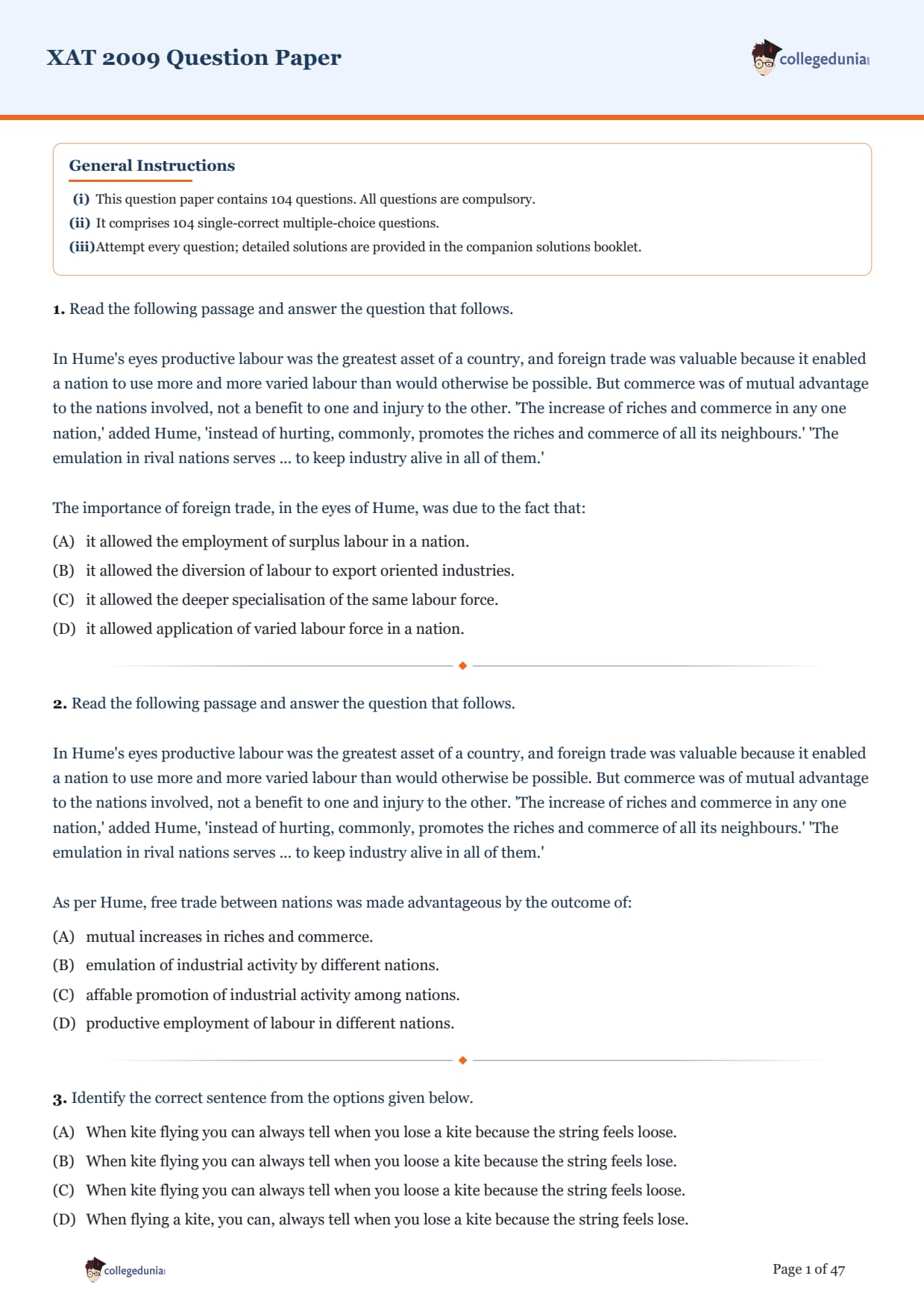
Read the following passage and answer the question that follows.
In Hume's eyes productive labour was the greatest asset of a country, and foreign trade was valuable because it enabled a nation to use more and more varied labour than would otherwise be possible. But commerce was of mutual advantage to the nations involved, not a benefit to one and injury to the other. 'The increase of riches and commerce in any one nation,' added Hume, 'instead of hurting, commonly, promotes the riches and commerce of all its neighbours.' 'The emulation in rival nations serves ... to keep industry alive in all of them.'
The importance of foreign trade, in the eyes of Hume, was due to the fact that:
Read the following passage and answer the question that follows.
In Hume's eyes productive labour was the greatest asset of a country, and foreign trade was valuable because it enabled a nation to use more and more varied labour than would otherwise be possible. But commerce was of mutual advantage to the nations involved, not a benefit to one and injury to the other. 'The increase of riches and commerce in any one nation,' added Hume, 'instead of hurting, commonly, promotes the riches and commerce of all its neighbours.' 'The emulation in rival nations serves ... to keep industry alive in all of them.'
As per Hume, free trade between nations was made advantageous by the outcome of:
Identify the correct sentence from the options given below.
Identify the correct sentence from the options given below.
Identify the correct sentence from the options given below.
Read the following passage and answer the question that follows.
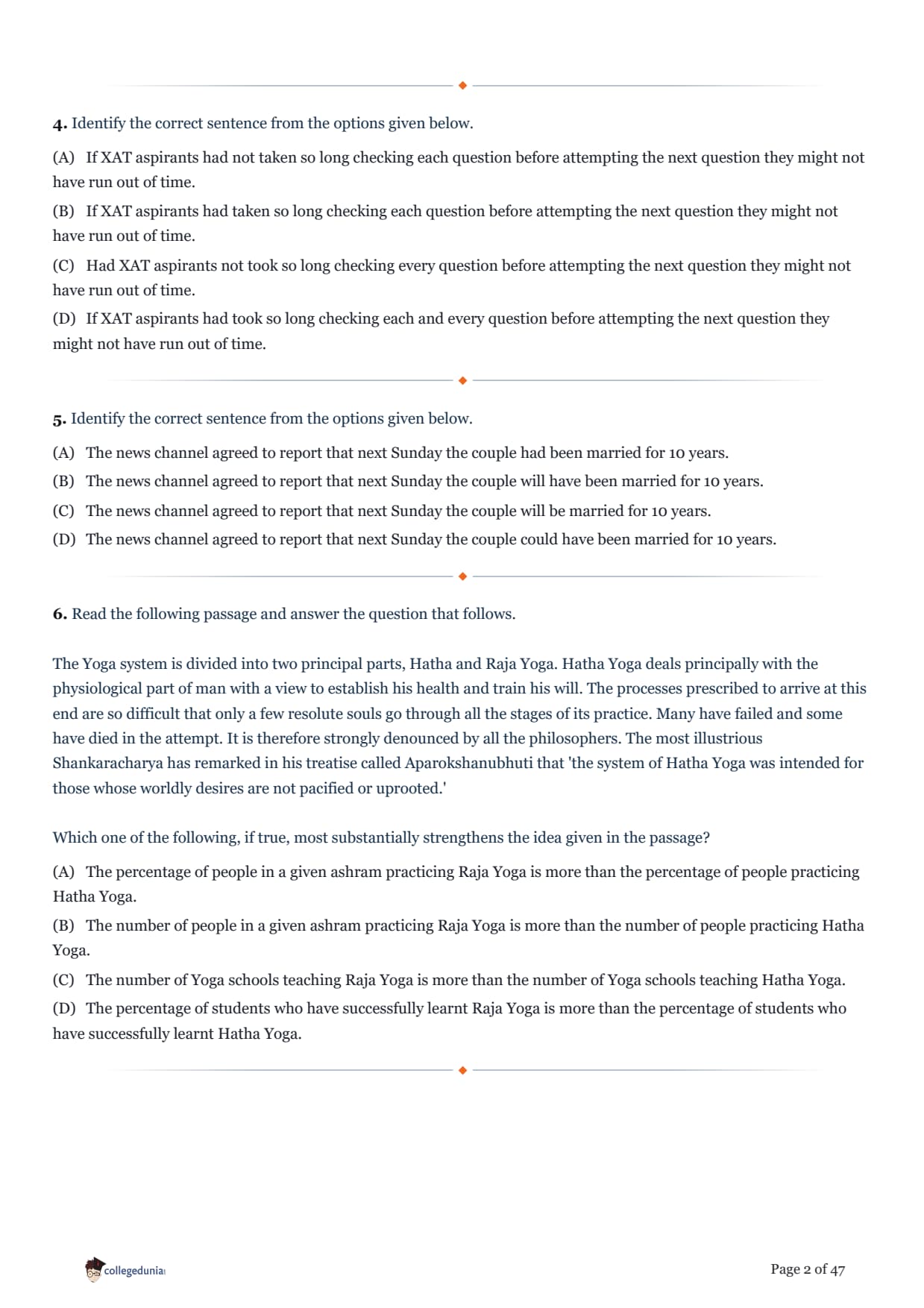
The Yoga system is divided into two principal parts, Hatha and Raja Yoga. Hatha Yoga deals principally with the physiological part of man with a view to establish his health and train his will. The processes prescribed to arrive at this end are so difficult that only a few resolute souls go through all the stages of its practice. Many have failed and some have died in the attempt. It is therefore strongly denounced by all the philosophers. The most illustrious Shankaracharya has remarked in his treatise called Aparokshanubhuti that 'the system of Hatha Yoga was intended for those whose worldly desires are not pacified or uprooted.'
Which one of the following, if true, most substantially strengthens the idea given in the passage?
Read the following passage and answer the question that follows.
The Yoga system is divided into two principal parts, Hatha and Raja Yoga. Hatha Yoga deals principally with the physiological part of man with a view to establish his health and train his will. The processes prescribed to arrive at this end are so difficult that only a few resolute souls go through all the stages of its practice. Many have failed and some have died in the attempt. It is therefore strongly denounced by all the philosophers. The most illustrious Shankaracharya has remarked in his treatise called Aparokshanubhuti that 'the system of Hatha Yoga was intended for those whose worldly desires are not pacified or uprooted.'
Which of the following options best reflects Shankaracharya's comments on Hatha Yoga?
Read the following passage and answer the question below.
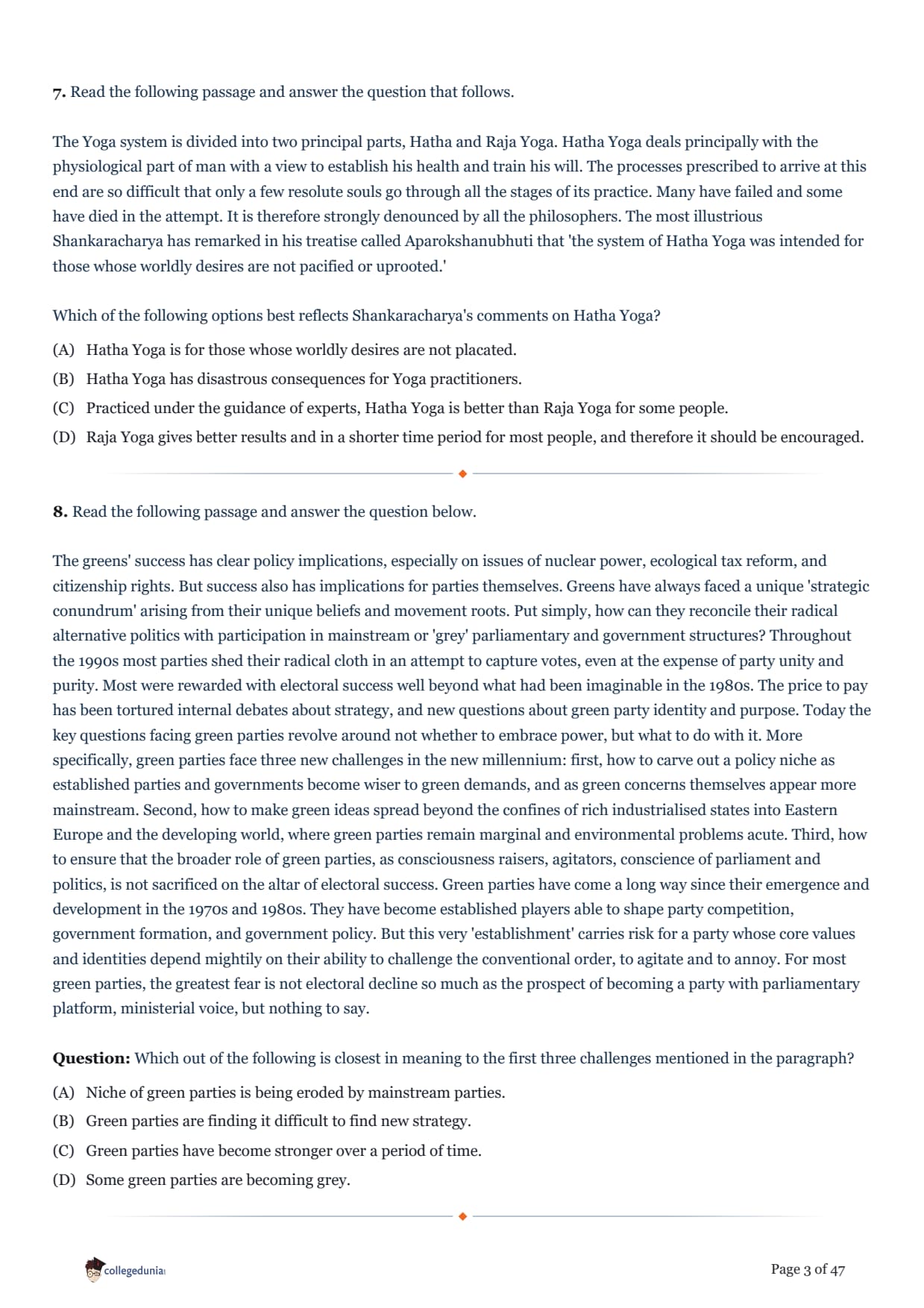
The greens' success has clear policy implications, especially on issues of nuclear power, ecological tax reform, and citizenship rights. But success also has implications for parties themselves. Greens have always faced a unique 'strategic conundrum' arising from their unique beliefs and movement roots. Put simply, how can they reconcile their radical alternative politics with participation in mainstream or 'grey' parliamentary and government structures? Throughout the 1990s most parties shed their radical cloth in an attempt to capture votes, even at the expense of party unity and purity. Most were rewarded with electoral success well beyond what had been imaginable in the 1980s. The price to pay has been tortured internal debates about strategy, and new questions about green party identity and purpose. Today the key questions facing green parties revolve around not whether to embrace power, but what to do with it. More specifically, green parties face three new challenges in the new millennium: first, how to carve out a policy niche as established parties and governments become wiser to green demands, and as green concerns themselves appear more mainstream. Second, how to make green ideas spread beyond the confines of rich industrialised states into Eastern Europe and the developing world, where green parties remain marginal and environmental problems acute. Third, how to ensure that the broader role of green parties, as consciousness raisers, agitators, conscience of parliament and politics, is not sacrificed on the altar of electoral success. Green parties have come a long way since their emergence and development in the 1970s and 1980s. They have become established players able to shape party competition, government formation, and government policy. But this very 'establishment' carries risk for a party whose core values and identities depend mightily on their ability to challenge the conventional order, to agitate and to annoy. For most green parties, the greatest fear is not electoral decline so much as the prospect of becoming a party with parliamentary platform, ministerial voice, but nothing to say.
Question: Which out of the following is closest in meaning to the first three challenges mentioned in the paragraph?
Read the following passage and answer the question below.
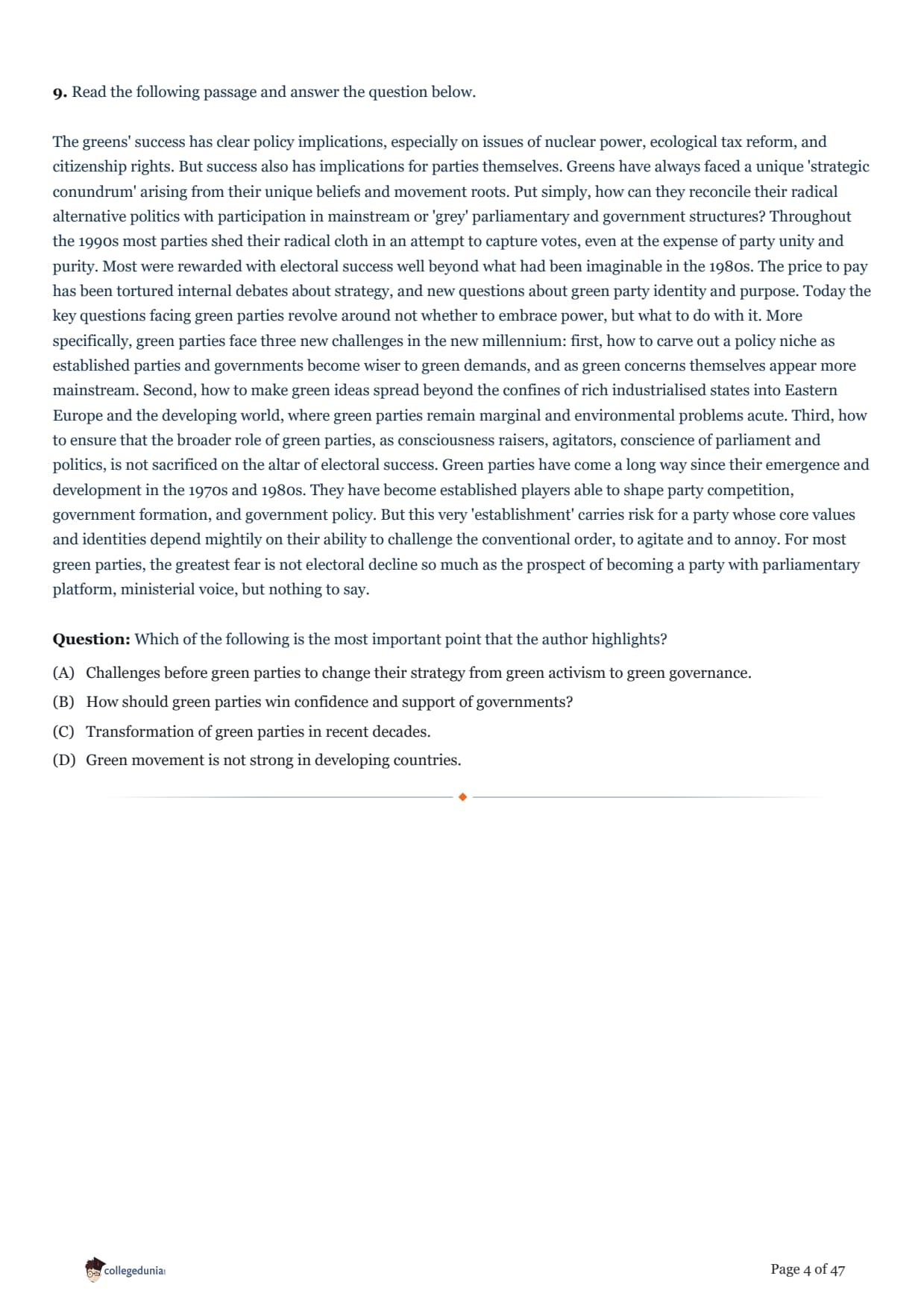
The greens' success has clear policy implications, especially on issues of nuclear power, ecological tax reform, and citizenship rights. But success also has implications for parties themselves. Greens have always faced a unique 'strategic conundrum' arising from their unique beliefs and movement roots. Put simply, how can they reconcile their radical alternative politics with participation in mainstream or 'grey' parliamentary and government structures? Throughout the 1990s most parties shed their radical cloth in an attempt to capture votes, even at the expense of party unity and purity. Most were rewarded with electoral success well beyond what had been imaginable in the 1980s. The price to pay has been tortured internal debates about strategy, and new questions about green party identity and purpose. Today the key questions facing green parties revolve around not whether to embrace power, but what to do with it. More specifically, green parties face three new challenges in the new millennium: first, how to carve out a policy niche as established parties and governments become wiser to green demands, and as green concerns themselves appear more mainstream. Second, how to make green ideas spread beyond the confines of rich industrialised states into Eastern Europe and the developing world, where green parties remain marginal and environmental problems acute. Third, how to ensure that the broader role of green parties, as consciousness raisers, agitators, conscience of parliament and politics, is not sacrificed on the altar of electoral success. Green parties have come a long way since their emergence and development in the 1970s and 1980s. They have become established players able to shape party competition, government formation, and government policy. But this very 'establishment' carries risk for a party whose core values and identities depend mightily on their ability to challenge the conventional order, to agitate and to annoy. For most green parties, the greatest fear is not electoral decline so much as the prospect of becoming a party with parliamentary platform, ministerial voice, but nothing to say.
Question: Which of the following is the most important point that the author highlights?
Read the following passage and answer the question below.
The greens' success has clear policy implications, especially on issues of nuclear power, ecological tax reform, and citizenship rights. But success also has implications for parties themselves. Greens have always faced a unique 'strategic conundrum' arising from their unique beliefs and movement roots. Put simply, how can they reconcile their radical alternative politics with participation in mainstream or 'grey' parliamentary and government structures? Throughout the 1990s most parties shed their radical cloth in an attempt to capture votes, even at the expense of party unity and purity. Most were rewarded with electoral success well beyond what had been imaginable in the 1980s. The price to pay has been tortured internal debates about strategy, and new questions about green party identity and purpose. Today the key questions facing green parties revolve around not whether to embrace power, but what to do with it. More specifically, green parties face three new challenges in the new millennium: first, how to carve out a policy niche as established parties and governments become wiser to green demands, and as green concerns themselves appear more mainstream. Second, how to make green ideas spread beyond the confines of rich industrialised states into Eastern Europe and the developing world, where green parties remain marginal and environmental problems acute. Third, how to ensure that the broader role of green parties, as consciousness raisers, agitators, conscience of parliament and politics, is not sacrificed on the altar of electoral success. Green parties have come a long way since their emergence and development in the 1970s and 1980s. They have become established players able to shape party competition, government formation, and government policy. But this very 'establishment' carries risk for a party whose core values and identities depend mightily on their ability to challenge the conventional order, to agitate and to annoy. For most green parties, the greatest fear is not electoral decline so much as the prospect of becoming a party with parliamentary platform, ministerial voice, but nothing to say.
Question: How best can mainstream political parties, in India, keep green parties at bay?
Read the following passage and answer the question below.
The Sapir-Whorf hypothesis, also known as the linguistic relativity hypothesis, refers to the proposal that the particular language one speaks influences the way one thinks about reality. The linguistic relativity hypothesis focuses on structural differences among natural languages such as Hopi, Chinese, and English, and asks whether the classifications of reality implicit in such structures affect our thinking about reality. Analytically, linguistic relativity as an issue stands between two others: a semiotic-level concern with how speaking any natural language whatsoever might influence the general potential for human thinking, and a functional or discourse-level concern with how using any given language code in a particular way might influence thinking, that is, the impact of special discursive practices such as schooling and literacy on formal thought. Although analytically distinct, the three issues are intimately related in both theory and practice. For example, claims about linguistic relativity depend on understanding the general psychological mechanisms linking language to thinking, and on understanding the diverse uses of speech in discourse to accomplish acts of descriptive reference. Hence, the relation of particular linguistic structures to patterns of thinking forms only one part of the broader array of questions about the significance of language for thought. Proposals of linguistic relativity necessarily develop two linked claims among the key terms of the hypothesis, language, thought, and reality. First, languages differ significantly in their interpretations of experienced reality, both what they select for representation and how they arrange it. Second, language interpretations have influences on thought about reality more generally, whether at the individual or cultural level. Claims for linguistic relativity thus require both articulating the contrasting interpretations of reality latent in the structures of different languages, and accessing their broader influences on, or relationships to, the cognitive interpretation of reality.
Question: Which of the following conclusions can be derived based on the Sapir-Whorf hypothesis?
Read the following passage and answer the question below.
The Sapir-Whorf hypothesis, also known as the linguistic relativity hypothesis, refers to the proposal that the particular language one speaks influences the way one thinks about reality. The linguistic relativity hypothesis focuses on structural differences among natural languages such as Hopi, Chinese, and English, and asks whether the classifications of reality implicit in such structures affect our thinking about reality. Analytically, linguistic relativity as an issue stands between two others: a semiotic-level concern with how speaking any natural language whatsoever might influence the general potential for human thinking, and a functional or discourse-level concern with how using any given language code in a particular way might influence thinking, that is, the impact of special discursive practices such as schooling and literacy on formal thought. Although analytically distinct, the three issues are intimately related in both theory and practice. For example, claims about linguistic relativity depend on understanding the general psychological mechanisms linking language to thinking, and on understanding the diverse uses of speech in discourse to accomplish acts of descriptive reference. Hence, the relation of particular linguistic structures to patterns of thinking forms only one part of the broader array of questions about the significance of language for thought. Proposals of linguistic relativity necessarily develop two linked claims among the key terms of the hypothesis, language, thought, and reality. First, languages differ significantly in their interpretations of experienced reality, both what they select for representation and how they arrange it. Second, language interpretations have influences on thought about reality more generally, whether at the individual or cultural level. Claims for linguistic relativity thus require both articulating the contrasting interpretations of reality latent in the structures of different languages, and accessing their broader influences on, or relationships to, the cognitive interpretation of reality.
Question: If the Sapir-Whorf hypothesis were to be true, which of the following conclusions would logically follow?
1. To develop vernacular languages, government should promote public debates and discourses.
2. Promote vernacular languages as medium of instruction in schools.
3. Cognitive and cultural realities are related.
Read the following passage and answer the question below.
The Sapir-Whorf hypothesis, also known as the linguistic relativity hypothesis, refers to the proposal that the particular language one speaks influences the way one thinks about reality. The linguistic relativity hypothesis focuses on structural differences among natural languages such as Hopi, Chinese, and English, and asks whether the classifications of reality implicit in such structures affect our thinking about reality. Analytically, linguistic relativity as an issue stands between two others: a semiotic-level concern with how speaking any natural language whatsoever might influence the general potential for human thinking, and a functional or discourse-level concern with how using any given language code in a particular way might influence thinking, that is, the impact of special discursive practices such as schooling and literacy on formal thought. Although analytically distinct, the three issues are intimately related in both theory and practice. For example, claims about linguistic relativity depend on understanding the general psychological mechanisms linking language to thinking, and on understanding the diverse uses of speech in discourse to accomplish acts of descriptive reference. Hence, the relation of particular linguistic structures to patterns of thinking forms only one part of the broader array of questions about the significance of language for thought. Proposals of linguistic relativity necessarily develop two linked claims among the key terms of the hypothesis, language, thought, and reality. First, languages differ significantly in their interpretations of experienced reality, both what they select for representation and how they arrange it. Second, language interpretations have influences on thought about reality more generally, whether at the individual or cultural level. Claims for linguistic relativity thus require both articulating the contrasting interpretations of reality latent in the structures of different languages, and accessing their broader influences on, or relationships to, the cognitive interpretation of reality.
Question: Which of the following proverbs may be false, if the above passage were to be right?
1. If speech is silver, silence is gold.
2. When you have spoken a word, it reigns over you. When it is unspoken you reign over it.
3. Speech of yourself ought to be seldom and well chosen.
Read the following passage and answer the question below.
Demography of organisations, also called population ecology, is an interesting field. It proposes that organisational mortality processes depend upon the age and size of the organisation, as well as on characteristics of populations and environments. Moreover, there is evidence of an imprinting process, meaning that environmental conditions at certain early phases in an organisation's development have long-term consequences. In particular, organisations subject to intense competition have elevated mortality hazards at all ages. A central theme is structural inertia, the tendency for organisations to respond slowly relative to the speed of environmental change. A central argument holds that the inertia derives from the very characteristics that make organisations favoured actors in modern society in terms of reliability and formal accountability. It follows that changes in an organisation's core features are disruptive and increase mortality hazards, at least in the short run. Research on this subject tends to support this view. The concept of niche provides a framework of relative environmental variations and competition to population dynamics and segmentation. Much empirical work examines the niches of organisational populations in terms of dimensions of social, political, and economic environments. Most research in this field builds on theories of resource partition and of density dependence. Resource-partitioning theory concerns the relationship between increasing market concentration and increasing proliferation of specialists in mature industries. The key implication of this theory concerns the effects of concentration on the viability of specialist organisations, those that seek to exploit a narrow range of resources. The theory of density-dependent organisational evolution synthesizes ecological and institutional processes. It holds that growth in the number of organisations in a population, density, drives processes of social legitimatisation and competition that, in turn, shape the vital rates.
Question: Most top-notch business consultants recommended changing the entire configuration of an organisation's strategy, structure and systems. If the ideas contained in the passage are agreed to, then such a recommendation:
Consider the following:
"Tata Steel, one of the biggest steel makers in the world, was born in Jamshedpur."
If the above passage is true, then it can be concluded that the location of Tata Steel has been one of the reasons for its success.
- The conclusion is false.
- This is a farfetched conclusion.
- This is a valid conclusion.
"Tata Steel, one of the biggest steel makers in the world, was born in Jamshedpur. The very success of Tata Steel could lead to its failure in the future and hence the challenge for Tata Steel is to recognise its strengths that make it successful in initial conditions and stick to them."
- This is a valid conclusion.
- The conclusion is contrary to the ideas described in the passage.
- This is an internally contradictory conclusion.
Recently it was reported that the Indian textile sector was not doing well. If the ideas contained in the passage are agreed to, then which of the following could be a possible reason?
- All Indian firms are as old as international firms.
- Indian textile firms are dispersed all over the country, with most of them also having an international presence.
- Textile firms in India were subjected to trade union activity in the period from the 1960s to the 1980s.
Read the following passage and answer the question below.
"Since power is itself a value, forms of influence which include power in their scope are usually themselves forms of power. The king's mistress, though she has only influence, not power, over the king, may have power over his subjects in the degree of that influence. Forms of influence based on power are themselves forms of power only if the scope of the influence is included within that of the power in question. The king may exercise influence over standards of morality, say, by virtue of his power position, but he does not necessarily exercise power over morality."
Which combination of the following statements best summarises the idea expressed in the paragraph?
- Strength of an influence determines its power.
- Influence always contributes power to the wielder of influence beyond the scope of influence.
- Proximity to authority is itself a source of power.
- Forms of influence are power only if they can influence behaviour.
"Since power is itself a value, forms of influence which include power in their scope are usually themselves forms of power. The king's mistress, though she has only influence, not power, over the king, may have power over his subjects in the degree of that influence. Forms of influence based on power are themselves forms of power only if the scope of the influence is included within that of the power in question. The king may exercise influence over standards of morality, say, by virtue of his power position, but he does not necessarily exercise power over morality."
Which of the following is similar to the ideas expressed in the paragraph?
As man casts off worn-out garments and puts on others which are new, similarly the embodied soul, casting off worn-out bodies, enters into others which are new. Of the following, which one best typifies the argument?
All the parliamentarians whom the reporter interviewed told that they had voted as per their conscience. Therefore, probably all the parliamentarians voted as per their conscience. This argument is an example of:
Nature lovers are attracted to forests and nature parks. Just look at the number of people visiting the Corbett national park.
Which of the following exhibits a pattern of reasoning least dissimilar to (that is, closest to) the one shown in the argument above?
In this era of global capital flows, so much money is now flowing through the world that no single country can fight inflation effectively by tightening its monetary policy.
If the above is true, which of the following could be most logically concluded?
Many entrepreneurs try to control the composition of their boards of directors, but more experienced entrepreneurs tend to share control, inviting participation from institutional investors and outside directors.
Which option best summarizes the idea that might be guiding experienced entrepreneurs' behaviour?
"There is nothing so stupid as an educated man, if you can get him off the thing he was educated in."
Which of the following, if true, most seriously undermines the author's contention?
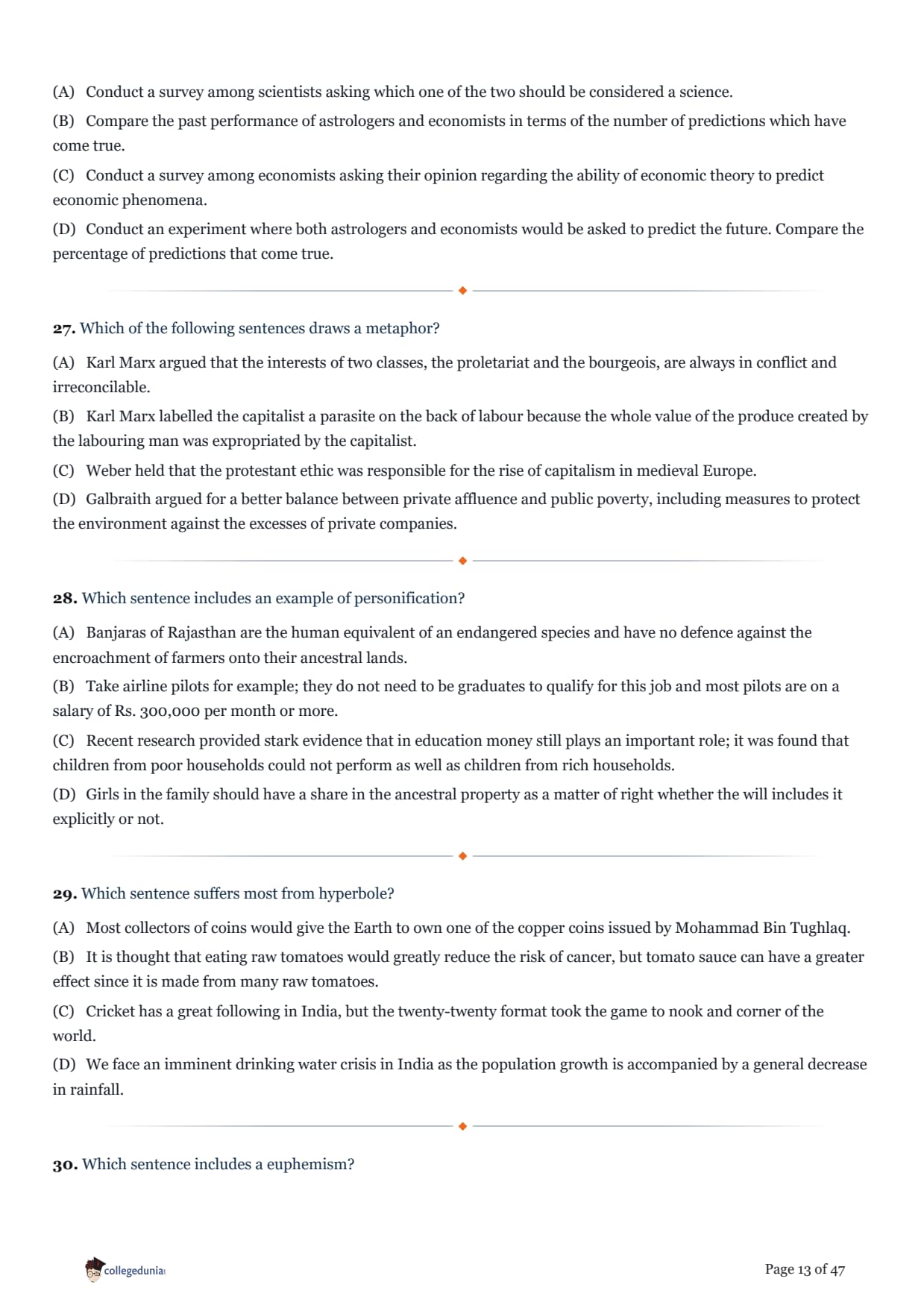
Ram, an economist, and Ramesh, an astrologer, had a debate. Ram said, "Astrology does not work. It just cannot predict." "It can predict better than your subject," rebutted Ramesh.
The evidence that best resolves the above debate will be:
Which of the following sentences draws a metaphor?
Which sentence includes an example of personification?
Which sentence suffers most from hyperbole?
Which sentence includes a euphemism?
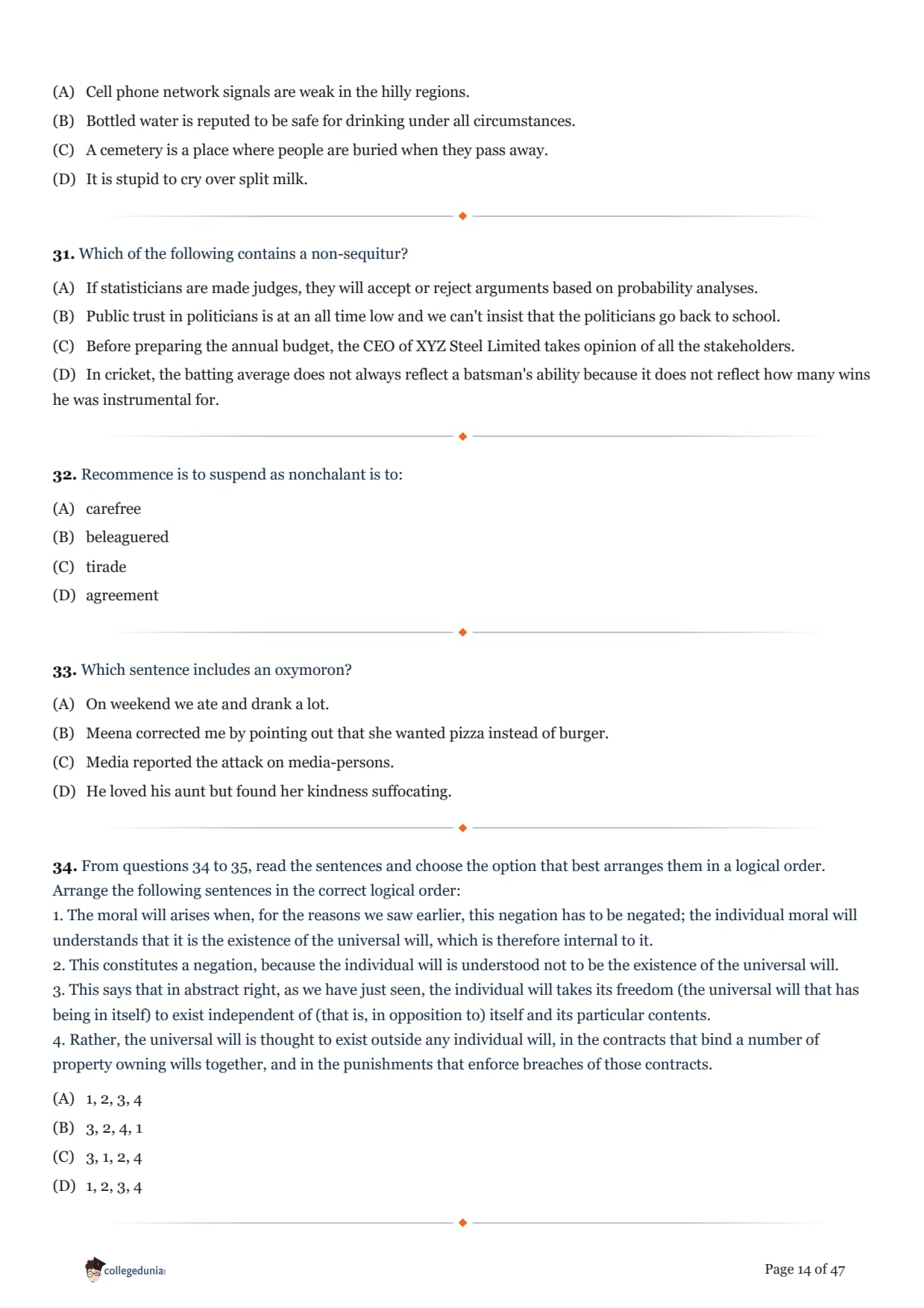
Which of the following contains a non-sequitur?
Recommence is to suspend as nonchalant is to:
Which sentence includes an oxymoron?
From questions 34 to 35, read the sentences and choose the option that best arranges them in a logical order.
Arrange the following sentences in the correct logical order:
1. The moral will arises when, for the reasons we saw earlier, this negation has to be negated; the individual moral will understands that it is the existence of the universal will, which is therefore internal to it.
2. This constitutes a negation, because the individual will is understood not to be the existence of the universal will.
3. This says that in abstract right, as we have just seen, the individual will takes its freedom (the universal will that has being in itself) to exist independent of (that is, in opposition to) itself and its particular contents.
4. Rather, the universal will is thought to exist outside any individual will, in the contracts that bind a number of property owning wills together, and in the punishments that enforce breaches of those contracts.
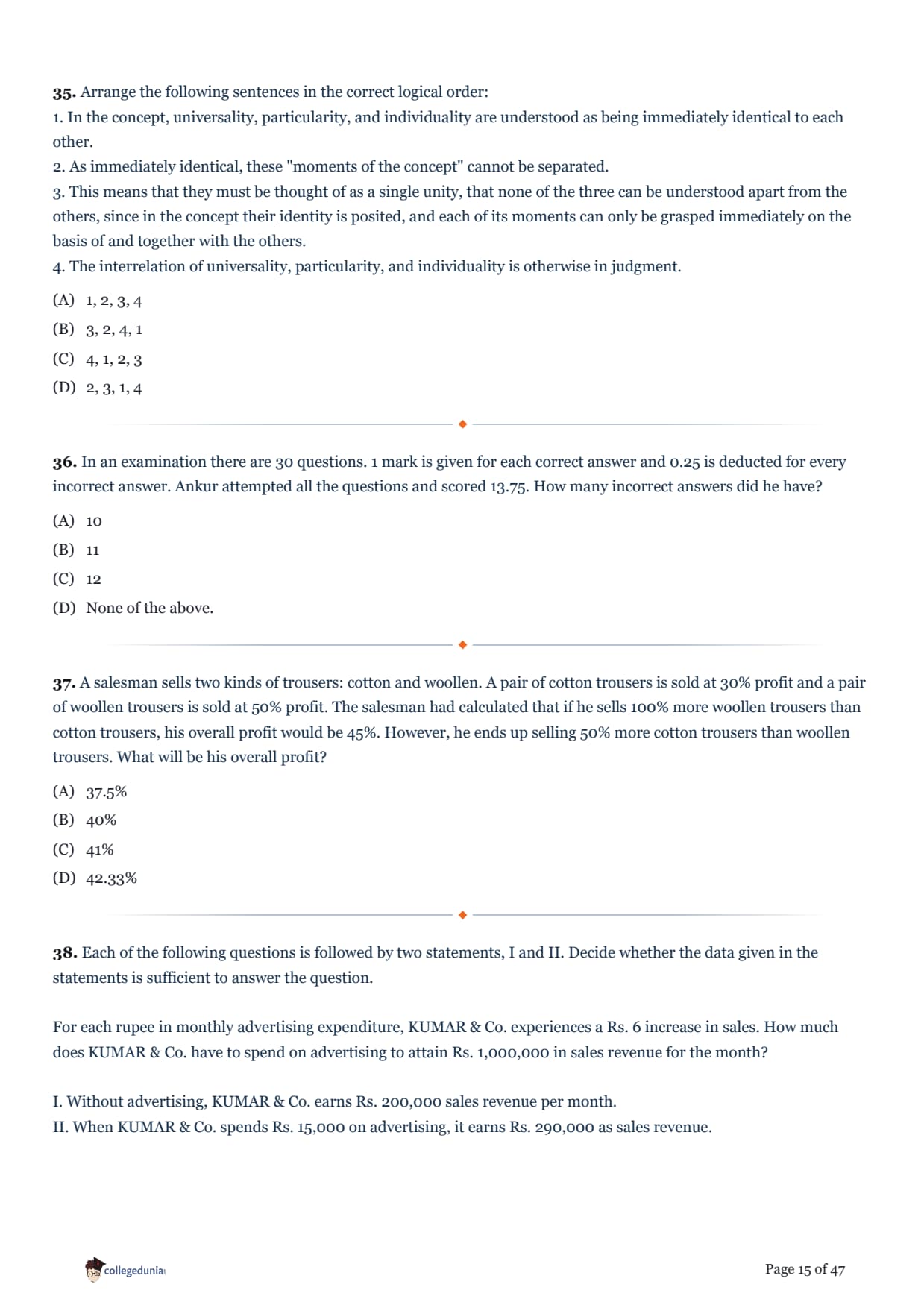
Arrange the following sentences in the correct logical order:
1. In the concept, universality, particularity, and individuality are understood as being immediately identical to each other.
2. As immediately identical, these "moments of the concept" cannot be separated.
3. This means that they must be thought of as a single unity, that none of the three can be understood apart from the others, since in the concept their identity is posited, and each of its moments can only be grasped immediately on the basis of and together with the others.
4. The interrelation of universality, particularity, and individuality is otherwise in judgment.
In an examination there are 30 questions. 1 mark is given for each correct answer and 0.25 is deducted for every incorrect answer. Ankur attempted all the questions and scored 13.75. How many incorrect answers did he have?
A salesman sells two kinds of trousers: cotton and woollen. A pair of cotton trousers is sold at 30% profit and a pair of woollen trousers is sold at 50% profit. The salesman had calculated that if he sells 100% more woollen trousers than cotton trousers, his overall profit would be 45%. However, he ends up selling 50% more cotton trousers than woollen trousers. What will be his overall profit?
Each of the following questions is followed by two statements, I and II. Decide whether the data given in the statements is sufficient to answer the question.
For each rupee in monthly advertising expenditure, KUMAR & Co. experiences a Rs. 6 increase in sales. How much does KUMAR & Co. have to spend on advertising to attain Rs. 1,000,000 in sales revenue for the month?
I. Without advertising, KUMAR & Co. earns Rs. 200,000 sales revenue per month.
II. When KUMAR & Co. spends Rs. 15,000 on advertising, it earns Rs. 290,000 as sales revenue.
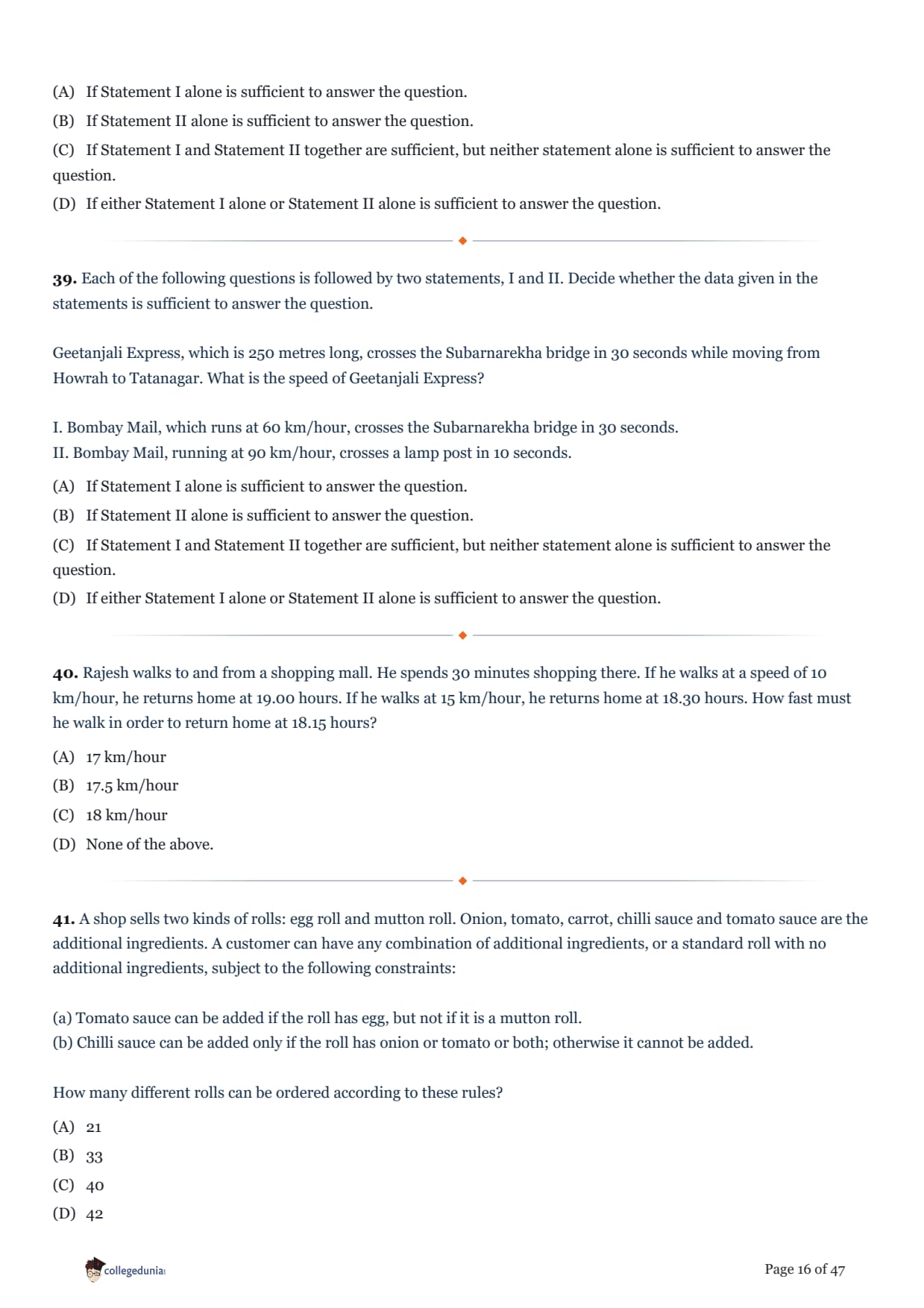
Each of the following questions is followed by two statements, I and II. Decide whether the data given in the statements is sufficient to answer the question.
Geetanjali Express, which is 250 metres long, crosses the Subarnarekha bridge in 30 seconds while moving from Howrah to Tatanagar. What is the speed of Geetanjali Express?
I. Bombay Mail, which runs at 60 km/hour, crosses the Subarnarekha bridge in 30 seconds.
II. Bombay Mail, running at 90 km/hour, crosses a lamp post in 10 seconds.
Rajesh walks to and from a shopping mall. He spends 30 minutes shopping there. If he walks at a speed of 10 km/hour, he returns home at 19.00 hours. If he walks at 15 km/hour, he returns home at 18.30 hours. How fast must he walk in order to return home at 18.15 hours?
A shop sells two kinds of rolls: egg roll and mutton roll. Onion, tomato, carrot, chilli sauce and tomato sauce are the additional ingredients. A customer can have any combination of additional ingredients, or a standard roll with no additional ingredients, subject to the following constraints:
(a) Tomato sauce can be added if the roll has egg, but not if it is a mutton roll.
(b) Chilli sauce can be added only if the roll has onion or tomato or both; otherwise it cannot be added.
How many different rolls can be ordered according to these rules?
Given five points A = (7, 4), B = (-10, 0), C = (-10, 3), D = (0, 10) and E = (7, 7). Every second, all the points move by halving their abscissas (x-coordinates) and doubling their ordinates (y-coordinates). This process continues for 500 years. After 500 years, which two points are closest?
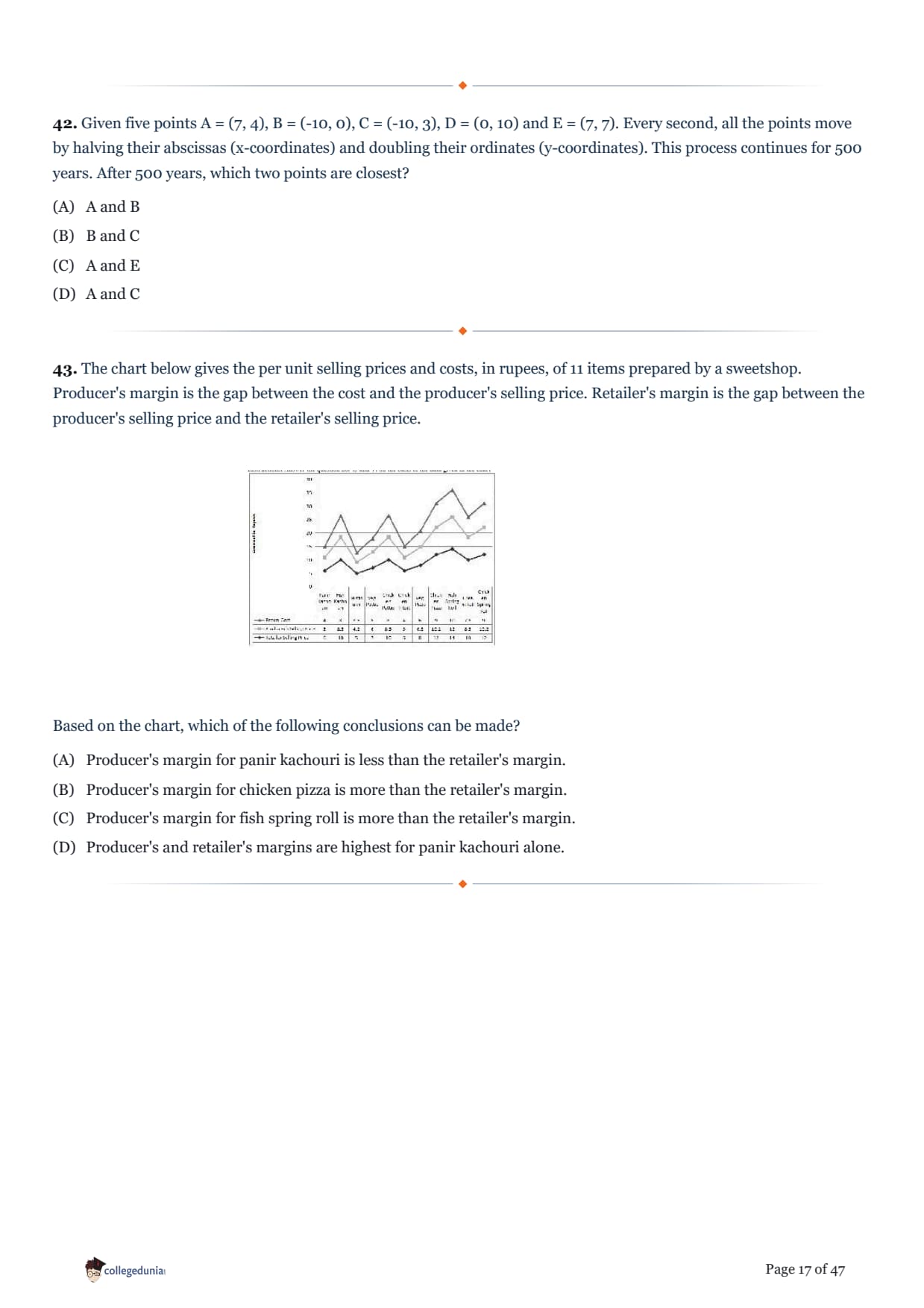
The chart below gives the per unit selling prices and costs, in rupees, of 11 items prepared by a sweetshop. Producer's margin is the gap between the cost and the producer's selling price. Retailer's margin is the gap between the producer's selling price and the retailer's selling price.

Based on the chart, which of the following conclusions can be made?
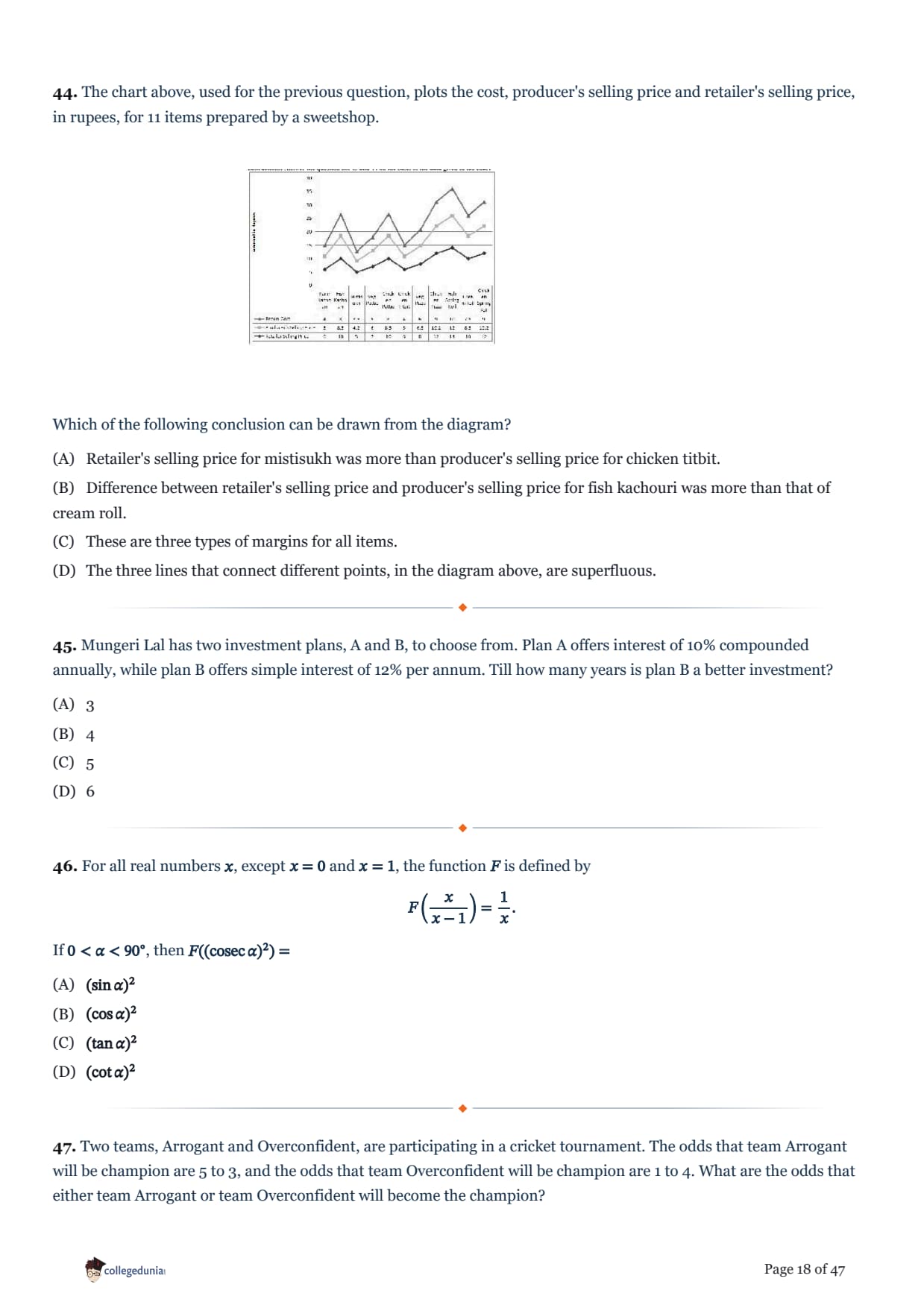
The chart above, used for the previous question, plots the cost, producer's selling price and retailer's selling price, in rupees, for 11 items prepared by a sweetshop.

Which of the following conclusion can be drawn from the diagram?
Mungeri Lal has two investment plans, A and B, to choose from. Plan A offers interest of 10% compounded annually, while plan B offers simple interest of 12% per annum. Till how many years is plan B a better investment?
For all real numbers \(x\), except \(x = 0\) and \(x = 1\), the function \(F\) is defined by \[ F\left(\frac{x}{x-1}\right) = \frac{1}{x}. \] If \(0 < \alpha < 90^{\circ}\), then \(F((\text{cosec}\,\alpha)^2) =\)
Two teams, Arrogant and Overconfident, are participating in a cricket tournament. The odds that team Arrogant will be champion are 5 to 3, and the odds that team Overconfident will be champion are 1 to 4. What are the odds that either team Arrogant or team Overconfident will become the champion?
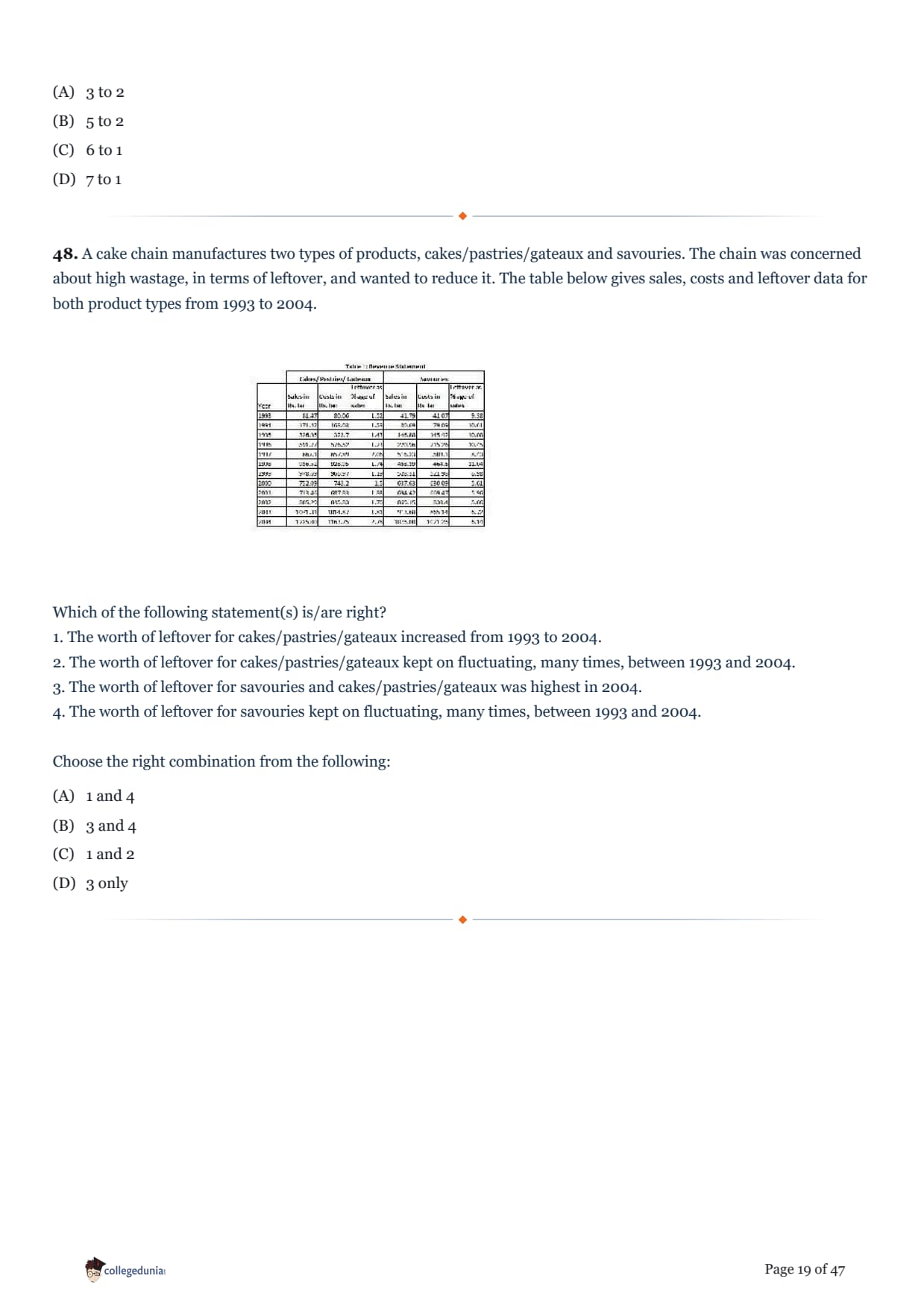
A cake chain manufactures two types of products, cakes/pastries/gateaux and savouries. The chain was concerned about high wastage, in terms of leftover, and wanted to reduce it. The table below gives sales, costs and leftover data for both product types from 1993 to 2004.

Which of the following statement(s) is/are right?
1. The worth of leftover for cakes/pastries/gateaux increased from 1993 to 2004.
2. The worth of leftover for cakes/pastries/gateaux kept on fluctuating, many times, between 1993 and 2004.
3. The worth of leftover for savouries and cakes/pastries/gateaux was highest in 2004.
4. The worth of leftover for savouries kept on fluctuating, many times, between 1993 and 2004.
Choose the right combination from the following:
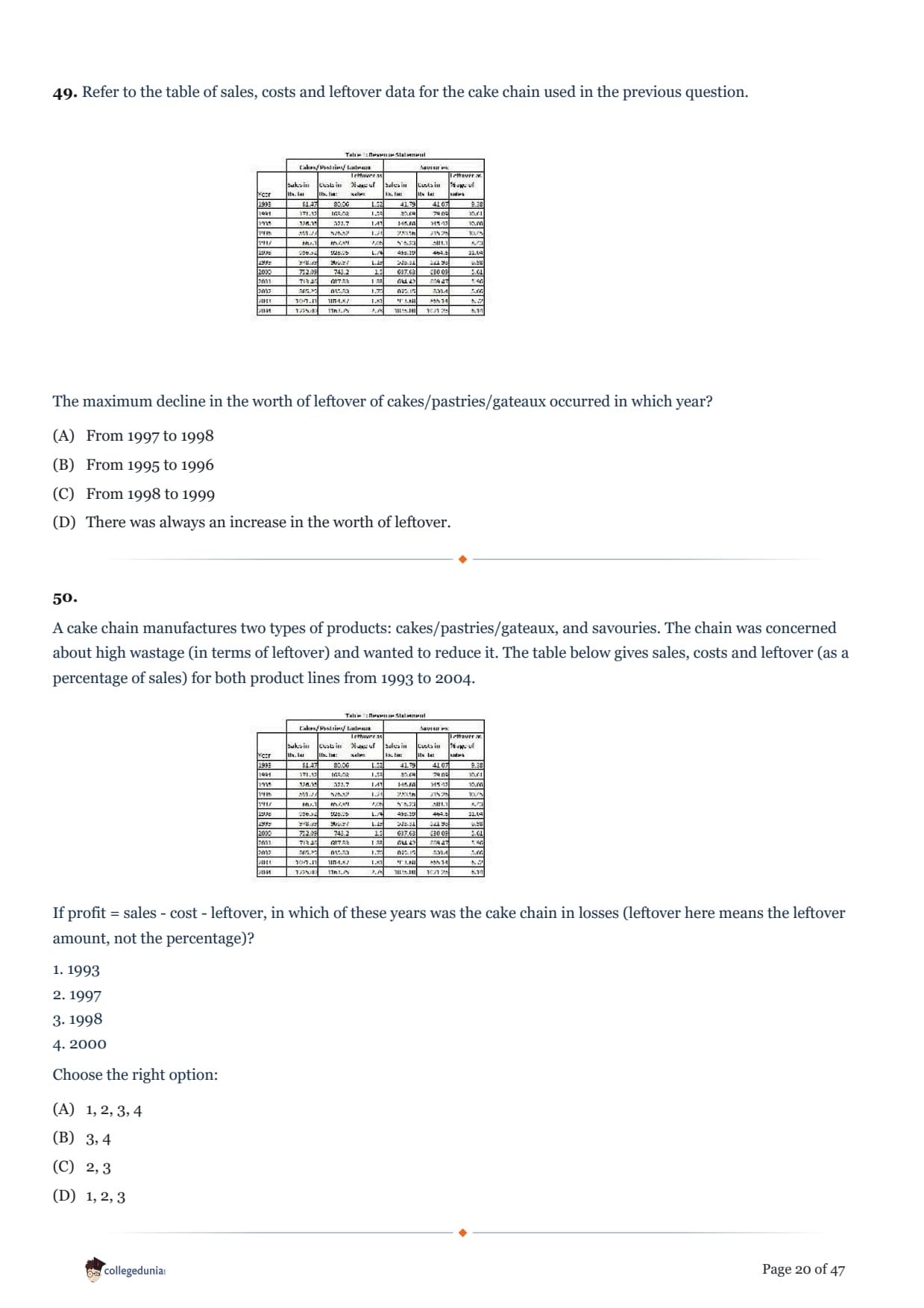
Refer to the table of sales, costs and leftover data for the cake chain used in the previous question.

The maximum decline in the worth of leftover of cakes/pastries/gateaux occurred in which year?
A cake chain manufactures two types of products: cakes/pastries/gateaux, and savouries. The chain was concerned about high wastage (in terms of leftover) and wanted to reduce it. The table below gives sales, costs and leftover (as a percentage of sales) for both product lines from 1993 to 2004.

If profit = sales - cost - leftover, in which of these years was the cake chain in losses (leftover here means the leftover amount, not the percentage)?
1. 1993
2. 1997
3. 1998
4. 2000
Choose the right option:
Let \(a\) and \(b\) be the roots of the quadratic equation \(x^2 + 3x - 1 = 0\). If \(P_n = a^n + b^n\) for \(n \geq 0\), then for \(n \geq 2\), \(P_n =\)
A rural child specialist has to find the weight of five children of different ages. He knows from past experience that each of the children weighs less than 30 Kg, and all five weigh different amounts. Unfortunately, the scale available in the village can measure weight only over 30 Kg, so the doctor decides to weigh the children in pairs. His new assistant weighed the children without noting down the names. The ten weights recorded were: 35, 36, 37, 39, 40, 41, 42, 45, 46 and 47 Kg. The weight of the lightest child is:
Sangeeta and Swati bought two wristwatches from Jamshedpur Electronics at 11:40 AM IST. After buying them, they found that when 60 minutes pass on a correct clock (IST), Sangeeta's wristwatch registers 62 minutes, while Swati's wristwatch registers 56 minutes. Later that day, Sangeeta's wristwatch reads 10:00 PM. What time does Swati's wristwatch show at that moment?
F(x) is a fourth-order polynomial with integer coefficients and no common factor among the coefficients. The roots of F(x) are -2, -1, 1 and 2. If p is a prime number greater than 97, then the largest integer that divides F(p) for all such values of p is:
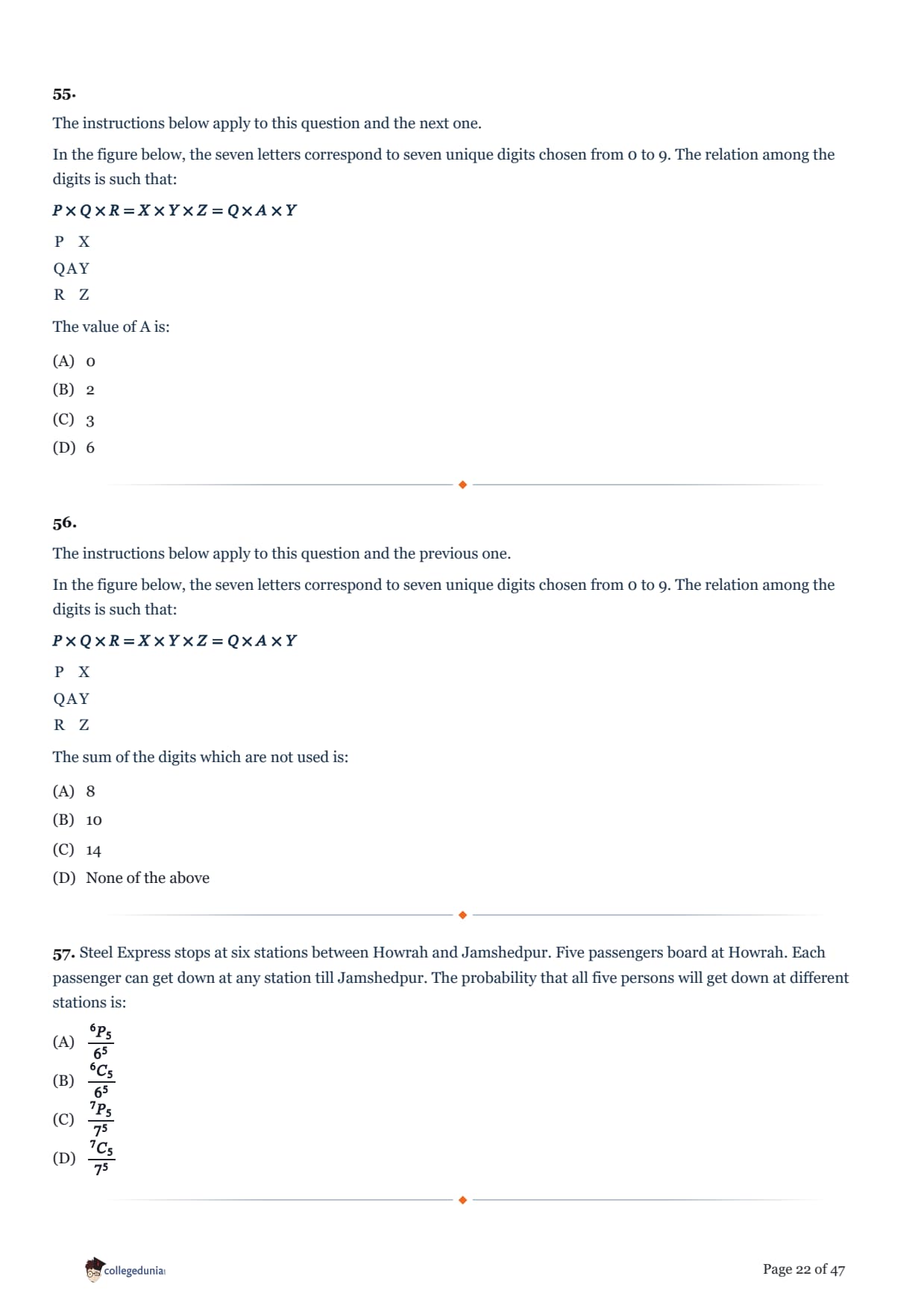
The instructions below apply to this question and the next one.
In the figure below, the seven letters correspond to seven unique digits chosen from 0 to 9. The relation among the digits is such that:
\(P \times Q \times R = X \times Y \times Z = Q \times A \times Y\)
| P | X | |
| Q | A | Y |
| R | Z |
The value of A is:
The instructions below apply to this question and the previous one.
In the figure below, the seven letters correspond to seven unique digits chosen from 0 to 9. The relation among the digits is such that:
\(P \times Q \times R = X \times Y \times Z = Q \times A \times Y\)
| P | X | |
| Q | A | Y |
| R | Z |
The sum of the digits which are not used is:
Steel Express stops at six stations between Howrah and Jamshedpur. Five passengers board at Howrah. Each passenger can get down at any station till Jamshedpur. The probability that all five persons will get down at different stations is:
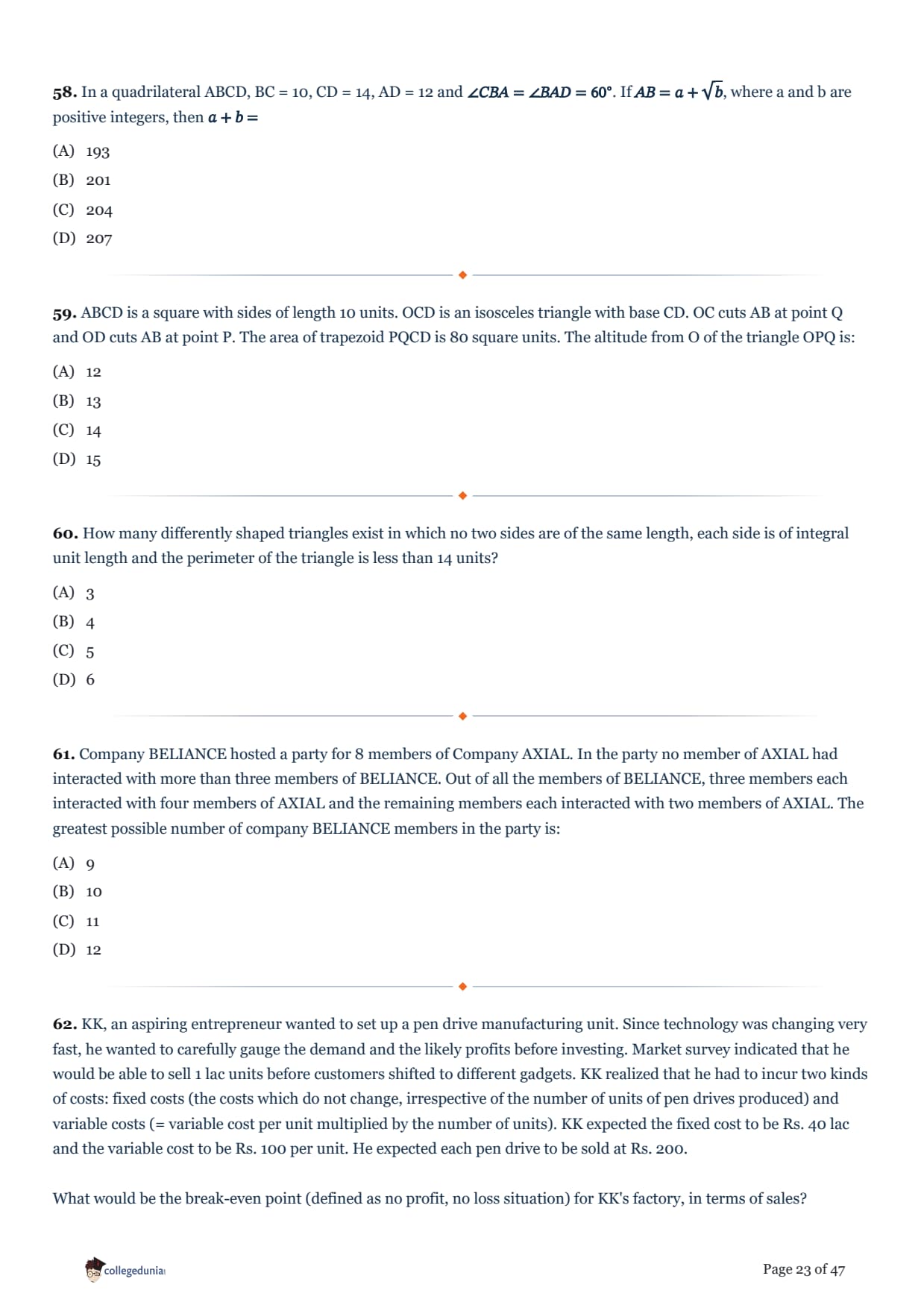
In a quadrilateral ABCD, BC = 10, CD = 14, AD = 12 and \(\angle CBA = \angle BAD = 60^{\circ}\). If \(AB = a + \sqrt{b}\), where a and b are positive integers, then \(a + b =\)
ABCD is a square with sides of length 10 units. OCD is an isosceles triangle with base CD. OC cuts AB at point Q and OD cuts AB at point P. The area of trapezoid PQCD is 80 square units. The altitude from O of the triangle OPQ is:
How many differently shaped triangles exist in which no two sides are of the same length, each side is of integral unit length and the perimeter of the triangle is less than 14 units?
Company BELIANCE hosted a party for 8 members of Company AXIAL. In the party no member of AXIAL had interacted with more than three members of BELIANCE. Out of all the members of BELIANCE, three members each interacted with four members of AXIAL and the remaining members each interacted with two members of AXIAL. The greatest possible number of company BELIANCE members in the party is:
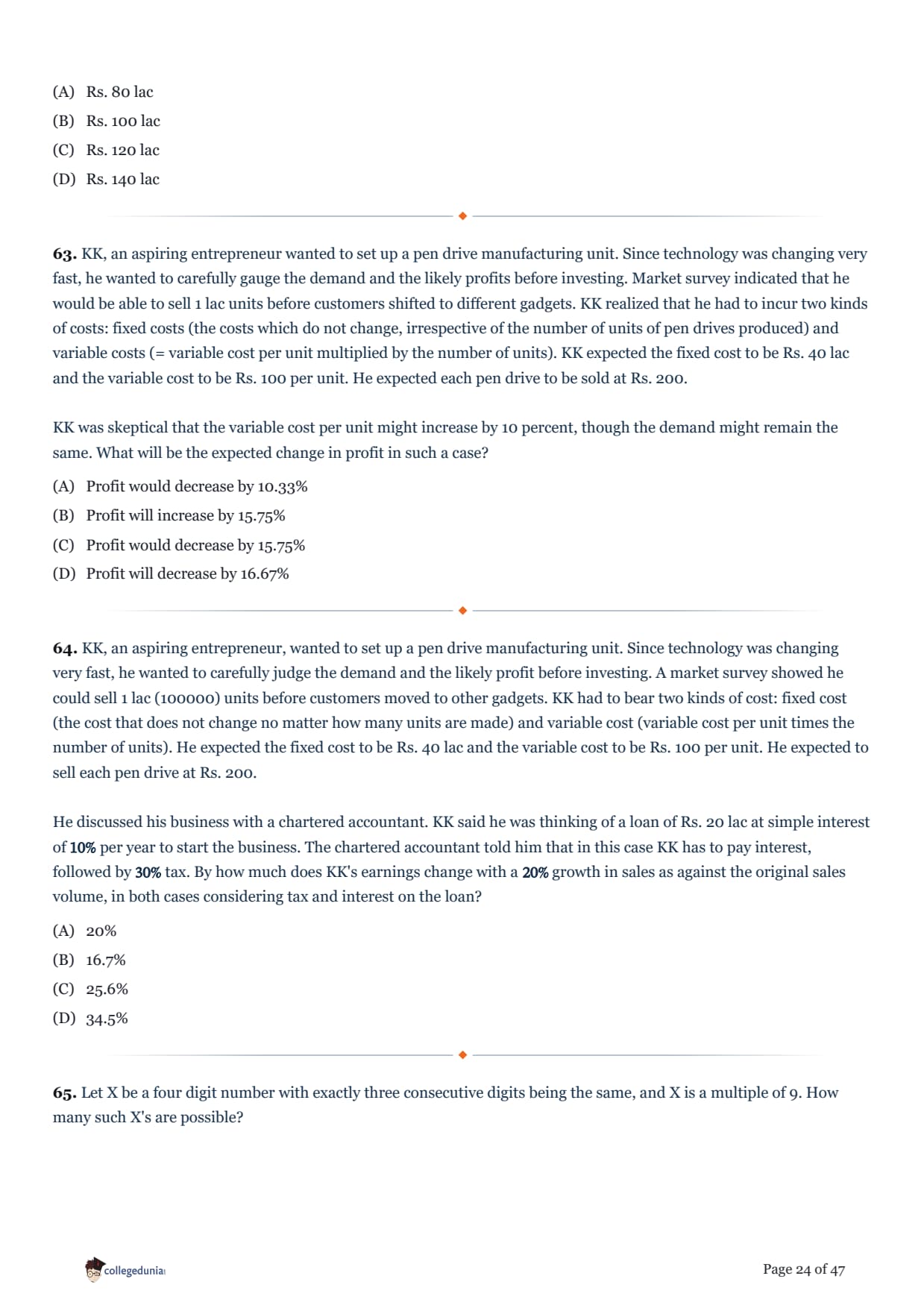
KK, an aspiring entrepreneur wanted to set up a pen drive manufacturing unit. Since technology was changing very fast, he wanted to carefully gauge the demand and the likely profits before investing. Market survey indicated that he would be able to sell 1 lac units before customers shifted to different gadgets. KK realized that he had to incur two kinds of costs: fixed costs (the costs which do not change, irrespective of the number of units of pen drives produced) and variable costs (= variable cost per unit multiplied by the number of units). KK expected the fixed cost to be Rs. 40 lac and the variable cost to be Rs. 100 per unit. He expected each pen drive to be sold at Rs. 200.
What would be the break-even point (defined as no profit, no loss situation) for KK's factory, in terms of sales?
KK, an aspiring entrepreneur wanted to set up a pen drive manufacturing unit. Since technology was changing very fast, he wanted to carefully gauge the demand and the likely profits before investing. Market survey indicated that he would be able to sell 1 lac units before customers shifted to different gadgets. KK realized that he had to incur two kinds of costs: fixed costs (the costs which do not change, irrespective of the number of units of pen drives produced) and variable costs (= variable cost per unit multiplied by the number of units). KK expected the fixed cost to be Rs. 40 lac and the variable cost to be Rs. 100 per unit. He expected each pen drive to be sold at Rs. 200.
KK was skeptical that the variable cost per unit might increase by 10 percent, though the demand might remain the same. What will be the expected change in profit in such a case?
KK, an aspiring entrepreneur, wanted to set up a pen drive manufacturing unit. Since technology was changing very fast, he wanted to carefully judge the demand and the likely profit before investing. A market survey showed he could sell 1 lac (100000) units before customers moved to other gadgets. KK had to bear two kinds of cost: fixed cost (the cost that does not change no matter how many units are made) and variable cost (variable cost per unit times the number of units). He expected the fixed cost to be Rs. 40 lac and the variable cost to be Rs. 100 per unit. He expected to sell each pen drive at Rs. 200.
He discussed his business with a chartered accountant. KK said he was thinking of a loan of Rs. 20 lac at simple interest of \(10\%\) per year to start the business. The chartered accountant told him that in this case KK has to pay interest, followed by \(30\%\) tax. By how much does KK's earnings change with a \(20\%\) growth in sales as against the original sales volume, in both cases considering tax and interest on the loan?
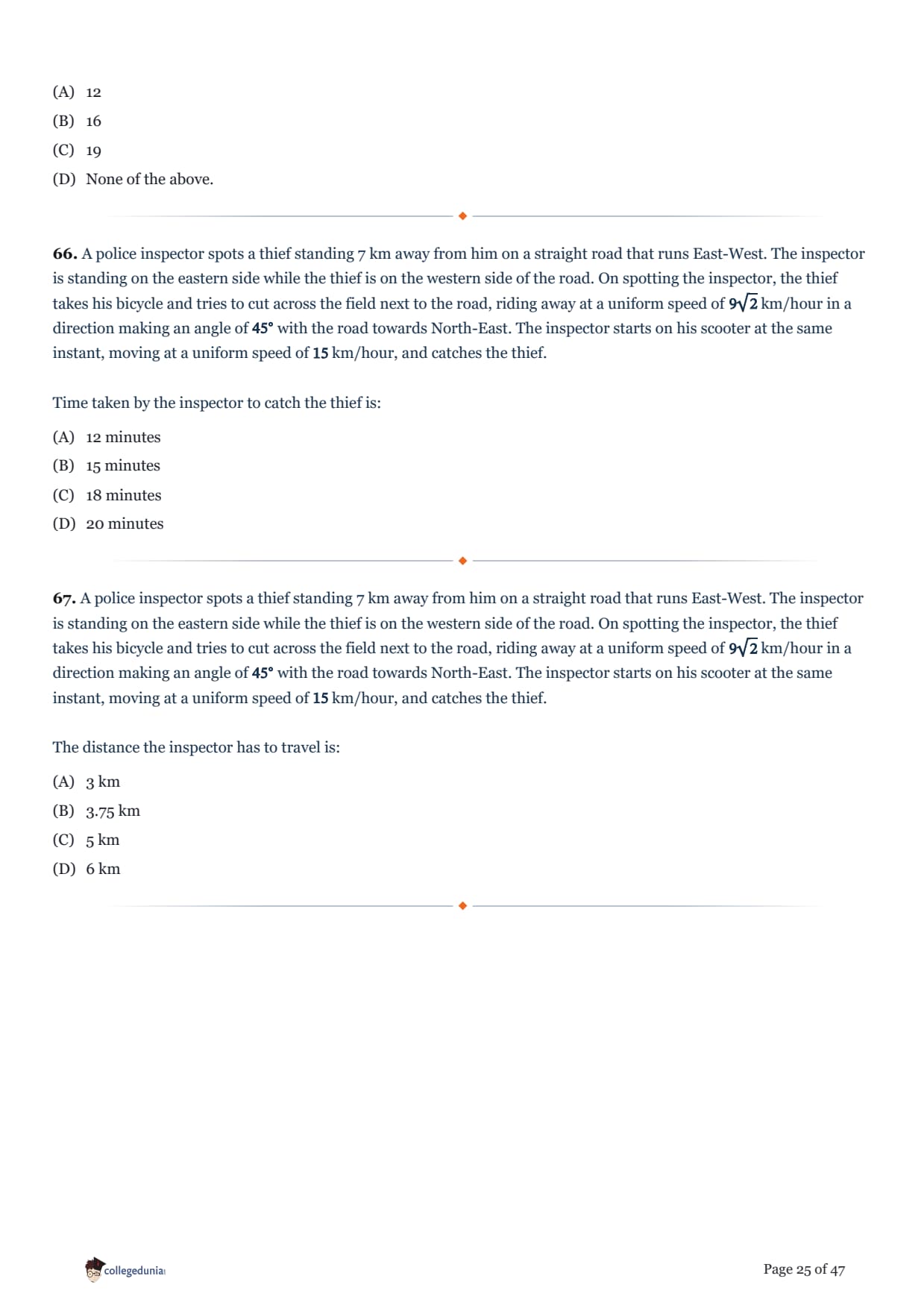
Let X be a four digit number with exactly three consecutive digits being the same, and X is a multiple of 9. How many such X's are possible?
A police inspector spots a thief standing 7 km away from him on a straight road that runs East-West. The inspector is standing on the eastern side while the thief is on the western side of the road. On spotting the inspector, the thief takes his bicycle and tries to cut across the field next to the road, riding away at a uniform speed of \(9\sqrt{2}\) km/hour in a direction making an angle of \(45^{\circ}\) with the road towards North-East. The inspector starts on his scooter at the same instant, moving at a uniform speed of \(15\) km/hour, and catches the thief.
Time taken by the inspector to catch the thief is:
A police inspector spots a thief standing 7 km away from him on a straight road that runs East-West. The inspector is standing on the eastern side while the thief is on the western side of the road. On spotting the inspector, the thief takes his bicycle and tries to cut across the field next to the road, riding away at a uniform speed of \(9\sqrt{2}\) km/hour in a direction making an angle of \(45^{\circ}\) with the road towards North-East. The inspector starts on his scooter at the same instant, moving at a uniform speed of \(15\) km/hour, and catches the thief.
The distance the inspector has to travel is:
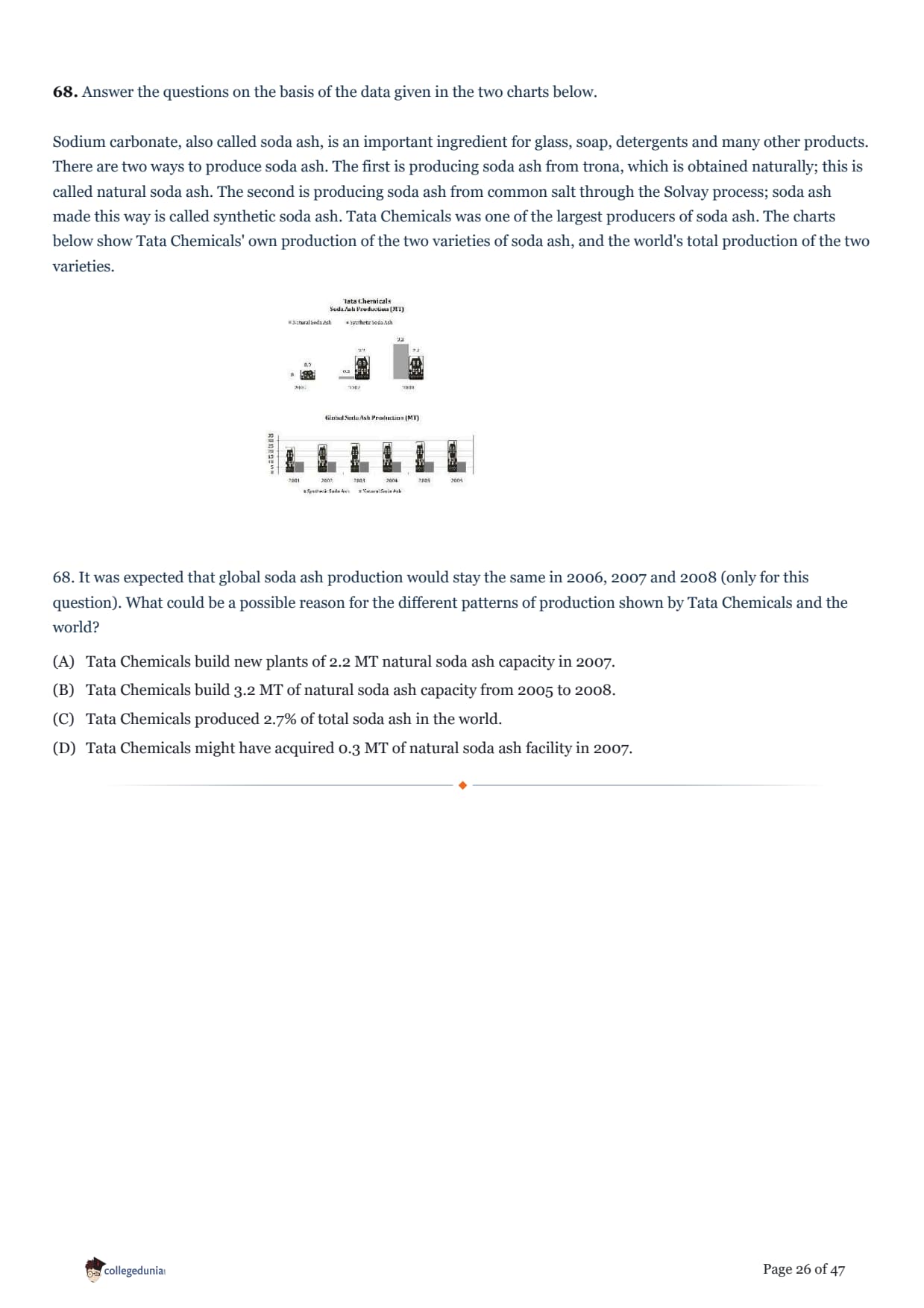
Answer the questions on the basis of the data given in the two charts below.
Sodium carbonate, also called soda ash, is an important ingredient for glass, soap, detergents and many other products. There are two ways to produce soda ash. The first is producing soda ash from trona, which is obtained naturally; this is called natural soda ash. The second is producing soda ash from common salt through the Solvay process; soda ash made this way is called synthetic soda ash. Tata Chemicals was one of the largest producers of soda ash. The charts below show Tata Chemicals' own production of the two varieties of soda ash, and the world's total production of the two varieties.

68. It was expected that global soda ash production would stay the same in 2006, 2007 and 2008 (only for this question). What could be a possible reason for the different patterns of production shown by Tata Chemicals and the world?
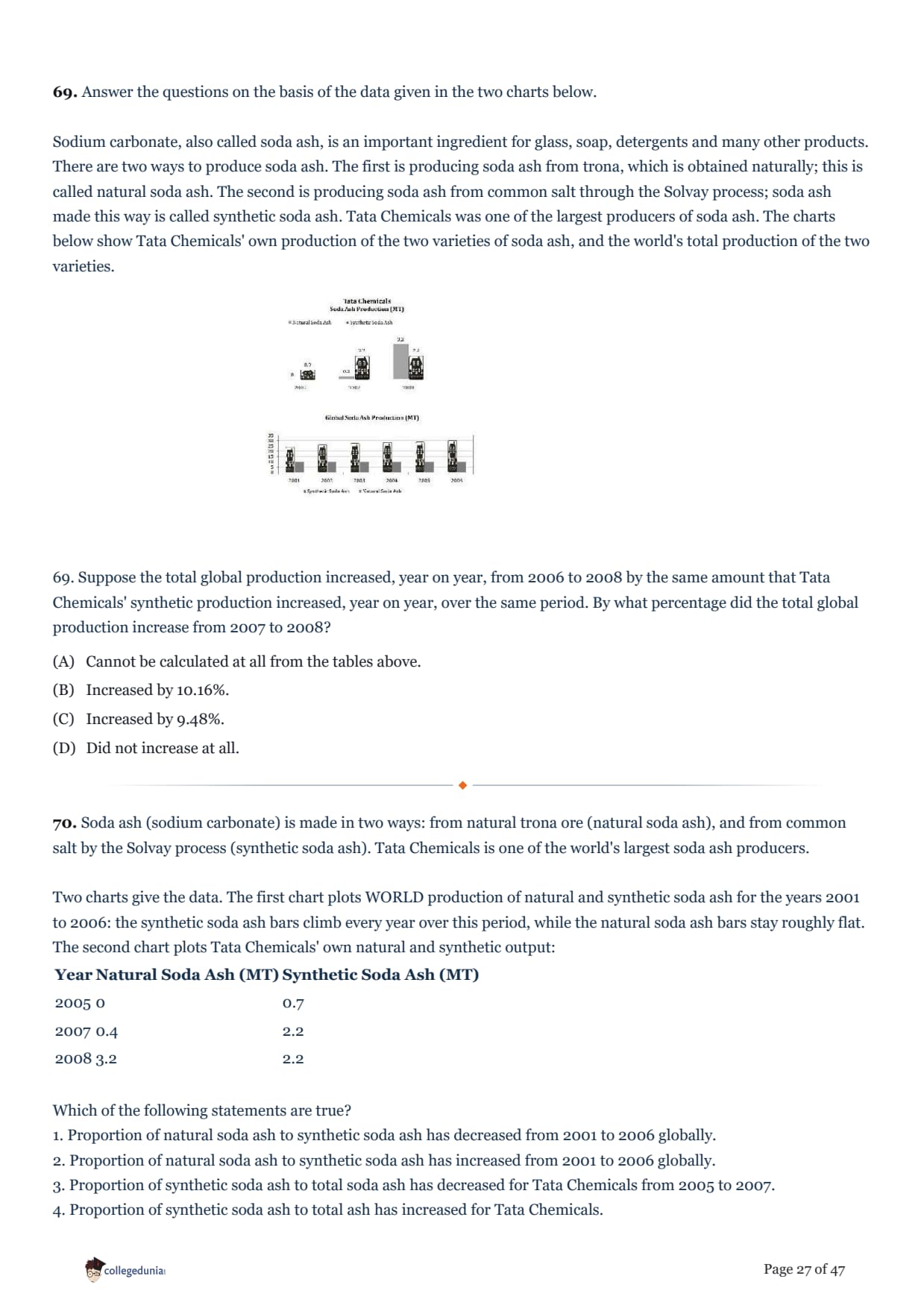
Answer the questions on the basis of the data given in the two charts below.
Sodium carbonate, also called soda ash, is an important ingredient for glass, soap, detergents and many other products. There are two ways to produce soda ash. The first is producing soda ash from trona, which is obtained naturally; this is called natural soda ash. The second is producing soda ash from common salt through the Solvay process; soda ash made this way is called synthetic soda ash. Tata Chemicals was one of the largest producers of soda ash. The charts below show Tata Chemicals' own production of the two varieties of soda ash, and the world's total production of the two varieties.

69. Suppose the total global production increased, year on year, from 2006 to 2008 by the same amount that Tata Chemicals' synthetic production increased, year on year, over the same period. By what percentage did the total global production increase from 2007 to 2008?
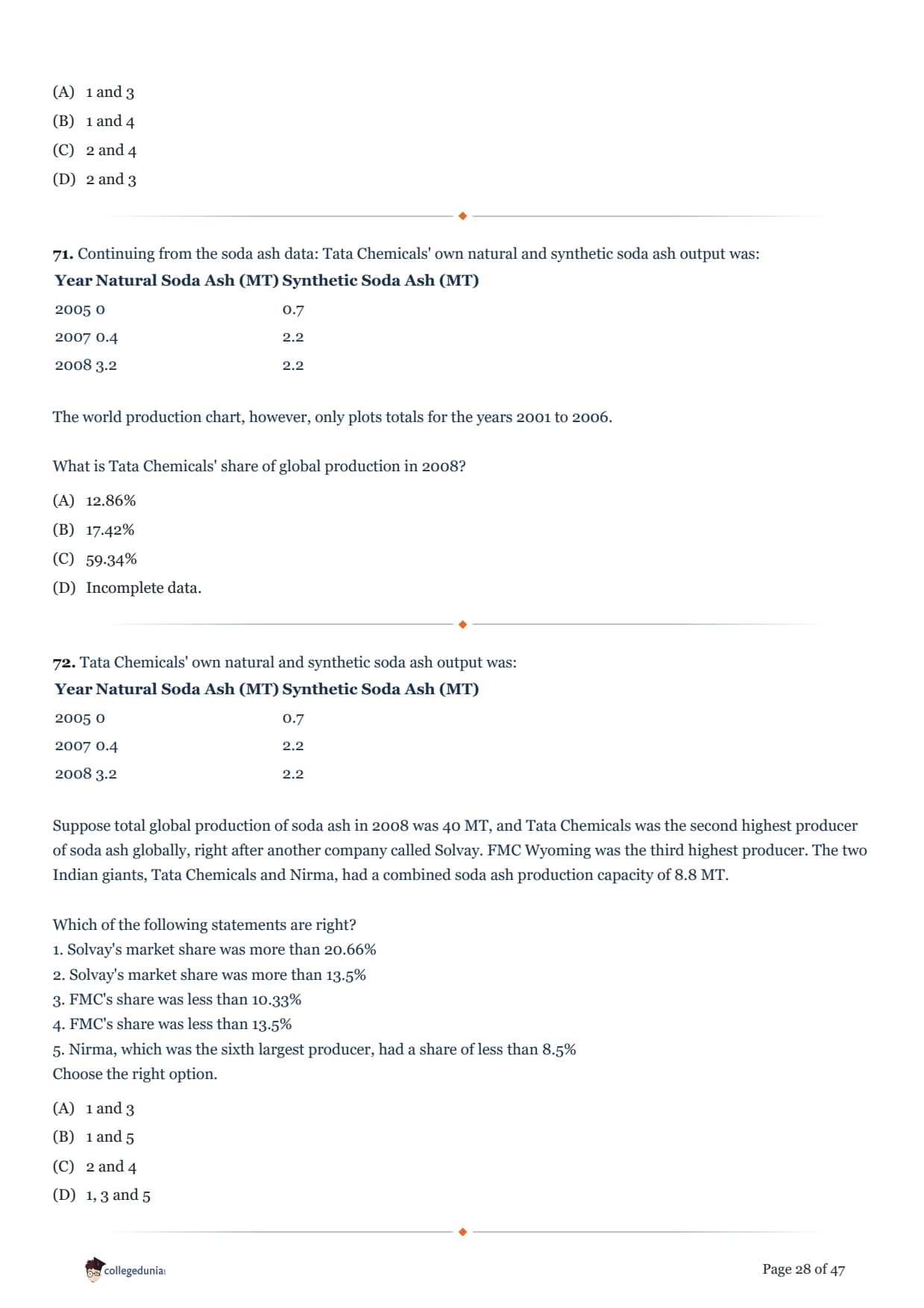
Soda ash (sodium carbonate) is made in two ways: from natural trona ore (natural soda ash), and from common salt by the Solvay process (synthetic soda ash). Tata Chemicals is one of the world's largest soda ash producers.
Two charts give the data. The first chart plots WORLD production of natural and synthetic soda ash for the years 2001 to 2006: the synthetic soda ash bars climb every year over this period, while the natural soda ash bars stay roughly flat. The second chart plots Tata Chemicals' own natural and synthetic output:
| Year | Natural Soda Ash (MT) | Synthetic Soda Ash (MT) |
|---|---|---|
| 2005 | 0 | 0.7 |
| 2007 | 0.4 | 2.2 |
| 2008 | 3.2 | 2.2 |
Which of the following statements are true?
1. Proportion of natural soda ash to synthetic soda ash has decreased from 2001 to 2006 globally.
2. Proportion of natural soda ash to synthetic soda ash has increased from 2001 to 2006 globally.
3. Proportion of synthetic soda ash to total soda ash has decreased for Tata Chemicals from 2005 to 2007.
4. Proportion of synthetic soda ash to total ash has increased for Tata Chemicals.
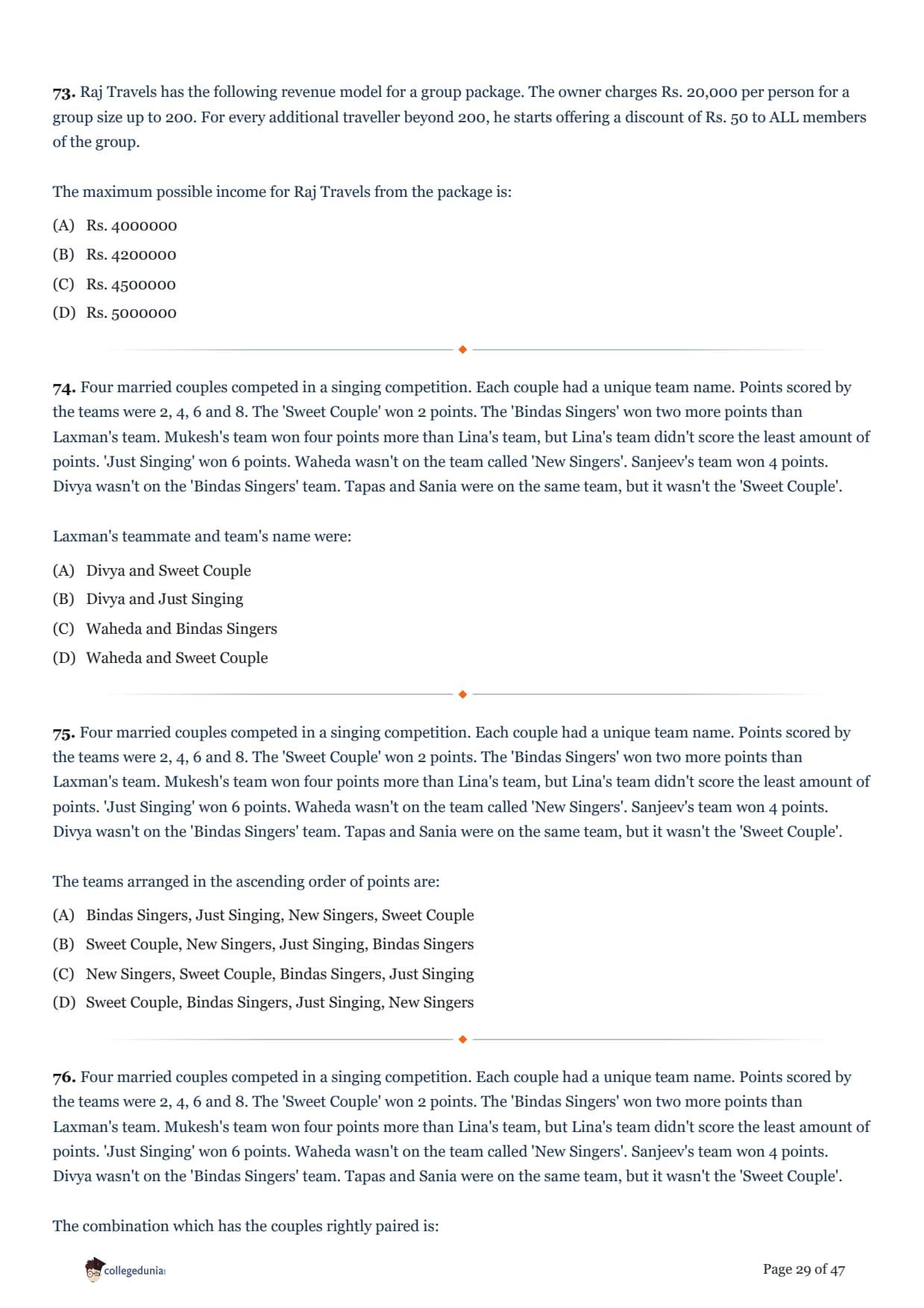
Continuing from the soda ash data: Tata Chemicals' own natural and synthetic soda ash output was:
| Year | Natural Soda Ash (MT) | Synthetic Soda Ash (MT) |
|---|---|---|
| 2005 | 0 | 0.7 |
| 2007 | 0.4 | 2.2 |
| 2008 | 3.2 | 2.2 |
The world production chart, however, only plots totals for the years 2001 to 2006.
What is Tata Chemicals' share of global production in 2008?
Tata Chemicals' own natural and synthetic soda ash output was:
| Year | Natural Soda Ash (MT) | Synthetic Soda Ash (MT) |
|---|---|---|
| 2005 | 0 | 0.7 |
| 2007 | 0.4 | 2.2 |
| 2008 | 3.2 | 2.2 |
Suppose total global production of soda ash in 2008 was 40 MT, and Tata Chemicals was the second highest producer of soda ash globally, right after another company called Solvay. FMC Wyoming was the third highest producer. The two Indian giants, Tata Chemicals and Nirma, had a combined soda ash production capacity of 8.8 MT.
Which of the following statements are right?
1. Solvay's market share was more than 20.66%
2. Solvay's market share was more than 13.5%
3. FMC's share was less than 10.33%
4. FMC's share was less than 13.5%
5. Nirma, which was the sixth largest producer, had a share of less than 8.5%
Choose the right option.
Raj Travels has the following revenue model for a group package. The owner charges Rs. 20,000 per person for a group size up to 200. For every additional traveller beyond 200, he starts offering a discount of Rs. 50 to ALL members of the group.
The maximum possible income for Raj Travels from the package is:
Four married couples competed in a singing competition. Each couple had a unique team name. Points scored by the teams were 2, 4, 6 and 8. The 'Sweet Couple' won 2 points. The 'Bindas Singers' won two more points than Laxman's team. Mukesh's team won four points more than Lina's team, but Lina's team didn't score the least amount of points. 'Just Singing' won 6 points. Waheda wasn't on the team called 'New Singers'. Sanjeev's team won 4 points. Divya wasn't on the 'Bindas Singers' team. Tapas and Sania were on the same team, but it wasn't the 'Sweet Couple'.
Laxman's teammate and team's name were:
Four married couples competed in a singing competition. Each couple had a unique team name. Points scored by the teams were 2, 4, 6 and 8. The 'Sweet Couple' won 2 points. The 'Bindas Singers' won two more points than Laxman's team. Mukesh's team won four points more than Lina's team, but Lina's team didn't score the least amount of points. 'Just Singing' won 6 points. Waheda wasn't on the team called 'New Singers'. Sanjeev's team won 4 points. Divya wasn't on the 'Bindas Singers' team. Tapas and Sania were on the same team, but it wasn't the 'Sweet Couple'.
The teams arranged in the ascending order of points are:
Four married couples competed in a singing competition. Each couple had a unique team name. Points scored by the teams were 2, 4, 6 and 8. The 'Sweet Couple' won 2 points. The 'Bindas Singers' won two more points than Laxman's team. Mukesh's team won four points more than Lina's team, but Lina's team didn't score the least amount of points. 'Just Singing' won 6 points. Waheda wasn't on the team called 'New Singers'. Sanjeev's team won 4 points. Divya wasn't on the 'Bindas Singers' team. Tapas and Sania were on the same team, but it wasn't the 'Sweet Couple'.
The combination which has the couples rightly paired is:
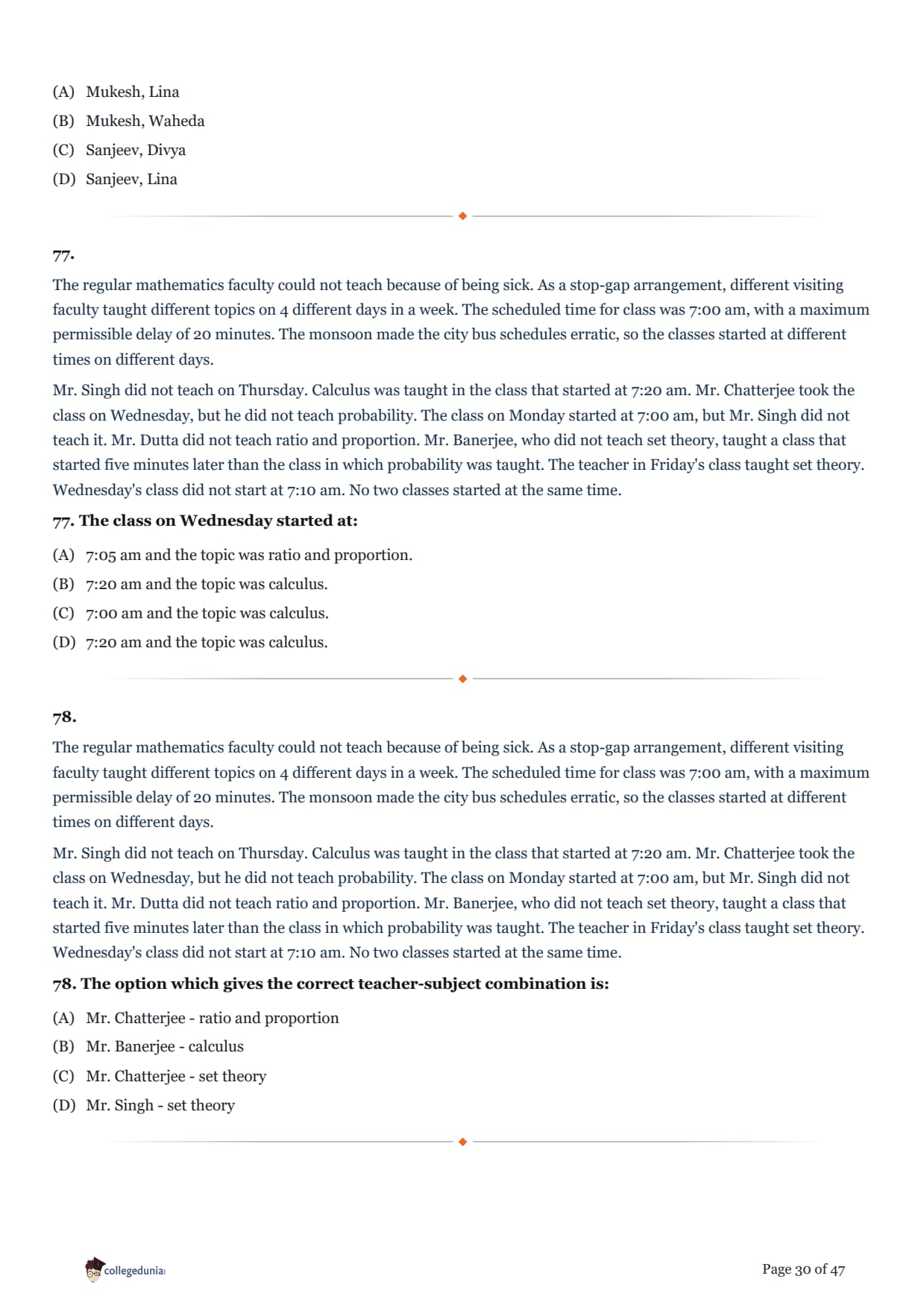
The regular mathematics faculty could not teach because of being sick. As a stop-gap arrangement, different visiting faculty taught different topics on 4 different days in a week. The scheduled time for class was 7:00 am, with a maximum permissible delay of 20 minutes. The monsoon made the city bus schedules erratic, so the classes started at different times on different days.
Mr. Singh did not teach on Thursday. Calculus was taught in the class that started at 7:20 am. Mr. Chatterjee took the class on Wednesday, but he did not teach probability. The class on Monday started at 7:00 am, but Mr. Singh did not teach it. Mr. Dutta did not teach ratio and proportion. Mr. Banerjee, who did not teach set theory, taught a class that started five minutes later than the class in which probability was taught. The teacher in Friday's class taught set theory. Wednesday's class did not start at 7:10 am. No two classes started at the same time.
77. The class on Wednesday started at:
The regular mathematics faculty could not teach because of being sick. As a stop-gap arrangement, different visiting faculty taught different topics on 4 different days in a week. The scheduled time for class was 7:00 am, with a maximum permissible delay of 20 minutes. The monsoon made the city bus schedules erratic, so the classes started at different times on different days.
Mr. Singh did not teach on Thursday. Calculus was taught in the class that started at 7:20 am. Mr. Chatterjee took the class on Wednesday, but he did not teach probability. The class on Monday started at 7:00 am, but Mr. Singh did not teach it. Mr. Dutta did not teach ratio and proportion. Mr. Banerjee, who did not teach set theory, taught a class that started five minutes later than the class in which probability was taught. The teacher in Friday's class taught set theory. Wednesday's class did not start at 7:10 am. No two classes started at the same time.
78. The option which gives the correct teacher-subject combination is:
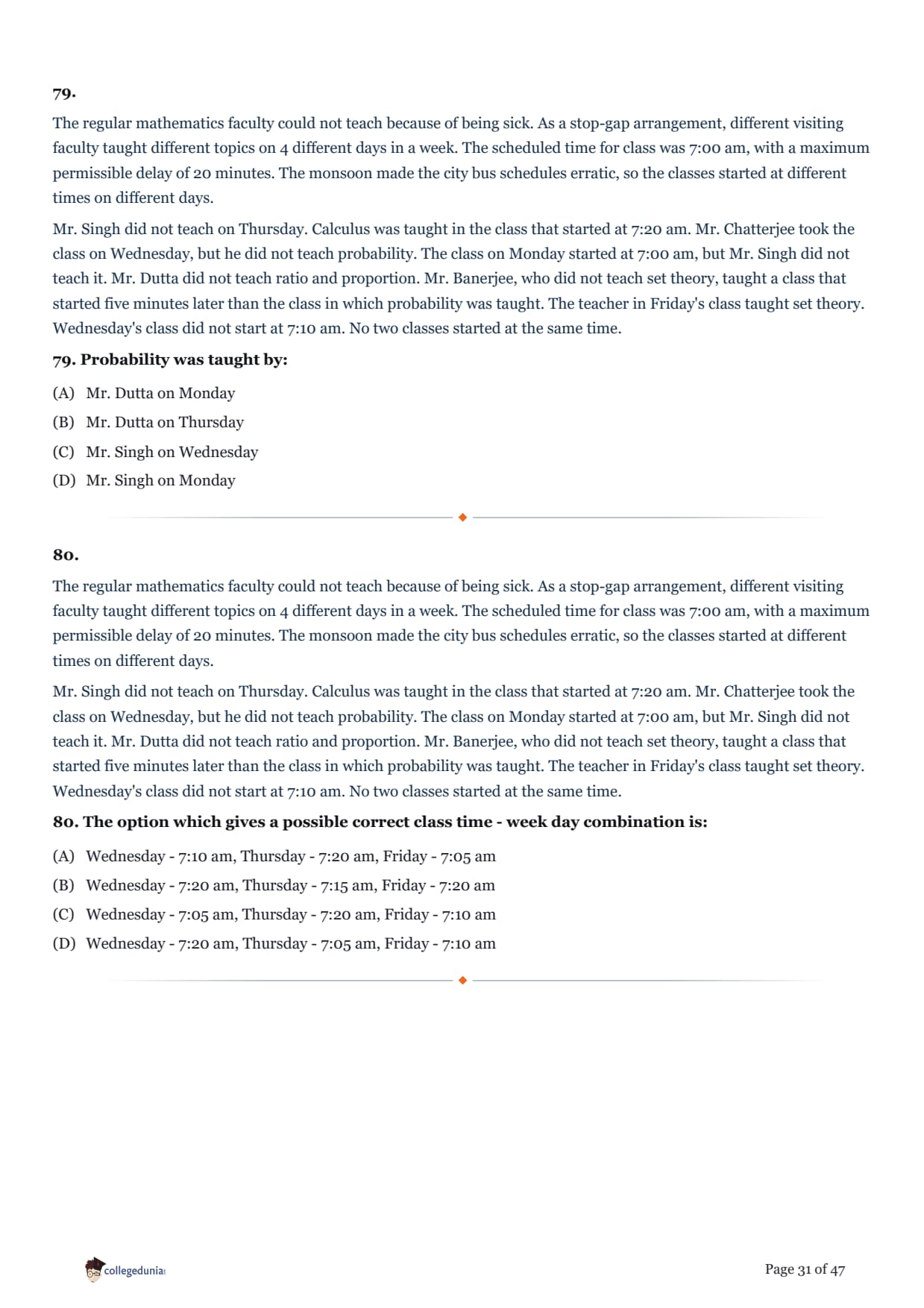
The regular mathematics faculty could not teach because of being sick. As a stop-gap arrangement, different visiting faculty taught different topics on 4 different days in a week. The scheduled time for class was 7:00 am, with a maximum permissible delay of 20 minutes. The monsoon made the city bus schedules erratic, so the classes started at different times on different days.
Mr. Singh did not teach on Thursday. Calculus was taught in the class that started at 7:20 am. Mr. Chatterjee took the class on Wednesday, but he did not teach probability. The class on Monday started at 7:00 am, but Mr. Singh did not teach it. Mr. Dutta did not teach ratio and proportion. Mr. Banerjee, who did not teach set theory, taught a class that started five minutes later than the class in which probability was taught. The teacher in Friday's class taught set theory. Wednesday's class did not start at 7:10 am. No two classes started at the same time.
79. Probability was taught by:
The regular mathematics faculty could not teach because of being sick. As a stop-gap arrangement, different visiting faculty taught different topics on 4 different days in a week. The scheduled time for class was 7:00 am, with a maximum permissible delay of 20 minutes. The monsoon made the city bus schedules erratic, so the classes started at different times on different days.
Mr. Singh did not teach on Thursday. Calculus was taught in the class that started at 7:20 am. Mr. Chatterjee took the class on Wednesday, but he did not teach probability. The class on Monday started at 7:00 am, but Mr. Singh did not teach it. Mr. Dutta did not teach ratio and proportion. Mr. Banerjee, who did not teach set theory, taught a class that started five minutes later than the class in which probability was taught. The teacher in Friday's class taught set theory. Wednesday's class did not start at 7:10 am. No two classes started at the same time.
80. The option which gives a possible correct class time - week day combination is:
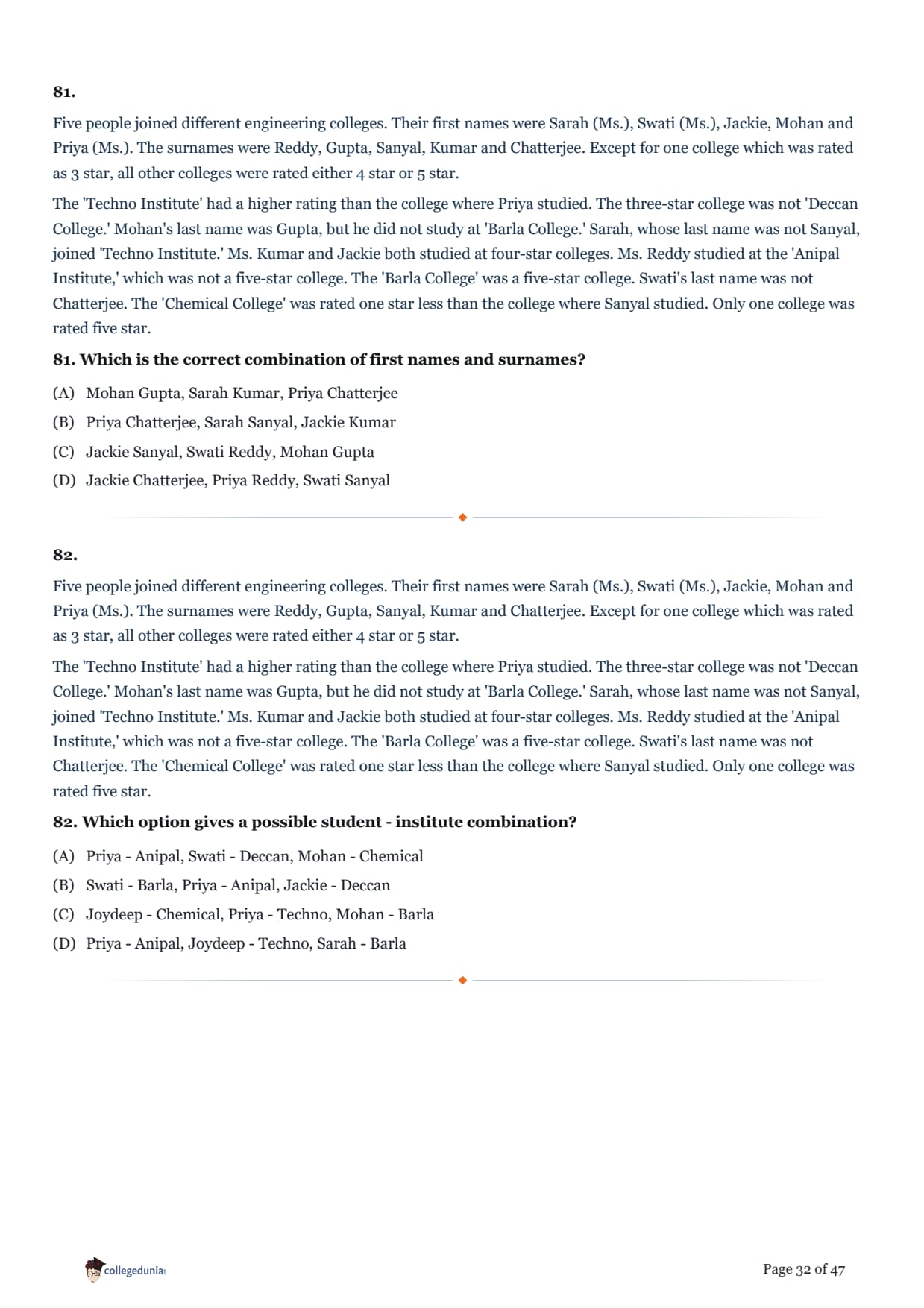
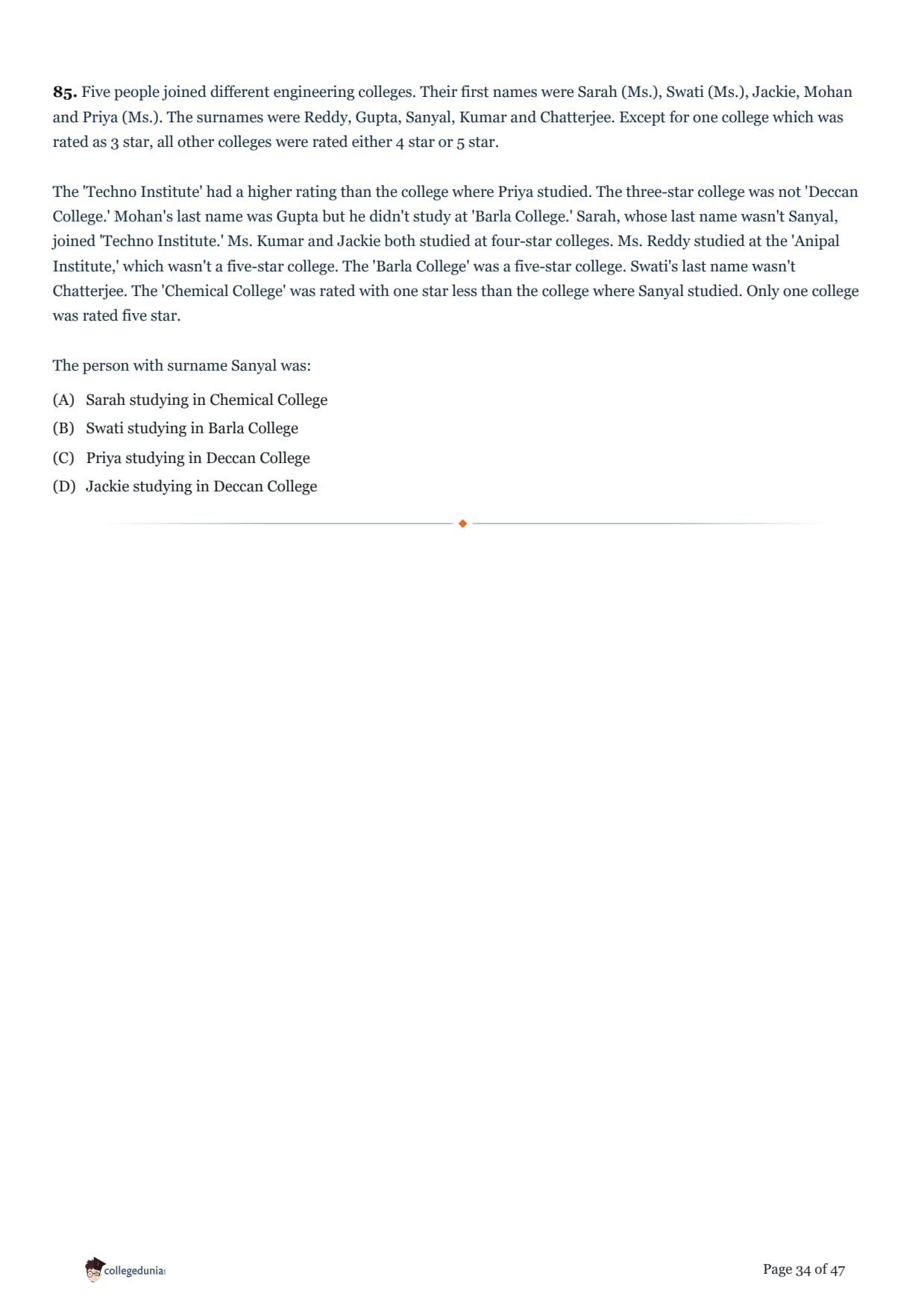
Five people joined different engineering colleges. Their first names were Sarah (Ms.), Swati (Ms.), Jackie, Mohan and Priya (Ms.). The surnames were Reddy, Gupta, Sanyal, Kumar and Chatterjee. Except for one college which was rated as 3 star, all other colleges were rated either 4 star or 5 star.
The 'Techno Institute' had a higher rating than the college where Priya studied. The three-star college was not 'Deccan College.' Mohan's last name was Gupta, but he did not study at 'Barla College.' Sarah, whose last name was not Sanyal, joined 'Techno Institute.' Ms. Kumar and Jackie both studied at four-star colleges. Ms. Reddy studied at the 'Anipal Institute,' which was not a five-star college. The 'Barla College' was a five-star college. Swati's last name was not Chatterjee. The 'Chemical College' was rated one star less than the college where Sanyal studied. Only one college was rated five star.
81. Which is the correct combination of first names and surnames?
Five people joined different engineering colleges. Their first names were Sarah (Ms.), Swati (Ms.), Jackie, Mohan and Priya (Ms.). The surnames were Reddy, Gupta, Sanyal, Kumar and Chatterjee. Except for one college which was rated as 3 star, all other colleges were rated either 4 star or 5 star.
The 'Techno Institute' had a higher rating than the college where Priya studied. The three-star college was not 'Deccan College.' Mohan's last name was Gupta, but he did not study at 'Barla College.' Sarah, whose last name was not Sanyal, joined 'Techno Institute.' Ms. Kumar and Jackie both studied at four-star colleges. Ms. Reddy studied at the 'Anipal Institute,' which was not a five-star college. The 'Barla College' was a five-star college. Swati's last name was not Chatterjee. The 'Chemical College' was rated one star less than the college where Sanyal studied. Only one college was rated five star.
82. Which option gives a possible student - institute combination?
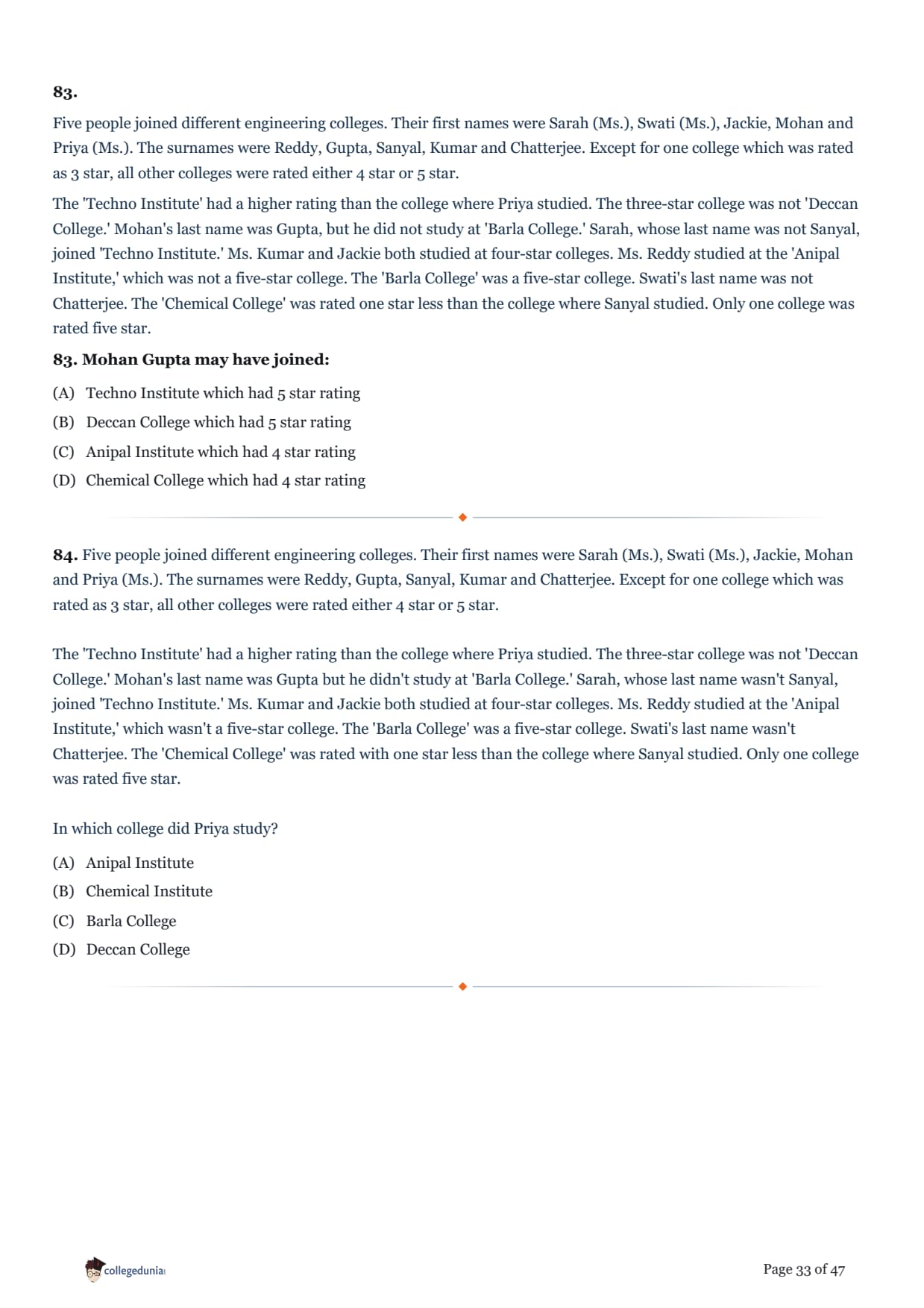
Five people joined different engineering colleges. Their first names were Sarah (Ms.), Swati (Ms.), Jackie, Mohan and Priya (Ms.). The surnames were Reddy, Gupta, Sanyal, Kumar and Chatterjee. Except for one college which was rated as 3 star, all other colleges were rated either 4 star or 5 star.
The 'Techno Institute' had a higher rating than the college where Priya studied. The three-star college was not 'Deccan College.' Mohan's last name was Gupta, but he did not study at 'Barla College.' Sarah, whose last name was not Sanyal, joined 'Techno Institute.' Ms. Kumar and Jackie both studied at four-star colleges. Ms. Reddy studied at the 'Anipal Institute,' which was not a five-star college. The 'Barla College' was a five-star college. Swati's last name was not Chatterjee. The 'Chemical College' was rated one star less than the college where Sanyal studied. Only one college was rated five star.
83. Mohan Gupta may have joined:
Five people joined different engineering colleges. Their first names were Sarah (Ms.), Swati (Ms.), Jackie, Mohan and Priya (Ms.). The surnames were Reddy, Gupta, Sanyal, Kumar and Chatterjee. Except for one college which was rated as 3 star, all other colleges were rated either 4 star or 5 star.
The 'Techno Institute' had a higher rating than the college where Priya studied. The three-star college was not 'Deccan College.' Mohan's last name was Gupta but he didn't study at 'Barla College.' Sarah, whose last name wasn't Sanyal, joined 'Techno Institute.' Ms. Kumar and Jackie both studied at four-star colleges. Ms. Reddy studied at the 'Anipal Institute,' which wasn't a five-star college. The 'Barla College' was a five-star college. Swati's last name wasn't Chatterjee. The 'Chemical College' was rated with one star less than the college where Sanyal studied. Only one college was rated five star.
In which college did Priya study?
Five people joined different engineering colleges. Their first names were Sarah (Ms.), Swati (Ms.), Jackie, Mohan and Priya (Ms.). The surnames were Reddy, Gupta, Sanyal, Kumar and Chatterjee. Except for one college which was rated as 3 star, all other colleges were rated either 4 star or 5 star.
The 'Techno Institute' had a higher rating than the college where Priya studied. The three-star college was not 'Deccan College.' Mohan's last name was Gupta but he didn't study at 'Barla College.' Sarah, whose last name wasn't Sanyal, joined 'Techno Institute.' Ms. Kumar and Jackie both studied at four-star colleges. Ms. Reddy studied at the 'Anipal Institute,' which wasn't a five-star college. The 'Barla College' was a five-star college. Swati's last name wasn't Chatterjee. The 'Chemical College' was rated with one star less than the college where Sanyal studied. Only one college was rated five star.
The person with surname Sanyal was:
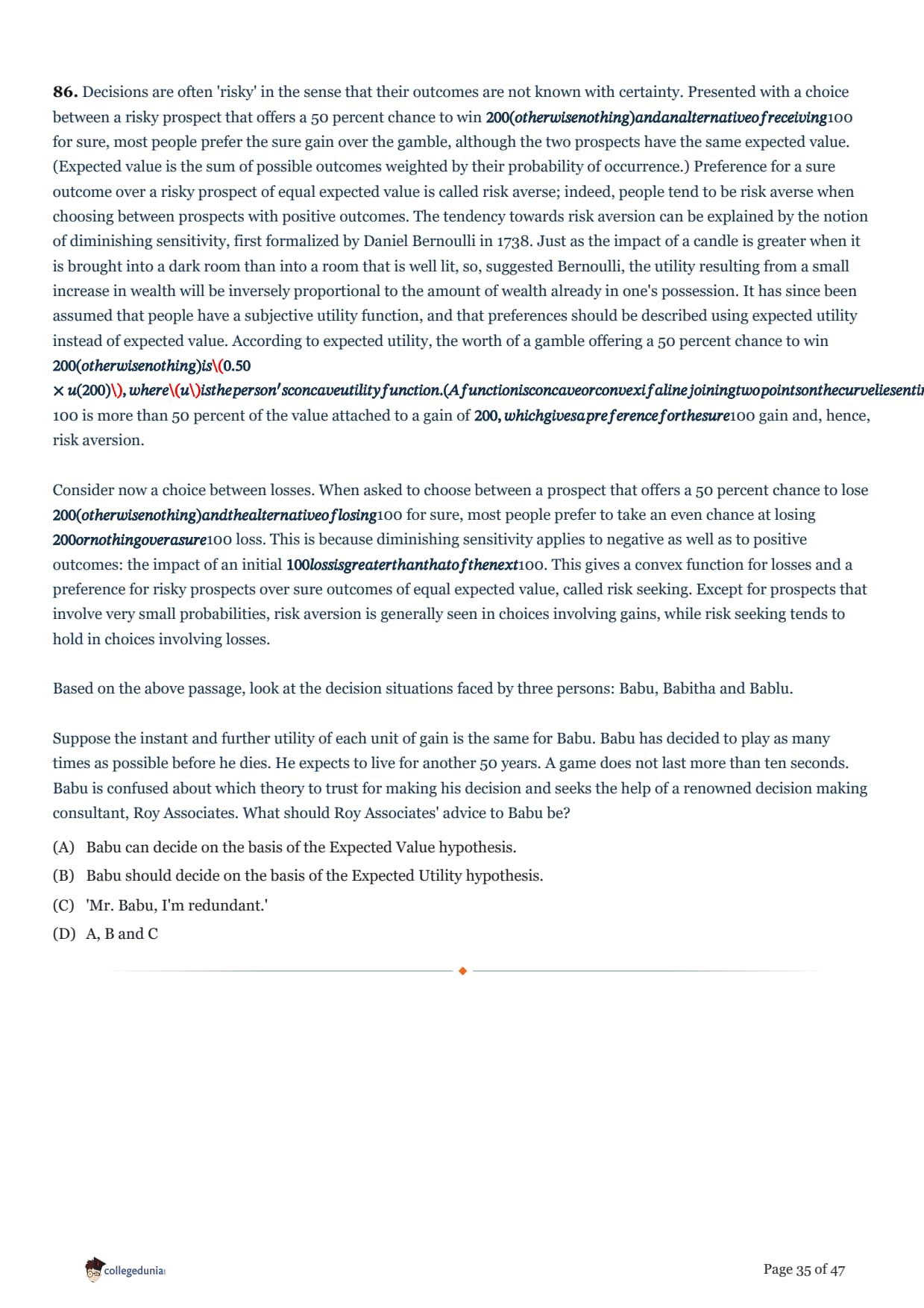
Decisions are often 'risky' in the sense that their outcomes are not known with certainty. Presented with a choice between a risky prospect that offers a 50 percent chance to win $200 (otherwise nothing) and an alternative of receiving $100 for sure, most people prefer the sure gain over the gamble, although the two prospects have the same expected value. (Expected value is the sum of possible outcomes weighted by their probability of occurrence.) Preference for a sure outcome over a risky prospect of equal expected value is called risk averse; indeed, people tend to be risk averse when choosing between prospects with positive outcomes. The tendency towards risk aversion can be explained by the notion of diminishing sensitivity, first formalized by Daniel Bernoulli in 1738. Just as the impact of a candle is greater when it is brought into a dark room than into a room that is well lit, so, suggested Bernoulli, the utility resulting from a small increase in wealth will be inversely proportional to the amount of wealth already in one's possession. It has since been assumed that people have a subjective utility function, and that preferences should be described using expected utility instead of expected value. According to expected utility, the worth of a gamble offering a 50 percent chance to win $200 (otherwise nothing) is \(0.50 \times u(200)\), where \(u\) is the person's concave utility function. (A function is concave or convex if a line joining two points on the curve lies entirely below or above the curve, respectively.) It follows from a concave function that the subjective value attached to a gain of $100 is more than 50 percent of the value attached to a gain of $200, which gives a preference for the sure $100 gain and, hence, risk aversion.
Consider now a choice between losses. When asked to choose between a prospect that offers a 50 percent chance to lose $200 (otherwise nothing) and the alternative of losing $100 for sure, most people prefer to take an even chance at losing $200 or nothing over a sure $100 loss. This is because diminishing sensitivity applies to negative as well as to positive outcomes: the impact of an initial $100 loss is greater than that of the next $100. This gives a convex function for losses and a preference for risky prospects over sure outcomes of equal expected value, called risk seeking. Except for prospects that involve very small probabilities, risk aversion is generally seen in choices involving gains, while risk seeking tends to hold in choices involving losses.
Based on the above passage, look at the decision situations faced by three persons: Babu, Babitha and Bablu.
Suppose the instant and further utility of each unit of gain is the same for Babu. Babu has decided to play as many times as possible before he dies. He expects to live for another 50 years. A game does not last more than ten seconds. Babu is confused about which theory to trust for making his decision and seeks the help of a renowned decision making consultant, Roy Associates. What should Roy Associates' advice to Babu be?
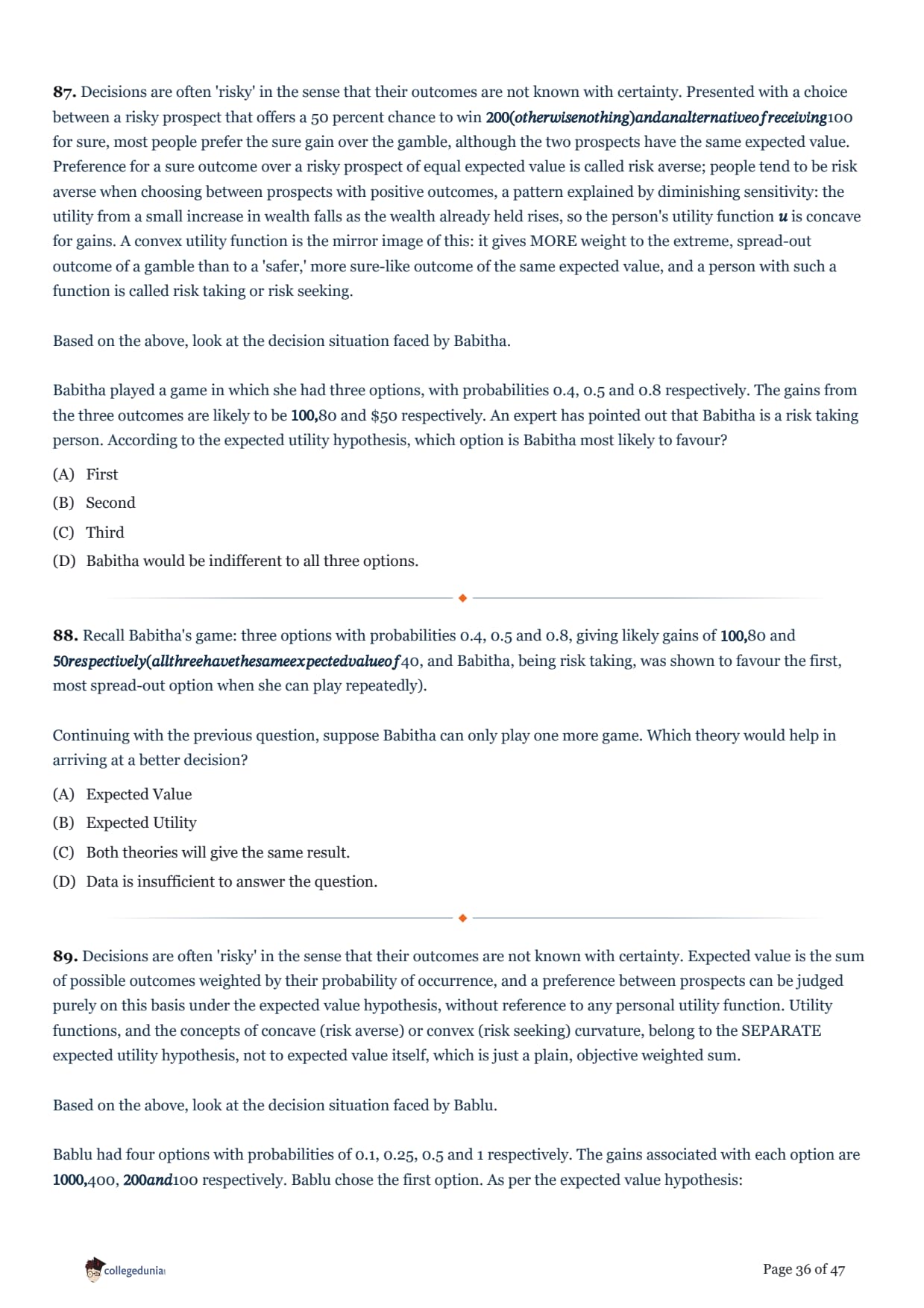
Decisions are often 'risky' in the sense that their outcomes are not known with certainty. Presented with a choice between a risky prospect that offers a 50 percent chance to win $200 (otherwise nothing) and an alternative of receiving $100 for sure, most people prefer the sure gain over the gamble, although the two prospects have the same expected value. Preference for a sure outcome over a risky prospect of equal expected value is called risk averse; people tend to be risk averse when choosing between prospects with positive outcomes, a pattern explained by diminishing sensitivity: the utility from a small increase in wealth falls as the wealth already held rises, so the person's utility function \(u\) is concave for gains. A convex utility function is the mirror image of this: it gives MORE weight to the extreme, spread-out outcome of a gamble than to a 'safer,' more sure-like outcome of the same expected value, and a person with such a function is called risk taking or risk seeking.
Based on the above, look at the decision situation faced by Babitha.
Babitha played a game in which she had three options, with probabilities 0.4, 0.5 and 0.8 respectively. The gains from the three outcomes are likely to be $100, $80 and $50 respectively. An expert has pointed out that Babitha is a risk taking person. According to the expected utility hypothesis, which option is Babitha most likely to favour?
Recall Babitha's game: three options with probabilities 0.4, 0.5 and 0.8, giving likely gains of $100, $80 and $50 respectively (all three have the same expected value of $40, and Babitha, being risk taking, was shown to favour the first, most spread-out option when she can play repeatedly).
Continuing with the previous question, suppose Babitha can only play one more game. Which theory would help in arriving at a better decision?
Decisions are often 'risky' in the sense that their outcomes are not known with certainty. Expected value is the sum of possible outcomes weighted by their probability of occurrence, and a preference between prospects can be judged purely on this basis under the expected value hypothesis, without reference to any personal utility function. Utility functions, and the concepts of concave (risk averse) or convex (risk seeking) curvature, belong to the SEPARATE expected utility hypothesis, not to expected value itself, which is just a plain, objective weighted sum.
Based on the above, look at the decision situation faced by Bablu.
Bablu had four options with probabilities of 0.1, 0.25, 0.5 and 1 respectively. The gains associated with each option are $1000, $400, $200 and $100 respectively. Bablu chose the first option. As per the expected value hypothesis:
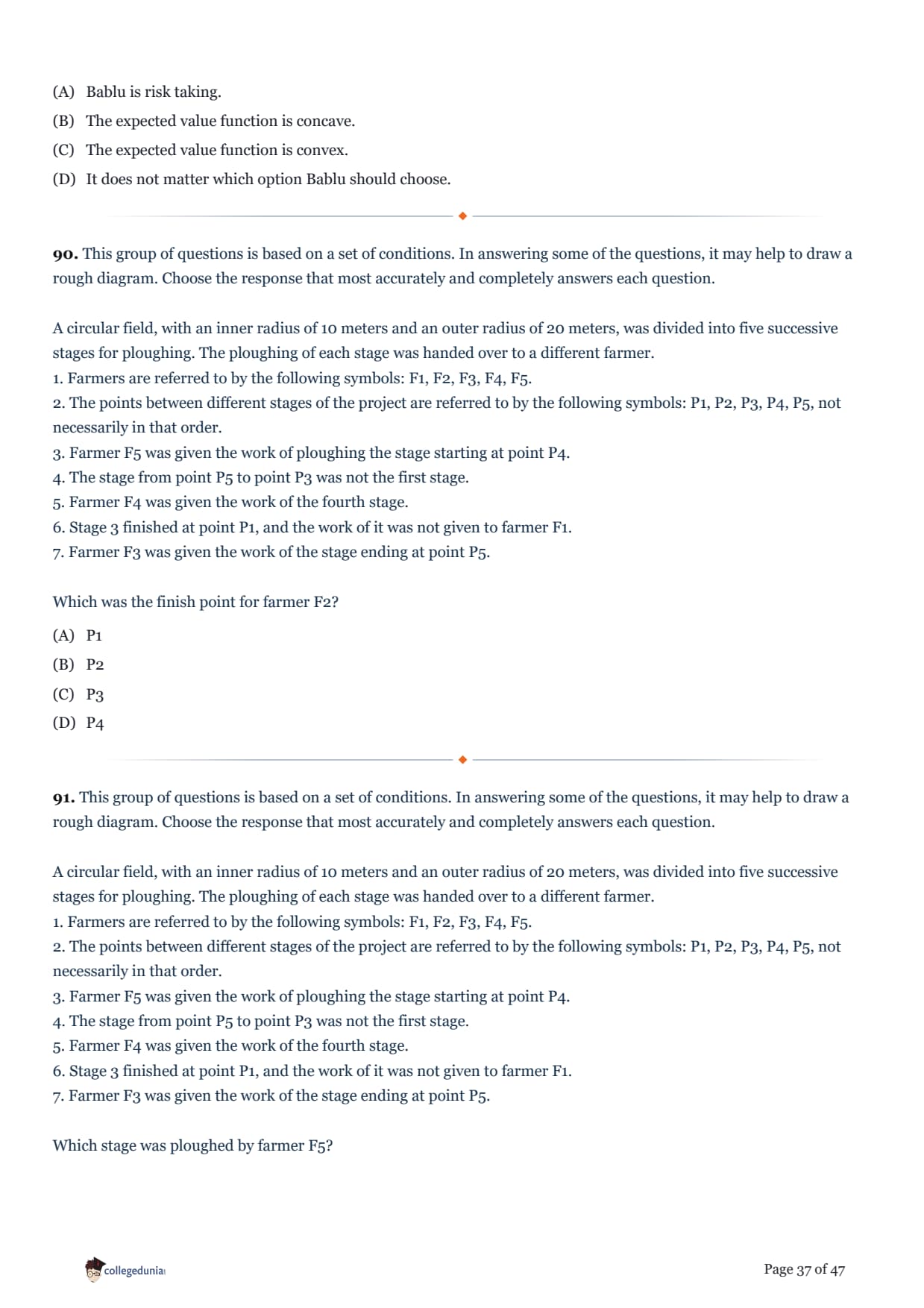
This group of questions is based on a set of conditions. In answering some of the questions, it may help to draw a rough diagram. Choose the response that most accurately and completely answers each question.
A circular field, with an inner radius of 10 meters and an outer radius of 20 meters, was divided into five successive stages for ploughing. The ploughing of each stage was handed over to a different farmer.
1. Farmers are referred to by the following symbols: F1, F2, F3, F4, F5.
2. The points between different stages of the project are referred to by the following symbols: P1, P2, P3, P4, P5, not necessarily in that order.
3. Farmer F5 was given the work of ploughing the stage starting at point P4.
4. The stage from point P5 to point P3 was not the first stage.
5. Farmer F4 was given the work of the fourth stage.
6. Stage 3 finished at point P1, and the work of it was not given to farmer F1.
7. Farmer F3 was given the work of the stage ending at point P5.
Which was the finish point for farmer F2?
This group of questions is based on a set of conditions. In answering some of the questions, it may help to draw a rough diagram. Choose the response that most accurately and completely answers each question.
A circular field, with an inner radius of 10 meters and an outer radius of 20 meters, was divided into five successive stages for ploughing. The ploughing of each stage was handed over to a different farmer.
1. Farmers are referred to by the following symbols: F1, F2, F3, F4, F5.
2. The points between different stages of the project are referred to by the following symbols: P1, P2, P3, P4, P5, not necessarily in that order.
3. Farmer F5 was given the work of ploughing the stage starting at point P4.
4. The stage from point P5 to point P3 was not the first stage.
5. Farmer F4 was given the work of the fourth stage.
6. Stage 3 finished at point P1, and the work of it was not given to farmer F1.
7. Farmer F3 was given the work of the stage ending at point P5.
Which stage was ploughed by farmer F5?
Directions: A circular field, with inner radius of 10 meters and outer radius of 20 meters, was divided into five successive stages for ploughing. The ploughing of each stage was handed over to a different farmer.
1. Farmers are referred to by the symbols F1, F2, F3, F4, F5.
2. The points between different stages are referred to by the symbols P1, P2, P3, P4, P5, not necessarily in that order.
3. Farmer F5 was given the work of ploughing the stage starting at point P4.
4. The stage from point P5 to point P3 was not the first stage.
5. Farmer F4 was given the work of the fourth stage.
6. Stage 3 finished at point P1, and the work of which was not given to farmer F1.
7. Farmer F3 was given the work of the stage ending at point P5.
Which were the starting and finishing points for stage 2?
Directions: A circular field, with inner radius of 10 meters and outer radius of 20 meters, was divided into five successive stages for ploughing. The ploughing of each stage was handed over to a different farmer.
1. Farmers are referred to by the symbols F1, F2, F3, F4, F5.
2. The points between different stages are referred to by the symbols P1, P2, P3, P4, P5, not necessarily in that order.
3. Farmer F5 was given the work of ploughing the stage starting at point P4.
4. The stage from point P5 to point P3 was not the first stage.
5. Farmer F4 was given the work of the fourth stage.
6. Stage 3 finished at point P1, and the work of which was not given to farmer F1.
7. Farmer F3 was given the work of the stage ending at point P5.
For which farmer was P2 a finishing point?
Directions: A circular field, with inner radius of 10 meters and outer radius of 20 meters, was divided into five successive stages for ploughing. The ploughing of each stage was handed over to a different farmer.
1. Farmers are referred to by the symbols F1, F2, F3, F4, F5.
2. The points between different stages are referred to by the symbols P1, P2, P3, P4, P5, not necessarily in that order.
3. Farmer F5 was given the work of ploughing the stage starting at point P4.
4. The stage from point P5 to point P3 was not the first stage.
5. Farmer F4 was given the work of the fourth stage.
6. Stage 3 finished at point P1, and the work of which was not given to farmer F1.
7. Farmer F3 was given the work of the stage ending at point P5.
Which was the starting point for farmer F3?
Children are in pursuit of a dog whose leash has broken. Krishnarajan is directly behind the dog. Rangarajan is behind Krishnarajan. Natrajan is behind Rangarajan. Premrajan is ahead of the dog walking down the street in the opposite direction. As the children and dog pass, Premrajan turns around and joins the pursuit. He runs in behind Rangarajan. Krishnarajan runs faster and is alongside the dog on the left. Rangarajan runs faster and is alongside the dog on the right. Which child is directly behind the dog?

The jars A to D are of equal radius. The option which gives the correct relationship among the capacity of jars is:
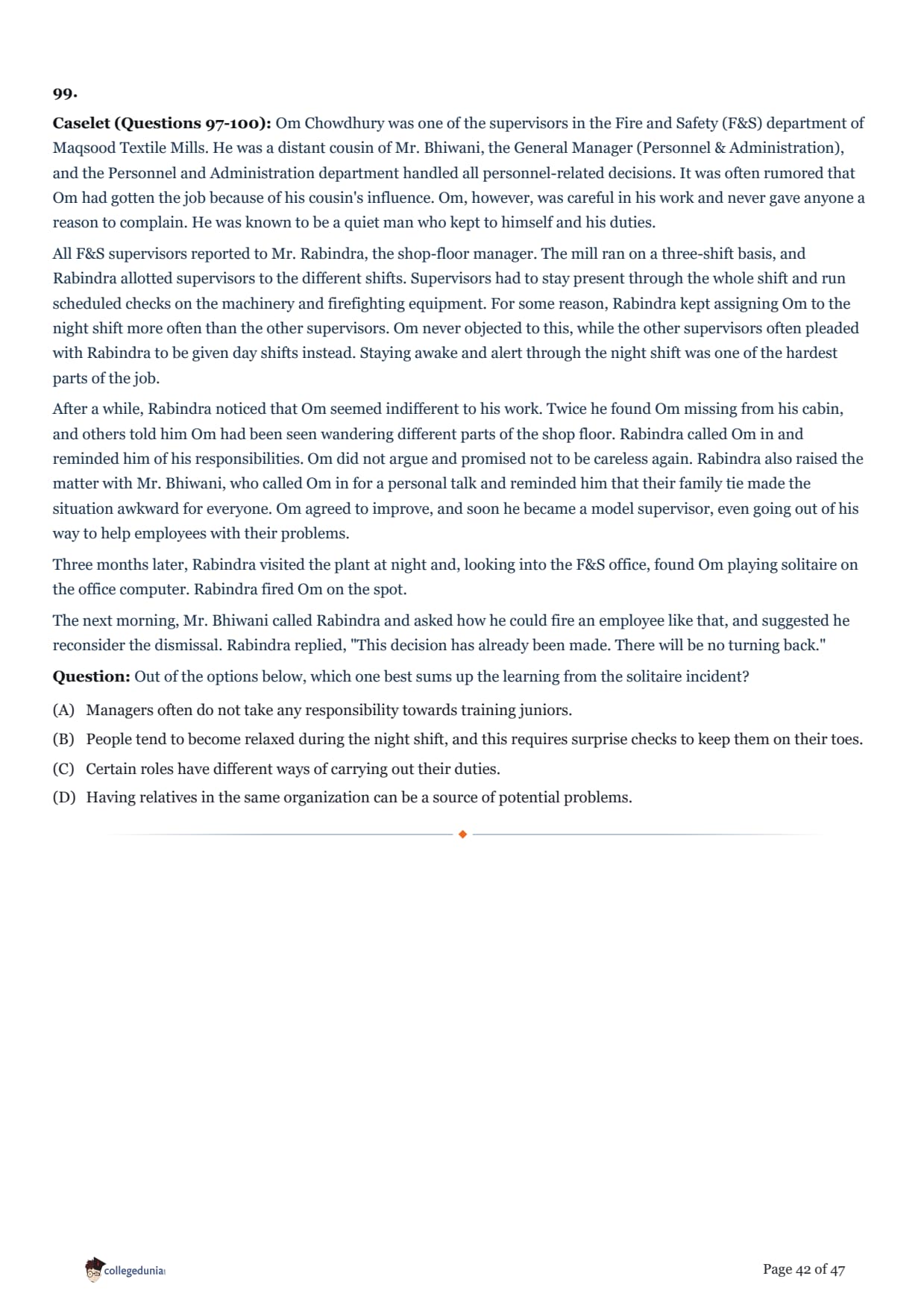
Caselet (Questions 97-100): Om Chowdhury was one of the supervisors in the Fire and Safety (F&S) department of Maqsood Textile Mills. He was a distant cousin of Mr. Bhiwani, the General Manager (Personnel & Administration), and the Personnel and Administration department handled all personnel-related decisions. It was often rumored that Om had gotten the job because of his cousin's influence. Om, however, was careful in his work and never gave anyone a reason to complain. He was known to be a quiet man who kept to himself and his duties.
All F&S supervisors reported to Mr. Rabindra, the shop-floor manager. The mill ran on a three-shift basis, and Rabindra allotted supervisors to the different shifts. Supervisors had to stay present through the whole shift and run scheduled checks on the machinery and firefighting equipment. For some reason, Rabindra kept assigning Om to the night shift more often than the other supervisors. Om never objected to this, while the other supervisors often pleaded with Rabindra to be given day shifts instead. Staying awake and alert through the night shift was one of the hardest parts of the job.
After a while, Rabindra noticed that Om seemed indifferent to his work. Twice he found Om missing from his cabin, and others told him Om had been seen wandering different parts of the shop floor. Rabindra called Om in and reminded him of his responsibilities. Om did not argue and promised not to be careless again. Rabindra also raised the matter with Mr. Bhiwani, who called Om in for a personal talk and reminded him that their family tie made the situation awkward for everyone. Om agreed to improve, and soon he became a model supervisor, even going out of his way to help employees with their problems.
Three months later, Rabindra visited the plant at night and, looking into the F&S office, found Om playing solitaire on the office computer. Rabindra fired Om on the spot.
The next morning, Mr. Bhiwani called Rabindra and asked how he could fire an employee like that, and suggested he reconsider the dismissal. Rabindra replied, "This decision has already been made. There will be no turning back."
Question: The options below give combinations of a possible root cause of the problem and its justification. Given the details in the case, which one can be inferred to be the best option?
Caselet (Questions 97-100): Om Chowdhury was one of the supervisors in the Fire and Safety (F&S) department of Maqsood Textile Mills. He was a distant cousin of Mr. Bhiwani, the General Manager (Personnel & Administration), and the Personnel and Administration department handled all personnel-related decisions. It was often rumored that Om had gotten the job because of his cousin's influence. Om, however, was careful in his work and never gave anyone a reason to complain. He was known to be a quiet man who kept to himself and his duties.
All F&S supervisors reported to Mr. Rabindra, the shop-floor manager. The mill ran on a three-shift basis, and Rabindra allotted supervisors to the different shifts. Supervisors had to stay present through the whole shift and run scheduled checks on the machinery and firefighting equipment. For some reason, Rabindra kept assigning Om to the night shift more often than the other supervisors. Om never objected to this, while the other supervisors often pleaded with Rabindra to be given day shifts instead. Staying awake and alert through the night shift was one of the hardest parts of the job.
After a while, Rabindra noticed that Om seemed indifferent to his work. Twice he found Om missing from his cabin, and others told him Om had been seen wandering different parts of the shop floor. Rabindra called Om in and reminded him of his responsibilities. Om did not argue and promised not to be careless again. Rabindra also raised the matter with Mr. Bhiwani, who called Om in for a personal talk and reminded him that their family tie made the situation awkward for everyone. Om agreed to improve, and soon he became a model supervisor, even going out of his way to help employees with their problems.
Three months later, Rabindra visited the plant at night and, looking into the F&S office, found Om playing solitaire on the office computer. Rabindra fired Om on the spot.
The next morning, Mr. Bhiwani called Rabindra and asked how he could fire an employee like that, and suggested he reconsider the dismissal. Rabindra replied, "This decision has already been made. There will be no turning back."
Question: The details of the entire episode have become common knowledge among all the employees of the company. Out of the options below, which one presents the best way for the top management to resolve the issue so as to benefit the organization as a whole?
Caselet (Questions 97-100): Om Chowdhury was one of the supervisors in the Fire and Safety (F&S) department of Maqsood Textile Mills. He was a distant cousin of Mr. Bhiwani, the General Manager (Personnel & Administration), and the Personnel and Administration department handled all personnel-related decisions. It was often rumored that Om had gotten the job because of his cousin's influence. Om, however, was careful in his work and never gave anyone a reason to complain. He was known to be a quiet man who kept to himself and his duties.
All F&S supervisors reported to Mr. Rabindra, the shop-floor manager. The mill ran on a three-shift basis, and Rabindra allotted supervisors to the different shifts. Supervisors had to stay present through the whole shift and run scheduled checks on the machinery and firefighting equipment. For some reason, Rabindra kept assigning Om to the night shift more often than the other supervisors. Om never objected to this, while the other supervisors often pleaded with Rabindra to be given day shifts instead. Staying awake and alert through the night shift was one of the hardest parts of the job.
After a while, Rabindra noticed that Om seemed indifferent to his work. Twice he found Om missing from his cabin, and others told him Om had been seen wandering different parts of the shop floor. Rabindra called Om in and reminded him of his responsibilities. Om did not argue and promised not to be careless again. Rabindra also raised the matter with Mr. Bhiwani, who called Om in for a personal talk and reminded him that their family tie made the situation awkward for everyone. Om agreed to improve, and soon he became a model supervisor, even going out of his way to help employees with their problems.
Three months later, Rabindra visited the plant at night and, looking into the F&S office, found Om playing solitaire on the office computer. Rabindra fired Om on the spot.
The next morning, Mr. Bhiwani called Rabindra and asked how he could fire an employee like that, and suggested he reconsider the dismissal. Rabindra replied, "This decision has already been made. There will be no turning back."
Question: Out of the options below, which one best sums up the learning from the solitaire incident?
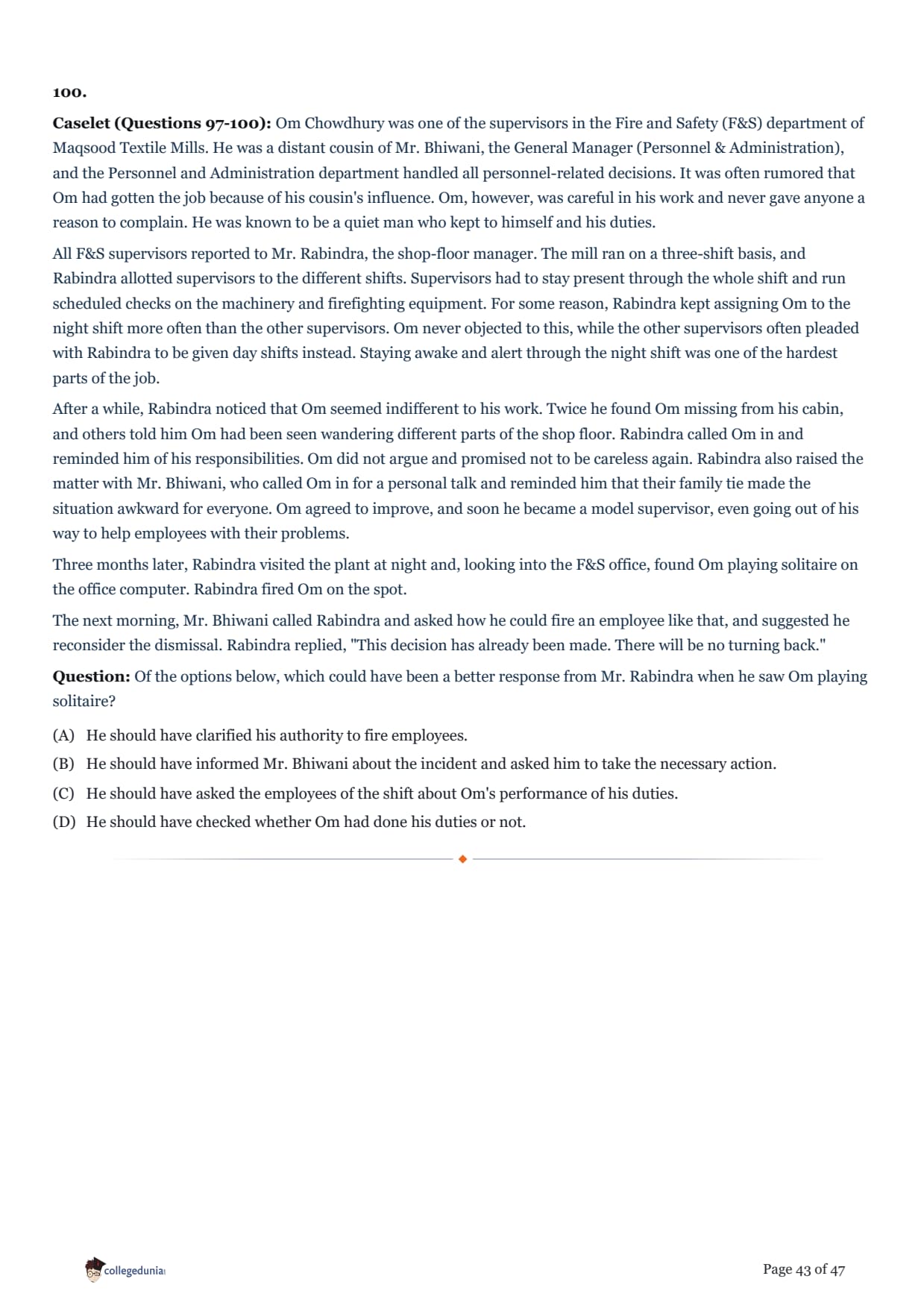
Caselet (Questions 97-100): Om Chowdhury was one of the supervisors in the Fire and Safety (F&S) department of Maqsood Textile Mills. He was a distant cousin of Mr. Bhiwani, the General Manager (Personnel & Administration), and the Personnel and Administration department handled all personnel-related decisions. It was often rumored that Om had gotten the job because of his cousin's influence. Om, however, was careful in his work and never gave anyone a reason to complain. He was known to be a quiet man who kept to himself and his duties.
All F&S supervisors reported to Mr. Rabindra, the shop-floor manager. The mill ran on a three-shift basis, and Rabindra allotted supervisors to the different shifts. Supervisors had to stay present through the whole shift and run scheduled checks on the machinery and firefighting equipment. For some reason, Rabindra kept assigning Om to the night shift more often than the other supervisors. Om never objected to this, while the other supervisors often pleaded with Rabindra to be given day shifts instead. Staying awake and alert through the night shift was one of the hardest parts of the job.
After a while, Rabindra noticed that Om seemed indifferent to his work. Twice he found Om missing from his cabin, and others told him Om had been seen wandering different parts of the shop floor. Rabindra called Om in and reminded him of his responsibilities. Om did not argue and promised not to be careless again. Rabindra also raised the matter with Mr. Bhiwani, who called Om in for a personal talk and reminded him that their family tie made the situation awkward for everyone. Om agreed to improve, and soon he became a model supervisor, even going out of his way to help employees with their problems.
Three months later, Rabindra visited the plant at night and, looking into the F&S office, found Om playing solitaire on the office computer. Rabindra fired Om on the spot.
The next morning, Mr. Bhiwani called Rabindra and asked how he could fire an employee like that, and suggested he reconsider the dismissal. Rabindra replied, "This decision has already been made. There will be no turning back."
Question: Of the options below, which could have been a better response from Mr. Rabindra when he saw Om playing solitaire?
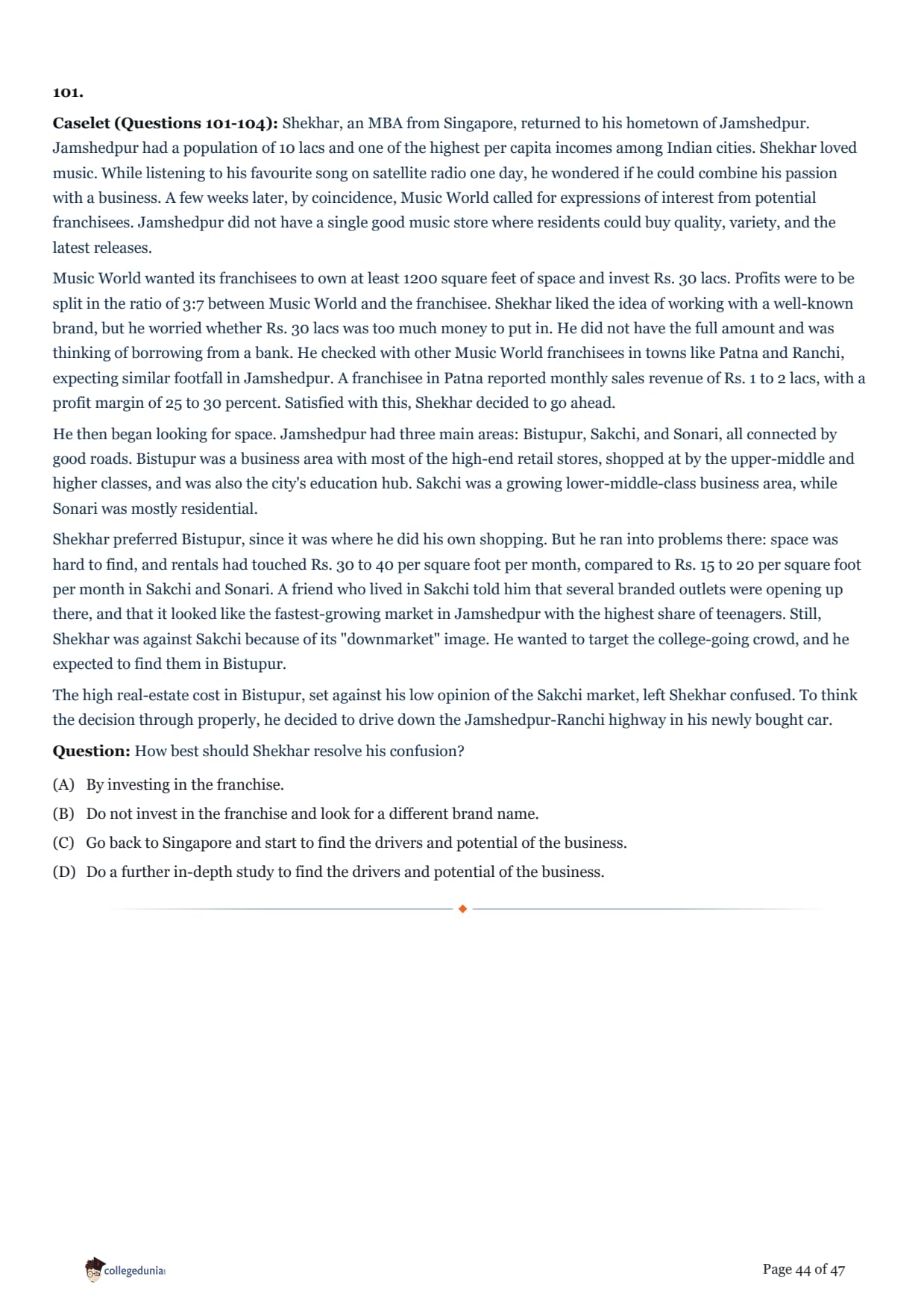
Caselet (Questions 101-104): Shekhar, an MBA from Singapore, returned to his hometown of Jamshedpur. Jamshedpur had a population of 10 lacs and one of the highest per capita incomes among Indian cities. Shekhar loved music. While listening to his favourite song on satellite radio one day, he wondered if he could combine his passion with a business. A few weeks later, by coincidence, Music World called for expressions of interest from potential franchisees. Jamshedpur did not have a single good music store where residents could buy quality, variety, and the latest releases.
Music World wanted its franchisees to own at least 1200 square feet of space and invest Rs. 30 lacs. Profits were to be split in the ratio of 3:7 between Music World and the franchisee. Shekhar liked the idea of working with a well-known brand, but he worried whether Rs. 30 lacs was too much money to put in. He did not have the full amount and was thinking of borrowing from a bank. He checked with other Music World franchisees in towns like Patna and Ranchi, expecting similar footfall in Jamshedpur. A franchisee in Patna reported monthly sales revenue of Rs. 1 to 2 lacs, with a profit margin of 25 to 30 percent. Satisfied with this, Shekhar decided to go ahead.
He then began looking for space. Jamshedpur had three main areas: Bistupur, Sakchi, and Sonari, all connected by good roads. Bistupur was a business area with most of the high-end retail stores, shopped at by the upper-middle and higher classes, and was also the city's education hub. Sakchi was a growing lower-middle-class business area, while Sonari was mostly residential.
Shekhar preferred Bistupur, since it was where he did his own shopping. But he ran into problems there: space was hard to find, and rentals had touched Rs. 30 to 40 per square foot per month, compared to Rs. 15 to 20 per square foot per month in Sakchi and Sonari. A friend who lived in Sakchi told him that several branded outlets were opening up there, and that it looked like the fastest-growing market in Jamshedpur with the highest share of teenagers. Still, Shekhar was against Sakchi because of its "downmarket" image. He wanted to target the college-going crowd, and he expected to find them in Bistupur.
The high real-estate cost in Bistupur, set against his low opinion of the Sakchi market, left Shekhar confused. To think the decision through properly, he decided to drive down the Jamshedpur-Ranchi highway in his newly bought car.
Question: How best should Shekhar resolve his confusion?
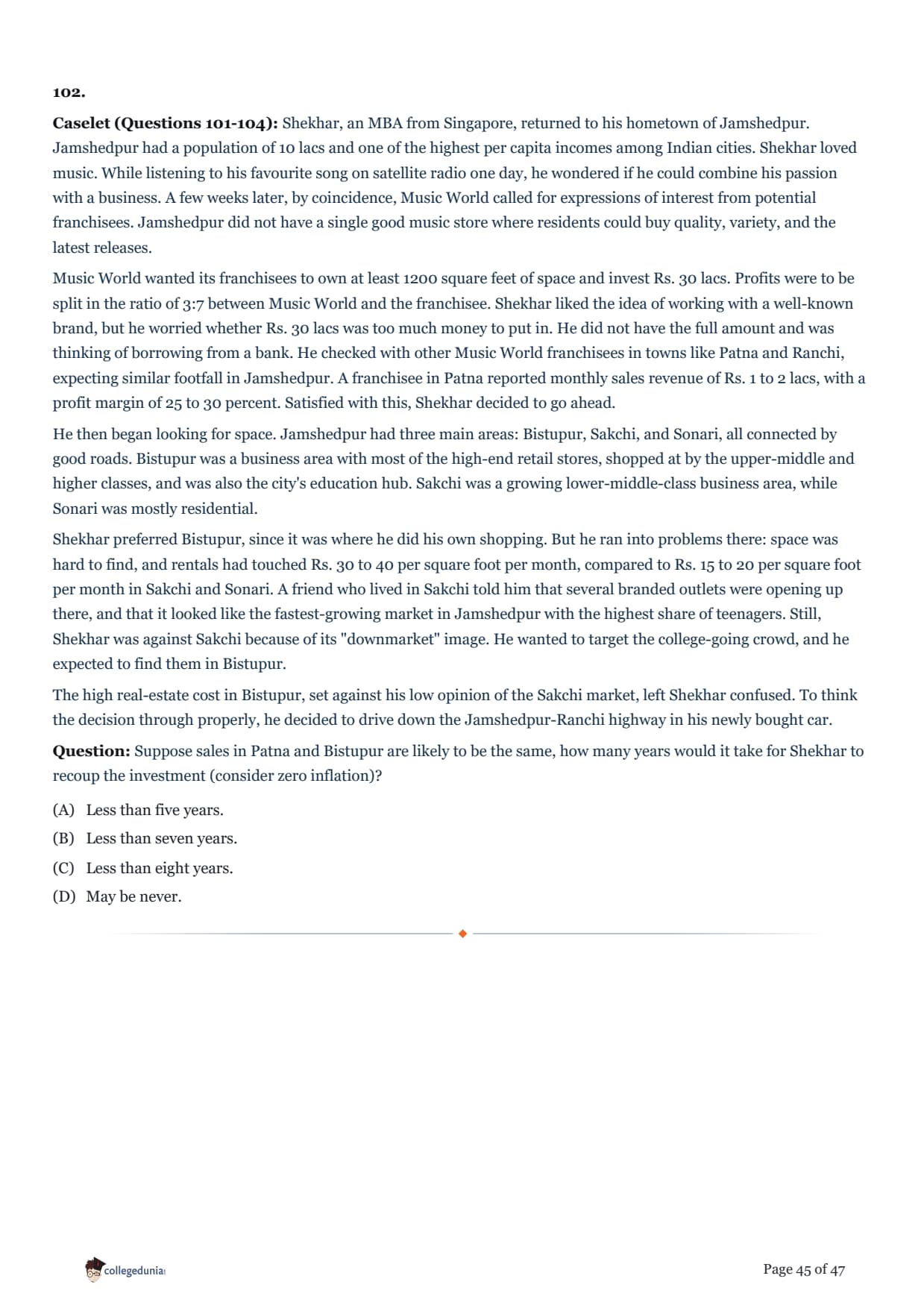
Caselet (Questions 101-104): Shekhar, an MBA from Singapore, returned to his hometown of Jamshedpur. Jamshedpur had a population of 10 lacs and one of the highest per capita incomes among Indian cities. Shekhar loved music. While listening to his favourite song on satellite radio one day, he wondered if he could combine his passion with a business. A few weeks later, by coincidence, Music World called for expressions of interest from potential franchisees. Jamshedpur did not have a single good music store where residents could buy quality, variety, and the latest releases.
Music World wanted its franchisees to own at least 1200 square feet of space and invest Rs. 30 lacs. Profits were to be split in the ratio of 3:7 between Music World and the franchisee. Shekhar liked the idea of working with a well-known brand, but he worried whether Rs. 30 lacs was too much money to put in. He did not have the full amount and was thinking of borrowing from a bank. He checked with other Music World franchisees in towns like Patna and Ranchi, expecting similar footfall in Jamshedpur. A franchisee in Patna reported monthly sales revenue of Rs. 1 to 2 lacs, with a profit margin of 25 to 30 percent. Satisfied with this, Shekhar decided to go ahead.
He then began looking for space. Jamshedpur had three main areas: Bistupur, Sakchi, and Sonari, all connected by good roads. Bistupur was a business area with most of the high-end retail stores, shopped at by the upper-middle and higher classes, and was also the city's education hub. Sakchi was a growing lower-middle-class business area, while Sonari was mostly residential.
Shekhar preferred Bistupur, since it was where he did his own shopping. But he ran into problems there: space was hard to find, and rentals had touched Rs. 30 to 40 per square foot per month, compared to Rs. 15 to 20 per square foot per month in Sakchi and Sonari. A friend who lived in Sakchi told him that several branded outlets were opening up there, and that it looked like the fastest-growing market in Jamshedpur with the highest share of teenagers. Still, Shekhar was against Sakchi because of its "downmarket" image. He wanted to target the college-going crowd, and he expected to find them in Bistupur.
The high real-estate cost in Bistupur, set against his low opinion of the Sakchi market, left Shekhar confused. To think the decision through properly, he decided to drive down the Jamshedpur-Ranchi highway in his newly bought car.
Question: Suppose sales in Patna and Bistupur are likely to be the same, how many years would it take for Shekhar to recoup the investment (consider zero inflation)?
Caselet (Questions 101-104): Shekhar, an MBA from Singapore, returned to his hometown of Jamshedpur. Jamshedpur had a population of 10 lacs and one of the highest per capita incomes among Indian cities. Shekhar loved music. While listening to his favourite song on satellite radio one day, he wondered if he could combine his passion with a business. A few weeks later, by coincidence, Music World called for expressions of interest from potential franchisees. Jamshedpur did not have a single good music store where residents could buy quality, variety, and the latest releases.
Music World wanted its franchisees to own at least 1200 square feet of space and invest Rs. 30 lacs. Profits were to be split in the ratio of 3:7 between Music World and the franchisee. Shekhar liked the idea of working with a well-known brand, but he worried whether Rs. 30 lacs was too much money to put in. He did not have the full amount and was thinking of borrowing from a bank. He checked with other Music World franchisees in towns like Patna and Ranchi, expecting similar footfall in Jamshedpur. A franchisee in Patna reported monthly sales revenue of Rs. 1 to 2 lacs, with a profit margin of 25 to 30 percent. Satisfied with this, Shekhar decided to go ahead.
He then began looking for space. Jamshedpur had three main areas: Bistupur, Sakchi, and Sonari, all connected by good roads. Bistupur was a business area with most of the high-end retail stores, shopped at by the upper-middle and higher classes, and was also the city's education hub. Sakchi was a growing lower-middle-class business area, while Sonari was mostly residential.
Shekhar preferred Bistupur, since it was where he did his own shopping. But he ran into problems there: space was hard to find, and rentals had touched Rs. 30 to 40 per square foot per month, compared to Rs. 15 to 20 per square foot per month in Sakchi and Sonari. A friend who lived in Sakchi told him that several branded outlets were opening up there, and that it looked like the fastest-growing market in Jamshedpur with the highest share of teenagers. Still, Shekhar was against Sakchi because of its "downmarket" image. He wanted to target the college-going crowd, and he expected to find them in Bistupur.
The high real-estate cost in Bistupur, set against his low opinion of the Sakchi market, left Shekhar confused. To think the decision through properly, he decided to drive down the Jamshedpur-Ranchi highway in his newly bought car.
Question: What could be the most likely reason for Shekhar's bias in favour of Bistupur?
Caselet (Questions 101-104): Shekhar, an MBA from Singapore, returned to his hometown of Jamshedpur. Jamshedpur had a population of 10 lacs and one of the highest per capita incomes among Indian cities. Shekhar loved music. While listening to his favourite song on satellite radio one day, he wondered if he could combine his passion with a business. A few weeks later, by coincidence, Music World called for expressions of interest from potential franchisees. Jamshedpur did not have a single good music store where residents could buy quality, variety, and the latest releases.
Music World wanted its franchisees to own at least 1200 square feet of space and invest Rs. 30 lacs. Profits were to be split in the ratio of 3:7 between Music World and the franchisee. Shekhar liked the idea of working with a well-known brand, but he worried whether Rs. 30 lacs was too much money to put in. He did not have the full amount and was thinking of borrowing from a bank. He checked with other Music World franchisees in towns like Patna and Ranchi, expecting similar footfall in Jamshedpur. A franchisee in Patna reported monthly sales revenue of Rs. 1 to 2 lacs, with a profit margin of 25 to 30 percent. Satisfied with this, Shekhar decided to go ahead.
He then began looking for space. Jamshedpur had three main areas: Bistupur, Sakchi, and Sonari, all connected by good roads. Bistupur was a business area with most of the high-end retail stores, shopped at by the upper-middle and higher classes, and was also the city's education hub. Sakchi was a growing lower-middle-class business area, while Sonari was mostly residential.
Shekhar preferred Bistupur, since it was where he did his own shopping. But he ran into problems there: space was hard to find, and rentals had touched Rs. 30 to 40 per square foot per month, compared to Rs. 15 to 20 per square foot per month in Sakchi and Sonari. A friend who lived in Sakchi told him that several branded outlets were opening up there, and that it looked like the fastest-growing market in Jamshedpur with the highest share of teenagers. Still, Shekhar was against Sakchi because of its "downmarket" image. He wanted to target the college-going crowd, and he expected to find them in Bistupur.
The high real-estate cost in Bistupur, set against his low opinion of the Sakchi market, left Shekhar confused. To think the decision through properly, he decided to drive down the Jamshedpur-Ranchi highway in his newly bought car.
Question: Which one of the following is the most important decision criterion in such a business situation?
XAT 2009 Exam Pattern and Marking Scheme Explained
XAT 2009 was a single paper of 104 objective questions that you had to clear across three separate sections, each with five options and negative marking.
- Total questions: 104 MCQs across three sections
- Section A - Verbal and Logical Ability: 35 questions
- Section B - Quantitative Ability and Data Interpretation: 38 questions
- Section C - Analytical Reasoning and Decision Making: 31 questions
- Options: five choices (A to E) per question
- Marking scheme: +1 for a correct answer and -0.25 for a wrong one, with a steeper penalty after the first six wrong answers in a section
High-Weightage Sections in XAT 2009 to Focus On First
Section B was both the largest and the hardest part of the paper, so it decided most scores in XAT 2009.
- Quantitative Ability and Data Interpretation (38 questions): the toughest section, with very few easy questions and long calculations - most students cleared it with the lowest sectional score of the three
- Data Interpretation sets: the Global Soda Ash production set was the easiest and worth attempting, while the cake-chain leftover set was calculation-heavy and best left for the end
- Verbal and Logical Ability (35 questions): reading comprehension, critical reasoning, sentence correction and figures of speech carried the bulk of the marks
- Analytical Reasoning and Decision Making (31 questions): caselet-based decision making and arrangement puzzles, a signature XAT section that rewards clear reasoning over speed
XAT 2009 Question Paper Solutions Video
Source: ExamNest
How to Use the XAT 2009 Question Paper for Practice
Treat the paper as a full timed mock before you look at any solution, then review section by section.
- Solve all 104 questions in one 2-hour sitting to build sectional stamina
- Attempt Section B (Quant and DI) last, the way most high scorers did in 2009
- Review every question with the solutions PDF and redo the sets you skipped
- Note that XAT reuses question styles - decision-making caselets and DI sets from 2009 still mirror what shows up today
XAT 2009 Question Paper with Solutions FAQs
Ques. Which section was the toughest in XAT 2009?
Ans. Section B, Quantitative Ability and Data Interpretation with 38 questions, was the hardest. Easy questions were rare and most needed long calculations, so its sectional cutoff was the lowest of the three sections.
Ques. How many questions were there in XAT 2009?
Ans. XAT 2009 had 104 multiple-choice questions across three sections - 35 in Verbal and Logical Ability, 38 in Quantitative Ability and Data Interpretation, and 31 in Analytical Reasoning and Decision Making.
Ques. What was the marking scheme in XAT 2009?
Ans. Each correct answer earned 1 mark and each wrong answer lost 0.25 mark. The penalty grew steeper after the first six wrong answers in a section, so blind guessing was risky.
Ques. Which XAT 2009 Data Interpretation set should you attempt first?
Ans. The Global Soda Ash production set was the easiest DI set and worth attempting early. The cake-chain leftover set involved heavy calculation and was best saved for last.
Ques. Are XAT decision making questions repeated from previous years?
Ans. Exact questions are not repeated, but the caselet style and the reasoning traps in the 2009 decision-making section still match how XAT frames its decision-making questions today, so the paper is strong practice.
Ques. Where can I download the XAT 2009 question paper with solutions PDF for free?
Ans. Use the download table above on Collegedunia to get the XAT 2009 question paper and its full solutions PDF. XAT is conducted by XLRI Jamshedpur, and details are available on the official site (xlri.ac.in).



Comments