




The XAT 2005 Quantitative Aptitude question paper is now available with detailed solutions for free download. XAT 2005 was conducted by XLRI Jamshedpur on January 9, 2005, and this section carried 50 multiple-choice questions from a paper-and-pencil test, back when XAT still ran as an offline exam.
| XAT 2005 Quantitative Aptitude Question Paper with Solutions | Download PDF | Check Solutions |
XAT 2005 Quantitative Aptitude Questions with Solutions
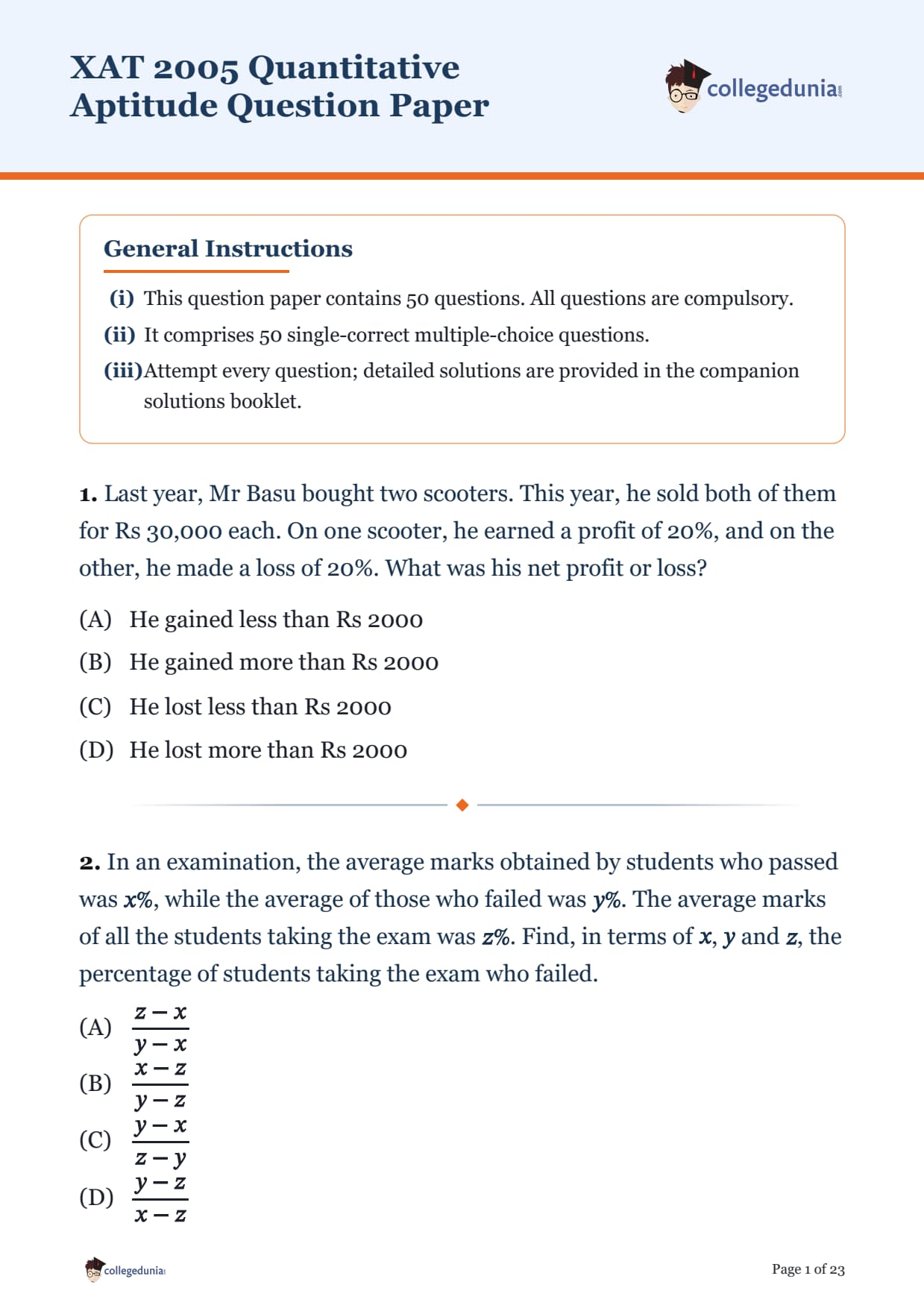
Last year, Mr Basu bought two scooters. This year, he sold both of them for Rs 30,000 each. On one scooter, he earned a profit of 20%, and on the other, he made a loss of 20%. What was his net profit or loss?
In an examination, the average marks obtained by students who passed was \(x\%\), while the average of those who failed was \(y\%\). The average marks of all the students taking the exam was \(z\%\). Find, in terms of \(x\), \(y\) and \(z\), the percentage of students taking the exam who failed.
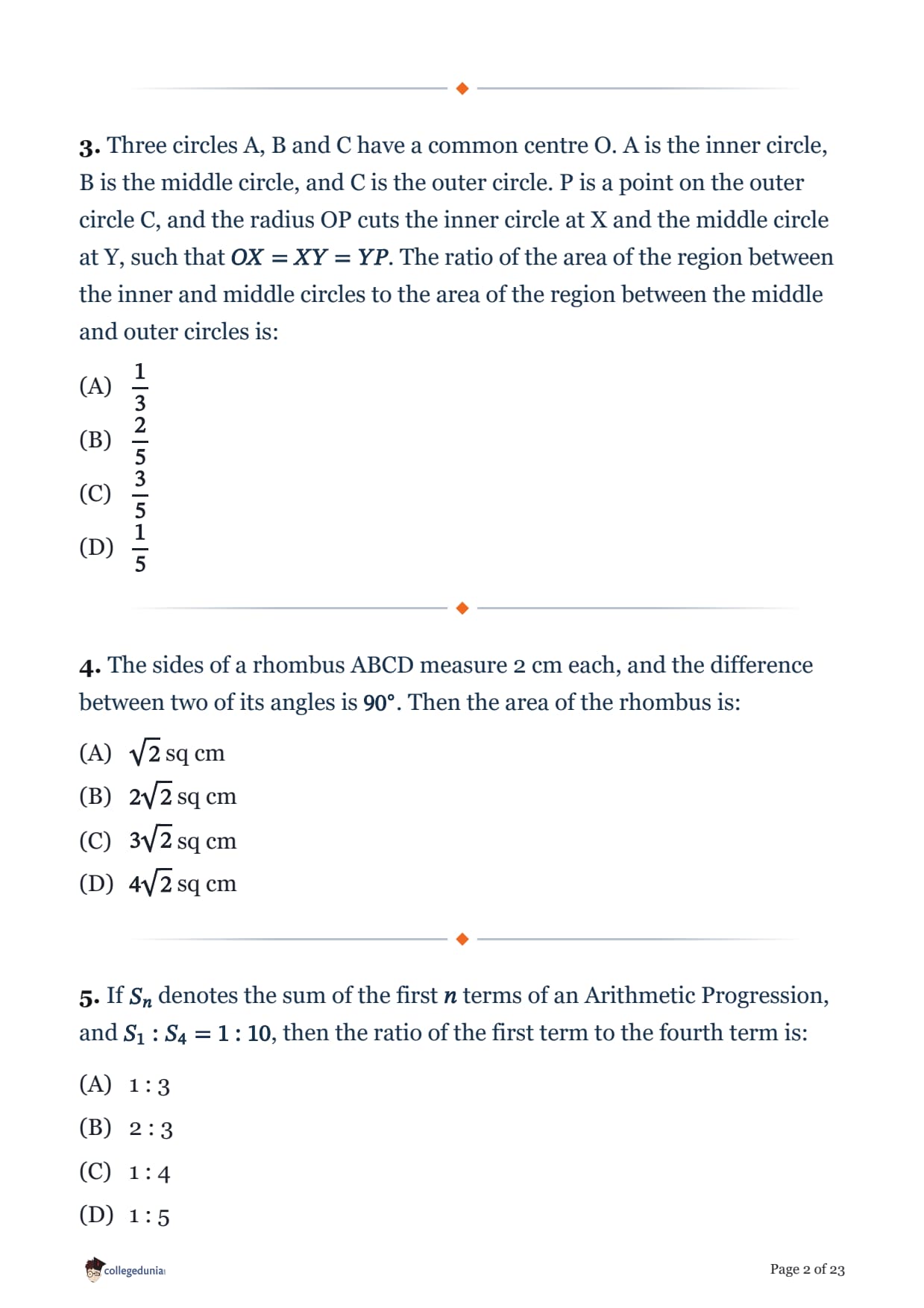
Three circles A, B and C have a common centre O. A is the inner circle, B is the middle circle, and C is the outer circle. P is a point on the outer circle C, and the radius OP cuts the inner circle at X and the middle circle at Y, such that \(OX = XY = YP\). The ratio of the area of the region between the inner and middle circles to the area of the region between the middle and outer circles is:
The sides of a rhombus ABCD measure 2 cm each, and the difference between two of its angles is \(90^{\circ}\). Then the area of the rhombus is:
If \(S_n\) denotes the sum of the first \(n\) terms of an Arithmetic Progression, and \(S_1 : S_4 = 1 : 10\), then the ratio of the first term to the fourth term is:
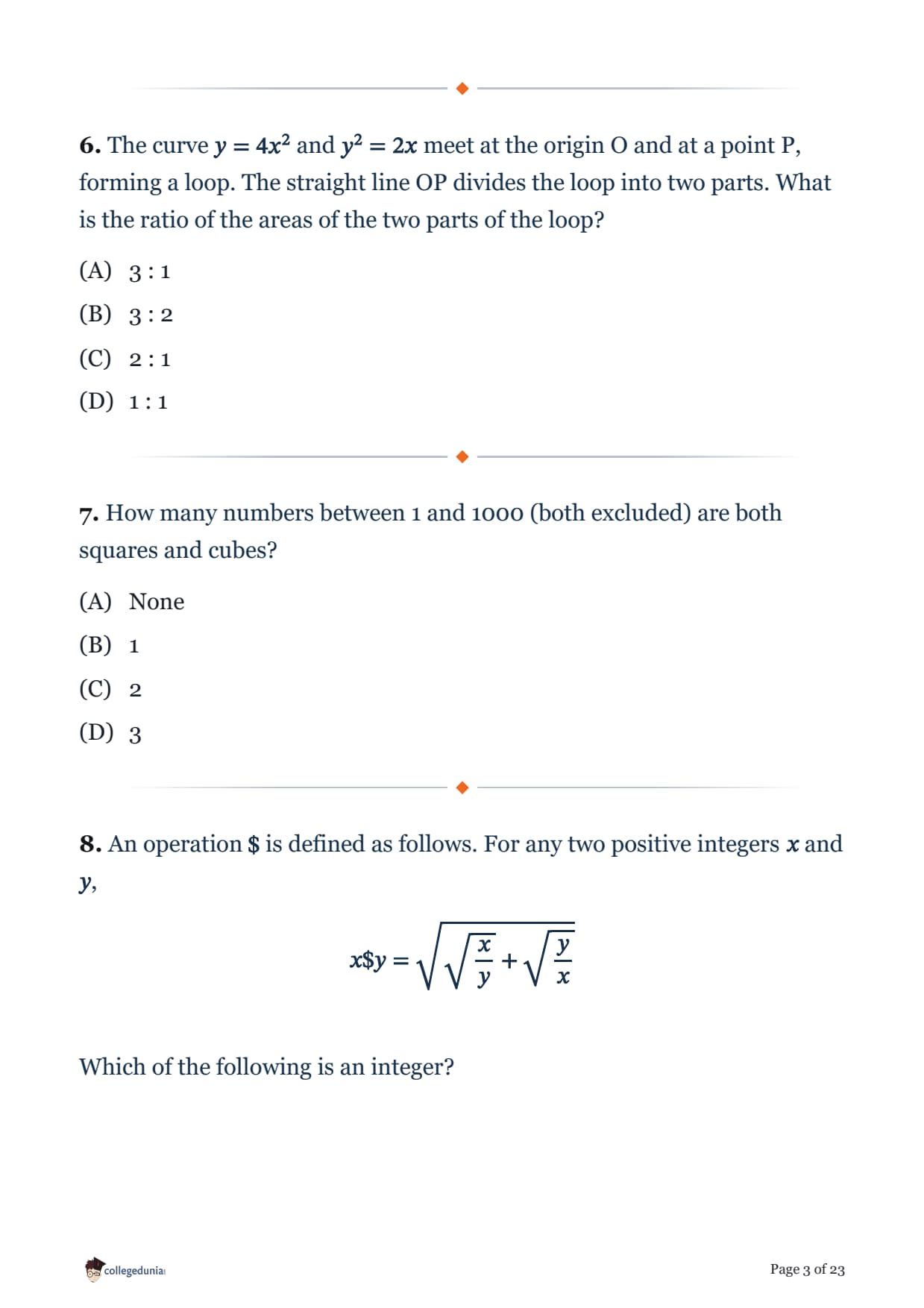
The curve \(y = 4x^2\) and \(y^2 = 2x\) meet at the origin O and at a point P, forming a loop. The straight line OP divides the loop into two parts. What is the ratio of the areas of the two parts of the loop?
How many numbers between 1 and 1000 (both excluded) are both squares and cubes?
An operation \( \$ \) is defined as follows. For any two positive integers \(x\) and \(y\),
\[ x \$ y = \sqrt{ \sqrt{\dfrac{x}{y}} + \sqrt{\dfrac{y}{x}} } \]
Which of the following is an integer?
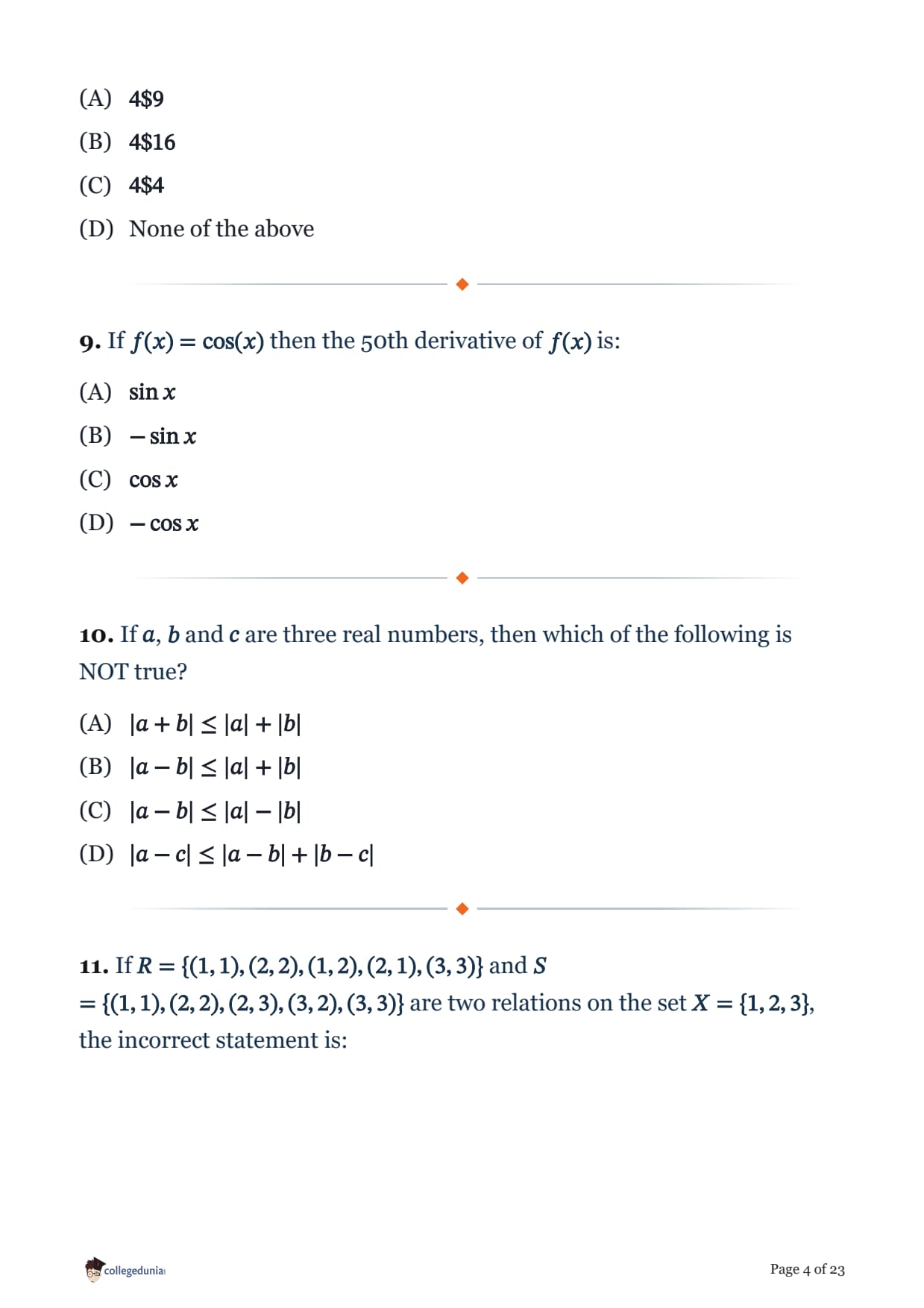
If \(f(x) = \cos(x)\) then the 50th derivative of \(f(x)\) is:
If \(a\), \(b\) and \(c\) are three real numbers, then which of the following is NOT true?
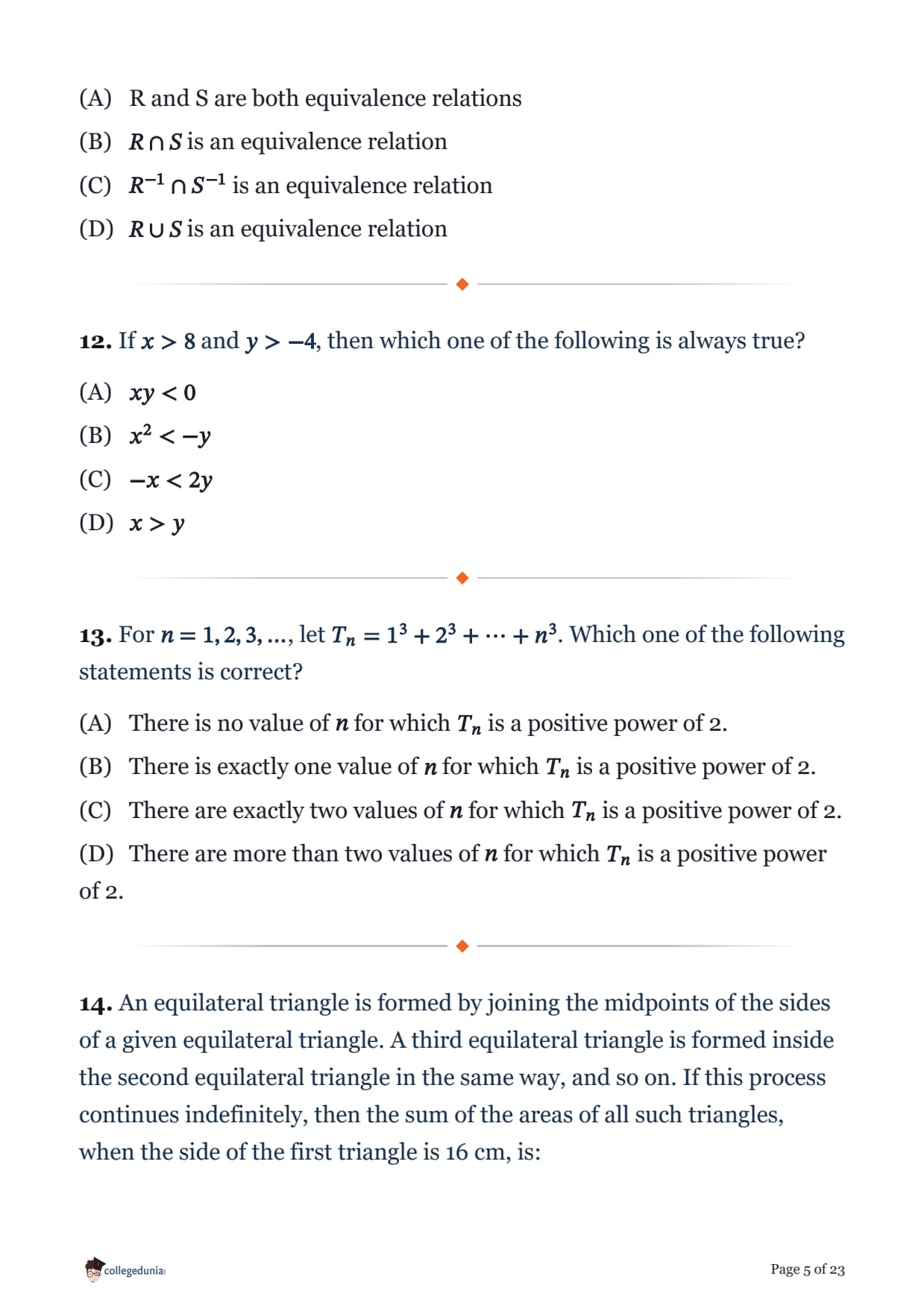
If \(R = \{(1,1), (2,2), (1,2), (2,1), (3,3)\}\) and \(S = \{(1,1), (2,2), (2,3), (3,2), (3,3)\}\) are two relations on the set \(X = \{1, 2, 3\}\), the incorrect statement is:
If \(x > 8\) and \(y > -4\), then which one of the following is always true?
For \(n = 1, 2, 3, \ldots\), let \(T_n = 1^3 + 2^3 + \cdots + n^3\). Which one of the following statements is correct?
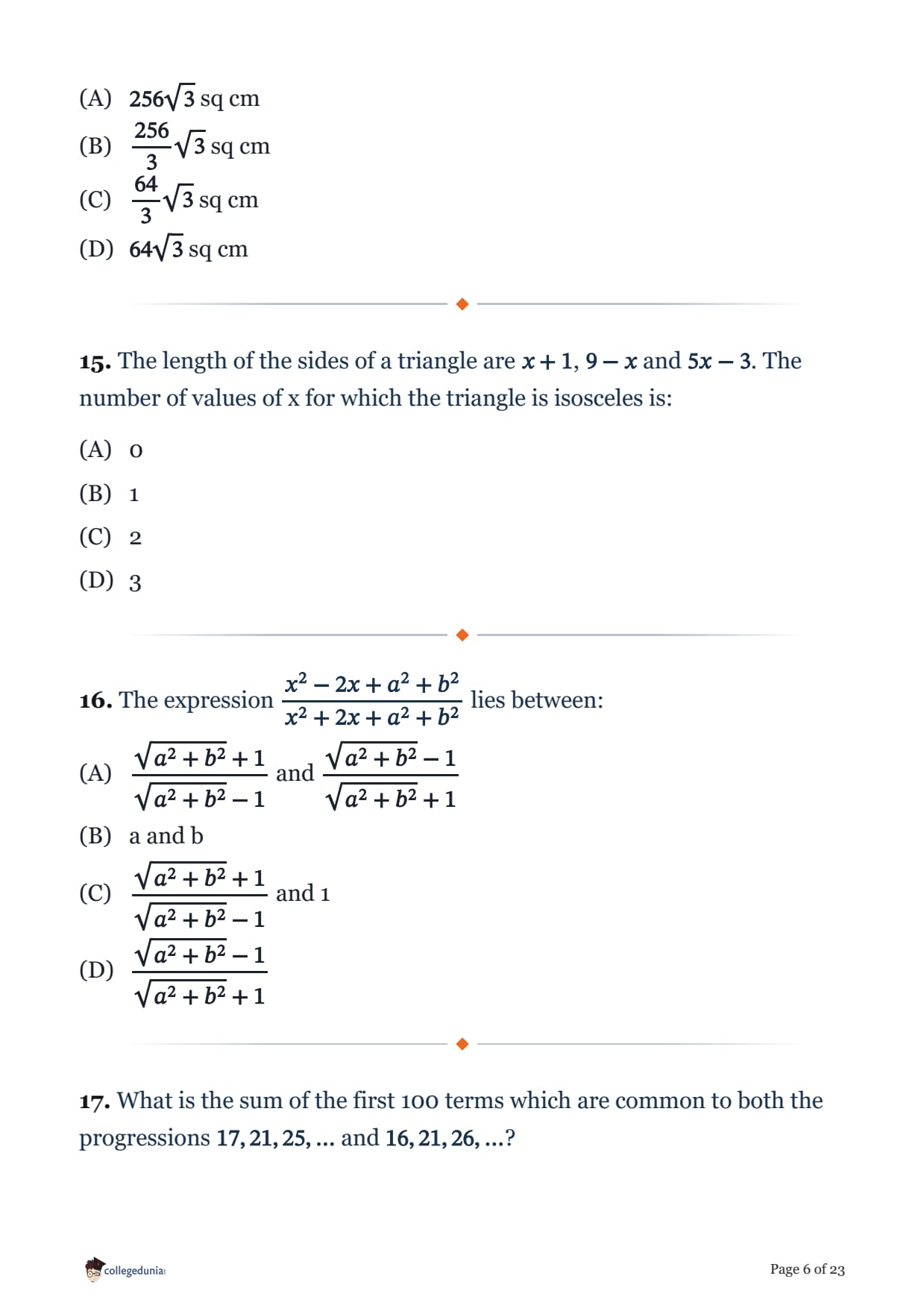
An equilateral triangle is formed by joining the midpoints of the sides of a given equilateral triangle. A third equilateral triangle is formed inside the second equilateral triangle in the same way, and so on. If this process continues indefinitely, then the sum of the areas of all such triangles, when the side of the first triangle is 16 cm, is:
The length of the sides of a triangle are \(x + 1\), \(9 - x\) and \(5x - 3\). The number of values of x for which the triangle is isosceles is:
The expression \(\dfrac{x^2 - 2x + a^2 + b^2}{x^2 + 2x + a^2 + b^2}\) lies between:
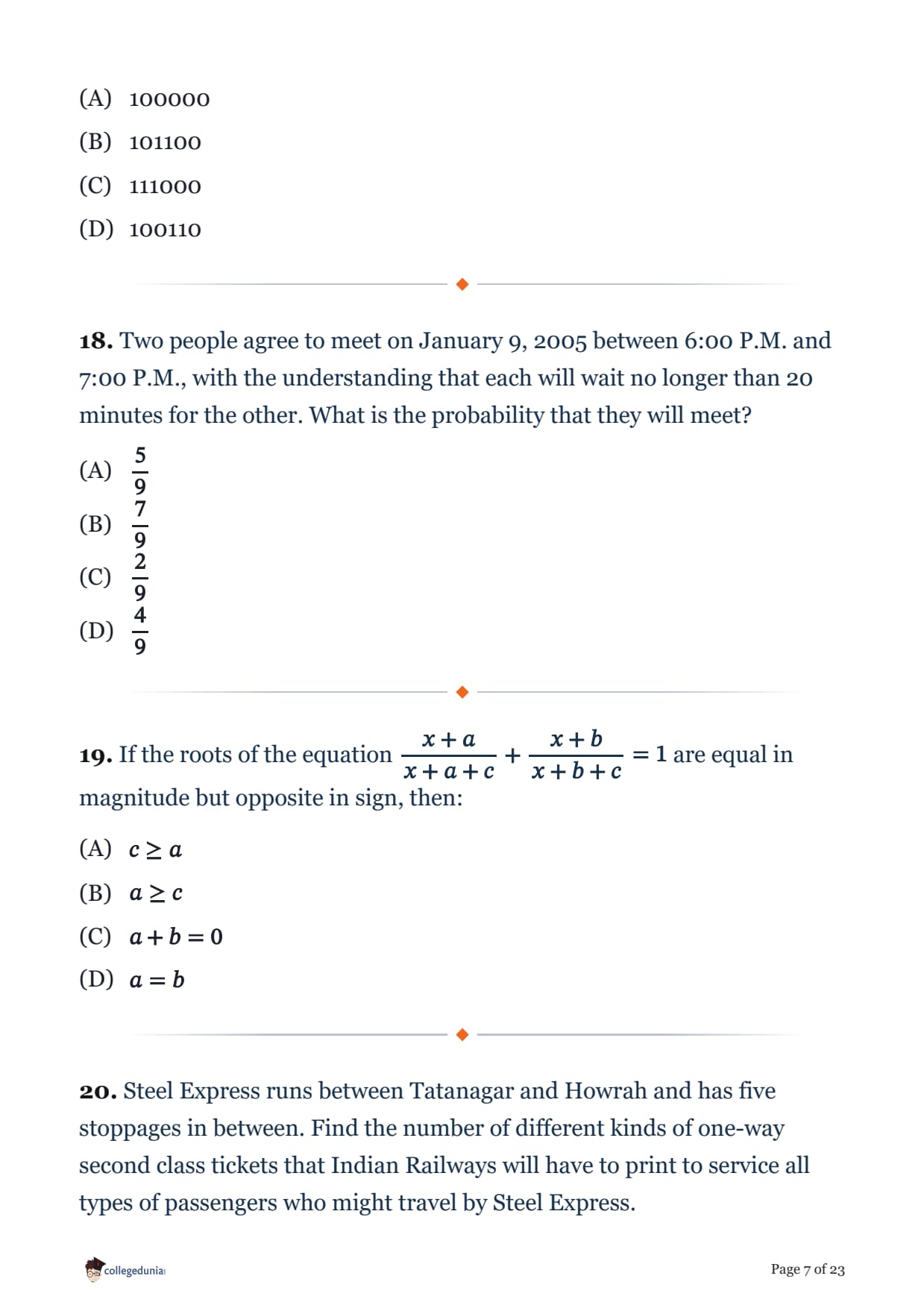
What is the sum of the first 100 terms which are common to both the progressions \(17, 21, 25, \ldots\) and \(16, 21, 26, \ldots\)?
Two people agree to meet on January 9, 2005 between 6:00 P.M. and 7:00 P.M., with the understanding that each will wait no longer than 20 minutes for the other. What is the probability that they will meet?
If the roots of the equation \(\dfrac{x+a}{x+a+c} + \dfrac{x+b}{x+b+c} = 1\) are equal in magnitude but opposite in sign, then:
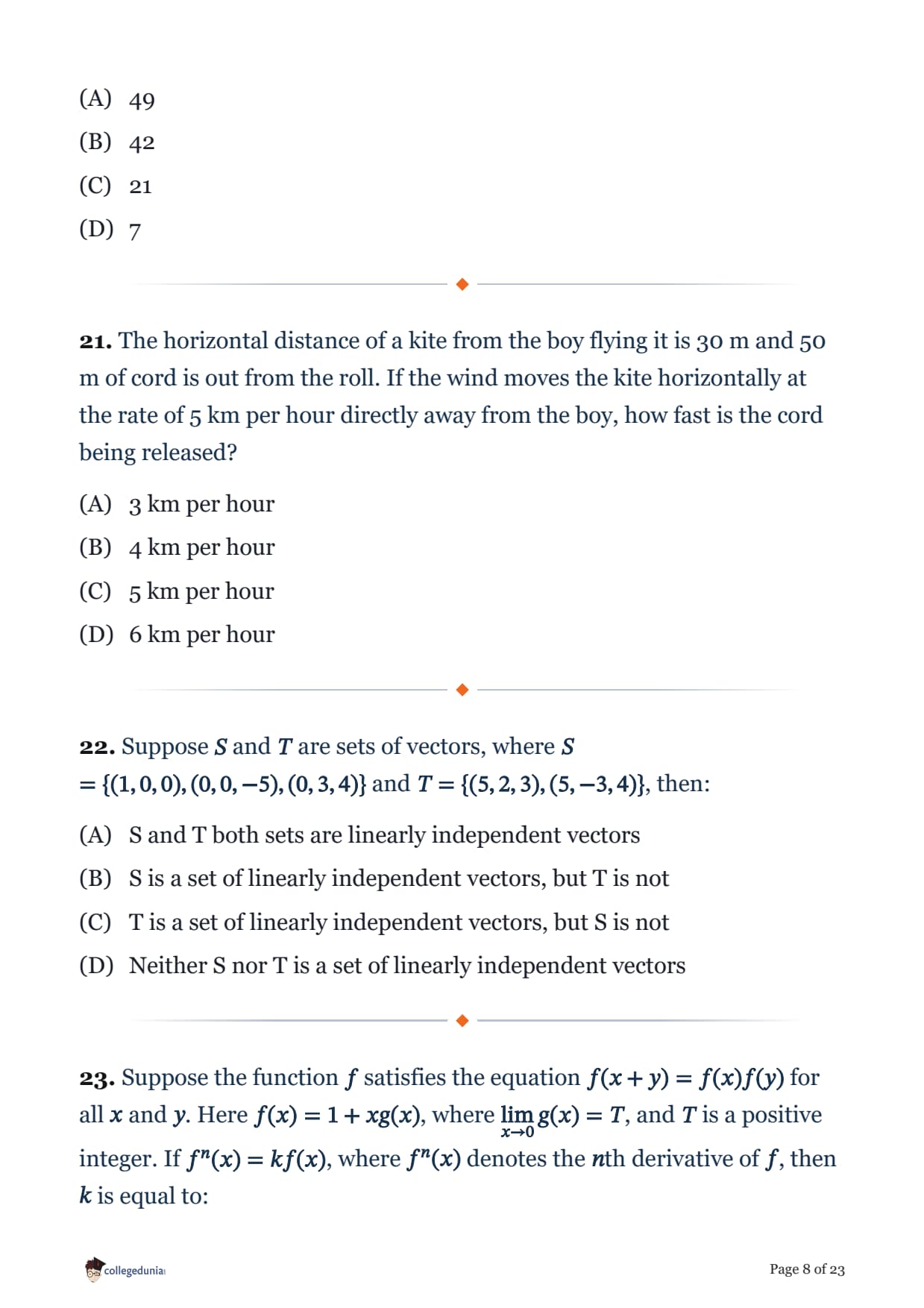
Steel Express runs between Tatanagar and Howrah and has five stoppages in between. Find the number of different kinds of one-way second class tickets that Indian Railways will have to print to service all types of passengers who might travel by Steel Express.
The horizontal distance of a kite from the boy flying it is 30 m and 50 m of cord is out from the roll. If the wind moves the kite horizontally at the rate of 5 km per hour directly away from the boy, how fast is the cord being released?
Suppose \(S\) and \(T\) are sets of vectors, where \(S = \{(1,0,0), (0, 0, -5), (0, 3, 4)\}\) and \(T = \{(5, 2, 3), (5, -3, 4)\}\), then:
Suppose the function \(f\) satisfies the equation \(f(x+y) = f(x)f(y)\) for all \(x\) and \(y\). Here \(f(x) = 1 + xg(x)\), where \(\displaystyle\lim_{x \to 0} g(x) = T\), and \(T\) is a positive integer. If \(f^{n}(x) = kf(x)\), where \(f^{n}(x)\) denotes the \(n\)th derivative of \(f\), then \(k\) is equal to:
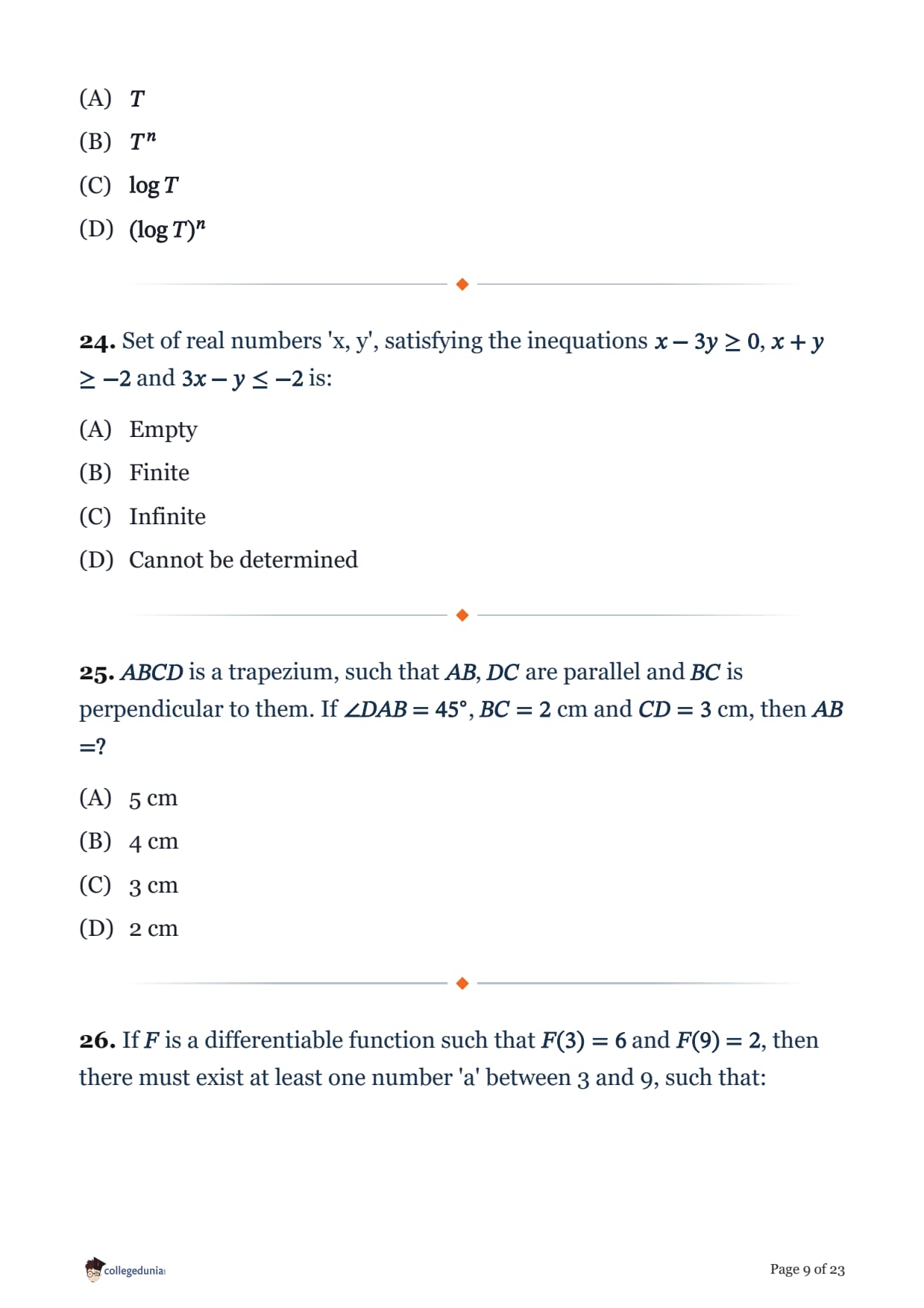
Set of real numbers 'x, y', satisfying the inequations \(x - 3y \geq 0\), \(x + y \geq -2\) and \(3x - y \leq -2\) is:
\(ABCD\) is a trapezium, such that \(AB\), \(DC\) are parallel and \(BC\) is perpendicular to them. If \(\angle DAB = 45^{\circ}\), \(BC = 2\) cm and \(CD = 3\) cm, then \(AB = ?\)
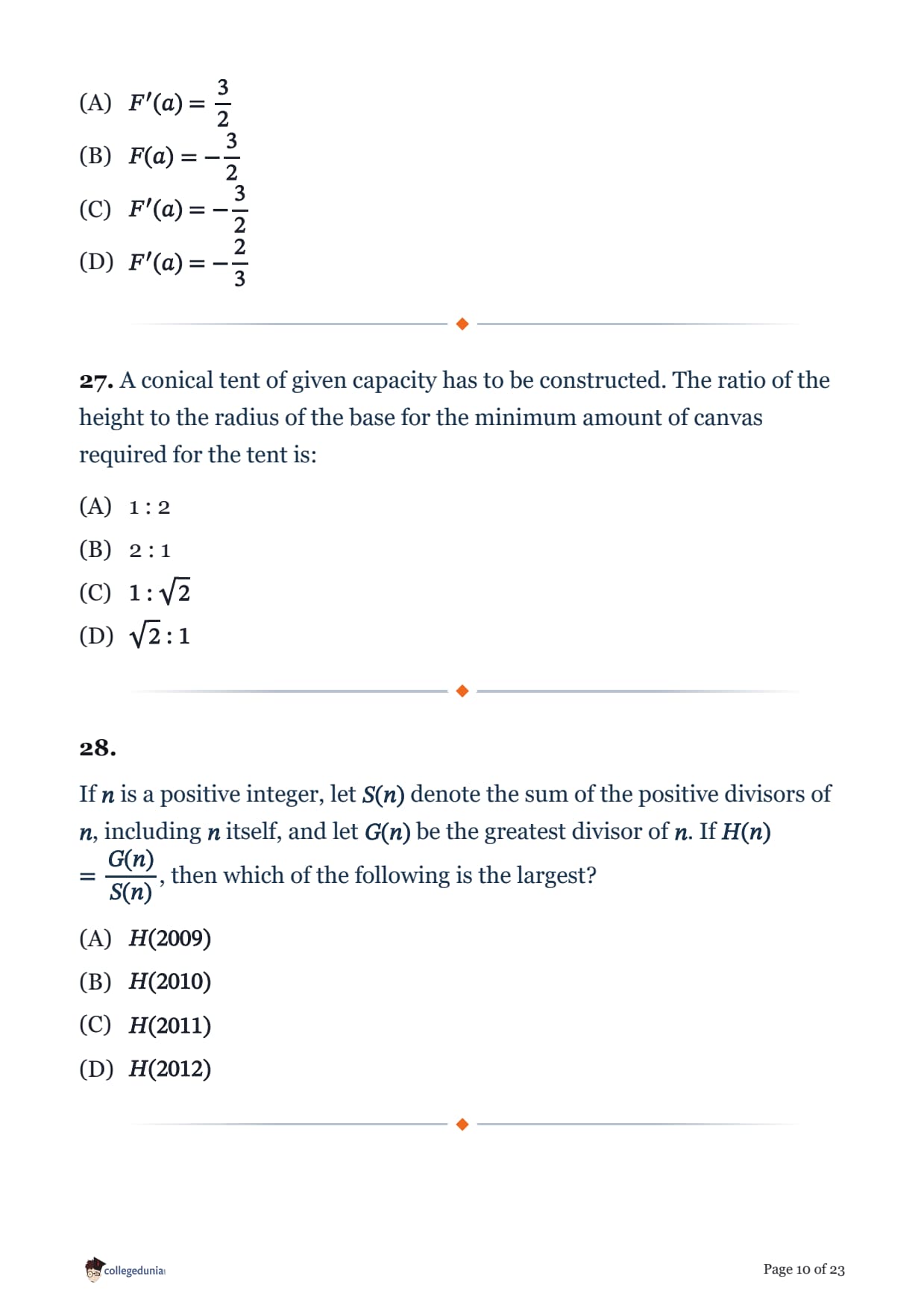
If \(F\) is a differentiable function such that \(F(3) = 6\) and \(F(9) = 2\), then there must exist at least one number 'a' between 3 and 9, such that:
A conical tent of given capacity has to be constructed. The ratio of the height to the radius of the base for the minimum amount of canvas required for the tent is:
If \(n\) is a positive integer, let \(S(n)\) denote the sum of the positive divisors of \(n\), including \(n\) itself, and let \(G(n)\) be the greatest divisor of \(n\). If \(H(n) = \dfrac{G(n)}{S(n)}\), then which of the following is the largest?
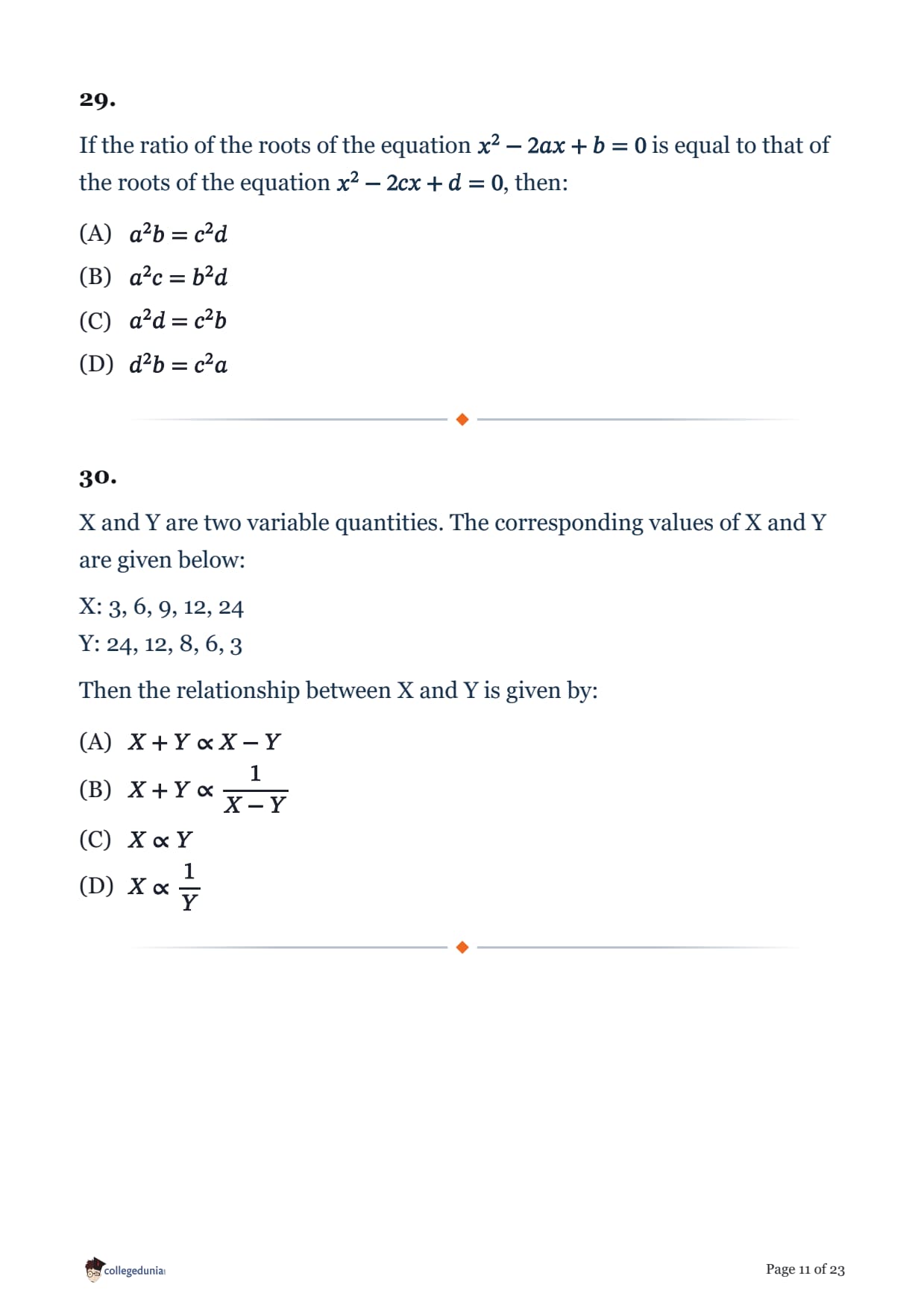
If the ratio of the roots of the equation \(x^2 - 2ax + b = 0\) is equal to that of the roots of the equation \(x^2 - 2cx + d = 0\), then:
X and Y are two variable quantities. The corresponding values of X and Y are given below:
X: 3, 6, 9, 12, 24
Y: 24, 12, 8, 6, 3
Then the relationship between X and Y is given by:
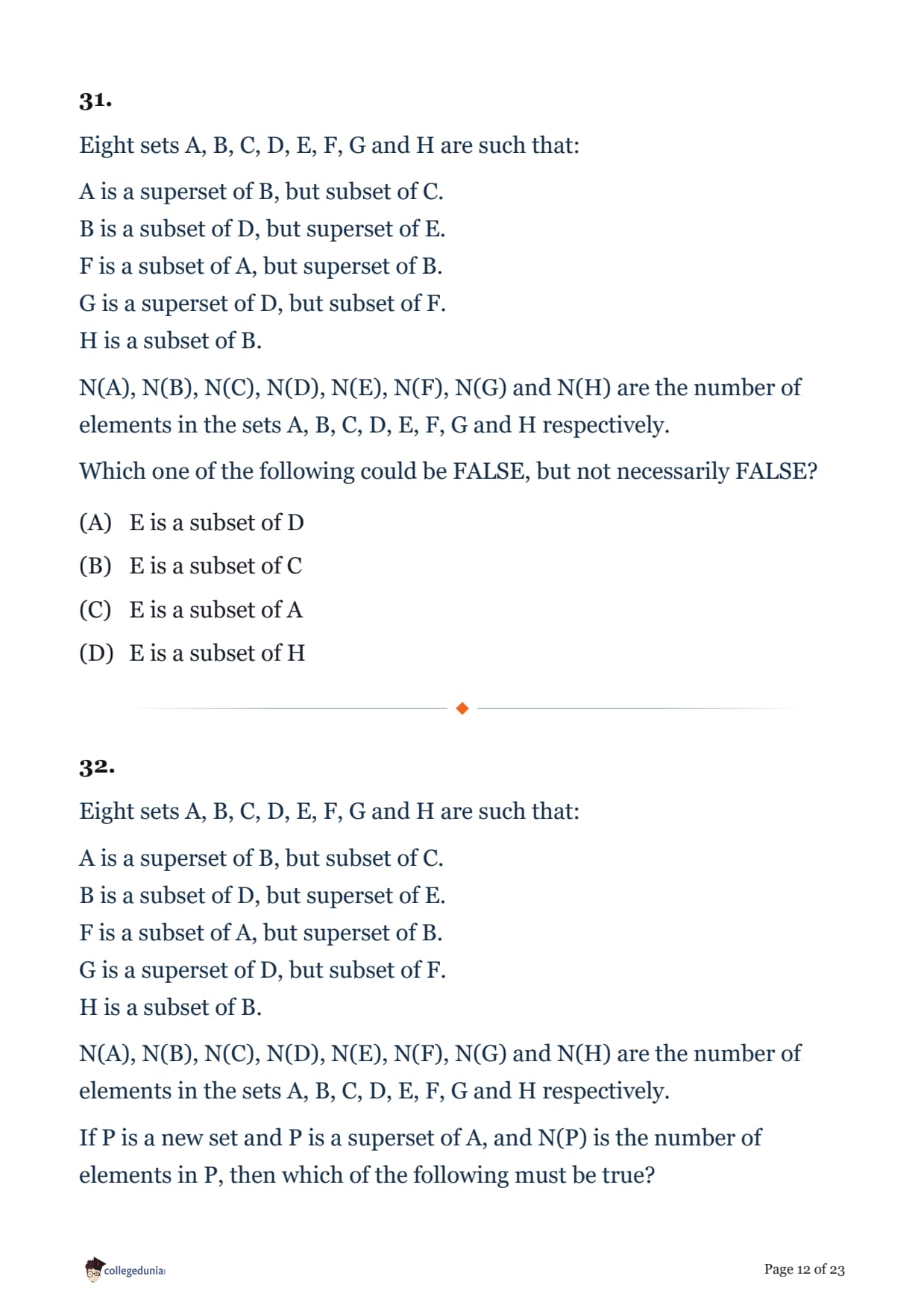
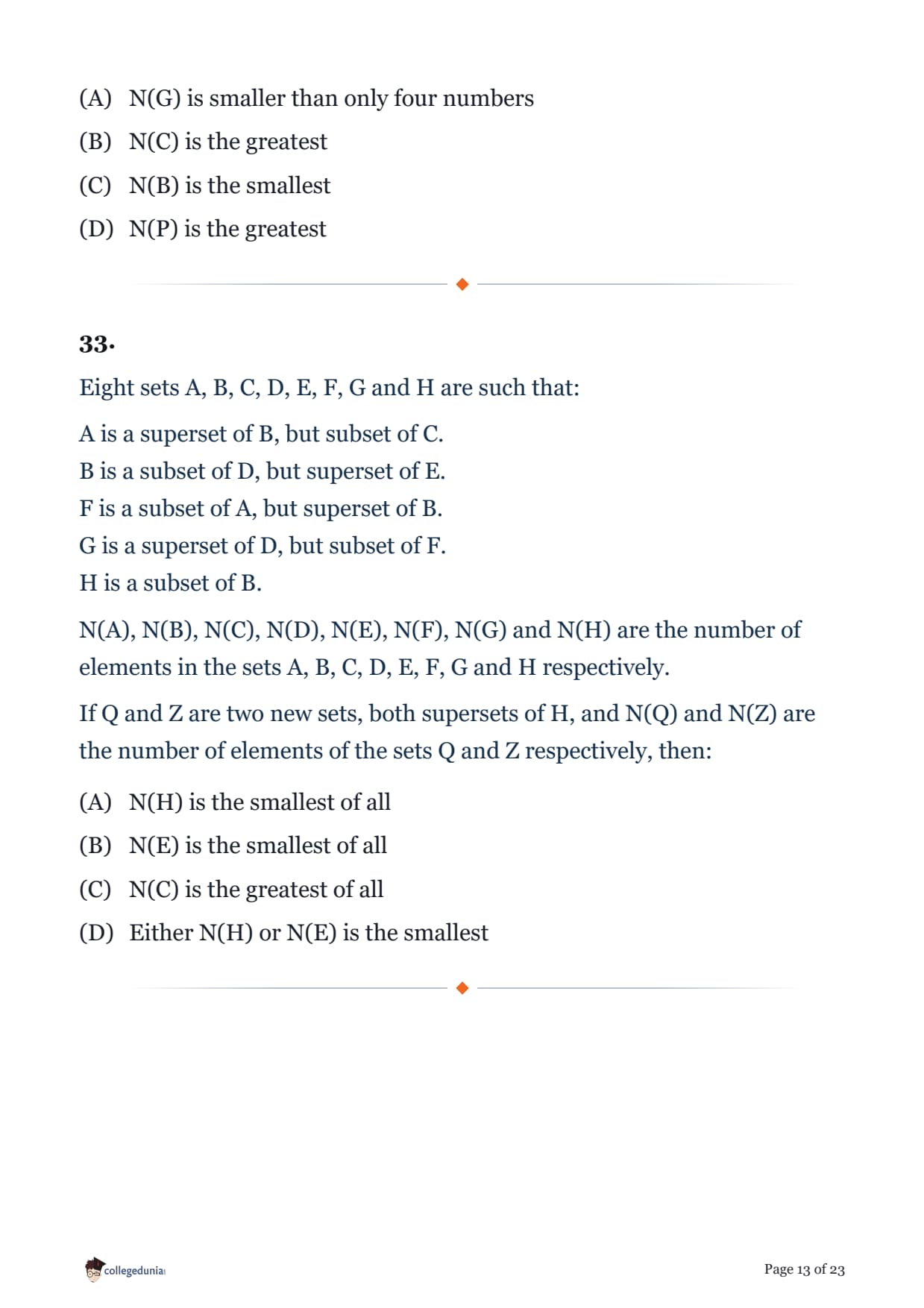
Eight sets A, B, C, D, E, F, G and H are such that:
A is a superset of B, but subset of C.
B is a subset of D, but superset of E.
F is a subset of A, but superset of B.
G is a superset of D, but subset of F.
H is a subset of B.
N(A), N(B), N(C), N(D), N(E), N(F), N(G) and N(H) are the number of elements in the sets A, B, C, D, E, F, G and H respectively.
Which one of the following could be FALSE, but not necessarily FALSE?
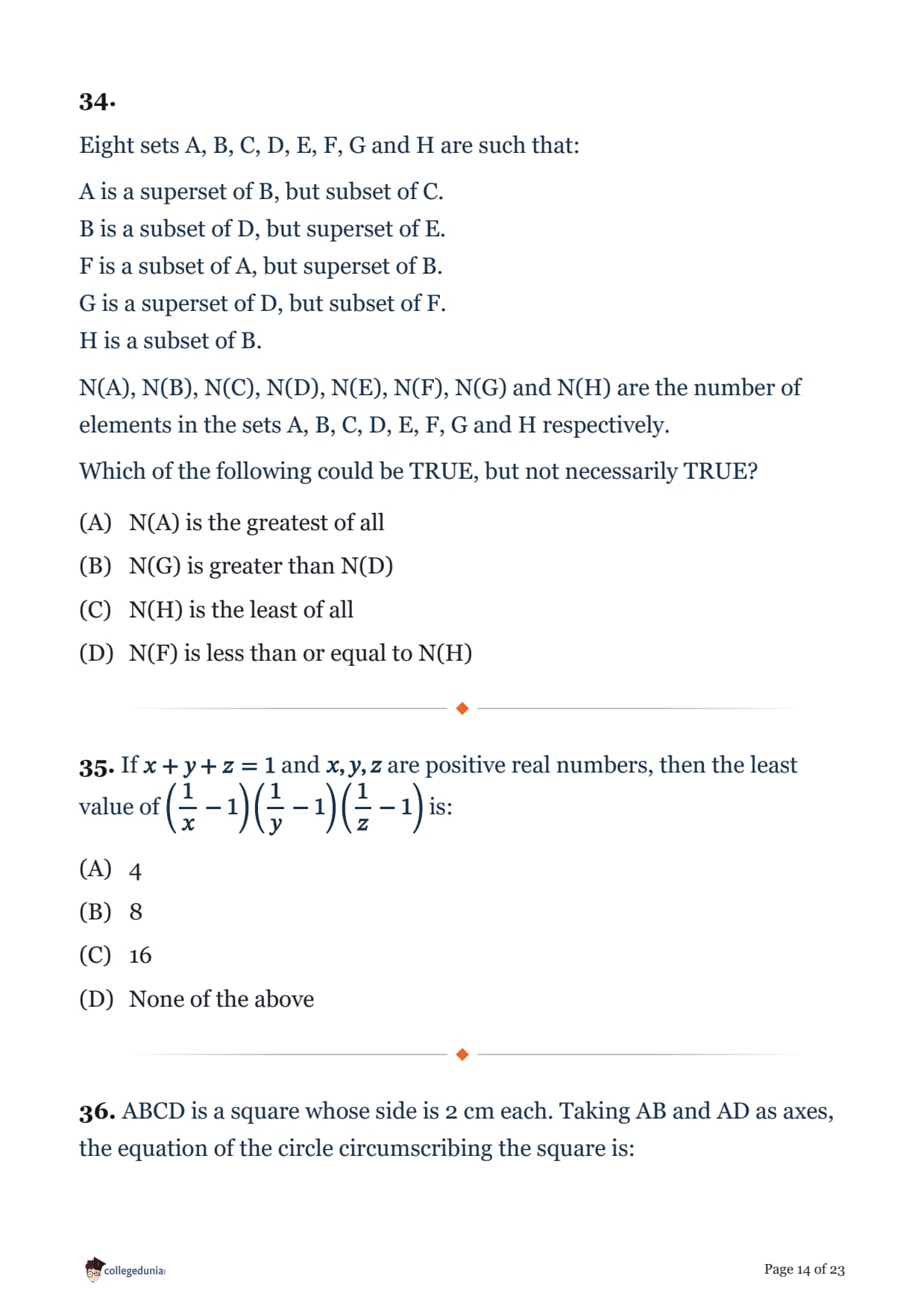
Eight sets A, B, C, D, E, F, G and H are such that:
A is a superset of B, but subset of C.
B is a subset of D, but superset of E.
F is a subset of A, but superset of B.
G is a superset of D, but subset of F.
H is a subset of B.
N(A), N(B), N(C), N(D), N(E), N(F), N(G) and N(H) are the number of elements in the sets A, B, C, D, E, F, G and H respectively.
If P is a new set and P is a superset of A, and N(P) is the number of elements in P, then which of the following must be true?
Eight sets A, B, C, D, E, F, G and H are such that:
A is a superset of B, but subset of C.
B is a subset of D, but superset of E.
F is a subset of A, but superset of B.
G is a superset of D, but subset of F.
H is a subset of B.
N(A), N(B), N(C), N(D), N(E), N(F), N(G) and N(H) are the number of elements in the sets A, B, C, D, E, F, G and H respectively.
If Q and Z are two new sets, both supersets of H, and N(Q) and N(Z) are the number of elements of the sets Q and Z respectively, then:
Eight sets A, B, C, D, E, F, G and H are such that:
A is a superset of B, but subset of C.
B is a subset of D, but superset of E.
F is a subset of A, but superset of B.
G is a superset of D, but subset of F.
H is a subset of B.
N(A), N(B), N(C), N(D), N(E), N(F), N(G) and N(H) are the number of elements in the sets A, B, C, D, E, F, G and H respectively.
Which of the following could be TRUE, but not necessarily TRUE?
If \(x + y + z = 1\) and \(x, y, z\) are positive real numbers, then the least value of \(\left(\dfrac{1}{x}-1\right)\left(\dfrac{1}{y}-1\right)\left(\dfrac{1}{z}-1\right)\) is:
ABCD is a square whose side is 2 cm each. Taking AB and AD as axes, the equation of the circle circumscribing the square is:
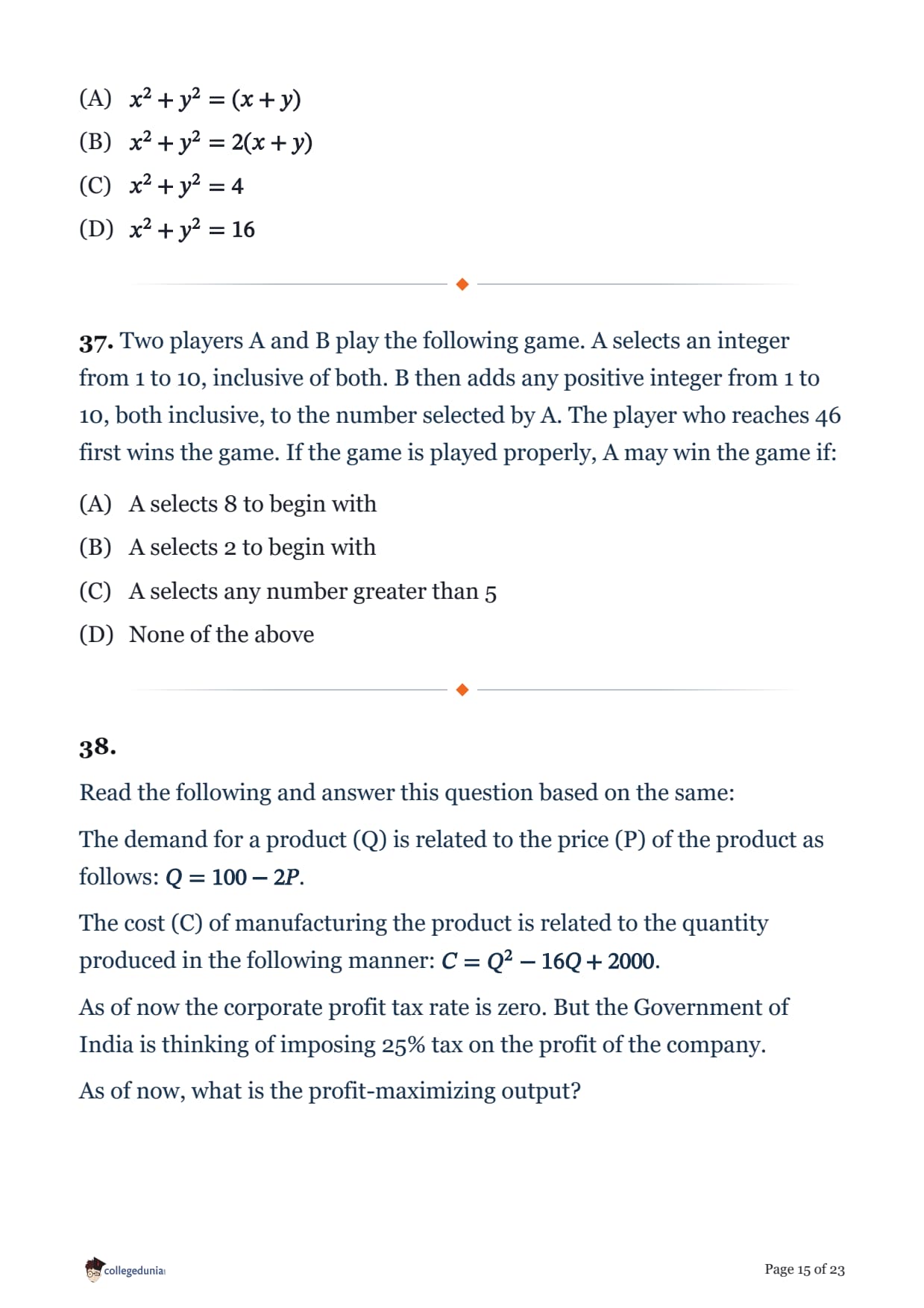
Two players A and B play the following game. A selects an integer from 1 to 10, inclusive of both. B then adds any positive integer from 1 to 10, both inclusive, to the number selected by A. The player who reaches 46 first wins the game. If the game is played properly, A may win the game if:
Read the following and answer this question based on the same:
The demand for a product (Q) is related to the price (P) of the product as follows: \(Q=100-2P\).
The cost (C) of manufacturing the product is related to the quantity produced in the following manner: \(C=Q^2-16Q+2000\).
As of now the corporate profit tax rate is zero. But the Government of India is thinking of imposing 25% tax on the profit of the company.
As of now, what is the profit-maximizing output?
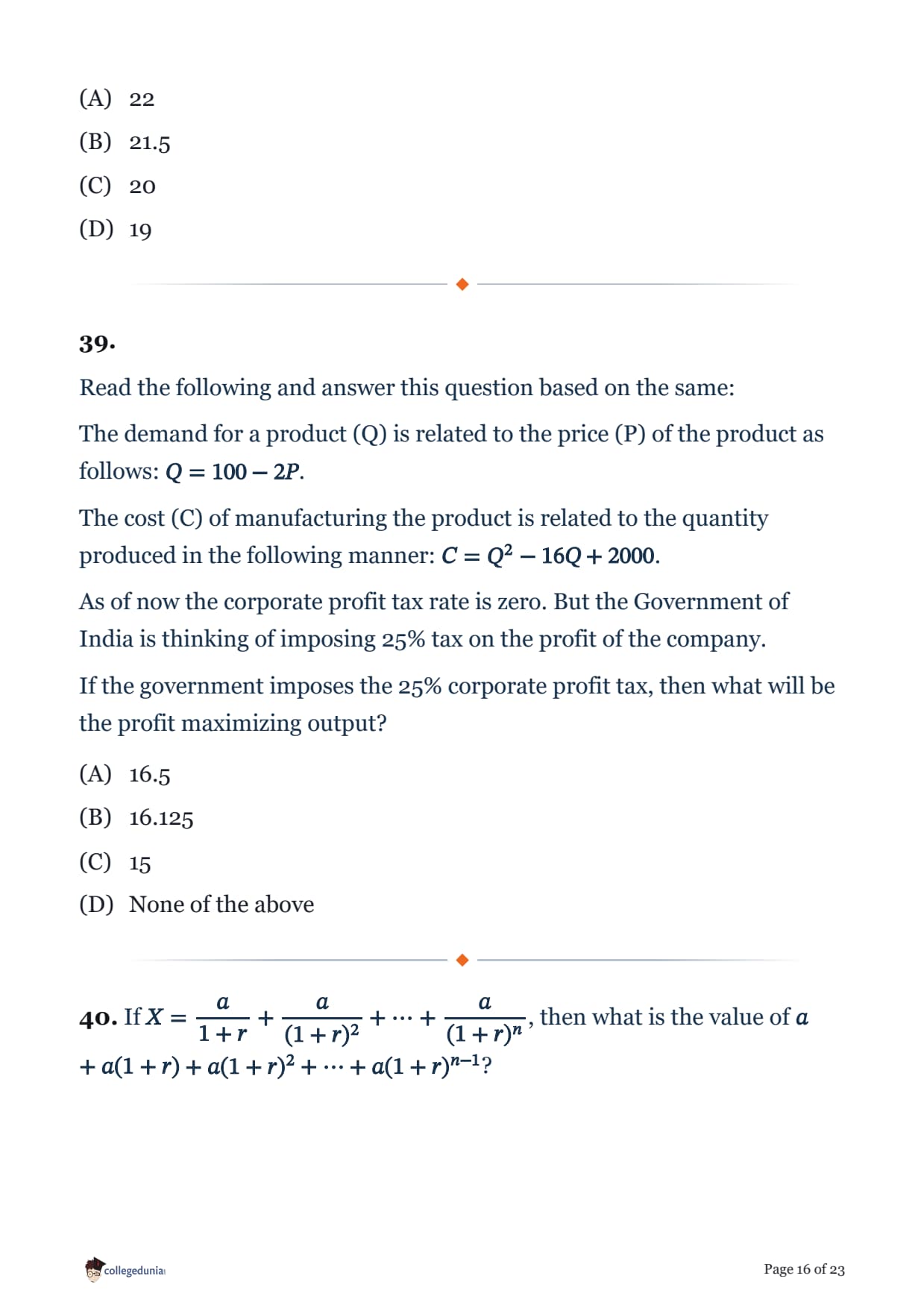
Read the following and answer this question based on the same:
The demand for a product (Q) is related to the price (P) of the product as follows: \(Q=100-2P\).
The cost (C) of manufacturing the product is related to the quantity produced in the following manner: \(C=Q^2-16Q+2000\).
As of now the corporate profit tax rate is zero. But the Government of India is thinking of imposing 25% tax on the profit of the company.
If the government imposes the 25% corporate profit tax, then what will be the profit maximizing output?
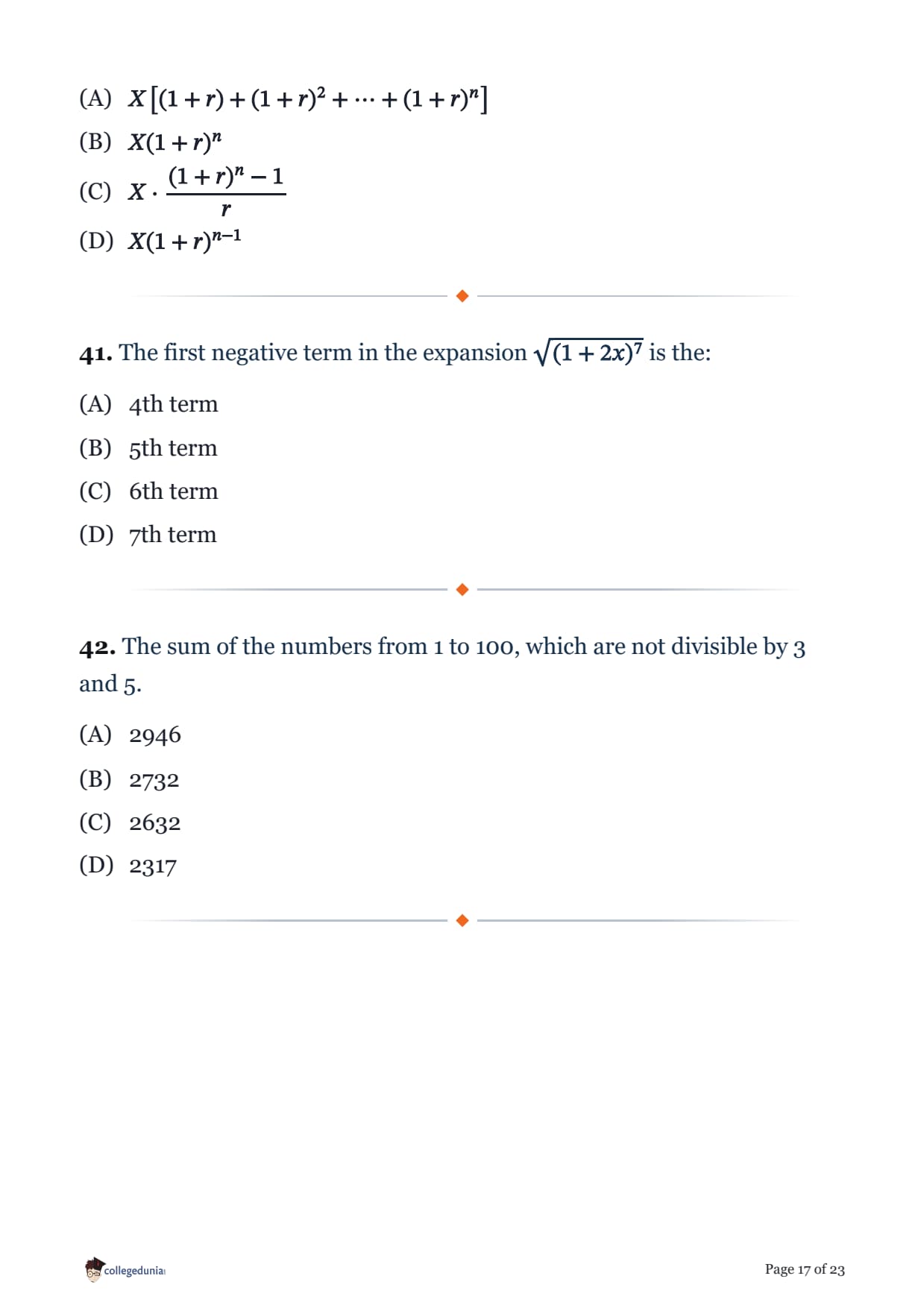
If \(X=\dfrac{a}{1+r}+\dfrac{a}{(1+r)^2}+\cdots+\dfrac{a}{(1+r)^n}\), then what is the value of \(a+a(1+r)+a(1+r)^2+\cdots+a(1+r)^{n-1}\)?
The first negative term in the expansion \(\sqrt{(1+2x)^7}\) is the:
The sum of the numbers from 1 to 100, which are not divisible by 3 and 5.
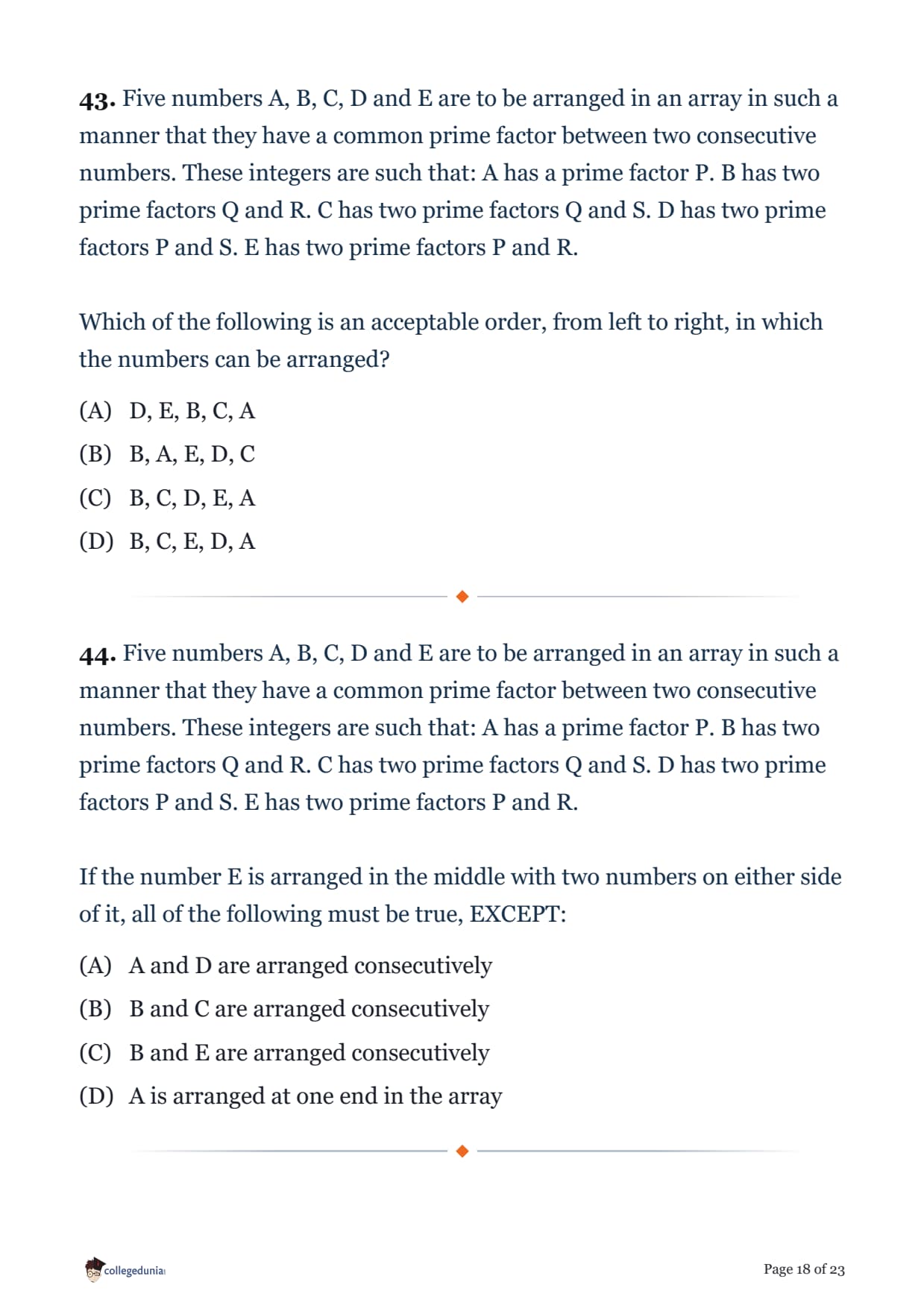
Five numbers A, B, C, D and E are to be arranged in an array in such a manner that they have a common prime factor between two consecutive numbers. These integers are such that: A has a prime factor P. B has two prime factors Q and R. C has two prime factors Q and S. D has two prime factors P and S. E has two prime factors P and R.
Which of the following is an acceptable order, from left to right, in which the numbers can be arranged?
Five numbers A, B, C, D and E are to be arranged in an array in such a manner that they have a common prime factor between two consecutive numbers. These integers are such that: A has a prime factor P. B has two prime factors Q and R. C has two prime factors Q and S. D has two prime factors P and S. E has two prime factors P and R.
If the number E is arranged in the middle with two numbers on either side of it, all of the following must be true, EXCEPT:
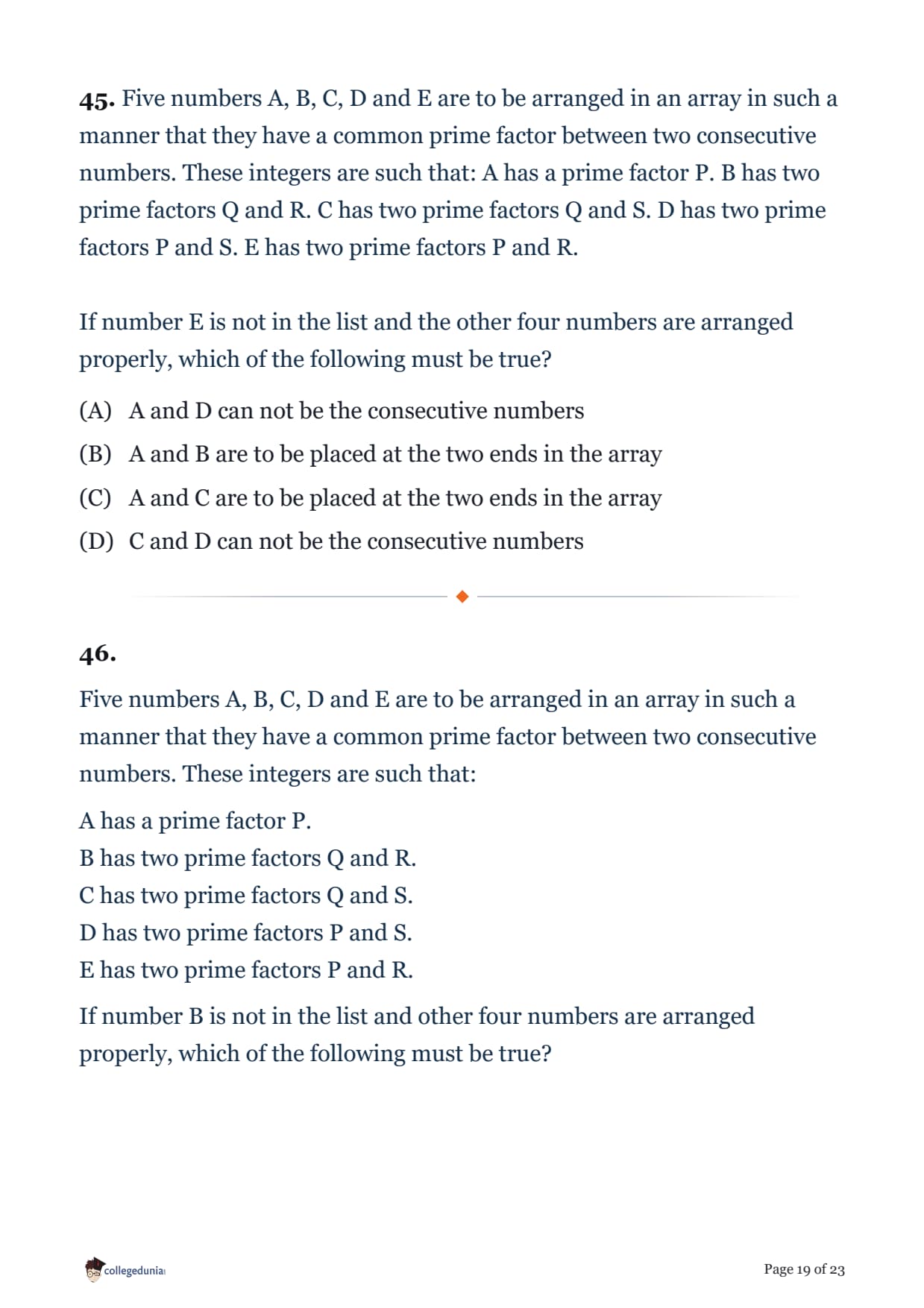
Five numbers A, B, C, D and E are to be arranged in an array in such a manner that they have a common prime factor between two consecutive numbers. These integers are such that: A has a prime factor P. B has two prime factors Q and R. C has two prime factors Q and S. D has two prime factors P and S. E has two prime factors P and R.
If number E is not in the list and the other four numbers are arranged properly, which of the following must be true?
Five numbers A, B, C, D and E are to be arranged in an array in such a manner that they have a common prime factor between two consecutive numbers. These integers are such that:
A has a prime factor P.
B has two prime factors Q and R.
C has two prime factors Q and S.
D has two prime factors P and S.
E has two prime factors P and R.
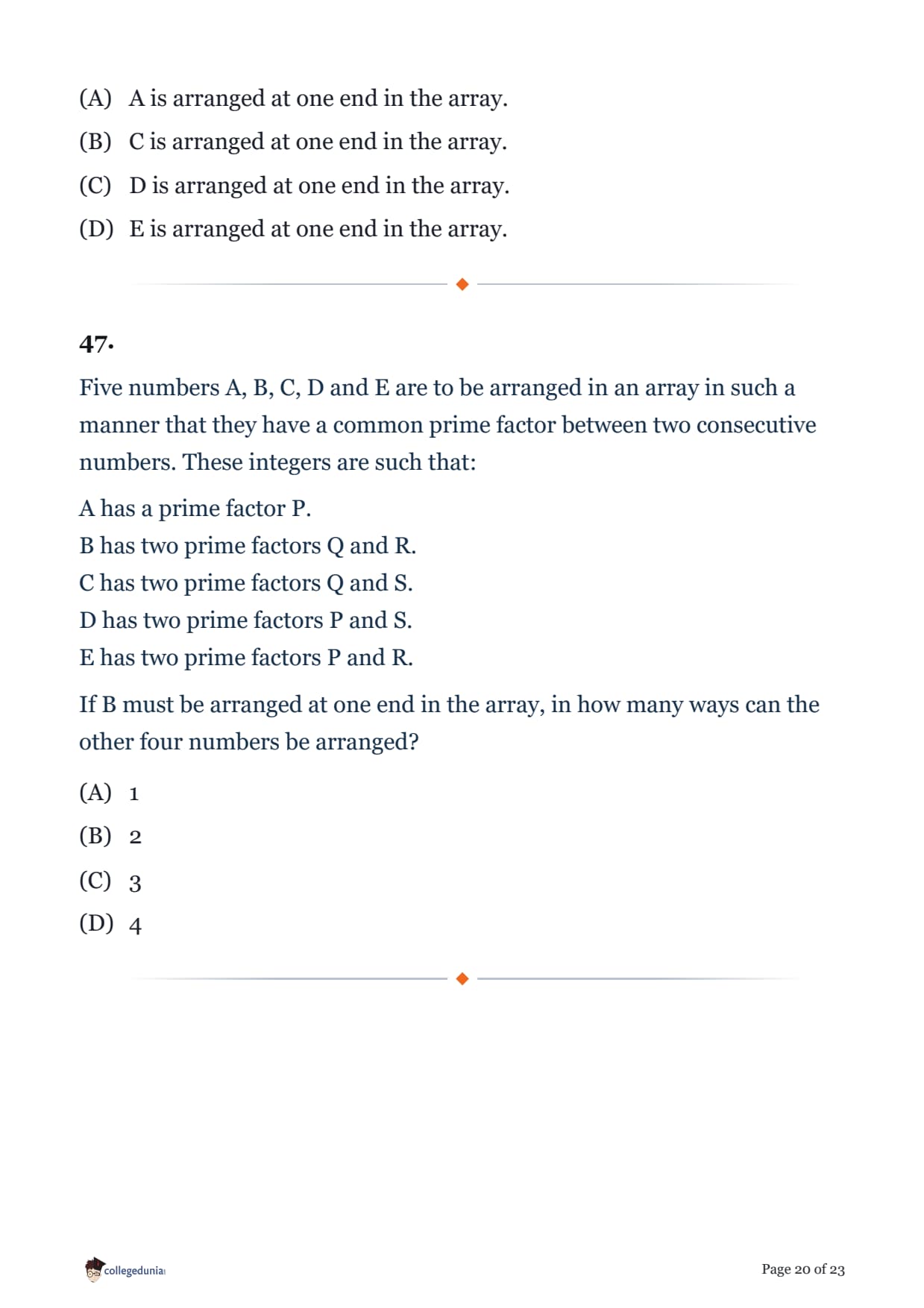
If number B is not in the list and other four numbers are arranged properly, which of the following must be true?
Five numbers A, B, C, D and E are to be arranged in an array in such a manner that they have a common prime factor between two consecutive numbers. These integers are such that:
A has a prime factor P.
B has two prime factors Q and R.
C has two prime factors Q and S.
D has two prime factors P and S.
E has two prime factors P and R.
If B must be arranged at one end in the array, in how many ways can the other four numbers be arranged?
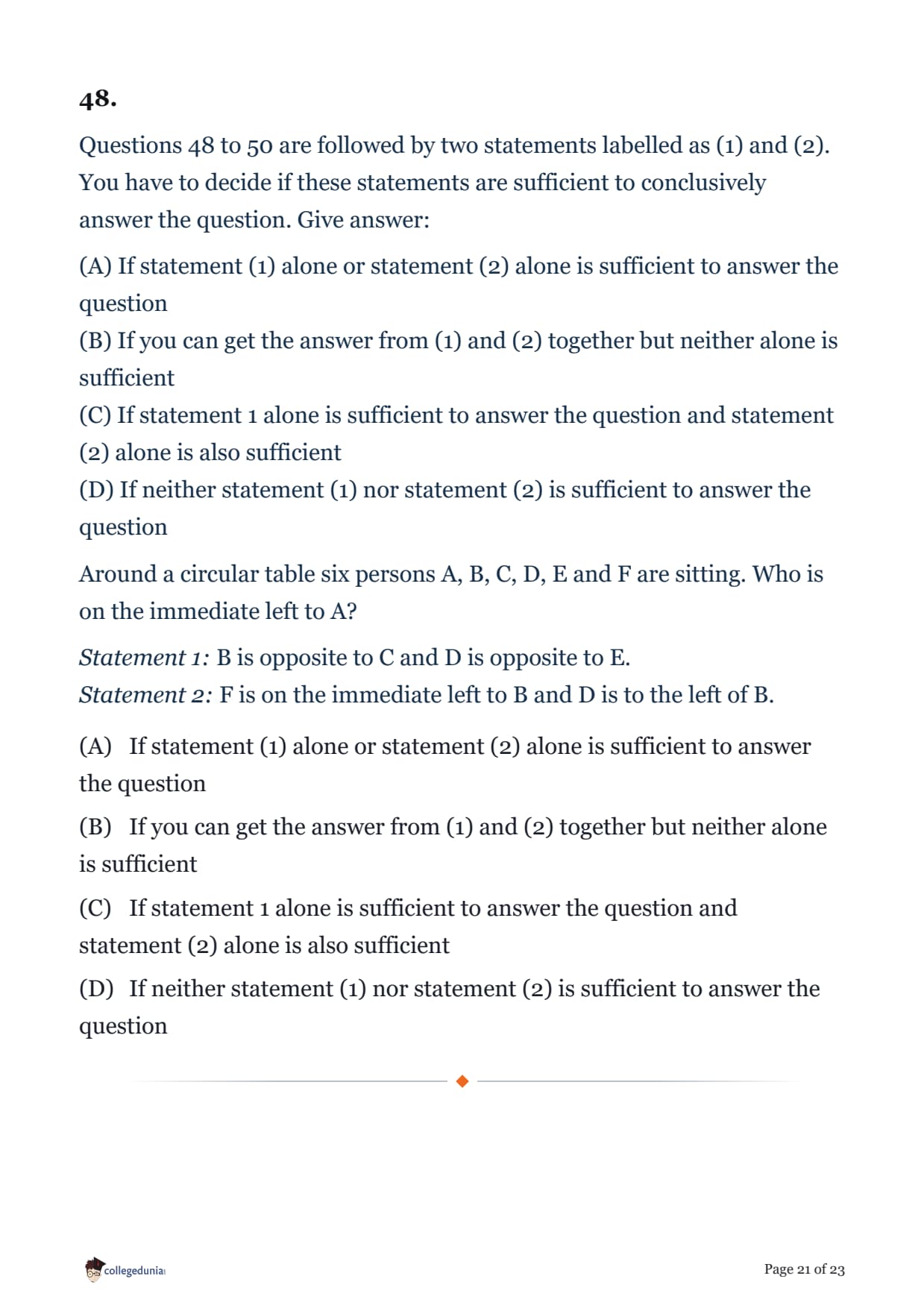
Questions 48 to 50 are followed by two statements labelled as (1) and (2). You have to decide if these statements are sufficient to conclusively answer the question. Give answer:
(A) If statement (1) alone or statement (2) alone is sufficient to answer the question
(B) If you can get the answer from (1) and (2) together but neither alone is sufficient
(C) If statement 1 alone is sufficient to answer the question and statement (2) alone is also sufficient
(D) If neither statement (1) nor statement (2) is sufficient to answer the question
Around a circular table six persons A, B, C, D, E and F are sitting. Who is on the immediate left to A?
Statement 1: B is opposite to C and D is opposite to E.
Statement 2: F is on the immediate left to B and D is to the left of B.
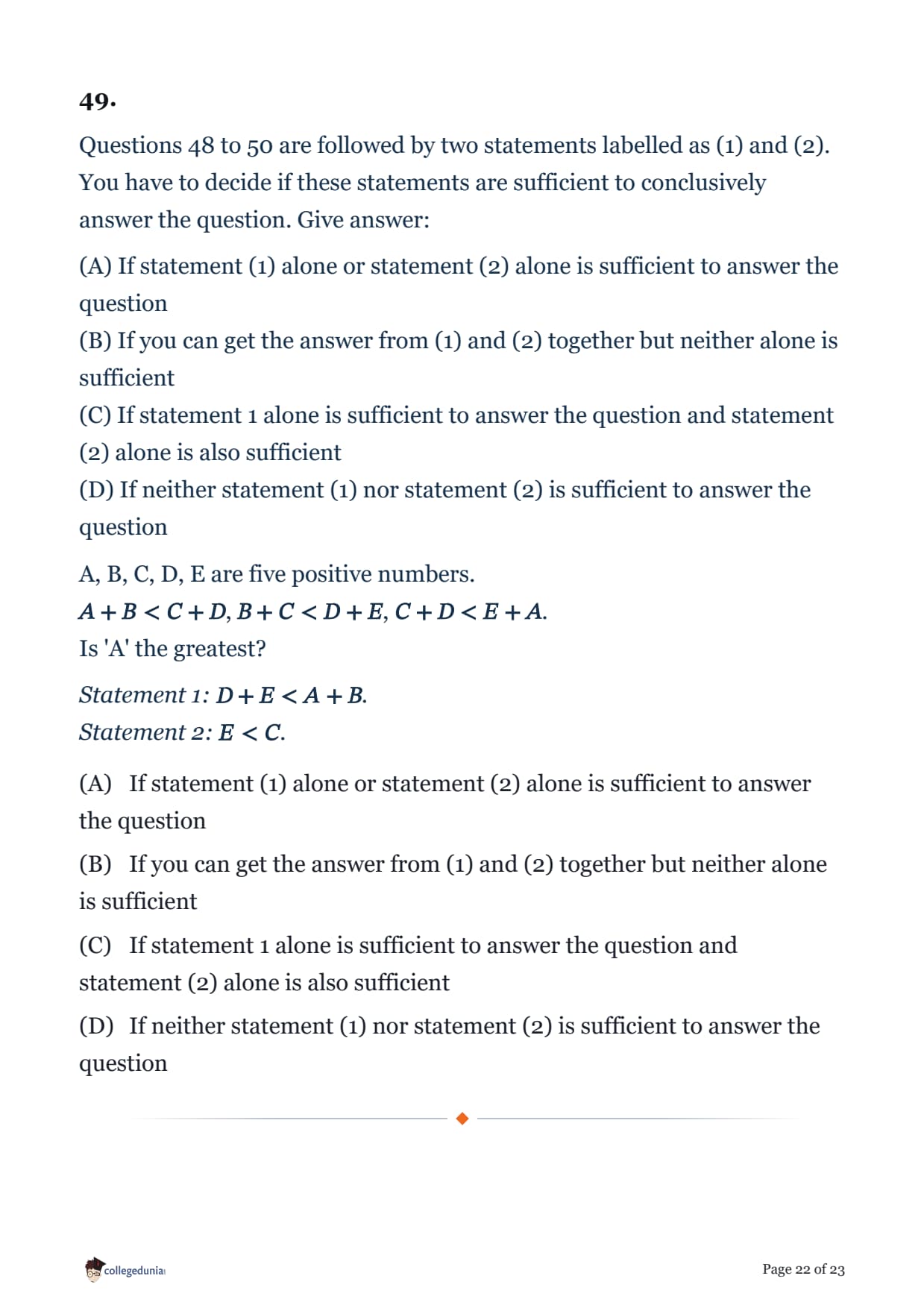
Questions 48 to 50 are followed by two statements labelled as (1) and (2). You have to decide if these statements are sufficient to conclusively answer the question. Give answer:
(A) If statement (1) alone or statement (2) alone is sufficient to answer the question
(B) If you can get the answer from (1) and (2) together but neither alone is sufficient
(C) If statement 1 alone is sufficient to answer the question and statement (2) alone is also sufficient
(D) If neither statement (1) nor statement (2) is sufficient to answer the question
A, B, C, D, E are five positive numbers.
\( A + B < C + D \), \( B + C < D + E \), \( C + D < E + A \).
Is 'A' the greatest?
Statement 1: \( D + E < A + B \).
Statement 2: \( E < C \).
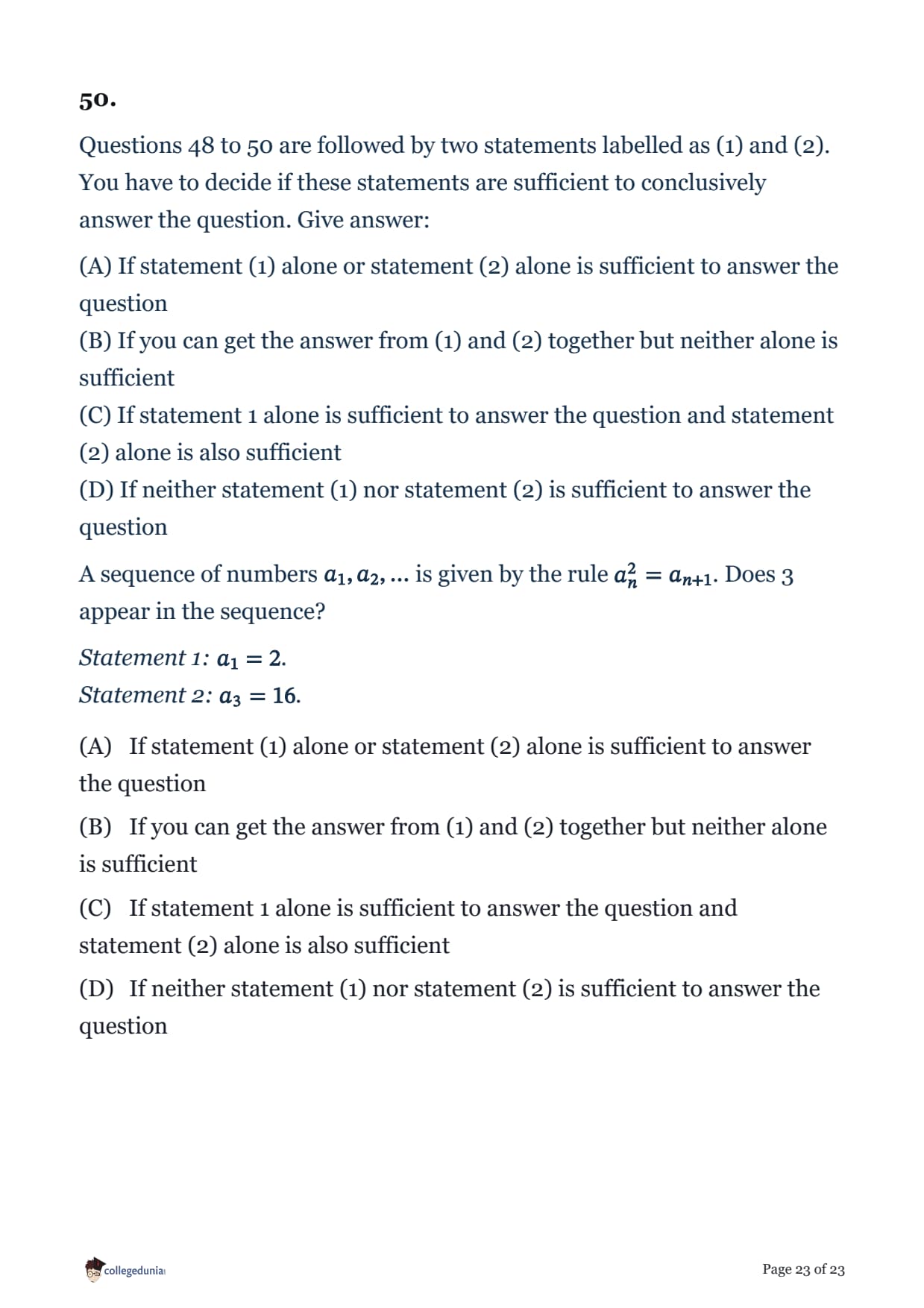
Questions 48 to 50 are followed by two statements labelled as (1) and (2). You have to decide if these statements are sufficient to conclusively answer the question. Give answer:
(A) If statement (1) alone or statement (2) alone is sufficient to answer the question
(B) If you can get the answer from (1) and (2) together but neither alone is sufficient
(C) If statement 1 alone is sufficient to answer the question and statement (2) alone is also sufficient
(D) If neither statement (1) nor statement (2) is sufficient to answer the question
A sequence of numbers \( a_1, a_2, \ldots \) is given by the rule \( a_n^2 = a_{n+1} \). Does 3 appear in the sequence?
Statement 1: \( a_1 = 2 \).
Statement 2: \( a_3 = 16 \).
XAT 2005 Quantitative Aptitude Exam Pattern and Marking Scheme Explained
This section had 50 single-correct MCQs with 4 options each, a much longer set than the Quantitative Ability & Data Interpretation section carries in the current XAT format.
- Total questions: 50 single-correct MCQs
- Question types: pure quant plus data-sufficiency items (2 questions gave two statements and asked whether they were sufficient to answer, not a numeric answer)
- Format: paper-and-pencil, unlike the computer-based test XAT uses today
- Today's XAT Quantitative Ability & Data Interpretation section carries around 28 questions inside a 170-minute combined Part 1 with Verbal Ability & Logical Reasoning and Decision Making, marked +1 for a correct answer and -0.25 for a wrong one
High-Weightage Topics in XAT 2005 Quantitative Aptitude to Focus On First
Five topic groups make up 25 of the 50 questions in this paper, so working through them first covers half the paper.
- Set theory: 5 questions, including a 4-question block on supersets and subsets that needs a full inclusion chain to solve
- Logical and arrangement puzzles: 5 questions built around a five-number common-prime-factor array, tested from multiple angles
- Geometry and mensuration: 5 questions covering circles, a rhombus, a trapezium, a cone, and a coordinate-geometry circle equation
- Progressions: 5 questions across arithmetic and geometric progressions and series
- Calculus: 5 questions on derivatives, Lagrange's Mean Value Theorem, and an optimisation problem
- Number system: 4 questions on divisors, squares and cubes, and number classification
XAT 2005 Quantitative Aptitude Question Paper Analysis Video
Source: Anshu Agarwal
How to Use the XAT 2005 Quantitative Aptitude Question Paper for Practice
Treat this as a timed mock before you look at the solutions, since XAT quant questions still reward the same skills the current QADI section tests.
- Solve all 50 questions in one sitting first, then check answers against the solutions PDF
- Redo every question you got wrong using a different method than the one you tried the first time
- Time yourself at roughly 90 seconds a question, since that is close to the pace XAT's current QADI section demands
- Revisit set theory and the arrangement puzzle block twice, since those two groups alone account for 10 of the 50 questions here
XAT Good Attempts and Qualifying Score Benchmark
- In recent XAT papers, a 90+ percentile in Quantitative Ability & Data Interpretation needs about 10-11 marks
- A 95+ percentile needs 12-15 marks, and 99+ percentile needs 17-19 marks in that section
- A safe qualifying score for QA & DI alone sits around 7-8 marks, so use that as your floor when you time yourself on this paper
XAT 2005 Quantitative Aptitude Question Paper FAQs
Ques. Where can I download the XAT 2005 Quantitative Aptitude question paper with solutions PDF for free?
Ans. You can download both the question paper and the full solutions PDF for free from the table at the top of this page on Collegedunia. The official XAT question papers for recent years are also listed on XLRI's website at xlri.ac.in.
Ques. Which topics had the highest weightage in XAT 2005 Quantitative Aptitude?
Ans. Set theory, logical arrangement puzzles, geometry and mensuration, progressions, and calculus each carried 5 of the 50 questions, together making up half the paper.
Ques. How many questions should I attempt in XAT Quantitative Ability to get a 99 percentile?
Ans. Based on recent XAT papers, scoring 17-19 marks in the Quantitative Ability & Data Interpretation section is enough for a 99+ percentile, which usually means attempting 15-18 questions with high accuracy rather than rushing through every question.
Ques. Are XAT Quantitative Aptitude questions repeated from previous years?
Ans. The exact questions do not repeat, but the underlying concepts do. Set theory, number system, progressions, and data sufficiency show up in almost every XAT paper, including this 2005 set, so solving old papers still builds the right pattern recognition.
Ques. Was the XAT 2005 Quantitative Aptitude section computer-based or pen-and-paper?
Ans. XAT 2005 was a pen-and-paper test. XLRI moved XAT to a computer-based format only years later, so this paper reflects the older offline exam style with a longer 50-question quant set compared to today's format.
Ques. Who conducts the XAT exam and where can I find the official exam pattern?
Ans. XLRI Jamshedpur conducts XAT every year on behalf of XAMI, the Xavier Association of Management Institutes, for admission to XLRI and 160+ other MBA institutes. The official exam pattern and notifications are published on xlri.ac.in.



Comments