




To prepare for the XAT Decision Making Section 2027, candidates should focus on understanding business situations, stakeholder interests, and practical problem-solving approaches
Unlike Quant and Verbal Ability, the XAT Decision Making section does not require formulas or calculations. Instead, it tests how well you can understand a situation, consider different viewpoints, and choose the most practical solution.
- Solve at least 10 years of XAT previous year Decision Making questions to understand common question patterns and XLRI's evaluation approach.
- Choose options that balance stakeholder interests while maintaining ethical, practical, and business-oriented decision-making.
- Avoid personal opinions and base every answer strictly on the facts and information provided in the caselet.
- Master the core decision frameworks such as FRUTE by Ananta Chhajer. This is an evaluation-based approach on whether the solution is Feasible, Responsible, Utilitarian, Time-based, and Ethical.
- Practice the elimination strategy by eliminating any extreme solutions. For example, firing an employee for a minor mistake is usually the wrong choice.
Related Articles:
XAT 2027 Decision Making Section: Overview and Weightage
Decision Making section in XAT is a very unique section for any management exam. This section focuses on scenario-based questions like ethical dilemma questions. DM section usually has 7 caselet sets with 3 questions each.
- In XAT 2026, the DM section had no Quantitative DM sets; all sets were purely situation-based or ethical reasoning caselets.
- DM is practice-intensive, not concept-driven; it usually cannot be learned from textbooks but only through extensive practice.
| Parameter | Details |
|---|---|
| Number of Questions | 21 questions (approx., based on XAT 2026) |
| Set Structure | 7 sets of 3 questions each (Based on XAT 2026 pattern) |
| Marks per Question | +1 correct; -0.25 wrong; no penalty for first 8 skips |
| Counted in Percentile? | Yes - part of Part 1 (75-mark pool) |
| Recommended Time | 50-55 minutes within 170-min Part 1 window |
| Good Attempt | 15-18 questions with ~75-80% accuracy |
| Overall Difficulty | Moderate to High (XAT 2026: Moderate to tough; XAT 2025: Moderate-High) |
| Question Type | MCQ only - 5 options per question |
Also Read:
- What is the Exam Pattern of XAT 2027?
- Check Complete Syllabus and Question Patterns of DM for XAT 2027
Ques. Is Decision Making the most important section in XAT 2027?
Ans. DM is critical because it has its own mandatory sectional cutoff at XLRI, and its question type is entirely unique to XAT. A candidate who ignores DM preparation risks failing the sectional cutoff even if overall percentile is high. For XLRI HRM aspirants especially, DM performance is weighted more heavily than in BM.
XAT 2027 Decision Making: Types of Questions Asked
- All XAT Decision Making questions are scenario-based caselets but they fall into two broad categories and four sub-types, each requiring a different reading and reasoning approach.
- Common DM themes in XAT PYQs are HR and workforce management, corporate governance, whistleblowing ethics, environmental vs. business tradeoffs, family business conflicts, supplier relationships, team dynamics, and leadership decisions under pressure.
| Category | Nature | Example Scenarios | Frequency in XAT |
|---|---|---|---|
| Situational / Ethical Reasoning | Long caselets with ethical or managerial dilemmas; candidate must choose the most balanced course of action | HR decisions, employee conflicts, leadership dilemmas, business ethics, CSR issues | High- dominant in most papers in recent years |
| Mathematical / Data-Based DM | Data Interpretation-style sets require a numerical analysis before making a decision | Revenue projections, resource allocation, financial scenario planning | Low to Moderate - appeared less in XAT 2025 & 2026. |
Different types of Caselet Formats in XAT Decision Making
- Single-question prompts have increased recently in XAT 2023-2026 exams. This is usually easy for students who can quickly extract the core ethical issue from a short passage.
- The DM section never has a definitively "correct" answer in the academic sense. The right answer is always the option that is the most unbiased, practical, and considerate after the analysis of all the scenarios.
| Format Type | Description | Strategy |
|---|---|---|
| Single-Question Prompts | A short paragraph followed by just one question mimics critical reasoning style | Attempt most of these; less time needed, good for quick marks |
| 2-3 Question Caselets | A moderate-length caselet with 2-3 follow-up questions. | Attempt if caselet is clear; skip if scenario is ambiguous and time is short |
| 4-5 Question Caselets | Long caselets with multiple opinions and complex ethical issues | Invest time only if you are confident. |
| Ethical Dilemma Sets | Present situations with no clear right answer. Candidate must choose the most ethical and least harmful option | Apply the "benefit to all" principle; avoid extreme options |
Also Read:
- What is the Eligibility Criteria for XAT 2027?
- Check the Tips & Tricks to prepare for Decision Making for XAT 2027
Ques. Are the Decision Making questions in XAT formula-based or calculation-heavy?
Ans. Most DM questions are not formula-based. They require logical and ethical reasoning about real-world scenarios. Mathematical DM sets (which resemble DILR problems) appear occasionally but were absent from XAT 2025 and 2026. For XAT 2027, the dominant format is expected to remain situational and ethical caselets.
How to Prepare for XAT 2027 Decision Making: Step-by-Step Strategy
To crack DM in XAT 2027, you need structured practice. You can score high if you are good at ethical dilemmas, practical and have balanced opinion.
Step 1 – Understand the XLRI Decision-Making Framework
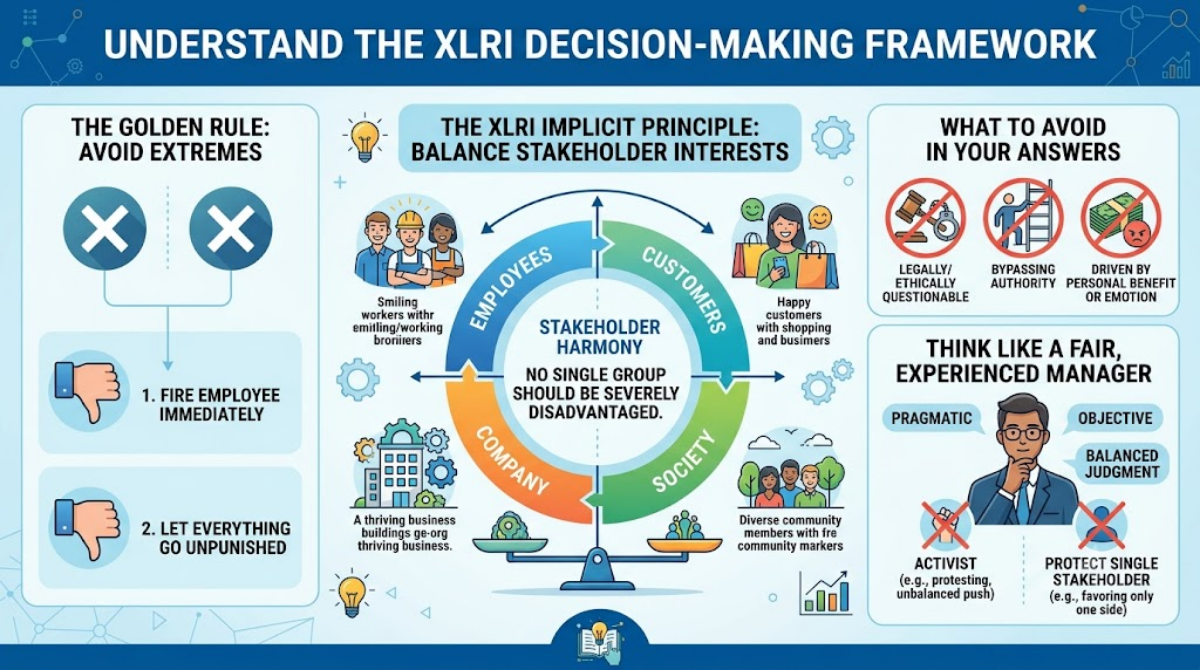
- The correct DM answer is never the extreme option (e.g., "fire the employee immediately" or "let everything go unpunished").
- XLRI's implicit principle: the ideal answer considers the interests of all stakeholders, which are employees, customers, the company and society. No single group should be severely disadvantaged.
- Avoid options that are legally/ethically questionable, that involve bypassing authority, or that are driven by personal benefit or emotion.
- Think as a fair, experienced manager, not as an activist, not as someone trying to protect a single stakeholder.
Step 2 – Master the 5-Step Caselet Approach
While solving DM caselet, apply these 5 steps to solve the questions effectively. Before you start answering any questions, scan all the questions first and pick the one you feel confident about.
- Start reading the caselet very carefully without leaving any part.
- Identify what the core conflict of the caselet is. Is this a fairness issue, an ethical issue, or is it a business decision?
- Evaluate your option one by one, and while choosing the answer, don’t apply your personal bias.
| Step | Action | What to Focus On |
|---|---|---|
| 1. Scan All Questions First | Read all follow-up questions before answering any | This helps you pick up relevant details while reading the caselet |
| 2. Read the Caselet | Read carefully, without skimming | Identify all stakeholders, the core dilemma, any stated constraints |
| 3. Identify the Core Issue | Analyse the information point by point; find what the fundamental conflict is. | Is this a fairness issue, an ethical issue, a legal issue, or a business decision? |
| 4. Evaluate Options | Apply the "balanced stakeholder" test to each option | Eliminate extreme options; look for the most moderate, logical choice |
| 5. Do Not Apply Personal Bias | Keep personal opinions and emotions out | What is the most defensible managerial response, given only the caselet's information? |

Step 3 – Build a PYQ Practice Habit
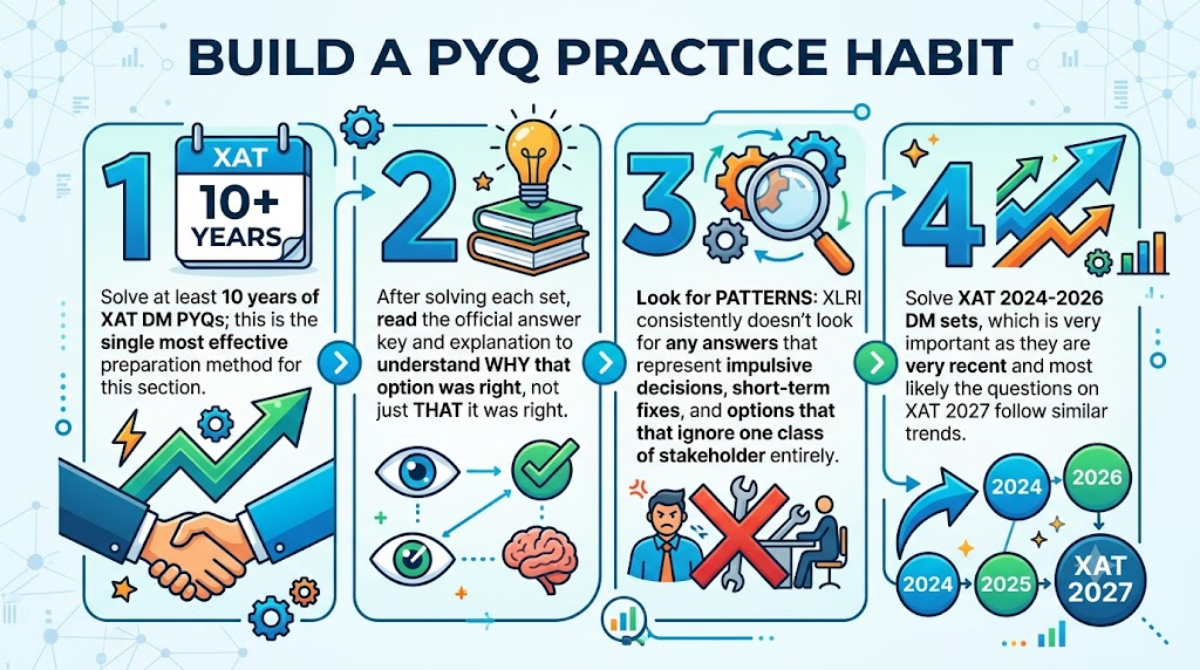
- Solve at least 10 years of XAT DM PYQs; this is the single most effective preparation method for this section.
- After solving each set, read the official answer key and explanation to understand why that option was right, not just that it was right.
- Look for patterns: XLRI consistently doesn’t look for any answers that represent impulsive decisions, short-term fixes, and options that ignore one class of stakeholder entirely.
- Solve XAT 2024-2026 DM sets, which is very important as they are very recent and most likely the questions on XAT 2027 follow similar trends.
Step 4 – Use Mock Tests to Calibrate Timing
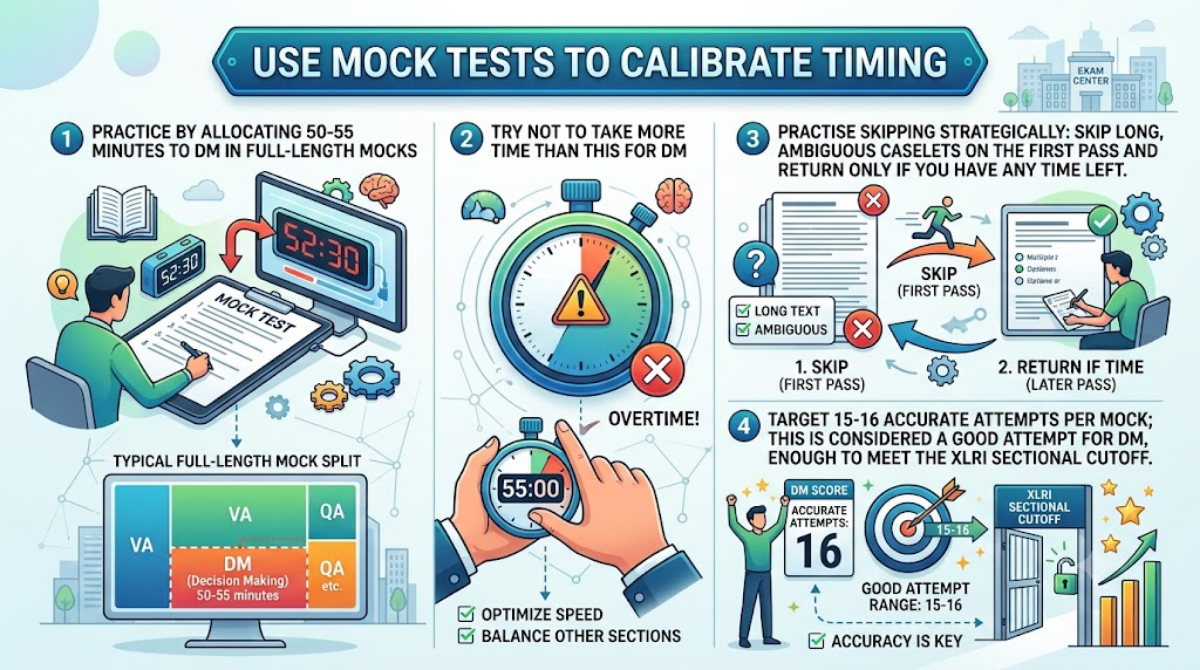
- Since Part 1 has no sectional timer, practice by allocating 50-55 minutes to DM in full-length mocks; Try not to take more time than this for DM.
- Practise skipping strategically: skip long, ambiguous caselets on the first pass and return only if you have any time left.
- Target 15-16 accurate attempts per mock; this is considered a good attempt for DM, enough to meet the XLRI sectional cutoff.
Take Free XAT Decision Making Mock Tests by Collegedunia
| XAT DM Caselets Mock Test 1 | Take Mock Test |
| XAT DM Caselets Mock Test 2 | Take Mock Test |
| XAT DM Caselets Mock Test 3 | Take Mock Test |
| XAT Analytical DM Mock Test 1 | Take Mock Test |
| XAT Analytical DM Mock Test 2 | Take Mock Test |
| XAT DM Complex Arrangement Mock Test | Take Mock Test |
Ques. How many hours per week should be dedicated to XAT DM preparation?
Ans. Experts recommend dedicating 4-6 hours per week to DM practice, especially in the 3 months before XAT. This translates to solving 2-3 caselet sets daily, reviewing answer explanations carefully, and attempting at least one full-length DM mock per week. For students starting after CAT (November), an intensive 5-6 week DM sprint is the standard strategy.
XAT 2027 Decision Making: Practice Questions
The following practice questions are designed in the format of XAT DM caselets, each set tests ethical reasoning, stakeholder balance, and managerial judgment, which are the core skills assessed in the DM section.
Practice Set 1 – HR and Workforce Ethics
Ramesh is the operations head of a mid-sized manufacturing company. During a routine audit, he discovers that his top-performing team leader, Priya, has been fudging attendance records for three junior team members- all of whom are single parents with childcare responsibilities. Priya did this to prevent them from losing their jobs due to a strict new attendance policy introduced three months ago. The three employees are otherwise excellent performers. HR has not yet detected the issue. Ramesh must decide what to do next.
Q1. What should Ramesh's immediate next step be?
- (A) Report Priya to HR immediately for falsification of records, as rules must be applied uniformly.
- (B) Confront Priya privately, ask her to stop, and quietly correct the records without involving HR.
- (C) Speak to Priya to understand the full situation, then raise the issue with HR while also recommending a review of the attendance policy for special-circumstance employees.
- (D) Ignore the issue as Priya's intent was good and the affected employees are performing well.
- (E) Warn Priya and transfer all three employees to a different team to neutralise the situation.
Correct Answer: (C) — This option acknowledges the ethical breach (records were falsified) while also addressing the systemic issue (a rigid policy that may be poorly suited to all employee situations). It avoids an extreme punitive response and involves the appropriate authority (HR). Options A and E are disproportionately punitive; options B and D ignore institutional accountability.
Practice Set 2 – Business Ethics and Stakeholder Conflict
Anita is the CEO of a pharmaceutical startup that has developed a low-cost generic drug for a rare childhood disease. A large multinational company has offered to acquire the startup at a significant premium, but it plans to discontinue the generic product post-acquisition and replace it with a branded high-margin version, making it unaffordable for most families. The startup's investors strongly favour the acquisition. Anita personally believes the product should remain accessible but also knows the company needs this capital to survive. The acquisition is not yet finalised.
Q2. Which of the following is the most appropriate course of action for Anita?
- (A) Accept the acquisition unconditionally — the company's survival is paramount and investors must be satisfied.
- (B) Reject the acquisition entirely — social responsibility must override financial considerations.
- (C) Negotiate with the acquiring company to include a contractual clause that keeps the generic version available at subsidised prices for a defined period, before finalising the deal.
- (D) Delay the decision indefinitely until a more ethical acquirer is found.
- (E) Accept the acquisition, but make a public statement about her disagreement to protect her personal reputation.
Correct Answer: (C) — This option balances all stakeholders: investors (acquisition proceeds), patients (continued access to affordable medicine), and the company's mission (sustainability + social impact). Options A and B represent extremes; option D is impractical and exposes the company to risk; option E is performative and does not address the core issue.
Practice Set 3 – Ethical Dilemma with Multiple Viewpoints
Suresh is a senior manager at a consulting firm. A junior analyst, Kavya, who recently joined, has shared confidential findings with Suresh suggesting that one of their firm's biggest clients — a food company — is understating harmful additive levels in a popular children's product. The data, while compelling, was not officially assigned to Kavya and she obtained it by accessing a restricted internal server. Suresh must now decide how to proceed.
Q3. What should Suresh do first?
- (A) Immediately share the findings with the regulatory authority — public health takes priority over all other concerns.
- (B) Report Kavya to the firm's compliance team for unauthorised data access and ask her to delete the findings.
- (C) Verify the data through legitimate channels, consult the firm's legal and ethics committee, and decide on next steps based on their guidance — while ensuring the data is preserved and not deleted.
- (D) Confront the client directly and demand they correct the labelling, threatening to go to regulators if they do not comply.
- (E) Do nothing until more evidence is available, to avoid disrupting the firm's most important client relationship.
Correct Answer: (C) — This option ensures the data integrity is preserved (not deleted), avoids unilateral action (which could expose the firm to liability), and brings in the appropriate internal stakeholders. Option A, while morally appealing, skips the verification and internal process steps. Options B and E are either counterproductive or irresponsible. Option D is confrontational and procedurally inappropriate.
| Practice Set | Theme | Key Principle Tested | Difficulty |
|---|---|---|---|
| Set 1 – Priya and Ramesh | HR and Workforce Ethics | Balancing rule enforcement with systemic fairness | Moderate |
| Set 2 – Anita the CEO | Business Ethics and Acquisition | Balancing investor interests with social responsibility | Moderate to High |
| Set 3 – Suresh and Kavya | Whistleblowing and Compliance | Handling sensitive information through proper channels | High |
Take Full-length XAT DM Sectional Mock Tests by Collegedunia
| XAT DM Mock Test 1 | Take Mock Test |
| XAT DM Mock Test 2 | Take Mock Test |
| XAT DM Mock Test 3 | Take Mock Test |
| XAT DM Mock Test 4 | Take Mock Test |
Ques. How are XAT DM answers different from DILR answers?
Ans. In DILR, answers are mathematically definitive; there is exactly one correct option based on data calculation. In XAT DM, answers are judgemental — no option is "wrong" in an absolute sense. The correct answer is the one that is most balanced, most defensible, and least harmful to any stakeholder group. This is why exam experience and PYQ familiarity matter far more than raw intelligence for DM.
XAT 2027 Decision Making: Preparation Timeline and Best Resources
Students who are preparing for XAT 2027 should dedicate a separate time entirely for DM, but make sure you are also preparing for VALR and QADI parallel.
- First 3 months focus on improving your foundations of the DM; solve XAT PYQs as much as possible; start with reading at least 1-2 caselets every day.
- In October & November, start attempting topic-wise and full section-wise DM mock tests.
- Once the CAT exam is completed, along with full-length XAT mock tests, also take DM mocks.
| Preparation Phase | Timeline | DM Focus |
|---|---|---|
| Foundation Phase | July-September 2026 | Solve XAT PYQs (2015-2020); understand answer patterns; read 1-2 caselet sets daily |
| Intensive Phase | October-November 2026 | Solve XAT PYQs (2021-2026); attempt full DM section mocks; analyse every incorrect answer |
| Post-CAT Sprint | December 2026 | Full-length XAT mocks with timed DM practice; consolidate DM strategy; solve 3-4 mock sets daily |
| Final Week | December 27-January 2, 2027 | Light revision of approach framework; no new caselets; review error log from mocks |
Best Books and Resources for XAT Decision Making 2027
XAT PYQs are the main resource, which is non-negotiable. Along with the PYQs, if possible, follow the study materials from coaching centres like TIME and IMS.
The best books & resources for the Decision Making section are listed here.
| Resource | Type | Why It Helps |
|---|---|---|
| XAT Previous Year Papers (2015-2026) | PYQs with solutions | Most authentic exposure to XLRI's DM question philosophy |
| XAT Decision Making by Disha Publications | Book | Dedicated DM practice caselets categorised by type and difficulty |
| Study material by IMS / Career Launcher / TIME | Coaching material | Expert-curated caselets and mock DM sets with detailed explanations |
| Official XAT Mock Tests (xatonline.in) | Free official mocks | XLRI releases free mock tests, DM sets here closely mirror actual paper format |
| Current Affairs reading (The Hindu, Business Standard) | Daily reading | Many DM caselets are inspired by real business events; familiarity helps contextual understanding |
| HBR Case Studies (summary reading) | Reference material | Exposes students to structured ethical business reasoning the same thinking DM rewards |
Ques. Are coaching institutes' DM materials reliable for XAT 2027 preparation?
Ans. Yes, IMS, Career Launcher, TIME, and Cracku all publish dedicated XAT DM practice sets based on PYQ analysis. However, PYQs from xatonline.in remain the gold standard. Coaching material is useful for additional caselet variety but should not replace PYQ practice as the primary preparation method.
XAT 2027 Decision Making: Common Mistakes to Avoid
Understanding what not to do in DM is as important as knowing the correct approach the following mistakes account for the majority of lost marks in this section.
- Choosing emotionally appealing options: Options worded sympathetically (e.g., "support the employee in every possible way") are designed to mislead; the correct answer is always the most practical.
- Eliminating options too quickly: With 5 options in DM, the difference between the correct answer and the second-best option is very close to the answer. Read all 5 before deciding.
- Applying personal moral code: Do not answer based on personal ethics or political beliefs. Answer based on what a reasonable, experienced, impartial manager would do within the stated constraints.
- Treating DM like DILR: DM has no data sets to calculate, do not waste time trying to arrive at a quantitative answer. Read, reason, decide.
- Not reading the caselet carefully enough: Most wrong answers in DM come from misreading constraints stated in the caselet. Read once, slowly and completely before scanning the questions.
Also Check: Check List of Top MBA Colleges Accepting XAT 2027 Scores
Ques. When do official XAT mock tests for 2027 become available?
Ans. XLRI typically releases two official mock tests on xatonline.in , the first around September 2026 and the second around October-November 2026. These mocks include a DM section and are the closest simulation of the actual XAT exam format. Students are strongly advised to attempt both official mocks in timed conditions.
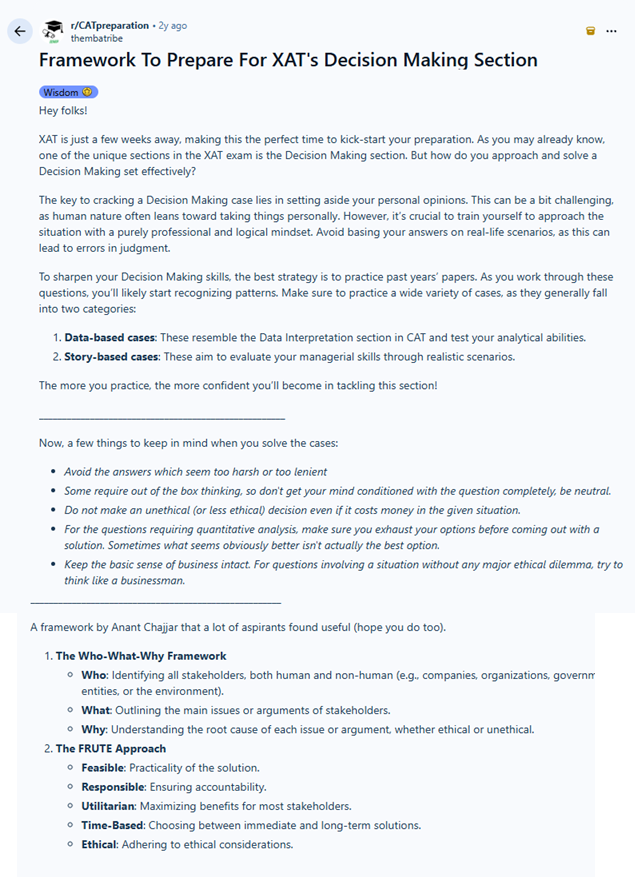
How to Prepare for XAT Decision Making Section: Reddit Discussion
A user on the r/CATPreparation subreddit gave a framework to solve XAT’s Decision Making section.
- The user specifies the who-what-why framework. To begin with, you need to identify all the stakeholders involved, be it human or inhuman.
- Next, outline the main issue or arguments of the stakeholders.
- Understanding the root cause of each issue or argument, whether it's ethical or unethical.
Related News:



Comments