




The NCERT Solutions for Class 9 Science Chapter 8 Journey Inside the Atom help students master atomic structure for the CBSE Class 9 exam and build a base for JEE and NEET later, as per the latest 2026-27 syllabus. This page solves all 15 questions from the Revise, Reflect, Refine exercise in plain, step-by-step language. Each answer names the concept, shows every calculation, and adds an expert method. Atomic models, subatomic particles, isotopes, and isobars are all covered here.
These NCERT Solutions for Class 9 Science Chapter 8 are prepared by subject experts, matched to the 2026-27 NCERT Exploration textbook, and checked against the official NCERT answer key.
- 15 solved questions from the Revise, Reflect, Refine exercise, covering atomic models, subatomic particles, isotopes, and isobars.
- Every counting problem shows the concept, substitution, and answer as separate steps, so students never lose method marks.
- Based on the new 2026-27 NCERT Exploration textbook, with an expert method added to each question.
Student Feedback
In a Collegedunia poll of 11,600 Class 9 students taken before the 2026 exams, 68% said they most often mixed up isotopes and isobars in this chapter. Many students rated the assertion-reason and valency questions as the trickiest part. Students who solved all 15 Revise, Reflect, Refine questions said they felt far more confident about the atomic structure section on exam day.
Source: 2026-27 Class 9 Science student poll. Sample of 11,600 students from CBSE schools across 13 states.
Journey Inside the Atom Class 9 Explained in Simple Language
Source: Magnet Brains on YouTube
This one-shot video walks through the whole chapter before students start the exercise. Watch it once, then use the step-by-step solutions below to practise each question. The video and these solutions together cover the atomic models, the three subatomic particles, and how to work out atomic number, mass number, and electronic configuration in Class 9 Science.
How Collegedunia's Class 9 Journey Inside the Atom NCERT Solutions Help You
Chapter 8 is a high-scoring chapter because most of its questions test a few clear rules about the atom. These NCERT Solutions for Class 9 Science Chapter 8 make each question easy to attempt and easy to score.
- 2026-27 NCERT alignment: Every answer matches the new Exploration textbook and the official NCERT answer key.
- Full working shown: The concept, the substitution, and the final answer sit on separate lines, so students keep every method mark.
- Expert method added: A second, faster approach is given below each solution to save time in the exam.
- Concepts made clear: Each solution starts with the exact idea it uses, such as the gold foil experiment or the 2n2 shell rule.
Atomic Models from Dalton to Bohr in Class 9 Science
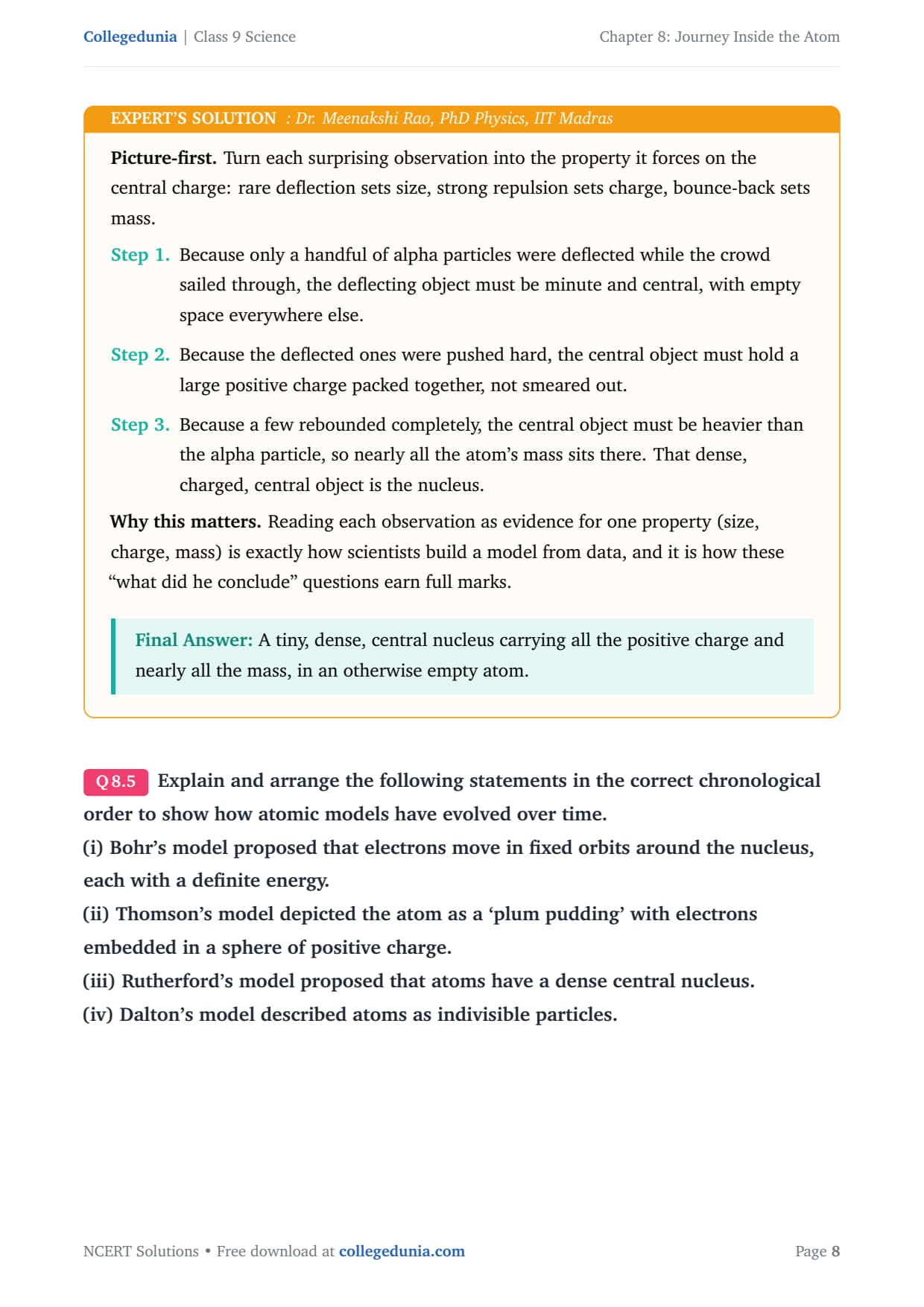
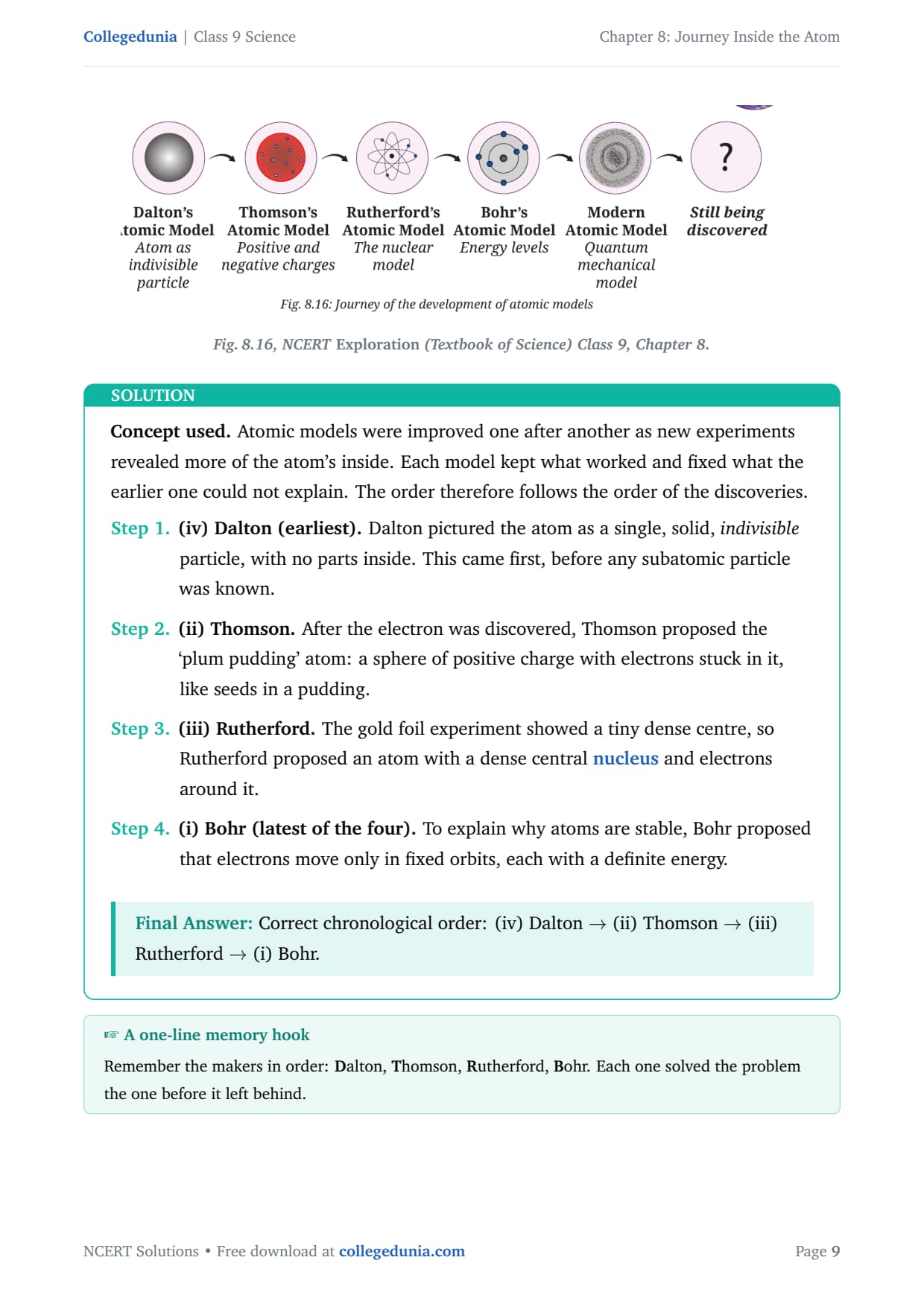
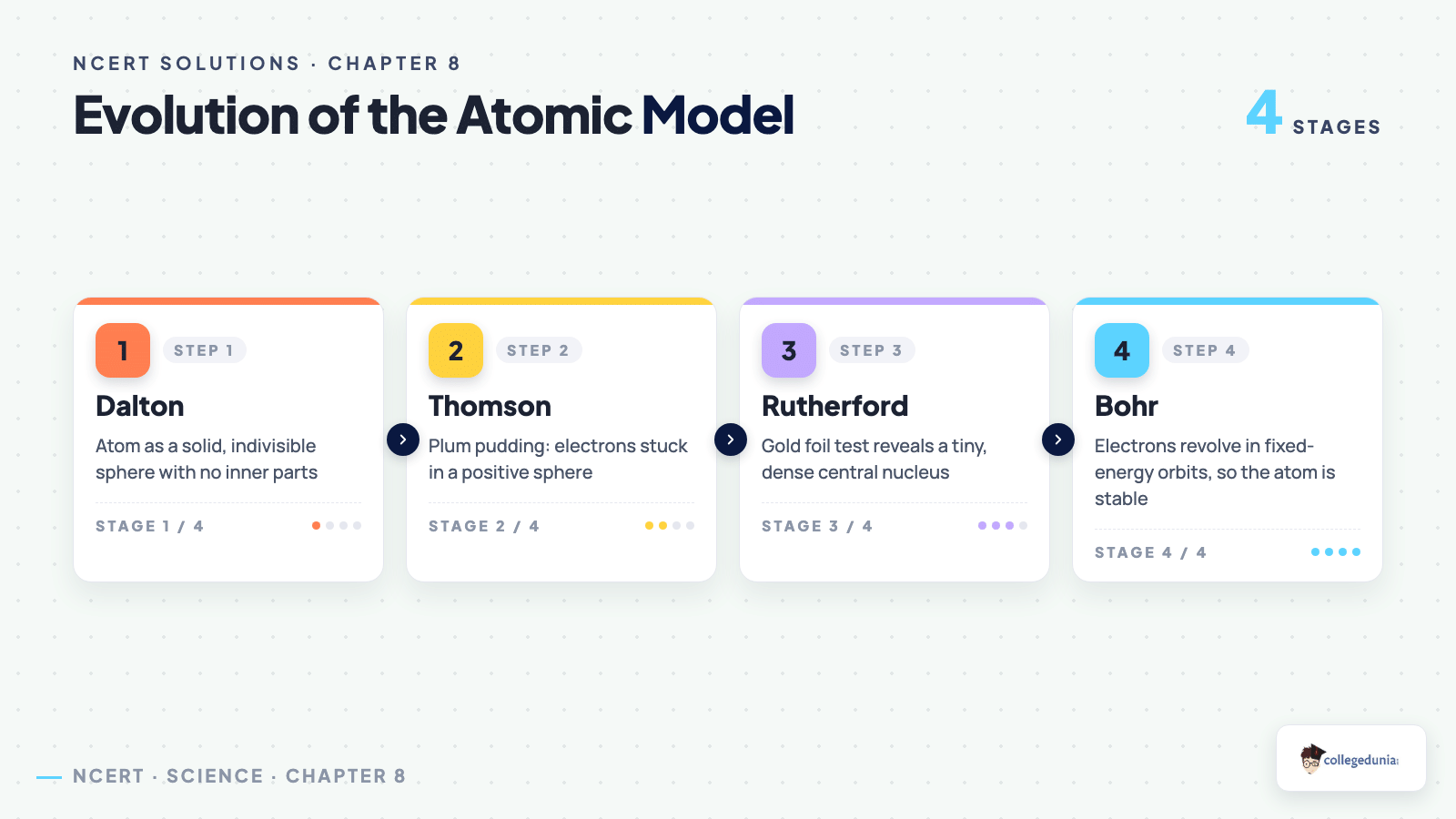
The story of the atom is really the story of four models, each fixing the gap left by the one before it. Questions 1, 2, 5, and 10 of this chapter all test this journey, so learn the order first.
| Model | Main idea | What it could not explain |
|---|---|---|
| Dalton | Atom is a solid, indivisible ball. | The presence of charged particles inside the atom. |
| Thomson | Plum pudding: electrons stuck in a positive sphere. | The large deflection of alpha particles in the gold foil test. |
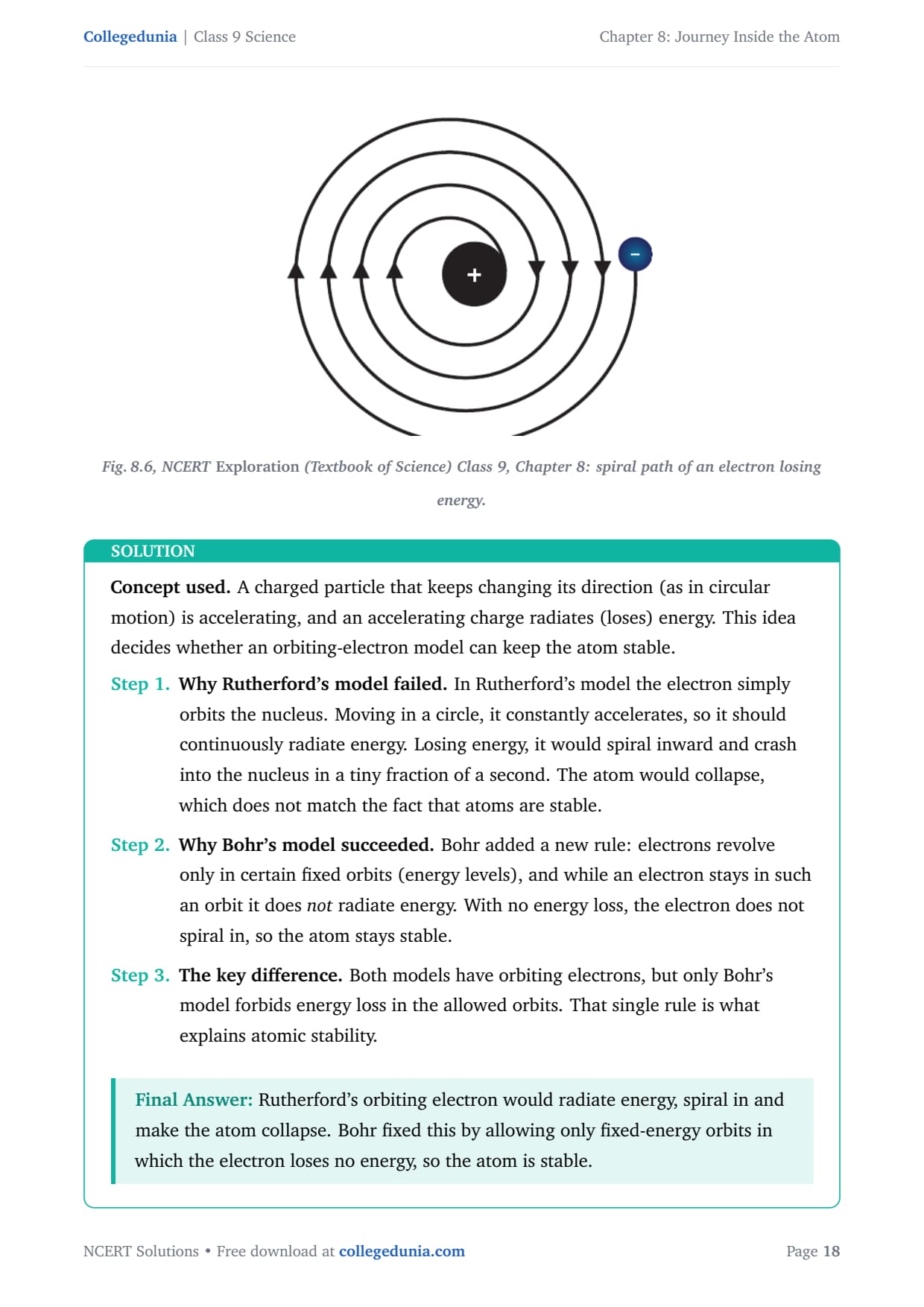
| Rutherford | A tiny, dense, positive nucleus at the centre. | Why the orbiting electron does not lose energy and fall in. |
| Bohr | Electrons revolve in fixed-energy orbits or shells. | Fine details of spectra of larger atoms (studied later). |
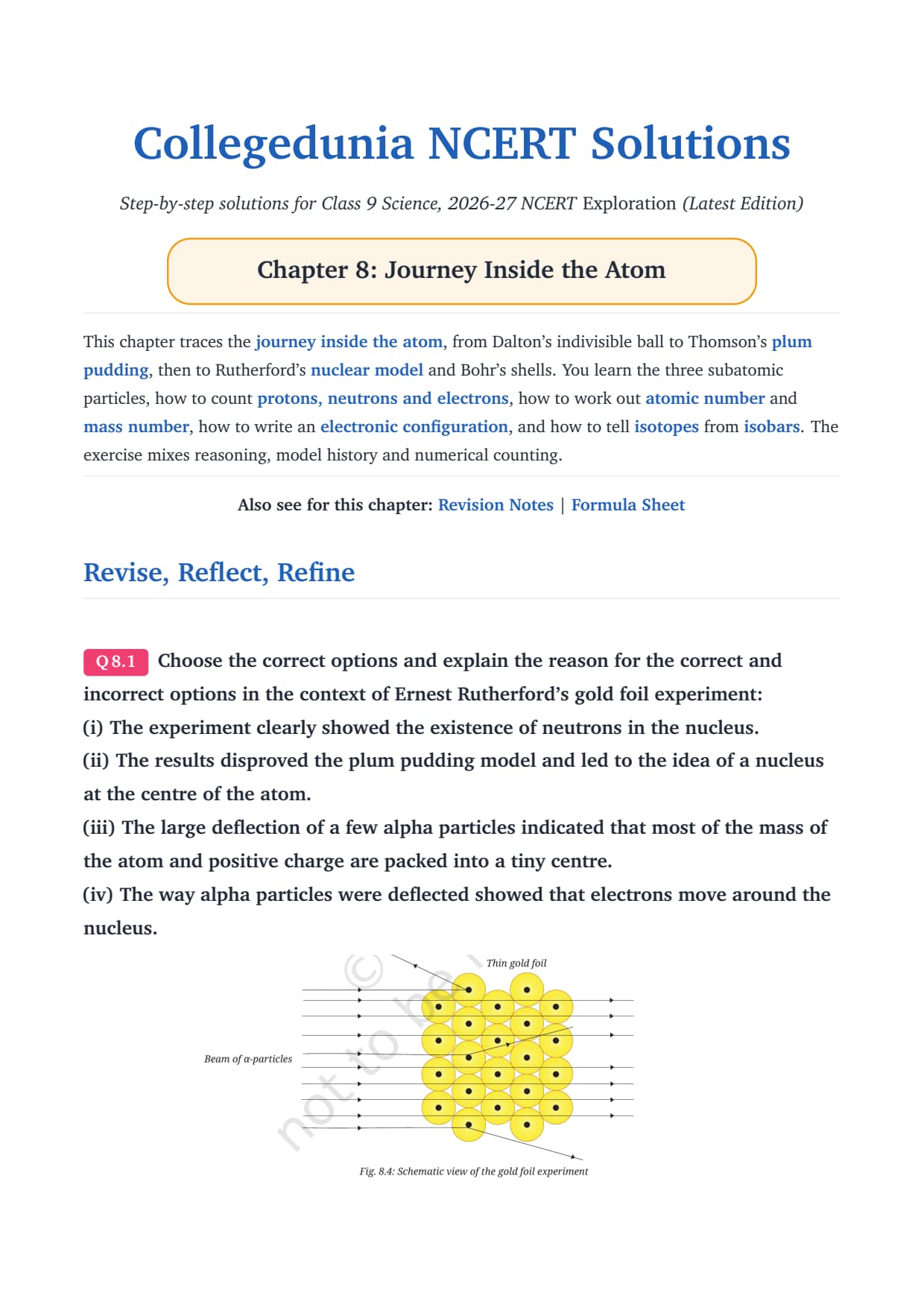
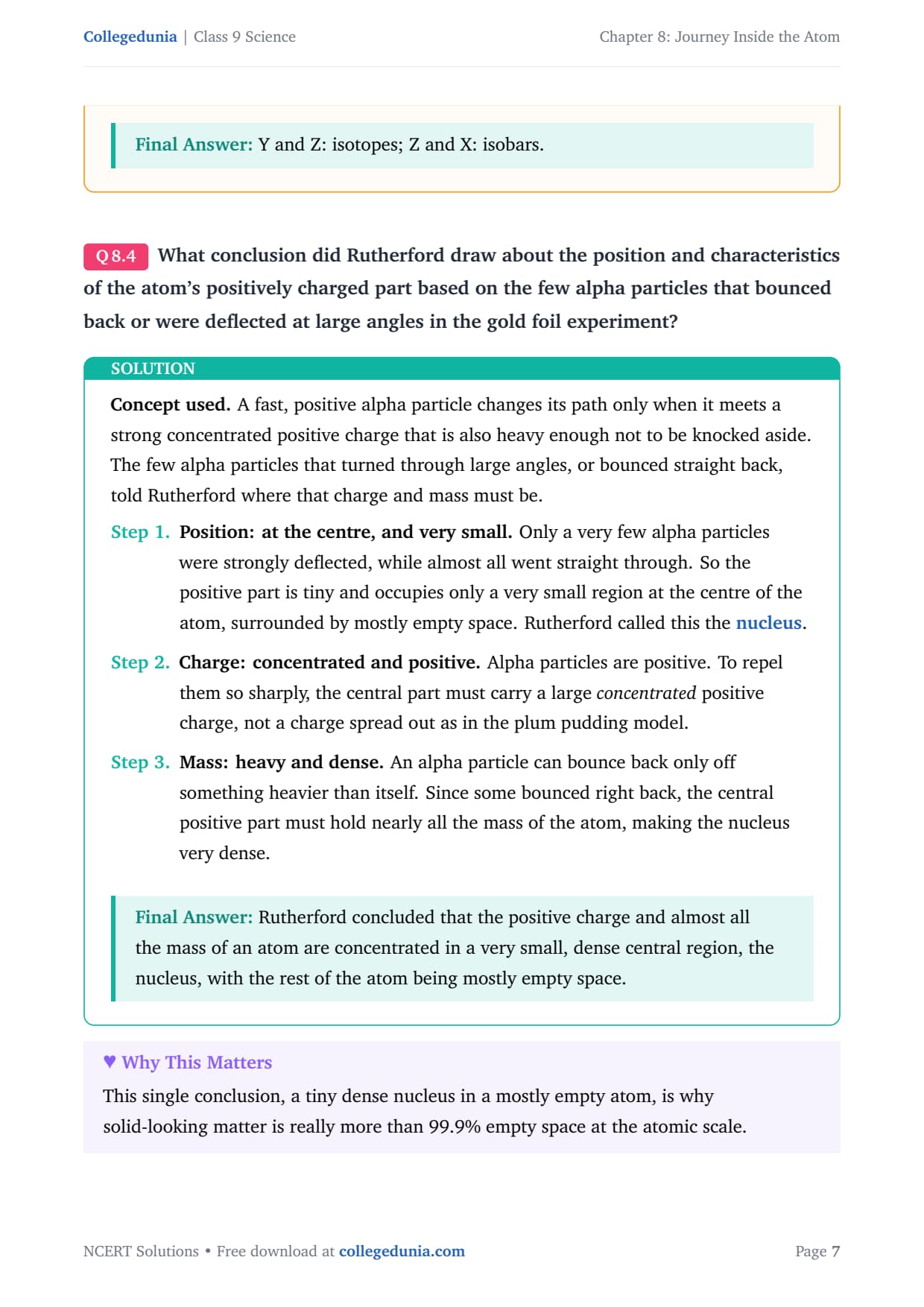
The gold foil experiment is the turning point. Most alpha particles passed straight through the foil, a few were deflected, and a very few bounced back. This proved that the positive charge and nearly all the mass of an atom sit in a tiny central nucleus.
Journey Inside the Atom Class 9 Important Formulas and Key Concepts
Almost every counting question in this chapter uses one of the relations below. Learn what each symbol means, then the numericals become one-line answers. In a neutral atom the number of protons always equals the number of electrons.
| Quantity | Relation | What it means |
|---|---|---|
| Atomic number (Z) | Z = number of protons = number of electrons | Decides which element the atom is. |
| Mass number (A) | A = protons + neutrons | Total count of particles in the nucleus. |
| Number of neutrons | n = A − Z | Neutrons are the mass number minus the protons. |
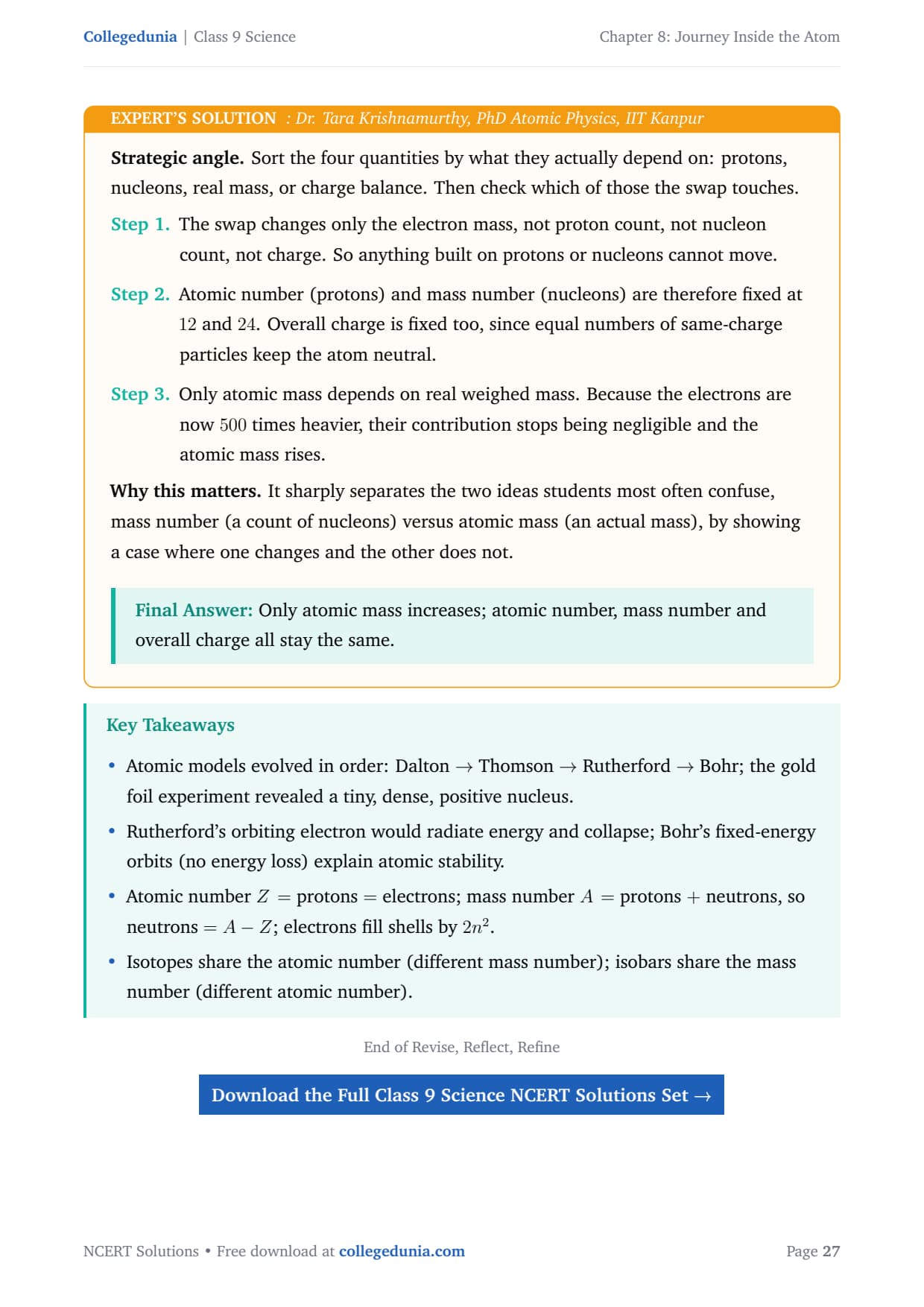
| Shell capacity | Maximum electrons = 2n2 | K holds 2, L holds 8, M holds up to 18. |
| Valency | Valence electrons, or 8 − valence electrons | Electrons gained, lost, or shared to fill the outer shell. |
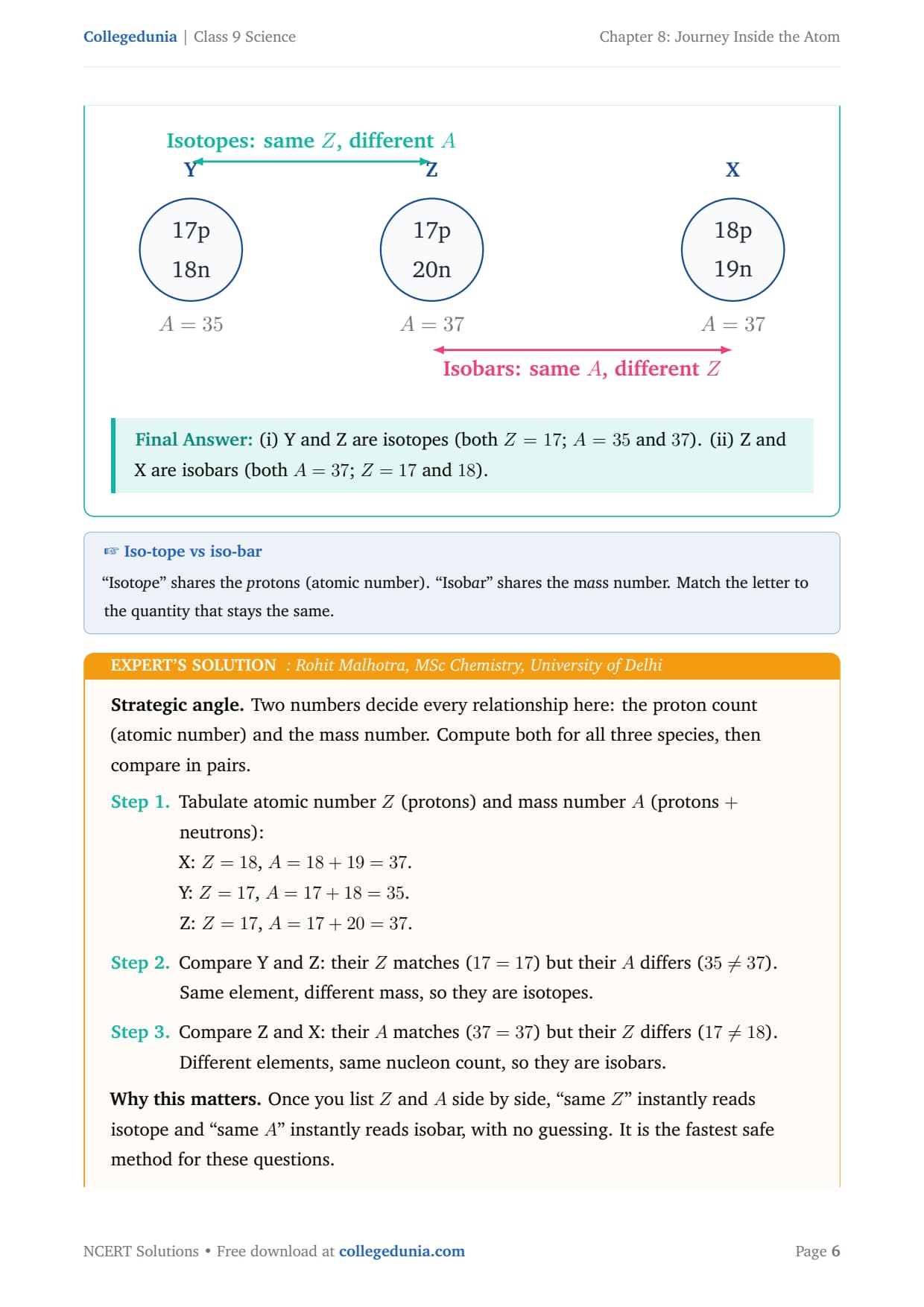
Two more terms complete the chapter. Isotopes are atoms of the same element with the same atomic number but different mass numbers. Isobars are atoms of different elements with the same mass number but different atomic numbers.
Revise, Reflect, Refine Exercise Breakdown for Class 9 Science Chapter 8
The Chapter 8 exercise is called Revise, Reflect, Refine and has 15 questions. The table shows what each question tests, so students can plan their practice.
| Questions | Type | What it tests |
|---|---|---|
| 1 to 3 | MCQ and reasoning | Gold foil experiment, Bohr's model, and isotopes versus isobars. |
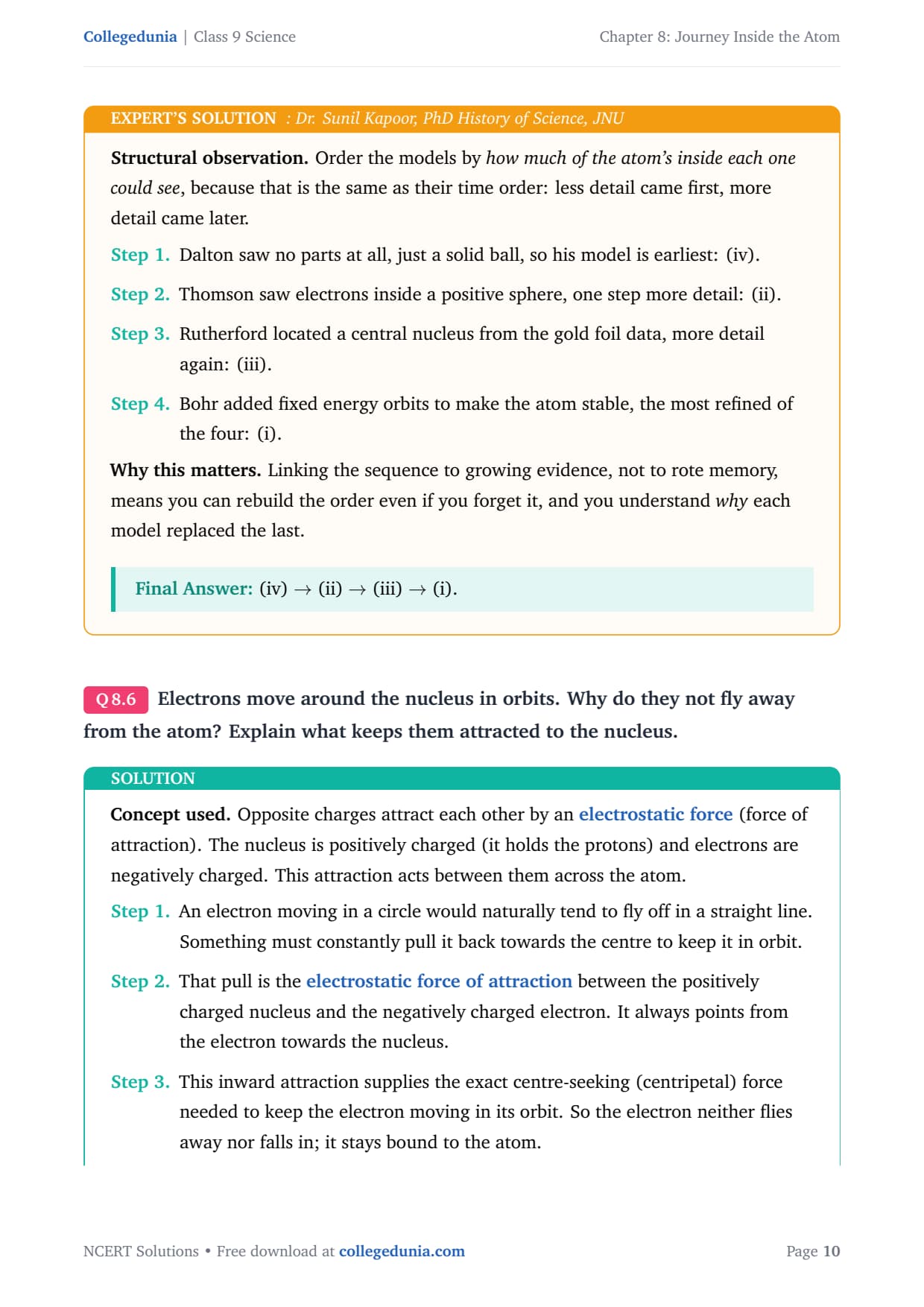
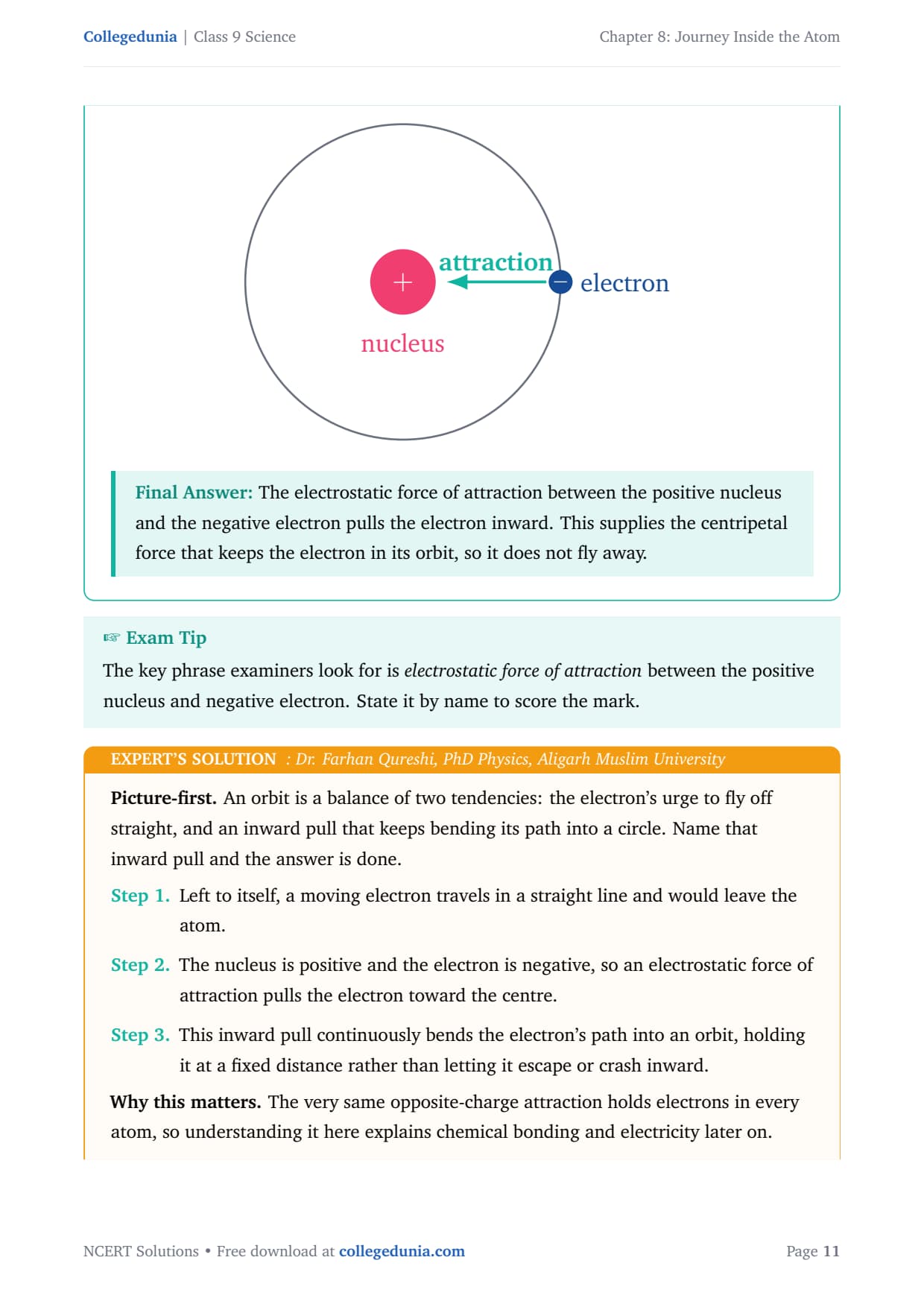
| 4 to 6 | Short and long answer | Rutherford's conclusion, model order, and why electrons stay bound. |
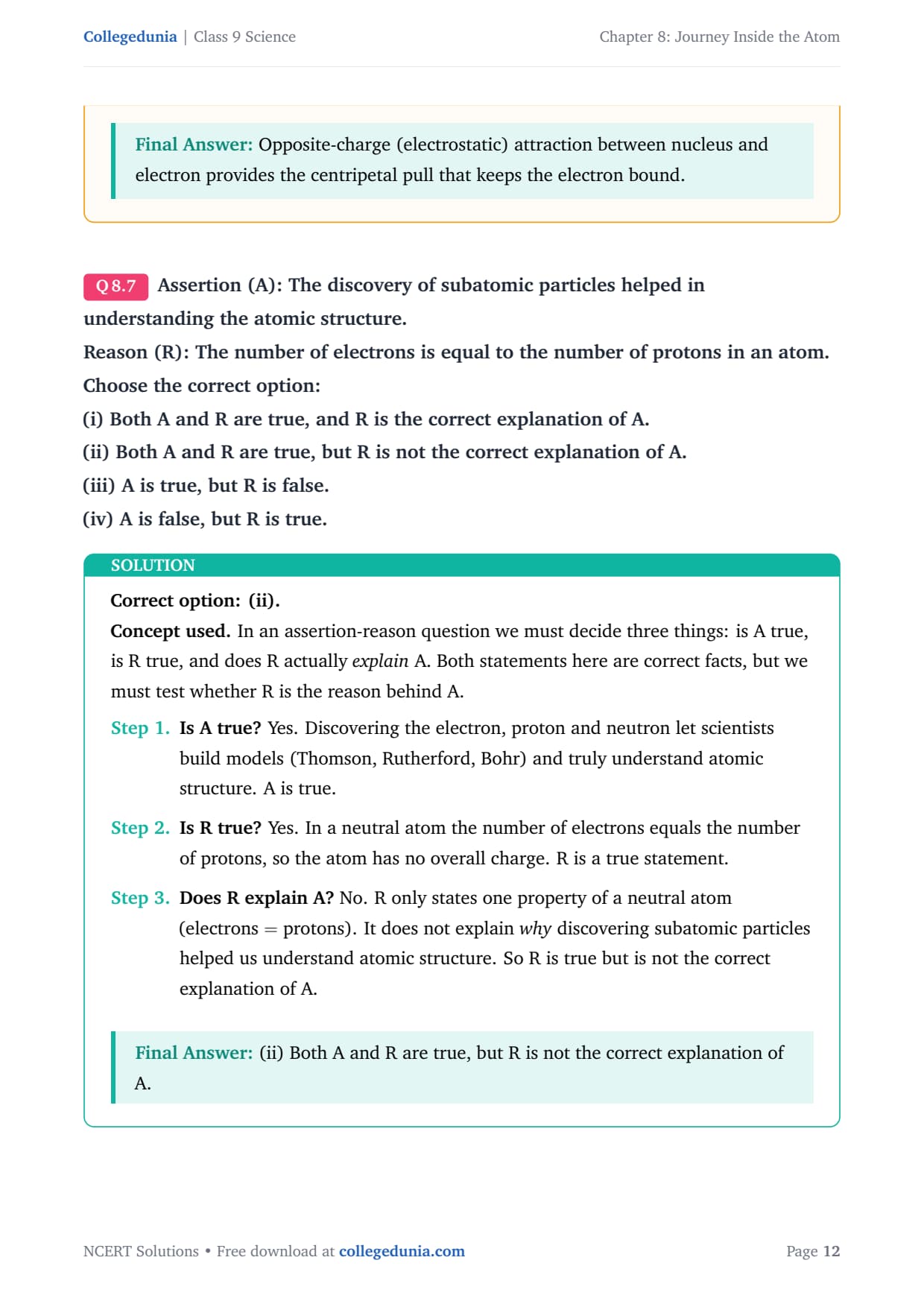
| 7 to 9 | Assertion-reason and counting | Assertion-reason logic, magnesium particles, and reading shell diagrams. |
| 10 to 12 | Reasoning and numerical | Rutherford versus Bohr stability and neutron counting. |
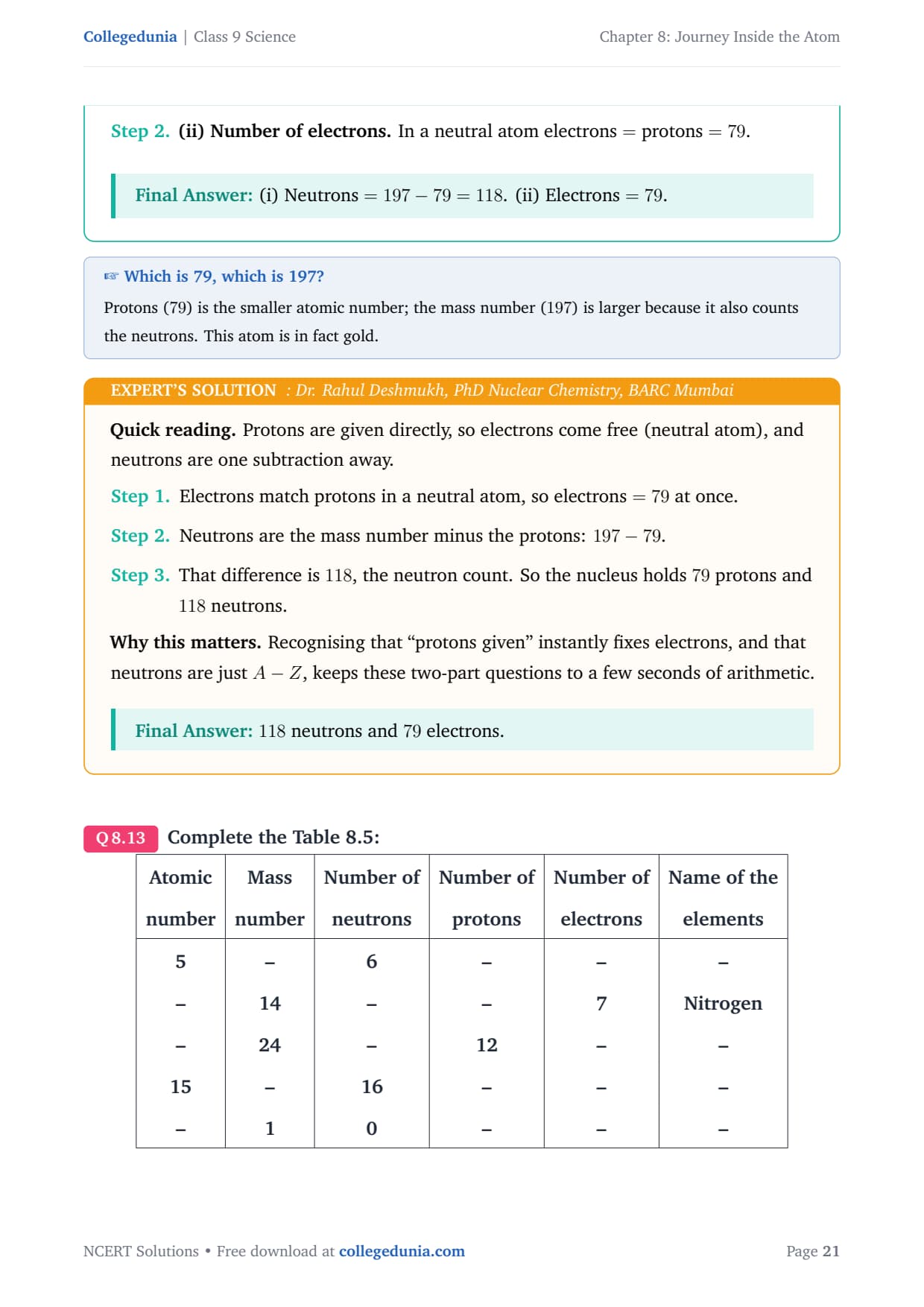
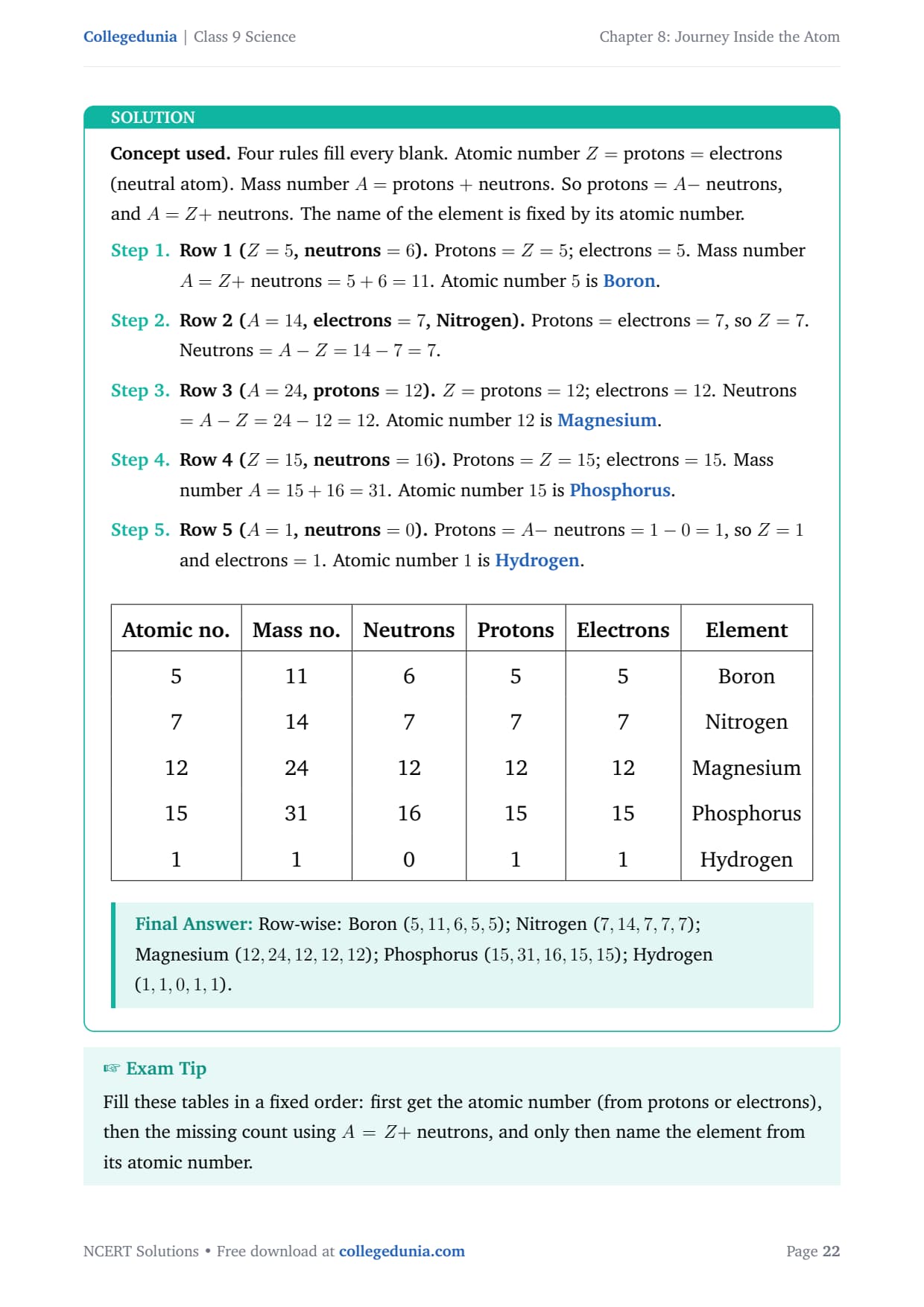
| 13 to 15 | Table and reasoning | Completing a particle table, chlorine, and a hypothetical heavy electron. |
Start with the model and definition questions, then move to the counting numericals. All 15 fully solved answers, with an expert method for each, are given lower down this page.
Isotopes and Isobars in Class 9 Science Chapter 8
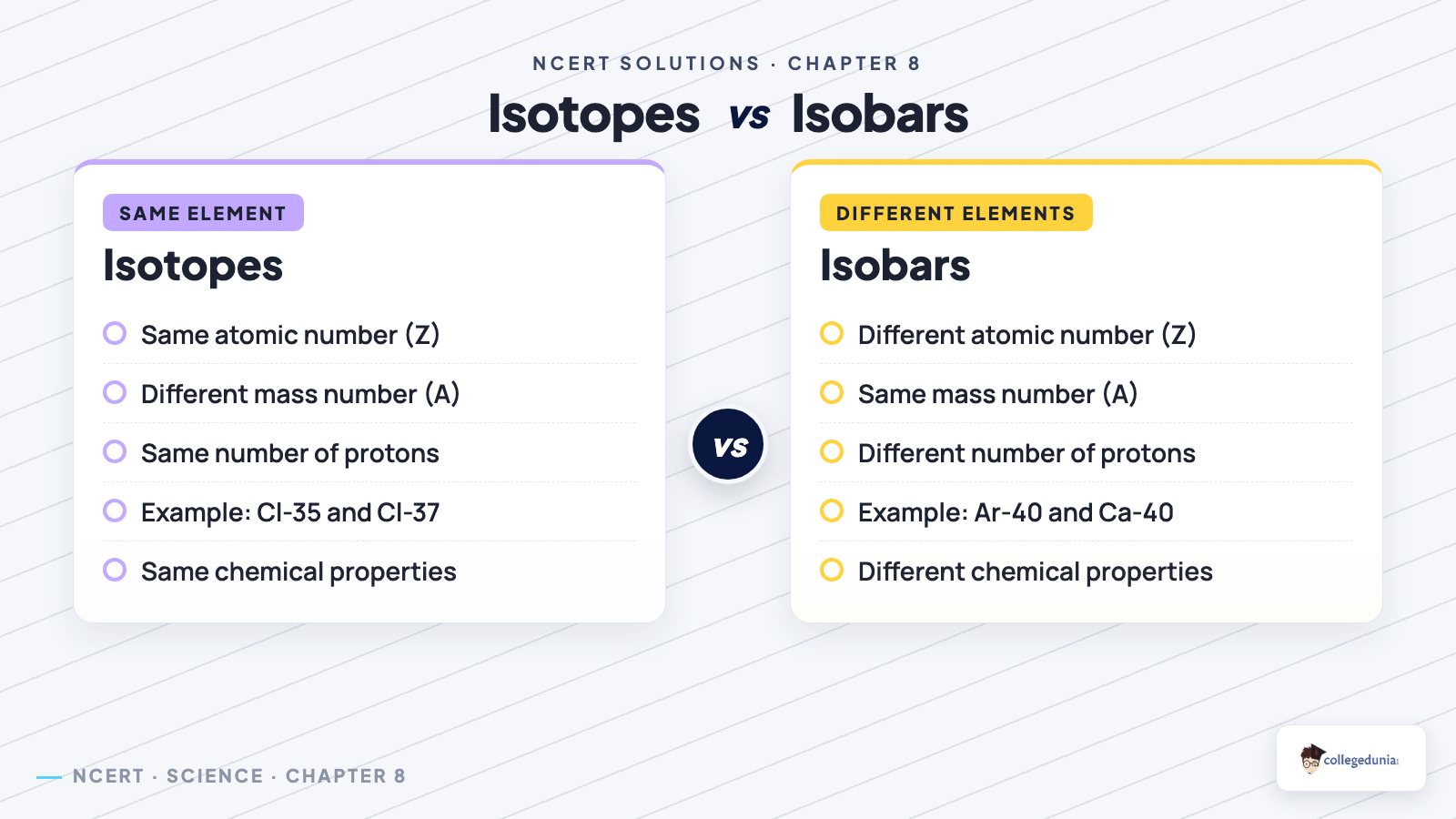
Telling isotopes from isobars is the single most common slip students make in this chapter. The trick is to check which number stays the same, the atomic number or the mass number.
- Isotopes: same atomic number, different mass number. They are the same element, such as chlorine-35 and chlorine-37.
- Isobars: same mass number, different atomic number. They are different elements, such as argon-40 and calcium-40.
- Memory hook: isotope shares the protons; isobar shares the mass number.
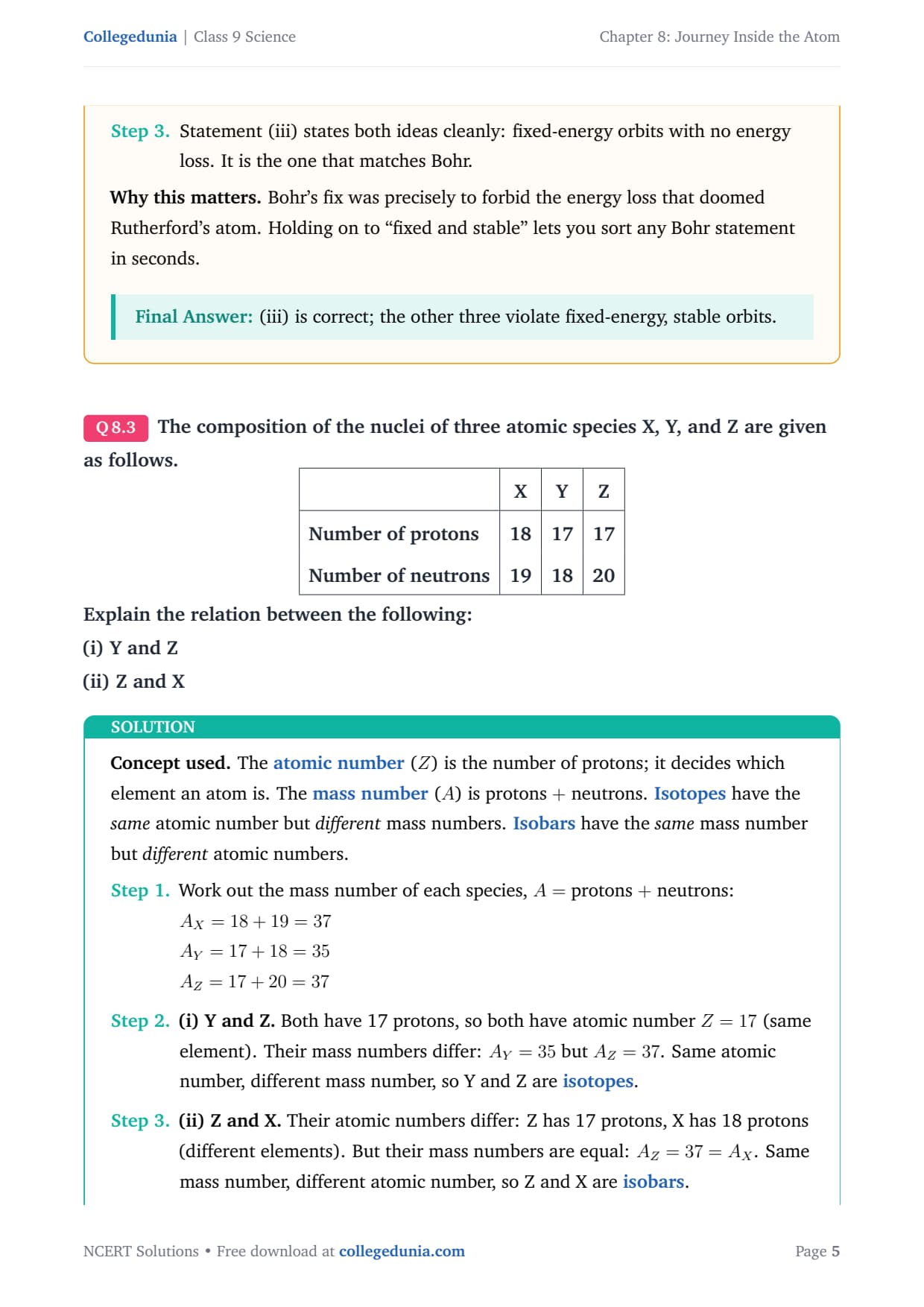
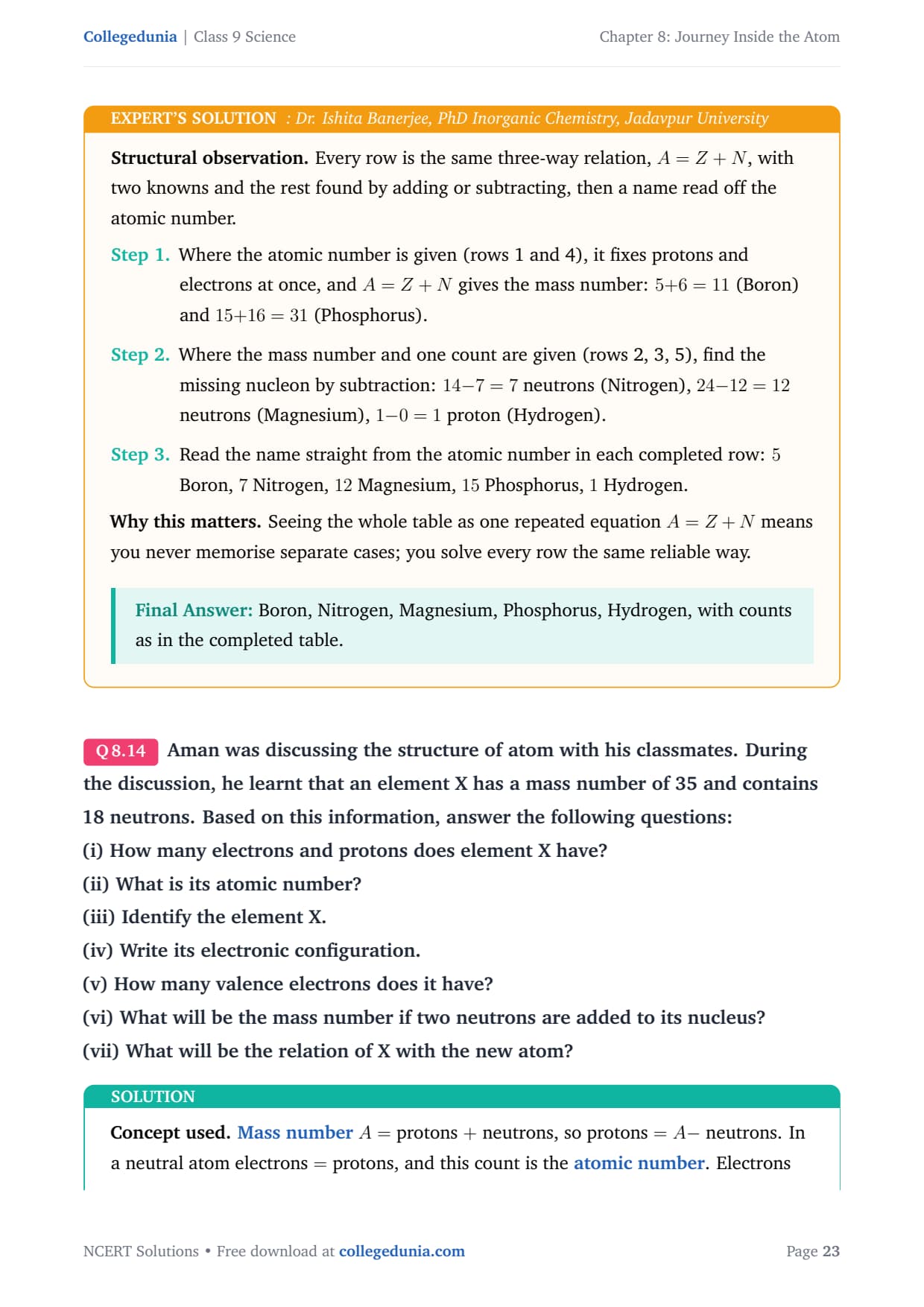
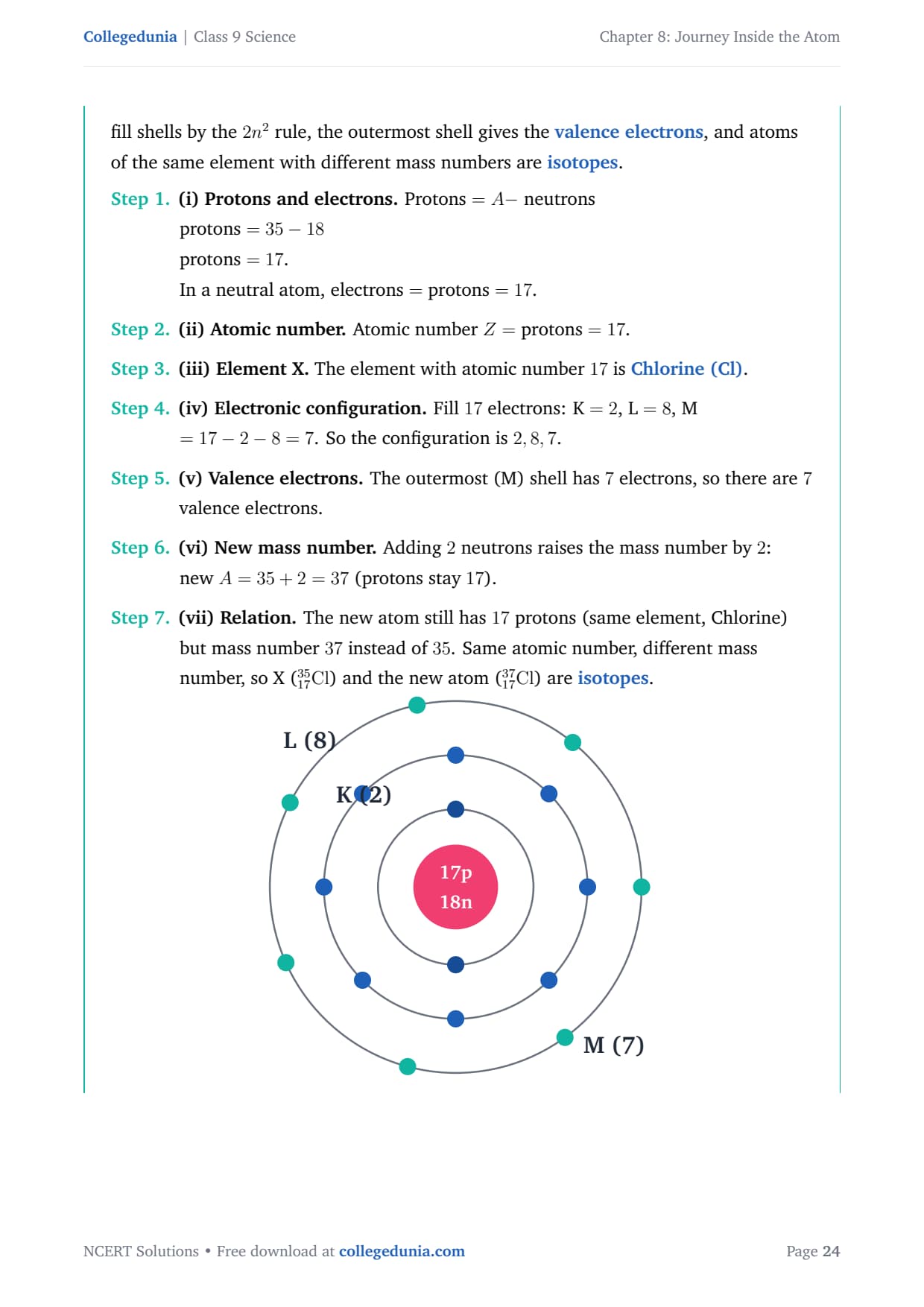
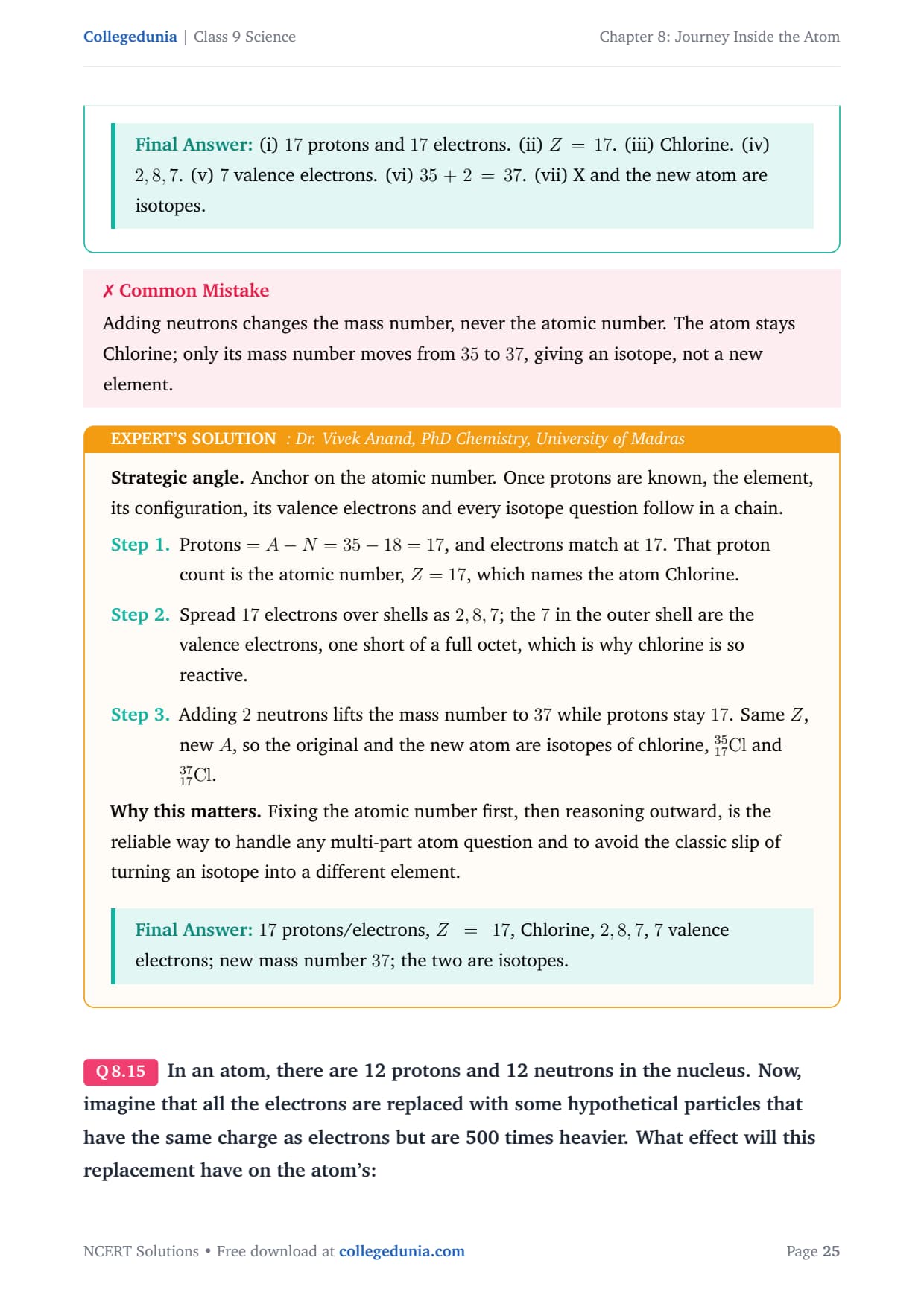
Questions 3 and 14 both use this idea. In Question 3, species Y and Z share 17 protons, so they are isotopes, while Z and X share mass number 37, so they are isobars.
Journey Inside the Atom Weightage in the Class 9 Science Exam
Chapter 8 sits in the chemistry part of Class 9 Science. Atomic structure is a favourite of examiners because it mixes short reasoning with easy counting. The table compares it with the nearby chemistry chapters.
| Chapter | Topic | Typical marks |
|---|---|---|
| Chapter 5 | Exploring Mixtures and their Separation | 5 to 6 marks |
| Chapter 8 | Journey Inside the Atom | 6 to 8 marks |
| Chapter 9 | Atomic Foundations of Matter | 5 to 7 marks |
Because the numericals here are short and rule-based, this chapter is one of the safest places to score full marks with steady practice.
Common Mistakes Students Make in the Journey Inside the Atom Chapter
Watch out for these slips:
- Crediting the gold foil experiment with finding the neutron. It revealed the nucleus; neutrons were found later by Chadwick.
- Confusing atomic number with mass number. Atomic number counts protons only, while mass number counts protons plus neutrons.
- Assuming valency always equals the valence electrons. If the outer shell is more than half full, valency = 8 − valence electrons.
- Mixing up isotopes and isobars. Isotopes share the atomic number; isobars share the mass number.
Solved Example: Counting Particles in a Magnesium Atom
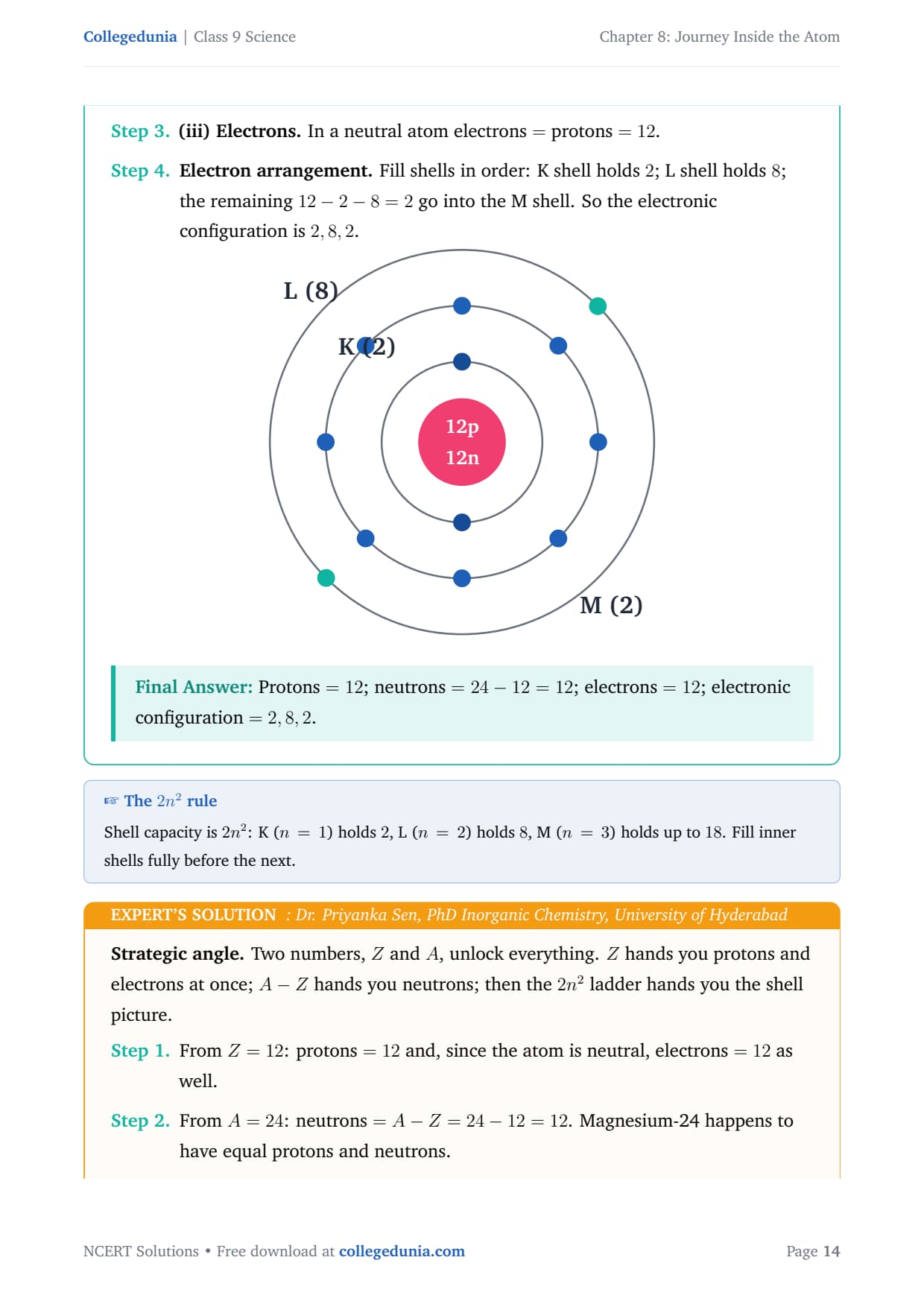
A magnesium atom has mass number 24 and atomic number 12. Find the number of protons, neutrons, and electrons, and write its electronic configuration. This is Question 8 from the exercise, shown here as a model of the method.
- Protons: the number of protons equals the atomic number, so protons = 12.
- Neutrons: neutrons = A − Z = 24 − 12 = 12.
- Electrons: in a neutral atom electrons = protons = 12.
- Electronic configuration: fill the shells as K = 2, L = 8, and the remaining 12 − 2 − 8 = 2 go into the M shell, giving 2, 8, 2.
Every particle-counting question in this chapter follows this same routine: read Z for the protons and electrons, subtract for the neutrons, then fill the shells using the 2n2 rule.
How to Use the Class 9 Journey Inside the Atom Solutions Most Effectively
Use a simple three-step routine so the chapter stays in memory until the exam.
- Learn the atomic models in order and the meaning of atomic number, mass number, and valency.
- Attempt each question yourself, then compare with the step-by-step solution below.
- Redo the counting questions you got wrong two days later, without looking at the answer.
Pair this page with the chapter notes and formula sheet for quick revision before the exam.
NCERT Class 9 Science Chapter 8 Other Study Resources
Use the other free resources for the same chapter alongside these solutions.
| Resource | Link |
|---|---|
| Revision Notes | Journey Inside the Atom Class 9 Notes |
| Handwritten Notes | Journey Inside the Atom Class 9 Handwritten Notes |
| NCERT Book PDF | Journey Inside the Atom Class 9 NCERT Book PDF |
| Formula Sheet | Journey Inside the Atom Class 9 Formula Sheet |
NCERT Solutions for Class 9 Science: All Chapters
Find the step-by-step NCERT Solutions for the other Class 9 Science chapters below.
| Chapter | Resource |
|---|---|
| Chapter 5 | Exploring Mixtures and their Separation NCERT Solutions |
| Chapter 7 | Work, Energy, and Simple Machines NCERT Solutions |
| Chapter 8 | Journey Inside the Atom NCERT Solutions |
| Chapter 9 | Atomic Foundations of Matter NCERT Solutions |
| Chapter 10 | Sound Waves Characteristics and Applications NCERT Solutions |
Journey Inside the Atom Class 9 Science NCERT Solutions FAQs
Ques. Where can I download the Journey Inside the Atom Class 9 Science NCERT Solutions PDF?
Ans. You can download the Journey Inside the Atom Class 9 Science NCERT Solutions PDF free from this page. Both a normal and an HD version are available.
Ques. How many questions are solved in Class 9 Science Chapter 8?
Ans. All 15 questions from the Revise, Reflect, Refine exercise are solved, each with a step-by-step method and an expert method.
Ques. Are these solutions aligned with the 2026-27 NCERT?
Ans. Yes. Every answer matches the new 2026-27 NCERT Exploration textbook for Class 9 Science and the official NCERT answer key.
Ques. What did the gold foil experiment prove in Class 9 Science?
Ans. It proved that an atom has a tiny, dense, positively charged nucleus at its centre, with most of the atom being empty space. It did not discover the neutron.
Ques. What is the difference between isotopes and isobars?
Ans. Isotopes have the same atomic number but different mass numbers, so they are the same element. Isobars have the same mass number but different atomic numbers, so they are different elements.
Ques. How do I find the number of neutrons in an atom?
Ans. Subtract the atomic number from the mass number. The number of neutrons equals A − Z, where A is the mass number and Z is the atomic number.
Ques. Why did Bohr's model succeed where Rutherford's model failed?
Ans. Rutherford's orbiting electron would radiate energy and spiral into the nucleus. Bohr fixed this by allowing only fixed-energy orbits in which the electron loses no energy, so the atom stays stable.



Comments