




Chapter 5 Exploring Mixtures and their Separation is one of the most scoring chapters in the new Class 9 Science book. The NCERT Solutions for Class 9 Science Chapter 5 Exploring Mixtures and their Separation on this page solve all 17 Revise, Reflect, Refine questions for the 2026-27 session. Every answer gives the concept used, the full working, and an expert shortcut. You get MCQs, assertion-reason, concentration numericals, and separation-method questions in one place.
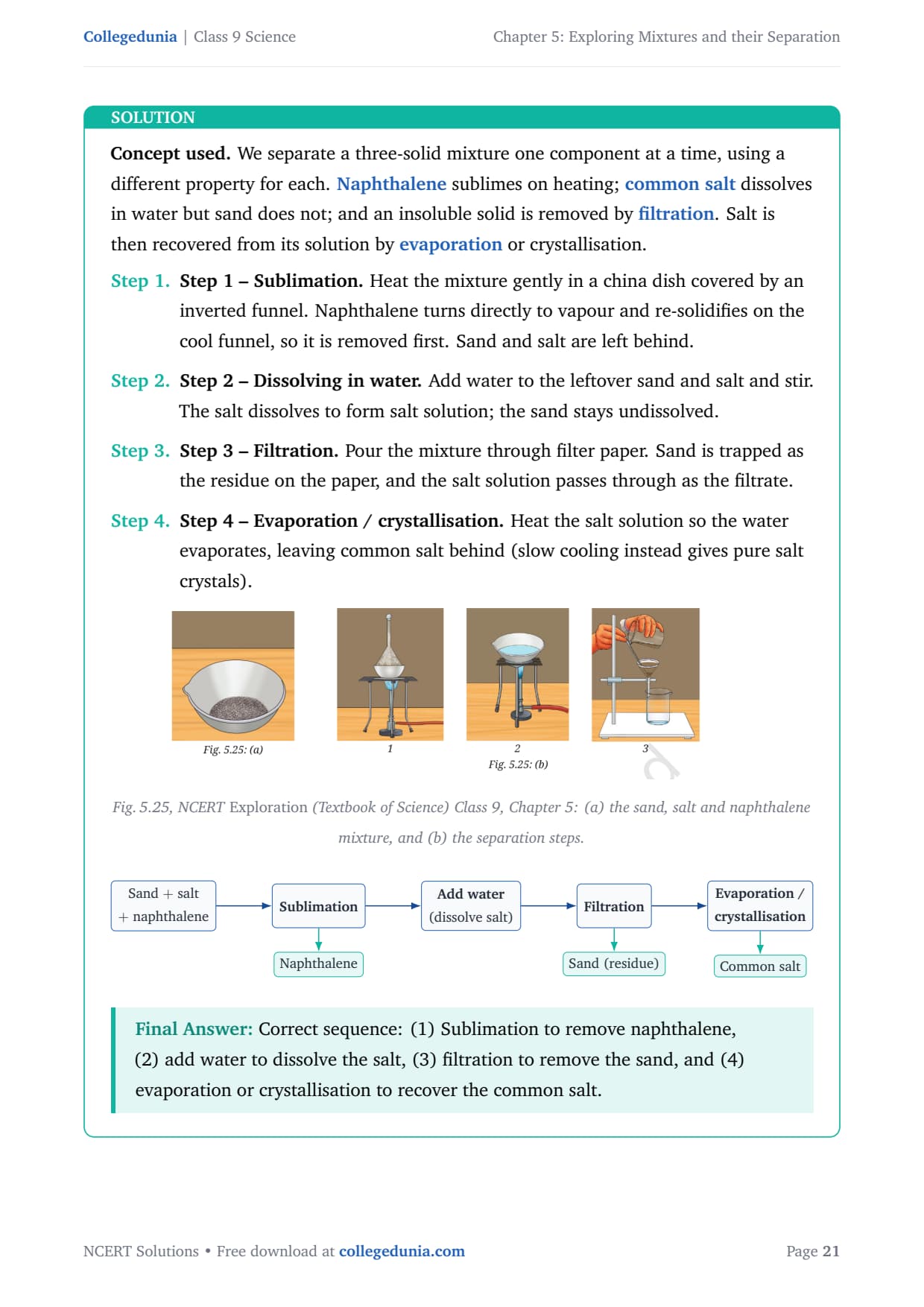
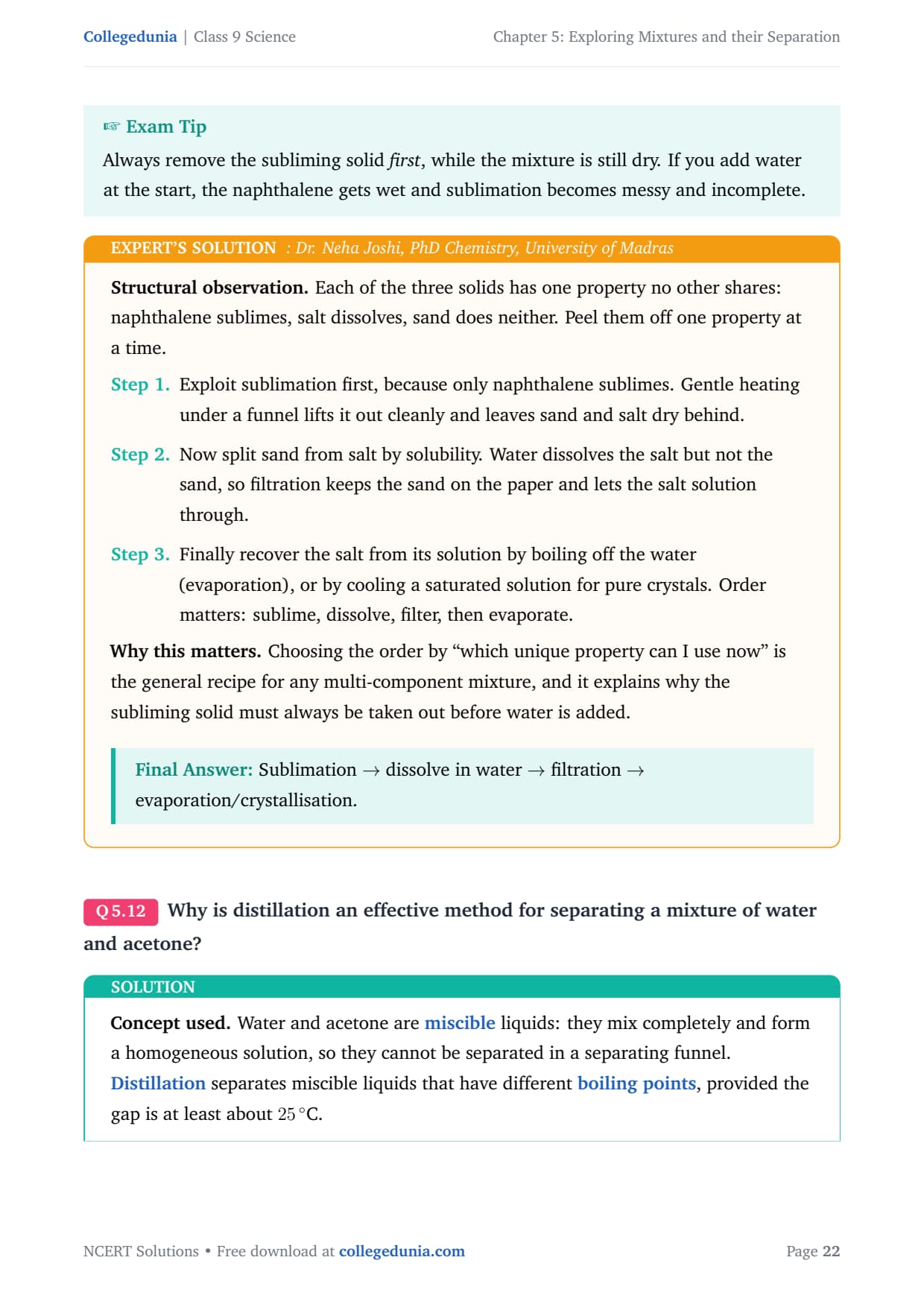
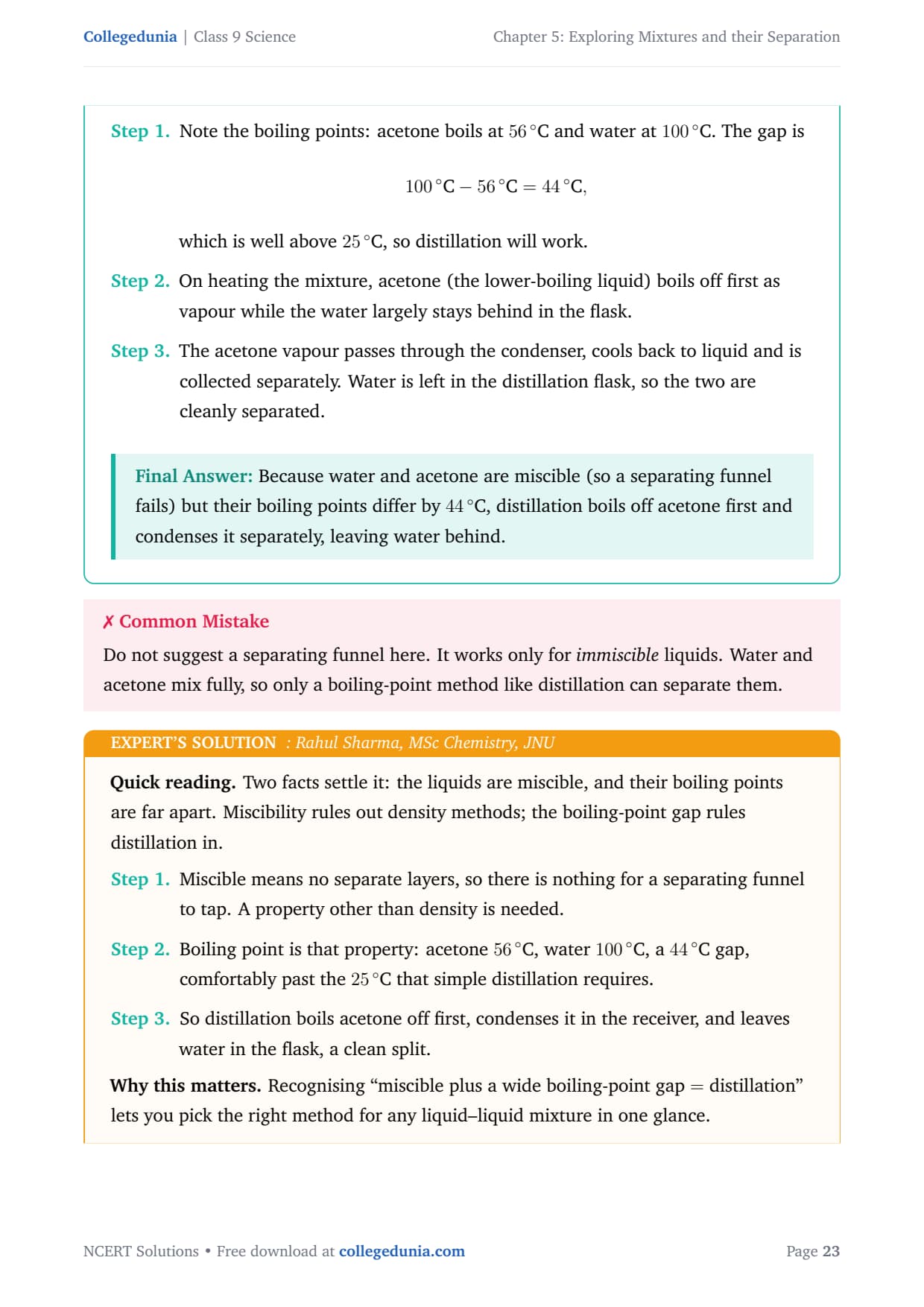
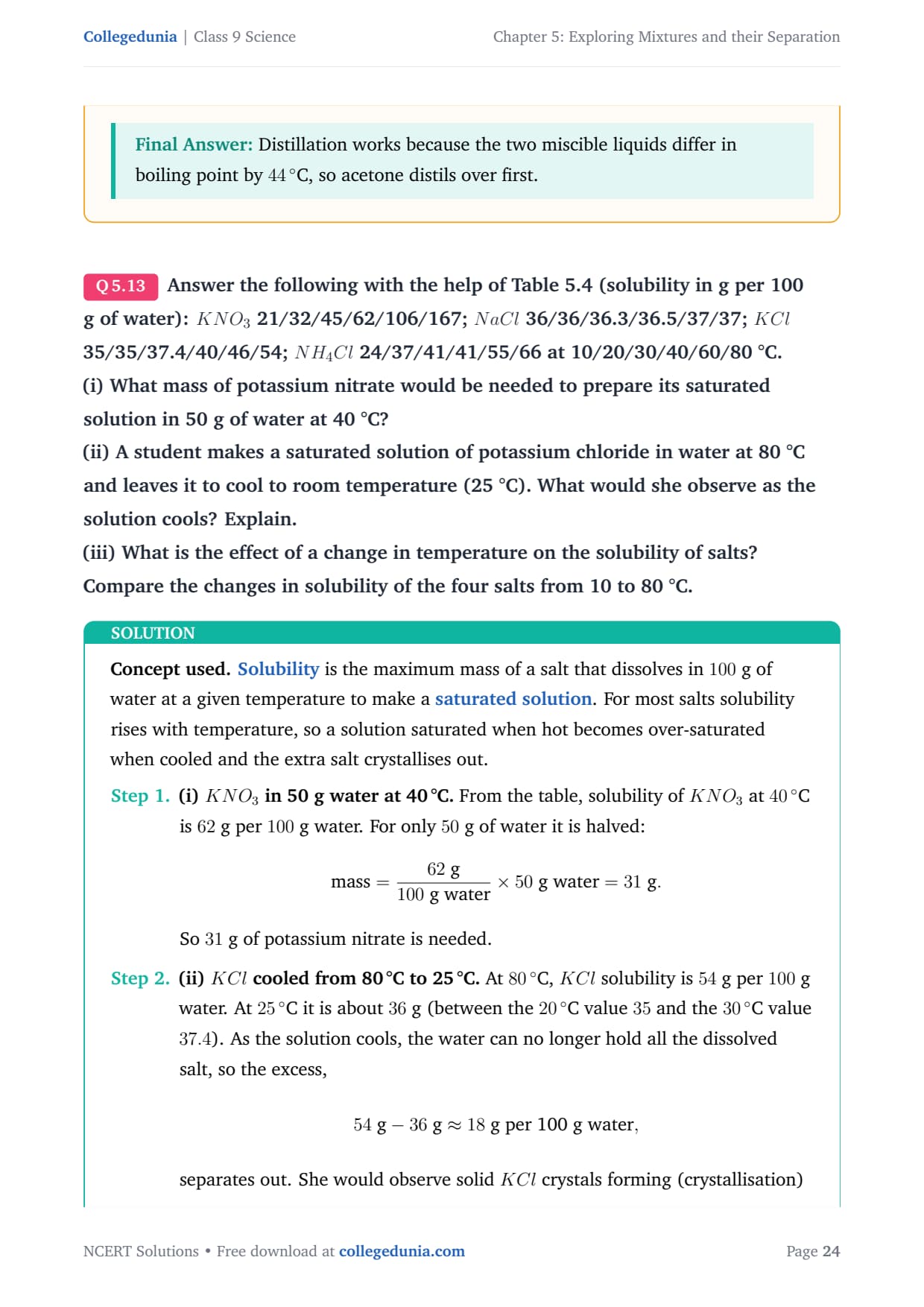
- Question count: 17 fully solved questions, covering MCQs, assertion-reason, three concentration numericals and separation-method questions.
- Concepts covered: homogeneous vs heterogeneous mixtures, solution-suspension-colloid, Tyndall effect, percentage concentration and eight separation methods.
- Format: each answer shows the concept, full working and an expert shortcut, matched to the 2026-27 NCERT Exploration book.
Every NCERT solution for Class 9 Science Chapter 5 in this Collegedunia set is written by science teachers, matched to the 2026-27 NCERT Exploration book, and checked against the official answer key.
Student Feedback on Exploring Mixtures and their Separation
In a Collegedunia poll of 12,840 Class 9 students during the 2026-27 session, 71% of students said the concentration numericals were the part they most wanted worked examples for. Students also rated the solution, suspension and colloid table as the topic they revised the most before their unit test.
Source: 2026-27 Class 9 Science student poll. Sample of 12,840 students from CBSE schools.
Exploring Mixtures Class 9 Explained in Simple Language
Source: Magnet Brains on YouTube
How Collegedunia's NCERT Solutions Help You With Exploring Mixtures and their Separation
These solutions do more than give the final answer. Each one names the property that matters, works the numbers in full, and adds an expert tip that saves time in the exam. That is exactly how a Class 9 unit test or the CBSE-style periodic test rewards you.
- 2026-27 NCERT alignment: answers follow the new Exploration book and its Revise, Reflect, Refine exercise, so nothing extra or outdated slips in.
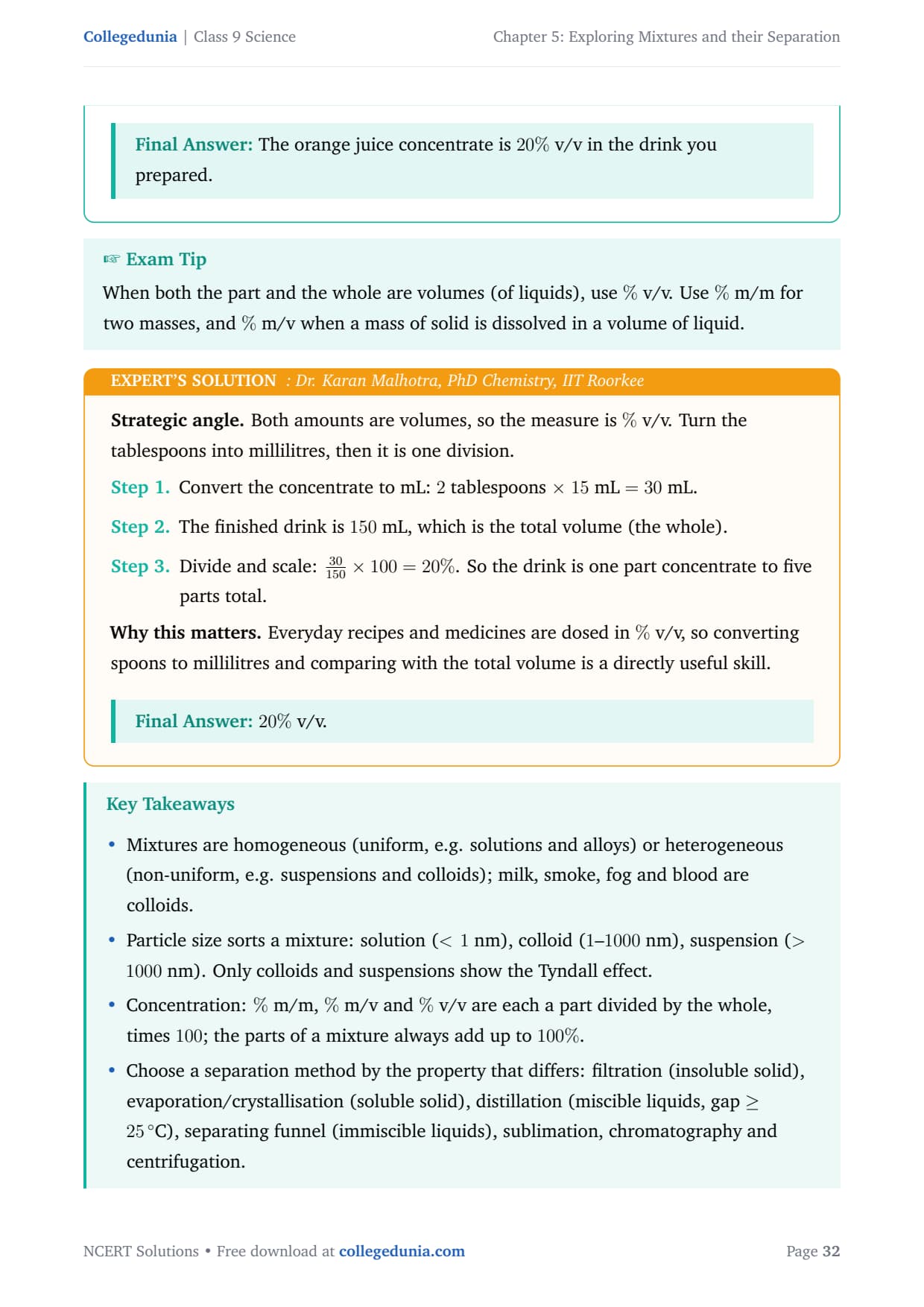
- Full working shown: every concentration sum is done step by step, from the formula to the final value, with a built-in check that the parts add up to 100%.
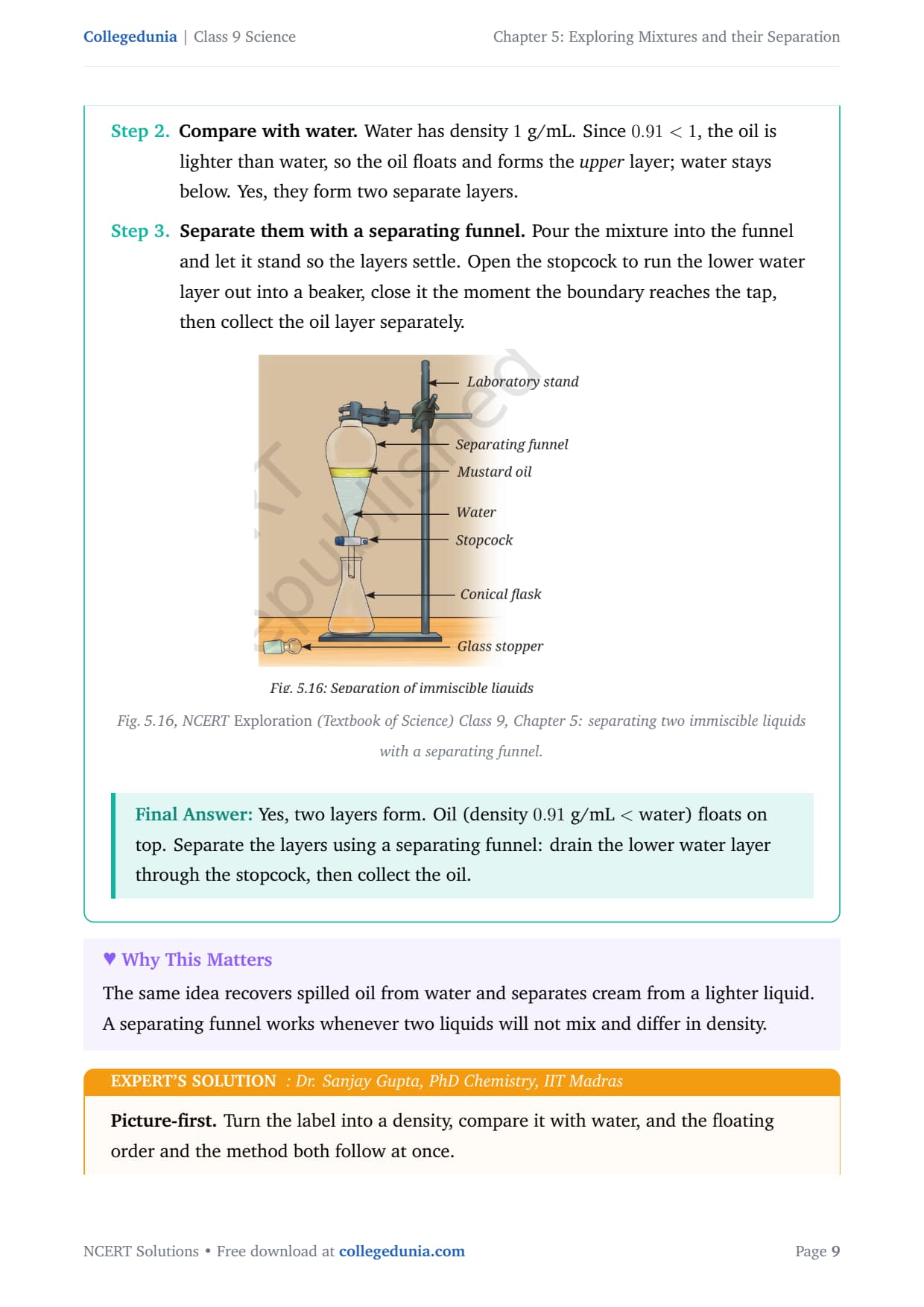
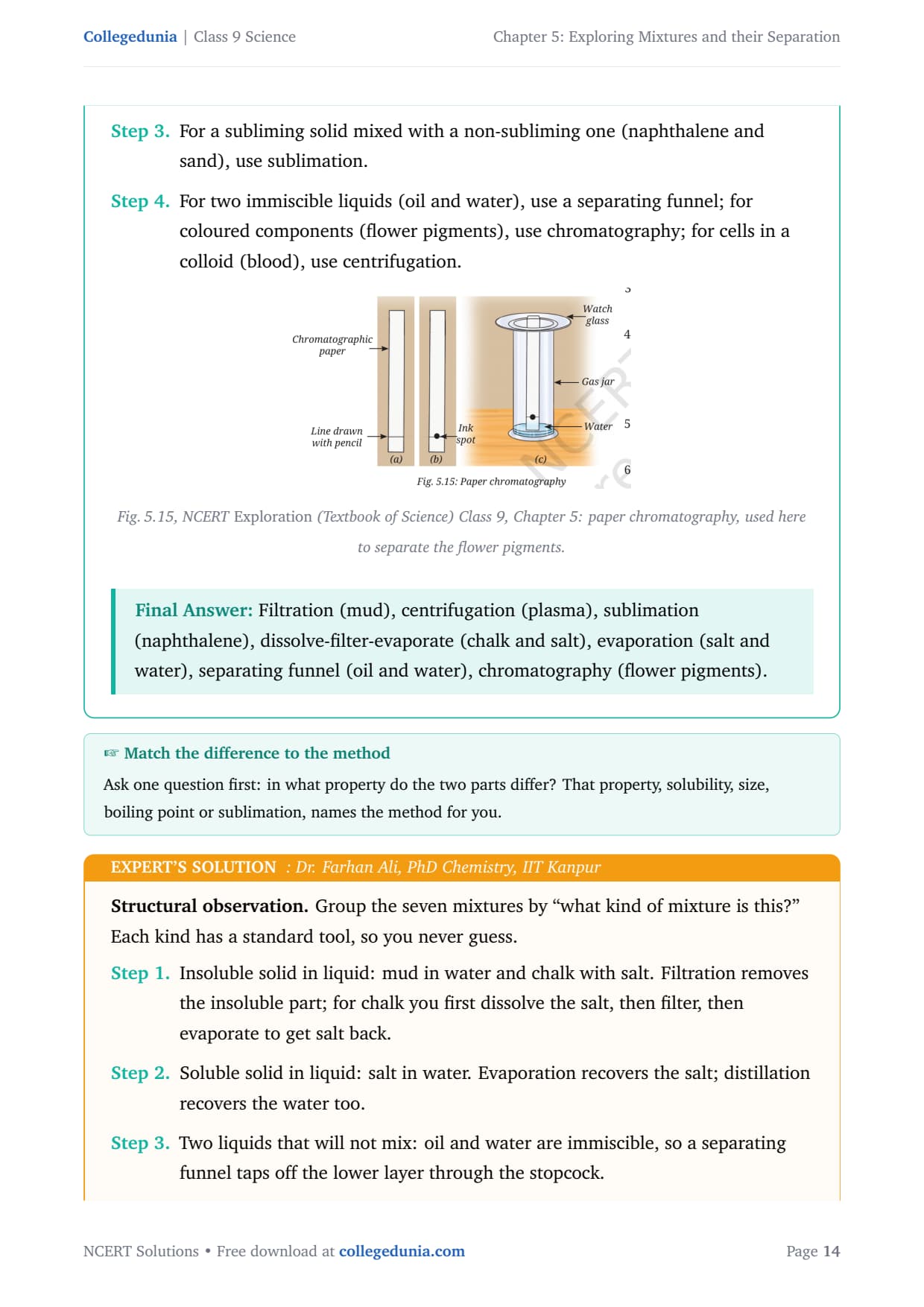
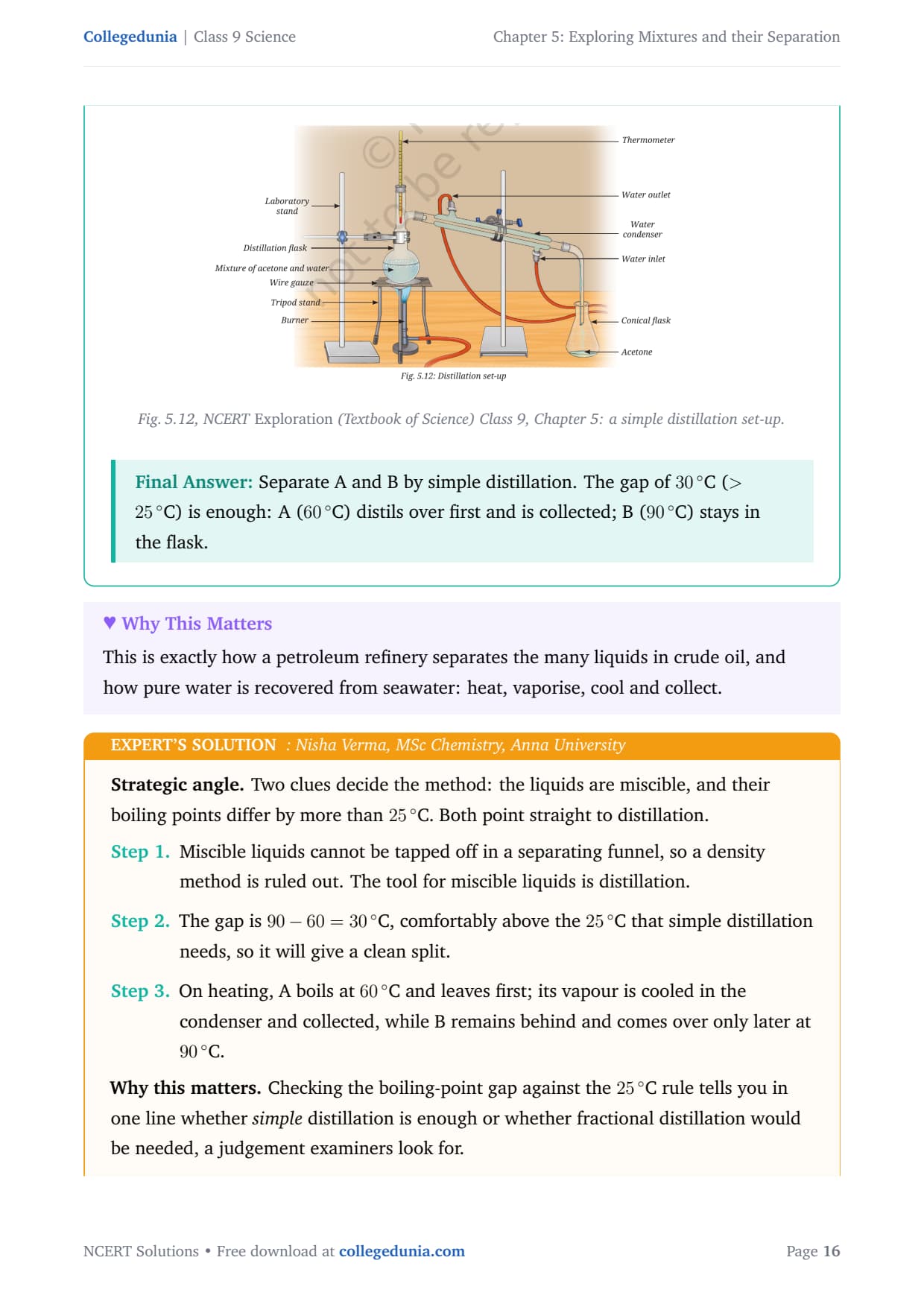
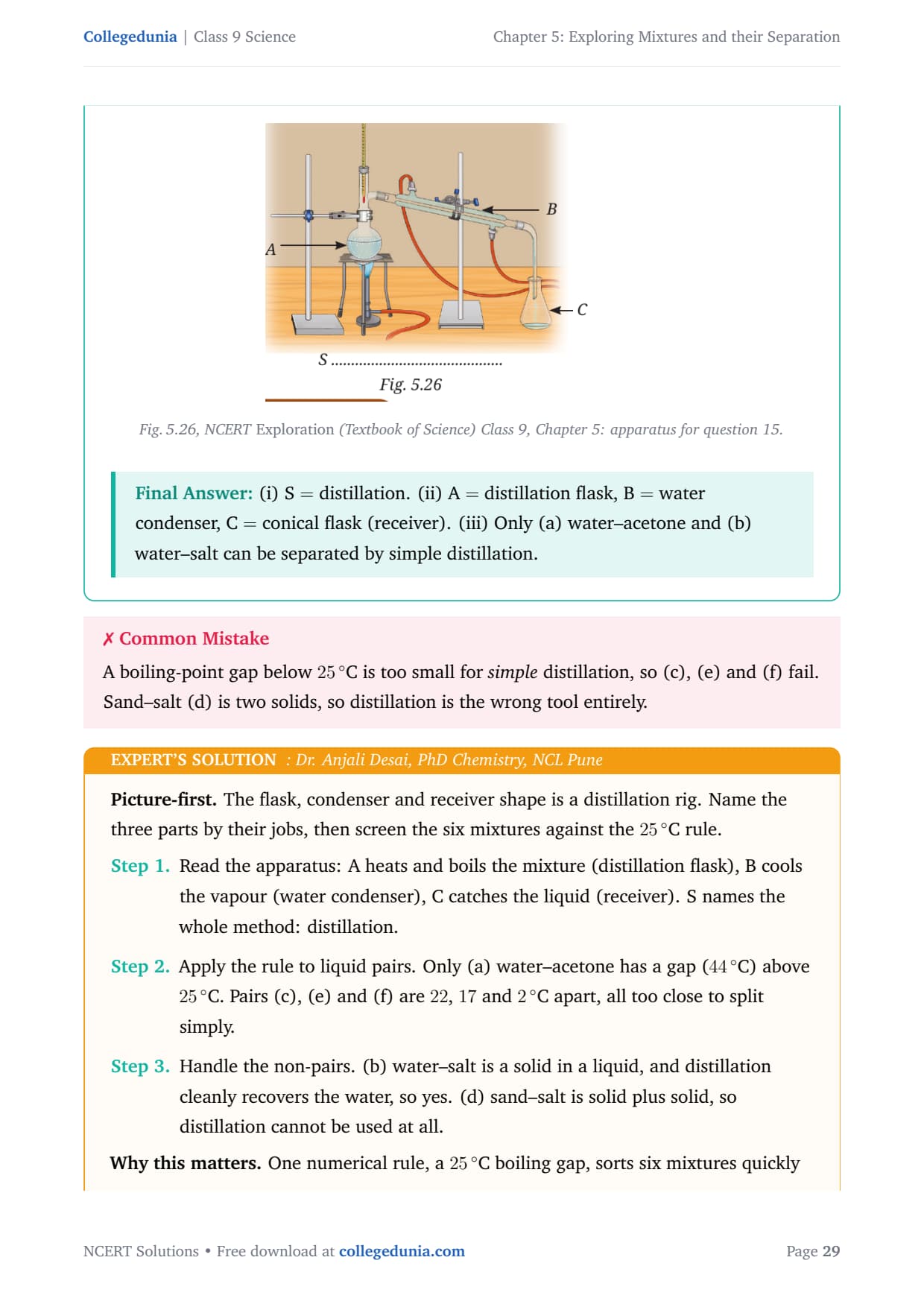
- Diagrams where they help: the distillation set-up, separating funnel and chromatography are shown with labelled figures from the NCERT book.
- Expert shortcuts: a second expert solution gives a faster route, such as ruling out true solutions first in a Tyndall-effect question.
What the Class 9 Science Exploring Mixtures and their Separation PDF Contains
The PDF is a clean, printable copy of everything on this page. It is handy for last-day revision because it puts the concept, the working and the expert tip for each question on one line of sight.
- All 15 Revise, Reflect, Refine questions, in the exact order of the NCERT book.
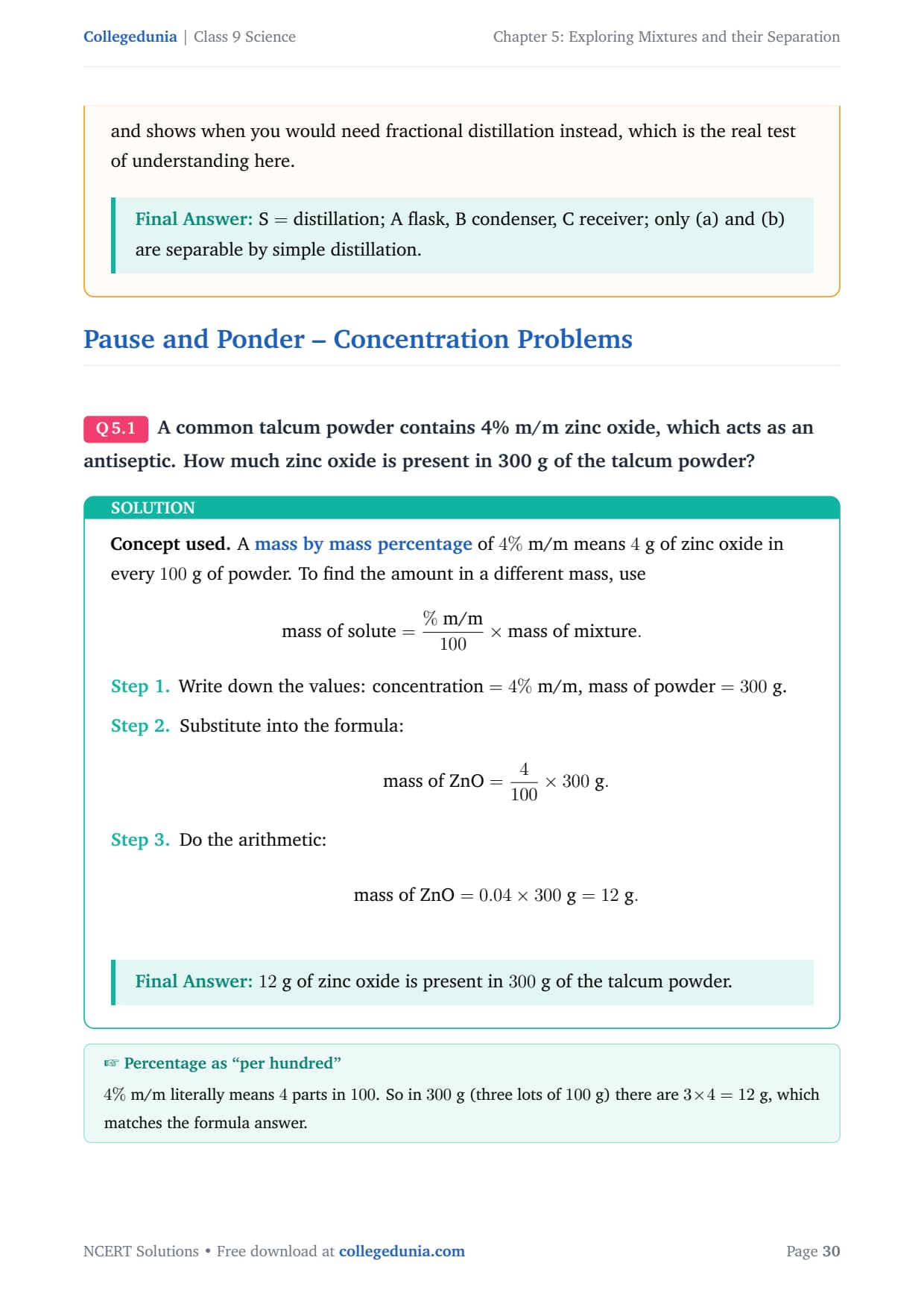
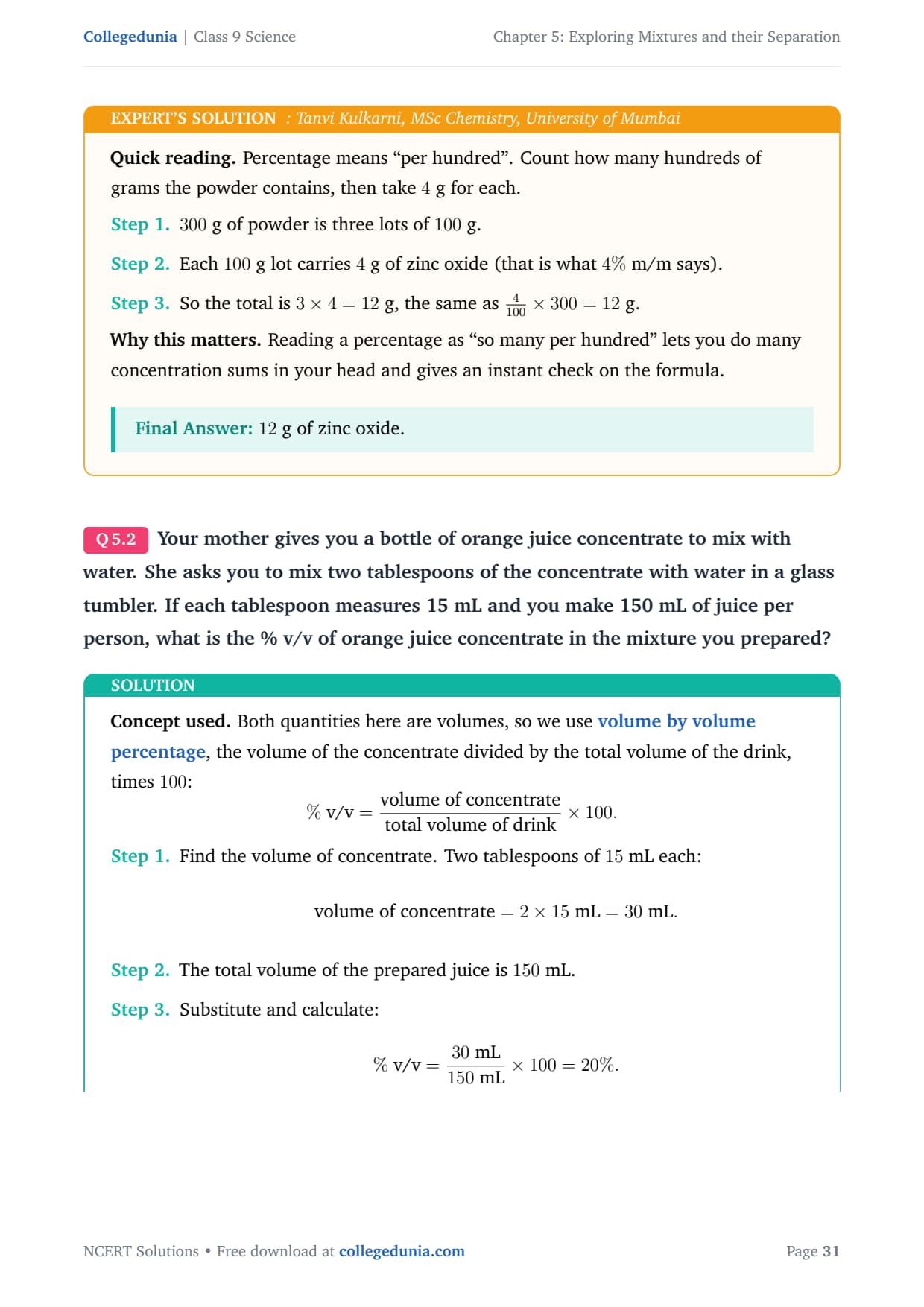
- Both Pause and Ponder concentration problems from inside the chapter.
- A quick-recall table of the three concentration formulas and the eight separation methods.
Types of Mixtures in Exploring Mixtures and their Separation: Homogeneous and Heterogeneous
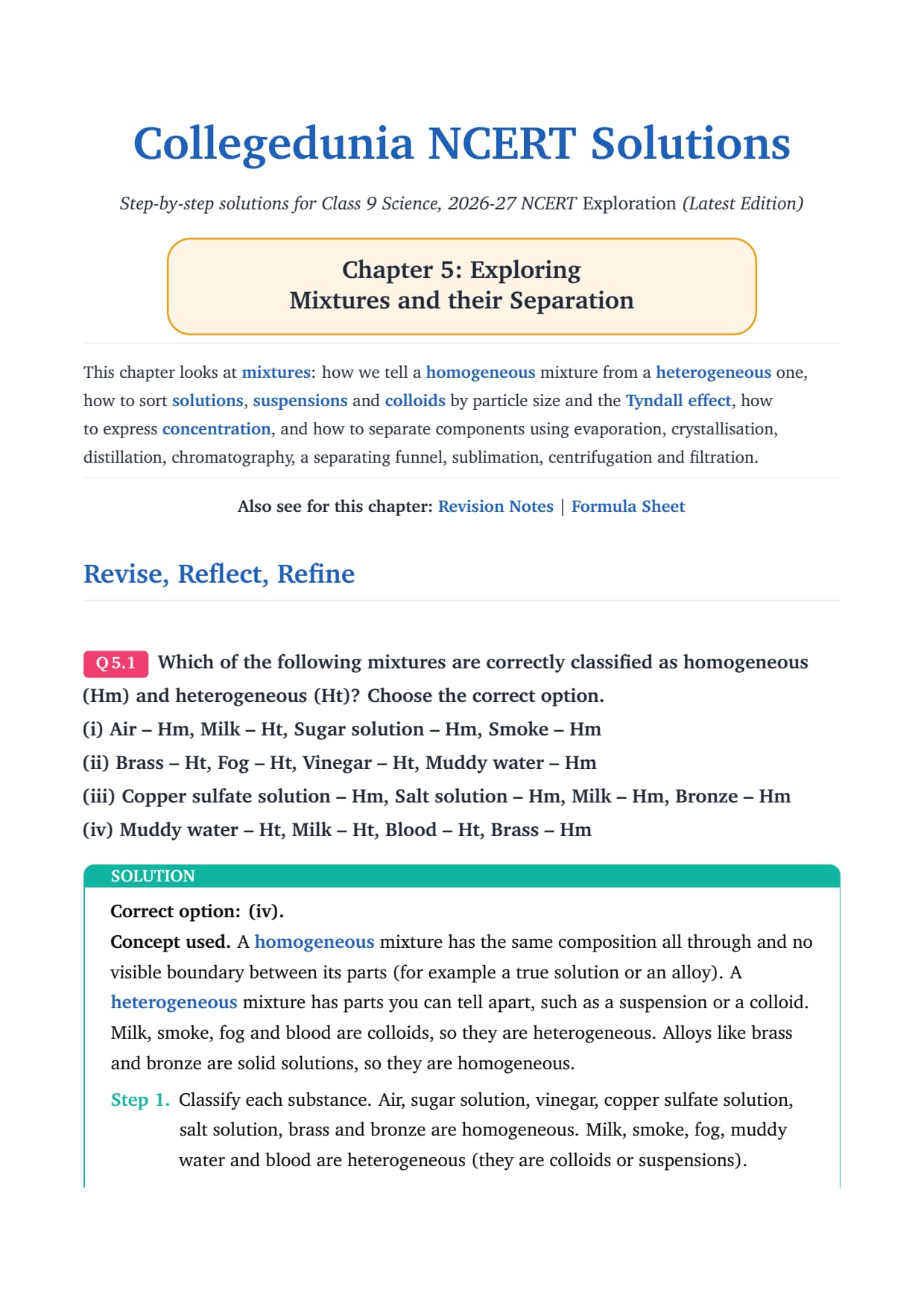
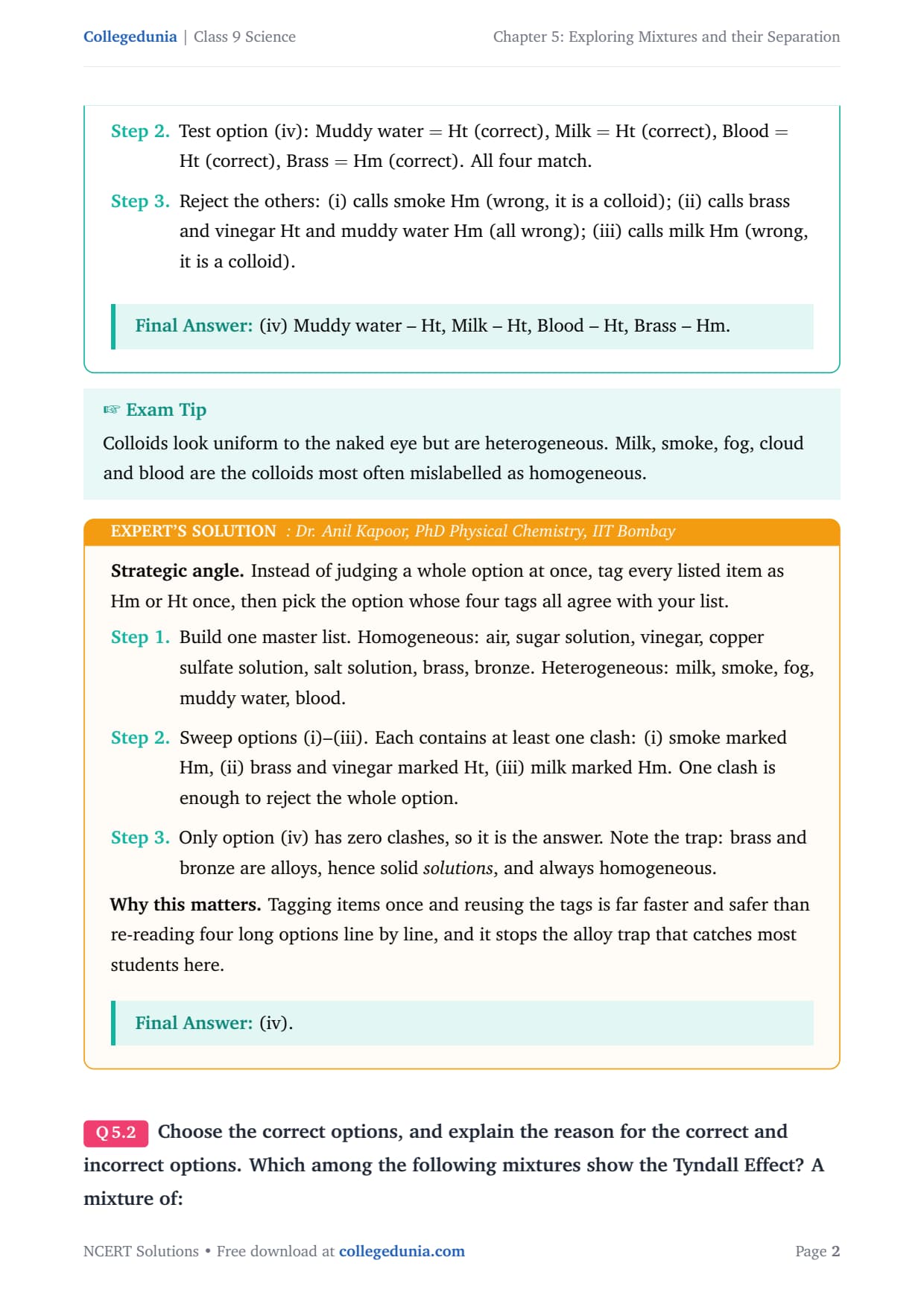
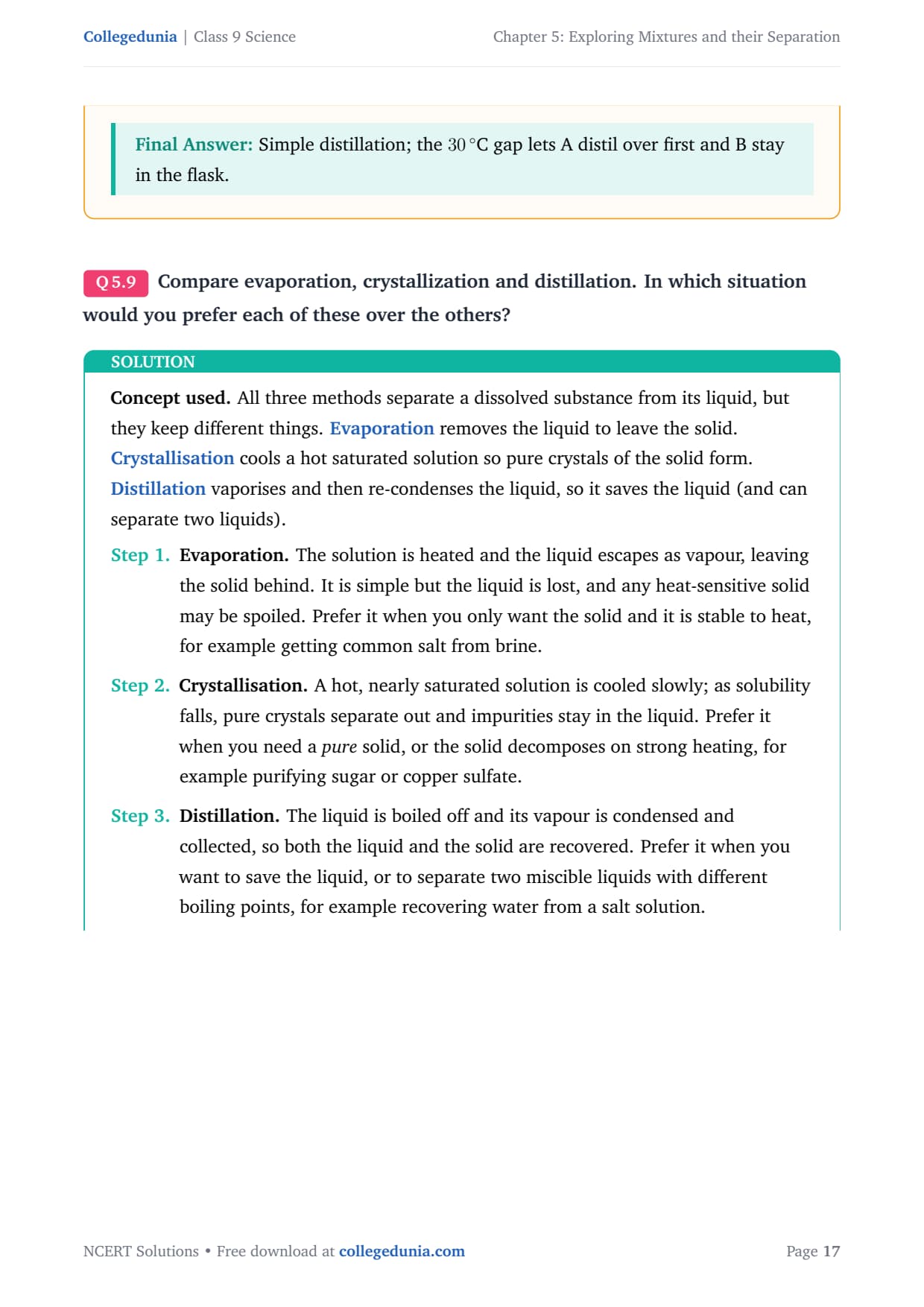
A mixture is two or more substances mixed without a fixed ratio. The first job of this chapter is to sort mixtures into two groups. A homogeneous mixture is uniform all through, with no visible boundary, like a sugar solution or an alloy. A heterogeneous mixture has parts you can tell apart, like muddy water or smoke.
- Homogeneous examples: air, sugar solution, vinegar, copper sulfate solution, salt solution, brass and bronze (alloys are solid solutions).
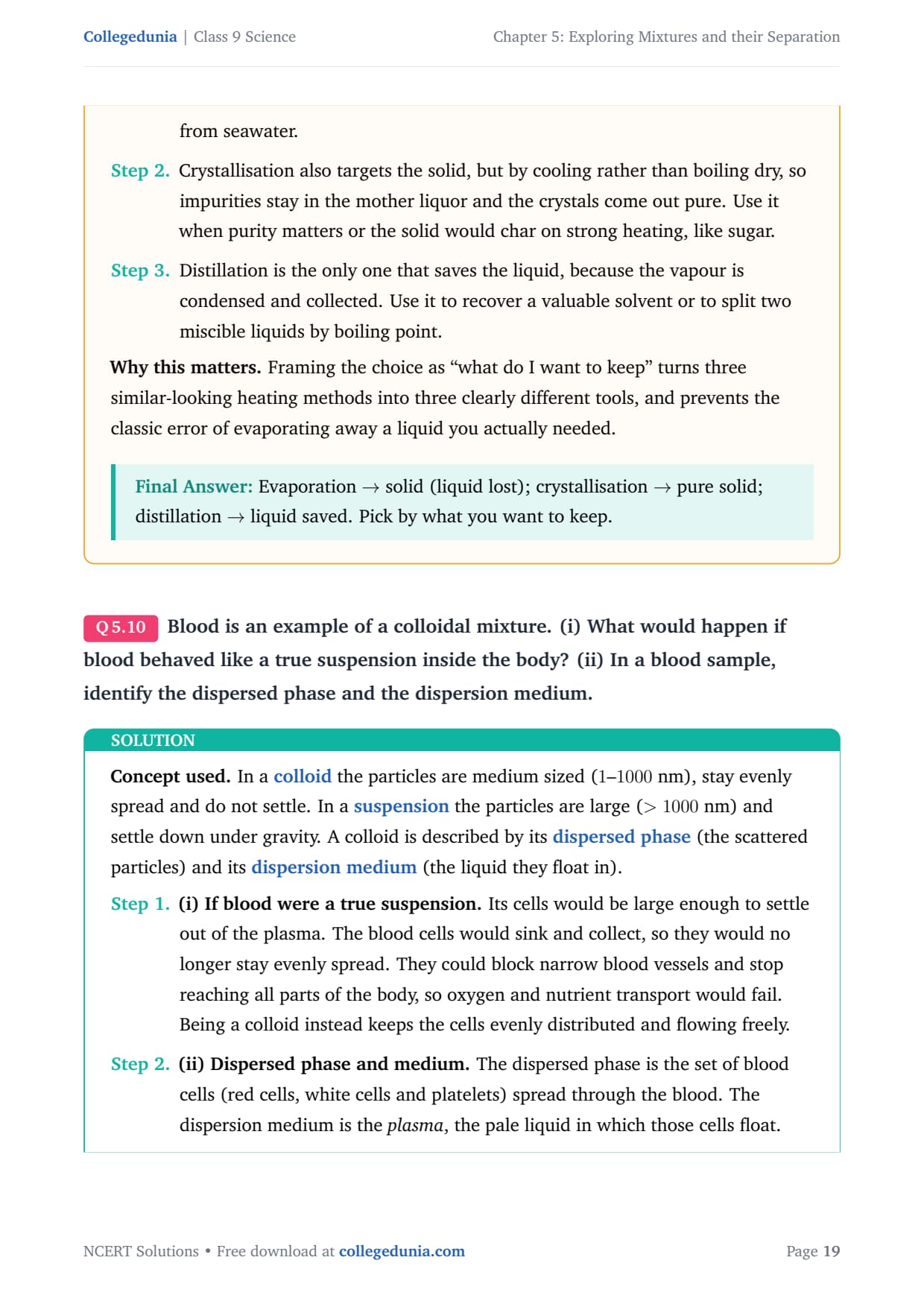
- Heterogeneous examples: muddy water, milk, smoke, fog, blood and butter.
- Common trap: milk, smoke, fog and blood look uniform but are colloids, so they are heterogeneous, not homogeneous.
Solution, Suspension and Colloid Compared by Particle Size
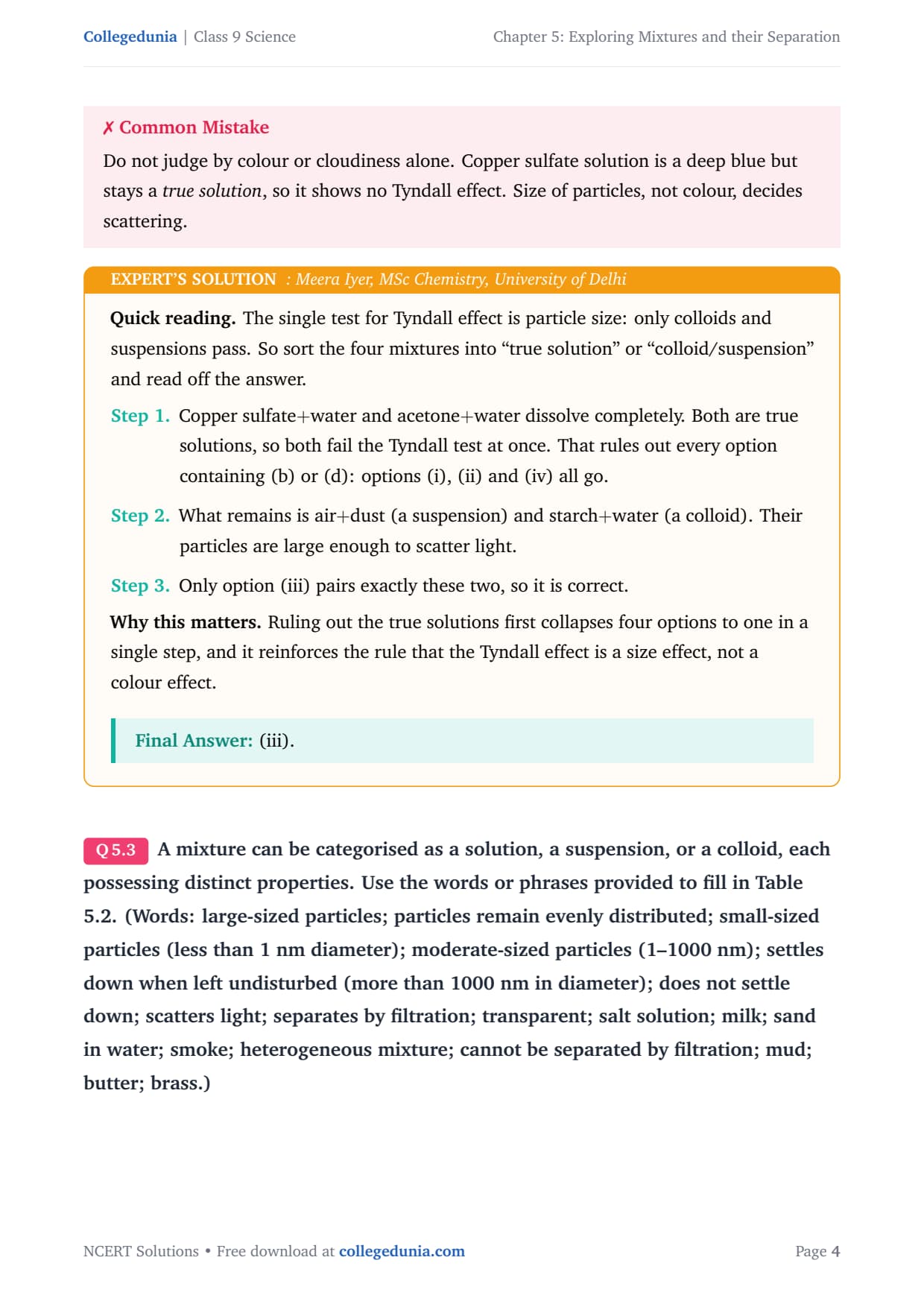
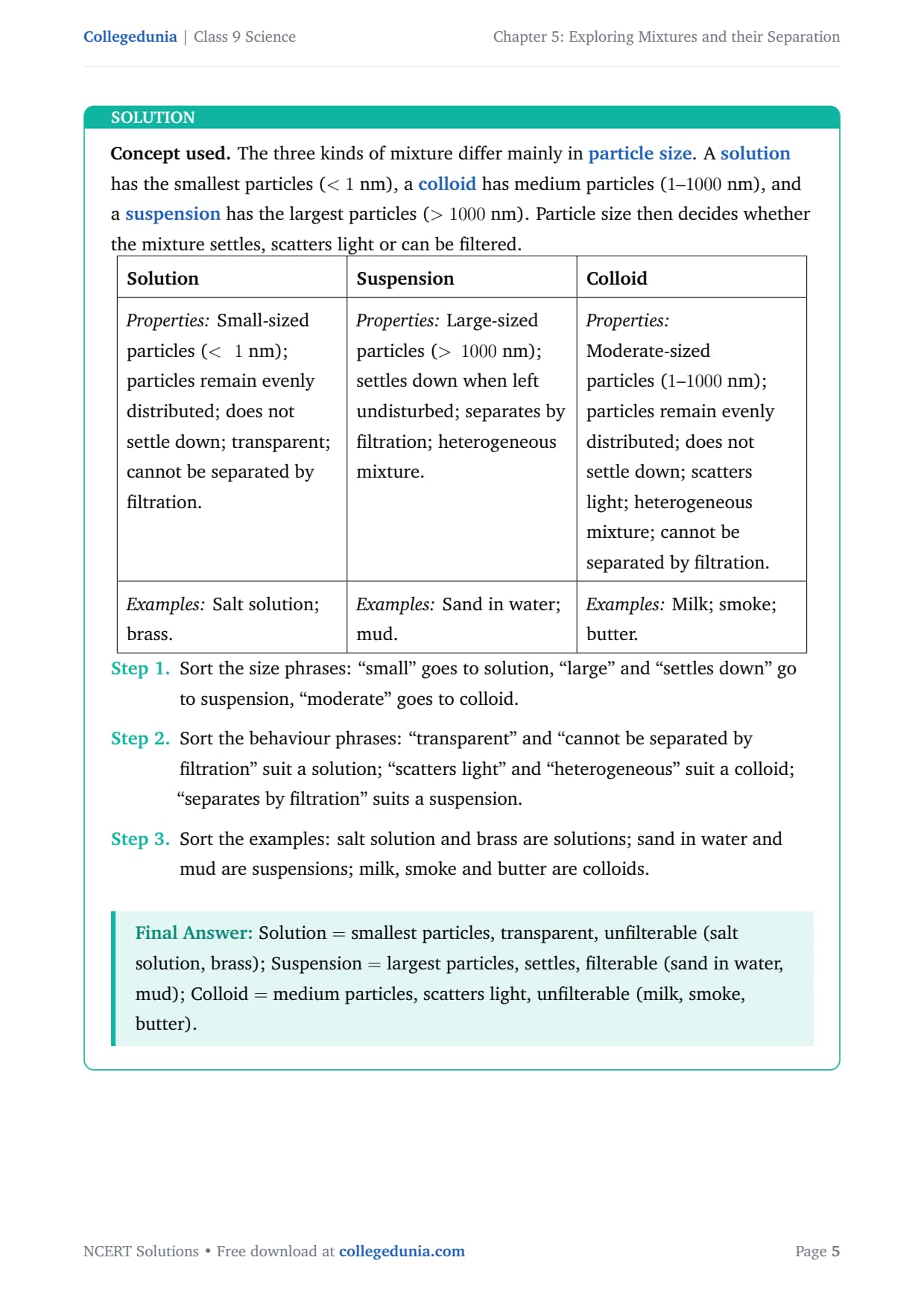
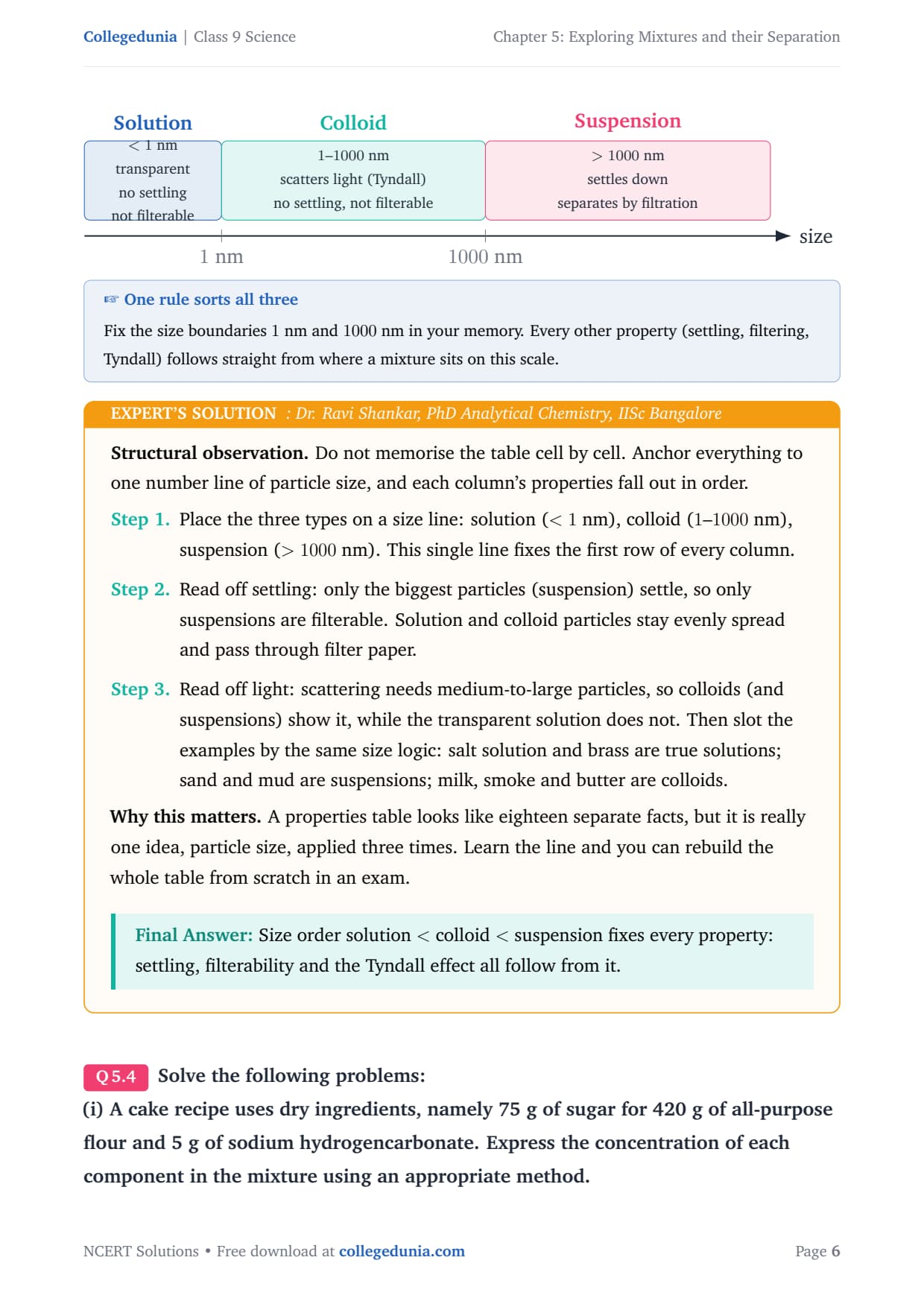
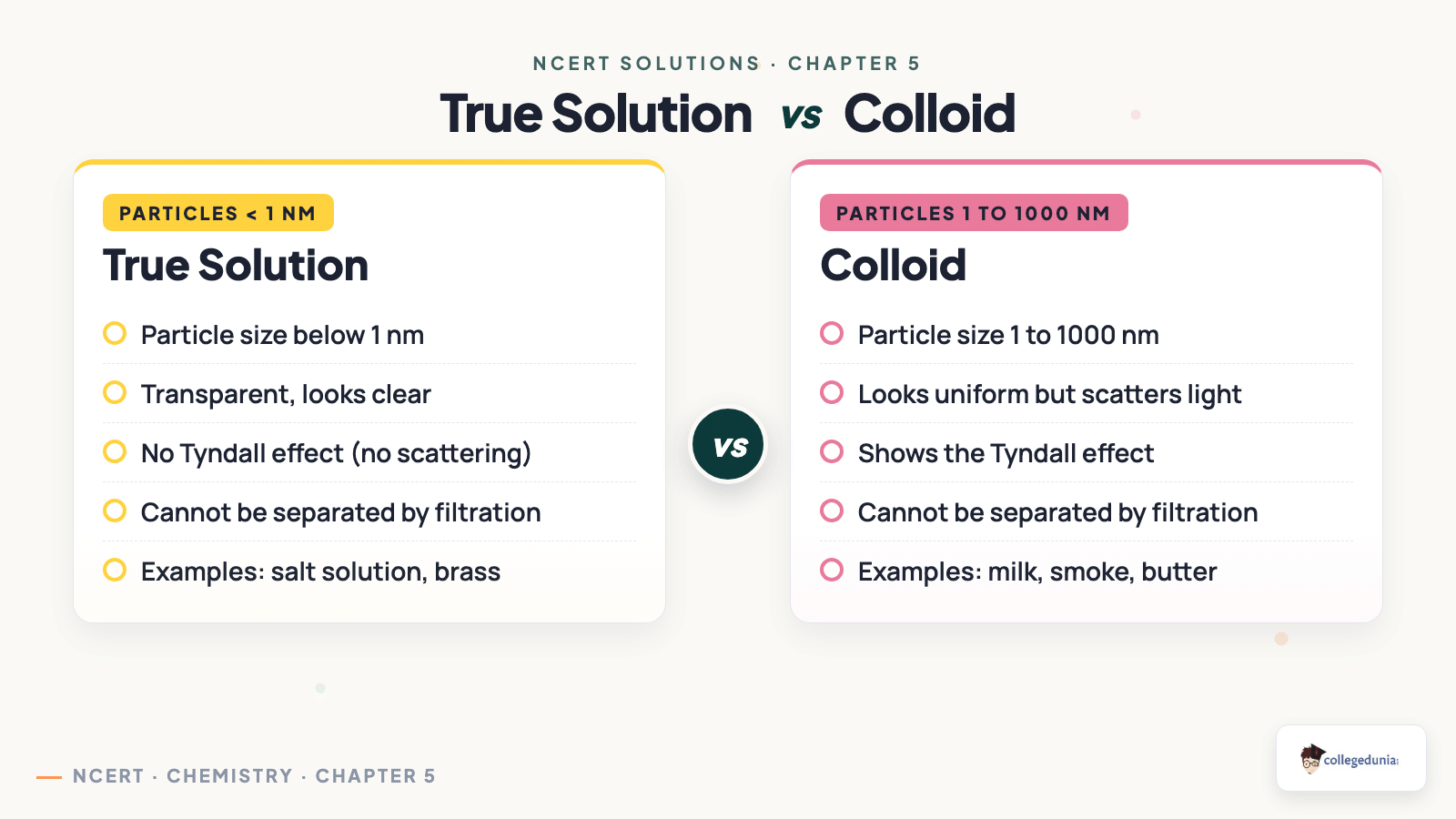
The whole difference between a solution, a suspension and a colloid comes down to one thing: particle size. Fix the two boundaries at 1 nm and 1000 nm, and every other property, such as settling, filtering and light scattering, follows straight from where the mixture sits on that scale.
| Property | Solution | Colloid | Suspension |
|---|---|---|---|
| Particle size | Less than 1 nm | 1 to 1000 nm | More than 1000 nm |
| Settles on standing? | No | No | Yes |
| Separated by filtration? | No | No | Yes |
| Shows Tyndall effect? | No | Yes | Yes |
| Appearance | Transparent | Looks uniform but scatters light | Cloudy, heterogeneous |
| Examples | Salt solution, brass | Milk, smoke, butter | Sand in water, mud |
Read the table down the size row first. Once you know a mixture is small, medium or large, the other rows are fixed for you.
The Tyndall Effect: Why Only Colloids and Suspensions Scatter Light
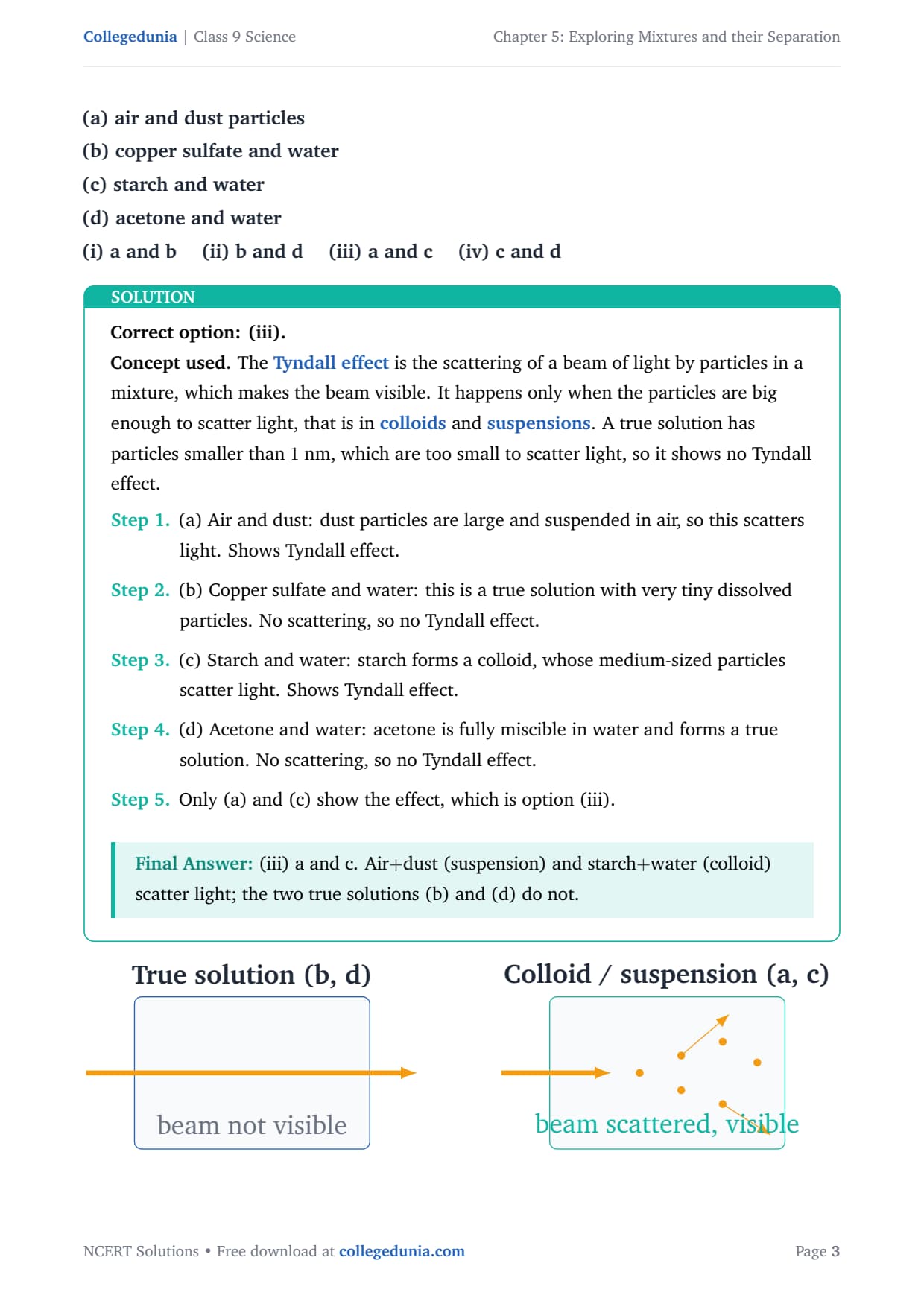
The Tyndall effect is the scattering of a beam of light by the particles in a mixture, which makes the beam visible. It happens only when particles are big enough to scatter light, that is in colloids and suspensions. A true solution has particles smaller than 1 nm, which are too small to scatter, so it shows no Tyndall effect.
- Air and dust: shows the effect (large suspended dust particles scatter light).
- Starch and water: shows the effect (starch forms a colloid).
- Copper sulfate and water: no effect (a true solution, even though it is deep blue).
- Acetone and water: no effect (fully miscible, a true solution).
Remember: it is size, not colour, that decides scattering. A deep blue copper sulfate solution still shows no Tyndall effect.
Concentration Formulas Every Class 9 Student Must Know
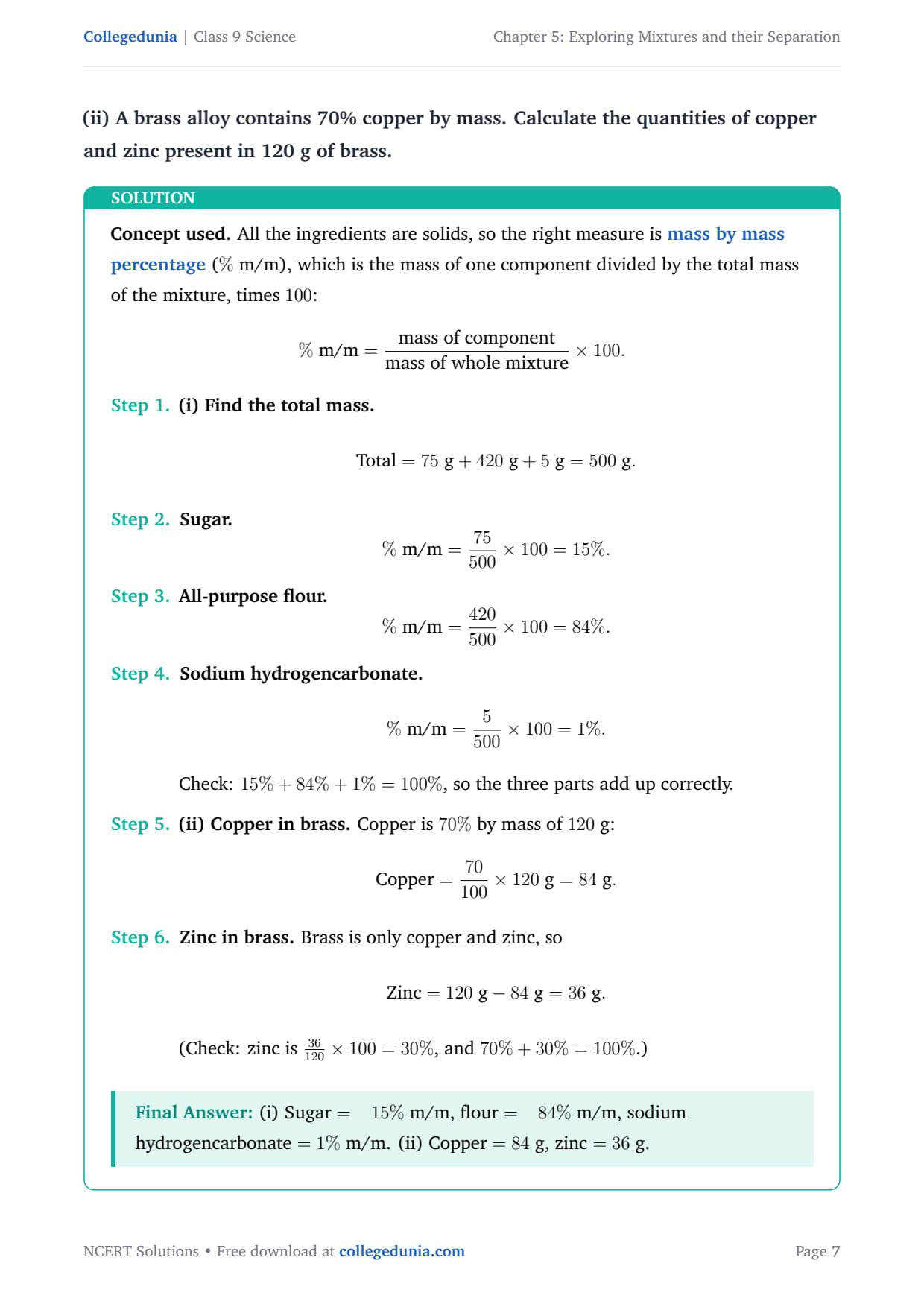
Concentration tells you how much solute is present in a given amount of mixture. Every concentration sum in this chapter is the same idea: a part divided by the whole, times 100. Pick the right formula by looking at whether the amounts are masses or volumes.
| Formula | What it is | Use it when |
|---|---|---|
| % m/m | (mass of solute ÷ mass of solution) × 100 | Both amounts are masses, such as sugar in flour. |
| % m/v | (mass of solute in g ÷ volume of solution in mL) × 100 | A solid mass is dissolved in a liquid volume. |
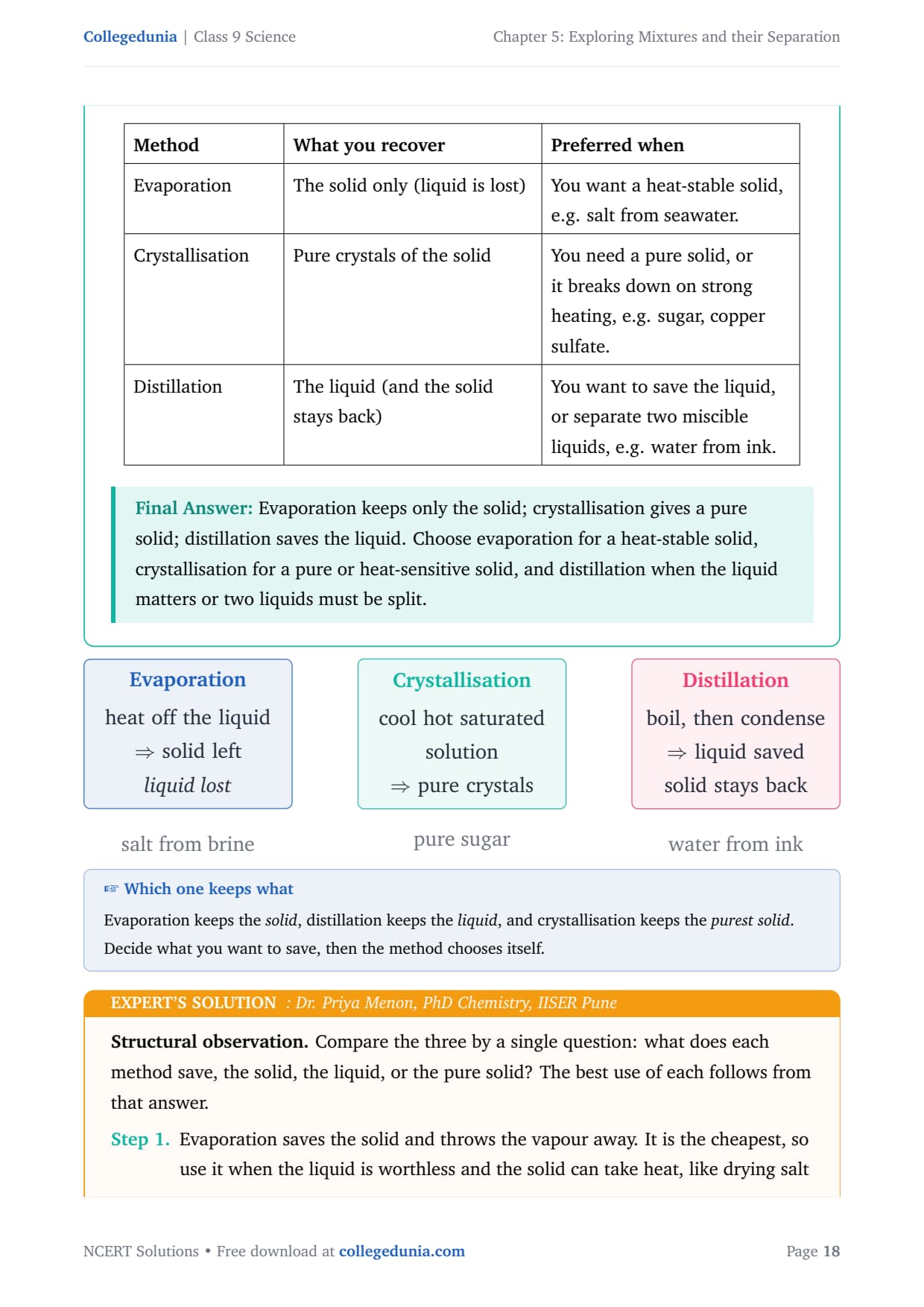
| % v/v | (volume of solute ÷ volume of solution) × 100 | Both amounts are volumes, such as juice concentrate in water. |
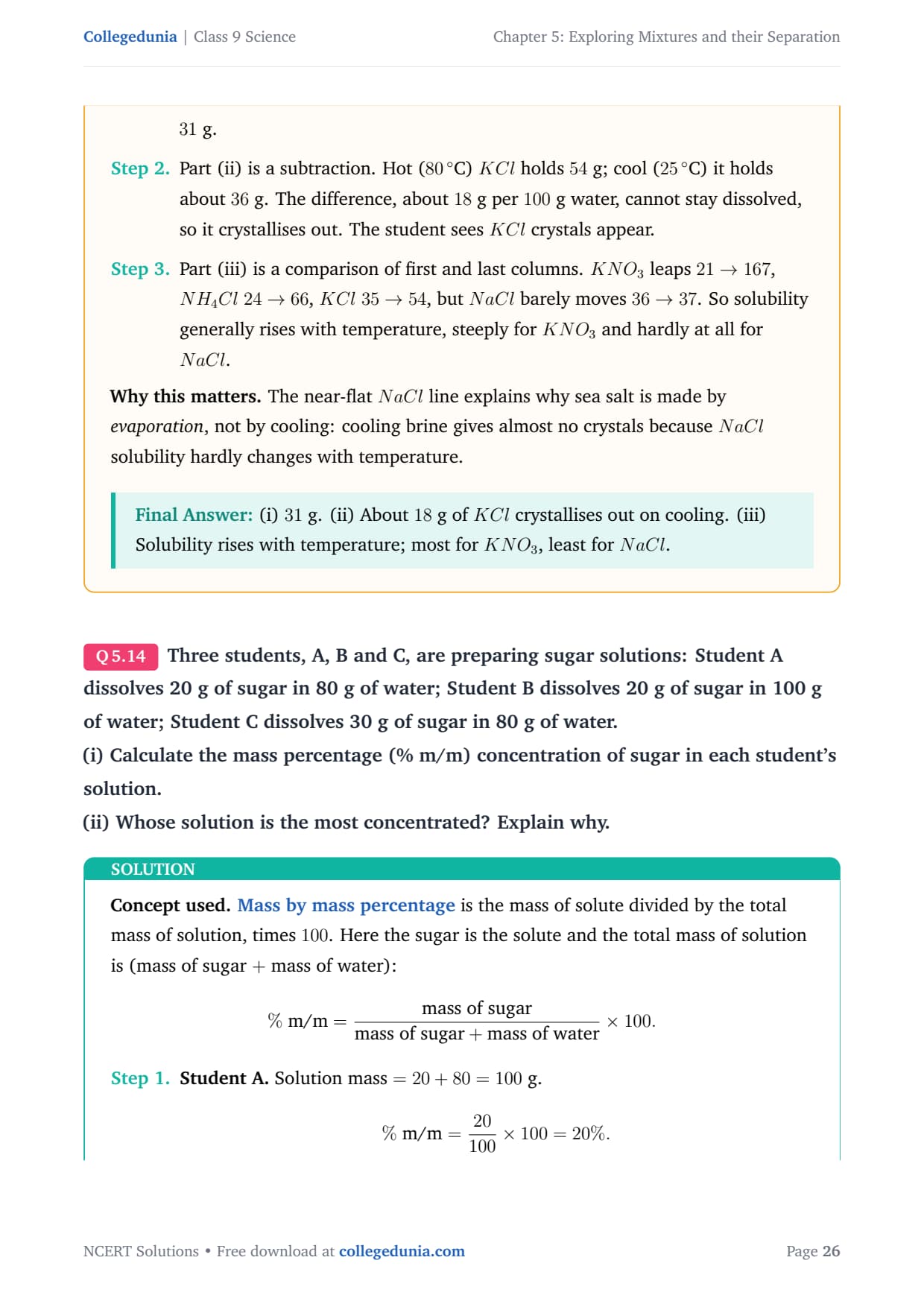
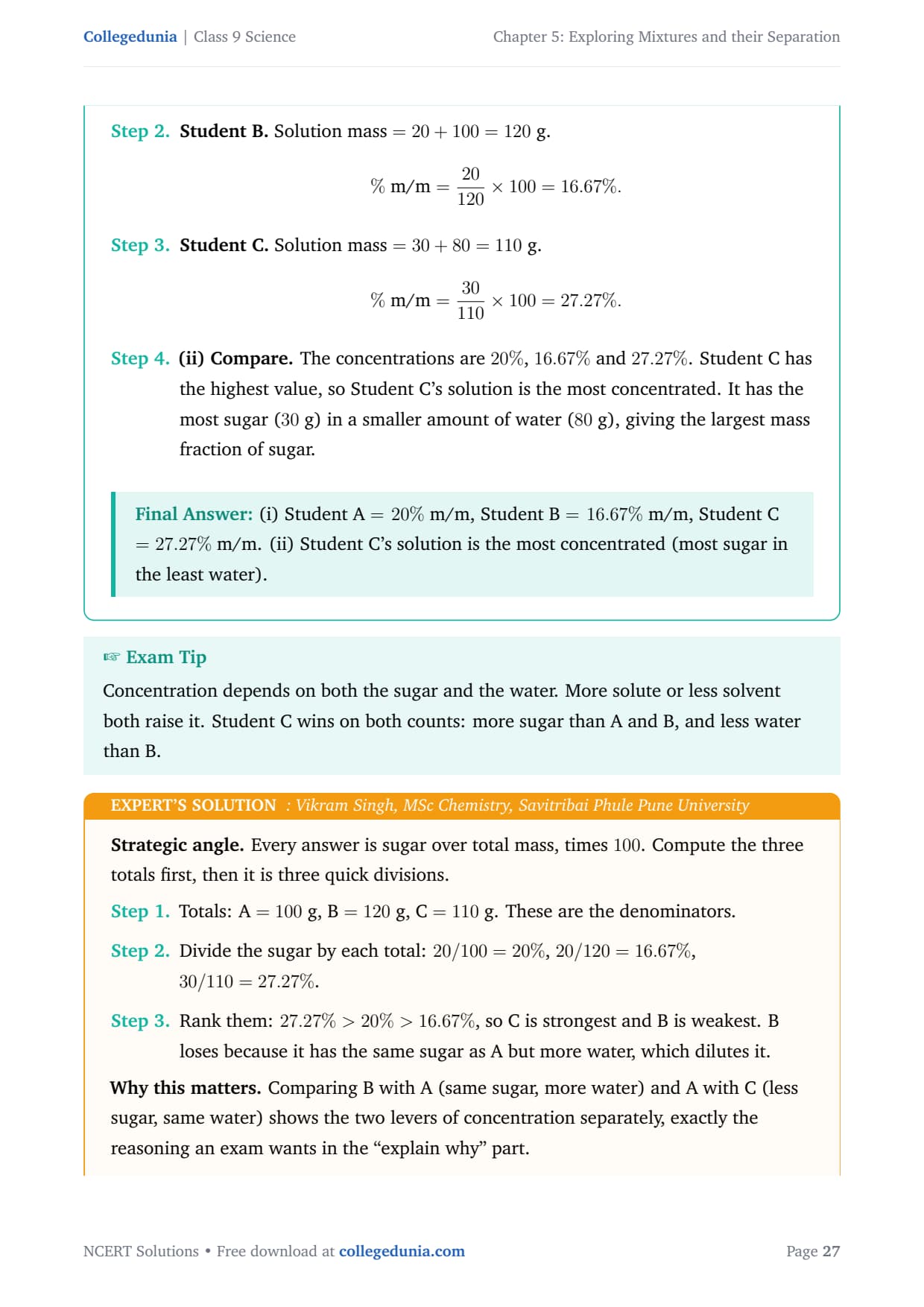
The most common slip is dividing by the wrong number. For % m/m, the denominator is the total mass of the mixture, never the mass of one other ingredient. A useful check is that the percentages of all parts of a mixture must add up to 100%.
Separation Methods in Exploring Mixtures and their Separation, from Filtration to Chromatography
To separate a mixture, first ask one question: in what property do the parts differ? That property, whether it is solubility, particle size, boiling point or density, names the method for you. This chapter uses eight standard methods.
| Method | Best for | Property used |
|---|---|---|
| Filtration | Insoluble solid in a liquid (mud in water) | Particle size |
| Evaporation | Recovering a heat-stable solid (salt from brine) | Solid stays, liquid escapes |
| Crystallisation | A pure solid (sugar, copper sulfate) | Solubility falls on cooling |
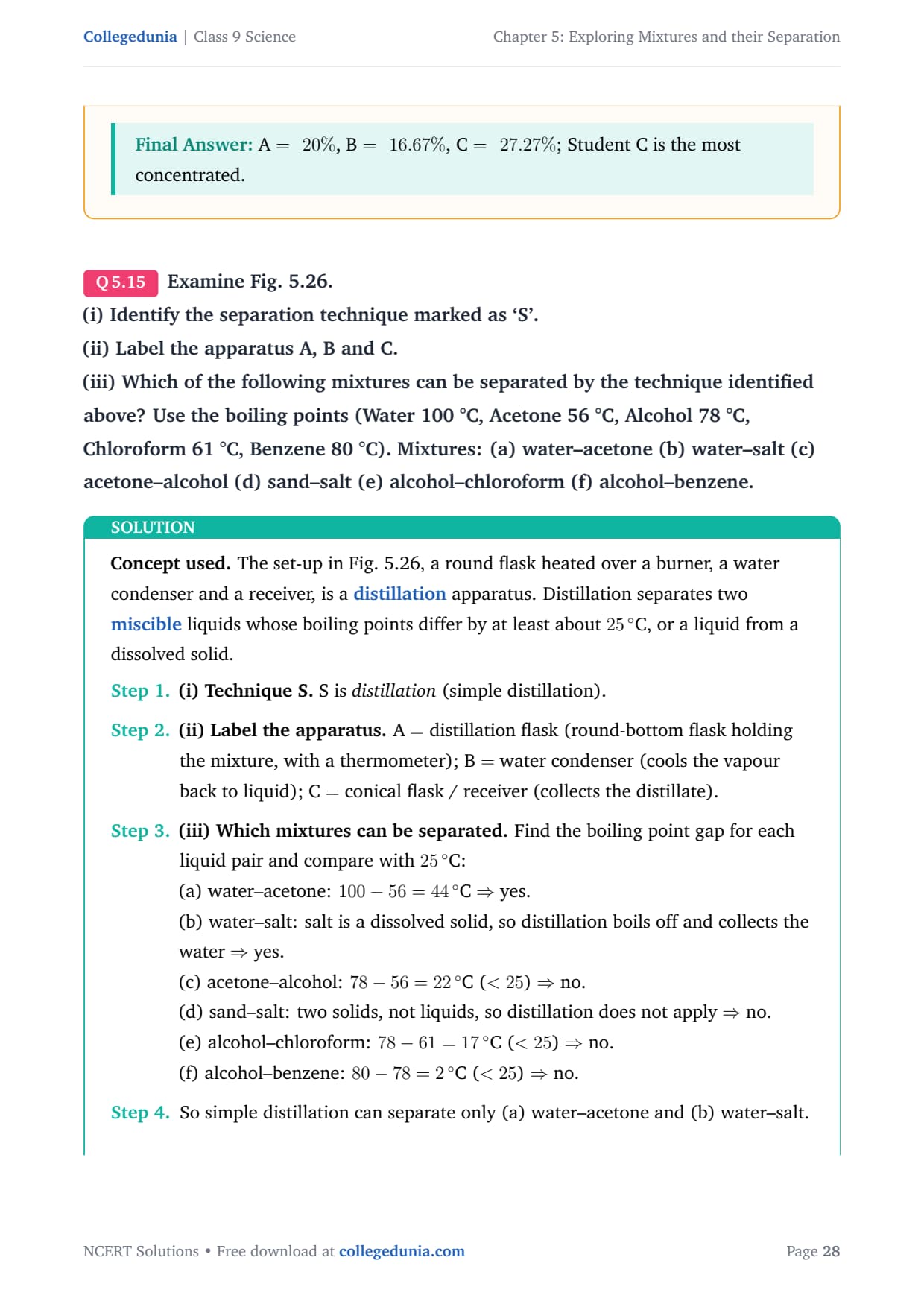
| Distillation | Miscible liquids with boiling points at least 25°C apart | Boiling point |
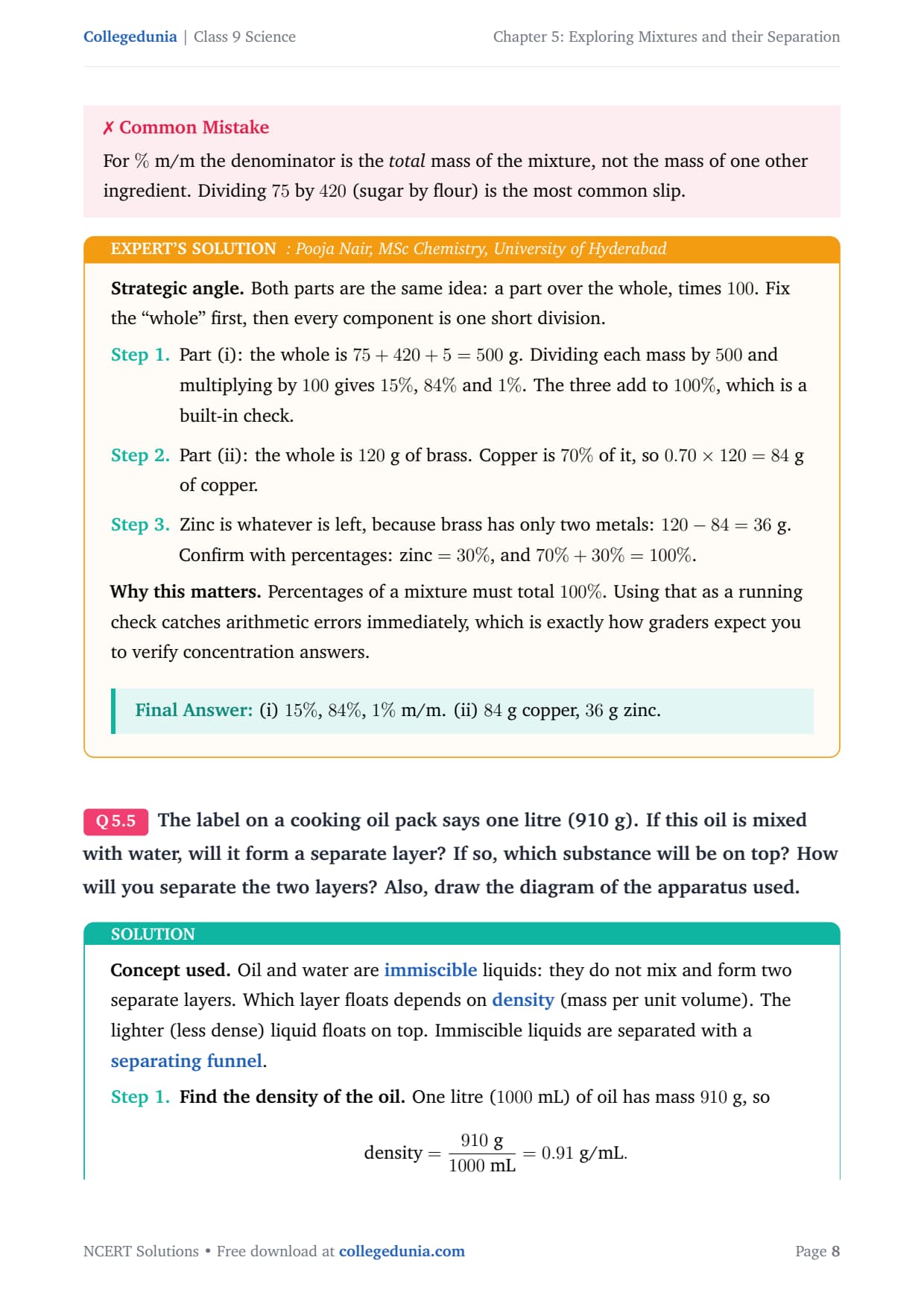
| Separating funnel | Two immiscible liquids (oil and water) | Density |
| Sublimation | A subliming solid mixed with a non-subliming one (naphthalene and sand) | Sublimation |
| Chromatography | Coloured components (flower pigments, ink dyes) | How fast each climbs paper |
| Centrifugation | Cells in a colloid (plasma from blood) | Density and fast spinning |
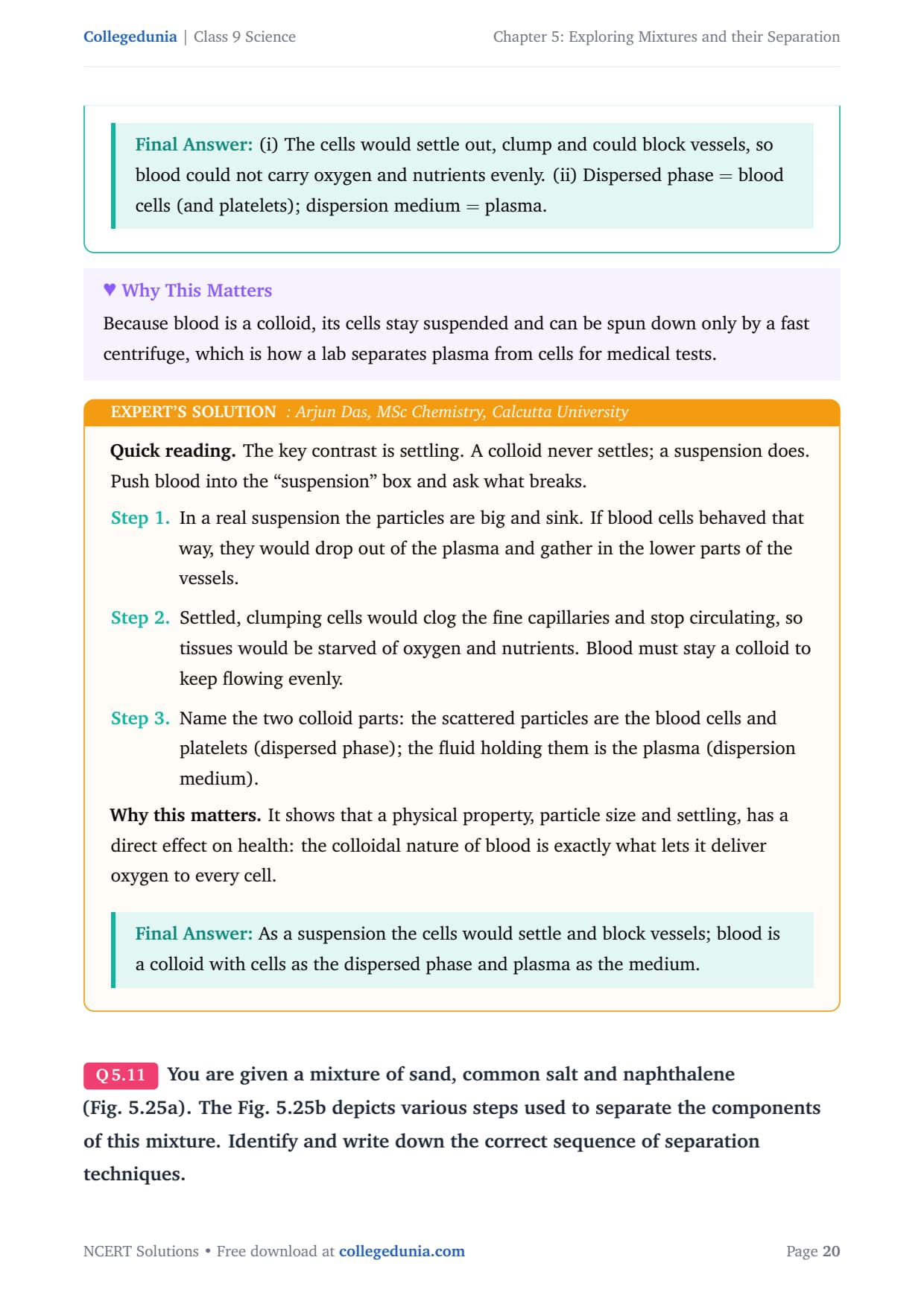
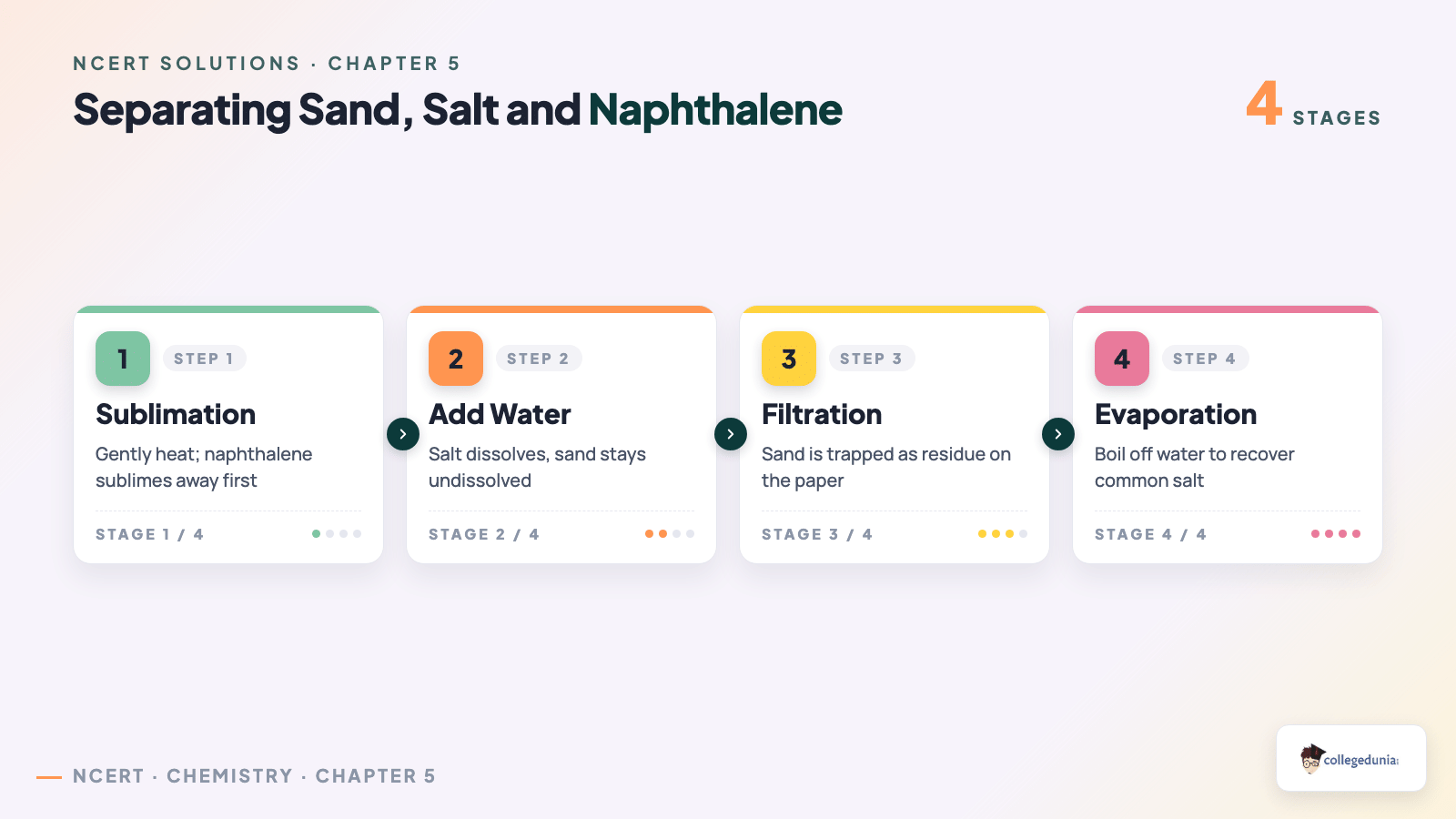
Exam tip: when three solids are mixed, such as sand, salt and naphthalene, always sublime the naphthalene first while the mixture is dry, then dissolve the salt, filter off the sand, and finally evaporate to get the salt back.
Solubility and Saturated Solutions in the Class 9 Solubility Table
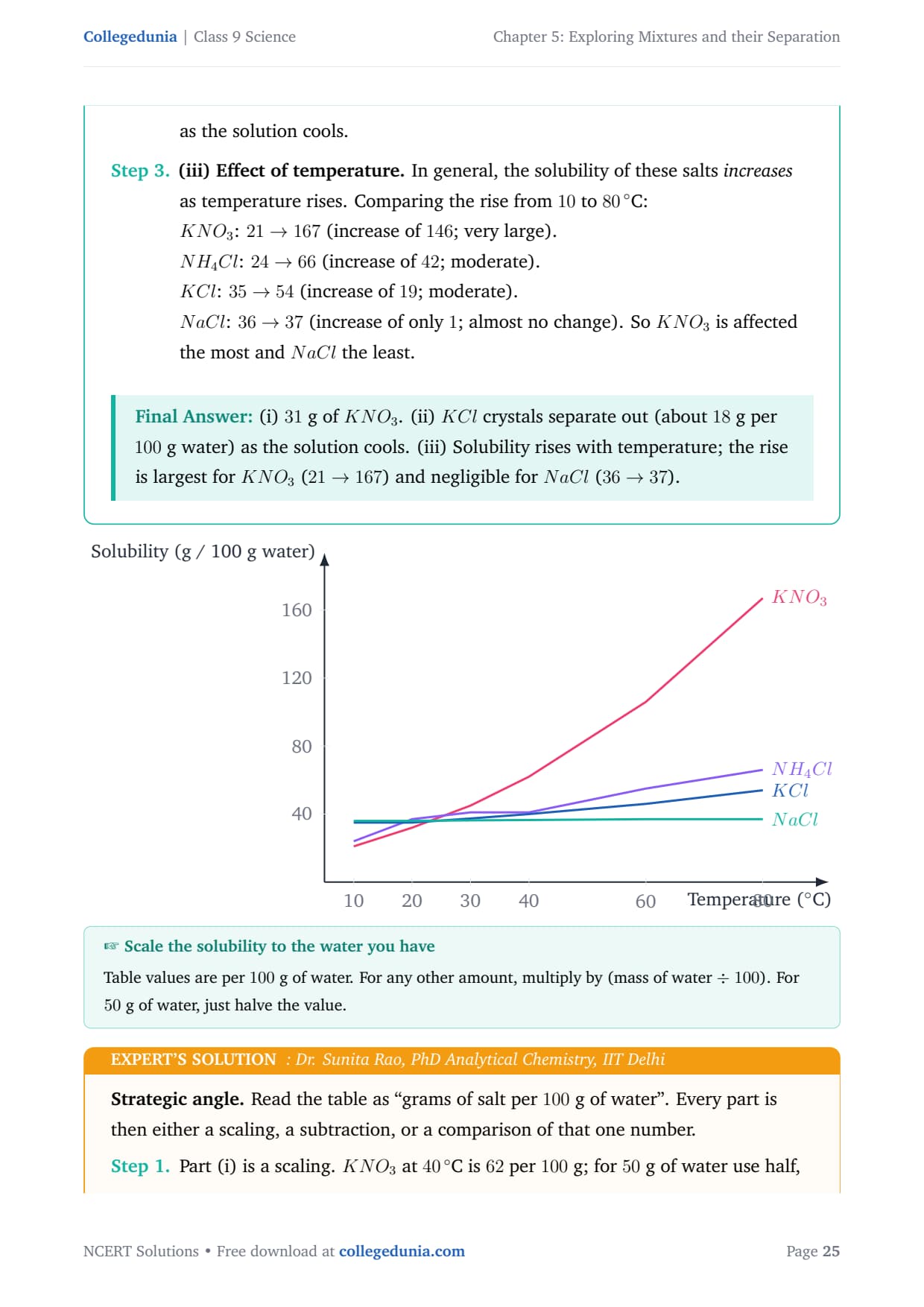
Solubility is the largest mass of a salt that dissolves in 100 g of water at a given temperature to make a saturated solution. For most salts, solubility rises with temperature. So a solution that is saturated when hot holds too much salt when cooled, and the extra salt crystallises out.
- To scale a table value to any amount of water, multiply by (mass of water ÷ 100). For 50 g of water, just halve the value.
- Potassium nitrate jumps from 21 to 167 g per 100 g of water between 10°C and 80°C, the largest change of the four salts.
- Common salt barely moves, from 36 to 37 g, which is why sea salt is made by evaporation, not by cooling.
Common Mistakes Students Make in Exploring Mixtures and their Separation
- Calling milk, smoke or blood homogeneous. They are colloids, so they are heterogeneous.
- Judging the Tyndall effect by colour. A blue copper sulfate solution still shows no scattering.
- In % m/m, dividing the solute by one other ingredient instead of the total mass.
- Suggesting a separating funnel for miscible liquids. It works only for immiscible liquids like oil and water.
- Adding water before subliming naphthalene in a three-solid mixture, which makes sublimation messy.
Revise, Reflect, Refine Exercise Coverage for Class 9 Science Chapter 5
The table below maps the Revise, Reflect, Refine questions to the skill each one tests, so you can revise by topic instead of in a straight line.
| Questions | What they test |
|---|---|
| Q1, Q2, Q6 | Classifying mixtures, the Tyndall effect and assertion-reason reasoning. |
| Q3, Q10 | Solution, suspension and colloid properties, and the dispersed phase and medium. |
| Q4, Q14 | Mass percentage numericals on cake ingredients, brass and sugar solutions. |
| Q5, Q7, Q8, Q11, Q12, Q15 | Choosing and drawing separation methods, including distillation and the separating funnel. |
| Q9, Q13 | Comparing evaporation, crystallisation and distillation, and reading the solubility table. |
| Q16, Q17 | Pause and Ponder concentration problems on % m/m and % v/v. |
Other Class 9 Science Chapter 5 Resources
Also Check: use these sister resources for the same chapter alongside the solutions.
| Resource | Best for |
|---|---|
| Exploring Mixtures and their Separation Class 9 Notes | Quick concept revision with diagrams and tables. |
| Exploring Mixtures and their Separation Class 9 Handwritten Notes | A topper's neat handwritten notes for one-shot revision. |
| Exploring Mixtures and their Separation Class 9 Formula Sheet | The three concentration formulas and key values on one page. |
| Exploring Mixtures and their Separation Class 9 NCERT Book PDF | The original chapter from the NCERT Exploration book. |
NCERT Solutions for Other Class 9 Science Chapters
Related Links: continue your Class 9 Science revision with the solutions for other chapters.
| Chapter | NCERT Solutions |
|---|---|
| Chapter 2 | Cell The Building Block of Life |
| Chapter 3 | Tissues in Action |
| Chapter 4 | Describing Motion Around Us |
| Chapter 6 | How Forces Affect Motion |
| Chapter 8 | Journey Inside the Atom |
| Chapter 9 | Atomic Foundations of Matter |
Exploring Mixtures and their Separation Class 9 Science NCERT Solutions FAQs
Ques. Where can I download the NCERT Solutions for Class 9 Science Chapter 5 Exploring Mixtures and their Separation PDF?
Ans. You can download the Exploring Mixtures and their Separation Class 9 Science NCERT Solutions PDF directly from this page. Both the Normal and HD versions are free.
Ques. How many questions are solved in Class 9 Science Chapter 5 Exploring Mixtures and their Separation?
Ans. All 17 questions are solved: 15 from the Revise, Reflect, Refine exercise and 2 Pause and Ponder concentration problems. Each has a step-by-step solution and an expert solution.
Ques. Are these solutions aligned with the 2026-27 NCERT syllabus?
Ans. Yes. The answers follow the new 2026-27 NCERT Exploration book for Class 9 Science and its Revise, Reflect, Refine exercise, so the questions and their order match your textbook.
Ques. What is a homogeneous mixture?
Ans. A homogeneous mixture is uniform all through, with no visible boundary between its parts. A sugar solution and an alloy like brass are homogeneous mixtures.
Ques. What is the Tyndall effect?
Ans. The Tyndall effect is the scattering of a beam of light by particles in a mixture, which makes the beam visible. Only colloids and suspensions show it, because their particles are large enough to scatter light. True solutions do not.
Ques. When is distillation used to separate a mixture in Class 9 Science Chapter 5?
Ans. Distillation separates two miscible liquids whose boiling points differ by at least about 25°C, or recovers a liquid from a dissolved solid. The lower-boiling liquid boils off first, then cools back to liquid in a condenser.
Ques. How do you separate oil from water?
Ans. Oil and water are immiscible and differ in density, so they form two layers. Use a separating funnel: let the layers settle, then drain the lower water layer through the stopcock and collect the oil on top.



Comments