




The NCERT Solutions for Class 9 Science Chapter 11 Reproduction How Life Continues answer every question in the Revise, Reflect, Refine exercise of the 2026-27 NCERT Exploration book. Each answer builds on one idea the chapter repeats: living things make new individuals either from one parent or from two. The solutions cover the MCQs, the assertion-reason item, the plant and human reproduction questions, and the two experiment-and-data questions, all in steps a Class 9 student can follow.
- Exercise solved: all 13 Revise, Reflect, Refine questions, from MCQs to the pollen germination and apple orchard data tasks.
- Main skills: linking asexual and sexual reproduction, pollination, fertilisation and the menstrual cycle to genetic variation.
- Why it matters: it builds the reproduction base needed for Class 10 biology and the NEET foundation years.
Every NCERT solution for Class 9 Science Chapter 11 Reproduction How Life Continues here is prepared by subject teachers, matched to the 2026-27 NCERT Exploration book, and checked step by step.
Student Feedback
In a Collegedunia poll of 10,860 Class 9 students taken before their 2026-27 annual exams, 64% rated the human reproduction and menstrual cycle part as the trickiest section of Reproduction How Life Continues. Most students said they mixed up the order of pollination, fertilisation and zygote formation in plants. Students who first drew each process as a flow chart reported the fastest recall in revision.
Source: 2026-27 Class 9 Science student poll. Sample of 10,860 students from CBSE schools across 14 states.
Reproduction How Life Continues Full Chapter Explanation for Class 9 Science
Source: Magnet Brains on YouTube
What Class 9 Science Chapter 11 Reproduction How Life Continues Covers
Reproduction is how living things make new individuals of their own kind, so a species does not die out. Chapter 11 shows two routes to this: one parent copies itself, or two parents mix their genes. The NCERT Solutions for Class 9 Science Chapter 11 Reproduction How Life Continues use this split in every answer.
- Asexual reproduction: budding, spore formation and vegetative propagation, where one parent makes identical copies.
- Sexual reproduction in plants: flower parts, pollination, fertilisation and seed formation.
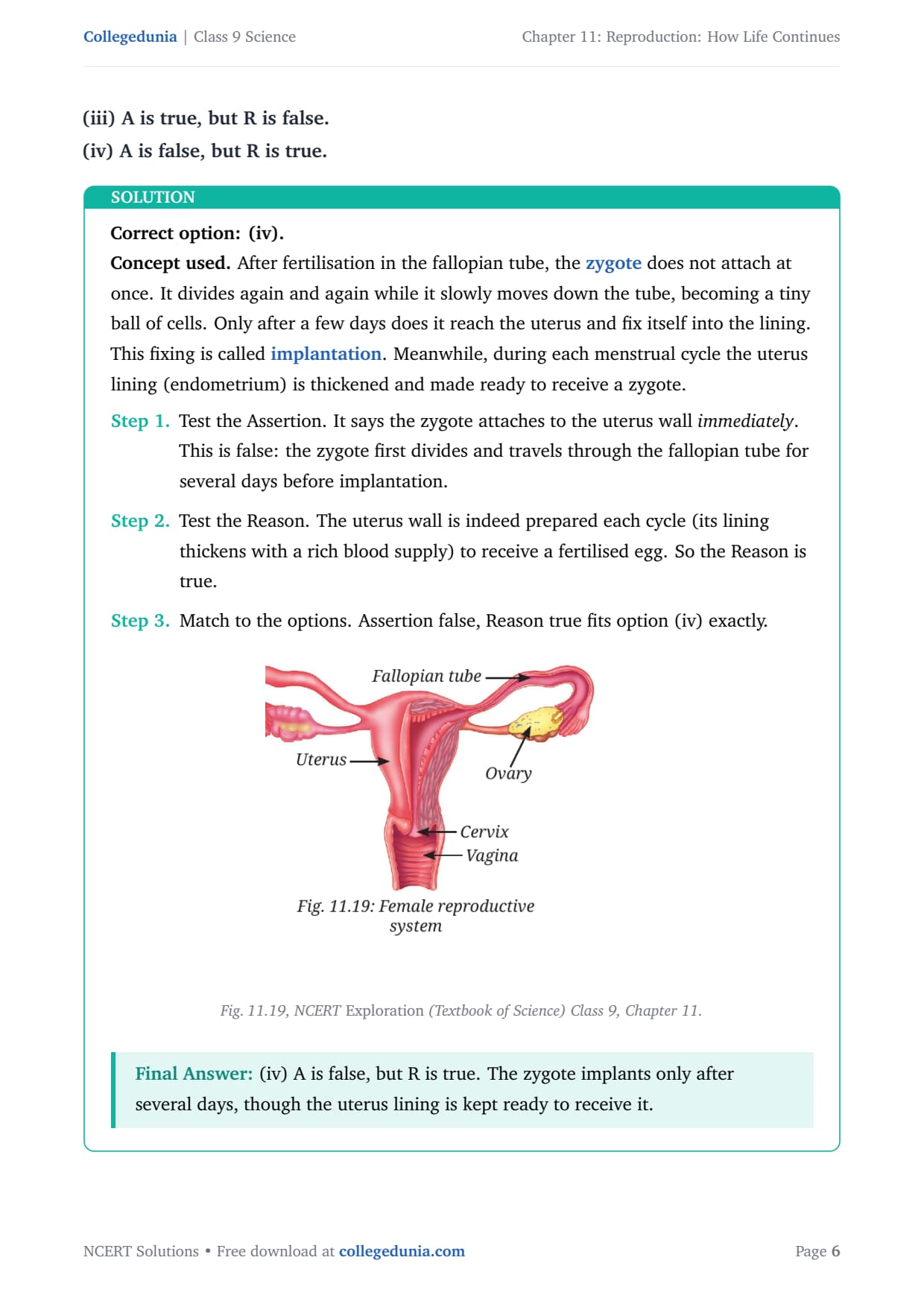
- Human reproduction: the male and female systems, the menstrual cycle, and what happens after fertilisation.
The chapter's big idea is that two parents create variation while one parent does not. Learn that link once and most reasoning questions become easy to answer.
Revise, Reflect, Refine Exercise Breakdown for Reproduction How Life Continues
The chapter ends with one exercise set called Revise, Reflect, Refine. It has 13 questions. The table below shows what each group of questions asks, so you can plan your practice.
| Question type | Count | What it tests |
|---|---|---|
| MCQ (single answer) | 2 | Proof of fertilisation from seed set, and the correct order of plant reproduction stages |
| Assertion-Reason | 1 | Timing of zygote implantation and the prepared uterus lining |
| Open-ended reasoning | 7 | Identical clones, menstrual cycle in pregnancy, flower colour, variation and diversity |
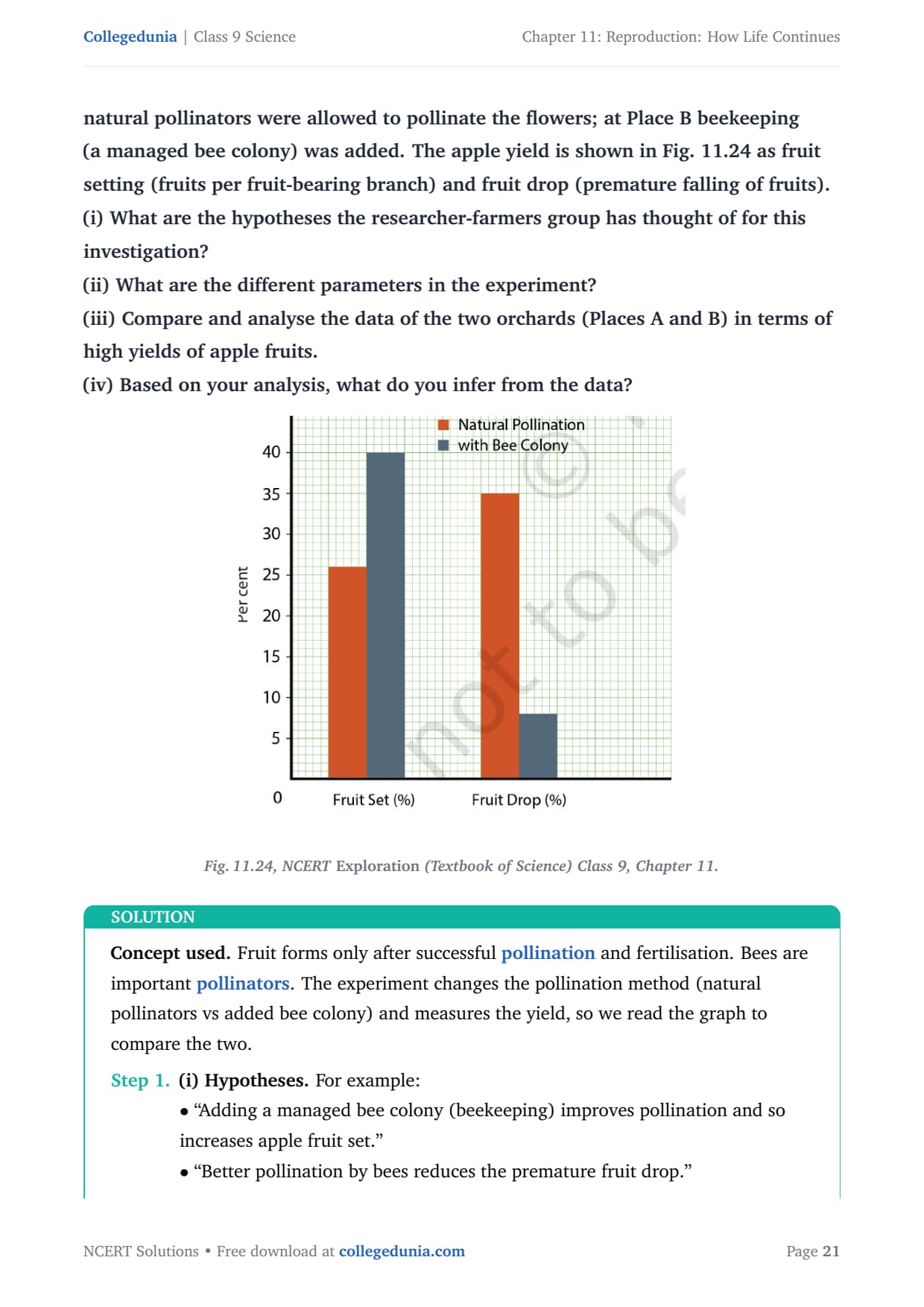
| Experiment and data | 2 | Pollen germination in sugar solutions, and the apple orchard bee-pollination graph |
Tip: the reasoning and data questions carry the most marks. Answer them in short labelled steps and name the exact process in your first line.
Reproduction How Life Continues Weightage in the Class 9 Science Annual Exam
Chapter 11 is one of the biology chapters in the new book. It usually gives one MCQ plus one longer reasoning or data question in the annual exam. The table shows where it sits against nearby chapters.
| Chapter | Topic | Typical marks |
|---|---|---|
| Chapter 3 | Tissues in Action | 5 to 6 marks |
| Chapter 11 | Reproduction How Life Continues | 5 to 6 marks |
| Chapter 12 | Patterns in Life: Diversity and Classification | 5 to 6 marks |
| Chapter 13 | Earth as a System | 4 to 5 marks |
Because the questions reward clear reasoning and simple data reading, this chapter is a safe scorer. Learn the processes well and you can pick up 5 to 6 marks with little effort.
Asexual Reproduction and Vegetative Propagation in Reproduction How Life Continues
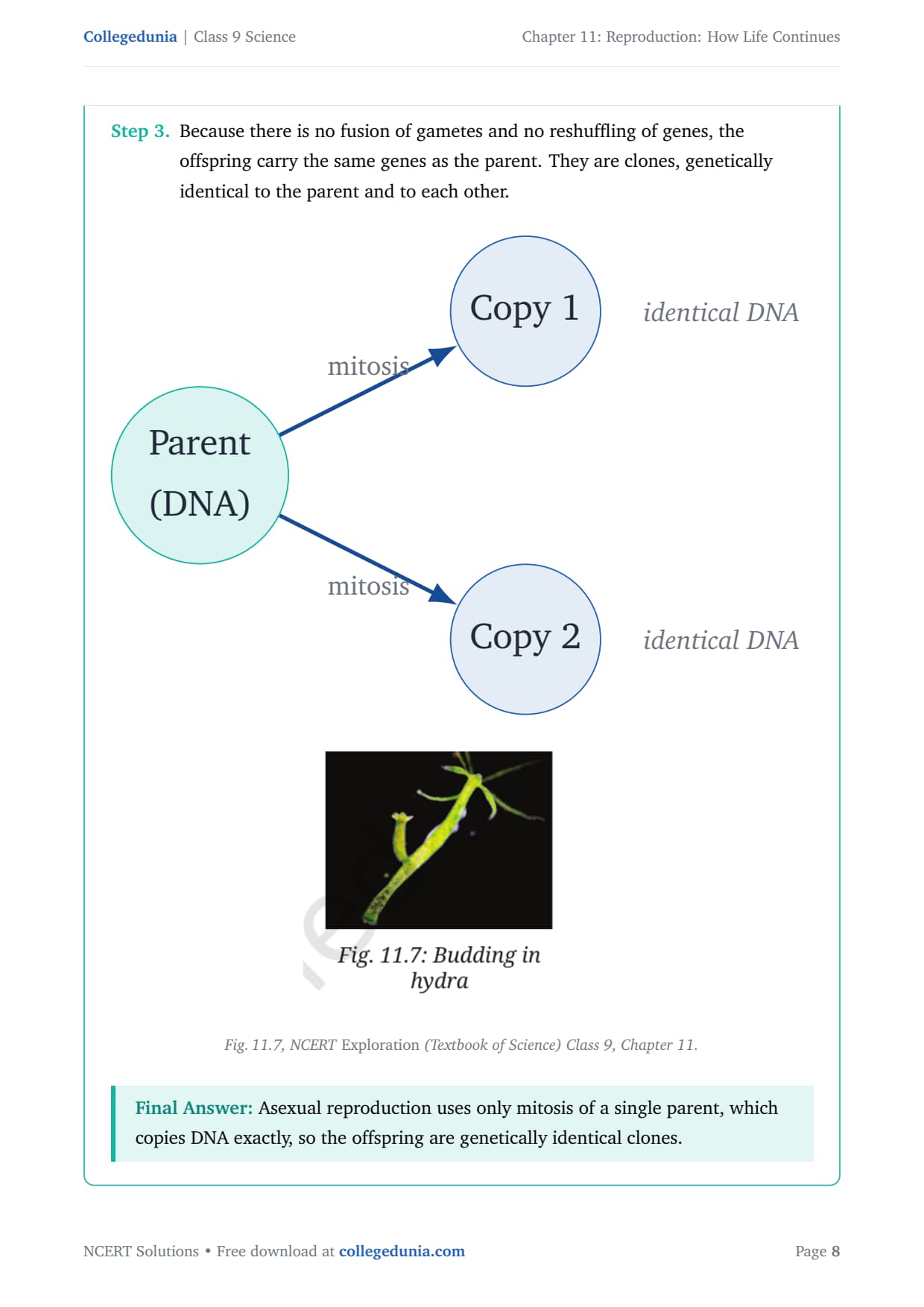
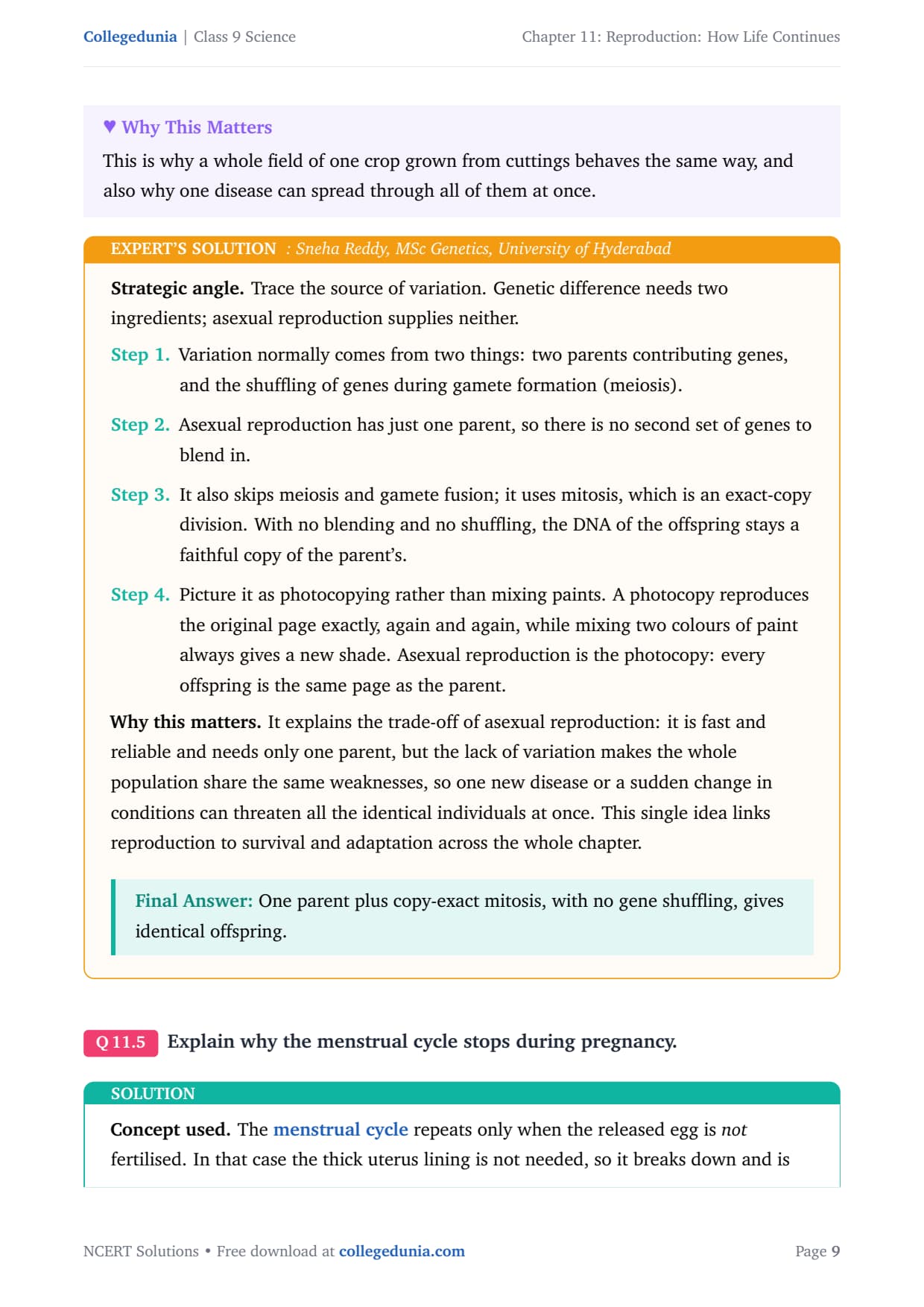
Asexual reproduction needs only one parent and no gametes. New individuals form by ordinary body-cell division, that is mitosis, so the offspring are exact copies of the parent. This single idea answers several questions in one line.
- Budding: a small bud grows on the parent and breaks off, as in yeast and hydra.
- Spore formation: tiny spores grow into new individuals, as in many fungi.
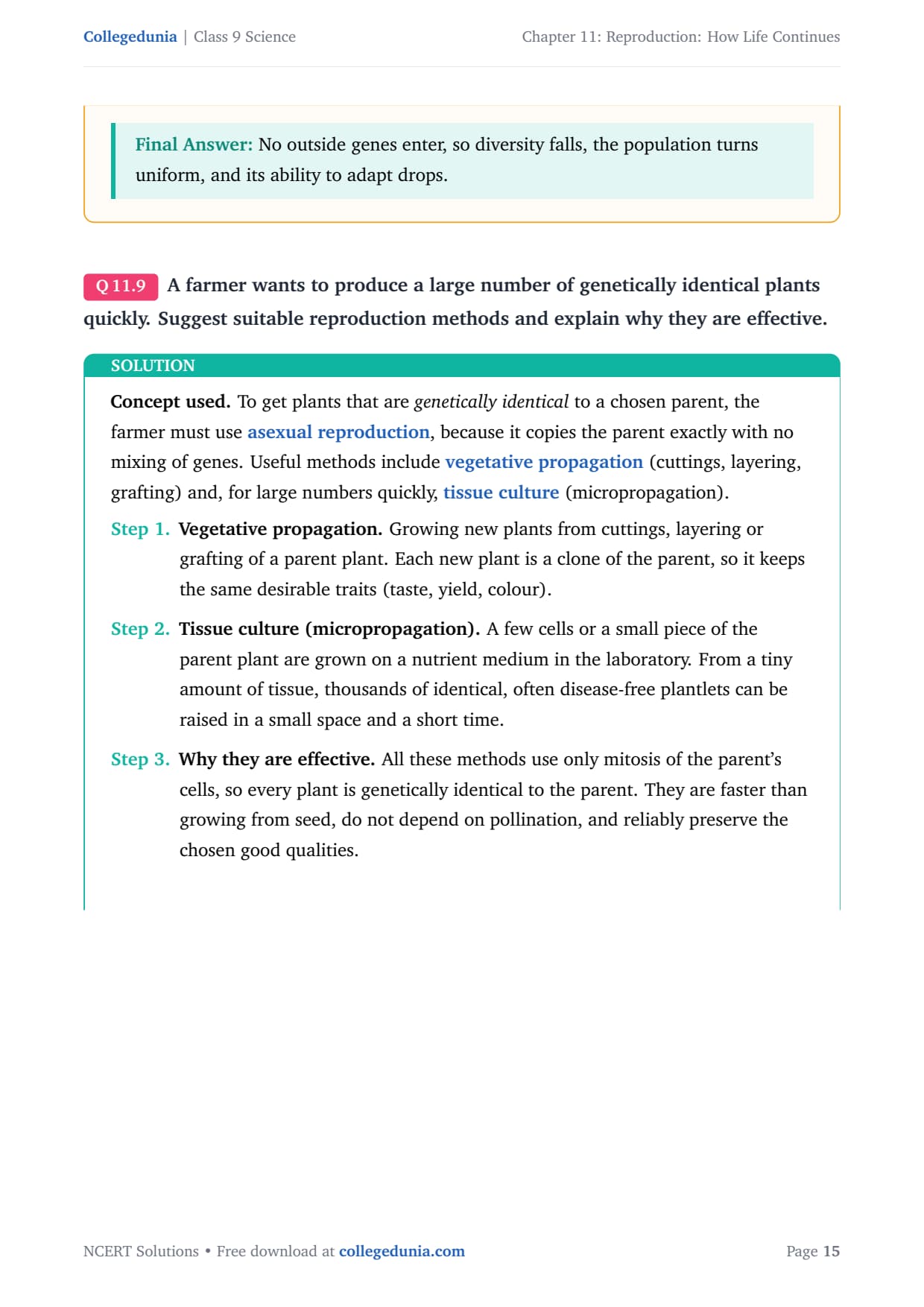
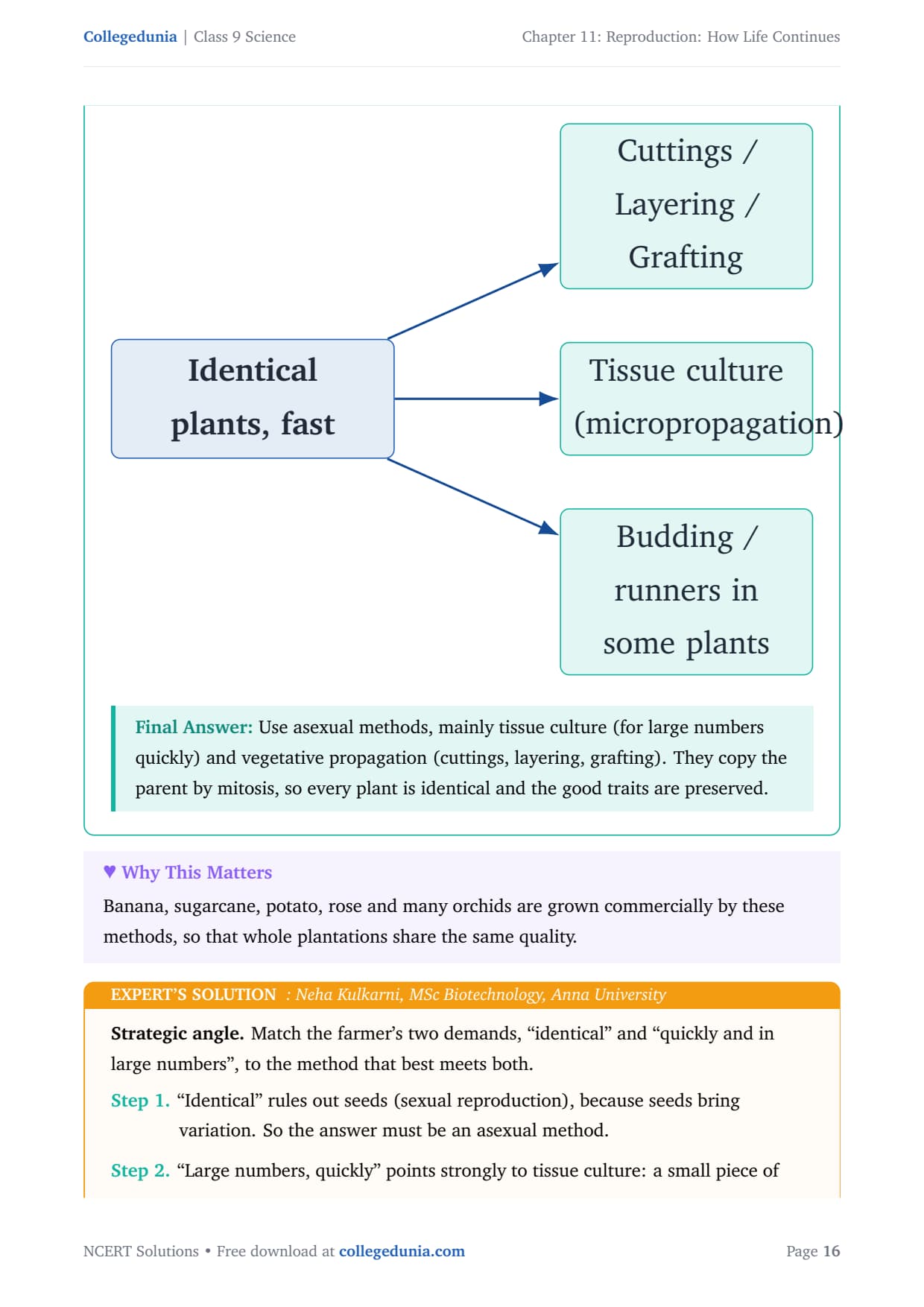
- Vegetative propagation: new plants grow from cuttings, layering or grafting of one parent plant.
- Tissue culture: a few cells are grown on a nutrient medium to raise thousands of identical plantlets.
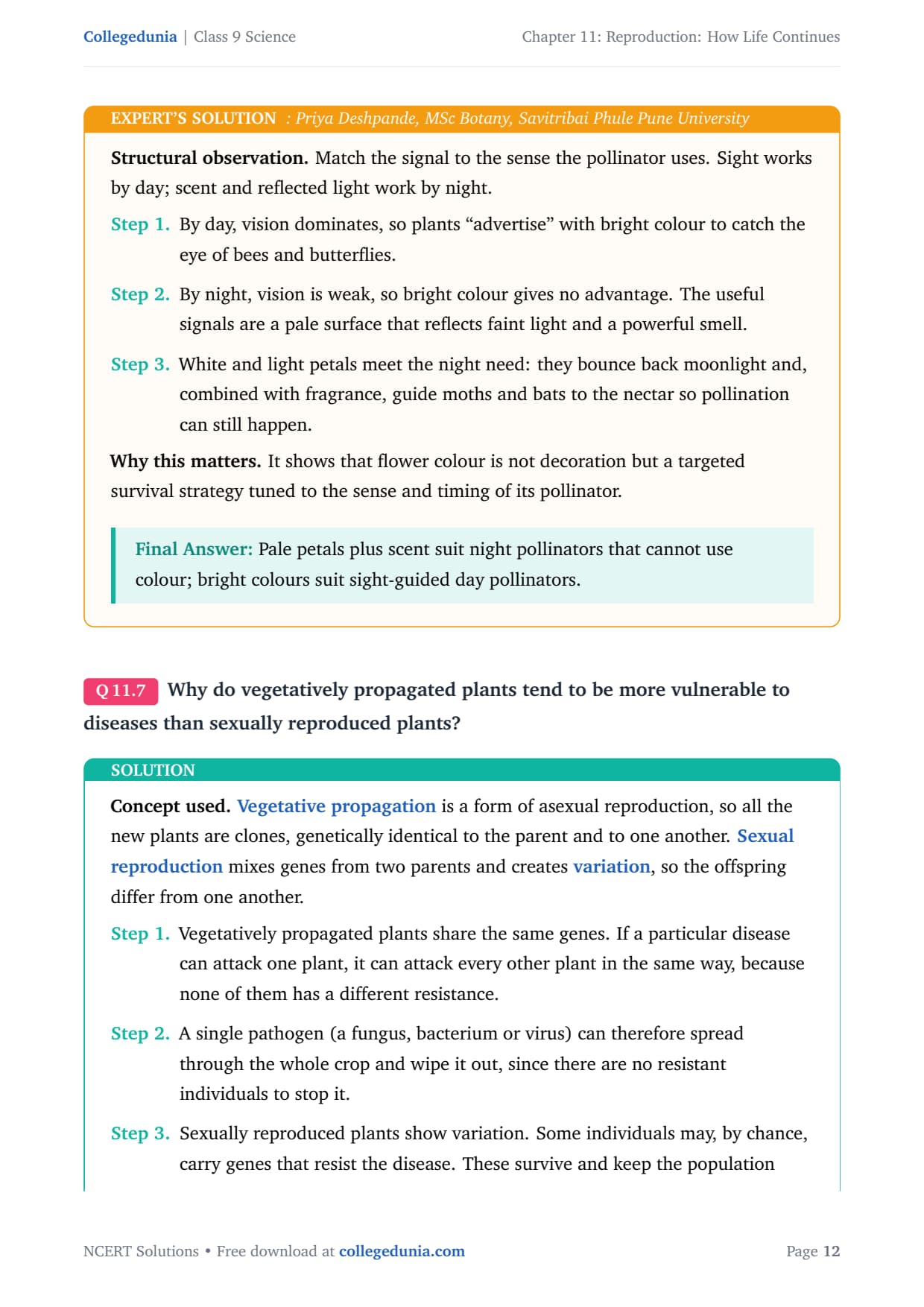
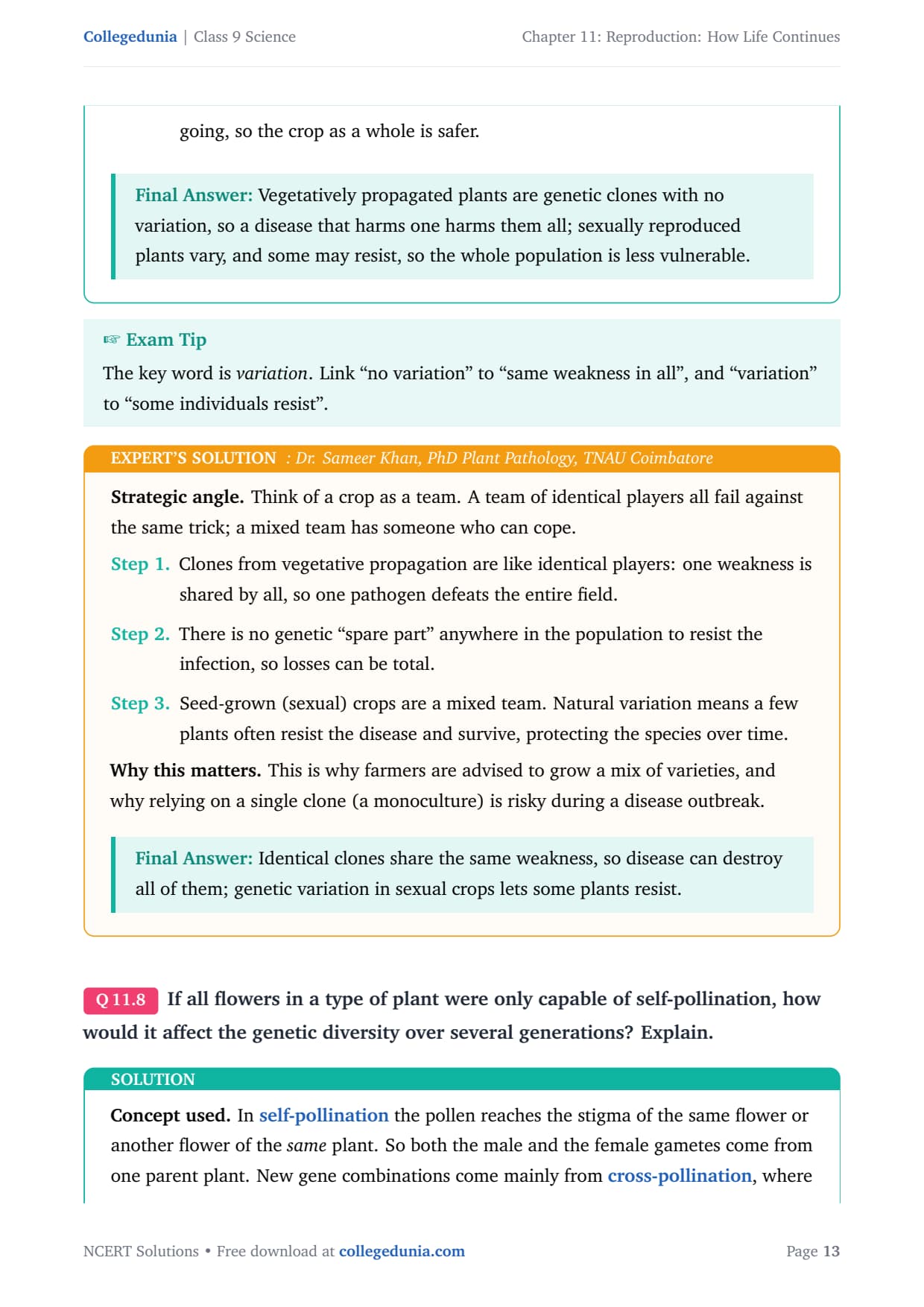
The trade-off matters in the exam. All these methods copy the parent by mitosis, so every offspring is a genetic clone. That makes the whole group share the same weakness, so one disease can spread through all of them at once.
Sexual Reproduction in Plants: Pollination to Seed
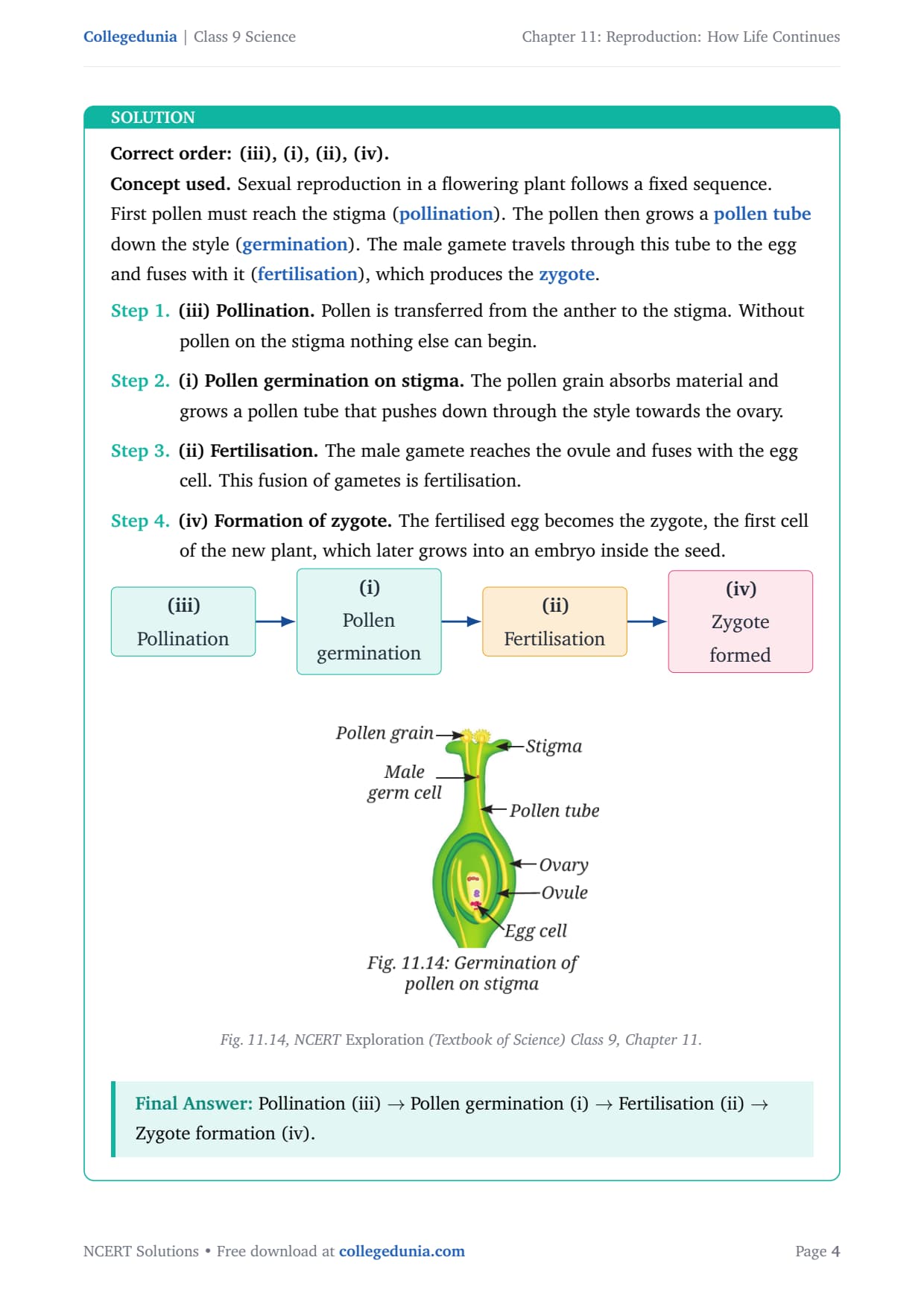
Sexual reproduction in a flowering plant follows a fixed order. Get this sequence right and the arranging and reasoning questions become quick. The flow below is the order the NCERT Solutions for Class 9 Science Chapter 11 Reproduction How Life Continues use again and again.
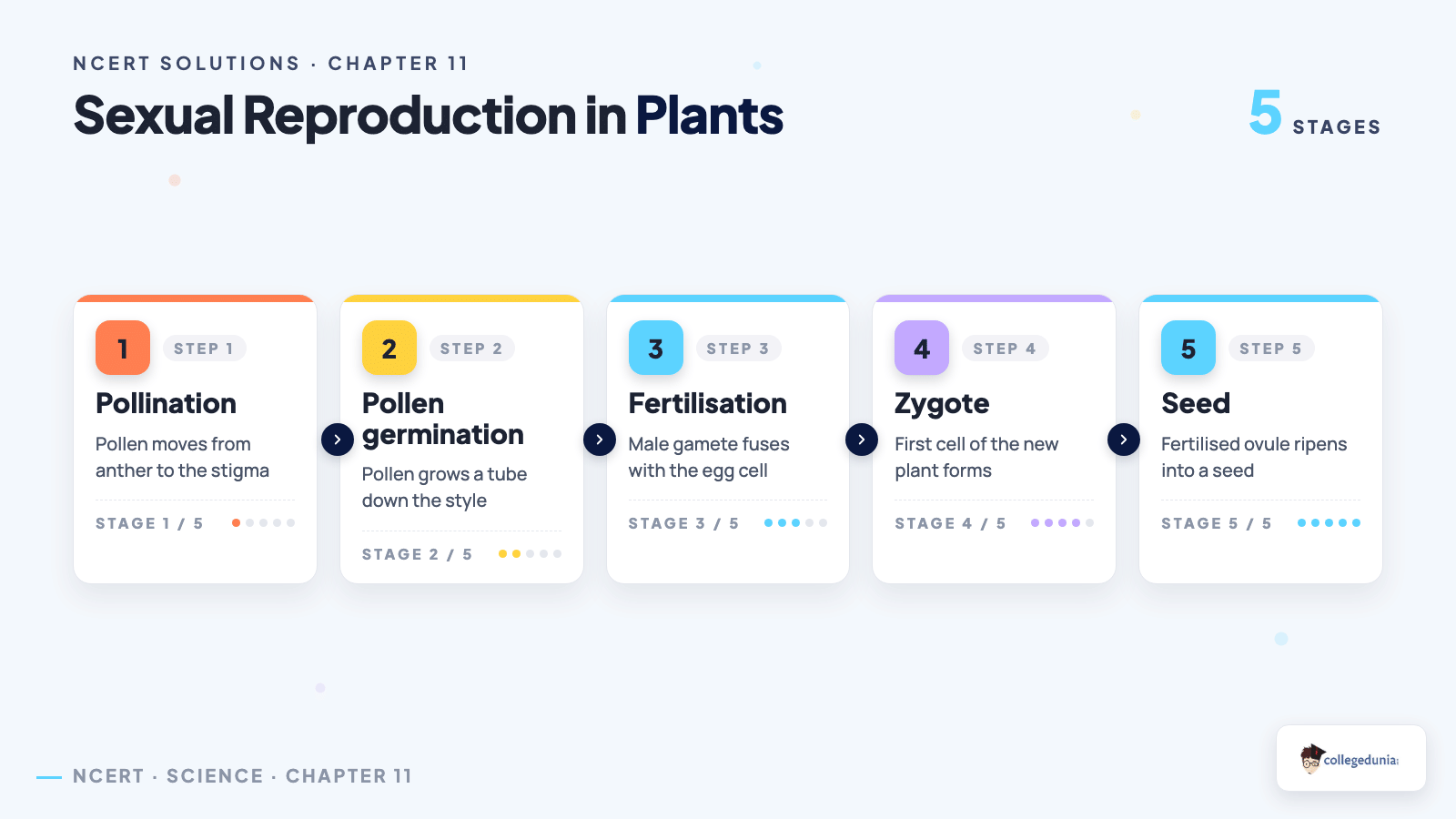
- Pollination: pollen is transferred from the anther to the stigma. Nothing else can start before this.
- Pollen germination: the pollen grows a pollen tube down through the style towards the ovary.
- Fertilisation: the male gamete reaches the ovule and fuses with the egg cell.
- Zygote: the fertilised egg becomes the zygote, the first cell of the new plant.
- Seed: the fertilised ovule ripens into a seed that can grow into a new plant.
A common exam trap is to place fertilisation before germination. The pollen tube must grow first, because it is the path the male gamete uses to reach the egg. Seed set is also the proof that fertilisation happened, since seeds cannot form without it.
Self-Pollination vs Cross-Pollination in Reproduction How Life Continues
Whether pollen stays within one plant or travels to another decides how much variation the offspring get. Many one-mark questions test this single reading, so learn the two side by side.
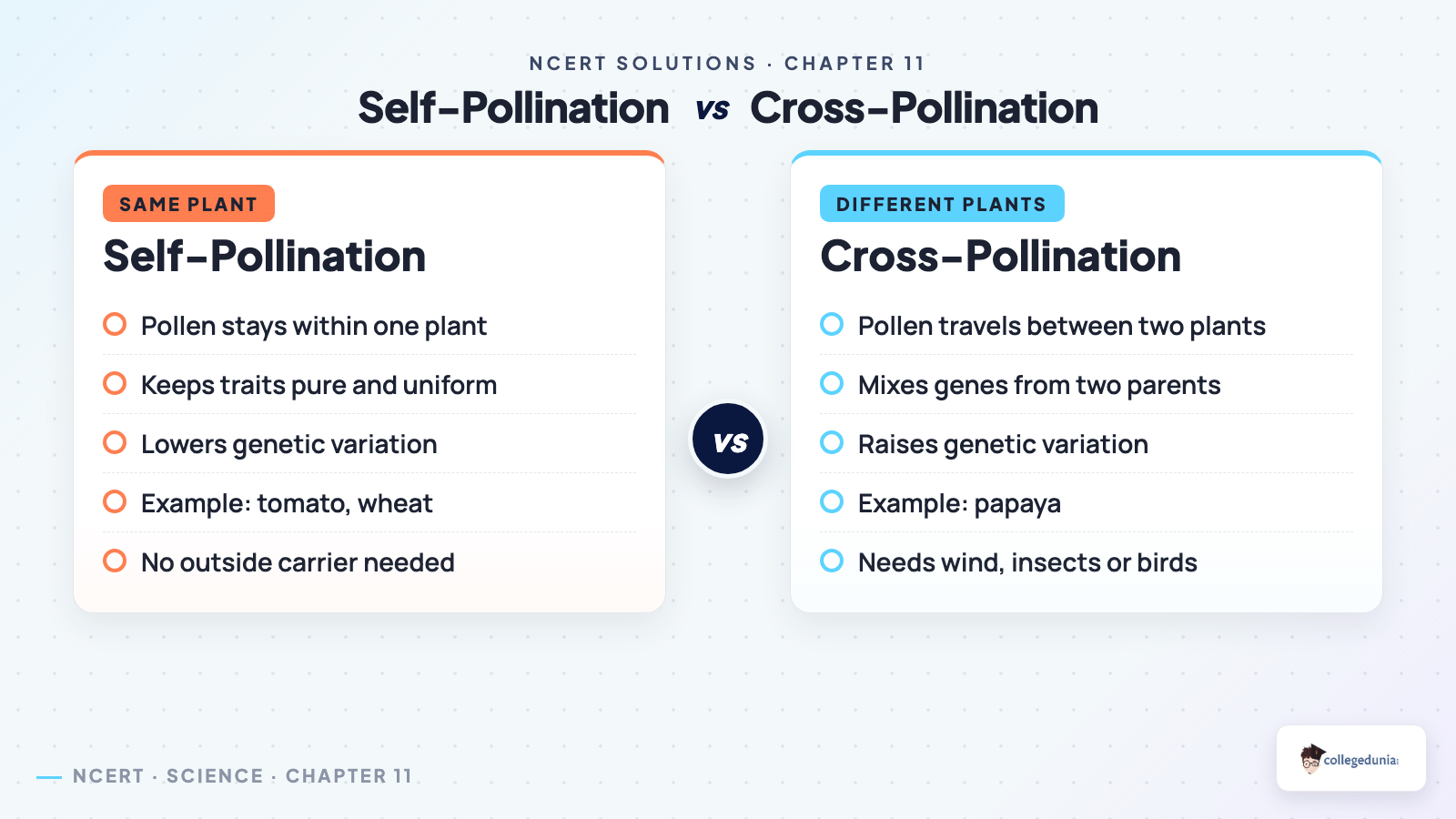
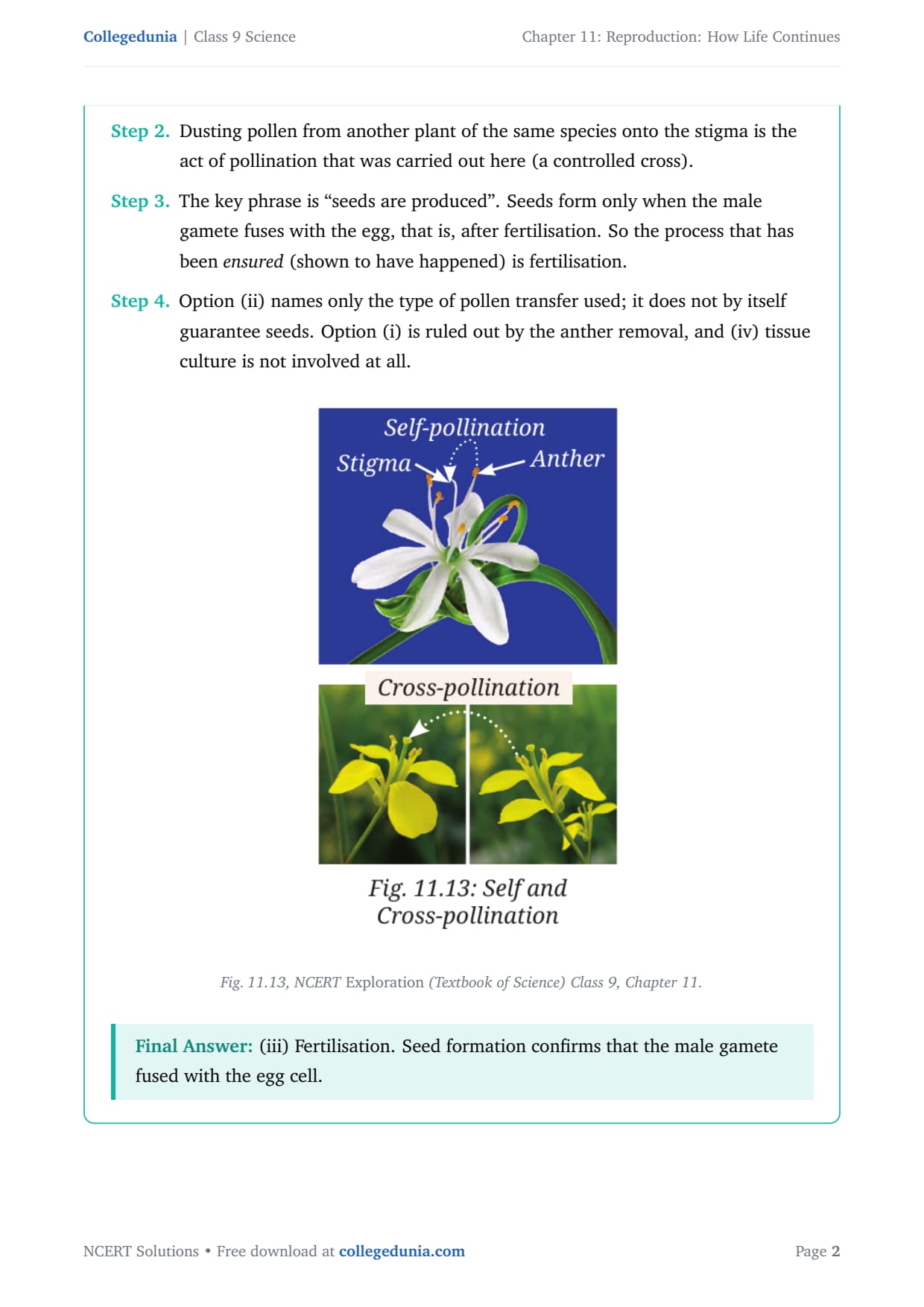
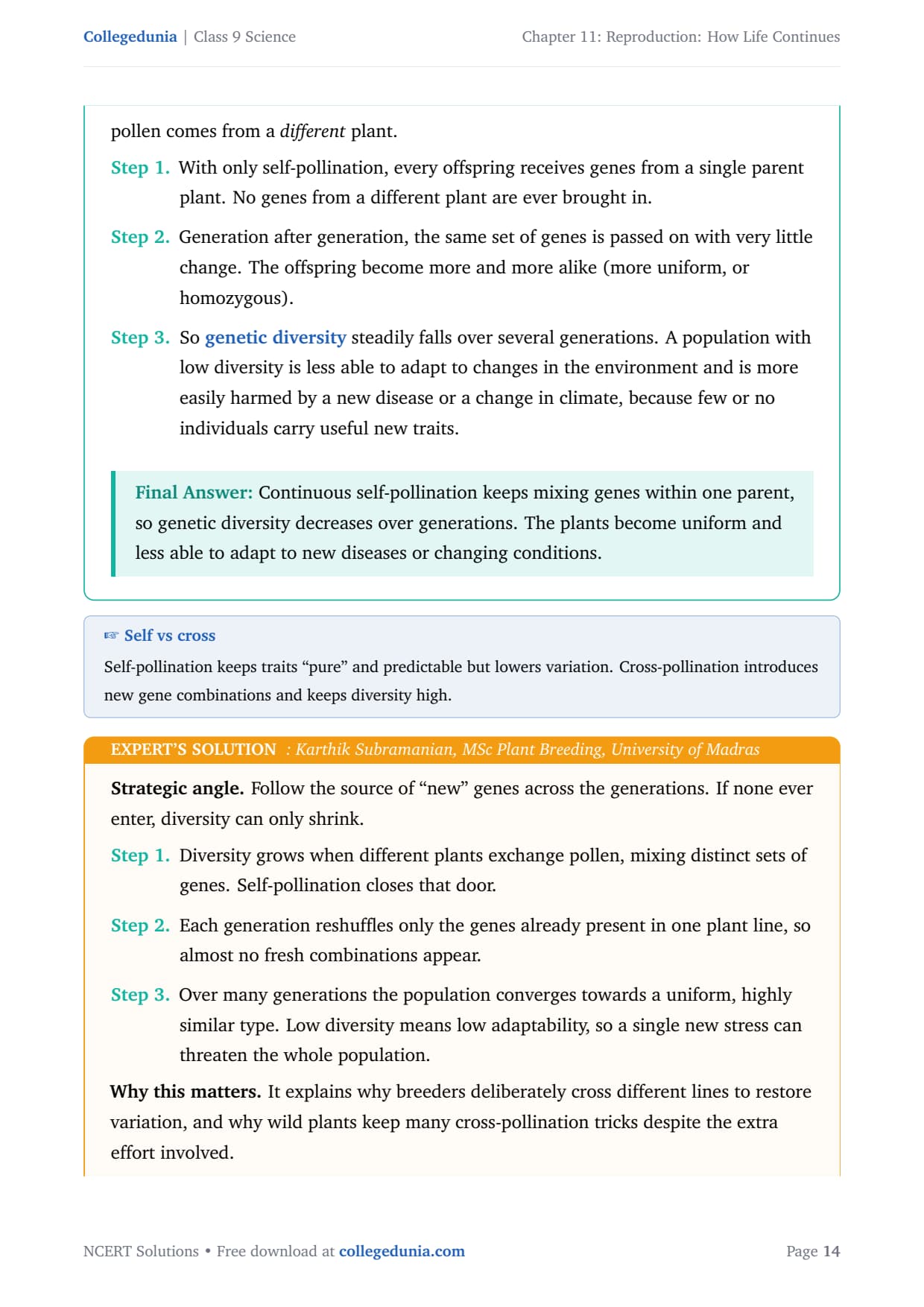
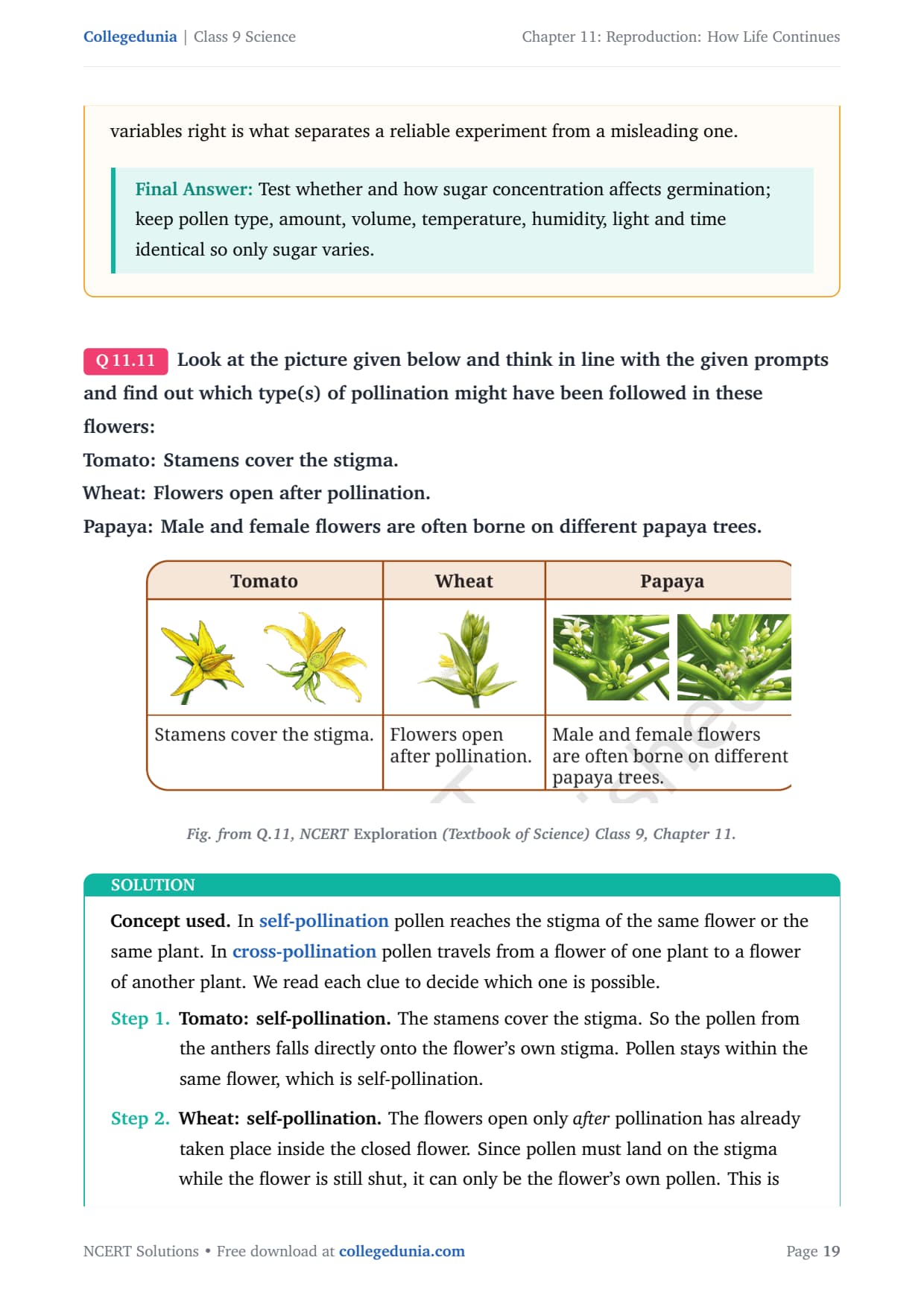
In self-pollination the pollen reaches the stigma of the same flower or the same plant, so both gametes come from one parent. This keeps traits pure but lowers variation over generations. In cross-pollination pollen travels from a flower of one plant to a flower of another, mixing genes and keeping diversity high. Tomato and wheat are read as self-pollinated, while papaya, with male and female flowers on different trees, is cross-pollinated.
Human Reproduction and the Menstrual Cycle in Reproduction How Life Continues
The human part of the chapter tests the timeline after fertilisation and the role of the menstrual cycle. The exam often checks whether students know that the zygote does not attach at once. Learn this small sequence and the human-reproduction questions become quick.
| Stage | Where it happens | What happens |
|---|---|---|
| Fertilisation | Fallopian tube | Male gamete fuses with the egg to form a zygote |
| Travel and division | Fallopian tube | The zygote divides for several days as it moves down |
| Implantation | Uterus lining | The ball of cells fixes into the prepared, thickened lining |
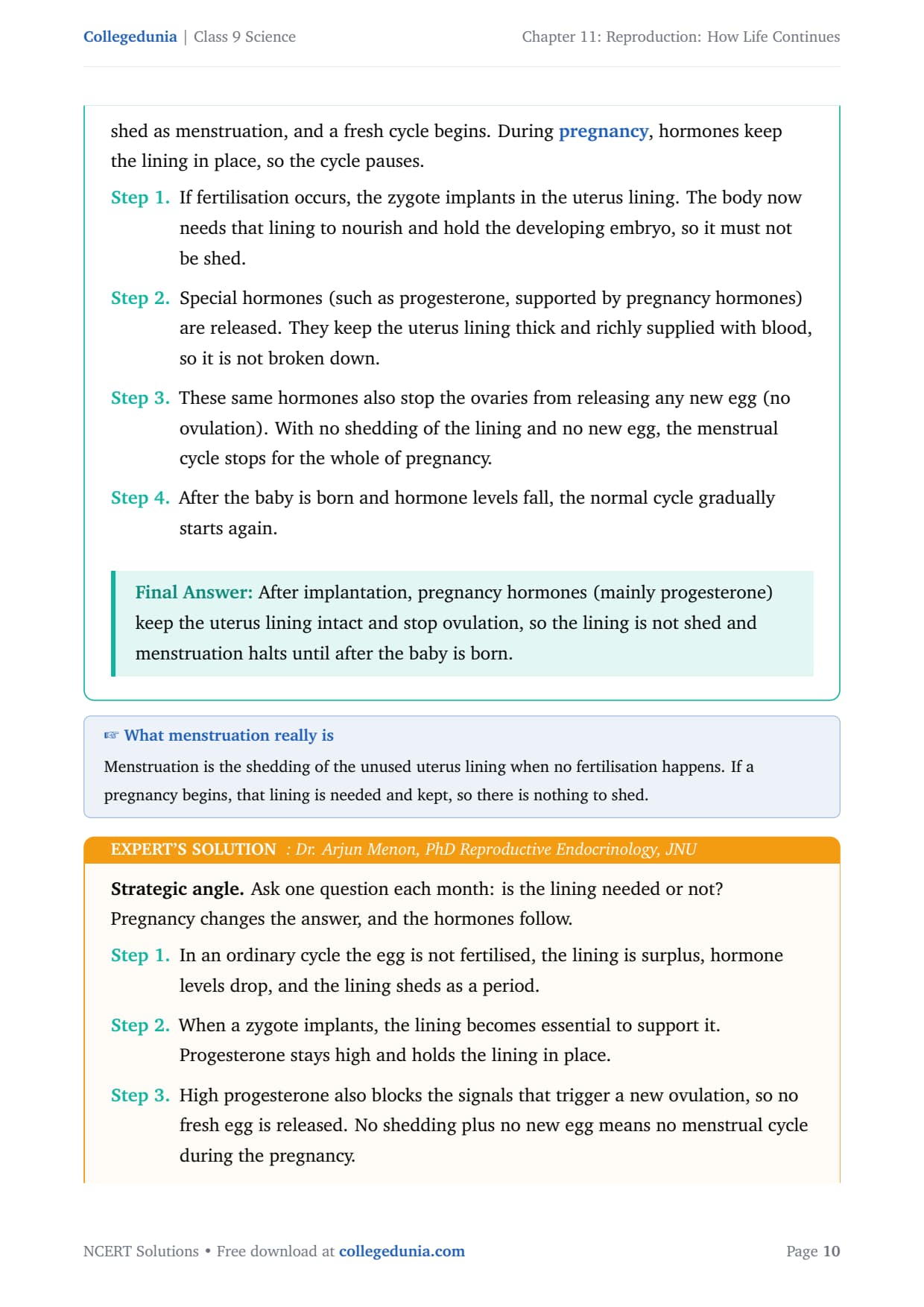
| Pregnancy | Uterus | Hormones keep the lining and stop ovulation, so the cycle pauses |
Two facts trip students up. The zygote implants only after several days, not immediately, though the uterus lining is kept ready each cycle. And ovulation timing is not fixed, because a menstrual cycle can run from about 21 to 35 days and even shifts month to month, so it does not always fall on day 14.
Common Mistakes Students Make in the Reproduction How Life Continues Chapter
Most lost marks in this chapter come from order and timing slips, not from hard ideas. Fix these early and your reasoning answers stay clean.
- Placing fertilisation before pollen germination in the plant sequence.
- Saying ovulation is always on day 14, when cycle length varies between and within people.
- Calling wheat cross-pollinated because it is wind-pollinated, when it is actually pollinated while still closed.
- Forgetting that asexual reproduction and self-pollination both lower variation and raise disease risk.
Sample Solved Question from Class 9 Science Chapter 11 Reproduction How Life Continues
Here is one open-ended question from Revise, Reflect, Refine, solved in steps, so you can see the method the NCERT Solutions for Class 9 Science Chapter 11 Reproduction How Life Continues use.
Question: Why does asexual reproduction produce offspring that are genetically identical to the parent?
- Count the parents. Asexual reproduction has only one parent, so there is no mixing of DNA from two different parents.
- Name the division. The parent cell copies its DNA and divides by mitosis, which gives each new cell an exact copy of the genetic material.
- Check for shuffling. There is no fusion of gametes and no reshuffling of genes, so nothing new is added.
- Final answer. The offspring carry the same genes as the parent. They are clones, identical to the parent and to each other.
How to Study Reproduction How Life Continues and Time Needed
This chapter rewards flow charts over long paragraphs. Draw each process once, write its one main outcome beside it, then answer the exercise. Use the solutions only to check your steps, not to copy them.
Revision mode
2 to 3 hours
If you have done the chapter once and are revising.
First read
5 to 6 hours
If you are reading Reproduction How Life Continues for the first time.
How Collegedunia's NCERT Solutions Help You with Reproduction How Life Continues
Collegedunia gives you the full NCERT Solutions for Class 9 Science Chapter 11 Reproduction How Life Continues as clean, step-by-step answers in one place. You can read them here or download the PDF for offline revision.
- 2026-27 Exploration match: every answer follows the new book and its Revise, Reflect, Refine exercise.
- Reasoning shown in steps: each open-ended answer names the process first, then explains why.
- Teacher checked: subject experts verify each MCQ key and each reasoning and data answer.
- Free PDF: download the Normal and HD versions and revise before your exam.
More Reproduction How Life Continues Class 9 Science Resources
Use the other Collegedunia resources for this chapter alongside the solutions.
| Resource | Open |
|---|---|
| NCERT Solutions | Reproduction How Life Continues Class 9 NCERT Solutions |
| Revision Notes | Reproduction How Life Continues Class 9 Notes |
| Handwritten Notes | Reproduction How Life Continues Class 9 Handwritten Notes |
| NCERT Book PDF | Reproduction How Life Continues Class 9 NCERT Book PDF |
NCERT Solutions for Class 9 Science: All Chapters
Open the NCERT Solutions for any other chapter of the new Class 9 Science Exploration book.
| Chapter | Solutions |
|---|---|
| Chapter 2 | Cell: The Building Block of Life NCERT Solutions |
| Chapter 3 | Tissues in Action NCERT Solutions |
| Chapter 4 | Describing Motion Around Us NCERT Solutions |
| Chapter 10 | Sound Waves NCERT Solutions |
| Chapter 11 | Reproduction How Life Continues NCERT Solutions |
| Chapter 12 | Patterns in Life NCERT Solutions |
| Chapter 13 | Earth as a System NCERT Solutions |
Reproduction How Life Continues Class 9 Science NCERT Solutions FAQs
Ques. Where can I download the Class 9 Science Chapter 11 Reproduction How Life Continues NCERT Solutions PDF?
Ans. You can download the Reproduction How Life Continues NCERT Solutions PDF directly from this page. Both the Normal and HD versions are free and match the 2026-27 Exploration book.
Ques. How many questions are there in the Reproduction How Life Continues exercise?
Ans. The Revise, Reflect, Refine exercise has 13 questions. These include MCQs, one assertion-reason item, several open-ended reasoning questions, and two experiment and data questions. Collegedunia solves all of them.
Ques. What is the correct order of sexual reproduction in plants?
Ans. The order is pollination, then pollen germination on the stigma, then fertilisation, then formation of the zygote, which finally develops inside a seed. Fertilisation cannot happen before the pollen tube has grown.
Ques. Why does asexual reproduction give genetically identical offspring?
Ans. Asexual reproduction uses only one parent and only mitosis, which copies the DNA exactly. There is no fusion of gametes and no gene shuffling, so every offspring is a clone that is identical to the parent and to the others.
Ques. Why does the menstrual cycle stop during pregnancy?
Ans. After the zygote implants, pregnancy hormones such as progesterone keep the uterus lining thick and stop the ovaries from releasing new eggs. With no shedding of the lining and no new egg, the menstrual cycle pauses until after the baby is born.
Ques. Is ovulation always on day 14 of the menstrual cycle?
Ans. No. Day 14 is only an average for a 28-day cycle. Cycle length varies from about 21 to 35 days between people and can change month to month in the same person, so ovulation does not always fall on day 14.



Comments