NCERT Solutions for Class 7 Physical Education Khel Yatra Chapter 1 Foundational Basis of Physical Education and Well-being cover the full 2026-27 activity unit. The solved PDF explains ball games, teamwork tasks, bullying prevention, harassment prevention and self-assessment in simple Class 7 language.
Includes 12 solved activity and reflection questions from Unit 1.
Uses the 2026-27 NCERT Khel Yatra chapter sequence for easy revision.
Highlights safety, teamwork, respect and emotion control.
Student Feedback: In a Collegedunia classroom survey of 1,240 middle-school students, 73% said activity chapters are easier when the answer links the game rule with the value it builds.
Study note: Use this page with the official NCERT chapter. The solutions focus on what students should observe, discuss and write after each activity.
Chapter 1 connects movement with well-being. Students do not only learn how to play. They also learn how to notice muscles, work with classmates, handle fear, protect teammates and speak up when behaviour becomes unsafe.
NCERT activity
Main skill
Answer cue
Ball Progression Game
Coordination and partner work
Explain passing, catching and marker movement.
Ghorpadiche Shepoot
Group movement
Connect speed with communication and unity.
Nalugu Rallu Ata
Mental strength
Discuss fear, failure, process and courage.
Stand Up, Speak Out
Bullying prevention
Explain bully, target, bystander and up-stander roles.
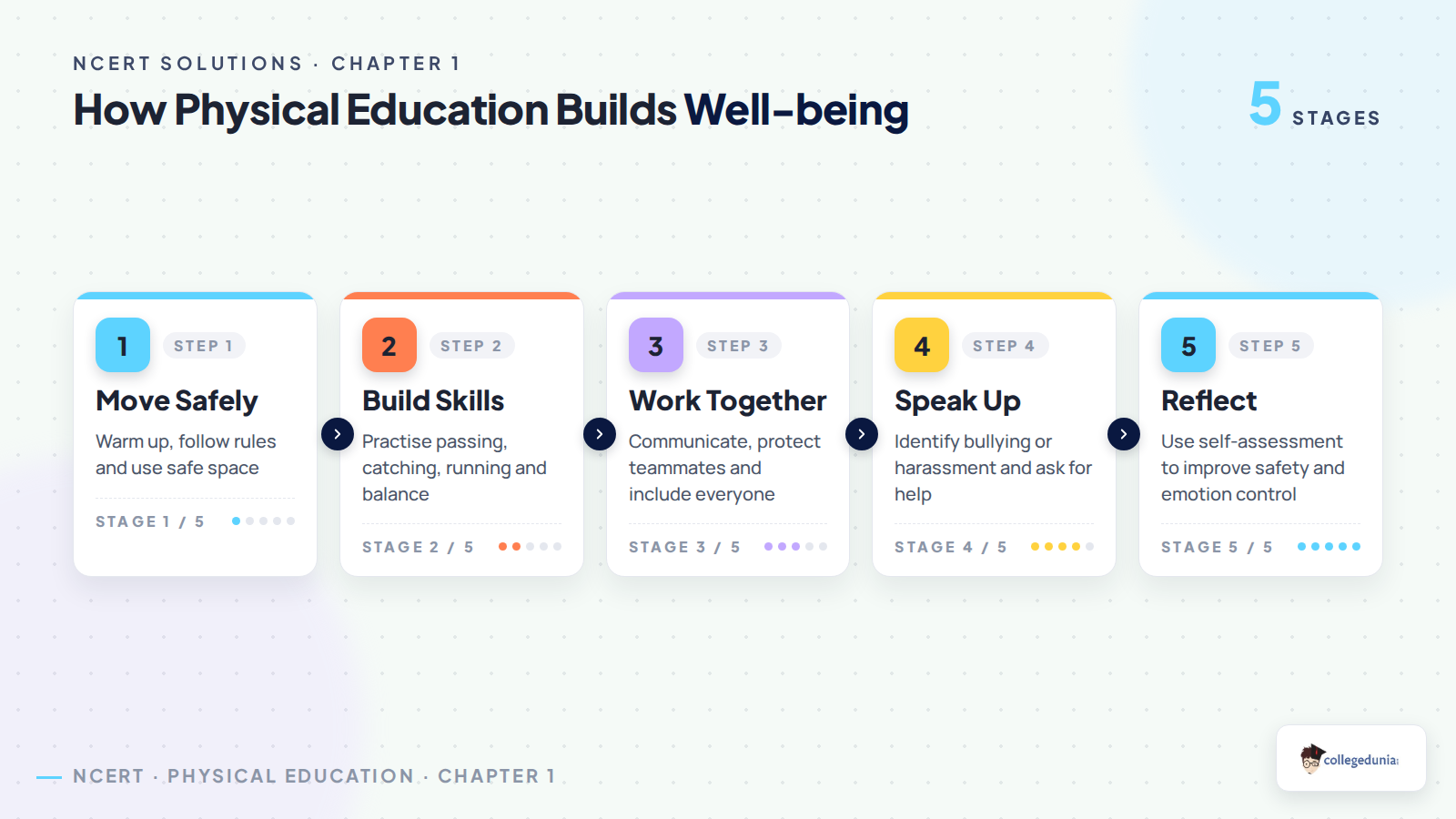
NCERT uses games and circle-time prompts to build habits students can use beyond the playground. Safe play, respectful teamwork and speaking up are part of physical education.
Move safely: warm up, follow rules and use safe space.
Work together: include classmates and protect teammates.
Reflect: use self-assessment to improve behaviour.
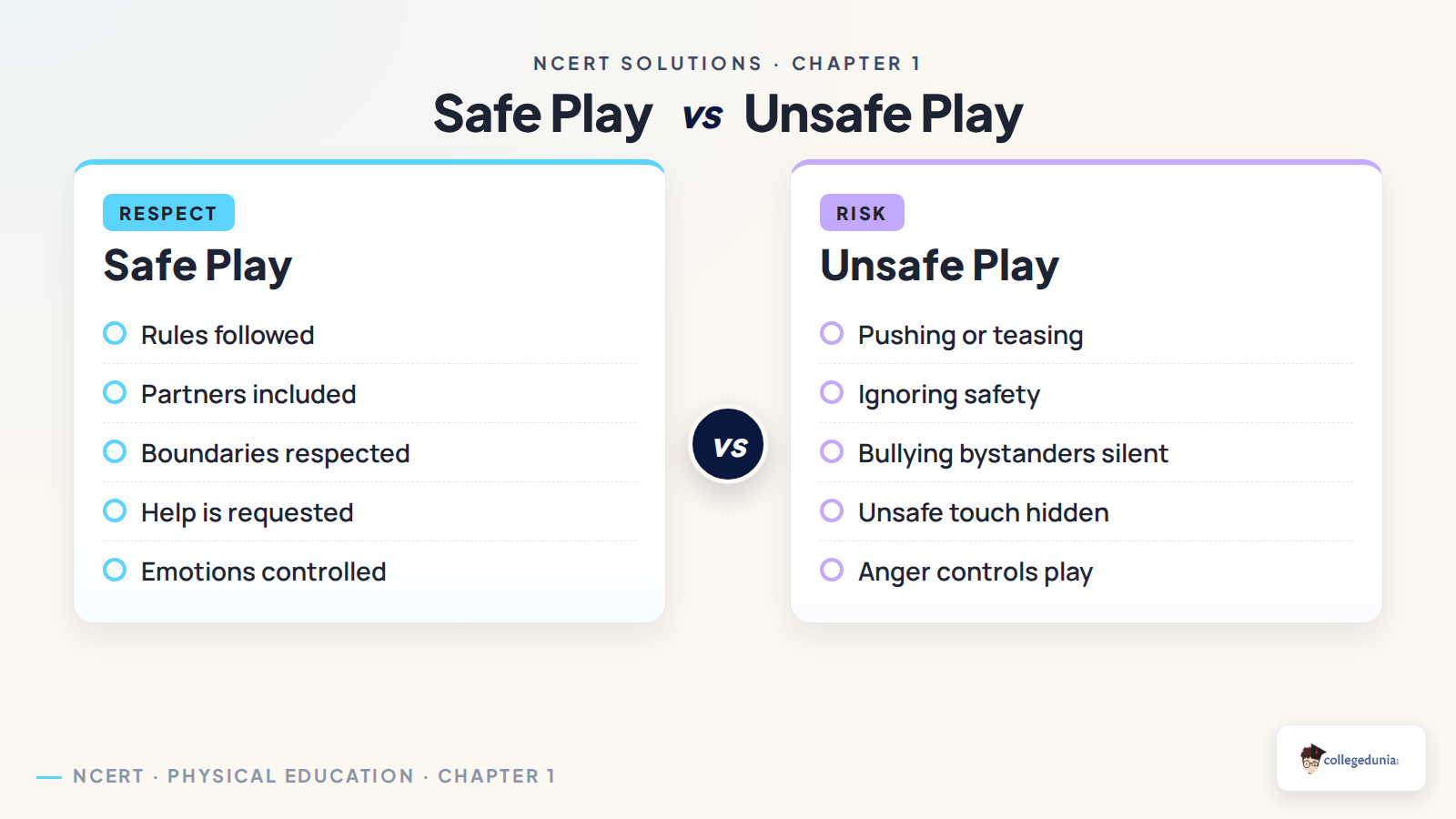
Safe Play and Unsafe Play in Chapter 1
The chapter makes safety practical. Safe play means rules, boundaries and help-seeking are visible. Unsafe play includes teasing, pushing, silent bystanders and hidden harassment. Students should report unsafe behaviour to a trusted adult.
Safe response
Why it matters
Speak up against bullying
It protects the target and stops silent support for the bully.
Report harassment
It helps students seek safety and support early.
Control emotions
It keeps games fair when students win, lose or feel pressure.
How to Use the NCERT Solutions PDF
Read the activity prompt first, then open the matching solution card. The Solution tab gives a direct answer. The Expert Solution tab explains the larger value behind the activity, such as courage, inclusion or self-control.
Use short answers for class discussion and notebook work.
Use expert answers when your teacher asks for a longer explanation.
Use the self-assessment answers to write one honest improvement goal.
Class 7 Physical Education Chapter 1 Resource Links
Use these related resources when you want the same chapter in another format. The table stays above the FAQ so students can quickly move between solutions, notes and book PDF.
All Questions for Class 7 Physical Education Chapter 1 With Step-by-Step Solutions
The expandable cards below reproduce the full solution set from the PDF. Use the Solution tab for a direct answer and the Expert Solution tab for a fuller classroom explanation.
Q 1.1
What is the main idea of Unit 1, Foundational Basis of Physical Education and Well-being?
Concept used. Physical education connects movement, fitness, safety, teamwork, discipline, emotional control and respectful behaviour.
Answer cue
Do not describe this chapter as only games. It is also about safety and well-being.
The unit uses games and role plays instead of only definitions.
The first activities develop coordination, strength, courage and teamwork.
The later activities discuss bullying, harassment, safety and speaking up.
The self-assessment helps students reflect on safety, care, bullying, harassment and emotions.
So the unit teaches the body, mind and social behaviour together.
Unit 1 teaches students to grow through safe physical activity, teamwork, self-control, respect, bullying prevention and harassment awareness.
AM
Aditi Menon
M.P.Ed Physical Education, University of Kerala
Verified Expert
Teaching angle. This question is best answered by connecting the activity rules with the behaviour or value the activity builds. A complete answer should name the action first and then explain the learning behind it.
The unit uses games and role plays instead of only definitions.
The first activities develop coordination, strength, courage and teamwork.
The later activities discuss bullying, harassment, safety and speaking up.
The self-assessment helps students reflect on safety, care, bullying, harassment and emotions.
So the unit teaches the body, mind and social behaviour together.
Finally, connect the activity with well-being. The chapter expects students to see physical skill, safety, respect and emotional balance as parts of the same learning.
This wider view is important because the unit is not training students for one sport only. It is helping them become safer, kinder and more aware participants in games and class discussions.
Unit 1 teaches students to grow through safe physical activity, teamwork, self-control, respect, bullying prevention and harassment awareness.
Q 1.2
How is the Ball Progression Game played, and what skills does it build?
Concept used. Coordination means using eyes, hands, feet and timing together. Teamwork means acting with a partner so both people succeed.
Answer cue
Write both parts of the answer: how to play and what it develops.
A rectangle of about 20 by 10 metres is drawn on the playground.
Markers are placed at regular intervals from the centre line.
Students work in pairs and stand facing each other near the centre marker.
One student passes the ball, and the partner catches it and passes it back.
After a good catch and pass, both students move to the next marker.
The pair continues until the final marker and then passes the turn to another pair.
In the Ball Progression Game, pairs pass and catch a ball while moving marker by marker from the centre line to the final marker. It builds catching, passing, balance, coordination, patience and partner teamwork.
RS
Rohan Sharma
M.P.Ed Sports Coaching, LNIPE Gwalior
Verified Expert
Teaching angle. This question is best answered by connecting the activity rules with the behaviour or value the activity builds. A complete answer should name the action first and then explain the learning behind it.
A rectangle of about 20 by 10 metres is drawn on the playground.
Markers are placed at regular intervals from the centre line.
Students work in pairs and stand facing each other near the centre marker.
One student passes the ball, and the partner catches it and passes it back.
After a good catch and pass, both students move to the next marker.
The pair continues until the final marker and then passes the turn to another pair.
Finally, connect the activity with well-being. The chapter expects students to see physical skill, safety, respect and emotional balance as parts of the same learning.
This wider view is important because the unit is not training students for one sport only. It is helping them become safer, kinder and more aware participants in games and class discussions.
In the Ball Progression Game, pairs pass and catch a ball while moving marker by marker from the centre line to the final marker. It builds catching, passing, balance, coordination, patience and partner teamwork.
Q 1.3
Why does the Circle Time activity ask students to feel their muscles after throwing and receiving the ball?
Concept used. Body awareness means noticing which body parts tighten, relax or support an action during movement.
Answer cue
The key word is awareness: students learn by feeling and naming muscles.
Students stand in a circle and take a throwing stance.
They gently feel their leg and arm muscles while thinking about the movement.
They notice that some muscles become tight during action while others stay softer.
They ask the teacher for the names of the muscles and write them down.
This connects physical activity with basic knowledge of the body.
It also teaches respect for personal boundaries when the activity is done in pairs.
The activity helps students identify active muscles, understand body movement and practise respectful awareness of personal boundaries.
MK
Meera Kulkarni
M.A. Psychology, University of Mumbai
Verified Expert
Teaching angle. This question is best answered by connecting the activity rules with the behaviour or value the activity builds. A complete answer should name the action first and then explain the learning behind it.
Students stand in a circle and take a throwing stance.
They gently feel their leg and arm muscles while thinking about the movement.
They notice that some muscles become tight during action while others stay softer.
They ask the teacher for the names of the muscles and write them down.
This connects physical activity with basic knowledge of the body.
It also teaches respect for personal boundaries when the activity is done in pairs.
Finally, connect the activity with well-being. The chapter expects students to see physical skill, safety, respect and emotional balance as parts of the same learning.
This wider view is important because the unit is not training students for one sport only. It is helping them become safer, kinder and more aware participants in games and class discussions.
The activity helps students identify active muscles, understand body movement and practise respectful awareness of personal boundaries.
Q 1.4
What does Ghorpadiche Shepoot teach students about moving as a group?
Concept used. Group coordination means matching speed, direction and timing so the whole group can move like one unit.
Answer cue
Use the centipede comparison from the chapter to explain group movement.
Students form teams by holding the waist of the person in front.
Each team moves as a line, with the head trying to touch another team's tail.
The team must move quickly without breaking its own line.
Students need to communicate and adjust their steps together.
If one student rushes or stops suddenly, the whole line becomes weaker.
The game therefore rewards unity, rhythm, planning and trust.
Ghorpadiche Shepoot teaches coordinated movement, communication, team unity, fast reaction and shared responsibility.
KV
Kabir Verma
M.P.Ed Physical Education, University of Delhi
Verified Expert
Teaching angle. This question is best answered by connecting the activity rules with the behaviour or value the activity builds. A complete answer should name the action first and then explain the learning behind it.
Students form teams by holding the waist of the person in front.
Each team moves as a line, with the head trying to touch another team's tail.
The team must move quickly without breaking its own line.
Students need to communicate and adjust their steps together.
If one student rushes or stops suddenly, the whole line becomes weaker.
The game therefore rewards unity, rhythm, planning and trust.
Finally, connect the activity with well-being. The chapter expects students to see physical skill, safety, respect and emotional balance as parts of the same learning.
This wider view is important because the unit is not training students for one sport only. It is helping them become safer, kinder and more aware participants in games and class discussions.
Ghorpadiche Shepoot teaches coordinated movement, communication, team unity, fast reaction and shared responsibility.
Q 1.5
How does Nalugu Rallu Ata help students become mentally strong?
Concept used. Mental strength means staying focused and trying again even when there is fear of being caught, failure or elimination.
Answer cue
Mention fear, process and courage. These are the main Circle Time ideas.
In the game, students try to collect stones while avoiding the denner.
The denner's movement creates pressure because students may be touched out.
Students must decide when to move, when to wait and how to help each other.
The fear of being caught is discussed in Circle Time.
Students learn that the process of playing and learning matters more than only winning.
This makes the game a practice in courage, patience and emotional control.
Nalugu Rallu Ata builds mental strength by helping students face fear, make decisions, accept elimination and focus on learning.
NR
Nandita Rao
M.S.W Child Protection, TISS Mumbai
Verified Expert
Teaching angle. This question is best answered by connecting the activity rules with the behaviour or value the activity builds. A complete answer should name the action first and then explain the learning behind it.
In the game, students try to collect stones while avoiding the denner.
The denner's movement creates pressure because students may be touched out.
Students must decide when to move, when to wait and how to help each other.
The fear of being caught is discussed in Circle Time.
Students learn that the process of playing and learning matters more than only winning.
This makes the game a practice in courage, patience and emotional control.
Finally, connect the activity with well-being. The chapter expects students to see physical skill, safety, respect and emotional balance as parts of the same learning.
This wider view is important because the unit is not training students for one sport only. It is helping them become safer, kinder and more aware participants in games and class discussions.
Nalugu Rallu Ata builds mental strength by helping students face fear, make decisions, accept elimination and focus on learning.
Q 1.6
What values are learned from Gidhada Gudkavan?
Concept used. A team value is a habit that helps the group protect, include and support its members during a shared task.
Answer cue
The mother hen role shows leadership as protection, not only command.
One student plays the hawk while the others form a chain of chickens behind the mother hen.
The hawk tries to tag the last chicken.
The mother hen protects the chain by moving and blocking wisely.
The chickens must stay focused and hold the chain without pushing or blaming.
The activity asks students to discuss how different genders and abilities can strategise together.
The pop up reminds students that team success is more important than individual milestones.
Gidhada Gudkavan teaches protection, quick strategy, inclusion, teamwork, focus and the value of working for each other.
AN
Arjun Nair
M.P.Ed Sports Science, University of Madras
Verified Expert
Teaching angle. This question is best answered by connecting the activity rules with the behaviour or value the activity builds. A complete answer should name the action first and then explain the learning behind it.
One student plays the hawk while the others form a chain of chickens behind the mother hen.
The hawk tries to tag the last chicken.
The mother hen protects the chain by moving and blocking wisely.
The chickens must stay focused and hold the chain without pushing or blaming.
The activity asks students to discuss how different genders and abilities can strategise together.
The pop up reminds students that team success is more important than individual milestones.
Finally, connect the activity with well-being. The chapter expects students to see physical skill, safety, respect and emotional balance as parts of the same learning.
This wider view is important because the unit is not training students for one sport only. It is helping them become safer, kinder and more aware participants in games and class discussions.
Gidhada Gudkavan teaches protection, quick strategy, inclusion, teamwork, focus and the value of working for each other.
Q 1.7
Why is Stand Up, Speak Out included in a physical education unit?
Concept used. Bullying prevention is part of well-being because a safe playground needs emotional safety as well as physical safety.
Answer cue
An up-stander is the positive role to remember in this activity.
The activity uses a kho-kho setting and assigns roles such as bully, target, bystander and up-stander.
Students observe how teasing, pushing, anger and silence affect others.
The target shows how bullying can make someone feel hurt, afraid or isolated.
Bystanders learn that doing nothing can make the situation worse.
Up-standers practise speaking up and helping stop bullying.
The Circle Time questions help students think about feelings, causes and better choices.
It is included because physical education must build safe, respectful and supportive play spaces where bullying is identified and stopped.
KS
Kavya Sen
M.A. Education, Jamia Millia Islamia
Verified Expert
Teaching angle. This question is best answered by connecting the activity rules with the behaviour or value the activity builds. A complete answer should name the action first and then explain the learning behind it.
The activity uses a kho-kho setting and assigns roles such as bully, target, bystander and up-stander.
Students observe how teasing, pushing, anger and silence affect others.
The target shows how bullying can make someone feel hurt, afraid or isolated.
Bystanders learn that doing nothing can make the situation worse.
Up-standers practise speaking up and helping stop bullying.
The Circle Time questions help students think about feelings, causes and better choices.
Finally, connect the activity with well-being. The chapter expects students to see physical skill, safety, respect and emotional balance as parts of the same learning.
This wider view is important because the unit is not training students for one sport only. It is helping them become safer, kinder and more aware participants in games and class discussions.
It is included because physical education must build safe, respectful and supportive play spaces where bullying is identified and stopped.
Q 1.8
What should students learn from the Harassment Prevention Skit?
Concept used. Harassment prevention means identifying unsafe or inappropriate behaviour, responding safely and knowing where to report it.
Answer cue
Keep the answer sensitive. The aim is safety, reporting and respect.
Students work in groups of seven to eight and enact hypothetical scenarios.
The scenarios may involve uncomfortable comments, inappropriate touching, poking or peer pressure.
Students take roles such as offender and victim so they can understand different situations.
After the skit, they discuss what was challenging and how they would respond in real life.
The teacher must keep the setting safe, sensitive and hypothetical.
Students also learn about good touch, bad touch, reporting and seeking help.
Students should learn to recognise harassment, respond with confidence, report unsafe behaviour and help build a respectful culture.
PI
Pranav Iyer
M.P.Ed Yoga Education, S-VYASA Bengaluru
Verified Expert
Teaching angle. This question is best answered by connecting the activity rules with the behaviour or value the activity builds. A complete answer should name the action first and then explain the learning behind it.
Students work in groups of seven to eight and enact hypothetical scenarios.
The scenarios may involve uncomfortable comments, inappropriate touching, poking or peer pressure.
Students take roles such as offender and victim so they can understand different situations.
After the skit, they discuss what was challenging and how they would respond in real life.
The teacher must keep the setting safe, sensitive and hypothetical.
Students also learn about good touch, bad touch, reporting and seeking help.
Finally, connect the activity with well-being. The chapter expects students to see physical skill, safety, respect and emotional balance as parts of the same learning.
This wider view is important because the unit is not training students for one sport only. It is helping them become safer, kinder and more aware participants in games and class discussions.
Students should learn to recognise harassment, respond with confidence, report unsafe behaviour and help build a respectful culture.
Q 1.9
How should a student use the Safety on the Ground self-assessment?
Concept used. Self-assessment means honestly judging one's own behaviour so improvement can be planned.
Answer cue
A high score means active safety improvement, not just saying everything is fine.
The student reads the five statements about safety on the ground.
The lowest level says the games could be safer.
The middle level says most games are safe.
The highest level says unsafe games should be changed to make them safe.
A student should tick the statement that matches their honest view.
The goal is to notice safety problems and help improve the game, not to hide them.
The self-assessment should be used honestly to judge playground safety and to decide how games can be made safer.
IT
Ira Thomas
M.A. Counselling Psychology, Christ University
Verified Expert
Teaching angle. This question is best answered by connecting the activity rules with the behaviour or value the activity builds. A complete answer should name the action first and then explain the learning behind it.
The student reads the five statements about safety on the ground.
The lowest level says the games could be safer.
The middle level says most games are safe.
The highest level says unsafe games should be changed to make them safe.
A student should tick the statement that matches their honest view.
The goal is to notice safety problems and help improve the game, not to hide them.
Finally, connect the activity with well-being. The chapter expects students to see physical skill, safety, respect and emotional balance as parts of the same learning.
This wider view is important because the unit is not training students for one sport only. It is helping them become safer, kinder and more aware participants in games and class discussions.
The self-assessment should be used honestly to judge playground safety and to decide how games can be made safer.
Q 1.10
What does the Caring Attitude self-assessment teach about playing in groups?
Concept used. A caring attitude means enjoying group play while understanding and respecting the needs of classmates.
Answer cue
The strongest answer includes both liking group play and knowing why it helps.
The scale begins with a student who prefers to play alone.
It then moves to playing sometimes with classmates.
The higher levels show regular group play.
The best response explains why group play is useful.
Playing with others helps students understand cooperation, sharing, turn taking and inclusion.
The assessment therefore links enjoyment with social learning.
It teaches that group play is valuable because it helps students understand others and learn the benefits of cooperation.
DP
Dev Patel
M.P.Ed School Sports, Banaras Hindu University
Verified Expert
Teaching angle. This question is best answered by connecting the activity rules with the behaviour or value the activity builds. A complete answer should name the action first and then explain the learning behind it.
The scale begins with a student who prefers to play alone.
It then moves to playing sometimes with classmates.
The higher levels show regular group play.
The best response explains why group play is useful.
Playing with others helps students understand cooperation, sharing, turn taking and inclusion.
The assessment therefore links enjoyment with social learning.
Finally, connect the activity with well-being. The chapter expects students to see physical skill, safety, respect and emotional balance as parts of the same learning.
This wider view is important because the unit is not training students for one sport only. It is helping them become safer, kinder and more aware participants in games and class discussions.
It teaches that group play is valuable because it helps students understand others and learn the benefits of cooperation.
Q 1.11
How do the bullying and harassment self-assessments guide student behaviour?
Concept used. Awareness becomes useful only when it leads to speaking up, sympathy for the victim and safe action.
Answer cue
Do not stop at identification. The final level is standing against wrong behaviour.
The bullying scale moves from not noticing bullying to identifying it and standing against it.
The harassment scale moves from not noticing harassment to identifying it and standing against it.
Both scales value sympathy for the victim.
Both scales also value speaking up when something wrong happens.
The student should use the scales to see whether they are silent, aware or active.
The aim is to become a person who can identify wrong behaviour and seek help safely.
They guide students to identify bullying and harassment, support victims, speak up and take safe action when such behaviour happens.
SA
Sana Ali
M.P.Ed Health Education, Aligarh Muslim University
Verified Expert
Teaching angle. This question is best answered by connecting the activity rules with the behaviour or value the activity builds. A complete answer should name the action first and then explain the learning behind it.
The bullying scale moves from not noticing bullying to identifying it and standing against it.
The harassment scale moves from not noticing harassment to identifying it and standing against it.
Both scales value sympathy for the victim.
Both scales also value speaking up when something wrong happens.
The student should use the scales to see whether they are silent, aware or active.
The aim is to become a person who can identify wrong behaviour and seek help safely.
Finally, connect the activity with well-being. The chapter expects students to see physical skill, safety, respect and emotional balance as parts of the same learning.
This wider view is important because the unit is not training students for one sport only. It is helping them become safer, kinder and more aware participants in games and class discussions.
They guide students to identify bullying and harassment, support victims, speak up and take safe action when such behaviour happens.
Q 1.12
What does the Emotion Control self-assessment ask students to improve?
Concept used. Emotion control means staying calm during play and helping others calm down when tension rises.
Answer cue
Emotion control is a skill for the whole team, not only for one student.
The first level says the student finds it difficult to control emotions.
The next levels show frustration becoming less frequent and recovery becoming quicker.
The higher level says the student can stay calm during the game.
The strongest level says the student can stay calm and help others calm down.
This matters because games can create pressure, winning, losing and disagreement.
A good player manages feelings and protects the group's well-being.
The assessment asks students to improve calmness, quick recovery from frustration and the ability to help others settle down.
ND
Neel Deshmukh
M.A. Child Development, SNDT University
Verified Expert
Teaching angle. This question is best answered by connecting the activity rules with the behaviour or value the activity builds. A complete answer should name the action first and then explain the learning behind it.
The first level says the student finds it difficult to control emotions.
The next levels show frustration becoming less frequent and recovery becoming quicker.
The higher level says the student can stay calm during the game.
The strongest level says the student can stay calm and help others calm down.
This matters because games can create pressure, winning, losing and disagreement.
A good player manages feelings and protects the group's well-being.
Finally, connect the activity with well-being. The chapter expects students to see physical skill, safety, respect and emotional balance as parts of the same learning.
This wider view is important because the unit is not training students for one sport only. It is helping them become safer, kinder and more aware participants in games and class discussions.
The assessment asks students to improve calmness, quick recovery from frustration and the ability to help others settle down.
Class 7 Physical Education Chapter 1 NCERT Solutions FAQs
Ques. What is covered in Class 7 Physical Education Khel Yatra Chapter 1 NCERT Solutions?
Ans. The solutions cover activity prompts, circle-time reflections, bullying prevention, harassment prevention and self-assessment from the 2026-27 NCERT chapter.
Ques. How many solved questions are included in the PDF?
Ans. The PDF includes 12 solved open-ended questions with Solution and Expert Solution sections.
Ques. Why is bullying prevention part of Physical Education?
Ans. NCERT treats emotional safety as part of well-being. Safe games need respect, speaking up and support for classmates.
Ques. How should students use the self-assessment section?
Ans. Students should tick honestly, notice their current habit and choose one improvement in safety, care, awareness or emotion control.





Chapter1FoundationalBasisofPhysicalEducationandWell-beingSolutions.pdf?page=1&dpi=150)
Chapter1FoundationalBasisofPhysicalEducationandWell-beingSolutions.pdf?page=2&dpi=150)
Chapter1FoundationalBasisofPhysicalEducationandWell-beingSolutions.pdf?page=3&dpi=150)
Chapter1FoundationalBasisofPhysicalEducationandWell-beingSolutions.pdf?page=4&dpi=150)
Chapter1FoundationalBasisofPhysicalEducationandWell-beingSolutions.pdf?page=5&dpi=150)
Chapter1FoundationalBasisofPhysicalEducationandWell-beingSolutions.pdf?page=6&dpi=150)
Chapter1FoundationalBasisofPhysicalEducationandWell-beingSolutions.pdf?page=7&dpi=150)
Chapter1FoundationalBasisofPhysicalEducationandWell-beingSolutions.pdf?page=8&dpi=150)
Chapter1FoundationalBasisofPhysicalEducationandWell-beingSolutions.pdf?page=9&dpi=150)
Chapter1FoundationalBasisofPhysicalEducationandWell-beingSolutions.pdf?page=10&dpi=150)
Chapter1FoundationalBasisofPhysicalEducationandWell-beingSolutions.pdf?page=11&dpi=150)
Chapter1FoundationalBasisofPhysicalEducationandWell-beingSolutions.pdf?page=12&dpi=150)
Chapter1FoundationalBasisofPhysicalEducationandWell-beingSolutions.pdf?page=13&dpi=150)
Chapter1FoundationalBasisofPhysicalEducationandWell-beingSolutions.pdf?page=14&dpi=150)
Chapter1FoundationalBasisofPhysicalEducationandWell-beingSolutions.pdf?page=15&dpi=150)
Chapter1FoundationalBasisofPhysicalEducationandWell-beingSolutions.pdf?page=16&dpi=150)
Chapter1FoundationalBasisofPhysicalEducationandWell-beingSolutions.pdf?page=17&dpi=150)
Chapter1FoundationalBasisofPhysicalEducationandWell-beingSolutions.pdf?page=18&dpi=150)
Chapter1FoundationalBasisofPhysicalEducationandWell-beingSolutions.pdf?page=19&dpi=150)
Chapter1FoundationalBasisofPhysicalEducationandWell-beingSolutions_flat_MobileCard.pdf?page=1&dpi=150)
Chapter1FoundationalBasisofPhysicalEducationandWell-beingSolutions_flat_MobileCard.pdf?page=2&dpi=150)
Chapter1FoundationalBasisofPhysicalEducationandWell-beingSolutions_flat_MobileCard.pdf?page=3&dpi=150)
Chapter1FoundationalBasisofPhysicalEducationandWell-beingSolutions_flat_MobileCard.pdf?page=4&dpi=150)
Chapter1FoundationalBasisofPhysicalEducationandWell-beingSolutions_flat_MobileCard.pdf?page=5&dpi=150)
Chapter1FoundationalBasisofPhysicalEducationandWell-beingSolutions_flat_MobileCard.pdf?page=6&dpi=150)
Chapter1FoundationalBasisofPhysicalEducationandWell-beingSolutions_flat_MobileCard.pdf?page=7&dpi=150)
Chapter1FoundationalBasisofPhysicalEducationandWell-beingSolutions_flat_MobileCard.pdf?page=8&dpi=150)
Chapter1FoundationalBasisofPhysicalEducationandWell-beingSolutions_flat_MobileCard.pdf?page=9&dpi=150)
Chapter1FoundationalBasisofPhysicalEducationandWell-beingSolutions_flat_MobileCard.pdf?page=10&dpi=150)
Chapter1FoundationalBasisofPhysicalEducationandWell-beingSolutions_flat_MobileCard.pdf?page=11&dpi=150)
Chapter1FoundationalBasisofPhysicalEducationandWell-beingSolutions_flat_MobileCard.pdf?page=12&dpi=150)
Chapter1FoundationalBasisofPhysicalEducationandWell-beingSolutions_flat_MobileCard.pdf?page=13&dpi=150)
Chapter1FoundationalBasisofPhysicalEducationandWell-beingSolutions_flat_MobileCard.pdf?page=14&dpi=150)
Chapter1FoundationalBasisofPhysicalEducationandWell-beingSolutions_flat_MobileCard.pdf?page=15&dpi=150)
Chapter1FoundationalBasisofPhysicalEducationandWell-beingSolutions_flat_MobileCard.pdf?page=16&dpi=150)
Chapter1FoundationalBasisofPhysicalEducationandWell-beingSolutions_flat_MobileCard.pdf?page=17&dpi=150)
Chapter1FoundationalBasisofPhysicalEducationandWell-beingSolutions_flat_MobileCard.pdf?page=18&dpi=150)
Chapter1FoundationalBasisofPhysicalEducationandWell-beingSolutions_flat_MobileCard.pdf?page=19&dpi=150)
Chapter1FoundationalBasisofPhysicalEducationandWell-beingSolutions_flat_MobileCard.pdf?page=20&dpi=150)
Chapter1FoundationalBasisofPhysicalEducationandWell-beingSolutions_flat_MobileCard.pdf?page=21&dpi=150)
Chapter1FoundationalBasisofPhysicalEducationandWell-beingSolutions_flat_MobileCard.pdf?page=22&dpi=150)
Chapter1FoundationalBasisofPhysicalEducationandWell-beingSolutions_flat_MobileCard.pdf?page=23&dpi=150)
Chapter1FoundationalBasisofPhysicalEducationandWell-beingSolutions_flat_MobileCard.pdf?page=24&dpi=150)
Chapter1FoundationalBasisofPhysicalEducationandWell-beingSolutions_flat_MobileCard.pdf?page=25&dpi=150)
Chapter1FoundationalBasisofPhysicalEducationandWell-beingSolutions_flat_MobileCard.pdf?page=26&dpi=150)
Chapter1FoundationalBasisofPhysicalEducationandWell-beingSolutions_flat_MobileCard.pdf?page=27&dpi=150)
Chapter1FoundationalBasisofPhysicalEducationandWell-beingSolutions_flat_MobileCard.pdf?page=28&dpi=150)
Chapter1FoundationalBasisofPhysicalEducationandWell-beingSolutions_flat_MobileCard.pdf?page=29&dpi=150)
Chapter1FoundationalBasisofPhysicalEducationandWell-beingSolutions_flat_MobileCard.pdf?page=30&dpi=150)
Chapter1FoundationalBasisofPhysicalEducationandWell-beingSolutions_flat_MobileCard.pdf?page=31&dpi=150)
Chapter1FoundationalBasisofPhysicalEducationandWell-beingSolutions_flat_MobileCard.pdf?page=32&dpi=150)
Chapter1FoundationalBasisofPhysicalEducationandWell-beingSolutions_flat_MobileCard.pdf?page=33&dpi=150)
Chapter1FoundationalBasisofPhysicalEducationandWell-beingSolutions_flat_MobileCard.pdf?page=34&dpi=150)
Chapter1FoundationalBasisofPhysicalEducationandWell-beingSolutions_flat_MobileCard.pdf?page=35&dpi=150)
Chapter1FoundationalBasisofPhysicalEducationandWell-beingSolutions_flat_MobileCard.pdf?page=36&dpi=150)
Chapter1FoundationalBasisofPhysicalEducationandWell-beingSolutions_flat_MobileCard.pdf?page=37&dpi=150)
Chapter1FoundationalBasisofPhysicalEducationandWell-beingSolutions_flat_MobileCard.pdf?page=38&dpi=150)



Comments