




The NCERT Solutions for Class 6 Science Curiosity Chapter 2 Diversity in the Living World explain every exercise question from the 2026-27 NCERT textbook. Students can download the PDF to revise biodiversity, plant grouping, animal habitats, venation, roots and adaptations with clear step-by-step answers.
- Resource: Class 6 Science Chapter 2 NCERT Solutions PDF.
- Chapter focus: biodiversity, grouping, monocots, dicots, habitats and adaptations.
- Question type: image-based answers, grouping tables, Venn diagrams and reasoning questions.
Chapter2DiversityintheLivingWorldSolutions.pdf?page=1&dpi=150)
Chapter2DiversityintheLivingWorldSolutions.pdf?page=2&dpi=150)
Chapter2DiversityintheLivingWorldSolutions.pdf?page=3&dpi=150)
Chapter2DiversityintheLivingWorldSolutions.pdf?page=4&dpi=150)
Chapter2DiversityintheLivingWorldSolutions.pdf?page=5&dpi=150)
Chapter2DiversityintheLivingWorldSolutions.pdf?page=6&dpi=150)
Chapter2DiversityintheLivingWorldSolutions.pdf?page=7&dpi=150)
Chapter2DiversityintheLivingWorldSolutions.pdf?page=8&dpi=150)
Chapter2DiversityintheLivingWorldSolutions.pdf?page=9&dpi=150)
Chapter2DiversityintheLivingWorldSolutions.pdf?page=10&dpi=150)
Chapter2DiversityintheLivingWorldSolutions.pdf?page=11&dpi=150)
Chapter2DiversityintheLivingWorldSolutions.pdf?page=12&dpi=150)
Chapter2DiversityintheLivingWorldSolutions.pdf?page=13&dpi=150)
Chapter2DiversityintheLivingWorldSolutions.pdf?page=14&dpi=150)
Chapter2DiversityintheLivingWorldSolutions.pdf?page=15&dpi=150)
Chapter2DiversityintheLivingWorldSolutions.pdf?page=16&dpi=150)
Chapter2DiversityintheLivingWorldSolutions.pdf?page=17&dpi=150)
Chapter2DiversityintheLivingWorldSolutions.pdf?page=18&dpi=150)
Chapter2DiversityintheLivingWorldSolutions_flat_MobileCard.pdf?page=1&dpi=150)
Chapter2DiversityintheLivingWorldSolutions_flat_MobileCard.pdf?page=2&dpi=150)
Chapter2DiversityintheLivingWorldSolutions_flat_MobileCard.pdf?page=3&dpi=150)
Chapter2DiversityintheLivingWorldSolutions_flat_MobileCard.pdf?page=4&dpi=150)
Chapter2DiversityintheLivingWorldSolutions_flat_MobileCard.pdf?page=5&dpi=150)
Chapter2DiversityintheLivingWorldSolutions_flat_MobileCard.pdf?page=6&dpi=150)
Chapter2DiversityintheLivingWorldSolutions_flat_MobileCard.pdf?page=7&dpi=150)
Chapter2DiversityintheLivingWorldSolutions_flat_MobileCard.pdf?page=8&dpi=150)
Chapter2DiversityintheLivingWorldSolutions_flat_MobileCard.pdf?page=9&dpi=150)
Chapter2DiversityintheLivingWorldSolutions_flat_MobileCard.pdf?page=10&dpi=150)
Chapter2DiversityintheLivingWorldSolutions_flat_MobileCard.pdf?page=11&dpi=150)
Chapter2DiversityintheLivingWorldSolutions_flat_MobileCard.pdf?page=12&dpi=150)
Chapter2DiversityintheLivingWorldSolutions_flat_MobileCard.pdf?page=13&dpi=150)
Chapter2DiversityintheLivingWorldSolutions_flat_MobileCard.pdf?page=14&dpi=150)
Chapter2DiversityintheLivingWorldSolutions_flat_MobileCard.pdf?page=15&dpi=150)
Chapter2DiversityintheLivingWorldSolutions_flat_MobileCard.pdf?page=16&dpi=150)
Chapter2DiversityintheLivingWorldSolutions_flat_MobileCard.pdf?page=17&dpi=150)
Chapter2DiversityintheLivingWorldSolutions_flat_MobileCard.pdf?page=18&dpi=150)
Chapter2DiversityintheLivingWorldSolutions_flat_MobileCard.pdf?page=19&dpi=150)
Chapter2DiversityintheLivingWorldSolutions_flat_MobileCard.pdf?page=20&dpi=150)
Chapter2DiversityintheLivingWorldSolutions_flat_MobileCard.pdf?page=21&dpi=150)
Chapter2DiversityintheLivingWorldSolutions_flat_MobileCard.pdf?page=22&dpi=150)
Chapter2DiversityintheLivingWorldSolutions_flat_MobileCard.pdf?page=23&dpi=150)
Chapter2DiversityintheLivingWorldSolutions_flat_MobileCard.pdf?page=24&dpi=150)
Chapter2DiversityintheLivingWorldSolutions_flat_MobileCard.pdf?page=25&dpi=150)
Chapter2DiversityintheLivingWorldSolutions_flat_MobileCard.pdf?page=26&dpi=150)
Chapter2DiversityintheLivingWorldSolutions_flat_MobileCard.pdf?page=27&dpi=150)
Chapter2DiversityintheLivingWorldSolutions_flat_MobileCard.pdf?page=28&dpi=150)
Chapter2DiversityintheLivingWorldSolutions_flat_MobileCard.pdf?page=29&dpi=150)
Chapter2DiversityintheLivingWorldSolutions_flat_MobileCard.pdf?page=30&dpi=150)
Chapter2DiversityintheLivingWorldSolutions_flat_MobileCard.pdf?page=31&dpi=150)
Chapter2DiversityintheLivingWorldSolutions_flat_MobileCard.pdf?page=32&dpi=150)
Student Feedback: These answers are written for activity-style Class 6 questions. Read the comparison first, then add a local plant or animal example wherever your teacher asks for observation.
Class 6 Science Chapter 2 Solutions Overview
Chapter 2 begins with a nature walk and shows that the living world has many forms. Plants differ in stems, leaves, flowers, roots and seeds. Animals differ in habitat, movement, food habits and body parts. The chapter uses these differences to introduce grouping.
In the exercise, most answers ask students to compare features. For example, wheat and kidney bean are compared through root type and leaf venation. Ducks and pigeons are compared through feet. Mountain goats and plains goats are compared through adaptations to different surroundings.
| Topic | What to remember | Answer cue |
|---|---|---|
| Biodiversity | Variety of plants and animals in a region | mention variety and role in nature |
| Grouping | Arranging living things by common features | state the basis before listing examples |
| Dicot plants | Two cotyledons, taproot and reticulate venation | examples include chickpea and hibiscus |
| Monocot plants | One cotyledon, fibrous roots and parallel venation | examples include wheat, maize and grass |
| Adaptations | Special features that help survival | connect feature with habitat |
Diversity in the Living World Video Lesson
Source: Teachers Guild on YouTube
Monocot and Dicot Clues in Chapter 2
One important pattern in the chapter is the relation between seeds, roots and leaf venation. A dicot plant usually has two cotyledons, a taproot and reticulate venation. A monocot plant usually has one cotyledon, fibrous roots and parallel venation.
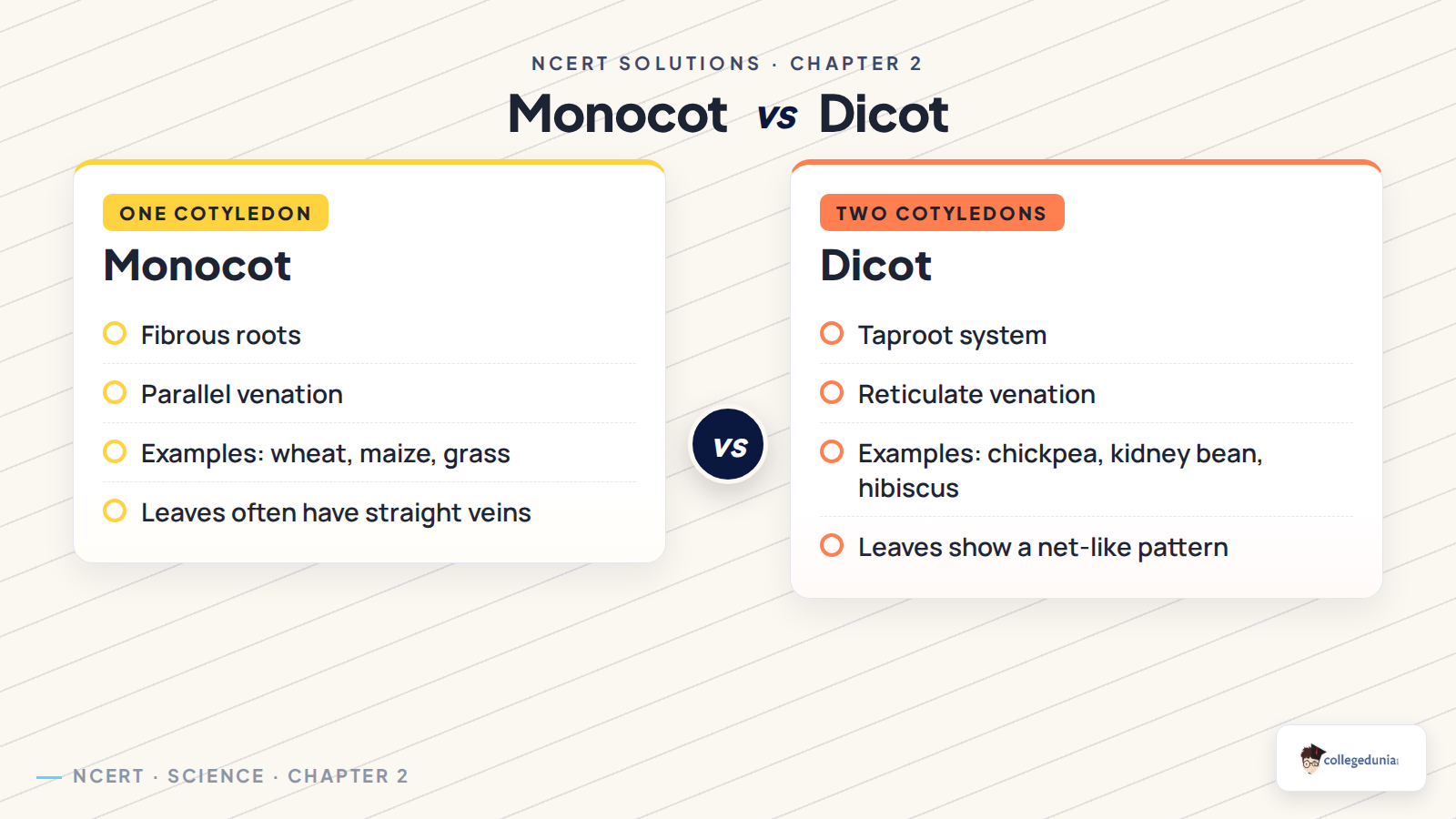
- Wheat is a monocot example, so its plant has fibrous roots and parallel venation.
- Kidney bean is a dicot example, so its plant has a taproot and reticulate venation.
- Radish is a taproot, so its leaves generally show reticulate venation.
- Hibiscus is used in the chapter as a shrub and as a reticulate venation example.
Habitats and Adaptations in Diversity in the Living World
Chapter 2 also explains how habitat affects body features. A fish has fins for swimming. A duck has webbed feet to push water. Camels, goats, deodar trees and rhododendrons show features that help them survive in deserts, plains or mountains.
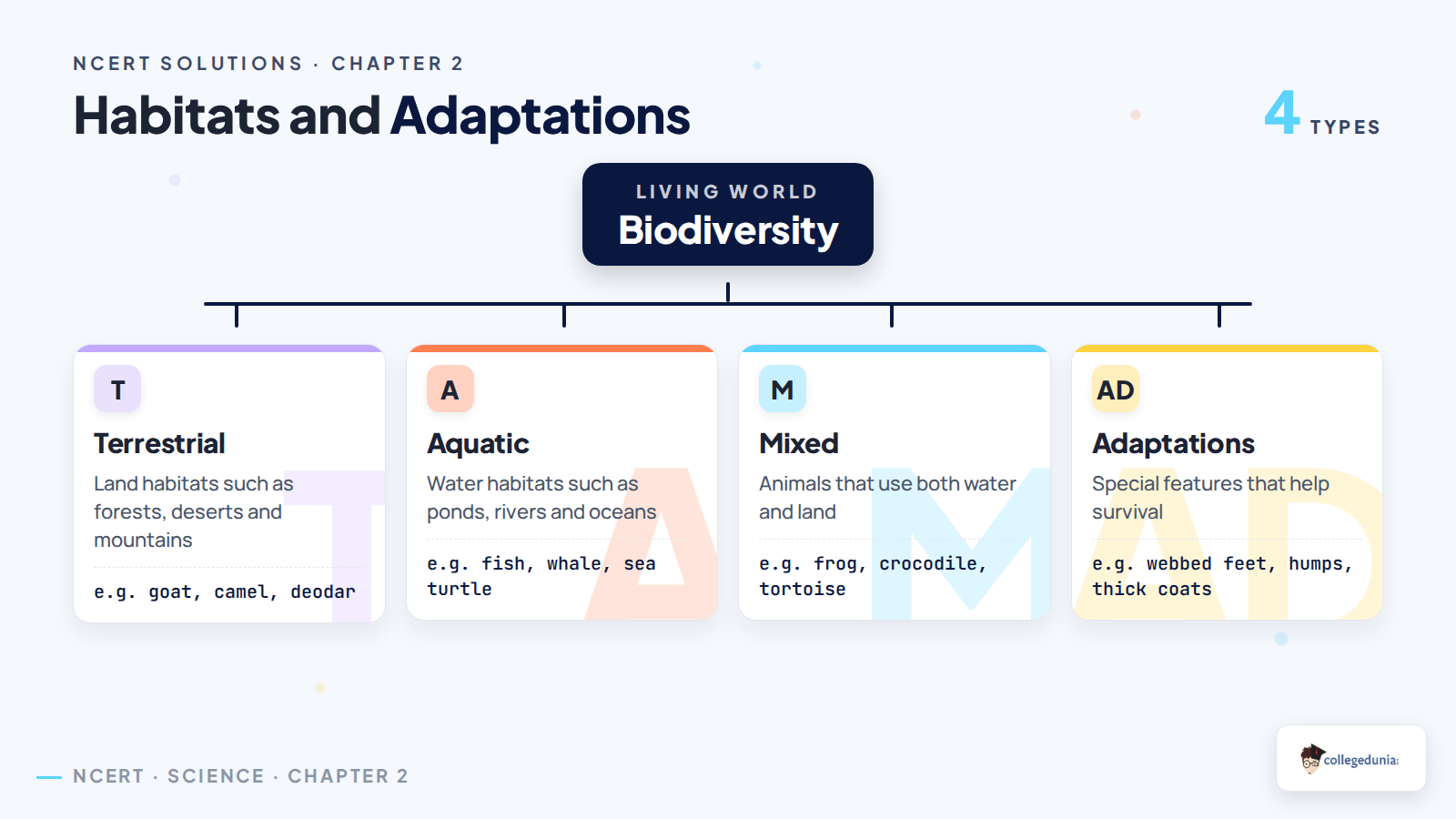
For reasoning questions, students should avoid one-word answers. A strong answer names the habitat, identifies the body feature and explains how that feature helps survival. For example, webbed feet help a duck swim because the joined toes push more water backward.
Question Cards for Chapter 2 NCERT Solutions
The companion question-card page gives each Chapter 2 prompt with a Check Solution panel and an Expert Solution panel. It is useful for quick oral revision before opening the full PDF.
Open question cards: Class 6 Science Chapter 2 step-by-step solutions
Related Class 6 Science Chapter 2 Resources
| Resource | Class 6 Science Chapter 2 Link |
|---|---|
| Revision Notes | Revise Chapter 2 with notes |
| Handwritten Notes | Open handwritten revision notes |
| NCERT Book PDF | Read the official chapter PDF |
Class 6 Science Curiosity NCERT Solutions for All Chapters
| Chapter | NCERT Solutions |
|---|---|
| Chapter 1 | The Wonderful World of Science Solutions |
| Chapter 2 | Diversity in the Living World Solutions |
| Chapter 3 | Mindful Eating: A Path to a Healthy Body Solutions |
| Chapter 4 | Exploring Magnets Solutions |
| Chapter 5 | Measurement of Length and Motion Solutions |
| Chapter 6 | Materials Around Us Solutions |
Class 6 Science Chapter 2 NCERT Solutions FAQs
Ques. What is covered in Class 6 Science Chapter 2 NCERT Solutions?
Ans. The solutions cover biodiversity, grouping of plants and animals, monocot and dicot clues, habitats, adaptations and all 10 exercise questions.
Ques. Are these answers based on the 2026-27 NCERT book?
Ans. Yes. The PDF follows the 2026-27 NCERT Class 6 Science Curiosity Chapter 2 Diversity in the Living World.
Ques. What is the difference between monocot and dicot plants?
Ans. Monocots usually have one cotyledon, fibrous roots and parallel venation. Dicots usually have two cotyledons, taproots and reticulate venation.
Ques. Why are adaptations important in this chapter?
Ans. Adaptations explain how special features, such as webbed feet or thick coats, help living things survive in their habitats.



Comments