The NCERT Solutions for Class 12 Sociology Chapter 6 Globalisation and Social Change answer every textbook question on how worldwide interconnections reshape Indian society, set to the latest 2026-27 CBSE syllabus. Each answer explains the economic, political and cultural sides of globalisation, the 1991 liberalisation, transnational corporations, and the debate between homogenisation and glocalisation. These solutions help students write full board answers and revise fast.
Covers all 4 exercise questions from Social Change and Development in India Chapter 6, with full point-wise answers.
This Class 12 Sociology chapter usually carries 5 to 6 marks per board paper.
Pairs with the Notes, Handwritten Notes and NCERT Book PDF linked lower on this page.
Every solution for Class 12 Sociology Chapter 6 in this Collegedunia compilation is written by subject experts from the official NCERT Social Change and Development in India textbook, and checked against the last five years of CBSE board papers.
Student Feedback: In a Collegedunia poll of 8,650 Class 12 Sociology students taken before the 2026 boards, 74% of students rated glocalisation as the part of Globalisation and Social Change they most wanted a model answer for. Most students said one clear example, like an Indian-flavoured global TV channel, made the whole idea easy to recall.
Source: 2026-27 Class 12 Sociology student poll. Sample of 8,650 students from CBSE schools across 13 states.
What the Globalisation and Social Change Class 12 Chapter Is About
Globalisation and Social Change is the sixth chapter of Social Change and Development in India. It looks at how the growing interdependence of the world's people, economies and cultures changes everyday life in India. The chapter does not treat globalisation as only an economic event. It shows that the economic, political and cultural sides move together, so an answer that names all three usually scores well.
The chapter answers three big questions that students must keep in mind:
What is globalisation? The growing worldwide flow of goods, money, people and ideas.
How does it reach India? Through liberalisation in 1991, transnational corporations and the communication revolution.
What does it do to culture? It sparks the debate between homogenisation and glocalisation.
So the chapter is really about the link between global forces and local life. A student who sorts each fact under "economic", "political" or "cultural" first can connect almost any question in globalisation and social change class 12 back to one of them, which makes revision much faster.
The Economic Dimension of Globalisation
The chapter starts with the economic side because that is where globalisation in India became visible. The key turning point is the 1991 liberalisation, when India opened up its economy to the world. Students should learn the features of a globalised economy as a clear set of points rather than a story.
Liberalisation: the State opens up trade, lowers barriers and lets foreign firms enter, as India did in 1991.
Transnational corporations: companies such as Coca Cola and General Motors that produce and sell across many countries.
Electronic economy: banks and fund managers shift money across the globe at the click of a button.
Weightless or knowledge economy: products like software and media are based on information, not heavy goods.
The point examiners reward is that a globalised economy moves not just goods but money, information and labour across borders. Whenever a question asks for the features of a globalised economy, the safe answer pairs a money example, like the electronic economy, with a labour example, like the new international division of labour. The image below sorts the key economic terms for fast revision.
The Cultural Dimension: Homogenisation and Glocalisation
A large part of the chapter deals with what globalisation does to culture. This is the single most-asked area here, so students should know the central debate well. The list below keeps the key ideas together.
Homogenisation: the fear that all cultures will become similar and local ways of life will vanish.
Glocalisation: the mixing of the global with the local, so global products take on a local flavour.
Culture is not fixed: the chapter corrects the idea that any culture is pure or unchanging.
Culture of consumption: malls, multiplexes and advertising promote a new shopping-led lifestyle.
The honest exam point is that globalisation does not simply wipe out local culture; it often blends with it to create new local and global traditions. A balanced answer notes the homogenisation worry, then shows how foreign TV channels add Indian content, food chains add Indian dishes, and festivals take on new forms. Showing both sides is what lifts a "discuss" answer to full marks. The image below sets the two views side by side.
Globalisation and Social Change Class 12 Exercise-wise Coverage
The chapter exercise has 4 questions. The table maps each one to its topic so students can plan revision and find the right NCERT answer fast. The full point-wise solution for each sits in the question set lower on this page.
Question
Topic it tests
Q 1
How globalisation has affected a chosen topic such as cinema, work or marriage
Q 2
Distinctive features of a globalised economy (discuss)
Q 3
Impact of globalisation on culture
Q 4
What glocalisation is, and whether it is a market strategy or real cultural synthesis
Questions 2, 3 and 4 are the most-asked long answers, so students preparing globalisation and social change class 12 important questions should learn those three first. Question 1 is open-ended, so a clear example like cinema makes it easy to score.
Students who want the offline copy can save the class 12 sociology chapter 6 pdf from the download card above and tick off each question as they finish it.
Globalisation and Social Change Important Questions and Previous Year Trends
CBSE sets a steady mix of short and long answers from this chapter. Knowing the pattern helps students decide how much to write. The chapter is a regular source of a 4-mark or 6-mark question, which is why a focused list of globalisation and social change important questions saves a lot of revision time.
Long answer (5 to 6 marks): the features of a globalised economy, or the impact of globalisation on culture.
Short answer (4 marks): the meaning and examples of glocalisation, or the role of transnational corporations.
Concept-based: the difference between homogenisation and glocalisation.
Example-based: how globalisation changed cinema, work or marriage in India.
For quick recall before the exam, students often practise the class 12 sociology chapter 6 important questions and a list of globalisation and social change class 12 questions and answers. The most repeated items are glocalisation and the features of the globalised economy, so keep those answer points ready in your own words.
Working through the ncert solutions class 12 sociology chapter 6 set twice, once open-book and once from memory, fixes the terms and the examples well before the board exam.
Common Mistakes Students Make in This Chapter
A few errors cost marks every year in this chapter. Most come from treating globalisation as only economic or from giving a one-sided view of culture. Avoiding them is the fastest way to lift a score.
Treating globalisation as only economic - it also has political and cultural sides.
Saying globalisation simply destroys local culture - it often blends to form new traditions.
Confusing homogenisation with glocalisation - one means becoming similar, the other means mixing.
Forgetting that liberalisation in 1991 is India's main entry point into globalisation.
Writing a one-sided "discuss" answer - always show both the gain and the cost.
Students who fix these five points usually move from average to high marks on the long answers. The exam rewards a balanced view, so always show both the benefit and the cost before you judge globalisation's effect.
Globalisation and Social Change PDF Download Formats and Languages
The solutions are free to download in more than one format, so students can pick what suits their device and revision style. The download card at the top of the page carries each option for this chapter.
Normal and HD PDF: the class 12 sociology chapter 6 pdf comes in a normal size for quick downloads and an HD version for clear printing.
English medium: all 4 answers are written in simple English for the CBSE board paper.
Question-only set: a print-and-practise sheet of globalisation and social change extra questions for self-testing.
Whole-book pack: the solutions sit in one set that runs through every Social Change and Development in India chapter, so you can revise in one place.
Many students search for class 12 sociology chapter 6 answers on their phone the night before a test, so a saved PDF means you can revise even without internet. Keep both the question set and the solved version handy for a full self-check.
How These Solutions Pair with the Notes and Book PDF
These NCERT Solutions answer the back-exercise questions. To revise the full chapter, students should use them alongside the other resources for the same chapter, all linked in the table below.
Tip: read the Notes first, then attempt these solutions on your own, and only then check the model answers here. That order builds memory faster than copying answers straight away.
All NCERT Solutions for Class 12 Sociology
The table links the NCERT Solutions for every chapter in both Class 12 Sociology books, so students can move across the course in one click. Globalisation and Social Change is highlighted.
All NCERT Solutions for Globalisation and Social Change with Step-by-Step Solutions
Below are all 4 NCERT exercise questions for this chapter, exactly as they appear in the textbook. Tap Check Solution for the model answer or Expert Solution for the topper-style approach.
Q 6.1
Choose any topic that is of interest to you and discuss how you think
globalisation has affected it. You could choose cinema, work, marriage or any
other topic.
Concept used.Globalisation is the growing interdependence
between people, regions and countries as social and economic relationships
stretch world-wide. The chapter uses the sociological imagination to
connect the personal and the public, the local and the global. Any everyday
topic, such as cinema, work or marriage, can be read as a place where distant
policies of globalisation touch private lives. Here the chosen topic is
cinema.
How globalisation has affected cinema (the chosen topic).
Wider reach and global audiences. The communication revolution,
satellite television, the Internet and digital distribution, lets Indian
films reach viewers across the world and brings foreign films and
streaming content into Indian homes. Cinema is no longer bounded by the
nation.
Glocalisation of content. The chapter's idea of glocalisation, the
mixing of the global with the local, is visible in films. Earlier
stories stayed local even when scenes were shot abroad; now there are
stories set entirely outside India, and global styles of music, fashion
and storytelling blend with Indian themes.
Changes in production and finance. Film production has become more
commercial and globally financed, with international locations,
corporate studios and a culture of consumption that promotes spending,
glamour and brand tie-ins, the same culture the chapter links to
shopping malls and fashion pageants.
Pressure on local traditions. As globalised, big-budget cinema spreads,
smaller regional and traditional forms of entertainment can be
squeezed, echoing the chapter's point about the threat globalisation
poses to indigenous and traditional cultural forms.
Using the sociological imagination. The point is not just to describe
cinema but to show the link between a personal pleasure (watching a film) and
the macro process of globalisation (open markets, satellite media, glocalised
content). The same exercise can be done with work (call centres, BPOs, flexible
labour) or marriage (matrimonial websites, changing expectations).
Taking cinema as the topic: globalisation has widened its reach
through satellite media and the Internet, brought in foreign films and
streaming, and produced glocalised content (global styles mixed with Indian
stories, some set entirely abroad). It has made production more commercial and
globally financed and tied film to a culture of consumption, while putting
pressure on smaller traditional forms of entertainment. Read with the
sociological imagination, a private act like watching a film is connected to
the macro process of globalisation.
TM
Tara Menon
MA Sociology, Delhi School of Economics
Verified Expert
Strategic angle. The examiner is really testing one skill: can you use
the sociological imagination to connect a personal topic to the macro forces of
globalisation? So choose one topic, then run it through the chapter's three
dimensions, economic, cultural and communication, and finish by naming the
link between the micro and the macro.
Pick and frame. Choose cinema (or work, or marriage) and state up front
that you will read it as a meeting point of the personal and the global.
Apply the cultural dimension. Glocalisation: global film styles, music
and locations mixed with Indian stories; the culture of consumption that
promotes glamour and spending.
Apply the economic and communication dimensions. Corporate, globally
financed production; satellite media and the Internet that carry films
across borders and bring foreign content in.
Close on the imagination. Tie it together: watching a film is a private
act, but it sits inside open markets, global media and glocalised
culture. That micro-macro link is the chapter's central method.
Why this matters. The mark-winning move here is not the topic you pick
but the method you show. Examiners reward a clear use of the sociological
imagination, the deliberate connection of an everyday interest to large-scale
processes (liberalisation, global media, glocalisation), rather than a loose
list of ``changes I have noticed.''
Whichever topic you choose, the strong answer applies the sociological
imagination: for cinema, show how satellite media and the Internet globalise its
reach, how glocalisation blends global and local content, how production becomes
commercial and globally financed, and how it joins a culture of consumption,
then name the link between this private pleasure and the macro process of
globalisation.
Q 6.2
What are the distinctive features of a globalised economy? Discuss.
Concept used. A globalised economy is one in which economic
relationships, production, finance, labour and trade, stretch across the world
rather than staying within national borders. The chapter spells out several
distinctive features driven above all by information and communication
technologies. The key features are liberalisation, transnational corporations,
the electronic economy, the weightless or knowledge economy, the globalisation
of finance and a new international division of labour.
Distinctive features of a globalised economy.
Liberalisation of economic policy. States open up their economies to the
world market. In India, since 1991, liberalisation removed many rules
regulating trade and finance, allowed greater foreign investment, and
involved loans from bodies like the IMF with conditions of
structural adjustment, often cutting state spending on health, education
and social security.
Transnational corporations (TNCs). Companies such as Coca Cola, General
Motors and Colgate-Palmolive produce goods or market services in more
than one country. They are oriented to global markets and global
profits even when they have a clear national base, and some Indian
firms too are becoming transnational.
The electronic economy. Banks, corporations, fund managers and
individual investors can shift funds internationally with the click of a
mouse. This instant movement of ``electronic money'' carries great risk,
seen in rising stock markets and sudden dips when foreign investors buy
and sell.
The weightless or knowledge economy. Production is no longer mainly
agricultural or industrial. The weightless economy has its base in
information, computer software, media, entertainment and Internet
services, and much of the workforce is involved in design, development,
marketing and servicing rather than physical production. New occupations
such as event managers appear.
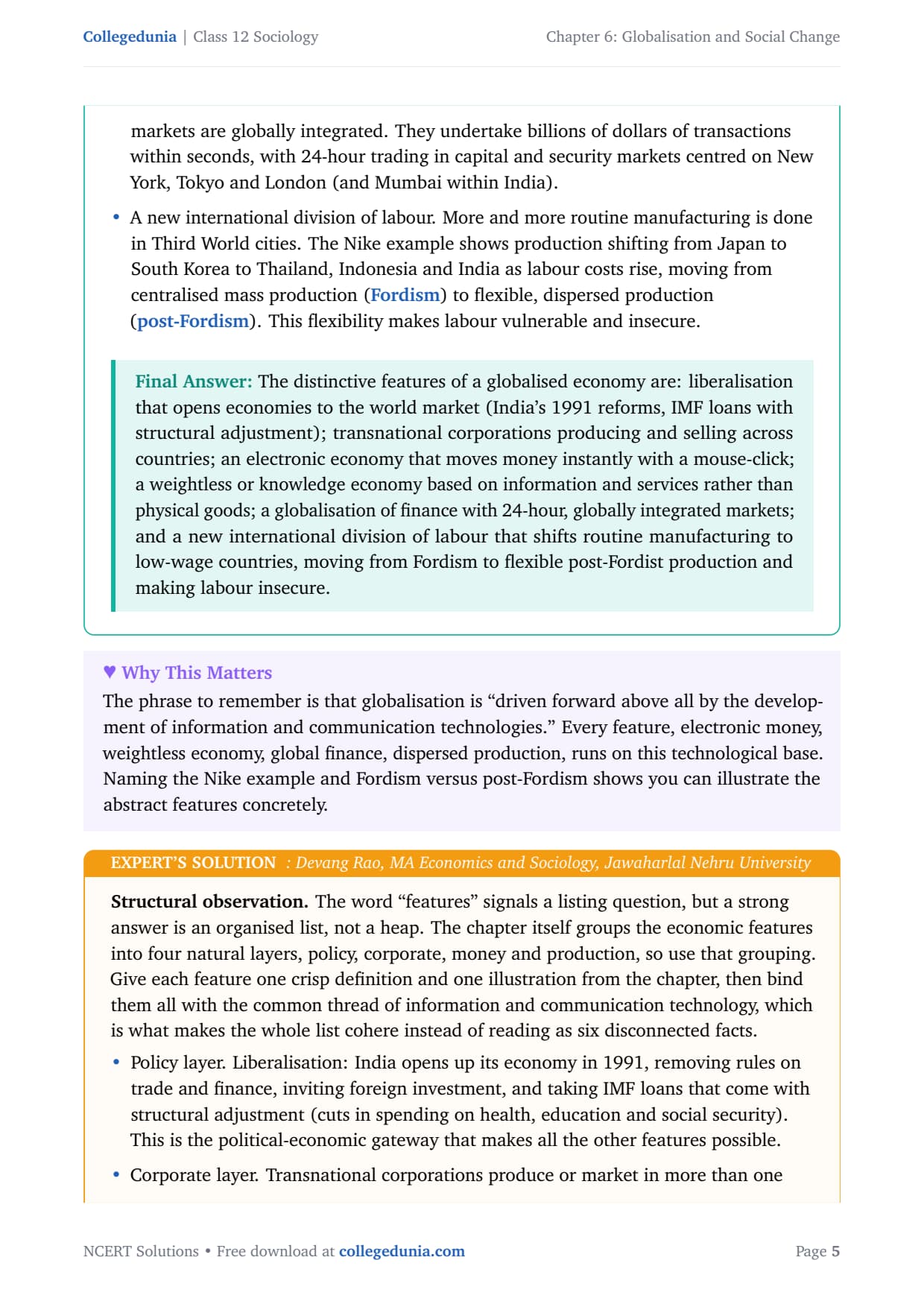
Globalisation of finance. For the first time, mainly due to the IT
revolution, financial markets are globally integrated. They undertake
billions of dollars of transactions within seconds, with 24-hour trading
in capital and security markets centred on New York, Tokyo and London
(and Mumbai within India).
A new international division of labour. More and more routine
manufacturing is done in Third World cities. The Nike example shows
production shifting from Japan to South Korea to Thailand, Indonesia and
India as labour costs rise, moving from centralised mass production
(Fordism) to flexible, dispersed production
(post-Fordism). This flexibility makes labour vulnerable and
insecure.
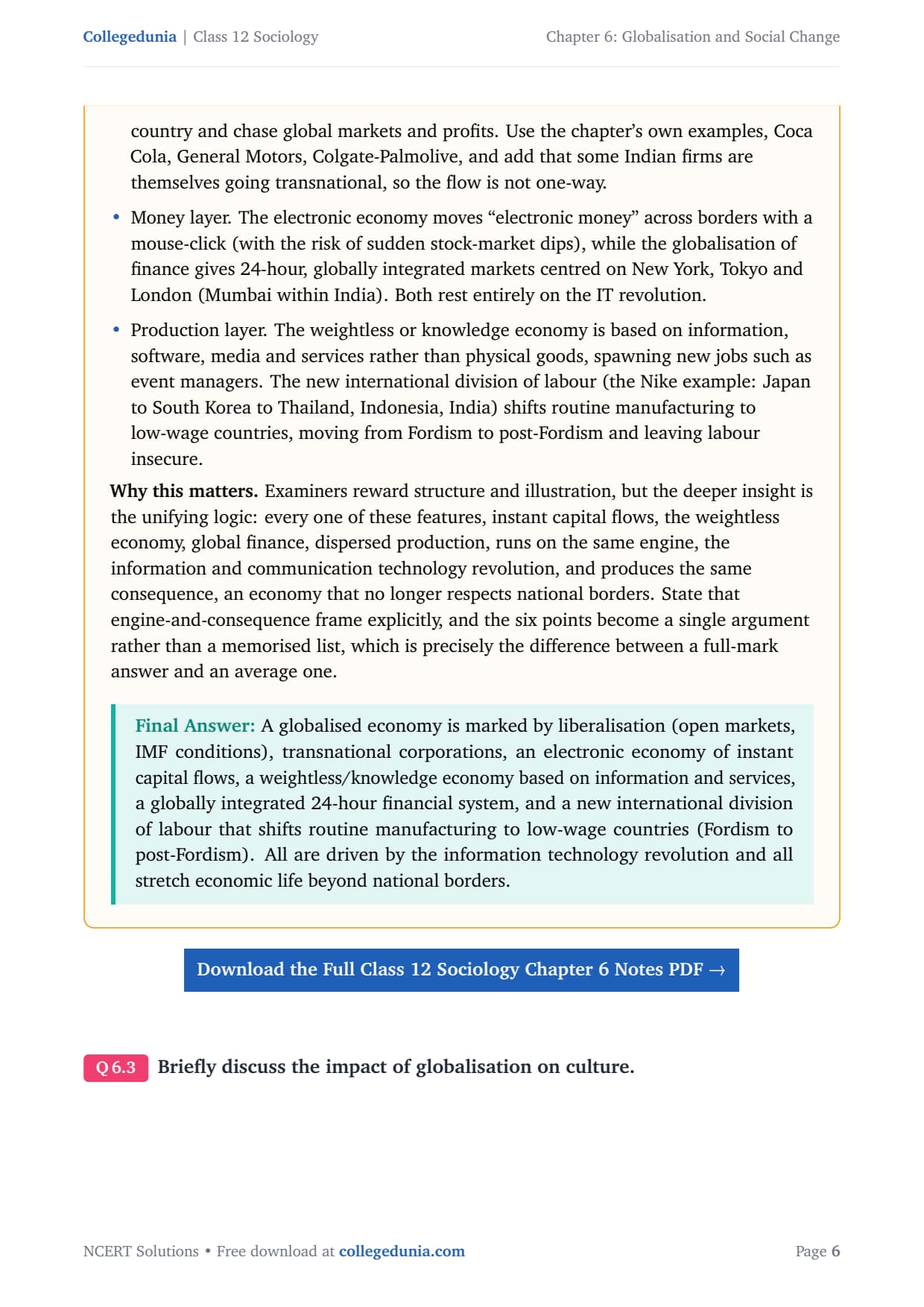
The distinctive features of a globalised economy are: liberalisation
that opens economies to the world market (India's 1991 reforms, IMF loans with
structural adjustment); transnational corporations producing and selling across
countries; an electronic economy that moves money instantly with a mouse-click;
a weightless or knowledge economy based on information and services rather than
physical goods; a globalisation of finance with 24-hour, globally integrated
markets; and a new international division of labour that shifts routine
manufacturing to low-wage countries, moving from Fordism to flexible
post-Fordist production and making labour insecure.
DR
Devang Rao
MA Economics and Sociology, Jawaharlal Nehru University
Verified Expert
Structural observation. The word ``features'' signals a listing
question, but a strong answer is an organised list, not a heap. The chapter
itself groups the economic features into four natural layers, policy, corporate,
money and production, so use that grouping. Give each feature one crisp
definition and one illustration from the chapter, then bind them all with the
common thread of information and communication technology, which is what makes
the whole list cohere instead of reading as six disconnected facts.
Policy layer. Liberalisation: India opens up its economy in 1991,
removing rules on trade and finance, inviting foreign investment, and
taking IMF loans that come with structural adjustment (cuts in spending
on health, education and social security). This is the political-economic
gateway that makes all the other features possible.
Corporate layer. Transnational corporations produce or market in more
than one country and chase global markets and profits. Use the chapter's
own examples, Coca Cola, General Motors, Colgate-Palmolive, and add that
some Indian firms are themselves going transnational, so the flow is not
one-way.
Money layer. The electronic economy moves ``electronic money'' across
borders with a mouse-click (with the risk of sudden stock-market dips),
while the globalisation of finance gives 24-hour, globally integrated
markets centred on New York, Tokyo and London (Mumbai within India).
Both rest entirely on the IT revolution.
Production layer. The weightless or knowledge economy is based on
information, software, media and services rather than physical goods,
spawning new jobs such as event managers. The new international division
of labour (the Nike example: Japan to South Korea to Thailand, Indonesia,
India) shifts routine manufacturing to low-wage countries, moving from
Fordism to post-Fordism and leaving labour insecure.
Why this matters. Examiners reward structure and illustration, but the
deeper insight is the unifying logic: every one of these features, instant
capital flows, the weightless economy, global finance, dispersed production,
runs on the same engine, the information and communication technology
revolution, and produces the same consequence, an economy that no longer
respects national borders. State that engine-and-consequence frame explicitly,
and the six points become a single argument rather than a memorised list, which
is precisely the difference between a full-mark answer and an average one.
A globalised economy is marked by liberalisation (open markets, IMF
conditions), transnational corporations, an electronic economy of instant
capital flows, a weightless/knowledge economy based on information and services,
a globally integrated 24-hour financial system, and a new international division
of labour that shifts routine manufacturing to low-wage countries (Fordism to
post-Fordism). All are driven by the information technology revolution and all
stretch economic life beyond national borders.
Q 6.3
Briefly discuss the impact of globalisation on culture.
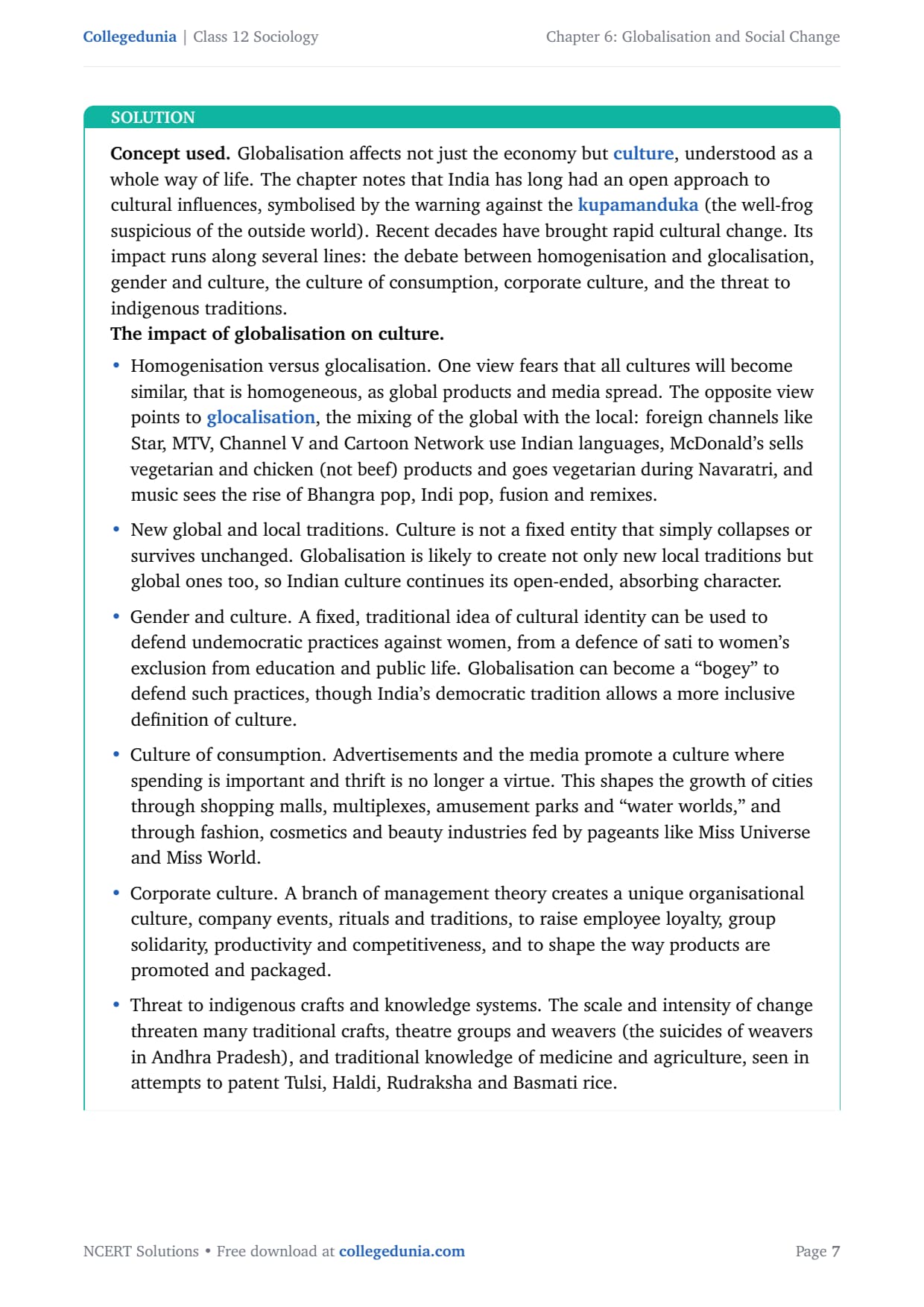
Concept used. Globalisation affects not just the economy but
culture, understood as a whole way of life. The chapter notes that
India has long had an open approach to cultural influences, symbolised by the
warning against the kupamanduka (the well-frog suspicious of the
outside world). Recent decades have brought rapid cultural change. Its impact
runs along several lines: the debate between homogenisation and glocalisation,
gender and culture, the culture of consumption, corporate culture, and the
threat to indigenous traditions.
The impact of globalisation on culture.
Homogenisation versus glocalisation. One view fears that all cultures
will become similar, that is homogeneous, as global products and media
spread. The opposite view points to glocalisation, the mixing
of the global with the local: foreign channels like Star, MTV, Channel V
and Cartoon Network use Indian languages, McDonald's sells vegetarian
and chicken (not beef) products and goes vegetarian during Navaratri,
and music sees the rise of Bhangra pop, Indi pop, fusion and remixes.
New global and local traditions. Culture is not a fixed entity that
simply collapses or survives unchanged. Globalisation is likely to
create not only new local traditions but global ones too, so Indian
culture continues its open-ended, absorbing character.
Gender and culture. A fixed, traditional idea of cultural identity can
be used to defend undemocratic practices against women, from a defence
of sati to women's exclusion from education and public life.
Globalisation can become a ``bogey'' to defend such practices, though
India's democratic tradition allows a more inclusive definition of
culture.
Culture of consumption. Advertisements and the media promote a culture
where spending is important and thrift is no longer a virtue. This
shapes the growth of cities through shopping malls, multiplexes,
amusement parks and ``water worlds,'' and through fashion, cosmetics and
beauty industries fed by pageants like Miss Universe and Miss World.
Corporate culture. A branch of management theory creates a unique
organisational culture, company events, rituals and traditions, to raise
employee loyalty, group solidarity, productivity and competitiveness,
and to shape the way products are promoted and packaged.
Threat to indigenous crafts and knowledge systems. The scale and
intensity of change threaten many traditional crafts, theatre groups and
weavers (the suicides of weavers in Andhra Pradesh), and traditional
knowledge of medicine and agriculture, seen in attempts to patent Tulsi,
Haldi, Rudraksha and Basmati rice.
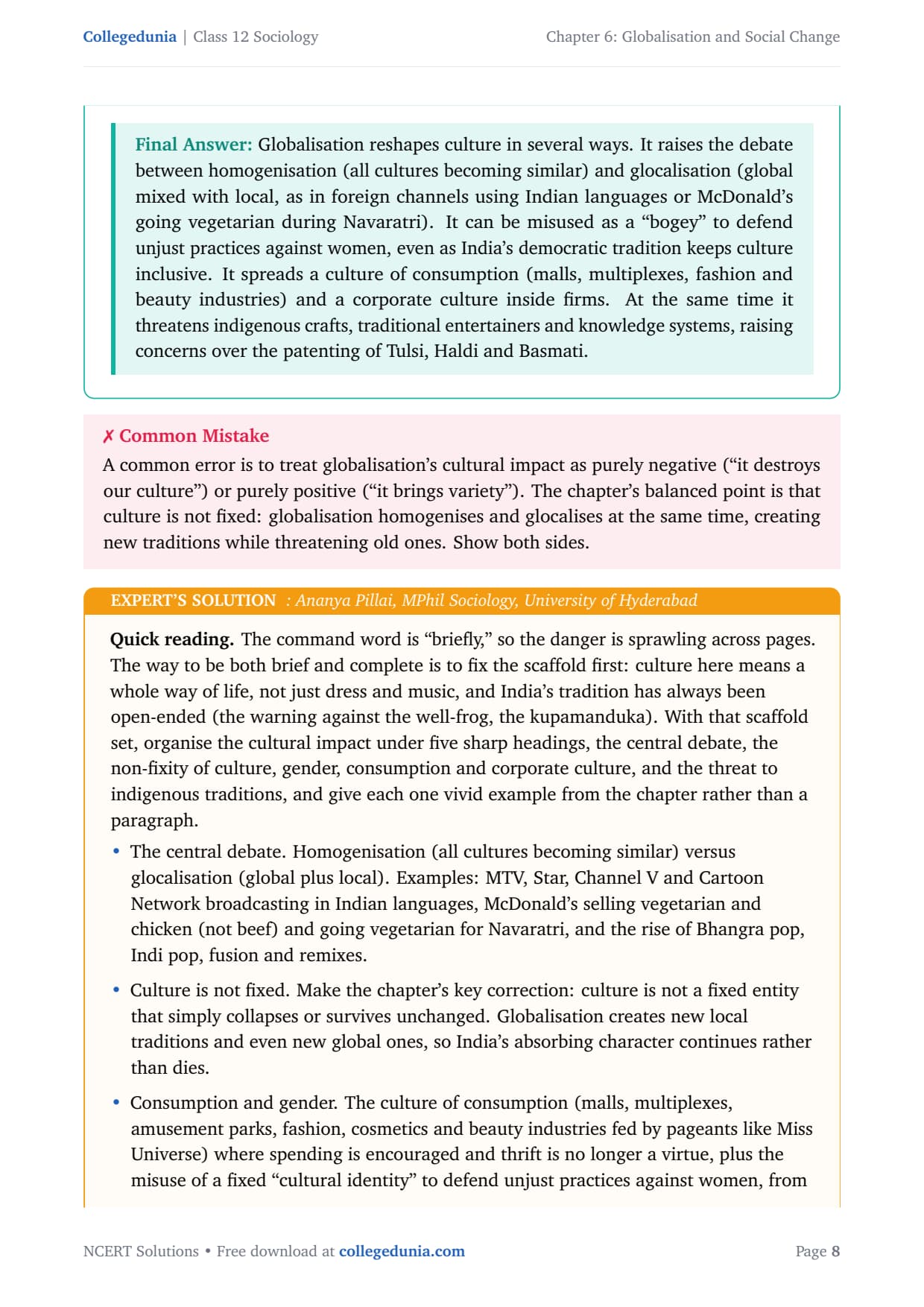
Globalisation reshapes culture in several ways. It raises the debate
between homogenisation (all cultures becoming similar) and glocalisation
(global mixed with local, as in foreign channels using Indian languages or
McDonald's going vegetarian during Navaratri). It can be misused as a ``bogey''
to defend unjust practices against women, even as India's democratic tradition
keeps culture inclusive. It spreads a culture of consumption (malls, multiplexes,
fashion and beauty industries) and a corporate culture inside firms. At the same
time it threatens indigenous crafts, traditional entertainers and knowledge
systems, raising concerns over the patenting of Tulsi, Haldi and Basmati.
AP
Ananya Pillai
MPhil Sociology, University of Hyderabad
Verified Expert
Quick reading. The command word is ``briefly,'' so the danger is
sprawling across pages. The way to be both brief and complete is to fix the
scaffold first: culture here means a whole way of life, not just dress and
music, and India's tradition has always been open-ended (the warning against the
well-frog, the kupamanduka). With that scaffold set, organise the cultural
impact under five sharp headings, the central debate, the non-fixity of culture,
gender, consumption and corporate culture, and the threat to indigenous
traditions, and give each one vivid example from the chapter rather than a
paragraph.
The central debate. Homogenisation (all cultures becoming similar) versus
glocalisation (global plus local). Examples: MTV, Star, Channel V and
Cartoon Network broadcasting in Indian languages, McDonald's selling
vegetarian and chicken (not beef) and going vegetarian for Navaratri,
and the rise of Bhangra pop, Indi pop, fusion and remixes.
Culture is not fixed. Make the chapter's key correction: culture is not
a fixed entity that simply collapses or survives unchanged. Globalisation
creates new local traditions and even new global ones, so India's
absorbing character continues rather than dies.
Consumption and gender. The culture of consumption (malls, multiplexes,
amusement parks, fashion, cosmetics and beauty industries fed by pageants
like Miss Universe) where spending is encouraged and thrift is no longer
a virtue, plus the misuse of a fixed ``cultural identity'' to defend
unjust practices against women, from sati to exclusion from education.
Corporate culture and the cost. Corporate culture builds loyalty and
solidarity inside firms through events and rituals; against this stands
the threat to indigenous crafts, defunct theatre groups and weavers
(the Andhra Pradesh suicides) and knowledge systems, with the patenting
of Tulsi, Haldi, Rudraksha and Basmati as the standout example.
Why this matters. The insight examiners look for is balance: culture is
neither a fragile object that globalisation smashes nor something it simply
enriches. By holding homogenisation and glocalisation together in one breath,
and by pairing the gains (variety, new local and global traditions) with the
losses (crafts, entertainers, knowledge systems), you show the nuanced,
two-handed understanding the chapter is built around, which is exactly what
separates a top answer from a one-sided ``globalisation is good/bad'' response.
Globalisation's cultural impact spans the homogenisation-versus-
glocalisation debate (global mixed with local, as in foreign channels using
Indian languages and McDonald's going vegetarian for Navaratri), the misuse of
fixed cultural identity against women, the spread of a culture of consumption
(malls, multiplexes, fashion) and corporate culture, and the threat to
indigenous crafts and knowledge systems (the patenting of Tulsi, Haldi and
Basmati). Culture is not fixed: globalisation both creates new traditions and
endangers old ones.
Q 6.4
What is glocalisation? Is it simply a market strategy adopted by
multinational companies or is genuine cultural synthesis taking place? Discuss.
Concept used.Glocalisation refers to the mixing of the
global with the local. The chapter places it against
homogenisation, the fear that all cultures will become similar.
Glocalisation is presented as ambiguous: it is partly a deliberate
market strategy of foreign firms and partly a real cultural blending.
The question asks you to weigh these two readings.
What glocalisation is.
Definition. Glocalisation is the mixing of the global with the local. It
is neither entirely spontaneous nor entirely delinked from the
commercial interests of globalisation.
Examples. Foreign television channels like Star, MTV, Channel V and
Cartoon Network use Indian languages; McDonald's sells only vegetarian
and chicken products in India (not beef) and goes vegetarian during
Navaratri; in music there is Bhangra pop, Indi pop, fusion music and
remixes.
Glocalisation as a market strategy.
It is a strategy often adopted by foreign firms while dealing with local
traditions in order to enhance their marketability. By
speaking the local language and respecting local tastes (vegetarian
food, festival menus), multinational companies sell more to Indian
consumers.
In this sense glocalisation is driven by commercial interest: the
company adapts not out of respect for culture but to expand its market
and profits.
Glocalisation as genuine cultural synthesis.
At the same time, the chapter argues that culture is not a fixed entity
and that India has always had an open-ended, absorbing approach to
outside influences. Real blending does take place: Indian and global
forms mix to create new music (fusion, remix), new media and new
styles.
Globalisation, on this view, leads to the creation of not just new local
traditions but global ones too. So genuine synthesis, new cultural forms
that are neither purely Indian nor purely foreign, is also happening.
Balanced conclusion. Glocalisation is therefore both: a market strategy
used by multinationals and a real process of cultural synthesis. The two
are intertwined, the commercial motive and the cultural mixing happen
together, which is exactly why the chapter says it is ``not entirely
spontaneous'' yet ``not entirely delinked'' from commerce.
Glocalisation is the mixing of the global with the local, seen in
foreign channels using Indian languages, McDonald's selling vegetarian and
chicken products (and going vegetarian for Navaratri), and Bhangra pop, Indi
pop and remixes. It is partly a market strategy: multinationals adapt to local
tastes to enhance marketability and profits. But it is also genuine cultural
synthesis, since culture is not fixed and India's open-ended tradition produces
real new blends, including new global traditions. So it is both at once,
commercial strategy and authentic synthesis intertwined, neither entirely
spontaneous nor entirely delinked from commercial interest.
FQ
Farah Qureshi
MA Sociology, Jamia Millia Islamia
Verified Expert
Strategic angle. The question is deliberately built as a debate,
``simply a market strategy or genuine synthesis?'', and the trap is to pick one
horn and run with it. Refuse the false choice. The structure that earns full
marks has four moves: define the term cleanly, argue side A (it is a commercial
strategy), argue side B (it is real cultural synthesis), then resolve the tension
by showing the two are intertwined, quoting the chapter's own careful hedge that
glocalisation is neither wholly spontaneous nor wholly commercial.
Define and illustrate. Glocalisation is the mixing of the global with the
local. Anchor it with the chapter's examples: MTV, Star, Channel V and
Cartoon Network broadcasting in Indian languages, McDonald's selling only
vegetarian and chicken products and going vegetarian for Navaratri, and
the spread of Bhangra pop, Indi pop, fusion music and remixes.
Side A, market strategy. Foreign firms adapt to local traditions
deliberately, to enhance their marketability. Speaking the local language
and honouring local tastes (vegetarian menus, festival specials) is a way
to sell more, so the driving motive here is clearly commercial profit.
Side B, genuine synthesis. Yet culture is not a fixed entity, and India's
open-ended, absorbing tradition produces real new blends, fusion music,
new media forms, new styles, that are neither purely Indian nor purely
foreign. The chapter even says globalisation creates new global
traditions, so authentic cultural mixing is genuinely under way.
Resolve. Conclude that it is both at once. The commercial motive and the
cultural blending are not rivals but partners: a firm chasing profit can,
in the very act of adapting, set off real synthesis. That is why the
chapter calls glocalisation ``not entirely spontaneous'' yet ``not
entirely delinked'' from commercial interests.
Why this matters. The mark-winning insight is that glocalisation is
genuinely double-edged: a company can pursue profit and, in doing so, still
generate real cultural synthesis, so the ``either/or'' framing of the question is
itself the thing to dismantle. Holding both truths together, and proving it with
the chapter's exact ``not entirely spontaneous, not entirely delinked'' phrasing,
shows the balanced, evidence-anchored judgement the examiner is actually testing
for, rather than a flat verdict on one side.
Glocalisation, the mixing of global and local (foreign channels in
Indian languages, McDonald's going vegetarian, fusion music), is both a market
strategy and genuine synthesis. Firms adapt to local tastes to boost
marketability and profit, yet because culture is not fixed and India is
open-ended, real new cultural blends (even global ones) also emerge. It is
therefore both at once: neither entirely spontaneous nor entirely delinked from
commercial interest.
FAQs on Globalisation and Social Change Class 12 NCERT Solutions
Globalisation and Social Change Class 12 Sociology Common Questions
Ques. Where can I get the class 12 sociology chapter 6 NCERT Solutions PDF?
Ans. You can download the Globalisation and Social Change Class 12 Sociology NCERT Solutions PDF directly from this page. It is free, follows the 2026-27 NCERT, and answers all 4 exercise questions point by point.
Ques. How many questions are there in globalisation and social change class 12 questions and answers?
Ans. The chapter has 4 exercise questions. They cover how globalisation affects a chosen topic like cinema, the features of a globalised economy, the impact on culture, and the meaning of glocalisation.
Ques. What are the distinctive features of a globalised economy?
Ans. A globalised economy is marked by liberalisation, transnational corporations, an electronic economy that moves money instantly, a weightless or knowledge economy based on information, and a new international division of labour. India entered this system mainly through the 1991 reforms.
Ques. What is glocalisation in Class 12 Sociology?
Ans. Glocalisation is the mixing of the global with the local. Foreign firms often adapt global products to local tastes, such as TV channels adding Indian content or food chains adding Indian dishes. It is partly a market strategy and partly genuine cultural synthesis, so a balanced answer shows both sides.
Ques. How does globalisation affect Indian culture?
Ans. Globalisation sparks a debate between homogenisation, the fear that all cultures become similar, and glocalisation, where global and local blend into new traditions. It also spreads a culture of consumption through malls and media, while raising concern for indigenous crafts and knowledge.
Ques. Is class 12 sociology chapter 6 easy to score in the board exam?
Ans. Yes. It is a high-scoring chapter if you keep the three dimensions straight and remember a clear example for glocalisation. Practise the features of a globalised economy and keep a balanced "discuss" answer ready for the question on culture.








Comments