Sociology Mentor, Ashoka | Updated on - Jul 21, 2026
The NCERT Solutions for Class 12 Sociology Chapter 3 Social Institutions Continuity and Change answer every textbook question on the caste system, tribes and the family, set to the latest 2026-27 CBSE syllabus. Each answer explains how separation and hierarchy hold caste together, how tribes are classified, and the difference between matriliny and matriarchy. These solutions help students write full board answers and revise fast.
Covers all 10 exercise questions from Indian Society Chapter 3, with point-wise model answers.
This Class 12 Sociology chapter usually carries 5 to 6 marks per board paper.
Pairs with the Notes, Handwritten Notes and NCERT Book PDF linked lower on this page.
Every solution for Class 12 Sociology Chapter 3 in this Collegedunia compilation is written by subject experts from the official NCERT Indian Society textbook, and checked against the last five years of CBSE board papers.
Student Feedback: In a Collegedunia poll of 8,140 Class 12 Sociology students taken before the 2026 boards, 72% of students rated the difference between matriliny and matriarchy as the part of Social Institutions Continuity and Change they most wanted a model answer for. Most students said a clear two-column split made the answer easy to write.
Source: 2026-27 Class 12 Sociology student poll. Sample of 8,140 students from CBSE schools across 12 states.
What the Social Institutions Continuity and Change Class 12 Chapter Is About
Social Institutions Continuity and Change is the third chapter of Indian Society. It looks at three core institutions of Indian life: the caste system, the tribe and the family. The chapter shows how each one both stays the same across generations and slowly changes under colonial rule, the law and city life. That double idea of continuity and change runs through every answer.
The chapter answers three big questions that students must keep in mind:
What is caste? A closed, ranked system held together by separation and hierarchy, which changed sharply under colonial rule.
Who are tribes? Communities classified by region, language and livelihood, now asserting their own identity.
What is the family? A kinship unit that takes many forms, from nuclear to matrilineal, and changes with society.
So the chapter is really about how India social structure holds and shifts at the same time. A student who keeps the three institutions separate, then asks "what stays" and "what changes" for each, can connect almost any question in Social Institutions Continuity and Change class 12 back to that frame.
Caste: Separation and Hierarchy
The caste section is the most asked part of the chapter, so students should learn it as a clear set of features. Caste rests on two linked ideas, and the exam often turns on naming both.
Separation: rules on marriage, food and contact keep each caste apart from the others.
Hierarchy: castes are ranked from pure to impure in a fixed order, settled by birth.
Endogamy: members must marry inside their own caste, which keeps the group closed.
Hereditary occupation: each caste was once tied to a traditional kind of work.
The point examiners test most is that caste combines separation with hierarchy. It is not enough to say castes are different; the answer must add that they are also ranked high or low. Keep this twin idea ready, because the very first exercise question turns on it.
What Changed in Caste Under Colonialism
Colonial rule reshaped caste in lasting ways, and this is a regular short answer. Students should learn the changes as a clear list rather than a story.
Change
What to recall
The census
The 1901 census tried to rank every caste, which hardened fluid identities into fixed lists.
Land settlements
New land laws and revenue records gave some castes secure land and weakened others.
Administration
The colonial state used caste data to run the bureaucracy and the army.
Social reform
Reformers and missionaries opened schools, slowly loosening some caste rules.
A key insight for the exam is that colonial rule made caste more rigid, not less. By counting and ranking castes, the census turned a loose, local system into firm, all-India categories. That is the trap in many MCQs, which expect students to say colonialism simply weakened caste.
Why Caste Became Invisible for the Urban Upper Castes
The chapter makes a sharp point about caste in the modern city, and it is a favourite long answer. Learn the idea as a contrast between two groups.
For the upper castes, caste feels invisible because their advantages now look like merit, education and good jobs.
For the lower castes, caste stays very visible, since it still decides their chances and their treatment.
Caste did not vanish; it simply changed form from open ritual rank to hidden social networks.
The judgement most answers should reach is that caste is invisible only for those it helps. Upper castes no longer see caste because it works quietly in their favour, through old networks and inherited capital. Lower castes cannot stop seeing it, because it still blocks them. A balanced answer names both sides.
Tribes: Classification and the Assertion of Identity
The tribe section asks how tribes are grouped and why tribal identity is rising today. This is a regular two-part question, so learn both halves.
By region: most tribes live in the central tribal belt and the North East.
By language: they fall under the Indo-Aryan, Dravidian, Austric and Tibeto-Burman families.
By livelihood: from fishing and hunting to shifting and settled farming.
By size: the Gond, Bhil and Santhal are the largest; some tribes have only a few hundred people.
The honest exam point is that tribes are not isolated or primitive. The chapter gives clear evidence against that myth: tribes have long traded with settled society, taken part in markets, and shared in regional cultures. Today, tribal identity is asserted through education, the fight for land and forest rights, and a shared sense of being left out of development. Marks come from giving the classification and the reasons for assertion together.
The Family: Forms, Change and Matriliny versus Matriarchy
The family section closes the chapter and is the source of the most-asked question of all. Students should know the forms the family takes and the two terms that confuse most.
Term
What to recall
Nuclear family
Parents and their children living as one small unit.
Extended or joint family
Several generations and kin sharing one home and resources.
Matriliny
Descent and property pass through the mother; real, as among the Khasi and Garo.
Matriarchy
Rule by women; a theoretical form that has never truly existed.
The single sharpest point is that matriliny is not matriarchy. Matriliny traces descent and inheritance through women, but men still hold public power. Matriarchy would mean women actually rule, and no such society is proven. The chapter also shows the family changes with the wider social structure, so a shift to factory work or migration can break a joint family into nuclear units.
The Social Institutions Continuity and Change Class 12 Exercise-wise Coverage
The chapter exercise has 10 questions. The table maps each one to its topic so students can plan revision and find the right NCERT answer fast. The full point-wise solution for each sits in the question set lower on this page.
Question
Topic it tests
Q 1
Role of separation and hierarchy in the caste system
Q 2
Rules that the caste system imposes
Q 3
Changes colonialism brought to caste
Q 4
How caste became invisible for the urban upper castes
Q 5
How tribes have been classified in India
Q 6
Evidence against the view that tribes are primitive and isolated
Q 7
Factors behind the assertion of tribal identities today
Q 8
Different forms that the family can take
Q 9
How social structure change leads to family change
Q 10
Difference between matriliny and matriarchy
Questions 4, 7 and 10 are the most-asked long answers, so students preparing Social Institutions Continuity and Change class 12 important questions should learn those three first. The shorter caste and tribe items, Q1 to Q3 and Q5, are quick marks once the basic features are clear.
Students who want the offline copy can save the class 12 sociology chapter 3 pdf from the download card above and tick off each question as they finish it.
Social Institutions Continuity and Change Important Questions and Previous Year Trends
CBSE sets a steady mix of short and long answers from this chapter. Knowing the pattern helps students decide how much to write. The chapter is a regular source of a 4-mark or 6-mark question, which is why a focused list of Social Institutions Continuity and Change important questions saves a lot of revision time.
Long answer (5 to 6 marks): why caste became invisible for the upper castes, or the factors behind tribal identity.
Short answer (4 marks): the rules caste imposes, or the difference between matriliny and matriarchy.
Evidence-based: arguing against the "tribes are primitive" view with clear examples.
Objective and short: separation and hierarchy, endogamy, sanskritisation, and the forms of the family.
For quick recall before the exam, students often practise a list of class 12 sociology chapter 3 important questions. The most repeated items are the invisibility of caste and matriliny versus matriarchy, so keep those answer points ready in your own words.
Working through the ncert solutions class 12 sociology chapter 3 set twice, once open-book and once from memory, fixes the terms and examples well before the board exam.
Common Mistakes Students Make in This Chapter
A few errors cost marks every year in this chapter. Most come from confusing matriliny with matriarchy or saying colonialism simply weakened caste. Avoiding them is the fastest way to lift a score.
Treating matriliny and matriarchy as the same thing - they are not; one traces descent, the other means rule.
Writing that colonialism only weakened caste - in fact the census made caste more rigid.
Calling tribes primitive and isolated - the chapter gives clear evidence against this.
Describing caste only by separation and forgetting hierarchy, or the reverse.
Saying caste has vanished in cities - it has only become invisible for those it helps.
Students who fix these five points usually move from average to high marks on the long answers. The exam rewards a balanced view, so always give both continuity and change before you judge.
Social Institutions Continuity and Change PDF Download Formats and Languages
The solutions are free to download in more than one format, so students can pick what suits their device and revision style. The download card at the top of the page carries each option for this chapter.
Normal and HD PDF: the class 12 sociology chapter 3 pdf comes in a normal size for quick downloads and an HD version for clear printing.
English medium: all 10 answers are written in simple English for the CBSE board paper.
Question-only set: a print-and-practise sheet of Social Institutions Continuity and Change extra questions for self-testing.
Whole-book pack: the solutions sit in one set that runs through every Indian Society chapter, so you can revise from Chapter 1 onwards in one place.
Many students search for class 12 sociology chapter 3 answers on their phone the night before a test, so a saved PDF means you can revise even without internet. Keep both the question set and the solved version handy for a full self-check.
How the Social Institutions Solutions Pair with Notes and the Book PDF
These NCERT Solutions answer the back-exercise questions. To revise the full chapter, students should use them alongside the other resources for the same chapter, all linked in the table below.
Tip: read the Notes first, then attempt these solutions on your own, and only then check the model answers here. That order builds memory faster than copying answers straight away.
All NCERT Solutions for Class 12 Sociology
The table links the NCERT Solutions for every chapter in both Class 12 Sociology books, so students can move across the course in one click. Social Institutions Continuity and Change is highlighted.
All NCERT Solutions for Social Institutions Continuity and Change with Step-by-Step Solutions
Below are all 10 NCERT exercise questions for this chapter, exactly as they appear in the textbook. Tap Check Solution for the model answer or Expert Solution for the topper-style approach.
Q 3.1
What is the role of the ideas of separation and hierarchy in the caste system?
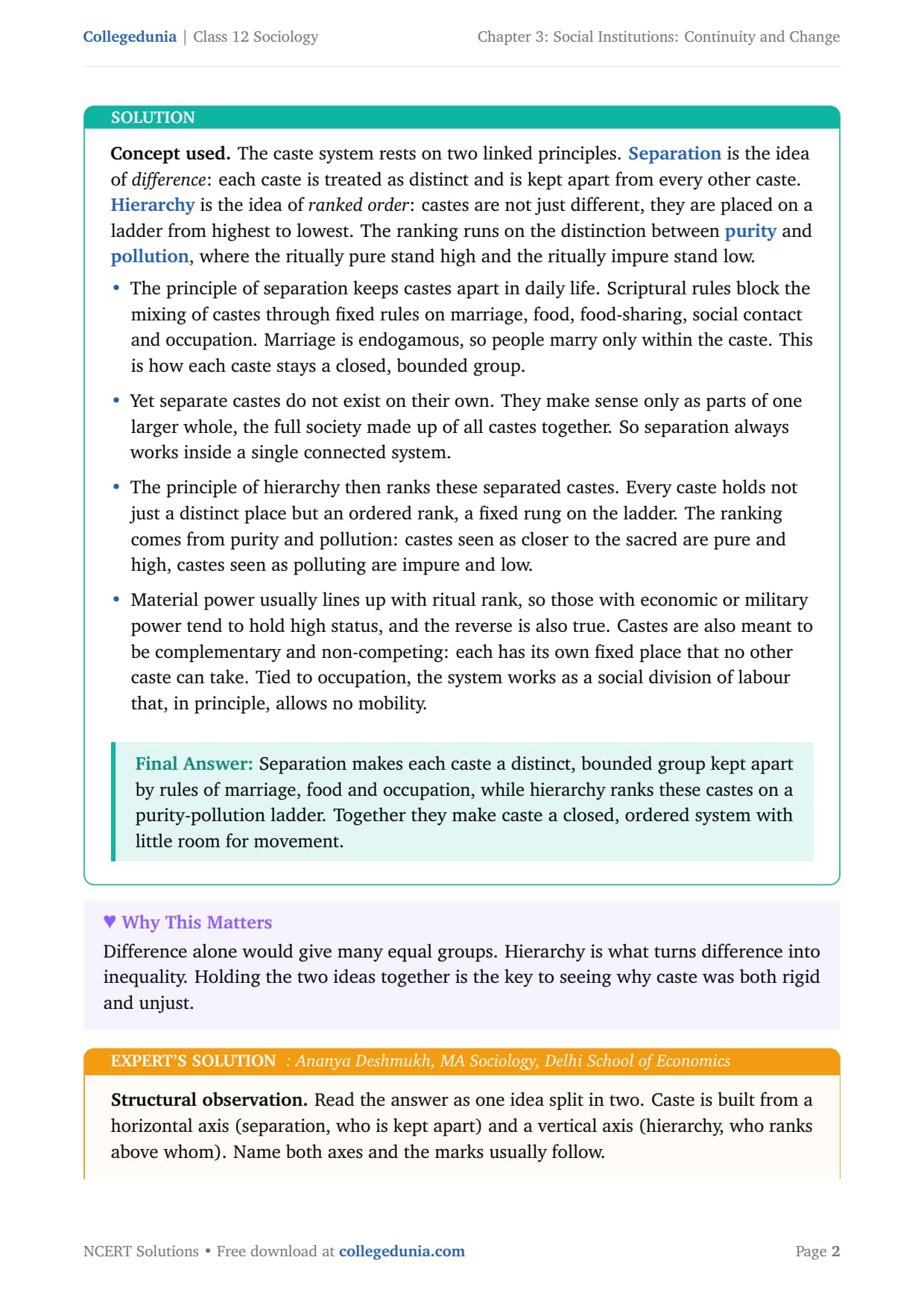
Concept used. The caste system rests on two linked principles.
Separation is the idea of difference: each caste is treated as
distinct and is kept apart from every other caste. Hierarchy is the
idea of ranked order: castes are not just different, they are placed on a
ladder from highest to lowest. The ranking runs on the distinction between
purity and pollution, where the ritually pure stand high and
the ritually impure stand low.
The principle of separation keeps castes apart in daily life.
Scriptural rules block the mixing of castes through fixed rules on
marriage, food, food-sharing, social contact and occupation. Marriage is
endogamous, so people marry only within the caste. This is how each caste
stays a closed, bounded group.
Yet separate castes do not exist on their own. They make sense only as
parts of one larger whole, the full society made up of all castes
together. So separation always works inside a single connected system.
The principle of hierarchy then ranks these separated castes. Every caste
holds not just a distinct place but an ordered rank, a fixed rung on the
ladder. The ranking comes from purity and pollution: castes seen as
closer to the sacred are pure and high, castes seen as polluting are
impure and low.
Material power usually lines up with ritual rank, so those with economic
or military power tend to hold high status, and the reverse is also true.
Castes are also meant to be complementary and non-competing: each has its
own fixed place that no other caste can take. Tied to occupation, the
system works as a social division of labour that, in principle, allows no
mobility.
Separation makes each caste a distinct, bounded group kept apart by
rules of marriage, food and occupation, while hierarchy ranks these castes on a
purity-pollution ladder. Together they make caste a closed, ordered system with
little room for movement.
AD
Ananya Deshmukh
MA Sociology, Delhi School of Economics
Verified Expert
Structural observation. Read the answer as one idea split in two. Caste
is built from a horizontal axis (separation, who is kept apart) and a vertical
axis (hierarchy, who ranks above whom). Name both axes and the marks usually
follow.
Horizontal axis, separation. Castes are different and bounded. The wall
is held up by endogamy, food rules and occupation rules, all aimed at
preventing the mixing of castes.
The two axes connect. A caste has no separate existence on its own. It
exists only in relation to the whole, the totality of society made of all
castes, so separation and hierarchy are two sides of the same system.
Vertical axis, hierarchy. The separated castes are ranked by purity and
pollution: pure equals high, polluting equals low. Economic and military
power usually track ritual rank.
Pull it together. Because castes are ranked and meant to be complementary
and non-competing, the system becomes a frozen division of labour. In
principle it allows no mobility, which is exactly what makes it so
unequal.
Why this matters. The same purity-pollution logic returns in Question 4
on invisibility and again in the tribe section, so locking it in here pays off
across the whole chapter.
Separation builds the horizontal wall between castes, hierarchy builds
the vertical purity-pollution ranking, and together they make caste a closed,
ranked, low-mobility system.
Q 3.2
What are some of the rules that the caste system imposes?
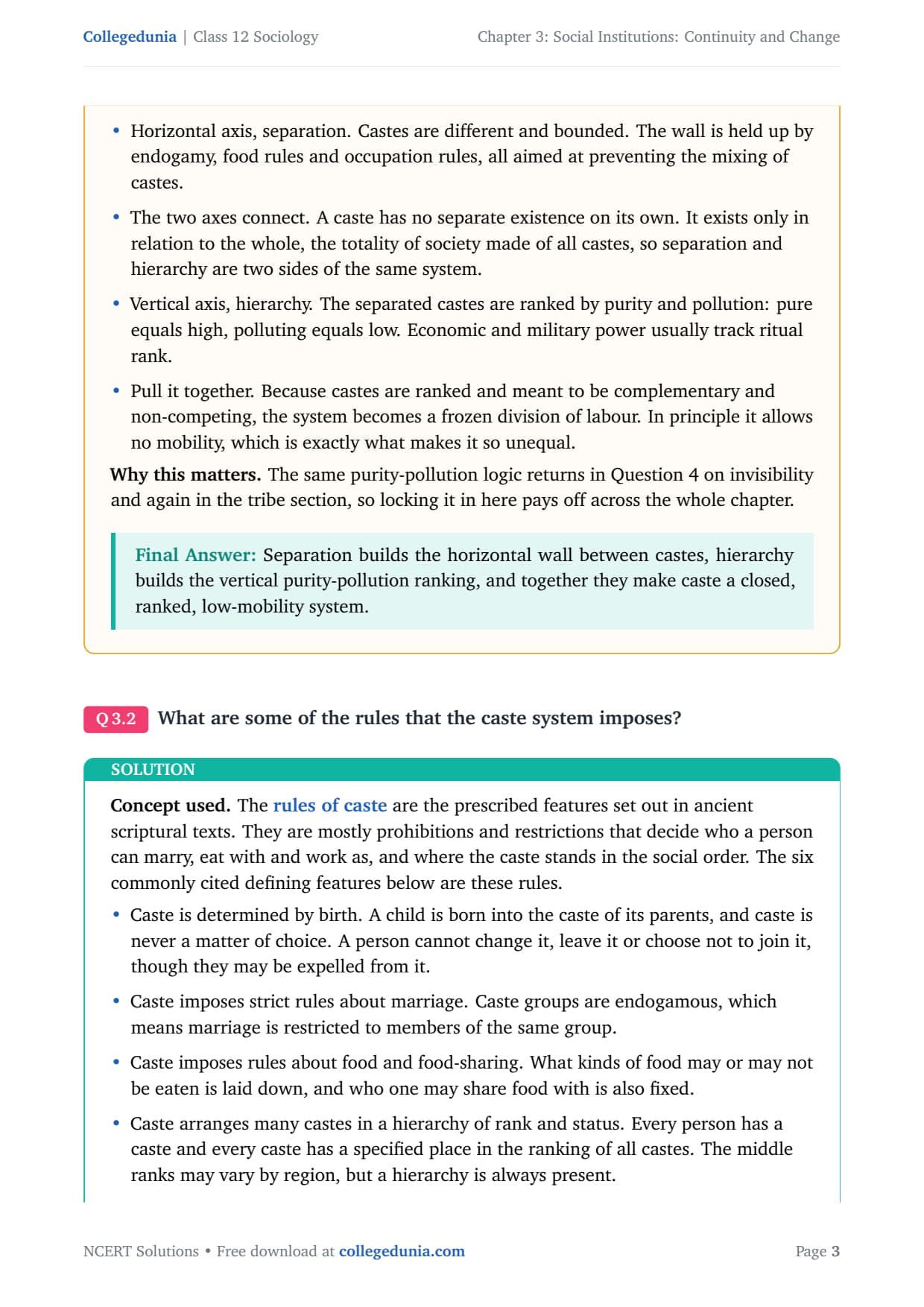
Concept used. The rules of caste are the prescribed features
set out in ancient scriptural texts. They are mostly prohibitions and
restrictions that decide who a person can marry, eat with and work as, and where
the caste stands in the social order. The six commonly cited defining features
below are these rules.
Caste is determined by birth. A child is born into the caste of its
parents, and caste is never a matter of choice. A person cannot change
it, leave it or choose not to join it, though they may be expelled from
it.
Caste imposes strict rules about marriage. Caste groups are endogamous,
which means marriage is restricted to members of the same group.
Caste imposes rules about food and food-sharing. What kinds of food may
or may not be eaten is laid down, and who one may share food with is also
fixed.
Caste arranges many castes in a hierarchy of rank and status. Every
person has a caste and every caste has a specified place in the ranking
of all castes. The middle ranks may vary by region, but a hierarchy is
always present.
Castes have sub-divisions. A caste almost always has sub-castes, and
sub-castes may have further sub-castes. This is called a segmental
organisation.
Castes were traditionally linked to occupations. Occupations were
hereditary, passed from one generation to the next, and a particular
occupation could be pursued only by the caste linked to it. Members of
other castes could not enter that occupation.
Caste imposes rules of birth (fixed by birth, unchangeable), marriage
(endogamy), food and food-sharing, hierarchy of rank, internal sub-division
(segmental organisation), and hereditary occupation.
RI
Rohan Iyer
MA Sociology, Jawaharlal Nehru University
Verified Expert
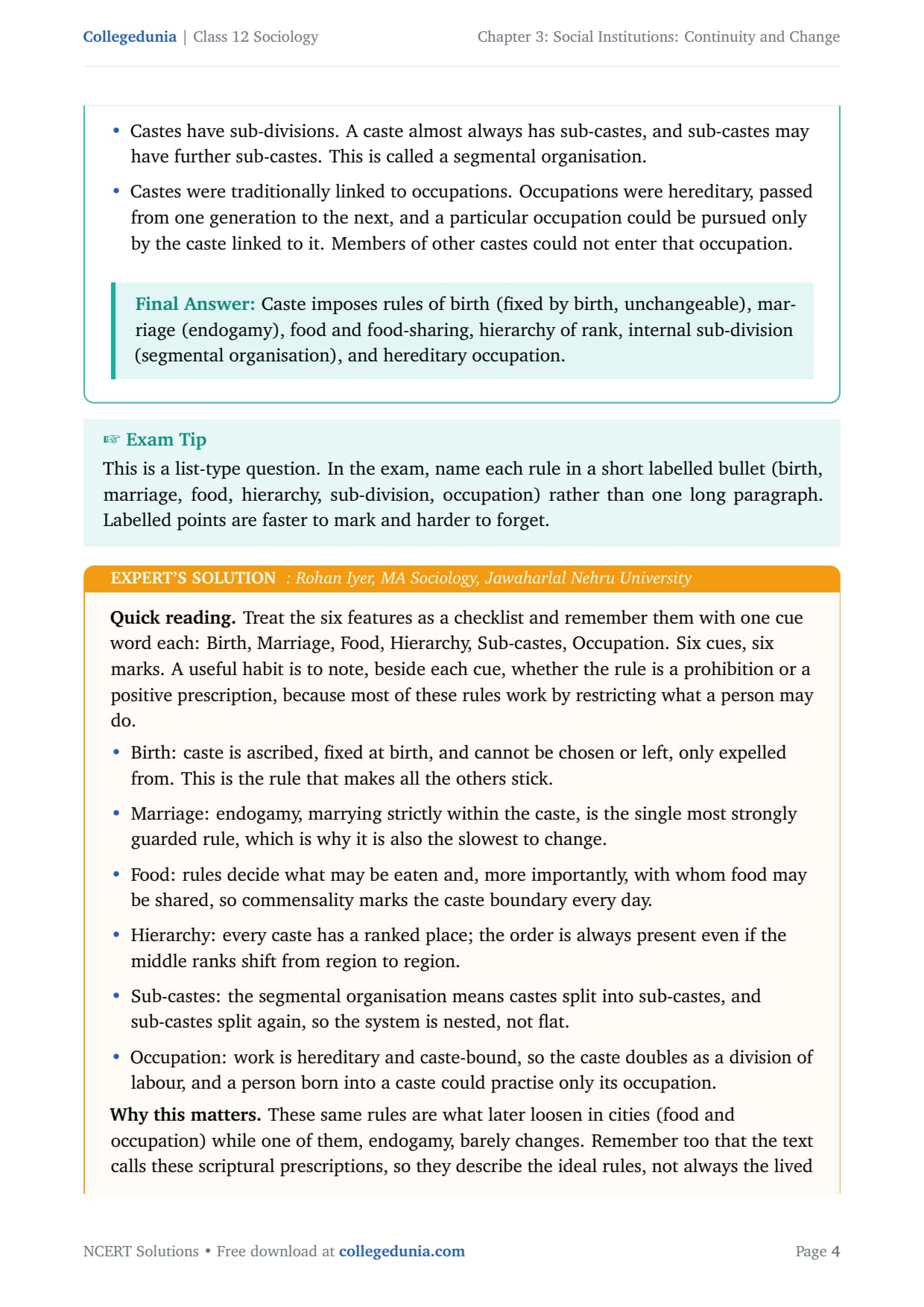
Quick reading. Treat the six features as a checklist and remember them
with one cue word each: Birth, Marriage, Food, Hierarchy, Sub-castes,
Occupation. Six cues, six marks. A useful habit is to note, beside each cue,
whether the rule is a prohibition or a positive prescription, because most of
these rules work by restricting what a person may do.
Birth: caste is ascribed, fixed at birth, and cannot be chosen or left,
only expelled from. This is the rule that makes all the others stick.
Marriage: endogamy, marrying strictly within the caste, is the single
most strongly guarded rule, which is why it is also the slowest to change.
Food: rules decide what may be eaten and, more importantly, with whom
food may be shared, so commensality marks the caste boundary every day.
Hierarchy: every caste has a ranked place; the order is always present
even if the middle ranks shift from region to region.
Sub-castes: the segmental organisation means castes split into
sub-castes, and sub-castes split again, so the system is nested, not flat.
Occupation: work is hereditary and caste-bound, so the caste doubles as a
division of labour, and a person born into a caste could practise only its
occupation.
Why this matters. These same rules are what later loosen in cities (food
and occupation) while one of them, endogamy, barely changes. Remember too that
the text calls these scriptural prescriptions, so they describe the ideal rules,
not always the lived reality. Noticing which rules bend and which hold is the
heart of Question 4.
The cue list Birth, Marriage, Food, Hierarchy, Sub-castes, Occupation
captures every rule the caste system imposes.
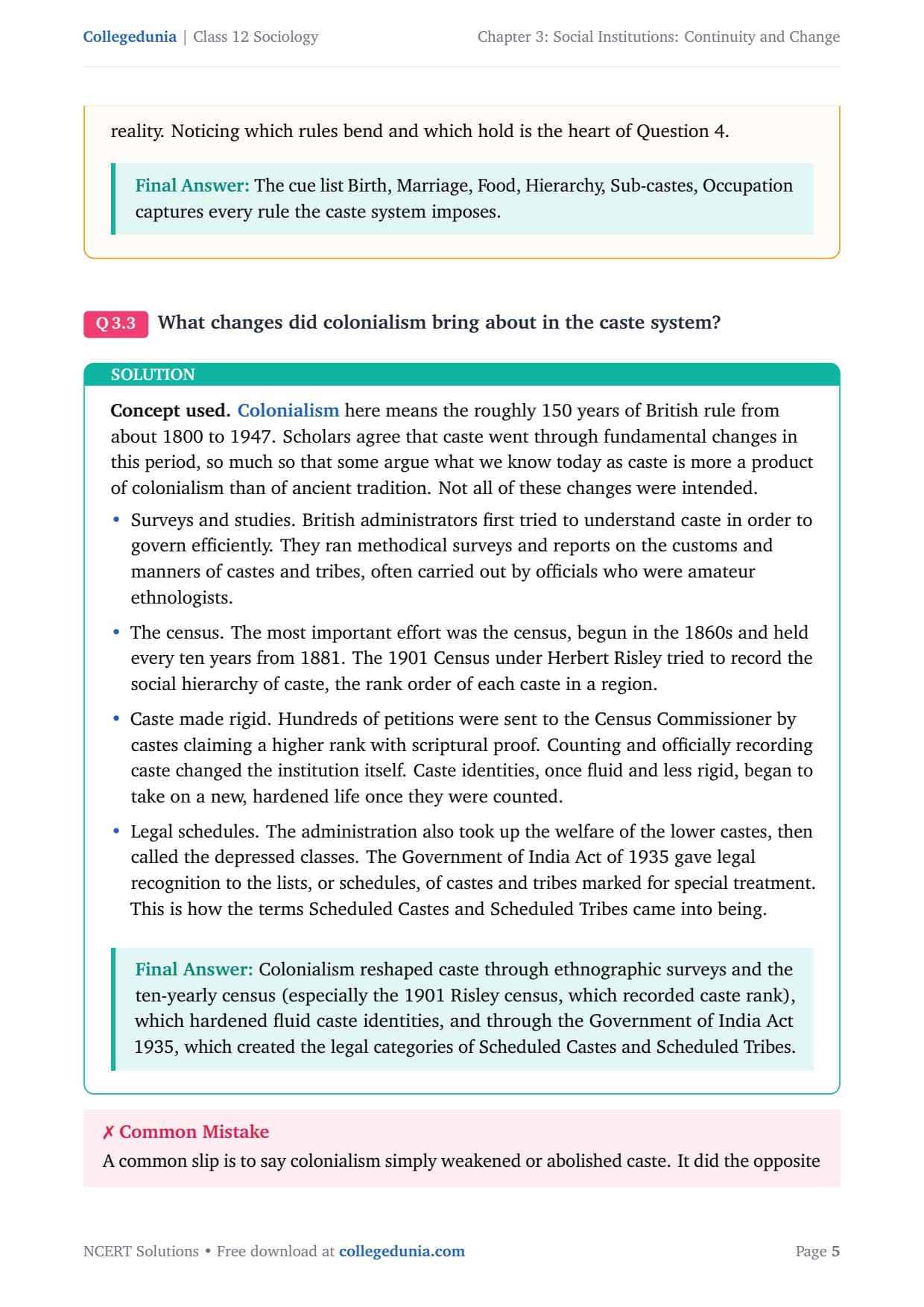
Q 3.3
What changes did colonialism bring about in the caste system?
Concept used.Colonialism here means the roughly 150 years of
British rule from about 1800 to 1947. Scholars agree that caste went through
fundamental changes in this period, so much so that some argue what we know today
as caste is more a product of colonialism than of ancient tradition. Not all of
these changes were intended.
Surveys and studies. British administrators first tried to understand
caste in order to govern efficiently. They ran methodical surveys and
reports on the customs and manners of castes and tribes, often carried
out by officials who were amateur ethnologists.
The census. The most important effort was the census, begun in the 1860s
and held every ten years from 1881. The 1901 Census under Herbert Risley
tried to record the social hierarchy of caste, the rank order of each
caste in a region.
Caste made rigid. Hundreds of petitions were sent to the Census
Commissioner by castes claiming a higher rank with scriptural proof.
Counting and officially recording caste changed the institution itself.
Caste identities, once fluid and less rigid, began to take on a new,
hardened life once they were counted.
Legal schedules. The administration also took up the welfare of the lower
castes, then called the depressed classes. The Government of India Act of
1935 gave legal recognition to the lists, or schedules, of castes and
tribes marked for special treatment. This is how the terms Scheduled
Castes and Scheduled Tribes came into being.
Colonialism reshaped caste through ethnographic surveys and the
ten-yearly census (especially the 1901 Risley census, which recorded caste
rank), which hardened fluid caste identities, and through the Government of India
Act 1935, which created the legal categories of Scheduled Castes and Scheduled
Tribes.
MK
Meera Krishnan
MPhil Sociology, University of Hyderabad
Verified Expert
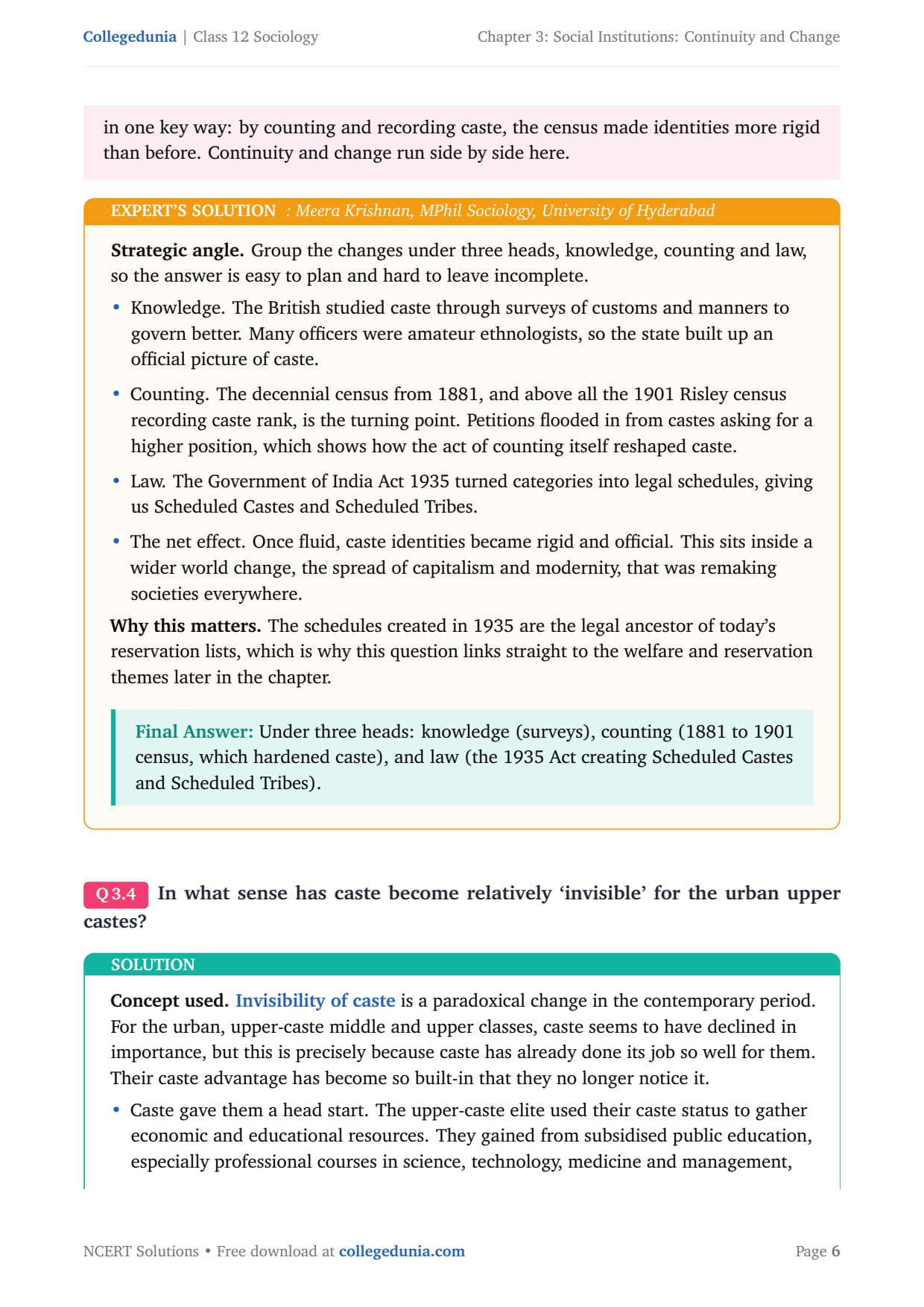
Strategic angle. Group the changes under three heads, knowledge,
counting and law, so the answer is easy to plan and hard to leave incomplete.
Knowledge. The British studied caste through surveys of customs and
manners to govern better. Many officers were amateur ethnologists, so the
state built up an official picture of caste.
Counting. The decennial census from 1881, and above all the 1901 Risley
census recording caste rank, is the turning point. Petitions flooded in
from castes asking for a higher position, which shows how the act of
counting itself reshaped caste.
Law. The Government of India Act 1935 turned categories into legal
schedules, giving us Scheduled Castes and Scheduled Tribes.
The net effect. Once fluid, caste identities became rigid and official.
This sits inside a wider world change, the spread of capitalism and
modernity, that was remaking societies everywhere.
Why this matters. The schedules created in 1935 are the legal ancestor
of today's reservation lists, which is why this question links straight to the
welfare and reservation themes later in the chapter.
Under three heads: knowledge (surveys), counting (1881 to 1901 census,
which hardened caste), and law (the 1935 Act creating Scheduled Castes and
Scheduled Tribes).
Q 3.4
In what sense has caste become relatively `invisible' for the urban upper castes?
Concept used.Invisibility of caste is a paradoxical change in
the contemporary period. For the urban, upper-caste middle and upper classes,
caste seems to have declined in importance, but this is precisely because caste
has already done its job so well for them. Their caste advantage has become so
built-in that they no longer notice it.
Caste gave them a head start. The upper-caste elite used their caste
status to gather economic and educational resources. They gained from
subsidised public education, especially professional courses in science,
technology, medicine and management, and from the early expansion of
public-sector jobs.
The lead became self-sustaining. In the first decades after independence
their educational lead meant they faced no serious competition. As this
advantage passed into the second and third generations, their economic and
educational capital alone was enough to keep securing the best life
chances.
Caste then seemed to disappear from their public life. These groups began
to believe their success had little to do with caste. Caste now appears
to play no part in their public lives and is limited to the personal
sphere of religious practice, marriage and kinship. So caste turns
invisible to them.
The opposite is true for the others. For the Scheduled Castes, Scheduled
Tribes and backward castes, caste has become all too visible. Lacking
inherited educational and social capital, and facing an entrenched
upper-caste group, they cannot abandon caste identity, since it is one of
the few collective assets they have, and reservation is their lifeline.
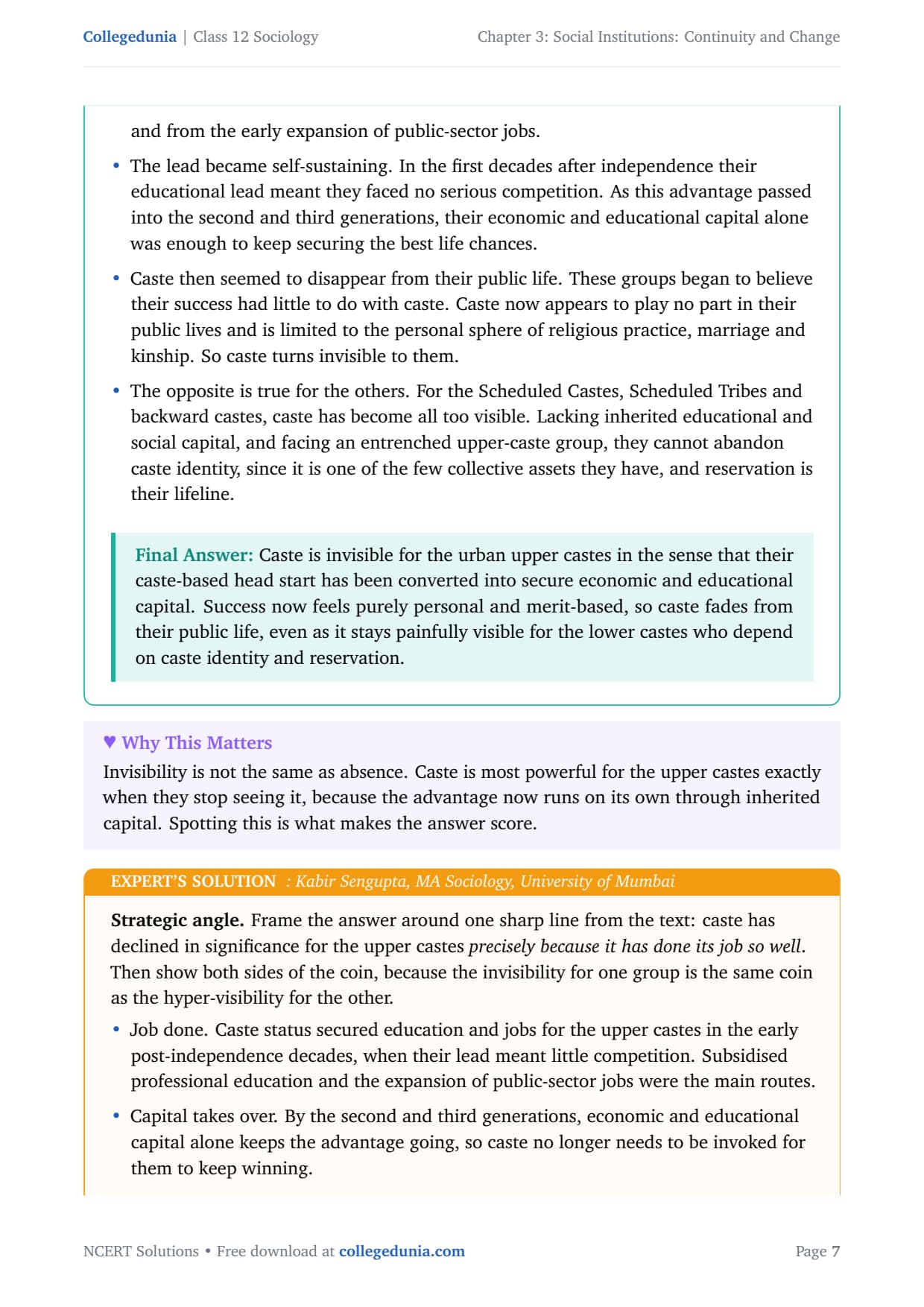
Caste is invisible for the urban upper castes in the sense that their
caste-based head start has been converted into secure economic and educational
capital. Success now feels purely personal and merit-based, so caste fades from
their public life, even as it stays painfully visible for the lower castes who
depend on caste identity and reservation.
KS
Kabir Sengupta
MA Sociology, University of Mumbai
Verified Expert
Strategic angle. Frame the answer around one sharp line from the text:
caste has declined in significance for the upper castes precisely because
it has done its job so well. Then show both sides of the coin, because the
invisibility for one group is the same coin as the hyper-visibility for the
other.
Job done. Caste status secured education and jobs for the upper castes in
the early post-independence decades, when their lead meant little
competition. Subsidised professional education and the expansion of
public-sector jobs were the main routes.
Capital takes over. By the second and third generations, economic and
educational capital alone keeps the advantage going, so caste no longer
needs to be invoked for them to keep winning.
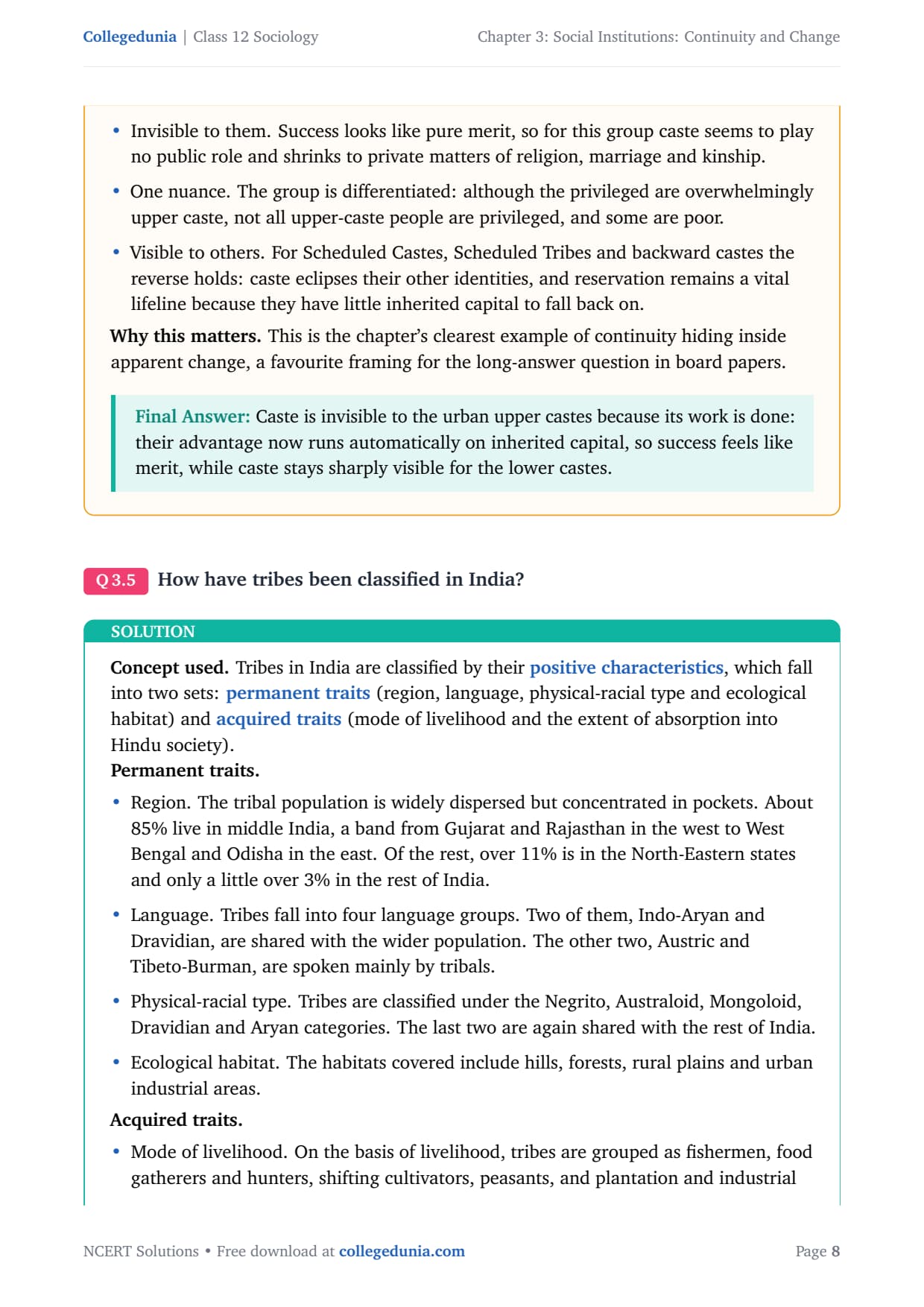
Invisible to them. Success looks like pure merit, so for this group caste
seems to play no public role and shrinks to private matters of religion,
marriage and kinship.
One nuance. The group is differentiated: although the privileged are
overwhelmingly upper caste, not all upper-caste people are privileged, and
some are poor.
Visible to others. For Scheduled Castes, Scheduled Tribes and backward
castes the reverse holds: caste eclipses their other identities, and
reservation remains a vital lifeline because they have little inherited
capital to fall back on.
Why this matters. This is the chapter's clearest example of continuity
hiding inside apparent change, a favourite framing for the long-answer question
in board papers.
Caste is invisible to the urban upper castes because its work is done:
their advantage now runs automatically on inherited capital, so success feels
like merit, while caste stays sharply visible for the lower castes.
Q 3.5
How have tribes been classified in India?
Concept used. Tribes in India are classified by their positive
characteristics, which fall into two sets: permanent traits (region,
language, physical-racial type and ecological habitat) and acquired
traits (mode of livelihood and the extent of absorption into Hindu society).
Permanent traits.
Region. The tribal population is widely dispersed but concentrated in
pockets. About 85% live in middle India, a band from Gujarat and
Rajasthan in the west to West Bengal and Odisha in the east. Of the rest,
over 11% is in the North-Eastern states and only a little over 3% in the
rest of India.
Language. Tribes fall into four language groups. Two of them, Indo-Aryan
and Dravidian, are shared with the wider population. The other two,
Austric and Tibeto-Burman, are spoken mainly by tribals.
Physical-racial type. Tribes are classified under the Negrito,
Australoid, Mongoloid, Dravidian and Aryan categories. The last two are
again shared with the rest of India.
Ecological habitat. The habitats covered include hills, forests, rural
plains and urban industrial areas.
Acquired traits.
Mode of livelihood. On the basis of livelihood, tribes are grouped as
fishermen, food gatherers and hunters, shifting cultivators, peasants,
and plantation and industrial workers.
Extent of incorporation into Hindu society. This is the dominant
criterion in both academic sociology and politics. It looks at how far a
tribe has been assimilated, and at the attitude of the tribe towards
Hindu society and the status given to it within that society.
Tribes are classified by permanent traits (region, language,
physical-racial type, ecological habitat) and by acquired traits (mode of
livelihood, and the degree of incorporation into Hindu society), with the last
being the dominant basis of classification.
SB
Sneha Barman
MA Sociology, North-Eastern Hill University
Verified Expert
Structural observation. The whole answer is a two-by-two tree: two trait
types (permanent and acquired), and inside each, the named criteria. Picture the
tree and the points come in order.
Permanent traits are the fixed, given features: region (85% in middle
India, 11% plus in the North-East), language (Indo-Aryan, Dravidian,
Austric, Tibeto-Burman), physical-racial type, and ecological habitat.
Acquired traits are the lived, changeable features: mode of livelihood
(from food gatherers to industrial workers) and the extent of
incorporation into Hindu society.
Flag the dominant one. The degree of assimilation into Hindu society is
the criterion most used in both sociology and public affairs, so it
deserves a line of its own.
Note the two-way view of assimilation. It can be read from the tribe's
side (its attitude to Hindu society) or from the mainstream side (the
status Hindu society gives the tribe).
Why this matters. The assimilation criterion is the bridge to the next
debate, the tribe-caste continuum, so getting it clear here sets up Question 6
neatly.
Two buckets: permanent traits (region, language, race, habitat) and
acquired traits (livelihood, and degree of incorporation into Hindu society, the
dominant criterion).
Q 3.6
What evidence would you offer against the view that `tribes are primitive communities living isolated lives untouched by civilisation'?
Concept used. The view to be challenged is the idea of the
pristine tribe, a community that is original, pure and untouched by
civilisation. The text shows this idea is false: tribes have long been in
contact with, and shaped by, the wider society, so they were never sealed-off,
stone-age survivors.
Definitions by 1970s were shown faulty. By the 1970s all the major
definitions of tribe were found to be weak. The tribe-peasantry
distinction did not hold on any of the usual criteria: size, isolation,
religion or means of livelihood.
Tribes are large, not tiny isolates. Some Indian tribes such as the
Santhals, Gonds and Bhils are very large and spread over wide territory,
which contradicts the picture of small, cut-off groups.
Tribes practise settled and specialised work. Tribes like the Mundas and
Hos turned to settled agriculture long ago. Even hunting-gathering
tribes, like the Birhors of Bihar, use specialised households to make
baskets and press oil, while in some cases non-tribals turned to hunting
and gathering. So livelihood does not cleanly separate tribe from
non-tribe.
Tribes were absorbed into Hindu society through history. The long span of
Indian history shows tribal groups being taken into caste-Hindu society at
various levels through sanskritisation, conquest and acculturation. Many
scholars therefore call tribes secondary phenomena, arising out of
contact with pre-existing states, not pristine isolates.
Tribes once held power and trade niches. Adivasis were not always
oppressed. There were Gond kingdoms in central India such as Garha Mandla
and Chanda, several so-called Rajput kingdoms grew out of stratification
within adivasi communities, adivasis raided and served as local militias,
and they traded forest produce, salt and elephants. The capitalist drive
to exploit forests and minerals brought tribes into contact with the
mainstream long ago.
The evidence against the pristine-tribe view: tribes are often large
and widespread (Santhals, Gonds, Bhils), many practise settled or specialised
work (Mundas, Birhors), they have long been absorbed into Hindu society through
sanskritisation and conquest, and some ran kingdoms (the Gond kingdoms), held
trade niches and served as militias. They were never isolated or untouched.
TL
Tenzin Lhamo
MA Sociology, University of Delhi
Verified Expert
Quick reading. Build the answer as a point-by-point rebuttal. The myth
makes three claims, primitive, isolated and untouched, and each one can be shot
down with a concrete example from the chapter, which is exactly what an examiner
wants to see.
Against primitive. Tribes had states and power: the Gond kingdoms of
Garha Mandla and Chanda, and Rajput kingdoms that grew out of adivasi
stratification. Primitive societies do not build kingdoms or hold land
rights and militias.
Against isolated. Tribes traded forest produce, salt and elephants,
served as local militias and raided the plains, even exercising dominance
over plains people. That is constant contact, not isolation.
Against untouched. Through history, tribes were drawn into Hindu society
by sanskritisation, conquest into the Shudra fold, and acculturation, and
later by the capitalist hunt for forests, minerals and cheap labour.
Use the scholarly test. By the 1970s the major definitions of tribe were
shown faulty: the tribe-peasant line failed on size, isolation, religion
and livelihood alike, since large tribes like Santhals and Gonds, settled
cultivators like the Mundas, and basket-making Birhors all break the mould.
Seal the argument. Scholars now treat tribes as secondary, formed through
exploitative contact with pre-existing states, so tribalism itself is an
outcome of interaction, not a leftover from the stone age.
Why this matters. The same myth is used to justify dispossession in the
name of development, which is exactly the theme of Question 7 on tribal identity.
Calling tribes timeless isolates erases their real, contact-driven history.
Each claim falls to a fact: kingdoms and militias break primitive,
trade and raids break isolated, and centuries of absorption into Hindu society
and the capitalist economy break untouched.
Q 3.7
What are the factors behind the assertion of tribal identities today?
Concept used.Assertion of tribal identity means tribal
communities actively claiming and defending their identity in public life. The
text says these identities today are formed by an interactional process
with the mainstream rather than by any primordial (original, ancient) traits, and
because that interaction has usually been on unfavourable terms, the identity
often centres on resistance and opposition.
Unfavourable interaction with the mainstream. Forced incorporation into
mainstream processes has hit tribal economy, culture and society. Because
contact has generally been on terms unfavourable to tribes, many tribal
identities now centre on resistance to the overwhelming force of the
non-tribal world.
Loss of land and forests. Issues relating to control over vital economic
resources, especially land and forests, are a major driver. National
development through dams, mines and factories dispossessed tribals,
private property undercut their community ownership, and the loss of
forests was a heavy blow.
In-migration of non-tribals. Heavy in-migration of non-tribals into
tribal regions threatens to overwhelm tribal communities and cultures.
Tripura, for example, saw its tribal share halved within a single decade,
reducing them to a minority.
Matters of ethnic and cultural identity. Alongside resource issues,
questions of ethnic-cultural identity drive movements. Successes like
statehood for Jharkhand and Chhattisgarh show identity being asserted
through political demands.
The new tribal middle class. A gradual emergence of an educated middle
class, most visible in the North-East and aided by reservation, has
created a new consciousness. As tribal society differentiates into
classes, the middle class may assert identity for reasons different from
why poor, uneducated tribals join movements.
Tribal identity is asserted today mainly because of unfavourable
interaction with the mainstream, loss of land and forests, dispossession by
large development projects, in-migration of non-tribals, demands of ethnic and
cultural identity, and the rise of an educated tribal middle class created by
education and reservation.
HO
Hemant Oraon
MA Sociology, Ranchi University
Verified Expert
Strategic angle. The text gives you the exact organising line: two broad
sets of issues, resources and ethnic-cultural identity, plus the engine driving
both, the new tribal middle class. Use that as the spine.
Set one, resources. Control over land and especially forests is the first
big driver. Dams, mines and private property took tribal land, and the
loss of forests, on which most tribal communities depended, was a major
blow.
Pressure of in-migration. Non-tribals pouring into tribal regions
threaten to swamp these communities; Tripura's tribal share was halved in
a decade, and Arunachal Pradesh feels similar pressure.
Set two, ethnic-cultural identity. Matters of culture, tradition and
ethnic belonging form the second driver. The two sets often go together,
as in the statehood movements for Jharkhand and Chhattisgarh.
The engine, a middle class. Modern education, modern occupations and
reservation produced an educated tribal middle class. This class brings a
new consciousness, though its reasons for asserting identity may differ
from those of poorer tribals.
Why this matters. Tribal identity is interactional, not primordial, so
it shifts with economic and political forces. That is the deeper point examiners
reward over a plain list.
Two families of factors, resource issues (land, forests, dispossession,
in-migration) and ethnic-cultural identity, both powered by a new educated tribal
middle class.
Q 3.8
What are some of the different forms that the family can take?
Concept used. The family can be studied as a social institution
in itself and in relation to other institutions. Its form varies along several
lines: size and composition, who heads it, the line of descent, the rule of
residence, and the rule of inheritance.
Nuclear or extended. A nuclear family has only one set of
parents and their children. An extended family, commonly called
the joint family, has more than one couple and often more than two
generations living together, such as a set of brothers with their
families or an elderly couple with their sons, grandsons and their
families.
Male-headed or female-headed. A family can be headed by a man or by a
woman. For instance, the migration of men from Himalayan villages can lead
to an unusual proportion of women-headed families there.
Patrilineal or matrilineal descent. The line of descent can run through
the father (patrilineal) or through the mother (matrilineal).
Patrilocal or matrilocal residence. By the rule of residence, some
societies are matrilocal, where the newly married couple stays with the
woman's parents, and others are patrilocal, where the couple lives with
the man's parents.
Patriarchal or matriarchal authority, and rules of inheritance.
Authority can be patriarchal (men dominate) or, in theory, matriarchal
(women dominate). By inheritance, matrilineal societies pass property
from mother to daughter, while patrilineal societies pass it from father
to son.
The family can be nuclear or extended (joint); male-headed or
female-headed; patrilineal or matrilineal in descent; patrilocal or matrilocal
in residence; and patriarchal or (in theory) matriarchal in authority, with
inheritance passing father-to-son or mother-to-daughter.
LN
Lakshmi Nair
MA Sociology, University of Kerala
Verified Expert
Structural observation. Every form of the family answers one of five
questions: How big? Who heads it? Whose line? Where do they live? Who inherits?
Answer all five and the list is complete, and you avoid the common trap of
listing only nuclear versus extended.
How big and who is in it: nuclear (one couple and children) versus
extended or joint (several couples, often more than two generations, such
as brothers with their families or grandparents with sons and grandsons).
Who heads it: male-headed versus female-headed, as with the women-headed
households left by male migration in Himalayan villages.
Whose line of descent: patrilineal (through the father) versus
matrilineal (through the mother).
Where the couple lives: patrilocal (with the man's parents) versus
matrilocal (with the woman's parents).
Who holds authority and who inherits: patriarchal (men dominate) versus
matriarchal (women dominate, in theory), with property passing
father-to-son or mother-to-daughter.
Why this matters. These categories are the toolkit for the last two
questions, on how social change reshapes the family and on the matriliny versus
matriarchy distinction. Note too that the joint family is not the dominant or
native Indian form, despite the popular image, a point worth a line in the exam.
Five axes: size (nuclear or extended), headship (male or female),
descent (patrilineal or matrilineal), residence (patrilocal or matrilocal), and
authority or inheritance (patriarchal or matriarchal).
Q 3.9
In what ways can changes in social structure lead to changes in the family structure?
Concept used. The family is the private sphere, but it is
linked to the public spheres of economy, politics, culture and education. So a
change in the wider social structure (these public spheres) feeds back
into the internal structure of the family. Changes can be accidental or
purposely brought about.
Economic change reshapes the family. The work schedules of young parents
in the software industry in India can lead to more grandparents moving in
as care-givers for young grandchildren. Here an economic shift directly
changes who lives in the household.
Migration reshapes the family. The migration of men from villages of the
Himalayan region can lead to an unusual proportion of women-headed
families in those villages. A change in the labour structure changes the
headship of the family.
War and accidental change. Some changes happen accidentally, as when a
war takes place or people migrate in search of work. These external shocks
alter the composition and structure of families.
Purposeful change in norms. Other changes are brought about on purpose, as
when young people decide to choose their spouses instead of letting elders
decide, or when same-sex love is expressed openly in society. Cultural
ideas, norms and values change along with structure.
Change is resisted. These changes are not easy to bring about. Both
history and contemporary times show that changes in family and marriage
norms are often resisted, sometimes violently.
Because the family (private sphere) is tied to the economic, political,
cultural and educational (public) spheres, shifts in social structure feed into
it: new work patterns bring grandparents in as care-givers, male migration
creates women-headed families, war and migration alter composition, and changing
norms (choosing one's own spouse, open expression of same-sex love) reshape the
family, though such change is often resisted.
IQ
Imran Qureshi
MA Sociology, Aligarh Muslim University
Verified Expert
Strategic angle. The text gives a clean two-by-two: changes are either
accidental or purposeful, and they touch either composition or norms. Pick one
strong example for each cell from the chapter.
Accidental and structural. War, or migration in search of work, changes a
family by force of circumstance, as with the women-headed families left by
male migration in the Himalayan villages.
Economic and structural. The software industry's work schedules pull
grandparents into the home as care-givers, so a new economy rewrites the
household.
Purposeful and normative. Young people choosing their own spouses, or the
open expression of same-sex love, are deliberate changes in cultural norms
and values, not just composition.
The catch. Family and marriage norms are often resisted, sometimes
violently, so structural change does not translate into family change
smoothly or quickly, and both history and the present show this lag.
The bigger frame. The private sphere of the family is tied to the public
spheres of economy, politics, culture and education, so a shift in any of
those spheres can ripple inward and reshape who lives together and how.
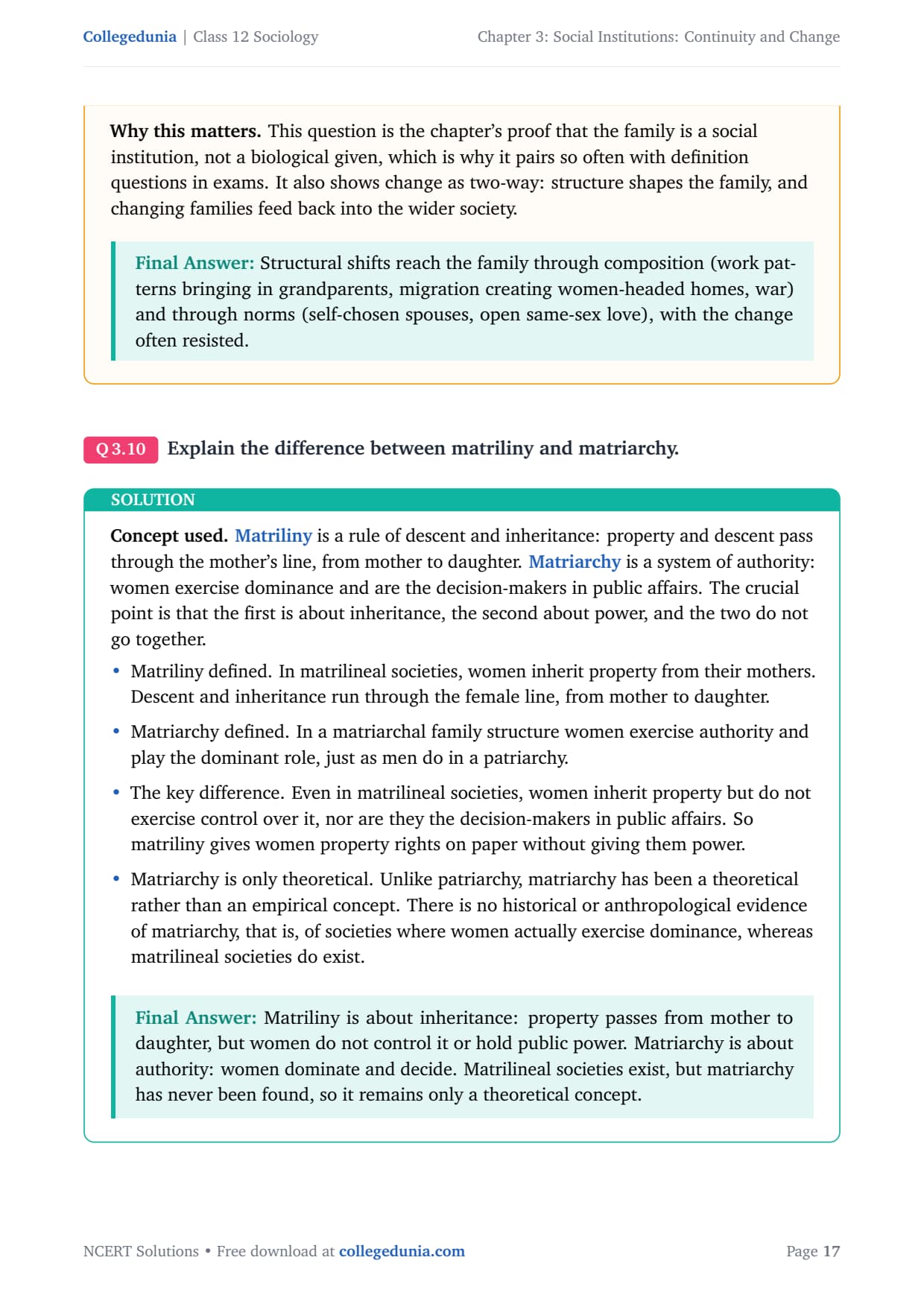
Why this matters. This question is the chapter's proof that the family is
a social institution, not a biological given, which is why it pairs so often with
definition questions in exams. It also shows change as two-way: structure shapes
the family, and changing families feed back into the wider society.
Structural shifts reach the family through composition (work patterns
bringing in grandparents, migration creating women-headed homes, war) and through
norms (self-chosen spouses, open same-sex love), with the change often resisted.
Q 3.10
Explain the difference between matriliny and matriarchy.
Concept used.Matriliny is a rule of descent and inheritance:
property and descent pass through the mother's line, from mother to daughter.
Matriarchy is a system of authority: women exercise dominance and are
the decision-makers in public affairs. The crucial point is that the first is
about inheritance, the second about power, and the two do not go together.
Matriliny defined. In matrilineal societies, women inherit property from
their mothers. Descent and inheritance run through the female line, from
mother to daughter.
Matriarchy defined. In a matriarchal family structure women exercise
authority and play the dominant role, just as men do in a patriarchy.
The key difference. Even in matrilineal societies, women inherit property
but do not exercise control over it, nor are they the decision-makers in
public affairs. So matriliny gives women property rights on paper without
giving them power.
Matriarchy is only theoretical. Unlike patriarchy, matriarchy has been a
theoretical rather than an empirical concept. There is no historical or
anthropological evidence of matriarchy, that is, of societies where women
actually exercise dominance, whereas matrilineal societies do exist.
Matriliny is about inheritance: property passes from mother to daughter,
but women do not control it or hold public power. Matriarchy is about authority:
women dominate and decide. Matrilineal societies exist, but matriarchy has never
been found, so it remains only a theoretical concept.
JD
Joymati Devi
MA Sociology, Gauhati University
Verified Expert
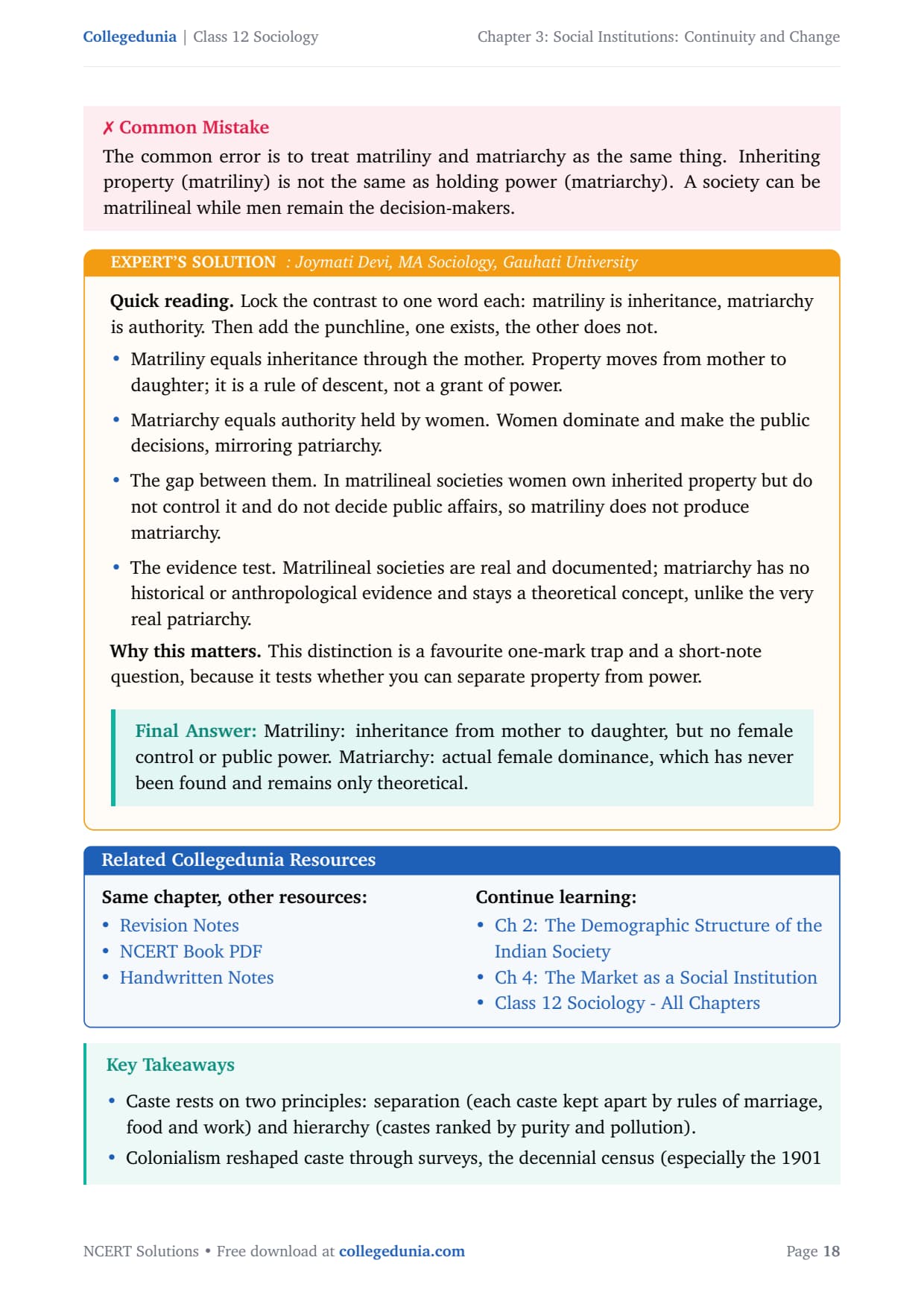
Quick reading. Lock the contrast to one word each: matriliny is
inheritance, matriarchy is authority. Then add the punchline, one exists, the
other does not.
Matriliny equals inheritance through the mother. Property moves from
mother to daughter; it is a rule of descent, not a grant of power.
Matriarchy equals authority held by women. Women dominate and make the
public decisions, mirroring patriarchy.
The gap between them. In matrilineal societies women own inherited
property but do not control it and do not decide public affairs, so
matriliny does not produce matriarchy.
The evidence test. Matrilineal societies are real and documented;
matriarchy has no historical or anthropological evidence and stays a
theoretical concept, unlike the very real patriarchy.
Why this matters. This distinction is a favourite one-mark trap and a
short-note question, because it tests whether you can separate property from
power.
Matriliny: inheritance from mother to daughter, but no female control or
public power. Matriarchy: actual female dominance, which has never been found and
remains only theoretical.
FAQs on Social Institutions Continuity and Change Class 12 NCERT Solutions
Social Institutions Continuity and Change Class 12 Sociology Common Questions
Ques. Where can I get the class 12 sociology chapter 3 NCERT Solutions PDF?
Ans. You can download the Social Institutions Continuity and Change Class 12 Sociology NCERT Solutions PDF directly from this page. It is free, follows the 2026-27 NCERT, and answers all 10 exercise questions in plain points.
Ques. How many questions are there in Social Institutions Continuity and Change class 12 questions and answers?
Ans. The chapter has 10 exercise questions. They cover the caste system, the classification and identity of tribes, and the forms and change of the family, including the difference between matriliny and matriarchy.
Ques. What is the role of separation and hierarchy in the caste system?
Ans. Separation keeps castes apart through rules on marriage, food and contact, while hierarchy ranks them from pure to impure by birth. Together these two ideas make caste a closed, ranked system, which is the central point examiners look for.
Ques. What is the difference between matriliny and matriarchy?
Ans. Matriliny means descent and property pass through the mother, as among the Khasi and Garo, but men still hold public power. Matriarchy means women actually rule, which has never truly existed. So matriliny is real and matriarchy is only a theoretical form.
Ques. Why has caste become invisible for the urban upper castes?
Ans. For the upper castes, caste advantages now look like merit, education and good jobs, so caste feels invisible. For the lower castes it stays very visible, since it still limits their chances. Caste did not vanish; it only changed into hidden networks.
Ques. Is class 12 sociology chapter 3 easy to score in the board exam?
Ans. Yes. It is a scoring chapter if you keep the three institutions separate and give a balanced view of continuity and change. Practise the caste features, the evidence against the "primitive tribe" view, and the matriliny versus matriarchy answer for the long questions.







Comments