



The NCERT Solutions for Class 12 Sociology Chapter 2 Cultural Change answer every textbook question on sanskritisation, westernisation, modernisation and secularisation, set to the latest 2026-27 CBSE syllabus. Each answer is written in plain points so students can revise fast and write full board answers from the Social Change and Development in India book.
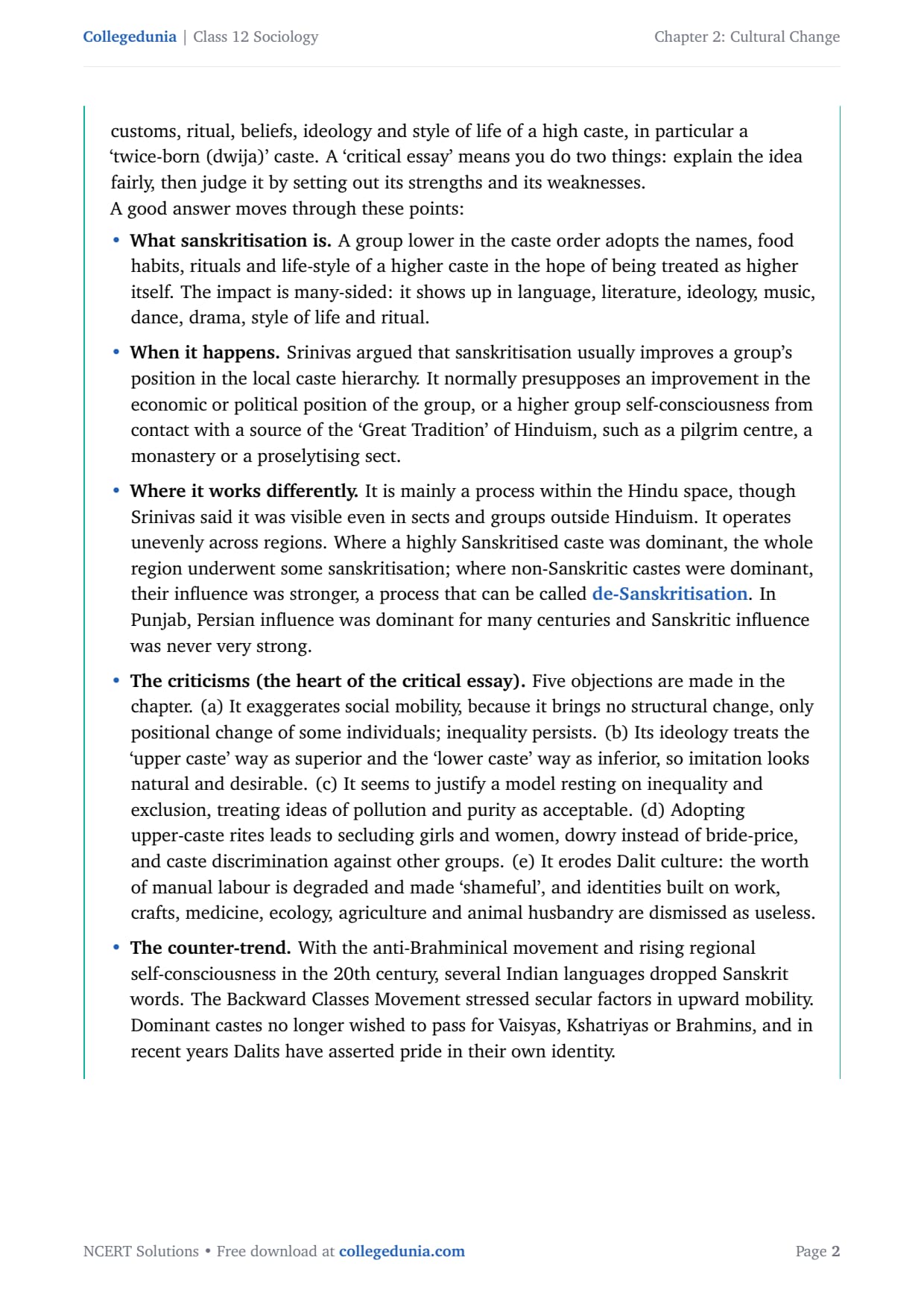
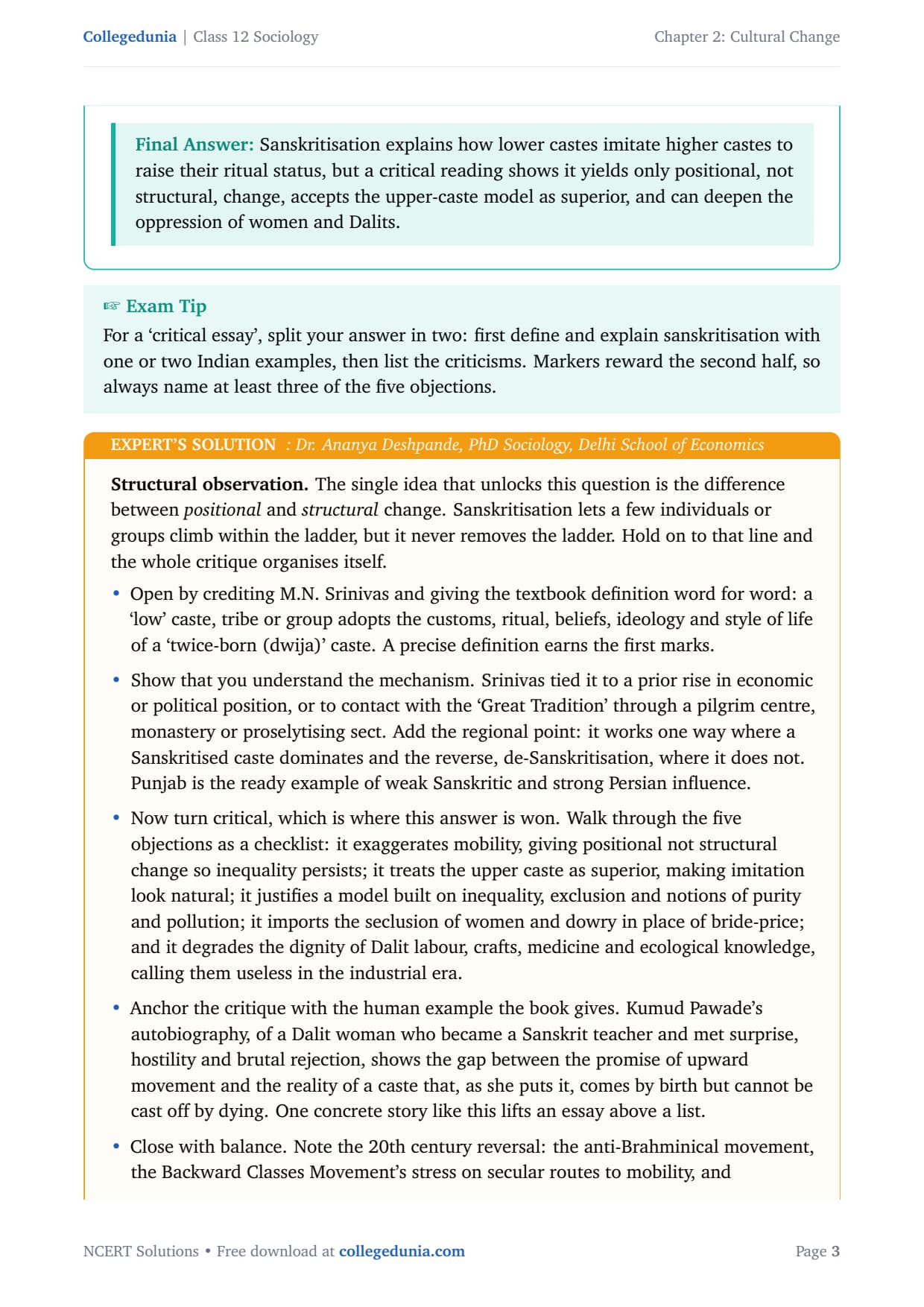
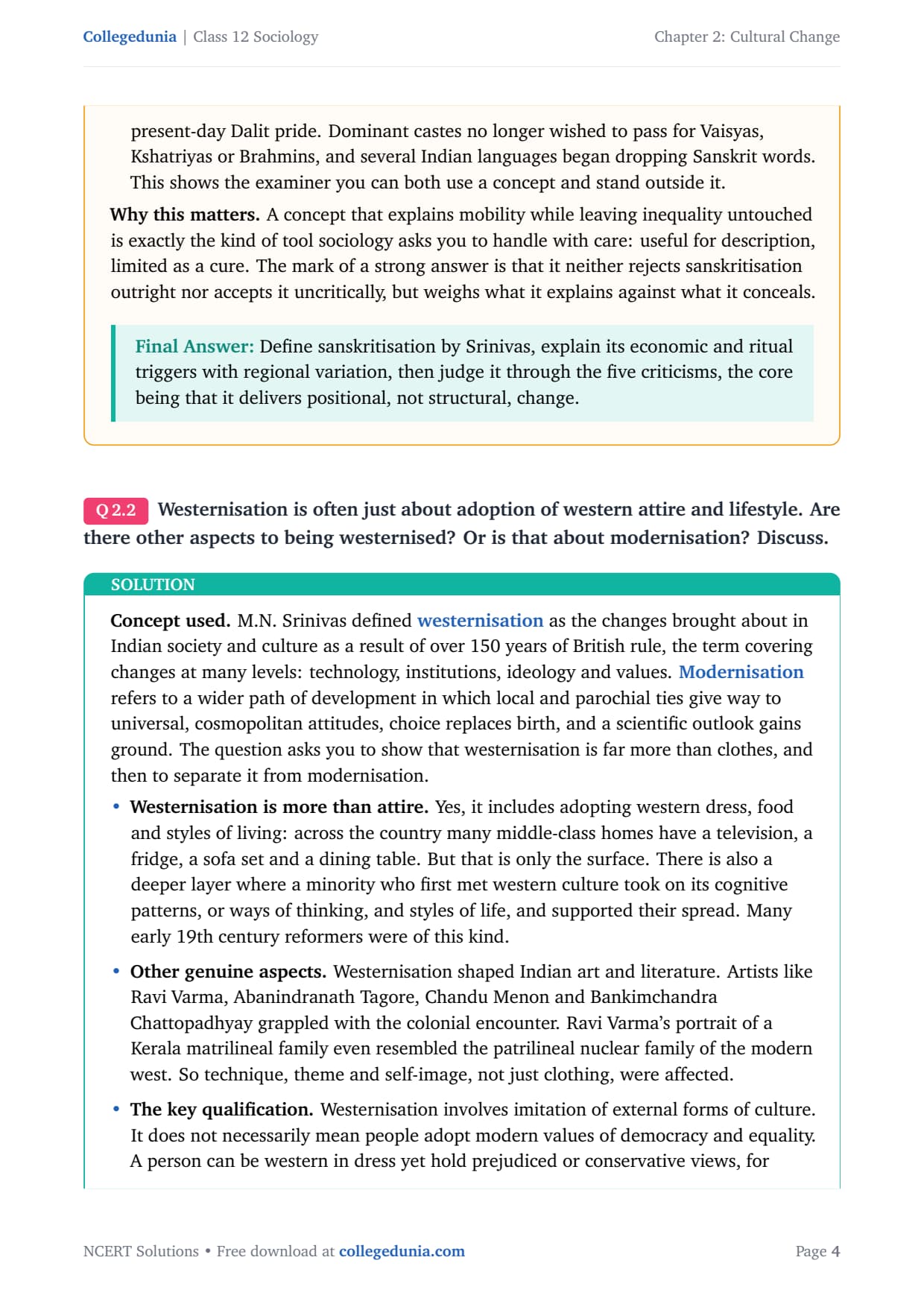
- Covers all 3 exercise questions from Cultural Change, including the short-note set, with point-wise model answers.
- This Class 12 Sociology chapter usually carries 4 to 6 marks per board paper.
- Pairs with the Notes, Handwritten Notes and NCERT Book PDF linked lower on this page.
Every solution for Class 12 Sociology Chapter 2 in this Collegedunia compilation is written by subject experts from the official NCERT Cultural Change textbook, and checked against the last five years of CBSE board papers.
Student Feedback: In a Collegedunia poll of 6,920 Class 12 Sociology students taken before the 2026 boards, 71% of students said telling sanskritisation, westernisation and modernisation apart was the part of this chapter they most wanted model answers for. Most students said one clear Indian example for each process made the difference click at once.
Source: 2026-27 Class 12 Sociology student poll. Sample of 6,920 students from CBSE schools across 12 states.
What the Cultural Change Class 12 Chapter Is About
Cultural Change is the second chapter of Social Change and Development in India. It looks at how colonial rule reshaped Indian culture, norms and ways of life, and at the social reform movements of the 19th and early 20th centuries. The chapter sorts cultural change into four key processes that the rest of your answers will rely on.
The chapter answers a few big questions that students must keep in mind:
- What are the four processes of change? Sanskritisation, westernisation, modernisation and secularisation each name a different path.
- Why study reform movements? Because debates on sati, widow remarriage and women's education show culture changing through struggle, not by itself.
- How do these ideas differ? Each process has its own meaning, Indian example and main criticism, which is exactly what the board tests.
So the chapter is really about learning to name the kind of change you are seeing. A student who labels each example under sanskritisation, westernisation, modernisation or secularisation can connect almost any question in Cultural Change class 12 back to one process. That habit of labelling first is why revision works best when you fix the four terms before you learn the answers.
Key Terms This Chapter Builds On
Before the questions, the chapter fixes a short set of ideas. Almost every answer in the exercise leans on one of them, so students should learn these first. The table below keeps each term next to a plain meaning for quick revision.
| Term | What it means |
|---|---|
| Sanskritisation | A low caste or group adopts the customs, ritual and life-style of a high, twice-born caste (M.N. Srinivas). |
| Westernisation | Changes from over 150 years of British rule, across technology, institutions, ideology and values. |
| Modernisation | A shift to universal, scientific and choice-based attitudes, with the individual as the unit. |
| Secularisation | A process of decline in the influence of religion over social life. |
| Dominant caste | A landowning caste with numbers and power that sets the local cultural model. |
A key insight for the exam is that each term names a path of change, not a verdict on it. The same family that buys a television (westernisation) may still arrange marriages by birth, so they are not yet modern in values. An answer that keeps the four processes apart scores higher than one that blurs them together.
Sanskritisation and Its Critical Evaluation
The first exercise question asks for a critical essay on sanskritisation. This is the most-tested long answer in the chapter, so students should learn it as a clear set of points and then the criticisms. The idea comes from sociologist M.N. Srinivas.
- What it is: a low caste, tribe or group takes over the customs, ritual, beliefs, ideology and style of life of a high, twice-born (dwija) caste.
- When it happens: it usually follows a rise in the group's economic or political position, or contact with a centre of the Great Tradition like a pilgrim site.
- What it changes: it lifts a group's position in the local caste order, but it does not challenge the caste system itself.
- De-Sanskritisation: where non-Sanskritic castes were dominant, their influence spread instead, the reverse pull.
The criticisms are where marks are won. Sanskritisation delivers positional change, not structural change: one group moves up while the ladder stays the same. Critics also note it accepts the ideology of caste, glorifies upper-caste customs, and tends to tighten controls on women, for example through dowry in place of bride-price. A strong answer neither rejects the idea outright nor accepts it uncritically, but weighs what it explains against what it conceals.
Westernisation Is More Than Western Clothes
The second exercise question asks whether westernisation is only about western attire and lifestyle, and whether that is really modernisation. Students should show that westernisation runs deeper than clothes, then keep it apart from modernisation. The table sorts the two for fast recall.
| Westernisation | Modernisation |
|---|---|
| Copies external forms | Changes inner values and outlook |
| Dress, food, furniture, technology, art | Choice over birth, individual over group |
| Can occur with prejudiced views intact | Science and reason over the sacred |
| Result of British rule in India | A wider, universal path of development |
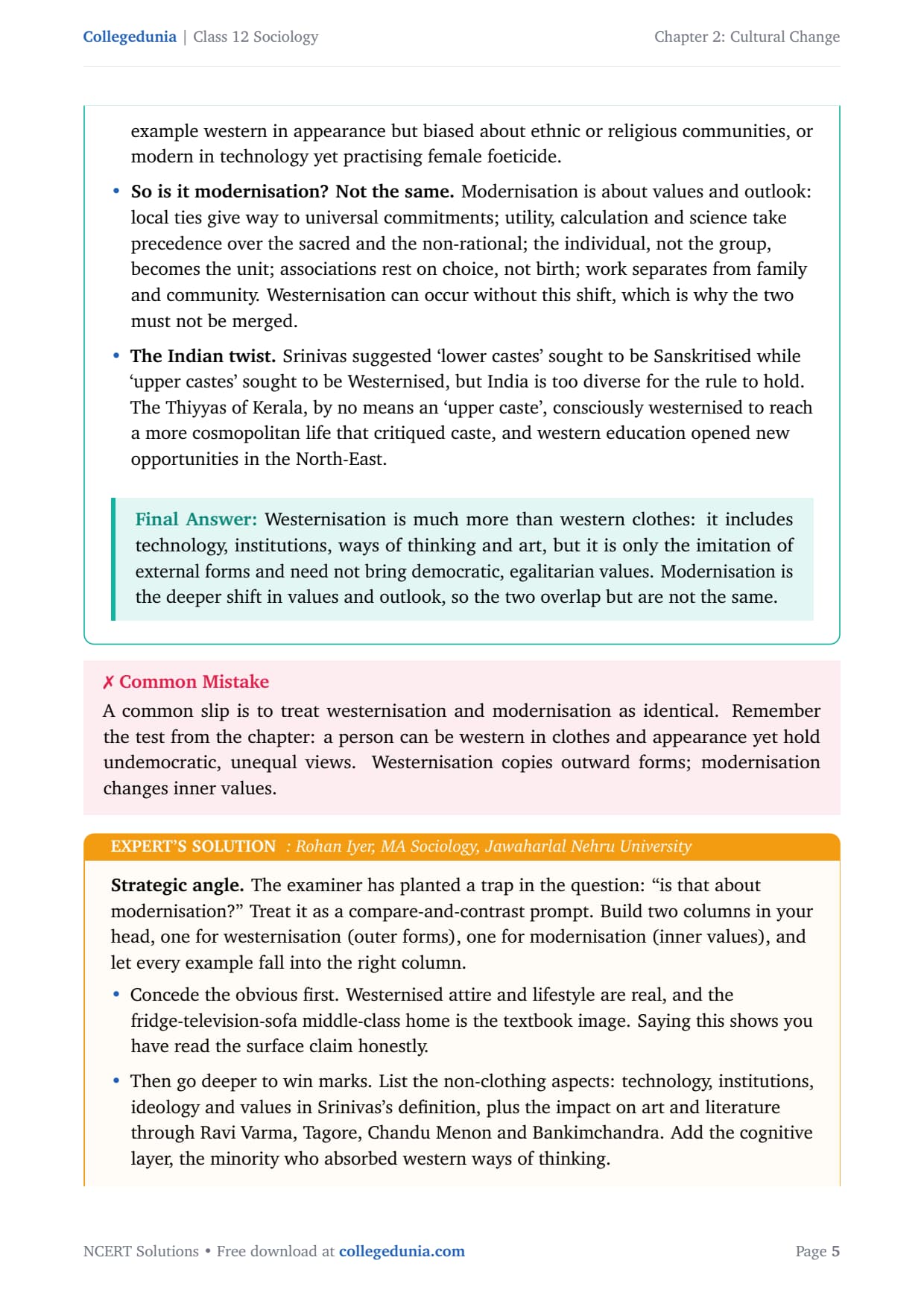
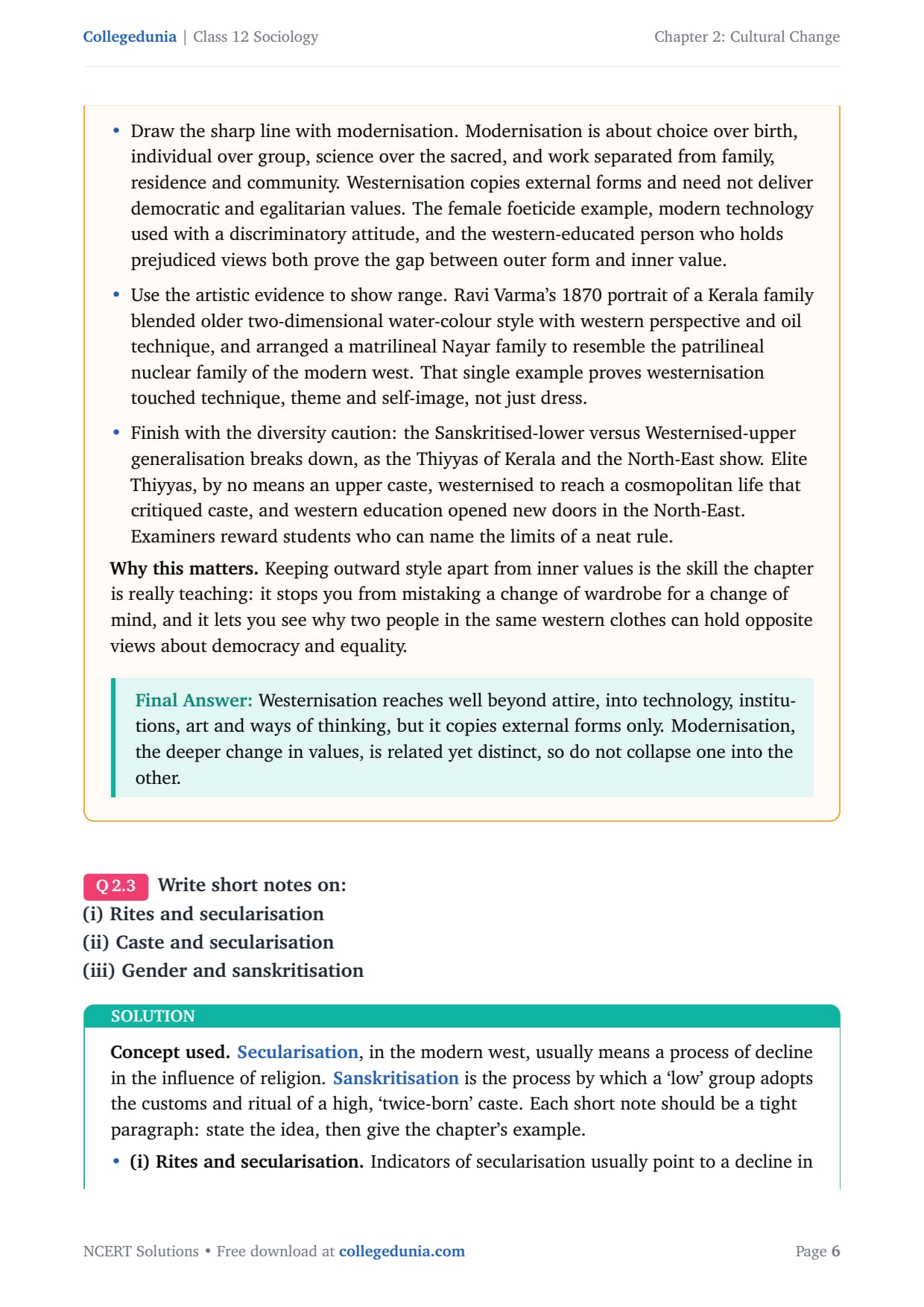
The honest exam point is that a person can be western in dress yet hold undemocratic, unequal views. Westernisation touched technology, institutions, ideology and even art, seen in Ravi Varma, Tagore, Chandu Menon and Bankimchandra. But it copies outward style and need not bring modern values. Modernisation is the deeper change, so the two overlap but must never be merged.
Secularisation of Rites and of Caste
The third exercise question asks for short notes, two of which turn on secularisation. Students should give the idea and then the chapter's Indian example for each. The points below are what an examiner expects.
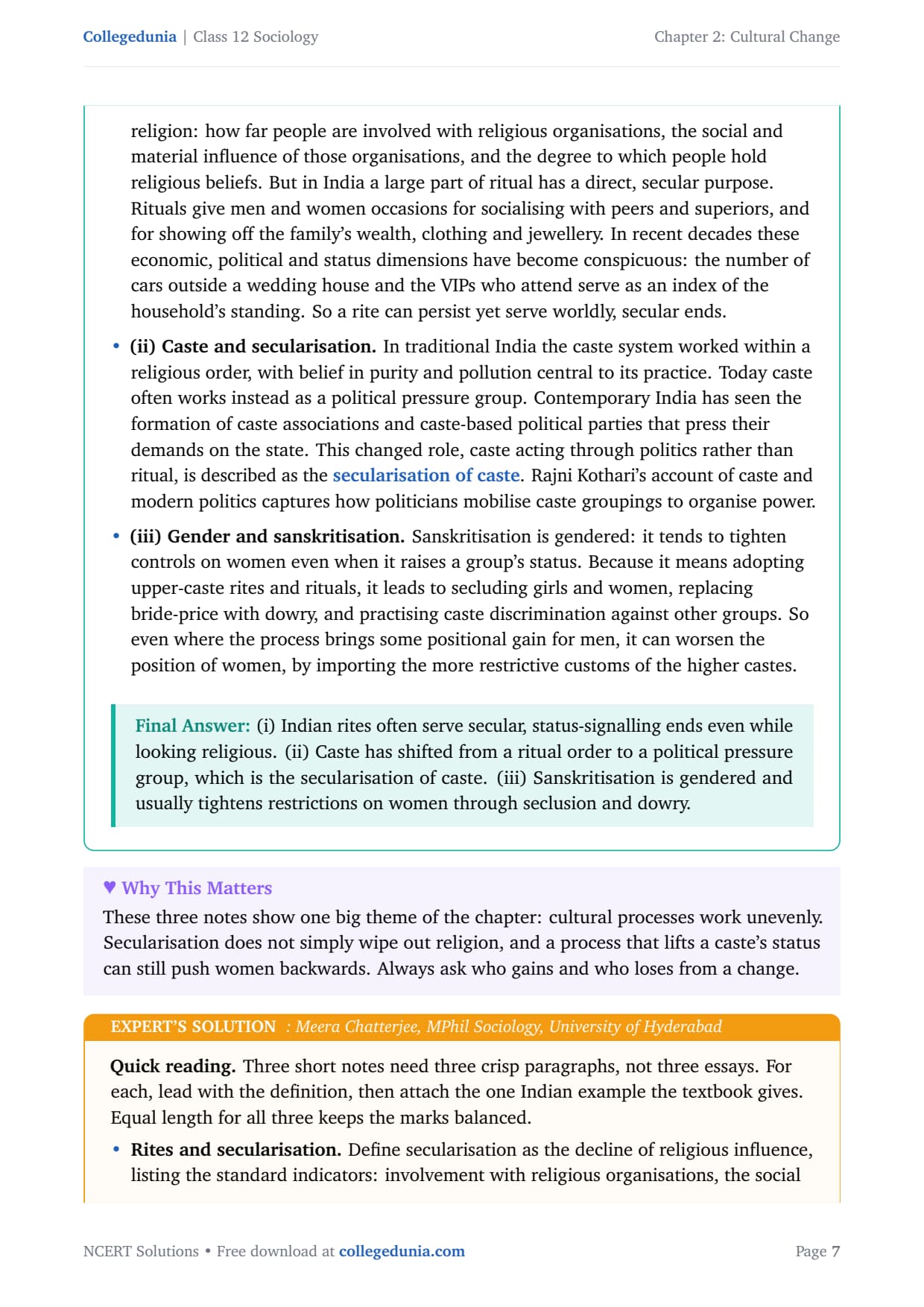
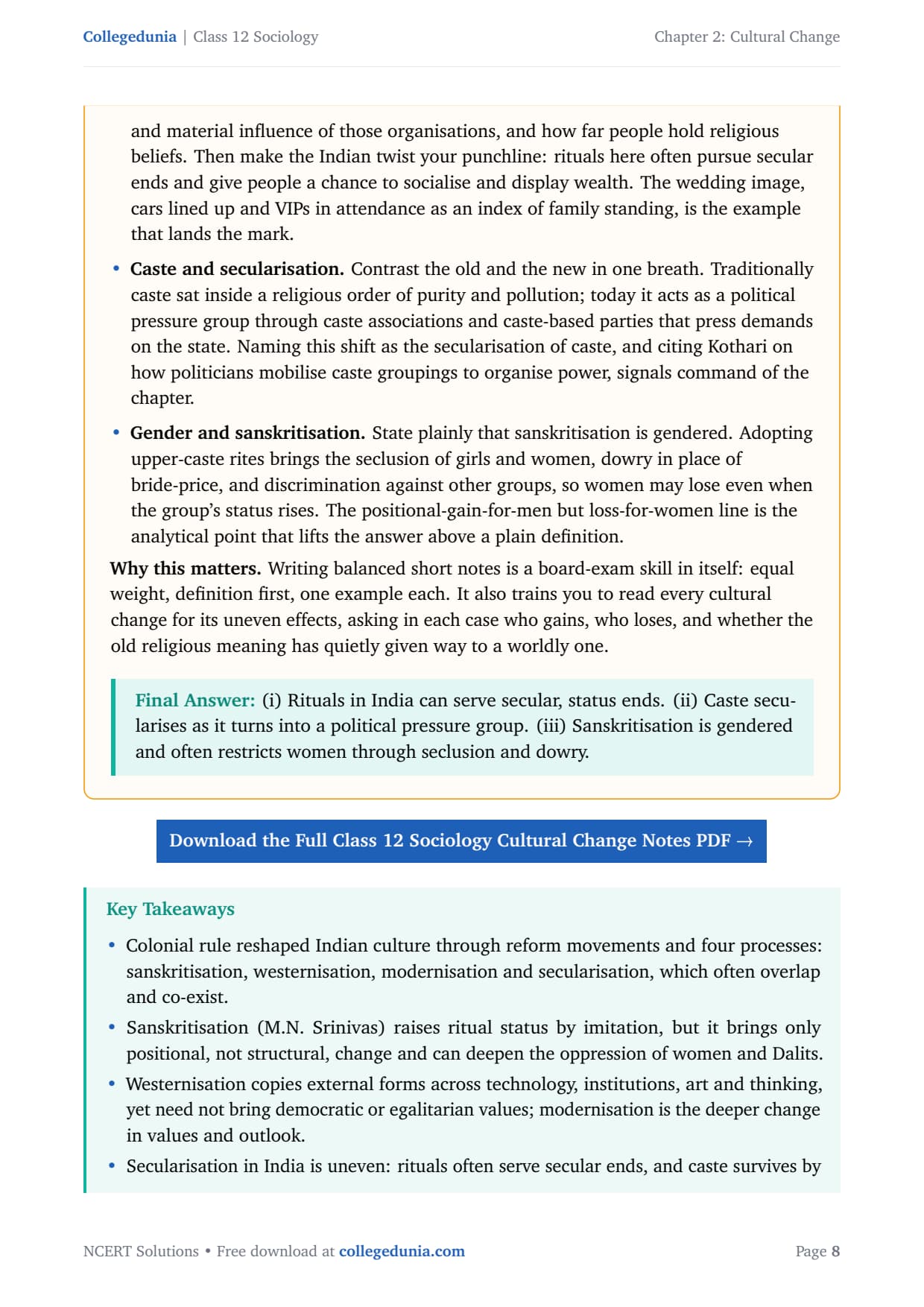
- Rites and secularisation: many Indian rituals serve a worldly purpose. A wedding is an occasion to socialise and to show off wealth, where the number of cars and VIPs index a household's standing. So a rite can persist yet serve secular, status ends.
- Caste and secularisation: caste once worked within a religious order built on purity and pollution. Today it often acts as a political pressure group through caste associations and parties, what Rajni Kothari studied as caste in modern politics.
- The shared theme: secularisation does not always mean less religion in India. It often means religion and caste taking on new, worldly roles.
A balanced answer notes that in India secularisation rarely means the simple decline of religion seen in the west. Instead, rituals and caste keep going while their purpose shifts toward status, money and politics. Marks come from giving the idea and then the textbook example, not just the definition.
Gender and Sanskritisation
The last short note links sanskritisation with gender. This is a sharp point that often appears as a sub-question, so students should state it plainly. The reasons below are what an examiner wants to see.
- Sanskritisation is gendered: as a group climbs, it tends to copy upper-caste controls on women.
- Practices tighten: bride-price may give way to dowry, and women's freedom of movement and work may shrink.
- A higher rung, a heavier cost: the group's ritual rank rises, but women often lose status within it.
The honest point is that moving up the caste order can lower women's position inside the group. This is why critics treat sanskritisation with care: the gain in rank is real, but it is bought by adopting more restrictive norms. Naming this cost is what separates a top answer from an average one.
The Cultural Change Class 12 Exercise-wise Coverage
The chapter exercise has 3 questions, with the third split into three short notes. The table maps each one to its topic so students can plan revision and find the right NCERT answer fast. The full point-wise solution for each sits in the question set lower on this page.
| Question | Topic it tests |
|---|---|
| Q 1 | A critical essay on sanskritisation, with its strengths and criticisms |
| Q 2 | Whether westernisation is only about attire, and how it differs from modernisation |
| Q 3 (i) | Rites and secularisation, with the wedding-as-status example |
| Q 3 (ii) | Caste and secularisation, caste as a political pressure group |
| Q 3 (iii) | Gender and sanskritisation, tighter controls on women |
Questions 1 and 2 are the most-asked long answers, so students preparing Cultural Change class 12 important questions should learn those first. The short notes in Q3 are quick scorers once the meaning of secularisation and sanskritisation is clear in your head.
Students who want the offline copy can save the class 12 sociology chapter 2 pdf from the download card above and tick off each question as they finish it.
Cultural Change Important Questions and Previous Year Trends
CBSE sets a steady mix of short and long answers from this chapter. Knowing the pattern helps students decide how much to write. The chapter is a regular source of one 4-mark or 6-mark question, which is why a focused list of Cultural Change important questions saves a lot of revision time.
- Long answer (6 marks): a critical essay on sanskritisation, or westernisation versus modernisation.
- Short answer (4 marks): secularisation of caste, or the difference between sanskritisation and westernisation.
- Conceptual: rites and secularisation, and the gendered nature of sanskritisation.
- Objective and MCQ: who coined sanskritisation, the meaning of dominant caste, and the four processes by name.
For quick recall before the exam, students often practise the class 12 sociology chapter 2 mcq set and a list of Cultural Change class 12 important questions. The most repeated items are the sanskritisation critique and the westernisation-modernisation contrast, so keep those answer points ready in your own words.
Working through the ncert solutions class 12 sociology chapter 2 set twice, once open-book and once from memory, fixes the four processes well before the board exam.
Common Mistakes Students Make in This Chapter
A few errors cost marks every year in this chapter. Most come from mixing up the four processes or giving a definition with no Indian example. Avoiding them is the fastest way to lift a score.
- Treating westernisation and modernisation as identical - one copies forms, the other changes values.
- Calling sanskritisation a real reform when it only gives positional, not structural change.
- Defining a process but giving no Indian example, like the wedding-as-status point.
- Forgetting that secularisation in India often means religion and caste taking on worldly roles.
- Missing the gendered cost of sanskritisation, the tighter controls on women.
Students who fix these five points usually move from average to high marks on the long answers. The exam rewards answers that name the process and then prove it with a textbook example, so always pair the idea with the case.
Cultural Change PDF Download Formats and Languages
The solutions are free to download in more than one format, so students can pick what suits their device and revision style. The download card at the top of the page carries each option for this chapter.
- Normal and HD PDF: the class 12 sociology chapter 2 pdf comes in a normal size for quick downloads and an HD version for clear printing.
- English medium: all answers are written in simple English for the CBSE board paper.
- Question-only set: a print-and-practise sheet of Cultural Change extra questions for self-testing.
- Whole-book pack: the solutions sit in one set that runs through every Social Change and Development in India chapter, so you can revise from Chapter 1 onwards in one place.
Many students search for class 12 sociology chapter 2 answers on their phone the night before a test, so a saved PDF means you can revise even without internet. Keep both the question set and the solved version handy for a full self-check.
How the Cultural Change Solutions Pair with Notes and the Book PDF
These NCERT Solutions answer the back-exercise questions. To revise the full chapter, students should use them alongside the other resources for the same chapter, all linked in the table below.
| Resource | Best used for |
|---|---|
| Cultural Change Class 12 Notes | Quick chapter summary with all four processes and key terms in one place |
| Cultural Change Class 12 Handwritten Notes | Last-minute, one-shot revision in a scanned notebook style |
| Cultural Change NCERT Book PDF | Reading the original NCERT chapter text from Social Change and Development in India |
Tip: read the Notes first, then attempt these solutions on your own, and only then check the model answers here. That order builds memory faster than copying answers straight away.
All NCERT Solutions for Class 12 Sociology
The table links the NCERT Solutions for every chapter in both Class 12 Sociology books, so students can move across the course in one click. Cultural Change is highlighted.
| Chapter | NCERT Solutions |
|---|---|
| Indian Society | |
| Chapter 1 | Introducing Indian Society |
| Chapter 2 | The Demographic Structure of the Indian Society |
| Chapter 3 | Social Institutions - Continuity and Change |
| Chapter 4 | The Market as a Social Institution |
| Chapter 5 | Patterns of Social Inequality and Exclusion |
| Chapter 6 | The Challenges of Cultural Diversity |
| Social Change and Development in India | |
| Chapter 1 | Structural Change |
| Chapter 2 | Cultural Change |
| Chapter 3 | The Constitution and Social Change |
| Chapter 4 | Change and Development in Rural Society |
| Chapter 5 | Change and Development in Industrial Society |
| Chapter 6 | Globalisation and Social Change |
| Chapter 7 | Mass Media and Communications |
| Chapter 8 | Social Movements |
All NCERT Solutions for Cultural Change with Step-by-Step Solutions
Below are all 3 NCERT exercise questions for this chapter, exactly as they appear in the textbook. Tap Check Solution for the model answer or Expert Solution for the topper-style approach.
Write a critical essay on sanskritisation.
Westernisation is often just about adoption of western attire and lifestyle. Are there other aspects to being westernised? Or is that about modernisation? Discuss.
Write short notes on:
(i) Rites and secularisation
(ii) Caste and secularisation
(iii) Gender and sanskritisation
FAQs on Cultural Change Class 12 NCERT Solutions
Cultural Change Class 12 Sociology Common Questions
Ques. Where can I get the class 12 sociology chapter 2 NCERT Solutions PDF?
Ans. You can download the Cultural Change Class 12 Sociology NCERT Solutions PDF directly from this page. It is free, follows the 2026-27 NCERT, and answers all exercise questions on sanskritisation, westernisation, modernisation and secularisation point by point.
Ques. What is sanskritisation in Cultural Change class 12?
Ans. Sanskritisation, a term coined by M.N. Srinivas, is the process by which a low caste, tribe or group takes over the customs, ritual and life-style of a high, twice-born caste to raise its own position. The key exam point is that it gives positional change, not a change in the caste system itself.
Ques. What is the difference between westernisation and modernisation?
Ans. Westernisation copies external forms, like dress, food, furniture and technology, from over 150 years of British rule. Modernisation is the deeper change in values: choice over birth, the individual over the group, and science over the sacred. A person can be western in clothes yet still hold unequal views, which is why the two are not the same.
Ques. What does secularisation mean in the Indian context?
Ans. In the west, secularisation means a decline in the influence of religion. In India it often means religion and caste taking on worldly roles instead, like a wedding becoming a show of wealth, or caste acting as a political pressure group through associations and parties.
Ques. How is sanskritisation linked to gender?
Ans. Sanskritisation is gendered. As a group climbs the caste order it tends to copy upper-caste controls on women, so bride-price may give way to dowry and women's freedom may shrink. The group's rank rises, but women often lose status within it, which is one of the main criticisms of the idea.
Ques. Is class 12 sociology chapter 2 easy to score in the board exam?
Ans. Yes. It is a high-scoring chapter if you keep the four processes apart and back each one with a textbook example. Learn the sanskritisation critique, the westernisation-versus-modernisation contrast, and the secularisation of caste, and keep your own short example ready for the long answers.



Comments