The NCERT Solutions for Class 12 Sociology Chapter 1 Structural Change answer every textbook question on how colonialism reshaped India, why industrialisation and urbanisation are linked, and how to classify a settlement as a village, town or city, set to the latest 2026-27 CBSE syllabus. Each answer is written in plain points so students can revise fast and write full board answers.
Covers all 4 back-exercise questions from Structural Change, with point-wise model answers.
This Class 12 Sociology chapter usually carries 4 to 6 marks per board paper.
Pairs with the Notes, Handwritten Notes and NCERT Book PDF linked lower on this page.
Every solution for Class 12 Sociology Chapter 1 Structural Change in this Collegedunia compilation is written by subject experts from the official NCERT Social Change and Development in India textbook, and checked against the last five years of CBSE board papers.
Student Feedback: In a Collegedunia poll of 7,640 Class 12 Sociology students taken before the 2026 boards, 69% of students rated the link between industrialisation and urbanisation as the part of this chapter they most wanted model answers for. Most students said the British example, from under 20% urban to 74% in a century, made the idea click at once.
Source: 2026-27 Class 12 Sociology student poll. Sample of 7,640 students from CBSE schools across 12 states.
What the Structural Change Class 12 Chapter Is About
Structural Change is the first chapter of Social Change and Development in India, the second Class 12 Sociology book. It studies how the deep structure of Indian society, its economy, work and institutions, was reshaped by three big forces. The chapter sets up the idea of structural change that the rest of the book builds on.
The chapter answers a few big questions that students must keep in mind:
What did colonialism do to India? Built on British capitalism, it reshaped our politics, law, education and economy, and its traces are still around us.
How are industrialisation and urbanisation linked? Machine production pulls people into towns, so the two usually move together, though not always.
How do we sort a place? Occupation, buildings, education and way of life mark a settlement as a village, a town or a city.
So the chapter is really about reading the present as a product of long-term change. A student who sorts each idea under "colonialism", "industrialisation and urbanisation" or "settlement type" can connect almost any question in Structural Change class 12 back to one of these threads.
Key Terms This Chapter Builds On
Before the questions, the chapter fixes a short set of ideas. Almost every answer in the exercise leans on one of them, so students should learn these first. The table below keeps each term next to a plain meaning for quick revision.
Term
What it means
Structural change
A lasting shift in how a society is organised, in its economy, work and institutions.
Colonialism
Rule by one country over another; British rule in India rested on capitalism.
Capitalism
An economy where the means of production are privately owned and run for profit.
Industrialisation
The rise of machine production using inanimate power like steam or electricity.
Urbanisation
The growing share of people living in towns and cities; also a way of life.
Deindustrialisation
The decline of older crafts and industries, as Indian handlooms saw under British rule.
A key insight for the exam is that structural change is deep and lasting, not a passing trend. The same force can both free and constrain, as English did in India: a mark of privilege, yet also a door for groups long denied education. An answer that shows this two-sided effect scores higher than one that only states a definition.
How Colonialism Impacted Our Lives
The first exercise question asks how colonialism has impacted our lives, in culture, politics or both. This is the most-tested idea in the chapter, so students should learn it as a clear, two-part list. The point is that colonial rule reached deep into both the state and society.
Built lasting institutions: the parliamentary form, the legal and police system and modern education all came through colonialism and stayed on after 1947.
Created a contradiction: Indians read about western freedom yet lived under a rule that denied it, which fed the reform and nationalist movements.
Reshaped culture: the place of English is double-edged, a mark of privilege but also a door for groups like the Dalits who were earlier denied education.
Had unintended results: western education, meant to serve British rule, instead grew a nationalist and anti-colonial consciousness.
The honest exam point is that colonialism is not just history; it still shapes our daily life. Everyday traces, from driving on the left to "bread-omlette" on roadside menus, sit alongside deep changes to our economy and state. A good answer names both the deep institutional change and the small living leftovers.
Industrialisation and Urbanisation as Linked Processes
A regular long answer asks students to discuss how industrialisation and urbanisation are linked. Students should know both why the two usually move together and why the link is not automatic. The table sorts the contrast for fast recall.
Why they go together
Why the link is not automatic
Factories cluster where people gather
Colonial India industrialised British mills, not Indian towns.
New industrial jobs are usually in cities
The same British industry caused deindustrialisation in India.
Britain went from under 20% to 74% urban in a century
Indian crafts and exports collapsed before factory work grew here.
Over 90% of people in the west now live in towns
So urban growth did not always follow industrial growth in India.
The key point examiners want is that industrialisation and urbanisation often occur together but not always so. Britain is the textbook proof of the link; colonial India is the counter-example, where one country's industrial rise meant another's decline. Marks come from giving both the rule and the exception.
Tracing the Growth of a Town or City
One exercise question is project-based: pick a town or city you know and find out both its history of growth and its present status. This is a field question, so students should treat it as applying the chapter, not reciting it. The plan below is what a marker looks for.
Separate the two halves: first the history of how the place grew, then its present status today.
Link growth to a cause: a port, a railway, a factory, an administrative role or a religious centre often explains why a town grew.
Read the present sociologically: describe today's main jobs, services, buildings and way of life, not just the population number.
Use sources: a Census figure, a local history or an interview with an older resident makes the answer concrete.
The honest point is that the marker is not looking for one correct city, but for the sociological method. Showing how an industrial or trade reason pulled people in, then how the place lives now, is doing sociology rather than just history. Any town works if you trace cause and present together.
Classifying Your Own Settlement
The last exercise question asks you to describe where you live and decide whether it is a village, a town or a city. The long list of sub-questions is really a checklist of criteria, not five separate questions. The points below show what each criterion tells you.
Occupation is the anchor: if farming is the main job it leans village; if most work is non-farm it leans city.
Buildings and density: scattered low houses suggest a village; dense, tall and mixed-use suggests a city.
Education and services: wide schools, colleges and offices point to a town or city.
Way of life, speech and dress: close-knit and personal points to a village; varied and impersonal points to a city.
The question quietly asks which single feature has a determining influence, and the chapter's answer is occupation. Urbanisation is a way of life (Wirth, 1938) that grows out of industrialisation, so the kind of work people do is the surest sorter. Use the sub-questions as a checklist, then name occupation as the deciding marker.
The Structural Change Class 12 Exercise-wise Coverage
The chapter back-exercise has 4 questions. The table maps each one to its topic so students can plan revision and find the right NCERT answer fast. The full point-wise solution for each sits in the question set lower on this page.
Question
Topic it tests
Q 1
How colonialism impacted our lives, in culture and politics
Q 2
How industrialisation and urbanisation are linked processes
Q 3
Tracing the history of growth and present status of a town or city
Q 4
Classifying your own settlement as a village, town or city
Questions 1 and 2 are the most-asked long answers, so students preparing Structural Change class 12 important questions should learn those first. Questions 3 and 4 are application questions where examples from your own place carry the marks.
Students who want the offline copy can save the class 12 sociology chapter 1 pdf from the download card above and tick off each question as they finish it.
Structural Change Important Questions and Previous Year Trends
CBSE sets a steady mix of short and long answers from this chapter. Knowing the pattern helps students decide how much to write. The chapter is a regular source of one 4-mark or 6-mark question, which is why a focused list of Structural Change important questions saves a lot of revision time.
Long answer (6 marks): how colonialism impacted our lives, or how industrialisation and urbanisation are linked.
Short answer (4 marks): the meaning of deindustrialisation, or why the industry-urban link is not automatic.
Conceptual: structural change as a deep and lasting shift, and urbanisation as a way of life.
Objective and MCQ: the meaning of capitalism, industrialisation, urbanisation and structural change.
For quick recall before the exam, students often practise the class 12 sociology chapter 1 mcq set and a list of Structural Change class 12 important questions. The most repeated items are the colonialism impact and the industry-urban link, so keep those answer points ready in your own words.
Working through the ncert solutions class 12 sociology chapter 1 set twice, once open-book and once from memory, fixes the terms and ideas well before the board exam.
Common Mistakes Students Make in This Chapter
A few errors cost marks every year in this chapter. Most come from treating colonialism as only politics or claiming the industry-urban link is automatic. Avoiding them is the fastest way to lift a score.
Writing only about politics and forgetting the cultural impact of colonialism, like the place of English.
Saying industrialisation and urbanisation always go together, with no mention of the colonial exception.
Treating the town-history question as pure history, not as a sociological reading of cause and present.
Forgetting that occupation is the deciding marker that sorts a village from a town or city.
Describing a place only by its population, not by its work, services and way of life.
Students who fix these five points usually move from average to high marks on the long answers. The exam rewards answers that read change as deep and two-sided, so always add the "why" behind the example.
Structural Change PDF Download Formats and Languages
The solutions are free to download in more than one format, so students can pick what suits their device and revision style. The download card at the top of the page carries each option for this chapter.
Normal and HD PDF: the class 12 sociology chapter 1 pdf comes in a normal size for quick downloads and an HD version for clear printing.
English medium: all 4 answers are written in simple English for the CBSE board paper.
Question-only set: a print-and-practise sheet of Structural Change extra questions for self-testing.
Whole-book pack: the solutions sit in one set that runs through every Social Change and Development in India chapter.
Many students search for class 12 sociology chapter 1 answers on their phone the night before a test, so a saved PDF means you can revise even without internet. Keep both the question set and the solved version handy for a full self-check.
How the Structural Change Solutions Pair with Notes and the Book PDF
These NCERT Solutions answer the back-exercise questions. To revise the full chapter, students should use them alongside the other resources for the same chapter, all linked in the table below.
Reading the original NCERT chapter text from Social Change and Development in India
Tip: read the Notes first, then attempt these solutions on your own, and only then check the model answers here. That order builds memory faster than copying answers straight away.
All NCERT Solutions for Class 12 Sociology
The table links the NCERT Solutions for every chapter in both Class 12 Sociology books, so students can move across the course in one click. Structural Change is highlighted.
All NCERT Solutions for Structural Change with Step-by-Step Solutions
Below are all 4 NCERT exercise questions for this chapter, exactly as they appear in the textbook. Tap Check Solution for the model answer or Expert Solution for the topper-style approach.
Q 1.1
How has colonialism impacted our lives? You can either focus on one
aspect, like culture or politics, or treat them together.
Concept used.Colonialism means the establishment of rule by
one country over another. British colonialism in India was special because it
rested on a capitalist system: an economy where the means of
production are privately owned and run to gather profit within a market. Unlike
older conquerors who only took tribute and left the economic base alone, the
British directly changed laws, land, crops and trade to serve British capitalism.
So its impact reached deep into both politics and culture,
and it lives on in our daily life even today.
The British model still around us
The chapter lists everyday traces of British rule: our parliamentary and legal
system, the police and the education system are built on British models. We
drive on the left. School uniforms with neck-ties, and roadside menus like
``bread-omlette'' and ``cutlets'', are all small leftovers of that contact.
Impact on politics and the state. Colonial rule reshaped the political
structure of India in lasting ways.
It built the institutions we still use. The parliamentary form, the
legal and police system, and modern education all came through
colonialism and stayed on after 1947.
It introduced a contradiction that shaped our freedom struggle. Indians
read about western liberalism and freedom, yet lived under a colonial
rule that denied them both. This paradox fed our social reform and
nationalist movements.
It made the nation state the dominant political form. The
principle of nationalism, that a people have the right to be free and
sovereign, directly clashed with foreign rule. Indian leaders seized
this irony and declared that swaraj (freedom) was their
birthright.
Impact on culture and society. The cultural effect was just as deep,
and just as double-edged.
Take the English language. It is now widely used, has produced a rich
body of Indian writing in English, and gives Indians an edge in the
global market. Yet it is also a mark of privilege, and not knowing it is
a disadvantage in the job market.
The same English had a freeing side. For groups traditionally denied
formal education, such as the Dalits, knowing English could
open doors that were earlier closed.
Western education was introduced to create Indians who would manage
British rule. Instead it had an unintended result: it helped grow a
nationalist and anti-colonial consciousness.
So colonialism is not just a chapter in history. It changed our institutions,
our economy and our culture, and these changes still shape how we live, work
and think.
Colonialism, built on British capitalism, reshaped India's politics
(state, law, education, the rise of nationalism) and culture (the paradoxical
place of English, western education breeding both privilege and resistance).
Its effects are contradictory and still present in daily Indian life.
AB
Ananya Banerjee
M.A Sociology, Delhi School of Economics
Verified Expert
Structural observation. The strongest answers treat colonialism as a
structure and system, not a list of events. The exam reward comes from
naming the engine (capitalism), then tracing it into two channels, politics and
culture, and finishing with the recurring theme of contradiction. Notice how the
chapter itself opens not with dates but with everyday traces: driving on the
left, the neck-tie, the biscuit brand named after Britain. That choice is a
hint. Colonialism is to be studied as a living structure, not a closed event.
A clean way to organise the impact is to separate what came in deliberately from
what came in unintended:
Deliberate: the legal system, police, parliamentary form, English
education, new land and crop laws, all designed to run the colony for
profit.
Unintended: nationalism, anti-colonial consciousness, a new educated
class that turned its western learning against the rulers.
Frame the engine first. British colonialism was capitalist, so it
interfered with the economic base itself: land ownership laws, which
crops to grow, manufacturing, even forests and the lives of pastoralists.
Older conquerors only took tribute and left production alone; the British
rewrote production itself. This is what made its impact ``far-reaching
and deep''.
Trace politics. From this base grew our state apparatus (parliament,
law, police, education) and, by reaction, our nationalism. The nation
state and the idea of popular sovereignty stood in direct opposition to
foreign rule, which is why leaders called freedom a birthright. The
practice of colonialism and the principle of nationalism are, as the
chapter says, contradictory.
Trace culture. English is the model case. It is at once a global asset,
a literary achievement, a marker of privilege, and a ladder of
opportunity for the formerly excluded such as the Dalits. Western
schooling, meant to serve the rulers, instead produced their critics.
Close by stressing the through-line: nearly every colonial gift carried its
opposite inside it. Modern liberty arrived through an unfree regime, modern
education arrived to serve empire but bred resistance, English both excluded and
liberated. That single insight, the paradox, lifts the answer from description
to analysis and is exactly what an examiner rewards.
Read colonialism as a capitalist structure that altered India's
economic base, then flowed into politics (institutions plus nationalism) and
culture (English, education), every effect carrying a built-in contradiction
that still marks Indian life.
Q 1.2
Industrialisation and urbanisation are linked processes. Discuss.
Concept used.Industrialisation is the emergence of machine
production based on inanimate power resources like steam or electricity.
Urbanisation is the growing share of people living in towns and
cities. They are linked because factories, offices and shops cluster where
people gather, so new industrial jobs are usually created in urban areas. As
the chapter notes, we ``usually associate urbanisation with industrialisation.
They often do occur together but not always so.''
Why the two normally go together. In an industrial society most of the
employed population works in factories, offices or shops rather than on land.
In traditional societies the low level of technology kept most people
tied to agriculture; only a small minority could be freed from farm
chores.
Industrialisation changes this. Machine production needs workers
gathered in one place, so people move towards the factory towns where
jobs are.
Over 90 per cent of people in the west now live in towns and cities,
where most jobs and new opportunities are found. So industrial growth
pulled people into cities.
Britain is the textbook proof of the link. It was the first society to
industrialise and the earliest to turn from rural to mainly urban. In 1800
under 20 per cent lived in towns of over 10,000 people; by 1900 it was 74 per
cent, and London grew from about 1.1 million to over 7 million.
Why the link is not automatic: the colonial twist. The chapter is
careful to say the two do not always move together. India under British rule is
the counter-example.
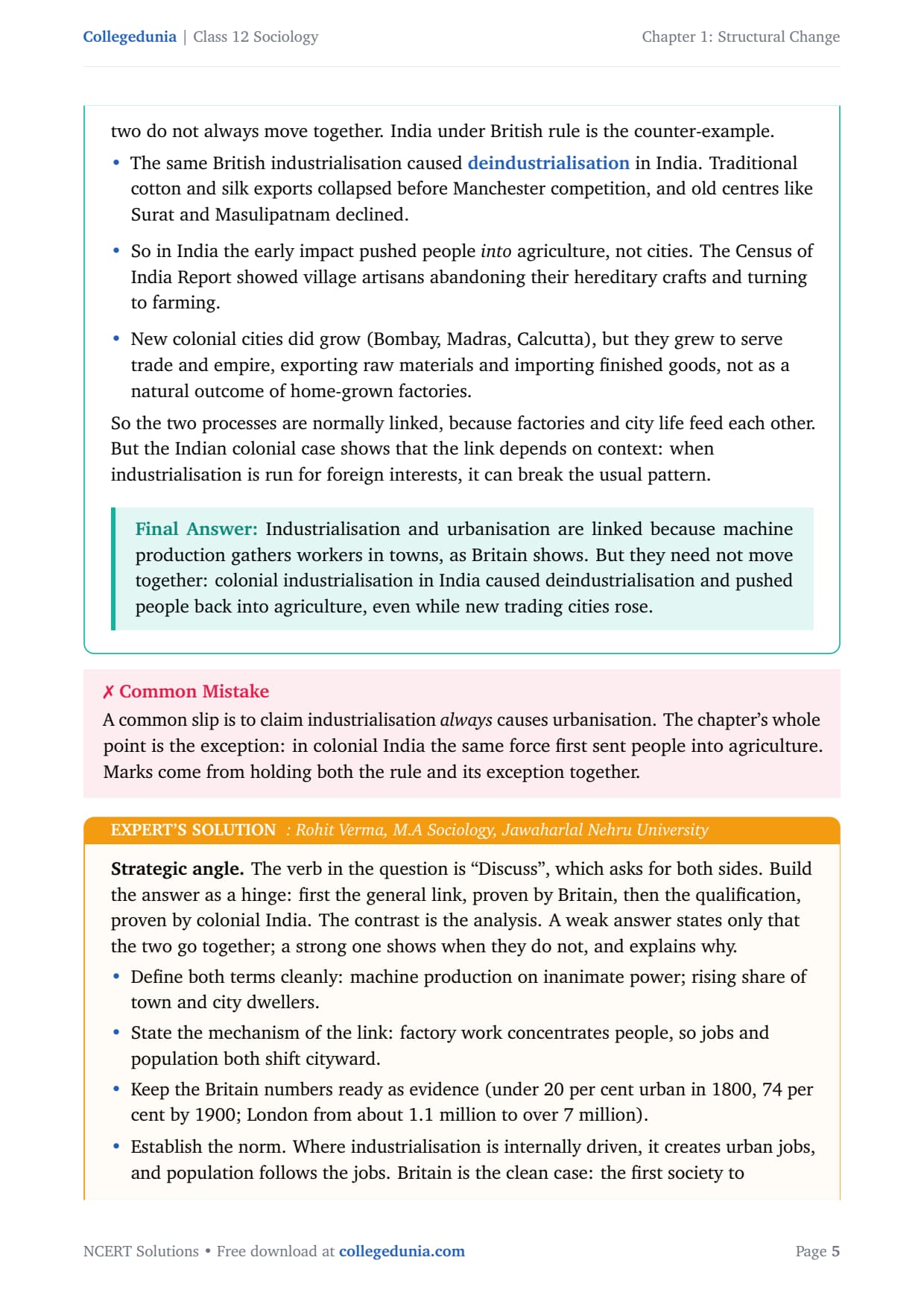
The same British industrialisation caused deindustrialisation
in India. Traditional cotton and silk exports collapsed before
Manchester competition, and old centres like Surat and Masulipatnam
declined.
So in India the early impact pushed people into agriculture, not
cities. The Census of India Report showed village artisans abandoning
their hereditary crafts and turning to farming.
New colonial cities did grow (Bombay, Madras, Calcutta), but they grew
to serve trade and empire, exporting raw materials and importing
finished goods, not as a natural outcome of home-grown factories.
So the two processes are normally linked, because factories and city life feed
each other. But the Indian colonial case shows that the link depends on context:
when industrialisation is run for foreign interests, it can break the usual
pattern.
Industrialisation and urbanisation are linked because machine
production gathers workers in towns, as Britain shows. But they need not move
together: colonial industrialisation in India caused deindustrialisation and
pushed people back into agriculture, even while new trading cities rose.
RV
Rohit Verma
M.A Sociology, Jawaharlal Nehru University
Verified Expert
Strategic angle. The verb in the question is ``Discuss'', which asks
for both sides. Build the answer as a hinge: first the general link, proven by
Britain, then the qualification, proven by colonial India. The contrast is the
analysis. A weak answer states only that the two go together; a strong one shows
when they do not, and explains why.
Define both terms cleanly: machine production on inanimate power;
rising share of town and city dwellers.
State the mechanism of the link: factory work concentrates people, so
jobs and population both shift cityward.
Keep the Britain numbers ready as evidence (under 20 per cent urban in
1800, 74 per cent by 1900; London from about 1.1 million to over 7
million).
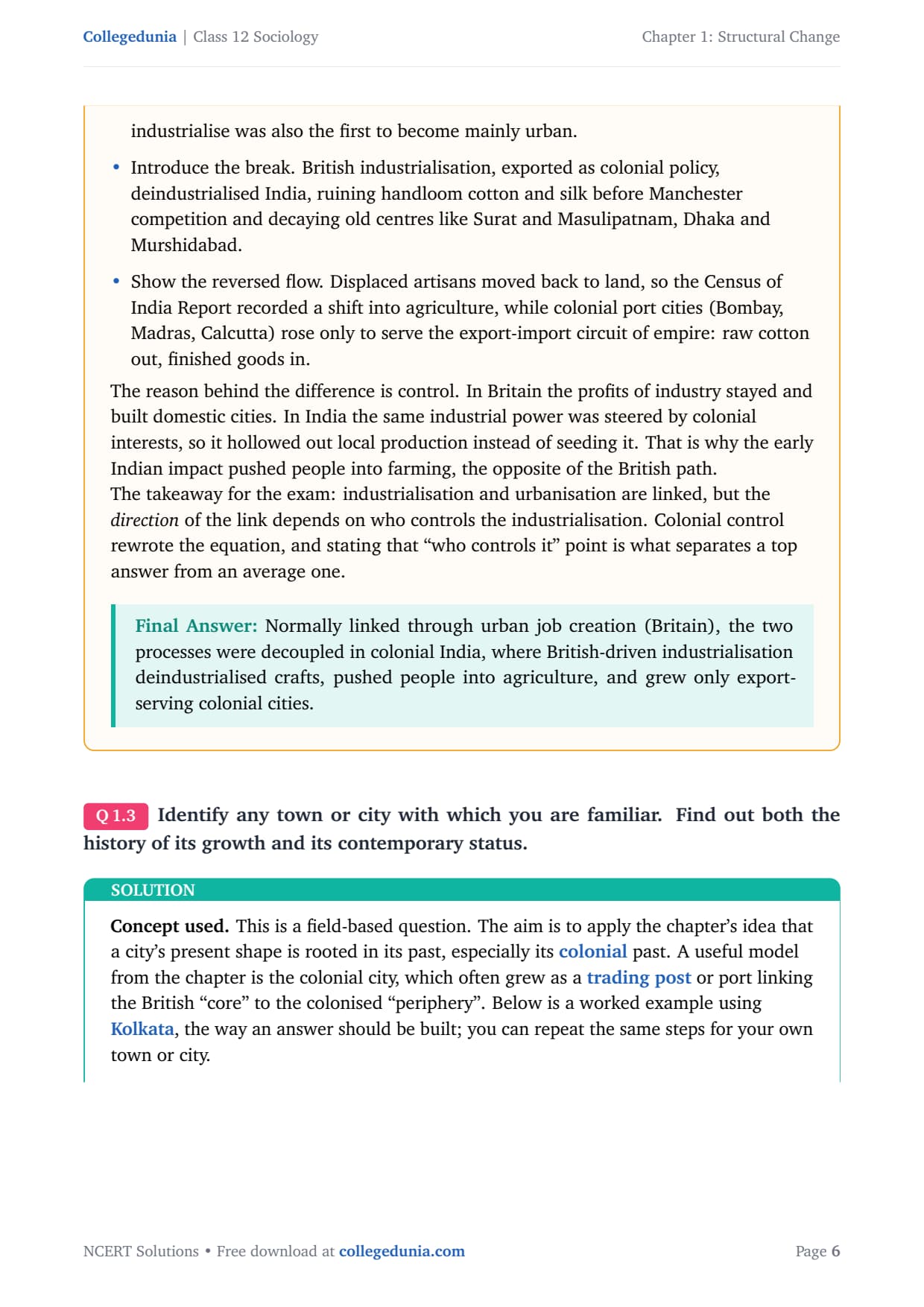
Establish the norm. Where industrialisation is internally driven, it
creates urban jobs, and population follows the jobs. Britain is the
clean case: the first society to industrialise was also the first to
become mainly urban.
Introduce the break. British industrialisation, exported as colonial
policy, deindustrialised India, ruining handloom cotton and silk before
Manchester competition and decaying old centres like Surat and
Masulipatnam, Dhaka and Murshidabad.
Show the reversed flow. Displaced artisans moved back to land, so the
Census of India Report recorded a shift into agriculture, while colonial
port cities (Bombay, Madras, Calcutta) rose only to serve the
export-import circuit of empire: raw cotton out, finished goods in.
The reason behind the difference is control. In Britain the profits of industry
stayed and built domestic cities. In India the same industrial power was steered
by colonial interests, so it hollowed out local production instead of seeding it.
That is why the early Indian impact pushed people into farming, the opposite of
the British path.
The takeaway for the exam: industrialisation and urbanisation are linked, but
the direction of the link depends on who controls the industrialisation.
Colonial control rewrote the equation, and stating that ``who controls it''
point is what separates a top answer from an average one.
Normally linked through urban job creation (Britain), the two
processes were decoupled in colonial India, where British-driven
industrialisation deindustrialised crafts, pushed people into agriculture, and
grew only export-serving colonial cities.
Q 1.3
Identify any town or city with which you are familiar. Find out both
the history of its growth and its contemporary status.
Concept used. This is a field-based question. The aim is to apply the
chapter's idea that a city's present shape is rooted in its past, especially its
colonial past. A useful model from the chapter is the colonial city,
which often grew as a trading post or port linking the British
``core'' to the colonised ``periphery''. Below is a worked example using
Kolkata, the way an answer should be built; you can repeat the same
steps for your own town or city.
How to research your own place
Use two angles. For history: when and why was it founded, who founded it, what
was traded or made there, how did the British change it. For contemporary
status: its size today, main occupations, whether it is a metro, an industrial
town, a semi-urban settlement or a village in transition.
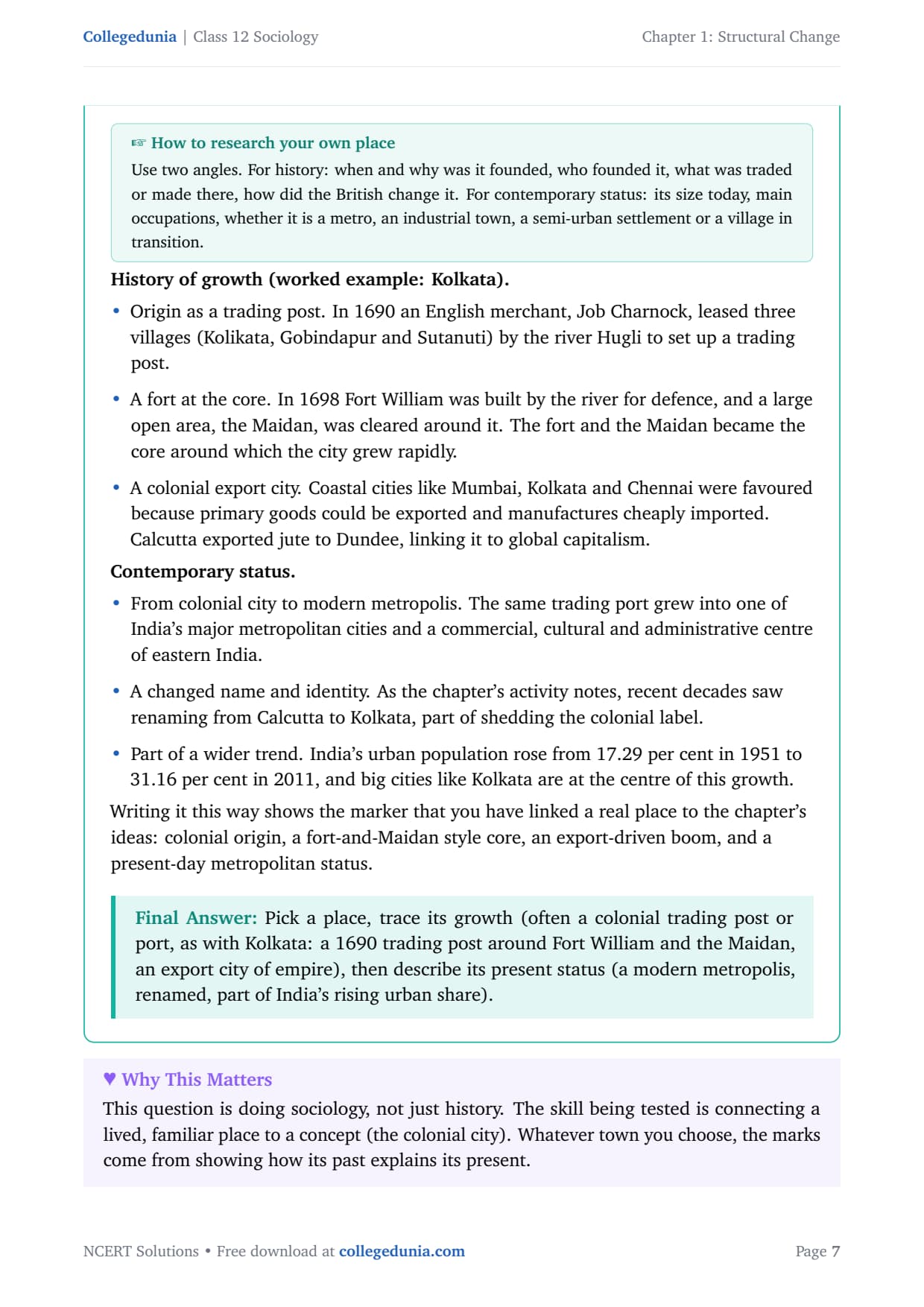
History of growth (worked example: Kolkata).
Origin as a trading post. In 1690 an English merchant, Job Charnock,
leased three villages (Kolikata, Gobindapur and Sutanuti) by the river
Hugli to set up a trading post.
A fort at the core. In 1698 Fort William was built by the river for
defence, and a large open area, the Maidan, was cleared around it. The
fort and the Maidan became the core around which the city grew rapidly.
A colonial export city. Coastal cities like Mumbai, Kolkata and Chennai
were favoured because primary goods could be exported and manufactures
cheaply imported. Calcutta exported jute to Dundee, linking it to global
capitalism.
Contemporary status.
From colonial city to modern metropolis. The same trading port grew
into one of India's major metropolitan cities and a commercial, cultural
and administrative centre of eastern India.
A changed name and identity. As the chapter's activity notes, recent
decades saw renaming from Calcutta to Kolkata, part of shedding the
colonial label.
Part of a wider trend. India's urban population rose from 17.29 per cent
in 1951 to 31.16 per cent in 2011, and big cities like Kolkata are at
the centre of this growth.
Writing it this way shows the marker that you have linked a real place to the
chapter's ideas: colonial origin, a fort-and-Maidan style core, an
export-driven boom, and a present-day metropolitan status.
Pick a place, trace its growth (often a colonial trading post or port,
as with Kolkata: a 1690 trading post around Fort William and the Maidan, an
export city of empire), then describe its present status (a modern metropolis,
renamed, part of India's rising urban share).
AI
Aditi Iyer
M.A Sociology, University of Mumbai
Verified Expert
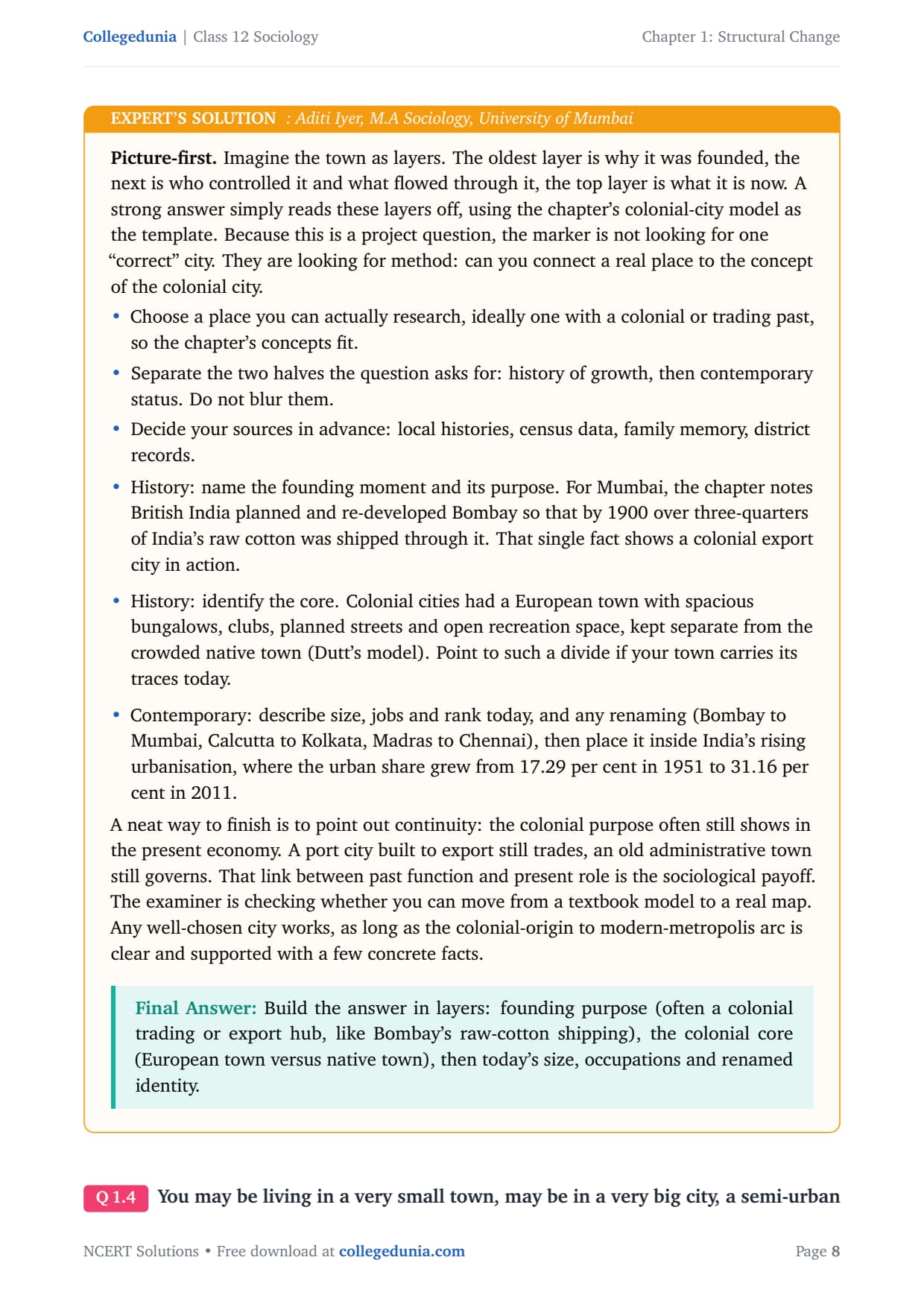
Picture-first. Imagine the town as layers. The oldest layer is why it
was founded, the next is who controlled it and what flowed through it, the top
layer is what it is now. A strong answer simply reads these layers off, using
the chapter's colonial-city model as the template. Because this is a project
question, the marker is not looking for one ``correct'' city. They are looking
for method: can you connect a real place to the concept of the colonial city.
Choose a place you can actually research, ideally one with a colonial or
trading past, so the chapter's concepts fit.
Separate the two halves the question asks for: history of growth, then
contemporary status. Do not blur them.
Decide your sources in advance: local histories, census data, family
memory, district records.
History: name the founding moment and its purpose. For Mumbai, the
chapter notes British India planned and re-developed Bombay so that by
1900 over three-quarters of India's raw cotton was shipped through it.
That single fact shows a colonial export city in action.
History: identify the core. Colonial cities had a European town with
spacious bungalows, clubs, planned streets and open recreation space,
kept separate from the crowded native town (Dutt's model). Point to such
a divide if your town carries its traces today.
Contemporary: describe size, jobs and rank today, and any renaming
(Bombay to Mumbai, Calcutta to Kolkata, Madras to Chennai), then place
it inside India's rising urbanisation, where the urban share grew from
17.29 per cent in 1951 to 31.16 per cent in 2011.
A neat way to finish is to point out continuity: the colonial purpose often
still shows in the present economy. A port city built to export still trades, an
old administrative town still governs. That link between past function and
present role is the sociological payoff.
The examiner is checking whether you can move from a textbook model to a real
map. Any well-chosen city works, as long as the colonial-origin to
modern-metropolis arc is clear and supported with a few concrete facts.
Build the answer in layers: founding purpose (often a colonial trading
or export hub, like Bombay's raw-cotton shipping), the colonial core (European
town versus native town), then today's size, occupations and renamed identity.
Q 1.4
You may be living in a very small town, may be in a very big city, a
semi-urban settlement or a village. • Describe the place where you live. • What are the features which make you think it is a town and not a
city, a village and not a town, or a city and not a village? • Is there any factory where you live? • Is agriculture the main job that people do? • Is it the occupational nature that has a determining influence? Is it
the buildings? Is it the availability of educational opportunities? Is it the
way people live and behave? Is it the way people talk and dress?
Concept used. This question asks you to classify your own settlement as
a village, town or city. The chapter gives the tools: urbanisation is not just
about a place but ``a way of life'' (Wirth, 1938), and it grows out of
industrialisation. The sorting criteria in the question, occupation,
buildings, education, behaviour, speech and dress, are the markers sociologists
use. Below is a model answer; replace the details with what is true for your own
place.
Village, town, city: a rough ladder
Village: small, farming-led, close-knit, fewer formal services. Town: larger,
mixed occupations, some industry and markets, more schools. City: large, mostly
non-farm work, dense buildings, wide education and services, varied and more
impersonal social life.
Describe the place and place it on the ladder.
Occupation is the strongest marker. If most people farm, it points to a
village. If most work in factories, offices, shops or services, it
points to a town or city. The chapter stresses that a prime feature of
industrial society is that the majority no longer work the land.
Buildings and density. Scattered homes with fields suggest a village;
dense, multi-storey, planned streets suggest a city. A mix suggests a
town or a semi-urban settlement.
Services, especially education. Wide availability of schools, colleges
and other formal institutions leans urban; limited access leans rural.
The way of life, not just the place.
Behaviour and social ties. Village life tends to be close-knit and
personal; city life is more varied, anonymous and fast. This is what
Wirth meant by urbanism as ``a way of life''.
Speech and dress. More mixed, cosmopolitan speech and dress usually
signal a town or city; more uniform, local styles signal a village.
Is there a factory? Presence of industry points towards a town or
industrial settlement, and recalls how industrialisation drives
urbanisation.
Putting these together, you weigh the markers rather than rely on size alone. A
place can be physically big yet still rural in its way of life, or small yet
urban in its work and habits.
Classify your settlement by weighing the chapter's markers:
occupation (farm versus non-farm), buildings and density, education and
services, plus the ``way of life'', behaviour, speech and dress. Occupation
usually has the most determining influence, since urban life grows from a shift
away from agriculture.
KD
Karan Desai
M.A Sociology, University of Hyderabad
Verified Expert
Strategic angle. Treat the long list of sub-questions as a checklist of
criteria, not separate questions. Answer each briefly for your own place, then
step back and judge: which criterion decides the label? The chapter hands you
the answer, occupation, so make that your anchor. The sub-questions are not five
random points; they are arranged from the hardest, most decisive marker
(occupation) down to softer cultural ones (speech, dress).
Run the checklist: occupation, factory or not, buildings, education,
behaviour, speech, dress.
Decide the verdict: village, town, city or semi-urban, and say which
criterion tipped it.
Remember the trap: size alone does not decide. A big place can still be
rural in its way of life.
Start with work. If farming dominates, lean village; if factory, office,
shop and service work dominate, lean town or city. The chapter says the
majority working off the land is the prime feature of industrial
society, so this carries the most weight and should lead your answer.
Add the physical and service markers. Density of buildings, planned
streets and the spread of schools and colleges push the label towards
urban; scattered homes among fields and thin services pull it towards
rural. The presence of a factory is a strong nudge towards urban.
Finish with the way of life. Wirth's point is that the city is a manner
of living, more impersonal, varied, mobile, visible in behaviour, speech
and dress, not only a count of people. A semi-urban settlement is exactly
the in-between case, where farm and non-farm life mix.
The reason occupation outranks the rest is that buildings, schools and habits
tend to follow from what people do for a living. Change the dominant work and the
buildings, services and lifestyle follow. So your final label should rest mainly
on occupation, with buildings, education and lifestyle confirming it. That
hierarchy of criteria, naming occupation as the one with ``determining
influence'', is exactly what the question is fishing for.
Use the sub-questions as a criteria checklist, then name your
settlement. Occupation (farm versus non-farm) has the determining influence;
buildings, education and the urban ``way of life'' (behaviour, speech, dress)
support the verdict.
FAQs on Structural Change Class 12 NCERT Solutions
Structural Change Class 12 Sociology Common Questions
Ques. Where can I get the class 12 sociology chapter 1 Structural Change NCERT Solutions PDF?
Ans. You can download the Structural Change Class 12 Sociology NCERT Solutions PDF directly from this page. It is free, follows the 2026-27 NCERT, and answers all 4 back-exercise questions point by point.
Ques. How many questions are there in Structural Change class 12 questions and answers?
Ans. The chapter has 4 back-exercise questions. They cover how colonialism impacted our lives, why industrialisation and urbanisation are linked, tracing the growth of a town or city, and classifying your own settlement.
Ques. How did colonialism impact our lives according to this chapter?
Ans. Built on British capitalism, colonialism reshaped India's politics and economy, gave us the parliamentary, legal and education systems, and changed our culture, including the double-edged place of English. Its effects are contradictory and still present in daily Indian life.
Ques. Why are industrialisation and urbanisation called linked processes?
Ans. Machine production needs workers gathered in one place, so new industrial jobs are usually created in towns and cities, pulling people there. Britain proves the link. But the two do not always move together, as colonial India shows, where British industry caused deindustrialisation here.
Ques. What is the deciding feature that sorts a village, town or city?
Ans. Occupation has the determining influence. If farming is the main job a place leans village; if most work is non-farm it leans city. Urbanisation is also a way of life, so buildings, services, speech and dress all support the occupation marker.
Ques. Is class 12 sociology chapter 1 Structural Change easy to score in the board exam?
Ans. Yes. It is a high-scoring chapter if you read change as deep and two-sided and tie every example back to society. Learn the colonialism impact, the industry-urban link and the settlement criteria, and keep your own local example ready for the application questions.








Comments