The NCERT Solutions for Psychology Class 12 Chapter 2 Self and Personality answer every textbook question on the self, the main theories of personality and the methods used to assess it, set to the latest 2026-27 CBSE syllabus. Each answer explains the Indian and Western notions of the self, the type and trait approaches, Freud's structure of personality and the humanistic view. These solutions help students prepare for the Class 12 Psychology board paper in 2026-27.
Covers all 11 exercise questions from Self and Personality, with full point-wise answers.
This Class 12 Psychology chapter usually carries 8 to 10 marks per board paper.
Pairs with the Notes, Handwritten Notes and NCERT Book PDF linked lower on this page.
Every solution for Class 12 Psychology Chapter 2 in this Collegedunia compilation is written by subject experts from the official NCERT Psychology textbook, and checked against the last five years of CBSE board papers.
Student Feedback: In a Collegedunia poll of 8,420 Class 12 Psychology students taken before the 2026 boards, 69% of students rated Freud's structure of personality and the difference between type and trait approaches as the hardest parts of Self and Personality. Most students said a clear id, ego and superego diagram made the long answer easy to recall.
Source: 2026-27 Class 12 Psychology student poll. Sample of 8,420 students from CBSE schools across 12 states.
What the Self and Personality Class 12 Chapter Is About
Self and Personality is the second chapter of the Class 12 Psychology textbook. It studies how a person comes to know the self, and how psychologists describe the personality that makes each person act in a fairly stable way. The chapter moves from the everyday idea of "who am I" to the formal theories that explain personality.
The chapter answers three big questions that students must keep in mind:
What is the self? The whole set of a person's ideas and feelings about who they are, seen differently in Indian and Western thought.
How is personality explained? Through the type, trait, psychodynamic, behavioural, cultural and humanistic approaches.
How is personality measured? By self-report tests, observation and projective techniques.
So the chapter is really about the inner world of a person and the tools psychology uses to study it. A student who keeps these three threads in mind can connect almost any question in Self and Personality class 12 back to one of them. This is why revision works best when you sort each fact under "self", "theories of personality" or "assessment" first.
The Self and How the Indian and Western Notions Differ
The chapter opens with the idea of the self. The self is the totality of a person's conscious experiences, ideas and feelings about who they are. To answer the first exercise question well, students must show how the Indian and Western views of the self are not the same.
Western view: the boundary between the self and others is relatively fixed, and the self is clearly set apart from other persons.
Indian view: the boundary keeps shifting, so the self extends to family, community and even the cosmos.
Personal self: an orientation in which a person is mainly concerned with the self, larger in the Western view.
Social or relational self: the self that emerges from links with family and group, larger in the Indian view.
The honest exam point is that the Indian self is connected and the Western self is separate. Neither is "better"; the chapter only asks students to see how culture shapes the way people draw the line between "me" and "others". This contrast is the spine of the first answer and a regular long-answer source.
Self-Regulation and Delay of Gratification
The chapter then looks at how a person manages the self. Self-regulation is the ability to organise and monitor one's own behaviour, and delay of gratification is the capacity to put off a smaller reward now for a bigger reward later. This pair feeds a short-answer question, so students should learn the meaning and the reasons together.
Idea
What it means for the exam
Delay of gratification
Holding back a present reward to gain a larger future one, a sign of self-control.
Serves long-term goals
Self-control helps a student work for results that come much later.
Builds resistance to pressure
It helps a person resist temptation and stand up to peer pressure.
Open to training
It can be learned through observation, self-instruction and self-reinforcement.
A key insight for the exam is that delay of gratification is treated as a marker of maturity. Almost every adult achievement in study or work needs the person to wait, plan and resist a quick reward, which is why NCERT calls it important for adult development.
Defining Personality and the Main Approaches
The heart of the chapter is personality. Personality refers to the unique and relatively stable patterns of thinking, feeling and acting that make a person consistent across situations. The third exercise question asks students to define it and then list the approaches, so a clear grid of the six approaches saves time.
Type approach: groups people into a few broad types, as in Sheldon or the Ayurveda doshas.
Trait approach: describes personality through stable traits, as in Allport and Cattell.
Psychodynamic approach: Freud's view that the unconscious id, ego and superego shape behaviour.
Behavioural, cultural and humanistic approaches: learned habits, cultural adaptation, and growth toward self-actualisation.
The exam point students miss most is that type and trait sit together as descriptive approaches, while psychodynamic, behavioural, cultural and humanistic try to explain how personality forms. Sorting the six this way makes the long answer for Question 3 far easier to plan.
Trait Approach Versus Type Approach
The fourth exercise question turns on the word "differ", so the answer must contrast the two approaches point by point. The table keeps the two side by side for fast revision before the board exam.
Point of contrast
Type approach vs trait approach
Unit of description
Type uses broad categories; trait uses smaller, stable dimensions.
All-or-none vs degree
A type puts a person fully in one box; a trait is a matter of degree, high or low.
Simplicity vs precision
Typologies are simple but too broad; traits are more precise and research based.
Realism
Most people do not fit one pure type, so the trait view is seen as more realistic.
A sharp line for the answer is that types are pigeonholes while traits are dimensions. Always add that typologies are too simplistic to capture the variety in real people, the line examiners reward in the Question 4 long answer.
Freud, Horney, Adler and the Humanistic View
This block covers the theory-heavy questions. Students need a clean account of Freud's structure, the difference between Horney and Adler, and Maslow's idea of self-actualisation. Learning them as short, labelled points keeps the long answers tidy.
Freud's structure: the id works on the pleasure principle, the ego on the reality principle, and the superego on the moral principle.
Horney vs Adler: Horney traced depression to basic anxiety and disturbed relationships, while Adler linked it to feelings of inferiority and the striving for superiority.
Humanistic approach: stresses the self, free will and growth, with Rogers and Maslow as the key names.
Self-actualisation: Maslow's idea of realising one's full potential, the top of his need hierarchy.
The exam point worth bolding is that Freud explains personality through inner conflict, while the humanistic view explains it through growth and choice. The Arihant case study (Question 11) tests the Rogers idea of conditional positive regard, so keep that link ready.
Methods of Personality Assessment
The last set of questions deals with how personality is measured. Students should know self-report tests, observation and projective techniques, with one or two named tests for each. The table maps the method to its named tests and its main problem.
Method
Named tests and the problem it faces
Self-report
MMPI and the 16 PF; people may give socially desirable answers.
Observation
Interview and behaviour ratings; observer bias and the effort it takes.
Projective
Rorschach inkblot and the TAT; scoring is subjective and hard to standardise.
A key fact for the exam: projective tests use vague stimuli so that hidden feelings get projected onto them. Note that the two most widely used structured (self-report) tests are the MMPI and the 16 PF, a common fill-in-the-blank trap if students mix them up with the projective Rorschach and TAT.
Self and Personality Class 12 Exercise-wise Coverage
The chapter exercise has 11 questions. The table maps each one to its topic so students can plan revision and find the right NCERT answer fast. The full point-wise solution for each sits in the question set lower on this page.
Question
Topic it tests
Q 1
The self, and the Indian versus Western notion of the self
Q 2
Delay of gratification and why it matters for adult development
Q 3
Defining personality and the main approaches to study it
Q 4
Trait approach and how it differs from the type approach
Q 5
Freud's structure of personality (id, ego, superego)
Q 6
Horney versus Adler on the causes of depression
Q 7
The humanistic approach and Maslow's self-actualisation
Q 8
Observational methods of assessment and their problems
Q 9
Structured personality tests and the two most widely used ones
Q 10
Projective techniques and the widely used projective tests
Q 11
Arihant case study on Rogers and conditional positive regard
Questions 3, 5 and 7 are the most-asked long answers, so students preparing Self and Personality class 12 important questions should learn those first. The case study (Q11) and the assessment items (Q8 to Q10) are steady scorers, so revise the named tests and the Rogers idea well.
Students who want the offline copy can save the class 12 psychology chapter 2 pdf from the download card above and tick off each question as they finish it.
Self and Personality Important Questions and Previous Year Trends
CBSE sets a steady mix of short and long answers from this chapter. Knowing the pattern helps students decide how much to write. The chapter is a regular source of one 4-mark and one 6-mark question, which is why a focused list of Self and Personality important questions saves a lot of revision time.
Long answer (6 marks): Freud's structure of personality, or define personality and explain the approaches.
Short answer (4 marks): Indian versus Western self, trait versus type, or projective techniques.
Very short answer (2 marks): delay of gratification, self-actualisation, or the two structured tests.
Case study: a situation like Arihant's, tested through the Carl Rogers idea of positive regard.
For quick recall before the exam, students often practise the self and personality class 12 important questions set and a short list of named tests. The most repeated items are Freud's id, ego and superego and the type versus trait contrast, so keep those answer points ready in your own words.
Working through the ncert solutions class 12 psychology chapter 2 set twice, once open-book and once from memory, fixes the names, theories and tests well before the board exam.
Common Mistakes Students Make in This Chapter
A few errors cost marks every year in this chapter. Most come from swapping theorists or mixing up the assessment tests. Avoiding them is the fastest way to lift a score.
Saying the id works on the reality principle - the id works on the pleasure principle, the ego on reality.
Calling the Rorschach and TAT structured tests - they are projective; MMPI and 16 PF are structured.
Writing that the Indian self is "fixed" - in the Indian view the boundary shifts; it is the Western self that is fixed.
Confusing Horney with Adler - keep basic anxiety (Horney) apart from inferiority feelings (Adler).
Treating type and trait as the same - a type is all-or-none, a trait is a matter of degree.
Students who fix these five points usually move from average to high marks on the long answers. The exam rewards exact names, so always attach the right theorist or test to the right idea before you explain it.
Self and Personality PDF Download Formats and Languages
The solutions are free to download in more than one format, so students can pick what suits their device and revision style. The download card at the top of the page carries each option for this chapter.
Normal and HD PDF: the class 12 psychology chapter 2 pdf comes in a normal size for quick downloads and an HD version for clear printing.
English medium: all 11 answers are written in simple English for the CBSE board paper.
Question-only set: a print-and-practise sheet of Self and Personality extra questions for self-testing.
Whole-book pack: the solutions sit in one set that runs through every Class 12 Psychology chapter, so you can revise from Chapter 1 onwards in one place.
Many students search for class 12 psychology chapter 2 answers on their phone the night before a test, so a saved PDF means you can revise even without internet. Keep both the question set and the solved version handy for a full self-check.
How the Self and Personality Solutions Pair with Notes and the Book PDF
These NCERT Solutions answer the back-exercise questions. To revise the full chapter, students should use them alongside the other resources for the same chapter, all linked in the table below.
Reading the original NCERT chapter text, figures and boxes
Tip: read the Notes first, then attempt these solutions on your own, and only then check the model answers here. That order builds memory faster than copying answers straight away.
All NCERT Solutions for Class 12 Psychology
The table links the NCERT Solutions for every chapter in Class 12 Psychology, so students can move across the course in one click. Self and Personality is highlighted.
All NCERT Solutions for Self and Personality with Step-by-Step Solutions
Below are all 11 NCERT exercise questions for this chapter, exactly as they appear in the textbook. Tap Check Solution for the model answer or Expert Solution for the topper-style approach.
Q 2.1
What is self? How does the Indian notion of self differ from the Western notion?
Concept used. The self is the totality of an
individual's conscious experiences, ideas, thoughts and feelings with
regard to herself or himself. In simple words, it is the answer each of us
gives, openly or quietly, to the question ``Who am I?''. The self has a dual
status: it can act as a subject (the ``I'' that does something, as in
``I am a dancer'') and as an object (the ``me'' on which something is
done, as in ``I am one who easily gets hurt''). It forms through our
interaction with the physical and the socio-cultural world, starting from
the early biological self of a hungry, crying infant.
The self has several aspects that students should keep apart:
Personal self. An orientation in which a person is mainly
concerned with herself or himself: personal freedom, personal
achievement, personal comfort.
Social (familial or relational) self. The self that emerges
in relation with others and values cooperation, unity, sharing,
sacrifice, and family and social relationships.
Indian notion versus Western notion. The sharpest difference lies in
where the boundary is drawn between the self and the other.
In the Western view, the boundary is relatively fixed. The
self and the group exist as two separate entities with clearly
defined limits, and members keep their individuality. The Western
view holds clear dichotomies: self versus other, person versus
nature, subjective versus objective.
In the Indian view, the boundary keeps shifting. At one
moment the self can expand to fuse with the cosmos or include
others; at the next it withdraws and focuses on the individual.
The self is not separated from one's own group; both stay in
harmonious co-existence, and clear dichotomies are avoided.
This is why many Western cultures are described as
individualistic (the individual stands apart from the group) and
many Asian, including Indian, cultures as collectivistic (the
individual and the group remain together).
Hold the contrast in one line
Western self: a separate island with a firm coastline. Indian self: a
shoreline that the tide of context keeps moving in and out.
Self is the totality of a person's conscious experiences, ideas
and feelings about themselves, acting both as knower (subject) and known
(object). The Western notion draws a fixed boundary between self and others
(individualistic), while the Indian notion treats that boundary as shifting,
so the self stays in harmony with the group (collectivistic).
AI
Ananya Iyer
M.A Psychology, Delhi University
Verified Expert
Structural observation. An examiner who reads ``What is self?'' is
checking two separate things in one question, so answer it in two clearly
labelled halves. The first half is a definition plus its dual nature;
the second half is a cultural comparison. Splitting the answer this
way also stops the common slip of confusing ``self'' with ``personality''.
Begin with the definition that NCERT gives word for word: self is the
totality of an individual's conscious experiences, ideas, thoughts and
feelings about herself or himself. Then add the two angles that earn the
extra marks:
Subject and object. The self knows (``I know who I am'')
and is known at the same time. Mention this dual status, because it
is a frequent one-mark add-on.
Kinds of self. Personal self (concern with oneself) versus
social or relational self (concern with relationships). Naming both
shows the self is not a single block.
For the cultural part, anchor the answer on the boundary idea, not on
loose adjectives. Western cultures keep a fixed self-other boundary and so
are called individualistic; Indian culture keeps a shifting boundary, so the
self merges with and separates from the group as the situation demands,
which is why it is called collectivistic. One concrete line such as ``the
Indian self can expand to include the family, then withdraw to the
individual'' tells the examiner you understand the idea, not just the
labels.
Why this matters. The self-other boundary is the seed of the whole
individualism versus collectivism theme that returns in social psychology,
so getting it right here pays off in later chapters too.
Self is a person's total conscious experience of themselves, which
both knows and is known. The Western self keeps a fixed boundary from others
(individualistic); the Indian self keeps a shifting boundary that fuses with
the group (collectivistic).
Q 2.2
What is meant by delay of gratification? Why is it considered important for adult development?
Concept used.Delay of gratification means learning to
postpone or defer the satisfaction of a need or desire, rather than acting on
it at once. NCERT calls this ability self-control, and it is one part
of the wider skill of self-regulation, which is our capacity to
organise and monitor our own behaviour. The strength behind it is what people
commonly call will power.
In short, delay of gratification is the difference between ``I want it now''
and ``I can wait for something better later''. A student who switches off a
game to finish revision is delaying the smaller, immediate pleasure for a
larger, later reward.
Why it matters for adult development. Adult life constantly asks us
to resist situational pressures and control ourselves. The ability to wait
supports development in several ways:
It serves long-term goals. Self-control plays a key role in
the fulfilment of long-term goals, which usually need steady effort
now for a payoff much later (a degree, a career, savings).
It builds resistance to pressure. Many life situations
require resisting tempting but harmful choices; the person who can
defer gratification is less swept along by the moment.
It is open to training. NCERT notes Indian cultural
practices such as fasting in vrata or roza and
non-attachment to worldly things as effective ways of developing
self-control, along with psychological techniques like observing
one's own behaviour, self-instruction and self-reinforcement.
The marshmallow idea in a sentence
Choosing the bigger reward later over the smaller reward now is the everyday
face of delay of gratification, and it predicts patience, planning and
goal-directed effort in adult life.
Delay of gratification is the learned ability to postpone the
satisfaction of a need (a form of self-control within self-regulation). It is
important for adult development because long-term goals, resistance to
situational pressure, and disciplined effort all depend on being able to wait
for a larger later reward instead of grabbing a small immediate one.
KM
Karan Mehta
M.A Applied Psychology, TISS Mumbai
Verified Expert
Strategic angle. This is a two-part question worth full marks only
if both parts are visibly answered: first define, then justify.
Toppers separate the two so the examiner can tick each. Do not let the answer
drift into a general essay on self-regulation; keep ``delay of gratification''
at the centre.
Define it crisply as the deferring of need satisfaction, and immediately
place it under the larger umbrella of self-control and self-regulation so the
concept has a home in the chapter's structure.
For the importance part, build the justification around long-term goals,
because that is the single line NCERT stresses most:
Goal pursuit. Almost every adult achievement, study, work,
health, money, needs present sacrifice for future gain, which is
exactly what delaying gratification trains.
Self-regulation techniques. Tie in observation of one's own
behaviour, self-instruction and self-reinforcement, plus the Indian
cultural mechanisms of vrata and roza, to show the
skill can be deliberately built.
Maturity marker. Frame the ability to wait as a sign of
moving from impulse-driven childhood responses to controlled,
planned adult behaviour.
Why this matters. Examiners reward the link between a small
psychological skill and big life outcomes, so spelling out ``wait now,
gain more later'' as the engine of adult goal achievement is what lifts a
3-mark answer to full marks.
Delay of gratification is the ability to postpone need satisfaction
(self-control within self-regulation). It is vital for adult development
because pursuing long-term goals, resisting situational pressure and acting
in a planned, mature way all rest on the capacity to defer immediate reward
for a greater future one.
Q 2.3
How do you define personality? What are the main approaches to the study of personality?
Concept used. In psychology, personality refers to our
characteristic and relatively stable ways of responding to individuals and
situations. The word itself comes from the Latin persona, the mask
worn by actors in Roman theatre, which already hints that personality is the
consistent ``character'' a person shows. NCERT lists its defining features:
It has both physical and psychological components.
Its expression in behaviour is fairly unique in a given individual.
Its main features do not change easily with time.
It is dynamic: some features may change due to internal or external
situational demands, so it is adaptive.
Once we can characterise someone's personality, we can predict, within
limits, how they will behave across many situations.
Main approaches to the study of personality. Psychologists have
built several broad approaches, each lighting up some aspects of personality:
Type approach. Groups people into a few broad types based
on patterns of behaviour (for example Hippocrates' four humours, the
Indian trigunas, Sheldon's body types, Jung's introvert and
extravert, and Type A and Type B).
Trait approach. Describes personality through a smaller set
of stable, consistent traits along which people differ (Allport,
Cattell, Eysenck, and the Five-Factor or Big Five model).
Psychodynamic approach. Freud's view that personality is
driven by unconscious forces, structured as id, ego and superego.
Behavioural approach. Treats personality as learned
responses to the environment, built through conditioning and
reinforcement.
Cultural approach. Sees personality as an adaptation of
individuals and groups to the demands of their ecology and culture.
Humanistic approach. Focuses on subjective experience,
free choice and self-actualisation (Rogers and Maslow).
Mention the count
State up front that there are several approaches and then name them. Listing
``type, trait, psychodynamic, behavioural, cultural, humanistic'' as a
labelled set is an easy way to bank marks before you explain any one of them.
Personality is a person's characteristic and relatively stable way
of responding to people and situations, with physical and psychological
components that are mostly enduring yet adaptive. The main approaches to
studying it are the type, trait, psychodynamic, behavioural, cultural and
humanistic approaches.
AS
Aditi Sharma
M.Phil Clinical Psychology, NIMHANS Bangalore
Verified Expert
Strategic angle. Read the question as a definition plus a
map. Many students nail the definition and then forget to list every
approach, losing easy marks. Treat the second half as a checklist of six
names that must all appear.
Open with the psychological definition, not the everyday ``good-looking''
one, and pull in the persona origin to show depth. Add the four NCERT
features so the definition is complete rather than a one-liner.
Then deliver the map of approaches as a tight, labelled list:
Type and trait sit together as descriptive approaches: types
sort people into a few boxes, traits place them on continuous
dimensions. Contrasting them in one breath shows understanding.
Psychodynamic is Freud and the unconscious id-ego-superego
structure.
Behavioural, cultural and humanistic round off the set,
each with a one-line tag (learned responses, ecological adaptation,
self-actualisation).
A neat memory hook for the second half is to group the six approaches into
three pairs by what they emphasise: type and trait describe the
structure of personality, psychodynamic and humanistic explain its
inner dynamics (unconscious conflict versus conscious growth), and
behavioural and cultural locate its source outside the person (learned
responses and ecological adaptation). Presenting the six as three pairs shows
the examiner you see the logic behind the list, not just a memorised string,
and it makes the names easier to recall under exam pressure.
Why this matters. This question is effectively the chapter's table
of contents, so a clean, complete list here signals to the examiner that you
have the whole map in your head, which sets up every later approach-specific
question. A student who can both define personality precisely and name all
six approaches has secured the gateway marks for the entire chapter.
Personality is the characteristic, relatively stable yet adaptive
way a person responds to people and situations, with physical and
psychological components. It is studied through six main approaches: type,
trait, psychodynamic, behavioural, cultural and humanistic.
Q 2.4
What is trait approach to personality? How does it differ from type approach?
Concept used. The trait approach describes personality
through traits, where a trait is a relatively enduring attribute or
quality on which one individual differs from another in a consistent,
stable way. Instead of sorting people into a few boxes, this approach looks
for the ``building blocks'' of personality and rates each person on the
degree to which a quality is present. NCERT summarises traits as
(a) relatively stable over time, (b) generally consistent across situations,
and (c) varying in strength and combination across individuals, which is what
produces individual differences. Allport, Cattell and Eysenck are the leading
trait theorists.
How it differs from the type approach. The two approaches answer the
same question, ``how is this person organised?'', in opposite ways:
Unit of description. The type approach uses broad
categories or types (for example sanguine, choleric, or Type
A and Type B); the trait approach uses dimensions along which
everyone can be placed.
All-or-none versus matter of degree. A type puts a person
wholly into one box; a trait rates a person by how
much of a quality they have, so shyness or friendliness is a sliding
scale, not a label.
Simplicity versus precision. Typologies are appealing but
too simplistic, since human behaviour is complex and people rarely
fit one box neatly; traits allow finer, more realistic description.
Do not call traits ``types''
Type and trait are not synonyms. ``Extravert type'' sorts a person into a
group; ``extraversion trait'' measures how outgoing they are on a scale.
Mixing the two is the commonest error in this answer.
The trait approach describes personality through stable, consistent
traits, enduring qualities on which people differ by degree (Allport,
Cattell, Eysenck). It differs from the type approach because types sort
people into a few broad, all-or-none categories, whereas traits place every
person on continuous dimensions and treat each quality as a matter of degree,
giving a more precise and less simplistic picture.
RV
Rohit Verma
M.A Psychology, Banaras Hindu University
Verified Expert
Quick reading. The hinge word in this question is ``differ''. The
examiner wants a definition of the trait approach and a sharp
contrast, so structure the answer as: define trait, then a point-by-point
difference. A two-column mental table is the fastest route to full marks.
Define a trait as an enduring quality measured by degree, and name the three
trait theorists so the approach is concrete. Then make the contrast explicit
rather than implied:
Category versus dimension. Types are pigeonholes; traits are
rulers. This single contrast carries most of the marks.
Whole versus degree. A type assigns the whole person to one
class; a trait says ``70 percent shy'', allowing mixtures.
Realism. Add the line that typologies are too simplistic
because people do not fit neat boxes, which is exactly why the trait
approach was developed.
One concrete illustration cements the contrast: Jung's introvert versus
extravert is a type split that drops each person into one of two boxes,
whereas Eysenck's extraversion is a trait dimension on which the same
person might score anywhere from very reserved to highly outgoing. Offering
this single example shows you can apply the distinction, not just recite it.
Why this matters. Examiners love compare-and-contrast items because
they separate students who memorise from students who understand. Stating the
``box versus scale'' difference in your own words, and backing it with the
introvert-versus-extraversion example, is what shows real grasp.
The trait approach explains personality through enduring qualities
(traits) measured by degree. It differs from the type approach in that types
place a person wholly into one of a few broad categories, while traits rate
the person along continuous dimensions, making the trait approach more
precise and less simplistic.
Q 2.5
How does Freud explain the structure of personality?
Concept used. In Freud's psychodynamic approach, the
structure of personality is built from three forces that reside mostly in the
unconscious and can only be inferred from how people behave: the
id, the ego and the superego. They are concepts,
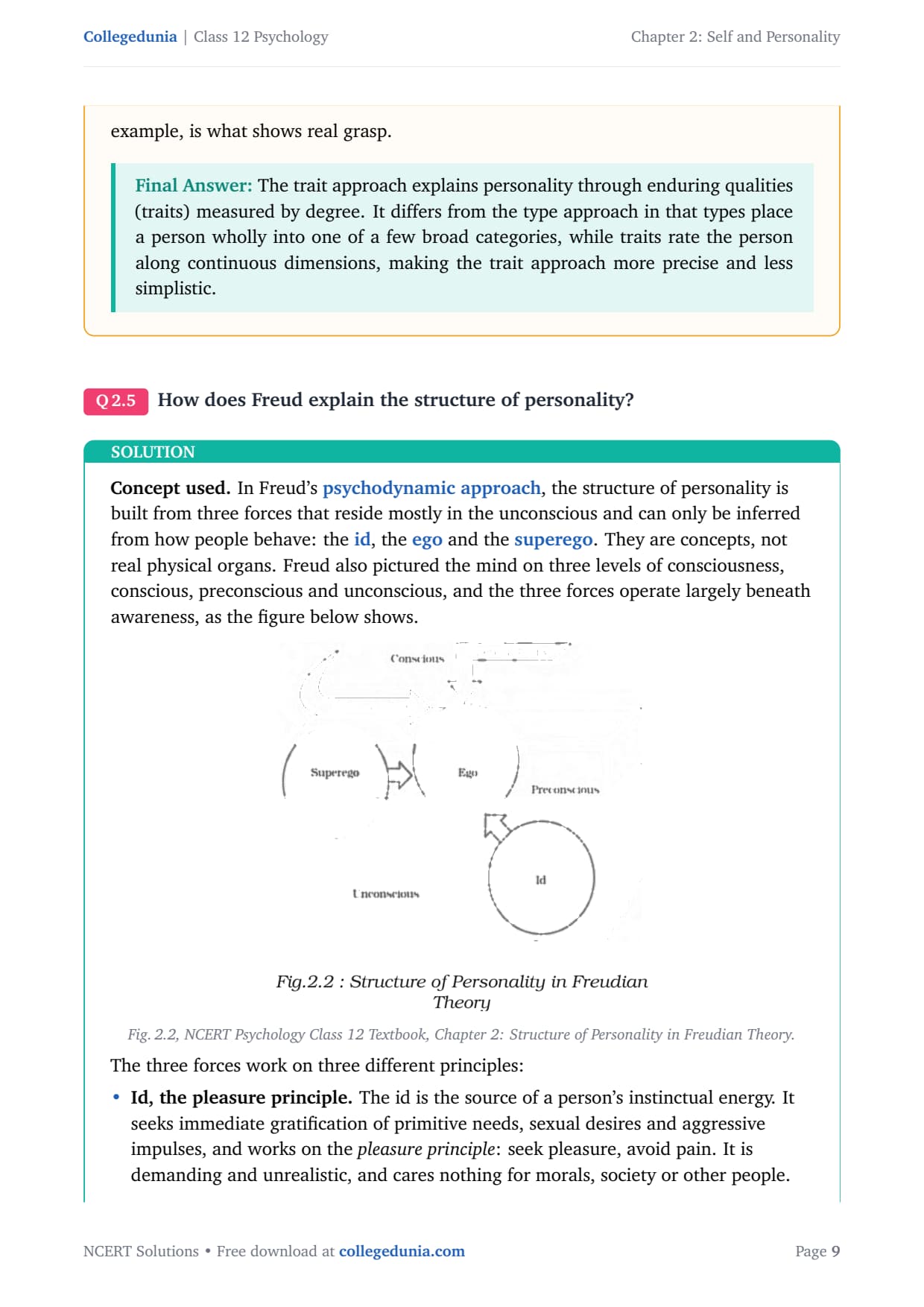
not real physical organs. Freud also pictured the mind on three levels of
consciousness, conscious, preconscious and unconscious, and the three forces
operate largely beneath awareness, as the figure below shows.
Fig. 2.2, NCERT Psychology Class 12 Textbook, Chapter 2: Structure of Personality in Freudian Theory.
The three forces work on three different principles:
Id, the pleasure principle. The id is the source of a
person's instinctual energy. It seeks immediate gratification of
primitive needs, sexual desires and aggressive impulses, and works on
the pleasure principle: seek pleasure, avoid pain. It is
demanding and unrealistic, and cares nothing for morals, society or
other people. The life force energising the id is called the
libido.
Ego, the reality principle. The ego grows out of the id and
tries to satisfy its needs in line with reality. It works on the
reality principle, steering the id towards acceptable
behaviour. NCERT's example: the id of a boy who wants an ice-cream
tells him to grab it; the ego, knowing he may be punished, tells him
the realistic way is to ask first. The ego is patient and reasonable.
Superego, the moral principle. The superego is the moral
branch of the mind. It tells the id and ego whether an act is ethical,
and it controls the id by internalising parental authority through
socialisation. It is the source of guilt, ideals and conscience.
How they combine. In some people the id is stronger, in others the
superego, and the relative strength of id, ego and superego determines each
person's stability. Freud also held that the id is energised by two
instinctual forces, a life instinct and a death instinct, and he focused more
on the life (sexual) instinct. Personality, then, is the outcome of a
constant inner conflict between these three competing forces, managed by the
ego.
A clean three-line skeleton
Id = ``I want it now'' (pleasure principle); ego = ``let us be realistic''
(reality principle); superego = ``is it right?'' (moral principle). Build
the whole answer on this skeleton and then flesh each line out.
Freud explains personality as three interacting forces lying mostly
in the unconscious: the id (instinctual energy on the pleasure principle), the
ego (which satisfies the id realistically on the reality principle), and the
superego (the moral branch that judges right from wrong). Behaviour and a
person's stability arise from the ongoing conflict among these three, managed
by the ego.
PJ
Pranav Joshi
M.A Psychology, University of Hyderabad
Verified Expert
Picture-first. Freud's structure is a classic figure-based answer,
so let the iceberg-style diagram do the heavy lifting and then translate it
into words. Open by naming all three structures and the level of mind they sit
in, because that one sentence frames everything that follows.
The marks here come from pairing each structure with its principle and
a one-line example, not from vague description:
Id with pleasure principle. Stress ``immediate
gratification'' and the libido as its energy. The id is the engine.
Ego with reality principle. Use the ask-before-you-grab
ice-cream example; it shows the ego mediating between desire and the
real world.
Superego with moral principle. Present it as internalised
parental authority and the seat of guilt and conscience.
A useful way to read the diagram is to notice that all three structures sit
mostly below the waterline, in the unconscious, with only small parts rising
into the conscious and preconscious. This is the point students most often
miss: even the ego and superego operate largely outside awareness, which is
why Freud said we infer them from behaviour rather than observe them directly.
Pointing this out from the figure earns the conceptual mark that pure
description cannot.
Close by saying the three are in constant conflict and that their relative
strength decides a person's stability, with the ego as the manager in the
middle. Mentioning the life and death instincts, and that the libido is the
life instinct's energy driving the id, is a useful extra that shows reading
beyond the basics. A balanced personality, in this view, is one where the ego
is strong enough to satisfy the id's demands without either letting them run
wild or letting the superego crush them entirely.
Why this matters. This structure is the foundation for the very next
ideas in the chapter, defence mechanisms and the psychosexual stages, so a
firm grasp of id-ego-superego pays off across several questions. The ego's
job of balancing id and superego is exactly what defence mechanisms are later
shown to protect.
Freud sees personality as three unconscious forces in constant
conflict: the id (pleasure principle, instinctual demands), the ego (reality
principle, realistic satisfaction of the id) and the superego (moral
principle, conscience). The ego manages the conflict, and the relative
strength of the three determines a person's stability.
Q 2.6
How would Horney's explanation of depression be different from that of Alfred Adler?
Concept used. Both Karen Horney and Alfred Adler were
post-Freudian (neo-analytic) theorists who moved away from Freud's heavy
stress on sexual and aggressive instincts and gave a larger role to social
forces and the conscious, goal-directed side of the person. But they locate
the root of psychological disturbance, including a low, depressed state, in
different places.
Horney's explanation. Horney traces psychological disorders to
disturbed interpersonal relationships during childhood.
When parents behave towards a child in an indifferent, discouraging
or erratic way, the child feels insecure, and a feeling she called
basic anxiety results.
Out of this anxiety grows deep resentment toward the parents, or
basic hostility.
Excessive dominance or indifference, and giving too much or too
little approval, leave the child feeling isolated and helpless, which
interferes with healthy development.
So for Horney, a depressed, helpless state grows from a damaged early
parent-child relationship. She also took a more optimistic view of human
growth and challenged Freud's treatment of women as inferior.
Adler's explanation. Adler's individual psychology assumes
that human behaviour is purposeful and goal-directed, and that we each have
the capacity to choose and create.
Adler held that every individual suffers from feelings of inadequacy
and guilt, which he called the inferiority complex, arising
from childhood.
Our personal goals, especially those that give us security and help
us overcome these feelings, drive personality development.
Healthy development depends on overcoming the inferiority
complex; failure to do so leaves the person stuck in inadequacy.
So for Adler, a depressed or defeated state reflects an unconquered
inferiority complex and a failure to move towards meaningful, security-giving
goals.
One contrast to remember
Horney looks outward to childhood relationships (parental behaviour
→ basic anxiety); Adler looks inward to the self (inferiority
feelings → struggle to overcome them).
For Horney, a depressed, helpless condition stems from disturbed
interpersonal relationships in childhood: indifferent or erratic parenting
produces basic anxiety and basic hostility. For Adler, it stems from an
unresolved inferiority complex, the childhood feelings of inadequacy and
guilt that the person has failed to overcome through goal-directed striving.
Thus Horney emphasises early social relationships, while Adler emphasises the
inner struggle against inferiority.
NR
Neha Reddy
M.A Psychology, Christ University Bangalore
Verified Expert
Quick reading. The word ``different'' tells you this is a contrast
question, so never describe only one theorist. Set up two short blocks,
Horney then Adler, each ending in a one-line cause of the depressed state,
and let the difference fall out of the comparison.
Horney's keyword chain is the scoring core: indifferent or erratic
parenting→basic anxiety→basic hostility→
feelings of isolation and helplessness. Reproduce that chain and the marks
follow.
For Adler, build a parallel chain so the contrast is visible:
Source. Childhood feelings of inadequacy and guilt, the
inferiority complex, present in everyone.
Engine. Goal-directed striving for security to overcome
those feelings.
Disturbance. A depressed state means the inferiority complex
was not overcome.
It also helps to note what the two share, so the contrast does not look
forced. Both are post-Freudian theorists who softened Freud's stress on
instincts and gave more weight to social and conscious factors, and both
trace the trouble back to childhood. The difference is purely in the
mechanism: for Horney the childhood damage is relational (how the
parents treated the child), while for Adler it is the universal feeling of
inferiority and whether the person managed to rise above it. Stating the
common ground first makes the final contrast land harder.
Why this matters. Examiners reward students who frame the difference
in one sentence: Horney blames the relationship, Adler blames an
unconquered inner feeling. Ending on that single contrasting line
shows you compared rather than merely listed.
Horney would explain a depressed state through disturbed childhood
relationships: cold or erratic parenting breeds basic anxiety and hostility,
leaving the person isolated and helpless. Adler would explain it through an
unresolved inferiority complex that the person failed to overcome by
goal-directed striving. Horney stresses early interpersonal relationships;
Adler stresses the inner struggle against feelings of inferiority.
Q 2.7
What is the main proposition of humanistic approach to personality? What did Maslow mean by self-actualisation?
Concept used. The humanistic approach, developed mainly by
Carl Rogers and Abraham Maslow largely in response to Freud, focuses on the
subjective experiences of individuals and on their freedom to choose. Its
main proposition is that human beings are basically good and are
driven by an inborn tendency towards growth and fulfilment.
Rogers' central idea is the fully functioning person.
Fulfilment is the motivating force of personality development:
people naturally try to express their capabilities, potentials and
talents to the fullest.
Rogers contrasts the real self (who a person actually is) with
the ideal self (who they would like to be). When the two match,
the person is happy; a wide gap between them brings unhappiness.
Healthy growth needs an atmosphere of unconditional positive
regard, which Rogers' client-centred therapy tries to create.
In short, the humanistic approach says people are innately good, free to shape
their lives, and naturally inclined to actualise their true self.
What Maslow meant by self-actualisation.Self-actualisation
is the state in which people have reached their own fullest potential. Maslow
held an optimistic, positive view of human nature, with people having the
potential for love, joy and creative work.
Survival needs, biological, security and belongingness needs, are
shared with animals; being concerned only with these reduces a person
to the animal level.
The real journey of human life begins with the pursuit of the higher
needs: self-esteem and self-actualisation.
A self-actualising person uses their abilities freely and creatively,
having moved beyond mere survival to growth.
Why the approach feels uplifting
Where Freud saw conflict and hidden drives, the humanistic approach sees
potential and choice. Self-actualisation is its high point: the picture of a
person living fully, creatively and true to themselves.
The main proposition of the humanistic approach (Rogers and Maslow)
is that people are basically good, free to shape their lives, and driven by an
inborn tendency towards growth and fulfilment, with a fully functioning person
showing congruence between the real self and the ideal self. By
self-actualisation Maslow meant the state in which a person has reached their
own fullest potential, the highest goal that emerges once survival needs are
met.
IN
Ishaan Nair
M.A Psychology, Ambedkar University Delhi
Verified Expert
Strategic angle. Two distinct sub-questions sit here: the
proposition of the whole approach, and Maslow's one term. Answer
them as two labelled halves so neither is lost, and resist the urge to write a
full needs-hierarchy essay; the question asks only what self-actualisation
means.
For the proposition, lead with the optimistic claim that people are innately
good and growth-oriented, then earn extra marks with Rogers' real-self versus
ideal-self congruence and unconditional positive regard:
Core claim. Inborn tendency to actualise one's nature;
fulfilment as the motive.
Rogers' machinery. Fully functioning person, real self
versus ideal self, unconditional positive regard.
For self-actualisation, define it tightly as reaching one's fullest potential,
then position it above the survival needs to show you know where it sits
without drifting into Class XI motivation content.
A neat framing for the contrast between the two thinkers is that Rogers
describes the process (becoming a fully functioning person through
congruence and unconditional positive regard), while Maslow names the
destination (self-actualisation, the fullest potential). Both, though,
agree on the optimistic core: people are innately good and reach upward once
their basic survival needs are met. Drawing this process-versus-destination
line shows you can connect the two humanistic theorists rather than treat
them as unrelated.
Why this matters. Markers look for the exact phrase ``fullest
potential'' for Maslow and ``congruence of real and ideal self'' for Rogers.
Hitting both keyword targets is what separates a complete answer from a vague
one.
The humanistic approach proposes that people are basically good,
free and naturally driven towards growth and fulfilment, with the fully
functioning person showing congruence between real self and ideal self. For
Maslow, self-actualisation is the state of having realised one's own fullest
potential, the highest pursuit that opens up once survival needs are
satisfied.
Q 2.8
Discuss the main observational methods used in personality assessment. What problems do we face in using these methods?
Concept used. Within behavioural analysis, an observer's
report of a person's behaviour across situations is used to assess
personality. The two main observation-based methods NCERT discusses are
observation and the interview; both gather first-hand
information about how a person actually behaves.
The main observational methods.
Observation. Watching a person's behaviour to assess
personality. It is not casual people-watching: it is a sophisticated
procedure that needs a trained observer and detailed guidelines on how
to analyse the behaviour. NCERT's example is a clinical psychologist
observing a client's interaction with family members and home
visitors to gain insight into the client's personality.
Interview. Talking to the person being assessed and asking
specific questions. Diagnostic interviewing goes in depth, beyond the
person's surface replies. Interviews may be unstructured (the
interviewer forms an impression through open questioning) or
structured (specific questions in a set order, often with
rating scales, to allow objective comparison between people).
Problems we face in using these methods. NCERT lists three main
limitations of observation and interview:
Demanding training. The professional training needed to
collect useful data through these methods is quite demanding and
time-consuming.
Maturity of the psychologist. The maturity of the
psychologist is a precondition for obtaining valid data; a less
experienced assessor may misread behaviour.
Observer effect. The mere presence of the observer may
contaminate the results. As a stranger, the observer can influence
the behaviour of the person being observed, so the data may not be
genuine.
Do not confuse observation with situational tests
Observation and interview are the ``observational methods'' here.
Nomination, ratings and situational tests are separate procedures within
behavioural analysis, so keep them out of this particular answer.
The main observational methods in personality assessment are
observation (trained, guideline-based watching of behaviour) and the
interview (structured or unstructured questioning of the person). The chief
problems are that they need demanding, time-consuming professional training,
they require a mature psychologist for valid data, and the observer's mere
presence can change the behaviour being observed, reducing the accuracy of
the data.
RK
Riya Kapoor
M.A Psychology, Jamia Millia Islamia
Verified Expert
Structural observation. This is a ``methods plus limitations''
question, so plan two visible parts. In part one name and explain
observation and interview; in part two list the three NCERT
limitations. Keeping the two parts separate guarantees marks for each.
For observation, the high-value point is that it is not casual watching: it
needs a trained observer and a detailed analysis scheme. For the interview,
the structured versus unstructured split is the easy mark, so state both and
note that structure plus rating scales adds objectivity.
For the problems, reproduce the three NCERT points cleanly:
Training. Demanding and time-consuming to learn.
Maturity. The psychologist's maturity decides validity.
Observer effect. A stranger watching changes the behaviour,
so data may be unnatural.
A small but smart addition is to explain why observation needs
training: behaviour is fleeting and ambiguous, so without a detailed coding
scheme two observers may record the same scene differently, which weakens
reliability. Linking the training requirement to reliability, rather than
just stating it, turns a list point into a reasoned one. The same logic
applies to the interview, where a structured format with rating scales exists
precisely to make different interviewers' judgments comparable.
Why this matters. The observer effect is the single most examinable
limitation because it captures a deep idea: the act of measuring behaviour can
distort it. Naming it explicitly shows conceptual understanding, not just
recall.
The main observational methods are observation (skilled,
guideline-driven watching of behaviour) and the interview (structured or
unstructured questioning). The problems are the demanding, time-consuming
training they require, the need for a mature psychologist to obtain valid
data, and the observer effect, where the observer's presence alters the
behaviour being assessed.
Q 2.9
What is meant by structured personality tests? Which are the two most widely used structured personality tests?
Concept used.Structured personality tests are the
self-report measures of personality. They are fairly structured measures,
often based on a theory, that ask the person to report on themselves by giving
verbal responses on some kind of rating scale.
The person objectively reports their own feelings about each item.
Responses are accepted at their face value.
They are scored in quantitative terms and interpreted against
norms developed for the test.
Because the items and the response format are fixed in advance, they are
``structured'', and because the information comes straight from the person,
they are called direct techniques.
The two most widely used structured personality tests.
Minnesota Multiphasic Personality Inventory (MMPI).
Developed by Hathaway and McKinley, originally to help with
psychiatric diagnosis, it is very effective at identifying various
kinds of psychopathology. Its revised version is the MMPI-2. It
consists of 567 statements, each judged ``true'' or ``false'', and is
divided into 10 subscales (for example hypochondriasis, depression,
hysteria, paranoia, schizophrenia, mania, social introversion). In
India, Mallick and Joshi developed the Jodhpur Multiphasic
Personality Inventory (JMPI) along similar lines.
Sixteen Personality Factor Questionnaire (16 PF). Developed
by Cattell, it grew from his factor-analysis work that identified the
basic personality structure. The person responds to a situation by
choosing from given alternatives. It can be used with high-school
students and adults, and is extremely useful in career guidance,
vocational exploration and occupational testing.
Two tests, two creators
Tie each test to its maker and its size: MMPI = Hathaway and McKinley, 567
items, 10 subscales; 16 PF = Cattell, 16 source-trait factors. These tags
make the answer instantly verifiable for the examiner.
Structured personality tests are self-report measures: fixed-format,
often theory-based tests in which a person reports on themselves using a
rating scale, scored quantitatively against norms. The two most widely used
ones are the Minnesota Multiphasic Personality Inventory (MMPI), developed by
Hathaway and McKinley, and the Sixteen Personality Factor Questionnaire (16
PF), developed by Cattell.
YD
Yash Desai
M.A Psychology, Panjab University
Verified Expert
Quick reading. The question has a definition half and a naming half.
The naming half is the easy scorer, so commit the two test names and their
creators to memory and lead the second part with them. Do not wander into
projective techniques; those are not structured tests.
Define structured tests as self-report measures with three features:
self-report, face-value scoring, and interpretation against norms. That
three-point definition is compact and complete.
Then deliver the two tests with their identifying details:
MMPI. Hathaway and McKinley; 567 true/false items; 10
subscales; revised as MMPI-2; Indian parallel is the JMPI.
16 PF. Cattell; built from factor analysis; choice from given
alternatives; strong in career and vocational guidance.
It is worth flagging the built-in weakness of self-report, since it shows
balanced understanding: because people report on themselves, the answers can
be coloured by social desirability (endorsing items that look good) and
acquiescence (saying ``yes'' regardless of content). Mentioning these
two tendencies, and that they make structured tests less reliable, signals
that you know not just what these tests are but where they fall short, which
is exactly the kind of evaluation that lifts a top answer.
Why this matters. Examiners can verify named tests, creators and item
counts at a glance, so precise tags here read as solid preparation and lift
the answer above a vague description of ``some questionnaires''.
Structured personality tests are self-report measures with a fixed
format, where the person reports on themselves on a rating scale, scored
quantitatively against norms. The two most widely used are the Minnesota
Multiphasic Personality Inventory (MMPI) by Hathaway and McKinley and the
Sixteen Personality Factor Questionnaire (16 PF) by Cattell.
Q 2.10
Explain how projective techniques assess personality. Which projective tests of personality are widely used by psychologists?
Concept used.Projective techniques are indirect methods of
personality assessment, developed to reach the unconscious motives and
feelings that direct, self-report tests cannot uncover. Psychoanalytic theory
holds that much of behaviour is governed by unconscious motives; since people
become self-conscious and answer in socially desirable ways on direct tests,
we need an indirect route.
How they assess personality. They rest on a simple assumption: a
less structured or unstructured stimulus lets a person
project their own feelings, desires and needs onto it. Experts then
interpret these projections. All projective techniques share these features:
The stimuli are relatively or fully unstructured and poorly defined.
The person is usually not told the purpose of the assessment or how
responses are scored and interpreted.
The person is told there are no correct or incorrect responses.
Each response is taken to reveal a significant aspect of personality.
Scoring and interpretation are lengthy and sometimes subjective, and
need rigorous training and qualitative analysis.
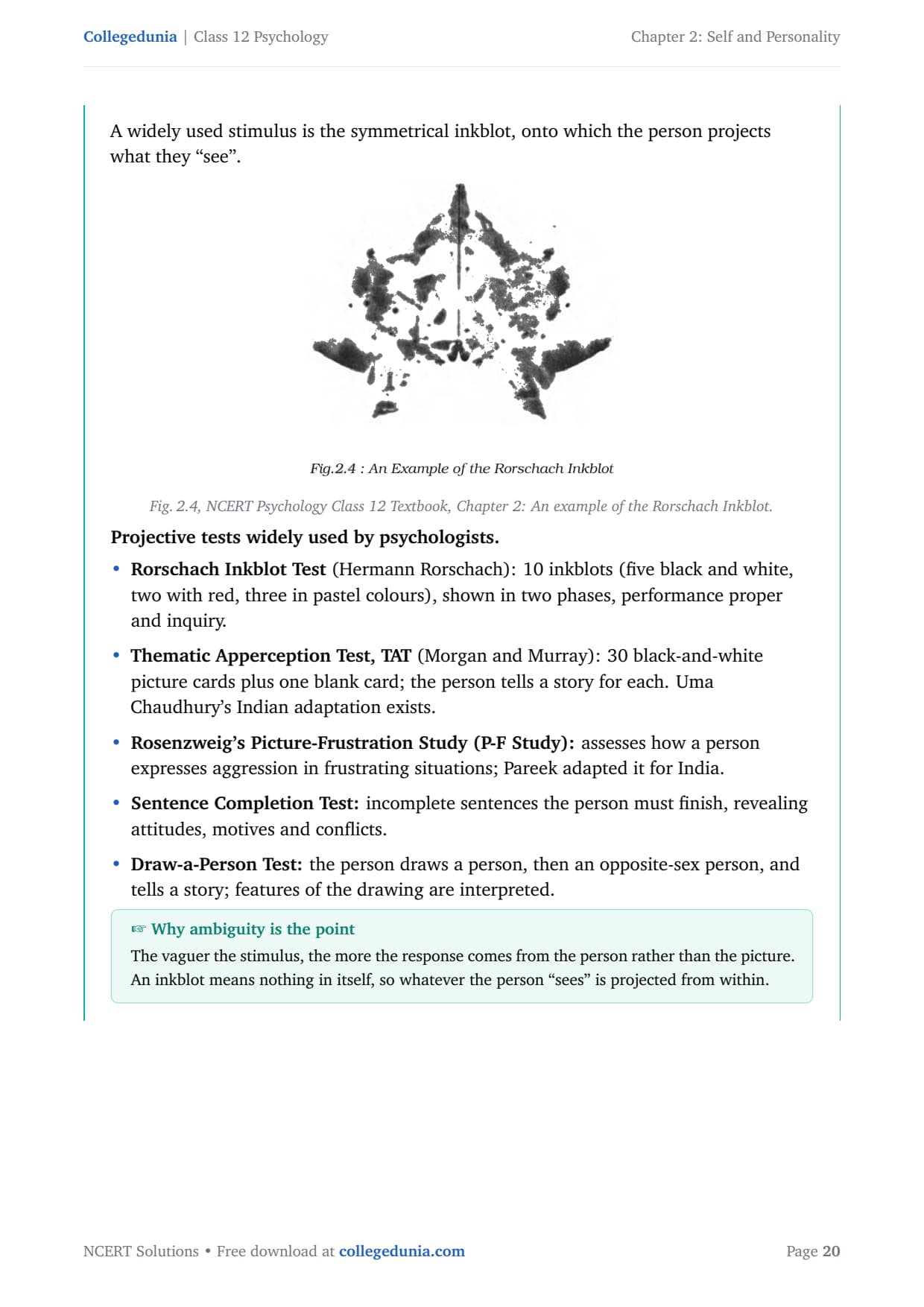
A widely used stimulus is the symmetrical inkblot, onto which the person
projects what they ``see''.
Fig. 2.4, NCERT Psychology Class 12 Textbook, Chapter 2: An example of the Rorschach Inkblot.
Projective tests widely used by psychologists.
Rorschach Inkblot Test (Hermann Rorschach): 10 inkblots
(five black and white, two with red, three in pastel colours), shown
in two phases, performance proper and inquiry.
Thematic Apperception Test, TAT (Morgan and Murray): 30
black-and-white picture cards plus one blank card; the person tells a
story for each. Uma Chaudhury's Indian adaptation exists.
Rosenzweig's Picture-Frustration Study (P-F Study): assesses
how a person expresses aggression in frustrating situations; Pareek
adapted it for India.
Sentence Completion Test: incomplete sentences the person
must finish, revealing attitudes, motives and conflicts.
Draw-a-Person Test: the person draws a person, then an
opposite-sex person, and tells a story; features of the drawing are
interpreted.
Why ambiguity is the point
The vaguer the stimulus, the more the response comes from the person rather
than the picture. An inkblot means nothing in itself, so whatever the person
``sees'' is projected from within.
Projective techniques assess personality indirectly: a vague,
unstructured stimulus lets the person project unconscious feelings, desires
and needs, which experts then interpret (responses are open-ended, with no
right or wrong answers, and scoring is subjective). The widely used projective
tests are the Rorschach Inkblot Test, the Thematic Apperception Test (TAT),
Rosenzweig's Picture-Frustration Study, the Sentence Completion Test and the
Draw-a-Person Test.
AB
Aanya Banerjee
M.A Psychology, Presidency University Kolkata
Verified Expert
Picture-first. The inkblot figure is the natural anchor for this
answer, so introduce the projection idea, show the stimulus, and then list the
tests. The question again has two parts, ``how they work'' and ``which ones'',
so keep them visibly separate.
The scoring core of part one is the projection assumption: an unstructured
stimulus pulls the response out of the person, not the picture. Pair this with
the contrast that direct tests cannot reach unconscious material, which is
why projective tests exist.
For part two, give the named tests with their creators:
Rorschach (Hermann Rorschach), 10 inkblots, two phases.
TAT (Morgan and Murray), 30 picture cards plus one blank.
P-F Study (Rosenzweig) and Sentence Completion and
Draw-a-Person as the remaining widely used tools.
Bring out the five shared features that NCERT lists, because they are the
backbone of the ``how'' part and are easy to drop: the stimuli are
unstructured and poorly defined; the person is not told the purpose or scoring;
the person is told there are no right or wrong answers; each response is taken
to reveal something significant; and scoring is lengthy and subjective.
Naming even three or four of these features shows you understand the common
machinery behind every projective test, not just the tests' names.
It also pays to state the limitation honestly: because scoring is qualitative
and subjective, projective techniques have problems of reliability and
validity and need long, specialised training to interpret. Pairing the
method's strength (reaching the unconscious) with this weakness gives a
balanced, examiner-friendly answer rather than an uncritical one.
Why this matters. The most examinable insight is that ambiguity is
deliberate: less structure means more projection. Stating that line shows you
understand the logic of the method, while the named tests with creators show
breadth.
Projective techniques work by presenting an unstructured, ambiguous
stimulus onto which the person projects unconscious feelings and needs, which
trained experts then interpret. The widely used projective tests are the
Rorschach Inkblot Test, the Thematic Apperception Test (TAT), Rosenzweig's
Picture-Frustration Study, the Sentence Completion Test and the Draw-a-Person
Test.
Q 2.11
Arihant wants to become a singer even though he belongs to a family of doctors. Though his family members claim to love him but strongly disapprove his choice of career. Using Carl Rogers' terminology, describe the attitudes shown by Arihant's family.
Concept used. In Carl Rogers' humanistic theory, healthy growth of
the self needs an atmosphere of unconditional positive regard, that
is, being accepted and valued by others whatever choices one makes. The
opposite of this is conditional positive regard, where acceptance
and love are given only when the person meets certain expectations set by
others. These expectations act as conditions of worth, telling the
person they are worthy only if they behave in approved ways.
Applying it to Arihant's family. Read the situation through Rogers'
lens:
Arihant's true self pushes him towards self-actualisation as a
singer; this is the inborn growth tendency Rogers describes.
His family claims to love him but strongly disapproves of his
career choice. Their love therefore comes with a string attached:
``we accept you if you follow our approved path (medicine)''.
This is exactly conditional positive regard. The family is
placing a condition of worth on Arihant, making their warmth
depend on his choosing a career they value rather than the one that
expresses his real self.
By withholding full acceptance of his real choice, the family widens
the gap between Arihant's real self (a singer) and the ideal self they
want for him (a doctor), which in Rogers' terms breeds unhappiness and
blocks the development of a healthy self-concept.
In Rogers' terminology, the family is offering conditional positive
regard instead of the unconditional positive regard that would let Arihant
grow and self-actualise.
The cost of conditions
When love depends on meeting others' conditions, a person learns to value
only the parts of themselves that others approve, and to deny the rest. That
denial is what stalls self-actualisation, which is why Rogers prized
unconditional positive regard.
In Carl Rogers' terms, Arihant's family is showing conditional
positive regard, not unconditional positive regard. By loving him yet strongly
disapproving of his wish to be a singer, they make their acceptance depend on
his following the approved career (medicine). This sets up conditions of worth
that widen the gap between his real self and the ideal self they expect,
hindering his self-actualisation.
AP
Aarav Pillai
M.A Counselling Psychology, Tata Institute of Social Sciences
Verified Expert
Strategic angle. This is an application question, so the marks lie in
naming the exact Rogers term and then justifying it from the scenario,
not in re-explaining the whole humanistic approach. Identify the term first,
then prove it line by line from Arihant's situation.
The decisive contrast is unconditional versus conditional positive regard.
Since the family loves Arihant ``but'' disapproves of his choice, the love
carries a condition, which is the textbook definition of conditional positive
regard:
Name it. Conditional positive regard, set against the
unconditional positive regard Rogers recommends.
Evidence. ``Claim to love him'' yet ``strongly disapprove''
is the condition in action.
Consequence. Conditions of worth widen the real-self versus
ideal-self gap and block self-actualisation.
To round the answer off, spell out the predicted effect on Arihant, since
application questions reward you for following the concept through to its
consequence. Under conditional positive regard, Arihant may start to doubt or
suppress his real self (the singer) to win his family's approval, widening the
gap between his real self and the ideal self they hold for him. In Rogers'
terms this incongruence breeds anxiety and blocks self-actualisation, whereas
unconditional positive regard would have let him pursue singing while still
feeling loved. Naming both the attitude and its likely outcome is what
completes a top-grade scenario answer.
Why this matters. Application items reward precise vocabulary married
to evidence from the case. Stating ``conditional positive regard'' and then
quoting the ``love but disapprove'' detail as proof is exactly the structure
examiners look for in scenario questions.
Arihant's family shows conditional positive regard in Rogers' terms:
their love is real but tied to a condition, that he choose the approved career.
This imposes conditions of worth, in contrast to the unconditional positive
regard that would let Arihant pursue singing and move towards
self-actualisation.
FAQs on Self and Personality Class 12 NCERT Solutions
Self and Personality Class 12 Psychology Common Questions
Ques. Where can I get the class 12 psychology chapter 2 NCERT Solutions PDF?
Ans. You can download the Self and Personality Class 12 Psychology NCERT Solutions PDF directly from this page. It is free, follows the 2026-27 NCERT, and answers all 11 exercise questions point by point.
Ques. How many questions are there in Self and Personality class 12 questions and answers?
Ans. The chapter has 11 exercise questions. They cover the self, delay of gratification, the approaches to personality, Freud's structure, Horney versus Adler, the humanistic view, the assessment methods and a Carl Rogers case study.
Ques. How does the Indian notion of self differ from the Western notion?
Ans. In the Indian view the boundary between the self and others keeps shifting, so the self extends to family, community and the cosmos. In the Western view the boundary is fixed and the self is clearly separate. The social self is larger in India, the personal self in the West.
Ques. How does Freud explain the structure of personality?
Ans. Freud divides personality into the id, the ego and the superego. The id works on the pleasure principle, the ego on the reality principle and the superego on the moral principle. Behaviour reflects the balance among these three parts.
Ques. Which are the two most widely used structured personality tests?
Ans. The two most widely used structured (self-report) tests are the Minnesota Multiphasic Personality Inventory (MMPI) and the Sixteen Personality Factor (16 PF) questionnaire. The Rorschach and the TAT are projective, not structured, tests.
Ques. Is class 12 psychology chapter 2 easy to score in the board exam?
Ans. Yes. It is a high-scoring chapter if you keep the theorists and tests straight. Learn Freud's id, ego and superego, the type versus trait contrast and the named assessment tests, and practise the case study on Carl Rogers for the application question.








Comments