Political Science Editor, 7 Yrs | Updated 3+ months ago
The NCERT Solutions for Political Science Class 12 Chapter 5 Security in the Contemporary World answer every textbook question on what security means today, set to the latest 2026-27 CBSE syllabus. Each answer explains the traditional and non-traditional notions of security, the four classic tools of statecraft, and the new threats like terrorism and poverty. These solutions help students prepare for the Class 12 Political Science board paper and the UPSC foundation in 2026-27.
Covers all 12 exercise questions from Contemporary World Politics Chapter 5, with full point-wise answers.
This Class 12 Political Science chapter usually carries 5 to 6 marks per board paper.
Pairs with the Notes, Handwritten Notes and NCERT Book PDF linked lower on this page.
Every solution for Class 12 Political Science Chapter 5 in this Collegedunia compilation is written by subject experts from the official NCERT Contemporary World Politics textbook, and checked against the last five years of CBSE board papers.
Student Feedback: In a Collegedunia poll of 9,040 Class 12 Political Science students taken before the 2026 boards, 71% of students rated the difference between traditional and non-traditional security as the most-asked part of this chapter. Most students said a clear two-column table made the long answer easy to recall.
Source: 2026-27 Class 12 Political Science student poll. Sample of 9,040 students from CBSE schools across 13 states.
What the Security in the Contemporary World Class 12 Chapter Is About
Security in the Contemporary World is the fifth chapter of Contemporary World Politics. It asks one simple question with a wide answer: what does security really mean? At its core, security is freedom from threats to our core values. The chapter sets out two ways of seeing it.
The whole chapter rests on three big ideas that students must keep in mind:
Traditional security: the danger is military attack on the State, answered by force.
Non-traditional security: the lens widens to human and global security, covering terrorism, poverty and disease.
Cooperation and India: states work together to limit violence, and India uses a four-part strategy.
So the chapter is really about how the idea of security has grown beyond the army and the border. A student who keeps these three threads in mind can connect almost any question in security in the contemporary world class 12 back to one of them. This is why revision works best when you sort each fact under "traditional", "non-traditional" or "cooperation" first.
Traditional Notion of Security
The traditional notion of security is the one most people picture first. In this view the greatest danger to a country is a military threat, and the usual source is another country. To answer questions on it, students must know what it protects and how.
The threat: armed attack, from outside the border and sometimes from within.
The referent: the State, its sovereignty, independence and territorial integrity.
The choices: a threatened government can surrender, deter the attack, or defend itself in war.
The tools: deterrence, defence, balance of power and alliance building.
A key exam point is that traditional security treats war as the main danger and the State as the thing to protect. The three choices, surrender, deterrence and defence, are a regular short answer, so learn them as a clear list. Remember that even traditional security accepts rules on war, the old idea of fighting only for a just cause and sparing civilians.
Non-Traditional Security and New Threats
By itself the military view leaves out a lot. The non-traditional notion widens the lens to human security and global security, where the thing to protect is people and the planet, not just the State. The new threats are a long-answer favourite, so students should learn them as a clear list rather than a story.
New threat
Why it counts as a security issue
Terrorism
Political violence by non-state groups that targets civilians, often across borders.
Human rights
Genocide and abuse harm people directly; their protection is a global concern.
Global poverty
Hunger and want kill more people than war and fuel migration and conflict.
Migration and refugees
Forced displacement strains states and endangers the displaced themselves.
Health epidemics
Diseases like HIV-AIDS and avian flu spread fast and cross borders.
A sharp point for the exam is that terrorism is a non-traditional threat, because the danger comes from non-state groups and hits ordinary people, not armies. The "human security" question turns on the referent: in non-traditional security the thing protected is the individual, not just the State. Keep that single idea ready and the whole non-traditional section becomes easy to answer.
Balance of Power, Alliances and Cooperation
Inside the traditional view, states use a few classic methods to stay safe without a world government to protect them. These methods are a regular MCQ and short answer, so the table sorts them for fast revision.
Method
What it means
Balance of power
A state keeps a careful watch on rivals and builds strength so no neighbour grows too powerful.
Alliance building
A coalition of states coordinate their forces to deter or defeat a possible attacker, like NATO.
Cooperation
Even rivals accept limits on war and agree to disarm, control arms or build confidence.
The judgement students should reach is that states rely on balance of power and alliances because there is no world government to keep them safe. A state achieves a balance of power by building its military and economic strength and by forming alliances. Alliances are usually based on national interest and can change when interests change, which is the point examiners want in the "objectives of military alliances" answer.
Disarmament, Arms Control and Confidence Building
The chapter names three forms of cooperation that even rival states accept. Students often confuse them, so learn one clear line for each, because Question 1 is a matching item that tests exactly this.
Disarmament: states agree to give up certain kinds of weapons, like the conventions that banned biological and chemical weapons.
Arms control: it does not ask states to give up weapons; it regulates how they are made and deployed, like the ABM Treaty and the NPT.
Confidence Building Measures (CBMs): a process of exchanging information on defence matters so rivals do not misread each other.
Alliance: a coalition of nations that coordinate forces to deter or defeat an attacker.
The trick to the matching question is to separate the terms by their verb. Disarmament is about giving up, arms control is about regulating, CBMs are about talking, and an alliance is about teaming up. Lock the obvious pairs first, then the rest fall into place. This way the four-by-four match becomes quick, safe marks.
India's Security Strategy
The chapter ends with how India tries to stay secure against both military and non-traditional threats. This topic is a regular long answer, so the table keeps India's four components side by side for fast revision.
Component
Key example to recall
Military strength
Wars with Pakistan and China; the 1998 nuclear tests for deterrence.
Norms and institutions
Support for the UN, non-alignment, the NIEO and UN peacekeeping.
Internal security via democracy
Letting communities share power to reduce separatism.
Economic development
Lifting citizens out of poverty so want does not breed conflict.
The honest answer to "which security has India prioritised, traditional or non-traditional" is both. India built military strength and tested nuclear weapons, but it also backed global institutions, internal democracy and economic development. A neat way to remember the four is the word MIDE: Military, Institutions, Democracy, Economic development. Cite one example from each component to score full marks on Question 11.
Security in the Contemporary World Class 12 Exercise-wise Coverage
The chapter exercise has 12 questions. The table maps each one to its topic so students can plan revision and find the right NCERT answer fast. The full point-wise solution for each sits in the question set lower on this page.
Question
Topic it tests
Q 1
Match the terms: CBMs, Arms Control, Alliance, Disarmament
Q 2
Classify items as traditional, non-traditional or not a threat
Q 3
Difference between traditional and non-traditional security
Q 4
Threats faced by the Third World versus the First World
Q 5
Is terrorism a traditional or non-traditional threat?
Q 6
A state's choices when its security is threatened (traditional view)
Q 7
What balance of power is, and how a state achieves it
Q 8
Objectives of military alliances, with an example
Q 9
Whether environmental degradation is a serious security threat
Q 10
Why nuclear weapons have limited use against new threats
Q 11
Which security India has prioritised, with examples
Q 12
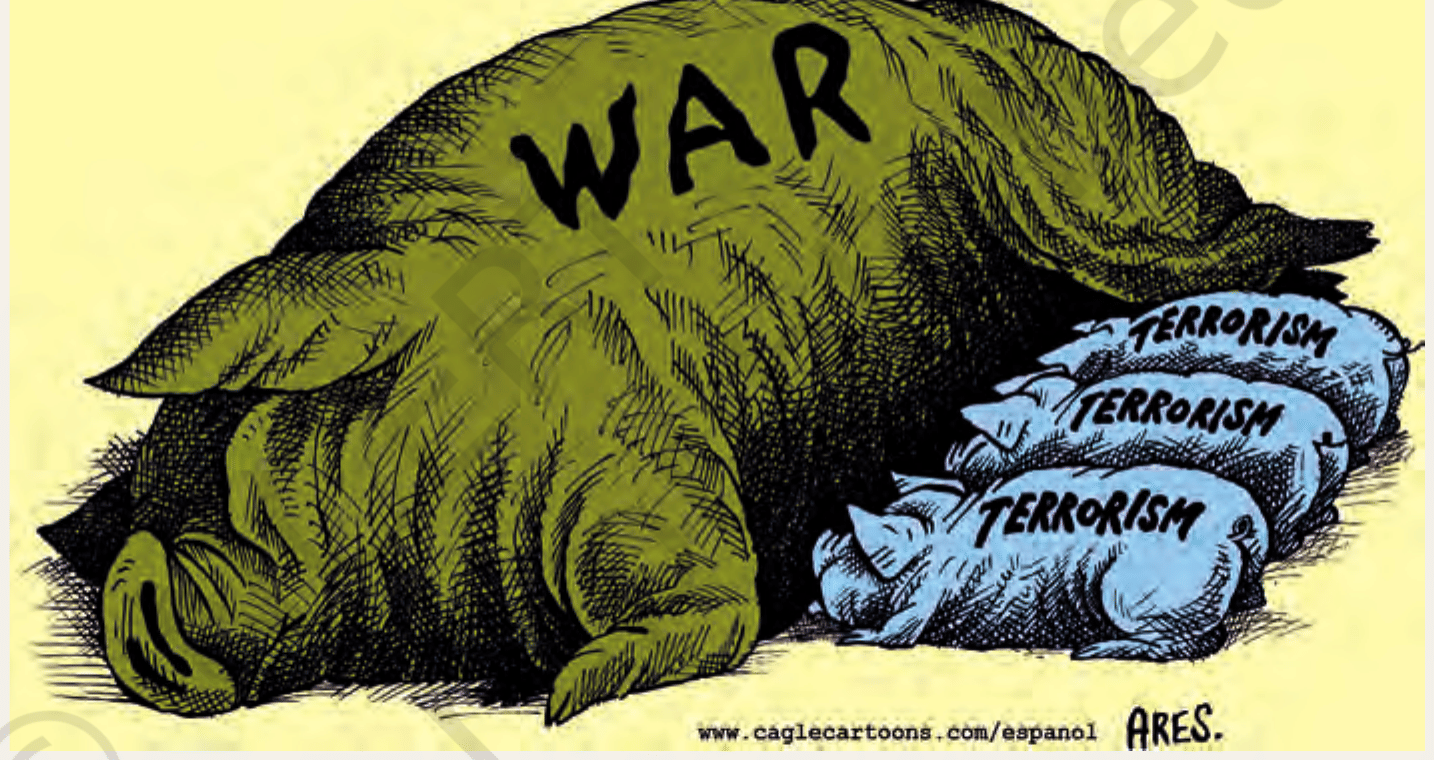
Cartoon-based note on the link between war and terrorism
Questions 3, 9 and 11 are the most-asked long answers, so students preparing security in the contemporary world class 12 important questions should learn those three first. The matching and classification items (Q1 and Q2) are quick marks, so revise the four cooperation terms and the two notions of security well to secure them.
Students who want the offline copy can save the class 12 political science chapter 5 pdf from the download card above and tick off each question as they finish it.
Security in the Contemporary World Important Questions and Previous Year Trends
CBSE sets a steady mix of MCQ, short and long answers from this chapter. Knowing the pattern helps students decide how much to write. The chapter is a regular source of one 4-mark or 6-mark question, which is why a focused list of security in the contemporary world important questions saves a lot of revision time.
Long answer (5 to 6 marks): traditional versus non-traditional security, or India's security strategy.
Short answer (4 marks): balance of power, objectives of alliances, or a state's three choices.
Source-based: the "Economy of war" cartoon, or a passage on the new threats, with sub-parts.
Objective and MCQ: the match item, disarmament versus arms control, and classifying threats.
For quick recall before the exam, students often practise the class 12 political science chapter 5 mcq set and a list of security in the contemporary world class 12 important questions. The most repeated items are the two notions of security and India's four-component strategy, so keep those answer points ready in your own words.
Working through the ncert solutions class 12 political science chapter 5 set twice, once open-book and once from memory, fixes the terms and examples well before the board exam.
Common Mistakes Students Make in This Chapter
A few errors cost marks every year in this chapter. Most come from mixing up the cooperation terms or naming the wrong referent for each notion of security. Avoiding them is the fastest way to lift a score.
Confusing disarmament (giving up weapons) with arms control (regulating weapons) - keep them separate.
Saying the referent of non-traditional security is the State - it is people and the planet.
Calling terrorism a traditional threat - it is non-traditional, by non-state groups against civilians.
Writing that the UN controls world security - there is no world government; the UN has only the power members give it.
Saying India chose only one type of security - its strategy uses both traditional and non-traditional tools.
Students who fix these five points usually move from average to high marks on the long answers. The exam rewards a balanced view, so always show both notions of security before you judge any threat.
Security in the Contemporary World PDF Download Formats and Languages
The solutions are free to download in more than one format, so students can pick what suits their device and revision style. The download card at the top of the page carries each option for this chapter.
Normal and HD PDF: the class 12 political science chapter 5 pdf comes in a normal size for quick downloads and an HD version for clear printing.
English medium: all 12 answers are written in simple English for the CBSE board paper.
Question-only set: a print-and-practise sheet of security in the contemporary world extra questions for self-testing.
Whole-book pack: the solutions sit in one set that runs through every Contemporary World Politics chapter, so you can revise from Chapter 1 onwards in one place.
Many students search for class 12 political science chapter 5 answers on their phone the night before a test, so a saved PDF means you can revise even without internet. Keep both the question set and the solved version handy for a full self-check.
How the Security in the Contemporary World Solutions Pair with Notes and the Book PDF
These NCERT Solutions answer the back-exercise questions. To revise the full chapter, students should use them alongside the other resources for the same chapter, all linked in the table below.
Reading the original NCERT chapter text and figures
Tip: read the Notes first, then attempt these solutions on your own, and only then check the model answers here. That order builds memory faster than copying answers straight away.
All NCERT Solutions for Class 12 Political Science
The table links the NCERT Solutions for every chapter in both Class 12 Political Science books, so students can move across the course in one click. Security in the Contemporary World is highlighted.
All NCERT Solutions for Security in the Contemporary World with Step-by-Step Solutions
Below are all 12 NCERT exercise questions for this chapter, exactly as they appear in the textbook. Tap Check Solution for the model answer or Expert Solution for the topper-style approach.
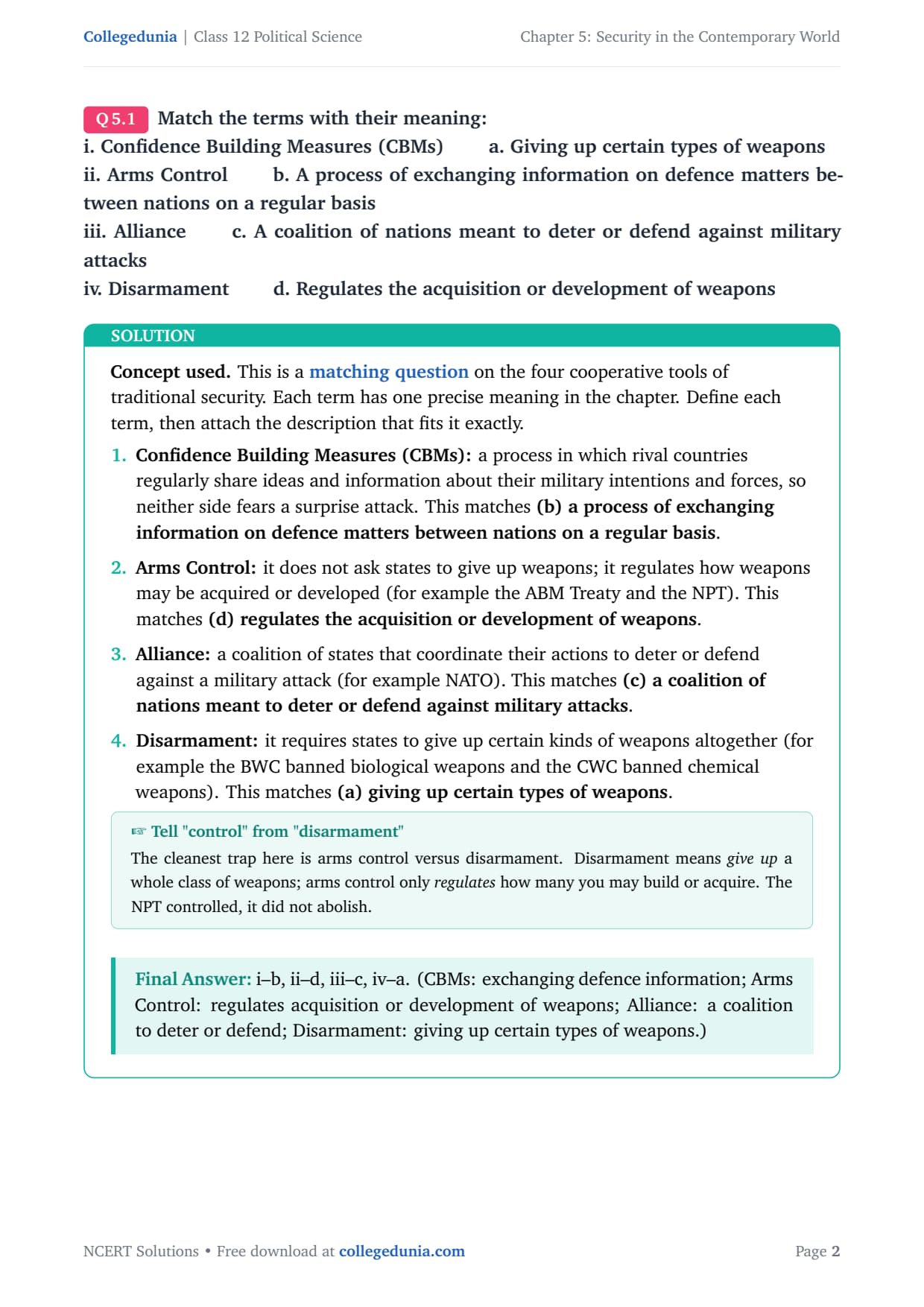
Q 5.1
Match the terms with their meaning:
i. Confidence Building Measures (CBMs) a. Giving up certain types of weapons
ii. Arms Control b. A process of exchanging information on defence matters between nations on a regular basis
iii. Alliance c. A coalition of nations meant to deter or defend against military attacks
iv. Disarmament d. Regulates the acquisition or development of weapons
Concept used. This is a matching question on the four
cooperative tools of traditional security. Each term has one precise meaning
in the chapter. Define each term, then attach the description that fits it
exactly.
Confidence Building Measures (CBMs): a process in which
rival countries regularly share ideas and information about their
military intentions and forces, so neither side fears a surprise
attack. This matches (b) a process of exchanging information
on defence matters between nations on a regular basis.
Arms Control: it does not ask states to give up weapons; it
regulates how weapons may be acquired or developed (for example the
ABM Treaty and the NPT). This matches (d) regulates the
acquisition or development of weapons.
Alliance: a coalition of states that coordinate their
actions to deter or defend against a military attack (for example
NATO). This matches (c) a coalition of nations meant to deter
or defend against military attacks.
Disarmament: it requires states to give up certain kinds of
weapons altogether (for example the BWC banned biological weapons and
the CWC banned chemical weapons). This matches (a) giving up
certain types of weapons.
Tell "control" from "disarmament"
The cleanest trap here is arms control versus disarmament. Disarmament means
give up a whole class of weapons; arms control only regulates
how many you may build or acquire. The NPT controlled, it did not abolish.
i–b, ii–d, iii–c, iv–a. (CBMs: exchanging defence information;
Arms Control: regulates acquisition or development of weapons; Alliance: a
coalition to deter or defend; Disarmament: giving up certain types of
weapons.)
AI
Ananya Iyer
MA Political Science, JNU
Verified Expert
Strategic angle. In a four-by-four match, anchor on the two terms
you cannot confuse. "Disarmament" literally contains "dis-arm", so it pairs
with "giving up weapons". "Alliance" is the only term that names a group of
nations, so it pairs with "coalition". That leaves CBMs and Arms Control for
the final two.
Lock the obvious pairs first: Disarmament → give up
weapons (a); Alliance → coalition to deter or defend (c).
Two down, two to go.
Separate the survivors by their verb. CBMs are about talking:
sharing defence information regularly, so (b). Arms Control is about
rules: it regulates acquisition or development, so (d).
Read the grid back: i–b, ii–d, iii–c, iv–a. Every term now has
exactly one partner and no description is used twice.
Why this matters. These four are the chapter's toolkit for limiting
violence without fighting. Reading them as a ladder, talk (CBMs), then limit
(arms control), then renounce (disarmament), then group up (alliance), fixes
both the meanings and the order in which states usually reach for them.
i–b, ii–d, iii–c, iv–a.
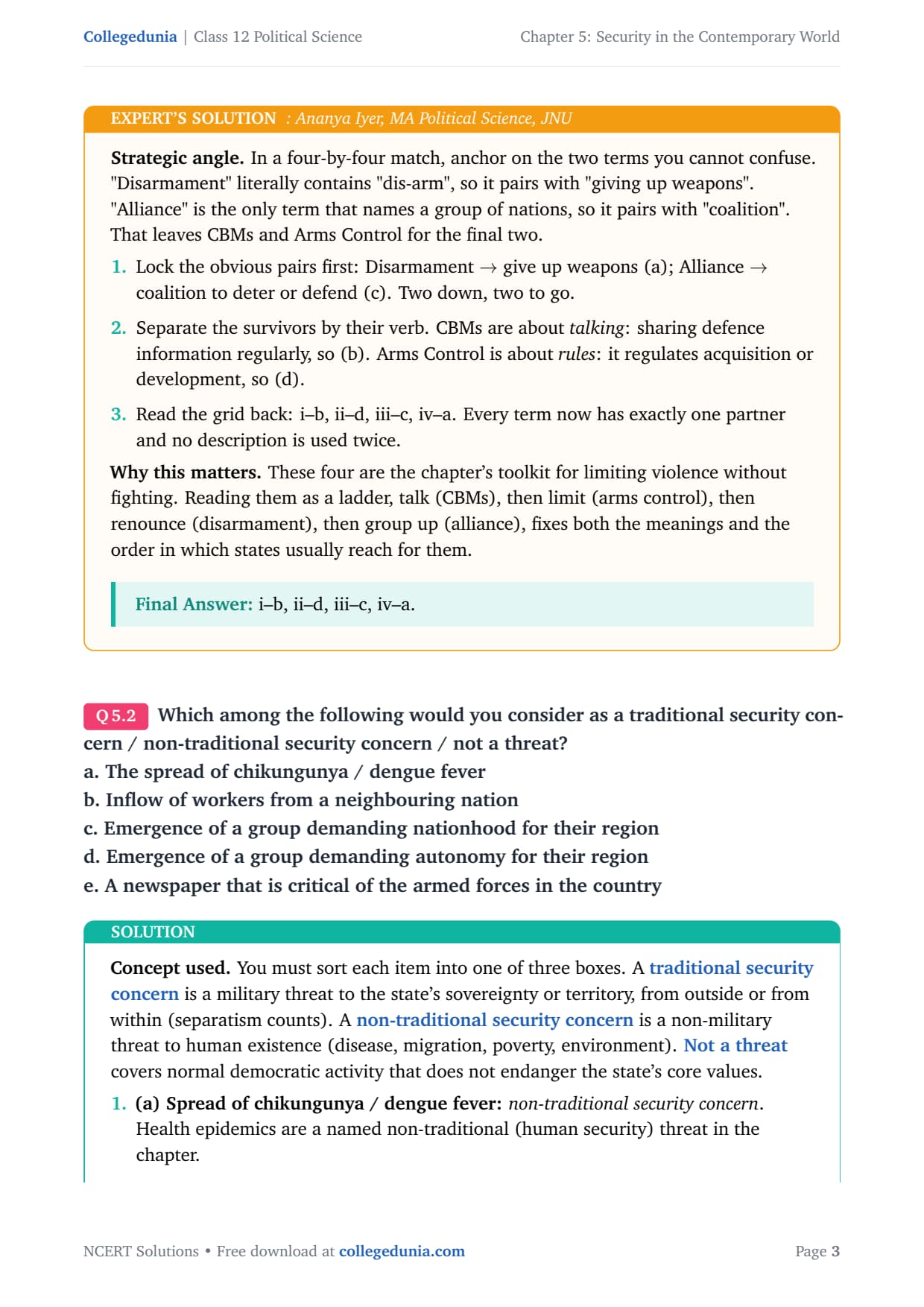
Q 5.2
Which among the following would you consider as a traditional
security concern / non-traditional security concern / not a threat?
a. The spread of chikungunya / dengue fever
b. Inflow of workers from a neighbouring nation
c. Emergence of a group demanding nationhood for their region
d. Emergence of a group demanding autonomy for their region
e. A newspaper that is critical of the armed forces in the country
Concept used. You must sort each item into one of three boxes. A
traditional security concern is a military threat to the state's
sovereignty or territory, from outside or from within (separatism counts). A
non-traditional security concern is a non-military threat to human
existence (disease, migration, poverty, environment). Not a threat
covers normal democratic activity that does not endanger the state's core
values.
(a) Spread of chikungunya / dengue fever:non-traditional security concern. Health epidemics are a named
non-traditional (human security) threat in the chapter.
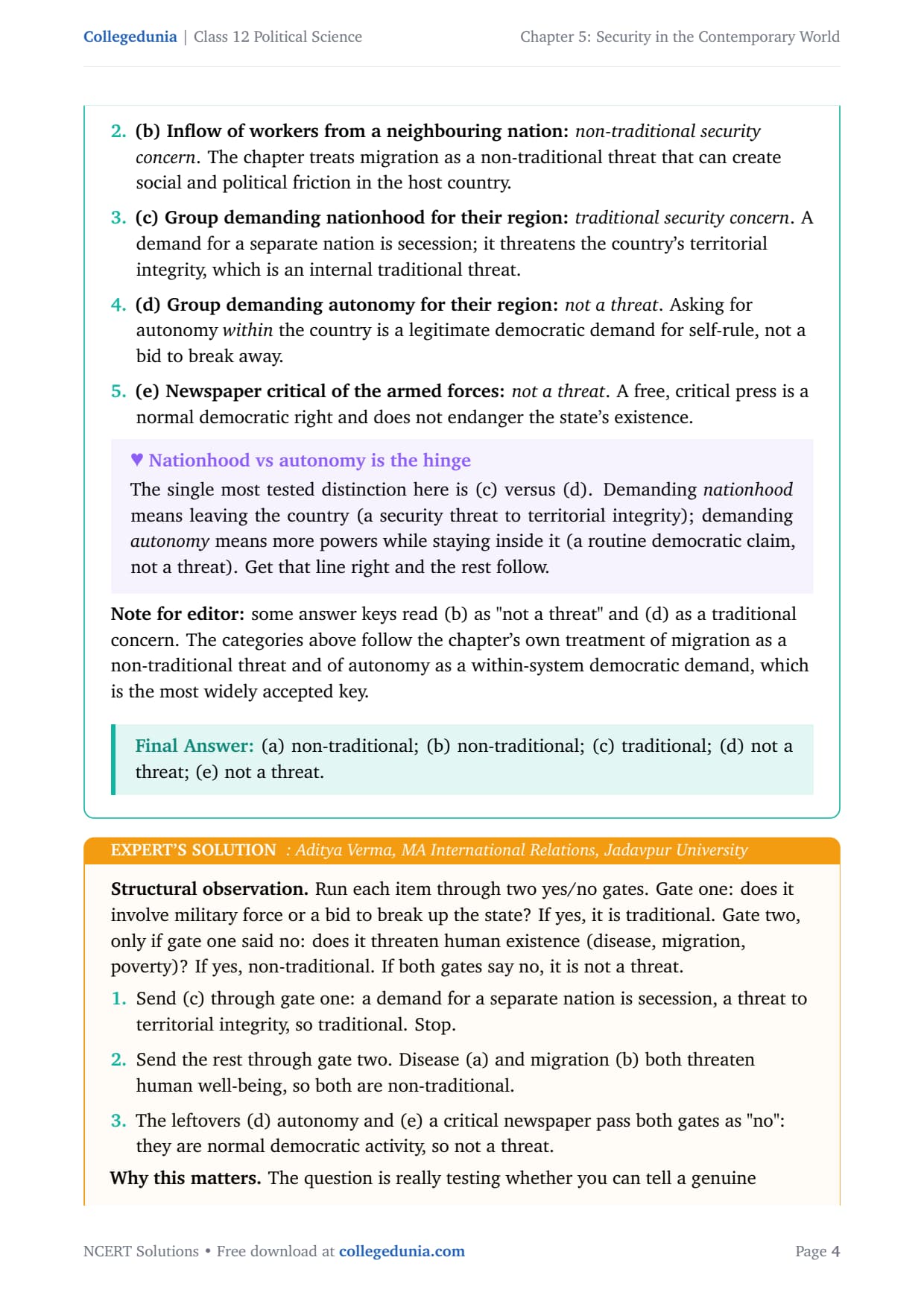
(b) Inflow of workers from a neighbouring nation:non-traditional security concern. The chapter treats migration
as a non-traditional threat that can create social and political
friction in the host country.
(c) Group demanding nationhood for their region:traditional security concern. A demand for a separate nation is
secession; it threatens the country's territorial integrity, which is
an internal traditional threat.
(d) Group demanding autonomy for their region:not a threat. Asking for autonomy within the country is
a legitimate democratic demand for self-rule, not a bid to break away.
(e) Newspaper critical of the armed forces:not a
threat. A free, critical press is a normal democratic right and does
not endanger the state's existence.
Nationhood vs autonomy is the hinge
The single most tested distinction here is (c) versus (d). Demanding
nationhood means leaving the country (a security threat to territorial
integrity); demanding autonomy means more powers while staying inside
it (a routine democratic claim, not a threat). Get that line right and the
rest follow.
Note for editor: some answer keys read (b) as "not a threat" and (d)
as a traditional concern. The categories above follow the chapter's own
treatment of migration as a non-traditional threat and of autonomy as a
within-system democratic demand, which is the most widely accepted key.
(a) non-traditional; (b) non-traditional; (c) traditional; (d) not a
threat; (e) not a threat.
AV
Aditya Verma
MA International Relations, Jadavpur University
Verified Expert
Structural observation. Run each item through two yes/no gates.
Gate one: does it involve military force or a bid to break up the state? If
yes, it is traditional. Gate two, only if gate one said no: does it threaten
human existence (disease, migration, poverty)? If yes, non-traditional. If
both gates say no, it is not a threat.
Send (c) through gate one: a demand for a separate nation is
secession, a threat to territorial integrity, so traditional. Stop.
Send the rest through gate two. Disease (a) and migration (b) both
threaten human well-being, so both are non-traditional.
The leftovers (d) autonomy and (e) a critical newspaper pass both
gates as "no": they are normal democratic activity, so not a threat.
Why this matters. The question is really testing whether you can tell
a genuine danger from the everyday noise of a free society. Dissent and a
demand for more local powers are signs of democracy working, not of insecurity.
Confusing criticism with threat is exactly the mindset the chapter warns
against.
(a) non-traditional, (b) non-traditional, (c) traditional, (d) not a
threat, (e) not a threat.
Q 5.3
What is the difference between traditional and non-traditional
security? Which category would the creation and sustenance of alliances belong
to?
Concept used. The question has two parts: contrast the two notions of
security, then place alliance building in the right box.
A good contrast names what each notion treats as the threat, who it tries to
protect, and how.
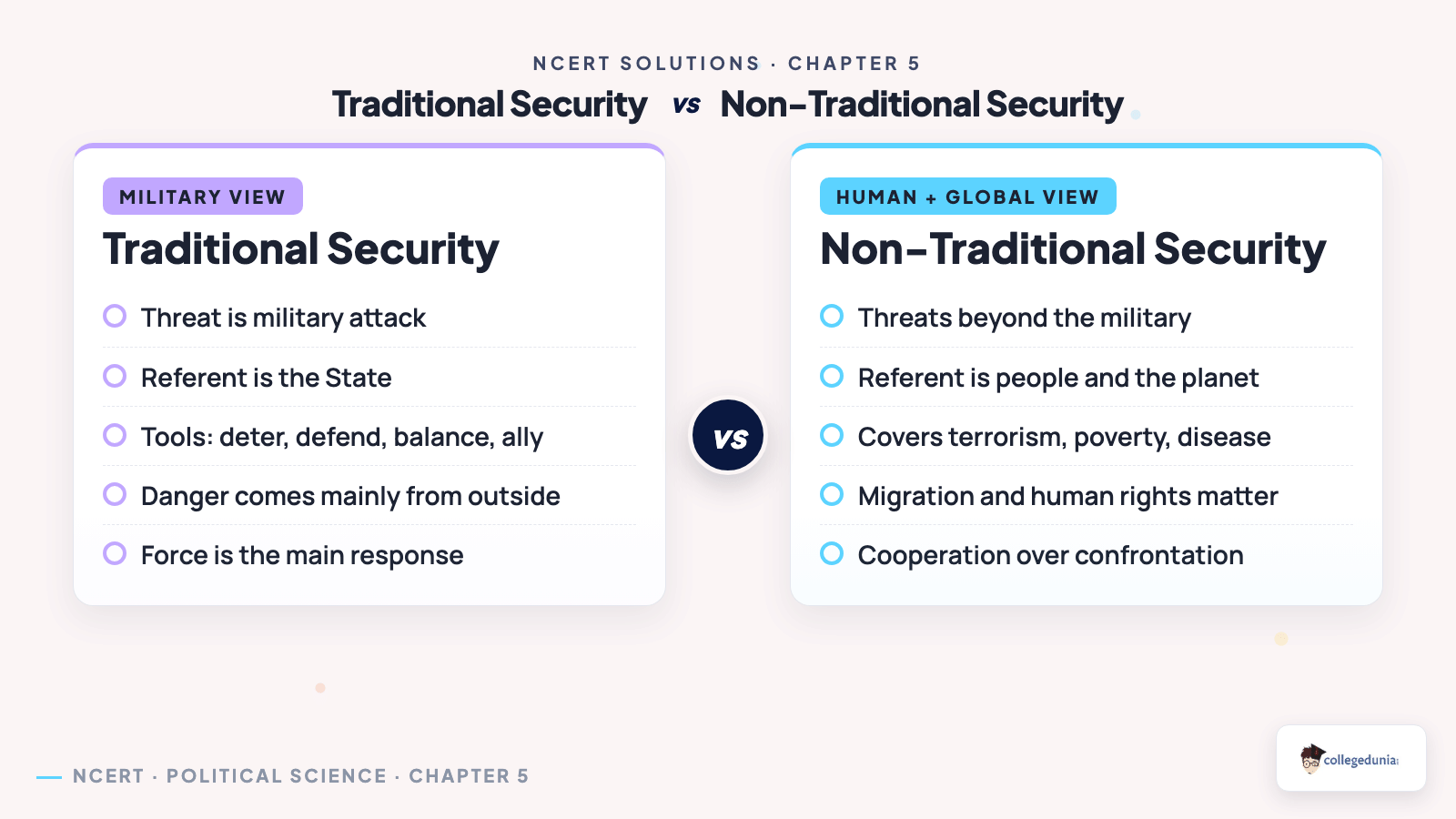
The two notions differ on three points:
Nature of the threat. Traditional security treats
military threats as the main danger: armed attack on a
country's sovereignty, independence and territory. Non-traditional
security goes beyond the military to include threats to human
existence such as terrorism, hunger, disease, migration and
environmental harm.
Who is protected (the referent). In traditional security the
referent is the state, with its territory and institutions.
In non-traditional security the referent widens to the
individual, the community and all of humankind, hence the names
"human security" and "global security".
The response. Traditional security relies on force:
deterrence, defence, balance of power and alliances. Non-traditional
security relies mainly on cooperation, because force can rarely
solve poverty, migration or epidemics.
Where alliances belong. The creation and sustenance of alliances
belongs to traditional security. An alliance is a coalition of
states that coordinate their military actions to deter or defend against an
attack, which is a classic military, force-based tool.
Answer both halves
This is a two-part question. Examiners give separate marks for the contrast
and for placing alliances. End with one clear line: "Alliances belong to
traditional security." Do not leave it implied.
Traditional security focuses on military threats to the state and
answers them with force (deterrence, defence, balance of power, alliances).
Non-traditional security widens the threat to non-military dangers (terrorism,
poverty, disease, migration, environment) and protects individuals and
humankind, mainly through cooperation. The creation and sustenance of
alliances belongs to traditional security.
RB
Rohan Banerjee
MA Political Science, University of Delhi
Verified Expert
Strategic angle. Draw a simple three-column contrast in your head,
threat, referent, method, and fill both notions into it. That structure earns
full marks fast and makes the placement of alliances obvious.
[leftmargin=14pt]
Threat: traditional = military attack; non-traditional =
non-military dangers to human life.
Referent: traditional = the state; non-traditional = people,
communities, all of humankind.
Method: traditional = force (deter, defend, balance, ally);
non-traditional = cooperation.
Now place alliances. An alliance is a group of states pooling
military power to deter or defend, so it sits squarely in the "force"
row, which is the traditional column.
Why this matters. Once you fix the referent ("security for who?"),
everything else falls out. Traditional security guards the state; the rest of
the chapter is the story of how the referent was widened to the human being.
Alliances belong to the older, state-centred view, which is why they read as
traditional.
The two notions differ in threat (military vs non-military),
referent (state vs people) and method (force vs cooperation). Alliances,
being military coalitions, belong to traditional security.
Q 5.4
What are the differences in the threats that people in the Third
World face and those living in the First World face?
Concept used.First World here means the powerful, mostly
Western developed countries; Third World means the
newly-independent, less-developed countries of Asia, Africa and Latin
America. The chapter shows their security threats differ in both kind and
source. Lay them out side by side.
First World: mainly external, mainly military. After the
Second World War the powerful Western states felt their internal
security was largely assured. They worried chiefly about threats from
outside their borders: above all a military attack from the
rival Cold War alliance.
Third World: external and internal together. The new
states faced the prospect of war with neighbours and internal
military conflict at the same time. They often feared their neighbours
even more than they feared the superpowers, quarrelling over borders,
territories and control of people.
Third World: separatism and internal wars. Internally, the
new states worried about separatist movements wanting to form
independent countries. Internal wars now make up more than 95 per
cent of all armed conflicts, and a neighbour could instigate an
internal movement, merging the external and internal threats.
Third World: non-traditional threats bite harder. Poverty,
disease and refugee flows weigh far more heavily on the Third World.
The world's poorest region, sub-Saharan Africa, also sees the most
armed conflict, and epidemics like HIV-AIDS drive poor regions deeper
into poverty.
One phrase to remember the contrast
First World: threats mostly from outside. Third World: threats from
both outside and inside, layered with poverty and disease.
First World (developed) countries faced threats mainly from outside
their borders, chiefly a military attack from the rival Cold War alliance,
with internal security largely assured. Third World (newly-independent)
countries faced threats from both outside (war with neighbours, sometimes
feared more than the superpowers) and inside (separatist movements and
internal wars), and they also bore the heaviest burden of non-traditional
threats such as poverty, disease and refugee flows.
PN
Priya Nair
MA Political Science, University of Hyderabad
Verified Expert
Structural observation. Sort the answer along one axis: where
the threat comes from. The First World looked outward; the Third World had to
look both ways at once. That single contrast organises the whole reply.
First World, outward only: with internal peace assured after 1945,
their one big fear was an external military attack from the opposing
Cold War bloc.
Third World, both directions: external war with neighbours (often
feared more than the superpowers) plus internal conflict from
separatist movements wanting their own states.
Add the extra layer: the Third World also carries the non-traditional
burden, poverty, disease, refugees, far more heavily, with the
poorest region also the most war-torn.
Why this matters. The deeper point is that security is not the same
everywhere; it depends on context. A rich, stable state can treat security as
"keep the enemy out". A poor, newly-formed state must fight on two fronts at
once and fend off hunger and disease as well. That is why the chapter keeps
returning to "contexts and situations".
First World threats were mainly external and military; Third World
threats were both external (neighbours) and internal (separatism and internal
wars), with the added weight of poverty, disease and refugees.
Q 5.5
Is terrorism a traditional or non-traditional threat to security?
Concept used. Recall the dividing line. A traditional
threat is military force used by one state against another. A
non-traditional threat is a non-military danger to human existence.
Then define terrorism and see which box it fits.
What terrorism is.Terrorism is political violence
that targets civilians deliberately and indiscriminately. Terrorist
groups use force or the threat of force to change a political
condition they dislike, choosing civilian targets to terrorise the
public.
Why it is non-traditional. The threat does not come from
another state's army; it comes from non-state groups and harms
ordinary people directly. International terrorism crosses borders and
affects the citizens or territory of more than one country. These are
the marks of a non-traditional threat.
Its place in the chapter. Terrorism is listed under "New
Sources of Threats", alongside human rights, poverty, migration and
epidemics, all of which are non-traditional. Attention to it grew
after the 11 September 2001 attacks, though terrorism itself is not
new.
Name the type, then justify
Open with the verdict, "Terrorism is a non-traditional threat", then justify
it: it is committed by non-state actors against civilians and crosses borders.
A labelled, justified answer scores better than a vague description.
Terrorism is a non-traditional threat to security. It is
political violence by non-state groups that deliberately targets civilians,
often across national borders, rather than a military attack by one state on
another, and the chapter places it among the new, non-traditional sources of
threat.
SR
Siddharth Rao
MA Political Science, Jamia Millia Islamia
Verified Expert
Quick reading. Test terrorism against the one feature that defines
traditional security: a state's army attacking another state. Terrorism fails
that test on every count, which fixes it as non-traditional.
Who acts? Non-state groups, not a national army acting on a state's
orders. That alone pushes it out of the traditional, state-versus-state
box.
Who is hit? Civilians, deliberately and indiscriminately, not enemy
soldiers on a battlefield. The aim is to terrorise the public and use
its fear as a weapon against governments. Traditional war at least
claims to aim at combatants.
Where? Across borders. International terrorism involves the citizens or
territory of more than one country, a hallmark of the non-traditional,
global threats the chapter lists under "New Sources of Threats".
Why this matters. The honest complication is that terrorism sits near
the edge: it uses violence, like a traditional threat, yet its actors, targets
and reach are all non-traditional. It is also old, not new, the chapter stresses
that only the world's attention to it jumped after 11 September 2001, when
the World Trade Centre was attacked. Saying clearly that terrorism is
non-traditional while noting this overlap shows the examiner you
understand why the old state-versus-state frame no longer captures today's
dangers, and why force alone struggles to defeat it.
Terrorism is a non-traditional threat: violence by non-state actors
against civilians, often international in reach, not a state-versus-state
military attack.
Q 5.6
What are the choices available to a state when its security is
threatened, according to the traditional security perspective?
Concept used. In the traditional security perspective, the
greatest danger to a country is a military threat, usually from
another country. When war threatens, the chapter says a government has
three basic choices. Name and explain each.
When its security is threatened by war, a state can choose to:
Surrender. The government can give in to the attacker. The
chapter notes that governments may surrender when actually confronted
by war, but they never announce surrender as the official policy of
the country.
Deter the attacker (prevent war). The state can stop the
other side from attacking by promising to raise the costs of war to an
unacceptable level. Preventing war this way is called
deterrence.
Defend itself. If war actually breaks out, the state can
defend itself: it fights to deny the attacker its objectives and to
turn back or defeat the attacking forces. Limiting or ending a war
once it has begun is called defence.
Three words to carry into the exam
Surrender, deter, defend. Two of these are the named pillars of security
policy: deterrence (prevent war) and defence (limit or end it).
Under the traditional security perspective a threatened state has
three basic choices: to surrender; to prevent the attack by deterrence
(threatening to raise the cost of war to an unacceptable level); and to defend
itself if war breaks out, so as to deny the attacker its aims and turn it back.
Preventing war is called deterrence and limiting or ending war is called
defence.
KM
Karan Mehta
MA Political Science, Banaras Hindu University
Verified Expert
Structural observation. The answer is a clean list of three, so name
all three first, then tag two of them with the chapter's technical words.
Examiners look for both the choices and the labels "deterrence" and "defence".
Choice one is to give in: surrender, which a government may do in
practice but never declares as policy.
Choice two is to head off the attack by raising its expected cost
until it is not worth launching. The textbook word for this is
deterrence.
Choice three is to fight back once attacked, to deny the enemy its
goals. Limiting or ending the war this way is defence.
Why this matters. Notice that two of the three choices, deterrence
and defence, are exactly the twin aims of all traditional security policy:
preventing war and, if it comes, winning or ending it. Linking the choices to
those two labels turns a simple list into a structured, top-scoring answer.
Three choices: surrender; deterrence (prevent the attack by raising
its cost); and defence (resist and defeat the attack if war breaks out).
Q 5.7
What is `Balance of Power'? How could a state achieve this?
Concept used.Balance of power is a component of
traditional security policy. It is a state's effort to keep its own power at
least equal to that of stronger or potentially hostile countries, so that no
single country becomes strong enough to dominate or attack it safely. Define
it, then explain how a state builds and keeps it.
What balance of power means. When countries look around, they see
that some are bigger and stronger. A very powerful neighbour is a clue to who
might be a threat in future, even if it gives no obvious reason for attack.
Governments are therefore very sensitive to the balance of power between
themselves and other countries, especially close-by countries and old rivals,
and they work hard to maintain a favourable balance.
How a state can achieve it:
Build up military power. A good part of keeping a favourable
balance is strengthening one's own armed forces, so as to match or
exceed the power of a likely rival.
Build economic and technological power. Economic and
technological strength matter too, because they are the very basis on
which military power is built. A strong economy can sustain a strong
military.
Build alliances. A state can form alliances with other
countries to add their strength to its own, increasing its effective
power relative to a rival or a rival alliance.
Define, then give the methods
This is a "what and how" question. Spend one or two lines defining balance of
power, then list the methods (military build-up, economic and technological
strength, alliances). Marks are split between the definition and the means.
Balance of power is a state's effort to keep its own power equal to
or greater than that of stronger or potentially hostile countries, so none can
safely dominate it. A state achieves it mainly by building up its military
power, and by developing the economic and technological strength that
underpins military power, often supported by alliances with other states.
VK
Vivaan Kapoor
MA International Relations, JNU
Verified Expert
Strategic angle. Treat the term as cause and cure. The "cause" is the
worry that a stronger neighbour might one day attack; the "cure" is to keep
your own strength level with theirs. Define it through that worry, then list
the levers of strength.
State the logic: power, not stated intentions, is what governments
watch. A neighbour that is simply very strong is a future risk, so a
state tries to stay as strong.
List the levers: military build-up is the direct one; economic and
technological power is the foundation beneath it; alliances borrow the
strength of friends.
Tie them together: military power rests on economic and technological
power, so a balanced economy is itself a security tool.
Why this matters. Balance of power explains why states arm even in
peacetime and why they care so much about the rise of a neighbour. It is about
capabilities, what a rival could do, not just what it says it will do.
That is the realist insight the question is testing.
Balance of power is keeping one's own power level with that of
stronger or hostile states so none can dominate. A state achieves it by
building military power, and the economic and technological power that
sustains it, and by forming alliances.
Q 5.8
What are the objectives of military alliances? Give an example of a
functioning military alliance with its specific objectives.
Concept used. A military alliance is a coalition of states
that coordinate their military actions. Its purpose flows from the definition
in the chapter: alliances exist to deter or defend against military
attack and to increase a country's effective power. Explain the objectives,
then give one real example.
Objectives of military alliances:
To deter or defend against attack. The core aim is to deter
or defend against a military attack. By joining forces, members make
an attack on any one of them too costly for an aggressor to risk.
To increase effective power. Countries form alliances to
increase their effective power relative to another country or
alliance, pooling strength they could not muster alone.
To serve national interests. Alliances are based on national
interests and are usually formalised in written treaties, with a
fairly clear identification of who the threat is. They can change when
national interests change.
Example: NATO. The North Atlantic Treaty Organisation is a
functioning military alliance of the US and its Western allies. Its specific
objective during the Cold War was collective defence: an attack on one member
would be treated as an attack on all, so as to deter and, if needed, defend
against a military attack from the rival Soviet-led bloc. The chapter notes how
alliances can shift with interests: for example, the US backed Islamic
militants in Afghanistan against the Soviet Union in the 1980s but later
attacked them after the 11 September 2001 strikes.
Alliances follow interests, not friendship
The deepest point about alliances is that they rest on national interests, not
sentiment. When interests change, alliances change, which is exactly why
yesterday's ally can become today's target.
The objectives of military alliances are to deter or defend against a
military attack, to increase members' effective power against a rival, and to
serve their national interests, usually under a written treaty. A functioning
example is NATO, whose specific objective is collective defence: an attack on
one member is treated as an attack on all, deterring and defending against
attack from a rival bloc.
AD
Aanya Desai
MA Political Science, University of Hyderabad
Verified Expert
Strategic angle. Pull the objectives straight from the definition: an
alliance is a coalition to "deter or defend", so its objectives are deterrence,
defence and added power. Then anchor the answer with one solid, named example
so it is not left abstract.
[leftmargin=14pt]
Deter: make any attack on a member too costly for an
aggressor to attempt in the first place.
Defend: fight off an attack jointly, with pooled forces, if
deterrence fails and war breaks out.
Add power: combine strength to outweigh a rival or rival
alliance, in line with members' national interests.
Formalise the commitment: put the promise in a written
treaty, with a clear statement of who the threat is, so partners know
what they are bound to do.
For the example, NATO is the cleanest: a US-led Western alliance whose
collective-defence pledge (attack on one = attack on all) was built to deter
and, if needed, defend against the Soviet-led bloc during the Cold War.
Why this matters. The example does double duty. NATO shows the
objectives in action, deterrence, defence and combined power under a treaty,
and, through the US-Afghanistan reversal (arming militants in the 1980s, then
fighting them after 2001), it shows the chapter's warning that alliances bend
to national interests and can change when those interests change. Pairing the
principle with a named, working example is what lifts the answer above a bare
textbook definition and earns the full mark.
Objectives: to deter and defend against military attack and to
increase members' power in line with national interests, under a treaty.
Example: NATO, a US-led alliance built on collective defence, an attack on one
member counts as an attack on all.
Q 5.9
Rapid environmental degradation is causing a serious threat to
security. Do you agree with the statement? Substantiate your arguments.
Concept used. This is an argumentative question: take a
stand and back it with evidence. Environmental degradation is a
non-traditional (global) security threat, because it endangers human
existence without any army being involved. A reasoned "yes, I agree" is
strongly supported by the chapter.
Stand: Yes, I agree. Rapid environmental degradation is a serious,
non-traditional threat to security. The arguments:
It threatens the very survival of some states. Due to global
warming, a sea-level rise of 1.5 to 2.0 metres would flood 20 per cent
of Bangladesh, inundate most of the Maldives, and threaten nearly half
the population of Thailand. For a low-lying country, this is a threat
to its existence, the test for any security problem.
No country can solve it alone. Environmental problems are
global in nature, so one country may have to bear the brunt of a
problem it did not cause. This makes international cooperation vital,
even though it is hard to achieve.
It links to other security threats. Degradation and resource
scarcity feed conflict and migration. Poverty in the South and pressure
on resources push people to migrate and can sharpen tensions, so
environmental harm rarely stays a purely "green" issue.
Take a side, then prove it with the figures
Open with "Yes, I agree", then cite the hard numbers: 20% of Bangladesh, most
of the Maldives, half of Thailand's people at risk from a 1.5 to 2.0 m
sea-level rise. Evidence-backed agreement scores far higher than a vague
"environment is important".
Yes. Rapid environmental degradation is a serious non-traditional
security threat. Global warming and a 1.5 to 2.0 metre sea-level rise could
flood 20 per cent of Bangladesh, most of the Maldives and threaten half of
Thailand's people, endangering the very existence of low-lying states. Because
such problems are global, no country can solve them alone, and they feed
conflict and migration, so they clearly threaten security.
IP
Ishaan Pillai
MA International Relations, Jadavpur University
Verified Expert
Strategic angle. An "do you agree" question needs a verdict in line
one and proof after. Agree, then prove it with the one test the chapter sets
for any security problem: does it threaten the existence of the referent?
For low-lying states, environmental degradation passes that test.
State the test: an issue qualifies as security only if it threatens
the very existence of a state or group of people.
Apply it: a 1.5 to 2.0 m sea-level rise floods 20% of Bangladesh,
most of the Maldives and threatens half of Thailand's population.
Existence is plainly at stake, so the test is met.
Add the global twist: because the harm crosses borders and one country
may suffer for others' emissions, only cooperation can address it,
which is the mark of a genuine global-security threat.
Why this matters. The careful point is that not every
environmental problem is a security issue; the chapter warns against stretching
"security" until it loses meaning. Environmental degradation counts because, in
specific contexts like small island and delta states, it threatens survival
itself. Showing you can apply that existence test is what earns full marks.
Yes, I agree. Environmental degradation threatens the existence of
low-lying states (20% of Bangladesh, most of the Maldives, half of Thailand
at risk from a 1.5 to 2.0 m sea-level rise), cannot be solved by any one
country alone, and fuels conflict and migration, so it is a serious
non-traditional security threat.
Q 5.10
Nuclear weapons as deterrence or defence have limited usage against
contemporary security threats to states. Explain the statement.
Concept used.Deterrence means preventing war by
threatening unacceptable costs; defence means limiting or ending a
war once it starts. The statement argues that nuclear weapons, designed for a
state-versus-state world, are of limited use against today's
non-traditional threats. Explain why, threat by threat.
Nuclear weapons have limited usage against contemporary security threats
because:
Today's threats are often non-state and non-military. Many
contemporary threats, terrorism, global poverty, refugee movements,
epidemics and environmental harm, do not come from another state's
army. A nuclear weapon, which deters or defeats a state, has no target
to threaten among these.
Force barely helps with non-traditional threats. Military
force may have a limited role in fighting terrorism or enforcing human
rights, but it is hard to see how force could alleviate poverty, manage
migration and refugees, or control epidemics. In most such cases, using
force would only make matters worse, and a nuclear weapon least of all.
Deterrence assumes a rational state opponent. Deterrence
works only against an enemy that can be threatened and that fears
retaliation. A terrorist group with no territory or population to lose
cannot be deterred by the threat of nuclear retaliation the way a state
can.
Cooperation, not weapons, is the real answer. Dealing with
these threats requires international cooperation, bilateral, regional
or global, rather than military confrontation. The tools that work are
treaties, institutions and shared action, not the bomb.
Right tool for the wrong threat
Nuclear weapons were built for one job: deterring a major military attack by
another state. Against poverty, disease, migration and terrorism, they are
simply the wrong tool, which is the heart of the statement.
Agreed. Nuclear weapons are built to deter or defeat another state's
army, but most contemporary threats, terrorism, poverty, refugees, epidemics
and environmental harm, are non-state or non-military and cannot be addressed
by force. Force often makes such problems worse, and groups with nothing to
lose cannot be deterred. These threats need international cooperation, so
nuclear weapons have only limited usage against them.
AB
Ananya Banerjee
MA Political Science, University of Delhi
Verified Expert
Strategic angle. Match weapon to threat. Nuclear deterrence answers
exactly one kind of threat, a major attack by another state. Run the list of
contemporary threats past it and show that, one by one, the bomb has no useful
role.
Name what nuclear weapons are for: deterring or defeating another
state's military attack. That is their single design purpose.
Line up today's threats: terrorism, poverty, refugees, epidemics,
environment. None is a state army, so none can be bombed away.
Draw the conclusion: against such threats force usually backfires, and
non-state actors cannot be deterred, so cooperation, not weapons, is
the working answer.
Why this matters. The argument is not that nuclear weapons are useless
in general; against a state-versus-state attack their deterrent value is real,
which is why nuclear-armed states still keep them. The point is one of
fit: as the threat agenda shifted from armies to poverty, disease,
refugees and terror, the bomb's relevance shrank, because none of these has a
homeland or population that can be held hostage by the threat of retaliation.
Recognising that shift in the very nature of threats, and matching the response
to the threat rather than reaching for the most powerful weapon, is exactly what
the statement is testing.
Nuclear weapons deter or defeat a state's army, but contemporary
threats, terrorism, poverty, refugees, epidemics, environment, are non-state
or non-military, cannot be deterred by retaliation, and often worsen under
force. They need cooperation, so nuclear weapons have limited usage against
them.
Q 5.11
Looking at the Indian scenario, what type of security has been given
priority in India, traditional or non-traditional? What examples could you cite
to substantiate the argument?
Concept used. India's security strategy has four broad
components, used in varying combinations over time. The key point is that
India has not chosen one type of security over the other: it has given
priority to bothtraditional and non-traditional
security, because it has faced both military and non-military threats from
within and outside its borders. Set out the four components, sorting them by
type.
India has given priority to both traditional and non-traditional
security. Its four-component strategy shows the balance:
Traditional: strengthening military capabilities. Because
India has fought wars with its neighbours, with Pakistan in 1947–48,
1965, 1971 and 1999, and with China in 1962, and is surrounded by
nuclear-armed countries in South Asia, it strengthened its forces. It
first tested a nuclear device in 1974 and conducted nuclear tests in
1998, justified as safeguarding national security.
Traditional and cooperative: strengthening international norms
and institutions. Under Nehru, India backed Asian solidarity,
decolonisation, disarmament and the UN. It pushed for a universal,
non-discriminatory non-proliferation regime and a New International
Economic Order (NIEO), used non-alignment to stay outside bloc
politics, signed the 1997 Kyoto Protocol, and sent troops on UN
peacekeeping missions.
Internal (traditional): meeting internal security
challenges. Several militant groups, in Nagaland, Mizoram, Punjab and
Kashmir, have sought to break away from India. India has tried to
preserve national unity through a democratic political system that
lets different communities voice grievances and share power.
Non-traditional: economic development. India has tried to
develop its economy so that the vast mass of citizens are lifted out
of poverty and misery and huge inequalities are not allowed to exist.
Democratic politics gives the poor a voice and pressures governments to
combine growth with human development, so democracy itself becomes a
source of security.
India does both, not either-or
The trap is to pick just one label. India's strategy deliberately mixes
traditional (military, nuclear, internal security) and non-traditional
(poverty, human development) priorities, because it faces both kinds of threat
at once.
India has given priority to both traditional and non-traditional
security through a four-component strategy: (1) building military capability
(wars with Pakistan and China; nuclear tests in 1974 and 1998); (2)
strengthening international norms and institutions (Nehru's support for the UN
and disarmament, non-alignment, the Kyoto Protocol, UN peacekeeping); (3)
meeting internal security challenges (separatist movements in Nagaland,
Mizoram, Punjab and Kashmir, met through democracy); and (4) economic
development to lift the masses out of poverty. The first three are largely
traditional, the fourth non-traditional, so India prioritises both.
PS
Pranav Sharma
MA Political Science, JNU
Verified Expert
Strategic angle. Resist the either-or framing built into the
question. The strongest answer says "both" and proves it by sorting India's
four components into the two types. That shows command of the chapter's own
structure rather than a guess between two labels.
India's strategy reads cleanly when you tag each component by type:
[leftmargin=14pt]
Traditional (military): component one, strengthening the
armed forces and testing nuclear devices in 1974 and 1998, after wars
with Pakistan (1947–48, 1965, 1971, 1999) and China (1962), in a
nuclear-armed neighbourhood.
Traditional and cooperative: component two, strengthening
international norms and institutions, Nehru's backing of the UN,
disarmament and decolonisation, non-alignment, the push for a fair
non-proliferation regime and an NIEO, the Kyoto Protocol and UN
peacekeeping.
Traditional (internal): component three, holding the country
together against separatist movements in Nagaland, Mizoram, Punjab and
Kashmir, by giving communities a democratic voice rather than only
using force.
Non-traditional: component four, lifting the masses out of
poverty and curbing inequality, so that democracy itself becomes a
source of security for ordinary citizens.
Why this matters. The honest reading is that the first three
components lean traditional and only the fourth is clearly non-traditional, so
if you are forced to weigh them, India's effort has tilted somewhat towards
traditional security over the years. But the smarter exam answer holds the
"both" line and demonstrates the mix, because that is exactly how the chapter
describes India's strategy: it has faced traditional and non-traditional
threats, from within and outside its borders, and has used the four components
in varying combinations to meet them together. Sorting the components by type,
rather than picking a single label, is what earns the top band.
India prioritises both. Its four-component strategy mixes traditional
security (military build-up and 1974 and 1998 nuclear tests; international
norms and the UN; internal security against separatism through democracy) with
non-traditional security (economic development to end mass poverty). The
examples above substantiate that India gives weight to both.
Q 5.12
Read the cartoon below and write a short note in favour or against
the connection between war and terrorism depicted in this cartoon.
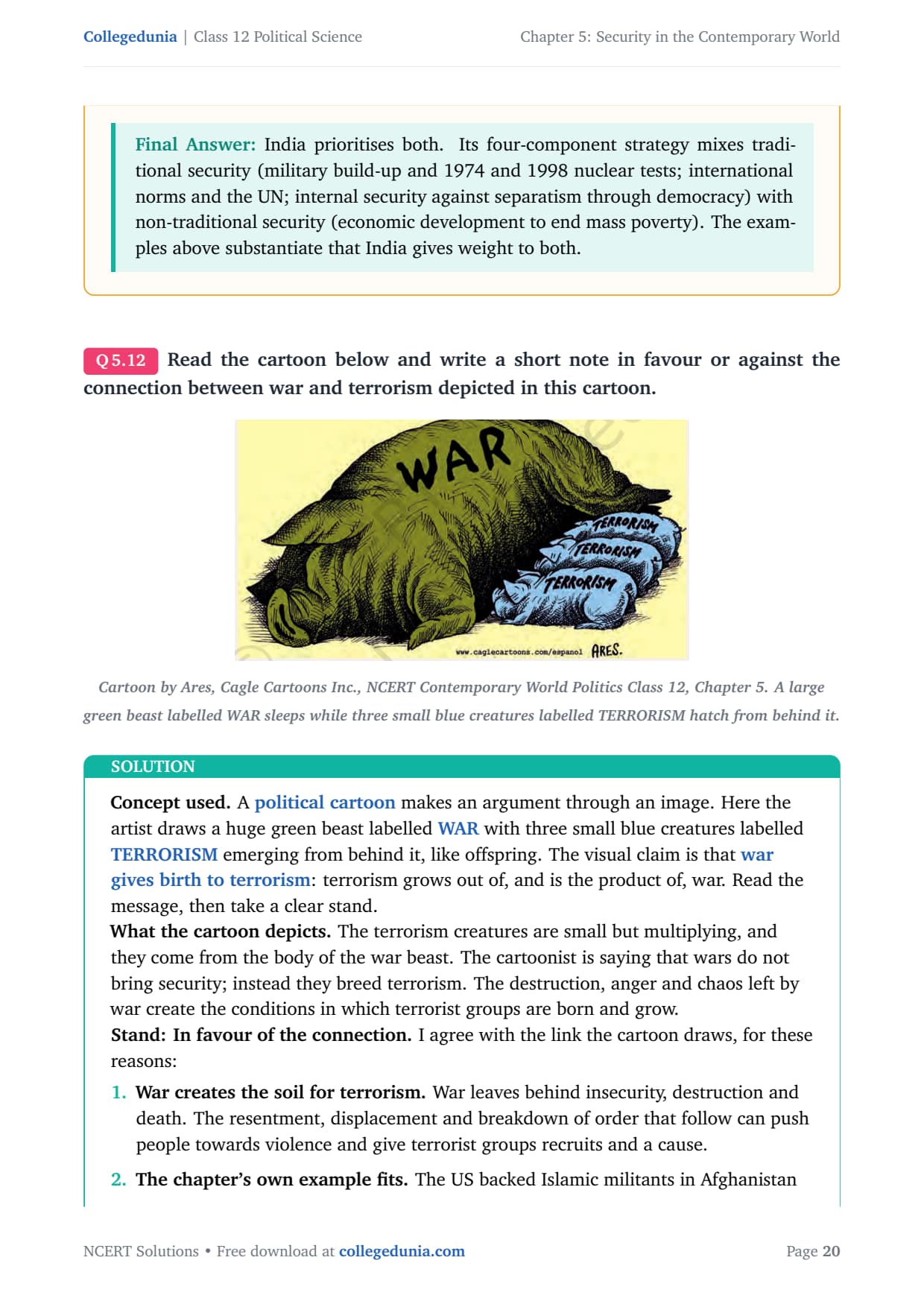
Cartoon by Ares, Cagle Cartoons Inc.,
NCERT Contemporary World Politics Class 12, Chapter 5. A large green beast
labelled WAR sleeps while three small blue creatures labelled TERRORISM hatch
from behind it.
Concept used. A political cartoon makes an argument through
an image. Here the artist draws a huge green beast labelled WAR with
three small blue creatures labelled TERRORISM emerging from behind
it, like offspring. The visual claim is that war gives birth to
terrorism: terrorism grows out of, and is the product of, war. Read the
message, then take a clear stand.
What the cartoon depicts. The terrorism creatures are small but
multiplying, and they come from the body of the war beast. The cartoonist is
saying that wars do not bring security; instead they breed terrorism. The
destruction, anger and chaos left by war create the conditions in which
terrorist groups are born and grow.
Stand: In favour of the connection. I agree with the link the cartoon
draws, for these reasons:
War creates the soil for terrorism. War leaves behind
insecurity, destruction and death. The resentment, displacement and
breakdown of order that follow can push people towards violence and
give terrorist groups recruits and a cause.
The chapter's own example fits. The US backed Islamic
militants in Afghanistan against the Soviet Union in the 1980s; some
of those militants later turned into Al Qaeda, which struck America on
11 September 2001. A war-time alliance helped create the very
terrorism it later faced.
Force often makes it worse. The chapter notes that using
military force against non-traditional threats can make matters worse.
Fighting terrorism with more war can multiply the small blue creatures
rather than removing them.
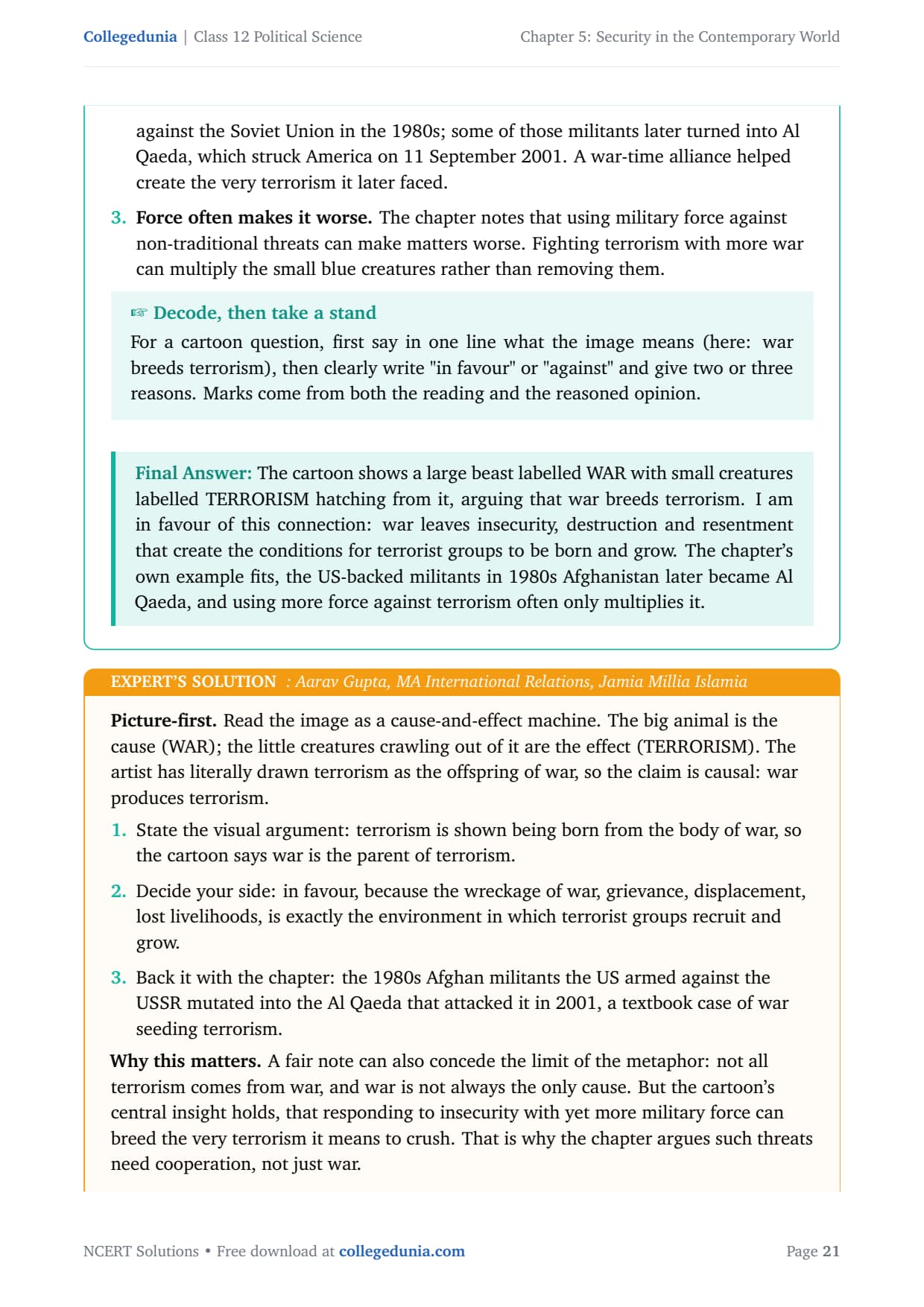
Decode, then take a stand
For a cartoon question, first say in one line what the image means (here: war
breeds terrorism), then clearly write "in favour" or "against" and give two or
three reasons. Marks come from both the reading and the reasoned opinion.
The cartoon shows a large beast labelled WAR with small creatures
labelled TERRORISM hatching from it, arguing that war breeds terrorism. I am in
favour of this connection: war leaves insecurity, destruction and resentment
that create the conditions for terrorist groups to be born and grow. The
chapter's own example fits, the US-backed militants in 1980s Afghanistan later
became Al Qaeda, and using more force against terrorism often only multiplies
it.
AG
Aarav Gupta
MA International Relations, Jamia Millia Islamia
Verified Expert
Picture-first. Read the image as a cause-and-effect machine. The big
animal is the cause (WAR); the little creatures crawling out of it are the
effect (TERRORISM). The artist has literally drawn terrorism as the offspring
of war, so the claim is causal: war produces terrorism.
State the visual argument: terrorism is shown being born from the body
of war, so the cartoon says war is the parent of terrorism.
Decide your side: in favour, because the wreckage of war, grievance,
displacement, lost livelihoods, is exactly the environment in which
terrorist groups recruit and grow.
Back it with the chapter: the 1980s Afghan militants the US armed
against the USSR mutated into the Al Qaeda that attacked it in 2001, a
textbook case of war seeding terrorism.
Why this matters. A fair note can also concede the limit of the
metaphor: not all terrorism comes from war, and war is not always the only
cause. But the cartoon's central insight holds, that responding to insecurity
with yet more military force can breed the very terrorism it means to crush.
That is why the chapter argues such threats need cooperation, not just war.
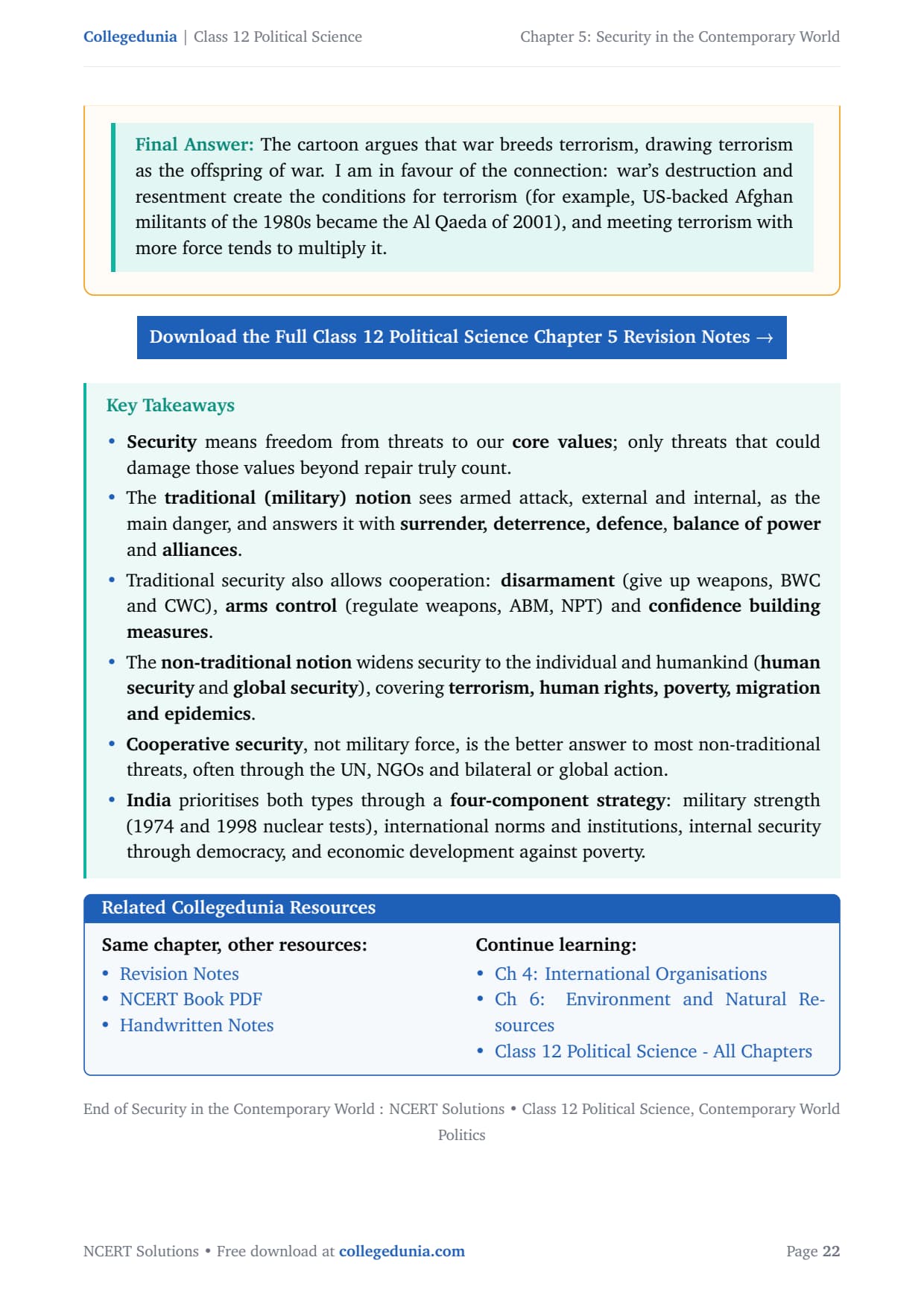
The cartoon argues that war breeds terrorism, drawing terrorism as
the offspring of war. I am in favour of the connection: war's destruction and
resentment create the conditions for terrorism (for example, US-backed Afghan
militants of the 1980s became the Al Qaeda of 2001), and meeting terrorism with
more force tends to multiply it.
FAQs on Security in the Contemporary World Class 12 NCERT Solutions
Security in the Contemporary World Class 12 Political Science Common Questions
Ques. Where can I get the class 12 political science chapter 5 NCERT Solutions PDF?
Ans. You can download the Security in the Contemporary World Class 12 Political Science NCERT Solutions PDF directly from this page. It is free, follows the 2026-27 NCERT, and answers all 12 exercise questions step by step.
Ques. How many questions are there in Security in the Contemporary World class 12 questions and answers?
Ans. The chapter has 12 exercise questions. They include a matching item, a classification of threats, several short and long written answers, and a cartoon-based note on war and terrorism.
Ques. What is the difference between traditional and non-traditional security?
Ans. Traditional security treats military attack as the main threat and protects the State, using deterrence, defence, balance of power and alliances. Non-traditional security widens the lens to human and global security, protecting people from terrorism, poverty, disease and migration.
Ques. Is terrorism a traditional or non-traditional threat?
Ans. Terrorism is a non-traditional threat. The danger comes from non-state groups, not a national army, and it targets ordinary civilians, often across borders. The chapter lists it among the new sources of threat to security.
Ques. What does balance of power mean in this chapter?
Ans. Balance of power means a state watches its rivals and builds strength so that no neighbour grows powerful enough to threaten it. A state achieves it by building military and economic power and by forming alliances with other states.
Ques. Is class 12 political science chapter 5 easy to score in the board exam?
Ans. Yes. It is a high-scoring chapter if you keep the two notions of security clear and give a balanced answer. Practise the matching question and India's four-component strategy, and keep the traditional-versus-non-traditional contrast ready for the long answer.








Comments