Political Science Editor, 7 Yrs | Updated 3+ months ago
The NCERT Solutions for Political Science Class 12 Chapter 4 International Organisations answer every textbook question on the United Nations, set to the latest 2026-27 CBSE syllabus. Each answer explains why countries need international organisations, how the UN works, what the veto power is, and why India wants a permanent Security Council seat. These solutions help students prepare for the Class 12 Political Science board paper and the UPSC foundation in 2026-27.
Covers all 12 exercise questions from Contemporary World Politics Chapter 4, with full point-wise answers.
This Class 12 Political Science chapter usually carries 5 to 6 marks per board paper.
Pairs with the Notes, Handwritten Notes and NCERT Book PDF linked lower on this page.
Every solution for Class 12 Political Science Chapter 4 in this Collegedunia compilation is written by subject experts from the official NCERT Contemporary World Politics textbook, and checked against the last five years of CBSE board papers.
Student Feedback: In a Collegedunia poll of 9,040 Class 12 Political Science students taken before the 2026 boards, 71% of students rated the match-the-organs question and the Security Council reform answer as the trickiest parts of International Organisations. Most students said a single labelled chart of the UN organs made the whole chapter easy to recall.
Source: 2026-27 Class 12 Political Science student poll. Sample of 9,040 students from CBSE schools across 13 states.
What the International Organisations Class 12 Chapter Is About
International Organisations is the fourth chapter of Contemporary World Politics. It explains why countries set up bodies like the United Nations (UN) and how these bodies try to keep peace and solve shared problems. An international organisation is a group of states that agree to work together on issues no single country can fix alone, such as war, disease or trade.
The chapter answers three big questions that students must keep in mind:
Why do we need them? Because war, poverty and health crises cross borders and need joint action.
How does the UN work? Through main organs like the Security Council and a network of specialised agencies.
Why reform it? The Security Council still reflects the world of 1945, so countries like India want change.
So the chapter is really about cooperation between states and the body that runs it. A student who keeps these three threads in mind can connect almost any question in International Organisations class 12 back to one of them. This is why revision works best when you sort each fact under "why", "how" or "reform" first.
Why Countries Need International Organisations
No country can solve a war, a disease or a financial crash on its own. International organisations give states a place to talk, set rules and act together. To answer the "why" questions well, students must see what these bodies actually do.
Stop war: they give enemies a forum to talk instead of fight.
Set rules: they help states agree on trade, health and human-rights rules.
Share help: they pool money and aid for disease, disaster and poverty.
Build trust: they let even rival states cooperate where their interests meet.
A key exam point is that an international organisation is not a world government. It cannot force a sovereign state to obey. It only works when members agree to follow its decisions, which is why the UN can advise and pressure but rarely command. Marks come from making this limit clear before listing what these bodies do.
The United Nations and Its Principal Organs
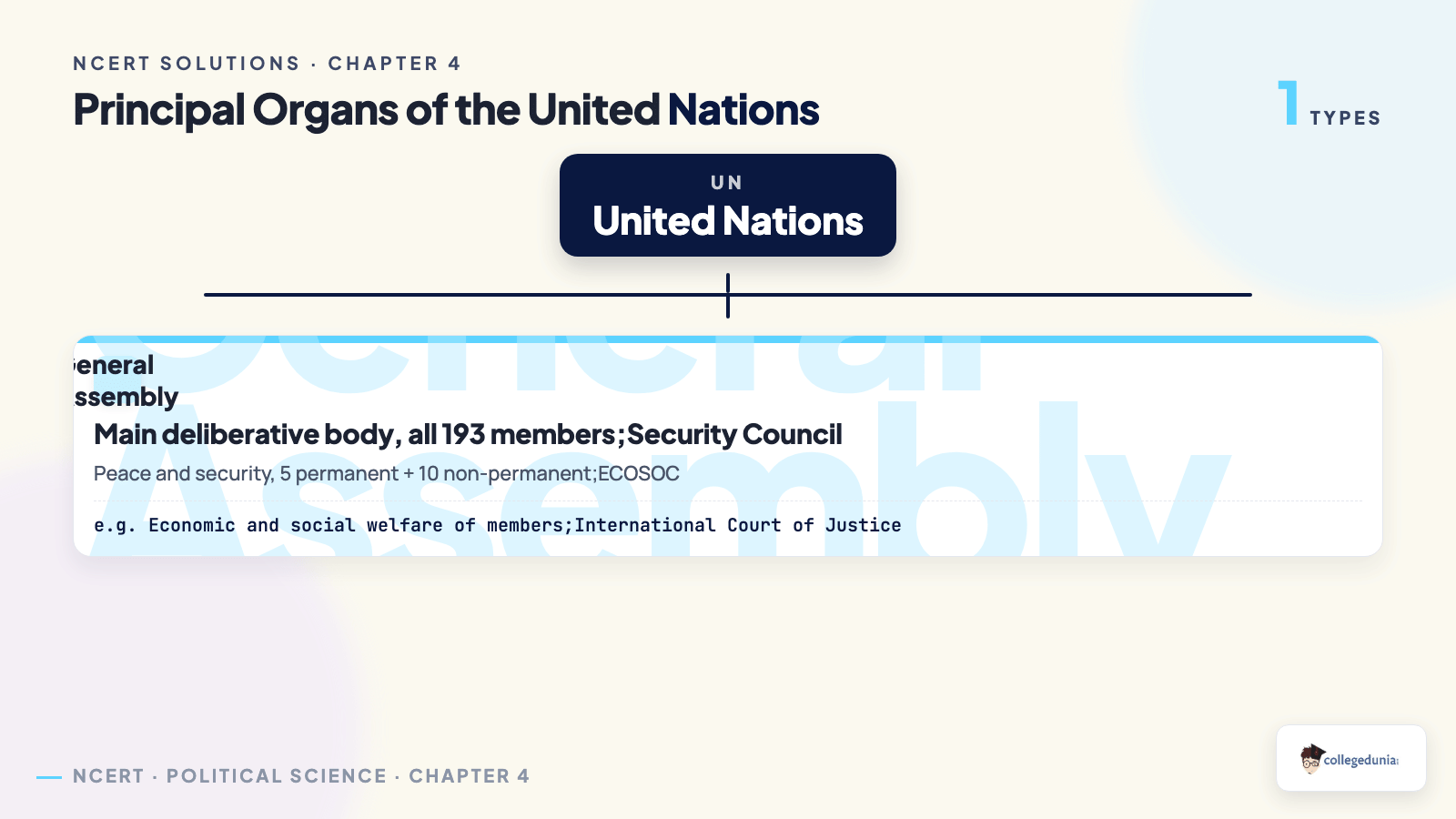
The UN was founded on 24 October 1945, after the Second World War, to replace the failed League of Nations. It now has 193 members and runs through six main organs. The table below sorts these organs so students can answer the match-the-following question fast.
Organ
What it does
Security Council
Keeps international peace and security; can take binding action.
General Assembly
The main debate body where all 193 members have a vote.
Economic and Social Council (ECOSOC)
Looks after the economic and social welfare of member countries.
International Court of Justice
Settles legal disputes between states.
Secretariat
Runs the day-to-day work, headed by the Secretary-General.
The single most useful idea for the match question is that each organ has one clear job. The Security Council guards peace, the ICJ judges disputes, ECOSOC handles welfare, and the IAEA oversees nuclear safety. Learn one job per body, and Question 7's matching becomes quick, sure marks.
The Security Council, Veto Power and Reform
The Security Council is the most powerful UN organ and the focus of most exam questions. Its make-up and the veto power are a regular MCQ and long-answer favourite, so students should learn both clearly.
Members: 5 permanent members (US, Russia, UK, France, China) and 10 non-permanent members elected for two years.
The veto: only the five permanent members hold it; one veto can stop any resolution.
Why reform: the Council still mirrors the power balance of 1945, not today's world.
Two parts of reform: changing the structures and processes, and reviewing the issues the UN handles.
The honest exam point is that the veto is the biggest block to reform. The five permanent members will not give up their special power, and new claimants like India, Germany, Japan and Brazil cannot agree on who deserves a seat. So almost everyone wants reform, yet little changes. A balanced answer names this deadlock instead of just calling for reform.
India and the Demand for a Permanent Seat
India wants a permanent seat in a reformed Security Council, and the chapter sets out a clear case for it. This is a "justify" question, so students must use the criteria from the book, not just praise India. The table keeps the criteria and India's claim side by side.
Criterion proposed for new members
How India fits
Large population
India is one of the most populous countries in the world.
Major economic power
India has a large and fast-growing economy.
Steady UN contributor
A founding member since 1945 and a regular contributor to peacekeeping.
Military strength
India is a nuclear power with one of the largest armies.
Support for democracy
India is the world's largest democracy, backing the UN's values.
One sharp point for the India question: India's case is strong on every proposed criterion, but the politics of who gets a veto blocks it. The existing permanent members and rival claimants slow the process down. A high-marks answer names the criteria, shows India fits each, then admits the political hurdle, which is exactly the balance the essay questions test.
Specialised Agencies, NGOs and the UN's Role
Beyond its main organs, the UN works through specialised agencies and alongside non-governmental organisations (NGOs). These appear in the MCQ and matching questions, so a short, sorted list is worth keeping. The table groups the agencies students must know.
Body
Its job
IAEA
Oversees the safe and peaceful use of nuclear technology.
WHO
Leads global health and fights disease.
IMF and World Bank
Oversee the global financial system and fund development.
WTO
Successor to the GATT; sets the rules of world trade.
Amnesty International (NGO)
A non-governmental body that campaigns for human rights.
The point that earns marks is that the UN is more than the Security Council. Its agencies fight disease, manage money and protect rights every day, while NGOs like Amnesty International add pressure from outside. In a unipolar world led by the US, this wider work is what makes the UN useful even when the Security Council is deadlocked.
International Organisations Class 12 Exercise-wise Coverage
The chapter exercise has 12 questions. The table maps each one to its topic so students can plan revision and find the right NCERT answer fast. The full point-wise solution for each sits in the question set lower on this page.
Question
Topic it tests
Q 1
Correct or wrong statements about the veto power (MCQ)
Q 2
Correct or wrong statements about how the UN functions (MCQ)
Q 3
What would strengthen India's case for permanent membership (MCQ)
Q 4
The UN agency for the peaceful use of nuclear technology (MCQ)
Q 5
The organisation the WTO succeeded (MCQ)
Q 6
Fill in the blanks on UN aims, the Secretary-General and the Council
Q 7
Match the principal organs and agencies with their functions
Q 8
Functions of the Security Council
Q 9
Supporting India's candidature for a permanent seat
Q 10
Difficulties in implementing the suggested UN reforms
Q 11
What makes the UN an indispensable organisation
Q 12
Whether UN reform means restructuring the Security Council
Questions 8, 9, 10 and 12 are the most-asked long answers, so students preparing International Organisations class 12 important questions should learn those first. The MCQs and fill-in-the-blanks (Q1 to Q6) are quick marks, so revise the UN facts well to secure them.
Students who want the offline copy can save the class 12 political science chapter 4 pdf from the download card above and tick off each question as they finish it.
International Organisations Important Questions and Previous Year Trends
CBSE sets a steady mix of MCQ, short and long answers from this chapter. Knowing the pattern helps students decide how much to write. The chapter is a regular source of one 4-mark or 6-mark question, which is why a focused list of International Organisations important questions saves a lot of revision time.
Long answer (5 to 6 marks): functions of the Security Council, or the difficulties of UN reform.
Short answer (4 marks): why the UN is indispensable, or India's case for a seat.
Source-based: a passage on Security Council reform or the veto, with sub-parts.
Objective and MCQ: the veto, the IAEA, the WTO and GATT, and the UN's founding year.
For quick recall before the exam, students often practise the class 12 political science chapter 4 mcq set and a list of International Organisations class 12 important questions. The most repeated items are the Security Council's functions and the reform debate, so keep those answer points ready in your own words.
Working through the ncert solutions class 12 political science chapter 4 set twice, once open-book and once from memory, fixes the organs and agencies well before the board exam.
Common Mistakes Students Make in This Chapter
A few errors cost marks every year in this chapter. Most come from mixing up the organs or giving only one side of the reform debate. Avoiding them is the fastest way to lift a score.
Saying the Secretary-General holds the veto - only the five permanent members of the Security Council do.
Confusing the General Assembly (all members debate) with the Security Council (peace and security).
Calling for UN reform without naming the veto deadlock that blocks it.
Forgetting the WTO is the successor to the GATT, not the WHO.
Writing that the UN is a world government - it cannot force a sovereign state to obey.
Students who fix these five points usually move from average to high marks on the long answers. The exam rewards a balanced view, so always give both the case for reform and the reasons it stalls before you judge it.
International Organisations PDF Download Formats and Languages
The solutions are free to download in more than one format, so students can pick what suits their device and revision style. The download card at the top of the page carries each option for this chapter.
Normal and HD PDF: the class 12 political science chapter 4 pdf comes in a normal size for quick downloads and an HD version for clear printing.
English medium: all 12 answers are written in simple English for the CBSE board paper.
Question-only set: a print-and-practise sheet of International Organisations extra questions for self-testing.
Whole-book pack: the solutions sit in one set that runs through every Contemporary World Politics chapter, so you can revise from Chapter 1 onwards in one place.
Many students search for class 12 political science chapter 4 answers on their phone the night before a test, so a saved PDF means you can revise even without internet. Keep both the question set and the solved version handy for a full self-check.
How the International Organisations Solutions Pair with Notes and the Book PDF
These NCERT Solutions answer the back-exercise questions. To revise the full chapter, students should use them alongside the other resources for the same chapter, all linked in the table below.
Reading the original NCERT chapter text and figures
Tip: read the Notes first, then attempt these solutions on your own, and only then check the model answers here. That order builds memory faster than copying answers straight away.
All NCERT Solutions for Class 12 Political Science
The table links the NCERT Solutions for every chapter in both Class 12 Political Science books, so students can move across the course in one click. International Organisations is highlighted.
All NCERT Solutions for International Organisations with Step-by-Step Solutions
Below are all 12 NCERT exercise questions for this chapter, exactly as they appear in the textbook. Tap Check Solution for the model answer or Expert Solution for the topper-style approach.
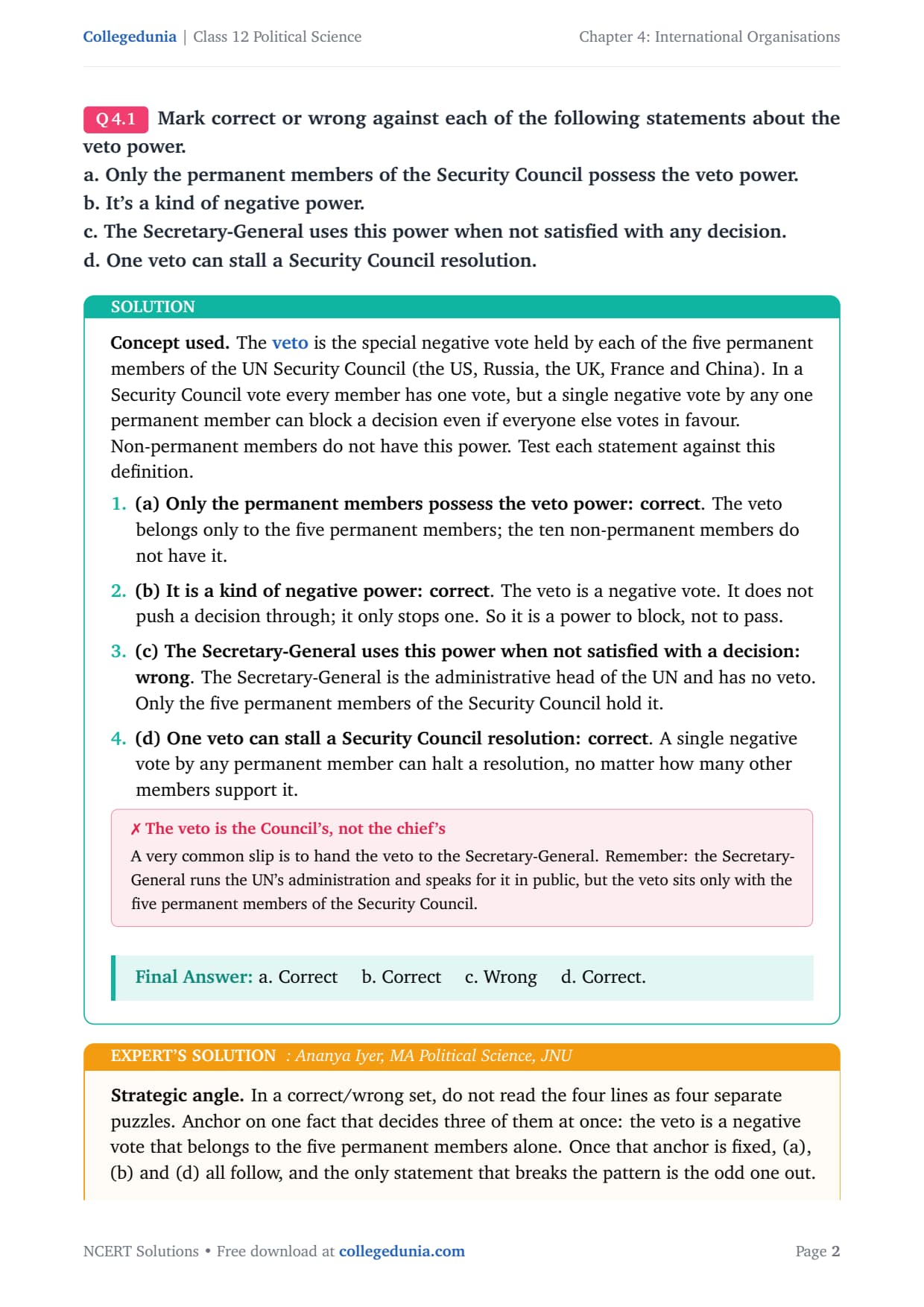
Q 4.1
Mark correct or wrong against each of the following statements
about the veto power.
a. Only the permanent members of the Security Council possess the veto power.
b. It's a kind of negative power.
c. The Secretary-General uses this power when not satisfied with any decision.
d. One veto can stall a Security Council resolution.
Concept used. The veto is the special negative vote held by
each of the five permanent members of the UN Security Council (the US, Russia,
the UK, France and China). In a Security Council vote every member has one
vote, but a single negative vote by any one permanent member can block a
decision even if everyone else votes in favour. Non-permanent members do not
have this power. Test each statement against this definition.
(a) Only the permanent members possess the veto power:correct. The veto belongs only to the five permanent members;
the ten non-permanent members do not have it.
(b) It is a kind of negative power:correct. The veto
is a negative vote. It does not push a decision through; it only stops
one. So it is a power to block, not to pass.
(c) The Secretary-General uses this power when not satisfied
with a decision:wrong. The Secretary-General is the
administrative head of the UN and has no veto. Only the five permanent
members of the Security Council hold it.
(d) One veto can stall a Security Council resolution:correct. A single negative vote by any permanent member can
halt a resolution, no matter how many other members support it.
The veto is the Council's, not the chief's
A very common slip is to hand the veto to the Secretary-General. Remember: the
Secretary-General runs the UN's administration and speaks for it in public,
but the veto sits only with the five permanent members of the Security Council.
a. Correct b. Correct c. Wrong d. Correct.
AI
Ananya Iyer
MA Political Science, JNU
Verified Expert
Strategic angle. In a correct/wrong set, do not read the four lines as
four separate puzzles. Anchor on one fact that decides three of them at once:
the veto is a negative vote that belongs to the five permanent members alone.
Once that anchor is fixed, (a), (b) and (d) all follow, and the only statement
that breaks the pattern is the odd one out.
Fix the anchor in one line: veto = negative vote = five permanent
members only. Write it in the margin before you mark anything.
(a), (b) and (d) all restate a piece of this anchor (who holds it, what
kind of power it is, what one veto does), so all three are correct.
(c) puts the veto in the wrong hands, the Secretary-General, so it is
the single wrong statement. That is the line examiners plant to catch a
hurried reader.
Why this matters. The veto is the most tested idea in this chapter
because it is also the hardest obstacle to UN reform. Knowing exactly who holds
it, and that it only blocks and never passes, sets you up for the long-answer
questions on Security Council reform later in the paper.
a. Correct, b. Correct, c. Wrong, d. Correct. The veto is a negative
vote held only by the five permanent members; the Secretary-General has no veto.
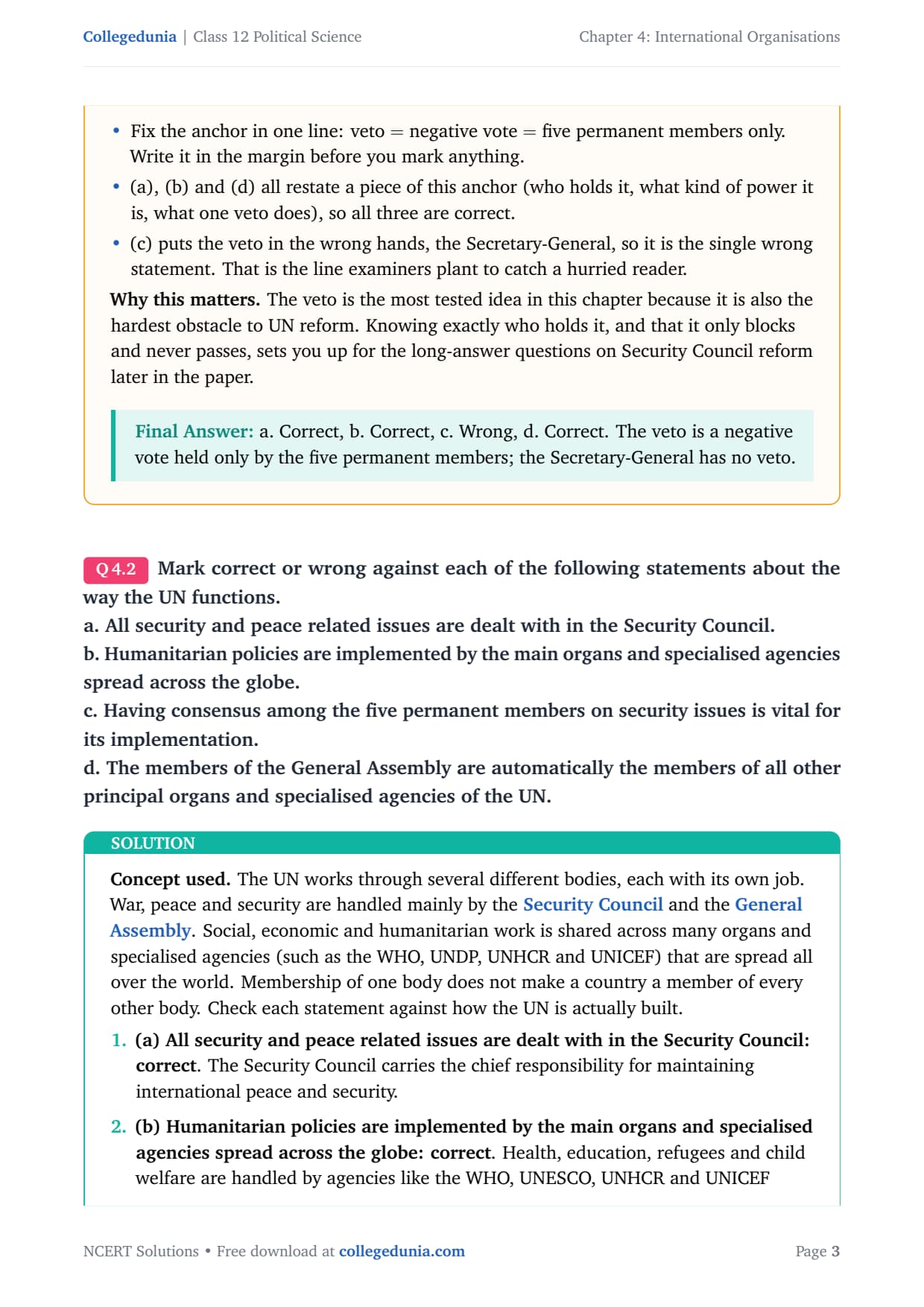
Q 4.2
Mark correct or wrong against each of the following statements
about the way the UN functions.
a. All security and peace related issues are dealt with in the Security
Council.
b. Humanitarian policies are implemented by the main organs and specialised
agencies spread across the globe.
c. Having consensus among the five permanent members on security issues is
vital for its implementation.
d. The members of the General Assembly are automatically the members of all
other principal organs and specialised agencies of the UN.
Concept used. The UN works through several different bodies, each with
its own job. War, peace and security are handled mainly by the
Security Council and the General Assembly. Social, economic
and humanitarian work is shared across many organs and specialised agencies
(such as the WHO, UNDP, UNHCR and UNICEF) that are spread all over the world.
Membership of one body does not make a country a member of every other body.
Check each statement against how the UN is actually built.
(a) All security and peace related issues are dealt with in the
Security Council:correct. The Security Council carries the
chief responsibility for maintaining international peace and security.
(b) Humanitarian policies are implemented by the main organs
and specialised agencies spread across the globe:correct.
Health, education, refugees and child welfare are handled by agencies
like the WHO, UNESCO, UNHCR and UNICEF located across the world.
(c) Consensus among the five permanent members on security
issues is vital for implementation:correct. Because any one
permanent member can veto a decision, real agreement among all five is
needed before a security decision can be carried out.
(d) Members of the General Assembly are automatically members
of all other principal organs and specialised agencies:wrong. Every UN member sits in the General Assembly, but the
Security Council and the specialised agencies have their own limited
and separate memberships.
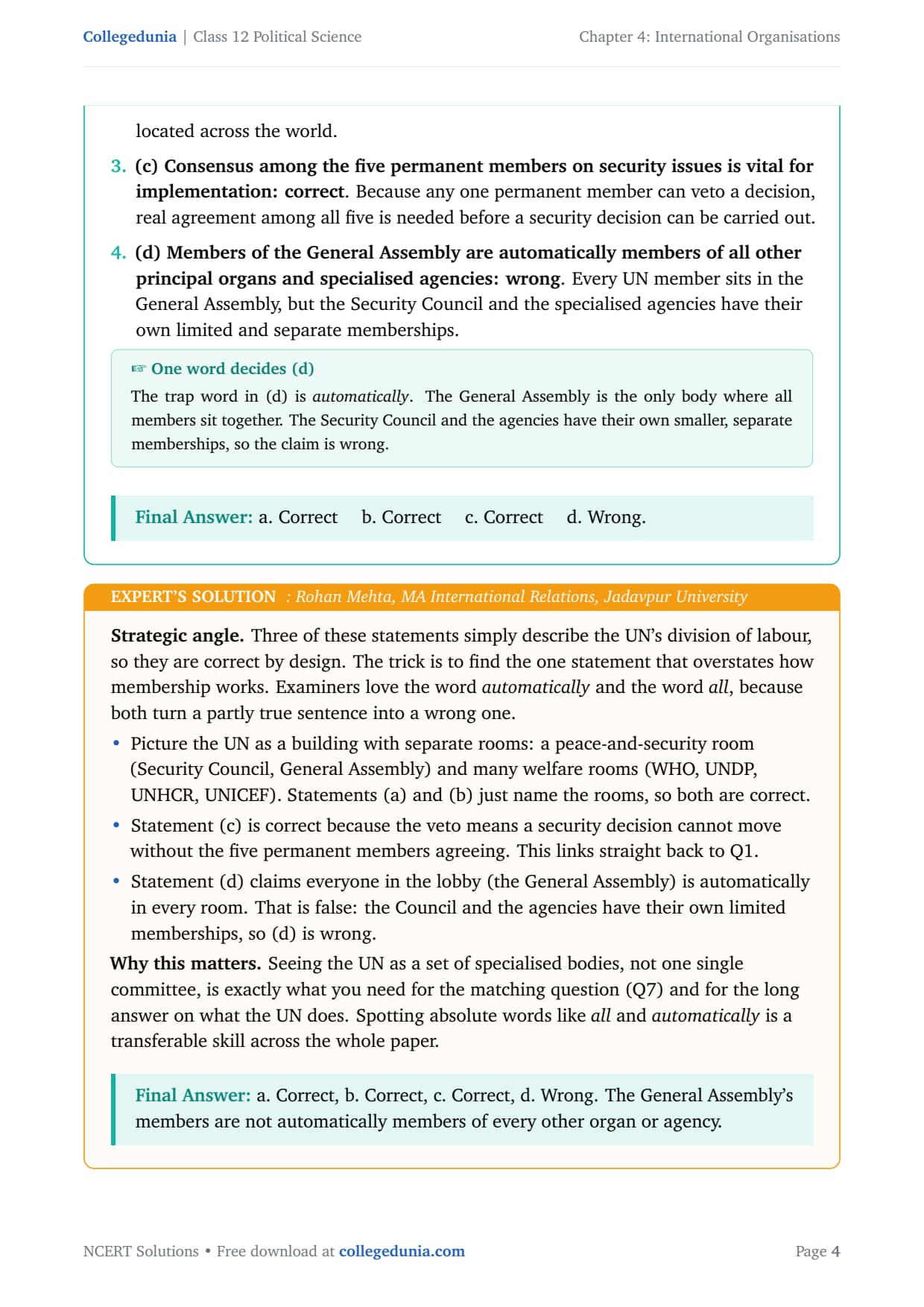
One word decides (d)
The trap word in (d) is automatically. The General Assembly is the only
body where all members sit together. The Security Council and the agencies have
their own smaller, separate memberships, so the claim is wrong.
a. Correct b. Correct c. Correct d. Wrong.
RM
Rohan Mehta
MA International Relations, Jadavpur University
Verified Expert
Strategic angle. Three of these statements simply describe the UN's
division of labour, so they are correct by design. The trick is to find the one
statement that overstates how membership works. Examiners love the word
automatically and the word all, because both turn a partly true
sentence into a wrong one.
Picture the UN as a building with separate rooms: a peace-and-security
room (Security Council, General Assembly) and many welfare rooms (WHO,
UNDP, UNHCR, UNICEF). Statements (a) and (b) just name the rooms, so
both are correct.
Statement (c) is correct because the veto means a security decision
cannot move without the five permanent members agreeing. This links
straight back to Q1.
Statement (d) claims everyone in the lobby (the General Assembly) is
automatically in every room. That is false: the Council and the
agencies have their own limited memberships, so (d) is wrong.
Why this matters. Seeing the UN as a set of specialised bodies, not
one single committee, is exactly what you need for the matching question (Q7)
and for the long answer on what the UN does. Spotting absolute words like
all and automatically is a transferable skill across the whole
paper.
a. Correct, b. Correct, c. Correct, d. Wrong. The General Assembly's
members are not automatically members of every other organ or agency.
Q 4.3
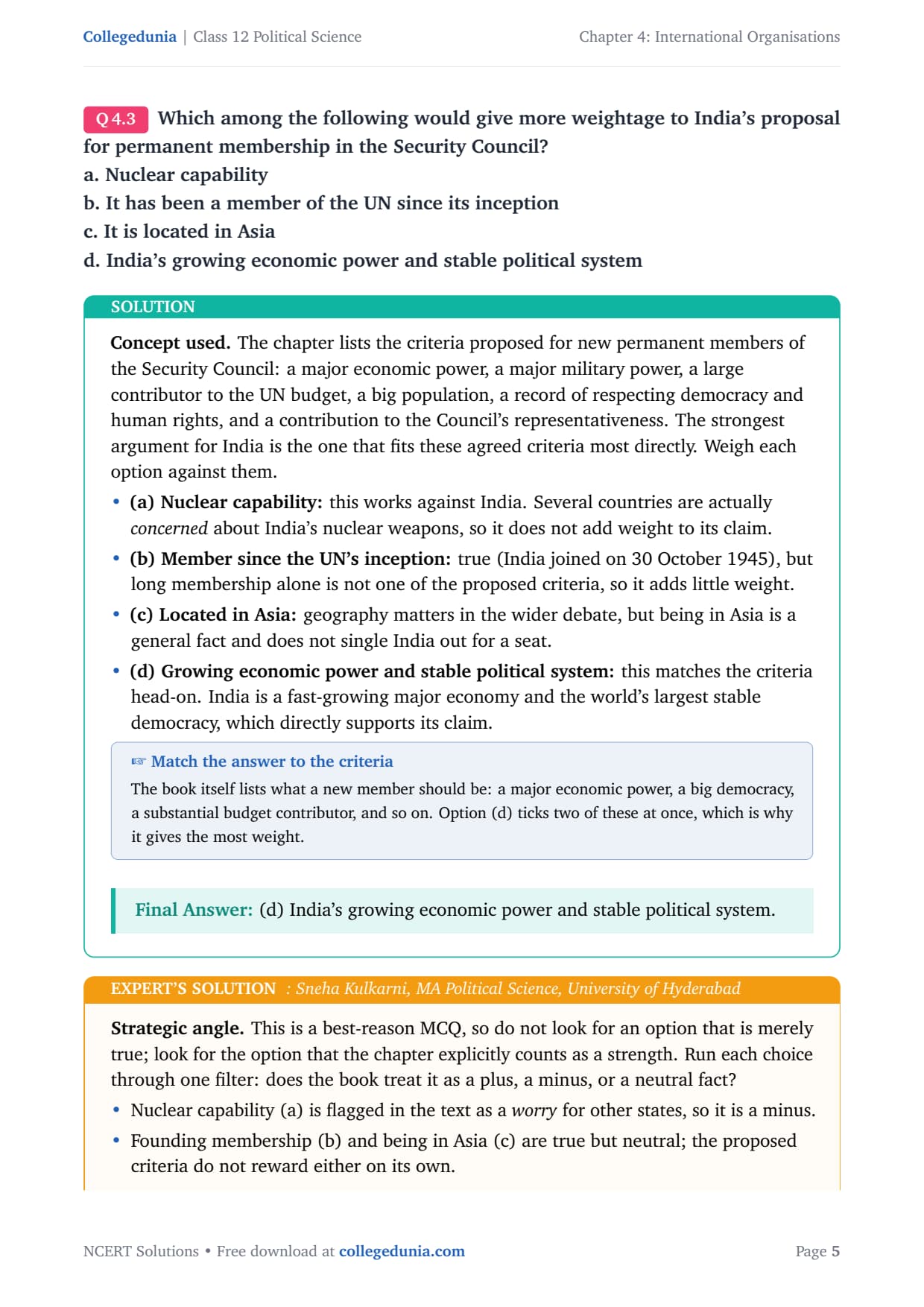
Which among the following would give more weightage to India's
proposal for permanent membership in the Security Council?
a. Nuclear capability
b. It has been a member of the UN since its inception
c. It is located in Asia
d. India's growing economic power and stable political system
Concept used. The chapter lists the criteria proposed for new
permanent members of the Security Council: a major economic power, a major
military power, a large contributor to the UN budget, a big population, a record
of respecting democracy and human rights, and a contribution to the Council's
representativeness. The strongest argument for India is the one that fits these
agreed criteria most directly. Weigh each option against them.
(a) Nuclear capability: this works against India. Several
countries are actually concerned about India's nuclear weapons,
so it does not add weight to its claim.
(b) Member since the UN's inception: true (India joined on 30
October 1945), but long membership alone is not one of the proposed
criteria, so it adds little weight.
(c) Located in Asia: geography matters in the wider debate, but
being in Asia is a general fact and does not single India out for a seat.
(d) Growing economic power and stable political system: this
matches the criteria head-on. India is a fast-growing major economy and
the world's largest stable democracy, which directly supports its claim.
Match the answer to the criteria
The book itself lists what a new member should be: a major economic power, a
big democracy, a substantial budget contributor, and so on. Option (d) ticks
two of these at once, which is why it gives the most weight.
(d) India's growing economic power and stable political system.
SK
Sneha Kulkarni
MA Political Science, University of Hyderabad
Verified Expert
Strategic angle. This is a best-reason MCQ, so do not look for an
option that is merely true; look for the option that the chapter explicitly
counts as a strength. Run each choice through one filter: does the book treat
it as a plus, a minus, or a neutral fact?
Nuclear capability (a) is flagged in the text as a worry for
other states, so it is a minus.
Founding membership (b) and being in Asia (c) are true but neutral; the
proposed criteria do not reward either on its own.
Economic strength plus a stable democracy (d) is exactly the language
the chapter uses for India's case, so it is the clear plus.
Why this matters. The criteria for new members reappear in the long
answers on India's candidature (Q9) and on the difficulties of reform (Q10).
Learning to sort facts into plus, minus and neutral is the same skill those
essays reward.
(d). India's growing economic power and stable political system best
fits the agreed criteria for a new permanent member.
Q 4.4
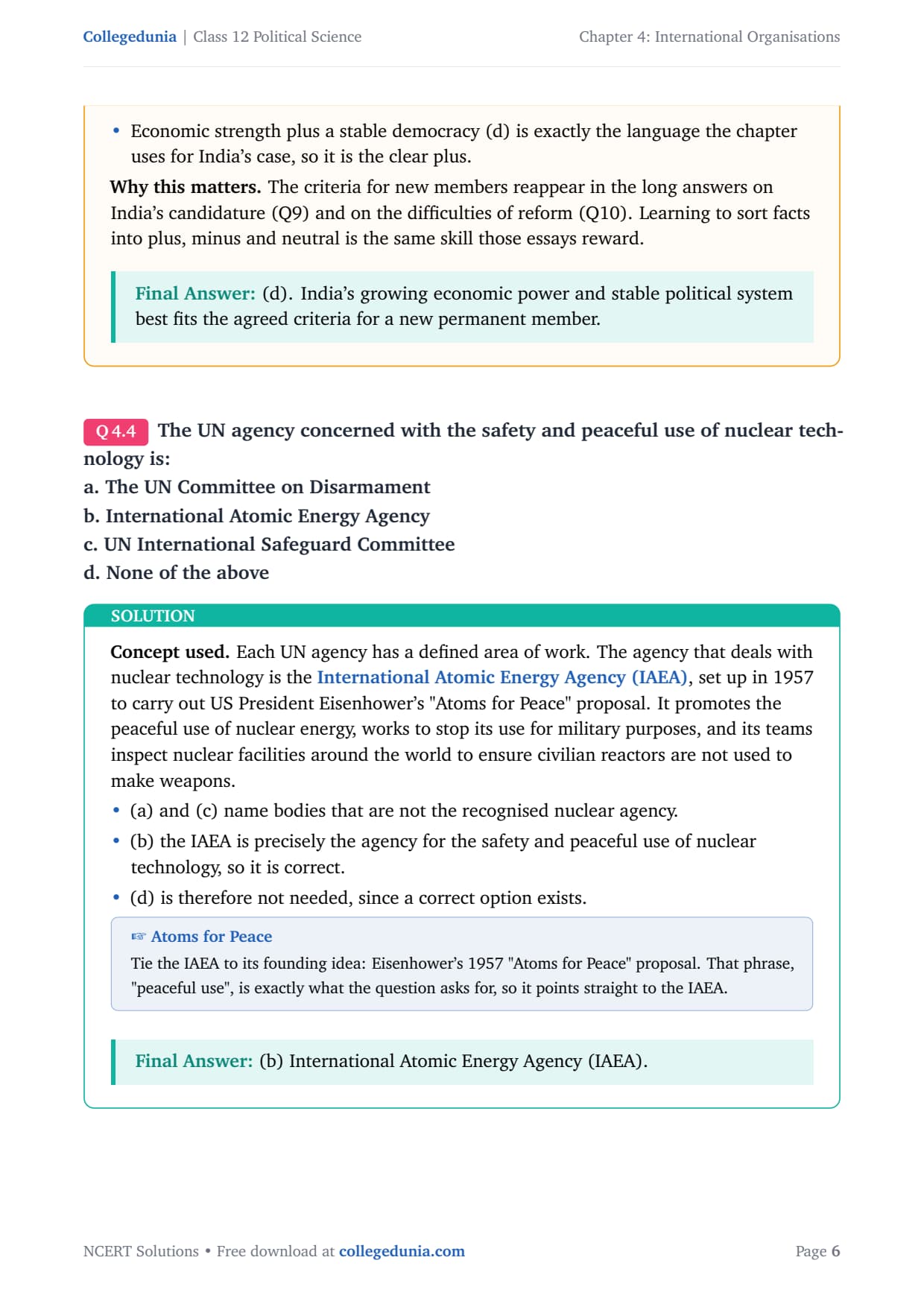
The UN agency concerned with the safety and peaceful use of nuclear
technology is:
a. The UN Committee on Disarmament
b. International Atomic Energy Agency
c. UN International Safeguard Committee
d. None of the above
Concept used. Each UN agency has a defined area of work. The agency
that deals with nuclear technology is the International Atomic Energy
Agency (IAEA), set up in 1957 to carry out US President Eisenhower's "Atoms for
Peace" proposal. It promotes the peaceful use of nuclear energy, works to stop
its use for military purposes, and its teams inspect nuclear facilities around
the world to ensure civilian reactors are not used to make weapons.
(a) and (c) name bodies that are not the recognised nuclear agency.
(b) the IAEA is precisely the agency for the safety and peaceful use of
nuclear technology, so it is correct.
(d) is therefore not needed, since a correct option exists.
Atoms for Peace
Tie the IAEA to its founding idea: Eisenhower's 1957 "Atoms for Peace" proposal.
That phrase, "peaceful use", is exactly what the question asks for, so it points
straight to the IAEA.
(b) International Atomic Energy Agency (IAEA).
AN
Arjun Nair
MA Politics and International Studies, JNU
Verified Expert
Strategic angle. For a one-line "which agency does X" question, latch
on to the keyword first. The keyword here is nuclear, and the only
nuclear body the chapter discusses is the IAEA. The other two named options are
distractors invented to sound official.
Pin the keyword: safety and peaceful use of nuclear technology.
Recall the IAEA's job from the chapter box: peaceful use of nuclear
energy, prevention of military use, and inspection of nuclear
facilities worldwide. That is an exact match.
Reject "None of the above" the moment a correct option appears, so (d)
is out.
Why this matters. The IAEA links to India's nuclear story in the wider
syllabus, where India's nuclear capability is read by some states as a reason
to keep it out of the Security Council. So this agency is worth knowing well
beyond a single MCQ mark.
(b) IAEA. It is the agency for the safe, peaceful use of nuclear
technology and inspects nuclear facilities worldwide.
Q 4.5
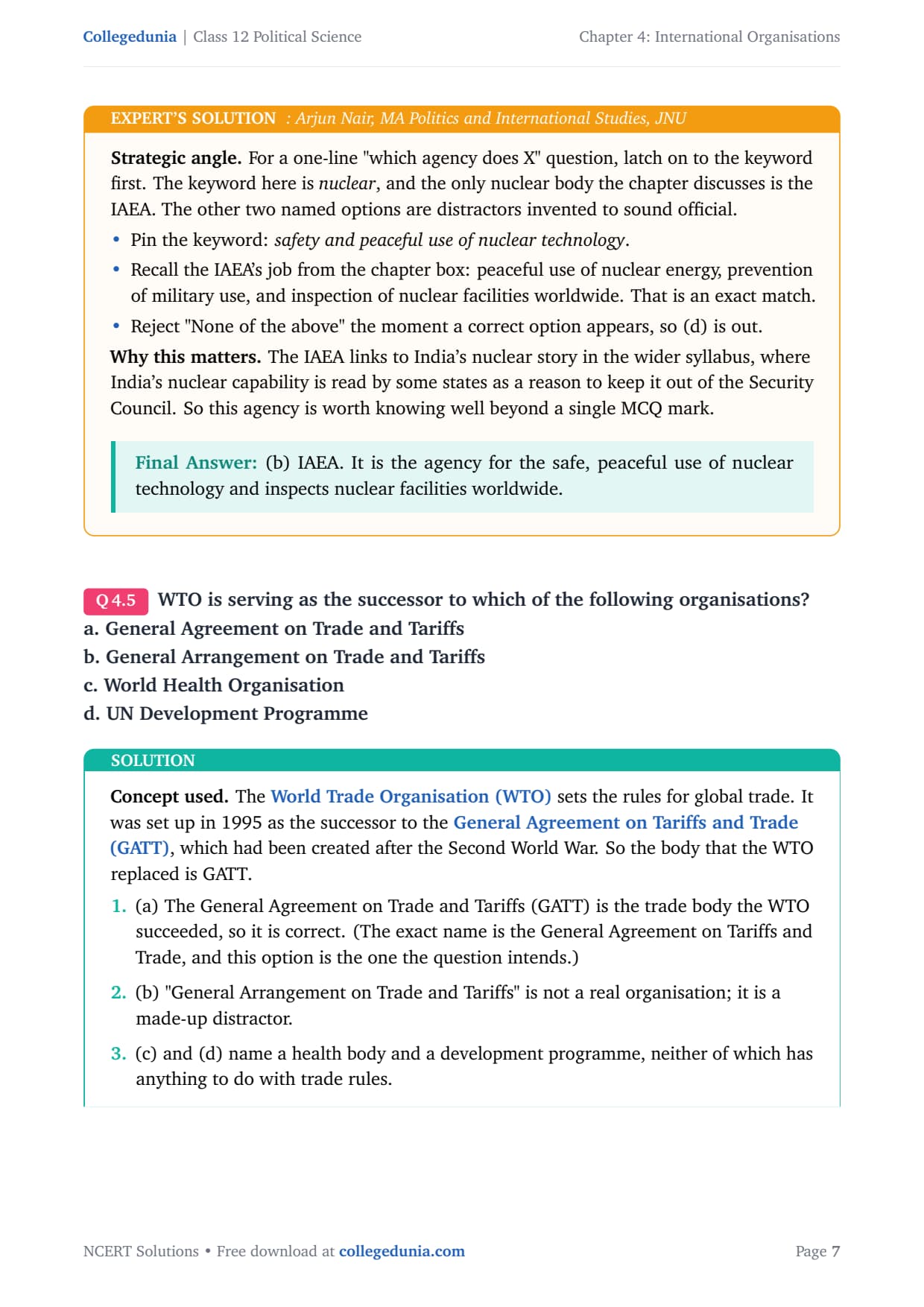
WTO is serving as the successor to which of the following
organisations?
a. General Agreement on Trade and Tariffs
b. General Arrangement on Trade and Tariffs
c. World Health Organisation
d. UN Development Programme
Concept used. The World Trade Organisation (WTO) sets the
rules for global trade. It was set up in 1995 as the successor to the
General Agreement on Tariffs and Trade (GATT), which had been created
after the Second World War. So the body that the WTO replaced is GATT.
(a) The General Agreement on Trade and Tariffs (GATT) is the trade body
the WTO succeeded, so it is correct. (The exact name is the General
Agreement on Tariffs and Trade, and this option is the one the question
intends.)
(b) "General Arrangement on Trade and Tariffs" is not a real
organisation; it is a made-up distractor.
(c) and (d) name a health body and a development programme, neither of
which has anything to do with trade rules.
Read the look-alike names slowly
Options (a) and (b) differ by one word: "Agreement" versus "Arrangement". The
real body is the General Agreement on Tariffs and Trade. Slowing down on
near-identical options is how you avoid the trap.
(a) General Agreement on Tariffs and Trade (GATT).
IB
Ishita Bose
MA Economics, Delhi School of Economics
Verified Expert
Strategic angle. Two options look almost identical here, so the test is
really a name-recall check. The genuine post-war trade body is GATT, the General
Agreement on Tariffs and Trade. The "Arrangement" option is a
look-alike designed to make you second-guess.
Tie the WTO to trade, then ask which option also deals with trade. That
knocks out the health body (c) and the development programme (d) at once.
Between the two remaining trade-style names, the real one is the
Agreement (GATT), not the Arrangement. Recognising the
correct word is the whole point of the question.
Why this matters. GATT to WTO is a clean example of how international
economic institutions evolve. The chapter notes that big powers like the US, EU
and Japan still shape WTO rules, which feeds into the wider theme of unequal
power inside international organisations.
(a) GATT. The WTO replaced the General Agreement on Tariffs and Trade
in 1995.
Q 4.6
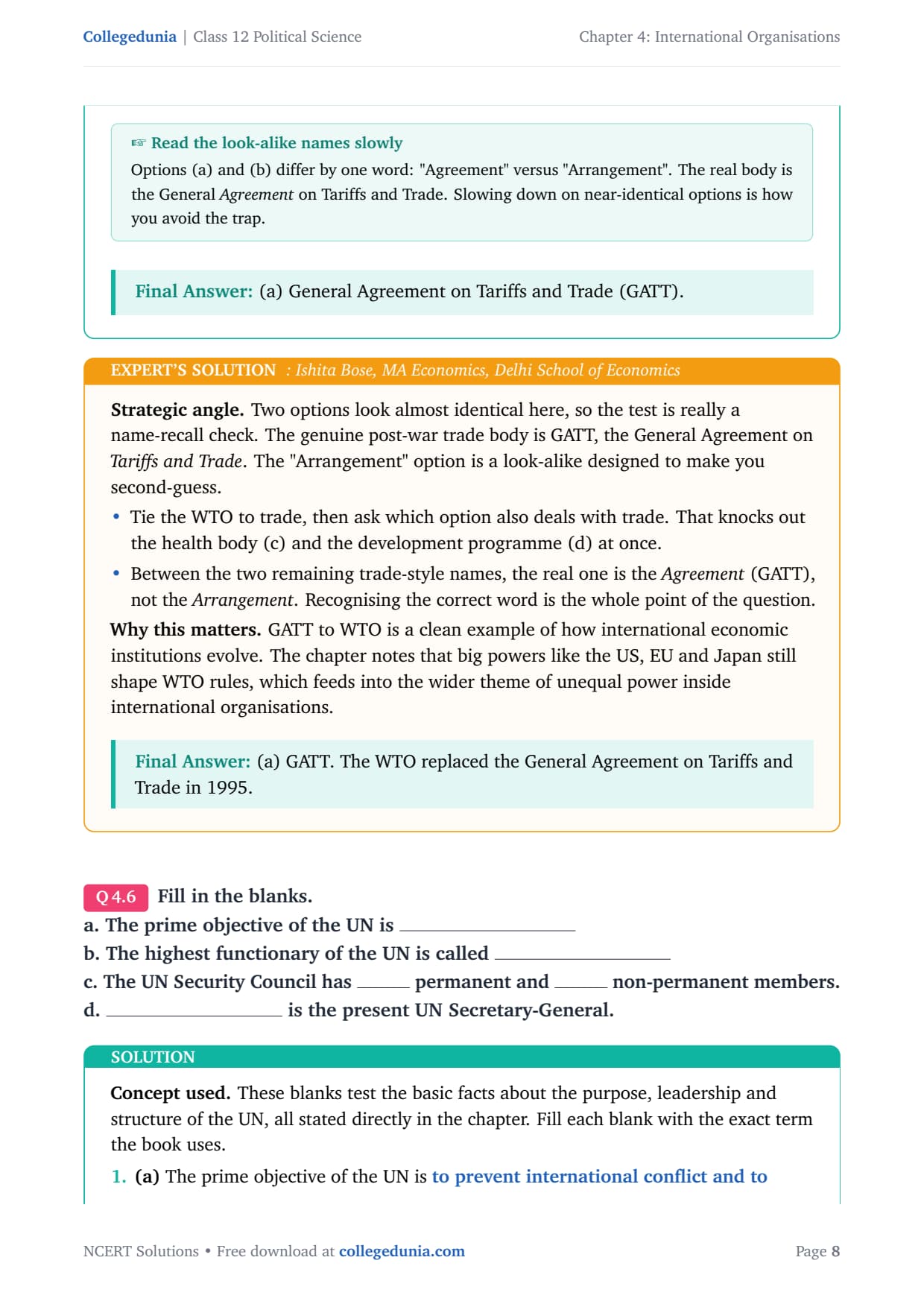
Fill in the blanks.
a. The prime objective of the UN is 4cm0.4pt
b. The highest functionary of the UN is called 4cm0.4pt
c. The UN Security Council has 1.2cm0.4pt permanent and
1.2cm0.4pt non-permanent members.
d. 4cm0.4pt is the present UN Secretary-General.
Concept used. These blanks test the basic facts about the purpose,
leadership and structure of the UN, all stated directly in the chapter. Fill
each blank with the exact term the book uses.
(a) The prime objective of the UN is to prevent
international conflict and to facilitate cooperation among states. In
short, it works to maintain international peace and security.
(b) The highest functionary of the UN is called the
Secretary-General. This is the UN's most visible public
figure and its representative head.
(c) The UN Security Council has 5 permanent and
10 non-permanent members, fifteen in all.
(d)António Guterres is the present UN
Secretary-General. He is the ninth Secretary-General and took office on
1 January 2017.
Write the exact figures
For (c), give both numbers, 5 and 10, and remember the total is 15. Many
students write only one number and lose half the mark.
a. to prevent international conflict and facilitate cooperation among
states; b. Secretary-General; c. 5 permanent and 10 non-permanent;
d. António Guterres.
KR
Kavya Reddy
MA Political Science, University of Hyderabad
Verified Expert
Quick reading. Fill-in-the-blanks reward exact wording, not paraphrase.
For each blank, recall the precise phrase the chapter uses and write it back.
There is no reasoning to do here, only accurate recall, so speed comes from
clean memory.
Purpose: "prevent international conflict and facilitate cooperation
among states". Do not vaguely write "world peace"; use the book's words.
Head: "Secretary-General", spelt with the hyphen and capitals.
Numbers: 5 permanent, 10 non-permanent, 15 total. Lock these as a set.
Current head: António Guterres, the ninth Secretary-General, in office
since 1 January 2017.
Why this matters. These four facts are the backbone of every other
answer in this chapter. Get them exact and the descriptive questions on the
Security Council, reform and India's bid all become easier to write.
a. prevent international conflict and facilitate cooperation among
states; b. Secretary-General; c. 5 and 10; d. António Guterres.
Q 4.7
Match the principal organs and agencies of the UN with their
functions: [4pt]
tabular@p0.5p0.45@
1. Economic and Social Council & a. Oversees the global financial system
2. International Court of Justice & b. Preservation of international peace and security
3. International Atomic Energy Agency & c. Looks into the economic and social welfare of the member countries
4. Security Council & d. Safety and peaceful use of nuclear technology
5. UN High Commission for Refugees & e. Resolves disputes between and among member countries
6. World Trade Organisation & f. Provides shelter and medical help during emergencies
7. International Monetary Fund & g. Debates and discusses global issues
8. General Assembly & h. Administration and coordination of UN affairs
9. World Health Organisation & i. Providing good health for all
10. Secretariat & j. Facilitates free trade among member countries
tabular
Concept used. Each UN organ or agency has one clearly defined job.
Match every body to the function that describes that job. Reading the body's
name usually tells you its work: "Court" deals with disputes, "Health" with
health, "Atomic Energy" with nuclear technology, and so on.
1 (Economic and Social Council) → c. It looks into
the economic and social welfare of member countries.
2 (International Court of Justice) → e. A court
resolves disputes between and among member countries.
3 (International Atomic Energy Agency) → d. It
handles the safety and peaceful use of nuclear technology.
4 (Security Council) → b. It is responsible for the
preservation of international peace and security.
5 (UN High Commission for Refugees) → f. It
provides shelter and medical help during emergencies.
6 (World Trade Organisation) → j. It facilitates
free trade among member countries.
7 (International Monetary Fund) → a. It oversees the
global financial system.
8 (General Assembly) → g. It debates and discusses
global issues.
9 (World Health Organisation) → i. It works for
good health for all.
10 (Secretariat) → h. It handles the
administration and coordination of UN affairs.
Name often tells the job
For most of these, the name carries the answer: Court = disputes, Health =
health, Refugees = shelter, Trade = trade, Monetary = finance. Match the
easy ones first, then place what remains.
MA International Relations, Jawaharlal Nehru University
Verified Expert
Strategic angle. In a ten-pair match, never start with the confusing
ones. Lock the obvious name-to-job pairs first, because each one you fix removes
a wrong option for the rest. This turns a ten-way puzzle into two or three easy
final choices.
Fix the self-explaining pairs in one pass: Court (2) to disputes (e),
Atomic Energy (3) to nuclear (d), Refugees (5) to shelter (f), Trade (6)
to free trade (j), Health (9) to good health (i).
Now place the economic trio. The IMF (7) handles money, so it takes
"global financial system" (a); the Economic and Social Council (1) takes
the broader "economic and social welfare" (c).
Finish with the three core organs. The Security Council (4) takes peace
and security (b); the General Assembly (8), the great debating hall,
takes "debates and discusses" (g); the Secretariat (10), the office that
runs the UN, takes "administration and coordination" (h).
Why this matters. This single question is a map of the whole UN system.
Once you can place all ten bodies, the long answers on what the Security Council
does and on why the UN is indispensable almost write themselves.
Concept used. The Security Council is the UN organ that holds
the chief responsibility for maintaining international peace and security. It has
five permanent members (the US, Russia, the UK, France and China), who alone
hold the veto, and ten non-permanent members elected for two years from across
the continents. Its functions flow from that core responsibility for peace.
The main functions of the Security Council are:
Maintaining international peace and security. This is its
central task. It works to stop conflicts between states from escalating
into war and, where war breaks out, to limit the fighting.
Investigating disputes. It can look into any dispute or
situation that might lead to international friction, so that trouble can
be addressed before it spreads.
Recommending peaceful settlement. It suggests methods and terms
for settling disputes peacefully, encouraging states to talk rather than
fight.
Taking enforcement action. When peaceful means fail, it can
call for economic sanctions or authorise the use of force, including UN
peacekeeping operations, against an aggressor.
Acting on new members and key appointments. It recommends the
admission of new members to the UN and, together with the General
Assembly, takes part in choosing the Secretary-General and electing the
judges of the International Court of Justice.
The chapter underlines that the Council can act effectively only when the five
permanent members agree, because any one of them can use the veto to stall a
decision.
Why the veto shapes every function
Each of these powers depends on consensus among the five permanent members. A
single veto can block enforcement action or a new resolution. That is why the
debate on reforming the Council is really a debate about the veto.
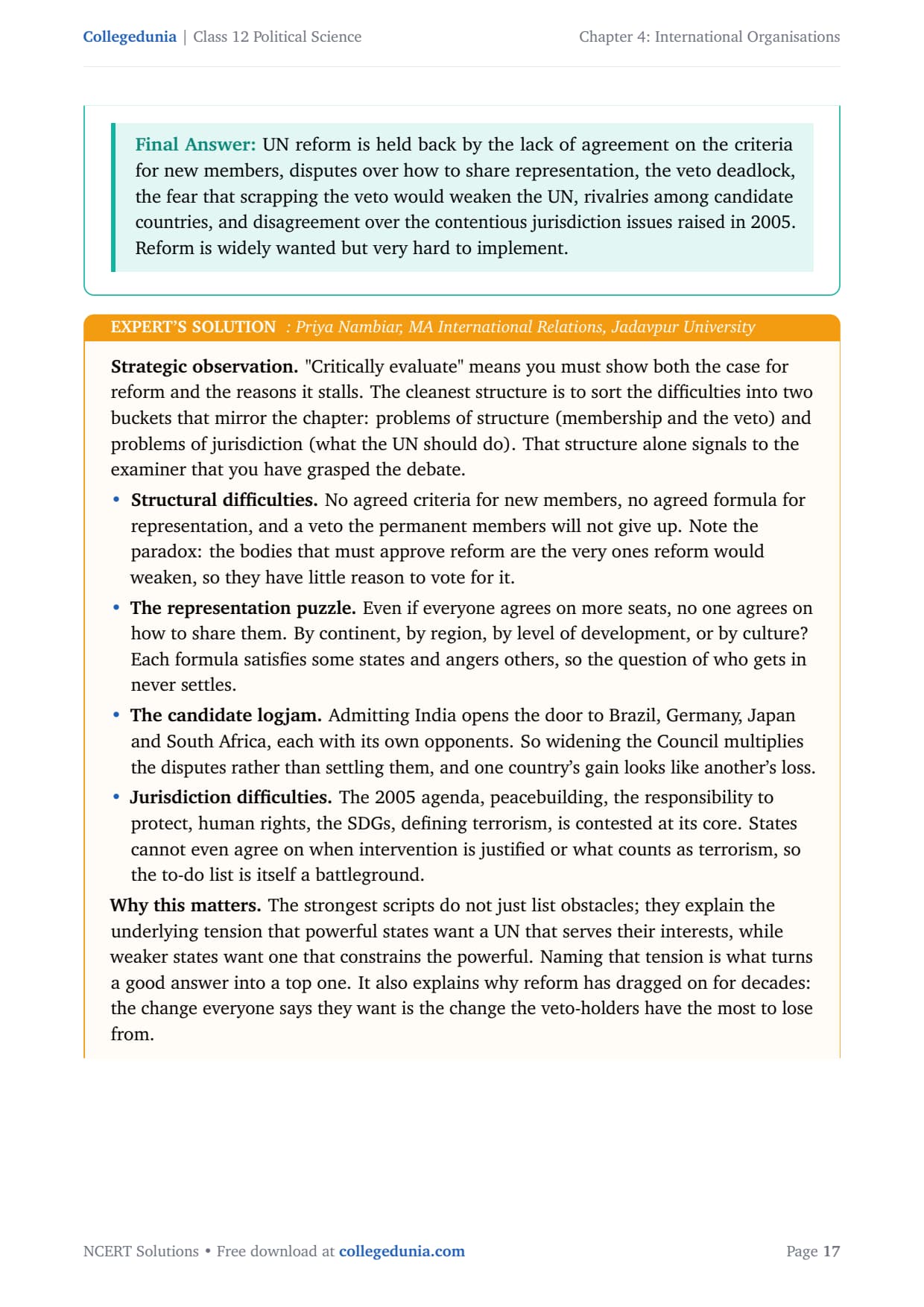
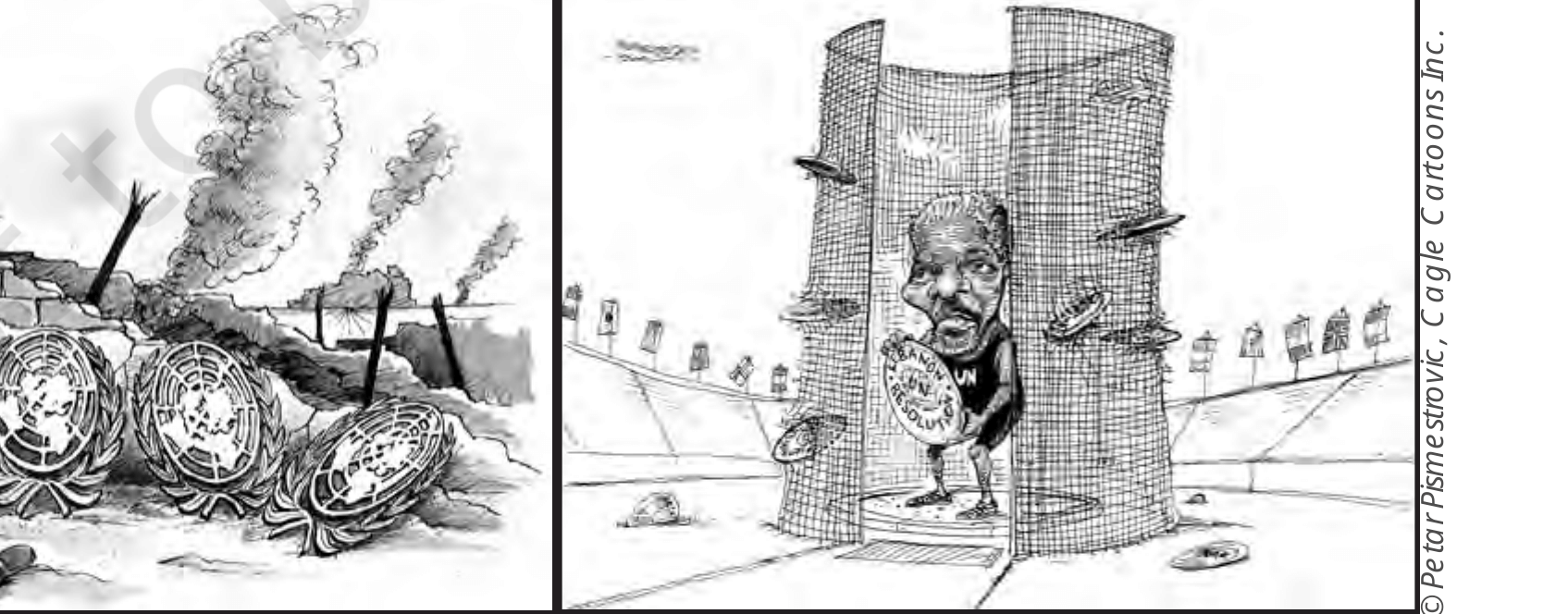
Cartoons by Harry Harrison and Petar
Pismestrovic, Cagle Cartoons Inc., NCERT Contemporary World Politics,
Class 12 Political Science, Chapter 4. Both comment on the UN's slow response in
the 2006 Lebanon crisis, the kind of failure that makes the Security Council's
functions so closely watched.
The Security Council maintains international peace and security:
investigating disputes, recommending peaceful settlements, taking enforcement
action (sanctions or force) against aggressors, deploying peacekeepers, and
recommending new members and key UN appointments. Its decisions need the
agreement of the five veto-holding permanent members.
MJ
Meera Joshi
MA Political Science, Jamia Millia Islamia
Verified Expert
Structural observation. Examiners want a clear list, not a paragraph of
mush. Group the functions under one heading, peace and security, and then unfold
them as a short sequence: prevent, investigate, recommend, enforce, and appoint.
That gives a tidy, mark-friendly answer that mirrors how the Council actually
acts when a crisis appears.
Set the scene first. In one line, note the Council's makeup,
five permanent members with the veto plus ten elected non-permanent
members, because every function below flows from that structure. This
opening earns easy marks and frames the rest.
Prevent and investigate. The Council's first job is to keep
peace and to investigate any dispute likely to cause friction. Open the
list of functions here, as the chapter does.
Recommend and enforce. If a dispute grows, the Council
recommends peaceful terms; if that fails, it can impose sanctions or
authorise force and send peacekeepers. This is the part that needs the
five permanent members to agree, since any one of them can veto action.
Admit and appoint. Beyond crises, it recommends new UN members
and shares in choosing the Secretary-General and electing the ICJ judges.
Adding this shows the examiner you know the Council's role inside the
wider UN, not just its crisis work.
Why this matters. Every reform demand in this chapter, from expanding
membership to abolishing the veto, is aimed at how the Council performs these
very functions. A student who lists the functions cleanly can then explain
exactly what reform is trying to fix, and why the veto makes that reform so hard.
The functions and the veto are two sides of the same coin: the powers are real,
but they can only be used when the permanent five agree.
Maintain peace and security, investigate disputes, recommend peaceful
settlement, enforce decisions through sanctions or force and peacekeeping, and
recommend new members plus key UN appointments, all resting on agreement among
the five permanent members.
Q 4.9
As a citizen of India, how would you support India's candidature for
the permanent membership of the Security Council? Justify your proposal.
Concept used. India seeks a permanent seat in a reformed Security
Council. The chapter sets out the criteria proposed for new members (a major
economic and military power, a big population, a substantial contributor to the
UN budget, a country that respects democracy and human rights, and one that adds
to the Council's representativeness) and shows how India meets them. A strong
answer supports India's case by matching India's record to these criteria.
As a citizen of India, I would support India's candidature on the following
grounds:
World's largest democracy with a stable political system.
India has run a stable, working democracy since independence. A country
that respects democracy and human rights fits the agreed criteria for a
new member.
Huge population. India is among the most populous countries in
the world, making up almost one-fifth of humanity. A permanent member
should be a big nation in terms of population.
Growing economic power. India's economy is expanding rapidly
and it is now one of the world's major economies, which strengthens its
claim as a major economic power.
Long record in the UN. India has been a member since the UN's
founding in 1945 and has taken part in virtually all its initiatives,
especially UN peacekeeping, where its contribution is long and
substantial.
Regular financial contributions. India has made steady
financial contributions to the UN and has never faltered on its payments.
Better representation of the developing world. The vast
majority of UN members today are developing countries. India's inclusion
would make the Council more representative of contemporary realities, so
that those who are affected by its decisions also help shape them.
Tie every point to a criterion
This is a "justify" question, so do not just praise India. Name a criterion from
the chapter (democracy, population, economy, budget, peacekeeping) and show how
India satisfies it. Markers reward that one-to-one matching.
India deserves a permanent seat because it is the world's largest
democracy with a stable polity, has a huge population, a fast-growing economy, a
founding membership and a long peacekeeping and financial record, and because
its inclusion would make the Council more representative of the developing world
that forms most of the UN's membership.
VS
Vikram Singh
MA Political Science, University of Delhi
Verified Expert
Strategic angle. A "justify your proposal" answer scores when it reads
like a case file, not a list of compliments. Take the chapter's own checklist of
criteria and tick India against each. Then add one honest line on the obstacles,
because a top answer acknowledges the other side before closing firmly in
India's favour.
Build the case on the criteria. Democracy and a stable polity,
a large population, a rising economy, founding membership, peacekeeping
and reliable payments: list each criterion and place India's record
beside it. This is the body of your answer.
Add the representativeness argument. Most UN members are
developing countries, yet the permanent membership has barely changed.
India argues that an expanded Council would carry greater support and
legitimacy. This lifts the answer from "India is big" to "the Council
needs India".
Concede, then close. Acknowledge the hurdles the chapter names,
Pakistan's opposition, worries over India's nuclear weapons, and the
knock-on demand to admit Brazil, Germany and Japan, then conclude that
on the agreed criteria India's case remains the strongest.
Why this matters. This question rewards judgement, not cheerleading. By
arguing from shared criteria and conceding the obstacles, you show the examiner
you understand both India's strengths and why reform is still so hard, which is
exactly the balance the next two questions test.
Support India on the agreed criteria, largest democracy, huge
population, rising economy, founding member, strong peacekeeping and payment
record, and on the need for a Council that represents the developing-world
majority, while honestly noting the obstacles to its admission.
Q 4.10
Critically evaluate the difficulties involved in implementing the
suggested reforms to reconstruct the UN.
Concept used. Reform of the UN has two parts: reform of structures and
processes (above all the Security Council), and a review of the issues that fall
within the UN's jurisdiction. Almost everyone agrees reform is needed, but they
cannot agree on what to do, how to do it, or when. A critical evaluation lays
out the difficulties on both sides.
The main difficulties in implementing UN reform are:
No agreement on the criteria for new members. Many criteria
have been suggested, economic power, military power, budget contribution,
population, respect for democracy. Each has some validity, but
governments back the criteria that suit their own interests, so no single
list commands agreement.
The problem of representation. States cannot agree on how to
share new seats. Should representation be by continent, by region, or by
level of development? Should culture or "civilisation" be represented?
Every formula leaves some group dissatisfied.
The veto deadlock. Some want the veto abolished as undemocratic,
but the five permanent members are unlikely to surrender it. Reform of
the veto needs the agreement of the very members who benefit from it.
Fear of weakening the UN. Without the veto there is a real
danger, as in 1945, that the great powers would lose interest in the UN,
act outside it, and leave it ineffective. So removing the veto could
damage the body it is meant to improve.
Rivalries among the contenders. If India is admitted, then
Brazil, Germany, Japan and perhaps South Africa would also press their
claims, and many states oppose one or more of these. Each candidate
attracts a rival's objection.
Contentious jurisdiction issues. The 2005 proposals
(peacebuilding, the responsibility to protect, a Human Rights Council,
the Sustainable Development Goals, a definition of terrorism) are
themselves disputed. States disagree on when the UN should intervene and
on what counts as terrorism, so the agenda itself is hard to settle.
Reform is wanted but blocked
The deep irony is that everyone supports reform in principle, yet the same veto
and the same clashing interests that make reform necessary also make it almost
impossible to carry out.
UN reform is held back by the lack of agreement on the criteria for
new members, disputes over how to share representation, the veto deadlock, the
fear that scrapping the veto would weaken the UN, rivalries among candidate
countries, and disagreement over the contentious jurisdiction issues raised in
2005. Reform is widely wanted but very hard to implement.
PN
Priya Nambiar
MA International Relations, Jadavpur University
Verified Expert
Strategic observation. "Critically evaluate" means you must show both
the case for reform and the reasons it stalls. The cleanest structure is to sort
the difficulties into two buckets that mirror the chapter: problems of structure
(membership and the veto) and problems of jurisdiction (what the UN should do).
That structure alone signals to the examiner that you have grasped the debate.
Structural difficulties. No agreed criteria for new members, no
agreed formula for representation, and a veto the permanent members will
not give up. Note the paradox: the bodies that must approve reform are
the very ones reform would weaken, so they have little reason to vote for
it.
The representation puzzle. Even if everyone agrees on more
seats, no one agrees on how to share them. By continent, by region, by
level of development, or by culture? Each formula satisfies some states
and angers others, so the question of who gets in never settles.
The candidate logjam. Admitting India opens the door to Brazil,
Germany, Japan and South Africa, each with its own opponents. So
widening the Council multiplies the disputes rather than settling them,
and one country's gain looks like another's loss.
Jurisdiction difficulties. The 2005 agenda, peacebuilding, the
responsibility to protect, human rights, the SDGs, defining terrorism,
is contested at its core. States cannot even agree on when intervention
is justified or what counts as terrorism, so the to-do list is itself a
battleground.
Why this matters. The strongest scripts do not just list obstacles; they
explain the underlying tension that powerful states want a UN that serves their
interests, while weaker states want one that constrains the powerful. Naming that
tension is what turns a good answer into a top one. It also explains why reform
has dragged on for decades: the change everyone says they want is the change the
veto-holders have the most to lose from.
Reform stalls on two fronts: structure (no agreed member criteria, no
agreed representation formula, an entrenched veto, and rival candidates blocking
each other) and jurisdiction (deep disagreement over intervention, human rights
and a definition of terrorism). Everyone wants reform, but the interests that
make it necessary also make it very hard to deliver.
Q 4.11
Though the UN has failed in preventing wars and related miseries,
nations prefer its continuation. What makes the UN an indispensable
organisation?
Concept used. The UN is an imperfect body that has not stopped every
war or ended every misery. Yet over 190 nations choose to keep it going because
it serves purposes that no single country can serve alone. Its indispensability
rests on the unique functions it performs in a deeply interdependent world.
The UN is indispensable for the following reasons:
A forum for dialogue, not war. The UN is one place where over
190 nations can meet, argue and find peaceful solutions. As Churchill put
it, "jaw-jaw is better than war-war": it is better to bore each other
with words than to bore holes in each other on the battlefield.
Resolving conflicts peacefully. Even though it is rarely
noticed, most conflicts and differences between states are settled
without going to war, and the UN often helps make that possible.
Tackling shared problems. Some challenges, such as disease and
global warming, can only be handled when everyone cooperates. A disease
may be eradicated only if every country vaccinates its people; warming
can be slowed only if the major powers act together. The UN helps
organise this cooperation.
Rules, information and trust. The UN provides mechanisms, rules
and a bureaucracy that help states cooperate with more confidence that
costs and benefits will be shared fairly and that others will keep their
promises.
Humanitarian and developmental work. Through agencies like the
WHO, UNDP, UNHCR, UNICEF and UNESCO, the UN improves living conditions in
health, education, refugees, children and culture across the world.
A check in a unipolar world. The UN cannot balance US power, but
it provides an arena where the rest of the world can be heard and where
US attitudes and policies can sometimes be modified through compromise.
Lead with the strongest line
Open this answer with the dialogue point, "a talking shop is better than a
battlefield", because it directly answers the "though it has failed" framing of
the question and sets up everything else.
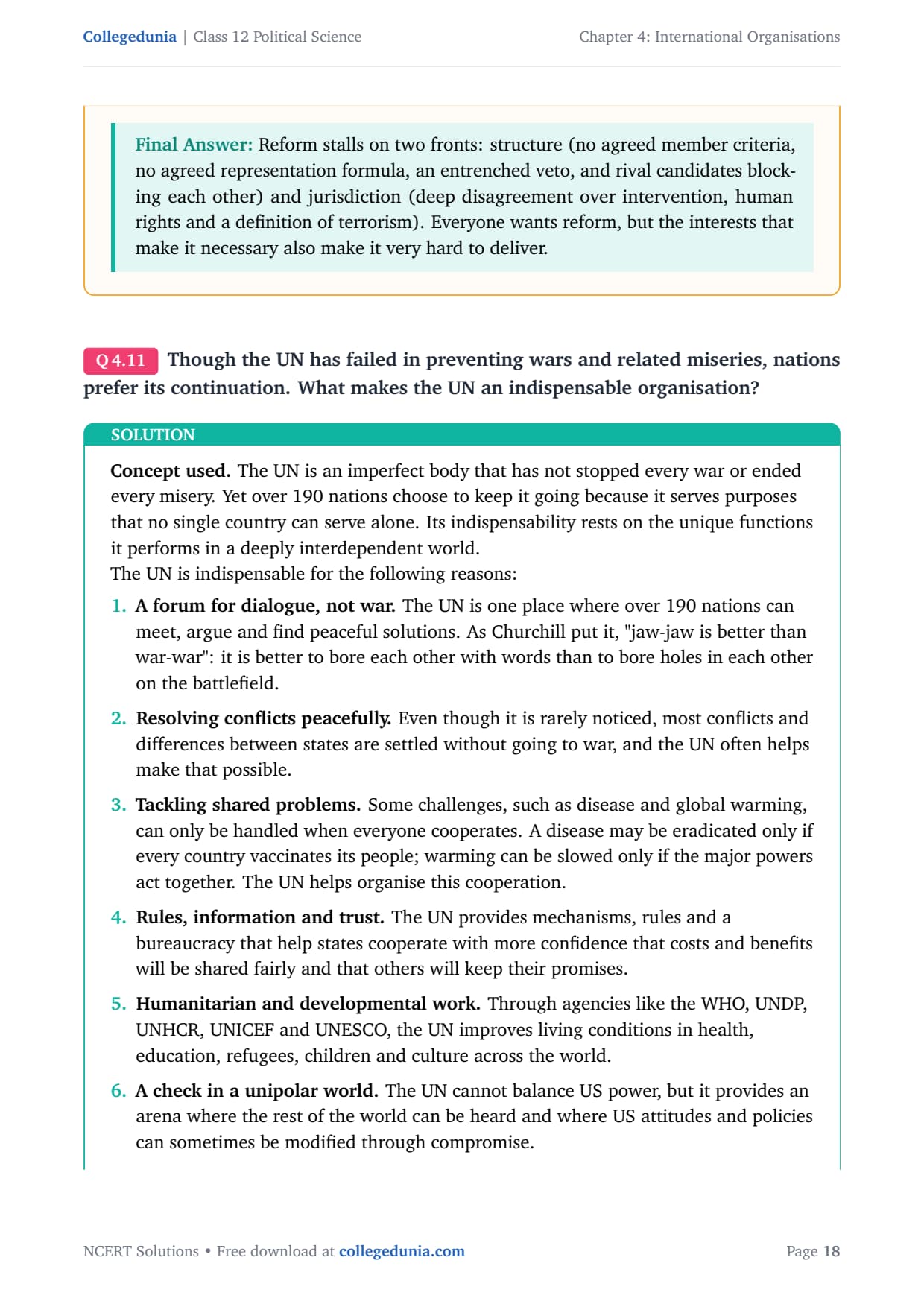
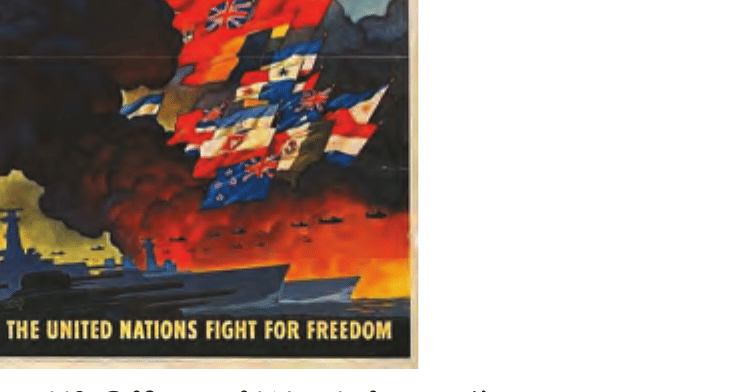
"The United Nations Fight for Freedom"
poster by the US Office of War Information, 1942, NCERT Contemporary World
Politics, Class 12 Political Science, Chapter 4. The wartime origins of the UN
explain why, despite its failures, nations still see it as essential to peace.
The UN is indispensable because it gives over 190 nations one place to
talk rather than fight, helps settle most disputes peacefully, organises
cooperation on shared threats like disease and climate change, supplies rules and
trust for that cooperation, runs vast humanitarian and developmental work, and
offers a forum where even the most powerful states can be questioned. As the book
says, it is imperfect, but without it the world would be worse off.
NR
Nikhil Rao
MA Politics and International Studies, Jawaharlal Nehru University
Verified Expert
Picture-first angle. The question already concedes the UN's failures,
so do not waste lines defending its record. Instead, flip the question: ask what
the world would lose if the UN vanished tomorrow. The answer is interdependence
without management, and that is the heart of why nations keep it.
Start with the counterfactual. With more than seven billion
people and growing interdependence, it is hard to imagine the world
functioning without a body like the UN. That single line frames the
whole answer and turns the question's concession into your argument.
Concede the failures in one line. Yes, the UN did not stop the
Lebanon war quickly, or many others. Grant this at once, because the
question already admits it, then pivot to what the UN still does that
nothing else can. A grader rewards a candidate who answers the framing
head-on.
Show what only the UN supplies. A standing forum for dialogue,
machinery to organise cooperation on disease and climate change, rules
that build trust between rivals, and a worldwide humanitarian network of
agencies. No single state, however powerful, can provide all of these at
once.
End on the unipolar point. Even in a US-dominated world the UN
gives the rest of the world a place to be heard and to shape compromises.
That is why even the US, despite its criticism, sees the UN as serving a
purpose: it brings over 190 nations into one room to manage shared
problems.
Why this matters. The chapter's own conclusion is that the UN is an
imperfect body, but without it the world would be worse off, and that
interdependence will only make it more important. Closing on that line ties your
answer directly to the textbook's final argument and shows you can separate the
UN's failures (real but not fatal) from its indispensable functions (the reason
nations keep it alive).
Nations keep the UN because it is the one global forum for dialogue, the
organiser of cooperation on shared threats, the supplier of rules and trust, the
engine of humanitarian work, and a space where even the strongest power can be
questioned. In an interdependent world its imperfections are outweighed by the
fact that the alternative, no UN at all, would be far worse.
Q 4.12
`Reforming the UN means restructuring of the Security Council'. Do you
agree with this statement? Give arguments for or against this position.
Concept used. UN reform has two distinct parts. One is reform of the
organisation's structures and processes, where the biggest issue is
the Security Council. The other is a review of jurisdiction, the issues
the UN should take up, such as peacebuilding, human rights, development goals and
terrorism. To answer this, decide whether restructuring the Security Council is
all of reform or only one important part of it.
Arguments that support the statement (reform is mainly about the
Security Council):
The Security Council is the most powerful organ, and its structure no
longer reflects today's world: it represents 1945 realities, not 2026.
Its decisions are seen as reflecting mainly Western values and interests
and as dominated by a few powers, so it lacks equitable representation.
The veto held by the five permanent members is the single biggest
obstacle to democratic reform, which is why most reform energy is spent
on the Council.
Expanding the permanent and non-permanent membership to include Asia,
Africa and Latin America would make the whole UN more representative.
Arguments against the statement (reform is more than the Security
Council):
Reform also means reviewing the UN's jurisdiction, the issues it deals
with, such as peacebuilding, the responsibility to protect, the Human
Rights Council, the Sustainable Development Goals and terrorism.
The 2005 summit agreed on steps well beyond the Council, including a
Peacebuilding Commission, a Human Rights Council and a Democracy Fund.
The UN's humanitarian and developmental work through its many agencies
needs improvement too, as do its budgetary and administrative procedures.
Balanced conclusion. Restructuring the Security Council is the most
important and most difficult part of reform, but it is not the whole of it.
Reform also requires reviewing what the UN does and how its agencies and
finances work. So one can partly agree: Security Council restructuring is central
to reform, but reform is wider than the Council alone.
Take a clear stand, then prove it
This is an opinion question, so state your position in the first line, "I partly
agree", and then defend it with arguments on both sides. A fence-sitting answer
with no stand loses marks even if the facts are correct.
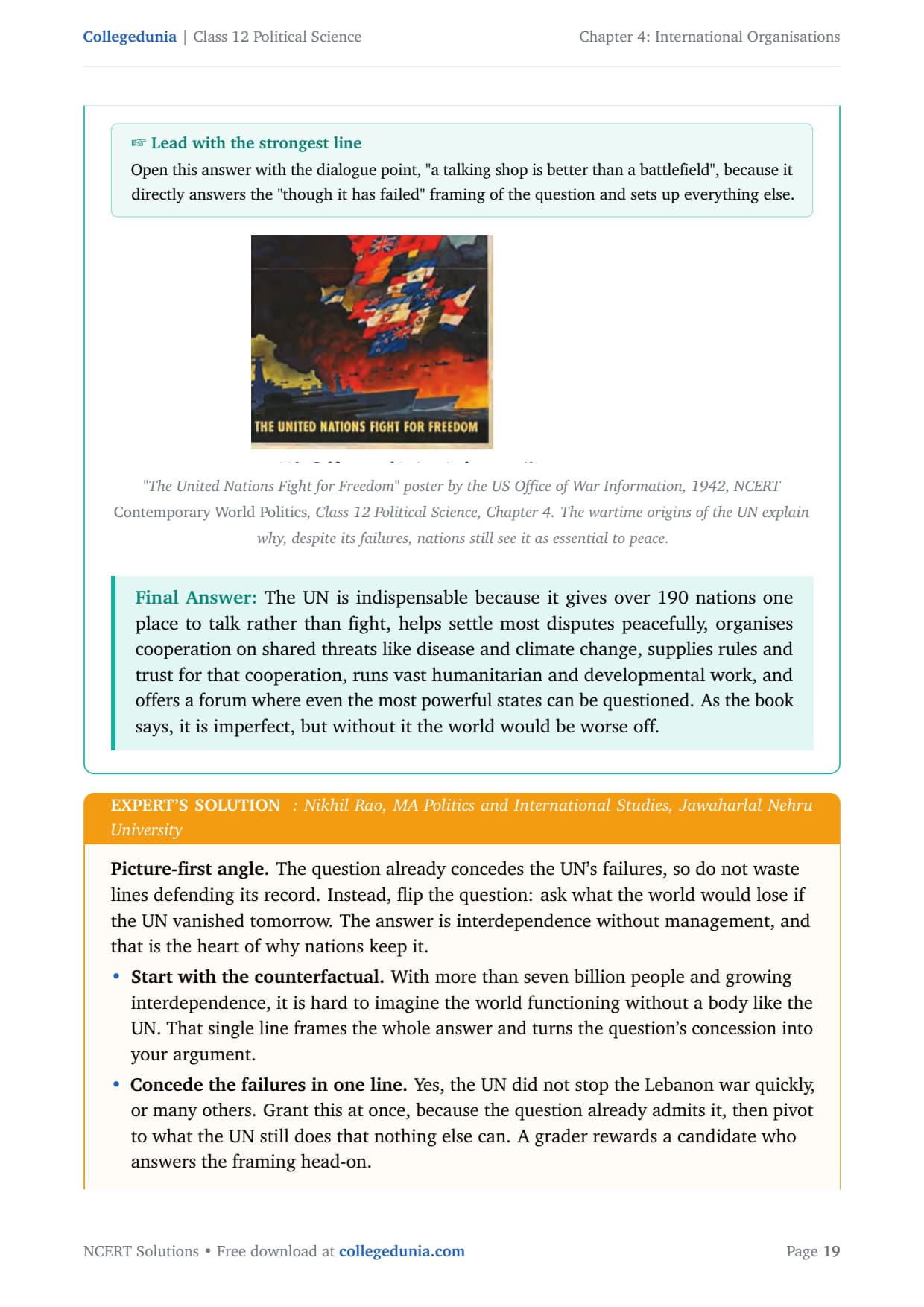
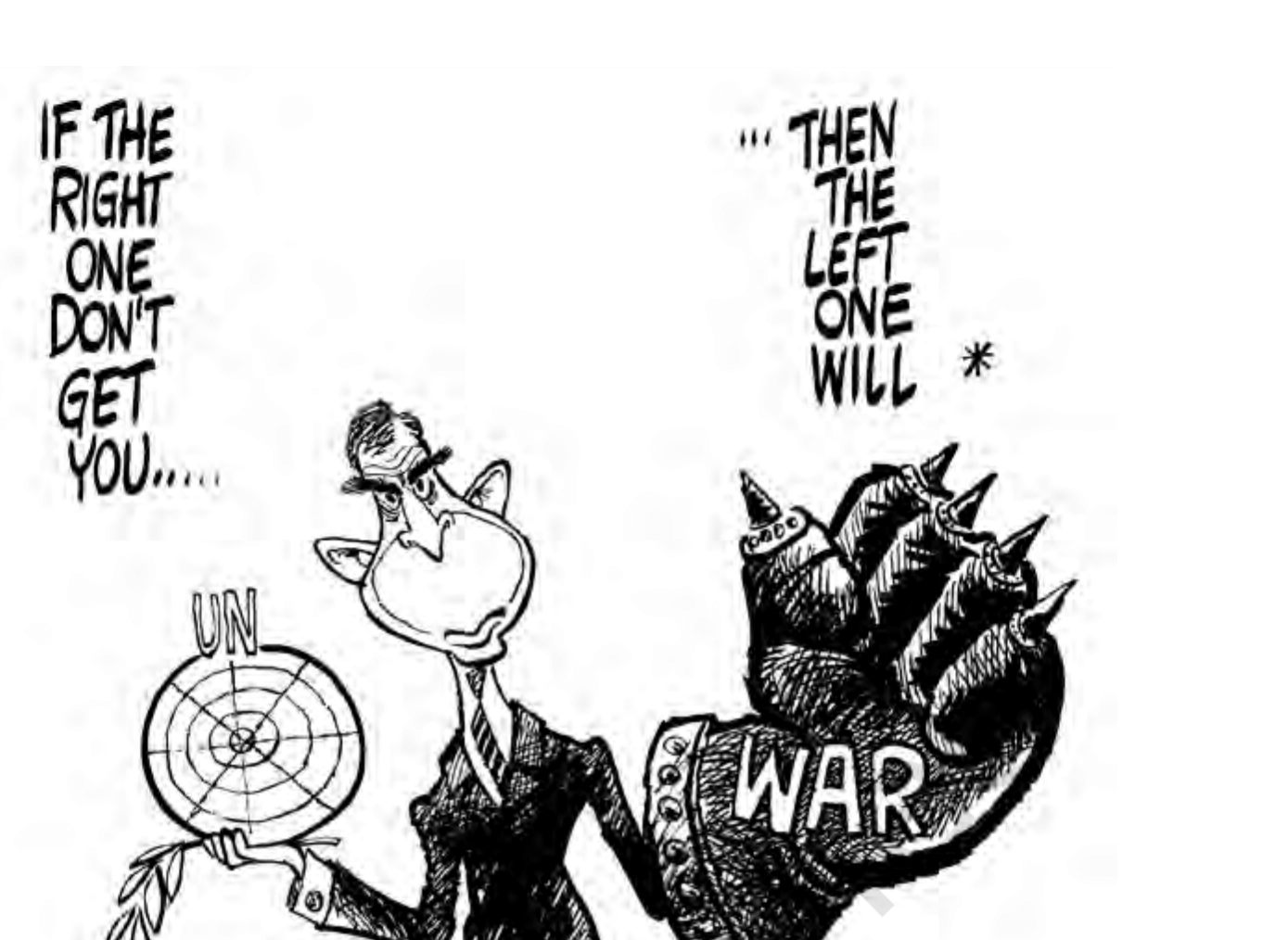
Cartoon by Mike Lane, Cagle Cartoons Inc.,
NCERT Contemporary World Politics, Class 12 Political Science, Chapter 4.
"If the right one don't get you, then the left one will": the UN caught between
appeasement and war, which is why reforming the Security Council is so contested.
I partly agree. Restructuring the Security Council, its membership and
the veto, is the most central and most difficult part of UN reform, since the
Council is the most powerful and least representative organ. But reform is
broader than that: it also means reviewing the UN's jurisdiction (peacebuilding,
human rights, development, terrorism) and improving its agencies, budget and
administration. So Security Council restructuring is the heart of reform, but not
the whole of it.
TK
Tara Krishnan
MA Political Science, University of Hyderabad
Verified Expert
Strategic angle. The smartest stand on an "do you agree" question is
"partly agree", but only if you justify the split. Use the chapter's own
two-part definition of reform as your spine: structures and processes on one
side, jurisdiction on the other. That lets you grant the statement its core truth
while showing why it is incomplete.
Concede the core. The Security Council is the most powerful and
most criticised organ, frozen in 1945, dominated by the veto. So it is
fair to say reform centres on the Council. Give this first, because it is
the true half of the statement, and showing you accept it makes your
disagreement later look measured, not contrary.
Add what the statement leaves out. Reform also means a review
of jurisdiction, the 2005 agenda of peacebuilding, the responsibility to
protect, a Human Rights Council, the SDGs and terrorism, plus better
agencies, budgets and administration. None of these is about the
Council's seats, yet all are part of reform, which is exactly why the
statement is too narrow.
Use the textbook's two-part frame. The chapter splits reform
into reform of structures and processes on one side and a review of
jurisdiction on the other. Quoting that split is the cleanest way to show
the statement captures only one of the two halves.
Land a clear verdict. Conclude that Council restructuring is the
heart of reform but not its whole body. A definite verdict, backed by the
two-part split, is what separates a top script from a vague one that
sits on the fence.
Why this matters. This question is really a test of whether you know the
chapter's exact definition of reform as two things, not one. A student who quotes
that two-part framing and then takes a clear stand demonstrates both knowledge and
judgement, which is precisely what a high-mark answer needs. The examiner is not
checking whether you say yes or no; the examiner is checking whether you know that
reform is wider than the Council and can prove it.
Partly agree. Security Council restructuring (membership and the veto)
is the central and hardest part of UN reform, but reform also covers a review of
the UN's jurisdiction and the working of its agencies, budget and administration.
The Council is the heart of reform, not the whole of it.
FAQs on International Organisations Class 12 NCERT Solutions
International Organisations Class 12 Political Science Common Questions
Ques. Where can I get the class 12 political science chapter 4 NCERT Solutions PDF?
Ans. You can download the International Organisations Class 12 Political Science NCERT Solutions PDF directly from this page. It is free, follows the 2026-27 NCERT, and answers all 12 exercise questions step by step.
Ques. How many questions are there in International Organisations class 12 questions and answers?
Ans. The chapter has 12 exercise questions. The first six are MCQ, fill-in-the-blank and match items, while Questions 8 to 12 are short and long written answers, including the functions of the Security Council and the UN reform debate.
Ques. What is the veto power in International Organisations?
Ans. The veto is a negative power held only by the five permanent members of the Security Council (the US, Russia, the UK, France and China). One veto can stop any Security Council resolution, which is why it is the biggest block to UN reform.
Ques. Why does India want a permanent seat in the Security Council?
Ans. India fits the proposed criteria for new members: a large population, a major economy, a steady UN contributor since 1945, military strength and the world's largest democracy. The chapter uses these points to justify India's candidature for a permanent seat.
Ques. What does an international organisation mean in this chapter?
Ans. An international organisation is a group of states that agree to work together on shared problems like war, disease or trade. It is not a world government and cannot force a sovereign state to obey, so it works only when members accept its decisions.
Ques. Is class 12 political science chapter 4 easy to score in the board exam?
Ans. Yes. It is one of the easier scoring chapters if you learn the UN organs, the veto and the reform debate. Practise the MCQs and the match-the-organs question, and keep the Security Council functions ready for the long answer.








Comments