Junior-Class Mentor, TFI Fellow | Updated 3+ months ago
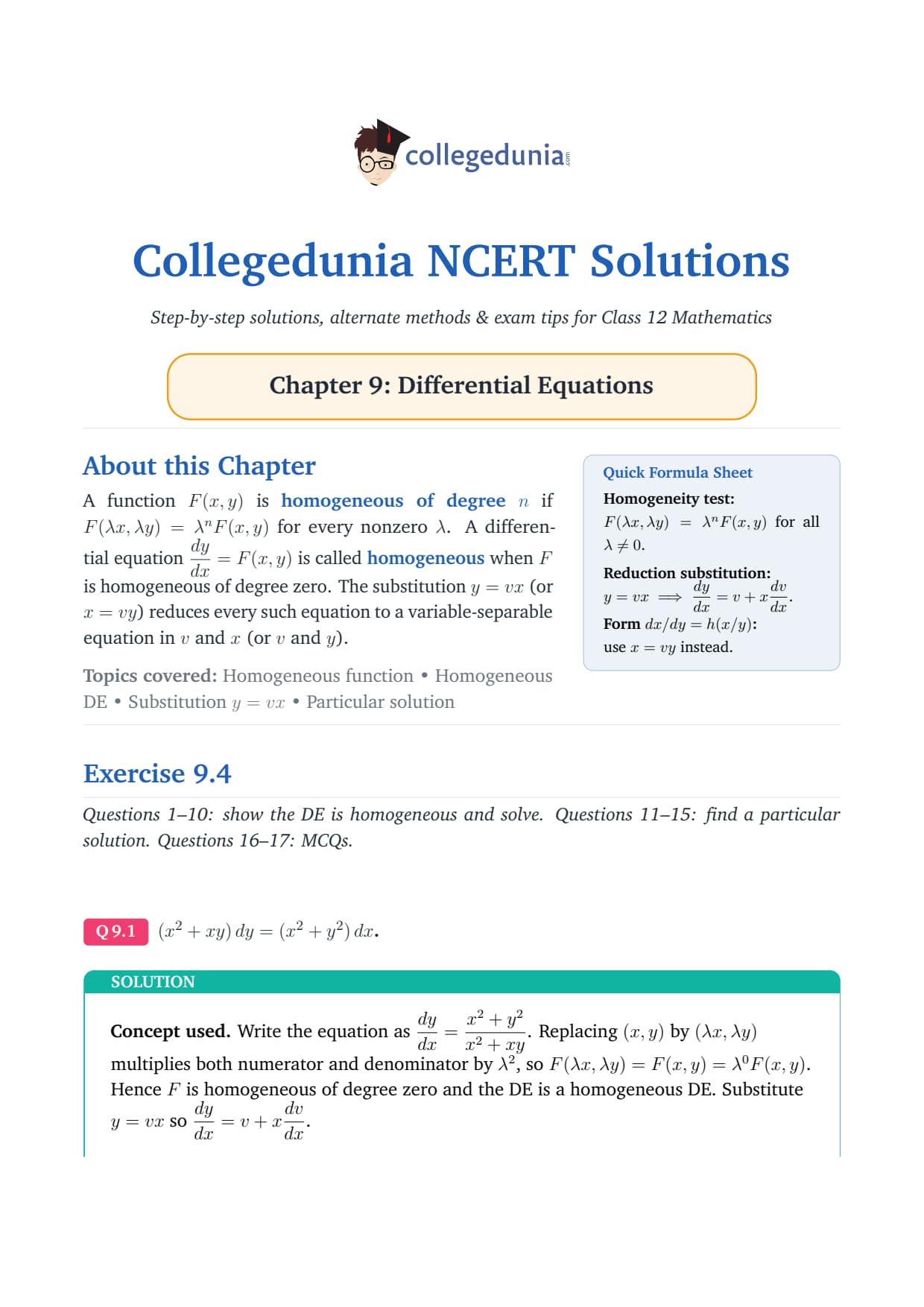
Exercise 9.4 of Class 12 Maths Chapter 9 Differential Equations covers homogeneous differential equations. These NCERT Solutions show every substitution and integration step in full. The free PDF download is available on this page.
Question count: 17 problems, where Q1 to Q10 ask you to show the equation is homogeneous and solve it, Q11 to Q15 add an initial condition for a particular solution, and Q16 to Q17 are substitution-rule MCQs.
Core substitution:y = vx so that dydx = v + xdvdx, or x = vy when the equation is given as dxdy = h(x/y) .
Exercise 9.4 snapshot
Detail
Total problems
17 (Q1 to Q17)
Question split
Q1 to Q10 general solution, Q11 to Q15 particular solution, Q16 to Q17 MCQ
Homogeneity test
F(λ x, λ y) = λ0F(x,y) for all λ ≠ 0
The snapshot shows the predictable shape of Exercise 9.4: prove homogeneity, substitute y = vx , reduce to a separable equation, integrate, then back-substitute v = y/x.
Every solved problem in this Collegedunia PDF first confirms the degree-zero homogeneity, applies the y = vx substitution, separates the resulting equation, integrates, and finally replaces v with y/x. The Collegedunia editorial team has matched every general and particular solution against the official NCERT answer key and the 2026-27 textbook.
How Collegedunia's NCERT Solutions Help You Clear Exercise 9.4
Exercise 9.4 is where students lose marks by skipping the homogeneity proof or forgetting to back-substitute. The Collegedunia solutions write both steps explicitly so the working scores in full.
Homogeneity check shown first for every problem before any substitution.
Substitution y = vx with the product-rule expansion dydx = v + xdvdx written out.
Separable reduction demonstrated, then integrated with the standard integral named.
Back-substitutionv = y/x restored in the final answer every time.
Form selection for Q16: when the equation is dxdy = h(x/y) , use x = vy instead.
The table lists the headline answer for representative problems across the three blocks of Exercise 9.4. Use it to verify your own working.
Q No.
Equation / condition
Answer
1
(x2+xy) dy = (x2+y2) dx
(x-y)2 = Cxe-y/x
2
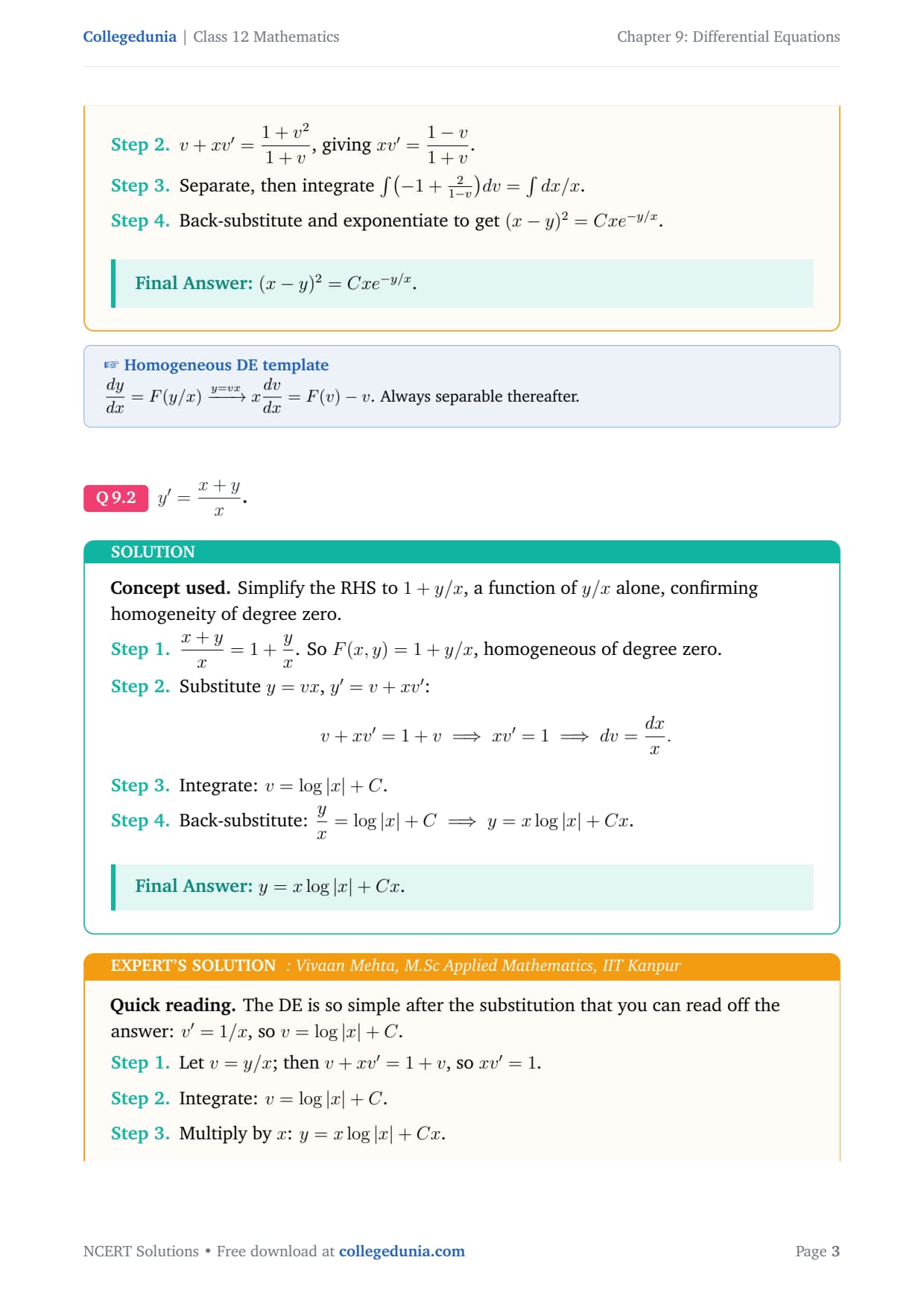
y' = x+yx
y = xlog|x| + Cx
3
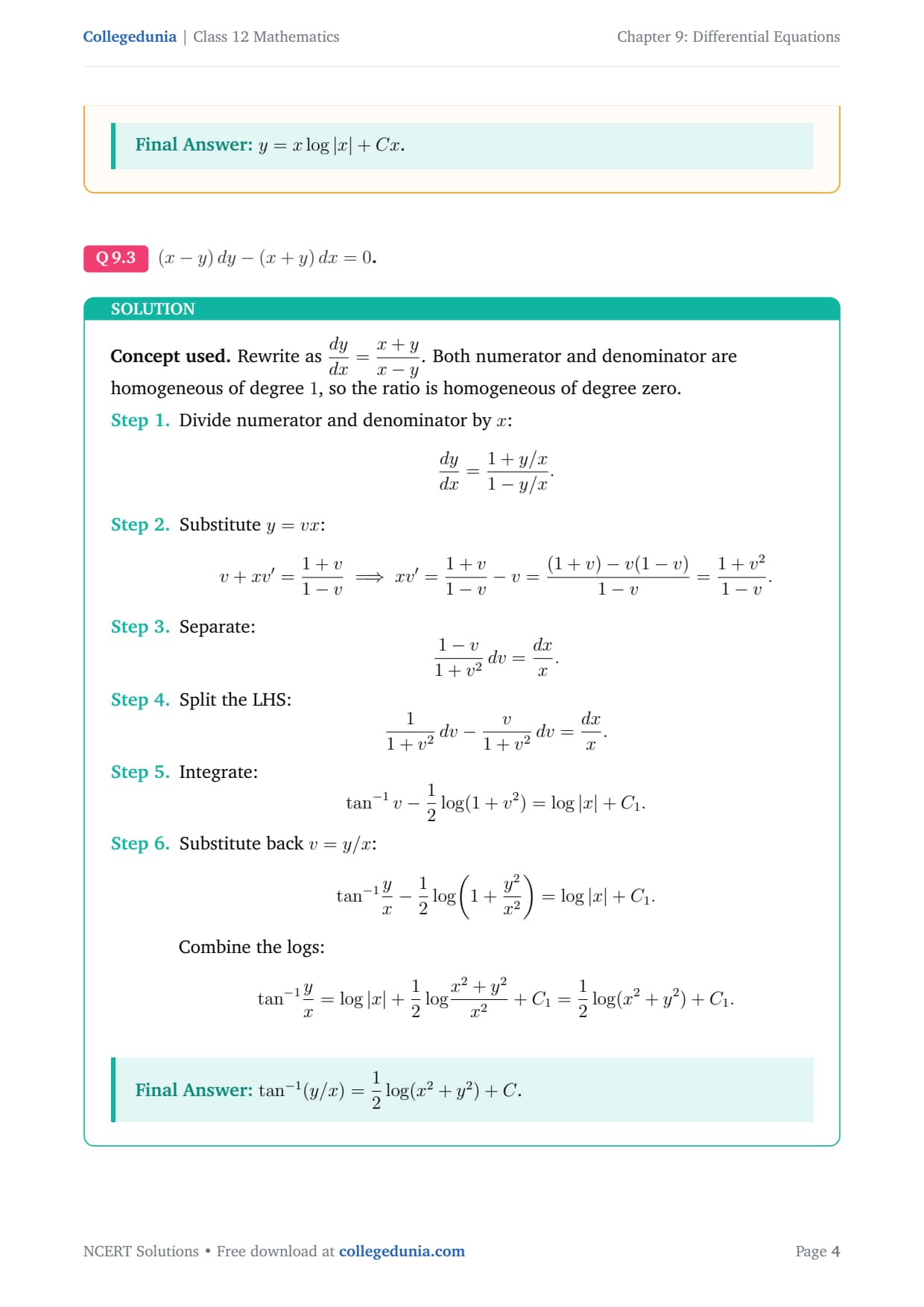
(x-y) dy - (x+y) dx = 0
tan-1yx = 12log(x2+y2) + C
4
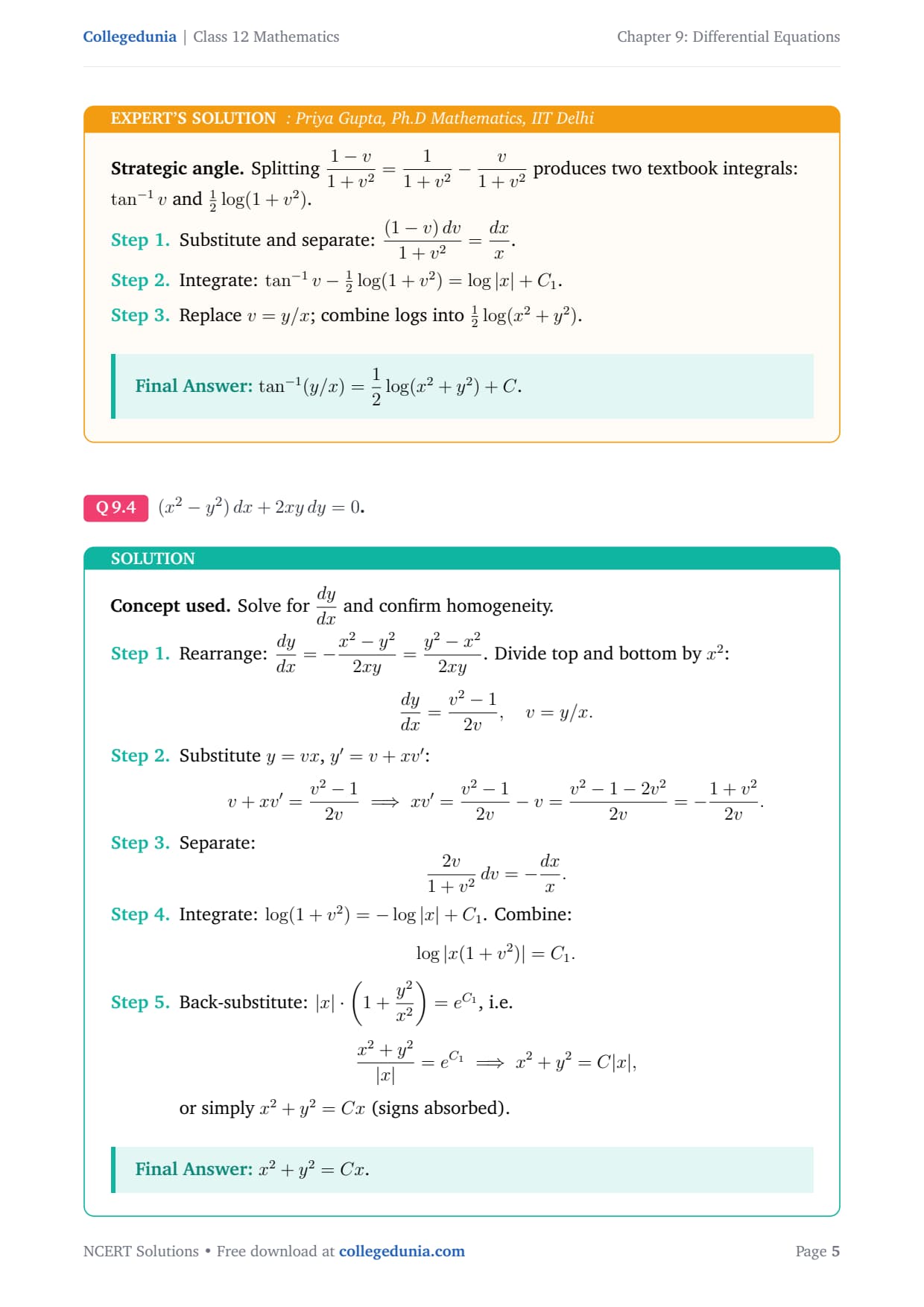
(x2-y2) dx + 2xy dy = 0
x2+y2 = Cx
6
x dy - y dx = √x2+y2 dx
y + √x2+y2 = Cx2
11
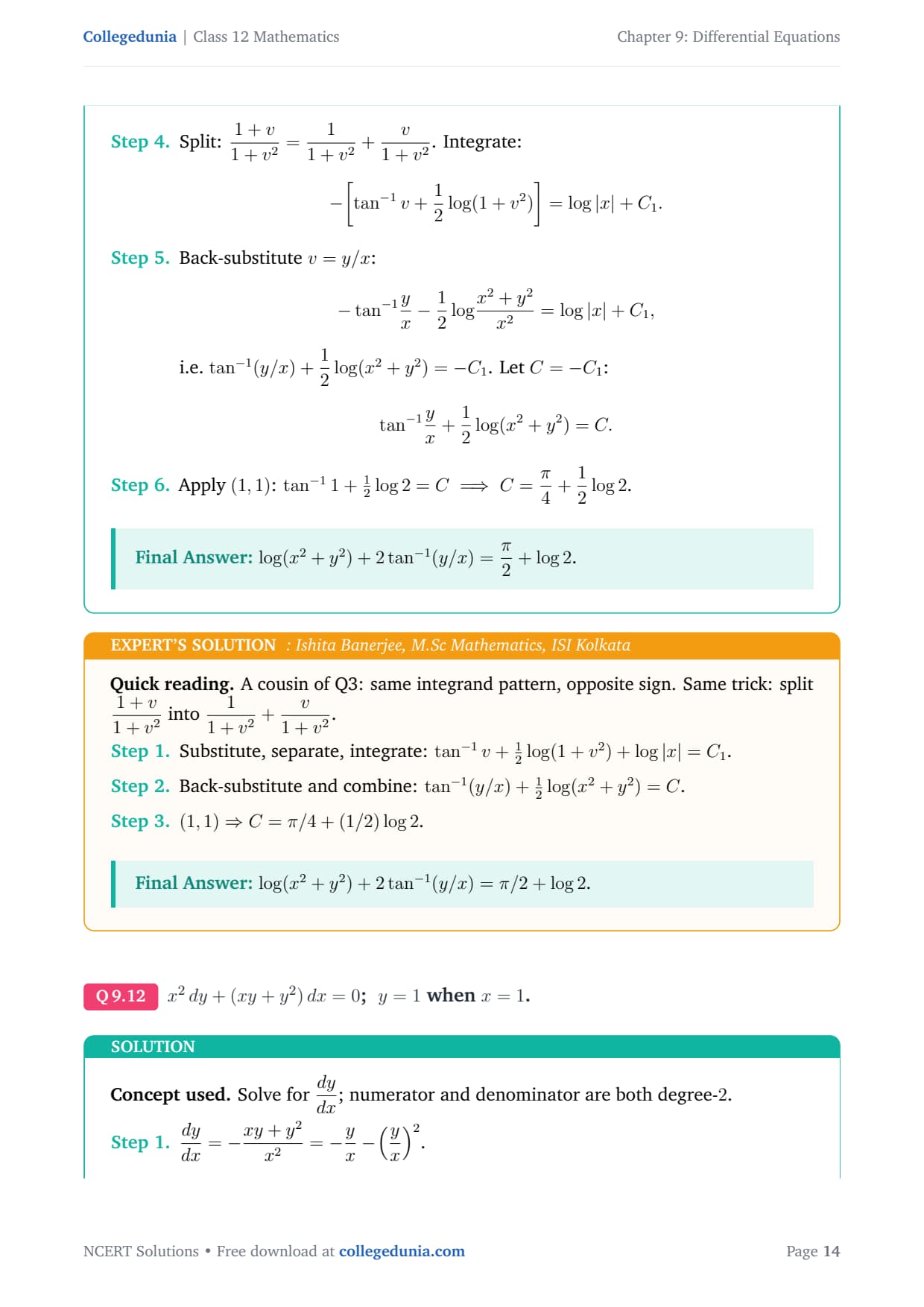
(x+y) dy + (x-y) dx = 0 , y(1)=1
log(x2+y2) + 2tan-1yx = π2 + log 2
12
x2 dy + (xy+y2) dx = 0 , y(1)=1
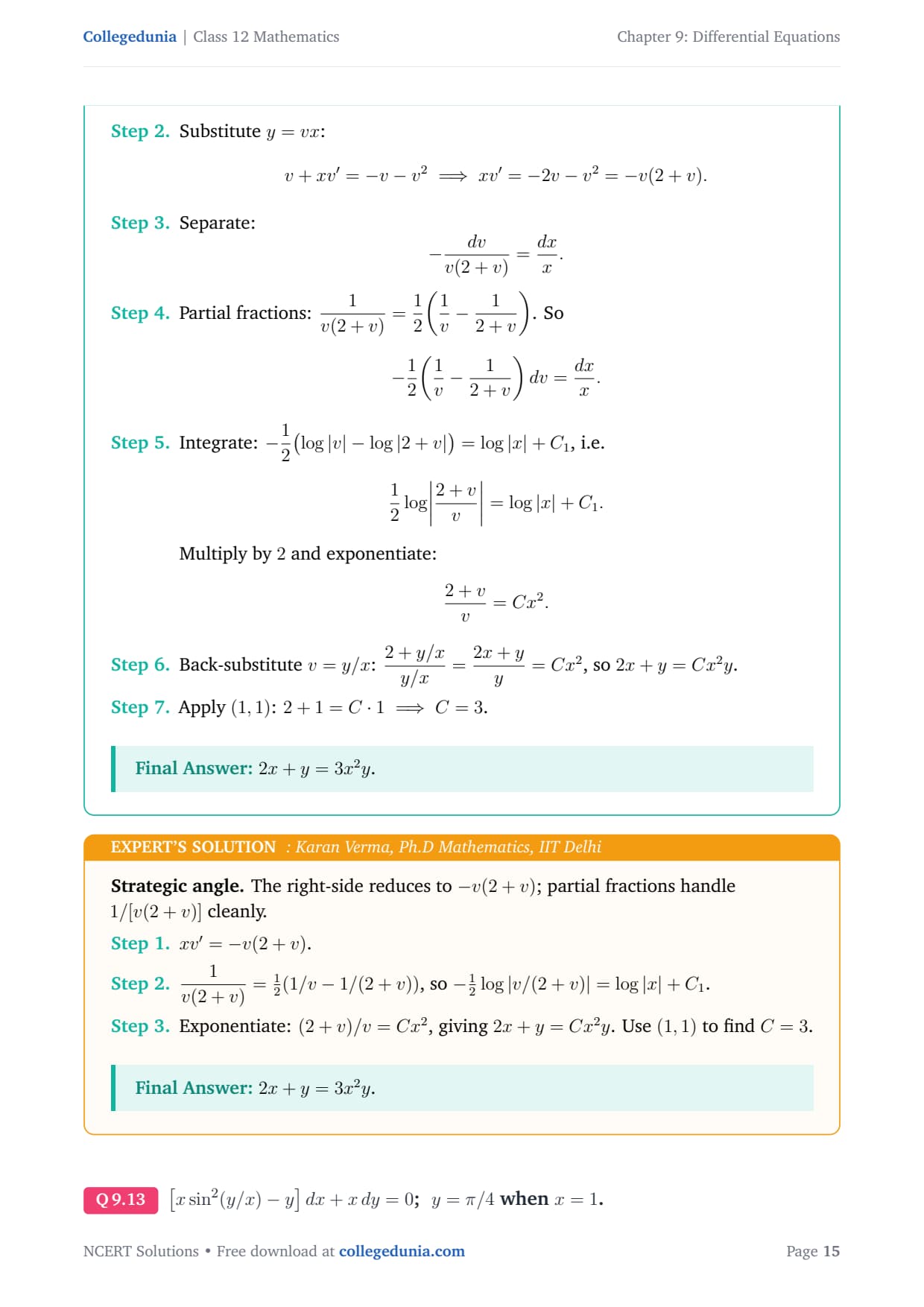
2x + y = 3x2y
14
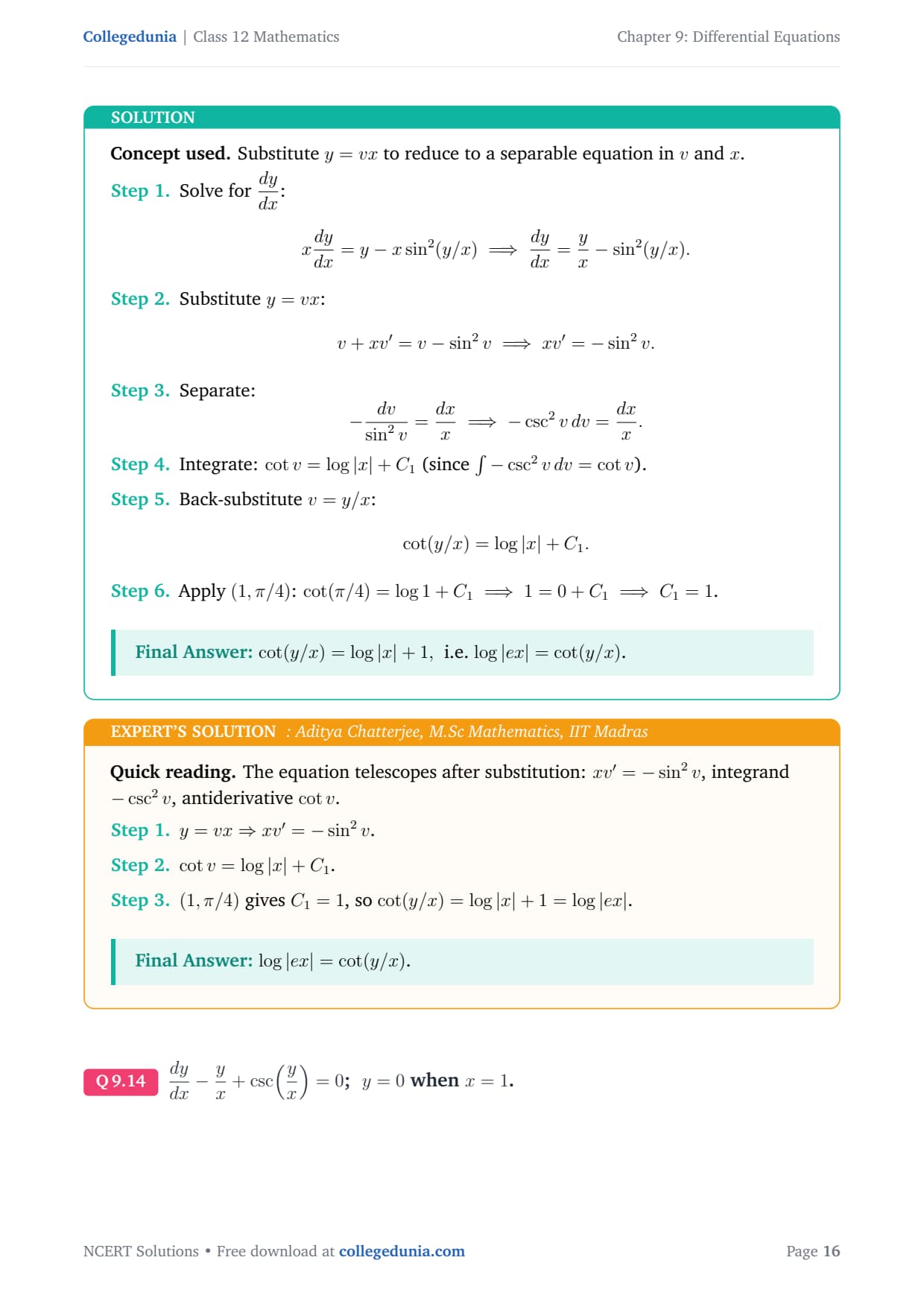
dydx - yx + cscyx = 0 , y(1)=0
cosyx = log|ex|
15
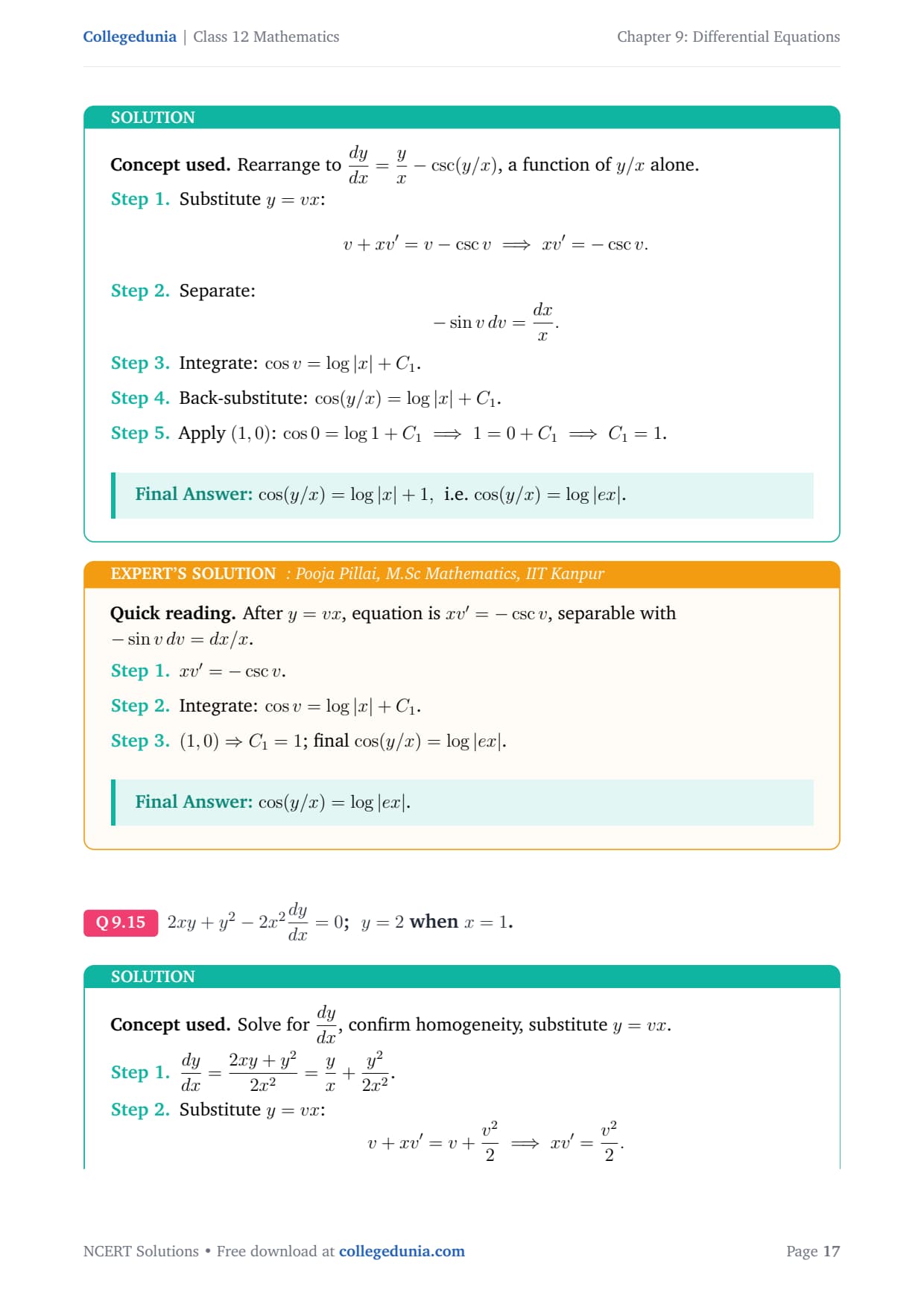
2xy + y2 - 2x2dydx = 0 , y(1)=2
y = 2xlog|ex|
16
MCQ: substitution for dxdy = h(x/y)
(C) x = vy
17
MCQ: which equation is homogeneous
(D)
The particular-solution problems Q11 to Q15 are the most demanding, since they combine the substitution with an initial condition that often produces a log|ex| form. Q14 and Q15 are the typical 5-mark Long Answer drawn from this exercise.
The Homogeneous Substitution Routine for Class 12 Maths Exercise 9.4
Every problem in Exercise 9.4 follows the same routine. Apply it in order to any homogeneous equation.
Step 1. Confirm the equation is homogeneous: every term has the same total degree, equivalently F(λ x, λ y) = F(x,y) . Step 2. Substitute y = vx , so dydx = v + xdvdx. Use x = vy if the equation is dxdy = h(x/y) . Step 3. The equation becomes variable-separable in v and x. Separate and integrate. Step 4. Back-substitute v = y/x, then apply any initial condition to fix the constant.
Step 4 is the most frequently dropped step under exam pressure, and CBSE deducts a mark for an answer left in v rather than x and y.
Common Mistakes Students Make in Class 12 Maths Exercise 9.4
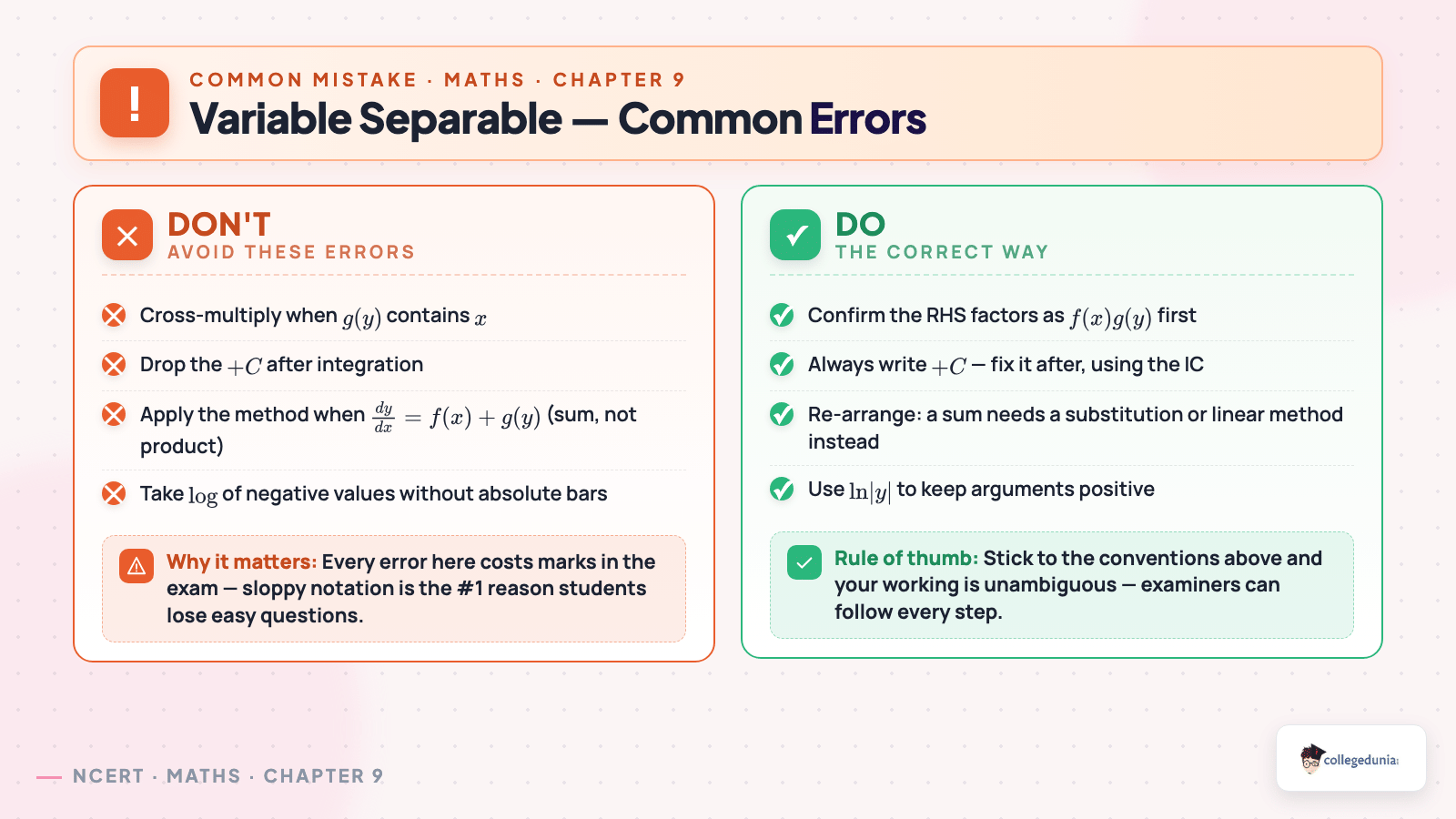
Common Mistake: Forgetting the product rule when substituting y = vx . The derivative is dydx = v + xdvdx, not just dvdx. Dropping the v term makes every subsequent integration wrong.
Not proving homogeneity before substituting, which loses the first method mark.
Choosing y = vx when the equation is dxdy = h(x/y) and x = vy is required (Q16).
Leaving the final answer in v instead of restoring v = y/x.
Applying the initial condition before back-substituting, which fixes the wrong constant.
Other Resources for Class 12 Maths Chapter 9 Differential Equations
All NCERT Solutions for Differential Equations Ex 9.4 with Step-by-Step Working
Every NCERT textbook question for Class 12 Mathematics Chapter 9 Differential Equations Ex 9.4 is listed below with its full Solution and Expert Solution hidden inside collapsible tabs. Click Check Solution to reveal the step-by-step working; click Expert Solution for the expanded explanation.
Questions
Q 9.1
(x2+xy) dy = (x2+y2) dx.
Concept used. Write the equation as dydx = x2+y2x2+xy. Replacing (x,y) by (λ x,λ y) multiplies both numerator and denominator by λ2, so F(λ x,λ y) = F(x,y) = λ0F(x,y). Hence F is homogeneous of degree zero and the DE is a homogeneous DE. Substitute y = vx so dydx = v + xdvdx.
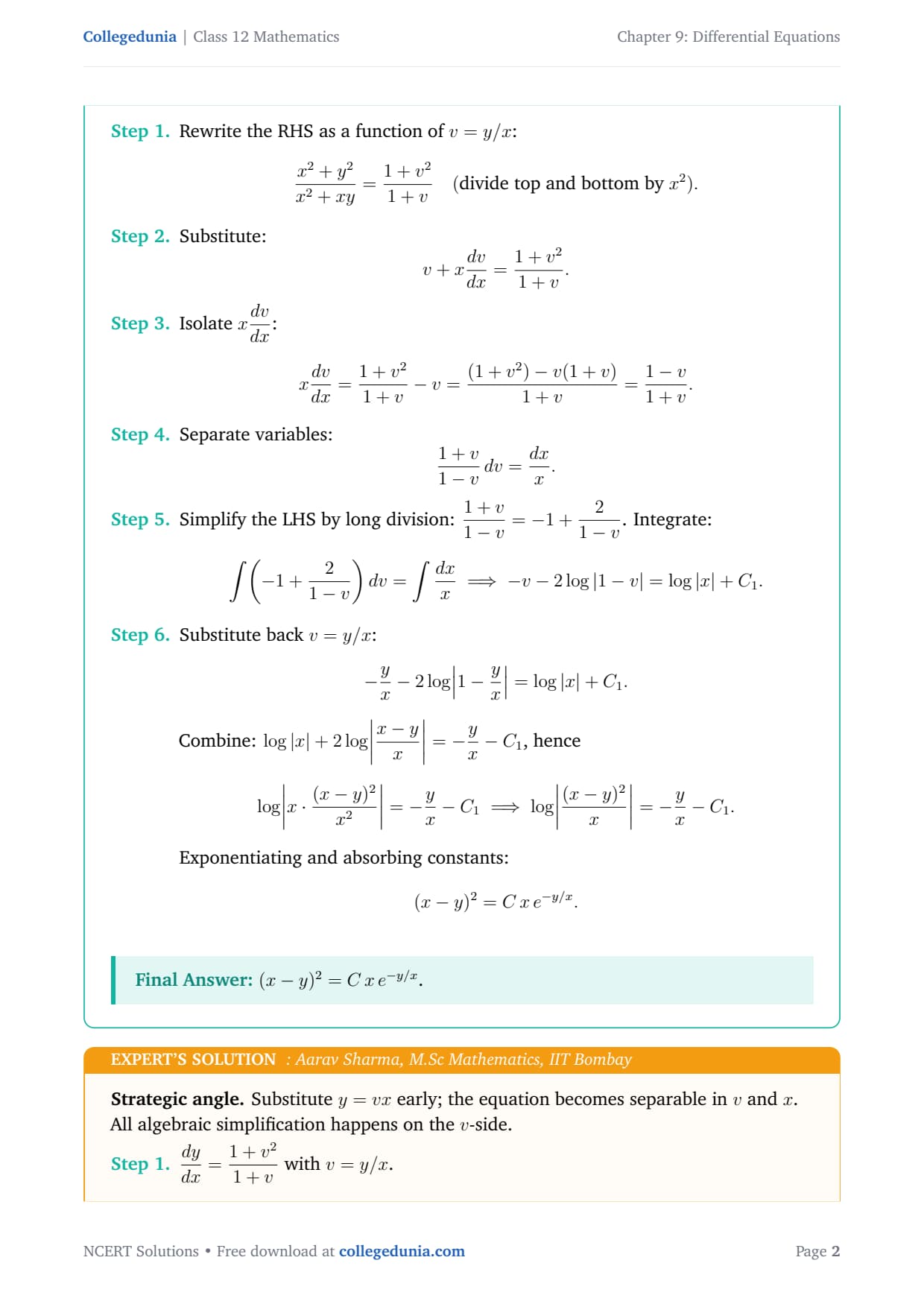
Rewrite the RHS as a function of v = y/x:
x2+y2x2+xy = 1 + v21 + v (divide top and bottom by x2).
Substitute:
v + xdvdx = 1+v21+v.
Isolate xdvdx:
xdvdx = 1+v21+v - v = (1+v2) - v(1+v)1+v = 1 - v1 + v.
Separate variables:
1+v1-v dv = dxx.
Simplify the LHS by long division: 1+v1-v = -1 + 21-v.
Integrate:
∫(-1 + 21-v)dv = ∫ dxx -v - 2log|1-v| = log|x| + C1.
Back-substitute: |x|·(1+y2x2) = eC1, i.e.
x2+y2|x| = eC1 x2+y2 = C|x|,
or simply x2+y2 = Cx (signs absorbed).
x2+y2 = Cx.
AB
Aanya Bhat
M.Sc Mathematics, IIT Madras
Verified Expert
Picture-first. The family x2+y2=Cx is a family of circles passing through the origin with centres on the x-axis at (C/2,0) and radius |C|/2.
Substitute y=vx, leading to xv' = -1+v22v.
Integrate 2v dv1+v2 = -dxx to log(1+v2)+log|x|=C1.
Hence x(1+v2)=C, i.e. x2+y2=Cx.
x2+y2=Cx.
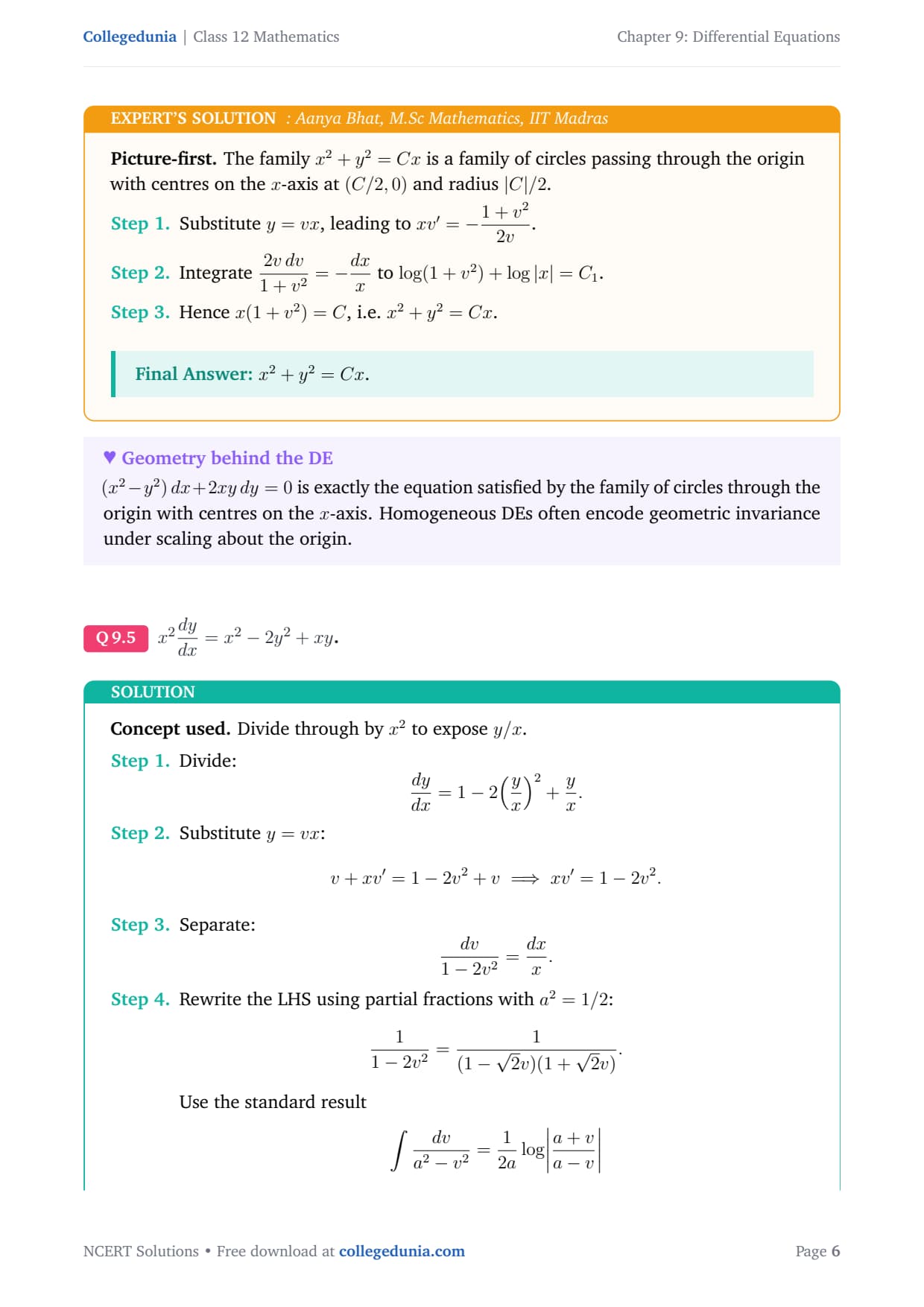
Q 9.5
x2dydx = x2-2y2+xy.
Concept used. Divide through by x2 to expose y/x.
Divide:
dydx = 1 - 2(yx)2 + yx.
Substitute y = vx:
v + xv' = 1 - 2v2 + v xv' = 1 - 2v2.
Separate:
dv1 - 2v2 = dxx.
Rewrite the LHS using partial fractions with a2 = 1/2:
11-2v2 = 1(1-√2v)(1+√2v).
Use the standard result
∫dva2-v2 = 12alog|a+va-v|
with 1-2v2 = 2(12-v2) and a = 1/√2:
∫ dv1-2v2 = 12∫ dv12-v2 = 12·12· 1/√2log|1/√2+v1/√2-v| = 12√2log|1+√2v1-√2v|.
Therefore
12√2log|1+√2v1-√2v| = log|x| + C1.
Back-substitute v = y/x:
12√2log|x+√2yx-√2y| = log|x| + C1,
which we write as log|x+√2yx-√2y| = 2√2log|x| + C.
log|x+√2yx-√2y| = 2√2 log|x| + C.
RS
Rohit Singh
B.Tech CSE, IIT Roorkee
Verified Expert
Strategic angle. The integrand 1/(1-2v2) is a textbook 1a2-v2 form with a = 1/√2. The standard log formula closes it.
After substitution: xv' = 1-2v2, separable.
Use ∫ dva2-v2 = 12alog|a+va-v| with a=1/√2.
Final answer involves log|x+√2yx-√2y|.
log|x+√2yx-√2y| = 2√2log|x|+C.
Q 9.6
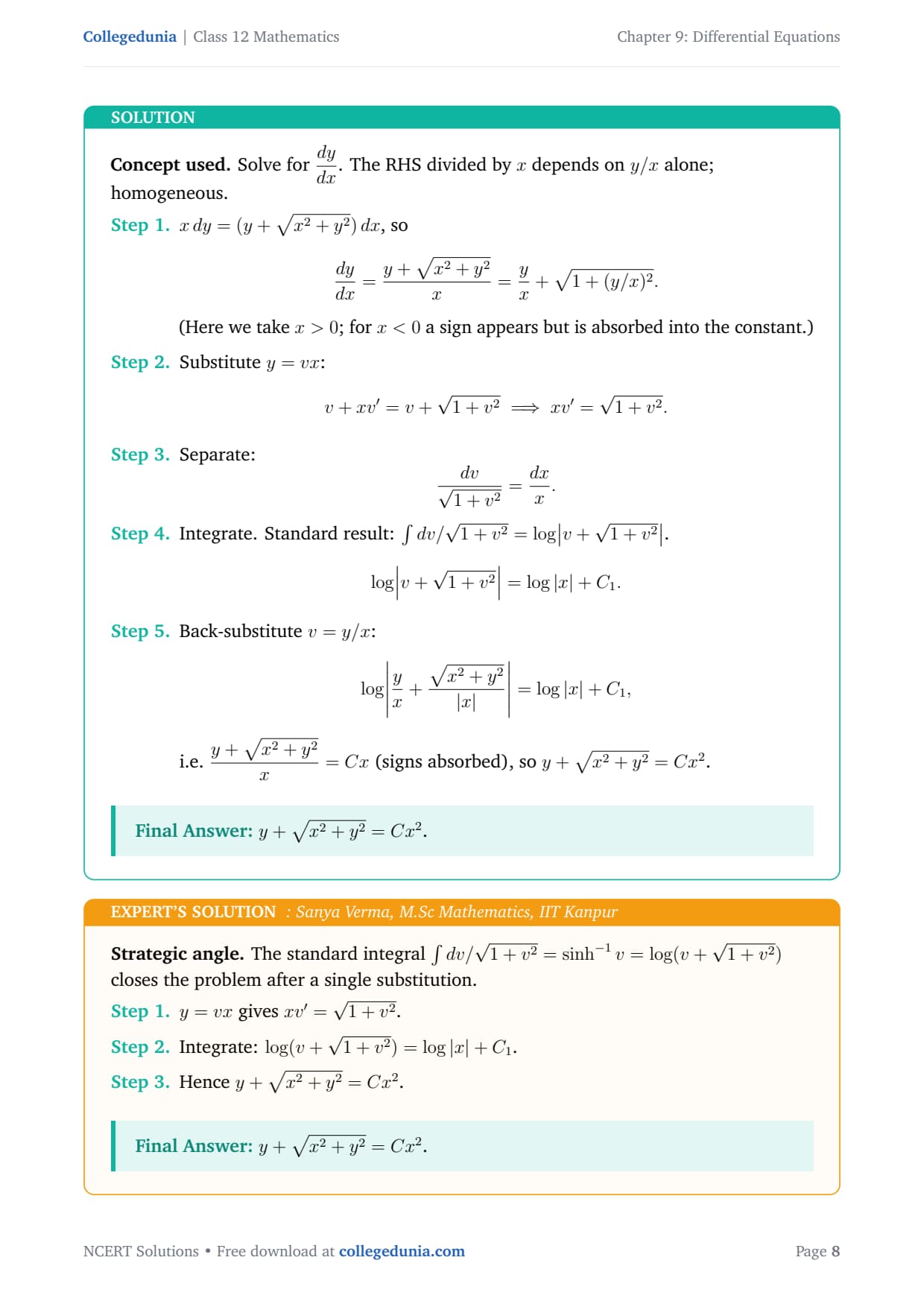
x dy - y dx = √x2+y2 dx.
Concept used. Solve for dydx. The RHS divided by x depends on y/x alone; homogeneous.
x dy = (y + √x2+y2) dx, so
dydx = y + √x2+y2x = yx + √1 + (y/x)2.
(Here we take x>0; for x<0 a sign appears but is absorbed into the constant.)
Substitute y = vx:
v + xv' = v + √1+v2 xv' = √1+v2.
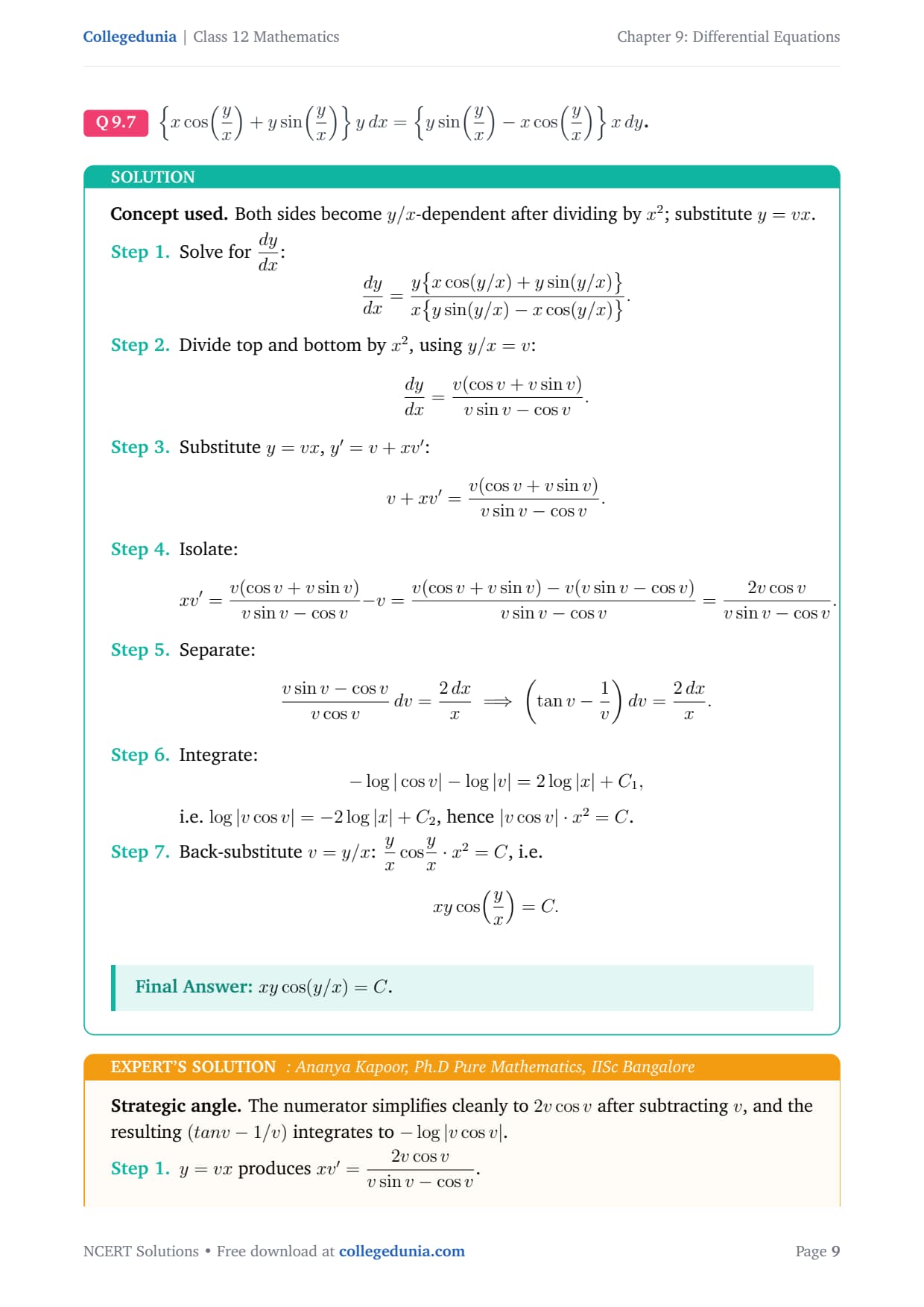
Back-substitute v = y/x: yxcosyx· x2 = C, i.e.
xycos(yx) = C.
xycos(y/x) = C.
AK
Ananya Kapoor
Ph.D Pure Mathematics, IISc Bangalore
Verified Expert
Strategic angle. The numerator simplifies cleanly to 2vcos v after subtracting v, and the resulting (tan v - 1/v) integrates to -log|vcos v|.
y=vx produces xv' = 2vcos vvsin v - cos v.
Separate and split into tan v - 1/v, which integrates to -log|cos v| - log|v|.
Combine and exponentiate: xycos(y/x) = C.
xycos(y/x) = C.
Q 9.8
xdydx - y + xsin(yx) = 0.
Concept used. Rearrange to dydx = yx - sin(y/x), a function of y/x only.
Substitute y = vx:
v + xv' = v - sin v xv' = -sin v.
Separate:
-dvsin v = dxx -csc v dv = dxx.
Integrate. Standard result: ∫ csc v dv = log|tan(v/2)|. So
-log|tan(v/2)| = log|x| + C1 log|tan(v/2)| = -log|x| - C1.
Exponentiate: tan(v/2) = Cx where C = ± e-C1.
Back-substitute v = y/x:
tan(y2x) = Cx xtan(y2x) = C.
xtan(y2x) = C.
DN
Dev Nair
M.Sc Mathematics, IIT Bombay
Verified Expert
Quick reading. After substitution the equation collapses to xv' = -sin v. Use the standard ∫ csc v dv = log|tan(v/2)|.
v = y/x gives xv' = -sin v.
Integrate: log|tan(v/2)| = -log|x|+C1.
Hence xtan(y/2x) = C.
xtan(y/2x) = C.
Q 9.9
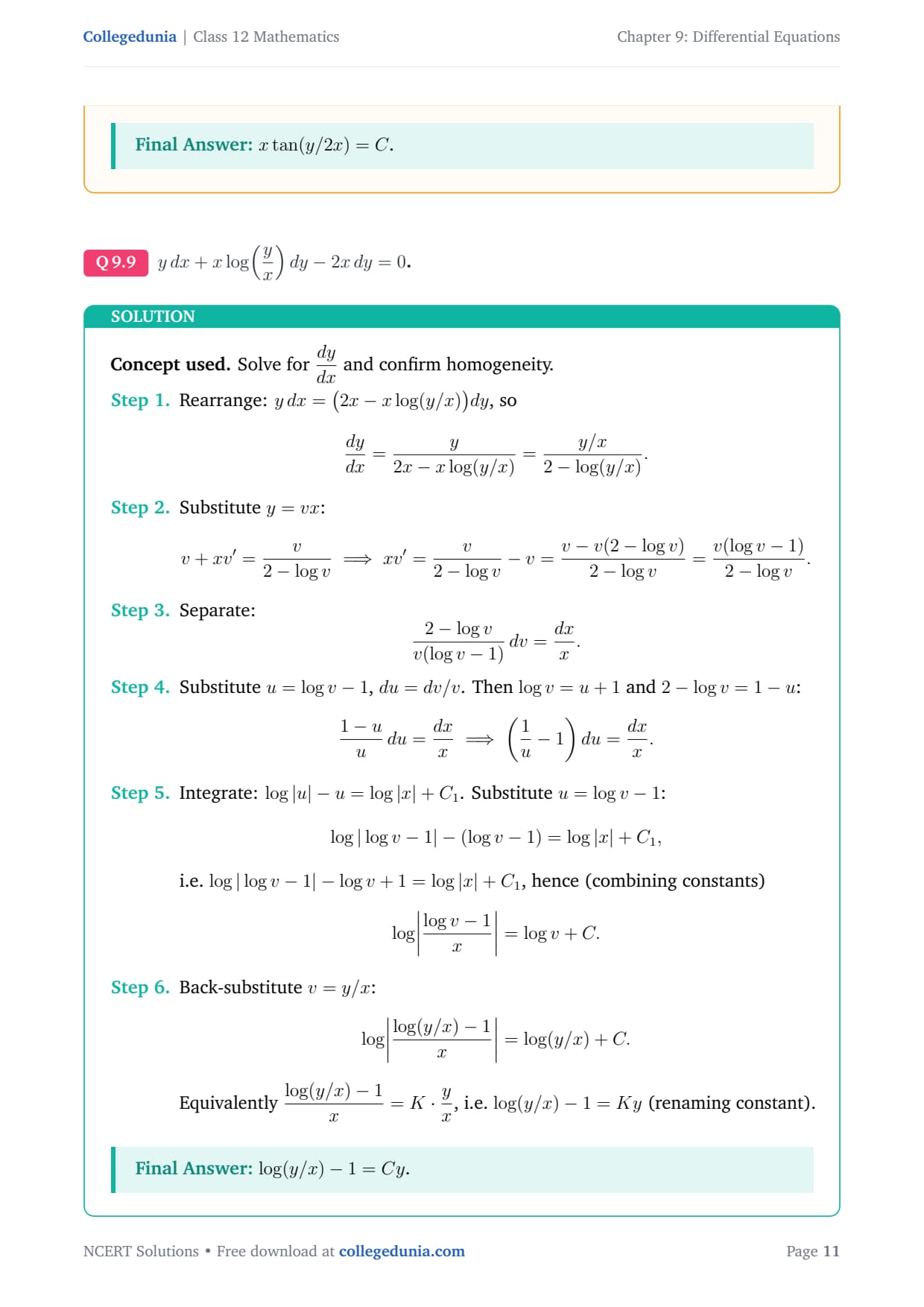
y dx + xlog(yx) dy - 2x dy = 0.
Concept used. Solve for dydx and confirm homogeneity.
Rearrange: y dx = (2x - xlog(y/x))dy, so
dydx = y2x - xlog(y/x) = y/x2 - log(y/x).
Substitute y = vx:
v + xv' = v2 - log v xv' = v2 - log v - v = v - v(2-log v)2-log v = v(log v - 1)2 - log v.
Separate:
2 - log vv(log v - 1) dv = dxx.
Substitute u = log v - 1, du = dv/v. Then log v = u + 1 and 2 - log v = 1 - u:
1 - uu du = dxx (1u - 1)du = dxx.
Integrate: log|u| - u = log|x| + C1. Substitute u = log v - 1:
log|log v - 1| - (log v - 1) = log|x| + C1,
i.e. log|log v - 1| - log v + 1 = log|x| + C1, hence (combining constants)
log|log v - 1x| = log v + C.
Back-substitute v = y/x:
log|log(y/x) - 1x| = log(y/x) + C.
Equivalently log(y/x) - 1x = K·yx, i.e. log(y/x) - 1 = Ky (renaming constant).
log(y/x) - 1 = Cy.
PB
Pranav Banerjee
M.Tech Applied Mathematics, IIT Delhi
Verified Expert
Strategic angle. The substitution u = log v - 1 collapses the seemingly messy fraction into the simple form (1/u - 1) du = dx/x.
Substitute y = vx; get xv' = v(log v - 1)2 - log v.
Substitute u = log v - 1; reduce to (1/u - 1)du = dx/x.
Integrate, back-substitute, and simplify to log(y/x) - 1 = Cy.
log(y/x) - 1 = Cy.
Q 9.10
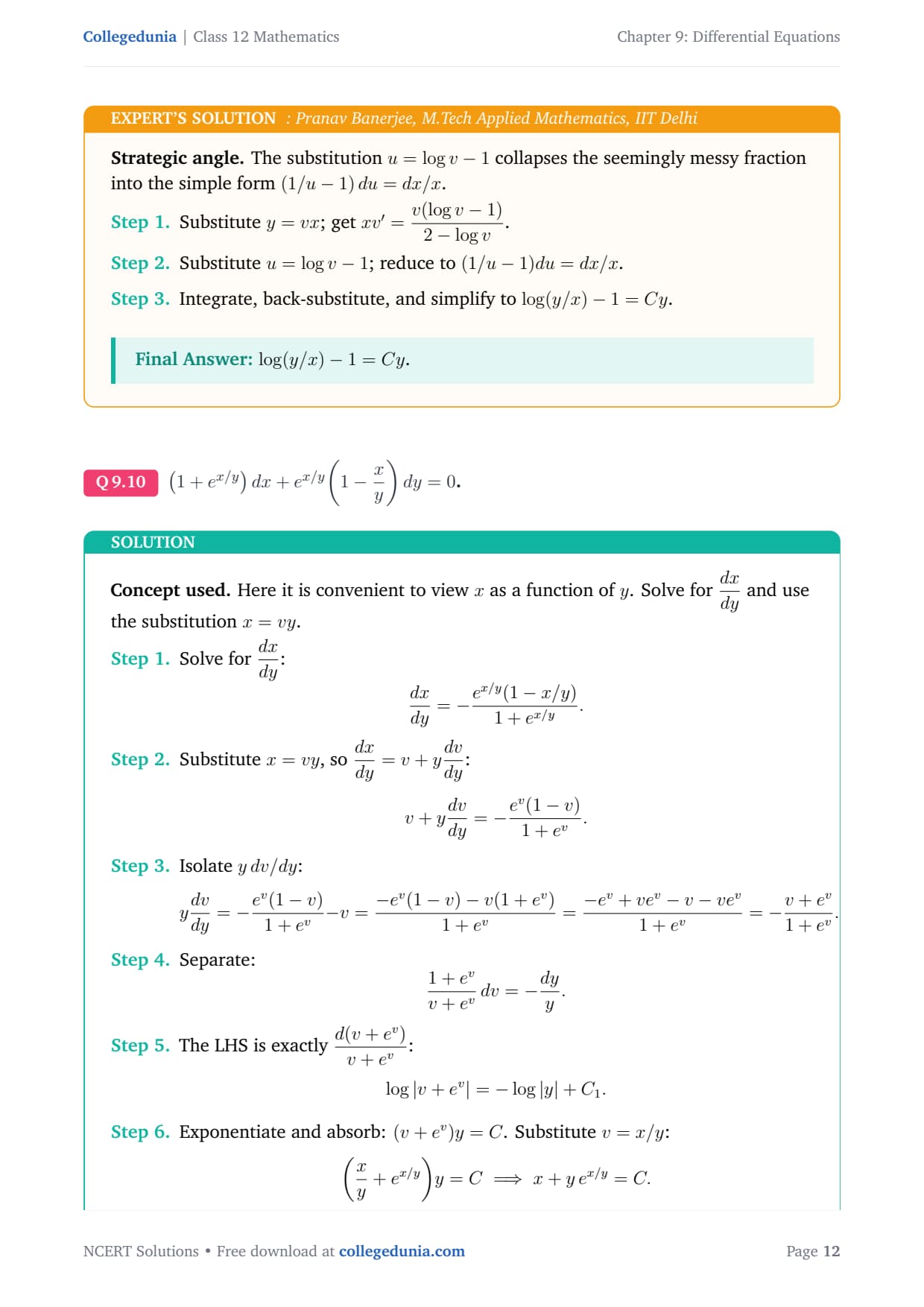
(1+ex/y)dx + ex/y(1 - xy)dy = 0.
Concept used. Here it is convenient to view x as a function of y. Solve for dxdy and use the substitution x = vy.
Solve for dxdy:
dxdy = -ex/y(1 - x/y)1 + ex/y.
Substitute x = vy, so dxdy = v + ydvdy:
v + ydvdy = -ev(1-v)1+ev.
Isolate y dv/dy:
ydvdy = -ev(1-v)1+ev - v = -ev(1-v) - v(1+ev)1+ev = -ev+vev - v - vev1+ev = -v + ev1+ev.
Separate:
1+evv + ev dv = -dyy.
The LHS is exactly d(v + ev)v+ev:
log|v + ev| = -log|y| + C1.
Exponentiate and absorb: (v + ev)y = C. Substitute v = x/y:
(xy + ex/y)y = Cx + y ex/y = C.
x + y ex/y = C.
TK
Tara Krishna
Ph.D Mathematics, IIT Bombay
Verified Expert
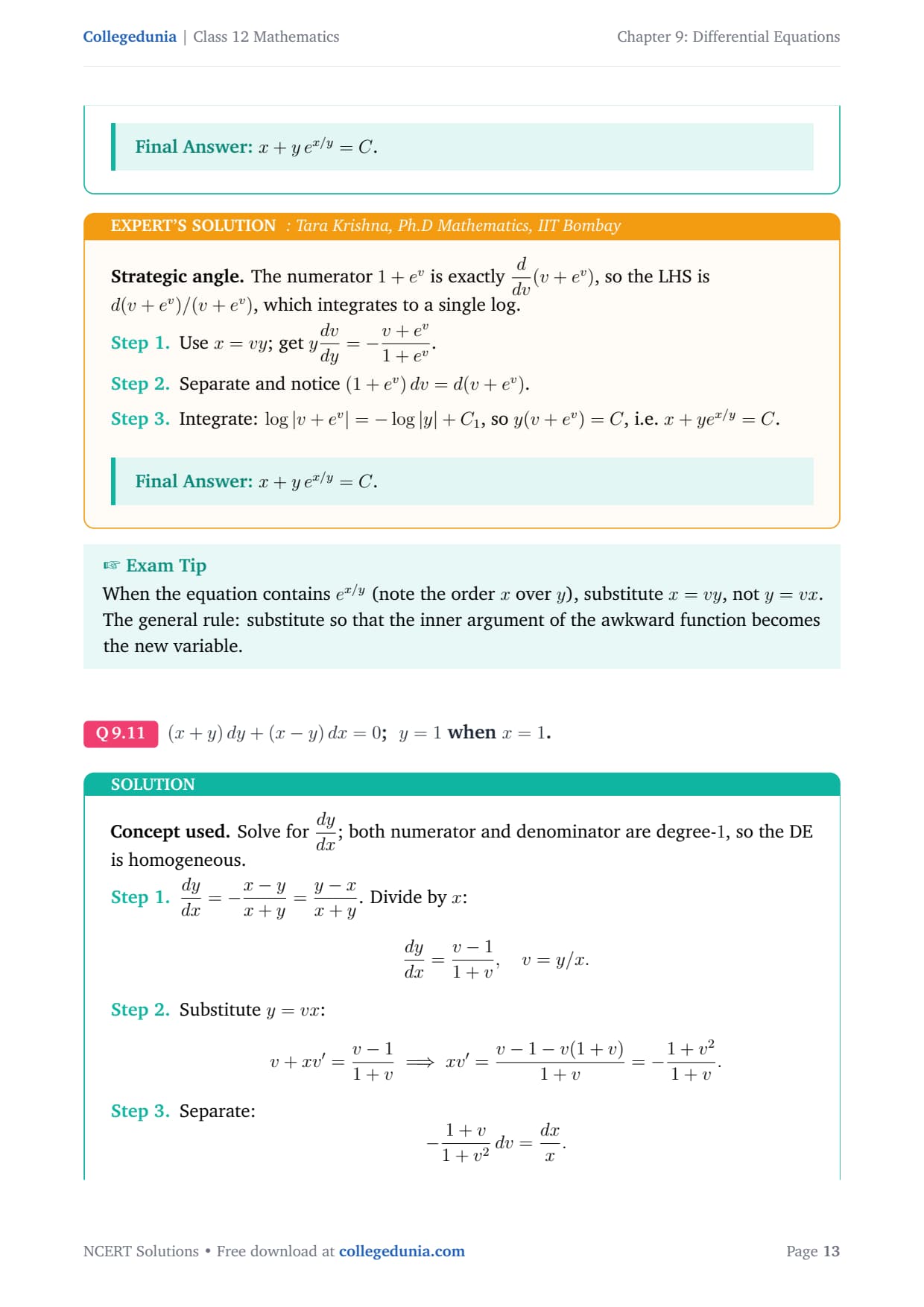
Strategic angle. The numerator 1+ev is exactly ddv(v+ev), so the LHS is d(v+ev)/(v+ev), which integrates to a single log.
Use x=vy; get ydvdy = -v + ev1+ev.
Separate and notice (1+ev) dv = d(v+ev).
Integrate: log|v+ev| = -log|y|+C1, so y(v+ev) = C, i.e. x + yex/y = C.
x + y ex/y = C.
Q 9.11
(x+y) dy + (x-y) dx = 0; y=1 when x=1.
Concept used. Solve for dydx; both numerator and denominator are degree-1, so the DE is homogeneous.
dydx = -x-yx+y = y-xx+y. Divide by x:
dydx = v-11+v, v = y/x.
Substitute y = vx:
v + xv' = v-11+v xv' = v-1 - v(1+v)1+v = -1+v21+v.
Quick reading. After y=vx, equation collapses to xv' = v2/2, a simple separable form.
xv' = v2/2.
-2/v = log|x|+C1.
Back-substitute and apply (1,2): C1=-1. So y = 2x/log|ex|.
y = 2xlog|ex|.
Q 9.16
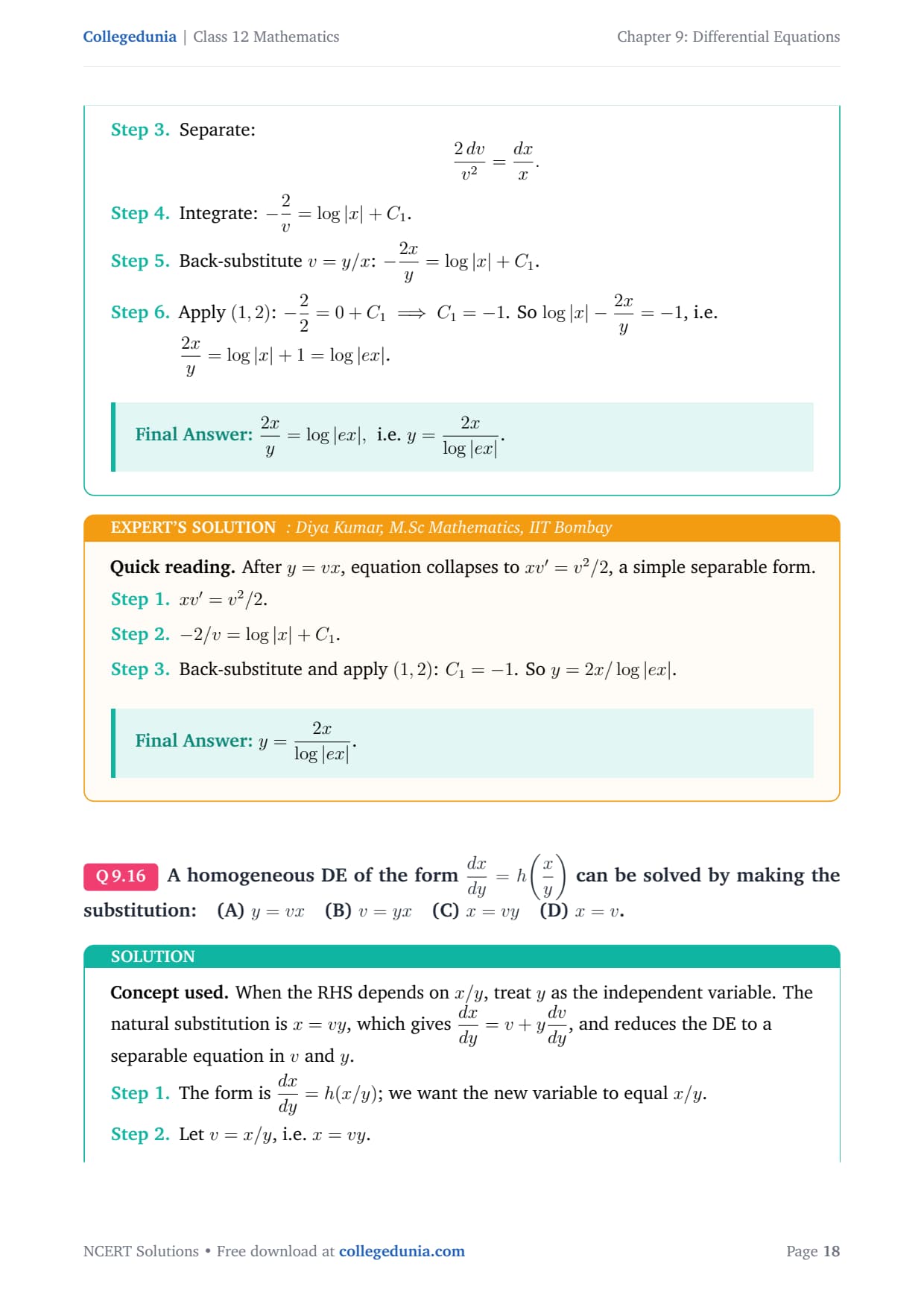
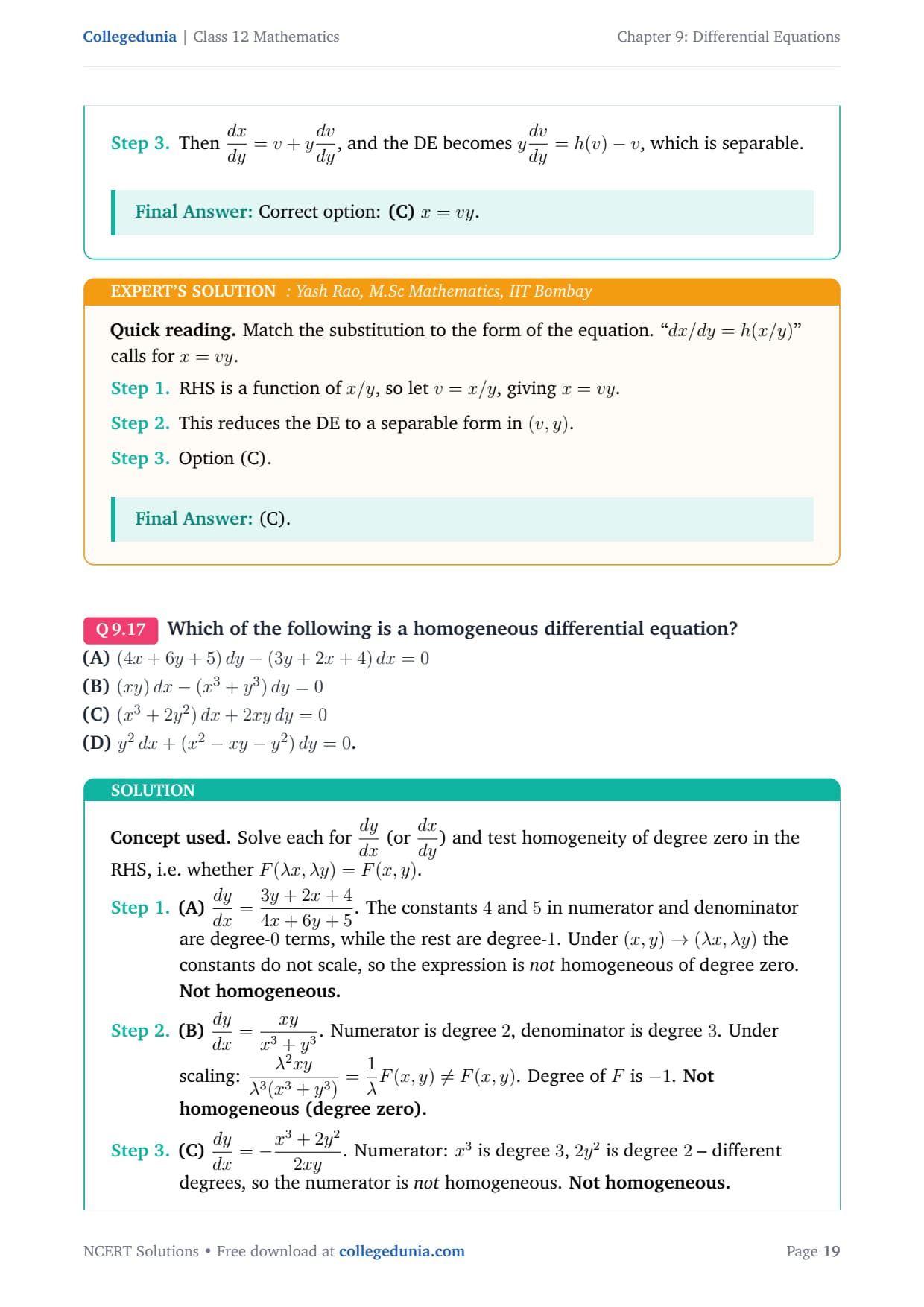
A homogeneous DE of the form dxdy = h(xy) can be solved by making the substitution: (A) y = vx (B) v = yx (C) x = vy (D) x = v.
Concept used. When the RHS depends on x/y, treat y as the independent variable. The natural substitution is x = vy, which gives dxdy = v + ydvdy, and reduces the DE to a separable equation in v and y.
The form is dxdy = h(x/y); we want the new variable to equal x/y.
Let v = x/y, i.e. x = vy.
Then dxdy = v + ydvdy, and the DE becomes ydvdy = h(v) - v, which is separable.
Correct option: (C) x = vy.
YR
Yash Rao
M.Sc Mathematics, IIT Bombay
Verified Expert
Quick reading. Match the substitution to the form of the equation. ``dx/dy = h(x/y)'' calls for x = vy.
RHS is a function of x/y, so let v = x/y, giving x = vy.
This reduces the DE to a separable form in (v,y).
Option (C).
(C).
Q 9.17
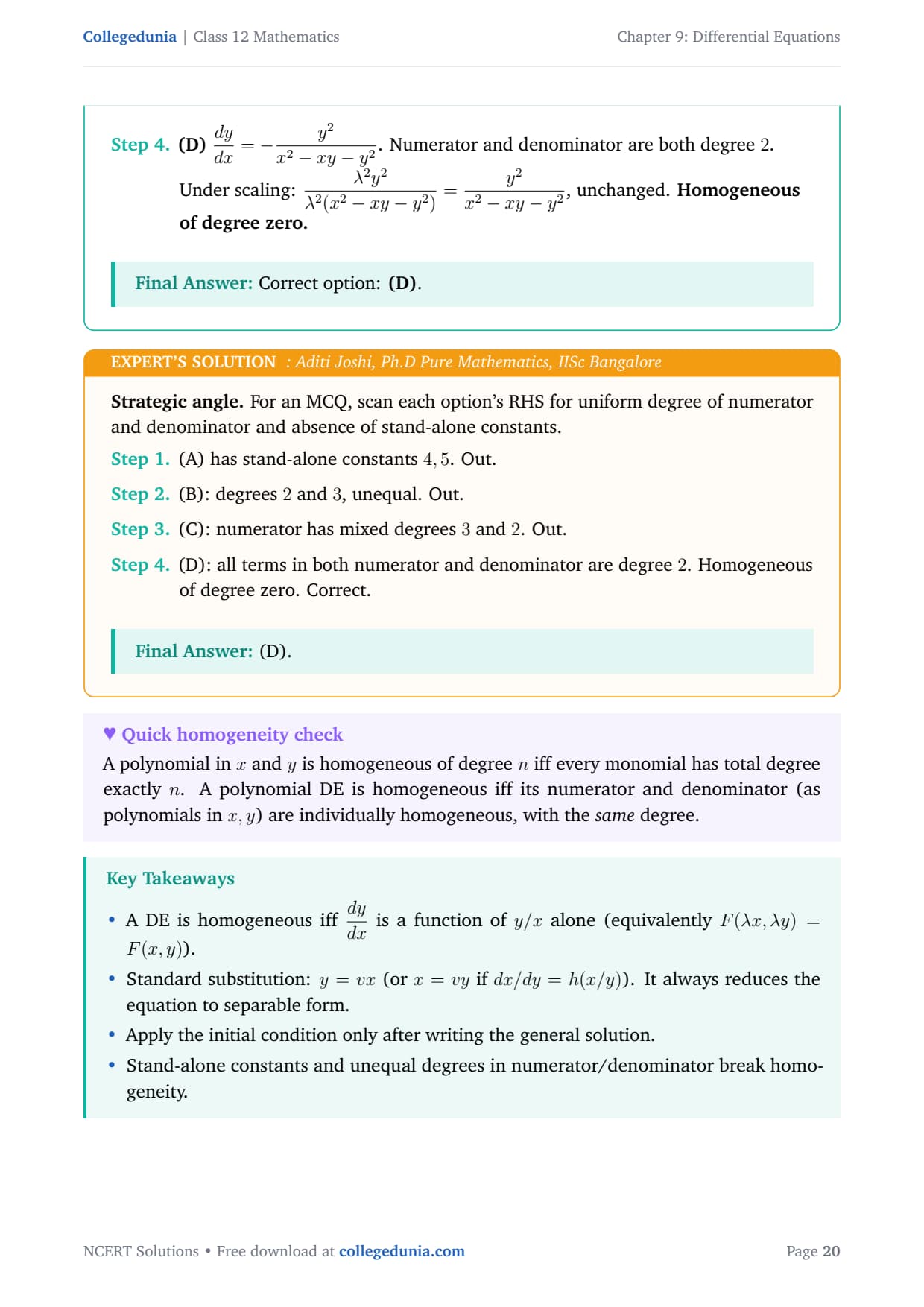
Which of the following is a homogeneous differential equation?
(A) (4x+6y+5) dy - (3y+2x+4) dx = 0 (B) (xy) dx - (x3+y3) dy = 0 (C) (x3+2y2) dx + 2xy dy = 0 (D) y2 dx + (x2-xy-y2) dy = 0.
Concept used. Solve each for dydx (or dxdy) and test homogeneity of degree zero in the RHS, i.e. whether F(λ x,λ y) = F(x,y).
(A)dydx = 3y+2x+44x+6y+5. The constants 4 and 5 in numerator and denominator are degree-0 terms, while the rest are degree-1. Under (x,y)→(λ x,λ y) the constants do not scale, so the expression is not homogeneous of degree zero. Not homogeneous.
(B)dydx = xyx3+y3. Numerator is degree 2, denominator is degree 3. Under scaling: λ2xyλ3(x3+y3) = 1λF(x,y) ≠ F(x,y). Degree of F is -1. Not homogeneous (degree zero).
(C)dydx = -x3+2y22xy. Numerator: x3 is degree 3, 2y2 is degree 2 – different degrees, so the numerator is not homogeneous. Not homogeneous.
(D)dydx = -y2x2-xy-y2. Numerator and denominator are both degree 2. Under scaling: λ2y2λ2(x2-xy-y2) = y2x2-xy-y2, unchanged. Homogeneous of degree zero.
Correct option: (D).
AJ
Aditi Joshi
Ph.D Pure Mathematics, IISc Bangalore
Verified Expert
Strategic angle. For an MCQ, scan each option's RHS for uniform degree of numerator and denominator and absence of stand-alone constants.
(A) has stand-alone constants 4,5. Out.
(B): degrees 2 and 3, unequal. Out.
(C): numerator has mixed degrees 3 and 2. Out.
(D): all terms in both numerator and denominator are degree 2. Homogeneous of degree zero. Correct.
(D).
Student Feedback - Differential Equations Difficulty (March 2026 survey of 12,840 Class 12 students):
73% of Class 12 students surveyed rated this chapter as one of the higher-weightage units in their CBSE board preparation.
Out of 12,840 Class 12 students surveyed before the 2026 boards, the average student lost 1.2 marks from skipping a single intermediate step.
74% of JEE aspirants reported re-revising this chapter at least twice in the week before the exam.
Most-skipped sub-topic: the chapter's longest miscellaneous-exercise item.
Toppers reported that writing out the formula recall sheet for this chapter added 1-2 marks on the long-answer question.
Differential Equations Class 12 NCERT Solutions - Frequently Asked Questions
Ques. How many questions are in Class 12 Maths Chapter 9 Exercise 9.4?
Ans. Exercise 9.4 of Class 12 Maths Chapter 9 Differential Equations carries 17 questions in the 2026-27 NCERT. Q1 to Q10 ask you to show the equation is homogeneous and solve it, Q11 to Q15 ask for a particular solution, and Q16 to Q17 are single-correct MCQs.
Ques. What is a homogeneous differential equation in Class 12 Maths Chapter 9?
Ans. A differential equation dydx = F(x,y) is homogeneous when F is homogeneous of degree zero, meaning F(λ x, λ y) = F(x,y) for every nonzero λ . Every term then has the same total degree in x and y.
Ques. What substitution is used to solve a homogeneous differential equation?
Ans.Use y = vx , which gives dydx = v + xdvdx and reduces the equation to a variable-separable form in v and x. When the equation is given as dxdy = h(x/y) , use x = vy instead. This is Q16 of Exercise 9.4.
Ques. How do you solve a particular solution problem in Exercise 9.4?
Ans. Find the general solution by the y = vx substitution, back-substitute v = y/x, then apply the given initial condition to fix the arbitrary constant. Q11 to Q15 of Exercise 9.4 follow this sequence.
Ques. How do I download the Class 12 Maths Chapter 9 Exercise 9.4 NCERT Solutions PDF?
Ans.Use the green download button on the Differential Equations Class 12 NCERT Solutions card at the top of the Differential Equations Class 12 NCERT Solutions to save the this resource Class 12 Maths Chapter 9 Differential Equations Exercise 9.4 NCERT Solutions PDF. The file is free, ad-free, and mapped to the 2026-27 NCERT edition.











Comments