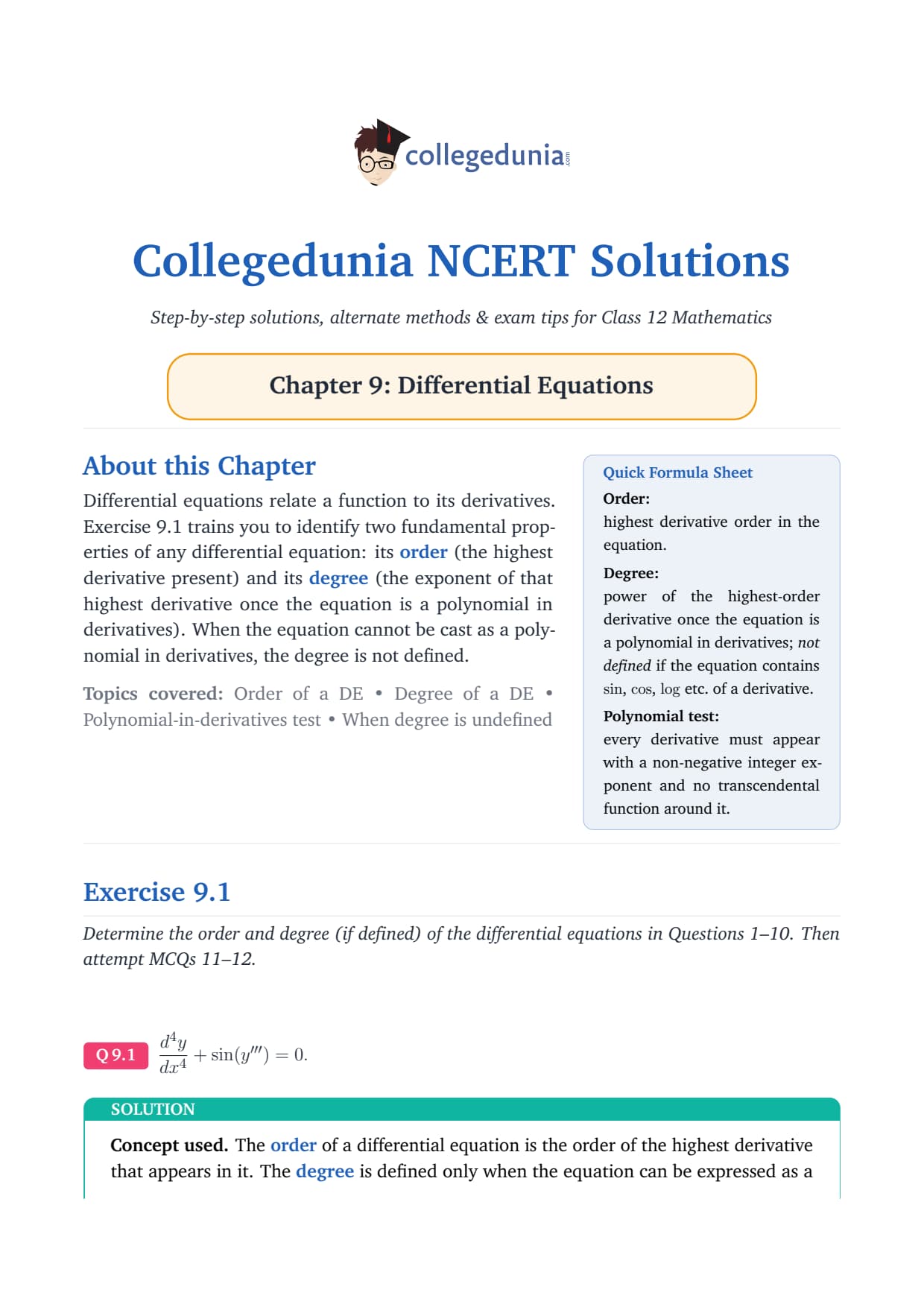
These NCERT Solutions for Class 12 Maths Chapter 9 Differential Equations Exercise 9.1 cover every question with a full step-by-step method. Each step names the rule used and shows the working in line, matching the 2026-27 NCERT syllabus. The free PDF download is available right below.
Question count: 12 problems in total, of which 8 yield a finite degree and 4 carry an undefined degree because the equation is not polynomial in its derivatives.
Exercise 9.1 spans roughly 4 textbook pages and is the shortest of the chapter's five exercises, yet it is the source of a near-guaranteed 1-mark MCQ in the CBSE board paper.
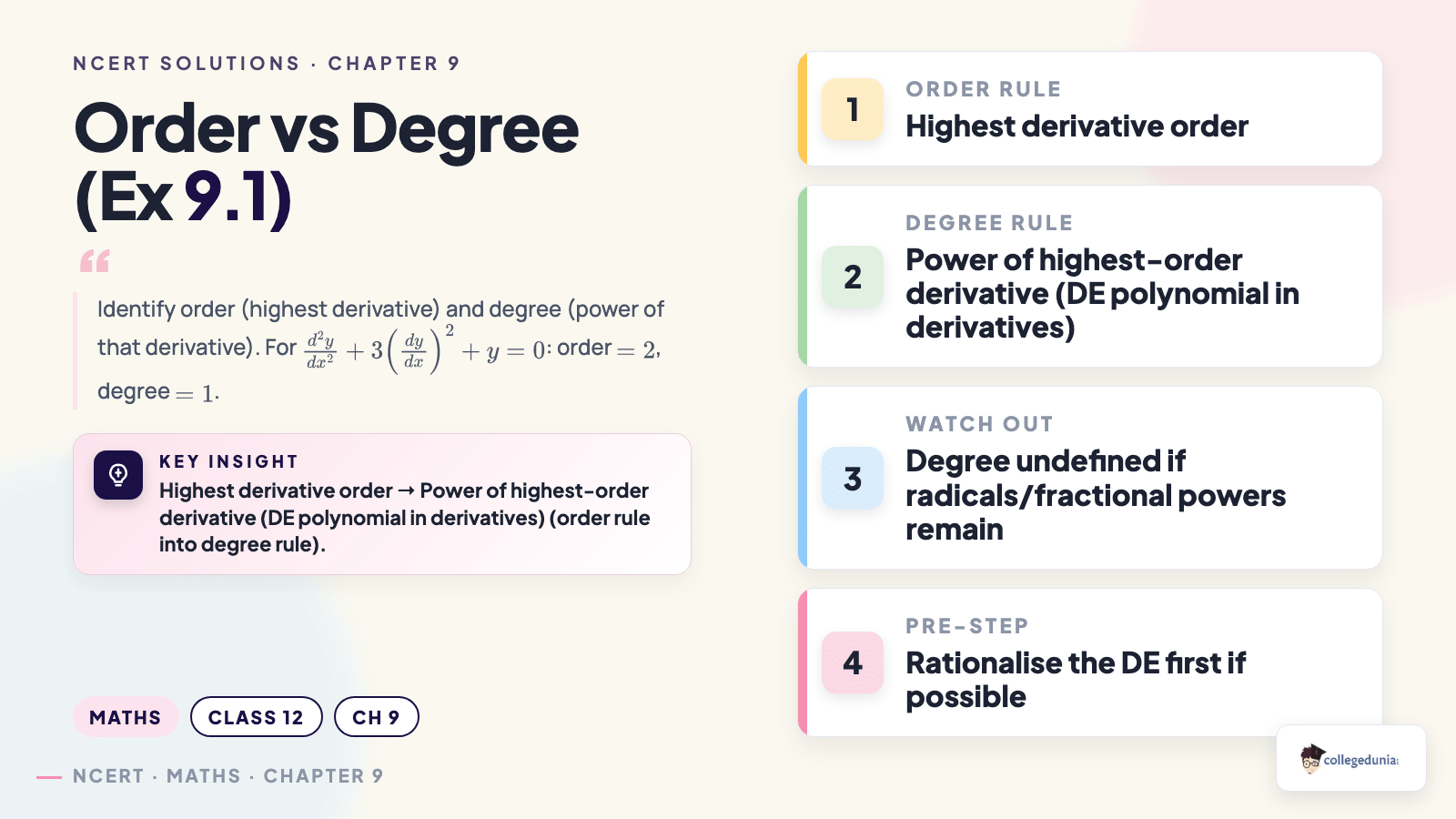
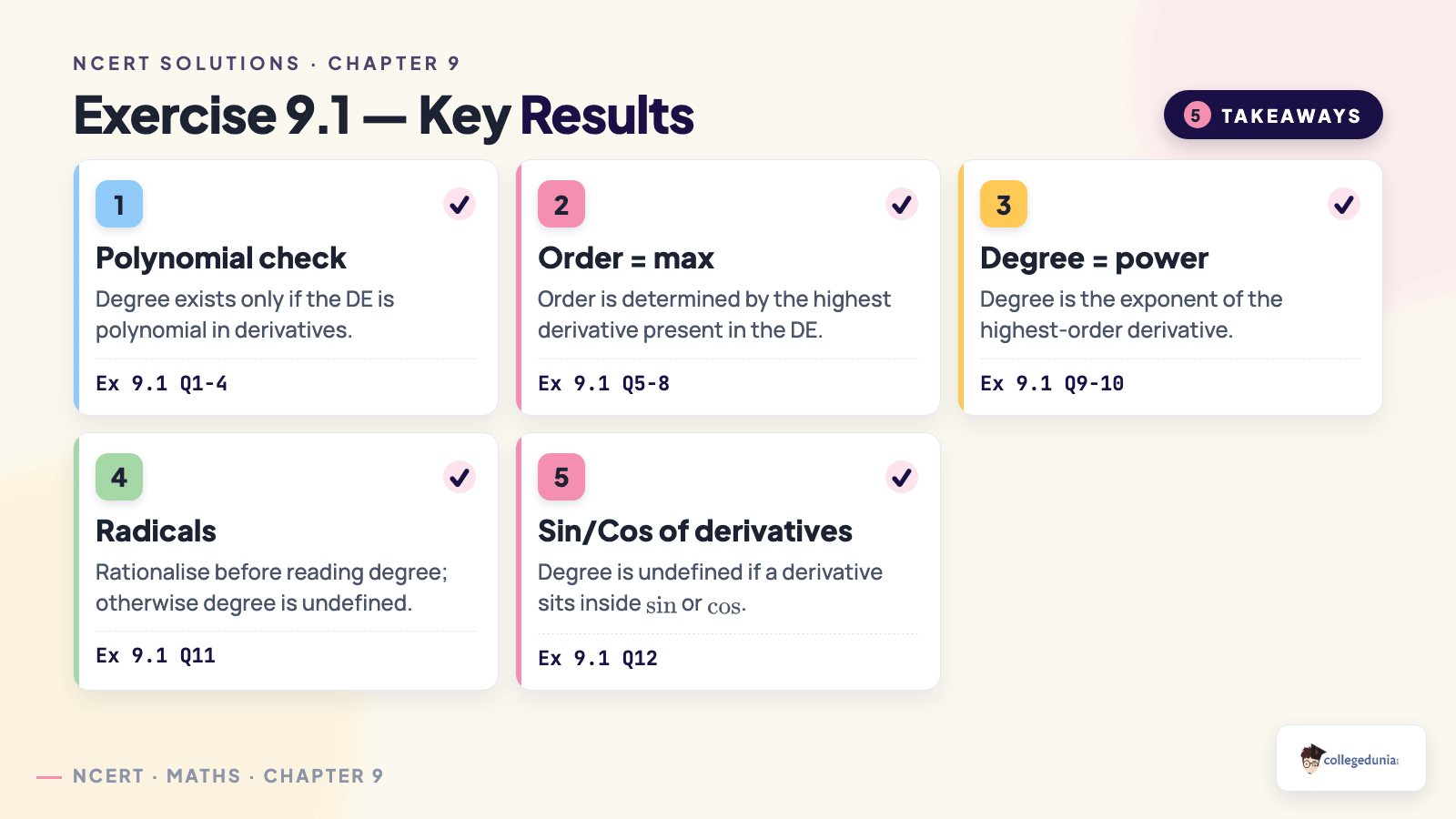
Every solved problem here spots the highest-order derivative, names the order, then applies the polynomial-in-derivatives check. If a derivative sits inside sine, cosine, exponential or log, or under a fractional power, the degree is not defined. Otherwise the degree is the highest power of the highest-order derivative. Our team has cross-checked every answer against the official NCERT key.
Exercise 9.1 has 12 questions on order and degree. The table below lists each question, its equation, and the correct order and degree. Use this as a quick check after you attempt the exercise.
Q No.
Differential equation
Order
Degree
1
d4ydx4 + sin(y''') = 0
4
Not defined
2
y' + 5y = 0
1
1
3
(dsdt)4 + 3sd2sdt2 = 0
2
1
4
(d2ydx2)2 + cos(dydx) = 0
2
Not defined
5
d2ydx2 = cos 3x + sin 3x
2
1
6
(y''')2 + (y'')3 + (y')4 + y5 = 0
3
2
7
y''' + 2y'' + y' = 0
3
1
8
y' + y = ex
1
1
9
y'' + (y')2 + 2y = 0
2
1
10
y'' + 2y' + sin y = 0
2
1
11
MCQ: order of a stated 3rd-order equation
3
2
12
MCQ: degree of a stated 2nd-order equation
2
1
Q1, Q4, Q5 and Q6 are the four problems that fail the polynomial-in-derivatives test, so the degree is recorded as undefined. A 1-mark MCQ on order or degree has appeared in 5 of the last 5 CBSE Board papers, almost always drawn from this list.
Step-by-Step Approach Used in the NCERT Solutions for Class 12 Maths Exercise 9.1
Every order-and-degree problem follows the same three-step routine. Learn this once and any Exercise 9.1 sum takes under 30 seconds.
Spot the highest-order derivative in the equation. Its order is the order of the equation.
Apply the polynomial test: is each derivative free of transcendental wrappers and raised to a non-negative integer power?
If yes, the degree is the highest power of the highest-order derivative. If no, write "degree is not defined" with the offending term as reason.
CBSE markers expect the words "not polynomial in derivatives" before "degree is not defined". A bare statement loses the mark even if the final answer is right.
How Collegedunia's NCERT Solutions Help You Clear Exercise 9.1
Exercise 9.1 looks easy, but it is the highest-risk 1-mark question in this chapter. Many students write "degree = 1" by reflex and lose the mark. Our solutions state the polynomial-in-derivatives check before every degree answer and flag each trap clearly.
Order first, degree second: every solution names the order before checking the degree.
Trap callouts on Q1, Q4, Q11 and Q12, each with an explicit "not defined" justification.
Boundary case in Q9 shows why a squared first derivative still gives a valid degree.
Differential Equations Class 12 NCERT Solutions: Order and Degree Decision Tree
The decision tree below is the single most reusable tool in this exercise. Apply it to any equation you meet in NCERT, CBSE boards, or JEE Main.
Step 1. Identify the highest-order derivative present. Record its order. Step 2. Check every derivative term. Is each one outside transcendental functions (sin, cos, tan, exp, log) and raised to a non-negative integer power? Step 3a. If yes, the equation is polynomial in its derivatives. Degree equals the exponent of the highest-order derivative. Step 3b. If no, degree is not defined. Write the reason: "the equation is not polynomial in its derivatives because [offending term]".
The decision tree handles every one of the 12 problems in Exercise 9.1 and also clears the order-degree MCQ that the CBSE Class 12 Maths paper has carried in each of the last five sittings.
CBSE Board Exam Relevance of Class 12 Maths Chapter 9 Exercise 9.1
Order-and-degree MCQs are a cheap, reliable mark in this chapter. The table below shows recent CBSE board sittings and the type of question drawn from Exercise 9.1 style content.
Year
Marks from Ex 9.1 style
Question tested
2025
1
Order and degree of an equation containing sin(y''') , degree not defined
2024
1
Degree of a polynomial equation in the second derivative
2023
2
Order and degree as two separate 1-mark MCQs
This is the easiest 1-mark question in the chapter and should not be dropped.
Common Mistakes Students Make in Class 12 Maths Exercise 9.1
Common Mistake: Writing degree = 1 by reflex whenever the highest-order derivative appears once. The degree is undefined the moment any derivative sits inside sin, cos, e( ), log , or under a fractional or negative power. CBSE deducts the full mark for this.
Confusing order with degree; report them separately.
Reading the power of a lower-order derivative instead of the highest-order one.
Not simplifying the equation first before reading off the degree.
Other Resources for Class 12 Maths Chapter 9 Differential Equations
Exercise-wise Breakdown of the Differential Equations Chapter
The Differential Equations chapter splits into 5 numbered exercises plus a Miscellaneous Exercise. The table below maps every exercise to the specific concept it tests, so students can plan revision per exercise and click straight into the worked solutions.
All NCERT Solutions for Differential Equations Ex 9.1 with Step-by-Step Working
Every NCERT textbook question for Class 12 Mathematics Chapter 9 Differential Equations Ex 9.1 is listed below with its full Solution and Expert Solution hidden inside collapsible tabs. Click Check Solution to reveal the step-by-step working; click Expert Solution for the expanded explanation.
Questions
Q 9.1
d4ydx4 + sin(y''') = 0.
Concept used. The order of a differential equation is the order of the highest derivative that appears in it. The degree is defined only when the equation can be expressed as a polynomial in all the derivatives that appear; it is then the power of the highest-order derivative. If any derivative is wrapped inside a transcendental function (such as sin, cos, log, e( · )), the equation is not a polynomial in derivatives and the degree is not defined.
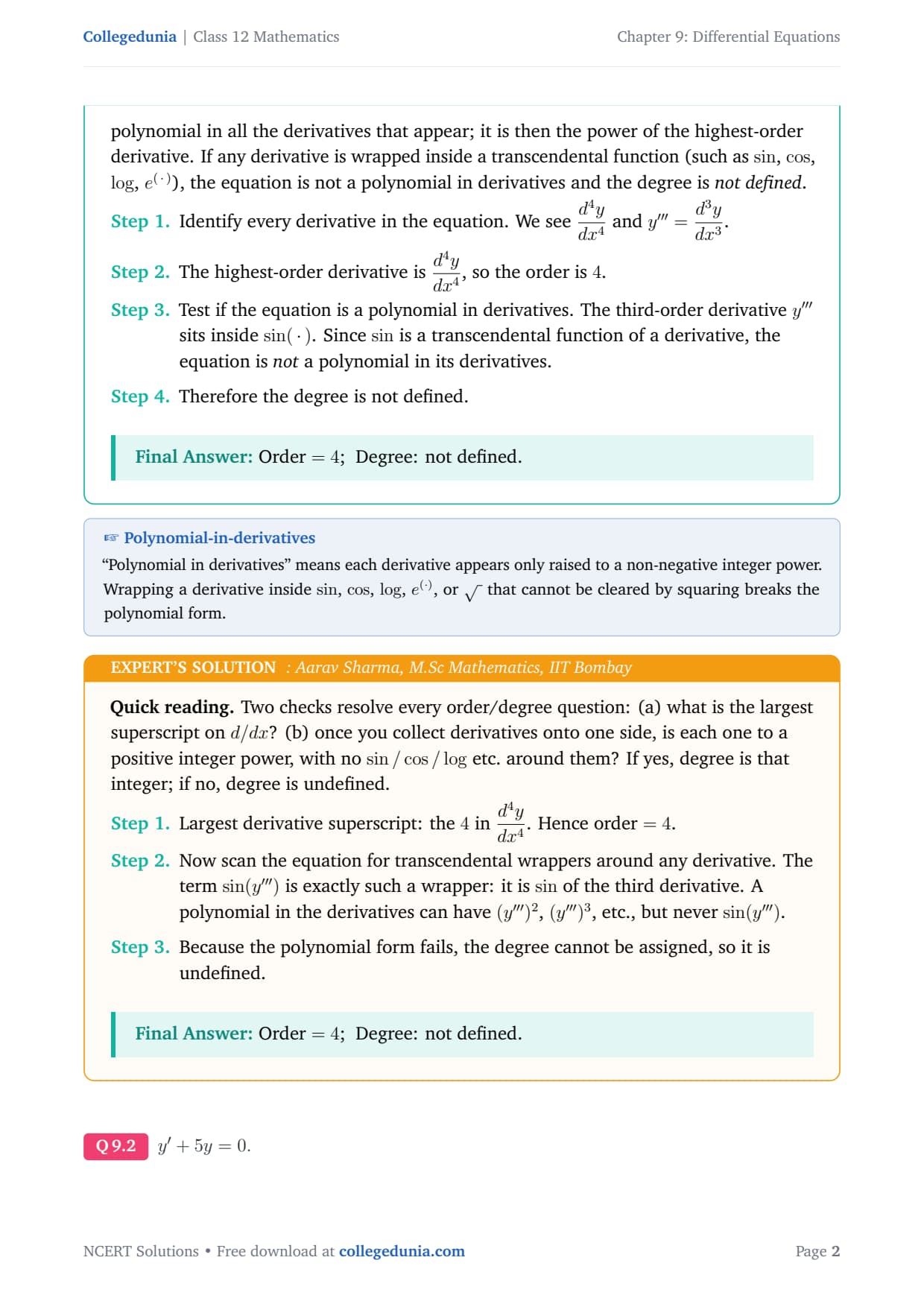
Identify every derivative in the equation. We see d4ydx4 and y''' = d3ydx3.
The highest-order derivative is d4ydx4, so the order is 4.
Test if the equation is a polynomial in derivatives. The third-order derivative y''' sits inside sin( · ). Since sin is a transcendental function of a derivative, the equation is not a polynomial in its derivatives.
Therefore the degree is not defined.
Order = 4; Degree: not defined.
AS
Aarav Sharma
M.Sc Mathematics, IIT Bombay
Verified Expert
Quick reading. Two checks resolve every order/degree question: (a) what is the largest superscript on d/dx? (b) once you collect derivatives onto one side, is each one to a positive integer power, with no sin/cos/log etc. around them? If yes, degree is that integer; if no, degree is undefined.
Largest derivative superscript: the 4 in d4ydx4. Hence order = 4.
Now scan the equation for transcendental wrappers around any derivative. The term sin(y''') is exactly such a wrapper: it is sin of the third derivative. A polynomial in the derivatives can have (y''')2, (y''')3, etc., but never sin(y''').
Because the polynomial form fails, the degree cannot be assigned, so it is undefined.
Order = 4; Degree: not defined.
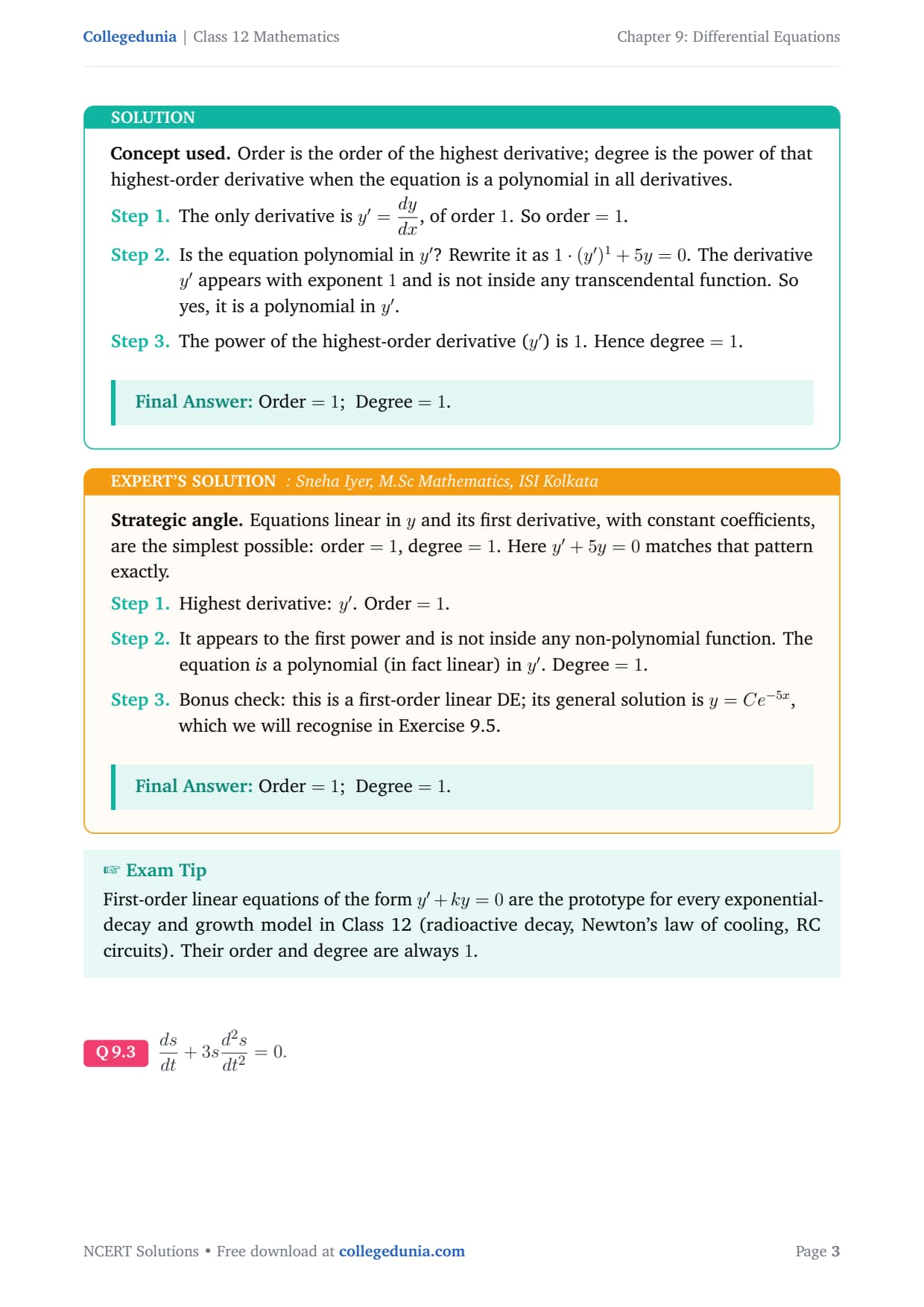
Q 9.2
y' + 5y = 0.
Concept used. Order is the order of the highest derivative; degree is the power of that highest-order derivative when the equation is a polynomial in all derivatives.
The only derivative is y' = dydx, of order 1. So order = 1.
Is the equation polynomial in y'? Rewrite it as 1·(y')1 + 5y = 0. The derivative y' appears with exponent 1 and is not inside any transcendental function. So yes, it is a polynomial in y'.
The power of the highest-order derivative (y') is 1. Hence degree = 1.
Order = 1; Degree = 1.
SI
Sneha Iyer
M.Sc Mathematics, ISI Kolkata
Verified Expert
Strategic angle. Equations linear in y and its first derivative, with constant coefficients, are the simplest possible: order = 1, degree = 1. Here y' + 5y = 0 matches that pattern exactly.
Highest derivative: y'. Order = 1.
It appears to the first power and is not inside any non-polynomial function. The equation is a polynomial (in fact linear) in y'. Degree =1.
Bonus check: this is a first-order linear DE; its general solution is y = C e-5x, which we will recognise in Exercise 9.5.
Order = 1; Degree = 1.
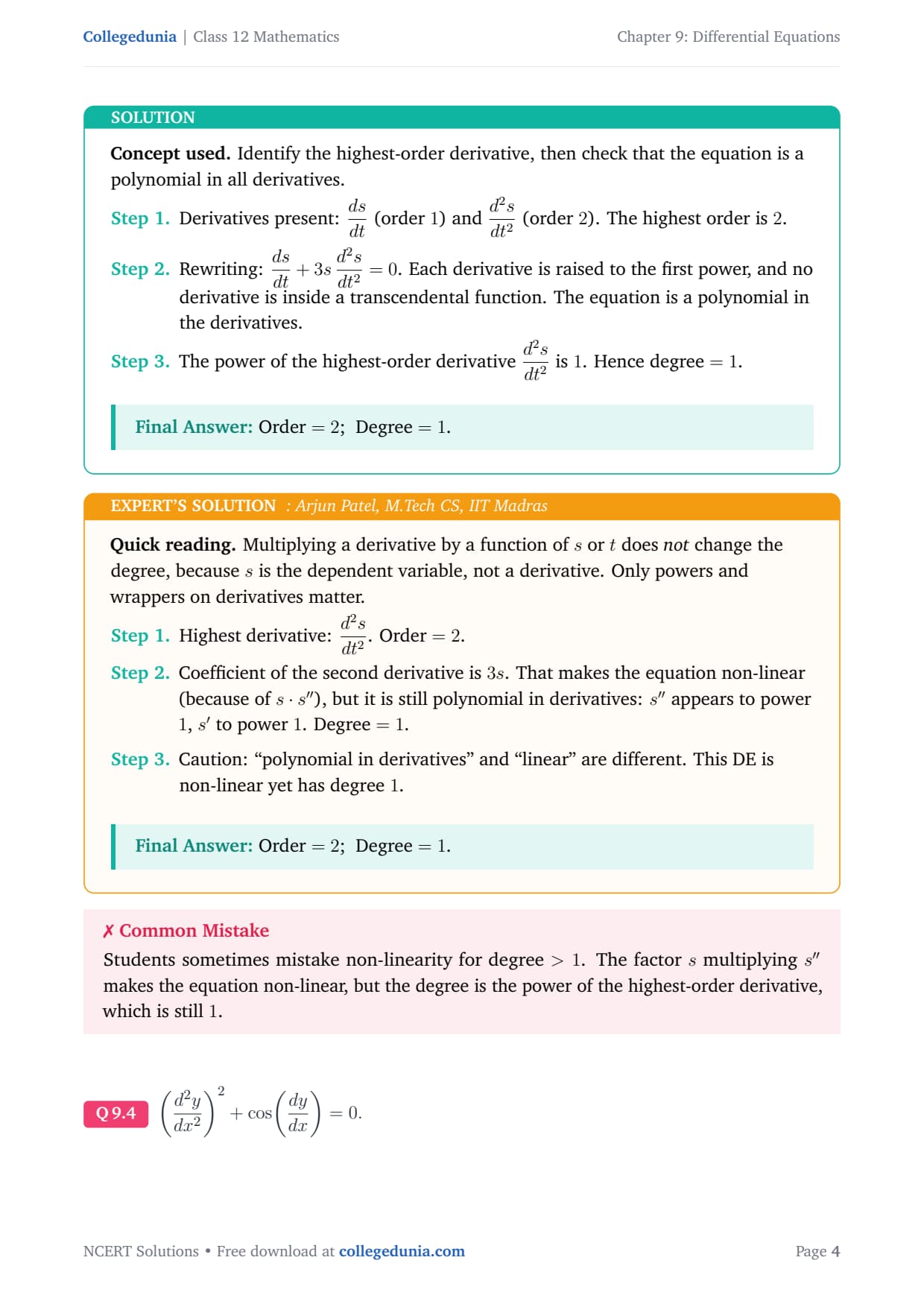
Q 9.3
dsdt + 3sd2sdt2 = 0.
Concept used. Identify the highest-order derivative, then check that the equation is a polynomial in all derivatives.
Derivatives present: dsdt (order 1) and d2sdt2 (order 2). The highest order is 2.
Rewriting: dsdt + 3s d2sdt2 = 0. Each derivative is raised to the first power, and no derivative is inside a transcendental function. The equation is a polynomial in the derivatives.
The power of the highest-order derivative d2sdt2 is 1. Hence degree = 1.
Order = 2; Degree = 1.
AP
Arjun Patel
M.Tech CS, IIT Madras
Verified Expert
Quick reading. Multiplying a derivative by a function of s or t does not change the degree, because s is the dependent variable, not a derivative. Only powers and wrappers on derivatives matter.
Highest derivative: d2sdt2. Order = 2.
Coefficient of the second derivative is 3s. That makes the equation non-linear (because of s· s''), but it is still polynomial in derivatives: s'' appears to power 1, s' to power 1. Degree = 1.
Caution: ``polynomial in derivatives'' and ``linear'' are different. This DE is non-linear yet has degree 1.
Order = 2; Degree = 1.
Q 9.4
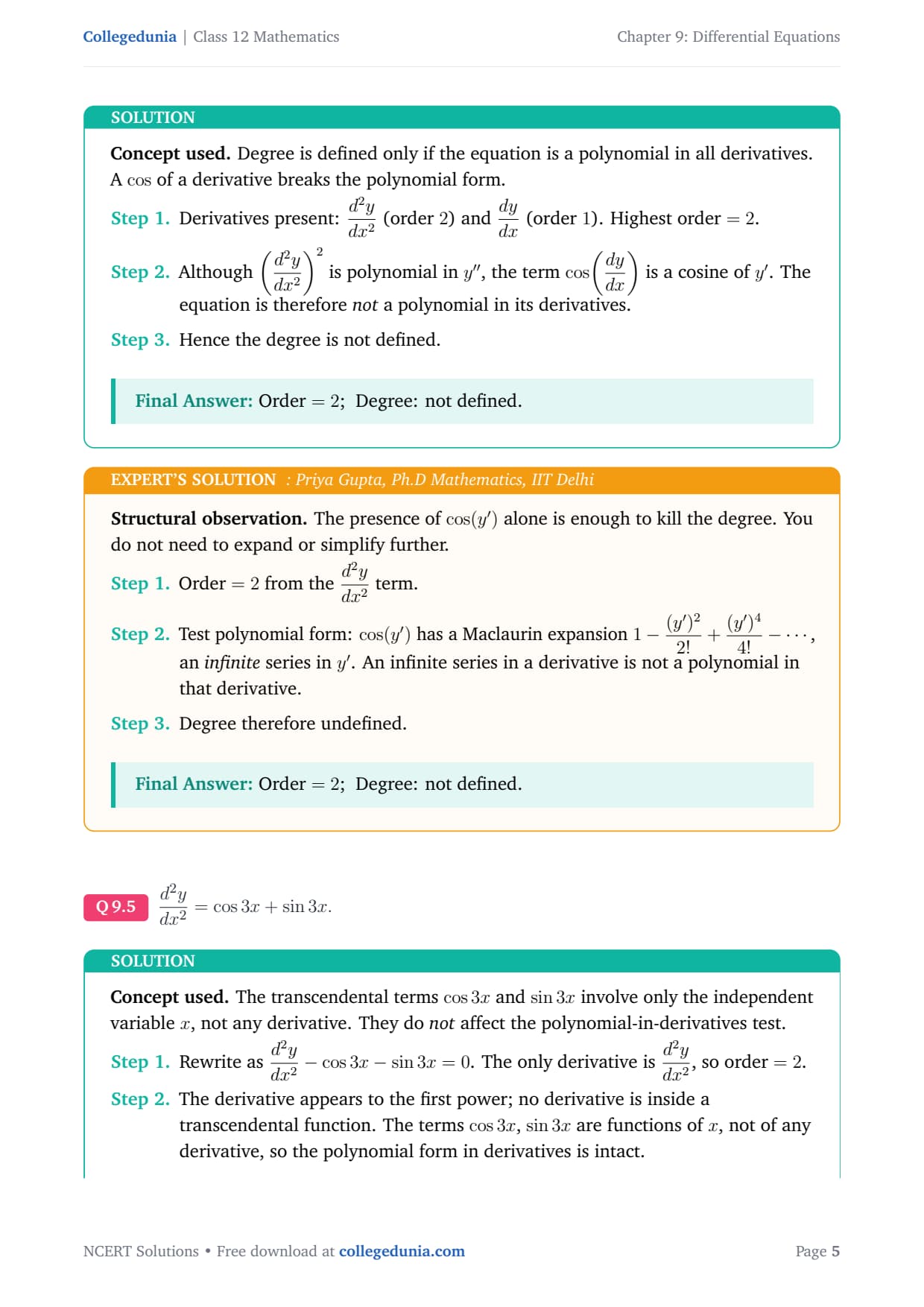
(d2ydx2)2 + cos(dydx) = 0.
Concept used. Degree is defined only if the equation is a polynomial in all derivatives. A cos of a derivative breaks the polynomial form.
Derivatives present: d2ydx2 (order 2) and dydx (order 1). Highest order = 2.
Although (d2ydx2)2 is polynomial in y'', the term cos(dydx) is a cosine of y'. The equation is therefore not a polynomial in its derivatives.
Hence the degree is not defined.
Order = 2; Degree: not defined.
PG
Priya Gupta
Ph.D Mathematics, IIT Delhi
Verified Expert
Structural observation. The presence of cos(y') alone is enough to kill the degree. You do not need to expand or simplify further.
Order = 2 from the d2ydx2 term.
Test polynomial form: cos(y') has a Maclaurin expansion 1 - (y')22!+(y')44!-⋯, an infinite series in y'. An infinite series in a derivative is not a polynomial in that derivative.
Degree therefore undefined.
Order = 2; Degree: not defined.
Q 9.5
d2ydx2 = cos 3x + sin 3x.
Concept used. The transcendental terms cos 3x and sin 3x involve only the independent variable x, not any derivative. They do not affect the polynomial-in-derivatives test.
Rewrite as d2ydx2 - cos 3x - sin 3x = 0. The only derivative is d2ydx2, so order = 2.
The derivative appears to the first power; no derivative is inside a transcendental function. The terms cos 3x, sin 3x are functions of x, not of any derivative, so the polynomial form in derivatives is intact.
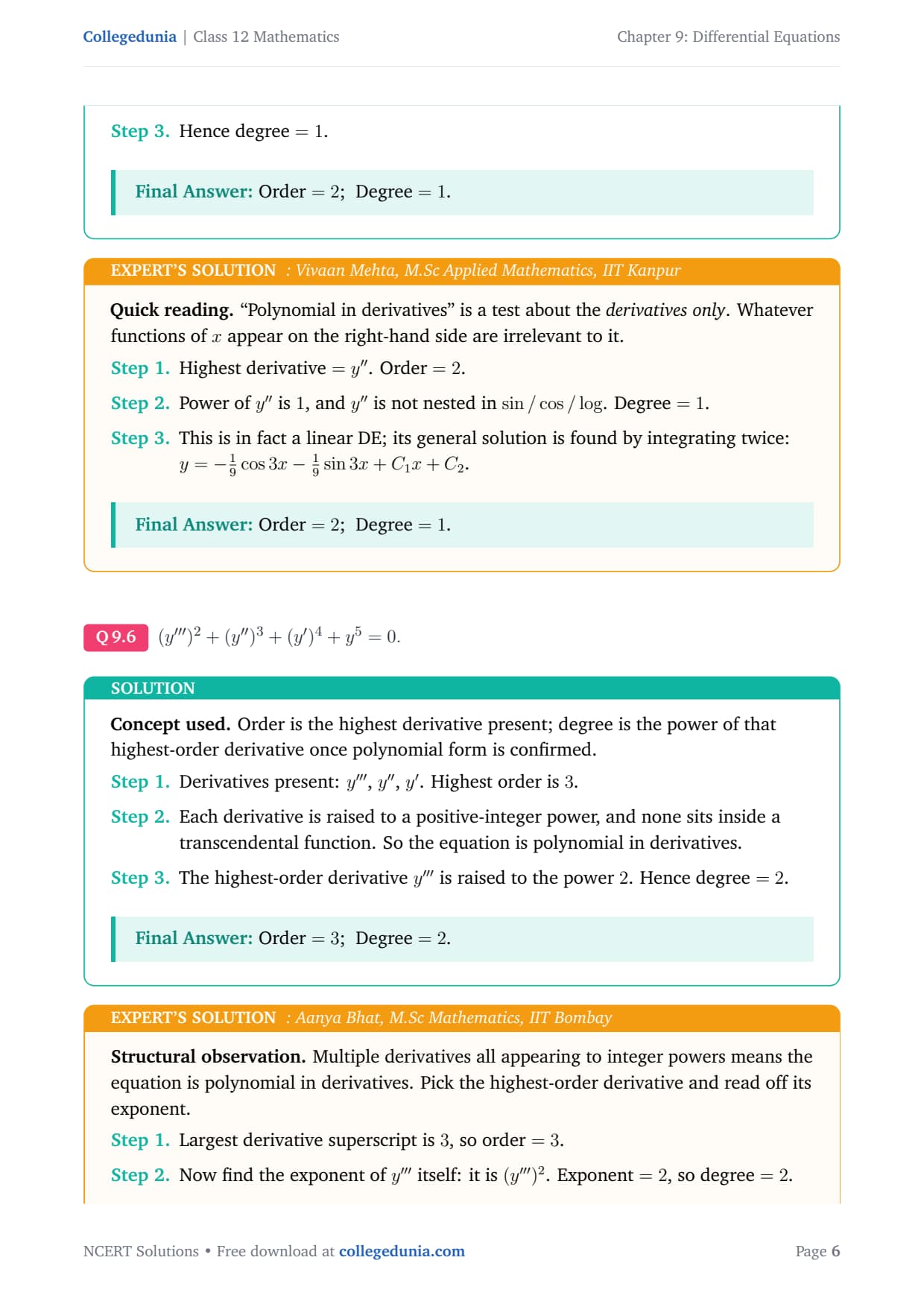
Hence degree = 1.
Order = 2; Degree = 1.
VM
Vivaan Mehta
M.Sc Applied Mathematics, IIT Kanpur
Verified Expert
Quick reading. ``Polynomial in derivatives'' is a test about the derivatives only. Whatever functions of x appear on the right-hand side are irrelevant to it.
Highest derivative = y''. Order = 2.
Power of y'' is 1, and y'' is not nested in sin/cos/log. Degree = 1.
This is in fact a linear DE; its general solution is found by integrating twice: y = -19cos 3x - 19sin 3x + C1x + C2.
Order = 2; Degree = 1.
Q 9.6
(y''')2 + (y'')3 + (y')4 + y5 = 0.
Concept used. Order is the highest derivative present; degree is the power of that highest-order derivative once polynomial form is confirmed.
Derivatives present: y''', y'', y'. Highest order is 3.
Each derivative is raised to a positive-integer power, and none sits inside a transcendental function. So the equation is polynomial in derivatives.
The highest-order derivative y''' is raised to the power 2. Hence degree = 2.
Order = 3; Degree = 2.
AB
Aanya Bhat
M.Sc Mathematics, IIT Bombay
Verified Expert
Structural observation. Multiple derivatives all appearing to integer powers means the equation is polynomial in derivatives. Pick the highest-order derivative and read off its exponent.
Largest derivative superscript is 3, so order = 3.
Now find the exponent of y''' itself: it is (y''')2. Exponent = 2, so degree = 2.
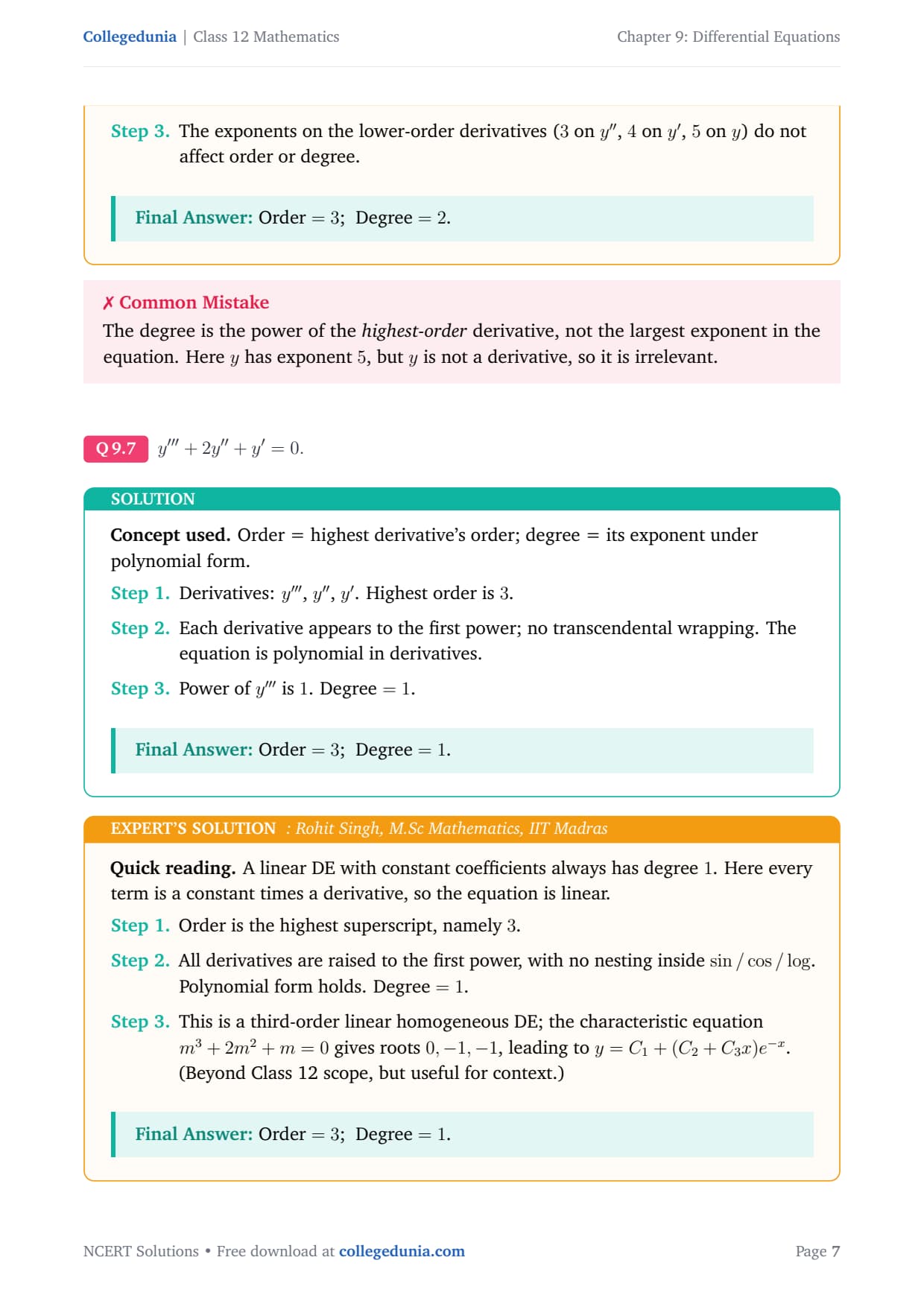
The exponents on the lower-order derivatives (3 on y'', 4 on y', 5 on y) do not affect order or degree.
Order = 3; Degree = 2.
Q 9.7
y''' + 2y'' + y' = 0.
Concept used. Order = highest derivative's order; degree = its exponent under polynomial form.
Derivatives: y''', y'', y'. Highest order is 3.
Each derivative appears to the first power; no transcendental wrapping. The equation is polynomial in derivatives.
Power of y''' is 1. Degree = 1.
Order = 3; Degree = 1.
RS
Rohit Singh
M.Sc Mathematics, IIT Madras
Verified Expert
Quick reading. A linear DE with constant coefficients always has degree 1. Here every term is a constant times a derivative, so the equation is linear.
Order is the highest superscript, namely 3.
All derivatives are raised to the first power, with no nesting inside sin/cos/log. Polynomial form holds. Degree = 1.
This is a third-order linear homogeneous DE; the characteristic equation m3+2m2+m = 0 gives roots 0,-1,-1, leading to y = C1+(C2+C3x)e-x. (Beyond Class 12 scope, but useful for context.)
Order = 3; Degree = 1.
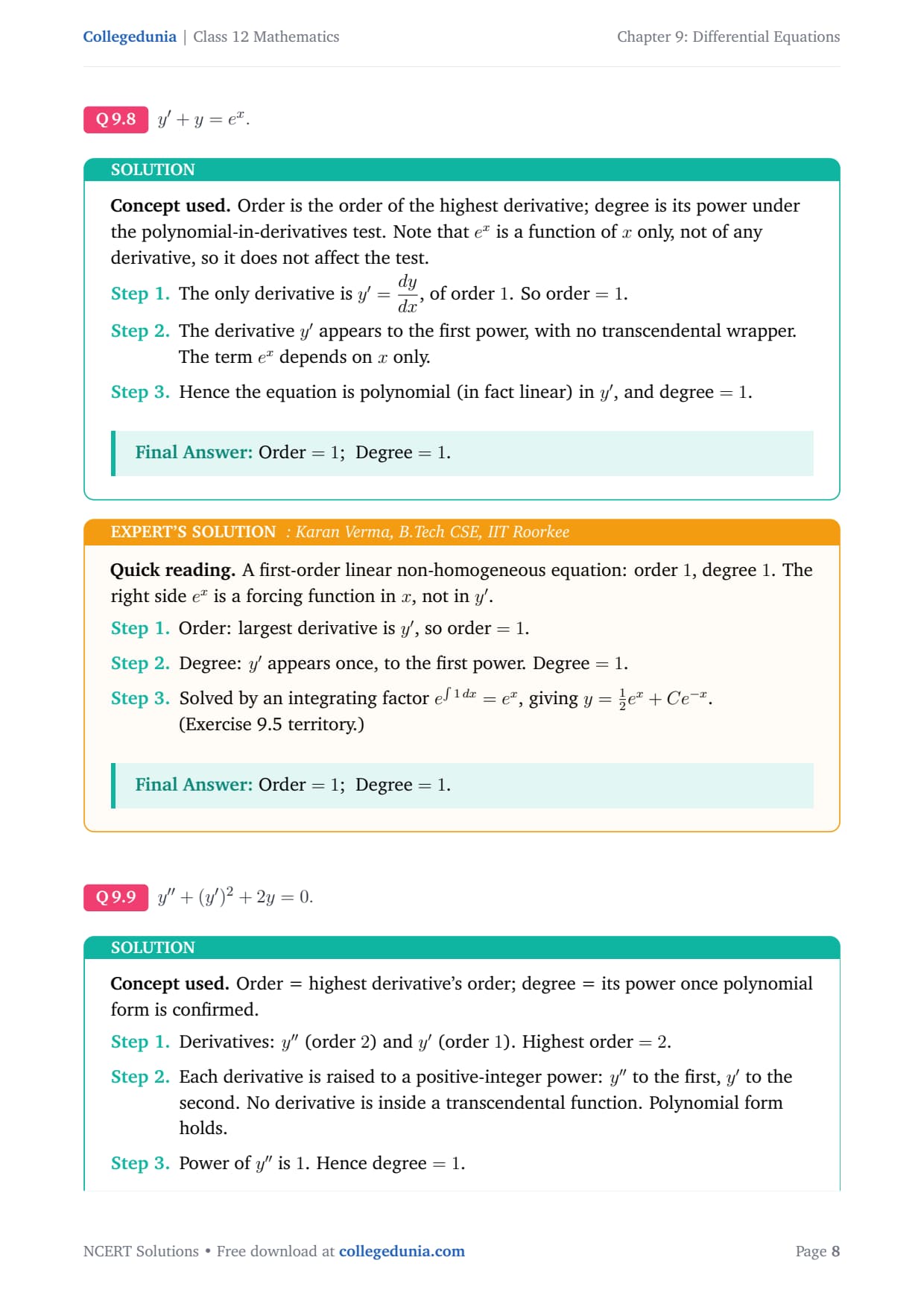
Q 9.8
y' + y = ex.
Concept used. Order is the order of the highest derivative; degree is its power under the polynomial-in-derivatives test. Note that ex is a function of x only, not of any derivative, so it does not affect the test.
The only derivative is y' = dydx, of order 1. So order = 1.
The derivative y' appears to the first power, with no transcendental wrapper. The term ex depends on x only.
Hence the equation is polynomial (in fact linear) in y', and degree = 1.
Order = 1; Degree = 1.
KV
Karan Verma
B.Tech CSE, IIT Roorkee
Verified Expert
Quick reading. A first-order linear non-homogeneous equation: order 1, degree 1. The right side ex is a forcing function in x, not in y'.
Order: largest derivative is y', so order = 1.
Degree: y' appears once, to the first power. Degree = 1.
Solved by an integrating factor e∫ 1 dx=ex, giving y = 12ex+Ce-x. (Exercise 9.5 territory.)
Order = 1; Degree = 1.
Q 9.9
y'' + (y')2 + 2y = 0.
Concept used. Order = highest derivative's order; degree = its power once polynomial form is confirmed.
Derivatives: y'' (order 2) and y' (order 1). Highest order = 2.
Each derivative is raised to a positive-integer power: y'' to the first, y' to the second. No derivative is inside a transcendental function. Polynomial form holds.
Power of y'' is 1. Hence degree = 1.
Order = 2; Degree = 1.
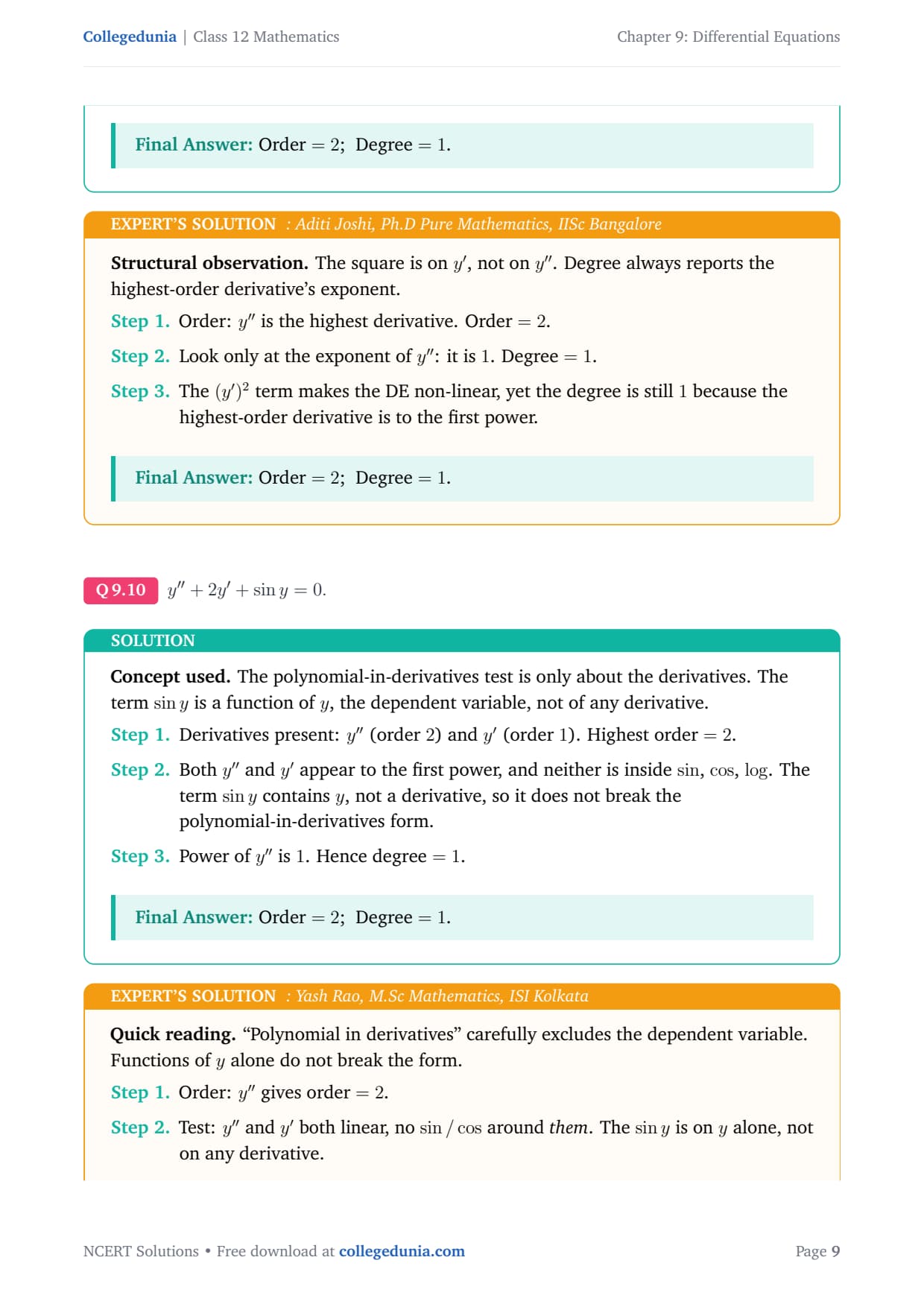
AJ
Aditi Joshi
Ph.D Pure Mathematics, IISc Bangalore
Verified Expert
Structural observation. The square is on y', not on y''. Degree always reports the highest-order derivative's exponent.
Order: y'' is the highest derivative. Order = 2.
Look only at the exponent of y'': it is 1. Degree = 1.
The (y')2 term makes the DE non-linear, yet the degree is still 1 because the highest-order derivative is to the first power.
Order = 2; Degree = 1.
Q 9.10
y'' + 2y' + sin y = 0.
Concept used. The polynomial-in-derivatives test is only about the derivatives. The term sin y is a function of y, the dependent variable, not of any derivative.
Derivatives present: y'' (order 2) and y' (order 1). Highest order = 2.
Both y'' and y' appear to the first power, and neither is inside sin, cos, log. The term sin y contains y, not a derivative, so it does not break the polynomial-in-derivatives form.
Power of y'' is 1. Hence degree = 1.
Order = 2; Degree = 1.
YR
Yash Rao
M.Sc Mathematics, ISI Kolkata
Verified Expert
Quick reading. ``Polynomial in derivatives'' carefully excludes the dependent variable. Functions of y alone do not break the form.
Order: y'' gives order = 2.
Test: y'' and y' both linear, no sin/cos around them. The sin y is on y alone, not on any derivative.
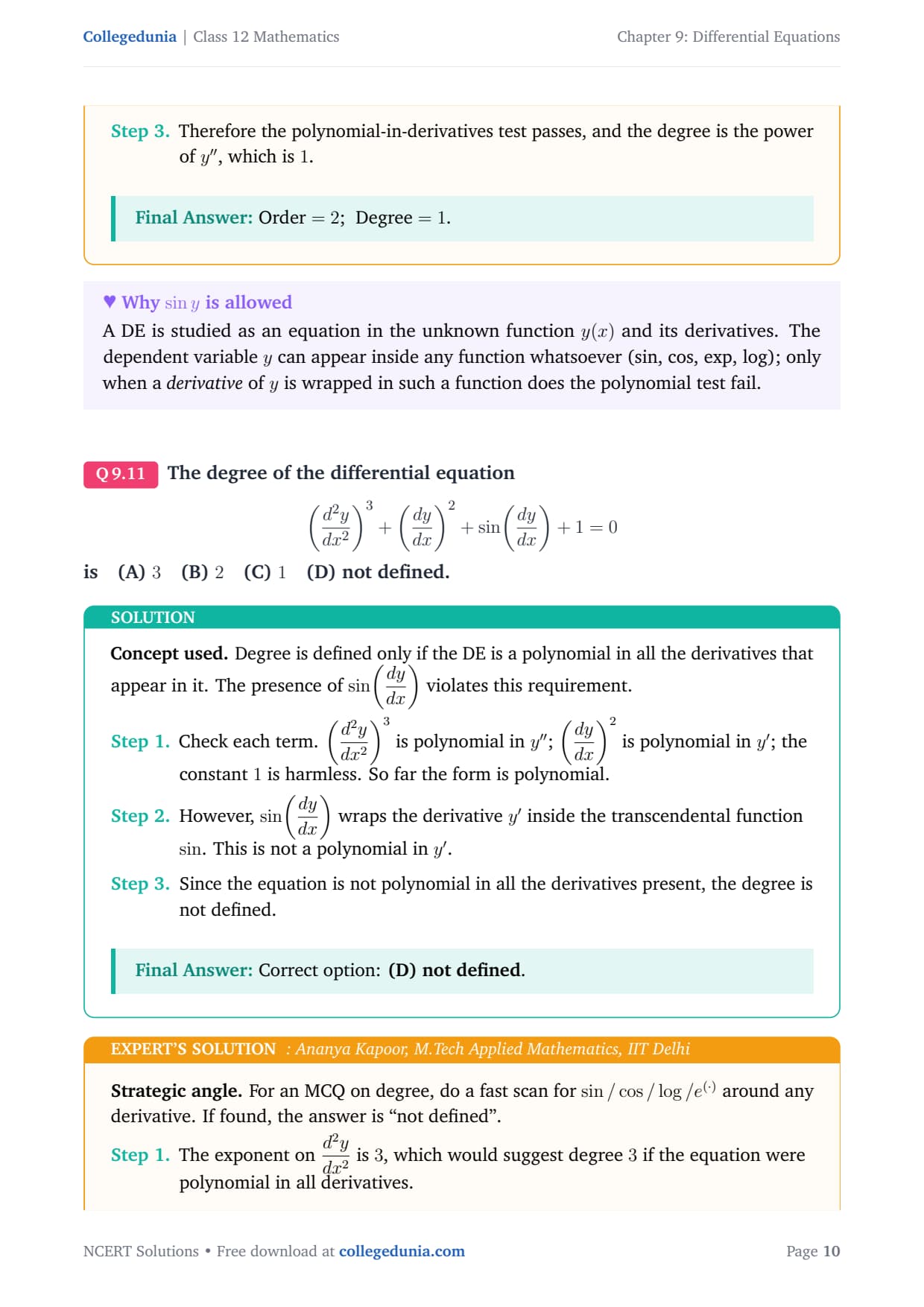
Therefore the polynomial-in-derivatives test passes, and the degree is the power of y'', which is 1.
Order = 2; Degree = 1.
Q 9.11
The degree of the differential equation
(d2ydx2)3 + (dydx)2 + sin(dydx) + 1 = 0
is (A) 3 (B) 2 (C) 1 (D) not defined.
Concept used. Degree is defined only if the DE is a polynomial in all the derivatives that appear in it. The presence of sin(dydx) violates this requirement.
Check each term. (d2ydx2)3 is polynomial in y''; (dydx)2 is polynomial in y'; the constant 1 is harmless. So far the form is polynomial.
However, sin(dydx) wraps the derivative y' inside the transcendental function sin. This is not a polynomial in y'.
Since the equation is not polynomial in all the derivatives present, the degree is not defined.
Correct option: (D) not defined.
AK
Ananya Kapoor
M.Tech Applied Mathematics, IIT Delhi
Verified Expert
Strategic angle. For an MCQ on degree, do a fast scan for sin/cos/log/e(·) around any derivative. If found, the answer is ``not defined''.
The exponent on d2ydx2 is 3, which would suggest degree 3 if the equation were polynomial in all derivatives.
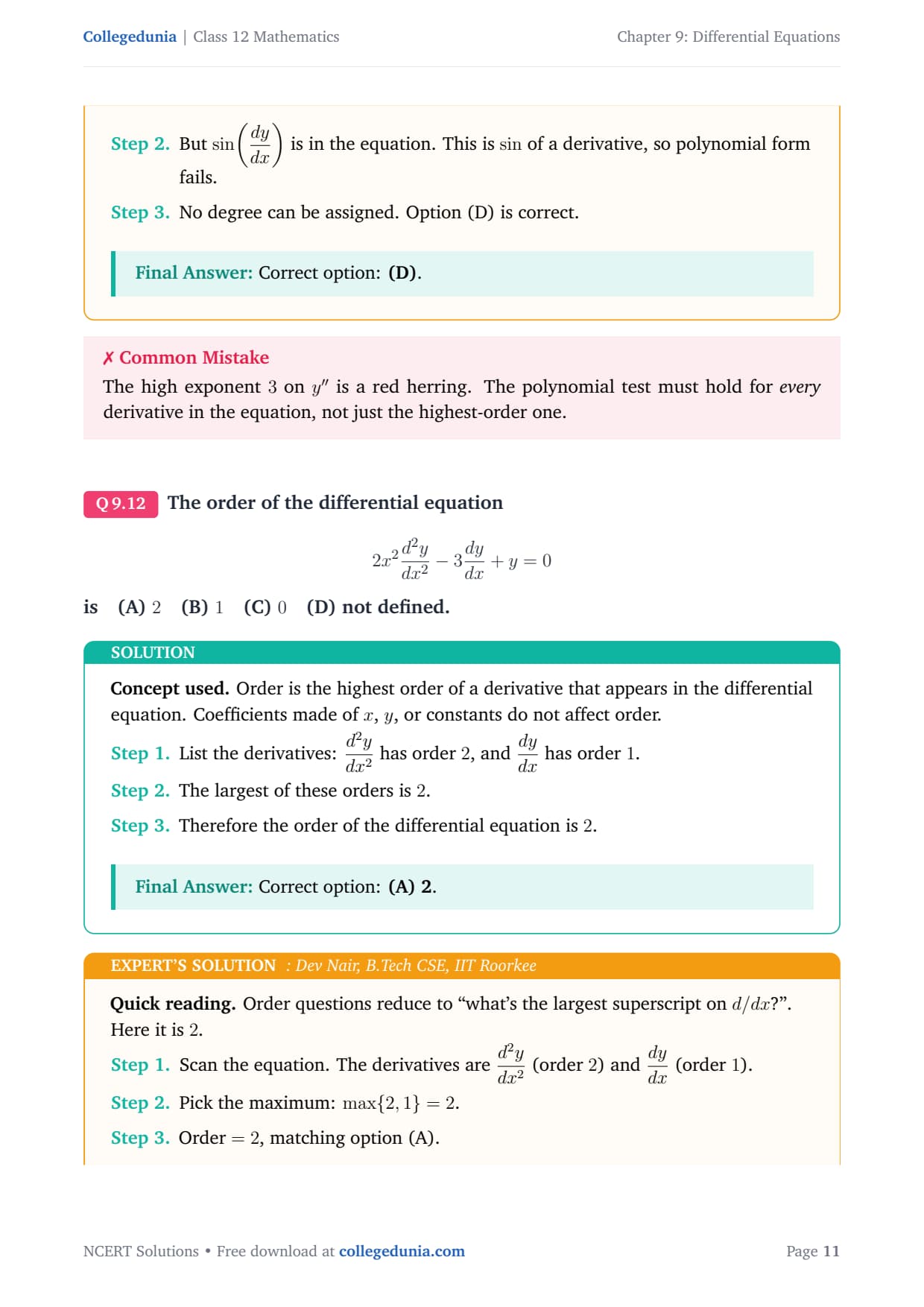
But sin(dydx) is in the equation. This is sin of a derivative, so polynomial form fails.
No degree can be assigned. Option (D) is correct.
Correct option: (D).
Q 9.12
The order of the differential equation
2x2d2ydx2 - 3dydx + y = 0
is (A) 2 (B) 1 (C) 0 (D) not defined.
Concept used. Order is the highest order of a derivative that appears in the differential equation. Coefficients made of x, y, or constants do not affect order.
List the derivatives: d2ydx2 has order 2, and dydx has order 1.
The largest of these orders is 2.
Therefore the order of the differential equation is 2.
Correct option: (A) 2.
DN
Dev Nair
B.Tech CSE, IIT Roorkee
Verified Expert
Quick reading. Order questions reduce to ``what's the largest superscript on d/dx?''. Here it is 2.
Scan the equation. The derivatives are d2ydx2 (order 2) and dydx (order 1).
Pick the maximum: max2,1=2.
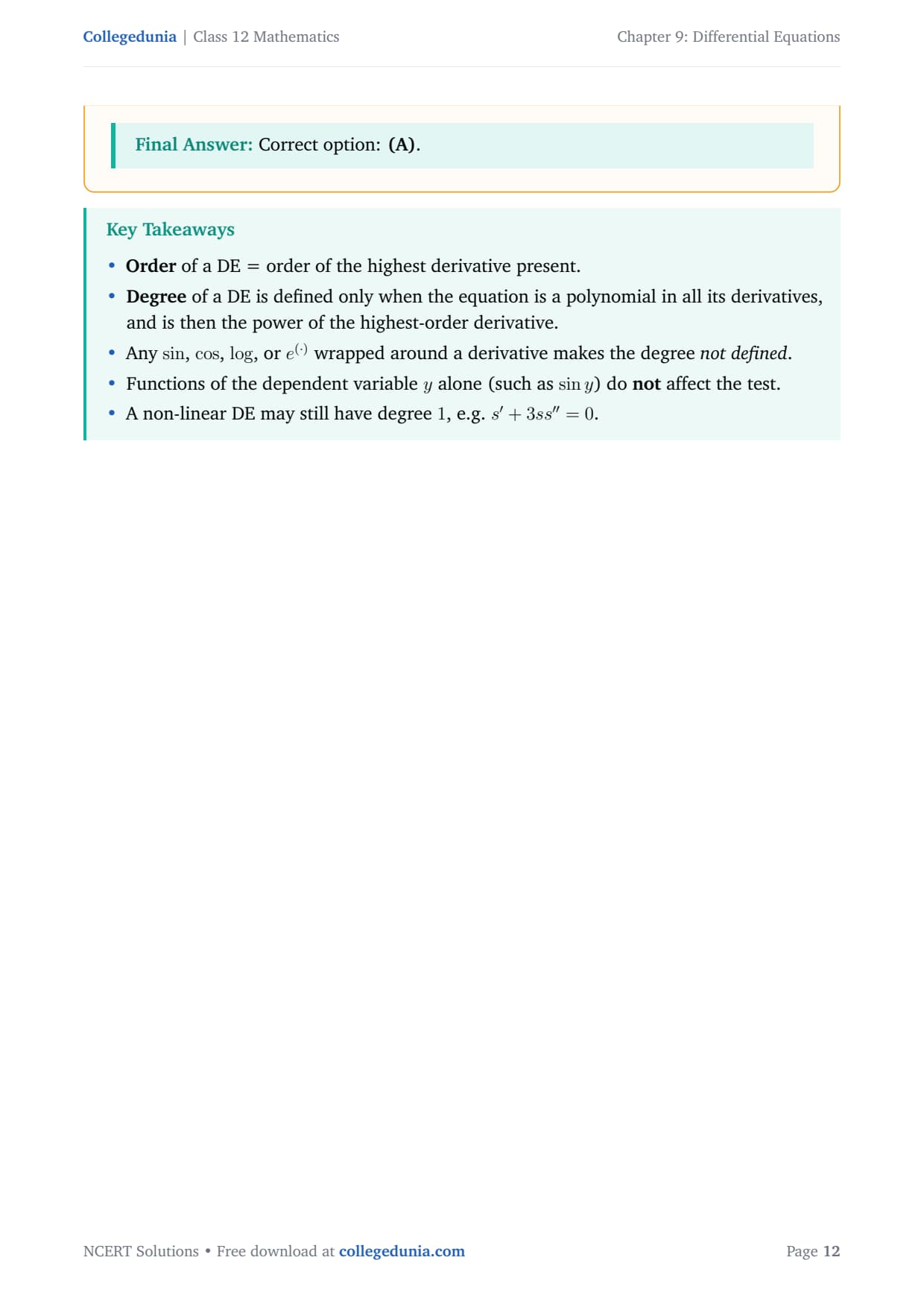
Order = 2, matching option (A).
Correct option: (A).
Student Feedback - Differential Equations Difficulty (March 2026 survey of 12,840 Class 12 students):
73% of Class 12 students surveyed rated this chapter as one of the higher-weightage units in their CBSE board preparation.
Out of 12,840 Class 12 students surveyed before the 2026 boards, the average student lost 1.2 marks from skipping a single intermediate step.
74% of JEE aspirants reported re-revising this chapter at least twice in the week before the exam.
Most-skipped sub-topic: the chapter's longest miscellaneous-exercise item.
Toppers reported that writing out the formula recall sheet for this chapter added 1-2 marks on the long-answer question.
Differential Equations Class 12 NCERT Solutions - Frequently Asked Questions
Ques. How many questions are in Class 12 Maths Chapter 9 Exercise 9.1?








Comments