The Integrals Class 12 NCERT Solutions solve every problem of Exercise 7.3 in Class 12 Maths Chapter 7 Integrals. Every answer follows the order used in the NCERT textbook, so students can move between the solutions PDF and the matching question without re-reading the theory. The free PDF for Exercise 7.3 is available to download on this page.
At a glance: 24 sums · trigonometric identities only · 9 power-reduction, 8 product-to-sum, 7 half-angle · PDF size ~7 MB
CBSE Weightage: Exercise 7.3 problems map to 3-mark short-answer questions inside the Integrals chapter's 9-11 mark block.
JEE Main Weightage: Trigonometric integration makes up roughly 2% of the Calculus questions, and the same identities show up in JEE Advanced too.
CUET Weightage: CUET (UG) Mathematics tests the same identities as short, direct questions.
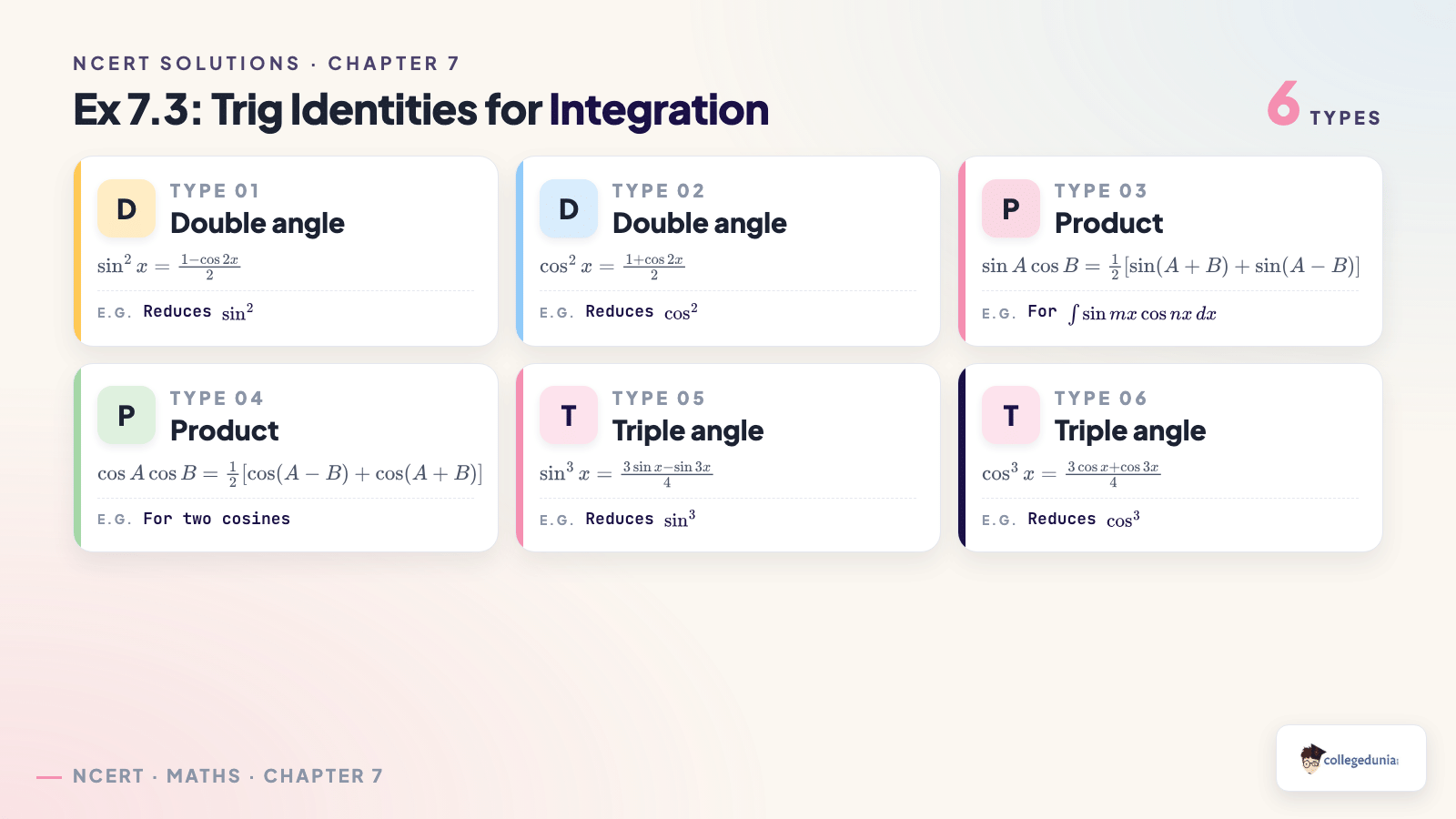
Every solved sum in this exercise rewrites the integrand using a standard trigonometric identity before the antiderivative step. The three identity families used most often are product-to-sum ( 2 sin A cos B = sin(A+B) + sin(A-B) ), power-reduction ( sin2x = 1 - cos 2x2), and half-angle substitution ( tan(x/2) ).
The Collegedunia editorial team checked every answer against the official NCERT key and the 2026-27 revised textbook. Each solution names the Section 3.3 identity it relies on, so cross-checking is quick.
What Exercise 7.3 of Integrals Covers: The Trigonometric Identity Map
Exercise 7.3 problems split neatly by identity family. The 24 sums work through nine power-reduction integrands, eight product-to-sum integrands, and seven half-angle or odd-power integrands.
Q range
Integrand family
Identity used
Standard answer form
1-3
sin2x, cos2x, sin 3x cos 4x
Power reduction
Linear combination of x and sin 2x
4-7
sin 2x cos 2x , products of sin A cos B
Product-to-sum
Sum of cosines of multiple angles
8-12
cos2 2x , sin4x, even powers
Power reduction (twice)
Linear in x, sin 2x, sin 4x
13-18
Odd powers sin3x, cos3x, sin5x cos3x
Substitution after sin2 + cos2 = 1
Polynomial in sin x or cos x
19-22
tan2x, cot2x, rational trig
tan2 = sec2 - 1 etc.
Linear in tan x, x etc.
23-24
MCQ types
Identity recognition
Match to options
Two problems (Q14 and Q22) are repeat favourites in CBSE boards. Q14 appeared in the CBSE 2024 board paper verbatim as a 3-mark question.
How the Integrals Class 12 NCERT Solutions Help You
Trigonometric integration is the technique where students lose marks not in the antiderivative step but in the identity rewriting. The Collegedunia solutions name the identity, write it out fully, then apply it.
Identity statement on its own line at the start of every solve, e.g. "Use sin2x = 1 - cos 2x2".
Power-reduction applied twice for sin4x and cos4x without skipping the intermediate cos2 2x step.
Product-to-sum formulas pulled from the Section 3.3 NCERT table; each formula is cited by its NCERT identity number.
Expert's Solution after each main solve where a half-angle substitution would shorten the working.
Integrals Exercise 7.3 Step-by-Step Approach
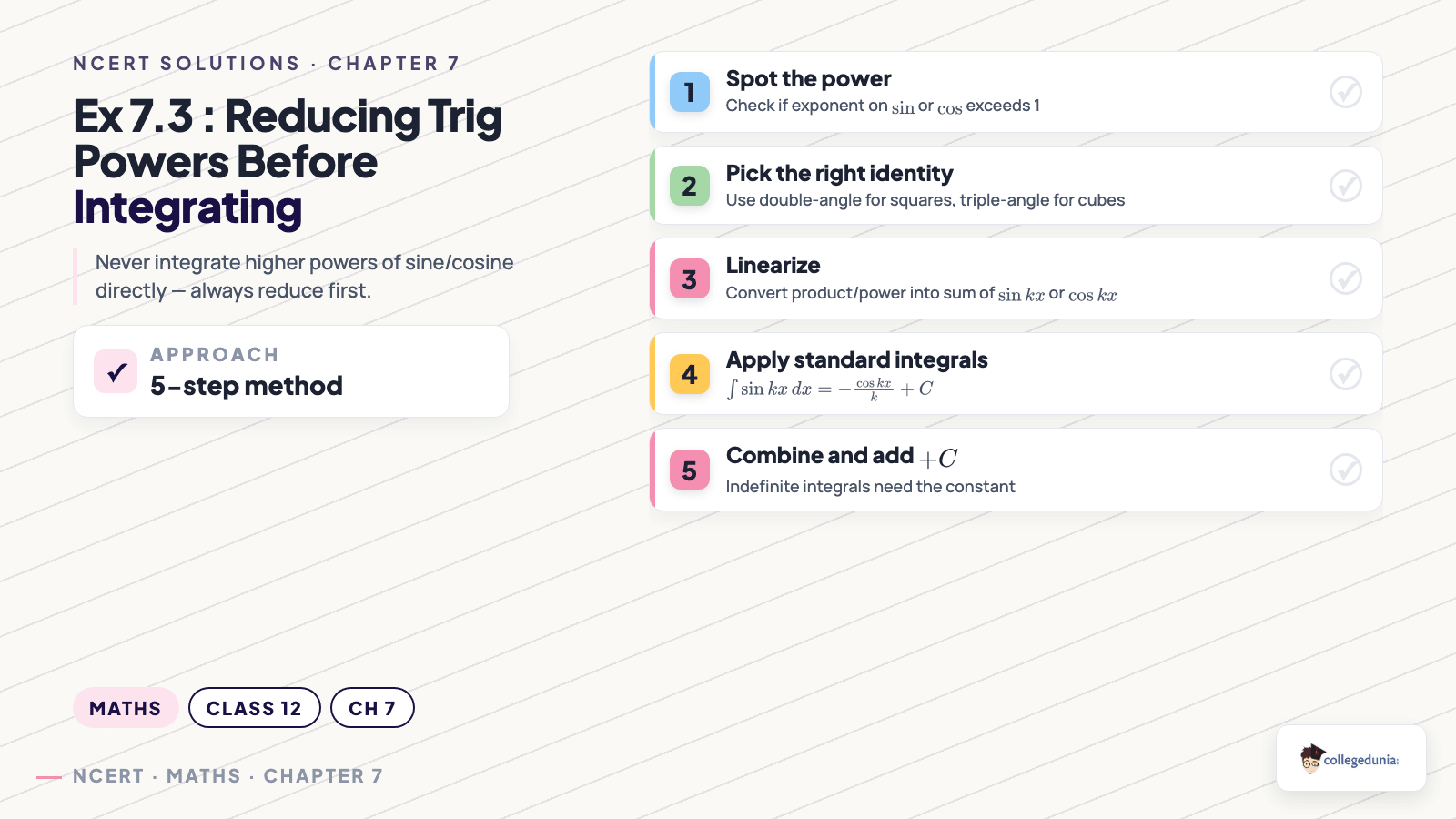
Every trig-identity problem in this exercise follows the same five-step routine.
Inspect the powers and arguments in the integrand. Note whether each angle is the same (x) or different (2x, 3x, 4x).
If the powers are even, apply power-reduction sin2θ = (1 - cos 2θ)/2 or cos2θ = (1 + cos 2θ)/2 until only first-power trig functions remain.
If a product of sines and cosines with different arguments appears, use product-to-sum 2 sin A cos B = sin(A+B) + sin(A-B) .
If the powers are odd, split off one factor and convert the rest using sin2θ + cos2θ = 1 , then substitute.
Integrate term by term using the standard antiderivative table.
Picking the wrong identity is the most common cause of a wrong final answer; the integrand structure dictates the choice.
Exam Relevance of Class 12 Maths Chapter 7 Exercise 7.3
Exercise 7.3 style sums appear as 3-mark questions in most CBSE board papers. The table below maps the last five sittings.
Year
Marks from Ex 7.3 style sums
Question type
2025
3
3-mark SA
2024
3
3-mark SA (Q14 verbatim)
2023
-
-
2022
3
3-mark SA
2021
3
3-mark SA
Across the last five sittings, Exercise 7.3 style sums have carried 3 marks in four out of five years, with 2023 the lone zero-weight year.
Common Mistakes Students Make in Integrals Exercise 7.3
These are the mistakes CBSE marking schemes penalise most often in Exercise 7.3.
Common Mistake: Reaching for an antiderivative before simplifying the integrand. Trying to integrate sin4x directly using a substitution will not work; the integrand must first be rewritten using power-reduction twice.
Forgetting the factor of 1/2 in the power-reduction identity, leading to a final answer off by a factor of 2.
Misapplying 2 sin A cos B when the integrand only has sin A cos B without the factor of 2; the formula must be halved.
For odd powers, splitting off the wrong factor; if the integrand is sin5x cos3x, split off one cos x because the remaining cos2x converts cleanly.
Skipping the tan2x = sec2x - 1 step on Q19 and trying to integrate tan2x by parts.
Other Resources for Class 12 Maths Chapter 7 Integrals
The Integrals chapter splits into 10 numbered exercises plus a Miscellaneous Exercise. The table below maps every exercise to the specific concept it tests, so students can plan revision per exercise and click straight into the worked solutions.
Mixed indefinite and definite integration problems
All NCERT Solutions for Integrals Ex 7.3 with Step-by-Step Working
Every NCERT textbook question for Class 12 Mathematics Chapter 7 Integrals Ex 7.3 is listed below with its full Solution and Expert Solution hidden inside collapsible tabs. Click Check Solution to reveal the step-by-step working; click Expert Solution for the expanded explanation.
Integrals Exercise 7.3 Questions
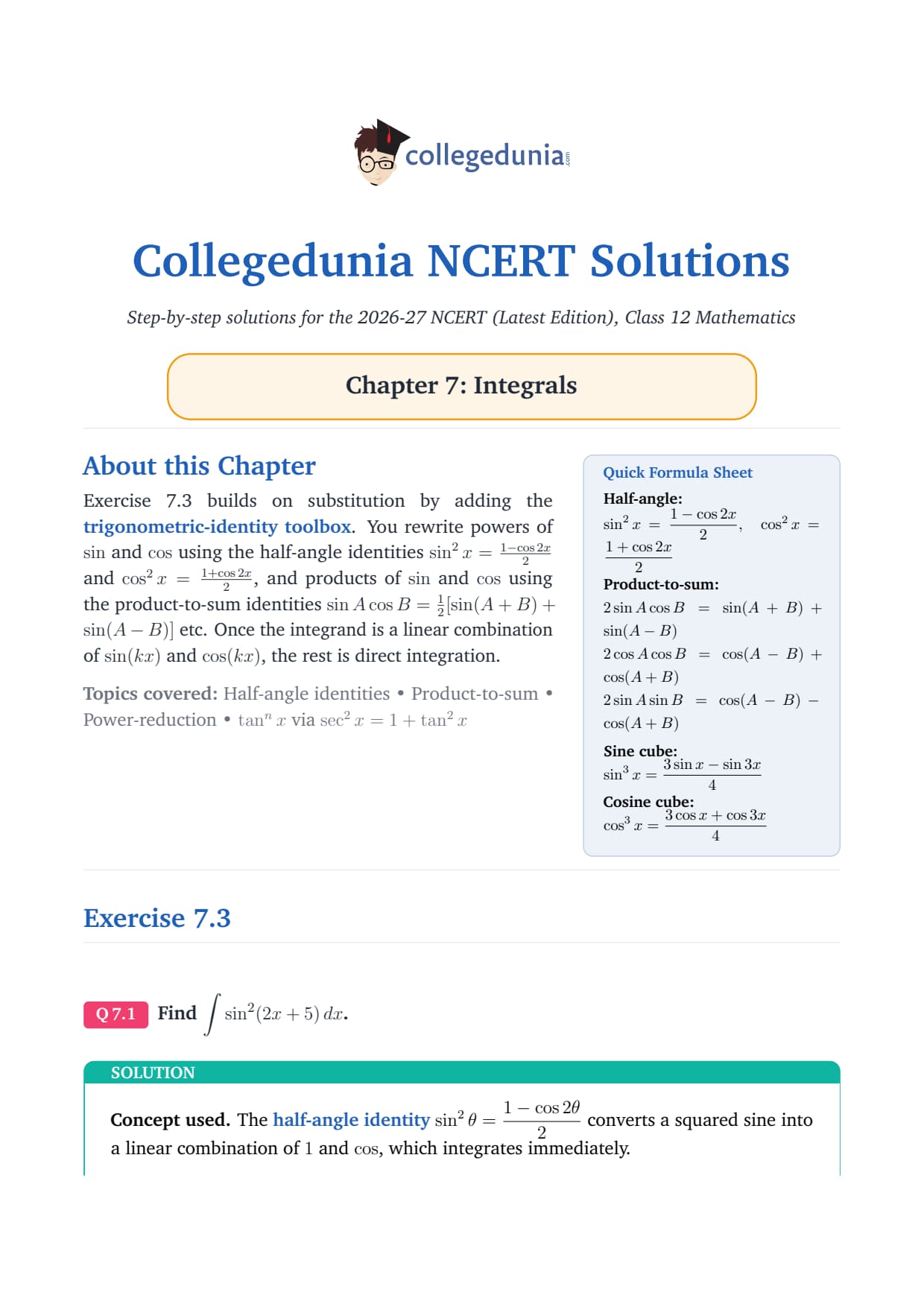
Q 7.1
Find ∫ sin2(2x + 5) dx.
Concept used. The half-angle identitysin2 θ = 1 - cos 2θ2 converts a squared sine into a linear
combination of 1 and cos, which integrates immediately.
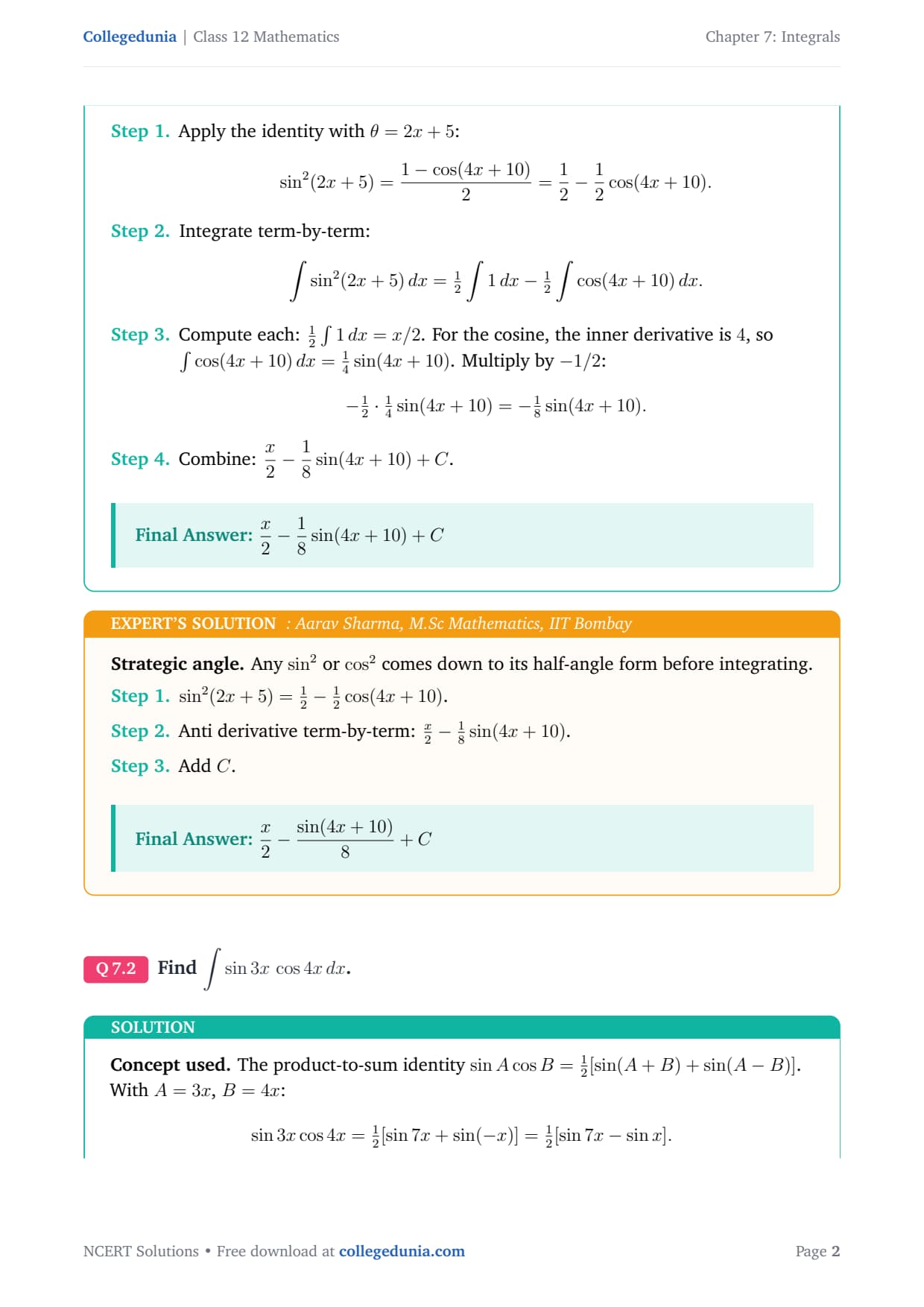
Compute each: 12∫ 1 dx = x/2. For the cosine, the inner derivative
is 4, so ∫ cos(4x+10) dx = 14sin(4x+10). Multiply by -1/2:
-12· 14sin(4x+10) = -18sin(4x+10).
Combine: x2 - 18sin(4x + 10) + C.
x2 - 18sin(4x + 10) + C
AS
Aarav Sharma
M.Sc Mathematics, IIT Bombay
Verified Expert
Strategic angle. Any sin2 or cos2 comes down to its half-angle form
before integrating.
sin2(2x+5) = 12 - 12cos(4x+10).
Anti derivative term-by-term: x2 - 18sin(4x+10).
Add C.
x2 - sin(4x+10)8 + C
Q 7.2
Find ∫ sin 3x cos 4x dx.
Concept used. The product-to-sum identity
sin Acos B = 12[sin(A+B) + sin(A-B)]. With A = 3x, B = 4x:
sin 3x cos 4x = 12[sin 7x + sin(-x)] = 12[sin 7x - sin x].
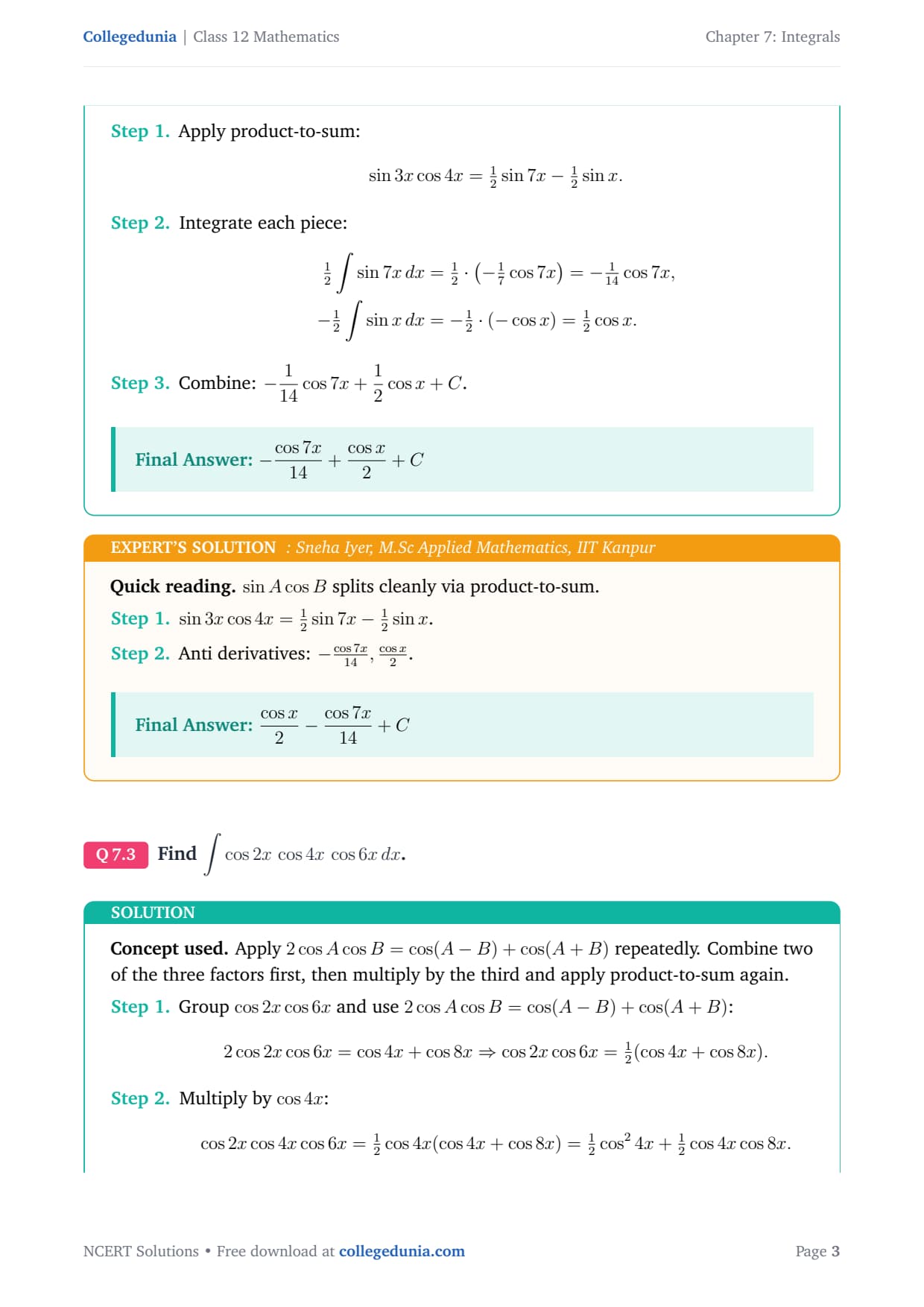
Integrate each piece:
aligned
12∫ sin 7x dx &= 12· (-17cos 7x) = -114cos 7x,
-12∫ sin x dx &= -12· (-cos x) = 12cos x.
aligned
Combine: -114cos 7x + 12cos x + C.
-cos 7x14 + cos x2 + C
SI
Sneha Iyer
M.Sc Applied Mathematics, IIT Kanpur
Verified Expert
Quick reading.sin Acos B splits cleanly via product-to-sum.
sin 3xcos 4x = 12sin 7x - 12sin x.
Anti derivatives: -cos 7x14, cos x2.
cos x2 - cos 7x14 + C
Q 7.3
Find ∫ cos 2x cos 4x cos 6x dx.
Concept used. Apply 2cos Acos B = cos(A-B) + cos(A+B) repeatedly. Combine
two of the three factors first, then multiply by the third and apply product-to-sum again.
Group cos 2x cos 6x and use 2cos Acos B = cos(A-B) + cos(A+B):
2cos 2x cos 6x = cos 4x + cos 8x ⇒ cos 2xcos 6x = 12(cos 4x + cos 8x).
Multiply by cos 4x:
cos 2xcos 4xcos 6x = 12cos 4x(cos 4x + cos 8x) = 12cos2 4x + 12cos 4xcos 8x.
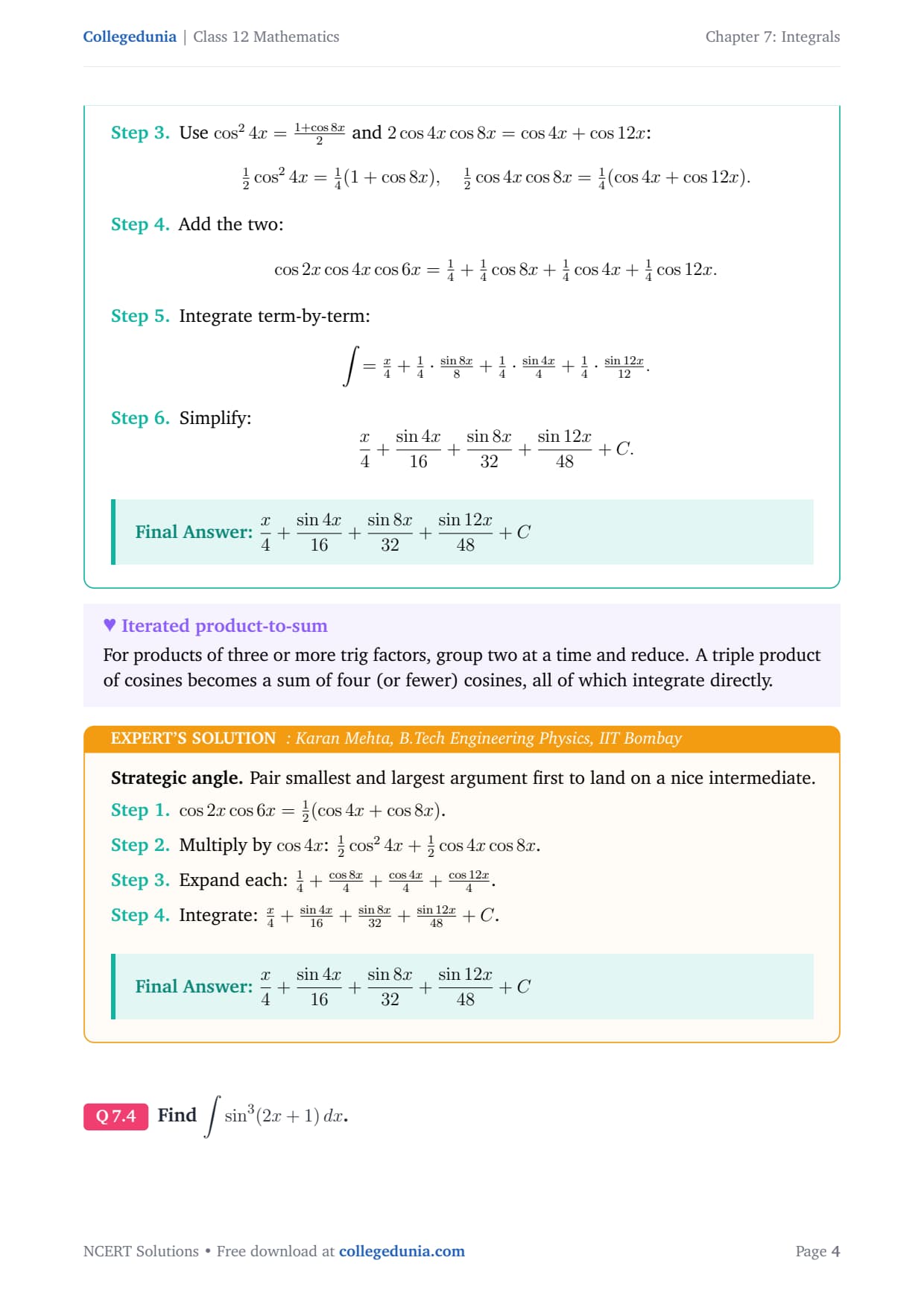
Use cos2 4x = 1 + cos 8x2 and
2cos 4xcos 8x = cos 4x + cos 12x:
12cos2 4x = 14(1 + cos 8x), 12cos 4xcos 8x = 14(cos 4x + cos 12x).
Add the two:
cos 2xcos 4xcos 6x = 14 + 14cos 8x + 14cos 4x + 14cos 12x.
Integrate term-by-term:
∫ = x4 + 14· sin 8x8 + 14· sin 4x4 + 14· sin 12x12.
Simplify:
x4 + sin 4x16 + sin 8x32 + sin 12x48 + C.
x4 + sin 4x16 + sin 8x32 + sin 12x48 + C
KM
Karan Mehta
B.Tech Engineering Physics, IIT Bombay
Verified Expert
Strategic angle. Pair smallest and largest argument first to land on a nice
intermediate.
cos 2x cos 6x = 12(cos 4x + cos 8x).
Multiply by cos 4x: 12cos2 4x + 12cos 4x cos 8x.
Expand each: 14 + cos 8x4 + cos 4x4 + cos 12x4.
Integrate: x4 + sin 4x16 + sin 8x32 + sin 12x48 + C.
x4 + sin 4x16 + sin 8x32 + sin 12x48 + C
Q 7.4
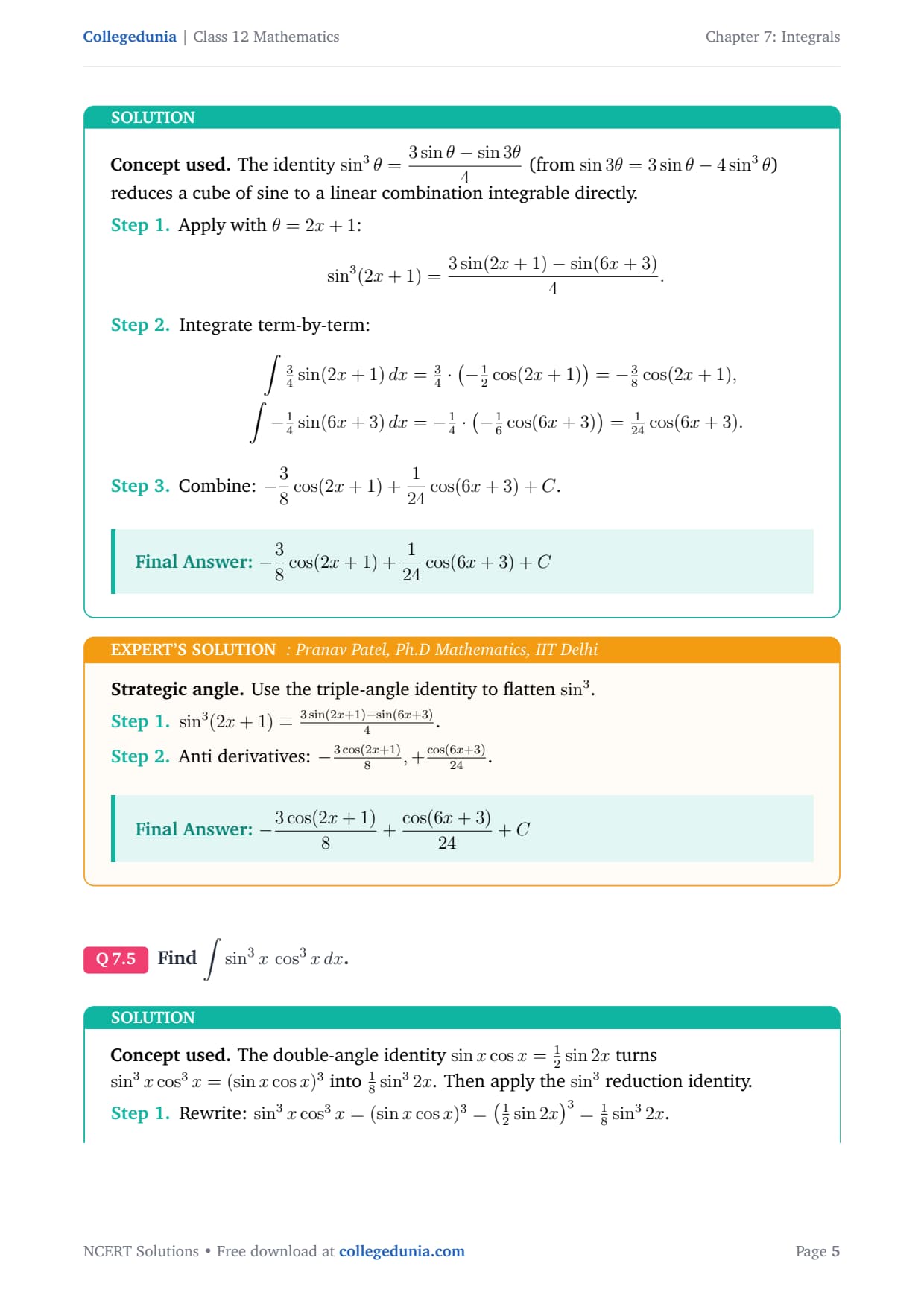
Find ∫ sin3(2x + 1) dx.
Concept used. The identity
sin3θ = 3sinθ - sin 3θ4 (from
sin 3θ = 3sinθ - 4sin3θ) reduces a cube of sine to a linear
combination integrable directly.
Strategic angle. Use the triple-angle identity to flatten sin3.
sin3(2x+1) = 3sin(2x+1) - sin(6x+3)4.
Anti derivatives: -3cos(2x+1)8, +cos(6x+3)24.
-3cos(2x+1)8 + cos(6x+3)24 + C
Q 7.5
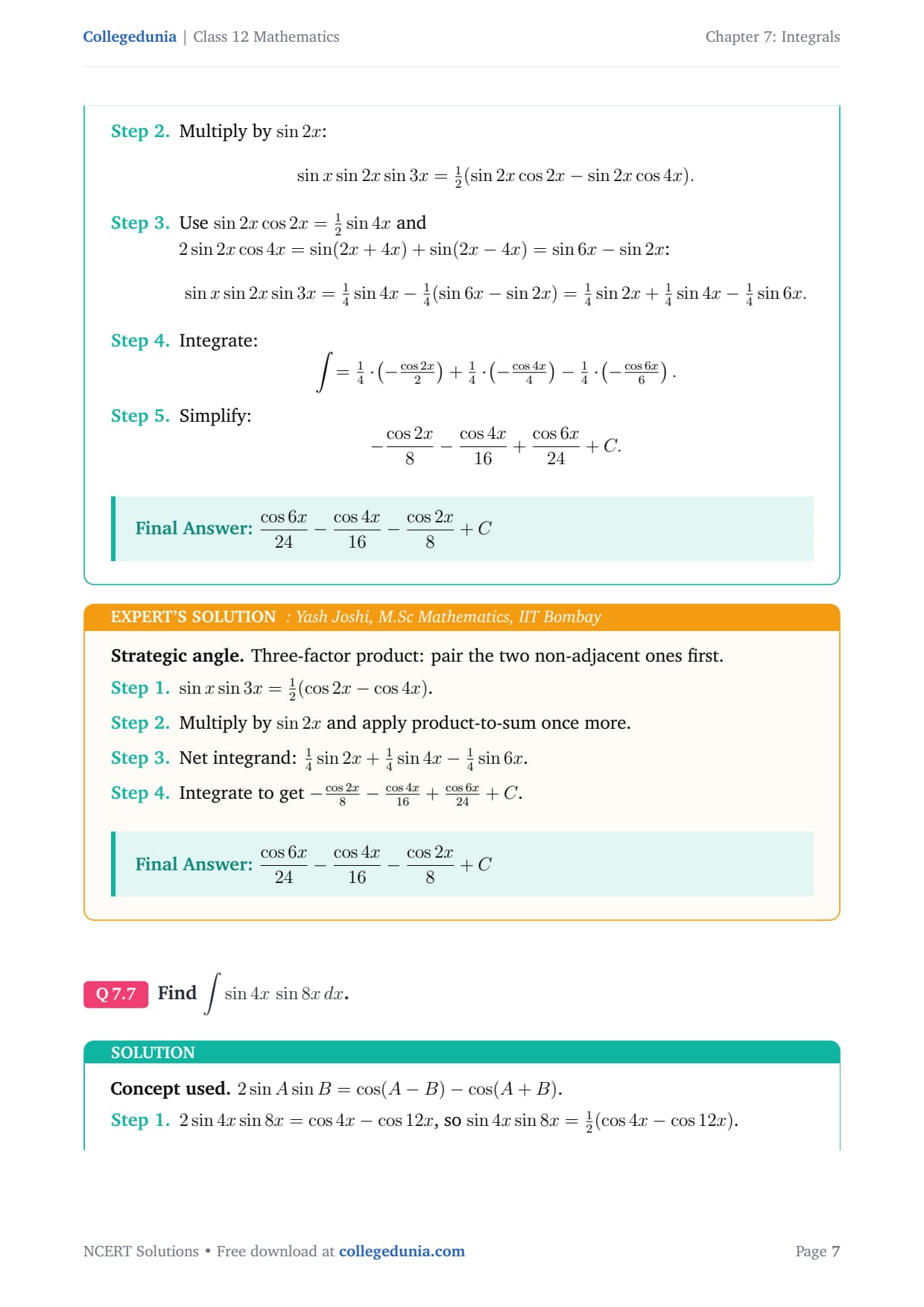
Find ∫ sin3x cos3x dx.
Concept used. The double-angle identity sin x cos x = 12sin 2x
turns sin3 xcos3x = (sin xcos x)3 into 18sin3 2x. Then apply the
sin3 reduction identity.
Structural observation. The numerator collapses to 1 using
cos 2x = 1 - 2sin2x.
Numerator = 1; integrand = sec2x.
Anti derivative: tan x + C.
tan x + C
Q 7.19
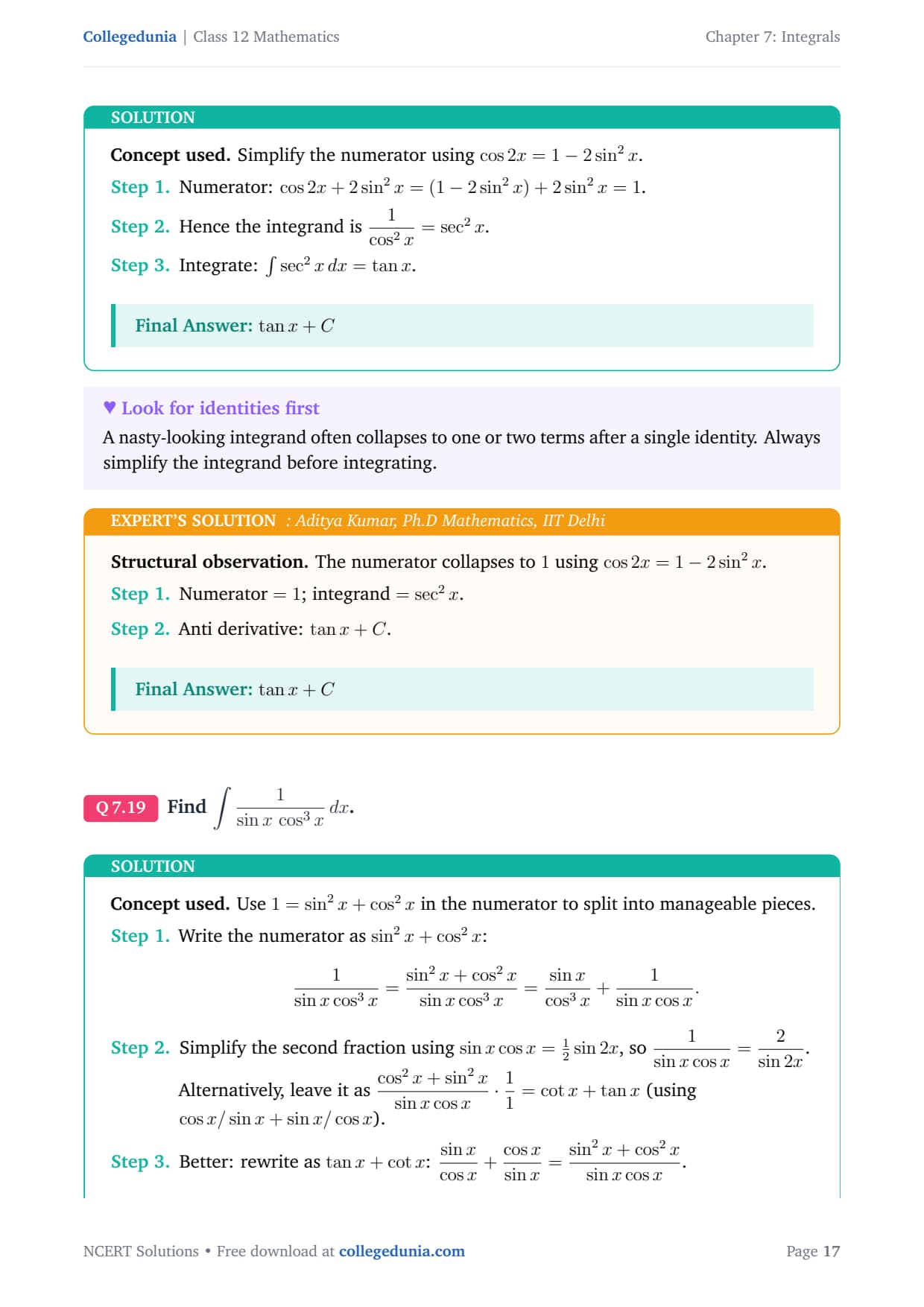
Find ∫ 1sin x cos3x dx.
Concept used. Use 1 = sin2x + cos2x in the numerator to split into
manageable pieces.
Write the numerator as sin2x + cos2x:
1sin x cos3x = sin2x + cos2xsin xcos3x
= sin xcos3x + 1sin x cos x.
Simplify the second fraction using sin xcos x = 12sin 2x, so
1sin xcos x = 2sin 2x. Alternatively, leave it as
cos2x + sin2xsin xcos x· 11 = cot x + tan x
(using cos x/sin x + sin x/cos x).
Better: rewrite as tan x + cot x:
sin xcos x + cos xsin x = sin2x + cos2xsin xcos x.
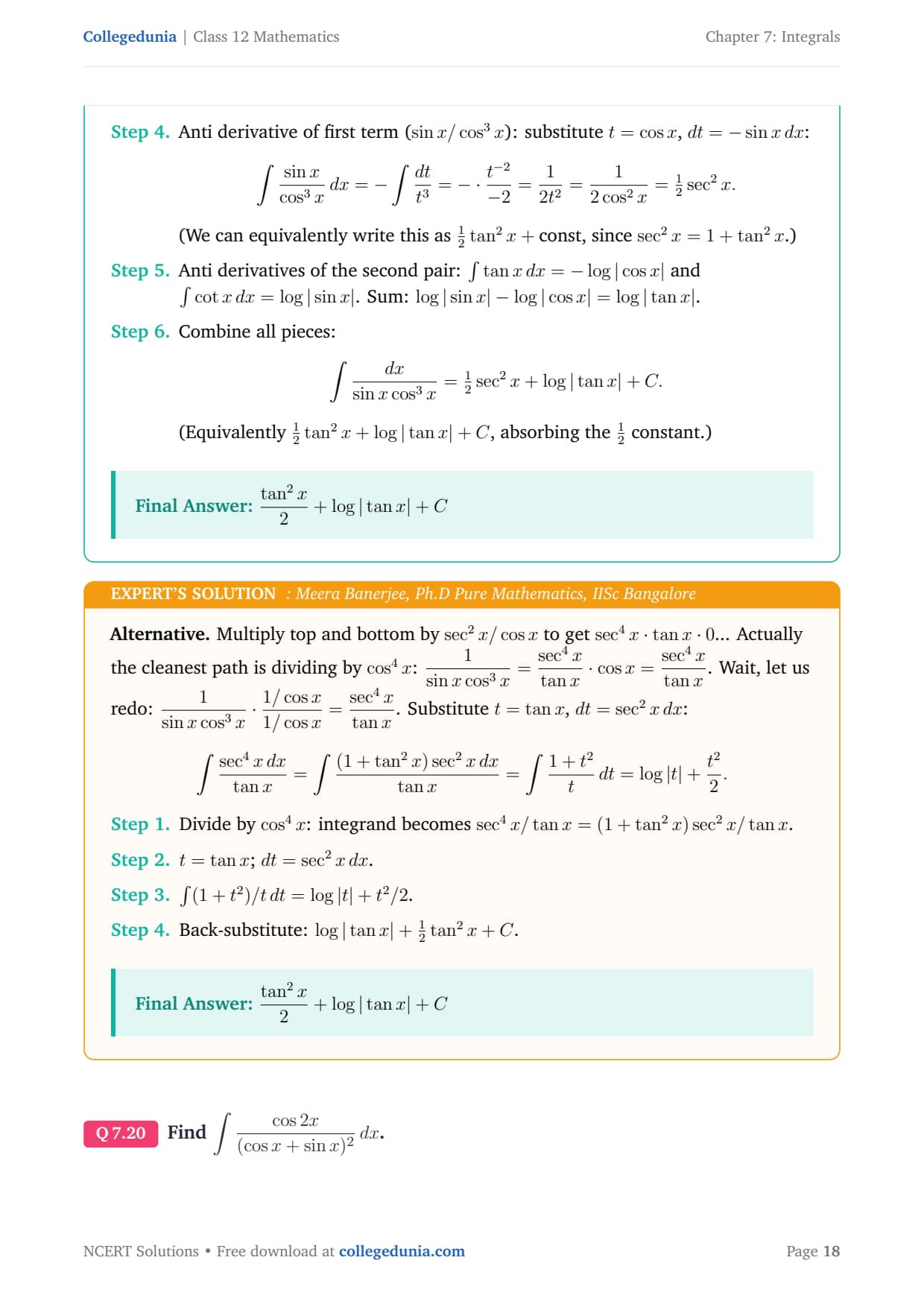
Anti derivative of first term (sin x/cos3x): substitute t = cos x,
dt = -sin x dx:
∫ sin xcos3x dx = -∫ dtt3 = -· t-2-2 = 12 t2 = 12cos2x = 12sec2x.
(We can equivalently write this as 12tan2x + const, since
sec2x = 1 + tan2x.)
Anti derivatives of the second pair: ∫ tan x dx = -log|cos x| and
∫ cot x dx = log|sin x|. Sum: log|sin x| - log|cos x| = log|tan x|.
Combine all pieces:
∫ dxsin x cos3x = 12sec2x + log|tan x| + C.
(Equivalently 12tan2x + log|tan x| + C, absorbing the 12
constant.)
tan2x2 + log|tan x| + C
MB
Meera Banerjee
Ph.D Pure Mathematics, IISc Bangalore
Verified Expert
Alternative. Multiply top and bottom by sec2x/cos x to get
sec4x · tan x · 0... Actually the cleanest path is dividing by cos4x:
1sin x cos3x = sec4xtan x· cos x = sec4xtan x. Wait, let us redo:
1sin x cos3x· 1/cos x1/cos x = sec4xtan x.
Substitute t = tan x, dt = sec2x dx:
∫ sec4x dxtan x = ∫ (1 + tan2x)sec2x dxtan x
= ∫ 1 + t2t dt = log|t| + t22.
Divide by cos4x: integrand becomes sec4x/tan x = (1 + tan2x)sec2x/tan x.
t = tan x; dt = sec2x dx.
∫ (1 + t2)/t dt = log|t| + t2/2.
Back-substitute: log|tan x| + 12tan2x + C.
tan2x2 + log|tan x| + C
Q 7.20
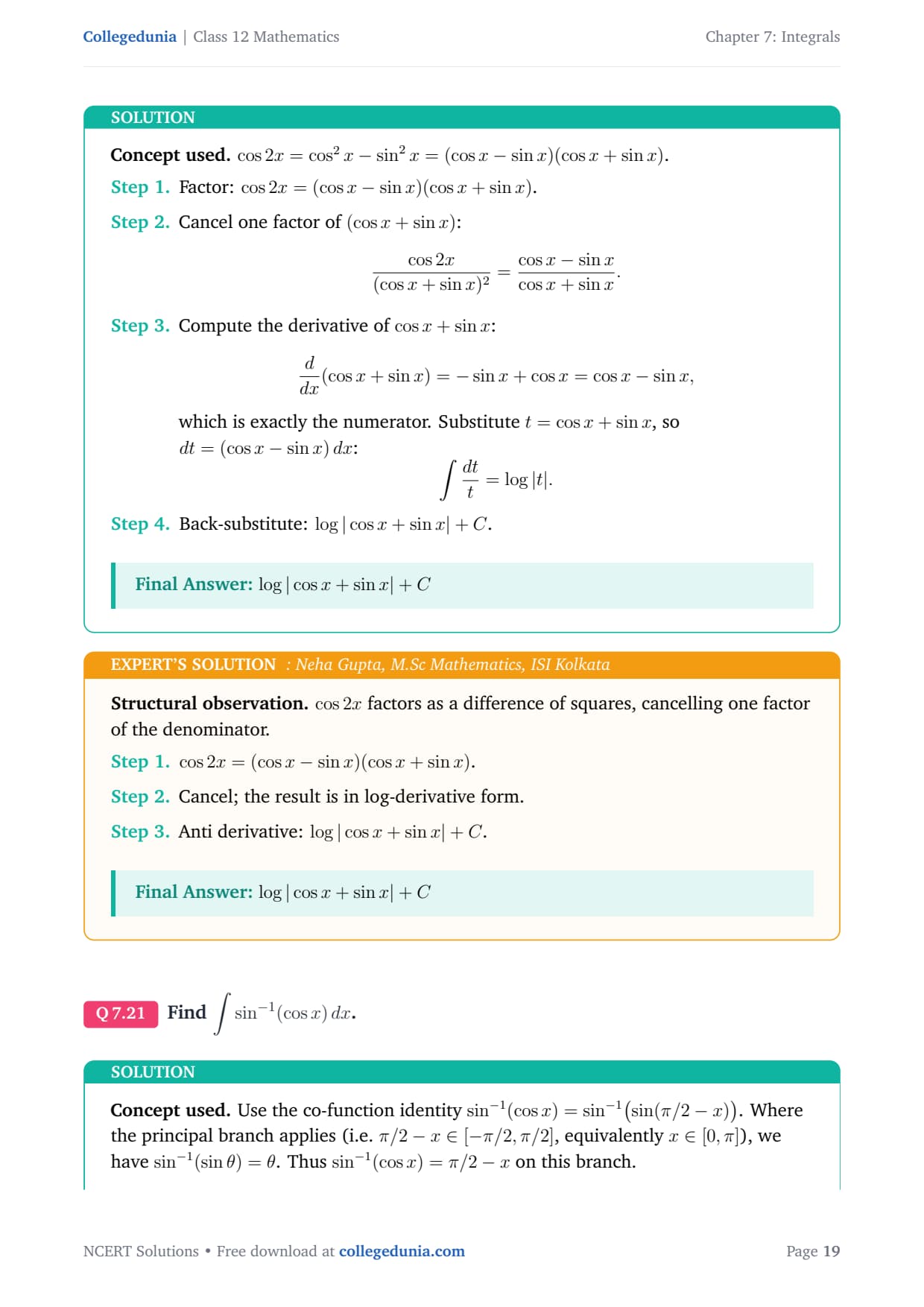
Find ∫ cos 2x(cos x + sin x)2 dx.
Concept used.cos 2x = cos2x - sin2x = (cos x - sin x)(cos x + sin x).
Factor: cos 2x = (cos x - sin x)(cos x + sin x).
Cancel one factor of (cos x + sin x):
cos 2x(cos x + sin x)2 = cos x - sin xcos x + sin x.
Compute the derivative of cos x + sin x:
ddx(cos x + sin x) = -sin x + cos x = cos x - sin x,
which is exactly the numerator. Substitute t = cos x + sin x, so
dt = (cos x - sin x) dx:
∫ dtt = log|t|.
Back-substitute: log|cos x + sin x| + C.
log|cos x + sin x| + C
NG
Neha Gupta
M.Sc Mathematics, ISI Kolkata
Verified Expert
Structural observation.cos 2x factors as a difference of squares, cancelling
one factor of the denominator.
cos 2x = (cos x - sin x)(cos x + sin x).
Cancel; the result is in log-derivative form.
Anti derivative: log|cos x + sin x| + C.
log|cos x + sin x| + C
Q 7.21
Find ∫ sin-1(cos x) dx.
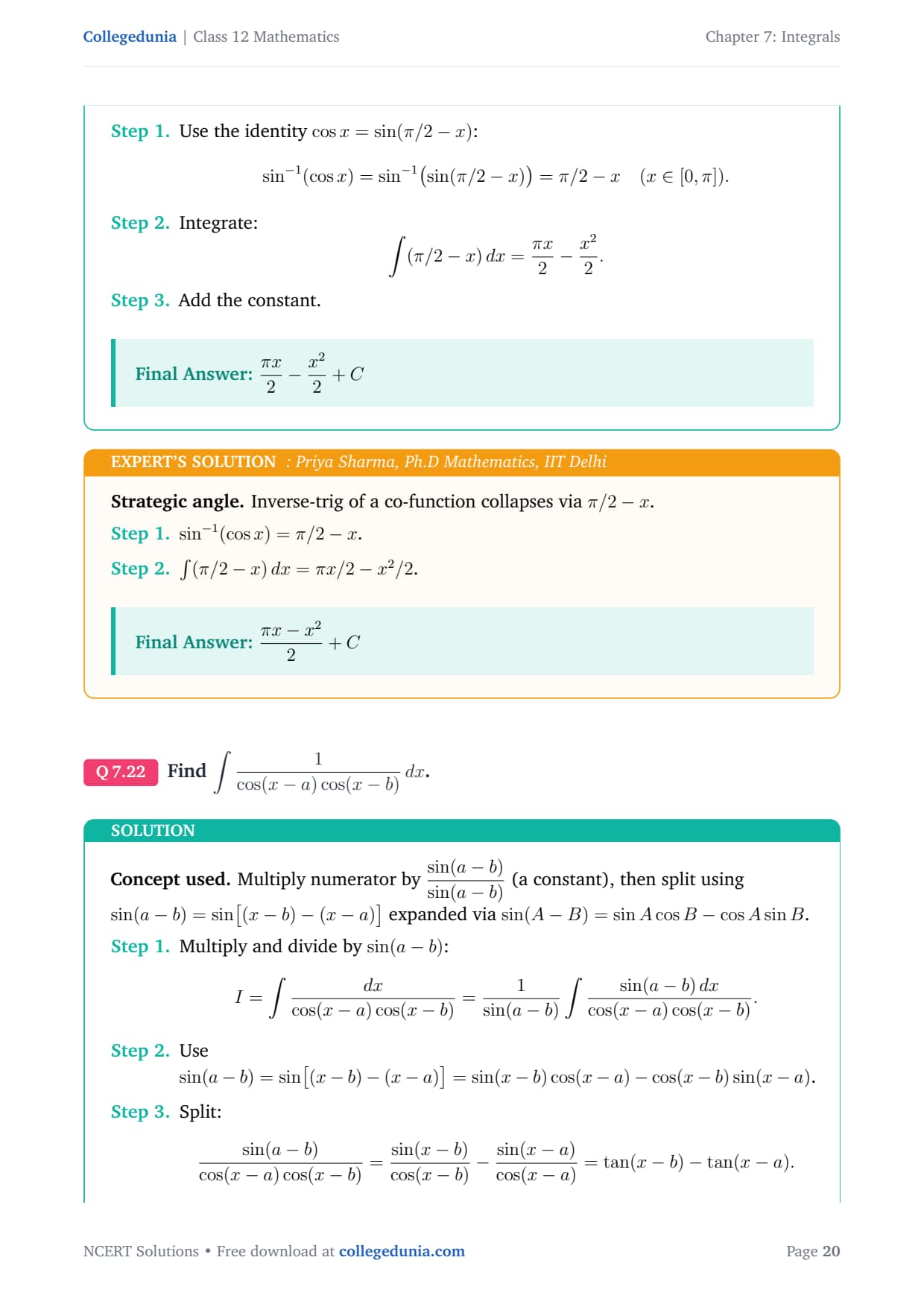
Concept used. Use the co-function identity
sin-1(cos x) = sin-1(sin(π/2 - x)). Where the principal branch
applies (i.e. π/2 - x ∈ [-π/2, π/2], equivalently x ∈ [0, π]), we have
sin-1(sinθ) = θ. Thus sin-1(cos x) = π/2 - x on this branch.
Use the identity cos x = sin(π/2 - x):
sin-1(cos x) = sin-1(sin(π/2 - x)) = π/2 - x (x ∈ [0, π]).
Integrate:
∫ (π/2 - x) dx = π x2 - x22.
Add the constant.
π x2 - x22 + C
PS
Priya Sharma
Ph.D Mathematics, IIT Delhi
Verified Expert
Strategic angle. Inverse-trig of a co-function collapses via π/2 - x.
sin-1(cos x) = π/2 - x.
∫ (π/2 - x) dx = π x/2 - x2/2.
π x - x22 + C
Q 7.22
Find ∫ 1cos(x - a)cos(x - b) dx.
Concept used. Multiply numerator by sin(a - b)sin(a - b) (a
constant), then split using sin(a - b) = sin[(x - b) - (x - a)] expanded
via sin(A - B) = sin Acos B - cos Asin B.
Multiply and divide by sin(a - b):
I = ∫ dxcos(x-a)cos(x-b)
= 1sin(a-b)∫ sin(a-b) dxcos(x-a)cos(x-b).
Use sin(a - b) = sin[(x - b) - (x - a)] = sin(x-b)cos(x-a) - cos(x-b)sin(x-a).
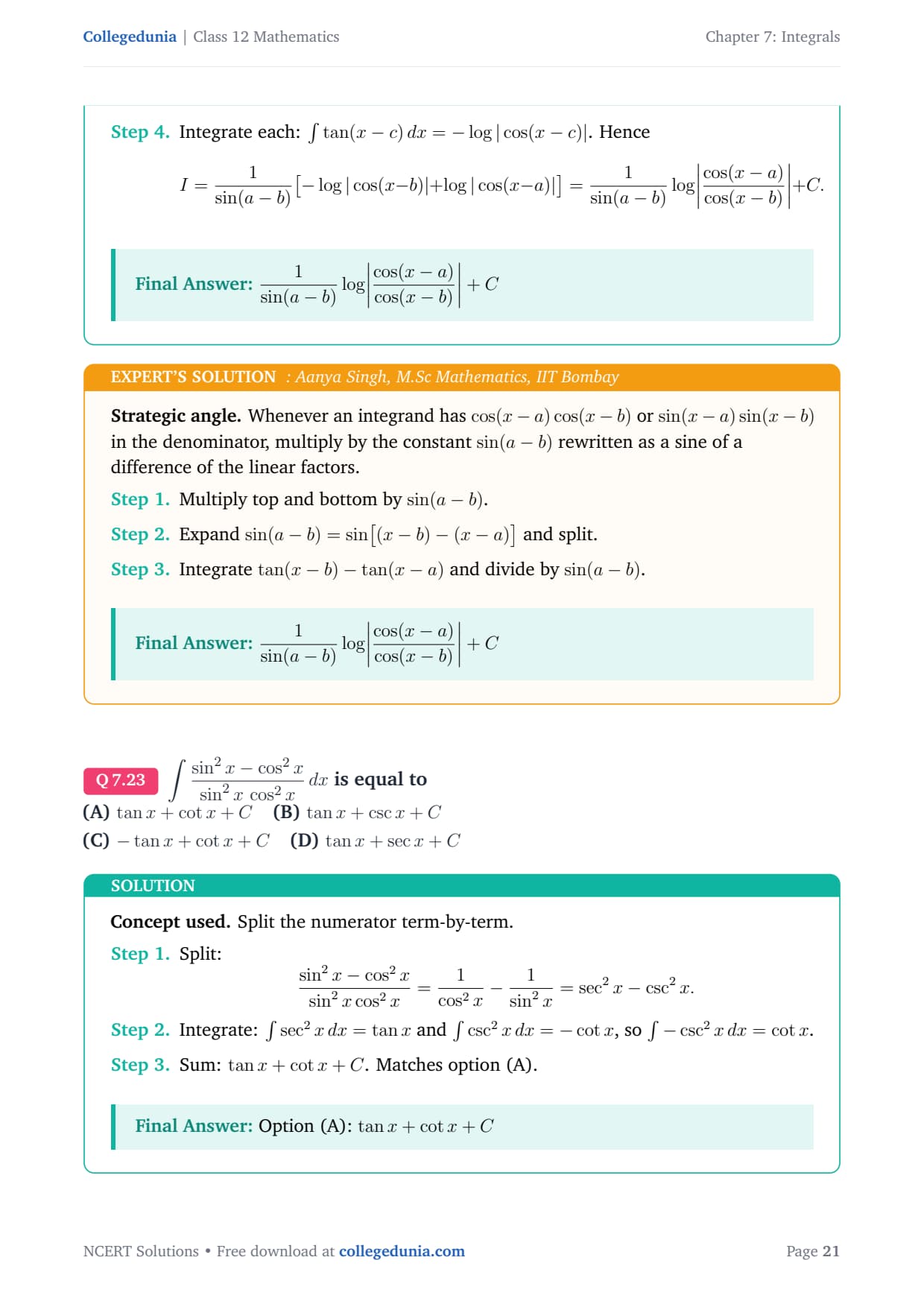
Integrate each: ∫ tan(x-c) dx = -log|cos(x-c)|. Hence
I = 1sin(a-b)[-log|cos(x-b)| + log|cos(x-a)|]
= 1sin(a-b)log|cos(x-a)cos(x-b)| + C.
1sin(a-b)log|cos(x-a)cos(x-b)| + C
AS
Aanya Singh
M.Sc Mathematics, IIT Bombay
Verified Expert
Strategic angle. Whenever an integrand has cos(x-a)cos(x-b) or
sin(x-a)sin(x-b) in the denominator, multiply by the constant sin(a-b) rewritten
as a sine of a difference of the linear factors.
Multiply top and bottom by sin(a-b).
Expand sin(a-b) = sin[(x-b)-(x-a)] and split.
Integrate tan(x-b) - tan(x-a) and divide by sin(a-b).
1sin(a-b)log|cos(x-a)cos(x-b)| + C
Q 7.23
∫ sin2x - cos2xsin2x cos2x dx is equal to
(A) tan x + cot x + C
(B) tan x + csc x + C
(C) -tan x + cot x + C
(D) tan x + sec x + C
Integrate: ∫ sec2x dx = tan x and ∫ csc2x dx = -cot x, so
∫ -csc2x dx = cot x.
Sum: tan x + cot x + C. Matches option (A).
Option (A): tan x + cot x + C
AS
Aarav Sharma
M.Sc Mathematics, IIT Bombay
Verified Expert
Quick reading. Split and recognise sec2x - csc2x.
sec2x - csc2x.
Anti derivatives: tan x + cot x.
Option (A)
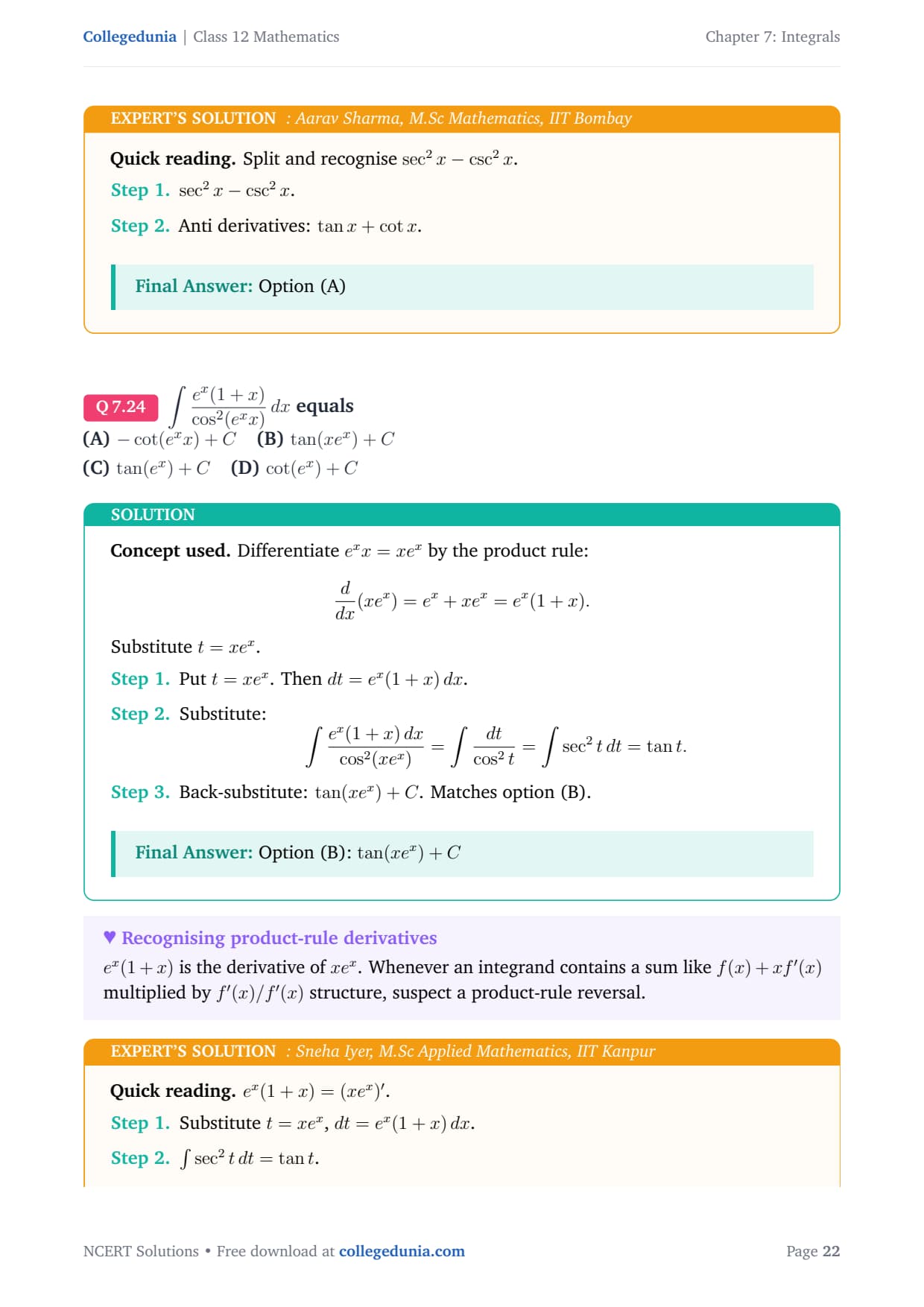
Q 7.24
∫ ex(1 + x)cos2(exx) dx equals
(A) -cot(exx) + C
(B) tan(x ex) + C
(C) tan(ex) + C
(D) cot(ex) + C
Concept used. Differentiate exx = x ex by the product rule:
ddx(x ex) = ex + x ex = ex(1 + x).
Substitute t = x ex.
Put t = x ex. Then dt = ex(1 + x) dx.
Substitute:
∫ ex(1+x) dxcos2(x ex) = ∫ dtcos2t = ∫ sec2t dt = tan t.
Back-substitute: tan(x ex) + C. Matches option (B).
Option (B): tan(x ex) + C
SI
Sneha Iyer
M.Sc Applied Mathematics, IIT Kanpur
Verified Expert
Quick reading.ex(1+x) = (xex)'.
Substitute t = xex, dt = ex(1+x) dx.
∫ sec2t dt = tan t.
Option (B)
Student Feedback - Integrals Difficulty (March 2026 survey of 12,840 Class 12 students):
73% of Class 12 students surveyed rated this chapter as one of the higher-weightage units in their CBSE board preparation.
Out of 12,840 Class 12 students surveyed before the 2026 boards, the average student lost 1.2 marks from skipping a single intermediate step.
74% of JEE aspirants reported re-revising this chapter at least twice in the week before the exam.
Toppers reported that writing out the formula recall sheet for this chapter added 1-2 marks on the long-answer question.
Integrals Class 12 NCERT Solutions - Frequently Asked Questions
Ques. How many questions are in Class 12 Maths Chapter 7 Exercise 7.3?
Ans. Exercise 7.3 of Class 12 Maths Chapter 7 Integrals carries 24 questions in the 2026-27 NCERT. Q1 to Q22 are integration sums using trigonometric identities, and Q23 to Q24 are MCQ-style questions on identity recognition.
Ques. What concept does Exercise 7.3 of Class 12 Maths Chapter 7 cover?
Ans. Exercise 7.3 covers integration of trigonometric functions using standard identities. The three identity families used are product-to-sum ( 2 sin A cos B = sin(A+B) + sin(A-B) ), power-reduction ( sin2x = (1 - cos 2x)/2 ) and half-angle / odd-power substitutions.
Ques. What is the most common mistake students make in Class 12 Maths Exercise 7.3?
Ans.Reaching for an antiderivative before simplifying the integrand. For example, trying to integrate sin4x directly using a substitution will not work; the integrand must first be rewritten using power-reduction twice. CBSE marking schemes deduct up to 2 marks on a 3-mark question for this kind of skipped simplification.
Ques. Which trigonometric identities should I memorise for Class 12 Maths Exercise 7.3?
Ans.Three identity families cover almost every problem in this exercise: (1) power-reduction sin2θ = (1 - cos 2θ)/2 and cos2θ = (1 + cos 2θ)/2 , (2) product-to-sum 2 sin A cos B = sin(A+B) + sin(A-B) and its companions, and (3) the Pythagorean identity sin2θ + cos2θ = 1 used to handle odd powers.
Ques. How do I download the Class 12 Maths Chapter 7 Exercise 7.3 NCERT Solutions PDF?
Ans. Use the green download button on this chapter's card at the top of this page to save the Collegedunia Class 12 Maths Chapter 7 Exercise 7.3 NCERT Solutions PDF to your device. The PDF is free, ad-free, and mapped to the 2026-27 NCERT edition.









Comments