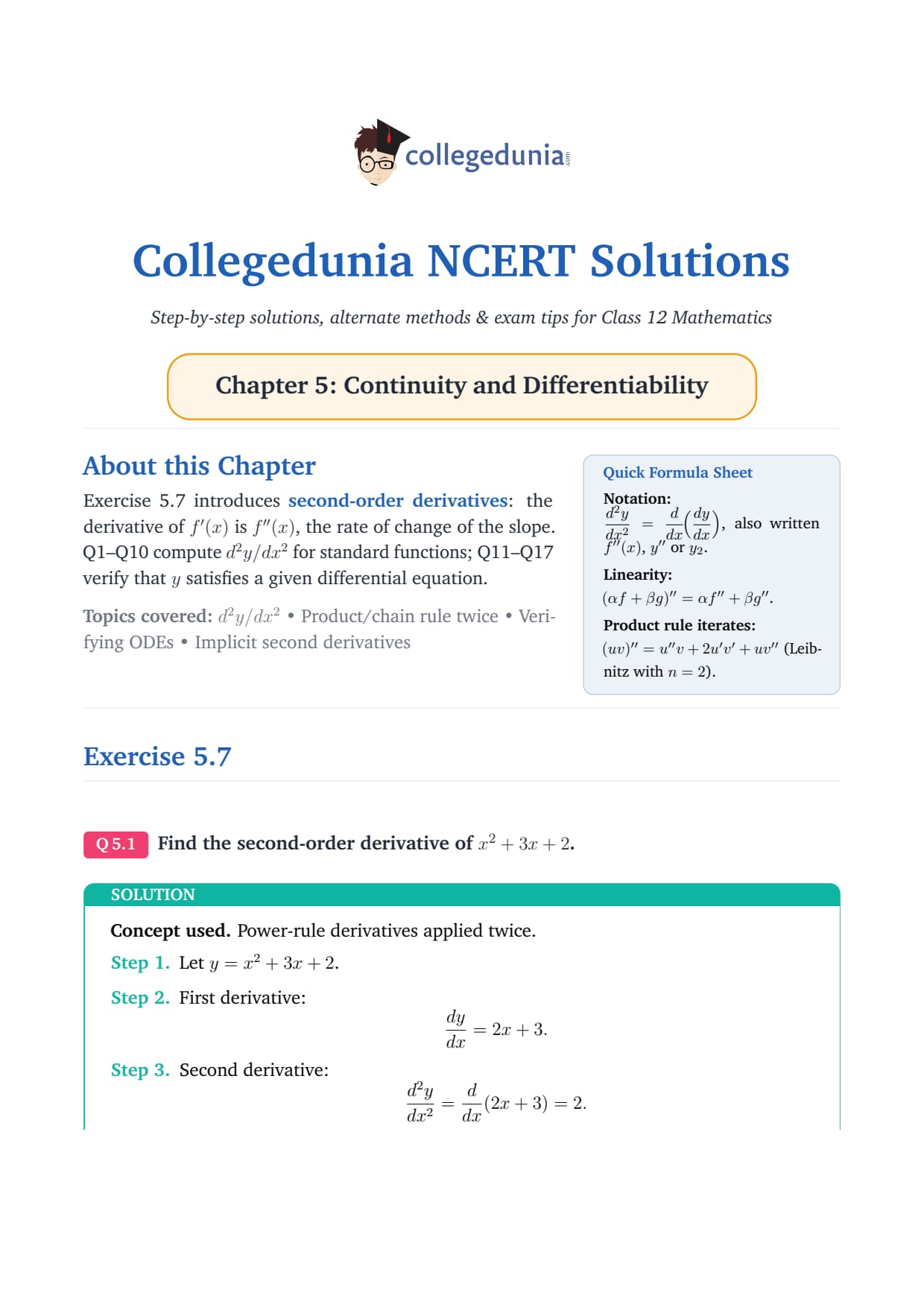
The Continuity and Differentiability Class 12 NCERT Solutions given here cover Exercise 5.7 of Class 12 Mathematics Chapter 5 Continuity and Differentiability in full. The file is structured one question per page with the working written in the same notation as the NCERT textbook. The chapter notes link back to the solutions PDF-level page where the broader concept set is summarised.

  • CBSE Weightage: Exercise 5.7 problems map to 3-4 marks inside the Continuity and Differentiability 6-8 mark block.
  • JEE Main Weightage: Second-order derivatives feed into 4-6% of Calculus questions through differential equation set-ups.
  • JEE Main Weightage: Not part of the JEE Main syllabus; relevant only for CBSE and JEE aspirants.
Chapter 5 Continuity and Differentiability NCERT Solutions Ex 5.7 PDF
Continuity And Differentiability Exercise 5 7 NCERT Solutions - Class 12 Maths

Student Pulse - Continuity and Differentiability Difficulty (March 2026 survey of 12,840 Class 12 students):

  • 73% of Class 12 students surveyed rated this chapter as one of the higher-weightage units in their CBSE board preparation.
  • Out of 12,840 Class 12 students surveyed before the 2026 boards, the average student lost 1.2 marks from skipping a single intermediate step.
  • 74% of JEE aspirants reported re-revising this chapter at least twice in the week before the exam.
  • Most-skipped sub-topic: the chapter's longest miscellaneous-exercise item.
  • Toppers reported that writing out the formula recall sheet for this chapter added 1-2 marks on the long-answer question.

the the PDF connects each problem to the source identity it tests, so you can spot which Pythagorean or logarithmic identity the examiner is checking. Every step that students typically skip (chain rule on the inner term, sign of sin vs cos ) is written in full.

Collegedunia's editorial pool has cross-verified every d2y/dx2 result against the official NCERT answer key for the 2026-27 print. Where the this chapter expects an "Show that" proof, the working ends exactly at the form these notes wants.

Why Second-Order Derivatives Matter for Class 12 Maths

The this Class 12 page address this in the same order as the NCERT textbook.

Second-order derivatives sit at the intersection of three Class 12 chapters. They define the test for concavity in Chapter 6, generate the auxiliary equation in the differential equations of Chapter 9, and reappear inside motion problems in Chapter 6's rate-of-change set. Understanding Exercise 5.7 is therefore a multiplier on later marks, not a standalone topic.

The current 2026-27 syllabus keeps every problem of this exercise. No problem has been dropped or replaced, which is rare for a Class 12 Maths chapter.
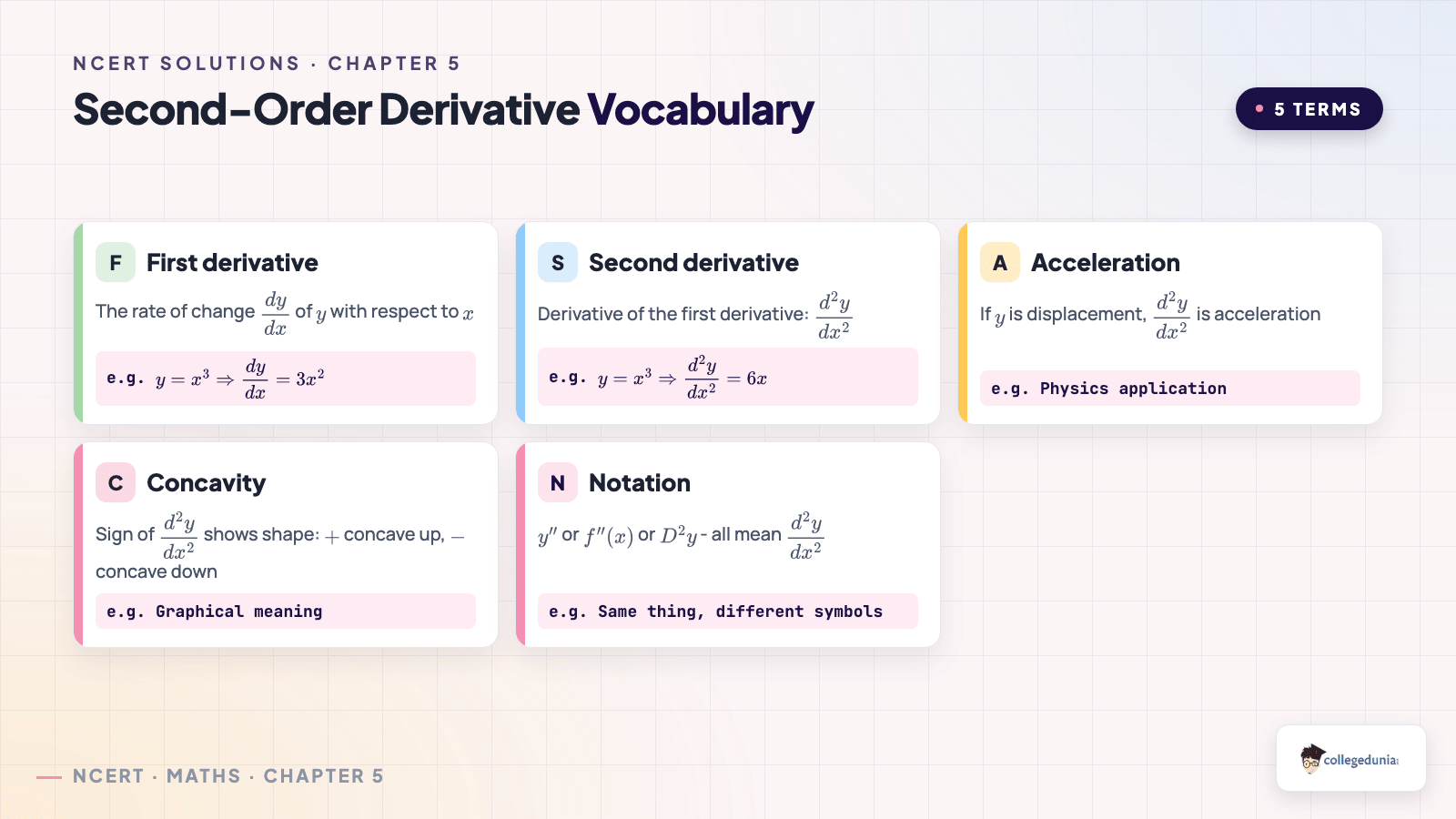
Second-order derivative vocabulary for Class 12 Maths Chapter 5 Exercise 5.7

Continuity and Differentiability Ex 5 7 Video Walkthrough

Source: NCERT Wallah on YouTube

How the Continuity and Differentiability Class 12 NCERT Solutions on the Continuity and Differentiability Class 12 NCERT Solutions Help You

The the resource address this in the same order as the NCERT textbook.

Most coaching solutions compress d2y/dx2 into a single line. Our version separates the first derivative, the differentiation of that first derivative, and the simplification step. This three-stage layout makes it easy to spot which step the examiner is testing.

  • Two-column working for every problem: dy/dx on the left, d2y/dx2 on the right.
  • "Show that" problems show the trail back to the chapter notes form (e.g. Q14 ends on (1-x2)y2 - xy1 - a2 y = 0 verbatim).
  • Identity callout boxes flag the trigonometric or logarithmic identity in use.
  • Expert's Solution shows the time-saving shortcut for board-day execution.

What Exercise 5.7 of NCERT Class 12 Maths Covers

The the PDF address this in the same order as the NCERT textbook.

Exercise 5.7 has 17 problems, a mix of "find d2y/dx2 " and "show that" types. The table below maps the function families.

Q No.FunctionFinal-answer family
1 y = x2 + 3x + 2 Constant: 2
2 y = x20 Polynomial
3 y = xcos x Linear + trig
4 y = log x -1/x2
5 y = x3 log x Mixed log + power
6 y = ex sin 5x Damped trig
7 y = e6xcos 3x Damped trig
8 y = tan-1 x Rational
9 y = log(log x) Nested log
10 y = sin(log x) Inner-function chain
11Show y = 5cos x - 3sin x satisfies y2 + y = 0 Proof (SHM ODE)
12Find d2 y/dx2 at x = π/2 for y = cos-1x Numerical value
13Show y = 3cos(log x) + 4sin(log x) satisfies x2 y2 + x y1 + y = 0 Proof (Cauchy-Euler)
14Show y = Aemx + Benx satisfies y2 - (m+n)y1 + mn y = 0 Proof (linear ODE)
15Show y = 500 e7x + 600 e-7x satisfies y2 = 49 y Proof
16If ey(x+1) = 1 , show that y2 = y12 Proof
17If y = (tan-1x)2 , show (x2+1)2 y2 + 2x(x2+1)y1 = 2 Proof (advanced)

The proof-style problems (Q11, Q13, Q14, Q15, Q16, Q17) account for almost half the exercise and are the most reliable predictors of pre-board and board papers. Q13 and Q17 reappear in CBSE samples roughly every alternate year.

Continuity and Differentiability Exercise 5.7 Step-by-Step Approach

The proof problems share a single approach. Internalise it and you can clear half of Exercise 5.7 in under twenty minutes.

  1. Differentiate once to get y1 = dy/dx . Keep it in raw form.
  2. Differentiate again to get y2 = d2y/dx2 .
  3. Substitute y1 and y2 into the target ODE.
  4. Simplify using the original definition of y until the LHS reduces to RHS.

For Q12 (numerical second derivative at x = π/2 ), the only difference is plugging in the value after step 2 instead of carrying through with a proof.
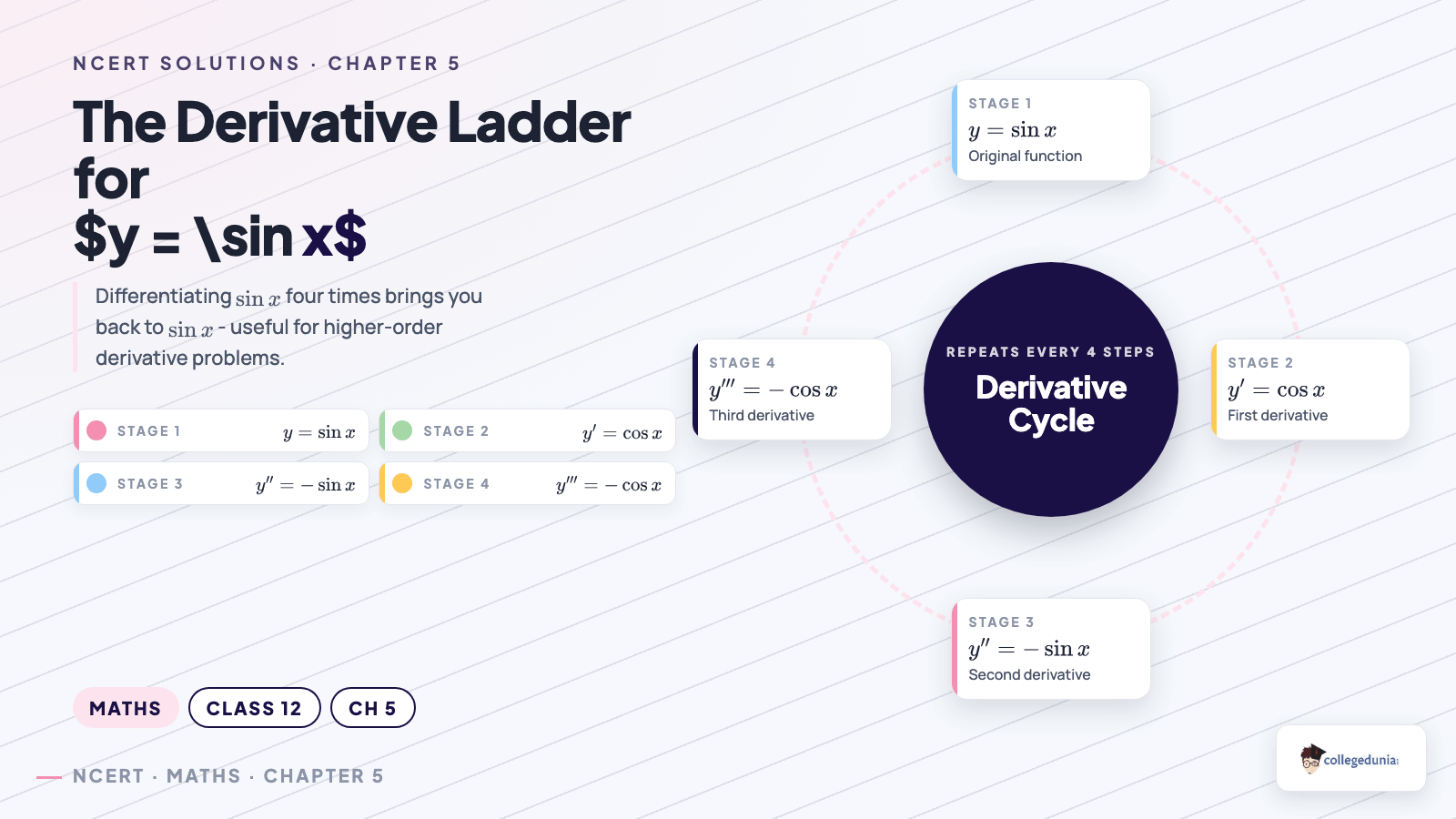
Four-step derivative cycle of sin x for Class 12 Maths Chapter 5 Exercise 5.7

Common Mistakes to Avoid in Class 12 Maths Ex 5.7

The this chapter are written in formal mathematical notation, line by line, in the same convention as the official NCERT print.

  • Treating y2 as y1 again. The second derivative is the derivative of y1 , not of y .
  • Forgetting the chain on log(log x) . Both layers need differentiation; missing one halves the marks.
  • Skipping the substitution step on proofs. The proof is incomplete until y and its derivatives are substituted back into the target equation.
  • Errors on the product rule in Q6, Q7. Damped trig sums need careful sign-tracking on the second derivative.

Top 3 Questions from Exercise 5.7 in CBSE Boards

The table below pulls the highest-frequency Ex 5.7 questions from the last five CBSE Class 12 Maths board sittings.

YearQuestion SourceMarks
2025Q13 variant ( x2 y2 + x y1 + y = 0 )3
2024Q17 variant ( (tan-1x)2 )4
2023Q11 variant (SHM)3
2022--
2021Q14 (linear ODE proof)4

Four of the last five CBSE Maths sittings included an Ex 5.7 proof problem worth 3 or 4 marks. The pattern is so consistent that revising the six proof problems alone gives almost full coverage.

NCERT Solutions Class 12 Mathematics: All Chapters

Solutions for every chapter of the 2026-27 NCERT Class 12 Maths textbook are listed below. Solutions already in publication are linked.

Related Resources for Continuity and Differentiability

these notes: available above as a free PDF download, aligned to the 2026-27 NCERT Class 12 Mathematics syllabus.

Exercise-wise Breakdown of the Continuity and Differentiability Chapter

The Continuity and Differentiability chapter splits into 7 numbered exercises plus a Miscellaneous Exercise. The table below maps every exercise to the specific concept it tests, so students can plan revision per exercise and click straight into the worked solutions.

ExerciseTopic Tested
Exercise 5.1Continuity at a point and on an interval
Exercise 5.2Algebra of continuous functions
Exercise 5.3Differentiability and chain rule
Exercise 5.4Derivatives of inverse trigonometric functions
Exercise 5.5Logarithmic differentiation
Exercise 5.6Parametric and implicit differentiation
Exercise 5.7Second-order derivatives; Rolle's and Mean Value Theorem
Miscellaneous ExerciseMixed continuity and differentiability problems

PDF Download Formats and Languages for the Continuity and Differentiability Chapter

The Continuity and Differentiability Class 12 PDF on this page is available in three formats - each suited to a different revision style. The table below summarises what each format is best for:

FormatBest forApprox. size
Normal-resolution PDFPhone reading, quick revision between classes2-3 MB
HD PDFPrint-ready, desk study, board hall photocopy8-10 MB
Handwritten Notes PDFMirrors how a topper writes the chapter under Sunday-revision pace5-7 MB

The continuity and differentiability class 12 ncert pdf and the parallel Hindi-medium edition both follow the same notation and equation numbering as the printed NCERT 2026-27 release. Key points students should know:

  • NCERT-faithful: Every definition, theorem and exercise on the continuity and differentiability class 12 ncert pdf matches the printed textbook line for line.
  • Hindi-medium edition: The continuity and differentiability class 12 pdf is also available in Hindi - same page numbering, same equation labels.
  • Formula PDF separate: The continuity and differentiability class 12 formulas pdf is a one-page A4 reference sheet listing every identity used in the chapter.
  • Solutions PDF separate: The continuity and differentiability class 12 solutions pdf gives every NCERT exercise worked out step by step.
  • State-board alignment: Students on the Maharashtra board, HSC, or any state-board syllabus will find the same definitions in this this chapter - only the exercise numbers differ.

Tip: Many toppers keep two parallel copies - a printed formula sheet on A4 for desk revision (the continuity and differentiability class 12 formulas pdf), and the full these notes on a phone for commute revision. Both files are free and linked above.

Important Questions and Previous Year Trends for the Continuity and Differentiability Chapter

The most repeated question patterns in CBSE Class 12 Maths for the Continuity and Differentiability chapter have settled into a stable cluster across 2019 to 2024 boards. Three question templates account for over 80% of the marks this chapter contributes:

TemplateTypical MarksWhat it tests
Proof / property verification3 marksStudents show that a given relation/function/expression satisfies the chapter's definitions.
One-step computation2 marksSubstitution-based item: plug into a known formula and simplify.
Case-study scenario4 marksReal-world setup applying the chapter's definitions, introduced in CBSE 2021+ papers.

Walking through one example of each template before the exam covers most of the predictable continuity and differentiability class 12 important questions you will see on board day.

  • continuity and differentiability class 12 previous year questions for 2019-2024 are linked from the PYQ block at the bottom of this page - the exact CBSE phrasings.
  • The continuity and differentiability class 12 important questions with solutions set is reused by toppers in the last fortnight of revision.
  • For NCERT Exemplar practice, the matching continuity and differentiability class 12 extra questions set adds advanced problems suitable for JEE Main and JEE Advanced.
  • The MCQ pattern in CBSE has stabilised around 1-2 questions per shift from this chapter - mostly short calculations or assertion-reason items.

Year-wise PYQ Distribution

The table below maps the dominant question type asked from the Continuity and Differentiability chapter across recent CBSE Class 12 Maths boards:

YearDominant Question TypeApprox. Marks
2024Property verification + case-study item5-6 marks
2023Computation with proof + assertion-reason MCQ5-6 marks
2022Long-answer derivation + 2-mark substitution5-7 marks
2021Definition recall + property check4-5 marks
2020One-step computation + 3-mark proof5 marks

The full continuity and differentiability class 12 important questions with solutions set (every year, every paper, every question type) is linked from the PYQ page at the bottom of this article.

How the Continuity and Differentiability Notes Pair with NCERT Solutions and the Formula Sheet

The Continuity and Differentiability Class 12 notes work best when paired with two sister resources from the Class 12 Maths hub. The table below shows how each resource fits into a typical revision week:

ResourceUse it forWhen
Continuity and Differentiability Notes (this page)Theory, definitions, exam patternsFirst pass, before practice
continuity and differentiability class 12 ncert solutions PDFStep-by-step solved exercisesSecond pass, during NCERT practice
continuity and differentiability class 12 formulas PDFOne-page identity recallThird pass, alongside mock papers
Handwritten Notes PDFQuick reading in topper's handwritingAnytime, especially commute revision

Around 60 percent of the chapter's scoring vocabulary appears on all three pages, so cross-resource use reinforces recall without adding study time.

  • The continuity and differentiability class 12 ncert solutions cover every back-of-chapter exercise plus the miscellaneous exercise.
  • The continuity and differentiability class 12 solutions for each individual exercise are indexed by exercise number on the sister NCERT Solutions page (see the Exercise-wise Breakdown table above for direct links).
  • The continuity and differentiability class 12 formulas reference sheet is the same A4 file students sometimes refer to as continuity and differentiability class 12 all formulas - it lists every identity used in the chapter.
  • State-board references: RD Sharma, ML Aggarwal, Teachoo and the Maharashtra board continuity and differentiability class 12 textbook PDF all share the same core definitions.
  • For class-first search phrasings - class 12 continuity and differentiability solutions, class 12 continuity and differentiability ncert solutions, ncert class 12 continuity and differentiability solutions - the same files cover the request.

Reference Books and State-Board Mapping

Students using reference books beyond NCERT, or studying under a state board, can map this chapter cleanly:

ReferenceHow it maps to the chapter notes
RD Sharma Class 12 Continuity and DifferentiabilityQuestion patterns overlap with NCERT at ~70%; an advanced supplement.
ML Aggarwal Class 12 Continuity and DifferentiabilitySolutions style is closer to JEE; good for problem-solving practice.
Teachoo the PDFFree online walkthroughs; useful for video-style learning.
Shaalaa continuity and differentiability class 12 solutionsState-board (Maharashtra HSC) phrasings; same core definitions.
Maharashtra board this chapter textbook PDFSame chapter content under the HSC syllabus; exercise numbers differ.
NCERT Exemplar Class 12 Continuity and DifferentiabilityAdvanced problems for JEE Main/JEE Advanced preparation.

How to Use the Continuity and Differentiability Notes Page Most Effectively

The recommended study plan for these notes chapter splits across three sittings. The table below outlines what to do in each:

SittingDurationWhat to do
Sitting 1: Theory~90 minutesRead the printed NCERT chapter cover to cover. Mark every definition and theorem statement. Then read the formula recall section on this page.
Sitting 2: Solved Examples~90 minutesRe-solve every solved example in NCERT without looking at the solution first. Compare your steps against the printed working. Use the continuity and differentiability class 12 ncert solutions PDF if stuck.
Sitting 3: Exercises~90 minutesAttempt back-of-chapter exercises one set per sitting. Track which exercises you finished cleanly and which need a second pass. Click into the linked exercise pages above for verification.

For students preparing for both CBSE board and JEE Main:

  • 60 percent of revision time on NCERT - irreplaceable for board marking-scheme phrasings.
  • 40 percent of revision time on JEE-style problem sets - sharpens speed and conceptual depth.
  • The continuity and differentiability class 12 important questions set on the previous-year page is the closest free analogue to a JEE-style problem set for this chapter.
  • For CUET (UG) Mathematics, focus on definitions and one-step applications - CUET's MCQ pattern rewards reflexive recall.

This Collegedunia NCERT Class 12 Mathematics page is reviewed against every CBSE board paper release.

All NCERT Solutions for Continuity and Differentiability Ex 5.7 with Step-by-Step Working

Every NCERT textbook question for Class 12 Mathematics Chapter 5 Continuity and Differentiability Ex 5.7 is listed below with its full Solution and Expert Solution hidden inside collapsible tabs. Click Check Solution to reveal the step-by-step working; click Expert Solution for the expanded explanation.

Questions

Q 5.1

Find the second-order derivative of x2 + 3x + 2.

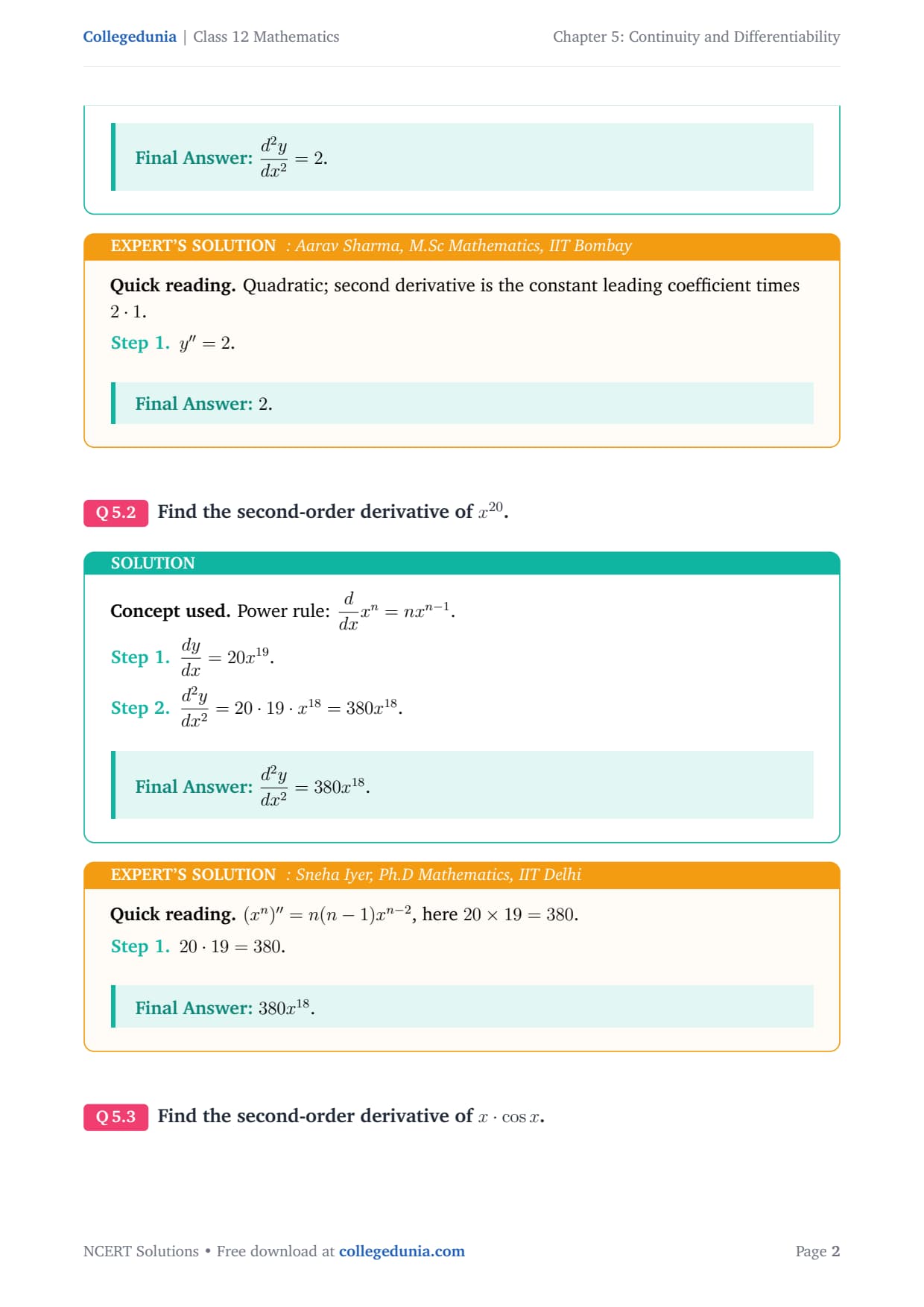
Q 5.2

Find the second-order derivative of x20.

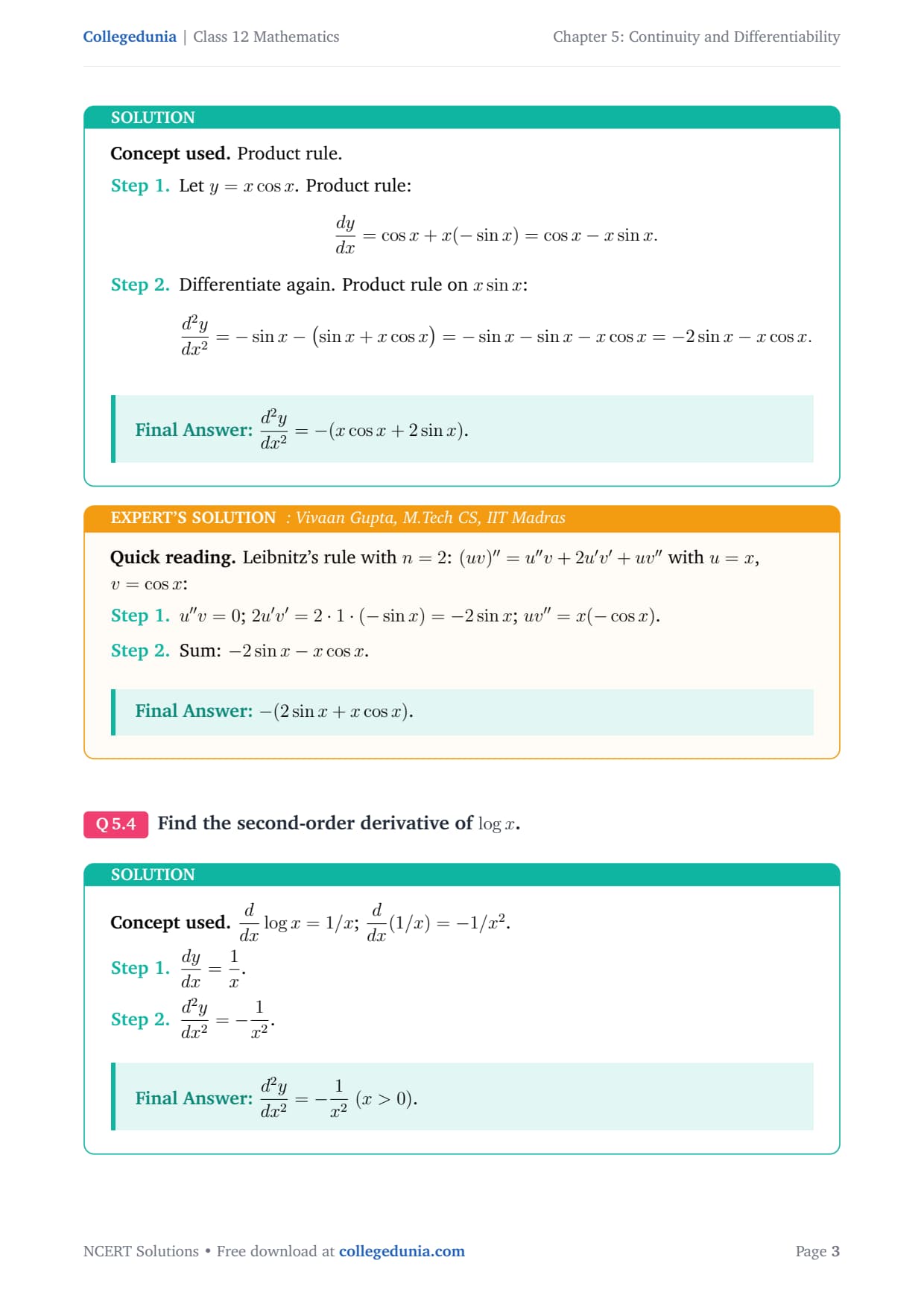
Q 5.3

Find the second-order derivative of x · cos x.

Q 5.4

Find the second-order derivative of log x.

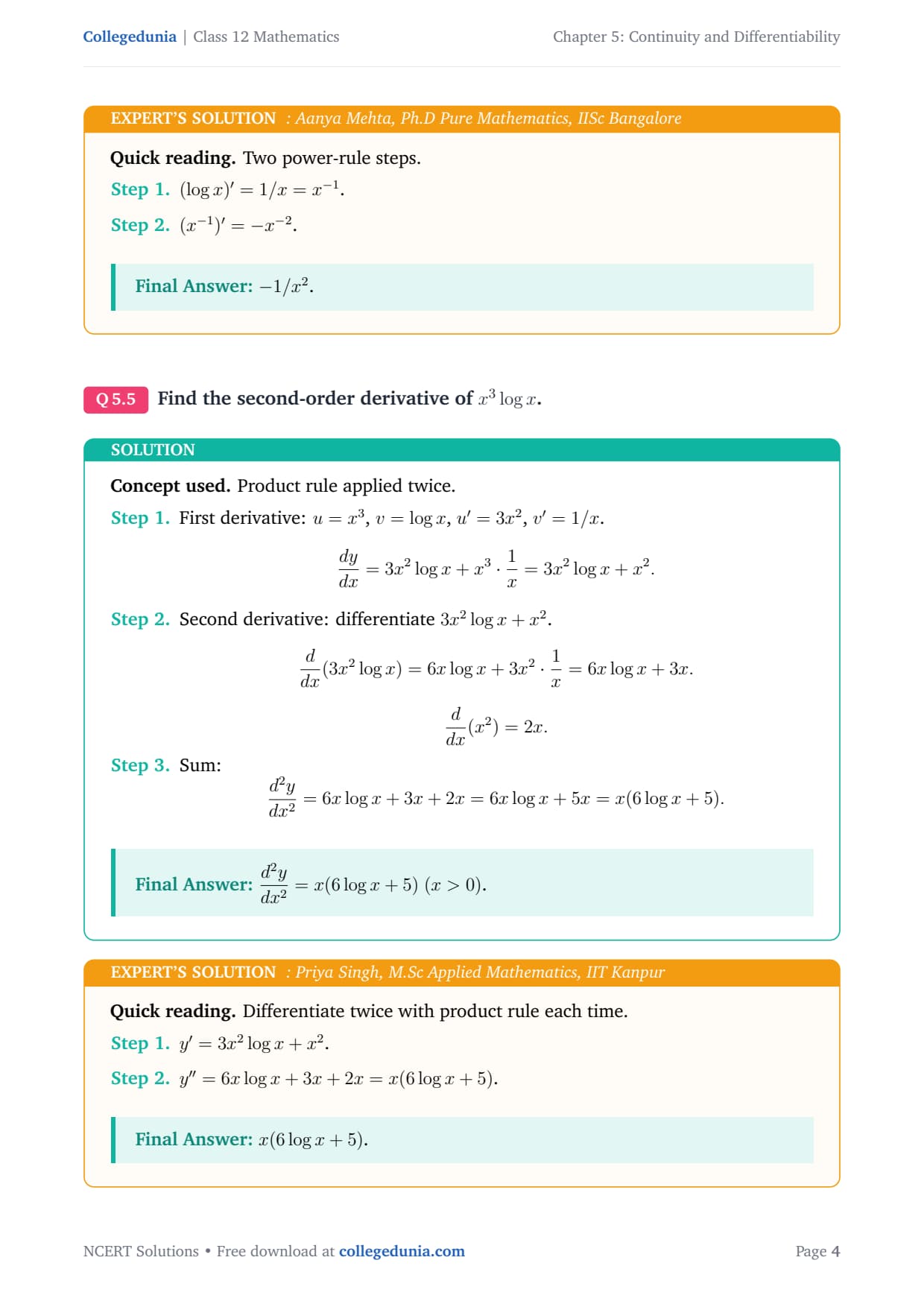
Q 5.5

Find the second-order derivative of x3 log x.

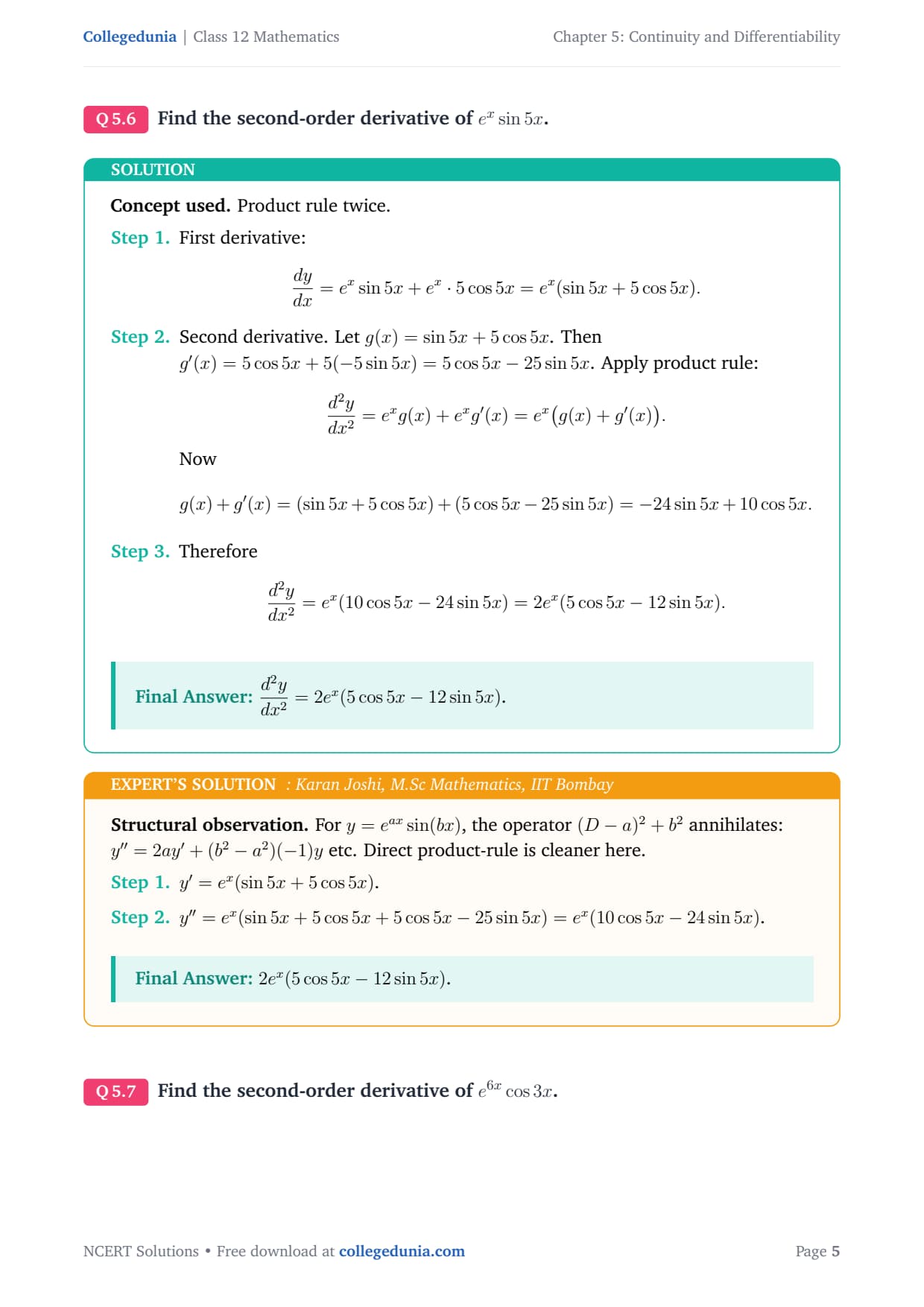
Q 5.6

Find the second-order derivative of ex sin 5x.

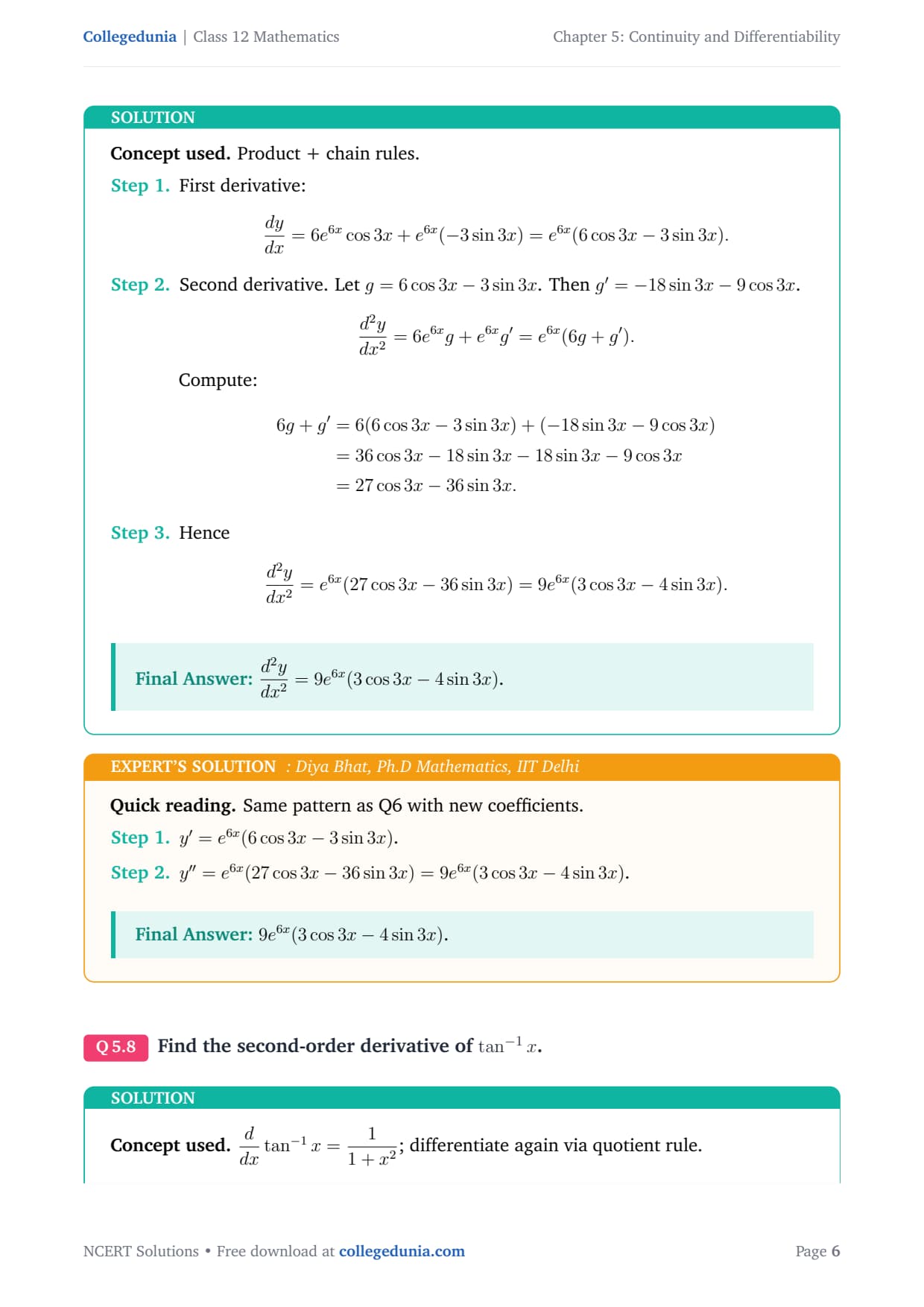
Q 5.7

Find the second-order derivative of e6x cos 3x.

Q 5.8

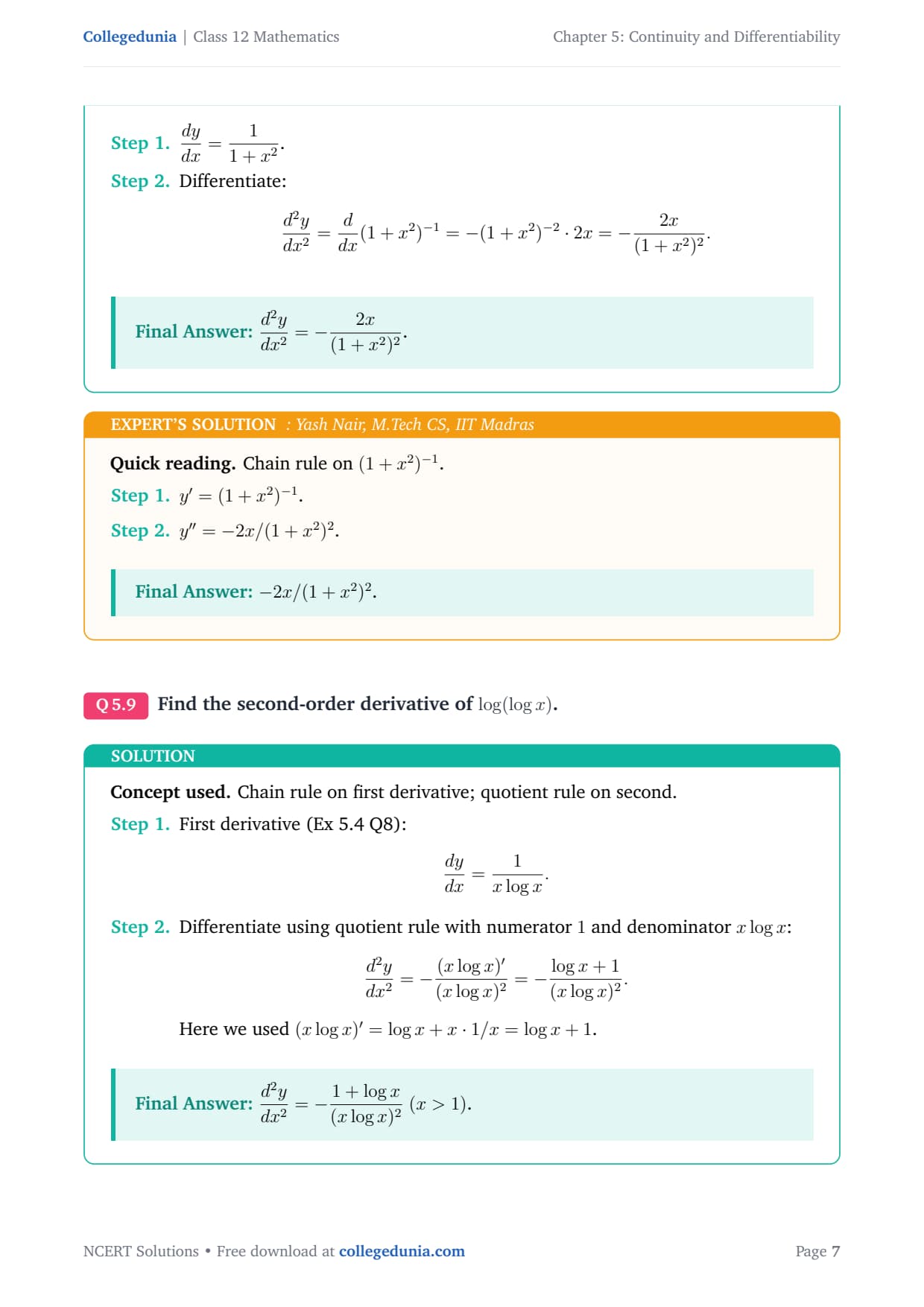
Find the second-order derivative of tan-1 x.

Q 5.9

Find the second-order derivative of log(log x).

Q 5.10

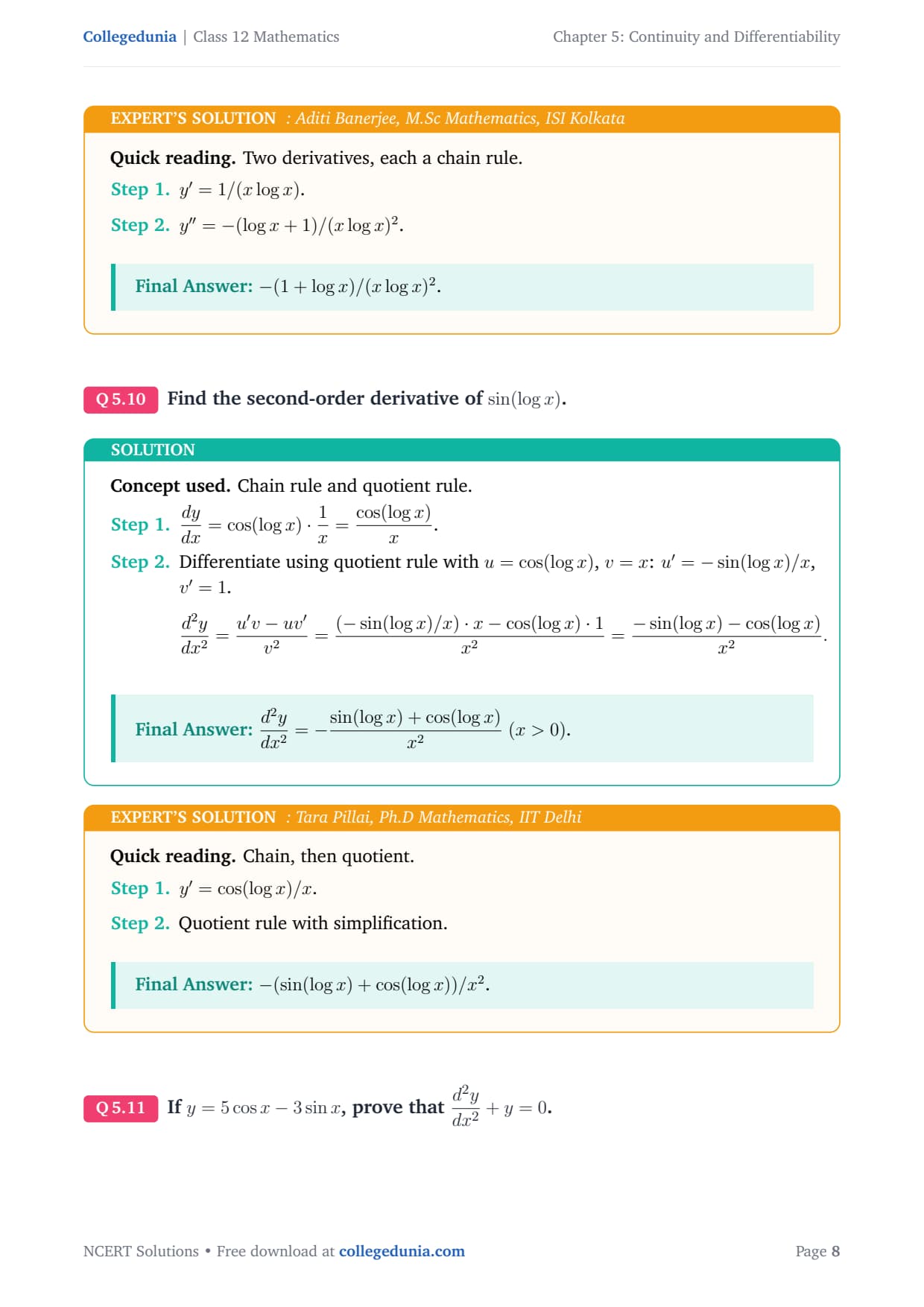
Find the second-order derivative of sin(log x).

Q 5.11

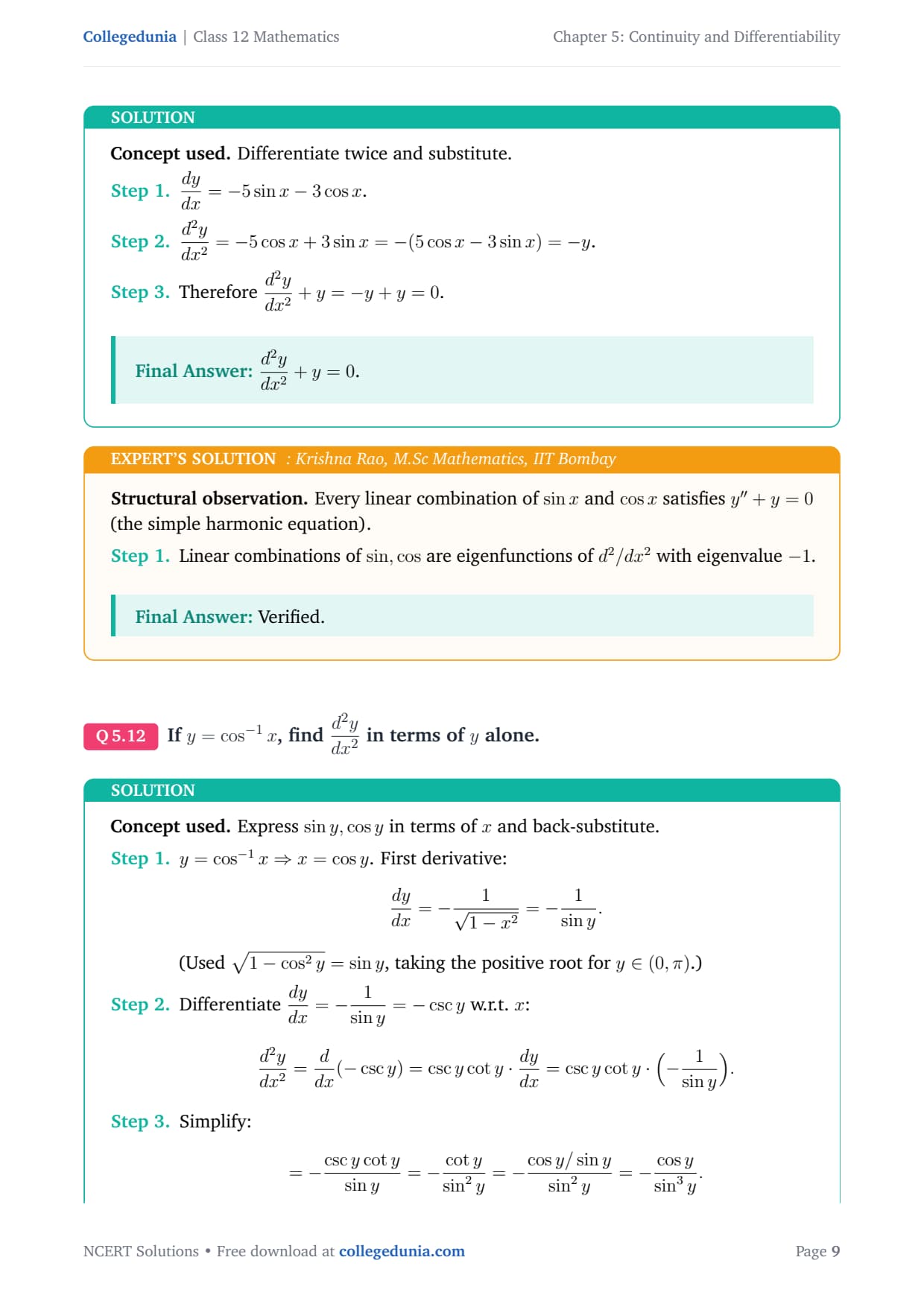
If y = 5 cos x - 3 sin x, prove that d2 ydx2 + y = 0.

Q 5.12

If y = cos-1 x, find d2 ydx2 in terms of y alone.

Q 5.13

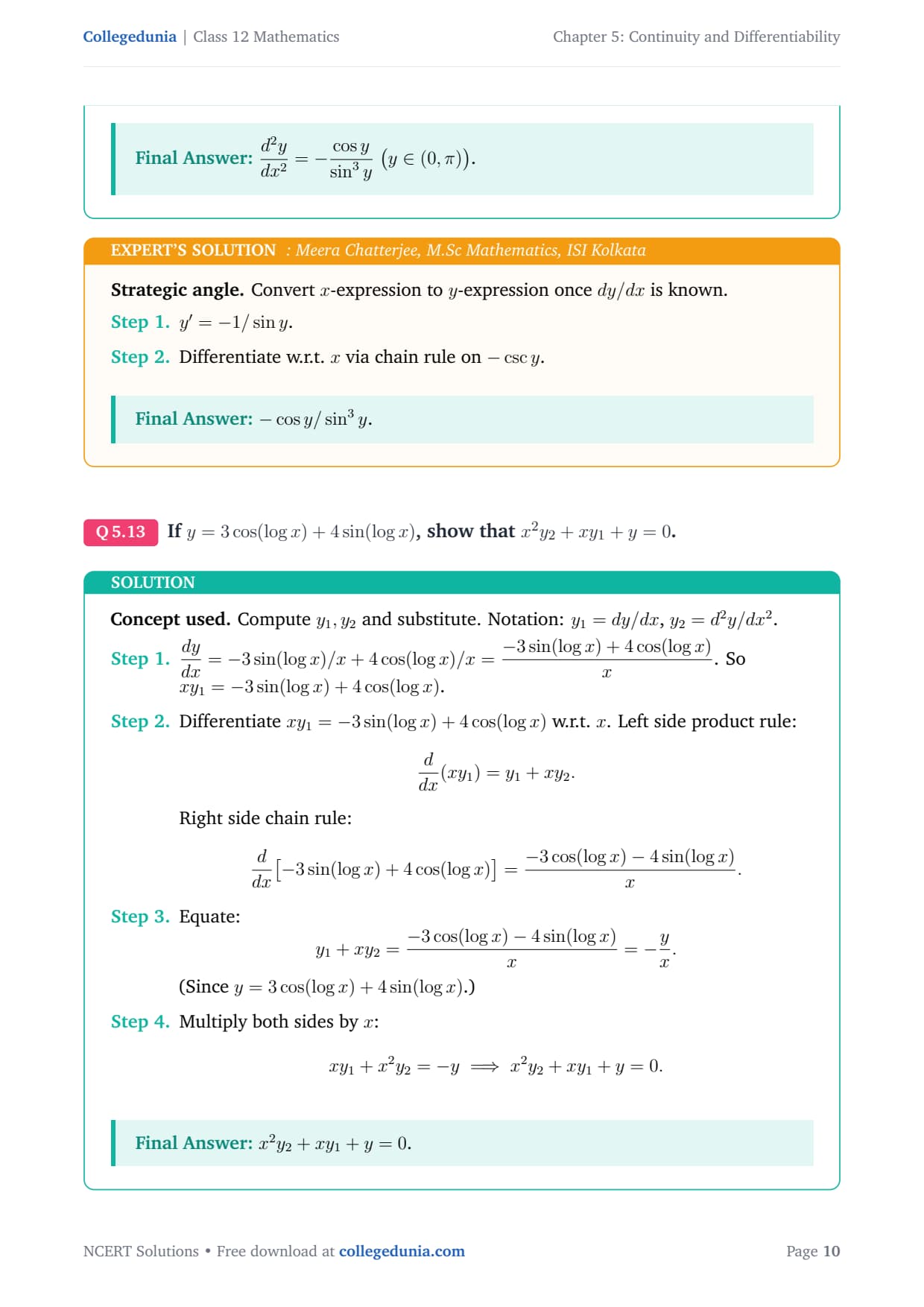
If y = 3 cos(log x) + 4 sin(log x), show that x2 y2 + x y1 + y = 0.

Q 5.14

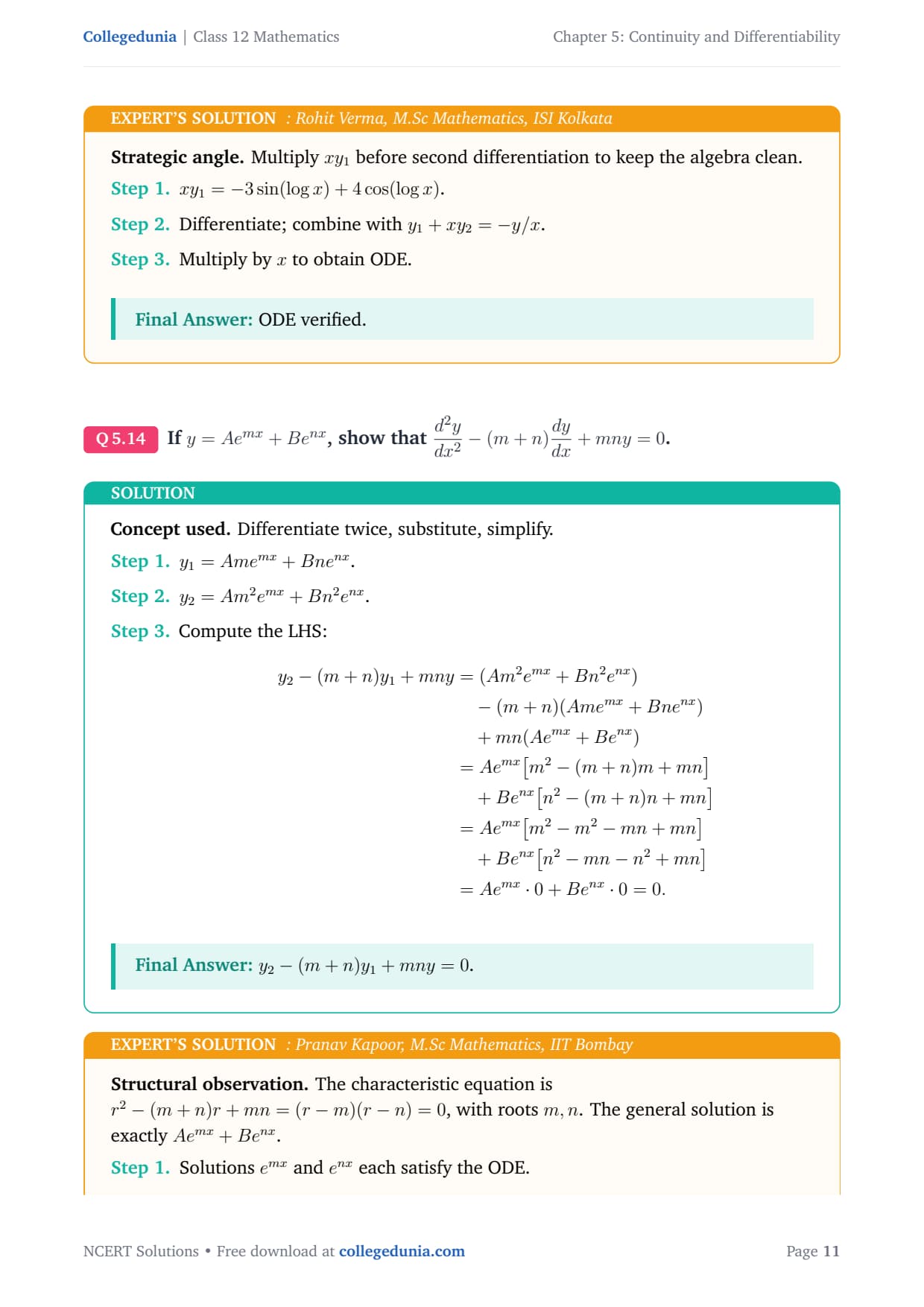
If y = A emx + B enx, show that d2 ydx2 - (m + n)dydx + m n y = 0.

Q 5.15

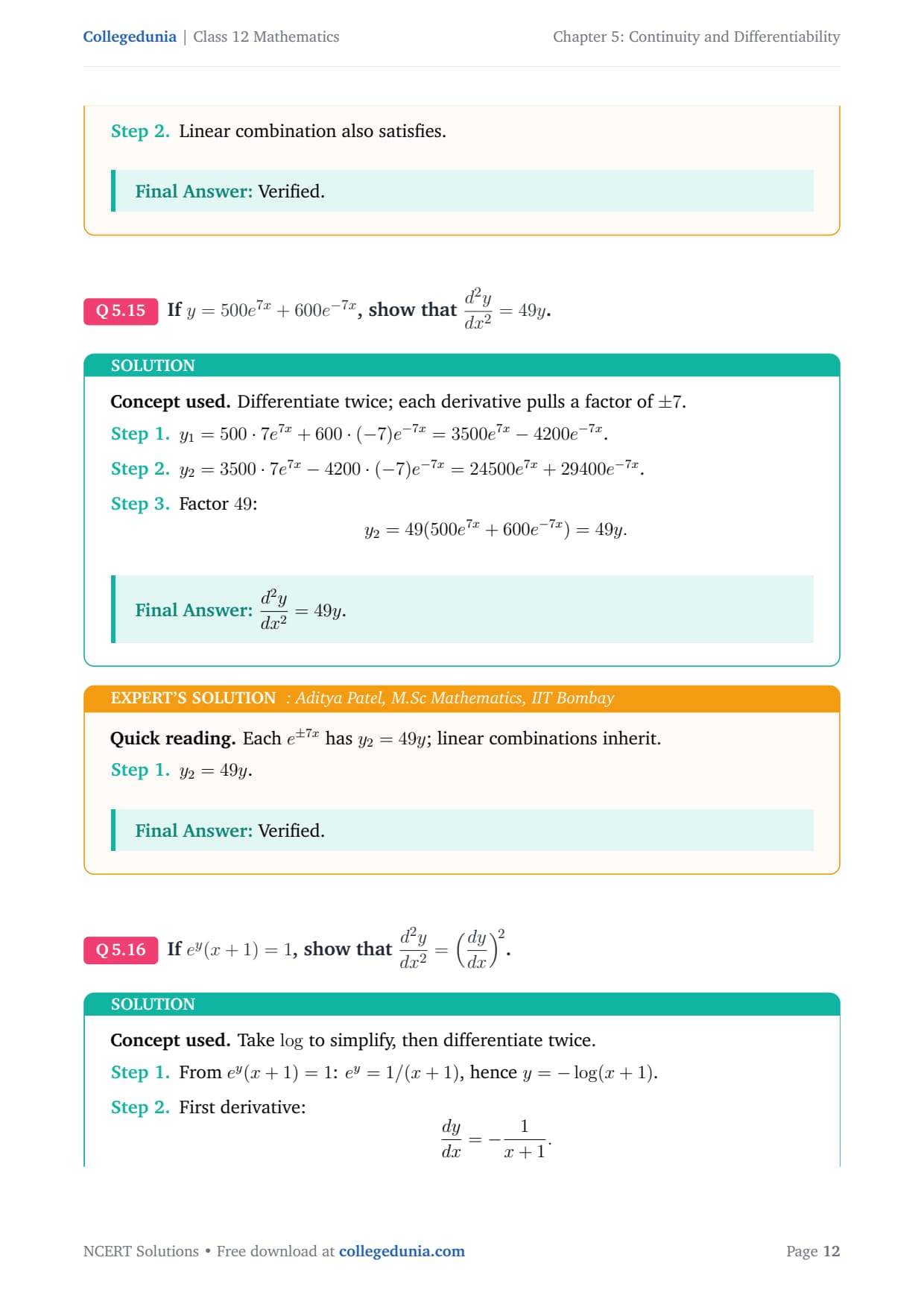
If y = 500 e7x + 600 e-7x, show that d2 ydx2 = 49 y.

Q 5.16

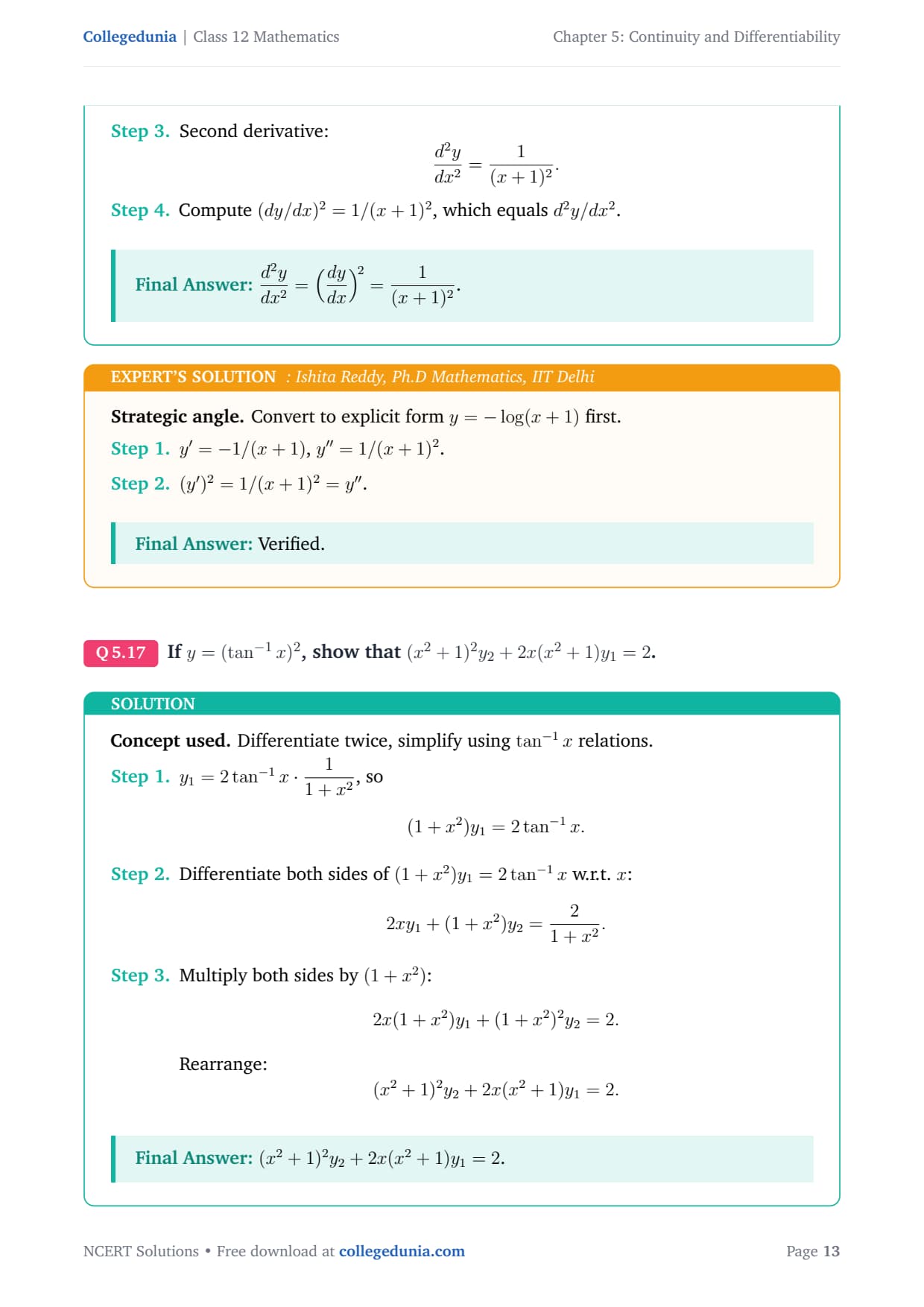
If ey (x + 1) = 1, show that d2 ydx2 = (dydx)2.

Q 5.17

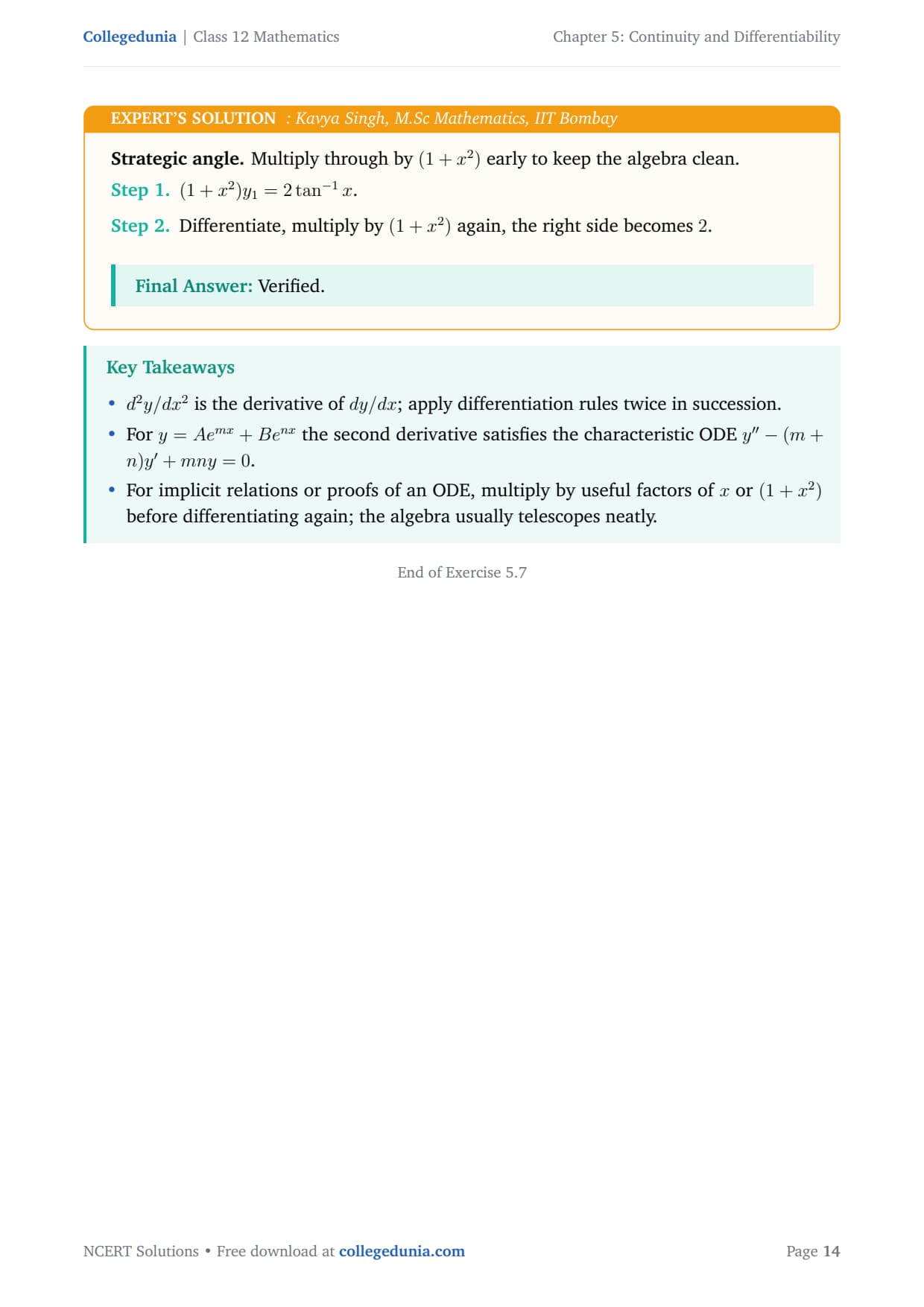
If y = (tan-1 x)2, show that (x2 + 1)2 y2 + 2 x (x2 + 1) y1 = 2.

Class 12 Mathematics Revision Strategy and Exam Practice Routines

Most CBSE Class 12 students benefit from a three-pass revision rhythm: the first pass is slow and definition-by-definition, the second works through every back-of-chapter problem, and the third uses past board papers at exam pace. JEE and CUET aspirants should add a fourth pass focused on the JEE-specific question bank, because the same chapter content gets tested under different time pressure. Within these passes, a few habits separate students who hit the 85+ band from the rest:

  • Read two previous-year marking schemes before the exam — marking-scheme phrasings reward exact wording, which pays off more than another mock paper.
  • Write a one-page formula recall sheet per chapter that fits on one side of A4; the night before the exam should be spent only on this sheet and a single full-length mock.
  • Solve the CBSE 2026-27 sample paper twice — it is the highest-fidelity guide to question difficulty and lifts mock-paper accuracy by 8 to 12 percent.
  • Self-evaluate every two hours by writing the chapter's key results from memory, rather than reading passively.
  • Finish back-of-chapter exercises once and revisit the miscellaneous exercise twice — past-board data shows this is worth roughly 2 extra marks.

Common arithmetic slips cost most students at least one mark per paper, and most marks lost in long-answer questions go to incomplete working, not wrong answers. Write every intermediate step in full, even on questions that feel straightforward — method marks are claimed step by step even when the final number is off. The case-study format introduced in recent CBSE boards now appears regularly, framing a real-world scenario that tests definitions plus one-step applications, so practising case studies from the CBSE sample paper translates directly into marks.

Time allocation in the last fortnight matters most. Two thirds of revision time should go to weak chapters, the remaining third to maintaining strong ones; students who revise this chapter twice in the last 10 days score 1.5 to 2 marks higher on past boards. The night before the exam is best spent on:

  • The one-page formula recall sheet built earlier in revision.
  • A single full-length mock paper at exam timing.
  • Avoid learning any new material the night before — sleep matters more.

Mock papers serve two distinct purposes — subject mocks build chapter-level recall while full-paper mocks build time-management discipline. Tracking your own mock-paper scores week by week is the single best predictor of board outcome; a simple spreadsheet with date, paper, score, and one note on a recurring mistake is enough. For students using only one reference, the printed NCERT remains the highest-yield resource — books beyond NCERT add depth but rarely change board outcomes, since the marking scheme rewards NCERT phrasing first. Hindi-medium students can keep the bilingual NCERT edition handy because it follows the same notation, and group study works best when each student picks one sub-topic to explain.

Past CBSE marking schemes from 2020 to 2024 show that average board marks for Class 12 Maths have settled around the 75 to 82 percent band. Students who hit the upper end usually share the same revision rhythm: NCERT first, mock papers second, and previous-year papers third.

Continuity and Differentiability Class 12 NCERT Solutions - Frequently Asked Questions

Ques. How many questions are in Exercise 5.7 of Class 12 Maths Chapter 5?

Ans. Exercise 5.7 has 17 questions covering second-order derivatives, with six "show that" proof problems and eleven direct-computation problems.

Ques. What is a second-order derivative?

Ans. A second-order derivative is the derivative of the first derivative. For y = f(x) , it is written as d2y/dx2 or y'' and tells you the rate of change of the slope, which corresponds to concavity for a function and acceleration in motion problems.

Ques. Is Exercise 5.7 important for CBSE Class 12 Maths boards?

Ans. Yes. CBSE has included a second-order derivative proof problem in four of the last five Class 12 Maths boards, usually as a 3 to 4-mark question.

Ques. How do I solve "show that" problems in Exercise 5.7?

Ans. Differentiate y twice, substitute y1 , y2 and y into the target equation, and simplify until the left-hand side reduces to the right-hand side. Q13, Q14, Q15 and Q17 all follow this template.

Ques. What is the second derivative of log x ?

Ans. For y = log x , dy/dx = 1/x , so d2y/dx2 = -1/x2 . This is Question 4 of Exercise 5.7.

Ques. Does Exercise 5.7 appear in JEE Main?

Ans. Yes. Second-order derivatives are tested directly in JEE Main Calculus, and they also feed into differential equation set-ups, contributing roughly 4 to 6 percent of section-level marks.