The Inverse Trigonometric Functions Class 12 NCERT Solutions Exercise 2.2 page has detailed expert solutions for all 21 questions, matched to the CBSE marking scheme. The free PDF is below.
CBSE Weightage: 4-6 marks (full Ch 2)
JEE Main: 2-3% of the entire paper
Question Count in Ex 2.2: 21 (proofs + simplifications + 2 MCQs)
Solved by Collegedunia experts. Each solution states the property used (with its valid domain), substitutes x = sinθ or x = tanθ where the proof needs it, and lands on the principal-value form CBSE expects in the marking scheme.
Question-Wise Breakdown of NCERT Class 12 Maths Exercise 2.2
The 21 questions fall into three bands: Q1-Q9 are direct identity applications, Q10-Q19 need a clean substitution, and the last two MCQs test principal values.
Q No.
Type
Concept Tested
Difficulty
Q1
Prove
3sin-1x = sin-1(3x - 4x3)
Medium
Q2
Prove
3cos-1x = cos-1(4x3 - 3x)
Medium
Q3
Prove
tan-1211 + tan-1724 = tan-112
Easy
Q4
Prove
2tan-112 + tan-117 = tan-13117
Medium
Q5
Write in simplest form
tan-1√1+x2-1x
Hard
Q6
Write in simplest form
tan-11√x2-1, |x| > 1
Medium
Q7
Write in simplest form
tan-1√1-cos x1+cos x
Hard
Q8
Write in simplest form
tan-1cos x - sin xcos x + sin x
Medium
Q9
Write in simplest form
tan-1x√a2 - x2
Easy
Q10
Simplify
tan-13a2x - x3a3 - 3a x2
Hard
Q11
Find value
tan12[sin-12x1+x2 + cos-11-y21+y2]
Hard
Q12
Prove
cot(tan-1a + cot-1a) = 0
Easy
Q13
Prove
tan12[sin-12x1+x2] = 1 - √1-x2x
Hard
Q14
Solve for x
tan-11-x1+x = 12tan-1x
Medium
Q15
Solve
sin(sin-115 + cos-1x) = 1
Medium
Q16
Solve
sin-1(1-x) - 2sin-1x = π2
Medium
Q17
Solve
tan-1x-1x-2 + tan-1x+1x+2 = π4
Hard
Q18
Find value
sin(tan-1x), |x| < 1
Easy
Q19
Find value
cos-1√32 + 2sin-112
Easy
Q20
MCQ
Principal value of inverse sine
Easy
Q21
MCQ
Value of tan-1√3 - cot-1(-√3)
Easy
How will Collegedunia's NCERT Solutions for Class 12 Maths Exercise 2.2 help you?
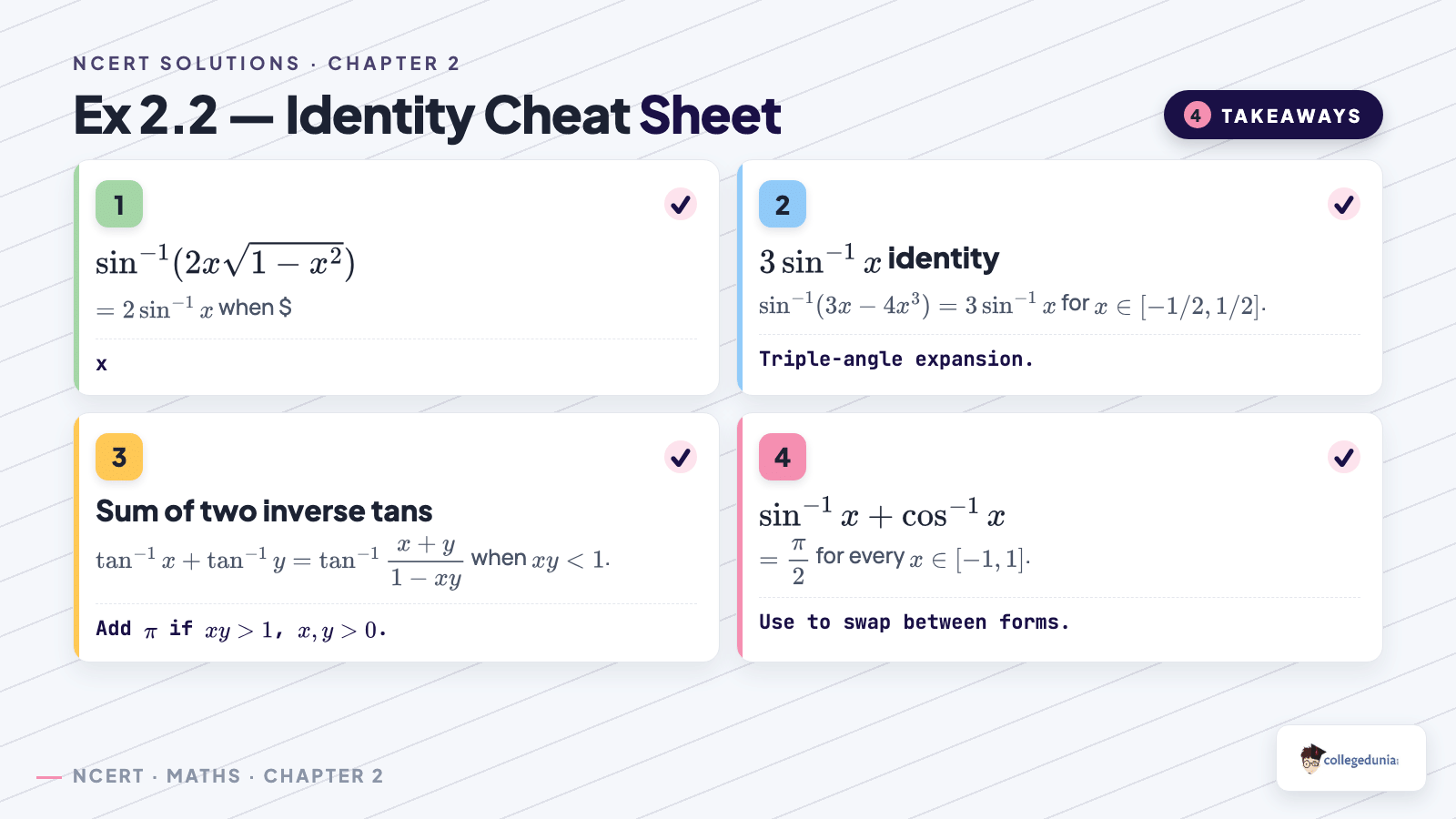
Exercise 2.2 lives or dies by identity selection. Students know all six properties but often pick the wrong one and lose time. Our PDF tags every solution with the exact identity used, so you learn to spot the right rewrite or substitution fast.
The set also rewards domain awareness. Q1 and Q2 need x ∈ [-12, 12] for the triple-angle expansion. Skip the domain line and CBSE markers dock a mark.
All NCERT Solutions for Inverse Trigonometric Functions Ex 2.2 with Step-by-Step Working
Every question of Inverse Trigonometric Functions Ex 2.2 is listed below with its full Solution and Expert Solution inside collapsible tabs.
Questions
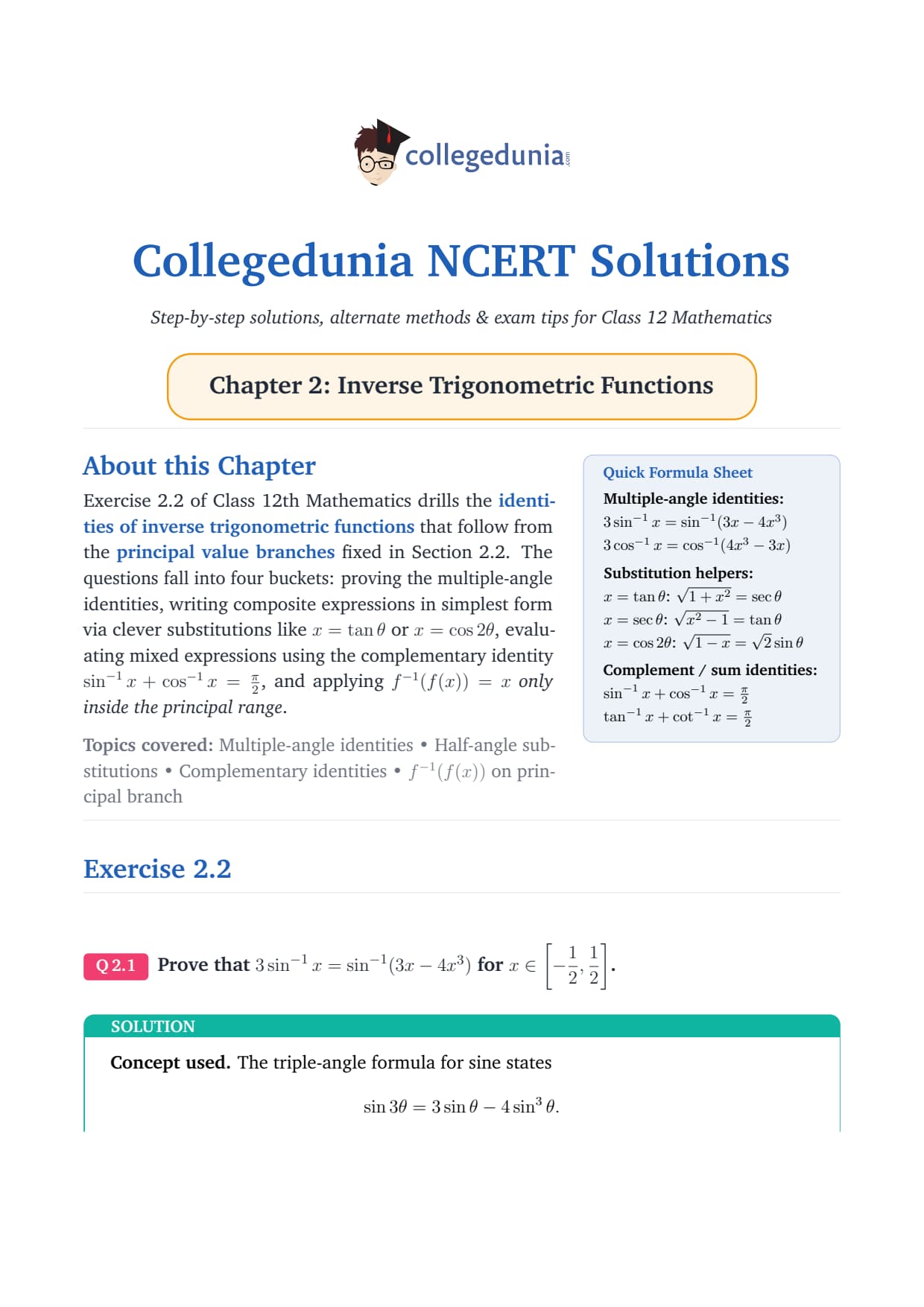
Q 2.1
Prove that 3sin-1x = sin-1(3x - 4x3) for x ∈ [-12,12].
Concept used. The triple-angle formula for sine states sin 3θ = 3sinθ - 4sin3θ. This is derived from sin 3θ = sin(2θ+θ) = sin 2θ cosθ + cos 2θ sinθ and the double-angle formulas. Combined with the principal-range identity sin-1(sin u) = u provided u ∈ [-π2,π2], it gives the inverse-trig identity asked here. The condition x ∈ [-12,12] is precisely what guarantees 3θ ∈ [-π2,π2] in the step where we apply this principal-range identity.
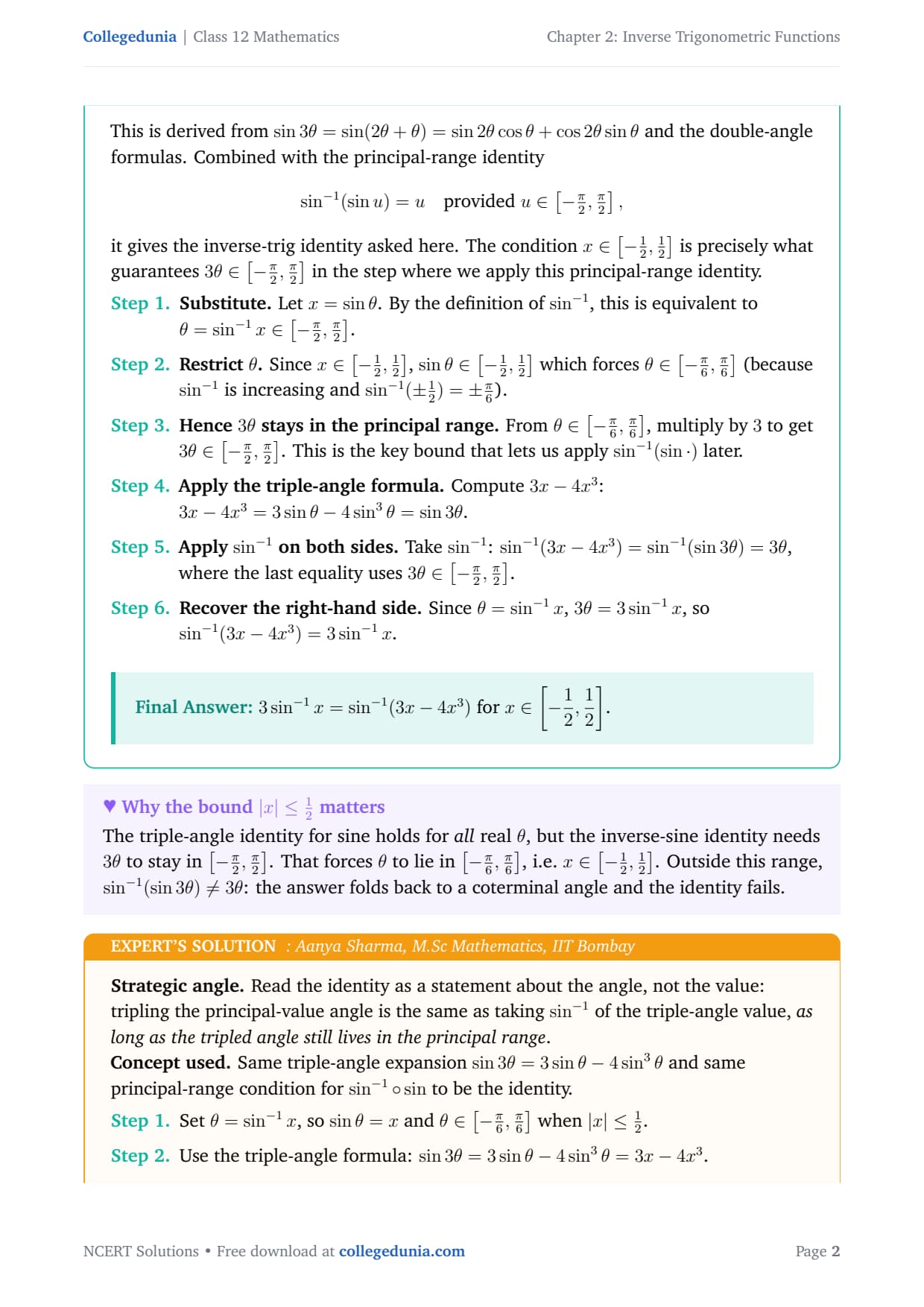
Substitute. Let x = sinθ. By the definition of sin-1, this is equivalent to θ = sin-1x ∈ [-π2,π2].
Restrict θ. Since x ∈ [-12,12], sinθ ∈ [-12,12] which forces θ ∈ [-π6,π6] (because sin-1 is increasing and sin-1(±12) = ±π6).
Hence 3θ stays in the principal range. From θ ∈ [-π6,π6], multiply by 3 to get 3θ ∈ [-π2,π2]. This is the key bound that lets us apply sin-1(sin·) later.
Apply the triple-angle formula. Compute 3x - 4x3: 3x - 4x3 = 3sinθ - 4sin3θ = sin 3θ.
Apply sin-1 on both sides. Take sin-1: sin-1(3x - 4x3) = sin-1(sin 3θ) = 3θ, where the last equality uses 3θ ∈ [-π2,π2].
Recover the right-hand side. Since θ = sin-1x, 3θ = 3sin-1x, so sin-1(3x - 4x3) = 3sin-1x.
3sin-1x = sin-1(3x - 4x3) for x ∈ [-12,12].
AS
Aanya Sharma
M.Sc Mathematics, IIT Bombay
Verified Expert
Strategic angle. Read the identity as a statement about the angle, not the value: tripling the principal-value angle is the same as taking sin-1 of the triple-angle value, as long as the tripled angle still lives in the principal range.
Concept used. Same triple-angle expansion sin 3θ = 3sinθ - 4sin3θ and same principal-range condition for sin-1 to be the identity.
Set θ = sin-1x, so sinθ = x and θ ∈ [-π6,π6] when |x| ≤ 12.
Use the triple-angle formula: sin 3θ = 3sinθ - 4sin3θ = 3x - 4x3.
Since |3θ| ≤ π2, we may invert: sin-1(sin 3θ) = 3θ = 3sin-1x.
Therefore sin-1(3x - 4x3) = 3sin-1x.
Why this matters. The exact analogue 3cos-1x = cos-1(4x3 - 3x) (Q2 below) uses the same template: triple-angle expansion plus a domain check that keeps the multiplied angle inside the principal range.
3sin-1x = sin-1(3x - 4x3) on [-12,12].
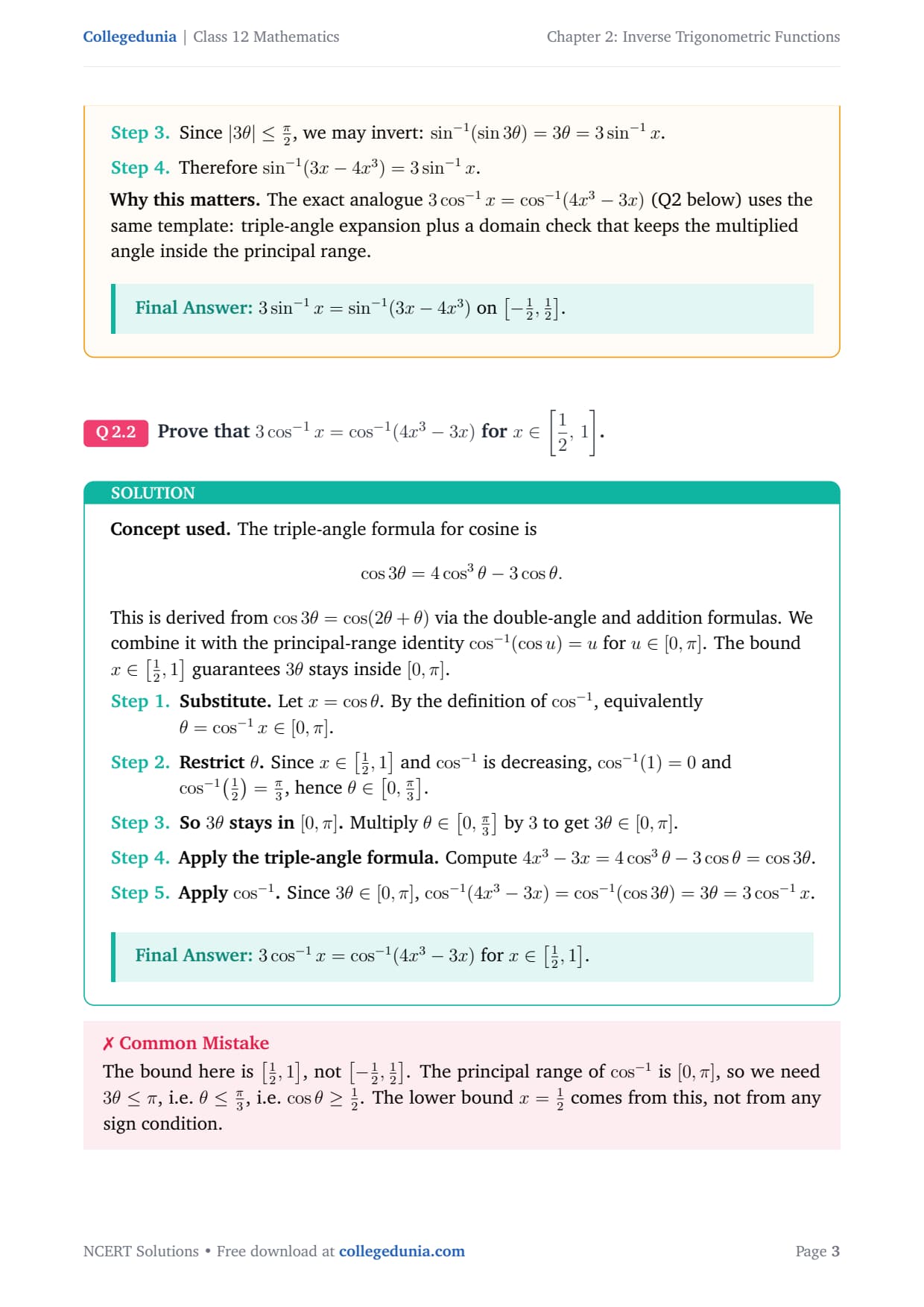
Q 2.2
Prove that 3cos-1x = cos-1(4x3 - 3x) for x ∈ [12, 1].
Concept used. The triple-angle formula for cosine is cos 3θ = 4cos3θ - 3cosθ. This is derived from cos 3θ = cos(2θ+θ) via the double-angle and addition formulas. We combine it with the principal-range identity cos-1(cos u) = u for u ∈ [0,π]. The bound x ∈ [12,1] guarantees 3θ stays inside [0,π].
Substitute. Let x = cosθ. By the definition of cos-1, equivalently θ = cos-1x ∈ [0,π].
Restrict θ. Since x ∈ [12,1] and cos-1 is decreasing, cos-1(1) = 0 and cos-1(12) = π3, hence θ ∈ [0,π3].
So 3θ stays in [0,π]. Multiply θ ∈ [0,π3] by 3 to get 3θ ∈ [0,π].
Apply the triple-angle formula. Compute 4x3 - 3x = 4cos3θ - 3cosθ = cos 3θ.
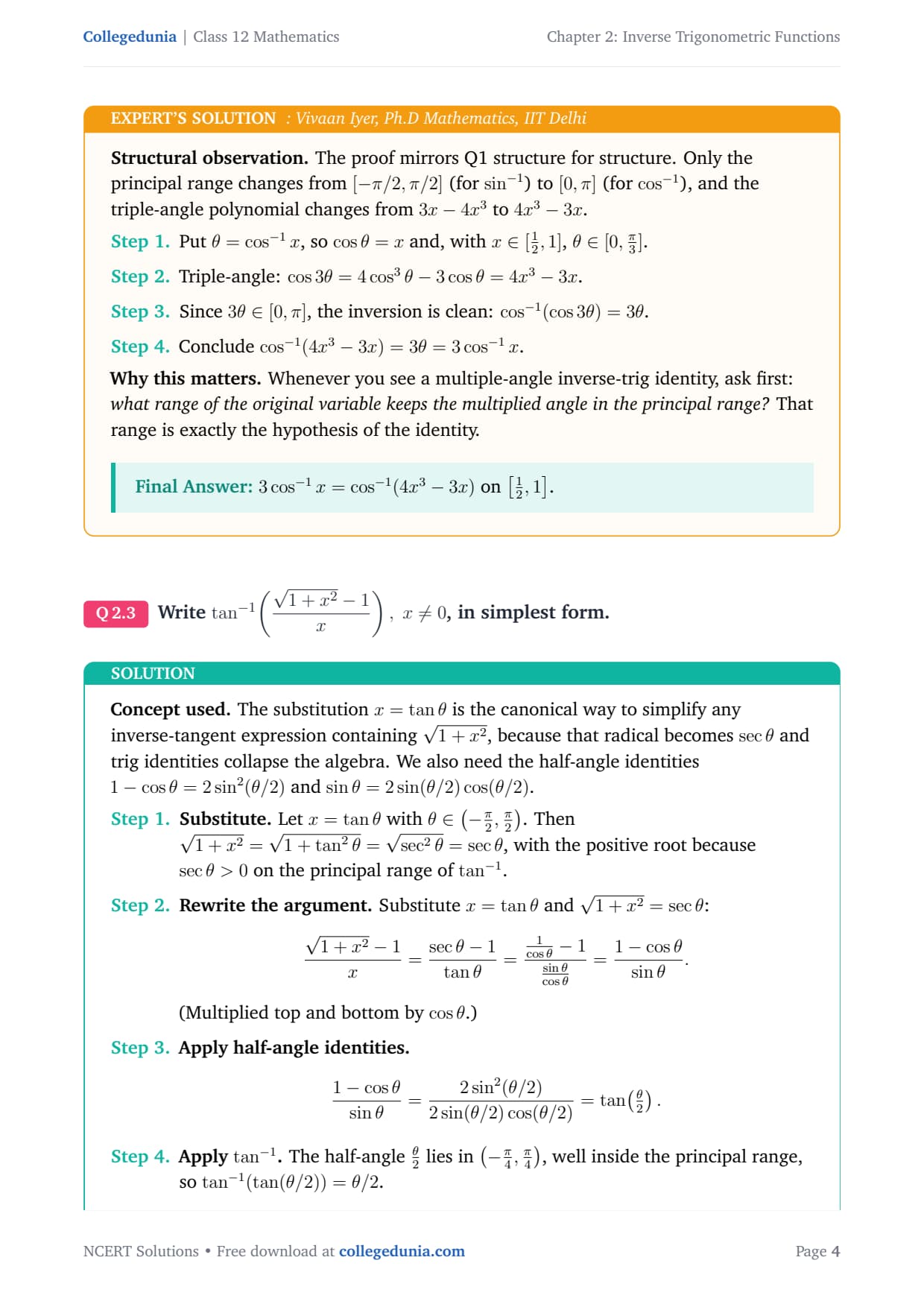
Structural observation. The proof mirrors Q1 structure for structure. Only the principal range changes from [-π/2,π/2] (for sin-1) to [0,π] (for cos-1), and the triple-angle polynomial changes from 3x - 4x3 to 4x3 - 3x.
Put θ = cos-1x, so cosθ = x and, with x ∈ [12,1], θ ∈ [0,π3].
Triple-angle: cos 3θ = 4cos3θ - 3cosθ = 4x3 - 3x.
Since 3θ ∈ [0,π], the inversion is clean: cos-1(cos 3θ) = 3θ.
Conclude cos-1(4x3 - 3x) = 3θ = 3cos-1x.
Why this matters. Whenever you see a multiple-angle inverse-trig identity, ask first: what range of the original variable keeps the multiplied angle in the principal range? That range is exactly the hypothesis of the identity.
3cos-1x = cos-1(4x3 - 3x) on [12,1].
Q 2.3
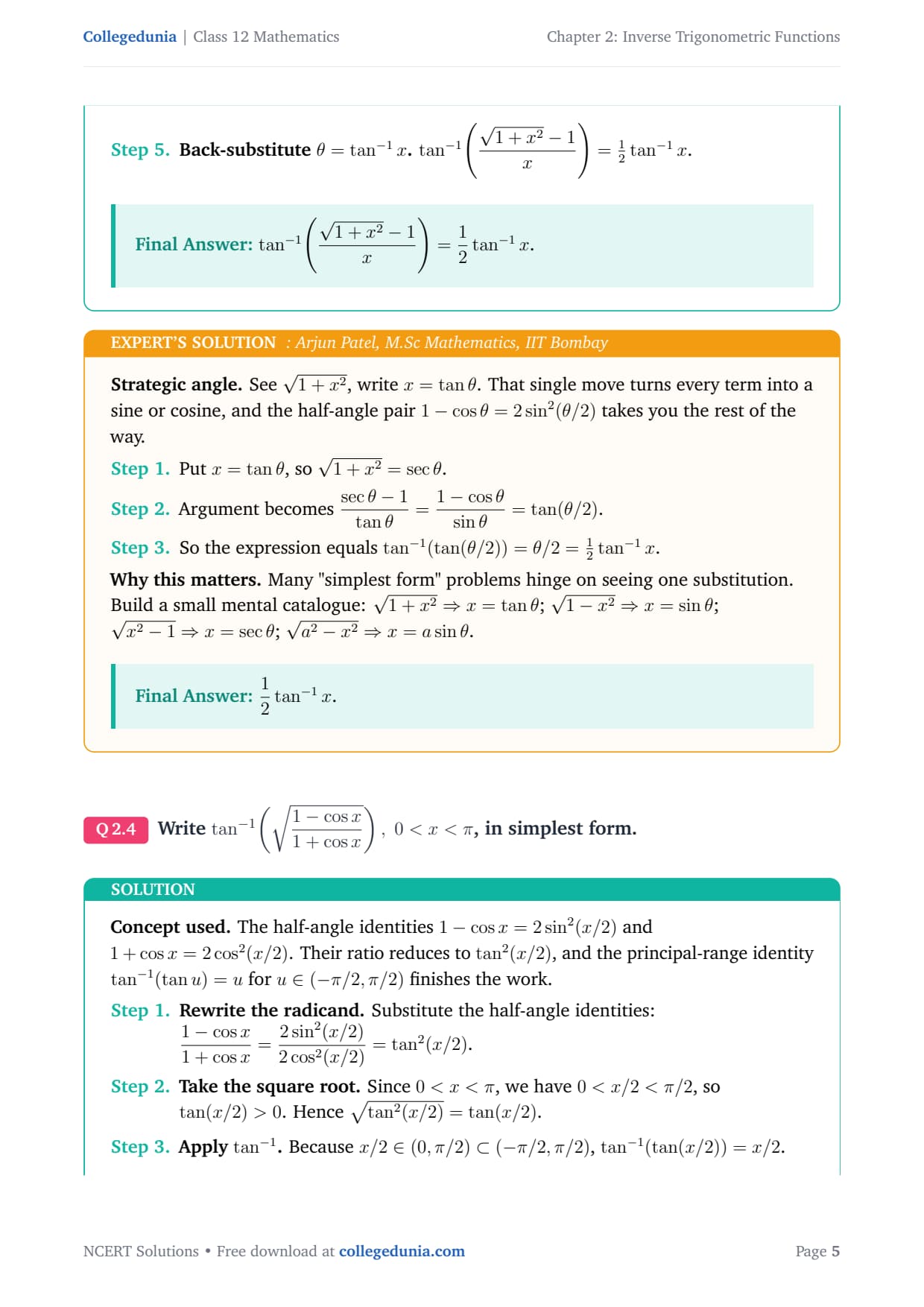
Write tan-1(√1+x2 - 1x), x ≠ 0, in simplest form.
Concept used. The substitution x = tanθ is the canonical way to simplify any inverse-tangent expression containing √1+x2, because that radical becomes secθ and trig identities collapse the algebra. We also need the half-angle identities 1 - cosθ = 2sin2(θ/2) and sinθ = 2sin(θ/2)cos(θ/2).
Substitute. Let x = tanθ with θ ∈ (-π2,π2). Then √1+x2 = √1+tan2θ = √sec2θ = secθ, with the positive root because secθ > 0 on the principal range of tan-1.
Rewrite the argument. Substitute x = tanθ and √1+x2 = secθ: √1+x2-1x = secθ - 1tanθ = 1cosθ - 1sinθcosθ = 1 - cosθsinθ. (Multiplied top and bottom by cosθ.)
Strategic angle. See √1+x2, write x = tanθ. That single move turns every term into a sine or cosine, and the half-angle pair 1 - cosθ = 2sin2(θ/2) takes you the rest of the way.
So the expression equals tan-1(tan(θ/2)) = θ/2 = 12tan-1x.
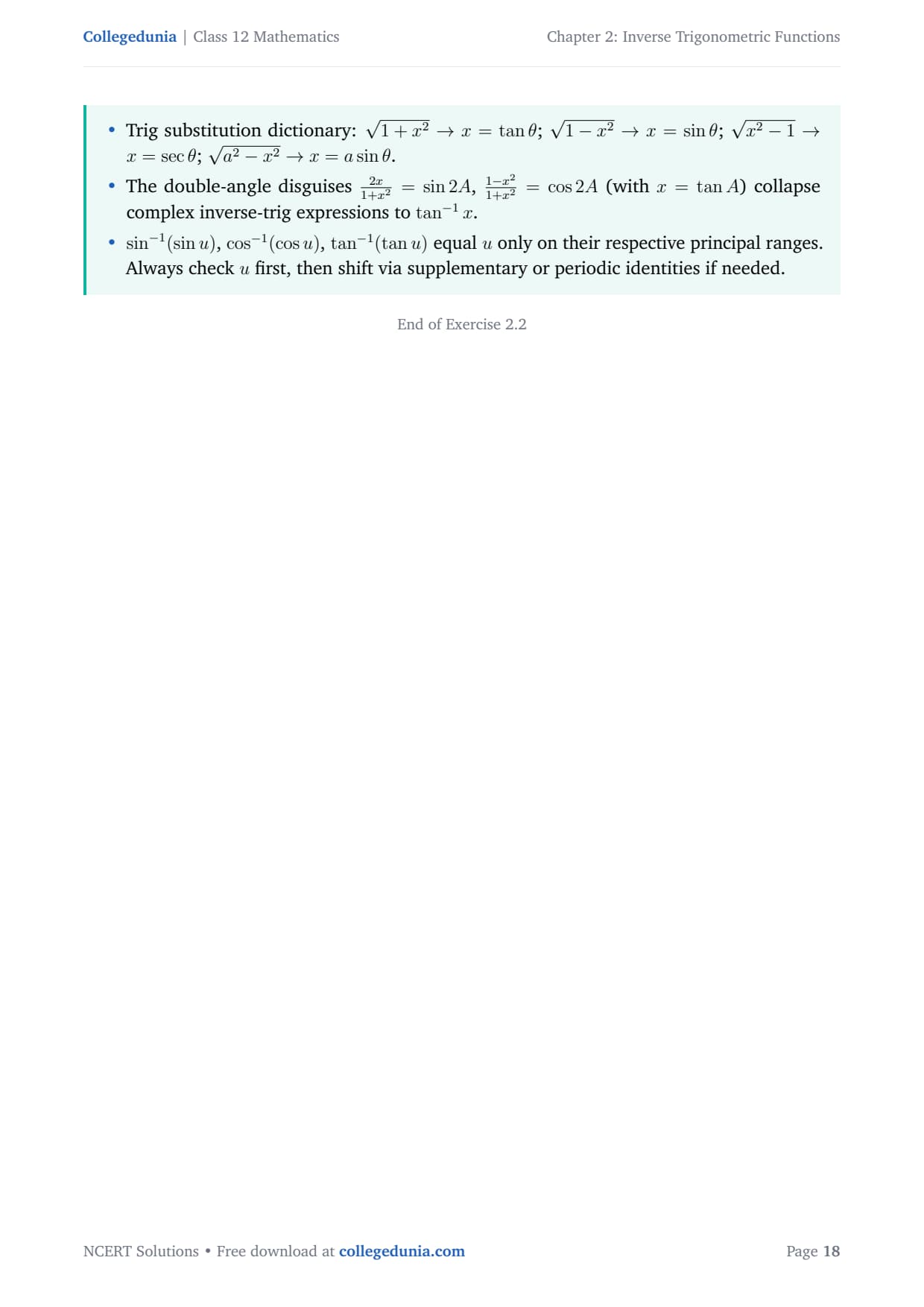
Why this matters. Many "simplest form" problems hinge on seeing one substitution. Build a small mental catalogue: √1+x2 ⇒ x = tanθ; √1-x2 ⇒ x = sinθ; √x2-1 ⇒ x = secθ; √a2-x2 ⇒ x = asinθ.
12tan-1x.
Q 2.4
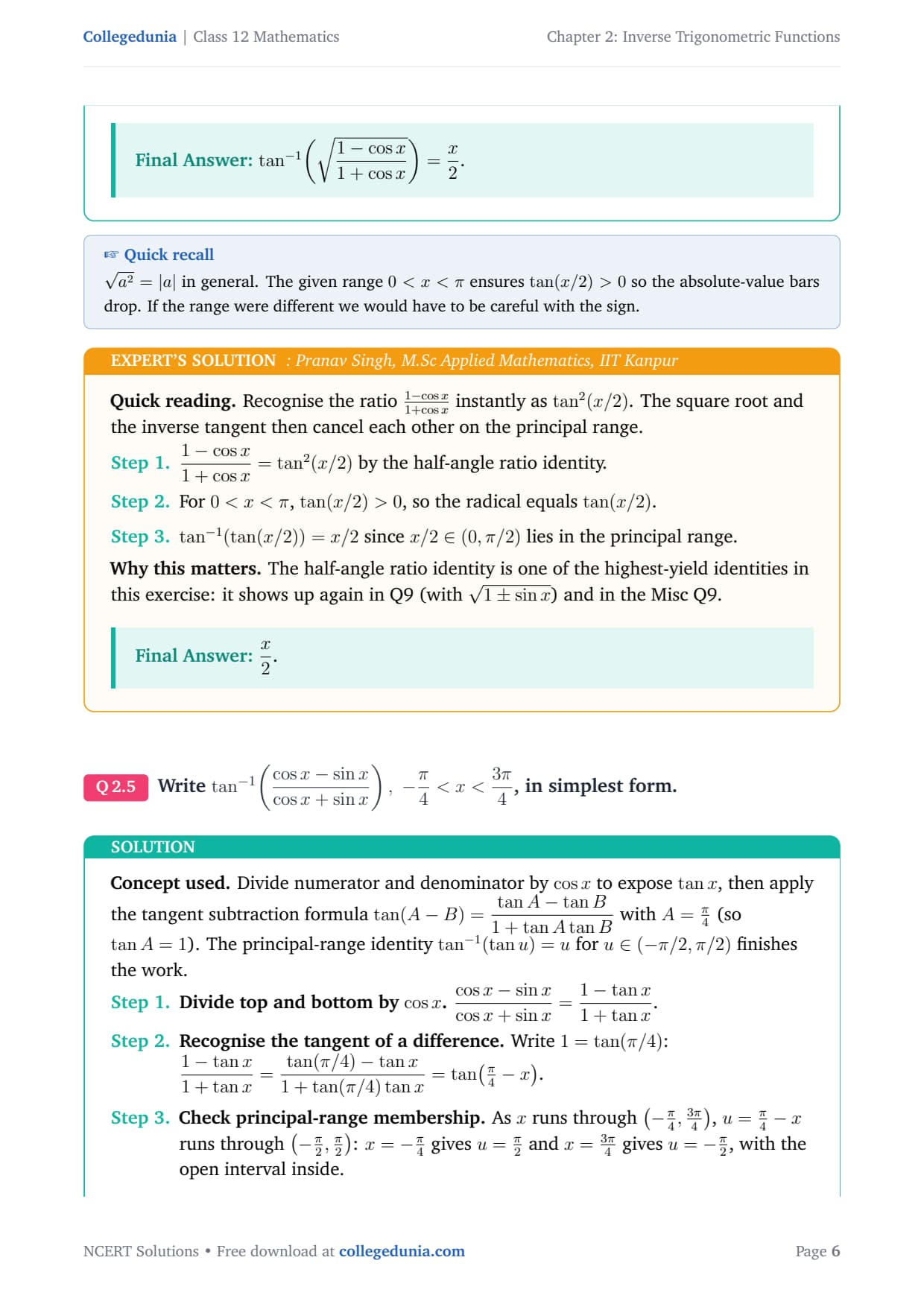
Write tan-1(√1-cos x1+cos x), 0 < x < π, in simplest form.
Concept used. The half-angle identities 1 - cos x = 2sin2(x/2) and 1 + cos x = 2cos2(x/2). Their ratio reduces to tan2(x/2), and the principal-range identity tan-1(tan u) = u for u ∈ (-π/2,π/2) finishes the work.
Rewrite the radicand. Substitute the half-angle identities: 1-cos x1+cos x = 2sin2(x/2)2cos2(x/2) = tan2(x/2).
Take the square root. Since 0 < x < π, we have 0 < x/2 < π/2, so tan(x/2) > 0. Hence √tan2(x/2) = tan(x/2).
Quick reading. Recognise the ratio 1-cos x1+cos x instantly as tan2(x/2). The square root and the inverse tangent then cancel each other on the principal range.
1-cos x1+cos x = tan2(x/2) by the half-angle ratio identity.
For 0 < x < π, tan(x/2) > 0, so the radical equals tan(x/2).
tan-1(tan(x/2)) = x/2 since x/2 ∈ (0,π/2) lies in the principal range.
Why this matters. The half-angle ratio identity is one of the highest-yield identities in this exercise: it shows up again in Q9 (with √1x) and in the Misc Q9.
x2.
Q 2.5
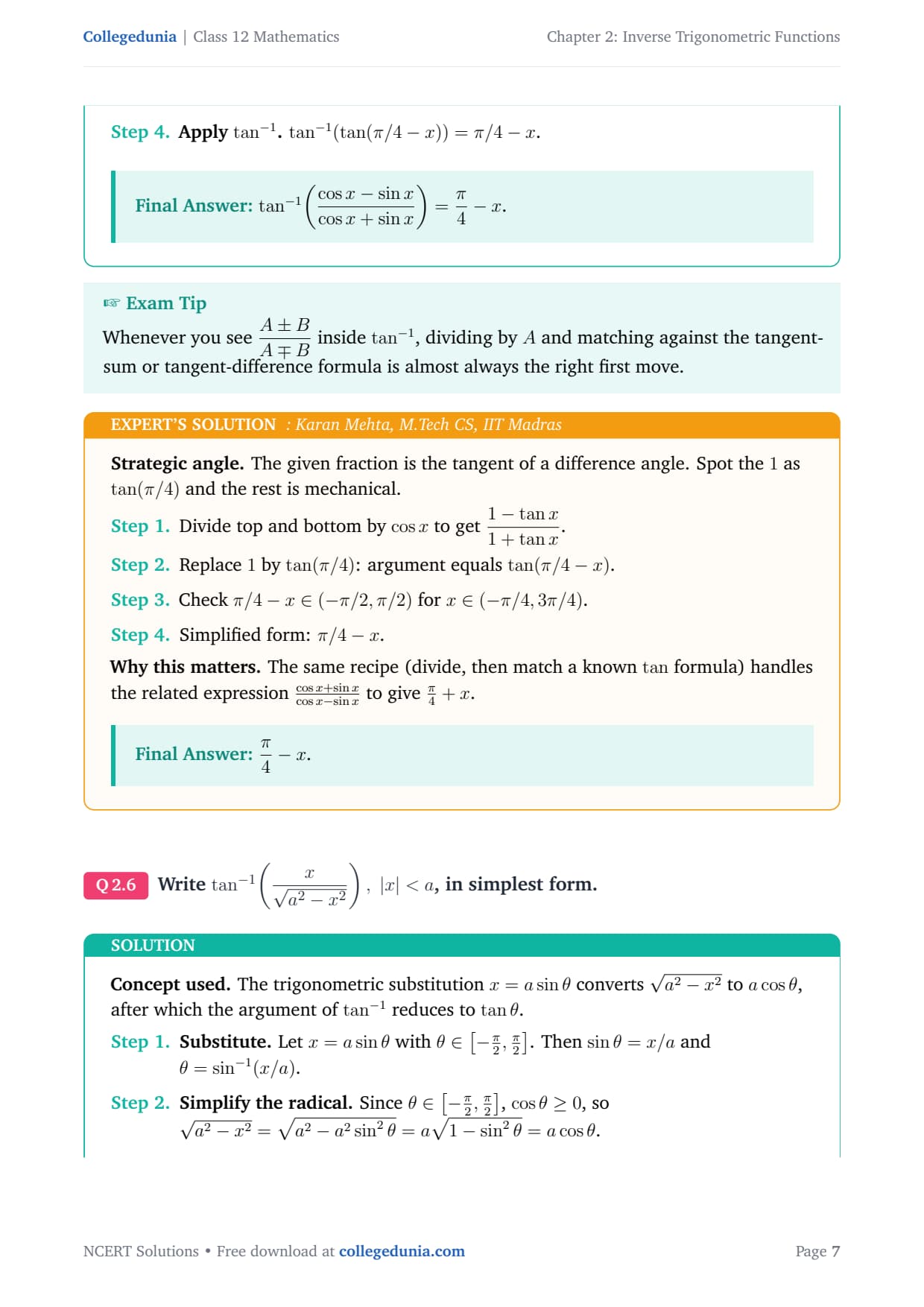
Write tan-1(cos x - sin xcos x + sin x), -π4 < x < 3π4, in simplest form.
Concept used. Divide numerator and denominator by cos x to expose tan x, then apply the tangent subtraction formula tan(A - B) = tan A - tan B1 + tan A tan B with A = π4 (so tan A = 1). The principal-range identity tan-1(tan u) = u for u ∈ (-π/2,π/2) finishes the work.
Divide top and bottom by cos x.cos x - sin xcos x + sin x = 1 - tan x1 + tan x.
Recognise the tangent of a difference. Write 1 = tan(π/4): 1 - tan x1 + tan x = tan(π/4) - tan x1 + tan(π/4)tan x = tan(π4 - x).
Check principal-range membership. As x runs through (-π4,3π4), u = π4 - x runs through (-π2,π2): x = -π4 gives u = π2 and x = 3π4 gives u = -π2, with the open interval inside.
Apply tan-1.tan-1(tan(π/4 - x)) = π/4 - x.
tan-1(cos x - sin xcos x + sin x) = π4 - x.
KM
Karan Mehta
M.Tech CS, IIT Madras
Verified Expert
Strategic angle. The given fraction is the tangent of a difference angle. Spot the 1 as tan(π/4) and the rest is mechanical.
Divide top and bottom by cos x to get 1 - tan x1 + tan x.
Replace 1 by tan(π/4): argument equals tan(π/4 - x).
Check π/4 - x ∈ (-π/2, π/2) for x ∈ (-π/4, 3π/4).
Simplified form: π/4 - x.
Why this matters. The same recipe (divide, then match a known tan formula) handles the related expression cos x + sin xcos x - sin x to give π4 + x.
π4 - x.
Q 2.6
Write tan-1(x√a2 - x2), |x| < a, in simplest form.
Concept used. The trigonometric substitution x = asinθ converts √a2 - x2 to acosθ, after which the argument of tan-1 reduces to tanθ.
Substitute. Let x = asinθ with θ ∈ [-π2,π2]. Then sinθ = x/a and θ = sin-1(x/a).
Simplify the radical. Since θ ∈ [-π2,π2], cosθ ≥ 0, so √a2 - x2 = √a2 - a2sin2θ = a√1 - sin2θ = acosθ.
Rewrite the argument.x√a2 - x2 = asinθacosθ = tanθ.
Apply tan-1. The condition |x| < a gives |sinθ| < 1, hence θ ∈ (-π2,π2), exactly the principal range of tan-1: tan-1(tanθ) = θ = sin-1(x/a).
tan-1(x√a2 - x2) = sin-1(xa).
AV
Aditi Verma
M.Sc Mathematics, ISI Kolkata
Verified Expert
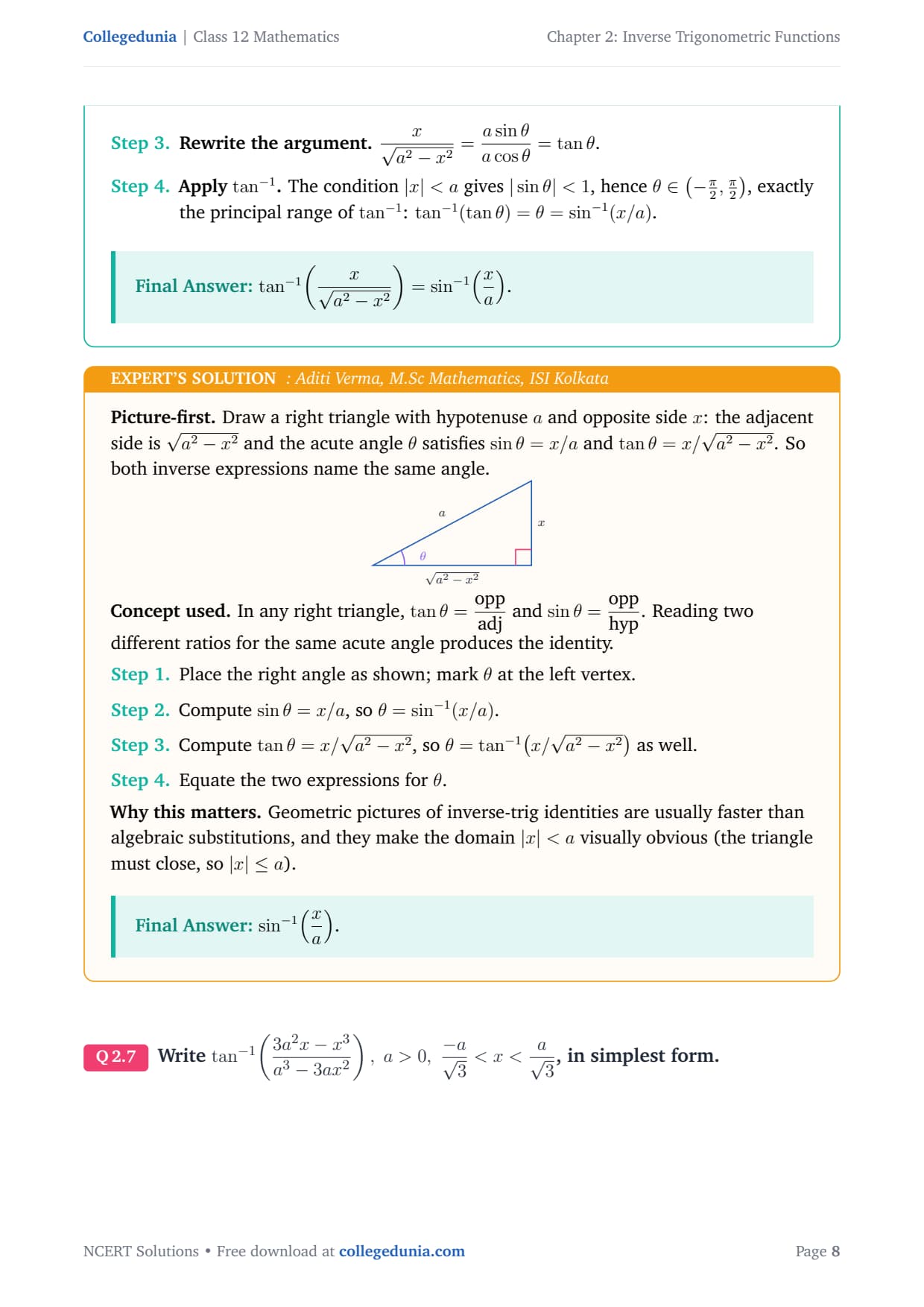
Picture-first. Draw a right triangle with hypotenuse a and opposite side x: the adjacent side is √a2 - x2 and the acute angle θ satisfies sinθ = x/a and tanθ = x/√a2-x2. So both inverse expressions name the same angle.
[See diagram in the PDF version]
Concept used. In any right triangle, tanθ = oppadj and sinθ = opphyp. Reading two different ratios for the same acute angle produces the identity.
Place the right angle as shown; mark θ at the left vertex.
Compute sinθ = x/a, so θ = sin-1(x/a).
Compute tanθ = x/√a2-x2, so θ = tan-1(x/√a2-x2) as well.
Equate the two expressions for θ.
Why this matters. Geometric pictures of inverse-trig identities are usually faster than algebraic substitutions, and they make the domain |x| < a visually obvious (the triangle must close, so |x| ≤ a).
sin-1(xa).
Q 2.7
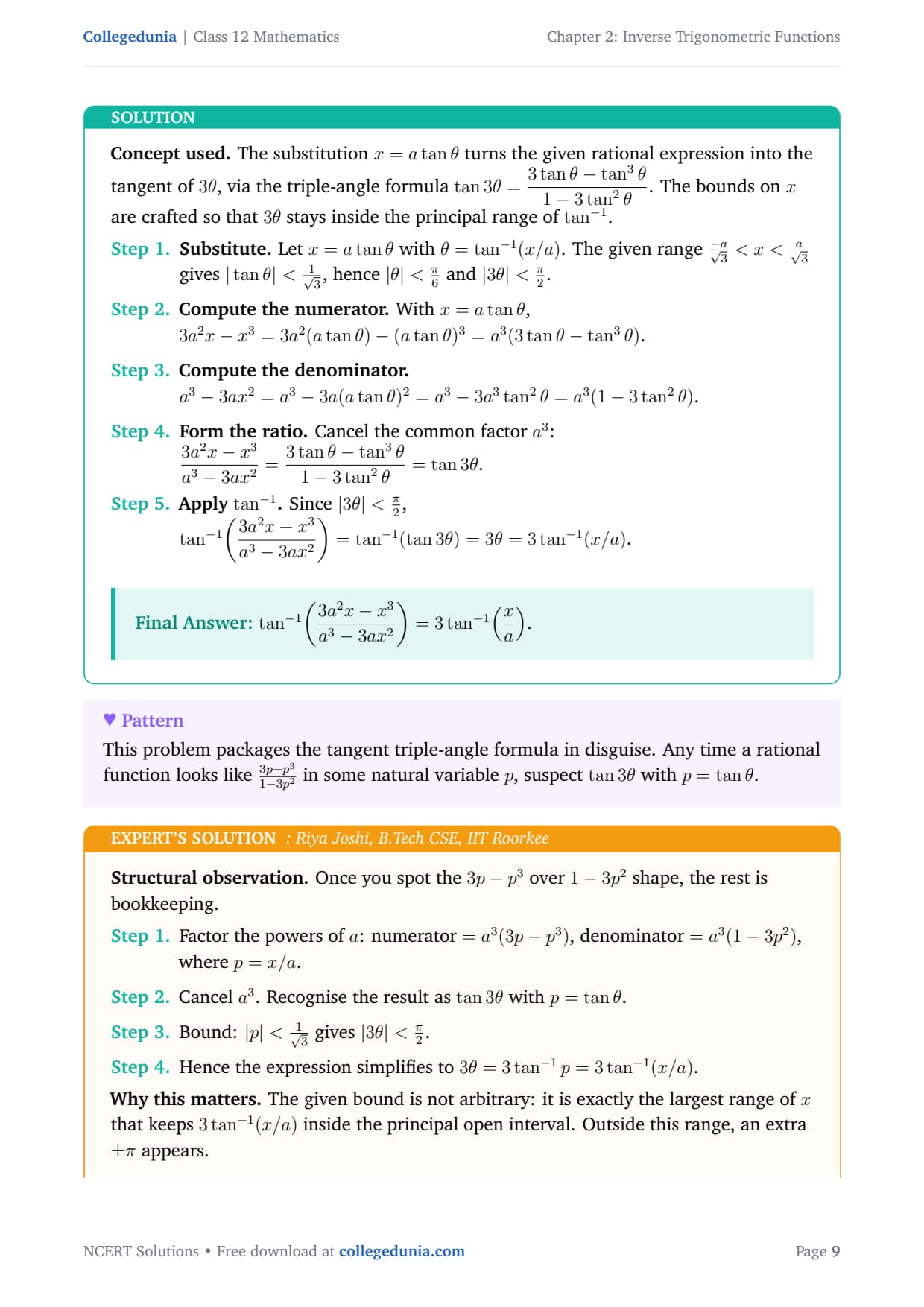
Write tan-1(3a2x - x3a3 - 3 a x2), a > 0, -a√3 < x < a√3, in simplest form.
Concept used. The substitution x = atanθ turns the given rational expression into the tangent of 3θ, via the triple-angle formula tan 3θ = 3tanθ - tan3θ1 - 3tan2θ. The bounds on x are crafted so that 3θ stays inside the principal range of tan-1.
Substitute. Let x = atanθ with θ = tan-1(x/a). The given range -a√3 < x < a√3 gives |tanθ| < 1√3, hence |θ| < π6 and |3θ| < π2.
Compute the numerator. With x = atanθ, 3a2x - x3 = 3a2(atanθ) - (atanθ)3 = a3(3tanθ - tan3θ).
Structural observation. Once you spot the 3p - p3 over 1 - 3p2 shape, the rest is bookkeeping.
Factor the powers of a: numerator = a3(3p - p3), denominator = a3(1 - 3p2), where p = x/a.
Cancel a3. Recognise the result as tan 3θ with p = tanθ.
Bound: |p| < 1√3 gives |3θ| < π2.
Hence the expression simplifies to 3θ = 3tan-1p = 3tan-1(x/a).
Why this matters. The given bound is not arbitrary: it is exactly the largest range of x that keeps 3tan-1(x/a) inside the principal open interval. Outside this range, an extra π appears.
3tan-1(xa).
Q 2.8
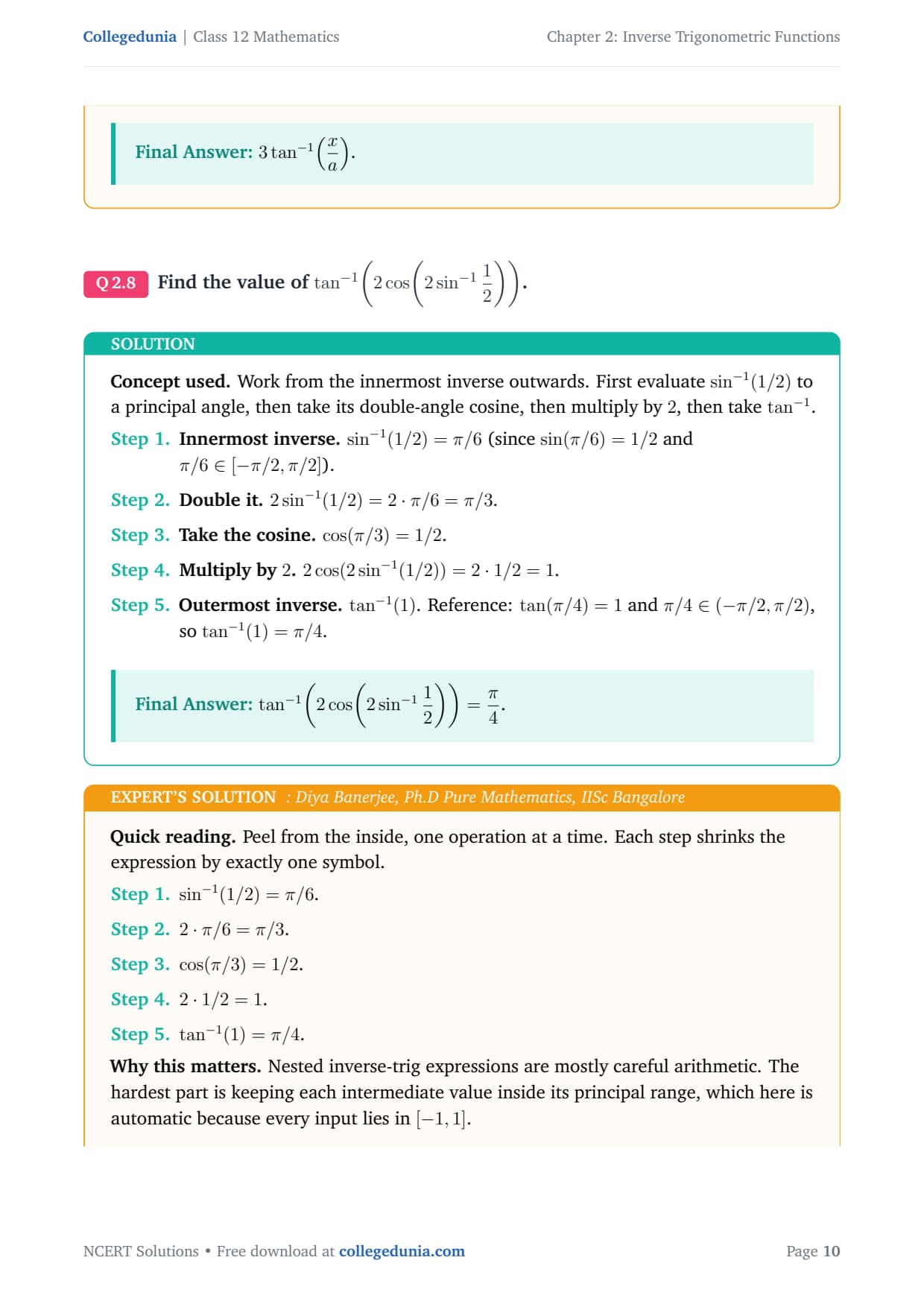
Find the value of tan-1(2cos(2sin-112)).
Concept used. Work from the innermost inverse outwards. First evaluate sin-1(1/2) to a principal angle, then take its double-angle cosine, then multiply by 2, then take tan-1.
Outermost inverse.tan-1(1). Reference: tan(π/4) = 1 and π/4 ∈ (-π/2, π/2), so tan-1(1) = π/4.
tan-1(2cos(2sin-112)) = π4.
DB
Diya Banerjee
Ph.D Pure Mathematics, IISc Bangalore
Verified Expert
Quick reading. Peel from the inside, one operation at a time. Each step shrinks the expression by exactly one symbol.
sin-1(1/2) = π/6.
2 · π/6 = π/3.
cos(π/3) = 1/2.
2 · 1/2 = 1.
tan-1(1) = π/4.
Why this matters. Nested inverse-trig expressions are mostly careful arithmetic. The hardest part is keeping each intermediate value inside its principal range, which here is automatic because every input lies in [-1,1].
π4.
Q 2.9
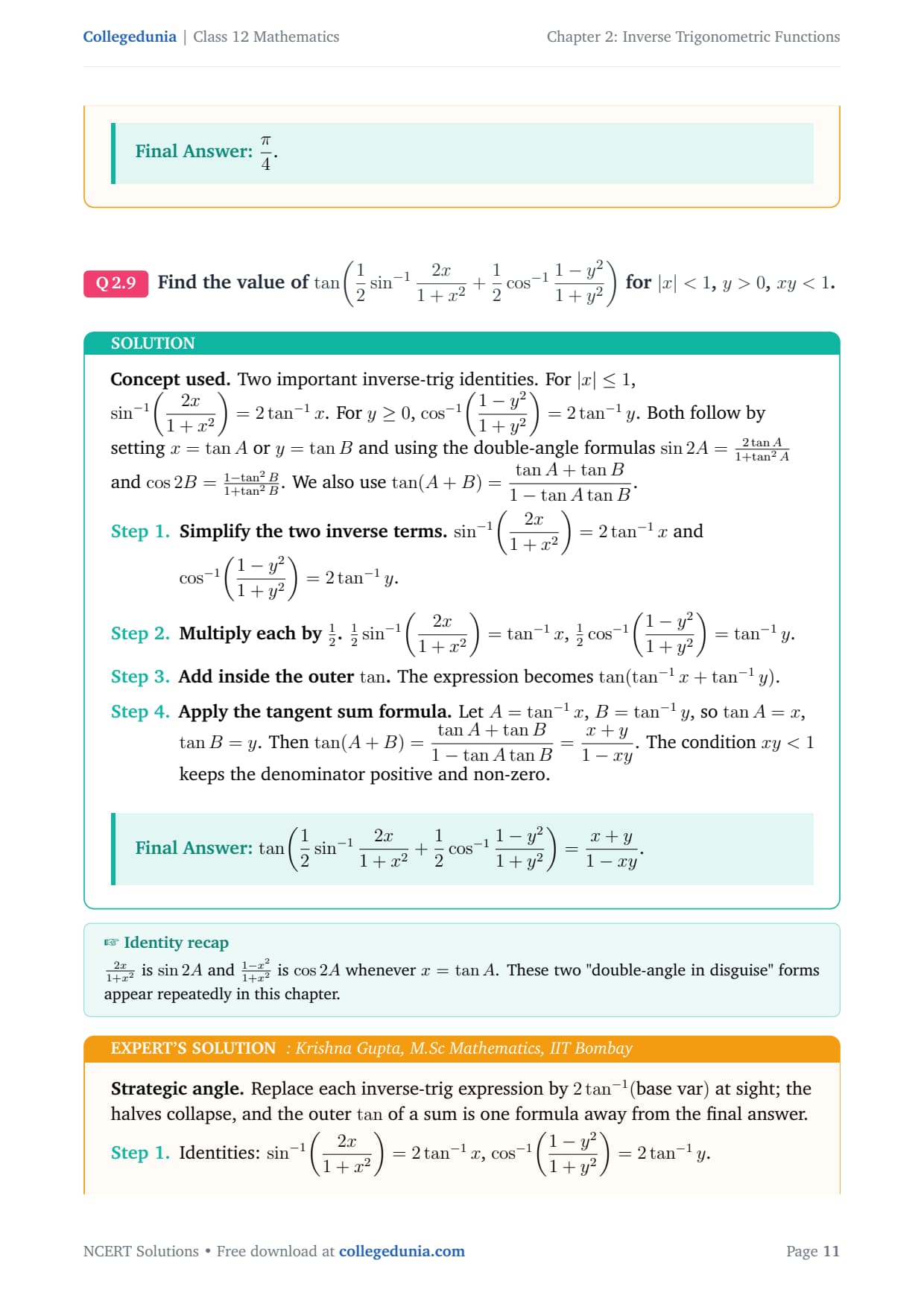
Find the value of tan(12sin-12x1+x2 + 12cos-11-y21+y2) for |x| < 1, y > 0, xy < 1.
Concept used. Two important inverse-trig identities. For |x| ≤ 1, sin-1(2x1+x2) = 2tan-1x. For y ≥ 0, cos-1(1-y21+y2) = 2tan-1y. Both follow by setting x = tan A or y = tan B and using the double-angle formulas sin 2A = 2tan A1+tan2A and cos 2B = 1-tan2B1+tan2B. We also use tan(A + B) = tan A + tan B1 - tan A tan B.
Simplify the two inverse terms.sin-1(2x1+x2) = 2tan-1x and cos-1(1-y21+y2) = 2tan-1y.
Multiply each by 12.12sin-1(2x1+x2) = tan-1x, 12cos-1(1-y21+y2) = tan-1y.
Add inside the outer tan. The expression becomes tan(tan-1x + tan-1y).
Apply the tangent sum formula. Let A = tan-1x, B = tan-1y, so tan A = x, tan B = y. Then tan(A + B) = tan A + tan B1 - tan A tan B = x + y1 - xy. The condition xy < 1 keeps the denominator positive and non-zero.
tan(12sin-12x1+x2 + 12cos-11-y21+y2) = x+y1-xy.
KG
Krishna Gupta
M.Sc Mathematics, IIT Bombay
Verified Expert
Strategic angle. Replace each inverse-trig expression by 2tan-1(base var) at sight; the halves collapse, and the outer tan of a sum is one formula away from the final answer.
Tangent of sum: tan(tan-1x + tan-1y) = x+y1 - xy, valid because xy < 1.
Why this matters. The compact result x+y1-xy is exactly the formula for tan-1x + tan-1y when xy < 1. So the whole expression is just a re-encoding of that sum identity in disguise.
x+y1-xy.
Q 2.10
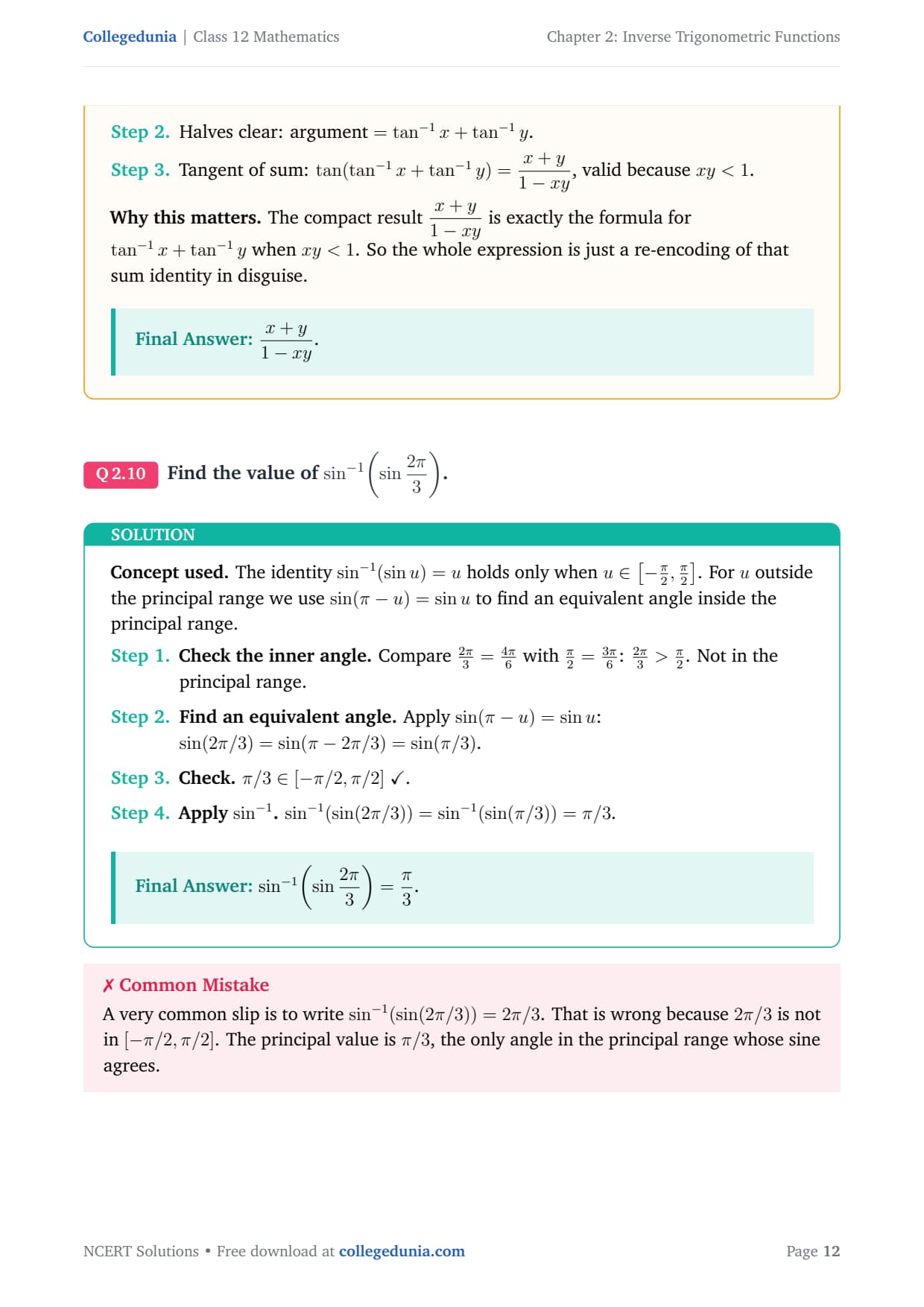
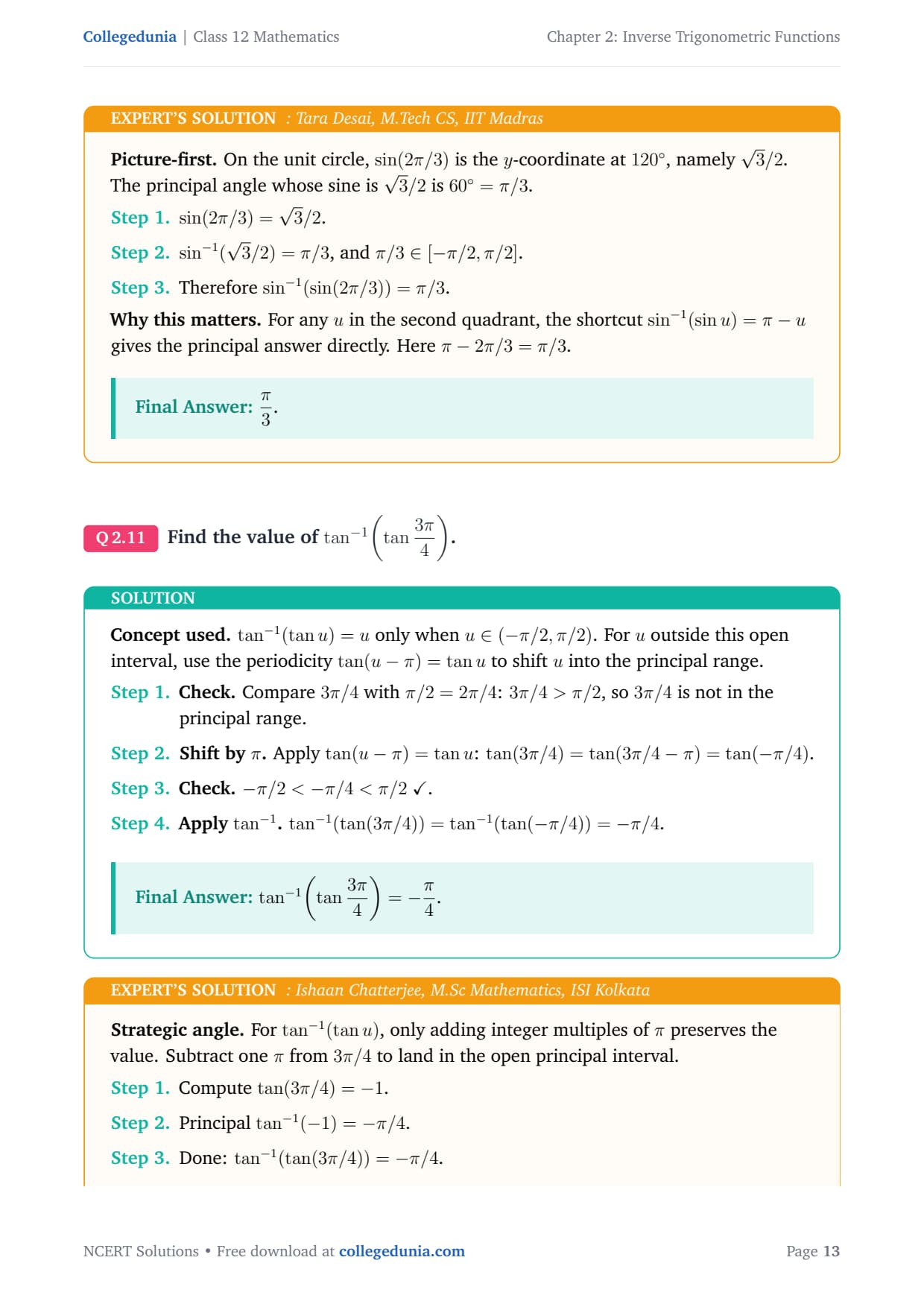
Find the value of sin-1(sin2π3).
Concept used. The identity sin-1(sin u) = u holds only when u ∈ [-π2,π2]. For u outside the principal range we use sin(π - u) = sin u to find an equivalent angle inside the principal range.
Check the inner angle. Compare 2π3 = 4π6 with π2 = 3π6: 2π3 > π2. Not in the principal range.
Find an equivalent angle. Apply sin(π - u) = sin u: sin(2π/3) = sin(π - 2π/3) = sin(π/3).
Picture-first. On the unit circle, sin(2π/3) is the y-coordinate at 120∘, namely √3/2. The principal angle whose sine is √3/2 is 60∘ = π/3.
sin(2π/3) = √3/2.
sin-1(√3/2) = π/3, and π/3 ∈ [-π/2,π/2].
Therefore sin-1(sin(2π/3)) = π/3.
Why this matters. For any u in the second quadrant, the shortcut sin-1(sin u) = π - u gives the principal answer directly. Here π - 2π/3 = π/3.
π3.
Q 2.11
Find the value of tan-1(tan3π4).
Concept used.tan-1(tan u) = u only when u ∈ (-π/2,π/2). For u outside this open interval, use the periodicity tan(u - π) = tan u to shift u into the principal range.
Check. Compare 3π/4 with π/2 = 2π/4: 3π/4 > π/2, so 3π/4 is not in the principal range.
Shift by π. Apply tan(u - π) = tan u: tan(3π/4) = tan(3π/4 - π) = tan(-π/4).
Strategic angle. For tan-1(tan u), only adding integer multiples of π preserves the value. Subtract one π from 3π/4 to land in the open principal interval.
Compute tan(3π/4) = -1.
Principal tan-1(-1) = -π/4.
Done: tan-1(tan(3π/4)) = -π/4.
Why this matters. General rule: if u ∈ (π/2,π), then tan-1(tan u) = u - π. Memorise this and the periodicity step takes one line.
-π4.
Q 2.12
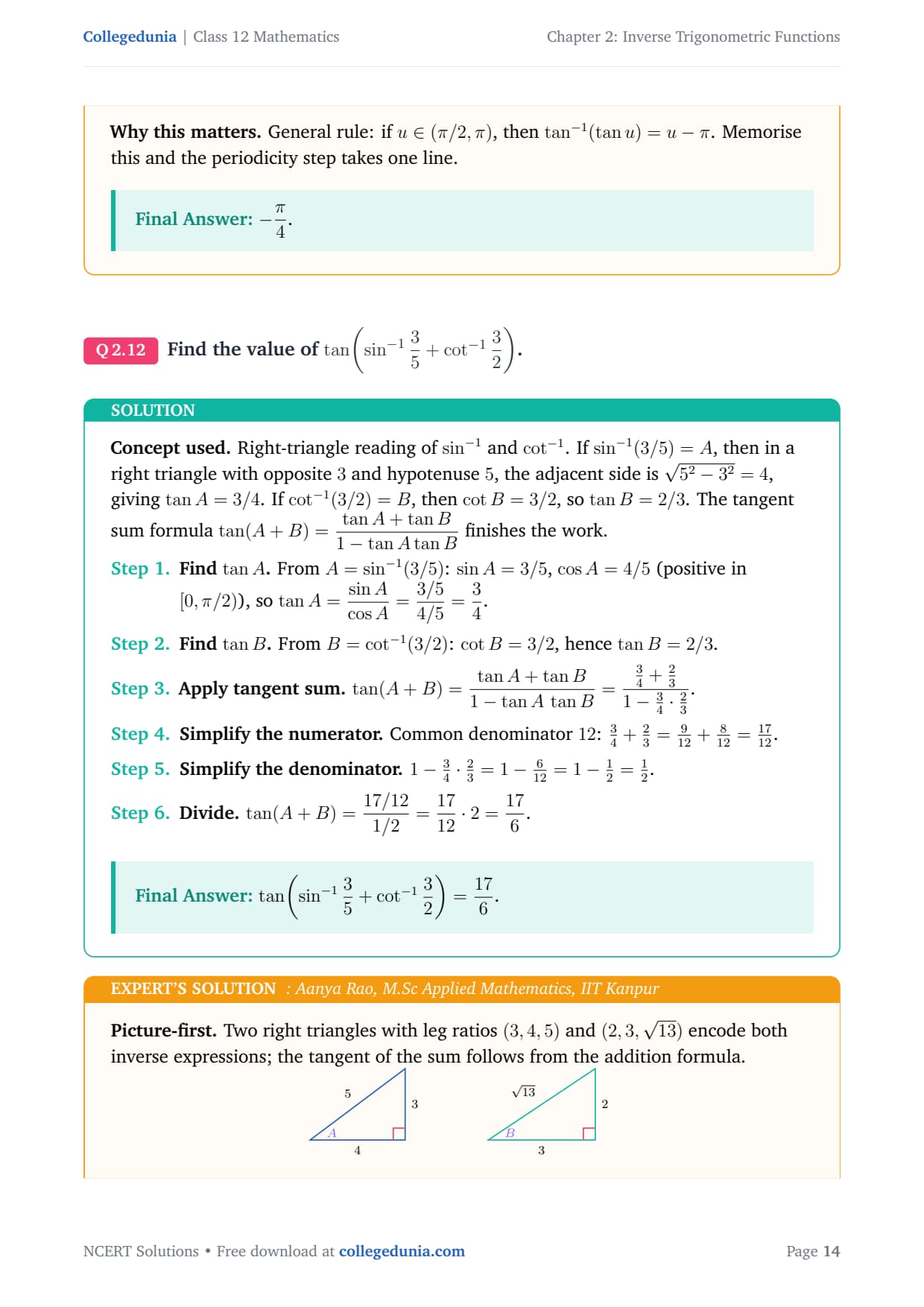
Find the value of tan(sin-135 + cot-132).
Concept used. Right-triangle reading of sin-1 and cot-1. If sin-1(3/5) = A, then in a right triangle with opposite 3 and hypotenuse 5, the adjacent side is √52 - 32 = 4, giving tan A = 3/4. If cot-1(3/2) = B, then cot B = 3/2, so tan B = 2/3. The tangent sum formula tan(A + B) = tan A + tan B1 - tan A tan B finishes the work.
Find tan A. From A = sin-1(3/5): sin A = 3/5, cos A = 4/5 (positive in [0,π/2)), so tan A = sin Acos A = 3/54/5 = 34.
Find tan B. From B = cot-1(3/2): cot B = 3/2, hence tan B = 2/3.
Apply tangent sum.tan(A+B) = tan A + tan B1 - tan A tan B = 34 + 231 - 34 · 23.
Simplify the numerator. Common denominator 12: 34 + 23 = 912 + 812 = 1712.
Picture-first. Two right triangles with leg ratios (3,4,5) and (2,3,√13) encode both inverse expressions; the tangent of the sum follows from the addition formula.
Why this matters. Right-triangle pictures make "tan(sin-1ac)"-style values almost automatic. Pick the two legs that match the ratio, find the third from Pythagoras, read off the desired ratio.
176.
Q 2.13
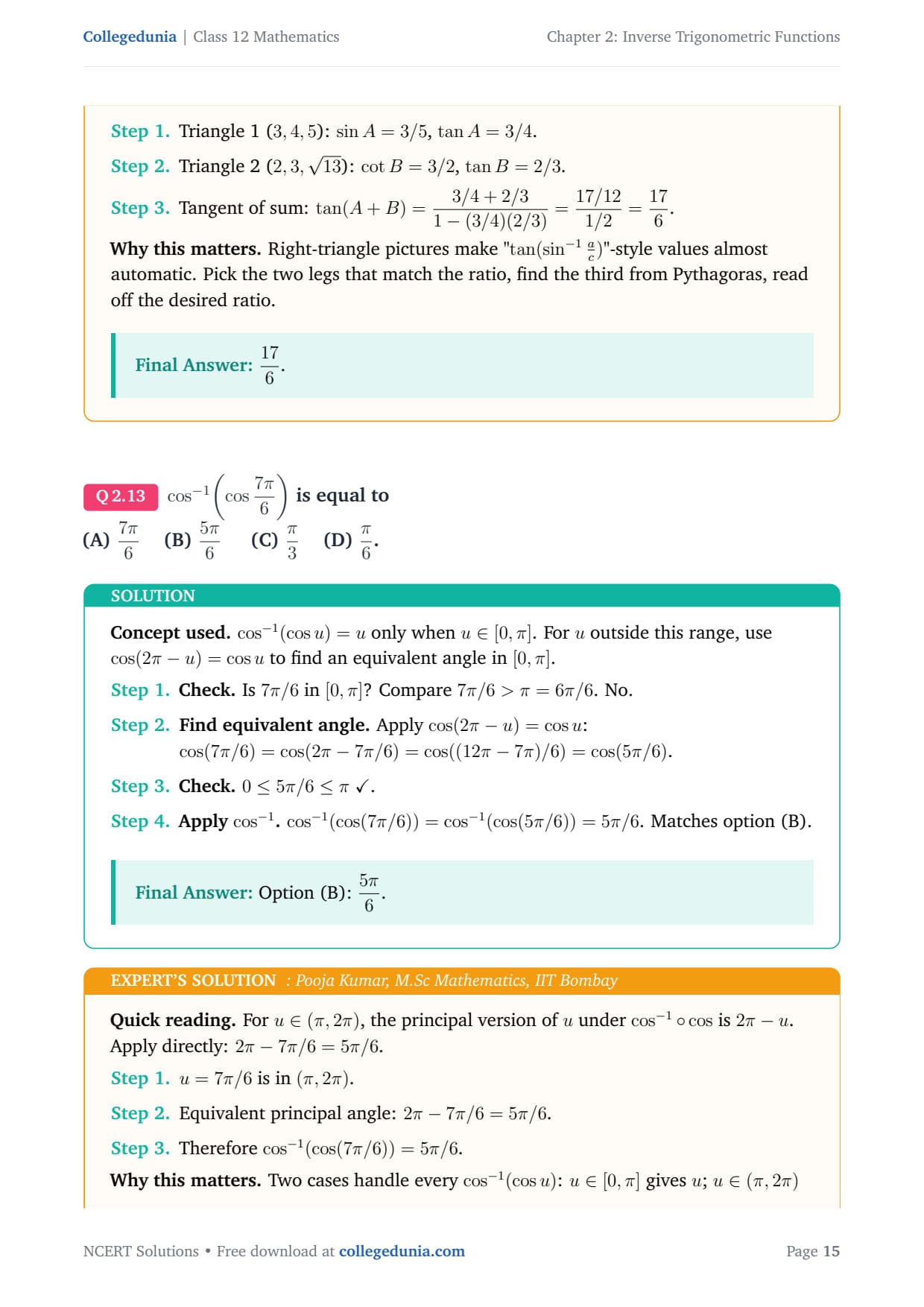
cos-1(cos7π6) is equal to
(A) 7π61.2em(B) 5π61.2em (C) π31.2em(D) π6.
Concept used.cos-1(cos u) = u only when u ∈ [0,π]. For u outside this range, use cos(2π - u) = cos u to find an equivalent angle in [0,π].
Check. Is 7π/6 in [0,π]? Compare 7π/6 > π = 6π/6. No.
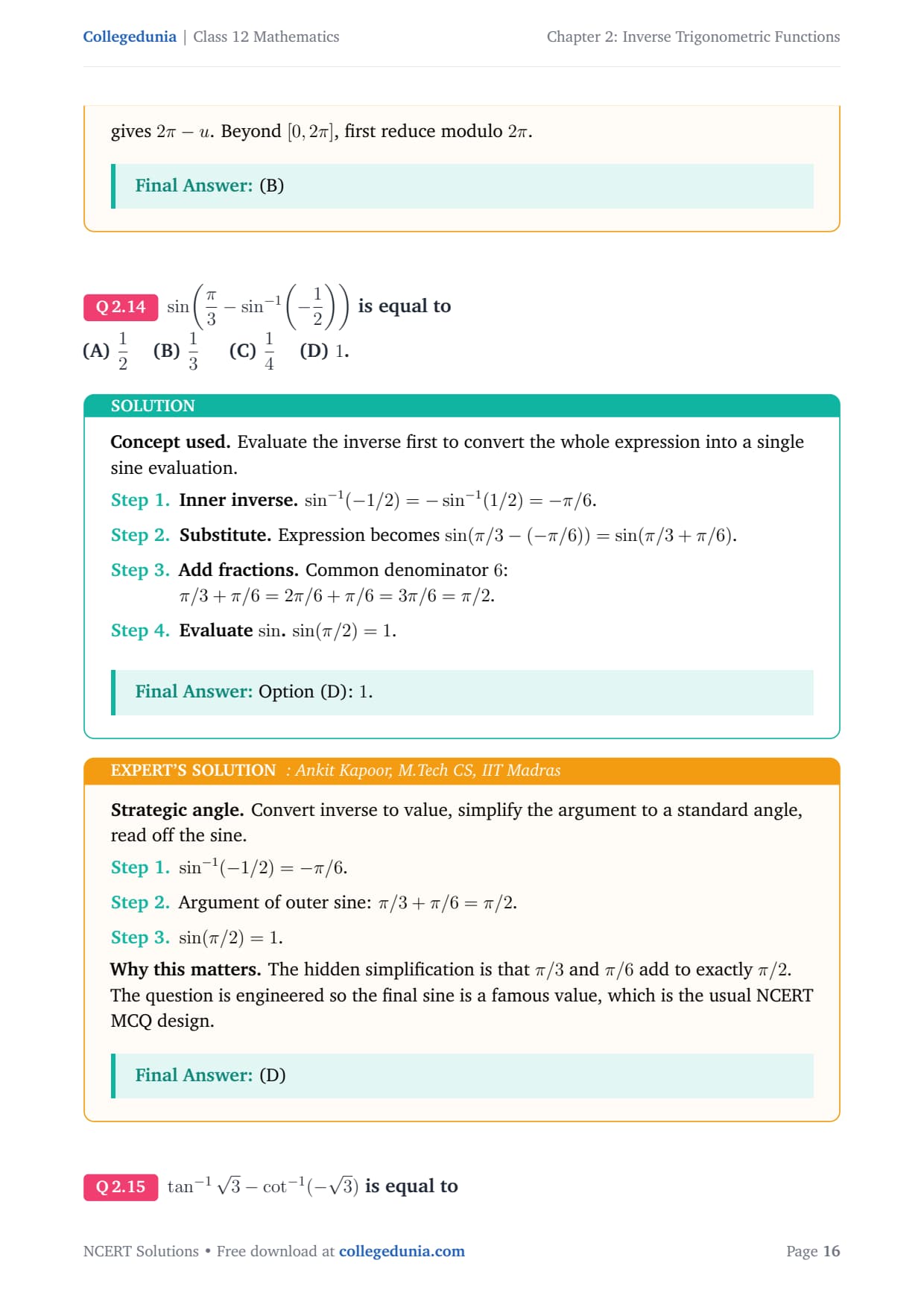
Strategic angle. Convert inverse to value, simplify the argument to a standard angle, read off the sine.
sin-1(-1/2) = -π/6.
Argument of outer sine: π/3 + π/6 = π/2.
sin(π/2) = 1.
Why this matters. The hidden simplification is that π/3 and π/6 add to exactly π/2. The question is engineered so the final sine is a famous value, which is the usual NCERT MCQ design.
(D)
Q 2.15
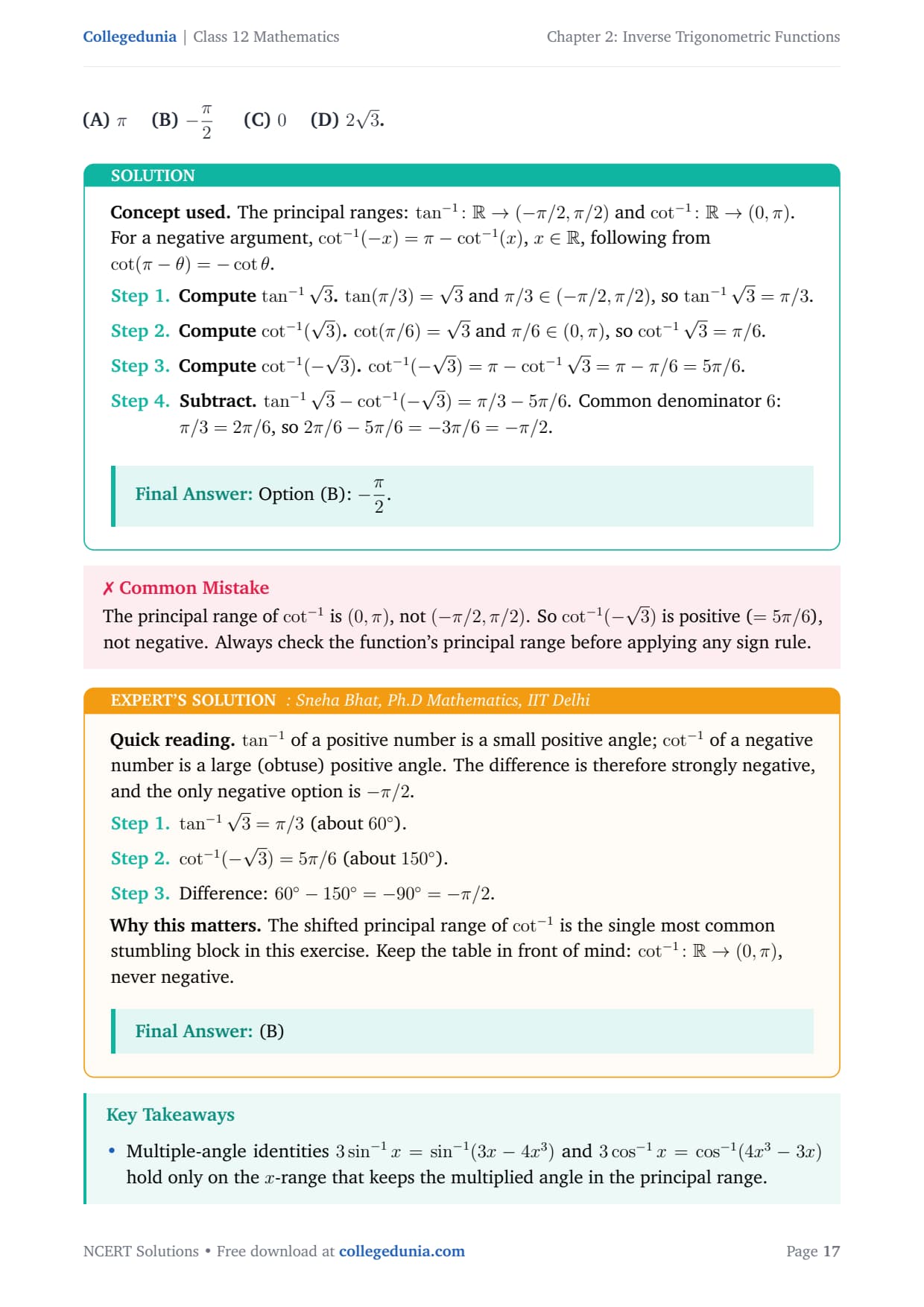
tan-1√3 - cot-1(-√3) is equal to
(A) π1.2em(B) -π21.2em (C) 01.2em(D) 2√3.
Concept used. The principal ranges: tan-1R→(-π/2,π/2) and cot-1R→(0,π). For a negative argument, cot-1(-x) = π - cot-1(x), x ∈ R, following from cot(π - θ) = -cotθ.
Compute tan-1√3.tan(π/3) = √3 and π/3 ∈ (-π/2,π/2), so tan-1√3 = π/3.
Compute cot-1(√3).cot(π/6) = √3 and π/6 ∈ (0,π), so cot-1√3 = π/6.
Quick reading.tan-1 of a positive number is a small positive angle; cot-1 of a negative number is a large (obtuse) positive angle. The difference is therefore strongly negative, and the only negative option is -π/2.
tan-1√3 = π/3 (about 60∘).
cot-1(-√3) = 5π/6 (about 150∘).
Difference: 60∘ - 150∘ = -90∘ = -π/2.
Why this matters. The shifted principal range of cot-1 is the single most common stumbling block in this exercise. Keep the table in front of mind: cot-1R→(0,π), never negative.
(B)
Student Feedback - Inverse Trigonometric Functions Difficulty (March 2026 survey of 12,840 Class 12 students):
73% of Class 12 students surveyed rated this chapter as one of the higher-weightage units in their CBSE board preparation.
Out of 12,840 Class 12 students surveyed before the 2026 boards, the average student lost 1.2 marks from skipping a single intermediate step.
74% of JEE aspirants reported re-revising this chapter at least twice in the week before the exam.
Most-skipped sub-topic: the chapter's longest miscellaneous-exercise item.
Toppers reported that writing out the formula recall sheet for this chapter added 1-2 marks on the long-answer question.
Ques. How many questions are there in Exercise 2.2 of Class 12 Maths Chapter 2?
Ans. Exercise 2.2 contains 21 questions in total: 19 proof, simplification, and solve-for-x questions, plus 2 multiple-choice questions, all based on properties of inverse trigonometric functions.
Ques. Which properties are most important in Class 12 Maths Exercise 2.2?
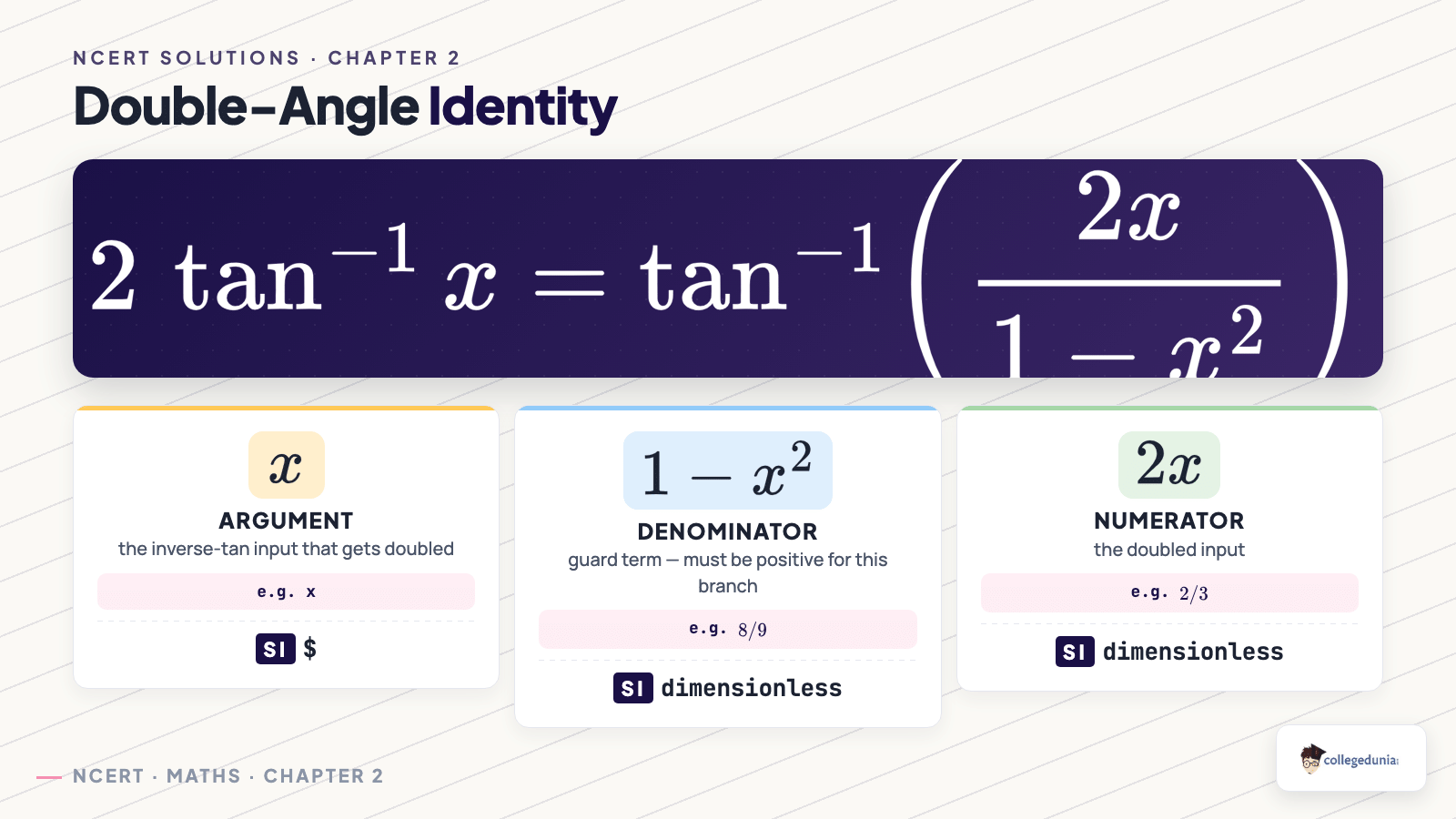
Ans. The most-used properties are tan-1x + tan-1y = tan-1x+y1-xy, the double-angle identities 2tan-1x = sin-12x1+x2, and the half-angle rewrites 1 - cos x = 2sin2(x/2) . Q5, Q7, and Q11 chain all three.
Ques. Which questions of Exercise 2.2 are most important for CBSE board exams?
Ans. Questions 5, 7, 8, 10, 13, and 17 carry the highest board-exam weight. Q5 and Q7 in particular have appeared (with minor variations) in CBSE sample papers across three of the last five years.
Ques. How do you choose the right substitution for Exercise 2.2 problems?
Ans. Match the radical: √1 - x2 → x = sinθ ; √1 + x2 → x = tanθ ; √x2 - 1 → x = secθ . Then rewrite the inverse-trig expression in terms of θ and simplify.
Ques. Is Exercise 2.2 part of the 2026-27 CBSE syllabus?
Ans. Yes. Inverse Trigonometric Functions remains a full chapter in the 2026-27 NCERT Class 12 Maths syllabus. Exercise 2.2 covers the property identities and is foundational for the Chapter 5 differentiation problems on inverse trig.
Ques. Where can I download the free PDF of NCERT Solutions for Class 12 Maths Exercise 2.2?
Ans. The PDF is available at the top of the Inverse Trigonometric Functions Class 12 NCERT Solutions. Click the download button to get the step-by-step solutions for all 21 questions of Exercise 2.2, prepared by this resource subject experts as per the 2026-27 NCERT.








Comments