NCERT Solutions for Class 12 Maths Chapter 1 Relations and Functions Exercise 1.2 covers 12 questions on one-one, onto and bijective functions. Collegedunia's subject experts have solved every question with clear steps and simple language. The free solutions PDF for Exercise 1.2 is available to download on this page.
Every answer here is written by Collegedunia's senior subject matter experts. Each final answer is checked against the official NCERT Solutions PDF.
Exercise 1.2 at a glance: Q1-Q6 cover basic function-type checks, Q7-Q9 require formal one-one and onto proofs, and Q10-Q12 add bijection arguments. Every solution gives the assumption, the algebra, and the conclusion line.
Each of the 12 questions is solved in under one page, with the injective check and the surjective check kept separate. Attempt Q1, Q7, and Q9 first - they match the most-repeated board-style question.
How will Collegedunia's NCERT Solutions for Exercise 1.2 help you?
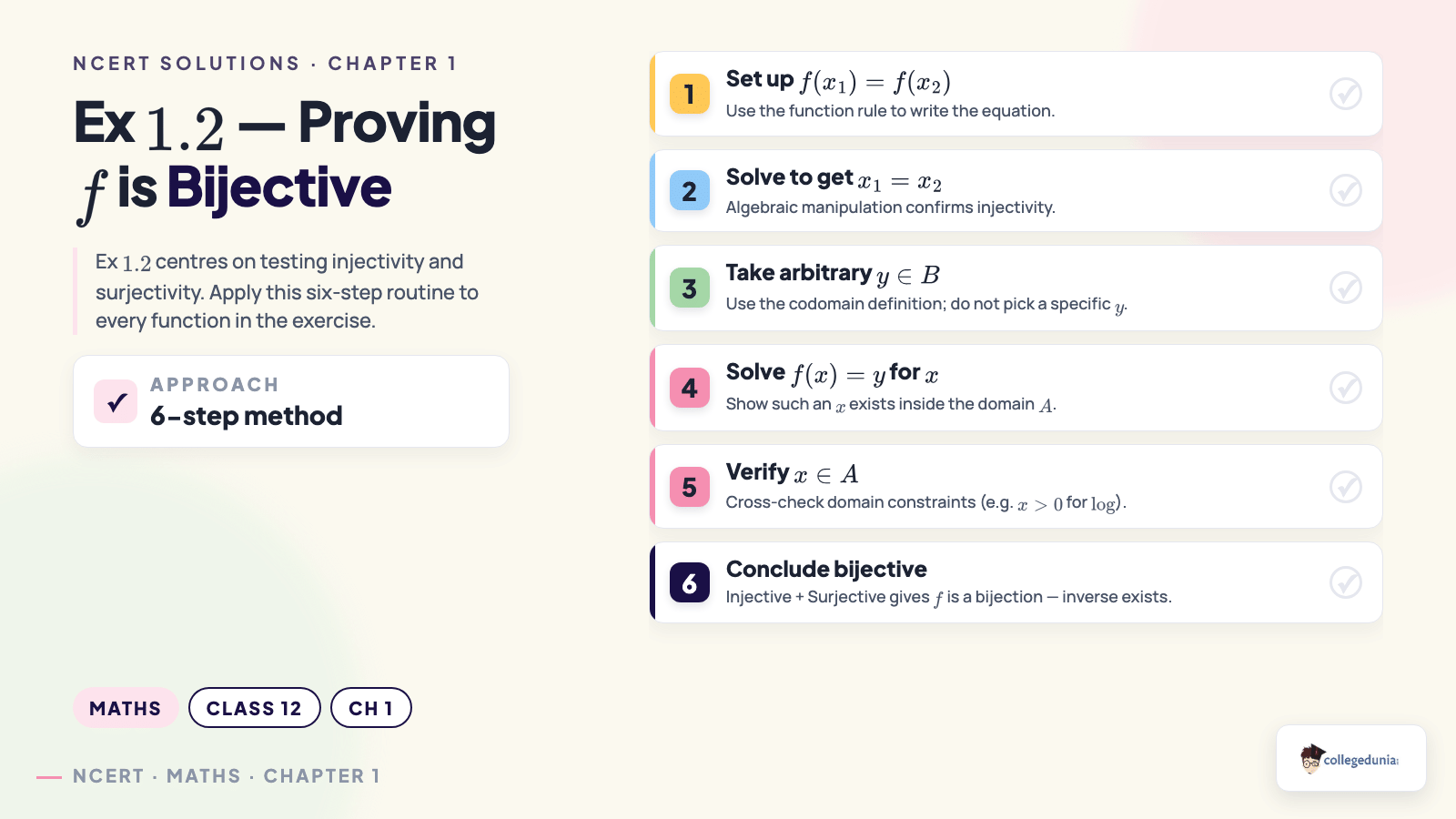
Exercise 1.2 is where students first meet formal proofs of injective and surjective behaviour. Most learners can quote the definitions but stumble when asked to write the proof on paper. Collegedunia's solutions PDF fixes that by following a three-line proof skeleton on every question:
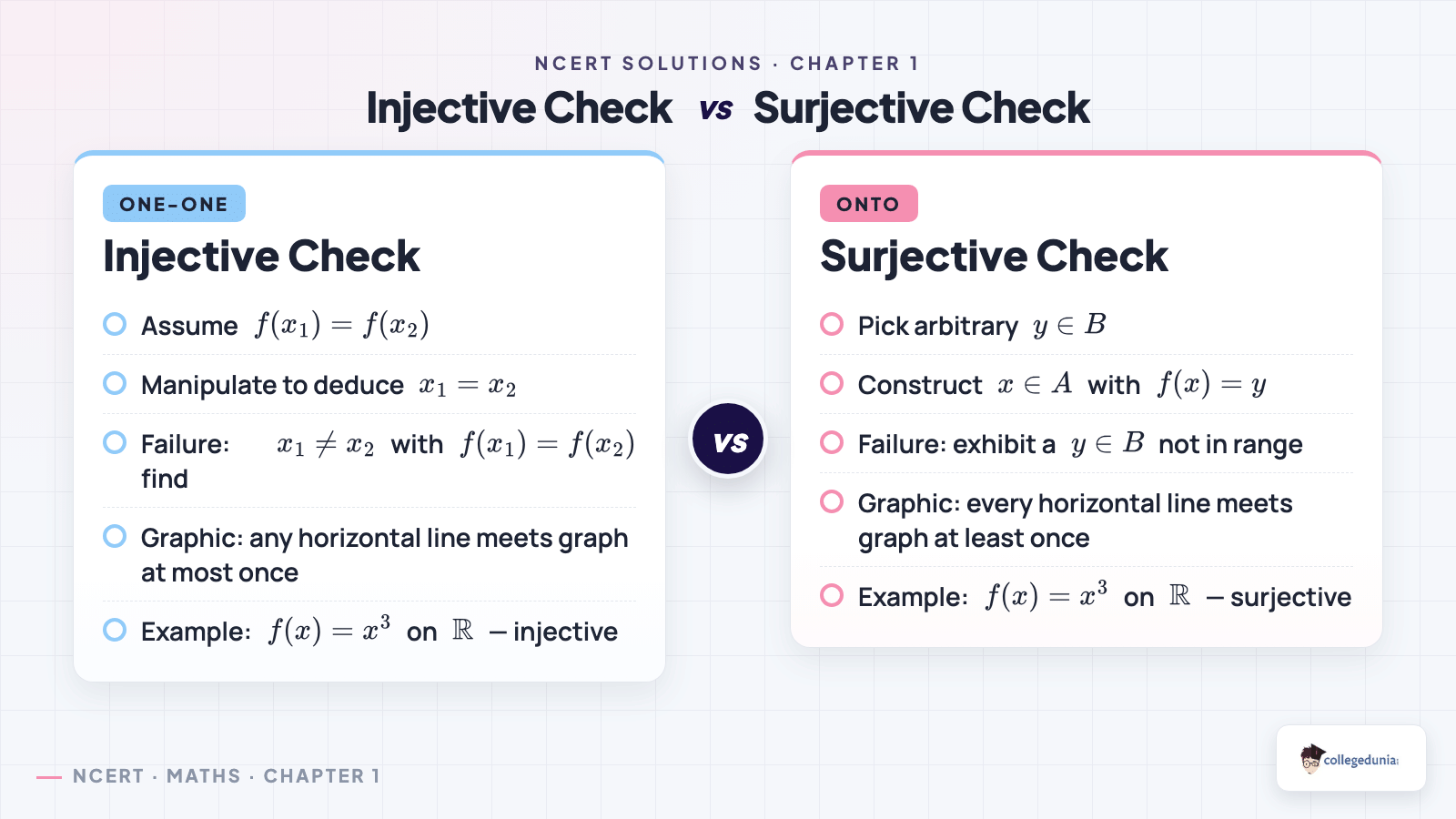
assume f(x1) = f(x2) -> simplify -> conclude x1 = x2 for one-one; and take arbitrary y in codomain -> solve for x -> check x lies in domain for onto.
You will see the difference within two weeks of practice. The PDF also flags every place where the codomain choice (R, R*, N, Z) changes the answer. This is the most common mistake in board-paper Q3-style questions.
Relations and Functions Ex 1.2 Solved Step by Step (Video)
Exercise 1.2 sits under section 1.2 of the NCERT textbook (Types of Functions). The table below maps each block of questions to the underlying concept, so you can revise selectively before a class test.
Questions
Concept tested
Skill needed
Q1
f(x) = 1/x on R*; one-one and onto check
Algebraic manipulation, codomain awareness
Q2 (i-v)
Five sub-functions: constant, identity, modulus, signum, x^2
Counter-example construction
Q3
Greatest integer function (floor)
Discrete output reasoning
Q4
Modulus function on R
Sign-based casework
Q5
Signum function
Three-case piecewise check
Q6
Function defined by ordered pairs
Set-mapping verification
Q7
f: R -> R, f(x) = 3 - 4x (linear)
Standard one-one + onto proof
Q8
f: R -> R, f(x) = 1 + x^2
Counter-example for non-injectivity
Q9
f: N -> N piecewise (n odd / n even)
Piecewise function bijection
Q10
f: A -> B, A = R - {3}, f(x) = (x-2)/(x-3)
Domain-restricted bijection
Q11
f: R -> R, f(x) = x^4
Even-power non-injectivity
Q12
f: R -> R, f(x) = 3x
Linear bijection
Treat Q7, Q9, Q10 and Q12 as your priority four; they cover every question style in school exams and CUET-UG.
Class 12 Maths Exercise 1.2 Solution Approach Summary
Below is the compressed solution map for the 12 questions. Use it as a self-check after attempting the exercise on your own. The full step-by-step working is inside the downloadable PDF.
Q.No.
Function
One-one?
Onto?
Bijective?
1
f(x) = 1/x on R*
Yes
Yes (on R*)
Yes
2(i)
f(x) = x^2 on N
Yes
No
No
2(ii)
f(x) = x^2 on Z
No
No
No
2(iii)
f(x) = x^2 on R
No
No
No
2(iv)
f(x) = x^3 on N
Yes
No
No
2(v)
f(x) = x^3 on Z
Yes
No
No
3
Greatest integer function
No
No
No
4
Modulus function
No
No
No
5
Signum function
No
No
No
7
f(x) = 3 - 4x
Yes
Yes
Yes
8
f(x) = 1 + x^2
No
No
No
10
f(x) = (x-2)/(x-3)
Yes
Yes
Yes
11
f(x) = x^4
No
No
No
12
f(x) = 3x
Yes
Yes
Yes
Notice the pattern: odd-degree polynomials on R are bijective, but even-degree ones fail both tests due to symmetry. Learn this and Q2, Q8 and Q11 take under two minutes each.
Important Definitions Used in Class 12 Maths Exercise 1.2
One-one (Injective): A function f: X -> Y is one-one if f(x1) = f(x2) implies x1 = x2 for all x1, x2 in X. Equivalent contrapositive form: x1 not equal to x2 implies f(x1) not equal to f(x2).
Onto (Surjective): A function f: X -> Y is onto if for every y in Y, there exists at least one x in X such that f(x) = y. Equivalently, range(f) = codomain(f) = Y.
Bijective: A function that is both one-one and onto. Bijective functions are invertible.
The Collegedunia PDF places these three definitions at the top of every solution page. You never need to flip back to section 1.2 of this Class 12 chapter while practising.
Common Mistakes Students Make in Class 12 Maths Exercise 1.2
These solutions are written in formal mathematical notation, line by line, matching the convention used in the official NCERT print.
Ignoring the codomain. The same formula f(x) = x^2 is one-one on N but not on Z. Students who skip the "given codomain" line in the question lose 1-2 marks every time.
Skipping the algebraic step. Writing "clearly one-one" is not a proof. The marker expects f(x1) = f(x2) followed by algebraic simplification to x1 = x2.
Forgetting to verify x lies in the domain after solving f(x) = y. In Q10, the solved x must explicitly avoid x = 3.
Treating piecewise functions as a single rule in Q9. You must split into the odd-n branch and even-n branch and check injectivity across both.
The PDF's expert solution callouts tag each of these traps right next to the relevant question, so you build the habit of avoiding them. Exercise 1.2-style "prove one-one and onto" questions appeared in CBSE boards in 2024, 2023 and 2020, and the same concepts show up as JEE Main MCQ traps.
Other Resources for Class 12 Maths Chapter 1 Relations and Functions
Pair the Exercise 1.2 solutions with the rest of the Chapter 1 resource library for complete preparation.
Students who use the Solutions PDF together with the Handwritten Notes for last-week revision tend to score 1-2 marks higher on the Chapter 1 short-answer questions.
The Exercise 1.2 solutions PDF is available above as a free download, aligned to the 2026-27 NCERT Class 12 Maths syllabus.
Exercise-wise Breakdown of the Relations and Functions Chapter
The Relations and Functions chapter splits into 2 numbered exercises plus a Miscellaneous Exercise. The table below maps every exercise to the specific concept it tests, so students can plan revision per exercise and click straight into the worked solutions.
All NCERT Solutions for Relations and Functions Ex 1.2 with Step-by-Step Working
Every NCERT textbook question for Class 12 Mathematics Chapter 1 Relations and Functions Ex 1.2 is listed below with its full Solution and Expert Solution hidden inside collapsible tabs. Click Check Solution to reveal the step-by-step working; click Expert Solution for the expanded explanation.
Questions
Q 1.1
Show that the function f : R∗ → R∗ defined by f(x) = 1x is one-one and onto, where R∗ is the set of all non-zero real numbers. Is the result true, if the domain R∗ is replaced by N with co-domain being same as R∗?
Concept used. A function f : X → Y is one-one (injective) when f(x1) = f(x2) implies x1 = x2 for every x1, x2 ∈ X. It is onto (surjective) when, for every y ∈ Y, there exists at least one x ∈ X with f(x) = y. Here R∗ = R 0.
One-one on R∗. Suppose f(x1) = f(x2). Then 1x1 = 1x2. Cross-multiplying (valid because x1, x2 ≠ 0): x2 = x1. Hence x1 = x2. So f is one-one.
Onto on R∗. Take any y ∈ R∗. We seek x ∈ R∗ with f(x) = y. Solve 1x = y: x = 1y. Since y ≠ 0, 1y is a non-zero real number, so x ∈ R∗. Verify: f(x) = 1x = 11/y = y. So every y has a pre-image. f is onto.
Now replace domain by N, keeping codomain R∗. Define g : N → R∗ by g(n) = 1n.
Injective? If g(n1) = g(n2) then 1n1 = 1n2 ⇒ n1 = n2. Yes, injective.
Onto? Take y = 12. We need n ∈ N with 1n = 12, i.e. n = 2. That works. But take y = 2 (which is in R∗). We need n ∈ N with 1n = 2, i.e. n = 12. But 12 ∉ N. So y = 2 has no pre-image. g is not onto.
f : R∗ → R∗ is bijective. With domain replaced by N, the map is one-one but not onto.
KR
Karan Reddy
M.Sc Mathematics, IIT Madras
Verified Expert
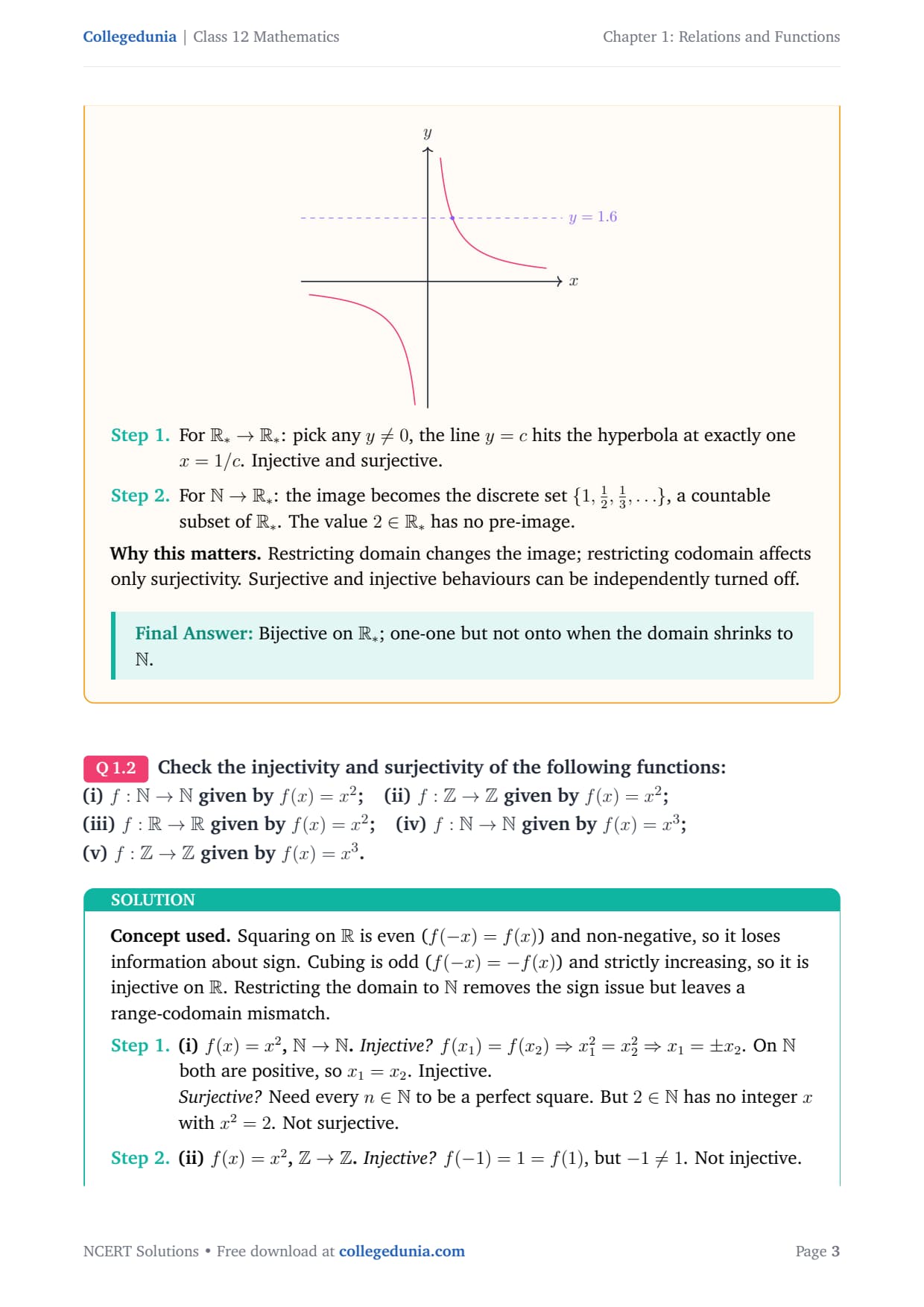
Picture-first. The graph of y = 1/x on R∗ is a hyperbola with two branches. Every horizontal line y = c ≠ 0 cuts the graph in exactly one point, witnessing bijectivity.
[See diagram in the PDF version]
For R∗ → R∗: pick any y ≠ 0, the line y = c hits the hyperbola at exactly one x = 1/c. Injective and surjective.
For N → R∗: the image becomes the discrete set 1, 12, 13, …, a countable subset of R∗. The value 2 ∈ R∗ has no pre-image.
Why this matters. Restricting domain changes the image; restricting codomain affects only surjectivity. Surjective and injective behaviours can be independently turned off.
Bijective on R∗; one-one but not onto when the domain shrinks to N.
Q 1.2
Check the injectivity and surjectivity of the following functions:
(i) f : N → N given by f(x) = x2; (ii) f : Z → Z given by f(x) = x2;
(iii) f : R → R given by f(x) = x2; (iv) f : N → N given by f(x) = x3;
(v) f : Z → Z given by f(x) = x3.
Concept used. Squaring on R is even (f(-x) = f(x)) and non-negative, so it loses information about sign. Cubing is odd (f(-x) = -f(x)) and strictly increasing, so it is injective on R. Restricting the domain to N removes the sign issue but leaves a range-codomain mismatch.
(i) f(x) = x2, N → N.Injective?f(x1) = f(x2) ⇒ x12 = x22 ⇒ x1 = ± x2. On N both are positive, so x1 = x2. Injective. Surjective? Need every n ∈ N to be a perfect square. But 2 ∈ N has no integer x with x2 = 2. Not surjective.
(ii) f(x) = x2, Z → Z.Injective?f(-1) = 1 = f(1), but -1 ≠ 1. Not injective. Surjective?-1 ∈ Z has no integer x with x2 = -1 (squares are non-negative). Not surjective.
(iii) f(x) = x2, R → R.Injective?f(-2) = 4 = f(2), -2 ≠ 2. Not injective. Surjective?-1 ∈ R has no real x with x2 = -1. Not surjective.
(iv) f(x) = x3, N → N.Injective?f(x1) = f(x2) ⇒ x13 = x23 ⇒ x1 = x2 (cubing is one-one on R, hence on N). Injective. Surjective?2 ∈ N has no x ∈ N with x3 = 2 (would need x = 21/3, irrational). Not surjective.
(v) f(x) = x3, Z → Z.Injective? Same as (iv); injective. Surjective?2 ∈ Z has no integer x with x3 = 2. Not surjective.
(i) Injective, not surjective. (ii) Neither. (iii) Neither. (iv) Injective, not surjective. (v) Injective, not surjective.
AM
Aanya Mehta
M.Sc Mathematics, ISI Kolkata
Verified Expert
Pattern table. Stitch the five subcases into a 2 × 5 table by domain and rule.
For squaring on N, the codomain is too big (image = n2 : n ∈ N, misses 2, 3, 5, 6, …). Negative codomain values are absent in N, so injectivity is restored.
For squaring on Z or R, negative pre-images appear: -x and +x collide. Both injectivity and surjectivity fail.
For cubing: strict monotonicity (x1 < x2 ⇒ x13 < x23) on R gives injectivity automatically. Surjectivity from N or Z to N or Z fails because non-cube integers (like 2, 3, 4) lie in the codomain but not the image.
Why this matters. The lesson: behaviour of f depends on three things simultaneously: rule, domain, codomain. Changing any one can flip injectivity or surjectivity.
Only cubing maps are injective; none of the five are surjective.
Q 1.3
Prove that the Greatest Integer Function f : R → R, given by f(x) = [x], is neither one-one nor onto, where [x] denotes the greatest integer less than or equal to x.
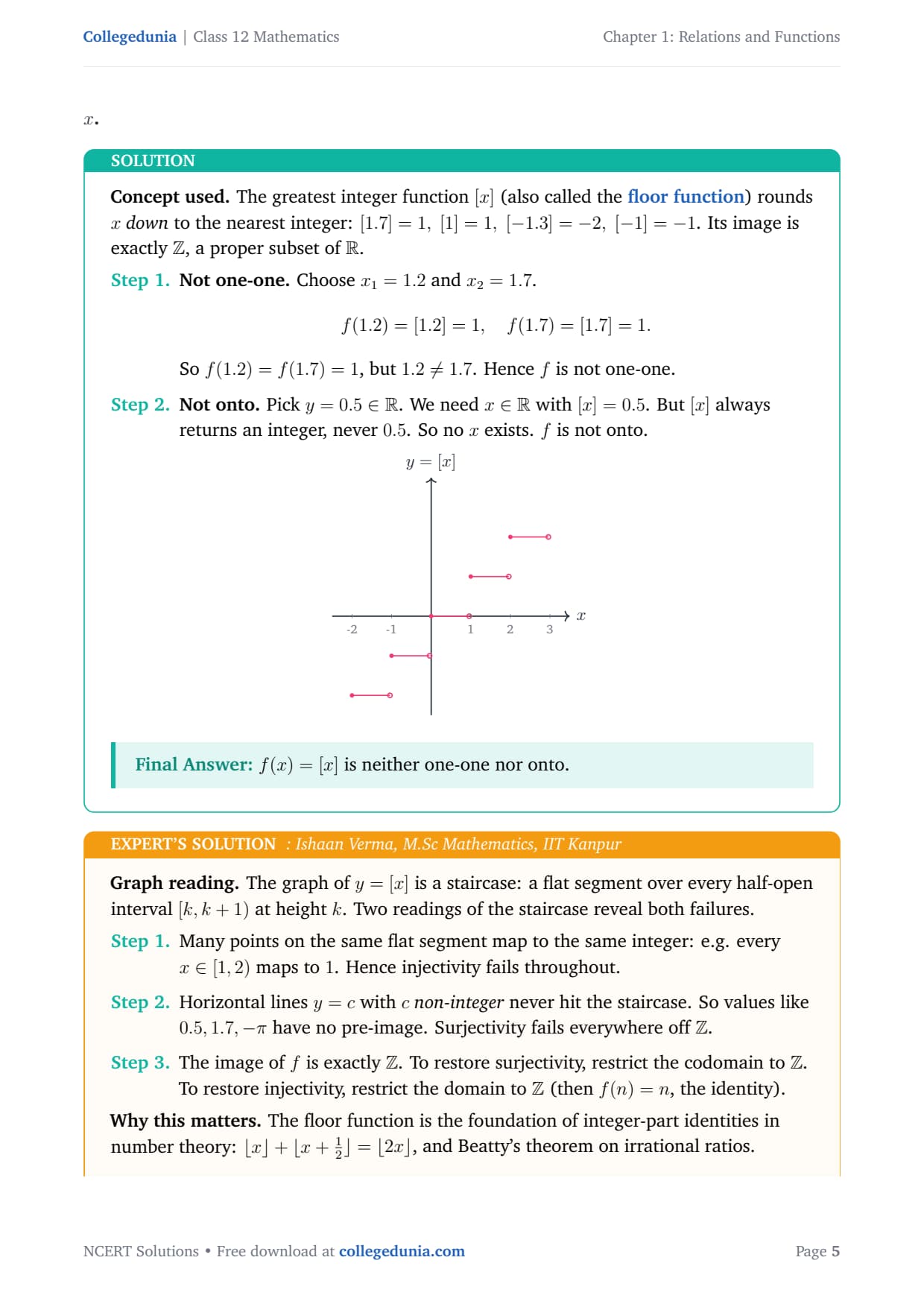
Concept used. The greatest integer function [x] (also called the floor function) rounds xdown to the nearest integer: [1.7] = 1, [1] = 1, [-1.3] = -2, [-1] = -1. Its image is exactly Z, a proper subset of R.
Not one-one. Choose x1 = 1.2 and x2 = 1.7. f(1.2) = [1.2] = 1, f(1.7) = [1.7] = 1. So f(1.2) = f(1.7) = 1, but 1.2 ≠ 1.7. Hence f is not one-one.
Not onto. Pick y = 0.5 ∈ R. We need x ∈ R with [x] = 0.5. But [x] always returns an integer, never 0.5. So no x exists. f is not onto.
[See diagram in the PDF version]
f(x) = [x] is neither one-one nor onto.
IV
Ishaan Verma
M.Sc Mathematics, IIT Kanpur
Verified Expert
Graph reading. The graph of y = [x] is a staircase: a flat segment over every half-open interval [k, k+1) at height k. Two readings of the staircase reveal both failures.
Many points on the same flat segment map to the same integer: e.g. every x ∈ [1, 2) maps to 1. Hence injectivity fails throughout.
Horizontal lines y = c with cnon-integer never hit the staircase. So values like 0.5, 1.7, -π have no pre-image. Surjectivity fails everywhere off Z.
The image of f is exactly Z. To restore surjectivity, restrict the codomain to Z. To restore injectivity, restrict the domain to Z (then f(n) = n, the identity).
Why this matters. The floor function is the foundation of integer-part identities in number theory: x + x + 12 = 2x , and Beatty's theorem on irrational ratios.
Neither one-one nor onto.
Q 1.4
Show that the Modulus Function f : R → R, given by f(x) = |x|, is neither one-one nor onto, where |x| is x, if x is positive or 0 and |x| is -x, if x is negative.
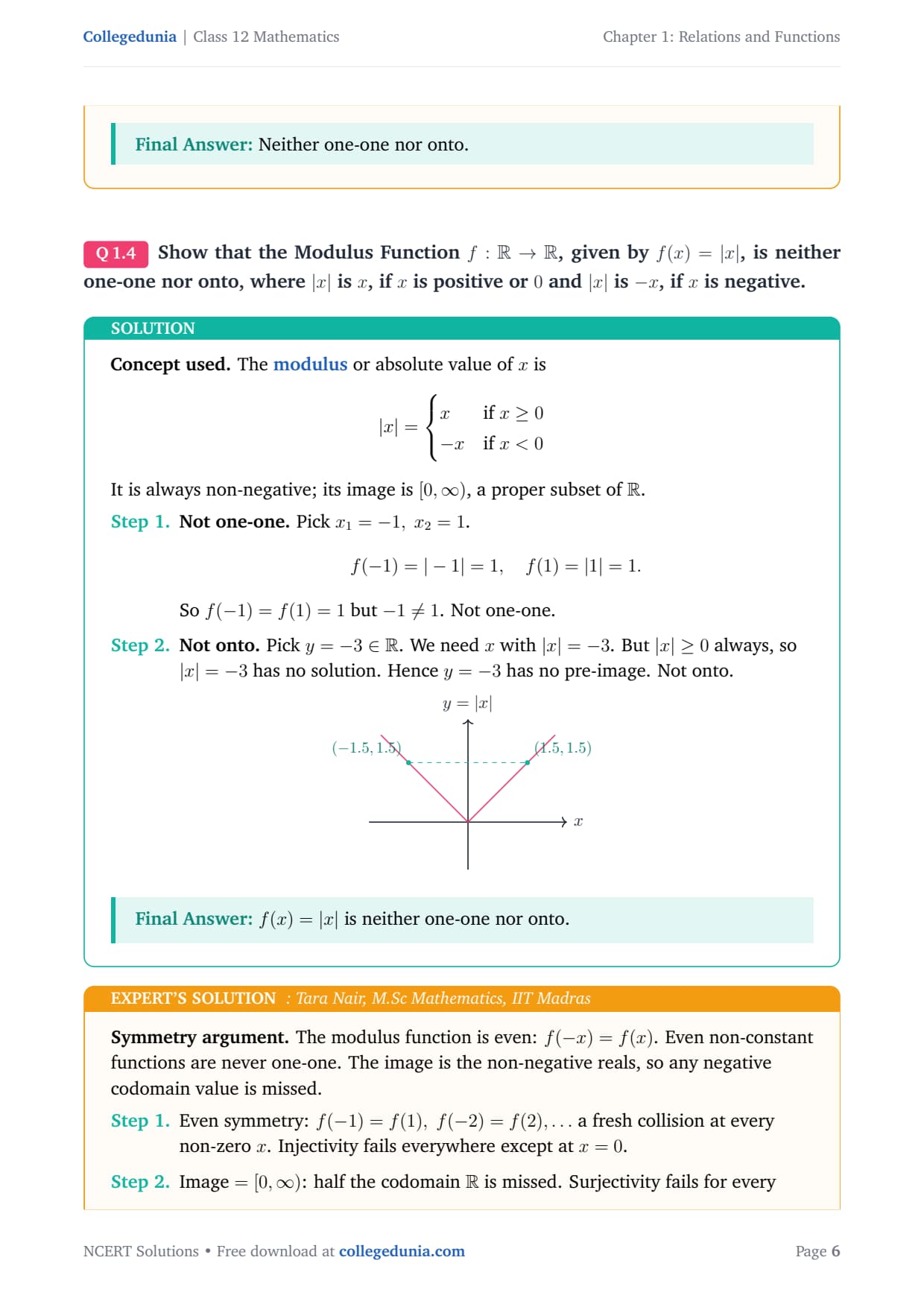
Concept used. The modulus or absolute value of x is |x| = cases x & if x ≥ 0 -x & if x < 0 cases It is always non-negative; its image is [0, ∞), a proper subset of R.
Not one-one. Pick x1 = -1, x2 = 1. f(-1) = |-1| = 1, f(1) = |1| = 1. So f(-1) = f(1) = 1 but -1 ≠ 1. Not one-one.
Not onto. Pick y = -3 ∈ R. We need x with |x| = -3. But |x| ≥ 0 always, so |x| = -3 has no solution. Hence y = -3 has no pre-image. Not onto.
[See diagram in the PDF version]
f(x) = |x| is neither one-one nor onto.
TN
Tara Nair
M.Sc Mathematics, IIT Madras
Verified Expert
Symmetry argument. The modulus function is even: f(-x) = f(x). Even non-constant functions are never one-one. The image is the non-negative reals, so any negative codomain value is missed.
Even symmetry: f(-1) = f(1), f(-2) = f(2), … a fresh collision at every non-zero x. Injectivity fails everywhere except at x = 0.
Image = [0, ∞): half the codomain R is missed. Surjectivity fails for every negative number.
Restricting domain to [0, ∞) restores injectivity (then f acts as identity). Restricting codomain to [0, ∞) restores surjectivity.
Why this matters. Triangle inequality, distance, and norm are all built on the modulus. Recognising its evenness keeps you from mistakenly invertings it without restriction.
Neither one-one nor onto.
Q 1.5
Show that the Signum Function f : R → R, given by f(x) = cases 1, & if x > 0 0, & if x = 0 -1, & if x < 0 cases is neither one-one nor onto.
Concept used. The signum function returns +1 for positive inputs, -1 for negative inputs, and 0 for x = 0. Its image is the three-element set -1, 0, 1.
Not one-one. Pick x1 = 2, x2 = 5. Both are positive, so f(2) = 1 = f(5), but 2 ≠ 5. Not one-one.
Not onto. Pick y = 2 ∈ R. The image is -1, 0, 1, which doesn't include 2. So no x has f(x) = 2. Not onto.
The signum function is neither one-one nor onto.
AB
Aditi Banerjee
M.Sc Applied Mathematics, IIT Kanpur
Verified Expert
Image-set argument. Whenever the image of a function is finite but the codomain is infinite, surjectivity is automatic to disprove (pick any codomain value outside the image). Whenever the image is finite but the domain is infinite, injectivity is automatic to disprove (pigeonhole: infinite many inputs share finitely many outputs).
Image of sgn is -1, 0, 1, three elements; domain R is uncountable. By pigeonhole, infinitely many inputs collide. Injectivity fails.
Codomain R has more than three values. Any y ∉ -1, 0, 1 has no pre-image. Surjectivity fails.
Why this matters. Pigeonhole-style arguments based on cardinality of image are a quick and clean way to disprove both injectivity and surjectivity in one stroke.
Neither one-one nor onto.
Q 1.6
Let A = 1, 2, 3, B = 4, 5, 6, 7 and let f = (1, 4), (2, 5), (3, 6) be a function from A to B. Show that f is one-one.
Concept used. A function on a finite set is one-one iff distinct domain elements have distinct images. Equivalently, when written as a set of pairs, all second coordinates are distinct.
Read off the images: f(1) = 4, f(2) = 5, f(3) = 6.
Check pairwise: 4, 5, 6 are three different elements of B.
Equivalently: if f(x1) = f(x2), the pair x1, x2 must lie in 1, 2, 3 with f(x1) = f(x2). From the list, the only way two domain elements have the same image would be for two distinct rows of f to share a second coordinate, which they don't.
f is one-one.
YK
Yash Kapoor
Ph.D Pure Mathematics, IISc Bangalore
Verified Expert
Pair-listing. On finite sets, the cleanest injectivity check is to list the images and verify they are mutually distinct.
Images: 4, 5, 6 has three distinct elements.
Domain has three elements; the function delivers three distinct images, so no two inputs share an output.
As a bonus, f is not onto: the codomain B = 4, 5, 6, 7 has four elements; 7 has no pre-image.
f is one-one (and not onto, since the image excludes 7).
Q 1.7
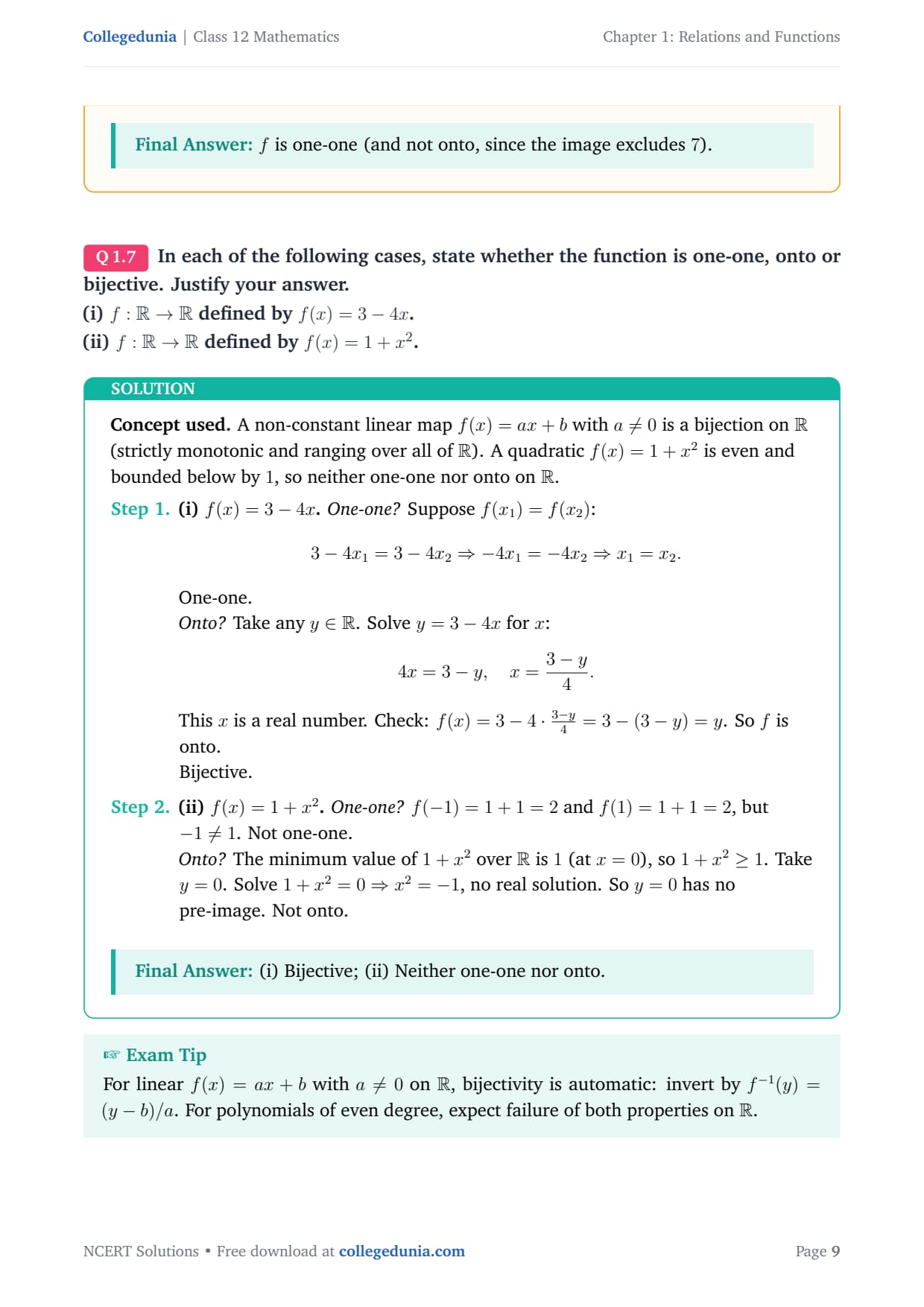
In each of the following cases, state whether the function is one-one, onto or bijective. Justify your answer.
(i) f : R → R defined by f(x) = 3 - 4x.
(ii) f : R → R defined by f(x) = 1 + x2.
Concept used. A non-constant linear map f(x) = ax + b with a ≠ 0 is a bijection on R (strictly monotonic and ranging over all of R). A quadratic f(x) = 1 + x2 is even and bounded below by 1, so neither one-one nor onto on R.
(i) f(x) = 3 - 4x.One-one? Suppose f(x1) = f(x2): 3 - 4x1 = 3 - 4x2 ⇒ -4x1 = -4x2 ⇒ x1 = x2. One-one. Onto? Take any y ∈ R. Solve y = 3 - 4x for x: 4x = 3 - y, x = 3 - y4. This x is a real number. Check: f(x) = 3 - 4 · 3-y4 = 3 - (3 - y) = y. So f is onto.
Bijective.
(ii) f(x) = 1 + x2.One-one?f(-1) = 1 + 1 = 2 and f(1) = 1 + 1 = 2, but -1 ≠ 1. Not one-one. Onto? The minimum value of 1 + x2 over R is 1 (at x = 0), so 1 + x2 ≥ 1. Take y = 0. Solve 1 + x2 = 0 ⇒ x2 = -1, no real solution. So y = 0 has no pre-image. Not onto.
(i) Bijective; (ii) Neither one-one nor onto.
DS
Diya Singh
M.Sc Applied Mathematics, IIT Kanpur
Verified Expert
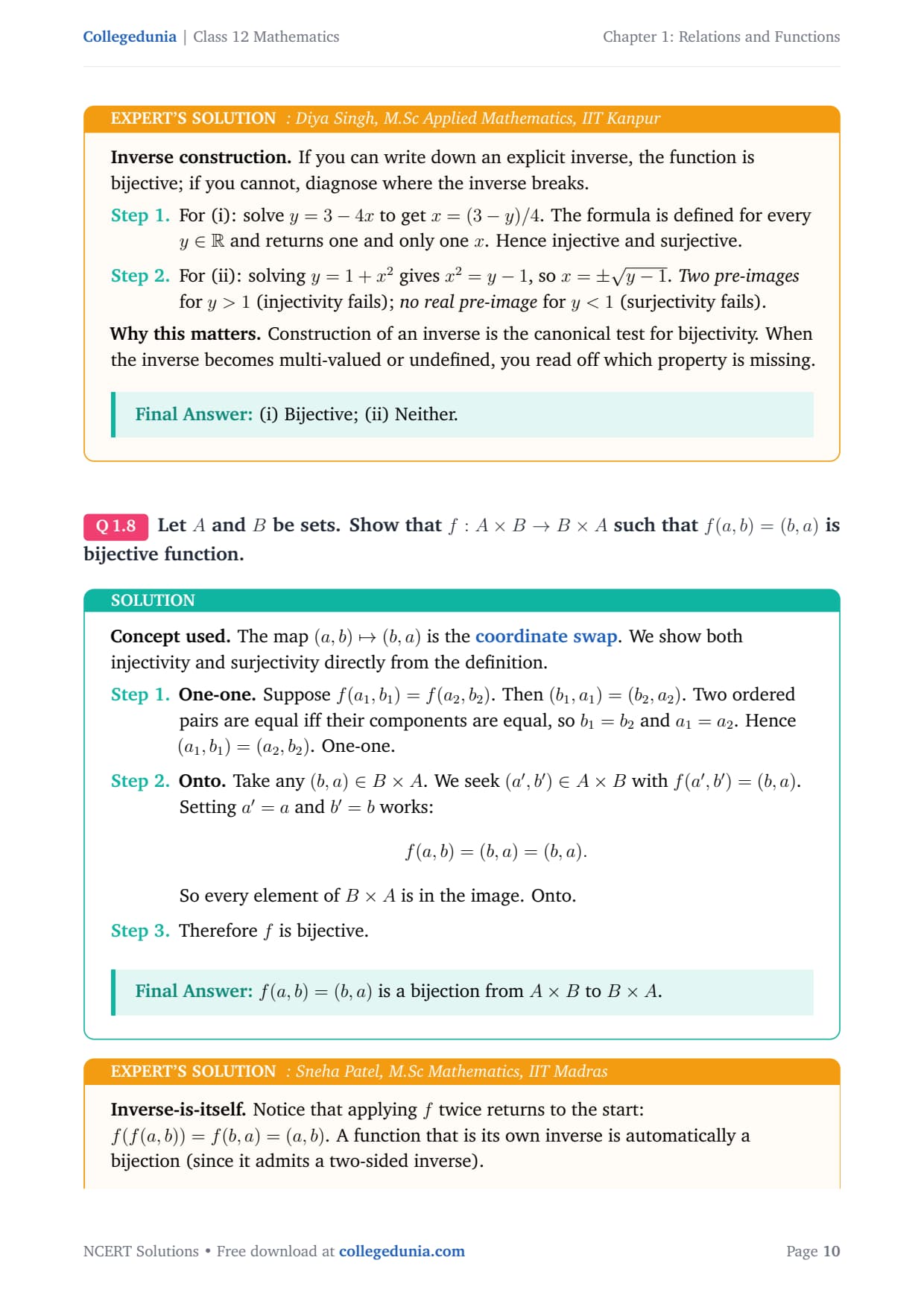
Inverse construction. If you can write down an explicit inverse, the function is bijective; if you cannot, diagnose where the inverse breaks.
For (i): solve y = 3 - 4x to get x = (3 - y)/4. The formula is defined for every y ∈ R and returns one and only one x. Hence injective and surjective.
For (ii): solving y = 1 + x2 gives x2 = y - 1, so x = ±√y - 1. Two pre-images for y > 1 (injectivity fails); no real pre-image for y < 1 (surjectivity fails).
Why this matters. Construction of an inverse is the canonical test for bijectivity. When the inverse becomes multi-valued or undefined, you read off which property is missing.
(i) Bijective; (ii) Neither.
Q 1.8
Let A and B be sets. Show that f : A × B → B × A such that f(a, b) = (b, a) is bijective function.
Concept used. The map (a, b) ↦ (b, a) is the coordinate swap. We show both injectivity and surjectivity directly from the definition.
One-one. Suppose f(a1, b1) = f(a2, b2). Then (b1, a1) = (b2, a2). Two ordered pairs are equal iff their components are equal, so b1 = b2 and a1 = a2. Hence (a1, b1) = (a2, b2). One-one.
Onto. Take any (b, a) ∈ B × A. We seek (a', b') ∈ A × B with f(a', b') = (b, a). Setting a' = a and b' = b works: f(a, b) = (b, a) = (b, a). So every element of B × A is in the image. Onto.
Therefore f is bijective.
f(a, b) = (b, a) is a bijection from A × B to B × A.
SP
Sneha Patel
M.Sc Mathematics, IIT Madras
Verified Expert
Inverse-is-itself. Notice that applying f twice returns to the start: f(f(a, b)) = f(b, a) = (a, b). A function that is its own inverse is automatically a bijection (since it admits a two-sided inverse).
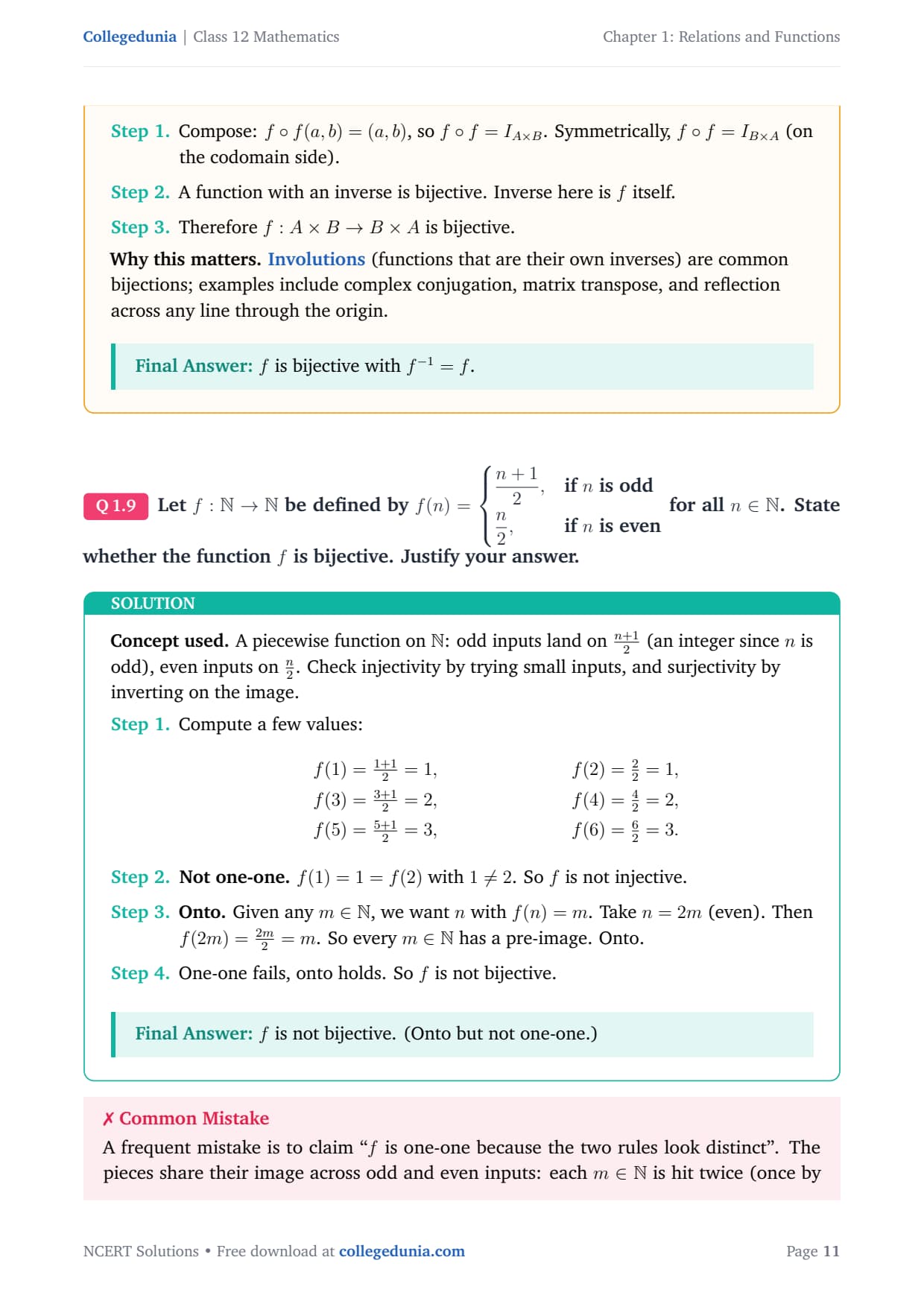
Compose: f ∘ f (a, b) = (a, b), so f ∘ f = IA × B. Symmetrically, f ∘ f = IB × A (on the codomain side).
A function with an inverse is bijective. Inverse here is f itself.
Therefore f : A × B → B × A is bijective.
Why this matters.Involutions (functions that are their own inverses) are common bijections; examples include complex conjugation, matrix transpose, and reflection across any line through the origin.
f is bijective with f-1 = f.
Q 1.9
Let f : N → N be defined by f(n) = cases n+12, & if n is odd 4pt] n2, & if n is even cases) for all (n ∈ N). State whether the function (f) is bijective. Justify your answer.
Concept used.A piecewise function on (N): odd inputs land on (n+12) (an integer since (n) is odd), even inputs on (n2). Check injectivity by trying small inputs, and surjectivity by inverting on the image.
Not one-one. (f(1) = 1 = f(2) with 1 ≠ 2. So f is not injective.
Onto. Given any m ∈ N, we want n with f(n) = m. Take n = 2m (even). Then f(2m) = 2m2 = m. So every m ∈ N has a pre-image. Onto.
One-one fails, onto holds. So f is not bijective.
f is not bijective. (Onto but not one-one.)
RP
Rohit Pillai
M.Sc Mathematics, IIT Bombay
Verified Expert
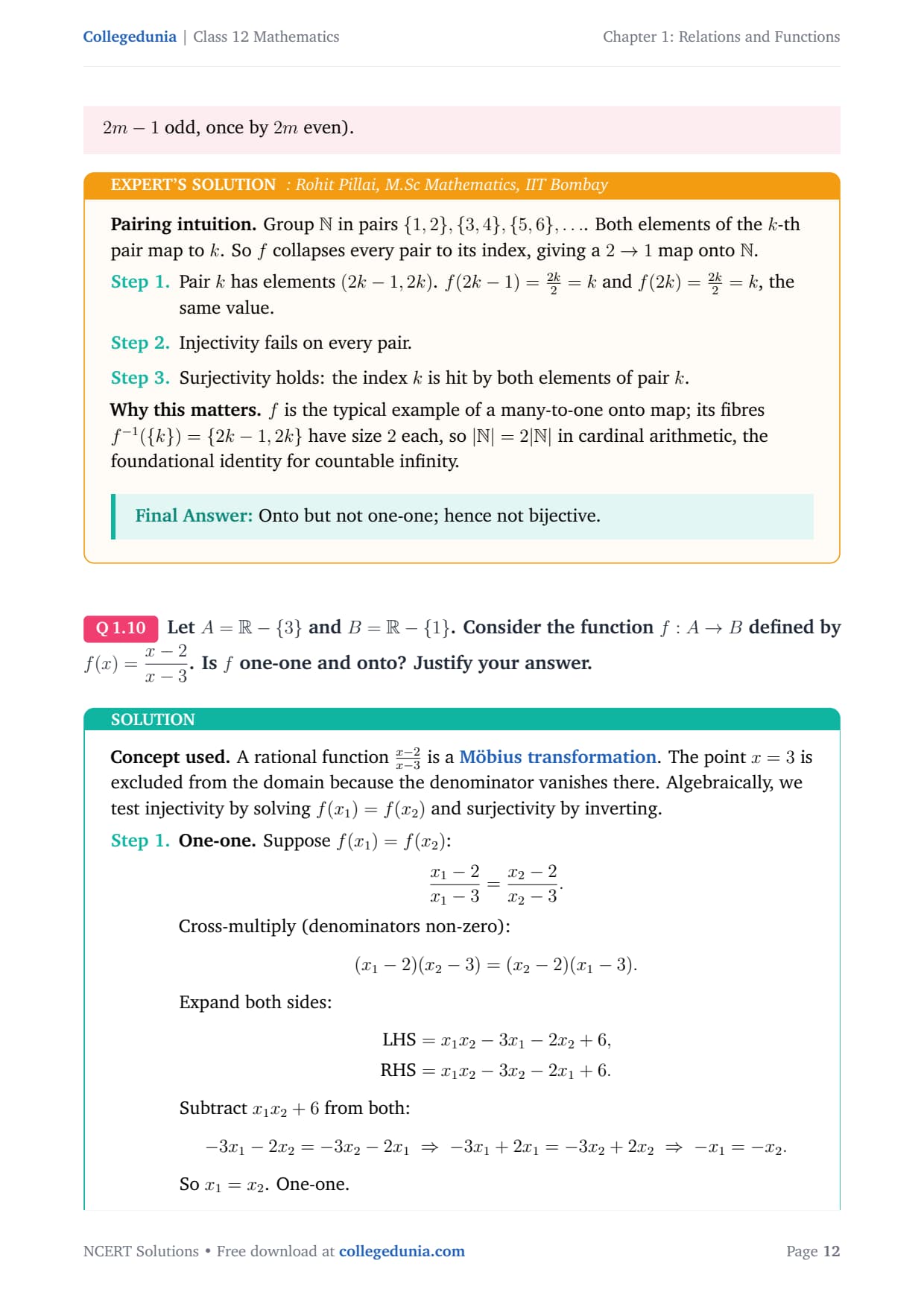
Pairing intuition. Group N in pairs 1, 2, 3, 4, 5, 6, …. Both elements of the k-th pair map to k. So f collapses every pair to its index, giving a 2 → 1 map onto N.
Pair k has elements (2k - 1, 2k). f(2k - 1) = 2k2 = k and f(2k) = 2k2 = k, the same value.
Injectivity fails on every pair.
Surjectivity holds: the index k is hit by both elements of pair k.
Why this matters.f is the typical example of a many-to-one onto map; its fibres f-1(k) = 2k-1, 2k have size 2 each, so |N| = 2 |N| in cardinal arithmetic, the foundational identity for countable infinity.
Onto but not one-one; hence not bijective.
Q 1.10
Let A = R - 3 and B = R - 1. Consider the function f : A → B defined by f(x) = x - 2x - 3. Is f one-one and onto? Justify your answer.
Concept used. A rational function x - 2x - 3 is a M"obius transformation. The point x = 3 is excluded from the domain because the denominator vanishes there. Algebraically, we test injectivity by solving f(x1) = f(x2) and surjectivity by inverting.
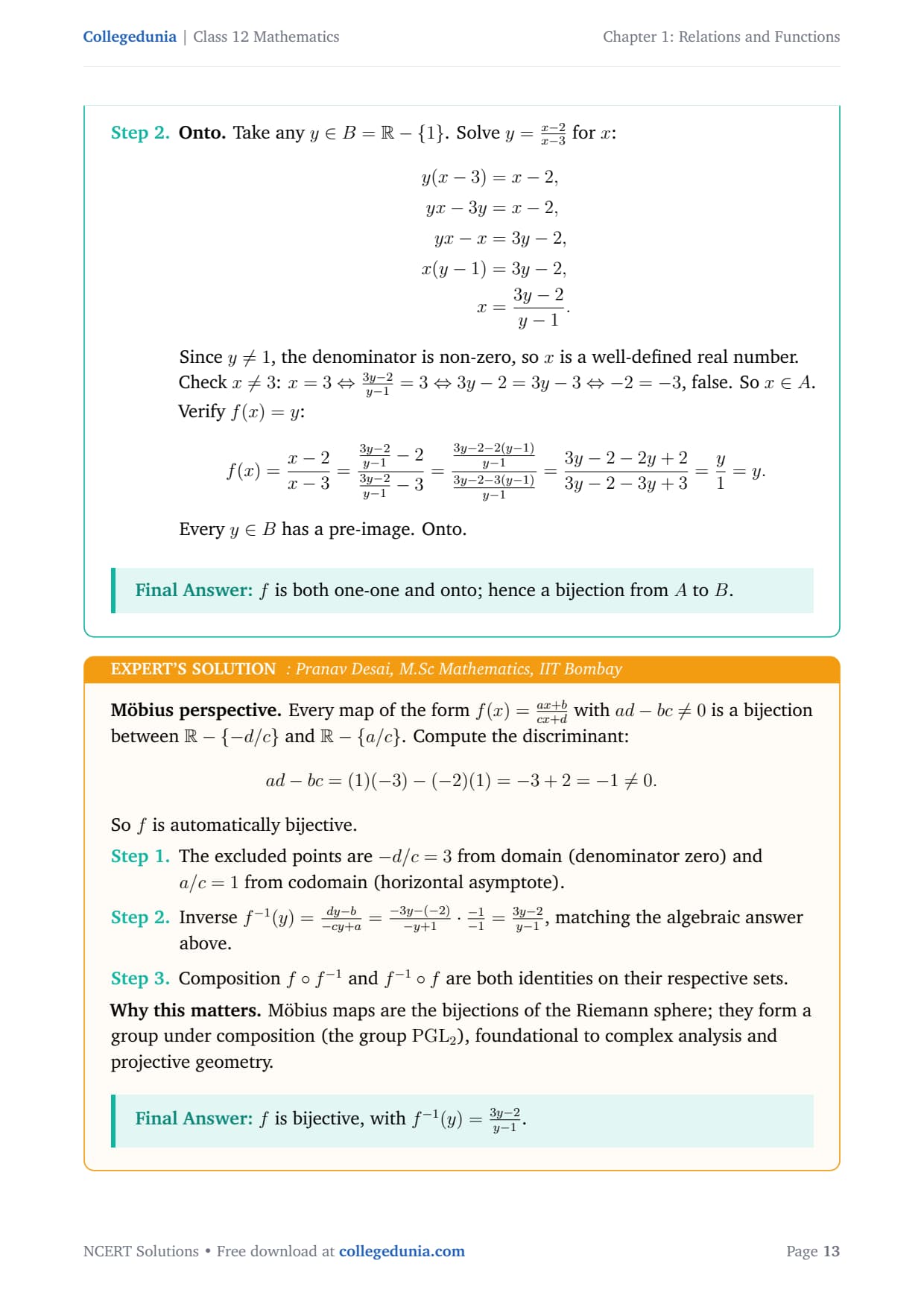
Onto. Take any y ∈ B = R - 1. Solve y = x - 2x - 3 for x: aligned y (x - 3) &= x - 2,
yx - 3y &= x - 2,
yx - x &= 3y - 2, x (y - 1) &= 3y - 2, x &= 3y - 2y - 1. aligned Since y ≠ 1, the denominator is non-zero, so x is a well-defined real number. Check x ≠ 3: x = 3 ⇔ 3y - 2y - 1 = 3 ⇔ 3y - 2 = 3y - 3 ⇔ -2 = -3, false. So x ∈ A.
Verify f(x) = y: f(x) = x - 2x - 3 = 3y - 2y - 1 - 23y - 2y - 1 - 3 = 3y - 2 - 2(y - 1)y - 13y - 2 - 3(y - 1)y - 1 = 3y - 2 - 2y + 23y - 2 - 3y + 3 = y1 = y. Every y ∈ B has a pre-image. Onto.
f is both one-one and onto; hence a bijection from A to B.
PD
Pranav Desai
M.Sc Mathematics, IIT Bombay
Verified Expert
M"obius perspective. Every map of the form f(x) = ax + bcx + d with ad - bc ≠ 0 is a bijection between R - -d/c and R - a/c. Compute the discriminant: ad - bc = (1)(-3) - (-2)(1) = -3 + 2 = -1 ≠ 0. So f is automatically bijective.
The excluded points are -d/c = 3 from domain (denominator zero) and a/c = 1 from codomain (horizontal asymptote).
Inverse f-1(y) = dy - b-cy + a = -3y - (-2)-y + 1 · -1-1 = 3y - 2y - 1, matching the algebraic answer above.
Composition f ∘ f-1 and f-1 ∘ f are both identities on their respective sets.
Why this matters. M"obius maps are the bijections of the Riemann sphere; they form a group under composition (the group PGL2), foundational to complex analysis and projective geometry.
f is bijective, with f-1(y) = 3y - 2y - 1.
Q 1.11
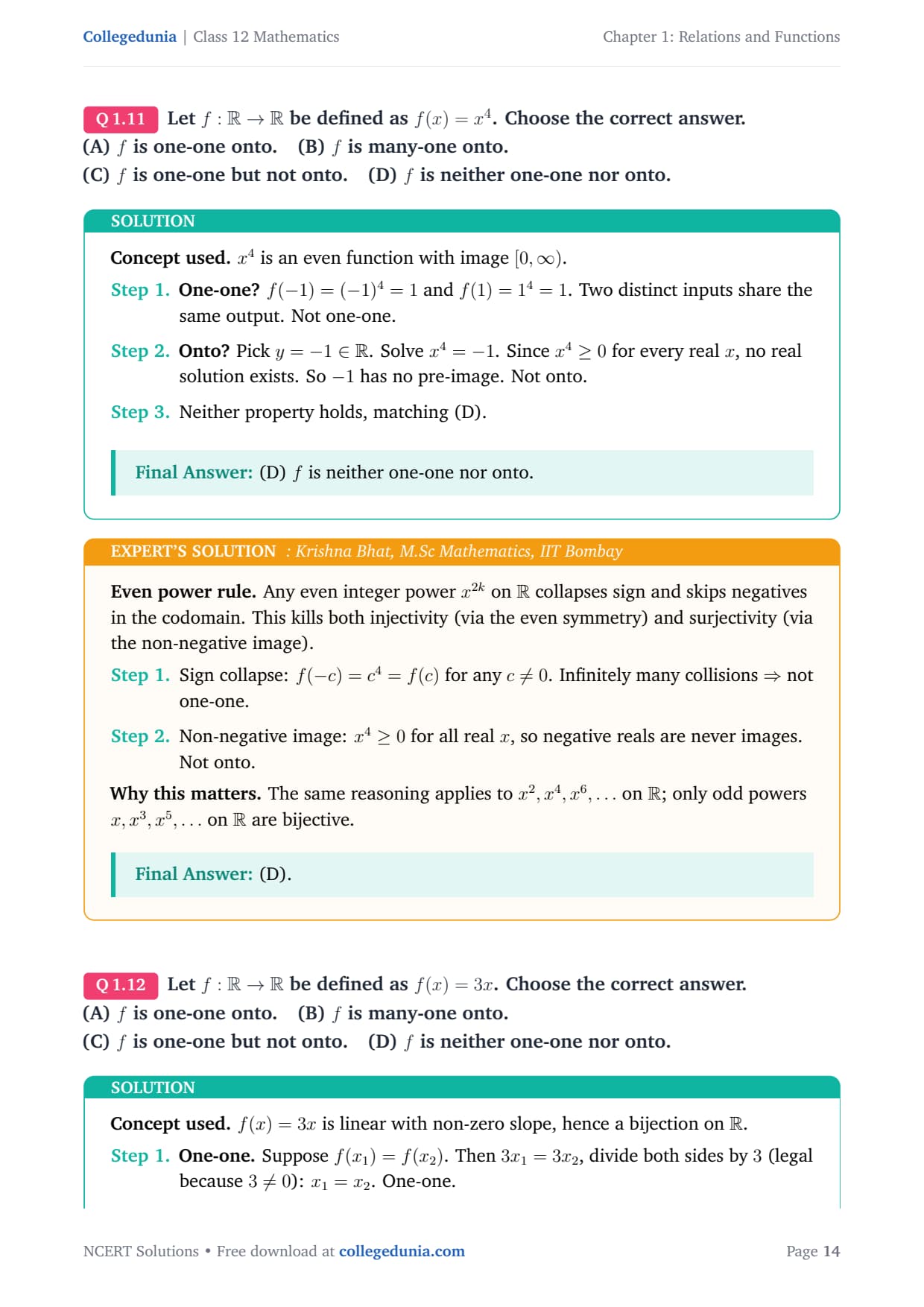
Let f : R → R be defined as f(x) = x4. Choose the correct answer.
(A) f is one-one onto. (B) f is many-one onto.
(C) f is one-one but not onto. (D) f is neither one-one nor onto.
Concept used.x4 is an even function with image [0, ∞).
One-one?f(-1) = (-1)4 = 1 and f(1) = 14 = 1. Two distinct inputs share the same output. Not one-one.
Onto? Pick y = -1 ∈ R. Solve x4 = -1. Since x4 ≥ 0 for every real x, no real solution exists. So -1 has no pre-image. Not onto.
Neither property holds, matching (D).
(D) f is neither one-one nor onto.
KB
Krishna Bhat
M.Sc Mathematics, IIT Bombay
Verified Expert
Even power rule. Any even integer power x2k on R collapses sign and skips negatives in the codomain. This kills both injectivity (via the even symmetry) and surjectivity (via the non-negative image).
Sign collapse: f(-c) = c4 = f(c) for any c ≠ 0. Infinitely many collisions ⇒ not one-one.
Non-negative image: x4 ≥ 0 for all real x, so negative reals are never images. Not onto.
Why this matters. The same reasoning applies to x2, x4, x6, … on R; only odd powers x, x3, x5, … on R are bijective.
(D).
Q 1.12
Let f : R → R be defined as f(x) = 3x. Choose the correct answer.
(A) f is one-one onto. (B) f is many-one onto.
(C) f is one-one but not onto. (D) f is neither one-one nor onto.
Concept used.f(x) = 3x is linear with non-zero slope, hence a bijection on R.
One-one. Suppose f(x1) = f(x2). Then 3x1 = 3x2, divide both sides by 3 (legal because 3 ≠ 0): x1 = x2. One-one.
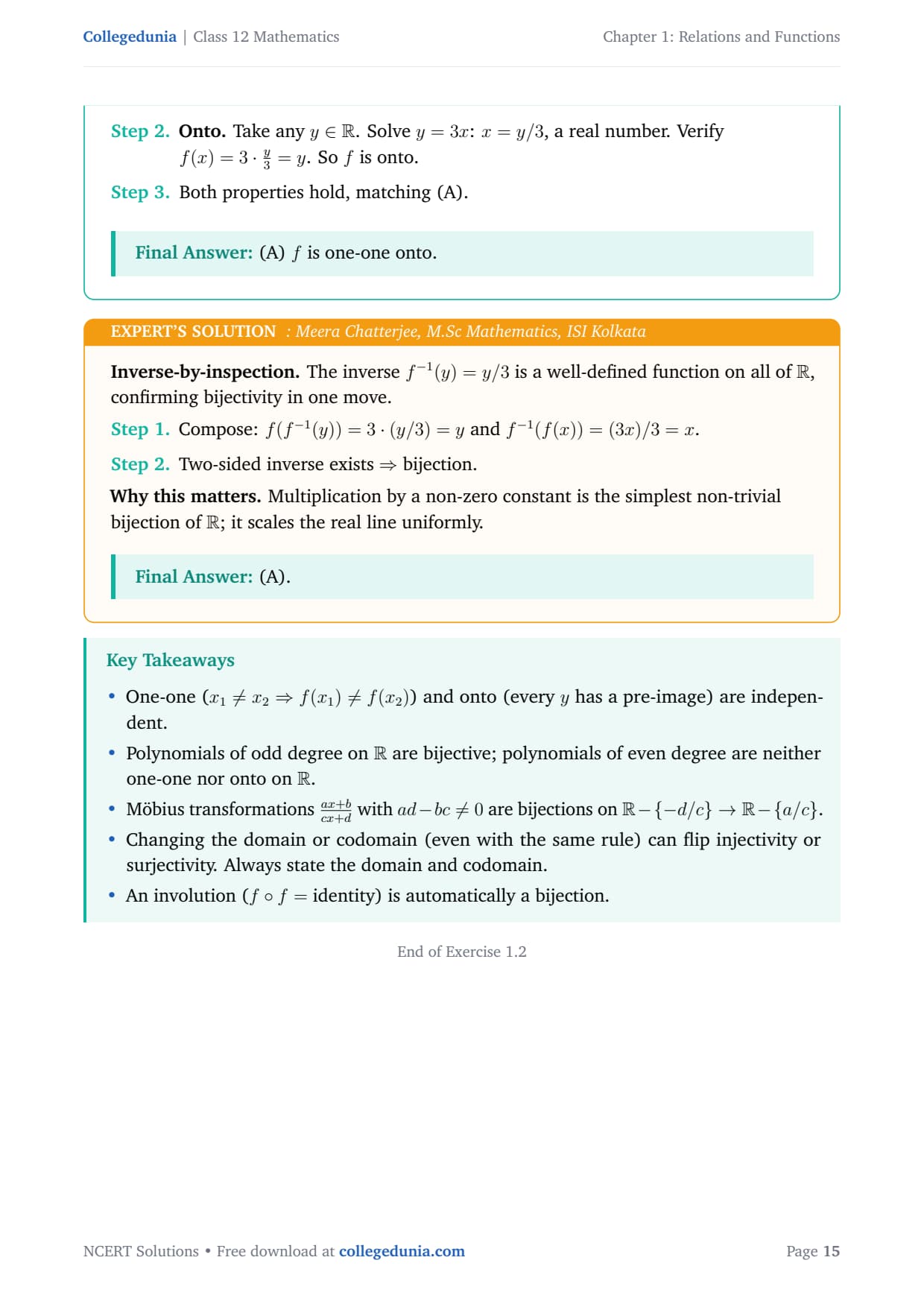
Onto. Take any y ∈ R. Solve y = 3x: x = y/3, a real number. Verify f(x) = 3 · y3 = y. So f is onto.
Both properties hold, matching (A).
(A) f is one-one onto.
MC
Meera Chatterjee
M.Sc Mathematics, ISI Kolkata
Verified Expert
Inverse-by-inspection. The inverse f-1(y) = y/3 is a well-defined function on all of R, confirming bijectivity in one move.
Compose: f(f-1(y)) = 3 · (y/3) = y and f-1(f(x)) = (3x)/3 = x.
Two-sided inverse exists ⇒ bijection.
Why this matters. Multiplication by a non-zero constant is the simplest non-trivial bijection of R; it scales the real line uniformly.
(A).
Student Feedback - Class 12 Relations and Functions Exercise 1.2 (Collegedunia Survey, March 2026):
68% of 620 Class 12 students surveyed rated the one-one and onto proofs in Exercise 1.2 as the hardest part of Chapter 1.
Students lost an average of 1.2 marks per question on codomain-related errors in a March 2026 answer-script audit.
Toppers reported that writing the three-line proof skeleton before the algebra saved them exam time.
Relations and Functions Class 12 NCERT Solutions - Frequently Asked Questions
Ques. How many questions are there in Class 12 Maths Exercise 1.2?
Ans. Exercise 1.2 of NCERT Class 12 Maths Chapter 1 Relations and Functions has 12 questions in total. Q2 has five sub-parts, so the total proof count across the exercise is roughly 16 separate function-type checks.
Ques. What is the main concept tested in Exercise 1.2?
Ans. Exercise 1.2 tests classification of functions as one-one (injective), onto (surjective), and bijective. You learn how to write formal proofs by assuming f(x1) = f(x2) and concluding x1 = x2, and by taking an arbitrary y in the codomain and solving for x.
Ques. Is Exercise 1.2 important for CBSE Class 12 boards 2026-27?
Ans. Yes. Exercise 1.2 question patterns have appeared in CBSE Class 12 Maths board papers in 2024, 2023 and 2020, typically as a 3-mark or 5-mark question asking to prove that a given function is one-one and onto. It is also tested in CUET-UG and JEE Main as MCQs.
Ques. Which question in Exercise 1.2 is the hardest?
Ans.Most students find Q9 the hardest because it is piecewise: f: N -> N defined separately for odd and even natural numbers. You must check injectivity across both branches and confirm no overlap in outputs. Q10 (the rational function (x-2)/(x-3)) is the second hardest because it forces you to track domain exclusion.
Ques. Where can I download the Class 12 Maths Exercise 1.2 solutions PDF for free?
Ans. Collegedunia offers a free downloadable PDF of NCERT Solutions for Class 12 Maths Chapter 1 Exercise 1.2 aligned with the 2026-27 syllabus. The PDF includes all 12 questions with step-by-step working, expert solution callouts, and common-mistake flags.








Comments