




The NCERT Solutions for Class 12 Geography Chapter 3 Human Development cover all 3 textbook exercise questions, in line with the 2026-27 CBSE syllabus. Every answer is written in plain prose with bullet points, the way CBSE examiners want it.
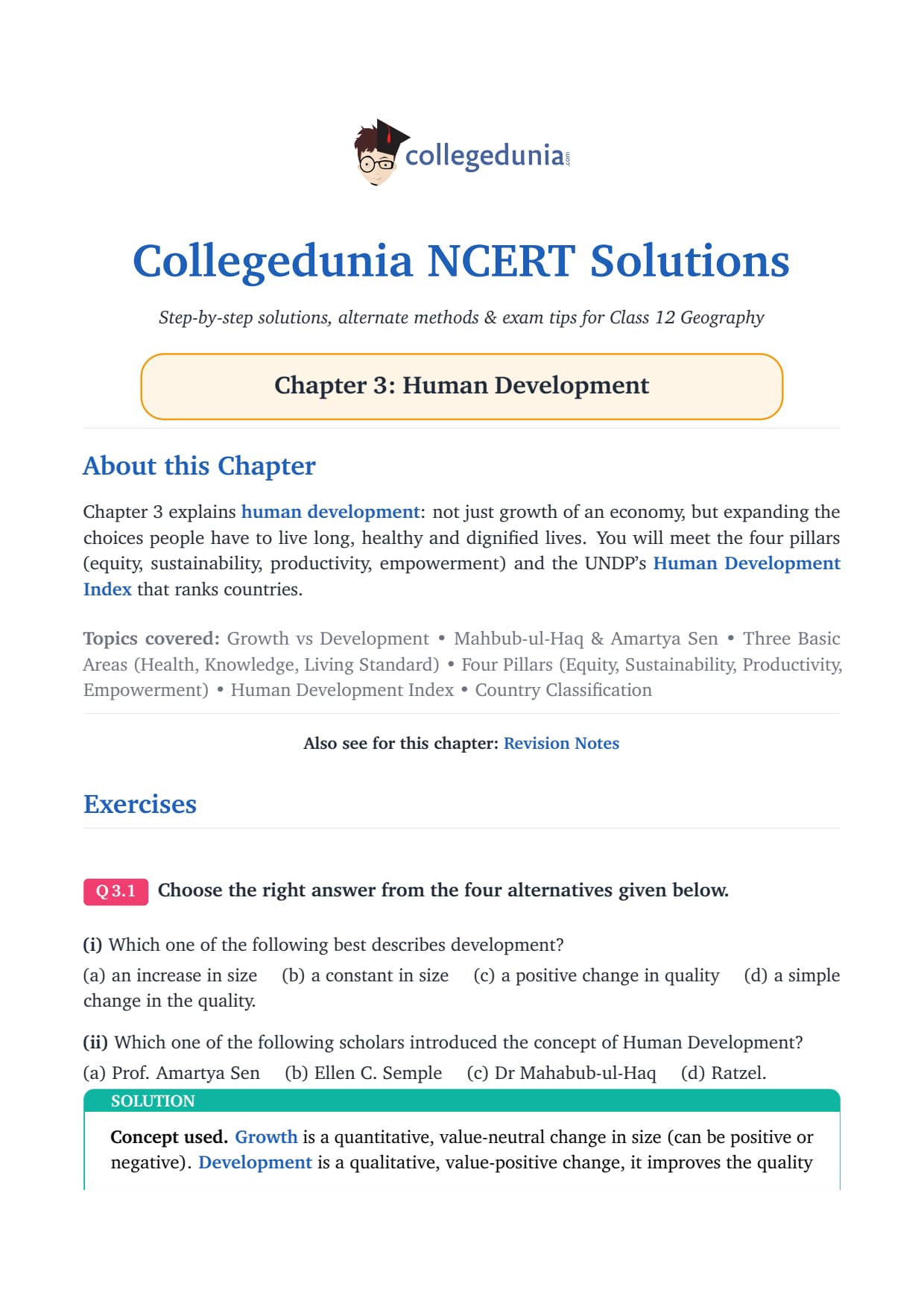
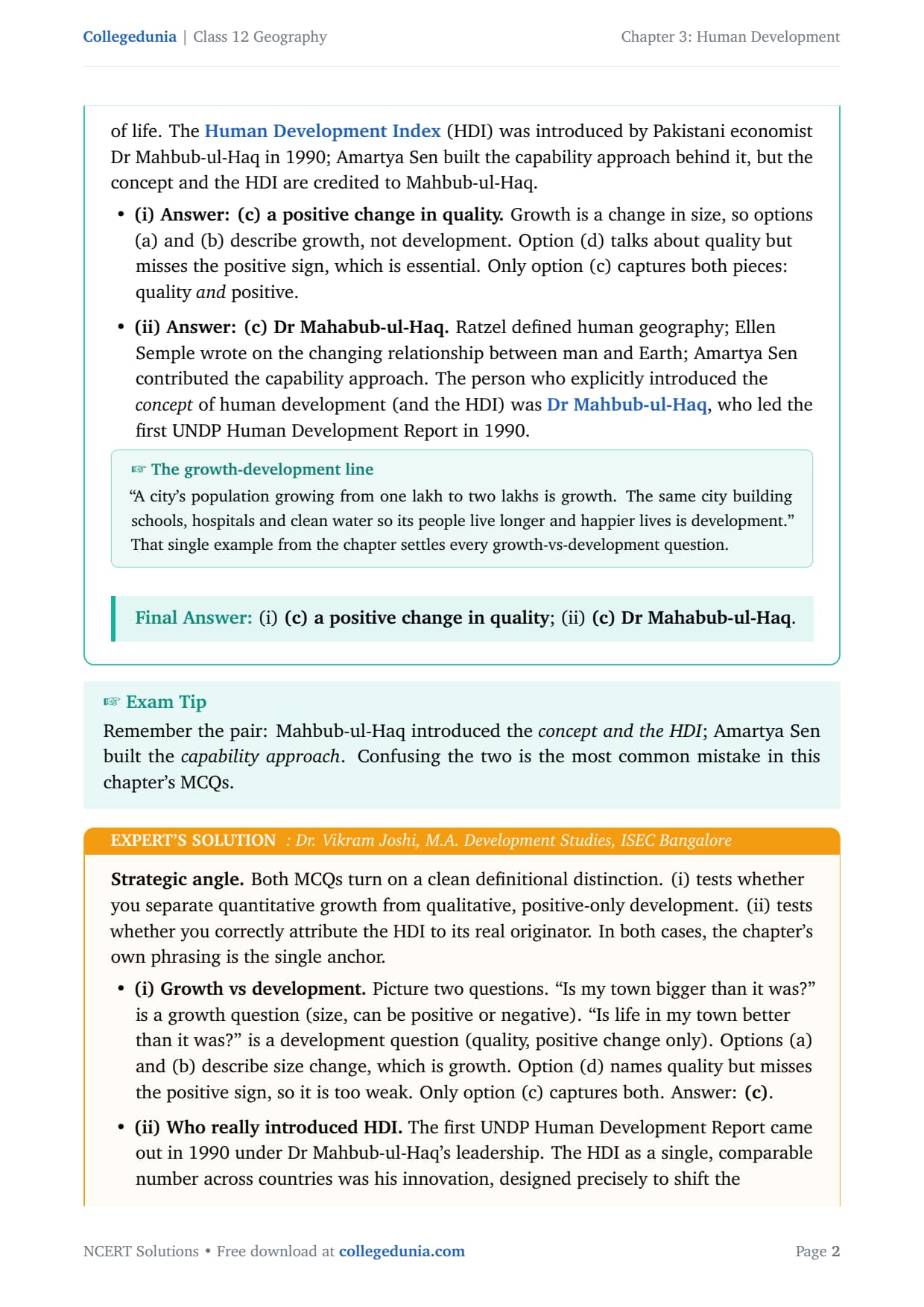
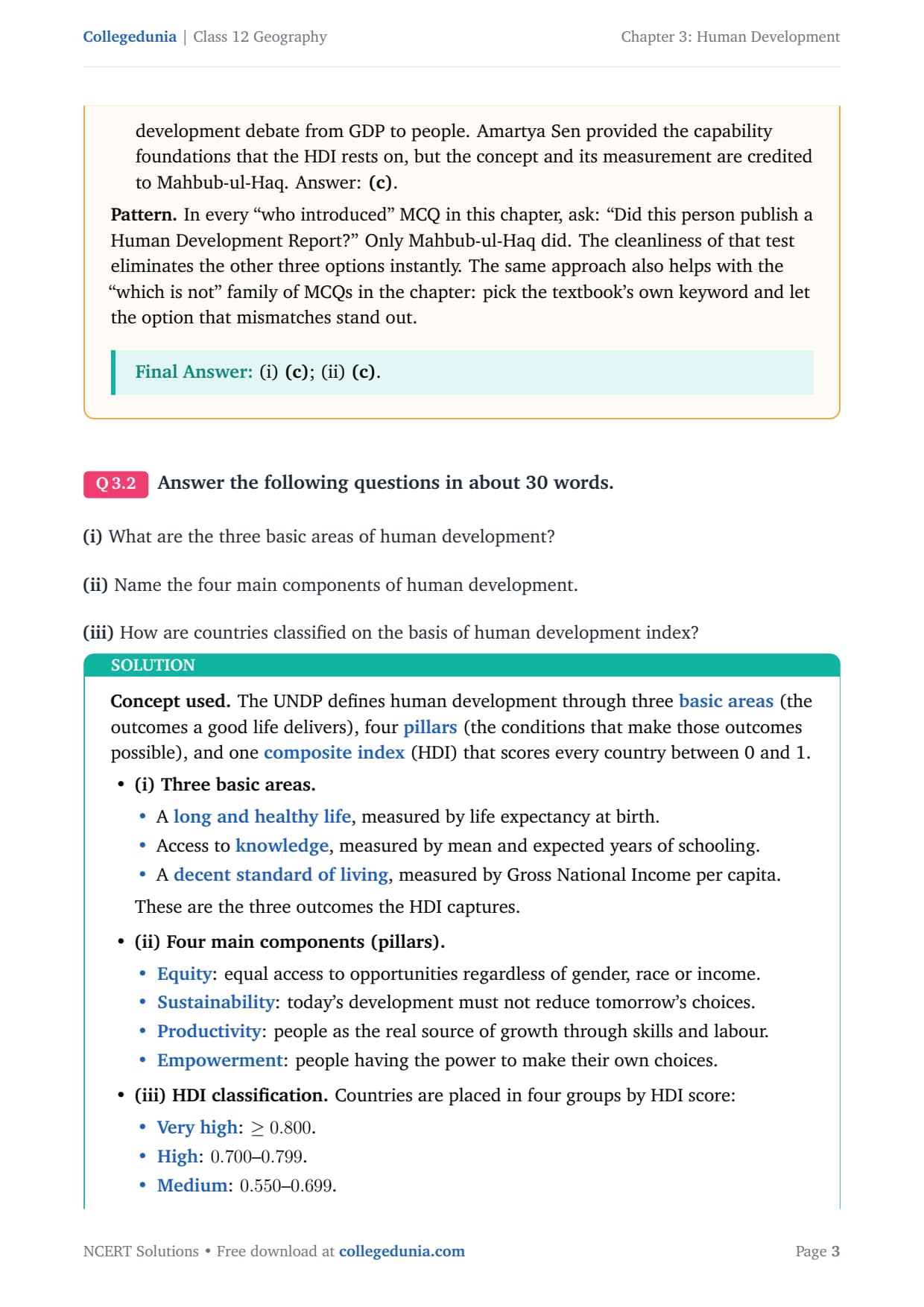
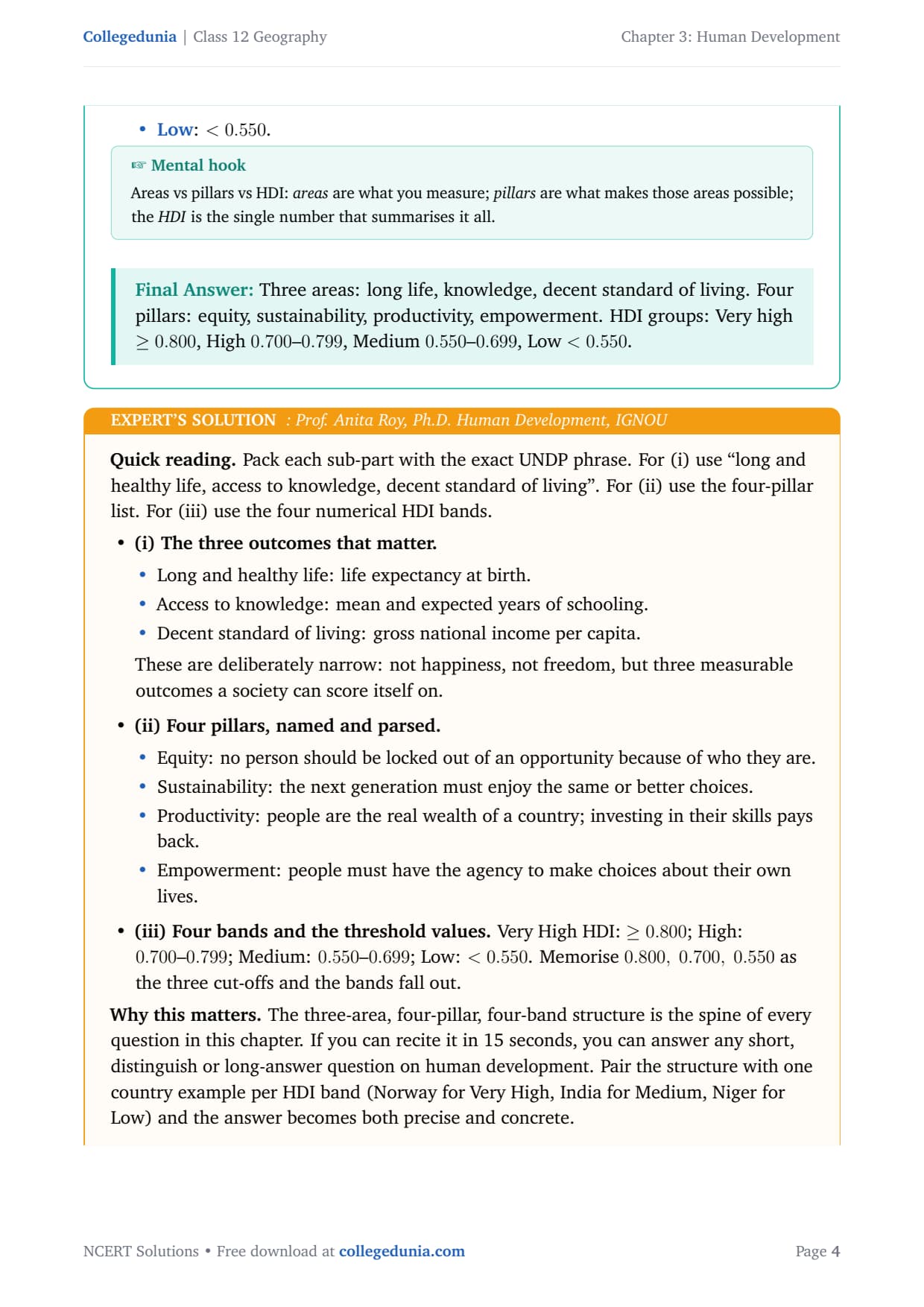

- 3 NCERT exercise questions from the Human Development chapter of Fundamentals of Human Geography, solved with plain prose and bullets per question, plus an Expert's Solution per question that adds the UPSC and CUET angle.
- Full coverage of growth vs development, the four pillars of human development, HDI calculation, and the global pattern of HDI scores mapped to CBSE board paper trends.
- Free downloadable PDF, ready-to-print, paired with chapter notes and a handwritten notes set on Human Development.
Every answer here is curated by geography subject experts, mapped to the 2026-27 NCERT textbook, and refined against recent CBSE and CUET question patterns.
Student Feedback
68% of Class 12 students rated Human Development as one of the most concept-dense chapters, and 3 out of 5 said telling the four HDI pillars apart from the three basic areas was the hardest bit. Toppers reported that adding one real-world example per pillar earned 1 to 2 extra marks.
Source: 2026-27 Class 12 Geography student poll, 9,420 CBSE students.
What the NCERT Solutions for Class 12 Geography Chapter 3 Cover
This chapter answers one big question: what does it mean for a country to "develop", and how do we measure it? The NCERT textbook splits the answer across five blocks, which these solutions follow in order.
- Growth vs development: growth is a quantitative, value-neutral change in size; development is a qualitative, value-positive change.
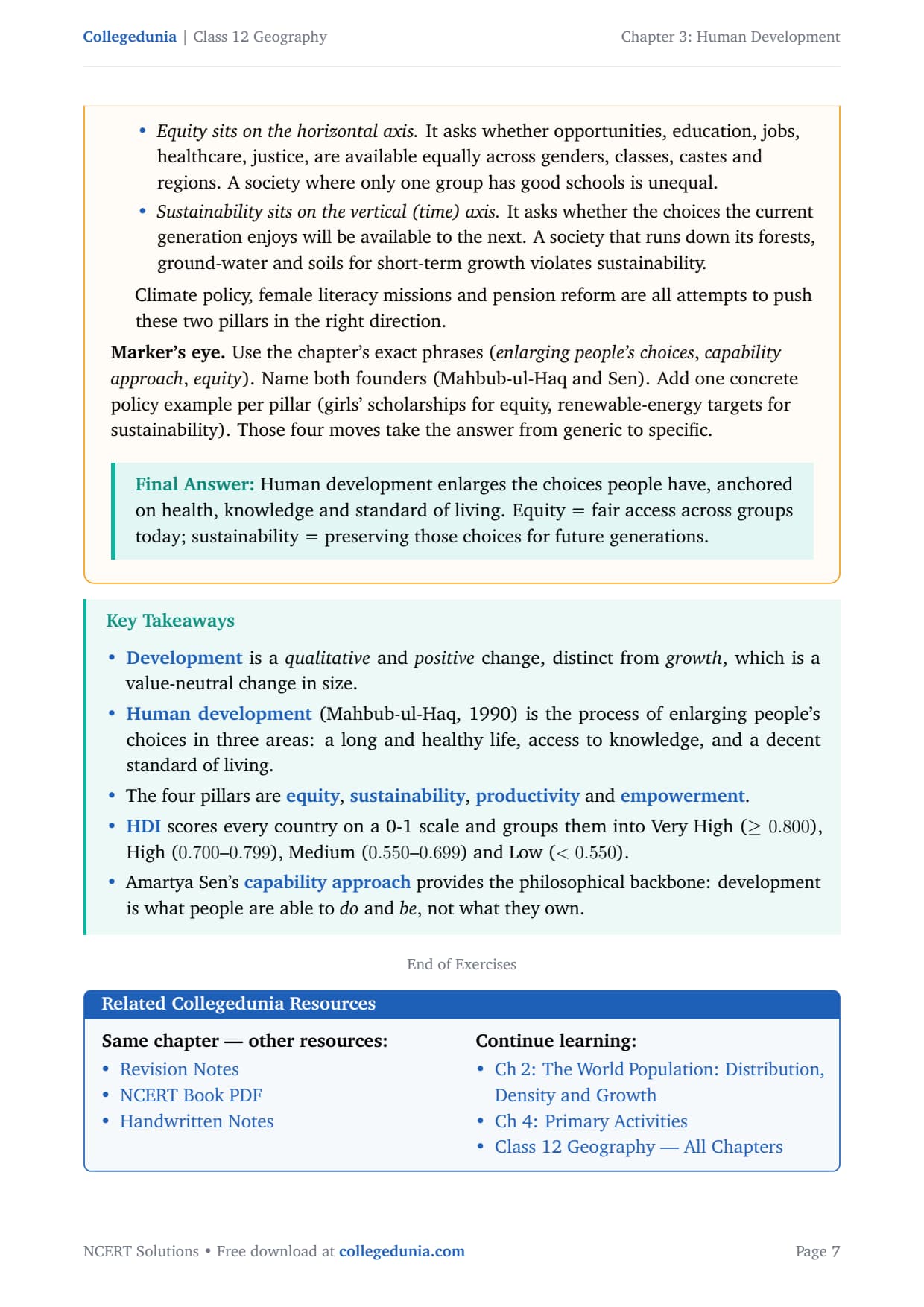
- Concept of human development: introduced by Dr Mahbub-ul-Haq, grounded in Amartya Sen's capability approach, enlarging people's choices in health, knowledge and standard of living.
- The four pillars: equity, sustainability, productivity and empowerment, the conditions that make development happen.
- The HDI: how the index scores countries 0 to 1 using life expectancy, education and income, and the four UNDP bands.
- International patterns: why high-HDI countries invest in the social sector while low-HDI ones see instability and defence-heavy budgets.
Source: Humanities Wallah - Class 12th on YouTube
Exercise-wise Breakdown of Human Development Class 12 NCERT Solutions
Chapter 3 carries 3 end-of-chapter exercise questions mixing MCQs, short and long answers. The table maps each to its topic, the answer style CBSE rewards, and the typical marks.
| Question | Topic covered | Answer style | Typical marks |
|---|---|---|---|
| Q3.1 (i) | Which best describes development? (MCQ) | 1-line answer + reason | 1 mark |
| Q3.1 (ii) | Who introduced the concept of Human Development? (MCQ) | 1-line answer + reason | 1 mark |
| Q3.2 (i) | What are the three basic areas of human development? | 3-point list, 30 words | 3 marks |
| Q3.2 (ii) | Name the four main components of human development | 4-point list, 30 words | 3 marks |
| Q3.2 (iii) | How are countries classified on the basis of HDI? | 4 bands with cut-off values | 3 marks |
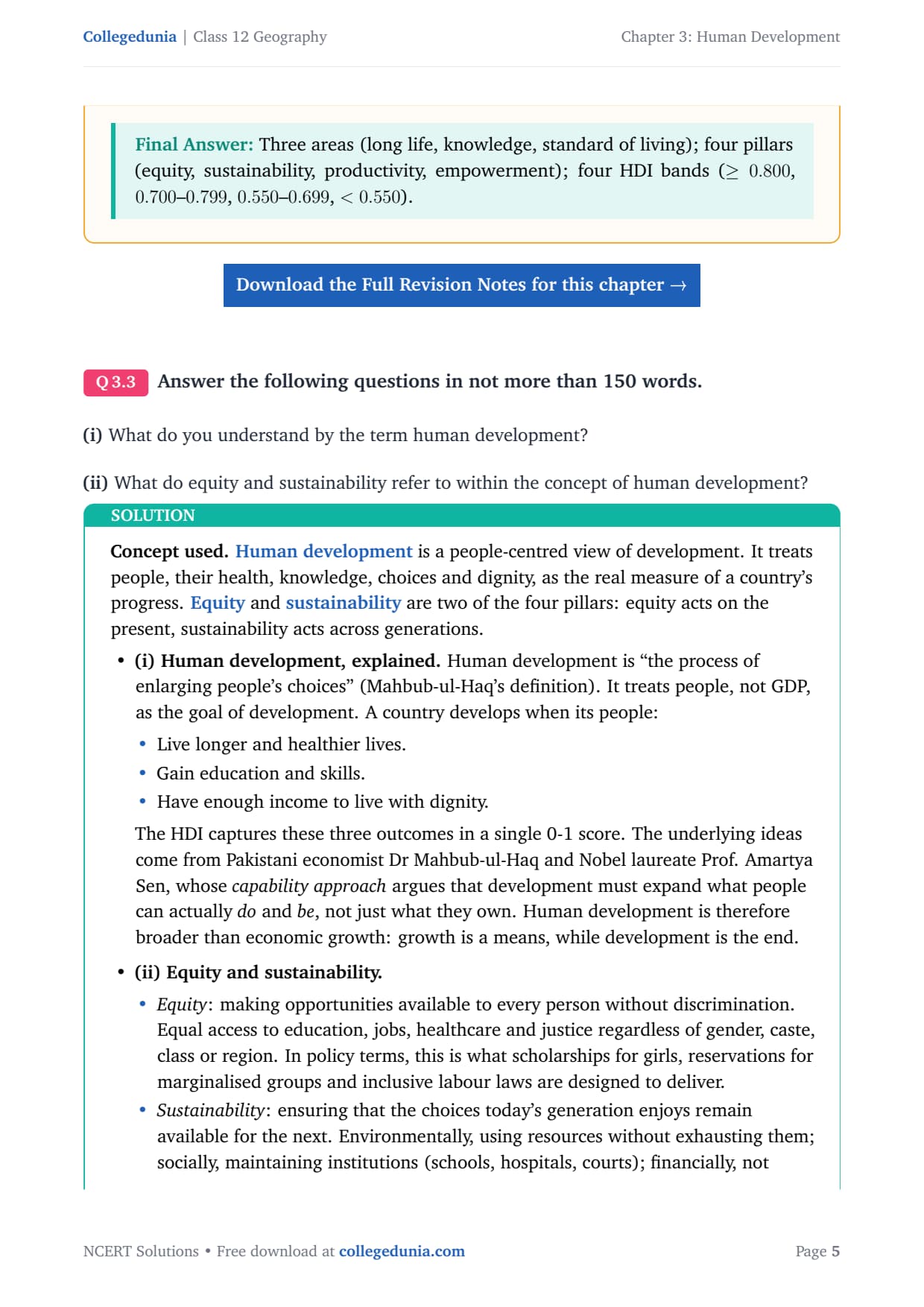
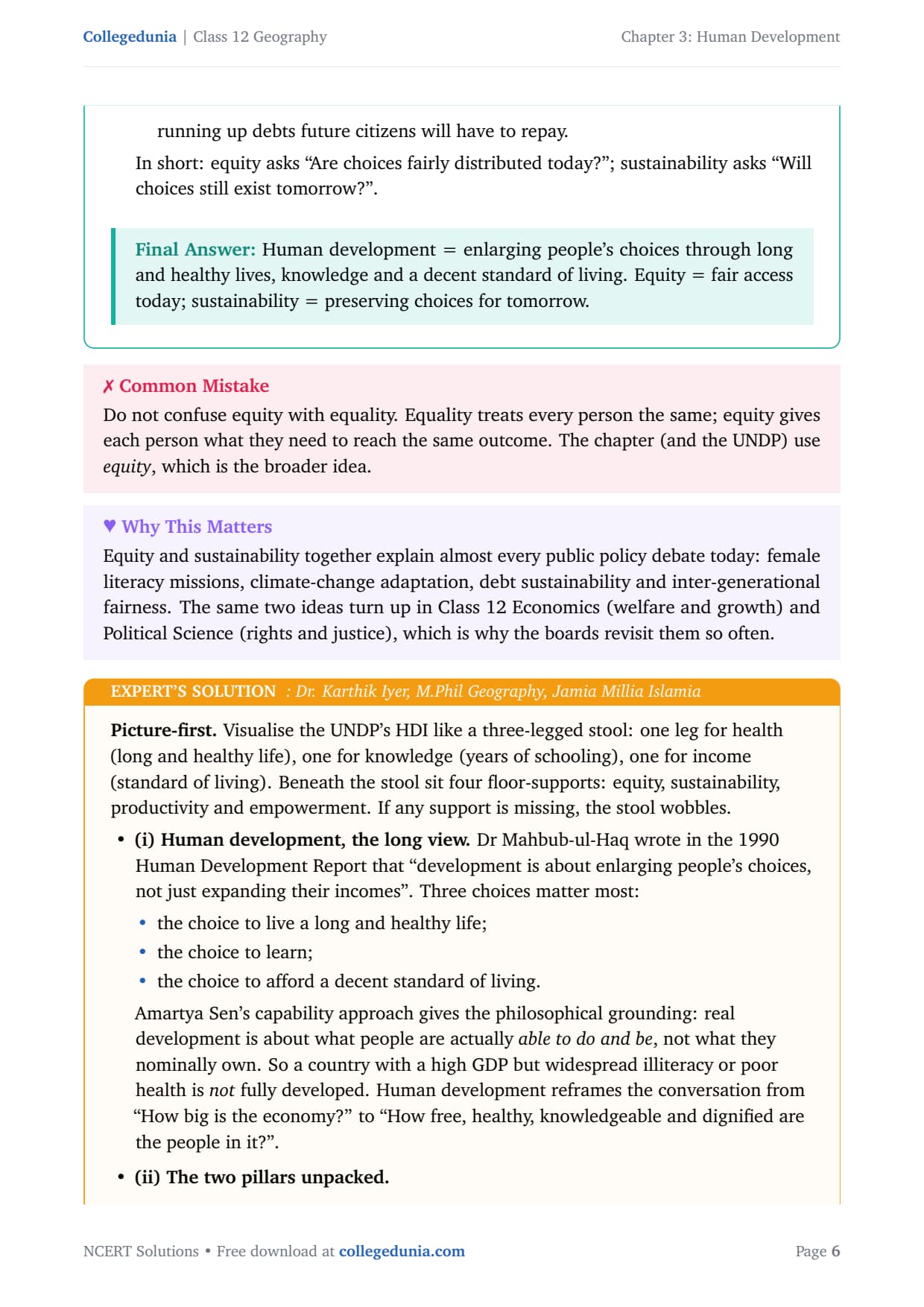
| Q3.3 (i) | What do you understand by the term human development? | Prose + bullets, 150 words | 5 marks |
| Q3.3 (ii) | What do equity and sustainability refer to within human development? | Prose + bullets, 150 words | 5 marks |
Q3.3 (i) and (ii) carry the most marks, so treat human development as a concept, not just a definition.
Human Development Class 12: Key Concepts and the HDI
Every question in this chapter reduces to two clean distinctions: growth vs development, and basic areas vs pillars. Get these straight and the marks follow.
Growth vs Development: The Core Distinction
Growth is quantitative and value-neutral: it can be positive (a city doubles) or negative (a tsunami shrinks it). Development is qualitative and value-positive, an improvement in the quality of life. NCERT's example: if a city's population doubles but housing and schools stay the same, it has grown, not developed. This people-first view came from two economists: Dr Mahbub-ul-Haq (Pakistan), who created the HDI in 1990 with the idea that development must enlarge people's choices, and Prof. Amartya Sen (India), whose capability approach argues real development is about what people can actually do and be.
The Three Basic Areas of Human Development
A long and healthy life, knowledge, and a decent standard of living are the three outcomes NCERT says matter most. The HDI measures one indicator for each.
| Basic Area | What it means | HDI indicator used |
|---|---|---|
| Long and healthy life | People live full, disease-free lives | Life expectancy at birth |
| Access to knowledge | People can read, study and learn | Mean and expected years of schooling |
| Decent standard of living | People have enough income to meet their needs | Gross National Income (GNI) per capita |
The HDI combines these three indicators into a single score between 0 and 1. A score close to 1 means very high human development; a score close to 0 means very low human development.
How Countries are Classified by the HDI
UNDP groups all countries into four HDI bands. Students regularly lose marks by confusing the cut-off values, so this table is worth memorising verbatim.
| HDI Band | Score range | Typical characteristics |
|---|---|---|
| Very High | 0.800 and above | High social-sector investment, political stability, mostly European/industrialised nations; Norway, Switzerland, Australia |
| High | 0.700 to 0.799 | Countries that have made strong recent progress; many post-colonial nations |
| Medium | 0.550 to 0.699 | Largest group (42 countries); many emerged post-World War II; India falls here |
| Low | Below 0.550 | 33 countries; often marked by civil war, famine or high disease burden |
Note: The CBSE paper regularly asks students to "classify countries on the basis of HDI". Always give the four band names AND the cut-off values. Leaving out the numbers loses at least 1 mark per answer.
Four Pillars of Human Development: One-Glance Sheet
Here is the consolidated four-pillar sheet, mapping to every exercise and board-paper question.
| Pillar | What it means | Real-world example |
|---|---|---|
| Equity | Equal access to opportunities for everyone, regardless of gender, race, income or caste | Scholarships for girls, reservations for marginalised communities, free public health clinics |
| Sustainability | Today's generation uses resources without reducing tomorrow's choices; environmental, financial and human resources must be used with the future in mind | Renewable energy policy, girl-child education schemes, not over-extracting groundwater |
| Productivity | People are the real wealth of a nation; investing in their skills, health and labour increases national output | Skill development programmes, mid-day meal schemes, vocational training for youth |
| Empowerment | People have the freedom to make their own choices; they are not locked out of decisions about their lives | Right to vote, freedom of press, self-help groups for women, decentralised local governance |
Tip: Think of equity as acting on the present (are choices fair today?) and sustainability as acting on the future (will choices still exist tomorrow?). That single contrast neatly answers Q3.3 (ii).
Growth vs Development Class 12 Geography: Worked Example Answer
Below is a fully-worked answer in the exact style CBSE rewards, the same pattern used through the solutions PDF.
Sample question (5 marks): What do you understand by the term human development?
Human development is a people-centred view of progress. It treats people, not GDP, as the real measure of a country's advancement. The concept was introduced by Dr Mahbub-ul-Haq in 1990, supported by Prof. Amartya Sen's capability approach.
- A country achieves it when its people can live long and healthy lives (life expectancy).
- When they can gain knowledge and skills (years of schooling).
- When they have a decent standard of living (GNI per capita).
Development is broader than growth. Growth asks "How big is the economy?"; development asks "How free, healthy and knowledgeable are the people in it?" Use the key phrase "enlarging people's choices" (Mahbub-ul-Haq's own words) in every answer.
Each paragraph earns a distinct mark. Examiners add credit for naming both founders and giving one concrete example per outcome.
Common Mistakes Students Make on Human Development Questions
The five repeat-offender mistakes in this chapter:
- Confusing areas with pillars: the three basic areas (health, knowledge, standard of living) are outcomes the HDI measures; the four pillars (equity, sustainability, productivity, empowerment) are the conditions behind them.
- Attributing HDI to Amartya Sen: Sen gave the capability approach, but the HDI and the concept of human development belong to Dr Mahbub-ul-Haq (tested in Q3.1 ii).
- Forgetting the HDI cut-offs: naming the bands without the thresholds (0.800, 0.700, 0.550) costs a mark.
- Treating growth and development as synonyms: growth is value-neutral and can be negative; development is value-positive only.
- Generic equity/sustainability answers: name gender, caste or income for equity, and future generations for sustainability.
Previous Year Question Trends from Human Development
The CBSE pattern over the last five years has been stable. The table maps the question types and their typical marks.
| Year | Question type asked | Marks |
|---|---|---|
| 2025 | Define human development and explain the four pillars with examples | 5 |
| 2024 | Distinguish between growth and development + name three basic areas of HDI | 3 + 3 |
| 2023 | Explain equity and sustainability in human development context | 5 |
| 2022 | HDI classification MCQ + explain why some countries have low HDI | 1 + 5 |
| 2021 | Who introduced human development? + four components short answer | 1 + 3 |
Also Check: The full human development questions and answers class 12 set ships with the downloadable PDF above, and the archive of CBSE Class 12 Geography previous-year questions is updated after each board paper.
Other Resources for Class 12 Geography Chapter 3 Human Development
Pair this NCERT Solutions PDF with the matching revision notes, handwritten notes and the official NCERT book chapter. All four resources for Class 12 Geography Chapter 3 are linked below.
| Resource | What it covers | Open |
|---|---|---|
| NCERT Solutions | Step-by-step answers to all 3 exercise questions, with Expert's Solution alternatives. | You are here |
| Notes | Concept-first revision notes covering growth vs development, four pillars, HDI measurement and global patterns. | Class 12 Geography Chapter 3 Notes |
| Handwritten Notes | Topper's handwritten revision pages for last-minute board exam practice. | Class 12 Geography Chapter 3 Handwritten Notes |
| NCERT Book PDF | Official NCERT Fundamentals of Human Geography Chapter 3 textbook in PDF form. | Class 12 Geography Chapter 3 NCERT Book PDF |
| Subject Hub | All chapters of Class 12 Geography with every resource in one place. | Class 12 Geography Subject Hub |
Fundamentals of Human Geography: All Chapters NCERT Solutions
Related Links: Use the table below to navigate to the NCERT Solutions for the other chapters of Class 12 Fundamentals of Human Geography. Every chapter ships with the same solution style, full PDF download and revision FAQ.
| Chapter | Topic | NCERT Solutions link |
|---|---|---|
| Chapter 1 | Human Geography: Nature and Scope | NCERT Solutions for Class 12 Geography Chapter 1 |
| Chapter 2 | The World Population: Distribution, Density and Growth | NCERT Solutions for Class 12 Geography Chapter 2 |
| Chapter 3 | Human Development | You are here |
| Chapter 4 | Primary Activities | NCERT Solutions for Class 12 Geography Chapter 4 |
| Chapter 5 | Secondary Activities | NCERT Solutions for Class 12 Geography Chapter 5 |
| Chapter 6 | Tertiary and Quaternary Activities | NCERT Solutions for Class 12 Geography Chapter 6 |
| Chapter 7 | Transport and Communication | NCERT Solutions for Class 12 Geography Chapter 7 |
| Chapter 8 | International Trade | NCERT Solutions for Class 12 Geography Chapter 8 |
All NCERT Solutions for Class 12 Geography Chapter 3 Human Development with Step-by-Step Solutions
Choose the right answer from the four alternatives given below.
(i) Which one of the following best describes development?
(a) an increase in size (b) a constant in size (c) a positive change in quality (d) a simple change in the quality
(ii) Which one of the following scholars introduced the concept of Human Development?
(a) Prof. Amartya Sen (b) Ellen C. Semple (c) Dr Mahabub-ul-Haq (d) Ratzel
Answer the following questions in about 30 words.
(i) What are the three basic areas of human development?
(ii) Name the four main components of human development?
(iii) How are countries classified on the basis of human development index?
Answer the following questions in not more than 150 words.
(i) What do you understand by the term human development?
(ii) What do equity and sustainability refer to within the concept of human development?
FAQs on NCERT Solutions for Class 12 Geography Chapter 3 Human Development
Ques. What is the difference between growth and development in human geography?
Ans. Growth is a quantitative and value-neutral change in the size of something. It can be positive (an increase) or negative (a decrease). Development is a qualitative and value-positive change. Development can only happen when there is a positive improvement in the quality of life. A city's population growing from one lakh to two lakhs is growth. The same city building schools, hospitals and clean water systems so its people live longer and better lives is development. NCERT Class 12 Geography uses this distinction as the starting point for the entire Human Development chapter.
Ques. Who introduced the concept of Human Development and the HDI?
Ans. Dr Mahbub-ul-Haq, a Pakistani economist, introduced the concept of human development and created the Human Development Index (HDI) in 1990. He led the first UNDP Human Development Report. His key idea was that development must enlarge people's choices and improve their lives, not just grow their incomes. Prof. Amartya Sen, a Nobel laureate from India, provided the philosophical foundation through his capability approach, but the HDI and the concept of human development are credited to Dr Mahbub-ul-Haq.
Ques. What are the four pillars of human development?
Ans. The four pillars are equity, sustainability, productivity and empowerment. Equity means equal access to opportunities for all, regardless of gender, race, income or caste. Sustainability means every generation must have the same opportunities, so resources must be used responsibly. Productivity means investing in people's health and skills, because people are the real wealth of a nation. Empowerment means people must have the freedom to make their own choices and not be locked out of decisions about their lives.
Ques. How are countries classified on the basis of the Human Development Index?
Ans. UNDP classifies countries into four HDI groups. Very High HDI countries score 0.800 and above; these are mostly industrialised, high-income nations with large social-sector investments. High HDI countries score between 0.700 and 0.799. Medium HDI countries score between 0.550 and 0.699; this is the largest group with 42 countries, including India. Low HDI countries score below 0.550; many of these face civil conflict, famine or high disease burden.
Ques. Is Human Development Chapter 3 important for CBSE Class 12 boards?
Ans. Yes, this is one of the most consistently tested chapters in Class 12 Geography. Every CBSE board paper from 2021 to 2025 has carried at least one question from this chapter, ranging from 1-mark MCQs (Who introduced HDI? / Which best describes development?) to 5-mark long answers (Explain human development / What are equity and sustainability?). Knowing the four pillars, three basic areas, HDI classification bands and the names of both founders is essential for full marks.
Ques. What is the role of Amartya Sen in human development?
Ans. Prof. Amartya Sen contributed the capability approach, which is the philosophical foundation of human development. He argued that real development is about expanding what people can actually do and be, not just what they own or earn. Increasing freedom is both the main objective of development and one of the most effective ways to bring it about. He explored how social and political institutions affect freedom. His work, along with Dr Mahbub-ul-Haq's, shifted the global development debate from GDP to people.



Comments