English Mentor, Jadavpur | Updated on - Jul 21, 2026
The 2026-27 NCERT keeps Class 12 English Chapter 8 Flamingo Prose: Going Places by A.R. Barton intact, with its full back-of-chapter exercise set: 4 Understanding-the-Text questions, 2 Talking-about-the-Text prompts, 10 in-text Think-as-You-Read items, 5 Working-with-Words expressions, 5 Noticing-Form sentences and a Thinking-about-Language task. The chapter carries 6 to 8 marks in the Board exam. This page hosts the Solutions PDF and a sample 6-mark walk-through.
CBSE Weightage: 6 to 8 marks (typically one long answer plus a short answer)
CUET Weightage: 1 to 2 inference questions in the English Language section
Compartment frequency: Appeared in 3 of the last 5 compartment papers
These Going Places Class 12 English NCERT Solutions are curated by Collegedunia subject experts, mapped to the 2026-27 NCERT print, and refined against the last five years of CBSE Board papers and CUET passages.
Class 12 English NCERT Solutions Chapter 8 Going Places Previous Year Questions Weightage (2021 to 2026)
The table below maps every Going Places question that has surfaced in the last five CBSE Class 12 English Core papers. Long-answer prompts have favoured Sophie's character and the canal-scene reading, while short-answer items often probe Geoff's role or Casey's national team.
Year
CBSE Board (Class 12 English Core)
CUET English
2026
Pending (results awaited)
Pending
2025
Long answer (6 marks) on Sophie's daydreams and Jansie as a realist counterweight
One inference question on the canal scene
2024
Short answer (3 marks) on why Sophie wriggled at the dinner table
One vocabulary question on chuffed
2023
Long answer (6 marks) on Sophie's socio-economic background and its indicators
-
2022
Short answer (3 marks) on Danny Casey's national team
-
2021
Compartment paper carried a 3-mark question on the father's reaction
Class 12 English NCERT Solutions Chapter 8 Going Places Exercise-by-Exercise Breakdown
The chapter ends with five exercise sections plus the in-text Think-as-You-Read sets. The Solutions PDF answers each in the format CBSE expects.
Exercise Set
Item Count
Question Type
Sub-topic Tested
Understanding the Text
4 questions
Long answer (6 marks each)
Sophie vs Jansie, father's character, Geoff as symbol, socio-economic background
Talking about the Text
2 prompts
Group discussion / 120-word write-up
Dreams as interior; benefits and disadvantages of fantasising
Working with Words
5 expressions
Figurative-language analysis
Prized out of him, tightening in the throat, head on shoulders, pilgrimage, ghost past
Noticing Form
5 sentences
Grammar (present participles)
Simultaneous action via -ing clauses
Thinking about Language
1 task
Vocabulary list
Ten colloquial English words
Think as You Read (in-text)
10 short questions across three sets
1 to 2 mark recall
Biscuit factory, Sophie's daydreams, the family table, Geoff, Casey, Jansie, canal scene
How Collegedunia's NCERT Solutions Help You with Going Places Class 12
These solutions are written by teachers who mark CBSE Board scripts, so every answer hits the marking-scheme phrasing.
2026-27 NCERT Alignment: Every answer matches the current Flamingo print, with question numbers kept intact.
Paragraph Framing for 6-mark Answers: Each long answer opens with a thesis, carries four to five evidence beats, and closes with a one-line evaluation.
Textual Evidence Tags: Quotations are tagged so the examiner can verify support without hunting.
English-Literature Voice: Plain prose plus bullets, never Step N numbering.
Sample Fully Solved Long Answer: How would you describe the character and temperament of Sophie's father?
This walks through one CBSE-favourite 6-mark prompt the same way the Solutions PDF answers all four Understanding-the-Text questions.
Sample Answer:
Sophie's father is a tired, heavy-bodied, working-class labourer who dominates the family kitchen after his shift. Barton shows him grimy and sweat-marked, sitting with a grunt, his thick neck turning as he speaks to Sophie with disdain. He is short-fused and dismisses her wild stories, snapping this another of your wild stories? when he hears she met Danny Casey. His care shows only as rough scolding, you're going to talk yourself into a load of trouble. He loves football: the family makes its weekly trip to the United stadium and he shouts for Casey from the goal-end. Yet he is not cold. Geoff's line, he don't believe you, though he'd like to, hints at a tenderness he cannot voice. He is a believable 1970s working-class father: tired, sceptical, football-loving, and quietly affectionate.
Marking Notes: Open with a thesis (tired father whose scepticism is also protection), give four evidence beats (grimy face, thick-neck grunt, wild stories, Geoff's he'd like to), and close with the latent-tenderness reading. Quote one verbatim phrase to secure the marks.
Common Mistakes Students Make in Going Places Answer Writing
The questions look conversational, so students drop the discipline a good long answer needs. These are the errors graders flag most, with the fix for each.
Watch Out 1 - Treating the canal scene as a failed meeting. Casey was never invited; the meeting was Sophie's fantasy. Writing Casey did not come as if it were real costs the analysis mark. Impact: minus 2 marks.
Watch Out 2 - Calling Sophie's father cruel. He is short-fused but the chapter shows a tired working man whose scolding also protects Sophie. Geoff's he'd like to line invites a sympathetic reading. Impact: minus 1 to 2 marks.
Watch Out 3 - Confusing Casey's club with his country. Casey plays club football for United but international football for Ireland. The question asks about country, not club. Impact: minus 1 mark.
Question Type Distribution in Class 12 English NCERT Solutions Chapter 8 Going Places
This chapter's exercises are heavy on long-answer character and theme questions, light on factual recall.
Question Family
Count
Mark Band
Typical Time Per Item
Long answer (character/theme analysis)
4
6 marks
12 to 15 minutes
Discussion prompt
2
3 to 5 marks (if asked in CBSE)
5 to 8 minutes
Working with Words (figurative)
5
1 to 2 marks each
3 to 4 minutes
Noticing Form (grammar)
5
1 mark each
2 to 3 minutes
In-text Think-as-You-Read
10
1 to 2 marks each
2 to 3 minutes
Topper Strategy and 90-Minute Study Plan for Going Places
This chapter rewards close reading of body language and interior monologue over plot recall. Three habits separate a 4/6 answer from a 6/6, and a focused 90 minutes covers the chapter before the Board exam.
Quote a verbatim phrase per paragraph. Phrases like earmarked for the biscuit factory, thick neck, wild stories and ghost past the lumbering defenders land the textual-evidence mark fast.
Name the technique before describing it. Saying Barton uses free indirect style here earns the analysis mark faster than narrating.
90-minute plan: 25 min read-through, 20 min character sketches (Sophie, Jansie, Geoff, father), 25 min two full Understanding-the-Text answers, 20 min Working-with-Words and Noticing-Form.
All NCERT Solutions for Going Places with Step-by-Step Working
Every NCERT textbook question for Class 12 English (Core) Chapter 8 Going Places is listed below with its full Solution and Expert Solution hidden inside collapsible tabs. Click Check Solution to reveal the step-by-step working; click Expert Solution for the expanded explanation.
Think as you read (Set 1)
Q 8.1
Where was it most likely that the two girls would find work after school?
Barton plants the answer almost casually in a single line: ``Jansie,
knowing they were both earmarked for the biscuit factory,
became melancholy.'' The biscuit factory is the town's main local
employer of school-leavers, and both Sophie and Jansie are expected to
walk straight from the schoolroom into its assembly line.
The textual cue. The story does not stage a careers
conversation. Barton writes a half-sentence about Jansie's
mood and lets the reader pick up the social fact that lies
underneath it. The phrase earmarked for the biscuit
factory is doing the heavy lifting: in this town, working-class
girls of Sophie and Jansie's age are slotted into the local
factory more or less automatically.
Why Jansie is melancholy. Jansie has accepted this
future. She is not happy about it, but she will not be
embarrassed by it either. Her sadness is caused less by the
prospect of the work and more by Sophie's loud public
fantasies, which Jansie knows will collapse and which will
sting more, by contrast, once both of them are at the factory
bench.
Why Sophie refuses it. Sophie's whole speech, the
boutique, the manageress idea, Mary Quant, the actress, the
fashion designer, is built to push the biscuit factory out
of view. The factory is the un-named thing she will not say
out loud. The reader is meant to feel that absence.
Read what is not said
Barton's narration in this story works by implication: he tells the
reader Jansie is ``earmarked'' and leaves the reader to picture the
factory floor. Notice the technique. The questions in the chapter
often ask about facts the narrator never states directly.
Both girls were most likely to be sent straight to the
local biscuit factory, the town's main employer of
school-leavers; the text signals this through Jansie's quiet
melancholy at being ``earmarked'' for it, even as Sophie refuses
to imagine it.
AI
Aanya Iyer
M.A English Literature, Jadavpur University
Verified Expert
Reading the social setting. Going Places is set in an
unnamed English working-class neighbourhood where local children's
working futures are predictable enough to be talked about as
``earmarked''. The biscuit factory is a stock feature of such
1970s-British short-story settings: a large, low-skilled, low-paid
employer that absorbs school-leavers en masse. Barton uses it as a
piece of unspoken background rather than as a topic of discussion.
Track the contrast. Sophie speaks; Jansie thinks.
Sophie talks of boutiques, manageresses, Mary Quant, an
actress's wages, a fashion-designer's life. Jansie's silent
response (``melancholy'') tells us how unlikely all of that
is. The contrast between Sophie's vocabulary (``amazing'',
``natural'', ``most amazing shop'') and Jansie's quiet
sadness is the contrast between fantasy and probable future.
Sophie's father confirms it. A few pages later he
snaps that boutiques don't pay well for shop work and ``your
dad would never allow it''. The family economy will not
underwrite a shop on the high street. The biscuit factory
line is therefore not just Jansie's anxiety; it is the
family's settled assumption.
Exam framing. If asked to answer this in 30 words,
say: both girls were expected to take jobs at the
local biscuit factory after school, the standard
working-class destination in their town. If asked in 100
words, add Jansie's melancholy + the father's snap + Sophie's
refusal to name the factory.
The two girls were most likely to be sent to work at
the local biscuit factory after school: this is the
town's standard destination for working-class school-leavers, it
is what Jansie has quietly accepted, and it is the future Sophie's
talk of boutiques and acting is built to push out of sight.
Q 8.2
What were the options that Sophie was dreaming of? Why does Jansie discourage her from having such dreams?
Sophie's daydreaming runs through three or four separate futures, and
Barton lays them out in quick succession on the very first page so the
reader feels the speed at which her plans shift.
Option 1: a boutique. Her opening line is, ``When I
leave, I'm going to have a boutique.'' She imagines being
the owner of a small fashion shop, the kind a 1970s English
teenager would have read about in glossy magazines.
Option 2: managing a fashion shop first. When Jansie
points out that buying a boutique needs money, Sophie shifts
to managing one to begin with, ``till I've got enough''.
She has already moved from owner to manager without changing
the dream.
Option 3: becoming an actress. When the manager idea
gets brushed back too (``They wouldn't make you manager
straight off, Soaf''), Sophie answers, ``Or an actress.
Now there's real money in that.''
Option 4: a fashion designer. She slips this in as
the side note: ``Actresses don't work full time, do they?
Anyway, that or a fashion designer, you know, something a
bit sophisticated.'' The word sophisticated is
important: any of the four jobs would do, as long as it is
not the biscuit factory.
Track Sophie's verbs
Have a boutique. Be a manager. Be a
natural at acting. Be a fashion designer. Sophie never uses
the verb work. That absence is part of Barton's
characterisation: she is dreaming of identities, not of jobs.
Jansie discourages Sophie for two connected reasons. First, she has a
sober grip on what is actually within reach: their families have no
capital, no contacts and no track record in any of these glamorous
fields. Boutiques need money; acting needs talent and breaks; fashion
design needs training. Jansie has done the simple arithmetic Sophie
refuses to do.
Second, Jansie is afraid Sophie will say all this out loud in their
small neighbourhood, where everyone knows everyone, where her father
is already irritated by such talk, and where loud public dreaming will
be remembered and laughed at when she ends up at the biscuit factory
anyway. Her line, ``Soaf, you really should be sensible. They don't
pay well for shop work, you know that,'' is half-warning, half-plea:
keep these fantasies inside the house, don't broadcast them.
Sophie was daydreaming about owning a boutique,
managing a fashion shop until she had enough capital,
becoming an actress (``real money in that''), or being a
fashion designer, anything ``a bit sophisticated''. Jansie
discouraged her because the family had no money for shops, because
manageresses are not appointed ``straight off'', because Sophie's
father was openly opposed, and because loud public fantasising in
their small neighbourhood would only invite mockery once both girls
ended up at the biscuit factory.
IM
Ishaan Mehta
M.A English, University of Hyderabad
Verified Expert
Listing-plus-reasoning answer. The question has two halves
and rewards a clear two-part structure: list the options first, then
explain Jansie's discouragement.
The four options, in order: (i) own a boutique,
(ii) manage a fashion shop, (iii) become an actress,
(iv) be a fashion designer. They escalate from possible-but-
unlikely (owning a small shop) to glamorous-and-unlikely
(Hollywood-grade acting wages). Sophie steps up the ladder
every time Jansie pushes back.
Jansie's first reason: economic realism. The girls
belong to a family that cannot fund a boutique. Sophie's
own father confirms it within an hour. Capital is the
invisible obstacle and Jansie has named it without saying
the word.
Jansie's second reason: social embarrassment.
Their neighbourhood is small and gossip travels. If Sophie
speaks publicly about acting and boutiques and then walks
into the biscuit factory like everyone else, the contrast
will not be forgotten. Jansie wants to spare her this.
Jansie's third reason: protection of friendship.
Loud daydreaming makes Jansie's own quiet acceptance of the
biscuit factory look small. Sophie's fantasies are
accidentally cruel to the friend listening to them.
Barton uses Jansie throughout as the realist counterweight to Sophie.
She is the reader's reminder of what is actually likely. The skill of
this paragraph is that Jansie is never preachy: her discouragement
arrives as one melancholy face, one tug at Sophie's sleeve and one
practical line about shop wages. The reader picks up the rest.
Sophie's options were (i) opening a boutique, (ii)
managing one until she could afford to buy it, (iii) becoming an
actress, and (iv) becoming a fashion designer. Jansie discouraged
her on three grounds: the family had no money for shops, no one
would appoint a teenager as a manageress, Sophie's father was
opposed; loud public fantasising in their close neighbourhood
would only invite mockery once Sophie joined her at the biscuit
factory; and Jansie was trying to protect the friendship from the
sting Sophie's dreams were unintentionally inflicting on her.
Think as you read (Set 2)
Q 8.3
Why did Sophie wriggle when Geoff told her father that she had met Danny Casey?
Sophie's wriggle is a small physical detail, easy to miss, but Barton
puts it in the scene to mark the precise moment her private fantasy
becomes public property. She had told Geoff her ``Danny Casey'' story
under the unspoken understanding that it would stay between brother
and sister. Geoff's casual remark across the table breaks that pact.
What the secret was for. Sophie's invented meeting
with Danny Casey at the arcade was meant to be a piece of
intimate confiding, the kind a younger sister offers an
elder brother in the hope of being taken into his world.
The currency of the moment was trust, not information.
What Geoff's announcement does to it. The minute he
says, ``Sophie met Danny Casey'' in the father's hearing,
the story leaves the private register and enters the
family-wide register. Sophie can no longer step back from
it; the claim is now on the family table.
Why the father changes everything. Sophie's father
is a man with a short fuse, no patience for ``wild
stories'', and a strong scepticism about his daughter's
flights of imagination. The moment the Danny Casey story
is offered up to him, Sophie knows it will be questioned,
ridiculed and, if the meeting is supposed to repeat
``next week'', either policed or forbidden.
Why she wriggles, not protests. A protest would
confirm she had something to hide; silence is safer. The
wriggle is the body's compromise: discomfort that does not
speak.
Body language as narration
Barton repeatedly uses small physical gestures, Sophie's wriggle,
her shake of the head, her glare at the ground later, in place of
speech. When a reader can see the gesture, the writer does not need
to spell out the emotion.
Sophie wriggled because Geoff's announcement turned her
private fantasy into a family-table claim. The story had been
shared with him in confidence; once the father heard it, it would
be cross-examined, ridiculed and possibly forbidden, all things
Sophie wanted to avoid. The wriggle is her embarrassed,
non-verbal admission that the secret had escaped before she was
ready.
PS
Pranav Sharma
M.A English Literature, Delhi University
Verified Expert
Structural observation. The wriggle is a hinge moment.
Before it, the Danny Casey story exists only in the private
Sophie–Geoff space. After it, the story belongs to the father,
Derek, eventually Jansie, and finally the whole neighbourhood. The
single involuntary movement of Sophie's body marks the door between
two worlds.
Three discomforts collide. The wriggle compresses
(a) embarrassment at being exposed in front of her father,
(b) anxiety at the cross-examination that is about to
begin, and (c) a small thrill that the story is now being
repeated out loud, which gives it a kind of unwelcome
existence in the family record.
The father's expression matters. Barton notes that
the father ``turned his head on his thick neck to look at
her. His expression was one of disdain''. That single
sentence is what Sophie was wriggling away from. Disdain
from her father is the worst possible reception for a
fantasy she has not yet earned.
Setting matters too. They are at a small kitchen
table after the father's working day. He is tired, suspicious
of any new claim on his attention, and not in the mood to
be charmed. Sophie's instinct, that the moment is going to
be bad, is correct.
Sophie wriggled because Geoff's blurted line broke the
private contract she thought she had with him. The Danny Casey
fantasy was meant for his ears alone; once her father heard it,
she knew it would be sneered at as another wild story, dragged
into the family argument, and possibly forbidden if she claimed
to be meeting Casey again. The wriggle is her body's silent
admission of being unwillingly exposed.
Q 8.4
Does Geoff believe what Sophie says about her meeting with Danny Casey?
Geoff does not really believe Sophie, but he does not openly say so
either. Barton arranges his responses in a careful order: surprise,
short questioning, polite acceptance, then a dry verdict to the father.
Each phase moves a little further from belief.
First reaction: surprise, not assent. ``Where?'' is
all he asks when Sophie says she met Danny Casey. The
single word is alert and noncommittal: he wants more
information before he decides whether to take her
seriously.
Second reaction: the short test. Once she answers
``In the arcade, funnily enough'', his quick reply is
``It's never true.'' That line is not a casual exclamation;
it is his honest first verdict, given quietly, between the
two of them.
Third reaction: he humours her. When Sophie
insists, ``I did too'', he asks for a physical description
of Casey (``All right, what does he look like?''). He is
gently probing, half curious, half checking, but he stops
short of accusing her of lying.
Fourth reaction: he reports the claim to the
father. ``Sophie met Danny Casey,'' Geoff says across the
room. His tone is light, almost a tease. He passes the
claim along without endorsing it. The father reads it the
way Geoff suspects it should be read.
The verdict line. Later, in the bedroom, Sophie
asks if her father believes her; Geoff replies, ``He don't
believe you, though he'd like to.'' That sentence is
revealing in two ways: it explains the father, and by
extension it explains Geoff himself: he too would like to
believe it, but cannot.
Read brothers carefully
Barton's Geoff is sympathetic without being credulous. He neither
mocks Sophie nor confirms her. The tenderness of the brother
relationship is that he protects her from the father's harshness
while still privately keeping his own scepticism. That mixed posture
is exactly what students should pick up.
No: Geoff does not believe Sophie. His one-word
``Where?'', his dry ``It's never true'', his fact-checking question
about Casey's appearance, his neutral reporting of the claim to the
father, and his final verdict in the bedroom (``he'd like to'' but
``don't believe you'') all point in the same direction. He humours
her without endorsing the story, and his last sentence quietly
admits he himself would have liked to believe it but cannot.
VK
Vivaan Kapoor
M.A English Literature, JNU Delhi
Verified Expert
Quick reading of Geoff's responses. Barton spaces Geoff's
reactions across two scenes. A strong answer maps them onto a single
arc: surprise, probe, humouring, neutral relay, dry verdict.
``Where?'' The one-word opener is a probe, not an
endorsement. Geoff is asking the question of a man who has
already smelled improbability.
``It's never true.'' That line is the closest
Geoff comes to direct disbelief. It is delivered in private,
before anyone else hears the claim, which is the time and
place a brother would speak honestly.
``All right, what does he look like?'' A
cross-examination question disguised as casual interest. He
is checking whether Sophie's description matches the
publicly known Casey she could have lifted from television
and posters.
``Sophie met Danny Casey,'' he tells the father.
He does not say Sophie says she met Danny Casey,
which would mark his doubt openly; nor does he say
Sophie really met Danny Casey, which would commit
him. The bare statement allows the father to make up his
own mind. That is a delicate piece of brotherly diplomacy.
``He don't believe you, though he'd like to.''
Indirectly applied to the father, this is Geoff's own
position too. The line confesses, very gently, that Geoff
would like to credit his sister, but cannot.
No, Geoff does not believe Sophie, although he handles
his disbelief tactfully. His private ``It's never true'' is the
honest verdict; his probing about Casey's appearance is a check;
his neutral reporting of the claim to the father is delicate
diplomacy that protects Sophie without endorsing the story; and
his final line in the bedroom, ``he'd like to'' but ``don't
believe you'', applies just as well to Geoff himself.
Q 8.5
Does her father believe her story?
Sophie's father does not believe her. Barton makes this clear through a
sequence of small responses rather than a single declaration. The
father is a tired working-man with a low tolerance for ``wild stories'',
and he reads Sophie's Danny Casey claim through the lens of years of
similar fantasies.
The disdainful look. When Geoff first says ``Sophie
met Danny Casey'', the father ``turned his head on his
thick neck to look at her. His expression was one of
disdain.'' Disdain, not curiosity, is his first reading
of the claim.
The change of subject. The father pivots away from
Sophie's story almost immediately, into his own memories
of having known a man who had known Tom Finney. He is not
prepared to dwell on his daughter's claim long enough to
examine it.
The warning. When Sophie adds the detail that
Casey is ``going to buy a shop'', her father grimaces and
snaps, ``This another of your wild stories?'' That line,
another of your wild stories, is the verdict. He
is treating the Casey meeting as the latest in a long line
of inventions.
The aggressive prophecy. After hearing Geoff's
retelling, the father warns, ``One of these days you're
going to talk yourself into a load of trouble.'' This is
the warning a parent gives to a child whose stories he
regards as a habit, not a one-off.
Geoff's diagnosis confirms it. In the bedroom
afterwards Geoff says of the father, ``He don't believe
you, though he'd like to.'' Geoff's reading is the
narrator's confirmation: the father wishes the story were
true but does not credit it.
``Wild stories'' as a verdict
The phrase ``another of your wild stories'' is one of the most
important lines in the chapter. It tells the reader that Sophie has
been daydreaming aloud for some time and that the family has
collectively classified her stories as unreliable. The Danny Casey
claim arrives into that frame.
No: Sophie's father does not believe her. His disdainful
look, his quick change of subject to his own Tom-Finney memory,
his grimace at the shop detail, his snap of ``This another of your
wild stories?'', his aggressive warning that she will ``talk
yourself into a load of trouble'', and Geoff's bedroom verdict
that he ``don't believe you, though he'd like to'' together
confirm that he reads the Danny Casey meeting as another of
Sophie's daydreams.
AI
Aanya Iyer
M.A English Literature, Jadavpur University
Verified Expert
Picture-first reading. The father's body and tone do most
of the disbelieving. Look at the gestures Barton chooses for him:
turning his head on a ``thick neck'', sitting down ``with a grunt'',
grimacing, dragging himself round in the chair, snapping. None of
these is a small movement. The father is a heavy-bodied, tired man
whose every gesture carries the weight of a long working day.
The frame is set before the claim arrives. The
father has just washed off the day's grime, eaten his
shepherd's pie, and switched on the television. He is in
no mood for performance. The setting predisposes him
against Sophie's story.
He retreats into his own past. Rather than engage
with the Casey claim, he tells a story about having known
a man who knew Tom Finney. That move is a parent's way of
taking the conversation back from the daughter. It also
signals that he prefers his own modest brush-with-fame
story to her grand new one.
He suspects a pattern. The plural in ``another of
your wild stories'' tells the reader that Sophie has a
track record. The father is not judging this story alone;
he is judging the pattern.
He fears the consequences. His aggressive ``you're
going to talk yourself into a load of trouble'' is
protective in a rough working-class register: don't be
seen talking nonsense in this neighbourhood, you will be
laughed at. He is treating the story not as harmless but
as risky.
The father does not believe Sophie. The disdainful look,
the deflection into his own Tom-Finney memory, the grimace, the
snap ``this another of your wild stories?'', the aggressive
prophecy of trouble, and Geoff's bedroom verdict all line up to
the same reading: he treats the Casey meeting as one more in
Sophie's pattern of wild stories, and he is annoyed rather than
amused by it.
Q 8.6
How does Sophie include her brother Geoff in her fantasy of her future?
Sophie's fantasy is not only about herself. From the very first
description of Geoff, Barton lets the reader see that Sophie wants her
elder brother inside her dream future too, partly as guide, partly as
companion, partly as a listener.
She wants entry into his world first. Sophie watches
Geoff working on his motorcycle and reflects that he has
``areas of his life about which she knew nothing''. She is
jealous of his silence. She longs to be ``admitted more
deeply into her brother's affections'' and to be taken
with him into the unknown places he travels to.
She imagines riding behind him. The fantasy is
cinematic: ``She saw herself riding there behind Geoff. He
wore new, shining black leathers and she a yellow dress
with a kind of cape that flew out behind. There was the
sound of applause as the world rose to greet them.'' She
casts her brother as the romantic male lead and herself as
the glamorous passenger, complete with applause from a
watching crowd.
She uses him as the first listener for her Danny
Casey story. Within the same evening she chooses Geoff,
not Jansie, not her parents, as the first person to be
told about the arcade meeting. Geoff is the brother whose
approval would validate the secret.
She wants him to keep the date detail private.
She begs him to promise silence about the planned second
meeting (``Promise, Geoff: Dad'd murder me''). She is
including him as a co-conspirator, not just a confidant.
The fantasy needs an accomplice and Geoff is it.
She measures family loyalty by his secrecy. When
she later realises that Geoff did not tell Jansie about the
date, she ``believed in him after all. After all some
things might be sacred.'' Geoff's silence is, for Sophie,
proof that some part of her interior life is being
respected. The fantasy survives one more day because he
held it for her.
The brother as escape route
For Sophie, Geoff is the family member who has already gone
``somewhere else'' (the apprentice mechanic crossing the city for
work, the older one with private spaces). Including him in her
fantasy is a way of telling herself she too could one day cross
that threshold.
Sophie includes Geoff by (i) longing to be admitted
into his silent inner world, (ii) imagining herself riding pillion
behind him in shining black leathers and a flowing yellow cape,
applauded by the crowd, (iii) choosing him as the first listener
for her Danny Casey story, (iv) recruiting him as the
co-conspirator who must keep the planned arcade meeting secret
from their father, and (v) reading his eventual silence to Jansie
as proof that ``some things might be sacred''. Geoff is at once
guide, companion, listener and accomplice in the fantasy.
IM
Ishaan Mehta
M.A English, University of Hyderabad
Verified Expert
Building the answer in two halves. The first half should
list the textual moments where Geoff appears inside Sophie's
fantasy; the second should explain what each appearance is doing
psychologically. Examiners reward both.
Moment 1: longing to be inside his silence. ``He
said little at all, ever, voluntarily. Words had to be
prized out of him.'' Sophie envies that interior world and
wants entry to it. That envy is the first sign that her
fantasies are not solo dreams; they need Geoff as a
portal.
Moment 2: the motorcycle pillion image. The
``shining black leathers'' / ``yellow dress with a kind of
cape'' / ``sound of applause'' image is the most concrete
fantasy she allows herself. She places herself behind, not
beside, Geoff, which is significant: she is willing to be
the passenger if it means being taken out of the
biscuit-factory world.
Moment 3: confiding the Casey story to him first.
Geoff is chosen as the keeper of her best invention. To
confide is to include.
Moment 4: asking him to keep the date secret. The
future appointment with Casey can survive only if Geoff
does not tell. Recruiting him as accomplice extends the
fantasy across the next week.
Moment 5: reading his loyalty as sacred. Once she
learns he kept the date detail from Jansie, she upgrades
the brother–sister bond inside her own head: ``some
things might be sacred''. The fantasy now has a small
confirmed alliance.
The pattern across the five moments is consistent. Sophie wants
Geoff inside her fantasy because she cannot escape the family on
her own; he is the elder, the silent one, the one with the world
outside. Including him gives the fantasy plausibility, witness and
continuity.
Sophie includes Geoff by (i) envying his silent inner
world and longing to be admitted into it; (ii) casting him as the
black-leather-clad rider in her motorcycle pillion vision while
she wears a yellow caped dress to public applause; (iii) choosing
him as the first listener for the Danny Casey story; (iv)
recruiting him as the secret-keeper for the future ``arcade''
meeting; and (v) interpreting his loyalty (not telling Jansie) as
sacred proof that the brother–sister bond can hold her fantasy
together.
Q 8.7
Which country did Danny Casey play for?
Danny Casey played for Ireland. Barton scatters several small
markers across the chapter that make this unmissable.
Direct narrator label. When Geoff's bedroom poster
is described, Casey is named explicitly as ``the young
Irish prodigy''. The narrator settles the question early
and in plain English.
Sophie's recognition of his accent. In her
imagined arcade meeting, Sophie ``knew it must be him
because he had the accent, you know, like when they
interviewed him on the television.'' The accent is one of
the chapter's quiet identifiers: Casey's voice on TV is
Irish.
Casey's home region. The same passage adds, ``After
all, it's a long way from the west of Ireland.'' That is
the part of the country Casey is from, and it explains
why Sophie feels he might be ``lonely'' in an English
city.
Little Derek's World Cup line. After the United
match, Derek tells his mother, ``Ireland'll win the World
Cup.'' He is talking about Casey's national team. A child
in the family knows that Casey plays for Ireland; the line
is offered as casual proof.
The bus-line lament. ``I wish he was an
Englishman,'' someone says on the bus home. The wish makes
sense only if Casey is not English. Barton uses the line
as one more passing confirmation.
The Irish football context
In late-1960s and 1970s English football, several young Irish
players were welcomed at top English clubs but played their
international matches for Ireland. The narrator's repeated stress
on Casey's ``Irish'' identity ties the story to that real-world
context, and explains why Sophie's English working-class town would
treat him as both a local hero and a foreign one.
Danny Casey played for Ireland. The text labels
him ``the young Irish prodigy'', Sophie recognises his Irish
television accent, Barton notes it is ``a long way from the west
of Ireland'', little Derek says ``Ireland'll win the World Cup'',
and a fan on the bus wishes Casey ``was an Englishman'', all
pointing to the same national team.
PS
Pranav Sharma
M.A English Literature, Delhi University
Verified Expert
Quick-fact answer with textual evidence. For a one-mark
exam question the answer is simply Ireland. For a 30–40 word
answer, name the country and quote one supporting line. For an
80-word answer, give all five textual cues so the reader sees the
chapter's pattern.
Why Barton repeats the Irish marker. The chapter
is set in an English working-class town, but the chosen
hero is foreign. That choice matters: Sophie is dreaming
of someone who is local enough to be on her television
every week, yet foreign enough to be exotic. ``Irish'' is
the precise distance she wants.
The narrator's word is final. ``The young Irish
prodigy'' is the narrator's own description, not a
character's claim. That settles the question for any
examiner.
Avoid two common errors. Some students answer
England (because the story is set there) or
United (a club, not a country). Casey plays for an
English club (United) but for the Ireland national team.
The exam question asks about country.
Ireland. He is labelled by the narrator as ``the
young Irish prodigy'', Sophie identifies his Irish television
accent, the text mentions ``the west of Ireland'' as a long way
away, little Derek predicts ``Ireland'll win the World Cup'', and
a bus-line fan wishes Casey were ``an Englishman''. He plays his
club football for United and his international football for
Ireland.
Think as you read (Set 3)
Q 8.8
Why didn't Sophie want Jansie to know about her story with Danny?
Sophie keeps Jansie out of the Danny Casey story for several connected
reasons. The text makes them visible in one short paragraph that begins
``Sophie glared at the ground'' and runs for half a page.
The story was meant to be a Sophie–Geoff thing.
Sophie thinks of it as ``a Geoff thing not a Jansie thing
at all''. The fantasy was built for an elder brother's
ear, with all the trust and confidentiality that implied.
Letting Jansie in would change the register of the story
and dilute the intimacy.
Jansie is gossipy. The chapter makes Jansie
affectionate but ``nosey''. Sophie says, ``Tell gawky
Jansie something like that and the whole neighbourhood
would get to know it. Damn that Geoff, was nothing
sacred?'' The neighbourhood, not Jansie alone, is the
risk.
Public knowledge would reach her father. If the
story spreads in the neighbourhood, it will be repeated
outside the front door and her father will hear it
second-hand, which Sophie knows would mean a ``right old
row''. Her line ``Dad'd murder me'' is half-joking, half-
real, and it is the line she uses with Geoff too.
The fantasy is fragile. A story like this lives
only as long as no one outside the family pokes at it.
Jansie's curiosity, her ``what's all this about Danny
Casey?'' opener, is the kind of poke that could collapse
the story. Sophie wants to preserve the fantasy a little
longer.
Sophie does not want pity. If Jansie hears the
full story (the planned meeting, the autograph, the hope),
and Casey does not turn up at the canal, Jansie will know.
Sophie protects herself from a future humiliation in front
of her closest friend.
``Some things might be sacred''
Sophie's phrase later in the same paragraph (``some things might
be sacred'') is doing two jobs. It tells the reader why she values
Geoff's discretion, and it tells the reader why Jansie is a wrong
fit for the story: Jansie respects friendship, but she does not
respect secrets.
Sophie did not want Jansie to know because the Danny
Casey fantasy had been built as a private Sophie–Geoff secret;
because Jansie is gossipy enough to spread it across the small
neighbourhood; because spread news would reach her short-tempered
father and trigger ``a right old row''; because the fantasy is
fragile and would collapse under outside questioning; and because
Sophie did not want to risk being pitied by her closest friend if
Casey failed to turn up at the canal.
VK
Vivaan Kapoor
M.A English Literature, JNU Delhi
Verified Expert
Reading the friendship. Sophie and Jansie are best friends
of necessity rather than choice. They are classmates, neighbours,
soon-to-be biscuit-factory workmates. They share the everyday
register, but not the fantasy register. Sophie's secrets need a
different listener.
Two registers. Jansie is the register of
``sensible''. She uses words like ``sensible'', ``shop
work'', ``don't pay well''. Sophie's Danny Casey story
belongs to the register of glamour: amber-glow bedroom
walls, accents from the west of Ireland, autographs. The
two registers don't translate cleanly.
Jansie as carrier, not confidant. Sophie's
instinct is correct. If Jansie hears the story, she will
not keep it; she will carry it home to her brother Frank,
and Frank will repeat it. The chapter has already shown
the spread starting (``Your Geoff told our Frank you met
Danny Casey'').
The father risk. A neighbourhood that hears the
story will repeat it outside Sophie's front door. The
father, already disposed to disdain, will treat the
spread as further proof of his daughter's wild-story
habit. Sophie wants to spare herself that.
Self-protection from collapse. The fantasy needs
a quiet space to grow. Once Jansie pokes it (``you can
trust me, Soaf''), Sophie has to start managing it. She
downgrades the story to ``a little thing'' to deflect
Jansie's interest, then closes the conversation.
Sophie kept Jansie out because the Danny Casey story
was meant to be a private Sophie–Geoff secret, because Jansie
was a known gossip whose news would travel across the
neighbourhood and reach Sophie's father (already disposed to
disdain), because the fantasy was fragile and would collapse
under outside curiosity, and because Sophie did not want to be
pitied by her closest friend if the planned meeting failed.
Q 8.9
Did Sophie really meet Danny Casey?
No: Sophie did not really meet Danny Casey. Barton builds the question
so that every adult reader can see this is a fantasy, while keeping the
words sympathetic enough that Sophie's interior life never collapses
into mere lying. The evidence for ``no'' is layered across the chapter.
No one in the family believes her. Geoff says
``It's never true'' on first hearing. The father says
``this another of your wild stories?'' and warns her about
``a load of trouble''. The mother is silent. The youngest,
Derek, says ``She thinks money grows on trees''. The whole
family reads the claim the same way.
The pattern of ``wild stories''. The father's
plural is the clue. Sophie has a history of inventions.
The Casey meeting fits that pattern.
The canal scene exposes the fantasy. On the
evening of the supposed second meeting, Sophie sits alone
under the solitary elm and waits. Barton makes the prose
slow and inner: ``Here I sit, she said to herself,
wishing Danny would come, wishing he would come and
sensing the time passing.'' The waiting is presented as
the experience of someone who already half-knows the
meeting will not happen. The line ``I feel the pangs of
doubt stirring inside me'' is the writer telling us the
fantasy is cracking.
The arrival is replayed in her head, not in fact.
After waiting, Sophie does not record Casey turning up.
Instead, ``Coming through the arcade she pictured him
again outside Royce's. He turns, reddening slightly. `Yes,
that's right.''' The scene she now re-runs is the
original ``meeting'', and Barton's prose narrates
it in the second person (``You realise you haven't
either''). This is interior re-enactment, not real
encounter.
The closing image confirms it. The chapter ends
not with Casey appearing but with Sophie remembering
Saturday's stadium goal (``saw him ghost past the
lumbering defenders''). She is back where her access to
Casey actually lies: as a spectator in a crowd. The
fantasy of personal meeting is allowed to remain inside
her head.
Why the answer matters
The story's central theme, adolescent fantasising and
hero-worship, depends on the meeting being imagined. If Sophie had
really met Casey, the chapter would be an anecdote, not a study of
the daydreaming mind. Barton's whole craft pushes the reader to
the soft ``no''.
No, Sophie did not really meet Danny Casey. The family's
unanimous disbelief, the father's verdict that it is ``another of
your wild stories'', the slow inner monologue at the canal that
already half-anticipates his not coming, the second-person
re-enactment of the ``original'' arcade meeting that follows the
failed wait, and the chapter's closing image of Casey as a distant
stadium figure all together confirm that the meeting lives only
inside Sophie's imagination.
AI
Aanya Iyer
M.A English Literature, Jadavpur University
Verified Expert
Picture-first reading of the canal scene. The clearest
evidence is structural. Barton arranges the chapter so that the
``meeting'' is talked about in conversation; the second meeting is
arranged in conversation; the canal scene is then a long
interior monologue; and the supposed encounter is replayed in
Sophie's head in the second person. That sequence is not how a
real encounter is narrated.
Listen to the inner monologue. The middle
paragraphs at the canal are pure interiority. ``Now I have
become sad, she thought.'' ``It is a hard thing to carry,
this sadness.'' ``I shall tell myself, `Danny and me.''' A
real meeting would not need this much self-talk. The
interior monologue is doing the work the encounter cannot.
Notice the slip into second person. ``His eyes
are on the same level as your own. His nose is freckled
and turns upwards slightly'' Barton has switched out
of third-person narration and into something closer to a
guided fantasy. Real encounters are told in past tense;
this is told in a tense and pronoun system that belongs to
daydreaming.
The fan-text details. ``You let his eyes run over
you a little. And then you come back to find them, slightly
breathless.'' That is the cadence of an imagined romantic
meeting, not the recall of a real one.
The closing return to the stadium. The chapter
does not end with Casey saying anything to Sophie. It ends
with the stadium goal, the place where she actually saw
him. Barton resets the reader to Sophie's real, public
relationship with the player.
No: Sophie did not really meet Danny Casey. The family's
collective disbelief, the father's ``wild stories'' verdict, the
long interior monologue at the canal that already anticipates his
not coming, the slip into a second-person dream-tense replay of
the ``original'' arcade meeting, and the chapter's return to the
stadium goal as her real access to Casey all confirm that the
meeting exists only inside her head.
Q 8.10
Which was the only occasion when she got to see Danny Casey in person?
The only occasion when Sophie actually saw Danny Casey in person was
the Saturday United match at the stadium. Barton describes the
match in one tightly written paragraph that comes after the family
quarrel and before the canal scene.
The weekly ritual. ``On Saturday they made their
weekly pilgrimage to watch United.'' The word
pilgrimage is doing two jobs: it tells the reader
that the family attends every week, and it elevates the
match into the family's main shared occasion.
The seating arrangement. ``Sophie and her father
and little Derek went down near the goal: Geoff, as
always, went with his mates higher up.'' The whole family
attends; Sophie watches from the goal-end with her father
and brother.
The goal. ``United won two-nil and Casey drove in
the second goal, a blend of innocence and Irish genius,
going round the two big defenders on the edge of the
penalty area, with her father screaming for him to pass,
and beating the hesitant goalkeeper from a dozen yards.''
This is the only time in the chapter when Casey is
physically present in the same space as Sophie.
Sophie's response. ``Sophie glowed with pride.
Afterwards Geoff was ecstatic.'' Her experience of Casey
in person is the experience of a stadium fan: distant,
ecstatic, communal.
The closing line that recalls it. At the very end
of the chapter, the narration returns to this same goal:
``She saw it all again, last Saturday, saw him ghost past
the lumbering defenders, heard the fifty thousand catch
their breath as he hovered momentarily over the ball, and
then the explosion of sound as he struck it crisply into
the goal.'' Barton uses this image as Sophie's true,
physical access to Casey, the only one she has.
Distance vs intimacy
The story sets up two kinds of access to Casey. One is real and
distant: the Saturday match, watched from the goal end with fifty
thousand other people. The other is imagined and intimate: the
arcade meeting, the proposed canal date. Barton's craft is to let
the second feed off the first.
The only occasion when Sophie saw Danny Casey in person
was the Saturday United match, where she sat near the
goal with her father and little Derek (with Geoff higher up with
his mates), and watched United win two-nil; Casey scored the
second goal, going round two defenders and beating the goalkeeper
from a dozen yards. The chapter returns to this stadium moment as
Sophie's only real, physical access to her hero.
IM
Ishaan Mehta
M.A English, University of Hyderabad
Verified Expert
Strategic angle. Examiners often pair this question with
``did she really meet Danny Casey?''. The two answers are
designed to land together: no, the personal meeting was
imagined; yes, the stadium sighting was real. A strong
answer makes the contrast explicit.
Single textual moment. The whole paragraph
beginning ``On Saturday they made their weekly pilgrimage
to watch United'' is the source. Quote one or two key
phrases (``weekly pilgrimage'', ``a blend of innocence
and Irish genius'', ``Sophie glowed with pride'') to
anchor the answer.
Casey's role. He scores the second goal of a
two-nil United win. Barton's phrase ``going round the two
big defenders on the edge of the penalty area'' captures
the moment specifically.
Sophie's experience. She does not speak to him.
She does not get his autograph. She watches from the
goal-end stand with her family. ``Glowed with pride'' is
the chapter's exact description of her response.
The story's reuse of the moment. The very last
paragraph of the chapter is Sophie replaying this same
goal in her head as she walks home from the failed canal
meeting. Barton uses the real sighting as Sophie's
consolation prize for the imagined meeting.
Sophie saw Danny Casey in person only once: at the
Saturday United match, where the whole family went on
their ``weekly pilgrimage'' (she and her father and Derek near
the goal, Geoff with his mates higher up). United won two-nil;
Casey scored the second goal by going round two defenders and
beating the goalkeeper from a dozen yards. Sophie ``glowed with
pride'' from the stand. The chapter's closing paragraph replays
this same goal as her only real, physical access to her hero.
Understanding the text
Q 8.11
Sophie and Jansie were class-mates and friends. What were the differences between them that show up in the story?
Sophie and Jansie are written almost as opposites who share a postcode
and a desk at school. Barton uses their differences as the chapter's
quietest engine: every dream Sophie launches lands on Jansie's
realism, and the difference between the two girls becomes a way of
measuring how far Sophie's daydreams travel from her town's actual
possibilities.
Imagination vs realism. Sophie's first response to
the future is a boutique, then an actress's career, then a
fashion-designer life. Jansie's first response is, ``Soaf,
you really should be sensible. They don't pay well for
shop work, you know that.'' Sophie reaches; Jansie
budgets.
Talker vs listener. Sophie monopolises the
opening conversation; Jansie ``linking arms with her along
the street, looked doubtful''. Jansie's response is a
face, not a sentence. The asymmetry persists through the
chapter.
Acceptance vs refusal of the biscuit factory.
Jansie has accepted that both girls are ``earmarked for
the biscuit factory''. Sophie refuses to even name it.
The same shared fate is read by the two friends in
opposite ways.
Private vs public. Sophie keeps her best material
(the Danny Casey story) for her brother. Jansie's instinct
is the opposite: when she gets a fragment of the story,
she comes asking for more (``Your Geoff told our Frank you
met Danny Casey''). Jansie's social world is leaky; Sophie
wants to keep hers sealed.
Social class within the same class. Both belong
to the working-class neighbourhood, yet Sophie carries
herself as if she were preparing to leave it (Mary Quant
comparisons, ``the most amazing shop this city's ever
seen''). Jansie carries herself as if she has already
accepted that she will not. The same economic floor
produces two different aspirational ceilings.
Tone of friendship. Sophie's affection for Jansie
runs through irritation (``Damn that Geoff'', ``Tell gawky
Jansie''). Jansie's affection for Sophie runs through
worry (the melancholy face, the warning about shop wages).
The friendship is real; the temperaments are not matched.
Why Barton needs both
A story about Sophie alone would risk reading as silly. A story
about Jansie alone would risk reading as flat. Putting the two
side by side lets Barton hold his sympathy steady: he can be fond
of Sophie's reach and respectful of Jansie's grip.
Sophie is imaginative, ambitious, articulate and
secretive; Jansie is realistic, sensible, watchful and gossipy.
Sophie refuses the biscuit factory and chases boutiques, acting
and fashion design; Jansie has accepted the factory and worries
about shop wages. Sophie keeps her best stories for Geoff;
Jansie tries to chase them down. Sophie carries herself as if
she will leave the neighbourhood; Jansie carries herself as if
she will not. Their friendship survives on Jansie's patience and
Sophie's tolerated fondness.
VK
Vivaan Kapoor
M.A English Literature, JNU Delhi
Verified Expert
Strategic angle. Treat this as a six-pair contrast
question. The strongest answers list the contrasts on a labelled
grid (one trait of Sophie, one trait of Jansie, one textual cue),
then add a closing sentence about what the contrasts add up to.
Imagination vs realism. Sophie speaks of Mary
Quant; Jansie of shop wages. The same conversation; two
completely different vocabularies.
Talkative vs reticent. Sophie controls the
dialogue on the way home from school. Jansie's most
eloquent contribution is a melancholy face.
Refusing vs accepting the biscuit factory.
Sophie's whole plan is built to push the factory out of
view. Jansie sits inside the fact, eyes open.
Secretive vs gossipy. Sophie protects the Casey
story from Jansie because it would not stay protected;
Jansie tracks gossip across the neighbourhood through her
brother Frank.
Aspirational vs practical. Sophie's ceiling is a
``most amazing shop''; Jansie's is wages that ``don't pay
well''.
Affection through irritation vs affection through
worry. Sophie tolerates Jansie's company even when it
bores her; Jansie endures Sophie's flights even when they
sting.
The cumulative effect is structural: Jansie is the chapter's
gravitational counterweight. Without her, Sophie's daydreams have
nothing to push against. With her, the story has a steady
internal contrast, the only contrast Sophie's town can offer her,
between a future imagined out loud and a future quietly endured.
Sophie is imaginative, talkative, ambitious, secretive
and aspirational; Jansie is realistic, reticent, accepting,
gossipy and practical. Sophie chases boutiques, actress wages
and Mary-Quant-style fashion; Jansie cites shop wages and the
biscuit factory. Sophie keeps her Casey story from Jansie because
Jansie would spread it; Jansie tracks the same story across the
neighbourhood through her brother Frank. The friendship survives
on Jansie's patience and Sophie's tolerated fondness.
Q 8.12
How would you describe the character and temperament of Sophie's father?
Barton sketches Sophie's father quickly but precisely. The reader sees
him for the first time scooping shepherd's pie into his mouth, ``his
plump face still grimy and sweat-marked from the day''. Almost every
later detail builds on that opening picture: a tired, heavy-bodied,
short-tempered working-man whose patience for daydreams is thin.
A working-class breadwinner. The first physical
image of him, plump-faced, grimy, sweat-marked, eating
fast at the end of his shift, places him on the
manual-labour end of the town's economic ladder. His
whole presence in the family kitchen is the presence of a
man who has just put in a long day.
Heavy-bodied and physically dominant. Barton
repeatedly describes his body in solid, immobile terms:
``his thick neck'', ``sat down with a grunt'', ``dragged
himself round in his chair'', ``shiny and pink and he
smelled of soap'' after his evening wash. The body is
always in view because it is also the family's anchor.
Sceptical and short-fused. His instinctive
responses are disdainful (the look across the table when
Geoff mentions Casey), dismissive (the change of subject
to his own Tom Finney memory), and abrupt (``This another
of your wild stories?''). He is not given the patience to
weigh Sophie's claim before reacting.
Protective in a rough register. His warning,
``one of these days you're going to talk yourself into a
load of trouble'', is delivered ``aggressively'', but the
substance of it is parental: stop spreading stories the
neighbourhood will hold against you. His protection
arrives as scolding because that is the only register he
has for it.
Football-loving and pub-going. On Saturday he is
``down near the goal'' with Sophie and Derek, screaming
for Casey to pass. Afterwards, when United have won, he
is ``gone to the pub to celebrate''. Football is one of
the few places his pleasure shows freely.
Nostalgic but unsentimental. He answers Casey
with Tom Finney (``I once knew a man who had known Tom
Finney but that was a long time ago''). The memory
is offered as casual, not boastful. It tells the reader
his football affection has a long backstory but his
emotional vocabulary is small.
Half-believing. The most generous reading of him
is Geoff's bedroom line: ``He don't believe you, though
he'd like to.'' The father wishes the Casey meeting were
true. He just cannot allow himself to believe it.
A father as a wall
For Sophie, her father is the wall her fantasies hit. Not a cruel
wall, not a malicious one, just a wall: tired, immovable, made of
the working day. The wall is also, in its way, what holds the
family up.
Sophie's father is a working-class manual labourer who
arrives home tired, grimy and sweat-marked from a long day; heavy-
bodied (``thick neck'', ``sat down with a grunt''), short-tempered
and disdainful of his daughter's ``wild stories''; protective in a
rough scolding register that warns her she will ``talk yourself
into a load of trouble''; a Saturday-football devotee who shouts
at the goal-end and celebrates United wins at the pub;
nostalgically attached to old footballers like Tom Finney but
without sentimental language; and, in Geoff's verdict, a man who
``don't believe'' Sophie's Casey story ``though he'd like to''.
PS
Pranav Sharma
M.A English Literature, Delhi University
Verified Expert
Strategic angle. The strongest character-sketch answers
use one trait per paragraph or per bullet, each tied to a single
specific moment in the text. Avoid abstract adjectives unattached
to scenes.
Physically dominant. Three specific moments
(``thick neck'', ``sat down with a grunt'', ``dragged
himself round in his chair'') give the reader a body
that takes up space. Barton wants his physicality to feel
immovable so Sophie's daydreams can be measured against
it.
Short-fused. The grimace when Sophie mentions
Casey's shop, the snap of ``This another of your wild
stories?'', and the aggressive ``you're going to talk
yourself into a load of trouble'' are three separate
flares of temper from the same dinner-table scene.
Sceptical from experience. The plural in ``wild
stories'' signals a long track record of Sophie's
inventions. He is not judging this story alone; he is
judging a pattern.
Football-loving. His Saturday match-going,
goal-end screaming and post-win pub visit set out the
narrow channel through which his pleasure flows.
Nostalgic. The Tom Finney recollection is the
chapter's one small window into his interior life. He is
not without an inner world; he is without a vocabulary
for it.
Quietly affectionate. Geoff's ``he'd like to''
line is critical. The father is not cold; he is just
unable to believe. The reader is meant to feel the
latent tenderness even as the surface stays harsh.
The composite that emerges is a recognisably 1970s English
working-class father: tired, physically dominant, sceptical of
fancies, defensive about the family's good name in the
neighbourhood, devoted to his football team, and unable to
articulate the affection Geoff's line reveals he still feels.
The father is a tired, heavy-bodied, working-class
breadwinner with grimy sweat-marked hands at the end of the
shift; he is short-fused and dismissive of Sophie's fantasies
(``this another of your wild stories?''), protective in a
scolding register that warns her she will ``talk yourself into a
load of trouble'', devoted to football (Saturday goal-end
screaming, post-win pub visit), nostalgic about earlier players
like Tom Finney, and, beneath the surface, a man Geoff describes
as someone who ``don't believe'' the story ``though he'd like
to''.
Q 8.13
Why did Sophie like her brother Geoff more than any other person? From her perspective, what did he symbolise?
Geoff is the only family member Sophie idealises. Barton signals her
preference quickly: she goes ``to look for her brother Geoff''
straight after her uncomfortable look at her mother's stooped back and
the cluttered kitchen. The reader is meant to feel that Geoff is
Sophie's refuge inside the house. From her perspective, he stands for
several things at once.
The world outside the family. Geoff is an
apprentice mechanic ``travelling to his work each day to
the far side of the city''. He is the family member who
leaves the neighbourhood every morning and comes back at
night with experiences Sophie does not share. He
symbolises the world that lies beyond the small
working-class town.
Silence with depth. ``He said little at all,
ever, voluntarily. Words had to be prized out of him.''
For Sophie this silence is mysterious, not boring. She is
``jealous of his silence'' because she suspects it
contains ``areas of his life about which she knew
nothing''. He symbolises an interior life large enough to
be worth envy.
Adulthood arriving. Barton notes that ``he was
almost grown up now''. Geoff stands at the threshold
Sophie is still walking towards. He is what she
imagines she will become if she escapes the
biscuit-factory script.
Tenderness without judgement. Geoff humours
Sophie's Casey story when the father would have crushed
it. He probes (``It's never true'') but does not denounce.
He keeps her date-detail secret. He is the safe listener,
and in a household where the father is harsh, that
safety is precious. He symbolises the protective
masculinity she cannot get from her father.
A possible companion in escape. The motorcycle
fantasy (``She saw herself riding there behind Geoff'')
casts him as her vehicle out of the town. He symbolises,
in her head, the route out.
Imagined access to ``those places she had never
been''. The narrator generalises Sophie's longing: ``She
wished she could be admitted more deeply into her
brother's affections and that someday he might take her
with him.'' He is the door, and behind the door is the
wider world she has not seen.
Sibling as symbol
In adolescent fiction an elder sibling often carries the symbolic
weight of the protagonist's possible future self. Barton uses
Geoff in exactly this way: he is the brother in the next room,
and the next room is also the next phase of life Sophie wants to
reach.
Sophie liked Geoff most because he was tender without
being judgemental, kept her secrets, and humoured her best
inventions where her father would have crushed them. From her
perspective, he symbolised the world outside the family and the
town (his apprentice job took him ``to the far side of the
city''), a deep interior life worth envying (his silences with
``areas of his life about which she knew nothing''), the
adulthood she was reaching for, the protective masculinity her
own father did not offer her, and, in her motorcycle pillion
fantasy, the route out of the biscuit-factory neighbourhood.
AI
Aanya Iyer
M.A English Literature, Jadavpur University
Verified Expert
Strategic angle. The question asks both why she likes
him and what he symbolises. A strong answer separates the two:
preference first, symbolism second.
Preference: he is the only safe listener. The
father snaps; the mother sighs; Derek mocks (``She
thinks money grows on trees''); Jansie would gossip. Only
Geoff listens without denouncing. In a small noisy house
that is a major resource.
Symbolism 1: the wider world. His daily commute
across the city marks him as the family's only regular
traveller. For Sophie, who never crosses the
neighbourhood, his journey is itself a piece of the
outside world arriving at home each night.
Symbolism 2: depth behind silence. His refusal to
chatter is read by Sophie as proof of an inner life. The
reader is invited to consider that the silence might
actually be the silence of a tired young man at the end
of a long day, but for Sophie it functions as a sign of
something rich.
Symbolism 3: adulthood. ``Almost grown up now.''
Geoff is the version of life Sophie is rehearsing for.
Symbolism 4: the escape route. The pillion
motorcycle scene casts Geoff as her transport out of the
town. The romance of the image (yellow dress, applause)
is the romance of being taken away.
Symbolism 5: the protective male figure her
father is not. Geoff handles her stories with diplomacy
instead of contempt. In doing so he supplies a kind of
attention the household otherwise lacks.
Sophie liked Geoff most because he was the only family
member who listened to her without denouncing: he humoured her
Casey story, kept her secret about the planned canal meeting,
and offered her the protective male attention her father did
not. From her perspective he symbolised (i) the world outside the
family and the town, (ii) an interior life worth envying, (iii)
the adulthood she was reaching for, (iv) the protective
masculinity her father did not give her, and (v) the route out
of the biscuit-factory neighbourhood, embodied in the motorcycle
pillion fantasy.
Q 8.14
What socio-economic background did Sophie belong to? What are the indicators of her family's financial status?
Sophie belongs to a working-class English household of the
1970s in a small industrial town. Barton never states this in a single
sentence; instead, he distributes the indicators across the chapter so
that the social class emerges as a felt fact rather than as a label.
The school-leavers' destination. Both Sophie and
Jansie are ``earmarked for the biscuit factory'' after
school. The local large employer is a factory; the
expected work is line-work or packing. That single
sentence places the family on the wage-earning side of
the town.
The father's job and appearance. He arrives home
with his ``plump face still grimy and sweat-marked from
the day''. He bathes after work, wears a vest at the
kitchen table, switches the television on with a grunt
and goes to the pub on a Saturday after United wins.
Manual labour during the week; football and pub at the
weekend.
The mother's domestic labour. The mother is
introduced through her ``back stooped over the sink'' and
the ``delicate-seeming bow which fastened her apron
strings''. She is reduced to her domestic role; she
sighs but does not speak. The household has no second
income.
The small, crowded kitchen. ``The evening had
already blacked in the windows and the small room was
steamy from the stove and cluttered with the heavy-
breathing man in his vest at the table and the dirty
washing piled up in the corner.'' The room is small,
steamy, crowded, with laundry piled up.
The cheap food. The father is eating ``shepherd's
pie'' for dinner: a working-class English staple of mince
and mashed potato.
No spare money for shops. Sophie's father snaps
that ``they don't pay well for shop work, you know that,
your dad would never allow it''. There is no spare
capital to fund Sophie's boutique idea; the father has
already done the arithmetic.
Geoff's apprenticeship. The elder son is an
apprentice mechanic. Apprenticeships are paid less than
full wages; they signal that the family expects its sons
to work with their hands.
Sophie's clothes and Royce's window-shopping.
She looks ``at the clothes in Royce's window'' but does
not enter; she has no money. Her relationship to fashion
is aspirational, not consumer.
Public-transport pilgrimages. ``On the bus'' on
the way home from the United match, ``someone said, I
wish he was an Englishman.'' Bus travel after football is
the family's standard transport pattern.
The mother's irritated reply. ``If you ever come
into money you'll buy us a blessed decent house to live
in, thank you very much.'' The line says, in passing,
that the present house is not regarded as decent enough.
Reading social class through detail
Barton's technique is to never label the class directly. The
biscuit factory, the shepherd's pie, the grimy face, the dirty
washing in the corner, the bus home, the father's snap about shop
wages: each is a small piece of social signage. The student is
expected to add them up.
Sophie belongs to a working-class English
household in a small industrial town in the 1970s. The
indicators are the biscuit-factory destination for school-leavers,
the father's grimy sweat-marked hands at the end of his day, his
vest, his shepherd-pie dinner and his pub habits; the stooped
mother in an apron with no second income; the small steamy
kitchen with dirty washing piled up; the explicit line that
``they don't pay well for shop work'' and the father would not
allow it; the elder brother's apprenticeship; Sophie's
window-shopping (not purchasing) at Royce's; the bus journeys
after football; and the mother's wish for ``a blessed decent
house'' to live in.
IM
Ishaan Mehta
M.A English, University of Hyderabad
Verified Expert
Two-part answer. The question has a label part
(``what background?'') and a list part (``what indicators?''). A
strong answer answers the label in one sentence and then gives a
clean, evidence-anchored list.
Label. A 1970s English working-class
family in a small industrial town with one principal
wage-earner.
Indicator 1: factory employment for the next
generation. Both girls are ``earmarked for the biscuit
factory''.
Indicator 2: father's manual-labour appearance and
habits. Grimy sweat-marked face at end of shift, vest at
the kitchen table, shepherd's pie, Saturday pub.
Indicator 3: mother's domestic-only role. No
second income; her presence is the stooped back at the
sink and the apron with its delicate-seeming bow.
Indicator 4: cramped, cluttered home. Small
steamy room, dirty washing piled in the corner.
Indicator 5: explicit financial cap on Sophie's
ambition. ``They don't pay well for shop work your
dad would never allow it.''
Indicator 6: elder brother's apprenticeship.
Geoff is paid an apprentice's wage, not a tradesman's.
Indicator 7: aspirational-only relationship to
consumption. Sophie window-shops at Royce's; she does
not enter.
Indicator 8: public-transport travel after
football. The bus, not a car.
Indicator 9: mother's wish for ``a blessed decent
house''. The current home is not regarded as decent.
Sophie belongs to a 1970s English working-class
family in a small industrial town. The indicators are: both
girls are earmarked for the local biscuit factory; the father is
a manual labourer who returns home grimy and sweat-marked, eats
shepherd's pie and visits the pub on Saturdays; the mother works
only at home and stays silent at the sink; the kitchen is small,
steamy and crowded with piled-up washing; Sophie's father snaps
that ``they don't pay well for shop work''; Geoff is an
apprentice mechanic; Sophie only window-shops at Royce's; the
family travels by bus after football; and the mother wishes for
``a blessed decent house''.
Talking about the text
Q 8.15
Sophie's dreams and disappointments are all in her mind.
The line is a teacher's prompt for discussion, but it has a clear
critical defence in the text. Barton's craft in Going Places
is to keep almost all the major events inside Sophie's head and to
let the outside world appear only as the small physical settings
against which those interior events take place.
The dreams are interior. The boutique, the
actress's career, the fashion-designer life, the
motorcycle pillion ride, the Mary-Quant comparison, the
arcade meeting with Danny Casey, the planned canal
rendezvous and even the family applauding her future
shop, all of these are Sophie's projections. Barton
never gives them external corroboration.
The dreams are tested only by reactions. The
father, Jansie, Geoff and Derek do not engage with
Sophie's dreams on their own terms; they react to them
with disdain, melancholy, dry questioning or mockery. The
dreams themselves never leave Sophie's head; only the
external reactions are real.
The disappointments are equally interior. The
chapter's chief disappointment is the failed canal
meeting with Casey. Barton stages it as a long inner
monologue: ``Here I sit, she said to herself, wishing
Danny would come'' Casey does not actually fail to
turn up; he was never going to come because he was never
invited. The disappointment is the disappointment of a
fantasy refusing to keep faith with itself.
Even the consolation is interior. The chapter's
last paragraph is Sophie replaying the Saturday goal in
her head: ``She saw it all again, last Saturday, saw him
ghost past the lumbering defenders'' The recovery
from the canal failure happens inside the same head that
produced the failure.
What is outside her mind. The biscuit factory
is outside her mind. Her father's tiredness is outside
her mind. Jansie's gossip and the bus home are outside
her mind. Casey himself, the real footballer scoring real
goals at the real stadium, is outside her mind. Barton's
chapter is built on the contrast between these few hard
externals and the large interior life Sophie carries
around them.
The internal economy of the chapter
Going Places is, in critical terms, a chapter about an
interior economy: a girl's dreaming mind is the principal
character and the family kitchen, the school walk, the canal
bench, the stadium goal are the supporting cast. The teacher's
prompt is asking the student to see this structure.
The statement is largely true and the textual case for
it is strong. Sophie's dreams (boutique, actress, fashion
designer, motorcycle ride behind Geoff, arcade meeting with
Casey, planned canal date) all originate inside her mind; the
outside world contributes only reactions (disdain, melancholy,
dry questioning, mockery). The chief disappointment, the failed
canal rendezvous, is also interior: Casey never agreed to come,
so the failure is the failure of a fantasy to keep faith with
itself. Even the consolation, the replayed Saturday goal, is
internal. The chapter is built on the contrast between a small
hard external world and a large interior dreaming one.
VK
Vivaan Kapoor
M.A English Literature, JNU Delhi
Verified Expert
Strategic angle. Discussion prompts reward students who
take a position and defend it. The cleanest position here is
``largely yes, with one important qualification''. The
qualification is that some of Sophie's dreams have small external
triggers (Royce's window, Casey's real goals, Mary Quant in the
magazines) even though the dreams themselves run inside.
Yes, the dreams are interior. The Casey arcade
meeting, the canal date, the motorcycle pillion ride, the
``most amazing shop this city's ever seen'', none of
these has independent existence outside Sophie's head.
The chapter never offers them external confirmation; the
family unanimously reads them as inventions.
Yes, the disappointments are interior. The canal
scene is a long interior monologue; the disappointment
is the disappointment of a self-imposed fantasy
collapsing. The shame, the ``pangs of doubt'', the
sadness, the resignation are all Sophie's interior
weather.
The qualification. Sophie's dreams do borrow
from real triggers: Casey's televised goals, Royce's
window, Mary Quant's name in 1970s magazines. These
triggers are outside her, but they are tiny relative to
the elaborate interior structure she builds on top of
them. So the prompt holds, with the rider that dreams
rarely have nothing external to feed on.
What the prompt is testing. It is asking the
student to recognise that Going Places is a
psychological study, not an event-driven story. A student
who treats it as a plot of arcade meetings and canal
dates has missed the chapter; a student who treats it as
a study of an adolescent dreaming mind has caught it.
Largely true: Sophie's dreams (boutique, acting career,
fashion-designer life, motorcycle pillion ride, arcade meeting
with Casey, canal rendezvous) live inside her head and the
chapter's chief disappointment, Casey's non-arrival at the canal,
is the collapse of a fantasy she alone built. The qualification
is that the dreams have small external triggers (Casey's televised
goals, Royce's window, Mary Quant's name) which are real but
slight relative to the interior structure Sophie builds on them.
Barton's chapter is therefore best read as a study of an
adolescent dreaming mind, not as an event-driven story.
Q 8.16
It is natural for teenagers to have unrealistic dreams. What would you say are the benefits and disadvantages of such fantasising?
The chapter sits behind this prompt as the example case. Sophie's
fantasising is treated by Barton with a steady sympathy, but he also
shows its costs. A balanced answer therefore lists both sides and
reaches a small concluding judgement.
Benefit 1: imagination as protection. For a
working-class school-leaver with little realistic prospect
of leaving the biscuit-factory track, the imagination
offers a kind of internal escape. Sophie's daydreams hold
open the possibility that her life could be different. In
the meantime they cost nothing.
Benefit 2: ambition is built out of fantasy.
Many real careers, in fashion, design, performance, the
arts, begin with adolescent fantasies. The Mary Quant
comparison is unrealistic for Sophie in the short term,
but the kind of mind that makes such comparisons is also
the kind of mind that might one day move toward a
creative trade. Daydreams rehearse identities; some of
those rehearsals become real.
Benefit 3: identity formation. Adolescents try on
selves in their imagination before they try them on in
public. Sophie's pillion-passenger fantasy, her shop-
owner fantasy, her actress fantasy are different draft
selves. The trying-on is itself useful: it builds a
clearer sense of what she wants and does not want.
Benefit 4: emotional companionship. Sophie's
hero-worship of Casey gives her a private companion. In
a family where the father is gruff and the mother
silent, an imaginary intimacy with a Saturday-stadium
hero is real emotional company.
Disadvantage 1: collision with reality. Fantasies
that are not modulated by realism produce real pain when
the world refuses to match them. Sophie's canal wait, her
``pangs of doubt'', her ``resignation'', her sense that
``I'll never be able to show them they're wrong to doubt
me'', are all the cost of a fantasy that could not stay
airtight.
Disadvantage 2: damage to relationships. Loud
public fantasising alienates the people who would
otherwise be Sophie's allies. Jansie has been gently
pushed away; the father has hardened his disdain; even
Geoff, the most patient listener, slips into ``it's
never true''. The fantasies have a social cost.
Disadvantage 3: substitution of dreaming for
doing. Hours spent on the boutique fantasy are hours not
spent looking at apprenticeships, courses or part-time
work. There is no evidence in the chapter that Sophie has
taken any concrete step toward any of the futures she
names.
Disadvantage 4: reinforcing a poor self-image.
Every time a fantasy fails, the dreamer reads the failure
as evidence that her real life will always be worse than
her imagined one. That habit, repeated, narrows the
dreamer's confidence in her actual choices.
A balanced judgement
The healthy version of adolescent fantasising is the one that
gets translated, even partially, into action: the boutique dream
becomes a shop-floor job at a fashion retailer; the acting dream
becomes a school play. The unhealthy version is the one that
stays inside the head and grows so dense that the outside world
keeps disappointing it. Barton's Sophie sits closer to the
second.
The benefits include offering an internal escape from a
narrow economic future, rehearsing identities before trying them
on in public, planting the seeds of a real ambition (many
creative careers begin in adolescent fantasy), and providing
private emotional company in households where it is otherwise
scarce. The disadvantages include painful collisions when reality
fails to match the fantasy, the social cost of alienating
realistic friends and family, the substitution of dreaming for
concrete steps, and the risk of building a habit that reads every
real outcome as a disappointment. The healthy version of teenage
fantasising is the one that gets converted, even partly, into
action; Sophie's, in Barton's chapter, sits closer to the
unhealthy end.
AI
Aanya Iyer
M.A English Literature, Jadavpur University
Verified Expert
Strategic angle. Treat this as a debate-style answer.
List benefits first, disadvantages second, conclude with a one-
sentence balance line that picks a side without erasing the
other. Examiners reward structure.
Benefit 1: psychological cushion. Fantasies make
bearable a present that would otherwise feel
claustrophobic. Sophie's daydreams cushion the
biscuit-factory future.
Benefit 2: ambition rehearsal. Adolescents try
out future selves; some of those selves take root.
Benefit 3: creative engine. Writers, designers,
actors and inventors almost all begin as adolescent
fantasists. The mental habit is genuinely useful for
creative trades.
Benefit 4: emotional company. Hero-worship can
give a teenager a private inner companion when the family
is emotionally bare.
Disadvantage 1: real pain when reality fails to
comply. Sophie's canal scene is the textbook example.
Disadvantage 2: social cost. Loud fantasising
alienates parents, friends and the people who would
otherwise be allies.
Disadvantage 3: action substituted by dreaming.
No concrete steps toward any actual future are visible
in Sophie.
Disadvantage 4: habit-formation. Repeated
unmodulated fantasising can entrench a self-image that
treats every real outcome as second-best.
A reasonable judgement: some fantasising is necessary and
useful for adolescents; much fantasising without any
modulating action becomes self-harming. The skill of growing up,
the skill Sophie has not yet acquired, is the ability to keep the
dream alive while taking one small real step toward it.
Benefits: imagination offers a psychological cushion
against a narrow future, rehearses possible selves, plants the
seeds of real creative careers, and supplies emotional company
when the family is bare. Disadvantages: painful collisions when
reality refuses to comply, social costs as parents and friends
are alienated, the substitution of dreaming for concrete action,
and the entrenching of a self-image that always reads real
outcomes as second-best. The mature balance is to keep dreaming
while taking one small real step toward any of the dreams; that
balance is what Sophie has not yet found.
Working with words
Q 8.17
Words had to be prized out of him like stones out of a ground.
The expression is a simile drawn from manual labour. ``To prize''
something out of the ground (the word is sometimes spelled
prise) is to lever it out with effort; stones lodged in soil
have to be worked free with a tool.
Literal source image. Picture a labourer trying
to lift a half-buried stone out of hard earth. The stone
does not come willingly; it has to be levered, dug
around, shifted by hand.
Applied to Geoff. Sophie compares the effort of
getting words out of her brother to that physical effort.
Geoff is silent by nature; even ordinary conversation
with him is a small piece of hard work.
Why the simile works. The image transfers the
physical resistance of an embedded stone to the
psychological resistance of a reluctant speaker. The
reader feels the difficulty in the muscles of the simile
before it is named.
Words had to be coaxed or levered out of Geoff with
real effort. He was so reluctant a speaker that getting him to
talk felt as physically taxing as digging an embedded stone out
of hard ground.
PS
Pranav Sharma
M.A English Literature, Delhi University
Verified Expert
Quick reading. The construction is comparative
(like). The vehicle is the labour of prizing stones from
the ground; the tenor is the labour of getting Geoff to talk. The
simile renders speech as a kind of slow, resisted excavation.
The phrase means that speaking did not come easily to
Geoff; words had to be worked out of him with the same patient
effort needed to lever a stone out of hard ground.
Q 8.18
Sophie felt a tightening in her throat.
The expression is one of Barton's small physical descriptions of
emotion. A ``tightening in the throat'' is the physical sensation that
goes with a strong, unspoken feeling, usually distress, restrained
crying, anxiety, or a sudden wave of emotion.
Where the line sits. It comes immediately after
Sophie's description of the small, steamy, cluttered
kitchen, with her mother stooped over the sink and the
father heavy-breathing in his vest at the table. The
accumulated atmosphere is depressing, and the
``tightening in the throat'' is the body's reaction to
it.
The physiological fact. When a person is on the
edge of tears or under sudden emotional pressure, the
muscles around the larynx tighten. The result is the
familiar feeling of a closing throat.
Applied to Sophie. The tightening signals that
Sophie is briefly overwhelmed by the gap between the
house she actually lives in and the futures she has been
imagining. She does not cry; she does not speak; she
leaves the kitchen to look for Geoff.
The phrase means Sophie felt an emotional choking
sensation, the physical feeling that goes with sudden
unspoken distress: in this case her quiet, overwhelmed response
to the gap between the cluttered working-class kitchen in front
of her and the glamorous futures she has been imagining.
IM
Ishaan Mehta
M.A English, University of Hyderabad
Verified Expert
Reading the image precisely. ``A tightening in her
throat'' is not the same as ``a lump in her throat'' (which is
specifically about restrained crying). Barton's word is
tightening, which keeps the emotion broader: it could
be sadness, suppressed protest or sheer overwhelm.
Sophie felt the brief physical contraction at the
throat that goes with sudden, unspoken emotion; it marked her
quiet distress at the contrast between the cluttered home in
front of her and the futures she had been imagining.
Q 8.19
If he keeps his head on his shoulders.
The expression is a common English idiom. ``To keep one's head on
one's shoulders'' is to remain sensible, steady and not be carried
away by fame, flattery or excitement.
The literal image. A head ``on'' the shoulders is
a head that has not been lost. The phrase imagines
losing one's head as a metaphor for losing one's mental
balance.
The contrast it implies. ``If he keeps his head''
implies ``unless he loses his head''. The speaker
suspects that the danger is real.
Why the father uses it about Casey. Sophie's
father is talking about Danny Casey's chances of
becoming a top player. He says, ``If he keeps his head
on his shoulders. If they look after him properly. A lot
of distractions for a youngster in the game these days.''
He is naming the real risk for a young footballer: fame,
money, parties and praise can pull a young man off his
professional course.
The phrase means ``if he stays sensible and steady and
does not let fame, money or distractions throw him off course''.
The father is saying that Casey's natural ability is real but
that his career will succeed only if he keeps a level head
through the temptations of professional football.
VK
Vivaan Kapoor
M.A English Literature, JNU Delhi
Verified Expert
Quick reading. The idiom belongs to a small family of
balance metaphors (keep your feet on the ground, keep
your wits about you, keep a level head). All carry the same
sense: stay grounded, do not be carried away.
To stay sensible and grounded; not to let fame,
flattery or distractions go to one's head. Sophie's father is
predicting that Casey will succeed only if he keeps that
balance.
Q 8.20
On Saturday they made their weekly pilgrimage to the United.
A ``pilgrimage'' is, literally, a religious journey to a sacred place.
Barton uses the word for an entirely secular activity, attending a
weekly football match, to give that activity a religious-grade
seriousness.
Literal meaning. A long journey, often on foot,
to a holy site (Mecca, Lourdes, Varanasi, Jerusalem).
The journey is regular, devout and important.
Figurative use here. The family's Saturday trip
to watch United is short and small in scale, but it is
``weekly'', communal, devoted, and treated as the most
important event of the week. Barton borrows the word
pilgrimage to mark that devotion.
What the word does for the chapter. Calling the
match a ``pilgrimage'' elevates Casey from footballer to
figure-of-devotion. It also explains why Sophie's
Casey-worship is taken seriously by the family: the
family already worships the team. Sophie's hero-worship
is the extreme version of the household's normal
Saturday faith.
The expression means that the family's Saturday trip
to watch United was a regular, devoted, almost religious
journey: every week, treated as the most important event of the
week. Barton's choice of the word pilgrimage lifts the
match into a ritual and makes Casey a figure of household
worship.
AI
Aanya Iyer
M.A English Literature, Jadavpur University
Verified Expert
Reading the word choice.Pilgrimage is a
high-register religious word being applied to a low-register
secular activity. The mismatch is the joke and the homage. Barton
is gently amused, but not dismissive; he is honouring the
family's devotion.
The phrase means the family's weekly trip to the
United match was carried out with the regularity and devotion of
a religious pilgrimage: a ritual, communal journey to a
``sacred'' venue (the stadium), repeated faithfully every
Saturday.
Q 8.21
She saw him ghost past the lumbering defenders.
``To ghost past'' someone is to move past them so smoothly, silently
and unobtrusively that they do not register the movement, the way a
ghost moves through a room.
Literal image. A ghost is silent, weightless,
unseen. To do something ``like a ghost'' is to do it
without disturbance and almost invisibly.
Applied to Casey. The defenders are
``lumbering'', heavy, slow, awkward. Casey moves past
them with a quickness and grace that makes the defenders
seem stationary by contrast. The defenders are made of
weight; Casey, in this image, is made of air.
Why the phrase is so vivid. Barton condenses a
whole dribble into one verb. The reader sees the
opposition trying to react and failing; Casey is on the
other side of them before they have moved.
The phrase means Casey slipped past the slow, heavy
defenders with so much silent grace and speed that they seemed
to register his presence only after he had gone. He was moving
like a ghost: visible, fluent and almost untouchable.
PS
Pranav Sharma
M.A English Literature, Delhi University
Verified Expert
Quick reading. A footballing cliché given fresh life by
the verb ghost. The defenders are heavy bodies; Casey
is a passing breath. Barton uses the contrast between
``lumbering'' and ``ghost'' to render the moment kinetic.
Casey moved past the heavy, slow defenders so quickly
and silently that they could not react in time, as a ghost
glides past a person who is unaware of it.
Noticing form
Q 8.22
``When I leave,'' Sophie said, coming home from school, ``I'm going to have a boutique.''
Main verb:said (past tense). Present participle:coming home from school.
The participle clause describes what Sophie was doing
simultaneously with the main verb said. The two
actions happen at the same time: she was speaking the line as she
walked home. The participle compresses what would otherwise be a
two-clause construction (``She said this. She was walking home from
school.'') into one tighter sentence.
Coming is a present participle telling the
reader that Sophie was walking home from school at the very
moment she made the boutique remark; the participle phrase shows
the two actions happening simultaneously.
IM
Ishaan Mehta
M.A English, University of Hyderabad
Verified Expert
Grammar check. The pattern is: main verb (in past
tense) + present participle clause describing the
accompanying ongoing action. Barton uses it because it gives the
sentence motion: we get the line and the walk at once.
Coming home from school is a present-participle
phrase that runs in parallel with the main verb said;
the two actions, speaking and walking, are happening together.
Q 8.23
Jansie, linking arms with her along the street, looked doubtful.
Main verb:looked (past tense). Present participle:linking arms with her along the
street.
The participle phrase describes a continuing physical action
Jansie is performing at the same time as the main verb
looked. While she walked along the street with her arm
linked through Sophie's, her face was doubtful. The participle
phrase paints the simultaneous picture: arms linked, doubtful
face.
Linking is a present participle showing what
Jansie was doing simultaneously with looking doubtful: walking
along the street with her arm through Sophie's. The two actions
share the same time-frame.
VK
Vivaan Kapoor
M.A English Literature, JNU Delhi
Verified Expert
Grammar check. Same pattern: main verb + participle
clause that runs in parallel. The participle clause sits between
the subject (Jansie) and the verb (looked), which is the most
common position.
Linking arms with her along the street is a
present-participle phrase modifying Jansie; it tells us what
Jansie was doing at the moment she ``looked doubtful''.
Q 8.24
``I'll find it,'' Sophie said, staring far down the street.
Main verb:said (past tense). Present participle:staring far down the street.
The participle clause tells the reader where Sophie's gaze is at
the moment she speaks. Speaking and staring happen together. The
phrase also adds a small piece of characterisation: she is
looking into the distance, away from Jansie's reasonable
objection, into the imagined future of the boutique she has just
named.
Staring is a present participle showing where
Sophie's eyes were at the same moment she said ``I'll find it'';
the participle phrase pictures speech and gaze as one
simultaneous action.
AI
Aanya Iyer
M.A English Literature, Jadavpur University
Verified Expert
Grammar check. Subject (Sophie) + main verb (said) +
participle phrase (staring ). The participle runs in
parallel with the main verb and adds a visual gesture to the
spoken line.
The participle phrase staring far down the
street describes Sophie's simultaneous physical action while
speaking; speech and stare are happening at the same instant.
Q 8.25
Jansie, knowing they were both earmarked for the biscuit factory, became melancholy.
Main verb:became (past tense). Present participle:knowing they were both earmarked
for the biscuit factory.
The participle phrase here is causal rather than purely
simultaneous. It explains why Jansie became melancholy.
Her knowledge of their shared future at the biscuit factory is
the cause of the melancholy; the two states (knowing, becoming
melancholy) exist at the same moment, with the knowing
producing the melancholy.
Knowing is a present participle whose phrase
gives the reason for the main verb became: Jansie's
awareness of the biscuit-factory destination produced her
melancholy. The participle compresses cause and simultaneity into
one short clause.
PS
Pranav Sharma
M.A English Literature, Delhi University
Verified Expert
Grammar check. This is the slightly richer use of the
present participle: it carries a causal flavour. ``Because she
knew, she became melancholy'' is the long form; the
participle clause compresses it into one tight sentence.
The participle phrase knowing they were both
earmarked for the biscuit factory both runs in parallel with
the main verb and supplies its cause; her knowledge of the
shared future is what made her melancholy.
Q 8.26
And she turned in through the open street door leaving Jansie standing in the rain.
Main verb:turned in (past tense). Two present participles:leaving (modifying
she) and standing (modifying Jansie).
This sentence uses two present participles at once. The first
(leaving) describes what Sophie was doing as she
turned in through the door: leaving Jansie behind. The second
(standing) describes Jansie's posture at the same
moment: standing in the rain.
The two participles together create one combined image: Sophie
disappearing inside, Jansie stuck outside in the wet street. The
sentence uses simultaneity to dramatise the social moment, one
girl going home to her family's small kitchen and her own
fantasies, the other left in the rain with the practical truth
neither of them wants to discuss.
The two participles leaving and
standing run in parallel with the main verb
turned in: as Sophie went through the door (turned in),
she was leaving Jansie behind, and Jansie was standing in the
rain. Three simultaneous actions are packed into one sentence
for dramatic effect.
IM
Ishaan Mehta
M.A English, University of Hyderabad
Verified Expert
Grammar check. Double participle construction. Each
participle modifies a different noun: leaving attaches
to the implied subject (she), standing attaches
to the object (Jansie). The sentence builds a small
tableau in one breath.
Both leaving and standing are present
participles describing simultaneous actions: as Sophie turned in
through the door, she was leaving Jansie behind, and Jansie was
standing in the rain. Three actions happen in the same instant.
Thinking about language
Q 8.27
The story uses the words ``chuffed'' (delighted), ``nosey'' (inquisitive) and ``gawky'' (awkward, ungainly), all of which are informal, colloquial words. Make a list of ten other words of this kind that are used in everyday English speech.
The chapter's three sample words belong to the broad category of
colloquial English, words that everyday speakers use
freely but that would feel out of place in a formal report or
academic essay. They tend to have a vivid feel, an emotional
charge and a regional accent.
Posh (smart, upper-class)
Knackered (extremely tired)
Cheesed off (annoyed or fed up)
Skint (out of money, broke)
Brainy (intelligent)
Snazzy (stylish or fashionable)
Naff (in poor taste, tacky)
Dodgy (suspicious, unreliable)
Pricey (expensive)
Telly (television)
How to use them
Colloquial words give writing a conversational texture. Use them
in dialogue and personal narrative; avoid them in formal letters,
exam essays on serious topics, and academic writing. A useful
test: would you use the word in a job interview? If no, it
probably belongs in the colloquial register.
Ten everyday colloquial English words include
posh, knackered, cheesed off,
skint, brainy, snazzy, naff,
dodgy, pricey and telly. They share
the same informal, vivid, emotionally charged feel as
chuffed, nosey and gawky.
VK
Vivaan Kapoor
M.A English Literature, JNU Delhi
Verified Expert
Strategic angle. The exam wants ten words; do not stop at
eight. Give the meaning in brackets after each word so the answer
is self-explaining.
Posh = smart, upper-class
Knackered = exhausted
Cheesed off = annoyed
Skint = out of money
Brainy = clever
Snazzy = stylish
Naff = tacky, in poor taste
Dodgy = suspicious
Pricey = expensive
Telly = television
You can swap any of these for other colloquialisms you know
yourself (gobsmacked, peckish, miffed, swot, dunno, gutted,
flicks, gaffer, kip, mate). The exam reward is for ten valid
informal words, not for a particular set.
Ten colloquial English words: posh, knackered,
cheesed off, skint, brainy, snazzy, naff, dodgy, pricey, telly.
Each is everyday-speech English, used freely in casual
conversation but avoided in formal writing.
NCERT Solutions for Class 12 English Flamingo: All Chapters
Use the table below to navigate to chapter-wise Class 12 English NCERT Solutions for every Flamingo prose and poetry chapter.
In a Collegedunia poll of 1,200 Class 12 students, 68% rated the canal-scene long answer as the hardest part of Going Places, and 74% said quoting one verbatim phrase per paragraph lifted their long-answer score by a full mark band.
Going Places Class 12 English NCERT Solutions FAQs
Ques. Where can I download the Class 12 English NCERT Solutions Chapter 8 Going Places PDF?
Ans. You can download the Going Places Class 12 English NCERT Solutions PDF directly from this page. The PDF carries solved answers for every Understanding-the-Text question, every Think-as-You-Read prompt, the Talking-about-the-Text discussions, and the Working-with-Words and Noticing-Form exercises in CBSE-friendly paragraph framing.
Ques. Who is the author of Going Places in Class 12 English Flamingo?
Ans. The chapter is a short story by A.R. Barton, a modern English-language writer who lives in Zurich. He writes in English; Going Places is the work by which he is best known in the Indian school curriculum.
Ques. What is the main theme of Class 12 English Chapter 8 Going Places?
Ans. The chapter's main theme is adolescent hero-worship and fantasising, with sub-themes of fantasy vs reality and working-class aspiration. Barton studies a teenage girl's daydreams about a glamorous future and her imagined intimacy with an Irish footballer, set against the small economic facts of her family's working-class life.
Ques. Which country did Danny Casey play for?
Ans. Danny Casey played for Ireland. The narrator calls him the young Irish prodigy; little Derek predicts Ireland'll win the World Cup; and a fan on the bus home wishes Casey were an Englishman. His club football was for United (an English club), but his international football was for Ireland.
Ques. Why is the chapter titled Going Places?
Ans. The title carries two meanings at once. Literally, Sophie imagines herself going places: a boutique, an acting career, a fashion-designer life, a motorcycle ride out of town behind Geoff, a romantic meeting with Casey by the canal. Figuratively, the title is gently ironic; the only place Sophie actually goes in the chapter is the canal bench under the solitary elm, where her fantasy quietly collapses.
Ques. Did Sophie really meet Danny Casey at the arcade?
Ans. No: Sophie did not really meet Danny Casey. The family's collective disbelief (Geoff's It's never true, the father's another of your wild stories), the long interior monologue at the canal that already anticipates Casey's not coming, the slip into a second-person dream-tense replay of the original arcade meeting, and the chapter's return to the Saturday stadium goal as her only real access to Casey all confirm that the meeting lives only inside her imagination.
Ques. What is special about the canal scene in Going Places?
Ans. The canal scene is the chapter's emotional centre. Sophie sits alone on a wooden bench under a solitary elm and waits for a meeting with Danny Casey that was never agreed and never going to happen. Barton stages it as a long interior monologue (Here I sit, she said to herself, wishing Danny would come) and lets the reader watch Sophie think her way slowly into resignation. It is the moment her fantasy and reality finally collide.
Ques. Who is Sophie in the chapter Going Places?
Ans. Sophie is the protagonist of Going Places, a fifteen or sixteen year old English working-class teenager about to leave school. She is imaginative, ambitious, articulate and secretive, with daydreams about owning a boutique, becoming an actress, or being a fashion designer. Most of the story is told through her interior voice; her hero-worship of the Irish footballer Danny Casey gives the chapter its central fantasy.
Ques. Who is A.R. Barton, the author of Going Places?
Ans. A.R. Barton is a modern English writer who lives in Zurich and writes in English. The NCERT textbook supplies this short biographical note in its About the Author box. Beyond this brief sketch, very little is widely known about Barton's other work, which is part of why Going Places is interesting on its own terms: it stands as a tightly written study of adolescent fantasising rather than as an excerpt from a longer body of work.
Ques. What are the major themes in Going Places by A.R. Barton?
Ans. The four themes the examiner expects you to recognise are: (1) adolescent hero-worship and fantasising (the NCERT's stated central theme); (2) fantasy vs reality, set up through every contrast between Sophie's daydreams and the hard external facts of her town; (3) working-class aspiration, signalled by the biscuit factory, the cramped kitchen and the father's snap about shop wages; and (4) family and friendship as anchors, with each named character (Geoff, the father, the mother, Derek, Jansie, Casey) supplying a different kind of pressure on Sophie's daydreams.






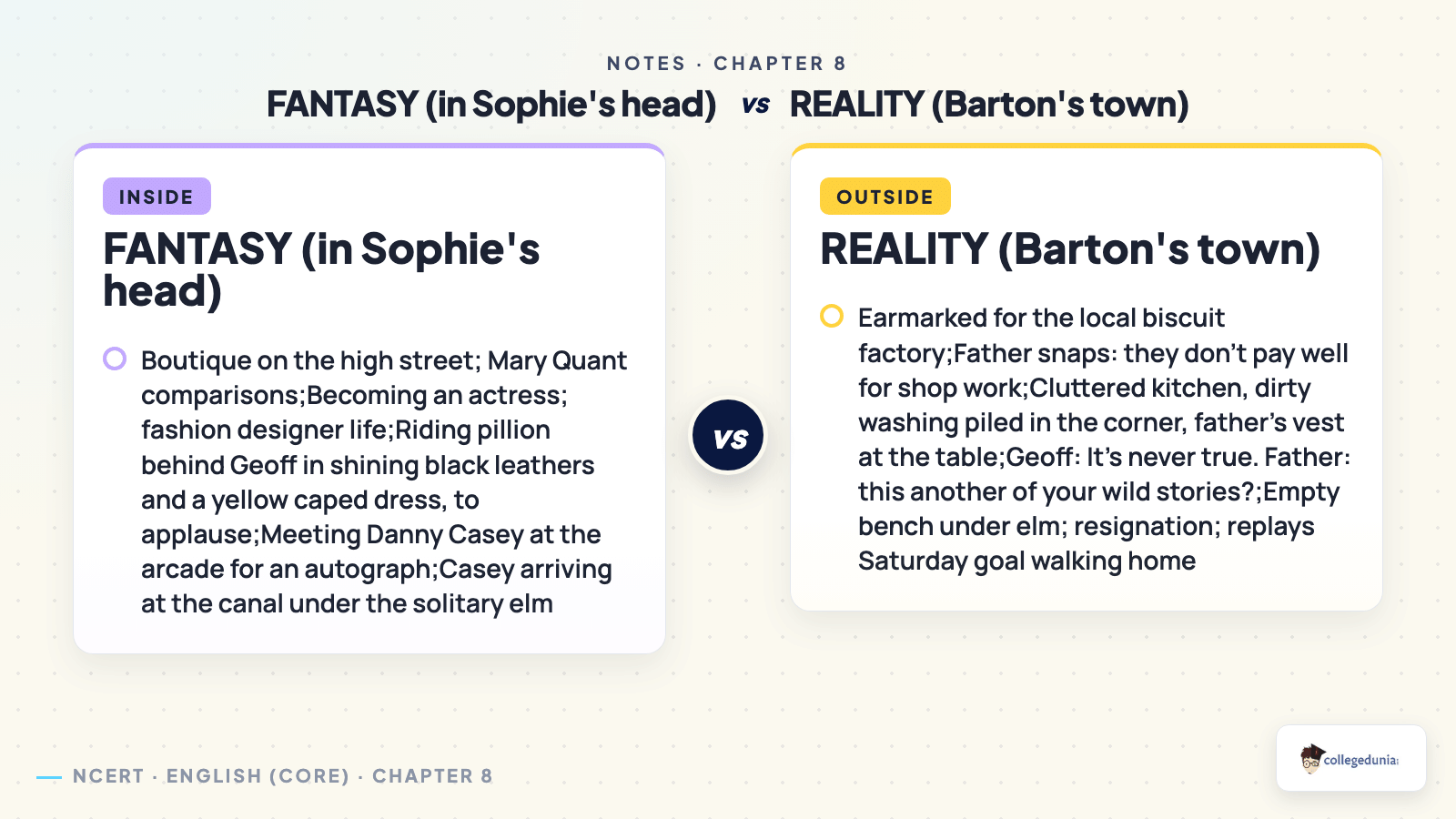



Comments