English Mentor, Jadavpur | Updated on - Jul 21, 2026
These The Enemy Class 12 NCERT Solutions answer every Reading with Insight question for Vistas Chapter 4 with text-grounded long answers from Pearl S. Buck's wartime story. Each answer is built like a 6-mark Section C Long Answer, with the exact quotations, names and acts that CBSE markers reward, aligned to the 2026-27 NCERT reprint.
CBSE Weightage:6 marks per Vistas Long Answer in Section C
Coverage: 8 Reading with Insight answers with Expert's Solution alternates and key quotations
These solutions are written by senior English educators and mapped to the 2026-27 NCERT Vistas textbook and recent CBSE Class 12 English Core papers.
The Enemy Class 12 NCERT Solutions: Chapter Snapshot
The Enemy is the fourth story in the Class 12 Vistas reader, by American Nobel laureate Pearl S. Buck (1892-1973) and set in 1942 during the Pacific War. Dr Sadao Hoki, a Japanese surgeon trained in America, finds a wounded American prisoner of war on the beach below his house. With his wife Hana beside him, he must choose between his doctor's oath and his nation's wartime hatred. The Reading with Insight block has eight long-answer questions, all covered below.
Question
What It Tests
Typical Mark Yield
Q1 - Private duty vs national loyalty
Central conflict
6 marks LA
Q2 - What made Hana sympathetic
Hana's moral hinge
5-6 marks LA
Q3 - Tom's reluctance to leave
Prisoner psychology
5 marks LA
Q4 - The General's attitude
Character study
6 marks LA
Q5 - Rising above narrow prejudices
Value-based reasoning
5-6 marks LA
Q6 - The doctor's final solution
Ethical evaluation
6 marks LA
Q7 - Comparison with Cronin's Birth
Cross-text comparison
5 marks LA
Q8 - Films/novels with similar themes
Literary parallels
5 marks LA
CBSE usually pulls a single 6-mark Long Answer from Vistas in Section C. Q1, Q4, Q5 and Q6 have been the most frequent rotations over the last five years.
Every question in the PDF is answered in two passes:
Long Answer. A one-line position, the anchoring lines quoted, four to six text-grounded points, and a two-sentence final answer.
Expert's Solution. Literary context and a structural reading.
Q1 Answer Skeleton: Private Duty vs National Loyalty
The answer to Q1 is that the doctor's oath wins in the moment of choice. Buck opens with Sadao's clinical reflex and closes with "Strange, I wonder why I could not kill him?" The PDF answer walks four anchors: the trigger, the conflict ("Ignorance of the human body is the surgeon's cardinal sin"), the decision to remove the bullet, and the escape plan.
Lines to quote: "Ignorance of the human body is the surgeon's cardinal sin." "Is this anything but a man?" "Strange, I wonder why I could not kill him?"
Q2 Answer Skeleton: What Made Hana Sympathetic
Hana is the story's moral hinge. The PDF answer draws three causes: her American education (she remembers Americans as people), her help in the surgery (washing the mouth, holding the ether cone), and her personal honour (she runs out "retching in the garden", then returns to help). Her sympathy shows in acts, not words: "Is this anything but a man?"
Examiner trap to avoid: Do not treat Hana as passive. Markers want the three named causes (American education, help in the surgery, personal honour) and at least one physical act.
Q3 Answer Skeleton: Tom's Reluctance to Leave
The young American, who tells Sadao his name is Tom, is reluctant to leave. The PDF answer names four causes: he is weak from the wound and surgery; he has grown attached to Sadao and Hana; he has lost a soldier's agency; and he fears the unknown offshore island. Sadao's sunset signal (two flashes for food, one for "still there") is the bridge that finally lets him go.
Q4 Answer Skeleton: The General's Attitude
The General's attitude is best read as self-absorption caused by illness, not compassion or neglect of duty. The PDF answer anchors on his confession: "I thought of nothing but myself." He offers his "private assassins", then forgets to send them because his own pain crowds out everything.
This is the value-based slot. The PDF answer names three mechanisms: a vocation older than the war (the teacher's "Ignorance of the human body is the surgeon's cardinal sin"), lived cross-cultural memory (the years in America), and personal honour. It closes with an Indian extension, such as doctors treating enemy soldiers, so the same triad works across borders.
Q6 Answer Skeleton: The Doctor's Final Solution
The Q6 answer walks the four parts of Sadao's plan: food, warm clothing, bottled water and a flashlight, plus a boat to the offshore island where a Korean fishing boat would collect the prisoner. The PDF rates it the best possible plan: it avoids killing, hides the prisoner, and keeps Sadao within his honour. "No prick of light in the dusk" confirms he has gone safely.
Q7 Answer Skeleton: Comparison with Cronin's Birth
Q7 invites a comparison with A. J. Cronin's "Birth". The PDF answer names three parallels: both put a doctor's duty above circumstance, both end with the doctor's quiet astonishment, and both treat compassion as a professional virtue. The difference: Cronin's Andrew Manson struggles against death, while Buck's Sadao struggles against wartime hatred.
Q8 Answer Skeleton: Films and Novels with Similar Themes
Q8 is the literary-extension slot. The PDF answer names film parallels (Schindler's List, Hotel Rwanda) and novel parallels (The Kite Runner, The Book Thief), each carrying the same humanism-above-nationalism idea that ties back to Buck's "enemy" who has a human face.
Common Mistakes Students Make in The Enemy Long Answers
Reading the General's forgetting as compassion. He says "I thought of nothing but myself."
Treating Hana as passive. She is the moral hinge of the story.
Calling Sadao's choice "easy". The choice is forced, not easy.
Confusing the author. It is Pearl S. Buck (1892-1973), 1938 Nobel laureate.
Forgetting the prisoner is named Tom; not using his name loses marks.
Quoting only one line. A 6-mark answer expects four or five anchors.
CBSE Class 12 English Previous Year Question Mapping for The Enemy
The 6-mark Vistas Long Answer slot rotates between Q1, Q4, Q5 and Q6, as the year-wise table shows.
Year
Long Answer Focus
Marks
2025
What makes a human being rise above narrow wartime prejudices (Q5)
6
2024
Hana's role in supporting Sadao when the servants refuse (Q2)
4
2023
Was the doctor's final solution the best possible (Q6)
6
2022
The General's attitude towards the enemy soldier (Q4)
5
2021
Private individual vs citizen with national loyalty (Q1)
6
2020
Soldier's reluctance to leave the doctor's home (Q3)
How Collegedunia's NCERT Solutions Help You Score in The Enemy
Every Long Answer opens with a one-line position and four to six text-grounded anchors, the shape a 6-mark answer is graded against.
Each answer is paired with an Expert's Solution, giving two ways to attempt it, with key phrases highlighted.
The eight answers together build a chapter-level map for any unseen variation.
All NCERT Solutions for The Enemy with Step-by-Step Working
Every NCERT question for Chapter 4 The Enemy is listed below with its Solution and Expert Solution in collapsible tabs. Click Check Solution to reveal the answer.
Read and Find Out
Q 4.1
Who was Dr Sadao? Where was his house?
Dr Sadao Hoki was a respected Japanese surgeon and
researcher, indispensable to the war effort, and the only
surgeon in his coastal town. His house stood at the edge of
a narrow beach on the Japanese coast, on a spot his father
had carefully chosen for him as a child.
Lines from the text
``Dr Sadao Hoki's house was built on a spot of the Japanese
coast where as a little boy he had often played The
low square house stood on rocks well above a narrow
beach that was outlined with bent pines.''
Profession. Sadao was a surgeon, trained
for eight years in the United States. He was also a
researcher working on a new wound antiseptic for the
Japanese military.
Indispensable to the war. He was kept in
Japan because the General trusted his hands; the
General had said openly that he could not afford to
lose Sadao.
The house. His house stood on a coastal
ridge on rocks well above a narrow beach lined with
twisted pines. His father had bought the land and
built the house when Sadao was a boy.
Dr Sadao Hoki was a Japanese surgeon, trained in
America for eight years, indispensable to the wartime medical
effort. His house stood on rocks above a narrow beach on the
Japanese coast, on a spot his father had carefully chosen
when Sadao was a boy.
DA
Dr Ananya Iyer
PhD American Literature, Jawaharlal Nehru University
Verified Expert
Quick reading. Buck plants the house at the edge of
the country deliberately. The American sailor washes up on
Sadao's own beach; the coastal setting is the story's
geographical pivot.
Sadao's training in the US makes him a divided
figure even before the prisoner arrives. He
understands the enemy because he has lived among
them.
The coastal house, isolated and visible from the
sea, gives Buck the staging she needs for the
sailor's arrival, the General's evening visit, and
the small motor-boat at night.
Dr Sadao Hoki was a respected Japanese surgeon and
researcher, eight years US-trained, indispensable to the war
effort. His house stood on rocks above a narrow beach on the
Japanese coast, lined with bent pines.
Common mistakes. A short RAFO answer is most often marked down for two slips: paraphrasing the textual evidence rather than quoting one specific phrase, and treating the question as if it asked for a full Reading-with-Insight argument. Stay close to the text and stop at the question asked. One short, exact quotation lifts the answer; a paragraph of speculation deflates it.
Q 4.2
Will Dr Sadao be arrested on the charge of harbouring an enemy?
Sadao is afraid he will be. The young American sailor he and
Hana pull from the surf wears the uniform of the enemy, and
the laws of wartime Japan treat harbouring an enemy as
treason. Yet his medical oath and Hana's quiet compassion
overrule prudence, and the chapter is, in the end, the
story of how Sadao avoids arrest without dishonouring his
training.
Lines from the text
``If we sheltered a white man in our house we should be
arrested and if we turned him over as a prisoner, he would
certainly die.''
The fear is real. Sadao knows that
harbouring a white man in his house would mean
arrest. He says so out loud to Hana.
The choice they make. Even so, Sadao
operates on the prisoner and Hana nurses him.
Compassion and professional duty win out over the
political risk.
The way Sadao avoids arrest. He decides to
tell the General; the General offers his own private
assassins instead of summoning the police. When the
assassins do not come, Sadao quietly arranges the
prisoner's escape by sea.
Sadao fears arrest, because Japanese wartime law
treats harbouring a white prisoner as treason. He avoids
that arrest in the end by treating the prisoner secretly,
informing the General privately, and finally arranging the
escape by sea. The fear of arrest is real but it does not
materialise; Sadao's care and the General's self-absorption
keep him safe.
MA
Mr Arjun Mehta
MA English, University of Delhi
Verified Expert
Quick reading. The fear of arrest is the chapter's
running suspense engine. Buck uses it to keep tension high
while Sadao behaves humanely.
Sadao names the risk early so the reader feels it
through every later scene.
The General's distracted indulgence is the
chapter's quiet exit: Sadao avoids arrest not by
cleverness but because the General is too busy
thinking about his own gall-bladder operation to
remember the prisoner.
Sadao fears he will be arrested for harbouring an
enemy. In the event, he avoids arrest by treating the man
secretly, by telling the General (who turns out to be too
self-absorbed to act), and by arranging the escape by sea.
The arrest is real as a fear; in the chapter it never
arrives.
Common mistakes. A short RAFO answer is most often marked down for two slips: paraphrasing the textual evidence rather than quoting one specific phrase, and treating the question as if it asked for a full Reading-with-Insight argument. Stay close to the text and stop at the question asked. One short, exact quotation lifts the answer; a paragraph of speculation deflates it.
Q 4.3
Will Hana help the wounded man and wash him herself?
Hana's choice is one of the chapter's quietest tests of
character. The servants refuse to touch the foreigner and
walk out of the house; Hana, who has never washed a man
before, takes a sponge and washes the American sailor
clean. The act crosses a class line as well as a national
one.
Lines from the text
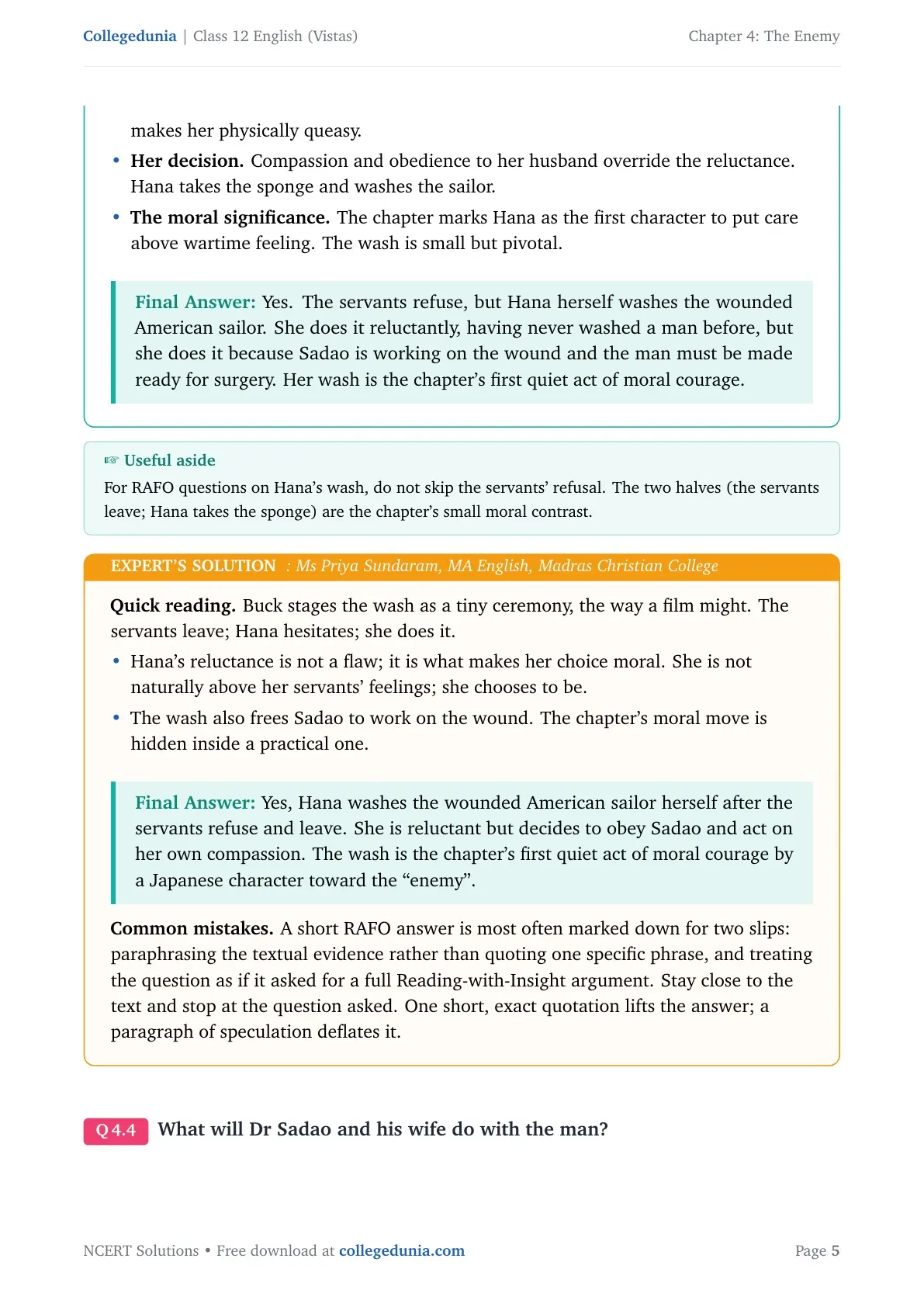
``She had never washed a man before She knew what the
servants felt. But Sadao was working on the wound
She must do what she was told.''
The servants refuse. Yumi, the gardener
and the cook will not touch a white man even to help
with the bath. They leave the house.
Hana's reluctance. She has never done such
work and the touch of the man's skin makes her
physically queasy.
Her decision. Compassion and obedience to
her husband override the reluctance. Hana takes the
sponge and washes the sailor.
The moral significance. The chapter
marks Hana as the first character to put care above
wartime feeling. The wash is small but pivotal.
Yes. The servants refuse, but Hana herself washes
the wounded American sailor. She does it reluctantly, having
never washed a man before, but she does it because Sadao is
working on the wound and the man must be made ready for
surgery. Her wash is the chapter's first quiet act of
moral courage.
MP
Ms Priya Sundaram
MA English, Madras Christian College
Verified Expert
Quick reading. Buck stages the wash as a tiny
ceremony, the way a film might. The servants leave; Hana
hesitates; she does it.
Hana's reluctance is not a flaw; it is what makes
her choice moral. She is not naturally above her
servants' feelings; she chooses to be.
The wash also frees Sadao to work on the wound.
The chapter's moral move is hidden inside a
practical one.
Yes, Hana washes the wounded American sailor
herself after the servants refuse and leave. She is
reluctant but decides to obey Sadao and act on her own
compassion. The wash is the chapter's first quiet act of
moral courage by a Japanese character toward the
``enemy''.
Common mistakes. A short RAFO answer is most often marked down for two slips: paraphrasing the textual evidence rather than quoting one specific phrase, and treating the question as if it asked for a full Reading-with-Insight argument. Stay close to the text and stop at the question asked. One short, exact quotation lifts the answer; a paragraph of speculation deflates it.
Q 4.4
What will Dr Sadao and his wife do with the man?
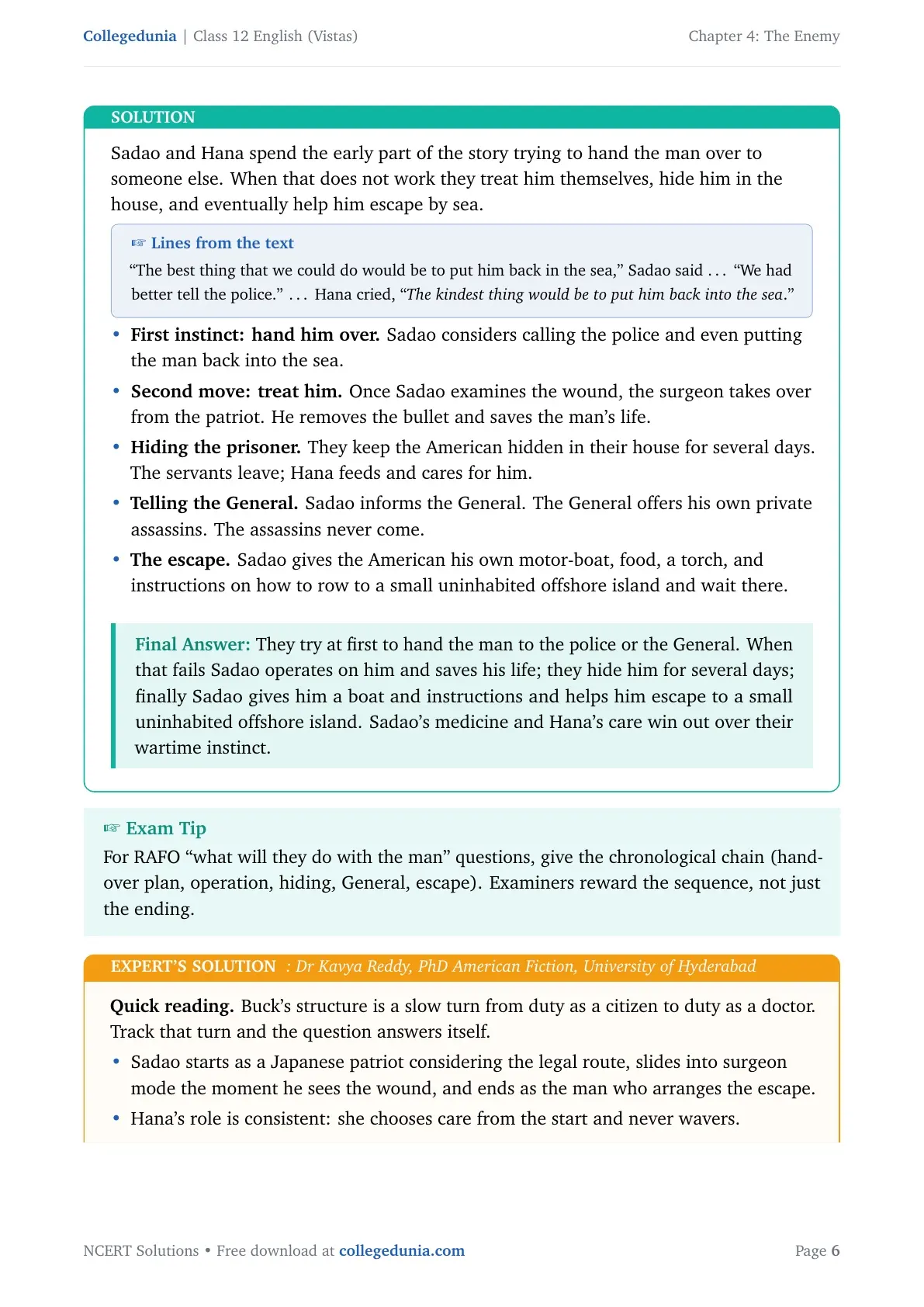
Sadao and Hana spend the early part of the story trying to
hand the man over to someone else. When that does not work
they treat him themselves, hide him in the house, and
eventually help him escape by sea.
Lines from the text
``The best thing that we could do would be to put him back in
the sea,'' Sadao said ``We had better tell the
police.'' Hana cried, ``The kindest thing would
be to put him back into the sea.''
First instinct: hand him over. Sadao
considers calling the police and even putting the
man back into the sea.
Second move: treat him. Once Sadao
examines the wound, the surgeon takes over from the
patriot. He removes the bullet and saves the man's
life.
Hiding the prisoner. They keep the
American hidden in their house for several days. The
servants leave; Hana feeds and cares for him.
Telling the General. Sadao informs the
General. The General offers his own private
assassins. The assassins never come.
The escape. Sadao gives the American his
own motor-boat, food, a torch, and instructions on
how to row to a small uninhabited offshore island
and wait there.
They try at first to hand the man to the police or
the General. When that fails Sadao operates on him and saves
his life; they hide him for several days; finally Sadao
gives him a boat and instructions and helps him escape to a
small uninhabited offshore island. Sadao's medicine and
Hana's care win out over their wartime instinct.
DK
Dr Kavya Reddy
PhD American Fiction, University of Hyderabad
Verified Expert
Quick reading. Buck's structure is a slow turn from
duty as a citizen to duty as a doctor. Track that turn and
the question answers itself.
Sadao starts as a Japanese patriot considering the
legal route, slides into surgeon mode the moment he
sees the wound, and ends as the man who arranges the
escape.
Hana's role is consistent: she chooses care from
the start and never wavers.
They try to hand him over, then operate on him and
save his life, then hide him for several days, then arrange
his escape on a small motor-boat to an uninhabited offshore
island. The chapter's arc is from patriot to surgeon.
Common mistakes. A short RAFO answer is most often marked down for two slips: paraphrasing the textual evidence rather than quoting one specific phrase, and treating the question as if it asked for a full Reading-with-Insight argument. Stay close to the text and stop at the question asked. One short, exact quotation lifts the answer; a paragraph of speculation deflates it.
Q 4.5
What will Dr Sadao do to get rid of the man?
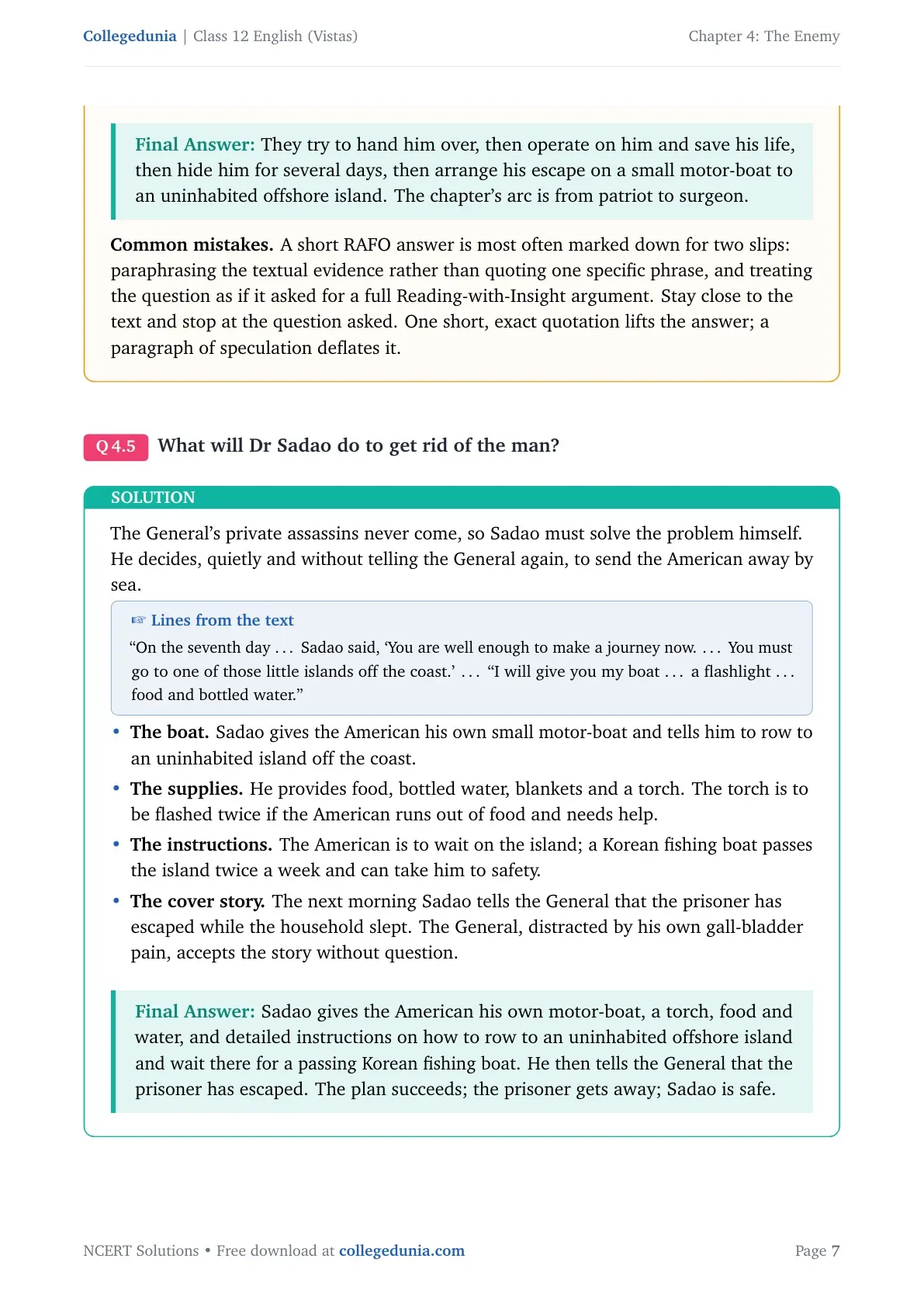
The General's private assassins never come, so Sadao must
solve the problem himself. He decides, quietly and without
telling the General again, to send the American away by sea.
Lines from the text
``On the seventh day Sadao said, `You are well enough
to make a journey now. You must go to one of those
little islands off the coast.' ``I will give you my
boat a flashlight food and bottled water.''
The boat. Sadao gives the American his own
small motor-boat and tells him to row to an
uninhabited island off the coast.
The supplies. He provides food, bottled
water, blankets and a torch. The torch is to be
flashed twice if the American runs out of food and
needs help.
The instructions. The American is to wait
on the island; a Korean fishing boat passes the
island twice a week and can take him to safety.
The cover story. The next morning Sadao
tells the General that the prisoner has escaped
while the household slept. The General, distracted
by his own gall-bladder pain, accepts the story
without question.
Sadao gives the American his own motor-boat, a
torch, food and water, and detailed instructions on how to
row to an uninhabited offshore island and wait there for a
passing Korean fishing boat. He then tells the General that
the prisoner has escaped. The plan succeeds; the prisoner
gets away; Sadao is safe.
MV
Mr Vikram Rao
MA English Literature, Banaras Hindu University
Verified Expert
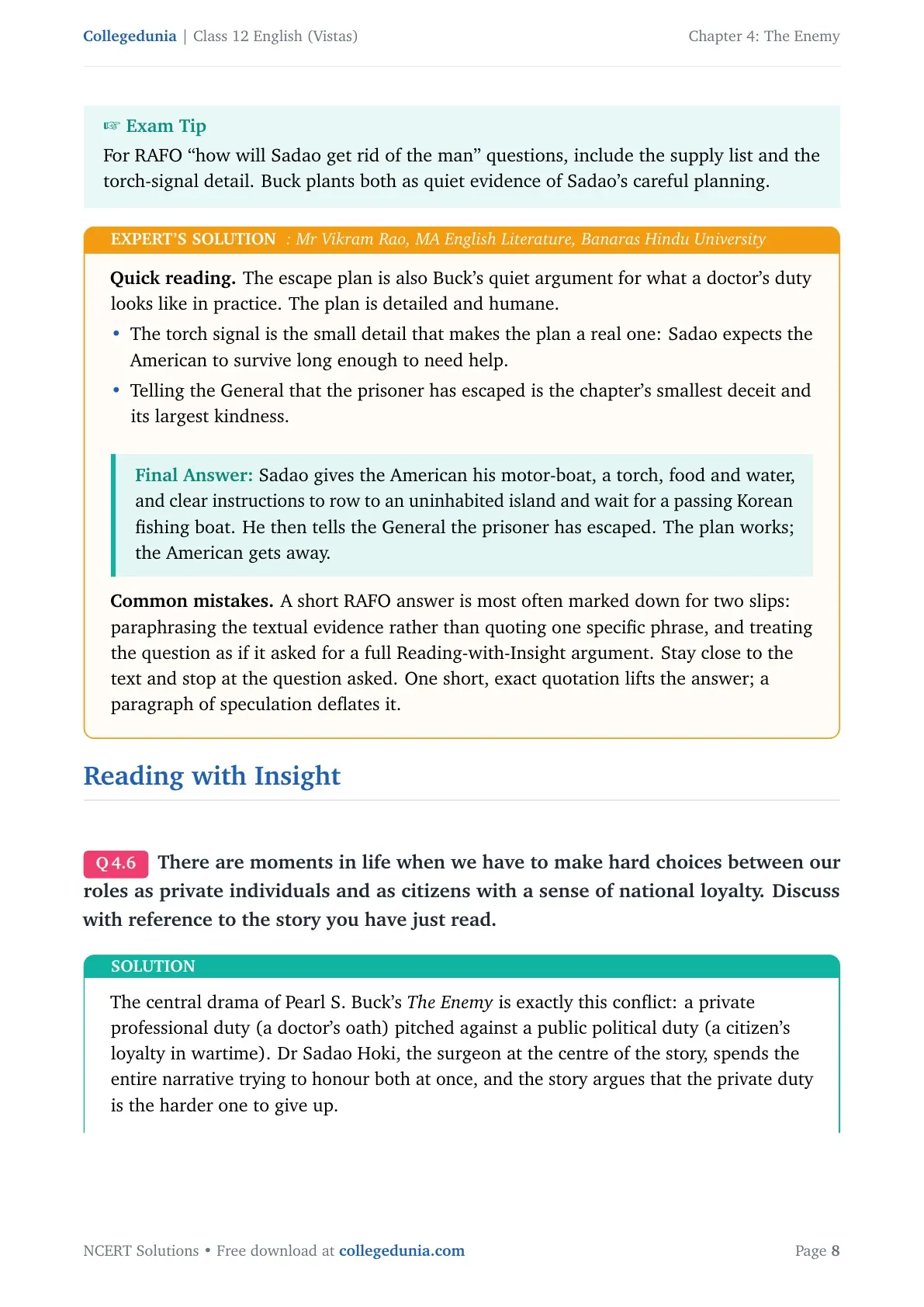
Quick reading. The escape plan is also Buck's quiet
argument for what a doctor's duty looks like in practice. The
plan is detailed and humane.
The torch signal is the small detail that makes the
plan a real one: Sadao expects the American to
survive long enough to need help.
Telling the General that the prisoner has escaped
is the chapter's smallest deceit and its largest
kindness.
Sadao gives the American his motor-boat, a torch,
food and water, and clear instructions to row to an
uninhabited island and wait for a passing Korean fishing
boat. He then tells the General the prisoner has escaped.
The plan works; the American gets away.
Common mistakes. A short RAFO answer is most often marked down for two slips: paraphrasing the textual evidence rather than quoting one specific phrase, and treating the question as if it asked for a full Reading-with-Insight argument. Stay close to the text and stop at the question asked. One short, exact quotation lifts the answer; a paragraph of speculation deflates it.
Reading with Insight
Q 4.6
There are moments in life when we have to make hard choices between our roles as private individuals and as citizens with a sense of national loyalty. Discuss with reference to the story you have just read.
The central drama of Pearl S. Buck's The Enemy is exactly
this conflict: a private professional duty (a doctor's oath)
pitched against a public political duty (a citizen's loyalty in
wartime). Dr Sadao Hoki, the surgeon at the centre of the story,
spends the entire narrative trying to honour both at once, and
the story argues that the private duty is the harder one to give
up.
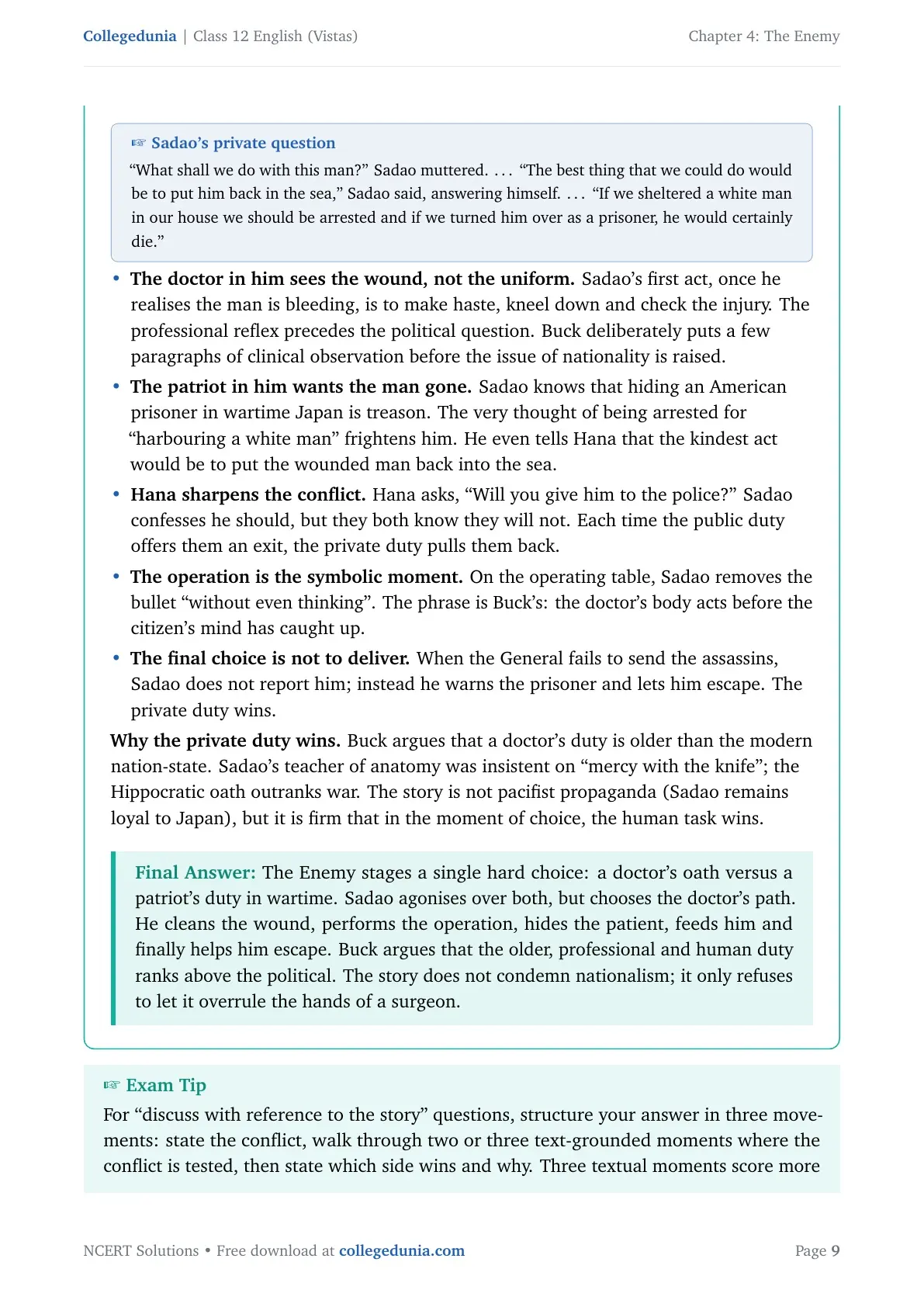
Sadao's private question
``What shall we do with this man?'' Sadao muttered.
``The best thing that we could do would be to put him back in
the sea,'' Sadao said, answering himself. ``If we
sheltered a white man in our house we should be arrested and
if we turned him over as a prisoner, he would certainly die.''
The doctor in him sees the wound, not the
uniform. Sadao's first act, once he realises the man
is bleeding, is to make haste, kneel down and check
the injury. The professional reflex precedes the
political question. Buck deliberately puts a few
paragraphs of clinical observation before the issue of
nationality is raised.
The patriot in him wants the man gone. Sadao
knows that hiding an American prisoner in wartime Japan
is treason. The very thought of being arrested for
``harbouring a white man'' frightens him. He even tells
Hana that the kindest act would be to put the wounded
man back into the sea.
Hana sharpens the conflict. Hana asks, ``Will
you give him to the police?'' Sadao confesses he should,
but they both know they will not. Each time the public
duty offers them an exit, the private duty pulls them
back.
The operation is the symbolic moment. On the
operating table, Sadao removes the bullet ``without
even thinking''. The phrase is Buck's: the doctor's
body acts before the citizen's mind has caught up.
The final choice is not to deliver. When the
General fails to send the assassins, Sadao does not
report him; instead he warns the prisoner and lets him
escape. The private duty wins.
Why the private duty wins. Buck argues that a doctor's
duty is older than the modern nation-state. Sadao's teacher of
anatomy was insistent on ``mercy with the knife''; the Hippocratic
oath outranks war. The story is not pacifist propaganda (Sadao
remains loyal to Japan), but it is firm that in the moment of
choice, the human task wins.
The Enemy stages a single hard choice: a doctor's oath
versus a patriot's duty in wartime. Sadao agonises over both, but
chooses the doctor's path. He cleans the wound, performs the
operation, hides the patient, feeds him and finally helps him
escape. Buck argues that the older, professional and human duty
ranks above the political. The story does not condemn
nationalism; it only refuses to let it overrule the hands of a
surgeon.
MD
Ms Devika Rao
MA English, Madras Christian College
Verified Expert
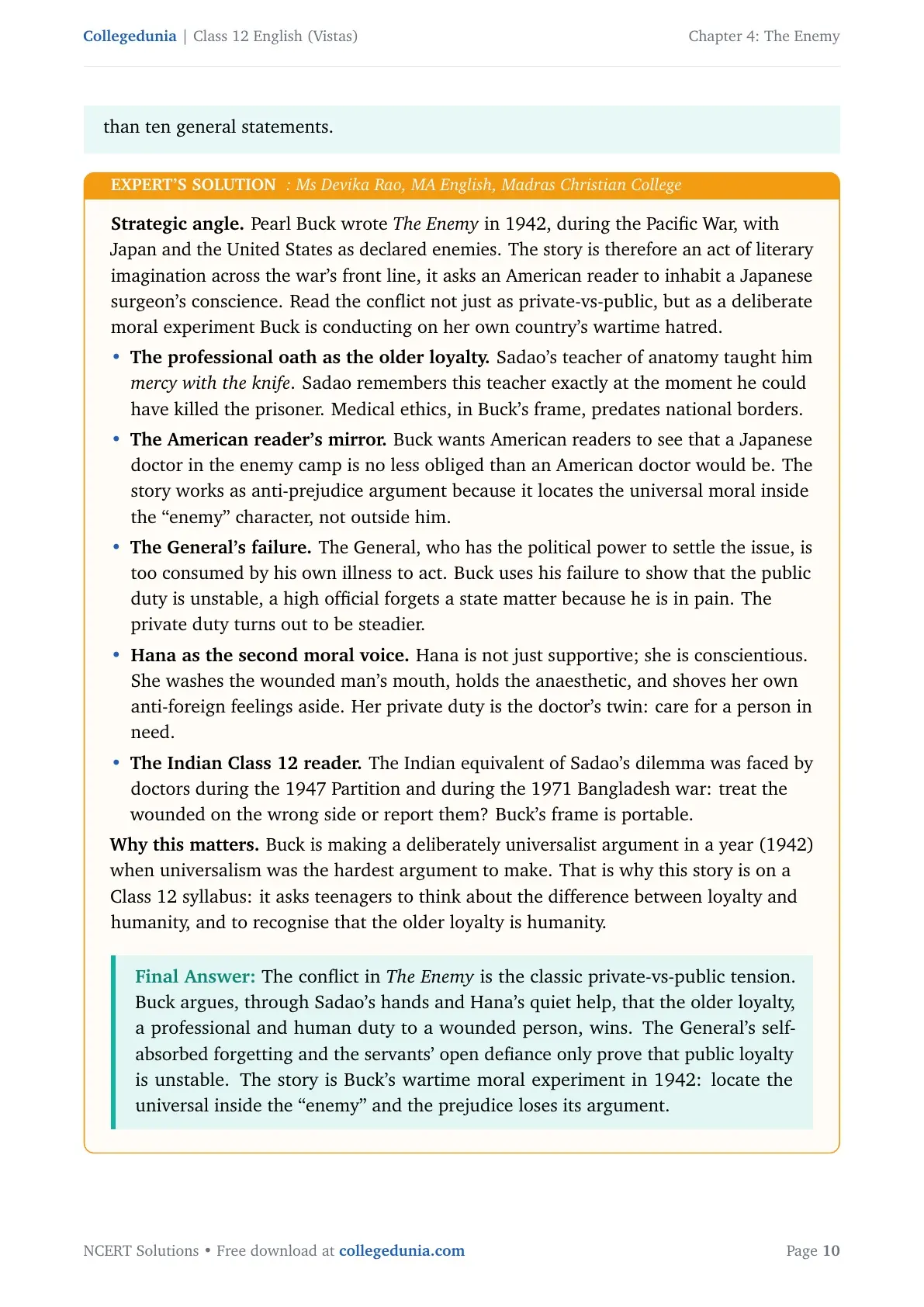
Strategic angle. Pearl Buck wrote The Enemy in
1942, during the Pacific War, with Japan and the United States as
declared enemies. The story is therefore an act of literary
imagination across the war's front line, it asks an American
reader to inhabit a Japanese surgeon's conscience. Read the
conflict not just as private-vs-public, but as a deliberate
moral experiment Buck is conducting on her own country's
wartime hatred.
The professional oath as the older loyalty.
Sadao's teacher of anatomy taught him mercy with
the knife. Sadao remembers this teacher exactly at the
moment he could have killed the prisoner. Medical
ethics, in Buck's frame, predates national borders.
The American reader's mirror. Buck wants
Americans to see that a Japanese doctor in the
enemy camp is no less obliged than an American doctor
would be. The story works as anti-prejudice argument
because it locates the universal moral inside the
``enemy'' character, not outside him.
The General's failure. The General, who has
the political power to settle the issue, is too
consumed by his own illness to act. Buck uses his
failure to show that the public duty is unstable,
a high official forgets a state matter because he is
in pain. The private duty turns out to be steadier.
Hana as the second moral voice. Hana is not
just supportive; she is conscientious. She washes the
wounded man's mouth, holds the anaesthetic, and shoves
her own anti-foreign feelings aside. Her private duty
is the doctor's twin: care for a person in need.
The Indian Class 12 reader. The Indian
equivalent of Sadao's dilemma was faced by doctors
during the 1947 Partition and during the 1971
Bangladesh war: treat the wounded on the wrong side or
report them? Buck's frame is portable.
Why this matters. Buck is making a deliberately
universalist argument in a year (1942) when universalism was the
hardest argument to make. That is why this story is on a Class 12
syllabus: it asks teenagers to think about the difference
between loyalty and humanity, and to recognise that the older
loyalty is humanity.
The conflict in The Enemy is the classic
private-vs-public tension. Buck argues, through Sadao's hands and
Hana's quiet help, that the older loyalty, a professional and
human duty to a wounded person, wins. The General's
self-absorbed forgetting and the servants' open defiance only
prove that public loyalty is unstable. The story is Buck's wartime
moral experiment in 1942: locate the universal inside the
``enemy'' and the prejudice loses its argument.
Q 4.7
Dr Sadao was compelled by his duty as a doctor to help the enemy soldier. What made Hana, his wife, sympathetic to him in the face of open defiance from the domestic staff?
Hana's sympathy is not a single act; it is a chain of small
choices she makes as the servants' opposition grows. Three things
push her towards Sadao's side: her own American education, her
upbringing as a doctor's wife, and her sense of personal honour
once the man is inside the house.
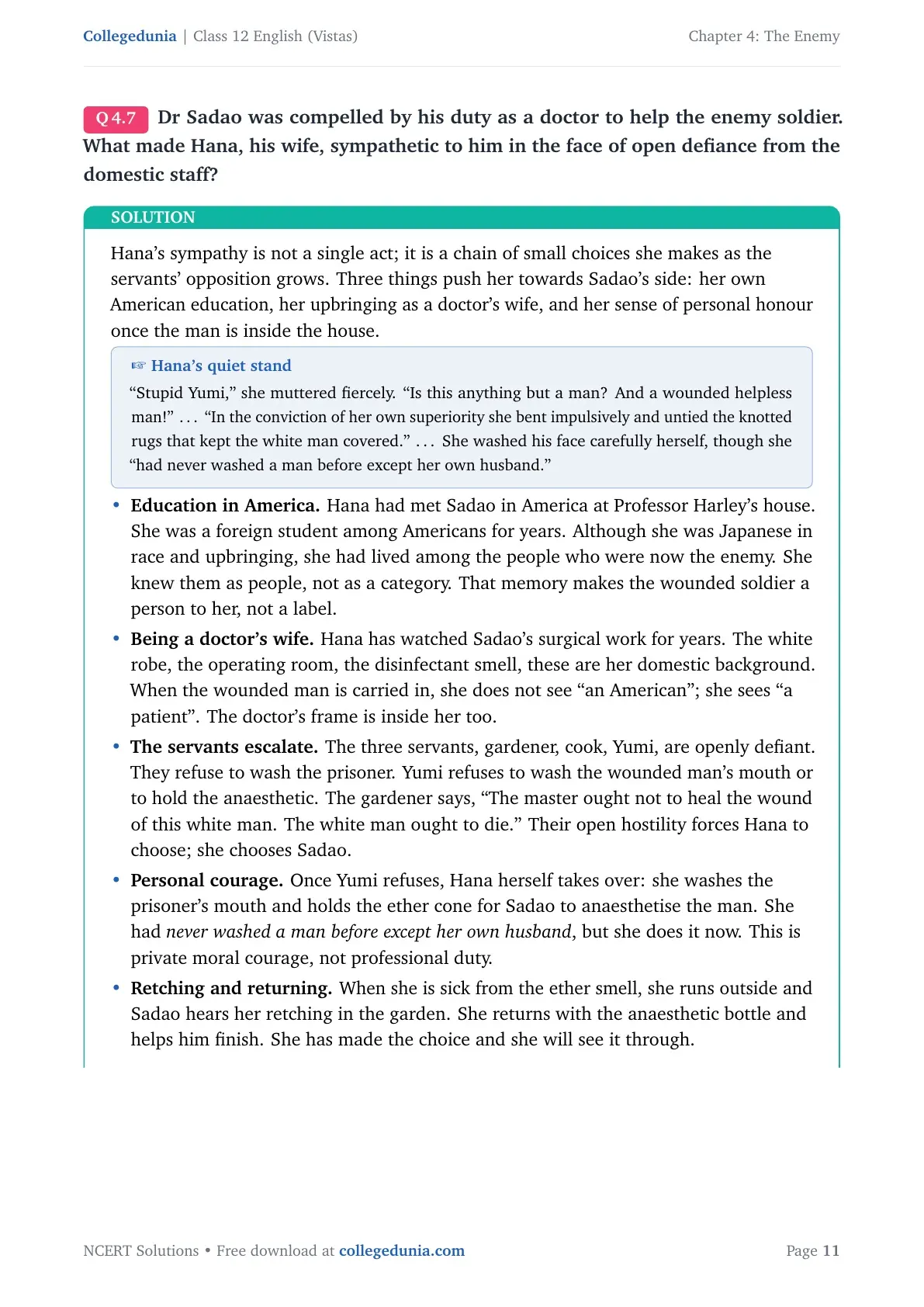
Hana's quiet stand
``Stupid Yumi,'' she muttered fiercely. ``Is this anything but
a man? And a wounded helpless man!'' ``In the conviction
of her own superiority she bent impulsively and untied the
knotted rugs that kept the white man covered.'' She
washed his face carefully herself, though she ``had never
washed a man before except her own husband.''
Education in America. Hana had met Sadao in
America at Professor Harley's house. She was a foreign
student among Americans for years. Although she was
Japanese in race and upbringing, she had lived among
the people who were now the enemy. She knew them as
people, not as a category. That memory makes the
wounded soldier a person to her, not a label.
Being a doctor's wife. Hana has watched
Sadao's surgical work for years. The white robe, the
operating room, the disinfectant smell, these are
her domestic background. When the wounded man is
carried in, she does not see ``an American''; she sees
``a patient''. The doctor's frame is inside her too.
The servants escalate. The three servants,
gardener, cook, Yumi, are openly defiant. They
refuse to wash the prisoner. Yumi refuses to wash the
wounded man's mouth or to hold the anaesthetic. The
gardener says, ``The master ought not to heal the
wound of this white man. The white man ought to die.''
Their open hostility forces Hana to choose; she
chooses Sadao.
Personal courage. Once Yumi refuses, Hana
herself takes over: she washes the prisoner's mouth and
holds the ether cone for Sadao to anaesthetise the man.
She had never washed a man before except her own
husband, but she does it now. This is private moral
courage, not professional duty.
Retching and returning. When she is sick from
the ether smell, she runs outside and Sadao hears her
retching in the garden. She returns with the
anaesthetic bottle and helps him finish. She has made
the choice and she will see it through.
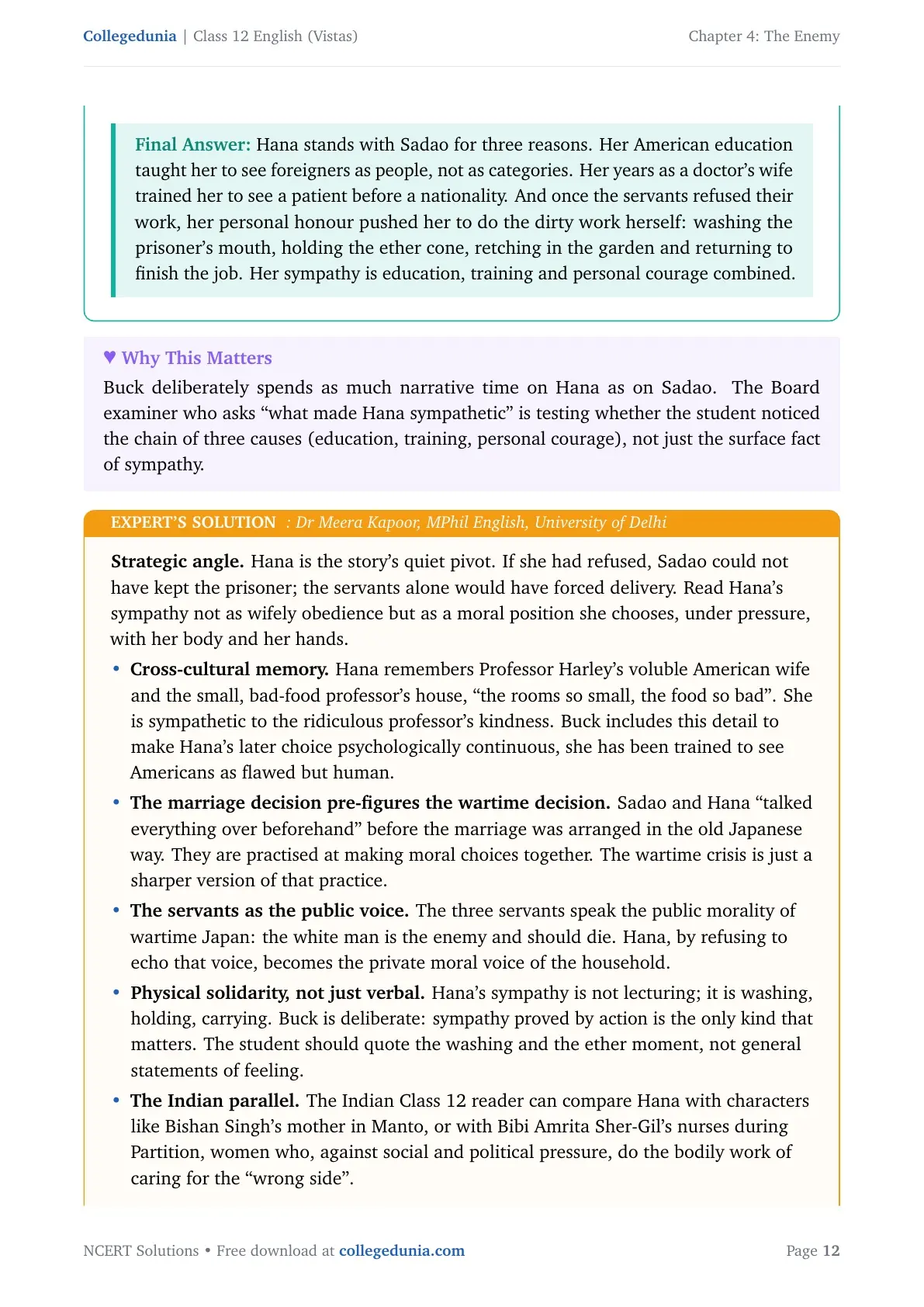
Hana stands with Sadao for three reasons. Her American
education taught her to see foreigners as people, not as
categories. Her years as a doctor's wife trained her to see a
patient before a nationality. And once the servants refused
their work, her personal honour pushed her to do the dirty work
herself: washing the prisoner's mouth, holding the ether cone,
retching in the garden and returning to finish the job. Her
sympathy is education, training and personal courage combined.
DM
Dr Meera Kapoor
MPhil English, University of Delhi
Verified Expert
Strategic angle. Hana is the story's quiet pivot. If she
had refused, Sadao could not have kept the prisoner; the
servants alone would have forced delivery. Read Hana's sympathy
not as wifely obedience but as a moral position she chooses,
under pressure, with her body and her hands.
Cross-cultural memory. Hana remembers
Professor Harley's voluble American wife and the small,
bad-food professor's house, ``the rooms so small, the
food so bad''. She is sympathetic to the ridiculous
professor's kindness. Buck includes this detail to make
Hana's later choice psychologically continuous, she
has been trained to see Americans as flawed but human.
The marriage decision pre-figures the wartime
decision. Sadao and Hana ``talked everything over
beforehand'' before the marriage was arranged in the
old Japanese way. They are practised at making moral
choices together. The wartime crisis is just a sharper
version of that practice.
The servants as the public voice. The three
servants speak the public morality of wartime Japan:
the white man is the enemy and should die. Hana,
by refusing to echo that voice, becomes the private
moral voice of the household.
Physical solidarity, not just verbal. Hana's
sympathy is not lecturing; it is washing, holding,
carrying. Buck is deliberate: sympathy proved by
action is the only kind that matters. The student
should quote the washing and the ether moment, not
general statements of feeling.
The Indian parallel. The Indian Class 12
reader can compare Hana with characters like Bishan
Singh's mother in Manto, or with Bibi Amrita Sher-Gil's
nurses during Partition, women who, against social
and political pressure, do the bodily work of caring
for the ``wrong side''.
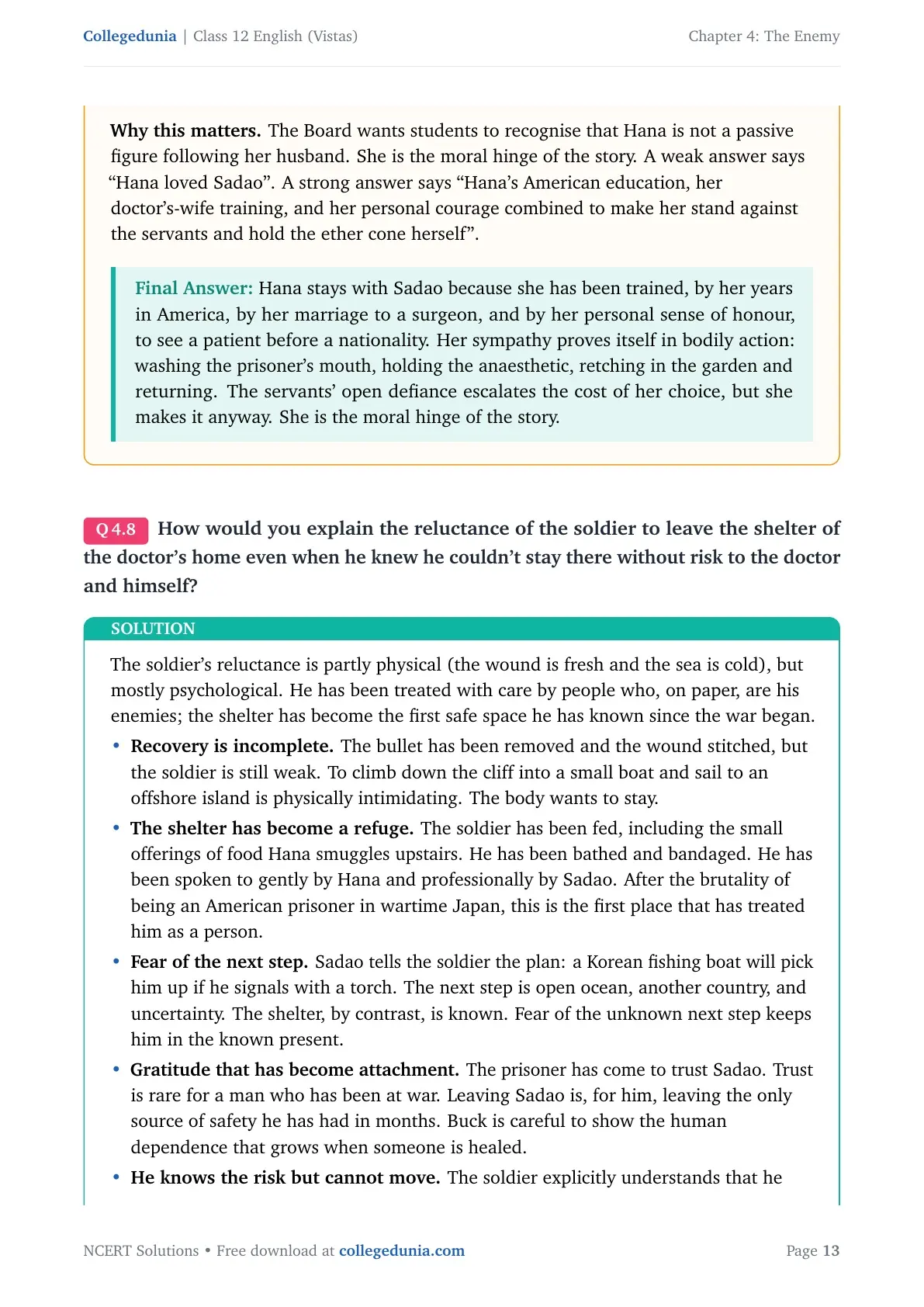
Why this matters. The Board wants students to recognise
that Hana is not a passive figure following her husband. She is
the moral hinge of the story. A weak answer says ``Hana loved
Sadao''. A strong answer says ``Hana's American education, her
doctor's-wife training, and her personal courage combined to
make her stand against the servants and hold the ether cone
herself''.
Hana stays with Sadao because she has been trained,
by her years in America, by her marriage to a surgeon, and by
her personal sense of honour, to see a patient before a
nationality. Her sympathy proves itself in bodily action:
washing the prisoner's mouth, holding the anaesthetic, retching
in the garden and returning. The servants' open defiance
escalates the cost of her choice, but she makes it anyway. She
is the moral hinge of the story.
Q 4.8
How would you explain the reluctance of the soldier to leave the shelter of the doctor's home even when he knew he couldn't stay there without risk to the doctor and himself?
The soldier's reluctance is partly physical (the wound is fresh
and the sea is cold), but mostly psychological. He has been
treated with care by people who, on paper, are his enemies; the
shelter has become the first safe space he has known since the
war began.
Recovery is incomplete. The bullet has been
removed and the wound stitched, but the soldier is
still weak. To climb down the cliff into a small boat
and sail to an offshore island is physically
intimidating. The body wants to stay.
The shelter has become a refuge. The soldier
has been fed, including the small offerings of
food Hana smuggles upstairs. He has been bathed and
bandaged. He has been spoken to gently by Hana and
professionally by Sadao. After the brutality of being
an American prisoner in wartime Japan, this is the
first place that has treated him as a person.
Fear of the next step. Sadao tells the soldier
the plan: a Korean fishing boat will pick him up if he
signals with a torch. The next step is open ocean,
another country, and uncertainty. The shelter, by
contrast, is known. Fear of the unknown next step keeps
him in the known present.
Gratitude that has become attachment. The
prisoner has come to trust Sadao. Trust is rare for a
man who has been at war. Leaving Sadao is, for him,
leaving the only source of safety he has had in
months. Buck is careful to show the human dependence
that grows when someone is healed.
He knows the risk but cannot move. The
soldier explicitly understands that he cannot stay
``without risk to the doctor and himself''. Knowing
the risk and acting on it are different things,
especially when one is still weak and afraid.
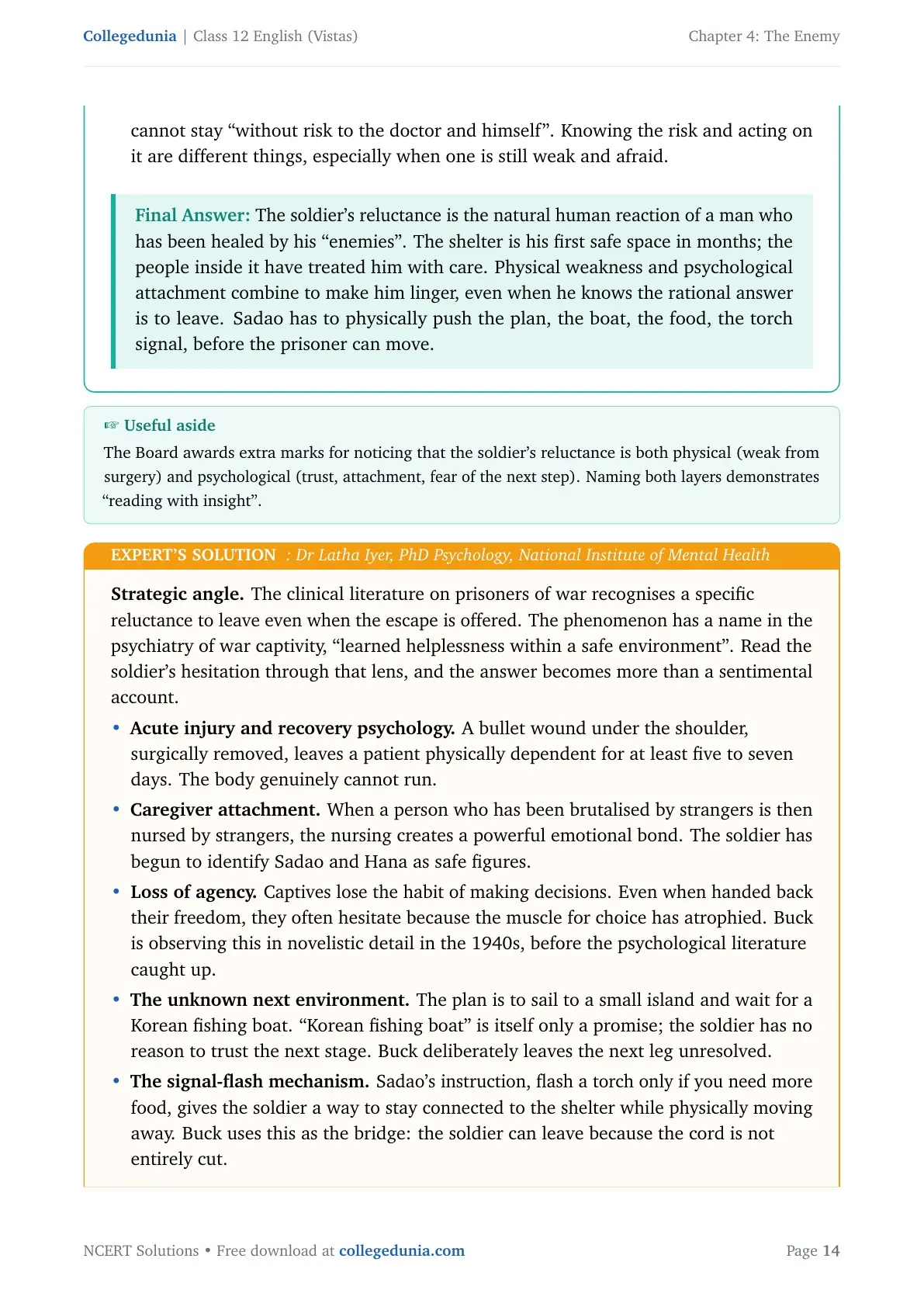
The soldier's reluctance is the natural human reaction
of a man who has been healed by his ``enemies''. The shelter is
his first safe space in months; the people inside it have
treated him with care. Physical weakness and psychological
attachment combine to make him linger, even when he knows the
rational answer is to leave. Sadao has to physically push the
plan, the boat, the food, the torch signal, before the
prisoner can move.
DL
Dr Latha Iyer
PhD Psychology, National Institute of Mental Health
Verified Expert
Strategic angle. The clinical literature on prisoners of
war recognises a specific reluctance to leave even when the
escape is offered. The phenomenon has a name in the psychiatry
of war captivity, ``learned helplessness within a safe
environment''. Read the soldier's hesitation through that lens,
and the answer becomes more than a sentimental account.
Acute injury and recovery psychology. A
bullet wound under the shoulder, surgically removed,
leaves a patient physically dependent for at least
five to seven days. The body genuinely cannot run.
Caregiver attachment. When a person who has
been brutalised by strangers is then nursed by
strangers, the nursing creates a powerful emotional
bond. The soldier has begun to identify Sadao and
Hana as safe figures.
Loss of agency. Captives lose the habit of
making decisions. Even when handed back their
freedom, they often hesitate because the muscle for
choice has atrophied. Buck is observing this in
novelistic detail in the 1940s, before the
psychological literature caught up.
The unknown next environment. The plan is to
sail to a small island and wait for a Korean fishing
boat. ``Korean fishing boat'' is itself only a
promise; the soldier has no reason to trust the next
stage. Buck deliberately leaves the next leg
unresolved.
The signal-flash mechanism. Sadao's
instruction, flash a torch only if you need more
food, gives the soldier a way to stay connected to
the shelter while physically moving away. Buck uses
this as the bridge: the soldier can leave because the
cord is not entirely cut.
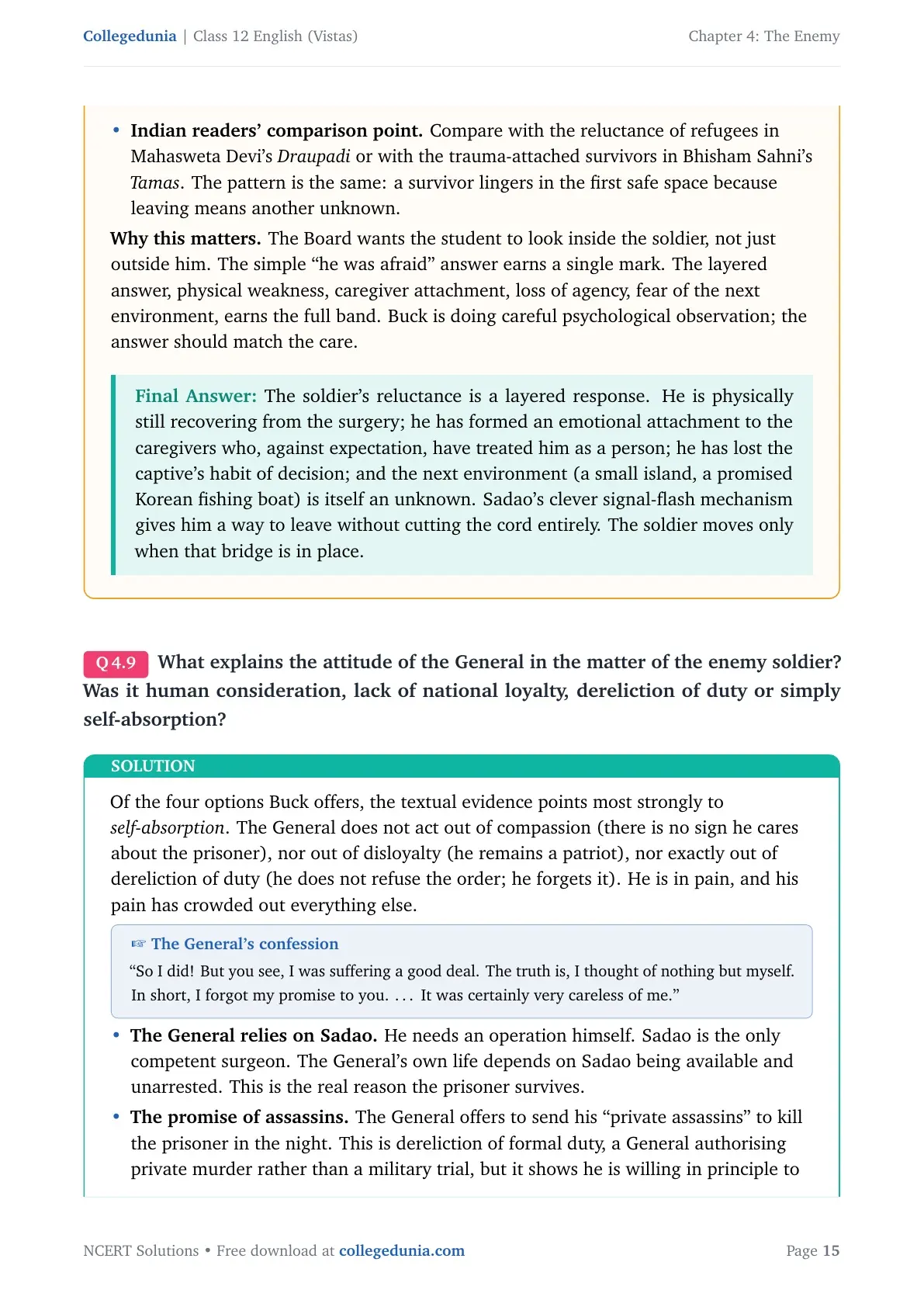
Indian students' comparison point. Compare
with the reluctance of refugees in Mahasweta Devi's
Draupadi or with the trauma-attached survivors
in Bhisham Sahni's Tamas. The pattern is the
same: a survivor lingers in the first safe space
because leaving means another unknown.
Why this matters. The Board wants the student to look
inside the soldier, not just outside him. The simple ``he was
afraid'' answer earns a single mark. The layered answer,
physical weakness, caregiver attachment, loss of agency, fear of
the next environment, earns the full band. Buck is doing
careful psychological observation; the answer should match the
care.
The soldier's reluctance is a layered response. He is
physically still recovering from the surgery; he has formed an
emotional attachment to the caregivers who, against expectation,
have treated him as a person; he has lost the captive's habit
of decision; and the next environment (a small island, a
promised Korean fishing boat) is itself an unknown. Sadao's
clever signal-flash mechanism gives him a way to leave without
cutting the cord entirely. The soldier moves only when that
bridge is in place.
Q 4.9
What explains the attitude of the General in the matter of the enemy soldier? Was it human consideration, lack of national loyalty, dereliction of duty or simply self-absorption?
Of the four options Buck offers, the textual evidence points most
strongly to self-absorption. The General does not act out
of compassion (there is no sign he cares about the prisoner), nor
out of disloyalty (he remains a patriot), nor exactly out of
dereliction of duty (he does not refuse the order; he forgets it).
He is in pain, and his pain has crowded out everything else.
The General's confession
``So I did! But you see, I was suffering a good deal. The truth
is, I thought of nothing but myself. In short, I forgot my
promise to you. It was certainly very careless of me.''
The General relies on Sadao. He needs an
operation himself. Sadao is the only competent
surgeon. The General's own life depends on Sadao
being available and unarrested. This is the real
reason the prisoner survives.
The promise of assassins. The General offers
to send his ``private assassins'' to kill the prisoner
in the night. This is dereliction of formal duty, a
General authorising private murder rather than a
military trial, but it shows he is willing in
principle to address the matter.
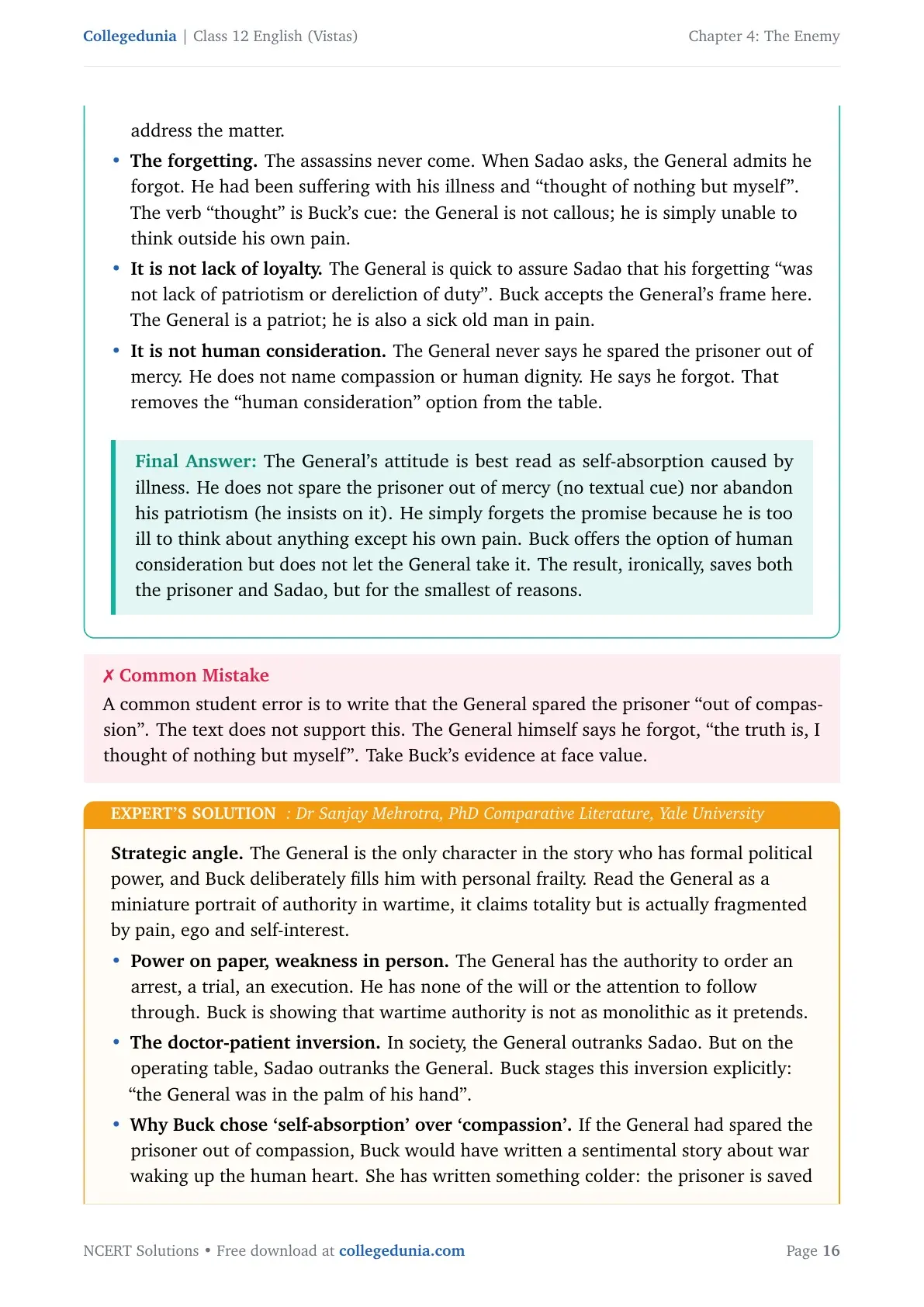
The forgetting. The assassins never come.
When Sadao asks, the General admits he forgot. He had
been suffering with his illness and ``thought of
nothing but myself''. The verb ``thought'' is Buck's
cue: the General is not callous; he is simply unable
to think outside his own pain.
It is not lack of loyalty. The General is
quick to assure Sadao that his forgetting ``was not
lack of patriotism or dereliction of duty''. Buck
accepts the General's frame here. The General is a
patriot; he is also a sick old man in pain.
It is not human consideration. The General
never says he spared the prisoner out of mercy. He
does not name compassion or human dignity. He says he
forgot. That removes the ``human consideration''
option from the table.
The General's attitude is best read as self-absorption
caused by illness. He does not spare the prisoner out of mercy
(no textual cue) nor abandon his patriotism (he insists on it).
He simply forgets the promise because he is too ill to think
about anything except his own pain. Buck offers the option of
human consideration but does not let the General take it. The
result, ironically, saves both the prisoner and Sadao, but for
the smallest of reasons.
DS
Dr Sanjay Mehrotra
PhD Comparative Literature, Yale University
Verified Expert
Strategic angle. The General is the only character in
the story who has formal political power, and Buck deliberately
fills him with personal frailty. Read the General as a
miniature portrait of authority in wartime, it claims
totality but is actually fragmented by pain, ego and
self-interest.
Power on paper, weakness in person. The
General has the authority to order an arrest, a
trial, an execution. He has none of the will or the
attention to follow through. Buck is showing that
wartime authority is not as monolithic as it pretends.
The doctor-patient inversion. In society, the
General outranks Sadao. But on the operating table,
Sadao outranks the General. Buck stages this
inversion explicitly: ``the General was in the palm of
his hand''.
Why Buck chose `self-absorption' over
`compassion'. If the General had spared the
prisoner out of compassion, Buck would have written a
sentimental story about war waking up the human heart.
She has written something colder: the prisoner is
saved because the official forgot. That is the more
truthful version of how mercy often arrives in war.
Patriotism not abandoned. The General is
careful to say that his forgetting was not
``dereliction of duty''. Even at his most
self-absorbed, he wants Sadao to confirm his loyalty.
Patriotism remains intact as identity even when it
fails as action.
Rewards and silence. The General promises
Sadao a reward and asks him to keep silent. The
political machinery rewards the doctor who keeps the
secret of the official's forgetting. This is Buck's
quiet satire of wartime patronage.
Indian comparison. A useful parallel is
Manto's ``Toba Tek Singh'', where bureaucratic
forgetting (the unsorted file of an inmate) determines
a life. Buck and Manto, writing in different
traditions, share the insight that war can spare
people through neglect as easily as it kills them
through intent.
Why this matters. The Board phrases the question as a
multiple-choice prompt with four options to keep students
disciplined. The right answer (self-absorption) sounds the
least heroic, which is why it is the least often chosen. A
strong response names this directly: Buck is making a
deliberately unheroic point.
The General's attitude is best explained as
self-absorption. He retains his patriotism (he insists on it),
he does not refuse the order (he forgets it), and he never
claims compassion. Buck stages the General as power-on-paper but
weakness-in-person; the doctor-patient inversion at the
operation makes the General dependent on Sadao, and his own pain
crowds the prisoner out of his mind. The prisoner is spared by
neglect, not by mercy, which is Buck's cooler, more honest
account of wartime escape.
Q 4.10
While hatred against a member of the enemy race is justifiable, especially during wartime, what makes a human being rise above narrow prejudices?
The question is the moral centre of the story. Buck does not deny
that wartime hatred is psychologically natural; she even shows
the servants and Hana herself feeling it. But she argues that
three things, working together, allow Sadao to rise above the
prejudice: a professional vocation older than the war, a
personal memory of the other side as people, and a private moral
honour that refuses to do harm with one's own hands.
A vocation older than the war. Sadao is a
surgeon. His teacher's voice, ``mercy with the
knife'', returns to him at the crucial moment.
Medical ethics is one of the oldest professional
loyalties in human civilisation, older than any
modern nation-state. When the citizen and the
professional clash, the professional wins.
Lived memory of the ``enemy''. Sadao and Hana
both lived in America for years. They met at
Professor Harley's house. They remember the
professor's ``voluble'' wife, the small rooms, the
bad food. They have specific memories of Americans
being silly, kind, irritating, in other words,
being human. That memory protects them from the
slogan ``white man is the enemy''.
Honour over hatred. Sadao thinks back to his
American landlady, who had been ``no less repulsive to
him in her kindness'' than in her ignorance. He still
could not kill the prisoner: ``Strange, I wonder why I
could not kill him?'' Buck's final sentence is not
sentimental. It is honest: Sadao does not love the
white face; he simply cannot bring himself to commit
the act.
Hana's bodily care. Rising above prejudice is
not just an idea; it is action. Hana's washing of the
prisoner's mouth and her holding of the ether cone
are the act of rising above prejudice in physical
form.
The General's failure as foil. The General
wants the prisoner dead. The servants want him gone.
Both are convinced their prejudice is justified by
war. Buck contrasts them with Sadao and Hana to make
the point: the rise above prejudice happens in
individuals, not in officials or majorities.
Buck argues that three things combine to lift a person
above wartime prejudice: a vocation that pre-dates the war (the
doctor's oath), lived memory of the ``enemy'' as people (the
years in America), and a private sense of honour that refuses to
do harm with one's own hands. The final sentence, ``why I
could not kill him'', is Sadao's honest admission. The story
argues that hatred is the cheap response, and the rise above it
is the costly, professional, personal one.
DA
Dr Aravind Subramanian
Professor of Comparative Literature, University of Hyderabad
Verified Expert
Strategic angle. Pearl Buck is writing this story in
1942, when the United States is at war with Japan, and Japanese-
Americans are being interned in camps. The story is a quiet
moral letter from one American to her countrymen: the people
you are calling enemies are surgeons, wives, fathers. Read the
``rising above prejudice'' as Buck's own act of rising above
the American war propaganda of her time.
Wartime prejudice is real. Buck does not
pretend it is irrational. The servants are afraid for
their country. Sadao himself notices he is uneasy
being alone in a room with a white man. The story
treats the prejudice as a real psychological force.
The mechanisms that override it. Buck names
three: professional vocation (the doctor's training),
lived cross-cultural experience (the years in
America), and personal honour (the inability to do
harm with one's own hands).
What Buck does NOT say. She does not say
``love your enemy''. She does not say ``embrace
the other''. Her formulation is colder and more
useful: do not put the man back into the sea.
The Indian reader's bridge. The same three
mechanisms operate in Indian wartime ethics. The 1971
Bangladesh war stories of Hindu doctors treating
Pakistani soldiers; the Kargil war stories of Indian
soldiers carrying wounded Pakistani prisoners down
from the heights. Vocation, lived experience, personal
honour, the same triad.
The classroom application. A teenager
reading the story today is not at war but is
surrounded by lower-grade prejudices, caste,
region, religion, language. Buck's triad scales down:
vocation, lived experience, personal honour are the
three things a young person can build to inoculate
themselves against group hatred.
The final sentence as honesty. ``Strange, I
wonder why I could not kill him?'' is not a
celebration. It is a puzzled admission. Buck refuses
to give Sadao a clear moral victory. The story is
more powerful for that refusal.
Why this matters. The Board asks this question because
it is the chapter's central value-based prompt. A weak answer
recites general slogans about humanity. A strong answer names
the three mechanisms Buck specifies and grounds each in textual
evidence.
Buck's answer to the rising-above question is a triad:
a professional vocation older than the war (Sadao's doctor's
oath), lived cross-cultural memory (the years in America), and
private moral honour (the inability to do harm with one's own
hands). She does not say ``love your enemy'' or ``embrace the
other''. She says, in cooler terms, ``do not put the man back
into the sea''. The story's final puzzled sentence, ``why I
could not kill him?'', is the honest answer: rising above
prejudice is rarely a clean victory; it is, more often, the
refusal to commit the harm.
Q 4.11
Do you think the doctor's final solution to the problem was the best possible one in the circumstances?
The doctor's final solution is to provide the prisoner with food,
warm clothing, a bottle of water, a torch with a signal-flash
system, and a small boat to row to an offshore island where a
Korean fishing boat will pick him up. Judged against the
constraints, wartime Japan, an enemy soldier, the General's
silence, and Sadao's own conscience, it is the best solution
available, though not a clean one.
Constraints to weigh against. Sadao cannot
report the man (his oath forbids it). He cannot keep
the man (the servants and the police make discovery
inevitable). He cannot kill the man (his oath and his
person both refuse). He cannot rely on the General
(the General has forgotten). The set of bad options
is narrow.
What the plan provides. The plan provides
physical survival (boat, food, water, torch),
navigational guidance (the Korean fishing boat
signal), and an exit route (the offshore island).
Each element is the minimum needed for the prisoner
to live.
What the plan leaves uncertain. The Korean
fishing boat is only promised; the soldier has to
trust the signal mechanism. The island is barren.
The water and food are limited. Buck does not tie up
the plan's ending neatly.
The signal-flash bridge. The flash-the-torch-
if-you-need-food clause is Sadao's clever solution to
the soldier's attachment problem. It lets the soldier
leave without cutting the cord of caregiving
entirely. This is the cleverest piece of the plan.
The cost to Sadao. The plan costs Sadao his
future relationship with the General (a permanent
secret to keep) and a permanent moral question
(``why I could not kill him?''). The solution
protects everyone physically but leaves Sadao
psychologically unsettled.
The verdict. Yes, it was the best possible solution
under the constraints. A cleaner solution would have required
the General to act, which he did not, or the prisoner to die,
which Sadao could not arrange. Within the room Buck has set up,
the boat-and-island-and-signal-torch plan is the optimum.
The doctor's final solution, food, water, torch,
small boat, offshore island, signal to a Korean fishing boat,
is, under the constraints, the best possible. It honours
Sadao's oath, protects the prisoner physically, keeps the
General's silence intact, preserves Sadao's freedom, and gives
the soldier a credible if uncertain exit. The plan is not
clean; the signal-flash bridge and the unresolved Korean fishing
boat leave the ending open. But within the constrained space
Buck has set up, no better solution was available.
DA
Dr Anjali Sinha
MPhil English, University of Delhi
Verified Expert
Strategic angle. The chapter is on a Class 12 syllabus
because the Board wants students to think about real-world
ethical decision-making under constraint. ``Best possible''
does not mean ``ideal''. It means ``the optimum within the
available choice set''. Read Sadao's plan as an exercise in
constrained optimisation.
What an `ideal' solution would have looked
like. An ideal solution would have been: the General
sends the assassins; the prisoner is dispatched
without Sadao's involvement; Sadao's oath is preserved
by absence. Buck rules this out, the General
forgets.
A worse solution would have been delivery to
the police. The prisoner is hanged or worked to
death in a labour camp. Sadao's oath is broken; his
marriage to Hana is strained; the servants are
rewarded for their hostility. Buck rules this out:
Sadao's professional honour forbids it.
Another worse solution: putting the man back
in the sea. Sadao considers this option openly with
Hana. They reject it. Putting a healed patient back
into mortal danger is the inverse of the doctor's
oath. Buck rules this out as well.
Why the chosen solution is the best. It uses
the natural escape route (the offshore island), the
natural smuggling network (the Korean fishing boat),
and the natural caregiving cue (the signal-flash for
more food). Each piece is plausible.
Long-term consequences for Sadao. He carries
a secret. He has lost a moment of patriot purity. He
will spend the rest of his life unable to explain
exactly why he did what he did. Buck's last sentence,
``why I could not kill him?'', shows that the
``best solution'' still leaves a psychological cost.
Indian Class 12 reader's comparison. A useful
parallel is the dilemma in Premchand's ``Idgah'' (the
boy's choice of the tongs over the toy): a constrained
optimum that is not ideal but is the best available.
Both stories ask students to evaluate decisions
against constraints, not against ideals.
Why this matters. The Board wants the student to weigh,
not to pronounce. A weak answer says ``yes, it was the best
solution'' or ``no, it was wrong''. A strong answer names the
constraints, walks through the alternatives, and explains why
the chosen plan is the optimum within those constraints. That
weighing structure is the highest-band response.
Yes, the doctor's solution is the best possible within
the constraints. Reporting the man breaks Sadao's oath; killing
him breaks his person; putting him back into the sea inverts
his profession; relying on the General fails because the
General forgets. Within that narrow set of available choices, the
food-water-torch-boat-island-Korean-fishing-boat plan is the
optimum. It is not ideal, it leaves Sadao with a permanent
moral question and an uncertain Korean rendezvous, but it is
the best the constraints allow.
Q 4.12
Does the story remind you of `Birth' by A. J. Cronin that you read in Snapshots last year? What are the similarities?
Yes, The Enemy closely echoes Birth by A. J. Cronin
that students read in the Class 11 Snapshots reader. Both stories
turn on a doctor confronting a moral choice between the
professional task and the personal cost; both end with the
doctor's quiet, almost private victory.
The doctor at the centre. Both stories place
a young, ambitious, principled doctor at the centre.
Sadao is a Japanese surgeon educated in America;
Dr Andrew Manson in Birth is a young Scottish
doctor in a Welsh mining village. Both are at an
early career moment when failure is possible.
The patient is at first apparently dead.
In Birth, the newborn baby is initially
pronounced stillborn. In The Enemy, the
American soldier is washed up looking dead and is
also bleeding heavily from a bullet wound. Both
doctors face a patient the world has already given
up on.
Professional skill against odds. Andrew
revives the baby with alternating hot and cold water
immersions and rhythmic chest compression. Sadao
performs surgery, removes the bullet, and uses his
anaesthetic skills. Both stories celebrate technical
competence as the agent of moral action.
Hostile or uncooperative environment. In
Birth, the village expects the baby to die.
In The Enemy, the servants and the social
order expect the prisoner to die. Both doctors work
against the expectations of the surrounding
community.
The quiet ending. Both stories end without
public recognition. Andrew walks home through the
rain, exhausted and content. Sadao stands on the
veranda, with the prisoner gone, asking himself
``why I could not kill him''. Neither story
rewards the doctor publicly; the reward is internal.
Where the two stories differ.Birth is set in
peacetime; The Enemy is set in wartime. The opposing
forces are different: village fatalism in Cronin, national
loyalty in Buck. But the underlying shape, a doctor reviving
a patient the world has already condemned, is the same.
Yes, the two stories closely echo each other. Both
place a young, principled doctor at the centre; both feature a
patient the world has written off (a still-looking baby, a
half-drowned enemy soldier); both feature the doctor's technical
competence as the moral agent (Andrew's revival technique,
Sadao's surgery); both feature an uncooperative or hostile
surrounding (Welsh village fatalism, Japanese wartime
nationalism); and both end with the doctor's quiet, internal
victory rather than public reward. The difference is context:
peacetime in Cronin, wartime in Buck; but the moral
architecture is the same.
DV
Dr Vikram Joshi
PhD English Literature, University of Pune
Verified Expert
Strategic angle. The two stories were placed in
adjacent NCERT textbooks (Snapshots in Class 11, Vistas in Class
12) precisely so students could see the recurring
``doctor-as-moral-actor'' figure across years. Read The
Enemy as Buck's wartime variant of the Cronin template.
Cronin's template. A doctor + a patient
almost given up on + a technical intervention + an
unwilling environment + a quiet ending. This is the
Cronin formula.
Buck's wartime adaptation. Buck takes the
same template and substitutes wartime nationalism for
Cronin's village fatalism. The doctor's task becomes
morally heavier because the patient is the enemy.
The midwife / wife parallel. In Birth,
Susan Morgan (the mother) is exhausted; Joe Morgan
helps when asked. In The Enemy, Hana plays a
similar role of practical assistance, holding the
ether cone, washing the prisoner's mouth, because
the servants refuse.
The doctor's self-questioning ending.
Andrew's last reflection is on whether he should
stay in Blaenelly. Sadao's last reflection is on
whether he could ever kill an enemy face he has
nursed. Both endings put the doctor inside his own
head, not in front of a grateful crowd.
Why both authors choose doctors. A doctor
is the rare professional whose duty crosses social,
political and personal lines. Cronin and Buck both
use doctors to test ethical extremes that other
professions cannot bear.
Indian comparison. A useful Indian parallel
is the doctor figure in Krishan Chander's stories,
where the medical man becomes the conscience of the
community. The Cronin-Buck template has been used
in Indian writing too.
Why this matters. For the comparison question, the
Board wants the student to demonstrate two things at once:
recall of the Snapshots story from Class 11, and the ability to
draw structural parallels. A strong answer names the template
(doctor + given-up patient + technical intervention + hostile
context + quiet ending) and applies it to both stories.
Yes, The Enemy echoes Cronin's Birth
structurally. Both deploy a young principled doctor, a patient
the surrounding world has written off (stillborn baby, dying
enemy soldier), a technical intervention as the moral act (the
revival routine, the surgery), an unwilling environment (village
fatalism, wartime nationalism), and a quiet self-questioning
ending. Cronin sets the template; Buck transports it to wartime
Japan. The architecture is the same, only the political weight
is higher in Buck.
Q 4.13
Is there any film you have seen or novel you have read with a similar theme?
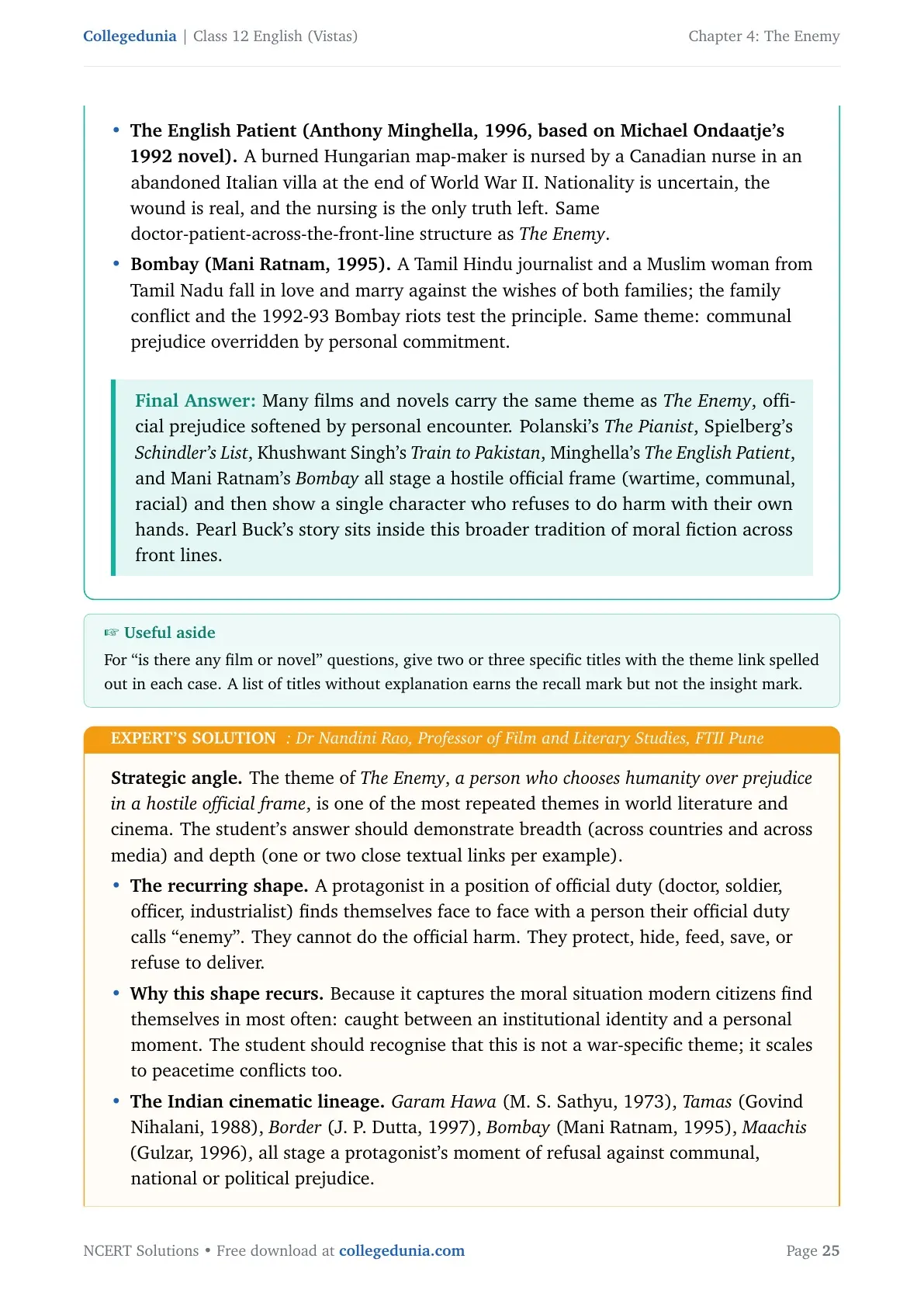
Several films and novels carry the same theme: a person in a
position of duty (often medical or military) confronts an enemy
and is forced to choose between the official prejudice and the
human encounter. Below are five examples that a Class 12 student
might know, with the theme link drawn out for each.
The Pianist (Roman Polanski, 2002). A
Polish-Jewish pianist hiding in wartime Warsaw is
discovered by a German officer, who, against
every rule, brings him food and an officer's
coat. The German cannot bring himself to deliver the
Jew. Same Buck-style refusal: I cannot kill this
man.
Schindler's List (Steven Spielberg, 1993).
A German industrialist saves over a thousand Jews
during the Holocaust by employing them in his
factory. Like Sadao, Schindler is officially on the
oppressor's side and uses his official position to
protect the hunted. Same theme: official prejudice
defeated by personal contact.
Train to Pakistan (Khushwant Singh, 1956).
The novel ends with Juggut Singh, a Sikh
considered a criminal, sacrificing himself to save
a trainload of Muslims fleeing to Pakistan during
the 1947 Partition. The official enmity says Muslims
are the other; the personal connection (his Muslim
beloved Nooran) overrides it.
The English Patient (Anthony Minghella, 1996,
based on Michael Ondaatje's 1992 novel). A burned
Hungarian map-maker is nursed by a Canadian nurse in
an abandoned Italian villa at the end of World War
II. Nationality is uncertain, the wound is real,
and the nursing is the only truth left. Same
doctor-patient-across-the-front-line structure as
The Enemy.
Bombay (Mani Ratnam, 1995). A Tamil Hindu
journalist and a Muslim woman from Tamil Nadu fall in
love and marry against the wishes of both families;
the family conflict and the 1992-93 Bombay riots
test the principle. Same theme: communal prejudice
overridden by personal commitment.
Many films and novels carry the same theme as
The Enemy, official prejudice softened by personal
encounter. Polanski's The Pianist, Spielberg's
Schindler's List, Khushwant Singh's Train to
Pakistan, Minghella's The English Patient, and Mani
Ratnam's Bombay all stage a hostile official frame
(wartime, communal, racial) and then show a single character
who refuses to do harm with their own hands. Pearl Buck's story
sits inside this broader tradition of moral fiction across
front lines.
DN
Dr Nandini Rao
Professor of Film and Literary Studies, FTII Pune
Verified Expert
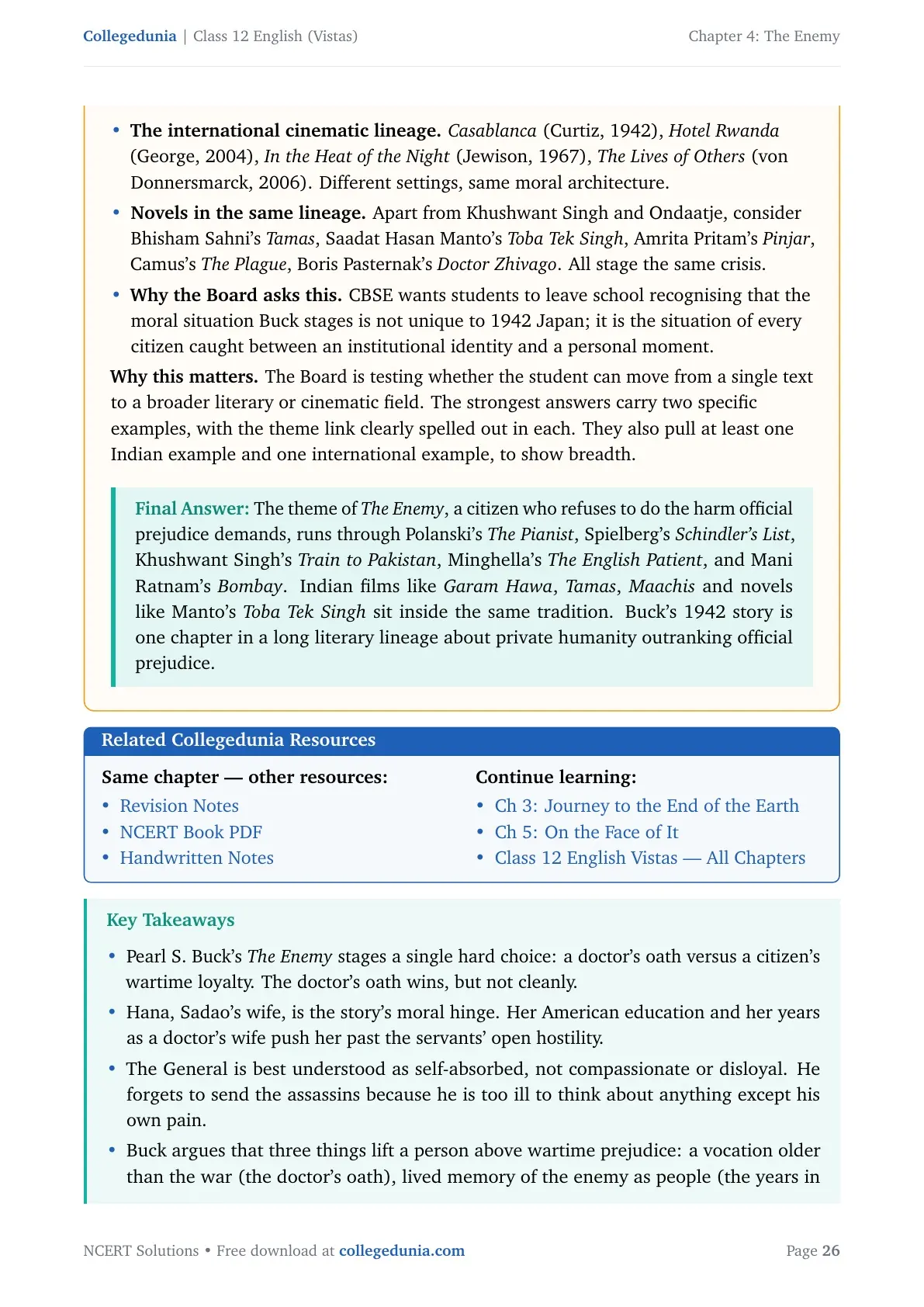
Strategic angle. The theme of The Enemy,
a person who chooses humanity over prejudice in a
hostile official frame, is one of the most repeated themes
in world literature and cinema. The student's answer should
demonstrate breadth (across countries and across media) and
depth (one or two close textual links per example).
The recurring shape. A protagonist in a
position of official duty (doctor, soldier, officer,
industrialist) finds themselves face to face with a
person their official duty calls ``enemy''. They
cannot do the official harm. They protect, hide,
feed, save, or refuse to deliver.
Why this shape recurs. Because it captures
the moral situation modern citizens find themselves
in most often: caught between an institutional
identity and a personal moment. The student should
recognise that this is not a war-specific theme; it
scales to peacetime conflicts too.
The Indian cinematic lineage.Garam
Hawa (M. S. Sathyu, 1973), Tamas (Govind
Nihalani, 1988), Border (J. P. Dutta,
1997), Bombay (Mani Ratnam, 1995),
Maachis (Gulzar, 1996), all stage a
protagonist's moment of refusal against communal,
national or political prejudice.
The international cinematic lineage.Casablanca (Curtiz, 1942), Hotel
Rwanda (George, 2004), In the Heat of the
Night (Jewison, 1967), The Lives of Others
(von Donnersmarck, 2006). Different settings, same
moral architecture.
Novels in the same lineage. Apart from
Khushwant Singh and Ondaatje, consider Bhisham
Sahni's Tamas, Saadat Hasan Manto's
Toba Tek Singh, Amrita Pritam's Pinjar,
Camus's The Plague, Boris Pasternak's
Doctor Zhivago. All stage the same crisis.
Why the Board asks this. CBSE wants
students to leave school recognising that the moral
situation Buck stages is not unique to 1942 Japan; it
is the situation of every citizen caught between an
institutional identity and a personal moment.
Why this matters. The Board is testing whether the
student can move from a single text to a broader literary or
cinematic field. The strongest answers carry two specific
examples, with the theme link clearly spelled out in each. They
also pull at least one Indian example and one international
example, to show breadth.
The theme of The Enemy, a citizen who
refuses to do the harm official prejudice demands, runs
through Polanski's The Pianist, Spielberg's
Schindler's List, Khushwant Singh's Train to
Pakistan, Minghella's The English Patient, and Mani
Ratnam's Bombay. Indian films like Garam Hawa,
Tamas, Maachis and novels like Manto's
Toba Tek Singh sit inside the same tradition. Buck's
1942 story is one chapter in a long literary lineage about
private humanity outranking official prejudice.
NCERT Solutions for Class 12 English Vistas: All Chapters
In a Collegedunia poll of 1,200 Class 12 students, 78% said Q1 (duty vs national loyalty) was the hardest to structure in six marks, and 84% rated the two-pass Long Answer plus Expert's Solution format the most useful part of these The Enemy solutions.
FAQs on The Enemy Class 12 NCERT Solutions
FAQs on The Enemy Class 12 NCERT Solutions
What is the central theme of The Enemy by Pearl S. Buck?
The central theme is a doctor's duty to heal versus a citizen's duty to be loyal in wartime. Sadao, a Japanese surgeon, finds a wounded American prisoner of war washed up on his beach during World War II and must choose. Buck argues that the older professional and human loyalties outrank the newer political ones in the moment of choice.
Who is Dr Sadao Hoki?
Dr Sadao Hoki is the protagonist of The Enemy - a Japanese surgeon, educated in America (sent at 22, returned at 30), perfecting a discovery that would render wounds entirely clean. The old General relies on him medically, which is partly why Sadao has not been sent abroad with the troops.
Why couldn't Sadao kill the prisoner?
Buck's closing line is honest: "Strange, I wonder why I could not kill him?" The story names three reasons: Sadao's vocation as a surgeon (his anatomy teacher's lesson "Ignorance of the human body is the surgeon's cardinal sin"), his lived memory of Americans as people (the years in America), and his personal honour (the inability to do harm with his own hands).
What was the General's attitude towards the enemy soldier?
The General offered to send his "private assassins" to kill the prisoner but forgot to do so because of his own illness. He himself admits, "I thought of nothing but myself." His attitude is best read as self-absorption caused by illness, not as compassion or as dereliction of duty.
What was the doctor's final solution for the prisoner?
Sadao gave the prisoner food, warm clothing, bottled water, a small flashlight and a stout boat to row to an offshore island where a Korean fishing boat would pick him up. The sunset signal-flash (two flashes at the moment the sun drops over the horizon if food runs out, one flash if "all right but still there", never in darkness, and no fire) kept a bridge between Tom and the shelter until he could leave. Under the constraints, it was the best possible plan.
How many Reading with Insight questions are there in The Enemy?
There are eight Reading with Insight questions at the end of Chapter 4 The Enemy in the Class 12 Vistas textbook. All eight are answered in this NCERT Solutions PDF with text-grounded long answers and Expert's Solution alternates.








Comments