Senior English Editor, 13 Yrs | Updated 3+ months ago
These The Tiger King Class 12 NCERT Solutions answer every Reading with Insight question for Vistas Chapter 2 with text-grounded long answers from Kalki Krishnamurthy's short story. Each answer is built like a 6-mark Section C Long Answer, with the exact lines, motives and satirical tone-markers that CBSE markers reward, aligned to the 2026-27 NCERT reprint.
CBSE Weightage:6 marks per Vistas Long Answer in Section C
Coverage: 5 Reading with Insight answers with Expert's Solution alternates, plus two bonus readings
These solutions are written by senior English educators and mapped to the 2026-27 NCERT Vistas textbook and recent CBSE Class 12 English Core papers.
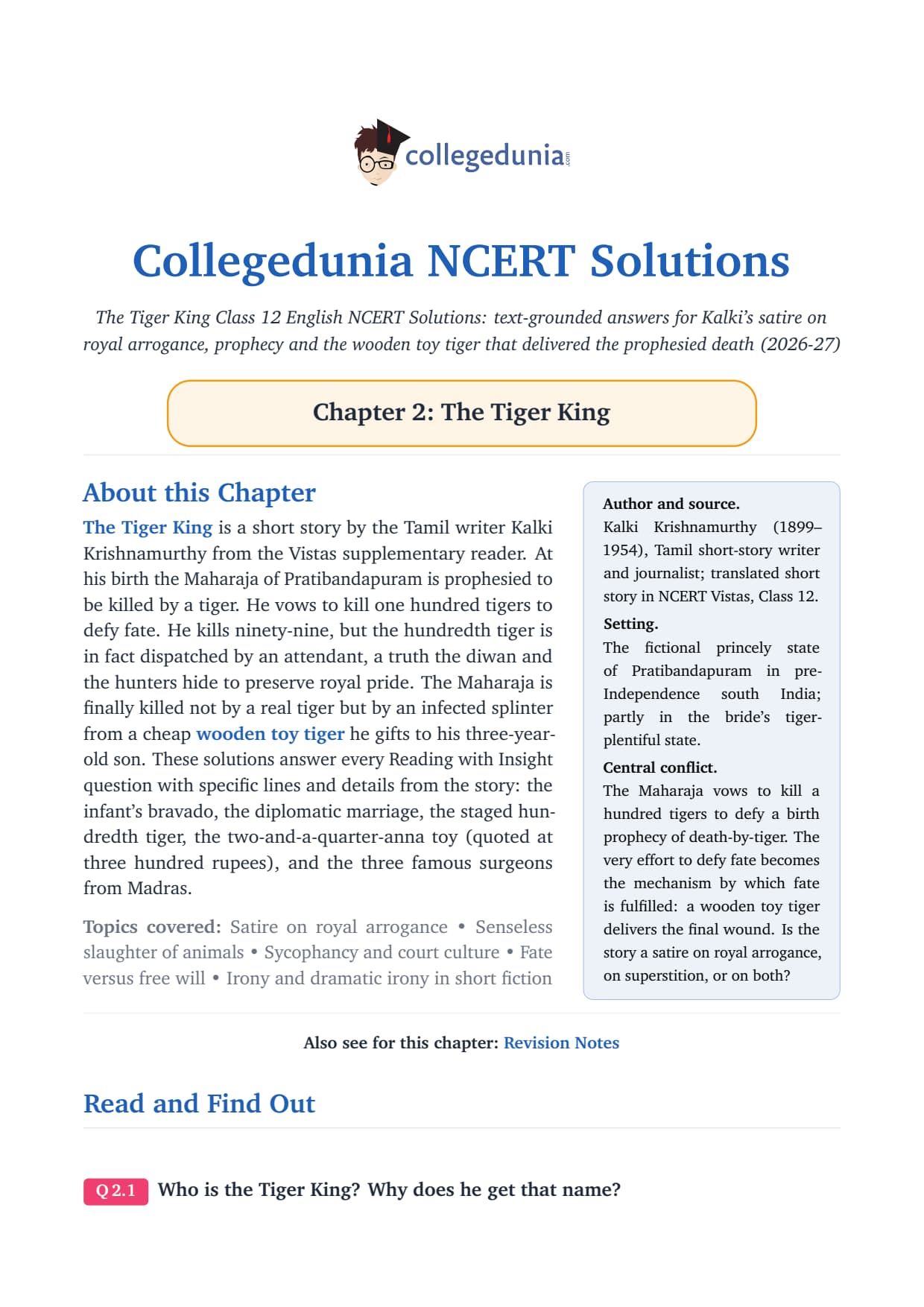
The Tiger King Class 12 NCERT Solutions: Chapter Snapshot
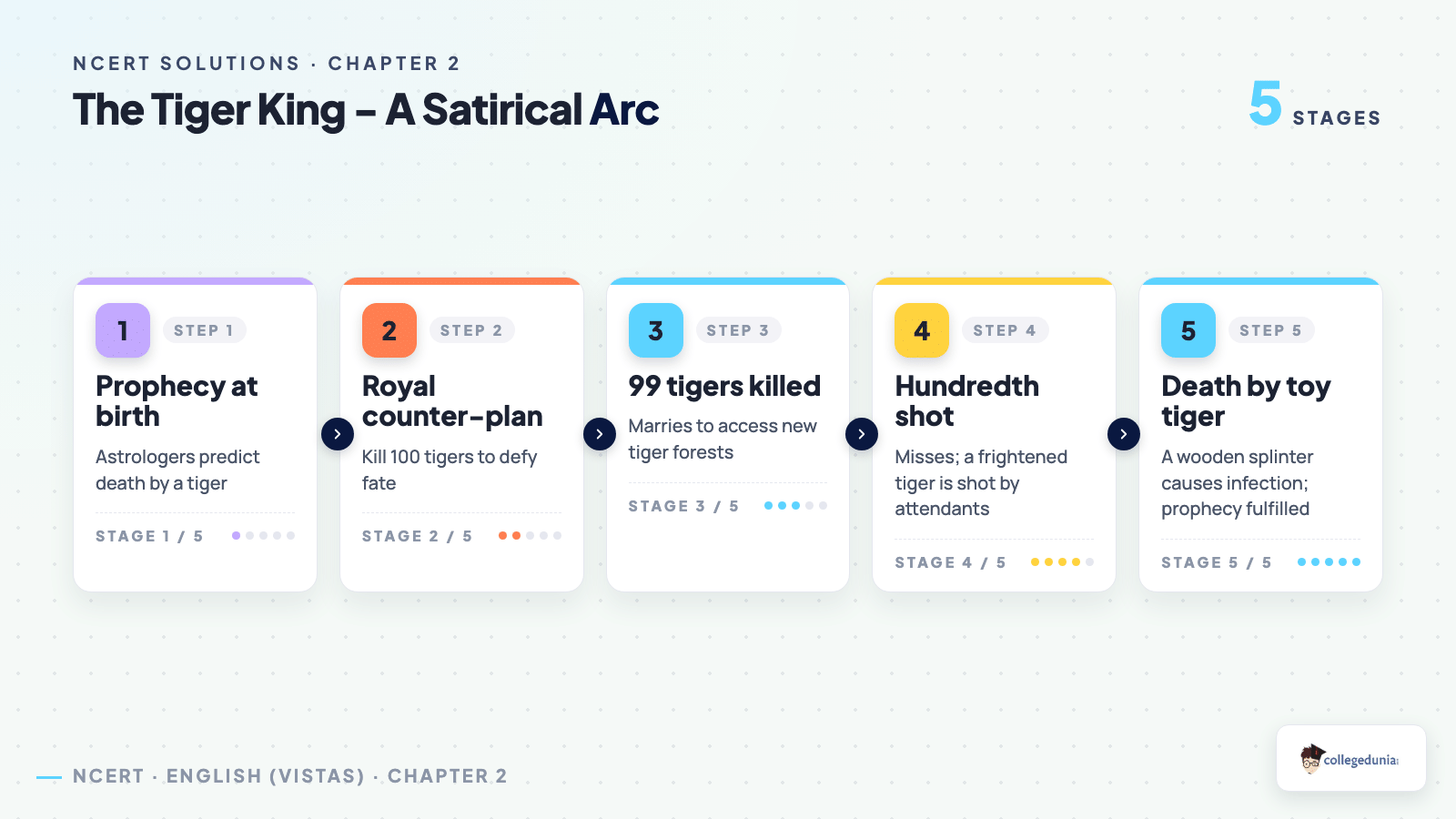
The Tiger King is the second story in the Class 12 Vistas reader, by Tamil writer and journalist Kalki Krishnamurthy (1899-1954). At his birth the Maharaja of Pratibandapuram is prophesied to die by a tiger. He vows to kill one hundred tigers to defy fate, kills ninety-nine in his own and his father-in-law's forests, and is finally killed not by a real tiger but by an infected splinter from a cheap wooden toy tiger he gifts to his son. The Reading with Insight block has five questions on satire and irony, animal cruelty, sycophancy, modern game-hunting and a new ecological order.
Question
What It Tests
Typical Mark Yield
Q1 - Satire on the conceit of those in power
Theme: satire; dramatic irony
6 marks LA
Q2 - Human willfulness towards innocent animals
Value-based; conservation reading
6 marks LA
Q3 - The Maharaja's minions; sincerity or fear
Character study; sycophancy
6 marks LA
Q4 - Modern game-hunting parallels
Value-based; callousness to wildlife
5-6 marks LA
Q5 - A new system for the age of ecology
Value-based; policy agenda
5-6 marks LA
CBSE usually pulls a single 6-mark Long Answer from Vistas in Section C. Q1, Q2 and Q3 have been the most frequent rotations over the last five years.
The Tiger King Video Explanation (Class 12 English)
Every question in the PDF is answered in two passes:
Long Answer. A one-line position (Yes / No / Both), the anchoring lines quoted, four to six text-grounded points with names and scene details, and a two-sentence final answer.
Expert's Solution. The literary context (Kalki the journalist-satirist), the mock-heroic tone, and a structural reading.
Q1 Answer Skeleton: Satire on the Conceit of Those in Power and Dramatic Irony
The answer to Q1 is yes: the chapter is a sustained satire on the conceit of those in power, and Kalki uses dramatic irony to make every blow land. The PDF answer walks five anchors: the infant's bravado ("Let tigers beware!"), the vow, the diplomatic marriage, the staged hundredth tiger (killed by a hunter, not the Maharaja), and the wooden toy that delivers the punchline.
Lines to quote: "Let tigers beware!"; "I have killed the hundredth tiger."; "The operation was successful. The Maharaja is dead."
Q2 Answer Skeleton: Author's Indirect Comment on the Willfulness of Human Beings Towards Animals
Kalki's indirect comment is unsparing. He turns the killing of ninety-nine tigers into a moral exhibit, not a heroic feat. The PDF answer walks the deadpan tone, the numbers (seventy in his own state, twenty-nine in his father-in-law's), and the wooden toy as nature's revenge: "the hundredth tiger took its final revenge upon the Tiger King."
Examiner trap to avoid: Do not praise the Maharaja's bravery. Read the chapter as satire; bravery is performative. The marker will dock for any answer that calls the hunt heroic.
Q3 Answer Skeleton: The Minions, Sincerity vs Fear, and Today's Political Order
The Maharaja's minions are driven by fear, not sincerity. The PDF answer gives five instances of sycophancy: the astrologer's softened prophecy, the dewan's marriage proposal, the dewan dragging the People's Park tiger to the forest at midnight, the hunters' silent second bullet that hides the missed shot, and the shopkeeper who marks up a two-and-a-quarter-anna toy to three hundred rupees. The court makes obedience a survival strategy, and the question invites a parallel with today's political order.
Q4 and Q5 Answer Skeleton: Modern Game Hunting and a New Ecological System
Q4 and Q5 are paired value-based prompts. Q4 asks for modern instances of game-hunting that show callousness towards wildlife; Q5 asks for a new system for the age of ecology that cares for both people and the Earth. The PDF maps the chapter onto modern examples (Cecil the Lion, canned hunting, Indian tiger poaching, trophy fishing) and Indian conservation landmarks (Wildlife Protection Act 1972, Project Tiger 1973, the Bishnoi and Chipko traditions, Article 51A(g)).
Bonus Reading: Chance, Fate and the Maharaja's Death
The PDF also covers the chance-and-fate engine, since CBSE has set extract-based questions on it. Fate sets the prophecy and the vow; chance arranges the toy, the splinter and the septic wound. The effort to defy fate is exactly what makes the splinter possible: he buys the toy only because tigers are on his mind.
Bonus Reading: Irony, Comic Effect and Ridicule as Devices
The chapter layers three devices: structural irony (the prophecy fulfilled by the effort to defy it), dramatic irony (the reader's knowledge gap), and comic effect through mock-heroic tone and deadpan. The PDF maps the structure as opening joke (the bravado), comic centre (the People's Park tiger), punchline (the toy) and exit line ("the operation was successful").
Common Mistakes Students Make in The Tiger King Long Answers
Praising the Maharaja's bravery. Read the chapter as satire; the bravery is performative.
Forgetting the hundredth tiger was killed by a hunter, not the Maharaja, whose bullet missed.
Treating the toy tiger as an accident rather than the prophecy's deliberate instrument.
Quoting the toy's cost wrongly. The story says "two annas and a quarter".
Confusing the dewan with a villain. He is a comic foil, a survivor of the system.
Saying the hundredth tiger came from a "zoo". It was the People's Park in Madras.
Missing the conservation reading, tested by CBSE for several years running.
CBSE Class 12 English Previous Year Question Mapping for The Tiger King
The 6-mark Vistas Long Answer slot rotates between Q1 (satire), Q2 (animal cruelty), Q3 (sycophancy) and Q4 (modern parallels), as the year-wise table shows.
Year
Long Answer Focus
Marks
2025
The story as a satire on the conceit of those in power (Q1)
6
2024
The author's comment on the willfulness of human beings towards innocent animals (Q2)
6
2023
The behaviour of the Maharaja's minions; sincerity or fear (Q3)
6
2022
Contemporary game-hunting parallels; callousness towards wildlife (Q4)
How Collegedunia's NCERT Solutions Help You Score in The Tiger King
Every Long Answer opens with a one-line position and four to six text-grounded anchors, the shape a 6-mark answer is graded against.
Each answer is paired with an Expert's Solution, giving two ways to attempt it, with key scene details highlighted.
The five answers plus two bonus readings build a chapter-level map for any unseen variation.
All NCERT Solutions for The Tiger King with Step-by-Step Working
Every NCERT question for Chapter 2 The Tiger King is listed below with its Solution and Expert Solution in collapsible tabs. Click Check Solution to reveal the answer.
Read and Find Out
Q 2.1
Who is the Tiger King? Why does he get that name?
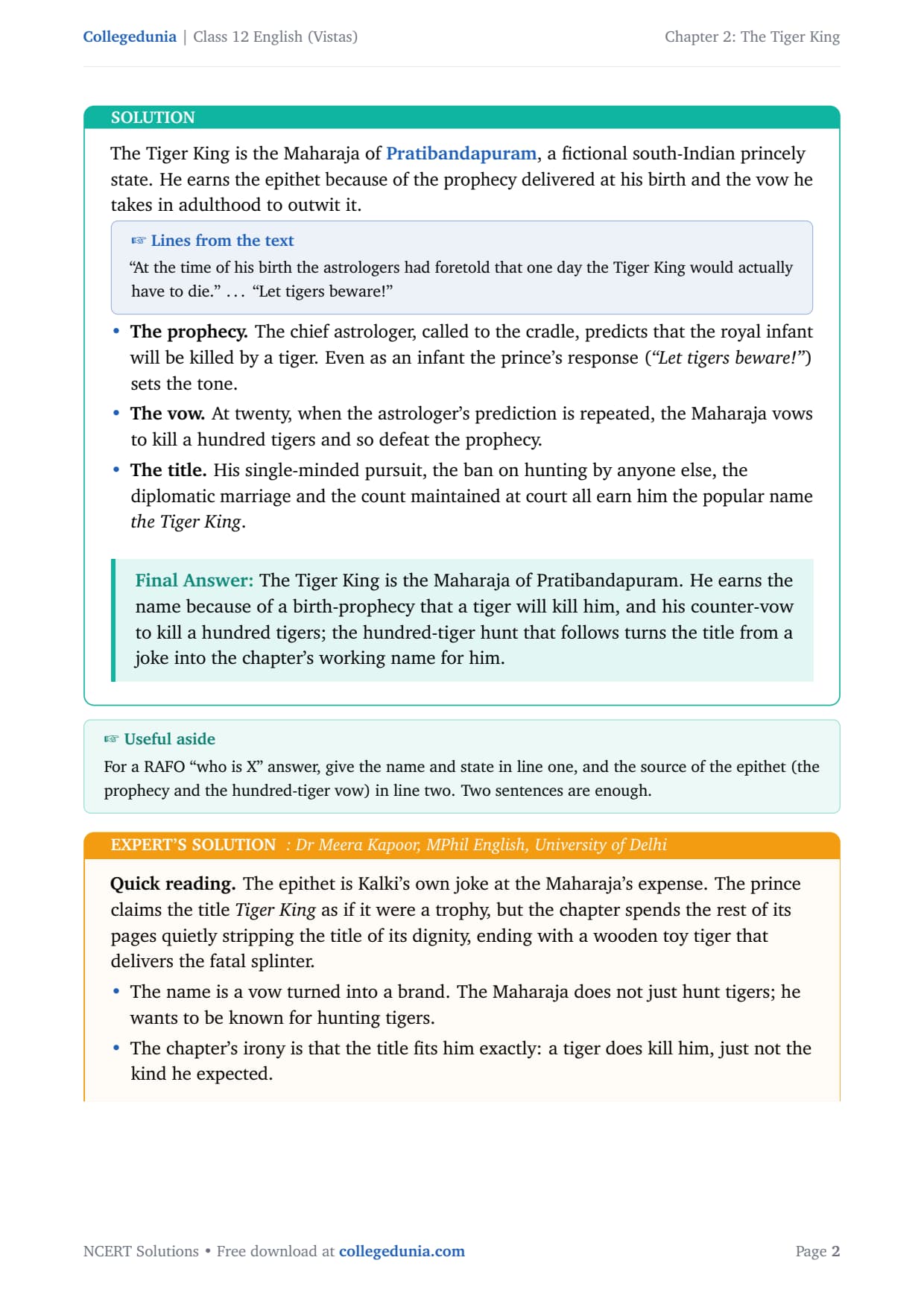
The Tiger King is the Maharaja of Pratibandapuram, a
fictional south-Indian princely state. He earns the epithet
because of the prophecy delivered at his birth and the vow he
takes in adulthood to outwit it.
Lines from the text
``At the time of his birth the astrologers had foretold that one
day the Tiger King would actually have to die.''
``Let tigers beware!''
The prophecy. The chief astrologer, called to
the cradle, predicts that the royal infant will be killed
by a tiger. Even as an infant the prince's response
(``Let tigers beware!'') sets the tone.
The vow. At twenty, when the astrologer's
prediction is repeated, the Maharaja vows to kill a
hundred tigers and so defeat the prophecy.
The title. His single-minded pursuit, the ban
on hunting by anyone else, the diplomatic marriage and
the count maintained at court all earn him the popular
name the Tiger King.
The Tiger King is the Maharaja of Pratibandapuram. He
earns the name because of a birth-prophecy that a tiger will
kill him, and his counter-vow to kill a hundred tigers; the
hundred-tiger hunt that follows turns the title from a joke
into the chapter's working name for him.
DM
Dr Meera Kapoor
MPhil English, University of Delhi
Verified Expert
Quick reading. The epithet is Kalki's own joke at the
Maharaja's expense. The prince claims the title Tiger
King as if it were a trophy, but the chapter spends the rest
of its pages quietly stripping the title of its dignity, ending
with a wooden toy tiger that delivers the fatal splinter.
The name is a vow turned into a brand. The Maharaja
does not just hunt tigers; he wants to be known for
hunting tigers.
The chapter's irony is that the title fits him exactly:
a tiger does kill him, just not the kind he expected.
The Tiger King is the Maharaja of Pratibandapuram. He
earns the name from the birth-prophecy of death-by-tiger and
the hundred-tiger vow he takes to defy it; Kalki then uses the
epithet as the chapter's running joke against royal pride.
Q 2.2
What did the royal infant grow up to be?
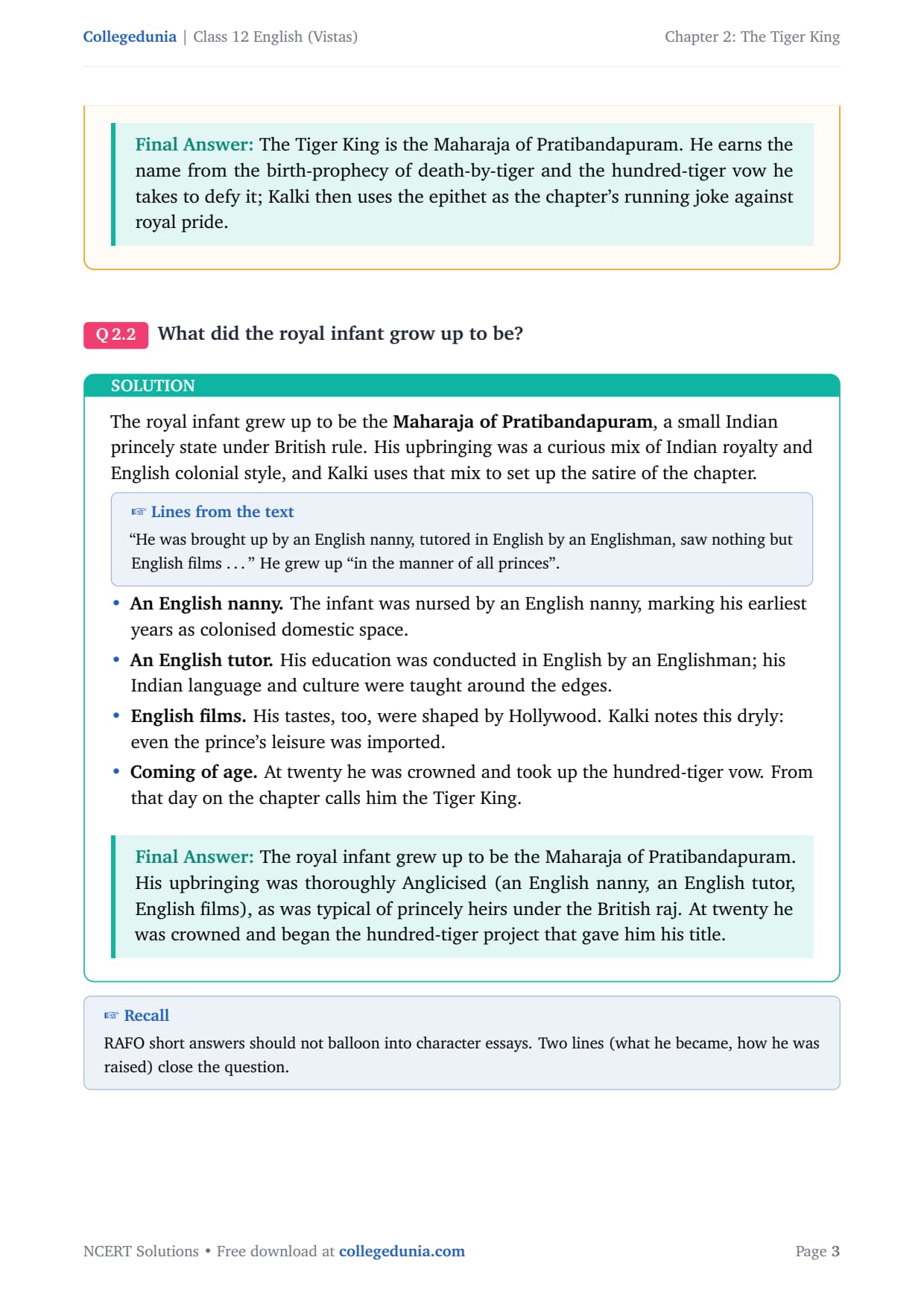
The royal infant grew up to be the Maharaja of
Pratibandapuram, a small Indian princely state under British
rule. His upbringing was a curious mix of Indian royalty and
English colonial style, and Kalki uses that mix to set up the
satire of the chapter.
Lines from the text
``He was brought up by an English nanny, tutored in English by
an Englishman, saw nothing but English films '' He grew up
``in the manner of all princes''.
An English nanny. The infant was nursed by an
English nanny, marking his earliest years as colonised
domestic space.
An English tutor. His education was conducted
in English by an Englishman; his Indian language and
culture were taught around the edges.
English films. His tastes, too, were shaped by
Hollywood. Kalki notes this dryly: even the prince's
leisure was imported.
Coming of age. At twenty he was crowned and
took up the hundred-tiger vow. From that day on the
chapter calls him the Tiger King.
The royal infant grew up to be the Maharaja of
Pratibandapuram. His upbringing was thoroughly Anglicised (an
English nanny, an English tutor, English films), as was
typical of princely heirs under the British raj. At twenty he
was crowned and began the hundred-tiger project that gave him
his title.
MA
Mr Arjun Mehta
MA English, University of Delhi
Verified Expert
Quick reading. Kalki's catalogue of the prince's
English upbringing is not nostalgic. It is the chapter's first
piece of satire: an Indian prince trained to be more English
than Indian, then asked to defend his land from its own
wildlife.
The English nanny, English tutor and English films
appear in a single sentence. The compression is the
joke.
The Anglicised upbringing is offered as context for
the Maharaja's later pride: he inherits both Indian
royalty and colonial vanity.
The royal infant grew up to be the Maharaja of
Pratibandapuram, with an English nanny, an English tutor and a
diet of English films. Kalki uses the Anglicised upbringing as
the satirical setting for the hundred-tiger vow that follows.
Common mistakes. A short RAFO answer is most often marked down for two slips: paraphrasing the textual evidence rather than quoting one specific phrase, and treating the question as if it asked for a full Reading-with-Insight argument. Stay close to the text and stop at the question asked. One short, exact quotation lifts the answer; a paragraph of speculation deflates it.
Q 2.3
What will the Maharaja do to find the required number of tigers to kill?
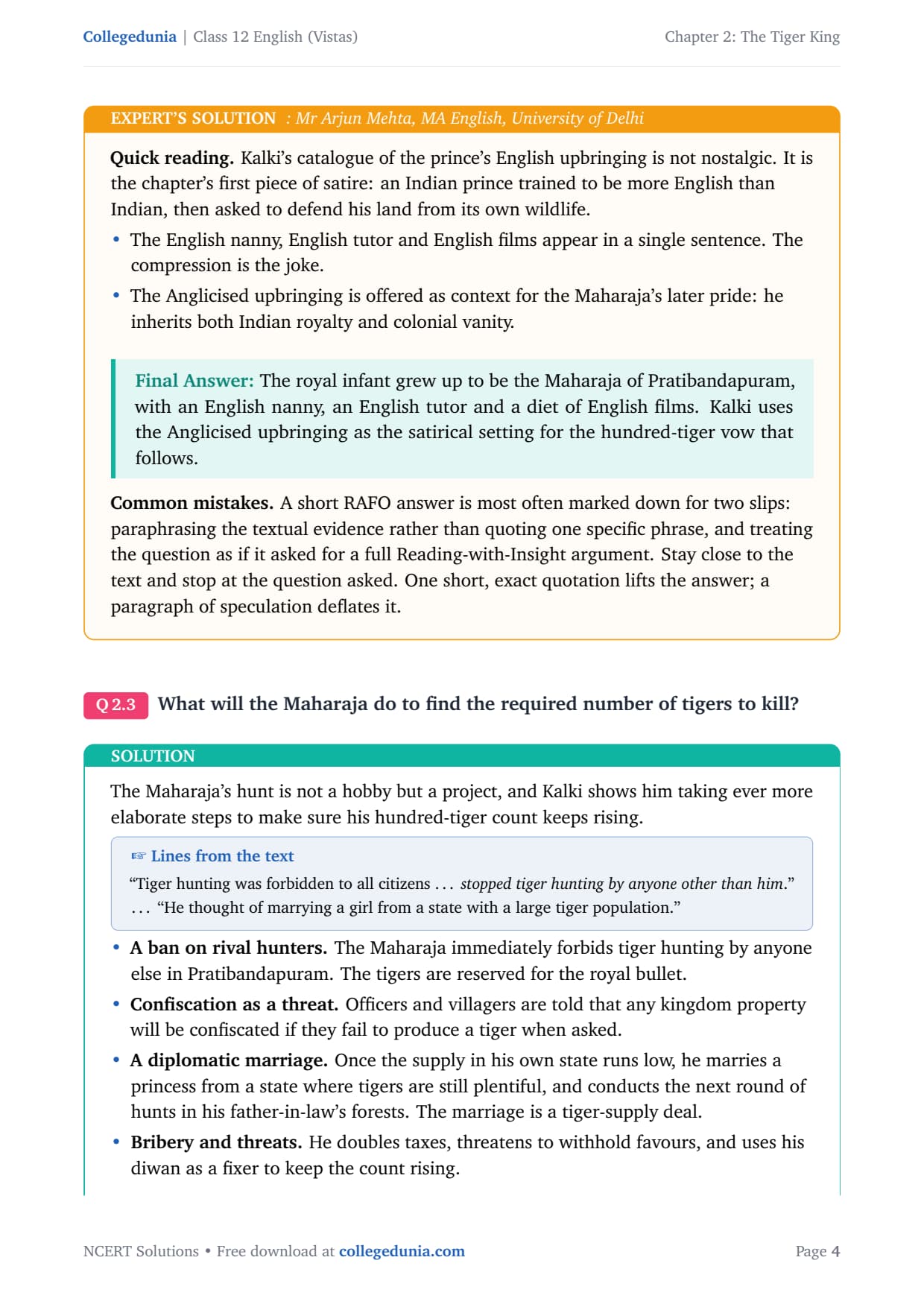
The Maharaja's hunt is not a hobby but a project, and Kalki
shows him taking ever more elaborate steps to make sure his
hundred-tiger count keeps rising.
Lines from the text
``Tiger hunting was forbidden to all citizens
stopped tiger hunting by anyone other than him.''
``He thought of marrying a girl from a state with a large tiger
population.''
A ban on rival hunters. The Maharaja
immediately forbids tiger hunting by anyone else in
Pratibandapuram. The tigers are reserved for the royal
bullet.
Confiscation as a threat. Officers and
villagers are told that any kingdom property will be
confiscated if they fail to produce a tiger when asked.
A diplomatic marriage. Once the supply in his
own state runs low, he marries a princess from a state
where tigers are still plentiful, and conducts the next
round of hunts in his father-in-law's forests. The
marriage is a tiger-supply deal.
Bribery and threats. He doubles taxes,
threatens to withhold favours, and uses his diwan as a
fixer to keep the count rising.
To keep finding tigers, the Maharaja bans tiger
hunting by anyone else, threatens to confiscate property if
his officers fail him, doubles taxes, marries a princess from
a tiger-rich state so he can hunt in his father-in-law's
forests, and uses the diwan to fix what cannot be ordered.
The hunt becomes a state project.
MK
Ms Kavya Raghavan
Senior CBSE English Examiner and Head of Department, Bengaluru
Verified Expert
Quick reading. Watch how the Maharaja escalates: from
a private hobby to a state ban, then to a marriage, then to a
state-wide tax hike. The chapter quietly tracks the cost of
royal pride.
Each new measure is also a small piece of satire. The
ban makes tigers a royal monopoly; the marriage turns
a wedding into a tiger transaction; the tax hike makes
the subjects pay for the king's vow.
The diwan is the chapter's fixer: when no real tiger
can be found for the hundredth, he releases an old zoo
tiger into the forest. The system has run out.
The Maharaja bans tiger hunting by anyone else,
threatens his officers and subjects with confiscation,
marries into a tiger-rich state and hunts in his
father-in-law's forests, and doubles taxes to pay for the
project. By the time he has killed ninety-nine, the system has
to manufacture the hundredth.
Q 2.4
How will the Maharaja prepare himself for the hundredth tiger which was supposed to decide his fate?
The hundredth tiger is the one that, according to the
prophecy, will decide whether the Maharaja's vow has defeated
fate. Kalki shows him preparing for it with the same heavy,
state-machinery thoroughness he has used throughout, but the
tiger he eventually shoots is not what it seems.
Lines from the text
``He thought he had killed the hundredth tiger.
But the tiger had only fainted from the shock of the bullet
whizzing past. It was the hunters that had killed it.''
A statewide search. The Maharaja orders a
search of every village in Pratibandapuram for the
last tiger.
Rewards and threats. He offers rewards to
whoever produces one and threatens confiscation
against those who do not.
A panicked goatherd's tiger. An old,
half-blind goatherd-hunter eventually produces a
weak, starved tiger. The Maharaja shoots; the tiger
appears to die.
The hidden truth. In fact the tiger has only
fainted from the shock of the bullet whistling past;
the attendants kill it quietly and pretend the
Maharaja's shot was true. The Maharaja never learns
the difference and celebrates his victory.
The Maharaja prepares for the hundredth tiger by
searching every village, offering rewards, and threatening
property confiscation. A panicked goatherd produces an old
half-blind tiger; the Maharaja shoots; the tiger only
faints, and the attendants finish it off in secret. The king
believes he has personally killed the hundredth tiger and so
defeated the prophecy.
PA
Prof Anand Venkataraman
PhD South-Asian Literatures, EFL University Hyderabad
Verified Expert
Quick reading. Kalki uses the hundredth tiger as a
small theatre piece: the king believes he is the hero, the
attendants quietly write the actual ending, and only the
reader knows the difference.
The state machinery is mobilised one last time: a
search, a reward, a threat. The cost of royal pride is
carried by the subjects.
The faint-and-finish trick keeps the Maharaja's
certainty intact, which the chapter needs in order to
deliver the wooden toy ending.
The Maharaja searches every village, threatens his
officers, and finally shoots the half-blind tiger a goatherd
produces. The tiger only faints; the attendants finish it.
The king believes he has killed the hundredth tiger himself
and celebrates the defeat of the prophecy. The reader knows
the prophecy is not yet defeated.
Common mistakes. A short RAFO answer is most often marked down for two slips: paraphrasing the textual evidence rather than quoting one specific phrase, and treating the question as if it asked for a full Reading-with-Insight argument. Stay close to the text and stop at the question asked. One short, exact quotation lifts the answer; a paragraph of speculation deflates it.
Q 2.5
What will now happen to the astrologer? Do you think the prophecy was indisputably disproved?
The chapter's last movement quietly reverses the apparent
victory. The astrologer's prediction, the Maharaja believes,
has been disproved by the hundredth-tiger kill; in fact, the
prophecy is exactly on schedule and the astrologer turns out
to be right.
Lines from the text
``A tiny little splinter pierced the Maharaja's right hand
The infection spread In four days, in spite of
the efforts of the three famous surgeons brought from Madras,
the Maharaja was dead.''
The Maharaja's reading. The Maharaja
believes the prophecy disproved. He has killed the
hundredth tiger; the astrologer was wrong; the
prophecy is finished.
The hidden truth about the hundredth tiger.
The hundredth tiger did not actually die from the
Maharaja's bullet. It survived and was killed later
by an attendant. The chapter has therefore been on
the side of the prophecy all along.
The wooden toy. The Maharaja buys a cheap,
badly-carved wooden tiger as a third-birthday gift
for his son. A sliver of the toy pierces his right
hand. The wound turns septic. Three famous surgeons
from Madras cannot save him.
The prophecy holds. A tiger does kill the
Maharaja: just not the kind he expected. The wooden
toy delivers the prediction. The astrologer's
original line stands.
The astrologer was right all along. The Maharaja
believes he has disproved the prophecy by shooting the
hundredth tiger, but the hundredth tiger did not die from his
bullet; the attendants finished it. A splinter from a wooden
toy tiger, gifted to his three-year-old son, becomes infected
and kills the Maharaja. The prophecy is not disputed; it is
fulfilled exactly.
MA
Ms Anjali Pillai
MA English Literature, Loyola College Chennai
Verified Expert
Quick reading. The chapter's structure is a closed
loop: a prophecy at the start, a hundred tigers in the
middle, and a wooden tiger at the end. The reader's pleasure
is in watching the loop close.
The faint-and-finish detail is the chapter's pivot.
Without it, the prophecy would actually have been
disproved. Kalki plants the detail so the closing can
land.
The wooden toy is the chapter's smallest, sharpest
instrument. It is also a tiger, and it does kill the
king. The astrologer wins on a technicality that is
also the chapter's punchline.
The astrologer's prediction is not disproved; it is
fulfilled. The hundredth tiger survived the Maharaja's shot;
the attendants killed it. A splinter from a wooden toy tiger
ends the king's life. The chapter closes the loop the
prophecy opened.
Reading with Insight
Q 2.6
The story is a satire on the conceit of those in power. How does the author employ the literary device of dramatic irony in the story?
Concept used. Dramatic irony in narrative satire: the
gap between what the reader knows and what the character (the
Maharaja) believes, analysed across the chapter's set-piece
scenes (the prophecy, the hundred-tiger vow, the staged hundredth
tiger, and the wooden toy).
Yes, The Tiger King reads most coherently as a sustained
satire on the conceit of those in power, and dramatic irony is the
single most important technique Kalki uses to make that satire land.
The chapter is built around an ironic loop: the Maharaja of
Pratibandapuram tries to defy a prophecy that he will be killed by a
tiger, and his very effort to defy fate becomes the mechanism by
which fate is fulfilled.
The relevant lines
``At the time of his birth the astrologers had foretold that one
day the Tiger King would actually have to die. The chief
astrologer was startled `O wise prophets! but I would
like to know the manner of his death.' `Let tigers
beware!' The infant who had thus opened his lips in
royal style was Jilani Jung Jung Bahadur, the prince of
Pratibandapuram.''
The infant's bravado. The story opens with the
absurdity of an infant declaring ``Let tigers
beware!''. Kalki places this line at the start so the
reader can carry the satire through every subsequent scene.
The bravado is for the astrologers, not for the tigers.
The hundred-tiger vow. The Maharaja's vow is
comic, not heroic. He bans others from hunting tigers,
reserves all the tigers for himself, and treats the count
as a tactical project rather than a moral one.
The diplomatic marriage. He sends a marriage
proposal to a state where tigers are still plentiful. Kalki
notes the Maharaja's logic with a straight face: where
another man might marry for love, the Tiger King marries
for tiger supply. The reader sees the satire even as the
prose pretends not to.
The staged hundredth tiger. The diwan releases a
half-starved zoo tiger into the forest. The Maharaja
shoots; the tiger only faints; an attendant quietly
finishes it. The Maharaja never learns this and goes on
celebrating. The reader's knowledge of the truth is the
dramatic irony at its sharpest.
The wooden toy tiger. The two-and-a-quarter-anna toy
bought for the Maharaja's three-year-old son delivers the
prophecy's punchline. Kalki's choice of instrument is the
satire's final exhibit: the king who killed ninety-nine
tigers is killed by the cheapest, smallest tiger of all.
Yes, the story is a satire on the conceit of those in
power, and Kalki uses dramatic irony to land every blow. The
reader knows what the Maharaja does not – the hundredth tiger
was finished by an attendant, the wooden toy is the prophesied
killer – and that gap between royal certainty and reader
knowledge is the satire's mechanism. The pride that thinks it can
outwit a horoscope is mocked by the smallness of the instrument
that defeats it.
MR
Mr Rohan Acharya
MA English, University of Calcutta
Verified Expert
Strategic angle. Kalki was a working journalist before he
became a novelist, and The Tiger King is structured like a
column with a long set-up and a single sharp punchline. Track the
shape of the piece – prophecy, hunt, staged kill, wooden toy –
and the satire reveals itself as a column-writer's set-piece.
Mock-heroic narration. Kalki's narrator describes
the Maharaja's actions in the high tone of a court
chronicler, but the events being narrated are absurd. The
gap between tone and content is the satire's first
engine.
Hyperbole as the chapter's main figure. The line
``Tigers were also so terrified of the Maharaja that
they ceased to exist'' is impossible to read straight.
The hyperbole signals to the reader that the chapter is
not asking to be believed but to be smiled at.
The diwan as straight man. Kalki uses the diwan
the way a stand-up uses a straight man. The diwan's
terror and resourcefulness make the Maharaja's pride
funnier than it would be on its own.
The British officer episode. The episode is not
a digression. It satirises the colonial taxidermy fashion
(photograph with a dead tiger) and the princely
gift-cycle (some fifty diamond rings dispatched to
the duraisani, bill three lakh rupees) in the same scene.
The autopsy line. The chapter closes with the
narrator's deadpan: ``The operation was successful.
The Maharaja is dead''. The contradiction is the
satire's last laugh, and Kalki's refusal to soften it is
what turns the chapter from a black joke into a working
piece of moral satire on royal pride.
Why this matters. A weaker writer would have told the
chapter as a tragedy: a man cursed at birth and unable to escape
his fate. Kalki turns the same plot into a satire by his choice
of tone, hyperbole and dramatic irony. The Class 12 examiner
rewards answers that name those choices and then show, with a
quoted line or two, how each choice does its work on the reader.
Aim for one quoted snippet per device, never more, never less.
Kalki's satire works through the layered use of dramatic
irony (the reader knows what the Maharaja does not – the
hundredth tiger was finished by another hunter, the wooden toy
will become the prophesied killer), mock-heroic narration,
deliberate hyperbole, and the wooden toy as the satire's final
exhibit. The chapter is built as a long column with a single
sharp punchline, and the punchline is that the cheapest, smallest
tiger in the toy shop is the one that finally kills the Tiger
King.
Common mistakes. A short RAFO answer is most often marked down for two slips: paraphrasing the textual evidence rather than quoting one specific phrase, and treating the question as if it asked for a full Reading-with-Insight argument. Stay close to the text and stop at the question asked. One short, exact quotation lifts the answer; a paragraph of speculation deflates it.
Q 2.7
What is the author's indirect comment on subjecting innocent animals to the willfulness of human beings?
Concept used. Indirect authorial commentary in satire:
tone, numbers and structural choices rather than overt moralising,
traced through the chapter's tiger-counts, the diplomatic
marriage, the staged hundredth kill, and the wooden-toy ending,
and read alongside India's actual conservation history.
Kalki's indirect comment is unsparing. By framing the chapter as a
satire on royal arrogance, he turns the killing of ninety-nine
tigers into a moral exhibit rather than a heroic feat. The
animals are not background; they are the chapter's silent victims,
and the narrator's deadpan tone never lets the reader forget that.
The relevant lines
``In no time he had killed many tigers as if tigers were
born to be killed by his bullets. Tigers were also so
terrified of the Maharaja that they ceased to exist. The
state of Pratibandapuram, which had once been famous for its
forests teeming with wild beasts, especially tigers, was now
nearly empty of them.''
The hunt is not heroic. The Maharaja's slaughter
is driven by a horoscope, not by self-defence or food. The
chapter makes this explicit in the opening pages, so
every kill that follows is read as senseless.
The numbers tell the story. Kalki gives precise
counts – thirty, fifty, seventy, ninety, ninety-nine.
The numbers carry the moral weight. A reader who counts
with the Maharaja becomes complicit; a reader who
recoils sees Kalki's point.
The diplomatic marriage. That the Maharaja
marries a princess specifically to access more tigers
turns even a wedding into an extension of the slaughter.
Human relationships are subordinated to the project.
The staged hundredth tiger. The half-starved zoo
beast that the diwan releases is the chapter's saddest
animal: it has been kept hungry for the king's pleasure
and is then shot by mistake by an attendant. Kalki shows
that even the staged kill destroys an animal life.
The British officer scene. The high-ranking
officer wants a photograph with a dead tiger. Kalki
slips in the detail that the trophy economy is shared by
the coloniser and the colonised; both treat the animal as
a prop.
The chapter's prophecy reading. Kalki's choice
to make the wooden toy tiger the final killer is the
author's last comment: nature gets even, but only after
ninety-nine real tigers have already paid the price.
Kalki's indirect comment on the slaughter is given
through tone, numbers and structure rather than through direct
moralising. The narrator's deadpan precision (the state was
now nearly empty of them), the absurd motive (a horoscope), the
diplomatic marriage as a tiger-supply move, and the wooden toy as
the chapter's punchline together make the case that subjecting
innocent animals to the wilfulness of human beings is both
cruel and self-defeating. The chapter is, among other things, a
pre-Project-Tiger conservation argument.
DA
Dr Aravind Subramanian
Professor of Environmental Studies, IIT Madras
Verified Expert
Strategic angle. Read the chapter alongside the actual
history of tiger numbers in India and Kalki's satire becomes a
documentary. In 1900 India had an estimated 100,000 tigers; by
1972 the count was below 1,800. Princes like Kalki's fictional
Maharaja are a real part of that drop.
Indian Wildlife Protection Act, 1972. Passed
precisely because of the slaughter the chapter
caricatures. The Act bans tiger hunting and lists the
tiger in Schedule I.
Project Tiger, 1973. Launched at Jim Corbett
National Park, currently covers 53 tiger reserves across
India. The chapter's premise – a single Maharaja
emptying a princely state of tigers – is the exact
condition Project Tiger reversed.
Article 51A(g). The fundamental duty to protect
wildlife is a constitutional answer to the trophy
economy. Kalki's satire reads now as an early statement
of that duty.
Trophy hunting overseas. The chapter's logic
survives in modern trophy hunting in parts of Africa
and North America. The same critique applies: an animal
is killed not for food or safety but for human pride.
The ecology of the hundredth tiger. The staged
zoo tiger is a small ecological detail with a big
meaning. Captive predators released for sport reveal a
culture that treats animals as set pieces; the chapter
captures that culture in a single scene.
Why this matters. The animal-rights answer is the
single highest-frequency Vistas value-based prompt at the Class
12 board, and the rubric rewards specifics over slogans. Markers
reward answers that connect the chapter to Indian conservation
history rather than answers that stop at ``hunting is bad''.
Name the 1972 Act, the 1973 project, the 51A(g) duty, and one
modern reserve (Bandhavgarh, Ranthambore, Sundarbans). A named
fact earns marks; a generalisation does not.
Kalki's indirect comment on the slaughter of innocent
animals is the chapter's deepest moral charge. Through deadpan
tone, precise tiger-counts (thirty, fifty, seventy, ninety, then
ninety-nine and the staged hundredth), the absurd motive (a
horoscope rather than self-defence or food), the diplomatic
marriage as a tiger-supply move, and the staged hundredth kill,
he shows that subjecting animals to human wilfulness is both
cruel and historically real. Read alongside the 1972 Wildlife
Protection Act, Project Tiger (1973), Article 51A(g) of the
Indian Constitution, and the recovery from below 1,800 tigers
in 1972 to over 3,000 in the 2022 census, the story is a
pre-Project-Tiger conservation argument as much as it is a
satire.
Q 2.8
How would you describe the behaviour of the Maharaja's minions towards him? Do you find them truly sincere towards him or are they driven by fear when they obey him? Do we find a similarity in today's political order?
Concept used. Court sycophancy as a structural feature
of an autocratic power system: read off the diwan's, the
attendants', and the chief astrologer's behaviour, then
mapped onto today's political order to test whether the same
incentives still produce the same conduct.
The Maharaja's minions are driven by fear, not by sincerity. Kalki
gives several instances of this across the chapter, and the
cumulative picture is a court culture in which obedience is a
survival strategy.
The relevant lines
``The Maharaja was thrilled. But the Diwan and his henchmen
knew that the tiger had not been killed by the Maharaja's
shot, but only stunned. They quietly took aim and shot it
dead.''
The diwan's marriage arrangement. When the
Maharaja runs out of tigers in his own state, the diwan
arranges a politically expensive marriage with a princess
from a tiger-plentiful state. The arrangement is not for
the king's happiness but for his tiger supply.
The zoo-tiger release. When the hundredth
tiger cannot be found, the diwan transports a half-
starved beast from a zoo and releases it into the forest
in time for the Maharaja to find it. The arrangement is
clandestine; the Maharaja must never know.
The attendant's silent kill. When the Maharaja's
shot misses and the tiger only faints, an attendant
quietly puts a second bullet into the animal. The
Maharaja's pride is preserved at the cost of a small,
crucial lie.
The British officer episode. The Maharaja sends
diamond rings to placate the British officer. The minions
prepare the rings, dispatch them, and presumably accept
the bill – all to keep the king's mood steady.
The astrologer's behaviour. Even the chief
astrologer, who is technically a religious authority and
not a minion, modulates his speech to please the king.
When the Maharaja asks how he will die, the astrologer
gives the answer the king expects, not the answer he
believes.
The Maharaja's minions are driven by fear, not by
sincerity. The diwan arranges a marriage for tiger supply, hides
the truth of the hundredth kill, organises gifts to placate the
British, and modulates every utterance to the king's mood.
Kalki's portrait is of a court culture in which obedience is a
survival strategy and sycophancy is the system, not an
individual flaw.
MK
Mr Karan Sethi
MA English Literature, University of Calcutta
Verified Expert
Strategic angle. The chapter's comic energy comes from
the diwan's terror, not from the Maharaja's hunting. Read the
chapter as a study in the comedy of fear, and the analysis
deepens.
The diwan is not evil; he is afraid. His
actions are the actions of a man trying to keep his job.
He arranges, hides and pacifies because every alternative
is worse for him.
Sycophancy as system. Kalki shows that the
sycophancy is not personal to the diwan. The attendants
do it. The astrologer does it. The British officer's
servants do it. The entire infrastructure runs on the
same rules.
The Maharaja never notices. The fact that the
Maharaja never learns about the hundredth tiger is the
chapter's quiet observation: sycophancy works precisely
because it leaves no trace.
Sycophancy and animal cruelty. The two themes
are linked. A court in which obedience is the only
strategy will protect royal pride at any cost,
including the price of more dead tigers and more lies.
The diwan's last service. Even after the
Maharaja's death, the chapter implies that the
attendants will protect the official version (the
operation was successful). Sycophancy outlives the
sycophant's master.
Why this matters. A weak answer says the minions are
afraid. A strong answer adds: their fear is not a personal flaw
but a feature of the court system, which makes the chapter's
satire larger than the figure of one Maharaja.
The minions are driven by fear, not by sincerity, and
Kalki makes that case across at least five instances: the
diplomatic marriage, the zoo-tiger release, the attendant's
silent kill, the British-officer gift cycle, and the chief
astrologer's tailored prophecy. Sycophancy in the chapter is a
system, not an individual flaw, which is why the Maharaja never
learns the truth even at the end.
Q 2.9
Can you relate instances of game hunting among the rich and the powerful in the present times that illustrate the callousness of human beings towards wildlife?
Concept used. Mapping Kalki's pre-Independence satire
onto present-day trophy and game hunting, using named cases
(Cecil the Lion, canned hunting, Indian tiger and rhino poaching,
private-land hunting leases, trophy fishing, the exotic-pet
trade) to show that the chapter's callousness still has live
counterparts.
Yes, the chapter's pre-Independence satire reads as a current
warning. Trophy hunting and game hunting by the wealthy continue
in many parts of the world, and the callousness Kalki caricatured
in 1948 is documented in news cycle after news cycle today.
African trophy hunting. Countries such as
Zimbabwe, South Africa and Tanzania still permit
regulated trophy hunting. The 2015 killing of Cecil the
Lion by an American dentist in Hwange National Park
sparked global outrage; it is the present-day equivalent
of Kalki's diwan-arranged zoo tiger.
Canned hunting. Lions and cheetahs are bred in
captivity to be released for paying hunters. The
practice mirrors the staged hundredth tiger in the
chapter – a beast raised for the bullet.
Indian poaching of tigers and rhinos. Even
after the Wildlife Protection Act, organised poaching
continues for tiger bones and rhino horn. The 2010s
decade saw multiple high-profile cases in Madhya Pradesh
and Assam.
Game hunting in the United States. Hunting
leases on private land allow wealthy clients to shoot
captive elk, bison and deer. The economics is the same
as the Maharaja's: the buyer pays for the certainty of a
kill, not for the skill of a hunt.
Trophy fishing. Marlin and tuna tournaments
compensate the largest fish with cash prizes. The fish
is often discarded after the photograph. Kalki's
observation that the trophy economy treats animals as
props for human pride is unchanged.
Black-market exotic-pet trade. Many wealthy
owners keep tigers, leopards and primates as private
attractions. The trade is illegal in most countries but
remains active.
Yes. Modern parallels are easy to find – African
trophy hunting (Cecil the Lion, 2015), canned hunting in southern
Africa, Indian tiger and rhino poaching despite the 1972 Act,
private-land hunting leases in the United States, trophy fishing
tournaments, and the exotic-pet black market. Kalki's chapter
becomes a contemporary essay rather than a period piece: the
callousness of human beings towards wildlife outlives the
princely state.
MR
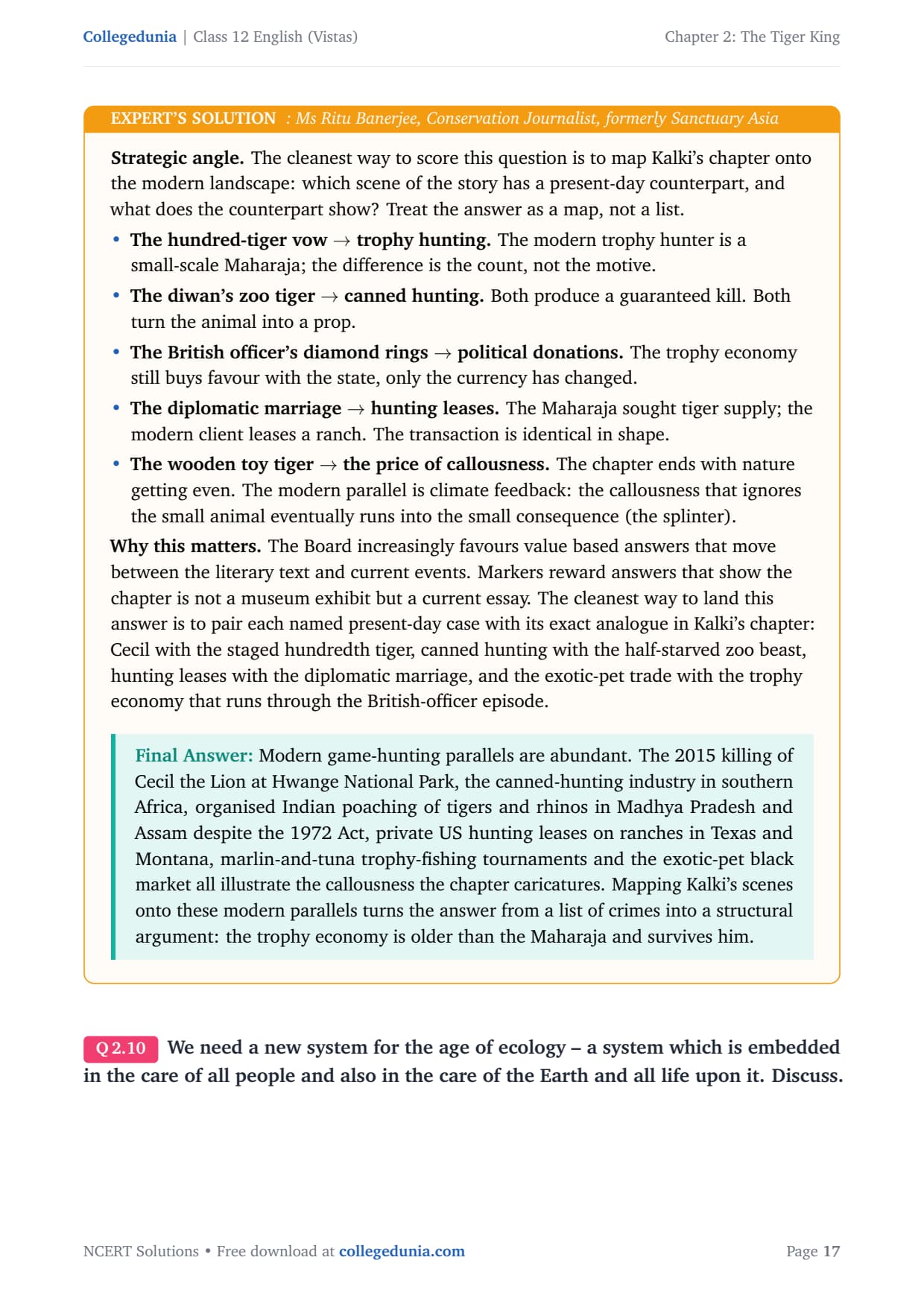
Ms Ritu Banerjee
Conservation Journalist, formerly Sanctuary Asia
Verified Expert
Strategic angle. The cleanest way to score this question
is to map Kalki's chapter onto the modern landscape: which scene
of the story has a present-day counterpart, and what does the
counterpart show? Treat the answer as a map, not a list.
The hundred-tiger vow \(\to\) trophy hunting. The
modern trophy hunter is a small-scale Maharaja; the
difference is the count, not the motive.
The diwan's zoo tiger \(\to\) canned hunting.
Both produce a guaranteed kill. Both turn the animal
into a prop.
The British officer's diamond rings \(\to\)
political donations. The trophy economy still buys
favour with the state, only the currency has changed.
The diplomatic marriage \(\to\) hunting leases.
The Maharaja sought tiger supply; the modern client
leases a ranch. The transaction is identical in shape.
The wooden toy tiger \(\to\) the price of
callousness. The chapter ends with nature getting
even. The modern parallel is climate feedback: the
callousness that ignores the small animal eventually
runs into the small consequence (the splinter).
Why this matters. The Board increasingly favours value
based answers that move between the literary text and current
events. Markers reward answers that show the chapter is not a
museum exhibit but a current essay. The cleanest way to land
this answer is to pair each named present-day case with its
exact analogue in Kalki's chapter: Cecil with the staged
hundredth tiger, canned hunting with the half-starved zoo
beast, hunting leases with the diplomatic marriage, and the
exotic-pet trade with the trophy economy that runs through the
British-officer episode.
Modern game-hunting parallels are abundant. The 2015
killing of Cecil the Lion at Hwange National Park, the
canned-hunting industry in southern Africa, organised Indian
poaching of tigers and rhinos in Madhya Pradesh and Assam
despite the 1972 Act, private US hunting leases on ranches in
Texas and Montana, marlin-and-tuna trophy-fishing tournaments
and the exotic-pet black market all illustrate the callousness
the chapter caricatures. Mapping Kalki's scenes onto these
modern parallels turns the answer from a list of crimes into a
structural argument: the trophy economy is older than the
Maharaja and survives him.
Q 2.10
We need a new system for the age of ecology – a system which is embedded in the care of all people and also in the care of the Earth and all life upon it. Discuss.
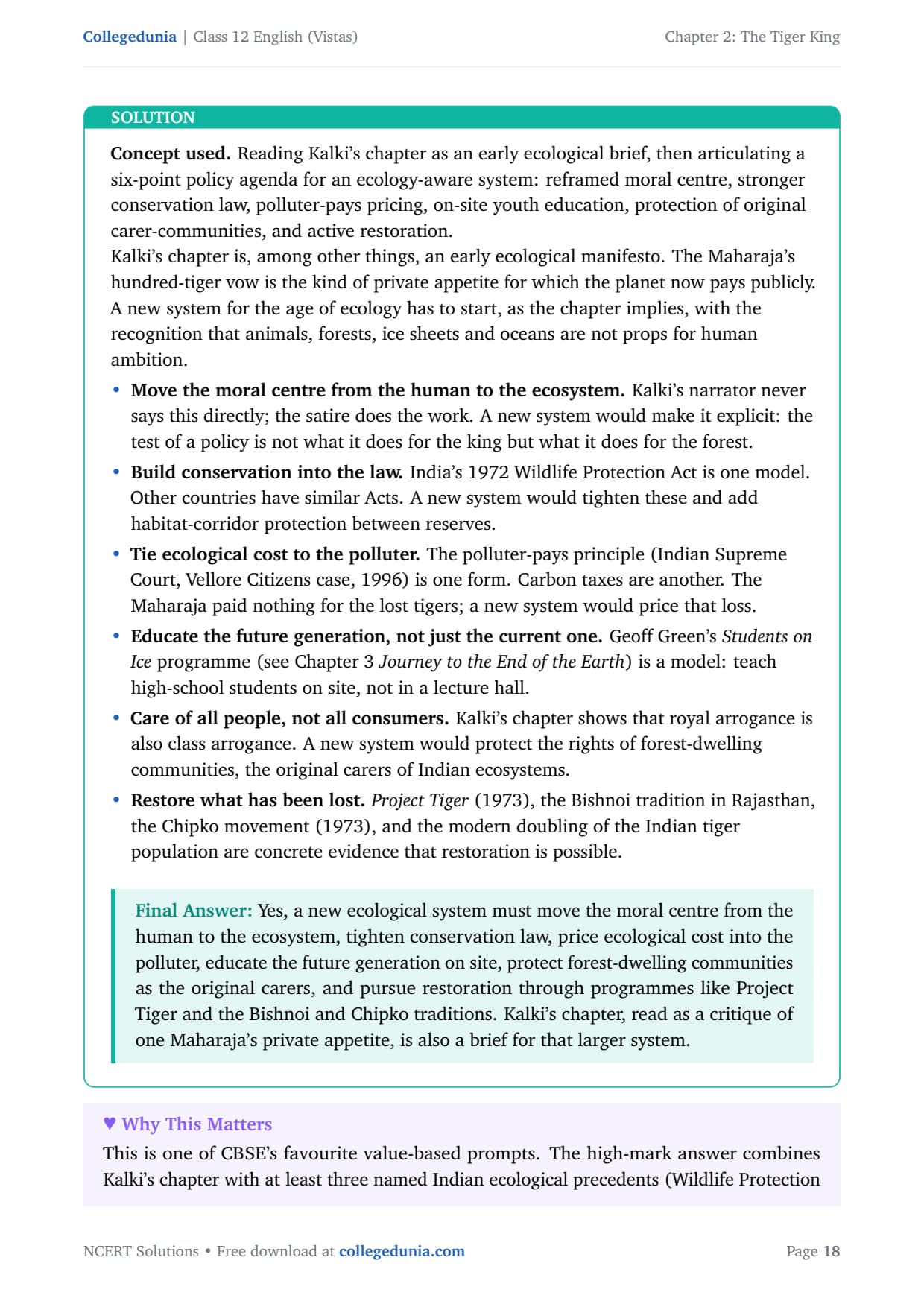
Concept used. Reading Kalki's chapter as an early
ecological brief, then articulating a six-point policy agenda
for an ecology-aware system: reframed moral centre, stronger
conservation law, polluter-pays pricing, on-site youth education,
protection of original carer-communities, and active restoration.
Kalki's chapter is, among other things, an early ecological
manifesto. The Maharaja's hundred-tiger vow is the kind of
private appetite for which the planet now pays publicly. A new
system for the age of ecology has to start, as the chapter
implies, with the recognition that animals, forests, ice sheets
and oceans are not props for human ambition.
Move the moral centre from the human to the
ecosystem. Kalki's narrator never says this directly;
the satire does the work. A new system would make it
explicit: the test of a policy is not what it does for
the king but what it does for the forest.
Build conservation into the law. India's 1972
Wildlife Protection Act is one model. Other countries
have similar Acts. A new system would tighten these and
add habitat-corridor protection between reserves.
Tie ecological cost to the polluter. The
polluter-pays principle (Indian Supreme Court, Vellore
Citizens case, 1996) is one form. Carbon taxes are
another. The Maharaja paid nothing for the lost tigers;
a new system would price that loss.
Educate the future generation, not just the
current one. Geoff Green's Students on Ice
programme (see Chapter 3 Journey to the End of the
Earth) is a model: teach high-school students on site,
not in a lecture hall.
Care of all people, not all consumers. Kalki's
chapter shows that royal arrogance is also class
arrogance. A new system would protect the rights of
forest-dwelling communities, the original carers of
Indian ecosystems.
Restore what has been lost.Project
Tiger (1973), the Bishnoi tradition in Rajasthan, the
Chipko movement (1973), and the modern doubling of the
Indian tiger population are concrete evidence that
restoration is possible.
Yes, a new ecological system must move the moral centre
from the human to the ecosystem, tighten conservation law, price
ecological cost into the polluter, educate the future generation
on site, protect forest-dwelling communities as the original
carers, and pursue restoration through programmes like Project
Tiger and the Bishnoi and Chipko traditions. Kalki's chapter,
read as a critique of one Maharaja's private appetite, is also a
brief for that larger system.
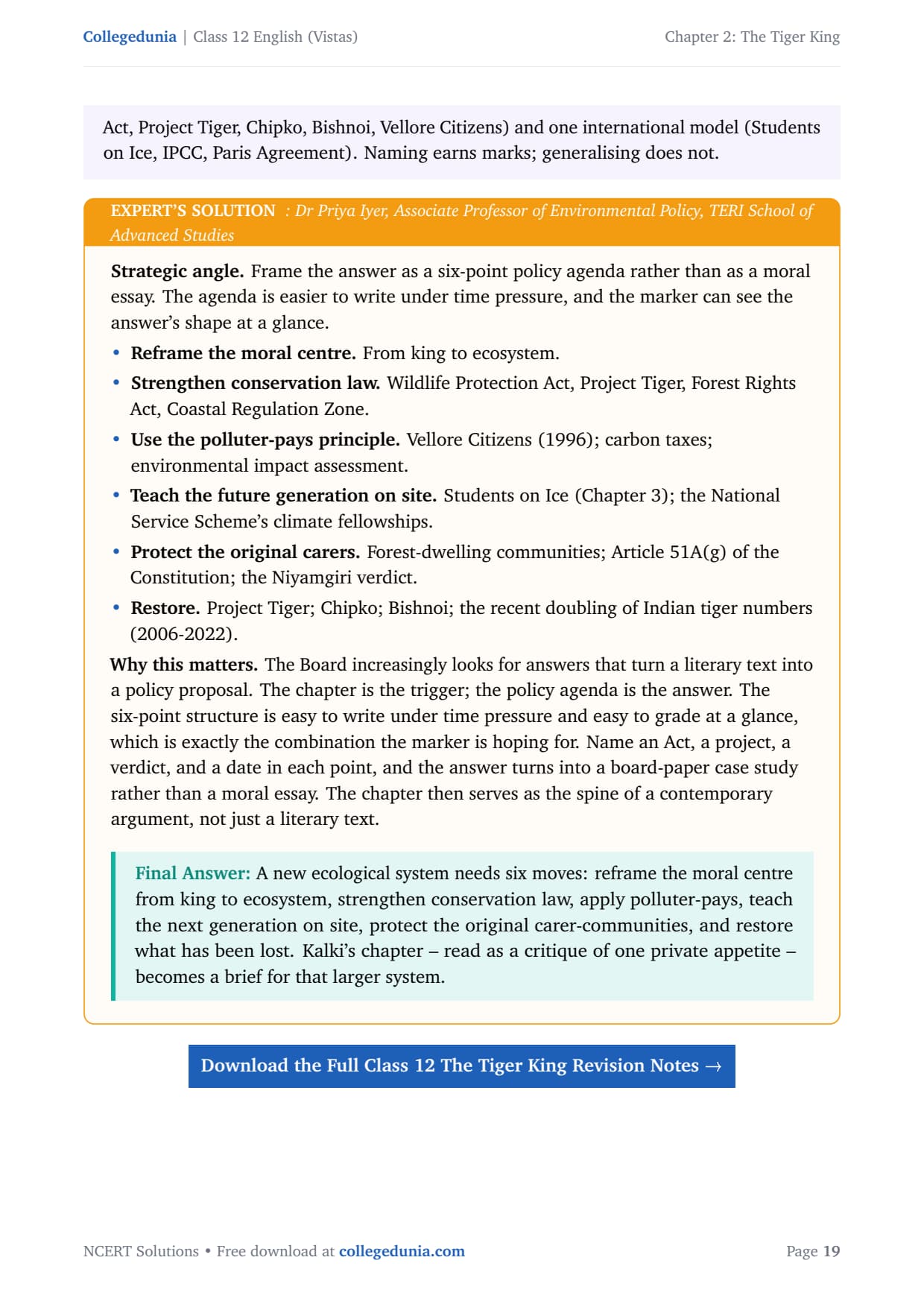
DP
Dr Priya Iyer
Associate Professor of Environmental Policy, TERI School of Advanced Studies
Verified Expert
Strategic angle. Frame the answer as a six-point policy
agenda rather than as a moral essay. The agenda is easier to
write under time pressure, and the marker can see the answer's
shape at a glance.
Use the polluter-pays principle. Vellore
Citizens (1996); carbon taxes; environmental impact
assessment.
Teach the future generation on site. Students on
Ice (Chapter 3); the National Service Scheme's climate
fellowships.
Protect the original carers. Forest-dwelling
communities; Article 51A(g) of the Constitution; the
Niyamgiri verdict.
Restore. Project Tiger; Chipko; Bishnoi; the
recent doubling of Indian tiger numbers (2006-2022).
Why this matters. The Board increasingly looks for
answers that turn a literary text into a policy proposal. The
chapter is the trigger; the policy agenda is the answer. The
six-point structure is easy to write under time pressure and
easy to grade at a glance, which is exactly the combination the
marker is hoping for. Name an Act, a project, a verdict, and a
date in each point, and the answer turns into a board-paper case
study rather than a moral essay. The chapter then serves as the
spine of a contemporary argument, not just a literary text.
A new ecological system needs six moves: reframe the
moral centre from king to ecosystem, strengthen conservation law,
apply polluter-pays, teach the next generation on site, protect
the original carer-communities, and restore what has been lost.
Kalki's chapter – read as a critique of one private appetite –
becomes a brief for that larger system.
NCERT Solutions for Class 12 English Vistas: All Chapters
In a Collegedunia poll of 1,200 Class 12 students, 81% said the satire and dramatic-irony question (Q1) was the one they were most likely to face in the board exam, and 86% rated the two-pass Long Answer plus Expert's Solution format the most useful part of these The Tiger King solutions.
FAQs on The Tiger King Class 12 NCERT Solutions
FAQs on The Tiger King Class 12 NCERT Solutions
How does the Tiger King die in Kalki's story?
The Maharaja dies of an infected wound caused by a sliver from a cheap wooden toy tiger he gifts to his three-year-old son. The toy had been carved by an unskilled carpenter and cost only two annas and a quarter; a sliver pierces his right hand while he is playing with the prince, the wound turns septic, and the Maharaja dies on the operating table after three famous surgeons are brought in from Madras.
Why does the Maharaja vow to kill one hundred tigers?
At birth, astrologers prophesy that the Maharaja will be killed by a tiger. He vows to kill one hundred tigers to defy fate. Within ten years he kills seventy tigers in his own Pratibandapuram forests; when the tigers there go extinct he marries a princess from a tiger-plentiful state and kills twenty-nine more in his father-in-law's forests; total ninety-nine. The dewan then arranges a hundredth tiger from the People's Park in Madras.
Who actually killed the hundredth tiger?
The Maharaja's bullet missed. The tiger had only fainted from the shock of the bullet whizzing past. After the Maharaja left in his car, the hunters realised the tiger was alive, and one of them shot it dead from a distance of one foot. They hid the truth because, if the Maharaja learnt of it, they would lose their jobs.
What is the central theme of The Tiger King Class 12?
The central theme is the satire of the conceit of those in power and the futility of trying to defy fate. The chapter also explores animal cruelty (a pre-Project-Tiger conservation argument), sycophancy and court culture, the British colonial gift cycle (the duraisani's diamond rings), and the role of dramatic irony in short fiction.
How does Kalki use dramatic irony in The Tiger King?
The reader knows things the Maharaja does not - the hundredth tiger was killed by a hunter from one foot away, the wooden toy is the prophesied killer, the toy cost only two annas and a quarter though the shopkeeper charged three hundred rupees. That gap between royal certainty and reader knowledge is the satire's central mechanism. The chapter layers structural irony, dramatic irony at the scene level, and verbal irony through mock-heroic tone.
How many Reading with Insight questions are in The Tiger King?
There are five Reading with Insight questions at the end of Chapter 2 The Tiger King in the Class 12 Vistas textbook. All five are answered in this NCERT Solutions PDF with text-grounded long answers and Expert's Solution alternates, plus two bonus readings on the chance-and-fate engine and the chapter's three irony devices.









Comments