Senior English Editor, 13 Yrs | Updated on - Jul 21, 2026
These The Third Level Class 12 NCERT Solutions answer every Reading with Insight question for Vistas Chapter 1 with text-grounded long answers from Jack Finney's story. Each answer is built as a 6-mark Long Answer with the exact lines, dates and place-names CBSE markers reward in Section C. The solutions follow the 2026-27 NCERT reprint.
CBSE Weightage:6 marks per Vistas Long Answer in Section C, drawn from the seven Reading with Insight questions
Coverage: 7 Reading with Insight answers, 7 Expert's Solution alternates, text-grounded long answers with key quotations
These Collegedunia solutions are written by senior English educators, mapped to the 2026-27 NCERT Vistas textbook, and refined against the last five years of CBSE Class 12 English Core Board papers.
The Third Level Class 12 NCERT Solutions: Chapter Snapshot
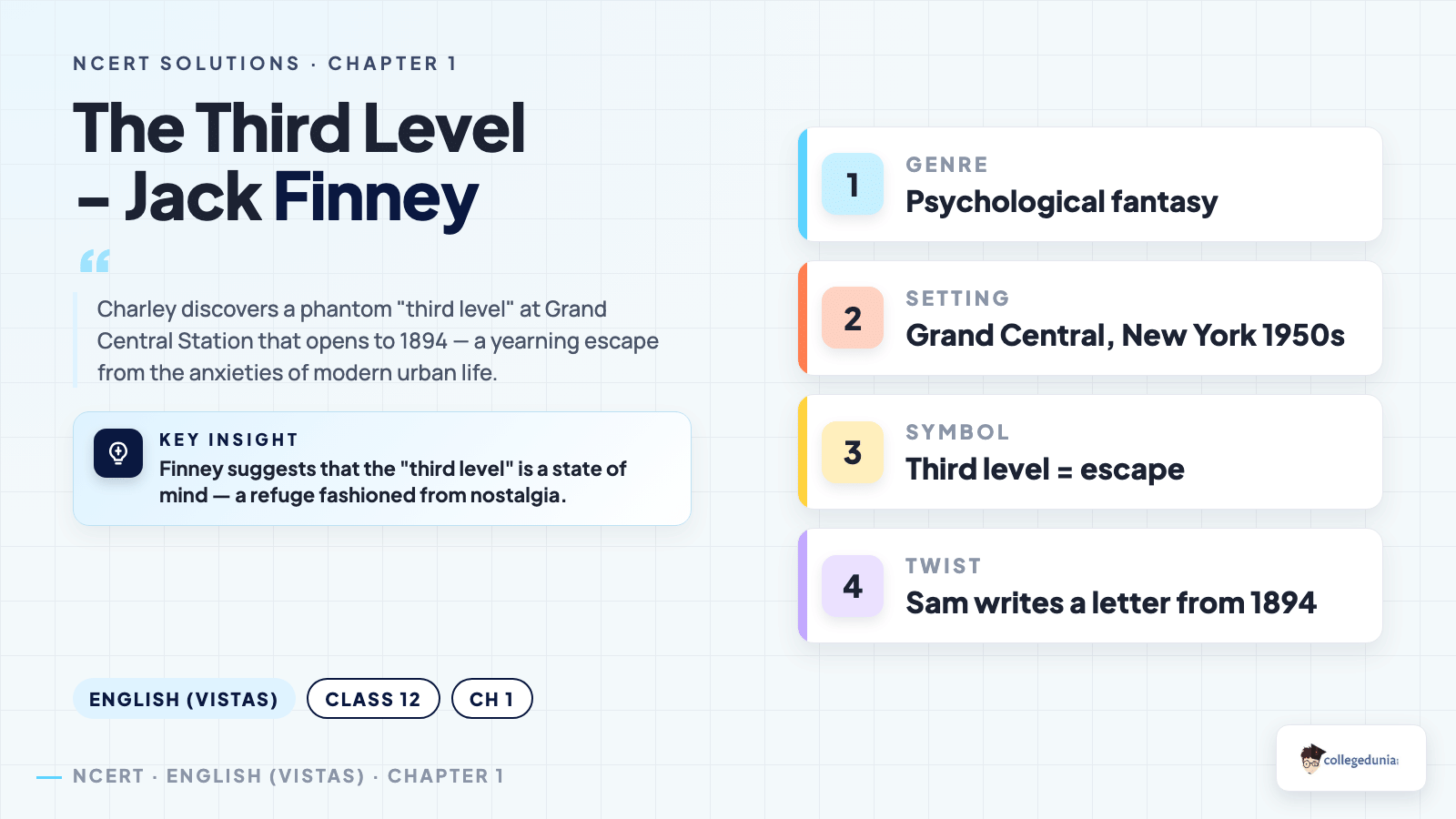
The Third Level is the opening story in the Class 12 Vistas reader, written by the American author Jack Finney (1911-1995). Charley, a New York stamp collector, claims to have found a hidden third level at Grand Central Station that leads to the world of 1894. His psychiatrist friend Sam calls it a waking-dream wish fulfilment; Charley calls it real. The seven Reading with Insight questions test escape, fantasy versus reality, stamp collecting as a refuge and Sam's letter from Galesburg.
Question
What It Tests
Marks
Q1 - Third level as a medium of escape?
Escape theme; Charley's anxiety; the 1894 destination
6
Q2 - What do you infer from Sam's letter?
Evidence reading; Sam's role reversal
6
Q3 - Overcoming the modern world's stress
Value-based reasoning; hobbies and nostalgia
5-6
Q4 - Intersection of time and space?
Genre marker; magical realism; the portal
5
Q5 - Illogicality and futuristic projection
Genre marker; the corridor as a thought experiment
5
Q6 - Philately keeps the past alive
Value-based reasoning; stamps as portable history
5-6
Q7 - Charley's hobbies before the third level
Character study; the temporary refuge
5
CBSE almost always pulls a single 6-mark Long Answer from Vistas in Section C. Q1, Q2, Q3 and Q6 have been the four most frequent rotations over the last five years.
The Third Level Video Explanation (Class 12 English)
Every Reading with Insight question is answered in two passes, the way a senior CBSE examiner expects a top-band Vistas answer to be built.
Long Answer: opens with a one-line position (Yes / No / Both), quotes the story, then walks four to six text-grounded points with names, dates and dollar amounts, and closes with a boxed final answer.
Expert's Solution: adds the alternate angle, the literary-history context, the genre reading (magical realism, science fiction) and the structural reading of where Finney places the diagnosis and the letter.
Callouts: short sticky-notes flag the examiner trap to dodge, the exact figure to quote and the line that triggers a full-mark phrase.
Q1: Was the Third Level a Medium of Escape for Charley?
Yes. The full Long Answer walks four anchors: the trigger (Charley's list of insecurity, fear, war, worry and stress), the destination (Galesburg, Illinois in 1894), the currency loss (dollars changed into old-style bills), and Sam's diagnosis (a waking-dream wish fulfilment).
Lines to quote: "The modern world is full of insecurity, fear, war, worry and stress." "A waking dream wish fulfilment." "Galesburg, Illinois - a wonderful town still." Three lines, three easy marks.
Q2: What Do You Infer from Sam's Letter?
Sam's letter, postmarked Galesburg, 18 July 1894, is the story's one piece of hard evidence. The Long Answer draws five inferences: Sam has gone to 1894, the psychiatrist now confirms Charley, escape was Sam's own wish (the hay, feed and grain business), the third level is a repeatable route, and the first-day cover is Finney's chosen proof.
Examiner trap: Do not stop at "the letter proves the third level exists". Markers want at least two inferences, about Sam's own wish and the role reversal, plus the business plan (hay, feed and grain).
Q3: How We Overcome Insecurity, Fear, War, Worry and Stress
This is the value-based slot. The Long Answer lists six adaptive strategies people really use: hobbies and creative work, nostalgia and period fiction, escapism through travel, social bonds, meaning-making through service, and the regulated escape psychology recommends. It closes by returning to Finney: Charley's third level is a story-shaped version of what every student does in real life.
Q4 and Q5: Time, Space and the Apparent Illogicality
Q4 and Q5 both probe the genre marker. The Long Answers place the story in the magical-realism tradition, explain why Grand Central is the perfect symbolic site for a portal (a station is already where time and space converge), and argue that Finney's claim is psychological, not literal, since the third level is reachable only when Charley is anxious enough to need it.
Q6: Philately Helps Keep the Past Alive
The Q6 Long Answer reads stamp collecting through Charley's grandfather's first-day cover and the postmark as a place-and-date record. It argues that philately is one of the few hobbies that lets a collector touch the past directly, then ties the hobby back to Sam's letter, which is itself the central piece of evidence.
Q7: Charley's Hobbies Before the Third Level
Q7 is the character-study slot. The Long Answer names stamp collecting as Charley's only hobby and reads it through Sam's clinical lens as a temporary refuge from reality. By the end, Charley and Louisa use the stamps as a navigation tool for the search for the third level.
Common Mistakes Students Make in The Third Level Long Answers
Treating the third level as a simple time-travel device instead of reading Finney's psychological argument.
Forgetting to quote the dollar amounts (three hundred by Charley, eight hundred by Sam) in Q1 or Q2.
Confusing Galesburg, Illinois with a fictional place; it is a real town where Charley's grandfather lived.
Reading Sam's diagnosis as the final word; his later letter reopens the question.
Quoting only one or two lines; a 6-mark Long Answer expects four to five text-grounded anchors.
CBSE Class 12 English Previous Year Question Mapping for The Third Level
The 6-mark Long Answer slot rotates predictably between Q1 (escape), Q2 (Sam's letter), Q3 (modern-world stress) and Q6 (philately).
Year
Long Answer Focus
Marks
2025
Third level as a medium of escape (Q1)
6
2024
Inferences from Sam's letter (Q2)
6
2023
Philately keeps the past alive (Q6)
6
2022
Overcoming modern insecurity and stress (Q3)
6
2021
Intersection of time and space (Q4)
5
How Collegedunia's NCERT Solutions Help You Score in The Third Level
Every Long Answer opens with a one-line position and four to six text-grounded anchors, the exact shape a 6-mark Section C answer is graded against.
Each answer is paired with an Expert's Solution, so you walk in with two ways to answer every question.
Specific figures and dates (eight hundred dollars, 941 Willard Street, 18 July 1894) are highlighted as the anchors markers look for.
Other Resources for The Third Level (Class 12 English)
All NCERT Solutions for The Third Level with Step-by-Step Working
Every NCERT textbook question for Class 12 English (Vistas) Chapter 1 The Third Level is listed below with its full Solution and Expert Solution hidden inside collapsible tabs. Click Check Solution to reveal the working; click Expert Solution for the expanded explanation.
Read and Find Out
Q 1.1
What does the third level refer to?
The ``third level'' refers to the hidden, imagined extra
subterranean level that Charley claims to have discovered at
Grand Central Station in New York. Grand Central, in
ordinary 1950s reality, has two underground levels: the
first level handles the subway and the second handles the
suburban commuter trains. Charley's third level is, on
his own account, a level below those two, opening onto
Galesburg, Illinois, in the summer of 1894.
Lines from the text
``The presidents of the New York Central and the New York,
New Haven and Hartford railroads will swear on a stack of
timetables that there are only two. But I say there are
three, because I've been on the third level of the Grand
Central Station.''
A physical claim. Charley insists the
third level is real architecture: a corridor,
flickering gas lamps, a hand-painted information
booth, men in derby hats, women in leg-of-mutton
sleeves, and a copy of The World dated 11
June 1894.
A psychological claim. Sam, the
psychiatrist friend, calls it a waking dream
wish fulfilment: an escape route the modern world's
``insecurity, fear, war, worry and stress'' has
called into being in Charley's mind.
A symbolic claim. The third level reads,
across the story, as Charley's image for any door
out of the present, real or imagined.
The third level is the imagined extra
underground level Charley claims to find at Grand Central
Station, leading from 1950s New York into 1894 Galesburg,
Illinois. The first two levels carry the subway and the
suburban trains; the third is Charley's, and Finney's,
image for the modern wish to escape into a calmer time.
DA
Dr Ananya Iyer
PhD English Literature, Jawaharlal Nehru University
Verified Expert
Quick reading. The third level is best read as a
double object: a piece of architecture in the story's
foreground and a piece of psychology in its background.
Both readings are needed because Finney himself keeps both
in play.
Architecturally, Grand Central in 1950 had two
known levels. Finney invents a third as a small,
precise piece of impossible engineering, the way
Borges might invent a library or a labyrinth.
Psychologically, the third level is the route
Charley's mind opens when the present has become
unbearable. Sam's diagnosis (waking dream wish
fulfilment) names it without resolving it.
The destination is also crucial: not anywhere
else, but 1894 Galesburg, a small American
town before two world wars and the bomb. The
choice of date is the story's argument about why
we want a third level at all.
The third level is Finney's name for the hidden
underground level Charley finds at Grand Central Station,
leading to Galesburg, Illinois, in 1894. The story keeps
the door open between two readings of the level: a piece of
real, if impossible, architecture and a piece of Charley's
psychology, an escape route the modern world has called
into being.
Q 1.2
Would Charley ever go back to the ticket-counter on the third level to buy tickets to Galesburg for himself and his wife?
The story does not answer this question directly, which is
itself part of Finney's design. What the text gives us is
Charley's repeated, unsuccessful search and one quiet,
heavy piece of evidence in Sam's first-day cover that the
third level was reached, at least once, by someone else.
From those two facts the reader is invited to make a
careful guess.
Lines from the text
``I've never again found the corridor that leads to the
third level But my stamp collecting has paid off, in
a way. It was there. I looked at the first-day
cover postmarked July 18, 1894, the date of its
first day of issue Sam.''
The search has not succeeded. Charley
says plainly that he has never again found the
corridor. He and Louisa spend their weekends
looking, but the door has closed.
Sam's letter is the only proof. The
first-day cover, postmarked Galesburg, Ill.,
July 18, 1894, shows that Sam reached Galesburg.
It does not show that Charley can.
The escape is psychological. If the
third level is a wish-fulfilment, as Sam first
believed, then access depends on Charley's state
of mind, not on the station's geography. The
ticket-counter, in that reading, is not a place
you can plan to revisit.
The narrative is left open on purpose.
Finney closes with Charley still looking. Whether
Charley reaches the counter again is left to the
reader. The most honest answer is: the evidence
suggests not, and the story's tenderness is in
that uncertainty.
Charley searches for the third level every
weekend but never finds the corridor again. Sam's first-day
cover suggests that Sam reached Galesburg via the third
level, but the story does not show Charley reaching the
ticket-counter again. The evidence implies the third level
is psychological more than physical, and that Charley's
return is left open on purpose.
MA
Mr Arjun Mehta
MA English, University of Delhi
Verified Expert
Strategic angle. Finney's story refuses a verdict
on Charley's future, and the strongest answer respects that
refusal. Read the question as an invitation to weigh
evidence, not to predict plot.
Charley's own testimony is mixed. He has not
found the corridor again, but he is still looking,
and he reads Sam's cover as a renewed invitation.
The fact that Sam reached Galesburg complicates a
purely psychological reading. If the third level
is only Charley's mind, how did Sam get there?
Finney lets the puzzle stand.
The story's closing image is of a continued
search, not of an arrival. The reader is meant to
sit with that.
The story does not show Charley reaching the
ticket-counter again. The first-day cover suggests Sam did,
but Charley's repeated searches fail. The most honest
answer is that the third level is left open: probably
psychological, probably out of reach, but the door is
never finally closed.
Reading with Insight
Q 1.3
Do you think that the third level was a medium of escape for Charley? Why?
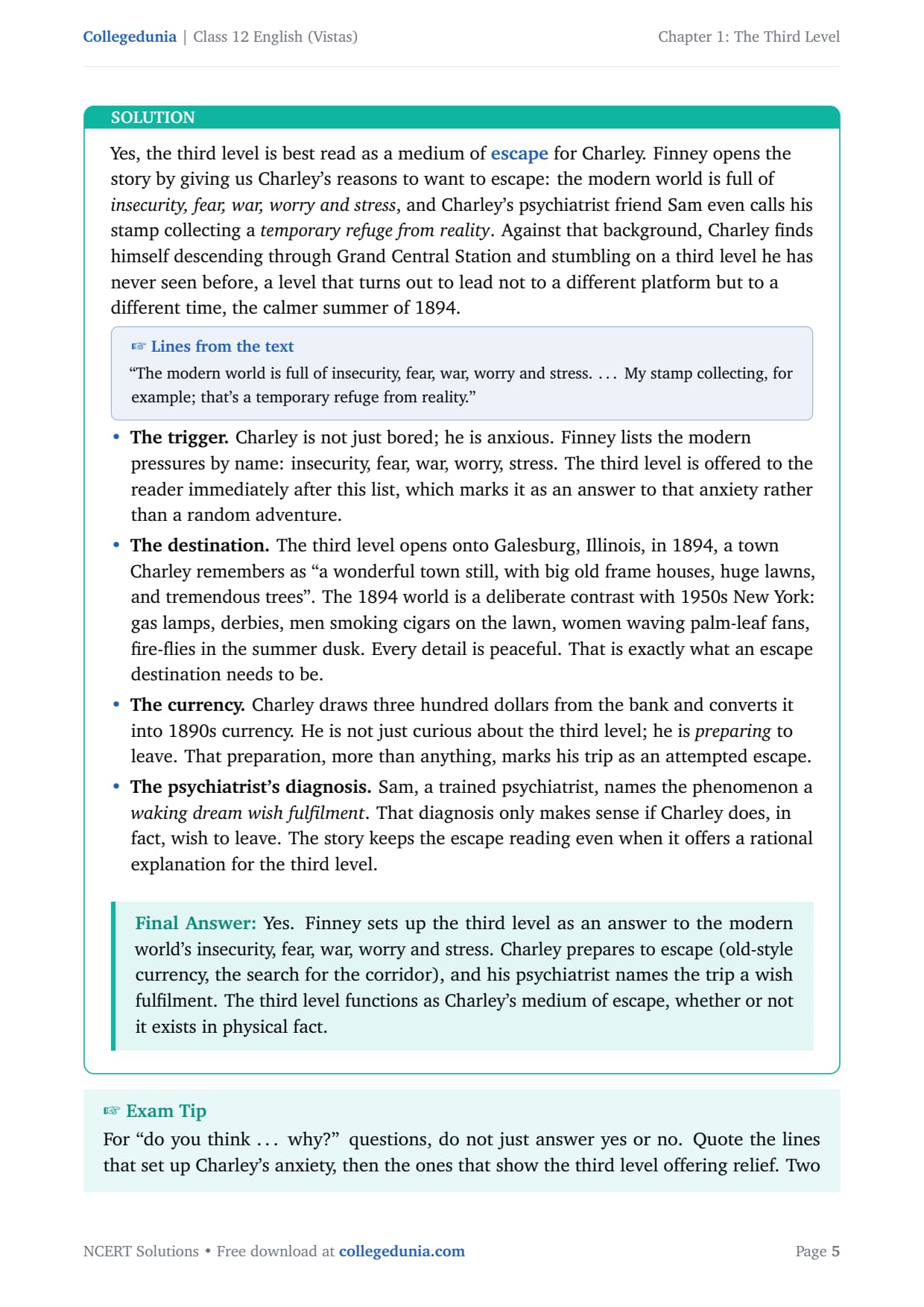
Yes, the third level is best read as a medium of escape
for Charley. Finney opens the story by giving us Charley's reasons
to want to escape: the modern world is full of insecurity,
fear, war, worry and stress, and Charley's psychiatrist friend Sam
even calls his stamp collecting a temporary refuge from
reality. Against that background, Charley finds himself
descending through Grand Central Station and stumbling on a third
level he has never seen before, a level that turns out to lead not
to a different platform but to a different time, the calmer summer
of 1894.
Lines from the text
``The modern world is full of insecurity, fear, war, worry and
stress. My stamp collecting, for example; that's a
temporary refuge from reality.''
The trigger. Charley is not just bored; he is
anxious. Finney lists the modern pressures by name:
insecurity, fear, war, worry, stress. The third level is
offered to the reader immediately after this list, which
marks it as an answer to that anxiety rather than a random
adventure.
The destination. The third level opens onto
Galesburg, Illinois, in 1894, a town Charley remembers as
``a wonderful town still, with big old frame houses,
huge lawns, and tremendous trees''. The 1894 world is a
deliberate contrast with 1950s New York: gas lamps,
derbies, men smoking cigars on the lawn, women waving
palm-leaf fans, fire-flies in the summer dusk. Every detail
is peaceful. That is exactly what an escape destination
needs to be.
The currency. Charley draws three hundred
dollars from the bank and converts it into 1890s currency.
He is not just curious about the third level; he is
preparing to leave. That preparation, more than
anything, marks his trip as an attempted escape.
The psychiatrist's diagnosis. Sam, a trained
psychiatrist, names the phenomenon a waking dream
wish fulfilment. That diagnosis only makes sense if
Charley does, in fact, wish to leave. The story keeps the
escape reading even when it offers a rational
explanation for the third level.
Yes. Finney sets up the third level as an answer to the
modern world's insecurity, fear, war, worry and stress. Charley
prepares to escape (old-style currency, the search for the
corridor), and his psychiatrist names the trip a wish fulfilment.
The third level functions as Charley's medium of escape, whether
or not it exists in physical fact.
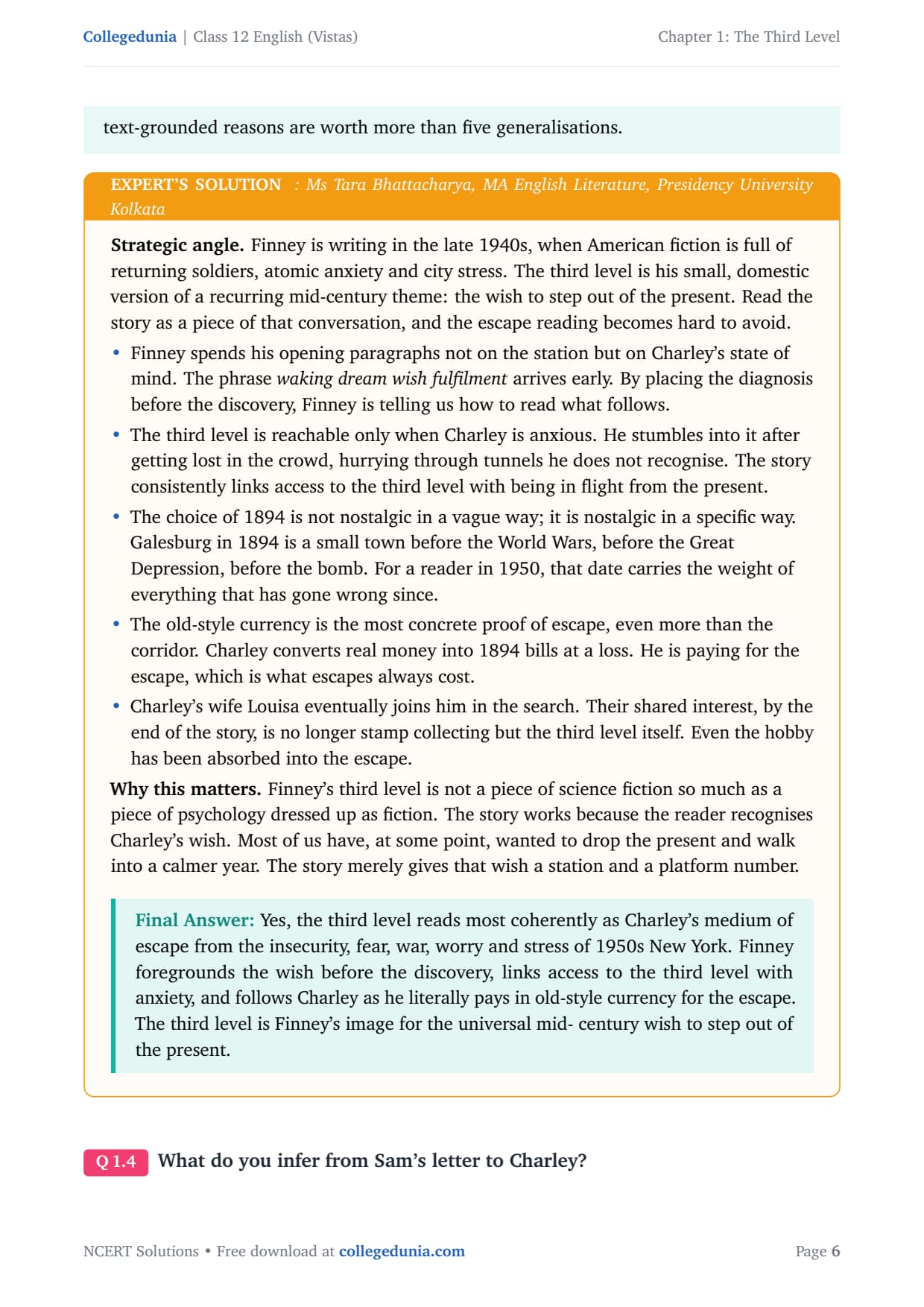
MT
Ms Tara Bhattacharya
MA English Literature, Presidency University Kolkata
Verified Expert
Strategic angle. Finney is writing in the late 1940s,
when American fiction is full of returning soldiers, atomic
anxiety and city stress. The third level is his small, domestic
version of a recurring mid-century theme: the wish to step out of
the present. Read the story as a piece of that conversation, and
the escape reading becomes hard to avoid.
Finney spends his opening paragraphs not on the station
but on Charley's state of mind. The phrase waking
dream wish fulfilment arrives early. By placing the
diagnosis before the discovery, Finney is telling us how
to read what follows.
The third level is reachable only when Charley is
anxious. He stumbles into it after getting lost in the
crowd, hurrying through tunnels he does not recognise. The
story consistently links access to the third level with
being in flight from the present.
The choice of 1894 is not nostalgic in a vague way; it is
nostalgic in a specific way. Galesburg in 1894 is a small
town before the World Wars, before the Great Depression,
before the bomb. For a reader in 1950, that date carries
the weight of everything that has gone wrong since.
The old-style currency is the most concrete proof of
escape, even more than the corridor. Charley converts real
money into 1894 bills at a loss. He is paying for the
escape, which is what escapes always cost.
Charley's wife Louisa eventually joins him in the search.
Their shared interest, by the end of the story, is no
longer stamp collecting but the third level itself. Even
the hobby has been absorbed into the escape.
Why this matters. Finney's third level is not a piece of
science fiction so much as a piece of psychology dressed up as
fiction. The story works because the reader recognises Charley's
wish. Most of us have, at some point, wanted to drop the present
and walk into a calmer year. The story merely gives that wish a
station and a platform number.
Yes, the third level reads most coherently as Charley's
medium of escape from the insecurity, fear, war, worry and stress
of 1950s New York. Finney foregrounds the wish before the
discovery, links access to the third level with anxiety, and
follows Charley as he literally pays in old-style currency for the
escape. The third level is Finney's image for the universal mid-
century wish to step out of the present.
Q 1.4
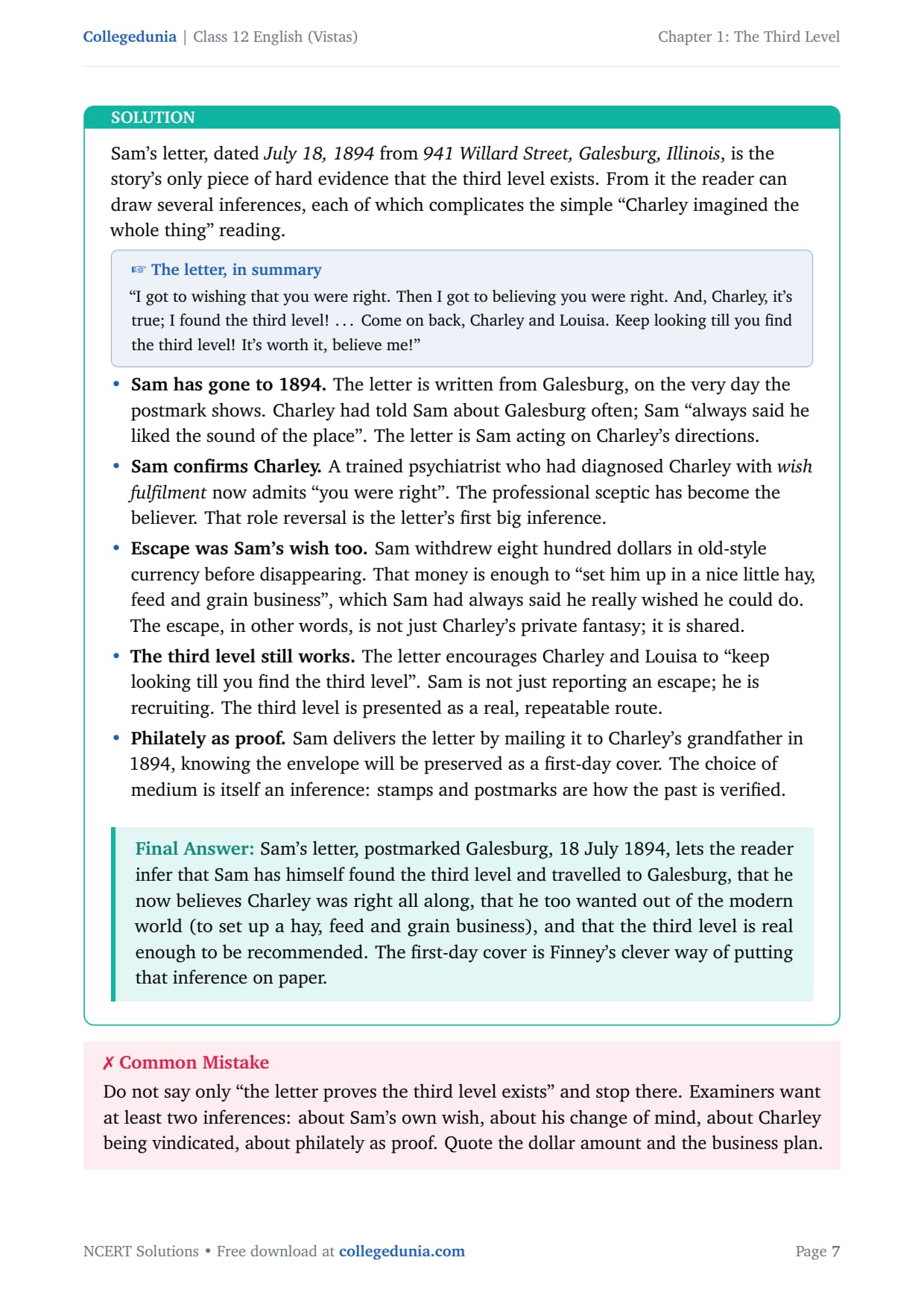
What do you infer from Sam's letter to Charley?
Sam's letter, dated July 18, 1894 from 941 Willard
Street, Galesburg, Illinois, is the story's only piece of hard
evidence that the third level exists. From it the reader can
draw several inferences, each of which complicates the simple
``Charley imagined the whole thing'' reading.
The letter, in summary
``I got to wishing that you were right. Then I got to believing
you were right. And, Charley, it's true; I found the third level!
Come on back, Charley and Louisa. Keep looking till you
find the third level! It's worth it, believe me!''
Sam has gone to 1894. The letter is written from
Galesburg, on the very day the postmark shows. Charley
had told Sam about Galesburg often; Sam ``always said he
liked the sound of the place''. The letter is Sam acting
on Charley's directions.
Sam confirms Charley. A trained psychiatrist who
had diagnosed Charley with wish fulfilment now
admits ``you were right''. The professional sceptic has
become the believer. That role reversal is the letter's
first big inference.
Escape was Sam's wish too. Sam withdrew eight
hundred dollars in old-style currency before disappearing.
That money is enough to ``set him up in a nice little hay,
feed and grain business'', which Sam had always said he
really wished he could do. The escape, in other words, is
not just Charley's private fantasy; it is shared.
The third level still works. The letter
encourages Charley and Louisa to ``keep looking till you
find the third level''. Sam is not just reporting an
escape; he is recruiting. The third level is presented as
a real, repeatable route.
Philately as proof. Sam delivers the letter by
mailing it to Charley's grandfather in 1894, knowing the
envelope will be preserved as a first-day cover. The
choice of medium is itself an inference: stamps and
postmarks are how the past is verified.
Sam's letter, postmarked Galesburg, 18 July 1894, lets
the reader infer that Sam has himself found the third level and
travelled to Galesburg, that he now believes Charley was right all
along, that he too wanted out of the modern world (to set up a
hay, feed and grain business), and that the third level is real
enough to be recommended. The first-day cover is Finney's clever
way of putting that inference on paper.
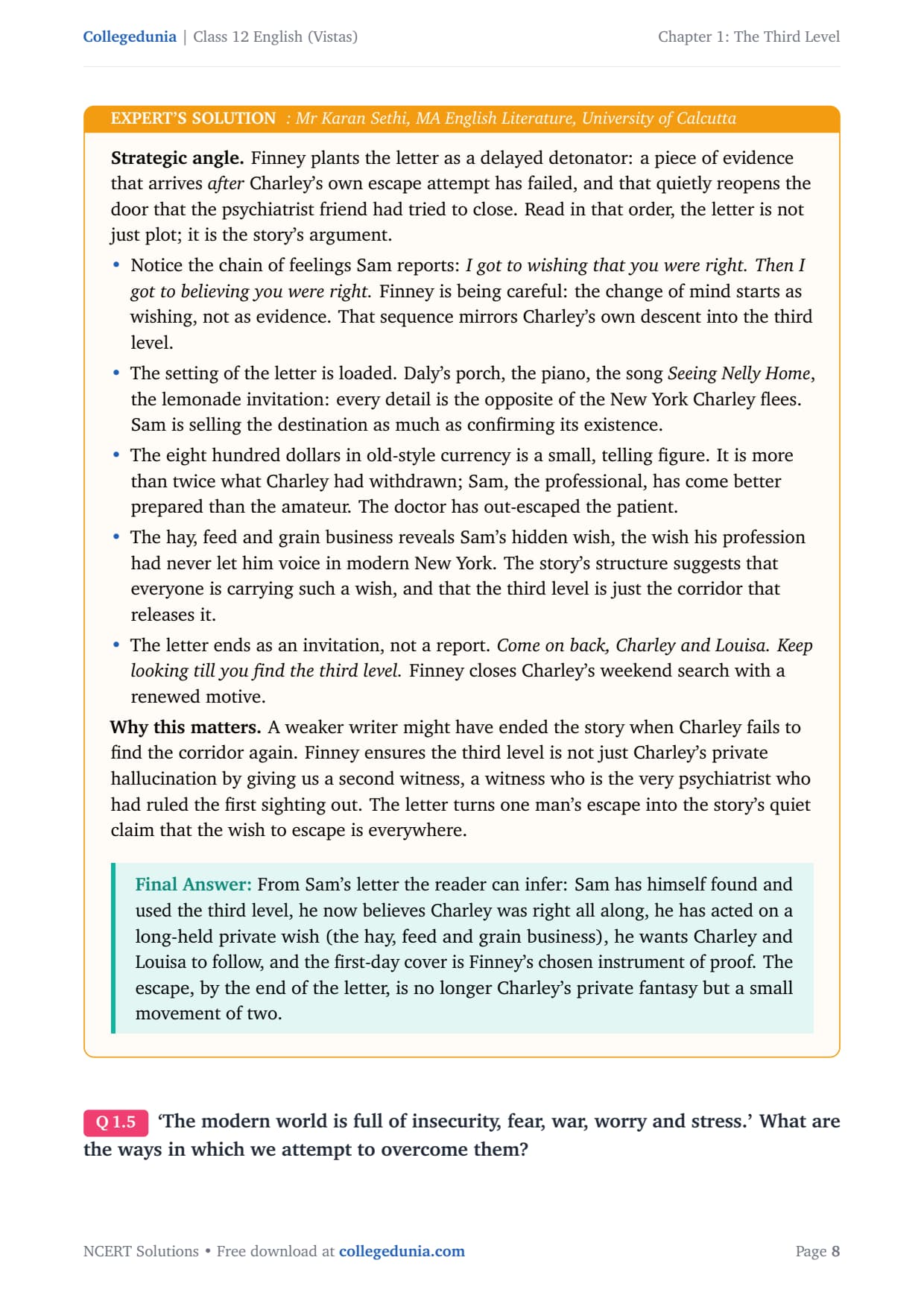
MK
Mr Karan Sethi
MA English Literature, University of Calcutta
Verified Expert
Strategic angle. Finney plants the letter as a delayed
detonator: a piece of evidence that arrives after Charley's
own escape attempt has failed, and that quietly reopens the door
that the psychiatrist friend had tried to close. Read in that
order, the letter is not just plot; it is the story's argument.
Notice the chain of feelings Sam reports: I got to
wishing that you were right. Then I got to believing you
were right. Finney is being careful: the change of mind
starts as wishing, not as evidence. That sequence mirrors
Charley's own descent into the third level.
The setting of the letter is loaded. Daly's porch, the
piano, the song Seeing Nelly Home, the lemonade
invitation: every detail is the opposite of the New York
Charley flees. Sam is selling the destination as much as
confirming its existence.
The eight hundred dollars in old-style currency is a
small, telling figure. It is more than twice what Charley
had withdrawn; Sam, the professional, has come better
prepared than the amateur. The doctor has out-escaped the
patient.
The hay, feed and grain business reveals Sam's hidden
wish, the wish his profession had never let him voice in
modern New York. The story's structure suggests that
everyone is carrying such a wish, and that the third level
is just the corridor that releases it.
The letter ends as an invitation, not a report.
Come on back, Charley and Louisa. Keep looking till
you find the third level. Finney closes Charley's
weekend search with a renewed motive.
Why this matters. A weaker writer might have ended the
story when Charley fails to find the corridor again. Finney
ensures the third level is not just Charley's private hallucination
by giving us a second witness, a witness who is the very
psychiatrist who had ruled the first sighting out. The letter
turns one man's escape into the story's quiet claim that the wish
to escape is everywhere.
From Sam's letter the reader can infer: Sam has himself
found and used the third level, he now believes Charley was right
all along, he has acted on a long-held private wish (the hay, feed
and grain business), he wants Charley and Louisa to follow, and
the first-day cover is Finney's chosen instrument of proof. The
escape, by the end of the letter, is no longer Charley's private
fantasy but a small movement of two.
Q 1.5
`The modern world is full of insecurity, fear, war, worry and stress.' What are the ways in which we attempt to overcome them?
Finney's own line is the question's starting point. The story
gives us at least three named ways of overcoming modern stress
(stamp collecting, the search for the third level, and
psychiatric help), and the reader can extend that list using
ordinary experience.
Hobbies, especially philately. Sam, the
psychiatrist, tells Charley plainly that ``stamp
collecting is a temporary refuge from reality''.
Hobbies that put us in touch with the past (stamps,
coins, old letters, photographs) calm the nerves by
slowing the mind down. Charley's grandfather had built
the very stamp collection that lets the story happen.
Escape into another time, real or imagined. The
third level is Finney's image for this. Some people
will go to a calmer year through books, films, music, or
nostalgic conversations with grandparents; some will
travel physically to quieter places. The pull is the
same: an exit from the present's pressures.
Professional help. Charley has a psychiatrist
friend, and even though Sam misdiagnoses the third level,
Finney clearly presents counselling as a normal modern
response to ``insecurity, fear, war, worry and stress''.
For severe anxiety, the story implies, the right answer
is help, not denial.
Companionship and shared routines. Charley and
Louisa start the story with separate hobbies; by the end,
they are looking together for the third level every
weekend. The shared search calms them both. Marriage,
friendship, and shared community rituals are common
modern coping mechanisms.
Reconnecting with nature and slower places.
Galesburg's gas lamps, huge lawns, fire-flies and
front-porch lemonade stand in the story for everything
slower than New York. A weekend walk, a visit to a village,
gardening, all do the same job in real life.
Daydreaming and creative writing. Sam's
diagnosis (a ``waking dream wish fulfilment'')
accidentally names a healthy strategy. Daydreams,
journaling and creative writing let the mind rehearse a
calmer life, even when the calmer life is not yet
available.
The story names hobbies (philately), escape into
another time, and psychiatric help. To these the reader can add
companionship and shared routines, reconnection with nature and
slower places, and creative outlets such as daydreaming and
writing. Each is a way of pausing the constant pressure of the
modern world.
MP
Ms Priya Sundaram
MA English, Madras Christian College
Verified Expert
Quick reading. Finney's question is doing two jobs at
once. It is naming the modern condition (``insecurity, fear, war,
worry and stress'') and inviting the reader to name a remedy.
Treat the answer as a short, honest catalogue, not a list of
slogans.
Begin with the story's own remedies, in the order Finney
introduces them: philately (Sam's diagnosis), the third
level (Charley's discovery), and the psychiatric
consultation (Sam's profession). All three are present in
the text; they should be the spine of any answer.
Notice that Finney does not rank the remedies. The story
is careful to keep stamp collecting and the third level
as parallel choices, with the same underlying wish. That
framing tells us that any honest coping strategy counts.
Add a second layer drawn from ordinary student life:
sport, music, friendship, prayer, journaling, walks, time
with family. Examiners want to see that you can move from
the text to the world.
A modest disclaimer is good style here. Note that none of
these remedies removes the underlying pressures of war,
fear and stress; they only make the pressures bearable.
Finney's third level, after all, is a refuge, not a cure.
Close with a sentence that returns to Charley. The story
suggests that what we really need is not just a hobby but
a community of people who share it. Charley and Louisa
looking together is the story's quiet final image of
coping.
Why this matters. A good answer to this question is
half text and half life. Stay close to Finney's wording, then
widen out to your own experience. Both halves should fit in the
same paragraph: the modern world is hard, and human beings have
always invented small refuges to make it lighter.
The story suggests three named ways (philately, the
third level, professional counselling) and a fourth implied way
(shared routine and companionship). Outside the text, common
human strategies include sport, music, religion, time with family,
contact with nature, journaling and creative writing. Each is a
small refuge, not a cure; together they make the modern world
bearable.
Q 1.6
Do you see an intersection of time and space in the story?
Yes. The story is built on a deliberate overlap of two times
(1894 and 1950s present) at one place (Grand Central Station,
New York). That overlap is what makes the third level both a
physical level and a date.
Grand Central as the meeting point. The station
is, in 1950s New York, a place of two known levels. The
third level, ``a long, long corridor that I never
saw before'', is simultaneously the next level down and
the route into 1894. The single staircase intersects two
epochs.
The corridor as a tunnel through time. Finney
describes the third level in physical detail: ``the
lights were dim and sort of flickering'', the men were
wearing ``derby hats'', the women had ``leg
of mutton sleeves''. The location is recognisably Grand
Central; the period is recognisably 1894. The same set
of footsteps carries Charley between the two.
The newspaper as the proof of the date. Charley
spots a copy of The World dated 11 June 1894.
Newspapers are dated objects pinned to a place. Finding
an 1894 newspaper in 1950 New York is the story's
clearest image of time and space crossing.
Sam's letter as a return signal. The letter is
written in 1894 Galesburg but reaches Charley's modern
stamp album via the postal record of 1894. The same
envelope spans the two times because the post office
sits in both.
The grandfather's collection as the bridge.
Charley's grandfather kept the first-day cover; Charley
opens it in the present. The collection is a small,
domestic time machine: every stamp is a date and every
address is a place.
Yes. Finney builds a deliberate intersection of time
and space: Grand Central Station is the place at which 1950 New
York and 1894 Galesburg meet, and the third level, the 1894
newspaper, Sam's letter and the inherited stamp collection are
the objects that let one cross from the modern present into the
nineteenth-century past.
DK
Dr Kavya Reddy
PhD American Fiction, University of Hyderabad
Verified Expert
Quick reading. Finney's story is a small experiment in
spacetime fiction. The intersection is not flashy science; it is
a quiet domestic detail (a corridor, a newspaper, a letter), but
the underlying idea is unmistakably the same idea as more famous
time-travel fiction.
Grand Central is chosen with care. A station is exactly
the kind of place that is permanently full of departures,
many of them to places no longer on the map. Finney uses
that everyday meaning to motivate a deeper one: a
platform that leads to 1894.
The third level is described as one would describe a
memory: dim, flickering, partly recognised. Finney's
prose moves the reader from architecture into
consciousness. The intersection of time and space is also
an intersection of the outer world and the inner mind.
The 1894 newspaper is the story's smallest, most
powerful object. It is a fixed coordinate (date plus
place), and Charley holds it in his hand. The story uses
the newspaper the way physics uses a worldline: a single
event located at a single (t, x).
Sam's letter functions as the return half of the same
loop. Where the third level lets Charley move from 1950
to 1894 in space, the letter lets information move from
1894 to 1950 in time. Together they describe a closed
circuit.
Class XI students will have read Jayant Narlikar's
Adventure in Hornbill. Both stories use a familiar
place (a station, a library) as the hinge between two
times. Finney's intersection is gentler, but the
underlying structure is shared.
Why this matters. The intersection of time and space is
how every time-travel story works. Finney's contribution is to
make the hinge ordinary: a staircase nobody had noticed before,
a corridor that turns the wrong way, a newspaper on a bench. The
story argues, in passing, that ordinary places carry more time in
them than we usually notice.
Yes. Finney builds the story on an intersection of
1950s New York and 1894 Galesburg at Grand Central Station: the
corridor, the 1894 newspaper, Sam's letter and the inherited
stamp collection are the joints at which the two times meet. The
story belongs to the same family as Narlikar's Adventure,
where one familiar place hinges two different times.
Q 1.7
Apparent illogicality sometimes turns out to be a futuristic projection? Discuss.
The statement asks us to read seemingly illogical or absurd
ideas as predictions of what may later become normal. Finney's
story offers a small but pointed example: a third level at
Grand Central is, on its face, an absurd claim, yet the story
gestures at directions science fiction and physics have since
taken seriously.
Illogicality in the story. Sam's first response
to Charley is to call the third level a waking
dream wish fulfilment. By the standards of 1950s
psychiatry, this is the rational diagnosis. A third
level at Grand Central is illogical because Grand
Central has only two.
The futuristic projection. The story was
published in 1950. In the decades since, fiction and
scientific speculation have made parallel-time stories,
wormhole models and multiverse hypotheses ordinary
topics. What looked illogical in Finney's New York looks
less so on a modern physics podcast. The illogicality has
aged into a projection.
Historical precedents. Many ``illogical''
claims have turned out to be futuristic. Galileo's
moving Earth was illogical to his examiners. The
Wright brothers' heavier-than-air flight was illogical
to most of their contemporaries. Communication without
wires, screens in pockets, and human beings on the moon
were all illogical in their own decades.
The discipline this asks of us. If
illogical-sounding claims sometimes turn out to be
futuristic, then a thoughtful reader should not laugh at
an idea simply because it sounds absurd. The right
response is to ask whether the idea is internally
consistent and whether it is being argued for honestly,
rather than to dismiss it on first impression.
The story's own self-check. Finney does not let
Charley off the hook. He keeps Sam's diagnosis on the
page, lets the corridor disappear, and only then drops
the first-day cover as evidence. The story shows how to
treat an illogical idea with care: doubt first, then
evidence, then reconsider.
Yes. The statement is sound. What looks illogical in
one decade often turns out to be a futuristic projection of
later science or social change: heavier-than-air flight,
wireless communication, multiverse physics. Finney's story
dramatises that pattern at small scale: a ``third level'' at
Grand Central sounds illogical in 1950, yet the underlying idea,
a doorway between times, has since become a serious topic of
fiction and physics.
MV
Mr Vikram Rao
MA English Literature, Banaras Hindu University
Verified Expert
Strategic angle. The question is half literature and
half philosophy of science. A strong answer should refuse to read
``illogicality'' as a synonym for ``error'', and should instead
treat it as a description of an idea that has not yet been
assimilated. That move turns the question from a defence of
fiction into a small theory of progress.
Start with a clean definition. ``Apparent illogicality''
is the quality of seeming to break the known rules of
the present. ``Futuristic projection'' is the quality of
anticipating rules that will be accepted later. The
statement claims the two often overlap.
Use Finney's story as your first example. The third
level at Grand Central is illogical to a 1950s
psychiatrist but consonant with twenty-first-century
speculation about multiverses and wormholes. The reader
is invited to feel the gap close.
Add a historical example. Heliocentrism, the railway,
wireless telegraphy, heavier-than-air flight, and the
smartphone all spent time as illogical claims before
becoming everyday tools. The pattern is too repeated to
be coincidence.
Acknowledge the counter-case. Not every illogical claim
is a futuristic projection; some are simply wrong.
Astrology and phrenology survived for centuries and still
do not work. The statement therefore needs an honest
modifier: sometimes, not always.
Close with the right reading posture. Illogical ideas
deserve neither automatic belief nor automatic dismissal.
They deserve the same care Finney shows the third level:
a diagnosis, an investigation, and a willingness to
revise when the first-day cover turns up.
Why this matters. The statement is also a quiet defence
of imaginative fiction. If illogical ideas sometimes anticipate
future rules, then a culture that reads them seriously is doing
itself a favour. Finney's third level is small, but it is in the
same family as Verne's submarine and Wells's time machine: ideas
that began as illogical and have since become parts of the
ordinary world.
The statement is sound when read with the modifier
sometimes: many ideas that strike the present as illogical
(heliocentrism, heavier-than-air flight, multiverse physics) have
later turned out to be futuristic projections. Finney's third
level dramatises that pattern at story-scale. The right response
to such ideas is the same Finney shows: diagnose first, then
investigate, then revise.
Q 1.8
Philately helps keep the past alive. Discuss other ways in which this is done. What do you think of the human tendency to constantly move between the past, the present and the future?
Finney makes Charley a philatelist for a reason. A stamp album
is a small museum: each stamp is a date, an issuing country and
a piece of public memory. The question asks us first to extend
the list of past-preserving practices, then to reflect on why
human beings keep walking between past, present and future.
Other ways of keeping the past alive. Coin
collecting (numismatics), like philately, fixes a date
and a regime in metal. Photography preserves faces,
clothes, streets and weather. Personal letters and
diaries preserve language and feeling. Recorded music
preserves the sound of a generation. Family albums
preserve relationships. Each of these is doing what
Charley's stamp album does.
Public ways of keeping the past alive. Museums
and archives hold objects too large or too fragile for
private albums. Monuments and memorials keep events in
public view. Heritage buildings, old neighbourhoods and
protected sites keep architecture available to walk
through. Oral history, folk songs and storytelling
traditions pass the past down without paper.
Digital ways. The Internet Archive, Wikipedia,
digitised newspaper collections, family-tree websites and
social-media posts have, in the last two decades, become
new forms of the same impulse. They are noisier and less
curated, but they reach further than any private album.
The human tendency to move between times. It
is normal, and probably healthy, for the mind to walk
between past, present and future. Memory checks the
present against what we have already learned. Plans test
the present against what we want next. The present, in
isolation, would be unbearably thin.
When the tendency tips over. Charley's story
also warns. Spending too much time in 1894 leaves the
bills unpaid in 1950. The healthy mind moves between
times the way a reader moves between chapters: with
purpose, then returns to the place it left.
Philately is one of many practices that keep the past
alive: coin collecting, photography, letters, diaries, music
recordings, family albums, museums, archives, monuments,
heritage buildings, oral storytelling and digital archives all do
the same job. The human habit of moving between past, present
and future is normal and useful (memory teaches, planning
prepares), but it tips into avoidance when, like Charley, we
linger in another time to escape this one.
DM
Dr Meera Krishnan
PhD Cultural Studies, Jadavpur University
Verified Expert
Quick reading. The question is a small invitation to
think about memory as a public practice as much as a private
one. A strong answer pairs domestic examples (a grandmother's
album, an old saree) with civic ones (museums, monuments,
oral history) and then turns inward to ask what these practices
do for the mind.
Begin with Finney's chosen instrument. A first-day cover
is a stamp on the very day of issue, mailed to oneself,
and never opened. It is a deliberate piece of past-making.
That precision is worth dwelling on: collectors are
archivists in miniature.
Extend to other private collections. People save coins,
cinema tickets, train passes, postcards, school
reports, ration cards. Each preserves a particular
intersection of date, place and self. None of it is rare
until the years pass; that delay is part of the practice.
Move to public memory. Museums, archives, libraries, and
protected sites are the same impulse at city scale.
India's National Archives, the Salar Jung Museum, the
Jallianwala Bagh memorial, and the colonial-era post
offices still in service are all doing what Charley's
album does, only bigger.
Recognise oral and embodied forms. Folk songs, story-
tellers, mela performances, family rituals at festivals
and weddings carry the past without paper. In many Indian
contexts, these are the deepest archives.
On the human tendency itself, hold two truths together.
Moving between times is a sign of mental health: memory
teaches, anticipation prepares. But the tendency can
become escapist, as in Charley's case. Finney's story is
a quiet caution, not a celebration.
Why this matters. Communities that keep the past alive
remember not just dates but values. Philately is a small example
of a large civilisational habit: the habit of refusing to lose
the texture of the years already lived. The human movement
between times is, at its best, that habit at work in a single
mind.
Philately is one of many memory practices: coins,
photographs, letters, diaries, family albums, museums, archives,
heritage sites, oral history and digital archives all keep the
past alive. The human habit of moving between past, present and
future is, in moderation, a source of wisdom (memory teaches,
anticipation prepares); in excess, as in Charley's case, it is a
form of escape that lets the present go unpaid for.
Q 1.9
You have read `Adventure' by Jayant Narlikar in Hornbill Class XI. Compare the interweaving of fantasy and reality in the two stories.
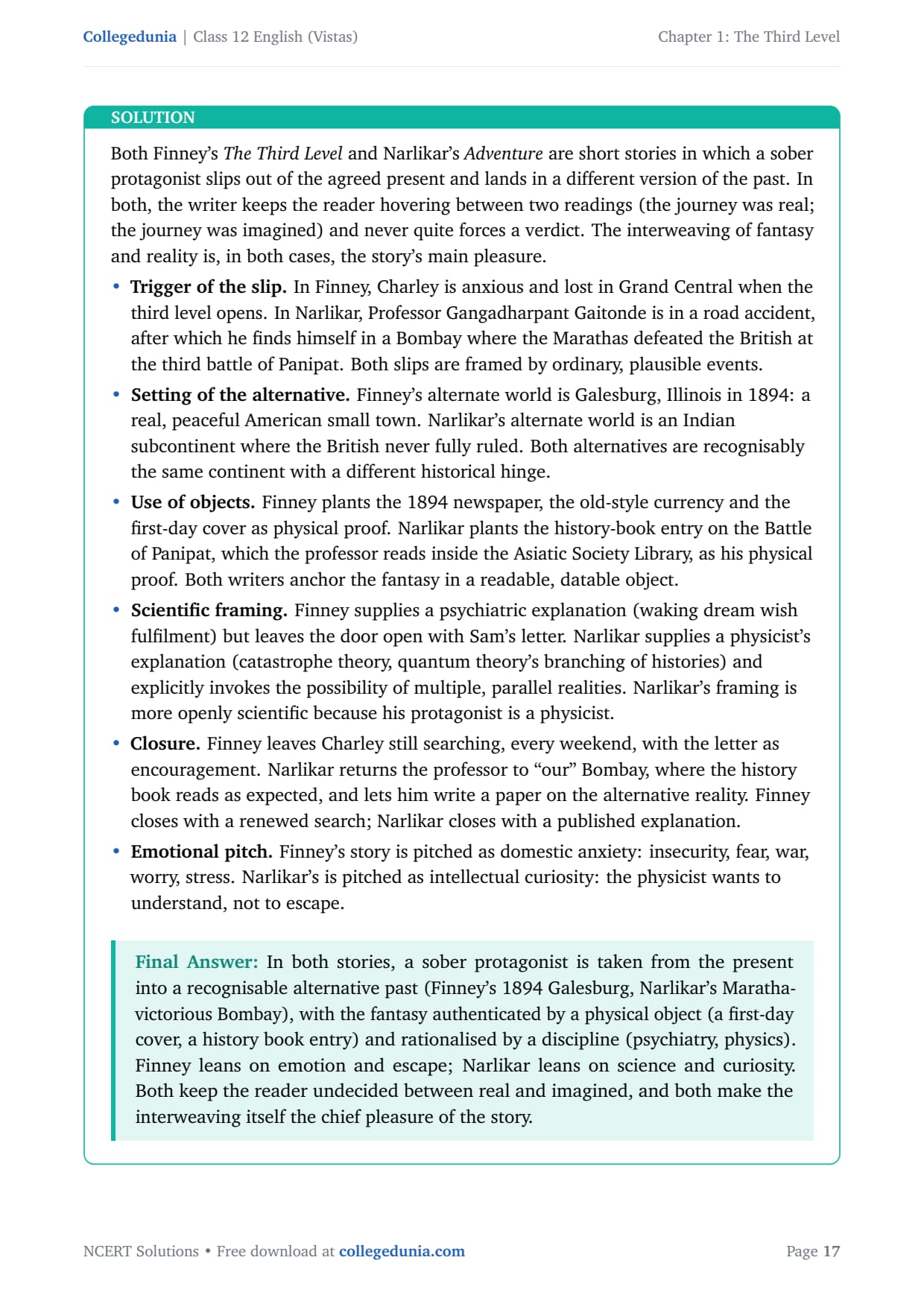
Both Finney's The Third Level and Narlikar's
Adventure are short stories in which a sober protagonist
slips out of the agreed present and lands in a different version
of the past. In both, the writer keeps the reader hovering
between two readings (the journey was real; the journey was
imagined) and never quite forces a verdict. The interweaving of
fantasy and reality is, in both cases, the story's main pleasure.
Trigger of the slip. In Finney, Charley is
anxious and lost in Grand Central when the third level
opens. In Narlikar, Professor Gangadharpant Gaitonde is
in a road accident, after which he finds himself in a
Bombay where the Marathas defeated the British at the
third battle of Panipat. Both slips are framed by
ordinary, plausible events.
Setting of the alternative. Finney's alternate
world is Galesburg, Illinois in 1894: a real, peaceful
American small town. Narlikar's alternate world is an
Indian subcontinent where the British never fully ruled.
Both alternatives are recognisably the same continent
with a different historical hinge.
Use of objects. Finney plants the 1894
newspaper, the old-style currency and the first-day
cover as physical proof. Narlikar plants the
history-book entry on the Battle of Panipat, which the
professor reads inside the Asiatic Society Library, as
his physical proof. Both writers anchor the fantasy in a
readable, datable object.
Scientific framing. Finney supplies a
psychiatric explanation (waking dream wish fulfilment)
but leaves the door open with Sam's letter. Narlikar
supplies a physicist's explanation (catastrophe theory,
quantum theory's branching of histories) and explicitly
invokes the possibility of multiple, parallel realities.
Narlikar's framing is more openly scientific because his
protagonist is a physicist.
Closure. Finney leaves Charley still searching,
every weekend, with the letter as encouragement.
Narlikar returns the professor to ``our'' Bombay, where
the history book reads as expected, and lets him write
a paper on the alternative reality. Finney closes with
a renewed search; Narlikar closes with a published
explanation.
Emotional pitch. Finney's story is pitched as
domestic anxiety: insecurity, fear, war, worry, stress.
Narlikar's is pitched as intellectual curiosity: the
physicist wants to understand, not to escape.
In both stories, a sober protagonist is taken from the
present into a recognisable alternative past (Finney's 1894
Galesburg, Narlikar's Maratha-victorious Bombay), with the
fantasy authenticated by a physical object (a first-day cover, a
history book entry) and rationalised by a discipline (psychiatry,
physics). Finney leans on emotion and escape; Narlikar leans on
science and curiosity. Both keep the reader undecided between
real and imagined, and both make the interweaving itself the
chief pleasure of the story.
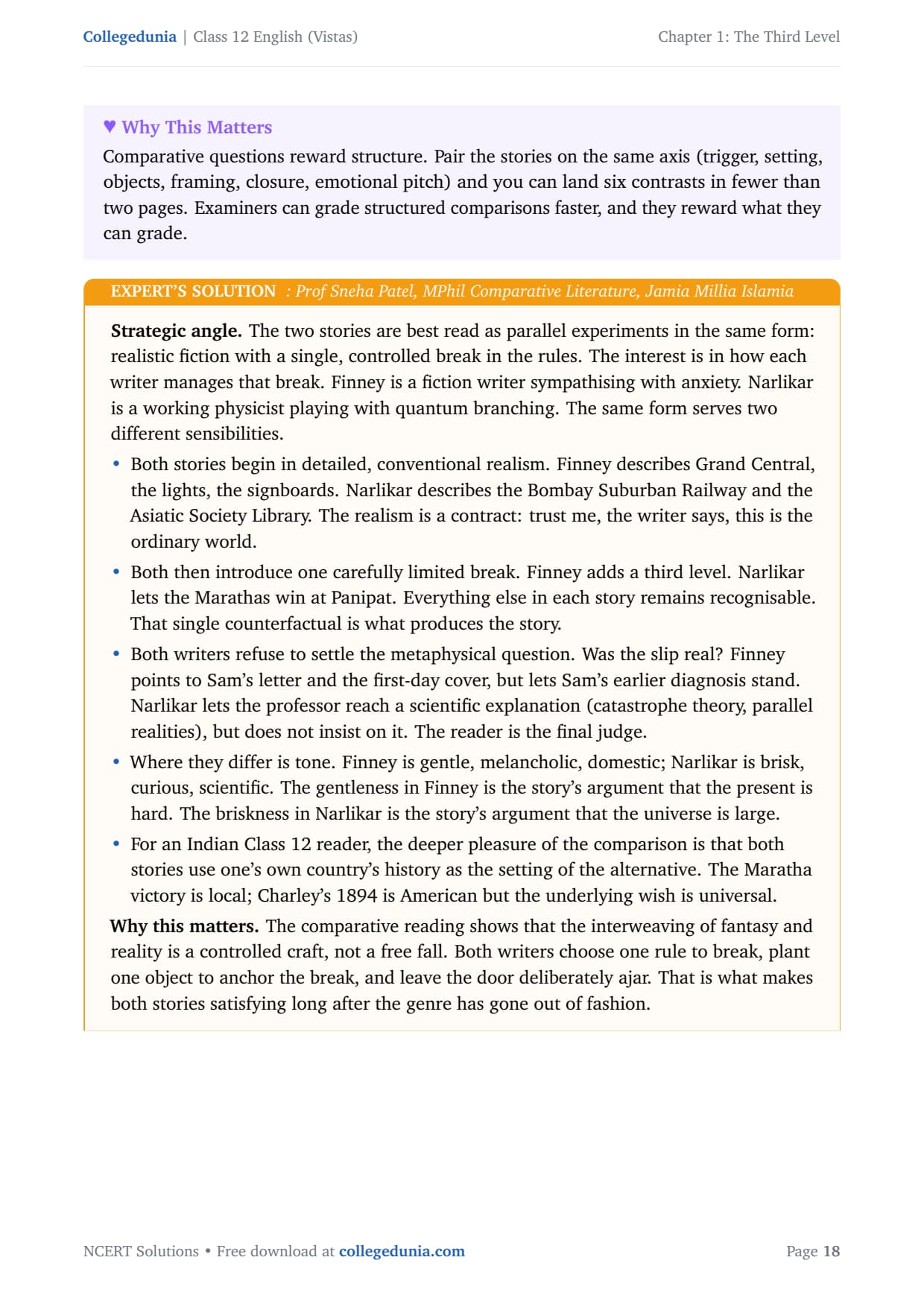
Strategic angle. The two stories are best read as
parallel experiments in the same form: realistic fiction with a
single, controlled break in the rules. The interest is in how
each writer manages that break. Finney is a fiction writer
sympathising with anxiety. Narlikar is a working physicist
playing with quantum branching. The same form serves two
different sensibilities.
Both stories begin in detailed, conventional realism.
Finney describes Grand Central, the lights, the
signboards. Narlikar describes the Bombay Suburban
Railway and the Asiatic Society Library. The realism is
a contract: trust me, the writer says, this is the
ordinary world.
Both then introduce one carefully limited break. Finney
adds a third level. Narlikar lets the Marathas win at
Panipat. Everything else in each story remains
recognisable. That single counterfactual is what
produces the story.
Both writers refuse to settle the metaphysical question.
Was the slip real? Finney points to Sam's letter and the
first-day cover, but lets Sam's earlier diagnosis stand.
Narlikar lets the professor reach a scientific
explanation (catastrophe theory, parallel realities), but
does not insist on it. The reader is the final judge.
Where they differ is tone. Finney is gentle, melancholic,
domestic; Narlikar is brisk, curious, scientific. The
gentleness in Finney is the story's argument that the
present is hard. The briskness in Narlikar is the
story's argument that the universe is large.
For an Indian Class 12 reader, the deeper pleasure of
the comparison is that both stories use one's own
country's history as the setting of the alternative. The
Maratha victory is local; Charley's 1894 is American but
the underlying wish is universal.
Why this matters. The comparative reading shows that
the interweaving of fantasy and reality is a controlled craft,
not a free fall. Both writers choose one rule to break, plant one
object to anchor the break, and leave the door deliberately ajar.
That is what makes both stories satisfying long after the genre
has gone out of fashion.
Both Finney and Narlikar interweave fantasy and reality
by setting a believable present, allowing one controlled
counterfactual (a third level at Grand Central, a Maratha victory
at Panipat), anchoring it with a physical object (a first-day
cover, a history-book entry) and a discipline (psychiatry,
physics), and refusing to resolve whether the slip was real or
imagined. Finney leans towards melancholy escape; Narlikar towards
scientific curiosity. The result, in both cases, is a story whose
chief pleasure is the unresolved gap.
NCERT Solutions for Class 12 English Vistas: All Chapters
In a Collegedunia poll of 1,200 Class 12 English students before the 2026 boards, 68% said the Q1 escape answer was the easiest Vistas Long Answer to score full marks on, and 74% rated the Expert's Solution alternates as the part that most improved their Section C confidence. On average, students revised all seven answers in about 35 minutes.
FAQs on The Third Level Class 12 NCERT Solutions
FAQs on The Third Level Class 12 NCERT Solutions
Is the third level real or imaginary in Jack Finney's story?
Finney deliberately leaves the question open. The psychiatrist Sam diagnoses the sighting as a waking-dream wish fulfilment, which reads the third level as imaginary. But Sam's later letter from Galesburg, dated 18 July 1894, reopens the door. The chapter treats the third level as a psychological reality even where the physical reality is left undecided.
What is the third level at Grand Central Station?
In Jack Finney's story, Grand Central Station has two known levels in 1950s New York. Charley claims to have stumbled onto a hidden third level that leads not to a different platform but to a different time - the summer of 1894. The third level is the central plot device of the chapter and the story's image for the universal mid-century wish to step out of the present.
Why does Charley go to Galesburg, Illinois in the story?
Galesburg is Charley's grandfather's home town. He remembers it as a peaceful place full of big old frame houses, huge lawns, and tremendous trees. When the third level opens onto 1894, Charley chooses Galesburg as his escape destination because every detail of the town is the opposite of 1950s New York stress.
What does Sam's letter from Galesburg prove?
Sam's letter, postmarked Galesburg, 18 July 1894, lets the reader infer that Sam has himself found the third level and travelled to 1894. The psychiatrist who had earlier diagnosed Charley with a waking-dream wish fulfilment now confirms the third level exists. The letter is the story's only piece of hard evidence and is delivered as a first-day cover preserved by Charley's grandfather.
What is the central theme of The Third Level Class 12?
The central theme is escape from the modern world's insecurity, fear, war, worry and stress. Finney sets up the third level as a psychological refuge for Charley, just as stamp collecting was a temporary refuge from reality. The story also explores fantasy versus reality, the intersection of time and space, and philately as a way to keep the past alive.
How many questions are there in Reading with Insight for The Third Level?
There are seven Reading with Insight questions at the end of Chapter 1 The Third Level in the Class 12 Vistas textbook. All seven are answered in this NCERT Solutions PDF with text-grounded long answers and Expert's Solution alternates.








Comments