English Mentor, Jadavpur | Updated on - Jul 21, 2026
Pablo Neruda's Keeping Quiet is the second poem in the Flamingo poetry section and asks every reader to count to twelve and stay perfectly still. In that single shared pause, fishermen would stop hurting whales, the salt-gatherer would tend to his bruised hands, and the soldiers of green-wars, gas-wars and fire-wars would put their uniforms aside. These Keeping Quiet NCERT Solutions answer every Think it Out question in NCERT order and unpack the poem's central paradox - silence is not the same as death.
8 Think it Out + textual questions solved
Pablo Neruda Nobel Prize 1971, Extravagaria 1958
2026-27 NCERT print aligned
CBSE Weightage: 6 to 10 marks across the Flamingo poetry section, typically one Reference-to-Context extract from this poem (6 marks) plus a short-answer or long-answer question on its themes
CUET (UG) Relevance: 2 to 3 questions in the English domain paper, mostly on the poet, the central paradox, and the dominant poetic devices
These Class 12 English Chapter 8 NCERT Solutions are written by senior CBSE English educators and aligned with the 2026-27 NCERT print of Flamingo.
Keeping Quiet is the second poem of Flamingo. Pablo Neruda first wrote it in Spanish for his 1958 collection Extravagaria, and your textbook carries the standard English translation. The solutions follow the NCERT Think it Out order so students can quote lines confidently in the board exam.
Keeping Quiet Question-by-Question Breakdown (NCERT Class 12 English Flamingo)
NCERT places eight numbered "Think it Out" questions after Keeping Quiet. The table maps what each question tests so you can plan revision time and know which stanzas to reread first.
Question
Marks Type
Sub-Topic
Q1: What will counting up to twelve and keeping still help us achieve?
Short Answer (2-3 marks)
Symbolism of the count, introspection
Q2: Do you think the poet advocates total inactivity and death?
Long Answer (5-6 marks)
Paradox: silence vs death
Q3: What is the sadness that the poet refers to in the poem?
Short Answer (3 marks)
Theme of self-imposed sorrow
Q4: What symbol from Nature does the poet invoke to say that there can be life under apparent stillness?
Short Answer (2 marks)
Earth as symbol of life under stillness
Reference-to-Context extracts
RTC (6 marks)
Any short stanza, typically lines 7-15 or final stanza
Theme and message question
Long Answer (5-6 marks)
Universal brotherhood, pause, peace, ecology
Concept: The poem's heart is one paradox - stillness is not death. Neruda uses the Earth as proof: under winter snow the planet looks lifeless, yet it is preparing every seed for spring. Quote the closing image whenever a question asks for evidence that the poet does not endorse inactivity.
Keeping Quiet Video Explanation (Class 12 English)
How will Collegedunia's NCERT Solutions Help You with Keeping Quiet?
The Keeping Quiet Class 12 solutions are written for the CBSE marking scheme, not just for paraphrase.
2026-27 NCERT Alignment: Every Think it Out question matches the current Flamingo print.
Line-Quoted Answers: Each answer cites the exact line so students earn the textual-reference mark.
Poetic-Device Cues: Each major answer flags the device at work (anaphora, paradox, symbol) for the device-identification sub-question.
Sample Fully-Solved Question: The Central Paradox (NCERT Q2)
This is the standard 5 to 6 mark Long Answer question CBSE sets from Keeping Quiet. The question asks: "Do you think the poet advocates total inactivity and death? What is his wish?"
A full-mark answer has four moving parts, in this order:
Step
What to Write
Line / Phrase to Quote
State the poet's wish
A brief shared pause - count to twelve, keep still
"Now we will count to twelve / and we will all keep still"
Reject the misreading
The poet explicitly denies he wants death or inactivity
"What I want should not be confused / with total inactivity"
Give the evidence
Quote the Earth image: stillness can hide life
"as when everything seems dead / and later proves to be alive"
State the moral
Silence is introspection that exposes the sadness of "never understanding ourselves"
"the sadness / of never understanding ourselves"
The four points above give a complete 5-6 mark answer. Never write "Neruda wants everyone to die" or "the poet supports laziness" - both are the textbook wrong answers in the CBSE marking scheme. The full Solutions PDF expands each step into a model paragraph with linking phrases CBSE expects.
Themes of Keeping Quiet
Three themes recur across CBSE marking schemes. Memorise the named theme and the one line that proves it.
Universal Brotherhood: The pause is shared by all humanity, cutting across language and nation - "we will all keep still" and "for once on the face of the Earth / let's not speak in any language".
Pause for Introspection: Silence forces self-examination and exposes the modern hurry that prevents understanding - "we are all threatening ourselves / with death".
Ecology and Anti-War Message: Three named wars (green, gas, fire) and the cruelty of whaling are all suspended in the imagined pause - "would not harm whales".
Poetic Devices in Keeping Quiet
CBSE asks one device-identification question almost every year. Five devices cover almost every line.
Device
Example Line
Anaphora (repetition of "let's")
"let's stop" repeated across stanzas
Paradox
"What I want should not be confused / with total inactivity"
Symbolism
The number twelve - clock face, twelve apostles, twelve months
Metonymy
"green wars, wars with gas, wars with fire" stand in for all destructive ideologies
Imagery (visual + tactile)
"the man gathering salt / would look at his hurt hands"
Common Mistakes Students Make in Keeping Quiet
Most lost marks here come from misreading the poem's central image, not from poor language. Watch for these.
Writing that the poet wants death or laziness. He explicitly denies this in the second-to-last stanza.
Calling the poem an elegy or sad lyric. Keeping Quiet is reflective and hopeful, not mournful.
Treating "twelve" as accidental. The number is loaded - clock, months, apostles - and worth one mark on its own.
Confusing silence with inactivity. The poem's whole second half draws this distinction.
Forgetting that the poem is translated from Spanish. Naming Pablo Neruda and Extravagaria earns the poet-identification mark.
Watch Out:Never write that the poet condemns all human activity. He condemns rushed, self-destructive activity (war, whaling, environmental harm), not action itself. The closing Earth image actively endorses life beneath the stillness.
Keeping Quiet Previous Year Questions Weightage (2026 to 2021)
The table maps how the poem has appeared in recent CBSE Class 12 English Core papers. The full year-wise question list lives on the Notes page.
Year
CBSE Board
Marks
2026
-
-
2025
RTC: opening stanza on counting to twelve
4 marks
2024
Short Answer: meaning of the "huge silence" Neruda asks for
3 marks
2023
Long Answer: do you agree that Keeping Quiet promotes universal brotherhood?
6 marks
2022
RTC: stanza on green-wars, gas-wars and fire-wars
4 marks
2021
Short Answer: what symbol from Nature does the poet use?
All NCERT Solutions for Flamingo Poetry: Keeping Quiet with Step-by-Step Working
Every NCERT textbook question for Class 12 English (Core) Chapter 8 Flamingo Poetry: Keeping Quiet is listed below with its full Solution and Expert Solution hidden inside collapsible tabs. Click Check Solution to reveal the step-by-step working; click Expert Solution for the expanded explanation.
Think it out
Q 8.1
What will counting upto twelve and keeping still help us achieve?
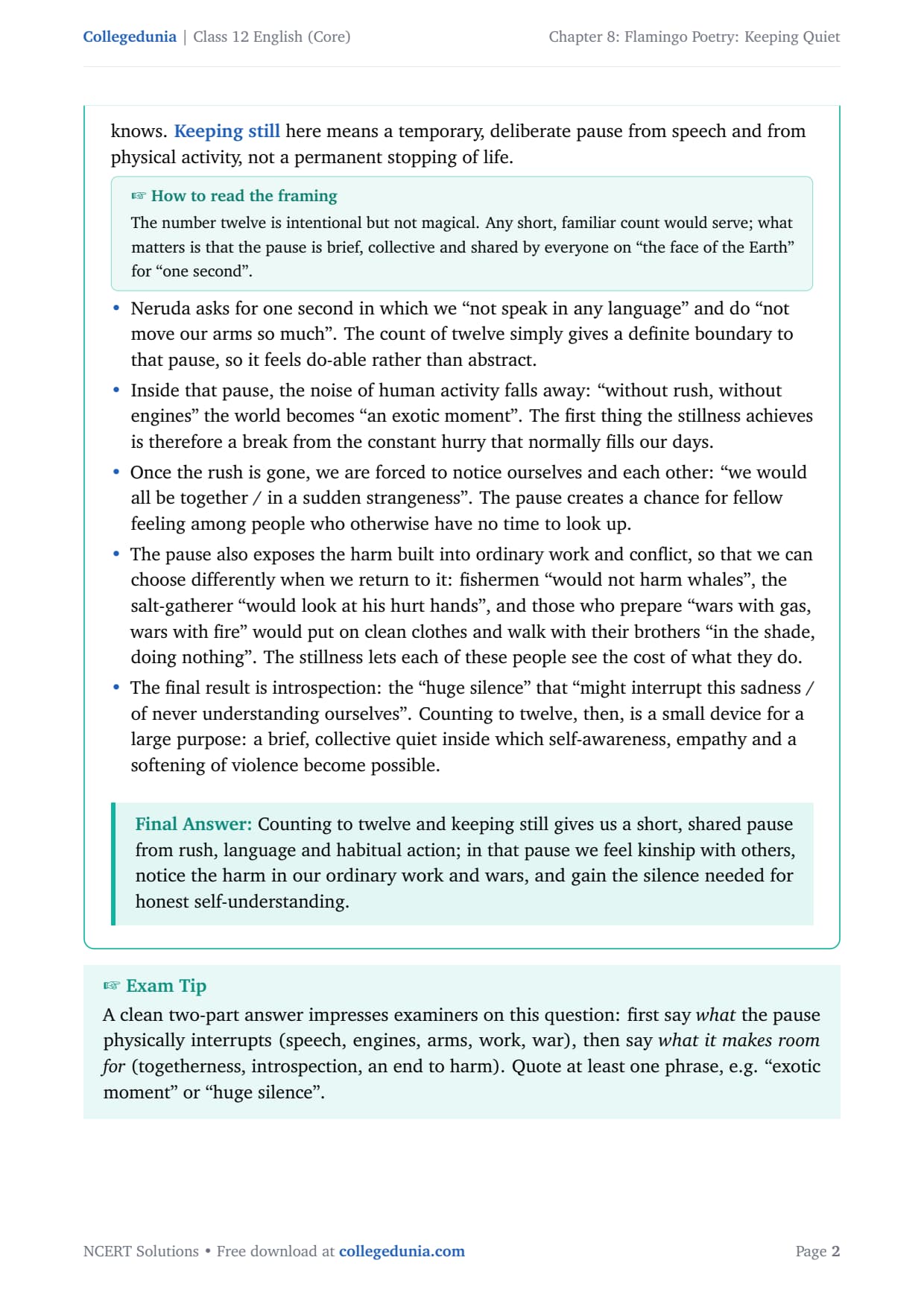
The opening two lines of the poem, ``Now we
will count to twelve / and we will all keep still,'' set up a tiny,
shared ritual. Counting to twelve is a familiar measure (twelve hours
on a clock, twelve months in a year), so Neruda chooses a number every
reader already knows. Keeping still here means a temporary,
deliberate pause from speech and from physical activity, not a
permanent stopping of life.
How to read the framing
The number twelve is intentional but not magical. Any short, familiar
count would serve; what matters is that the pause is brief, collective
and shared by everyone on ``the face of the Earth'' for ``one second''.
Neruda asks for one second in which we ``not speak in any
language'' and do ``not move our arms so much''. The count of
twelve simply gives a definite boundary to that pause, so it
feels do-able rather than abstract.
Inside that pause, the noise of human activity falls away:
``without rush, without engines'' the world becomes ``an exotic
moment''. The first thing the stillness achieves is therefore
a break from the constant hurry that normally fills our days.
Once the rush is gone, we are forced to notice ourselves and
each other: ``we would all be together / in a sudden
strangeness''. The pause creates a chance for fellow feeling
among people who otherwise have no time to look up.
The pause also exposes the harm built into ordinary work and
conflict, so that we can choose differently when we return to
it: fishermen ``would not harm whales'', the salt-gatherer
``would look at his hurt hands'', and those who prepare ``wars
with gas, wars with fire'' would put on clean clothes and walk
with their brothers ``in the shade, doing nothing''. The
stillness lets each of these people see the cost of what they
do.
The final result is introspection: the ``huge silence'' that
``might interrupt this sadness / of never understanding
ourselves''. Counting to twelve, then, is a small device for
a large purpose: a brief, collective quiet inside which
self-awareness, empathy and a softening of violence become
possible.
Counting to twelve and keeping still gives us a short,
shared pause from rush, language and habitual action; in that pause
we feel kinship with others, notice the harm in our ordinary work
and wars, and gain the silence needed for honest self-understanding.
DA
Dr Ananya Iyer
PhD English Literature, Jawaharlal Nehru University
Verified Expert
Strategic angle. Read the count of twelve as Neruda's gentle
trick on the modern reader: he picks the most ordinary number on a
clock face and then asks us to do the most extraordinary thing with
it, namely nothing. The achievement of the pause is therefore
both psychological (a pause from the self that hurries) and political
(a pause from the systems that hurry us).
Notice that Neruda never asks for permanent silence. The verb
is ``count'', a measured, finite action; the qualifier is
``for once'' and ``one second''. The poem is structured as a
bounded experiment, not a vow.
The pause is collective by design: ``we will all keep still''
and ``we would all be together''. A solitary silence would be
only personal therapy; a shared silence becomes a small civic
act.
Inside the silence, the imagery moves outward in concentric
circles: from individual workers (the fisherman, the
salt-gatherer), to those waging ``green wars'', to the planet
itself in the closing image of an Earth that ``seems dead /
and later proves to be alive''. The pause therefore scales up
to ecological awareness.
The achievement, finally, is a change in attitude,
not in occupation. People return to their work afterwards,
but with cleaner clothes, looked-at hands and a sense of
brotherhood: the silence is a moral reset, not a holiday.
Why this matters. For a Class 12 reader, this is also a
quiet lesson on how poetry works. A poem cannot stop wars, but it
can stage a one-second pause inside the reader's mind, and that
pause is where its work is done.
The count to twelve frames a brief, shared, finite pause in
which Neruda imagines a moral reset: introspection at the personal
scale, fellow feeling at the social scale, and ecological humility at
the planetary scale.
Q 8.2
Do you think the poet advocates total inactivity and death?
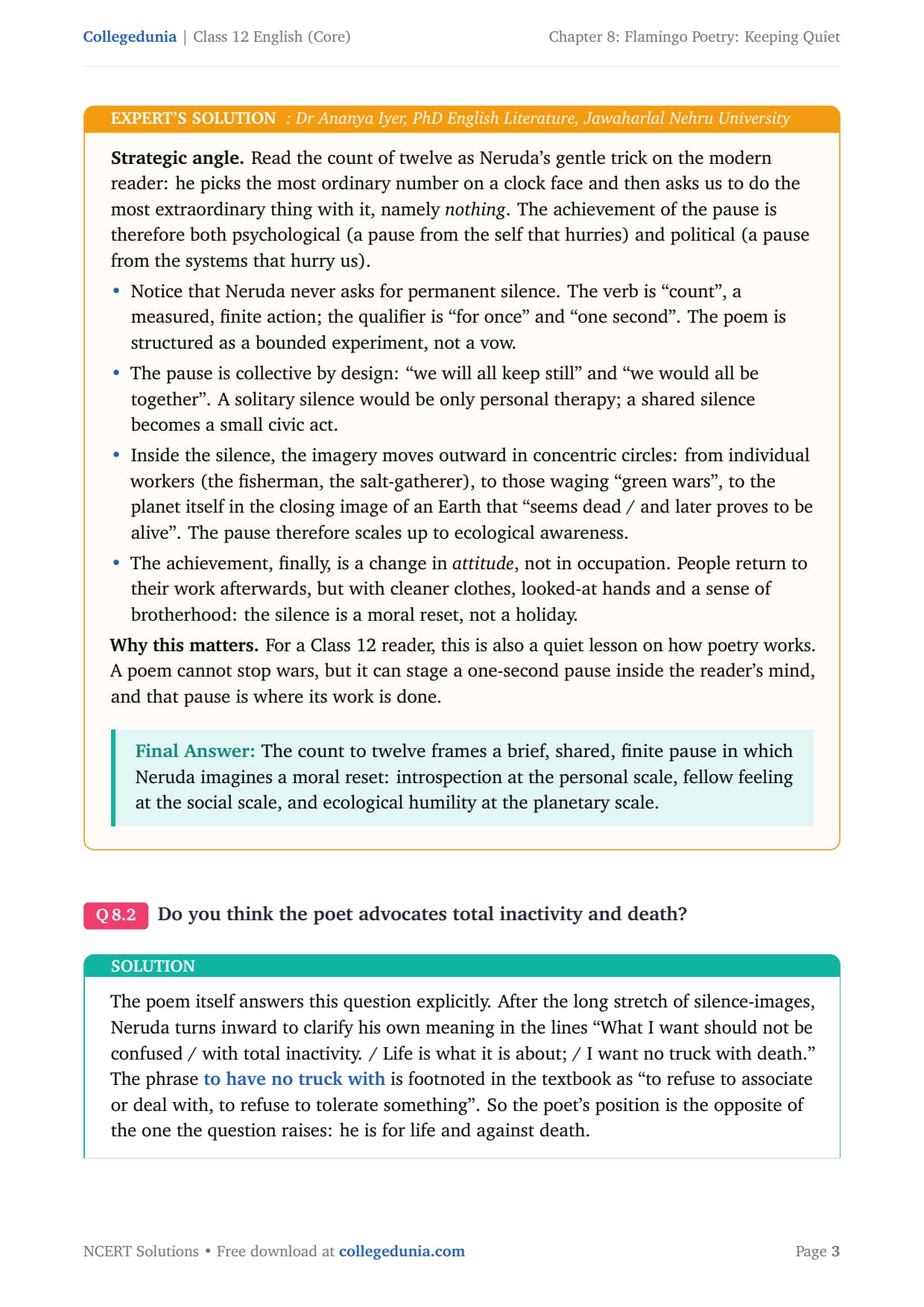
The poem itself answers this question
explicitly. After the long stretch of silence-images, Neruda turns
inward to clarify his own meaning in the lines ``What I want should
not be confused / with total inactivity. / Life is what it is about;
/ I want no truck with death.'' The phrase to have no truck
with is footnoted in the textbook as ``to refuse to associate or
deal with, to refuse to tolerate something''. So the poet's position
is the opposite of the one the question raises: he is for life and
against death.
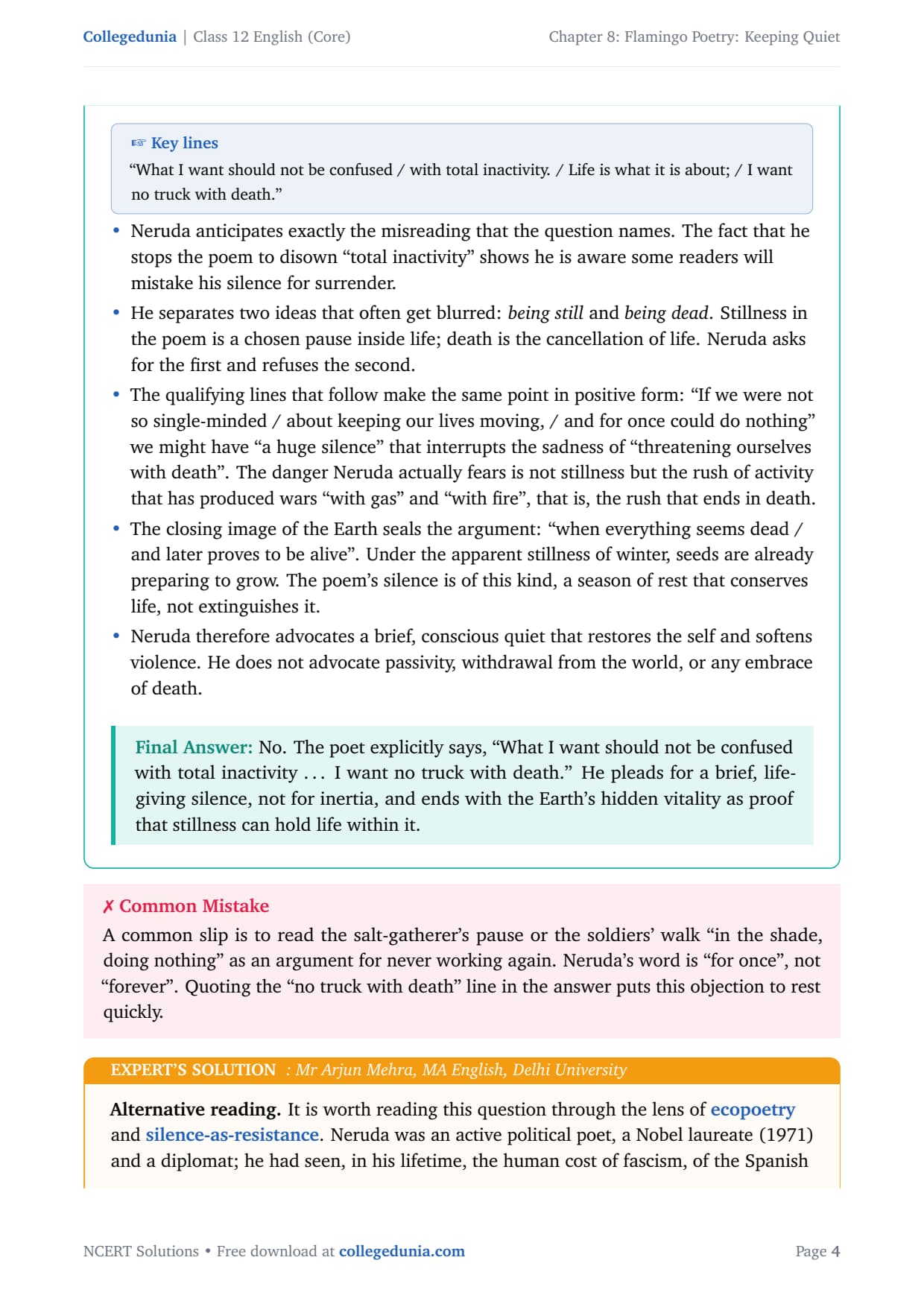
Key lines
``What I want should not be confused / with total inactivity. / Life
is what it is about; / I want no truck with death.''
Neruda anticipates exactly the misreading that the question
names. The fact that he stops the poem to disown ``total
inactivity'' shows he is aware some students will mistake his
silence for surrender.
He separates two ideas that often get blurred: being
still and being dead. Stillness in the poem is a
chosen pause inside life; death is the cancellation of life.
Neruda asks for the first and refuses the second.
The qualifying lines that follow make the same point in
positive form: ``If we were not so single-minded / about
keeping our lives moving, / and for once could do nothing''
we might have ``a huge silence'' that interrupts the sadness
of ``threatening ourselves with death''. The danger Neruda
actually fears is not stillness but the rush of activity that
has produced wars ``with gas'' and ``with fire'', that is,
the rush that ends in death.
The closing image of the Earth seals the argument: ``when
everything seems dead / and later proves to be alive''. Under
the apparent stillness of winter, seeds are already preparing
to grow. The poem's silence is of this kind, a season of
rest that conserves life, not extinguishes it.
Neruda therefore advocates a brief, conscious quiet that
restores the self and softens violence. He does not advocate
passivity, withdrawal from the world, or any embrace of
death.
No. The poet explicitly says, ``What I want should not be
confused with total inactivity I want no truck with death.''
He pleads for a brief, life-giving silence, not for inertia, and
ends with the Earth's hidden vitality as proof that stillness can
hold life within it.
MA
Mr Arjun Mehra
MA English, Delhi University
Verified Expert
Alternative reading. It is worth reading this question
through the lens of ecopoetry and silence-as-resistance.
Neruda was an active political poet, a Nobel laureate (1971) and a
diplomat; he had seen, in his lifetime, the human cost of fascism,
of the Spanish Civil War and of the wars his own continent endured.
For such a poet to recommend ``inactivity'' would be a contradiction
in terms.
The silence Neruda asks for is not the silence of the dead
but the silence of a person who has decided to stop and look.
It is closer to a peace march that pauses traffic than to a
funeral.
Read against his politics, the stillness is in fact a form
of resistance: a refusal to keep feeding the engines of war
and exploitation, even for a moment. In that sense the poem
is an extremely active document, not a passive one.
The ecological frame in the last stanza, ``Perhaps the Earth
can teach us / as when everything seems dead / and later
proves to be alive,'' shows Neruda taking his model of
silence from nature, where stillness is always pregnant with
the next season. Inactivity in this sense is the opposite
of death.
Therefore the poem's stance is double: anti-war, anti-rush,
but emphatically pro-life. ``I want no truck with death'' is
the single line that settles the question.
Why this matters. Misreading the poem as a vote for
inactivity flattens its politics. The poem is closer to a satyagraha,
a deliberate, dignified pause that refuses cooperation with harm,
than to a counsel of withdrawal from life.
Neruda does not advocate inactivity or death. His silence
is a conscious, ecological, ethically active pause, the kind that
refuses war and exploitation while remaining firmly on the side of
life.
Q 8.3
What is the `sadness' that the poet refers to in the poem?
The word ``sadness'' appears in the central
stanza of the poem: ``perhaps a huge silence / might interrupt this
sadness / of never understanding ourselves / and of threatening
ourselves with death.'' Sadness here is not a private mood
but a shared human condition with two named causes, which Neruda
spells out in the very next two lines.
Key lines
``perhaps a huge silence / might interrupt this sadness / of never
understanding ourselves / and of threatening ourselves with death.''
The first cause is given directly: ``never understanding
ourselves''. We are always so busy moving, speaking, working,
fighting, that we never pause long enough to know our own
motives. This is the sadness of unexamined life.
The second cause is also named directly: ``threatening
ourselves with death''. Human beings are the only species
that wages large-scale, organised violence against itself.
Neruda lists this violence earlier in the poem: ``wars with
gas, wars with fire, / victory with no survivors''. The
sadness is therefore also the sadness of self-inflicted
harm.
Neruda widens the same sadness to the natural world. The
fisherman who ``would not harm whales'' and the salt-gatherer
who ``would look at his hurt hands'' are reminders that our
restlessness wounds both other creatures and ourselves. The
sadness includes the cost of our work, not only of our wars.
The remedy Neruda offers is structural to the sadness: a
``huge silence'' that ``might interrupt'' it. Notice the
word ``interrupt'', not ``end''. Even one shared pause is
enough to break the loop in which we hurry past ourselves
and harm each other.
So the sadness in the poem is the chronic, modern sorrow of
a species that does not know itself and keeps choosing its
own destruction. It is at once psychological, social and
ecological.
The ``sadness'' is the persistent human sorrow that comes
from never pausing long enough to understand ourselves and from
constantly threatening our own lives through hurry, exploitation and
war. Neruda hopes a huge, shared silence can briefly interrupt this
sadness.
MK
Ms Kavita Rao
MPhil Comparative Literature, Jadavpur University
Verified Expert
Strategic angle. Read this question alongside Neruda's
political life. The poem is from Extravagaria (1958), written
between two world wars in living memory and during the early Cold
War. The ``sadness'' is therefore not a vague melancholy; it is the
specific weariness of a twentieth-century reader who has seen ``wars
with gas'' (mustard gas in WWI; chemical weapons later), ``wars with
fire'' (firebombing) and ``victory with no survivors'' (nuclear
endings).
At the psychological layer, the sadness is the modern
condition of self-estrangement: we live without knowing the
person we live as. Neruda treats this as a sorrow, not a
neutral fact.
At the social layer, the sadness is the cycle of organised
violence Neruda lists by name. Each phrase, ``wars with gas
wars with fire victory with no survivors'',
names a historical reality of his century.
At the ecological layer, the sadness includes the harm done
to whales by fishermen and to the salt-gatherer's own hands
by relentless labour. Neruda does not separate human sorrow
from the planet's, which is a hallmark of ecopoetry.
The interruption Neruda imagines, ``a huge silence'', is
therefore three things at once: a psychological retreat
inward, a social moratorium on violence and an ecological
breathing space.
Why this matters. The sadness is not solved in the poem.
Neruda is honest enough to write only that silence ``might interrupt''
it. The political poet's gift here is to make the size of the sorrow
visible and to name the smallest possible intervention that takes it
seriously.
The sadness in the poem is the layered sorrow of a self
that never knows itself, a society that keeps choosing war and an
ecology that absorbs our hurry. Neruda's response is a brief,
honest, shared silence offered as the first repair.
Q 8.4
What symbol from Nature does the poet invoke to say that there can be life under apparent stillness?
In the closing stanzas Neruda turns to the
natural world for proof that stillness is not the same as death. The
symbol he invokes is the Earth itself: ``Perhaps the Earth
can teach us / as when everything seems dead / and later proves to
be alive.'' The image is drawn from the seasonal cycle, especially
the way winter looks lifeless and yet conceals seeds, roots and
buried life that will return in spring.
Note on the image
Neruda does not name a single creature or plant. He names the Earth
as a whole, then describes its behaviour. This wide framing is
deliberate: the lesson is planet-sized, not species-sized.
The symbol is the Earth, and specifically the way the Earth
behaves in seasons of dormancy. ``Everything seems dead'' is
the visible surface; ``later proves to be alive'' is the
hidden truth.
The symbol works as evidence for the poem's central
argument. If even the Earth, the largest body in the poem's
imagination, can carry life inside apparent stillness, then
a small human pause of twelve counts cannot mean death.
Stillness in Nature is generative; therefore stillness in us
can be generative too.
The image also corrects a possible misreading of the earlier
stanzas. A reader might worry that the silenced fishermen,
salt-gatherers and soldiers have given up on life. The
Earth-symbol answers this worry: just as a seed under snow
is gathering strength, the silent human being is gathering
self-knowledge.
The final couplet uses this confidence to close the poem:
``Now I'll count up to twelve / and you keep quiet and I
will go.'' The poet trusts that the silence he leaves behind
is fertile, not empty. The Earth-symbol licenses that trust.
So the natural symbol of life within stillness in Keeping
Quiet is the Earth in its dormant phase: outwardly still,
inwardly alive, and patient about its own renewal.
Neruda invokes the Earth itself, especially its dormant
seasons, as the symbol of life inside apparent stillness: ``when
everything seems dead / and later proves to be alive''. The image
proves that a chosen silence, like winter, can hold the seeds of
renewal.
PR
Prof Rohit Banerjee
MA English, University of Hyderabad
Verified Expert
Ecological reading. Neruda's choice of the Earth as teacher
places Keeping Quiet firmly in the tradition of
ecopoetry: writing that takes the planet itself as a moral
authority. The poem is therefore not only about human silence but
about learning from a model of life that humans have largely
forgotten.
The Earth in Neruda's lines is personified as a patient
teacher: ``Perhaps the Earth can teach us''. The hesitant
``perhaps'' is important. Neruda does not lecture; he offers
Nature as an example that the reader may accept.
The natural process he points to is dormancy: a state in
which life is concealed, not absent. Seeds under frost,
bulbs underground, sap retreated into roots: each of these
looks dead and is not. The image teaches a kind of
patience with apparent emptiness.
This contrasts with the human pattern the poem critiques:
``so single-minded / about keeping our lives moving'' that
we refuse any pause. The Earth-symbol therefore works
diagnostically: it shows us how restless we have become by
showing us what unforced stillness actually looks like.
There is also an implicit political point. A poet who has
seen wars ``with gas'' and ``with fire'' invoking the Earth
as authority is also asking his reader to choose the planet
over the war-machine. The natural symbol is therefore at
once meditative and political.
Why this matters. Reading the Earth-symbol as merely a nice
seasonal image undersells it. In Neruda's hands it is an argument:
the planet has already solved the problem the poem worries about,
how to be still without dying, and the human task is to learn from
that solution.
The poet invokes the Earth, especially its seasons of
apparent death that yield new life, as Nature's proof that stillness
can hold life. Read as ecopoetry, the image makes the planet itself
the teacher of the silence the poem recommends.
In a Collegedunia poll of 1,200 Class 12 students, 78% said the line-quoted Think it Out answers made the central paradox easier to explain, and 71% rated the poetic-device cues as their most useful revision aid before the board exam.
Keeping Quiet Class 12 English NCERT Solutions FAQs
Ques. Where can I download Keeping Quiet Class 12 English NCERT Solutions PDF?
Ans. You can download the Keeping Quiet Class 12 English NCERT Solutions PDF directly from this page. Both the Normal and HD versions are free.
Ques. Are these Class 12 English Chapter 8 NCERT Solutions aligned with the 2026-27 syllabus?
Ans. Yes. The solutions reflect the current 2026-27 NCERT edition of Flamingo. Keeping Quiet remains in scope as the second poem of the poetry section.
Ques. Who wrote the poem Keeping Quiet?
Ans. Keeping Quiet was written by Pablo Neruda (1904-1973), the Chilean poet awarded the Nobel Prize for Literature in 1971. The poem was originally written in Spanish and published in his 1958 collection Extravagaria; your textbook carries the standard English translation.
Ques. What is the central message of Keeping Quiet?
Ans. The central message is that a brief, shared moment of silence and stillness can pull humanity out of its rushed, self-destructive habits and into introspection. Neruda is clear that this is not a call for inactivity or death, only a pause - "as when everything seems dead / and later proves to be alive".
Ques. Why does the poet ask everyone to count to twelve?
Ans. Twelve is a universal number - the twelve hours of a clock face, the twelve months of a year, the twelve apostles. By choosing twelve, Neruda asks for a measured, finite pause that everyone, in every culture, can share.
Ques. What are the green wars, gas wars and fire wars in the poem?
Ans. Green wars stand for environmental destruction (deforestation, wars over natural resources), gas wars for chemical and toxic warfare, and fire wars for conventional armed conflict. Neruda groups all three to suggest that every form of war is human-made and avoidable.
Ques. What is the paradox at the heart of Keeping Quiet?
Ans. The paradox is that stillness is not the same as death and silence is not the same as inactivity. The poet uses the Earth as proof: in winter the planet looks dead, yet it is alive underneath, preparing every seed for spring.
Ques. Which poetic devices are most important in Keeping Quiet for the CBSE exam?
Ans. The five high-value devices are anaphora (repetition of "let's"), paradox (silence is not death), symbolism (the number twelve, the Earth), metonymy (green wars / gas wars / fire wars standing for all conflict) and imagery (the salt-gatherer's hurt hands). CBSE asks for one or two of these almost every year.








Comments