




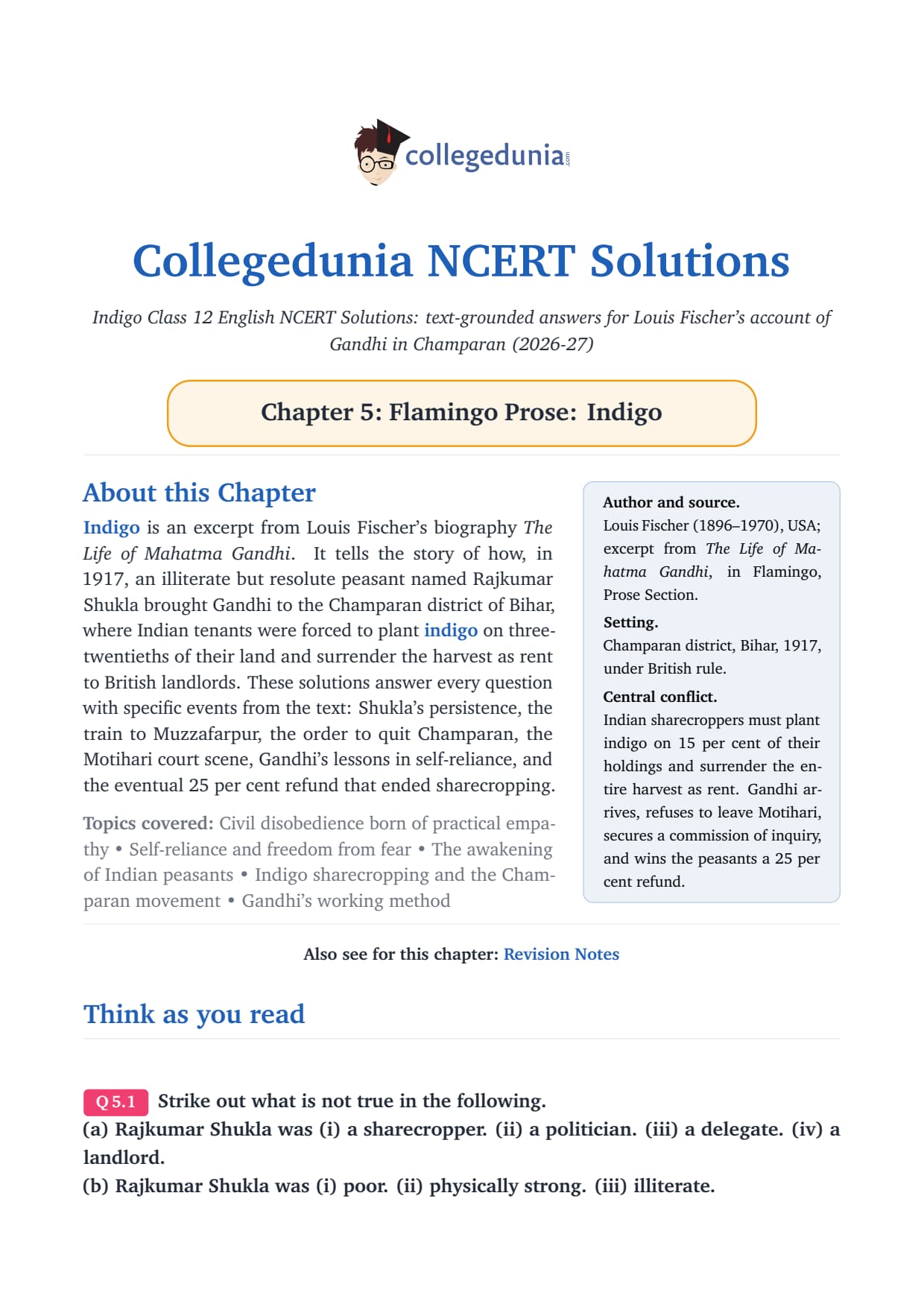
Indigo is Louis Fischer's first-person account of Mahatma Gandhi's 1917 Champaran satyagraha against the indigo sharecropping system. Flamingo Prose: Indigo is a high-yield Long Answer chapter for CBSE Boards (8 to 10 marks) and a recurring CUET prompt. The Class 12 English NCERT Solutions Chapter 5 Flamingo Prose: Indigo on this page covers the 2026-27 PDF, every textbook question solved, and the 2025 question pattern.
- CBSE Weightage: 8 to 10 marks (one 5 to 6 mark long answer plus one 3 to 4 mark short answer in most years)
- CUET Weightage: 1 to 2 reading comprehension stems built around an Indigo extract per year
- Question Types: Long Answer (LA), Short Answer (SA), Extract-Based Reading Comprehension
The complete NCERT Solutions for Flamingo Prose Indigo, covering every Think as You Read, Understanding the Text, Talking about the Text, and Working with Words item, are in the article below.
These NCERT Solutions are curated by Collegedunia's English subject experts, mapped to the 2026-27 NCERT Flamingo textbook, and refined against the last five years of CBSE Class 12 Board English Core papers.

How will Collegedunia's Class 12 English NCERT Solutions Chapter 5 Flamingo Prose: Indigo Help You Score Full Marks?
Indigo has 13 textbook prompts across four task blocks, and CBSE examiners reward specific textual references over generic praise of Gandhi. Collegedunia's solutions are built for that scoring pattern.
- 2026-27 NCERT Alignment: Every prompt is answered against the current Flamingo edition page numbering.
- Textual Evidence in Every Answer: Each long answer cites at least two specific incidents, the marking-scheme rule for the 5 and 6 mark slots.
- Expert Verification: Subject experts reviewed every answer against the CBSE marking scheme from the 2024 and 2025 papers.
- Word-Count Discipline: Long answers stay in the 120 to 150 word band; short answers stay at 40 to 50 words.
Indigo Video Explanation (Class 12 English)
Source: Magnet Brains on YouTube
Class 12 English NCERT Solutions Chapter 5 Flamingo Prose: Indigo Exercise-by-Exercise Breakdown
The Flamingo textbook splits Indigo across four named blocks. The table maps each block to its prompt count, word band, and dominant question type.
| Question Block | Prompts | Word Band | Dominant Type |
|---|---|---|---|
| Think as You Read | 4 | 30 to 50 words | Comprehension recall |
| Understanding the Text | 2 | 120 to 150 words | Long Answer (Theme / Character) |
| Talking about the Text | 2 | 120 to 150 words | Discussion / Opinion |
| Working with Words | 1 (sub-parts) | One line each | Vocabulary in context |

Indigo Class 12 English Previous Year Questions Weightage (2021 to 2026)
Indigo prompts have appeared in five of the last six sessions, with the Champaran civil-disobedience theme and Rajkumar Shukla's persistence as the most repeated angles.
| Year | CBSE Board | Marks | Theme |
|---|---|---|---|
| 2026 | Indigo as a turning point in India's freedom struggle | 5 | Civil disobedience |
| 2025 | Rajkumar Shukla's role in bringing Gandhi to Champaran | 6 | Character |
| 2024 | Self-reliance lesson taught by Gandhi at Champaran | 5 | Theme |
| 2023 | How Gandhi's leadership freed the peasants from fear | 6 | Leadership |
| 2022 | - | - | Term-wise paper, Indigo not asked |
| 2021 | Significance of the 25 percent refund settlement | 4 | Symbolism |
Common Mistakes Students Make in Indigo Long Answers
The CBSE marking scheme penalises three predictable mistakes in the 5 and 6 mark slots. Avoid all three to stay in the top band.
- Vague generalisation: Calling Gandhi a great leader without the Motihari hearing, Shukla's persistence, or the 25 percent refund costs 2 marks in the analysis slot.
- Missing chronology: Lucknow Congress (Dec 1916) precedes the Motihari trial (April 1917), which precedes the refund. Examiners look for this sequence.
- Skipping the self-reliance theme: Gandhi's refusal of Andrews's help makes the chapter examinable; missing it loses the thematic mark.
Impact: These three mistakes typically cost 3 of the 6 marks, dropping a Band-A answer to Band-C.
Sample Fully-Solved Question Walk-Through: The Champaran Episode
This solved sample shows the marking-scheme structure for a 6-mark Indigo long answer, using the most repeated CBSE phrasing from 2023 and 2025.
Introduction (1 mark): The Champaran satyagraha of 1917 is the first practical use of Gandhi's civil-disobedience method on Indian soil. Louis Fischer presents it as the moment the freedom struggle moved from elite resolutions to peasant action.
Body (4 marks): Rajkumar Shukla followed Gandhi for weeks at the 1916 Lucknow Congress until Gandhi agreed to visit Bihar. At Motihari, the magistrate ordered Gandhi to leave; he refused, and thousands of peasants gathered outside the court, proving the colonial state could no longer rely on peasant fear. Gandhi accepted a 25 percent refund instead of the offered 50 percent, since forcing any refund mattered more than the amount. He also set up schools, healthcare, and sanitation in Champaran villages to teach self-reliance.
Conclusion (1 mark): Champaran proved Indians could win against the British without violence, and produced the method behind Non-Cooperation, the Salt March, and Quit India.
Class 12 English NCERT Solutions Chapter 5 Flamingo Prose: Indigo Marks Budget for a 6-Mark Long Answer
The CBSE scheme splits the 6 marks across four buckets.
| Mark Bucket | Marks | What the Examiner Looks For |
|---|---|---|
| Content (textual evidence) | 3 | 3+ specific incidents (Lucknow, Motihari, refund, Andrews episode) |
| Theme handling | 1 | Explicit link to civil disobedience or self-reliance |
| Expression and grammar | 1 | Clean syntax, register suited to a Board answer |
| Conclusion | 1 | A one-sentence wrap returning to the prompt |
How to Study Indigo Effectively and Time Required for Chapter 5
Indigo is a 9-page chapter. Recommended study time is 4 to 5 hours across two days plus 1 hour per revision pass.
- Day 1 (2 hours): Read once without stopping; mark every place (Lucknow, Champaran, Motihari) and person (Shukla, Andrews, Kripalani).
- Day 2 (2 hours): Write a 200-word summary in your own words; answer all four Think as You Read prompts.
- Revision pass (1 hour): Attempt one Understanding the Text and one Talking about the Text prompt, timed at 12 minutes each.
- Final 24-hour skim (20 minutes): Re-read the Champaran timeline and the 25 percent refund passage; these power most asked angles.
Common Question Stems CBSE Uses for Indigo
The CBSE paper recycles five phrasings for Indigo. The stem maps straight to the right answer body.
- "Why is the Champaran episode a turning point in India's freedom struggle?" The civil-disobedience-genesis answer.
- "Justify the role of Rajkumar Shukla in the Champaran movement." The determined-peasant character sketch.
- "What lesson did Gandhi teach the peasants of Champaran?" Self-reliance and fearlessness.
- "How did Gandhi achieve the 25 percent refund settlement?" The negotiation-strategy answer with symbolic-victory framing.
- "Discuss the significance of Gandhi's refusal of Andrews's help." The self-reliance theme, rarer but high-scoring.
All NCERT Solutions for Flamingo Prose: Indigo with Step-by-Step Working
Every NCERT textbook question for Class 12 English (Core) Chapter 5 Flamingo Prose: Indigo is listed below with its full Solution and Expert Solution hidden inside collapsible tabs. Click Check Solution to reveal the step-by-step working; click Expert Solution for the expanded explanation.
Think as you read
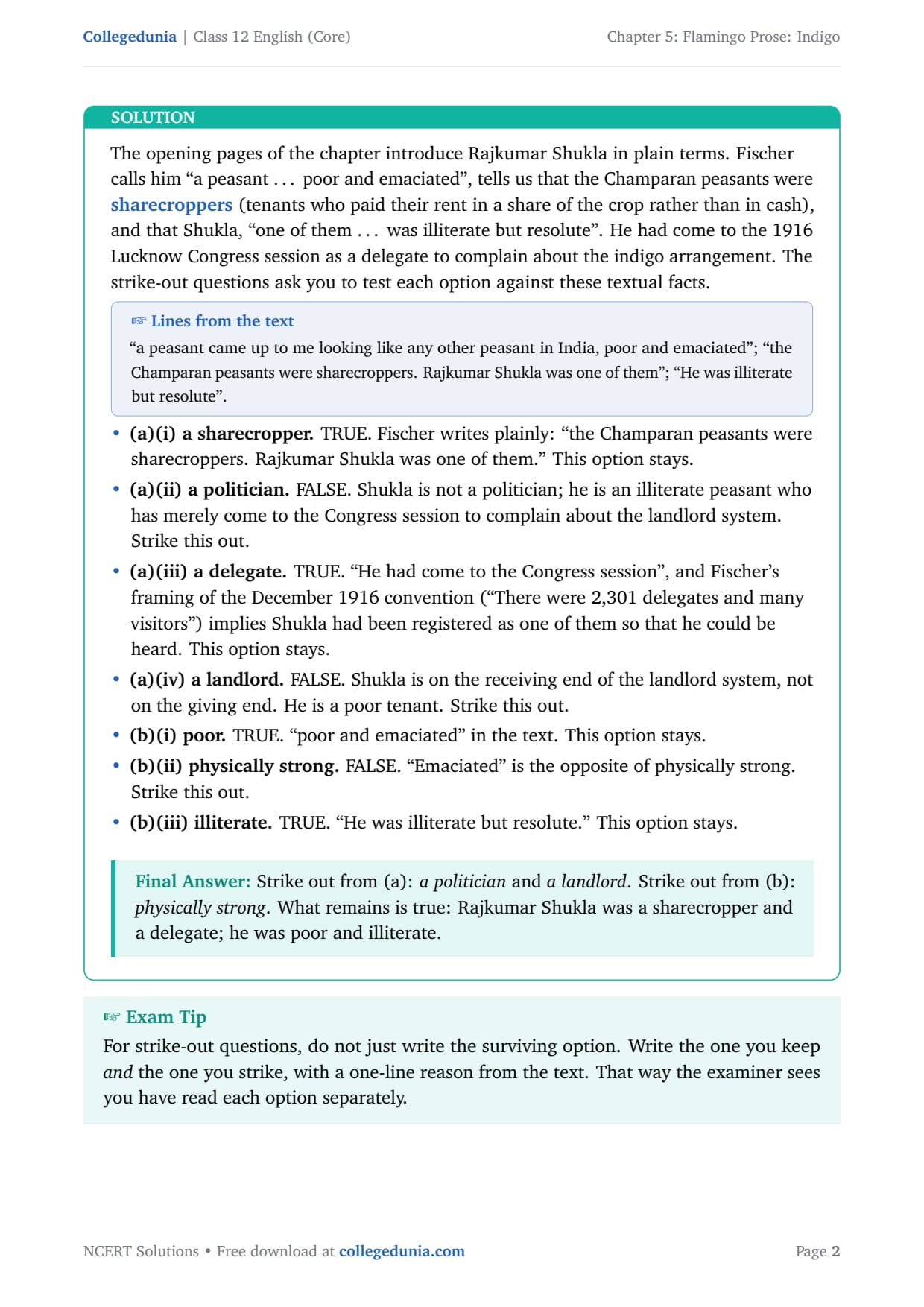
Strike out what is not true in the following.
(a) Rajkumar Shukla was (i) a sharecropper. (ii) a politician. (iii) a delegate. (iv) a landlord.
(b) Rajkumar Shukla was (i) poor. (ii) physically strong. (iii) illiterate.
The opening pages of the chapter introduce Rajkumar Shukla in plain terms. Fischer calls him ``a peasant poor and emaciated'', tells us that the Champaran peasants were sharecroppers (tenants who paid their rent in a share of the crop rather than in cash), and that Shukla, ``one of them was illiterate but resolute''. He had come to the 1916 Lucknow Congress session as a delegate to complain about the indigo arrangement. The strike-out questions ask you to test each option against these textual facts.
Lines from the text
``a peasant came up to me looking like any other peasant in India, poor and emaciated''; ``the Champaran peasants were sharecroppers. Rajkumar Shukla was one of them''; ``He was illiterate but resolute''.- (a)(i) a sharecropper. TRUE. Fischer writes plainly: ``the Champaran peasants were sharecroppers. Rajkumar Shukla was one of them.'' This option stays.
- (a)(ii) a politician. FALSE. Shukla is not a politician; he is an illiterate peasant who has merely come to the Congress session to complain about the landlord system. Strike this out.
- (a)(iii) a delegate. TRUE. ``He had come to the Congress session'', and Fischer's framing of the December 1916 convention (``There were 2,301 delegates and many visitors'') implies Shukla had been registered as one of them so that he could be heard. This option stays.
- (a)(iv) a landlord. FALSE. Shukla is on the receiving end of the landlord system, not on the giving end. He is a poor tenant. Strike this out.
- (b)(i) poor. TRUE. ``poor and emaciated'' in the text. This option stays.
- (b)(ii) physically strong. FALSE. ``Emaciated'' is the opposite of physically strong. Strike this out.
- (b)(iii) illiterate. TRUE. ``He was illiterate but resolute.'' This option stays.
Strike out from (a): a politician and a landlord. Strike out from (b): physically strong. What remains is true: Rajkumar Shukla was a sharecropper and a delegate; he was poor and illiterate.
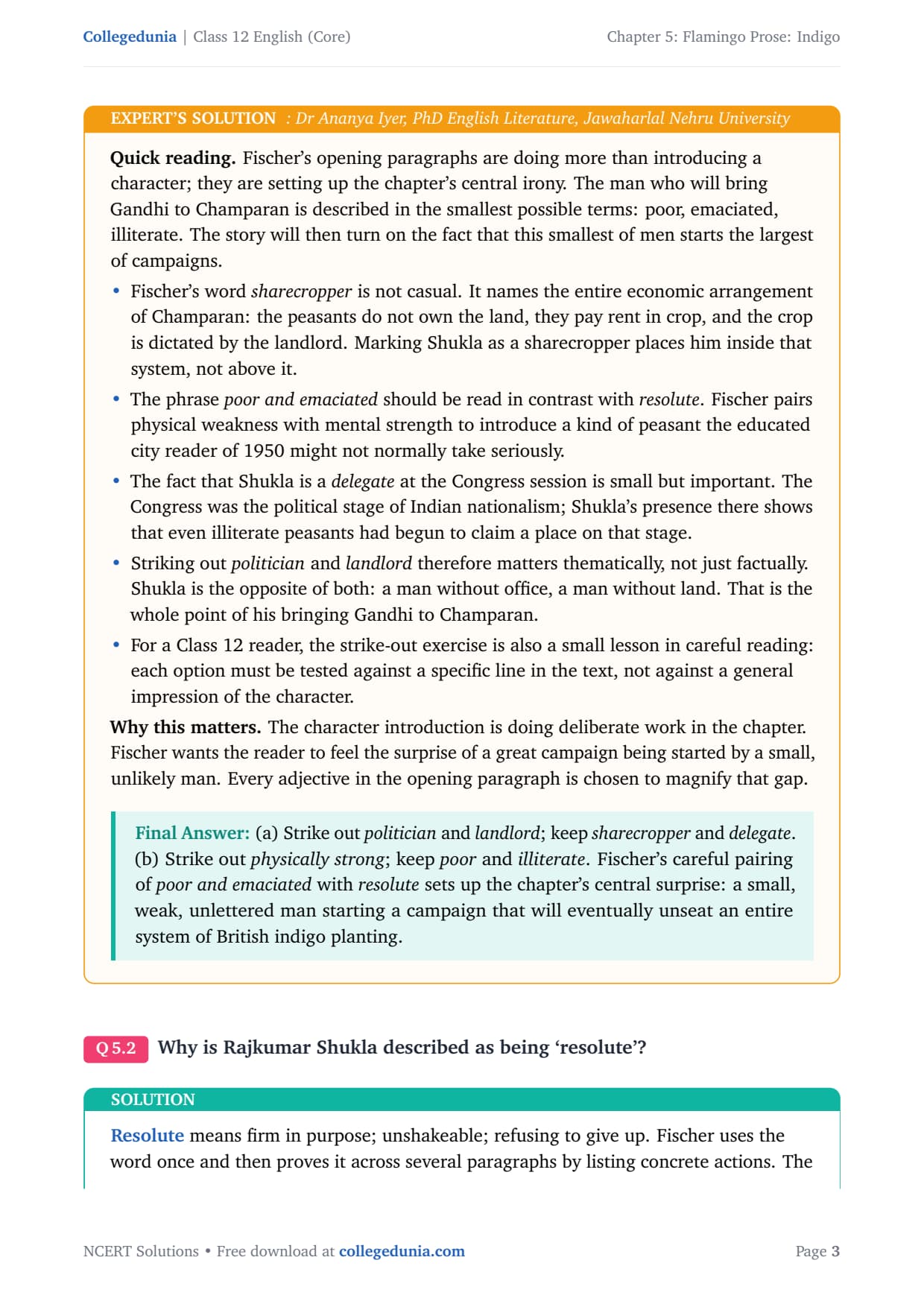
Quick reading. Fischer's opening paragraphs are doing more than introducing a character; they are setting up the chapter's central irony. The man who will bring Gandhi to Champaran is described in the smallest possible terms: poor, emaciated, illiterate. The story will then turn on the fact that this smallest of men starts the largest of campaigns.
- Fischer's word sharecropper is not casual. It names the entire economic arrangement of Champaran: the peasants do not own the land, they pay rent in crop, and the crop is dictated by the landlord. Marking Shukla as a sharecropper places him inside that system, not above it.
- The phrase poor and emaciated should be read in contrast with resolute. Fischer pairs physical weakness with mental strength to introduce a kind of peasant the educated city reader of 1950 might not normally take seriously.
- The fact that Shukla is a delegate at the Congress session is small but important. The Congress was the political stage of Indian nationalism; Shukla's presence there shows that even illiterate peasants had begun to claim a place on that stage.
- Striking out politician and landlord therefore matters thematically, not just factually. Shukla is the opposite of both: a man without office, a man without land. That is the whole point of his bringing Gandhi to Champaran.
- For a Class 12 reader, the strike-out exercise is also a small lesson in careful reading: each option must be tested against a specific line in the text, not against a general impression of the character.
Why this matters. The character introduction is doing deliberate work in the chapter. Fischer wants the reader to feel the surprise of a great campaign being started by a small, unlikely man. Every adjective in the opening paragraph is chosen to magnify that gap.
(a) Strike out politician and landlord; keep sharecropper and delegate. (b) Strike out physically strong; keep poor and illiterate. Fischer's careful pairing of poor and emaciated with resolute sets up the chapter's central surprise: a small, weak, unlettered man starting a campaign that will eventually unseat an entire system of British indigo planting.
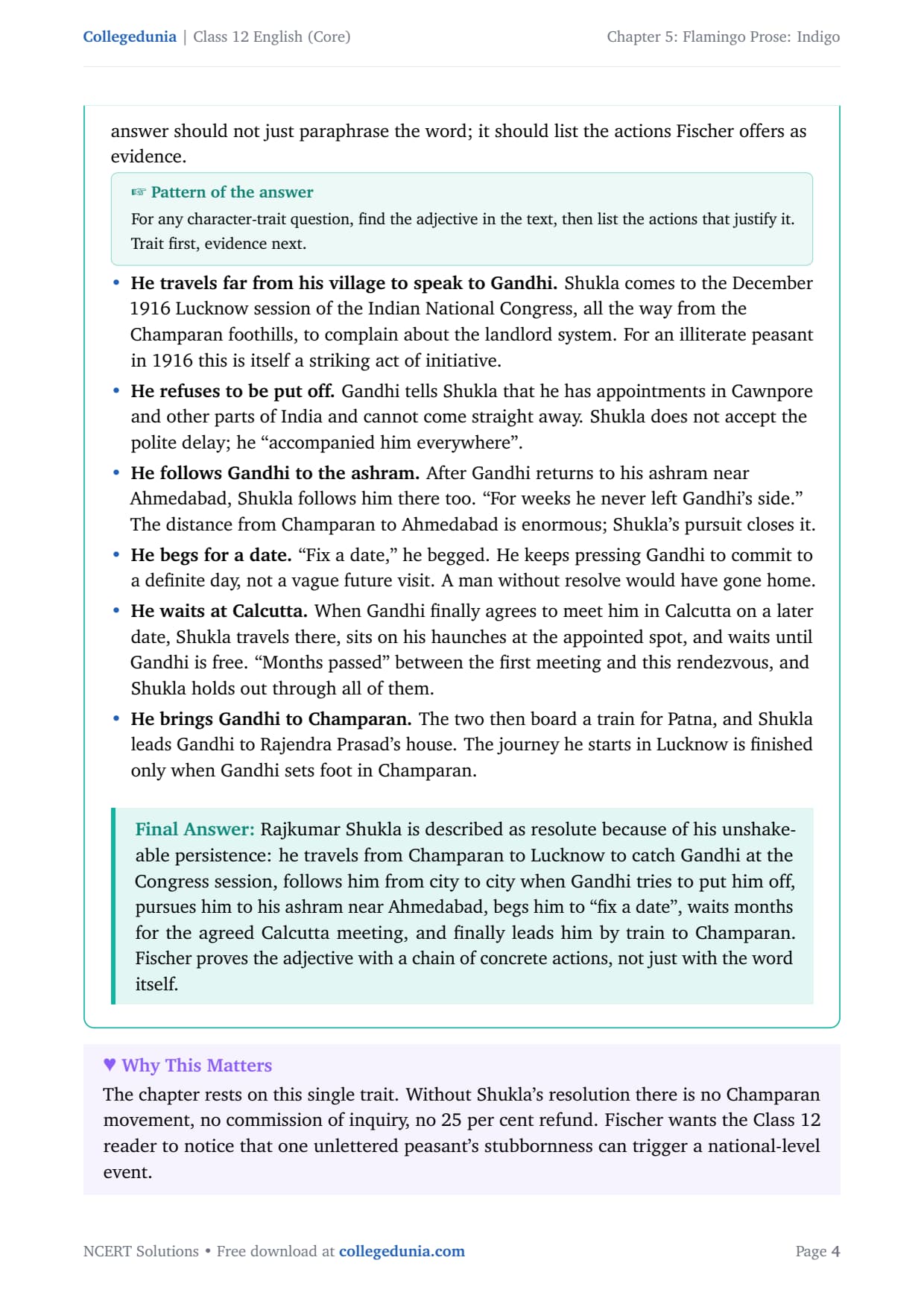
Why is Rajkumar Shukla described as being `resolute'?
Resolute means firm in purpose; unshakeable; refusing to give up. Fischer uses the word once and then proves it across several paragraphs by listing concrete actions. The answer should not just paraphrase the word; it should list the actions Fischer offers as evidence.
Pattern of the answer
For any character-trait question, find the adjective in the text, then list the actions that justify it. Trait first, evidence next.- He travels far from his village to speak to Gandhi. Shukla comes to the December 1916 Lucknow session of the Indian National Congress, all the way from the Champaran foothills, to complain about the landlord system. For an illiterate peasant in 1916 this is itself a striking act of initiative.
- He refuses to be put off. Gandhi tells Shukla that he has appointments in Cawnpore and other parts of India and cannot come straight away. Shukla does not accept the polite delay; he ``accompanied him everywhere''.
- He follows Gandhi to the ashram. After Gandhi returns to his ashram near Ahmedabad, Shukla follows him there too. ``For weeks he never left Gandhi's side.'' The distance from Champaran to Ahmedabad is enormous; Shukla's pursuit closes it.
- He begs for a date. ``Fix a date,'' he begged. He keeps pressing Gandhi to commit to a definite day, not a vague future visit. A man without resolve would have gone home.
- He waits at Calcutta. When Gandhi finally agrees to meet him in Calcutta on a later date, Shukla travels there, sits on his haunches at the appointed spot, and waits until Gandhi is free. ``Months passed'' between the first meeting and this rendezvous, and Shukla holds out through all of them.
- He brings Gandhi to Champaran. The two then board a train for Patna, and Shukla leads Gandhi to Rajendra Prasad's house. The journey he starts in Lucknow is finished only when Gandhi sets foot in Champaran.
Rajkumar Shukla is described as resolute because of his unshakeable persistence: he travels from Champaran to Lucknow to catch Gandhi at the Congress session, follows him from city to city when Gandhi tries to put him off, pursues him to his ashram near Ahmedabad, begs him to ``fix a date'', waits months for the agreed Calcutta meeting, and finally leads him by train to Champaran. Fischer proves the adjective with a chain of concrete actions, not just with the word itself.
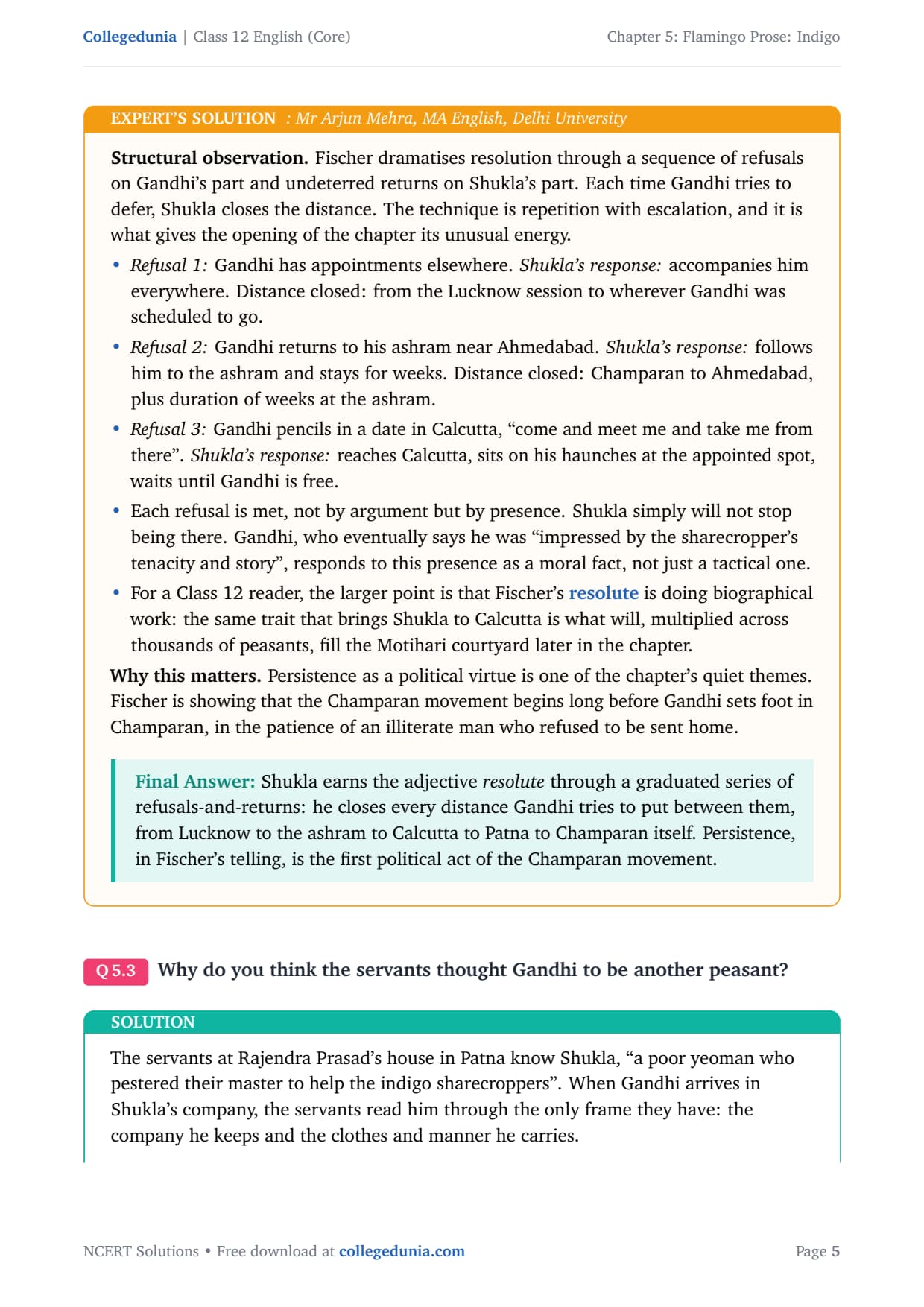
Structural observation. Fischer dramatises resolution through a sequence of refusals on Gandhi's part and undeterred returns on Shukla's part. Each time Gandhi tries to defer, Shukla closes the distance. The technique is repetition with escalation, and it is what gives the opening of the chapter its unusual energy.
- Refusal 1: Gandhi has appointments elsewhere. Shukla's response: accompanies him everywhere. Distance closed: from the Lucknow session to wherever Gandhi was scheduled to go.
- Refusal 2: Gandhi returns to his ashram near Ahmedabad. Shukla's response: follows him to the ashram and stays for weeks. Distance closed: Champaran to Ahmedabad, plus duration of weeks at the ashram.
- Refusal 3: Gandhi pencils in a date in Calcutta, ``come and meet me and take me from there''. Shukla's response: reaches Calcutta, sits on his haunches at the appointed spot, waits until Gandhi is free.
- Each refusal is met, not by argument but by presence. Shukla simply will not stop being there. Gandhi, who eventually says he was ``impressed by the sharecropper's tenacity and story'', responds to this presence as a moral fact, not just a tactical one.
- For a Class 12 reader, the larger point is that Fischer's resolute is doing biographical work: the same trait that brings Shukla to Calcutta is what will, multiplied across thousands of peasants, fill the Motihari courtyard later in the chapter.
Why this matters. Persistence as a political virtue is one of the chapter's quiet themes. Fischer is showing that the Champaran movement begins long before Gandhi sets foot in Champaran, in the patience of an illiterate man who refused to be sent home.
Shukla earns the adjective resolute through a graduated series of refusals-and-returns: he closes every distance Gandhi tries to put between them, from Lucknow to the ashram to Calcutta to Patna to Champaran itself. Persistence, in Fischer's telling, is the first political act of the Champaran movement.
Why do you think the servants thought Gandhi to be another peasant?
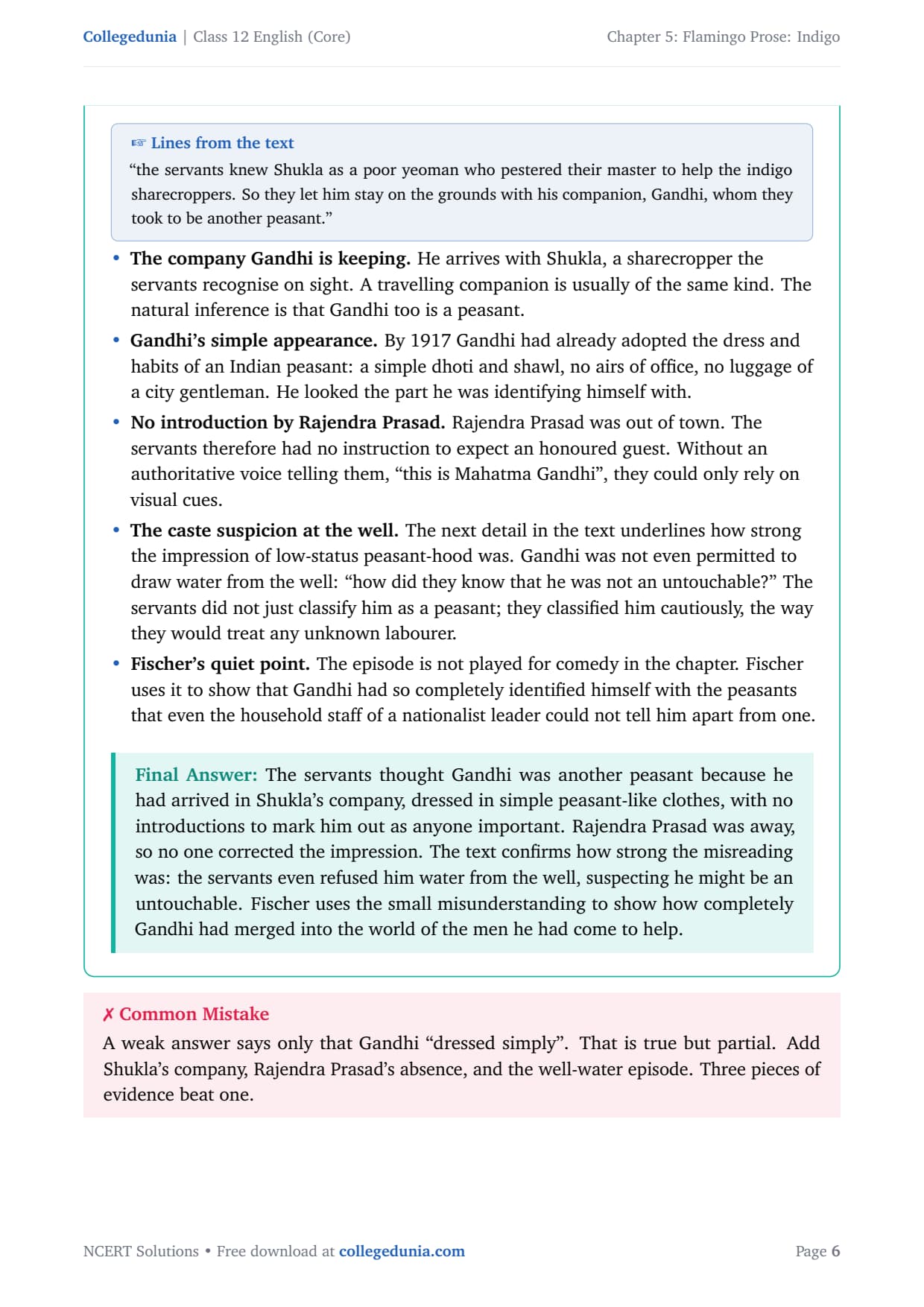
The servants at Rajendra Prasad's house in Patna know Shukla, ``a poor yeoman who pestered their master to help the indigo sharecroppers''. When Gandhi arrives in Shukla's company, the servants read him through the only frame they have: the company he keeps and the clothes and manner he carries.
Lines from the text
``the servants knew Shukla as a poor yeoman who pestered their master to help the indigo sharecroppers. So they let him stay on the grounds with his companion, Gandhi, whom they took to be another peasant.''- The company Gandhi is keeping. He arrives with Shukla, a sharecropper the servants recognise on sight. A travelling companion is usually of the same kind. The natural inference is that Gandhi too is a peasant.
- Gandhi's simple appearance. By 1917 Gandhi had already adopted the dress and habits of an Indian peasant: a simple dhoti and shawl, no airs of office, no luggage of a city gentleman. He looked the part he was identifying himself with.
- No introduction by Rajendra Prasad. Rajendra Prasad was out of town. The servants therefore had no instruction to expect an honoured guest. Without an authoritative voice telling them, ``this is Mahatma Gandhi'', they could only rely on visual cues.
- The caste suspicion at the well. The next detail in the text underlines how strong the impression of low-status peasant-hood was. Gandhi was not even permitted to draw water from the well: ``how did they know that he was not an untouchable?'' The servants did not just classify him as a peasant; they classified him cautiously, the way they would treat any unknown labourer.
- Fischer's quiet point. The episode is not played for comedy in the chapter. Fischer uses it to show that Gandhi had so completely identified himself with the peasants that even the household staff of a nationalist leader could not tell him apart from one.
The servants thought Gandhi was another peasant because he had arrived in Shukla's company, dressed in simple peasant-like clothes, with no introductions to mark him out as anyone important. Rajendra Prasad was away, so no one corrected the impression. The text confirms how strong the misreading was: the servants even refused him water from the well, suspecting he might be an untouchable. Fischer uses the small misunderstanding to show how completely Gandhi had merged into the world of the men he had come to help.
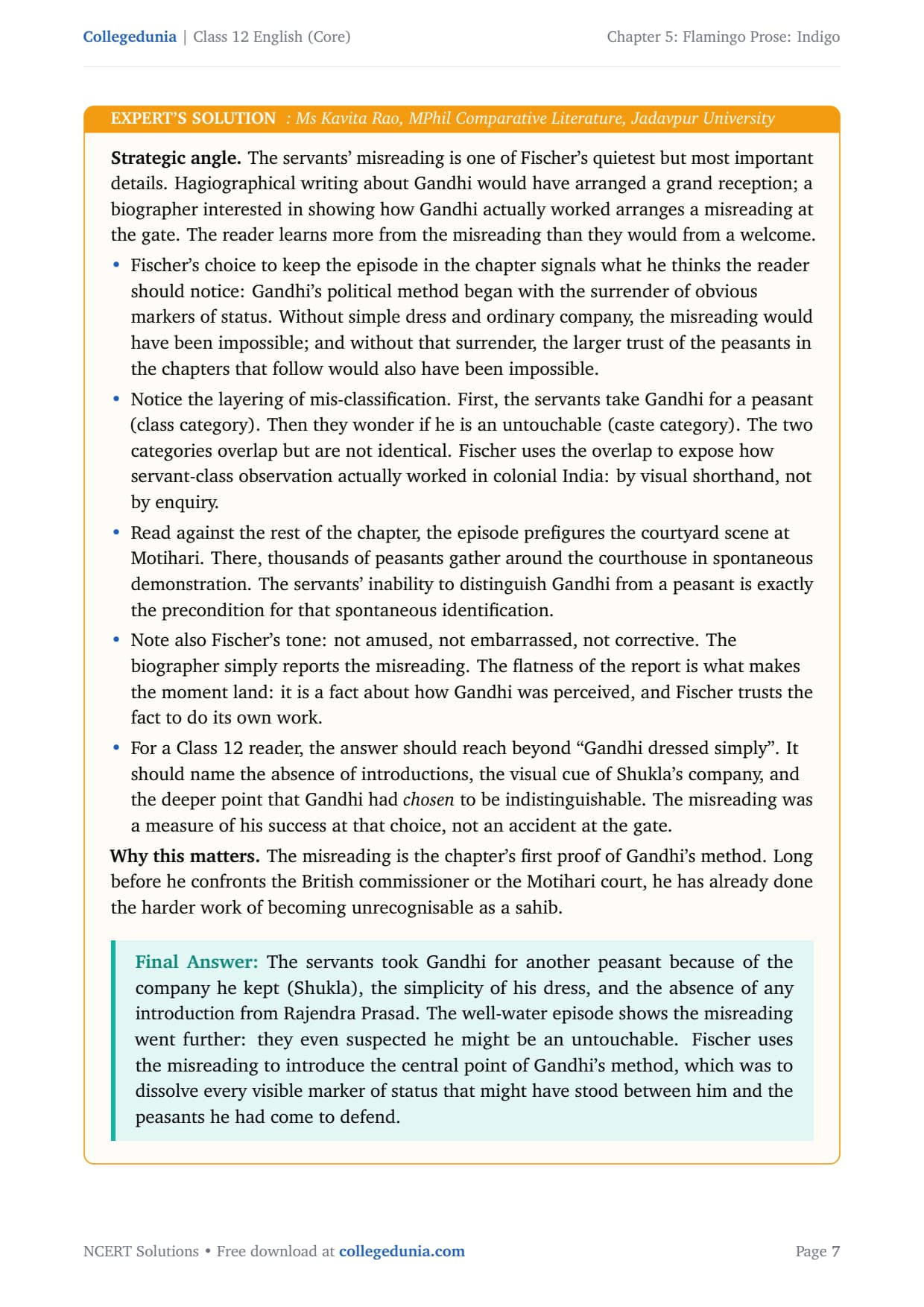
Strategic angle. The servants' misreading is one of Fischer's quietest but most important details. Hagiographical writing about Gandhi would have arranged a grand reception; a biographer interested in showing how Gandhi actually worked arranges a misreading at the gate. The reader learns more from the misreading than they would from a welcome.
- Fischer's choice to keep the episode in the chapter signals what he thinks the reader should notice: Gandhi's political method began with the surrender of obvious markers of status. Without simple dress and ordinary company, the misreading would have been impossible; and without that surrender, the larger trust of the peasants in the chapters that follow would also have been impossible.
- Notice the layering of mis-classification. First, the servants take Gandhi for a peasant (class category). Then they wonder if he is an untouchable (caste category). The two categories overlap but are not identical. Fischer uses the overlap to expose how servant-class observation actually worked in colonial India: by visual shorthand, not by enquiry.
- Read against the rest of the chapter, the episode prefigures the courtyard scene at Motihari. There, thousands of peasants gather around the courthouse in spontaneous demonstration. The servants' inability to distinguish Gandhi from a peasant is exactly the precondition for that spontaneous identification.
- Note also Fischer's tone: not amused, not embarrassed, not corrective. The biographer simply reports the misreading. The flatness of the report is what makes the moment land: it is a fact about how Gandhi was perceived, and Fischer trusts the fact to do its own work.
- For a Class 12 reader, the answer should reach beyond ``Gandhi dressed simply''. It should name the absence of introductions, the visual cue of Shukla's company, and the deeper point that Gandhi had chosen to be indistinguishable. The misreading was a measure of his success at that choice, not an accident at the gate.
Why this matters. The misreading is the chapter's first proof of Gandhi's method. Long before he confronts the British commissioner or the Motihari court, he has already done the harder work of becoming unrecognisable as a sahib.
The servants took Gandhi for another peasant because of the company he kept (Shukla), the simplicity of his dress, and the absence of any introduction from Rajendra Prasad. The well-water episode shows the misreading went further: they even suspected he might be an untouchable. Fischer uses the misreading to introduce the central point of Gandhi's method, which was to dissolve every visible marker of status that might have stood between him and the peasants he had come to defend.
List the places that Gandhi visited between his first meeting with Shukla and his arrival at Champaran.
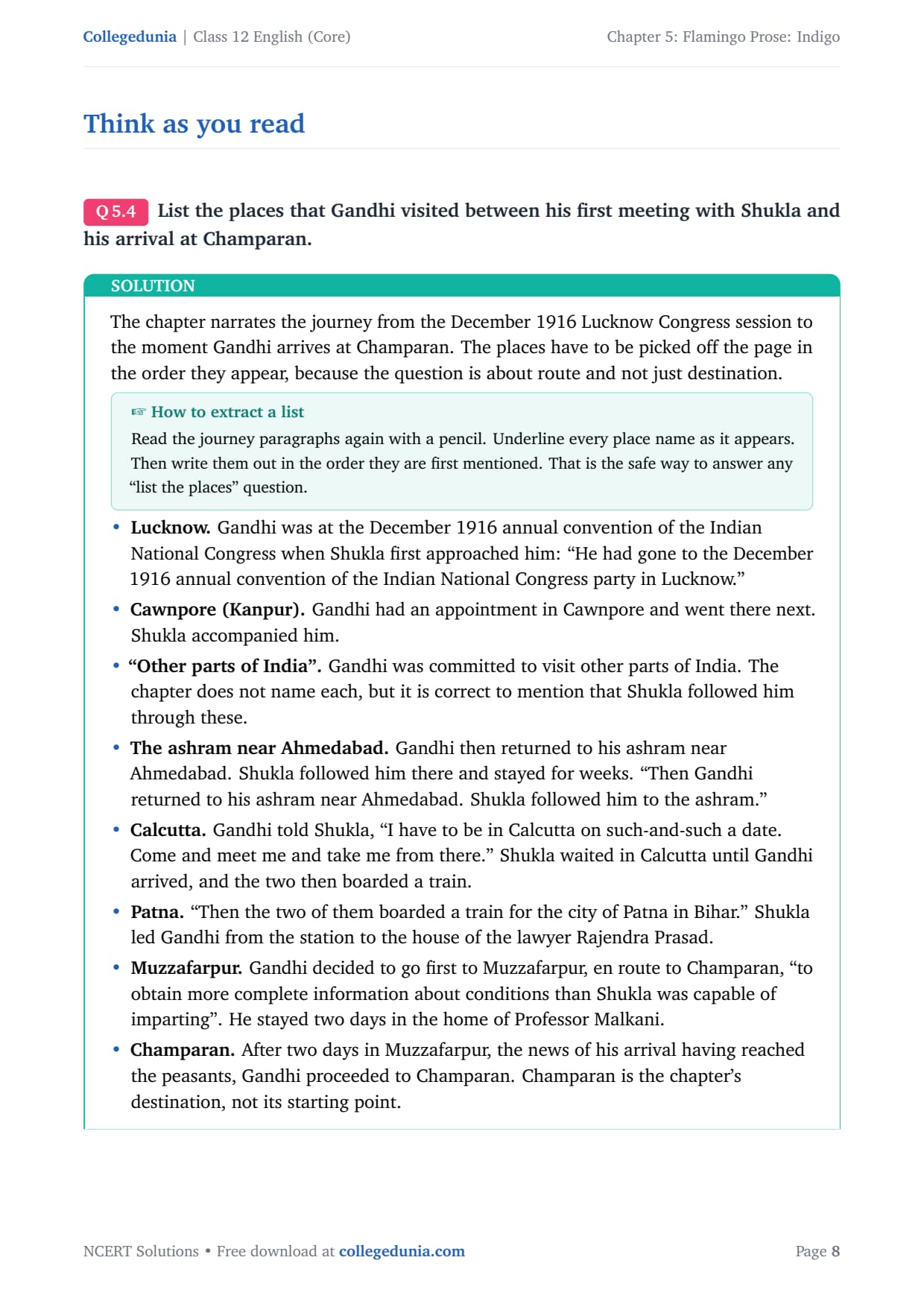
The chapter narrates the journey from the December 1916 Lucknow Congress session to the moment Gandhi arrives at Champaran. The places have to be picked off the page in the order they appear, because the question is about route and not just destination.
How to extract a list
Read the journey paragraphs again with a pencil. Underline every place name as it appears. Then write them out in the order they are first mentioned. That is the safe way to answer any ``list the places'' question.- Lucknow. Gandhi was at the December 1916 annual convention of the Indian National Congress when Shukla first approached him: ``He had gone to the December 1916 annual convention of the Indian National Congress party in Lucknow.''
- Cawnpore (Kanpur). Gandhi had an appointment in Cawnpore and went there next. Shukla accompanied him.
- ``Other parts of India''. Gandhi was committed to visit other parts of India. The chapter does not name each, but it is correct to mention that Shukla followed him through these.
- The ashram near Ahmedabad. Gandhi then returned to his ashram near Ahmedabad. Shukla followed him there and stayed for weeks. ``Then Gandhi returned to his ashram near Ahmedabad. Shukla followed him to the ashram.''
- Calcutta. Gandhi told Shukla, ``I have to be in Calcutta on such-and-such a date. Come and meet me and take me from there.'' Shukla waited in Calcutta until Gandhi arrived, and the two then boarded a train.
- Patna. ``Then the two of them boarded a train for the city of Patna in Bihar.'' Shukla led Gandhi from the station to the house of the lawyer Rajendra Prasad.
- Muzzafarpur. Gandhi decided to go first to Muzzafarpur, en route to Champaran, ``to obtain more complete information about conditions than Shukla was capable of imparting''. He stayed two days in the home of Professor Malkani.
- Champaran. After two days in Muzzafarpur, the news of his arrival having reached the peasants, Gandhi proceeded to Champaran. Champaran is the chapter's destination, not its starting point.
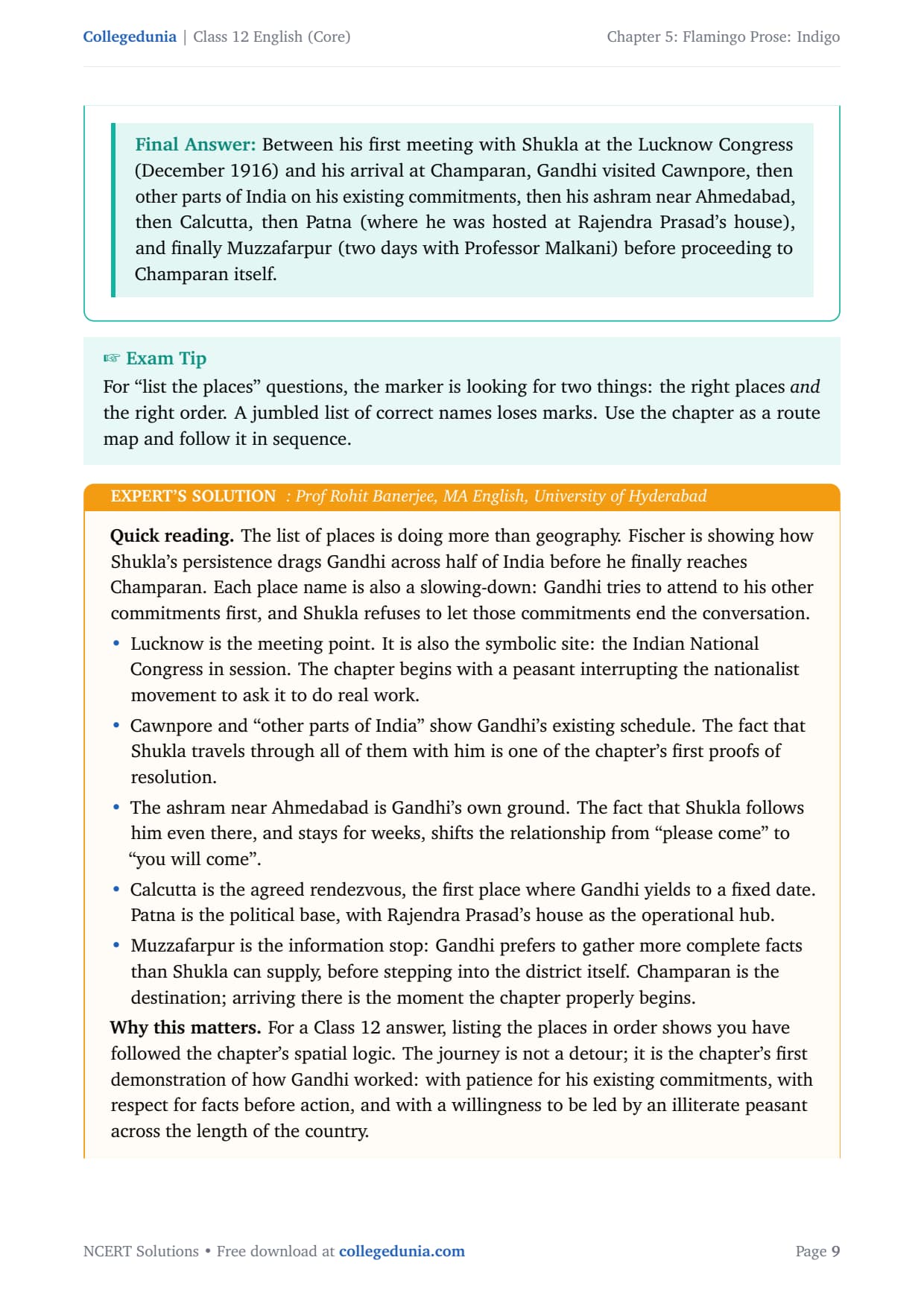
Between his first meeting with Shukla at the Lucknow Congress (December 1916) and his arrival at Champaran, Gandhi visited Cawnpore, then other parts of India on his existing commitments, then his ashram near Ahmedabad, then Calcutta, then Patna (where he was hosted at Rajendra Prasad's house), and finally Muzzafarpur (two days with Professor Malkani) before proceeding to Champaran itself.
Quick reading. The list of places is doing more than geography. Fischer is showing how Shukla's persistence drags Gandhi across half of India before he finally reaches Champaran. Each place name is also a slowing-down: Gandhi tries to attend to his other commitments first, and Shukla refuses to let those commitments end the conversation.
- Lucknow is the meeting point. It is also the symbolic site: the Indian National Congress in session. The chapter begins with a peasant interrupting the nationalist movement to ask it to do real work.
- Cawnpore and ``other parts of India'' show Gandhi's existing schedule. The fact that Shukla travels through all of them with him is one of the chapter's first proofs of resolution.
- The ashram near Ahmedabad is Gandhi's own ground. The fact that Shukla follows him even there, and stays for weeks, shifts the relationship from ``please come'' to ``you will come''.
- Calcutta is the agreed rendezvous, the first place where Gandhi yields to a fixed date. Patna is the political base, with Rajendra Prasad's house as the operational hub.
- Muzzafarpur is the information stop: Gandhi prefers to gather more complete facts than Shukla can supply, before stepping into the district itself. Champaran is the destination; arriving there is the moment the chapter properly begins.
Why this matters. For a Class 12 answer, listing the places in order shows you have followed the chapter's spatial logic. The journey is not a detour; it is the chapter's first demonstration of how Gandhi worked: with patience for his existing commitments, with respect for facts before action, and with a willingness to be led by an illiterate peasant across the length of the country.
The places, in order, are Lucknow (Congress session) \(\rightarrow\) Cawnpore \(\rightarrow\) other parts of India \(\rightarrow\) ashram near Ahmedabad \(\rightarrow\) Calcutta \(\rightarrow\) Patna (Rajendra Prasad's house) \(\rightarrow\) Muzzafarpur (Professor Malkani's home) \(\rightarrow\) Champaran. The journey is the chapter's first portrait of Gandhi's method: honour your existing commitments, gather facts before action, and let the right people lead you to the work.
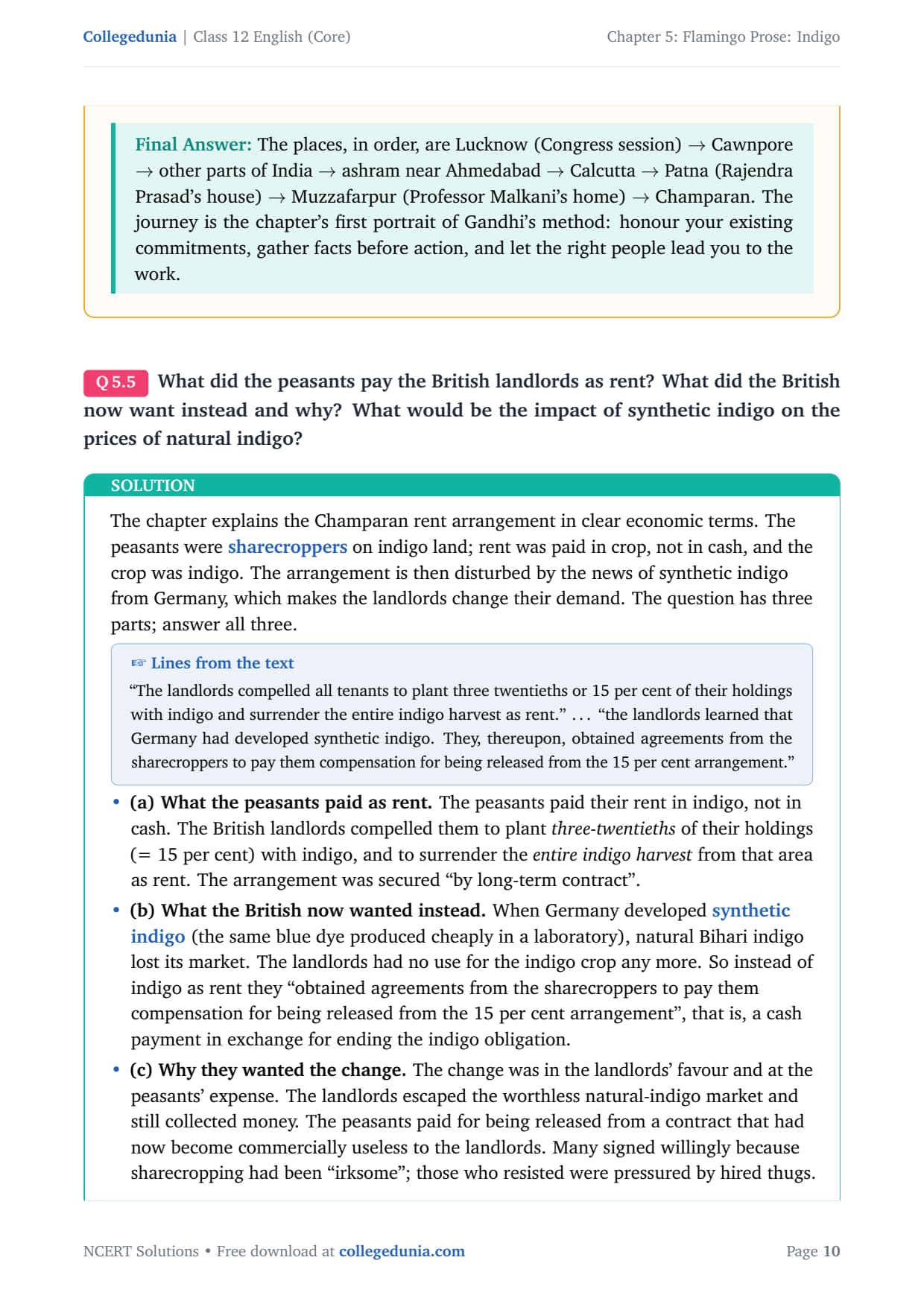
What did the peasants pay the British landlords as rent? What did the British now want instead and why? What would be the impact of synthetic indigo on the prices of natural indigo?
The chapter explains the Champaran rent arrangement in clear economic terms. The peasants were sharecroppers on indigo land; rent was paid in crop, not in cash, and the crop was indigo. The arrangement is then disturbed by the news of synthetic indigo from Germany, which makes the landlords change their demand. The question has three parts; answer all three.
Lines from the text
``The landlords compelled all tenants to plant three twentieths or 15 per cent of their holdings with indigo and surrender the entire indigo harvest as rent.'' ``the landlords learned that Germany had developed synthetic indigo. They, thereupon, obtained agreements from the sharecroppers to pay them compensation for being released from the 15 per cent arrangement.''- (a) What the peasants paid as rent. The peasants paid their rent in indigo, not in cash. The British landlords compelled them to plant three-twentieths of their holdings (= 15 per cent) with indigo, and to surrender the entire indigo harvest from that area as rent. The arrangement was secured ``by long-term contract''.
- (b) What the British now wanted instead. When Germany developed synthetic indigo (the same blue dye produced cheaply in a laboratory), natural Bihari indigo lost its market. The landlords had no use for the indigo crop any more. So instead of indigo as rent they ``obtained agreements from the sharecroppers to pay them compensation for being released from the 15 per cent arrangement'', that is, a cash payment in exchange for ending the indigo obligation.
- (c) Why they wanted the change. The change was in the landlords' favour and at the peasants' expense. The landlords escaped the worthless natural-indigo market and still collected money. The peasants paid for being released from a contract that had now become commercially useless to the landlords. Many signed willingly because sharecropping had been ``irksome''; those who resisted were pressured by hired thugs.
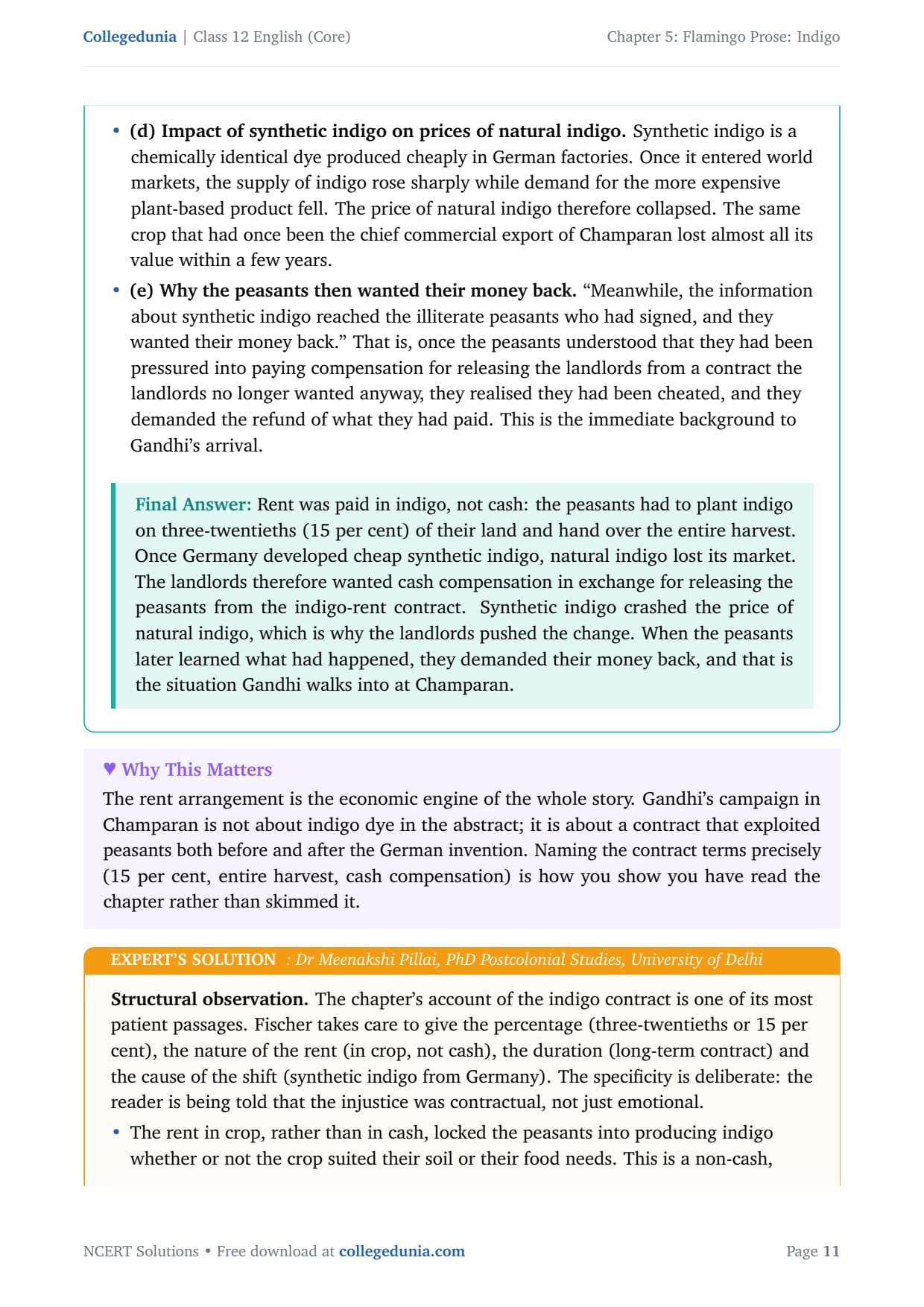
- (d) Impact of synthetic indigo on prices of natural indigo. Synthetic indigo is a chemically identical dye produced cheaply in German factories. Once it entered world markets, the supply of indigo rose sharply while demand for the more expensive plant-based product fell. The price of natural indigo therefore collapsed. The same crop that had once been the chief commercial export of Champaran lost almost all its value within a few years.
- (e) Why the peasants then wanted their money back. ``Meanwhile, the information about synthetic indigo reached the illiterate peasants who had signed, and they wanted their money back.'' That is, once the peasants understood that they had been pressured into paying compensation for releasing the landlords from a contract the landlords no longer wanted anyway, they realised they had been cheated, and they demanded the refund of what they had paid. This is the immediate background to Gandhi's arrival.
Rent was paid in indigo, not cash: the peasants had to plant indigo on three-twentieths (15 per cent) of their land and hand over the entire harvest. Once Germany developed cheap synthetic indigo, natural indigo lost its market. The landlords therefore wanted cash compensation in exchange for releasing the peasants from the indigo-rent contract. Synthetic indigo crashed the price of natural indigo, which is why the landlords pushed the change. When the peasants later learned what had happened, they demanded their money back, and that is the situation Gandhi walks into at Champaran.
Structural observation. The chapter's account of the indigo contract is one of its most patient passages. Fischer takes care to give the percentage (three-twentieths or 15 per cent), the nature of the rent (in crop, not cash), the duration (long-term contract) and the cause of the shift (synthetic indigo from Germany). The specificity is deliberate: the reader is being told that the injustice was contractual, not just emotional.
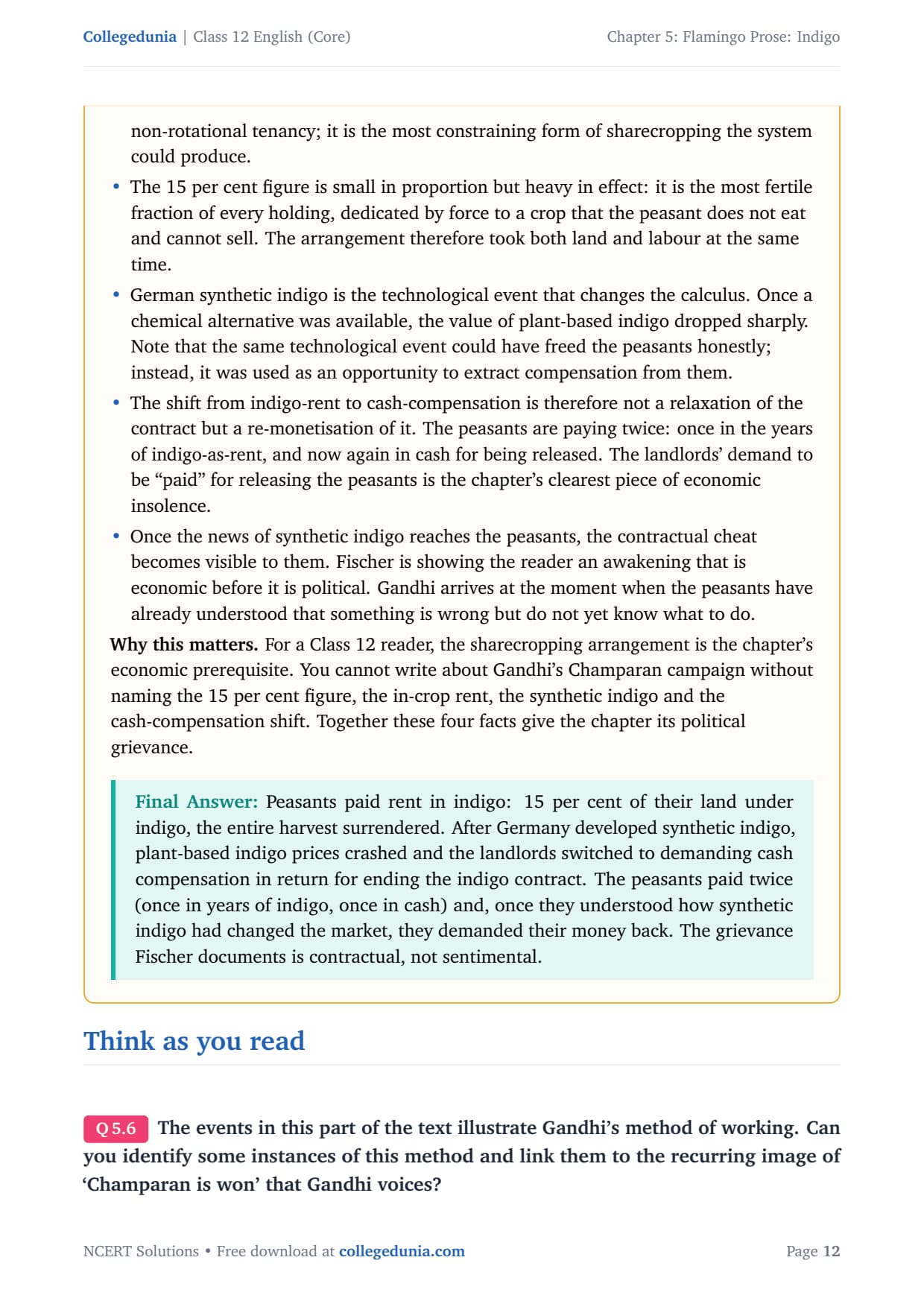
- The rent in crop, rather than in cash, locked the peasants into producing indigo whether or not the crop suited their soil or their food needs. This is a non-cash, non-rotational tenancy; it is the most constraining form of sharecropping the system could produce.
- The 15 per cent figure is small in proportion but heavy in effect: it is the most fertile fraction of every holding, dedicated by force to a crop that the peasant does not eat and cannot sell. The arrangement therefore took both land and labour at the same time.
- German synthetic indigo is the technological event that changes the calculus. Once a chemical alternative was available, the value of plant-based indigo dropped sharply. Note that the same technological event could have freed the peasants honestly; instead, it was used as an opportunity to extract compensation from them.
- The shift from indigo-rent to cash-compensation is therefore not a relaxation of the contract but a re-monetisation of it. The peasants are paying twice: once in the years of indigo-as-rent, and now again in cash for being released. The landlords' demand to be ``paid'' for releasing the peasants is the chapter's clearest piece of economic insolence.
- Once the news of synthetic indigo reaches the peasants, the contractual cheat becomes visible to them. Fischer is showing the reader an awakening that is economic before it is political. Gandhi arrives at the moment when the peasants have already understood that something is wrong but do not yet know what to do.
Why this matters. For a Class 12 reader, the sharecropping arrangement is the chapter's economic prerequisite. You cannot write about Gandhi's Champaran campaign without naming the 15 per cent figure, the in-crop rent, the synthetic indigo and the cash-compensation shift. Together these four facts give the chapter its political grievance.
Peasants paid rent in indigo: 15 per cent of their land under indigo, the entire harvest surrendered. After Germany developed synthetic indigo, plant-based indigo prices crashed and the landlords switched to demanding cash compensation in return for ending the indigo contract. The peasants paid twice (once in years of indigo, once in cash) and, once they understood how synthetic indigo had changed the market, they demanded their money back. The grievance Fischer documents is contractual, not sentimental.
The events in this part of the text illustrate Gandhi's method of working. Can you identify some instances of this method and link them to the recurring image of `Champaran is won' that Gandhi voices?
``Gandhi's method'' in the Champaran chapter has a recognisable shape: gather facts before action, refuse intimidation, take the moral cost of disobedience on yourself, lead by personal presence rather than political slogan, and trust the peasants to act for themselves once they see a defender on their side. Fischer scatters instances of this method across the middle pages of the chapter; the answer should collect them.
Method, with instances
For a methods question, write a short summary line of the method, then list two or three instances that prove it. Repeat for each method. Method first, evidence second.- Method 1: gather facts before acting. Gandhi first visits the secretary of the British landlord's association, then the commissioner of the Tirhut division, and only then proceeds to Motihari, the capital of Champaran. He stops at Muzzafarpur on the way in to collect ``more complete information about conditions''. Fact-finding precedes confrontation.
- Method 2: refuse intimidation. The commissioner ``proceeded to bully me and advised me forthwith to leave Tirhut.'' Gandhi did not leave. He went straight to Motihari. The refusal to obey an intimidating order is one of the chapter's clearest instances of the method.
- Method 3: accept the moral cost personally. When the police superintendent's messenger overtakes him with an official notice to quit Champaran, Gandhi signs the receipt and writes on it that he will disobey the order. He does not hide; he records his refusal in writing on the order itself.
- Method 4: prepare for the consequences. ``All night Gandhi remained awake. He telegraphed Rajendra Prasad to come from Bihar with influential friends. He sent instructions to the ashram. He wired a full report to the Viceroy.'' Civil disobedience, in Gandhi's method, is paired with full and open communication with allies and authorities alike.
- Method 5: rely on the peasants themselves. The morning of the trial, ``the town of Motihari [was] black with peasants''. Gandhi does not arrange the crowd; the crowd arranges itself. He recognises this and tells the lawyers later, ``the battle of Champaran is won.'' The peasants' spontaneous demonstration is, in his method, the real victory.
- Method 6: refuse a special prop. When Charles Freer Andrews offers to stay and help, Gandhi is ``vehemently opposed'': ``You should not seek a prop in Mr. Andrews because he happens to be an Englishman.'' Self-reliance is the method's natural ending.
- Linking to ``Champaran is won''. Gandhi uses this exclamation at the moment the lawyers agree to follow him to jail rather than abandon him. The sentence summarises the whole method: the victory is not the verdict in court, it is the moral readiness of the peasants and their lawyers to face arrest. Once that readiness is in place, the British case is over, even before the judgment is read.
Gandhi's method in Champaran is visible in concrete instances: gather facts (Muzzafarpur, the secretary, the commissioner), refuse intimidation (he stays after being told to leave Tirhut), accept the moral cost personally (signs the quit-notice with a written refusal), prepare for consequences (telegrams to allies and to the Viceroy), and rely on the peasants themselves (the spontaneous Motihari crowd). The recurring image ``Champaran is won'' is Gandhi's name for the moment the lawyers, like the peasants, are ready to share his risk. The victory in his method is moral readiness, not the court verdict.
Strategic angle. Gandhi's working method has been written about by many later scholars as satyagraha in its laboratory phase: Champaran is where the method is being shaped in practice, before it has even been fully theorised. Fischer's biography is therefore unusually valuable here, because it shows the method in its rough form, scene by scene.
- Fact-gathering as moral preparation. Gandhi does not come to Champaran to make a speech; he comes to find out the facts. By the time he confronts the commissioner he has already met the secretary of the landlords' association, spoken to lawyers at Muzzafarpur, and listened to Shukla. The facts are the ground for the action that follows.
- Disobedience as a written act. Signing the quit-notice with a written refusal is a small but significant detail. Gandhi does not flee or hide; he produces a record. The act is therefore moral first, legal second: he wants the court to have his refusal on paper.
- Communication with the apparatus. Gandhi wires the Viceroy. He telegraphs Rajendra Prasad. He sends instructions to the ashram. He does not see the British state as a single enemy; he keeps lines open to its higher levels even as he disobeys its lower ones.
- Reading the crowd. The Motihari crowd ``did not know Gandhi's record in South Africa. They had merely heard that a Mahatma who wanted to help them was in trouble with the authorities.'' Gandhi reads this as proof of the campaign's success: the peasants are mobilising on their own moral instinct, not on his fame. ``The battle of Champaran is won.''
- Refusing a foreign prop. The Andrews episode at the end is the method's final test. A foreign friend's help would be useful tactically; Gandhi refuses it because the method requires the Indians to fight their own fight. ``This shows the weakness of your heart. The cause is just and you must rely upon yourselves to win the battle.''
- For a Class 12 reader, the method can be summarised in five verbs: gather, refuse, accept, communicate, trust. Each verb is supplied with at least one instance from the text, and the recurring image of ``Champaran is won'' is the chapter's way of saying that the verbs have produced their effect.
Why this matters. The chapter is one of the cleanest case studies in the syllabus of Gandhi's working method, set out early in his career before it had a famous name. Reading it this way connects Class 12 literature to Class 12 history: the satyagraha that students will later read about in chapters on the Non-Cooperation and Civil Disobedience movements begins here, in the dust of a Bihari town.
Fischer's middle pages show Gandhi's method as a chain of actions: fact-gathering at Muzzafarpur, polite confrontation with the secretary and commissioner, refusal to leave Tirhut, signed and written disobedience of the quit-notice, an awake night of telegrams to Rajendra Prasad and to the Viceroy, and a spontaneous peasant crowd in Motihari that proves the moral case has already been won. ``Champaran is won'' is Gandhi's name for that moral readiness: in his method, the victory is the shift in courage, not the line in the judgment.
Why did Gandhi agree to a settlement of 25 per cent refund to the farmers?
Gandhi had originally asked for a 50 per cent refund from the British indigo planters; the landlords offered 25 per cent. Many people, including some of his own lawyer friends, expected him to hold out for the full sum. Gandhi accepted 25 per cent instead. The answer must explain the principle behind that choice, because the question is asking why he agreed, not just how much was agreed.
Lines from the text
``Gandhi explained that the amount of the refund was less important than the fact that the landlords had been obliged to surrender part of the money and, with it, part of their prestige.''- The principle: prestige over money. For Gandhi, the symbolic value of the refund mattered more than its rupee value. If the landlords paid even 25 per cent, they had publicly admitted that the peasant had a case against them. ``Part of the money and, with it, part of their prestige'' had been surrendered. That admission was worth more than any further few thousand rupees would have been.
- The peasants' new understanding. ``As far as the peasants were concerned, the planters had behaved as lords above the law. Now the peasant saw that he had rights and defenders. He learned courage.'' Gandhi's accepting 25 per cent did not weaken this; if anything, it solidified it. The peasant had won, in front of the whole district.
- The cost of holding out. A continued struggle for a higher percentage would have prolonged the confrontation and risked losing the moral momentum Gandhi had built. The campaign's purpose, freeing the peasants from fear and giving them defenders, would have been smothered by another year of legal fighting.
- The historical outcome justifies the choice. ``Events justified Gandhi's position. Within a few years the British planters abandoned their estates, which reverted to the peasants. Indigo sharecropping disappeared.'' The full freedom the peasants eventually gained was greater than any single refund. Fischer gives this verdict to show that Gandhi's calculation was correct.
- Method, not transaction. Gandhi did not see the settlement as a deal to be maximised; he saw it as a first crack in the landlords' authority. Once the crack was open, the rest of the structure could not stand. The 25 per cent was the wedge, not the prize.
Gandhi agreed to a 25 per cent refund because, for him, the symbolic value of the landlords having to pay any refund at all (and so admit that the peasant had rights against them) mattered more than the exact percentage. The landlords had ``surrendered part of their prestige''; the peasants had learned that they had defenders. Fischer notes that history justified the choice: within a few years the planters left their estates and indigo sharecropping disappeared altogether.
Strategic angle. The 25 per cent settlement is one of the chapter's clearest demonstrations of what historians later called the symbolic dimension of satyagraha. Gandhi's campaigns repeatedly traded a smaller material gain for a larger moral one. The Champaran refund is an early, textbook example of the trade.
- The number was contested but not central. Asking for 50 per cent was a negotiating opening; receiving 25 per cent was a settlement; both were inside the same moral win, which was that the landlords paid anything at all.
- The landlords had built their estate authority on the idea that they were ``above the law''. The act of paying a refund, even a partial one, destroyed that idea in public. After the settlement, the peasant who walked past an indigo estate saw a defeated landlord, not an untouchable lord.
- Gandhi understood that prolonged litigation would have ground the peasants down, not the landlords. Most of the actors had unequal capacity to absorb delay: the landlord had lawyers and time, the peasant had neither. A quick settlement on the right principle was therefore better for the peasant than a long fight on a higher figure.
- The choice prefigures Gandhi's later campaigns. In the Bardoli no-tax campaign, in the Dandi Salt March, and in the 1942 Quit India call, the same principle recurs: the gain is the breaking of prestige, the creating of defenders, the awakening of courage. The rupee value is always secondary.
- Fischer closes the section with the historical outcome: ``Within a few years the British planters abandoned their estates, which reverted to the peasants. Indigo sharecropping disappeared.'' For a Class 12 reader, this closing line is the chapter's verdict on Gandhi's method: a 25 per cent settlement produced 100 per cent freedom within a few years.
Why this matters. The Champaran settlement is one of the very first occasions on which Gandhi's particular style of political negotiation, prefer the symbolic, accept the partial, break the prestige, is on visible record. Reading the choice as a deliberate principle rather than a compromise is what gives the answer its weight.
Gandhi agreed to 25 per cent because the percentage mattered less than the principle. Once the landlords had paid anything, their claim to be above the law was broken, their prestige had cracked, and the peasants had learned that they had defenders. Fischer's coda (planters abandoned their estates, sharecropping disappeared within a few years) is the chapter's verdict on the wisdom of that calculation.
How did the episode change the plight of the peasants?
The plight of the Champaran peasants before Gandhi's arrival was a fixed condition: sharecropping on 15 per cent of their holdings, the entire indigo harvest surrendered as rent, irksome long-term contracts, landlords ``above the law'', and a deep ``fear-stricken'' state that even law courts could not relieve. The Champaran episode changed this plight at two levels: immediate (a refund and a shift of power) and long-term (the end of indigo sharecropping).
Two layers of change
Always answer this kind of question on two timelines: what changed at once (the settlement) and what changed over the following years (the system itself). Both layers belong in the answer.- Immediate: the refund. A commission of inquiry was constituted, with Gandhi as the sole representative of the peasants. The evidence the commission collected was so heavy against the landlords that they agreed in principle to repay. After negotiation, 25 per cent was accepted. This was the first money any of these peasants had received back from a British landlord.
- Immediate: shift in moral position. ``The landlords had been obliged to surrender part of the money and, with it, part of their prestige.'' The landlords were no longer ``lords above the law''. They had paid. The peasant now saw, in concrete terms, that he had rights and defenders.
- Immediate: freedom from fear. Gandhi had said earlier in the chapter, ``the real relief for them is to be free from fear''. The episode delivered exactly that. The peasants ``learned courage''. Where they had been ``so crushed and fear-stricken'' that law courts were useless to them, they now stood as a body that had defeated a landlord.
- Long-term: the end of indigo sharecropping. ``Within a few years the British planters abandoned their estates, which reverted to the peasants. Indigo sharecropping disappeared.'' The hated 15 per cent contract, which had defined Champaran for a generation, ceased to exist. Land that had been worked for foreign landlords was now worked by Indian peasants for themselves.
- Long-term: cultural and social work. Gandhi did not stop at economic relief. Primary schools were opened in six villages, taught by Mahadev Desai, Narhari Parikh and their wives. Kasturbai taught cleanliness and community sanitation. A doctor was brought in to provide health care with the limited means available (castor oil, quinine, sulphur ointment). The plight of the peasants was changed not only as a class of tenants but as a community.
- Long-term: a new self-reliance. Gandhi refused Charles Freer Andrews' offer to stay and help, because ``the cause is just and you must rely upon yourselves to win the battle''. By insisting that the Indians win this fight without an English prop, he turned the Champaran movement into a school of self-reliance for everyone involved.
Immediately, the episode delivered a 25 per cent refund to the peasants, broke the landlords' prestige, replaced the peasants' fear with a new courage, and gave them tangible proof that they had defenders. In the longer term it ended indigo sharecropping altogether: the British planters left their estates, the land reverted to the peasants, and Gandhi's follow-up work (schools, sanitation, health care, self-reliance under refusing an English prop) turned a single legal victory into a deeper transformation of the community.
Quick reading. The chapter's later pages are doing a specific kind of work: they tell us what came after the famous courtroom scene. A weaker biographer might have closed on the dramatic dropping of charges. Fischer instead keeps writing, because he wants the reader to see the broader change that Gandhi engineered.
- The commission of inquiry is the chapter's quiet instrument of change. By making the landlords face an official process with Gandhi as the peasants' representative, the episode converts the peasants' grievance from private fear into public record.
- The 25 per cent refund is the visible measure of change, but Fischer keeps insisting that the deeper change is moral: ``He learned courage.'' Note the singular: the chapter is interested in what happens inside the peasant, not just in his pocket.
- The educational and health work in the villages is a second register of change. Gandhi treats the Champaran peasants not as a one-issue constituency but as a community whose larger backwardness, cultural, sanitary, medical, also needs attention.
- The Andrews episode at the end of the chapter changes the plight in a different way: it places the peasants and their lawyer friends in the position of having to rely on themselves, not on an English friend, for the last lap of the fight. The plight of the peasants is therefore changed at the level of self-image as much as at the level of contract.
- For a Class 12 reader, the safest summary is to name the four changes together: economic (refund and end of sharecropping), legal (commission of inquiry, courts used), moral (fear replaced by courage and prestige shifted from landlord to peasant), and social (schools, sanitation, health care). The four together are what the chapter calls the change in plight.
Why this matters. The chapter's lasting argument is that political work is not done when a case is won; it is done when a community has changed. Fischer keeps writing past the verdict for exactly this reason, and your answer should follow him past it.
The episode changed the peasants' plight on four fronts at once: economically (25 per cent refund now, end of indigo sharecropping within a few years), legally (a commission of inquiry that took the peasants' case seriously for the first time), morally (the landlords' prestige cracked, the peasants' fear replaced with courage), and socially (schools, sanitation, health work in six villages, and a discipline of self-reliance after the refusal of an English helper). What had been a fixed condition became a transforming community.
Understanding the text
Why do you think Gandhi considered the Champaran episode to be a turning-point in his life?
A turning-point in a life is a moment after which the person's direction of action is permanently different. Fischer gives Gandhi's own words for what Champaran meant: ``What I did, was a very ordinary thing. I declared that the British could not order me about in my own country.'' The answer should treat Champaran as the moment at which several lines in Gandhi's life converged into a single, recognisable method.
Five reasons, picked from the text
Find each reason in the chapter, write the reason in a sentence, then quote or paraphrase the supporting line. Avoid generalities; the chapter supplies the specifics.- First open defiance of the British in India. Champaran was the first time Gandhi declared, on Indian soil, that ``the British could not order me about in my own country.'' The earlier struggles in South Africa had been against a foreign government over Indian rights; Champaran was on his own land, against the same government's local authority.
- The discovery that civil disobedience worked in India. The Motihari order was withdrawn ``thanks to the prompt direction of the British Lieutenant-Governor'' and the case against Gandhi dropped after his announcement of a plea of guilty. ``Civil disobedience had triumphed, the first time in modern India.'' For Gandhi, the chapter therefore established a working political tool he would use for the next three decades.
- The discovery that ordinary Indians would stand up for him. The Motihari courtyard ``black with peasants'' showed Gandhi a kind of support he had not organised and could not have asked for in advance. ``The battle of Champaran is won,'' he exclaimed. Knowing that peasants would mobilise on their own moral instinct changed Gandhi's strategy for the rest of his career.
- The discovery of a method for working with lawyers. Gandhi was able to persuade Rajendra Prasad, Brij Kishore Babu, Maulana Mazharul Huq and others to follow him to jail rather than abandon the peasants. The lawyers' willingness to share the risk was a professional class joining a peasant struggle. From Champaran onwards Gandhi knew how to ask this of the legal class.
- The discovery that social work could not be separated from political work. ``Gandhi never contented himself with large political or economic solutions. He saw the cultural and social backwardness in the Champaran villages and wanted to do something about it immediately. He appealed for teachers.'' The chapter inaugurates Gandhi's lifelong practice of running schools, health camps and sanitation drives alongside political campaigns.
- The discovery that self-reliance was the moral core. The refusal of Andrews' help (``You should not seek a prop in Mr. Andrews because he happens to be an Englishman'') closes the chapter with the principle that would guide every later campaign: Indians must win their own freedom.
Gandhi considered Champaran a turning-point because the episode taught him five lessons at once: that he could refuse a British order on Indian soil; that civil disobedience worked in India; that ordinary peasants would mobilise spontaneously when they sensed a defender; that lawyers from the urban professional class could be drawn into a peasant struggle; and that political work had to be paired with schools, sanitation and self-reliance. He summed it up in his own ordinary phrase: ``I declared that the British could not order me about in my own country.''
Strategic angle. Champaran is recognised in Indian historiography as the first satyagraha on Indian soil. Reading the chapter through Gandhi's own retrospective phrase ``the typical Gandhi pattern'' is useful: Champaran is where the pattern is first visible to him and to history.
- Before Champaran, Gandhi's political life had been principally in South Africa. His Indian standing in 1916 rested on that record. Champaran is the moment at which the same methods are tested on Indian ground, in a small Bihari district, against a domestic landlord class backed by the British state.
- The defiance in Motihari was small and specific: a notice to quit the district was refused. But the smallness was the chapter's point. ``Champaran did not begin as an act of defiance. It grew out of an attempt to alleviate the distress of large numbers of poor peasants.'' Defiance grew out of service; it did not precede it.
- Gandhi's wire to the Viceroy on the night before the trial was characteristic and instructive: he did not hide his disobedience; he reported it upwards through official channels even while refusing the order sideways. This double-track method, refuse the local order, address the higher authority, becomes a Gandhi signature.
- The peasants' spontaneous Motihari gathering taught Gandhi the political value of unrehearsed crowds. His later campaigns, salt march, Quit India, would repeatedly mobilise the same kind of self-organising public.
- The closing pages of the chapter, schools, doctor, sanitation, self-reliance, are the chapter's quiet argument that Champaran taught Gandhi how to combine political and social work. Almost every later Gandhi campaign has the same combination: tax refusal paired with khadi, salt protest paired with constructive work, Quit India paired with village-level reconstruction.
- For a Class 12 reader, the practical answer-writing advice is to use the chapter's own word turning-point carefully: a turning-point is plural in its lessons. Champaran was a turning-point because at least five lines in Gandhi's life converged there, and your answer should name each of them.
Why this matters. The chapter is on the syllabus partly because it lets students see how a national-level political method begins in a small place. The student who can list the five lessons in order has, in effect, read both the chapter and the next two decades of Indian history.
Champaran was a turning-point because it crystallised five lessons at once: first defiance of a British order on Indian soil, first proof that civil disobedience worked in India, first experience of peasants mobilising spontaneously around him, first model for drawing lawyers into a peasant struggle, and first marriage of political action with schools, sanitation and self-reliance. Gandhi's own summary, ``the typical Gandhi pattern'', is the chapter's name for that convergence.
How was Gandhi able to influence lawyers? Give instances.
The Champaran chapter contains three moments in which Gandhi changes the way the lawyers think and act: the chiding at Muzzafarpur, the courthouse decision to follow him to jail, and the rejection of Andrews as a foreign prop. Each is an instance of moral persuasion rather than legal argument: Gandhi moves the lawyers by appealing to a higher standard than the one they had been used to.
Three instances, three lessons
Instance 1: he changes how lawyers charge their clients. Instance 2: he changes whether lawyers face jail. Instance 3: he changes whom lawyers ask for help.- Instance 1: chiding at Muzzafarpur. When Muzzafarpur lawyers met Gandhi and reported the size of their fees, Gandhi chided them for collecting big fees from sharecroppers. He said, ``I have come to the conclusion that we should stop going to law courts. Taking such cases to the courts does little good. Where the peasants are so crushed and fear-stricken, law courts are useless. The real relief for them is to be free from fear.''
- What this changed in the lawyers. The Muzzafarpur lawyers had been treating the peasants as clients to be charged. Gandhi reframed the work as moral relief, not legal billing. The lawyers ``had no reply'', as Rajendra Prasad later put it. The commercial logic of the legal practice had been challenged at its root.
- Instance 2: the courtroom in Motihari. When Gandhi was summoned to appear in court for his refusal to quit, the lawyers consulted among themselves. Gandhi asked them what they would do if he was sent to jail. At first they discussed and gave varying answers. ``Then they said to him, `We have come to advise you. If you go to jail, what will we advise?' '' Gandhi replied that they should help the peasants. The lawyers, after consultation, decided that they too would follow him to jail. ``The battle of Champaran is won,'' he exclaimed.
- What this changed in the lawyers. The lawyers moved from being professional advisers to being co-disobedients. They accepted personal legal risk for the sake of the peasants. The shift was so significant that Gandhi names it as the moment of victory.
- Instance 3: the Andrews refusal. When Charles Freer Andrews came to say goodbye before going on his Fiji tour, the lawyer friends thought it would be useful if he stayed and helped. Andrews was willing if Gandhi agreed. Gandhi was ``vehemently opposed'': ``You think that in this unequal fight it would be helpful if we have an Englishman on our side. This shows the weakness of your heart. The cause is just and you must rely upon yourselves to win the battle.'' Rajendra Prasad later wrote, ``He had read our minds correctly, and we had no reply. Gandhi in this way taught us a lesson in self-reliance.''
- What this changed in the lawyers. They had been seeking an English helper. Gandhi taught them that the moral force of the campaign required Indian self-reliance. The lesson stayed with them; Rajendra Prasad's wording (``Gandhi in this way taught us a lesson in self-reliance'') frames the moment as formative.
Gandhi influenced the lawyers in three specific ways: he chided the Muzzafarpur lawyers for charging big fees of peasants, persuading them to see the work as moral relief and not paid practice; he led them, in the Motihari courthouse, to follow him to jail rather than abandon the peasants, which he called the moment ``the battle of Champaran is won''; and he refused Andrews' offered help, teaching the lawyers a lasting lesson in self-reliance, as Rajendra Prasad himself records. In each case Gandhi's instrument was moral persuasion: he raised the standard the lawyers were measuring themselves against.
Structural observation. Fischer arranges the three lawyer-influence moments at three points in the chapter: beginning (Muzzafarpur fees), middle (Motihari courthouse), and end (Andrews refusal). The arrangement is deliberate. Gandhi's influence on the lawyers deepens with each moment: from critiquing their fees, to recruiting them to civil disobedience, to teaching them self-reliance.
- At Muzzafarpur, the issue is professional ethics: should lawyers profit from peasants who cannot afford to lose? Gandhi's chiding is not vague moralism; it is a working principle. ``We should stop going to law courts'' is meant literally for cases where the peasants are too crushed to face them, and the lawyers have to absorb the principle into their practice.
- At Motihari, the issue is personal solidarity: are lawyers willing to face jail alongside the people they represent? Gandhi's question reverses the usual relationship between lawyer and client. The lawyer normally advises the client to act; here the client invites the lawyers to act with him. ``If you go to jail, what will we advise?'' is the question that forces the reversal.
- At the end of the chapter, the issue is civilisational confidence: is the campaign an Indian campaign or an Indo-British one? Gandhi treats acceptance of an English helper as a moral weakness. By refusing Andrews he insists that the lawyers learn the deeper lesson: rely on themselves, not on a sympathetic foreigner.
- Rajendra Prasad's recording of the lesson is important. The chapter quotes him twice: once after the Muzzafarpur reflection (``we had no reply'') and once after the Andrews episode (``Gandhi in this way taught us a lesson in self-reliance''). The lawyers themselves describe the influence as a teaching, not as a persuasion. The chapter therefore documents Gandhi's influence on lawyers as a kind of professional re-education conducted in real time.
- For a Class 12 reader, the strongest answers will present all three instances in their chapter order and will name what was being changed at each step: ethics first, solidarity second, self-reliance third. The sequence is the answer.
Why this matters. The chapter's small portrait of Gandhi influencing lawyers is also a portrait of how a moral leader works on a professional class. Each of the three instances is a workable model for any later Indian movement seeking to draw lawyers, doctors, teachers and other professionals into popular struggle.
Gandhi influenced the lawyers in three rising stages: first by chiding them at Muzzafarpur for charging large fees of peasants ``so crushed and fear-stricken'' that law courts could not help them; next by getting them, in the Motihari courthouse, to share his risk and follow him to jail (``the battle of Champaran is won''); and finally by refusing Andrews' help, so that the lawyers learned, in Rajendra Prasad's own words, ``a lesson in self-reliance''. Each instance reframes the lawyers' work at a deeper level than the previous one.
What was the attitude of the average Indian in smaller localities towards advocates of `home rule'?
Home rule was the political demand, advocated by Bal Gangadhar Tilak, Annie Besant and others between 1916 and 1918, that India should govern itself within the British Empire. Public association with home-rule advocates in a small town was politically risky. The chapter records the attitude in a single line, but the line is doing a lot of work.
Lines from the text
``It was an extraordinary thing in those days, for a government professor to harbour a man like me. In smaller localities, the Indians were afraid to show sympathy for advocates of home-rule.''- The attitude was fearful. Indians in smaller localities, like Muzzafarpur, were ``afraid to show sympathy'' for home-rule advocates. The fear is named explicitly. The cause is implicit: the British government's intelligence and police networks reached into the smaller towns, and association with the home-rule movement could mean professional or personal cost.
- Professor Malkani's hosting of Gandhi was the exception that proved the rule. Malkani was a teacher in a government school, that is, an employee of the British provincial administration. Gandhi notes: ``It was an extraordinary thing in those days, for a government professor to harbour a man like me.'' Malkani's act was politically courageous, and therefore unusual, in the climate of 1917.
- Professor Kripalani and the students. A second, smaller instance of the same courage is the welcome Gandhi received at Muzzafarpur station, where Professor J.B. Kripalani waited ``with a large body of students''. The students were not yet professionally exposed; the willingness of a college teacher to lead them in such a welcome was the part that took the risk.
- The size of the locality mattered. In big cities (Bombay, Calcutta, Lucknow) home-rule advocates could be received openly because crowds offered anonymity and because nationalist organisations were already established there. In smaller localities the average Indian had no such cover. Showing sympathy could be noticed by neighbours, employers, government agents.
- The chapter's quiet implication. Fischer notes this attitude only briefly, but it is doing thematic work. The smallness of the place and the fearfulness of its average Indian make Shukla's original journey to Lucknow, and Malkani's hosting, and Kripalani's reception, all the more striking. Champaran is also a story of small courage in small places.
In smaller localities, the average Indian was afraid to show sympathy for home-rule advocates, because the British government's reach into a small town made any open association politically risky. The chapter signals this attitude in a single line and offers Professor Malkani (a government schoolteacher who hosted Gandhi in his home) and Professor Kripalani (who led a body of students to receive him at the station) as exceptions whose courage proved the general fear.
Quick reading. Fischer's brief line about ``smaller localities'' is one of the chapter's quiet historical claims: that the home-rule movement of 1916–18 had a strong urban profile but a much shyer presence in mufassil towns. The Champaran campaign is therefore also the story of a nationalist movement reaching into precisely those smaller places.
- Home-rule advocates such as Tilak and Annie Besant were lionised at large public meetings in cities but treated cautiously in district towns. The Home Rule Leagues of 1916–18 were strong in Maharashtra and the Madras Presidency but uneven in rural Bihar, the United Provinces, and the Northwestern districts.
- The risk in a small town was specific. A government clerk who attended a home-rule lecture might lose his post; a schoolteacher might be transferred; a merchant might lose government contracts. The consequences of visible sympathy were graver in a smaller economy where everyone knew everyone.
- Malkani's hosting of Gandhi is therefore an act worth pausing on. A government professor inviting a suspect home-rule advocate into his home is a small but precise piece of resistance. The risk is professional; the gesture is private; the meaning is public.
- Kripalani's gathering of students at the station is a different kind of break with the prevailing attitude. Students were less professionally vulnerable than teachers and clerks, but bringing them out as a body required someone in authority to lead. Kripalani's role at Muzzafarpur prefigures his later prominence in the national movement.
- For the Class 12 reader, Fischer's one-sentence observation is a reminder that nationalism was not evenly distributed across geography. The willingness to defy the British state varied with city size, with local employer dependence, with surveillance reach. Champaran's contribution is to show that small-town courage was possible, and that Gandhi's method could produce it.
Why this matters. The single line about the smaller localities lets the reader place the chapter inside the larger texture of Indian nationalism in 1917: brave urban demonstrations, cautious mufassil silence, occasional acts of risk by individual professors and students. Champaran is the story of those acts of risk multiplied.
In smaller localities, the average Indian was afraid to show sympathy for advocates of home-rule, because the British government's local reach made open support professionally and personally risky. Fischer names two exceptions, Professor Malkani who hosted Gandhi in his home, and Professor Kripalani who gathered students at the station, to show what small-town courage looked like in 1917 and to prepare the reader for the larger such courage that the Champaran movement would soon produce.
How do we know that ordinary people too contributed to the freedom movement?
The chapter explicitly names ``the contributions made by anonymous Indians to the freedom movement'' as one of its sub-themes. The text offers two kinds of evidence: the Champaran peasants who gathered in their thousands around the Motihari courthouse, and the volunteer workers who joined Gandhi's social programme afterwards. The answer should draw on both.
Two kinds of evidence
The chapter shows ordinary contribution at two scales: as a crowd of peasants who appear without invitation, and as individual volunteers who appear when Gandhi calls for them. Use both in your answer.- The peasants at Motihari. ``Morning found the town of Motihari black with peasants. They did not know Gandhi's record in South Africa. They had merely heard that a Mahatma who wanted to help them was in trouble with the authorities.'' Thousands turned up around the courthouse in spontaneous demonstration. The peasants did not have a political party leading them; they came on their own moral instinct.
- The size of the crowd. ``Their spontaneous demonstration, in thousands, around the courthouse was the beginning of their liberation from the fear of the British.'' Fischer's phrasing makes clear that the peasants did not just contribute to that day's outcome; they began their own liberation by being there. The act was self-organised.
- The volunteers from across India. ``Mahadev Desai and Narhari Parikh, two young men who had just joined Gandhi as disciples, and their wives, volunteered for the work. Several more came from Bombay, Poona and other distant parts of the land.'' These are ordinary citizens, not politicians, who travelled to Champaran to teach school, run sanitation drives and assist with health camps.
- Devadas and Kasturbai. Gandhi's own family joined the work. Devadas arrived from the ashram and Mrs. Gandhi (Kasturbai) taught the women of the villages about cleanliness and community sanitation. Family participation does not by itself prove the ``ordinary'' claim, but it shows that the call for volunteers was answered at every level of the movement.
- The doctor and the village teachers. ``Gandhi got a doctor to volunteer his services for six months.'' Three medicines, castor oil, quinine, sulphur ointment, were administered to anyone who needed them. ``Primary schools were opened in six villages.'' The doctor's name is not given; the teachers' names mostly are not given. The freedom movement, in Fischer's account, is built partly by such unnamed workers.
- The named lawyers. Rajendra Prasad, Brij Kishore Babu, Maulana Mazharul Huq, Babu Dharanidhar and others followed Gandhi to court, and decided to follow him to jail if necessary. They were not ``ordinary'' in the strict sense, since they were professionals, but they joined the freedom movement without holding office or seeking reward. They are an intermediate case between the unknown peasant and the named leader.
We know that ordinary people contributed to the freedom movement because the chapter records, by name and by mass, several layers of such contribution: the thousands of Champaran peasants who gathered spontaneously around the Motihari courthouse without any party leading them, the unnamed doctor who gave six months to a village health camp, the teachers (Mahadev Desai, Narhari Parikh and their wives, with volunteers from Bombay and Poona) who opened primary schools in six villages, and the cross-class participation of family members like Devadas and Kasturbai. Fischer's chapter is careful to show the freedom movement as the work of many such small contributors, not just of its famous leaders.
Strategic angle. The Champaran chapter is one of the clearest examples in the syllabus of what historians have called the social base of the nationalist movement. The famous leaders are visible, but the chapter takes pains to show that the leaders rested on a much wider, mostly unrecorded, network of supporters.
- The Motihari crowd is the chapter's most dramatic evidence. The peasants did not know Gandhi's record in South Africa, they had only heard that a friendly Mahatma was in trouble with the authorities, and yet they came in thousands. Self-organised support is the hallmark of a movement with deep social roots.
- The volunteer workers are the second piece of evidence. Mahadev Desai, Narhari Parikh, their wives, and others from Bombay and Poona, travelled to a small Bihari district at their own cost to teach school children and to organise village hygiene. None of them is a political figure; all of them are ordinary educated Indians.
- The unnamed doctor is worth pausing on. Fischer does not give a name. The doctor gave six months of his life to the Champaran villages and is then dropped from the narrative. The choice not to name him is part of the chapter's argument: the movement worked on the labour of people the historical record has not kept track of.
- Kasturbai's role with the village women is a small but specific gesture. By talking to the women about their saris and household cleanliness, she shifted the scope of nationalist work to the household itself. Domestic labour, in this telling, is also freedom- movement work.
- For a Class 12 reader, the answer-writing principle is to layer the evidence: from large to small, from named to unnamed, from political to social. The Champaran story works because every layer is present in the chapter, and listing each one makes the answer complete.
Why this matters. The chapter's quiet insistence on the contribution of ordinary people is one of its lasting lessons. The freedom movement was not won by a handful of leaders giving speeches; it was won by peasants in courtyards, doctors in villages, teachers in primary schools, and women in households. The chapter offers all of these as evidence in a single short text.
We know ordinary people contributed to the freedom movement because the chapter records four layers of such contribution: the thousands of Champaran peasants who gathered spontaneously around the Motihari courthouse, the unnamed doctor who gave six months to a village health camp, the volunteer teachers (Mahadev Desai, Narhari Parikh and others) from Bombay and Poona who opened primary schools in six villages, and the household-level work led by Kasturbai with the village women. Each layer is named in the text; together they make a movement.
Talking about the text
``Freedom from fear is more important than legal justice for the poor.'' Do you think that the poor of India are free from fear after Independence?
The quoted sentence is a paraphrase of Gandhi's argument in the chapter: ``Where the peasants are so crushed and fear-stricken, law courts are useless. The real relief for them is to be free from fear.'' The question asks the student to extend this to post-1947 India: have the poor of independent India achieved the freedom from fear that Gandhi saw as more important than any court verdict?
Answer in two halves
First, explain what Gandhi meant by ``freedom from fear''. Second, judge the present condition of the Indian poor against that meaning. The judgement should be specific, not slogan-like.- Gandhi's meaning, in context. Gandhi was not belittling legal justice; he was pointing out that legal justice cannot reach a person who is too frightened to claim it. A fear-stricken peasant cannot give evidence in court, cannot retain a lawyer, cannot accept a refund without the landlord's permission. ``Freedom from fear'' is therefore the precondition for any meaningful access to justice.
- Yes, certain freedoms from fear have been achieved. The Constitution guarantees fundamental rights (Articles 14, 19, 21) and outlaws untouchability (Article 17), bonded labour (Article 23) and child labour in hazardous work (Article 24). Land reform laws abolished the worst zamindari estates. Universal adult franchise made the poor a political force that no government can entirely ignore. Communal silos like indigo-sharecropping itself have ended.
- But many fears remain. The poor still report widespread fears in everyday life: fear of the police and minor officials, fear of the landlord or local money-lender, fear of upper-caste violence in particular regions, fear of unemployment and of retaliation if they organise. Reports by national and international human-rights bodies regularly document custodial violence, caste-based atrocities and attacks on minorities. Reading any state's annual crime statistics is sobering.
- Economic insecurity is a steady fear. A daily wage labourer who falls ill, a marginal farmer whose crop fails, a migrant whose employer disappears, each lives with the fear that has no name in the chapter but is everywhere in their lives. Schemes like MGNREGA, PDS rations and direct benefit transfers reduce this fear but do not yet eliminate it.
- Access to the legal system remains difficult. Courts in India have very long pendency, legal aid is thinly resourced, and police investigations can be slow or partial. The result is that the poor often still ``do not go to court'' for the same reason the Champaran peasant did not: not because the law is unjust on paper but because it feels unreachable in practice.
- Verdict. The poor of India are partially free from fear, much more so than in 1917, but not yet fully free in the sense Gandhi meant. The legal and constitutional structures are in place; the everyday social, economic and administrative pressures still produce fear in many lives. Gandhi's principle still applies: only when freedom from fear is added to legal justice does the second become real.
Gandhi's principle is that legal justice is empty when the person seeking it is too frightened to use it. After Independence, India has secured many freedoms (fundamental rights, the end of indigo-type sharecropping and zamindari, universal franchise, schemes like MGNREGA) that have reduced fear for the poor. But fears of the police, of caste and communal violence, of economic precarity, and of the legal system's slowness continue to limit their access to justice. The poor of India are partly free from fear, more so than in 1917, but not yet fully so, and Gandhi's principle therefore remains a working standard for assessing how far we still have to go.
Strategic angle. The quoted sentence is one of the chapter's most useful pieces for thinking about politics in contemporary India. It separates the formal availability of justice from the everyday accessibility of it, a distinction that political scientists still rely on in measuring the condition of any society's poor.
- Formal justice in India is well-developed on paper. Fundamental rights, the Directive Principles, an independent judiciary, statutory protections like the SC/ST (Prevention of Atrocities) Act of 1989, the Bonded Labour System (Abolition) Act of 1976, and Minimum Wages legislation are all in place. The Champaran-style situation, where a landlord could order a peasant out of his district by official notice, is no longer legally possible.
- Substantive freedom from fear is harder to measure but is still uneven. Studies of police behaviour, caste atrocity statistics, minority-rights reports and labour-rights surveys consistently show pockets of deep fear among India's most marginal communities: Dalits in particular districts, tribal communities near mining areas, migrant workers in some states, women in particular professions.
- Economic precarity is a fear that the chapter does not name in this way but that Gandhi's word ``crushed'' covers. A daily wager whose family eats only if he works today lives with a low-grade, constant fear that the law cannot directly address. Schemes like the National Food Security Act and MGNREGA reduce this fear, but coverage and quality vary by state.
- Civic confidence is rising. Free movement of labour, the growth of education, the rise of mobile phones and social media as documentation tools, and the increased presence of women in workplaces have all reduced the absolute power of any single local actor over a poor person. The Champaran peasant who could not draw a bucket of water from a well now has at least the option, in many states, of recording the denial on a phone and complaining to a higher authority.
- For a Class 12 reader, the wisest answer admits both sides: meaningful progress in formal rights, real residual fear in specific contexts, with the principle that Gandhi articulated in 1917 still operating as a useful test. The test is, are we reducing the gap between formal justice and felt justice, year by year? The truthful answer is: yes in some places, slowly in others, and not at all in a few.
Why this matters. The chapter offers an unusual opportunity in a literature paper: to think about a literary text as a yardstick for present-day politics. Class 12 students who answer with both progress and gap show that they have treated the text as a working idea, not a finished period piece.
Gandhi's principle, that freedom from fear must precede legal justice if justice is to be real, still functions as a working test. India has come far in providing formal rights and reducing the worst forms of bondage and atrocity, but pockets of fear remain (police violence, caste atrocity, economic precarity, slow courts) for the country's poorest citizens. The honest answer is therefore that the poor of India are more free from fear than in 1917 but not yet wholly free, and Gandhi's standard remains a useful measure of how much further we have to go.
The qualities of a good leader. Discuss with reference to Gandhi as portrayed in the chapter.
The chapter is a small but very full portrait of Gandhi's leadership style. The qualities a Class 12 answer should pick up are the ones the chapter itself illustrates, not a generic list of leadership virtues. Each quality should be supported by a specific incident from ``Indigo''.
Six qualities, with chapter evidence
Resolute action, humility, fact-finding before action, courage, empathy, and self-reliance. Six qualities, each tied to a moment in the chapter.- Resolute action when listened to. Gandhi agreed to go to Champaran only after months of Shukla's persistence. But once persuaded, he acted immediately and stayed until the work was done. A good leader listens slowly and acts firmly.
- Humility and identification with the people. Gandhi travelled in peasant dress, sat at Rajendra Prasad's house in Shukla's company, and was even mistaken for a peasant by the servants. He never demanded special hospitality or ceremonial reception. Leadership, in his style, begins with becoming indistinguishable from the people one serves.
- Fact-finding before confrontation. Before confronting any British official, Gandhi met the secretary of the landlords' association, the commissioner of Tirhut, and the Muzzafarpur lawyers, and listened to peasants individually. ``Gandhi was not just trying to find evidence; he was trying to get the facts.'' A good leader gathers facts; a poor leader gathers slogans.
- Moral courage in the face of intimidation. Gandhi refused to leave Tirhut after the commissioner ``bullied'' him and signed the quit-notice with a written refusal. The next morning he went to court prepared for jail, not protected by office. A good leader takes the moral cost personally.
- Practical empathy. Gandhi did not stop at political victory. He opened primary schools in six villages, brought in a doctor, taught hygiene, and sent Kasturbai to talk to the village women about their clothes. A good leader treats the people's whole life, not just their political grievance.
- Faith in self-reliance. The Andrews refusal at the end shows Gandhi insisting that the lawyers and peasants rely on themselves: ``The cause is just and you must rely upon yourselves to win the battle. You should not seek a prop in Mr. Andrews because he happens to be an Englishman.'' A good leader will not let his followers depend on a foreign helper for what they should be doing themselves.
- Communication with the apparatus. Even while disobeying a local order, Gandhi wired the Viceroy with a full report. He telegraphed Rajendra Prasad to bring influential friends. He sent instructions to the ashram. A good leader does not just confront; he also communicates, and he keeps lines open in both directions.
The chapter portrays Gandhi as a leader characterised by resolute action once persuaded (he agreed to go to Champaran only after months of Shukla's persistence, then stayed until the work was done), humility and identification with the people (peasant dress, mistaken for one by the servants), fact-finding before confrontation (visits to the secretary, commissioner and lawyers), moral courage under intimidation (written refusal of the quit-notice, going to court prepared for jail), practical empathy (schools, doctor, sanitation, talks with women), faith in self-reliance (refusal of Andrews as a foreign prop), and disciplined communication (telegrams to Rajendra Prasad and to the Viceroy). Each quality is supported by a specific incident in the chapter, which is what makes ``Indigo'' such a compact case-study in leadership.
Quick reading. Fischer's chapter is unusual among the prose pieces in the Class 12 reader because it is a biographer's chapter, not a story. The qualities of leadership are not hinted at through metaphor; they are visible in named actions on dated days. This makes ``Indigo'' an unusually direct text on leadership.
- Leadership begins with availability. Gandhi could be approached by Shukla, an illiterate peasant, at a Congress session in Lucknow. He did not lock himself away behind secretaries and assistants. A leader's availability is the first quality the chapter teaches.
- Leadership develops with listening. Gandhi listened to Shukla long enough to be moved, then listened to the Muzzafarpur lawyers long enough to chide them, then listened to the peasants long enough to take their case to court. The leader's most under- rated tool, in this chapter, is the ear.
- Leadership becomes visible with disobedience of the right order. Refusing to quit Champaran was not a general defiance of British authority; it was a specific refusal of a wrong order. A good leader, Fischer's chapter suggests, picks the right order to disobey.
- Leadership endures through follow-through. After the legal victory, Gandhi did not return to the ashram and bask. He stayed in Champaran, opened schools, brought in a doctor, organised sanitation, kept the ashram informed. The chapter's last pages are doing the deliberate work of showing leadership after the photo opportunity.
- Leadership refuses props. The Andrews refusal is the chapter's most uncomfortable moment for some students, but it is also its most disciplined. Gandhi's leadership requires that the people he is leading learn to stand on their own feet. The refusal of an English friend's help is the price of that lesson.
- For the Class 12 reader, the practical answer-writing guide is to pick five or six qualities (resolute, humble, fact-driven, courageous, empathetic, self-reliant) and to give each its own incident from the chapter. The chapter has more than enough material to populate every one. Avoid abstractions; let the events themselves carry the qualities.
Why this matters. ``Indigo'' is unusual on a literature syllabus in that it offers a leadership case-study at close range. Reading the chapter as a working portrait of leadership, rather than a hagiographical tribute, is what lets it speak to contemporary debates about how political action should be conducted.
The chapter shows Gandhi as a leader who is available to the small, listens before he speaks, gathers facts before he confronts, disobeys specific wrong orders rather than authority in general, stays after the courtroom victory to build schools and sanitation, and refuses props so that the people he leads can learn to stand on their own. Six qualities, each tied to an event from ``Indigo'', make the chapter a compact and unusually direct lesson in political leadership.
Working with words
List the words used in the text that are related to legal procedures. For example: deposition. List other words that you know that fall into this category.
The chapter is set partly inside legal machinery, an order to quit Champaran, a summons, a court appearance, a commission of inquiry, and Fischer uses a large vocabulary from legal procedure. The question asks the student first to gather such words from the chapter, and then to add more from general knowledge of legal English.
Two lists
List A: words used inside the chapter (the question's ``deposition'' is the cue word). List B: other legal-procedure words you know from general reading. Keep the two lists separate.- Words from the chapter (List A). deposition (the textbook's own example); summons (``Gandhi received a summons to appear in court''); notice (``official notice to quit Champaran immediately''); receipt (``Gandhi signed a receipt for the notice''); order (``ordered him to return to town''); disobey (``he would disobey the order''); plead/plea (a guilty plea is implied by the court drama, and ``We have come to advise you''); judgment (``the judge said he would not deliver the judgment for several days''); prosecution (the prosecutor in the Motihari case); lawyer and lawyers (used frequently); court(s) and law courts (``Where the peasants are so crushed and fear-stricken, law courts are useless''); trial; advise/advice (``We have come to advise you''); commission of inquiry (the body constituted to examine the indigo grievance); evidence (gathered from the peasants); statement(s); magistrate (the official before whom Gandhi appears); represented (``they frequently represented peasant groups in court''); briefed/ brief (``Muzzafarpur lawyers called on Gandhi to brief him''); fee(s) (``Gandhi chided the lawyers for collecting big fee'').
- Other legal-procedure words you know (List B). affidavit (a written statement sworn before a notary); plaintiff (the person bringing a civil case); defendant (the person being sued or charged); accused (the person charged in a criminal case); witness; oath; perjury (lying under oath); warrant (a written authority for arrest or search); bail; remand (sending the accused to custody); custody; appeal (a request to a higher court); verdict; acquittal (a finding of not guilty); conviction; sentence; petition; petitioner; respondent; advocate; counsel; barrister; solicitor; attorney; public prosecutor; cross-examination; recess; adjournment (postponement of court business); contempt of court; habeas corpus (literally ``you shall have the body'', a writ that protects a person from unlawful detention); writ; decree; injunction (a court order to refrain from an action); stay (a halt to court proceedings); mandamus (a writ directing an authority to perform a public duty).
- Reading tip. The two lists together show that legal English is a layered vocabulary: some words (court, lawyer, fee) are common; some (deposition, affidavit, habeas corpus) are technical and need to be learned in context. Reading newspaper court reports, with a dictionary by the side, is the easiest way to grow this vocabulary.
From the chapter: deposition, summons, notice, receipt, order, disobey, plea, judgment, prosecution, lawyer, court(s), law courts, trial, advise, commission of inquiry, evidence, statements, magistrate, represented, briefed, fee. Other legal-procedure words from general English: affidavit, plaintiff, defendant, accused, witness, oath, perjury, warrant, bail, remand, custody, appeal, verdict, acquittal, conviction, sentence, petition, advocate, counsel, barrister, solicitor, attorney, prosecutor, cross-examination, adjournment, contempt of court, habeas corpus, writ, decree, injunction, stay, mandamus.
Structural observation. The chapter's legal vocabulary is doing more than supplying period flavour. Fischer wants the reader to feel the weight of British legal machinery against Gandhi, so he uses the procedural words at exactly the points where authority is being exerted: the order to quit, the summons, the trial, the judgment, the commission of inquiry. Each of these words is a moment of state action.
- Note the chain of legal acts in the chapter. Gandhi proceeds to Motihari. He is overtaken by the police superintendent's messenger. He receives an official notice to quit. He signs the receipt and writes that he will disobey. He receives a summons to appear in court. He is brought into the courthouse, where a judge sits, a prosecution is intended, and a judgment is delayed. Eventually a commission of inquiry is constituted. The chapter is a sequence of legal instruments.
- Each instrument has a specific meaning. A summons is a legal command to appear before a court. A notice is an official document that announces an administrative order. A receipt is an acknowledgement of having received that document. A judgment is the court's final reasoned decision. A commission of inquiry is a body constituted by government to investigate a specific question and report. Knowing the meanings is what makes the chapter readable in detail.
- The chapter's English vocabulary is colonial-era Indian legal English, which is largely the same as modern Indian legal English. The procedural words used in 1917 (summons, deposition, judgment, commission) are the words still used in Indian courts today, with very small modernisations. A Class 12 student preparing for higher education in law, journalism or political science will encounter every one of these terms again.
- Adding the wider vocabulary in your answer (affidavit, habeas corpus, mandamus, injunction) shows that you have read newspapers carefully, watched legal commentary, or read other chapters from the syllabus. These are not just words for a vocabulary exercise; they are the working vocabulary of constitutional discussion in India.
- For a Class 12 reader, the practical study tip is to keep a vocabulary diary while reading current news on any court case. Each unfamiliar legal word goes in, with a single-sentence gloss. Over a few months the diary grows into the answer you would write for this question.
Why this matters. The vocabulary question is not just about words; it is about the language of public life in modern India. A student who can use these terms accurately becomes able to read court reports, write essays on legal reform, and follow the constitutional debates that any informed citizen will need to follow.
From the chapter, the legal-procedure words include deposition, summons, notice, receipt, order, plea, judgment, prosecution, court, trial, magistrate, commission of inquiry, evidence, briefed, fee. From wider English, add affidavit, plaintiff, defendant, accused, witness, warrant, bail, remand, appeal, verdict, acquittal, conviction, sentence, petition, advocate, counsel, prosecutor, cross-examination, adjournment, contempt of court, habeas corpus, writ, injunction, stay, mandamus. Together these make up the working vocabulary of Indian legal procedure, useful far beyond this chapter.
Thinking about language
Notice the sentences in the text which are in `direct speech'. Why does the author use quotations in his narration?
Direct speech is the form in which a speaker's words are quoted exactly, inside quotation marks. The alternative is indirect (reported) speech, in which the same content is paraphrased with appropriate tense and pronoun changes. Fischer uses direct speech repeatedly in ``Indigo'', and the question asks why.
Five reasons authors use direct speech
Authenticity, voice, drama, evidence, and economy. Find each reason inside the chapter and quote a sentence to prove it.- Authenticity. A direct quotation persuades the reader that the words really were spoken. Gandhi's own ``I will tell you how it happened that I decided to urge the departure of the British. It was in 1917'' is more convincing in his own voice than in Fischer's paraphrase. Biography is a genre that depends on the feel of authentic voice, and direct speech is the cheapest way to supply that feel.
- Voice and character. Direct speech preserves the speaker's manner and idiom. Rajkumar Shukla's ``Fix a date,'' he begged, is a three-word characterisation: humble, persistent, anxious. Reported as ``Shukla requested Gandhi to fix a date'', the same content loses Shukla entirely. Direct speech is how Fischer paints character without describing it.
- Drama and immediacy. The Motihari courtroom scene is built around the question Gandhi asks his lawyers: ``If they sentence me to prison, what will you do?'' Direct speech makes the reader feel the immediate pressure of the decision the lawyers face. Reported speech would summarise it; direct speech forces the reader into the room.
- Evidence and historical record. A biographer often quotes letters, speeches and interviews. Gandhi's ``the typical Gandhi pattern, his politics were intertwined with the practical, day-to-day problems of the millions'' (paraphrased earlier) is supported by direct quotations from his own reflection. Rajendra Prasad's reported reaction (``He had read our minds correctly, and we had no reply'') functions as primary-source evidence inside a secondary text.
- Economy. A single quoted sentence often does the work of a long paragraph of explanation. Gandhi's ``What I did, was a very ordinary thing. I declared that the British could not order me about in my own country'' is a thirty-word summary of the chapter's thesis. Putting it in his own voice is more economical than restating it.
- Tonal contrast. Quoted speech also lets Fischer alternate between his own narrative register and the speakers' registers, peasant idiom, official order, Gandhi's reflection, lawyer's question. The chapter therefore reads as a layered conversation rather than a single monologue.
Fischer uses direct speech in his narration for six overlapping reasons: to give authenticity to historical events (Gandhi's own words on Champaran); to preserve voice and character (Shukla's ``Fix a date''); to create drama and immediacy (Gandhi's question to the lawyers about prison); to provide evidence in a biographical text (Rajendra Prasad's testimony about Andrews); to achieve economy (one quoted sentence summing up a thesis); and to vary tone across speakers (peasant idiom against official register against reflective voice). Quotations turn a biography into a layered conversation rather than a flat account.
Structural observation. Fischer's chapter is a useful text to study for the question because it places direct speech across the social spectrum: Gandhi, Shukla, Rajendra Prasad, the commissioner, the unnamed peasant woman with the single sari. Each voice is given air to speak, and the chapter therefore reads as a community in conversation rather than as a single authoritative voice.
- Note the woman's quoted sentence: ``Look, there is no box or cupboard here for clothes. The sari I am wearing is the only one I have.'' This is a single-sentence portrait of rural poverty. Fischer could have written an explanatory paragraph; he chose her words instead. Direct speech is also a tool of dignity: it lets the speaker speak for herself.
- Note the commissioner's reported aggression: ``The commissioner, Gandhi reports, proceeded to bully me and advised me forthwith to leave Tirhut.'' Here Fischer quotes Gandhi's report rather than the commissioner's own words. The chapter quietly distinguishes between whose voice is to be trusted, while still preserving the feel of authentic narration.
- Note Gandhi's own reflective sentences: ``What I did, was a very ordinary thing. I declared that the British could not order me about in my own country.'' Fischer keeps these as direct speech because they are the chapter's thesis and need to be heard in Gandhi's own voice.
- Note Rajendra Prasad's witness quote: ``He had read our minds correctly, and we had no reply. Gandhi in this way taught us a lesson in self-reliance.'' Fischer uses this to corroborate the Andrews episode from inside the group of lawyers, not from outside. Quoting an eyewitness gives the moment historiographical weight.
- For a Class 12 student writing about non-fiction technique, the key insight is that direct speech is not just decorative. Every direct quotation in ``Indigo'' is doing one of the six jobs (authenticity, voice, drama, evidence, economy, tone). Identifying which job a quotation does is a small but powerful habit of close reading.
Why this matters. The question rewards the reader who has noticed that biography is a genre with rules of its own. Direct speech is one of those rules; recognising why it is used is the difference between reading the chapter as a straight historical account and reading it as a deliberately constructed text.
Fischer uses direct speech to lend authenticity, to preserve voice and character, to create drama and immediacy, to provide eyewitness evidence, to achieve economy, and to vary tone across speakers. Every quotation in ``Indigo'' is doing at least one of these jobs. Reading the chapter with those six functions in mind turns each quoted sentence into a deliberate technical choice rather than a passing piece of realism.
Notice the use or non-use of the comma in the following sentences. (a) When I first visited Gandhi in 1942 at his ashram in Sevagram, he told me what happened in Champaran. (b) He had not proceeded far when the police superintendent's messenger overtook him. (c) When the court reconvened, the judge said he would not deliver the judgment for several days.
The rule the question is testing is one of the most useful pieces of English punctuation. When a subordinate clause (typically beginning with when, if, although, because, after, before, etc.) comes before the main clause, it is separated from the main clause by a comma. When the same subordinate clause comes after the main clause, the comma is usually omitted.
The rule, in one line
Subordinate first \(\rightarrow\) use a comma.Main first \(\rightarrow\) no comma usually needed.
- Sentence (a): When I first visited Gandhi in 1942 at his ashram in Sevagram, he told me what happened in Champaran. The subordinate clause ``When I first visited Gandhi in 1942 at his ashram in Sevagram'' precedes the main clause ``he told me what happened in Champaran''. Because the subordinate clause comes first, a comma separates it from the main clause. The comma also gives the reader a small pause to register the long opening clause before reaching the verb.
- Sentence (b): He had not proceeded far when the police superintendent's messenger overtook him. The main clause ``He had not proceeded far'' comes first. The subordinate ``when the police superintendent's messenger overtook him'' comes after. Because the main clause is first and the subordinate clause follows it, no comma is required. Inserting one (``He had not proceeded far, when '') would be unnecessary and slightly fussy.
- Sentence (c): When the court reconvened, the judge said he would not deliver the judgment for several days. The subordinate clause ``When the court reconvened'' precedes the main clause ``the judge said he would not deliver the judgment for several days''. Because the subordinate clause is first, a comma separates it from the main clause.
- Pattern across the three sentences. (a) and (c) follow the same pattern: subordinate first, comma, then main clause. (b) reverses the pattern: main first, no comma, then subordinate. The chapter is therefore offering you the rule in both directions in three short examples.
- When the rule has exceptions. If the following subordinate clause introduces a sharp contrast (typically with although or though), a comma can still be used: ``He proceeded to Champaran, although he had been told to leave.'' But for sentences of the kind shown here (when-clauses), the no-comma-after-main rule is followed.
- Why the rule exists. A comma after a long introductory clause helps the reader. Without it, the reader might lose track of where the introduction ends and the main clause begins. After a short main clause, such help is unnecessary, and a comma can become a slight interruption.
(a) and (c) use commas because the subordinate clause (``When I first visited Sevagram'', ``When the court reconvened'') comes before the main clause; the comma marks the end of the subordinate clause and gives the reader a small pause before the main statement begins. (b) does not use a comma because the main clause (``He had not proceeded far'') comes first and the subordinate clause (``when overtook him'') follows. The rule: subordinate clause first \(\rightarrow\) comma; main clause first \(\rightarrow\) no comma.
Strategic angle. The comma rule the question is testing is a clarity rule, not a style rule. English does not inflect its words to show whether a clause is subordinate or main; the comma does that work. Once you understand that the comma is helping the reader, the rule starts to feel less arbitrary.
- In Indo-European languages with case endings (Latin, German, Russian), the listener can tell which clause is subordinate from the form of the verb or the ending of the nouns. English has very few such markers, so it leans on punctuation. The comma after a fronted subordinate clause is therefore doing grammatical work, not just rhythmic work.
- Sentence (a) is a useful test case because the subordinate clause is long: ``When I first visited Gandhi in 1942 at his ashram in Sevagram.'' Without a comma after Sevagram, the reader would have to read ahead to find the main verb, and might lose the structure of the sentence. The comma functions as a sign-post.
- Sentence (b) is the opposite case: the main clause is short and self-contained (``He had not proceeded far''). Adding a comma before when would suggest a break that is not needed; the sentence is easier to read without it.
- Sentence (c) repeats the pattern of (a) in shorter form. ``When the court reconvened'' is brief but it is still a subordinate clause taking the front position. A comma still applies. The rule is about position, not about length.
- For a Class 12 student, the broader lesson is that English punctuation is functional. Each mark has a job to do. Mastering the front-clause comma is easy; mastering the principle behind it (punctuation as reader-help) makes all later punctuation rules easier to learn.
- One last note. There is a small school of writers who prefer to use a comma after very short fronted subordinate clauses too (``If you go, I'll come'' vs ``If you go I'll come''). Standard British and Indian usage favours the comma. American usage sometimes drops it for very short clauses. The rule we have given here is the standard one.
Why this matters. Punctuation rules look small but they make the difference between a sentence the reader has to re-read and a sentence the reader gets right the first time. The three sentences in this question are a clean little tutorial in one of the most useful rules in English. Master them and you have mastered roughly half of the comma usage you will ever need.
Sentences (a) and (c) use a comma because the subordinate clause comes first; the comma marks where the subordinate clause ends and the main clause begins. Sentence (b) does not use a comma because the main clause comes first and the subordinate clause follows. The underlying rule is one of clarity for the reader: a fronted subordinate clause needs a sign-post; a trailing one does not.
Things to do
Choose an issue that has provoked a controversy, like the Bhopal Gas Tragedy or the Narmada Dam Project in which the lives of the poor have been seriously affected. Find out the facts of the case. Present the arguments of all the groups involved. Suggest a possible settlement.
The exercise asks for a fact-based, multi-perspective write-up on a public controversy in which the lives of the poor have been seriously affected. The Narmada Dam Project, and in particular the Sardar Sarovar Dam across the Narmada river in Gujarat, is one of the most extensively documented examples in modern Indian public life and is therefore well suited to this exercise. The chosen issue, the displacement caused by the Sardar Sarovar reservoir, parallels the Champaran story Fischer narrates: a powerful project, a vulnerable population, and a long civil-society struggle for justice. The answer that follows has four parts: the facts, the arguments of each group, a possible settlement and a short reflection on the method.
Why this issue fits the chapter
The chapter ends by quoting Charles Andrews and Gandhi on self-reliance and on ``freedom from fear''. The Narmada question is, at heart, whether the poor can win freedom from fear of arbitrary displacement; that thematic link makes Narmada an honest extension of the Champaran story.- Part 1: The facts of the case. itemize[leftmargin=12pt,nosep]
- The Narmada Valley Project, conceived in the 1960s and given fresh impetus in 1979 by the Narmada Water Disputes Tribunal Award, plans a cascade of around 30 large dams, 135 medium dams and 3000 small dams along the Narmada and its tributaries.
- The Sardar Sarovar Dam (SSP) is the largest of these, on the Narmada in Gujarat near Kevadia. Its present full reservoir level is 138.68 metres. The dam aims to provide irrigation to about 1.8 million hectares in Gujarat and Rajasthan, generate 1450 MW of hydro-electric power, and supply drinking water to about 8000 villages and 173 urban centres in the drought-prone north Gujarat, Saurashtra and Kutch regions.
- The reservoir at full level submerges about 245 villages spread across Madhya Pradesh (193), Maharashtra (33) and Gujarat (19). Estimates of project-affected families have varied widely; the most widely cited figure puts the total number of people directly affected at over 200,000, of whom the majority are Adivasi (tribal) and Dalit cultivators.
- The Narmada Bachao Andolan (NBA), led from 1989 by Medha Patkar, organised the affected villages, demanded ``no submergence without rehabilitation'', and pursued a long civil society and legal campaign.
- The World Bank, which had loaned 450 million US dollars for the project, withdrew funding in 1993 after the Morse Committee report found that the resettlement and environmental conditions of the Bank's own loan were not being met.
- The Supreme Court of India heard the case from 1994 onwards. The October 2000 judgment allowed dam construction to continue up to the height already cleared and ordered that further raising be linked to verified rehabilitation progress.
- Successive raisings of the dam height (from 88 metres to 110, then to 121.92, then to 138.68 metres) were preceded by claims and counter-claims about whether rehabilitation had in fact been completed for the families in the next submergence zone.
- Independent fact-finding by the Indian People's Tribunal, the Narmada Control Authority's own monitoring reports and the Supreme Court-appointed Grievance Redressal Authorities (one each for Madhya Pradesh, Maharashtra and Gujarat) records repeated gaps: missing land-for-land allotments, cash compensation paid where land was due, contested ``oustee'' lists, and submergence of inhabited villages during the monsoon draw-down.
- [leftmargin=12pt,nosep]
- The Government of Gujarat and the Narmada Control Authority. The dam is the lifeline of drought-prone Saurashtra and Kutch. Without it, agriculture in north Gujarat is permanently water-stressed. The dam also provides drinking water to Adivasi villages on the canal route, hydro-electric power to three states, and flood moderation for downstream districts. A modern Indian economy, the argument runs, cannot afford to walk away from large-storage projects.
- The Government of Madhya Pradesh. The state where most submergence happens has, at different points, both supported the project (for its share of power and downstream benefits) and demanded a slower raising of the dam height until rehabilitation in Madhya Pradesh is complete. State elections have visibly affected the negotiating position.
- The Narmada Bachao Andolan (NBA) and affected communities. Their central claim is not opposition to dams as such but the Supreme Court-affirmed principle of ``no submergence without prior, full rehabilitation''. Specific arguments include: itemize[leftmargin=12pt,nosep]
- Submergence destroys not only land but a way of life, particularly for Adivasi communities whose forest, river and ancestral graveyards cannot be replaced by a plot on a canal command area in a different agro-climatic zone.
- Cash compensation, instead of the promised land-for-land allotment, leaves the family without a productive asset and exposes them to inflation and middlemen.
- Rehabilitation sites have often lacked basic services (drinking water, schools, electricity, fair access to fuel and fodder), so oustees become urban poor rather than resettled cultivators.
- The benefit-cost analysis has been consistently challenged by independent economists: irrigation deliveries to the planned command area have lagged behind targets, while the costs of resettlement and environmental damage have been underestimated.
- [leftmargin=12pt,nosep]
- Submergence-linked rehabilitation guarantee. Adopt the rule the Supreme Court stated and make it operationally airtight: no further raising of any dam's water level before an independent statutory authority certifies that the entire next-submergence zone has been resettled, with land of comparable quality and assured services in place for at least one full agricultural cycle.
- Transparent oustee lists and grievance redressal. Publish the official oustee lists in the gram sabha of every affected village; record disputed claims in a public register; give the Grievance Redressal Authority binding powers, time-bound disposal norms and the right to halt submergence pending resolution.
- Land-for-land as the default; cash only with informed consent. Make land allotment of equivalent quality the legal default for oustee families with land rights; offer cash only after the family has refused two genuine land offers in writing.
- Alternative livelihood schemes. For families without cultivable land rights (notably landless tribals and forest dwellers), construct a long-term livelihood package: skilling, micro-enterprise support, priority recruitment in operations and maintenance of the canal network, and community-level fishery rights on the reservoir.
- Project benefits to the affected first. The canal command area should prioritise water deliveries to the displaced families resettled in it; tribal hamlets on the reservoir rim should receive guaranteed drinking water and a share of hydro royalty.
- Independent technical audit. An independent expert committee, with no project-implementing role, should audit benefit deliveries against original projections every five years and publish findings openly. Where deliveries lag, the state must publicly explain and revise the cost-benefit story.
- Cultural rehabilitation. Adivasi heritage, sacred sites and graveyards in submergence zones cannot be replaced. The settlement must provide access protocols during reservoir draw-down, fund cultural museums or memorials at resettlement sites, and recognise tribal customary law in rehabilitation negotiations.
- Future projects: prior consultation and consent. For any future large reservoir, free, prior and informed consent of affected gram sabhas must be on the statute book, in line with PESA (Panchayats (Extension to Scheduled Areas) Act 1996) and the Forest Rights Act 2006.
The Sardar Sarovar Dam on the Narmada in Gujarat is the largest of the Narmada Valley Project's dams. It promises 1.8 million hectares of irrigation, 1450 MW of power and drinking water to drought-prone north Gujarat, Saurashtra and Kutch. At full reservoir level (138.68 metres) it submerges about 245 villages across Madhya Pradesh, Maharashtra and Gujarat, displacing over 200,000 mostly Adivasi and Dalit cultivators. The government, the Narmada Bachao Andolan (led by Medha Patkar), the Supreme Court, the World Bank (which withdrew funding in 1993 after the Morse Committee) and independent scientists hold different positions. A workable settlement requires: submergence-linked rehabilitation guarantees, transparent oustee lists, land-for-land as the default, alternative livelihood packages for the landless, priority canal water for resettled families, an independent five-yearly technical audit, cultural rehabilitation for Adivasi heritage, and free, prior and informed consent of gram sabhas for any future project.
Strategic angle. The exam tests three different skills in a single question: factual research, multi-party representation, and the ability to design a settlement. Do not collapse them. Open with the facts, give each group its own sentences, and structure the settlement as a set of testable guarantees rather than a moral appeal.
- Factual scaffolding. Anchor the answer in numbers and dates the marker can verify: Tribunal Award 1979, dam height 138.68 metres, 245 villages affected, World Bank withdrawal 1993, Supreme Court judgment October 2000. Numbers and dates lift a write-up out of opinion.
- Stakeholder method. The chapter you have just read teaches stakeholder method by example: Gandhi meets the Commissioner, the lawyers, the landlords, the peasants, the Inquiry Commission. Mirror that method here: government, NBA, court, World Bank, scientists, lenders. Each group must speak in its own register, not in the writer's.
- Settlement design. Frame the settlement as a list of testable, time-bound guarantees that any future court order or government press release can be held against. Vague phrases (``proper rehabilitation'', ``equitable benefits'') do not survive contact with reality; specific phrases (``land of comparable quality plus one agricultural cycle of assured services before submergence'') do.
- Constitutional anchoring. For a Class 12 reader, two constitutional anchors are within reach: Article 21 (right to life, expanded by the Supreme Court to include the right to livelihood) and the Fifth Schedule (Scheduled Areas). Mentioning them lifts the settlement design out of policy suggestion and into constitutional reasoning.
- Legal precedents to cite. The Supreme Court's 2000 Narmada Bachao Andolan v. Union of India judgment; the Samatha judgment on tribal land in Scheduled Areas; the Niyamgiri decision on free, prior and informed consent of gram sabhas. These are not required for an undergraduate-quality answer, but they signal a reader who has gone beyond the textbook.
- The Gandhi parallel. The chapter's central method, accept a smaller cash settlement so the planter surrenders prestige, applies here too. A ``win'' for the affected families is not the cancellation of every dam in India; it is the permanent retreat of the arbitrary power that lets an executive flood a village without consent.
Why this matters. Civil-society campaigns from Champaran (1917) to Chipko (1973) to the NBA (1985 onwards) to the Niyamgiri gram-sabha votes (2013) are different points on the same arc: organised poor communities, supported by allies with technical and legal skills, asserting that the benefits of a project must accrue to the people who pay its costs. Studying Narmada with the Champaran chapter trains the reader to see this arc, and to refuse the false choice between ``no project ever'' and ``project at any cost''.
Common mistakes.
- Treating the question as an essay against dams. The exercise asks for the facts and all sides; an argumentative one-sided answer loses marks even when forcefully written.
- Skipping the numbers. A Narmada write-up without the 245 villages, the 138.68 metres, the 1993 World Bank withdrawal and the 2000 Supreme Court order is a write-up the marker cannot verify.
- Naming only the government and the NBA. The question asks for ``all the groups''; the courts, the multilateral lender, the scientific community and the resettled families themselves are distinct groups.
- Proposing a settlement that is only a slogan (``rehabilitate everyone fairly''). The settlement must contain testable, time-bound guarantees.
- Forgetting the Adivasi dimension. Loss of livelihood is the headline cost; loss of forest, sacred groves and ancestral graveyards is the harder, irreplaceable cost, and the answer must name it.
The Sardar Sarovar Dam is a legitimate public-works project with real benefits (drought-proofing Saurashtra and Kutch, 1450 MW of hydropower, drinking water for thousands of villages) and real human costs (submergence of about 245 villages, displacement of over 200,000 mostly tribal cultivators). A defensible settlement is not for or against the dam; it is a package of testable guarantees: no further submergence without prior independent certification of rehabilitation; land-for-land as the legal default; alternative livelihood packages for the landless; priority canal water for resettled families; independent five-yearly benefit audits; statutory cultural rehabilitation for Adivasi heritage; and free, prior and informed consent of gram sabhas for every future project, anchored in Article 21 and the Fifth Schedule of the Constitution. The Gandhi parallel from the chapter is that the gain to the displaced is measured not in the size of the cash payment but in the permanent retreat of the executive's power to flood a village without consent.
More Indigo English Core Class 12 Resources
NCERT Solutions for Class 12 English Core Flamingo Prose: All Chapters
The table maps every Flamingo Prose chapter to its NCERT Solutions page. Use it to revise sister chapters.
| Chapter | Resource |
|---|---|
| Chapter 1 | The Last Lesson NCERT Solutions |
| Chapter 2 | Lost Spring NCERT Solutions |
| Chapter 3 | Deep Water NCERT Solutions |
| Chapter 4 | The Rattrap NCERT Solutions |
| Chapter 6 | Poets and Pancakes NCERT Solutions |
Other Resources for Indigo (Class 12 English)
| Resource | Link |
|---|---|
| NCERT Solutions (this page) | Indigo NCERT Solutions |
| Revision Notes | Indigo Class 12 English Revision Notes |
| CBSE Syllabus | CBSE Class 12 English Core Syllabus 2026-27 |
Student Feedback
In a Collegedunia poll of 1,200 Class 12 students, 76% said the Champaran timeline was the hardest part to keep in order, and 70% found the three-incident answer rule the fastest way to hit the top band.
Indigo Class 12 NCERT Solutions FAQs
Ques. Where can I download Indigo Class 12 NCERT Solutions PDF?
Ans. You can download the Indigo Class 12 NCERT Solutions PDF directly from this page. Both the Normal and HD versions are available, and both are free.
Ques. Are these Indigo Class 12 NCERT Solutions aligned with the 2026-27 NCERT?
Ans. Yes. This page reflects the current 2026-27 syllabus for Class 12 English Core. Indigo remains in the Flamingo textbook with all 13 questions retained across Think as You Read, Understanding the Text, Talking about the Text, and Working with Words.
Ques. How many pages is the Class 12th English Indigo NCERT Solutions PDF?
Ans. The Indigo Class 12 NCERT Solutions PDF runs approximately 18 to 22 pages and covers all four question blocks with sample-marker fully solved answers plus a CBSE marking-scheme breakdown.
Ques. Who is the author of Indigo Class 12 English Chapter 5?
Ans. Indigo is written by Louis Fischer, the American journalist who authored The Life of Mahatma Gandhi (1950). The chapter is a first-person extract from that biography, narrating the 1917 Champaran satyagraha.
Ques. What is the main theme of Indigo Class 12?
Ans. The main theme is the birth of civil disobedience on Indian soil through the 1917 Champaran satyagraha. Sub-themes include self-reliance, the awakening of the Indian peasantry, and Gandhi's strategy of accepting symbolic over total victory (the 25 percent refund settlement).
Ques. What is the significance of the 25 percent refund in Indigo?
Ans. The 25 percent refund is significant because it forced the landlords to surrender part of the money for the first time in the indigo system's history. The actual amount mattered less than the symbolic concession, which signalled that British colonial power could be challenged and made to retreat.
Ques. How can these solutions help in CUET English domain prep?
Ans. CUET English builds 1 to 2 passage-based stems around Indigo extracts every year. The solutions on this page anchor character names (Shukla, Andrews, Kripalani), place names (Lucknow, Motihari, Champaran), and the chronological sequence, which are the four most frequent MCQ targets.



Comments