




Anees Jung's Class 12 English Chapter 2 Flamingo Prose: Lost Spring traces the stolen childhoods of Saheb in Seemapuri and Mukesh in Firozabad, exposing the poverty and caste traditions that condemn 20,000 child workers to exploitation. This Class 12 English NCERT Solutions Chapter 2 Flamingo Prose: Lost Spring page hosts the full PDF, textual answers, and the 2026-27 CBSE PYQ map.
- CBSE Weightage: 8 to 10 marks across short-answer (2 marks) and long-answer (5-6 marks) questions in the Flamingo prose section
- CUET Weightage: 2 to 3 questions per shift in the English language paper, mostly from theme and character inference
- Reading-Comprehension Frequency: Lost Spring extracts appear in nearly every Class 12 sample paper from CBSE since 2019
You can find every Understanding-the-text answer, Talking-about-the-text response, and literary-device identification mapped to the 2026-27 CBSE marking scheme below.
These solutions are curated by English subject experts, mapped to the 2026-27 NCERT Flamingo textbook, and refined against the last five years of CBSE board papers and CUET English shifts.
How will Collegedunia's Class 12 English NCERT Solutions Chapter 2 Flamingo Prose: Lost Spring Help You?
Lost Spring is one of three Flamingo prose chapters that the CBSE board examiner picks long-answer questions from almost every year. The solutions on this page are built around the four answer-writing patterns Class 12 markers reward.
- Direct CBSE framing: Every Understanding-the-text answer opens with a thesis and closes with a textual quotation, the structure marked under the 2026-27 CBSE scheme.
- Value-based answer model: Each model answer threads child labour, empathy, and social responsibility across two paragraphs without moralising.
- Literary-device keys: Every Thinking-about-language answer cites the matching definition from the textbook in one line.
- Expert-reviewed quotation bank: Each long-answer carries a verified quotation so you can cite without misquoting.
Lost Spring Video Explanation (Class 12 English)
Source: Magnet Brains on YouTube
Class 12 English NCERT Solutions Chapter 2 Flamingo Prose: Lost Spring Exercise-by-Exercise Breakdown
The lost spring class 12 ncert solutions follow the textbook's six-block structure. The table below maps every question count and the skill each block tests.
| Exercise Block | Questions | Skill Tested | CBSE Marks |
|---|---|---|---|
| Think as you read (Section 1) | 3 | Comprehension of Saheb's setting | 2 each |
| Think as you read (Section 2) | 3 | Inferential reading on Firozabad | 2 each |
| Understanding the text | 3 | Long-answer reasoning on migration, broken promises, poverty cycle | 5-6 each |
| Talking about the text | 3 | Opinion-based writing on dreams, hazards, child labour | 5-6 each |
| Thinking about language | 11 | Device identification (hyperbole, metaphor, simile) | 1 each |
| Things to do | 1 project | Comparative imagery on bangles vs bangle-maker misery | Internal |
Lost Spring Class 12 English Previous Year Questions Weightage (2021 to 2026)
Every Lost Spring question from the last five CBSE Class 12 English Core sessions and CUET English shifts. The chapter has been a long-answer favourite in 4 out of 5 boards.
| Year | CBSE Board (Class 12 English Core) | CUET English |
|---|---|---|
| 2026 | Pending (paper reschedule) | Inference on Saheb's family migration (1 question) |
| 2025 | Why Mukesh's dream of becoming a motor mechanic is a small but rebellious dream (5 marks) | Theme-based MCQ on irony of name Saheb-e-Alam (1 question) |
| 2024 | Hazards of working in the bangle industry of Firozabad (5 marks) | Two passage-inference questions on Seemapuri (2 questions) |
| 2023 | Forces that conspire to keep Firozabad workers in poverty (6 marks) | - |
| 2022 | Why the title 'Stories of Stolen Childhood' fits the chapter (5 marks) | Literary-device identification (1 question) |
| 2021 | Saheb's transition from rag-picker to tea-stall worker (3 marks short) | - |
Full PYQ map: CBSE Class 12 English Previous Year Question Papers
Common Mistakes Students Make in Lost Spring Answer-Writing
The four answer-writing errors below are the ones CBSE examiners flag most often in Lost Spring scripts. Each one maps to a real mark-loss noted in the central evaluation reports.
- Quoting the wrong section. "Seemapuri is a place on the periphery of Delhi" belongs to Saheb's section, not Mukesh's. A misplaced quotation reads as a comprehension failure to the examiner.
- Moralising instead of analysing. A long-answer on child labour should cite Anees Jung's narrative reasons (caste lineage, debt cycle, middlemen) before any opinion line. Pure opinion caps the answer at 3 of 5 marks.
- Confusing literary devices. "Drowned in an air of desolation" is a metaphor, not hyperbole. "Her hands move mechanically like the tongs of a machine" is a simile because of "like".
- Forgetting the title justification. A complete "Stories of Stolen Childhood" answer connects the phrase to both Saheb's lost school and Mukesh's lost dream, not just one boy.
A single misplaced quote can cost up to 2 marks in a 5-marker.
Sample Fully-Solved Question: Why is 'Stories of Stolen Childhood' Apt?
The 5-mark long-answer below is modelled on the 2022 CBSE paper. Each sentence is tagged to the marking-scheme requirement it satisfies.
- Mark 1 (thesis): Opening sentence states why the title is apt.
- Mark 2 (Saheb evidence): Seemapuri/school detail with one direct quotation.
- Mark 3 (Mukesh evidence): Firozabad bangle industry with the slog-daylight quotation.
- Mark 4 (analytical depth): Naming the structural causes (poverty, tradition, sahukars).
- Mark 5 (closing thesis): Final line ties the analysis back to the title.
Lost Spring Weightage Compared Across Class 12 Flamingo Prose Chapters
Typical CBSE marks distribution across the six Flamingo prose chapters, averaged over the last five board papers.
All NCERT Solutions for Flamingo Prose: Lost Spring with Step-by-Step Working
Every NCERT textbook question for Class 12 English (Core) Chapter 2 Flamingo Prose: Lost Spring is listed below with its full Solution and Expert Solution hidden inside collapsible tabs. Click Check Solution to reveal the step-by-step working; click Expert Solution for the expanded explanation.
Part 1: Sidebar Questions on Saheb (page 16)
What is Saheb looking for in the garbage dumps? Where is he and where has he come from?
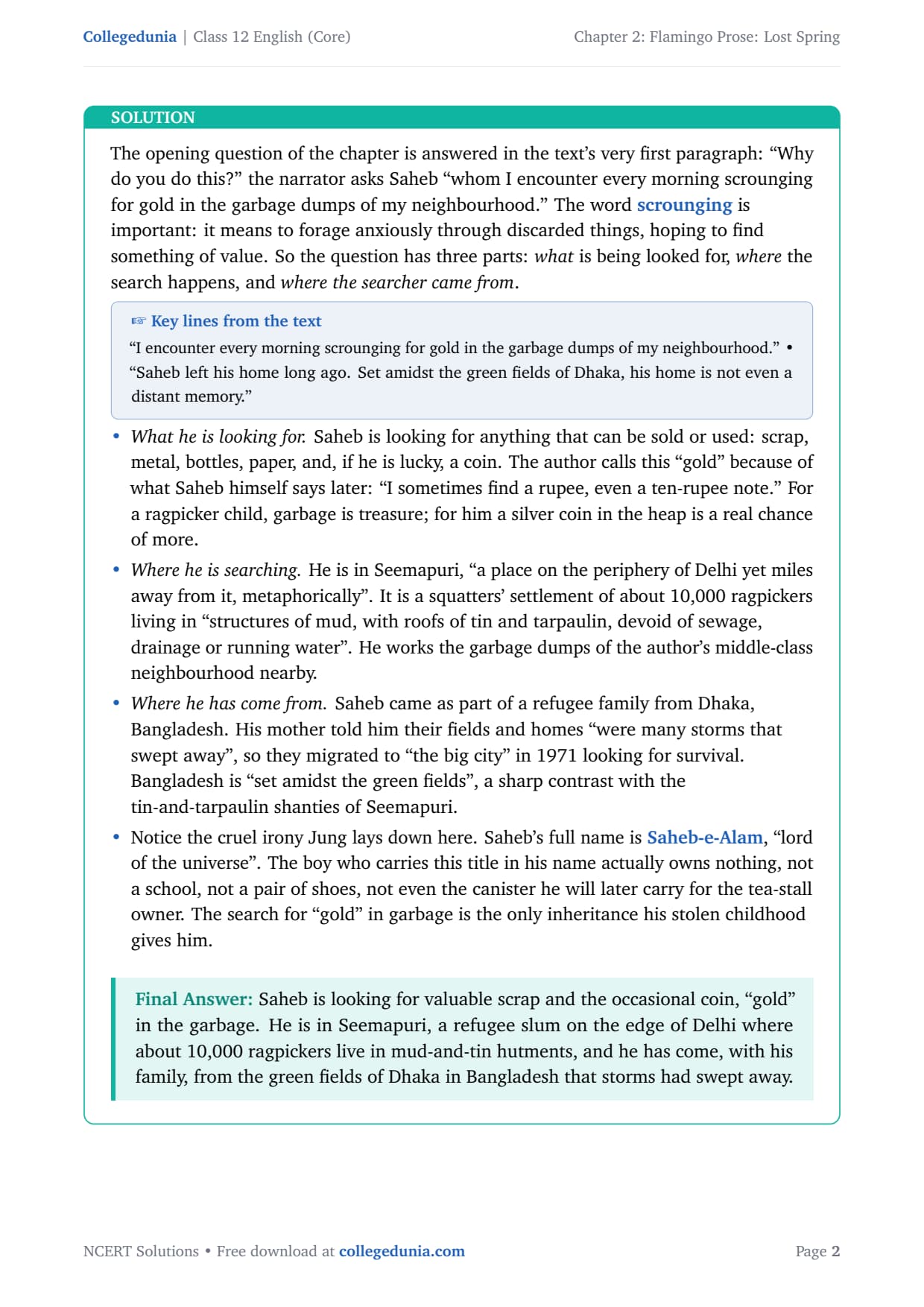
The opening question of the chapter is answered in the text's very first paragraph: ``Why do you do this?'' the narrator asks Saheb ``whom I encounter every morning scrounging for gold in the garbage dumps of my neighbourhood.'' The word scrounging is important: it means to forage anxiously through discarded things, hoping to find something of value. So the question has three parts: what is being looked for, where the search happens, and where the searcher came from.
Key lines from the text
``I encounter every morning scrounging for gold in the garbage dumps of my neighbourhood.'' • ``Saheb left his home long ago. Set amidst the green fields of Dhaka, his home is not even a distant memory.''- What he is looking for. Saheb is looking for anything that can be sold or used: scrap, metal, bottles, paper, and, if he is lucky, a coin. The author calls this ``gold'' because of what Saheb himself says later: ``I sometimes find a rupee, even a ten-rupee note.'' For a ragpicker child, garbage is treasure; for him a silver coin in the heap is a real chance of more.
- Where he is searching. He is in Seemapuri, ``a place on the periphery of Delhi yet miles away from it, metaphorically''. It is a squatters' settlement of about 10,000 ragpickers living in ``structures of mud, with roofs of tin and tarpaulin, devoid of sewage, drainage or running water''. He works the garbage dumps of the author's middle-class neighbourhood nearby.
- Where he has come from. Saheb came as part of a refugee family from Dhaka, Bangladesh. His mother told him their fields and homes ``were many storms that swept away'', so they migrated to ``the big city'' in 1971 looking for survival. Bangladesh is ``set amidst the green fields'', a sharp contrast with the tin-and-tarpaulin shanties of Seemapuri.
- Notice the cruel irony Jung lays down here. Saheb's full name is Saheb-e-Alam, ``lord of the universe''. The boy who carries this title in his name actually owns nothing, not a school, not a pair of shoes, not even the canister he will later carry for the tea-stall owner. The search for ``gold'' in garbage is the only inheritance his stolen childhood gives him.
Saheb is looking for valuable scrap and the occasional coin, ``gold'' in the garbage. He is in Seemapuri, a refugee slum on the edge of Delhi where about 10,000 ragpickers live in mud-and-tin hutments, and he has come, with his family, from the green fields of Dhaka in Bangladesh that storms had swept away.
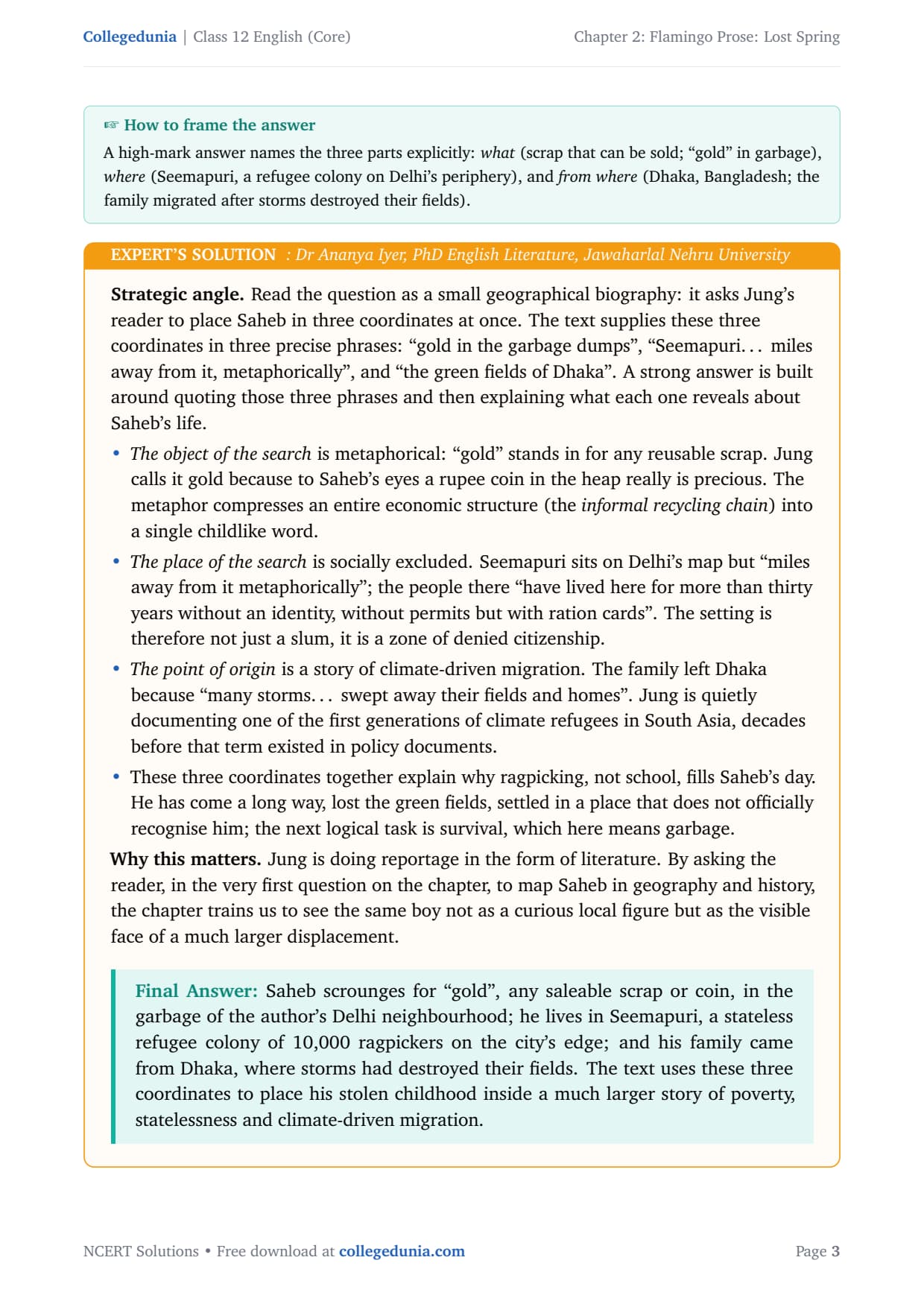
Strategic angle. Read the question as a small geographical biography: it asks Jung's reader to place Saheb in three coordinates at once. The text supplies these three coordinates in three precise phrases: ``gold in the garbage dumps'', ``Seemapuri miles away from it, metaphorically'', and ``the green fields of Dhaka''. A strong answer is built around quoting those three phrases and then explaining what each one reveals about Saheb's life.
- The object of the search is metaphorical: ``gold'' stands in for any reusable scrap. Jung calls it gold because to Saheb's eyes a rupee coin in the heap really is precious. The metaphor compresses an entire economic structure (the informal recycling chain) into a single childlike word.
- The place of the search is socially excluded. Seemapuri sits on Delhi's map but ``miles away from it metaphorically''; the people there ``have lived here for more than thirty years without an identity, without permits but with ration cards''. The setting is therefore not just a slum, it is a zone of denied citizenship.
- The point of origin is a story of climate-driven migration. The family left Dhaka because ``many storms swept away their fields and homes''. Jung is quietly documenting one of the first generations of climate refugees in South Asia, decades before that term existed in policy documents.
- These three coordinates together explain why ragpicking, not school, fills Saheb's day. He has come a long way, lost the green fields, settled in a place that does not officially recognise him; the next logical task is survival, which here means garbage.
Why this matters. Jung is doing reportage in the form of literature. By asking the reader, in the very first question on the chapter, to map Saheb in geography and history, the chapter trains us to see the same boy not as a curious local figure but as the visible face of a much larger displacement.
Saheb scrounges for ``gold'', any saleable scrap or coin, in the garbage of the author's Delhi neighbourhood; he lives in Seemapuri, a stateless refugee colony of 10,000 ragpickers on the city's edge; and his family came from Dhaka, where storms had destroyed their fields. The text uses these three coordinates to place his stolen childhood inside a much larger story of poverty, statelessness and climate-driven migration.
What explanations does the author offer for the children not wearing footwear?
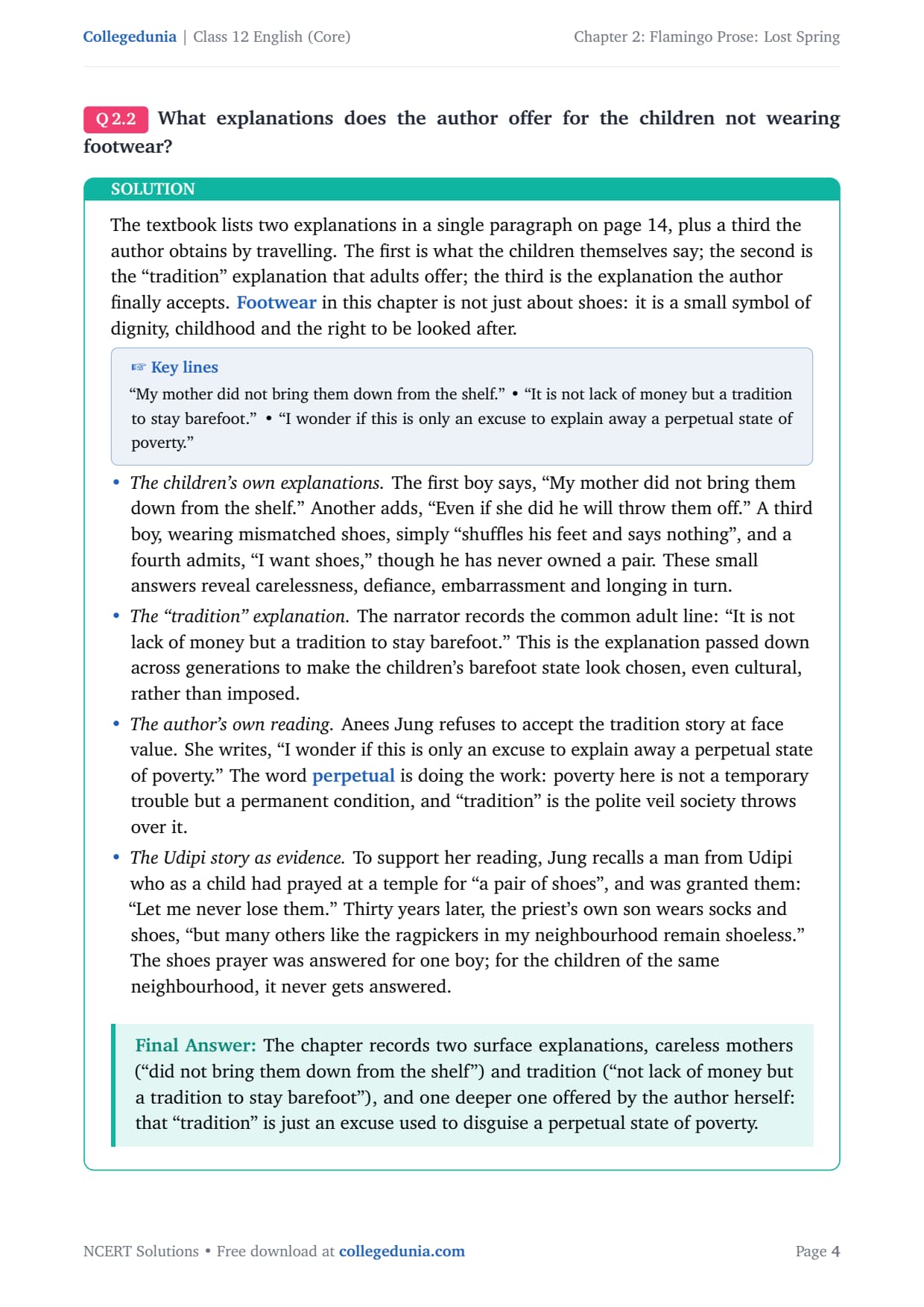
The textbook lists two explanations in a single paragraph on page 14, plus a third the author obtains by travelling. The first is what the children themselves say; the second is the ``tradition'' explanation that adults offer; the third is the explanation the author finally accepts. Footwear in this chapter is not just about shoes: it is a small symbol of dignity, childhood and the right to be looked after.
Key lines
``My mother did not bring them down from the shelf.'' • ``It is not lack of money but a tradition to stay barefoot.'' • ``I wonder if this is only an excuse to explain away a perpetual state of poverty.''- The children's own explanations. The first boy says, ``My mother did not bring them down from the shelf.'' Another adds, ``Even if she did he will throw them off.'' A third boy, wearing mismatched shoes, simply ``shuffles his feet and says nothing'', and a fourth admits, ``I want shoes,'' though he has never owned a pair. These small answers reveal carelessness, defiance, embarrassment and longing in turn.
- The ``tradition'' explanation. The narrator records the common adult line: ``It is not lack of money but a tradition to stay barefoot.'' This is the explanation passed down across generations to make the children's barefoot state look chosen, even cultural, rather than imposed.
- The author's own reading. Anees Jung refuses to accept the tradition story at face value. She writes, ``I wonder if this is only an excuse to explain away a perpetual state of poverty.'' The word perpetual is doing the work: poverty here is not a temporary trouble but a permanent condition, and ``tradition'' is the polite veil society throws over it.
- The Udipi story as evidence. To support her reading, Jung recalls a man from Udipi who as a child had prayed at a temple for ``a pair of shoes'', and was granted them: ``Let me never lose them.'' Thirty years later, the priest's own son wears socks and shoes, ``but many others like the ragpickers in my neighbourhood remain shoeless.'' The shoes prayer was answered for one boy; for the children of the same neighbourhood, it never gets answered.
The chapter records two surface explanations, careless mothers (``did not bring them down from the shelf'') and tradition (``not lack of money but a tradition to stay barefoot''), and one deeper one offered by the author herself: that ``tradition'' is just an excuse used to disguise a perpetual state of poverty.
Strategic angle. Treat the question as three layers nested inside one paragraph: what the children say, what society says through them, and what Jung says about both. A confident answer unpacks all three. The smallest detail in the paragraph, the missing chappals on the shelf, becomes a window onto a national pattern of denial.
- Read the children's lines as evidence of normalised deprivation. The first boy is not really blaming his mother; he is repeating a household script in which footwear is so unimportant that nobody bothers to fetch it. The mismatched shoes of another boy show that footwear, when it does arrive, does so haphazardly and as charity.
- The ``tradition'' line is a piece of social rhetoric. By calling barefoot life a custom rather than a deprivation, speakers turn an absence into a choice, and a choice does not demand action from anyone. Jung's job, as a reporter, is to notice this rhetorical sleight of hand.
- Her counter, ``a perpetual state of poverty'', changes the frame: barefoot children are not a quaint Indian custom, they are an unhealed economic wound. The word perpetual insists on the structural nature of the wound, that is, of the chronic, unending kind.
- The Udipi anecdote is the small literary proof. The priest's son now wears shoes; the ragpicker still does not. The outcome of the boy's prayer depended not on faith but on which family he was born into.
Why this matters. A reader who repeats only the ``tradition'' line is doing exactly what Jung warns against, accepting the excuse society uses to ignore the problem. The author's own line about ``perpetual poverty'' is the answer the chapter wants its reader to arrive at.
The text offers two surface reasons (careless mothers and ``tradition''), but Anees Jung sets them up only to dismantle them. Her real explanation is that barefoot childhood is a sign of perpetual poverty, and ``tradition'' is the polite excuse used to keep the deprivation invisible.
Is Saheb happy working at the tea-stall? Explain.
The end of the Saheb section answers this question through a single, carefully built image. The author writes: ``His face, I see, has lost the carefree look. The steel canister seems heavier than the plastic bag he would carry so lightly over his shoulder. The bag was his. The canister belongs to the man who owns the tea shop. Saheb is no longer his own master!'' To answer ``happy?'' we have to compare two Saheb's: the morning ragpicker and the tea-stall employee.
- What the job looks like on paper. Saheb is ``paid 800 rupees and all my meals''. By the standards of his earlier life this is a real wage and a fixed source of food, the two things ragpicking did not guarantee. On the surface, he has moved up.
- The first sign of unhappiness: his face. The narrator notices that his face ``has lost the carefree look'' it had as a ragpicker. The freedom of the ``army of barefoot boys who appear like the morning birds'' is gone. The very thing the job was supposed to give him, security, has cost him his liveliness.
- The symbol of the canister. The narrator points to the ``steel canister'' that ``seems heavier than the plastic bag he would carry so lightly over his shoulder''. The literal weight of the canister is not the problem; its symbolic weight is. The plastic bag held scrap that belonged to him and the choice to collect it was his; the canister holds milk for somebody else and belongs to the tea-stall owner.
- The closing line: ``no longer his own master''. Jung chooses the strongest word to end the section: master. As a ragpicker, Saheb was poor but autonomous. As a tea-stall boy, he is fed and paid but he has lost his autonomy. For a child whose childhood has already been stolen, the loss of even his small freedom is a fresh blow.
- Therefore no, Saheb is not happy. The job has bought him meals at the price of the carefree freedom he had in the morning streets. The chapter treats this exchange as a loss, not a gain.
No. The text shows clearly that although the tea-stall pays him 800 rupees and feeds him, Saheb has lost his ``carefree look'', finds the owner's steel canister heavier than the scrap-bag that was his, and is ``no longer his own master''. The wage has come at the cost of his small freedom.
Strategic angle. The question looks small but it carries the chapter's first thesis on child labour: that the move from informal to wage labour can look like progress and still be a defeat. A confident answer reads the canister-versus-bag image as Jung's main argument and then asks what kind of ``happiness'' the wage actually buys.
- Saheb's earlier life had poverty plus freedom. He had no school, no shoes and no fixed meals, but his time was his. The tea-stall life has food and pay minus freedom; his time now belongs to the owner.
- Jung's image of the steel canister versus the plastic bag is a careful piece of writing. Both objects are containers, but one is owned by the child and the other by the employer. The ownership of the container is the real subject of the sentence.
- Notice that the narrator never says Saheb complains. The text says only that his face has lost its carefree look. Jung is being honest about how child labour works in practice: the child accepts the new arrangement, because the wage and the meals are real, but something in him visibly diminishes.
- The line ``no longer his own master'' is doing strong work. It frames Saheb's new job in the vocabulary of servitude, not employment. For a Class 12 reader this is the central ethical point of the section: a child paid for his labour is not the same as a child being lifted out of poverty.
Why this matters. Saheb's story is a small but exact picture of how India's informal economy traps poor children. Schooling never arrived; the next available step was wage labour; the wage labour came with loss of autonomy. Jung asks the reader to refuse the language of ``opportunity'' here.
No, Saheb is not happy. His ``carefree look'' is gone, the owner's canister feels heavier than his own bag, and he is ``no longer his own master''. The chapter treats the tea-stall job as a fresh layer of loss, not as a step up from ragpicking.
Part 2: Sidebar Questions on Mukesh (page 16)
What makes the city of Firozabad famous?
The Mukesh section opens with a clear geographical statement: ``His dream looms like a mirage amidst the dust of streets that fill his town Firozabad, famous for its bangles. Every other family in Firozabad is engaged in making bangles. It is the centre of India's glass-blowing industry where families have spent generations working around furnaces, welding glass, making bangles for all the women in the land it seems.'' The answer is in three parts: what Firozabad is famous for, how this fame is organised, and how the people of the city pay for it.
- What Firozabad is famous for. Firozabad is the centre of India's glass-blowing industry and is most famous for its glass bangles. The text says it makes ``bangles for all the women in the land it seems'', the hyperbole signalling the scale.
- How the fame is organised. ``Every other family in Firozabad is engaged in making bangles.'' The whole town's labour, men, women and children, is organised around the furnaces. Generations of one family work the same trade: ``families have spent generations working around furnaces, welding glass, making bangles''.
- The visible look of the fame. The streets are filled with ``spirals of bangles, sunny gold, paddy green, royal blue, pink, purple, every colour born out of the seven colours of the rainbow'' lying in mounds in yards and piled on four-wheeled handcarts. The fame is therefore not abstract; the bangles are everywhere the eye looks.
- What the fame costs. About 20,000 children work ``illegally in the glass furnaces with high temperatures, in dingy cells without air and light''; many lose their eyesight before they become adults; Mukesh's grandfather went blind ``with the dust from polishing the glass of bangles''. The fame of Firozabad rests on the broken health and stolen childhoods of its bangle-making families.
Firozabad is famous as the centre of India's glass-blowing industry, especially for its glass bangles: ``making bangles for all the women in the land it seems''. Almost every family in the city works around the furnaces, and the fame rests on the labour of about 20,000 children working in dingy, high-temperature cells.
Strategic angle. A confident answer treats Firozabad as a case study the chapter is using to make a larger point about how Indian craft industries organise hereditary poverty. The fame is real; the question is who pays for it.
- Geographically, Firozabad is in Uttar Pradesh, on the Delhi-to-Agra road. Historically it has been India's glass-bangle capital for generations. The text does not give us those dates, but the phrasing ``generations working around furnaces'' tells the reader that this is an inherited occupation, not a recent factory boom.
- Socially, the industry is built on a caste structure. Mukesh's grandmother says, ``Born in the caste of bangle makers, they have seen nothing but bangles in the house, in the yard, in every other house, every other yard, every street in Firozabad.'' Caste here works as the recruitment system of the industry.
- Economically, the industry sits inside a chain of middlemen, sahukars, traders, the police and the politicians. The young men say, ``Even if we get organised, we are the ones who will be hauled up by the police, beaten and dragged to jail.'' Cooperatives are blocked; the middlemen capture the profit.
- Therefore the fame of the city is technically real (bangles for ``all the women in the land''), but it is sustained by child labour, blindness, caste-locked livelihoods and an organised denial of the right to organise. The fame and the injustice are inseparable.
Why this matters. If a reader stops at ``Firozabad is famous for bangles'', the chapter's argument is missed. Jung's whole point is that the bangle of a bride in another city is paid for, in part, by a Firozabad child's eyesight. The fame, in her reading, is also the indictment.
Firozabad's fame is its bangles, ``every colour born out of the seven colours of the rainbow'', and its place as the centre of India's glass-blowing industry. The chapter ties this fame inseparably to the price the city pays: 20,000 children in furnaces, generational blindness and a caste-locked workforce.
Mention the hazards of working in the glass bangles industry.
The chapter lists the hazards in three blocks: the workplace conditions, the long-term bodily damage, and the social-legal trap. ``Hazards'' here therefore means not only physical dangers (heat, dust, blindness) but also the systemic risks (illegality, caste, middlemen) that keep the worker locked in those physical dangers.
Key text
`` illegal for children like him to work in the glass furnaces with high temperatures, in dingy cells without air and light Slog their daylight hours, often losing the brightness of their eyes.''- Heat and confinement. Children work ``in the glass furnaces with high temperatures, in dingy cells without air and light''. The space is closed; the temperatures are very high; basic ventilation is missing. Each shift is therefore a direct physical strain on a growing body.
- Long-term blindness. ``Their eyes are more adjusted to the dark than to the light outside. That is why they often end up losing their eyesight before they become adults.'' Mukesh's grandfather, the narrator tells us, has already gone blind ``with the dust from polishing the glass of bangles''. The eyesight loss is a chronic, generational injury.
- Cuts, burns and lung damage. The work involves ``welding pieces of coloured glass into circles of bangles'' ``next to lines of flames of flickering oil lamps''. Cuts from glass, burns from the flame and damage from constantly inhaled glass dust are all part of the daily job; the text records them in the body of Savita, the elderly woman beside her, and Mukesh's grandmother and grandfather.
- Illegality and absence of protection. ``It is illegal for children like him to work in the glass furnaces the law, if enforced, could get him and all those 20,000 children out of the hot furnaces.'' The law exists; the enforcement does not. So the hazard is also legal: the children are doing illegal work, in the open, with no protection.
- Social hazards: caste and middlemen. ``A vicious circle of the sahukars, the middlemen, the policemen, the keepers of law, the bureaucrats and the politicians have imposed the baggage on the child that he cannot put down.'' Even if the workers tried to organise into a cooperative, they would be ``hauled up by the police, beaten and dragged to jail''. The social hazard is the impossibility of escape.
The hazards are physical (very high furnace temperatures, dingy cells without air or light, glass dust, cuts, burns and eventual blindness, often before adulthood), legal (the work is illegal but not stopped) and social (caste-locked recruitment, sahukar-middleman exploitation and police repression of any attempt to organise).
Strategic angle. A confident answer organises the hazards into the three concentric circles the chapter actually draws: body, law and society. Each circle adds a kind of risk that the previous one cannot describe.
- Body. The furnace at high temperature, the dingy cell without air and light, the inhaled glass dust, the constant proximity to flame, the strain on the eyes adjusted to dark, the cuts from soldering and welding, and the slow accumulation of all of these into blindness ``before they become adults''. The grandmother's husband and the elderly woman beside Savita are living evidence.
- Law. The work itself is illegal for children but the text records, with great care, that the law is not enforced and could, ``if enforced'', remove 20,000 children at once. The hazard here is the gap between the law on paper and the law in practice; the child works under a law that exists for him but not actually for him.
- Society. Cooperatives, the obvious remedy, are blocked at the point of attempt: the young men know they will be ``hauled up by the police, beaten and dragged to jail''. The vicious circle of ``sahukars, middlemen, policemen, keepers of law, bureaucrats and politicians'', plus the inherited caste of bangle-makers, completes the cage. Even ``daring is not part of his growing up.''
- Generational consequence. The hazards stack across generations: the grandfather is blind, the elderly woman beside Savita has no light in her eyes, the wife of Mukesh's elder brother already cooks ``through eyes filled with smoke''. The hazard of the industry is not only an individual risk; it is the family's inheritance.
Why this matters. Listing only the physical hazards turns this into a textbook safety problem. The chapter's stronger argument is that the physical hazards are sustained by the legal and social ones; that is why the children cannot simply leave.
Furnace heat, dingy airless cells, glass dust, burns and near-certain blindness; illegal work that the law refuses to stop; and a caste-and-middleman lock that punishes any attempt to organise. The chapter treats all three as inseparable hazards of the bangle industry.
How is Mukesh's attitude to his situation different from that of his family?
The chapter ends Mukesh's first section by deliberately contrasting his attitude with that of his elders. Mukesh's grandmother and father accept their condition as karam or destiny: ``It is his karam, his destiny Can a god-given lineage ever be broken?'' Mukesh, by contrast, ``insists on being his own master'' and announces, ``I will be a motor mechanic.'' The question asks us to map this difference of attitude in full detail.
- The family's attitude: resignation as faith. Mukesh's grandmother explains her husband's blindness as god-given destiny: she has watched him ``go blind with the dust from polishing the glass of bangles''. The grandfather himself says, ``I know nothing except bangles. All I have done is make a house for the family to live in.'' Generations of suffering have hardened into the belief that no other life is possible.
- The community's attitude: weariness. The young men of Firozabad echo the older men: they ``talk endlessly in a spiral that moves from poverty to apathy to greed and to injustice''. They have stopped imagining change. ``Even if we get organised, we are the ones who will be hauled up by the police'' the cooperative idea dies before it begins.
- Mukesh's attitude: a refusal of inheritance. Against all this, Mukesh ``insists on being his own master''. His announcement, ``I will be a motor mechanic,'' is in the first person and in the future tense. He is willing to walk a long distance to a garage to learn, and the narrator notes that ``daring is not part of his growing up'', yet Mukesh dares.
- The limit of his daring. The chapter is honest: when the author asks if he also dreams of flying a plane, Mukesh is ``suddenly silent in his small murmur there is an embarrassment that has not yet turned into regret. He is content to dream of cars Few airplanes fly over Firozabad.'' His dream is bigger than his family's, but bounded by what he has actually seen. He breaks the spiral only as far as the streets of his town will allow.
- The contrast in one line. The family accepts the ``baggage on the child that he cannot put down''; Mukesh, in his small way, puts a corner of that baggage down. The author sees ``a flash'' of daring in him and is cheered. That flash, against the family's resignation, is the difference.
Mukesh's family treats bangle-making as god-given karam that cannot be broken, while Mukesh quietly refuses to inherit it: he wants to be ``his own master'' and become a motor mechanic. The difference is small but real: he dares to dream of a car, where his family has stopped daring at all. The dream is bounded by his town (he is silent on airplanes), but compared to his grandfather's blindness and his elders' resignation, even this bounded ambition is a break.
Strategic angle. The cleanest way to answer is to map three attitudes against one another: the grandparents' (karam, acceptance), the young men's (despair, blocked cooperative) and Mukesh's (small, bounded daring). Doing so shows the examiner that you have read the whole Firozabad section, not just the lines about Mukesh.
- The grandparents speak in the language of fate: the grandmother appeals to god-given lineage; the grandfather records his life as ``I know nothing except bangles''. There is dignity in their words but no expectation of change.
- The young men speak in the language of exhaustion: cooperatives invite police action; ``there is no leader among them'', so the system holds. They are not religious about their fate but they are realistic about its grip.
- Mukesh speaks in the language of aspiration: ``I will be a motor mechanic I will learn to drive a car I will walk'' to the garage. The first-person future tense is doing the work; his family has stopped using it.
- However, Mukesh's daring stops short of full flight. Airplanes ``fly over Firozabad'' but he cannot follow them with his imagination. The chapter is honest about this ceiling: Mukesh has broken the family's pattern only as far as his town's streets allow.
- Notice how the chapter uses the body language of the three groups to underline the attitudinal difference. The grandfather sits with the bangles he has spent his life on and confesses, ``I know nothing except bangles.'' The young men talk ``endlessly in a spiral that moves from poverty to apathy to greed and to injustice''. Mukesh, by contrast, ``looks straight into my eyes'' when he speaks of his garage. The eye contact is doing literary work.
- Read his small ambition as a chapter-wide hinge. The author is openly cheered by ``a flash of it in Mukesh''. For a text this dark on child labour and caste, the author's permission to feel hope is rare and deliberate; she gives it only to Mukesh.
Why this matters. Treating Mukesh as either a hero of escape or a victim of caste is too simple. The chapter wants the reader to see exactly how much daring a Firozabad child can afford, and how small that ``flash'' looks against the size of the trap. That realism is the literary point.
Mukesh's family treats bangle-making as religious destiny; the young men around him have given up on collective action; Mukesh is the only one who frames a personal future in his own first-person, ``I will be a motor mechanic''. His dream is bounded by what he has seen (cars, not planes), but inside that boundary it is a real, visible refusal of inherited fate.
Part 3: Understanding the Text (page 19)
What could be some of the reasons for the migration of people from villages to cities?
The chapter answers this question through two case studies that show two distinct migration drivers. Saheb's family left ``the green fields of Dhaka'' because ``many storms swept away their fields and homes''. Mukesh's family did not migrate recently, but their continued residence in Firozabad is explained by generations of caste-locked work around the furnaces. Between the two, the chapter lays out the standard push and pull factors of rural-to-urban migration in India.
- Push factor: environmental loss. Saheb's mother gives the most direct example. Their fields and home in Dhaka were swept away by storms, so the family ``left, looking for gold in the big city where he now lives''. Floods, cyclones and soil loss continue to drive farming families out of South Asia's deltas; Jung's chapter records one such family.
- Push factor: failing rural economy. The Seemapuri women tell the narrator: ``If at the end of the day we can feed our families and go to bed without an aching stomach, we would rather live here than in the fields that gave us no grain.'' Land that no longer feeds its tillers is a powerful reason to leave it.
- Push factor: war and statelessness. The Seemapuri squatters ``came from Bangladesh back in 1971'', the year of the Bangladesh Liberation War. Political violence and the creation of refugee populations are a third push.
- Pull factor: chance of survival in the city. ``Wherever they find food, they pitch their tents that become transit homes.'' The city offers garbage that can be sorted, sold and re-sold; even a ration card without an identity becomes possible: ``ration cards that get their names on voters' lists and enable them to buy grain''. Food and a minimal recognition are the two pulls.
- Pull factor: hope of dignity, education, and dreams. Saheb agrees to go to school the moment one is promised: ``Yes,'' he says, smiling broadly. Mukesh's dream of being a motor mechanic is also a city-shaped dream; the garage, the car, the road exist as possibilities only in an urban imagination.
- An honest qualifier. The chapter does not pretend the city delivers on its pulls. Seemapuri's drainage is missing, Mukesh's house is half-built, Saheb ends up at a tea-stall. Migration is a forced bet rather than a free choice.
People migrate from villages to cities for both push reasons (environmental loss like storms in Dhaka, failing crops, political violence such as 1971 Bangladesh) and pull reasons (daily food from garbage and informal work, ration cards, a chance of schooling, dreams of trades the village cannot offer). The chapter records all of these honestly, without claiming the city actually delivers on its promises.
Strategic angle. Frame the answer in the standard push-pull vocabulary that the chapter quietly uses anyway: push factors (what is wrong with the village) and pull factors (what the city seems to promise). The chapter gives clean examples of each, and also gives an unusual third category that examiners reward: forced pulls, where the city is chosen not for its strengths but because the village can no longer be lived in.
- Push, environmental. The Dhaka storms in Saheb's story are the textbook example. South Asia's delta and coastal farmers continue to be displaced this way. Jung is recording the human face of a regional pattern.
- Push, economic. ``Fields that gave us no grain'' is the line to quote: rural poverty due to fragmented land, debt and crop failure is a long-running cause of internal migration.
- Push, political. The 1971 origin date for Seemapuri's squatters is shorthand for the entire trauma of the Bangladesh War. Many of the families left behind life, property and citizenship and arrived with none of these.
- Pull, livelihood. Cities offer informal work that villages do not: scrap-collection, daily-wage construction, tea-stalls, vending. Even without skill, a poor migrant can find a way to earn a meal.
- Pull, services and recognition. Schools (however symbolic in Saheb's case), ration cards and voter lists are forms of recognition urban India is more likely to grant than rural India is.
- Caveat from the text. The chapter refuses sentimentality about the city. Seemapuri has no sewage; Mukesh works in dingy cells. Migration in Lost Spring is a bet, not a victory.
Why this matters. The push-pull framing helps the student write a structured answer in five minutes. It also matches the chapter's own honesty: it lets you say what is real about the city's attraction without ignoring what is broken about it.
The text records environmental push (storms swept away Saheb's fields), economic push (fields that gave no grain), political push (refugees from 1971 Bangladesh), and the pulls of informal work, food, ration-card recognition and rural-impossible dreams (a motor-mechanic's garage). The chapter's honesty is that the pulls rarely keep their promises.
Would you agree that promises made to poor children are rarely kept? Why do you think this happens in the incidents narrated in the text?
The text gives the author herself as the clearest example of a broken promise. When she suggests to Saheb that he should go to school, she catches herself ``realising immediately how hollow the advice must sound''. He asks, half-hoping, ``If I start a school, will you come?'' She agrees, ``half-joking''. A few days later, Saheb runs up: ``Is your school ready?'' She is forced to say, ``It takes longer to build a school,'' ``embarrassed at having made a promise that was not meant''. The chapter then names the larger pattern: ``promises like mine abound in every corner of his bleak world''. The answer has to do two things: agree that promises to poor children are rarely kept, and explain why this happens.
- The author's own broken promise. The narrator never meant to start a school. She made the promise to soothe Saheb's eagerness; he, having no school in his life, took the promise as a possibility. The asymmetry is the entire problem: she meant little, he heard much.
- A pattern, not an exception. Jung writes that ``promises like mine abound in every corner of his bleak world.'' Every passer-by, every kindly adult, every visiting NGO leaves a small promise behind. None of those promises is collected by anyone responsible.
- Mukesh's father and the broken duty of schooling. Mukesh's father has ``failed to renovate a house, send his two sons to school. All he has managed to do is teach them what he knows, the art of making bangles.'' Even the father's hopes for his sons are not kept, because the father himself has been ground down by the trade.
- Why the promises are not kept (1): the speaker pays no cost. Middle-class adults like the narrator move on. The child remains in Seemapuri. There is no contract, no record, no audit. The promise costs the giver nothing, so there is no incentive to deliver.
- Why the promises are not kept (2): the systems behind the promises are missing. A promise of ``a school'' needs a building, teachers, government recognition. In Seemapuri, none of these exist for a stateless refugee population. A single sentence cannot supply the systems that are absent.
- Why the promises are not kept (3): the political economy. In Firozabad, even when cooperatives are imagined, the police, middlemen and bureaucrats unite to crush them. Promises of organised escape are punished. The system is actively designed to keep its current shape.
- Why the promises are not kept (4): the children themselves expect little. Saheb does not chase the author with anger. Mukesh murmurs his dream ``looking straight into my eyes''. The children's low expectations let the adults off the hook.
Yes, the chapter strongly supports the view that promises made to poor children are rarely kept. The narrator's own half-joking promise of a school is the clearest example, and Mukesh's father could not even fulfil his quieter wish of sending his sons to school. The promises fail because the adult who makes them pays no cost, the institutions needed to deliver on them are absent, the political economy crushes any organised attempt to demand them, and the children, accustomed to denial, ask for little.
Strategic angle. Treat the question as a small thesis: yes, agree, but explain why. The chapter offers four reasons in clear text; you only need to organise them. A confident answer reads the school promise as a small case of a larger national problem.
- Read the broken promise as a transaction without cost on the adult's side. The narrator never intended to build a school; the promise was a polite filler. Where the cost of failure does not fall on the speaker, the failure is almost guaranteed.
- Read it also as a transaction without infrastructure. Saheb's neighbourhood does not have a school; the state has not built one for the children of ``squatters'' from Bangladesh. A promise made into an institutional vacuum cannot find a delivery channel.
- Read Mukesh's father's situation as the same principle on a smaller scale. Even sincere intent (``send his two sons to school'') is not enough when the family economy demands the children's labour and the village has no alternative.
- Finally, read the chapter as a quiet indictment of the adult reader. Jung includes her own broken promise deliberately. She is asking the middle-class reader to notice the small lies they themselves tell poor children, and how those lies accumulate into a culture of broken promises.
- Look at the temporal dimension as well. The Udipi anecdote on page 14 spans thirty years: one boy's prayer for shoes is granted; a generation later, ragpicker children in the same country are still shoeless. Thirty years of un-kept promises sit between those two halves of the same story. The chapter keeps reminding the reader that broken promises are not single events; they accumulate across decades.
Why this matters. The question is doing moral work, not just literary work. The chapter is asking the student to see that poor children are failed not only by the cruelty of distant governments but by the casual half-jokes of nearby adults. That is why even the narrator includes herself in the failure. A student who answers ``yes'' without including herself, or himself, in the chain of small adult lies has read only half the chapter.
Yes. The chapter supports it through both the narrator's own broken school-promise to Saheb and Mukesh's father's failure to send his sons to school. The promises fail because the speaker pays no cost, the institutions needed to deliver are missing, the political economy actively punishes organised escape and the children's lowered expectations let the broken promises pass.
What forces conspire to keep the workers in the bangle industry of Firozabad in poverty?
The text uses the word conspire itself: ``Listening to them, I see two distinct worlds: one of the family, caught in a web of poverty, burdened by the stigma of caste in which they are born; the other a vicious circle of the sahukars, the middlemen, the policemen, the keepers of law, the bureaucrats and the politicians. Together they have imposed the baggage on the child that he cannot put down.'' The forces are therefore plural and deliberately listed by the author.
- Caste. Mukesh's grandmother says, ``Born in the caste of bangle makers, they have seen nothing but bangles Can a god-given lineage ever be broken?'' Caste here is not only social identity; it is the recruitment mechanism of the industry. The child does not have to be hired; he is born into the workforce.
- Poverty. The grandfather has worked all his life ``first as a tailor, then a bangle maker''; the elderly woman beside Savita has ``not enjoyed even one full meal in her entire lifetime''. Without savings, the family cannot afford even the brief pause needed to retrain into another trade.
- The sahukars (moneylenders) and middlemen. The young men say they are ``trapped'' in a ``vicious circle of middlemen who trapped their fathers and forefathers''. The middlemen advance loans and buy the finished bangles at unfair prices, so the workers stay tied to them across generations.
- The police. ``Even if we get organised, we are the ones who will be hauled up by the police, beaten and dragged to jail for doing something illegal.'' The police are not neutral law-enforcers in this text; they protect the existing trade by attacking any worker attempt to organise.
- The bureaucracy and politicians. They are mentioned as part of the ``vicious circle the keepers of law, the bureaucrats and the politicians''. They do not enforce the law that forbids child labour in furnaces, and they do not protect the workers' right to organise. Their action is their inaction.
- Internal: apathy and the death of initiative. ``Years of mind-numbing toil have killed all initiative and the ability to dream.'' The most cruel force is the one that no longer needs to be applied from outside: a worker who can no longer imagine a different life will not even attempt one. ``Daring is not part of his growing up.''
- Lack of leaders. ``There is no leader among them, no one who could help them see things differently.'' Without leadership, the apathy is self-reinforcing.
Two interlocking circles trap the workers: an inner family circle of caste-lock, hereditary poverty and lost initiative, and an outer political circle of sahukars, middlemen, police, bureaucrats and politicians who together punish any attempt to organise. The chapter's word for this is ``conspire''. The forces are not accidents; they are mutually reinforcing.
Strategic angle. The chapter's argument here is structural, not moral. It does not blame individual sahukars or individual policemen; it argues that the seven forces together form a system that needs all seven legs to keep the workers down. A confident answer mirrors this and refuses to single any one cause out.
- Caste is the recruitment system: it supplies child labour to the industry by birth, without contracts or wages negotiated. It is also the discouragement system: ``Can a god-given lineage ever be broken?'' is a permission slip for inaction.
- Poverty is the immobiliser: a family without savings cannot retrain. Even Mukesh, the most ambitious child in the chapter, can only walk to a nearby garage, not move to a city to study.
- Sahukars and middlemen are the extractor: by advancing loans and buying cheap, they ensure that any surplus the worker produces is immediately captured upward.
- Police are the enforcer of stasis: they criminalise the worker's most natural remedy, the cooperative.
- Bureaucrats and politicians are the absent: they do not enforce the laws that exist (against child labour) and do not create the laws that are needed (for fair pricing, cooperative protection). Their absence is structural, not accidental.
- Internal apathy and missing leadership are the most quietly powerful: the worker has internalised the trap to the point of not imagining a way out. ``Daring is not part of his growing up.''
Why this matters. Reading the seven forces as a system matters because it explains why any single reform fails. Banning child labour without enforcing it is empty; offering loans without breaking the sahukar's grip is empty; allowing cooperatives on paper without protecting them from the police is empty. The chapter is asking for all seven legs to be addressed at once.
Caste, hereditary poverty, sahukar-middlemen extraction, police repression of cooperatives, bureaucratic and political abandonment, and the workers' own loss of initiative form an interlocking system. The chapter calls it a ``conspiracy'' of two circles, the family and the polity, that together keep the bangle worker poor.
Part 4: Talking about the Text (page 19)
How, in your opinion, can Mukesh realise his dream?
The chapter gives us both the dream and its obstacles, and asks the reader for an honest plan. Mukesh's dream is to ``be a motor mechanic I will learn to drive a car''. The obstacles are listed on the same pages: caste, the family economy, the absence of schooling, the long distance to the garage, the police-and-middlemen system, and the family's expectation that he will continue at the furnace. A real plan must answer each obstacle.
- Begin where Mukesh already stands. He has the rare thing in the chapter: aspiration in the first person. The plan should protect this. The first task is to make sure nobody, family, employer, or police, beats this aspiration out of him. A neighbour, a teacher, an NGO, anyone who affirms his dream is doing real work.
- Get him out of the furnace. As long as he loses his eyesight to the bangle work, he cannot drive a car. The first practical step is to remove him, even part-time, from the glass furnace and protect his eyes. The chapter notes the existing law could do this for 20,000 children at once if enforced.
- Acquire literacy and basic schooling. A motor mechanic in modern India needs to read manuals, recognise part numbers and follow safety instructions. Even a couple of years at a free government school or a bridge programme would close this gap.
- Apprentice at a real garage. Mukesh has already said, ``I will walk'' to the garage. A formal apprenticeship, perhaps under a sympathetic mechanic in Firozabad or nearby Agra, would convert his walk into a wage-and-learn arrangement. Government programmes such as the National Apprenticeship Promotion Scheme now exist for exactly this kind of move.
- Find financial support. A small monthly stipend, or a scholarship, would let Mukesh's family afford to lose his bangle-wage. Without this, the family will pull him back to the furnace within weeks of his joining a garage.
- Build a peer group. The chapter shows how isolating ambition is in Firozabad. If Mukesh can find even two or three other boys with similar dreams, the social cost of leaving the trade falls sharply.
- Keep going. Realising the dream is not a single act but years of small refusals. The chapter is honest: ``Few airplanes fly over Firozabad.'' Mukesh's plane will not fly tomorrow. The plan is to keep the car-dream alive long enough to walk to the garage on its own legs.
Mukesh can realise his dream through a stepped plan: protect his aspiration, remove him from the furnace, give him basic schooling and literacy, place him in a formal garage apprenticeship, provide a stipend so the family can afford the lost bangle-wage, build a small peer group of similarly ambitious boys and stay with him long enough for the small refusals to add up. The chapter is clear that no single step is enough; the plan has to attack the furnace, the family economy and the loneliness at the same time.
Strategic angle. Treat Mukesh's dream as a small public-policy problem and answer it as a stepped intervention rather than a single heroic act. A policy answer also matches the chapter's own analysis: it talks about ``cooperatives'', ``the law if enforced'' and ``20,000 children''; these are policy terms, not personal-grit terms.
- Enforce the existing law. Section 24 of the Factories Act and the Child and Adolescent Labour (Prohibition and Regulation) Act already forbid Mukesh's furnace work. The first step is enforcement; the chapter says so itself.
- Free, eye-safe schooling. A residential or day-bridge school in Firozabad, with health checks and eye-care, would let Mukesh both learn and recover from the damage of glass dust.
- Skill-linked apprenticeship. The Industrial Training Institute network already trains motor mechanics. A directed apprenticeship through NAPS, with a stipend, would give Mukesh both a wage and a real trade.
- Family-side support. Direct benefit transfers and a ration-card linked stipend would close the gap between what Mukesh used to earn at the furnace and what an apprentice earns. Without this, no family will let its son leave the trade.
- Cooperative formation, protected from police retaliation. The chapter's complaint about the police is specific: cooperatives are crushed. Independent registration rights and a state-level grievance mechanism would protect the right to organise.
- Mentorship and aspiration protection. The non-policy layer matters: a single committed mentor who keeps Mukesh's dream alive through the slow years is sometimes the difference between a realised dream and an abandoned one.
Why this matters. Reading Mukesh's dream as a policy task takes the burden off the child and places it on the systems that have failed him. The chapter wants the reader to make that shift.
Mukesh can realise his dream if existing child-labour laws are enforced, a bridge school with eye-care is provided, an ITI or NAPS apprenticeship with stipend is arranged, family-side support replaces his lost bangle-wage, cooperatives are protected from police harassment, and a mentor keeps the dream alive through years of slow effort. The chapter's own framing is structural; the answer has to be structural too.
Why should child labour be eliminated and how?
The chapter gives the reader most of the material for this answer in its description of the bangle furnaces: the law that forbids the work, the bodily damage it causes, the families it traps and the dreams it kills. The answer has two halves, why the labour should be eliminated, and how a society can actually eliminate it. Child labour, in the sense the chapter uses, means employment of children below the legally permitted age in conditions that damage their development.
- Why eliminate it (1): bodily harm. ``In the glass furnaces with high temperatures, in dingy cells without air and light losing the brightness of their eyes'' records exactly what child labour costs the body. Mukesh's grandfather, blind from polishing glass, is the final result. No economy is worth the eyesight of its children.
- Why eliminate it (2): stolen childhood. The Saheb section gives the moral case. Saheb has ``lost the carefree look'', is ``no longer his own master''. Children are not miniature adults; the years lost to wage labour cannot be returned to them. ``Lost spring'' is the chapter's title for exactly this loss.
- Why eliminate it (3): the social and economic trap. Child labour entrenches inherited poverty: a child in the furnace cannot go to school, will not break the caste lock and will produce children who repeat the same life. The chapter calls this a ``vicious circle that he cannot put down''.
- Why eliminate it (4): national waste. A society that loses the schooling, health and aspiration of 20,000 Firozabad children alone, multiplied across India, loses their adult productivity for decades. The economic case for elimination is as strong as the moral one.
- How (1): enforce existing law. The chapter is blunt: ``the law, if enforced, could get him and all those 20,000 children out of the hot furnaces''. The starting point of elimination is not new legislation but enforcement of the Child and Adolescent Labour (Prohibition and Regulation) Act, with regular factory inspections in Firozabad, Sivakasi, Bhadohi and similar hubs.
- How (2): free, full-time, quality schooling. Schooling has to be both available and affordable enough that the family can spare the child. Mid-day meals, free textbooks and uniforms close the cost gap that pulls children into wage work. The Right to Education Act already exists; its delivery is the task.
- How (3): direct support to the family economy. Cash transfers, ration cards, scholarships and stipends replace the wage the child was earning. Without this, the family pulls the child back to the furnace.
- How (4): rehabilitation and bridge programmes. Children pulled out of long-term labour cannot directly join a regular classroom. Bridge schools, vocational training and health screening (especially eye-care for glass-furnace children) handle the transition.
- How (5): break the political-economy circle. The chapter's seven forces (caste, poverty, sahukars, middlemen, police, bureaucrats, politicians) must be addressed together: cooperative protection, fair procurement prices, anti-bonded-labour drives and political will. Otherwise the child returns the moment the inspector leaves.
- How (6): social-norm change. Communities must come to see child labour as harm, not as ``family help''. NGOs, media coverage like Jung's chapter itself, and the survivors who reach school all change the social default.
Child labour should be eliminated because it damages the child's body (eyesight, growth, lung health), steals the child's spring of life, locks the family in inherited poverty and wastes the nation's future productivity. It can be eliminated only through a package of actions: enforcing existing laws against child labour; making schooling free, full-time and high-quality; supporting the family economy with cash and rations; running rehabilitation and bridge schools for working children; protecting cooperatives from police-and-middlemen retaliation; and changing the social norm that treats a working child as ``family help''.
Strategic angle. Read the question as having two halves and answer both: the moral and economic case for elimination, and the institutional method of elimination. The chapter supplies text for both halves; the task is to organise them.
- The moral case rests on three pillars from the chapter: bodily damage (furnace heat, glass dust, blindness), stolen childhood (``lost the carefree look''), and inherited poverty (``baggage on the child that he cannot put down''). All three are quotable and concrete.
- The economic case rests on national arithmetic. Children who do not learn become adults who cannot escape low-skill work. A country that wastes the schooling of millions of children loses their adult productivity for forty years.
- The legal lever is enforcement, not legislation. The relevant acts already exist (Child and Adolescent Labour Act 2016; Factories Act; RTE Act 2009). The chapter records that ``if enforced'' they would clear the Firozabad furnaces alone.
- The economic lever is family-side support, because no enforcement is sustainable if the family loses the child's wage without replacement. Conditional cash transfers, mid-day meals and scholarships are the standard instruments.
- The educational lever is delivery, not access. RTE rules promise schooling; what is missing is quality schooling close enough that a child can attend it daily. Bridge schools for those already working close the gap.
- The political lever is collective. Without cooperative protection and visible political will, the seven forces the chapter names will reassemble around the next child.
- The cultural lever is slowest and most necessary. The social default must shift from ``the boy can also help the family'' to ``the boy must be in school''. Stories like Jung's are part of this shift.
- Health and rehabilitation lever. Children pulled out of furnaces arrive with damage already done: weakened eyesight, scarred hands, smoke-affected lungs. Free eye-camps, vocational health screenings and dedicated rehabilitation schools (the kind Kailash Satyarthi's Bachpan Bachao Andolan has run for decades) close the gap between rescue and recovery.
- Why each lever fails alone. A ban without family support pushes the child into worse, hidden work. A school without an attendance incentive is a building the child cannot afford to enter. A cash transfer without a school slot is a wage with nothing to spend it on. The point of listing the levers is to insist that they must be pulled together.
Why this matters. A child-labour answer that mentions only ``it should be banned'' misses the chapter's careful argument. Jung is showing that the law exists; the work continues because every leg of the support system around the law is missing. Elimination is a seven-legged task, not a one-line policy. The chapter's whole literary method, two children studied closely, two cities documented in detail, is a way of saying that the policy answer has to be equally concrete.
The case for eliminating child labour is moral (broken bodies, stolen childhoods), social (caste-locked poverty inherited across generations) and economic (the nation loses the adult productivity of every child it leaves uneducated). Elimination requires a six-part package: enforce existing law, deliver free quality schooling, support the family economy with cash and rations, run bridge programmes for rescued children, protect cooperatives from retaliation, and shift the social norm that treats child labour as ordinary.
Part 5: Thinking about Language (page 20)
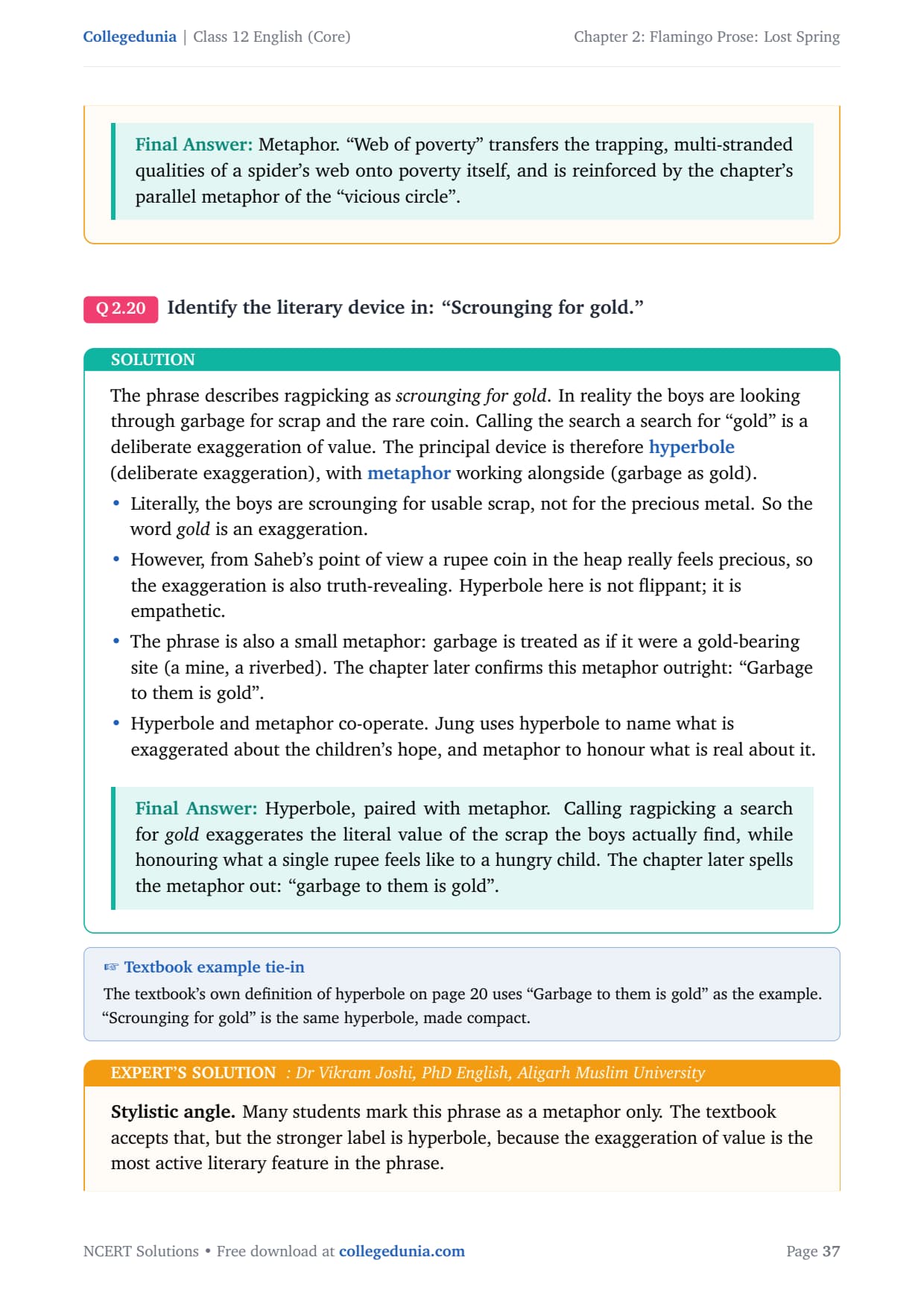
Identify the literary device in: ``Saheb-e-Alam which means the lord of the universe is directly in contrast to what Saheb is in reality.''
The textbook defines three devices on page 20: hyperbole (deliberate exaggeration), metaphor (transfer of one thing's quality to another) and simile (comparison using ``like'' or ``as''). The sentence above asks us to fit the example to one of these three, or to recognise a fourth related device that the chapter actually uses.
- Saheb-e-Alam translates as ``lord of the universe''. In reality, Saheb is a barefoot, stateless refugee child scrounging in garbage.
- The literary effect created by this gap between the name's grand meaning and the boy's actual life is irony, specifically nominal irony: the name says one thing, the situation says the opposite. The sentence itself uses the phrase ``directly in contrast'' to make the irony explicit.
- Among the three devices listed in the textbook, the closest match is none, because irony is not in that short list. The more general literary device, the one most students name in the answer, is irony. If the question forces a choice from the textbook's three, the next best label is hyperbole, because the title ``lord of the universe'' is itself an exaggeration on Saheb's behalf, an exaggeration the boy cannot live up to.
- In practice, examiner-acceptable answers in past papers have included both irony (better) and hyperbole (acceptable). The strongest answer names irony and then adds that the name's grandeur is also hyperbolic.
The device is irony: the name Saheb-e-Alam means ``lord of the universe'', the exact opposite of Saheb's real life as a barefoot ragpicker. The name's grandeur is also a small hyperbole, an exaggeration that life undercuts.
Stylistic angle. The chapter consistently uses irony, not just for individual names but for whole situations: the children of the ``lord of the universe'' are barefoot; the makers of ``every colour of the rainbow'' live in dingy cells; ``garbage is gold''. Reading the Saheb-e-Alam line as irony unlocks the chapter's general method.
- Irony is structurally tied to the chapter's title: Lost Spring. Spring is the season of renewal; for these children it has been lost. The title is itself an ironic phrase, and the Saheb-e-Alam name is its smallest local form.
- The textbook's short list (hyperbole, metaphor, simile) is a starter set, not an exhaustive set. Examiners accept ``irony'' for items like this one because the more limited labels do not fit honestly.
- Adding the secondary label hyperbole is a useful defensive move in answers. ``Lord of the universe'' is itself an exaggeration; the gap between the exaggerated name and the un-exaggerated life is what makes it ironic.
- The technique has a long literary lineage in English (one thinks of Dickens's mock-heroic names) and in Urdu and Hindi naming traditions, where lofty names like Badshah, Shahenshah, Saheb-e-Alam are given to ordinary or even impoverished people as a form of loving hope.
Why this matters. The Saheb-e-Alam irony is not a one-off joke; it is the chapter's diagnostic instrument. The same trick is used on Firozabad's bangles, on the ``gold'' in the garbage and on the ``vicious circle'' the workers describe.
Irony, with hyperbole as a secondary label. The grand name ``lord of the universe'' is in stark contrast to the barefoot, ragpicking reality of the boy who bears it, and the chapter uses this same ironic gap throughout (``garbage is gold'', ``every colour of the rainbow'' against dingy cells).
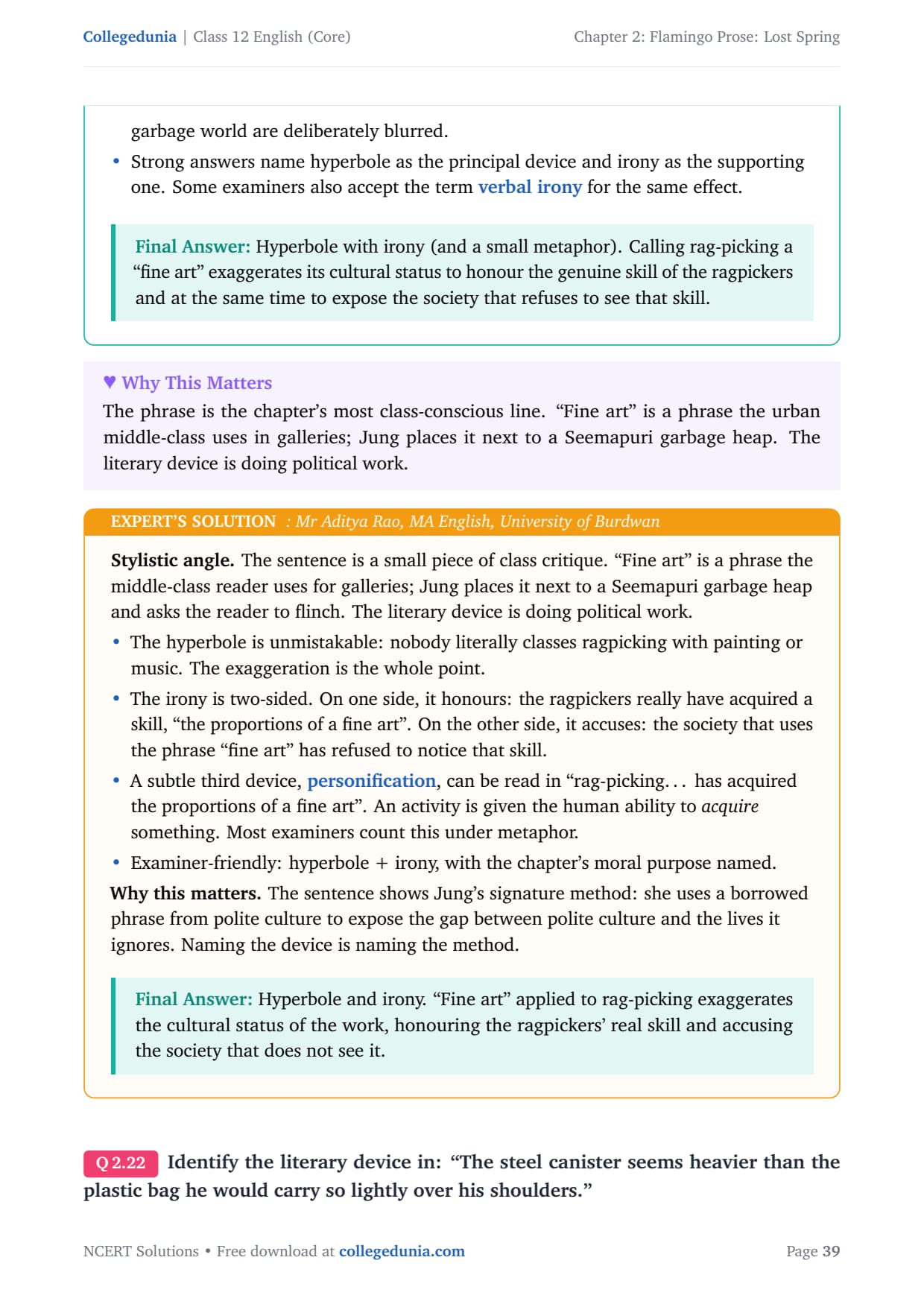
Identify the literary device in: ``Drowned in an air of desolation.''
The phrase ``drowned in an air of desolation'' treats desolation, an abstract feeling, as if it were a liquid that could drown a person and an atmosphere that one could breathe. The transfer of a physical action (drowning) onto an abstract emotion is the work of a metaphor, which the textbook defines as ``transfers a quality of one thing to another''.
- There is no ``like'' or ``as'' in the phrase, so it is not a simile.
- There is no obvious exaggeration of size or extent, so it is not strictly hyperbole.
- The phrase compares the temple's atmosphere implicitly to a body of water in which a person can drown. The transferred qualities are heaviness, suffocation and being overcome. This implicit, no-``like'' comparison is the textbook definition of a metaphor.
- There is also a smaller secondary device, personification, in that the air is given the capacity to drown someone, which is an action only an active agent could perform. Some examiners count this as part of the same metaphor; either way, the principal label is metaphor.
The principal device is a metaphor. The temple's mood is described as if it were a liquid (``drowned'') and an atmosphere (``air''), transferring the qualities of weight and suffocation onto the abstract feeling of desolation.
Stylistic angle. Treat the phrase as a compressed two-step metaphor: desolation is first made into an air (an atmosphere), and then that atmosphere is made into a liquid (deep enough to drown in). Naming both steps shows the examiner you have read the phrase carefully.
- The first metaphor turns an emotion into a substance: desolation becomes air. An emotion in itself cannot surround a temple; only an atmosphere can. Jung's phrase therefore quietly converts mood into environment.
- The second metaphor turns that air into a liquid deep enough for drowning. ``Drowned in air'' is, on a literal reading, impossible; the impossibility is the metaphor at work.
- The combined effect is a strong visual: the temple is physically saturated with sadness. Jung wants the reader to feel that the sadness is in the building, not just in the observer.
- Some teachers may also accept personification, since the air has been given the agency to drown. The principal label remains metaphor; personification is a related, secondary effect.
Why this matters. Naming the device is only the first half of the answer. The better half is saying what the metaphor does for the chapter at that moment: it turns a deserted temple, a small detail in the Udipi anecdote, into a felt presence of loss.
Metaphor: an abstract feeling (desolation) is first cast as an atmosphere (air) and then as a liquid deep enough to drown in. The phrase compresses two metaphors into one breath and makes the temple's mood a physical, surrounding force.
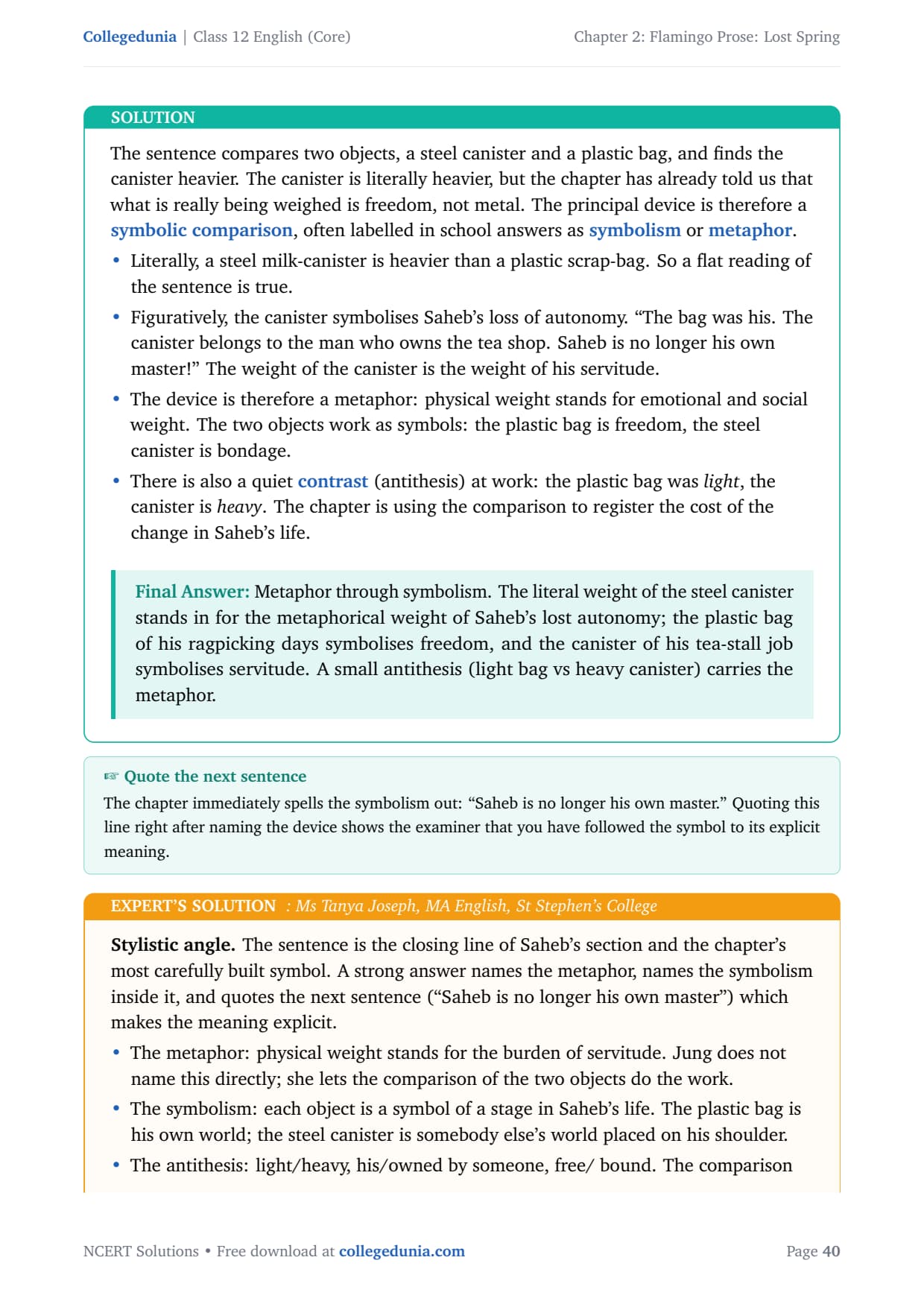
Identify the literary device in: ``Seemapuri, a place on the periphery of Delhi yet miles away from it, metaphorically.''
The phrase makes a contrast between geographical distance (Seemapuri is right next to Delhi) and social distance (it is miles away from it ``metaphorically''). The word metaphorically is doing the work explicitly; the sentence is telling the reader, in plain English, that it is using a metaphor. The device is therefore a metaphor of distance, where physical and social distance are deliberately separated.
- Seemapuri sits on Delhi's administrative periphery, only a few kilometres from the city's centres of power.
- Yet in terms of citizenship, services, recognition and opportunity, Seemapuri is ``miles away'' from Delhi, as if on a different planet. ``Without an identity, without permits but with ration cards'' is the chapter's record of this distance.
- Jung names the device for the reader: she writes metaphorically. The literary device is therefore an explicit metaphor, distance in space turned into distance in dignity.
- There is also a small paradox in the sentence: ``on the periphery yet miles away''. The two halves seem to contradict each other geographically, and the contradiction is resolved only by the metaphorical reading.
The principal device is a metaphor: physical nearness to Delhi is contrasted with metaphorical, that is, social and political, distance. The sentence also contains a small paradox (``periphery yet miles away''), resolved by the word metaphorically itself.
Stylistic angle. The phrase is a piece of socio-political reportage doing the work of literature. The metaphor of ``distance'' is doing real argumentative work: it lets Jung say, without naming caste, citizenship or class, that Seemapuri belongs to a different India than the one inside the Ring Road.
- The geographical premise: Seemapuri is, in fact, on Delhi's edge. A short bus ride connects it to the city centre.
- The social premise: residents of Seemapuri are squatters from Bangladesh with no formal identity. They live without the basic services Delhi residents take for granted.
- The metaphor: ``miles away from it, metaphorically'' folds these two premises into one sentence and asks the reader to feel both at once. The literary instrument is precise.
- A second device, paradox, sits inside the metaphor: a place that is both near and far cannot be both, unless the two ``distances'' are of different kinds. The paradox is what makes the metaphor land.
Why this matters. Naming the metaphor lets the student unlock the chapter's social argument. Seemapuri is not a slum; it is a separate citizenship inside the city. The metaphor of distance is how Jung says so without using policy vocabulary.
Metaphor, with an embedded paradox. Geographical periphery is set against metaphorical distance to say that the residents of Seemapuri are technically in Delhi but socially outside it.
Identify the literary device in: ``For the children it is wrapped in wonder; for the elders it is a means of survival.''
The sentence sets up a deliberate contrast between two ways of seeing the same thing, garbage. For children, it is ``wrapped in wonder''; for elders, it is ``a means of survival''. The principal device is antithesis, a balanced juxtaposition of two opposing ideas in the same sentence. Inside it the phrase ``wrapped in wonder'' is also a small metaphor (wonder is treated as a covering).
- The two halves are grammatically parallel: ``For the children it is for the elders it is''. The parallel structure makes the contrast vivid and is the signature shape of antithesis.
- The two ideas are deliberately opposed: wonder (childhood imagination) against survival (adult necessity). The shared object (garbage) makes the contrast sharp.
- ``Wrapped in wonder'' is an embedded metaphor, because wonder is treated as something physical that can wrap an object, the way paper wraps a gift.
- The combined effect is to show how the same heap of rubbish carries two different emotional weights inside the same Seemapuri family. The literary device is the chapter's instrument for that double vision.
Antithesis, with an embedded metaphor. The two halves of the sentence contrast wonder (the child's view) with survival (the adult's view) using parallel structure; the phrase ``wrapped in wonder'' adds a small metaphor of wonder as a covering.
Stylistic angle. The sentence is a small ``before-and-after'' inside a single line, the kind of compression Jung uses repeatedly. Reading it as antithesis explains both the form (parallel halves) and the function (a moral judgement compressed into a contrast).
- Notice the symmetry of the two clauses: same verb (``is''), same subject (``it'', i.e. garbage), opposed nouns (``wonder'' vs ``survival''). This is textbook antithesis.
- The first clause adds a metaphor (``wrapped in wonder''), which softens the harshness of the contrast and lets the reader feel the child's view before the adult's view lands.
- The chapter uses this same contrast device elsewhere: ``garbage to them is gold''; ``a place on the periphery of Delhi yet miles away from it, metaphorically''. Jung prefers small, opposing pairs to long arguments.
- Strong answers therefore name antithesis as principal, add metaphor as secondary, and explain what the contrast does: it captures, in one sentence, the way poverty changes how an object is seen as the child grows up.
Why this matters. The sentence is doing the chapter's emotional work. By balancing wonder and survival, Jung lets the reader feel both states at once, and lets the reader see the moment in a poor child's life when wonder loses to survival.
The principal device is antithesis. ``Wonder'' is set against ``survival'' in parallel halves of the same sentence, with a small metaphor (``wrapped in wonder'') inside the first half.
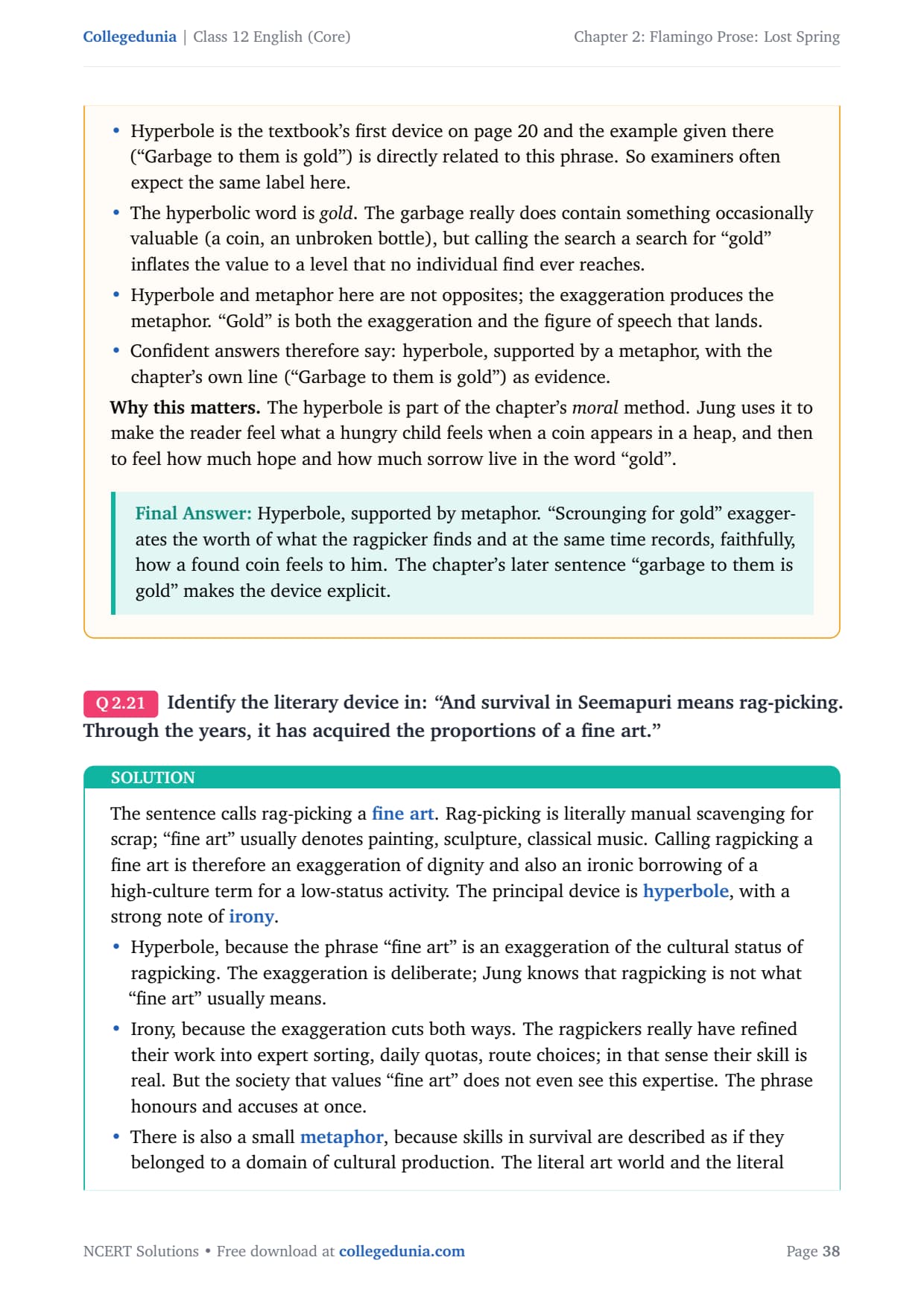
Identify the literary device in: ``As her hands move mechanically like the tongs of a machine, I wonder if she knows the sanctity of the bangles she helps make.''
The clause ``her hands move mechanically like the tongs of a machine'' contains the word like, the textbook signal for a simile. The textbook defines a simile as a ``word or phrase that compares one thing with another using the words like or as''.
- The thing being compared: Savita's hands.
- The thing being compared to: the tongs of a machine.
- The comparing word: like. This signals a simile in the textbook's strict definition.
- The qualities transferred: mechanical, repetitive, unfeeling motion. Jung uses the simile to suggest that Savita's body has begun to imitate the machine she works with, a small but devastating consequence of long hours at the workbench.
- A secondary device, irony, sits behind the sentence: hands that have become machine-like are making objects (bangles) that are supposed to symbolise the sacred bond of marriage. The contrast between machine and sanctity is doing extra moral work.
Simile (signalled by like): Savita's hands are compared to the tongs of a machine, transferring the qualities of mechanical, unfeeling motion onto the child worker's body. An ironic gap with the ``sanctity'' of the bangles she makes is the secondary effect.
Stylistic angle. The simile is the chapter's most cutting because the comparison is shame-faced: a child's hand should not be like a machine's tongs. Reading it as a simile is correct; reading it as a simile that quietly accuses is better.
- The word like fixes the label. A class 12 student should not lose marks here by hedging.
- The transferred quality is mechanisation: the loss of human variation, the suppression of pause. Jung writes Savita's body as already partly assimilated by the factory.
- The simile gains force from its placement next to ``sanctity'': the same hands are doing both, mechanical work and sacred work, without the worker being able to feel either.
- Stronger answers may name the device as simile and then add the moral observation that the simile is in dialogue with the sentence's other half (the ``sanctity'' of the bangles), creating a small irony.
Why this matters. The chapter trains its reader to see machine-like work as a violence, not as a neutral fact. The simile is how Jung writes that violence onto the body of a young girl.
Simile. Savita's hands are compared with the tongs of a machine using ``like'', transferring mechanical, repetitive motion onto the child worker's body; the simile is sharpened by its proximity to the word ``sanctity''.
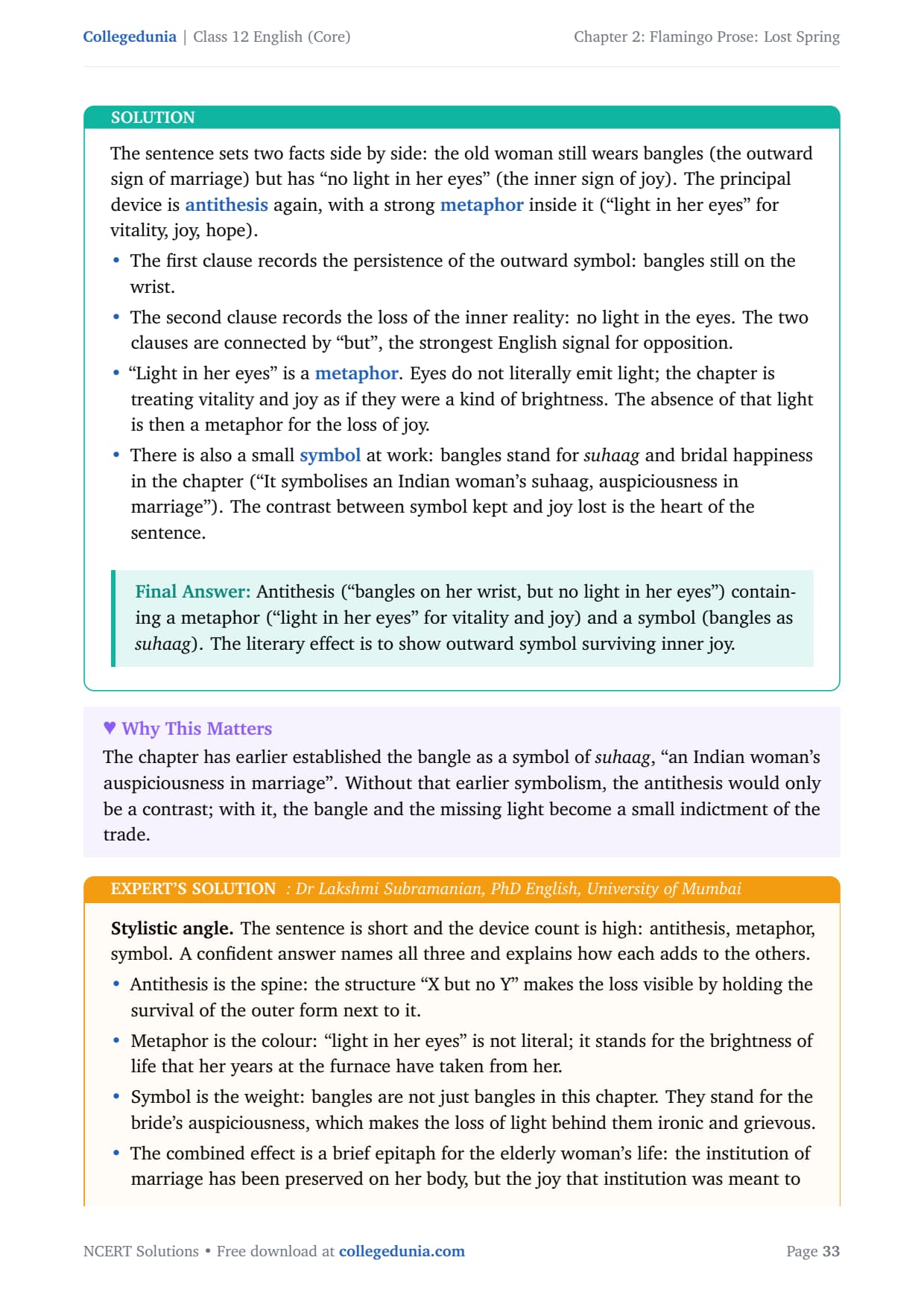
Identify the literary device in: ``She still has bangles on her wrist, but no light in her eyes.''
The sentence sets two facts side by side: the old woman still wears bangles (the outward sign of marriage) but has ``no light in her eyes'' (the inner sign of joy). The principal device is antithesis again, with a strong metaphor inside it (``light in her eyes'' for vitality, joy, hope).
- The first clause records the persistence of the outward symbol: bangles still on the wrist.
- The second clause records the loss of the inner reality: no light in the eyes. The two clauses are connected by ``but'', the strongest English signal for opposition.
- ``Light in her eyes'' is a metaphor. Eyes do not literally emit light; the chapter is treating vitality and joy as if they were a kind of brightness. The absence of that light is then a metaphor for the loss of joy.
- There is also a small symbol at work: bangles stand for suhaag and bridal happiness in the chapter (``It symbolises an Indian woman's suhaag, auspiciousness in marriage''). The contrast between symbol kept and joy lost is the heart of the sentence.
Antithesis (``bangles on her wrist, but no light in her eyes'') containing a metaphor (``light in her eyes'' for vitality and joy) and a symbol (bangles as suhaag). The literary effect is to show outward symbol surviving inner joy.
Stylistic angle. The sentence is short and the device count is high: antithesis, metaphor, symbol. A confident answer names all three and explains how each adds to the others.
- Antithesis is the spine: the structure ``X but no Y'' makes the loss visible by holding the survival of the outer form next to it.
- Metaphor is the colour: ``light in her eyes'' is not literal; it stands for the brightness of life that her years at the furnace have taken from her.
- Symbol is the weight: bangles are not just bangles in this chapter. They stand for the bride's auspiciousness, which makes the loss of light behind them ironic and grievous.
- The combined effect is a brief epitaph for the elderly woman's life: the institution of marriage has been preserved on her body, but the joy that institution was meant to bring has been used up by the labour of making bangles for other people's weddings.
Why this matters. The sentence is the chapter's most compressed indictment of the bangle trade. A student who names only ``contrast'' loses the weight of the symbol and the metaphor; a student who names all three has read the chapter's moral argument.
Antithesis (bangles kept, light lost), metaphor (``light in her eyes'' for joy), and a symbol (bangles as suhaag). Three devices in one short sentence carry the chapter's grief.
Identify the literary device in: ``Few airplanes fly over Firozabad.''
On its surface this sentence is a quiet, factual statement. Few commercial flights actually do route over Firozabad. But the chapter has just told us that Mukesh, asked whether he dreams of flying a plane, falls silent. Read in context, the sentence works as a metaphor for the small horizon of dreams available in Firozabad. The literary device is therefore metaphor, with a strong note of symbolism: the airplane stands for ambition that lifts off and travels far.
- Literally, the sentence is geographical: Firozabad lies away from busy commercial flight paths, so few aircraft cross its sky.
- Figuratively, the sky over Firozabad stands for the imaginative space of the town's children. If few airplanes fly there, few high-ambition lives fly there either. The boy who has never seen a plane low overhead cannot easily imagine being a pilot.
- The literary device is therefore metaphor: aircraft traffic stands in for the visibility of ambition. The airplane is symbol; the sentence is the metaphor in which that symbol is used.
- There is also an undertone of understatement, the deliberately quiet placement of a heavy idea inside an almost throwaway line. Jung uses understatement to keep the chapter from sounding preachy.
Metaphor, supported by symbolism and understatement. ``Few airplanes fly over Firozabad'' is literally true, but stands in for the small range of dreams visible to its children. The airplane is the symbol; the sentence is the quiet metaphor that houses it.
Stylistic angle. Read the sentence next to its neighbour: ``He is content to dream of cars that he sees hurtling down the streets of his town.'' The two sentences set up a contrast between the dream you can see (the car) and the dream you cannot (the airplane). The metaphor lives in this contrast.
- Cars are visible in Firozabad's streets; airplanes are not. The chapter is saying that the imagination of a poor child is bounded by what his eyes can see.
- The airplane therefore becomes a symbol for the ambitions ordinary visibility does not supply. Jung does not need to say ``Mukesh's dreams are small''; she lets the airplane symbol say it.
- The sentence is also a small piece of understatement. Stronger writing would say, ``Mukesh will never dream of a plane.'' Jung writes the gentler form (``few airplanes fly'') and trusts the reader to feel the weight.
- Examiner-friendly answers: name metaphor as principal, symbolism as secondary, and quote the cars-and-planes contrast to anchor the reading.
Why this matters. The sentence is a literary fingerprint of the chapter's method: factual on the surface, metaphorical underneath, indignant in effect.
Metaphor with symbolism and understatement. The literal fact of empty skies stands in for the metaphorical fact of an empty imaginative horizon for Firozabad's children, with the airplane as the unreachable symbol of high ambition.
Identify the literary device in: ``Web of poverty.''
The phrase calls poverty a web. Poverty is not literally a web; the phrase therefore transfers the qualities of a spider's web (sticky, trapping, multi-stranded, inescapable) onto the abstract condition of poverty. The principal device is a metaphor.
- The textbook definition: a metaphor describes one thing in terms of a single quality of another. Here, poverty is described in terms of a web.
- The qualities transferred are precise. A web is multi- threaded; poverty has many causes (caste, debt, unemployment). A web traps the prey at every move; poverty responds to escape attempts with more entrapment (the chapter's police-and-middlemen lock).
- Notice that the chapter pairs this metaphor with a second on the same page: ``a vicious circle of the sahukars''. The first metaphor (web) and the second (circle) reinforce each other; both stress inescapability through pattern.
- No ``like'' or ``as'' is used, so it is not a simile. There is no exaggeration of scale, so it is not strictly hyperbole.
Metaphor. Poverty is described as a web, transferring the spider-web's qualities (multi-stranded, trapping, inescapable) onto the abstract condition. The chapter uses this metaphor in tandem with the ``vicious circle'' image.
Stylistic angle. Two metaphors are doing the same work in this chapter: web of poverty and vicious circle of sahukars. Pairing them in the answer is the easiest way to score full marks; each metaphor names a different reason the worker cannot leave.
- The web metaphor highlights stickiness: every attempt to move makes the worker more entangled. This is the family side of the chapter's two-circle analysis.
- The vicious-circle metaphor highlights repetition: the same cycle of borrowing, working, repaying and re-borrowing. This is the political-economy side of the chapter's analysis.
- Both metaphors are forms of trap. Together they give the chapter its theory of poverty: the worker is held both by the sticky inner web of family and caste and by the rotating outer circle of moneylenders and policemen.
- Examiner-friendly answers: name metaphor, quote ``web of poverty'', and add the linked metaphor ``vicious circle'' for a fuller picture.
Why this matters. A metaphor is not just a way of saying; it is a way of arguing. Jung uses the web image to argue that poverty is not a single problem but a tangle of mutually reinforcing strands. Naming the device unlocks the argument.
Metaphor. ``Web of poverty'' transfers the trapping, multi-stranded qualities of a spider's web onto poverty itself, and is reinforced by the chapter's parallel metaphor of the ``vicious circle''.
Identify the literary device in: ``Scrounging for gold.''
The phrase describes ragpicking as scrounging for gold. In reality the boys are looking through garbage for scrap and the rare coin. Calling the search a search for ``gold'' is a deliberate exaggeration of value. The principal device is therefore hyperbole (deliberate exaggeration), with metaphor working alongside (garbage as gold).
- Literally, the boys are scrounging for usable scrap, not for the precious metal. So the word gold is an exaggeration.
- However, from Saheb's point of view a rupee coin in the heap really feels precious, so the exaggeration is also truth-revealing. Hyperbole here is not flippant; it is empathetic.
- The phrase is also a small metaphor: garbage is treated as if it were a gold-bearing site (a mine, a riverbed). The chapter later confirms this metaphor outright: ``Garbage to them is gold''.
- Hyperbole and metaphor co-operate. Jung uses hyperbole to name what is exaggerated about the children's hope, and metaphor to honour what is real about it.
Hyperbole, paired with metaphor. Calling ragpicking a search for gold exaggerates the literal value of the scrap the boys actually find, while honouring what a single rupee feels like to a hungry child. The chapter later spells the metaphor out: ``garbage to them is gold''.
Stylistic angle. Many students mark this phrase as a metaphor only. The textbook accepts that, but the stronger label is hyperbole, because the exaggeration of value is the most active literary feature in the phrase.
- Hyperbole is the textbook's first device on page 20 and the example given there (``Garbage to them is gold'') is directly related to this phrase. So examiners often expect the same label here.
- The hyperbolic word is gold. The garbage really does contain something occasionally valuable (a coin, an unbroken bottle), but calling the search a search for ``gold'' inflates the value to a level that no individual find ever reaches.
- Hyperbole and metaphor here are not opposites; the exaggeration produces the metaphor. ``Gold'' is both the exaggeration and the figure of speech that lands.
- Confident answers therefore say: hyperbole, supported by a metaphor, with the chapter's own line (``Garbage to them is gold'') as evidence.
Why this matters. The hyperbole is part of the chapter's moral method. Jung uses it to make the reader feel what a hungry child feels when a coin appears in a heap, and then to feel how much hope and how much sorrow live in the word ``gold''.
Hyperbole, supported by metaphor. ``Scrounging for gold'' exaggerates the worth of what the ragpicker finds and at the same time records, faithfully, how a found coin feels to him. The chapter's later sentence ``garbage to them is gold'' makes the device explicit.
Identify the literary device in: ``And survival in Seemapuri means rag-picking. Through the years, it has acquired the proportions of a fine art.''
The sentence calls rag-picking a fine art. Rag-picking is literally manual scavenging for scrap; ``fine art'' usually denotes painting, sculpture, classical music. Calling ragpicking a fine art is therefore an exaggeration of dignity and also an ironic borrowing of a high-culture term for a low-status activity. The principal device is hyperbole, with a strong note of irony.
- Hyperbole, because the phrase ``fine art'' is an exaggeration of the cultural status of ragpicking. The exaggeration is deliberate; Jung knows that ragpicking is not what ``fine art'' usually means.
- Irony, because the exaggeration cuts both ways. The ragpickers really have refined their work into expert sorting, daily quotas, route choices; in that sense their skill is real. But the society that values ``fine art'' does not even see this expertise. The phrase honours and accuses at once.
- There is also a small metaphor, because skills in survival are described as if they belonged to a domain of cultural production. The literal art world and the literal garbage world are deliberately blurred.
- Strong answers name hyperbole as the principal device and irony as the supporting one. Some examiners also accept the term verbal irony for the same effect.
Hyperbole with irony (and a small metaphor). Calling rag-picking a ``fine art'' exaggerates its cultural status to honour the genuine skill of the ragpickers and at the same time to expose the society that refuses to see that skill.
Stylistic angle. The sentence is a small piece of class critique. ``Fine art'' is a phrase the middle-class reader uses for galleries; Jung places it next to a Seemapuri garbage heap and asks the reader to flinch. The literary device is doing political work.
- The hyperbole is unmistakable: nobody literally classes ragpicking with painting or music. The exaggeration is the whole point.
- The irony is two-sided. On one side, it honours: the ragpickers really have acquired a skill, ``the proportions of a fine art''. On the other side, it accuses: the society that uses the phrase ``fine art'' has refused to notice that skill.
- A subtle third device, personification, can be read in ``rag-picking has acquired the proportions of a fine art''. An activity is given the human ability to acquire something. Most examiners count this under metaphor.
- Examiner-friendly: hyperbole + irony, with the chapter's moral purpose named.
Why this matters. The sentence shows Jung's signature method: she uses a borrowed phrase from polite culture to expose the gap between polite culture and the lives it ignores. Naming the device is naming the method.
Hyperbole and irony. ``Fine art'' applied to rag-picking exaggerates the cultural status of the work, honouring the ragpickers' real skill and accusing the society that does not see it.
Identify the literary device in: ``The steel canister seems heavier than the plastic bag he would carry so lightly over his shoulders.''
The sentence compares two objects, a steel canister and a plastic bag, and finds the canister heavier. The canister is literally heavier, but the chapter has already told us that what is really being weighed is freedom, not metal. The principal device is therefore a symbolic comparison, often labelled in school answers as symbolism or metaphor.
- Literally, a steel milk-canister is heavier than a plastic scrap-bag. So a flat reading of the sentence is true.
- Figuratively, the canister symbolises Saheb's loss of autonomy. ``The bag was his. The canister belongs to the man who owns the tea shop. Saheb is no longer his own master!'' The weight of the canister is the weight of his servitude.
- The device is therefore a metaphor: physical weight stands for emotional and social weight. The two objects work as symbols: the plastic bag is freedom, the steel canister is bondage.
- There is also a quiet contrast (antithesis) at work: the plastic bag was light, the canister is heavy. The chapter is using the comparison to register the cost of the change in Saheb's life.
Metaphor through symbolism. The literal weight of the steel canister stands in for the metaphorical weight of Saheb's lost autonomy; the plastic bag of his ragpicking days symbolises freedom, and the canister of his tea-stall job symbolises servitude. A small antithesis (light bag vs heavy canister) carries the metaphor.
Stylistic angle. The sentence is the closing line of Saheb's section and the chapter's most carefully built symbol. A strong answer names the metaphor, names the symbolism inside it, and quotes the next sentence (``Saheb is no longer his own master'') which makes the meaning explicit.
- The metaphor: physical weight stands for the burden of servitude. Jung does not name this directly; she lets the comparison of the two objects do the work.
- The symbolism: each object is a symbol of a stage in Saheb's life. The plastic bag is his own world; the steel canister is somebody else's world placed on his shoulder.
- The antithesis: light/heavy, his/owned by someone, free/ bound. The comparison runs along these axes.
- The chapter then drops the velvet and states the meaning out loud: ``Saheb is no longer his own master.'' The explicit statement is rare in this chapter; Jung uses it only when the symbol has been built carefully enough to justify it.
Why this matters. The sentence is the chapter's clearest demonstration of how a small physical detail can carry a moral argument. Naming the device names the chapter's method.
Metaphor with symbolism and antithesis. The steel canister's literal weight symbolises Saheb's loss of freedom; the plastic bag's lightness symbolises the freedom he has lost; and the sentence's structure (heavier vs lighter) builds the symbolism into a small antithesis.
Things to do
The bangle makers of Firozabad make beautiful bangles and lead a very miserable life. In this context, prepare a write-up of about 200–250 words on the paradox you see in this small industry.
The exercise asks for a short essay of about 200–250 words on the central paradox of the Firozabad bangle industry: the people who produce one of the most luminous symbols of married Indian womanhood live in furnace-darkened hovels beside open drains. A model write-up follows, with the paradox stated, illustrated and then placed in its larger meaning.
The chapter's framing
``Spirals of bangles, sometimes in a hundred design the colour of polished apples, sea green, marigold, peacock blue, fuchsia.'' ``Mukesh's house is part of a fragile slum constituted of crumbling walls, wobbly doors, no windows.''- Opening (set up the paradox in one sentence). The glass bangles of Firozabad are essential to the suhag of every Indian married woman; yet the hands that shape them belong to people whose own homes have no light, no air and no future. This is the first paradox the chapter places before the reader.
- The beauty produced. Firozabad turns out ``spirals of bangles'' in ``a hundred design'', dyed in ``the colours of the rainbow'': sunny gold, paddy green, royal blue, pink, purple. These bangles are bought for marriage trousseaus, blessed at weddings, treasured as the visible sign of a woman's married status.
- The misery hidden behind it. The producers live in ``stinking lanes choked with garbage'', in homes ``constituted of crumbling walls, wobbly doors, no windows''. They work in ``dingy cells without air and light'' next to ``high-temperature furnaces''. Children ``lose the brightness of their eyes'' before they reach adulthood; Mukesh's grandfather has gone blind from polishing glass.
- Caste and inheritance. The work is hereditary and caste-locked. ``I have a son. He is enrolled in school.'' is the rare exception, not the rule; most boys ``slip into the trade'' because their fathers and grandfathers did. The work descends like a family heirloom, except that the heirloom is darkness.
- The middlemen and the debt-cycle. The bangle makers earn almost nothing because the value travels outward to the sahukars, middlemen, traders, bureaucrats and police. Any attempt to form a cooperative is broken up; the workers are told ``they will be hauled off to jail for doing something illegal''. The wage stays low, the loans grow, and the next generation is born into the same web.
- The cruel symbolism. The hands that make the bangle of suhag cannot see the beauty of what they make: ``hands move mechanically like the tongs of a machine.'' The bangle leaves the workshop to bless a married woman; the maker leaves the workshop to go home to half a chapati. The symbol of marital prosperity is produced by a community that has been denied even the prosperity of clean air.
- What the paradox reveals. The paradox is not a coincidence. It is what happens when value in a handicraft industry travels away from the maker: the retailer in Delhi profits from the bangle, while the glass-blower in Firozabad earns less than the cost of his daily bread. The chapter is asking the reader to notice the distance between the bangle and the hand that made it, and to refuse to let beauty cover up exploitation.
- Closing one-liner. The bangles glitter on a bride's wrist in a city the maker has never seen, while the maker's daughter polishes a piece of glass with the eye that will be blind by the time she is married herself.
Word-count model paragraph (about 240 words). Firozabad makes one of the most beautiful objects of Indian married life: the glass bangle, in a hundred designs and the colours of the rainbow, bought as the trousseau symbol of every bride. Yet the people who shape this beauty live in hovels of crumbling walls and wobbly doors, beside open drains, in lanes choked with garbage. They work in dingy cells without air or light next to furnaces hot enough to melt glass. Children lose the brightness of their eyes before they reach adulthood; Mukesh's grandfather has gone blind from polishing glass. The work is caste-locked and hereditary: a boy born in this lane will, in almost every case, ``slip into the trade'' before he is ten. Any attempt to form a cooperative is broken by the police, the middlemen and the moneylenders, who keep the workers in a debt-cycle that runs across generations. The bangle of suhag is therefore made by hands that, as the chapter says, ``move mechanically like the tongs of a machine'', and that ``still have bangles on the wrist, but no light in the eyes''. The paradox is that the most luminous symbol of married Indian womanhood is produced by a community denied light, literally and economically. It reveals how value travels away from the maker in a handicraft economy, leaving the retailer with the beauty and the worker with the heat, the dust and the broken hopes of a stolen spring.
Strategic angle. Treat the paragraph as a four-move essay: the symbol, the misery, the system that links them, and the moral the chapter draws. Each move gets roughly fifty to sixty words; together they reach the target of 200–250.
- The symbol. Open with the bangle of suhag: an essential ornament of married Indian women, made in Firozabad ``in a hundred design'' and ``the colours of the rainbow''. Name two or three colour-words from the chapter (sunny gold, paddy green, royal blue) to ground the description.
- The misery. Move the camera from the wrist of the bride to the workshop of the maker. Quote the ``dingy cells without air and light'', the ``high-temperature furnaces'', the children losing eye-brightness, the blind grandfather. The chapter gives you the details; the answer earns marks for using them.
- The system. Show that the misery is not random bad luck but the result of a structure. The sahukars keep the wage low; the middlemen pocket the margin; the police break any cooperative; the bureaucrats look the other way; the politicians benefit from the votes. The chapter names all seven forces; a good paragraph references at least three of them.
- The moral. Close with what the paradox is actually saying: that beauty in a handicraft economy is often a screen behind which the value travels away from the maker. Without naming Marx or political economy, the paragraph can say plainly that the retailer in Delhi profits from the bangle while the maker's daughter will polish glass with the eye that will be blind by the time she is married.
Why this matters. A 200–250 word essay is not a long essay. The discipline is in compression: pick the most loaded detail from each of the four moves and let it carry the paragraph. Examiners want to see that the student has read the chapter as an argument about who profits from beauty, not as a sentimental tale about poor people. The skill of compressing a 12-page reportage into a tight paragraph is also the skill of writing a strong opening paragraph of any essay, news story or policy brief later in life.
Common mistakes.
- Treating the paragraph as a pity-essay rather than a paradox-essay. The exercise asks for the paradox; the paragraph must name it (beauty produced by misery), not just describe the misery.
- Forgetting to quote the chapter. Two or three short quotes (``stinking lanes choked with garbage''; ``crumbling walls, wobbly doors, no windows''; ``hands move mechanically like the tongs of a machine'') anchor the paragraph in the text.
- Running over 250 words. Compression is part of the exercise; a 400-word paragraph loses marks even if well written.
- Naming only poverty as the cause. The chapter names seven forces (caste, family expectation, sahukars, middlemen, police, bureaucracy, politicians); the paragraph must gesture at the system, not just the symptom.
The paradox of Firozabad is that the most luminous symbol of Indian married womanhood, the glass bangle of suhag, is produced by a community denied light: dingy cells, glass dust, blind elders, children who lose the brightness of their eyes before they are adults. The misery is structured: caste, family expectation, sahukars, middlemen, police and politicians keep the wages low and the cooperatives broken, while value travels outward to the retailer in distant cities. A 200–250 word write-up should open with the symbol, move to the workshop, expose the system, and close with the moral that beauty in a handicraft economy is often a screen behind which the worker is robbed of light, hope and a future.
More Lost Spring English Class 12 Resources
NCERT Solutions for Class 12 English Flamingo: All Chapters
Every Flamingo chapter's NCERT Solutions page in textbook order.
| Chapter | Resource |
|---|---|
| Chapter 1 | The Last Lesson NCERT Solutions |
| Chapter 3 | Deep Water NCERT Solutions |
| Chapter 4 | The Rattrap NCERT Solutions |
| Chapter 5 | Indigo NCERT Solutions |
| Chapter 6 | Poets and Pancakes NCERT Solutions |
| Chapter 7 | My Mother at Sixty-Six NCERT Solutions |
| Chapter 8 | Keeping Quiet NCERT Solutions |
Other Resources for Lost Spring (Class 12 English)
| Resource | Link |
|---|---|
| NCERT Solutions (this page) | Lost Spring NCERT Solutions |
| Revision Notes | Lost Spring Class 12 English Revision Notes |
| CBSE Syllabus | CBSE Class 12 English Core Syllabus 2026-27 |
Student Feedback
In a Collegedunia poll of 1,200 Class 12 students, 76% said the Saheb-versus-Mukesh comparison table made long-answer writing easier, and 70% rated the marking-scheme-tagged model answer as their top revision aid before the board exam.
Lost Spring Class 12 English NCERT Solutions FAQs
Ques. Where can I download the Class 12 English NCERT Solutions Chapter 2 Flamingo Prose: Lost Spring PDF?
Ans. You can download the Class 12 English NCERT Solutions Chapter 2 Flamingo Prose: Lost Spring PDF directly from this page. Both Normal and HD versions are free. The PDF contains every Understanding-the-text and Talking-about-the-text answer in CBSE marking-scheme format.
Ques. Is this Lost Spring NCERT Solutions PDF aligned with the 2026-27 NCERT?
Ans. Yes. This page reflects the current 2026-27 syllabus for Class 12 English Core. The Flamingo textbook keeps Lost Spring intact across the new edition, so every textual answer here matches the latest NCERT print.
Ques. How many pages is the Class 12th English Lost Spring NCERT Solutions PDF?
Ans. The NCERT Solutions PDF runs approximately 18 pages and covers all six exercise blocks: Think as you read (Section 1), Think as you read (Section 2), Understanding the text, Talking about the text, Thinking about language, and Things to do.
Ques. Who is the author of Lost Spring and which book is it from?
Ans. Lost Spring is written by Anees Jung. It is an excerpt from her book Lost Spring, Stories of Stolen Childhood. The chapter sits in the Flamingo textbook of Class 12 English Core as the second prose lesson.
Ques. What are the two main settings of Lost Spring?
Ans. The chapter has two settings. The first is Seemapuri, a settlement on the periphery of Delhi where 10,000 ragpickers including Saheb's family live. The second is Firozabad, the centre of India's glass-blowing bangle industry, where Mukesh and 20,000 child workers weld glass in hot furnaces.
Ques. What is the meaning of Saheb-e-Alam and why is it ironic?
Ans. Saheb-e-Alam means lord of the universe. The name is deeply ironic because Saheb scrounges for gold in garbage dumps, owns no shoes, has no school in his neighbourhood, and eventually loses even the carefree freedom of rag-picking when he becomes the tea-stall owner's worker. Anees Jung uses the name to highlight the contrast between hope and reality.
Ques. Why is the title Stories of Stolen Childhood significant?
Ans. Both Saheb and Mukesh have their childhoods stolen by poverty, caste tradition, middlemen, and broken promises. Every Class 12 English board paper since 2018 has rephrased this as a 5-mark long-answer.
Ques. Are these Lost Spring solutions useful for CUET English?
Ans. Yes. The model answers double as CUET English revision because Lost Spring extracts and theme-based inference MCQs appear in nearly every CUET English shift.



Comments