English Mentor, Jadavpur | Updated on - Jul 21, 2026
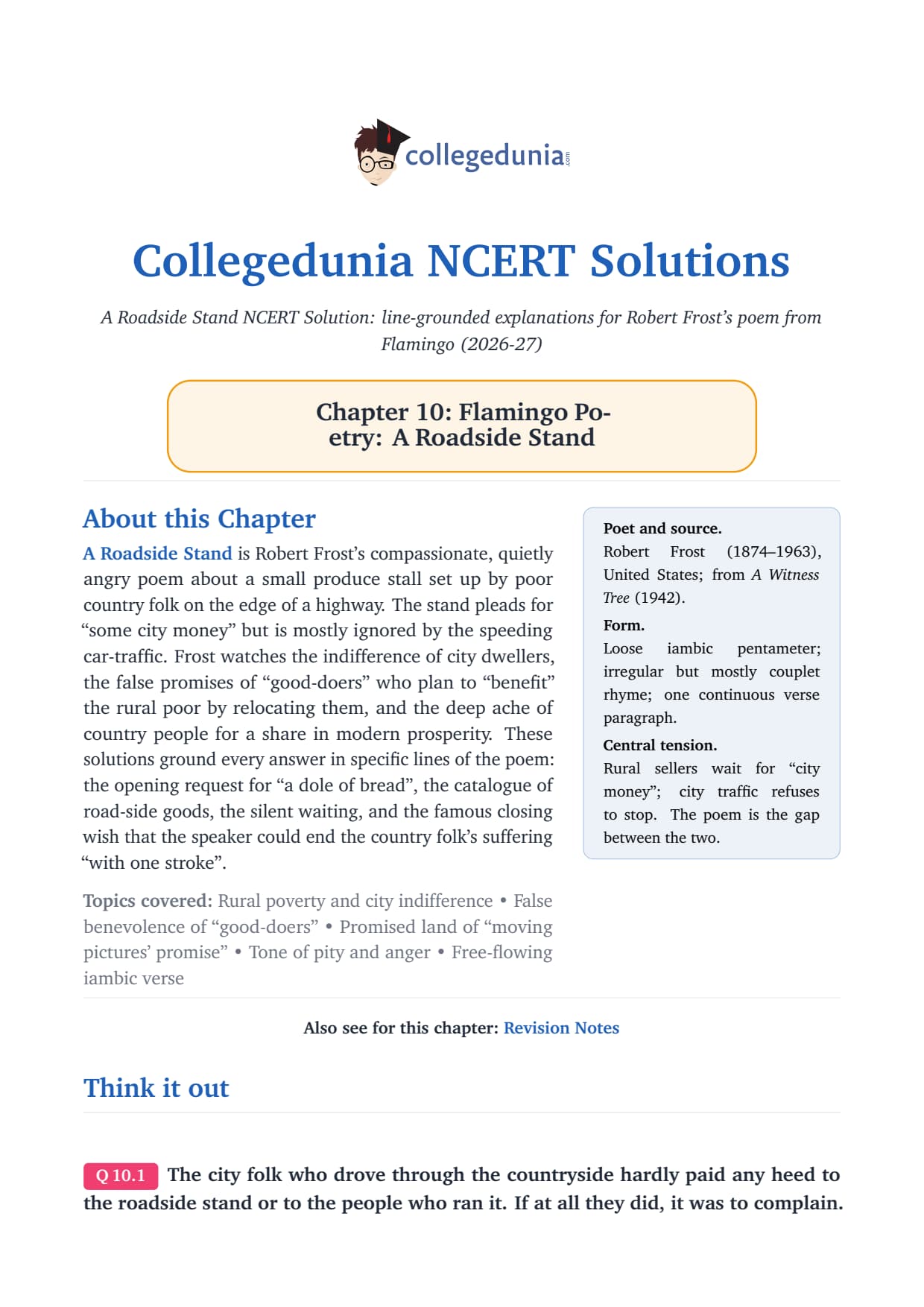
Robert Frost's quietly angry, deeply compassionate poem in Class 12 English Chapter 10 Flamingo Poetry: A Roadside Stand carries roughly 8 marks in the CBSE Board exam and is the longest poem in the Flamingo Poetry section. These class 12 english ncert solutions chapter 10 Flamingo Poetry: A Roadside Stand answer every textbook question in NCERT order.
1 poem · 4 textbook questions solved · Class 12 English Core Chapter 10, 2026-27 NCERT
CBSE Weightage: About 8 marks, usually split as one extract-based question (3 marks) and one long-answer on social criticism, indifference, or false benevolence (6 marks)
CUET (UG) Relevance: 1 to 2 questions on tone, theme, and Frost's signature oxymoron in Section IA English
These A Roadside Stand NCERT Solutions are reviewed by Collegedunia's CBSE English educators, mapped to the 2026-27 NCERT Flamingo print, and refined against the last five years of CBSE Board and CUET papers.
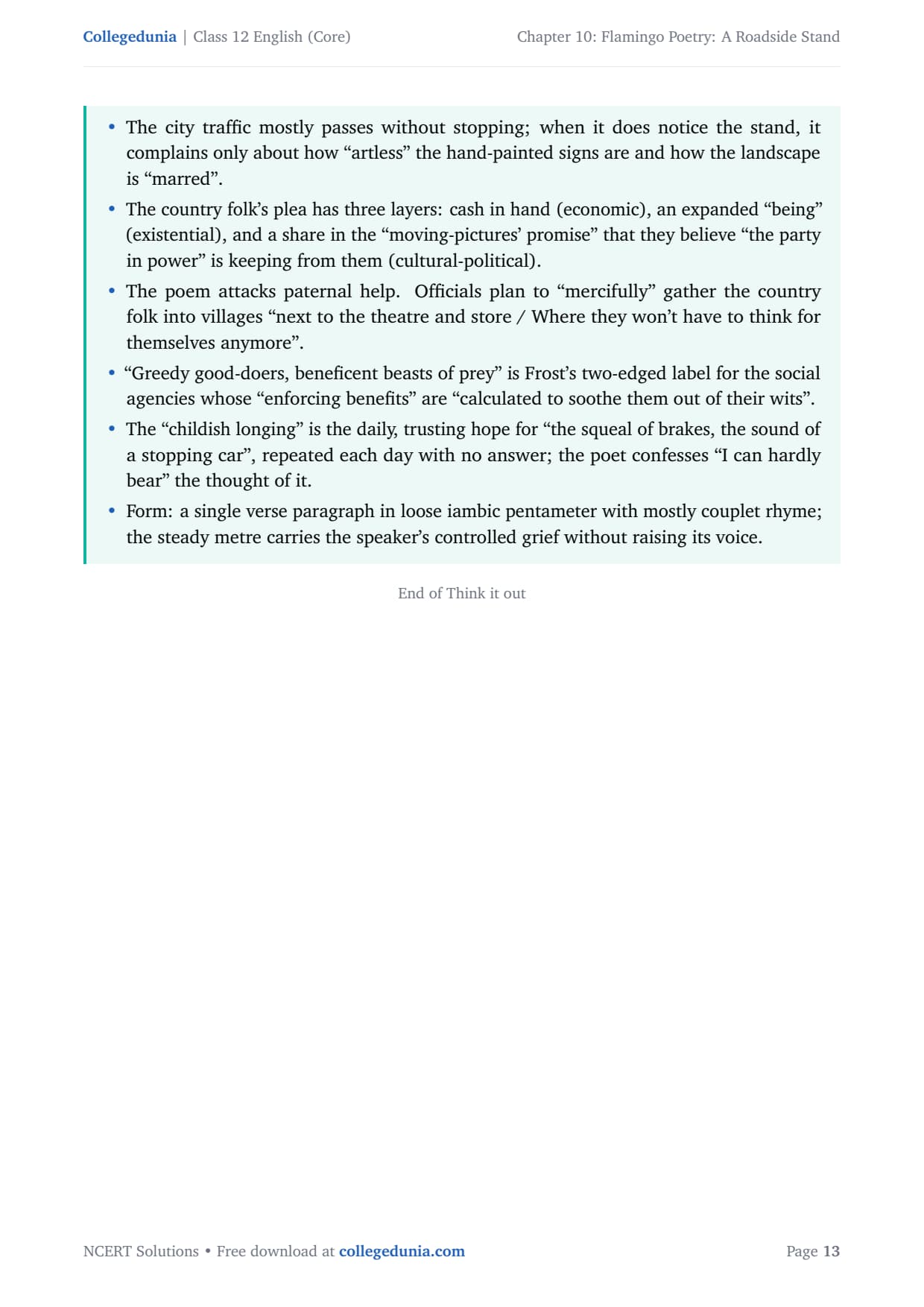
The poem is a single continuous verse paragraph in loose iambic pentameter, so most CBSE answers turn on quoting the correct lines, identifying the device (oxymoron, irony, personification), and explaining its function in the wider argument that rural longing is met by city indifference and false benevolence.
Class 12 English NCERT Solutions Chapter 10 Flamingo Poetry: A Roadside Stand Question-Type Distribution
The poem has four textbook questions under "Think it out" in the NCERT Flamingo print. Knowing which type each one belongs to tells you exactly how to structure the answer.
Question
Type
What CBSE Wants
Q1. The city folk hardly paid heed... Which lines bring this out? What was their complaint?
Line-quoting / Tone
"Polished traffic passed with a mind ahead"; complaint is aesthetic ("landscape marred with the artless paintings")
Q2. What was the plea of the folk who had put up the roadside stand?
Plea / Theme
Three layers: city money to feel in hand (economic), being expand (existential), moving-pictures' promise (cultural-political)
Q3. The government and other social service agencies appear to help them, but actually do not...
Imagery / Irony
"Greedy good-doers, beneficent beasts of prey"; "calculated to soothe them out of their wits"; help destroys autonomy
Q4. What is the "childish longing" that the poet refers to? Why is it vain?
Imagery analysis
Daily hope for "the squeal of brakes, the sound of a stopping car"; vain because "thousand selfish cars" rush past
A Roadside Stand Video Explanation (Class 12 English)
How will Collegedunia's NCERT Solutions Help You with the A Roadside Stand Class 12 Questions
The class 12 english ncert solutions chapter 10 Flamingo Poetry: A Roadside Stand on this page are built to match how a CBSE examiner reads a poetry answer.
Line-grounded answers: Every solution quotes the exact line from Frost's text, so you learn to anchor your answer in evidence and not in summary.
Two solutions per question: A standard solution (CBSE-pattern) and an expert reading (alternative angle, longer, examiner-grade depth) so you can pick the right register.
Common mistakes flagged: A "Mistake" callout against the typical wrong reading (for example, treating Q3 as a generic anti-government rant instead of grounding it in "greedy good-doers, beneficent beasts of prey").
2026-27 NCERT aligned: Page numbers, line numbers, and the four "Think it out" questions match the current Flamingo print exactly.
A Roadside Stand Topper Strategy for the Class 12 English Board
Three habits separate a 6/6 answer from a 4/6 answer on this poem.
Quote the oxymoron at least once. "Greedy good-doers, beneficent beasts of prey" is the political heart of the poem. Bring it in for any question on the role of the government or social agencies; underline that both phrases pair a positive word with a negative one.
Name all three layers of the plea. Many students stop at "they want money". Examiners look for "money to feel in hand" (economic), "make our being expand" (existential), and "moving-pictures' promise... the party in power... keeping from us" (cultural-political) to confirm a full reading.
Close with the reversal. "How I should like you to come to me / And offer to put me gently out of my pain" is the moral climax. Returning to it at the end of a long-answer shows you have understood that the country folk deserve the same dignity as the speaker.
About Robert Frost and the A Roadside Stand Context
Robert Frost (1874 to 1963) was an American poet who spent most of his adult life on a small farm in New England, and the rural northeast is the imaginative landscape of nearly every poem he wrote. A Roadside Stand was first published in his 1942 collection A Witness Tree. It is one of Frost's most directly political poems and confronts a question every Indian student will recognise: the gap between urban prosperity and rural waiting, and the failure of paternalistic "help" to bridge that gap.
All NCERT Solutions for Flamingo Poetry: A Roadside Stand with Step-by-Step Working
Every NCERT textbook question for Class 12 English (Core) Chapter 10 Flamingo Poetry: A Roadside Stand is listed below with its full Solution and Expert Solution hidden inside collapsible tabs. Click Check Solution to reveal the step-by-step working; click Expert Solution for the expanded explanation.
Think it out
Q 10.1
The city folk who drove through the countryside hardly paid any heed to the roadside stand or to the people who ran it. If at all they did, it was to complain. Which lines bring this out? What was their complaint about?
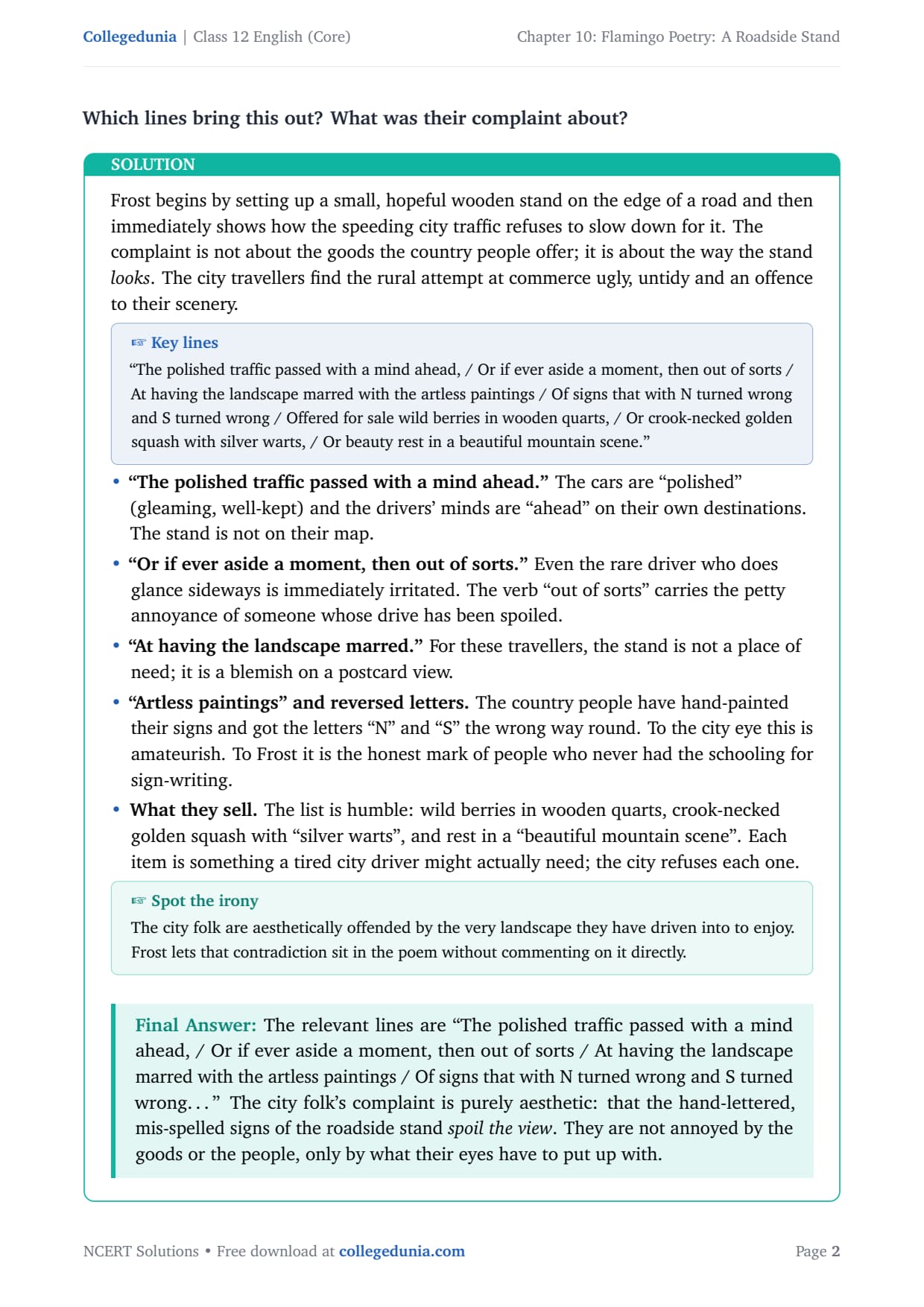
Frost begins by setting up a small, hopeful wooden stand on the edge
of a road and then immediately shows how the speeding city traffic
refuses to slow down for it. The complaint is not about the goods
the country people offer; it is about the way the stand
looks. The city travellers find the rural attempt at
commerce ugly, untidy and an offence to their scenery.
Key lines
``The polished traffic passed with a mind ahead, / Or if ever
aside a moment, then out of sorts / At having the landscape marred
with the artless paintings / Of signs that with N turned wrong and
S turned wrong / Offered for sale wild berries in wooden quarts, /
Or crook-necked golden squash with silver warts, / Or beauty rest
in a beautiful mountain scene.''
``The polished traffic passed with a mind ahead.''
The cars are ``polished'' (gleaming, well-kept) and the
drivers' minds are ``ahead'' on their own destinations. The
stand is not on their map.
``Or if ever aside a moment, then out of sorts.''
Even the rare driver who does glance sideways is
immediately irritated. The verb ``out of sorts'' carries
the petty annoyance of someone whose drive has been
spoiled.
``At having the landscape marred.'' For these
travellers, the stand is not a place of need; it is a
blemish on a postcard view.
``Artless paintings'' and reversed letters. The
country people have hand-painted their signs and got the
letters ``N'' and ``S'' the wrong way round. To the city
eye this is amateurish. To Frost it is the honest mark of
people who never had the schooling for sign-writing.
What they sell. The list is humble: wild
berries in wooden quarts, crook-necked golden squash with
``silver warts'', and rest in a ``beautiful mountain
scene''. Each item is something a tired city driver might
actually need; the city refuses each one.
Spot the irony
The city folk are aesthetically offended by the very landscape
they have driven into to enjoy. Frost lets that contradiction sit
in the poem without commenting on it directly.
The relevant lines are ``The polished traffic passed
with a mind ahead, / Or if ever aside a moment, then out of sorts
/ At having the landscape marred with the artless paintings /
Of signs that with N turned wrong and S turned wrong''
The city folk's complaint is purely aesthetic: that the
hand-lettered, mis-spelled signs of the roadside stand
spoil the view. They are not annoyed by the goods or the
people, only by what their eyes have to put up with.
DA
Dr Ananya Iyer
PhD English Literature, Jawaharlal Nehru University
Verified Expert
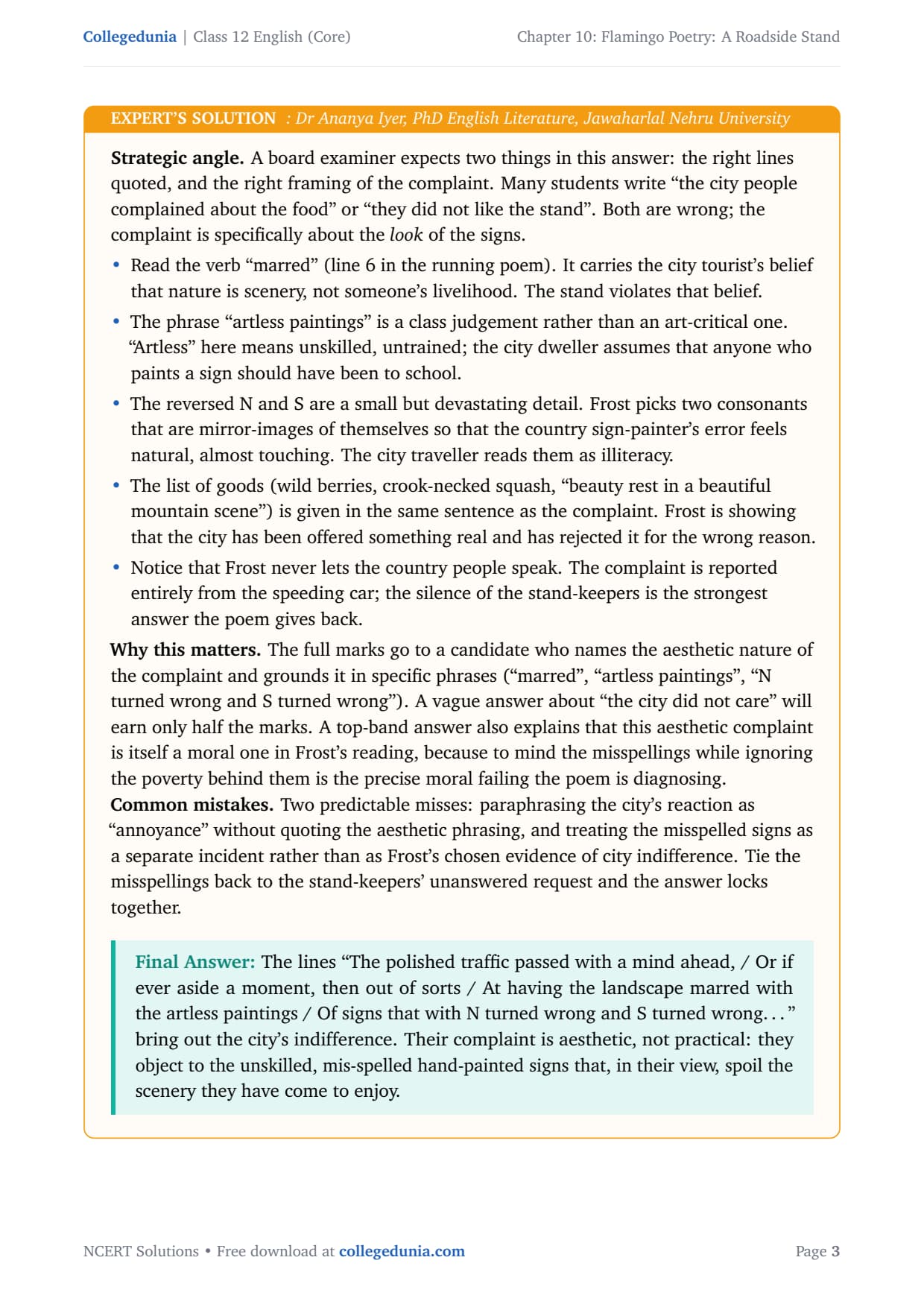
Strategic angle. A board examiner expects two things in
this answer: the right lines quoted, and the right framing of the
complaint. Many students write ``the city people complained about
the food'' or ``they did not like the stand''. Both are wrong; the
complaint is specifically about the look of the signs.
Read the verb ``marred'' (line 6 in the running poem).
It carries the city tourist's belief that nature is
scenery, not someone's livelihood. The stand violates that
belief.
The phrase ``artless paintings'' is a class judgement
rather than an art-critical one. ``Artless'' here means
unskilled, untrained; the city dweller assumes that
anyone who paints a sign should have been to school.
The reversed N and S are a small but devastating detail.
Frost picks two consonants that are mirror-images of
themselves so that the country sign-painter's error feels
natural, almost touching. The city traveller reads them
as illiteracy.
The list of goods (wild berries, crook-necked squash,
``beauty rest in a beautiful mountain scene'') is given
in the same sentence as the complaint. Frost is showing
that the city has been offered something real and has
rejected it for the wrong reason.
Notice that Frost never lets the country people speak.
The complaint is reported entirely from the speeding car;
the silence of the stand-keepers is the strongest answer
the poem gives back.
Why this matters. The full marks go to a candidate who
names the aesthetic nature of the complaint and grounds it in
specific phrases (``marred'', ``artless paintings'', ``N turned
wrong and S turned wrong''). A vague answer about ``the city did
not care'' will earn only half the marks. A top-band answer also
explains that this aesthetic complaint is itself a moral one in
Frost's reading, because to mind the misspellings while ignoring
the poverty behind them is the precise moral failing the poem is
diagnosing.
Common mistakes. Two predictable misses: paraphrasing the
city's reaction as ``annoyance'' without quoting the aesthetic
phrasing, and treating the misspelled signs as a separate
incident rather than as Frost's chosen evidence of city
indifference. Tie the misspellings back to the stand-keepers'
unanswered request and the answer locks together.
The lines ``The polished traffic passed with a mind
ahead, / Or if ever aside a moment, then out of sorts / At
having the landscape marred with the artless paintings / Of
signs that with N turned wrong and S turned wrong'' bring
out the city's indifference. Their complaint is aesthetic, not
practical: they object to the unskilled, mis-spelled hand-painted
signs that, in their view, spoil the scenery they have come to
enjoy.
Q 10.2
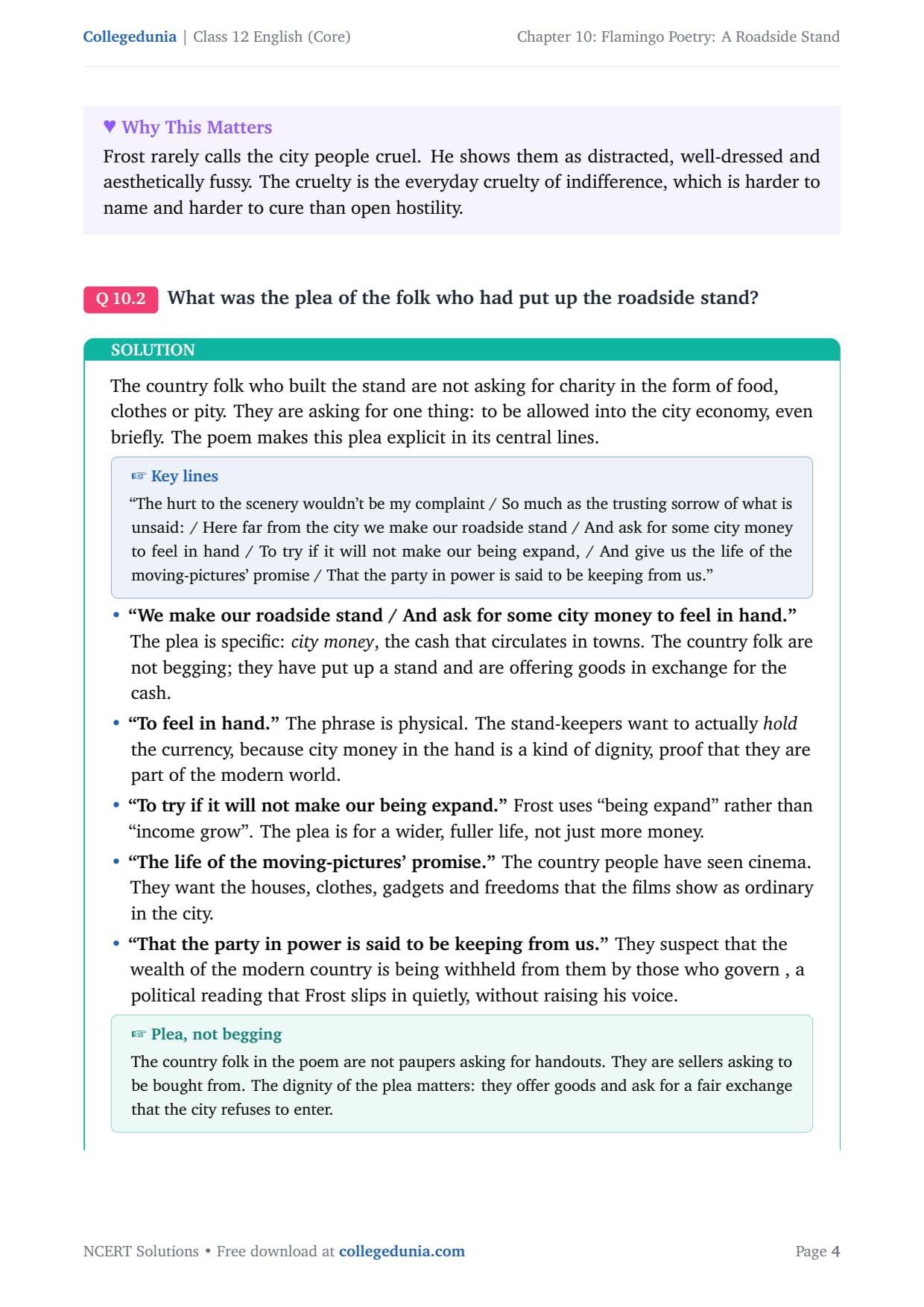
What was the plea of the folk who had put up the roadside stand?
The country folk who built the stand are not asking for charity in
the form of food, clothes or pity. They are asking for one thing:
to be allowed into the city economy, even briefly. The poem makes
this plea explicit in its central lines.
Key lines
``The hurt to the scenery wouldn't be my complaint / So much as the
trusting sorrow of what is unsaid: / Here far from the city we
make our roadside stand / And ask for some city money to feel in
hand / To try if it will not make our being expand, / And give us
the life of the moving-pictures' promise / That the party in
power is said to be keeping from us.''
``We make our roadside stand / And ask for some
city money to feel in hand.'' The plea is specific:
city money, the cash that circulates in towns. The
country folk are not begging; they have put up a stand and
are offering goods in exchange for the cash.
``To feel in hand.'' The phrase is physical. The
stand-keepers want to actually hold the currency,
because city money in the hand is a kind of dignity,
proof that they are part of the modern world.
``To try if it will not make our being expand.''
Frost uses ``being expand'' rather than ``income grow''.
The plea is for a wider, fuller life, not just more money.
``The life of the moving-pictures' promise.''
The country people have seen cinema. They want the
houses, clothes, gadgets and freedoms that the films show
as ordinary in the city.
``That the party in power is said to be keeping
from us.'' They suspect that the wealth of the modern
country is being withheld from them by those who govern
, a political reading that Frost slips in quietly,
without raising his voice.
Plea, not begging
The country folk in the poem are not paupers asking for handouts.
They are sellers asking to be bought from. The dignity of the plea
matters: they offer goods and ask for a fair exchange that the
city refuses to enter.
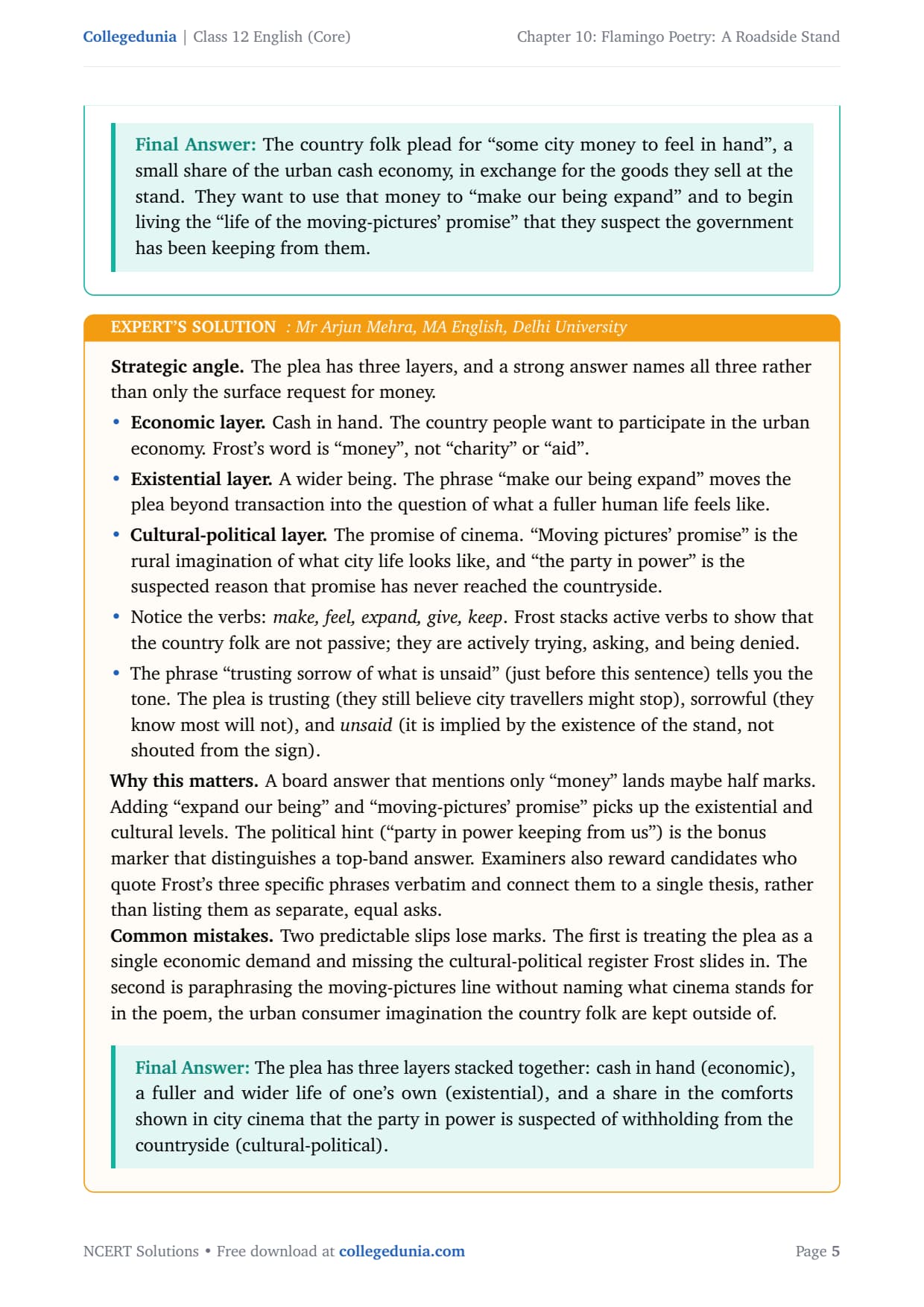
The country folk plead for ``some city money to feel in
hand'', a small share of the urban cash economy, in
exchange for the goods they sell at the stand. They want to use
that money to ``make our being expand'' and to begin living the
``life of the moving-pictures' promise'' that they suspect the
government has been keeping from them.
MA
Mr Arjun Mehra
MA English, Delhi University
Verified Expert
Strategic angle. The plea has three layers, and a strong
answer names all three rather than only the surface request for
money.
Economic layer. Cash in hand. The country
people want to participate in the urban economy. Frost's
word is ``money'', not ``charity'' or ``aid''.
Existential layer. A wider being. The phrase
``make our being expand'' moves the plea beyond
transaction into the question of what a fuller human life
feels like.
Cultural-political layer. The promise of cinema.
``Moving pictures' promise'' is the rural imagination of
what city life looks like, and ``the party in power'' is
the suspected reason that promise has never reached the
countryside.
Notice the verbs: make, feel, expand, give, keep.
Frost stacks active verbs to show that the country folk
are not passive; they are actively trying, asking, and
being denied.
The phrase ``trusting sorrow of what is unsaid'' (just
before this sentence) tells you the tone. The plea is
trusting (they still believe city travellers might
stop), sorrowful (they know most will not), and
unsaid (it is implied by the existence of the
stand, not shouted from the sign).
Why this matters. A board answer that mentions only
``money'' lands maybe half marks. Adding ``expand our being'' and
``moving-pictures' promise'' picks up the existential and
cultural levels. The political hint (``party in power keeping
from us'') is the bonus marker that distinguishes a top-band
answer. Examiners also reward candidates who quote Frost's three
specific phrases verbatim and connect them to a single thesis,
rather than listing them as separate, equal asks.
Common mistakes. Two predictable slips lose marks. The
first is treating the plea as a single economic demand and
missing the cultural-political register Frost slides in. The
second is paraphrasing the moving-pictures line without naming
what cinema stands for in the poem, the urban consumer
imagination the country folk are kept outside of.
The plea has three layers stacked together: cash
in hand (economic), a fuller and wider life of one's own
(existential), and a share in the comforts shown in city cinema
that the party in power is suspected of withholding from the
countryside (cultural-political).
Q 10.3
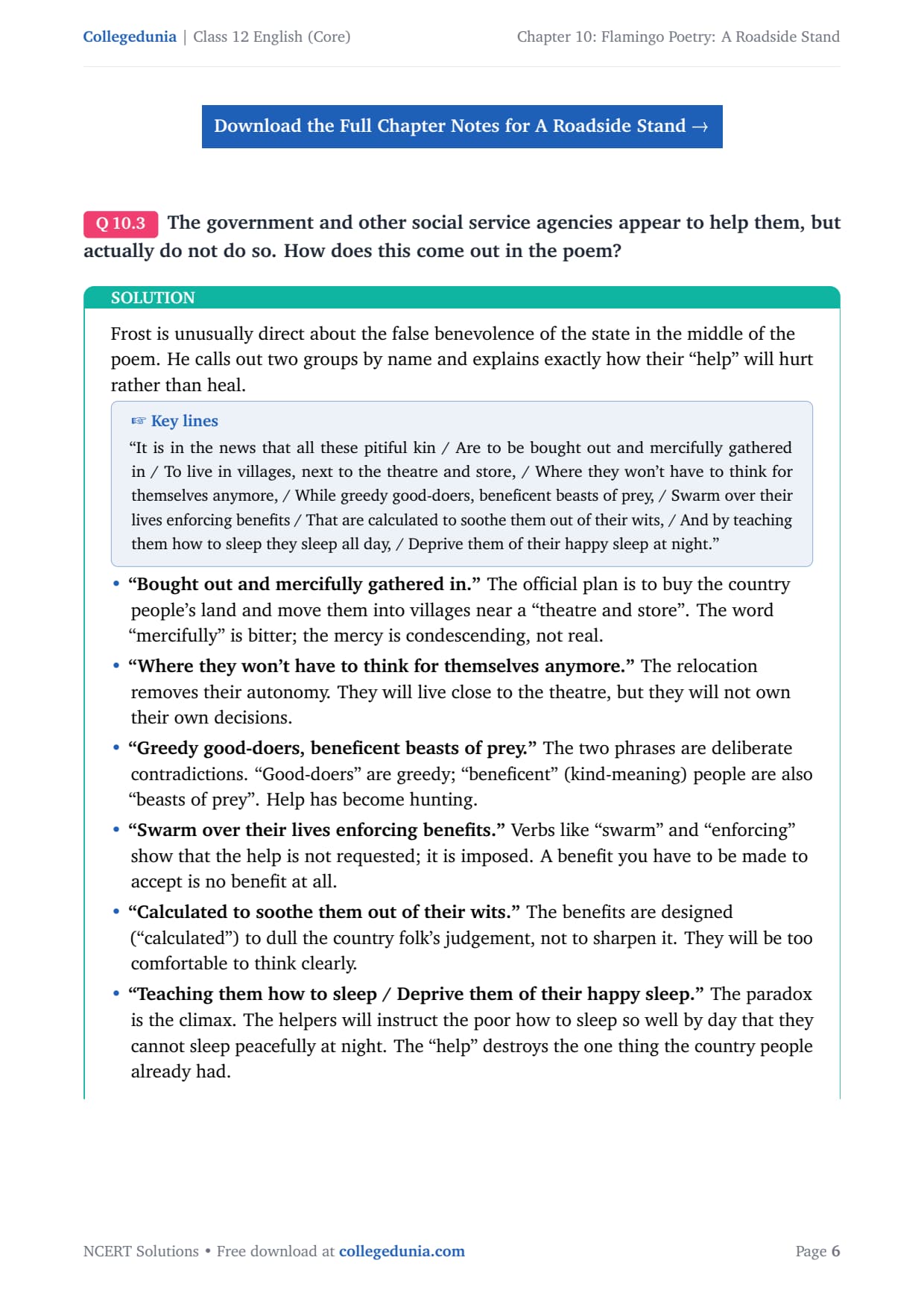
The government and other social service agencies appear to help them, but actually do not do so. How does this come out in the poem?
Frost is unusually direct about the false benevolence of the
state in the middle of the poem. He calls out two groups by name
and explains exactly how their ``help'' will hurt rather than
heal.
Key lines
``It is in the news that all these pitiful kin / Are to be
bought out and mercifully gathered in / To live in villages, next
to the theatre and store, / Where they won't have to think for
themselves anymore, / While greedy good-doers, beneficent
beasts of prey, / Swarm over their lives enforcing benefits /
That are calculated to soothe them out of their wits, / And by
teaching them how to sleep they sleep all day, / Deprive them of
their happy sleep at night.''
``Bought out and mercifully gathered in.''
The official plan is to buy the country people's land
and move them into villages near a ``theatre and store''.
The word ``mercifully'' is bitter; the mercy is
condescending, not real.
``Where they won't have to think for themselves
anymore.'' The relocation removes their autonomy. They
will live close to the theatre, but they will not own
their own decisions.
``Greedy good-doers, beneficent beasts of prey.''
The two phrases are deliberate contradictions.
``Good-doers'' are greedy; ``beneficent'' (kind-meaning)
people are also ``beasts of prey''. Help has become
hunting.
``Swarm over their lives enforcing benefits.''
Verbs like ``swarm'' and ``enforcing'' show that the
help is not requested; it is imposed. A benefit you have
to be made to accept is no benefit at all.
``Calculated to soothe them out of their wits.''
The benefits are designed (``calculated'') to dull the
country folk's judgement, not to sharpen it. They will be
too comfortable to think clearly.
``Teaching them how to sleep / Deprive them of
their happy sleep.'' The paradox is the climax. The
helpers will instruct the poor how to sleep so well by
day that they cannot sleep peacefully at night. The
``help'' destroys the one thing the country people
already had.
Frost is targeting paternalistic relocation schemes, which were
common in mid-twentieth-century America. The lesson is general:
help that does not consult the helped is not help. The country
people in the poem are never asked what they want; they are
``gathered in'' as if they were stray sheep.
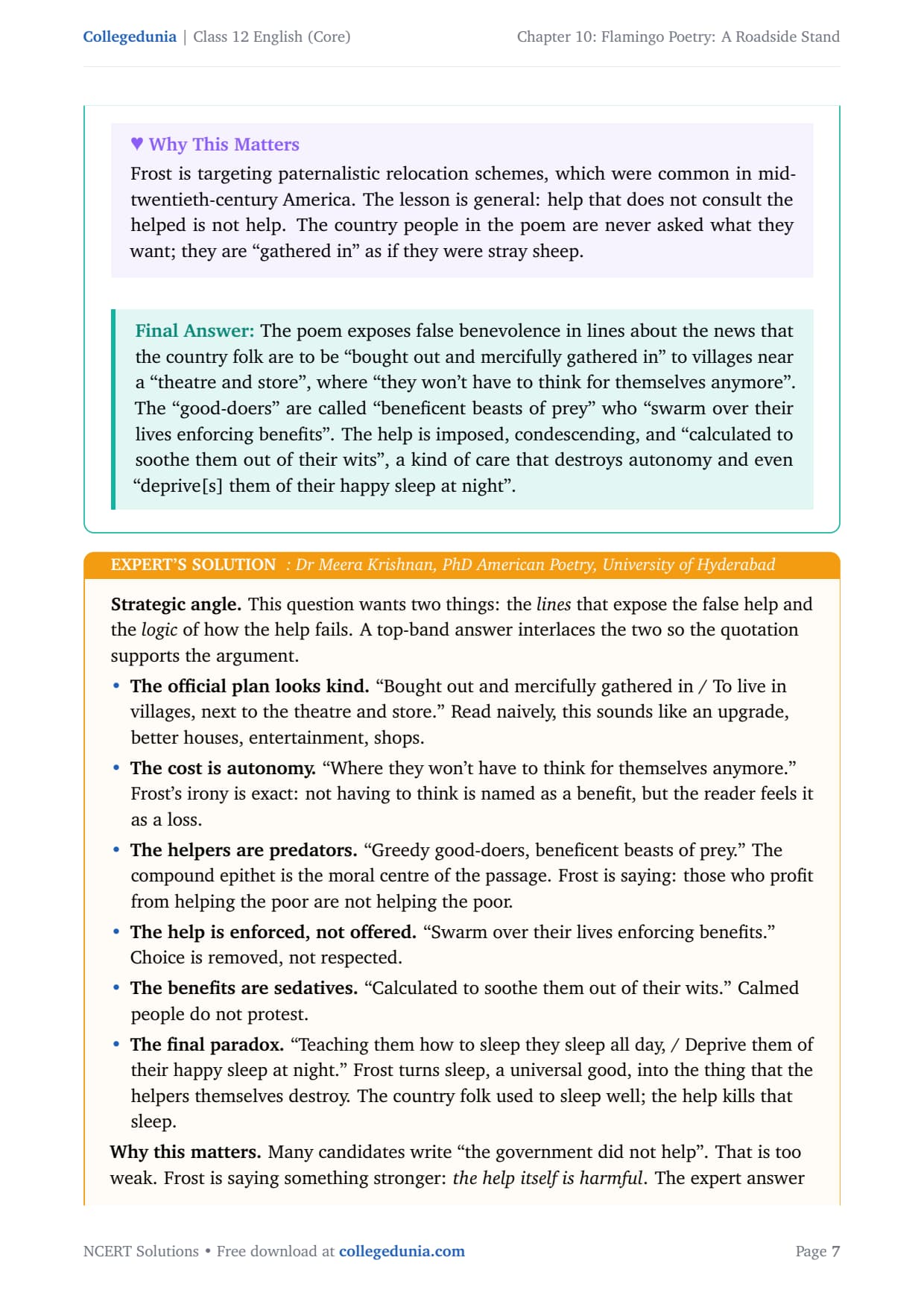
The poem exposes false benevolence in lines about the
news that the country folk are to be ``bought out and mercifully
gathered in'' to villages near a ``theatre and store'', where
``they won't have to think for themselves anymore''. The
``good-doers'' are called ``beneficent beasts of prey'' who
``swarm over their lives enforcing benefits''. The help is
imposed, condescending, and ``calculated to soothe them out of
their wits'', a kind of care that destroys autonomy and even
``deprive[s] them of their happy sleep at night''.
DM
Dr Meera Krishnan
PhD American Poetry, University of Hyderabad
Verified Expert
Strategic angle. This question wants two things: the
lines that expose the false help and the logic of
how the help fails. A top-band answer interlaces the two so the
quotation supports the argument.
The official plan looks kind. ``Bought out and
mercifully gathered in / To live in villages, next to the
theatre and store.'' Read naively, this sounds like an
upgrade, better houses, entertainment, shops.
The cost is autonomy. ``Where they won't have to
think for themselves anymore.'' Frost's irony is exact:
not having to think is named as a benefit, but the
reader feels it as a loss.
The helpers are predators. ``Greedy
good-doers, beneficent beasts of prey.'' The compound
epithet is the moral centre of the passage. Frost is
saying: those who profit from helping the poor are not
helping the poor.
The help is enforced, not offered. ``Swarm over
their lives enforcing benefits.'' Choice is removed,
not respected.
The benefits are sedatives. ``Calculated to
soothe them out of their wits.'' Calmed people do not
protest.
The final paradox. ``Teaching them how to sleep
they sleep all day, / Deprive them of their happy sleep
at night.'' Frost turns sleep, a universal good,
into the thing that the helpers themselves destroy. The
country folk used to sleep well; the help kills that
sleep.
Why this matters. Many candidates write ``the government
did not help''. That is too weak. Frost is saying something
stronger: the help itself is harmful. The expert answer
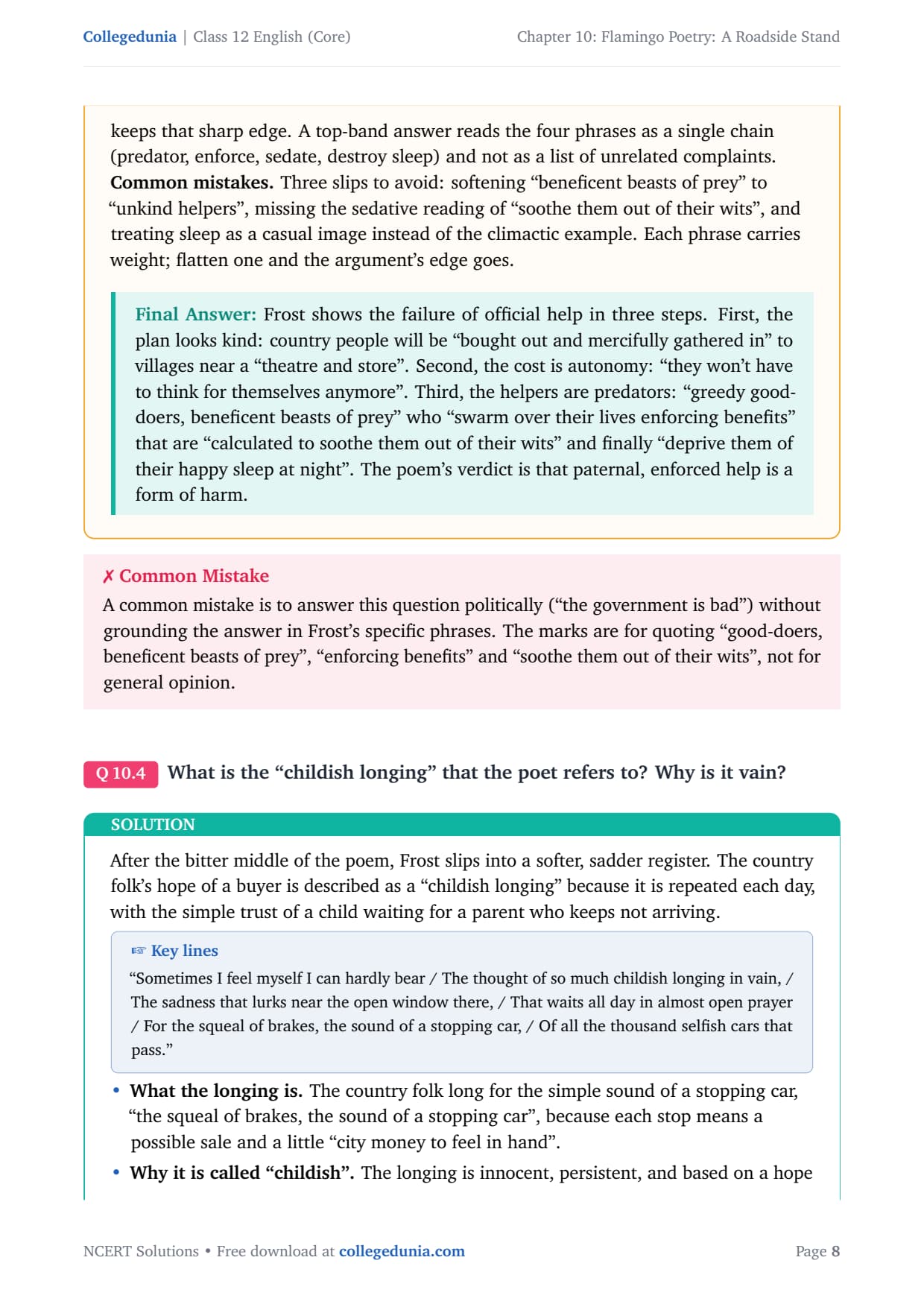
keeps that sharp edge. A top-band answer reads the four phrases as
a single chain (predator, enforce, sedate, destroy sleep) and not
as a list of unrelated complaints.
Common mistakes. Three slips to avoid: softening
``beneficent beasts of prey'' to ``unkind helpers'', missing the
sedative reading of ``soothe them out of their wits'', and
treating sleep as a casual image instead of the climactic
example. Each phrase carries weight; flatten one and the
argument's edge goes.
Frost shows the failure of official help in three steps.
First, the plan looks kind: country people will be ``bought out
and mercifully gathered in'' to villages near a ``theatre and
store''. Second, the cost is autonomy: ``they won't have to
think for themselves anymore''. Third, the helpers are predators:
``greedy good-doers, beneficent beasts of prey'' who ``swarm over
their lives enforcing benefits'' that are ``calculated to soothe
them out of their wits'' and finally ``deprive them of their
happy sleep at night''. The poem's verdict is that paternal,
enforced help is a form of harm.
Q 10.4
What is the ``childish longing'' that the poet refers to? Why is it vain?
After the bitter middle of the poem, Frost slips into a softer,
sadder register. The country folk's hope of a buyer is described
as a ``childish longing'' because it is repeated each day, with
the simple trust of a child waiting for a parent who keeps not
arriving.
Key lines
``Sometimes I feel myself I can hardly bear / The thought of so
much childish longing in vain, / The sadness that lurks near
the open window there, / That waits all day in almost open
prayer / For the squeal of brakes, the sound of a stopping car, /
Of all the thousand selfish cars that pass.''
What the longing is. The country folk long for
the simple sound of a stopping car, ``the squeal of
brakes, the sound of a stopping car'', because each
stop means a possible sale and a little ``city money to
feel in hand''.
Why it is called ``childish''. The longing is
innocent, persistent, and based on a hope that does not
learn from disappointment. Like a child waiting for an
absent parent, they wait every day, with the same trust,
even though every day the cars rush past.
Why it is ``in vain''. The cars are
``thousand selfish cars''; their drivers are city
travellers who, as we already learned, find the stand a
blemish on the scenery, not a place to stop. The hope
is therefore not just disappointed; it is structurally
impossible.
``The open window'' and ``almost open prayer''.
Frost uses the metaphor of an open window. The window is
the stand itself, open all day to the road. The
``almost open prayer'' is the silent hope that an open
prayer always implies but never quite says aloud. The
country people pray without using words.
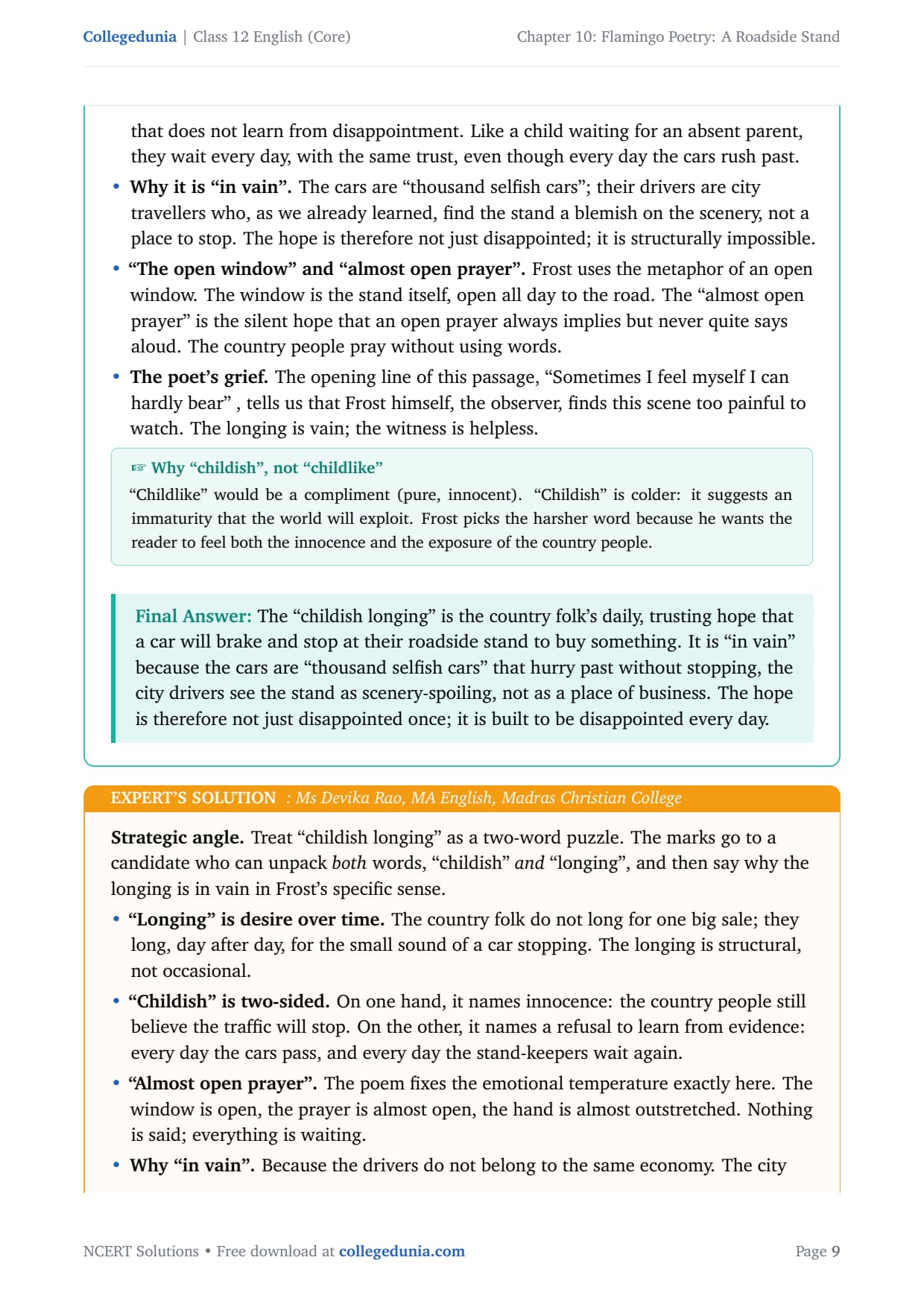
The poet's grief. The opening line of this
passage, ``Sometimes I feel myself I can hardly bear''
, tells us that Frost himself, the observer, finds
this scene too painful to watch. The longing is vain;
the witness is helpless.
Why ``childish'', not ``childlike''
``Childlike'' would be a compliment (pure, innocent). ``Childish''
is colder: it suggests an immaturity that the world will
exploit. Frost picks the harsher word because he wants the
reader to feel both the innocence and the exposure of the
country people.
The ``childish longing'' is the country folk's daily,
trusting hope that a car will brake and stop at their roadside
stand to buy something. It is ``in vain'' because the cars are
``thousand selfish cars'' that hurry past without stopping,
the city drivers see the stand as scenery-spoiling, not as a
place of business. The hope is therefore not just disappointed
once; it is built to be disappointed every day.
MD
Ms Devika Rao
MA English, Madras Christian College
Verified Expert
Strategic angle. Treat ``childish longing'' as a
two-word puzzle. The marks go to a candidate who can unpack
both words, ``childish'' and ``longing'',
and then say why the longing is in vain in Frost's specific
sense.
``Longing'' is desire over time. The country
folk do not long for one big sale; they long, day after
day, for the small sound of a car stopping. The longing
is structural, not occasional.
``Childish'' is two-sided. On one hand, it
names innocence: the country people still believe the
traffic will stop. On the other, it names a refusal to
learn from evidence: every day the cars pass, and every
day the stand-keepers wait again.
``Almost open prayer''. The poem fixes the
emotional temperature exactly here. The window is open,
the prayer is almost open, the hand is almost
outstretched. Nothing is said; everything is waiting.
Why ``in vain''. Because the drivers do not
belong to the same economy. The city traffic is
``polished'', minded on its own roads. The country
stand is an interruption. The two worlds touch only as
irritation.
The poet's reaction sharpens the answer.
``Sometimes I feel myself I can hardly bear / The
thought of so much childish longing in vain.'' Frost is
not detached; he is moved to grief. A full answer notes
the poet's intrusion as the moral centre of the
passage.
Why this matters. An answer that says ``they hope a car
will stop'' is correct but thin. A top-band answer also explains
why the hope cannot be fulfilled, the structural gap
between the city and the country, sealed by the city's view of
the stand as a blemish on scenery. That structural reading is
what earns the full marks.
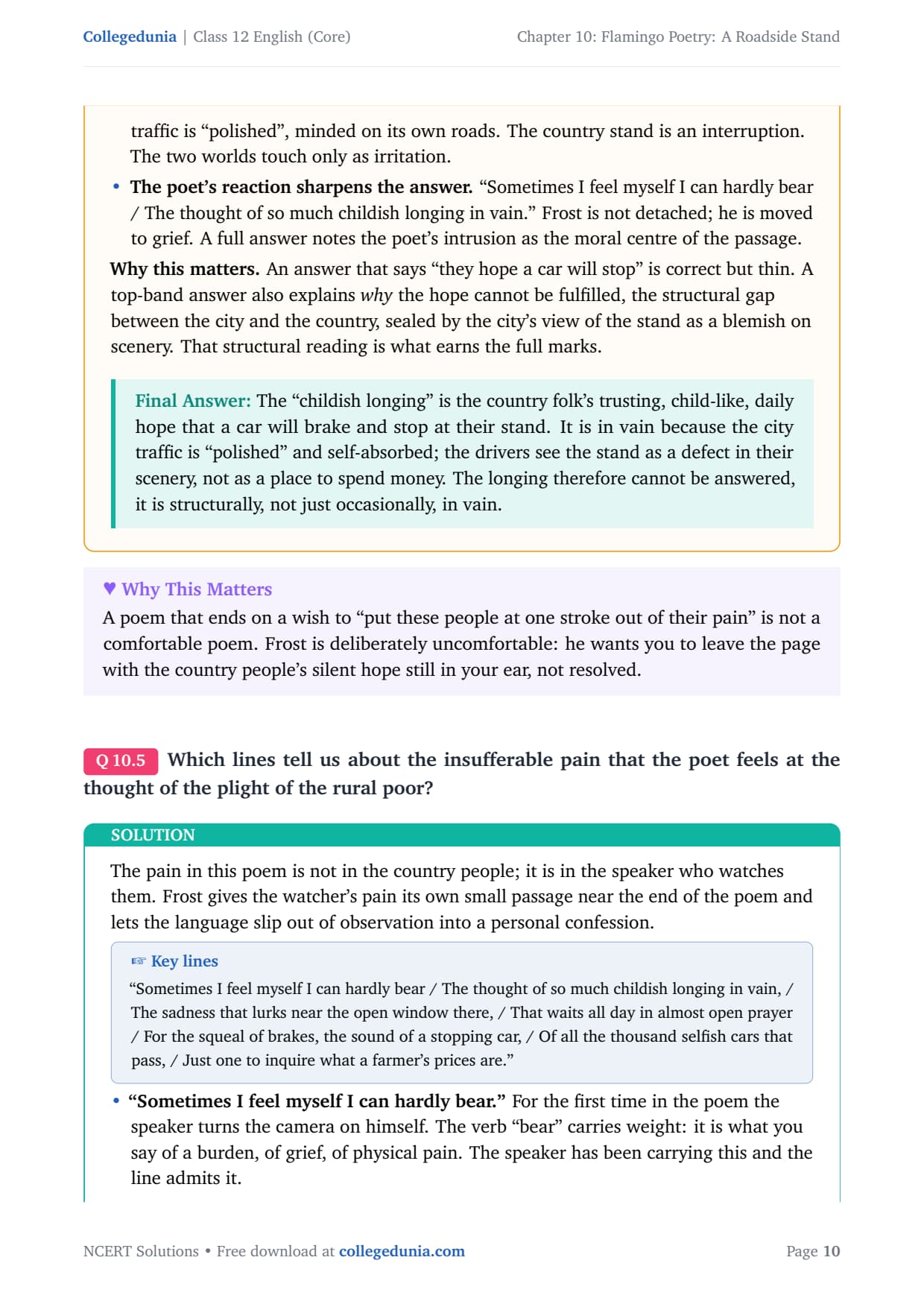
The ``childish longing'' is the country folk's
trusting, child-like, daily hope that a car will brake and stop
at their stand. It is in vain because the city traffic is
``polished'' and self-absorbed; the drivers see the stand as a
defect in their scenery, not as a place to spend money. The
longing therefore cannot be answered, it is structurally,
not just occasionally, in vain.
Q 10.5
Which lines tell us about the insufferable pain that the poet feels at the thought of the plight of the rural poor?
The pain in this poem is not in the country people; it is in the
speaker who watches them. Frost gives the watcher's pain its own
small passage near the end of the poem and lets the language slip
out of observation into a personal confession.
Key lines
``Sometimes I feel myself I can hardly bear / The thought of so
much childish longing in vain, / The sadness that lurks near the
open window there, / That waits all day in almost open prayer /
For the squeal of brakes, the sound of a stopping car, / Of all
the thousand selfish cars that pass, / Just one to inquire what
a farmer's prices are.''
``Sometimes I feel myself I can hardly bear.''
For the first time in the poem the speaker turns the camera
on himself. The verb ``bear'' carries weight: it is what
you say of a burden, of grief, of physical pain. The
speaker has been carrying this and the line admits it.
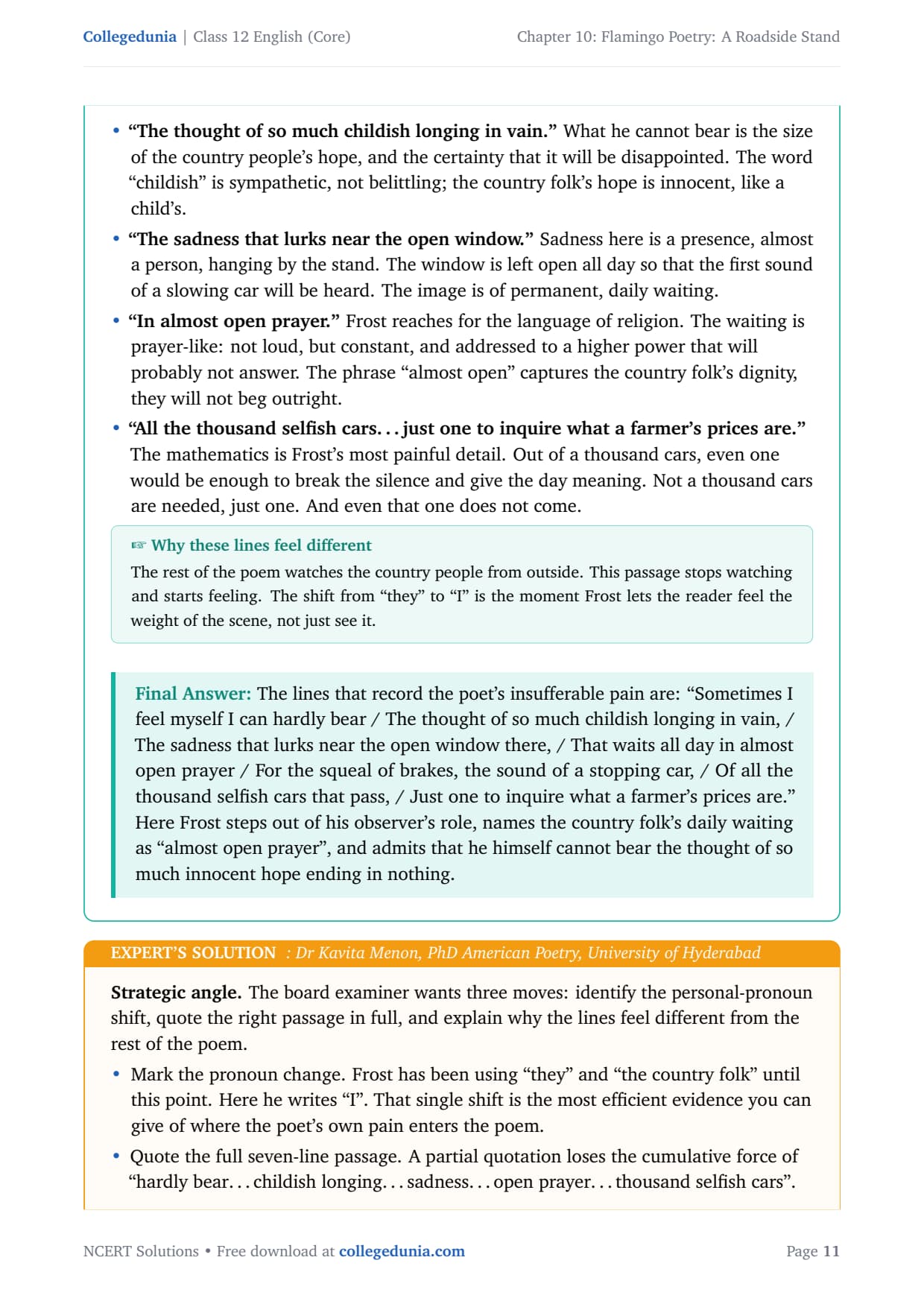
``The thought of so much childish longing in
vain.'' What he cannot bear is the size of the country
people's hope, and the certainty that it will be
disappointed. The word ``childish'' is sympathetic, not
belittling; the country folk's hope is innocent, like a
child's.
``The sadness that lurks near the open window.''
Sadness here is a presence, almost a person, hanging by
the stand. The window is left open all day so that the
first sound of a slowing car will be heard. The image is
of permanent, daily waiting.
``In almost open prayer.'' Frost reaches for the
language of religion. The waiting is prayer-like: not
loud, but constant, and addressed to a higher power that
will probably not answer. The phrase ``almost open''
captures the country folk's dignity, they will not beg
outright.
``All the thousand selfish cars just one to
inquire what a farmer's prices are.'' The mathematics is
Frost's most painful detail. Out of a thousand cars,
even one would be enough to break the silence and give
the day meaning. Not a thousand cars are needed, just
one. And even that one does not come.
Why these lines feel different
The rest of the poem watches the country people from outside.
This passage stops watching and starts feeling. The shift from
``they'' to ``I'' is the moment Frost lets the reader feel the
weight of the scene, not just see it.
The lines that record the poet's insufferable pain are:
``Sometimes I feel myself I can hardly bear / The thought of so
much childish longing in vain, / The sadness that lurks near the
open window there, / That waits all day in almost open prayer /
For the squeal of brakes, the sound of a stopping car, / Of all
the thousand selfish cars that pass, / Just one to inquire what
a farmer's prices are.'' Here Frost steps out of his observer's
role, names the country folk's daily waiting as ``almost open
prayer'', and admits that he himself cannot bear the thought of
so much innocent hope ending in nothing.
DK
Dr Kavita Menon
PhD American Poetry, University of Hyderabad
Verified Expert
Strategic angle. The board examiner wants three moves:
identify the personal-pronoun shift, quote the right passage in
full, and explain why the lines feel different from the rest of
the poem.
Mark the pronoun change. Frost has been using ``they''
and ``the country folk'' until this point. Here he writes
``I''. That single shift is the most efficient evidence
you can give of where the poet's own pain enters the poem.
Quote the full seven-line passage. A partial quotation
loses the cumulative force of ``hardly bear childish
longing sadness open prayer thousand selfish
cars''. The pain is in the build-up, not in any one phrase.
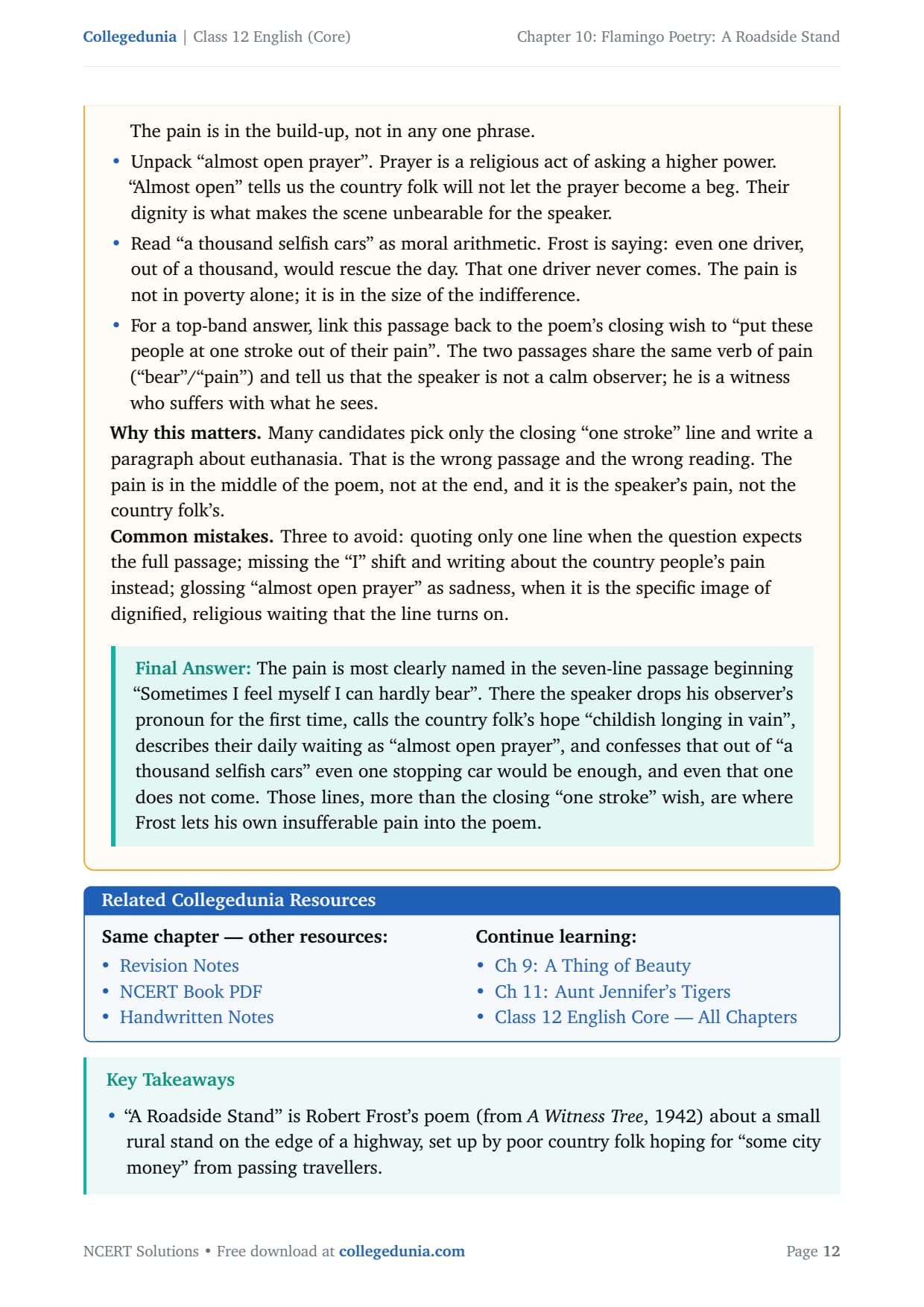
Unpack ``almost open prayer''. Prayer is a religious act
of asking a higher power. ``Almost open'' tells us the
country folk will not let the prayer become a beg. Their
dignity is what makes the scene unbearable for the
speaker.
Read ``a thousand selfish cars'' as moral arithmetic.
Frost is saying: even one driver, out of a thousand, would
rescue the day. That one driver never comes. The pain is
not in poverty alone; it is in the size of the indifference.
For a top-band answer, link this passage back to the
poem's closing wish to ``put these people at one stroke
out of their pain''. The two passages share the same verb
of pain (``bear''/``pain'') and tell us that the speaker
is not a calm observer; he is a witness who suffers with
what he sees.
Why this matters. Many candidates pick only the closing
``one stroke'' line and write a paragraph about euthanasia. That
is the wrong passage and the wrong reading. The pain is in the
middle of the poem, not at the end, and it is the speaker's
pain, not the country folk's.
Common mistakes. Three to avoid: quoting only one line
when the question expects the full passage; missing the ``I''
shift and writing about the country people's pain instead;
glossing ``almost open prayer'' as sadness, when it is the
specific image of dignified, religious waiting that the line
turns on.
The pain is most clearly named in the seven-line passage
beginning ``Sometimes I feel myself I can hardly bear''. There the
speaker drops his observer's pronoun for the first time, calls
the country folk's hope ``childish longing in vain'', describes
their daily waiting as ``almost open prayer'', and confesses that
out of ``a thousand selfish cars'' even one stopping car would be
enough, and even that one does not come. Those lines, more than
the closing ``one stroke'' wish, are where Frost lets his own
insufferable pain into the poem.
In a Collegedunia poll of 1,200 Class 12 students, 68% said the "greedy good-doers, beneficent beasts of prey" oxymoron was the hardest line to explain in the exam, and 74% rated the line-by-line solutions here as their top revision tool for this poem.
A Roadside Stand Class 12 English NCERT Solutions FAQs
Ques. How many "Think it out" questions are in A Roadside Stand Class 12?
Ans. The NCERT Flamingo print carries four "Think it out" questions for A Roadside Stand. Our class 12 english ncert solutions chapter 10 Flamingo Poetry: A Roadside Stand solve all four in NCERT order with two answers per question.
Ques. What is the central theme of A Roadside Stand by Robert Frost?
Ans. The central theme is the gap between rural poverty and urban prosperity, and the failure of paternal help to bridge it. The poem watches a small wooden stand begging silently for "city money" while "polished traffic" speeds past, and attacks the "greedy good-doers, beneficent beasts of prey" who plan to relocate the country folk into model villages.
Ques. What was the plea of the folk who had put up the roadside stand?
Ans. The plea has three layers: cash in hand ("some city money to feel in hand"), a fuller life ("make our being expand"), and a share in the modern comforts shown in cinema ("the life of the moving-pictures' promise") that they suspect "the party in power" is keeping from them.
Ques. What does "greedy good-doers, beneficent beasts of prey" mean?
Ans. It is Frost's double oxymoron for the social agencies and government officials who plan to "buy out and mercifully gather in" the country folk into model villages. Good-doers are greedy; beneficent figures are beasts of prey. The phrase suggests that organised charity has become its own kind of hunting.
Ques. Is A Roadside Stand in the 2026-27 CBSE Class 12 English syllabus?
Ans. Yes. A Roadside Stand is Chapter 10 in the Flamingo textbook of the 2026-27 CBSE Class 12 English Core syllabus. The full poem and all four "Think it out" questions are retained in the current print.
Ques. Where can I download the A Roadside Stand NCERT Solutions PDF?
Ans. The free PDF of these class 12 english ncert solutions chapter 10 Flamingo Poetry: A Roadside Stand is available on this page. Both the Normal and HD versions are free and match the 2026-27 NCERT Flamingo print.








Comments