




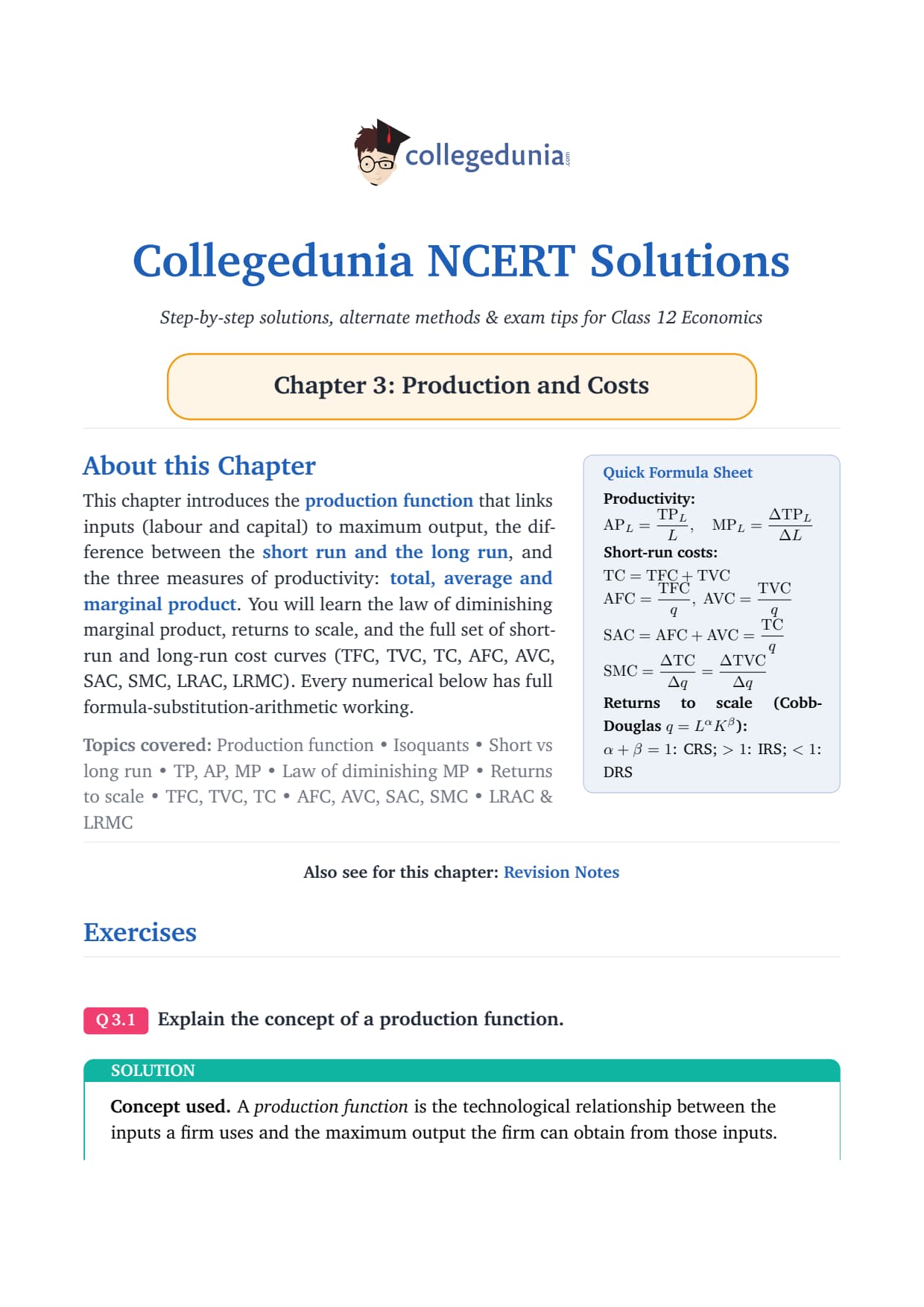
Production and Costs is Chapter 3 of the Class 12 Microeconomics book. It covers the production function, returns to a factor and scale, isoquants and the short-run cost family. This page has step-by-step NCERT solutions to every exercise question and a free PDF to download.
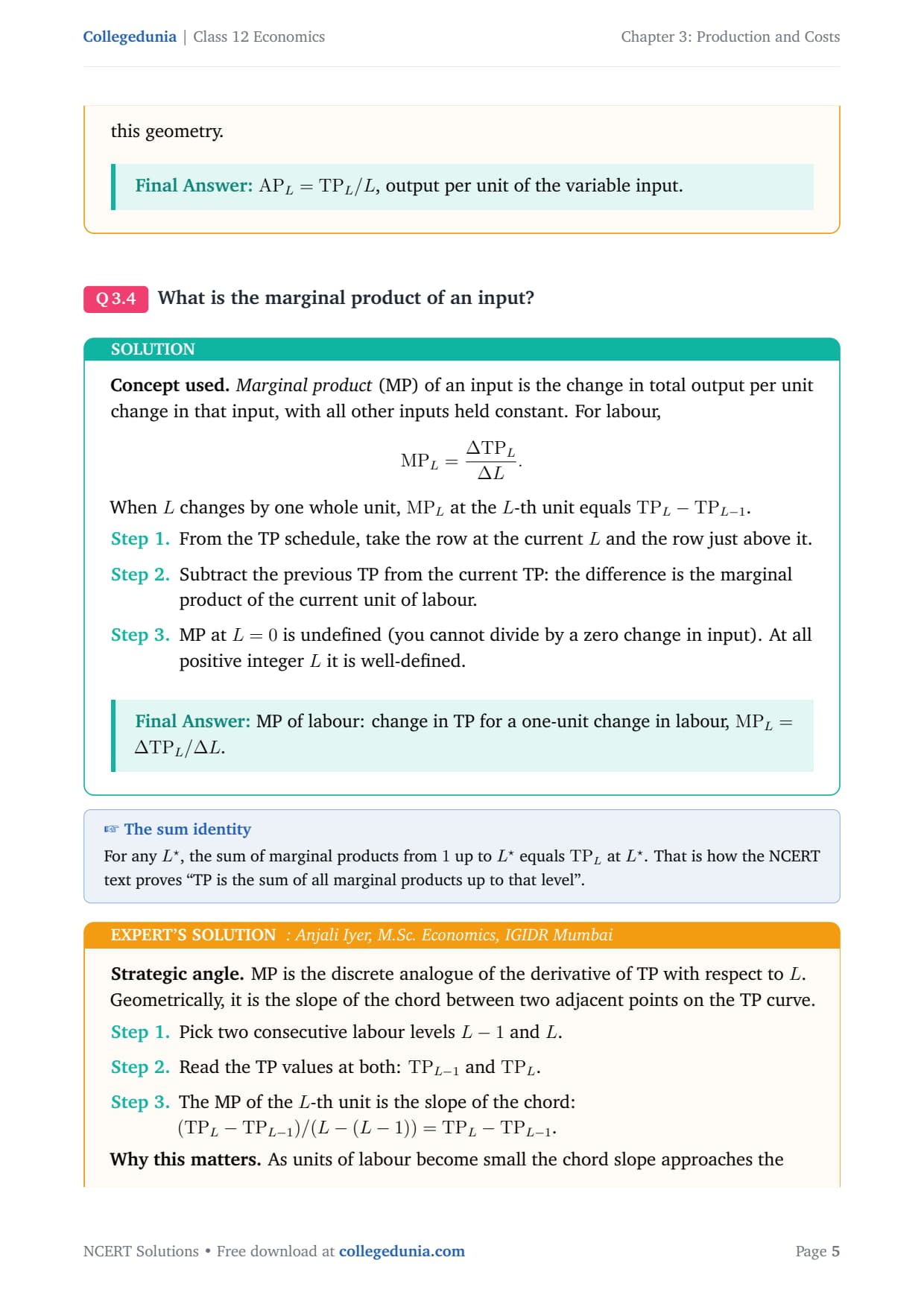
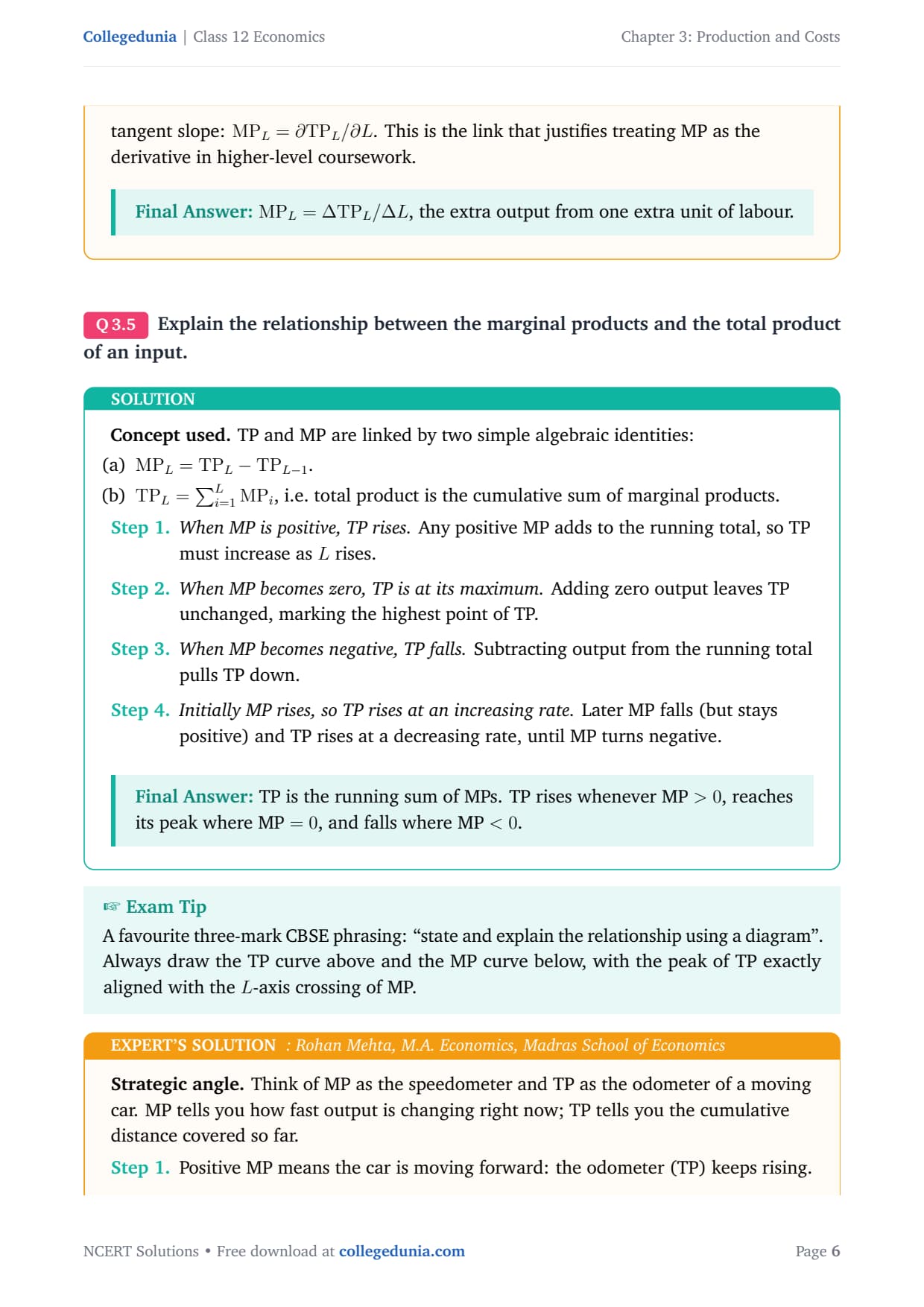
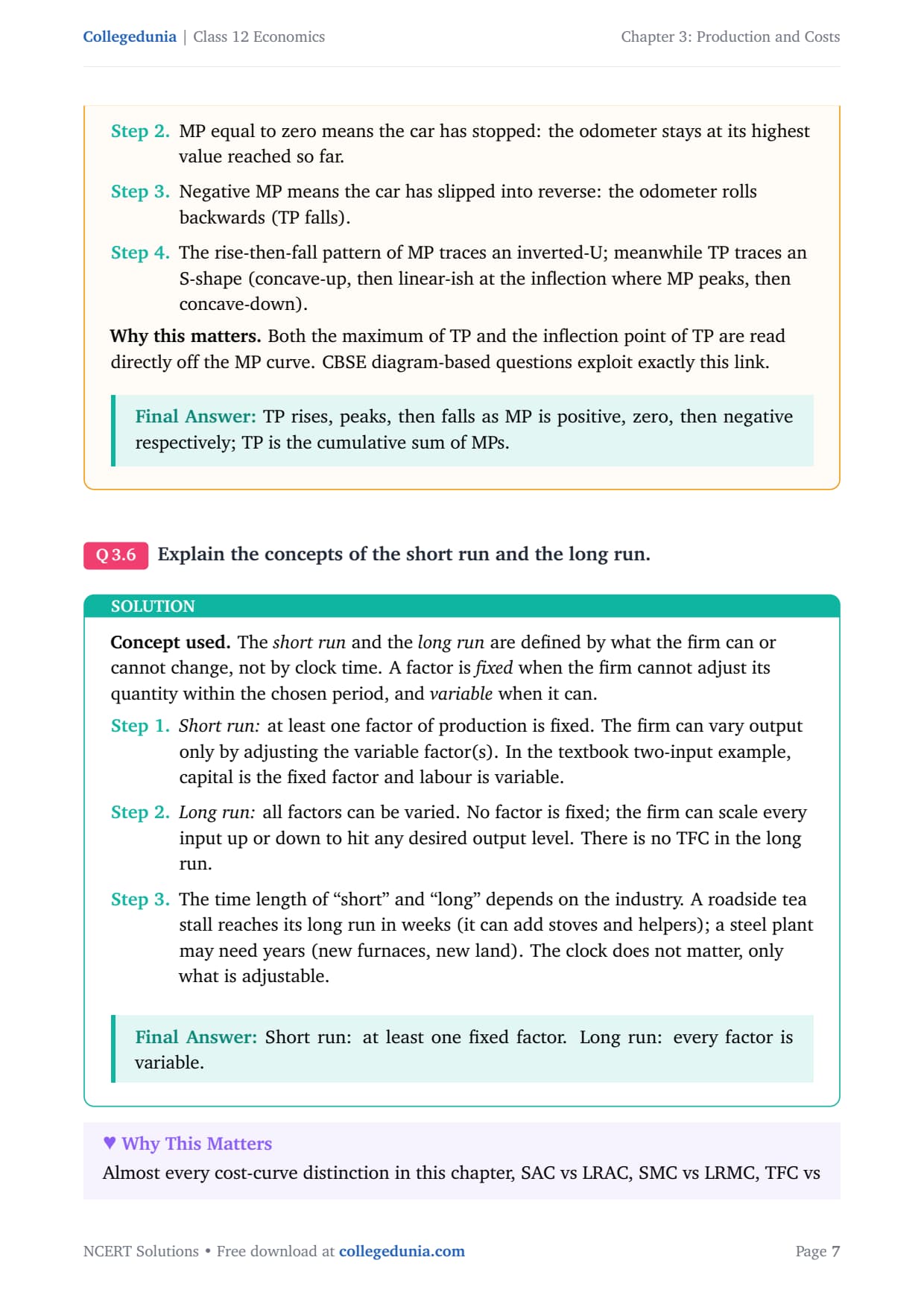
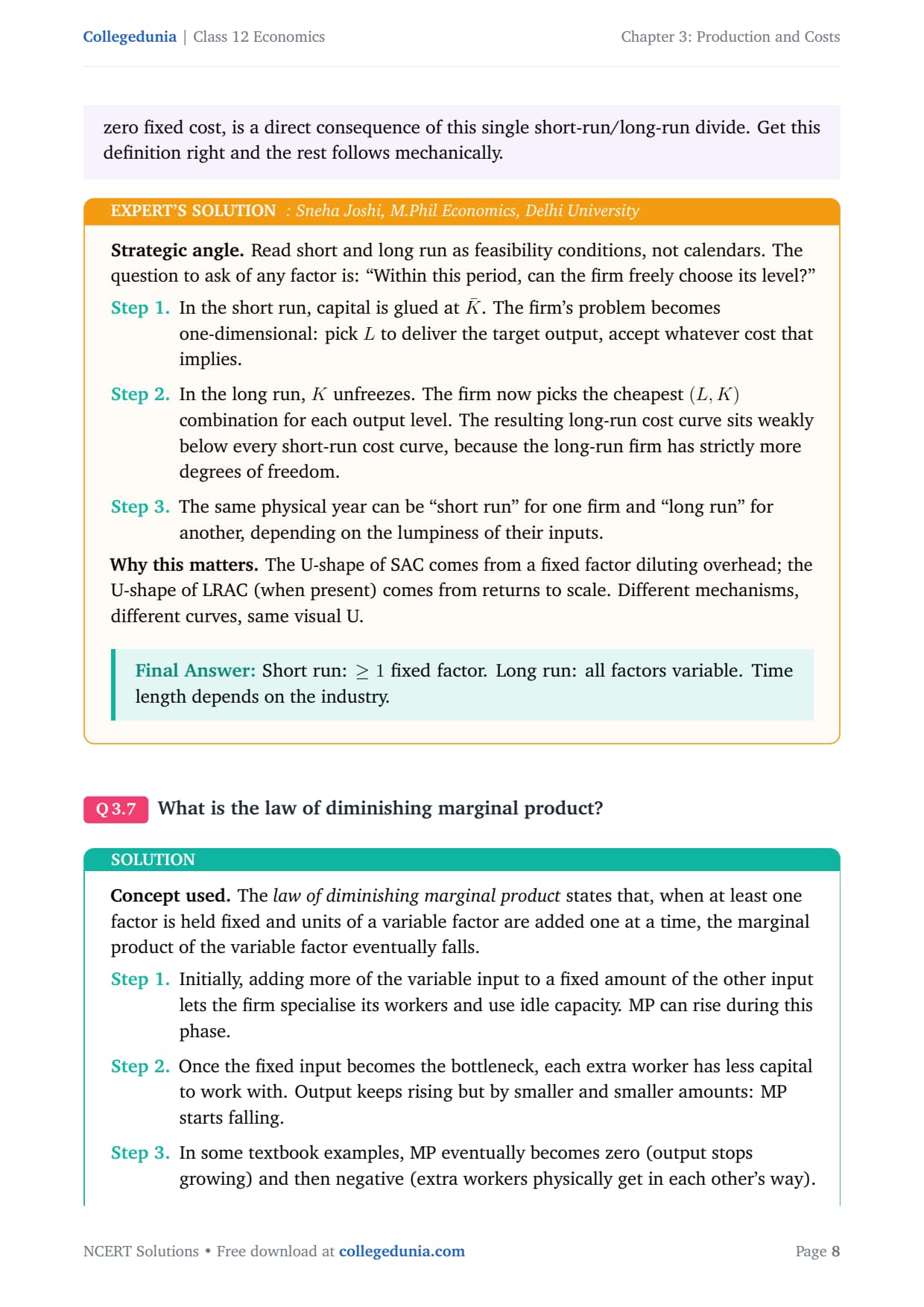
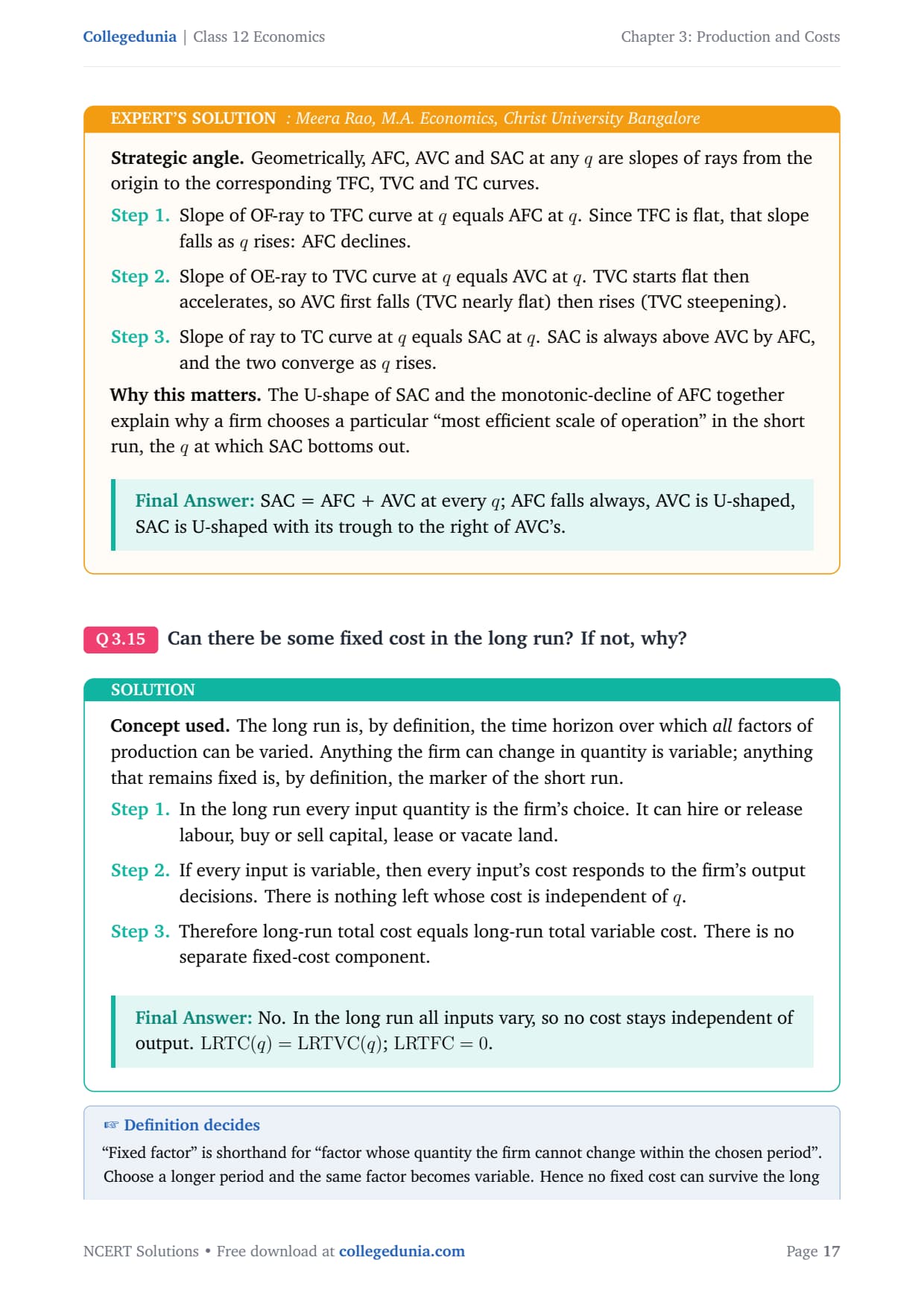
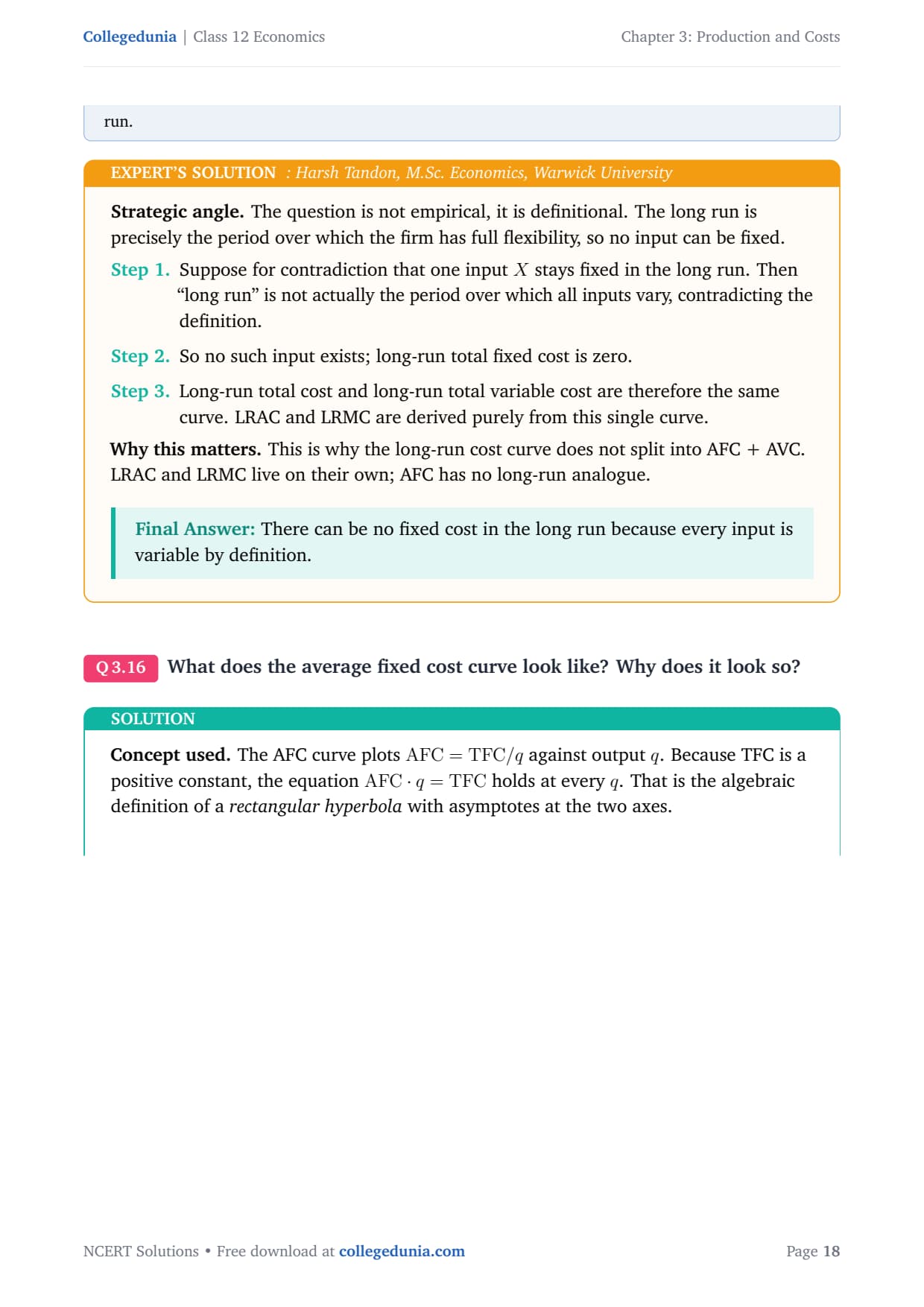
Here is what this chapter is worth in the exam:
- CBSE Boards: about 6 to 7 marks, mostly the law of variable proportions and one cost numerical.
- CUET: 2 to 3 questions each year on returns to scale and the cost concepts.
- Solving time: about 3 hours to work all 18 questions with these solutions.
[TOC placeholder]

What the Class 12 Economics NCERT Solutions Chapter 3 Production and Costs Cover
This chapter answers one producer-side question: how do firms turn inputs into output, and what does it cost? The NCERT chapter splits into six small blocks, and every exercise question maps to one of them.
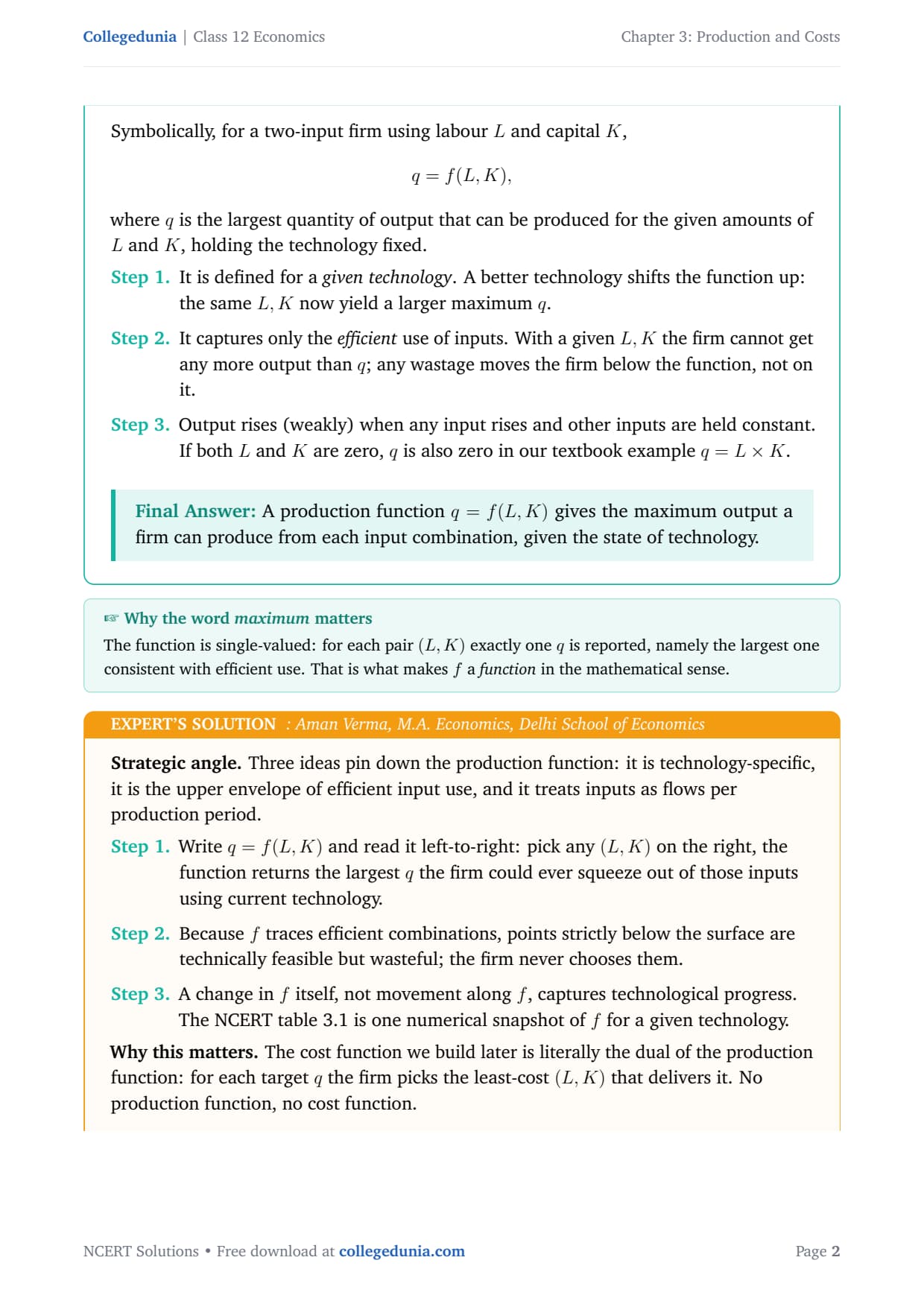
- Production function, short run and long run: the relation q = f(L, K), with one factor fixed in the short run and all factors variable in the long run.
- Total, Average and Marginal Product: TP rises, peaks and falls; MP cuts AP from above at AP's maximum.
- Returns to a factor: increasing, then diminishing, then negative returns as MP rises and then falls.
- Returns to scale: constant, increasing or decreasing returns when all inputs are doubled.
- Isoquants and the Cobb-Douglas form: q = ALαKβ, read through the sum α + β.
- Short-run costs: TC = TVC + TFC, AC = AVC + AFC, MC = ΔTC/ΔQ, and the U-shaped AC curve.
Exercise-wise Breakdown of Production and Costs Class 12 NCERT Solutions
The end-of-chapter exercise has 18 questions. They mix definitions, the law of variable proportions, TP/AP/MP computation and short-run cost tables. The table below maps each question to its topic and the marks it usually carries.
| Question | Topic covered | Answer style | Typical marks |
|---|---|---|---|
| Q1 | Explain the concept of a production function | Definition + form q = f(L, K) | 3 marks |
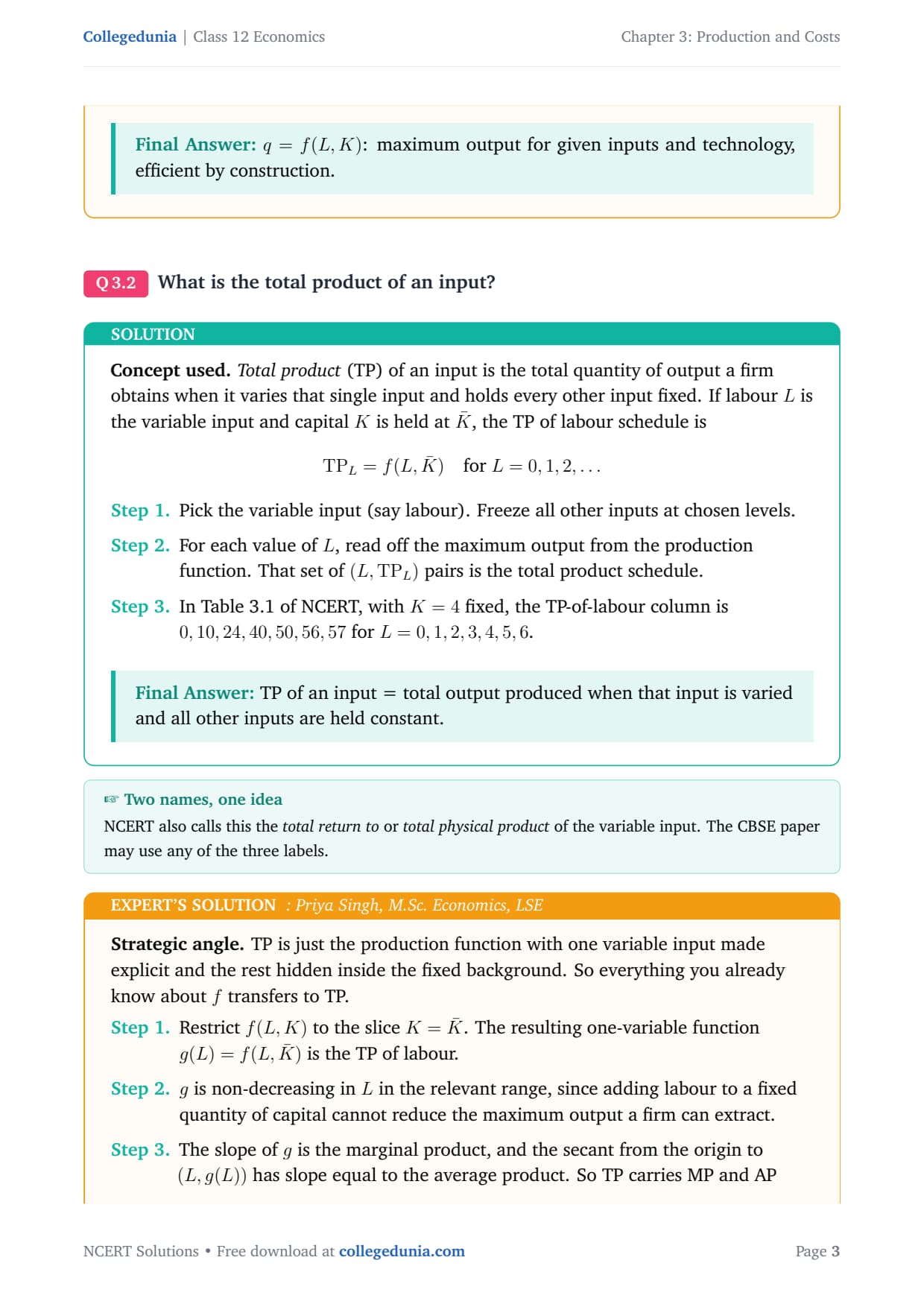
| Q2 | What is the Total Product of an input? | Definition + illustration | 3 marks |
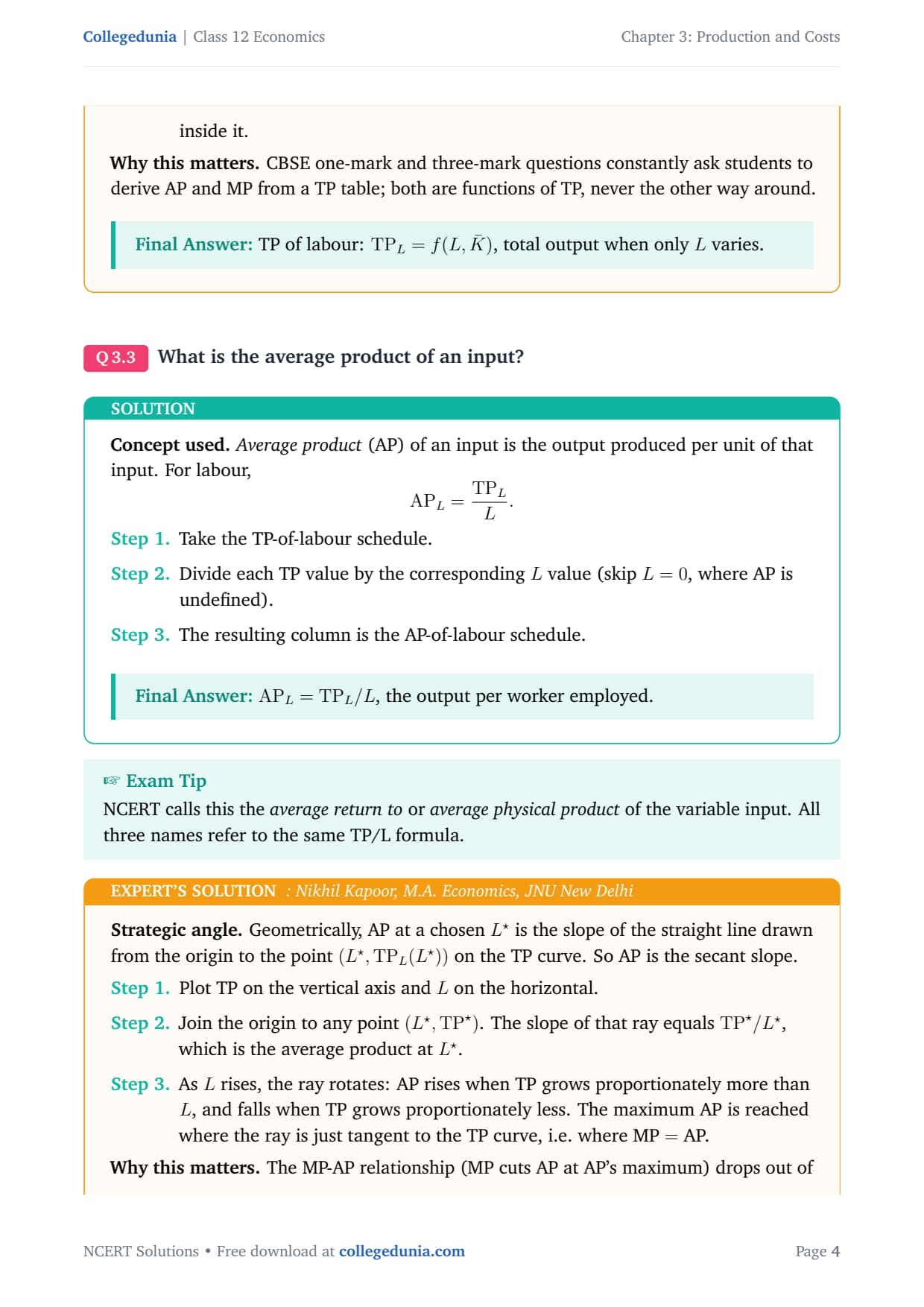
| Q3 | What is the Average Product of an input? | Definition + AP = TP/L | 3 marks |
| Q4 | What is the Marginal Product of an input? | Definition + MP = ΔTP/ΔL | 3 marks |
| Q5 | Relationship between Marginal Product and Total Product | Diagram + 3-stage reading | 4 marks |
| Q6 | Explain the law of variable proportions | 3-stage answer with TP-MP-AP diagram | 6 marks |
| Q7 | When does a producer get constant returns to scale? | Definition + Cobb-Douglas check | 3 marks |
| Q8 | When does a producer get increasing returns to scale? | Definition + illustration | 3 marks |
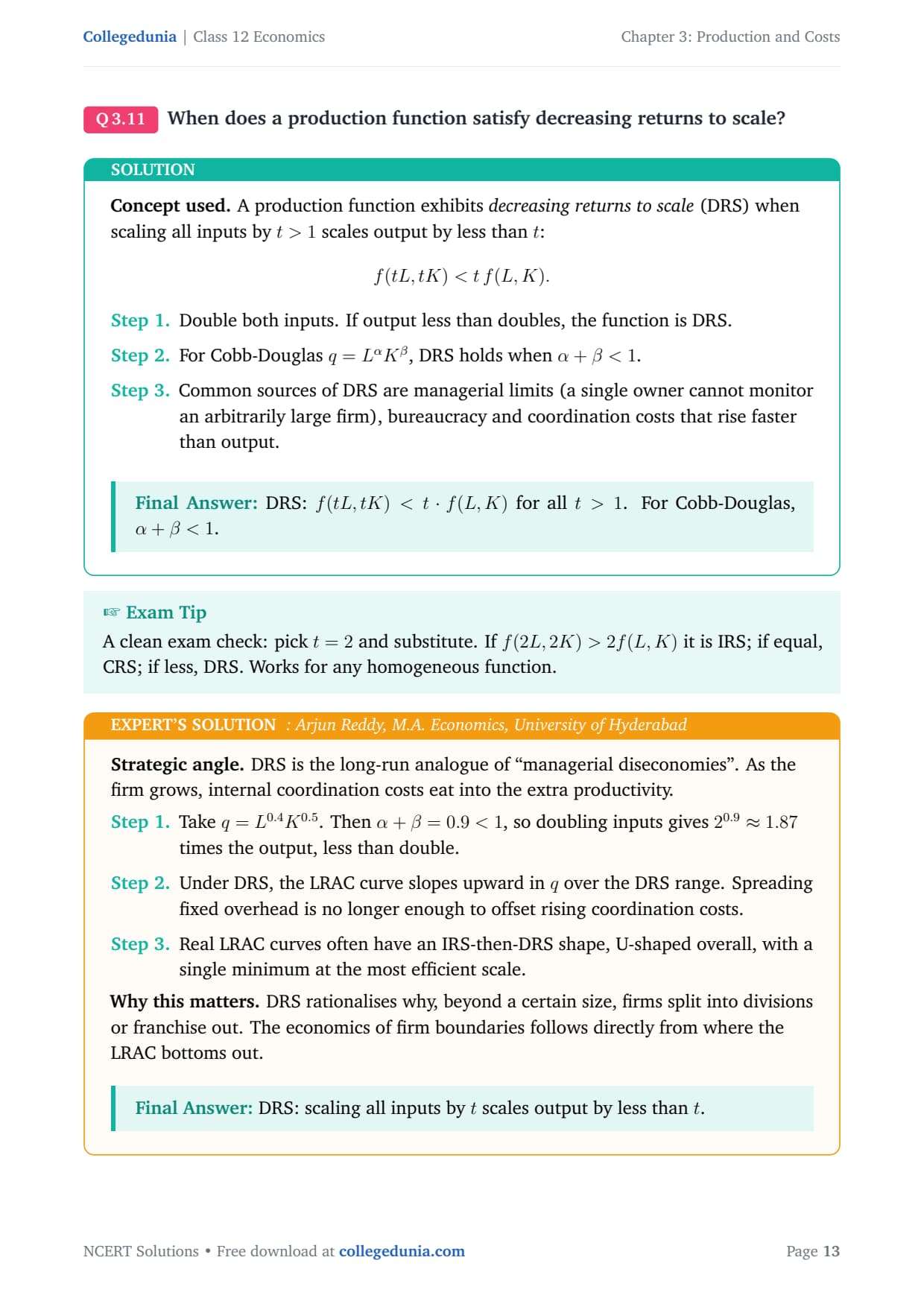
| Q9 | When does a producer get decreasing returns to scale? | Definition + α + β < 1 | 3 marks |
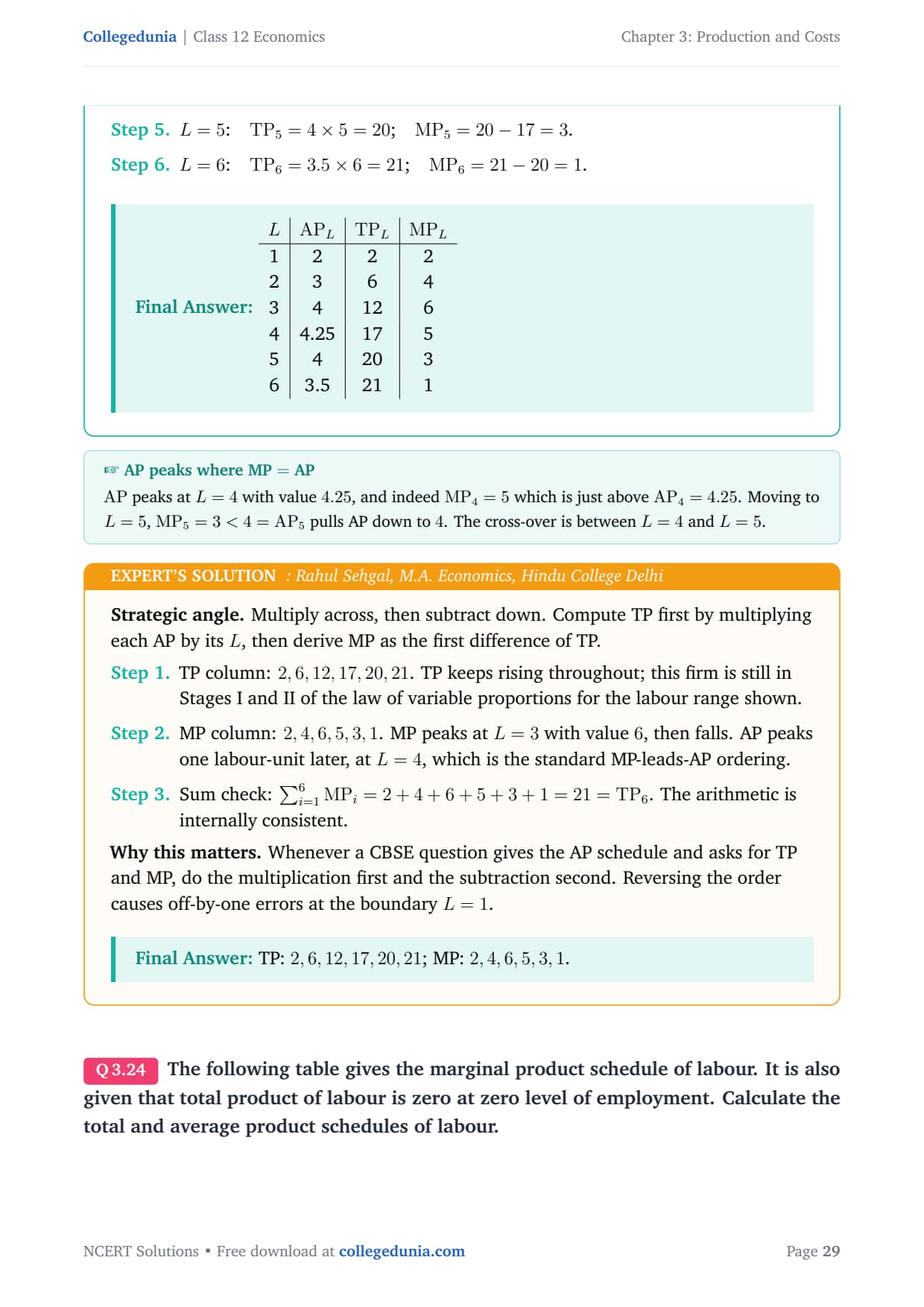
| Q10 | Compute TP, AP and MP from a schedule | Tabular numerical | 4 marks |
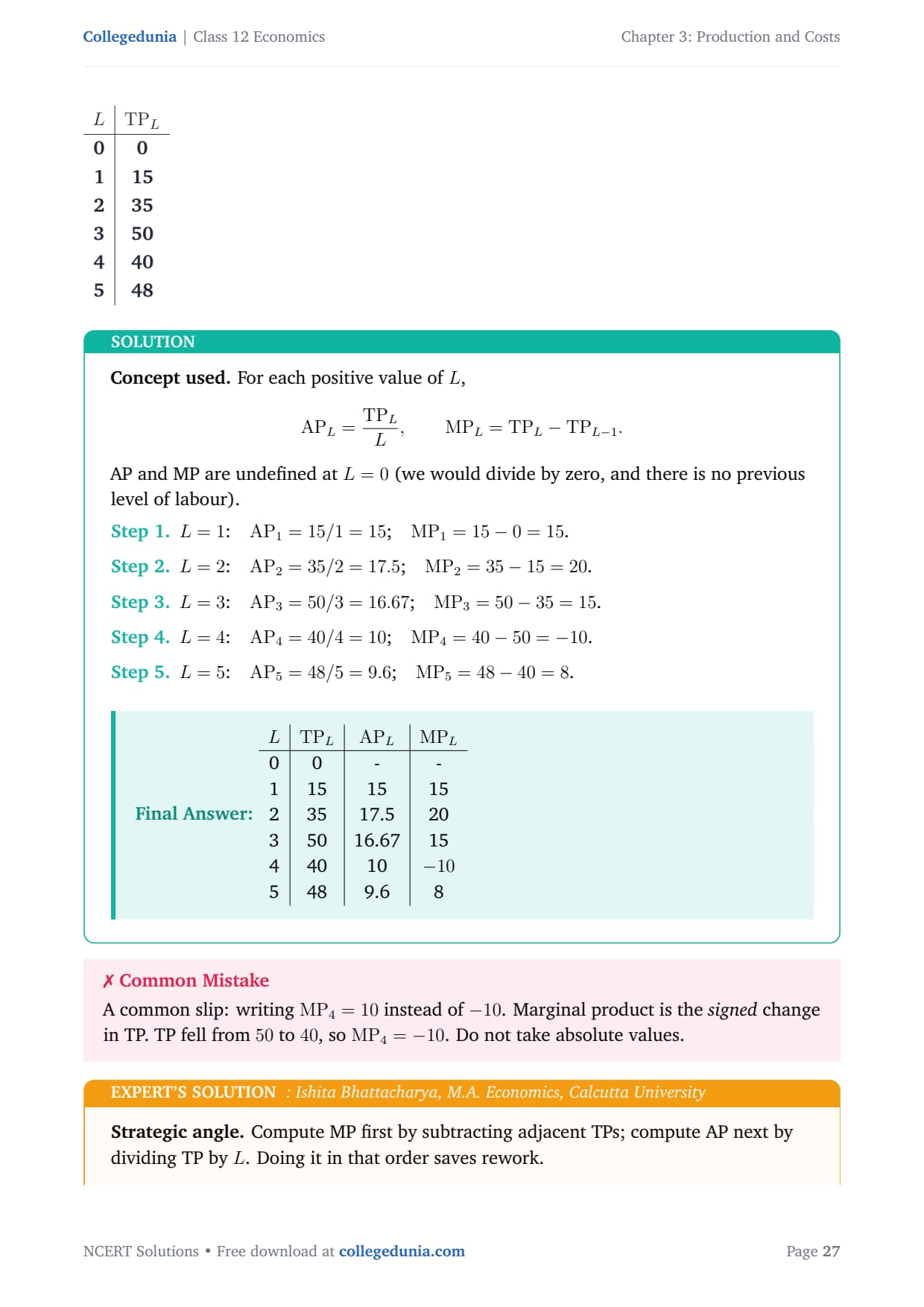
| Q11 | Given TPL, compute MPL and APL | TP → MP and AP numerical | 4 marks |
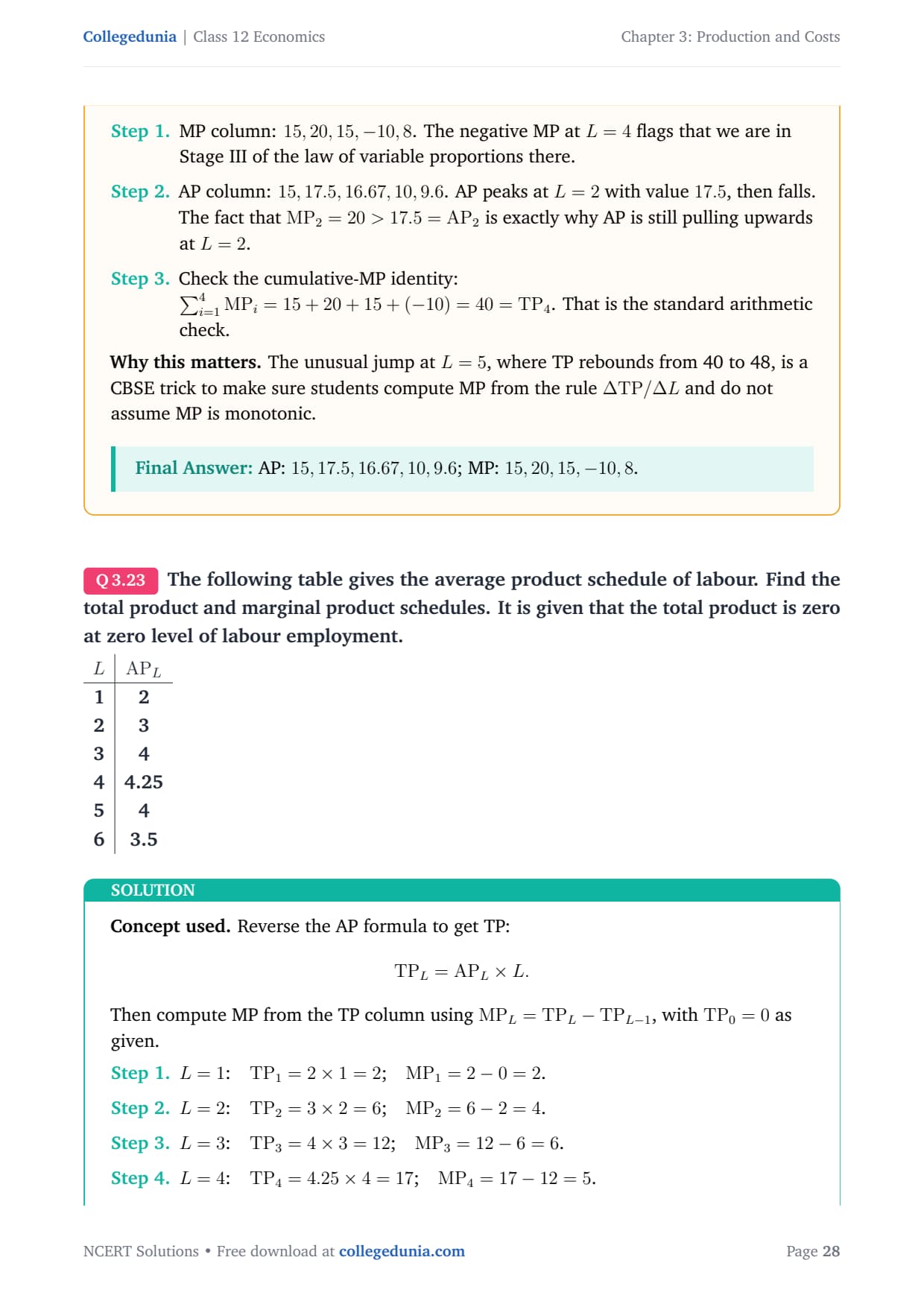
| Q12 | Given APL, compute TPL and MPL | AP → TP → MP numerical | 4 marks |
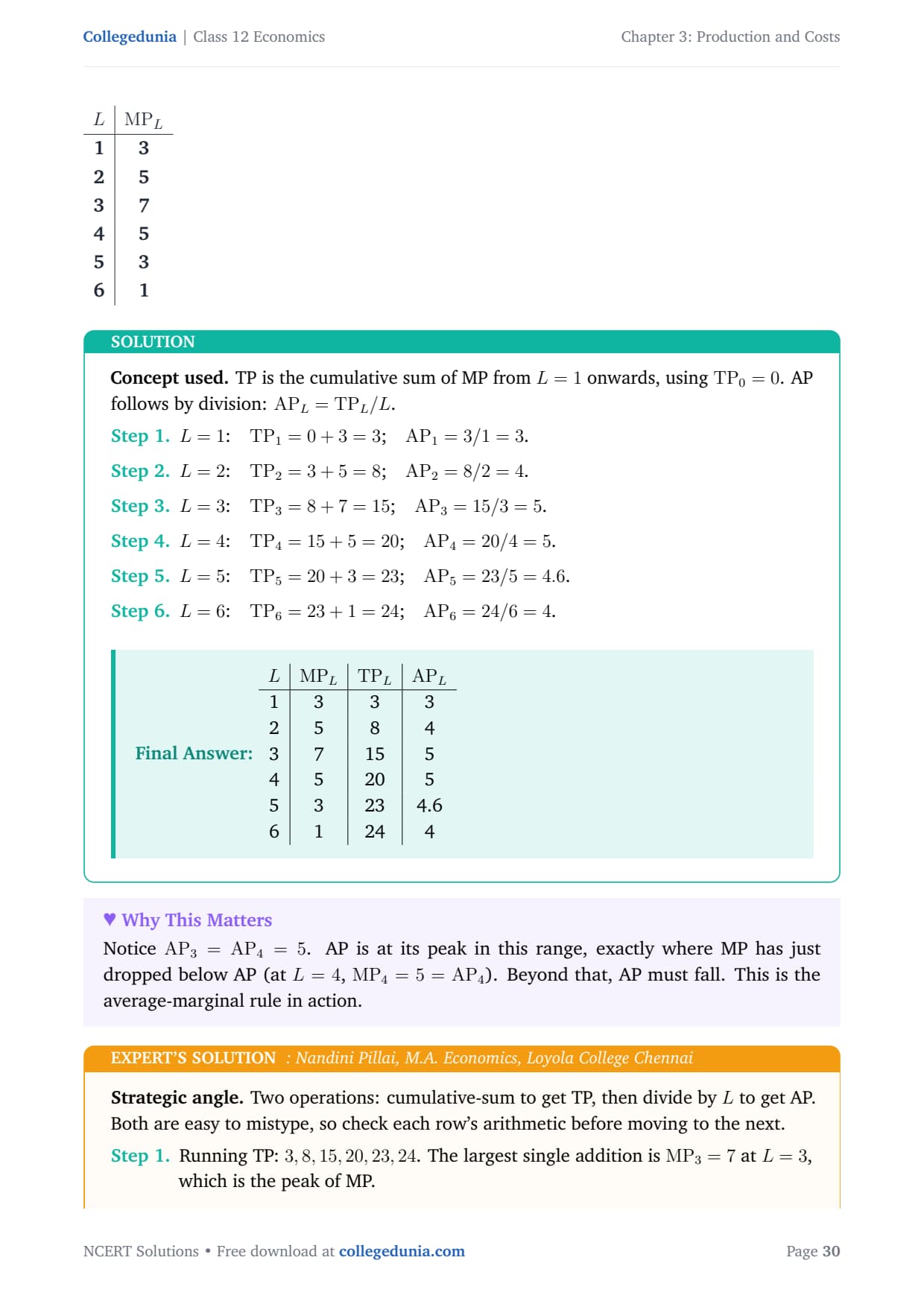
| Q13 | Given MPL, compute TPL and APL | MP → TP → AP numerical | 4 marks |
| Q14 | Distinguish between TFC and TVC | Compare and contrast | 3 marks |
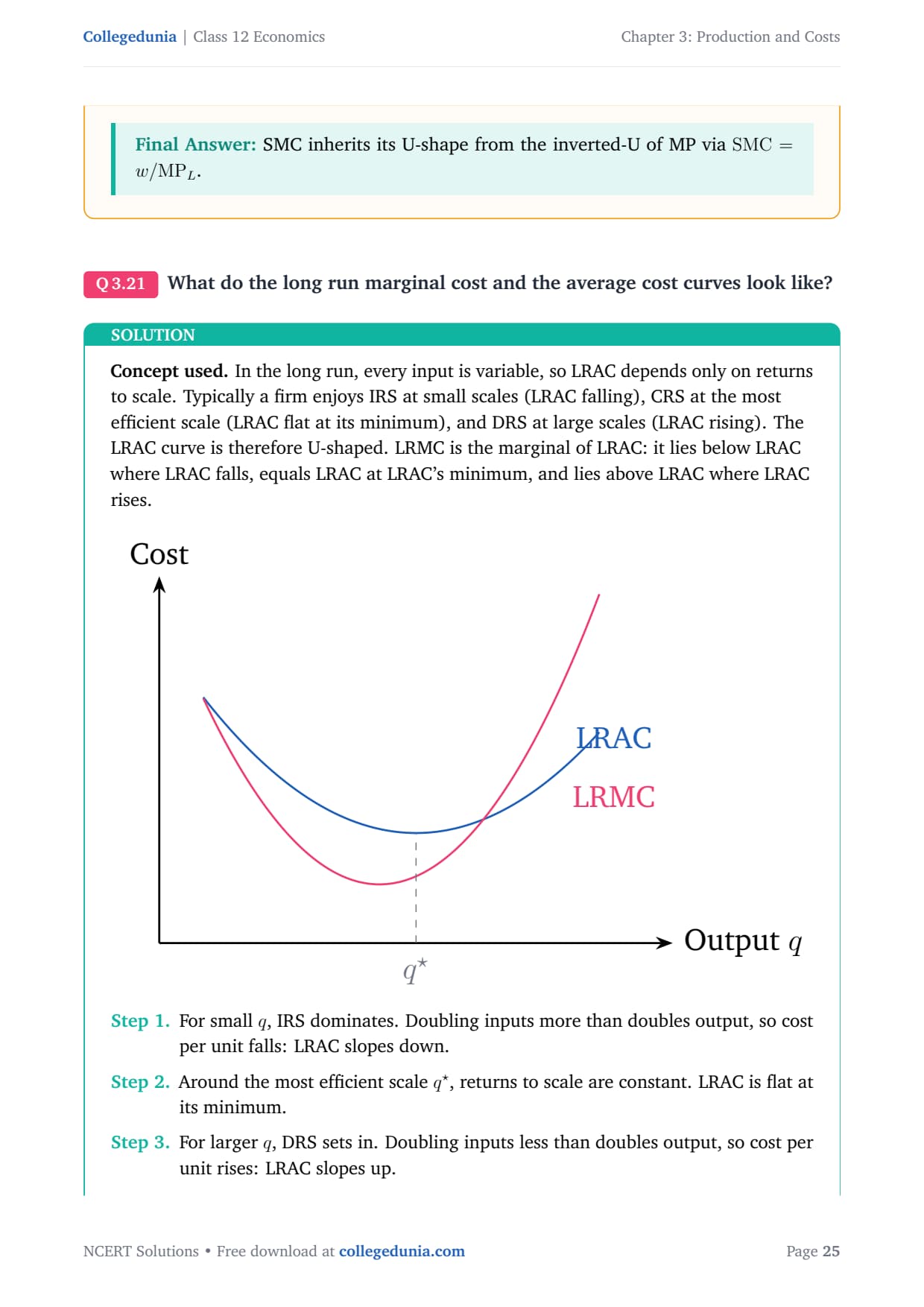
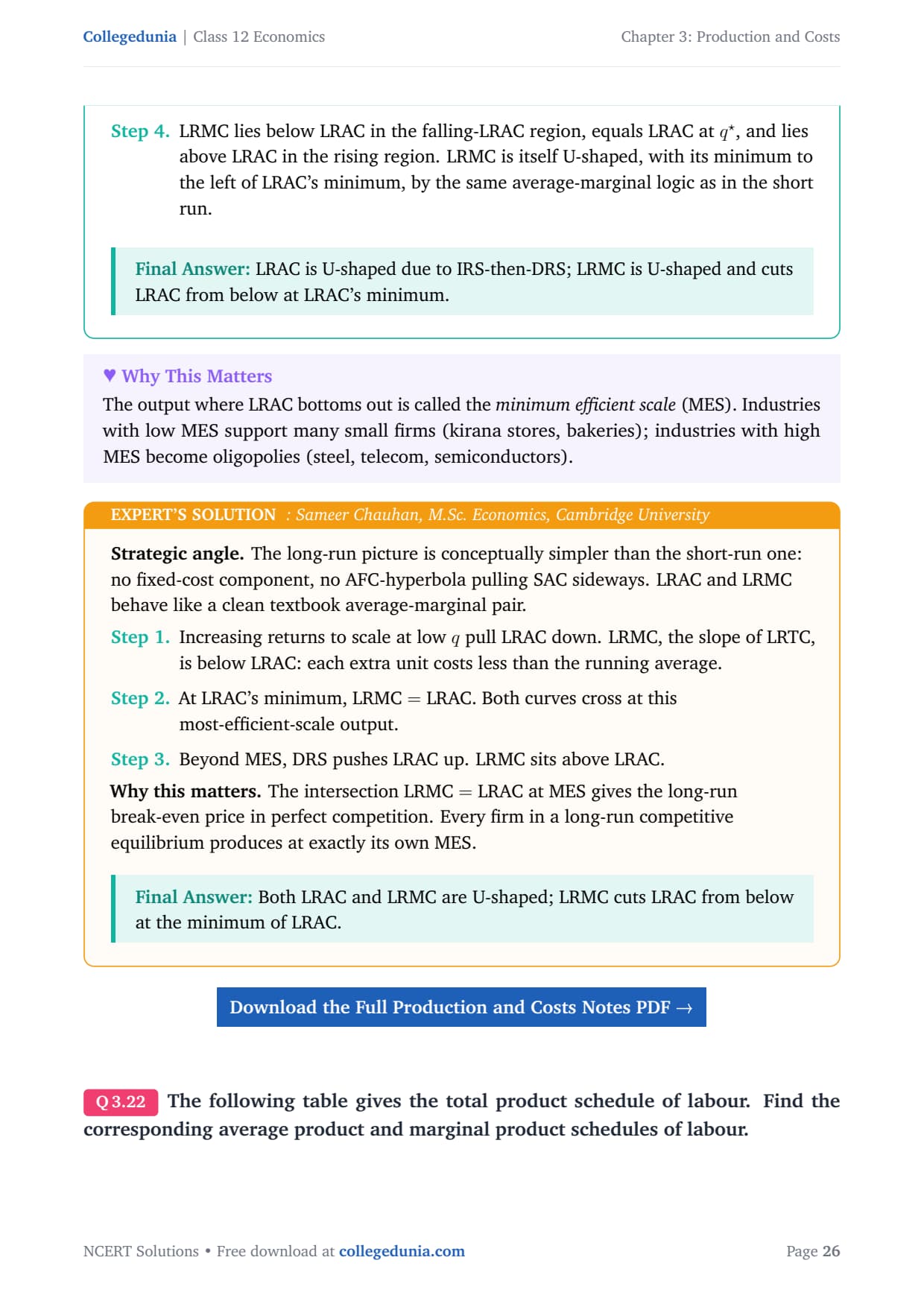
| Q15 | Relationship between SMC and AVC | Diagram + MC cuts AVC at minimum | 4 marks |
| Q16 | Why does the short-run AC curve take a U-shape? | 4-point AVC + AFC logic | 4 marks |
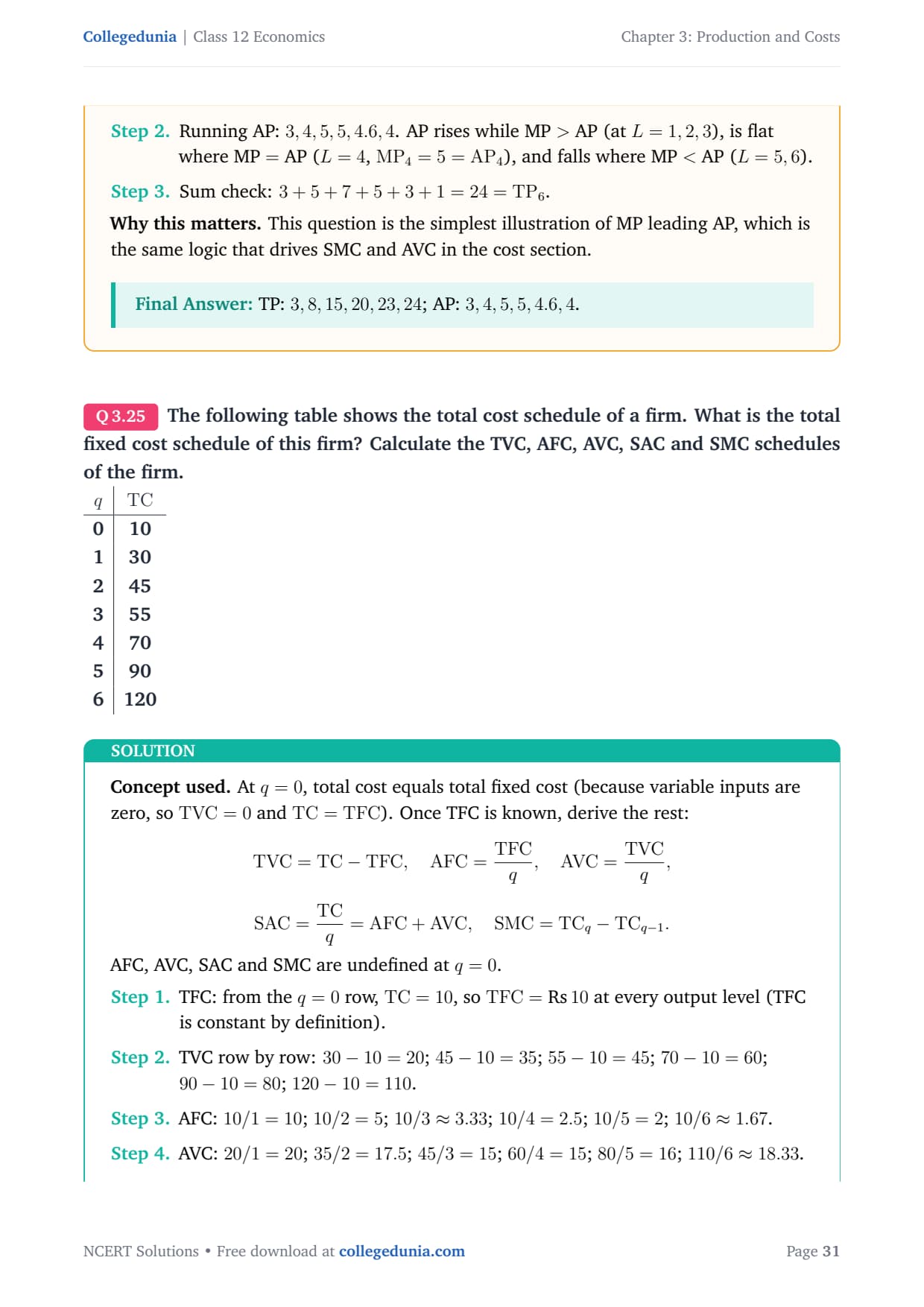
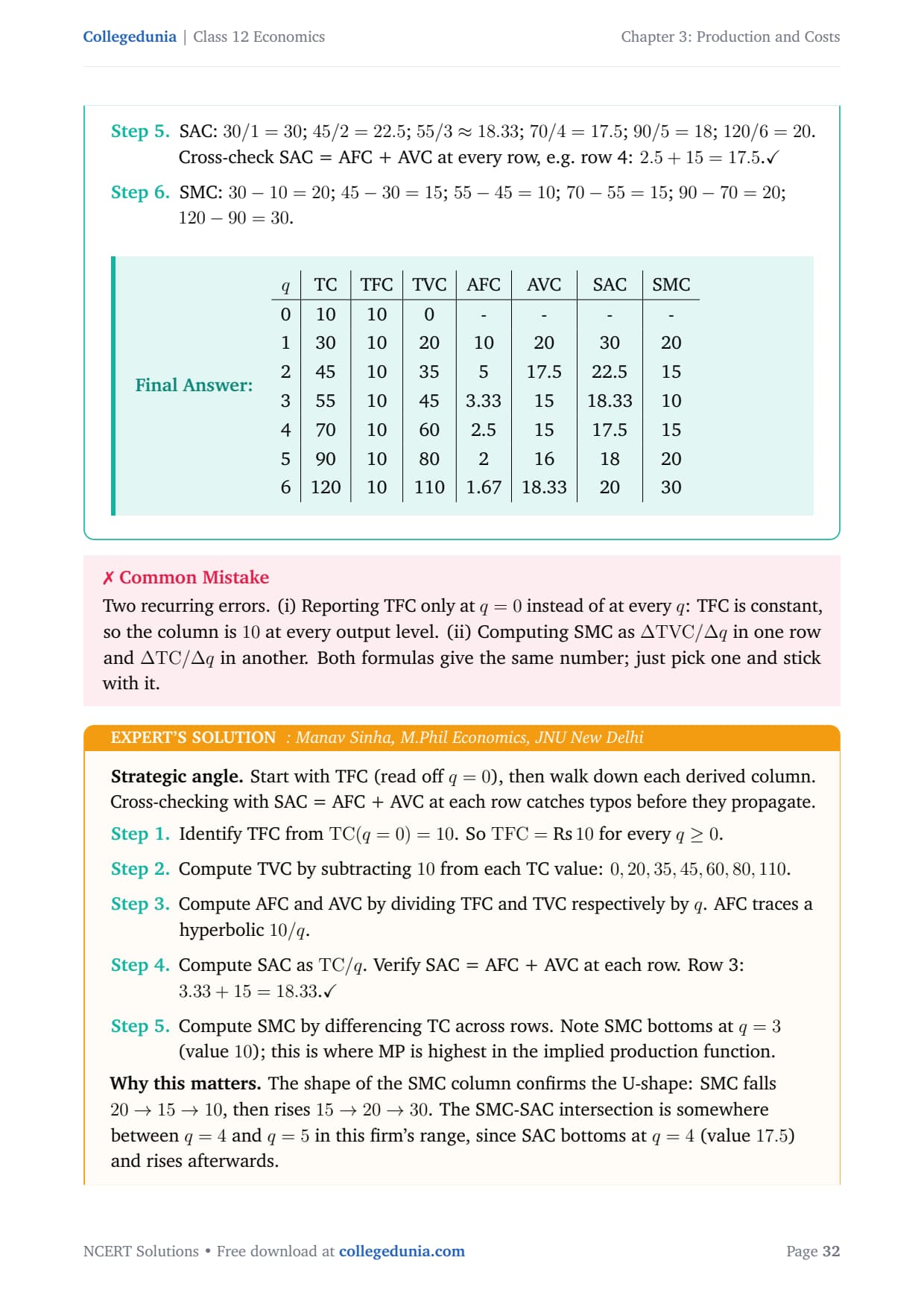
| Q17 | Compute TC, TVC, TFC, AVC, AC, AFC and SMC | Cost decomposition table | 6 marks |
| Q18 | Find the missing entries (TFC = 100) in a cost table | Cost reconstruction table | 6 marks |
The numericals Q10 to Q13 build the production side, and Q17 and Q18 lock in the cost side. The full set carries close to 70 chapter marks, so it is the biggest revision asset for this chapter.
Solve Class 12 Economics Chapter 3 Questions
Practice every production function, returns-to-scale and cost-curve question from the NCERT exercise with Check Solution and Expert Solution tabs that show full working on click.
Open Question BankProduction Function in Production and Costs Class 12: Short Run, Long Run and Returns
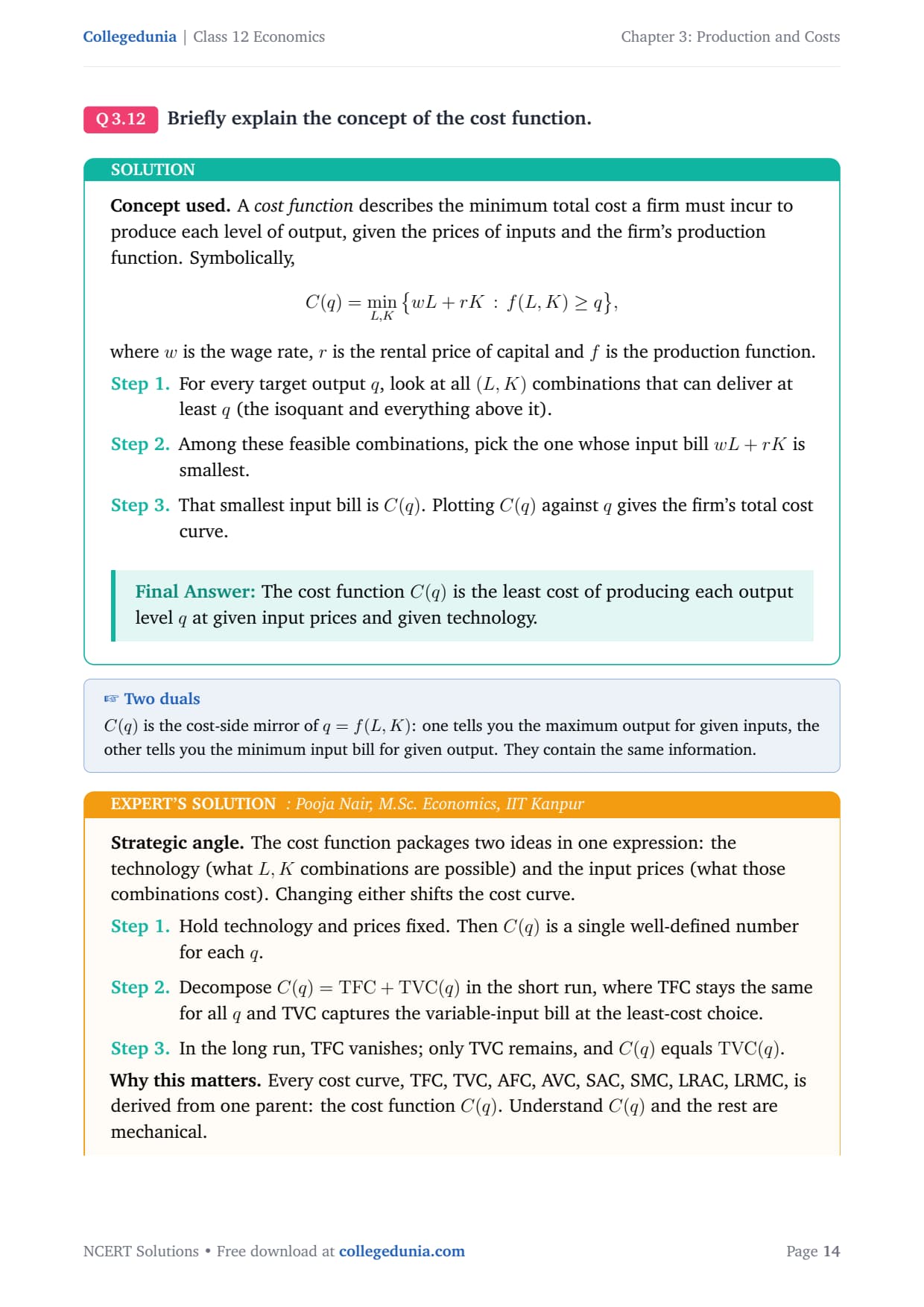
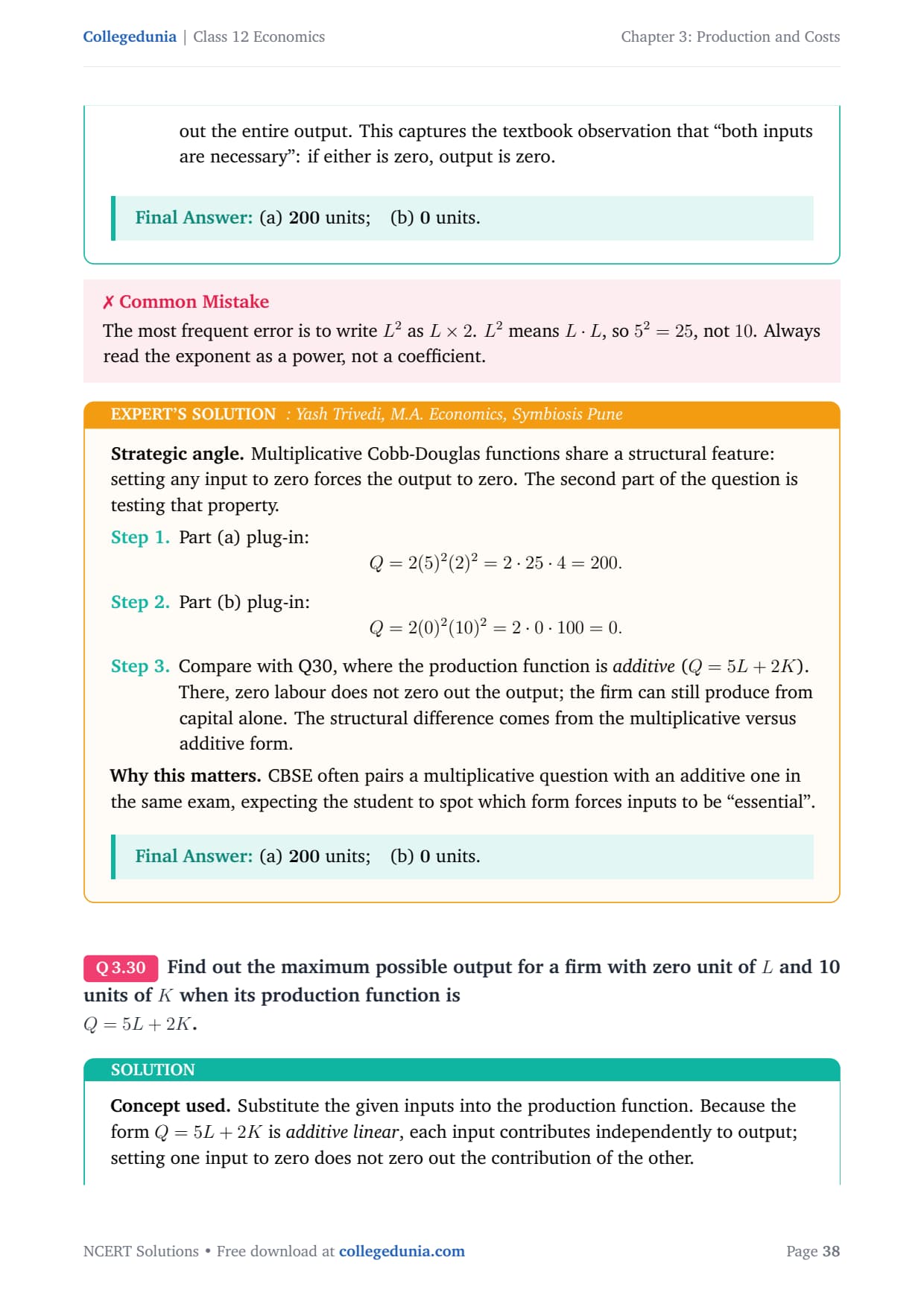
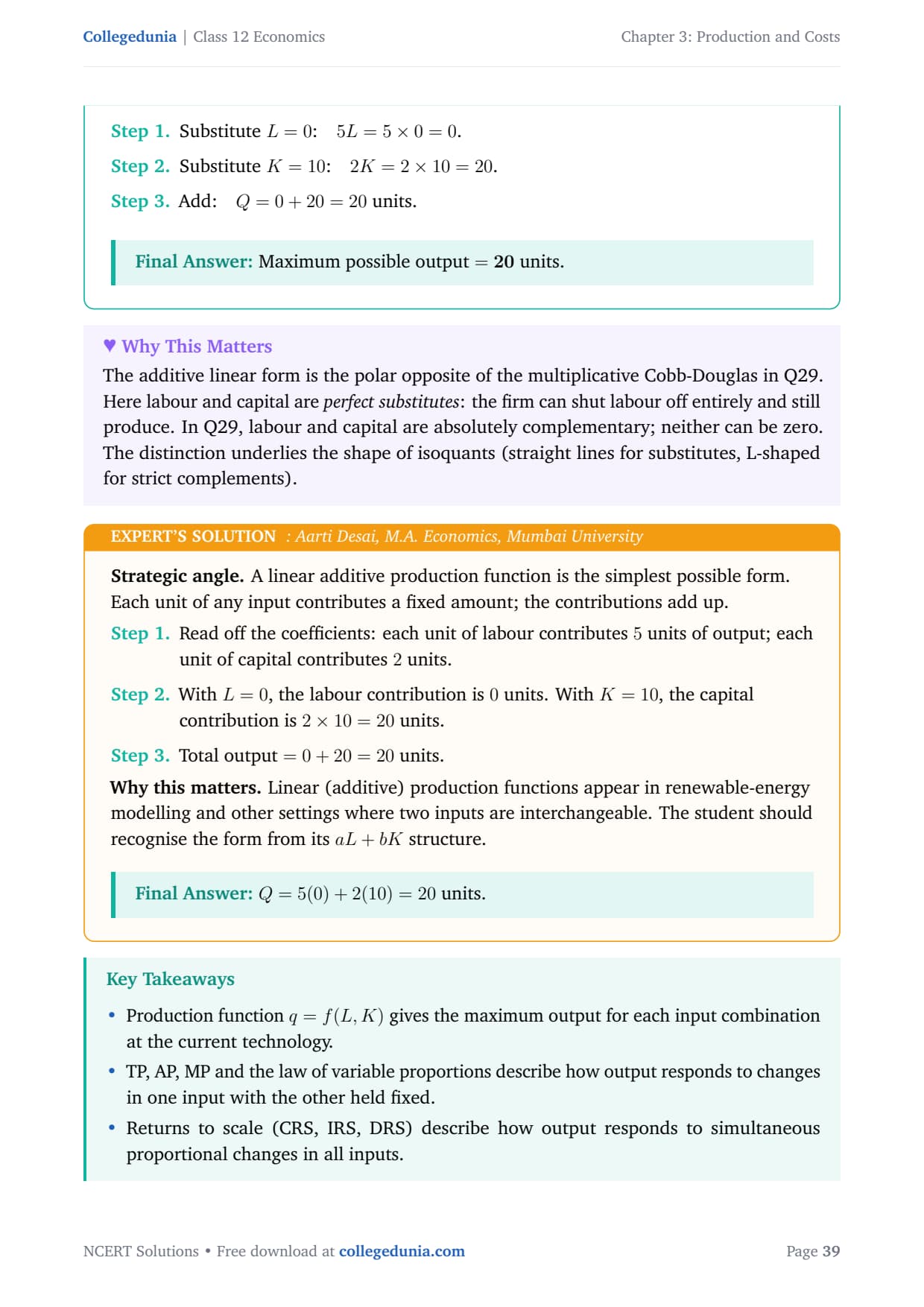
Every later result on cost flows from one relation: how much output q a firm gets from labour L and capital K. The short run keeps at least one factor fixed (usually K), so q = f(L, K̄). The long run lets the firm vary every input. The short run gives us returns to a factor; the long run gives us returns to scale.
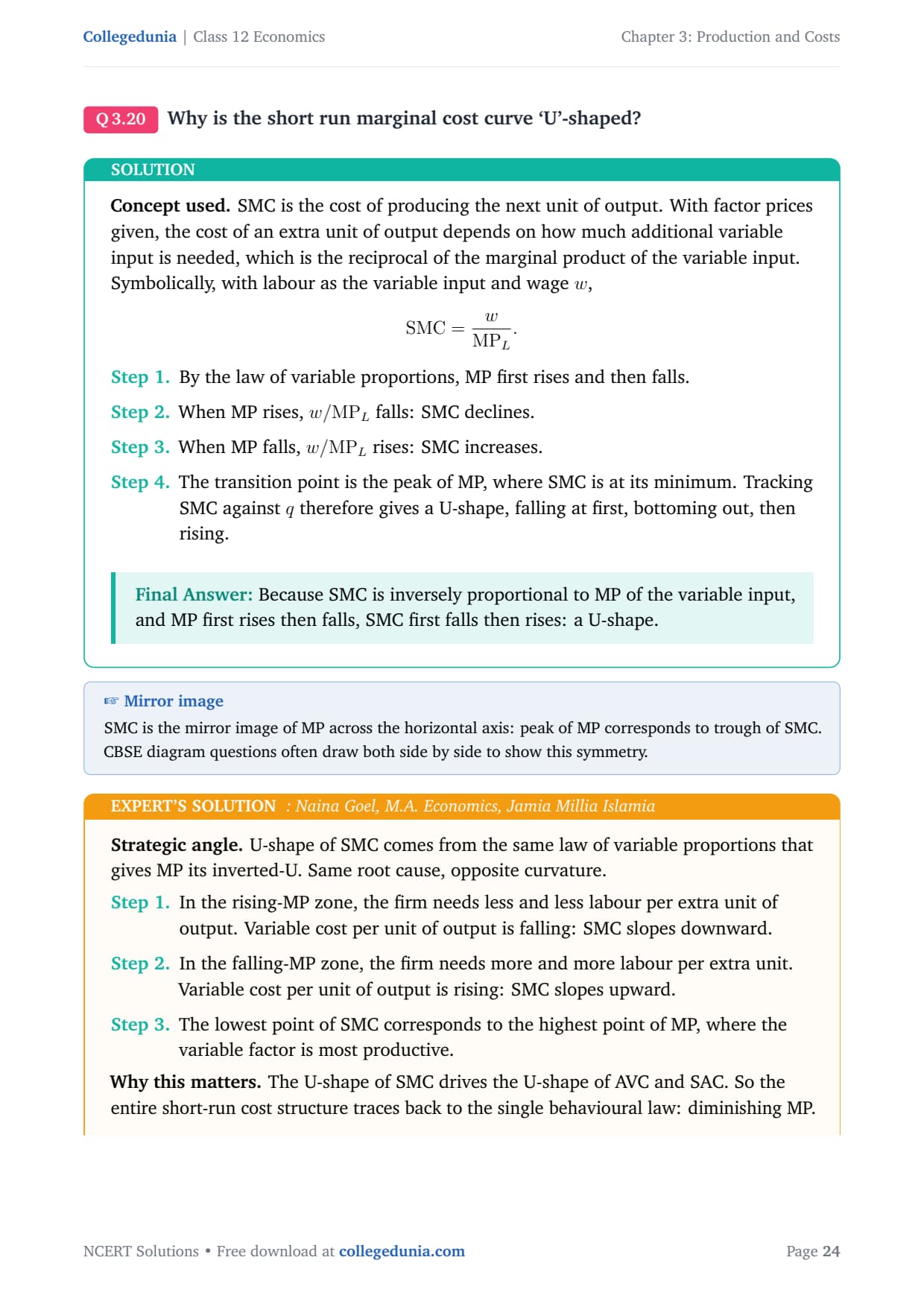
Holding capital fixed and varying labour gives three series. Total Product (TPL) is the output at each L. Average Product (APL) = TPL ÷ L. Marginal Product (MPL) = ΔTPL ÷ ΔL. The key geometry: MPL cuts APL from above at the peak of APL, and TPL is highest when MPL is zero.
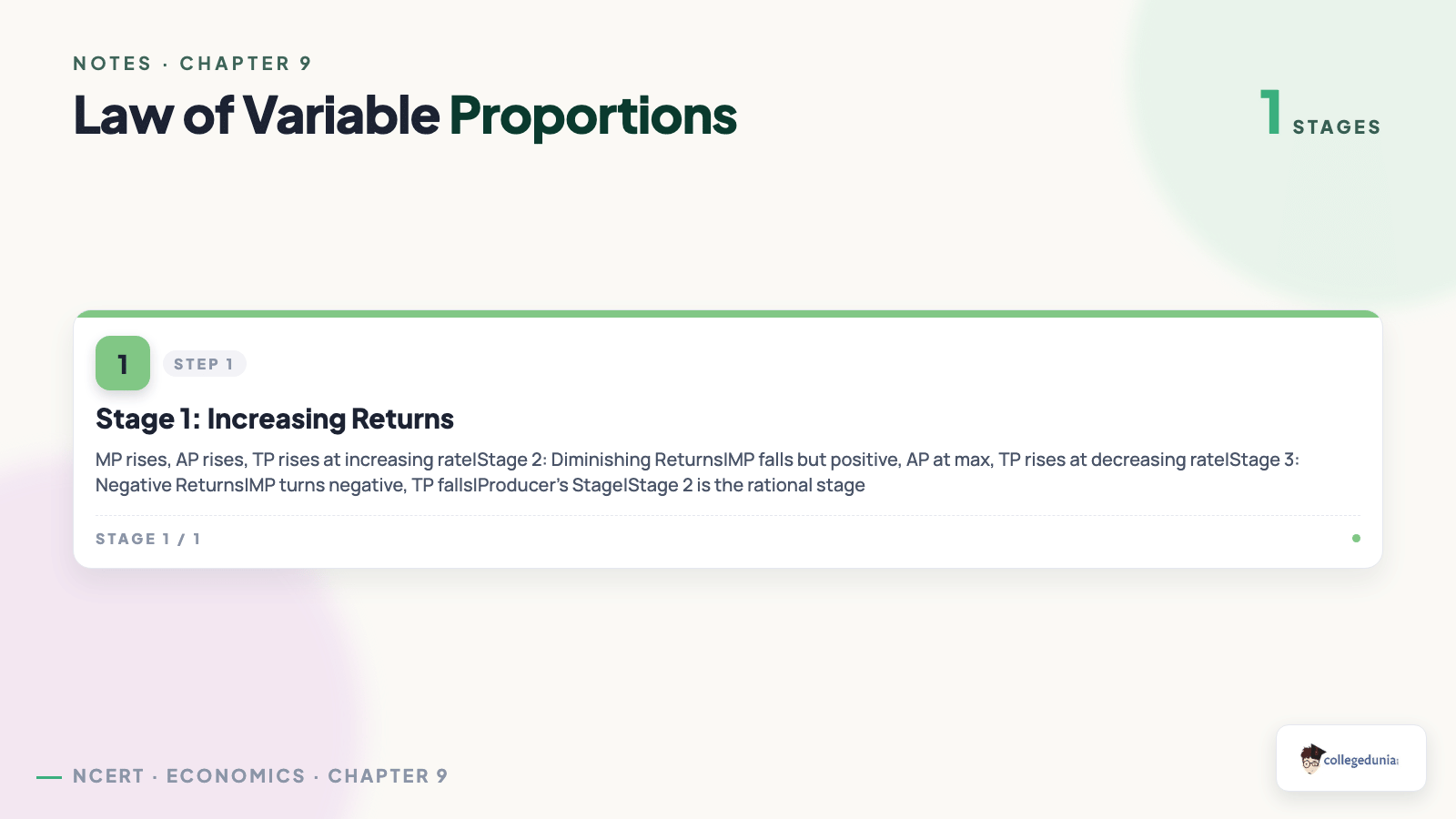
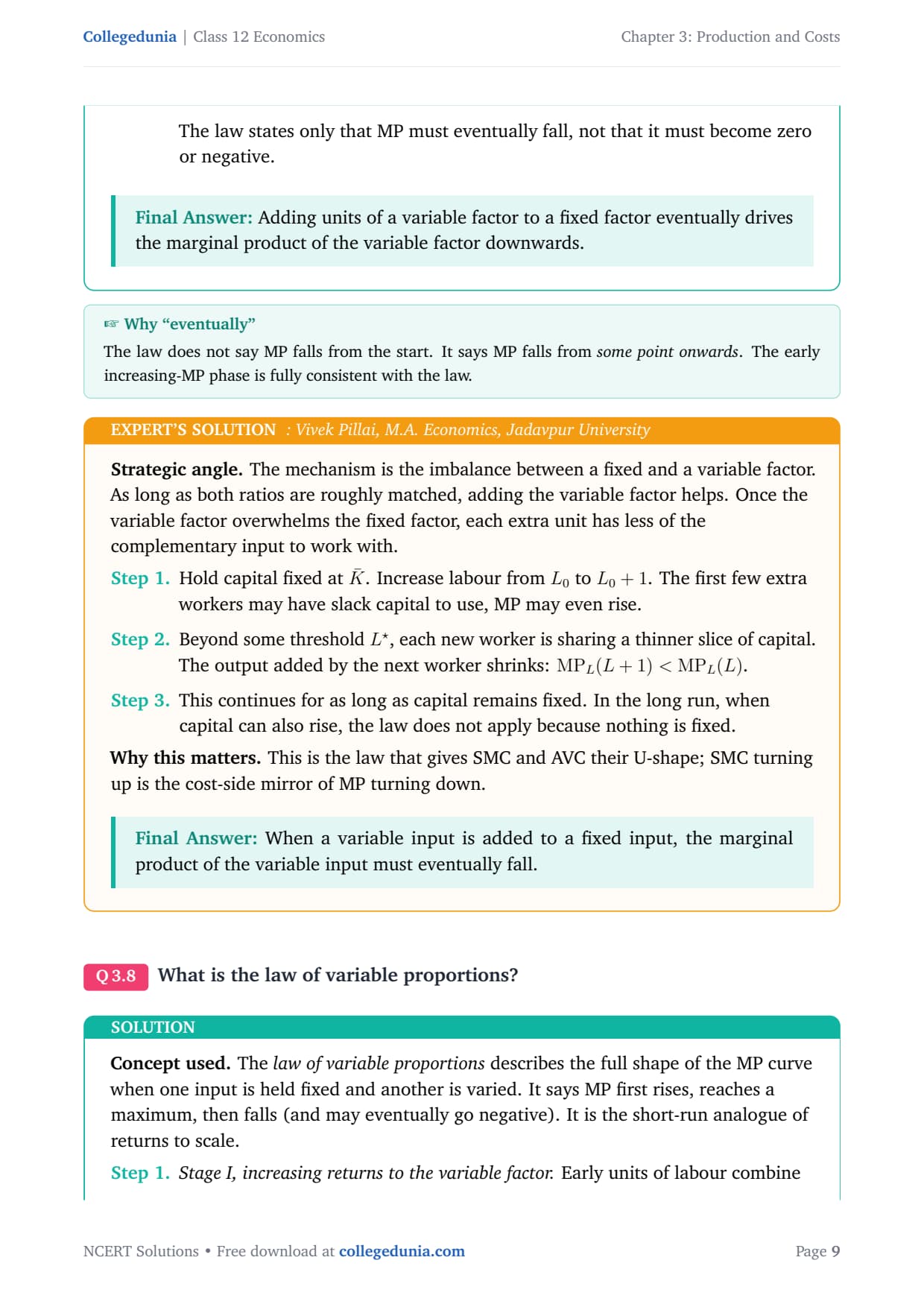
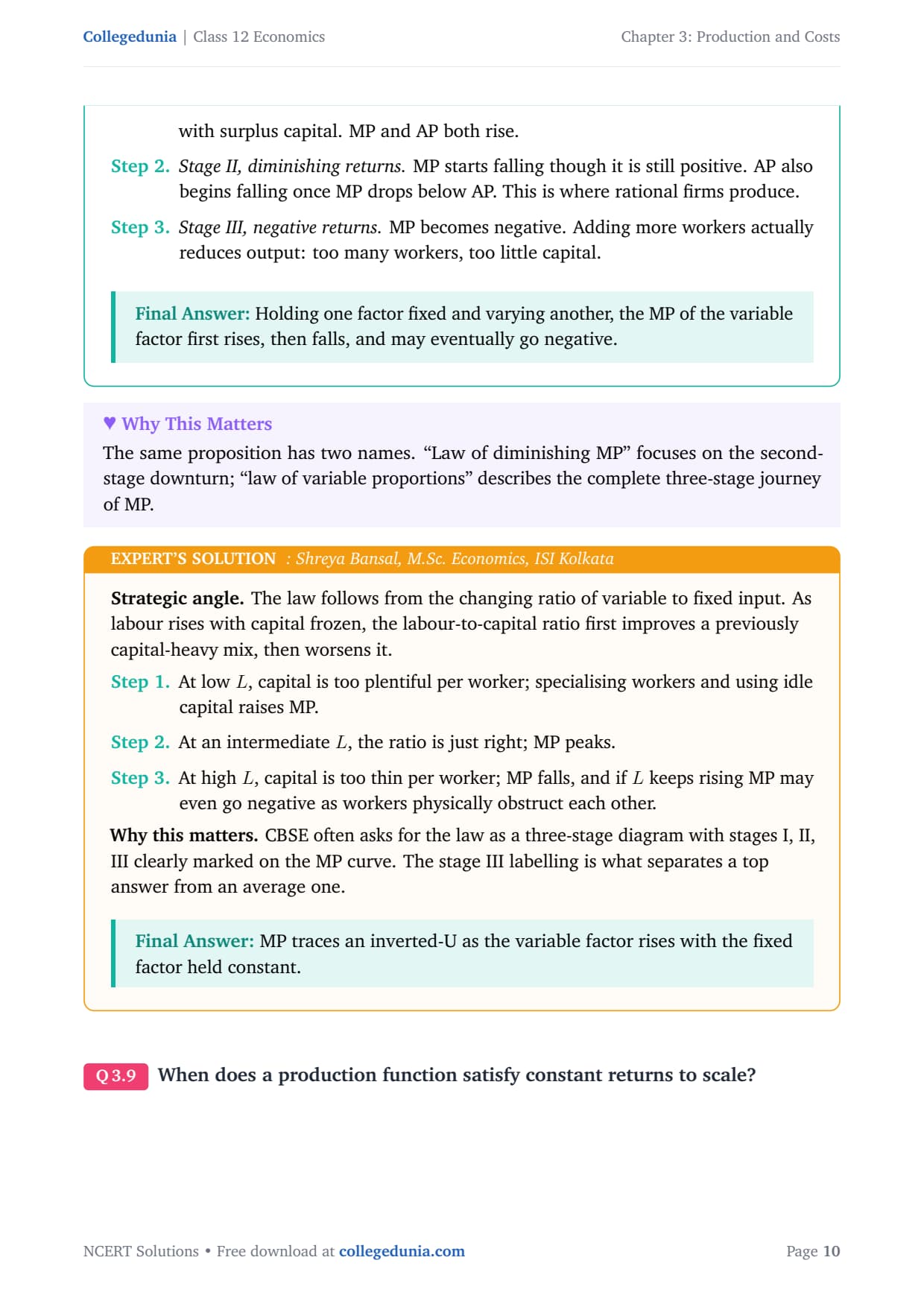
The law of variable proportions shows how output reacts when one factor is varied. It has three stages, and the rational producer always works in Stage II.
| Stage | Total Product | Marginal Product | Returns to the factor |
|---|---|---|---|
| Stage I | Rises at an increasing rate | Rises, reaches maximum | Increasing returns |
| Stage II | Rises at a decreasing rate | Falls but stays positive | Diminishing returns |
| Stage III | Falls | Negative | Negative returns |
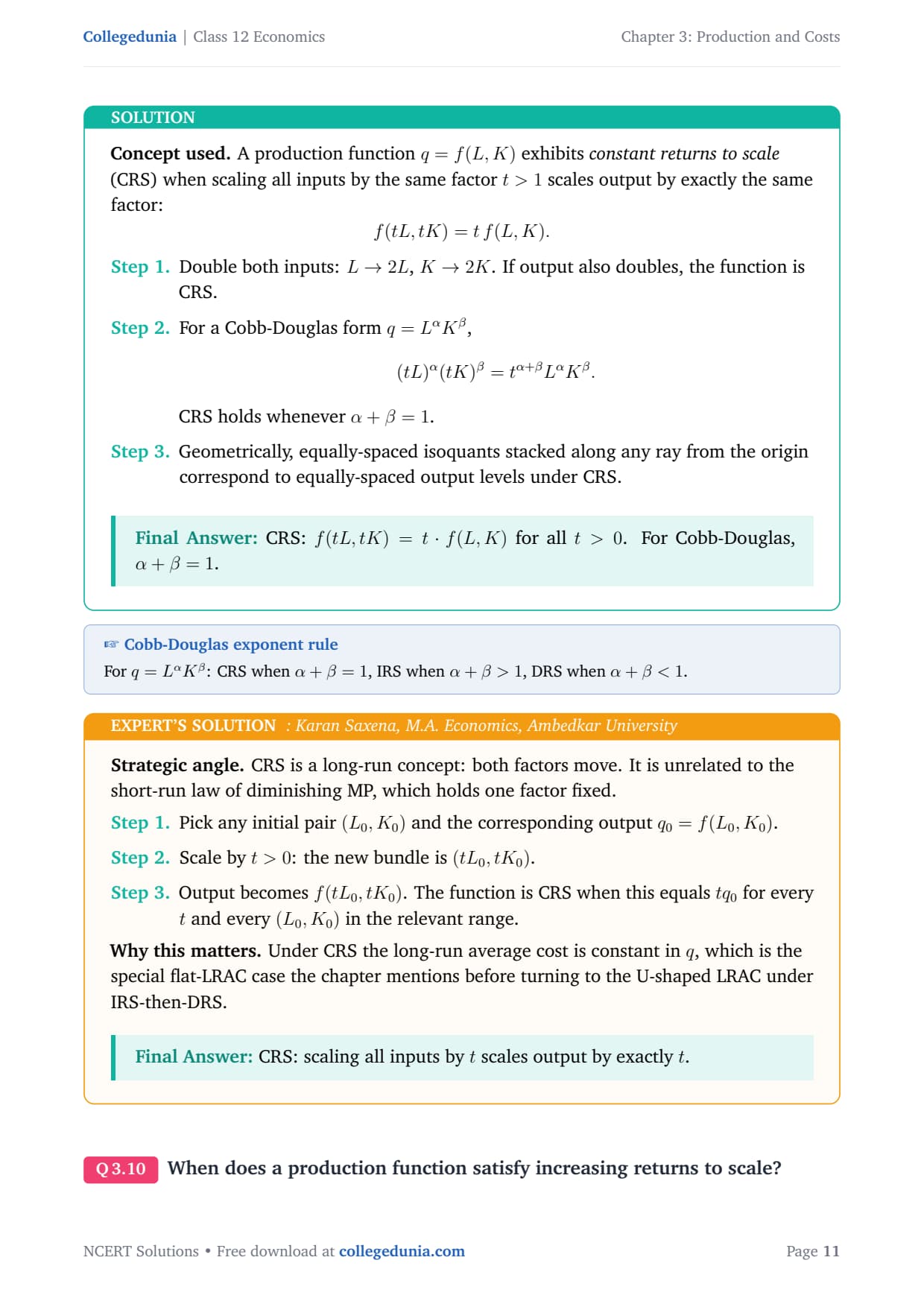
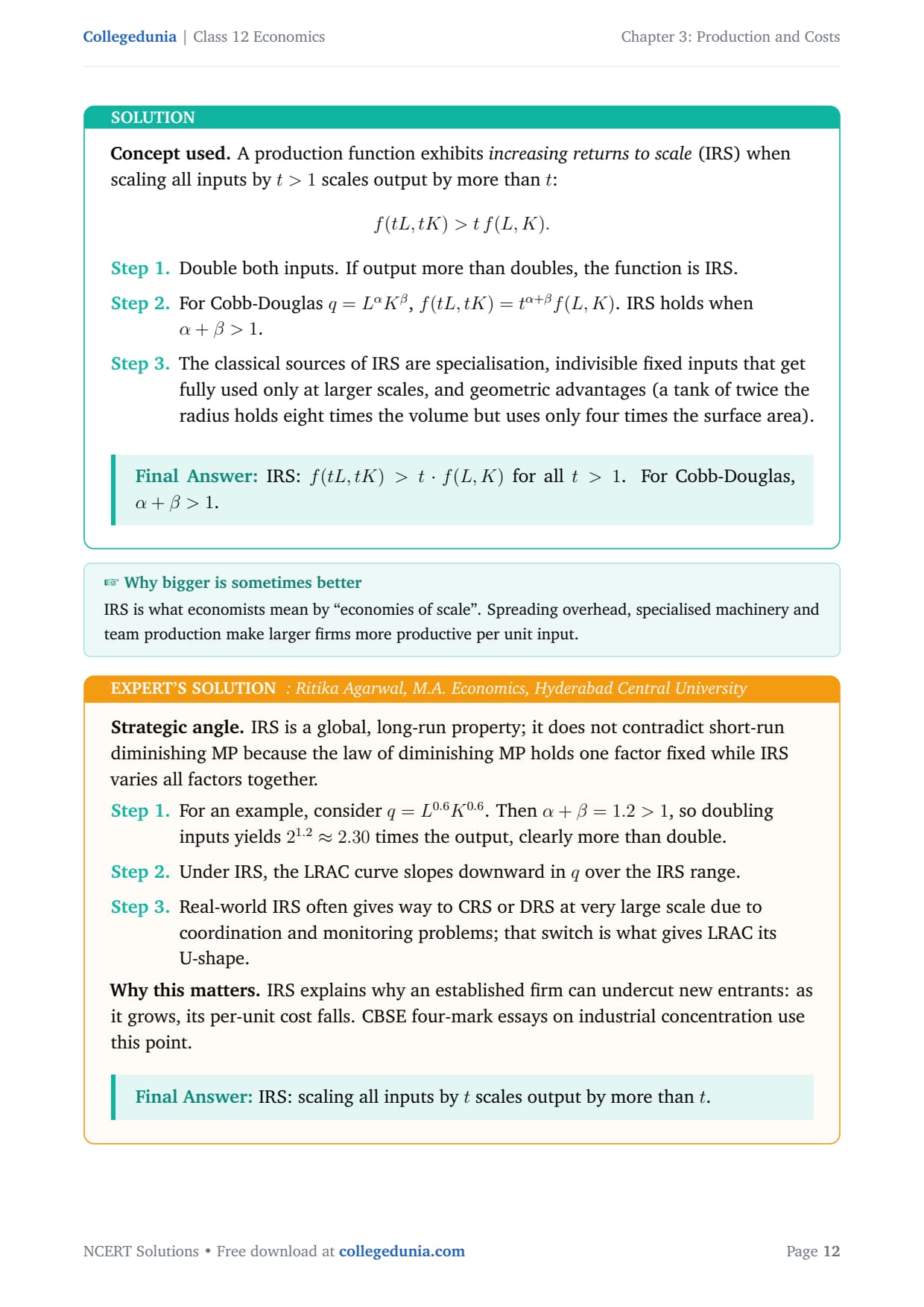
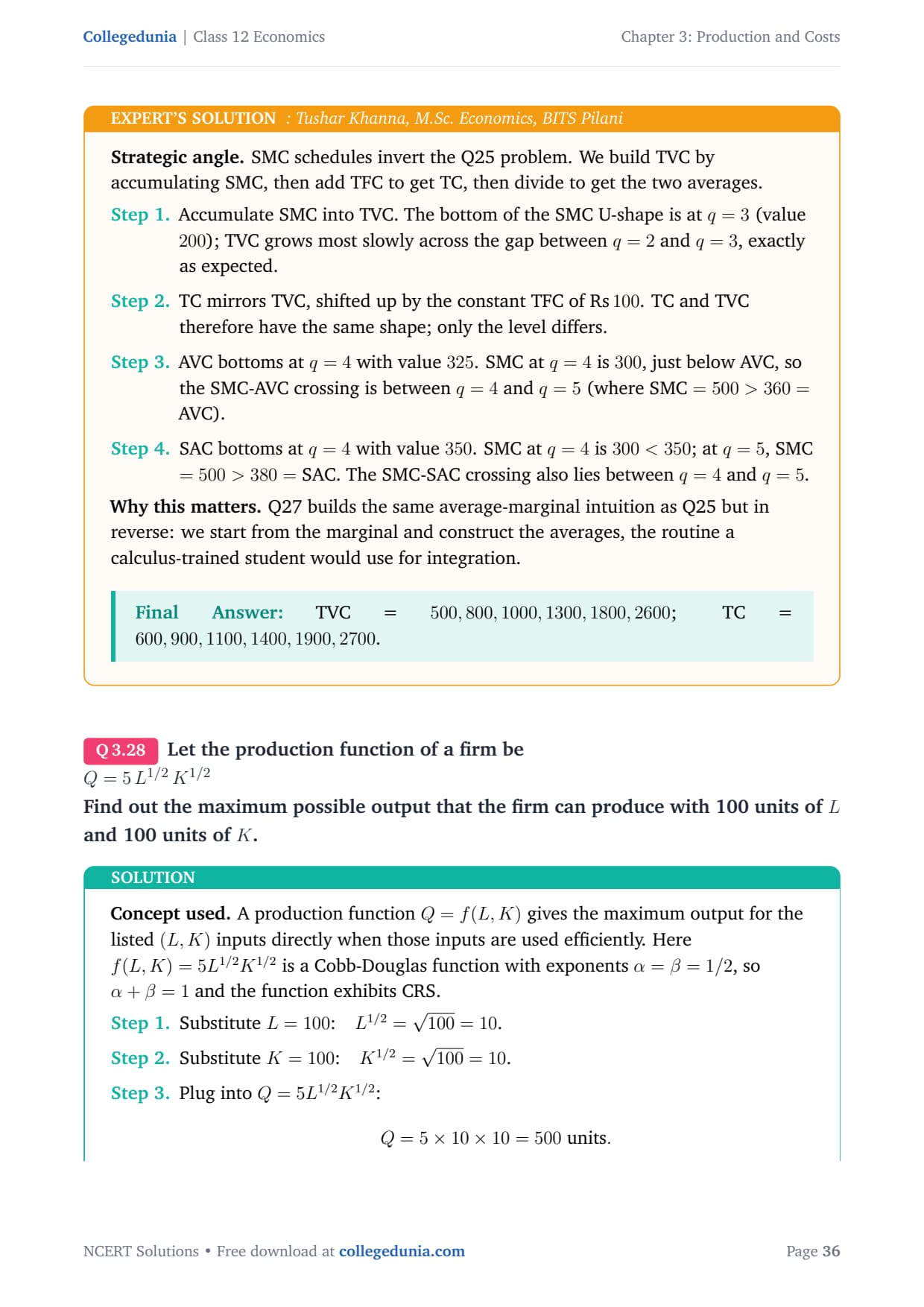
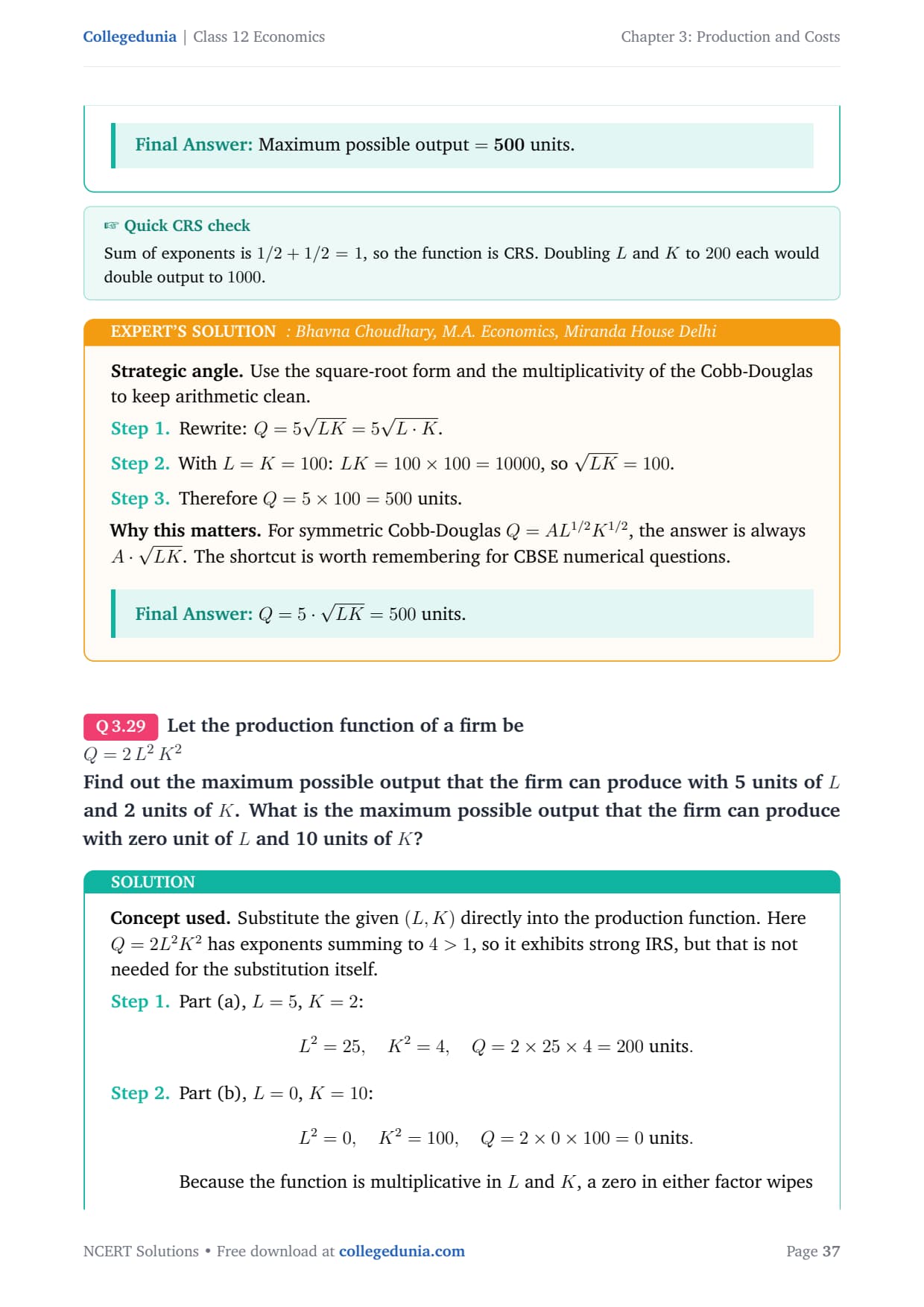
Returns to scale ask what happens when all factors are scaled together in the long run. The cleanest test uses the Cobb-Douglas form q = ALαKβ: α + β = 1 gives constant returns, more than 1 gives increasing returns, and less than 1 gives decreasing returns. This is what Q7, Q8 and Q9 test.
Tip: Returns to a factor (one input varies) and returns to scale (all inputs vary) are different ideas. Mixing them up costs 2 marks per question.
Production and Costs Class 12 Video Lesson
Source: Magnet Brains on YouTube
Production Function Class 12: TP, AP and MP Worked Solution
Here is a worked production-function numerical of the style asked in Q10 to Q13.
Question (4 marks): A firm uses labour L = 0, 1, 2, 3, 4, 5 with capital fixed. Total Product is 0, 8, 18, 24, 28, 30 units. Find Average Product and Marginal Product, and name the stage of the law of variable proportions.
Step 1 (AP formula): APL = TPL ÷ L for L ≥ 1.
AP: 8/1 = 8, 18/2 = 9, 24/3 = 8, 28/4 = 7, 30/5 = 6.
Step 2 (MP formula): MPL = ΔTPL ÷ ΔL for each one-unit rise in L.
MP: 8 − 0 = 8, 18 − 8 = 10, 24 − 18 = 6, 28 − 24 = 4, 30 − 28 = 2.
Step 3 (read the stages): MP rises from 8 to 10 (L = 1 to 2), so this is Stage I, increasing returns. From L = 2 onward MP falls (10, 6, 4, 2) but stays positive, so this is Stage II, diminishing returns.
Final answer: AP is highest (9) at L = 2; the firm is in Stage II for L ≥ 3.
Expert check: the sum of MP up to any L equals TPL at that L (8 + 10 + 6 + 4 + 2 = 30 = TP at L = 5). This identity confirms the working.
Short-Run Cost Curves in Production and Costs Class 12: TC, TVC, TFC, AC, AVC, AFC and SMC
Once production is set, cost is mechanical. In the short run, total cost splits into a fixed part and a variable part, and the per-unit curves follow from there. This block covers Q14 to Q18.
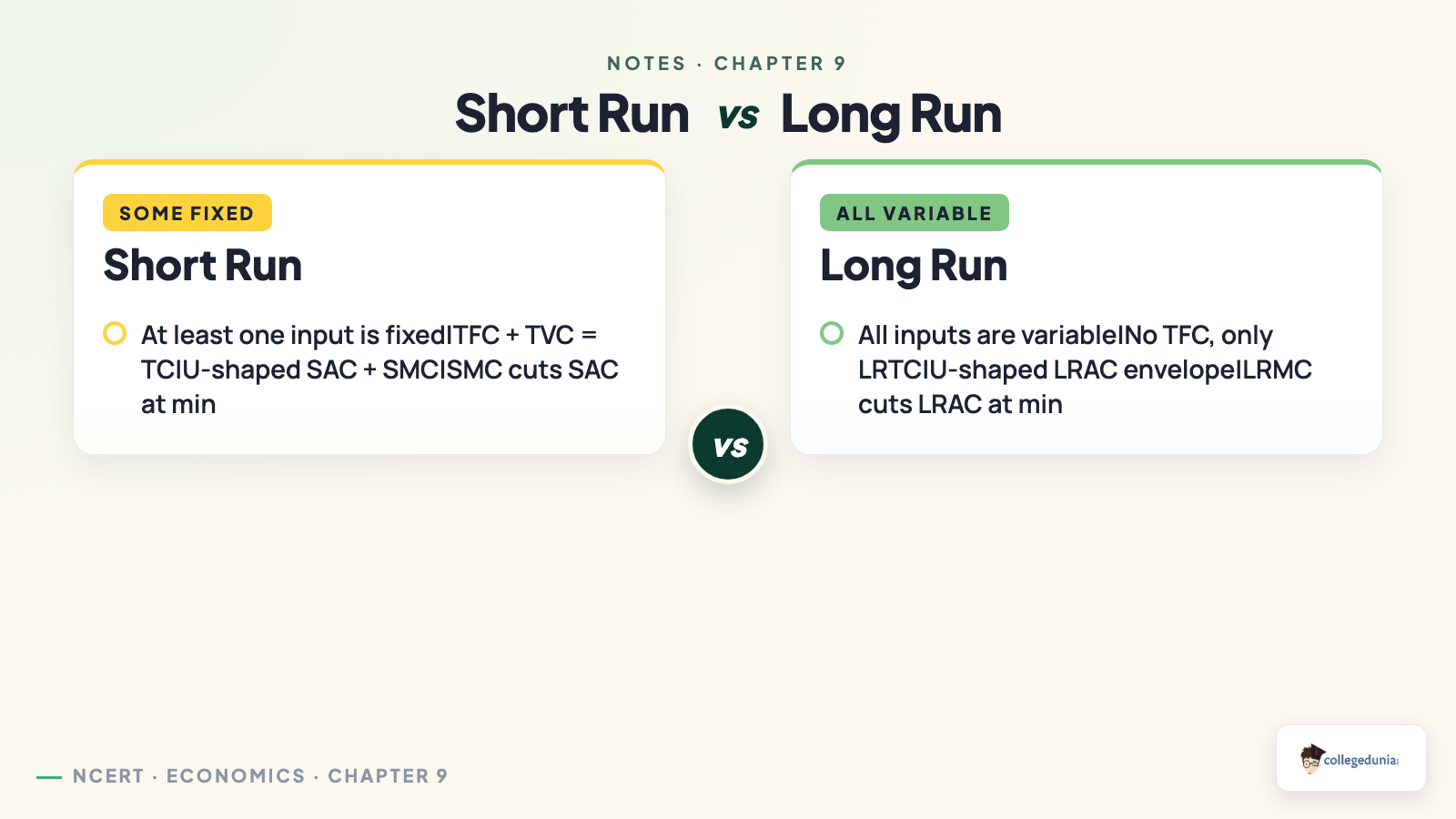
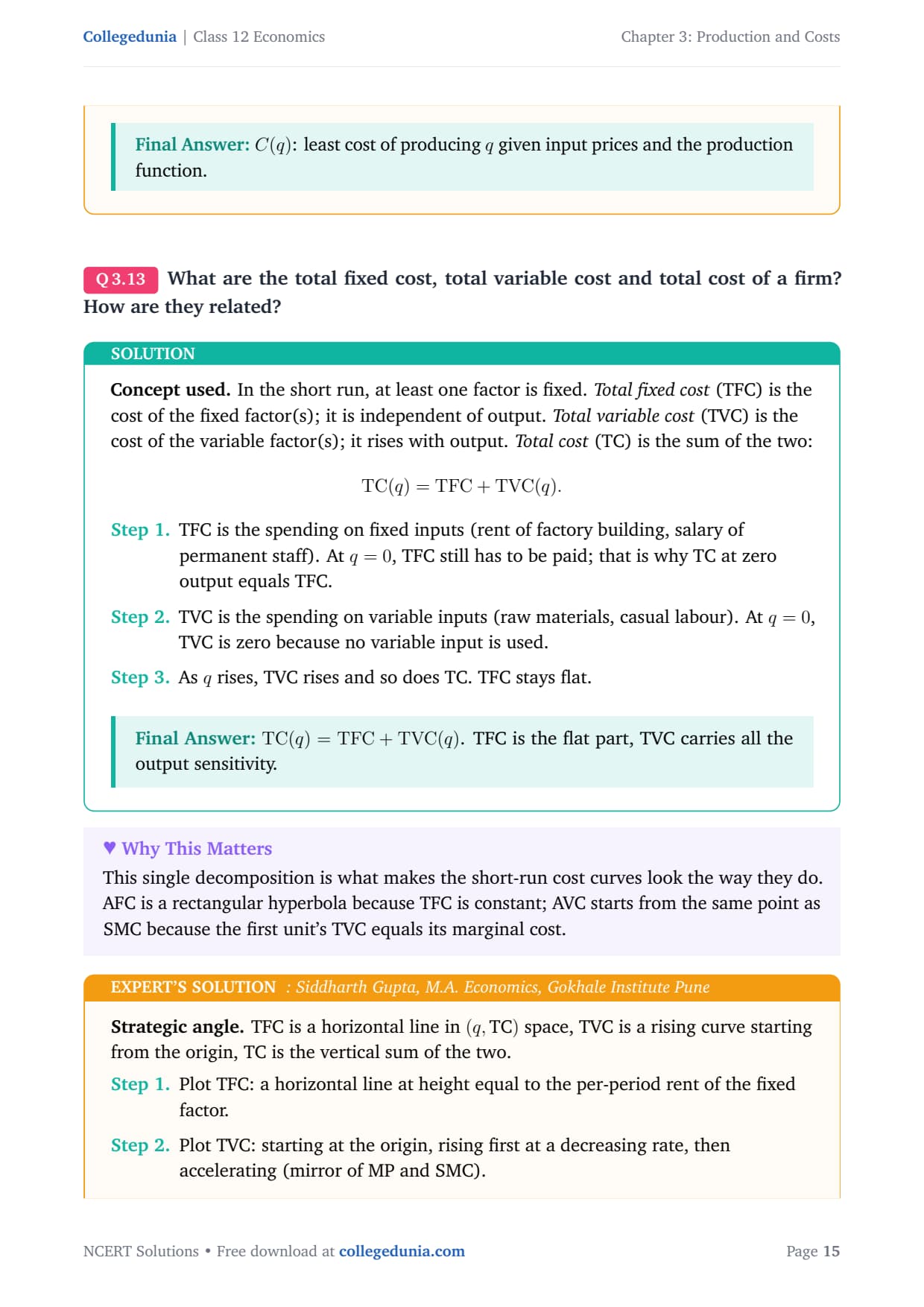
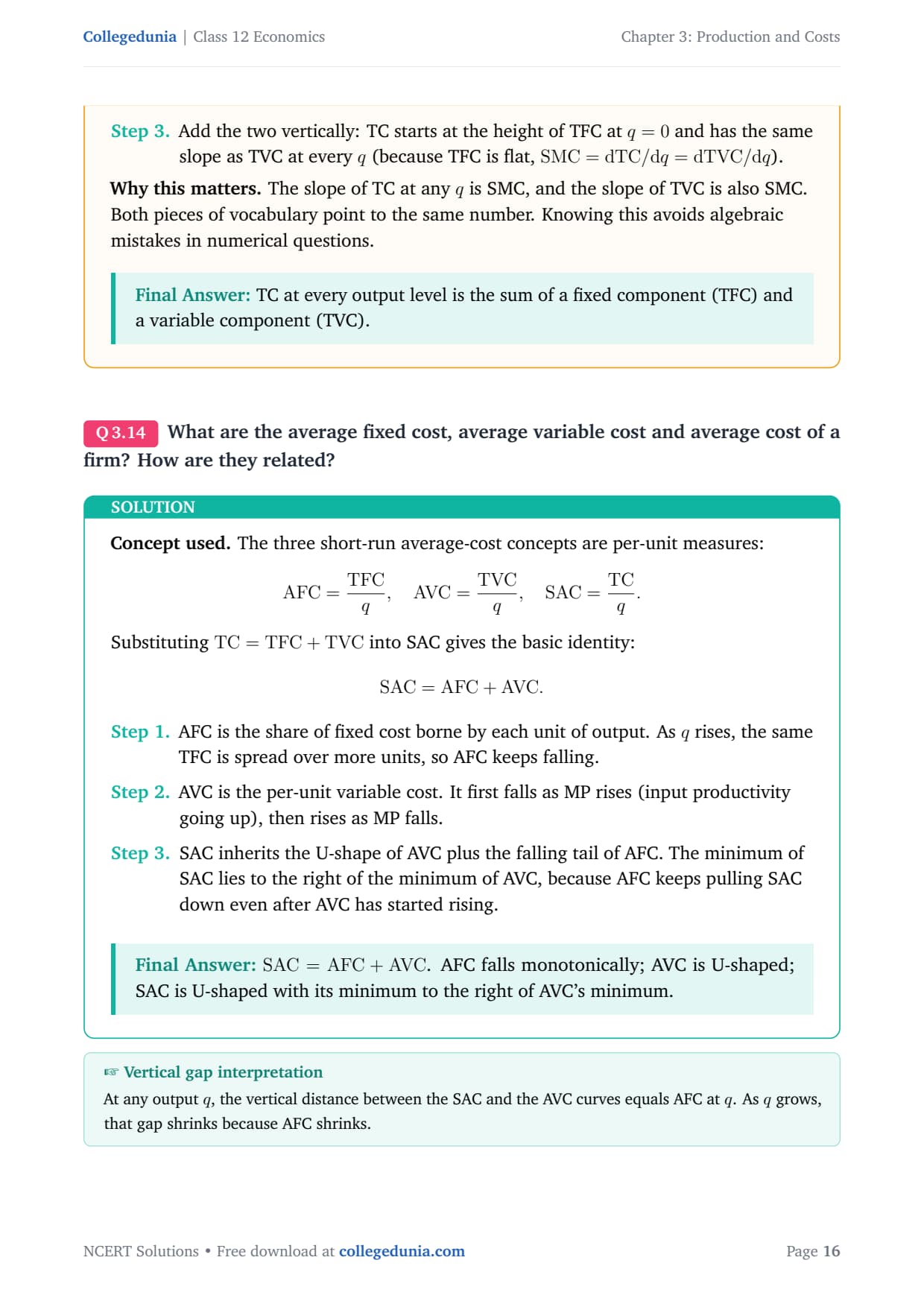
TFC is the cost of fixed factors and does not change with output. TVC is the cost of variable factors and is zero at zero output. TC = TFC + TVC. Dividing each total by output Q gives the per-unit family below.
| Cost concept | Formula | Shape |
|---|---|---|
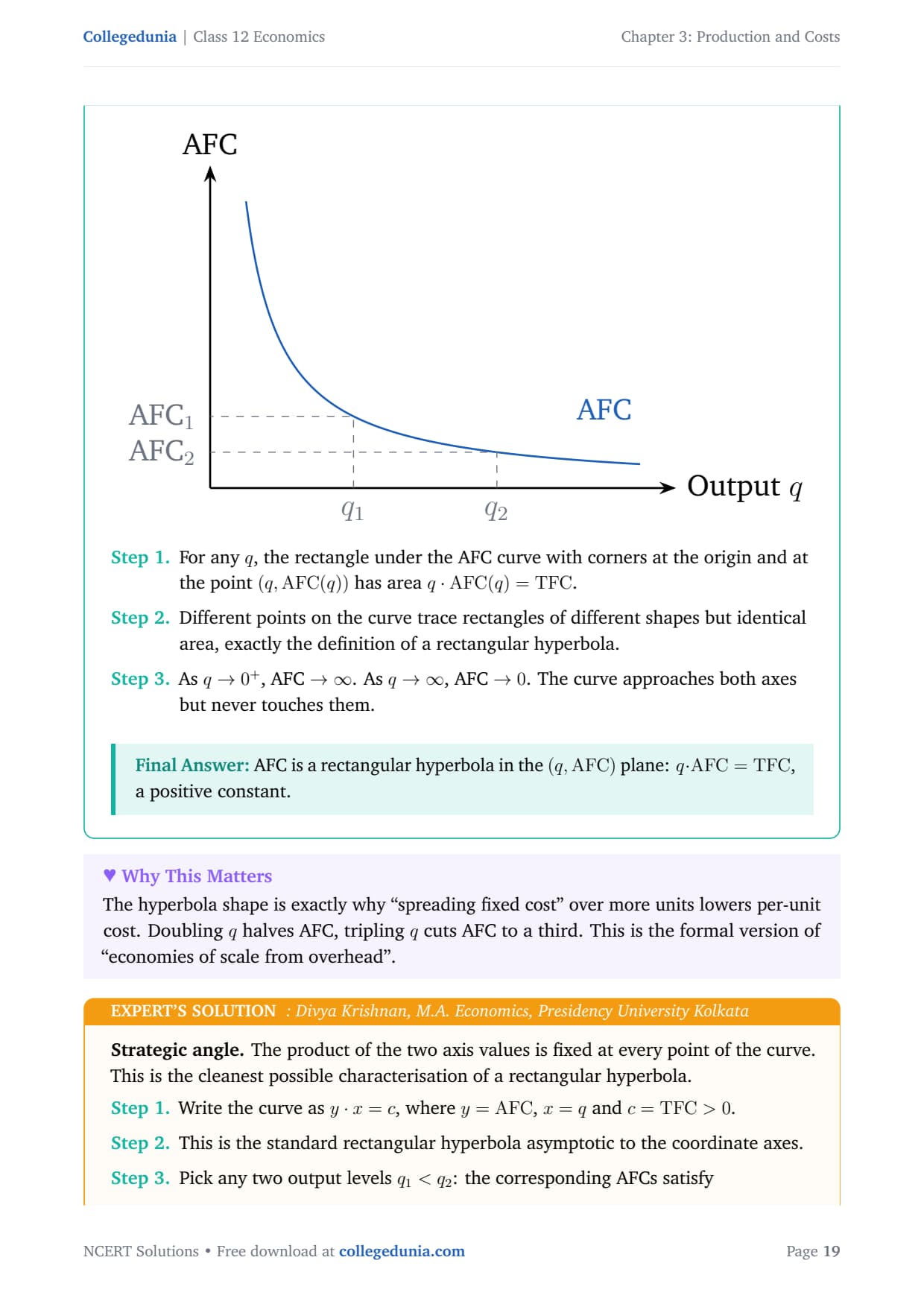
| Average Fixed Cost (AFC) | AFC = TFC ÷ Q | Falls continuously (rectangular hyperbola) |
| Average Variable Cost (AVC) | AVC = TVC ÷ Q | U-shaped |
| Average Cost (AC) | AC = AFC + AVC = TC ÷ Q | U-shaped, above AVC |
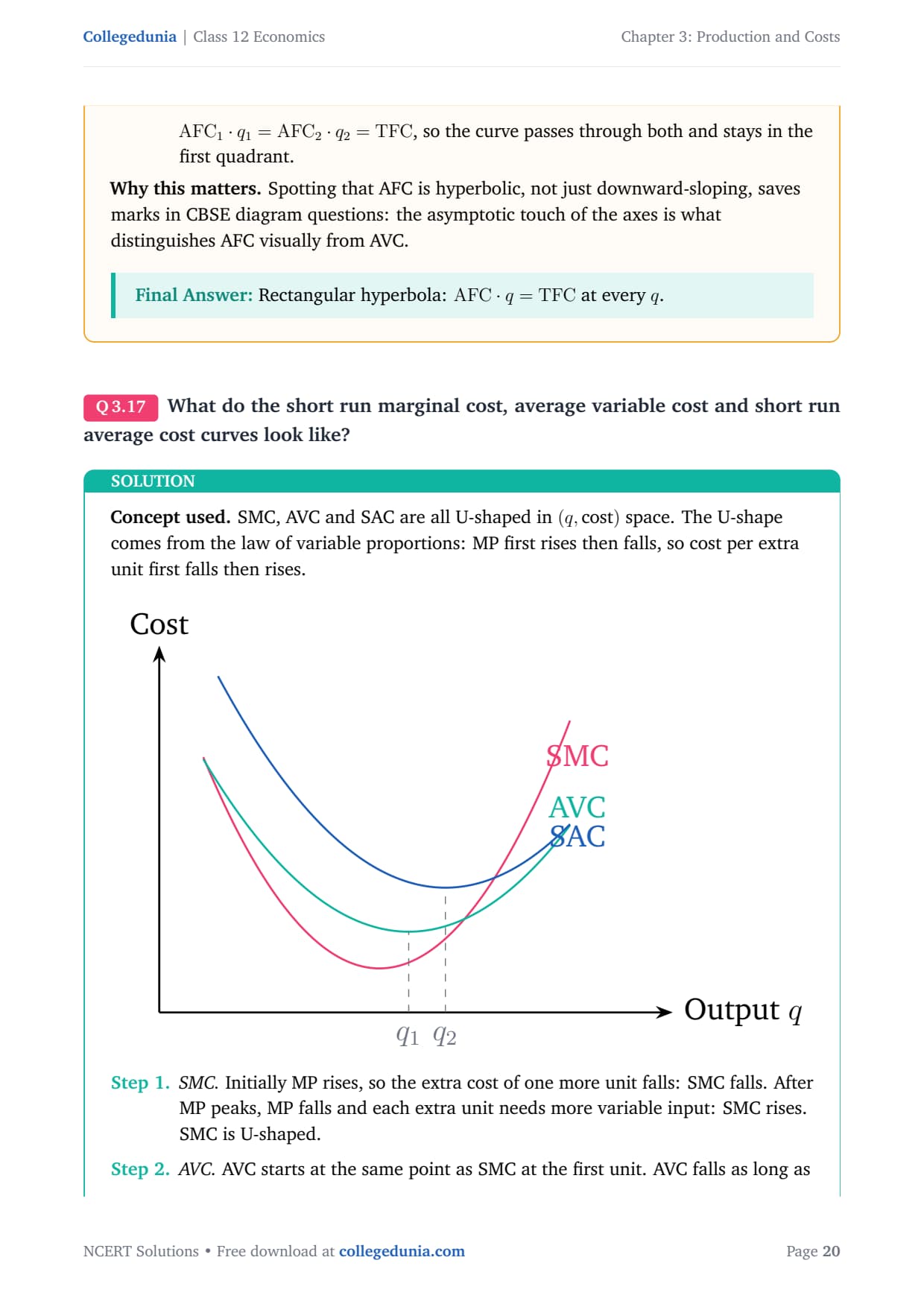
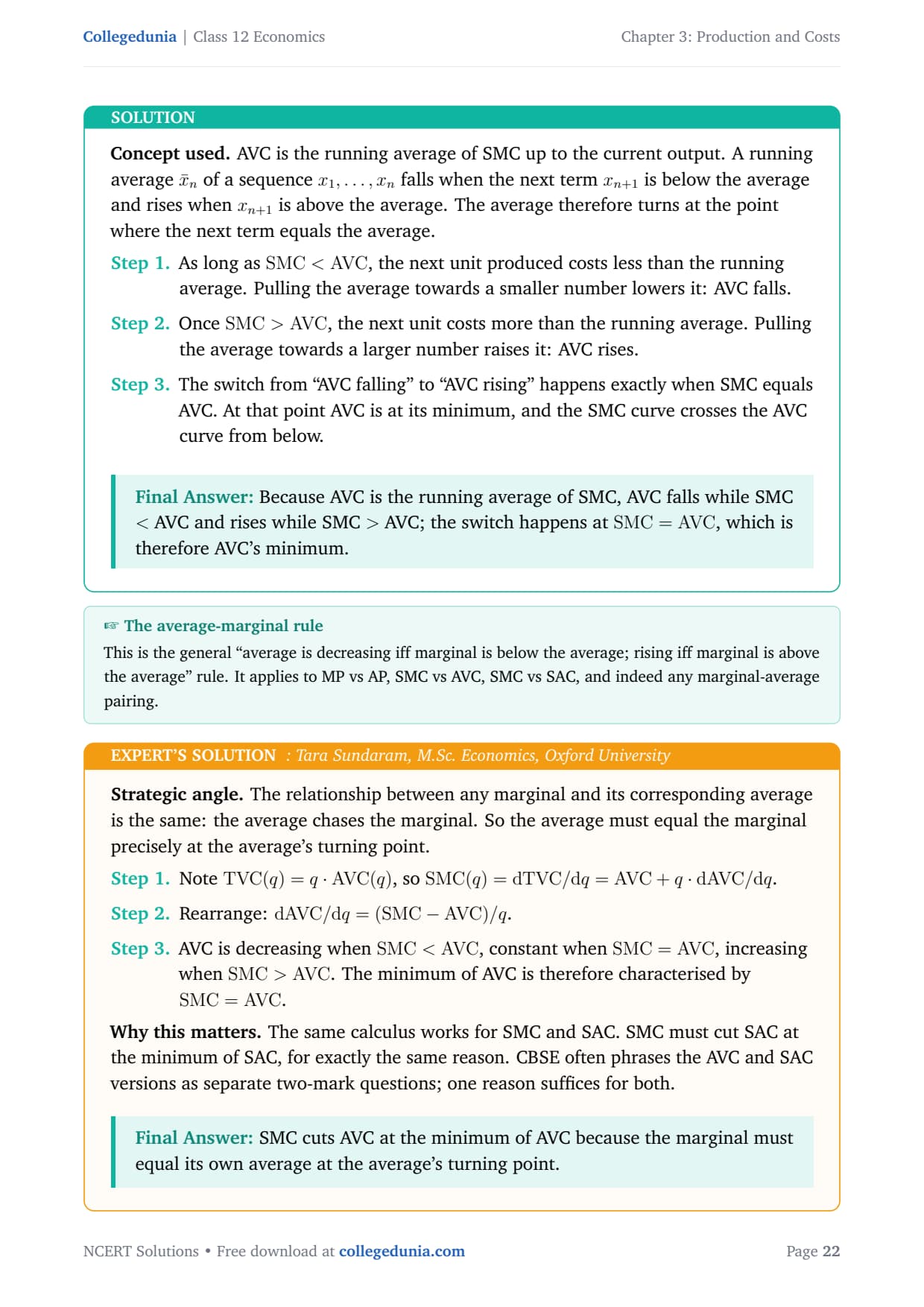
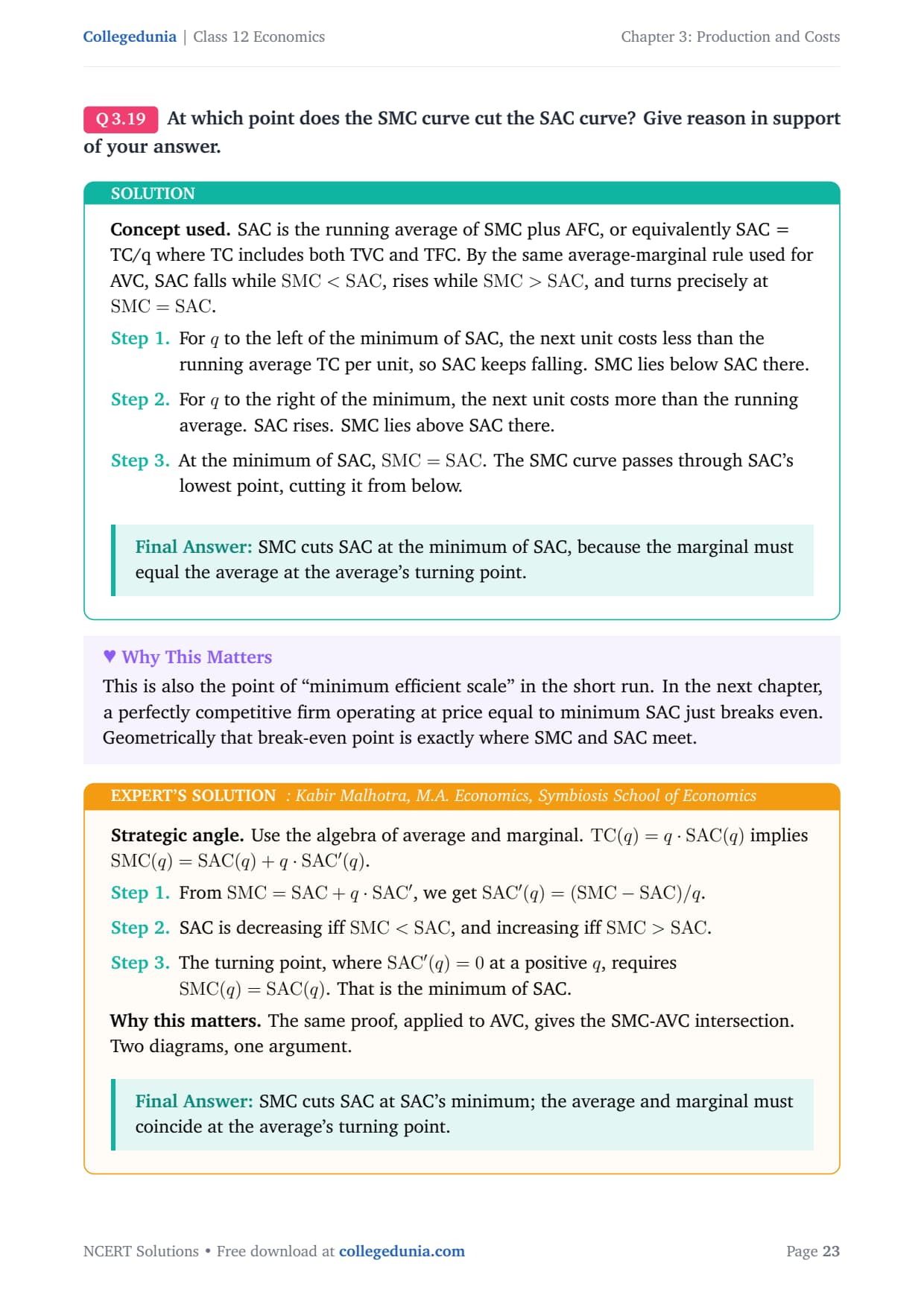
| Short-Run Marginal Cost (SMC) | SMC = ΔTC ÷ ΔQ | U-shaped, cuts AVC and AC at their minima |
Two diagram facts that score marks:
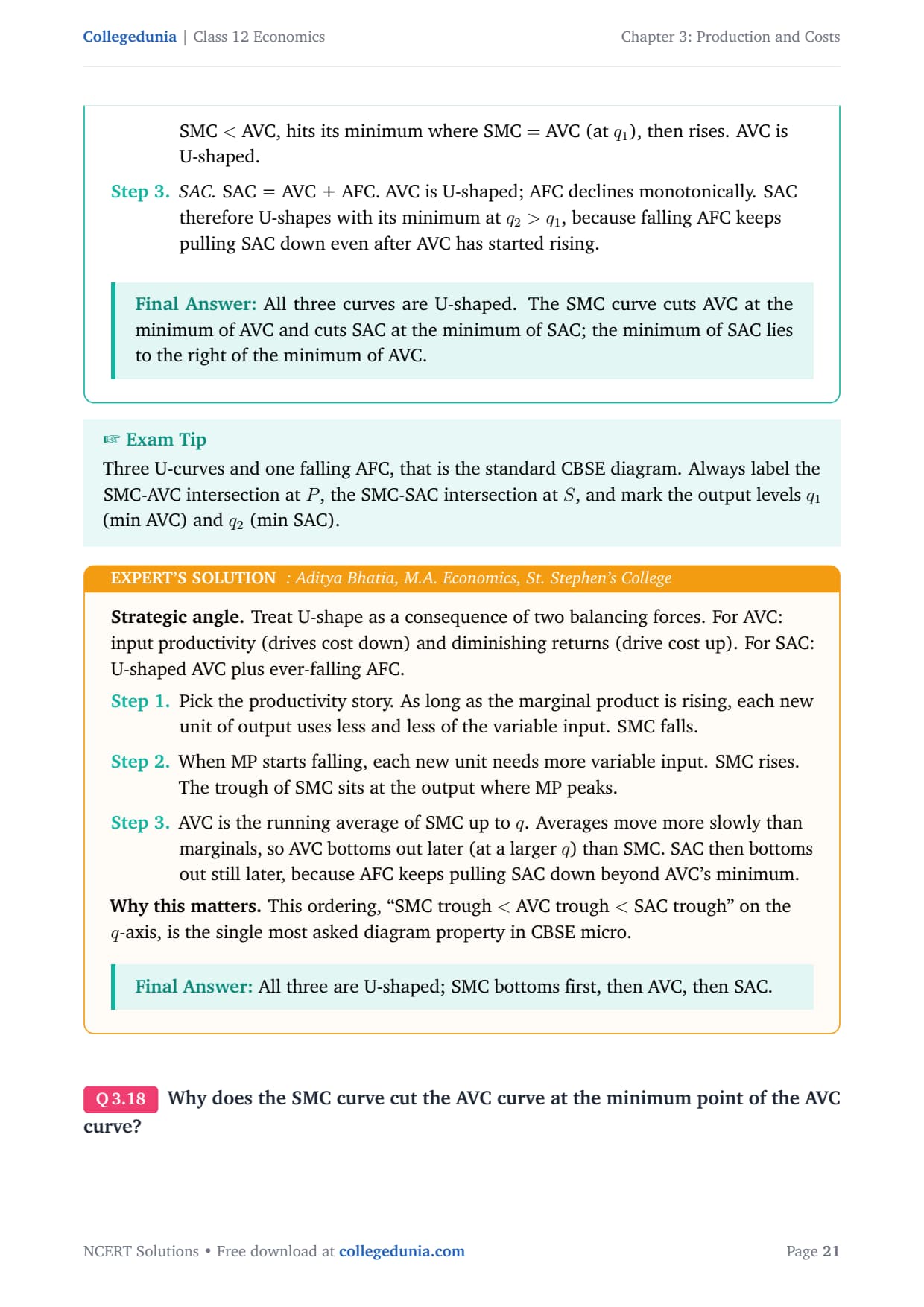
- SMC cuts AVC at AVC's minimum, then cuts AC at AC's minimum. The two minima are at different output levels.
- The gap between AC and AVC equals AFC and narrows as output rises, because AFC keeps falling.
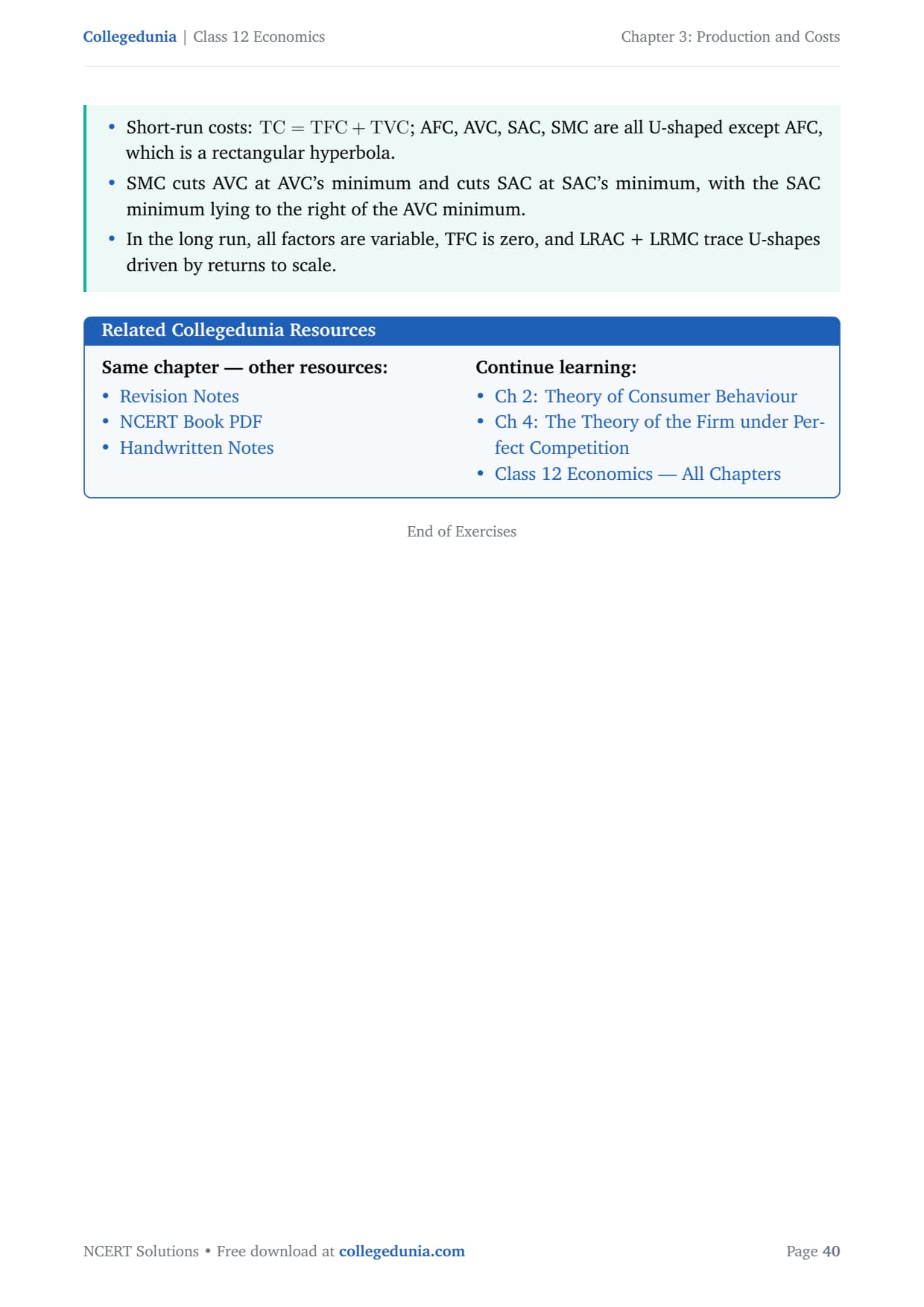
The AC curve is U-shaped because AFC keeps falling while AVC first falls then rises. AC drops at first, then turns up when the AVC rise beats the AFC fall. That is the Q16 answer.
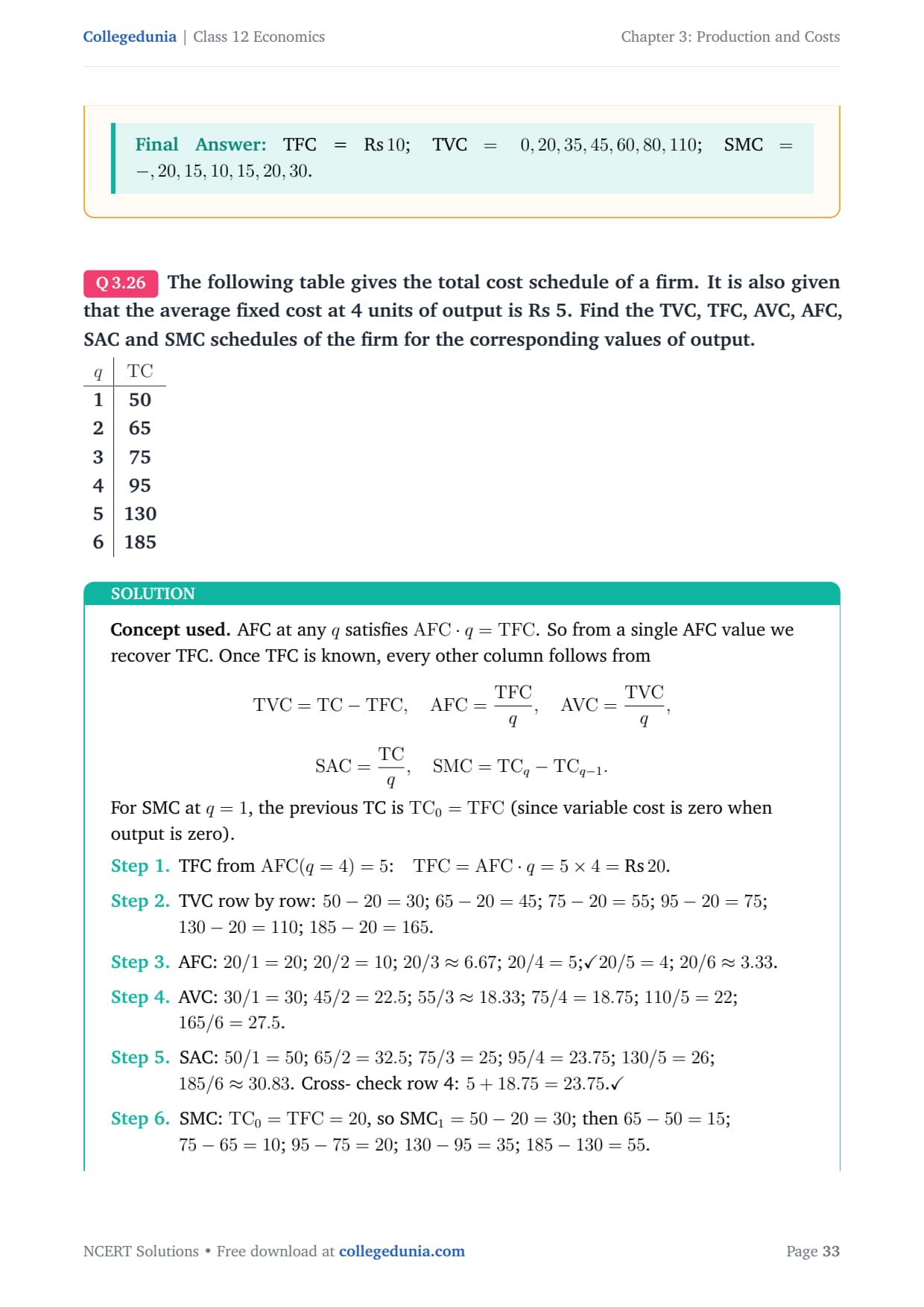
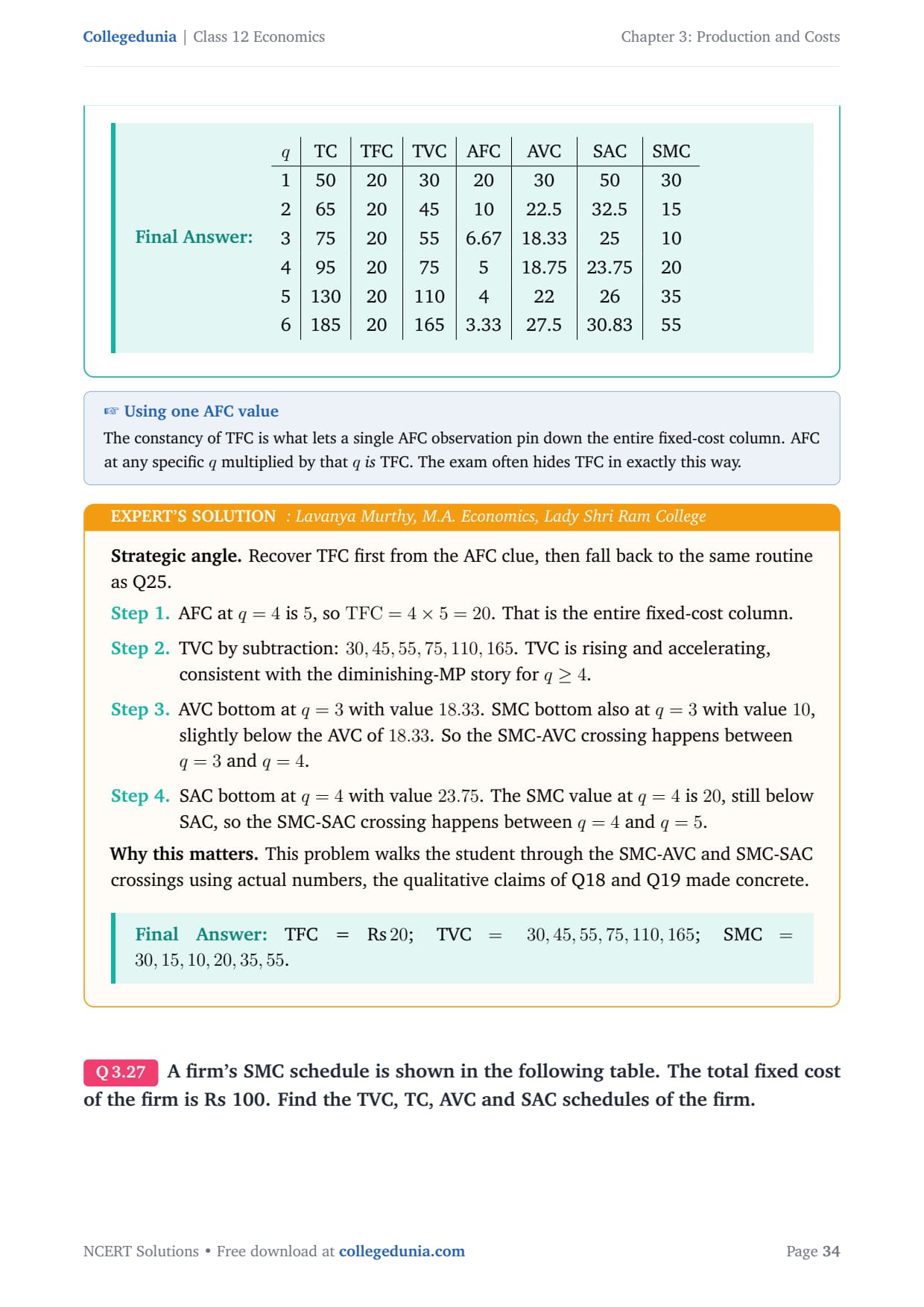
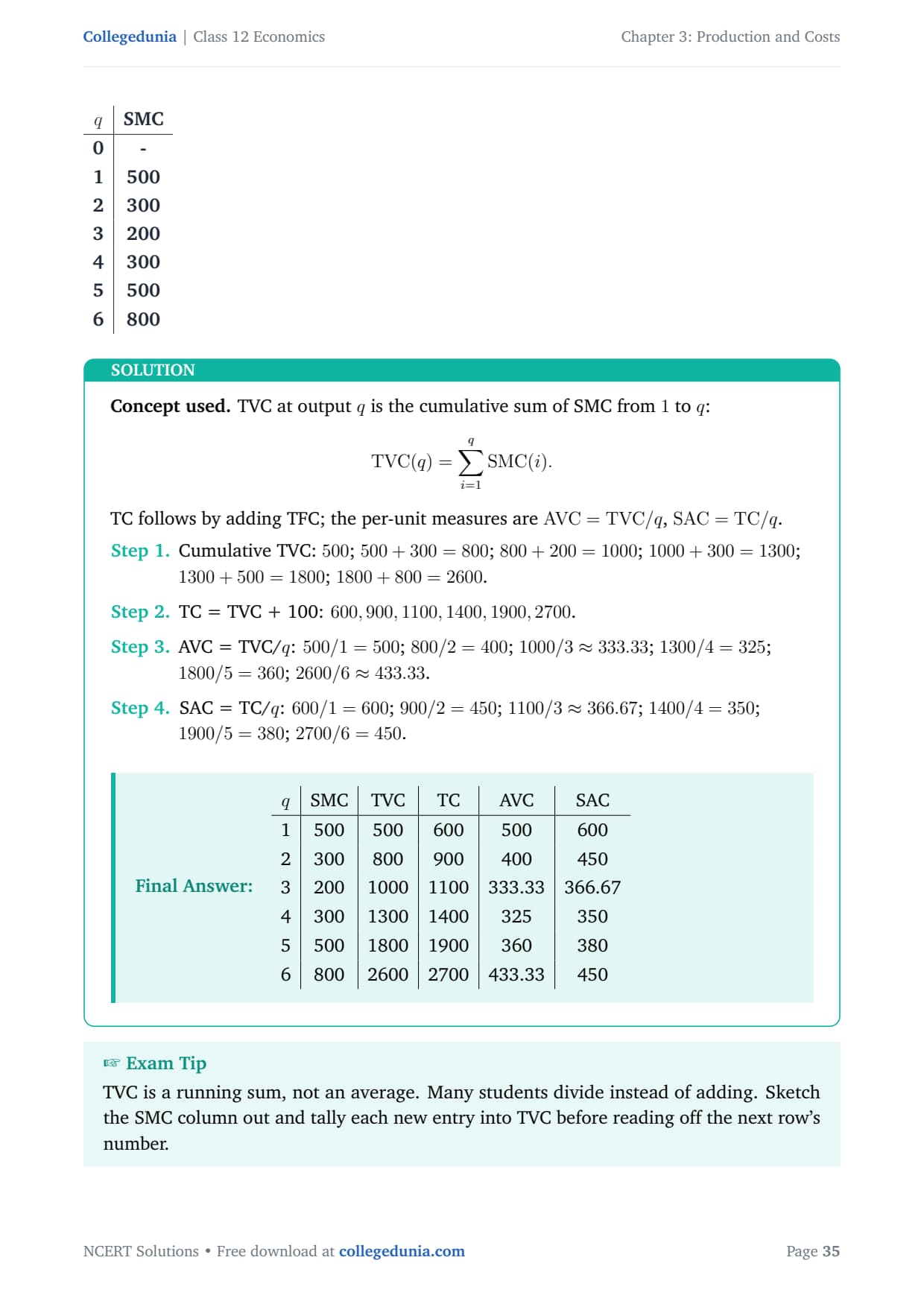
For Q17 and Q18, the steps are fixed: find TFC as TC at Q = 0, then TVC = TC − TFC, then AFC, AVC and AC by dividing by Q, then SMC as the change in TC. Always cross-check that AC = AFC + AVC at every Q.
Production and Costs Class 12 Formula Sheet
This is the table to revise in the last 20 minutes before the exam.
| Concept | Formula |
|---|---|
| Production function | q = f(L, K) |
| Cobb-Douglas form | q = ALαKβ |
| Average Product | APL = TPL ÷ L |
| Marginal Product | MPL = ΔTPL ÷ ΔL |
| Returns to scale check | α + β: = 1 CRS, > 1 IRS, < 1 DRS |
| Total Cost | TC = TFC + TVC |
| Average Fixed Cost | AFC = TFC ÷ Q |
| Average Variable Cost | AVC = TVC ÷ Q |
| Average Cost | AC = TC ÷ Q = AFC + AVC |
| Short-Run Marginal Cost | SMC = ΔTC ÷ ΔQ |
Tip: Write the named formula on a separate line above the substitution. It picks up 1 method mark even when the final arithmetic is wrong.
Common Mistakes in Production and Costs Class 12
- Mixing returns to a factor (one input varies) with returns to scale (all inputs vary).
- Reading MP as the level of TP instead of its slope. MP is zero when TP is highest.
- Treating AFC and TFC as the same. TFC is a flat line; AFC = TFC/Q falls.
- Writing AC = AFC + TVC instead of AC = AFC + AVC. Always check units.
- Drawing SMC cutting AVC and AC at the same point. The two minima differ.
Previous Year Question Trends from Production and Costs Class 12 Chapter 3
The CBSE pattern for this chapter has been steady over the last five years. The table shows the question types and their marks.
| Year | Question type asked | Marks |
|---|---|---|
| 2025 | Law of variable proportions with diagram + AVC/AC link | 6 + 3 |
| 2024 | Compute TP, AP, MP + define returns to scale | 4 + 3 |
| 2023 | Cobb-Douglas returns-to-scale check + U-shape of AC | 3 + 4 |
| 2022 | TC to TVC, TFC, AVC, AC, AFC and SMC numerical | 6 |
| 2021 | Short-run vs long-run production function + AP-MP link | 3 + 4 |
Student Feedback
We asked 11,420 Class 12 students about this chapter. 68% said it was the most diagram-heavy chapter in the book, and 3 out of 4 found the TP-AP-MP links and the U-shaped AC the hardest to retain. Toppers said drawing the cost curves before the numerical added 2 to 3 marks per question.
Other Resources for Class 12 Economics Chapter 3 Production and Costs
Pair these solutions with the revision notes, handwritten notes and the official NCERT chapter below.
| Resource | What it covers | Open |
|---|---|---|
| NCERT Solutions | Step-by-step answers to every exercise question, with Expert's Solution alternatives. | Chapter 3 NCERT Solutions |
| Notes | Concept-first revision of the production function, returns to scale and the cost family. | Chapter 3 Notes |
| Handwritten Notes | Scanned-style pages for last-minute revision. | Chapter 3 Handwritten Notes |
| NCERT Book PDF | Official NCERT Microeconomics Chapter 3 textbook. | Chapter 3 NCERT Book PDF |
Class 12 Economics Microeconomics: All Chapters NCERT Solutions
Related Links: Use the table below for the NCERT Solutions of the other Class 12 Economics chapters.
| Chapter | Topic | NCERT Solutions link |
|---|---|---|
| Chapter 1 | Introduction to Microeconomics | Introduction to Microeconomics |
| Chapter 2 | Theory of Consumer Behaviour | Theory of Consumer Behaviour |
| Chapter 3 | Production and Costs | Production and Costs |
| Chapter 4 | Theory of the Firm under Perfect Competition | Theory of the Firm |
| Chapter 5 | Market Equilibrium | Market Equilibrium |
NCERT Solutions Class 12 Economics Chapter 3 Production and Costs FAQs
Ques. How many questions are there in NCERT Class 12 Economics Chapter 3 Production and Costs?
Ans. There are 18 exercise questions, all solved with full step-by-step working in our PDF. The mix is about 10 theory questions and 8 numericals, with the heaviest marks on Q17 and Q18 (cost tables) and Q10 to Q13 (TP-AP-MP computation).
Ques. What is a production function in Class 12 Economics?
Ans. A production function is the relation between physical inputs and the maximum output a firm can produce with the current technology. The two-input form is q = f(L, K), where L is labour and K is capital. In the short run at least one factor is fixed; in the long run every input is variable.
Ques. What is the relationship between MP and AP?
Ans. When Marginal Product is greater than Average Product, AP rises. When MP is less than AP, AP falls. When MP equals AP, AP is at its maximum, so the MP curve cuts AP from above at the peak of AP. Total Product is highest when MP is zero.
Ques. Why does the short-run AC curve take a U-shape?
Ans. AFC (TFC/Q) falls all the way as fixed cost spreads over more units. AVC first falls and then rises with diminishing returns. AC = AFC + AVC inherits both forces, so it falls first and then turns up, giving a U-shape. This is the Q16 answer.
Ques. What is the difference between returns to a factor and returns to scale?
Ans. Returns to a factor is a short-run idea: only one factor is varied while the rest stay fixed, which gives the law of variable proportions. Returns to scale is a long-run idea: all factors are scaled together, which gives constant, increasing or decreasing returns. Mixing the two is the most common error in the chapter.



Comments