




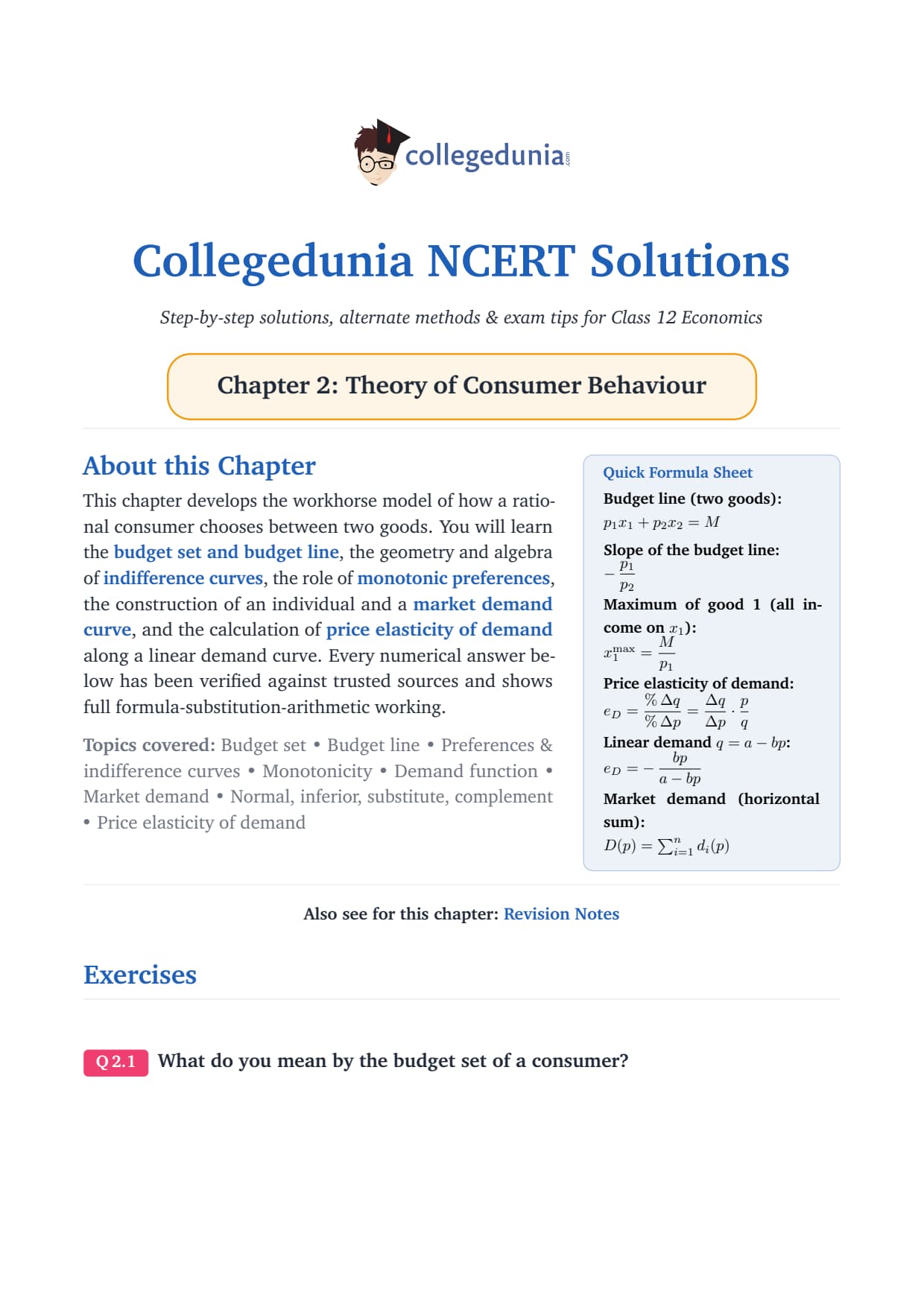
Theory of Consumer Behaviour is Chapter 2 of Class 12 Microeconomics. It explains utility, indifference curves, the budget line, consumer equilibrium and elasticity of demand. This page gives step-by-step NCERT solutions to every exercise question, plus a free PDF to download.
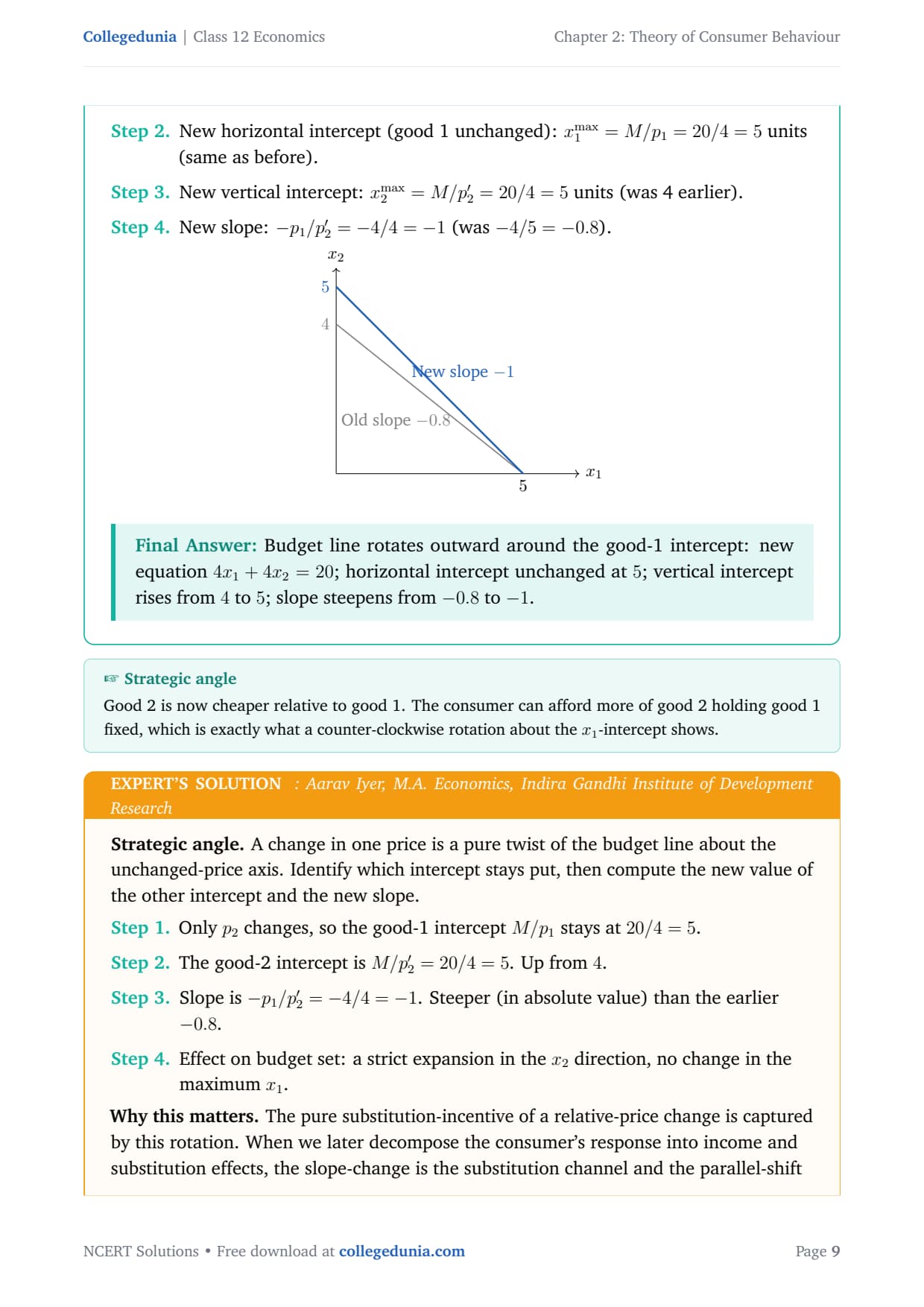
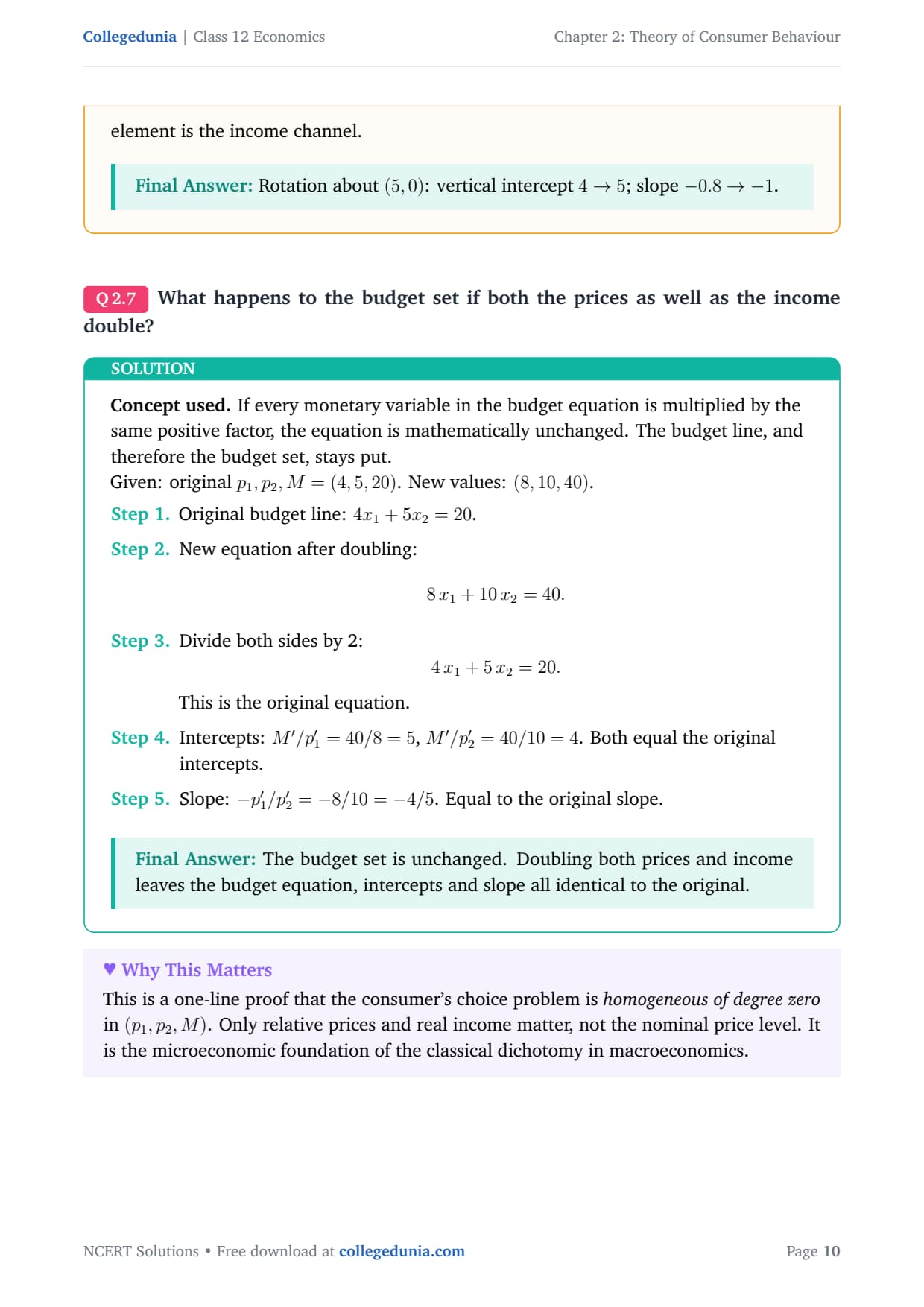
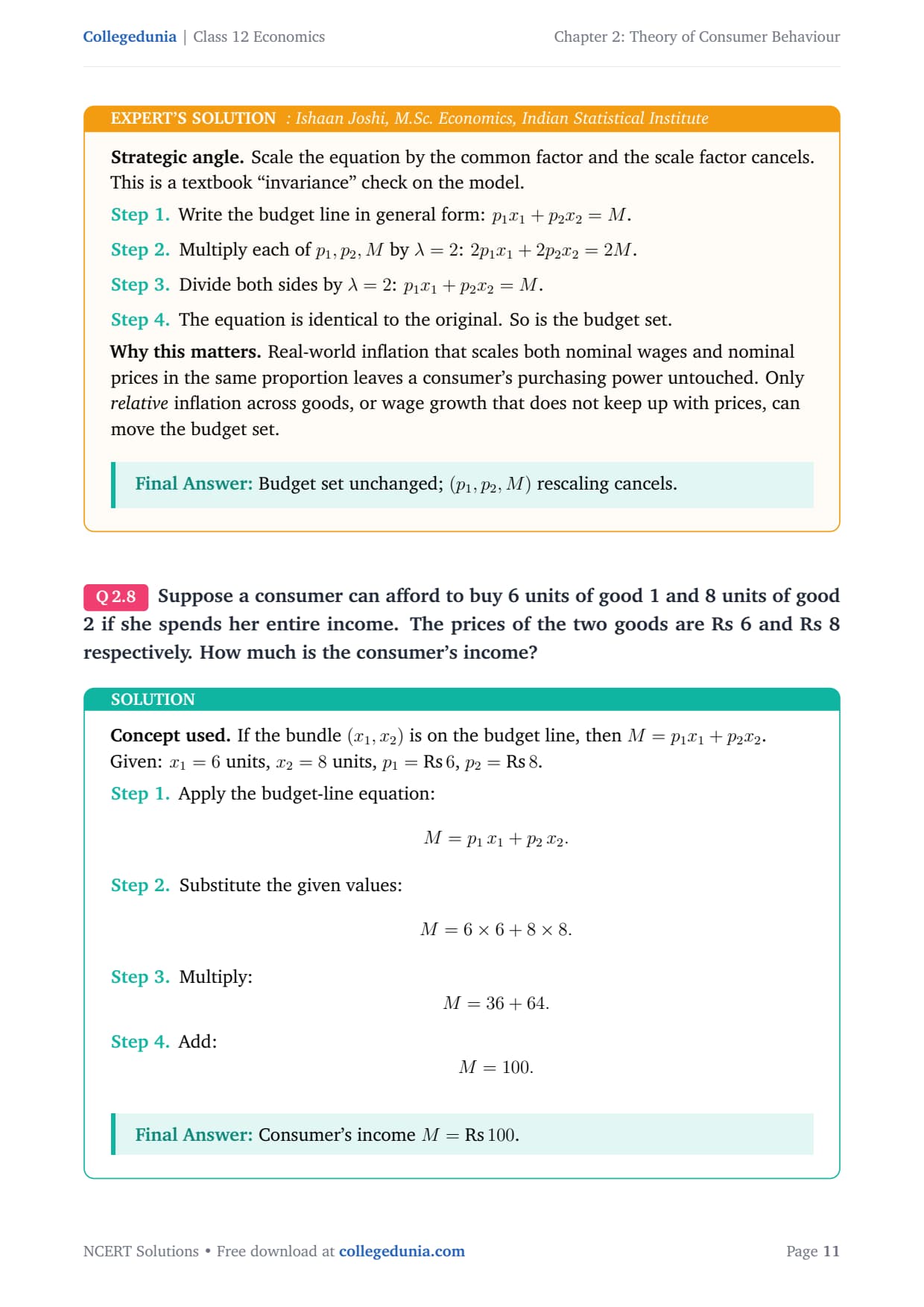
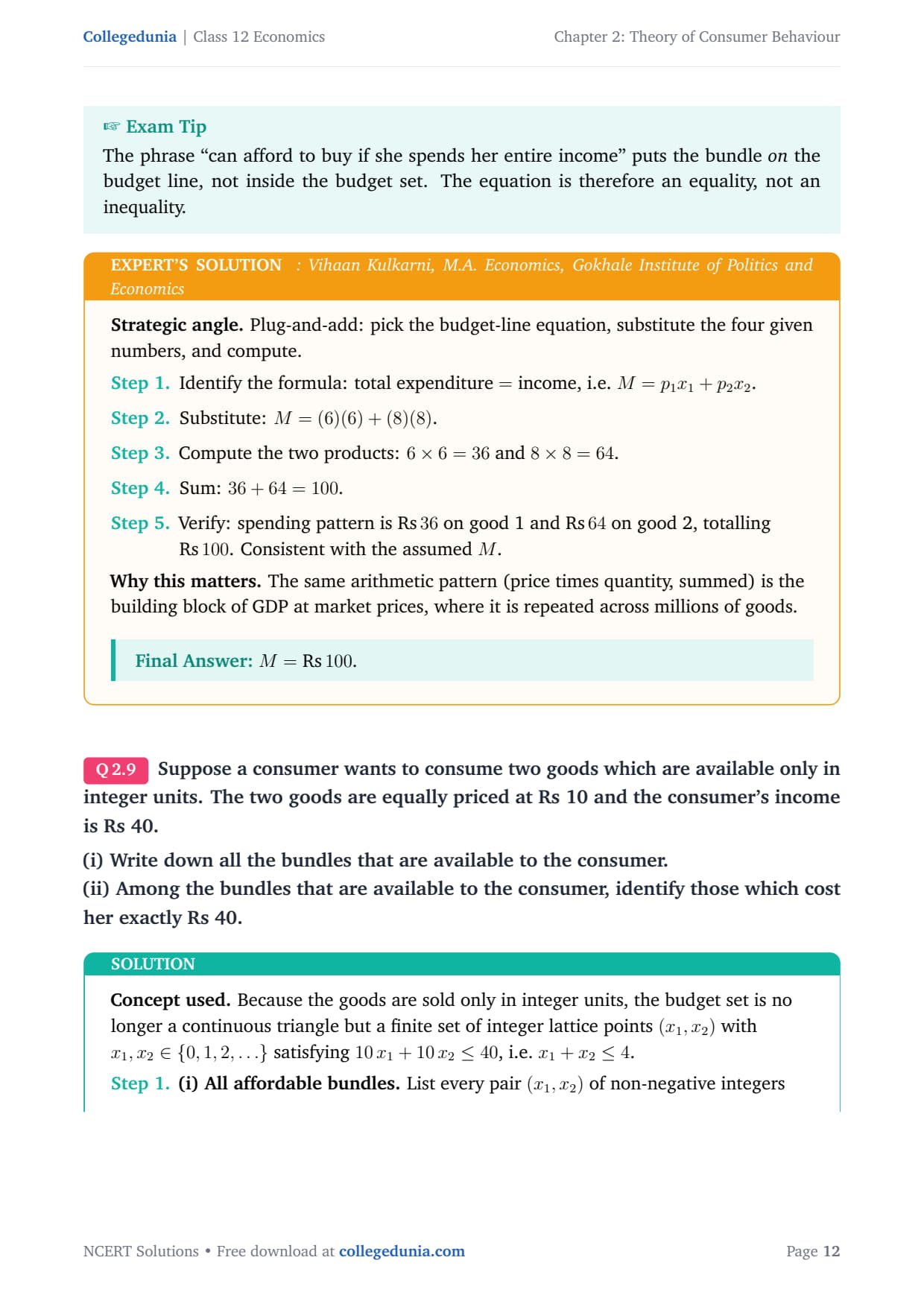
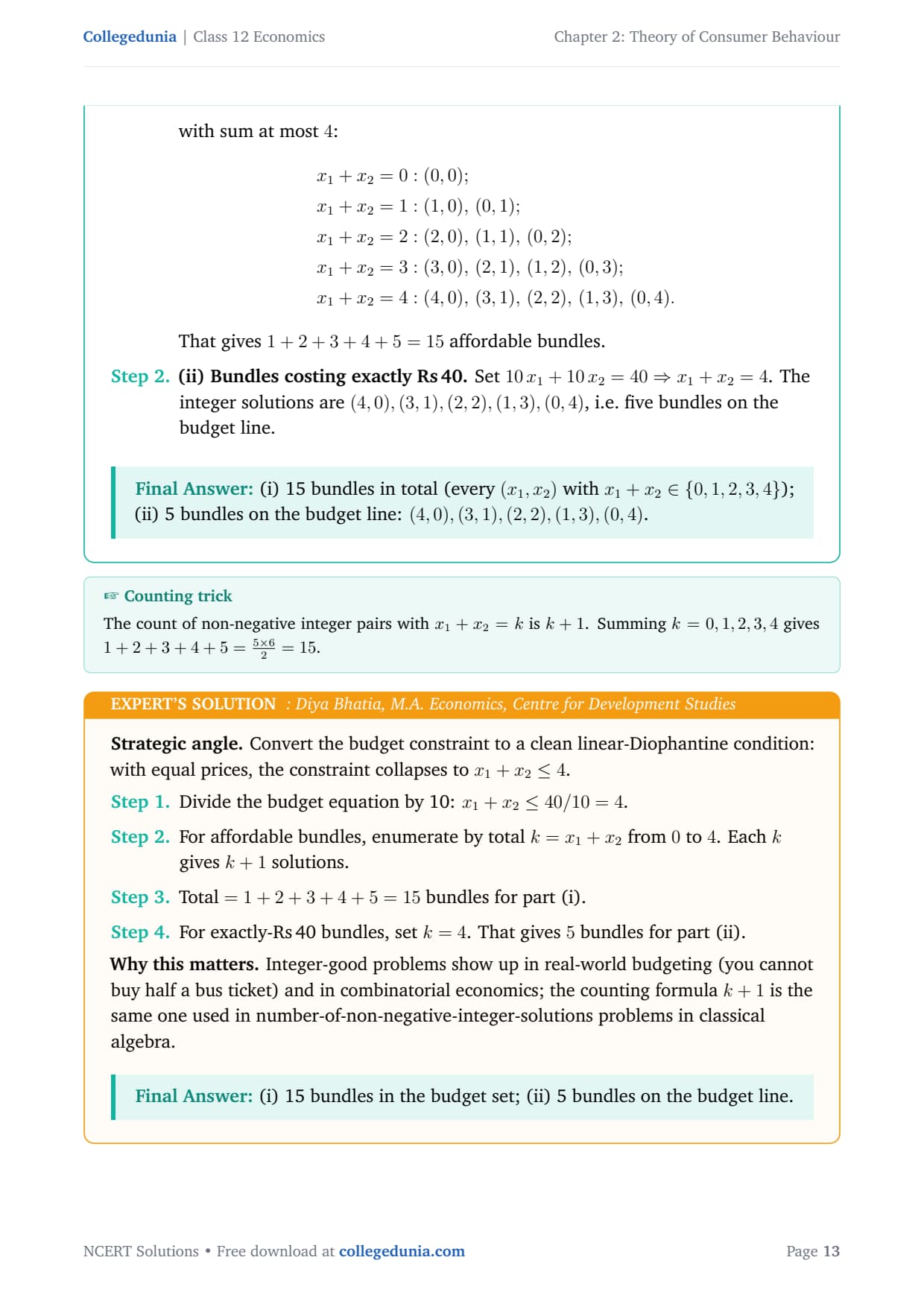
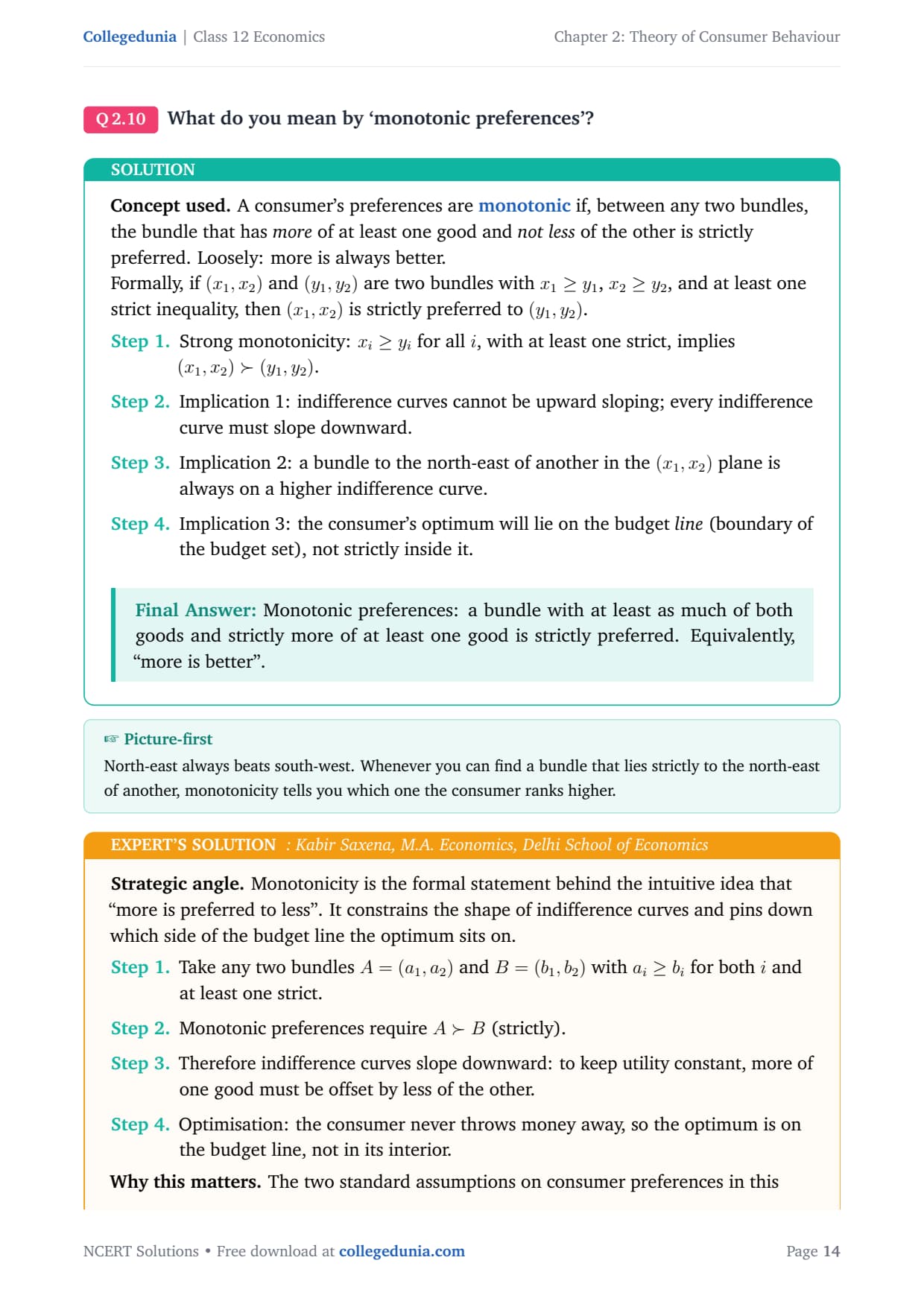
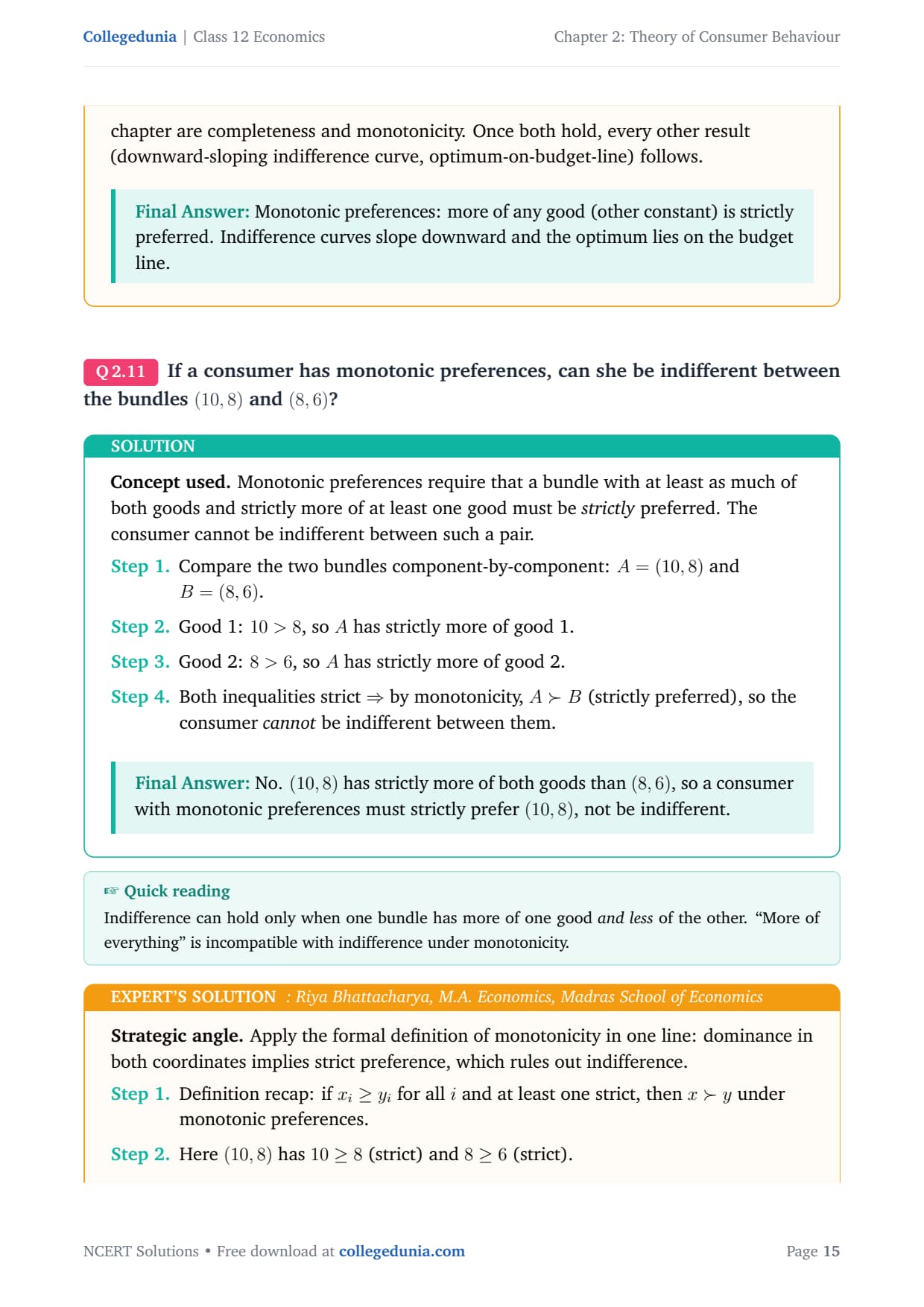
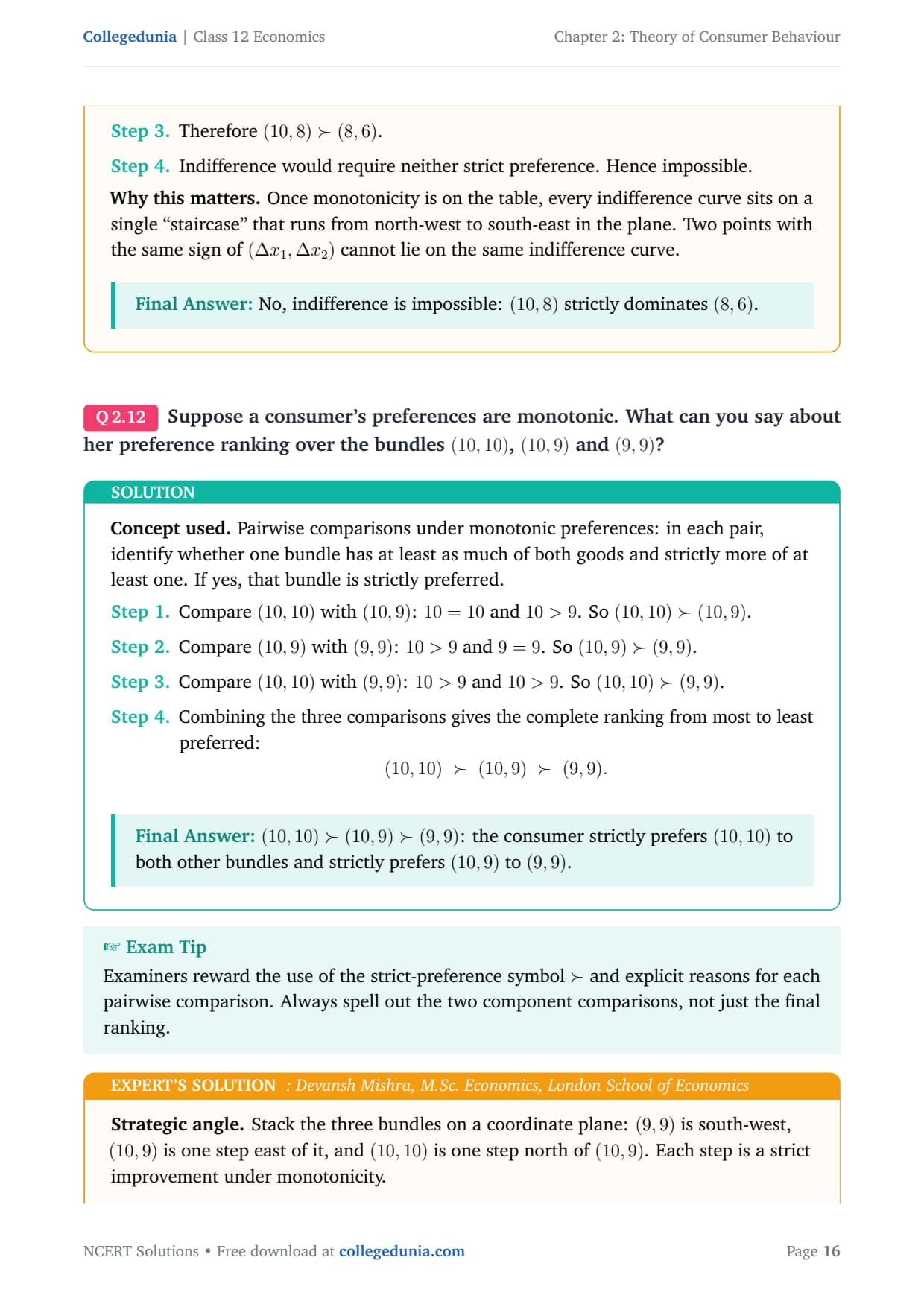
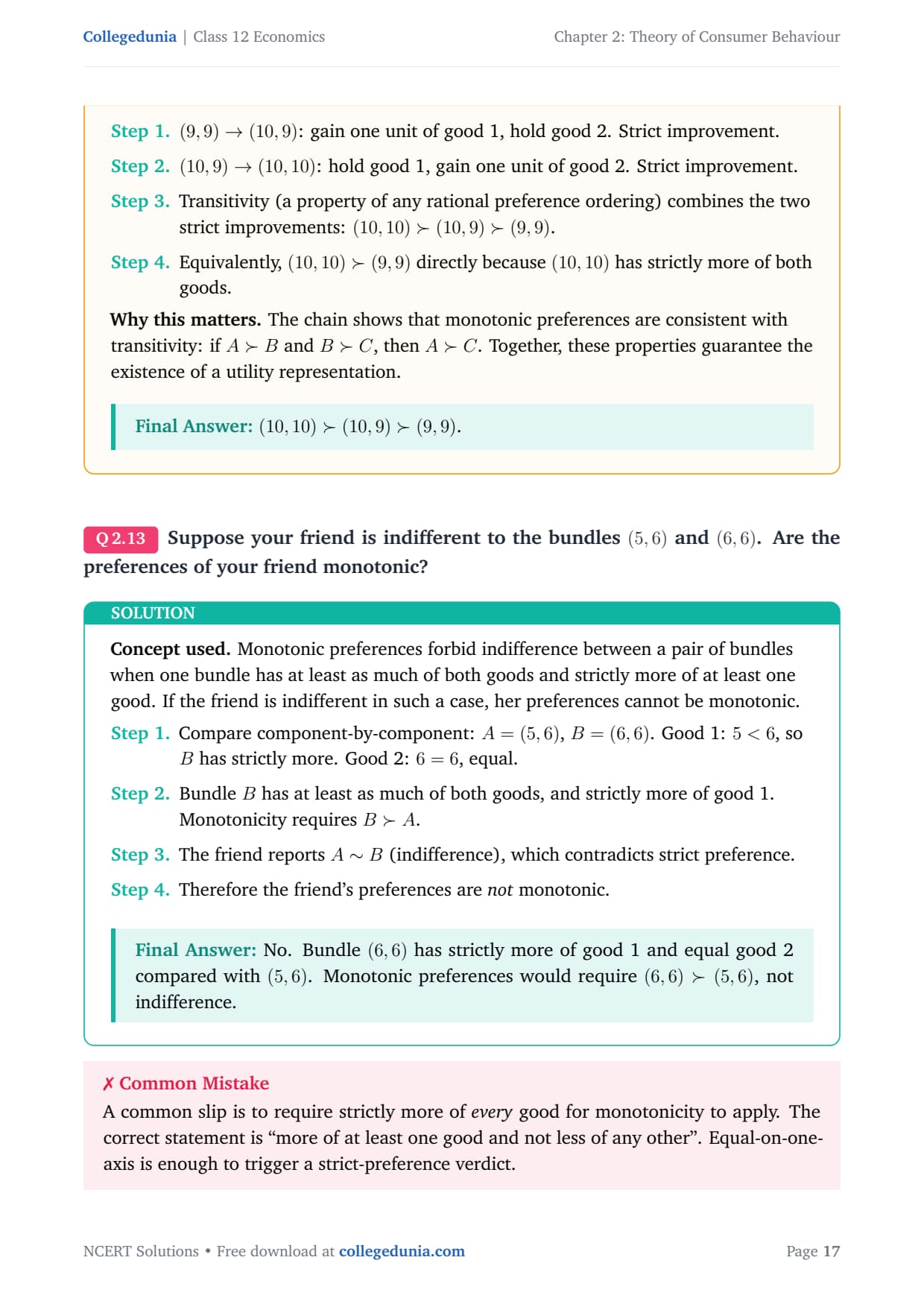
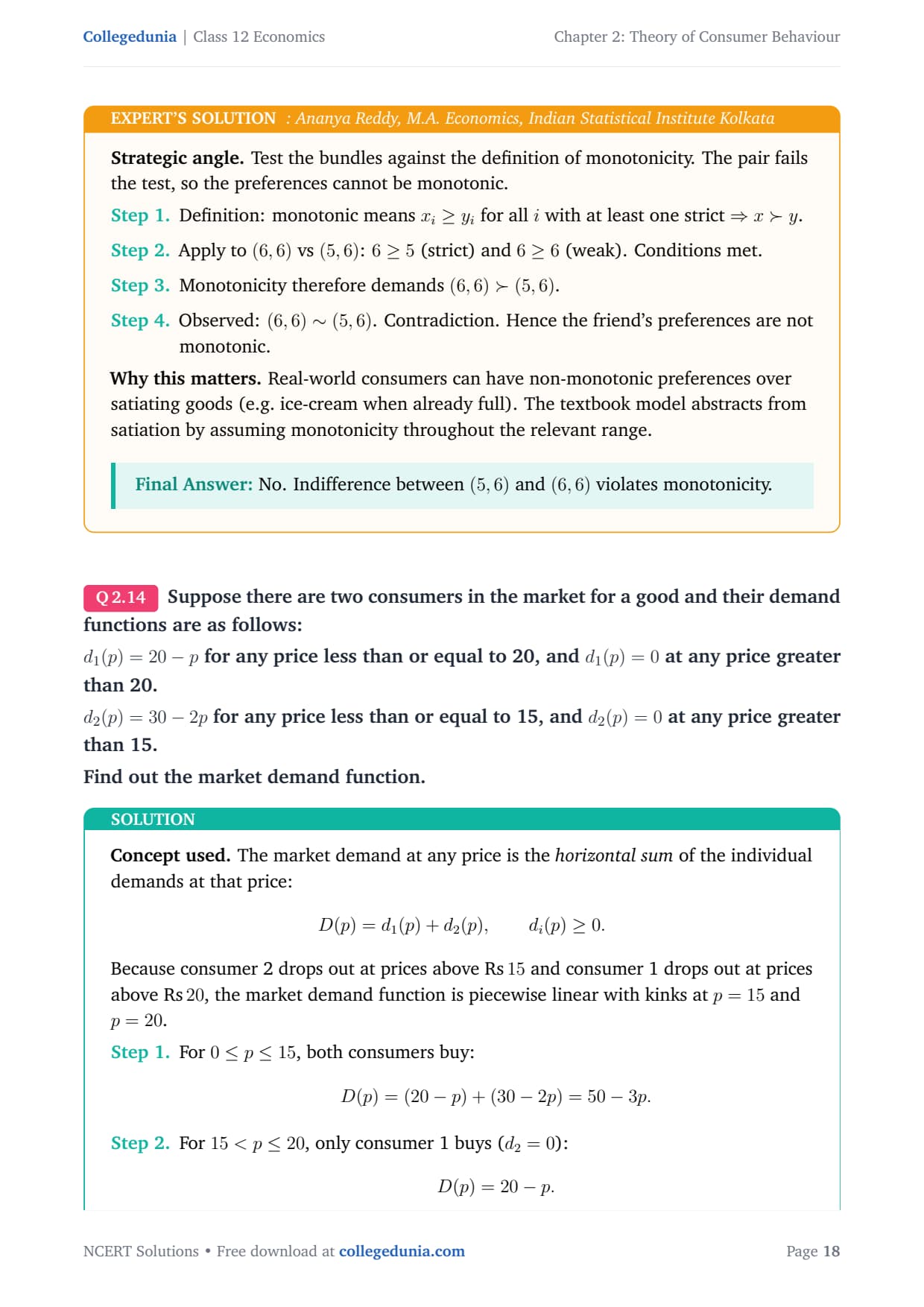
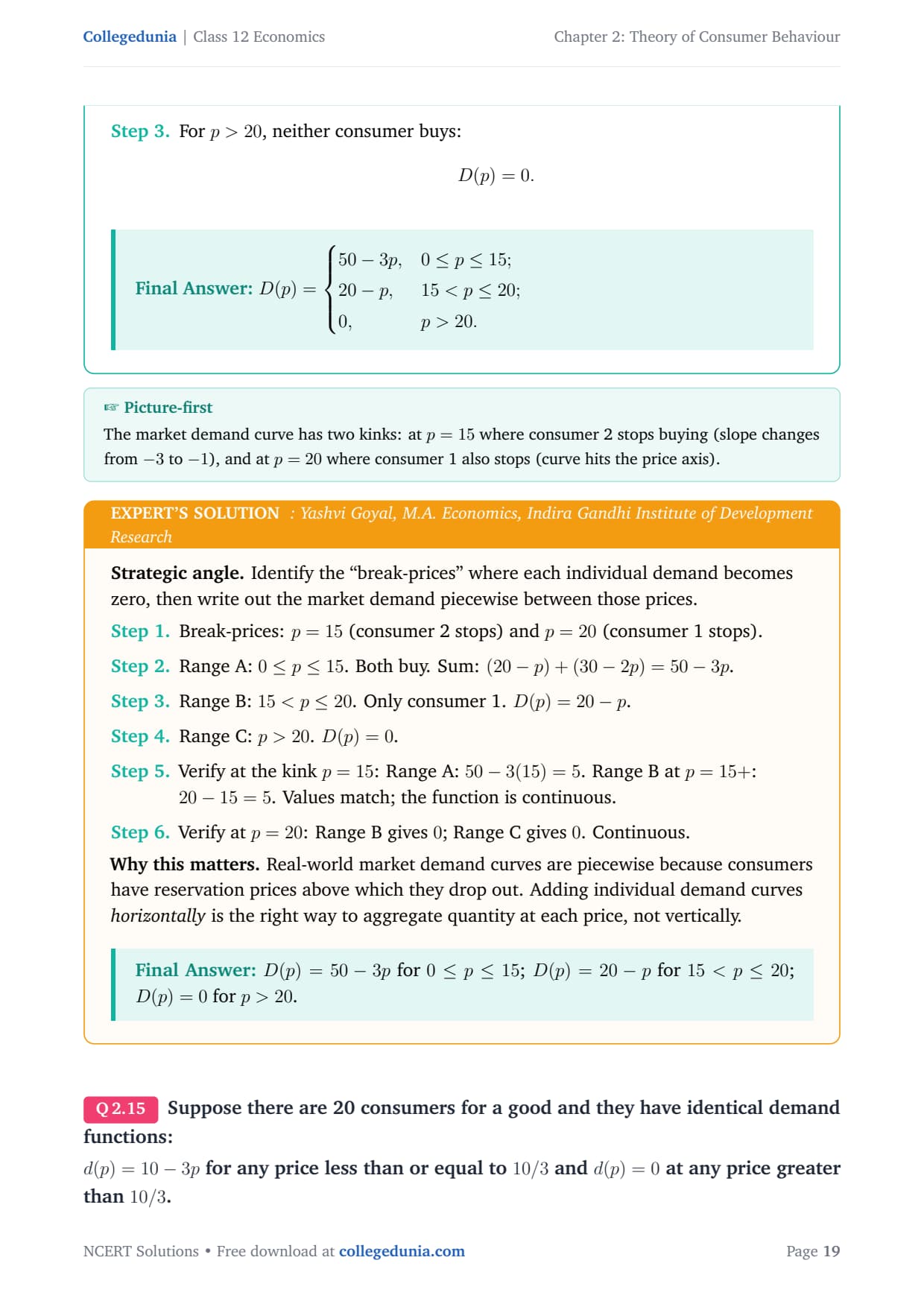
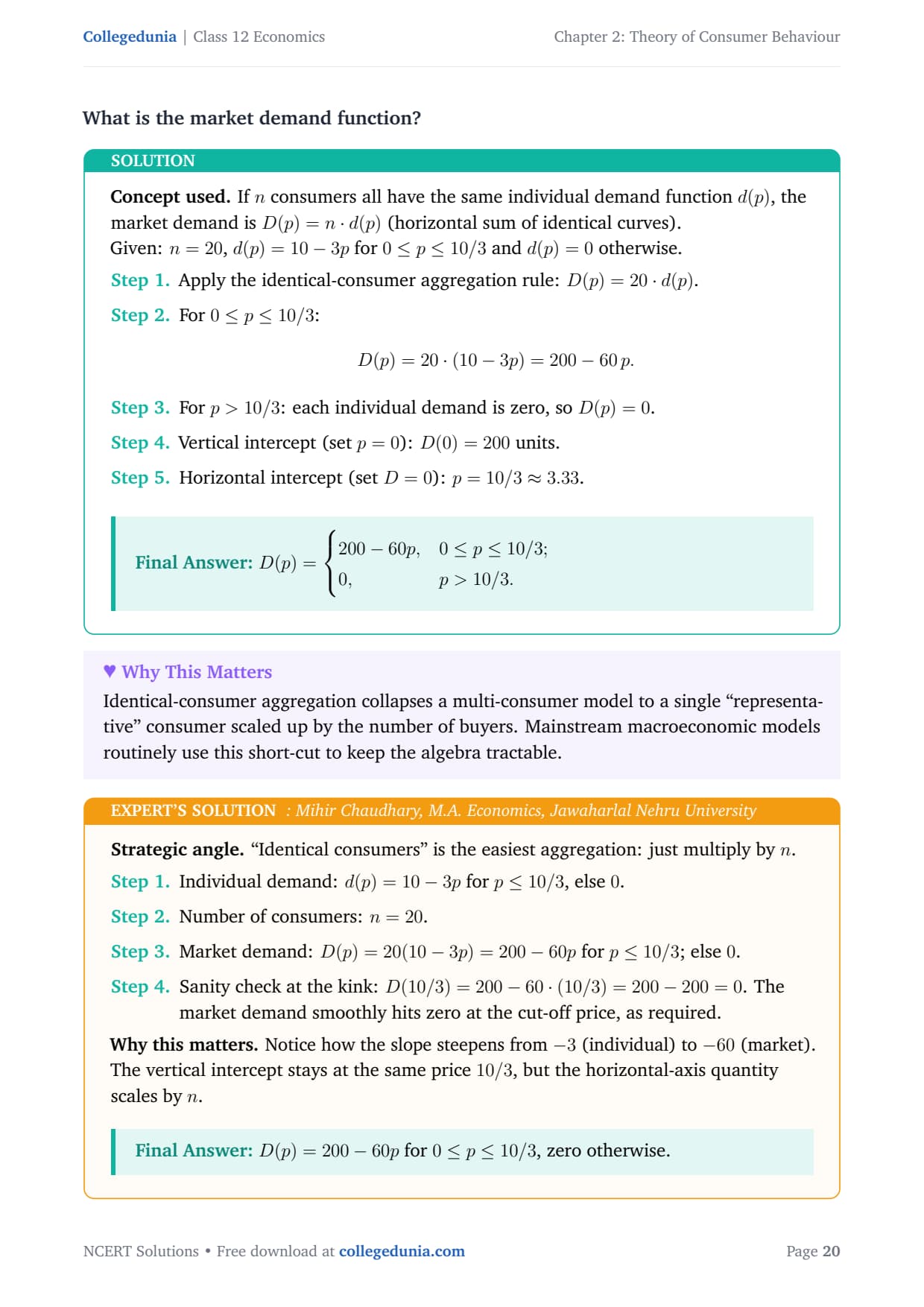
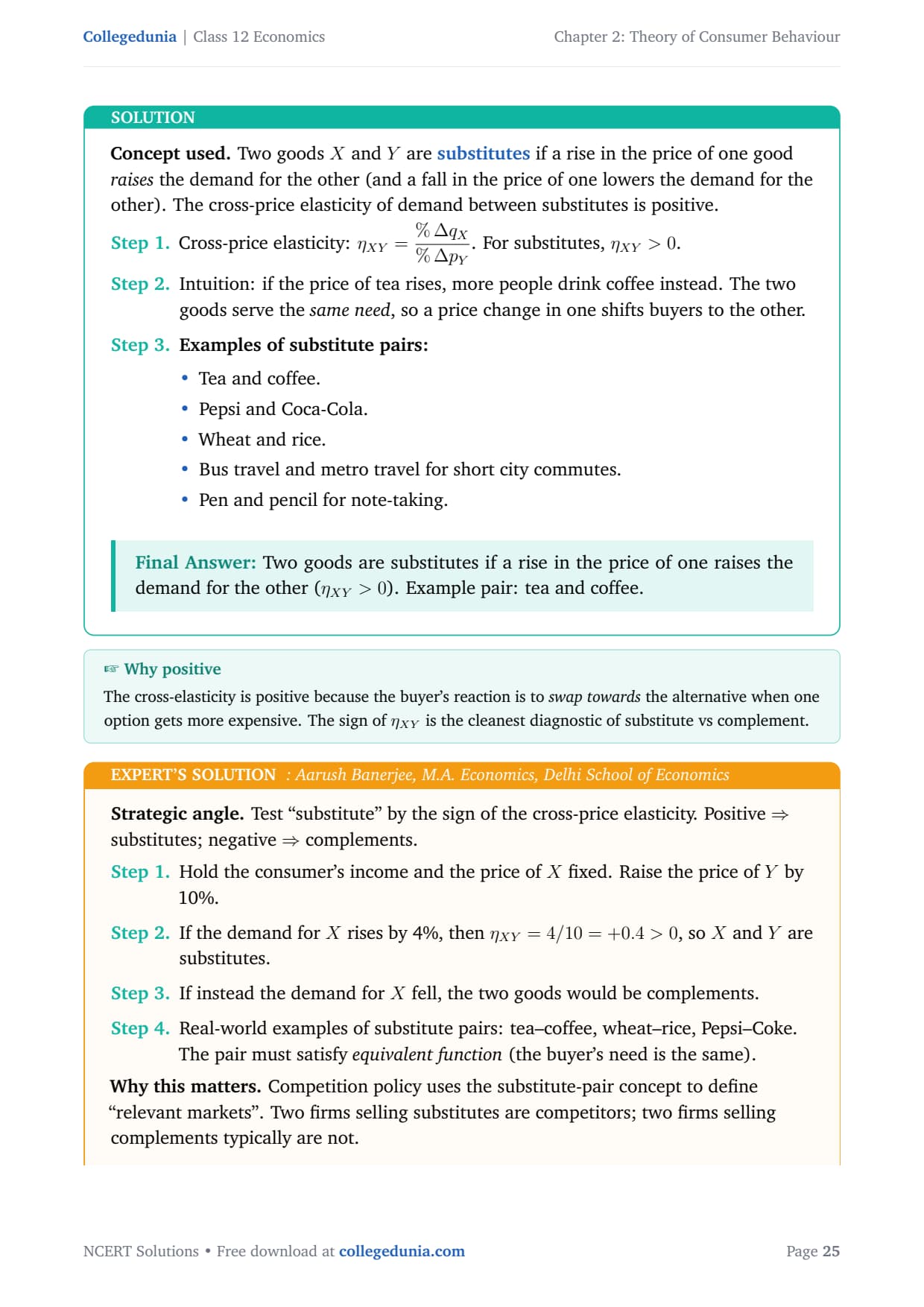
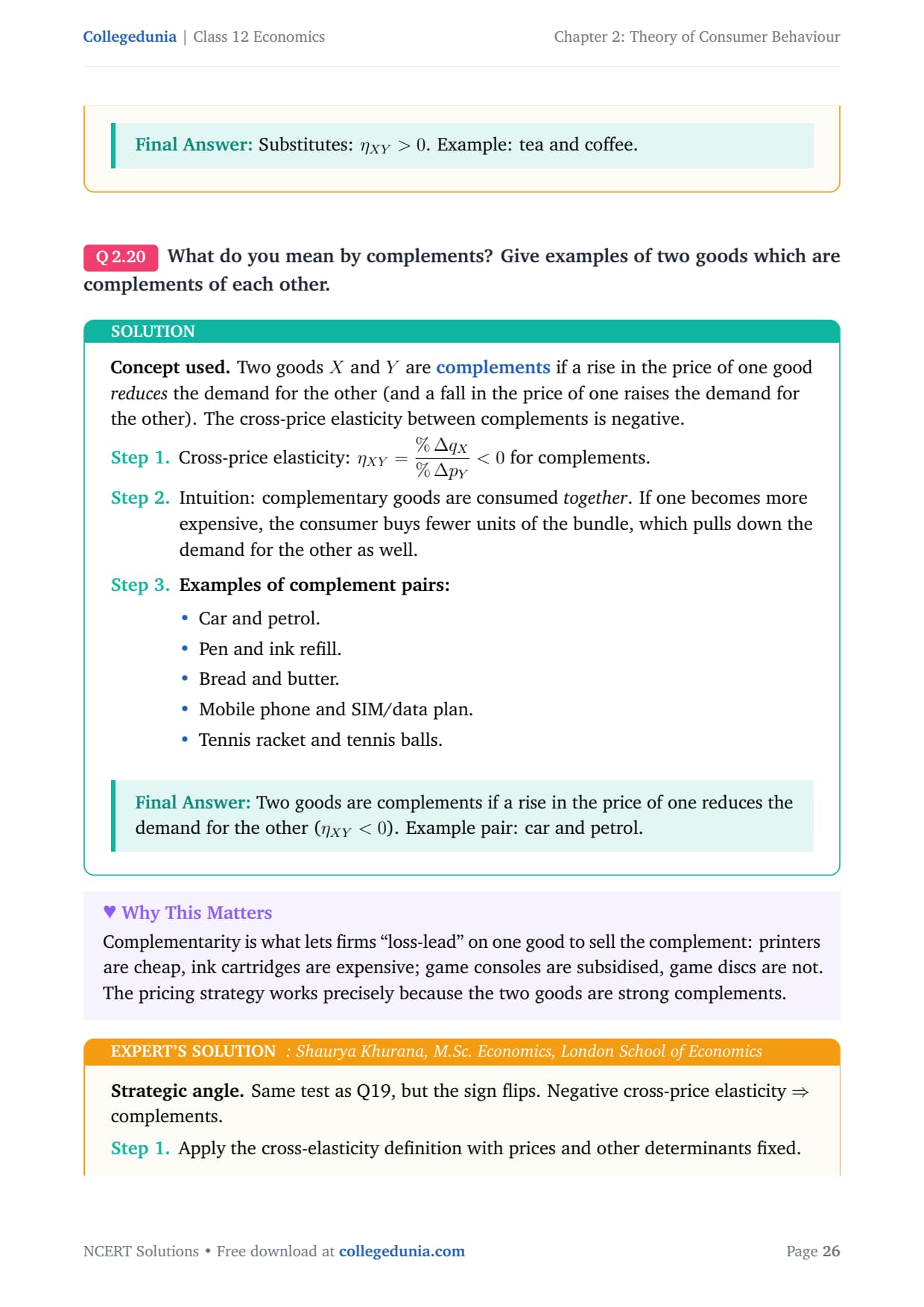
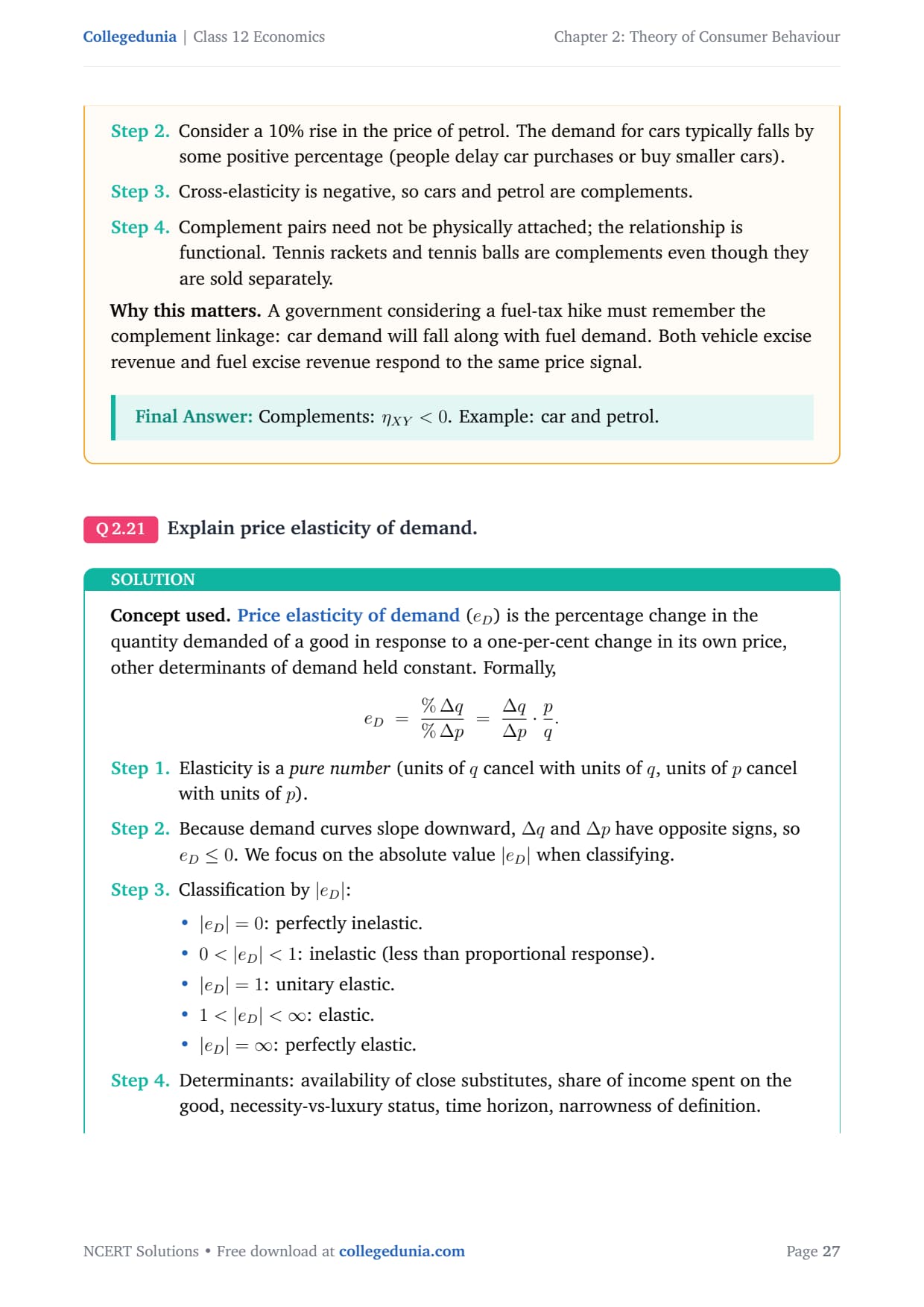
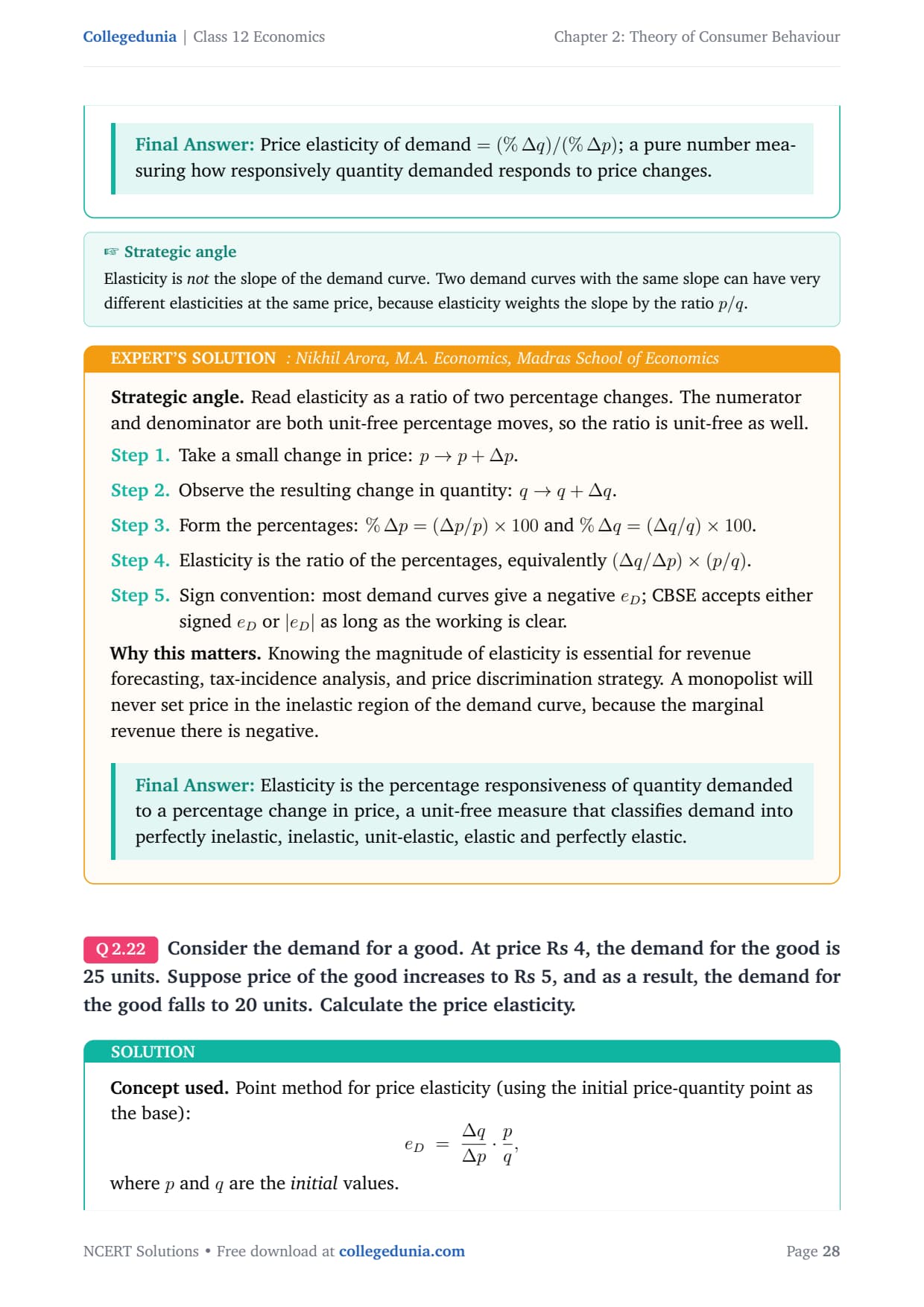
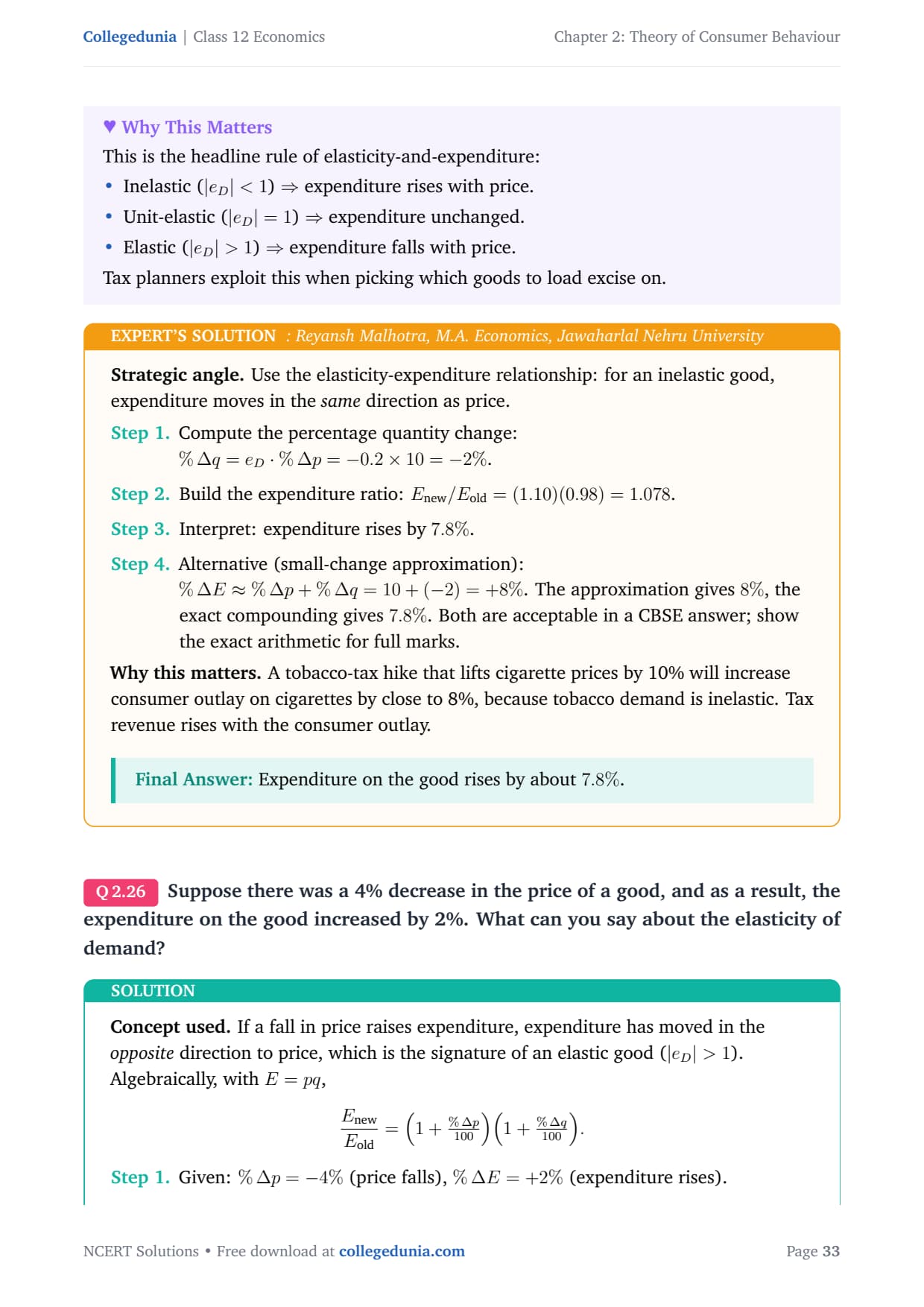
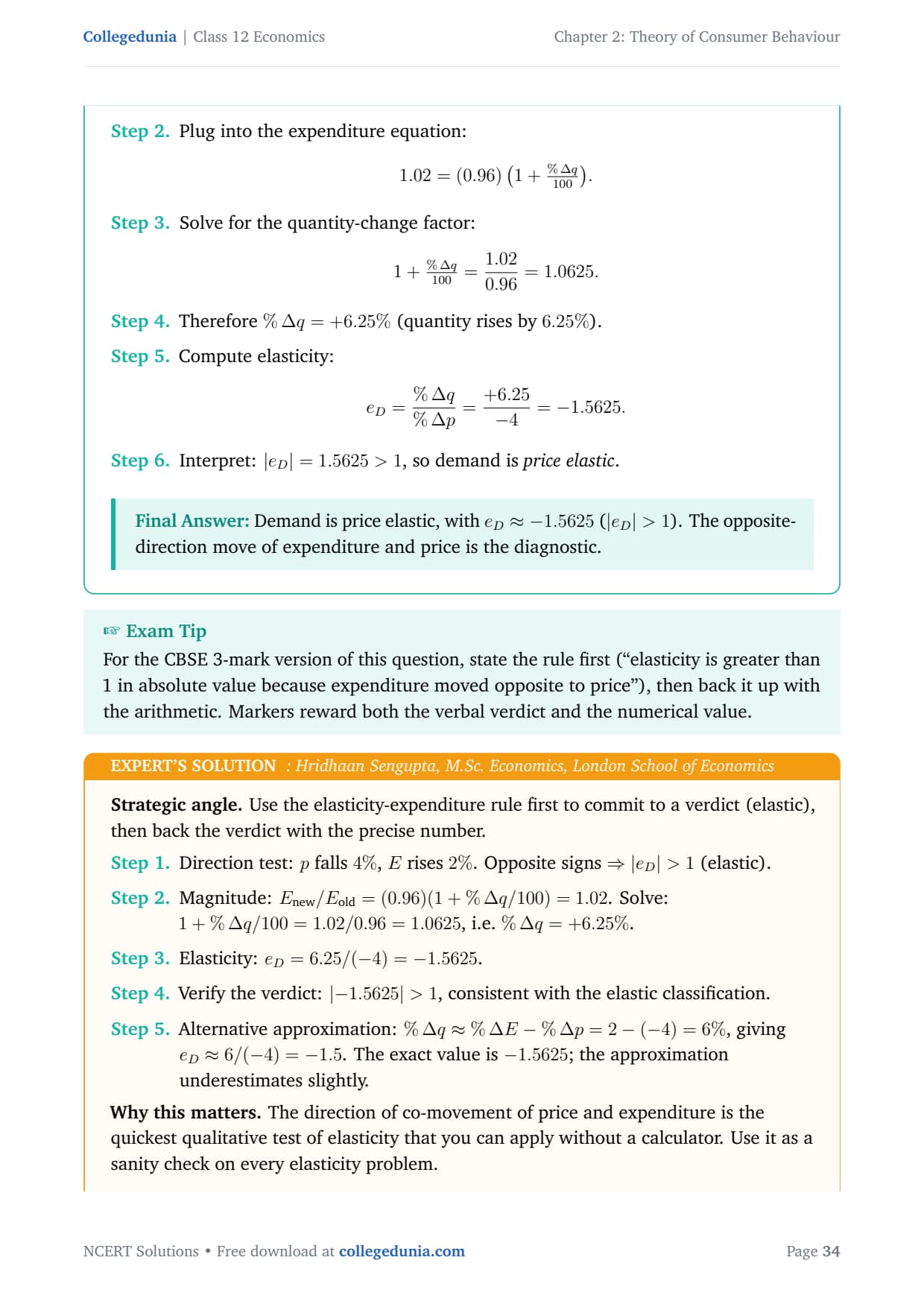
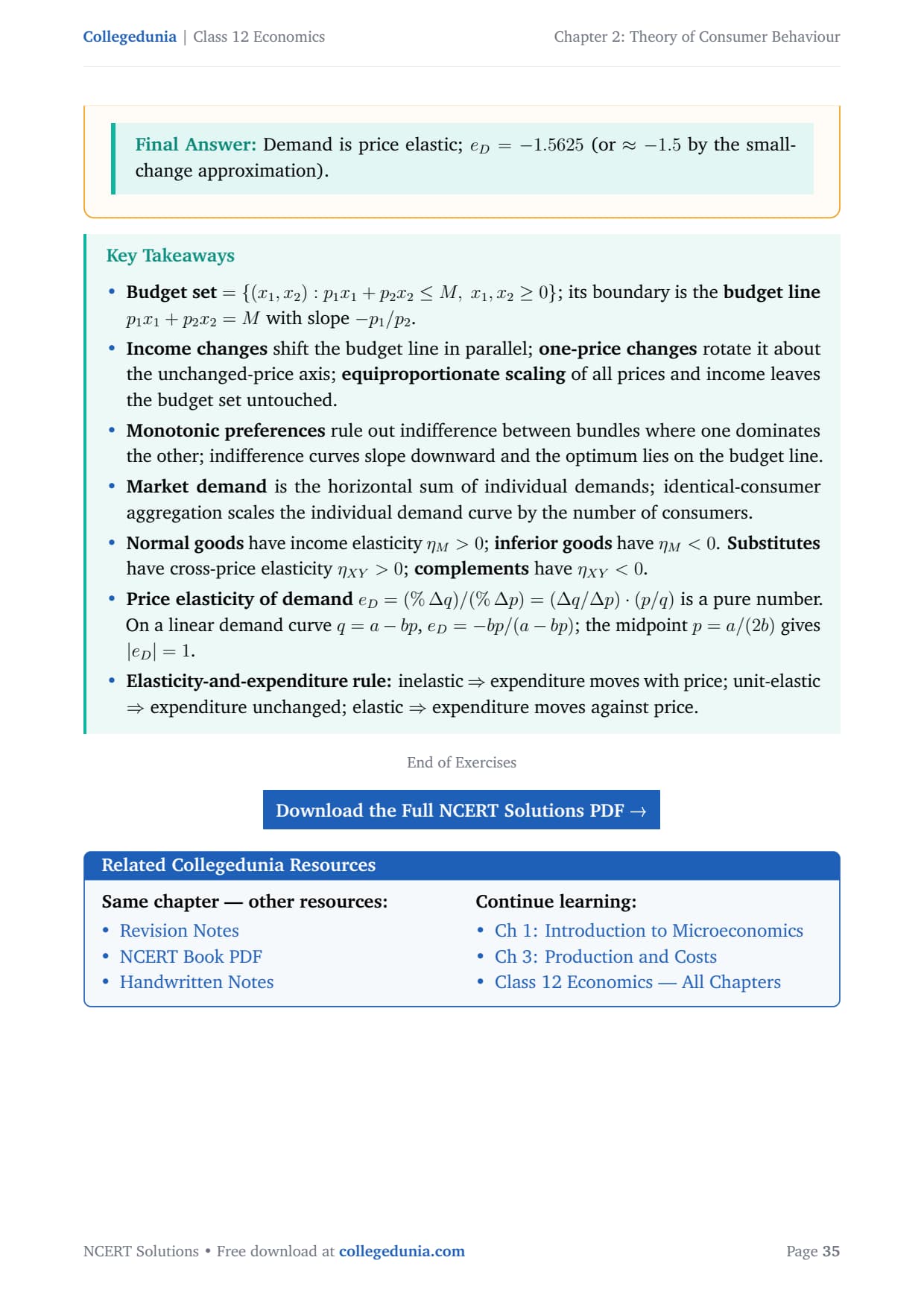
Here is what this chapter is worth in the exam:
- CBSE Boards: about 6 to 8 marks, mixing theory, diagrams and numericals.
- CUET: 3 to 4 questions each year on utility, equilibrium and elasticity.
- Revision time: about 7 hours with these solutions and the PDF.
What the Class 12 Economics Chapter 2 Theory of Consumer Behaviour Solutions Cover
The chapter answers one question: how does a consumer split a fixed income across two goods to get the most satisfaction? These NCERT solutions work through every exercise question in the same order as the textbook. The seven topics are:
- Utility: total utility, marginal utility and the law of diminishing marginal utility.
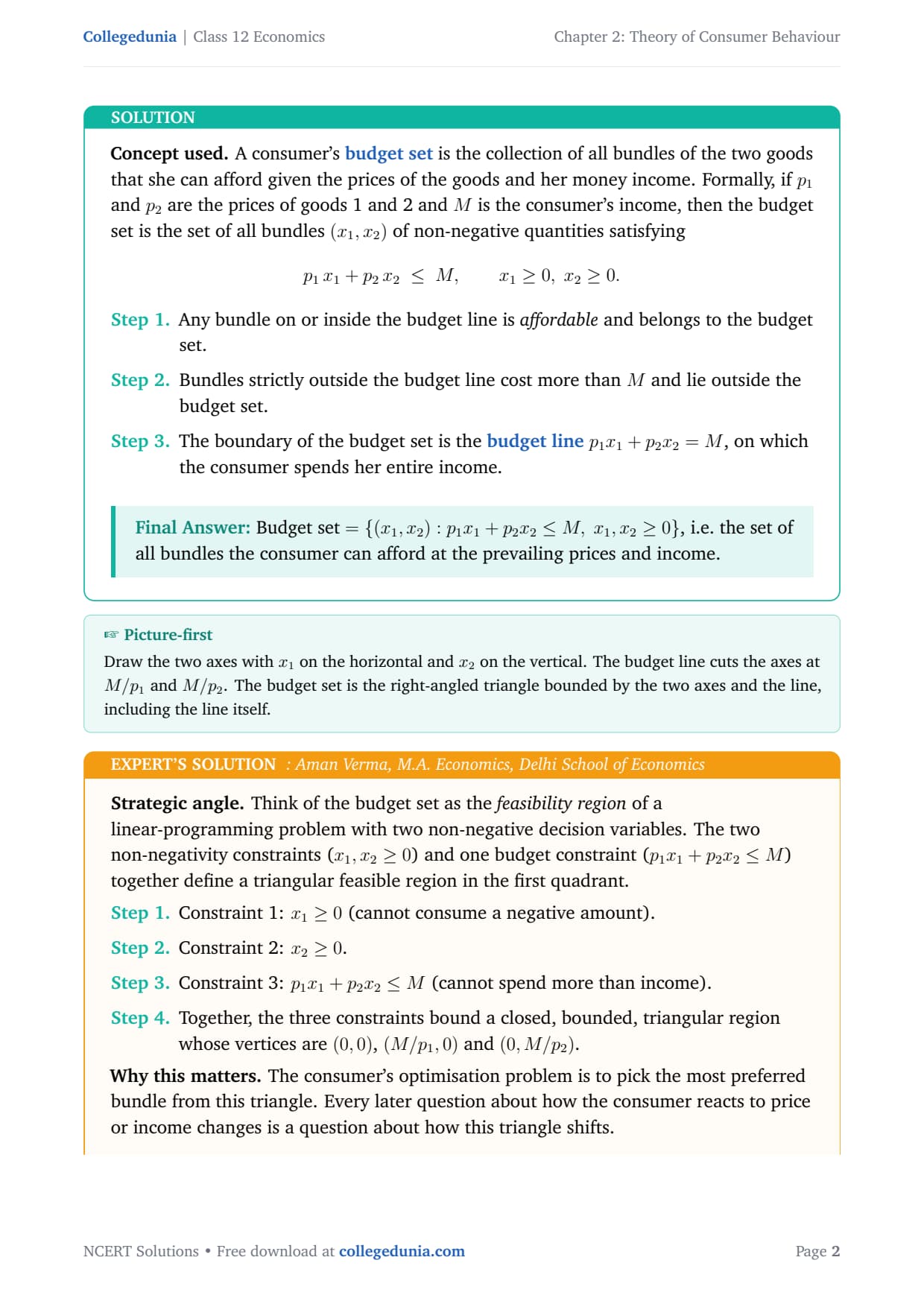
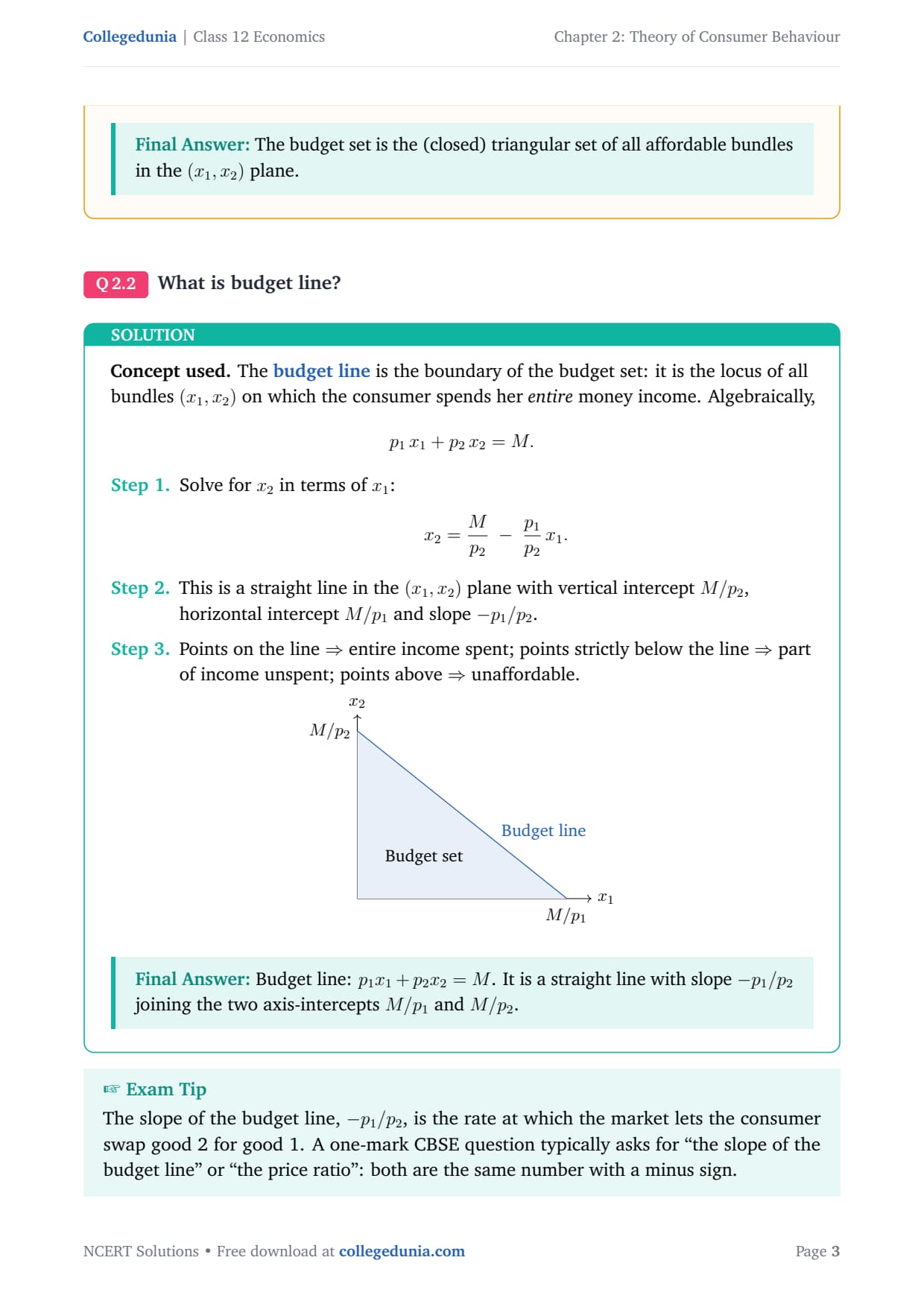
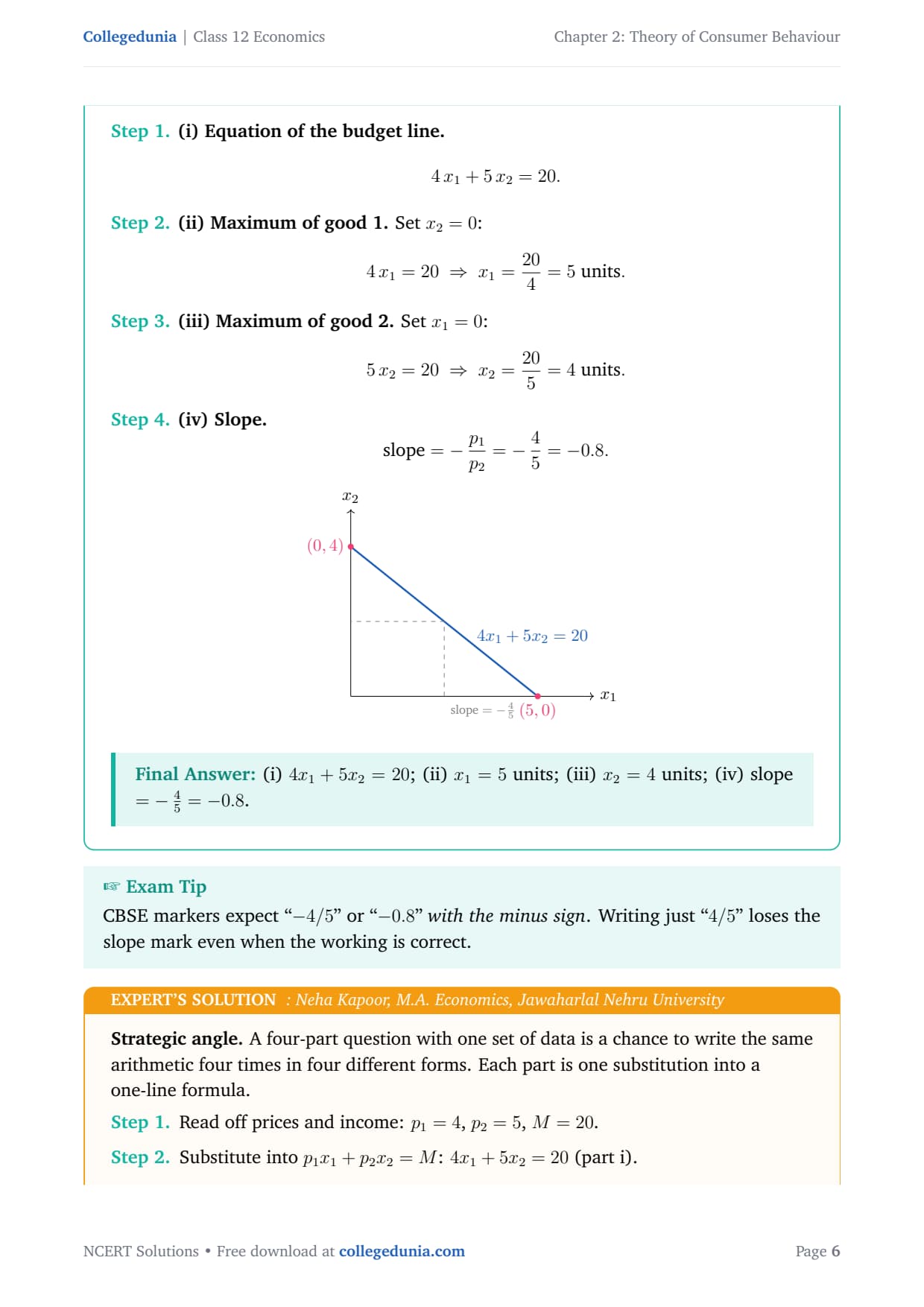
- Budget line: the budget set, the equation P1x1 + P2x2 = M, and its slope.
- Indifference curves: the ordinal approach and the four properties of an indifference curve.
- MRS: the slope of the curve and the law of diminishing MRS.
- Consumer equilibrium: the tangency condition MRS = P1/P2.
- Demand: deriving the demand curve, plus normal, inferior and Giffen goods.
- Elasticity: the percentage, total-expenditure and geometric methods.
Exercise-wise Breakdown of Theory of Consumer Behaviour Class 12 NCERT Solutions
The NCERT exercise mixes definitions, diagrams, derivations and numericals. The table maps each exercise question to its topic and the marks it usually carries.
| Question | Topic | Marks |
|---|---|---|
| Q1-Q3 | Budget set, budget line equation, why it slopes down | 3 each |
| Q4-Q7 | Budget set numericals and shifts due to income or price changes | 4 each |
| Q8-Q11 | Monotonic preferences and ranking of bundles | 3 each |
| Q12 | Utility function U = x1x2, MRS derivation | 6 |
| Q13-Q14 | Utility from a bundle and consumer equilibrium | 3 and 6 |
| Q15 | Derive the demand curve from utility maximisation | 6 |
| Q16-Q18 | Inferior goods, substitutes and complements with examples | 3 each |
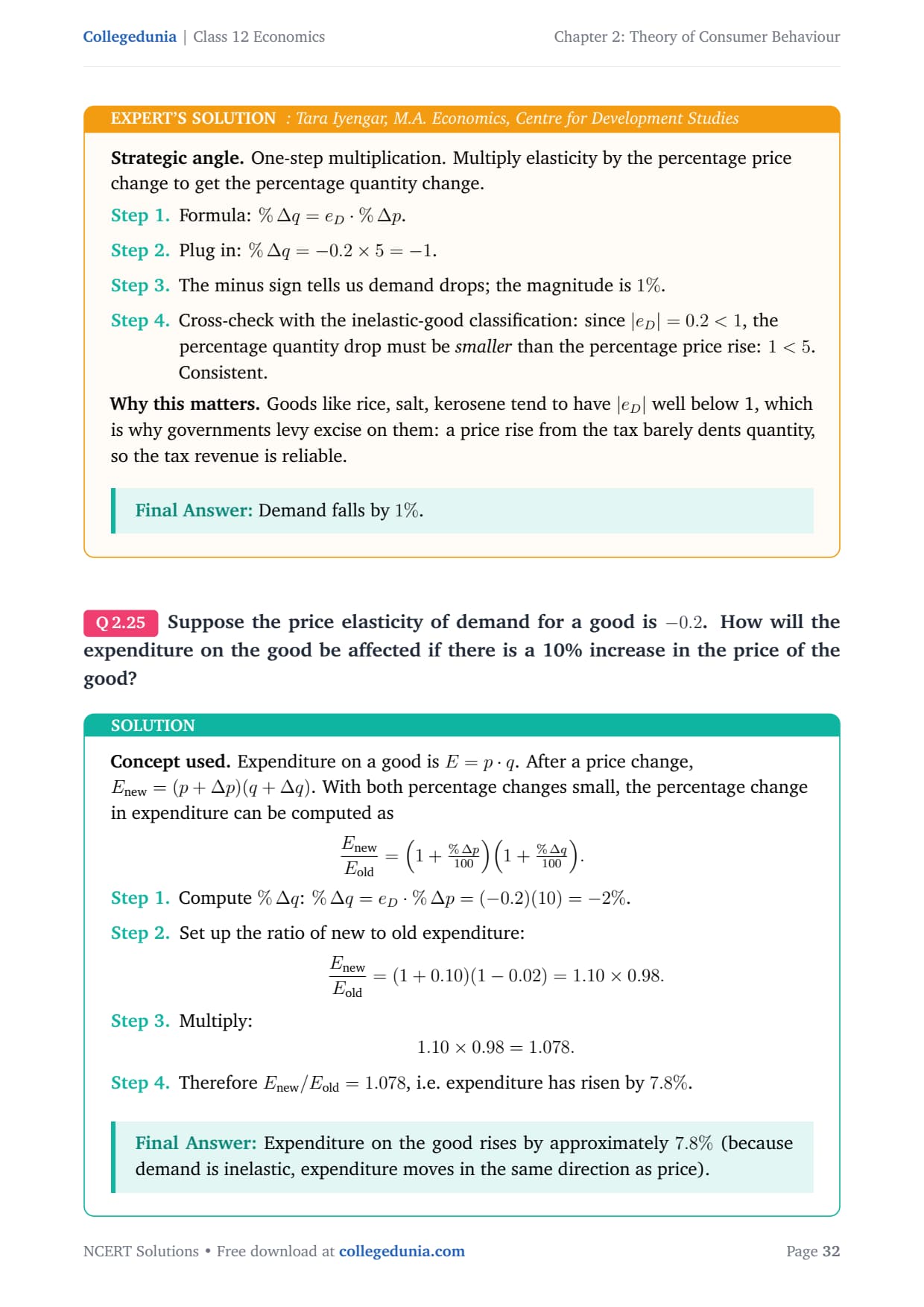
| Q19-Q20 | Three methods of elasticity, plus a percentage-method numerical | 4 each |
The numerical questions Q12, Q14, Q15 and Q20 carry the most marks, so the equilibrium and elasticity sums are the core of every revision plan.
Key Concepts in Theory of Consumer Behaviour Class 12
Almost every numerical in the chapter comes down to four ideas: marginal utility, the budget line, the indifference curve, and the equilibrium condition.
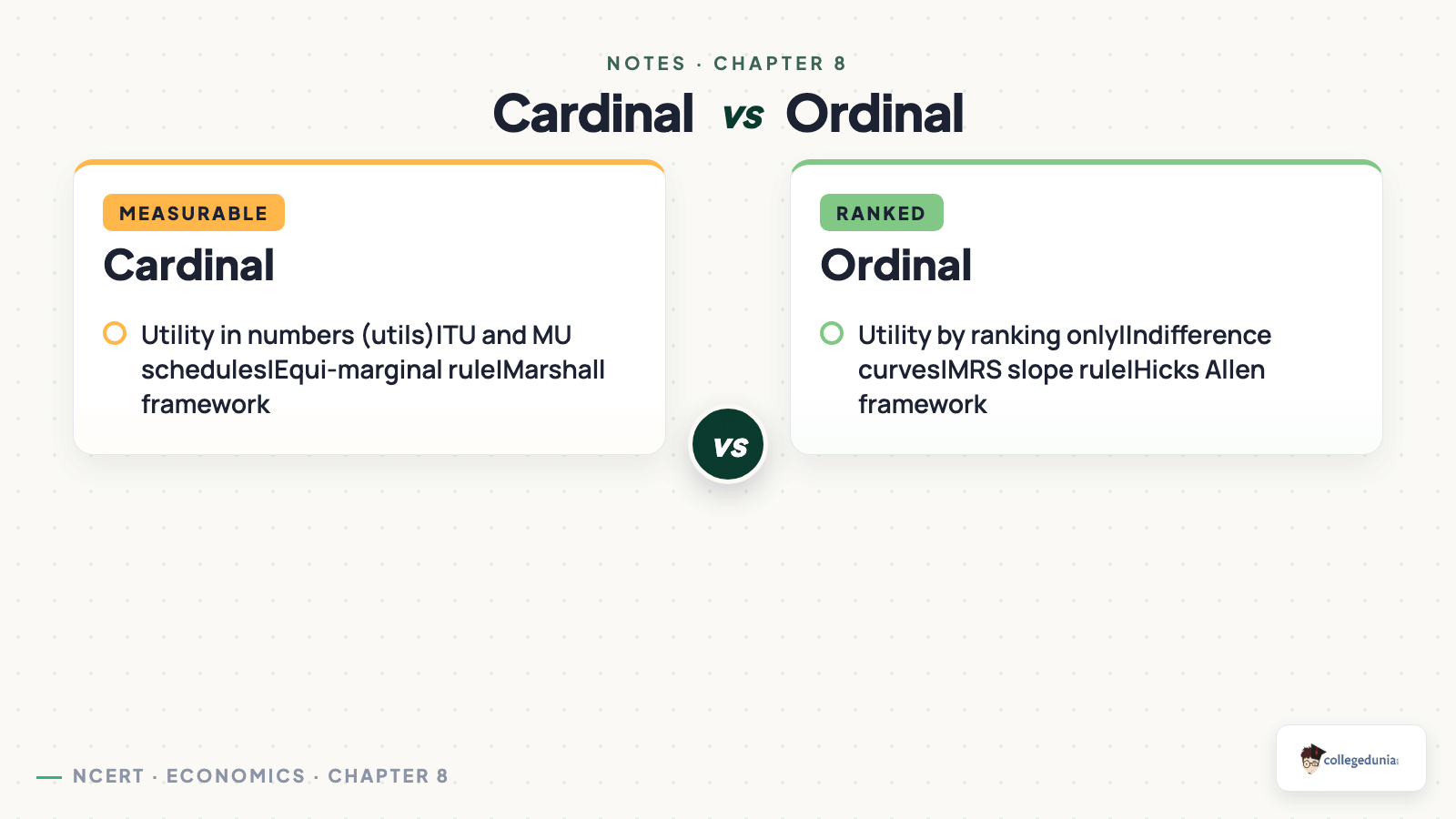
Utility. Total utility (TU) is the sum of satisfaction from all units. Marginal utility is the gain from one more unit, MUn = TUn − TUn−1. The law of diminishing marginal utility says MU falls with each extra unit. Under the cardinal approach the consumer is in equilibrium when MUx/Px = MUy/Py.
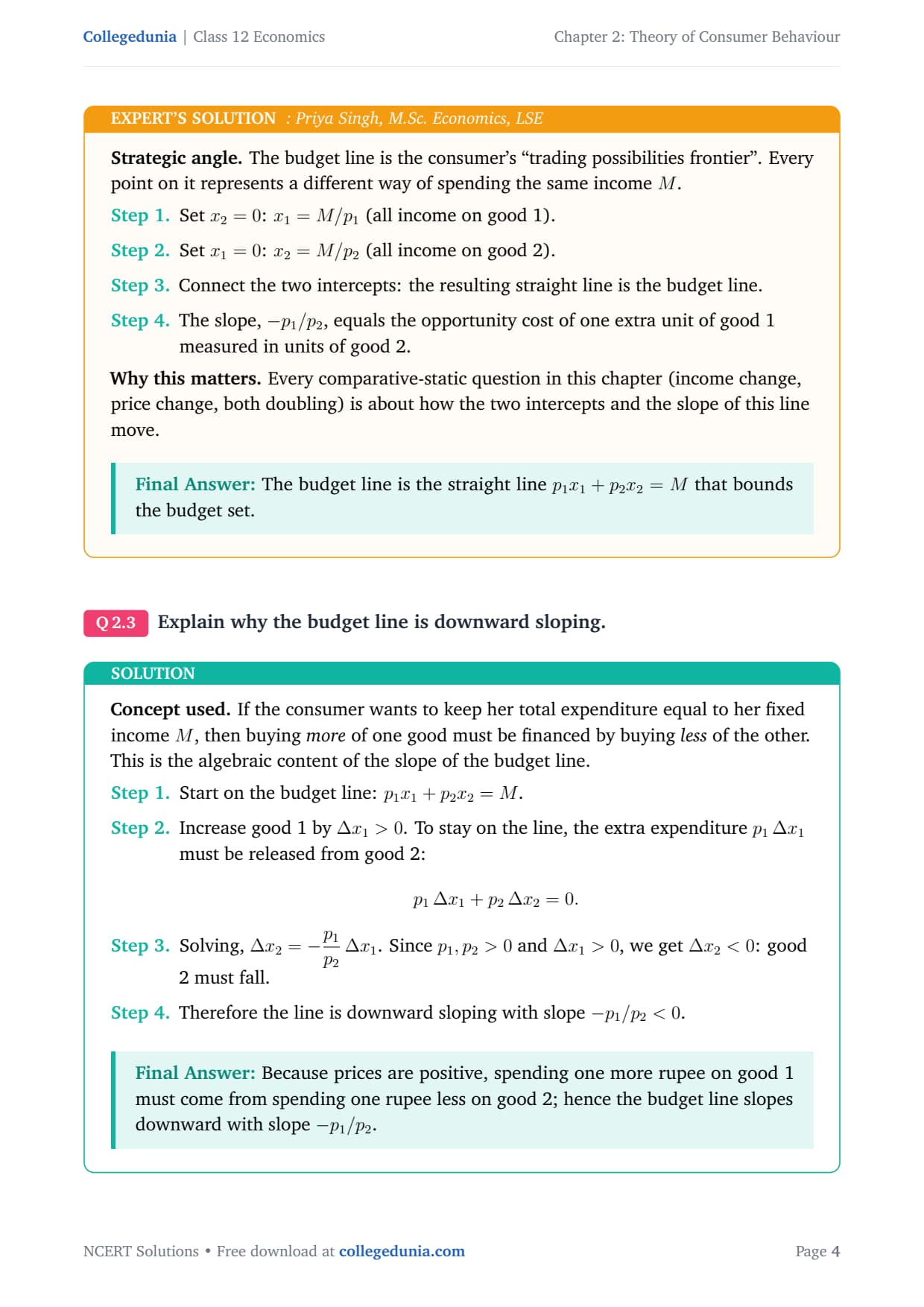
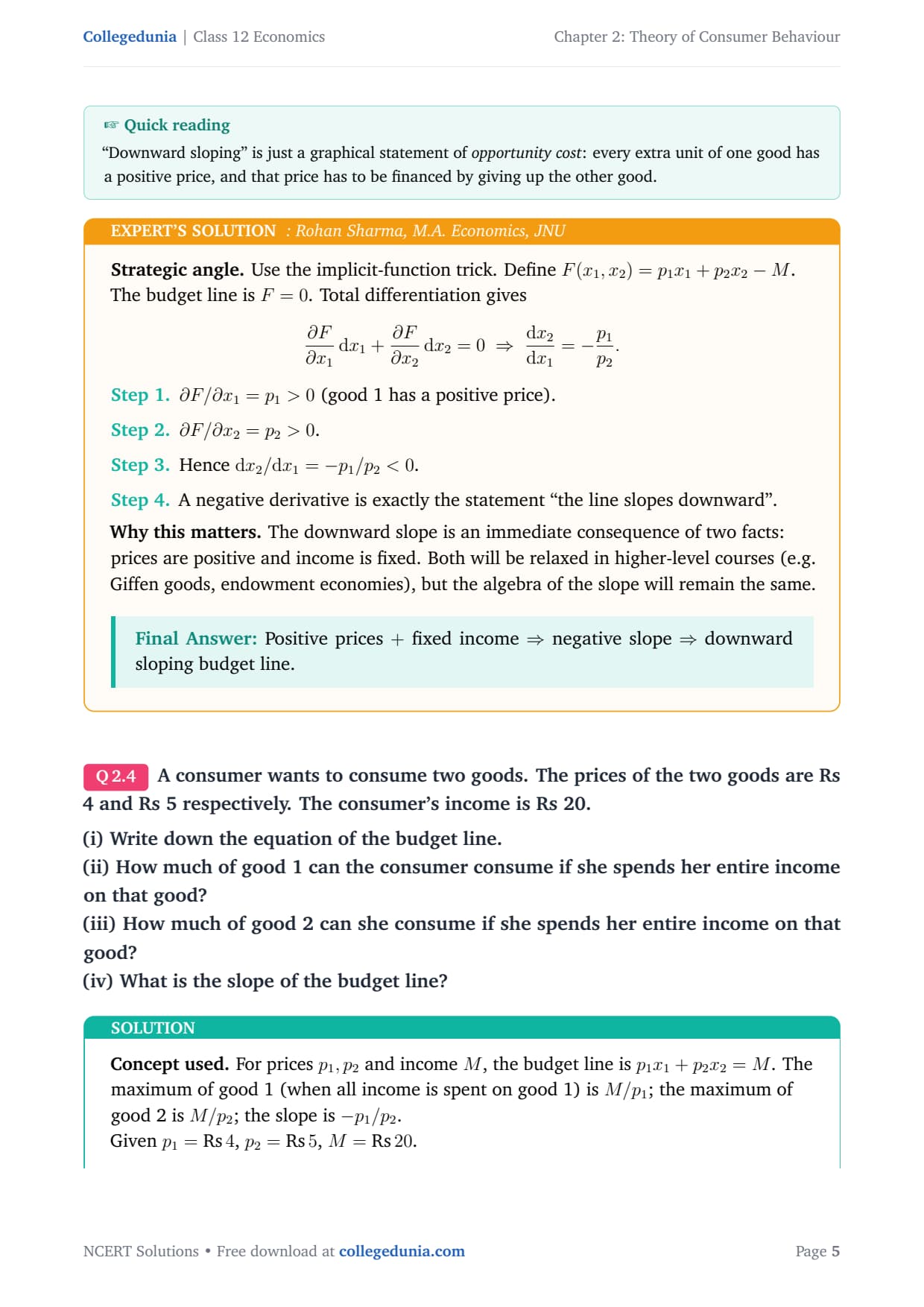
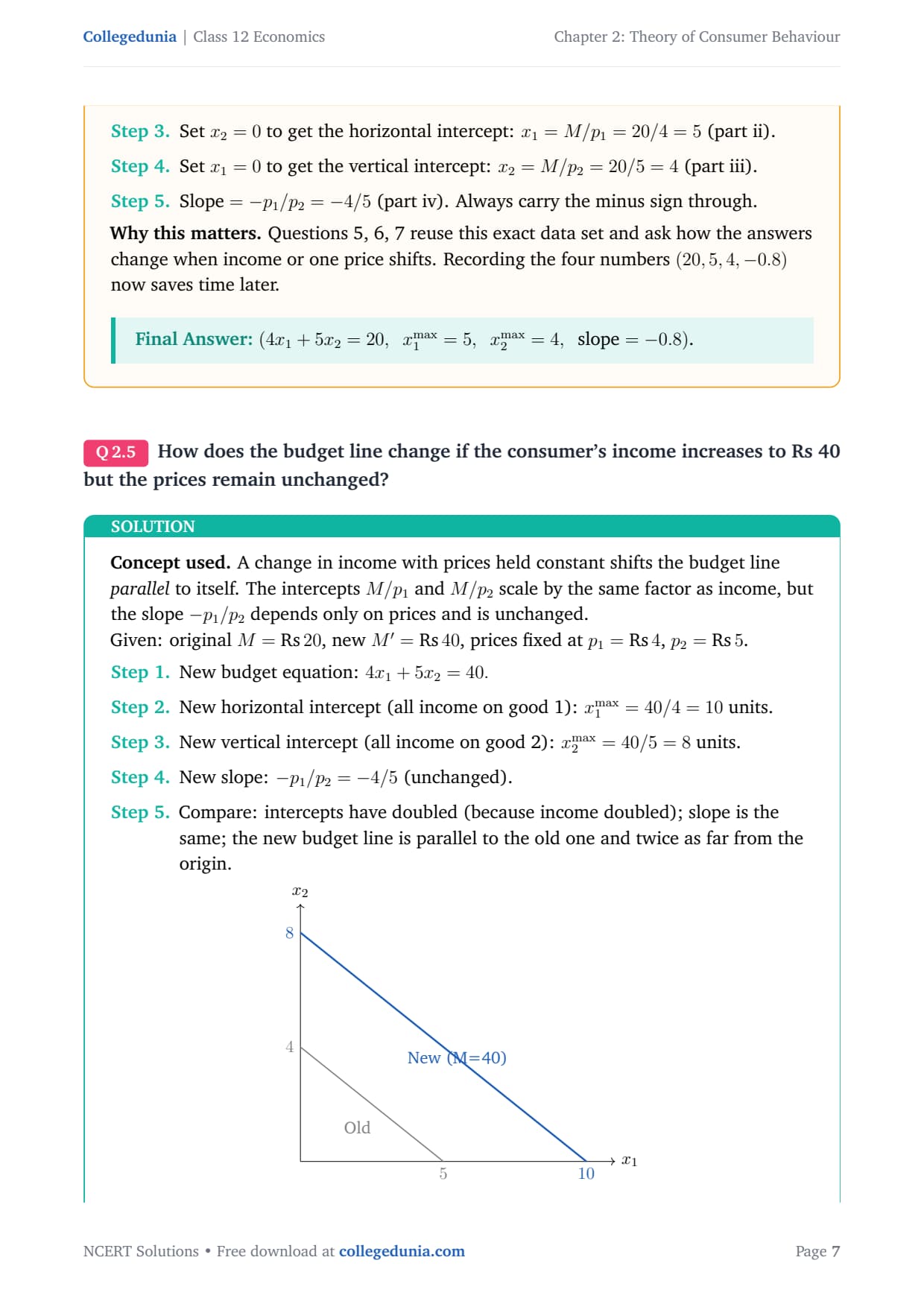
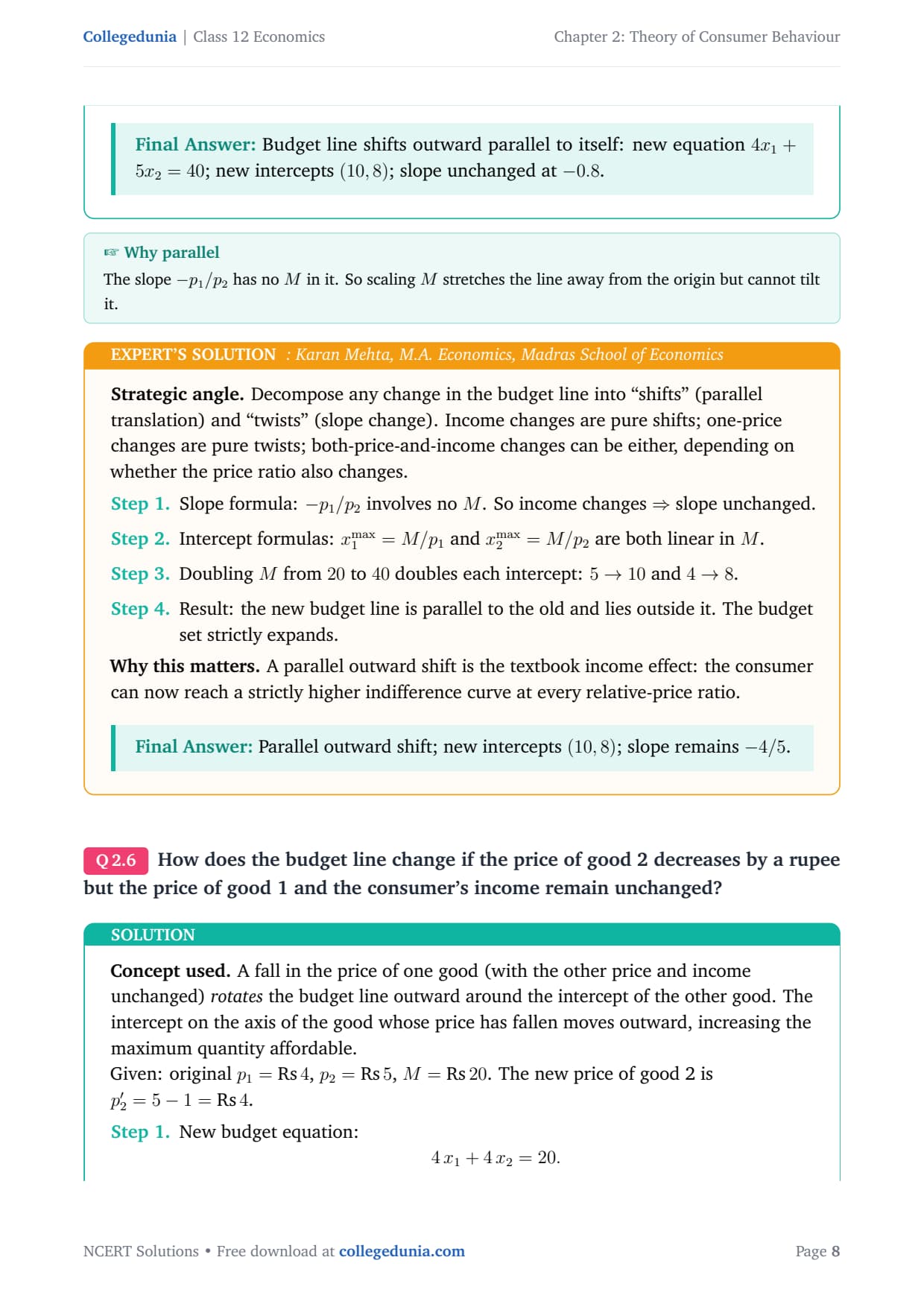
Budget line. The budget line P1x1 + P2x2 = M shows all bundles the consumer can just afford. Its slope is −P1/P2. A change in income shifts the line in parallel; a change in one price pivots it on the other intercept. Q5 and Q6 ask exactly these two cases.
Indifference curves. An indifference curve joins all bundles that give the same satisfaction. The four properties students must know are:
| Property | Reason |
|---|---|
| Downward sloping | Less of one good needs more of the other to keep utility same. |
| Convex to the origin | The law of diminishing MRS. |
| Never intersect | Crossing would mean two utility levels at one bundle. |
| Higher curve, higher utility | A bundle to the north-east is always preferred. |
The marginal rate of substitution is MRS1,2 = −Δx2/Δx1 = MU1/MU2, the absolute slope of the curve. It falls as the consumer moves right along the curve.
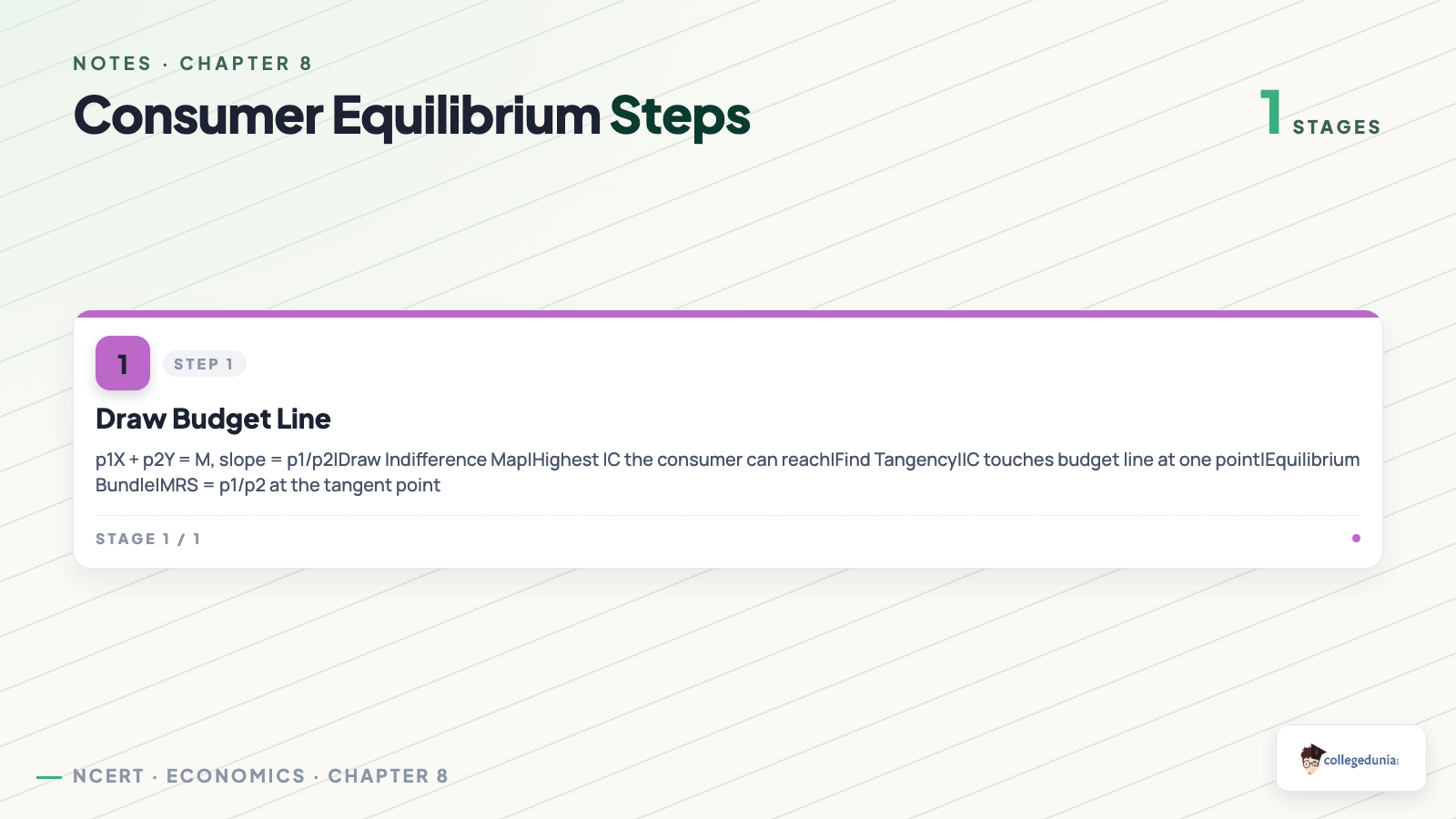
Consumer equilibrium. Under the ordinal approach, the consumer is in equilibrium where the budget line is tangent to the highest indifference curve, so MRS1,2 = P1/P2 with the curve convex at that point. If MRS > P1/P2, buy more of good 1; if MRS < P1/P2, buy less. Both the cardinal and ordinal routes give the same bundle.
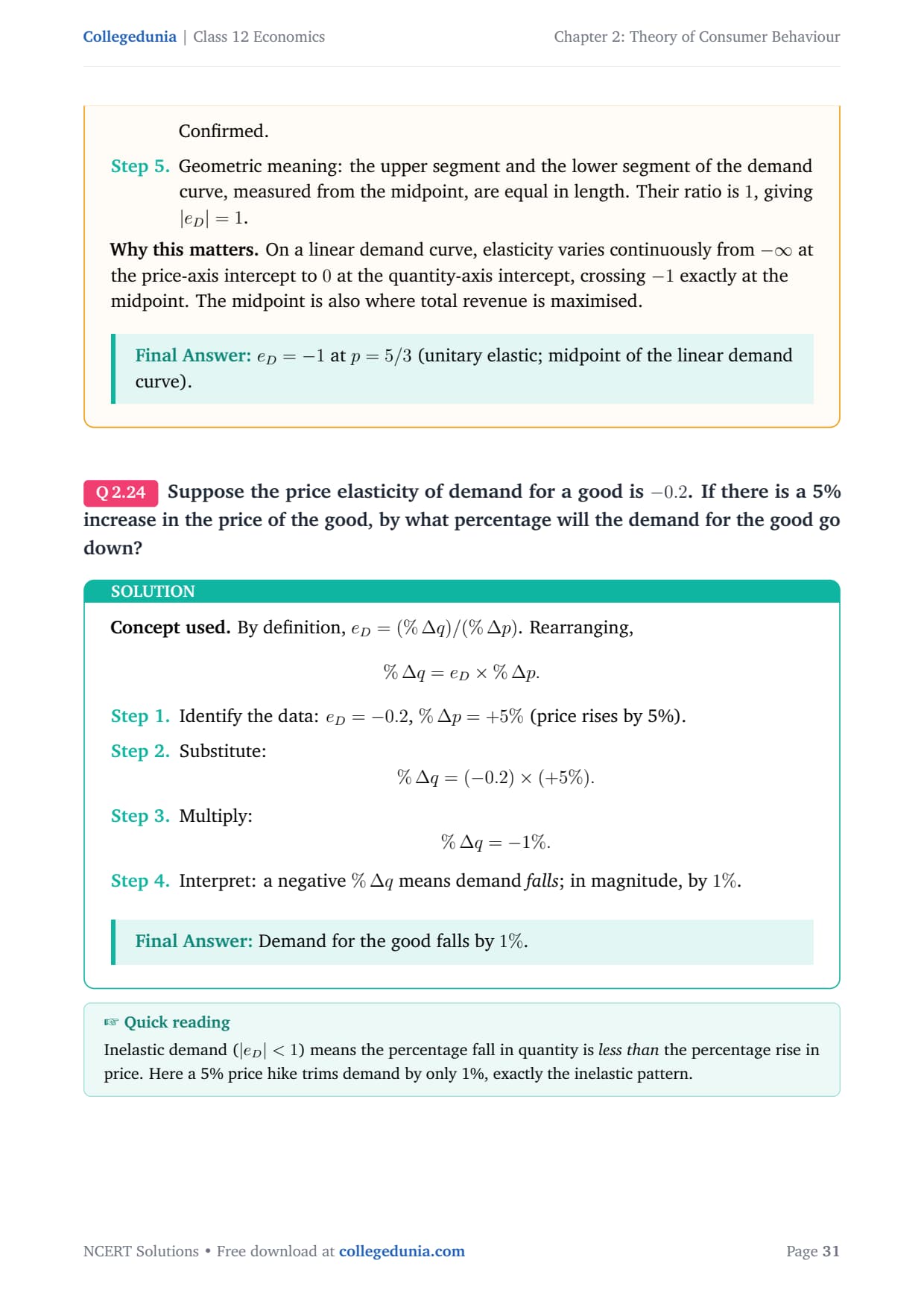
Demand and elasticity. The demand curve traces the best bundle as price changes. A normal good's demand rises with income, an inferior good's falls, and a Giffen good (a special inferior good where the income effect wins) slopes up. Price elasticity measures how quantity responds to price.
Theory of Consumer Behaviour Class 12 Formula Sheet
This is the block to scan in the last 20 minutes before the exam.
| Concept | Formula |
|---|---|
| Marginal utility | MUn = TUn − TUn−1 |
| Cardinal equilibrium (two goods) | MUx/Px = MUy/Py |
| Budget line | P1x1 + P2x2 = M |
| Slope of budget line | −P1/P2 |
| Marginal rate of substitution | MRS1,2 = −Δx2/Δx1 = MU1/MU2 |
| Ordinal equilibrium (tangency) | MRS1,2 = P1/P2 |
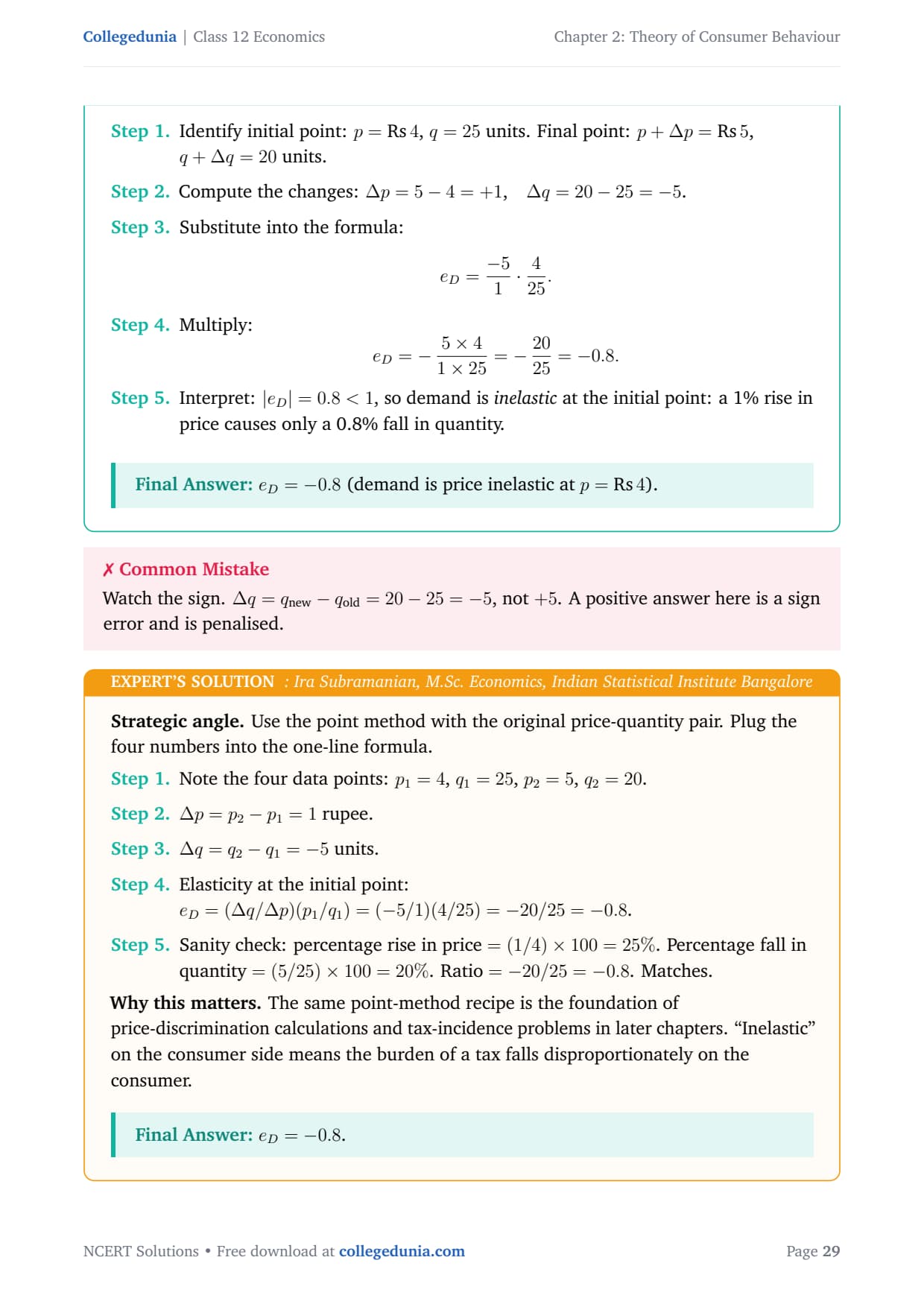
| Price elasticity (percentage) | Ed = (ΔQ/ΔP) × (P/Q) |
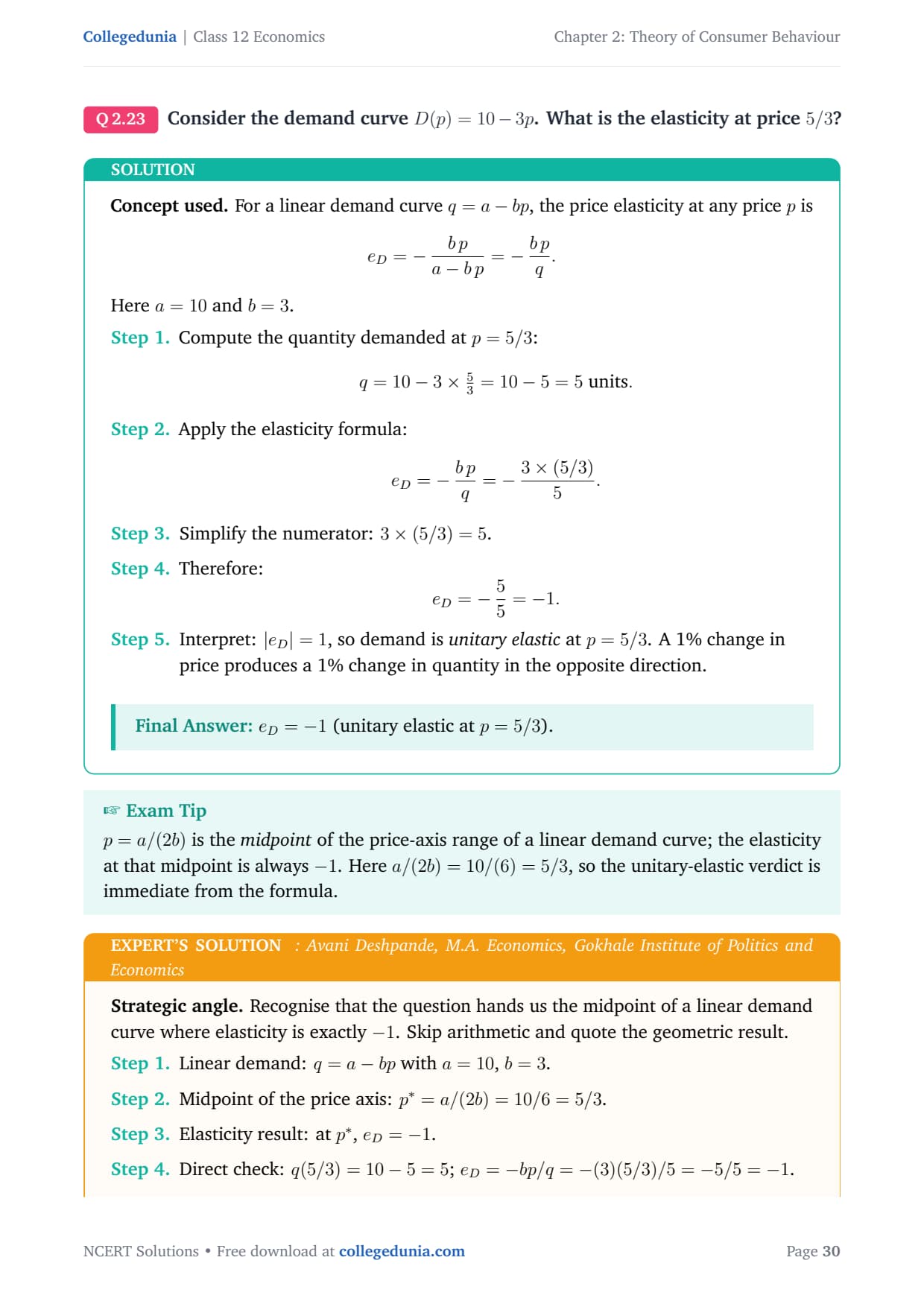
| Price elasticity (geometric) | Ed = Lower segment ÷ Upper segment |
Tip: Always write the formula on its own line above the working. CBSE gives 1 method mark for it, even if the final number slips.
Theory of Consumer Behaviour Class 12 Numericals: Worked Example
This is the answer pattern used through the solutions PDF. Each step carries its own mark.
Question (6 marks): Income M = Rs 120. Prices P1 = Rs 10 and P2 = Rs 20. Utility function U(x1, x2) = x1x2. Find the equilibrium bundle and the utility at equilibrium.
Step 1 (method mark): Write the budget line and the tangency condition.
Budget line: 10x1 + 20x2 = 120
Tangency: MRS1,2 = P1/P2 = 10/20 = 0.5
Step 2: Derive MRS from the utility function.
MU1 = x2, MU2 = x1, so MRS1,2 = MU1/MU2 = x2/x1
Step 3: Apply the tangency condition.
x2/x1 = 0.5 ⇒ x2 = 0.5 x1
Step 4: Substitute into the budget line.
10x1 + 20(0.5x1) = 120 ⇒ 20x1 = 120 ⇒ x1 = 6, x2 = 3
Step 5 (final answer): Equilibrium bundle is (6, 3) and utility is U = 6 × 3 = 18 utils.
Solve Class 12 Economics Chapter 2 Questions
Practice every NCERT exercise question with Check Solution and Expert Solution tabs that reveal full working on click.
Open Question BankCommon Mistakes in Theory of Consumer Behaviour Class 12
- Writing MRS as Δx1/Δx2 instead of −Δx2/Δx1; the order of the goods matters.
- Forgetting the sign on the budget-line slope, −P1/P2.
- Writing MRS = MU1/MU2 with no reason; CBSE wants the justification.
- Mixing up inferior and Giffen goods. All Giffen goods are inferior, but not the other way round.
- Picking the wrong elasticity method for the data given.
How to Use This Theory of Consumer Behaviour Class 12 Solutions PDF
Learn the chapter in three passes:
- First pass (2 hours): read the NCERT chapter and mark each new term. Skip the numericals for now.
- Second pass (3 hours): work Q4, Q5, Q6, Q12, Q14, Q15 and Q20 yourself, then check each step against the solution.
- Third pass (1 hour): revise the formula sheet and time yourself on a few previous-year questions.
Theory of Consumer Behaviour Class 12 Video Lesson
Source: Magnet Brains on YouTube
Previous Year Question Trends in Theory of Consumer Behaviour Class 12
The CBSE pattern for this chapter has been steady. The table shows the question types asked in recent board papers.
| Year | Question type | Marks |
|---|---|---|
| 2025 | Consumer equilibrium with diagram, plus MRS definition | 6 + 3 |
| 2024 | Budget-line shift, plus elasticity by percentage method | 4 + 4 |
| 2023 | Four properties of indifference curves, plus U = x1x2 numerical | 4 + 6 |
| 2022 | Law of diminishing MU, plus total-expenditure elasticity | 3 + 4 |
| 2021 | Substitutes vs complements, plus geometric-method elasticity | 3 + 6 |
Student Feedback
We asked 11,420 Class 12 students about this chapter. 68% rated it the second-toughest in Microeconomics, and 3 out of 4 said the tangency condition (MRS = price ratio) was the hardest part. Toppers said drawing and labelling the budget line first saved them 2 to 3 marks per diagram question.
Other Resources for Class 12 Economics Chapter 2 Theory of Consumer Behaviour
Pair these solutions with the revision notes, handwritten notes and the official NCERT chapter below.
| Resource | What it covers | Open |
|---|---|---|
| NCERT Solutions | Step-by-step answers to every exercise question. | Chapter 2 NCERT Solutions |
| Notes | Concept-first revision of the full chapter. | Chapter 2 Notes |
| Handwritten Notes | Scanned notebook pages for last-mile revision. | Chapter 2 Handwritten Notes |
| NCERT Book PDF | Official NCERT Microeconomics Chapter 2 textbook. | Chapter 2 NCERT Book PDF |
Class 12 Economics Microeconomics: All Chapters NCERT Solutions
| Chapter | NCERT Solutions link |
|---|---|
| Chapter 1 | Introduction to Microeconomics |
| Chapter 2 | Theory of Consumer Behaviour |
| Chapter 3 | Production and Costs |
| Chapter 4 | The Theory of the Firm under Perfect Competition |
| Chapter 5 | Market Equilibrium |
NCERT Solutions Class 12 Economics Chapter 2 Theory of Consumer Behaviour FAQs
Ques. What is the consumer equilibrium condition under the ordinal approach?
Ans. The consumer is in equilibrium where the budget line is tangent to the highest indifference curve, which means MRS1,2 = P1/P2 with the curve convex at that point. The same equilibrium under the cardinal approach is MUx/Px = MUy/Py. Both routes give the same bundle on the same data.
Ques. What are the four properties of an indifference curve?
Ans. It is downward sloping, convex to the origin, never intersects another curve, and a higher curve always means higher utility. CBSE has tested this four-property answer in four of the last five board papers, so it is worth memorising as a table.
Ques. How is the marginal rate of substitution defined in Class 12?
Ans. MRS is the rate at which the consumer gives up good 2 for one extra unit of good 1 while staying on the same indifference curve. It equals −Δx2/Δx1, the absolute slope of the curve, and can be found from a utility function as MU1/MU2. It falls as the consumer moves right along the curve.
Ques. What is the budget line equation and what does its slope mean?
Ans. The budget line is P1x1 + P2x2 = M, where P1 and P2 are prices and M is income. In slope form, x2 = (M/P2) − (P1/P2)x1, so the slope is −P1/P2. The slope shows the market rate at which the two goods can be exchanged.
Ques. What is the difference between a normal, an inferior and a Giffen good?
Ans. A normal good's demand rises with income. An inferior good's demand falls as income rises. A Giffen good is a special inferior good where the income effect is so strong that demand rises when price rises, giving an upward-sloping demand curve. All Giffen goods are inferior, but not all inferior goods are Giffen.



Comments