




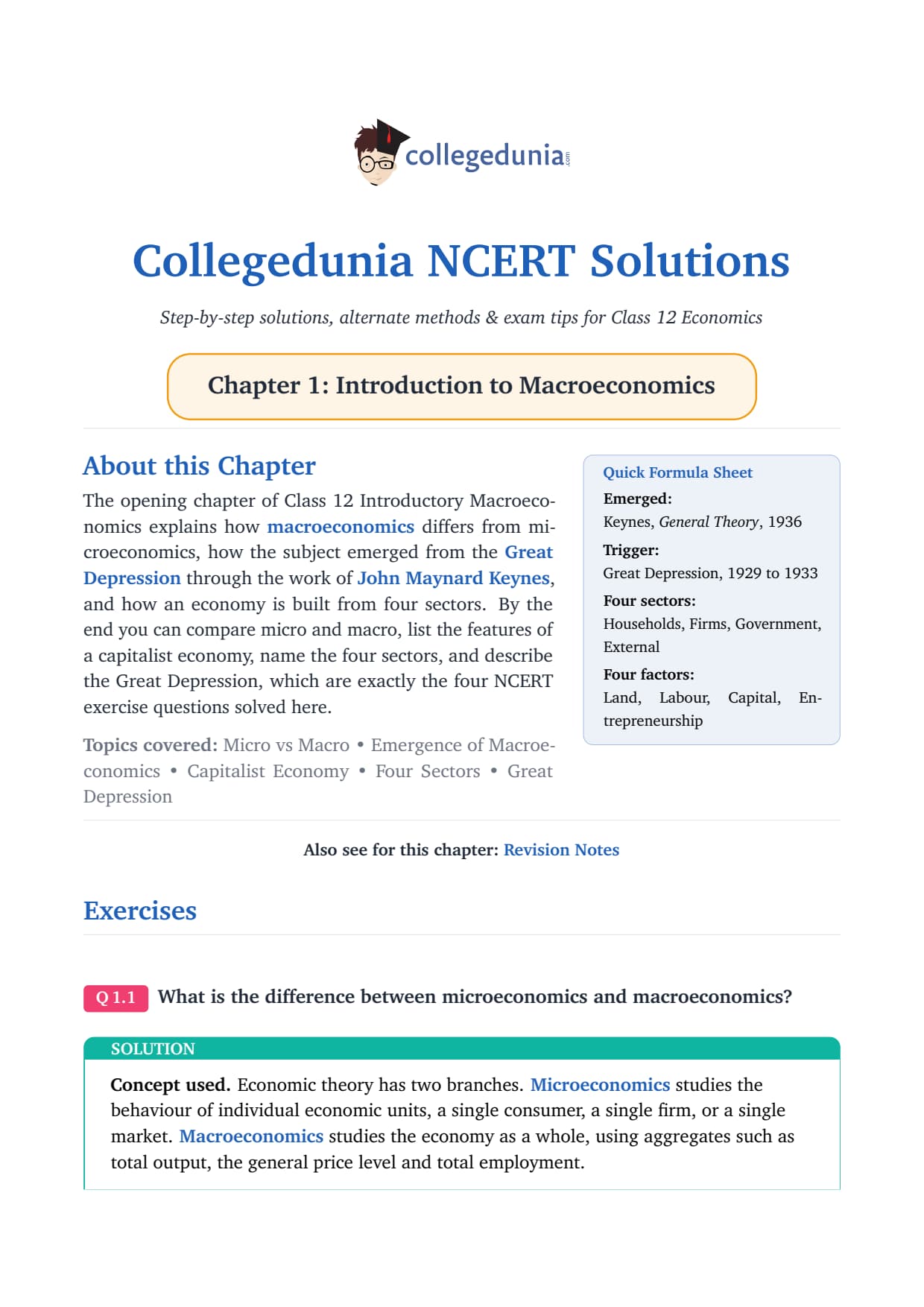
Class 12 Economics Chapter 1 Introduction to Macroeconomics is the first chapter of the Macroeconomics book. It explains what macroeconomics is, how it differs from microeconomics, and how it began after the Great Depression. This page has step-by-step answers to all 4 exercise questions and a free PDF to download.
Here is what this chapter is worth in the exam:
- CBSE Boards: about 6 marks, all short theory (micro vs macro, four sectors, capitalist economy, Great Depression).
- CUET: 2 to 3 questions every year on the basic terms.
- Revision time: about 40 minutes with these solutions.

What the Class 12 Economics Chapter 1 NCERT Solutions Cover
This chapter looks at the economy as one whole, not at one buyer or one market. The solutions below stay in the textbook order and add the wording that earns full marks.
- What macroeconomics studies: the whole economy through aggregates like total output, the general price level and total employment.
- Micro vs macro: micro looks at single units; macro looks at the whole country and treats inflation and unemployment as the main problems.
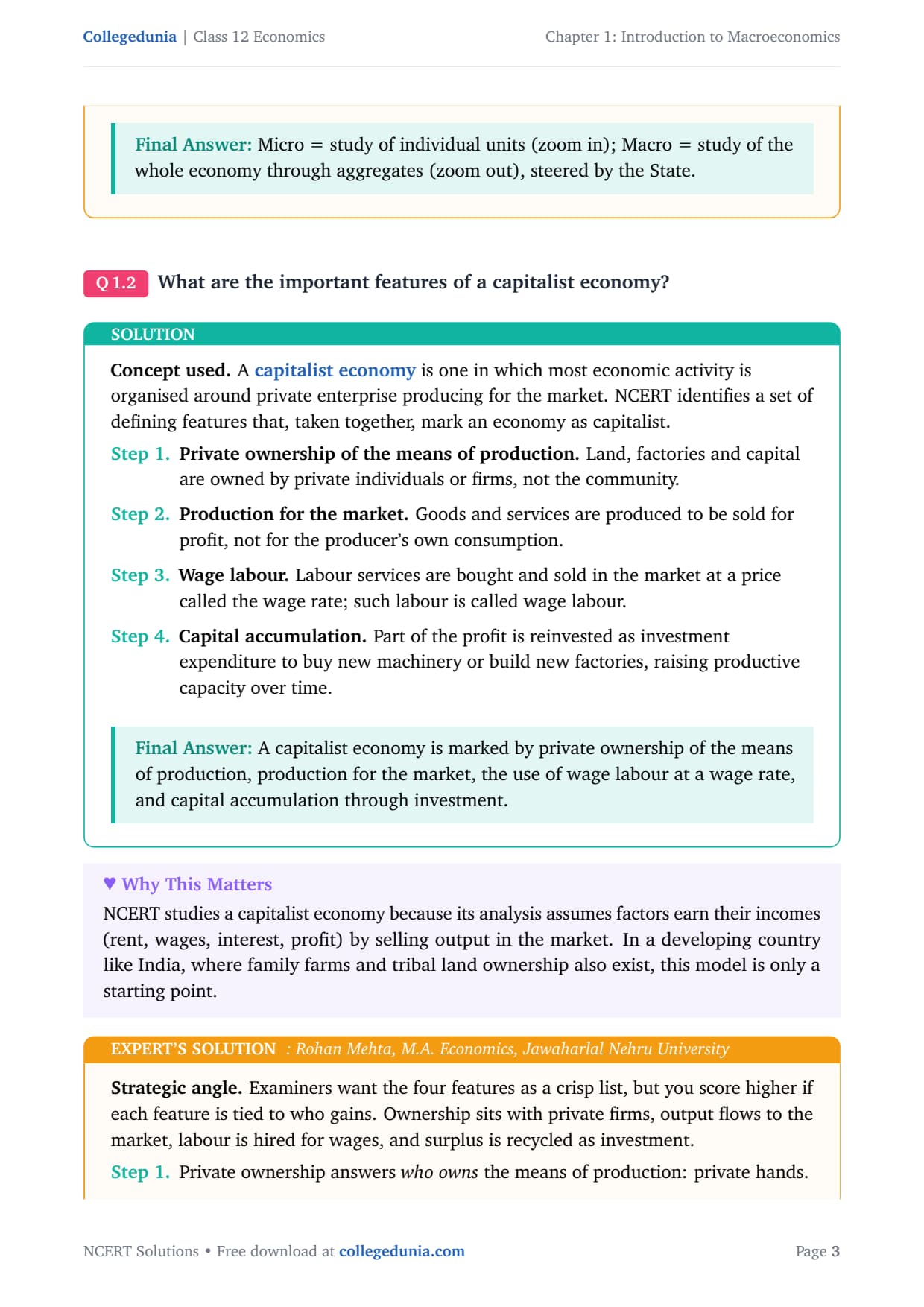
- The capitalist economy: private ownership, production for the market, wage labour and capital accumulation.
- The four sectors: households, firms, government and the external sector, and how they interact.
- How the subject began: the classical view, the Great Depression of 1929 and Keynes' 1936 book.
The chapter carries 4 end-of-chapter exercise questions, all theory. The table maps each one to its topic, the answer style CBSE rewards and the typical marks.
| Question | Topic | Answer style | Typical marks |
|---|---|---|---|
| Q1 | Difference between microeconomics and macroeconomics | 5-point compare plus table | 4 marks |
| Q2 | Features of a capitalist economy | 4-point list | 3 marks |
| Q3 | The four sectors of an economy | 4 sectors, one line each | 4 marks |
| Q4 | The Great Depression of 1929 | Cause, evidence, consequence | 3 marks |
Q1 and Q3 are the heaviest at 4 marks each and come up most often, so revise those two first.

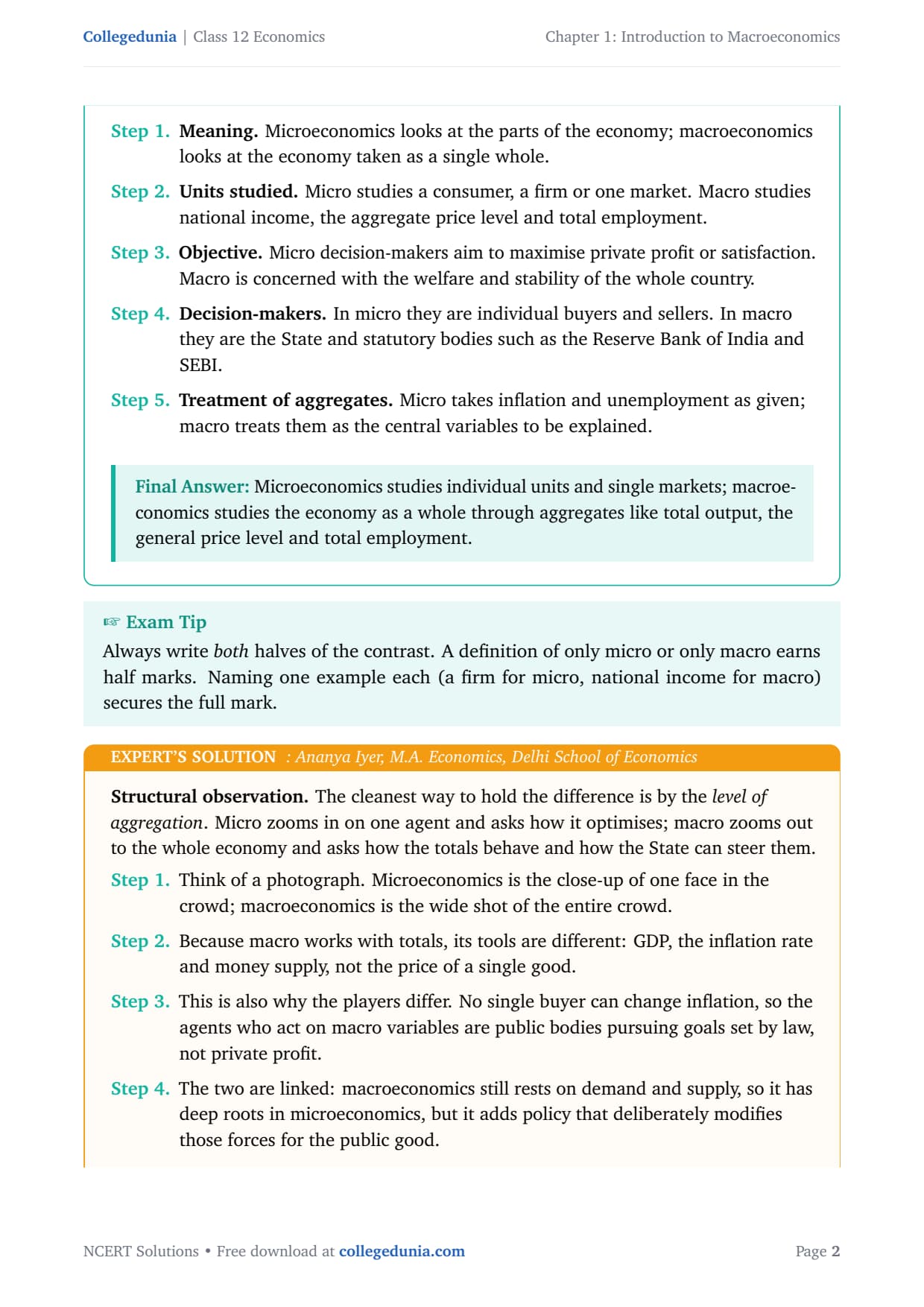
Micro vs Macro Difference in Introduction to Macroeconomics Class 12
This is the most-asked 4-mark question in the chapter, so learn it word-perfect. Microeconomics studies single units like a consumer, a firm or one market. Macroeconomics studies the whole economy through totals. Use this sheet to revise it fast.
| Basis | Microeconomics | Macroeconomics |
|---|---|---|
| Subject matter | Single units and markets | The economy as a whole |
| Main variables | Price and output of one good | National income, general price level, total employment |
| Decision-makers | Individual buyers and sellers | The State, RBI, SEBI and similar bodies |
| Inflation and unemployment | Taken as given | Central variables to control |
| Also called | Price theory | Income and employment theory |
The two are linked, not opposed. Macro still rests on demand and supply, so it has its roots in micro, but it adds policy by the State for the public good. The book studies a capitalist economy: one marked by private ownership of the means of production, production for the market, wage labour at a wage rate, and capital accumulation through investment.

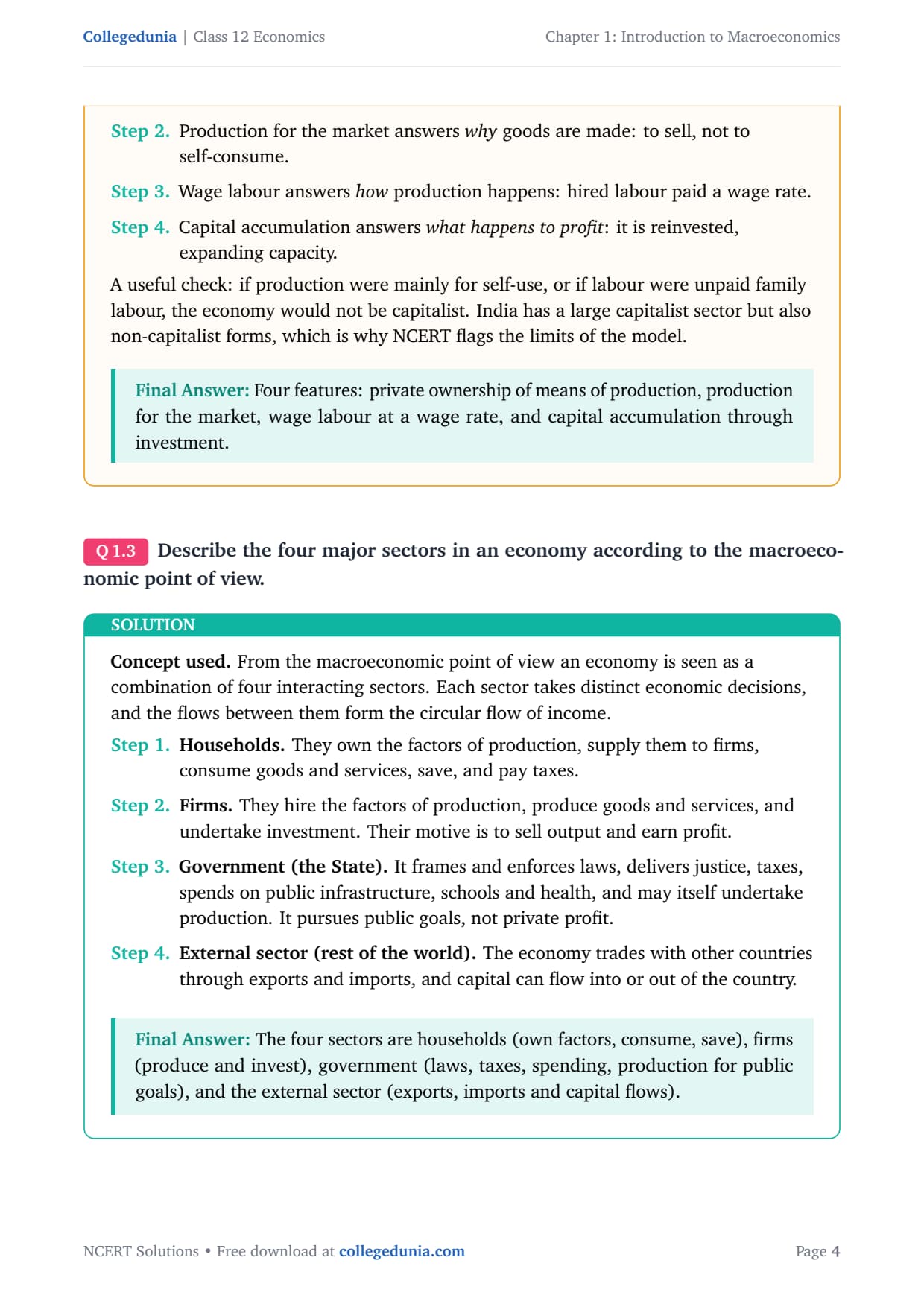
The Four Sectors of an Economy: Class 12 Macroeconomics Chapter 1
The textbook splits the economy into four interacting sectors. This split is the base for the circular flow of income in Chapter 2, so learn it cleanly. Students often forget the external sector, so list all four.
| Sector | What it does | Key decisions |
|---|---|---|
| Households | Own the factors of production and consume | Supply factors, consume, save, pay taxes |
| Firms | Hire factors and produce goods and services | What to produce, how much to invest |
| Government | Frames laws, taxes, spends, may itself produce | Taxes, public spending, transfers |
| External sector | Trades with the rest of the world | Exports, imports, capital flows |
How Macroeconomics Emerged: Great Depression and Keynes (Class 12)
The chapter tells a short story about where macroeconomics came from. Write it as three steps for full marks.
The classical view. Before Keynes, the belief was that every willing worker would find a job and every factory would run at full capacity.
The Great Depression of 1929. From 1929, output and employment in Europe and North America fell sharply. In the USA, from 1929 to 1933, unemployment rose from about 3% to 25% and output fell about 33%. The classical view could not explain this.
The birth of macroeconomics. In 1936, John Maynard Keynes published The General Theory of Employment, Interest and Money. He studied the economy as a whole, and macroeconomics was born as a separate subject.
Frame the answer as cause, evidence and consequence. That is the structure CBSE markers reward most.
Introduction to Macroeconomics Class 12 Video Explanation
Source: Magnet Brains on YouTube
Common Mistakes in Introduction to Macroeconomics Class 12
- Writing fewer than four points of difference for micro vs macro. Four clean points are needed for full marks.
- Naming the wrong economist or year. It is Keynes, the book is The General Theory of Employment, Interest and Money, and the year is 1936.
- Missing the external sector. The four sectors are households, firms, government and the external sector.
- Treating macro as the opposite of micro. Macro has its roots in micro and uses demand and supply too.
Introduction to Macroeconomics Class 12 Previous Year Question Trends
The chapter is short and theory-only, so the questions are easy to predict. The table maps the asked types and their marks across recent CBSE board papers.
| Year | Question type asked | Marks |
|---|---|---|
| 2025 | Micro vs macro difference plus define economic agent | 4 + 1 |
| 2024 | Four sectors plus role of the external sector | 4 + 3 |
| 2023 | Features of a capitalist economy plus wage labour | 3 + 1 |
| 2022 | The Great Depression plus emergence of macroeconomics | 3 + 4 |
Other Resources for Class 12 Economics Chapter 1 Introduction to Macroeconomics
Pair these solutions with the revision notes, handwritten notes and the official NCERT chapter below.
| Resource | What it covers | Open |
|---|---|---|
| NCERT Solutions | Step-by-step answers to all 4 exercise questions, with Expert's Solution alternatives. | Chapter 1 NCERT Solutions |
| Notes | Concept-first revision of micro vs macro, the four sectors and the emergence of macroeconomics. | Chapter 1 Notes |
| Handwritten Notes | Scanned-style handwritten pages for last-minute revision. | Chapter 1 Handwritten Notes |
| NCERT Book PDF | Official NCERT Macroeconomics Chapter 1 textbook in PDF form. | Chapter 1 NCERT Book PDF |
Class 12 Economics Macroeconomics: All Chapters NCERT Solutions
Use the table below to open the NCERT Solutions for the other chapters of Class 12 Economics Macroeconomics.
| Chapter | Topic | NCERT Solutions link |
|---|---|---|
| Chapter 1 | Introduction to Macroeconomics | Introduction to Macroeconomics |
| Chapter 2 | National Income Accounting | National Income Accounting |
| Chapter 3 | Money and Banking | Money and Banking |
| Chapter 4 | Income Determination | Income Determination |
| Chapter 5 | Government Budget and the Economy | Government Budget |
| Chapter 6 | Open Economy Macroeconomics | Open Economy Macroeconomics |
All NCERT Solutions for Class 12 Economics Chapter 1 Introduction to Macroeconomics with Step-by-Step Solutions
What is the difference between microeconomics and macroeconomics?
What are the important features of a capitalist economy?
Describe the four major sectors in an economy according to the macroeconomic point of view.
Describe the Great Depression of 1929.
Student Feedback
We asked 11,460 Class 12 students about this chapter. 68% said it looks easy but is hard to score in, because the questions are theory-only and reward precise wording. 3 out of 5 found the micro vs macro difference the part they most often muddle in the exam.
Toppers said writing each answer as a short concept line plus 4 to 5 numbered points added 1 to 2 marks per question.
NCERT Solutions Class 12 Economics Chapter 1 Introduction to Macroeconomics FAQs
Ques. How many questions are there in NCERT Class 12 Economics Chapter 1 Introduction to Macroeconomics?
Ans. There are 4 end-of-chapter exercise questions, and all 4 are theory. They are solved with a clear concept line and numbered points in the PDF. The two heaviest at 4 marks each are the micro vs macro difference and the four sectors of an economy.
Ques. What is the difference between microeconomics and macroeconomics in Class 12?
Ans. Microeconomics studies individual units, a single consumer, a single firm or one market. Macroeconomics studies the economy as a whole using aggregates like national income, the general price level and total employment. In micro the decision-makers are individual buyers and sellers; in macro they are the State and bodies like the RBI and SEBI. Micro takes inflation and unemployment as given, while macro treats them as the central variables to explain.
Ques. When and how did macroeconomics emerge as a separate subject?
Ans. Macroeconomics emerged after John Maynard Keynes published The General Theory of Employment, Interest and Money in 1936. The trigger was the Great Depression of 1929, which the classical tradition could not explain. In the USA from 1929 to 1933, unemployment rose from 3% to 25% and output fell about 33%. Keynes examined the economy as a whole, and macroeconomics was born.
Ques. What are the four sectors of an economy in Class 12 Macroeconomics?
Ans. The four sectors are households, firms, government and the external sector. Households own the factors of production, consume, save and pay taxes. Firms hire factors, produce and invest. The government frames laws, taxes, spends and may itself produce. The external sector trades with the rest of the world through exports, imports and capital flows. List all four to score full marks.
Ques. What are the features of a capitalist economy in Class 12 Economics?
Ans. A capitalist economy has four features: private ownership of the means of production, production for sale in the market, the use of wage labour bought and sold at a wage rate, and capital accumulation, where part of the profit is reinvested to expand productive capacity. NCERT studies a capitalist economy in this book.



Comments