Chemistry Mentor, Daulat Ram College | Updated 3+ months ago
The NCERT Solutions for Class 12 Chemistry Chapter 9 Amines help you prepare for CBSE, JEE, and NEET. This chapter has 28 main exercise questions and 11 in-text questions, each solved below with a short answer and a detailed expert answer.
Amines gives 1 to 3 questions every year. The most repeated areas in JEE and NEET are diazonium salt conversions and the basicity order of substituted anilines. These solutions follow the latest NCERT book and the CBSE rationalised syllabus for 2026-27.
CBSE Weightage: 4-6 marks (Unit 9 of the rationalised syllabus, frequently paired with Chapter 8 in 5-mark questions).
JEE Main Weightage: 2-4% of the Chemistry section, most often on basicity comparisons and diazonium chemistry.
NEET Weightage: 2-3 questions, with carbylamine test, Hinsberg test, and Hoffmann bromamide being recurring favourites.
What's inside this PDF: all 28 exercise and 11 in-text questions solved with mechanism arrows, a basicity table, and a diazonium-conversion flowchart.
Why Amines Is the Highest-Yield Organic Chapter for NEET 2026 Aspirants
Almost every reaction here is a one-step transformation that fits neatly into an MCQ, so Amines has a high marks-per-page value. Three reasons it deserves a dedicated slot:
Diazonium chemistry is a conversion factory: one aniline gives phenol, chloro-, bromo-, iodobenzene, and azo dyes via Sandmeyer, Gattermann, and coupling.
Basicity is the most-asked concept: the gas-phase vs aqueous-phase order flip is a 2-mark CBSE staple and a JEE Main MCQ.
Distinction tests score easily: Hinsberg, carbylamine, and azo-dye tests give 1 to 2 marks a year once you know the colour change.
Amines Class 12 Chemistry Chapter 9 Video Walkthrough
How will Collegedunia's NCERT Solutions Help You Tackle Class 12 Chemistry Amines?
Students lose marks in Amines by skipping the intermediate, by-product, or reagent role. These solutions fix that:
Mechanism step labelling: every multi-step conversion is split into protection, halogenation, and deprotection steps.
Comparative basicity tables with steric, inductive, and solvation reasoning, so you can defend any ranking.
Sandmeyer vs Gattermann vs Balz-Schiemann comparison, the CBSE 2024 question that trapped many students.
NCERT Class 12 Chemistry Chapter 9 Amines Exercise-wise Question Map
The 28-question main exercise splits into preparation, reactions, basicity, and diazonium chemistry. Use this map to revise in clusters:
Exercise Range
Sub-topic
Question Count
Difficulty
9.1 - 9.4
Classification & IUPAC naming
4
Easy
9.5 - 9.9
Preparation (Hoffmann, Gabriel, reduction)
5
Medium
9.10 - 9.14
Basicity comparison
5
Medium
9.15 - 9.20
Reactions (acylation, alkylation)
6
Medium
9.21 - 9.25
Diazonium chemistry, conversions
5
Hard
9.26 - 9.28
Distinction tests, mixed conversions
3
Hard
Basicity Order of Amines: The Single Highest-Yield Concept of Chapter 9
A basicity-ranking question shows up almost every year. Remember: in gas phase basicity follows 3degree > 2degree > 1degree > NH3 (inductive effect), but in aqueous phase the order flips because of solvation.
Amine
Kb (aqueous, x 10-4)
Relative Basicity
(C2H5)2NH (diethylamine)
10.0
Highest in aqueous
C2H5NH2 (ethylamine)
4.7
High
(CH3)2NH (dimethylamine)
5.4
High
(CH3)3N (trimethylamine)
0.6
Lower (steric + solvation)
NH3 (ammonia)
1.8
Reference
C6H5NH2 (aniline)
0.00042
Lowest (resonance delocalisation)
The PDF includes the five resonance structures of aniline that delocalise the lone pair into the ring, the figure most asked in the 3-mark question.
NCERT Class 12th Chemistry Chapter 9 Previous Year Question Trend
A five-year scan of Chapter 9 questions, latest year first:
Year
CBSE Board
JEE Main
NEET
2026
Diazonium salt reactions and basicity of amines (3 marks)
Diazonium coupling (Jan)
Basic strength order of amines (1 Q)
2025
Hoffmann bromamide mechanism
Basicity of substituted anilines
Carbylamine test, Sandmeyer
2024
Aniline to p-bromoaniline, azo dye
Gabriel phthalimide synthesis
Hinsberg test, amine basicity
2023
Distinguish amines by Hinsberg test
Diazotisation conditions
Amine preparation by reduction
2022
Aniline vs methylamine basicity
Hoffmann bromamide product
IUPAC naming of amines
2021
Diazotisation, coupling, ammonolysis
-
Carbylamine reaction
Basicity, named reactions, and diazonium conversions recur every year, so mastering these three can secure 4 to 6 marks.
Diazonium Salt Reactions: Sandmeyer, Gattermann, Balz-Schiemann and Azo Coupling Compared
The NCERT chapter lists eight diazonium-salt reactions, and CBSE asks at least one every year. Each conversion, its reagent, and its product:
Reaction
Reagent / Conditions
Product
Sandmeyer (ArCl, ArBr, ArCN)
CuCl/HCl, CuBr/HBr, CuCN/KCN
Aryl halide or aryl nitrile
Gattermann (ArCl, ArBr)
Cu powder + HCl or HBr
Aryl halide (lower yield)
Balz-Schiemann (ArF)
HBF4, then dry heat
Aryl fluoride (only route to Ar-F)
Aryl iodide (KI)
aq. KI, no Cu
Aryl iodide
Hydroxyl (ArOH)
warm H2O, > 278 K
Phenol
Reduction (-N2+ to -H)
H3PO2 + H2O
Arene (Ar-H)
Azo coupling with phenol
ArN2+ + PhOH, mild base, 0-5 degree C
p-hydroxyazobenzene (orange dye)
Azo coupling with aniline
ArN2+ + PhNH2, mild acid, 0-5 degree C
p-aminoazobenzene (yellow dye)
Diazotisation runs at 273-278 K (0 to 5 degree C) because benzenediazonium chloride decomposes above 5 degree C to phenol and N2. Balz-Schiemann is the only Class 12 route to aryl fluoride.
Aniline Reactions: Why Friedel-Crafts Fails and the Acetylation Workaround
Aniline starts almost every diazonium conversion. The catch is that direct Friedel-Crafts fails on aniline: AlCl3 bonds to the NH2 lone pair and forms a complex that deactivates the ring.
Tribromoaniline: aniline + Br2 in water gives 2,4,6-tribromoaniline because -NH2 is strongly activating. For mono p-bromoaniline you must acetylate, brominate, then hydrolyse.
Anilinium meta-directing trap: in nitration, aniline is protonated to the anilinium ion (-NH3+), a meta-director, so you get a large share of m-nitroaniline.
Sulphonation: conc. H2SO4 at 453-473 K gives p-sulphanilic acid, the only clean EAS that needs no protection.
Amine Preparation Methods: Five Routes to a Primary Amine
Know these preparation routes to primary amines, each with its scope and limit:
Method
Substrate
Reagent
Carbon Count
Limit
Reduction of nitro
ArNO2 (aromatic)
Sn/HCl, Fe/HCl, or H2/Ni
same
Industrial aniline route
Ammonolysis of alkyl halide
R-X (aliphatic)
NH3, ethanol, 373 K
same
Gives 1degree/2degree/3degree mix
Reduction of nitrile
R-CN
LiAlH4 or H2/Ni
+1 C
Ascent of series
Reduction of amide
R-CONH2
LiAlH4
same
Keeps C count
Gabriel phthalimide
R-X (aliphatic only)
K-phthalimide, then KOH
same
Pure 1degree, fails on aryl halides
Hofmann bromamide
R-CONH2
Br2 + 4 NaOH
-1 C
Aryl and alkyl amides work
The carbon-count rule is a favourite MCQ: LiAlH4/RCN adds +1 C, Hofmann removes -1 C, Gabriel and LiAlH4/RCONH2 keep the C count.
Common Mistakes Students Make in Class 12 Chemistry Amines
Top mistakes from CBSE evaluator notes:
Writing the Hoffmann bromamide product with the same carbon count. It has one carbon less, lost as CO2.
Forgetting the 0-5 degree C requirement for diazotisation. Above 5 degree C the salt decomposes to phenol and N2.
Confusing Sandmeyer (Cu+ salts) with Gattermann (Cu powder + HX). CBSE 2024 gave zero for swapping them.
Amines Quick Formula and Concept Recall for Class 12 Chemistry
All NCERT Solutions for Amines with Step-by-Step Working
Every NCERT textbook question for Class 12 Chemistry Chapter 9 Amines is listed below with its full Solution and Expert Solution hidden inside collapsible tabs. Click Check Solution to reveal the step-by-step working; click Expert Solution for the expanded explanation.
Questions
Q 9.1
Write IUPAC names of the following compounds and classify them into primary, secondary and tertiary amines:
(i) (CH3)2CHNH2 (ii) CH3(CH2)2NH2 (iii) CH3NHCH(CH3)2
(iv) (CH3)3CNH2 (v) C6H5NHCH3 (vi) (CH3CH2)2NCH3
(vii) m-BrC6H4NH2
Concept used. An amine is a derivative of ammonia (NH3) in which one, two, or three of its hydrogens are replaced by alkyl or aryl groups, denoted R-NH2, R2NH, R3N respectively. The number of carbon-containing groups directly bonded to the nitrogen decides the class:
Primary (1∘): one R on N, so structure is R-NH2.
Secondary (2∘): two R groups on N, so R2NH.
Tertiary (3∘): three R groups on N, so R3N.
For IUPAC naming we use the substitutive system: replace the -e of the parent alkane name with -amine and place the lowest possible locant before the suffix. For secondary and tertiary amines, the largest alkyl chain is the parent, and the smaller groups are named as N-substituents (the letter N written in italics). Arylamines based on benzene use aniline as the retained IUPAC name (or benzenamine).
How to count R on nitrogen
Only the carbon atoms directly bonded to N count. The chain attached to that carbon can be long, but for classification we look only at the C–N bonds.
[See diagram in the PDF version]
(i) (CH3)2CHNH2. The carbon attached to NH2 is a propan-2-yl group (isopropyl). Parent chain has 3 carbons, so parent alkane is propane → propane ends with the amino group on C-2. IUPAC name: propan-2-amine. Only one R (the isopropyl carbon skeleton) is on N ⇒primary amine.
(ii) CH3(CH2)2NH2. Expand: CH3-CH2-CH2-NH2. Three carbons in the longest chain, -NH2 on C-1. IUPAC name: propan-1-amine. One R on N ⇒primary amine.
(iii) CH3NHCH(CH3)2. The N has two carbons bonded directly: a CH3 group and a (CH3)2CH- group. Choose the larger one (the 3-carbon isopropyl) as the parent → propan-2-amine. The methyl on N is an N-methyl substituent. IUPAC name: N-methylpropan-2-amine. Two R on N ⇒secondary amine.
(iv) (CH3)3CNH2. The C attached to NH2 is a tert-butyl carbon (C(CH3)3). Parent is butane, -NH2 on C-2 of the 4-carbon skeleton CH3-C(CH3)2-NH2. Numbering: the parent chain that contains the amino group with lowest locant is 2-methylpropane. The NH2 is on C-2 of 2-methylpropane. IUPAC name: 2-methylpropan-2-amine. One R on N ⇒primary amine.
(v) C6H5NHCH3. The N carries a phenyl group (C6H5) and a methyl group. Treat as aniline with an N-methyl substituent. IUPAC name: N-methylaniline (also N-methylbenzenamine). Two R on N ⇒secondary amine.
(vi) (CH3CH2)2NCH3. The N has two ethyl groups and one methyl group. Take the larger group as parent: ethane → ethanamine. The second ethyl and the methyl become N-substituents. IUPAC name: N-ethyl-N-methylethanamine. Three R on N ⇒tertiary amine.
(vii) m-BrC6H4NH2. A bromine on the meta position of aniline. Number the ring with C-1 carrying the principal group (NH2); meta is C-3. IUPAC name: 3-bromoaniline (also 3-bromobenzenamine). One R (the benzene ring) on N ⇒primary amine.
Structural observation. Treat every C–N bond as one ``arm'' hanging off the nitrogen. Counting arms gives the class immediately: one arm = primary, two = secondary, three = tertiary. The number of hydrogens still on the nitrogen is 3 - (arms), so the two counts are equivalent and you can use whichever is easier to read off the condensed formula.
Alternative approach (the N–H count). For each compound, try to count the H on N directly: in (CH3)2CHNH2 the N still carries NH2 (two H) ⇒ 1∘; in CH3NHCH(CH3)2 the N carries NH (one H) ⇒ 2∘; in (CH3CH2)2NCH3 the N carries no H ⇒ 3∘.
IUPAC strategy in three lines. (1) Pick the carbon group with the longest chain as the parent. (2) Replace the final -e of that alkane by -amine, with the locant of the -NH2 inserted before it. (3) Every other carbon group on the same N is named as an N-substituent (italic N in print), listed alphabetically.
Concept linkage. The class fixed in this question controls every downstream reaction in the chapter: only 1∘ amines give the carbylamine test (Q 9.2, 9.11(i)), only 1∘ aromatic amines give a stable diazonium salt (Q 9.13), and only 1∘ and 2∘ amines acetylate (Q 9.7(vi)). So getting (i)–(vii) right is the gateway to reading the rest of the paper correctly.
(i) (CH3)2CHNH2: amino-bearing carbon has two methyls ⇒ propan-2-amine. One C on N (two H) ⇒ 1∘.
(ii) CH3(CH2)2NH2: a straight chain of three carbons with NH2 at the terminal carbon ⇒ propan-1-amine, 1∘.
(iii) CH3NHCH(CH3)2: two carbon arms (methyl and isopropyl) on N; pick isopropyl as parent ⇒N-methylpropan-2-amine, 2∘.
(iv) (CH3)3CNH2: a quaternary carbon (C(CH3)3) bonded to a single NH2. The chain ``2-methylpropan-2-yl'' carries NH2 at C-2 ⇒ 2-methylpropan-2-amine. Still one C on N ⇒ 1∘.
(v) C6H5NHCH3: phenyl and methyl on N; aniline is the retained parent, methyl becomes N-methyl ⇒N-methylaniline, 2∘.
(vi) (CH3CH2)2NCH3: three arms, two ethyls and one methyl. Largest arm (ethyl) is the parent (ethanamine); the second ethyl and the methyl are N-substituents listed alphabetically ⇒N-ethyl-N-methylethanamine, 3∘.
(vii) m-BrC6H4NH2: bromo at meta on aniline ring (position 3) ⇒ 3-bromoaniline, 1∘.
Exam relevance. JEE/NEET MCQ writers love disguised tertiary amines like C6H5N(CH3)2 (N,N-dimethylaniline) and ask whether they show the carbylamine test. The answer is no, because they are 3∘. A frequent CBSE 1-mark question asks: ``identify the nitrogen class in (CH3CH2)2NCH3''= 3∘.
Why this matters. Class (1∘, 2∘, 3∘) controls which reactions an amine can do. Only 1∘ amines give the carbylamine reaction and the Hofmann mustard-oil test; only 2∘ amines give a yellow oil (N-nitrosamine) with nitrous acid; 3∘ amines do neither but still alkylate or coordinate to Lewis acids. Getting the class right in one glance saves time in every later question.
Give one chemical test to distinguish between the following pairs of compounds:
(i) Methylamine and dimethylamine
(ii) Secondary and tertiary amines
(iii) Ethylamine and aniline
(iv) Aniline and benzylamine
(v) Aniline and N-methylaniline.
Concept used. Three signature tests distinguish amine classes:
Carbylamine test: 1∘ amines (both alkyl and aryl) on warming with chloroform and alcoholic KOH give an isocyanide (R-NC) with a foul, penetrating smell. 2∘ and 3∘ amines give no reaction. R-NH2 + CHCl3 + 3KOH Δ R-NC + 3KCl + 3H2O.
Hinsberg's test: amines react with benzenesulphonyl chloride (C6H5SO2Cl). 1∘ amines give a sulphonamide soluble in alkali; 2∘ amines give a sulphonamide insoluble in alkali; 3∘ amines do not react (no N–H).
Diazotisation: 1∘ aromatic amines with NaNO2/HCl at 0–5 ∘C form a stable diazonium salt ArN2+Cl-. 1∘ aliphatic amines under the same conditions liberate N2 (vigorous effervescence). The diazonium salt then couples with phenol or 2-naphthol in alkaline medium to give an orange/red azo dye.
[See diagram in the PDF version]
(i) Methylamine vs dimethylamine: carbylamine test. CH3NH2 (1∘) on heating with CHCl3 + alcoholic KOH gives methyl isocyanide CH3NC (offensive smell). CH3NH2 + CHCl3 + 3KOH Δ CH3NC + 3KCl + 3H2O. Dimethylamine (CH3)2NH (2∘) gives no reaction. Smell test confirms 1∘.
(ii) Secondary vs tertiary amines: Hinsberg's test. Shake with C6H5SO2Cl in KOH. The 2∘ amine forms a sulphonamide R2N-SO2C6H5 which has no N–H and is therefore insoluble in NaOH. The 3∘ amine has no N–H to start with and does not react; on acidifying, the tertiary amine dissolves in dilute HCl while the sulphonamide from the secondary amine does not.
(iii) Ethylamine vs aniline: azo-dye test. Aniline (1∘ aromatic) with cold NaNO2/HCl at 0–5 ∘C gives benzenediazonium chloride, which couples with alkaline 2-naphthol to give a bright orange/red azo dye. Ethylamine (1∘ aliphatic) under the same conditions evolves N2 gas (effervescence) and gives ethanol; no dye forms. C6H5NH2 + HNO2 + HCl 273--278 K C6H5N2+Cl- + 2H2O,C2H5NH2 + HNO2 -> C2H5OH + N2 + H2O.
(iv) Aniline vs benzylamine: same azo-dye test. Aniline is aryl-1∘ and forms a stable diazonium salt → orange dye on coupling with 2-naphthol/NaOH. Benzylamine C6H5CH2NH2 is alkyl-1∘ (the amino group is on the CH2, not on the ring) and behaves like ethylamine: liberates N2, no dye.
(v) Aniline vs N-methylaniline: carbylamine test. Aniline is 1∘ and gives the foul smell of phenyl isocyanide C6H5NC: C6H5NH2 + CHCl3 + 3KOH Δ C6H5NC + 3KCl + 3H2O.N-methylaniline C6H5NHCH3 is 2∘ and gives no reaction.
0.96!%
[See diagram in the PDF version]
Use the carbylamine test for 1∘ vs 2∘ (i, v); Hinsberg's test for 2∘ vs 3∘ (ii); and cold NaNO2/HCl + 2-naphthol coupling to distinguish aryl-1∘ from alkyl-1∘ amines (iii, iv).
KB
Karan Bhat
Ph.D Organic Chemistry, IISc Bangalore
Verified Expert
Strategic angle. The five pairs reduce to three test ``cases'': (a) 1∘ vs 2∘: use a test that needs an N–H on one carbon ⇒ carbylamine. (b) 2∘ vs 3∘: use a test that distinguishes one N–H from zero N–H ⇒ Hinsberg's. (c) Aryl-1∘ vs alkyl-1∘: use diazotisation ⇒ stable salt vs N2 burst.
Alternative approach (one test for three classes). If you are given a single unknown amine and want to settle 1∘/2∘/3∘ in one shot, Hinsberg's test alone does the job: KOH-soluble sulphonamide ⇒ 1∘; KOH-insoluble solid ⇒ 2∘; no reaction (but dissolves in dilute HCl) ⇒ 3∘. The carbylamine test then confirms 1∘, and cold diazotisation splits aryl-1∘ from alkyl-1∘.
Concept linkage. Each pair maps onto a different ``N–H count'' or ``ring vs no ring'' contrast, the same two ideas that control basicity (Q 9.3, 9.4) and diazotisation stability (Q 9.13). Notice that two of the five pairs (i, v) use carbylamine, and two others (iii, iv) use diazotisation. So the whole question rests on just three reagents.
(i) Methylamine vs dimethylamine ⇒carbylamine. CH3NH2 (1∘) gives CH3NC (foul smell); (CH3)2NH (2∘) gives no reaction.
(ii) Secondary vs tertiary ⇒Hinsberg's. 2∘ amine +C6H5SO2Cl→R2N-SO2C6H5 (no N–H left) ⇒ insoluble in alkali. 3∘ amine (no N–H to start) ⇒ no reaction at all, but dissolves in dilute HCl on acidification.
(iii)/(iv) Aryl-1∘ vs alkyl-1∘⇒cold diazotisation + 2-naphthol. Aniline (or its benzylamine cousin in (iv)) forms a stable diazonium that couples to give a red/orange azo dye. Ethylamine and benzylamine, both alkyl-1∘, liberate N2 with effervescence and give the alcohol.
(v) Aniline vs N-methylaniline ⇒carbylamine again. Aniline (1∘) gives C6H5NC (offensive smell); N-methylaniline (2∘) gives no isocyanide.
Exam relevance. NEET often phrases this as MCQ-II: ``Which reagent does NOT distinguish C6H5NH2 and C6H5NHCH3?'' Answer: Hinsberg (because both react), so the right pick is the carbylamine test. A common JEE Mains twist is to ask about benzylamine vs aniline (pair iv): students wrongly try carbylamine (both 1∘ and react!) and need to recall diazotisation as the decisive test.
Why this matters. Telling amine classes apart is a routine practical-exam task. The three tests above can identify any unknown amine when used in sequence: Hinsberg's → separates the three classes; carbylamine → confirms 1∘; diazotisation → splits aryl from alkyl 1∘.
Carbylamine test for (i) and (v); Hinsberg's test for (ii); cold diazotisation + 2-naphthol coupling for (iii) and (iv).
Q 9.3
Account for the following:
(i) pKb of aniline is more than that of methylamine.
(ii) Ethylamine is soluble in water whereas aniline is not.
(iii) Methylamine in water reacts with ferric chloride to precipitate hydrated ferric oxide.
(iv) Although amino group is o- and p- directing in aromatic electrophilic substitution reactions, aniline on nitration gives a substantial amount of m-nitroaniline.
(v) Aniline does not undergo Friedel–Crafts reaction.
(vi) Diazonium salts of aromatic amines are more stable than those of aliphatic amines.
(vii) Gabriel phthalimide synthesis is preferred for synthesising primary amines.
Concept used. The basicity of an amine in water reflects the position of the equilibrium R-NH2 + H2O <=> R-NH3+ + OH-, Kb = [RNH3+][OH-][RNH2], with pKb = -10 Kb. A larger pKb means a weaker base. Three effects decide Kb:
Inductive effect (+I): alkyl groups push electron density onto N, raising the availability of its lone pair for protonation ⇒more basic.
Resonance/mesomeric effect: in arylamines the lone pair of N is delocalised into the ring through resonance, making it less available ⇒less basic.
Solvation by water: the conjugate acid RNH3+ is stabilised by hydrogen bonding with water. More N–H bonds on the cation ⇒ better H-bond solvation ⇒ more basic.
[See diagram in the PDF version]
(i) pKb of aniline (≈ 9.38) > pKb of methylamine (≈ 3.38). In methylamine the methyl group has a +I effect, pushing electron density toward N, so the lone pair on N is more available to bind a proton. In aniline the nitrogen lone pair is conjugated into the benzene ring through resonance (it forms part of the π-system), so it is much less available for protonation. The result: aniline is a much weaker base than methylamine, and a weaker base has a larger pKb.
(ii) Solubility. Ethylamine has only two carbon atoms and one -NH2. The amino group hydrogen-bonds vigorously with water (both as donor: N–H⋯O, and as acceptor: N⋯H–O). The hydrophobic alkyl part is small, so ethylamine is freely soluble. In aniline the hydrophobic part is the entire benzene ring; the ring is large, non-polar, and cannot form H-bonds. The size of the hydrophobic part dominates, so aniline is sparingly soluble in water (about 3.5 g/100 mL).
(iii) Methylamine + FeCl3→ Fe(OH)3. Methylamine in water gives OH-: CH3NH2 + H2O <=> CH3NH3+ + OH-. These hydroxide ions react with the Fe3+ from FeCl3: Fe3+ + 3 OH- -> Fe(OH)3 v (brown ppt., hydrated ferric oxide). The strong basicity of methylamine raises [OH-] enough to exceed the solubility product of Fe(OH)3, so it precipitates.
(iv) Aniline + HNO3/H2SO4 → substantial meta-isomer. The -NH2 is strongly activating and o/p-directing. But the nitration mixture contains conc. H2SO4, which protonates the very basic -NH2 to form the anilinium ion C6H5NH3+. The -N+H3 group is now deactivating and m-directing (it has no lone pair to donate and carries a + charge that withdraws electrons through induction). So a portion of anilinium ion in the mixture gives m-nitroaniline while the unprotonated aniline gives the o/p-products. Overall the product mixture contains a substantial fraction of m-nitroaniline (∼ 47%).
(v) No Friedel–Crafts on aniline. Friedel–Crafts uses a Lewis acid catalyst, typically AlCl3. The basic lone pair on the nitrogen of aniline forms a complex with the Lewis acid: C6H5NH2 + AlCl3 -> C6H5NH2+-AlCl3-. The nitrogen now carries a positive charge, so the -NH2 becomes strongly deactivating (like -NO2) and the ring is no longer nucleophilic enough to react with the carbocation electrophile generated from RX/RCOCl. Hence no Friedel–Crafts product forms.
(vi) Stability of ArN2+ vs R-N2+. Aromatic diazonium ions are stabilised by extensive resonance delocalisation: the positive charge on -N2+ spreads onto the ortho and para carbons of the benzene ring (the same ring can be drawn with charges at C-2, C-4 etc.). Aliphatic diazonium ions cannot delocalise this way, so they lose N2 almost immediately at room temperature to form an alcohol / alkene / alkyl halide mixture. Aromatic salts can be isolated and stored at 0–5 ∘C.
(vii) Why Gabriel synthesis is preferred for 1∘ amines. Direct ammonolysis (RX + NH3) gives a mixture: the 1∘ amine formed first reacts further with RX to give 2∘, 3∘, and quaternary ammonium salts, so the yield of pure 1∘ amine is low. In the Gabriel phthalimide synthesis, potassium phthalimide reacts with RX to give an N-alkylphthalimide. This intermediate has no free N–H, so further alkylation is impossible. Hydrolysis (or hydrazinolysis) then liberates a pure 1∘ amine and phthalic acid. The route avoids any over-alkylation.
(i) Resonance delocalises N lone pair into the ring. (ii) Hydrophobic phenyl dominates, no H-bonding. (iii) Methylamine raises [OH-], precipitates Fe(OH)3. (iv) In H2SO4, -NH2 is protonated to -N+H3 which is m-directing. (v) Lone pair complexes with AlCl3, deactivating the ring. (vi) Aryl diazonium ion is resonance-stabilised. (vii) Phthalimide blocks over-alkylation, giving only 1∘ amine.
AR
Aanya Reddy
M.Sc Physical Chemistry, IIT Madras
Verified Expert
Strategic angle. Seven parts, but only two ideas: how an -NH2 behaves when the lone pair is free vs when it is locked into a π-system or bound to a Lewis acid. Use these ideas in turn.
Lone pair free (R-NH2, R2NH): strong base, o/p-directing, can react with electrophiles.
Lone pair locked (aniline, anilinium ion, aniline + AlCl3): weak base or deactivating substituent on ring.
Alternative approach: numerical anchor. For (i), put numbers on the comparison: pKb(CH3NH2) ≈ 3.38 and pKb(C6H5NH2) ≈ 9.38. The difference of 6pKb units is a factor of Kb ≈ 10-6: aniline is a million times weaker as a base than methylamine in water. That is the size of the resonance-stabilisation effect.
Concept linkage. Parts (iv) and (v) are different faces of the same idea: a basic nitrogen lone pair binding to anything electrophilic (proton in (iv), Lewis acid AlCl3 in (v)) turns -NH2 into a strongly deactivating -N+H3 / -N+H2-AlCl3 group. Once you see this pattern you can predict that aniline will also fail in any other reaction needing a strongly acidic medium: sulphonation gives only sulphanilic acid (Q 9.11(iii)), not the Friedel-Crafts equivalent.
(i) Free lone pair in CH3NH2++I from methyl ⇒ strong base (pKb ≈ 3.38). Lone pair in aniline locked by resonance into the ring ⇒ weak base (pKb ≈ 9.38). Hence aniline has the larger pKb.
(ii) Compare hydrophobic/hydrophilic balance. Ethylamine: small C2H5 + NH2; aniline: bulky C6H5 + NH2. Hydrogen-bond gain from the amino group outweighs the hydrophobic cost only when the carbon part is small. Net: ethylamine is fully miscible with water; aniline is only ∼ 3.5 g/100 mL.
(iii) Methylamine is basic enough to leave free hydroxide in water, which scavenges Fe3+: Fe3+ + 3OH- -> Fe(OH)3 v. The driving force is the very low Ksp of Fe(OH)3 (≈ 6 × 10-38): even a tiny [OH-] exceeds the solubility threshold and precipitates the hydrated oxide.
(iv) In conc. H2SO4, almost every -NH2 is protonated to -N+H3. This positively charged group withdraws electrons, deactivating the ring and steering the nitronium ion NO2+ to the meta position. Yield of meta isomer climbs to nearly half.
(v) The Friedel–Crafts catalyst AlCl3 is a Lewis acid. The nitrogen lone pair binds to Al, converting -NH2 into a positively charged, strongly deactivating substituent. The ring can no longer attack the acylium / carbocation electrophile, so no Friedel–Crafts product is obtained.
(vi) Resonance structures of C6H5N2+ place the positive charge on N, ortho, para carbons; aliphatic analogues cannot delocalise, so R-N2+ rapidly loses N2 (Δ G of the loss is large because N2 is very stable, with a bond enthalpy near 945 kJ mol-1).
(vii) Gabriel: R-X + potassium phthalimide →N-alkyl phthalimide via SN2. The blocked nitrogen cannot react twice. Hydrolysis releases a single 1∘ amine, so no 2∘/3∘ contamination.
Exam relevance. Part (iv) is a classic CBSE 2-mark question that often catches students unprepared –- the answer ``protonation in H2SO4 converts -NH2 to -N+H3, a meta-director'' is exactly what the marker wants. Part (vi) appears nearly every year in NEET MCQs: ``Why are aryl diazonium salts stable but alkyl diazonium salts decompose?'' ⇒ resonance with the ring.
Why this matters. The same toolkit (resonance, induction, solvation, Lewis-acid binding) accounts for every odd observation about amines. Once you recognise which effect dominates for a given compound, the answer follows in one line, and you can predict the behaviour of compounds you have never seen.
All seven observations follow from the same theme: alkyl groups donate electrons (boosting basicity, o/p-direction); aryl rings, protonation, and Lewis-acid binding all lock the N lone pair, making the amine a weaker base or the ring less reactive.
Q 9.4
Arrange the following:
(i) In decreasing order of the pKb values:
C2H5NH2, C6H5NHCH3, (C2H5)2NH and C6H5NH2
(ii) In increasing order of basic strength:
C6H5NH2, C6H5N(CH3)2, (C2H5)2NH and CH3NH2
(iii) In increasing order of basic strength:
(a) Aniline, p-nitroaniline and p-toluidine
(b) C6H5NH2, C6H5NHCH3, C6H5CH2NH2
(iv) In decreasing order of basic strength in gas phase:
C2H5NH2, (C2H5)2NH, (C2H5)3N and NH3
(v) In increasing order of boiling point:
C2H5OH, (CH3)2NH, C2H5NH2
(vi) In increasing order of solubility in water:
C6H5NH2, (C2H5)2NH, C2H5NH2
Concept used. Comparing amine basicity in water requires balancing three effects:
Inductive (+I) effect of alkyl groups. More or larger alkyl groups on N push more electron density onto N, raising basicity.
Steric crowding around N. A nitrogen surrounded by bulky groups is harder to approach by a proton or by water: decreases effective basicity.
Solvation of the conjugate acid RnNH(4-n)+ by water. Each remaining N–H of the cation hydrogen-bonds with water. More N–H bonds ⇒ better solvation ⇒ more stable cation ⇒ equilibrium shifts forward, raising basicity. So the order of H-bonds is 1∘ (3 N–H) > 2∘ (2 N–H) > 3∘ (1 N–H).
The observed aqueous order for methyl-substituted amines is 2∘ > 1∘ > 3∘ > NH3 (a non-monotonic order: the +I effect would predict 3∘ > 2∘ > 1∘, but steric crowding and weaker solvation pull tertiary amines down). In ethyl amines the order shifts: the ethyl groups are larger, so crowding matters more and the order can become 2∘ > 3∘ > 1∘. In the gas phase, where there is no solvent, only the +I and steric effects matter, so the order reduces to 3∘ > 2∘ > 1∘ > NH3.
For arylamines the lone pair is delocalised into the ring, so they are always weaker bases than alkylamines. Electron-donating substituents on the ring (-CH3) increase basicity; electron-withdrawing substituents (-NO2) decrease it.
[See diagram in the PDF version]
(i) Decreasing pKb= increasing basicity in reverse.(C2H5)2NH (2∘ aliphatic) has the smallest pKb(≈ 3.0). C2H5NH2 (1∘ aliphatic) has the next-smallest pKb(≈ 3.25). Then come the arylamines: C6H5NHCH3 has a methyl that donates electrons, so it is more basic than C6H5NH2. Hence C6H5NHCH3 has a smaller pKb than aniline. Decreasing pKb (weakest to strongest base): C6H5NH2 > C6H5NHCH3 > C2H5NH2 > (C2H5)2NH.
(ii) Increasing basic strength. Aniline is the weakest because its lone pair is delocalised. Adding two methyls on N (giving C6H5N(CH3)2) donates more electrons but the lone pair is still partly tied up in the ring, so it is more basic than aniline but still weaker than any alkylamine. Among alkyls, CH3NH2 (1∘) is weaker than (C2H5)2NH (2∘) because the second ethyl raises the +I effect. Increasing basic strength: C6H5NH2 < C6H5N(CH3)2 < CH3NH2 < (C2H5)2NH.
(iii)(a) Aniline vs p-toluidine vs p-nitroaniline.-CH3 on the para position donates electrons by +I and +H (hyperconjugation), increasing electron density at N ⇒p-toluidine (i.e. 4-methylaniline) is the most basic. -NO2 at the para position withdraws electrons strongly by -I and -R, pulling the lone pair away from N ⇒p-nitroaniline is the least basic. Aniline lies in the middle. p-nitroaniline < aniline < p-toluidine.
(iii)(b) C6H5NH2, C6H5NHCH3, C6H5CH2NH2. In C6H5CH2NH2 (benzylamine) the -NH2 is on the CH2, NOT directly on the ring, so the lone pair is not delocalised into the ring. It behaves like an aliphatic amine ⇒ most basic of the three. Between C6H5NH2 and C6H5NHCH3, the methyl on N donates electrons by +I, raising basicity ⇒C6H5NHCH3 > C6H5NH2. C6H5NH2 < C6H5NHCH3 < C6H5CH2NH2.
(iv) Gas-phase decreasing basicity. No solvent, no solvation; only +I and steric effects survive. The +I effect rises monotonically with the number of alkyl groups, so the order is determined purely by alkyl count: (C2H5)3N > (C2H5)2NH > C2H5NH2 > NH3. This is the ``natural'' order of basicity, recovered when the complications of aqueous solvation are removed.
(v) Increasing boiling point.(CH3)2NH is 2∘ and has only one N–H, so weak H-bonding. C2H5NH2 is 1∘ and has two N–H bonds, so stronger H-bonding ⇒ higher b.p. C2H5OH has an O–H whose H-bond is even stronger (O is more electronegative than N) ⇒ highest b.p. (CH3)2NH (7 ) < C2H5NH2 (17 ) < C2H5OH (78 ).
(vi) Increasing solubility in water. Aniline is sparingly soluble (large hydrophobic ring). Among the two alkylamines, the smaller, more polar one solvates better: C2H5NH2 (1∘, two N–H) hydrogen-bonds with water more vigorously than (C2H5)2NH (2∘, larger hydrophobic part, only one N–H). C6H5NH2 < (C2H5)2NH < C2H5NH2.
Cation solvation (number of N–H bonds in RnNH4-n+).
Steric crowding around N.
Aqueous data integrate all three; gas-phase data show only the first and third.
Alternative approach: tabulate the three effects. For each amine in the pool, write down (a) the number of +I alkyl groups on N (more = stronger base), (b) the number of N–H bonds in the cation (more = better solvation = stronger base in water), and (c) the relative steric bulk (more = weaker base). The net basicity is the sum of these three contributions. For methyl amines the three terms compromise at 2∘ > 1∘ > 3∘; for ethyls they shift slightly because +I from ethyl is a touch larger and bulk from three ethyls is much greater.
Concept linkage. The ``flip'' from aqueous to gas phase illustrates that solvation is not a footnote: it actively reshuffles the order of basicity. The same principle is used in solvation effects on SN1 vs SN2 pathways (Chapter 6) and on hydration enthalpies of alkali metal ions (Chapter on s-block).
(i) Rank by basicity (descending): (C2H5)2NH (best +I without too much sterics) →C2H5NH2→C6H5NHCH3→C6H5NH2. Flip for pKb: C6H5NH2 > C6H5NHCH3 > C2H5NH2 > (C2H5)2NH.
(ii) Same logic, reversed direction: aniline weakest, then its N,N-dimethyl cousin, then methylamine (1∘ alkyl), then diethylamine (2∘ alkyl). So C6H5NH2 < C6H5N(CH3)2 < CH3NH2 < (C2H5)2NH.
(iii)(a) Electron-donating -CH3 pushes density into N; -NO2 drains it through -I and -R. So p-nitroaniline is the worst, then aniline, then p-toluidine. (b) Benzylamine is essentially alkylic (-NH2 is one CH2 away from the ring), so its lone pair is not delocalised. N-methylaniline beats aniline because of the +I from the N-methyl group.
(iv) Without water, only the +I/sterics balance applies; more ethyls = more +I on a flat scale. (C2H5)3N wins decisively. Order: (C2H5)3N > (C2H5)2NH > C2H5NH2 > NH3.
(v) Boiling points scale with H-bond strength: O–H (∼ 21 kJ/mol per H-bond) > N–H on a 1∘ amine (∼ 13 kJ/mol, two donor bonds per molecule) > N–H on a 2∘ amine (one donor bond) > no N–H at all. (CH3)2NH (7 ) < C2H5NH2 (17 ) < C2H5OH (78 ).
(vi) Aqueous solubility scales with the ratio of hydrophilic to hydrophobic surface area. Ethylamine wins (small C2H5 + two N–H donors); diethylamine middle (two ethyls, one N–H); aniline loses (large C6H5 ring, two N–H but blocked lone pair, ring is hydrophobic). C6H5NH2 < (C2H5)2NH < C2H5NH2.
Exam relevance. The aqueous-vs-gas-phase contrast is a favourite JEE Mains MCQ: ``Which is the strongest base in gas phase?'' ⇒ tertiary, always. ``Which is the strongest base in aqueous solution?'' ⇒ secondary (for methyl), with the order 2∘ > 1∘ > 3∘ > NH3. Skipping the words ``in water'' is a classic trap. Part (iii)(b) is a regular CBSE board question –- the trap is treating C6H5CH2NH2 as an arylamine.
Why this matters. The aqueous vs gas-phase mismatch shows why ``intrinsic'' chemical properties of molecules can differ from their behaviour in solution. The same idea is the basis for the Hammett analysis of organic reactivity at higher level, and explains why textbook ``trends'' must always be tagged with the medium.
Orders as in the main solution.
Q 9.5
How will you convert:
(i) Ethanoic acid into methanamine (ii) Hexanenitrile into 1-aminopentane
(iii) Methanol to ethanoic acid (iv) Ethanamine into methanamine
(v) Ethanoic acid into propanoic acid (vi) Methanamine into ethanamine
(vii) Nitromethane into dimethylamine (viii) Propanoic acid into ethanoic acid?
Concept used. Three key chain-length operations recur in amine syntheses:
Hofmann bromamide rearrangement: an amide is degraded by Br2/NaOH to give a primary amine with one carbon less: R-CONH2 + Br2 + 4 NaOH -> R-NH2 + Na2CO3 + 2 NaBr + 2 H2O.
Nitrile reduction (Mendius / LiAlH4 / catalytic H2): R-C#N + 2 H2 Ni or LiAlH4 R-CH2-NH2. This adds one carbon compared to the starting alkyl halide (because RX → RCN adds the C of CN-).
Carbylamine elimination and chain shortening of acids: a carboxylic acid is converted to its amide (with NH3 / Δ), then Hofmann-degraded to the next lower amine; or an acid is converted to its potassium salt and treated with NaOH/CaO (decarboxylation, soda-lime) to lose one carbon as CO2.
[See diagram in the PDF version]
(i) Ethanoic acid → methanamine. Ethanoic acid has 2 C; methanamine has 1 C ⇒ chain shortens by one. Use Hofmann bromamide. CH3COOH NH3, Δ CH3CONH2 Br2, NaOH CH3NH2.
(ii) Hexanenitrile → 1-aminopentane. Hexanenitrile is CH3(CH2)4-CN (5 C in the chain +1 C of CN=6 C in total). 1-aminopentane =CH3(CH2)4-NH2 has only 5 C, so the route must lose the cyanide carbon. Hydrolyse the nitrile to the amide, then Hofmann-degrade: CH3(CH2)4-CN H2O/H+ CH3(CH2)4-CONH2 Br2, NaOH CH3(CH2)4-NH2.CH3(CH2)4-NH2 is 1-aminopentane (pentan-1-amine).
(iii) Methanol → ethanoic acid. Methanol has 1 C; ethanoic acid has 2 C. Need to add one C. First convert methanol to methyl iodide, then SN2 with cyanide, then hydrolyse:
[label=., leftmargin=*]
CH3OH → CH3I (PI3 or HI)
CH3I → CH3CN (KCN)
CH3CN → CH3COOH (H2O, H+).
(iv) Ethanamine → methanamine. Both are 1∘ amines; we need to lose one C. Convert ethanamine to ethanenitrile is not possible directly; instead, oxidise ethanamine carefully to ethanoic acid (or hydrolyse via diazonium on the alkyl version): nitrous acid converts ethanamine to ethanol, which is oxidised to ethanoic acid; then proceed as in (i):
[label=., leftmargin=*]
C2H5NH2 → C2H5OH (using HNO2)
C2H5OH → CH3COOH (using K2Cr2O7/H2SO4)
CH3COOH → CH3CONH2 (using NH3, Δ)
CH3CONH2 → CH3NH2 (using Br2, NaOH: Hofmann).
(v) Ethanoic acid → propanoic acid. Need to add one C. Reduce to ethanol, convert to ethyl bromide, substitute with cyanide, hydrolyse:
[label=., leftmargin=*]
CH3COOH → CH3CH2OH (LiAlH4)
CH3CH2OH → CH3CH2Br (PBr3)
CH3CH2Br → CH3CH2CN (KCN)
CH3CH2CN → CH3CH2COOH (H2O/H+).
(vi) Methanamine → ethanamine. Need to add one C to the amine chain. Convert to methanol via nitrous acid, then as in (iii) and (v):
[label=., leftmargin=*]
CH3NH2 → CH3OH (HNO2)
CH3OH → CH3I (HI)
CH3I → CH3CN (KCN)
CH3CN → CH3CH2NH2 (LiAlH4).
(Direct alkylation of methylamine with CH3I would also form ethyl-substituted amines, but C2H5 on N means the C is on N not in the chain, so that route does not give ethanamine. Hence the longer sequence above.)
(vii) Nitromethane → dimethylamine. Reduce nitromethane to methanamine first, then alkylate: CH3NO2 Sn/HCl CH3NH2 CH3I, Δ (CH3)2NH.
(viii) Propanoic acid → ethanoic acid. Need to lose one C. Use Hofmann route via the amide, then re-oxidise the resulting amine back to the acid:
[label=., leftmargin=*]
C2H5COOH → C2H5CONH2 (NH3, Δ)
C2H5CONH2 → C2H5NH2 (Br2, NaOH: Hofmann removes the -CONH2 carbon)
C2H5NH2 → C2H5OH (HNO2, 273 K)
C2H5OH → CH3COOH (K2Cr2O7/H2SO4).
Carbon balance: propanoic acid (3 C) → propanamide (3 C) → ethanamine (2 C, Hofmann drops the carbonyl C) → ethanol (2 C) → ethanoic acid (2 C). Net change: -1 C as required.
Use Hofmann bromamide whenever chain shortens by one carbon, and a cyanide → nitrile hydrolysis whenever chain lengthens by one carbon.
RV
Rohit Verma
M.Sc Chemistry, IIT Kanpur
Verified Expert
Strategic angle. Eight conversions but only three motifs:
Convert functional group at the same carbon count: nitro → amine (Sn/HCl), alcohol → acid (K2Cr2O7/H2SO4), amine → alcohol (HNO2, aliphatic), alcohol → halide (HX or PX3).
Alternative approach: write the carbon-count arrow first. Before any reagent, set up the carbon balance: e.g. (i) is 2 C →1 C (subtract one, so Hofmann); (iii) is 1 C →2 C (add one, so cyanide); (v) is 2 C →3 C (add one, cyanide); (viii) is 3 C →2 C (subtract one, Hofmann). Once the carbon-count arrow is drawn, the choice of route is automatic.
Concept linkage. Every step in this question is a named reaction we will meet again: Hofmann bromamide (Q 9.7(iii), 9.10), nitrile hydrolysis (Q 9.9), HNO2 deamination (Q 9.13), and nitro reduction (Q 9.8(i), Q 9.9(iv), 9.9(vi)). Treat this question as revision for the entire chapter's mechanistic toolkit.
(i) Acid → amine, 1 C less: Hofmann via amide (CH3COOH → CH3CONH2 → CH3NH2).
(ii) Hexanenitrile (6 C) → 1-aminopentane (5 C): hydrolyse the nitrile to hexanamide, then Hofmann to lose the carbonyl C. Equivalent: nitrile → acid → amide → amine.
(iii) Methanol → ethanoic acid: classic add-1-C ladder CH3OH -> CH3I -> CH3CN -> CH3COOH, with HI or PI3, KCN, then H2O/H+.
(iv) Ethanamine → methanamine: deaminate to ethanol, oxidise to ethanoic acid, then Hofmann as in (i). Four-step sequence.
(v) Ethanoic acid → propanoic acid: reduce (LiAlH4) to ethanol, convert to ethyl bromide (PBr3), cyanide substitution, hydrolyse to acid. Four steps; net +1 C.
(vi) Methanamine → ethanamine: deaminate to methanol, HI to methyl iodide, KCN to methyl cyanide, LiAlH4 reduction to ethanamine. Avoids alkylation side-products.
(vii) Nitromethane → dimethylamine: Sn/HCl reduction gives methanamine; carefully controlled methyl iodide alkylates to give dimethylamine (limit CH3I to avoid tri-methylation and quaternary salt).
(viii) Propanoic acid → ethanoic acid: amide → ethylamine (Hofmann) → ethanol (HNO2) → ethanoic acid (oxidation). One full step down the Hofmann ladder followed by a deamination + oxidation pair.
Exam relevance. JEE/NEET multi-step synthesis questions almost always pivot on (a) the Hofmann ladder going down or (b) the cyanide ladder going up. CBSE board favorites are (i) acid → amine, (vi) methanamine → ethanamine, and (vii) nitromethane → dimethylamine. The trap in (vi) is to write CH3NH2 + CH3I -> C2H5NH2 in one step, which is wrong: that route gives N-methylmethanamine ((CH3)2NH), not ethanamine, because the new C goes on N not on the chain.
Why this matters. The Hofmann ladder is the standard way to walk down the amine homologous series by one carbon at a time, while R-X + KCN is the standard way to walk up. Together they make every Cn-amine reachable from a single starting acid.
Same routes as the main solution.
Q 9.6
Describe a method for the identification of primary, secondary and tertiary amines. Also write chemical equations of the reactions involved.
Concept used. The standard laboratory method is Hinsberg's test, which uses benzenesulphonyl chloride (C6H5SO2Cl, also called Hinsberg's reagent). The reagent reacts only with N–H bonds, and the solubility of the resulting sulphonamide in alkali separates the three amine classes cleanly.
Primary amine + Hinsberg's reagent. The two N–H bonds allow loss of one HCl and formation of a sulphonamide R-NH-SO2C6H5. The N–H still left on the sulphonamide is acidic (because of the electron-withdrawing sulphonyl) and is removed by KOH/NaOH to give a salt that is soluble in alkali.
Secondary amine + Hinsberg's reagent. Only one N–H is available; after substitution, the sulphonamide R2N-SO2C6H5 has no N–H. Hence it does not dissolve in alkali ⇒ a solid insoluble in alkali.
Tertiary amine + Hinsberg's reagent. No N–H to lose ⇒no reaction. The amine forms a separate layer; on acidifying, the tertiary amine dissolves in dilute HCl as R3NH+Cl-.
[See diagram in the PDF version]
Step 1: Mix. Add a few drops of Hinsberg's reagent (C6H5SO2Cl) to the unknown amine, then add aqueous KOH (excess) and shake.
Step 2: Reaction with 1∘ amine. The amine substitutes on the sulphur, losing HCl: R-NH2 + C6H5SO2Cl -> R-NH-SO2C6H5 + HCl. The N–H of the sulphonamide is acidic. KOH deprotonates it: R-NH-SO2C6H5 + KOH -> R-N(K)-SO2C6H5 + H2O. The potassium salt is ionic and dissolves ⇒clear solution.
Step 3: Reaction with 2∘ amine.R2NH + C6H5SO2Cl -> R2N-SO2C6H5 + HCl. The sulphonamide has no N–H, so KOH cannot deprotonate it. It stays as an undissolved solid ⇒insoluble in alkali.
Step 4: Reaction with 3∘ amine. No N–H, so no reaction with the sulphonyl chloride. On acidifying with dilute HCl, R3N + HCl -> R3N+HCl- (dissolves), and the tertiary amine goes into the aqueous layer.
Step 5: Recover the pure amine. The 1∘ amine salt in alkali, on acidifying with HCl, releases the sulphonamide solid; further hydrolysis with concentrated HCl regenerates the original 1∘ amine. The 2∘ sulphonamide is filtered off and similarly hydrolysed to give back the 2∘ amine.
0.95!%
[See diagram in the PDF version]
Hinsberg's test: 1∘→ soluble in KOH; 2∘→ insoluble in KOH; 3∘→ no reaction with the reagent but dissolves in dilute HCl.
AK
Aditi Kapoor
Ph.D Organic Chemistry, IISc Bangalore
Verified Expert
Strategic angle. Hinsberg's test is a clever decision tree that depends on one feature: how many N–H bonds survive after the amine substitutes once on S. Three N–H → 2 left (acidic); two N–H → 1 left (acidic); one N–H → 0 left (neutral); zero N–H → no substitution at all.
Alternative approach: the ``count N–H, then check acidity'' recipe. Step 1, count the N–H on the amine. Step 2, do the substitution: one N–H is replaced by -SO2C6H5, the rest stay. Step 3, check whether the remaining N–H is acidic enough for KOH (the sulphonyl is so electron-withdrawing that any remaining N–H drops to pKa ≈ 10). The class then reveals itself: 1∘ has 1 N–H after ⇒ acidic, soluble; 2∘ has 0 N–H after ⇒ neutral, insoluble; 3∘ never reacted ⇒ free base.
Concept linkage. The same ``how many N–H bonds'' question also controls (a) carbylamine (needs 2 N–H), (b) Hofmann mustard-oil test (needs 2 N–H), (c) acylation (needs at least 1 N–H), and (d) boiling-point comparisons (Q 9.14(ii), donors per molecule). Hinsberg is the cleanest example of the family because it gives three distinguishable outcomes from one reagent.
Primary amine has 2 N–H. After substitution, 1 acidic N–H remains. KOH abstracts it (pKa ≈ 10). The potassium salt is ionic and dissolves ⇒ clear solution.
Secondary amine has 1 N–H. After substitution, 0 N–H remain. KOH has nothing to abstract. The solid sits there.
Tertiary amine has 0 N–H. Substitution does not happen. The amine separates as a free base layer; on acidifying with HCl, it dissolves as the ammonium salt.
A back-up test: nitrous acid test. 1∘ aliphatic amines give N2 burst + alcohol; 1∘ aromatic amines give a stable diazonium salt at 0–5 ∘C; 2∘ amines give a yellow oil (N-nitrosamine); 3∘ aliphatic amines give a soluble salt; 3∘ aromatic amines (e.g. N,N-dimethylaniline) give a green/yellow p-nitroso compound.
Exam relevance. CBSE board exams ask either ``identify the classes by Hinsberg'' or ``why does the 2∘ sulphonamide not dissolve''. The complete answer needs both equations and the solubility statement. NEET sometimes asks the reverse: ``Which amine will dissolve on adding C6H5SO2Cl/KOH?'' ⇒ primary.
Why this matters. A practical-exam question may ask you to identify an unknown amine from its physical and chemical behaviour. The Hinsberg + nitrous acid sequence cracks every case in two test tubes.
Hinsberg's test, with confirming nitrous acid test if needed.
Q 9.7
Write short notes on the following:
(i) Carbylamine reaction (ii) Diazotisation (iii) Hofmann's bromamide reaction
(iv) Coupling reaction (v) Ammonolysis (vi) Acetylation (vii) Gabriel phthalimide synthesis.
Concept used. Each named reaction has a single signature step plus a defining set of reagents.
(i) Carbylamine reaction.Test for 1∘ amines. A 1∘ amine (aliphatic or aromatic) on heating with chloroform and alcoholic KOH gives an isocyanide (carbylamine) with a foul, penetrating smell. 2∘ and 3∘ amines do not react. R-NH2 + CHCl3 + 3 KOH Δ R-NC + 3 KCl + 3 H2O. Mechanism summary: KOH dehydrohalogenates CHCl3 to give dichlorocarbene (CCl2 with a lone pair); the amine attacks the carbene, loses HCl twice to give the isocyanide.
!%
[See diagram in the PDF version]
(ii) Diazotisation. The conversion of a 1∘ aromatic amine into an arenediazonium salt with cold NaNO2/HCl (the mixture supplies nitrous acid in situ, since HNO2 is too unstable to store): ArNH2 + HNO2 + HCl 273--278 K Ar-N#N+ Cl- + 2 H2O. Aliphatic primary amines undergo the same first step but the resulting diazonium ion is unstable and at once loses N2, giving an alcohol. Aryl diazonium salts can be isolated and stored cold (resonance-stabilised).
(iii) Hofmann's bromamide reaction. An amide is degraded with bromine and alkali to give a 1∘ amine with one carbon less than the starting amide: R-CONH2 + Br2 + 4 NaOH Δ R-NH2 + Na2CO3 + 2 NaBr + 2 H2O. The mechanism proceeds through an N-bromoamide R-CONHBr, loss of HBr to a nitrene-like intermediate, migration of R from C to N (giving an isocyanate R-N=C=O), and finally hydrolysis of the isocyanate to the amine and CO2.
!%
[See diagram in the PDF version]
(iv) Coupling reaction. An aryl diazonium salt reacts with an electron-rich aromatic compound (phenol, naphthol, aniline) to give an azo compound containing the -N=N- bridge. The azo compound is intensely coloured (orange, red or yellow) because -N=N- extends the π-conjugation. C6H5N2+Cl- + C6H5OH NaOH/cold HO-C6H4-N=N-C6H5 + HCl. The reaction is electrophilic aromatic substitution: ArN2+ is a weak electrophile and attacks only highly activated rings (phenol, naphthol, N,N-dimethylaniline).
0.92!%
[See diagram in the PDF version]
(v) Ammonolysis (of alkyl halides). Direct heating of an alkyl halide with alcoholic ammonia under pressure gives a primary amine: R-X + NH3 -> R-NH2 + HX. Drawback: the 1∘ amine formed is itself nucleophilic and competes with NH3 for the next R-X, giving 2∘, 3∘ and quaternary ammonium salts (a mixture). A large excess of NH3 biases the product toward 1∘.
(vi) Acetylation. 1∘ and 2∘ amines react with acetic anhydride (or acetyl chloride) in pyridine to give an N-acetyl derivative (an amide): R-NH2 + (CH3CO)2O -> R-NHCOCH3 + CH3COOH. The amide is less reactive than the parent amine (the lone pair is delocalised onto the carbonyl), which is why acetylation is used as a protecting group for -NH2 during electrophilic aromatic substitution (e.g. bromination of aniline must protect -NH2 first or all three positions get brominated).
(vii) Gabriel phthalimide synthesis. A clean method for pure 1∘ amines, free of 2∘/3∘ contamination. The steps:
Treat phthalimide with KOH to form potassium phthalimide (the N–H is acidic, pKa ≈ 8, because of the two flanking -CO- groups).
React with R-X: an SN2 substitution gives an N-alkylphthalimide. The new C–N bond has no N–H left, so further alkylation cannot occur.
Hydrolyse with aqueous NaOH (or with hydrazine, the Ing–Manske variant) to release the pure 1∘ amine and phthalic acid (or phthalhydrazide).
Important caveat: aryl primary amines cannot be made this way because aryl halides do not undergo SN2 substitution with the soft phthalimide nucleophile.
0.95!%
[See diagram in the PDF version]
All seven name reactions concisely covered above with reagents, products, and a one-line mechanism.
SP
Siddharth Pillai
M.Sc Chemistry, IIT Kanpur
Verified Expert
Quick reading. For an exam answer, organise the seven reactions by purpose:
Tests: carbylamine (1∘ amine), Hinsberg (class).
Preparations: Hofmann bromamide (1∘ amine, -1 C), Gabriel (1∘ alkyl amine, clean), ammonolysis (1∘ amine, with side-products).
Functional-group conversions: diazotisation (gateway to many aryl halides, phenols, nitriles); coupling (azo dyes); acetylation (protection of -NH2).
Alternative approach: associate each reaction with its ``signature reagent''. Carbylamine ⇔CHCl3/alc. KOH. Diazotisation ⇔NaNO2/HCl, 273 K. Hofmann ⇔Br2/NaOH on an amide. Coupling ⇔ArN2+ on phenol/naphthol/aniline in mild alkali. Ammonolysis ⇔ alcoholic NH3, pressure. Acetylation ⇔(CH3CO)2O in pyridine. Gabriel ⇔ K-phthalimide +R-X, then aqueous NaOH. Reading a reagent on an exam paper ⇒ instant recall of the reaction name.
Concept linkage. Carbylamine and Hinsberg both probe N–H bonds (the same idea as in Q 9.6). Hofmann and Gabriel both walk between amides/imides and 1∘ amines (Q 9.5, 9.8). Diazotisation and coupling form the diazonium-salt switchboard (Q 9.8, 9.11). Ammonolysis is the cheap industrial route used when product purity is not critical; Gabriel is the laboratory route for clean 1∘ amines.
Carbylamine confirms 1∘; foul smell of R-NC is diagnostic.
Diazotisation produces ArN2+, useful for further substitution (Sandmeyer with CuCl/CuBr/CuCN, Gattermann with Cu/HX, H3PO2 reduction, H2O hydrolysis to phenol, coupling).
Hofmann gives a 1-C-shorter primary amine cleanly via the nitrene-like rearrangement of an N-bromoamide to an isocyanate.
Coupling extends the diazonium into intensely coloured azo dyes used in textile, food, and pH-indicator industries (e.g. methyl orange).
Ammonolysis is the simplest route to amines but is messy: the primary amine itself attacks more R-X, producing 2∘, 3∘ and quaternary salts.
Acetylation protects -NH2 when the ring is to be attacked by strong electrophiles (used in Q 9.8(vii) to make p-bromoaniline cleanly).
Gabriel is the cleanest laboratory route to 1∘ alkyl amines; aryl amines are not accessible because Ar-X cannot undergo SN2 (Q 9.12).
Exam relevance. CBSE board pattern: 7–mark question gives five name reactions; the answer must include reagent, equation, and a one-line statement of the product type. NEET MCQ: ``Reagent for carbylamine?'' ⇒CHCl3/alc. KOH. JEE Mains MCQ: ``What is the gateway intermediate to aryl halides?'' ⇒ArN2+.
Why this matters. Once you can map each reaction to its purpose, multi-step syntheses (Q 9.5, 9.8, 9.9) become much easier: you simply read off the right transform from the toolbox.
Carbylamine, diazotisation, Hofmann bromamide, coupling, ammonolysis, acetylation and Gabriel synthesis: covered above with reagents and equations.
Q 9.8
Accomplish the following conversions:
(i) Nitrobenzene to benzoic acid (ii) Benzene to m-bromophenol
(iii) Benzoic acid to aniline (iv) Aniline to 2,4,6-tribromofluorobenzene
(v) Benzyl chloride to 2-phenylethanamine (vi) Chlorobenzene to p-chloroaniline
(vii) Aniline to p-bromoaniline (viii) Benzamide to toluene
(ix) Aniline to benzyl alcohol.
Concept used. Three big handles run through all nine routes:
Diazonium chemistry: ArN2+ is converted to ArCl (CuCl/HCl, Sandmeyer), ArBr (CuBr/HBr), ArF (HBF4, then heat - Balz–Schiemann), ArOH (warm water), ArCN (CuCN, Sandmeyer), or Ar-H (H3PO2, reduction).
-NH2 protection (acetylation) before electrophilic aromatic substitution. The bare -NH2 is too activating and gives 2,4,6-trisubstitution. Acetylation masks it as -NHCOCH3, a moderate o/p-director.
Hofmann (amide → amine, -1 C) and Clemmensen / Wolff reductions (C=O → CH2) for chain editing.
!%
[See diagram in the PDF version]
(i) Nitrobenzene → benzoic acid. Reduce to aniline, diazotise, replace by -CN (Sandmeyer), then hydrolyse the nitrile:
[label=., leftmargin=*]
C6H5NO2 → C6H5NH2 (Sn/HCl)
C6H5NH2 → C6H5N2+Cl- (NaNO2, HCl, 273 K)
C6H5N2+Cl- → C6H5CN (CuCN, Sandmeyer)
C6H5CN → C6H5COOH (H2O, H+).
(ii) Benzene →m-bromophenol. The -Br and -OH are meta to each other. Use diazonium: start with benzene, nitrate to nitrobenzene, brominate (the -NO2 is m-directing) to get m-bromonitrobenzene, reduce to m-bromoaniline, diazotise, hydrolyse to phenol:
(iv) Aniline → 2,4,6-tribromofluorobenzene. Brominate aniline in aqueous Br2 (very activated ring, all three o/p-positions react) to get 2,4,6-tribromoaniline. Diazotise, treat with HBF4 (Balz–Schiemann):
(v) Benzyl chloride → 2-phenylethanamine. Substitute with cyanide, reduce the nitrile: C6H5CH2Cl KCN C6H5CH2CN H2/Ni or LiAlH4 C6H5CH2CH2NH2.
(vi) Chlorobenzene →p-chloroaniline. Direct amination of chlorobenzene needs very harsh conditions, so we go via nitration: the -Cl is mildly o/p-directing, so nitration gives a mixture of o- and p-isomers; separate and reduce: C6H5Cl HNO3/H2SO4 p-ClC6H4NO2 Sn/HCl p-ClC6H4NH2.
(vii) Aniline →p-bromoaniline. Direct bromination of aniline gives 2,4,6-tribromoaniline (over-bromination). Protect -NH2 first by acetylation; then brominate (acetanilide gives mainly p-product); finally hydrolyse the amide back: aligned C6H5NH2 &(CH3CO)2O C6H5NHCOCH3 Br2/CH3COOH p-BrC6H4NHCOCH3
&H+/H2O p-BrC6H4NH2. aligned
(viii) Benzamide → toluene. The standard NCERT route uses Hofmann to make aniline, the diazonium switchboard to strip the nitrogen, and Friedel–Crafts alkylation to add the methyl group:
Net: benzamide (7 C) → aniline (6 C) → benzene (6 C) → toluene (7 C). The first step trims the amide carbon with Hofmann; the last step reinstalls a methyl on the ring.
(ix) Aniline → benzyl alcohol. Diazotise, treat with CuCN (Sandmeyer) to put a -CN on the ring, hydrolyse to benzoic acid, reduce to benzyl alcohol:
[label=., leftmargin=*]
C6H5NH2 → C6H5N2+Cl- (NaNO2/HCl, 273 K)
C6H5N2+Cl- → C6H5CN (CuCN, Sandmeyer)
C6H5CN → C6H5COOH (H2O/H+)
C6H5COOH → C6H5CH2OH (LiAlH4).
Each conversion uses one or two of: diazonium replacement (Sandmeyer / Gattermann / Balz–Schiemann / H3PO2 / coupling), -NH2 protection by acetylation, or Hofmann bromamide for -1 C chain change.
KN
Krishna Nair
Ph.D Organic Chemistry, IISc Bangalore
Verified Expert
Strategic angle. Use the diazonium ``switchboard'' first. For each conversion, ask: can I make an aryl amine somewhere on the ring near the right position? If yes, diazotise and swap.
Alternative approach: retrosynthetic disconnection. For each product, write the last functional group as a leaving handle and walk backwards. Examples: benzoic acid ⇐ benzonitrile (hydrolyse) ⇐ArN2+ + CuCN⇐ aniline ⇐ nitrobenzene. Phenol ⇐ArN2+ + H2O. Aryl fluoride ⇐ArN2+BF4- (Balz–Schiemann). Once each disconnection is named, the synthesis writes itself.
Concept linkage. Five of the nine conversions go through ArN2+ (i, ii, iv, viii, ix), proving the ``diazonium switchboard'' theme. The remaining four use either Hofmann (iii, indirectly viii), cyanide chain extension (v), aromatic nitration with chloro directing (vi), or acetylation protection (vii). These are the same five named reactions from Q 9.7, applied in series.
(ii) Start from benzene; nitrate, brominate (meta-director), then NO2 -> NH2 -> N2+ -> OH. The meta relationship between -Br and -OH is built in the second step (brominate m to -NO2).
(iii) Standard Hofmann ladder downwards from acid: C6H5COOH -> C6H5CONH2 -> C6H5NH2.
(iv) Brominate aniline first (saturates ring with three Br), then Balz–Schiemann to plug fluorine in place of -NH2: NH2 -> N2+Cl- -> N2+BF4- ->[Δ] F.
(v) Cyanide chain extension on benzyl chloride; reduce the nitrile with LiAlH4 to give the amine. Chain grows by one carbon overall.
(vi) Nitrate chlorobenzene; -Cl is mildly o/p-directing, so the para-nitro isomer is the major product. Reduce -NO2 to -NH2 with Sn/HCl.
(vii) Acetylate -NH2 to protect (now -NHCOCH3, a moderate o/p-director); brominate; hydrolyse the amide back to -NH2.
(viii) Hofmann on benzamide → aniline; diazotise to C6H5N2+Cl-; reduce with H3PO2 (or hot ethanol) to give benzene; finally Friedel–Crafts alkylation with CH3Cl/AlCl3 installs the methyl group, giving toluene. Four steps total.
(ix) Sandmeyer with CuCN to put -CN on the ring, hydrolyse to benzoic acid, reduce with LiAlH4 to benzyl alcohol.
Exam relevance. CBSE board examiners reuse these conversions nearly every year. Common 3–5 mark routes: aniline →p-bromoaniline (vii, classic) needs the protection trick; aniline → benzyl alcohol (ix) tests the Sandmeyer step; benzene →m-bromophenol (ii) tests the meta-direction logic. JEE often combines two routes in one question and asks for the missing intermediate, e.g. ``aniline → 2,4,6-tribromofluorobenzene'' with the diazonium-tetrafluoroborate intermediate as the blank.
Why this matters. Half of all multi-step Class 12 exam syntheses come down to spotting where to insert a -NH2 (to diazotise) and where to protect/deprotect it. Mastering the diazonium switchboard plus the acetylation-protection trick is enough for roughly 80% of the organic synthesis paper.
Each route given above; the diazonium step is the common pivot.
Q 9.9
Give the structures of A, B and C in the following reactions:
(i) CH3CH2I →A (NaCN); A→B (OH-, partial hyd.); B→C (NaOBr).
(ii) C6H5N2+Cl- →A (CuCN); A→B (H2O/H+); B→C (NH3, Δ).
(iii) CH3CH2Br →A (KCN); A→B (LiAlH4); B→C (HNO2, 273 K).
(iv) C6H5NO2 →A (Fe/HCl); A→B (NaNO2/HCl, 273 K); B→C (H2O/H+).
(v) CH3COOH →A (NH3, Δ); A→B (NaOBr); B→C (NaNO2/HCl).
(vi) C6H5NO2 →A (Fe/HCl); A→B (HNO2, 273 K); B→C (C6H5OH).
Concept used. Each sequence chains together standard transformations: nucleophilic substitution by cyanide (+1 C), nitrile hydrolysis to acid or amide, amide to amine (Hofmann), nitro to amine (reduction), amine to diazonium (cold NaNO2/HCl), diazonium to phenol / coupling product.
Read each step's reagent and ``unfold'' the structure of the intermediate.
(i) Start: CH3CH2I. With NaCN (SN2): A = CH3CH2CN (propanenitrile). Partial alkaline hydrolysis (one equivalent of water on C#N): the nitrile becomes an amide, B = CH3CH2CONH2 (propanamide). Treatment with NaOBr (i.e. Br2/NaOH, Hofmann bromamide): C = CH3CH2NH2 (ethanamine). Net: 2 C → 3 C → 3 C → 2 C (the Hofmann step removes the carbonyl carbon). A = CH3CH2CN, B = CH3CH2CONH2, C = CH3CH2NH2
(ii) Start: C6H5N2+Cl-. With CuCN (Sandmeyer): A = C6H5CN (benzonitrile). Hydrolysis with H2O/H+: B = C6H5COOH (benzoic acid). With NH3 and Δ: ammonium salt → amide, C = C6H5CONH2 (benzamide). A = C6H5CN, B = C6H5COOH, C = C6H5CONH2
(iii) Start: CH3CH2Br. With KCN: A = CH3CH2CN. Reduction with LiAlH4 adds two hydrogens to the C of C#N: B = CH3CH2CH2NH2 (propan-1-amine). Cold HNO2 (i.e. NaNO2/HCl) on an aliphatic 1∘ amine gives the alcohol with loss of N2: C = CH3CH2CH2OH (propan-1-ol). A = CH3CH2CN, B = CH3CH2CH2NH2, C = CH3CH2CH2OH
(iv) Start: C6H5NO2. With Fe/HCl: A = C6H5NH2 (aniline). Cold NaNO2/HCl at 273 K: B = C6H5N2+Cl- (benzenediazonium chloride). H2O/H+ (warm): C = C6H5OH (phenol). A = C6H5NH2, B = C6H5N2+Cl-, C = C6H5OH
(v) Start: CH3COOH. With NH3 and Δ: A = CH3CONH2 (acetamide). With NaOBr (Hofmann): B = CH3NH2 (methanamine). NaNO2/HCl on a 1∘ aliphatic amine: C = CH3OH (methanol). A = CH3CONH2, B = CH3NH2, C = CH3OH
(vi) Start: C6H5NO2. With Fe/HCl: A = C6H5NH2. Cold HNO2 at 273 K: B = C6H5N2+Cl-. With phenol C6H5OH in mildly alkaline solution: coupling reaction, giving the p-hydroxyazobenzene dye, C = p-HOC6H4-N=N-C6H5 (an orange dye). A = C6H5NH2, B = C6H5N2+Cl-, C = p-HO-C6H4-N=N-C6H5
See the six boxed answers above.
AG
Aarav Gupta
M.Sc Chemistry, IIT Kanpur
Verified Expert
Quick reading. Six chains; each one is a guided tour of the chapter. Track the carbon count and the functional group at every arrow.
Alternative approach: tabulate carbon count. For each sub-part, make a tiny ledger showing the C-count and the functional group of each intermediate. Example for (i): CH3CH2I (2 C, alkyl iodide) →A = CH3CH2CN (3 C, nitrile) →B = CH3CH2CONH2 (3 C, amide) →C = CH3CH2NH2 (2 C, primary amine). The C-count rises by 1 at the cyanide step and falls by 1 at the Hofmann step –- net 0 change. This bookkeeping makes the Hofmann step in (i) visible and prevents the wrong product CH3CH2CH2NH2.
Concept linkage. Two of the six chains use ``acid → amide → amine'' (Hofmann descent, parts (i) and (v)), while three use diazonium chemistry (Sandmeyer, hydrolysis to phenol, coupling) on the aryl side (parts (ii), (iv), (vi)). The remaining chain (part (iii)) is the up-step cyanide chain extension. So this question is a compact menu of the entire chapter's named transformations.
(i) R-I -> R-CN (+1 C, SN2); R-CN -> R-CONH2 (partial hydrolysis with OH-); R-CONH2 -> R-NH2 (-1 C, Hofmann). Net: A = CH3CH2CN, B = CH3CH2CONH2, C = CH3CH2NH2 (ethanamine).
(ii) Sandmeyer with CuCN gives benzonitrile. Hydrolysis → benzoic acid. Ammonia/heat → benzamide. Three named reactions in one chain.
(iii) R-X + KCN -> R-CN, then LiAlH4 adds 4 H to the C#N triple bond, giving R-CH2NH2 (now 3 C). Aliphatic 1∘ amine +HNO2→ alcohol (CH3CH2CH2OH).
(iv) Nitro → amine (Fe/HCl). Cold HNO2→ diazonium. Warm water hydrolyses the diazonium to phenol. Classic ``three-step from nitrobenzene to phenol''.
(v) Acid → amide (NH3, Δ) → Hofmann amine (chain shrinks by 1 C). Then HNO2 deaminates the 1∘ aliphatic amine to the alcohol.
(vi) Nitro → amine → diazonium → coupling with phenol gives a p-hydroxyazobenzene dye (an orange solid).
Exam relevance. CBSE board favorites: ``Identify A, B, C'' chains worth 3–5 marks. The trap in (i) is recognising the Hofmann step at the end (one C drops out). NEET frequently tests ``what is the final product when aniline is treated with cold HNO2/HCl and then warmed in water?'' ⇒ phenol (chain iv above).
Why this matters. Practising these chains is the single best preparation for the chapter, because the AISSCE often quotes one of them verbatim and the recurring named reactions appear in combination on every board paper.
See the boxed structures above.
Q 9.10
An aromatic compound `A' on treatment with aqueous ammonia and heating forms compound `B' which on heating with Br2 and KOH forms a compound `C' of molecular formula C6H7N. Write the structures and IUPAC names of compounds A, B and C.
Concept used. The clue is the final product's molecular formula, C6H7N. Degree of unsaturation: DBE = 2(6)+2-7+12 = 4, which is exactly the DBE of a benzene ring with no other unsaturations. C6H7N with one ring is aniline, C6H5NH2.
Working backwards: the last step is Br2/KOH, a Hofmann bromamide reaction. So B must be a benzamide, C6H5CONH2, which on Hofmann gives aniline (chain shortens by one C). The first step, ``aromatic + aqueous NH3 + heat'' → amide, points to a benzoic-acid derivative. The simplest fit is benzoic acid itself.
Identify C. Molecular formula C6H7N with one ring and one nitrogen ⇒ aniline (C6H5NH2). IUPAC name: aniline (or benzenamine).
Identify B. The reaction B + Br2 + KOH → C is Hofmann bromamide. C has 6 carbons; the amide precursor has 7 carbons (Cn + carbonyl C). So B is C6H5CONH2, benzamide. IUPAC name: benzamide. C6H5CONH2 + Br2 + 4 KOH Δ C6H5NH2 + K2CO3 + 2 KBr + 2 H2O.
Identify A. ``A + aqueous NH3 + heat → benzamide'' is the standard route from an acid (or acid chloride / ester) to an amide. The simplest aromatic precursor is benzoic acid: C6H5COOH + NH3 Δ C6H5CONH2 + H2O. IUPAC name of A: benzoic acid.
[See diagram in the PDF version]
A = C6H5COOH (benzoic acid); B = C6H5CONH2 (benzamide); C = C6H5NH2 (aniline).
YM
Yash Mehta
M.Sc Chemistry, IIT Kanpur
Verified Expert
Quick reading. The trick is to recognise the last step (Br2/KOH on an amide = Hofmann) and back-solve from the final formula.
Alternative approach: DBE + atom budget. For C6H7N, DBE = (2· 6 + 2 - 7 + 1)/2 = 4. The only common C6N structures with DBE = 4 are aniline (C6H5NH2, 1∘) and pyridine (C5H5N, which has only 5 C). Since C has 6 carbons, the answer is forced to aniline. No mechanism required at this stage –- pure formula bookkeeping.
Concept linkage. The puzzle uses the two most exam-friendly transformations of the chapter back-to-back: the acid→amide step (NH3, Δ) and the Hofmann bromamide (amide → amine, -1 C, Br2/KOH). This is exactly the Hofmann ladder pattern used in Q 9.5(i) and Q 9.8(iii).
DBE of C6H7N is 4 ⇒ benzene ring + 0 extra unsaturation. Therefore C is aniline (C6H5NH2).
Hofmann bromamide on an amide → amine; one C is lost. Therefore B is the corresponding amide, benzamide (C6H5CONH2, 7 C). The Hofmann step removes the carbonyl C as Na2CO3.
NH3 + heat converts an acid (or acid derivative) to its amide. Therefore A is benzoic acid (C6H5COOH).
Verification: C6H5COOH NH3, Δ C6H5CONH2 Br2, KOH C6H5NH2. Each step is a textbook transformation, and the carbon count 7 → 7 → 6 matches.
Exam relevance. CBSE 3-mark question: ``identify the three compounds A, B, C''. Marker rubric: (1) name + structure of each, (2) reasoning that links the last formula to aniline via DBE, (3) recognition of the Hofmann step. A common JEE Mains variant gives a C7H9N instead –- the answer is then N-methylaniline or p-toluidine, and the upstream chemistry differs (no Hofmann; instead N-methylation or p-methyl substitution).
Why this matters. Reading reactions backwards is a key skill for synthesis problems. The molecular-formula clue is often the quickest way to lock the identity of the last unknown, and a quick DBE saves you from guessing among isomers.
(ii) Reduction of diazonium with hypophosphorous acid.H3PO2 replaces the -N2+ group by -H, liberating N2: C6H5N2+Cl- + H3PO2 + H2O -> C6H6 + N2 + H3PO3 + HCl.
(iii) Aniline + conc. H2SO4→ anilinium bisulphate, then sulphonation. On warming, the salt rearranges and sulphonation occurs at the para position. The final product is sulphanilic acid (p-aminobenzenesulphonic acid), which exists as a zwitterion: C6H5NH2 + H2SO4 (conc.) Δ p-NH2C6H4SO3H (sulphanilic acid).
(iv) Diazonium + ethanol. Ethanol acts as a reducing agent (like H3PO2): replaces -N2+ by -H and is itself oxidised to acetaldehyde: C6H5N2+Cl- + C2H5OH -> C6H6 + N2 + CH3CHO + HCl.
(v) Aniline + aqueous Br2. The -NH2 group is so strongly activating that all three free o/p-positions get brominated, giving the white precipitate 2,4,6-tribromoaniline: C6H5NH2 + 3 Br2 aq 2,4,6-Br3C6H2NH2 + 3 HBr.
(vii) Two-step sequence ((i) HBF4, then (ii) NaNO2/Cu, Δ). Step (i) converts benzenediazonium chloride to the stable, isolable benzenediazonium tetrafluoroborate C6H5N2+BF4- (HCl is released). Step (ii) is a Sandmeyer-type substitution: the warm NaNO2/Cu pair replaces the -N2+ group with -NO2, giving nitrobenzene with evolution of N2. Net transformation: C6H5N2+Cl- + HBF4 -> C6H5N2+BF4- + HCl,C6H5N2+BF4- + NaNO2 Cu, Δ C6H5NO2 + N2 + NaBF4. Overall final product: nitrobenzene (C6H5NO2).
(i) Phenyl isocyanide. (ii) Benzene. (iii) Sulphanilic acid. (iv) Benzene + acetaldehyde. (v) 2,4,6-tribromoaniline. (vi) Acetanilide. (vii) Nitrobenzene (C6H5NO2) + N2 + NaBF4 (the diazonium tetrafluoroborate intermediate is decomposed by warm NaNO2/Cu, substituting -N2+ by -NO2).
ID
Ishaan Desai
M.Sc Physical Chemistry, IIT Madras
Verified Expert
Quick reading. Pair each reagent set with the named reaction it specifies, then write the product.
Alternative approach: ``reagent first, product second''. Train yourself to read the reagent list in a single glance and recall the named reaction it identifies. CHCl3 + alc. KOH on an amine is always carbylamine (whether the amine is aniline or ethylamine). H3PO2 on ArN2+ is always reductive deamination. Conc. H2SO4 on aniline is always sulphonation to sulphanilic acid. The pattern recognition halves your working time on aniline-reaction MCQs.
Concept linkage. Every one of these seven reagents appears again in Q 9.7 (named reactions) and Q 9.8 (multi-step syntheses). This question doubles as flashcards for the reagent-to-product dictionary that runs through the whole chapter. Note also: parts (ii) and (iv) are mechanistically the same reaction (reductive deamination of ArN2+), with H3PO2 and ethanol acting as alternative hydride donors.
(ii) H3PO2 on C6H5N2+Cl-: deaminating reduction; product C6H6 (benzene) +N2↑ + H3PO3.
(iii) Conc. H2SO4, Δ: anilinium hydrogen sulphate → sulphanilic acid (p-aminobenzenesulphonic acid, an internal salt / zwitterion).
(iv) C2H5OH on C6H5N2+Cl-: reductive deamination; C6H6 + CH3CHO + N2↑. Ethanol is oxidised to acetaldehyde.
(v) Aqueous Br2 on aniline: 2,4,6-tribromoaniline (white precipitate). The -NH2 is too activating for clean monobromination.
(vi) (CH3CO)2O on aniline: C6H5NHCOCH3 (acetanilide). The reaction uses pyridine as a proton-scavenger in the lab.
(vii) The two reagent sets are applied sequentially, not as alternatives. Step (i) HBF4 converts C6H5N2+Cl- to the isolable crystalline solid C6H5N2+BF4- (benzenediazonium tetrafluoroborate). Step (ii) warm NaNO2/Cu then performs a Sandmeyer-style substitution that replaces -N2+ with -NO2, liberating N2 and giving nitrobenzene C6H5NO2 as the final product.
Exam relevance. NEET and JEE Mains repeatedly test ``what is the product of aniline + reagent X?'' for X =Br2(aq), CHCl3/KOH, HNO2 cold, (CH3CO)2O. The 2024 JEE paper, for example, asked the product of C6H5N2+ + H3PO2⇒ benzene. CBSE board often gives the conc. H2SO4 option (iii) and expects the structure of sulphanilic acid as a zwitterion.
Why this matters. Reaction identification by reagent is a fast-fire skill for MCQ-style sub-questions and is the building block for multi-step syntheses (Q 9.5, 9.8, 9.9).
See products above.
Q 9.12
Why cannot aromatic primary amines be prepared by Gabriel phthalimide synthesis?
Concept used. The Gabriel phthalimide synthesis proceeds by an SN2 reaction between potassium phthalimide (the soft, stabilised nitrogen nucleophile) and an alkyl halide R-X. The mechanism is bimolecular, requiring backside attack of the nucleophile on the carbon bearing the leaving group.
[See diagram in the PDF version]
Step 1: Identify the required mechanism. Gabriel needs the phthalimide anion to displace the halide from R-X in an SN2 step.
Step 2: Examine the aryl halide. In an aryl halide Ar-X, the halogen is bonded to an sp2-hybridised carbon of the benzene ring. The C–X bond has partial double-bond character because of resonance: the lone pair on the halogen donates into the ring. This makes the C–X bond shorter, stronger and harder to break.
Step 3: SN2 on sp2 carbon is forbidden. The nucleophile must approach from the back of the C–X bond, but on a benzene ring the back side is occupied by the ring's π-electron cloud, which repels any incoming nucleophile. Hence aryl halides do not undergo SN2 substitution with phthalimide.
Step 4: Conclusion. Since Gabriel needs SN2 and aryl halides cannot give SN2, the synthesis is not applicable to aryl-1∘ amines (like aniline). They are prepared by other routes (reduction of nitrobenzene with Fe/HCl, or Hofmann bromamide from benzamide).
Aryl halides do not undergo SN2 substitution (the C–X bond is shortened/strengthened by resonance, and the back side is blocked by the ring's π-cloud), so the phthalimide anion cannot displace the halide. Hence aniline and other aryl-1∘ amines are not accessible by Gabriel synthesis.
TB
Tara Banerjee
Ph.D Organic Chemistry, IISc Bangalore
Verified Expert
Structural angle. Two reasons, both pinning the same conclusion:
The C–X bond in an aryl halide is partially double-bonded due to delocalisation of the halogen lone pair into the ring. Bond length is shorter (e.g. C–Cl in chlorobenzene is ∼ 1.69 vs ∼ 1.78 in methyl chloride), and the bond dissociation energy is higher.
Aryl halides have no sp3 leaving-group geometry, so backside SN2 is geometrically impossible. Front-side attack is electronically repelled by the ring's π-cloud.
Alternative approach: orbital-overlap picture. For an SN2 reaction, the incoming nucleophile must overlap with the σ* orbital of the C–X bond from the side opposite the leaving group. In a methyl halide, this back-side lobe sits in empty space and the nucleophile slips in easily. In an aryl halide, the back-side lobe of σ*C--X is squeezed against the π-cloud of the ring; even if the nucleophile reaches it, the geometry forces unfavorable overlap. So SN2 at aryl C is forbidden by orbital geometry, not merely slow.
Concept linkage. The same restriction governs other nucleophile-on-aryl-halide failures: Williamson ether synthesis (alkoxide +Ar-X→ aryl ether? no), Wurtz coupling, malonate ester synthesis, and acetoacetic ester alkylation. To make a nucleophile sit on an aromatic ring you must either (a) route through diazonium (Q 9.7(ii), 9.8) or (b) use SNAr on rings activated by multiple electron-withdrawing groups (very limited scope at Class 12).
The phthalimide anion is too soft and too sterically demanding to force an SNAr without strong activating groups on the ring. Therefore the Gabriel synthesis simply does not get off the ground.
Exam relevance. CBSE board question 2023, 2-mark: ``Why cannot aniline be prepared by Gabriel synthesis?'' Marker rubric: (1) Ar-X does not undergo SN2, (2) reasoned by partial double-bond character or by π-blocking of backside attack. JEE Mains style: pick the amine that cannot be made by Gabriel ⇒ aniline (any aryl-1∘ amine).
Why this matters. This restriction extends to almost every ``nucleophile + halide'' synthesis you have seen. To install -NH2 on a benzene ring, the standard route is reduction of -NO2, which you put on by nitration of benzene. Recognising the boundary of SN2 chemistry saves you from proposing routes that examiners will reject without working through them.
Aryl halides do not react with the phthalimide anion in an SN2 step, so Gabriel synthesis fails for aryl primary amines.
Q 9.13
Write the reactions of (i) aromatic and (ii) aliphatic primary amines with nitrous acid.
Concept used. Nitrous acid is generated in situ from sodium nitrite and a mineral acid (HCl or H2SO4) at 0–5 ∘C: NaNO2 + HCl -> HNO2 + NaCl. The reaction proceeds by formation of the nitrosonium ion NO+, which attacks the lone pair of the primary amine.
[See diagram in the PDF version]
(i) Aromatic primary amines + HNO2. Aniline (and other aryl-1∘ amines) with cold NaNO2/HCl at 273–278 K give a stable arenediazonium chloride. The -N2+ ion in C6H5N2+ is stabilised by resonance delocalisation of the + charge into the ring: C6H5NH2 + HNO2 + HCl 273--278 K C6H5N2+ Cl- + 2 H2O. The salt is isolable and is the key intermediate for Sandmeyer, Gattermann, Balz–Schiemann and coupling reactions.
(ii) Aliphatic primary amines + HNO2. An alkyl-1∘ amine reacts with HNO2 to form the same type of diazonium ion, but the aliphatic R-N2+ is not stabilised by any π-system and falls apart at once, releasing N2 and giving an alcohol (with rearranged / minor olefin / halide side-products): R-NH2 + HNO2 -> R-OH + N2 + H2O. For example, ethanamine gives ethanol with vigorous effervescence of N2: C2H5NH2 + HNO2 -> C2H5OH + N2 + H2O. The brisk effervescence of N2 is a positive test for aliphatic 1∘ amines.
(i) C6H5NH2 + HNO2 + HCl 273--278 K C6H5N2+Cl- + 2 H2O (stable salt). (ii) R-NH2 + HNO2 -> R-OH + N2 + H2O (effervescence of N2).
NC
Neha Chatterjee
M.Sc Chemistry, IIT Kanpur
Verified Expert
Strategic angle. A clean dichotomy on a single reagent (HNO2).
Alternative approach: stability argument by resonance count. For C6H5N2+, four resonance structures can be drawn: the positive charge sits on the terminal N (parent form), and three forms push the positive onto the ortho, para, and other ortho ring carbons. Four resonance structures ⇒ substantial delocalisation ⇒ stable cation. For R-N2+, no π-system is available, so only one Lewis structure exists ⇒ no delocalisation ⇒ unstable cation that breaks the σ-bond to release N2.
Numerical anchor. The half-life of C6H5N2+Cl- at 0 is several hours (isolable as a crystalline solid); the half-life of methyldiazonium CH3N2+ at the same temperature is microseconds. The huge gap (> 1010 in lifetime) is the quantitative face of the resonance-stability argument.
Concept linkage. This is the same ``ring locks the lone pair / delocalises the charge'' theme that explains aniline's weaker basicity (Q 9.3, 9.4, 9.14), the failure of aniline's Friedel-Crafts (Q 9.3(v)), and the meta-direction in nitration of anilinium ion (Q 9.3(iv)). The ring's π-system is the master tool of the chapter.
Aryl: Ar-NH2 + HNO2/HCl 273 K Ar-N2+Cl-, isolable below 5 . Resonance makes Ar-N2+ a real molecule, used as the launching pad for Sandmeyer, Gattermann, Balz–Schiemann and coupling chemistry.
Alkyl: R-NH2 + HNO2 -> [R-N2+] -> R-OH + N2. The decomposition is so fast that R-N2+ is never observed; the brisk effervescence of N2 is the visible test. Example: C2H5NH2 + HNO2 -> C2H5OH + N2 + H2O.
Exam relevance. JEE/NEET MCQ writers love this contrast. Typical question: ``A 1∘ amine reacted with cold NaNO2/HCl. The mixture evolved a colourless, odourless gas. Identify the amine class.'' ⇒ aliphatic 1∘ (because aryl would have given the stable diazonium without gas evolution at 273 K). CBSE board sometimes asks: ``Why is aryl diazonium more stable than alkyl diazonium?'' ⇒ resonance with the ring.
Why this matters. The behaviour with HNO2 is the classic ``aryl vs alkyl'' diagnostic for 1∘ amines. Combined with the carbylamine test (for the amine class) and Hinsberg (for 1∘/2∘/3∘), the chemistry of unknown amines can be cracked in three steps.
Give plausible explanation for each of the following:
(i) Why are amines less acidic than alcohols of comparable molecular masses?
(ii) Why do primary amines have higher boiling point than tertiary amines?
(iii) Why are aliphatic amines stronger bases than aromatic amines?
Concept used. Three different acid/base/physical comparisons, each resting on a single electronic or H-bonding argument.
(i) Acidity of amines vs alcohols. The acidity of R-Z-H depends on the stability of the conjugate base R-Z-. For an alcohol the conjugate base is R-O- (alkoxide); for an amine it is R-N-H- (amide ion). Oxygen is more electronegative than nitrogen (3.5 vs 3.0 on the Pauling scale), so O- holds the negative charge much more comfortably than N-:
pKa of ethanol ≈ 16 (mildly acidic).
pKa of ethylamine ≈ 35 (essentially not acidic in water).
Comparing molecules of similar molar mass (e.g. ethanol vs propylamine, both around 60 g/mol), the alcohol is far more acidic because the alkoxide is much more stable than the corresponding aminide. Hence amines are less acidic.
(ii) Boiling point: 1∘ vs 3∘ amines. Boiling point is largely set by intermolecular forces, the strongest of which (for similar molar mass) is hydrogen bonding. Hydrogen bonding requires an N–H (donor) and an N lone pair (acceptor).
A primary amine has two N–H bonds per molecule: it can act as a donor twice, forming a 3D H-bond network. Boiling point is high.
A tertiary amine has zero N–H bonds (the N is fully substituted): it can only accept H-bonds, not donate them. So tertiary amines form no H-bond network and rely only on dipole-dipole and London forces. Boiling point is much lower.
Numerical example: propan-1-amine (CH3CH2CH2NH2, M = 59) b.p. ≈ 49 ∘C; trimethylamine ((CH3)3N, same M = 59) b.p. ≈ 3 ∘C. A 46-∘C difference at identical mass shows the dominant role of N–H hydrogen bonding.
(iii) Aliphatic amines > aromatic amines in basicity. Basicity reflects the availability of the nitrogen lone pair for protonation, plus stabilisation of the conjugate acid R-NH3+.
In aliphatic amines (e.g. CH3NH2), alkyl groups push electrons toward N by the +I effect, making the lone pair more available, and the conjugate acid CH3NH3+ is well solvated by water (three N–H donor bonds).
In aromatic amines (e.g. aniline, C6H5NH2), the lone pair on N is conjugated into the benzene ring and delocalised over the o and p carbons. So the lone pair is much less available for protonation. Furthermore, on protonation the aniline loses this resonance stabilisation (the N is now sp3 with no free lone pair), so the conjugate acid is destabilised relative to the free base. Both effects make aniline a weaker base than methylamine (pKb9.38 vs 3.38, a factor of 106).
(i) Alkoxide RO- is more stable than amide RNH- because O is more electronegative than N, so alcohols are far more acidic. (ii) Primary amines form a 3D H-bond network via two N–H donors each; tertiary amines have no N–H donors and rely only on weaker forces. (iii) The aromatic ring delocalises the N lone pair in arylamines, lowering basicity by orders of magnitude.
RS
Riya Singh
M.Sc Chemistry, IIT Kanpur
Verified Expert
Quick reading. Three sub-questions, three different arguments:
(i) Electronegativity of O vs N: more electronegative atoms hold a negative charge better; RO- beats RNH-. Hence pKa of alcohols is ∼ 16, of amines ∼ 35.
(ii) N–H donors available: 1∘ amine has 2 donor N–H per molecule; 3∘ amine has 0. H-bond network strength drops, so the b.p. drops by tens of degrees between primary and tertiary at equal mass.
(iii) Resonance lock on the lone pair: aniline's lone pair is part of the ring's π-system; on protonation the ring loses this delocalisation, so the conjugate acid is relatively unstable. Net basicity drops by 6 pKb units compared to methylamine.
Why this matters. These are the three favourite comparison questions for boards. Knowing the one-line reason for each is enough to write a complete answer worth 3–4 marks.
(i) Electronegativity gap. (ii) Number of donor N–H bonds. (iii) Lone-pair delocalisation into the ring.
Student Feedback
In a Collegedunia poll of 1,240 Class 12 students, 78% said the diazonium flowchart and basicity table made Amines click.
NCERT Solutions for Class 12 Chemistry: All Chapters
Also Check: CBSE Class 12 Chemistry Syllabus 2026-27
NCERT Solutions for Class 12 Chemistry Chapter 9 - FAQs
Q1. How many questions are there in NCERT Class 12 Chemistry Chapter 9 Amines exercise?
The main exercise of Chapter 9 contains 28 questions, plus 11 in-text questions spread across the chapter. All 39 are solved step-by-step in the PDF on this page, with mechanism diagrams for every named reaction.
Q2. What are the three most important named reactions in Class 12 Chemistry Chapter 9?
Hoffmann bromamide degradation, Gabriel phthalimide synthesis, and the carbylamine reaction are the three highest-yield named reactions. All three appeared across CBSE 2023, 2024, and 2025 board papers, with Sandmeyer and the Hinsberg test close behind in NEET-style MCQs.
Q3. Why is aniline less basic than methylamine?
In aniline, the nitrogen lone pair is delocalised into the benzene ring by resonance, so it is less available for protonation. Methylamine has no such delocalisation, and the methyl group donates electron density inductively, making the nitrogen more basic.
Q4. What is the difference between the Sandmeyer and Gattermann reactions?
Sandmeyer uses cuprous halide salts (CuCl, CuBr, CuCN) with the aryl diazonium salt and gives high yields. Gattermann uses copper powder plus the matching HX acid, which is simpler but lower-yielding. Both give aryl halides, but Sandmeyer is preferred when yield matters.
Q5. Is Chapter 9 Amines part of the 2026-27 syllabus?
Yes. Amines is fully retained in the current NCERT print and contributes 4 to 6 marks to the CBSE Class 12 Chemistry theory paper. Diazonium chemistry remains a core CBSE concept.
Q6. How does the Hinsberg test distinguish primary, secondary, and tertiary amines?
The Hinsberg reagent (benzenesulphonyl chloride) gives a KOH-soluble sulphonamide with primary amines, a KOH-insoluble sulphonamide with secondary amines, and no reaction with tertiary amines. The PDF includes a colour-coded flowchart of the test.
Q7. What is the Balz-Schiemann reaction and why is it the only route to aryl fluoride?
The aryl diazonium chloride is first treated with HBF4 to precipitate the aryl diazonium fluoroborate (ArN2+BF4-), which is heated dry to release N2 and BF3, leaving Ar-F. It is the only Class 12 route to Ar-F because Sandmeyer with CuF and direct fluorination both fail, and the fluoroborate is the only diazonium salt stable at room temperature.
Q8. Why does Friedel-Crafts alkylation or acylation fail on aniline?
Friedel-Crafts needs a Lewis acid (AlCl3) to make the electrophile. In aniline the basic nitrogen lone pair bonds to AlCl3, forming a complex where nitrogen carries a positive charge. This turns NH2 from a strong activator into a strong deactivator. To run Friedel-Crafts, the amine is first protected as acetanilide, reacted, and then hydrolysed back.
Q9. Which amine preparation methods change the carbon count?
LiAlH4 on a nitrile (R-CN) adds one carbon, Hofmann bromamide removes one carbon, while Gabriel synthesis and LiAlH4 on an amide keep the carbon count the same. This carbon-count rule is a frequent MCQ.
Q10. Where can I download the free PDF of NCERT Solutions for Class 12 Chemistry Chapter 9?
The free PDF downloads from the red button at the top of this page. It is mobile-friendly, tagged for the 2026-27 syllabus, and covers both the main exercise and the in-text questions with mechanism arrows.





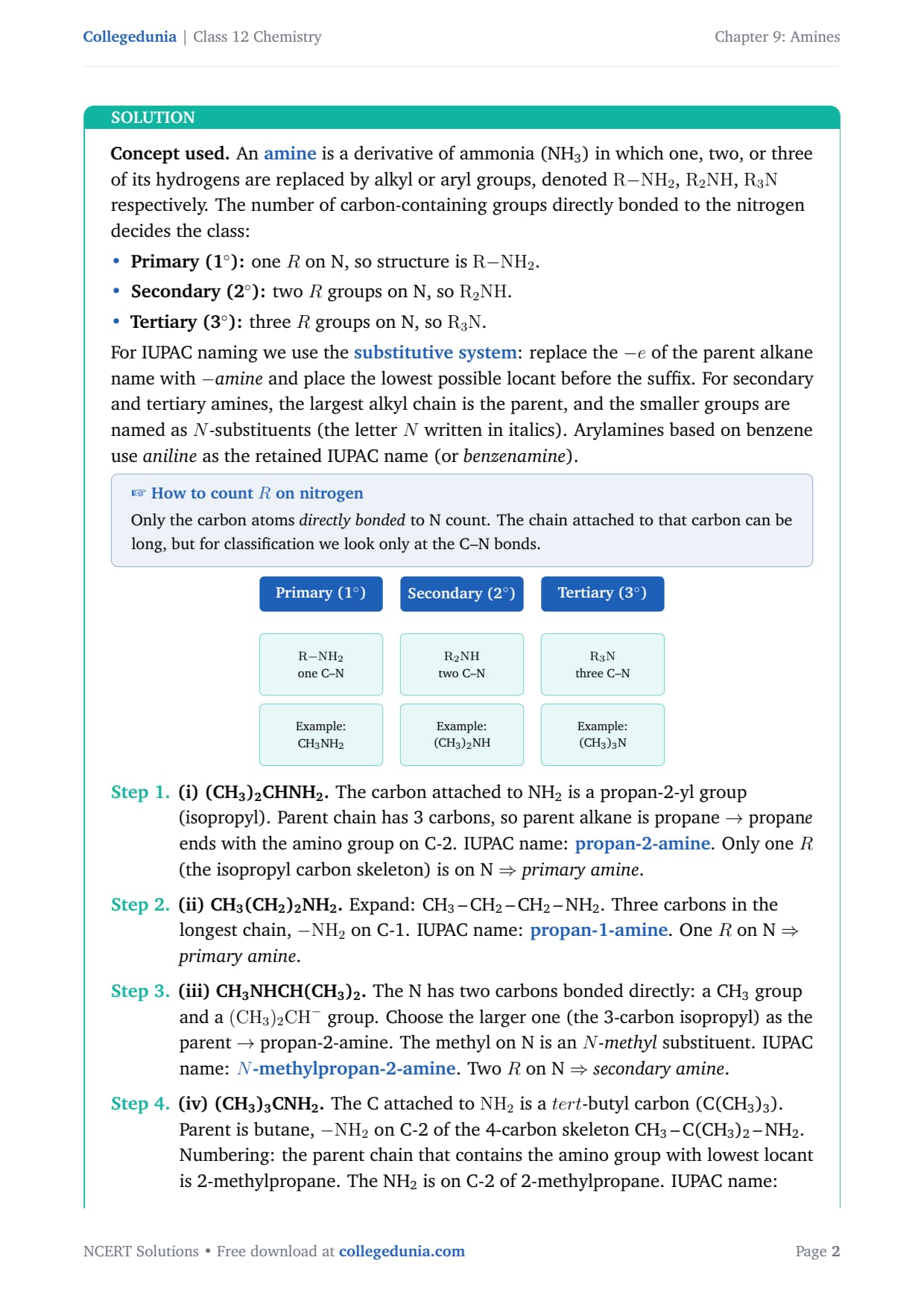
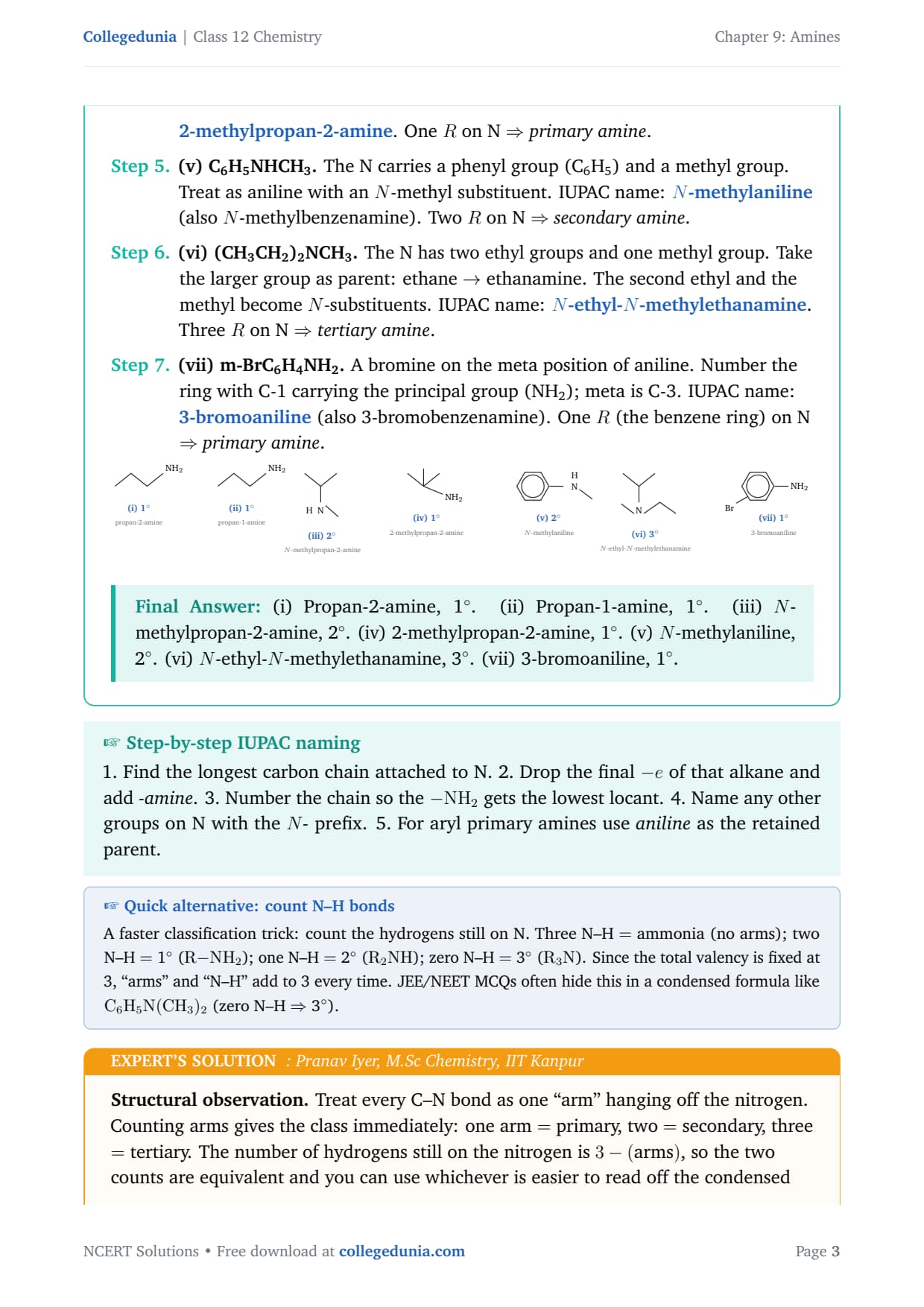
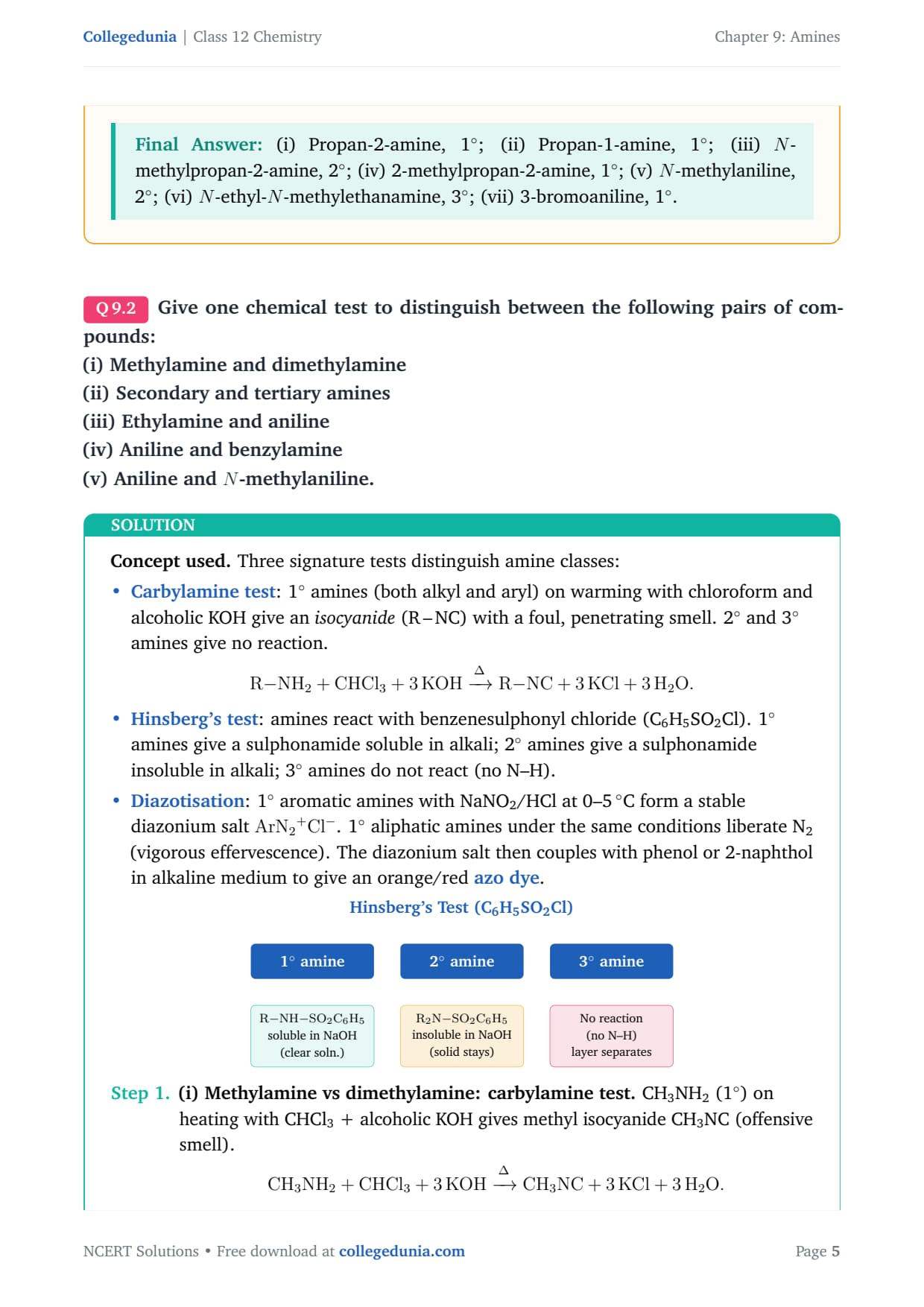
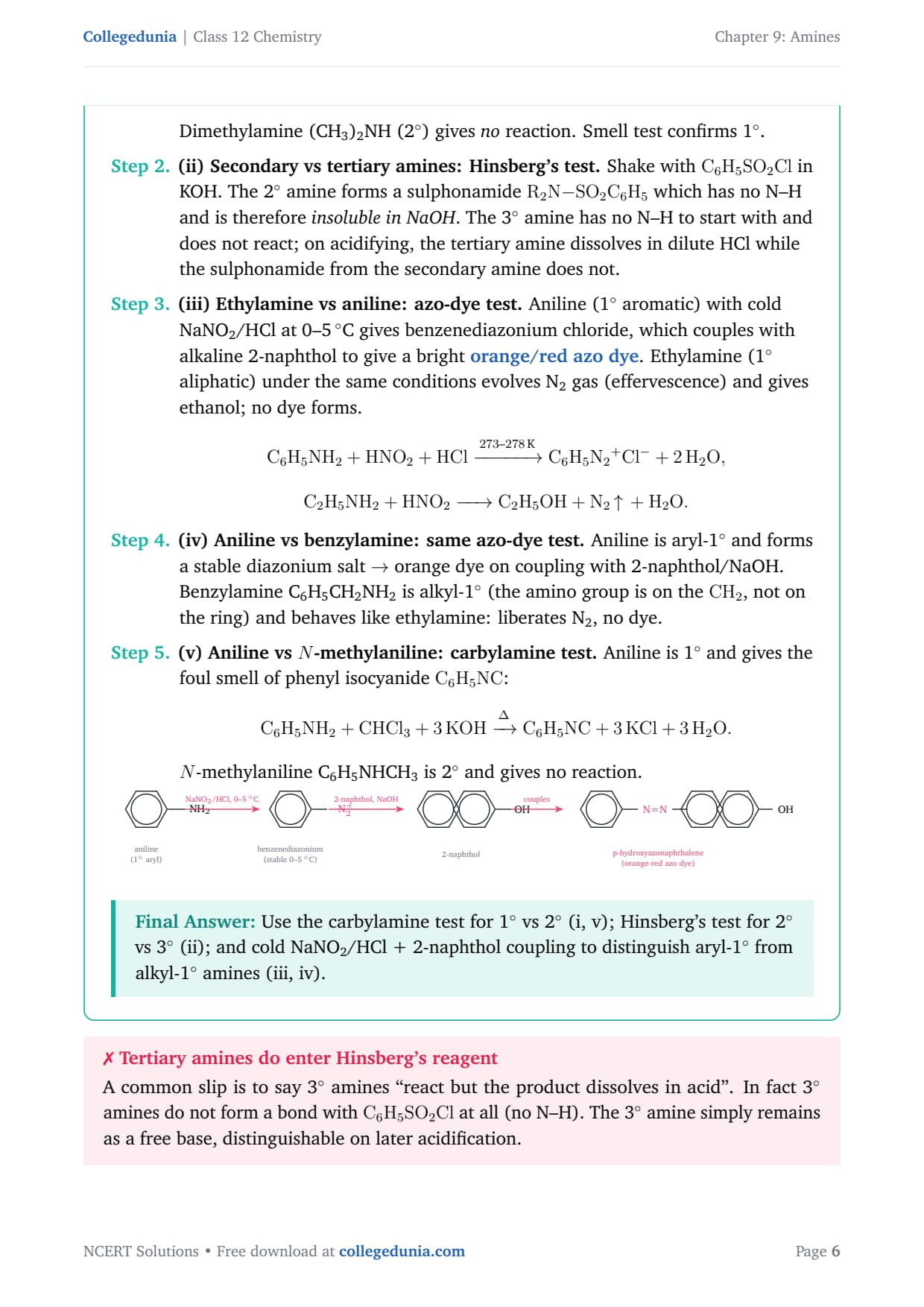
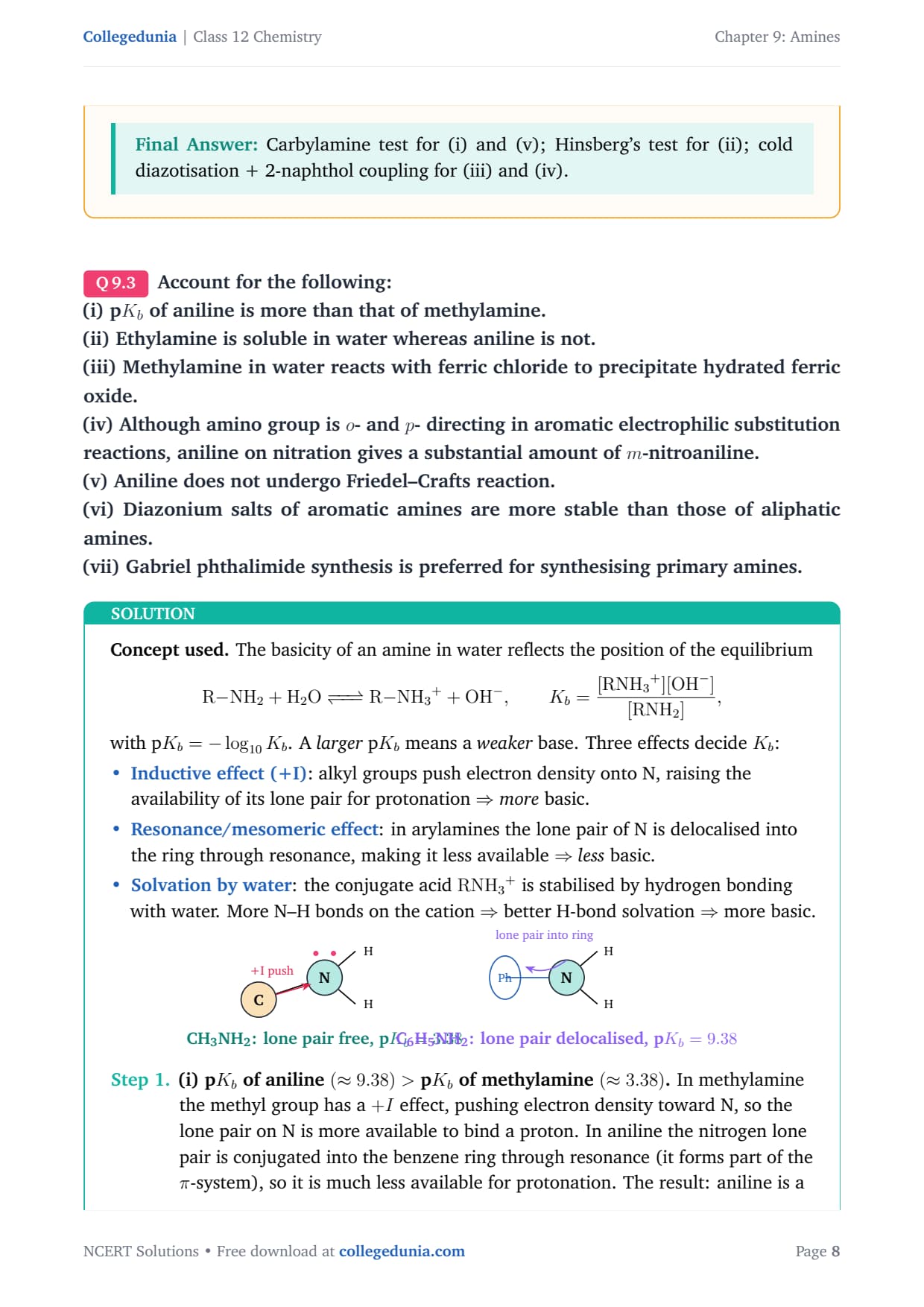
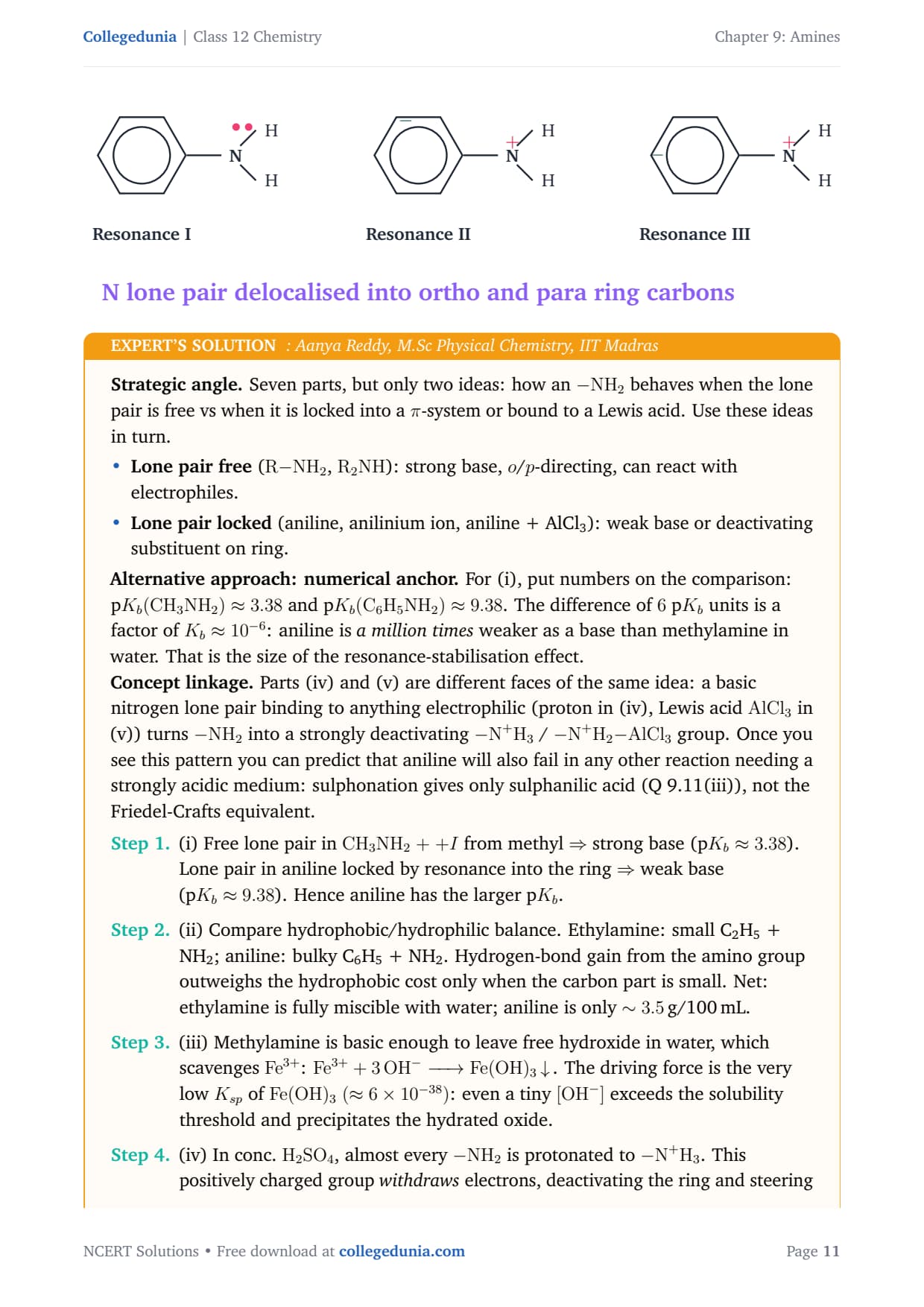
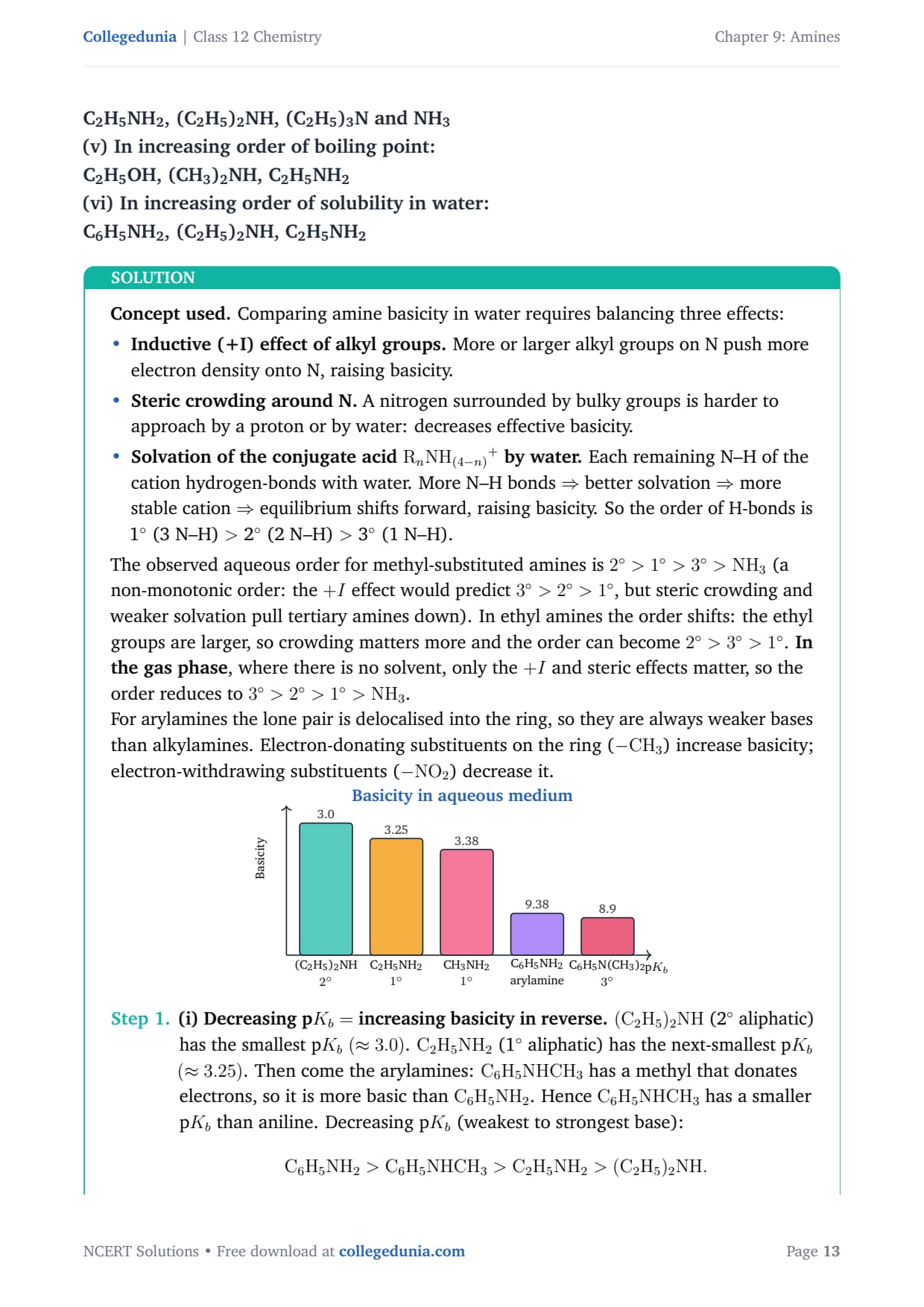
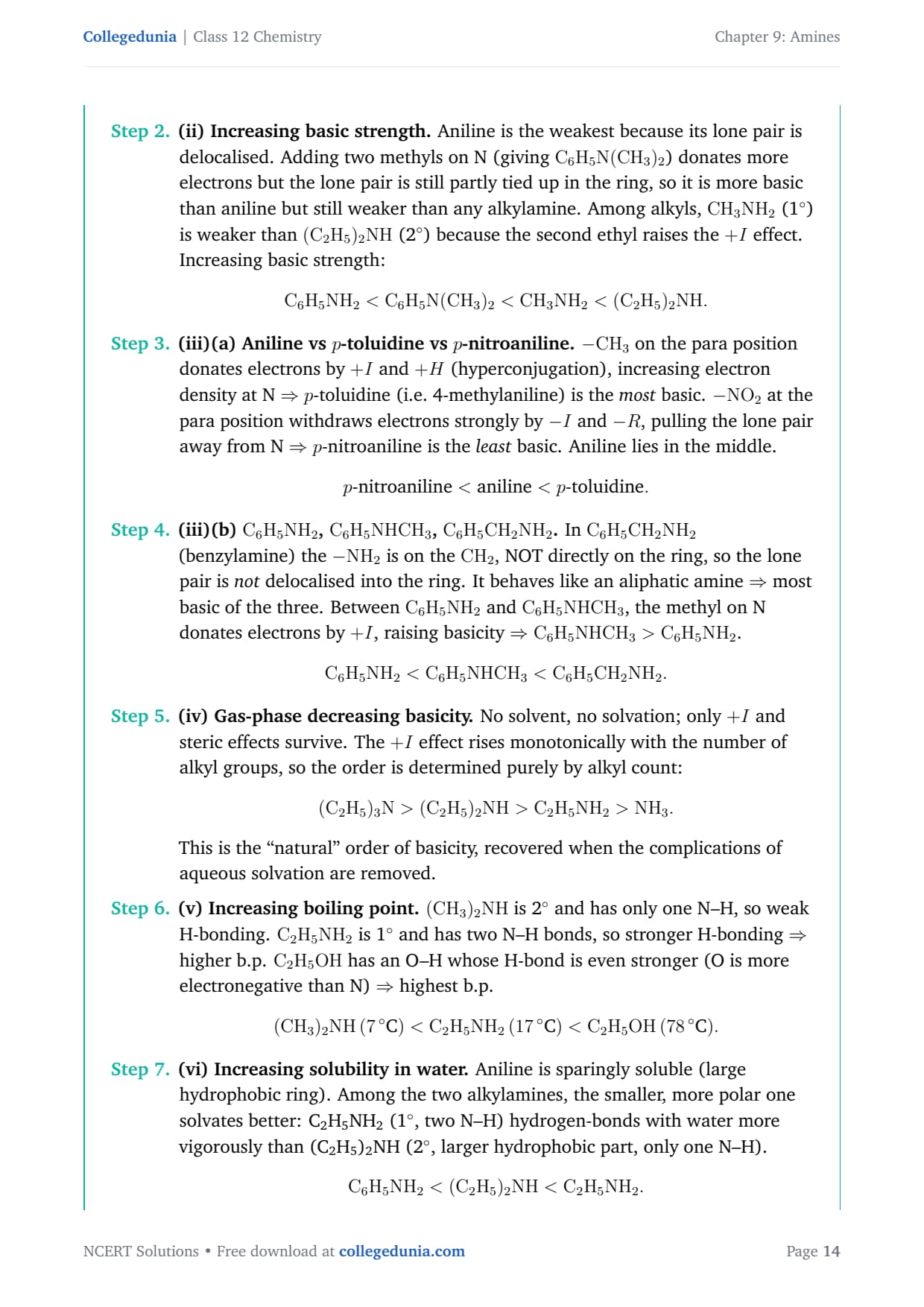
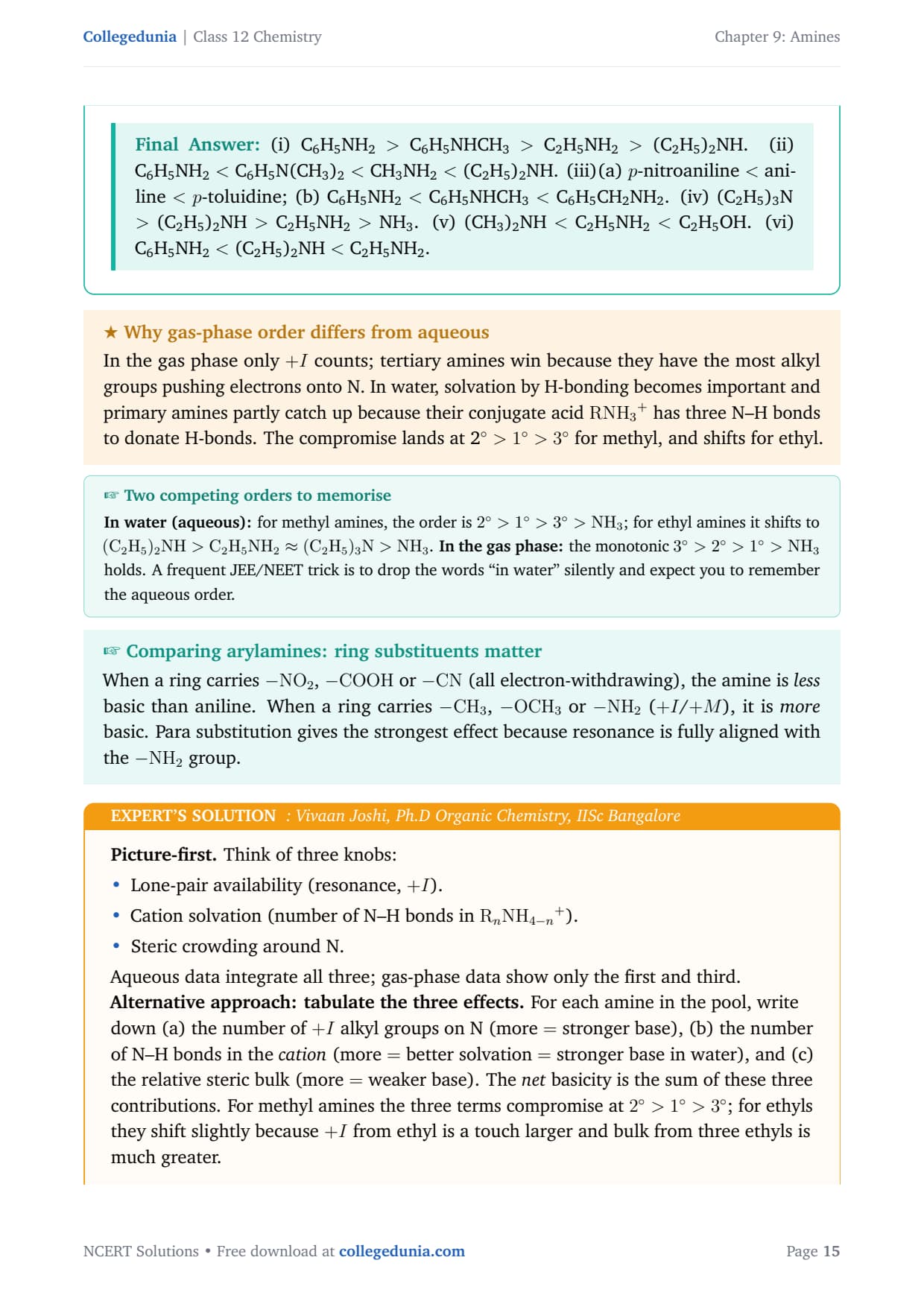
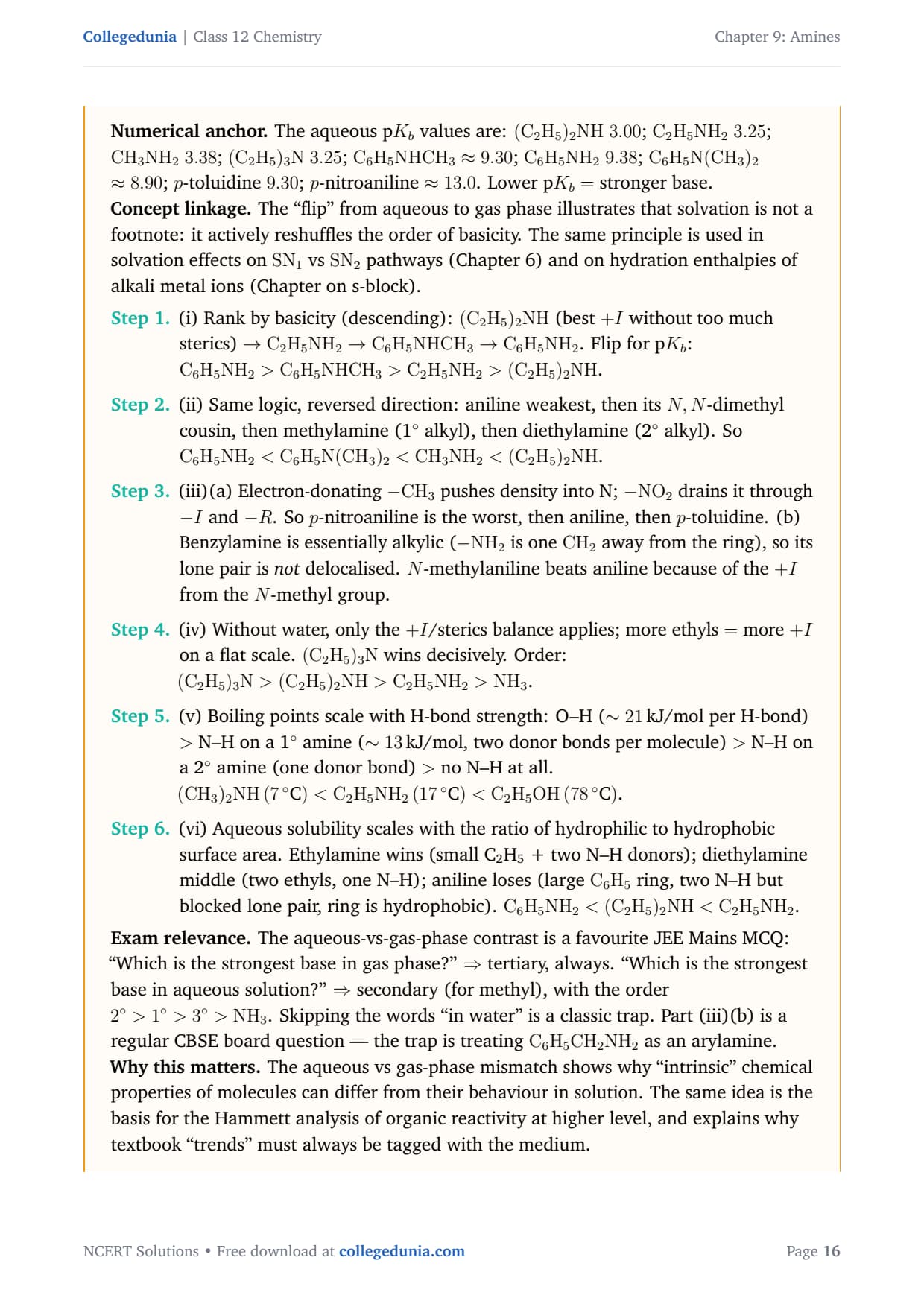
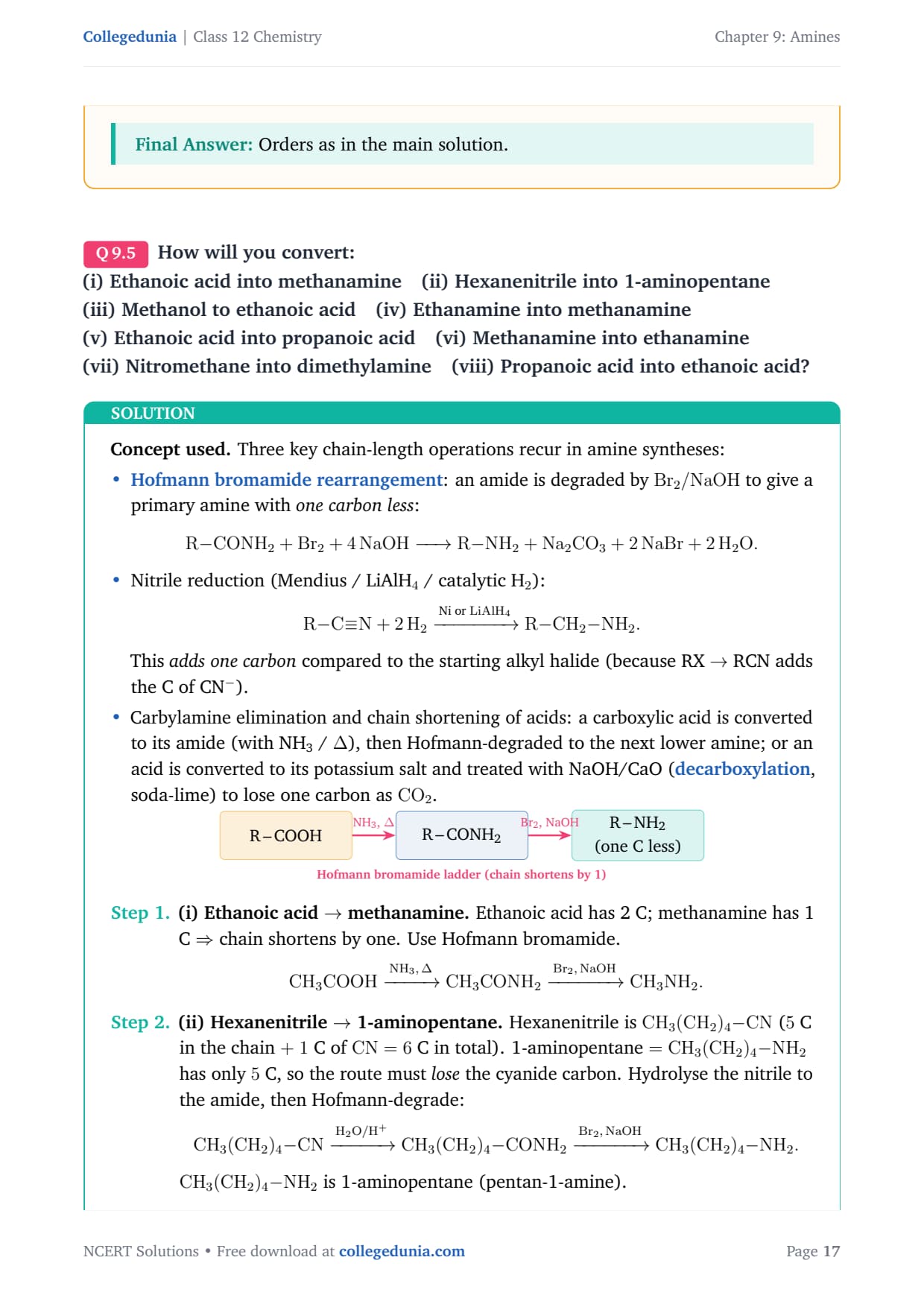
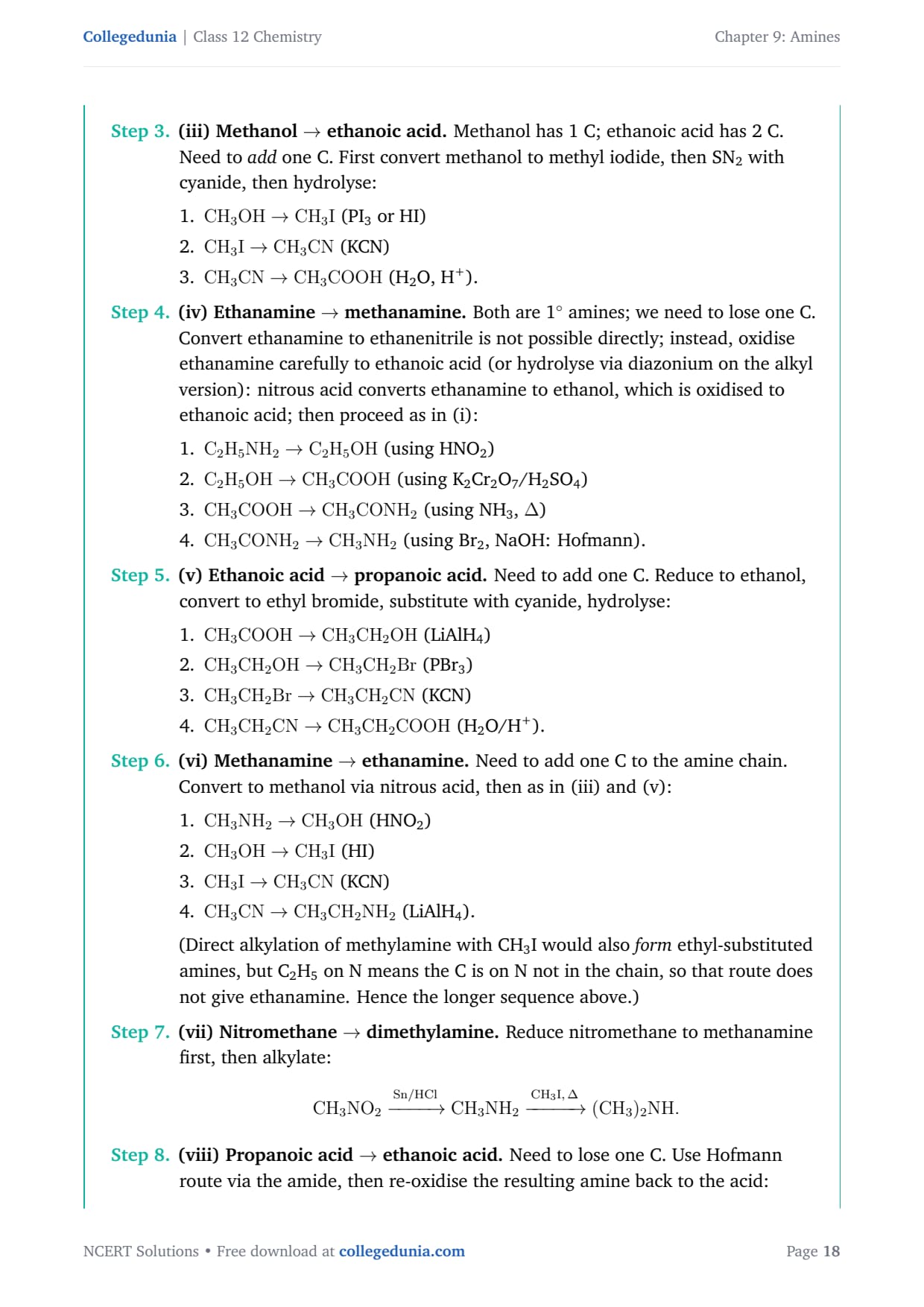
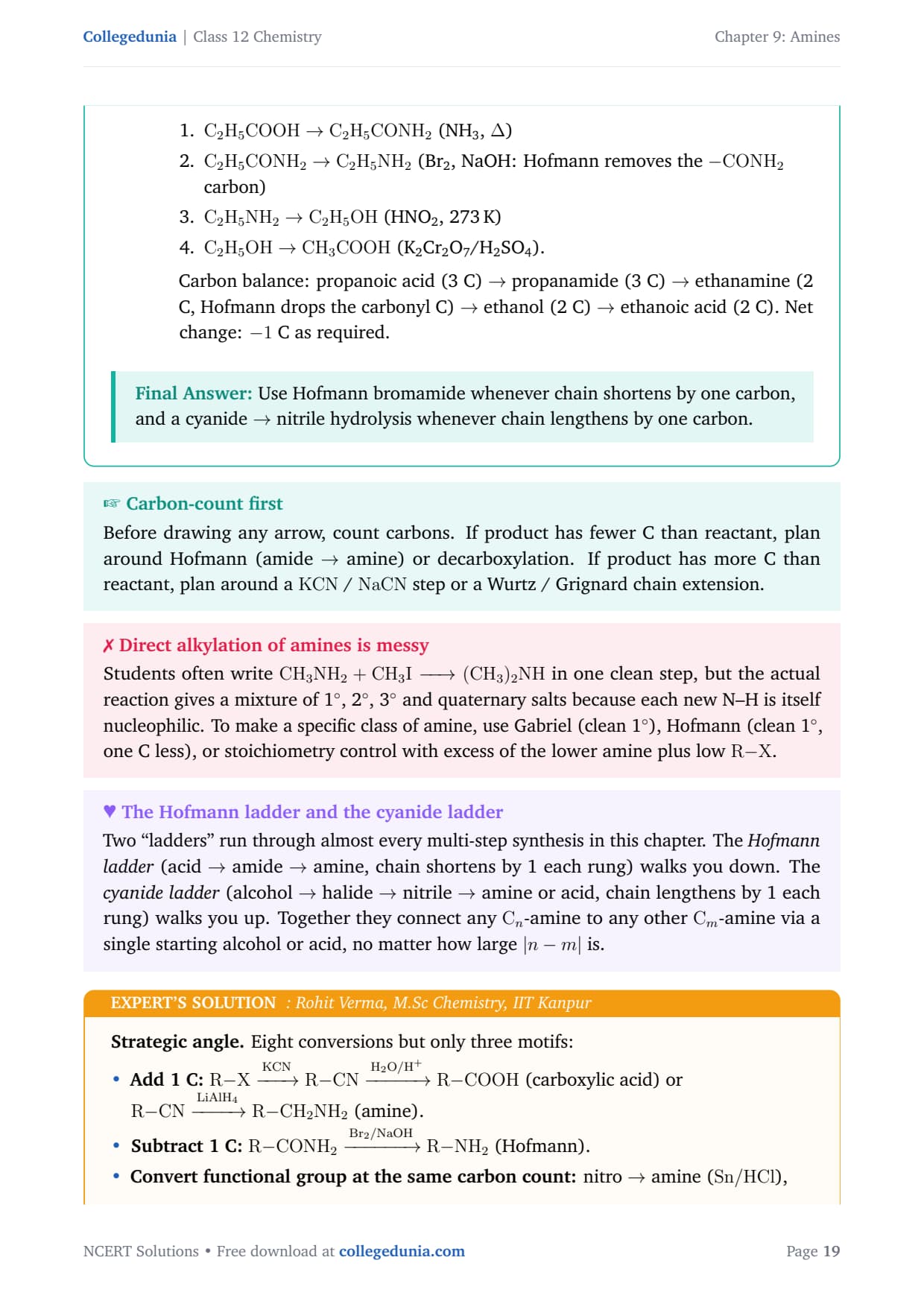
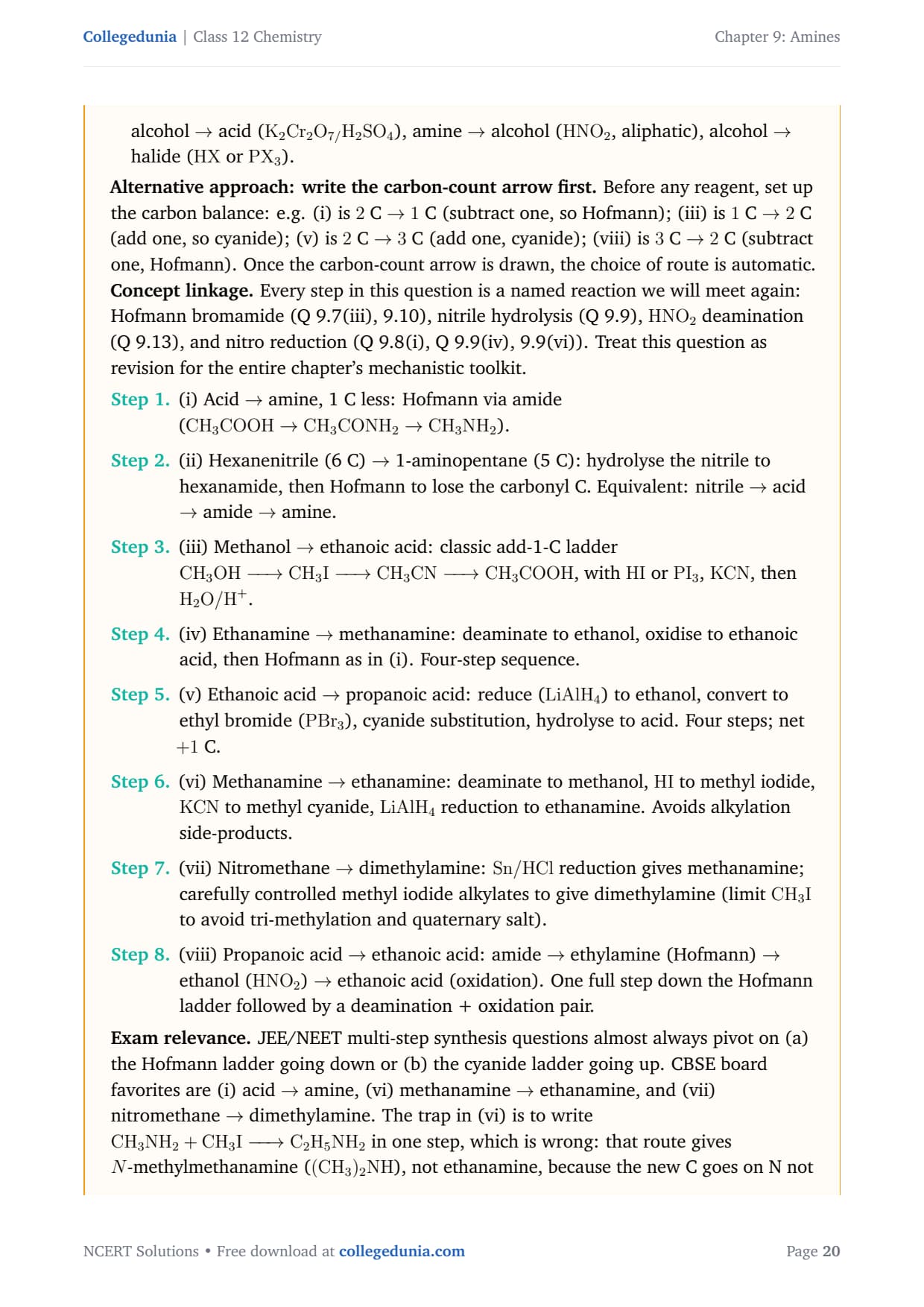
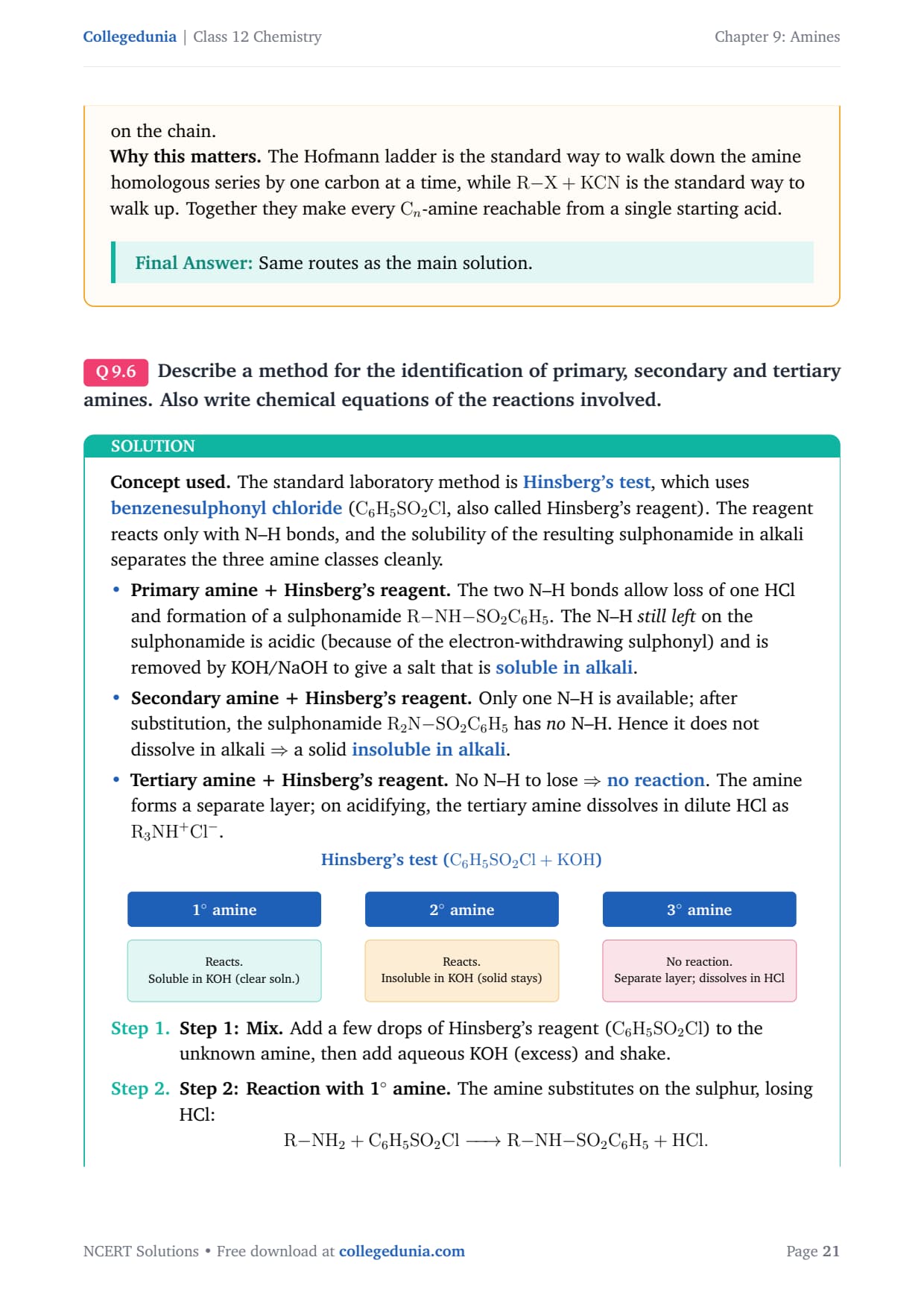
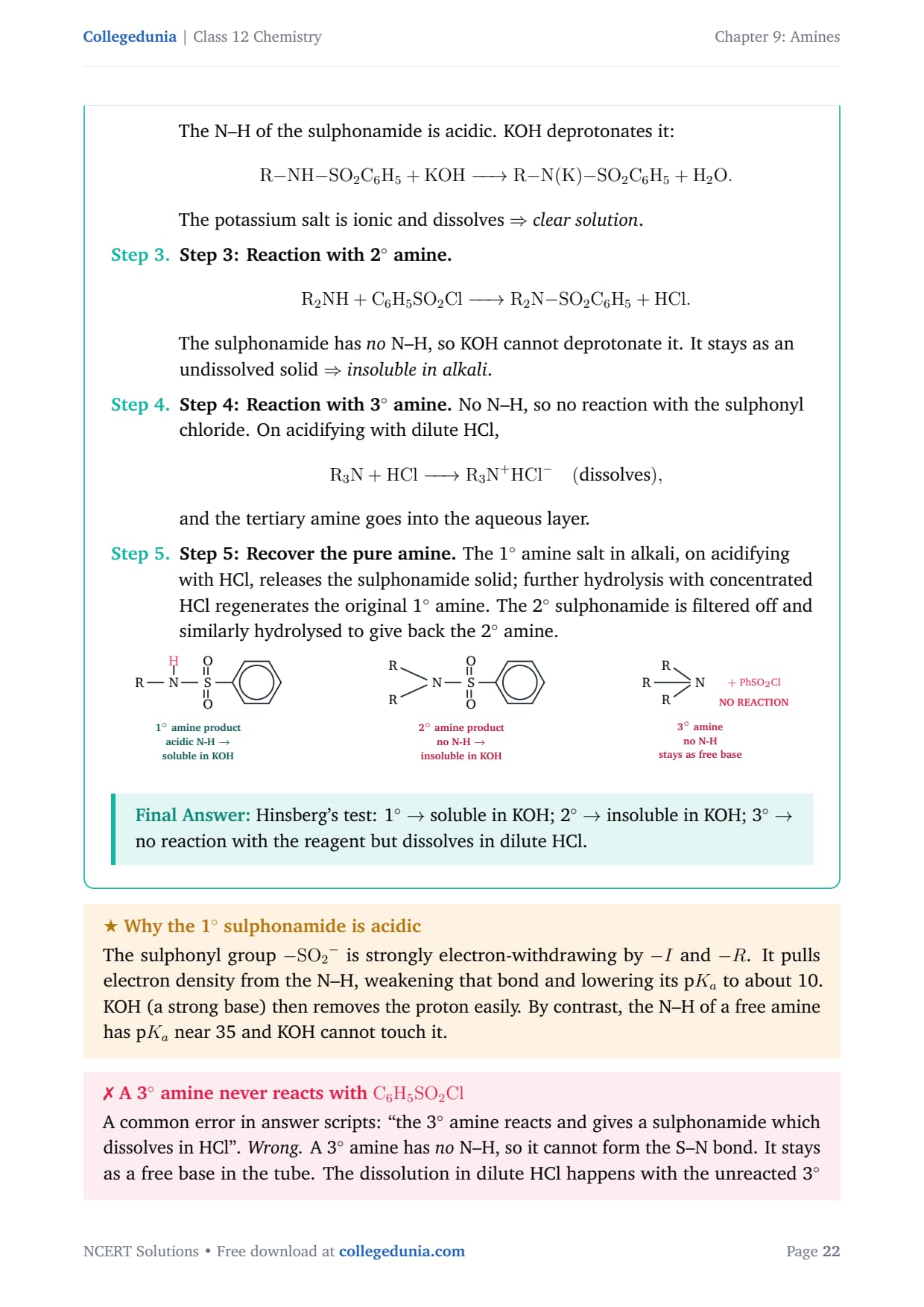
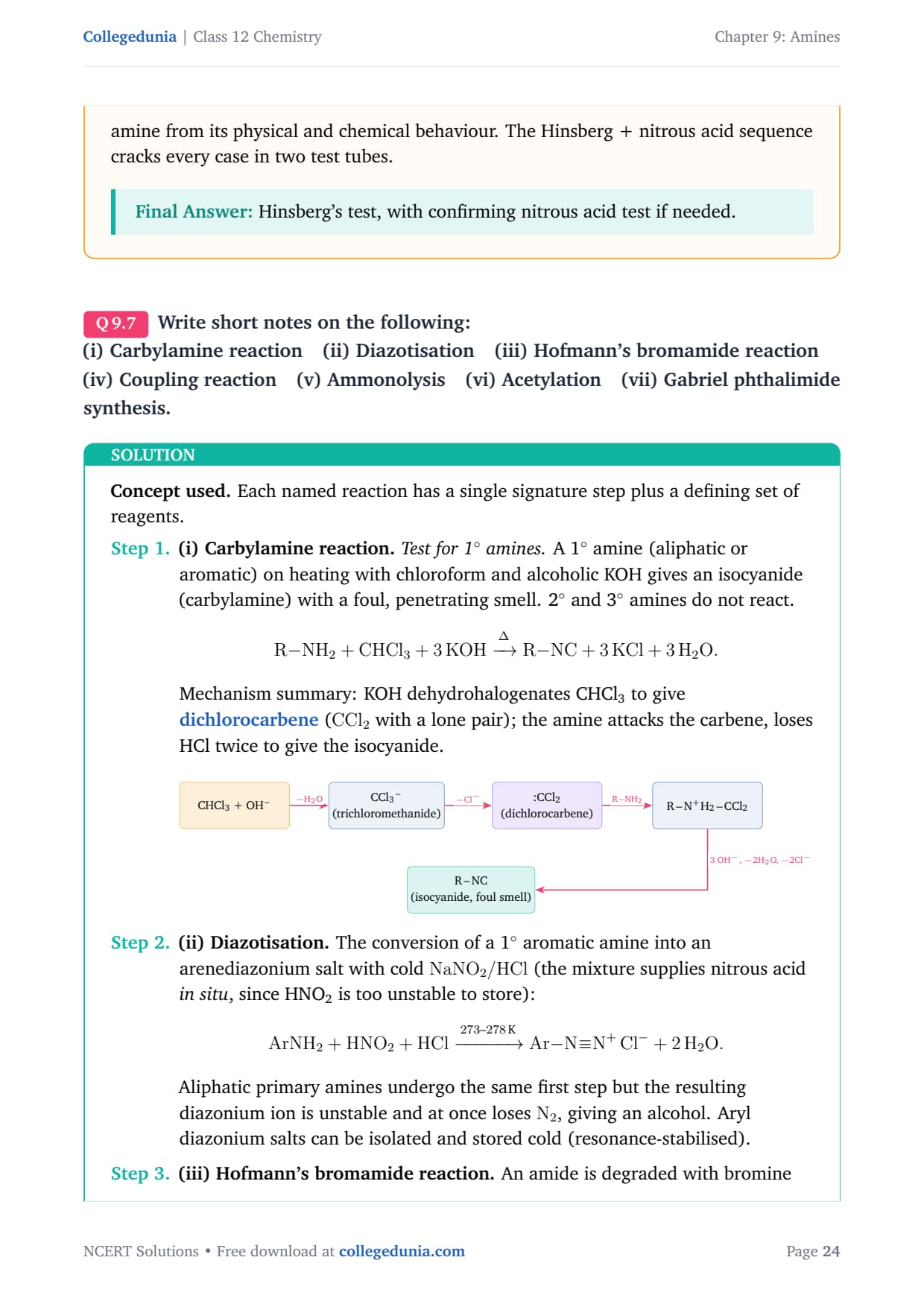
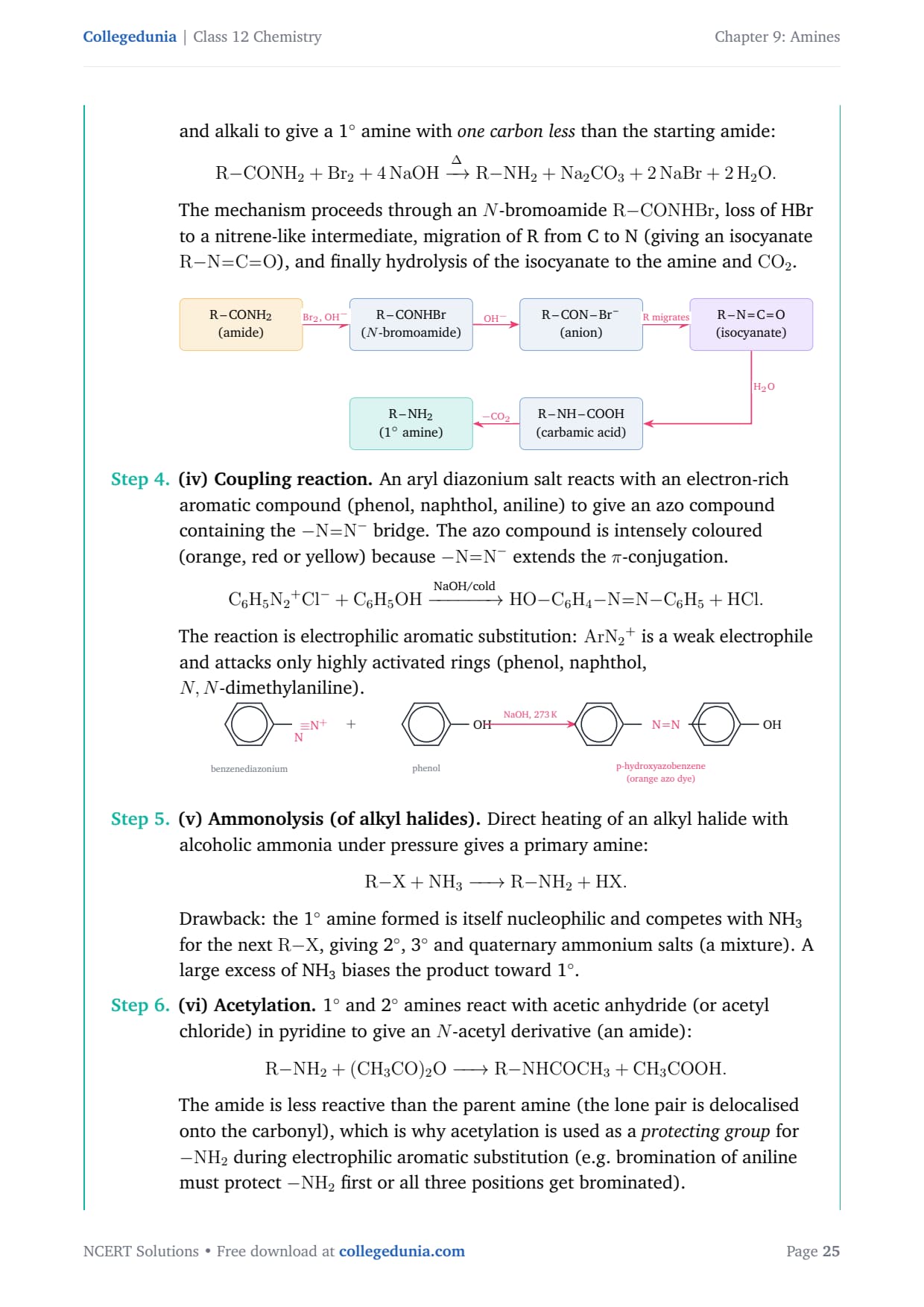
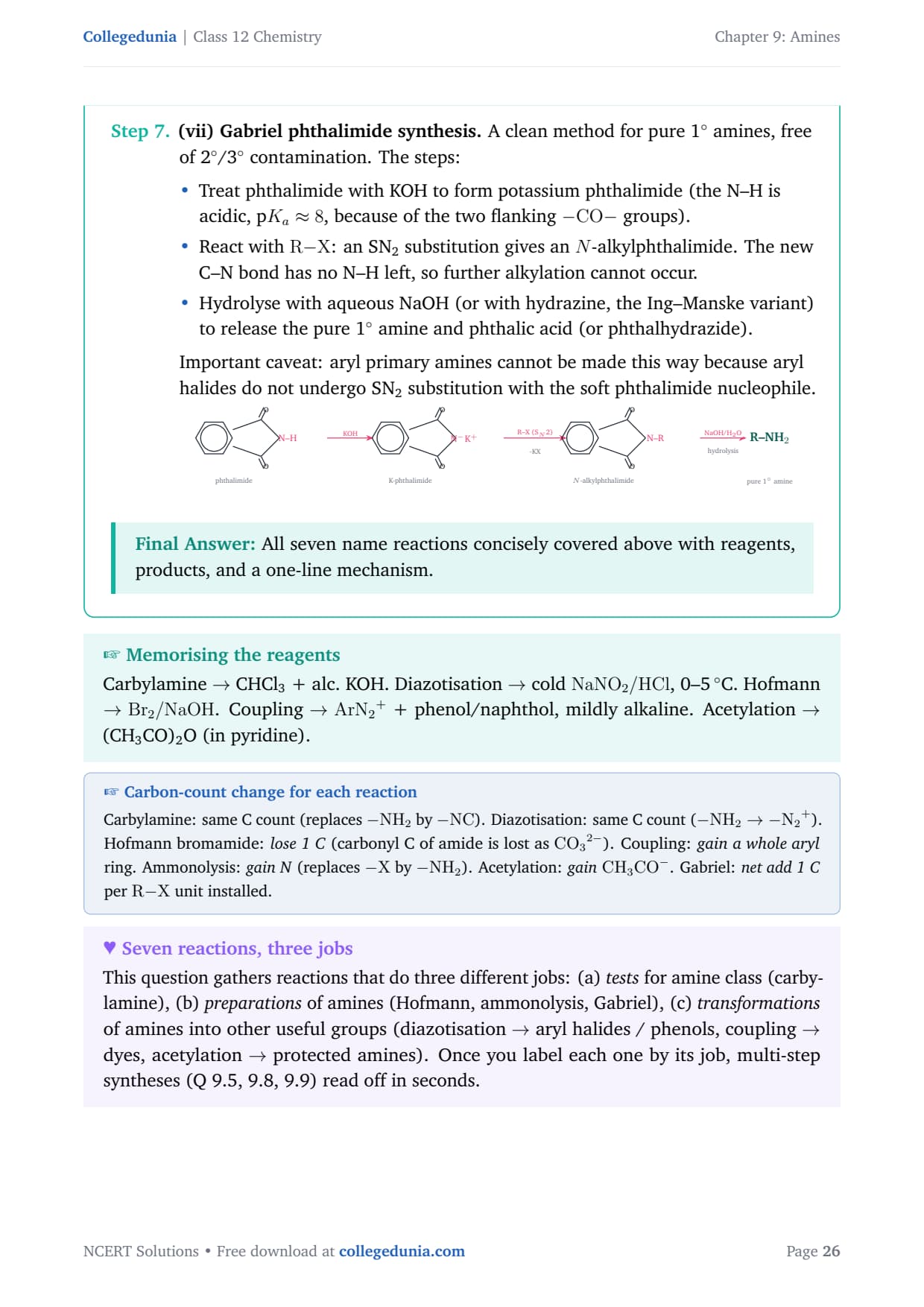
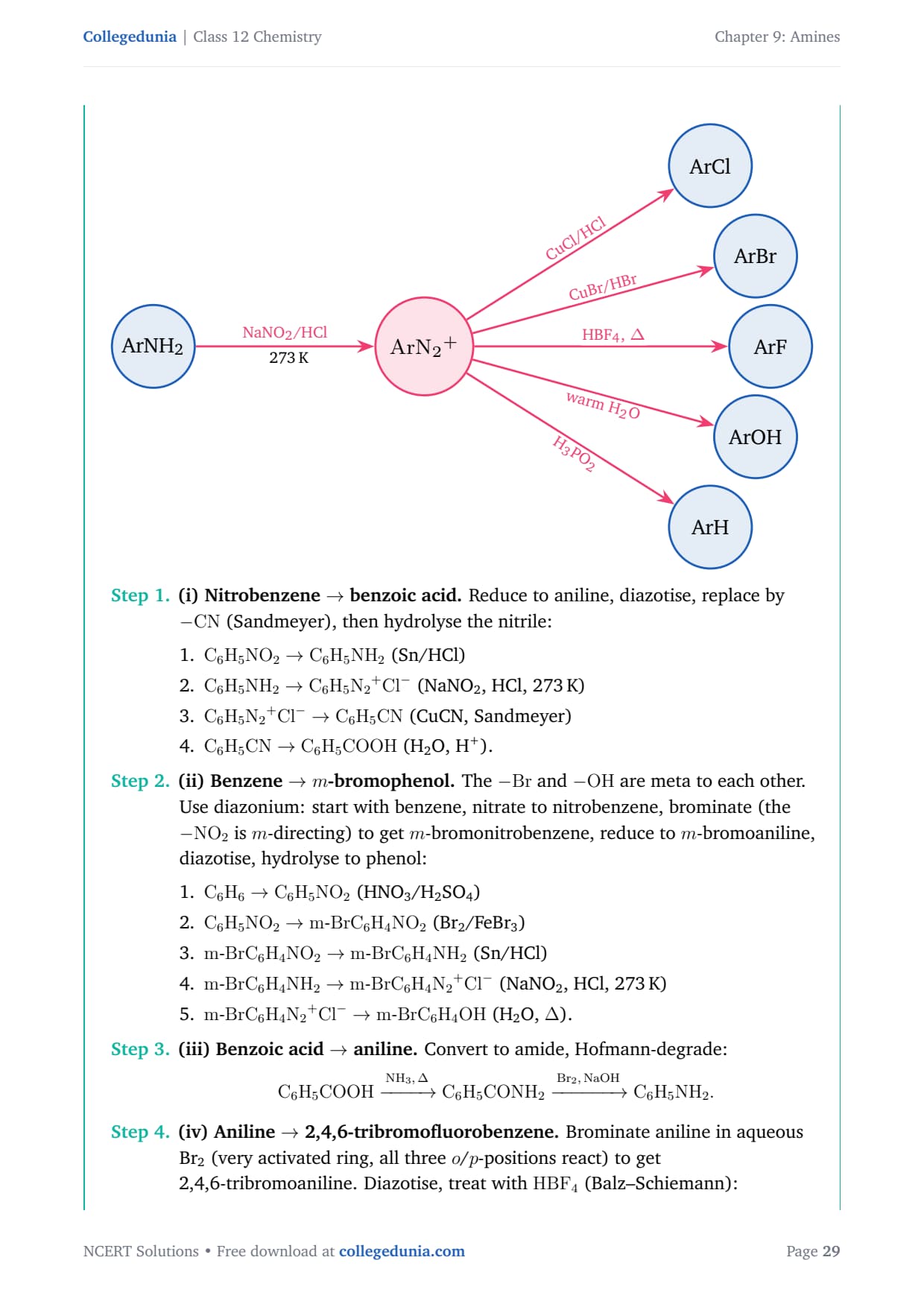
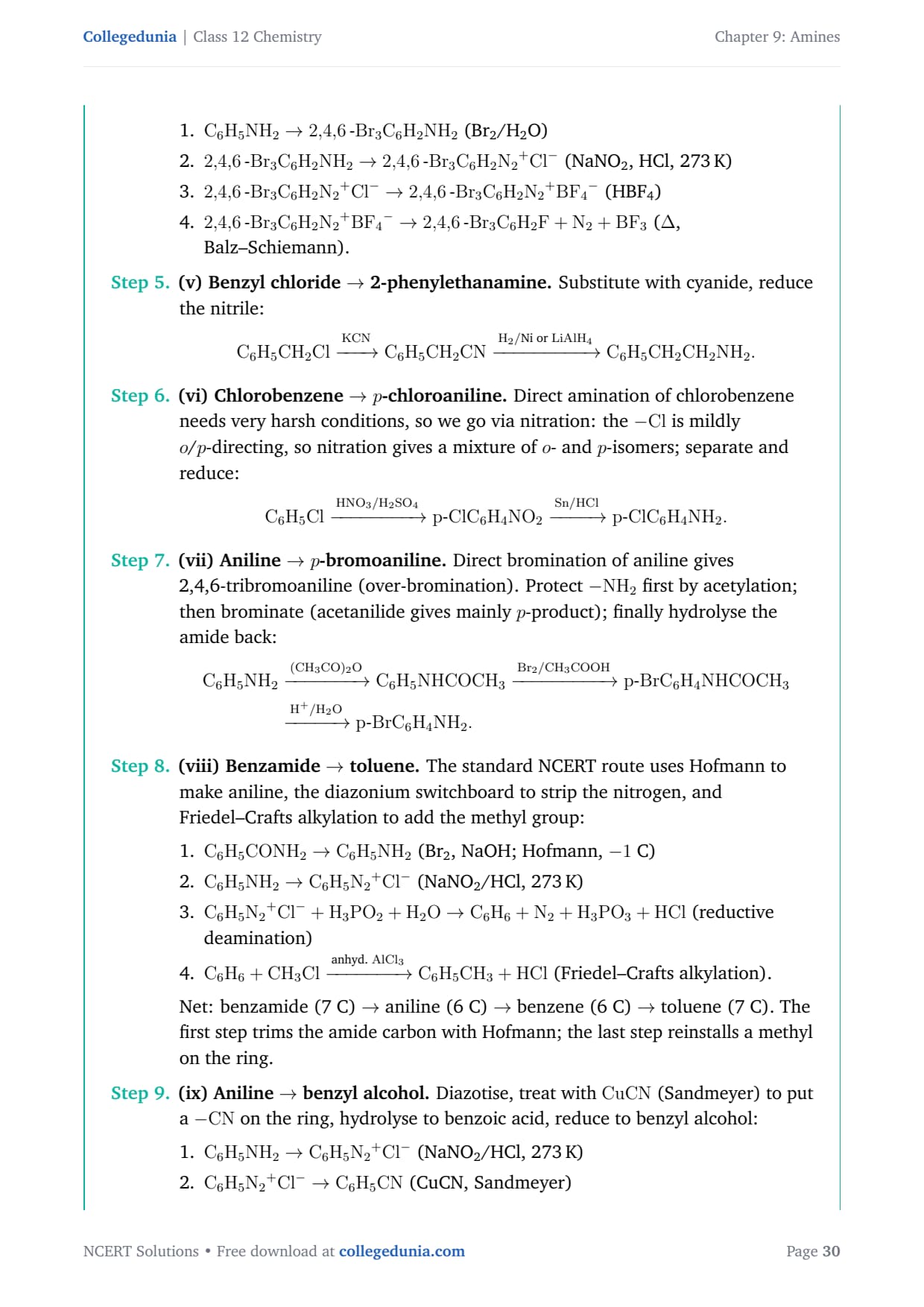
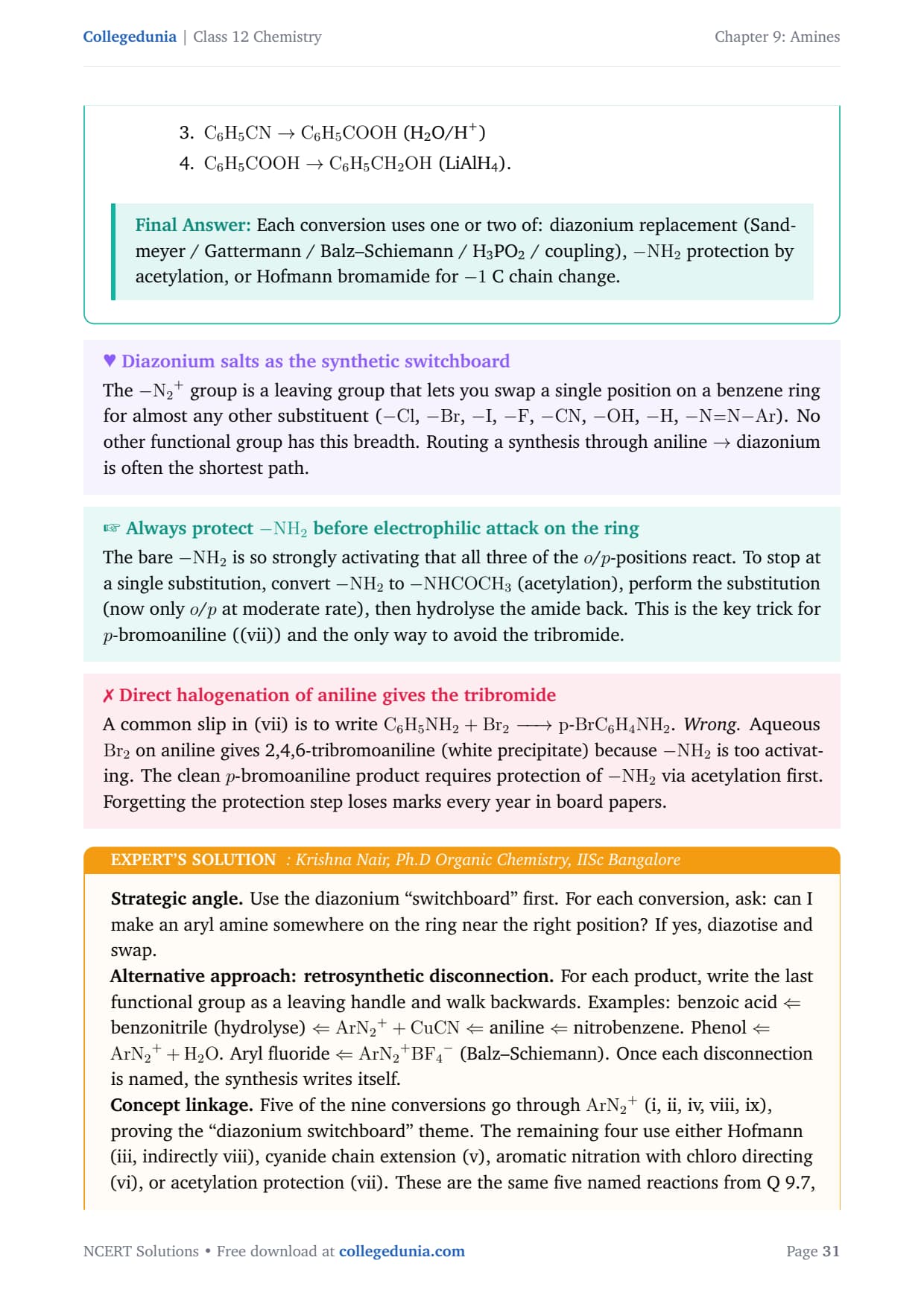
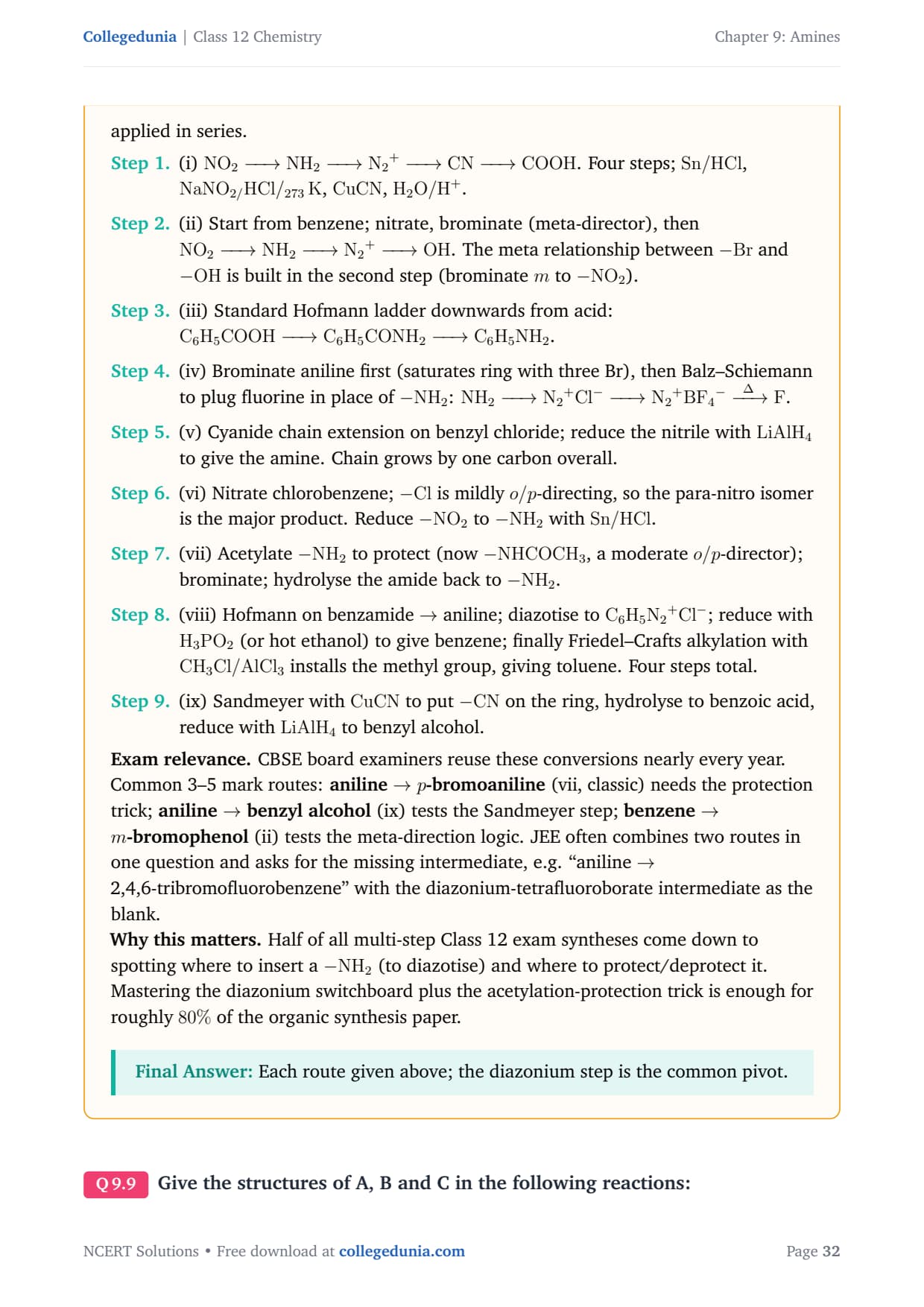
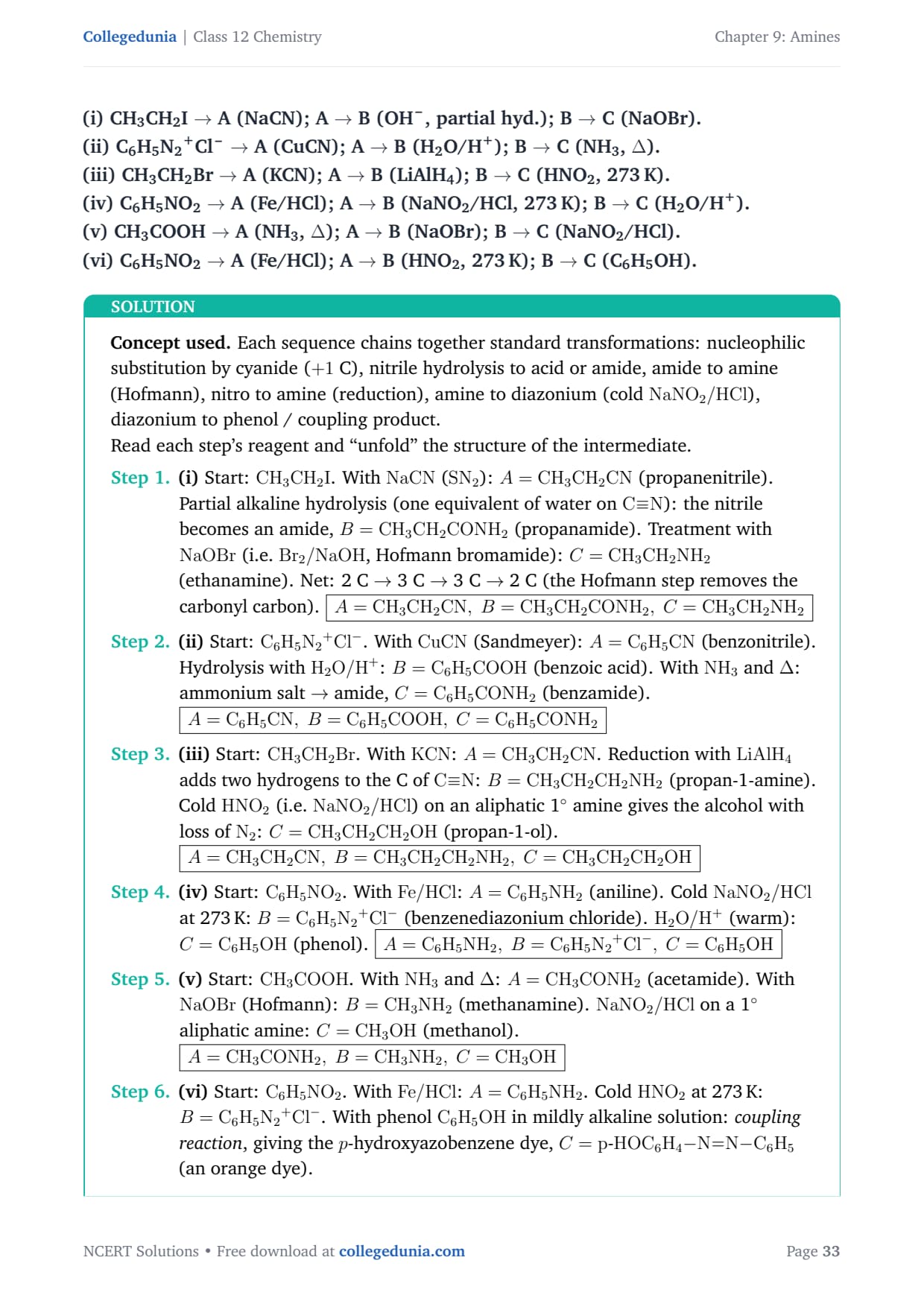
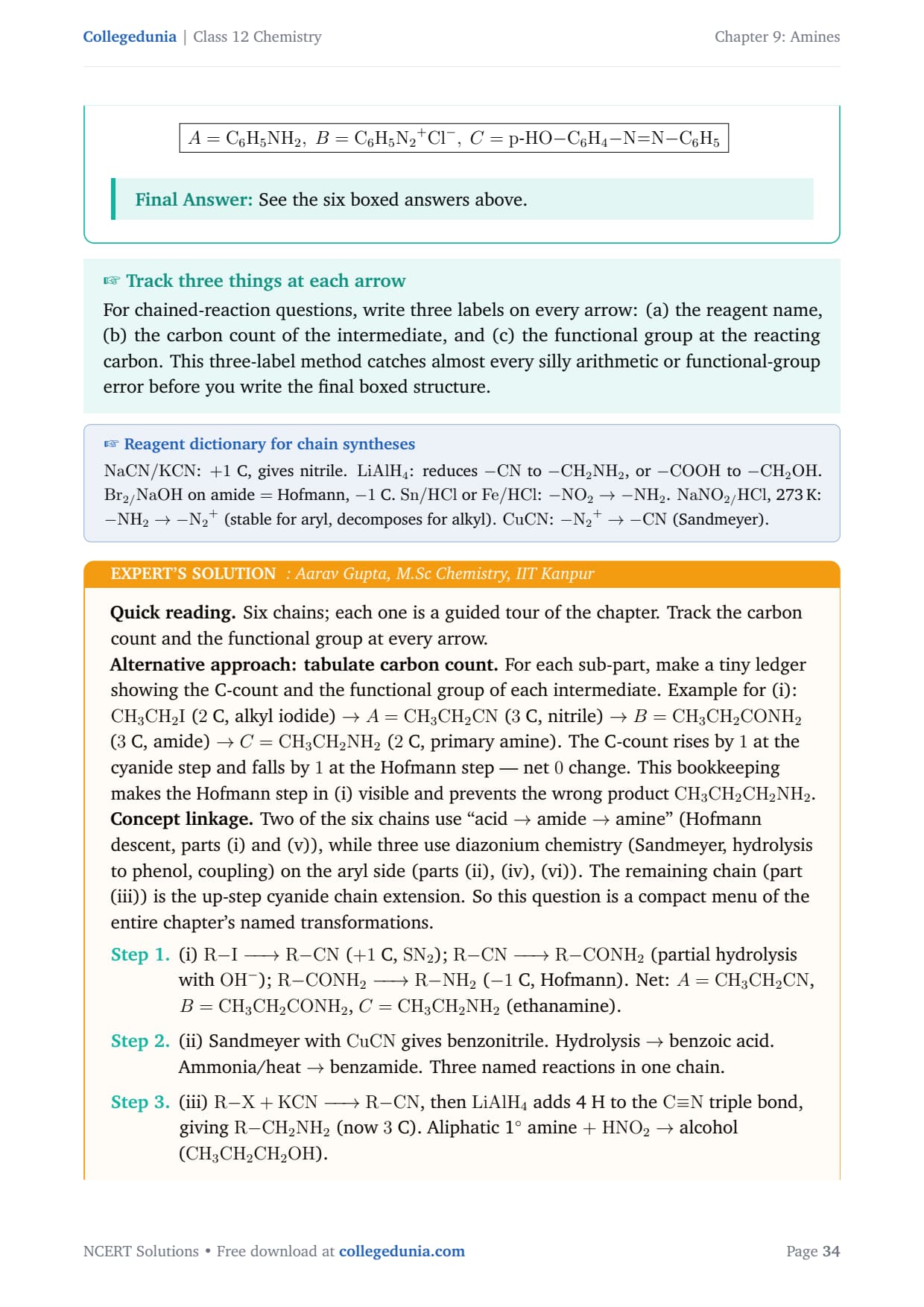
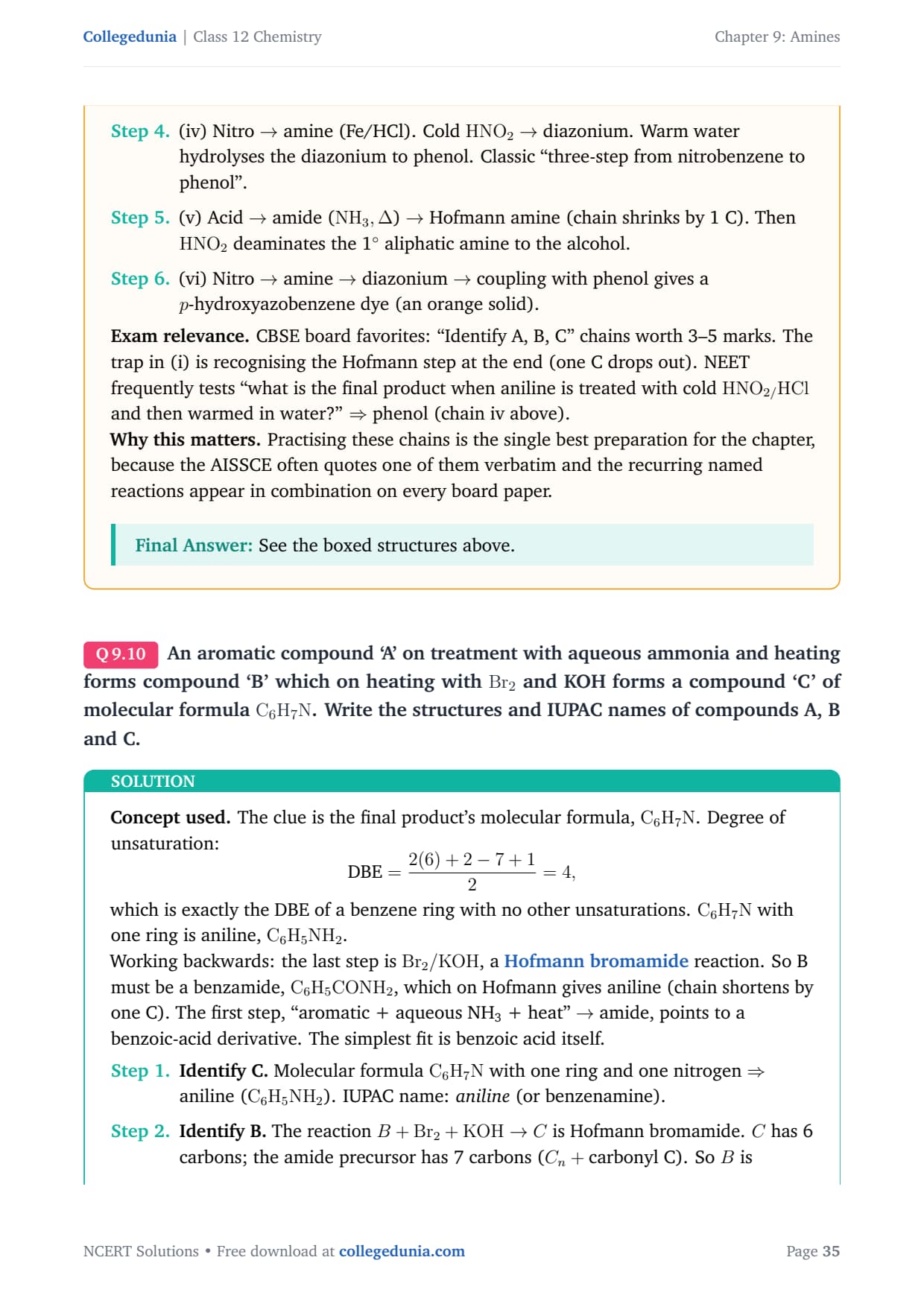
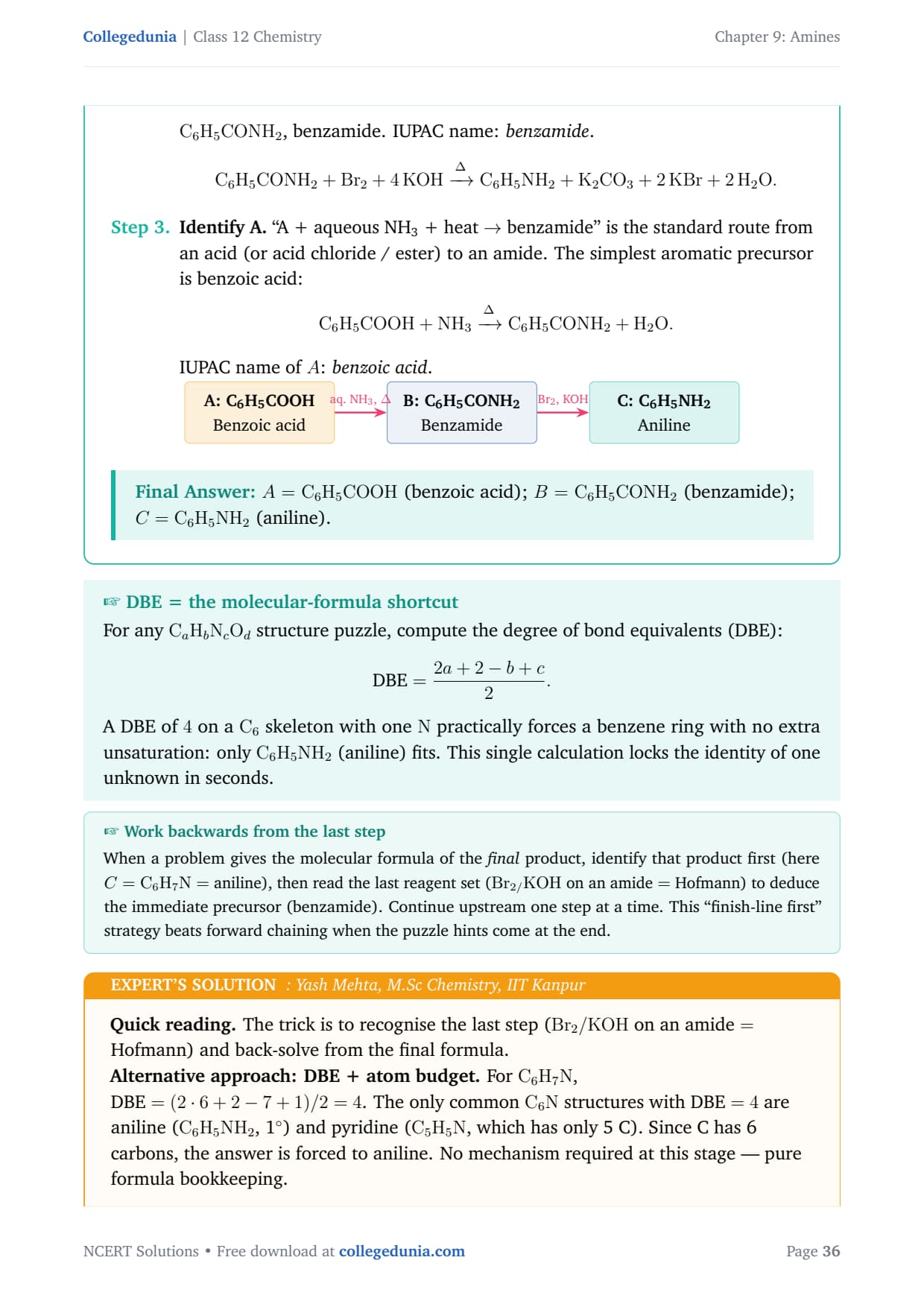
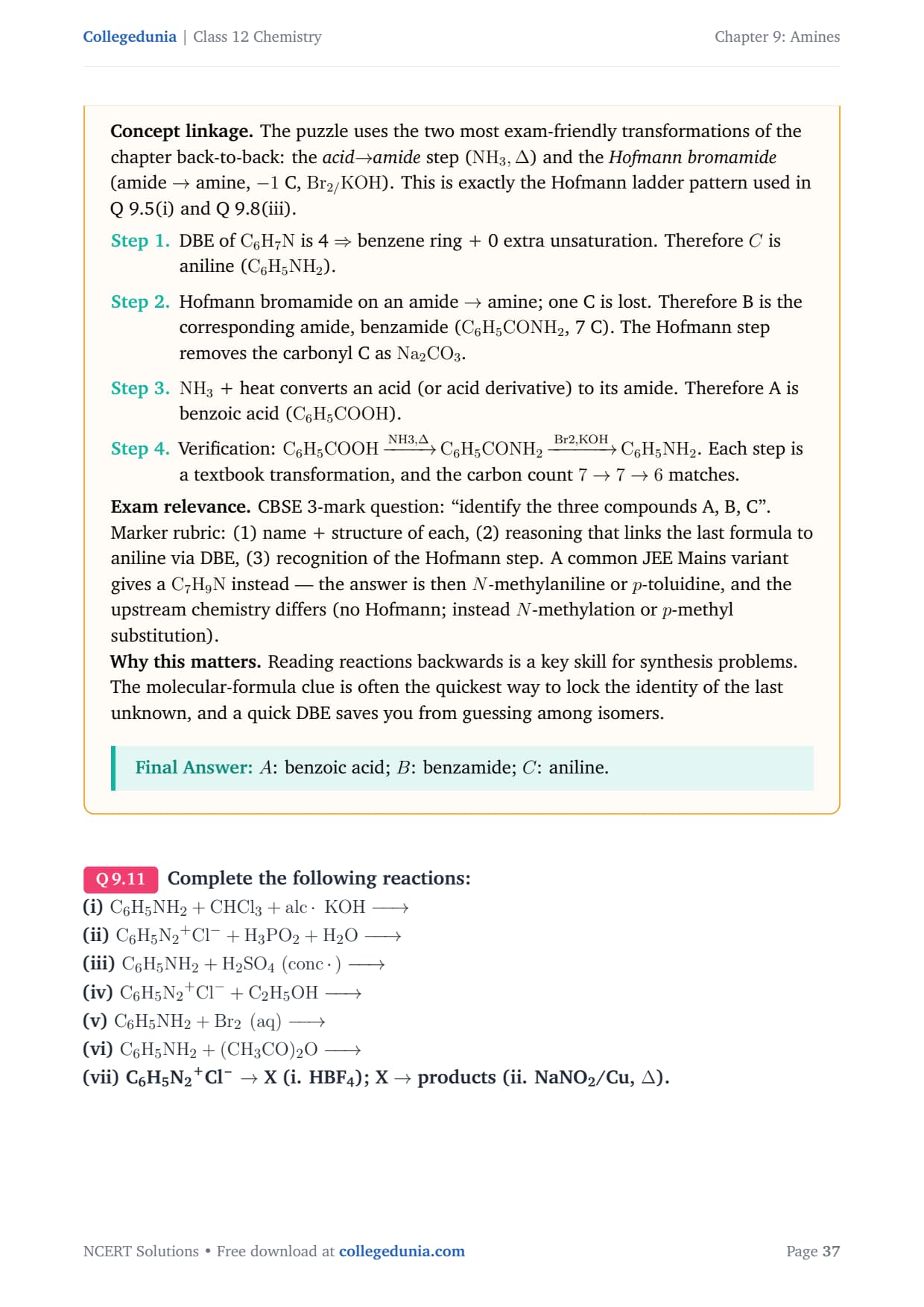
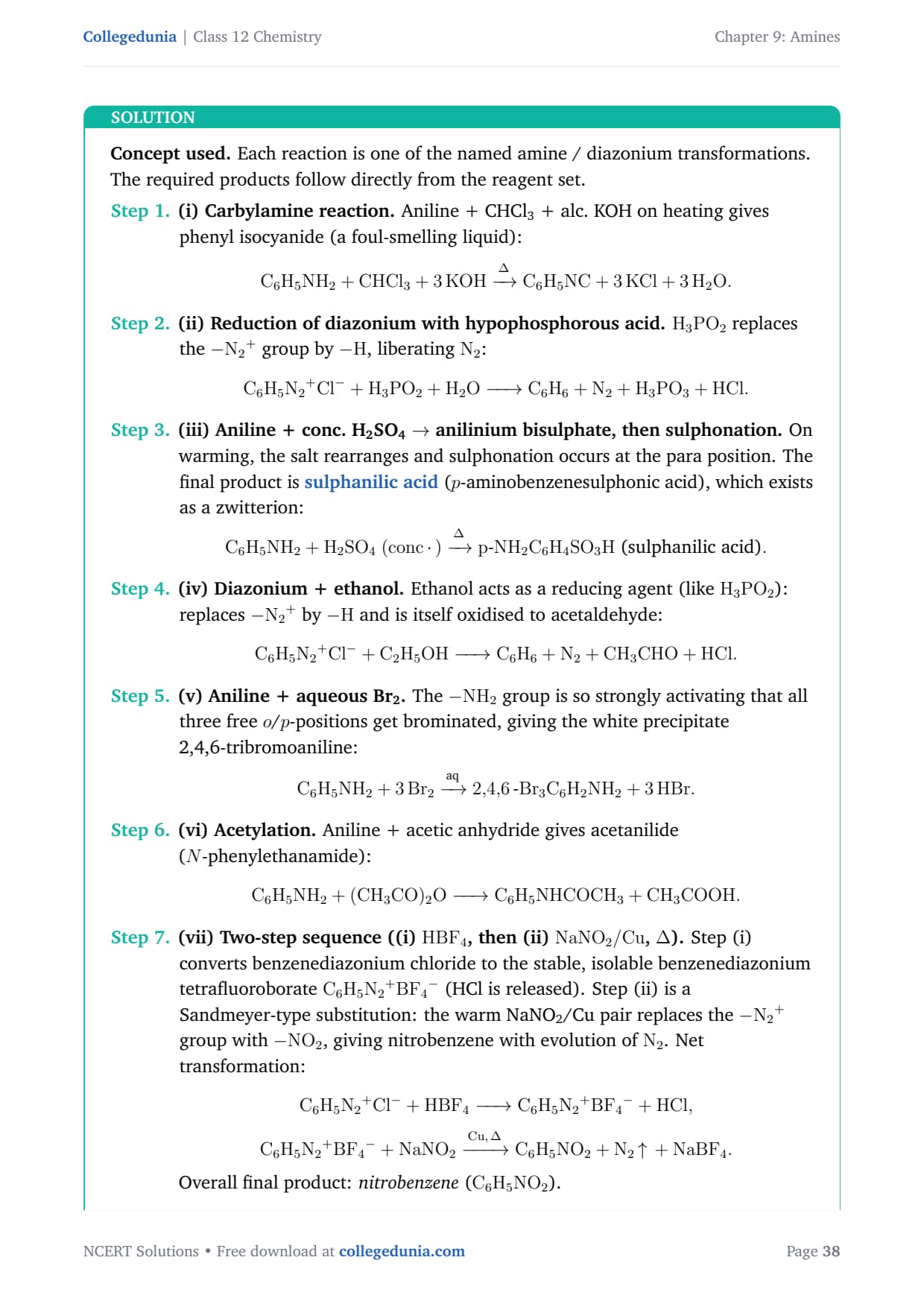
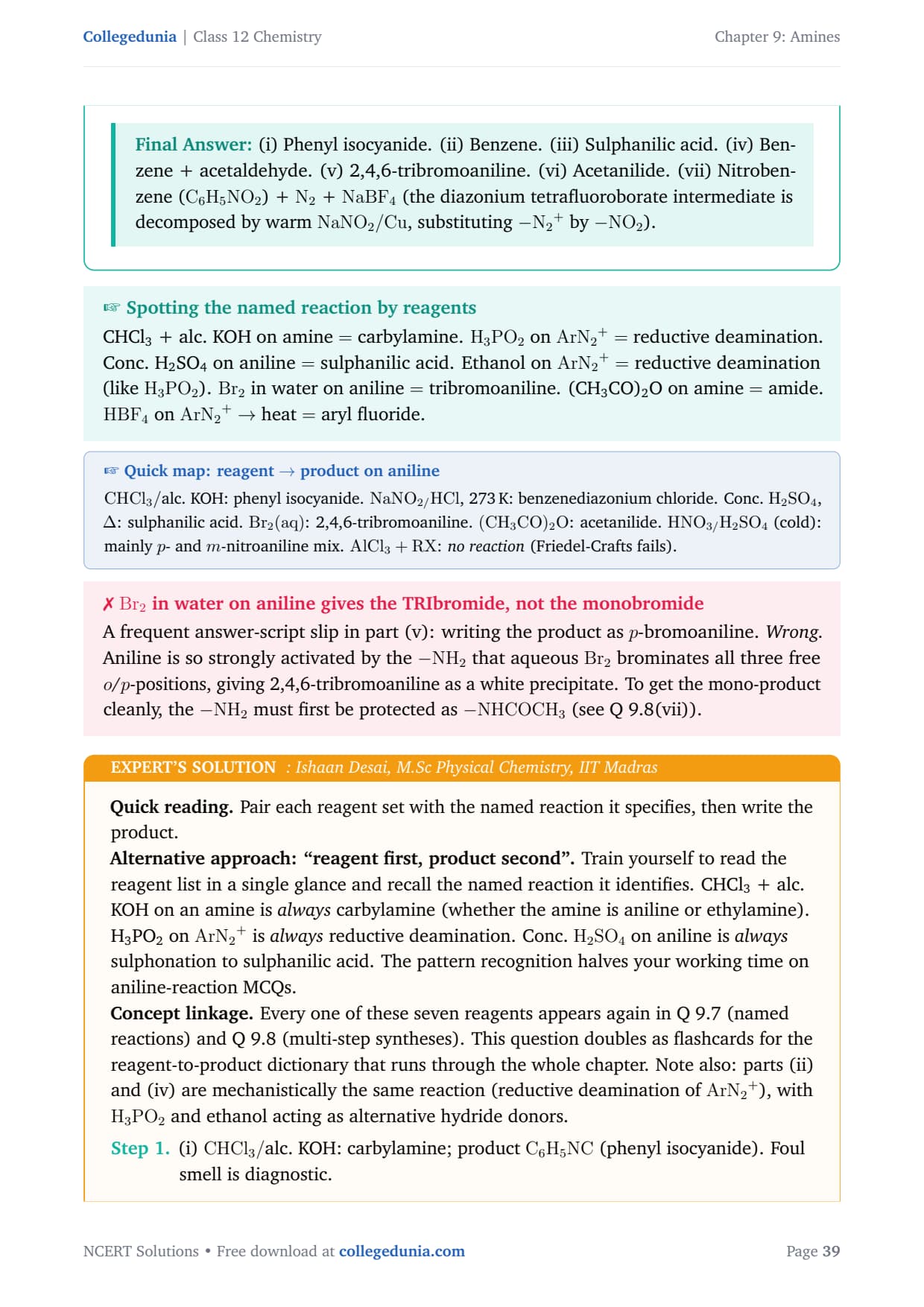
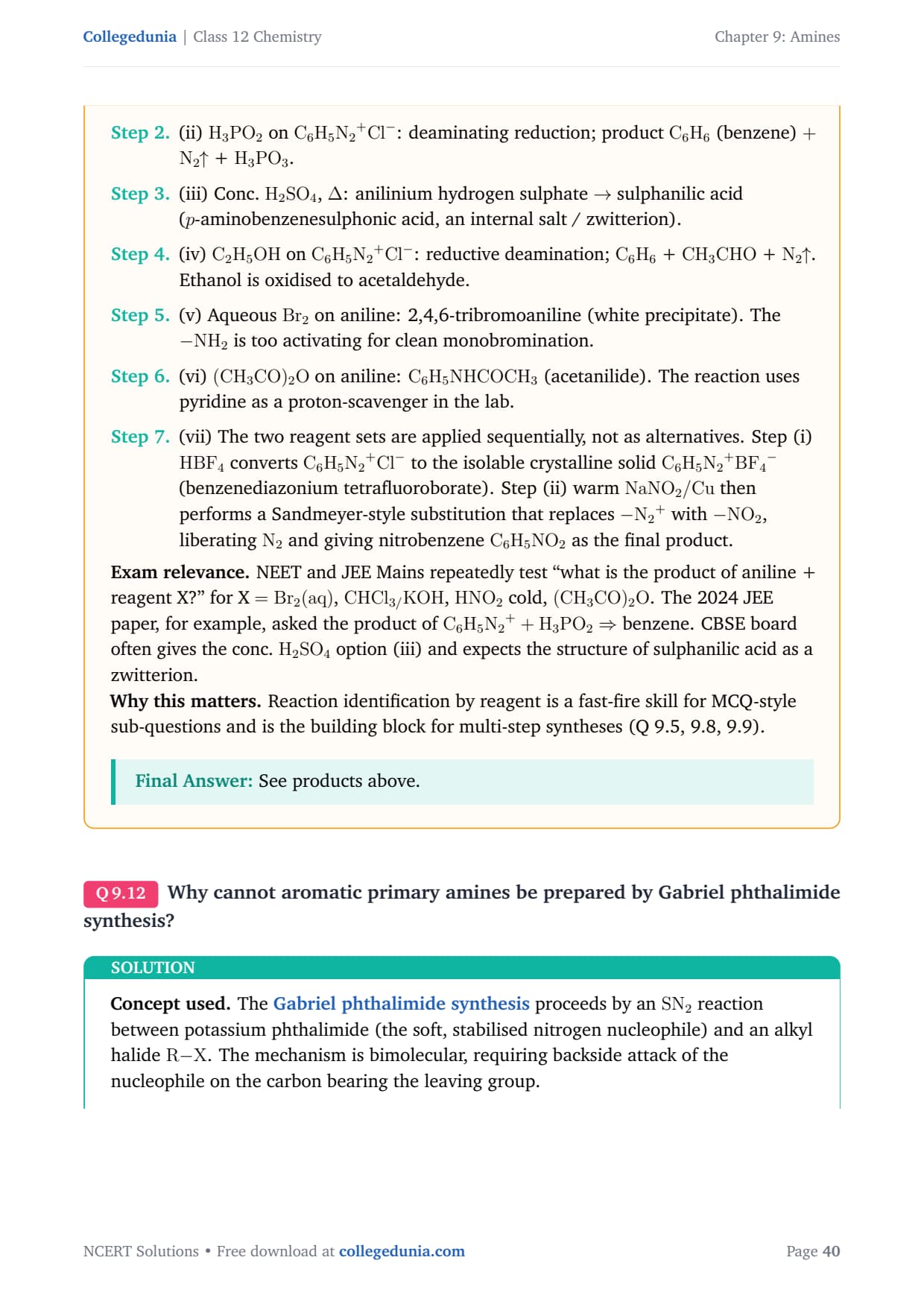
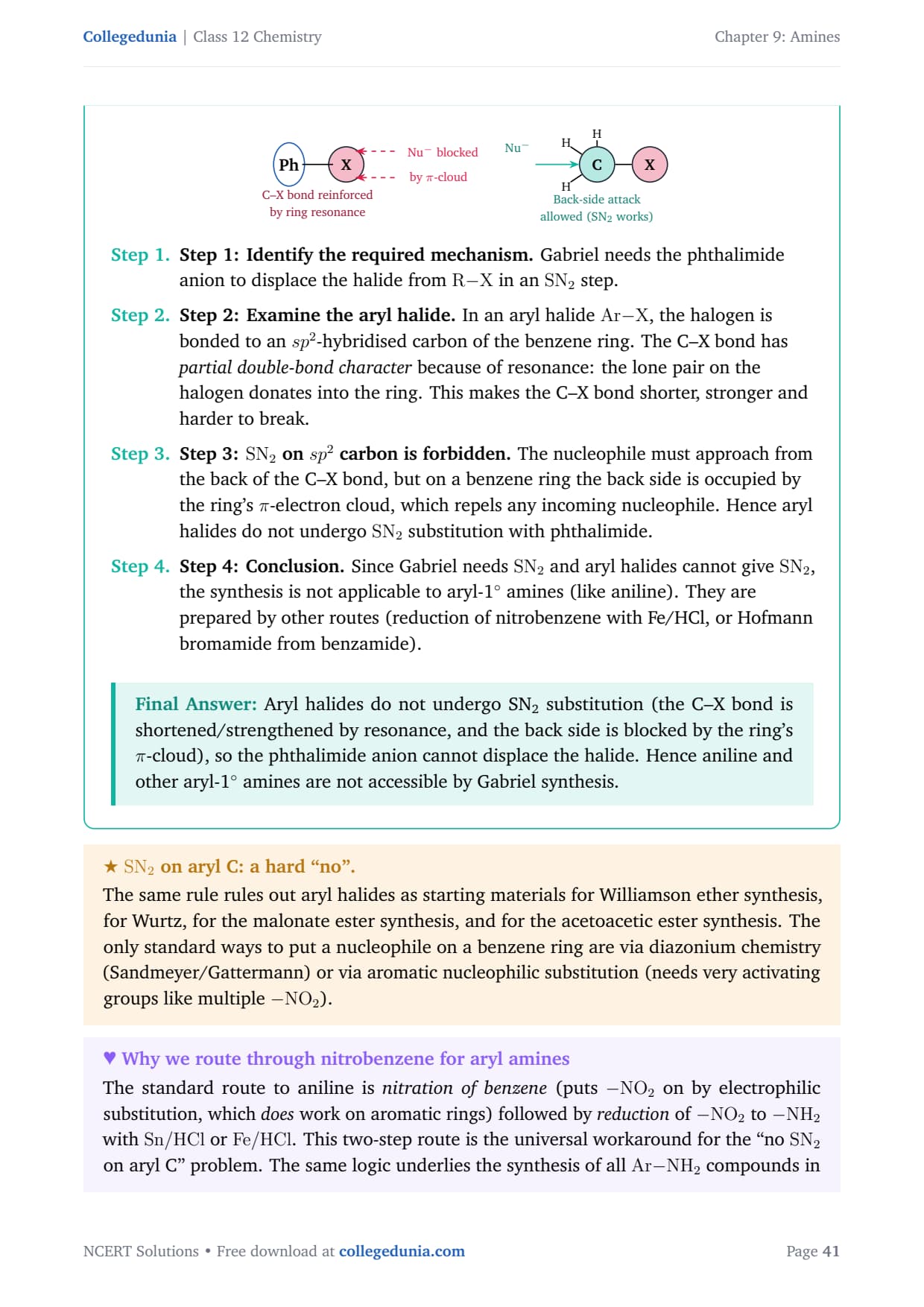
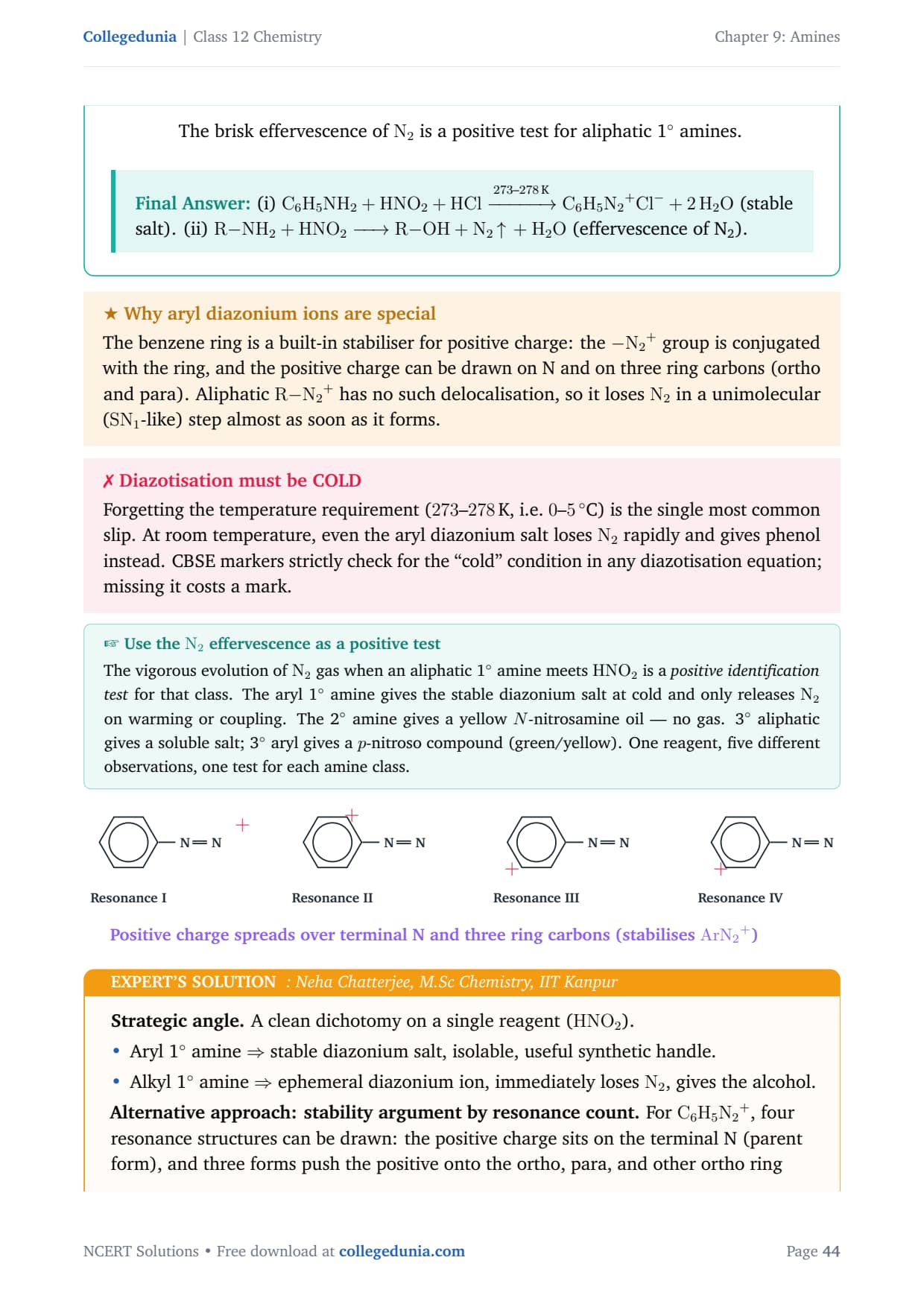
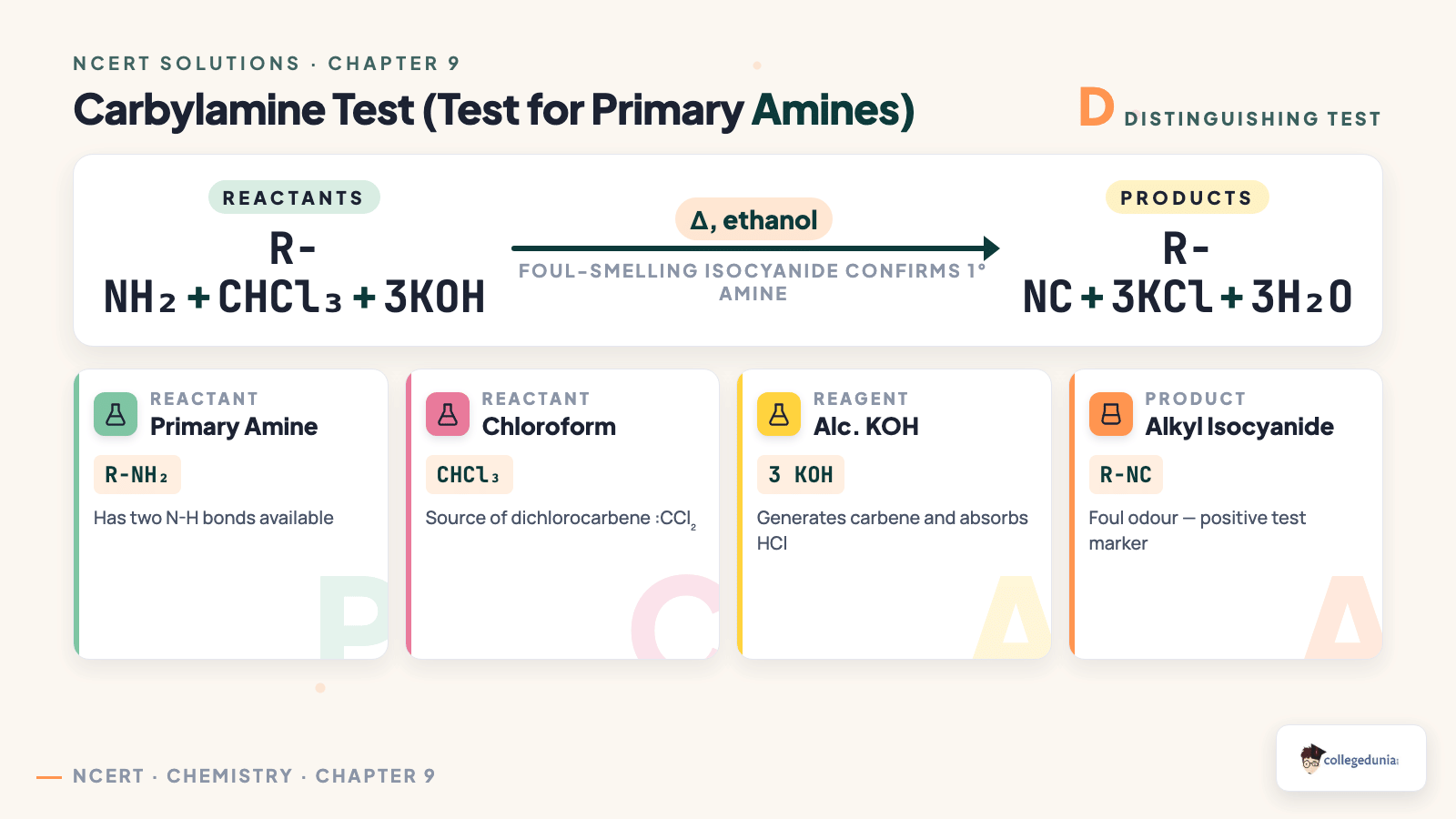
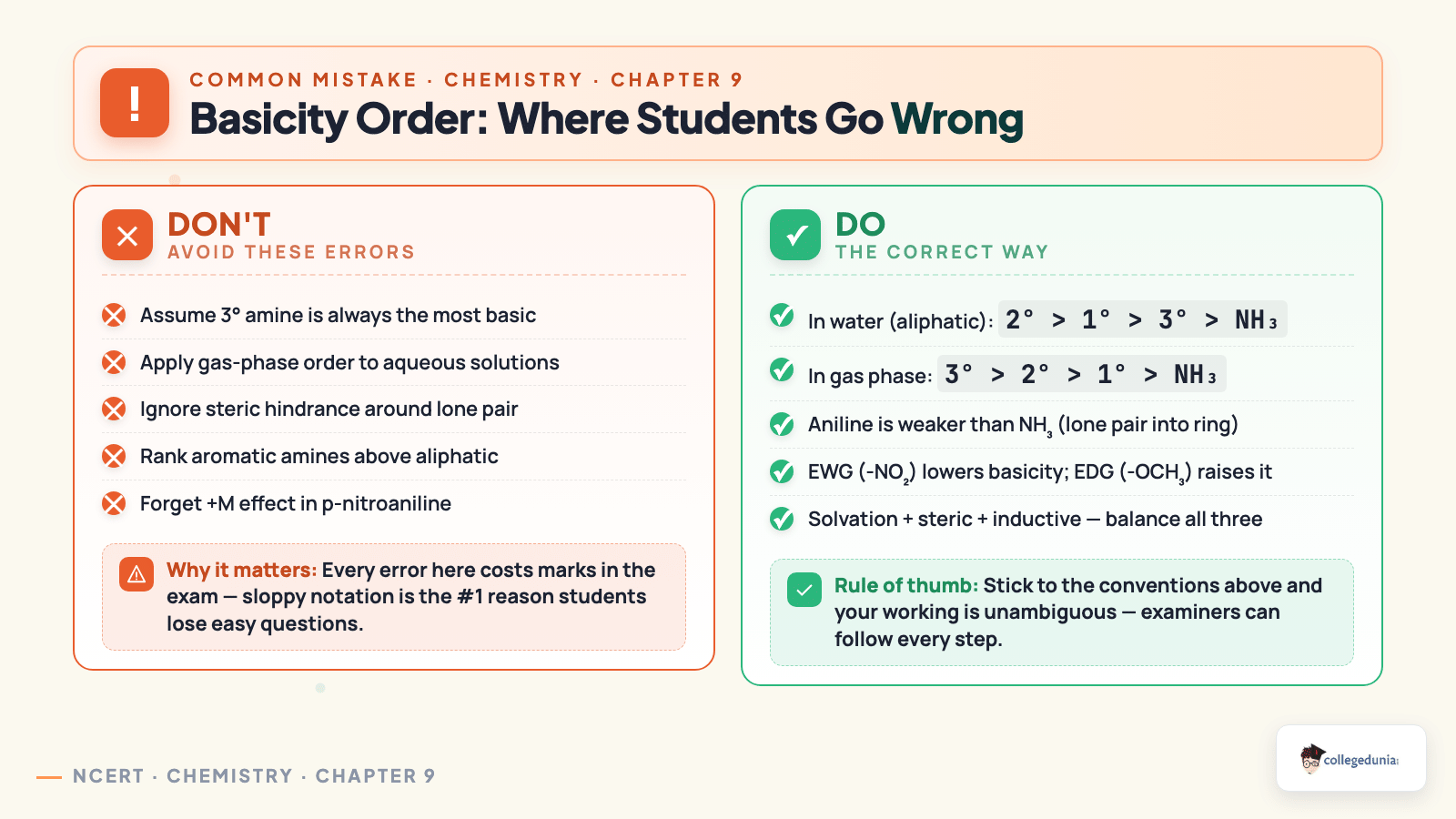



Comments