The NCERT Solutions on Aldehydes, Ketones and Carboxylic Acids will boost your overall marks in Chemistry as this chapter carries high weightage across JEE, NEET and CBSE Boards exams. The solutions on this page will include all 39 NCERT exercise questions plus 17 in-text problems aligned with the 2026-27 syllabus.
CBSE Weightage: 5 to 7 marks (Unit 8 of the current NCERT, paired with Unit 7 in the organic-block question cluster).
JEE Main Weightage: 3 to 4% of the Chemistry section, typically one nucleophilic-addition question and one carboxylic-acid acidity ordering.
NEET Weightage: 2 to 3 questions, with Cannizzaro reaction, aldol condensation, and HVZ (Hell-Volhard-Zelinsky) being recurring favourites.
Aldehydes Ketones and Carboxylic Acids: Exercise-by-Exercise Question Count
The table below groups the 39 main-exercise questions of Chapter 8 by sub-topic, so you can revise in focused blocks instead of reading top to bottom.
Exercise Range
Sub-topic
Question Count
Difficulty
8.1 - 8.5
IUPAC nomenclature of carbonyls and acids
5
Easy
8.6 - 8.12
Preparation of aldehydes (Rosenmund, Stephen, Etard)
NCERT Class 12 Chemistry Chapter 8 Important Named Reactions
Eight named reactions carry nearly half the marks this chapter gets in the exam. The solutions PDF works through each one with reagent, mechanism, and product; the recall table below is the compact revision version.
Named Reaction
Starting Material
Reagent / Conditions
Product Type
Rosenmund reduction
Acyl chloride
H2 / Pd-BaSO4 (poisoned)
Aldehyde
Stephen reduction
Alkyl/aryl nitrile
SnCl2 / HCl, then H3O+
Aldehyde
Etard reaction
Toluene
CrO2Cl2 / CS2, then H2O
Benzaldehyde
Cannizzaro reaction
Aldehyde without alpha-H
Conc. NaOH
Alcohol + carboxylate (disproportionation)
Aldol condensation
Aldehyde/ketone with alpha-H
Dilute NaOH
Beta-hydroxy carbonyl, then alpha,beta-unsaturated
Clemmensen reduction
Aldehyde/ketone
Zn-Hg / conc. HCl
Alkane (C=O to CH2)
Wolff-Kishner reduction
Aldehyde/ketone
NH2-NH2 / KOH / glycol, heat
Alkane (C=O to CH2)
HVZ reaction
Carboxylic acid with alpha-H
Cl2 / red P, then H2O
Alpha-halo acid
Every named reaction above has appeared at least twice between CBSE 2021 and 2025, so the reagent column alone is worth around 6 marks.
Carbonyl Reactivity Order in Class 12 Chemistry Chapter 8
A reactivity-order question on aldehydes versus ketones shows up almost every year in CBSE, JEE and NEET. The rule: aldehydes are more reactive than ketones because the alkyl groups on a ketone push electron density into the carbonyl carbon (+I effect) and also block the nucleophile by steric hindrance.
Compound
Reactivity Towards HCN
Reason
HCHO (formaldehyde)
Highest
No alkyl group, minimum steric hindrance, maximum delta+ on C
CH3CHO (acetaldehyde)
High
One methyl group only
CH3COCH3 (acetone)
Moderate
Two methyl groups, +I from both
(CH3)2CHCOCH3
Low
Branching adds steric block
C6H5COC6H5 (benzophenone)
Lowest
Two aryl groups + resonance stabilisation of C=O
Distinguishing Tests and Carbonyl Detection in Class 12 Chemistry Chapter 8
Distinction-test questions take almost half the 2-mark slots from Chapter 8. The five core tests below cover every CBSE distinction question since 2021. Learn the reagent, the colour change, and the feature each test isolates.
Test
Reagent
Positive Observation
What it Isolates
Tollens test (silver mirror)
Ammoniacal AgNO3, [Ag(NH3)2]+OH-
Shiny silver mirror on tube wall
All aldehydes (aliphatic + aromatic); ketones negative
Fehling test
Cu2+ tartrate complex in alkali (Fehling A + B)
Red Cu2O precipitate
Aliphatic aldehydes only; benzaldehyde and ketones negative
The 2,4-DNP / Schiff pair separates "any carbonyl" from "aldehyde only", while Tollens, Fehling, and iodoform fingerprint the carbonyl type.
Carboxylic Acid Acidity Order with Substituent Effects
Acidity ranking is the most-asked 2-mark question on Chapter 8. The rule is simple: electron-withdrawing groups (-NO2, halogens, -CN) raise acidity by stabilising the carboxylate, while electron-donating groups (-CH3, -OR, -NH2) lower it.
Acid
Structure
pKa
Driver
Trichloroacetic acid
Cl3C-COOH
~0.66
Three Cl (-I); approaches HCl strength
Dichloroacetic acid
Cl2CH-COOH
~1.25
Two Cl (-I)
Chloroacetic acid
ClCH2-COOH
~2.86
One Cl (-I); ~80x stronger than acetic
Formic acid
HCOOH
~3.75
No +I alkyl substituent
p-Nitrobenzoic acid
p-O2N-C6H4-COOH
~3.41
NO2 (-M, -I)
Benzoic acid
C6H5-COOH
~4.20
Phenyl is mildly -I
Acetic acid
CH3-COOH
~4.76
+I methyl destabilises carboxylate
p-Methoxybenzoic acid
p-CH3O-C6H4-COOH
~4.47
OMe is +M, lowers acidity slightly
NCERT Class 12th Chemistry Chapter 8 Previous Year Question Trend
A six-year scan of how Chapter 8 questions showed up across CBSE Boards, JEE Main, and NEET, latest year first.
Year
CBSE Board
JEE Main
NEET
2026
Aldol and Cannizzaro reactions (3 marks)
2 questions (Jan + April sessions) on aldol and Cannizzaro
Distinction tests and acidity order (1 Q)
2025
5-mark: aldol condensation mechanism + product
2 questions on acidity order of substituted benzoic acids
2 questions on Cannizzaro and Tollens test
2024
3-mark: distinguish aldehydes and ketones using Tollens reagent
1 question on HVZ reaction product
1 question on Wolff-Kishner
2023
5-mark: preparation of benzaldehyde from toluene + 2 reactions
2 questions on nucleophilic addition order
2 questions on Clemmensen and iodoform test
2022
3-mark: mechanism of Fischer esterification
1 question on alpha-H acidity
1 question on Rosenmund reduction
2021
2-mark: IUPAC name of propanal and butan-2-one
-
1 question on carbonyl resonance
The pattern is clear: aldol, Cannizzaro, and the Tollens/Fehling distinction tests come up in some form every year. Lock in these three sub-topics and you can count on 5 to 6 marks from Chapter 8.
Common Mistakes Students Make in Aldehydes Ketones and Carboxylic Acids
Top mistakes flagged in CBSE evaluator notes:
Writing Cannizzaro for aldehydes WITH alpha-hydrogens. Cannizzaro needs an aldehyde with no alpha-H (HCHO, benzaldehyde); aldehydes with alpha-H undergo aldol instead.
Forgetting that Tollens reagent is ammoniacal silver nitrate, not plain AgNO3. The complex [Ag(NH3)2]+ is the actual oxidising species.
Confusing Clemmensen (Zn-Hg / HCl, acidic) with Wolff-Kishner (NH2NH2 / KOH, basic). Both reduce C=O to CH2 but the conditions are mutually exclusive.
Writing +I effect for carboxylic acids instead of -I. The COOH group is electron-withdrawing, which is why monohaloacids are more acidic than the parent acid.
Class 12 Chemistry Chapter-wise Marks Distribution (CBSE 2026-27)
Here is where Chapter 8 sits against the other Class 12 Chemistry chapters, so you can plan your revision order by marks-per-hour.
Chapter
Topic
Approx. CBSE Marks
Ch 1
Solutions
7
Ch 2
Electrochemistry
6
Ch 3
Chemical Kinetics
6
Ch 4
The d- and f-Block Elements
5
Ch 5
Coordination Compounds
7
Ch 6
Haloalkanes and Haloarenes
4
Ch 7
Alcohols, Phenols and Ethers
5
Ch 8
Aldehydes, Ketones and Carboxylic Acids
6
Ch 9
Amines
5
Ch 10
Biomolecules
4
Other Resources for Aldehydes, Ketones and Carboxylic Acids Class 12 Chemistry
All NCERT Solutions for Aldehydes, Ketones and Carboxylic Acids with Step-by-Step Working
Every NCERT textbook question for Class 12 Chemistry Chapter 8 Aldehydes, Ketones and Carboxylic Acids is listed below. Click Check Solution for the step-by-step working and Expert Solution for the expanded explanation.
Questions
Q 8.1
What is meant by the following terms? Give an example of the reaction in each case.
(i) Cyanohydrin (ii) Acetal (iii) Semicarbazone
(iv) Aldol (v) Hemiacetal (vi) Oxime
(vii) Ketal (viii) Imine (ix) 2,4-DNP-derivative (x) Schiff's base
Concept used. Each name in this question labels a specific addition or condensation product of a carbonyl (C=O) with a nucleophile. The carbonyl carbon carries a partial positive charge, Cδ+=Oδ-, so a nucleophile Nu- attacks the carbon while O becomes O-; protonation of the oxygen then gives the neutral adduct. We name each product, write its general structure, and give one balanced example.
How to read the names
The suffix tells you the nucleophile: -cyanohydrin (from HCN), -hemiacetal/-acetal (from ROH), -imine/-oxime/-semicarbazone (from R-NH2 derivatives), -DNP derivative (from 2,4-dinitrophenylhydrazine).
Cyanohydrin: an α-hydroxynitrile formed when HCN adds across the carbonyl. General structure R2C(OH)CN. Example with acetone: (CH3)2C=O + HCN -[KCN/HCl] (CH3)2C(OH)CN. Useful because the nitrile -CN can be hydrolysed later to a α-hydroxy acid.
Acetal: a gem-dialkoxy compound, R-CH(OR)2, formed when an aldehyde reacts with two equivalents of an alcohol in the presence of dry HCl. The intermediate is a hemiacetal. Example with ethanal: CH3CHO + 2 C2H5OH -[dry HCl] CH3CH(OC2H5)2 + H2O.
Semicarbazone: the condensation product of a carbonyl with semicarbazide (H2N-NH-CO-NH2). General structure R2C=N-NH-CO-NH2. Example: CH3COCH3 + H2N-NH-CO-NH2 - (CH3)2C=N-NH-CO-NH2 + H2O. A useful crystalline derivative used to characterise ketones.
Aldol: a β-hydroxy aldehyde (or ketone) formed when two carbonyl molecules with an α-hydrogen combine under dilute base. General structure R-CH(OH)-CH(R)-CHO. Example with ethanal: 2 CH3CHO -[dil. NaOH] CH3CH(OH)CH2CHO (3-hydroxybutanal).
Hemiacetal: an α-alkoxy alcohol, R-CH(OH)(OR), formed by addition of one mole of alcohol to an aldehyde. It is the intermediate on the way to an acetal. Example: CH3CHO + C2H5OH <=>[dry HCl] CH3CH(OH)(OC2H5).
Ketal: a gem-dialkoxy compound derived from a ketone, R2C(OR)2. Example with propanone and ethylene glycol: (CH3)2C=O + HOCH2CH2OH -[dry HCl] (CH3)2C(OCH2CH2O) + H2O.
Imine (Schiff's base when R= aryl): product with a primary amine RNH2, structure R2C=N-R. Example: CH3CHO + C2H5NH2 - CH3CH=N-C2H5 + H2O.
2,4-DNP-derivative: 2,4-dinitrophenylhydrazone, the orange/yellow crystalline product with 2,4-dinitrophenylhydrazine (2,4-(NO2)2C6H3-NH-NH2). Example with ethanal: CH3CHO + H2N-NH-C6H3(NO2)2 - CH3CH=N-NH-C6H3(NO2)2 + H2O.
Schiff's base: the imine formed when an aldehyde or ketone reacts specifically with an aromatic primary amine such as aniline. Structure R2C=N-Ar. Example: C6H5CHO + C6H5NH2 - C6H5CH=N-C6H5 + H2O.
Visual structures of the key derivatives:
[See diagram in the PDF version]
Each derivative is a nucleophilic addition (or addition–elimination) product of C=O, with the nucleophile and the product tabulated above.
PS
Pranav Sharma
M.Sc Chemistry, IIT Kanpur
Verified Expert
Picture-first. Every derivative in this list is a nucleophile adding to the same electrophile, the carbonyl carbon. The carbon is Cδ+; nucleophile forms the new C–Nu bond; oxygen becomes -OH; if the nucleophile carries an NH next to the new bond, that NH kicks the OH out as water and we get a C=N.
Grouping by mechanism:
Simple addition (stop at the tetrahedral adduct): cyanohydrin (HCN), hemiacetal (ROH, one equiv).
Addition then substitution by a second nucleophile: acetal, ketal (two equivs of ROH with dry HCl).
Addition–elimination (C=O → C=N): imine, oxime, semicarbazone, 2,4-DNP, Schiff base (all nitrogen nucleophiles with an N-H).
Alternative approach (the electrophilicity–steric–resonance trio). Three independent factors decide how easily each nucleophile can land on the carbonyl carbon: (a) how positive that carbon already is (electrophilicity), (b) how crowded its two faces are (steric), and (c) whether the carbonyl is part of a π system that gives away positive charge to a neighbour (resonance). For HCHO all three are favourable, so it forms every adduct in this list at room temperature. For a hindered or resonance-stabilised carbonyl (e.g. amide R-CO-NH2, ester R-CO-OR), the same nucleophiles struggle. Reading any new substrate through this trio is faster than memorising case-by-case.
Concept linkage: α-H acidity, tautomerism and oxidation/reduction. Each adduct here keeps the original carbonyl carbon's oxidation state intact (it is still C+1 in an aldehyde-derived adduct). That is the bridge to Q 8.7 (aldol, which needs α-H acidity), to Q 8.20 (oxidation of -CHO to -COOH) and to Q 8.15 (Clemmensen / Wolff–Kishner, which take the carbon two oxidation states down). Recognising ``addition only'' vs ``oxidation'' vs ``reduction'' is the first sort you do on any carbonyl reagent.
Why 2,4-(NO2)2-C6H3-NHNH2 instead of plain H2N-NH2?
Plain hydrazine gives a hydrazone, but the product is often a high-boiling liquid hard to isolate. The two -NO2 groups deactivate the aniline-style NH2 towards over-reaction and make the hydrazone a bright orange/yellow crystalline solid with a sharp melting point. That is why 2,4-DNP is the reagent of choice for carbonyl characterisation.
Cyanohydrin: (CH3)2C=O + HCN - (CH3)2C(OH)CN. An industrial precursor to methyl methacrylate (Plexiglas monomer).
Acetal vs hemiacetal: CH3CHO + C2H5OH <=> CH3CH(OH)(OC2H5) (hemiacetal), then + C2H5OH, -H2O → CH3CH(OC2H5)2 (acetal).
Semicarbazone, oxime and 2,4-DNP follow the same addition–elimination: R2C=O + H2N-X - R2C=N-X + H2O with X = NHCONH2, OH, NH-C6H3(NO2)2 respectively.
Aldol: the α-carbanion of one CH3CHO attacks the carbonyl carbon of a second CH3CHO to give CH3CH(OH)CH2CHO. This is the only entry on the list that builds a new C-C bond.
Imine / Schiff: same addition–elimination but with a primary amine. When the amine is aromatic (C6H5NH2, aniline) the imine is called a Schiff's base.
Exam relevance. The CBSE 2024 and 2023 board papers both asked one-mark identifications of cyanohydrin and 2,4-DNP products, and a three-mark question on the differentiation of oxime vs Schiff base. Knowing the nucleophile-suffix pairing (see exam tip above) gives you the answer in under a minute.
Memory hook.One-shot addition for HCN / single ROH. Two-shot substitution for full acetal/ketal. Eliminate water whenever the nucleophile is an amine derivative. Aldol is the odd one out: a carbon nucleophile, so the new bond is C-C.
Definitions plus one balanced equation per term, as in the main solution.
Q 8.2
Name the following compounds according to the IUPAC system of nomenclature:
(i) CH3CH(CH3)CH2CH2CHO (ii) CH3CH2COCH(C2H5)CH2CH2Cl
(iii) CH3CH=CHCHO (iv) CH3COCH2COCH3
(v) CH3CH(CH3)CH2C(CH3)2COCH3 (vi) (CH3)3CCH2COOH
(vii) p-OHC-C6H4-CHO
Concept used. The IUPAC name of a carbonyl is built in four steps:
identify the principal characteristic group (-COOH -CHO C=O; it gets the lowest locant and the suffix);
find the longest continuous carbon chain that contains it;
number from the end nearer the principal group so that this group, then unsaturation, then substituents, all get the lowest locants;
list substituents alphabetically with their locants in front of the parent name.
For aldehydes the suffix is -al and the CHO carbon is always C-1. For ketones the suffix is -one and the C=O carbon gets the lowest locant. For carboxylic acids the suffix is -oic acid and the COOH carbon is C-1.
Locant rule
First lowest set goes to the principal group's suffix carbon, then to unsaturation, then to substituents in alphabetic order. Ties are broken at the first point of difference.
(i) CH3CH(CH3)CH2CH2CHO. Longest chain ending at CHO: five carbons (pentanal). Numbering from CHO: C1(CHO)-C2(H2)-C3(H2)-C4(H)(CH3)-C5(H3). A methyl sits at C-4. Name:4-Methylpentanal.
(ii) CH3CH2COCH(C2H5)CH2CH2Cl. Principal group is the ketone C=O. Longest chain through it: take the -C2H5 side to extend the chain. Numbering to give the carbonyl the lowest locant gives C1(H3)-C2(H2)-C3(=O)-C4(H)-C5(H2)-C6(H2Cl), with an ethyl branch at C-4. Name:6-Chloro-4-ethylhexan-3-one.
(iii) CH3CH=CHCHO. Four carbons, CHO is C-1, double bond C-2 to C-3, more stable as trans (E). Name:But-2-enal (commonly E-but-2-enal, crotonaldehyde).
(iv) CH3COCH2COCH3. Two ketones in a five-carbon chain at C-2 and C-4. Name:Pentane-2,4-dione.
(v) CH3CH(CH3)CH2C(CH3)2COCH3. Carbonyl at C-2; carbon skeleton: methyl, C(=O), C(CH3)2, CH2, CH(CH3), CH3. Substituents: two methyls at C-3, one at C-5; parent hexan-2-one. Name:3,3,5-Trimethylhexan-2-one.
(vi) (CH3)3CCH2COOH. Parent butanoic acid (four carbons in the principal chain). Two methyls at C-3. Name:3,3-Dimethylbutanoic acid.
(vii) p-OHC-C6H4-CHO. Both -CHO groups are substituents on benzene; we use the multiplying prefix di and the suffix -dicarbaldehyde. Name:Benzene-1,4-dicarbaldehyde (terephthalaldehyde).
Strategic angle. Skim each structure for the highest-priority suffix-bearing group (-COOH beats -CHO beats C=O). Anchor it at the lowest locant, then read the chain out as a substituent list plus suffix.
Alternative approach (priority table). When several functional groups appear in the same molecule, the IUPAC seniority order is -COOH > -COOR > -CONH2 > -CN > -CHO > C=O > -OH > -NH2. Only the highest-ranked group earns the suffix; every other group falls back to a prefix (oxo- for a ketone C=O, formyl- for an aldehyde -CHO, cyano- for -CN, etc.). The first scan of any new compound should be this priority sort.
Concept linkage. Each name fixes the connectivity, which in turn fixes the reactivity. Pentane-2,4-dione (iv) has two α-Hs between the carbonyls (the methylene), so its pKa is unusually low (∼ 9) - that links straight into the enol–enolate chemistry of Q 8.7. The 3,3,5-trimethylhexan-2-one (v) has noα-H on the C-3 side (quaternary carbon), so the aldol enolate forms only on the methyl side; this matters in later questions.
(i) Pentanal with a methyl on C-4: 4-Methylpentanal. Locants 1 (CHO) and 4 (CH3) sum to 5; numbering the other way gives 1 (CHO) and 2 (CH3) sum 3, but that puts CHO at the wrong end of the chain - recall CHO is always at C-1 so the only legal numbering is from CHO.
(ii) Six-carbon ketone, Cl at C-6, C2H5 branch on C-4: 6-Chloro-4-ethylhexan-3-one. The ketone wins the lowest locant (3); alphabetical order ``chloro'' before ``ethyl'' is read.
(iii) Four-carbon α,β-unsaturated aldehyde: (E)-But-2-enal. trans configuration is more stable due to lower steric strain.
(iv) Symmetrical 1,3-diketone: Pentane-2,4-dione (acetylacetone). The methylene between two C=O groups is unusually acidic (pKa ≈ 9).
(v) Six-carbon ketone with gem-dimethyl at C-3 and methyl at C-5: 3,3,5-Trimethylhexan-2-one. Locants 2,3,3,5 beat any alternative numbering.
(vi) Branched neopentyl acid: 3,3-Dimethylbutanoic acid. Four-carbon parent because -COOH must be C-1.
(vii) Two aldehydes para on benzene: Benzene-1,4-dicarbaldehyde. Both CHO groups keep the carbon, so they appear as ``carbaldehyde'', not ``-al''.
Exam relevance. CBSE awards full marks only for IUPAC names with the correct locant set, hyphenation and capitalisation. A common 1-mark trap is asking the name of CH3COCH2COCH3 - many write ``2,4-pentanedione'' but the locants 2,4 must precede a hyphen on the parent (pentane-2,4-dione, not 2,4-pentanedione).
Why this matters. Naming locks in the structure; once you write the name correctly, you know how each reagent will hit the molecule (which α-H is there, where steric crowding is, where the polar group sits).
Same set of seven IUPAC names as above.
Q 8.3
Draw the structures of the following compounds.
(i) 3-Methylbutanal (ii) p-Nitropropiophenone
(iii) p-Methylbenzaldehyde (iv) 4-Methylpent-3-en-2-one
(v) 4-Chloropentan-2-one (vi) 3-Bromo-4-phenylpentanoic acid
(vii) p,p'-Dihydroxybenzophenone (viii) Hex-2-en-4-ynoic acid
Concept used. To draw a structure from a name, reverse the naming algorithm: (1) draw the parent chain with the principal group at C-1 (or its lowest locant), (2) place substituents at their indicated locants, and (3) add stereochemistry / unsaturation as the locants specify.
(i) 3-Methylbutanal: butanal is CH3CH2CH2CHO with CHO as C-1. A methyl on C-3 gives (CH3)2CH-CH2-CHO.
(ii) p-Nitropropiophenone: propiophenone is C6H5-CO-C2H5 (phenyl ethyl ketone). Putting -NO2para on the ring gives O2N-C6H4-CO-CH2CH3 (para-).
(iii) p-Methylbenzaldehyde: a -CHO on benzene and a -CH3para: CH3-C6H4-CHO (para-, p-tolualdehyde).
(iv) 4-Methylpent-3-en-2-one: parent pentan-2-one is CH3-CO-CH2-CH2-CH3. A double bond between C-3 and C-4, and a methyl on C-4, gives CH3-CO-CH=C(CH3)-CH3≡ (CH3)2C=CH-COCH3 (mesityl oxide).
(v) 4-Chloropentan-2-one: pentan-2-one with Cl on C-4: CH3-CO-CH2-CHCl-CH3.
(vi) 3-Bromo-4-phenylpentanoic acid: pentanoic acid with Br at C-3 and a phenyl at C-4: CH3-CH(C6H5)-CH(Br)-CH2-COOH.
(vii) p,p'-Dihydroxybenzophenone: benzophenone is C6H5-CO-C6H5. Hydroxyls para on each ring: HO-C6H4-CO-C6H4-OH (both para).
(viii) Hex-2-en-4-ynoic acid: six-carbon acid with a double bond C2=C3 and a triple bond C4≡C5: CH3-C#C-CH=CH-COOH.
Structures (i)–(viii) as written above.
RK
Rohit Kapoor
M.Tech Chemical Engineering, IIT Delhi
Verified Expert
Strategic angle. Build each skeleton as parent + decorations. Pick the parent (butanal, pentan-2-one, pentanoic acid, benzaldehyde, benzophenone) and pin the principal group at C-1 or lowest locant. Then drop on substituents.
Alternative approach (skeleton-first). For any name, first sketch the bare carbon chain or ring (the parent), then add the principal group at the locant given, and only after that hang on the substituents. This forces you to keep the carbon count correct. Try it on (viii): hex = 6 carbons + COOH at C-1 + double bond 2–3 + triple bond 4–5, and you get the structure in three pen strokes.
Reading para, ortho, meta on benzene
For benzene compounds the ring carbon bearing the principal group is implicitly C-1. Ortho= C-2, meta= C-3, para= C-4. So p-nitrobenzaldehyde is 4-nitrobenzaldehyde; p-methylbenzaldehyde is 4-methylbenzaldehyde. Treat ``p-'' as a shorthand for ``4-'' in mono-substituted benzene derivatives.
(i) Parent butanal C1HO-C2H2-C3H2-C4H3; add CH3 at C-3 to get OHC-CH2-CH(CH3)-CH3, i.e. isovaleraldehyde.
(ii) Propiophenone is PhCOC2H5; p-NO2 gives O2N-C6H4-CO-C2H5, a yellow crystalline solid.
(iii) Benzaldehyde with p-methyl is p-tolualdehyde, 4-CH3-C6H4-CHO, the precursor to terephthalic acid.
(iv) Pentan-2-one with C3=C4 and a methyl on C-4: (CH3)2C=CH-COCH3 (mesityl oxide). This is the α,β-unsaturated ketone from diacetone alcohol.
(v) Pentan-2-one + Cl at C-4: CH3COCH2CHClCH3. The C-4 chlorine is at the γ position relative to the carbonyl.
(vi) Pentanoic acid with phenyl at C-4 and Br at C-3: CH3CH(C6H5)CHBrCH2COOH.
(vii) Benzophenone with OH para on each ring: HO-C6H4-CO-C6H4-OH (used as a UV-absorbing sunscreen ingredient).
(viii) Hexanoic acid with C2=C3 and C4≡C5: CH3C#CCH=CHCOOH. A conjugated en-ynoic acid.
Exam relevance. Structure-from-name questions reward neat, unambiguous bond drawings. Always show the double/triple bonds explicitly (don't compress them into ≡ on a typed linear formula in your answer sheet).
Why this matters. Practising structure drawing in both directions (name → structure, structure → name) fixes IUPAC priorities firmly in mind.
Eight structures as listed above.
Q 8.4
Write the IUPAC names of the following ketones and aldehydes. Wherever possible, give also common names.
(i) CH3CO(CH2)4CH3 (ii) CH3CH2CHBrCH2CH(CH3)CHO
(iii) CH3(CH2)5CHO (iv) Ph-CH=CH-CHO
(v) Cyclopentyl-CHO (vi) Ph-CO-Ph
Concept used. Same rules as Q 8.2: identify the principal group, the longest chain containing it, number to give it the lowest locant, then list substituents alphabetically. Common names follow older but still accepted patterns (e.g. cinnamaldehyde, heptanal as oenanthaldehyde).
(i) CH3CO(CH2)4CH3 = CH3COCH2CH2CH2CH2CH3. Seven carbons, ketone at C-2 from one end. IUPAC:Heptan-2-one; common: methyl n-pentyl ketone (or methyl amyl ketone).
(ii) CH3CH2CHBrCH2CH(CH3)CHO. Number from CHO (C-1). Methyl at C-2, bromo at C-4, six-carbon parent (hexanal). IUPAC:4-Bromo-2-methylhexanal.
(iii) CH3(CH2)5CHO has seven carbons in total with CHO as C-1. IUPAC:Heptanal; common:n-heptaldehyde / oenanthaldehyde.
(iv) Ph-CH=CH-CHO. Three-carbon chain (propenal) with phenyl on C-3 and a C2=C3 double bond. IUPAC:3-Phenylprop-2-enal (E); common: cinnamaldehyde.
(v) Cyclopentanecarbaldehyde: the -CHO sits on a cyclopentane ring. IUPAC:Cyclopentanecarbaldehyde; no widely used common name.
(vi) Ph-CO-Ph is diphenyl ketone. IUPAC:Diphenylmethanone; common: benzophenone.
Quick reading. For mixed cases like (i) and (iii), count from CHO or place the ketone at the lowest locant first. For (iv), note the styryl (PhCH=CH-) group.
Alternative approach (count, then place). (a) count carbons in the principal chain (including the suffix carbon); (b) place the principal group at the lowest possible locant; (c) read remaining substituents alphabetically with their locants. For (i) CH3COC5H11, count = 7, ketone at C-2: heptan-2-one. For (vi) PhCOPh, count = 1 (the carbonyl carbon - the phenyls are substituents on it), suffix -methanone: diphenylmethanone.
Aldehydes attached to a ring carbon
When the -CHO is on a ring carbon (cyclopentane, cyclohexane), name the ring as the parent and append -carbaldehyde. The aldehyde C is not counted in the ring's chain length. So cyclopentyl-CHO → cyclopentanecarbaldehyde, not 1-formylcyclopentane.
Concept linkage. The names anchor reactivity. Heptanal (iii) has α-H, so it does aldol; benzaldehyde-type compounds (no α-H, see Q 8.7) do Cannizzaro instead. Cinnamaldehyde (iv) has both a C=C and a C=O - selective reduction of -CHO (NaBH4 at low temperature) gives cinnamyl alcohol; selective C=C hydrogenation (H2/Pd) gives 3-phenylpropanal.
(i) Heptan-2-one (methyl pentyl ketone). Mw = 114, used as a fragrance.
(ii) 4-Bromo-2-methylhexanal. Two stereocentres at C-2 and C-4 (not asked, but worth noting).
(iii) Heptanal (oenanthaldehyde). Six α-H total but only the two on C-2 take part in aldol.
(iv) (E)-3-Phenylprop-2-enal (cinnamaldehyde). Conjugated α,β-unsaturated aldehyde; the aroma of cinnamon.
(v) Cyclopentanecarbaldehyde. No common name in widespread use.
(vi) Diphenylmethanone (benzophenone). No α-H, no C-H that can transfer hydride either: stable to all the standard carbonyl reactions.
Exam relevance. Mixed naming questions test both IUPAC mechanics and recognition of trivial names. Two-mark questions typically ask one IUPAC + one common name; full marks need both.
Why this matters. The IUPAC name fixes the connectivity; the common name (cinnamaldehyde, benzophenone) is the everyday tag. Knowing both helps when reading literature.
Same six pairs of names as the main solution.
Q 8.5
Draw structures of the following derivatives.
(i) The 2,4-dinitrophenylhydrazone of benzaldehyde
(ii) Cyclopropanone oxime
(iii) Acetaldehyde dimethylacetal
(iv) The semicarbazone of cyclobutanone
(v) The ethylene ketal of hexan-3-one
(vi) The methyl hemiacetal of formaldehyde
Concept used. Each derivative is obtained from a parent carbonyl by a specific nucleophilic addition or addition–elimination (see Q 8.1). To draw it: locate the carbonyl carbon, replace C=O with the corresponding C=N-X (for hydrazone, oxime, semicarbazone) or with a tetrahedral C(OR)2 / C(OH)(OR) (for acetal/ketal/hemiacetal).
(i) Benzaldehyde 2,4-DNP: replace C=O in PhCHO with C=N-NH-Ar where Ar = 2,4-(NO2)2C6H3. C6H5-CH=N-NH-C6H3(NO2)2.
(ii) Cyclopropanone oxime: cyclopropanone is a three-membered ring with C=O; the oxime replaces it with C=N-OH. A cyclopropane ring with an exocyclic =N-OH. Shorthand: (CH2)2C=N-OH (exocyclic).
(iii) Acetaldehyde dimethylacetal: replace CH3CHO's carbonyl by CH(OCH3)2: CH3-CH(OCH3)2.
(iv) Cyclobutanone semicarbazone: replace C=O of cyclobutanone with C=N-NH-CO-NH2: (CH2)3-C=N-NH-CO-NH2 (4-membered ring at C).
(v) Hexan-3-one ethylene ketal: at C-3 of hexan-3-one CH3CH2COC2H5 form a 1,3-dioxolane with ethylene glycol: CH3CH2-C(OCH2CH2O)-CH2CH3.
(vi) Methyl hemiacetal of formaldehyde: add one mole of CH3OH to HCHO: H-CH(OH)(OCH3) ≡ HOCH2-OCH3.
Visual structures of the six derivatives:
[See diagram in the PDF version]
Structures (i)–(vi) as written.
DB
Diya Banerjee
Ph.D Organic Chemistry, IISc Bangalore
Verified Expert
Picture-first. Every derivative is a one-swap operation on the parent carbonyl. Draw the parent first, then swap.
Alternative approach (mechanism class shortcut). Three mechanism classes cover all six:
One-step addition (one equiv ROH stops at the hemiacetal): (vi).
Cyclic ketals are unusually stable
A ketal made with ethylene glycol or 1,3-propanediol (a cyclic ketal, i.e. 1,3-dioxolane or 1,3-dioxane) is far more stable than its open-chain cousin because the cyclic form has lower entropic cost - one ring instead of two free -OR groups. This is why ethylene-glycol ketals are the standard C=O protecting group in synthesis.
Concept linkage. The C=N stretch of an oxime, semicarbazone or 2,4-DNP appears around 1620cm^-1, distinctly lower than the parent C=O stretch near 1715cm^-1. So IR spectroscopy tells you instantly whether the derivative has formed. For acetals and hemiacetals, C=O disappears completely (replaced by C-O singles around 1100cm^-1) - another diagnostic.
(i) PhCH=N-NHC6H3(NO2)2 (orange solid; m.p. 237).
(ii) Cyclopropane ring with exocyclic =N-OH. The ring strain leaves the oxime slightly less stable than an acyclic one.
(iii) CH3CH(OCH3)2. Used as a solvent and as an anhydrous source of acetaldehyde.
(iv) Cyclobutane ring with exocyclic =N-NH-CO-NH2.
(v) Hexan-3-one with the C-3 sealed inside a 1,3-dioxolane. Standard C=O protecting strategy for later LiAlH4 steps.
(vi) HOCH2OCH3 (methoxymethanol). Unstable in dilute acid - collapses back to HCHO + CH3OH.
Exam relevance. 2-mark CBSE questions ask for the structural formula of one specified derivative given the parent carbonyl and nucleophile. Always show stereochemistry of the C=N (E/Z) if asked, but the default is just the connectivity.
Why this matters. Recognising these on a spectrum (e.g. a strong C=N stretch around 1620cm^-1, no C=O near 1715cm^-1) confirms which derivative you have made.
Six labelled structures, drawn as in the main solution.
Q 8.6
Predict the products formed when cyclohexanecarbaldehyde reacts with the following reagents.
(i) PhMgBr and then H3O+
(ii) Tollens' reagent
(iii) Semicarbazide and weak acid
(iv) Excess ethanol and acid
(v) Zinc amalgam and dilute hydrochloric acid
Concept used. Cyclohexanecarbaldehyde, C6H11-CHO, has the -CHO on a cyclohexyl ring. Its carbonyl carbon is electrophilic and reacts with:
Grignards RMgX, giving secondary alcohols after acidic workup.
Tollens' reagent ([Ag(NH3)2]+, mild oxidiser), giving the carboxylic acid (and a silver mirror).
Semicarbazide (H2N-NH-CO-NH2) in weakly acidic medium, giving the semicarbazone (addition–elimination).
Excess alcohol with dry acid, giving an acetal.
Clemmensen reduction (Zn(Hg), conc. HCl), reducing C=O all the way to -CH2-.
[See diagram in the PDF version]
(i) PhMgBr adds the phenyl to the carbonyl carbon; oxygen becomes O-MgBr+; aqueous workup protonates oxygen: C6H11-CHO + PhMgBr - C6H11-CH(OMgBr)Ph -[H3O+] C6H11-CH(OH)Ph. Product: phenyl(cyclohexyl)methanol, a secondary alcohol.
(ii) Tollens' reagent oxidises -CHO to -COOH and deposits silver: C6H11-CHO + 2[Ag(NH3)2]+ + 3OH- - C6H11-COO- + 2 Ag(v) + 4 NH3 + 2 H2O. Product: cyclohexanecarboxylic acid (silver mirror on the test tube).
(iii) With semicarbazide and a trace of weak acid (pH 4–5), addition–elimination gives the semicarbazone: C6H11-CHO + H2N-NH-CO-NH2 - C6H11-CH=N-NH-CO-NH2 + H2O.
(iv) Excess ethanol with dry HCl: two moles of C2H5OH add and one water leaves: C6H11-CHO + 2 C2H5OH -[dry HCl] C6H11-CH(OC2H5)2 + H2O. Product: cyclohexanecarbaldehyde diethyl acetal.
(v) Clemmensen reduction takes -CHO all the way to -CH3: C6H11-CHO -[Zn(Hg), HCl] C6H11-CH3 (methylcyclohexane).
Structural drawings of cyclohexanecarbaldehyde and its products:
Picture-first. The substrate is an aliphatic aldehyde with an unhindered C=O. So everything proceeds smoothly: addition with PhMgBr, oxidation with Tollens', condensation with semicarbazide, acetal formation with ethanol, and Clemmensen reduction.
Alternative approach (reagent-class sort). Sort each reagent by what it does to the carbonyl carbon's oxidation state and hybridisation:
PhMgBr is a strong carbon nucleophile: adds C, leaves oxidation state unchanged, carbon becomes sp3.
Tollens' is a mild oxidiser: -CHO → -COOH, oxidation state C+1 → C+3, still sp2.
Semicarbazide: addition–elimination, swaps =O for =N-NHCONH2, sp2 retained.
Excess ROH/H+: addition-substitution, swaps =O for two -OR, carbon becomes sp3.
Clemmensen: full reduction, C+1 → C-2, carbon becomes sp3.
Why Grignard gives a secondary alcohol here
Cyclohexanecarbaldehyde is an aldehyde (one H, one alkyl on the carbonyl C). Addition of a second alkyl/aryl group (from PhMgBr) gives a carbon with two alkyl/aryl groups + OH: a secondary alcohol. A formaldehyde substrate would have given a primary alcohol; a ketone substrate would have given a tertiary alcohol.
Concept linkage with carbonyl reactivity. The electrophilicity of an aldehyde carbon depends on (a) the absence of an extra alkyl (+I) donor, and (b) the absence of resonance donors. Here, cyclohexyl is just one +I alkyl –- so the substrate is more reactive than acetone but less than formaldehyde. This matches the ``aldehyde > ketone'' ladder you will use in Q 8.12 (i).
(i) C6H11-CH(OH)-Ph: secondary alcohol from Grignard addition + protonation. Two-step mechanism (alkoxide intermediate, then aqueous workup).
(ii) C6H11-COOH: silver mirror plus carboxylic acid. The mirror is silver(0) deposited on the inner test-tube wall.
(iii) C6H11-CH=N-NH-CO-NH2: cyclohexanecarbaldehyde semicarbazone. A crystalline solid with sharp m.p. used to identify the parent aldehyde.
(iv) C6H11-CH(OC2H5)2: the diethyl acetal. Bears two -OEt on the same carbon.
(v) C6H11-CH3: methylcyclohexane. The deepest reduction available without breaking any C-C bond.
Exam relevance. CBSE 2022 asked exactly this product-set question on a different aldehyde (propanal). Marks are split: 1 per product, with 1 extra mark for naming the named reaction (Clemmensen, Rosenmund, etc.). Always label the named reaction next to the arrow.
Why this matters. The same carbonyl carbon plays five different roles depending on the reagent: electrophile for Grignard, substrate for oxidation, substrate for addition–elimination, substrate for protection, substrate for reduction. The carbonyl is the most reagent-flexible functional group you meet in Class 12.
Five products as listed; methylcyclohexane from Clemmensen is the deepest reduction.
Q 8.7
Which of the following compounds would undergo aldol condensation, which the Cannizzaro reaction, and which neither? Write the structures of the expected products of aldol condensation and Cannizzaro reaction.
(i) Methanal (ii) 2-Methylpentanal (iii) Benzaldehyde
(iv) Benzophenone (v) Cyclohexanone (vi) 1-Phenylpropanone
(vii) Phenylacetaldehyde (viii) Butan-1-ol (ix) 2,2-Dimethylbutanal
Concept used. Two simple rules decide:
Aldol condensation requires at least one α-hydrogen on a carbonyl, because the base must abstract H+ from the α-carbon to form the enolate nucleophile.
Cannizzaro reaction happens only for carbonyls with noα-hydrogen: concentrated base then forces hydride transfer between two molecules, giving one alcohol and one carboxylate.
A compound that is not a carbonyl (e.g. butan-1-ol) does neither.
(ii) 2-Methylpentanal CH3CH2CH2CH(CH3)CHO: α-H present (on the CH(CH3)) ⇒Aldol, which on heating dehydrates to the α,β-unsaturated aldehyde CH3CH2CH2-C(C3H7)=C(CH3)-CHO (2-methyl-3-propylhex-2-enal).
(iv) Benzophenone (C6H5)2C=O: no α-H. It is a ketone with no hydride-transferable C-H: neither aldol nor Cannizzaro.
(v) Cyclohexanone: α-H on each α-CH2⇒Aldol; self condensation gives 2-(1-cyclohexenyl)cyclohexan-1-one (after β-elimination).
(vi) 1-Phenylpropanone (C6H5COCH2CH3, propiophenone): α-H on the CH2⇒Aldol; the product is a β-hydroxy ketone that dehydrates to an α,β-unsaturated phenyl ketone.
(vii) Phenylacetaldehyde (C6H5CH2CHO): α-H on the benzylic CH2⇒Aldol; product (after dehydration) is 2,3-diphenylprop-2-enal.
(viii) Butan-1-ol CH3CH2CH2CH2OH is an alcohol, not a carbonyl: ⇒neither.
(ix) 2,2-Dimethylbutanal (CH3)2C(C2H5)CHO: the α-carbon is fully substituted (no α-H) ⇒Cannizzaro: With conc. OH^-: aligned 2 (CH3)2C(C2H5)CHO ->
[6pt] (CH3)2C(C2H5)CH2OH + (CH3)2C(C2H5)COO-Na+. aligned
Aldol: (ii),(v),(vi),(vii). Cannizzaro: (i),(iii),(ix). Neither: (iv),(viii). Products as written.
TN
Tara Nair
Ph.D Organic Chemistry, IISc Bangalore
Verified Expert
Decision tree. For each compound: (a) Is it a carbonyl? If no → neither. (b) Does it have α-H? If yes → aldol; if no → Cannizzaro.
Alternative approach (aldol vs Cannizzaro decision). Both reactions need (i) a carbonyl and (ii) base. Aldol additionally needs an α-H so the base can deprotonate it; Cannizzaro additionally needs a transferable hydride (the C-H of the -CHO itself). A ketone like benzophenone has no α-H and no C-H on the carbonyl carbon, so neither reaction runs. Run this two-question test on every compound: ``Is there an α-H?'' then ``Is there a transferable C-H?''
Crossed Cannizzaro and Cannizzaro of HCHO
When the substrate is a mixture of formaldehyde and another α-Hless aldehyde (e.g. HCHO + PhCHO), HCHO acts as the hydride donor (most easily oxidised) and the other aldehyde gets reduced. This ``crossed Cannizzaro'' is a clean way to convert PhCHO → PhCH2OH while sacrificing the cheap HCHO to formate.
(iv): no α-H but it is a ketone; benzophenone does not undergo Cannizzaro (no hydride donor); neither.
(viii): alcohol, not a carbonyl; neither.
Concept linkage with α-H acidity and tautomerism. An aldehyde or ketone α-H has pKa ≈ 20, much more acidic than a simple alkane (pKa ≈ 50) because the resulting carbanion is delocalised onto the electronegative oxygen (enolate). The same enolate is the nucleophilic species in aldol. The keto–enol tautomerism is the structural underpinning: the enol form R-C(OH)=CH2 is the protonated enolate, and the two forms interconvert in solution.
Methanal: 2 HCHO -[OH-] CH3OH + HCOO-. Disproportionation is fast; commercial HCOONa is made by exactly this Cannizzaro on industrial scale.
Exam relevance. This is one of the most-asked CBSE board questions on the chapter. Expect a 5-mark variant where the question lists 4–5 compounds and asks for sorting + product structures + mechanism. Memorise the decision tree as a 30-second sort.
Why this matters. The single rule ``no α-H = no enolate'' tells you every time which test will fire. Aldol is the α-chemistry; Cannizzaro is the carbonyl-only chemistry.
How will you convert ethanal into the following compounds?
(i) Butane-1,3-diol (ii) But-2-enal (iii) But-2-enoic acid
Concept used. All three targets come from a self-aldol on ethanal (CH3CHO). The product 3-hydroxybutanal, CH3CH(OH)CH2CHO, branches three ways:
reduce both -OH and -CHO to alcohols → butane-1,3-diol;
dehydrate the aldol → but-2-enal;
oxidise but-2-enal's -CHO→ but-2-enoic acid.
[See diagram in the PDF version]
Aldol mechanism (curly arrows):
[See diagram in the PDF version]
Self-aldol on ethanal. Dilute NaOH removes an α-H from one CH3CHO to give the enolate -CH2CHO; the enolate attacks a second CH3CHO at its carbonyl carbon; protonation gives the aldol: 2 CH3CHO -[dil. NaOH] CH3-CH(OH)-CH2-CHO (3-hydroxybutanal).
(i) Butane-1,3-diol: reduce the aldehyde of the aldol to a primary alcohol with NaBH4 (or H2/Ni): CH3CH(OH)CH2CHO -[NaBH4] CH3CH(OH)CH2CH2OH.
(ii) But-2-enal: dehydrate the aldol by warming; -OH on C-3 and α-H on C-2 leave as water: CH3CH(OH)CH2CHO -[Δ] CH3-CH=CH-CHO + H2O.
(iii) But-2-enoic acid (crotonic acid): oxidise the aldehyde of but-2-enal with mild oxidant (Tollens' or Ag2O; avoid KMnO4 which cleaves the C=C): CH3CH=CHCHO -[Tollens / Ag2O] CH3CH=CHCOOH.
Aldol → (i) reduce → butane-1,3-diol; (ii) dehydrate → but-2-enal; (iii) oxidise (ii) → but-2-enoic acid.
YJ
Yash Joshi
M.Tech Chemical Engineering, IIT Bombay
Verified Expert
Quick reading. All three targets sit on the same family tree, with the aldol product CH3CH(OH)CH2CHO as the trunk.
Alternative approach (Hell–Volhard–Zelinsky logic does not apply here, but selective oxidant choice does). For polyfunctional targets always ask: which functional group am I changing, and what do I leave alone? Here the trunk has -OH and -CHO; each branch chooses one selective transformation: reduce -CHO but keep -OH (use NaBH4), dehydrate but keep -CHO (use Δ), or oxidise -CHO but keep C=C (use Tollens'). Selectivity is the central skill of multifunctional synthesis.
How β-elimination dehydrates the aldol
After the aldol forms, gentle warming pulls an α-H and an -OH off neighbouring carbons (E1cb-like): the carbonyl pulls its α-H, the hydroxide leaves, and a new C=C forms conjugated with the existing C=O. The resulting α,β-unsaturated carbonyl is more stable than the aldol because of the new conjugation.
Form the aldol: 2 CH3CHO -[dil. NaOH] CH3CH(OH)CH2CHO. Only a catalytic amount of NaOH is needed; too much base drives the system to the α,β-unsaturated product directly (Claisen–Schmidt-like).
(i) Reduce both functional groups: NaBH4 first reduces the CHO; the C(OH) already exists. Net product CH3CH(OH)CH2CH2OH. NaBH4 in MeOH at room temperature is the textbook choice.
(ii) Heat the aldol to drive off water across C-2,C-3 to give CH3CH=CHCHO. The newly formed C=C is conjugated with C=O - the aldol product was higher in energy than this α,β-unsaturated aldehyde because of the lost conjugation; that is the driving force.
(iii) Mild oxidation of (ii) with Tollens' converts -CHO → -COOH without touching the alkene. The [Ag(NH3)2]+ complex is a mild Ag(I) oxidiser that stops at the carboxylic acid stage.
Concept linkage –- the aldol family tree. Starting from any aldehyde with α-H, the aldol gives a β-hydroxy carbonyl. Then four standard moves give four common targets: reduce → 1,3-diol; dehydrate → enal; oxidise → enoic acid; hydrogenate → saturated β-hydroxy ketone. Pattern fluency beats route-design.
Exam relevance. CBSE 2024 set a 3-mark version on propanal-to-2-methylpent-2-enal. The marking scheme demands all three steps shown explicitly, with reagents above each arrow.
Why this matters. Recognising one ``branch point'' intermediate (the aldol product here) lets you reach a whole family of products in 2–3 steps instead of designing each route from scratch.
Aldol → (i) butane-1,3-diol; (ii) but-2-enal; (iii) but-2-enoic acid.
Q 8.9
Write structural formulas and names of four possible aldol condensation products from propanal and butanal. In each case, indicate which aldehyde acts as nucleophile and which as electrophile.
Concept used. In a crossed aldol between propanal (CH3CH2CHO, call it P) and butanal (CH3CH2CH2CHO, call it B), either aldehyde can be the enolate nucleophile (its α-carbon attacks) or the electrophile (its carbonyl carbon is attacked). With two distinct aldehydes there are four nucleophile/electrophile combinations.
Why α-carbon is nucleophilic
A base removes an α-H to form a resonance-stabilised carbanion (the enolate). The negatively charged carbon attacks the carbonyl carbon of another aldehyde.
[See diagram in the PDF version]
P (nuc) + P (elec): self-aldol of propanal. Enolate of CH3CH2CHO is CH3CH(-)CHO. Attacks the carbonyl carbon of another propanal: 2 CH3CH2CHO - CH3CH2-CH(OH)-CH(CH3)-CHO 3-hydroxy-2-methylpentanal. After β-elimination: CH3CH2-CH=C(CH3)-CHO2-methylpent-2-enal.
B (nuc) + B (elec): self-aldol of butanal. Enolate CH3CH2CH(-)CHO attacks the carbonyl of another butanal: 2 CH3CH2CH2CHO - CH3CH2CH2-CH(OH)-CH(C2H5)-CHO 3-hydroxy-2-ethylhexanal. After β-elimination: CH3CH2CH2-CH=C(C2H5)-CHO2-ethylhex-2-enal.
P (nuc) + B (elec): enolate of propanal attacks the carbonyl of butanal: CH3CH2CHO + CH3CH2CH2CHO - CH3CH2CH2-CH(OH)-CH(CH3)-CHO 3-hydroxy-2-methylhexanal. After β-elimination: CH3CH2CH2-CH=C(CH3)-CHO2-methylhex-2-enal.
B (nuc) + P (elec): enolate of butanal attacks the carbonyl of propanal: CH3CH2CH2CHO + CH3CH2CHO - CH3CH2-CH(OH)-CH(C2H5)-CHO 3-hydroxy-2-ethylpentanal. After β-elimination: CH3CH2-CH=C(C2H5)-CHO2-ethylpent-2-enal.
Strategic angle. Label one aldehyde the nucleophile (its α-C attacks) and the other the electrophile (its C=O is attacked). With two aldehydes that both have α-H, you get 2 × 2 = 4 combinations.
Alternative approach (combinatorial). Number the aldehydes A and B, then enumerate (nucleophile)+(electrophile) pairs: AA, AB, BA, BB. Two of these are self-aldols and two are crosses. For each pair, the β-hydroxy product has the carbon chain of the electrophile extended at its carbonyl carbon by the α-carbon of the nucleophile.
The C-C bond formed in aldol
The new C-C bond joins the α-carbon of the nucleophile to the carbonyl carbon of the electrophile. So in ``P (nuc) + B (elec)'', the propanal α-C (which is C-2 of propanal) connects to the butanal carbonyl carbon (which is C-1 of butanal). Trace this bond and the structural formula falls out.
Concept linkage –- carbanion (enolate) reactivity. The α-H of a carbonyl has pKa ≈ 20; in dilute NaOH the equilibrium concentration of the enolate is small but enough to react. The aldol product's -OH is then dehydrated on heating to give an α,β-unsaturated aldehyde with conjugation between C=C and C=O, which lowers the molecule's energy. The same enolate logic governs Claisen, Reformatsky and Knoevenagel reactions.
P+P aldol: CH3CH2CH(OH)CH(CH3)CHO→ 2-methylpent-2-enal. (Self-aldol of propanal.)
B+B aldol: CH3CH2CH2CH(OH)CH(C2H5)CHO→ 2-ethylhex-2-enal. (Self-aldol of butanal.)
Exam relevance. CBSE 2023 awarded 1 mark per correctly labelled product (4 marks total) plus 1 mark for explicitly identifying nucleophile vs electrophile in each case (5 marks total). Always label, don't just list.
Why this matters. The crossed aldol is a C-C bond-forming reaction that builds complex aldehyde skeletons from simple ones; the selectivity problem here is a classic challenge in modern synthesis (Mukaiyama, Evans aldol).
Four aldols / α,β-unsaturated aldehydes as listed.
Q 8.10
An organic compound with the molecular formula C9H10O forms a 2,4-DNP derivative, reduces Tollens' reagent and undergoes the Cannizzaro reaction. On vigorous oxidation it gives 1,2-benzenedicarboxylic acid. Identify the compound.
Concept used. The clues build up a unique aromatic aldehyde:
Forms 2,4-DNP and reduces Tollens'⇒ the compound is an aldehyde R-CHO.
Cannizzaro⇒ no α-H on the CHO⇒ the aldehyde sits directly on an aromatic ring, Ar-CHO.
Oxidation gives 1,2-benzenedicarboxylic acid (phthalic acid) ⇒ the side-chain on the ring oxidises to a -COOH that sits ortho to the existing -CHO, and the existing -CHO also oxidises to -COOH.
So the compound has -CHO at one ring carbon and an ortho alkyl side chain that ends up as -COOH. The molecular formula must be C9H10O.
Count atoms. A benzene ring contributes C6H4 when di-substituted. Add -CHO and an alkyl group -R; for the formula to be C9H10O we need R + CHO = C3H6O. So R = -C2H5 (ethyl). Skeleton: C6H4(CHO)(C2H5).
Place the ethyl ortho to the CHO so that oxidation of both side chains gives 1,2-(ortho) diacid (phthalic acid): o-C2H5-C6H4-CHO -[KMnO4, H+] o-HOOC-C6H4-COOH.
Confirm Cannizzaro: the CHO has no α-H (it sits directly on the aromatic ring) ⇒ Cannizzaro is possible.
Sanity check Tollens'/2,4-DNP: both tests require only an intact -CHO, present here.
Structure of the identified compound:
[See diagram in the PDF version]
The compound is 2-ethylbenzaldehyde (o-ethylbenzaldehyde), C6H4(C2H5)(CHO) with C2H5 ortho to CHO.
AR
Aditi Reddy
Ph.D Organic Chemistry, IISc Bangalore
Verified Expert
Structural observation. Three signposts:
2,4-DNP and Tollens' + Cannizzaro ⇒ aryl aldehyde Ar-CHO.
Vigorous oxidation gives phthalic acid (1,2-diacid) ⇒ two side chains ortho on benzene, both end up as COOH.
C9H10O leaves C3H6 outside the ring, split as -CHO + -C2H5.
Alternative approach (DoU first, then tests). Degree of unsaturation immediately tells you the ring + carbonyl count, so the skeleton is set before any test result is used. DoU = (2C+2-H)/2 = 5; four count for the aromatic ring (3 π + 1 ring), leaving 1 for a single C=O. Now layer on the test results to choose between possible isomers.
Vigorous KMnO4 cuts side chains to the bone
Hot acidic KMnO4 takes any aryl side chain that has at least one benzylic C-H (so -CH3, -CH2R, -CHR2) all the way down to -COOH on the ring carbon. A -CR3 (no benzylic H, like tert-butyl) is left untouched. So ``vigorous oxidation gave one -COOH'' tells you there was one side chain with at least one benzylic H.
DoU = (2 × 9 + 2 - 10)/2 = 5. Four for the benzene ring + one for C=O.
Place -CHO at C-1 (Cannizzaro ⇒ no α-H), -C2H5 at C-2 (ortho).
Vigorous oxidation: -CHO → -COOH (the existing aldehyde) and -CH2CH3 → -COOH (the ethyl loses both of its carbons except the one bonded to the ring; that ring carbon ends up as a -COOH). Both ortho: phthalic acid.
Confirm carbon count of products: ortho-diacid is C8H6O4 - the original 9-carbon compound lost one carbon during ethyl oxidation. Always check loss/gain of carbon in side-chain oxidation.
Concept linkage –- side-chain oxidation, hyperconjugation and Hammett. The reactivity of a benzylic C-H in KMnO4 oxidation tracks the same hyperconjugation that makes toluene more easily oxidised than benzene (which is inert to KMnO4). Electron-donating p-substituents accelerate side-chain oxidation; strong electron-withdrawers (-NO2) slow it down. So the test ``vigorous KMnO4 cuts every benzylic side chain'' is qualitatively right but rate-sensitive in practice.
Exam relevance. Structure-elucidation questions like this are a CBSE 5-mark staple. Marks split: 1 for molecular formula arithmetic, 1 for each functional-group test interpretation, 1 for the final structure. Show your atom-counting work explicitly.
Why this matters. Side-chain oxidation always cuts back to the ring carbon, no matter how long the alkyl. So an ortho-ethyl becomes an ortho-COOH, locking the substitution pattern.
Compound: 2-Ethylbenzaldehyde.
Q 8.11
An organic compound (A) (molecular formula C8H16O2) was hydrolysed with dilute sulphuric acid to give a carboxylic acid (B) and an alcohol (C). Oxidation of (C) with chromic acid produced (B). (C) on dehydration gives but-1-ene. Write equations for the reactions involved.
Concept used. Acidic hydrolysis of an ester R-COO-R gives a carboxylic acid R-COOH (B) and an alcohol R-OH (C). Two extra clues fix B and C:
Oxidation of R-OH to a carboxylic acid (with CrO3/H2SO4, chromic acid) means R-OH is a primary alcohol.
Since B is the oxidation product of C, B is the carboxylic acid corresponding to C: R-CH2OH → R-COOH. So R = R (-CH2) in atom count, i.e. B has the same carbon count as C.
Dehydration of C gives but-1-ene CH3CH2CH=CH2; therefore C = CH3CH2CH2CH2OH (butan-1-ol; a primary butanol that dehydrates to terminal but-1-ene).
Set (C) = CH3CH2CH2CH2OH. Oxidation with CrO3/H2SO4: CH3CH2CH2CH2OH -[CrO3, H2SO4] CH3CH2CH2COOH, so (B) = CH3CH2CH2COOH (butanoic acid).
Reconstruct (A). The ester of B and C is butyl butanoate: (A) = CH3CH2CH2-COO-CH2CH2CH2CH3. Verify formula: C3H7-COO-C4H9 = C8H16O2.
Quick reading.C8H16O2, DoU = 1⇒ one π-bond, so either ester or acid. ``Hydrolyses to acid + alcohol'' fixes it as an ester. The alcohol dehydrates to but-1-ene, fixing C = butan-1-ol. Then B = oxidation product of C = butanoic acid, so A is butyl butanoate.
Alternative approach (Saytzeff rule check). But-1-ene is the less-substituted alkene; if C were sec-butanol (CH3CH(OH)CH2CH3), Saytzeff dehydration would give the more-substituted but-2-ene as the major product, not but-1-ene. So C must be a primary alcohol where the only possible alkene is the terminal one –- butan-1-ol. This Saytzeff cross-check rules out the secondary isomer immediately.
C: but-1-ene comes from CH3CH2CH2CH2OH via -H2O (no rearrangement at 443 K).
B: CH3CH2CH2CH2OH -[CrO3/H2SO4] CH3CH2CH2COOH. Chromic acid is a strong oxidiser: primary alcohol → carboxylic acid, secondary alcohol → ketone.
A: connect B and C as an ester: CH3CH2CH2-COO-CH2CH2CH2CH3 via Fischer esterification.
Concept linkage with oxidation–reduction map. The R-CH2OH → R-CHO → R-COOH ladder is the standard oxidation map for primary alcohols. Mild oxidants (PCC, MnO2) stop at the aldehyde; strong oxidants (CrO3/H2SO4, hot acidic KMnO4) go to the carboxylic acid. Knowing which oxidant stops where is essential for selective synthesis.
Exam relevance. Three-step structure-elucidation problems are a classic CBSE 5-mark question. Show molecular formula verification (atom-counting) at the end –- it earns a separate mark.
Why this matters. Pattern: acid + primary alcohol of the same carbon count and the alcohol → alkene with terminal double bond fixes the alcohol as the unbranched primary one.
Arrange the following compounds in increasing order of their property as indicated:
(i) Acetaldehyde, Acetone, Di-tert-butyl ketone, Methyl tert-butyl ketone (reactivity towards HCN)
(ii) CH3CH2CH(Br)COOH, CH3CH(Br)CH2COOH,
(CH3)2CHCOOH, CH3CH2CH2COOH (acid strength)
(iii) Benzoic acid, 4-Nitrobenzoic acid, 3,4-Dinitrobenzoic acid, 4-Methoxybenzoic acid (acid strength)
Concept used. Two effects govern these orderings:
Reactivity of a carbonyl towards HCN depends on (a) the electrophilicity of the carbonyl carbon, which is lowered by electron-donating alkyl groups (+I), and (b) the steric crowding around the carbonyl carbon, which blocks the approaching CN-. Both effects make the reaction slower as alkyl size grows.
Acid strength is fixed by the stability of the conjugate base R-COO-. Electron-withdrawing groups (-I, -M) stabilise the anion and increase acidity; electron-donating groups (+I, +M) destabilise it and decrease acidity. Inductive effects fall sharply with distance.
[See diagram in the PDF version]
(i) Crowding and +I both reduce HCN addition. Acetaldehyde (CH3CHO, one methyl) is least hindered; Acetone ((CH3)2CO, two methyls) is more hindered; Methyl tert-butyl ketone ((CH3)3C-CO-CH3) has one bulky C(CH3)3; Di-tert-butyl ketone ([(CH3)3C]2C=O) has two bulky groups. Increasing reactivity: Di-t-Bu ketone < Me-t-Bu ketone < Acetone < Acetaldehyde.
(ii) Effects on acid strength:
CH3CH2CH(Br)COOH: -Br on α-C, strong -I, closest to COOH⇒ most acidic.
CH3CH(Br)CH2COOH: -Br on β-C, -I acts at one more bond, less acidic.
CH3CH2CH2COOH (butanoic acid): no -I; mild +I from the alkyl chain.
(CH3)2CHCOOH (isobutyric acid): the branched (CH3)2CH- has more+I than the straight CH3CH2CH2-; destabilises -COO-more⇒ least acidic.
Strategic angle. For (i), +I and steric crowding both reduceHCN addition. For (ii), the closer the -I group to COOH, the stronger the acid; alkyl +I groups weaken the acid in proportion to branching. For (iii), score each substituent: -OCH3 (+M, para) weakens; -NO2 (-I, -M) strengthens.
Alternative approach (numerical pKa ladder for acid strength). The qualitative orderings here follow from real pKa values:
Lower pKa= stronger acid. Practise placing real numbers on the ladder and the qualitative ordering becomes obvious.
-I vs +M on para-substituted benzoic acids
-NO2 has both -I and -M effects - both pull electron density away from -COO-, stabilising the anion strongly. -OCH3 has -I (small, oxygen is electronegative) but also a stronger +M effect (the oxygen lone pair pushes into the ring); the net push destabilises -COO- when para, so the acid is weaker than benzoic acid.
Concept linkage with carbonyl reactivity. For (i), HCN addition rate ∝ electrophilicity of carbonyl C. Electrophilicity decreases as more +I alkyl groups crowd around it (alkyl donates into the empty π* of C=O, and also blocks the approach of CN-). This is the same logic as ``aldehydes are more reactive than ketones towards nucleophilic addition''.
(ii) Branched alkyl (+I strongest) < straight chain (+I smaller) <β-bromo (-I at distance) <α-bromo (-I closest). Net: lowest pKa for the α-bromo compound.
(iii) -OCH3 para (+M destabilises anion) <H (benzoic, no substituent) < one -NO2 (-I, -M stabilises) < two -NO2 groups (additive -I, -M).
Exam relevance. Acid-strength ordering is asked almost every CBSE year. Marks split: 1 mark for the correct sequence, 1 mark for naming the dominant effect (± I, ± M, steric, etc.). Always state which effect dominates.
Why this matters. The Hammett substituent effect is one of the few quantitative tools for predicting reactivity from structure. The orderings here are the qualitative form of that idea.
Three orderings as listed above.
Q 8.13
Give simple chemical tests to distinguish between the following pairs of compounds.
(i) Propanal and Propanone (ii) Acetophenone and Benzophenone
(iii) Phenol and Benzoic acid (iv) Benzoic acid and Ethyl benzoate
(v) Pentan-2-one and Pentan-3-one (vi) Benzaldehyde and Acetophenone
(vii) Ethanal and Propanal
Concept used. We use functional-group tests:
Tollens' / Fehling's detect -CHO (aldehydes give positive; ketones do not).
Iodoform test (NaOH/I2) gives a yellow precipitate of CHI3 when the molecule has a CH3-CO- group or a CH3-CH(OH)- group adjacent.
NaHCO3 reacts only with carboxylic acids (fizz of CO2); phenols are too weak.
Neutral FeCl3 gives violet colour with phenol but not with benzoic acid.
(i) Propanal vs Propanone: Tollens'. Propanal (CH3CH2CHO) gives a silver mirror; propanone (CH3COCH3) does not.
(ii) Acetophenone vs Benzophenone: Iodoform. Acetophenone (C6H5COCH3) has CH3CO- and gives yellow CHI3; benzophenone ((C6H5)2C=O) does not.
(iii) Phenol vs Benzoic acid: NaHCO3. Benzoic acid fizzes (CO2); phenol does not. Or neutral FeCl3: phenol gives violet; benzoic acid gives a buff precipitate of ferric benzoate.
(iv) Benzoic acid vs Ethyl benzoate: NaHCO3. Benzoic acid fizzes; ethyl benzoate (C6H5COOC2H5) does not.
(v) Pentan-2-one vs Pentan-3-one: Iodoform. Pentan-2-one (CH3COCH2CH2CH3) has CH3CO- and gives CHI3 (yellow); pentan-3-one (C2H5COC2H5) has no methyl ketone group and gives no precipitate.
(vi) Benzaldehyde vs Acetophenone: Tollens'. Benzaldehyde gives silver mirror; acetophenone does not.
(vii) Ethanal vs Propanal: Iodoform. Ethanal (CH3CHO) gives CHI3; propanal (CH3CH2CHO) does not.
I2 in NaOH triply iodinates the methyl group of a methyl ketone to give R-CO-CI3; hydroxide then cleaves the C-C bond, releasing the stable trihalomethanide CI3- (which picks up a proton to give iodoform CHI3, a yellow solid). For CH3CH(OH)R substrates, I2/NaOH first oxidises the alcohol to the methyl ketone, then the same cleavage runs. This is why both functional groups give a positive iodoform.
Concept linkage with the oxidation/reduction map. Tollens' and Fehling are mild oxidants that take -CHO → -COOH without touching C=C. Iodoform is a haloform cleavage: a C-C bond breaks, producing a carboxylate and the methyl ketone is shortened by one carbon. NaHCO3 is purely acid-base. Knowing the chemistry (not just the observation) tells you which test to pick.
Tollens' fires for: (i) propanal, (vi) benzaldehyde. Aliphatic propanal gives both Tollens' and Fehling; benzaldehyde gives only Tollens'.
Exam relevance. CBSE has asked this exact 7-pair question in 2018, 2020 and 2023. Marking: 1 mark per pair (must state the reagent and the visible observation). Write both. Saying ``Tollens' positive'' alone scores 0.5; saying ``Tollens' –- silver mirror with propanal, no change with propanone'' earns full marks.
Why this matters. A small kit of three reagents distinguishes seven different aldehyde/ketone/acid/phenol pairs. Recognising what the test detects is more important than memorising each case.
Tests as above for all seven pairs.
Q 8.14
How will you prepare the following compounds from benzene? You may use any inorganic reagent and any organic reagent having not more than one carbon atom.
(i) Methyl benzoate (ii) m-Nitrobenzoic acid
(iii) p-Nitrobenzoic acid (iv) Phenylacetic acid
(v) p-Nitrobenzaldehyde
Concept used. ``One-carbon reagent'' means we may use CH4, CH3OH, CH3Cl, CH3COCl, CO, HCN, HCHO, etc., but not C2H5OH. The intermediates C6H5CH3 (toluene) and C6H5COOH (benzoic acid) are workhorses because:
-CH3 on benzene is ortho/para directing and activates the ring.
(ii) m-Nitrobenzoic acid. Convert benzene → toluene as above, then oxidise to benzoic acid. -COOH is meta directing, so nitration places NO2 at the 3-position: C6H5COOH -[HNO3/H2SO4] m-O2N-C6H4-COOH.
(iii) p-Nitrobenzoic acid. Reverse the order: nitrate toluene first (since -CH3 is o/p directing, the major product is p-nitrotoluene), then oxidise the methyl: C6H5CH3 -[HNO3/H2SO4] p-O2N-C6H4-CH3 -[KMnO4] p-O2N-C6H4-COOH.
Hydrolysis of the gem-dihalide: p-O2N-C6H4-CHBr2 + H2O - p-O2N-C6H4-CHO + 2 HBr.
Alternative: Etard reaction on p-nitrotoluene (CrO2Cl2 in CS2) gives the chromium adduct which hydrolyses to the aldehyde.
Directing effect routes (key disconnection):
[See diagram in the PDF version]
Five syntheses as written; the order (oxidise then nitrate vs nitrate then oxidise) is what controls meta (ii) versus para (iii).
RC
Riya Chatterjee
Ph.D Organic Chemistry, IIT Madras
Verified Expert
Strategic angle. Pin the central question: what directs the electrophile to the right position? -CH3 on the ring is o/p directing (activator); -COOH is meta directing (deactivator). This single rule decides every sequence.
Alternative approach (work backwards from the target). For each target, identify the last functional-group install:
Methyl benzoate → esterify COOH→ make COOH from CH3→ start from benzene → toluene.
Phenylacetic acid → hydrolyse -CN→ install -CN from -Cl→ benzylic chlorination of toluene.
p-Nitrobenzaldehyde → hydrolyse -CHBr2 or use Etard on p-nitrotoluene → nitrate toluene to install NO2 para.
Etard reaction in one line
CrO2Cl2 (chromyl chloride) in CS2 converts Ar-CH3 to a chromium–ester intermediate that on aqueous workup gives Ar-CHO. Stops cleanly at the aldehyde (because the intermediate is base-stable). Great for (v).
Concept linkage –- the directing-effect map. Activators (-CH3, -OH, -NH2, -OR) are o/p directors; deactivators except halogens are meta directors. Halogens are an exception: deactivators but o/p directors. For multi-step benzene synthesis the rule is simple: install activators before running another electrophilic substitution; install deactivators last (or use them as meta-directors).
(i) Friedel–Crafts methylation, then KMnO4 oxidation (side-chain to -COOH), then Fischer esterification with CH3OH/H+.
(ii) Get to benzoic acid first (-COOH meta-directs); nitrate (HNO3/H2SO4) gives m-nitrobenzoic acid.
(iii) Nitrate toluene first (-CH3 o/p-directs; para is the major thermodynamic product because of steric reasons); oxidise side chain second.
(iv) Toluene → benzyl chloride (Cl2/hν, free-radical) →C6H5CH2CN (KCN, SN2) →C6H5CH2COOH (hydrolysis with aq. H2SO4 or NaOH then acidify).
(v) Toluene → p-nitrotoluene (nitration, o/p) → Etard (or double side-chain bromination with Br2/hν then hydrolysis) gives p-nitrobenzaldehyde.
Exam relevance. Multi-step synthesis is a 5-mark CBSE classic. Marking scheme: 1 mark per correctly named reagent; candidates lose marks for forgetting to label ``meta'' or ``para'' explicitly under the structure.
Why this matters. Sequence matters as much as reagents in electrophilic aromatic substitution; one swap of order changes meta to para and the whole synthesis.
Five-step routes as written; choice of order is the key synthetic decision.
Q 8.15
How will you bring about the following conversions in not more than two steps?
(i) Propanone to Propene
(ii) Benzoic acid to Benzaldehyde
(iii) Ethanol to 3-Hydroxybutanal
(iv) Benzene to m-Nitroacetophenone
(v) Benzaldehyde to Benzophenone
(vi) Bromobenzene to 1-Phenylethanol
(vii) Benzaldehyde to 3-Phenylpropan-1-ol
(viii) Benzaldehyde to a-Hydroxyphenylacetic acid
(ix) Benzoic acid to m-Nitrobenzyl alcohol
Concept used. Each two-step conversion uses one carbonyl or aromatic reaction followed by a workup transformation. Key named procedures used here:
(iv) Benzene → m-Nitroacetophenone. Friedel-Crafts first (acetophenone), then nitrate (acetyl is meta directing): C6H6 + CH3COCl -[AlCl3] C6H5COCH3 -[HNO3/H2SO4] m-O2N-C6H4-COCH3.
(v) Benzaldehyde → Benzophenone. Add PhMgBr to benzaldehyde, then oxidise: C6H5CHO + C6H5MgBr -[H3O+] (C6H5)2CHOH -[K2Cr2O7] (C6H5)2C=O.
(vi) Bromobenzene → 1-Phenylethanol. Make Grignard, add to ethanal: C6H5Br -[Mg/Et2O] C6H5MgBr -[CH3CHO, then H3O+] C6H5CH(OH)CH3.
(vii) Benzaldehyde → 3-Phenylpropan-1-ol. Cross-aldol with ethanal then reduce: C6H5CHO + CH3CHO -[dil. NaOH] C6H5CH=CHCHO -[H2/Pd] C6H5CH2CH2CH2OH.
(ix) Benzoic acid → m-Nitrobenzyl alcohol. Nitrate first (benzoic acid is meta directing), then reduce -COOH with LiAlH4: Nitrate (HNO3/H2SO4): C6H5COOH -> m-O2N-C6H4-COOH Reduce with LiAlH4: m-O2N-C6H4-COOH -> m-O2N-C6H4-CH2OH.
Key named reductions illustrated:
[See diagram in the PDF version]
Nine two-step conversions as written above.
MP
Meera Pillai
M.Sc Chemistry, IIT Kanpur
Verified Expert
Quick reading. Group the conversions by the central operation.
Reductions: (i), (ii), (ix).
Aldols: (iii), (vii).
Grignards: (v), (vi).
Cyanohydrin: (viii).
Aromatic sequence: (iv).
Alternative approach (named reactions as one-step compressors). Each line below is a one-step name that compresses what otherwise would take 3-4 elementary steps:
Rosenmund =R-COCl + H2 → R-CHO (stops at aldehyde because Pd-BaSO4 is poisoned).
Clemmensen =R2C=O → R2CH2 in acidic conditions.
Wolff–Kishner = same in basic conditions.
Aldol = build C-C bond between α-C and carbonyl-C.
Friedel–Crafts = install acyl/alkyl on benzene ring.
Grignard = make secondary/tertiary alcohol from aldehyde or ketone +RMgX.
Cyanohydrin → acid =HCN adds, then hydrolyse -CN to -COOH; raises carbon count by 1.
Why aldol + catalytic H2 gives a fully-saturated alcohol
After cross-aldol PhCHO + CH3CHO, the β-hydroxy aldehyde dehydrates to PhCH=CHCHO (cinnamaldehyde). H2/Ni then adds across bothC=C and C=O, giving the primary alcohol PhCH2CH2CH2OH (3-phenylpropan-1-ol). Mild NaBH4 would have reduced only the C=O, leaving cinnamyl alcohol.
Concept linkage –- the reduction selectivity ladder. Strength order: LiAlH4 > NaBH4 ≫ H2/Pd-BaSO4 > NaBH4/CeCl3 > Rosenmund (poisoned). The stronger the reductant, the less selective. For multi-functional substrates pick the gentlest reductant that still does the job.
(ix) PhCOOH -[HNO3/H2SO4] m-O2N-PhCOOH -[LiAlH4] m-O2N-PhCH2OH. Nitrate first, then reduce the acid.
Exam relevance. The CBSE pattern: 1 mark per conversion (reagents + product), bonus 1-2 marks for naming the reaction (``Rosenmund'', ``Clemmensen'', etc.). Always label.
Why this matters. Routine syntheses use a tiny toolbox: Rosenmund, Clemmensen, aldol, Grignard, cyanohydrin, Friedel-Crafts. Knowing what each step does and what it leaves alone makes 2-step problems easy.
Same nine sequences as in the main solution.
Q 8.16
Describe the following:
(i) Acetylation (ii) Cannizzaro reaction
(iii) Cross aldol condensation (iv) Decarboxylation
Concept used. Four named reactions of carbonyls and carboxylic acids:
(i) Acetylation: introduction of an acetyl group (CH3CO-) by reaction with acetic anhydride ((CH3CO)2O) or acetyl chloride (CH3COCl), usually catalysed by pyridine. Targets alcohols, phenols and amines. R-OH + (CH3CO)2O -[pyridine] R-O-COCH3 + CH3COOH. Ar-NH2 + CH3COCl -[pyridine] Ar-NH-COCH3 + HCl. Acetylation protects -OH and -NH2 as the much less reactive acetate and amide.
(ii) Cannizzaro reaction: disproportionation of an aldehyde with no α-H by concentrated NaOH. One molecule is oxidised to a carboxylate, the other reduced to an alcohol: 2 HCHO -[conc. NaOH] CH3OH + HCOO-Na+, 2 C6H5CHO -[conc. NaOH] C6H5CH2OH + C6H5COO-Na+. Mechanism: OH- adds to one C=O, then the tetrahedral intermediate transfers H- (hydride) to a second aldehyde.
[See diagram in the PDF version]
(iii) Cross aldol condensation: aldol between two different carbonyls. Useful only when one carbonyl has no α-H (e.g. HCHO, PhCHO) so it acts only as the electrophile; the other provides the enolate. Example: C6H5CHO + CH3CHO -[dil. NaOH] C6H5CH=CH-CHO + H2O, producing cinnamaldehyde after dehydration.
(iv) Decarboxylation: loss of CO2 from a carboxylic acid. The classical preparation heats the sodium salt with soda lime (NaOH/CaO): R-COONa + NaOH -[CaO, Δ] R-H + Na2CO3. Aromatic example: C6H5COONa + NaOH -[CaO, Δ] C6H6 + Na2CO3. β-Keto acids and malonic-acid derivatives lose CO2 on mild heating without soda lime.
Acetylation: install CH3CO-. Cannizzaro: disproportionation of α-Hless aldehydes. Cross aldol: aldol between two different carbonyls. Decarboxylation: -COOH → -H + CO2.
AD
Ananya Desai
Ph.D Organic Chemistry, IISc Bangalore
Verified Expert
Quick reading. Four small ideas with a shared theme: building or breaking C-C and C-O bonds at the carbonyl carbon.
Alternative approach (functional-group matrix). Sort each ``describe'' by what bond changes and where:
Acetylation: new C(O)-O or C(O)-N bond on a nucleophile (OH/NH2); no change at the carbonyl carbon of the acetyl group.
Cannizzaro: new C-H bond (hydride transfer to carbonyl) and new C-O (in carboxylate); breaks the C-H of the donor's -CHO.
Cross aldol: new C-C bond between α-C of one and carbonyl-C of the other; can be followed by β-elimination.
Decarboxylation: breaks C-C between the carboxylate carbon and the next.
Why pyridine in acetylation
Pyridine has two jobs: (i) it neutralises the HCl or CH3COOH produced (otherwise the by-product would protonate the amine and stop the reaction); (ii) it acts as a nucleophilic catalyst, forming a transient pyridinium acyl cation that is a better acetylating agent than acetyl chloride itself. Without pyridine, amines and phenols are slow to acetylate.
Cannizzaro mechanism in three steps
Step 1: OH- adds to a C=O, forming a tetrahedral alkoxide. Step 2: this alkoxide transfers its C-H hydride to a second aldehyde's carbonyl carbon. Step 3: deprotonate the oxidised molecule (now a carboxylic acid) by base, giving the carboxylate + the alcohol from step 2. The disproportionation is intermolecular, and the slow step is hydride transfer.
Concept linkage –- acetylation and amide/ester chemistry. Acetylation of an alcohol gives an ester, of an amine gives an amide. Both are protective: an amide doesn't react with electrophiles the way an amine does; an ester doesn't react with bases the way an alcohol does. This protective use links into the synthesis strategy in Q 8.14–8.17.
Phenol → phenyl acetate by acetic anhydride/pyridine. Aniline → acetanilide. Acetanilide deactivates the ring enough to allow controlled mono-bromination.
HCHO disproportionates to CH3OH + HCOO-. Industrial source of sodium formate.
Benzaldehyde + ethanal → cinnamaldehyde (clean cross aldol because PhCHO has no α-H, so only ethanal can be the nucleophile).
Sodium benzoate + soda lime → benzene + Na2CO3. The classical lab prep of benzene from benzoic acid.
Exam relevance. Definition-style questions are 4 marks (1 × 4). Marks split: 1 mark per definition with 1 example each. Definitions without examples score only half marks.
Why this matters. Each of these is a one-step transformation that you can drop into a multi-step synthesis. Acetylation protects; Cannizzaro makes both an alcohol and an acid at once; cross aldol builds a C-C bond; decarboxylation strips an acid group.
Definitions plus one example each, as above.
Q 8.17
Complete each of the following syntheses by giving the missing starting material, reagent or product.
(A) C6H5CHO + (CH3CO)2O -[CH3COONa] (E)-C6H5CH=CH-COOH (Perkin reaction)
(B) C6H5-CH=CH-COCH3 ? C6H5CH2CH2COCH3
(C) CH3CH(OH)CN H3O+, Δ CH3CH(OH)COOH
Concept used. Three named reactions are missing from the syntheses; we fill each in.
Perkin condensation: an aromatic aldehyde with an anhydride and the sodium salt of the corresponding acid gives an α,β-unsaturated acid (here cinnamic acid).
Selective reduction of an α,β-unsaturated ketone: C=C is reduced to C-C while the C=O remains. Use H2/Pd at controlled pressure.
Cyanohydrin hydrolysis: the cyano group is hydrolysed to -COOH by aqueous mineral acid on warming.
(B) The substrate C6H5CH=CH-COCH3 (benzalacetone) has a C=C and a C=O. To leave the ketone intact and reduce only the C=C, use H2/Pd: C6H5CH=CHCOCH3 -[H2, Pd-C] C6H5CH2CH2COCH3.
(C) Cyanohydrin hydrolysis. -CN → -COOH via an amide intermediate; mineral acid suffices: CH3CH(OH)CN + 2 H2O H3O+, Δ CH3CH(OH)COOH + NH3. Product: 2-hydroxypropanoic acid (lactic acid).
Strategic angle. Identify the named transformation behind each blank: (A) Perkin synthesis of cinnamic acids; (B) chemoselective hydrogenation of C=C over C=O; (C) nitrile-to-acid hydrolysis.
Alternative approach (functional-group bookkeeping). For each blank, write down the starting functional groups and the ending functional groups; the reagent must accomplish exactly the difference and no more.
(A) Start: ArCHO + anhydride. End: ArCH=CH-COOH. So we built a C-C bond (aldol-like) and lost water –- that's Perkin.
(B) Start: ArCH=CH-CO-CH3. End: ArCH2CH2-CO-CH3. So we reduced C=C but notC=O. Choose mild H2/Pd-C.
(C) Start: R-CH(OH)CN. End: R-CH(OH)COOH. So we hydrolysed -CN to -COOH; aqueous mineral acid or aqueous NaOH/heat works.
Cyanide hydrolysis goes through an amide
R-CN -[H2O, H+] R-C(=NH)OH -[H2O, H+] R-CONH2 -[H2O, H+] R-COOH + NH3. The intermediate primary amide is sometimes isolable if you stop the reaction; full hydrolysis requires either strong acid + heat or strong base. The amide stage is more stable than the imino-acid stage because of partial double-bond character of the C–N bond.
Concept linkage –- condensation + chemoselective reduction + hydrolysis. The three blanks span three of the most-asked exam reaction types. Recognising each as a single named transformation is the trick.
H2/Pd-C adds across C=C first; ketone is untouched.
Aqueous mineral acid converts -CN to -COOH through an amide intermediate; the product here is 2-hydroxypropanoic acid (lactic acid).
Exam relevance. CBSE 2019 and 2024 set fill-in-the-blank synthesis questions modelled on this. Marking: 1 mark for the correct reagent/product, 1 mark for naming the named reaction.
Why this matters. The three transformations span condensation, chemoselective reduction and hydrolysis, three of the most often tested classes of carbonyl chemistry.
Three blanks filled as above.
Q 8.18
Give plausible explanations for each of the following.
(i) Cyclohexanone forms cyanohydrin in good yield but 2,2,6-trimethylcyclohexanone does not.
(ii) There are two -NH2 groups in semicarbazide. However, only one is involved in the formation of semicarbazones.
(iii) During the preparation of esters from a carboxylic acid and an alcohol in the presence of an acid catalyst, the water or the ester should be removed as soon as it is formed.
Concept used. Three short conceptual points:
Cyanohydrin formation is a nucleophilic addition to a carbonyl; its rate depends on (a) electrophilicity of the carbonyl carbon and (b) steric crowding at that carbon.
Resonance can withdraw lone pairs from a nitrogen and remove its nucleophilicity.
Esterification (Fischer) is reversible: R-COOH + ROH <=> R-COOR + H2O. Le Chatelier's principle sets the forward yield.
[See diagram in the PDF version]
(i) In cyclohexanone the C=O is accessible, so CN- attacks easily to give a high yield of cyanohydrin. In 2,2,6-trimethylcyclohexanone three methyl groups crowd the α-positions on both sides; the approaching CN- cannot reach the carbonyl carbon, so the reaction stalls.
(ii) In semicarbazide H2N-NH-CO-NH2 the right-hand -NH2 (the one attached to CO) loses its lone pair to the C=O by resonance: H2N-NH-CO-NH2 <-> H2N-NH-C(O-)=NH2+. That delocalisation makes it a poor nucleophile. The left-hand -NH2 (attached to -NH-, not in resonance with the C=O) keeps its lone pair and acts as the nucleophile in the carbonyl condensation.
(iii) Fischer esterification is reversible: R-COOH + R-OH <=>[3pt H+ ] R-COO-R + H2O. By Le Chatelier's principle, removing one of the products (water by azeotropic distillation with benzene/toluene, or ester as a low-boiling distillate) drives the equilibrium forward and increases the yield. If neither is removed, the equilibrium constant is only ∼ 4 and conversion stops around 65–70%.
Fischer esterification equilibrium (structures):
[See diagram in the PDF version]
(i) Steric block in the trimethyl ketone; (ii) only the non-conjugated -NH2 is nucleophilic; (iii) remove a product to drive a reversible esterification forward.
SS
Siddharth Sharma
M.Sc Chemistry, IIT Kanpur
Verified Expert
Strategic angle. Three problems, three different principles: steric hindrance, resonance donation, and equilibrium control.
Alternative approach (apply the electrophilicity–steric–resonance trio). For each item, decide which member of the trio explains the observation:
(i) Steric dominates: methyls at C-2, C-2, C-6 cage the C=O from both diastereotopic faces. Electronically the C=O is unchanged from cyclohexanone, but kinetics fail.
(ii) Resonance dominates: the carbonyl-adjacent -NH2 is conjugated into the amide π system, losing its lone-pair availability. Inductive effects play a minor role.
(iii) Neither steric nor resonance –- a thermodynamic equilibrium control (Le Chatelier).
Why amide nitrogen is not nucleophilic
In an amide R-C(=O)-NH2, the nitrogen lone pair is delocalised into the carbonyl π system (the molecule is best drawn as a resonance hybrid of R-C(=O)-NH2 ↔ R-C(O-)=NH2+). The nitrogen acts as a π-donor, not a σ-nucleophile: it cannot attack a new electrophile because its lone pair is already busy. This is why amides are much less basic than amines.
Esterification equilibrium constant is small
For ethanol + acetic acid → ethyl acetate + water at 298K, K ≈ 4. That is small enough that at equilibrium only ∼ 67% of the acid has been esterified. Removing water (Dean–Stark) or removing the lower-boiling ester (distill it off) pushes conversion to > 95%. The reaction is ``yield-controlled by separation'', not by kinetics.
(i) Steric: methyls at C-2, C-2, C-6 wall off the C=O face; CN- cannot get within bonding distance. The electronic environment is similar to cyclohexanone but the approach trajectory is blocked. This is the same idea that makes acetone > pinacolone > di-t-butyl ketone in HCN reactivity (Q 8.12).
(ii) Resonance: the -NH2 next to C=O in semicarbazide donates into the amide π system and is no longer nucleophilic; only the -NH2 on the hydrazine nitrogen (the one bonded to -NH-) reacts with a carbonyl. Drawing the resonance structure helps make this clear.
(iii) Le Chatelier: pull out water (or ester) and the equilibrium shifts toward more ester. This is the basis of azeotropic esterification (Dean–Stark trap) and the reason molecular sieves are used in modern Fischer esterification.
Concept linkage with carbonyl reactivity. Every nucleophilic addition to a carbonyl is gated by exactly these three factors (electrophilicity of C, steric access, resonance donation by substituents). Knowing the trio lets you predict every related reactivity ordering in this chapter.
Exam relevance. CBSE 2017, 2021 and 2024 set very similar ``explanation'' questions. Marking is consistent: name the principle, then explain with a structural sketch where possible.
Why this matters. Each item is a model problem: ``steric vs electronic'' (i), ``resonance switches off nucleophilicity'' (ii), ``shift the equilibrium by removing a product'' (iii). These three ideas recur all over organic chemistry.
Three explanations as in the main solution.
Q 8.19
An organic compound contains 69.77% carbon, 11.63% hydrogen and the rest oxygen. The molecular mass of the compound is 86. It does not reduce Tollens' reagent but forms an addition compound with sodium hydrogensulphite and gives a positive iodoform test. On vigorous oxidation it gives ethanoic and propanoic acid. Write the possible structure of the compound.
Concept used. We combine percent-composition arithmetic with functional-group tests:
Percentage composition → empirical formula → molecular formula using the molar mass.
Reaction tests fix the functional group: NaHSO3 addition happens with methyl ketones and aldehydes; no Tollens' rules out aldehyde; iodoform fires for methyl ketones CH3-CO-R; vigorous oxidation cleaving the C-CO-C bond gives two carboxylic acids whose chain lengths reveal the carbon skeleton.
Empirical formula. Mass of O = 100 - 69.77 - 11.63 = 18.60%. Convert to moles per 100 g: nC = 69.7712 = 5.81 mol, nH = 11.631 = 11.63 mol, nO = 18.6016 = 1.16 mol. Divide each by the smallest, 1.16: C: 5.811.16 = 5.0, H: 11.631.16 = 10.0, O: 1.161.16 = 1.0. Empirical formula = C5H10O, empirical mass = 5(12) + 10(1) + 16 = 86 g/mol.
Molecular formula. Given Mw = 86 ≈ empirical mass; molecular formula = C5H10O. Degree of unsaturation = (2(5)+2-10)/2 = 1, consistent with one C=O.
Functional group.NaHSO3 + iodoform but no Tollens' ⇒ methyl ketone CH3-CO-R where R = C3H7.
Locate methyl: oxidative cleavage. Vigorous oxidation cleaves a methyl ketone at the C-CO- bonds either side of the C=O. The two acids are ethanoic acid (CH3COOH) and propanoic acid (CH3CH2COOH). So one side of the ketone is a single carbon (CH3CO-) and the other side has 2 carbons (-CH2CH2CH3 converted to propanoic acid). That makes the compound CH3-CO-CH2-CH2-CH3 (pentan-2-one).
Check formula.CH3COCH2CH2CH3 = C5H10O, Mw = 86.
The compound is pentan-2-one, CH3COCH2CH2CH3.
PJ
Priya Joshi
B.Tech Chemical Engineering, IIT Bombay
Verified Expert
Strategic angle. Run the arithmetic, then read the clues.
Alternative approach (combine tests before arithmetic). A faster strategy: read the tests first.
``Forms NaHSO3 adduct'' ⇒ methyl ketone or aldehyde with limited steric bulk.
``No Tollens'' ⇒ not an aldehyde ⇒ methyl ketone.
``Iodoform positive'' ⇒CH3CO-R confirmed.
``Vigorous oxidation gives CH3COOH + CH3CH2COOH'' ⇒ structure is CH3-CO-CH2CH2CH3 (the methyl-side gives CH3COOH, the C3 side gives CH3CH2COOH).
Now use the molecular formula as a verification, not as the starting point.
Why NaHSO3 tests methyl ketones
Bisulphite addition R2C=O + NaHSO3 → R2C(OH)SO3Na requires the carbonyl to be unhindered. Aldehydes (RCHO) and small methyl ketones (CH3COR with R small) form the white crystalline adduct; bulky ketones (di-t-butyl ketone) and aromatic ketones (acetophenone with bulky R) don't react cleanly. So a positive NaHSO3 test narrows the substrate to aldehyde-or-methyl-ketone.
Concept linkage with iodoform and oxidative cleavage. The methyl-ketone signature recurs through this chapter: iodoform ( 8.13), NaHSO3 adduct ( 8.19), α-bromination via HVZ-like or direct Br2/H+ (more in Q 8.20), and oxidative cleavage (this Q). Recognising it on first sight saves you 5 minutes per problem.
%O = 18.60. Ratio C:H:O = 5.81:11.63:1.16 = 5:10:1. Empirical C5H10O, mass 86 = given Mw. Molecular formula C5H10O.
DoU = (2 × 5 + 2 - 10)/2 = 1; one C=O, consistent with all tests.
Cleavage to ethanoic + propanoic acid pins the methyl on a C2 neighbour: CH3-CO-CH2-CH2-CH3 (pentan-2-one). Other C5H10O isomers (e.g. 3-pentanone, C2H5COC2H5, gives propanoic acid only) are ruled out.
Exam relevance. 5-mark CBSE structure-elucidation problems follow this exact template. Marking: 1 for empirical, 1 for molecular, 1 for DoU and tests, 1 for the structure, 1 for ruling out isomers. Always write out the structural isomer rule-out.
Why this matters. Mixed quantitative-and-qualitative problems are a CBSE staple. The algorithm is always: empirical from %, molecular from Mw, then layer the tests to fix the isomer.
Pentan-2-one, CH3COC3H7, Mw = 86.
Q 8.20
Although phenoxide ion has more number of resonating structures than carboxylate ion, carboxylic acid is a stronger acid than phenol. Why?
Concept used.Acidity depends on the stability of the conjugate base. Stability of an anion depends on (i) how many resonance structures it has, but more importantly on (ii) the quality of those structures, in particular whether the negative charge sits on the more electronegative atom (oxygen) and whether the contributing structures are equivalent.
[See diagram in the PDF version]
In carboxylate R-COO- the two resonance structures are equivalent and place the negative charge on the more electronegative oxygen in both. The actual structure is a symmetrical anion with each C-O bond order ≈ 1.5 and the charge split equally over both oxygens. This is very effective stabilisation.
In phenoxide C6H5O- the negative charge can be drawn on oxygen and on the ortho and para carbons of the ring. The carbon-charged structures are less stable than the oxygen-charged one because carbon is less electronegative than oxygen. They also break the aromatic sextet partially.
So although phenoxide has more contributing structures (4) than carboxylate (2), the carboxylate's two structures are both ``best-quality'' (charge on O, both equivalent), whereas only one of phenoxide's structures has charge on O. The carboxylate is therefore the more stable conjugate base, and the parent carboxylic acid (pKa ≈ 4.7) is a stronger acid than phenol (pKa ≈ 10).
Inductive effects reinforce: in R-COO- the adjacent C=O pulls electron density and stabilises the anion; in C6H5O- the ring is overall electron-rich.
Number of resonance structures is not enough; what counts is whether the charge ends up on the more electronegative atom and whether the structures are equivalent. Carboxylate scores on both counts, so RCOOH (pKa ≈ 4.7) is more acidic than phenol (pKa ≈ 10).
AK
Ankit Kumar
Ph.D Organic Chemistry, IIT Madras
Verified Expert
Picture-first. Count resonance structures, but weigh them. Carboxylate's two structures place the charge symmetrically on the two oxygens; phenoxide's four structures spread the charge over O, ortho-C, para-C, with the C-charged structures dominating numerically but contributing weakly.
Alternative approach (charge-on-oxygen weighting). Two factors determine resonance quality:
Electronegativity of the atom carrying the negative charge: O (χ = 3.5) is much better than C (χ = 2.5). A structure with negative charge on O is about 104 times more stable than one on C.
Equivalence: two equivalent structures (like the two C-O bonds of carboxylate) give complete delocalisation; non-equivalent structures contribute unequally.
Carboxylate scores on both counts; phenoxide scores on only one (the O-charged structure is good, but the three C-charged ones drag the average down).
Concept linkage with the pKa map. Acidity scales:
Strong acids (pKa < 0): HCl, HNO3, RSO3H.
Carboxylic acids (pKa 3-5): RCOOH, ArCOOH.
Phenols (pKa 9-11): ArOH.
Alcohols (pKa 15-19): ROH.
α-H of carbonyls (pKa 18-25).
Hydrocarbons (pKa> 40).
The 5-unit gap between carboxylic acids and phenols is the largest on this scale at biological pH.
Carboxylate (RCOO-): two equivalent structures, both O-. High-quality stabilisation. The C-O bond order is 1.5, charges -1/2 on each oxygen.
Phenoxide (PhO-): four structures, only one with O-; three put the negative on a ring carbon, which is less stable. Also, the C-charged structures break the aromatic sextet partially.
Effective stabilisation: carboxylate > phenoxide. Therefore RCOOH (pKa ≈ 4.7) is more acidic than PhOH (pKa ≈ 10).
Inductive support: the carboxylate's C=O also inductively withdraws electron density (the σ* of C-O is -I), reinforcing resonance stabilisation. Phenoxide sits on an electron-rich benzene ring with no such reinforcement.
Exam relevance. The carboxylic-acid-vs-phenol question is asked in some form almost every CBSE year (1-mark to 3-mark variants). Key phrases for full marks: ``equivalent resonance structures'', ``charge on electronegative oxygen'', ``inductive reinforcement''.
Why this matters. Acid-strength explanations in organic chemistry almost always boil down to ``stability of the conjugate base''. Do not count resonance forms blindly; ask whether the charge sits on the better atom.
Carboxylic acid is stronger because its conjugate base puts the charge on equivalent, electronegative oxygens; phenoxide's extra resonance structures place the charge on less stable ring carbons.
NCERT Solutions for Class 12 Chemistry: All Chapters
Also Check: CBSE Class 12 Chemistry Syllabus 2026-27
Student Feedback
In a Collegedunia poll of 1,240 Class 12 students, 82% said the named-reaction and distinction-test tables here were the fastest Chapter 8 revision.
NCERT Solutions for Class 12 Chemistry Chapter 8 - FAQs
Q1. How many questions are there in NCERT Class 12 Chemistry Chapter 8 Aldehydes, Ketones and Carboxylic Acids exercise?
The main exercise of Chapter 8 contains 39 questions, supplemented by 17 intext questions distributed across the chapter. All 56 questions are solved with full mechanism arrows in the Collegedunia PDF on this page.
Q2. What is the difference between aldol condensation and Cannizzaro reaction?
Aldol happens with aldehydes or ketones that have an alpha-hydrogen, and forms a beta-hydroxy carbonyl (which may further dehydrate). Cannizzaro happens with aldehydes that have NO alpha-hydrogen, and gives disproportionation - one molecule becomes the alcohol, the other becomes the carboxylate.
Q3. Why are aldehydes more reactive than ketones towards nucleophilic addition?
Two reasons: (i) ketones have two alkyl groups that donate electron density into the carbonyl carbon through the +I effect, reducing its electrophilicity, and (ii) the two alkyl groups sterically hinder nucleophile approach. Aldehydes have only one alkyl group, so both effects are weaker.
Q4. What is the most important named reaction from Chapter 8 for CBSE 2026?
Aldol condensation and Cannizzaro reaction are the two highest-yield named reactions, having appeared in CBSE 2023, 2024, and 2025 in different forms. HVZ reaction (Hell-Volhard-Zelinsky) for alpha-halogenation of carboxylic acids is a close third.
Q5. Is Chapter 8 Aldehydes, Ketones and Carboxylic Acids part of the 2026-27 syllabus?
Yes, the chapter is fully retained in the current NCERT print as Unit 8 and contributes 5 to 7 marks to the CBSE Class 12 Chemistry theory paper. No sub-topics have been trimmed in the latest edition, although the old commercial-applications section was streamlined.
Q6. How do I distinguish aldehydes from ketones in the lab?
Use Tollens reagent (ammoniacal AgNO3): aldehydes give a silver mirror, ketones do not. Alternatively, Fehling solution gives a red precipitate (Cu2O) with aldehydes only, and Schiff reagent restores its magenta colour with aldehydes. The Collegedunia solutions PDF includes a one-page distinction-test summary chart.
Q7. What is the difference between Clemmensen and Wolff-Kishner reduction?
Both reduce a C=O group to CH2, but the conditions are mutually exclusive. Clemmensen uses Zn-Hg amalgam with concentrated HCl (acidic medium), so it suits acid-stable but base-sensitive substrates. Wolff-Kishner uses hydrazine (NH2NH2) with KOH in ethylene glycol (basic medium), so it suits base-stable but acid-sensitive substrates. Pick by the rest of the molecule's tolerance, never by personal preference.
Q8. What is the Hell-Volhard-Zelinsky (HVZ) reaction and what does it produce?
The HVZ reaction is the alpha-halogenation of an aliphatic carboxylic acid carrying at least one alpha-hydrogen. The acid is treated with Cl2 or Br2 in the presence of a small amount of red phosphorus, followed by aqueous work-up. The product is an alpha-halocarboxylic acid (RCHX-COOH), a precursor for alpha-hydroxy acids and alpha-amino acids. Formic acid (no alpha-H) and pivalic acid (no alpha-H) do not undergo HVZ.
Q9. Why is trichloroacetic acid much more acidic than acetic acid?
Three chlorine atoms on the alpha-carbon withdraw electron density inductively (-I effect) and powerfully stabilise the trichloroacetate anion (Cl3CCOO-) by dispersing its negative charge. Acetic acid has only +I-donating methyl group, which destabilises the acetate anion. The pKa drops from 4.76 (CH3COOH) to roughly 0.66 (Cl3CCOOH), an acidity jump of more than 10,000 times.
Q10. Which compounds give a positive iodoform test?
The iodoform test (I2 in NaOH, yellow CHI3 precipitate) is positive for any compound containing the CH3CO- group or any compound oxidisable to it under the test conditions. Specifically: acetaldehyde, all methyl ketones (acetone, acetophenone, butan-2-one), ethanol, and any secondary methyl-carbinol of the form CH3-CH(OH)-R. Methanol, formaldehyde, all primary alcohols other than ethanol, and benzaldehyde all give a negative test.
Q11. How does ozonolysis relate to aldehyde and ketone preparation?
Ozonolysis of an alkene (O3 followed by Zn/H2O reductive work-up) cleaves the C=C double bond and gives two carbonyl fragments. A =CHR end gives an aldehyde, a =CR2 end gives a ketone. Ozonolysis appeared in Class 11 Hydrocarbons but feeds directly into Chapter 8 preparation methods, and CBSE 2024 paired it with an aldol step in a 3-mark conversion question.
Q12. What is the Cannizzaro reaction and which aldehydes undergo it?
Cannizzaro is a base-induced disproportionation of an aldehyde that has no alpha-hydrogen. Under concentrated NaOH, one molecule is reduced to the primary alcohol (RCH2OH) while another is oxidised to the carboxylate (RCOO-). The classic substrates are HCHO (formaldehyde), C6H5CHO (benzaldehyde), and (CH3)3CCHO (pivaldehyde). Aldehydes with alpha-H instead undergo aldol condensation under the same base.
Q13. What is the role of 2,4-DNP (Brady's reagent) and the Schiff test?
2,4-Dinitrophenylhydrazine (Brady's reagent) reacts with any C=O group (aldehyde or ketone) to form an orange-to-red phenylhydrazone precipitate, confirming the presence of a carbonyl. Schiff's reagent (fuchsin-bisulphite) restores its magenta colour only with aldehydes; ketones do not respond. The 2,4-DNP + Schiff combination distinguishes "any carbonyl" from "aldehyde specifically" in qualitative analysis.
Q14. How is the Kolbe electrolysis used in carboxylic-acid chemistry?
Kolbe electrolysis converts a concentrated aqueous solution of a sodium carboxylate (RCOO-Na+) into the corresponding alkane R-R at the anode by decarboxylation and radical coupling. It is an important method to build the C-C bond from two carboxylate units. Decarboxylation by soda-lime is the simpler thermal route: RCOO-Na+ + NaOH (CaO, heat) gives RH and Na2CO3.
Q15. Where can I download the free PDF of NCERT Solutions for Class 12 Chemistry Chapter 8?
The free PDF is downloadable from the red button at the top of this page. The file is mobile-friendly, watermarked with the 2026-27 syllabus tag, and includes both the main exercise solutions and the 17 intext-question solutions.





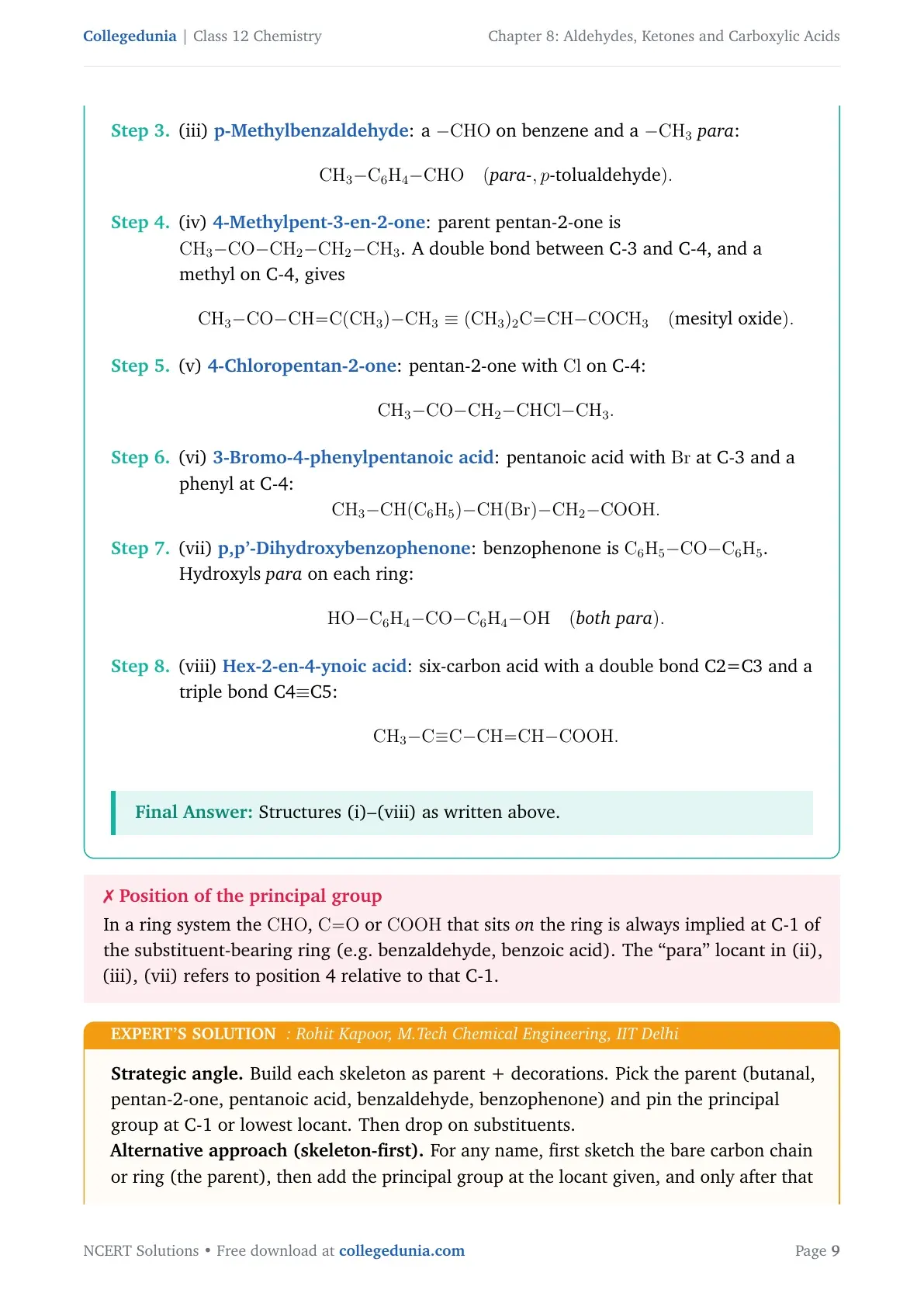
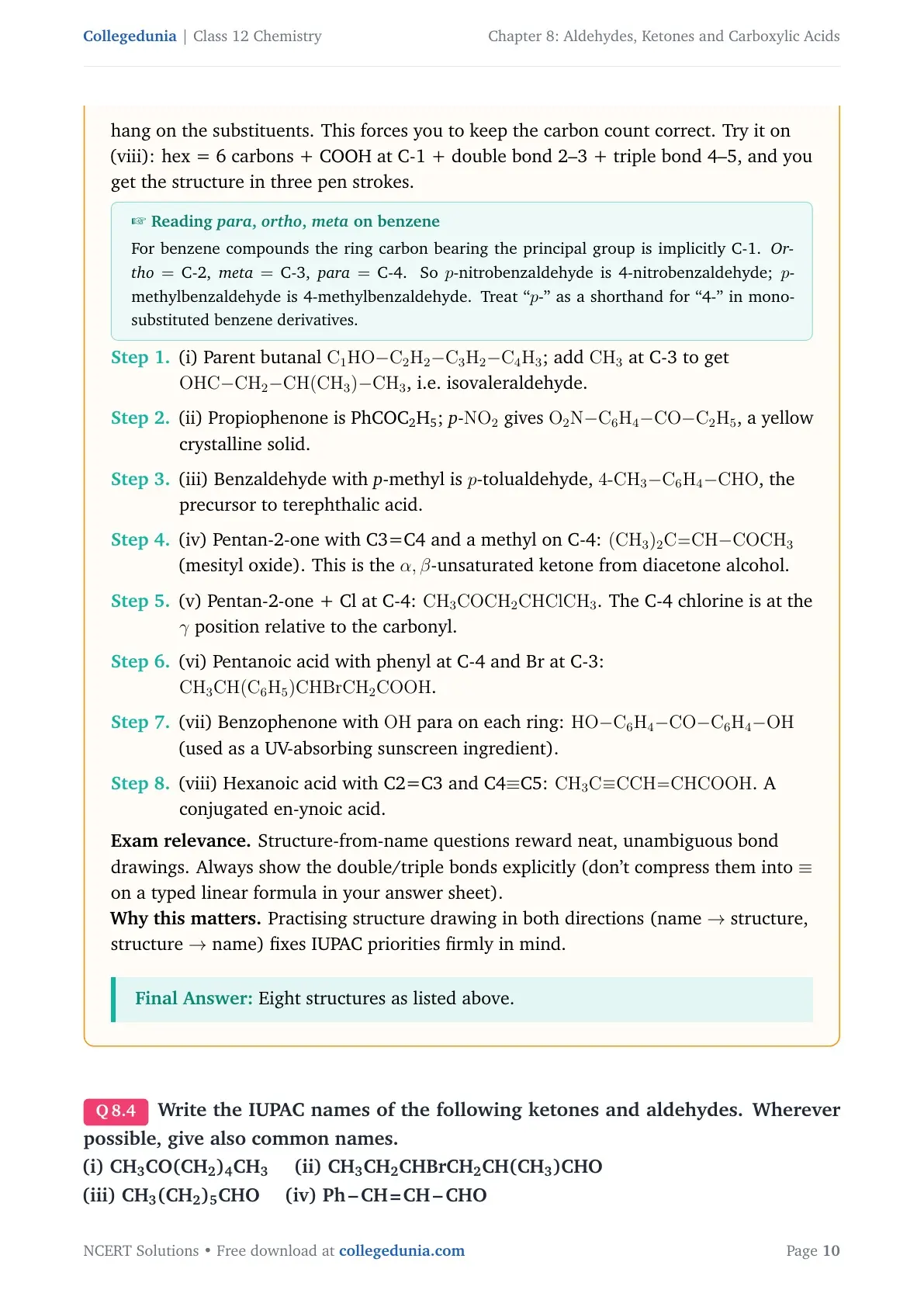
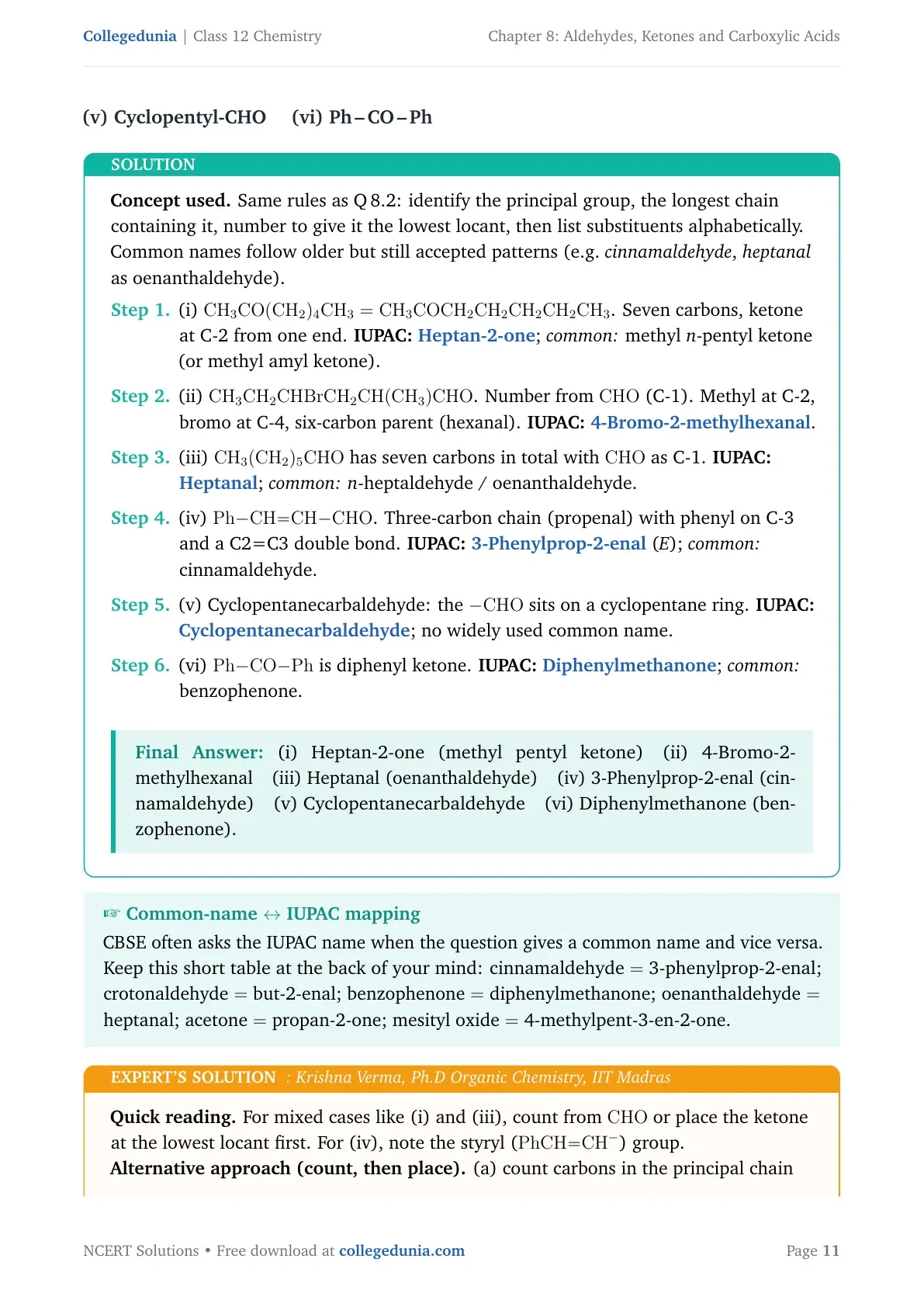
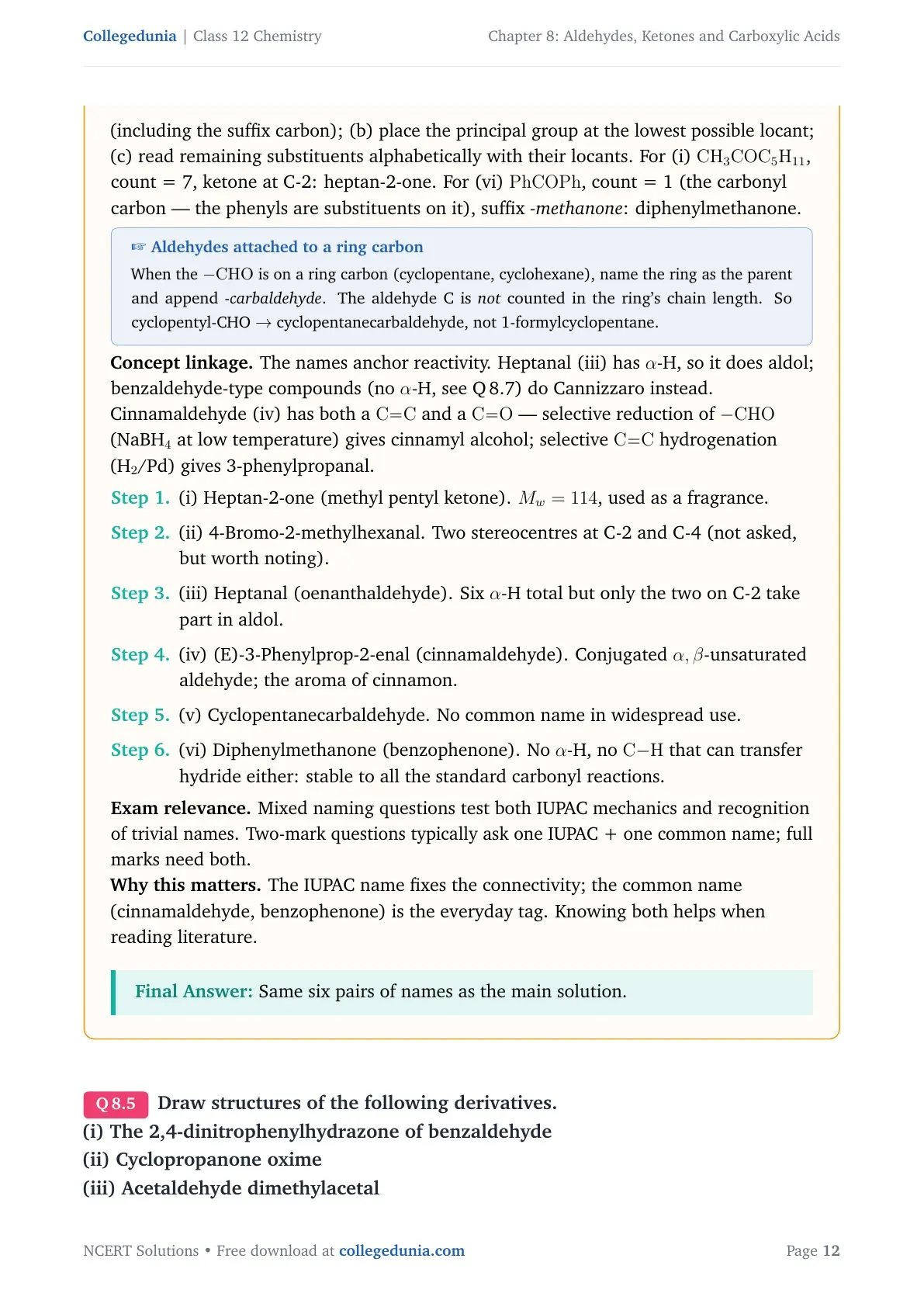
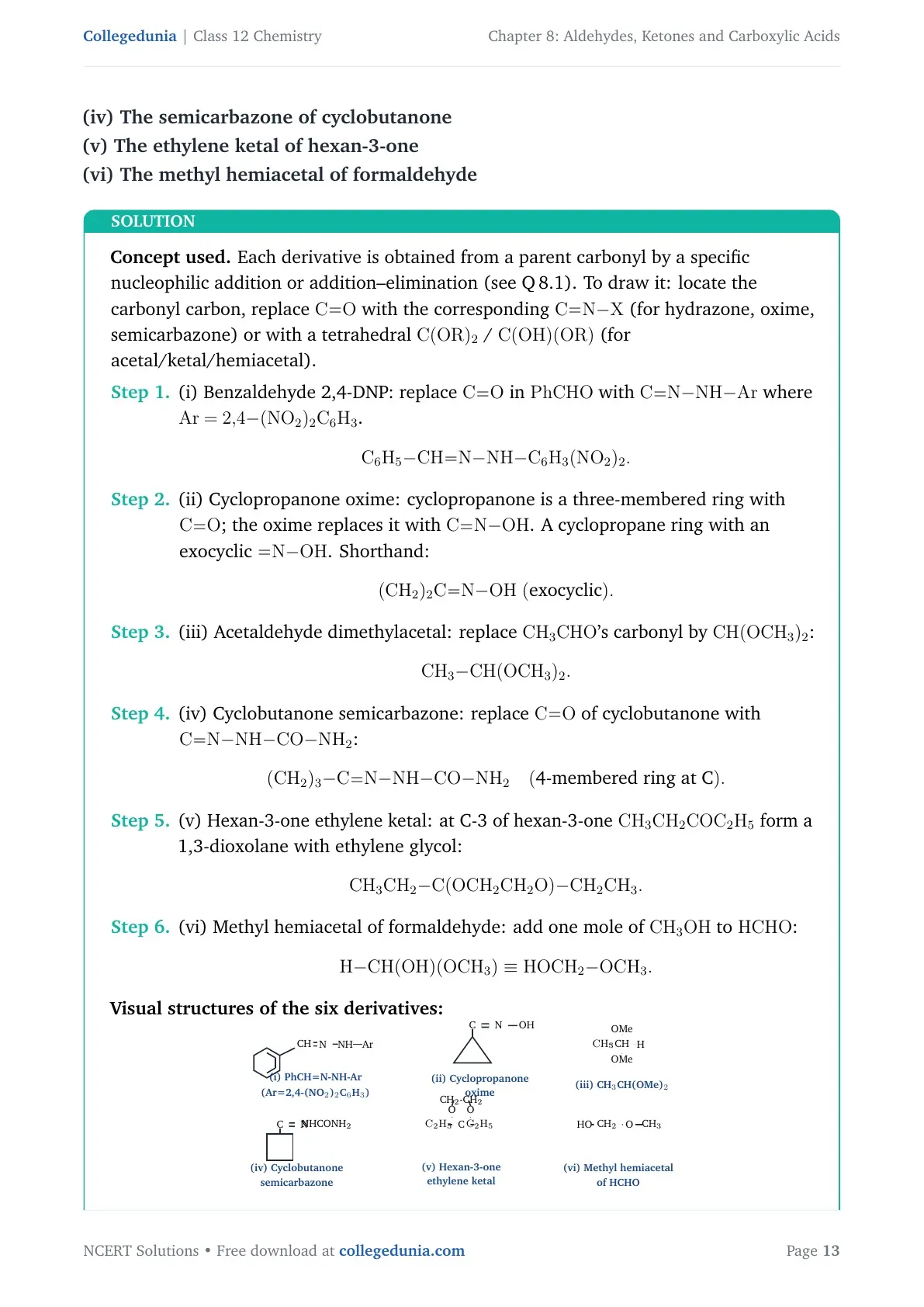
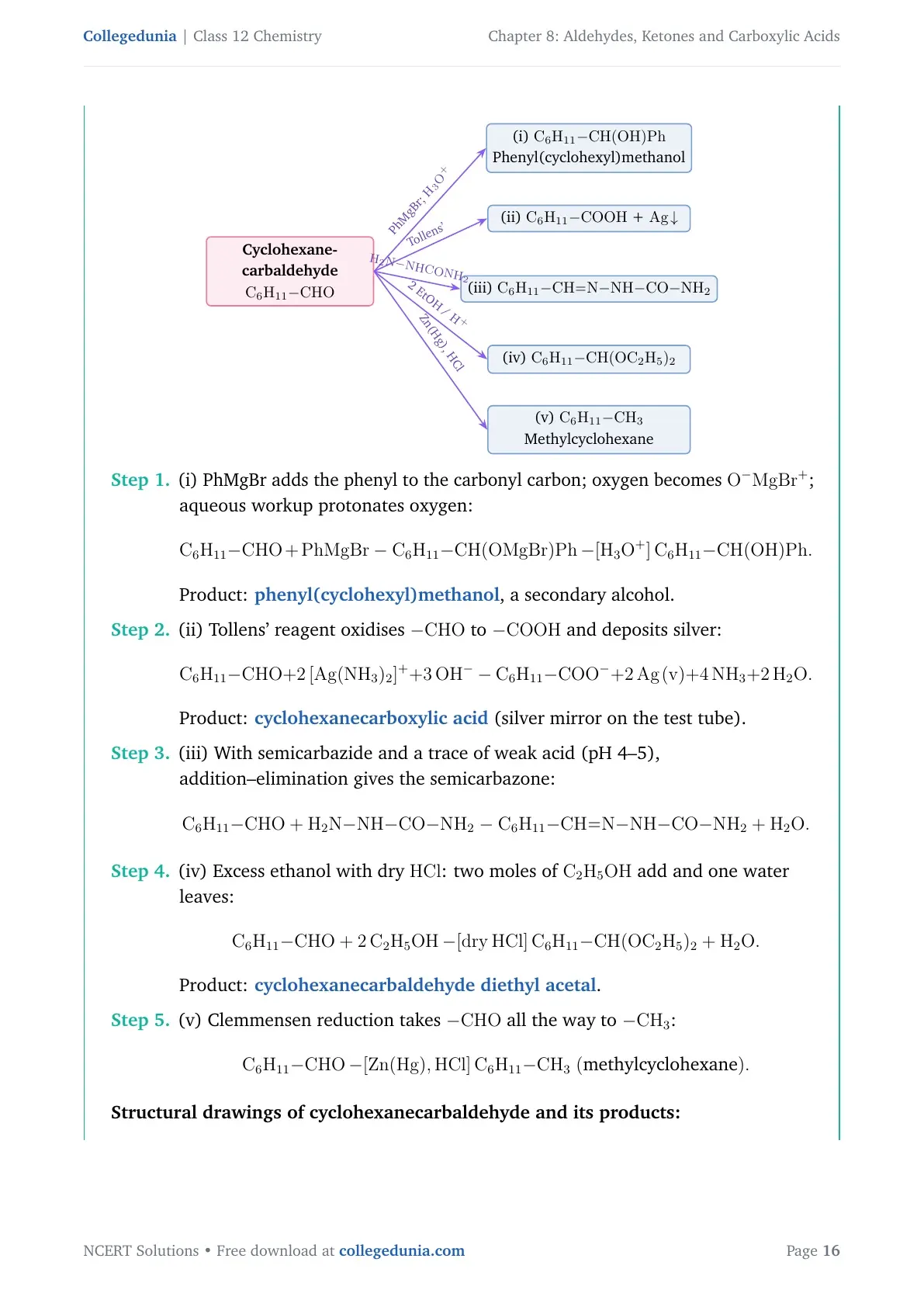
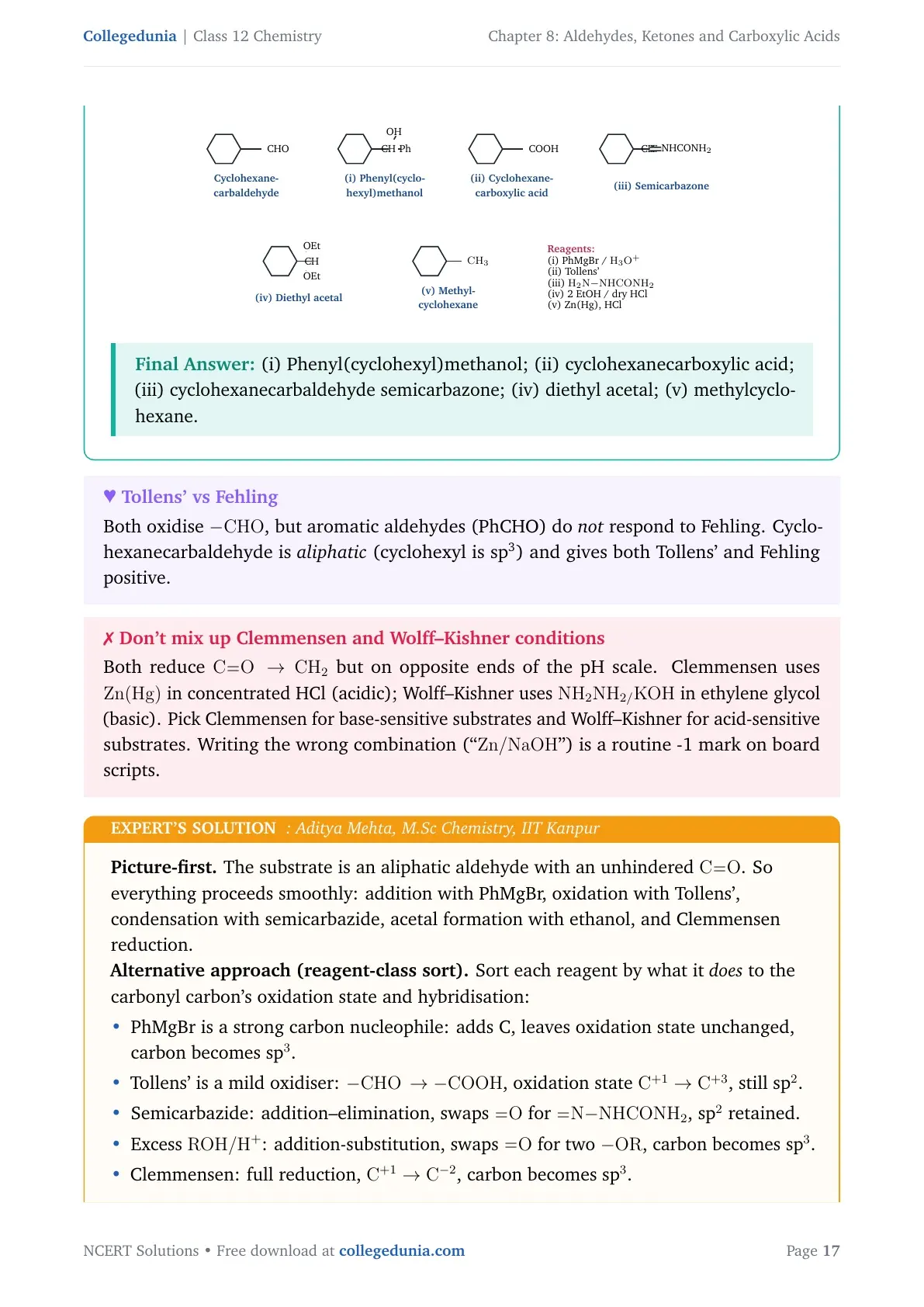
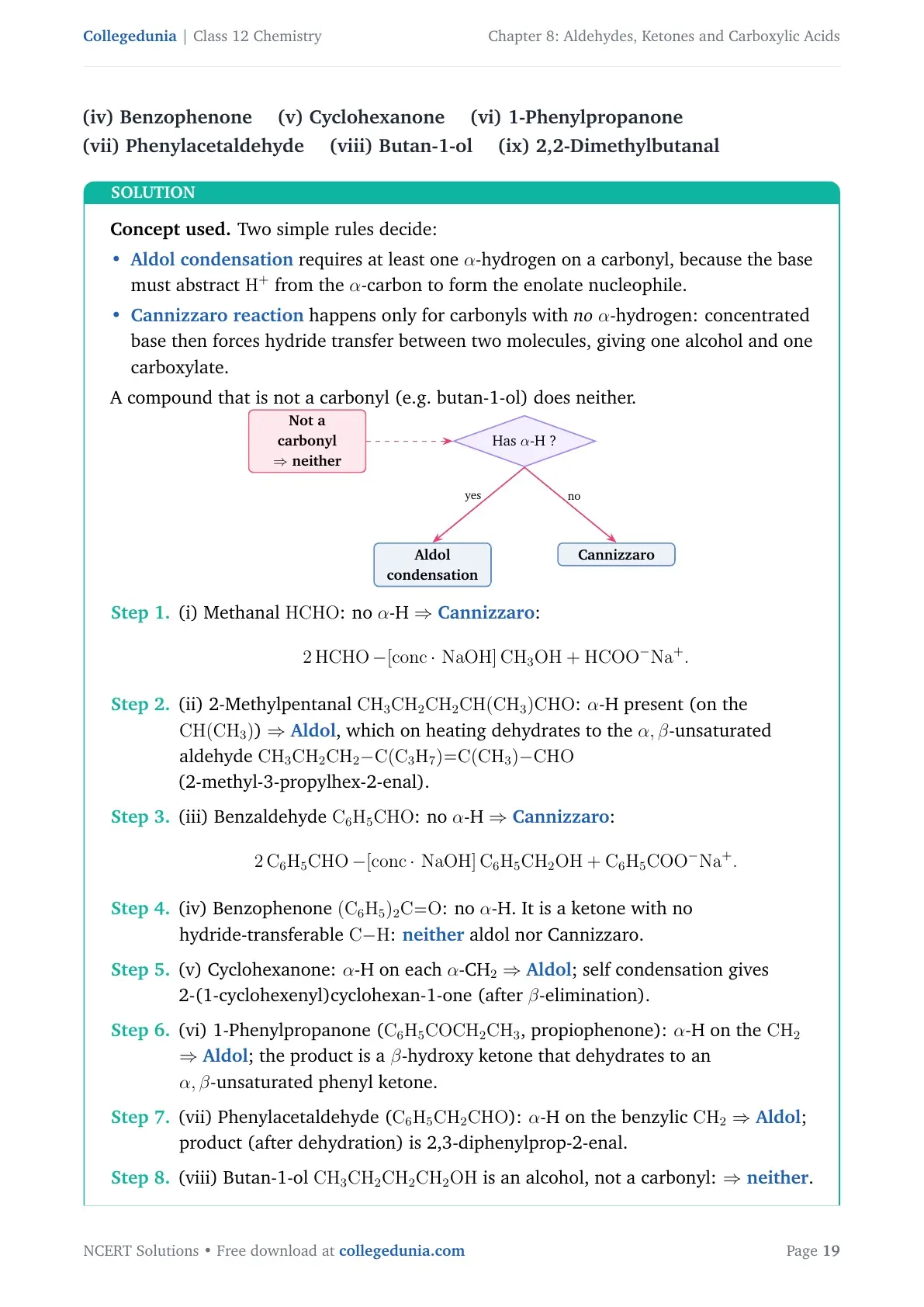
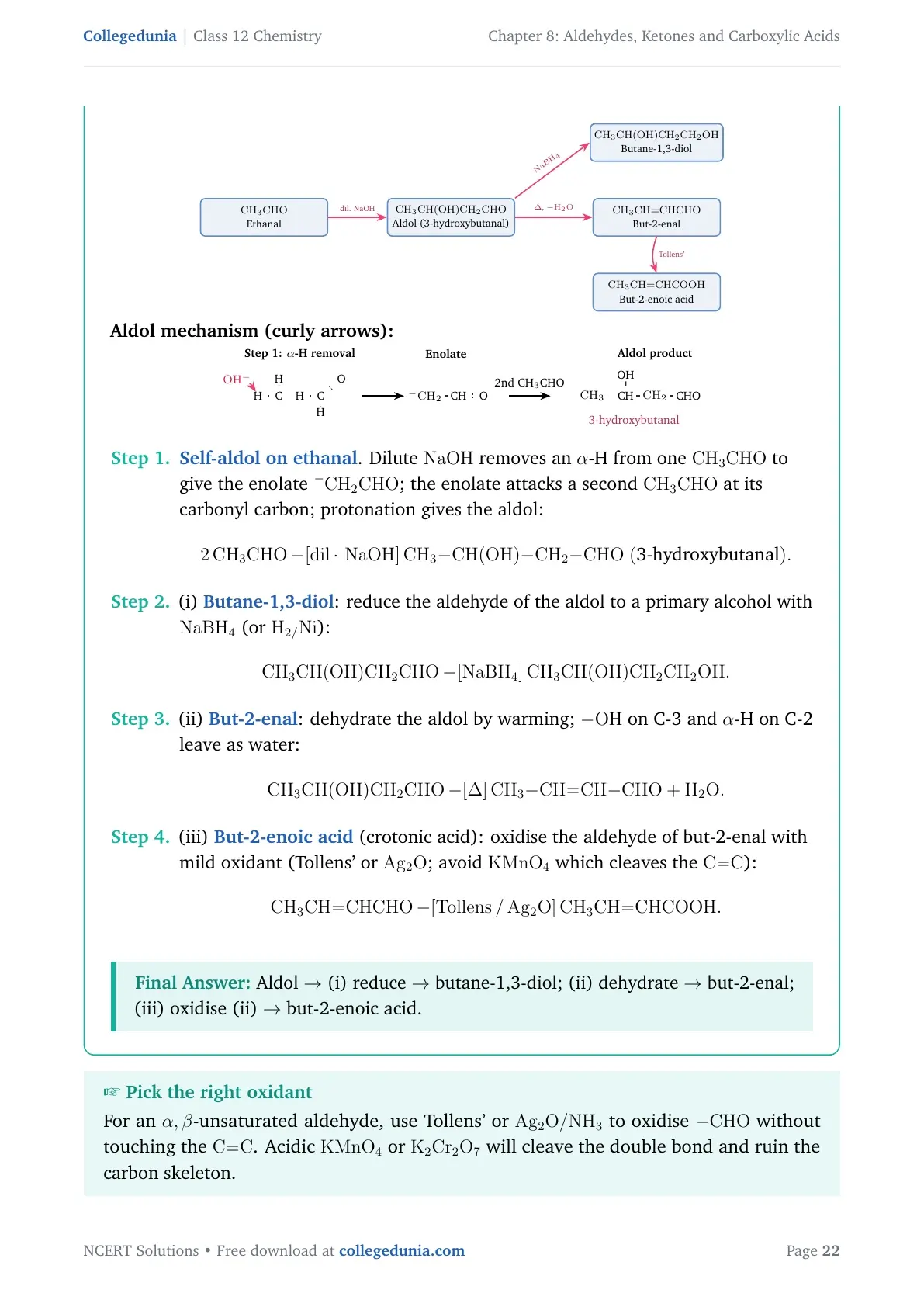
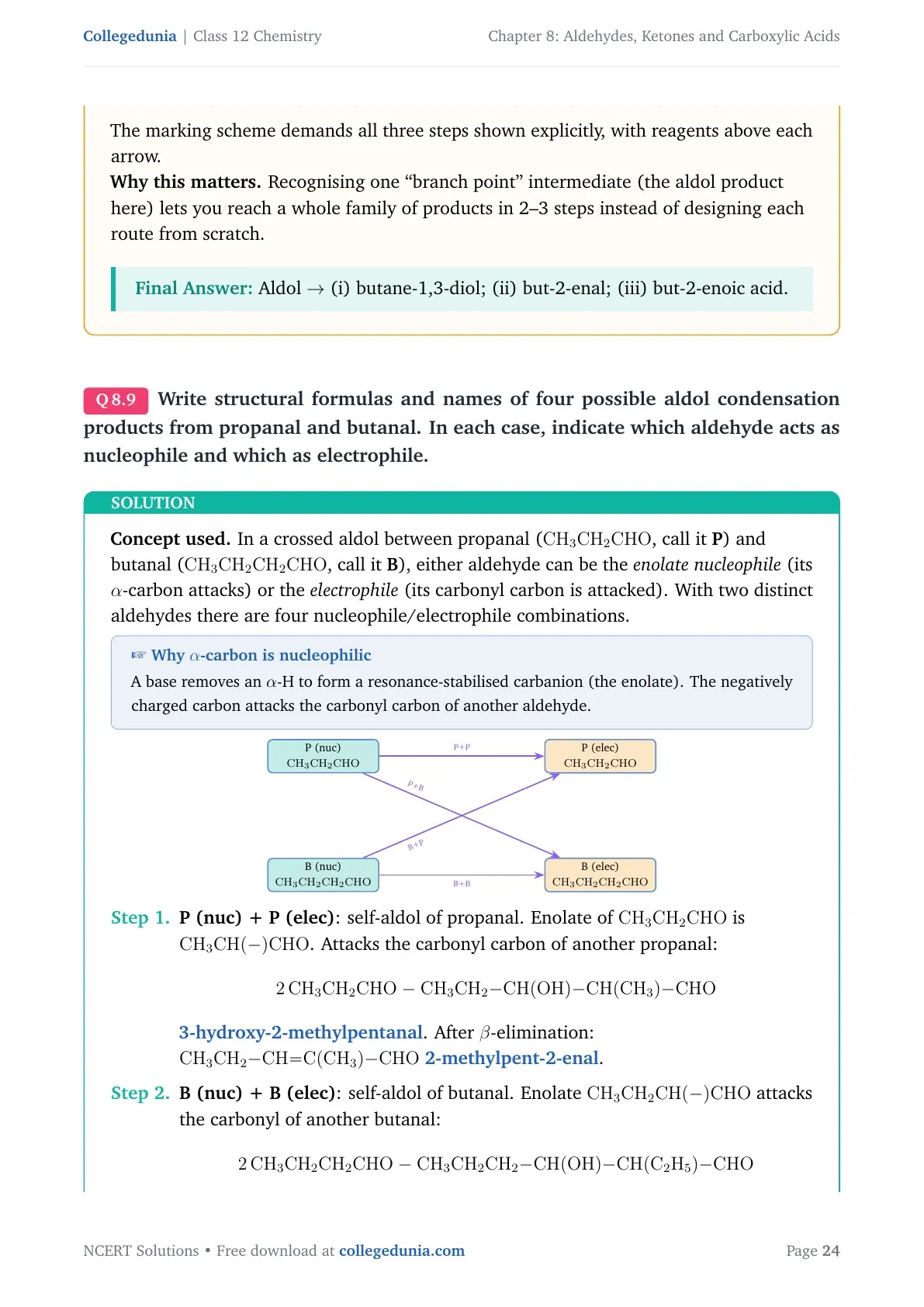
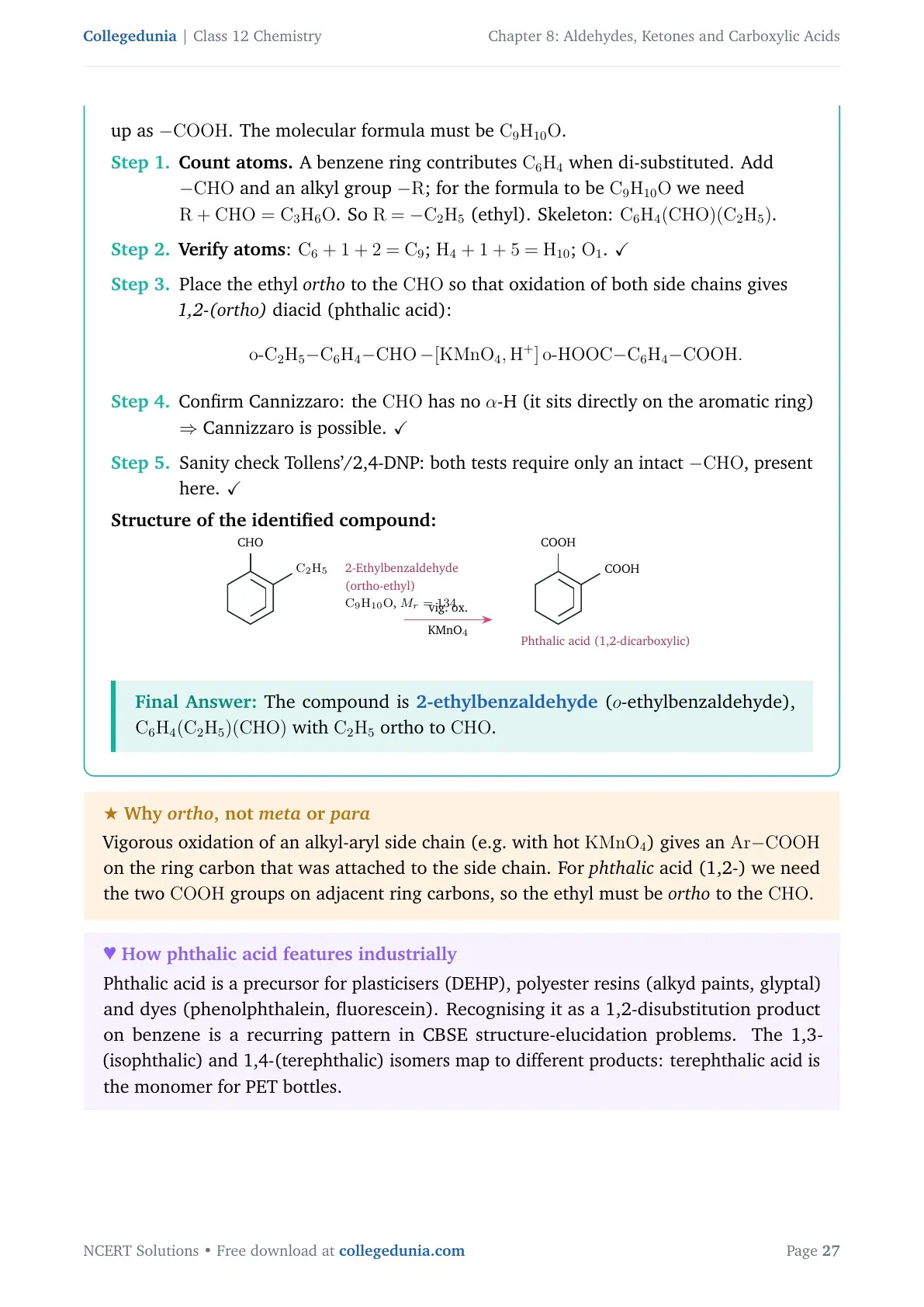
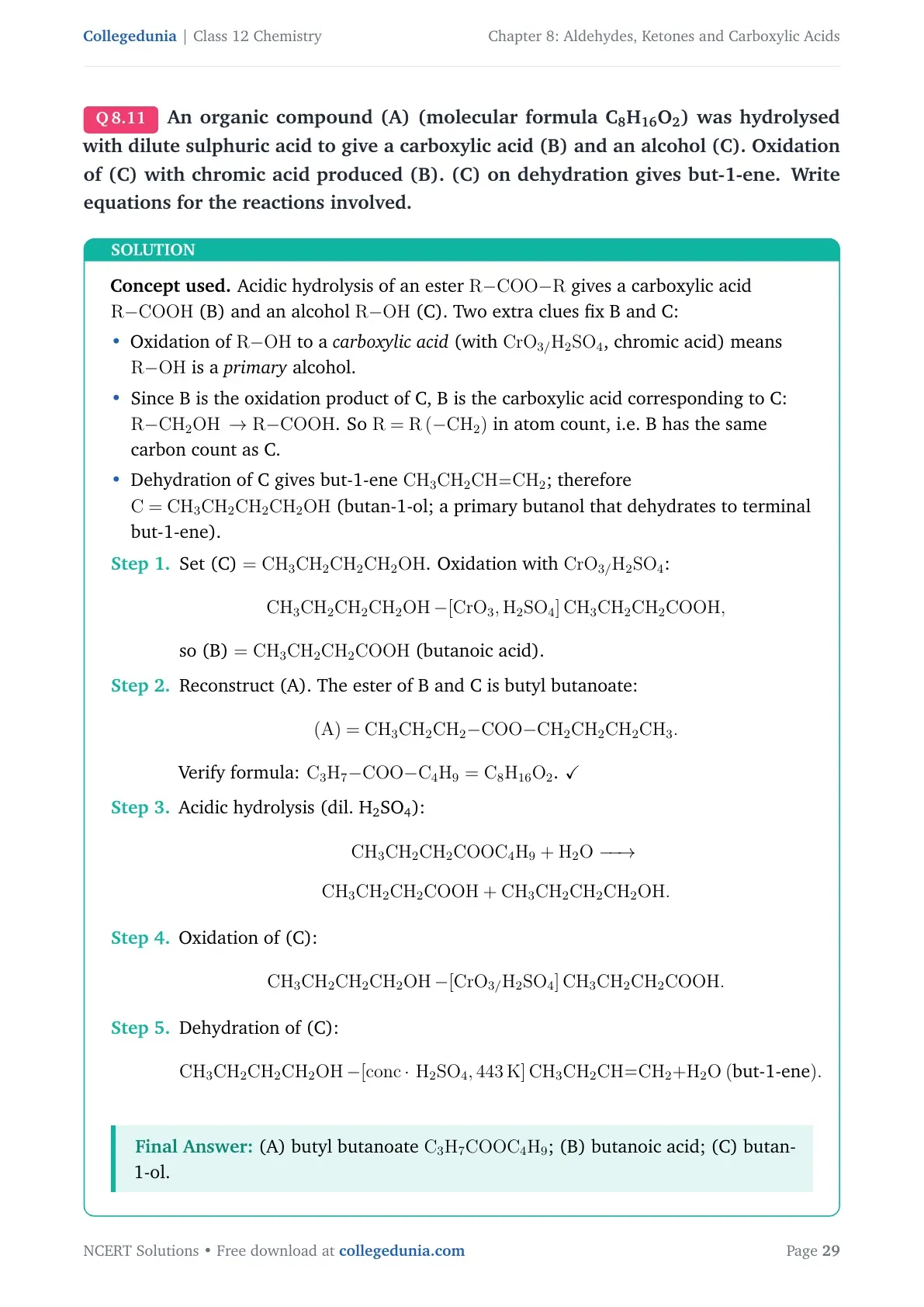
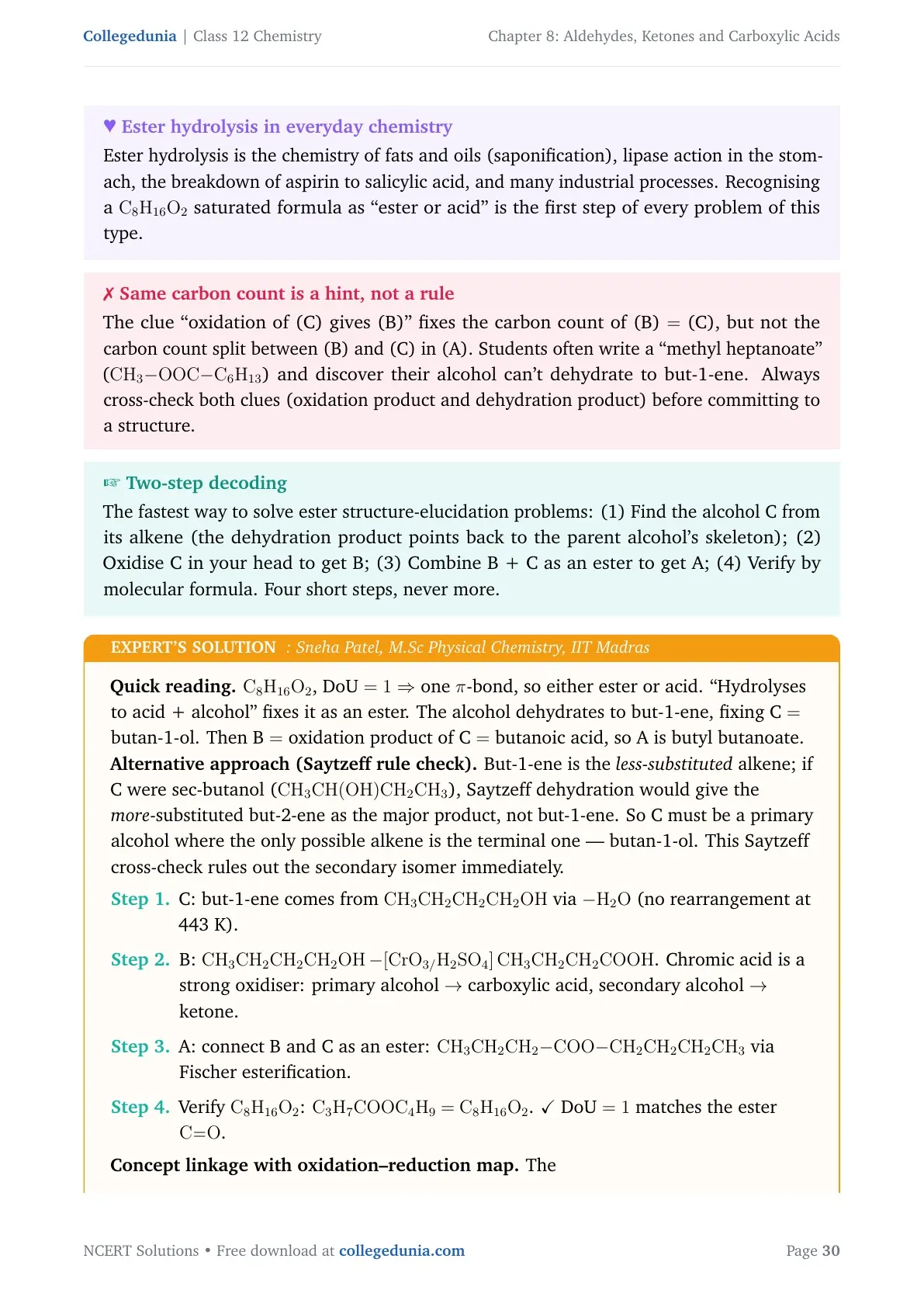
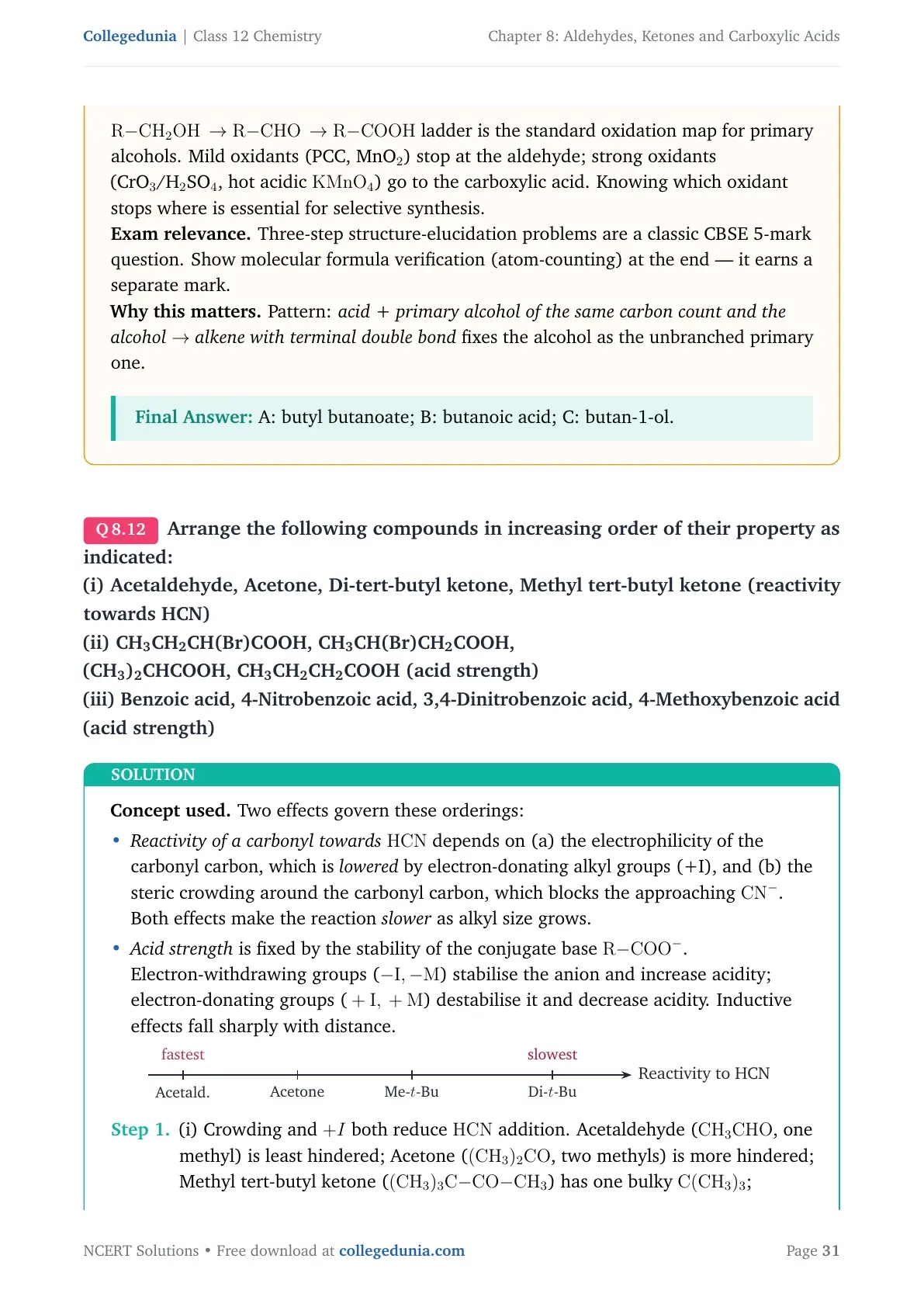
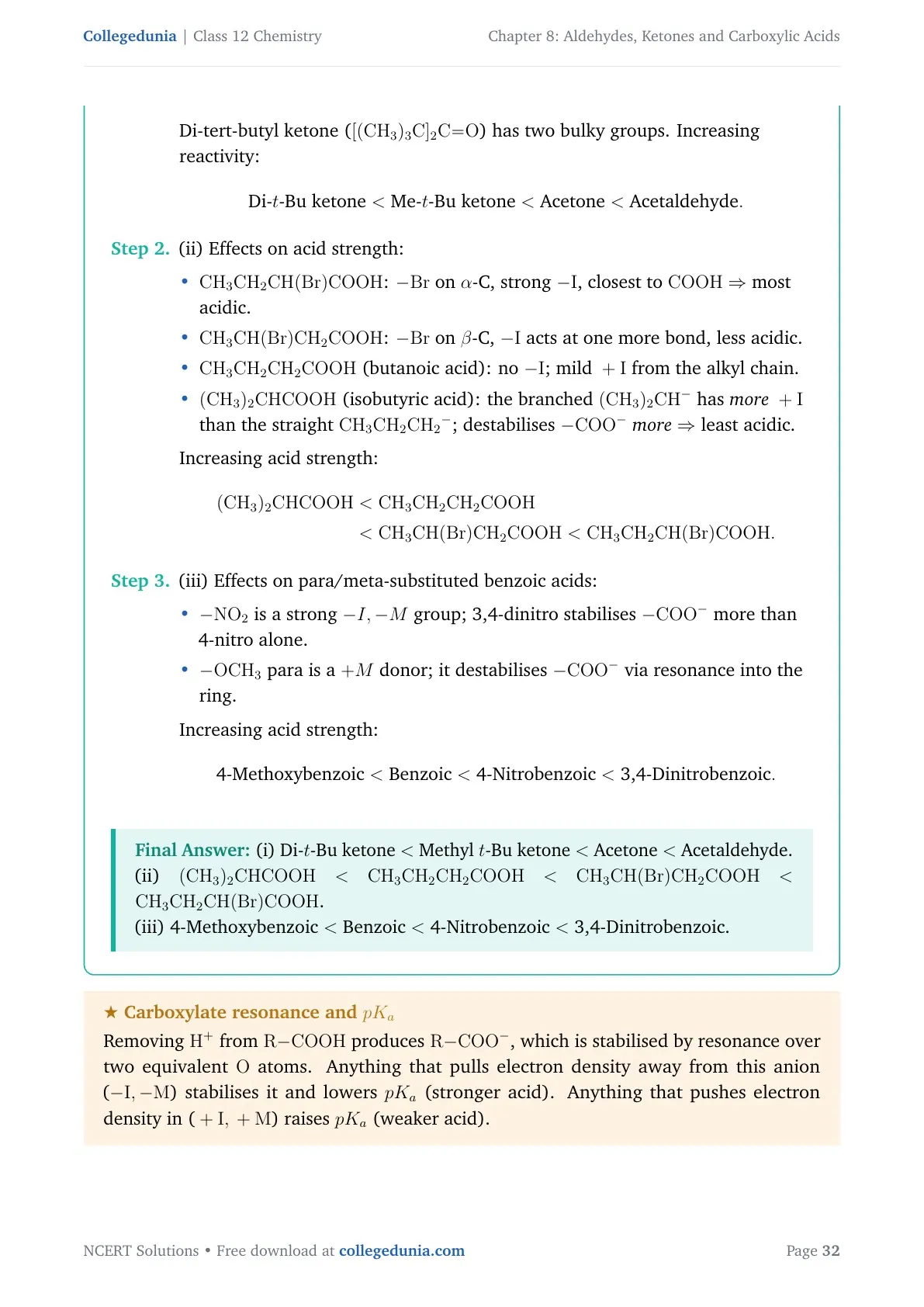
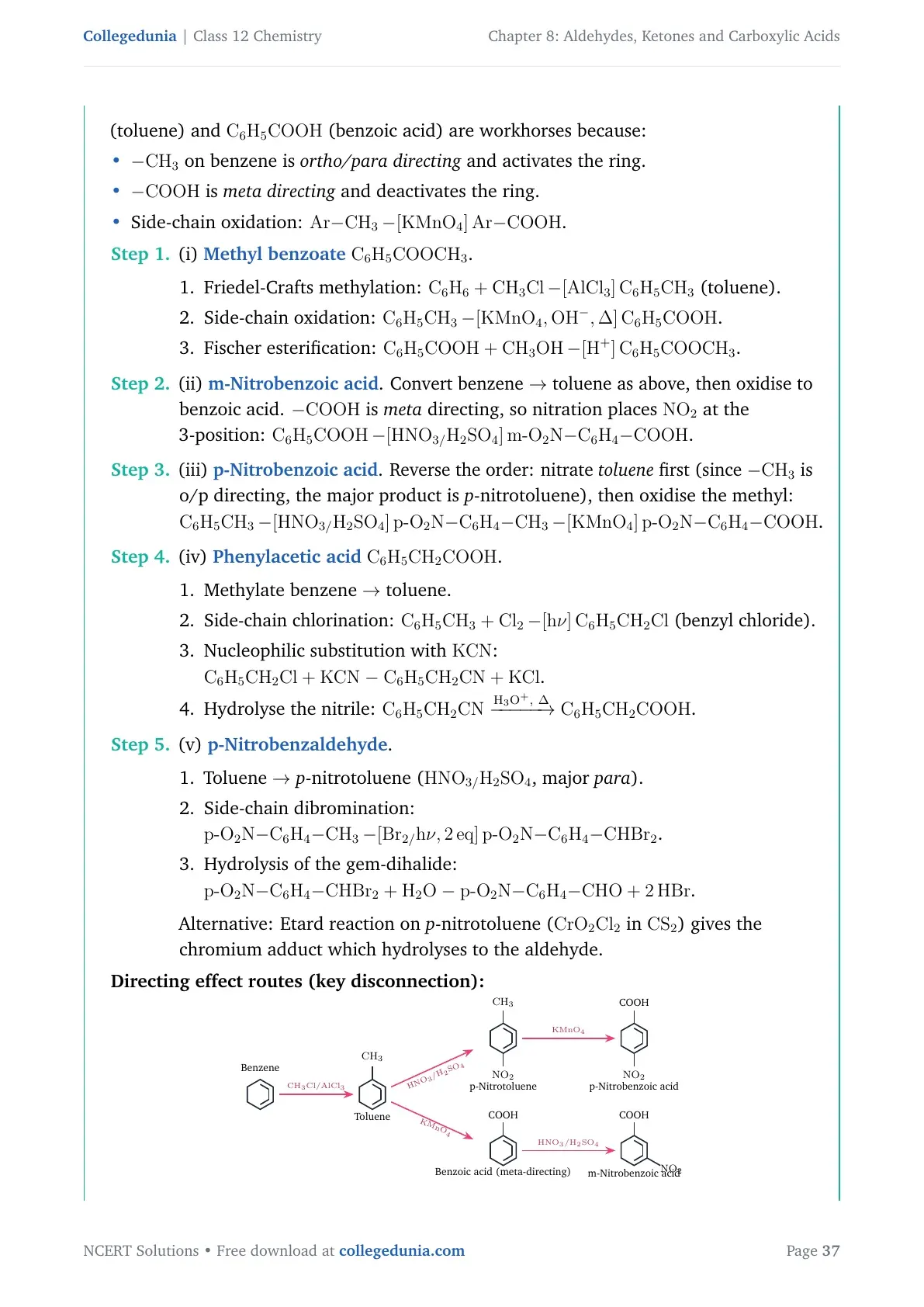
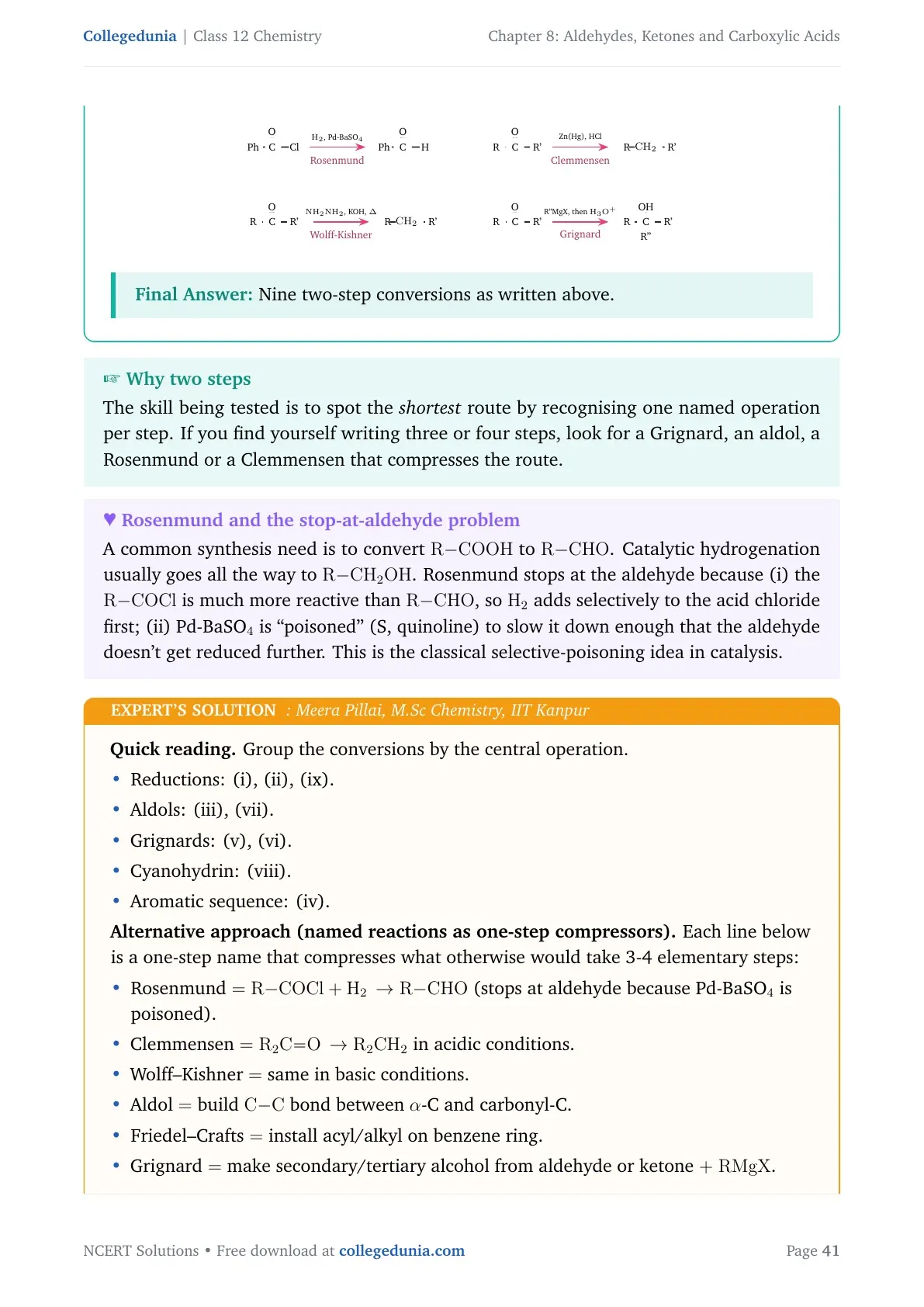
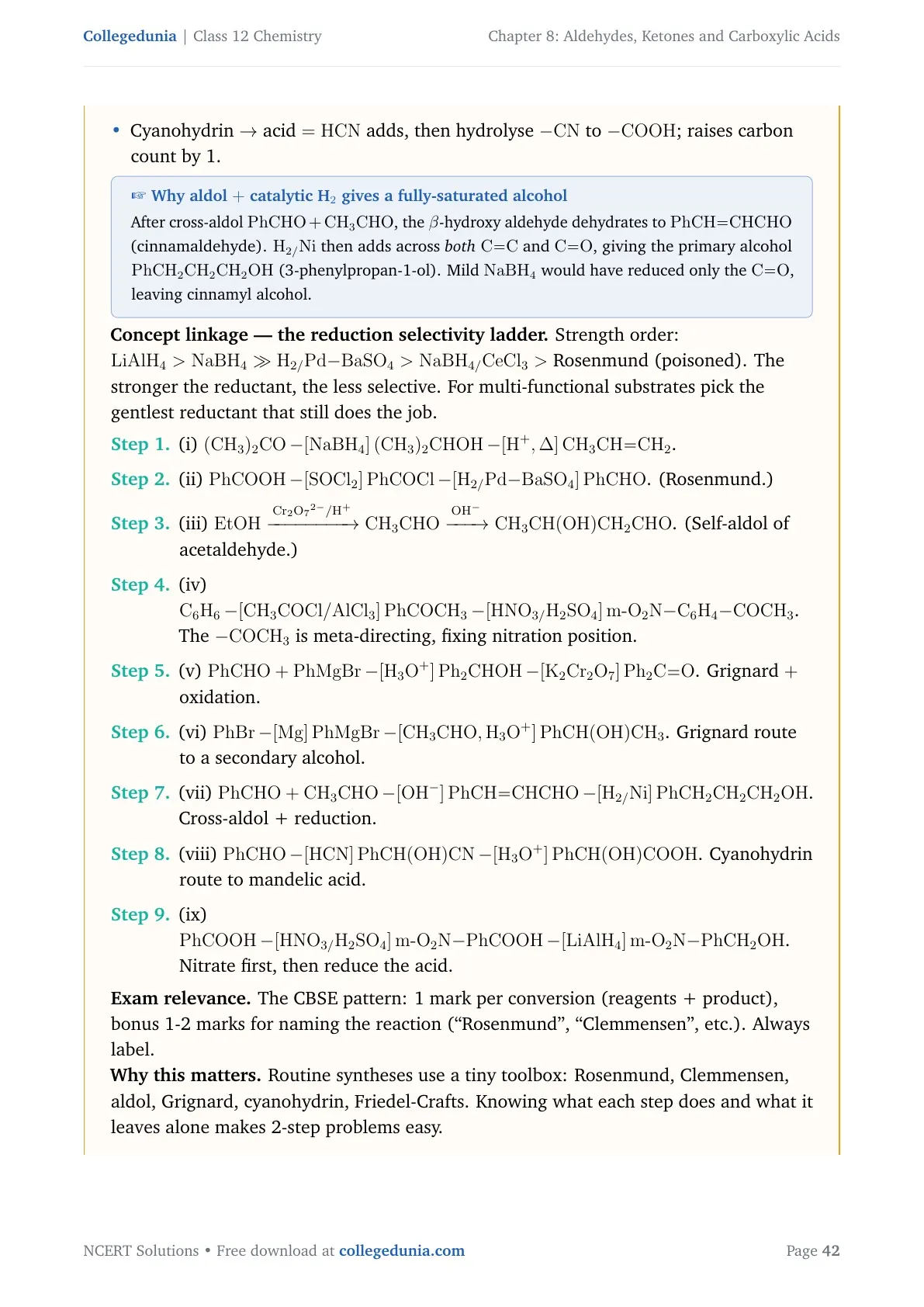
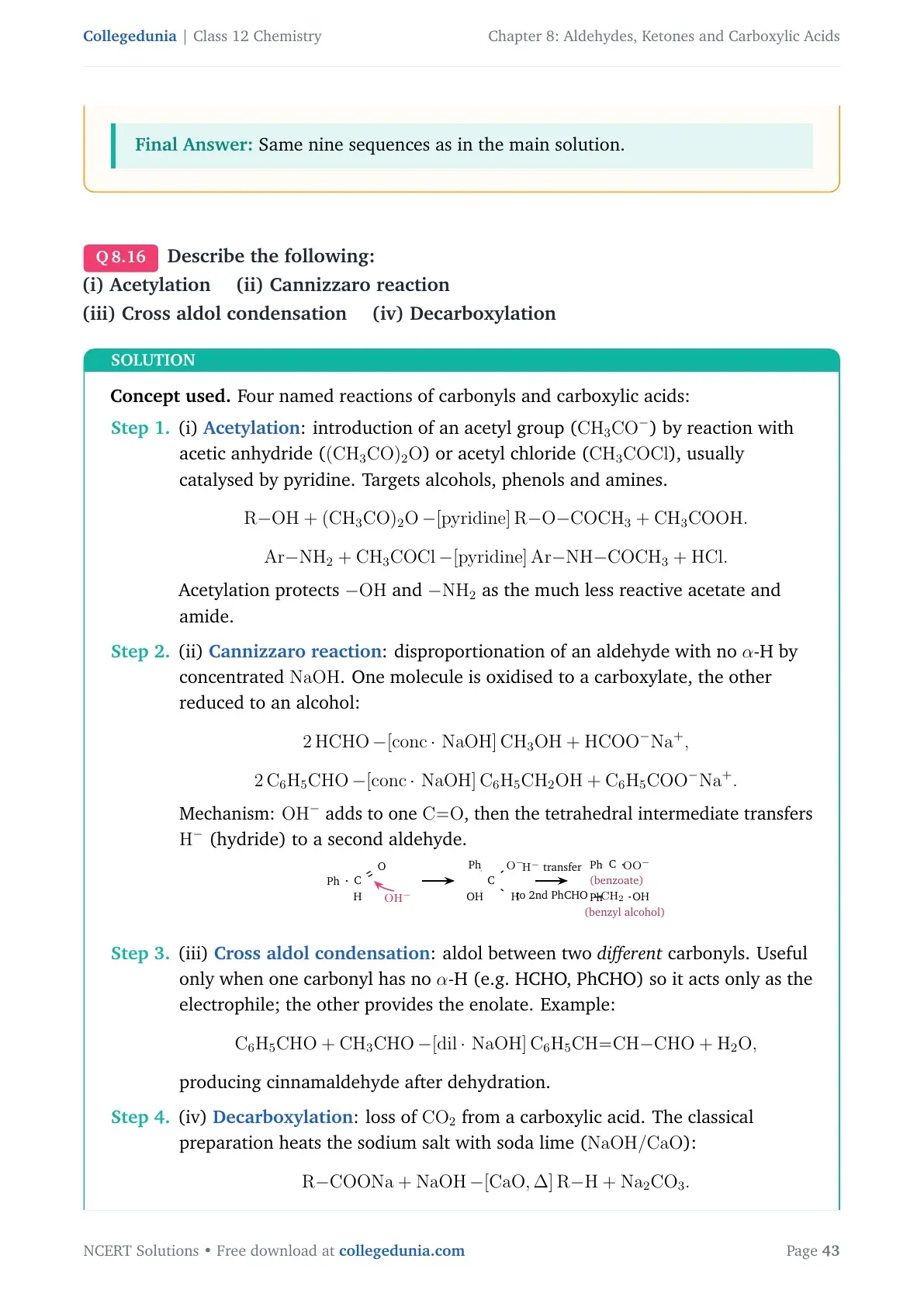
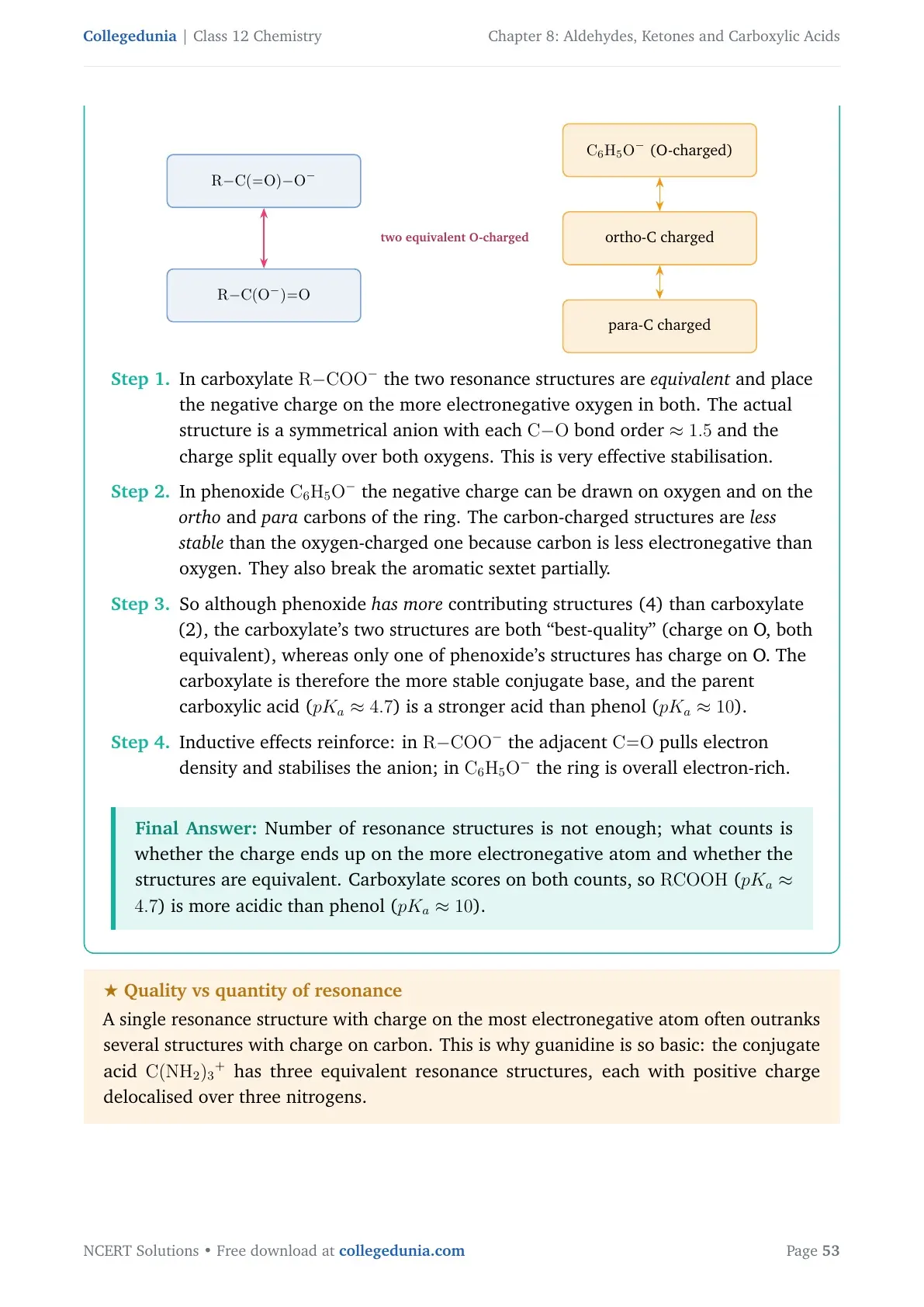

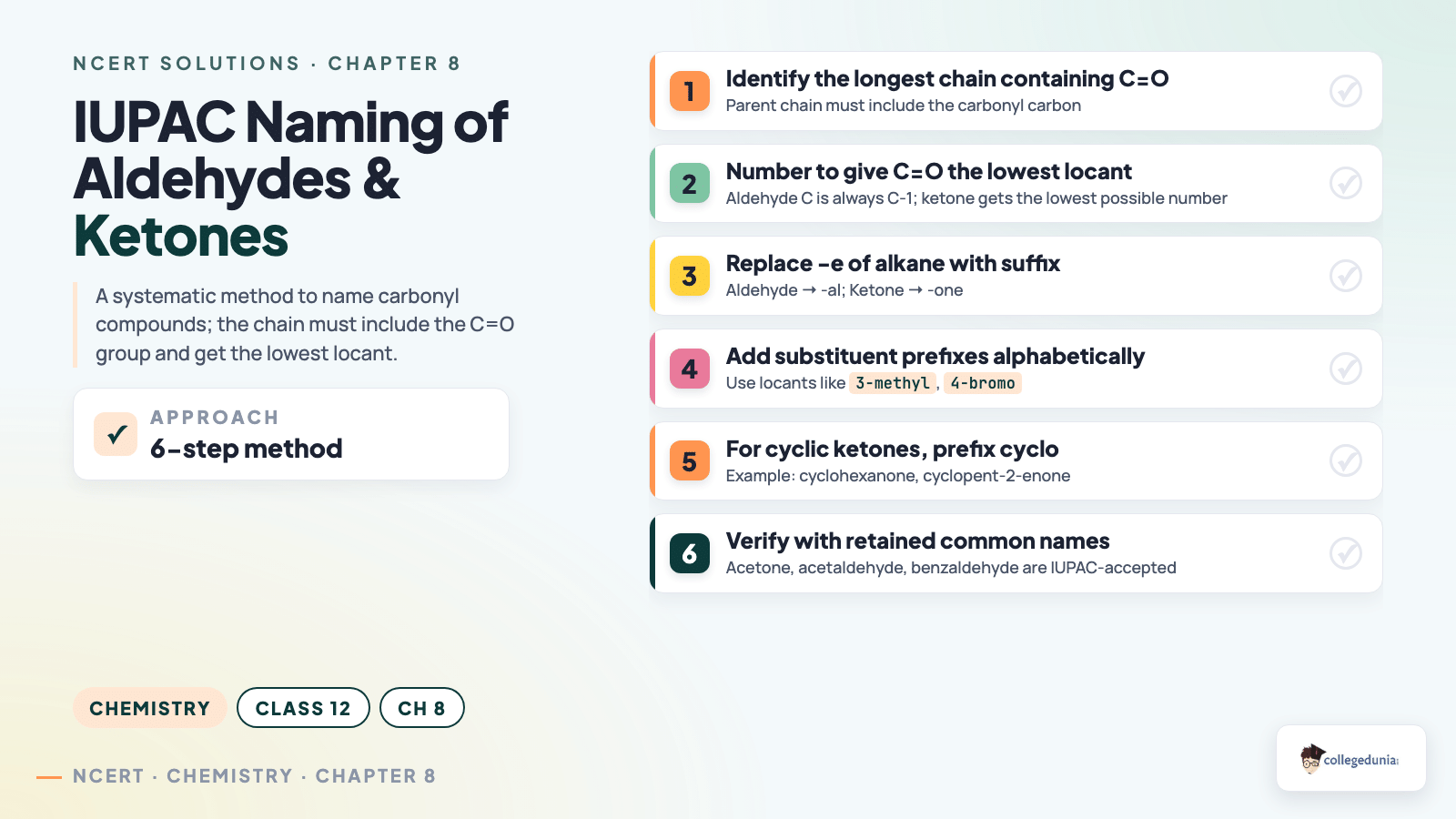
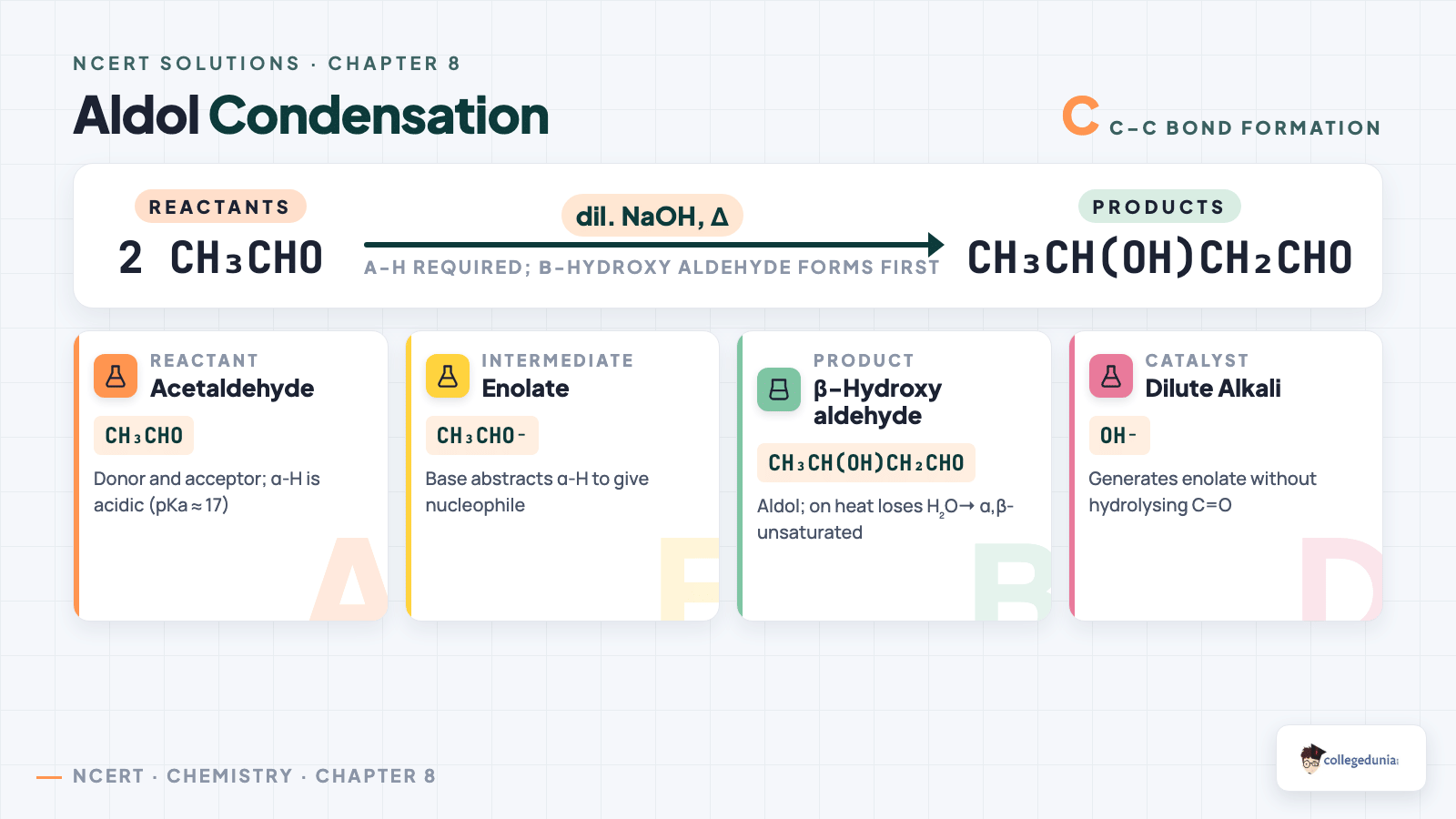



Comments