Senior Chemistry Editor, 12 Yrs | Updated 3+ months ago
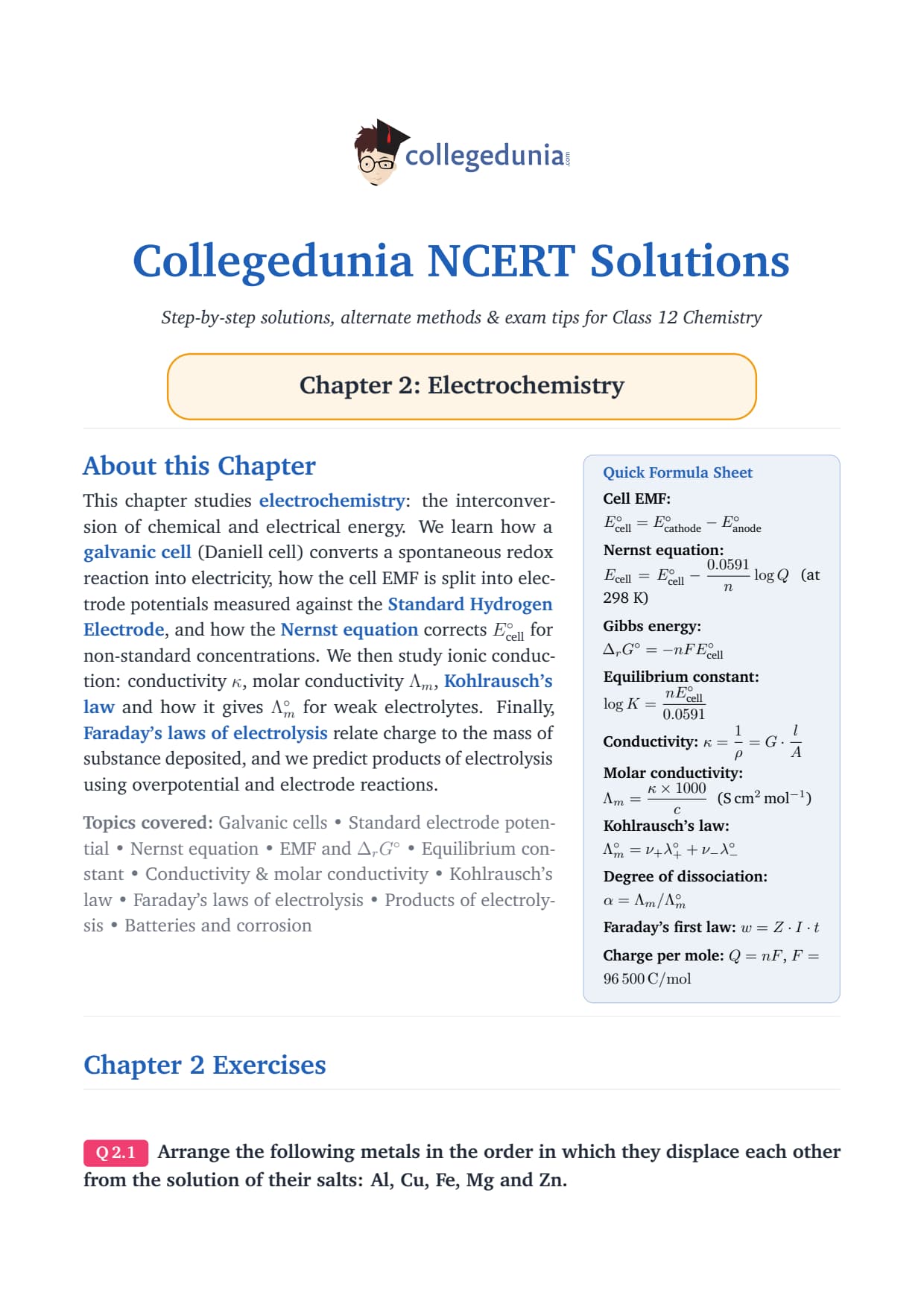
The NCERT Solutions for Class 12 Chemistry Chapter 2 Electrochemistry help you learn the exact steps to solve every numerical. Start with the high-weightage topics like the Nernst equation, cell potential, solution conductivity, and Gibbs free energy, then work through the rest.
CBSE Weightage: 5–7 marks (one 3-marker plus a 2- or 5-marker numerical)
JEE Main Weightage: 3–4% (1 to 2 questions per shift, almost always numerical)
NEET Weightage: 2–3 questions per year (Nernst equation and conductivity dominate)
The PDF above solves every intext example and back-exercise problem of Electrochemistry in the CBSE step-marking style. The sections below show where students lose marks, how a 5-marker is graded, and which exercises CBSE repeats most.
Where Students Lose Marks in Electrochemistry (Class 12 Chemistry)
Electrochemistry is a high-scoring chapter, yet the average board score on a 5-mark Nernst question is only 2.8 out of 5. Five recurring slips cause most of the lost marks, and each is easy to fix.
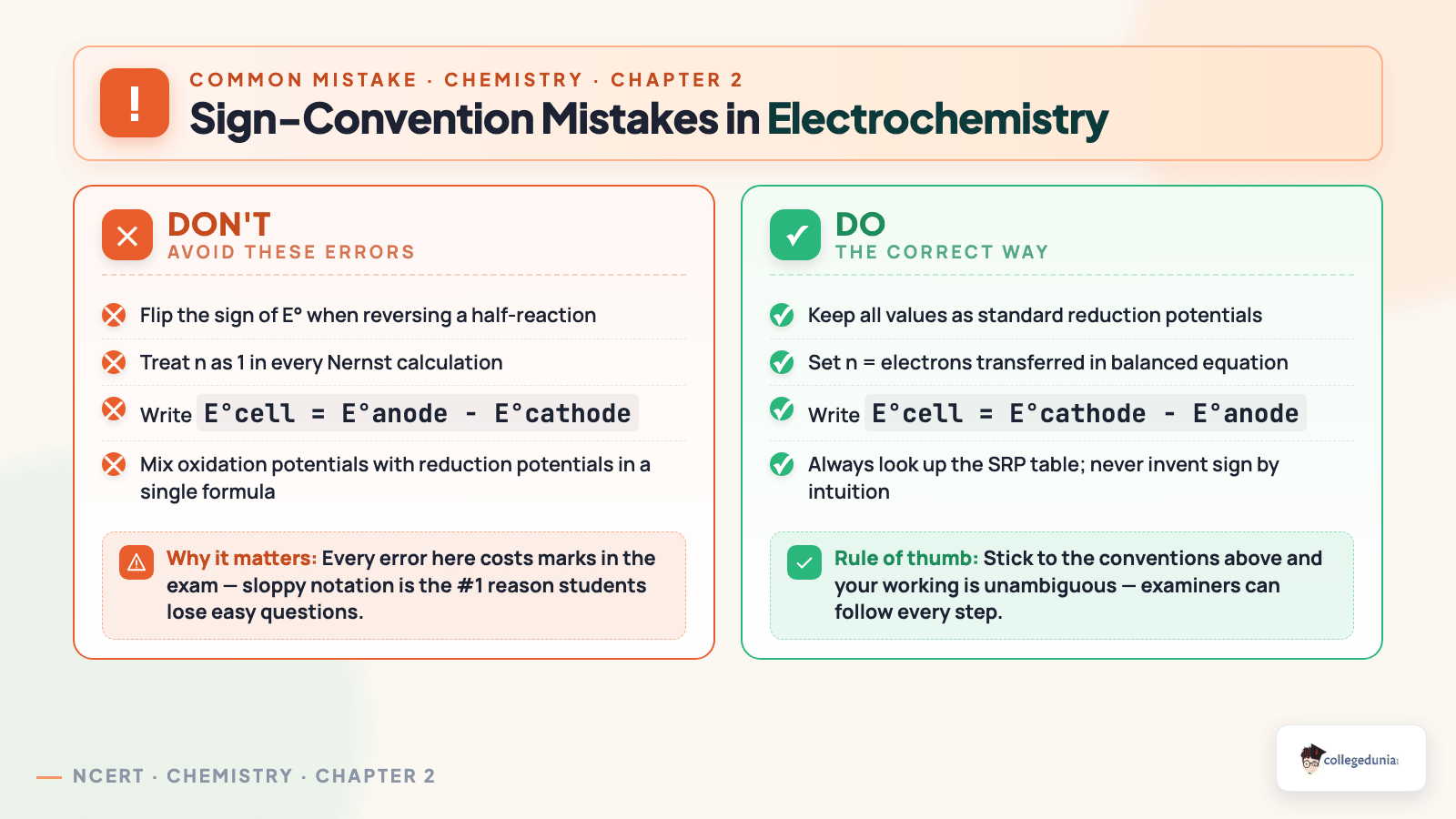
Watch Out:Forgetting the factor of 2.303 in the Nernst equation costs roughly 1.5 marks on every numerical, because substitution is marked separately from the formula step.
Sign of E°cell: use E∘cell = E∘cathode - E∘anode with reduction potentials, never oxidation potentials.
Number of electrons (n): for the Daniell cell n = 2, not 1. The wrong-n error cascades through every later step.
Units in molar conductivity: the standard unit is S cm2 mol-1; students routinely drop the cm-to-m conversion when SI is requested.
Faraday's law arithmetic: use w = ZIt with current in amperes and time in seconds. Mixing minutes with amperes is the most common silent error.
Nernst log ratio: the ratio inside the log is [products]/[reactants] for the reduction reaction. Reversing it flips the sign and forfeits the answer mark.
Electrochemistry Class 12 Chemistry Video Walkthrough
How will Collegedunia's NCERT Solutions for Electrochemistry Help You?
Every solution on this page is step-graded against the official CBSE marking scheme so the working you copy matches what an evaluator awards marks for.
2026-27 NCERT Alignment: Exercise numbering and intext examples track the latest NCERT print; topics moved out in the new edition are flagged.
Step-Marked Working: Every numerical splits into formula, substitution, simplification, and final-answer steps so the half-marks are visible.
Expert Verification: Reviewed against the last five years of CBSE, JEE Main, and NEET answer keys for sign conventions, units, and significant figures.
Quick-Recall Boxes: Each section ends with a Nernst, molar-conductivity, and Kohlrausch trigger for one-pass revision.
Electrochemistry Marks Budget for a Typical CBSE 5-Marker
The split below shows how a standard 5-mark Nernst numerical is graded. Memorise the structure, not just the answer.
Marking Step
CBSE Expectation
Marks
Correct formula stated
Nernst equation with terms defined
1
Substitution with correct n, signs
n = 2 for Daniell cell, reduction potentials
1.5
Numerical simplification
2.303 RT/F = 0.0591 V at 298 K used
1
Final answer with units
Two decimal places, V or kJ/mol stated
1
Diagram or cell notation
Salt bridge shown, electrodes labelled
0.5
Quick Tip: Write the Nernst formula on line one even if you cannot finish the numerical. CBSE awards the formula mark independently.
Electrochemistry Exercise-by-Exercise Breakdown (NCERT Class 12 Chemistry)
The chapter splits into 12 intext example questions and an 18-question back exercise. The map below tags each cluster with its sub-topic and CBSE priority.
Section
Qs
Sub-Topic
Priority
Intext 2.1 – 2.5
5
Electrode potential, SHE, Nernst equation
High
Intext 2.6 – 2.9
4
Conductance, Molar conductivity, Kohlrausch law
Medium
Intext 2.10 – 2.12
3
Faraday's laws, Quantitative electrolysis
High
Exercise 2.1 – 2.6
6
Standard potentials, EMF computation
High
Exercise 2.7 – 2.12
6
Nernst numericals, Gibbs energy, Kc
High
Exercise 2.13 – 2.18
6
Conductivity, Faraday, Batteries, Corrosion
Medium
Of the 30 questions, around 14 are numericals, accounting for the bulk of CBSE marks. Prioritise Exercises 2.7 to 2.12, then 2.1 to 2.6 for theory framing.
Electrochemistry Previous Year Questions Weightage (2021–2026)
The year-wise map tags which sub-topic each board sourced its Electrochemistry question from. Nernst and conductivity carry the chapter every cycle.
Year
CBSE Board
JEE Main
NEET
2026
Nernst equation and cell EMF (3 marks)
Nernst at non-standard pH (2 Qs)
Molar conductivity and Kohlrausch law (1 Q)
2025
Nernst 3 marks + Kohlrausch 2 marks
Molar conductivity plot (1 Q)
Equivalent conductivity, Faraday (2 Qs)
2024
Cell representation + EMF 5 marks
Standard potential ordering (1 Q)
Nernst at 298 K, Batteries (2 Qs)
2023
Faraday's law numerical 3 marks
Gibbs energy from E°cell (1 Q)
Kohlrausch law (2 Qs)
2022
Reactivity series + Nernst 5 marks
Cell constant (1 Q)
EMF, Concentration cell (2 Qs)
2021
Electrolysis quantitative 3 marks
Cell potential at varying [ ] (1 Q)
SHE (1 Q)
Remember: At 298 K, 2.303 RT/F = 0.0591 V. CBSE prints this in the question footer; JEE Main and NEET expect you to recall it.
Electrochemistry Top 5 Formulae for Quick Recall
These five formulae cover almost every CBSE Board and JEE Main numerical on the chapter. The full master table with dimensional checks lives on the Formula Sheet page.
Must-Know Electrochemistry Derivations for Class 12 Boards
CBSE has rotated through four derivations across the last five board cycles. Memorise the year-tag with each one so you can pre-empt repeats in 2026.
Nernst Equation from Thermodynamics: derived from Δ G = Δ G∘ + RT ln Q and Δ G = -nFE. Appeared in CBSE 2024, 2022, 2021.
Relation between Kc and E∘cell: set Ecell = 0 at equilibrium in the Nernst equation. Appeared in CBSE 2025, 2023.
Kohlrausch Law of Independent Migration: limiting molar conductivity expressed as the sum of cation and anion contributions. Appeared in CBSE 2025, 2022.
Faraday's First Law from Charge Conservation: mass deposited = (M / nF) × charge passed. Appeared in CBSE 2023, 2021.
Electrochemistry CBSE Question-Type Distribution Class 12 Chemistry
How CBSE has distributed the chapter's marks across question types in the last five board papers.
Question Type
Marks
Frequency (5 yrs)
Nernst-equation numerical
3 or 5
5/5
Cell representation, EMF
3
4/5
Kohlrausch / Molar conductivity
2 or 3
3/5
Faraday's law of electrolysis
2 or 3
3/5
Batteries, corrosion theory
1 or 2
2/5
Assertion–Reason / MCQ
1
5/5
Numerical questions on Nernst, EMF, and Faraday's law account for nearly 80% of the chapter's marks. Prioritise numerical practice over theory write-ups.
All NCERT Solutions for Electrochemistry with Step-by-Step Working
Every NCERT textbook question for Class 12 Chemistry Chapter 2 Electrochemistry is listed below with its full Solution and Expert Solution hidden inside collapsible tabs. Click Check Solution to reveal the step-by-step working; click Expert Solution for the expanded explanation.
Questions
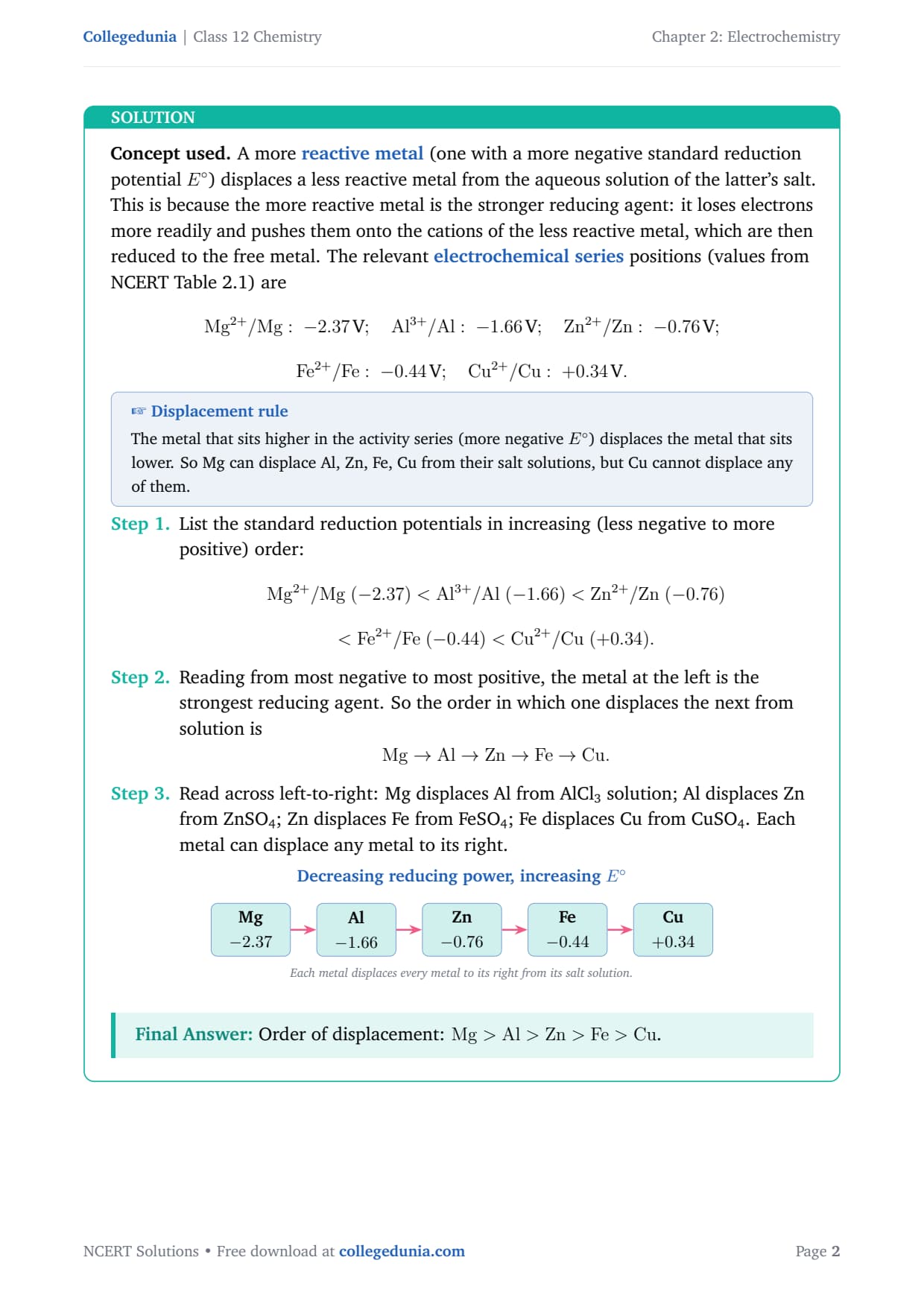
Q 2.1
Arrange the following metals in the order in which they displace each other from the solution of their salts: Al, Cu, Fe, Mg and Zn.
Concept used. A more reactive metal (one with a more negative standard reduction potential E∘) displaces a less reactive metal from the aqueous solution of the latter's salt. This is because the more reactive metal is the stronger reducing agent: it loses electrons more readily and pushes them onto the cations of the less reactive metal, which are then reduced to the free metal. The relevant electrochemical series positions (values from NCERT Table 2.1) are Mg2+/Mg: -2.37 V; Al3+/Al: -1.66 V; Zn2+/Zn: -0.76 V; Fe2+/Fe: -0.44 V; Cu2+/Cu: +0.34 V.
Displacement rule
The metal that sits higher in the activity series (more negative E∘) displaces the metal that sits lower. So Mg can displace Al, Zn, Fe, Cu from their salt solutions, but Cu cannot displace any of them.
List the standard reduction potentials in increasing (less negative to more positive) order: Mg2+/Mg (-2.37) < Al3+/Al (-1.66) < Zn2+/Zn (-0.76) < Fe2+/Fe (-0.44) < Cu2+/Cu (+0.34).
Reading from most negative to most positive, the metal at the left is the strongest reducing agent. So the order in which one displaces the next from solution is Mg → Al → Zn → Fe → Cu.
Read across left-to-right: Mg displaces Al from AlCl3 solution; Al displaces Zn from ZnSO4; Zn displaces Fe from FeSO4; Fe displaces Cu from CuSO4. Each metal can displace any metal to its right.
[See diagram in the PDF version]
Order of displacement: Mg > Al > Zn > Fe > Cu.
AS
Aarav Sharma
M.Sc Chemistry, IIT Kanpur
Verified Expert
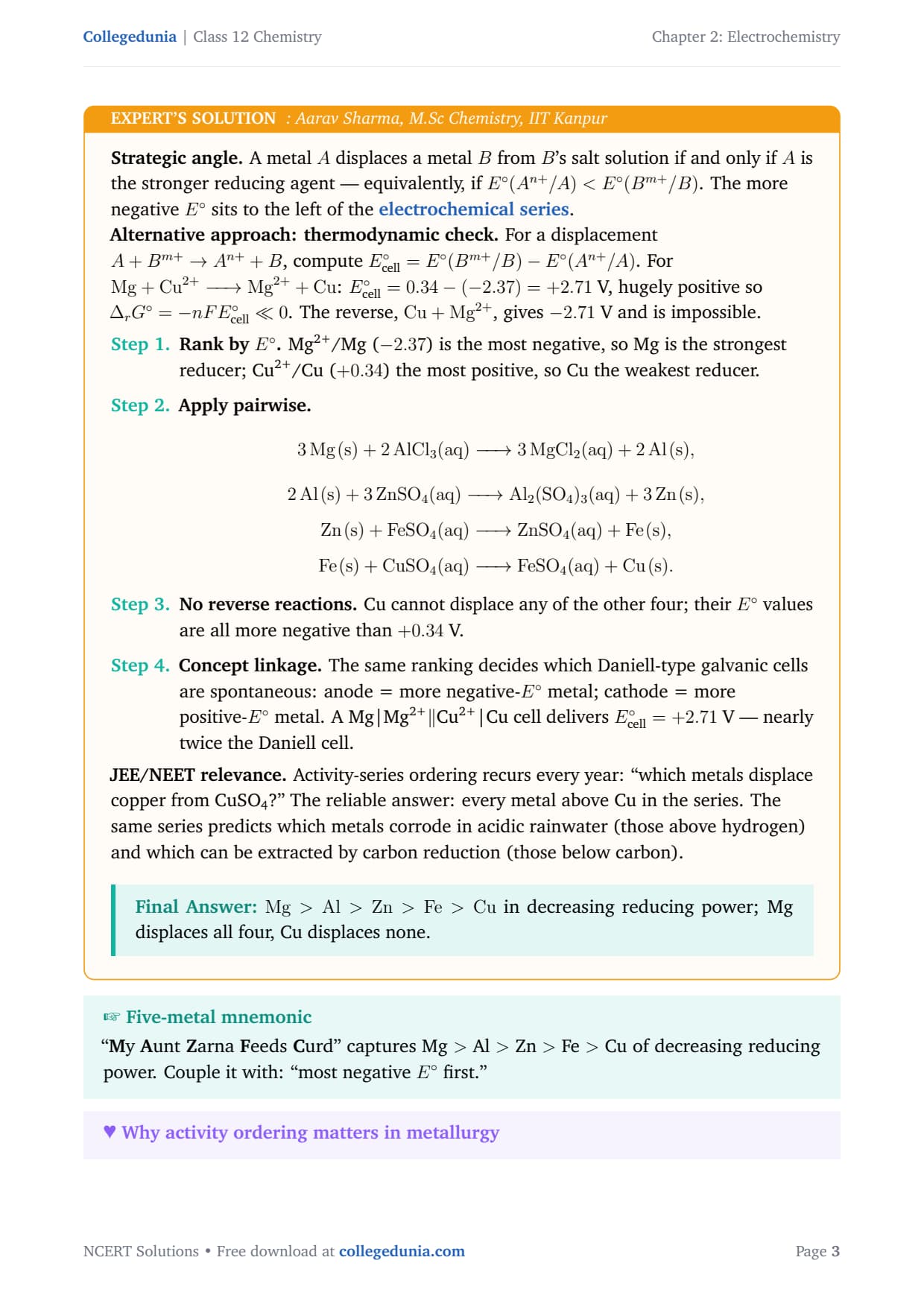
Strategic angle. A metal A displaces a metal B from B's salt solution if and only if A is the stronger reducing agent –- equivalently, if E∘(An+/A) < E∘(Bm+/B). The more negative E∘ sits to the left of the electrochemical series.
Alternative approach: thermodynamic check. For a displacement A + Bm+ → An+ + B, compute E∘cell = E∘(Bm+/B) - E∘(An+/A). For Mg + Cu2+ -> Mg2+ + Cu: E∘cell = 0.34 - (-2.37) = +2.71 V, hugely positive so r G∘ = -nFE∘cell ≪ 0. The reverse, Cu + Mg2+, gives -2.71 V and is impossible.
Rank by E∘. Mg^2+/Mg (-2.37) is the most negative, so Mg is the strongest reducer; Cu^2+/Cu (+0.34) the most positive, so Cu the weakest reducer.
No reverse reactions. Cu cannot displace any of the other four; their E∘ values are all more negative than +0.34 V.
Concept linkage. The same ranking decides which Daniell-type galvanic cells are spontaneous: anode = more negative-E∘ metal; cathode = more positive-E∘ metal. A Mg|Mg^2+|Cu^2+|Cu cell delivers E∘cell = +2.71 V –- nearly twice the Daniell cell.
JEE/NEET relevance. Activity-series ordering recurs every year: ``which metals displace copper from CuSO4?'' The reliable answer: every metal above Cu in the series. The same series predicts which metals corrode in acidic rainwater (those above hydrogen) and which can be extracted by carbon reduction (those below carbon).
Mg > Al > Zn > Fe > Cu in decreasing reducing power; Mg displaces all four, Cu displaces none.
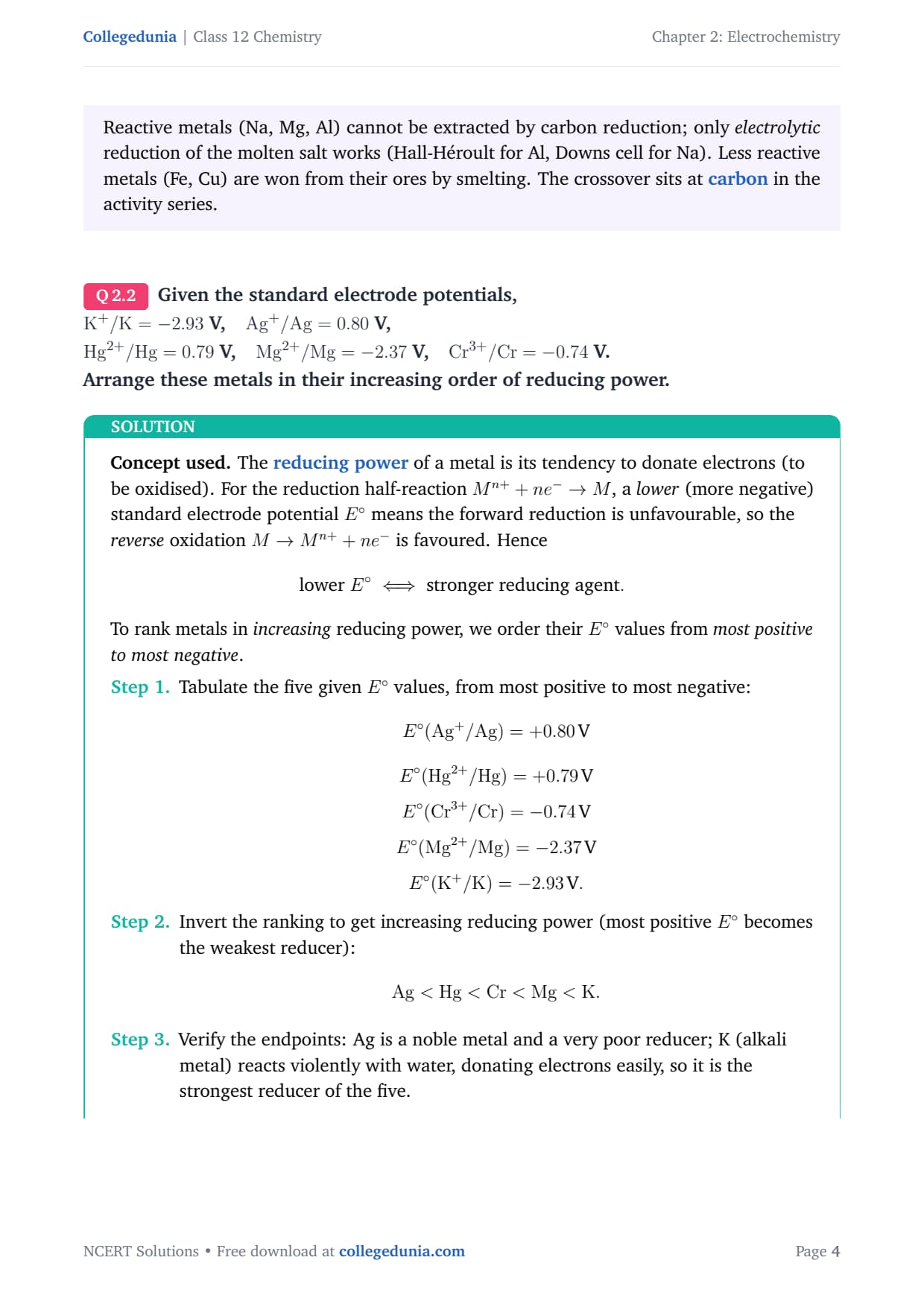
Q 2.2
Given the standard electrode potentials, K+/K = -2.93 V, Ag+/Ag = 0.80 V, Hg2+/Hg = 0.79 V, Mg2+/Mg = -2.37 V, Cr3+/Cr = -0.74 V.
Arrange these metals in their increasing order of reducing power.
Concept used. The reducing power of a metal is its tendency to donate electrons (to be oxidised). For the reduction half-reaction Mn+ + ne- → M, a lower (more negative) standard electrode potential E∘ means the forward reduction is unfavourable, so the reverse oxidation M → Mn+ + ne- is favoured. Hence lower E∘ stronger reducing agent. To rank metals in increasing reducing power, we order their E∘ values from most positive to most negative.
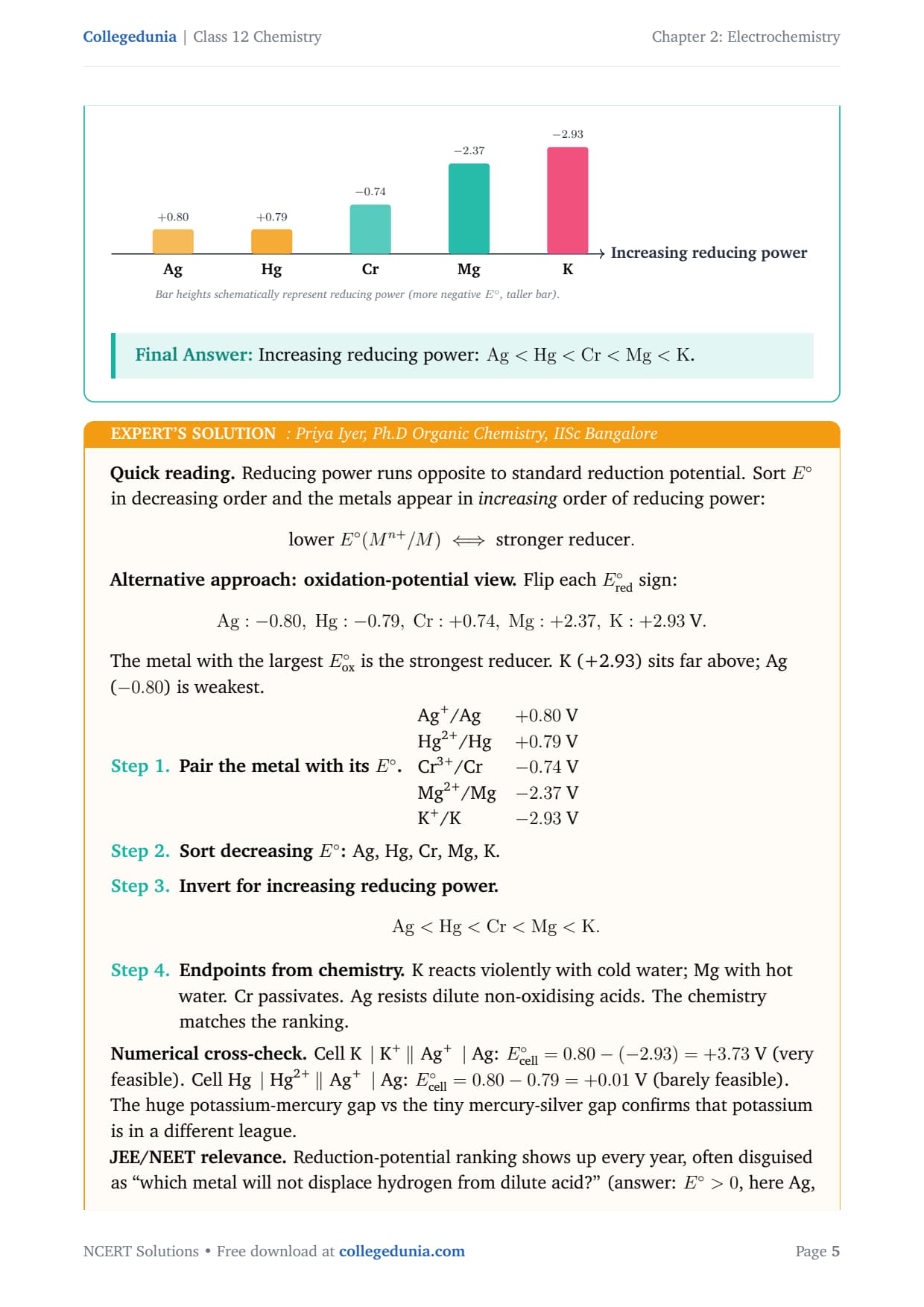
Tabulate the five given E∘ values, from most positive to most negative: E∘(Ag+/Ag) = +0.80 V E∘(Hg2+/Hg) = +0.79 V E∘(Cr3+/Cr) = -0.74 V E∘(Mg2+/Mg) = -2.37 V E∘(K+/K) = -2.93 V.
Invert the ranking to get increasing reducing power (most positive E∘ becomes the weakest reducer): Ag < Hg < Cr < Mg < K.
Verify the endpoints: Ag is a noble metal and a very poor reducer; K (alkali metal) reacts violently with water, donating electrons easily, so it is the strongest reducer of the five.
!%
[See diagram in the PDF version]
Increasing reducing power: Ag < Hg < Cr < Mg < K.
PI
Priya Iyer
Ph.D Organic Chemistry, IISc Bangalore
Verified Expert
Quick reading. Reducing power runs opposite to standard reduction potential. Sort E∘ in decreasing order and the metals appear in increasing order of reducing power: lower E∘(Mn+/M) stronger reducer.
Alternative approach: oxidation-potential view. Flip each E∘red sign: Ag: -0.80, Hg: -0.79, Cr: +0.74, Mg: +2.37, K: +2.93 V. The metal with the largest E∘ox is the strongest reducer. K (+2.93) sits far above; Ag (-0.80) is weakest.
Pair the metal with its E∘. tabularll Ag+/Ag & +0.80 V
Hg^2+/Hg & +0.79 V
Cr^3+/Cr & -0.74 V
Mg^2+/Mg & -2.37 V
K+/K & -2.93 V
tabular
Sort decreasing E∘: Ag, Hg, Cr, Mg, K.
Invert for increasing reducing power. Ag < Hg < Cr < Mg < K.
Endpoints from chemistry. K reacts violently with cold water; Mg with hot water. Cr passivates. Ag resists dilute non-oxidising acids. The chemistry matches the ranking.
Numerical cross-check. Cell K K+ | Ag+ Ag: E∘cell = 0.80 - (-2.93) = +3.73 V (very feasible). Cell Hg Hg^2+ | Ag+ Ag: E∘cell = 0.80 - 0.79 = +0.01 V (barely feasible). The huge potassium-mercury gap vs the tiny mercury-silver gap confirms that potassium is in a different league.
JEE/NEET relevance. Reduction-potential ranking shows up every year, often disguised as ``which metal will not displace hydrogen from dilute acid?'' (answer: E∘ > 0, here Ag, Hg) or ``arrange in increasing order of oxidation potential'' (reverse of reduction ranking).
Increasing reducing power: Ag < Hg < Cr < Mg < K.
Q 2.3
Depict the galvanic cell in which the reaction Zn(s) + 2 Ag+(aq) -> Zn2+(aq) + 2 Ag(s) takes place. Further show:
(i) Which of the electrode is negatively charged?
(ii) The carriers of the current in the cell.
(iii) Individual reaction at each electrode.
Concept used. A galvanic cell (also called a voltaic cell) converts the energy released by a spontaneous redox reaction into electrical energy. The reaction is split between two half-cells joined by a salt bridge:
the anode is the electrode where oxidation occurs; it acquires a negative charge because the metal loses electrons that accumulate on the electrode rod and flow out through the external circuit;
the cathode is the electrode where reduction occurs; it is the positive terminal because cations from solution remove electrons from it.
Inside the solution, current is carried by ions: cations move toward the cathode, anions move toward the anode. In the external wire, the current is carried by electrons from anode to cathode.
The IUPAC cell representation writes the anode on the left and the cathode on the right, separated by a double vertical bar | that denotes the salt bridge: anode anodic solution | cathodic solution cathode.
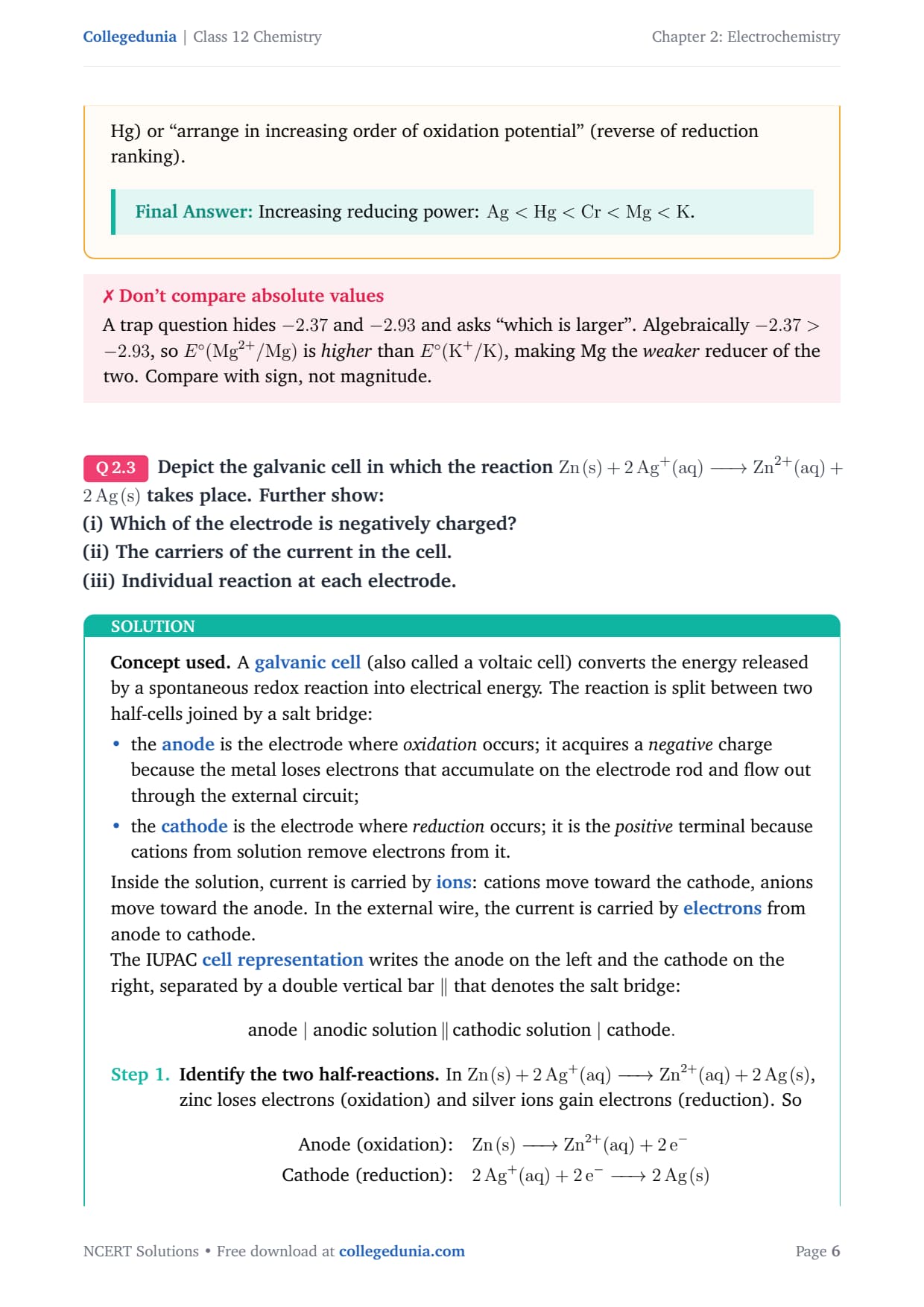
Identify the two half-reactions. In Zn(s) + 2 Ag+(aq) -> Zn2+(aq) + 2 Ag(s), zinc loses electrons (oxidation) and silver ions gain electrons (reduction). So aligned Anode (oxidation): &Zn(s) -> Zn2+(aq) + 2 e-
Cathode (reduction): &2 Ag+(aq) + 2 e- -> 2 Ag(s) aligned
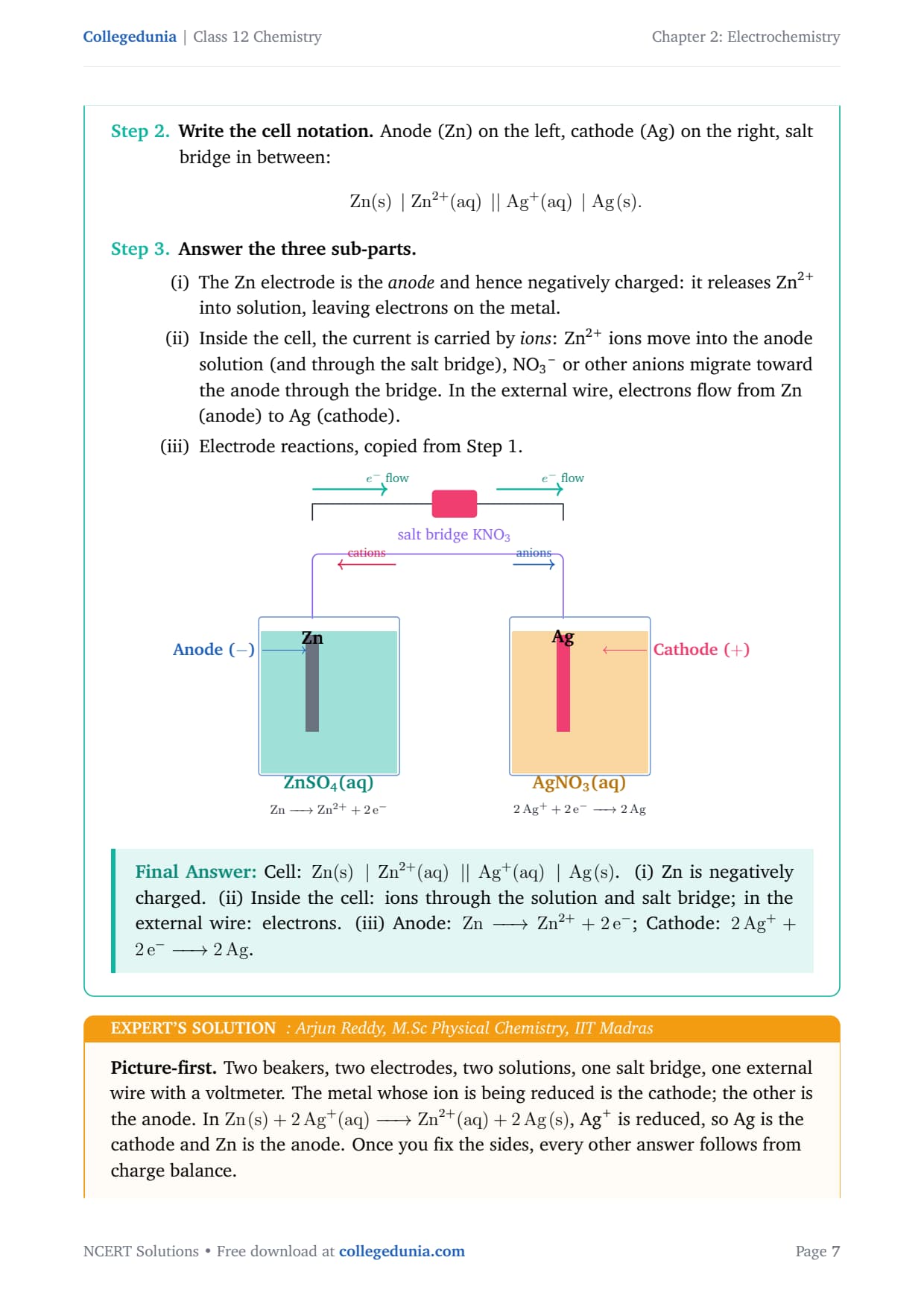
Write the cell notation. Anode (Zn) on the left, cathode (Ag) on the right, salt bridge in between: Zn(s) Zn2+(aq) Ag+(aq) Ag(s).
Answer the three sub-parts.
[(i)] The Zn electrode is the anode and hence negatively charged: it releases Zn^2+ into solution, leaving electrons on the metal. [(ii)] Inside the cell, the current is carried by ions: Zn^2+ ions move into the anode solution (and through the salt bridge), NO3^- or other anions migrate toward the anode through the bridge. In the external wire, electrons flow from Zn (anode) to Ag (cathode). [(iii)] Electrode reactions, copied from Step 1.
[See diagram in the PDF version]
Cell: Zn(s) Zn2+(aq) Ag+(aq) Ag(s). (i) Zn is negatively charged. (ii) Inside the cell: ions through the solution and salt bridge; in the external wire: electrons. (iii) Anode: Zn -> Zn2+ + 2e-; Cathode: 2 Ag+ + 2 e- -> 2 Ag.
AR
Arjun Reddy
M.Sc Physical Chemistry, IIT Madras
Verified Expert
Picture-first. Two beakers, two electrodes, two solutions, one salt bridge, one external wire with a voltmeter. The metal whose ion is being reduced is the cathode; the other is the anode. In Zn(s) + 2 Ag+(aq) -> Zn2+(aq) + 2 Ag(s), Ag+ is reduced, so Ag is the cathode and Zn is the anode. Once you fix the sides, every other answer follows from charge balance.
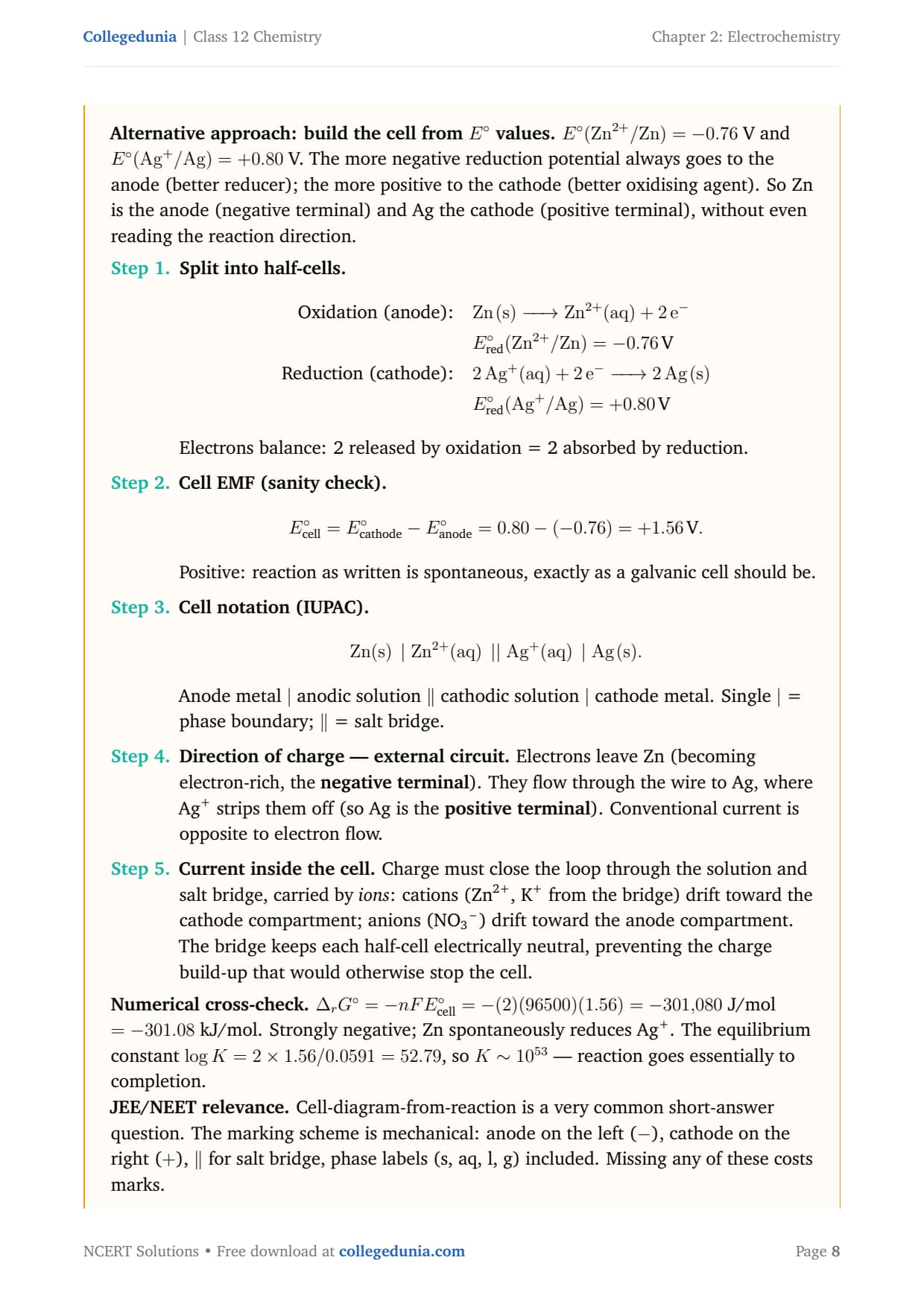
Alternative approach: build the cell from E∘ values.E∘(Zn2+/Zn) = -0.76 V and E∘(Ag+/Ag) = +0.80 V. The more negative reduction potential always goes to the anode (better reducer); the more positive to the cathode (better oxidising agent). So Zn is the anode (negative terminal) and Ag the cathode (positive terminal), without even reading the reaction direction.
Split into half-cells.aligned Oxidation (anode): &Zn(s) -> Zn2+(aq) + 2 e-
&E∘red(Zn2+/Zn) = -0.76 V
Reduction (cathode): &2 Ag+(aq) + 2 e- -> 2 Ag(s)
&E∘red(Ag+/Ag) = +0.80 V aligned Electrons balance: 2 released by oxidation = 2 absorbed by reduction.
Cell EMF (sanity check). E∘cell = E∘cathode - E∘anode = 0.80 - (-0.76) = +1.56 V. Positive: reaction as written is spontaneous, exactly as a galvanic cell should be.
Cell notation (IUPAC). Zn(s) Zn2+(aq) Ag+(aq) Ag(s). Anode metal anodic solution | cathodic solution cathode metal. Single = phase boundary; | = salt bridge.
Direction of charge –- external circuit. Electrons leave Zn (becoming electron-rich, the negative terminal). They flow through the wire to Ag, where Ag+ strips them off (so Ag is the positive terminal). Conventional current is opposite to electron flow.
Current inside the cell. Charge must close the loop through the solution and salt bridge, carried by ions: cations (Zn^2+, K+ from the bridge) drift toward the cathode compartment; anions (NO3^-) drift toward the anode compartment. The bridge keeps each half-cell electrically neutral, preventing the charge build-up that would otherwise stop the cell.
Numerical cross-check.r G∘ = -nFE∘cell = -(2)(96500)(1.56) = -301,080 J/mol = -301.08 kJ/mol. Strongly negative; Zn spontaneously reduces Ag+. The equilibrium constant log K = 2 × 1.56 / 0.0591 = 52.79, so K ∼ 1053 –- reaction goes essentially to completion.
JEE/NEET relevance. Cell-diagram-from-reaction is a very common short-answer question. The marking scheme is mechanical: anode on the left (-), cathode on the right (+), | for salt bridge, phase labels (s, aq, l, g) included. Missing any of these costs marks.
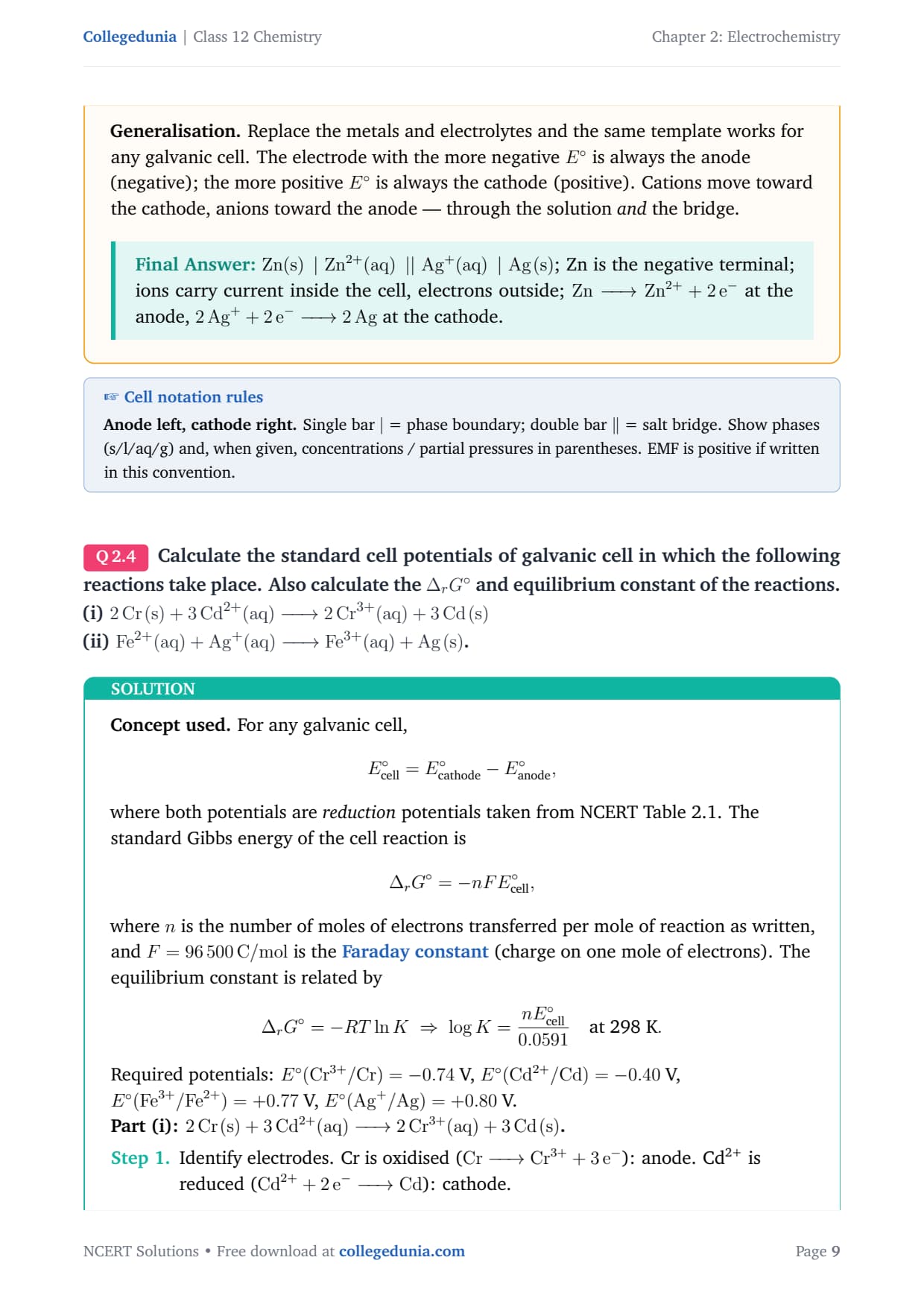
Generalisation. Replace the metals and electrolytes and the same template works for any galvanic cell. The electrode with the more negative E∘ is always the anode (negative); the more positive E∘ is always the cathode (positive). Cations move toward the cathode, anions toward the anode –- through the solution and the bridge.
Zn(s) Zn2+(aq) Ag+(aq) Ag(s); Zn is the negative terminal; ions carry current inside the cell, electrons outside; Zn -> Zn2+ + 2e- at the anode, 2 Ag+ + 2 e- -> 2 Ag at the cathode.
Q 2.4
Calculate the standard cell potentials of galvanic cell in which the following reactions take place. Also calculate the r G∘ and equilibrium constant of the reactions.
(i) 2 Cr(s) + 3 Cd2+(aq) -> 2 Cr3+(aq) + 3 Cd(s)
(ii) Fe2+(aq) + Ag+(aq) -> Fe3+(aq) + Ag(s).
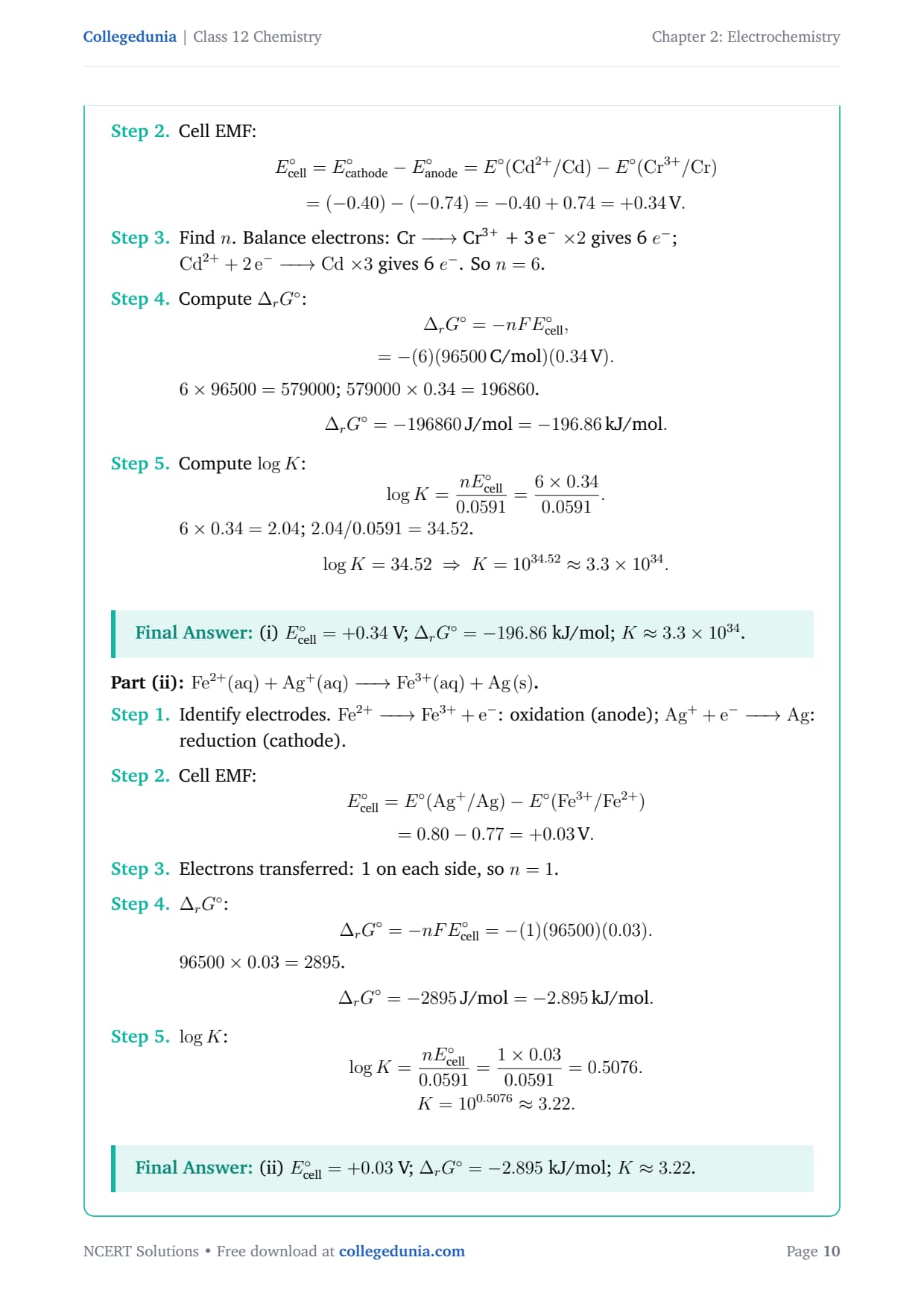
Concept used. For any galvanic cell, E∘cell = E∘cathode - E∘anode, where both potentials are reduction potentials taken from NCERT Table 2.1. The standard Gibbs energy of the cell reaction is r G∘ = -nF E∘cell, where n is the number of moles of electrons transferred per mole of reaction as written, and F = 96500C/mol is the Faraday constant (charge on one mole of electrons). The equilibrium constant is related by r G∘ = -RT ln K ⇒ log K = n E∘cell0.0591 at 298 K. Required potentials: E∘(Cr3+/Cr) = -0.74 V, E∘(Cd2+/Cd) = -0.40 V, E∘(Fe3+/Fe2+) = +0.77 V, E∘(Ag+/Ag) = +0.80 V.
r G∘: r G∘ = -nF E∘cell = -(1)(96500)(0.03). 96500 × 0.03 = 2895. r G∘ = -2895 J/mol = -2.895 kJ/mol.
log K: log K = n E∘cell0.0591 = 1 × 0.030.0591 = 0.5076. K = 100.5076 ≈ 3.22.
(ii) E∘cell = +0.03 V; r G∘ = -2.895 kJ/mol; K ≈ 3.22.
VP
Vivaan Patel
M.Tech Chemical Engineering, IIT Delhi
Verified Expert
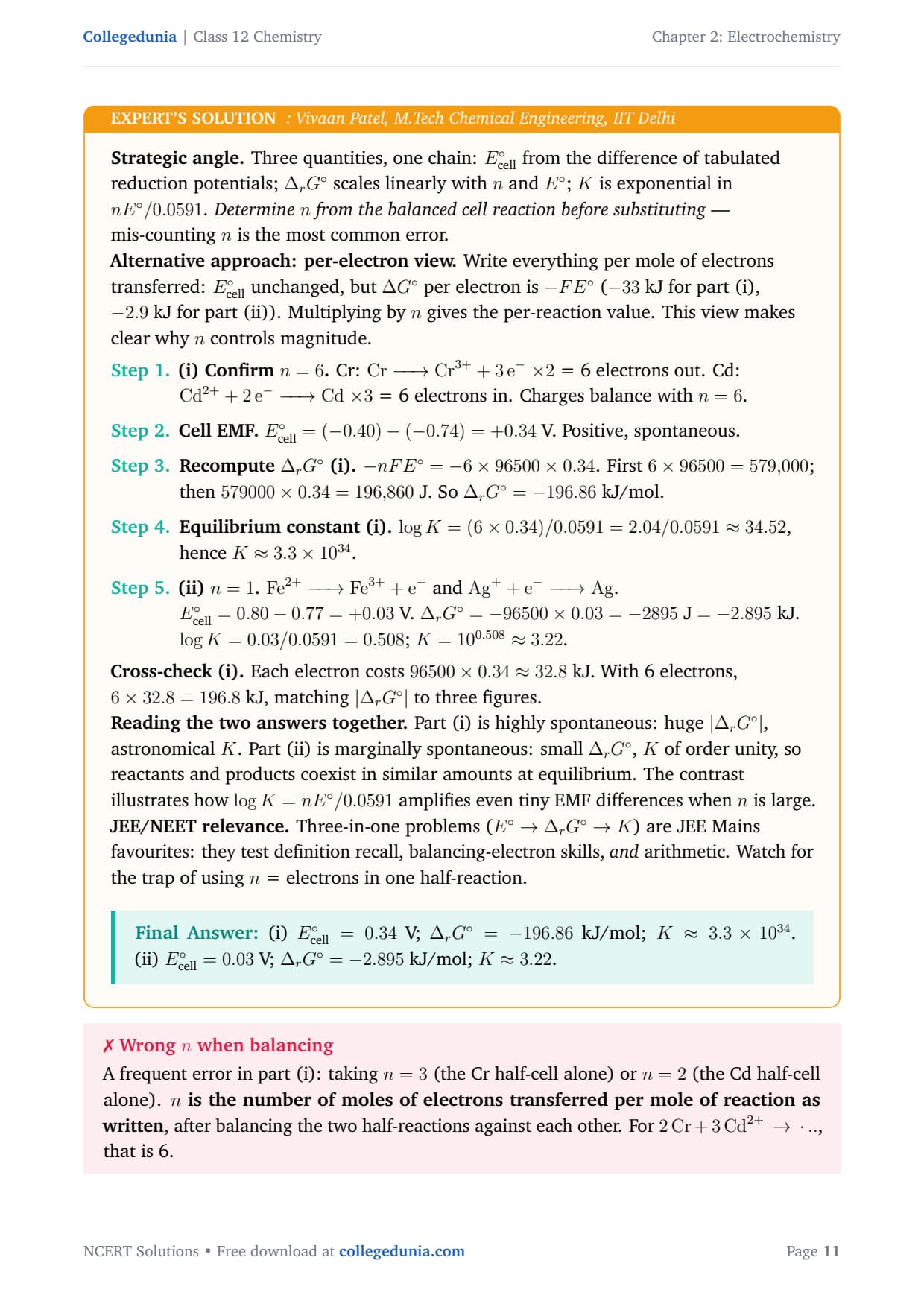
Strategic angle. Three quantities, one chain: E∘cell from the difference of tabulated reduction potentials; r G∘ scales linearly with n and E∘; K is exponential in nE∘/0.0591. Determine n from the balanced cell reaction before substituting –- mis-counting n is the most common error.
Alternative approach: per-electron view. Write everything per mole of electrons transferred: E∘cell unchanged, but Δ G∘ per electron is -FE∘ (-33 kJ for part (i), -2.9 kJ for part (ii)). Multiplying by n gives the per-reaction value. This view makes clear why n controls magnitude.
(i) Confirm n = 6. Cr: Cr -> Cr3+ + 3 e-× 2 = 6 electrons out. Cd: Cd2+ + 2 e- -> Cd× 3 = 6 electrons in. Charges balance with n = 6.
Recompute r G∘ (i).-nF E∘ = -6 × 96500 × 0.34. First 6 × 96500 = 579,000; then 579000 × 0.34 = 196,860 J. So r G∘ = -196.86 kJ/mol.
Equilibrium constant (i).log K = (6 × 0.34)/0.0591 = 2.04/0.0591 ≈ 34.52, hence K ≈ 3.3 × 1034.
(ii) n = 1.Fe2+ -> Fe3+ + e- and Ag+ + e- -> Ag. E∘cell = 0.80 - 0.77 = +0.03 V. r G∘ = -96500 × 0.03 = -2895 J = -2.895 kJ. log K = 0.03/0.0591 = 0.508; K = 100.508 ≈ 3.22.
Cross-check (i). Each electron costs 96500 × 0.34 ≈ 32.8 kJ. With 6 electrons, 6 × 32.8 = 196.8 kJ, matching |r G∘| to three figures.
Reading the two answers together. Part (i) is highly spontaneous: huge |r G∘|, astronomical K. Part (ii) is marginally spontaneous: small r G∘, K of order unity, so reactants and products coexist in similar amounts at equilibrium. The contrast illustrates how log K = nE∘/0.0591 amplifies even tiny EMF differences when n is large.
JEE/NEET relevance. Three-in-one problems (E∘ → r G∘ → K) are JEE Mains favourites: they test definition recall, balancing-electron skills, and arithmetic. Watch for the trap of using n = electrons in one half-reaction.
(i) E∘cell = 0.34 V; r G∘ = -196.86 kJ/mol; K ≈ 3.3 × 1034. (ii) E∘cell = 0.03 V; r G∘ = -2.895 kJ/mol; K ≈ 3.22.
Q 2.5
Write the Nernst equation and emf of the following cells at 298 K:
(i) Mg(s) Mg2+(0.001 M) Cu2+(0.0001 M) Cu(s)
(ii) Fe(s) Fe2+(0.001 M) H+(1 M) H2(g)(1 bar) Pt(s)
(iii) Sn(s) Sn2+(0.050 M) H+(0.020 M) H2(g)(1 bar) Pt(s)
(iv) Pt(s) Br-(0.010 M) Br2(l) H+(0.030 M) H2(g)(1 bar) Pt(s).
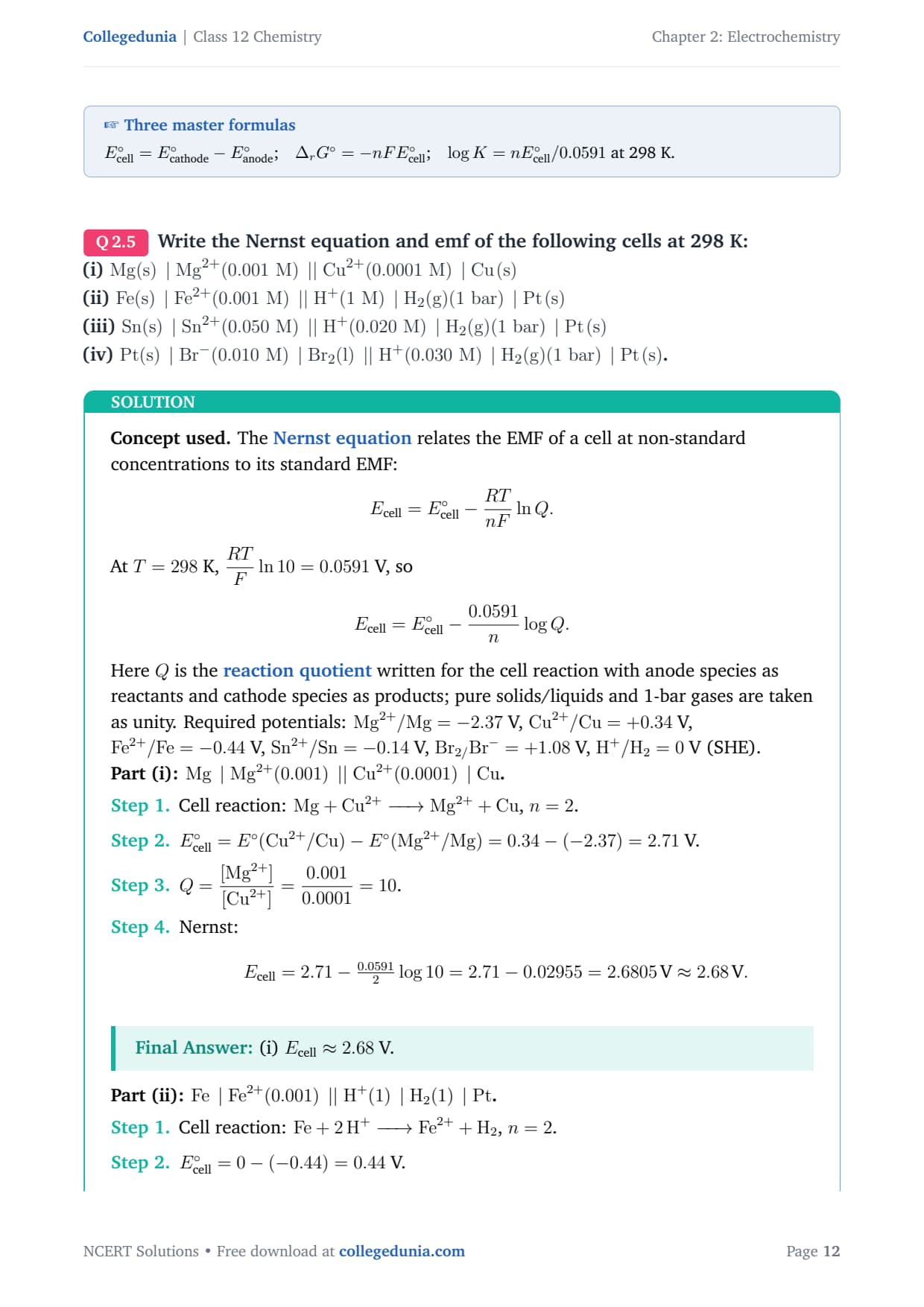
Concept used. The Nernst equation relates the EMF of a cell at non-standard concentrations to its standard EMF: Ecell = E∘cell - RTnFln Q. At T = 298 K, RTFln 10 = 0.0591 V, so Ecell = E∘cell - 0.0591nlog Q. Here Q is the reaction quotient written for the cell reaction with anode species as reactants and cathode species as products; pure solids/liquids and 1-bar gases are taken as unity. Required potentials: Mg2+/Mg = -2.37 V, Cu2+/Cu = +0.34 V, Fe2+/Fe = -0.44 V, Sn2+/Sn = -0.14 V, Br2/Br- = +1.08 V, H+/H2 = 0 V (SHE).
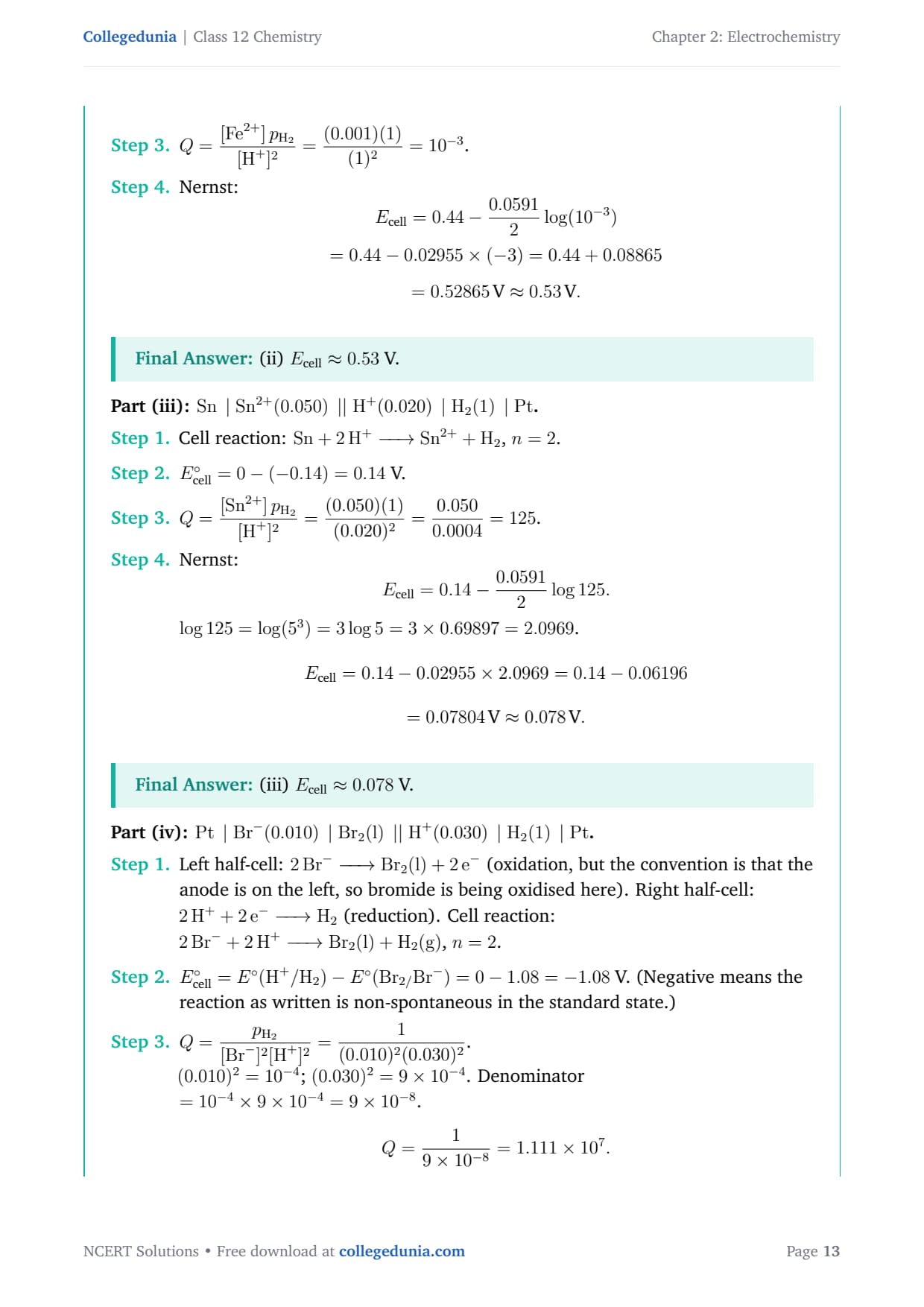
Part (iv): Pt Br-(0.010) Br2(l) H+(0.030) H2(1) Pt.
Left half-cell: 2 Br- -> Br2(l) + 2 e- (oxidation, but the convention is that the anode is on the left, so bromide is being oxidised here). Right half-cell: 2 H+ + 2 e- -> H2 (reduction). Cell reaction: 2 Br- + 2 H+ -> Br2(l) + H2(g), n = 2.
E∘cell = E∘(H+/H2) - E∘(Br2/Br-)= 0 - 1.08 = -1.08 V. (Negative means the reaction as written is non-spontaneous in the standard state.)
Strategic angle. The Nernst equation E = E∘ - (0.0591/n)log Q at 298 K has one tricky part: writing the correct Q. For each cell, identify anode (oxidation) on the left and cathode (reduction) on the right, then build Q as products over reactants of the net cell reaction. Pure solids/liquids and 1-bar gases give unity, not zero.
Alternative approach: half-cell Nernst. Apply Nernst to each half-reaction separately, then subtract to get Ecell. The algebra collapses to the same form, but the half-cell view helps when gas pressures or aqueous redox couples are involved.
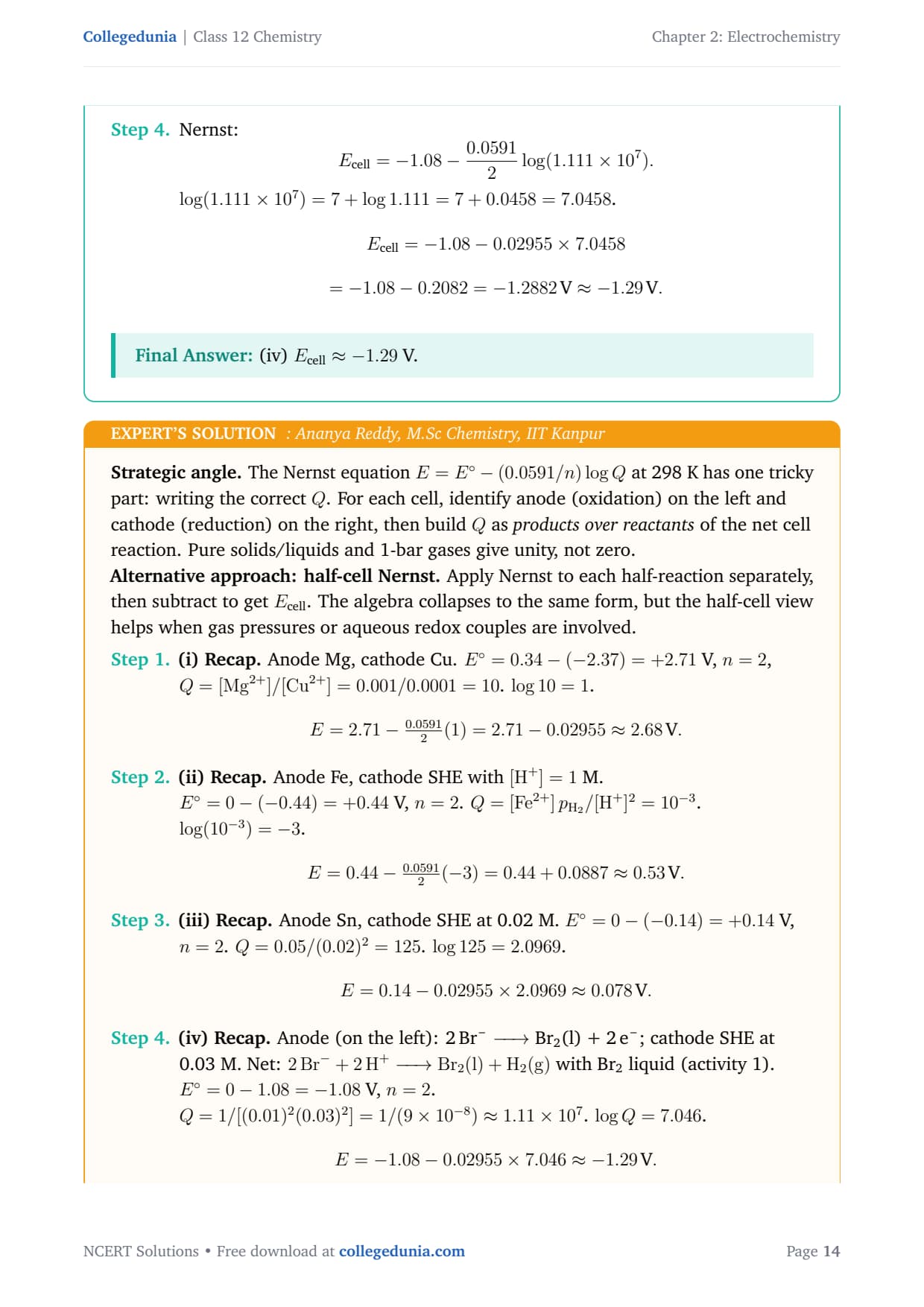
(ii) Recap. Anode Fe, cathode SHE with [H+] = 1 M. E∘ = 0 - (-0.44) = +0.44 V, n = 2. Q = [Fe2+] pH2/[H+]2 = 10-3. log(10-3) = -3. E = 0.44 - 0.05912(-3) = 0.44 + 0.0887 ≈ 0.53 V.
(iii) Recap. Anode Sn, cathode SHE at 0.02 M. E∘ = 0 - (-0.14) = +0.14 V, n = 2. Q = 0.05/(0.02)2 = 125. log 125 = 2.0969. E = 0.14 - 0.02955 × 2.0969 ≈ 0.078 V.
(iv) Recap. Anode (on the left): 2 Br^- -> Br2(l) + 2 e^-; cathode SHE at 0.03 M. Net: 2 Br- + 2 H+ -> Br2(l) + H2(g) with Br2 liquid (activity 1). E∘ = 0 - 1.08 = -1.08 V, n = 2. Q = 1/[(0.01)2(0.03)2] = 1/(9 × 10-8) ≈ 1.11 × 10⁷. log Q = 7.046. E = -1.08 - 0.02955 × 7.046 ≈ -1.29 V.
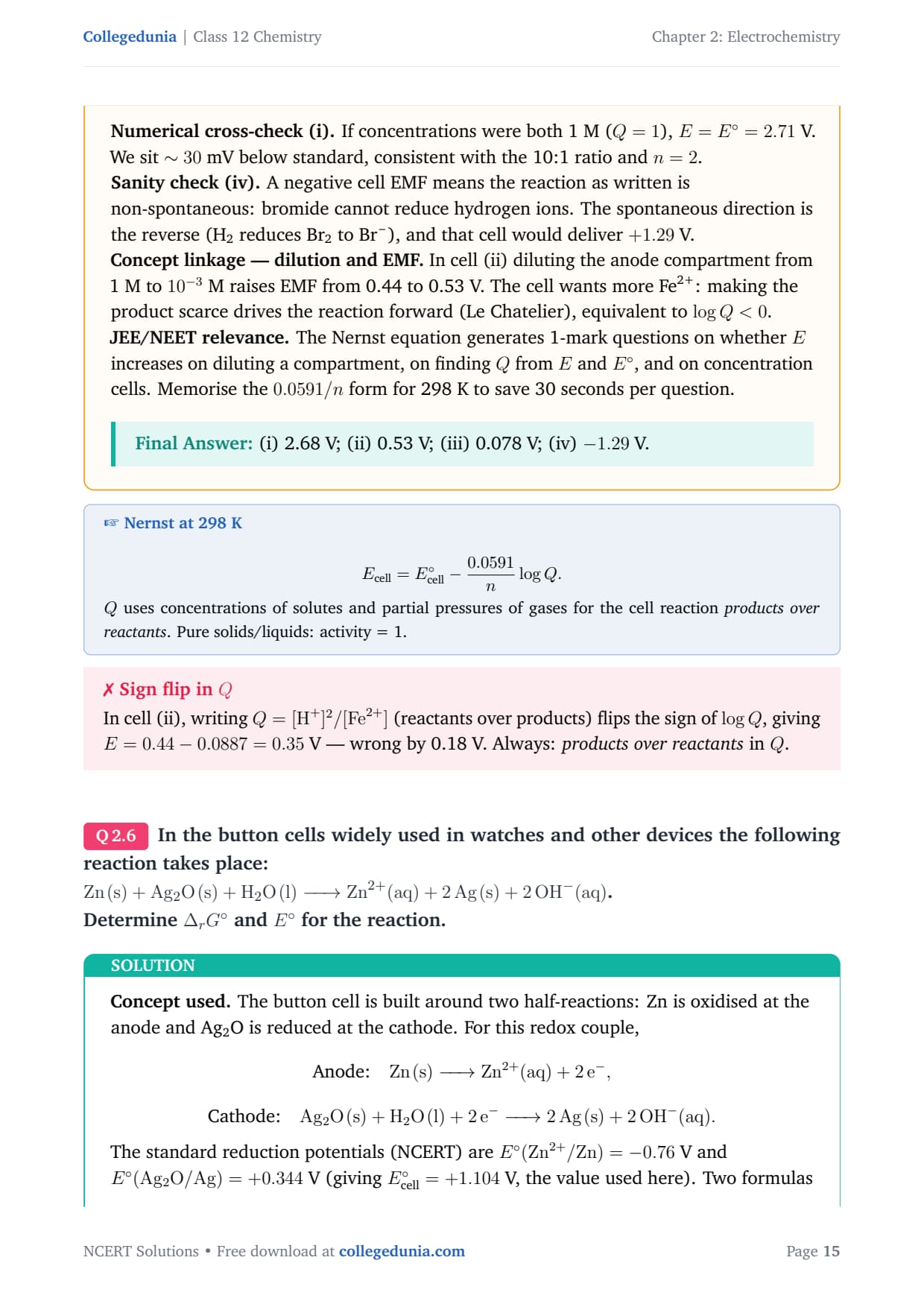
Numerical cross-check (i). If concentrations were both 1 M (Q = 1), E = E∘ = 2.71 V. We sit ∼ 30 mV below standard, consistent with the 10:1 ratio and n = 2.
Sanity check (iv). A negative cell EMF means the reaction as written is non-spontaneous: bromide cannot reduce hydrogen ions. The spontaneous direction is the reverse (H2 reduces Br2 to Br^-), and that cell would deliver +1.29 V.
Concept linkage –- dilution and EMF. In cell (ii) diluting the anode compartment from 1 M to 10-3 M raises EMF from 0.44 to 0.53 V. The cell wants more Fe^2+: making the product scarce drives the reaction forward (Le Chatelier), equivalent to log Q < 0.
JEE/NEET relevance. The Nernst equation generates 1-mark questions on whether E increases on diluting a compartment, on finding Q from E and E∘, and on concentration cells. Memorise the 0.0591/n form for 298 K to save 30 seconds per question.
(i) 2.68 V; (ii) 0.53 V; (iii) 0.078 V; (iv) -1.29 V.
Q 2.6
In the button cells widely used in watches and other devices the following reaction takes place: Zn(s) + Ag2O(s) + H2O(l) -> Zn2+(aq) + 2 Ag(s) + 2 OH-(aq).
Determine r G∘ and E∘ for the reaction.
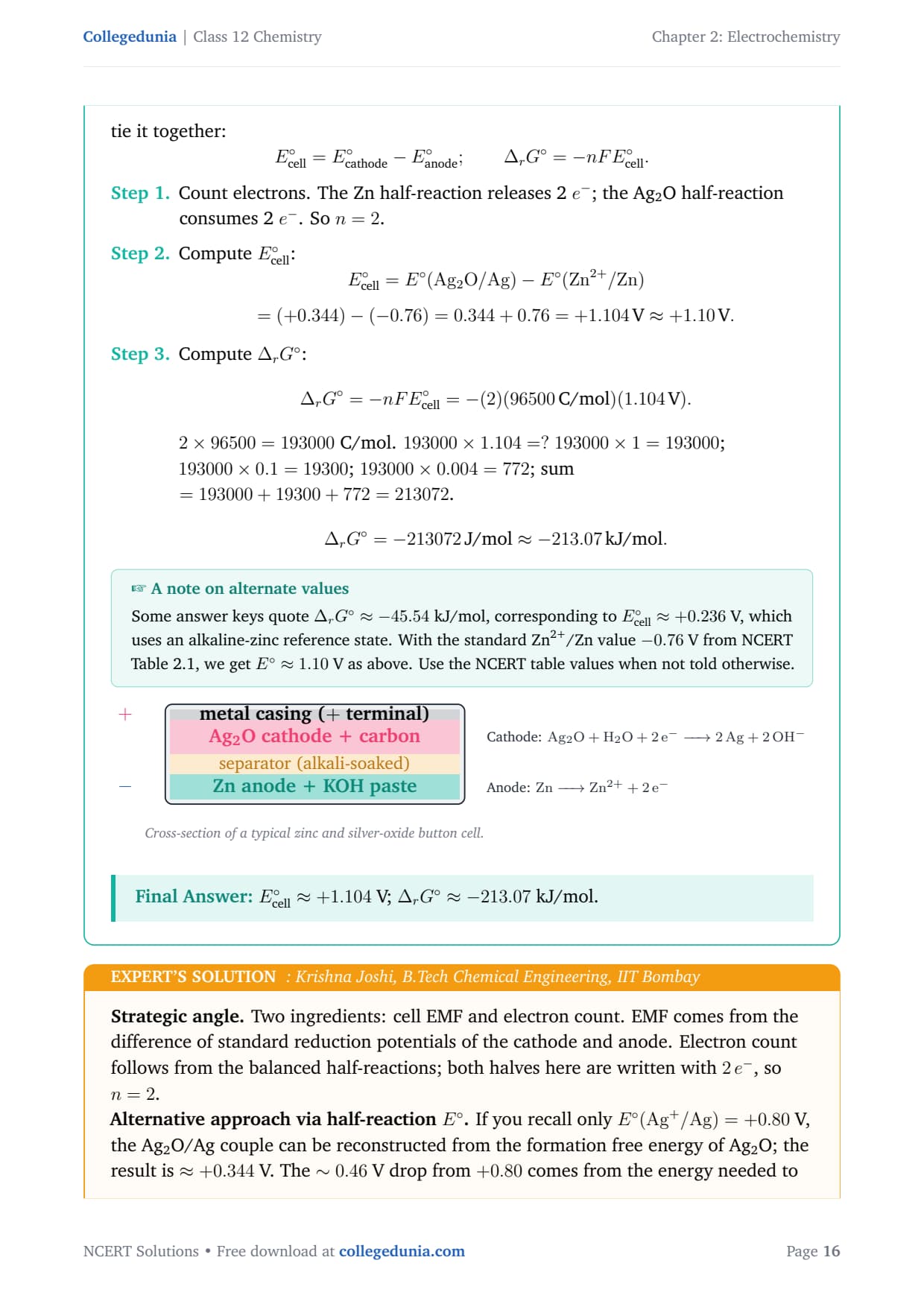
Concept used. The button cell is built around two half-reactions: Zn is oxidised at the anode and Ag2O is reduced at the cathode. For this redox couple, Anode: Zn(s) -> Zn2+(aq) + 2 e-, Cathode: Ag2O(s) + H2O(l) + 2 e- -> 2 Ag(s) + 2 OH-(aq). The standard reduction potentials (NCERT) are E∘(Zn2+/Zn) = -0.76 V and E∘(Ag2O/Ag) = +0.344 V (giving E∘cell = +1.104 V, the value used here). Two formulas tie it together: E∘cell = E∘cathode - E∘anode; r G∘ = -nF E∘cell.
Count electrons. The Zn half-reaction releases 2 e-; the Ag2O half-reaction consumes 2 e-. So n = 2.
Some answer keys quote r G∘ ≈ -45.54 kJ/mol, corresponding to E∘cell ≈ +0.236 V, which uses an alkaline-zinc reference state. With the standard Zn^2+/Zn value -0.76 V from NCERT Table 2.1, we get E∘ ≈ 1.10 V as above. Use the NCERT table values when not told otherwise.
!%
[See diagram in the PDF version]
E∘cell ≈ +1.104 V; r G∘ ≈ -213.07 kJ/mol.
KJ
Krishna Joshi
B.Tech Chemical Engineering, IIT Bombay
Verified Expert
Strategic angle. Two ingredients: cell EMF and electron count. EMF comes from the difference of standard reduction potentials of the cathode and anode. Electron count follows from the balanced half-reactions; both halves here are written with 2 e-, so n = 2.
Alternative approach via half-reaction E∘. If you recall only E∘(Ag+/Ag) = +0.80 V, the Ag2O/Ag couple can be reconstructed from the formation free energy of Ag2O; the result is ≈ +0.344 V. The ∼ 0.46 V drop from +0.80 comes from the energy needed to break the Ag-O-Ag bond and the strongly alkaline product.
Half-cells.aligned Cathode (reduction): &Ag2O(s) + H2O(l) + 2 e- -> 2 Ag(s) + 2 OH-(aq)
Anode (oxidation): &Zn(s) -> Zn2+(aq) + 2 e- aligned Adding (with Zn^2+ combining with 2 OH^- to give Zn(OH)2/ZnO) yields the net cell reaction in the question. n = 2.
Equilibrium constant (extra).log K = nE∘/0.0591 = (2 × 1.104)/0.0591 = 2.208/0.0591 ≈ 37.36, so K ≈ 2.3 × 1037 –- the reaction proceeds essentially to completion.
Engineering note –- why voltage is so stable. None of the species in the net reaction is aqueous in large amounts (Zn^2+ stays complexed/precipitated as ZnO/Zn(OH)2 in alkaline electrolyte), so Q stays near 1 and operating voltage drifts very little as the cell discharges. This is exactly why button cells run watches: a clock crystal needs a stable supply to keep time.
Numerical cross-check. Energy per gram of Zn consumed: |Δ G|/M(Zn) = 213,072/65.4 ≈ 3260 J/g. Times typical 0.1 g of Zn in a button cell: ∼ 326 J = 0.09 Wh –- in the right ballpark for a watch battery.
JEE/NEET relevance. Battery questions cluster around ``calculate E∘ and r G∘'' for button cell, lead-acid cell, NiCd cell. The recipe is the same: identify half-reactions, look up E∘, substitute into -nFE∘.
E∘cell ≈ +1.104 V; r G∘ ≈ -213.07 kJ/mol.
Q 2.7
Define conductivity and molar conductivity for the solution of an electrolyte. Discuss their variation with concentration.
Concept used. An electrolytic solution carries current by the movement of ions. Two related quantities describe how well it does this.
Conductivityκ (kappa) is the reciprocal of the resistivity ρ of the solution. If a solution placed between two parallel electrodes of area A separated by a distance l has resistance R, then R = ρ · l/A, hence κ = 1ρ = 1R · lA = G · lA, where G = 1/R is the conductance. Conductivity has SI units S/m (siemens per metre); in chemistry, S/cm is also common. Physically, κ is the conductance of a sample one centimetre long and one square centimetre in cross-section: a property of the solution.
Molar conductivitym is the conductivity of the solution divided by its molar concentration c: m = κc. With κ in S cm-1 and c in mol cm-3, m comes out in S cm2 mol-1. In practice c is given in mol/L = mol/dm3= 10-3 mol/cm3, so m = κ × 1000c (units: S.cm2/mol). Physically, m is the conductance of the volume of solution that contains one mole of electrolyte placed between electrodes that are 1 cm apart.
Variation with concentration.
Conductivity κ. On dilution, the number of ions per unit volume falls, so the current the solution can carry between fixed-area electrodes falls too. Hence κdecreases as concentration decreases. This is true for both strong and weak electrolytes.
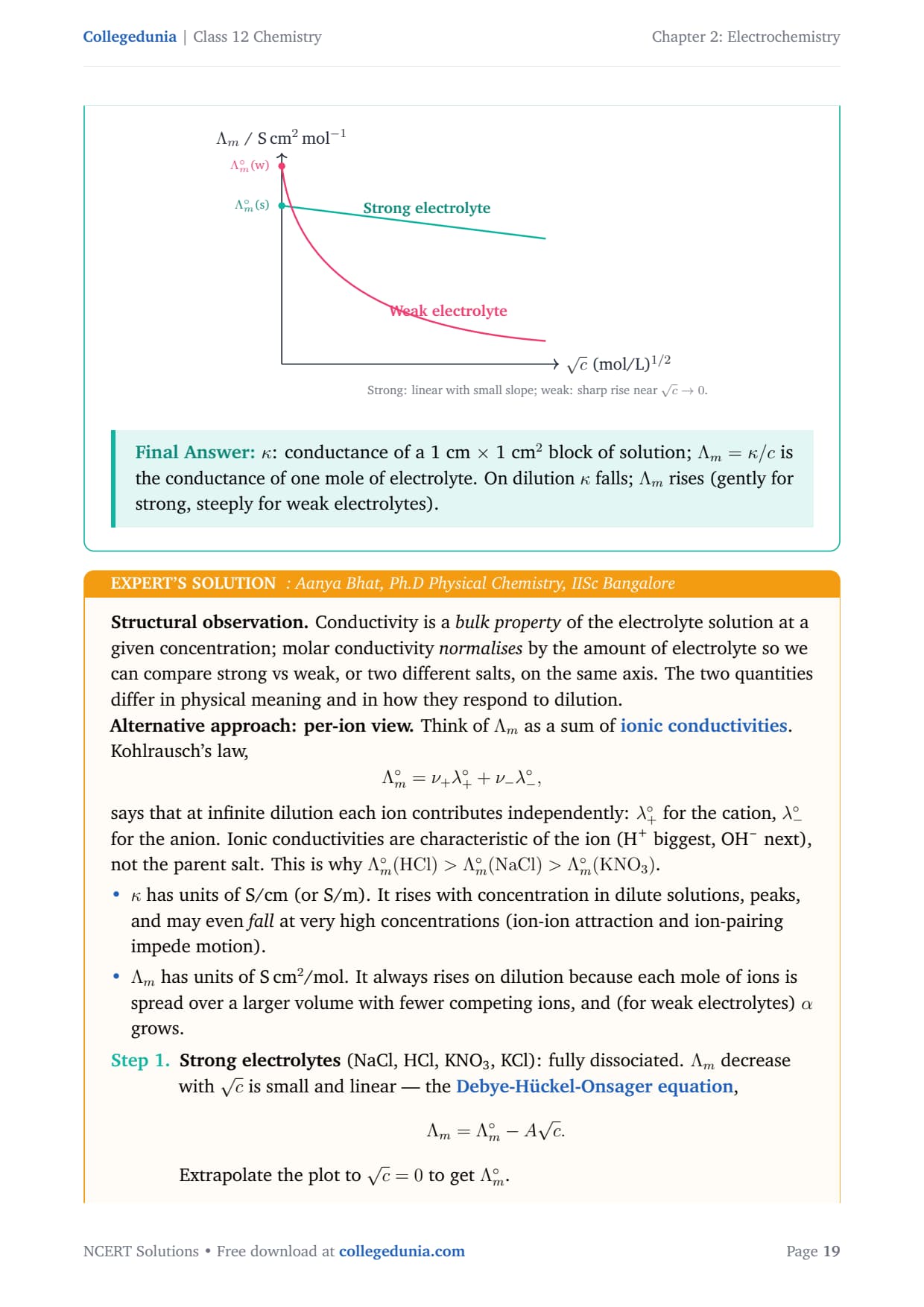
Molar conductivity m (strong electrolyte). On dilution, even though κ falls, the volume per mole of electrolyte grows faster, so m = κ/cincreases. For a strong electrolyte (KCl, HCl, NaOH), this rise is small and the plot of m vs √c is a straight line that extrapolates to a finite limit Λ∘m at infinite dilution. Debye-Huckel-Onsager: m = Λ∘m - A√c.
Molar conductivity m (weak electrolyte). For weak electrolytes (acetic acid, NH4OH), the increase on dilution is steep and nonlinear because the degree of dissociationα grows toward 1. The m vs √c plot is curved and rises sharply near c → 0. The limiting value Λ∘m cannot be obtained by direct extrapolation; it is computed using Kohlrausch's law from the limiting ionic conductivities of the ions.
[See diagram in the PDF version]
κ: conductance of a 1 cm × 1 cm2 block of solution; m = κ/c is the conductance of one mole of electrolyte. On dilution κ falls; m rises (gently for strong, steeply for weak electrolytes).
AB
Aanya Bhat
Ph.D Physical Chemistry, IISc Bangalore
Verified Expert
Structural observation. Conductivity is a bulk property of the electrolyte solution at a given concentration; molar conductivity normalises by the amount of electrolyte so we can compare strong vs weak, or two different salts, on the same axis. The two quantities differ in physical meaning and in how they respond to dilution.
Alternative approach: per-ion view. Think of m as a sum of ionic conductivities. Kohlrausch's law, Λ∘m = +λ∘+ + -λ∘-, says that at infinite dilution each ion contributes independently: λ∘+ for the cation, λ∘- for the anion. Ionic conductivities are characteristic of the ion (H+ biggest, OH^- next), not the parent salt. This is why Λ∘m(HCl) > Λ∘m(NaCl) > Λ∘m(KNO3).
κ has units of S/cm (or S/m). It rises with concentration in dilute solutions, peaks, and may even fall at very high concentrations (ion-ion attraction and ion-pairing impede motion).
m has units of S cm2/mol. It always rises on dilution because each mole of ions is spread over a larger volume with fewer competing ions, and (for weak electrolytes) α grows.
Strong electrolytes (NaCl, HCl, KNO3, KCl): fully dissociated. m decrease with √c is small and linear –- the Debye-H"uckel-Onsager equation, m = Λ∘m - A√c. Extrapolate the plot to √c = 0 to get Λ∘m.
Weak electrolytes (CH3COOH, NH4OH): partially dissociated; α ≪ 1 at finite c but α → 1 as c → 0. Curves sharply upward near √c = 0. Cannot extrapolate linearly –- use Kohlrausch's law.
Degree of dissociation.α = m/Λ∘m, from which Ka = cα2/(1-α) (Ostwald's dilution law).
Why κ falls but m rises. On dilution, ions per cm3 drop (so κ falls), but per mole of electrolyte the same number of ions spread over a larger volume with fewer competing neighbours, so the ratio κ/c grows.
Practical use.κ is the measured quantity (cell constant × conductance). The downstream chemistry (degree of dissociation, dissociation constant, ionic mobilities) flows from converting κ to m and applying the appropriate dilution law.
Numerical anchor. At 298 K, Λ∘m(KCl) = 149.86, Λ∘m(HCl) = 425.9, Λ∘m(CH3COOH) = 390.5 S cm2/mol; yet at 0.1 M, m(CH3COOH) falls below 10 because α is only ∼ 0.013. Strong vs weak is unmistakable from a single concentration measurement.
JEE/NEET relevance.m-vs-√c plots are a favourite NEET question: identify the strong vs the weak electrolyte from two curves. Strong = nearly horizontal straight line; weak = steep curve rising near origin.
κ = G · l/A in S/cm; m = κ × 1000/c in S cm2/mol. κ falls on dilution; m rises –- linearly for strong (Debye-H"uckel-Onsager), sharply for weak (Kohlrausch + Ostwald).
Q 2.8
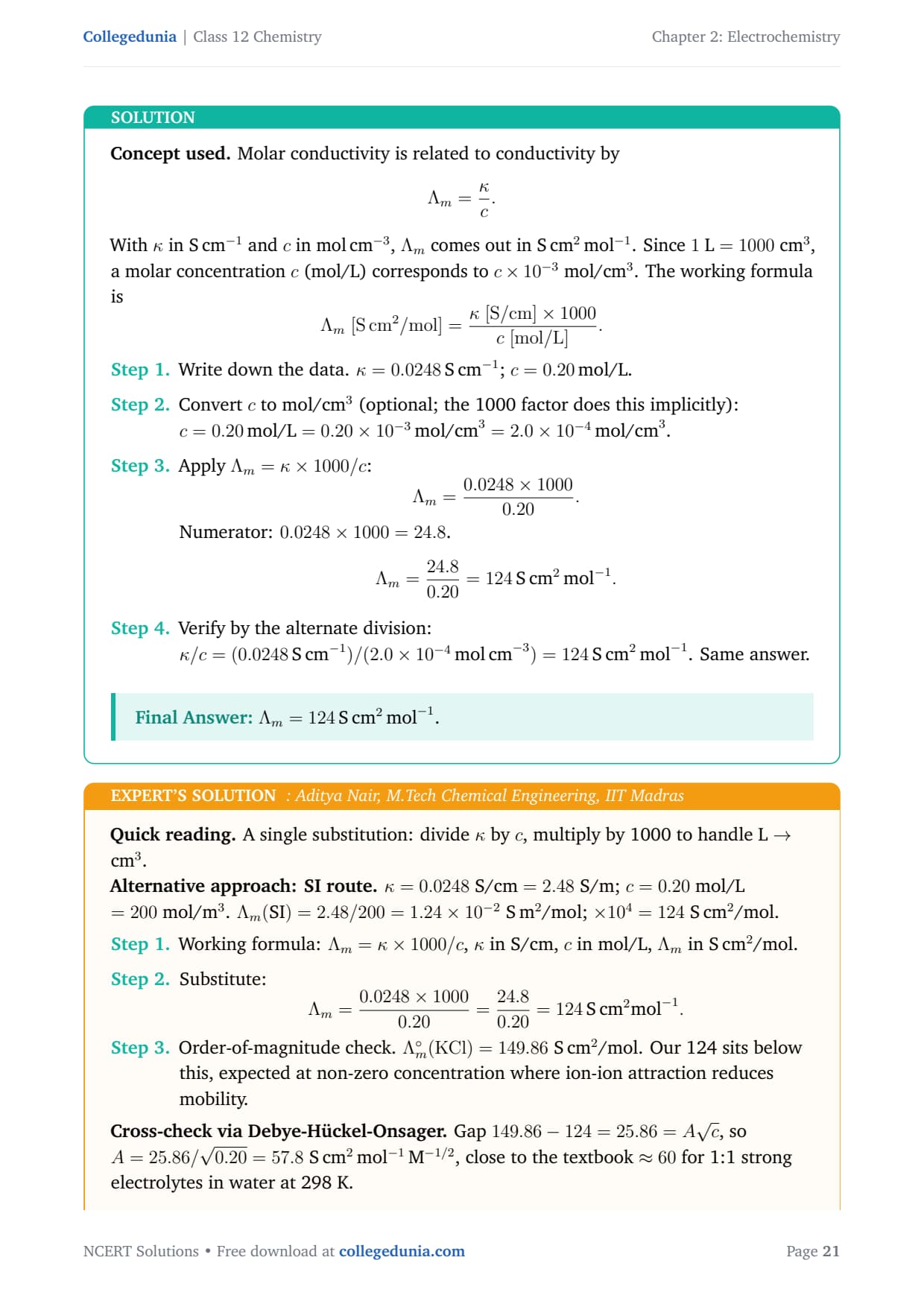
The conductivity of 0.20 M solution of KCl at 298 K is 0.0248S.cm-1. Calculate its molar conductivity.
Concept used. Molar conductivity is related to conductivity by m = κc. With κ in S cm-1 and c in mol cm-3, m comes out in S cm2 mol-1. Since 1 L =1000 cm3, a molar concentration c (mol/L) corresponds to c × 10-3 mol/cm3. The working formula is m [S.cm2/mol] = κ [S/cm] × 1000c [mol/L].
Write down the data. κ = 0.0248 S cm-1; c = 0.20 mol/L.
Convert c to mol/cm3 (optional; the 1000 factor does this implicitly): c = 0.20 mol/L = 0.20 × 10⁻³ mol/cm3 = 2.0 × 10⁻⁴ mol/cm3.
Apply m = κ × 1000/c: m = 0.0248 × 10000.20. Numerator: 0.0248 × 1000 = 24.8. m = 24.80.20 = 124 S cm2 mol-1.
Verify by the alternate division: κ/c = (0.0248 S cm-1)/(2.0 × 10-4 mol cm-3) = 124 S cm2 mol-1. Same answer.
m = 124 S cm2 mol-1.
AN
Aditya Nair
M.Tech Chemical Engineering, IIT Madras
Verified Expert
Quick reading. A single substitution: divide κ by c, multiply by 1000 to handle L → cm3.
Alternative approach: SI route.κ = 0.0248 S/cm = 2.48 S/m; c = 0.20 mol/L = 200 mol/m3. m(SI) = 2.48/200 = 1.24 × 10⁻² S m2/mol; × 104 = 124 S cm2/mol.
Working formula: m = κ × 1000/c, κ in S/cm, c in mol/L, m in S cm2/mol.
Substitute: m = 0.0248 × 10000.20 = 24.80.20 = 124 S cm2mol-1.
Order-of-magnitude check. Λ∘m(KCl) = 149.86 S cm2/mol. Our 124 sits below this, expected at non-zero concentration where ion-ion attraction reduces mobility.
Cross-check via Debye-H"uckel-Onsager. Gap 149.86 - 124 = 25.86=A√c, so A = 25.86/√0.20 = 57.8 S cm2 mol-1 M-1/2, close to the textbook ≈ 60 for 1:1 strong electrolytes in water at 298 K.
JEE/NEET relevance. The × 1000 unit trick is exactly the kind of detail JEE Mains tests. Forgetting it produces 0.124 instead of 124 –- a 1000× error.
m(KCl, 0.20 M) = 124 S cm2 mol-1.
Q 2.9
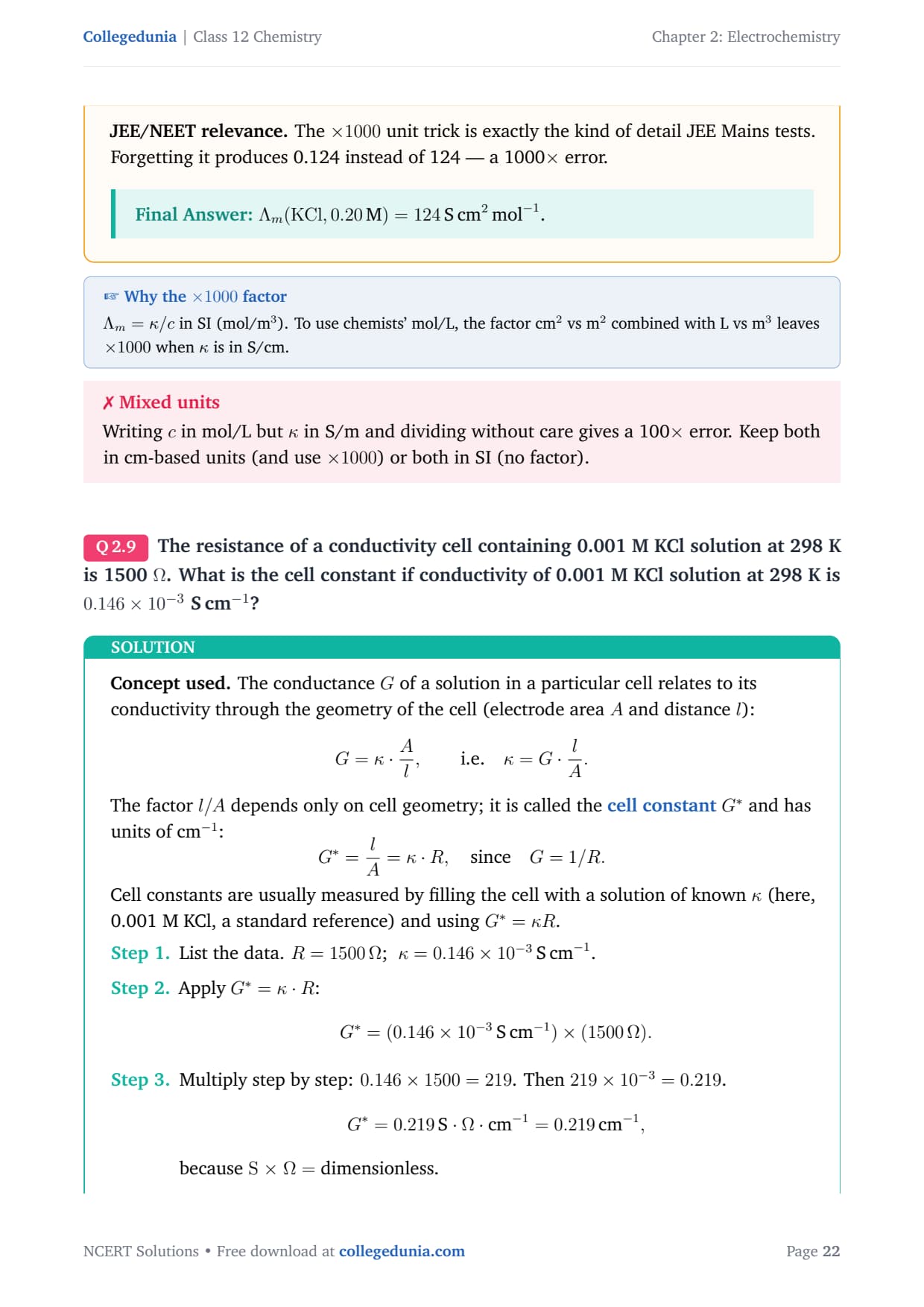
The resistance of a conductivity cell containing 0.001 M KCl solution at 298 K is 1500 Ω. What is the cell constant if conductivity of 0.001 M KCl solution at 298 K is 0.146 × 10⁻³ S cm-1?
Concept used. The conductance G of a solution in a particular cell relates to its conductivity through the geometry of the cell (electrode area A and distance l): G = κ · Al, i.e. κ = G · lA. The factor l/A depends only on cell geometry; it is called the cell constantG* and has units of cm-1: G* = lA = κ · R, since G = 1/R. Cell constants are usually measured by filling the cell with a solution of known κ (here, 0.001 M KCl, a standard reference) and using G* = κ R.
List the data. R = 1500 Ω; κ = 0.146 × 10⁻³S cm-1.
Multiply step by step: 0.146 × 1500 = 219. Then 219 × 10-3 = 0.219. G* = 0.219 SΩ · cm-1 = 0.219 cm-1, because S ×= dimensionless.
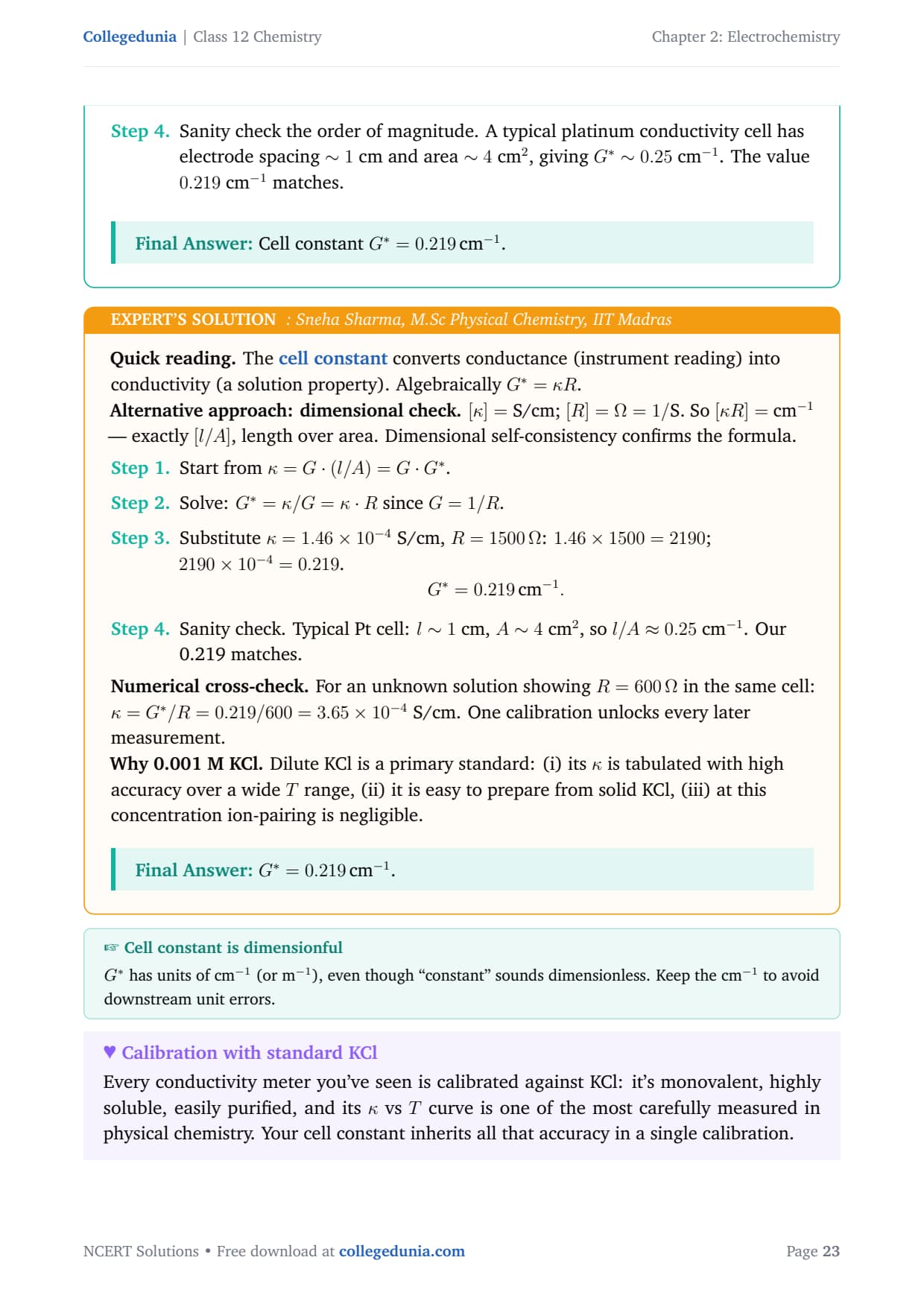
Sanity check the order of magnitude. A typical platinum conductivity cell has electrode spacing ∼ 1 cm and area ∼ 4 cm2, giving G* ∼ 0.25 cm-1. The value 0.219 cm-1 matches.
Cell constant G* = 0.219 cm-1.
SS
Sneha Sharma
M.Sc Physical Chemistry, IIT Madras
Verified Expert
Quick reading. The cell constant converts conductance (instrument reading) into conductivity (a solution property). Algebraically G* = κ R.
Alternative approach: dimensional check.[κ] = S/cm; [R] = Ω = 1/S. So [κ R] = cm-1 –- exactly [l/A], length over area. Dimensional self-consistency confirms the formula.
Sanity check. Typical Pt cell: l ∼ 1 cm, A ∼ 4 cm2, so l/A ≈ 0.25 cm-1. Our 0.219 matches.
Numerical cross-check. For an unknown solution showing R = 600 Ω in the same cell: κ = G*/R = 0.219/600 = 3.65 × 10⁻⁴ S/cm. One calibration unlocks every later measurement.
Why 0.001 M KCl. Dilute KCl is a primary standard: (i) its κ is tabulated with high accuracy over a wide T range, (ii) it is easy to prepare from solid KCl, (iii) at this concentration ion-pairing is negligible.
G* = 0.219 cm-1.
Q 2.10
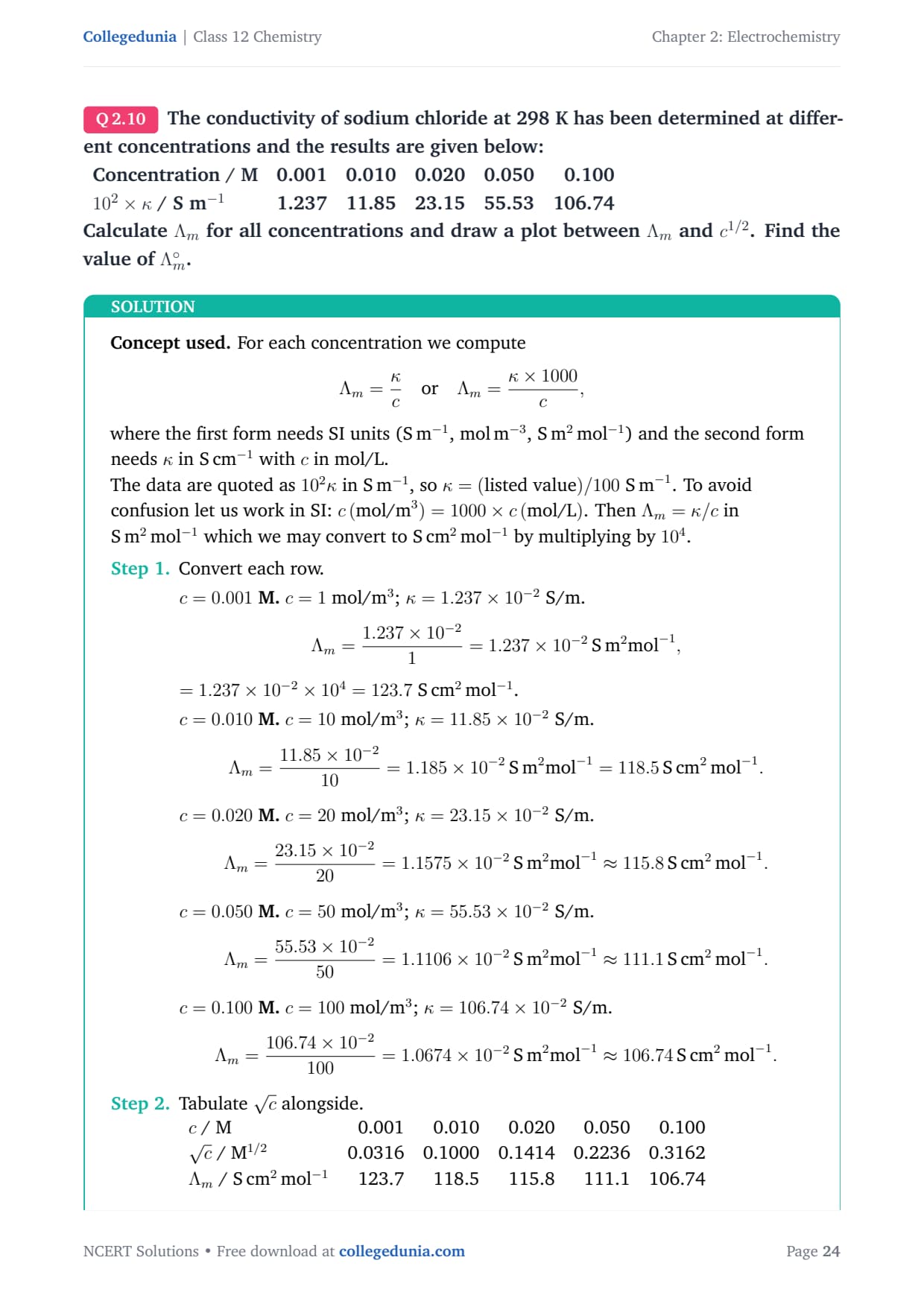
The conductivity of sodium chloride at 298 K has been determined at different concentrations and the results are given below:
[2pt] tabularlrrrrr Concentration / M & 0.001 & 0.010 & 0.020 & 0.050 & 0.100 102 × κ / S m-1 & 1.237 & 11.85 & 23.15 & 55.53 & 106.74
tabular
Calculate m for all concentrations and draw a plot between m and c1/2. Find the value of Λ∘m.
Concept used. For each concentration we compute m = κc or m = κ × 1000c, where the first form needs SI units (S m-1, mol m-3, S m2 mol-1) and the second form needs κ in S cm-1 with c in mol/L.
The data are quoted as 102 κ in S m-1, so κ = (listed value)/100 S m-1. To avoid confusion let us work in SI: c (mol/m3) = 1000 × c (mol/L). Then m = κ/c in S m2 mol-1 which we may convert to S cm2 mol-1 by multiplying by 104.
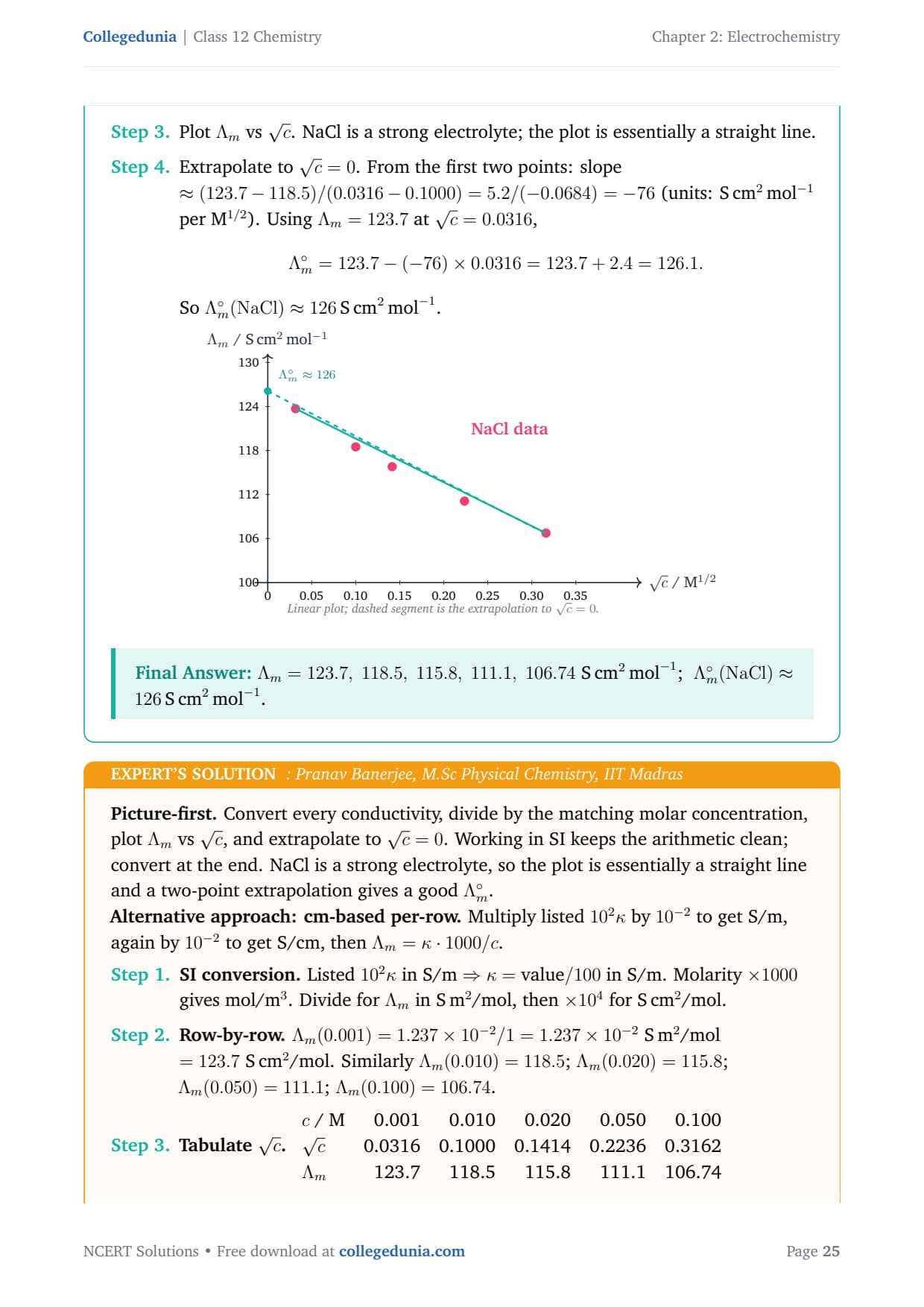
Plot m vs √c. NaCl is a strong electrolyte; the plot is essentially a straight line.
Extrapolate to √c = 0. From the first two points: slope ≈ (123.7 - 118.5)/(0.0316 - 0.1000)= 5.2/(-0.0684) = -76 (units: S cm2 mol-1 per M1/2). Using m = 123.7 at √c = 0.0316, Λ∘m = 123.7 - (-76)× 0.0316 = 123.7 + 2.4 = 126.1. So Λ∘m(NaCl) ≈ 126 S cm2 mol-1.
[See diagram in the PDF version]
m = 123.7, 118.5, 115.8, 111.1, 106.74 S cm2 mol-1; Λ∘m(NaCl) ≈ 126 S cm2 mol-1.
PB
Pranav Banerjee
M.Sc Physical Chemistry, IIT Madras
Verified Expert
Picture-first. Convert every conductivity, divide by the matching molar concentration, plot m vs √c, and extrapolate to √c = 0. Working in SI keeps the arithmetic clean; convert at the end. NaCl is a strong electrolyte, so the plot is essentially a straight line and a two-point extrapolation gives a good Λ∘m.
Alternative approach: cm-based per-row. Multiply listed 102κ by 10-2 to get S/m, again by 10-2 to get S/cm, then m = κ · 1000/c.
SI conversion. Listed 102 κ in S/m ⇒κ = value/100 in S/m. Molarity × 1000 gives mol/m3. Divide for m in S m2/mol, then × 104 for S cm2/mol.
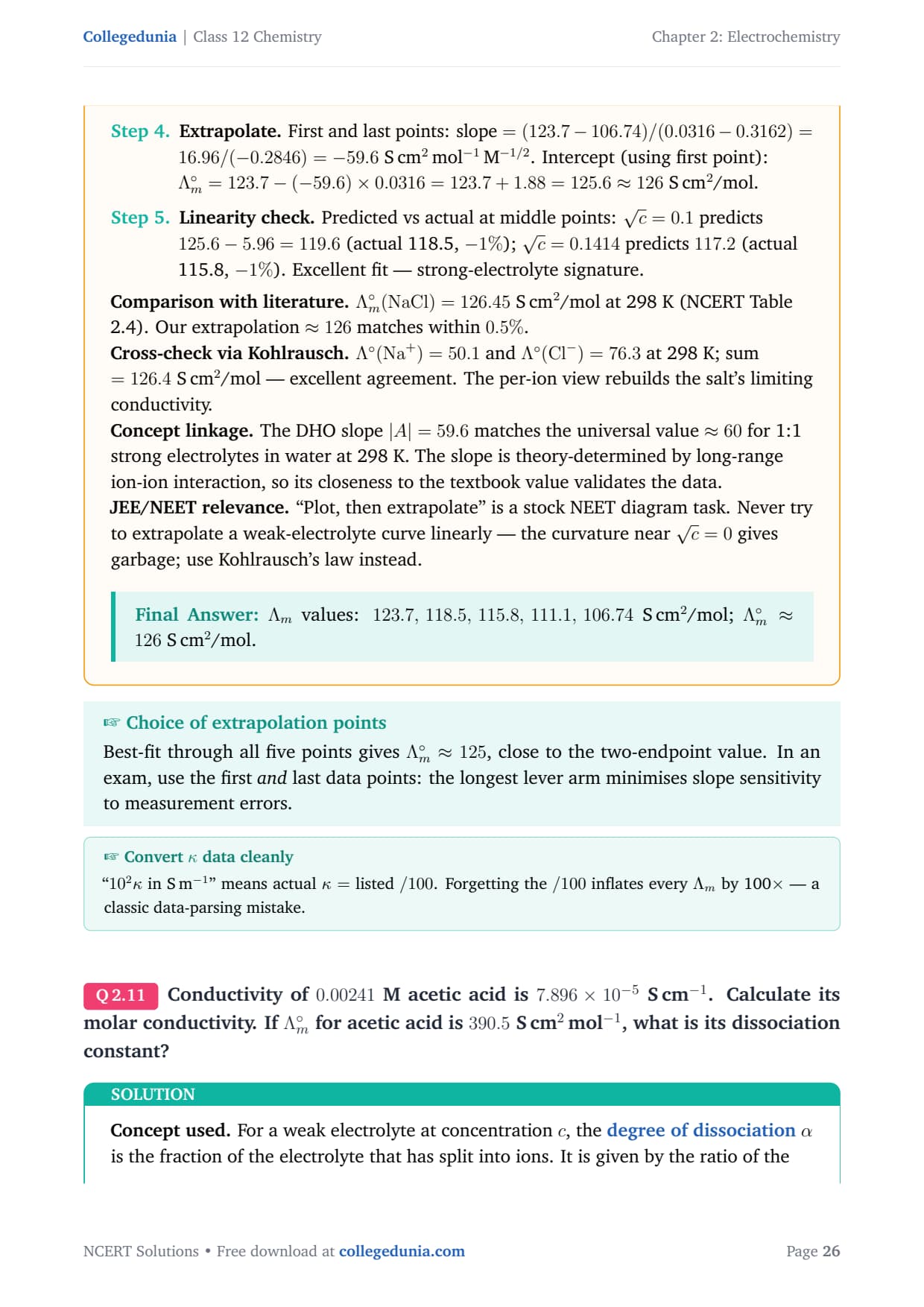
Extrapolate. First and last points: slope = (123.7 - 106.74)/(0.0316 - 0.3162) = 16.96/(-0.2846) = -59.6 S cm2 mol-1 M-1/2. Intercept (using first point): Λ∘m = 123.7 - (-59.6)× 0.0316 = 123.7 + 1.88 = 125.6 ≈ 126 S cm2/mol.
Linearity check. Predicted vs actual at middle points: √c = 0.1 predicts 125.6 - 5.96 = 119.6 (actual 118.5, -1%); √c = 0.1414 predicts 117.2 (actual 115.8, -1%). Excellent fit –- strong-electrolyte signature.
Comparison with literature.Λ∘m(NaCl) = 126.45 S cm2/mol at 298 K (NCERT Table 2.4). Our extrapolation ≈ 126 matches within 0.5%.
Cross-check via Kohlrausch.Λ∘(Na+) = 50.1 and Λ∘(Cl-) = 76.3 at 298 K; sum = 126.4 S cm2/mol –- excellent agreement. The per-ion view rebuilds the salt's limiting conductivity.
Concept linkage. The DHO slope |A| = 59.6 matches the universal value ≈ 60 for 1:1 strong electrolytes in water at 298 K. The slope is theory-determined by long-range ion-ion interaction, so its closeness to the textbook value validates the data.
JEE/NEET relevance. ``Plot, then extrapolate'' is a stock NEET diagram task. Never try to extrapolate a weak-electrolyte curve linearly –- the curvature near √c = 0 gives garbage; use Kohlrausch's law instead.
m values: 123.7, 118.5, 115.8, 111.1, 106.74 S cm2/mol; Λ∘m ≈ 126 S cm2/mol.
Q 2.11
Conductivity of 0.00241 M acetic acid is 7.896 × 10⁻⁵ S cm-1. Calculate its molar conductivity. If Λ∘m for acetic acid is 390.5 S cm2 mol-1, what is its dissociation constant?
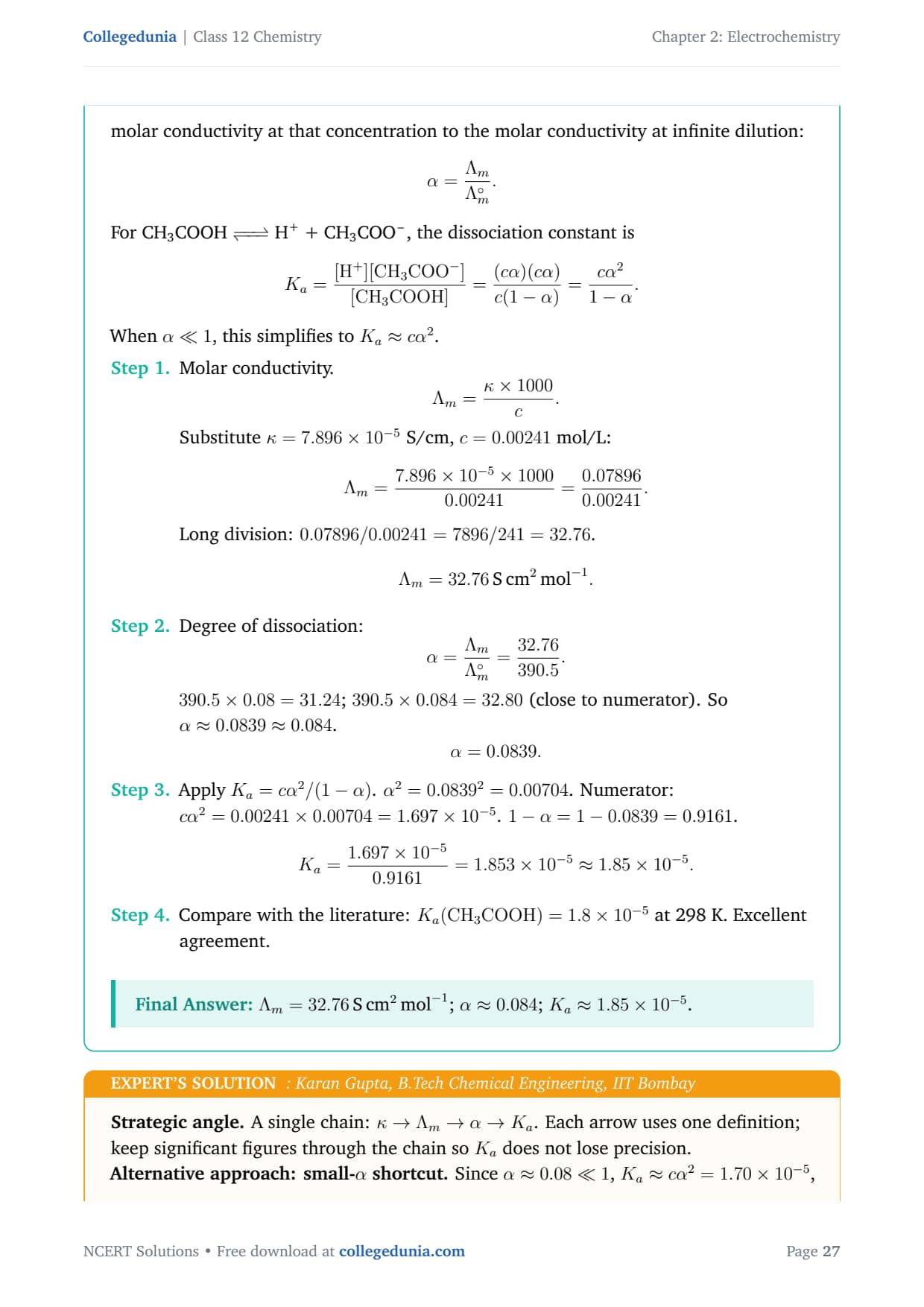
Concept used. For a weak electrolyte at concentration c, the degree of dissociationα is the fraction of the electrolyte that has split into ions. It is given by the ratio of the molar conductivity at that concentration to the molar conductivity at infinite dilution: α = mΛ∘m. For CH3COOH <=> H+ + CH3COO^-, the dissociation constant is Ka = [H+][CH3COO-][CH3COOH] = (cα)(cα)c(1 - α) = cα21 - α. When α ≪ 1, this simplifies to Ka ≈ cα2.
Molar conductivity. m = κ × 1000c. Substitute κ = 7.896 × 10⁻⁵ S/cm, c = 0.00241 mol/L: m = 7.896 × 10-5 × 10000.00241 = 0.078960.00241. Long division: 0.07896/0.00241 = 7896/241 = 32.76. m = 32.76 S cm2 mol-1.
Degree of dissociation: α = mΛ∘m = 32.76390.5. 390.5 × 0.08 = 31.24; 390.5 × 0.084 = 32.80 (close to numerator). So α ≈ 0.0839 ≈ 0.084. α = 0.0839.
Compare with the literature: Ka(CH3COOH) = 1.8 × 10⁻⁵ at 298 K. Excellent agreement.
m = 32.76 S cm2 mol-1; α ≈ 0.084; Ka ≈ 1.85 × 10⁻⁵.
KG
Karan Gupta
B.Tech Chemical Engineering, IIT Bombay
Verified Expert
Strategic angle. A single chain: κ → m → α → Ka. Each arrow uses one definition; keep significant figures through the chain so Ka does not lose precision.
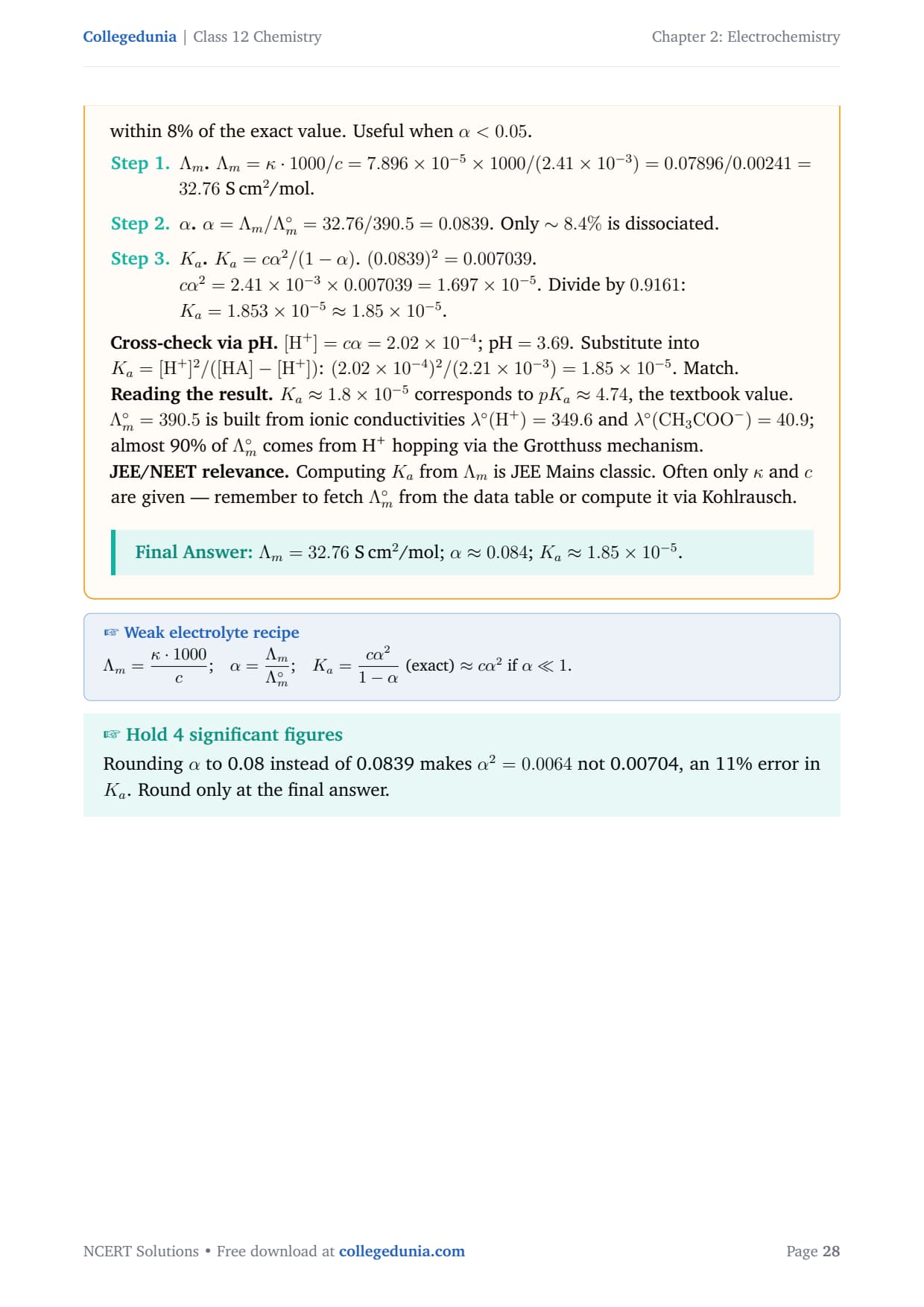
Alternative approach: small-α shortcut. Since α ≈ 0.08 ≪ 1, Ka ≈ cα2 = 1.70 × 10⁻⁵, within 8% of the exact value. Useful when α < 0.05.
Cross-check via pH.[H+] = cα = 2.02 × 10⁻⁴; pH = 3.69. Substitute into Ka = [H+]2/([HA] - [H+]): (2.02 × 10⁻⁴)2/(2.21 × 10-3) = 1.85 × 10⁻⁵. Match.
Reading the result.Ka ≈ 1.8 × 10⁻⁵ corresponds to pKa ≈ 4.74, the textbook value. Λ∘m = 390.5 is built from ionic conductivities λ∘(H+) = 349.6 and λ∘(CH3COO-) = 40.9; almost 90% of Λ∘m comes from H+ hopping via the Grotthuss mechanism.
JEE/NEET relevance. Computing Ka from m is JEE Mains classic. Often only κ and c are given –- remember to fetch Λ∘m from the data table or compute it via Kohlrausch.
m = 32.76 S cm2/mol; α ≈ 0.084; Ka ≈ 1.85 × 10⁻⁵.
Q 2.12
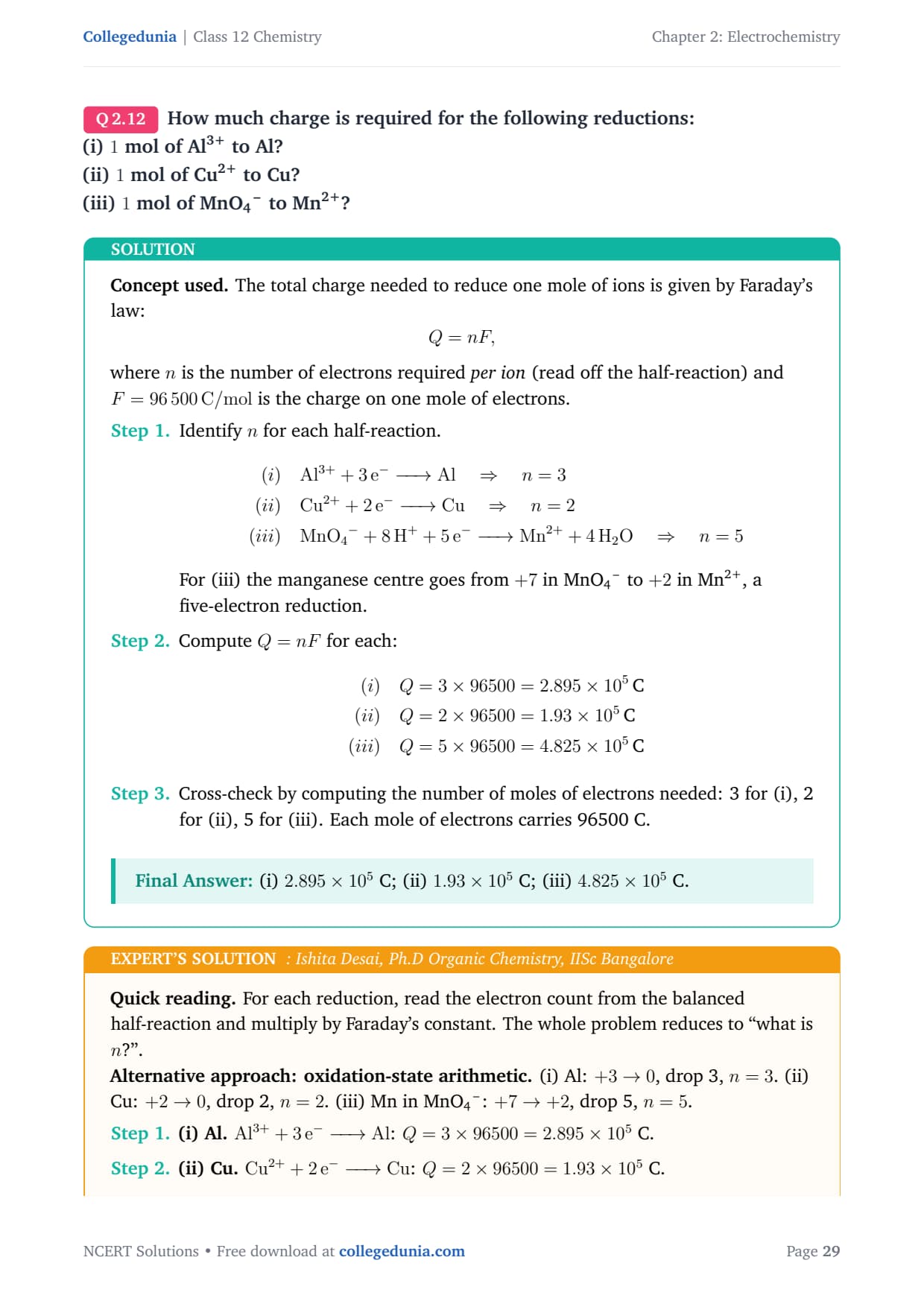
How much charge is required for the following reductions:
(i) 1 mol of Al^3+ to Al?
(ii) 1 mol of Cu^2+ to Cu?
(iii) 1 mol of MnO4^- to Mn^2+?
Concept used. The total charge needed to reduce one mole of ions is given by Faraday's law: Q = nF, where n is the number of electrons required per ion (read off the half-reaction) and F = 96500C/mol is the charge on one mole of electrons.
Identify n for each half-reaction. aligned (i)& Al3+ + 3 e- -> Al ⇒ n = 3
(ii)& Cu2+ + 2 e- -> Cu ⇒ n = 2
(iii)& MnO4- + 8 H+ + 5 e- -> Mn2+ + 4 H2O ⇒ n = 5 aligned For (iii) the manganese centre goes from +7 in MnO4^- to +2 in Mn^2+, a five-electron reduction.
Cross-check by computing the number of moles of electrons needed: 3 for (i), 2 for (ii), 5 for (iii). Each mole of electrons carries 96500 C.
(i) 2.895 × 10⁵ C; (ii) 1.93 × 10⁵ C; (iii) 4.825 × 10⁵ C.
ID
Ishita Desai
Ph.D Organic Chemistry, IISc Bangalore
Verified Expert
Quick reading. For each reduction, read the electron count from the balanced half-reaction and multiply by Faraday's constant. The whole problem reduces to ``what is n?''.
Alternative approach: oxidation-state arithmetic. (i) Al: +3 → 0, drop 3, n = 3. (ii) Cu: +2 → 0, drop 2, n = 2. (iii) Mn in MnO4^-: +7 → +2, drop 5, n = 5.
Reading the numbers. Each electron costs ∼ 9.65 × 10⁴ C per mole. The result scales linearly with n: Al needs 50% more charge than Cu for the same mole count; permanganate needs 2.5× as much as Cu.
Cross-check (iii).4.825 × 105 C = 134 Ah. A 1 A current must run for 134 hours to reduce one mole (∼ 100 g) of MnO4^- –- a real industrial number.
JEE/NEET relevance. ``Charge to deposit x moles of M'' is a classroom staple. The trap: mis-counting electrons for couples like Cr2O7^2-/Cr^3+ (6, not 3 or 7).
(i) 2.895 × 10⁵ C; (ii) 1.93 × 10⁵ C; (iii) 4.825 × 10⁵ C.
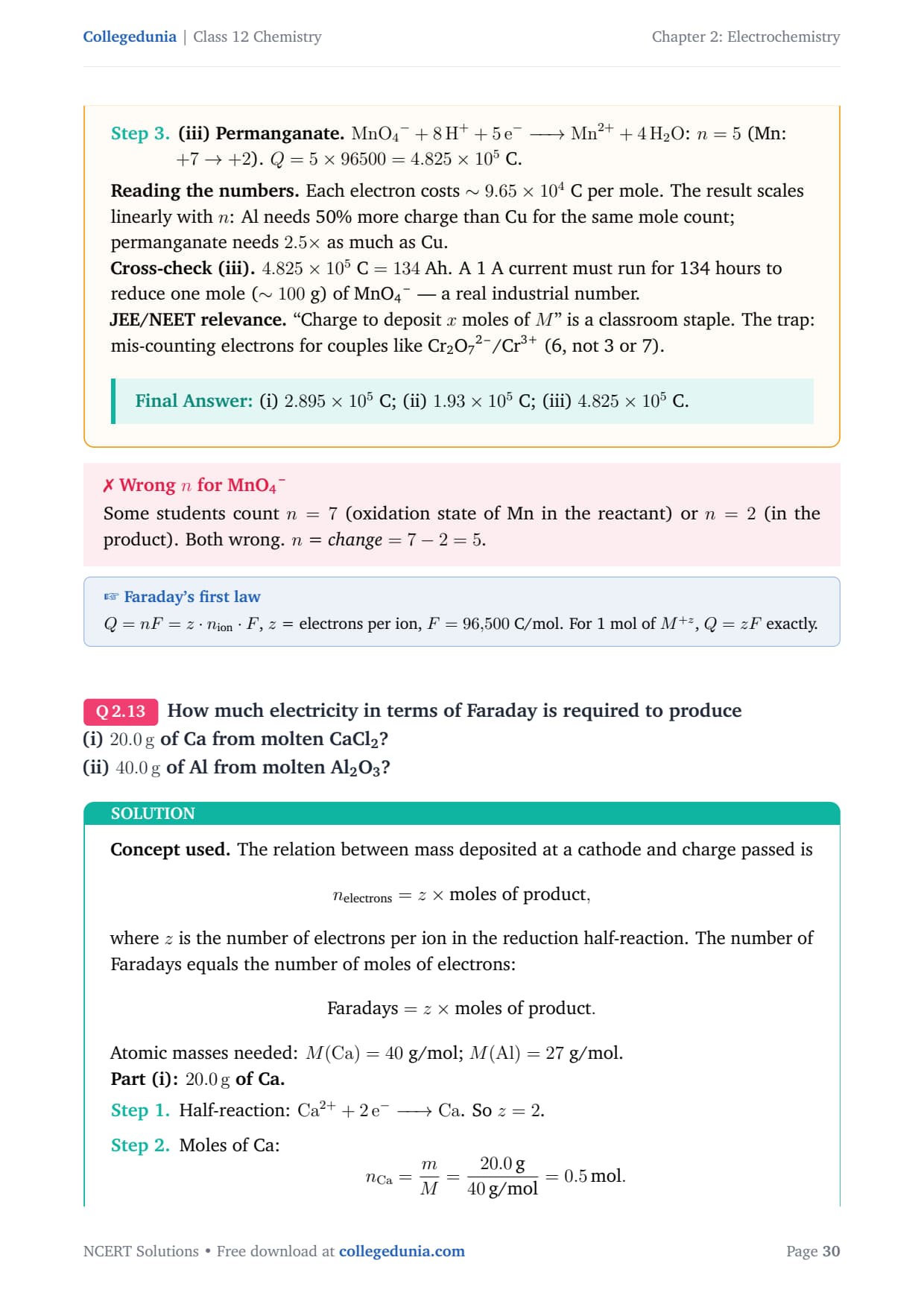
Q 2.13
How much electricity in terms of Faraday is required to produce
(i) 20.0g of Ca from molten CaCl2?
(ii) 40.0g of Al from molten Al2O3?
Concept used. The relation between mass deposited at a cathode and charge passed is nelectrons = z × moles of product, where z is the number of electrons per ion in the reduction half-reaction. The number of Faradays equals the number of moles of electrons: Faradays = z × moles of product. Atomic masses needed: M(Ca) = 40 g/mol; M(Al) = 27 g/mol.
Part (i): 20.0g of Ca.
Half-reaction: Ca2+ + 2 e- -> Ca. So z = 2.
Moles of Ca: nCa = mM = 20.0 g40 g/mol = 0.5 mol.
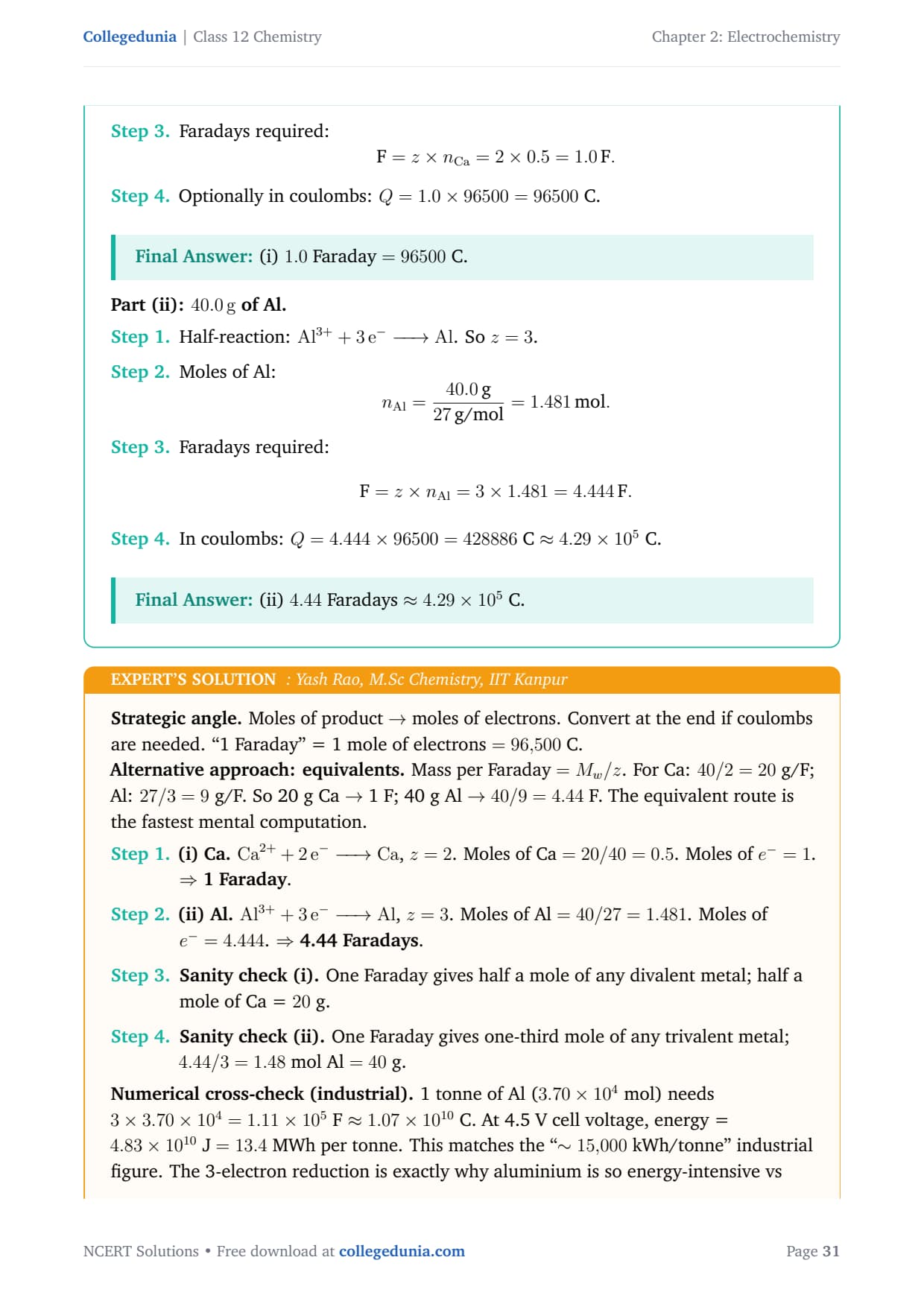
Faradays required: F = z × nCa = 2 × 0.5 = 1.0 F.
Optionally in coulombs: Q = 1.0 × 96500 = 96500 C.
(i) 1.0 Faraday = 96500 C.
Part (ii): 40.0g of Al.
Half-reaction: Al3+ + 3 e- -> Al. So z = 3.
Moles of Al: nAl = 40.0 g27 g/mol = 1.481 mol.
Faradays required: F = z × nAl = 3 × 1.481 = 4.444 F.
In coulombs: Q = 4.444 × 96500 = 428886 C ≈ 4.29 × 10⁵ C.
(ii) 4.44 Faradays ≈ 4.29 × 10⁵ C.
YR
Yash Rao
M.Sc Chemistry, IIT Kanpur
Verified Expert
Strategic angle. Moles of product → moles of electrons. Convert at the end if coulombs are needed. ``1 Faraday'' = 1 mole of electrons = 96,500 C.
Alternative approach: equivalents. Mass per Faraday = Mw/z. For Ca: 40/2 = 20 g/F; Al: 27/3 = 9 g/F. So 20 g Ca → 1 F; 40 g Al → 40/9 = 4.44 F. The equivalent route is the fastest mental computation.
(i) Ca.Ca2+ + 2 e- -> Ca, z = 2. Moles of Ca = 20/40 = 0.5. Moles of e- = 1. ⇒1 Faraday.
(ii) Al.Al3+ + 3 e- -> Al, z = 3. Moles of Al = 40/27 = 1.481. Moles of e- = 4.444. ⇒4.44 Faradays.
Sanity check (i). One Faraday gives half a mole of any divalent metal; half a mole of Ca = 20 g.
Sanity check (ii). One Faraday gives one-third mole of any trivalent metal; 4.44/3 = 1.48 mol Al = 40 g.
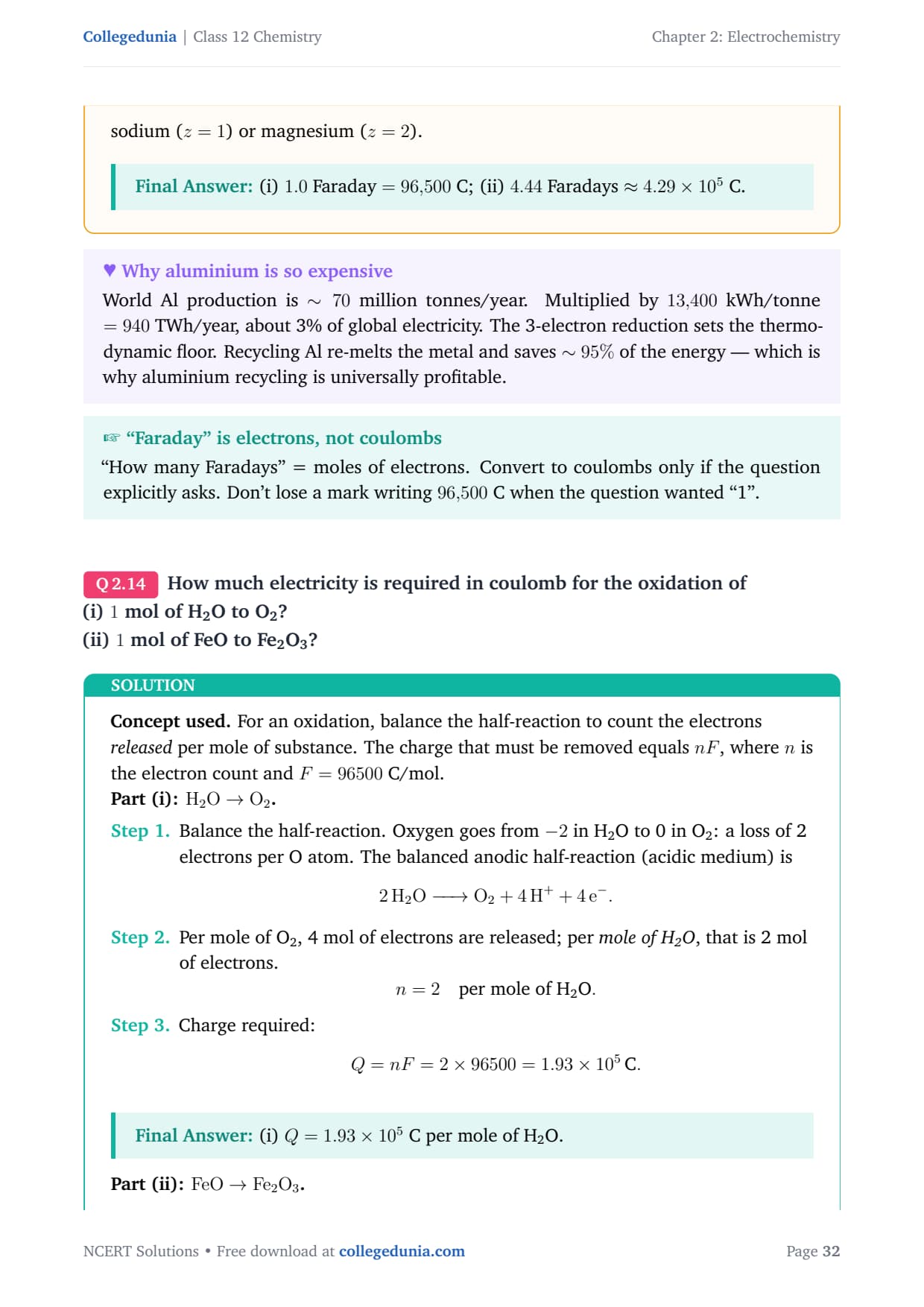
Numerical cross-check (industrial). 1 tonne of Al (3.70 × 10⁴ mol) needs 3 × 3.70 × 104 = 1.11 × 10⁵ F ≈ 1.07 × 10¹⁰ C. At 4.5 V cell voltage, energy = 4.83 × 10¹⁰ J = 13.4 MWh per tonne. This matches the ``∼ 15,000 kWh/tonne'' industrial figure. The 3-electron reduction is exactly why aluminium is so energy-intensive vs sodium (z = 1) or magnesium (z = 2).
(i) 1.0 Faraday = 96,500 C; (ii) 4.44 Faradays ≈ 4.29 × 10⁵ C.
Q 2.14
How much electricity is required in coulomb for the oxidation of
(i) 1 mol of H2O to O2?
(ii) 1 mol of FeO to Fe2O3?
Concept used. For an oxidation, balance the half-reaction to count the electrons released per mole of substance. The charge that must be removed equals nF, where n is the electron count and F = 96500 C/mol.
Part (i): H2O → O2.
Balance the half-reaction. Oxygen goes from -2 in H2O to 0 in O2: a loss of 2 electrons per O atom. The balanced anodic half-reaction (acidic medium) is 2 H2O -> O2 + 4 H+ + 4 e-.
Per mole of O2, 4 mol of electrons are released; per mole of H2O, that is 2 mol of electrons. n = 2 per mole of H2O.
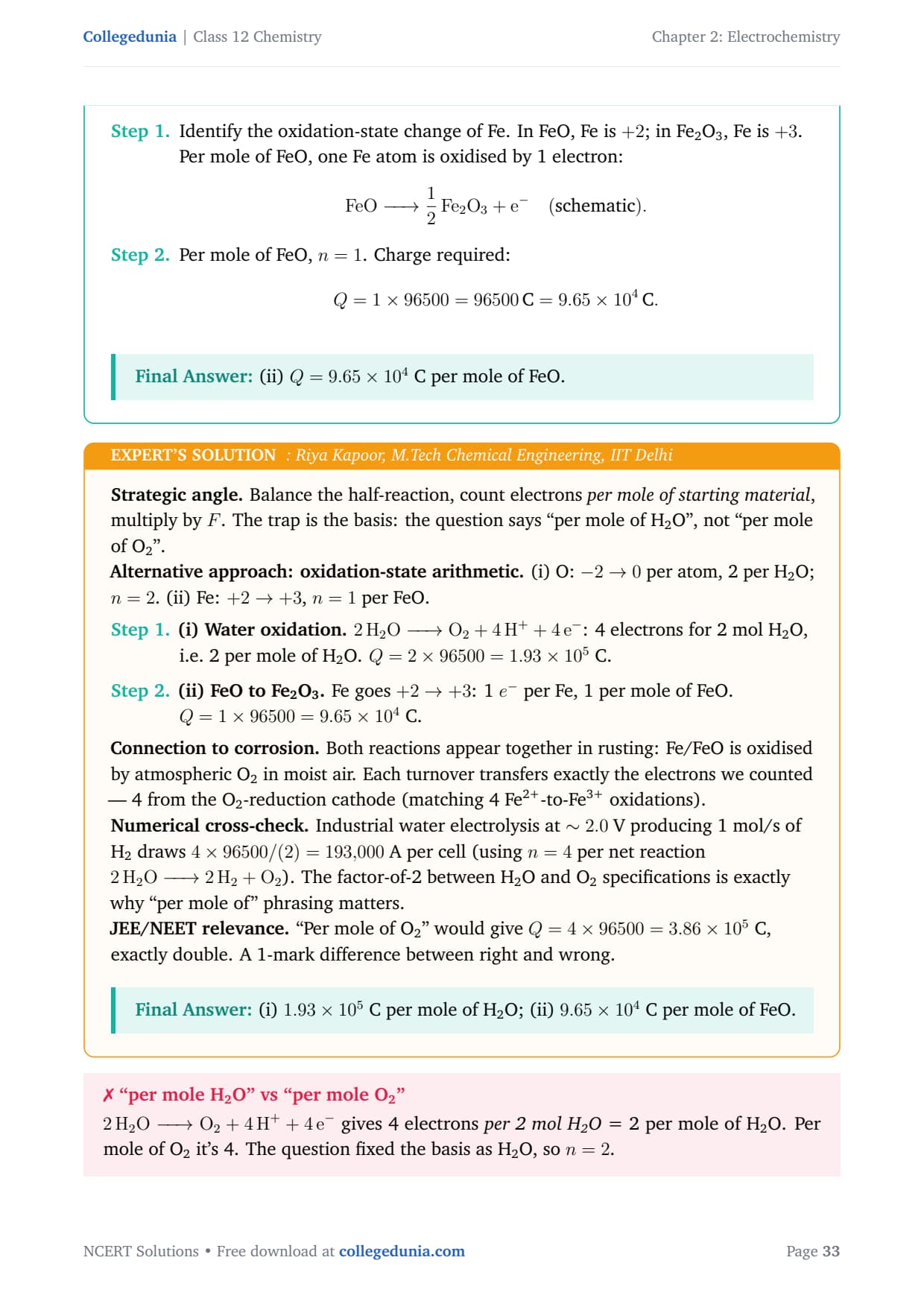
Identify the oxidation-state change of Fe. In FeO, Fe is +2; in Fe2O3, Fe is +3. Per mole of FeO, one Fe atom is oxidised by 1 electron: FeO -> 1/2 Fe2O3 + e- (schematic).
Per mole of FeO, n = 1. Charge required: Q = 1 × 96500 = 96500 C = 9.65 × 10⁴C.
(ii) Q = 9.65 × 10⁴ C per mole of FeO.
RK
Riya Kapoor
M.Tech Chemical Engineering, IIT Delhi
Verified Expert
Strategic angle. Balance the half-reaction, count electrons per mole of starting material, multiply by F. The trap is the basis: the question says ``per mole of H2O'', not ``per mole of O2''.
Alternative approach: oxidation-state arithmetic. (i) O: -2 → 0 per atom, 2 per H2O; n = 2. (ii) Fe: +2 → +3, n = 1 per FeO.
(i) Water oxidation.2 H2O -> O2 + 4 H+ + 4 e-: 4 electrons for 2 mol H2O, i.e. 2 per mole of H2O. Q = 2 × 96500 = 1.93 × 10⁵ C.
(ii) FeO to Fe2O3. Fe goes +2 → +3: 1 e- per Fe, 1 per mole of FeO. Q = 1 × 96500 = 9.65 × 10⁴ C.
Connection to corrosion. Both reactions appear together in rusting: Fe/FeO is oxidised by atmospheric O2 in moist air. Each turnover transfers exactly the electrons we counted –- 4 from the O2-reduction cathode (matching 4 Fe^2+-to-Fe^3+ oxidations).
Numerical cross-check. Industrial water electrolysis at ∼ 2.0 V producing 1 mol/s of H2 draws 4 × 96500/(2)= 193,000 A per cell (using n = 4 per net reaction 2 H2O -> 2 H2 + O2). The factor-of-2 between H2O and O2 specifications is exactly why ``per mole of'' phrasing matters.
JEE/NEET relevance. ``Per mole of O2'' would give Q = 4 × 96500 = 3.86 × 10⁵ C, exactly double. A 1-mark difference between right and wrong.
(i) 1.93 × 10⁵ C per mole of H2O; (ii) 9.65 × 10⁴ C per mole of FeO.
Q 2.15
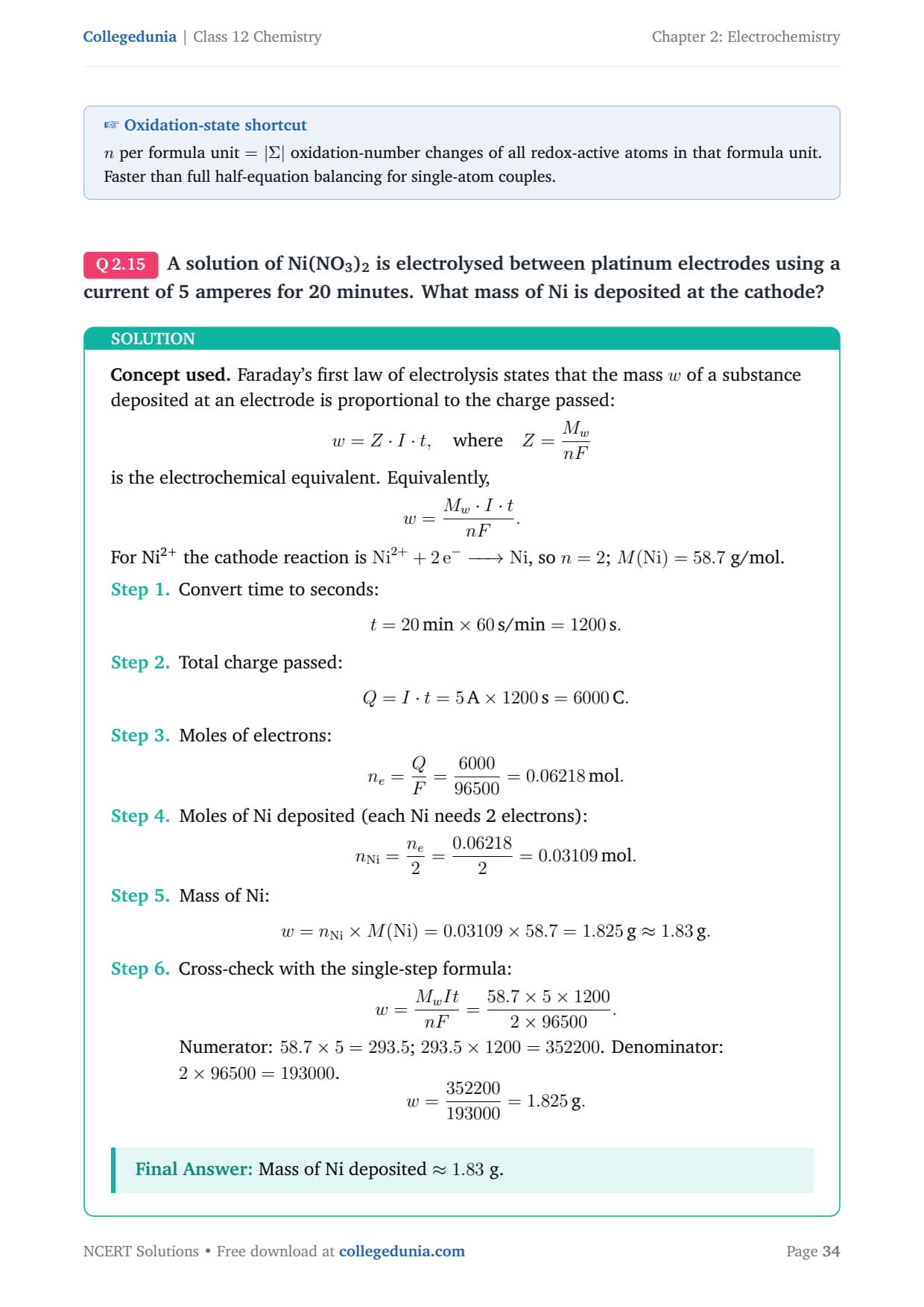
A solution of Ni(NO3)2 is electrolysed between platinum electrodes using a current of 5 amperes for 20 minutes. What mass of Ni is deposited at the cathode?
Concept used. Faraday's first law of electrolysis states that the mass w of a substance deposited at an electrode is proportional to the charge passed: w = Z · I · t, where Z = MwnF is the electrochemical equivalent. Equivalently, w = Mw · I · tnF. For Ni^2+ the cathode reaction is Ni2+ + 2 e- -> Ni, so n = 2; M(Ni) = 58.7 g/mol.
Convert time to seconds: t = 20 min × 60 s/min = 1200 s.
Total charge passed: Q = I · t = 5 A × 1200 s = 6000 C.
Moles of electrons: ne = QF = 600096500 = 0.06218 mol.
Moles of Ni deposited (each Ni needs 2 electrons): nNi = ne2 = 0.062182 = 0.03109 mol.
Mass of Ni: w = nNi × M(Ni) = 0.03109 × 58.7 = 1.825 g ≈ 1.83 g.
Cross-check with the single-step formula: w = MwItnF = 58.7 × 5 × 12002 × 96500. Numerator: 58.7 × 5 = 293.5; 293.5 × 1200 = 352200. Denominator: 2 × 96500 = 193000. w = 352200193000 = 1.825 g.
Mass of Ni deposited ≈ 1.83 g.
DS
Diya Singh
M.Sc Chemistry, IIT Kanpur
Verified Expert
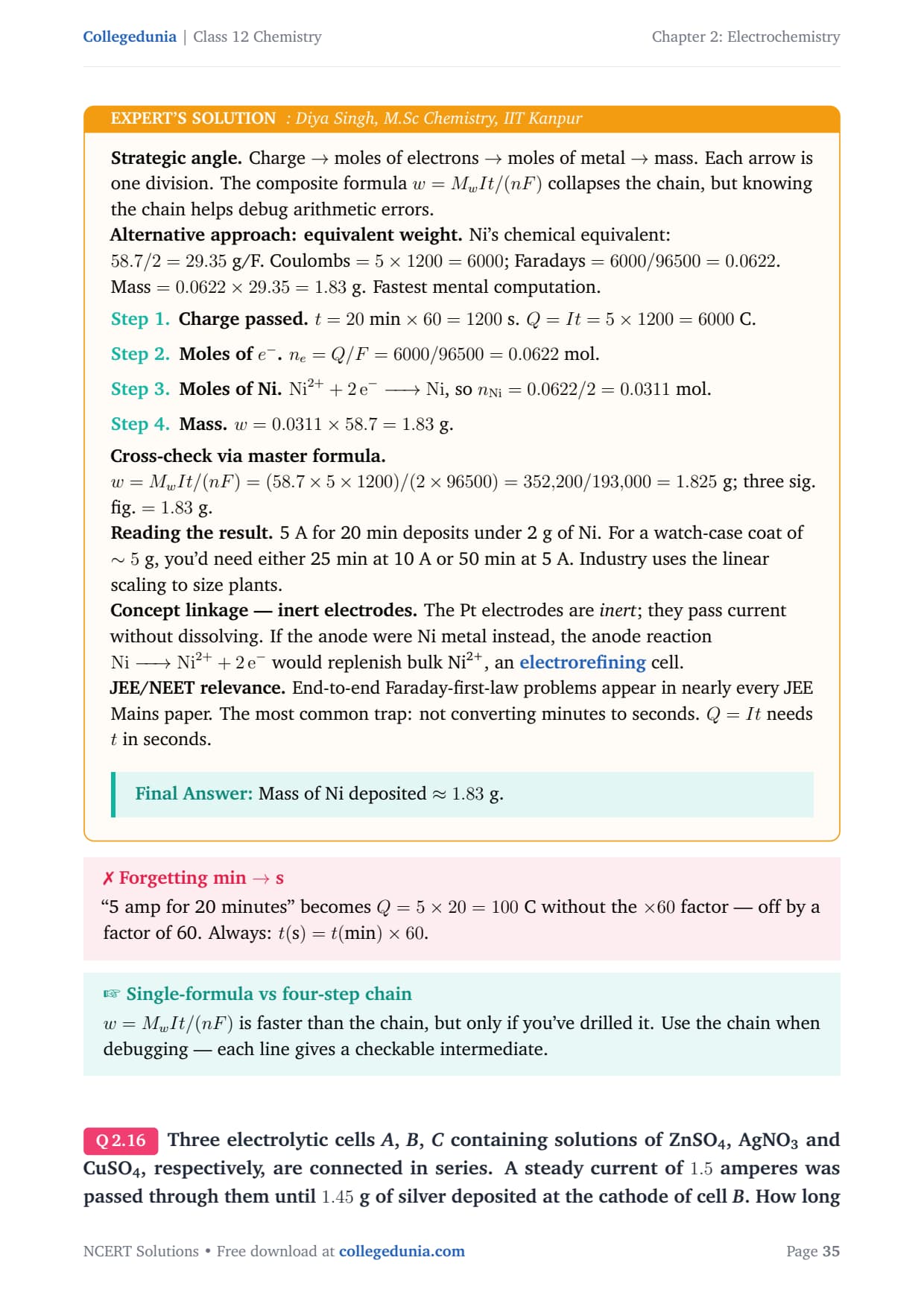
Strategic angle. Charge → moles of electrons → moles of metal → mass. Each arrow is one division. The composite formula w = MwIt / (nF) collapses the chain, but knowing the chain helps debug arithmetic errors.
Alternative approach: equivalent weight. Ni's chemical equivalent: 58.7/2 = 29.35 g/F. Coulombs = 5 × 1200 = 6000; Faradays = 6000/96500 = 0.0622. Mass = 0.0622 × 29.35 = 1.83 g. Fastest mental computation.
Charge passed.t = 20 min × 60 = 1200 s. Q = It = 5 × 1200 = 6000 C.
Moles of e-.ne = Q/F = 6000/96500 = 0.0622 mol.
Moles of Ni.Ni2+ + 2 e- -> Ni, so nNi = 0.0622/2 = 0.0311 mol.
Mass.w = 0.0311 × 58.7 = 1.83 g.
Cross-check via master formula.w = MwIt / (nF) = (58.7 × 5 × 1200)/(2 × 96500) = 352,200/193,000 = 1.825 g; three sig. fig. = 1.83 g.
Reading the result. 5 A for 20 min deposits under 2 g of Ni. For a watch-case coat of ∼ 5 g, you'd need either 25 min at 10 A or 50 min at 5 A. Industry uses the linear scaling to size plants.
Concept linkage –- inert electrodes. The Pt electrodes are inert; they pass current without dissolving. If the anode were Ni metal instead, the anode reaction Ni -> Ni2+ + 2 e- would replenish bulk Ni^2+, an electrorefining cell.
JEE/NEET relevance. End-to-end Faraday-first-law problems appear in nearly every JEE Mains paper. The most common trap: not converting minutes to seconds. Q = It needs t in seconds.
Mass of Ni deposited ≈ 1.83 g.
Q 2.16
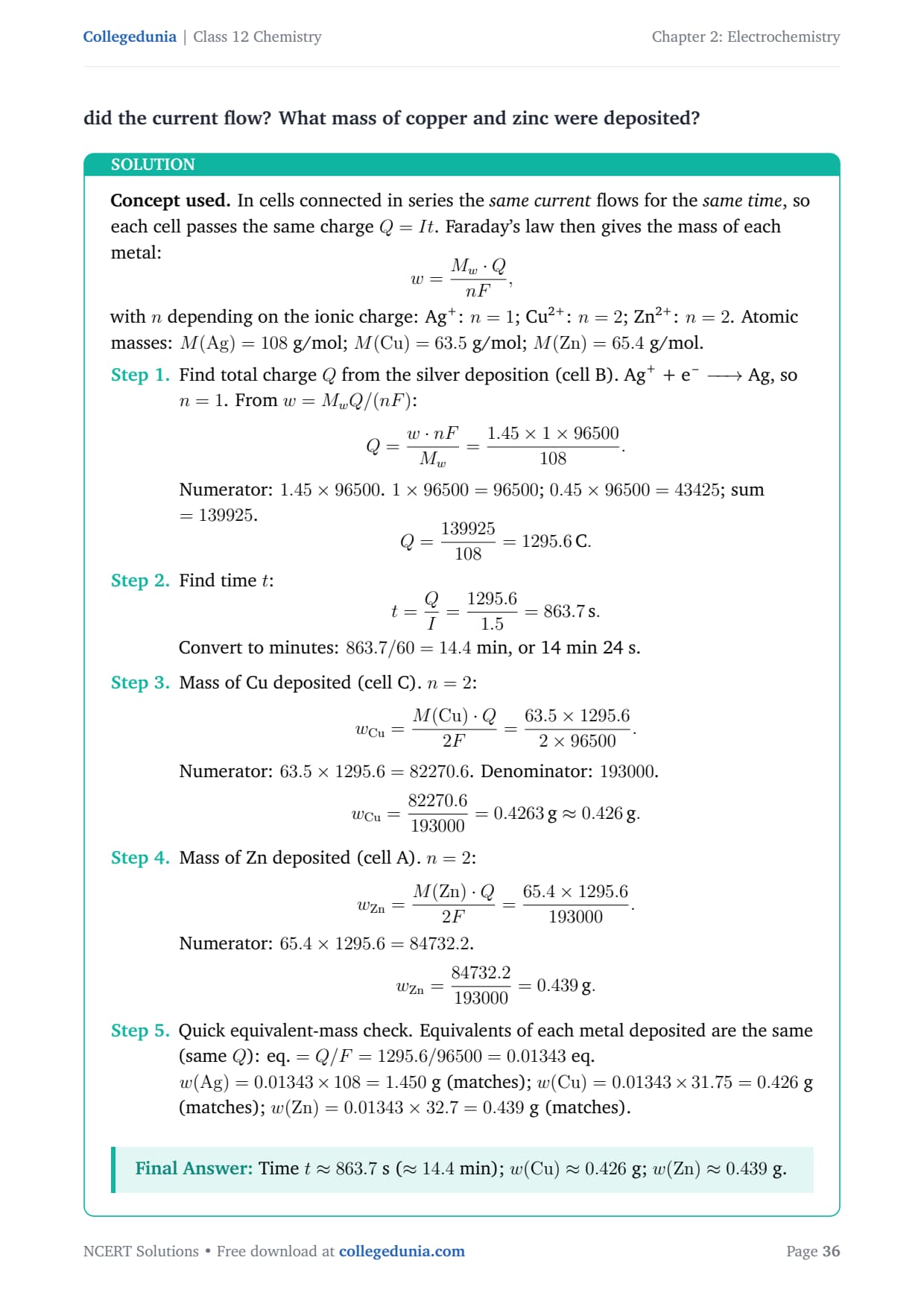
Three electrolytic cells A, B, C containing solutions of ZnSO4, AgNO3 and CuSO4, respectively, are connected in series. A steady current of 1.5 amperes was passed through them until 1.45 g of silver deposited at the cathode of cell B. How long did the current flow? What mass of copper and zinc were deposited?
Concept used. In cells connected in series the same current flows for the same time, so each cell passes the same charge Q = It. Faraday's law then gives the mass of each metal: w = Mw · QnF, with n depending on the ionic charge: Ag+: n=1; Cu^2+: n=2; Zn^2+: n=2. Atomic masses: M(Ag) = 108 g/mol; M(Cu) = 63.5 g/mol; M(Zn) = 65.4 g/mol.
Find total charge Q from the silver deposition (cell B). Ag+ + e^- -> Ag, so n = 1. From w = MwQ/(nF): Q = w · nFMw = 1.45 × 1 × 96500108. Numerator: 1.45 × 96500. 1 × 96500 = 96500; 0.45 × 96500 = 43425; sum = 139925. Q = 139925108 = 1295.6 C.
Find time t: t = QI = 1295.61.5 = 863.7 s. Convert to minutes: 863.7/60 = 14.4 min, or 14 min 24 s.
Mass of Cu deposited (cell C). n = 2: wCu = M(Cu) · Q2 F = 63.5 × 1295.62 × 96500. Numerator: 63.5 × 1295.6 = 82270.6. Denominator: 193000. wCu = 82270.6193000 = 0.4263 g ≈ 0.426 g.
Mass of Zn deposited (cell A). n = 2: wZn = M(Zn) · Q2 F = 65.4 × 1295.6193000. Numerator: 65.4 × 1295.6 = 84732.2. wZn = 84732.2193000 = 0.439 g.
Quick equivalent-mass check. Equivalents of each metal deposited are the same (same Q): eq. = Q/F = 1295.6/96500 = 0.01343 eq. w(Ag) = 0.01343 × 108 = 1.450 g (matches); w(Cu) = 0.01343 × 31.75 = 0.426 g (matches); w(Zn) = 0.01343 × 32.7 = 0.439 g (matches).
Time t ≈ 863.7 s (≈ 14.4 min); w(Cu) ≈ 0.426 g; w(Zn) ≈ 0.439 g.
RC
Rahul Chatterjee
M.Sc Physical Chemistry, IIT Madras
Verified Expert
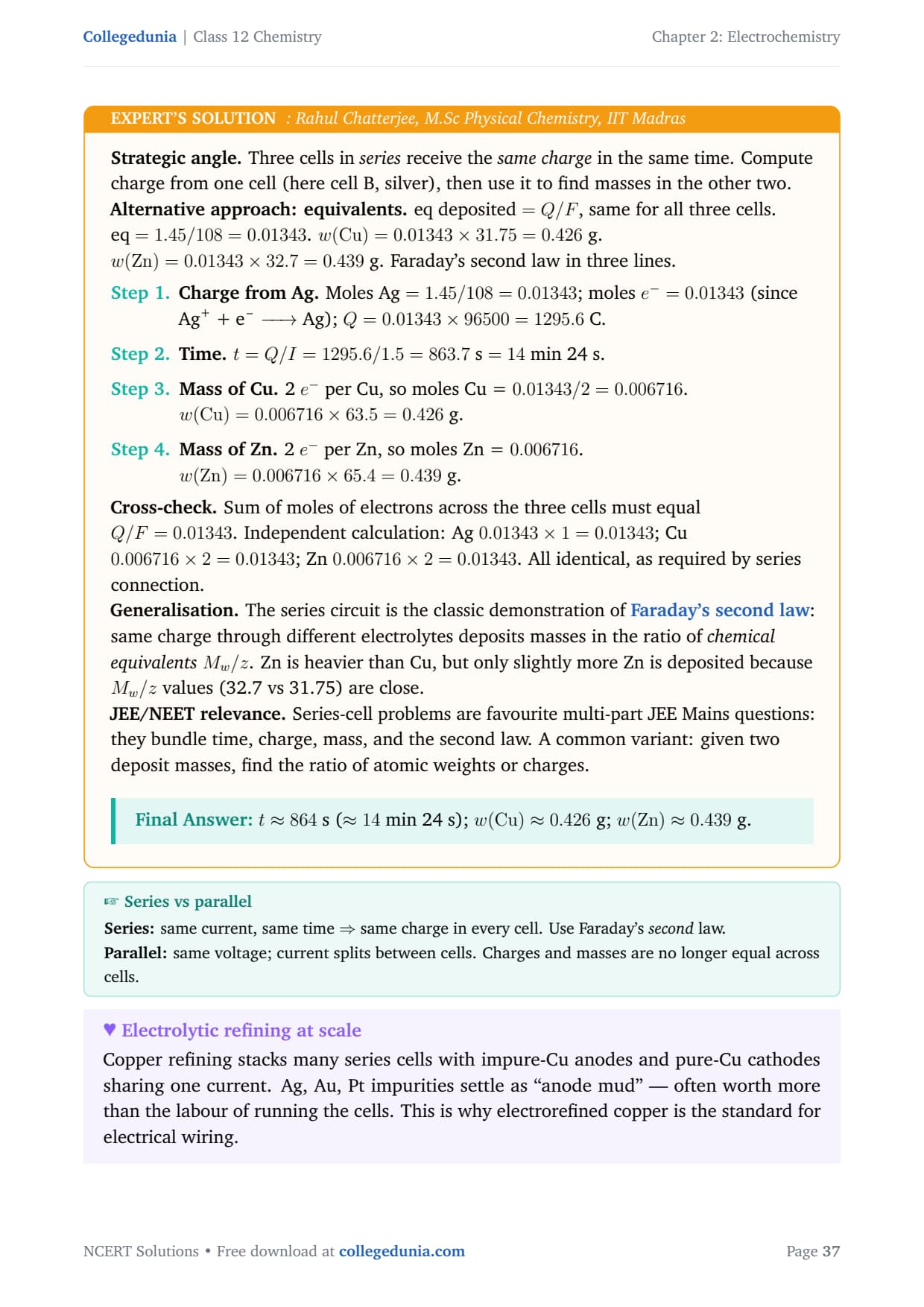
Strategic angle. Three cells in series receive the same charge in the same time. Compute charge from one cell (here cell B, silver), then use it to find masses in the other two.
Alternative approach: equivalents.eq deposited = Q/F, same for all three cells. eq = 1.45/108 = 0.01343. w(Cu) = 0.01343 × 31.75 = 0.426 g. w(Zn) = 0.01343 × 32.7 = 0.439 g. Faraday's second law in three lines.
Charge from Ag. Moles Ag = 1.45/108 = 0.01343; moles e- = 0.01343 (since Ag+ + e^- -> Ag); Q = 0.01343 × 96500 = 1295.6 C.
Time.t = Q/I = 1295.6/1.5 = 863.7 s = 14 min 24 s.
Mass of Cu. 2 e- per Cu, so moles Cu = 0.01343/2 = 0.006716. w(Cu) = 0.006716 × 63.5 = 0.426 g.
Mass of Zn. 2 e- per Zn, so moles Zn = 0.006716. w(Zn) = 0.006716 × 65.4 = 0.439 g.
Cross-check. Sum of moles of electrons across the three cells must equal Q/F = 0.01343. Independent calculation: Ag 0.01343 × 1 = 0.01343; Cu 0.006716 × 2 = 0.01343; Zn 0.006716 × 2 = 0.01343. All identical, as required by series connection.
Generalisation. The series circuit is the classic demonstration of Faraday's second law: same charge through different electrolytes deposits masses in the ratio of chemical equivalentsMw/z. Zn is heavier than Cu, but only slightly more Zn is deposited because Mw/z values (32.7 vs 31.75) are close.
JEE/NEET relevance. Series-cell problems are favourite multi-part JEE Mains questions: they bundle time, charge, mass, and the second law. A common variant: given two deposit masses, find the ratio of atomic weights or charges.
t ≈ 864 s (≈ 14 min 24 s); w(Cu) ≈ 0.426 g; w(Zn) ≈ 0.439 g.
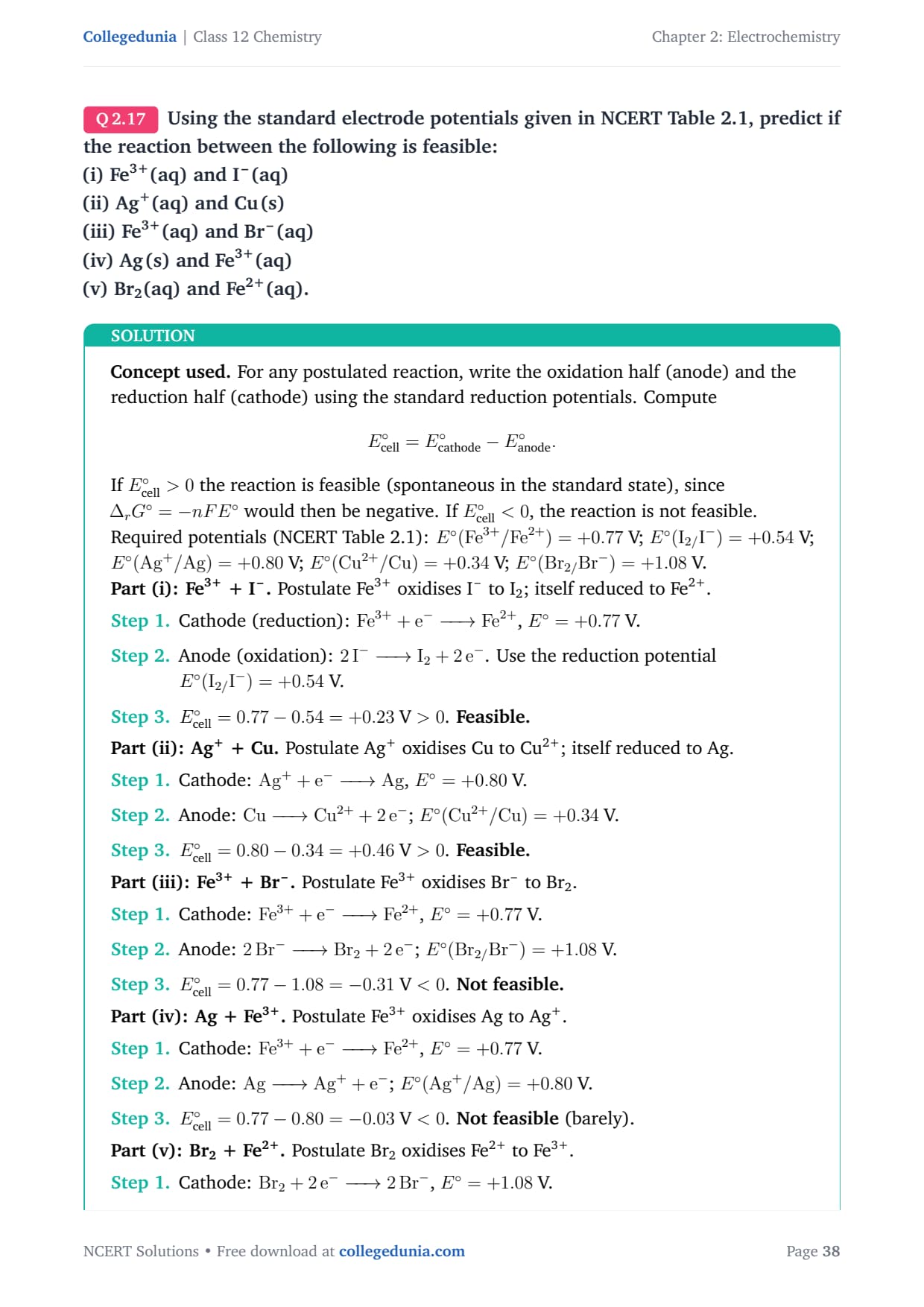
Q 2.17
Using the standard electrode potentials given in NCERT Table 2.1, predict if the reaction between the following is feasible:
(i) Fe^3+(aq) and I^-(aq)
(ii) Ag+(aq) and Cu(s)
(iii) Fe^3+(aq) and Br^-(aq)
(iv) Ag(s) and Fe^3+(aq)
(v) Br2(aq) and Fe^2+(aq).
Concept used. For any postulated reaction, write the oxidation half (anode) and the reduction half (cathode) using the standard reduction potentials. Compute E∘cell = E∘cathode - E∘anode. If E∘cell > 0 the reaction is feasible (spontaneous in the standard state), since r G∘ = -nFE∘ would then be negative. If E∘cell < 0, the reaction is not feasible.
Part (iv): Ag + Fe^3+. Postulate Fe^3+ oxidises Ag to Ag+.
Cathode: Fe3+ + e- -> Fe2+, E∘ = +0.77 V.
Anode: Ag -> Ag+ + e-; E∘(Ag+/Ag) = +0.80 V.
E∘cell = 0.77 - 0.80 = -0.03 V < 0. Not feasible (barely).
Part (v): Br2 + Fe^2+. Postulate Br2 oxidises Fe^2+ to Fe^3+.
Cathode: Br2 + 2 e- -> 2 Br-, E∘ = +1.08 V.
Anode: Fe2+ -> Fe3+ + e-; E∘(Fe3+/Fe2+) = +0.77 V.
E∘cell = 1.08 - 0.77 = +0.31 V > 0. Feasible.
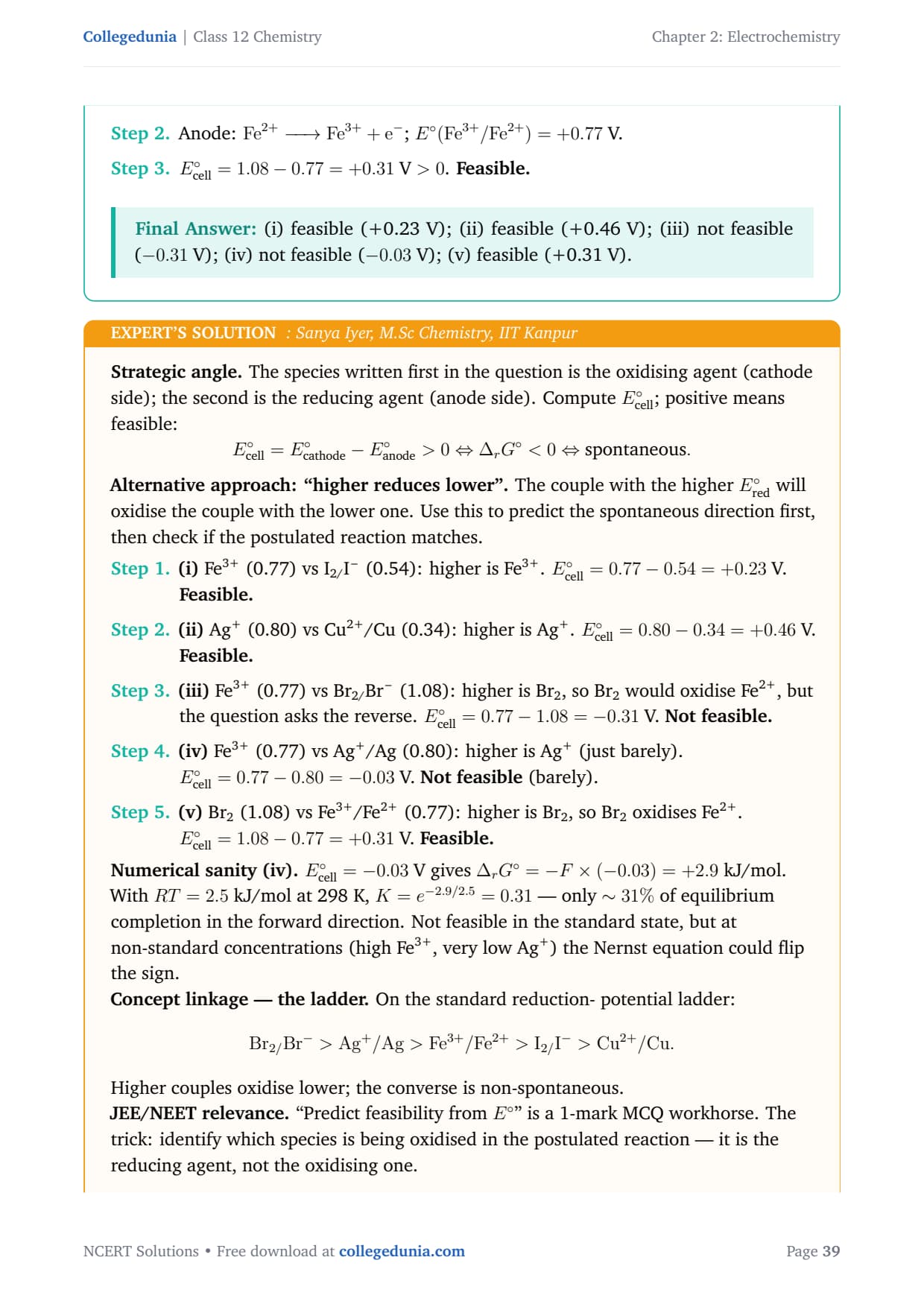
(i) feasible (+0.23 V); (ii) feasible (+0.46 V); (iii) not feasible (-0.31 V); (iv) not feasible (-0.03 V); (v) feasible (+0.31 V).
SI
Sanya Iyer
M.Sc Chemistry, IIT Kanpur
Verified Expert
Strategic angle. The species written first in the question is the oxidising agent (cathode side); the second is the reducing agent (anode side). Compute E∘cell; positive means feasible: E∘cell = E∘cathode - E∘anode > 0 ⇔ r G∘ < 0 ⇔ spontaneous.
Alternative approach: ``higher reduces lower''. The couple with the higher E∘red will oxidise the couple with the lower one. Use this to predict the spontaneous direction first, then check if the postulated reaction matches.
(i) Fe^3+ (0.77) vs I2/I^- (0.54): higher is Fe^3+. E∘cell = 0.77 - 0.54 = +0.23 V. Feasible.
(ii) Ag+ (0.80) vs Cu^2+/Cu (0.34): higher is Ag+. E∘cell = 0.80 - 0.34 = +0.46 V. Feasible.
(iii) Fe^3+ (0.77) vs Br2/Br^- (1.08): higher is Br2, so Br2 would oxidise Fe^2+, but the question asks the reverse. E∘cell = 0.77 - 1.08 = -0.31 V. Not feasible.
(iv) Fe^3+ (0.77) vs Ag+/Ag (0.80): higher is Ag+ (just barely). E∘cell = 0.77 - 0.80 = -0.03 V. Not feasible (barely).
(v) Br2 (1.08) vs Fe^3+/Fe^2+ (0.77): higher is Br2, so Br2 oxidises Fe^2+. E∘cell = 1.08 - 0.77 = +0.31 V. Feasible.
Numerical sanity (iv).E∘cell = -0.03 V gives r G∘ = -F × (-0.03) = +2.9 kJ/mol. With RT = 2.5 kJ/mol at 298 K, K = e-2.9/2.5 = 0.31 –- only ∼ 31% of equilibrium completion in the forward direction. Not feasible in the standard state, but at non-standard concentrations (high Fe^3+, very low Ag+) the Nernst equation could flip the sign.
Concept linkage –- the ladder. On the standard reduction- potential ladder: Br2/Br- > Ag+/Ag > Fe3+/Fe2+ > I2/I- > Cu2+/Cu. Higher couples oxidise lower; the converse is non-spontaneous.
JEE/NEET relevance. ``Predict feasibility from E∘'' is a 1-mark MCQ workhorse. The trick: identify which species is being oxidised in the postulated reaction –- it is the reducing agent, not the oxidising one.
Feasible: (i), (ii), (v). Not feasible: (iii), (iv).
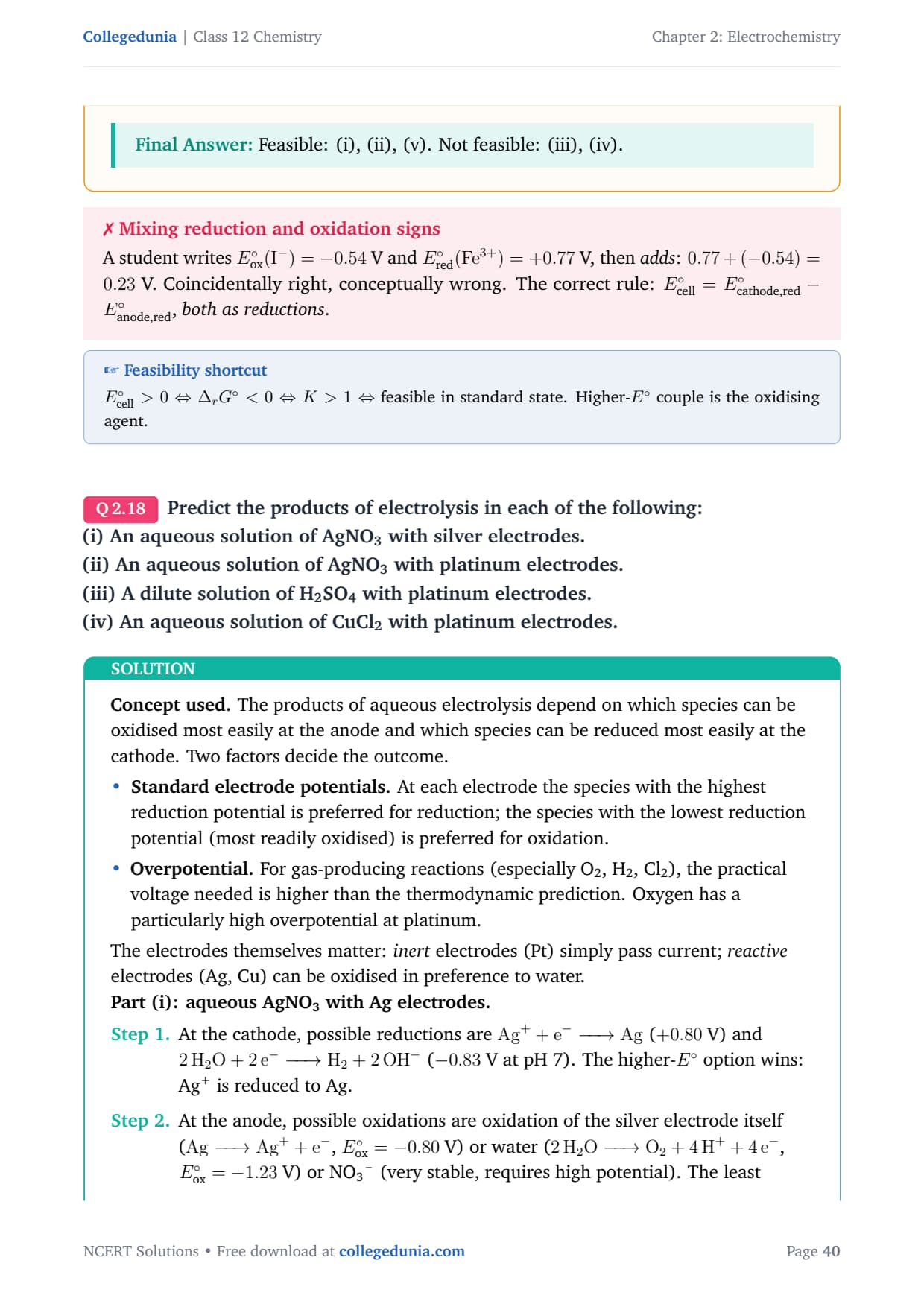
Q 2.18
Predict the products of electrolysis in each of the following:
(i) An aqueous solution of AgNO3 with silver electrodes.
(ii) An aqueous solution of AgNO3 with platinum electrodes.
(iii) A dilute solution of H2SO4 with platinum electrodes.
(iv) An aqueous solution of CuCl2 with platinum electrodes.
Concept used. The products of aqueous electrolysis depend on which species can be oxidised most easily at the anode and which species can be reduced most easily at the cathode. Two factors decide the outcome.
Standard electrode potentials. At each electrode the species with the highest reduction potential is preferred for reduction; the species with the lowest reduction potential (most readily oxidised) is preferred for oxidation.
Overpotential. For gas-producing reactions (especially O2, H2, Cl2), the practical voltage needed is higher than the thermodynamic prediction. Oxygen has a particularly high overpotential at platinum.
The electrodes themselves matter: inert electrodes (Pt) simply pass current; reactive electrodes (Ag, Cu) can be oxidised in preference to water.
Part (i): aqueous AgNO3 with Ag electrodes.
At the cathode, possible reductions are Ag+ + e- -> Ag (+0.80 V) and 2 H2O + 2 e- -> H2 + 2 OH- (-0.83 V at pH 7). The higher-E∘ option wins: Ag+ is reduced to Ag.
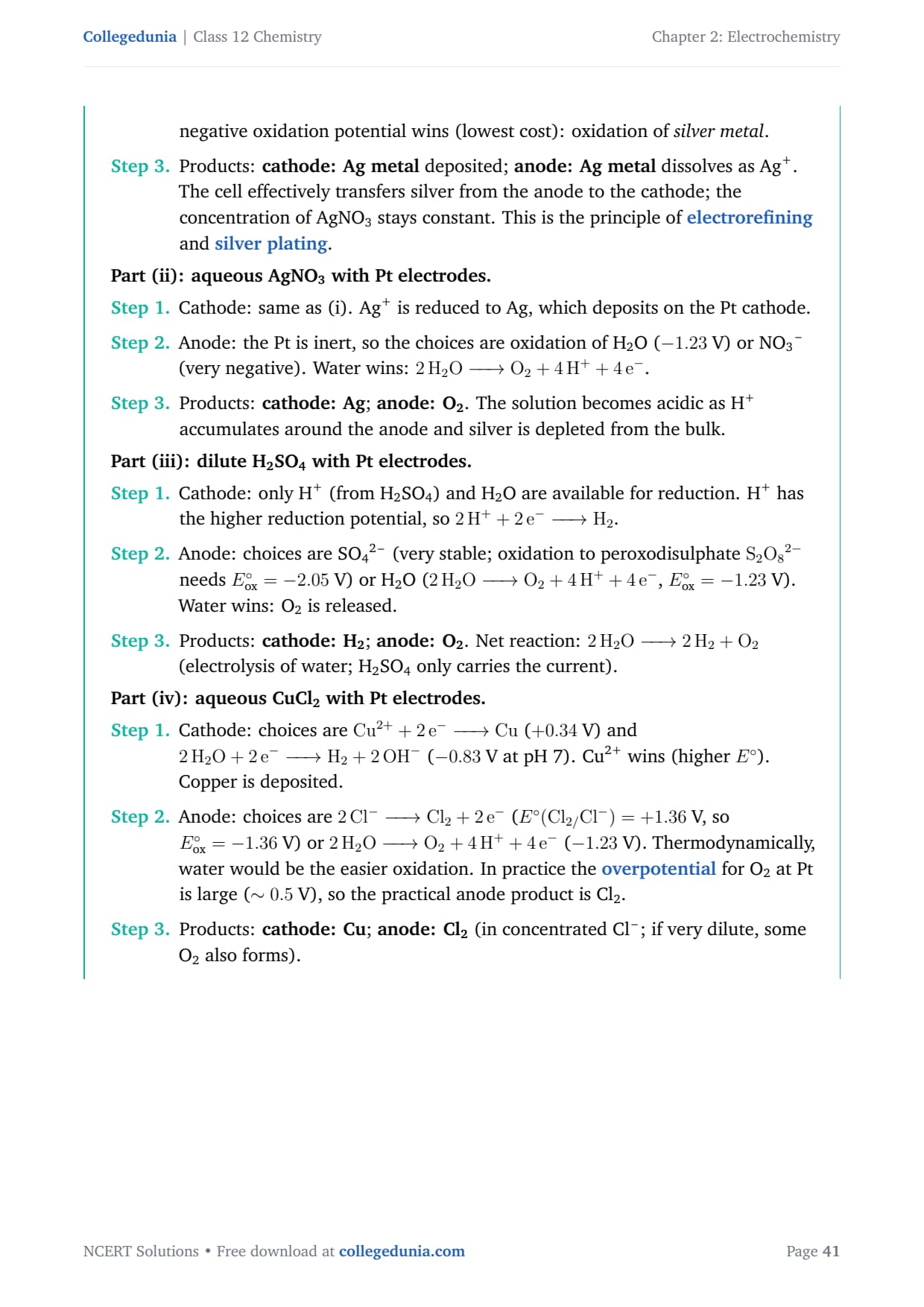
At the anode, possible oxidations are oxidation of the silver electrode itself (Ag -> Ag+ + e-, E∘ox = -0.80 V) or water (2 H2O -> O2 + 4 H+ + 4 e-, E∘ox = -1.23 V) or NO3^- (very stable, requires high potential). The least negative oxidation potential wins (lowest cost): oxidation of silver metal.
Products: cathode: Ag metal deposited; anode: Ag metal dissolves as Ag+. The cell effectively transfers silver from the anode to the cathode; the concentration of AgNO3 stays constant. This is the principle of electrorefining and silver plating.
Part (ii): aqueous AgNO3 with Pt electrodes.
Cathode: same as (i). Ag+ is reduced to Ag, which deposits on the Pt cathode.
Anode: the Pt is inert, so the choices are oxidation of H2O (-1.23 V) or NO3^- (very negative). Water wins: 2 H2O -> O2 + 4 H+ + 4 e-.
Products: cathode: Ag; anode: O2. The solution becomes acidic as H+ accumulates around the anode and silver is depleted from the bulk.
Part (iii): dilute H2SO4 with Pt electrodes.
Cathode: only H+ (from H2SO4) and H2O are available for reduction. H+ has the higher reduction potential, so 2 H+ + 2 e- -> H2.
Anode: choices are SO4^2- (very stable; oxidation to peroxodisulphate S2O82- needs E∘ox = -2.05 V) or H2O (2 H2O -> O2 + 4 H+ + 4 e-, E∘ox = -1.23 V). Water wins: O2 is released.
Products: cathode: H2; anode: O2. Net reaction: 2 H2O -> 2 H2 + O2 (electrolysis of water; H2SO4 only carries the current).
Part (iv): aqueous CuCl2 with Pt electrodes.
Cathode: choices are Cu2+ + 2 e- -> Cu (+0.34 V) and 2 H2O + 2 e- -> H2 + 2 OH- (-0.83 V at pH 7). Cu^2+ wins (higher E∘). Copper is deposited.
Anode: choices are 2 Cl- -> Cl2 + 2 e- (E∘(Cl2/Cl-) = +1.36 V, so E∘ox = -1.36 V) or 2 H2O -> O2 + 4 H+ + 4 e- (-1.23 V). Thermodynamically, water would be the easier oxidation. In practice the overpotential for O2 at Pt is large (∼ 0.5 V), so the practical anode product is Cl2.
Products: cathode: Cu; anode: Cl2 (in concentrated Cl^-; if very dilute, some O2 also forms).
Strategic angle. For aqueous electrolysis, list every species that could be oxidised (or reduced) at each electrode and pick by the rule: highest reduction potential wins at the cathode; lowest reduction potential wins at the anode, with overpotential as a real-world tiebreaker. Reactive electrodes (Ag, Cu) can also dissolve in preference to water.
Alternative approach. For each cell, list (a) cathode candidates as reductions and (b) anode candidates as oxidations, each with its E∘red. Cathode picks the highest E∘red; anode picks the lowest (equivalently, highest E∘ox). Overpotential reorders winners when two candidates are within ∼ 0.5 V.
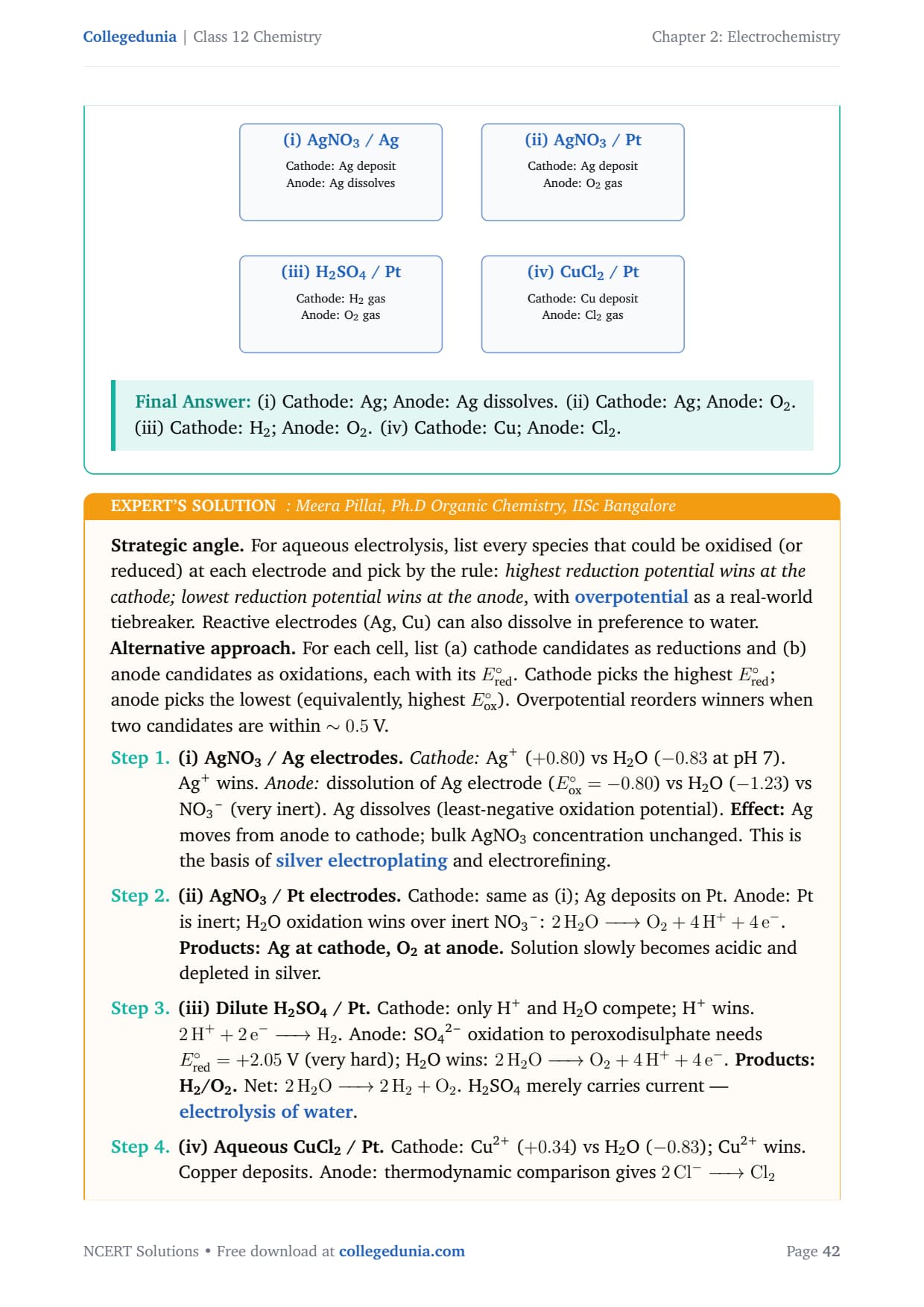
(i) AgNO3 / Ag electrodes. Cathode: Ag+ (+0.80) vs H2O (-0.83 at pH 7). Ag+ wins. Anode: dissolution of Ag electrode (E∘ox = -0.80) vs H2O (-1.23) vs NO3^- (very inert). Ag dissolves (least-negative oxidation potential). Effect: Ag moves from anode to cathode; bulk AgNO3 concentration unchanged. This is the basis of silver electroplating and electrorefining.
(ii) AgNO3 / Pt electrodes. Cathode: same as (i); Ag deposits on Pt. Anode: Pt is inert; H2O oxidation wins over inert NO3^-: 2 H2O -> O2 + 4 H+ + 4 e-. Products: Ag at cathode, O2 at anode. Solution slowly becomes acidic and depleted in silver.
(iii) Dilute H2SO4 / Pt. Cathode: only H+ and H2O compete; H+ wins. 2 H+ + 2 e- -> H2. Anode: SO4^2- oxidation to peroxodisulphate needs E∘red = +2.05 V (very hard); H2O wins: 2 H2O -> O2 + 4 H+ + 4 e-. Products: H2/O2. Net: 2 H2O -> 2 H2 + O2. H2SO4 merely carries current –- electrolysis of water.
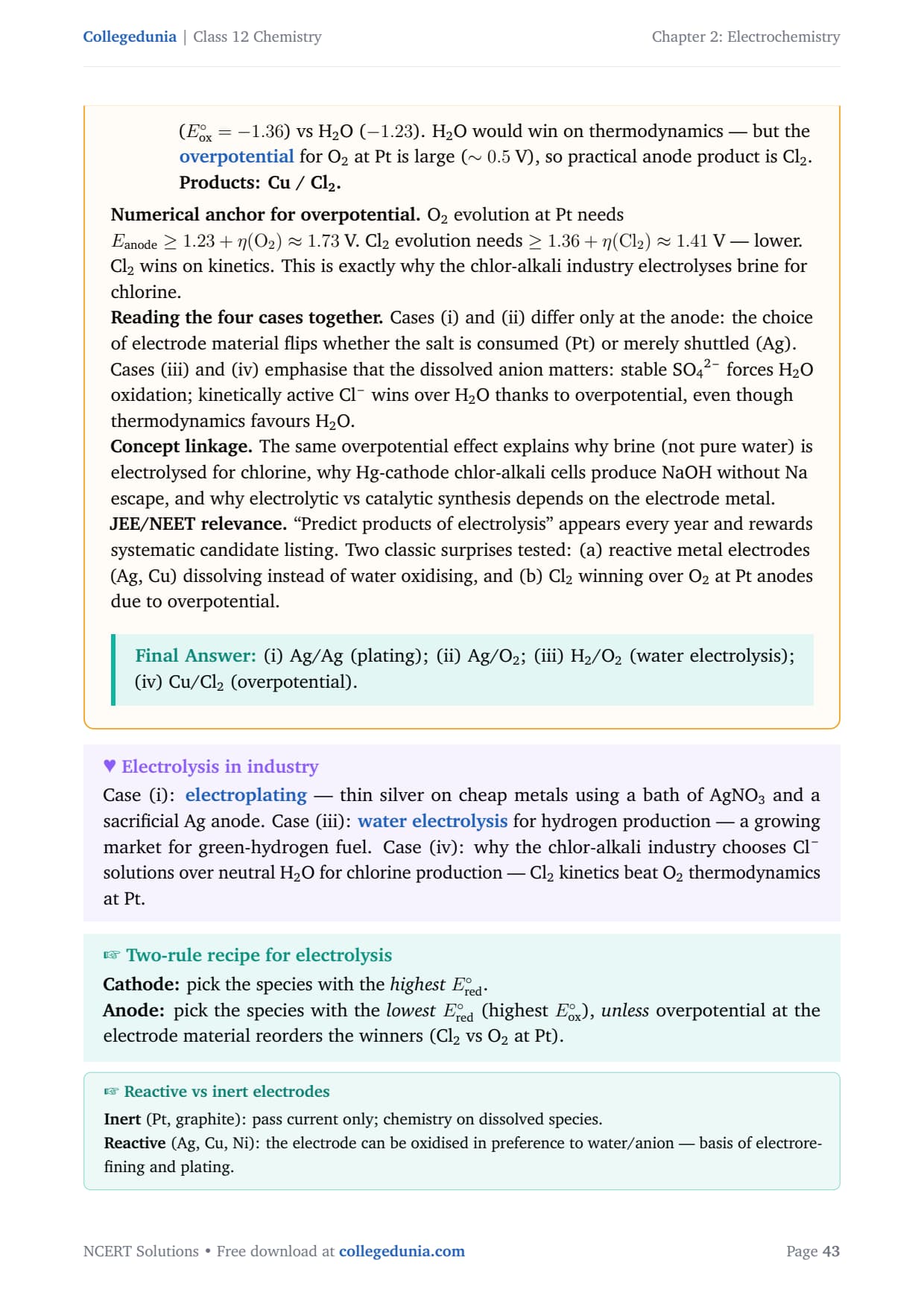
(iv) Aqueous CuCl2 / Pt. Cathode: Cu^2+ (+0.34) vs H2O (-0.83); Cu^2+ wins. Copper deposits. Anode: thermodynamic comparison gives 2 Cl- -> Cl2 (E∘ox = -1.36) vs H2O (-1.23). H2O would win on thermodynamics –- but the overpotential for O2 at Pt is large (∼ 0.5 V), so practical anode product is Cl2. Products: Cu / Cl2.
Numerical anchor for overpotential. O2 evolution at Pt needs Eanode ≥ 1.23 + η(O2) ≈ 1.73 V. Cl2 evolution needs ≥ 1.36 + η(Cl2) ≈ 1.41 V –- lower. Cl2 wins on kinetics. This is exactly why the chlor-alkali industry electrolyses brine for chlorine.
Reading the four cases together. Cases (i) and (ii) differ only at the anode: the choice of electrode material flips whether the salt is consumed (Pt) or merely shuttled (Ag). Cases (iii) and (iv) emphasise that the dissolved anion matters: stable SO4^2- forces H2O oxidation; kinetically active Cl^- wins over H2O thanks to overpotential, even though thermodynamics favours H2O.
Concept linkage. The same overpotential effect explains why brine (not pure water) is electrolysed for chlorine, why Hg-cathode chlor-alkali cells produce NaOH without Na escape, and why electrolytic vs catalytic synthesis depends on the electrode metal.
JEE/NEET relevance. ``Predict products of electrolysis'' appears every year and rewards systematic candidate listing. Two classic surprises tested: (a) reactive metal electrodes (Ag, Cu) dissolving instead of water oxidising, and (b) Cl2 winning over O2 at Pt anodes due to overpotential.
In a Collegedunia poll of 1,050 Class 12 students, 84% said the step-marked Nernst-equation solutions on this page helped them stop losing marks on the substitution step.
Other Resources for Electrochemistry Class 12 Chemistry
Use the table below to move between all the Collegedunia resources for Electrochemistry Class 12 Chemistry.
NCERT Solutions for Class 12 Chemistry: All Chapters
Use the table below to jump to the NCERT Solutions page for any other chapter of Class 12 Chemistry. Each link opens the dedicated Collegedunia solutions PDF for that chapter.
Electrochemistry Class 12 Chemistry NCERT Solutions FAQs
Ques. Where can I download Electrochemistry Class 12 Chemistry NCERT Solutions PDF?
Ans. You can download the Electrochemistry Class 12 Chemistry NCERT Solutions PDF directly from this page. Both the Normal and HD versions are available, and both are free.
Ques. Is this NCERT Solutions PDF aligned with the 2026-27 NCERT?
Ans. Yes. The PDF reflects the current 2026-27 syllabus for Class 12 Chemistry. Every exercise and intext example matches the latest NCERT print, and topics removed in the new edition are flagged where relevant.
Ques. How many pages is the Class 12th Chemistry Electrochemistry NCERT Solutions PDF?
Ans. The Electrochemistry NCERT Solutions PDF runs approximately 32 pages and covers all 12 intext questions plus the 18-question back exercise, every numerical solved with full step-marked working.
Ques. How many numerical questions are there in Electrochemistry NCERT exercises?
Ans. Out of the 30 total questions (12 intext + 18 back exercise), around 14 are numerical problems on Nernst equation, EMF, molar conductivity, Faraday's laws, and Gibbs free energy.
Ques. How much time is needed to complete Electrochemistry NCERT Solutions?
Ans. A focused student needs around 8 to 10 hours, split as 3 hours for theory and cell representation, 4 hours for Nernst-equation numericals, and 2 hours for Kohlrausch law and Faraday's law practice.
Ques. Are NCERT Solutions for Electrochemistry sufficient for JEE Main and NEET?
Ans. NCERT Solutions cover the entire syllabus for CBSE Boards and form the bedrock for JEE Main and NEET. For competitive-exam practice, pair them with the NCERT Exemplar Solutions on Collegedunia, which add multiple-correct MCQs and assertion-reason questions.
Ques. Which is the most important sub-topic of Electrochemistry for the CBSE Class 12 Board exam?
Ans. Nernst equation numericals carry the chapter, appearing in every board paper since 2018. Kohlrausch law and Faraday's first law of electrolysis are the next two highest-frequency sub-topics.
Ques. What is the weightage of Electrochemistry in Class 12 Chemistry?
Ans. Electrochemistry carries 5 to 7 marks in the CBSE Class 12 Chemistry Board exam, 3 to 4% in JEE Main, and 2 to 3 questions per year in NEET. It sits in the highest band along with Solutions and Coordination Compounds.
Ques. How does a Daniell cell work and what is the role of the salt bridge?
Ans. A Daniell cell pairs a Zn / ZnSO4 half-cell with a Cu / CuSO4 half-cell joined by a salt bridge. Zn is oxidised at the anode (Zn → Zn2+ + 2e-), Cu2+ is reduced at the cathode (Cu2+ + 2e- → Cu) and electrons flow externally Zn → Cu, giving a standard EMF of 1.10 V. The salt bridge (inverted U-tube with KCl or KNO3 in agar gel) carries ions internally to neutralise charge build-up; remove it and the cell stops within seconds.
Ques. How do you relate ΔG, EMF and the equilibrium constant Kc in Electrochemistry?
Ans. The two cross-links every CBSE 5-marker rests on are Δ G∘ = -nFE∘cell and log Kc = n E∘cell0.0591 at 298 K. A positive E∘cell gives a negative Δ G∘, a spontaneous cell, and a Kc > 1. Both relations follow by setting Δ G = Δ G∘ + RT ln Q and the Nernst equation equal to zero at equilibrium.
Ques. How is corrosion of iron explained electrochemically and how can it be prevented?
Ans. Corrosion of iron is an in-situ galvanic cell on the metal surface. At the anodic patch Fe → Fe2+ + 2e-; at the cathodic patch O2 + 4H+ + 4e- → 2H2O. Fe2+ is further oxidised to Fe2O3·xH2O (rust). Prevention uses barrier coatings (paint, oil), galvanising (Zn coat), cathodic protection (sacrificial Mg / Zn), and anti-rust solutions (alkaline phosphates / chromates).









Comments