Commerce Mentor, Ramjas College | Updated 3+ months ago
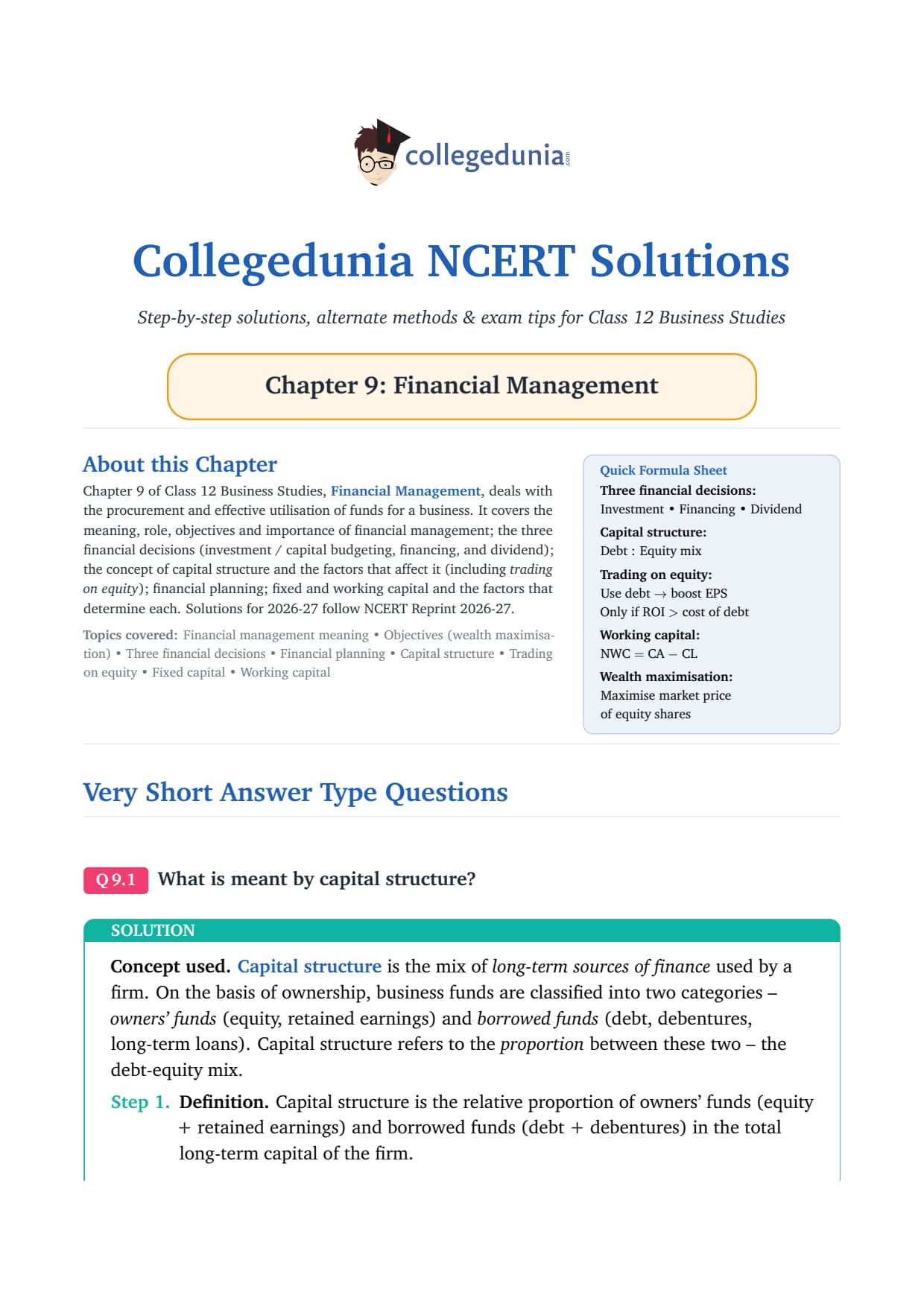
Financial Management is one of the highest-weightage chapters in the Class 12 Business Studies paper. These NCERT Solutions answer every question on the three financial decisions, the wealth-maximisation objective and capital structure, solved step by step for the 2026-27 CBSE syllabus.
CBSE Weightage: 8 to 12 marks (Unit 3, Business Finance and Marketing)
Sections Covered: 5 Very Short Answer, 7 Short Answer (incl. case), 6 Long Answer NCERT exercise questions
These solutions suit both a first-time reader of the chapter and a board candidate revising in the last week. Each answer gives a clear definition, the ROI vs cost-of-debt rule, the NWC formula, and a one-line takeaway. Quick tips and common-mistake call-outs sit at the exact points where students slip.
Financial Management Class 12 NCERT Solutions: Topic Map
What the Class 12 Business Studies Chapter 9 NCERT Solutions PDF Contains
Question-wise step-by-step answers to all 18 NCERT exercise questions (5 Very Short Answer, 7 Short Answer including case, 6 Long Answer including the steel-industry composite case).
Concept Used block at the start of every long-answer solution naming the rule, definition or model being applied.
Boxed Final Answer at the end of every solution for last-minute revision.
Numerical solutions with line-by-line ROI computation (e.g. ROI = $\frac{8{,}00{,}000}{1{,}00{,}00{,}000} \times 100 = 8\%$ in the Sunrises case).
EPS comparison table showing trading on equity in action (Plan A all-equity vs Plan B 50:50 debt-equity).
Case-study mapping from spotter words to answer (e.g. "financial blueprint" $\Rightarrow$ financial planning; "fixed financial charges raise return to equity" $\Rightarrow$ trading on equity).
Cross-links to Notes, Handwritten Notes and the NCERT Book PDF for the same chapter.
Exam Anchor: In Chapter 9, the must-know rule is "trading on equity works only when ROI > cost of debt". The must-state formula is $\text{NWC} = \text{CA} - \text{CL}$. The must-list trio is the three financial decisions: Investment + Financing + Dividend.
Financial Management Class 12: Related Chapters to Continue Learning
All NCERT Solutions for Financial Management with Step-by-Step Working
Every NCERT textbook question for Class 12 Business Studies Chapter 9 Financial Management is listed below with its full Solution and Expert Solution hidden inside collapsible tabs. Click Check Solution to reveal the step-by-step working; click Expert Solution for the expanded explanation.
Very Short Answer Type Questions
Q 9.1
What is meant by capital structure?
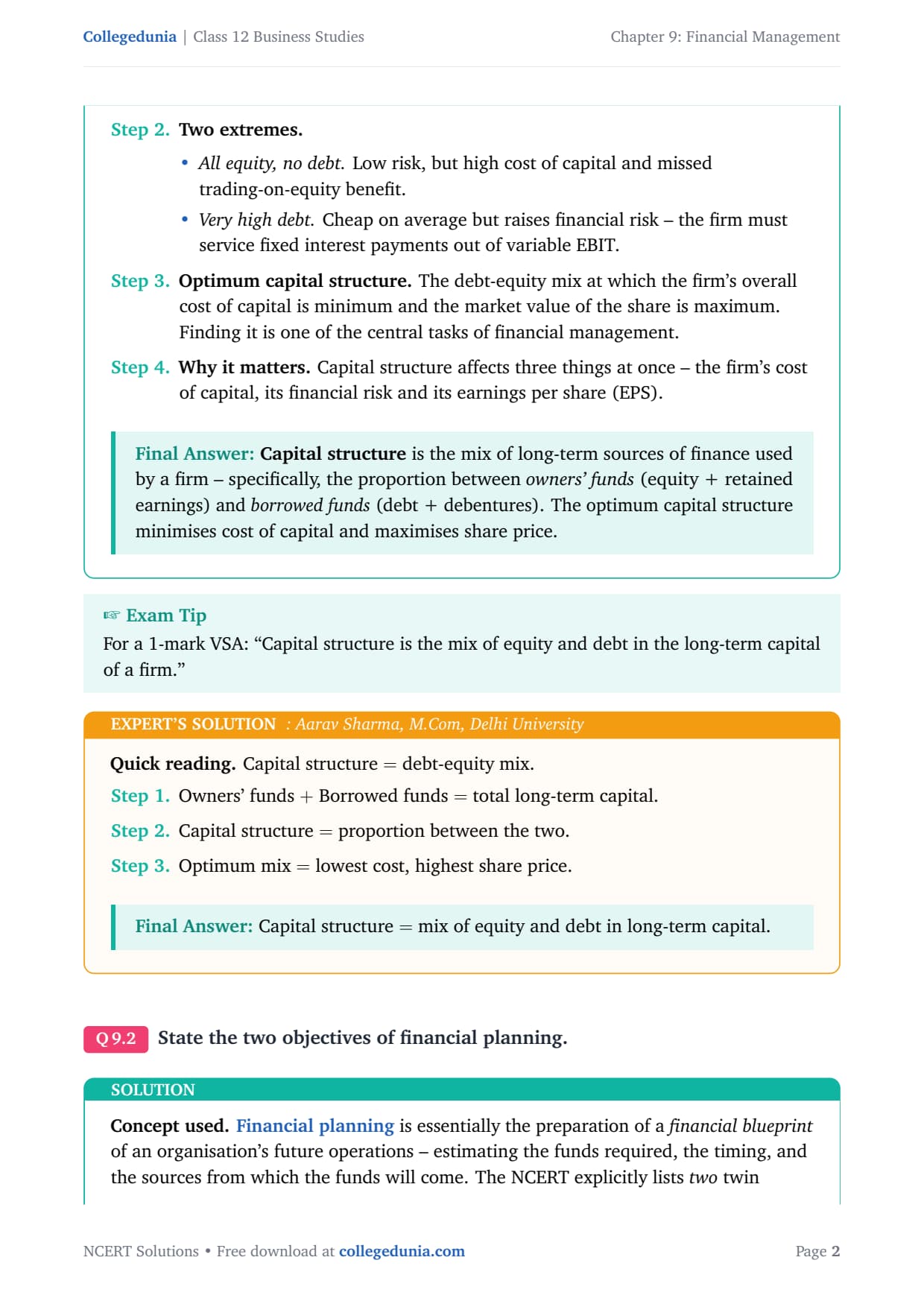
Concept used.Capital structure is the mix of long-term sources of
finance used by a firm. On the basis of ownership, business funds are classified into two
categories – owners' funds (equity, retained earnings) and borrowed funds (debt,
debentures, long-term loans). Capital structure refers to the proportion between these
two – the debt-equity mix.
Definition. Capital structure is the relative proportion of owners' funds
(equity + retained earnings) and borrowed funds (debt + debentures) in the total
long-term capital of the firm.
Two extremes.
All equity, no debt. Low risk, but high cost of capital and missed
trading-on-equity benefit.
Very high debt. Cheap on average but raises financial risk – the firm
must service fixed interest payments out of variable EBIT.
Optimum capital structure. The debt-equity mix at which the firm's overall
cost of capital is minimum and the market value of the share is maximum. Finding it is
one of the central tasks of financial management.
Why it matters. Capital structure affects three things at once – the
firm's cost of capital, its financial risk and its earnings per share (EPS).
Capital structure is the mix of long-term sources of finance used by a
firm – specifically, the proportion between owners' funds (equity + retained earnings)
and borrowed funds (debt + debentures). The optimum capital structure minimises cost of
capital and maximises share price.
AS
Aarav Sharma
M.Com, Delhi University
Verified Expert
Quick reading. Capital structure \(=\) debt-equity mix.
Owners' funds \(+\) Borrowed funds \(=\) total long-term capital.
Capital structure \(=\) proportion between the two.
Capital structure \(=\) mix of equity and debt in long-term capital.
Q 9.2
State the two objectives of financial planning.
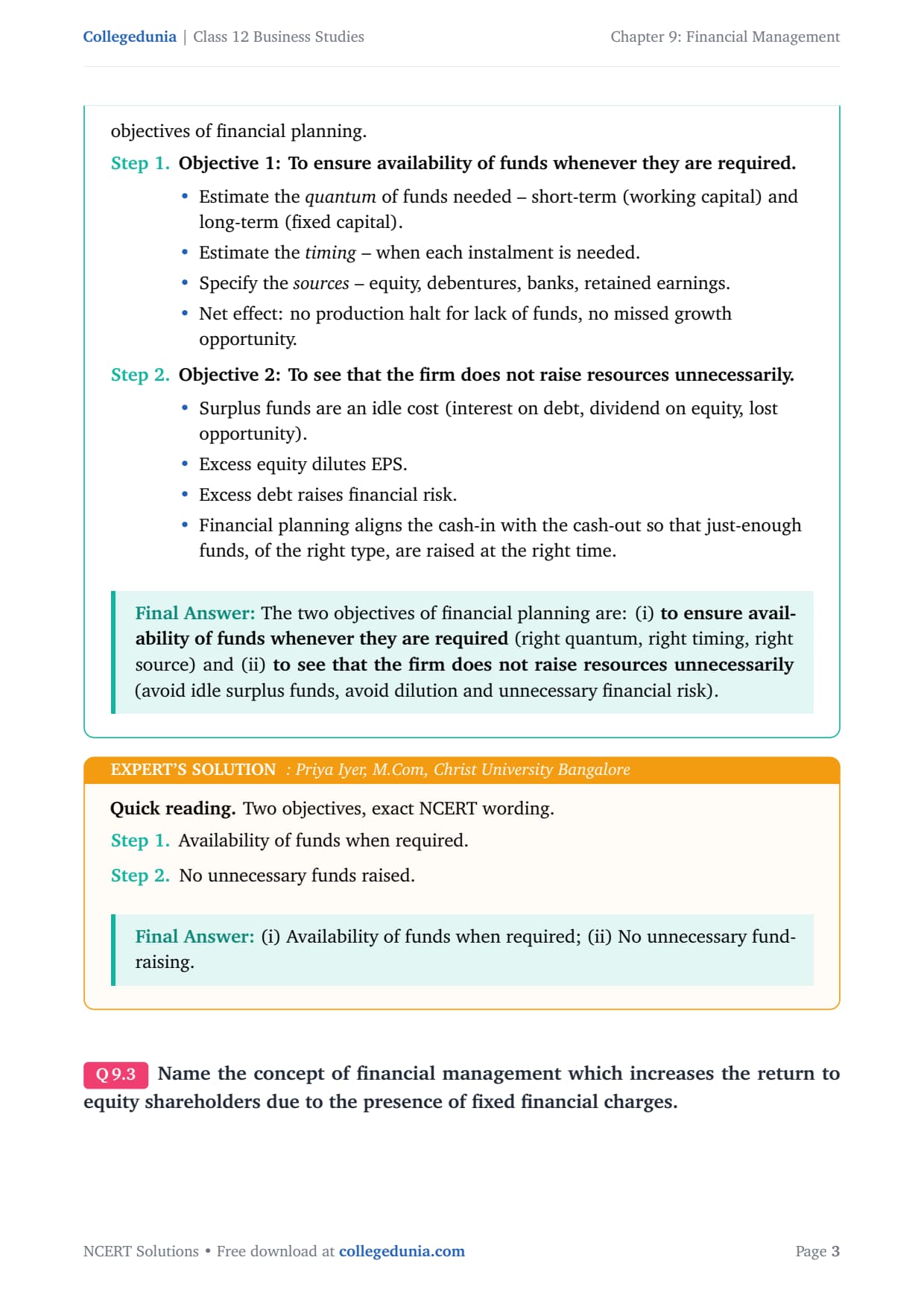
Concept used.Financial planning is essentially the preparation of a
financial blueprint of an organisation's future operations – estimating the funds
required, the timing, and the sources from which the funds will come. The NCERT explicitly lists
two twin objectives of financial planning.
Objective 1: To ensure availability of funds whenever they are required.
Estimate the quantum of funds needed – short-term (working capital) and
long-term (fixed capital).
Estimate the timing – when each instalment is needed.
Specify the sources – equity, debentures, banks, retained earnings.
Net effect: no production halt for lack of funds, no missed growth opportunity.
Objective 2: To see that the firm does not raise resources unnecessarily.
Surplus funds are an idle cost (interest on debt, dividend on equity, lost
opportunity).
Excess equity dilutes EPS.
Excess debt raises financial risk.
Financial planning aligns the cash-in with the cash-out so that just-enough
funds, of the right type, are raised at the right time.
The two objectives of financial planning are: (i) to ensure availability of
funds whenever they are required (right quantum, right timing, right source) and (ii)
to see that the firm does not raise resources unnecessarily (avoid idle surplus
funds, avoid dilution and unnecessary financial risk).
PI
Priya Iyer
M.Com, Christ University Bangalore
Verified Expert
Quick reading. Two objectives, exact NCERT wording.
Availability of funds when required.
No unnecessary funds raised.
(i) Availability of funds when required; (ii) No unnecessary fund-raising.
Q 9.3
Name the concept of financial management which increases the return to equity
shareholders due to the presence of fixed financial charges.
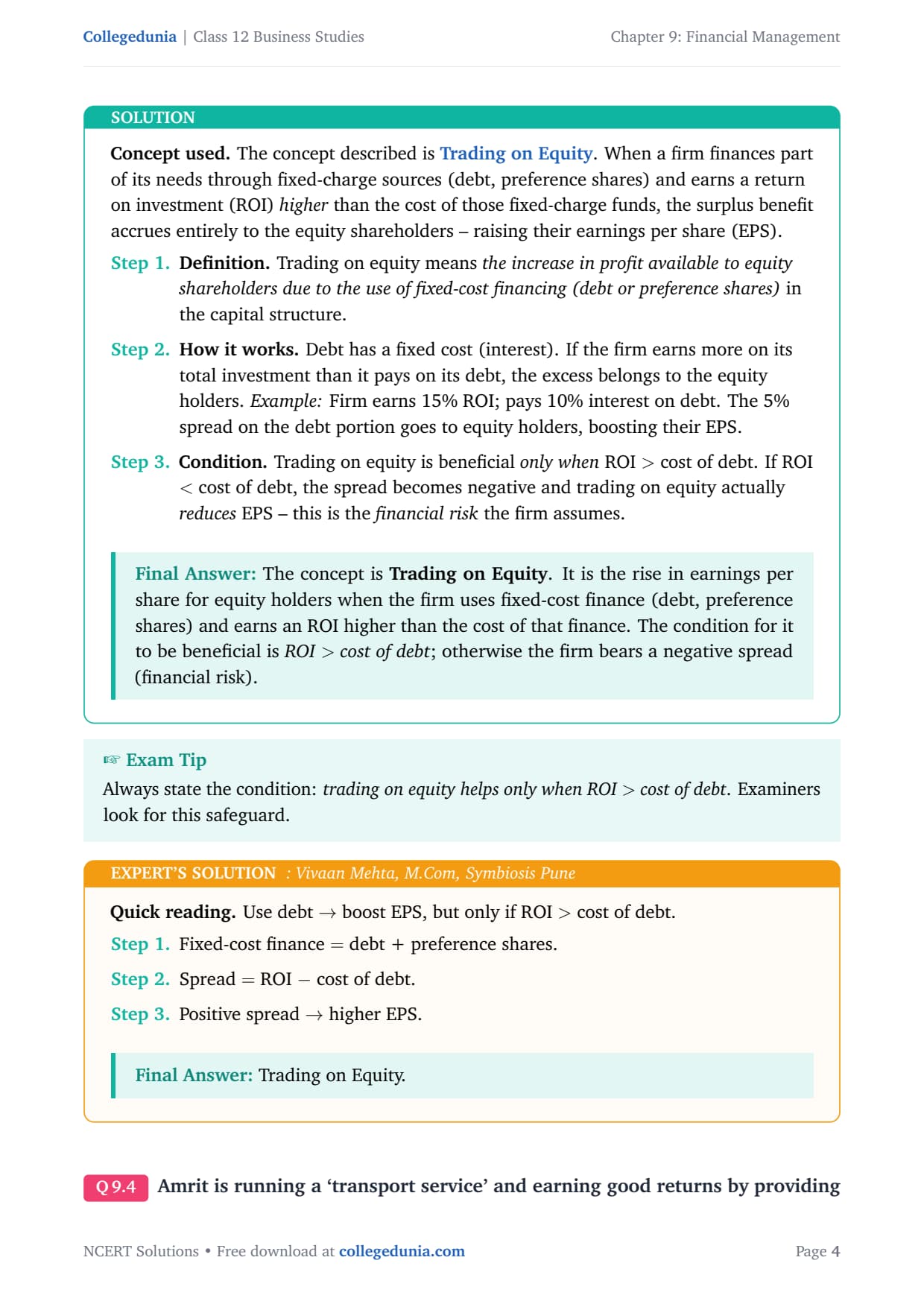
Concept used. The concept described is Trading on Equity. When a firm
finances part of its needs through fixed-charge sources (debt, preference shares) and earns a
return on investment (ROI) higher than the cost of those fixed-charge funds, the
surplus benefit accrues entirely to the equity shareholders – raising their earnings per
share (EPS).
Definition. Trading on equity means the increase in profit available to
equity shareholders due to the use of fixed-cost financing (debt or preference shares)
in the capital structure.
How it works. Debt has a fixed cost (interest). If the firm earns more on its
total investment than it pays on its debt, the excess belongs to the equity holders.
Example: Firm earns 15% ROI; pays 10% interest on debt. The 5% spread on the
debt portion goes to equity holders, boosting their EPS.
Condition. Trading on equity is beneficial only when ROI \(>\) cost of
debt. If ROI \(<\) cost of debt, the spread becomes negative and trading on equity
actually reduces EPS – this is the financial risk the firm assumes.
The concept is Trading on Equity. It is the rise in earnings per share for
equity holders when the firm uses fixed-cost finance (debt, preference shares) and earns an ROI
higher than the cost of that finance. The condition for it to be beneficial is
ROI \(>\) cost of debt; otherwise the firm bears a negative spread (financial risk).
VM
Vivaan Mehta
M.Com, Symbiosis Pune
Verified Expert
Quick reading. Use debt \(\to\) boost EPS, but only if ROI \(>\) cost of debt.
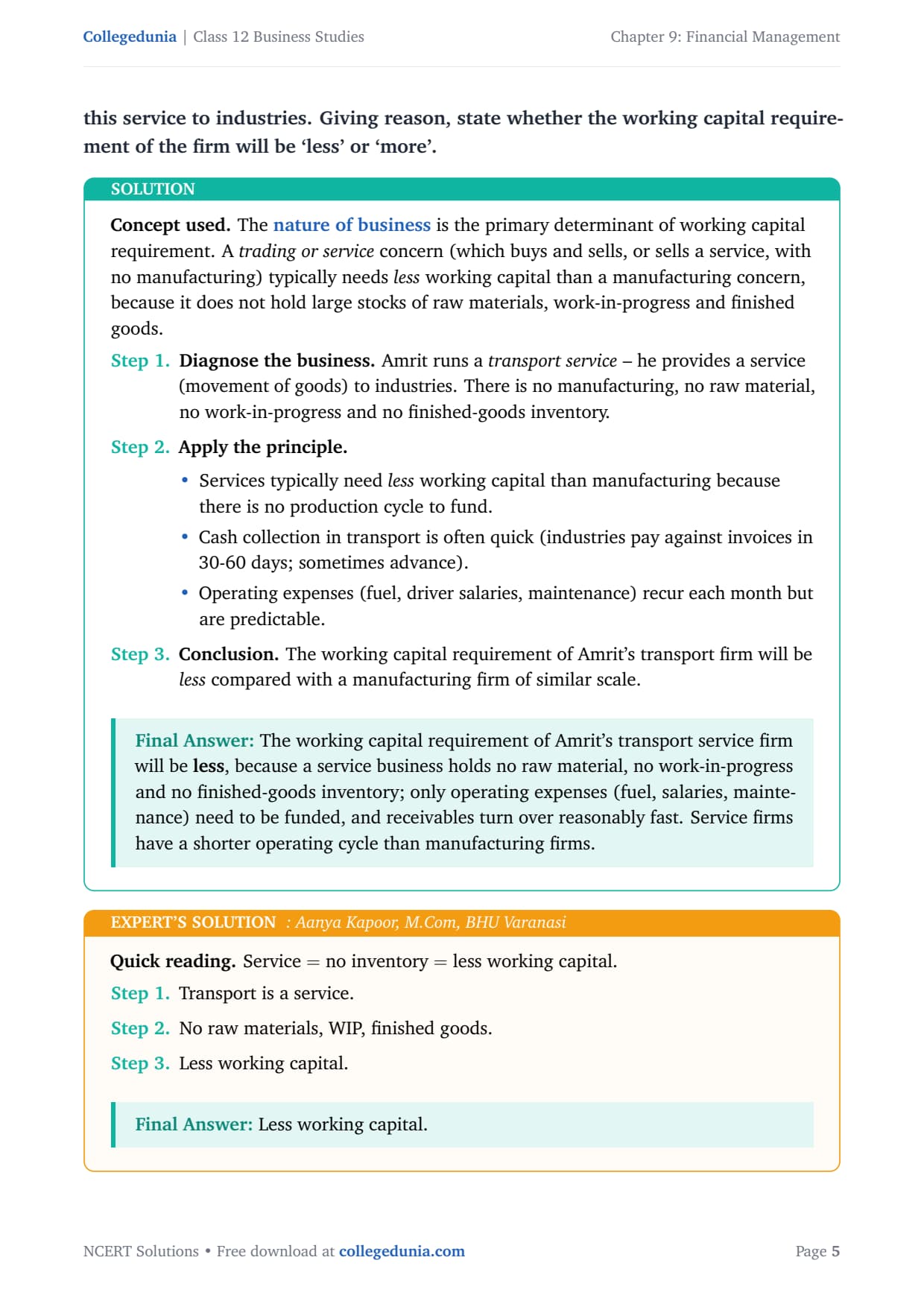
Amrit is running a `transport service' and earning good returns by providing this
service to industries. Giving reason, state whether the working capital requirement of the firm
will be `less' or `more'.
Concept used. The nature of business is the primary determinant of working
capital requirement. A trading or service concern (which buys and sells, or sells a
service, with no manufacturing) typically needs less working capital than a manufacturing
concern, because it does not hold large stocks of raw materials, work-in-progress and finished
goods.
Diagnose the business. Amrit runs a transport service – he provides
a service (movement of goods) to industries. There is no manufacturing, no raw
material, no work-in-progress and no finished-goods inventory.
Apply the principle.
Services typically need less working capital than manufacturing because
there is no production cycle to fund.
Cash collection in transport is often quick (industries pay against invoices
in 30-60 days; sometimes advance).
Operating expenses (fuel, driver salaries, maintenance) recur each month but
are predictable.
Conclusion. The working capital requirement of Amrit's transport firm will be
less compared with a manufacturing firm of similar scale.
The working capital requirement of Amrit's transport service firm will be
less, because a service business holds no raw material, no work-in-progress and no
finished-goods inventory; only operating expenses (fuel, salaries, maintenance) need to be
funded, and receivables turn over reasonably fast. Service firms have a shorter operating
cycle than manufacturing firms.
AK
Aanya Kapoor
M.Com, BHU Varanasi
Verified Expert
Quick reading. Service \(=\) no inventory \(=\) less working capital.
Transport is a service.
No raw materials, WIP, finished goods.
Less working capital.
Less working capital.
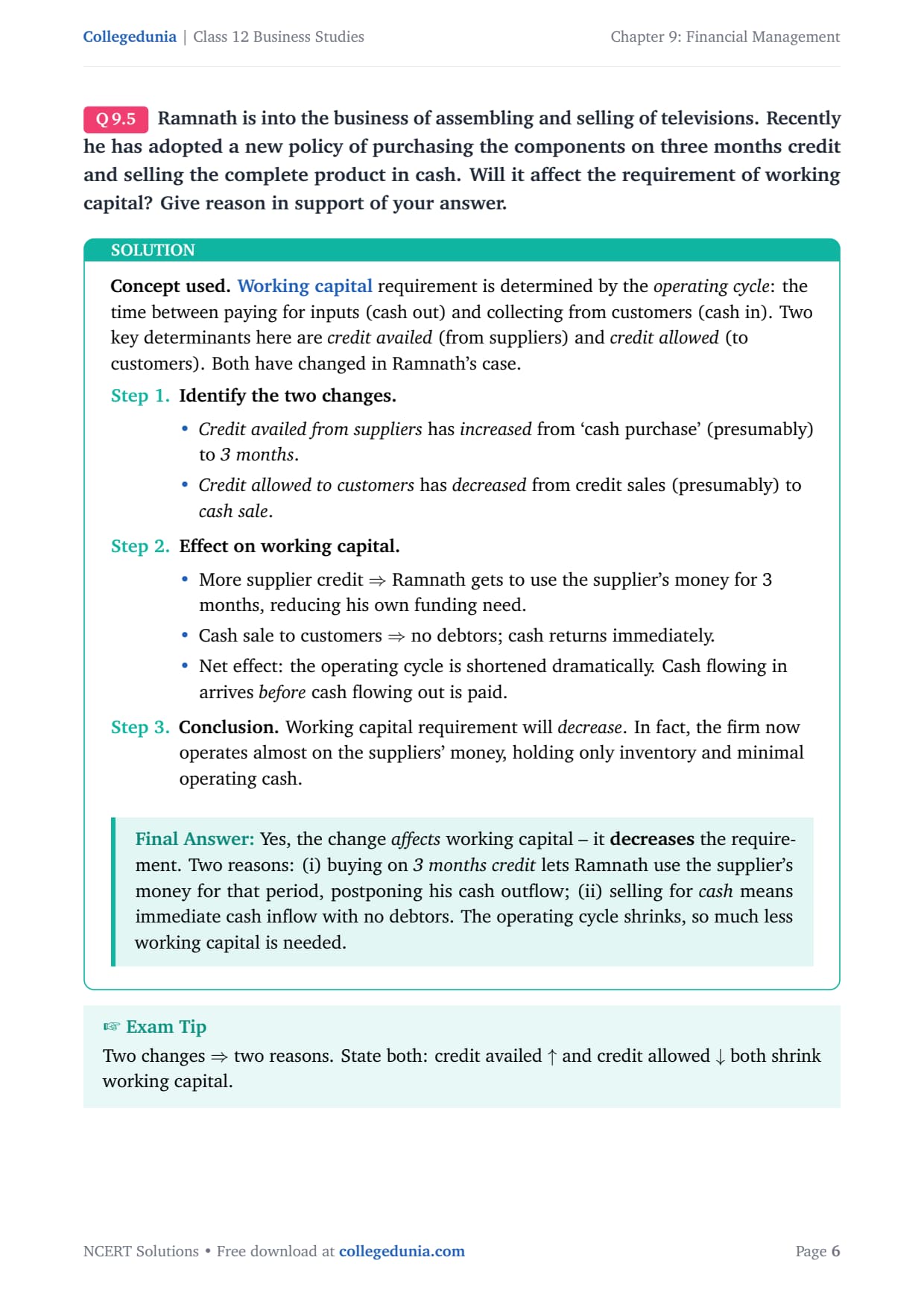
Q 9.5
Ramnath is into the business of assembling and selling of televisions. Recently he
has adopted a new policy of purchasing the components on three months credit and selling the
complete product in cash. Will it affect the requirement of working capital? Give reason in
support of your answer.
Concept used.Working capital requirement is determined by the
operating cycle: the time between paying for inputs (cash out) and collecting from
customers (cash in). Two key determinants here are credit availed (from suppliers) and
credit allowed (to customers). Both have changed in Ramnath's case.
Identify the two changes.
Credit availed from suppliers has increased from `cash purchase'
(presumably) to 3 months.
Credit allowed to customers has decreased from credit sales
(presumably) to cash sale.
Effect on working capital.
More supplier credit \(\Rightarrow\) Ramnath gets to use the supplier's money for
3 months, reducing his own funding need.
Cash sale to customers \(\Rightarrow\) no debtors; cash returns immediately.
Net effect: the operating cycle is shortened dramatically. Cash flowing in
arrives before cash flowing out is paid.
Conclusion. Working capital requirement will decrease. In fact, the
firm now operates almost on the suppliers' money, holding only inventory and minimal
operating cash.
Yes, the change affects working capital – it decreases the
requirement. Two reasons:
(i) buying on 3 months credit lets Ramnath use the supplier's money for that period,
postponing his cash outflow;
(ii) selling for cash means immediate cash inflow with no debtors. The operating cycle
shrinks, so much less working capital is needed.
KJ
Karan Joshi
M.Com, BHU Varanasi
Verified Expert
Quick reading. Pay later (suppliers) + collect now (customers) \(\Rightarrow\) shorter
cycle \(\Rightarrow\) less working capital.
Credit availed \(\uparrow\): less cash out today.
Credit allowed \(\downarrow\): cash in today.
Cycle shrinks; WC need falls.
Working capital requirement decreases.
Short Answer Type Questions
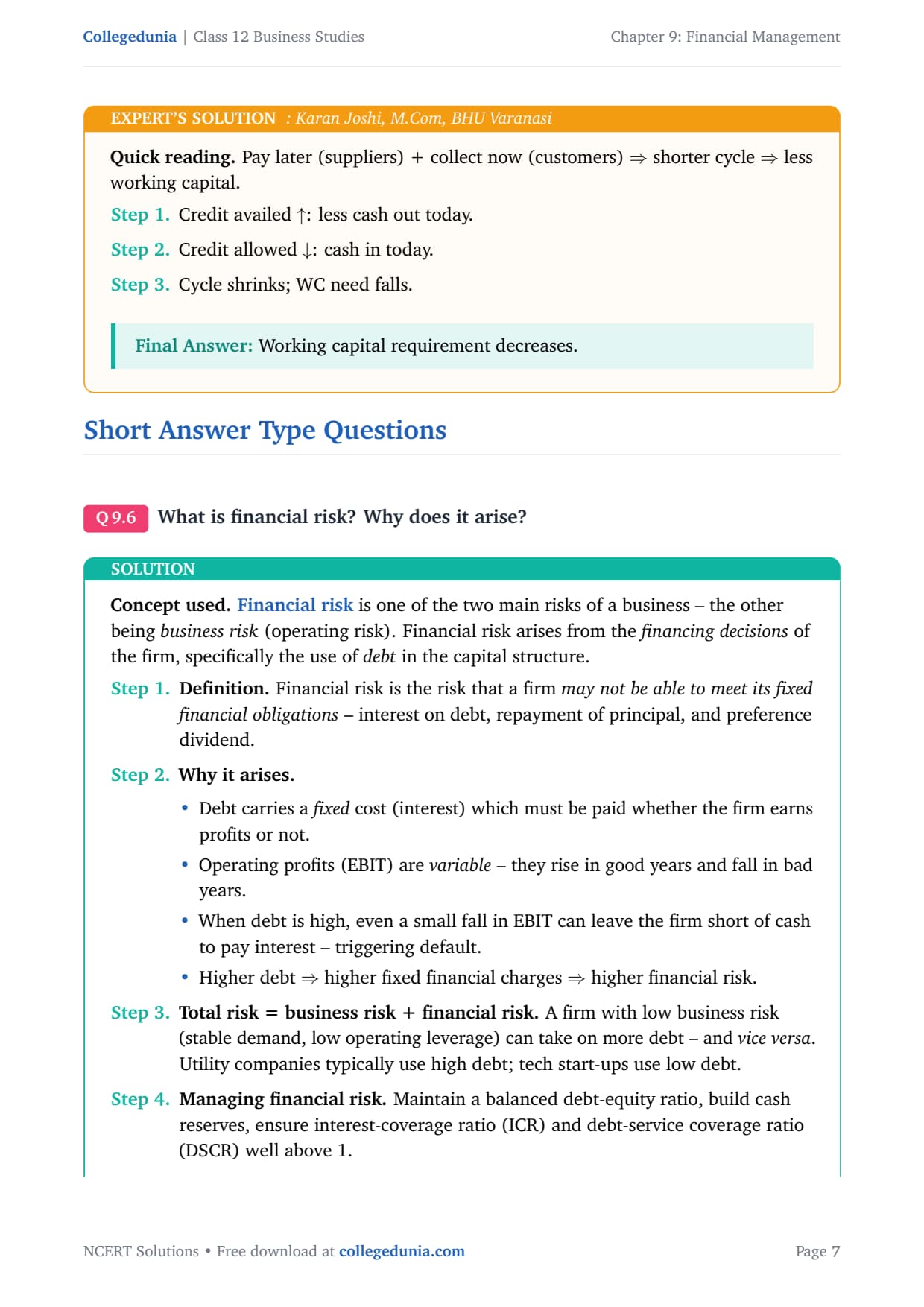
Q 9.6
What is financial risk? Why does it arise?
Concept used.Financial risk is one of the two main risks of a business – the
other being business risk (operating risk). Financial risk arises from the
financing decisions of the firm, specifically the use of debt in the capital
structure.
Definition. Financial risk is the risk that a firm may not be able to
meet its fixed financial obligations – interest on debt, repayment of principal, and
preference dividend.
Why it arises.
Debt carries a fixed cost (interest) which must be paid whether the firm
earns profits or not.
Operating profits (EBIT) are variable – they rise in good years and
fall in bad years.
When debt is high, even a small fall in EBIT can leave the firm short of cash
to pay interest – triggering default.
Total risk = business risk + financial risk. A firm with low business risk
(stable demand, low operating leverage) can take on more debt – and vice versa.
Utility companies typically use high debt; tech start-ups use low debt.
Managing financial risk. Maintain a balanced debt-equity ratio, build cash
reserves, ensure interest-coverage ratio (ICR) and debt-service coverage ratio (DSCR)
well above 1.
Financial risk is the risk that the firm may fail to meet its fixed
financial obligations – interest, principal repayment and preference dividend. It arises
because debt carries fixed charges, while operating profit (EBIT) is variable; in a bad year
the firm may not have enough EBIT to service its debt. The greater the proportion of debt in
the capital structure, the higher the financial risk.
Definition: risk of not meeting fixed financial obligations.
Cause: debt has fixed cost; EBIT is variable.
More debt \(\Rightarrow\) more financial risk.
Financial risk \(=\) risk of failing to meet fixed financial charges. Arises from use of
debt in the capital structure.
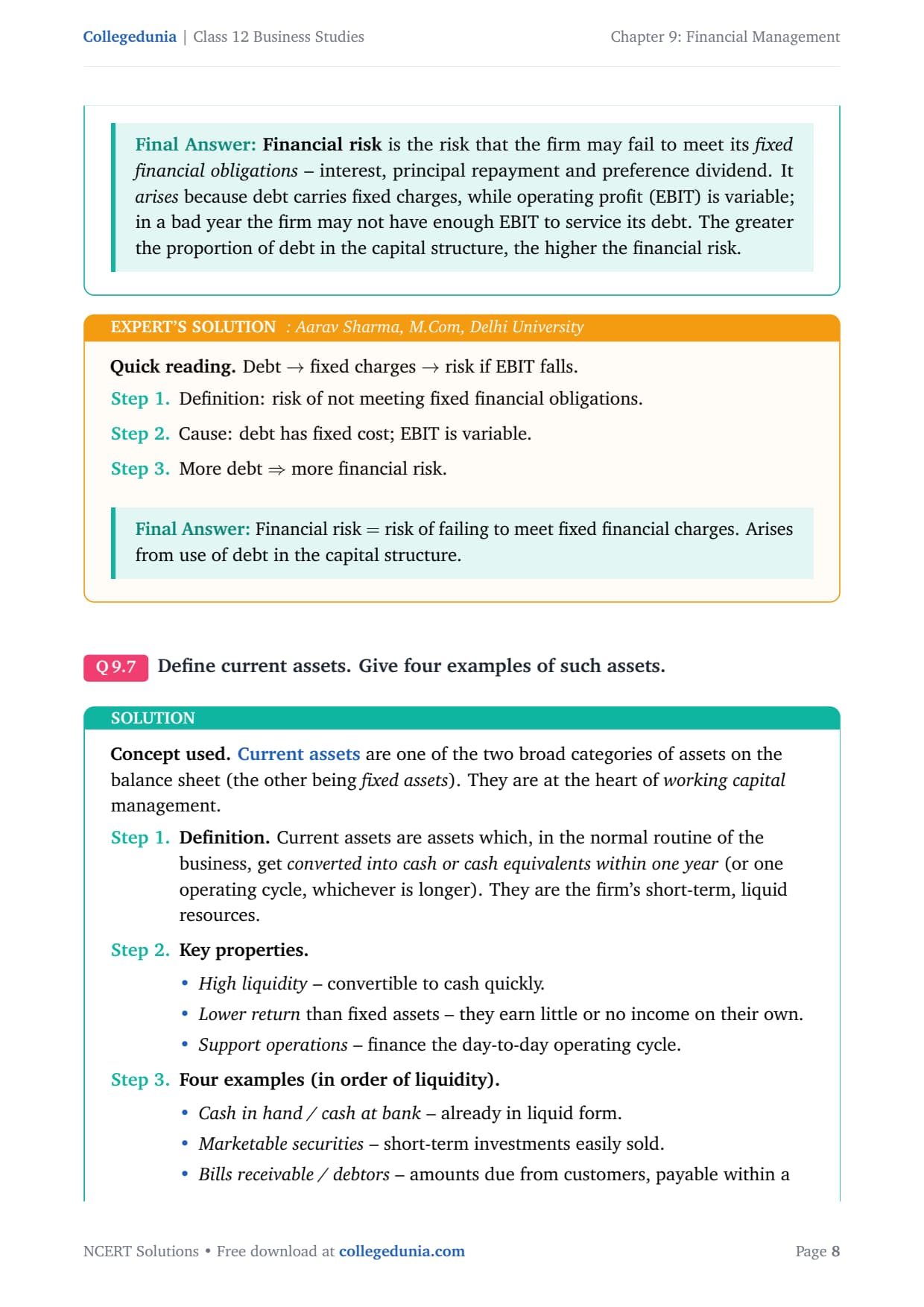
Q 9.7
Define current assets. Give four examples of such assets.
Concept used.Current assets are one of the two broad categories of assets
on the balance sheet (the other being fixed assets). They are at the heart of
working capital management.
Definition. Current assets are assets which, in the normal routine of the
business, get converted into cash or cash equivalents within one year (or one
operating cycle, whichever is longer). They are the firm's short-term, liquid
resources.
Key properties.
High liquidity – convertible to cash quickly.
Lower return than fixed assets – they earn little or no income on their
own.
Support operations – finance the day-to-day operating cycle.
Four examples (in order of liquidity).
Cash in hand / cash at bank – already in liquid form.
Bills receivable / debtors – amounts due from customers, payable
within a year.
Inventories – raw materials, work-in-progress, finished goods.
Prepaid expenses – expenses paid in advance (rent, insurance).
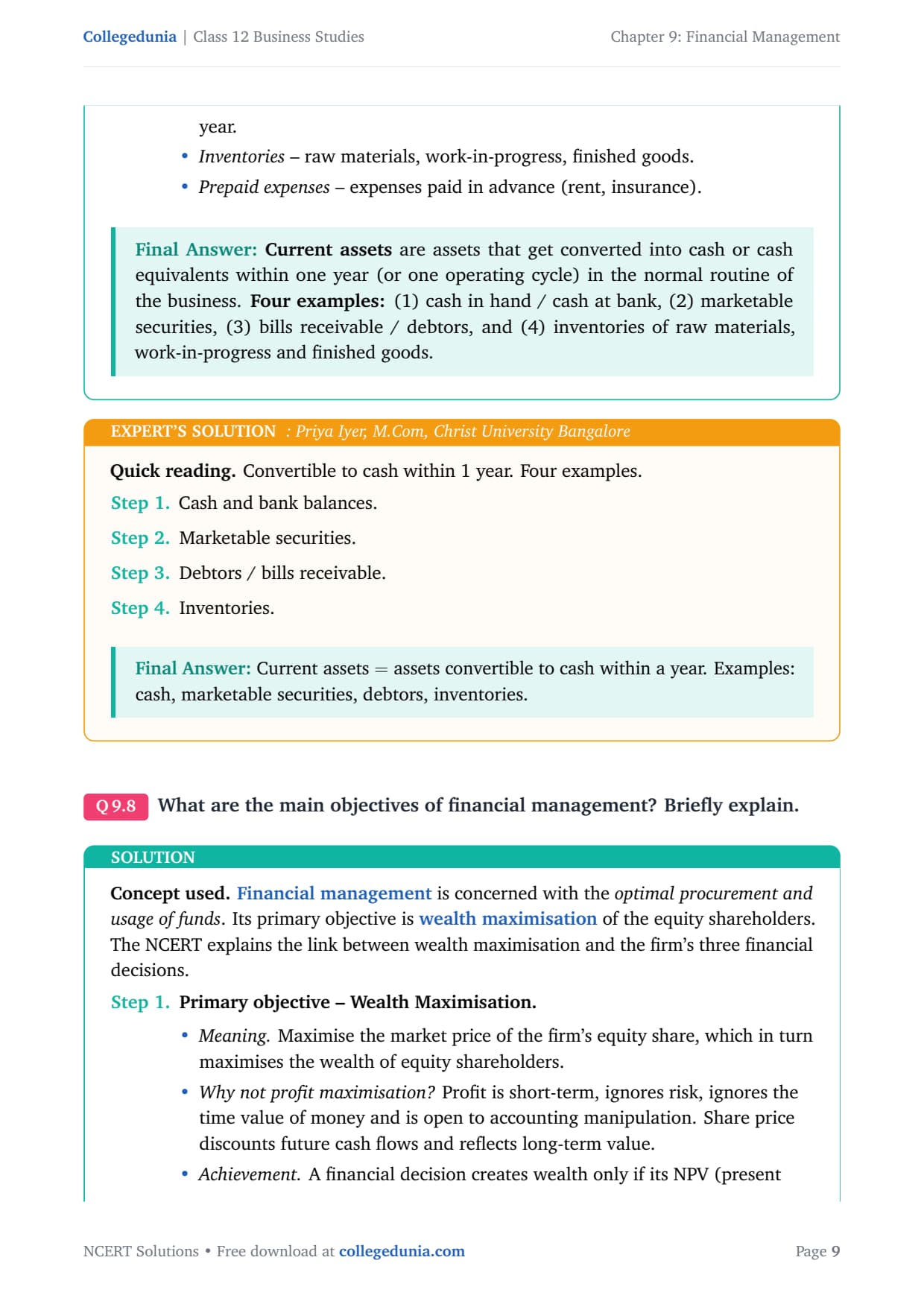
Current assets are assets that get converted into cash or cash equivalents
within one year (or one operating cycle) in the normal routine of the business. Four
examples: (1) cash in hand / cash at bank, (2) marketable securities, (3) bills receivable /
debtors, and (4) inventories of raw materials, work-in-progress and finished goods.
PI
Priya Iyer
M.Com, Christ University Bangalore
Verified Expert
Quick reading. Convertible to cash within 1 year. Four examples.
Cash and bank balances.
Marketable securities.
Debtors / bills receivable.
Inventories.
Current assets \(=\) assets convertible to cash within a year. Examples: cash,
marketable securities, debtors, inventories.
Q 9.8
What are the main objectives of financial management? Briefly explain.
Concept used.Financial management is concerned with the optimal
procurement and usage of funds. Its primary objective is wealth maximisation of the
equity shareholders. The NCERT explains the link between wealth maximisation and the firm's
three financial decisions.
Primary objective – Wealth Maximisation.
Meaning. Maximise the market price of the firm's equity share, which
in turn maximises the wealth of equity shareholders.
Why not profit maximisation? Profit is short-term, ignores risk, ignores
the time value of money and is open to accounting manipulation. Share price
discounts future cash flows and reflects long-term value.
Achievement. A financial decision creates wealth only if its NPV
(present value of future cash inflows minus present value of outflows) is
positive at the firm's cost of capital.
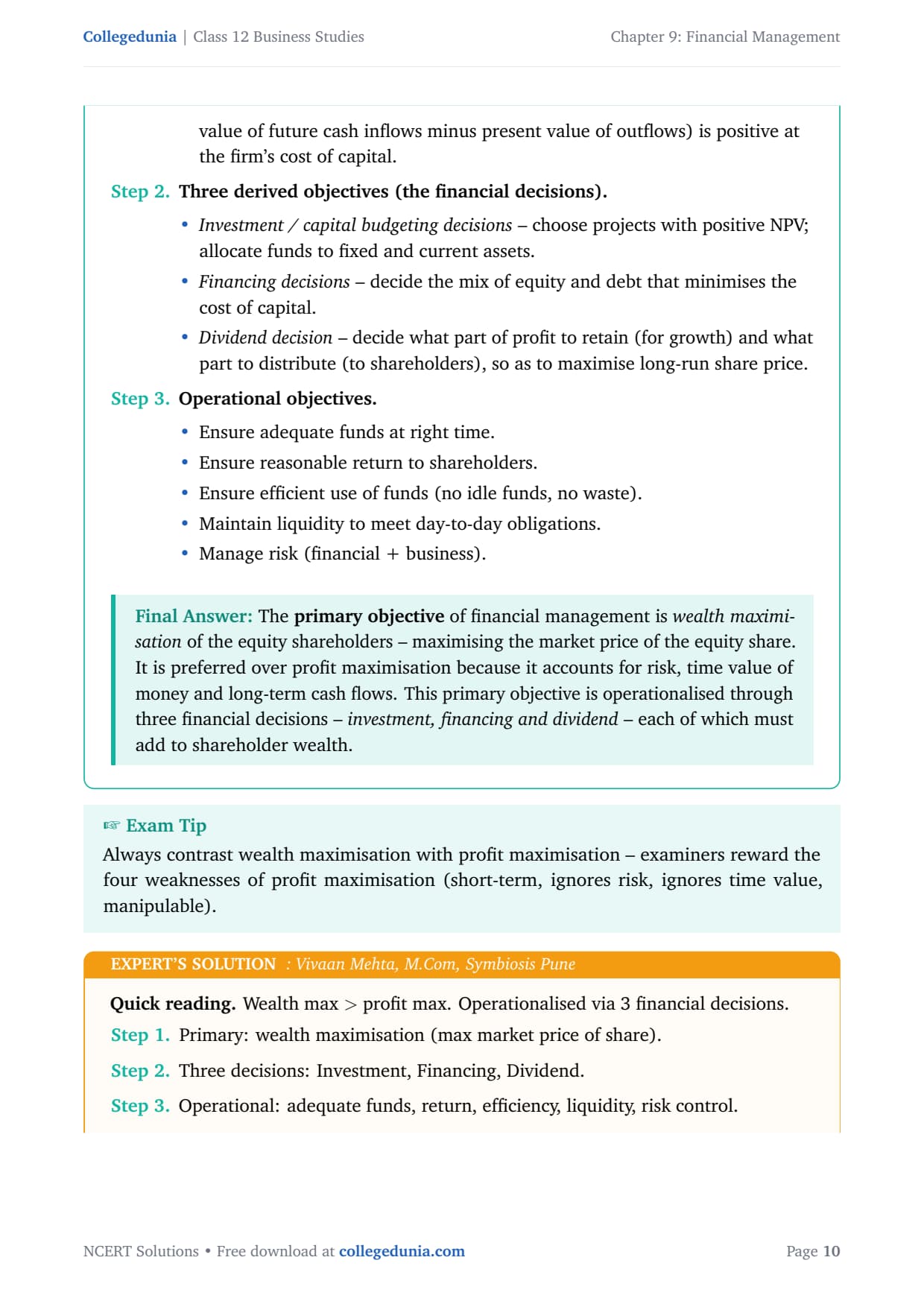
Three derived objectives (the financial decisions).
Investment / capital budgeting decisions – choose projects with
positive NPV; allocate funds to fixed and current assets.
Financing decisions – decide the mix of equity and debt that
minimises the cost of capital.
Dividend decision – decide what part of profit to retain (for growth)
and what part to distribute (to shareholders), so as to maximise long-run
share price.
Operational objectives.
Ensure adequate funds at right time.
Ensure reasonable return to shareholders.
Ensure efficient use of funds (no idle funds, no waste).
Maintain liquidity to meet day-to-day obligations.
Manage risk (financial + business).
The primary objective of financial management is wealth maximisation
of the equity shareholders – maximising the market price of the equity share. It is preferred
over profit maximisation because it accounts for risk, time value of money and long-term cash
flows. This primary objective is operationalised through three financial decisions –
investment, financing and dividend – each of which must add to shareholder wealth.
VM
Vivaan Mehta
M.Com, Symbiosis Pune
Verified Expert
Quick reading. Wealth max \(>\) profit max. Operationalised via 3 financial decisions.
Primary: wealth maximisation (max market price of share).
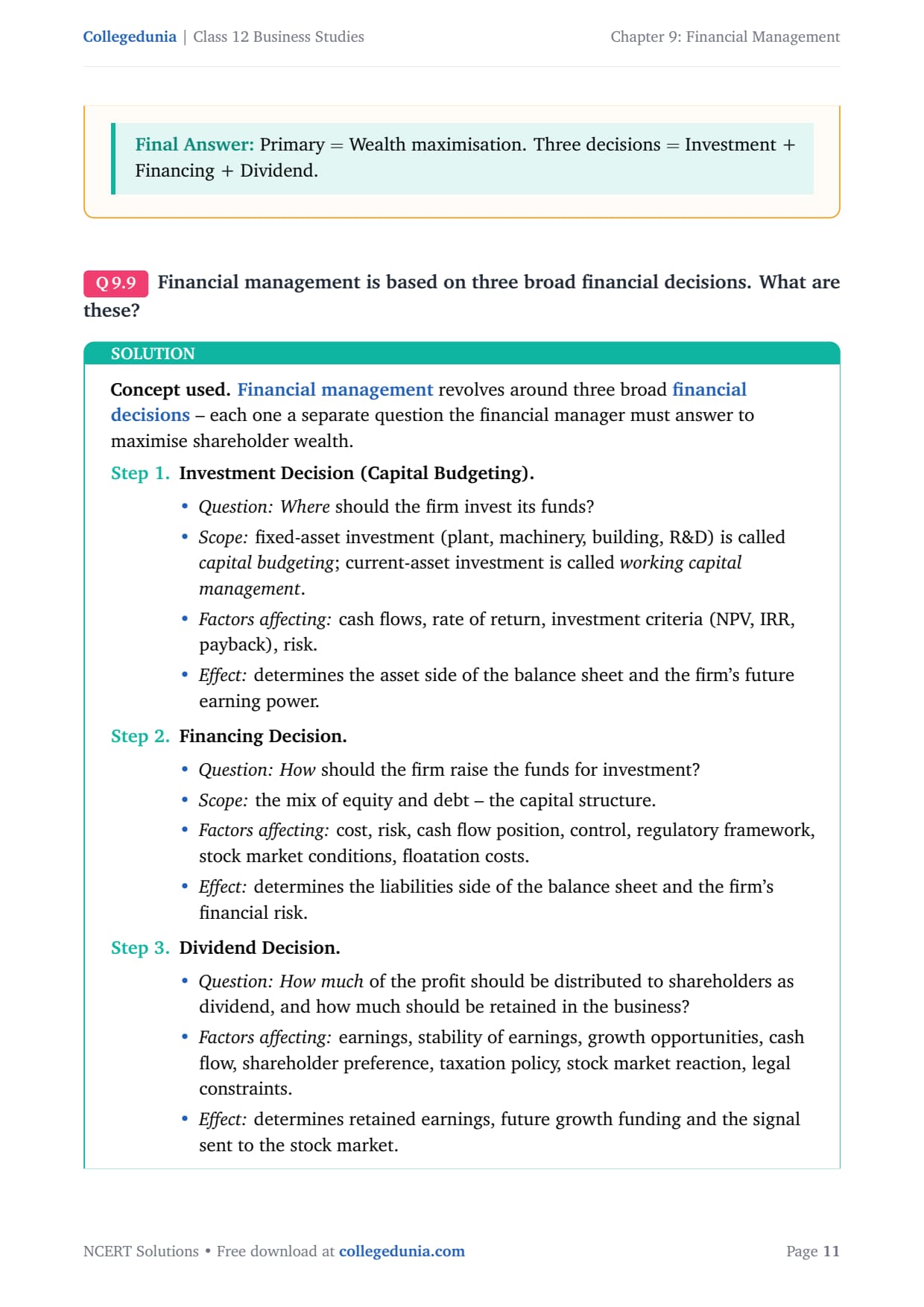
Financial management is based on three broad financial decisions. What are these?
Concept used.Financial management revolves around three broad
financial decisions – each one a separate question the financial manager must
answer to maximise shareholder wealth.
Investment Decision (Capital Budgeting).
Question:Where should the firm invest its funds?
Scope: fixed-asset investment (plant, machinery, building, R&D) is
called capital budgeting; current-asset investment is called
working capital management.
Effect: determines retained earnings, future growth funding and the
signal sent to the stock market.
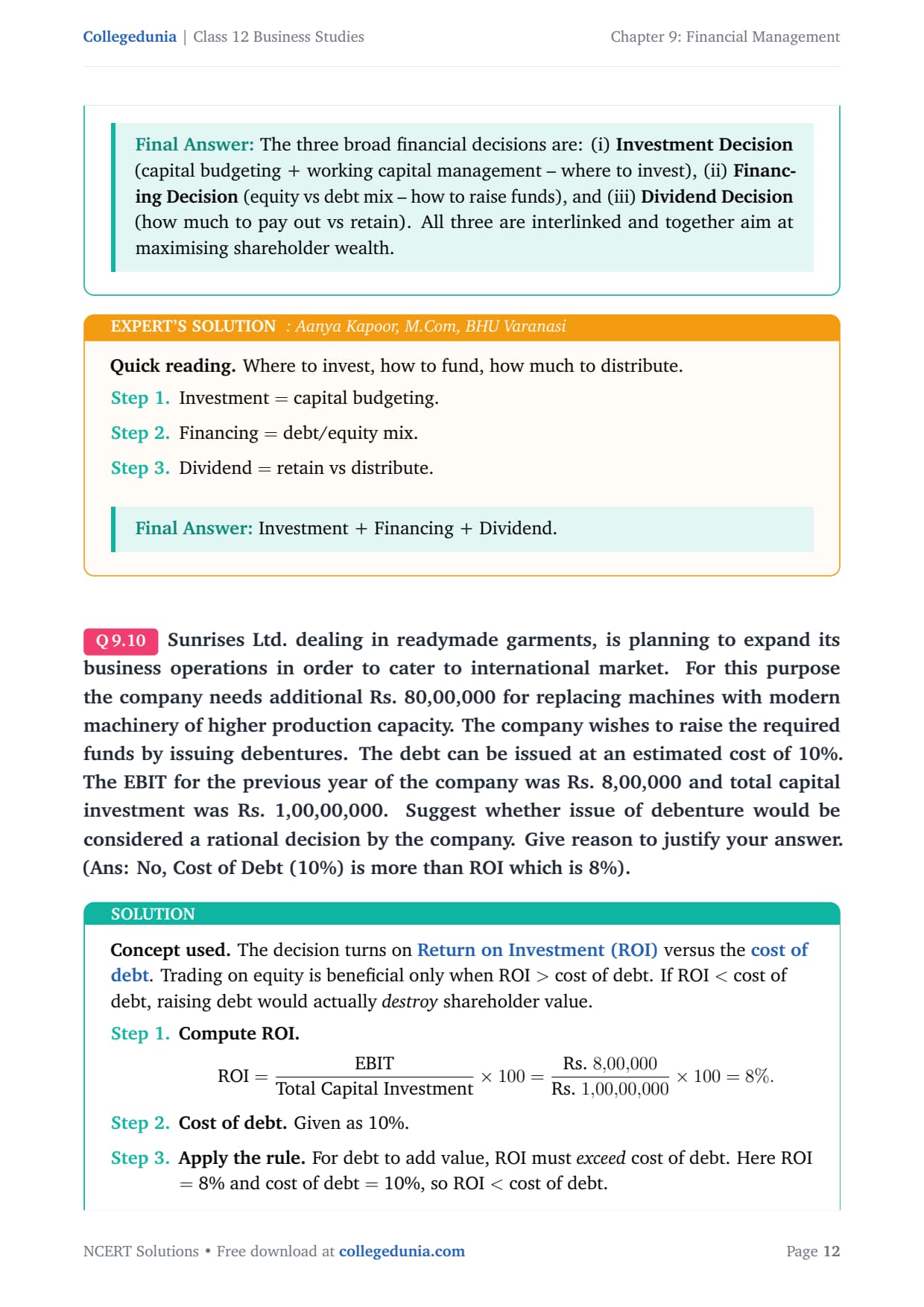
The three broad financial decisions are: (i) Investment Decision (capital
budgeting + working capital management – where to invest), (ii) Financing Decision
(equity vs debt mix – how to raise funds), and (iii) Dividend Decision (how much to
pay out vs retain). All three are interlinked and together aim at maximising shareholder
wealth.
AK
Aanya Kapoor
M.Com, BHU Varanasi
Verified Expert
Quick reading. Where to invest, how to fund, how much to distribute.
Investment \(=\) capital budgeting.
Financing \(=\) debt/equity mix.
Dividend \(=\) retain vs distribute.
Investment + Financing + Dividend.
Q 9.10
Sunrises Ltd. dealing in readymade garments, is planning to expand its business
operations in order to cater to international market. For this purpose the company needs
additional Rs. 80,00,000 for replacing machines with modern machinery of higher production
capacity. The company wishes to raise the required funds by issuing debentures. The debt can be
issued at an estimated cost of 10%. The EBIT for the previous year of the company was
Rs. 8,00,000 and total capital investment was Rs. 1,00,00,000. Suggest whether issue of
debenture would be considered a rational decision by the company. Give reason to justify your
answer. (Ans: No, Cost of Debt (10%) is more than ROI which is 8%).
Concept used. The decision turns on Return on Investment (ROI) versus the
cost of debt. Trading on equity is beneficial only when ROI \(>\) cost of debt. If ROI
\(<\) cost of debt, raising debt would actually destroy shareholder value.
Apply the rule. For debt to add value, ROI must exceed cost of debt.
Here ROI \(=\) 8% and cost of debt \(=\) 10%, so ROI \(<\) cost of debt.
Consequence of issuing debt.
Every Rs. 100 of debt earns only Rs. 8 of EBIT but costs Rs. 10 of interest.
Net effect \(=\) a loss of Rs. 2 per Rs. 100 of debt, paid out of the existing
equity holders' profits.
EPS of equity holders will fall, not rise.
Financial risk will also rise – the firm has taken on fixed interest
obligations.
Recommendation. The company should not raise the Rs. 80 lakh through
debentures.
Better alternatives: raise funds through equity (rights issue / fresh
equity), retained earnings (if available), or a smaller debt issue once
the new machines start improving ROI.
If debt must be used, negotiate a lower interest rate or wait until projected
ROI on the expansion exceeds 10%.
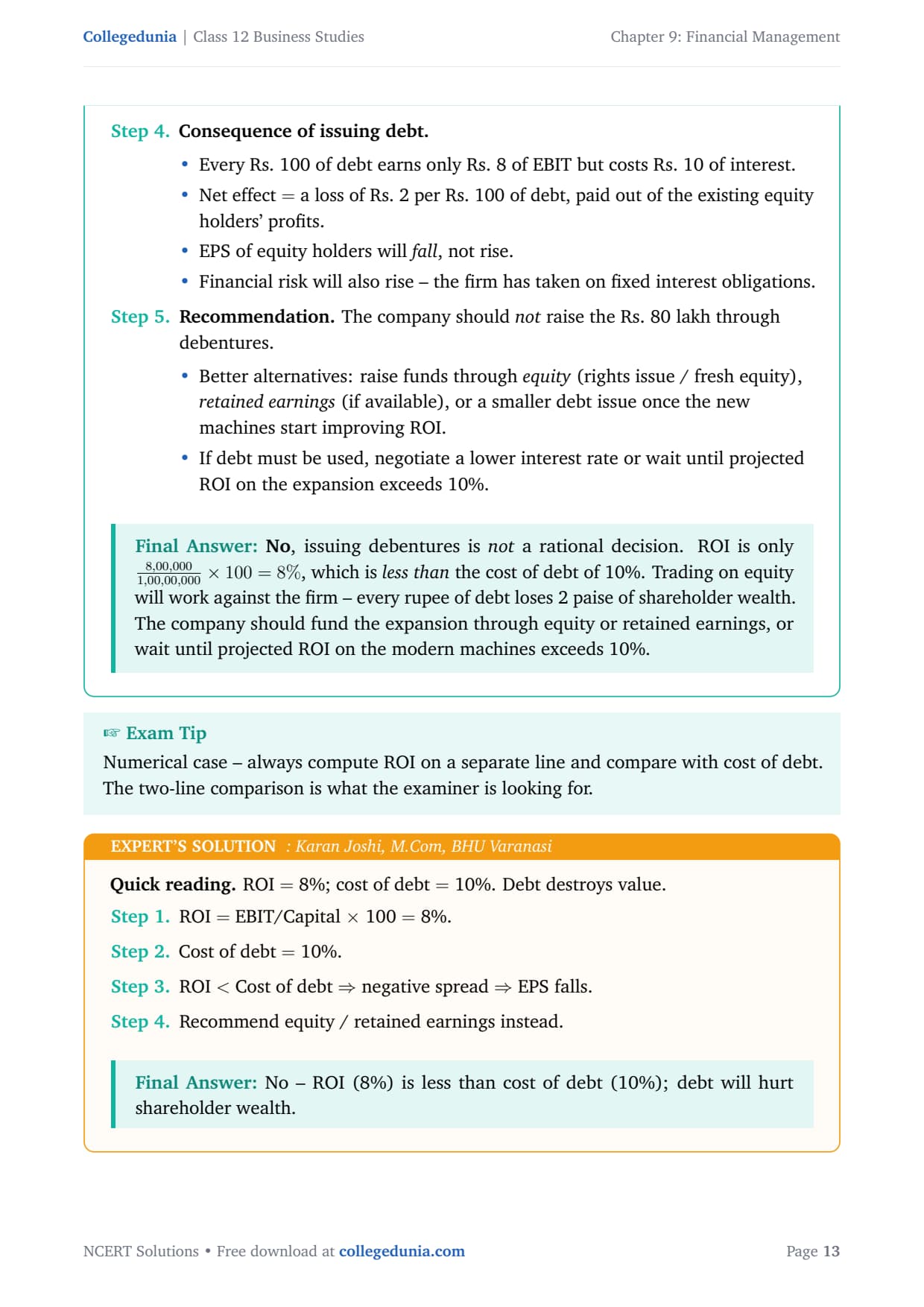
No, issuing debentures is not a rational decision. ROI is only
\(\frac{8{,}00{,}000}{1{,}00{,}00{,}000} \times 100 = 8\%\), which is less than the cost
of debt of 10%. Trading on equity will work against the firm – every rupee of debt loses 2
paise of shareholder wealth. The company should fund the expansion through equity or retained
earnings, or wait until projected ROI on the modern machines exceeds 10%.
KJ
Karan Joshi
M.Com, BHU Varanasi
Verified Expert
Quick reading. ROI \(=\) 8%; cost of debt \(=\) 10%. Debt destroys value.
ROI \(=\) EBIT/Capital \(\times\) 100 \(=\) 8%.
Cost of debt \(=\) 10%.
ROI \(<\) Cost of debt \(\Rightarrow\) negative spread \(\Rightarrow\) EPS falls.
Recommend equity / retained earnings instead.
No – ROI (8%) is less than cost of debt (10%); debt will hurt shareholder wealth.
Q 9.11
How does working capital affect both the liquidity as well as profitability of a
business?
Concept used.Working capital is the lifeblood of the business – it funds
the day-to-day operating cycle. Working capital affects two seemingly competing things:
liquidity (ability to pay short-term obligations) and profitability (return on
total investment). The trade-off between the two is one of the central tensions in financial
management.
Net Working Capital (NWC).
\[
\text{NWC} = \text{Current Assets} - \text{Current Liabilities}.
\]
Effect on Liquidity.
Higher working capital \(\Rightarrow\) more cash, more inventory, more
debtors \(\Rightarrow\) the firm can pay its bills, salaries and suppliers on
time. Higher liquidity.
Lower working capital \(\Rightarrow\) risk of running out of cash, missing
payments, losing supplier credit and customer trust. Lower liquidity.
Effect on Profitability.
Higher working capital (especially excess inventory and excess debtors)
\(\Rightarrow\) funds blocked in low-return current assets \(\Rightarrow\) the
same money would have earned more in fixed assets or paying down debt
\(\Rightarrow\) lower profitability.
Lower working capital \(\Rightarrow\) more money in productive
investments \(\Rightarrow\) higher return on investment.
The trade-off. Liquidity and profitability move in opposite directions with
working capital level.
Too much WC \(\Rightarrow\) high liquidity, low profitability.
Too little WC \(\Rightarrow\) high profitability on paper, but
risk of liquidity crisis that can stop production altogether.
The financial manager seeks the optimum WC level that keeps liquidity
just adequate and profitability as high as possible.
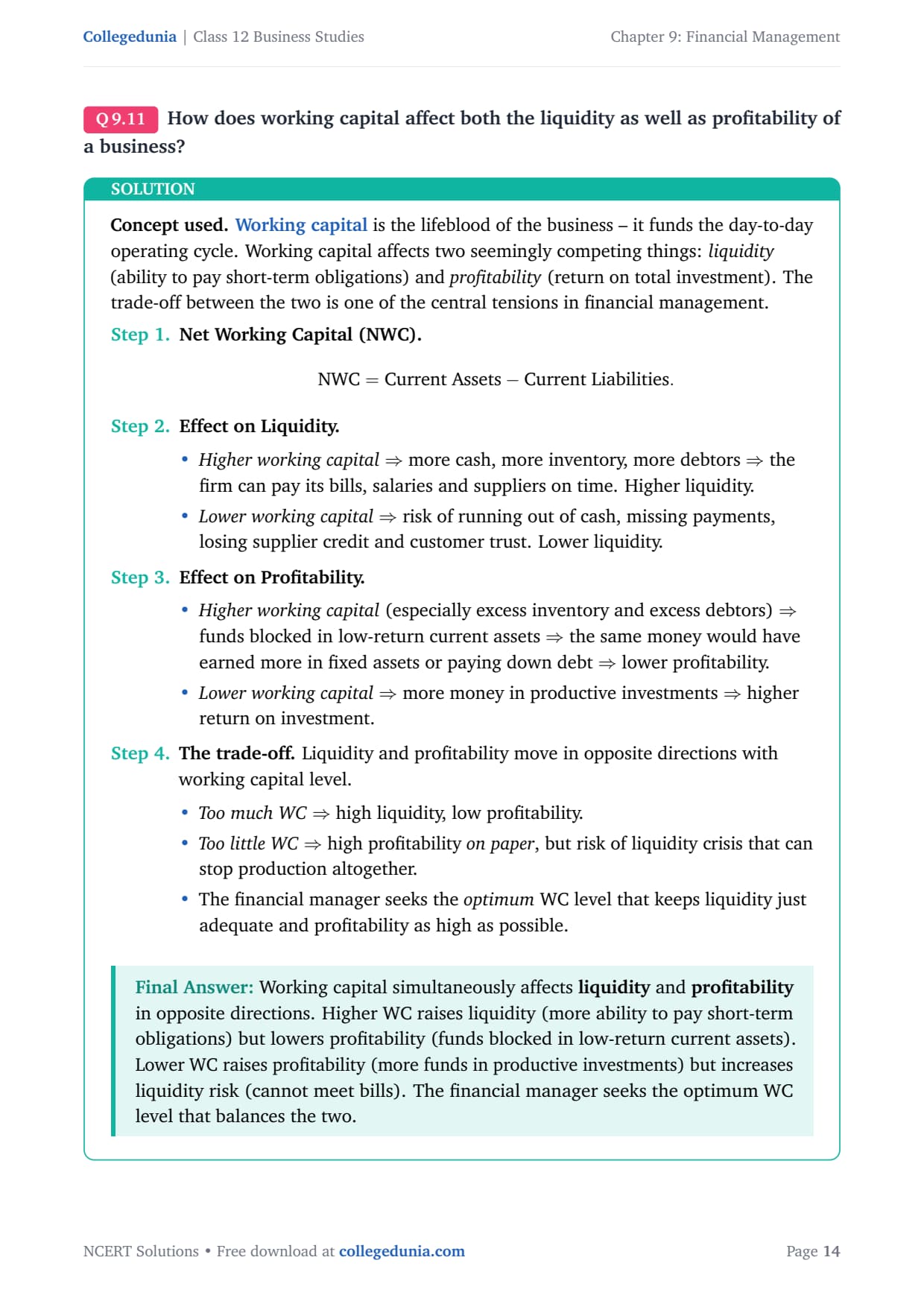
Working capital simultaneously affects liquidity and profitability
in opposite directions. Higher WC raises liquidity (more ability to pay short-term obligations)
but lowers profitability (funds blocked in low-return current assets). Lower WC raises
profitability (more funds in productive investments) but increases liquidity risk (cannot meet
bills). The financial manager seeks the optimum WC level that balances the two.
AS
Aarav Sharma
M.Com, Delhi University
Verified Expert
Quick reading. More WC \(\Rightarrow\) safer but less profitable; less WC \(\Rightarrow\)
profitable but risky.
NWC \(=\) CA \(-\) CL.
More WC \(\to\) liquidity \(\uparrow\), profitability \(\downarrow\).
Less WC \(\to\) liquidity \(\downarrow\), profitability \(\uparrow\).
Optimum \(=\) balance both.
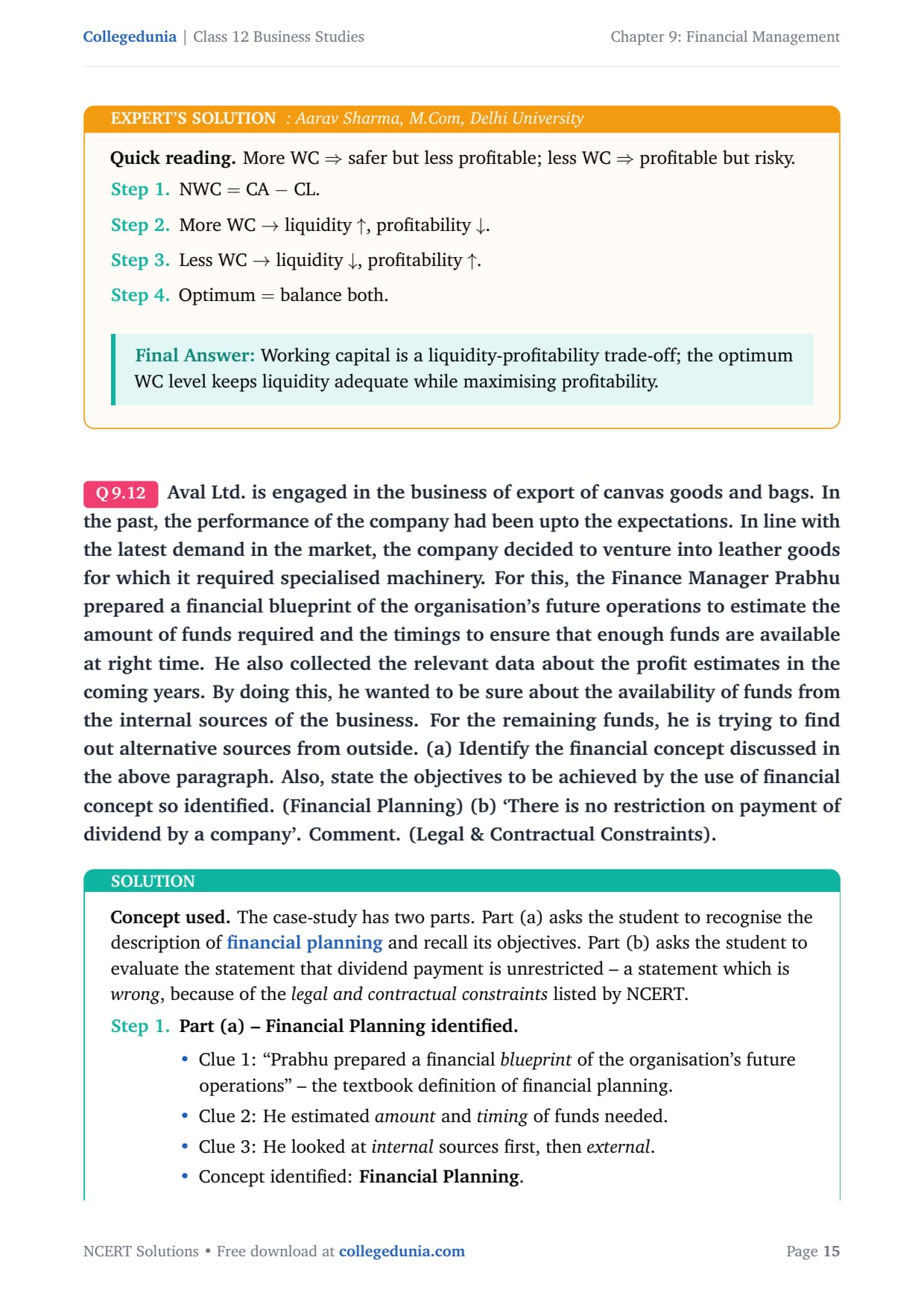
Working capital is a liquidity-profitability trade-off; the optimum WC level keeps
liquidity adequate while maximising profitability.
Q 9.12
Aval Ltd. is engaged in the business of export of canvas goods and bags. In the
past, the performance of the company had been upto the expectations. In line with the latest
demand in the market, the company decided to venture into leather goods for which it required
specialised machinery. For this, the Finance Manager Prabhu prepared a financial blueprint of
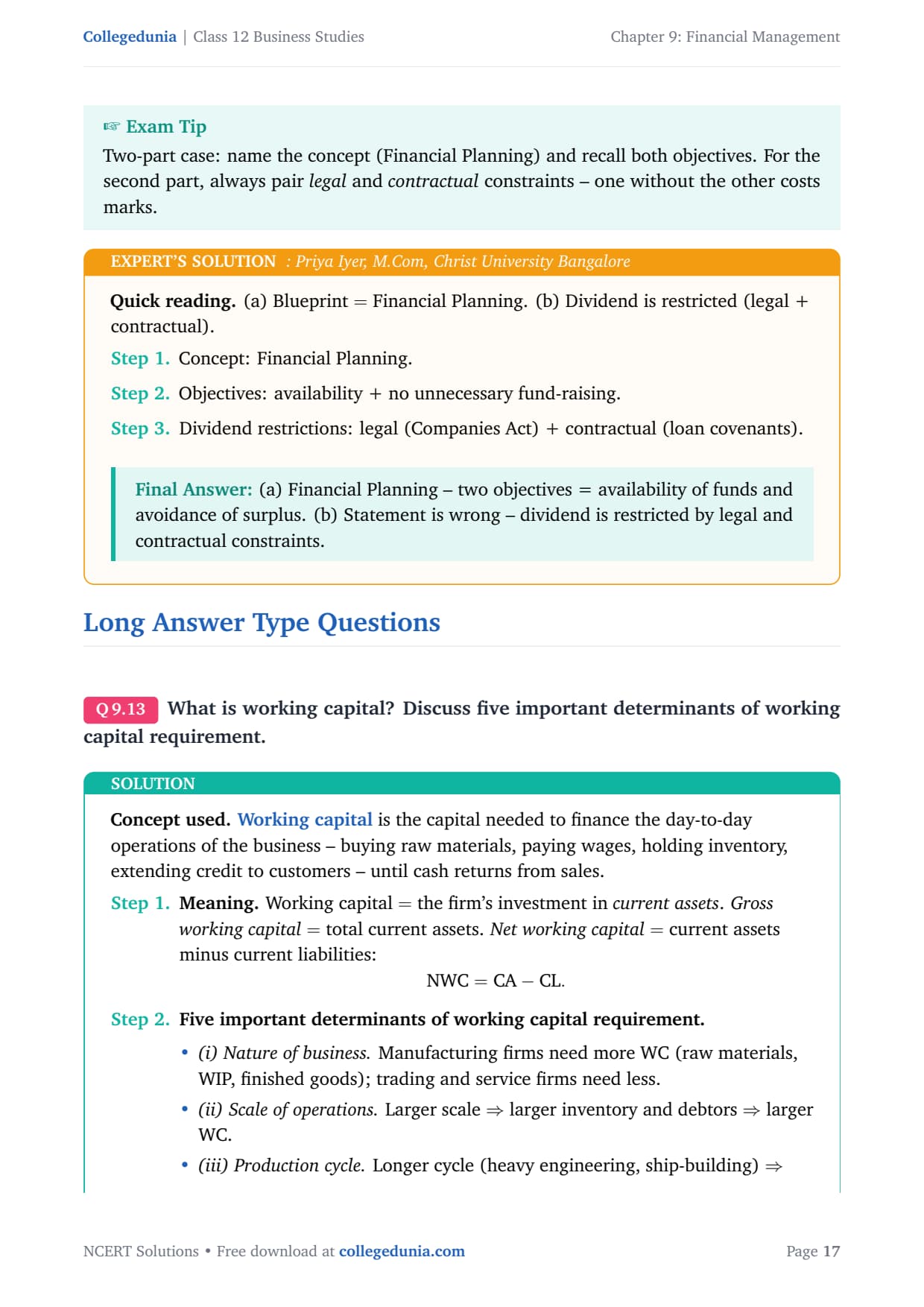
the organisation's future operations to estimate the amount of funds required and the timings
to ensure that enough funds are available at right time. He also collected the relevant data
about the profit estimates in the coming years. By doing this, he wanted to be sure about the
availability of funds from the internal sources of the business. For the remaining funds, he
is trying to find out alternative sources from outside. (a) Identify the financial concept
discussed in the above paragraph. Also, state the objectives to be achieved by the use of
financial concept so identified. (Financial Planning) (b) `There is no restriction on payment
of dividend by a company'. Comment. (Legal & Contractual Constraints).
Concept used. The case-study has two parts. Part (a) asks the student to recognise
the description of financial planning and recall its objectives. Part (b) asks the
student to evaluate the statement that dividend payment is unrestricted – a statement which is
wrong, because of the legal and contractual constraints listed by NCERT.
Part (a) – Financial Planning identified.
Clue 1: ``Prabhu prepared a financial blueprint of the organisation's
future operations'' – the textbook definition of financial planning.
Clue 2: He estimated amount and timing of funds needed.
Clue 3: He looked at internal sources first, then external.
Concept identified: Financial Planning.
Objectives of Financial Planning.
(i) To ensure availability of funds whenever they are required. Right
amount, right timing, right source.
(ii) To see that the firm does not raise resources unnecessarily. No
idle surplus; no unnecessary financial cost.
Other points of importance. Tackles uncertainty about future operations;
helps in coordinating various business functions; reduces wastage; provides
links between investment and financing decisions; ensures smooth functioning;
aids in policy formulation.
Part (b) – ``No restriction on dividend payment'' is INCORRECT.
Dividend payment is restricted by both legal and contractual
constraints.
Legal constraints (Companies Act 2013).
itemize
Dividend can be paid only out of profits – current year's
profit (after depreciation), or accumulated past profits, or both.
Dividend cannot be paid out of capital – this would be a return of
capital, not income.
A specified percentage of profit must be transferred to reserves
before dividend.
Dividend must be declared at the AGM on the recommendation of the
Board; the AGM cannot increase the recommended rate.
Contractual constraints.
Long-term loan agreements (debentures, bank loans) often include
covenants that restrict dividend until the loan is partly or fully
repaid, or require the company to maintain a minimum
debt-service-coverage ratio before declaring dividend.
Such covenants protect lenders.
Conclusion: The statement is wrong; there are several legal and contractual
restrictions on dividend payment.
itemize
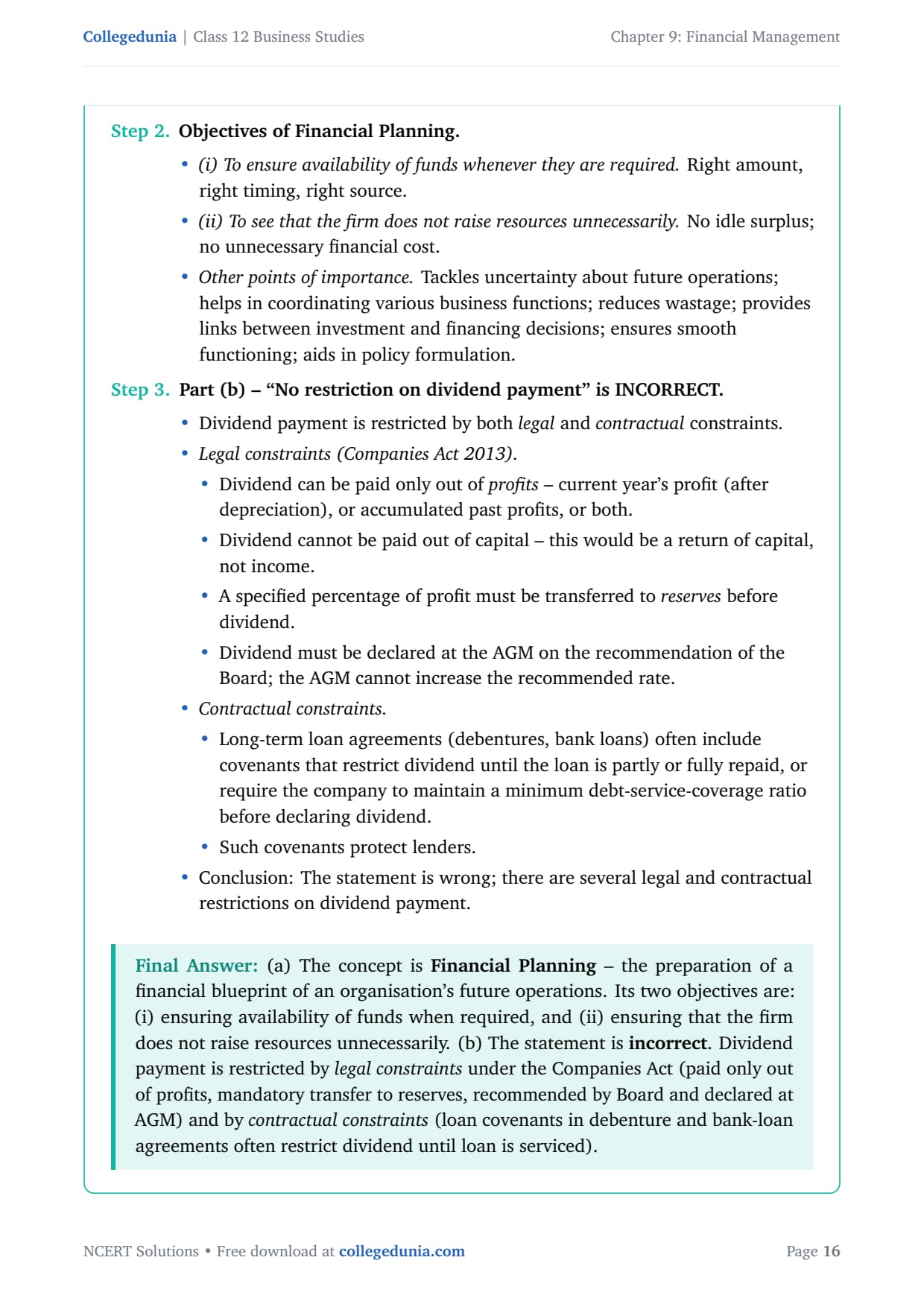
(a) The concept is Financial Planning – the preparation of a financial
blueprint of an organisation's future operations. Its two objectives are: (i) ensuring
availability of funds when required, and (ii) ensuring that the firm does not raise resources
unnecessarily. (b) The statement is incorrect. Dividend payment is restricted by
legal constraints under the Companies Act (paid only out of profits, mandatory transfer
to reserves, recommended by Board and declared at AGM) and by contractual constraints
(loan covenants in debenture and bank-loan agreements often restrict dividend until loan is
serviced).
(a) Financial Planning – two objectives = availability of funds and avoidance of
surplus. (b) Statement is wrong – dividend is restricted by legal and contractual constraints.
Long Answer Type Questions
Q 9.13
What is working capital? Discuss five important determinants of working capital
requirement.
Concept used.Working capital is the capital needed to finance the
day-to-day operations of the business – buying raw materials, paying wages, holding inventory,
extending credit to customers – until cash returns from sales.
Meaning. Working capital \(=\) the firm's investment in current assets.
Gross working capital \(=\) total current assets. Net working capital \(=\)
current assets minus current liabilities:
\[
\text{NWC} = \text{CA} - \text{CL}.
\]
Five important determinants of working capital requirement.
(i) Nature of business. Manufacturing firms need more WC (raw materials,
WIP, finished goods); trading and service firms need less.
(ii) Scale of operations. Larger scale \(\Rightarrow\) larger inventory
and debtors \(\Rightarrow\) larger WC.
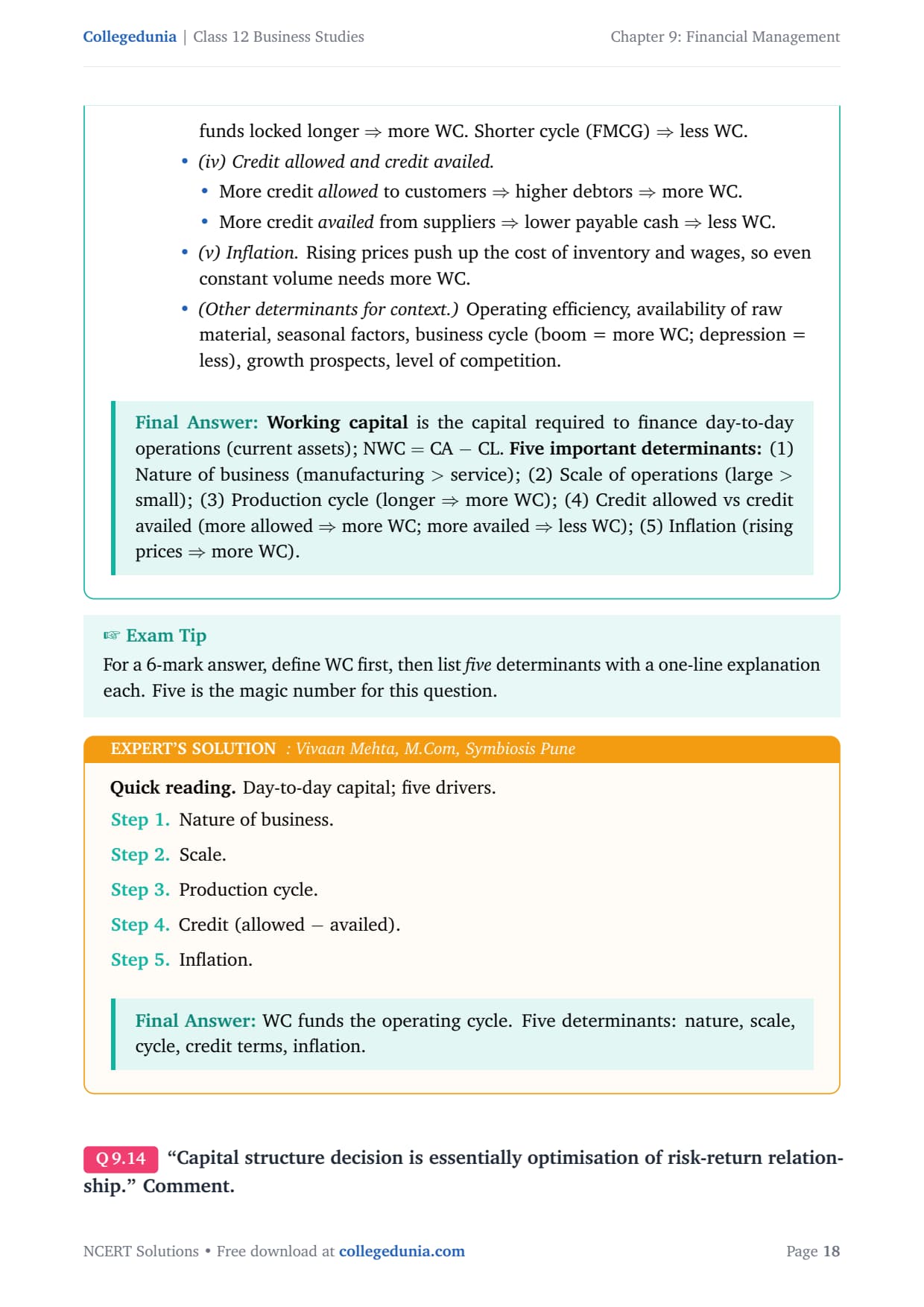
(iii) Production cycle. Longer cycle (heavy engineering, ship-building)
\(\Rightarrow\) funds locked longer \(\Rightarrow\) more WC. Shorter cycle (FMCG)
\(\Rightarrow\) less WC.
(iv) Credit allowed and credit availed.
itemize
More credit allowed to customers \(\Rightarrow\) higher debtors
\(\Rightarrow\) more WC.
More credit availed from suppliers \(\Rightarrow\) lower payable
cash \(\Rightarrow\) less WC.
(v) Inflation. Rising prices push up the cost of inventory and wages,
so even constant volume needs more WC.
(Other determinants for context.) Operating efficiency, availability of
raw material, seasonal factors, business cycle (boom = more WC; depression =
less), growth prospects, level of competition.
itemize
Working capital is the capital required to finance day-to-day operations
(current assets); NWC \(=\) CA \(-\) CL. Five important determinants: (1) Nature of
business (manufacturing \(>\) service); (2) Scale of operations (large \(>\) small); (3) Production
cycle (longer \(\Rightarrow\) more WC); (4) Credit allowed vs credit availed (more allowed
\(\Rightarrow\) more WC; more availed \(\Rightarrow\) less WC); (5) Inflation (rising prices
\(\Rightarrow\) more WC).
VM
Vivaan Mehta
M.Com, Symbiosis Pune
Verified Expert
Quick reading. Day-to-day capital; five drivers.
Nature of business.
Scale.
Production cycle.
Credit (allowed \(-\) availed).
Inflation.
WC funds the operating cycle. Five determinants: nature, scale, cycle, credit terms,
inflation.
Q 9.14
``Capital structure decision is essentially optimisation of risk-return relationship.'' Comment.
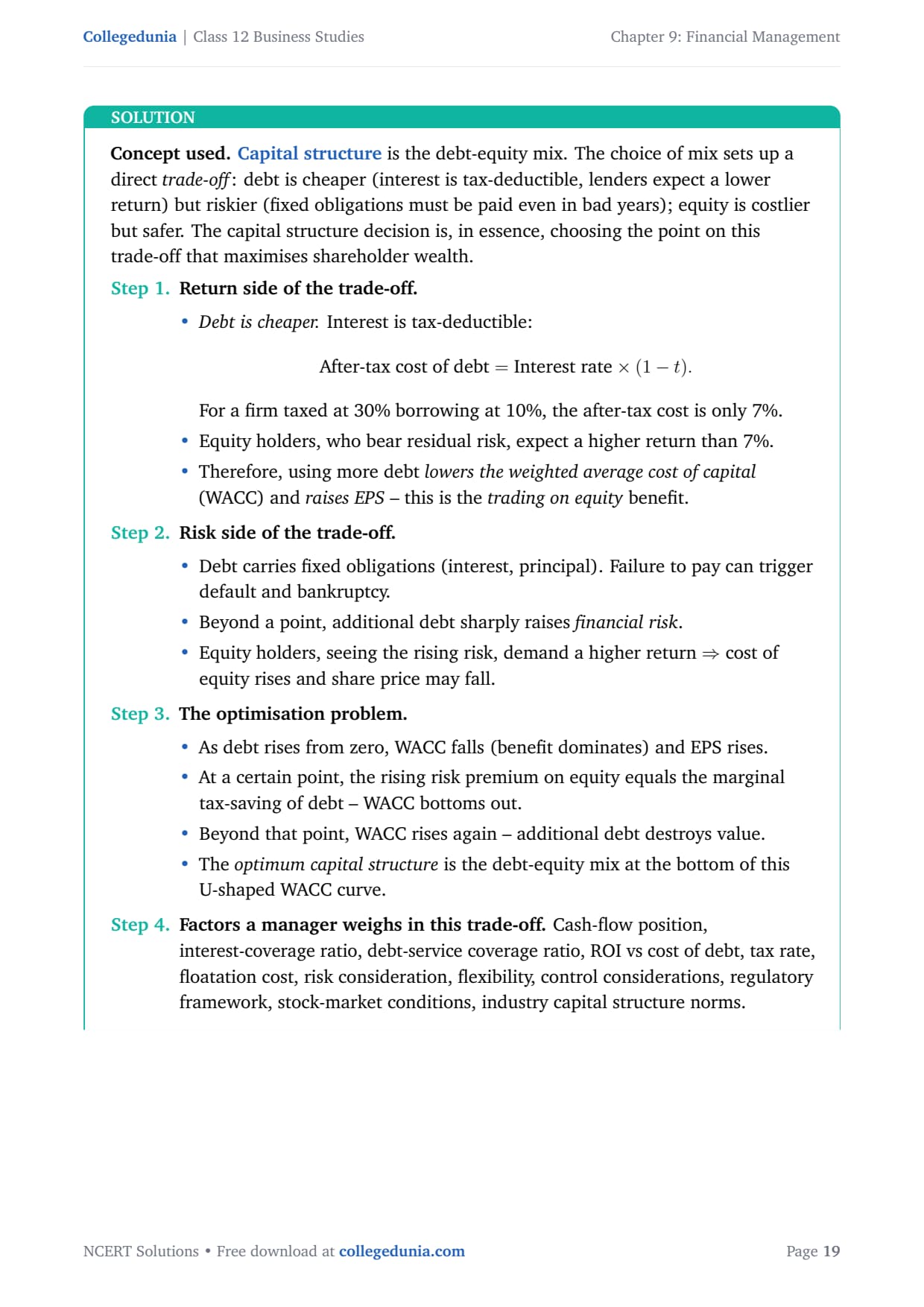
Concept used.Capital structure is the debt-equity mix. The choice of mix
sets up a direct trade-off: debt is cheaper (interest is tax-deductible, lenders
expect a lower return) but riskier (fixed obligations must be paid even in bad years); equity
is costlier but safer. The capital structure decision is, in essence, choosing the point on
this trade-off that maximises shareholder wealth.
Return side of the trade-off.
Debt is cheaper. Interest is tax-deductible:
\[ \text{After-tax cost of debt} = \text{Interest rate} \times (1 - t). \]
For a firm taxed at 30% borrowing at 10%, the after-tax cost is only 7%.
Equity holders, who bear residual risk, expect a higher return than 7%.
Therefore, using more debt lowers the weighted average cost of capital
(WACC) and raises EPS – this is the trading on equity benefit.
Risk side of the trade-off.
Debt carries fixed obligations (interest, principal). Failure to pay can
trigger default and bankruptcy.
Beyond a point, additional debt sharply raises financial risk.
Equity holders, seeing the rising risk, demand a higher return \(\Rightarrow\)
cost of equity rises and share price may fall.
The optimisation problem.
As debt rises from zero, WACC falls (benefit dominates) and EPS rises.
At a certain point, the rising risk premium on equity equals the marginal
tax-saving of debt – WACC bottoms out.
Beyond that point, WACC rises again – additional debt destroys value.
The optimum capital structure is the debt-equity mix at the bottom of
this U-shaped WACC curve.
Factors a manager weighs in this trade-off.
Cash-flow position, interest-coverage ratio, debt-service coverage ratio, ROI vs cost
of debt, tax rate, floatation cost, risk consideration, flexibility, control
considerations, regulatory framework, stock-market conditions, industry capital
structure norms.
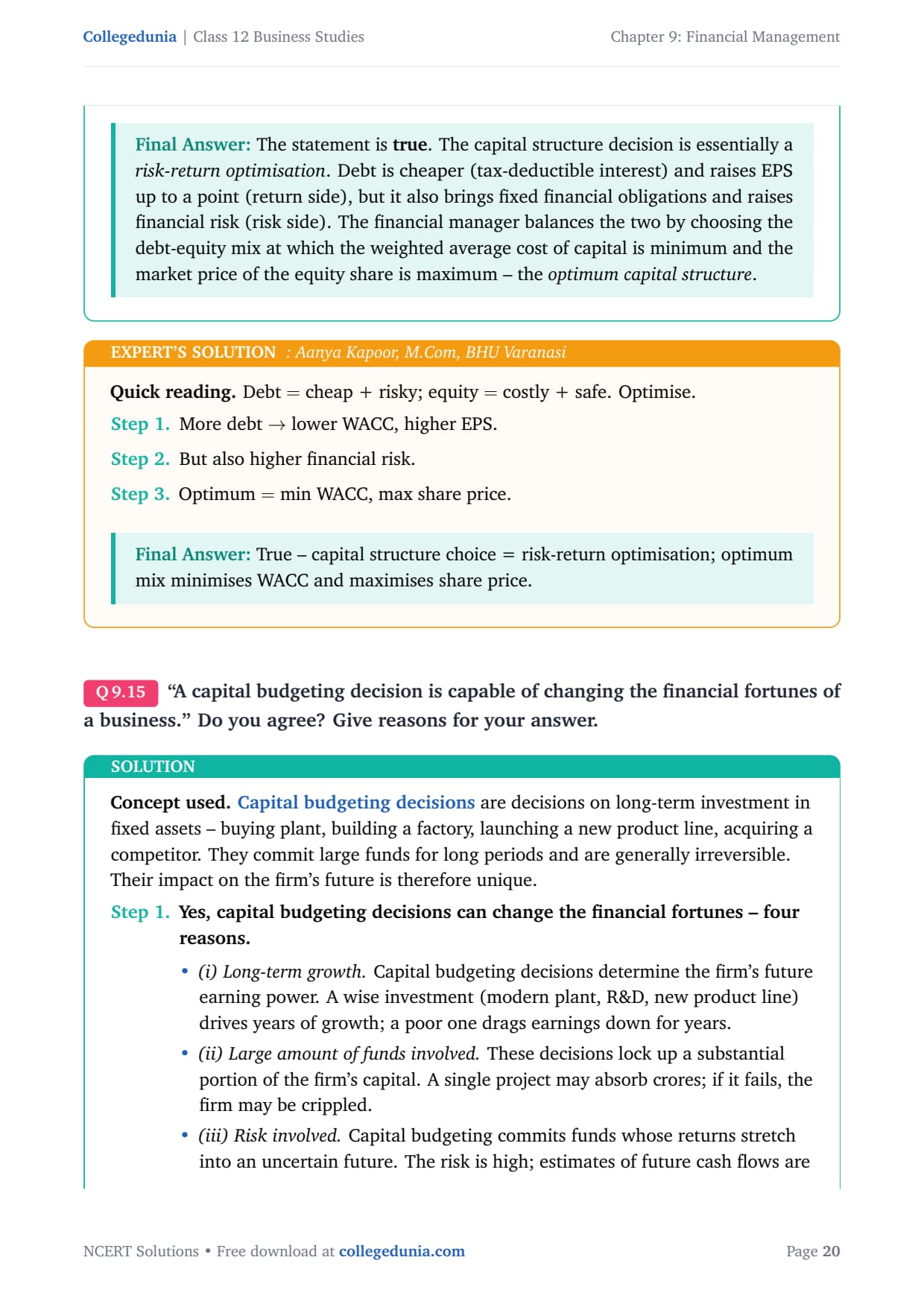
The statement is true. The capital structure decision is essentially a
risk-return optimisation. Debt is cheaper (tax-deductible interest) and raises EPS up
to a point (return side), but it also brings fixed financial obligations and raises financial
risk (risk side). The financial manager balances the two by choosing the debt-equity mix at
which the weighted average cost of capital is minimum and the market price of the equity share
is maximum – the optimum capital structure.
True – capital structure choice = risk-return optimisation; optimum mix minimises
WACC and maximises share price.
Q 9.15
``A capital budgeting decision is capable of changing the financial fortunes of a
business.'' Do you agree? Give reasons for your answer.
Concept used.Capital budgeting decisions are decisions on long-term
investment in fixed assets – buying plant, building a factory, launching a new product line,
acquiring a competitor. They commit large funds for long periods and are generally irreversible.
Their impact on the firm's future is therefore unique.
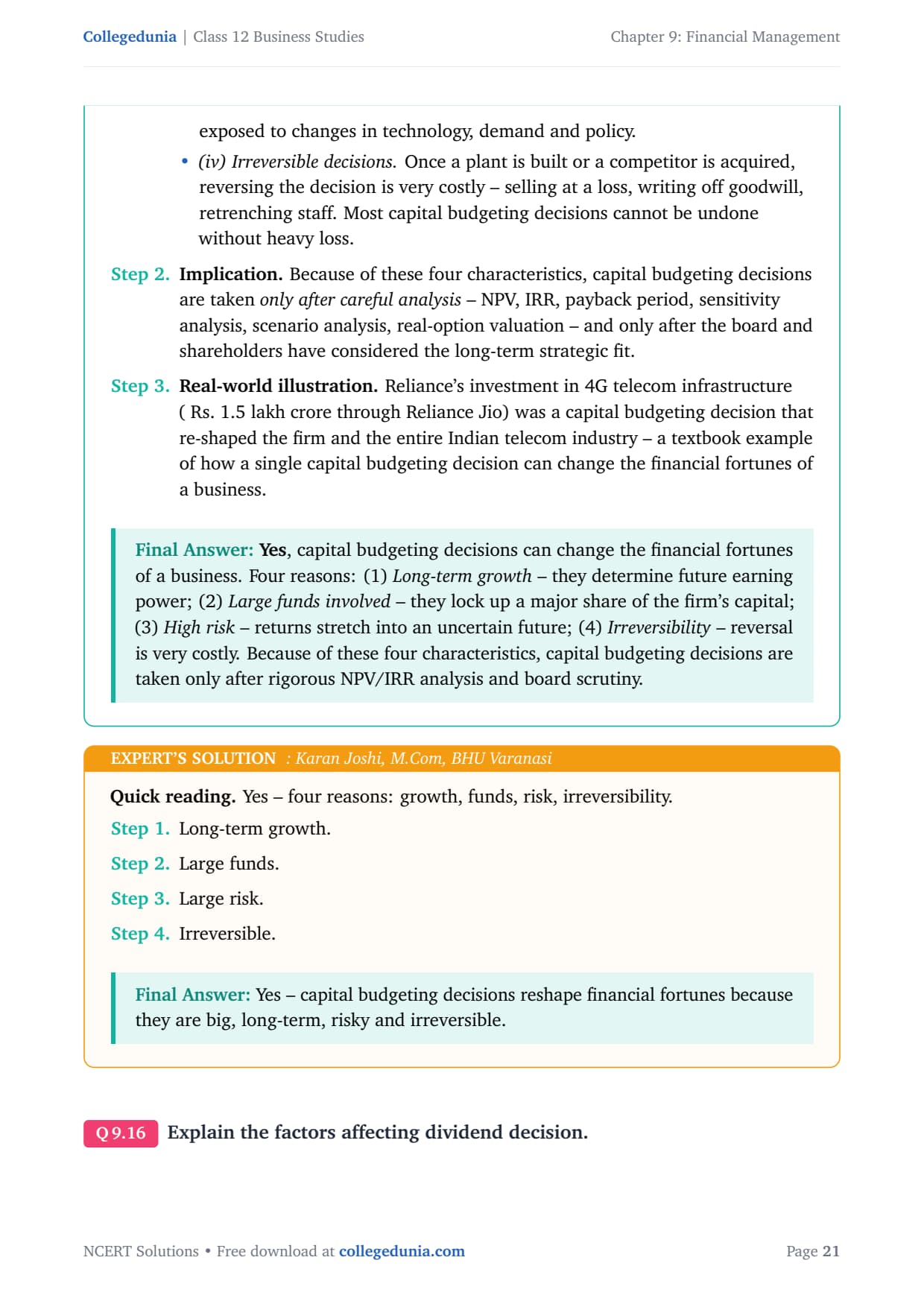
Yes, capital budgeting decisions can change the financial fortunes – four
reasons.
(i) Long-term growth. Capital budgeting decisions determine the firm's
future earning power. A wise investment (modern plant, R&D, new product
line) drives years of growth; a poor one drags earnings down for years.
(ii) Large amount of funds involved. These decisions lock up a
substantial portion of the firm's capital. A single project may absorb crores;
if it fails, the firm may be crippled.
(iii) Risk involved. Capital budgeting commits funds whose returns
stretch into an uncertain future. The risk is high; estimates of future cash
flows are exposed to changes in technology, demand and policy.
(iv) Irreversible decisions. Once a plant is built or a competitor is
acquired, reversing the decision is very costly – selling at a loss, writing
off goodwill, retrenching staff. Most capital budgeting decisions cannot be
undone without heavy loss.
Implication. Because of these four characteristics, capital budgeting
decisions are taken only after careful analysis – NPV, IRR, payback period,
sensitivity analysis, scenario analysis, real-option valuation – and only after the
board and shareholders have considered the long-term strategic fit.
Real-world illustration. Reliance's investment in 4G telecom infrastructure
( Rs. 1.5 lakh crore through Reliance Jio) was a capital budgeting decision that
re-shaped the firm and the entire Indian telecom industry – a textbook example of how
a single capital budgeting decision can change the financial fortunes of a business.
Yes, capital budgeting decisions can change the financial fortunes of a
business. Four reasons: (1) Long-term growth – they determine future earning power;
(2) Large funds involved – they lock up a major share of the firm's capital;
(3) High risk – returns stretch into an uncertain future; (4) Irreversibility
– reversal is very costly. Because of these four characteristics, capital budgeting decisions
are taken only after rigorous NPV/IRR analysis and board scrutiny.
KJ
Karan Joshi
M.Com, BHU Varanasi
Verified Expert
Quick reading. Yes – four reasons: growth, funds, risk, irreversibility.
Long-term growth.
Large funds.
Large risk.
Irreversible.
Yes – capital budgeting decisions reshape financial fortunes because they are big,
long-term, risky and irreversible.
Q 9.16
Explain the factors affecting dividend decision.
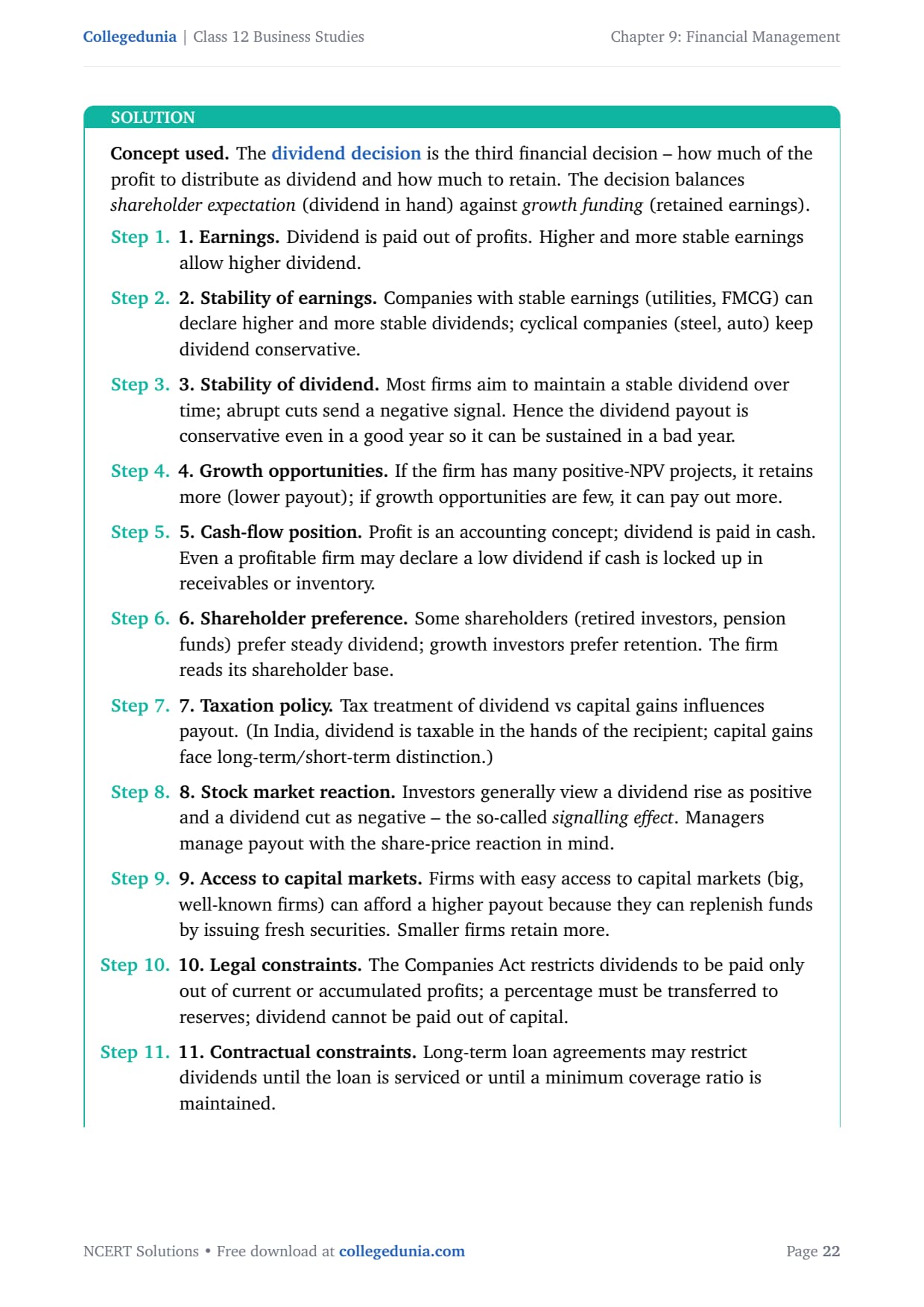
Concept used. The dividend decision is the third financial decision – how
much of the profit to distribute as dividend and how much to retain. The decision balances
shareholder expectation (dividend in hand) against growth funding (retained
earnings).
1. Earnings. Dividend is paid out of profits. Higher and more stable
earnings allow higher dividend.
2. Stability of earnings. Companies with stable earnings (utilities,
FMCG) can declare higher and more stable dividends; cyclical companies (steel, auto)
keep dividend conservative.
3. Stability of dividend. Most firms aim to maintain a stable dividend over
time; abrupt cuts send a negative signal. Hence the dividend payout is conservative
even in a good year so it can be sustained in a bad year.
4. Growth opportunities. If the firm has many positive-NPV projects, it
retains more (lower payout); if growth opportunities are few, it can pay out more.
5. Cash-flow position. Profit is an accounting concept; dividend is paid in
cash. Even a profitable firm may declare a low dividend if cash is locked up in
receivables or inventory.
6. Shareholder preference. Some shareholders (retired investors, pension
funds) prefer steady dividend; growth investors prefer retention. The firm reads its
shareholder base.
7. Taxation policy. Tax treatment of dividend vs capital gains influences
payout. (In India, dividend is taxable in the hands of the recipient; capital gains
face long-term/short-term distinction.)
8. Stock market reaction. Investors generally view a dividend rise as
positive and a dividend cut as negative – the so-called signalling effect.
Managers manage payout with the share-price reaction in mind.
9. Access to capital markets. Firms with easy access to capital markets (big,
well-known firms) can afford a higher payout because they can replenish funds by
issuing fresh securities. Smaller firms retain more.
10. Legal constraints. The Companies Act restricts dividends to be paid
only out of current or accumulated profits; a percentage must be transferred to
reserves; dividend cannot be paid out of capital.
11. Contractual constraints. Long-term loan agreements may restrict
dividends until the loan is serviced or until a minimum coverage ratio is
maintained.
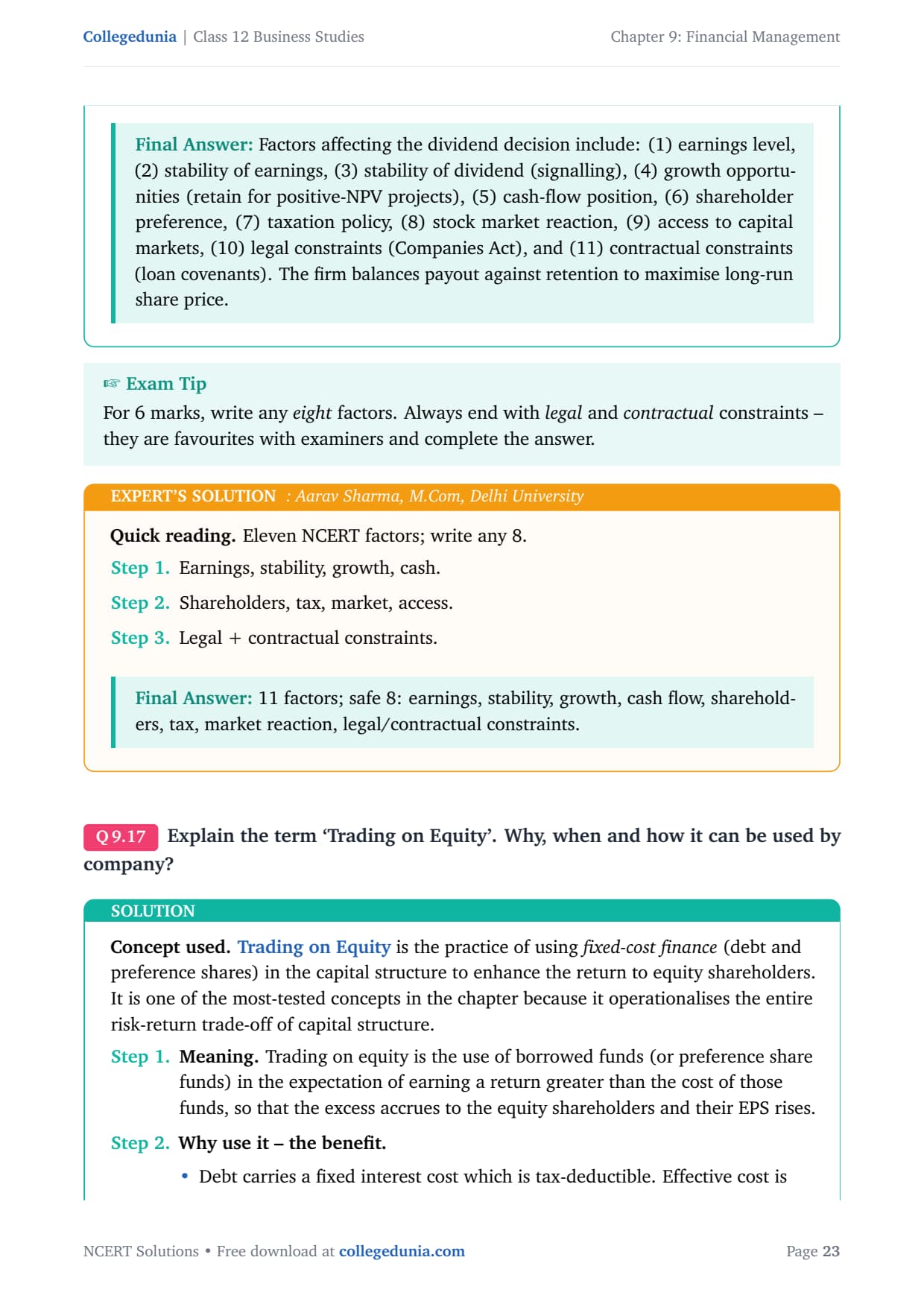
Factors affecting the dividend decision include: (1) earnings level, (2) stability
of earnings, (3) stability of dividend (signalling), (4) growth opportunities (retain for
positive-NPV projects), (5) cash-flow position, (6) shareholder preference, (7) taxation
policy, (8) stock market reaction, (9) access to capital markets, (10) legal constraints
(Companies Act), and (11) contractual constraints (loan covenants). The firm balances payout
against retention to maximise long-run share price.
Explain the term `Trading on Equity'. Why, when and how it can be used by company?
Concept used.Trading on Equity is the practice of using fixed-cost
finance (debt and preference shares) in the capital structure to enhance the return to equity
shareholders. It is one of the most-tested concepts in the chapter because it operationalises
the entire risk-return trade-off of capital structure.
Meaning. Trading on equity is the use of borrowed funds (or preference share
funds) in the expectation of earning a return greater than the cost of those funds, so
that the excess accrues to the equity shareholders and their EPS rises.
Why use it – the benefit.
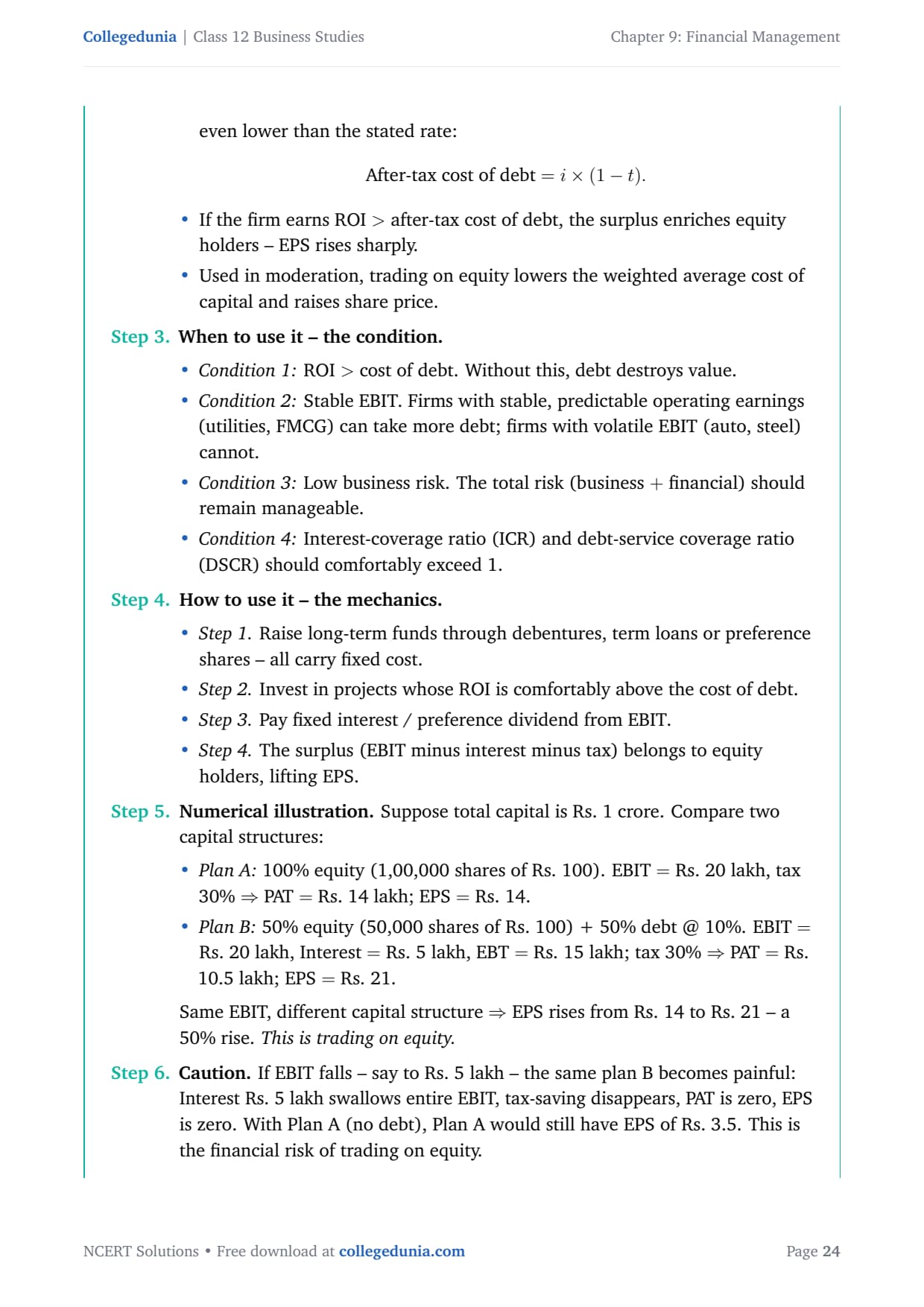
Debt carries a fixed interest cost which is tax-deductible. Effective cost is
even lower than the stated rate:
\[ \text{After-tax cost of debt} = i \times (1 - t). \]
If the firm earns ROI \(>\) after-tax cost of debt, the surplus enriches equity
holders – EPS rises sharply.
Used in moderation, trading on equity lowers the weighted average cost of
capital and raises share price.
When to use it – the condition.
Condition 1: ROI \(>\) cost of debt. Without this, debt destroys value.
Condition 2: Stable EBIT. Firms with stable, predictable operating
earnings (utilities, FMCG) can take more debt; firms with volatile EBIT (auto,
steel) cannot.
Condition 3: Low business risk. The total risk (business \(+\) financial)
should remain manageable.
Condition 4: Interest-coverage ratio (ICR) and debt-service coverage
ratio (DSCR) should comfortably exceed 1.
How to use it – the mechanics.
Step 1. Raise long-term funds through debentures, term loans or
preference shares – all carry fixed cost.
Step 2. Invest in projects whose ROI is comfortably above the cost of
debt.
Step 3. Pay fixed interest / preference dividend from EBIT.
Step 4. The surplus (EBIT minus interest minus tax) belongs to equity
holders, lifting EPS.
Numerical illustration. Suppose total capital is Rs. 1 crore. Compare two
capital structures:
Plan A: 100% equity (1,00,000 shares of Rs. 100).
EBIT \(=\) Rs. 20 lakh, tax 30% \(\Rightarrow\) PAT \(=\) Rs. 14 lakh; EPS \(=\)
Rs. 14.
Same EBIT, different capital structure \(\Rightarrow\) EPS rises from Rs. 14 to
Rs. 21 – a 50% rise. This is trading on equity.
Caution. If EBIT falls – say to Rs. 5 lakh – the same plan B becomes
painful: Interest Rs. 5 lakh swallows entire EBIT, tax-saving disappears, PAT is
zero, EPS is zero. With Plan A (no debt), Plan A would still have EPS of Rs. 3.5.
This is the financial risk of trading on equity.
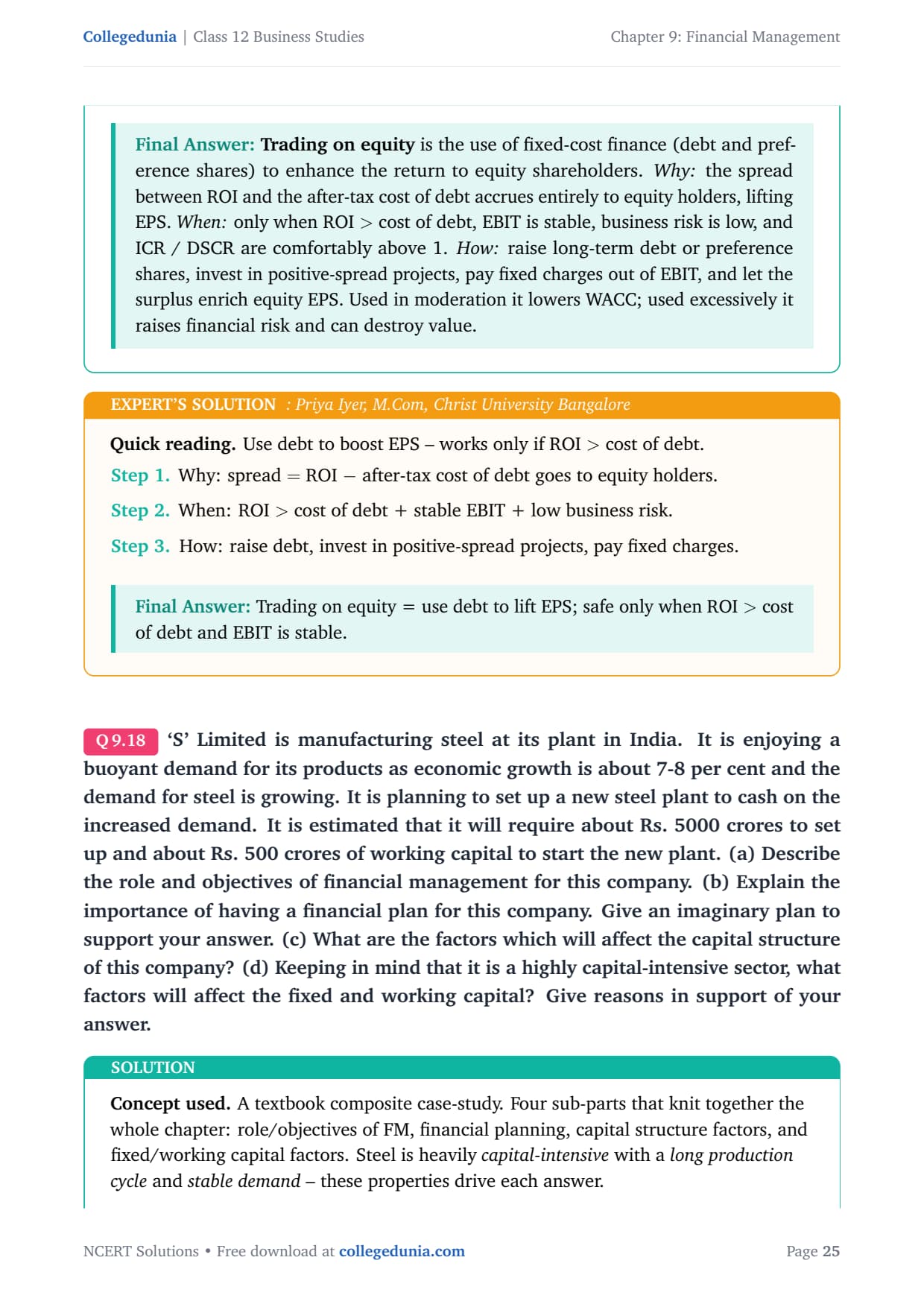
Trading on equity is the use of fixed-cost finance (debt and preference
shares) to enhance the return to equity shareholders. Why: the spread between ROI and
the after-tax cost of debt accrues entirely to equity holders, lifting EPS. When: only
when ROI \(>\) cost of debt, EBIT is stable, business risk is low, and ICR / DSCR are
comfortably above 1. How: raise long-term debt or preference shares, invest in
positive-spread projects, pay fixed charges out of EBIT, and let the surplus enrich equity
EPS. Used in moderation it lowers WACC; used excessively it raises financial risk and can
destroy value.
PI
Priya Iyer
M.Com, Christ University Bangalore
Verified Expert
Quick reading. Use debt to boost EPS – works only if ROI \(>\) cost of debt.
Why: spread \(=\) ROI \(-\) after-tax cost of debt goes to equity holders.
When: ROI \(>\) cost of debt + stable EBIT + low business risk.
How: raise debt, invest in positive-spread projects, pay fixed charges.
Trading on equity = use debt to lift EPS; safe only when ROI \(>\) cost of debt and
EBIT is stable.
Q 9.18
`S' Limited is manufacturing steel at its plant in India. It is enjoying a buoyant
demand for its products as economic growth is about 7-8 per cent and the demand for steel is
growing. It is planning to set up a new steel plant to cash on the increased demand. It is
estimated that it will require about Rs. 5000 crores to set up and about Rs. 500 crores of
working capital to start the new plant. (a) Describe the role and objectives of financial
management for this company. (b) Explain the importance of having a financial plan for this
company. Give an imaginary plan to support your answer. (c) What are the factors which will
affect the capital structure of this company? (d) Keeping in mind that it is a highly
capital-intensive sector, what factors will affect the fixed and working capital? Give reasons
in support of your answer.
Concept used. A textbook composite case-study. Four sub-parts that knit together the
whole chapter: role/objectives of FM, financial planning, capital structure factors, and
fixed/working capital factors. Steel is heavily capital-intensive with a long
production cycle and stable demand – these properties drive each answer.
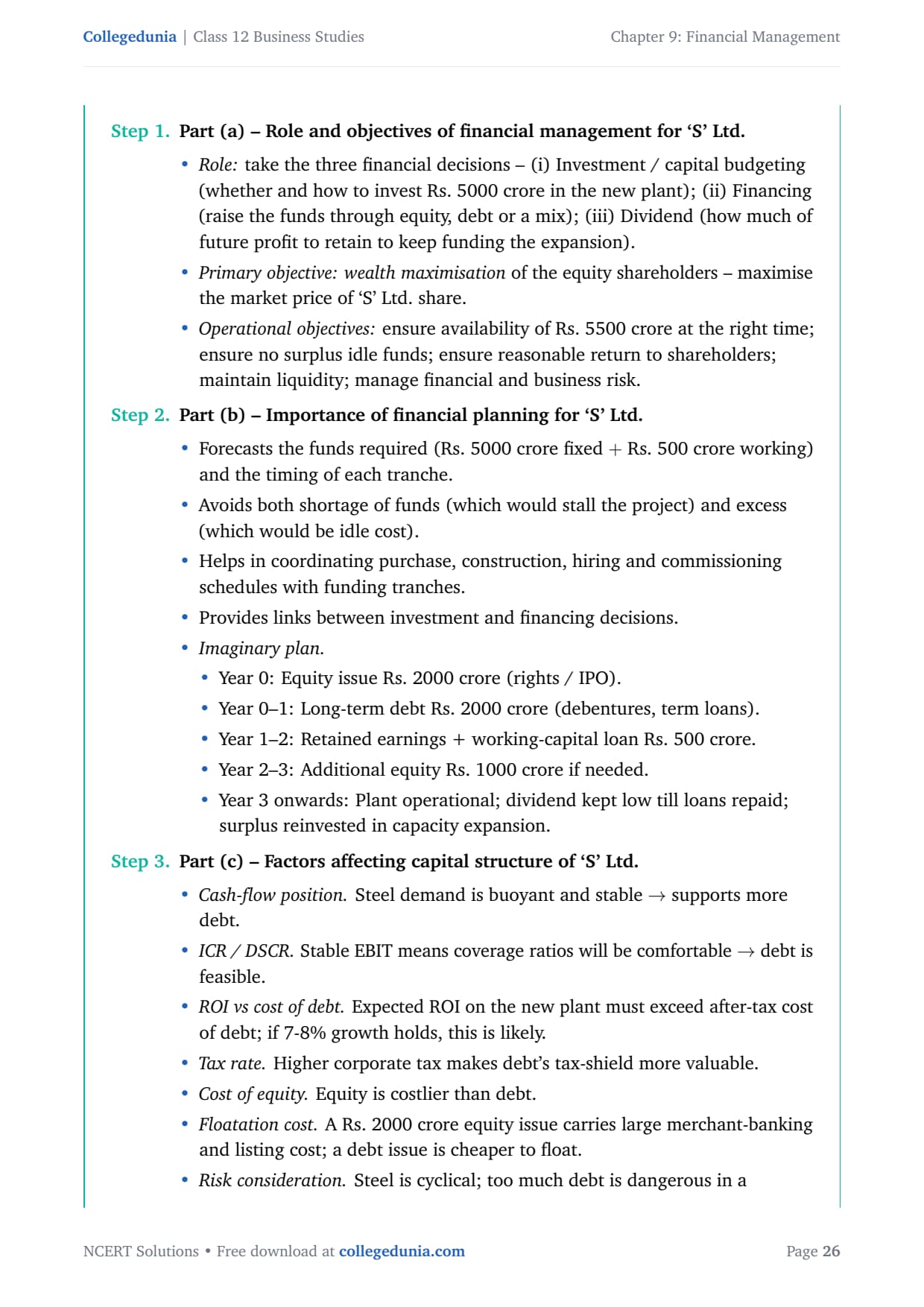
Part (a) – Role and objectives of financial management for `S' Ltd.
Role: take the three financial decisions – (i) Investment / capital
budgeting (whether and how to invest Rs. 5000 crore in the new plant);
(ii) Financing (raise the funds through equity, debt or a mix);
(iii) Dividend (how much of future profit to retain to keep funding the
expansion).
Primary objective:wealth maximisation of the equity
shareholders – maximise the market price of `S' Ltd. share.
Operational objectives: ensure availability of Rs. 5500 crore at the
right time; ensure no surplus idle funds; ensure reasonable return to
shareholders; maintain liquidity; manage financial and business risk.
Part (b) – Importance of financial planning for `S' Ltd.
Forecasts the funds required (Rs. 5000 crore fixed \(+\) Rs. 500 crore
working) and the timing of each tranche.
Avoids both shortage of funds (which would stall the project) and excess
(which would be idle cost).
Helps in coordinating purchase, construction, hiring and commissioning
schedules with funding tranches.
Provides links between investment and financing decisions.
Imaginary plan.
itemize
Year 0: Equity issue Rs. 2000 crore (rights / IPO).
Year 0–1: Long-term debt Rs. 2000 crore (debentures, term loans).
Year 1–2: Retained earnings + working-capital loan Rs. 500 crore.
Year 2–3: Additional equity Rs. 1000 crore if needed.
Year 3 onwards: Plant operational; dividend kept low till loans
repaid; surplus reinvested in capacity expansion.
itemize
Part (c) – Factors affecting capital structure of `S' Ltd.
Cash-flow position. Steel demand is buoyant and stable \(\to\) supports
more debt.
ICR / DSCR. Stable EBIT means coverage ratios will be comfortable \(\to\)
debt is feasible.
ROI vs cost of debt. Expected ROI on the new plant must exceed
after-tax cost of debt; if 7-8% growth holds, this is likely.
Tax rate. Higher corporate tax makes debt's tax-shield more valuable.
Cost of equity. Equity is costlier than debt.
Floatation cost. A Rs. 2000 crore equity issue carries large
merchant-banking and listing cost; a debt issue is cheaper to float.
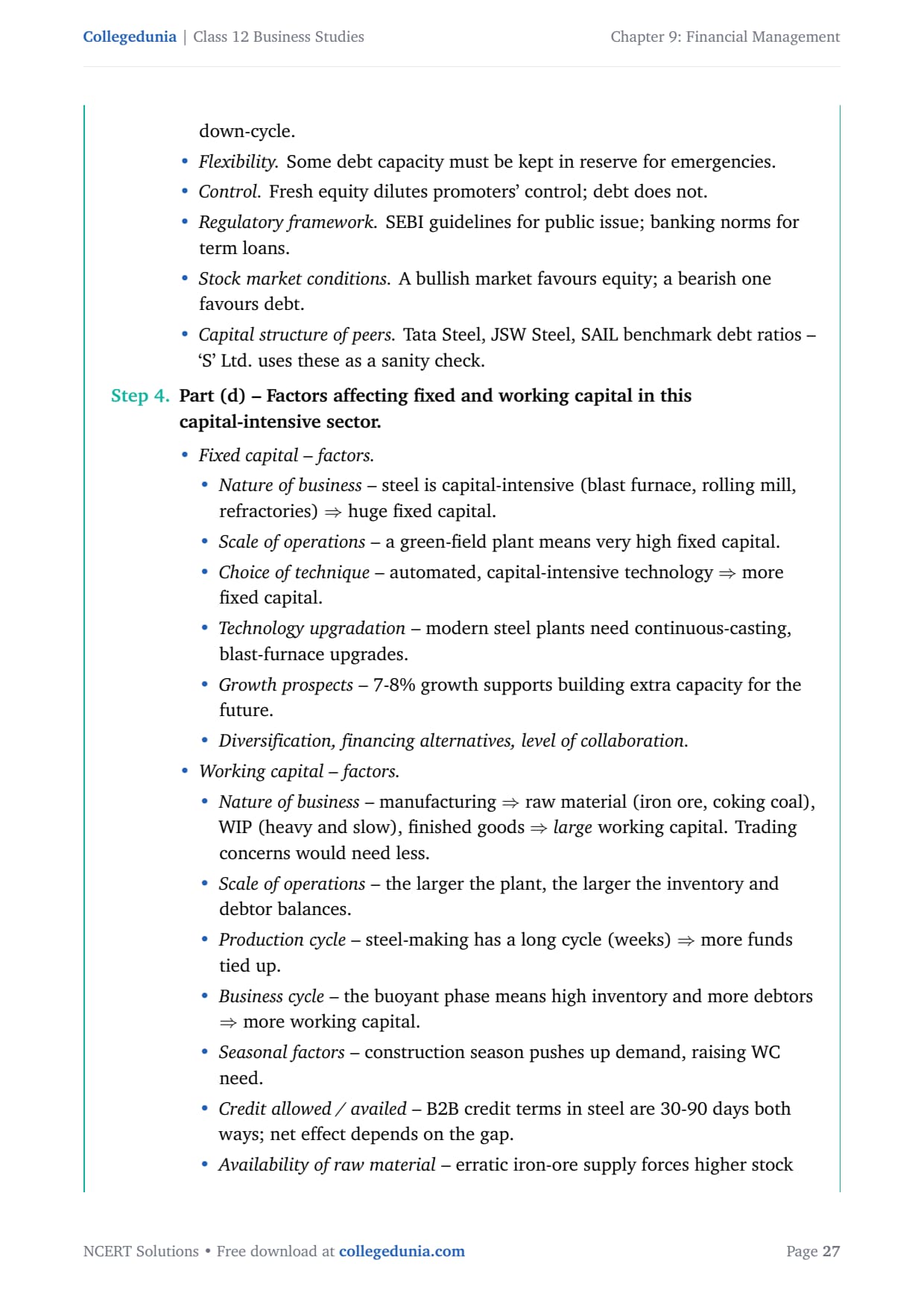
Risk consideration. Steel is cyclical; too much debt is dangerous in a
down-cycle.
Flexibility. Some debt capacity must be kept in reserve for emergencies.
Control. Fresh equity dilutes promoters' control; debt does not.
Regulatory framework. SEBI guidelines for public issue; banking norms
for term loans.
Stock market conditions. A bullish market favours equity; a bearish one
favours debt.
Capital structure of peers. Tata Steel, JSW Steel, SAIL benchmark debt
ratios – `S' Ltd. uses these as a sanity check.
Part (d) – Factors affecting fixed and working capital in this
capital-intensive sector.
Fixed capital – factors.
itemize
Nature of business – steel is capital-intensive (blast
furnace, rolling mill, refractories) \(\Rightarrow\) huge fixed capital.
Scale of operations – a green-field plant means very high
fixed capital.
Choice of technique – automated, capital-intensive technology
\(\Rightarrow\) more fixed capital.
Technology upgradation – modern steel plants need
continuous-casting, blast-furnace upgrades.
Growth prospects – 7-8% growth supports building extra
capacity for the future.
Diversification, financing alternatives, level of
collaboration.
Working capital – factors.
Nature of business – manufacturing \(\Rightarrow\) raw material
(iron ore, coking coal), WIP (heavy and slow), finished goods
\(\Rightarrow\) large working capital. Trading concerns would
need less.
Scale of operations – the larger the plant, the larger the
inventory and debtor balances.
Production cycle – steel-making has a long cycle (weeks)
\(\Rightarrow\) more funds tied up.
Business cycle – the buoyant phase means high inventory and
more debtors \(\Rightarrow\) more working capital.
Seasonal factors – construction season pushes up demand,
raising WC need.
Credit allowed / availed – B2B credit terms in steel are 30-90
days both ways; net effect depends on the gap.
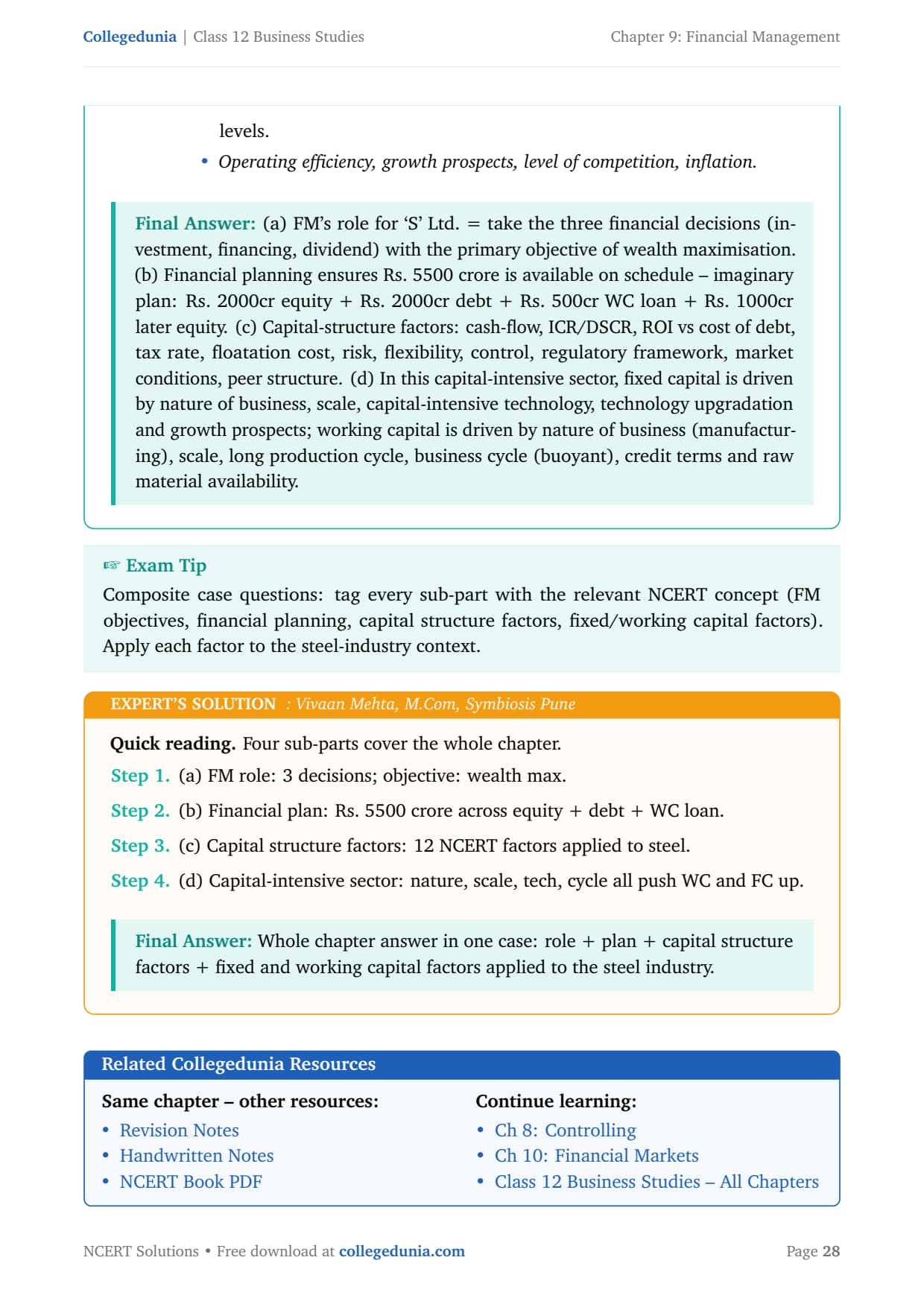
Availability of raw material – erratic iron-ore supply forces
higher stock levels.
Operating efficiency, growth prospects, level of competition,
inflation.
itemize
(a) FM's role for `S' Ltd. = take the three financial decisions (investment,
financing, dividend) with the primary objective of wealth maximisation. (b) Financial planning
ensures Rs. 5500 crore is available on schedule – imaginary plan: Rs. 2000cr equity +
Rs. 2000cr debt + Rs. 500cr WC loan + Rs. 1000cr later equity. (c) Capital-structure
factors: cash-flow, ICR/DSCR, ROI vs cost of debt, tax rate, floatation cost, risk, flexibility,
control, regulatory framework, market conditions, peer structure. (d) In this capital-intensive
sector, fixed capital is driven by nature of business, scale, capital-intensive technology,
technology upgradation and growth prospects; working capital is driven by nature of business
(manufacturing), scale, long production cycle, business cycle (buoyant), credit terms and raw
material availability.
VM
Vivaan Mehta
M.Com, Symbiosis Pune
Verified Expert
Quick reading. Four sub-parts cover the whole chapter.
(c) Capital structure factors: 12 NCERT factors applied to steel.
(d) Capital-intensive sector: nature, scale, tech, cycle all push WC and FC up.
Whole chapter answer in one case: role + plan + capital structure factors + fixed and
working capital factors applied to the steel industry.
Student Feedback
In a Collegedunia poll of 640 Class 12 Commerce students, 78% said the trading-on-equity numerical was the part of Financial Management they most feared before using these solutions. 3 in 4 said the boxed final answers and the ROI vs cost-of-debt rule made the capital-structure questions easier to attempt in the board exam.
Other Resources for Class 12 Business Studies Chapter 9 Financial Management
Financial Management Class 12 - Frequently Asked Questions
Financial Management Class 12 - Frequently Asked Questions
What is financial management in Class 12 Business Studies Chapter 9?
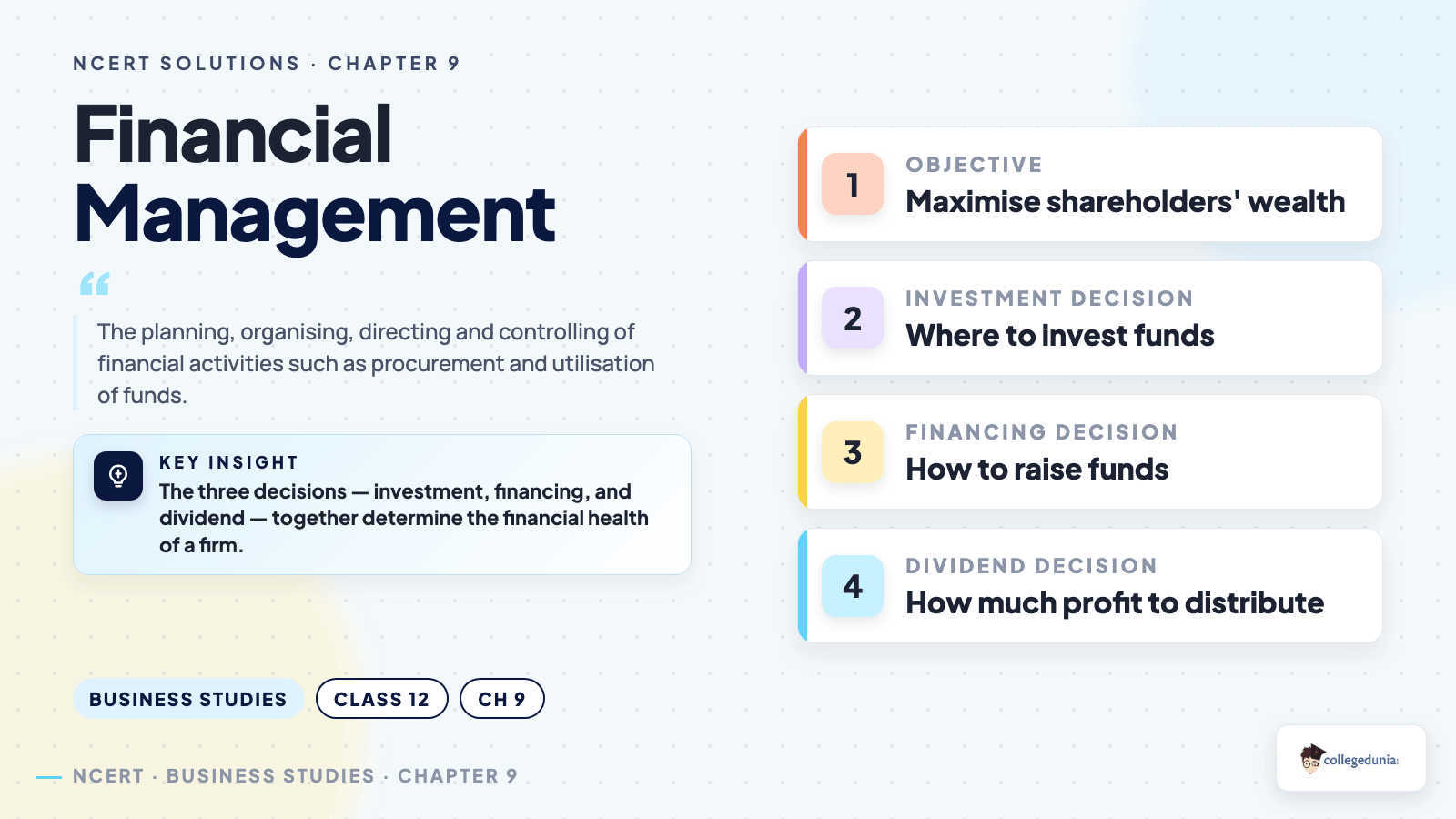
Financial management is concerned with the optimal procurement and usage of funds. Its primary objective is the wealth maximisation of the equity shareholders, operationalised through three financial decisions - investment (capital budgeting), financing (capital structure), and dividend decisions.
What are the three financial decisions?
The three financial decisions are: (1) Investment decision (where to deploy funds - capital budgeting for fixed assets plus working capital management for current assets), (2) Financing decision (how to raise funds - the debt-equity mix in the capital structure), and (3) Dividend decision (how much to pay out as dividend vs how much to retain for growth).
What is trading on equity?
Trading on equity is the use of fixed-cost finance (debt and preference shares) in the capital structure to enhance the return to equity shareholders. It works only when ROI > cost of debt; the surplus between the two accrues to equity holders and lifts EPS. If ROI is less than cost of debt, trading on equity destroys value.
What are the five main determinants of working capital?
The five main determinants are: (1) Nature of business (manufacturing needs more, service needs less), (2) Scale of operations, (3) Production cycle (longer cycle = more WC), (4) Credit allowed to customers vs credit availed from suppliers, and (5) Inflation (rising prices increase WC need).
Where can I download the Class 12 Business Studies Chapter 9 Financial Management NCERT Solutions PDF?
You can download the Collegedunia Class 12 Business Studies Chapter 9 Financial Management NCERT Solutions PDF free of cost from this page. The PDF is aligned to the NCERT Reprint 2026-27 syllabus and includes all 18 exercise questions, the EPS-comparison numerical, the deviation and NWC formulas, and the case-study spotters you need for the board exam.









Comments