Accountancy Strategist, 11 Yrs | Updated 3+ months ago
These NCERT Solutions for Class 12 Business Studies Chapter 7 Directing bring together every answer the board tests, covering supervision, motivation, leadership and communication, plus Maslow's need hierarchy. Each answer matches the 2026-27 CBSE syllabus and marking scheme.
CBSE Weightage: 6 to 10 marks (Unit 1, Principles and Functions of Management)
The ncert solutions are designed for a Class 12 student covering the chapter for the first time, and for board-exam candidates revising in the last week before the paper. Every concept is presented clearly with definitions, supporting features and one-line takeaways. Mnemonics, quick tips, common-mistake call-outs and case-study spotters are placed at the precise points where students typically slip.
Directing Class 12 NCERT Solutions: Topic Map
Section
What is Covered
Why It Matters in the Exam
1. Meaning of Directing
Instructing, guiding, motivating, leading
1 to 3-mark definition
2. Importance of Directing
Five-point list (initiates, integrates, motivates, change, stability)
3 to 4-mark; mnemonic I-I-M-F-S
3. Eight Principles
Max contribution, harmony, unity of command...
3 to 4-mark "explain any three" question
4. Four Elements
Supervision, motivation, leadership, communication
2-mark naming question
5. Motivation Process
6-stage cyclical chain with diagram
4 to 6-mark "process of motivation with diagram"
6. Maslow Need Hierarchy
Five levels: P-S-S-E-S; financial vs non-financial mapping
What the Class 12 Business Studies Chapter 7 NCERT Solutions PDF Contains
Question-wise step-by-step answers to all 14 NCERT questions (4 Very Short Answer, 6 Short Answer, 4 Long Answer).
Concept Used block at the start of every long-answer solution naming the rule, definition or model being applied.
Boxed Final Answer at the end of every solution for last-minute revision.
Diagrams for the motivation process, Maslow's pyramid, communication process and the four grapevine networks.
Case-study mapping from spotter words to answer (e.g. "unwilling" $\rightarrow$ motivation; "free-rein" $\rightarrow$ laissez-faire).
Cross-links to Notes, Handwritten Notes and the NCERT Book PDF for the same chapter.
Exam Anchor: In Chapter 7, the most-tested distinction is "unable" (skill gap $\Rightarrow$ training, Chapter 6) vs "unwilling" (will gap $\Rightarrow$ motivation, this chapter). Also memorise the seven elements of the communication process (S-E-M-C-R-D-F) and the five levels of Maslow (P-S-S-E-S).
Directing Concept Capsule: Every Named List You Are Tested On in Class 12
Five Features (Characteristics) of Directing
Initiates action - other functions only prepare the setting; directing actually sets people in motion.
Takes place at every level - top, middle and supervisory; every manager directs subordinates.
Continuous process - lasts the entire life of the organisation, not a one-time act.
Flows from top to bottom - instructions move down the chain of authority; each superior directs the subordinate immediately below.
Integrates the four management functions (planning, organising, staffing, controlling) by translating plans into people-led action.
Four Elements of Directing
Supervision - first-line guidance and oversight of operatives; ensures work follows the plan.
Motivation - the internal drive to act; managers stimulate subordinates' willingness to perform.
Leadership - influencing people to strive willingly for group goals.
Communication - exchange of facts, ideas and opinions to build shared understanding.
Noise is any disturbance (technical, semantic or psychological) that distorts the message anywhere in the chain - poor handwriting, language gap, bias, ambient sound.
Formal Communication - Three Directions
Vertical - between superiors and subordinates; further split into downward (orders, instructions) and upward (reports, suggestions).
Horizontal / Lateral - between people at the same level (two production managers coordinating).
Diagonal / Crosswise - between people at different levels in different departments (a sales executive directly e-mailing the finance manager).
Grapevine - Four Network Patterns
Single Strand - A tells B, B tells C, C tells D, in a single chain.
Gossip - one person tells everyone else (hub and spoke).
Probability - information is passed randomly to anyone the person meets.
Cluster - one person tells a chosen few, who in turn tell a few more (most common in practice).
All NCERT Solutions for Directing with Step-by-Step Working
Every NCERT textbook question for Class 12 Business Studies Chapter 7 Directing is listed below with its full Solution and Expert Solution hidden inside collapsible tabs. Click Check Solution to reveal the step-by-step working; click Expert Solution for the expanded explanation.
Very Short Answer Type Questions
Q 7.1
What is informal communication?
Concept used.Informal communication, also called grapevine
communication, is the communication that takes place without following the formal lines of
authority prescribed by the organisation chart. It arises from personal and social relationships
among employees.
Definition. Informal communication is the unofficial, unstructured exchange of
information between people in an organisation through personal contact – in the canteen,
in corridors, before/after meetings, on chat groups.
Origin. It is not designed by management – it grows on its own out of
friendships, neighbourhoods, common interests, language groups and the natural human urge
to share news.
Speed. Informal communication is very fast – often faster than formal
channels.
Reliability. It is not always reliable: messages get distorted as they
pass mouth-to-mouth, like the children's game of ``Chinese whispers''.
Forms / networks. It flows in four typical patterns – single strand,
gossip, probability, cluster.
Management view. A manager should not try to suppress informal communication –
it cannot be eliminated. Instead, the manager should listen to it (to know what employees
are feeling) and inject correct information into it to counter rumours.
Informal communication (or grapevine) is the unofficial, person-to-person
exchange of information in an organisation that does not follow the formal chain of authority. It
is fast but often distorted; it cannot be eliminated, only managed.
AS
Aarav Sharma
M.Com, Delhi University
Verified Expert
Senior-teacher view. The CBSE marker looks for three ideas in this 1-mark question –
(i) the message does not follow the formal chain of authority, (ii) it arises from
social or personal relationships, and (iii) the popular synonym is grapevine. A
single line that touches all three earns the full mark.
Strict definition. Informal communication is the spontaneous, unofficial flow of
information among employees that bypasses the prescribed organisational hierarchy.
Carrier. It moves through friendships, neighbourhoods, lunch tables, WhatsApp
groups and corridor chats – never through an org-chart line.
Speed vs accuracy. It is the fastest channel in the organisation but suffers
heavy distortion as each retelling shaves or adds detail.
The four shapes. It physically flows along four grapevine networks –
single-strand, gossip, probability and cluster – the last being the most common in
Indian workplaces.
Managerial stance. It is a permanent fixture of human organisation; a manager
cannot ban it, only ride it – listen for unrest, plant correct facts to kill rumours.
Informal communication (the grapevine) is the unofficial, person-to-person
exchange of information among employees that does not follow the organisation's formal lines of
authority – fast, social, but often distorted; a manager manages it rather than eliminates it.
Q 7.2
Which style of leadership does not believe in use of power unless it is absolutely
essential?
Concept used. The NCERT identifies three main leadership styles –
autocratic (or authoritarian), democratic (or participative), and
laissez-faire (or free-rein). The style which deliberately holds back the use of authority
and lets the group decide is the laissez-faire / free-rein style.
Laissez-faire meaning. A French phrase meaning ``let people do''. The leader
gives the team complete freedom to set goals, make decisions and solve problems.
Use of power. The free-rein leader uses authority only when the team is unable to
decide for itself; otherwise, the leader stays in the background as a facilitator or
resource provider.
Where it works. Highly skilled, self-motivated professionals – research
scientists, university faculty, top creative teams – where the team's expertise exceeds
the leader's.
Risk. Less suited where employees lack expertise or self-discipline; can lead to
confusion and missed targets.
The Free-rein (laissez-faire) style of leadership does not believe in using
power unless absolutely essential – the leader hands decision-making to the group and steps in
only when necessary.
PI
Priya Iyer
M.Com, Christ University Bangalore
Verified Expert
Senior-teacher view. Of the three NCERT leadership styles only one explicitly limits the
use of power. Mapping the keyword ``unless absolutely essential'' to laissez-faire (also
called free-rein) is the entire content of this question – so the marker wants the term
spelt correctly and the synonym in brackets.
Three styles on a power-use spectrum. Autocratic (maximum use of authority) \(\to\)
Democratic (shared use) \(\to\) Laissez-faire (minimum use).
French roots. ``Laissez-faire'' literally means ``let do'' – the leader lets the
team plan, decide and execute on its own.
Synonym in English.Free-rein leadership – the leader holds the reins
loose; the horse decides where to go.
When the leader does step in. Only when the group is unable to decide for
itself, or when there is a conflict of expertise the team cannot resolve.
Best-fit teams. R&D labs, doctors in a hospital, university faculty, top
creative agencies – groups whose technical skill exceeds the leader's.
Risk. On semi-skilled or undisciplined teams it produces chaos, missed deadlines
and free-riding.
Free-rein / Laissez-faire leadership style – it deliberately withholds the
use of power and lets the group self-direct, stepping in only when absolutely essential.
Q 7.3
Which element in the communication process involves converting the message into words,
symbols, gestures etc.?
Concept used. The communication process has seven elements – sender, message,
encoding, media (channel), decoding, receiver, and feedback. The step of converting the
idea inside the sender's head into transmittable form (words, symbols, gestures, drawings, code)
is called encoding.
Encoding – definition. The process of converting the message into
communication symbols which may be in the form of words, signs, gestures, pictures, etc.
Purpose. To put the idea in a form that the channel can carry and the receiver
can interpret.
Skill needed. The sender must encode in symbols the receiver also knows –
otherwise the message will be received but not understood (semantic barrier).
Counterpart at the other end. The receiver does decoding – the reverse
of encoding – converting the symbols back into an idea.
The element of the communication process that converts the message into words, symbols,
gestures etc. is Encoding. (Its mirror at the receiver's end is decoding.)
VM
Vivaan Mehta
M.Com, Symbiosis Pune
Verified Expert
Senior-teacher view. CBSE markers expect the candidate to (i) name the element
encoding, (ii) define it in one line, and (iii) name its mirror element decoding at
the receiver's end. Doing all three earns the full mark.
Where encoding fits. In the seven-element process Sender \(\to\) Encoding \(\to\)
Message \(\to\) Channel/Media \(\to\) Receiver \(\to\) Decoding \(\to\) Feedback, encoding is the
second step – it sits between the sender's idea and the message that travels.
Operational meaning. The sender translates a private thought into public
symbols – spoken words, written sentences, hand gestures, diagrams, computer code – so
that the message can travel along the chosen channel.
Symbol set must overlap. Encoding works only if the sender uses symbols the
receiver already knows. Encoding into legal Latin for a class of teenagers is the classic
semantic barrier.
Mirror at the other end. The receiver's decoding step reverses encoding –
unpacks the symbols back into the original idea. The two steps together close the loop.
Why examiners love this question. It tests whether the student remembers the
order of the seven elements, not just their names.
The element of the communication process that converts the message into words, symbols,
gestures, etc. is Encoding; the receiver does the reverse step – decoding –
to recover the original idea.
Q 7.4
The workers always try to show their inability when any new work is given to them. They
are always unwilling to take up any kind of work. Due to sudden rise in demand a firm wants to
meet excess orders. The supervisor is finding it difficult to cope up with the situation. State
the element of directing that can help the supervisor in handling the problem.
Concept used. Workers showing inability and unwillingness \(\Rightarrow\) they lack the
willingness to work – not the ability. The element of directing that addresses
willingness is motivation.
Diagnose. The problem is not skill; the problem is will. Workers refuse
new work and show inability – a classic motivation problem.
Prescribe the right element. Of the four elements of directing – supervision,
motivation, leadership, communication – motivation is the one that
directly stimulates willingness.
Implementation. The supervisor can use financial incentives (bonus,
production-linked pay for the excess orders) and non-financial incentives (recognition,
praise, job enrichment, sense of belonging).
Expected outcome. Once motivated, workers willingly take up the additional work
and excess orders are met on time.
The element of directing that will help the supervisor is Motivation – it
addresses willingness to work, which is the missing ingredient here. The supervisor should use a
mix of financial and non-financial incentives to motivate workers to accept the extra work.
AK
Aanya Kapoor
M.Com, BHU Varanasi
Verified Expert
Senior-teacher view. The case writes the answer twice – ``show their inability''
and ``always unwilling''. The first phrase is a decoy that tempts students to write
``training''. The decisive phrase is always unwilling – a willingness gap, which is the
very definition of a motivation problem.
Diagnose. A skill problem \(\Rightarrow\) training; a willingness problem
\(\Rightarrow\) motivation. The case says ``always unwilling'' – willingness, not skill.
Locate the element. Among the four elements of directing – supervision,
motivation, leadership, communication – the one that directly addresses
willingness is motivation.
Prescribe the toolkit. A blended package works best on a sudden surge in demand:
financial incentives (production-linked wage, special excess-order bonus, overtime
allowance) and non-financial incentives (recognition, target boards, on-the-spot
praise, sense of belonging to the surge team).
Reinforce with leadership. The supervisor adopts a democratic style for
the surge week – consults workers on the production plan – which itself lifts
willingness.
Expected outcome. Workers willingly take up the extra work, excess orders are
met on time, and the motivational gain often outlasts the surge.
The element of directing that will help the supervisor is Motivation – it
addresses the willingness gap (the missing ingredient) through a mix of financial and
non-financial incentives, reinforced by a democratic leadership style.
Short Answer Type Questions
Q 7.5
What are semantic barriers of communication?
Concept used.Semantic barriers are obstacles to communication that arise out
of problems in language or the meaning of symbols used in the message. (``Semantic'' comes
from the Greek word for meaning.) These barriers prevent the receiver from interpreting the
message in the way the sender intended.
Badly expressed message. The sender drafts the message poorly – vague
sentences, missing punctuation, technical jargon, ambiguous pronouns. The receiver
cannot pin down what is meant.
Symbols with different meanings. A word has more than one meaning, and sender
and receiver pick different ones (e.g., bank could mean a financial institution or
a riverside).
Faulty translations. A message translated from one language to another may lose
precision or pick up unintended meanings – common in multinational and multilingual
India.
Unclarified assumptions. The sender assumes the receiver knows certain
background facts; the receiver, unaware, draws the wrong conclusion.
Technical jargon. Specialists use a vocabulary unfamiliar to the receiver –
medical, legal, engineering or IT terms. The receiver feels lost.
Body language and gesture decoding. A nod that means yes in one culture means
``I'm listening'' in another. Mis-read gestures create semantic barriers.
Semantic barriers are barriers to communication arising from problems in language and
meaning – badly expressed messages, symbols with multiple meanings, faulty translations,
unclarified assumptions, technical jargon, and mis-read body language.
KJ
Karan Joshi
M.Com, BHU Varanasi
Verified Expert
Senior-teacher view. ``Semantic'' from semantikos = ``of meaning''. A semantic
barrier is therefore any obstacle that arises because sender and receiver attach different
meanings to the same symbol. CBSE's 3-mark version asks for any three; the 5-mark version asks
for any five. Always name the barrier in bold and follow with a one-line plain-English example.
Family identity. Semantic barriers are the language/meaning family of
communication barriers – distinct from psychological (emotion), organisational
(structure) and personal (fear/trust) families.
Six standard NCERT types. Badly expressed message \(\cdot\) symbols with multiple
meanings \(\cdot\) faulty translations \(\cdot\) unclarified assumptions \(\cdot\) technical
jargon \(\cdot\) body-language/gesture mis-reading.
One-line examples each. ``Please do the needful'' (badly expressed); ``Bank''
= financial institution or river bank (multi-meaning); a Hindi circular translated word-
for-word into English (faulty translation); the boss assuming the new joiner knows the
company jargon (unclarified assumption); a doctor saying ``hypertension'' to a patient
(technical jargon); a head-shake meaning ``yes'' in South India but ``no'' in North India
(gesture mis-reading).
Why it matters. A semantic barrier converts an otherwise perfect formal channel
into a leaky one; the message arrives but the meaning does not.
Remedies. Clarify the idea before sending, use plain language, give a glossary
for jargon, encourage feedback to test understanding.
Semantic barriers are communication obstacles arising from the language and
meaning of the message itself – the NCERT lists six: badly expressed message, multi-meaning
symbols, faulty translations, unclarified assumptions, technical jargon, and mis-read body
language/gestures.
Q 7.6
Explain the process of motivation with the help of a diagram.
Concept used. The process of motivation is a chain that begins with an unsatisfied
need inside a person and ends with the reduction of tension after the need is fulfilled.
The five-step chain repeats endlessly because, once a need is satisfied, a new unsatisfied need
emerges.
Unsatisfied need. An imbalance / deficiency the person feels – hunger, safety,
recognition, growth.
Tension. The unsatisfied need creates tension or restlessness inside the
individual.
Drives. Tension triggers internal drives (urges, desires) to do something about
it.
Search behaviour. The person engages in goal-directed behaviour to find means of
satisfying the need – works harder, seeks promotion, joins a course.
Satisfied need. The goal is achieved; the need is satisfied.
Reduction of tension. The earlier tension is reduced or eliminated. A fresh
unsatisfied need now arises – the cycle repeats.
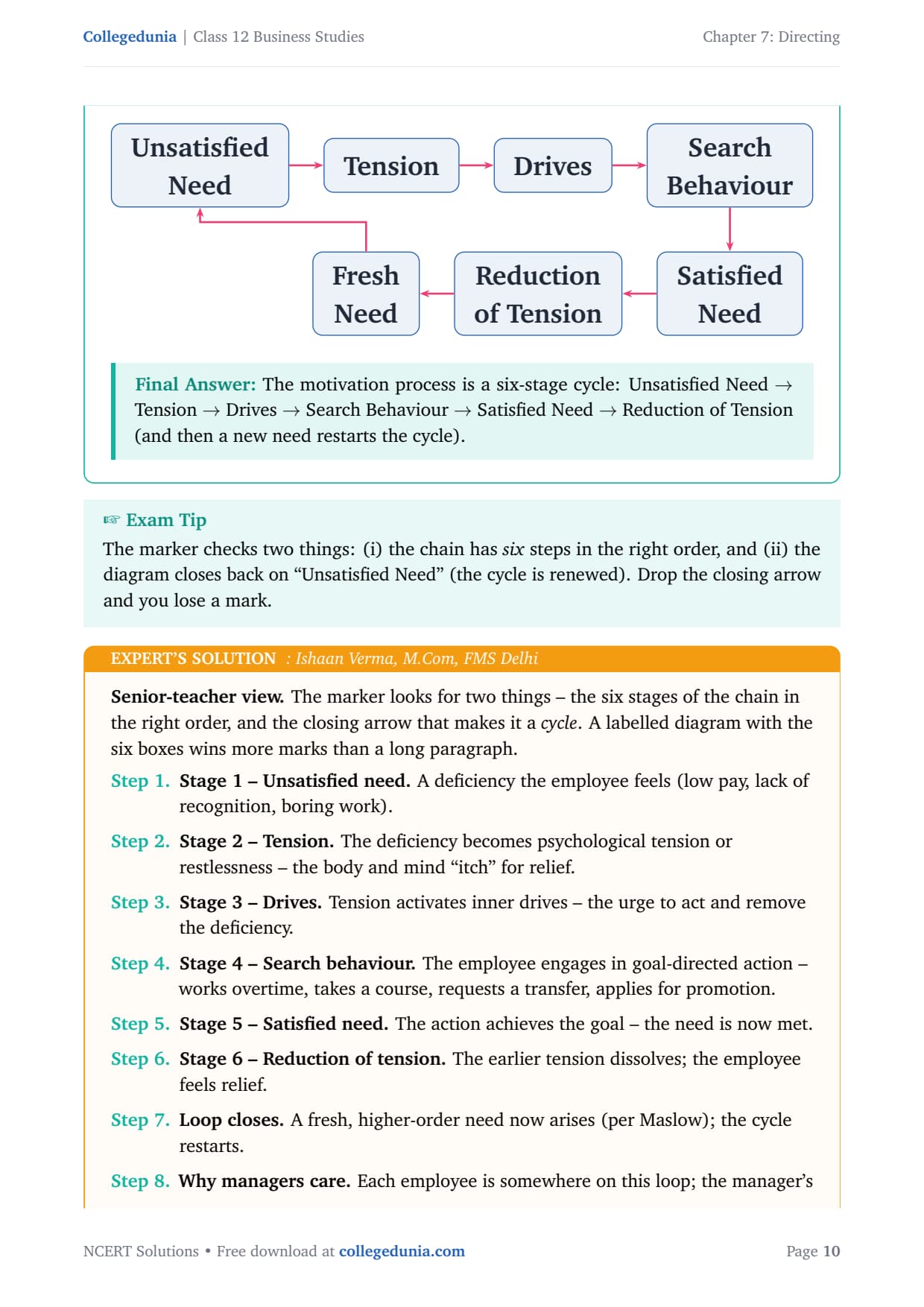
Diagram (process of motivation).
!%
[See diagram in the PDF version]
%
The motivation process is a six-stage cycle: Unsatisfied Need \(\to\) Tension \(\to\)
Drives \(\to\) Search Behaviour \(\to\) Satisfied Need \(\to\) Reduction of Tension (and then a new
need restarts the cycle).
IV
Ishaan Verma
M.Com, FMS Delhi
Verified Expert
Senior-teacher view. The marker looks for two things – the six stages of the chain in
the right order, and the closing arrow that makes it a cycle. A labelled diagram with the
six boxes wins more marks than a long paragraph.
Stage 1 – Unsatisfied need. A deficiency the employee feels (low pay, lack of
recognition, boring work).
Stage 2 – Tension. The deficiency becomes psychological tension or restlessness
– the body and mind ``itch'' for relief.
Stage 3 – Drives. Tension activates inner drives – the urge to act and remove
the deficiency.
Stage 4 – Search behaviour. The employee engages in goal-directed action –
works overtime, takes a course, requests a transfer, applies for promotion.
Stage 5 – Satisfied need. The action achieves the goal – the need is now met.
Stage 6 – Reduction of tension. The earlier tension dissolves; the employee
feels relief.
Loop closes. A fresh, higher-order need now arises (per Maslow); the cycle
restarts.
Why managers care. Each employee is somewhere on this loop; the manager's job is
to channel the search behaviour toward organisational goals.
Motivation is a six-step self-renewing cycle – Unsatisfied Need \(\to\) Tension \(\to\)
Drives \(\to\) Search Behaviour \(\to\) Satisfied Need \(\to\) Reduction of Tension – and then a fresh
need restarts the loop, which is why motivation is a continuous managerial task.
Q 7.7
State the different networks of grapevine communications.
Concept used.Grapevine (informal) communication does not flow randomly – it
follows four typical patterns or networks. The NCERT names them as single strand,
gossip, probability and cluster.
Single-strand network. The message passes from one person to the next, who tells
the next, and so on in a straight chain.
(\(\,A \to B \to C \to D\,\)). High distortion risk because each repetition alters the
message slightly.
Gossip network. One person tells the message to many others non-selectively.
(\(\,A\) tells \(B, C, D, E, F\,\)). Spreads news fast but accuracy depends on \(A\).
Probability network. The originator passes the message to a random subset of
people, and each of those does the same – like Brownian motion. Coverage is broad but
unpredictable.
Cluster network. The originator passes the message only to selected, trusted
people. Each of those then selectively passes it on. This is the most common
organisational grapevine and is reasonably reliable.
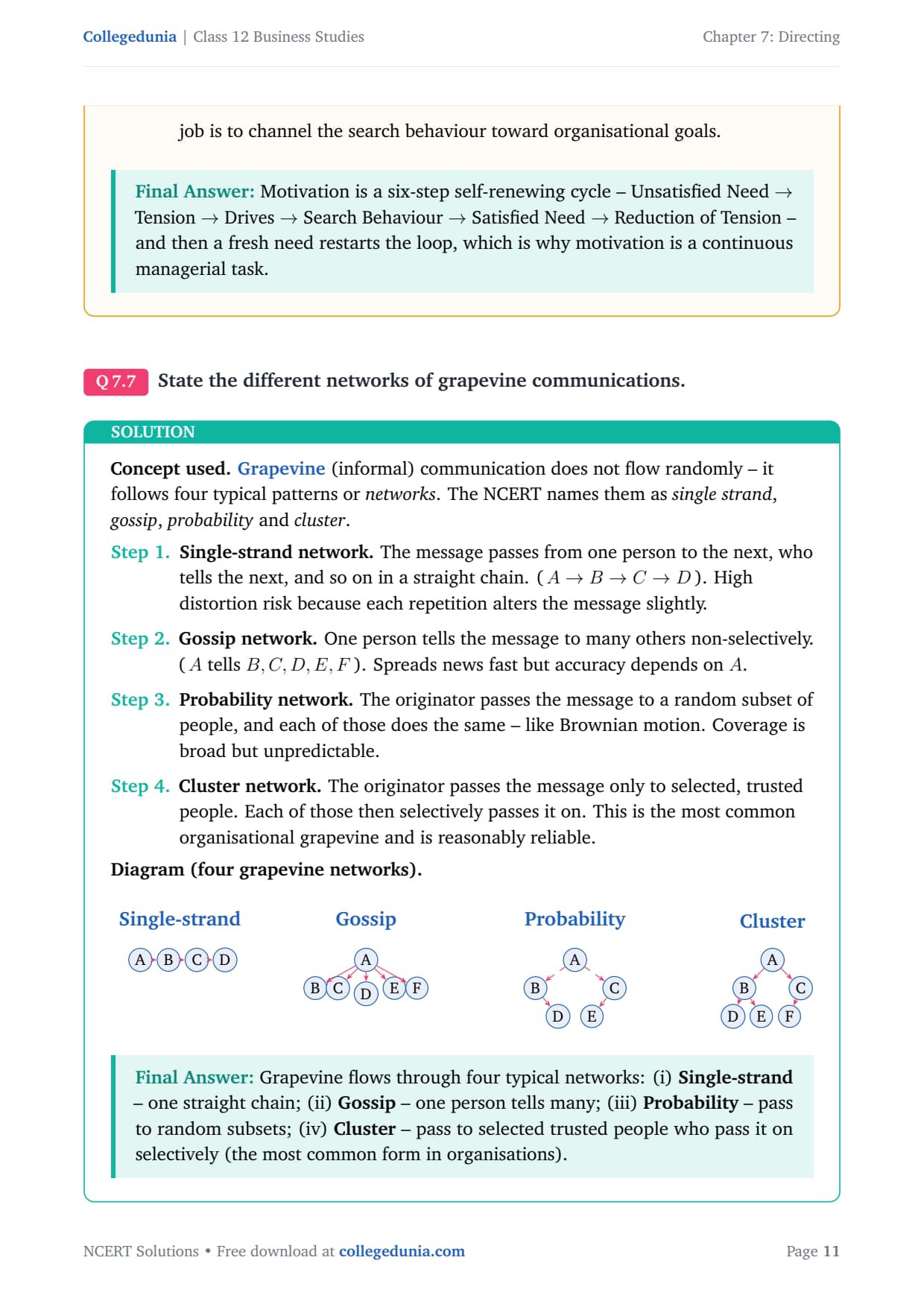
Diagram (four grapevine networks).
!%
[See diagram in the PDF version]
%
Grapevine flows through four typical networks: (i) Single-strand – one
straight chain; (ii) Gossip – one person tells many; (iii) Probability – pass
to random subsets; (iv) Cluster – pass to selected trusted people who pass it on
selectively (the most common form in organisations).
SR
Saanvi Reddy
M.Com, IIM Indore
Verified Expert
Senior-teacher view. Memorise the four names with a mental picture for each shape; the
diagram earns more marks than the paragraph. Mention which network is the most common in
real workplaces (cluster) for an easy extra mark.
Single-strand network. A linear chain – A tells B, B tells C, C tells D.
Maximum distortion: by the time the message reaches D it can be unrecognisable.
Gossip network. A central person tells the message non-selectively to a circle
of others – one-to-many. Spreads fast; reliability depends on the central person.
Probability network. The originator passes the message to a random subset,
each of whom in turn passes it to another random subset. The path is unpredictable,
coverage is wide but uneven.
Cluster network. The originator passes the message only to selected, trusted
people (a cluster); each of them does the same. This is the most common grapevine
in organisations and is reasonably reliable because trust filters out unfit news.
Managerial use. A manager who knows the cluster ``hubs'' can plant accurate
information through them to kill rumours quickly.
Real-world illustration. The grapevine in a typical Indian factory shop floor
almost always follows the cluster pattern – a charge-hand tells two trusted
operatives, each of whom tells two more, and the news fans out along trust lines. A wise
supervisor identifies these hubs in the first week and uses them as informal
``microphones'' to spread official news faster than any formal channel could.
Reliability ranking. Cluster \(>\) Gossip \(>\) Probability \(>\) Single-strand –
because every retelling in single-strand adds distortion, while cluster's trust filter
screens out wild rumour.
The four grapevine networks are Single-strand (a straight chain),
Gossip (one person tells many), Probability (random subsets pass it on) and
Cluster (selective trusted relay – the most common and most reliable form in real
organisations).
Q 7.8
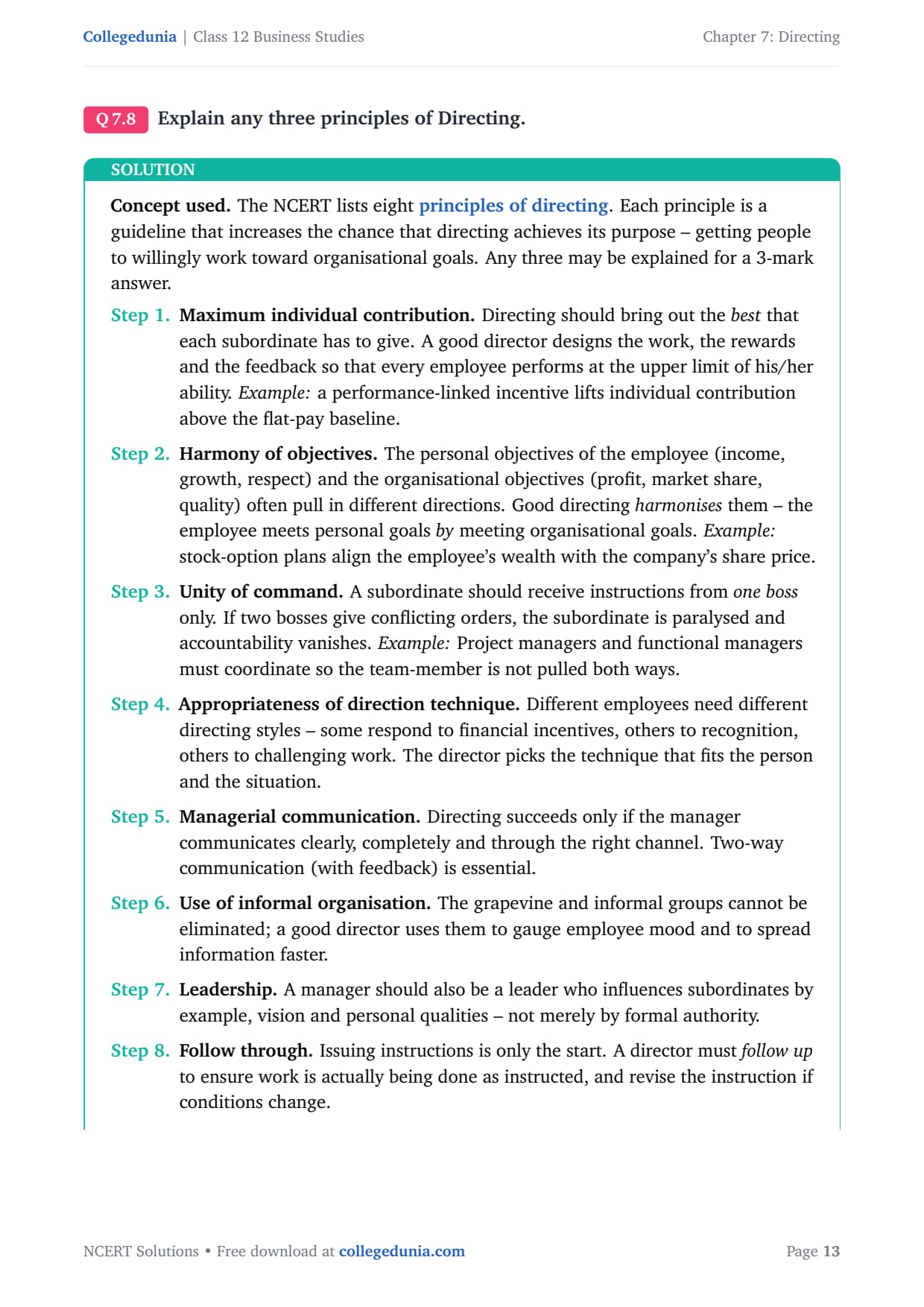
Explain any three principles of Directing.
Concept used. The NCERT lists eight principles of directing. Each principle is a
guideline that increases the chance that directing achieves its purpose – getting people to
willingly work toward organisational goals. Any three may be explained for a 3-mark answer.
Maximum individual contribution. Directing should bring out the best that
each subordinate has to give. A good director designs the work, the rewards and the
feedback so that every employee performs at the upper limit of his/her ability.
Example: a performance-linked incentive lifts individual contribution above the
flat-pay baseline.
Harmony of objectives. The personal objectives of the employee (income, growth,
respect) and the organisational objectives (profit, market share, quality) often pull in
different directions. Good directing harmonises them – the employee meets
personal goals by meeting organisational goals.
Example: stock-option plans align the employee's wealth with the company's share
price.
Unity of command. A subordinate should receive instructions from one
boss only. If two bosses give conflicting orders, the subordinate is paralysed and
accountability vanishes.
Example: Project managers and functional managers must coordinate so the
team-member is not pulled both ways.
Appropriateness of direction technique. Different employees need different
directing styles – some respond to financial incentives, others to recognition, others
to challenging work. The director picks the technique that fits the person and the
situation.
Managerial communication. Directing succeeds only if the manager communicates
clearly, completely and through the right channel. Two-way communication (with feedback)
is essential.
Use of informal organisation. The grapevine and informal groups cannot be
eliminated; a good director uses them to gauge employee mood and to spread information
faster.
Leadership. A manager should also be a leader who influences subordinates by
example, vision and personal qualities – not merely by formal authority.
Follow through. Issuing instructions is only the start. A director must
follow up to ensure work is actually being done as instructed, and revise the
instruction if conditions change.
Three principles of directing (illustrative): Maximum individual contribution
(design rewards and work to extract each person's best), Harmony of objectives
(align personal and organisational goals), and Unity of command (one boss per
subordinate, to avoid conflicting orders).
DN
Devansh Nair
M.Com, NMIMS Mumbai
Verified Expert
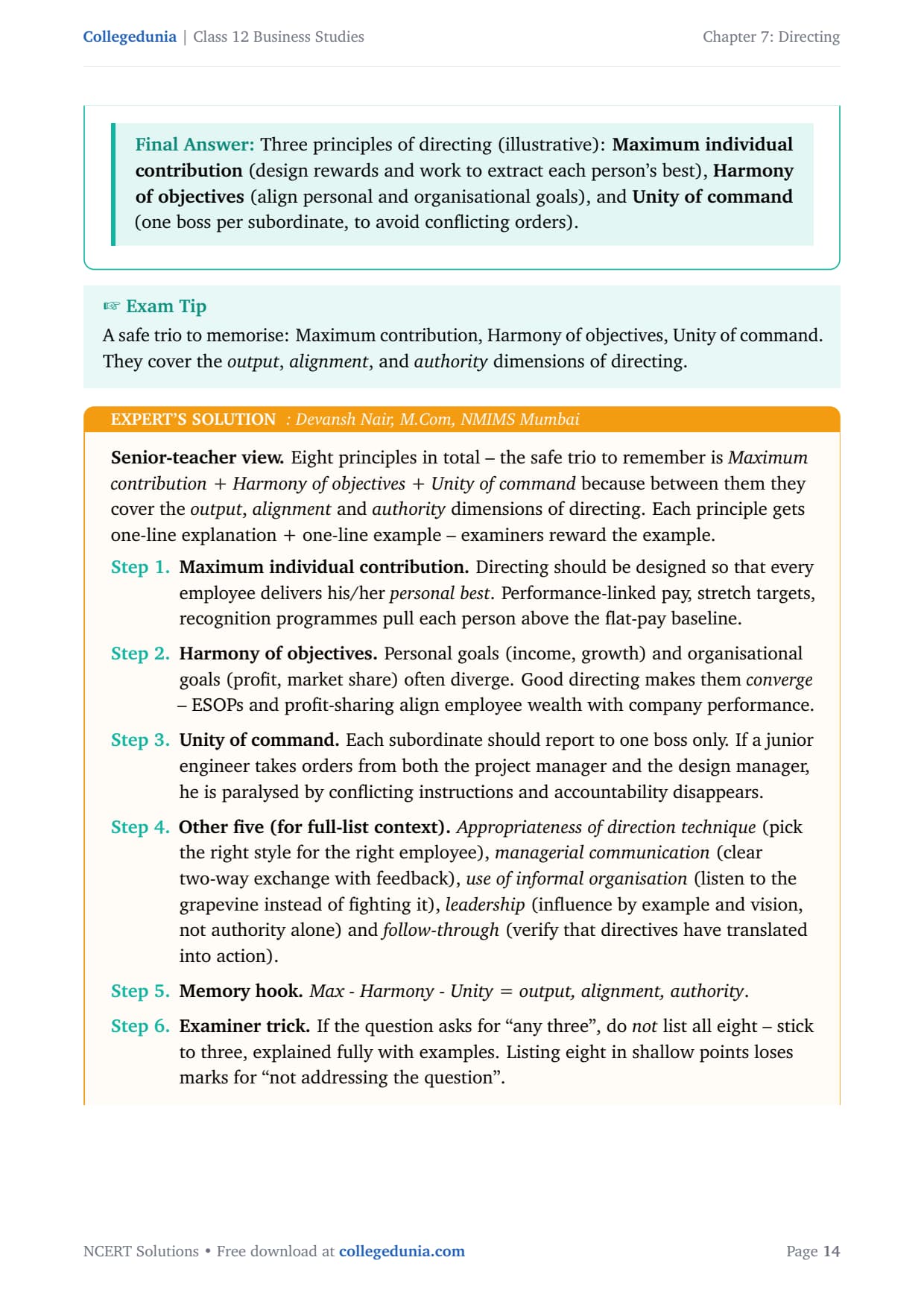
Senior-teacher view. Eight principles in total – the safe trio to remember is
Maximum contribution + Harmony of objectives + Unity of command because between them they
cover the output, alignment and authority dimensions of directing. Each
principle gets one-line explanation + one-line example – examiners reward the example.
Maximum individual contribution. Directing should be designed so that every
employee delivers his/her personal best. Performance-linked pay, stretch targets,
recognition programmes pull each person above the flat-pay baseline.
Harmony of objectives. Personal goals (income, growth) and organisational goals
(profit, market share) often diverge. Good directing makes them converge – ESOPs
and profit-sharing align employee wealth with company performance.
Unity of command. Each subordinate should report to one boss only. If a junior
engineer takes orders from both the project manager and the design manager, he is
paralysed by conflicting instructions and accountability disappears.
Other five (for full-list context).Appropriateness of direction
technique (pick the right style for the right employee), managerial communication
(clear two-way exchange with feedback), use of informal organisation (listen to
the grapevine instead of fighting it), leadership (influence by example and
vision, not authority alone) and follow-through (verify that directives have
translated into action).
Examiner trick. If the question asks for ``any three'', do not list all
eight – stick to three, explained fully with examples. Listing eight in shallow points
loses marks for ``not addressing the question''.
Three principles of directing (illustrative): Maximum individual contribution
(rewards designed to extract every person's best), Harmony of objectives (personal and
organisational goals converge) and Unity of command (one boss per subordinate – so that
authority and accountability are intact).
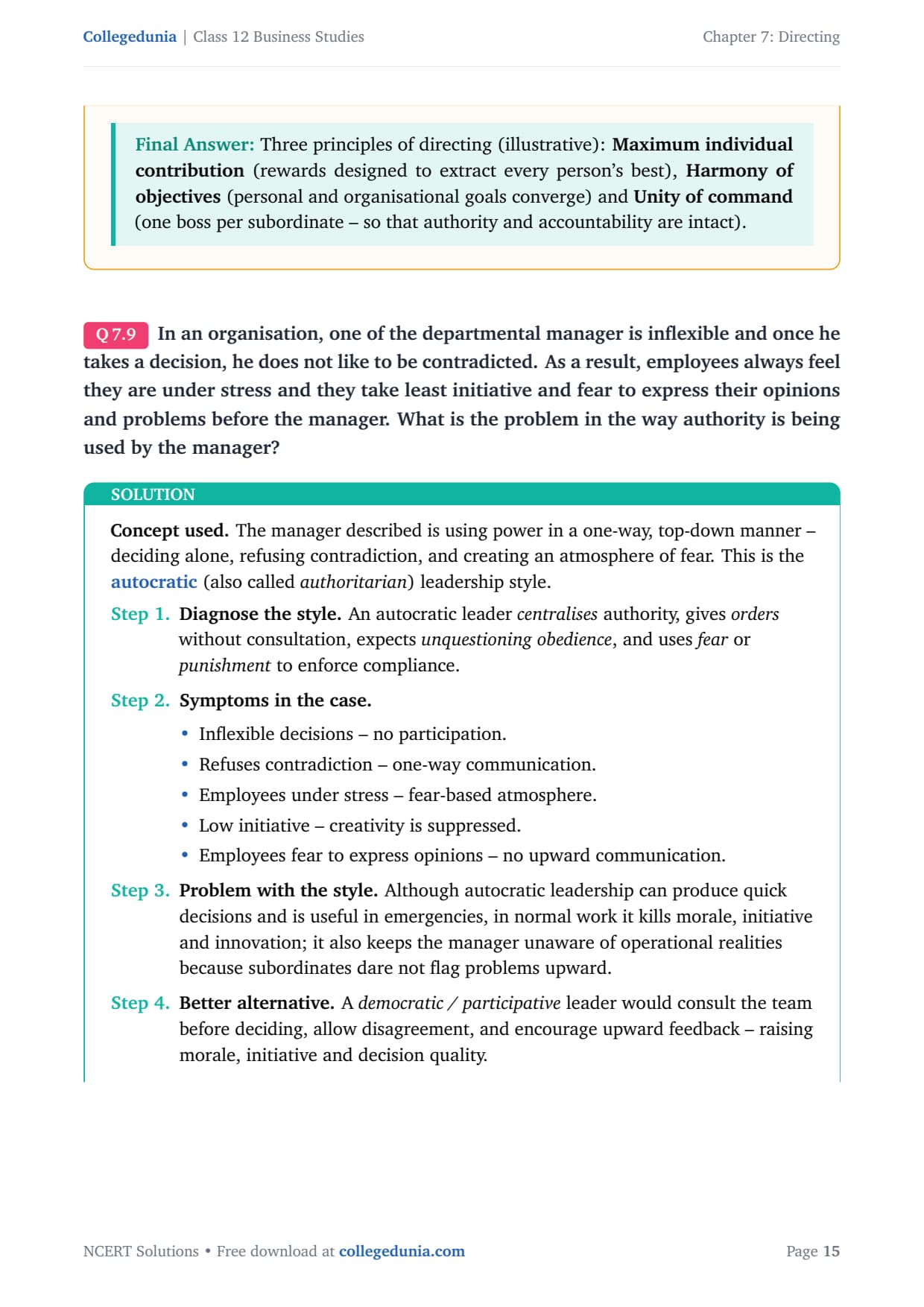
Q 7.9
In an organisation, one of the departmental manager is inflexible and once he takes a
decision, he does not like to be contradicted. As a result, employees always feel they are under
stress and they take least initiative and fear to express their opinions and problems before the
manager. What is the problem in the way authority is being used by the manager?
Concept used. The manager described is using power in a one-way, top-down manner –
deciding alone, refusing contradiction, and creating an atmosphere of fear. This is the
autocratic (also called authoritarian) leadership style.
Diagnose the style. An autocratic leader centralises authority, gives
orders without consultation, expects unquestioning obedience, and uses
fear or punishment to enforce compliance.
Symptoms in the case.
Inflexible decisions – no participation.
Refuses contradiction – one-way communication.
Employees under stress – fear-based atmosphere.
Low initiative – creativity is suppressed.
Employees fear to express opinions – no upward communication.
Problem with the style. Although autocratic leadership can produce quick
decisions and is useful in emergencies, in normal work it kills morale, initiative and
innovation; it also keeps the manager unaware of operational realities because
subordinates dare not flag problems upward.
Better alternative. A democratic / participative leader would consult the
team before deciding, allow disagreement, and encourage upward feedback – raising
morale, initiative and decision quality.
The manager is using an Autocratic (Authoritarian) leadership style – one-way,
power-centralised, no participation, fear-based. The problem is that it kills employee morale,
initiative and innovation, and starves the manager of upward information. The corrective is to
move to a democratic / participative style.
RB
Riya Bhatnagar
M.Com, MDI Gurgaon
Verified Expert
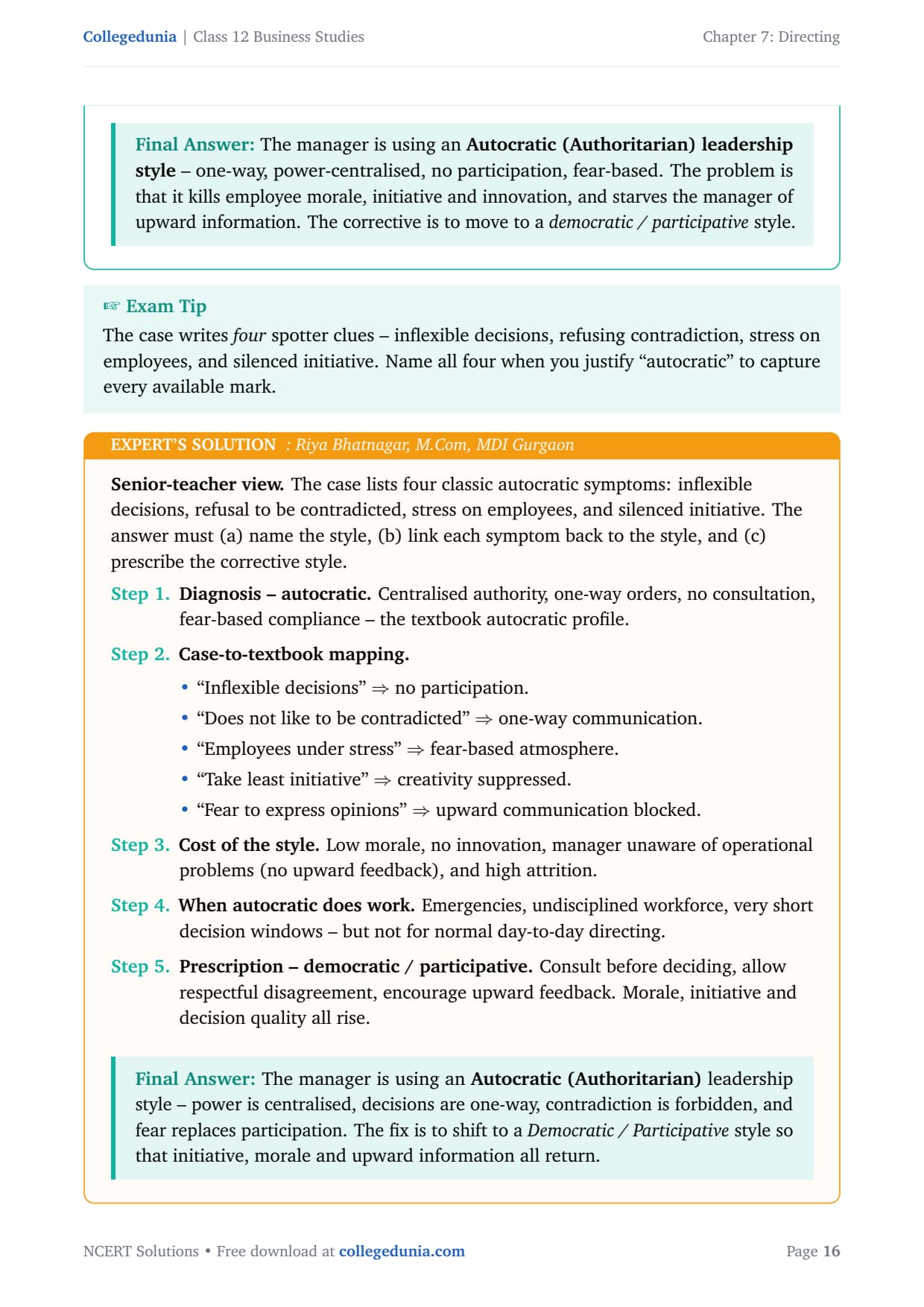
Senior-teacher view. The case lists four classic autocratic symptoms: inflexible
decisions, refusal to be contradicted, stress on employees, and silenced initiative. The answer
must (a) name the style, (b) link each symptom back to the style, and (c) prescribe the corrective
style.
Diagnosis – autocratic. Centralised authority, one-way orders, no consultation,
fear-based compliance – the textbook autocratic profile.
Case-to-textbook mapping.
``Inflexible decisions'' \(\Rightarrow\) no participation.
``Does not like to be contradicted'' \(\Rightarrow\) one-way communication.
``Employees under stress'' \(\Rightarrow\) fear-based atmosphere.
``Take least initiative'' \(\Rightarrow\) creativity suppressed.
``Fear to express opinions'' \(\Rightarrow\) upward communication blocked.
Cost of the style. Low morale, no innovation, manager unaware of operational
problems (no upward feedback), and high attrition.
When autocratic does work. Emergencies, undisciplined workforce, very short
decision windows – but not for normal day-to-day directing.
Prescription – democratic / participative. Consult before deciding, allow
respectful disagreement, encourage upward feedback. Morale, initiative and decision
quality all rise.
The manager is using an Autocratic (Authoritarian) leadership style – power
is centralised, decisions are one-way, contradiction is forbidden, and fear replaces
participation. The fix is to shift to a Democratic / Participative style so that initiative,
morale and upward information all return.
Q 7.10
A reputed hostel, GyanPradan provides medical aid and free education to children of its
employees. Which incentive is being highlighted here? State its category and name any two more
incentives of the same category.
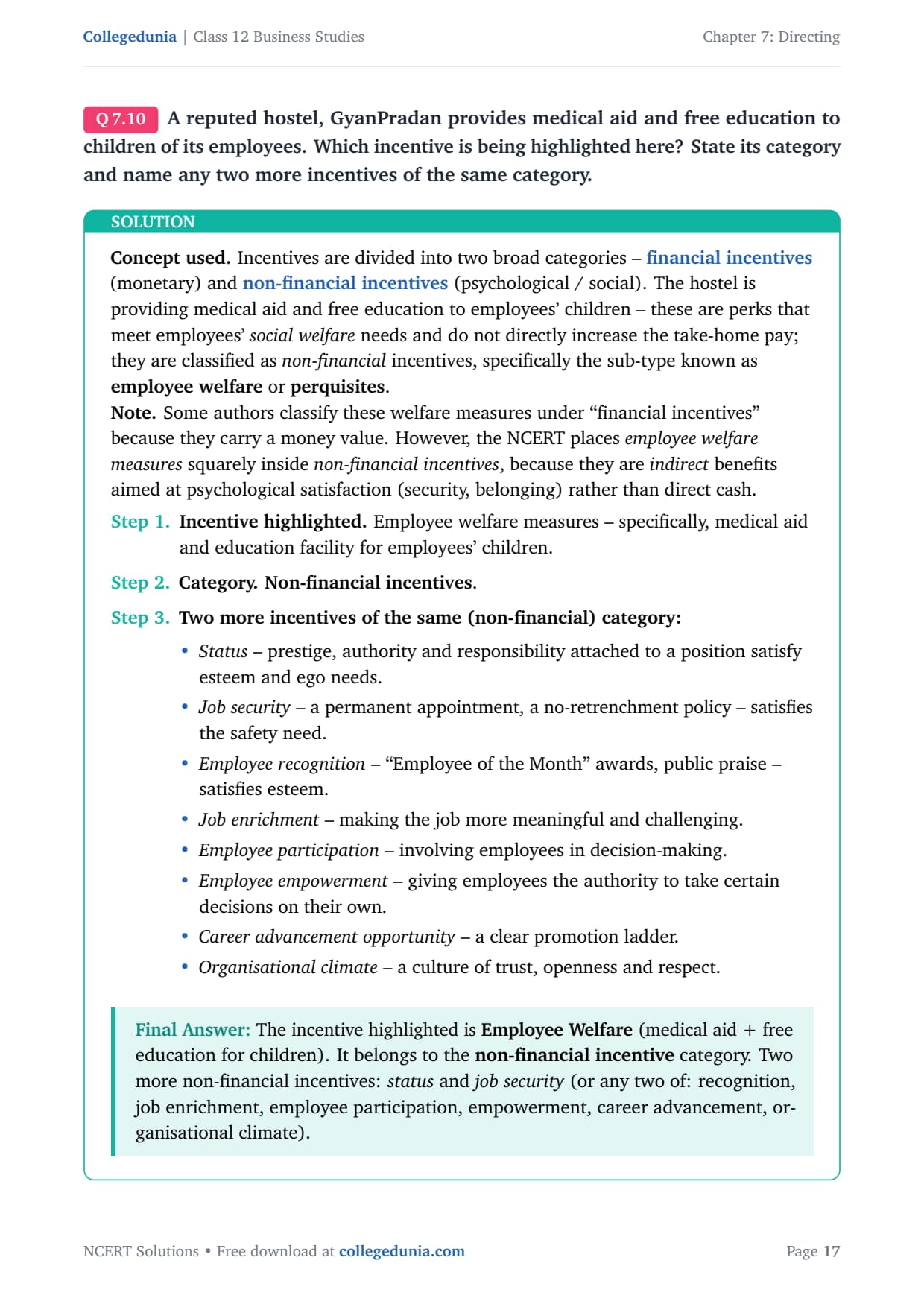
Concept used. Incentives are divided into two broad categories – financial
incentives (monetary) and non-financial incentives (psychological / social). The hostel
is providing medical aid and free education to employees' children – these are perks that meet
employees' social welfare needs and do not directly increase the take-home pay; they are
classified as non-financial incentives, specifically the sub-type known as
employee welfare or perquisites.
Note. Some authors classify these welfare measures under ``financial incentives'' because
they carry a money value. However, the NCERT places employee welfare measures squarely
inside non-financial incentives, because they are indirect benefits aimed at
psychological satisfaction (security, belonging) rather than direct cash.
Incentive highlighted. Employee welfare measures – specifically, medical aid
and education facility for employees' children.
Category.Non-financial incentives.
Two more incentives of the same (non-financial) category:
Status – prestige, authority and responsibility attached to a position
satisfy esteem and ego needs.
Job security – a permanent appointment, a no-retrenchment policy –
satisfies the safety need.
Employee recognition – ``Employee of the Month'' awards, public praise –
satisfies esteem.
Job enrichment – making the job more meaningful and challenging.
Employee participation – involving employees in decision-making.
Employee empowerment – giving employees the authority to take certain
decisions on their own.
Career advancement opportunity – a clear promotion ladder.
Organisational climate – a culture of trust, openness and respect.
The incentive highlighted is Employee Welfare (medical aid + free education for
children). It belongs to the non-financial incentive category. Two more non-financial
incentives: status and job security (or any two of: recognition, job enrichment,
employee participation, empowerment, career advancement, organisational climate).
TS
Tanvi Sinha
M.Com, IIM Lucknow
Verified Expert
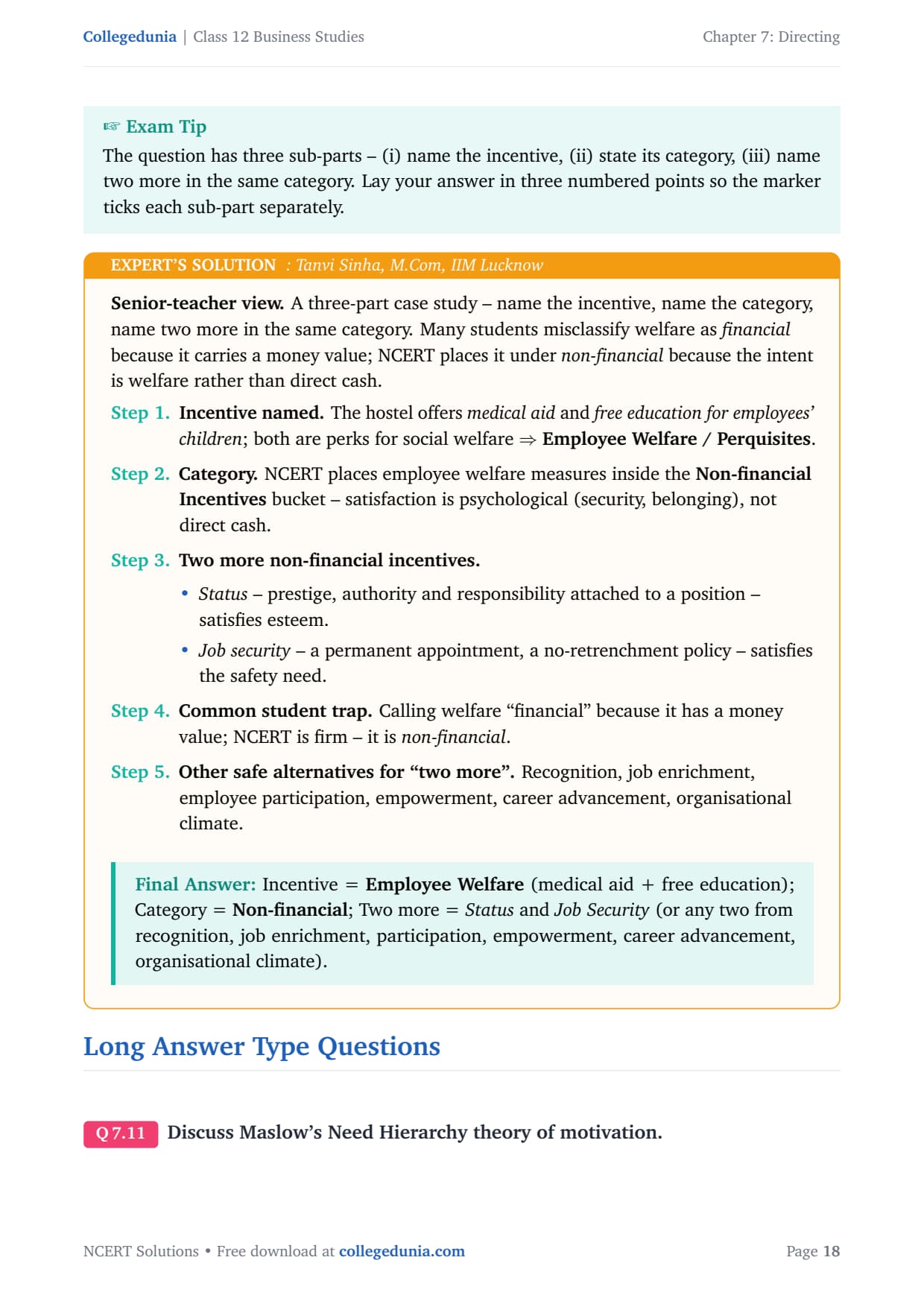
Senior-teacher view. A three-part case study – name the incentive, name the category,
name two more in the same category. Many students misclassify welfare as financial
because it carries a money value; NCERT places it under non-financial because the intent
is welfare rather than direct cash.
Incentive named. The hostel offers medical aid and free education
for employees' children; both are perks for social welfare \(\Rightarrow\)
Employee Welfare / Perquisites.
Category. NCERT places employee welfare measures inside the
Non-financial Incentives bucket – satisfaction is psychological (security,
belonging), not direct cash.
Two more non-financial incentives.
Status – prestige, authority and responsibility attached to a position –
satisfies esteem.
Job security – a permanent appointment, a no-retrenchment policy –
satisfies the safety need.
Common student trap. Calling welfare ``financial'' because it has a money value;
NCERT is firm – it is non-financial.
Other safe alternatives for ``two more''. Recognition, job enrichment, employee
participation, empowerment, career advancement, organisational climate.
Incentive = Employee Welfare (medical aid + free education); Category =
Non-financial; Two more = Status and Job Security (or any two from
recognition, job enrichment, participation, empowerment, career advancement, organisational
climate).
Long Answer Type Questions
Q 7.11
Discuss Maslow's Need Hierarchy theory of motivation.
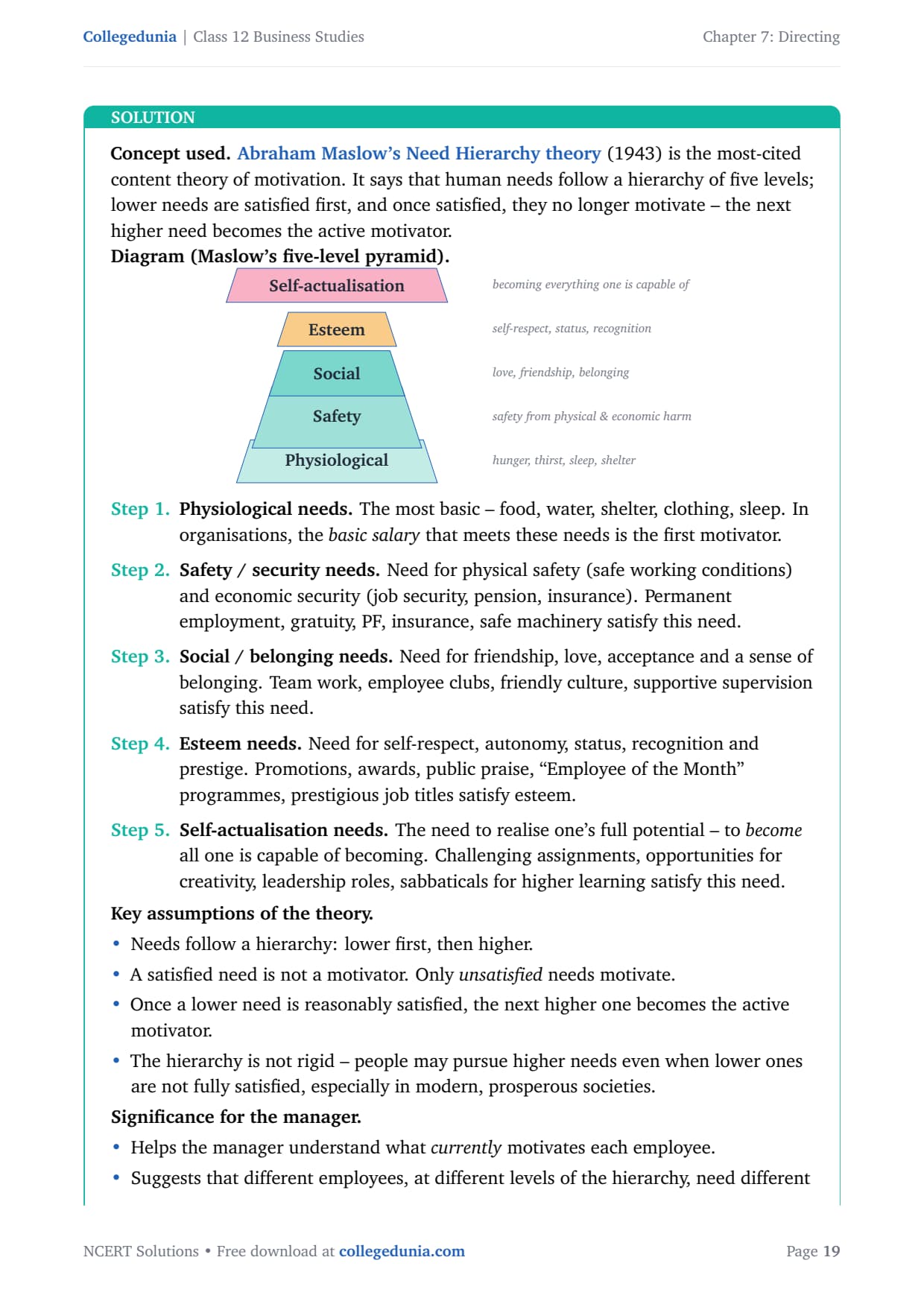
Concept used.Abraham Maslow's Need Hierarchy theory (1943) is the most-cited
content theory of motivation. It says that human needs follow a hierarchy of five levels; lower
needs are satisfied first, and once satisfied, they no longer motivate – the next higher need
becomes the active motivator.
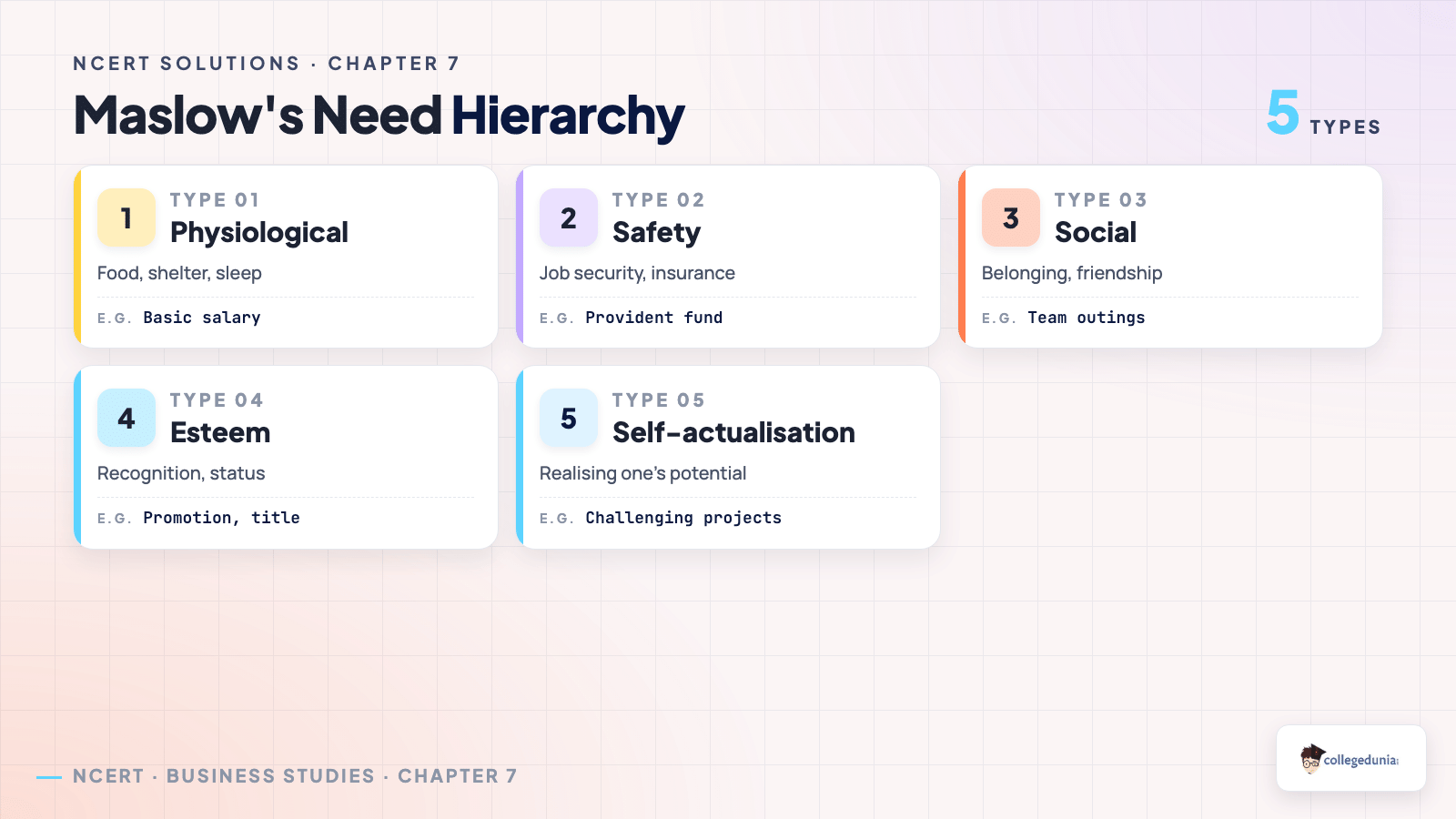
Diagram (Maslow's five-level pyramid).
[See diagram in the PDF version]
Physiological needs. The most basic – food, water, shelter, clothing, sleep. In
organisations, the basic salary that meets these needs is the first motivator.
Safety / security needs. Need for physical safety (safe working conditions) and
economic security (job security, pension, insurance). Permanent employment, gratuity,
PF, insurance, safe machinery satisfy this need.
Social / belonging needs. Need for friendship, love, acceptance and a sense of
belonging. Team work, employee clubs, friendly culture, supportive supervision satisfy
this need.
Esteem needs. Need for self-respect, autonomy, status, recognition and prestige.
Promotions, awards, public praise, ``Employee of the Month'' programmes, prestigious job
titles satisfy esteem.
Self-actualisation needs. The need to realise one's full potential – to
become all one is capable of becoming. Challenging assignments, opportunities for
creativity, leadership roles, sabbaticals for higher learning satisfy this need.
Key assumptions of the theory.
Needs follow a hierarchy: lower first, then higher.
A satisfied need is not a motivator. Only unsatisfied needs motivate.
Once a lower need is reasonably satisfied, the next higher one becomes the active
motivator.
The hierarchy is not rigid – people may pursue higher needs even when lower ones are not
fully satisfied, especially in modern, prosperous societies.
Significance for the manager.
Helps the manager understand what currently motivates each employee.
Suggests that different employees, at different levels of the hierarchy, need different
incentives.
Lower-level needs are mostly met by financial incentives; higher-level needs are met by
non-financial incentives.
Maslow's Need Hierarchy theory (1943) arranges human needs in a five-level pyramid:
Physiological \(\to\) Safety \(\to\) Social \(\to\) Esteem \(\to\) Self-actualisation. Lower needs
must be reasonably satisfied before higher ones become motivators; a satisfied need is no longer
a motivator. For managers, the theory means lower-need employees respond best to financial
incentives, while higher-need employees respond best to non-financial incentives like
recognition, autonomy and challenging work.
MA
Mihir Agrawal
M.Com, JNU Delhi
Verified Expert
Senior-teacher view. This is a high-mark LA question. The marker expects (i) the
biographical anchor (Abraham Maslow, 1943), (ii) the five-level pyramid in correct order from
bottom to top with one example of how each level is met at the workplace, (iii) the three
governing assumptions (lower-needs-first, satisfied-need-not-motivator, lower-needs-money / upper-
needs-non-money), and (iv) the managerial significance. A labelled pyramid diagram earns extra.
Provenance. Proposed by American psychologist Abraham Maslow in his 1943
paper ``A Theory of Human Motivation''; refined in his 1954 book Motivation and
Personality.
Stage 1 – Physiological. Hunger, thirst, sleep, shelter – met at work by the
basic salary, canteen, rest rooms, drinking water, accommodation.
Stage 3 – Social. Friendship, belonging, acceptance – met by team work,
cordial peers, employee clubs, supportive supervision, festival celebrations.
Stage 4 – Esteem. Self-respect, autonomy, status, recognition – met by
promotions, public praise, ``Employee of the Month'', prestigious job titles, corner
cabins.
Stage 5 – Self-actualisation. Realising one's full potential – met by
challenging assignments, creative freedom, sabbaticals, leadership roles, R&D projects.
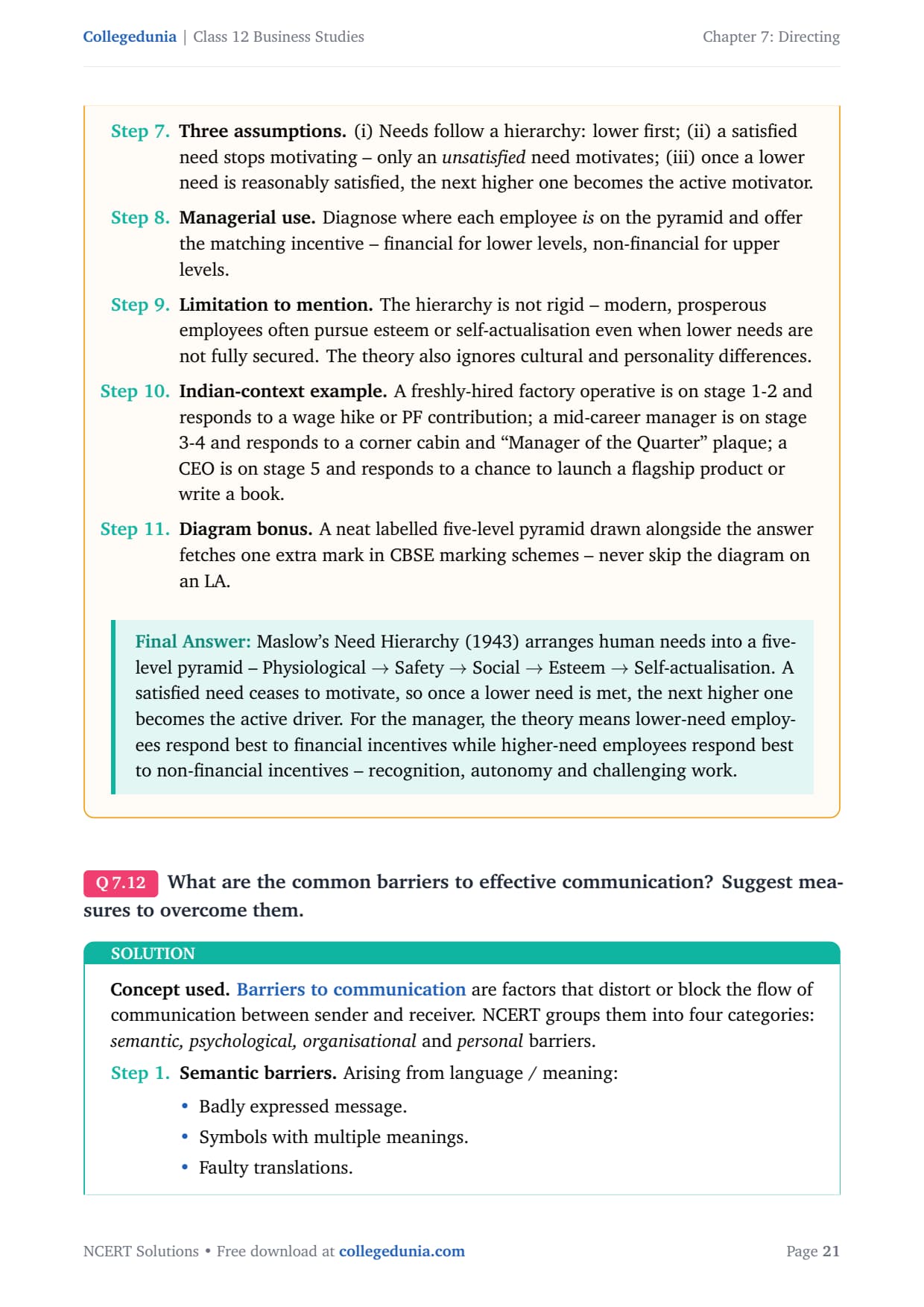
Three assumptions. (i) Needs follow a hierarchy: lower first; (ii) a satisfied
need stops motivating – only an unsatisfied need motivates; (iii) once a lower
need is reasonably satisfied, the next higher one becomes the active motivator.
Managerial use. Diagnose where each employee is on the pyramid and offer
the matching incentive – financial for lower levels, non-financial for upper levels.
Limitation to mention. The hierarchy is not rigid – modern, prosperous
employees often pursue esteem or self-actualisation even when lower needs are not fully
secured. The theory also ignores cultural and personality differences.
Indian-context example. A freshly-hired factory operative is on stage 1-2 and
responds to a wage hike or PF contribution; a mid-career manager is on stage 3-4 and
responds to a corner cabin and ``Manager of the Quarter'' plaque; a CEO is on stage 5
and responds to a chance to launch a flagship product or write a book.
Diagram bonus. A neat labelled five-level pyramid drawn alongside the answer
fetches one extra mark in CBSE marking schemes – never skip the diagram on an LA.
Maslow's Need Hierarchy (1943) arranges human needs into a five-level pyramid –
Physiological \(\to\) Safety \(\to\) Social \(\to\) Esteem \(\to\) Self-actualisation. A satisfied need
ceases to motivate, so once a lower need is met, the next higher one becomes the active driver.
For the manager, the theory means lower-need employees respond best to financial incentives while
higher-need employees respond best to non-financial incentives – recognition, autonomy and
challenging work.
Q 7.12
What are the common barriers to effective communication? Suggest measures to overcome
them.
Concept used.Barriers to communication are factors that distort or block the
flow of communication between sender and receiver. NCERT groups them into four categories:
semantic, psychological, organisational and personal barriers.
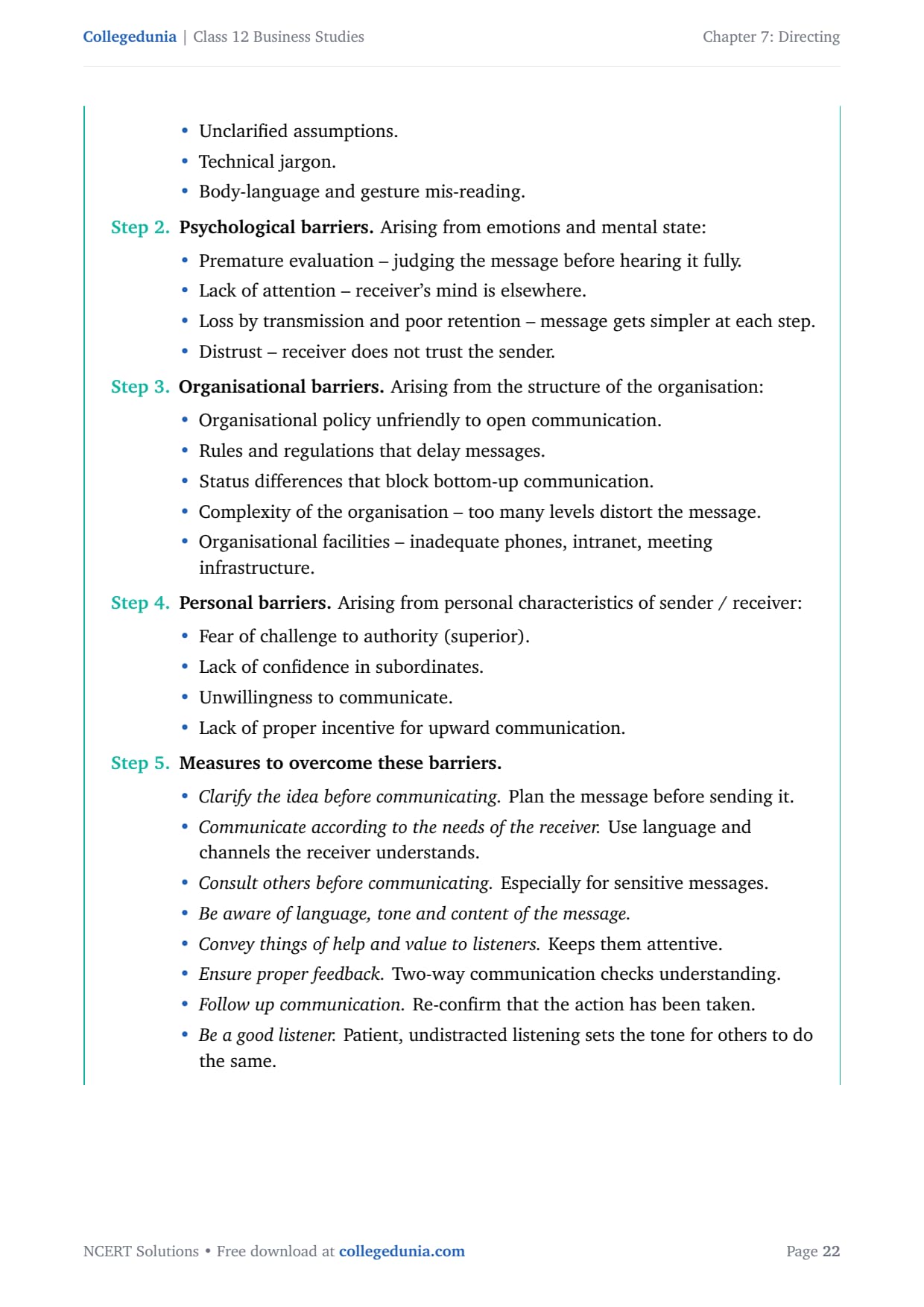
Semantic barriers. Arising from language / meaning:
Badly expressed message.
Symbols with multiple meanings.
Faulty translations.
Unclarified assumptions.
Technical jargon.
Body-language and gesture mis-reading.
Psychological barriers. Arising from emotions and mental state:
Premature evaluation – judging the message before hearing it fully.
Lack of attention – receiver's mind is elsewhere.
Loss by transmission and poor retention – message gets simpler at each step.
Distrust – receiver does not trust the sender.
Organisational barriers. Arising from the structure of the organisation:
Organisational policy unfriendly to open communication.
Rules and regulations that delay messages.
Status differences that block bottom-up communication.
Complexity of the organisation – too many levels distort the message.
Personal barriers. Arising from personal characteristics of sender / receiver:
Fear of challenge to authority (superior).
Lack of confidence in subordinates.
Unwillingness to communicate.
Lack of proper incentive for upward communication.
Measures to overcome these barriers.
Clarify the idea before communicating. Plan the message before sending it.
Communicate according to the needs of the receiver. Use language and
channels the receiver understands.
Consult others before communicating. Especially for sensitive messages.
Be aware of language, tone and content of the message.
Convey things of help and value to listeners. Keeps them attentive.
Ensure proper feedback. Two-way communication checks understanding.
Follow up communication. Re-confirm that the action has been taken.
Be a good listener. Patient, undistracted listening sets the tone for
others to do the same.
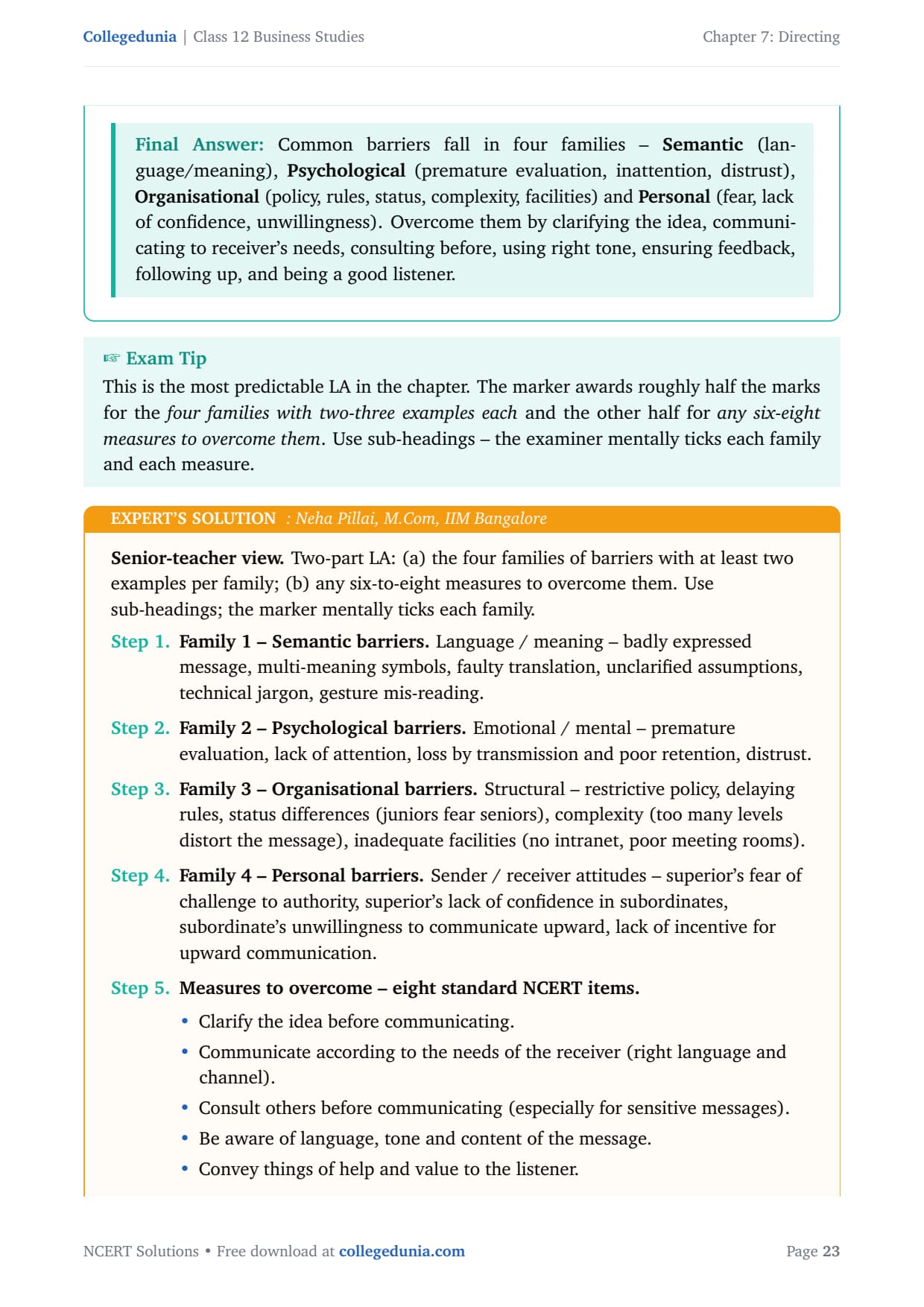
Common barriers fall in four families – Semantic (language/meaning),
Psychological (premature evaluation, inattention, distrust), Organisational
(policy, rules, status, complexity, facilities) and Personal (fear, lack of confidence,
unwillingness). Overcome them by clarifying the idea, communicating to receiver's needs,
consulting before, using right tone, ensuring feedback, following up, and being a good listener.
NP
Neha Pillai
M.Com, IIM Bangalore
Verified Expert
Senior-teacher view. Two-part LA: (a) the four families of barriers with at least two
examples per family; (b) any six-to-eight measures to overcome them. Use sub-headings; the marker
mentally ticks each family.
Family 1 – Semantic barriers. Language / meaning – badly expressed message,
multi-meaning symbols, faulty translation, unclarified assumptions, technical jargon,
gesture mis-reading.
Family 2 – Psychological barriers. Emotional / mental – premature evaluation,
lack of attention, loss by transmission and poor retention, distrust.
Family 3 – Organisational barriers. Structural – restrictive policy, delaying
rules, status differences (juniors fear seniors), complexity (too many levels distort
the message), inadequate facilities (no intranet, poor meeting rooms).
Family 4 – Personal barriers. Sender / receiver attitudes – superior's fear of
challenge to authority, superior's lack of confidence in subordinates, subordinate's
unwillingness to communicate upward, lack of incentive for upward communication.
Measures to overcome – eight standard NCERT items.
Clarify the idea before communicating.
Communicate according to the needs of the receiver (right language and channel).
Consult others before communicating (especially for sensitive messages).
Be aware of language, tone and content of the message.
Convey things of help and value to the listener.
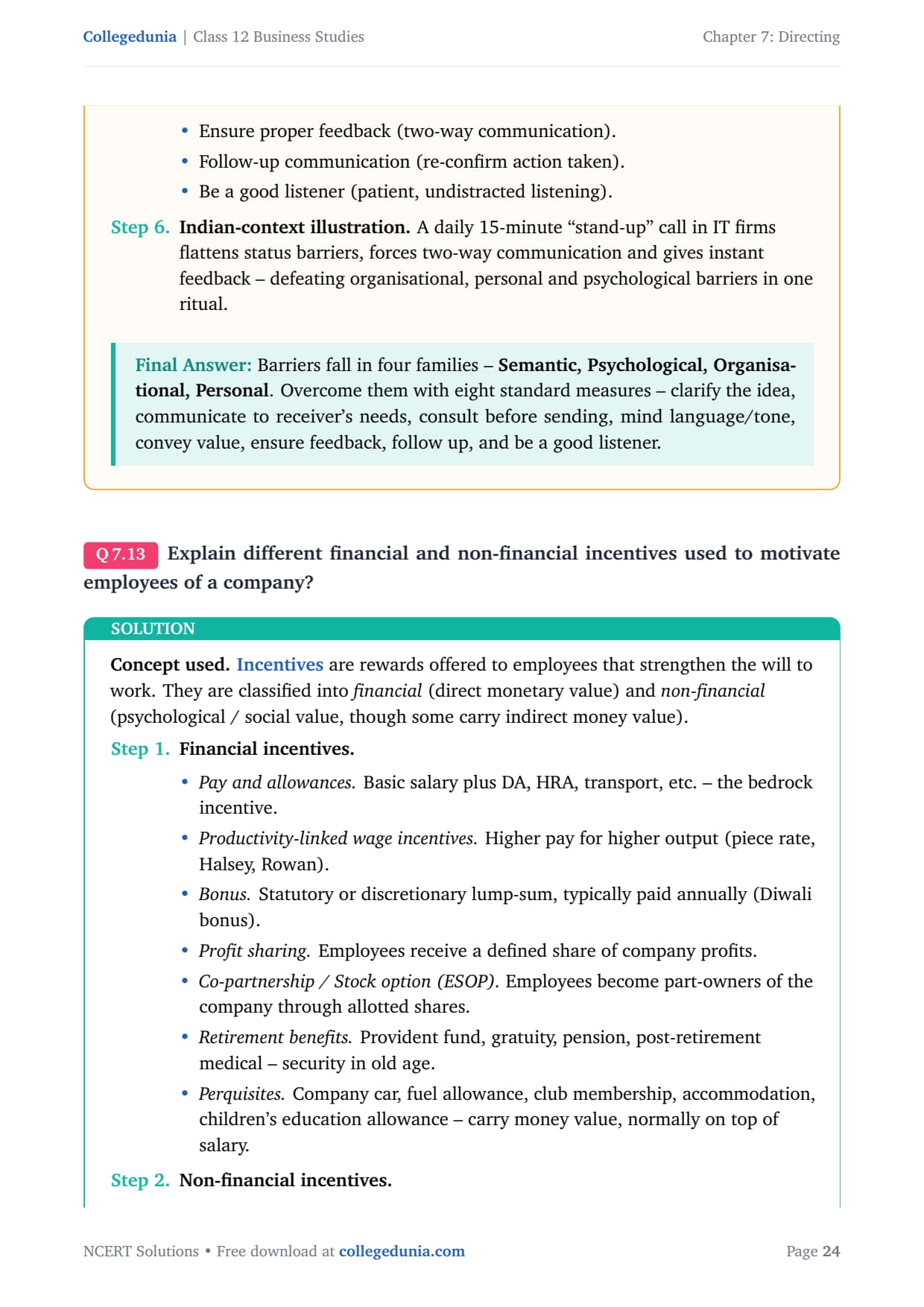
Ensure proper feedback (two-way communication).
Follow-up communication (re-confirm action taken).
Be a good listener (patient, undistracted listening).
Indian-context illustration. A daily 15-minute ``stand-up'' call in IT firms
flattens status barriers, forces two-way communication and gives instant feedback –
defeating organisational, personal and psychological barriers in one ritual.
Barriers fall in four families – Semantic, Psychological, Organisational,
Personal. Overcome them with eight standard measures – clarify the idea, communicate to
receiver's needs, consult before sending, mind language/tone, convey value, ensure feedback,
follow up, and be a good listener.
Q 7.13
Explain different financial and non-financial incentives used to motivate employees of a
company?
Concept used.Incentives are rewards offered to employees that strengthen the
will to work. They are classified into financial (direct monetary value) and
non-financial (psychological / social value, though some carry indirect money value).
Financial incentives.
Pay and allowances. Basic salary plus DA, HRA, transport, etc. – the
bedrock incentive.
Bonus. Statutory or discretionary lump-sum, typically paid annually
(Diwali bonus).
Profit sharing. Employees receive a defined share of company profits.
Co-partnership / Stock option (ESOP). Employees become part-owners of the
company through allotted shares.
Retirement benefits. Provident fund, gratuity, pension, post-retirement
medical – security in old age.
Perquisites. Company car, fuel allowance, club membership, accommodation,
children's education allowance – carry money value, normally on top of salary.
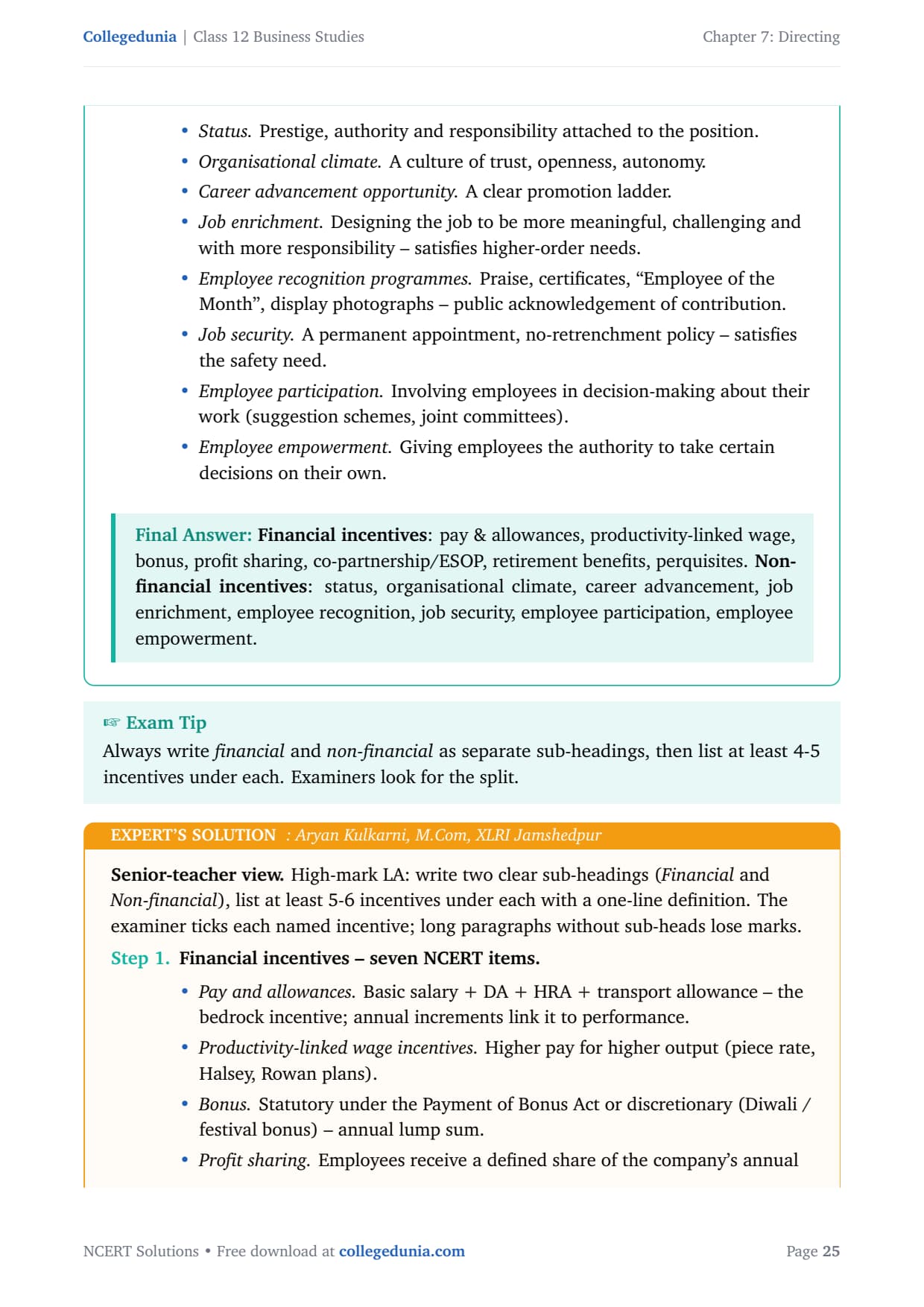
Non-financial incentives.
Status. Prestige, authority and responsibility attached to the position.
Organisational climate. A culture of trust, openness, autonomy.
Career advancement opportunity. A clear promotion ladder.
Job enrichment. Designing the job to be more meaningful, challenging and
with more responsibility – satisfies higher-order needs.
Employee recognition programmes. Praise, certificates, ``Employee of the
Month'', display photographs – public acknowledgement of contribution.
Job security. A permanent appointment, no-retrenchment policy – satisfies
the safety need.
Employee participation. Involving employees in decision-making about their
work (suggestion schemes, joint committees).
Employee empowerment. Giving employees the authority to take certain
decisions on their own.
Senior-teacher view. High-mark LA: write two clear sub-headings (Financial and
Non-financial), list at least 5-6 incentives under each with a one-line definition. The
examiner ticks each named incentive; long paragraphs without sub-heads lose marks.
Financial incentives – seven NCERT items.
Pay and allowances. Basic salary + DA + HRA + transport allowance – the
bedrock incentive; annual increments link it to performance.
Bonus. Statutory under the Payment of Bonus Act or discretionary
(Diwali / festival bonus) – annual lump sum.
Profit sharing. Employees receive a defined share of the company's annual
profit.
Co-partnership / Stock option (ESOP). Employees become part-owners of the
company through allotted shares – aligns wealth with company performance.
Retirement benefits. Provident fund, gratuity, pension, post-retirement
medical – security in old age.
Perquisites. Company car, fuel allowance, club membership, accommodation,
children's education allowance – carry money value, normally on top of salary.
Non-financial incentives – eight NCERT items.
Status – prestige, authority and responsibility of the position.
Organisational climate – a culture of trust, openness and autonomy.
Career advancement opportunity – a clear promotion ladder.
Job enrichment – making the job more meaningful and challenging.
Employee recognition programmes – praise, certificates, Employee of the
Month.
In an organisation all the employees take things easy and are free to approach anyone
for minor queries and problems. This has resulted in everyone taking to each other and thus
resulting in inefficiency in the office. It has also resulted in loss of secrecy and confidential
information being leaked out. What system do you think the manager should adopt to improve
communication?
Concept used. The current state described – everyone approaching anyone, no structure –
is informal communication taking over. The remedy is to install a system of
formal communication, where information flows through prescribed channels along the
organisation's chain of authority.
Diagnose the problem. Open access + no chain of authority \(\Rightarrow\) informal
communication has displaced formal channels. Consequences: (i) inefficiency (people
spend time gossiping) and (ii) leakage of confidential information.
Prescribe formal communication. The manager should establish a
formal communication system that follows the chain of authority. The four typical
directions of formal communication:
Downward – from superior to subordinate (orders, instructions, policies).
Upward – from subordinate to superior (reports, suggestions, grievances).
Horizontal / lateral – between people at the same level (coordination
between departments).
Diagonal – across both levels and departments, when needed and
authorised.
Specific steps the manager should take.
Draw a clear chain of authority and circulate it.
Specify who reports to whom and who may communicate with whom for which kind of
message.
Set up formal channels – official emails, intranet, weekly meetings, formal
memos, suggestion box.
Mark confidential information clearly and restrict its circulation list.
Train employees on what information may and may not be shared informally.
Conduct training in business communication to improve clarity and professionalism.
What about informal communication? It cannot be eliminated – but its
dominance can be reduced when a fast, reliable formal channel is in place. The
manager should also listen to the grapevine to catch rumours early.
The manager should adopt a formal communication system – a structured channel
that follows the chain of authority, with clear downward, upward, horizontal and diagonal flows;
specified channels (emails, intranet, memos, meetings); confidentiality classification; and
training in business communication. This restores efficiency and protects confidential information,
while informal communication continues in the background.
PJ
Pranav Joshi
M.Com, JBIMS Mumbai
Verified Expert
Senior-teacher view. The two problem-symptoms in the case – (a) everyone talking to
everyone (inefficiency), (b) leak of confidential information – must each be tied back to the
absence of a formal communication system. Name the four directions of formal communication
for the easy extra marks.
Diagnose. Open access + no chain of authority \(\Rightarrow\) informal channels
have crowded out formal ones. Consequences are exactly the two symptoms in the case –
inefficiency and loss of secrecy.
Prescription. Install a formal communication system – structured
flows along the chain of authority.
Four directions of formal communication.
Downward – superior to subordinate (orders, instructions, policies).
Upward – subordinate to superior (reports, suggestions, grievances).
Horizontal / lateral – between peers (inter-department coordination).
Diagonal – across levels and departments, when needed and authorised.
Action checklist for the manager.
Draw a clear organisation chart and circulate it.
Specify who reports to whom and which channel carries which message.
Set up official channels – emails, intranet, weekly meetings, memos, suggestion
box.
Train staff in business communication and confidentiality.
Position on informal communication. It cannot be eliminated – and should not
be. Once a fast, reliable formal channel exists, the dominance of the grapevine drops.
The manager continues to listen to it to catch rumours early.
The manager should adopt a formal communication system – a structured channel
that follows the chain of authority with downward, upward, horizontal and diagonal flows,
official media (emails, intranet, memos, meetings), and document classification for confidential
information. This restores efficiency and protects secrecy, while the grapevine continues in the
background but no longer dominates.
Student Feedback
In a Collegedunia poll of 940 Class 12 Commerce students, 82% said the Maslow need-hierarchy and communication-process diagrams in these Directing solutions made the 6-mark answers easier to reproduce in the exam. 3 in 4 said the "unable vs unwilling" and leadership-style spotter cues helped them crack case-study questions faster.
Other Resources for Class 12 Business Studies Chapter 7 Directing
What is directing in Class 12 Business Studies Chapter 7?
Directing is the management function of instructing, guiding, counselling, motivating and leading people in the organisation to achieve its objectives. It is the fourth function of management and converts plans on paper into actual goal-directed action.
What are the four elements of directing?
The four elements of directing are supervision, motivation, leadership and communication. Supervision is the first-line guidance of operatives; motivation stimulates the will to work; leadership influences people to strive willingly for group objectives; communication creates shared understanding.
What is Maslow's need hierarchy theory?
Abraham Maslow (1943) proposed that human needs follow a five-level hierarchy: (1) physiological, (2) safety, (3) social, (4) esteem, (5) self-actualisation. Lower needs are satisfied first; once satisfied, they stop motivating and the next higher need becomes the active motivator.
What is the difference between formal and informal communication?
Formal communication follows the chain of authority designed by management (orders, memos, agenda, minutes); it is slower but reliable. Informal communication (or grapevine) arises spontaneously out of social ties (rumours, whispers); it is very fast but often distorted.
Where can I download the Class 12 Business Studies Chapter 7 Directing NCERT Solutions PDF?
You can download the Collegedunia Class 12 Business Studies Chapter 7 Directing NCERT Solutions PDF free of cost from this page. The PDF is aligned to the NCERT Reprint 2026-27 syllabus and includes all the concepts, comparisons, diagrams and case-study spotters you need for the board exam.









Comments