Accountancy Strategist, 11 Yrs | Updated 3+ months ago
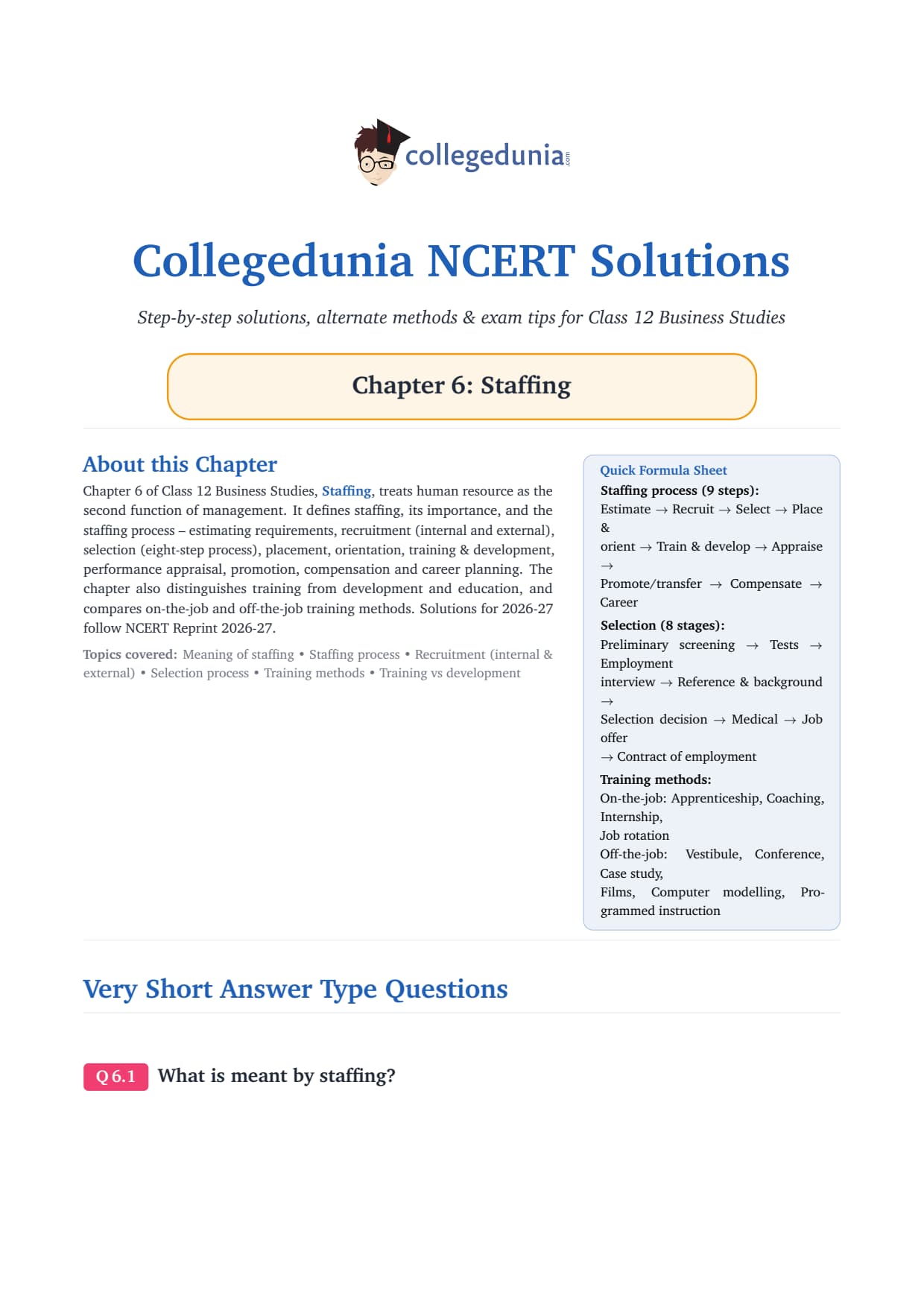
Staffing regularly carries a full Long Answer in the Class 12 Business Studies paper. These NCERT Solutions cover every question on the nine-step staffing process, recruitment, the eight-step selection procedure and training, answered the way CBSE expects for 2026-27.
CBSE Weightage: 6 to 10 marks (Unit 1, Principles and Functions of Management)
The ncert solutions are designed for a Class 12 student covering the chapter for the first time, and for board-exam candidates revising in the last week before the paper. Every concept is presented clearly with definitions, supporting features and one-line takeaways. Mnemonics, quick tips, common-mistake call-outs and case-study spotters are placed at the precise points where students typically slip.
Staffing Class 12 NCERT Solutions: Topic Map
Section
What is Covered
Why It Matters in the Exam
1. Meaning of Staffing
NCERT process definition, place in management cycle
1 to 3-mark questions; the verbatim "filling and keeping filled" line
2. Importance of Staffing
Five-point list anchored in NCERT
3 to 4-mark; mnemonic D-P-C-O-M
3. Staffing Process (9 steps)
Estimate to career planning
Sequence question (3 marks); cycle diagram
4. Recruitment Sources
Internal (transfers, promotions) vs external (10 sub-sources)
3 to 6-mark case-study identification (web publishing, casual callers)
5. Selection (8-step)
P-T-I-R-S-M-O-C procedure
5 to 6-mark long answer; ordered list
6. Training vs Development
Side-by-side comparison table
3 to 4-mark "distinguish between" question
7. Training Methods
On-the-job (4) vs off-the-job (6); vestibule training
What the Class 12 Business Studies Chapter 6 NCERT Solutions PDF Contains
Question-wise step-by-step answers to all 17 NCERT questions (5 Very Short Answer, 6 Short Answer, 7 Long Answer).
Concept Used block at the start of every long-answer solution naming the rule, definition or model being applied.
Boxed Final Answer at the end of every solution for last-minute revision.
Expert's Solution by an M.Com mentor giving the quick "exam-day" reading of each question.
Case-study mapping from spotter words to NCERT answer (e.g. "unable" $\rightarrow$ training; "urgent festival" $\rightarrow$ casual callers).
Cross-links to Notes, Handwritten Notes and the NCERT Book PDF for the same chapter.
Exam Anchor: In Chapter 6, two case-study keywords map directly to the right answer: "unable to work / lack of knowledge" $\Rightarrow$ training (specifically vestibule training when machines are costly/hi-tech), and "urgent + temporary + low-skill" $\Rightarrow$ casual callers. Train this reflex before the board exam.
Continue Learning: Staffing and Nearby Class 12 Chapters
All NCERT Solutions for Staffing with Step-by-Step Working
Every NCERT textbook question for Class 12 Business Studies Chapter 6 Staffing is listed below with its full Solution and Expert Solution hidden inside collapsible tabs. Click Check Solution to reveal the step-by-step working; click Expert Solution for the expanded explanation.
Very Short Answer Type Questions
Q 6.1
What is meant by staffing?
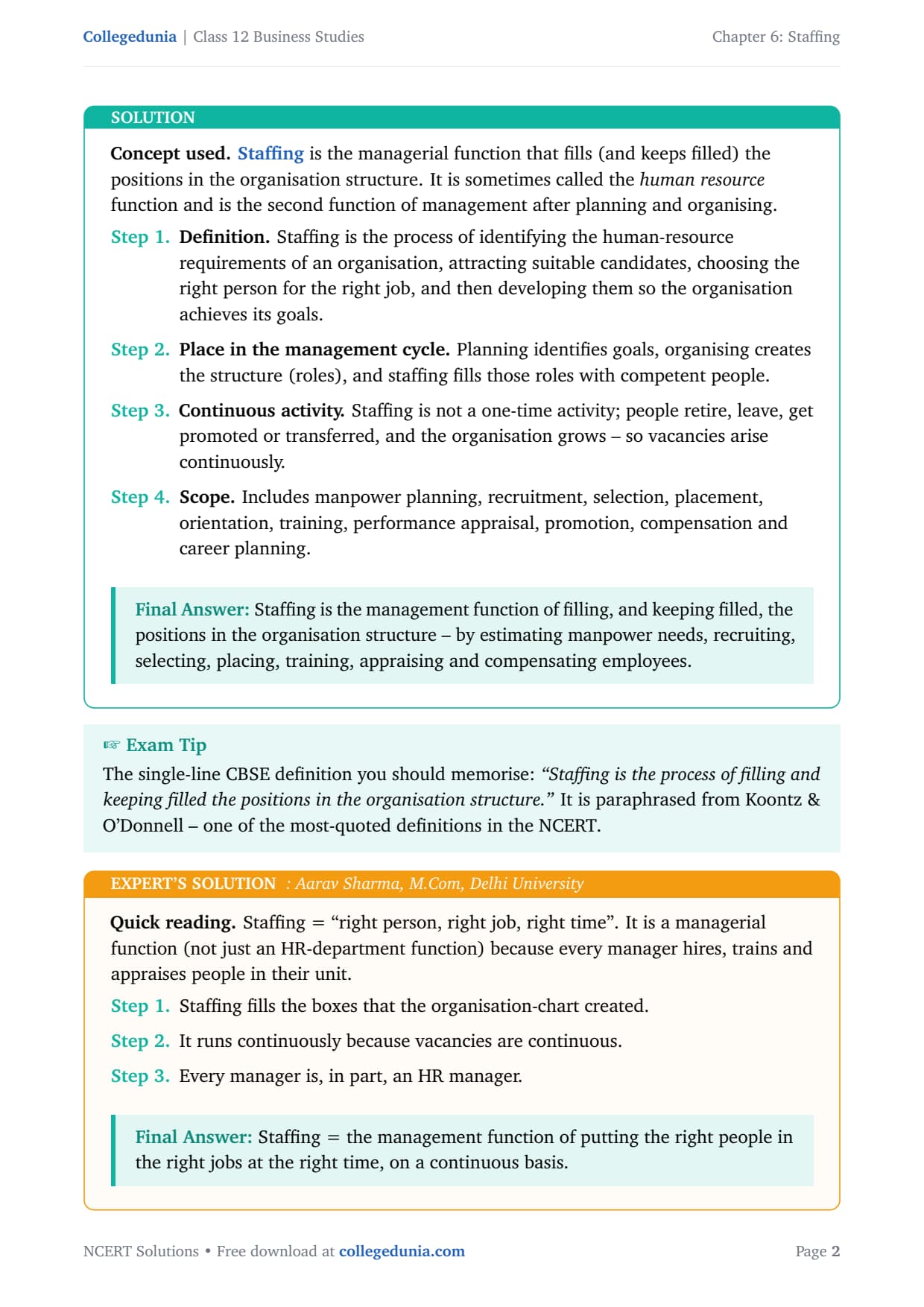
Concept used.Staffing is the managerial function that fills (and keeps filled) the
positions in the organisation structure. It is sometimes called the human resource function and
is the second function of management after planning and organising.
Definition. Staffing is the process of identifying the human-resource requirements
of an organisation, attracting suitable candidates, choosing the right person for the right
job, and then developing them so the organisation achieves its goals.
Place in the management cycle. Planning identifies goals, organising creates the
structure (roles), and staffing fills those roles with competent people.
Continuous activity. Staffing is not a one-time activity; people retire, leave,
get promoted or transferred, and the organisation grows – so vacancies arise continuously.
Scope. Includes manpower planning, recruitment, selection, placement, orientation,
training, performance appraisal, promotion, compensation and career planning.
Staffing is the management function of filling, and keeping filled, the positions in the
organisation structure – by estimating manpower needs, recruiting, selecting, placing, training,
appraising and compensating employees.
AS
Aarav Sharma
M.Com, Delhi University
Verified Expert
Quick reading. Staffing = ``right person, right job, right time''. It is a managerial
function (not just an HR-department function) because every manager hires, trains and appraises
people in their unit.
Staffing fills the boxes that the organisation-chart created.
It runs continuously because vacancies are continuous.
Every manager is, in part, an HR manager.
Staffing = the management function of putting the right people in the right jobs at the
right time, on a continuous basis.
Q 6.2
State the two important sources of recruitment.
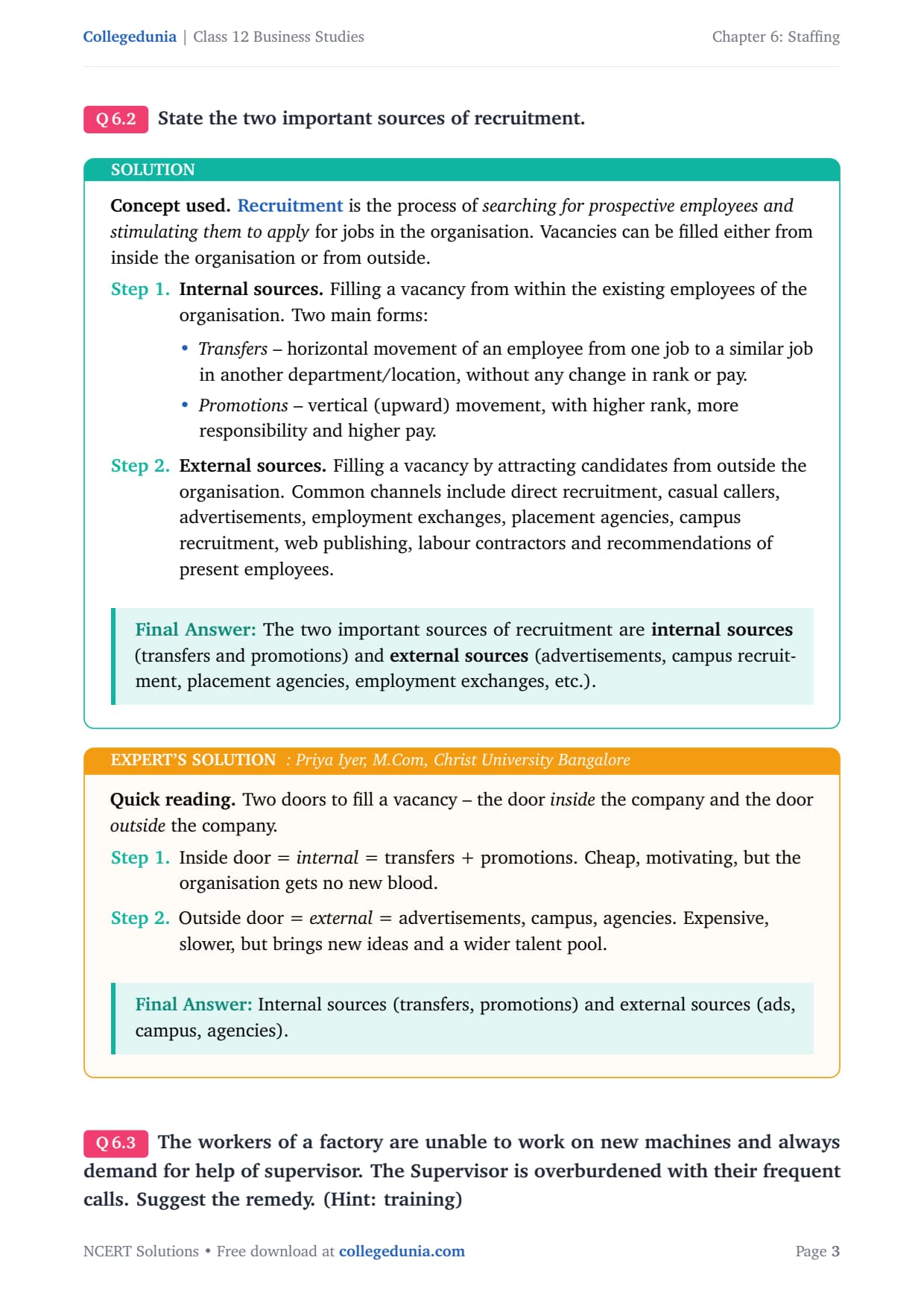
Concept used.Recruitment is the process of searching for prospective
employees and stimulating them to apply for jobs in the organisation. Vacancies can be filled
either from inside the organisation or from outside.
Internal sources. Filling a vacancy from within the existing employees of the
organisation. Two main forms:
Transfers – horizontal movement of an employee from one job to a similar job
in another department/location, without any change in rank or pay.
Promotions – vertical (upward) movement, with higher rank, more
responsibility and higher pay.
External sources. Filling a vacancy by attracting candidates from outside the
organisation. Common channels include direct recruitment, casual callers, advertisements,
employment exchanges, placement agencies, campus recruitment, web publishing, labour
contractors and recommendations of present employees.
The two important sources of recruitment are internal sources (transfers and
promotions) and external sources (advertisements, campus recruitment, placement agencies,
employment exchanges, etc.).
PI
Priya Iyer
M.Com, Christ University Bangalore
Verified Expert
Quick reading. Two doors to fill a vacancy – the door inside the company and the
door outside the company.
Inside door = internal = transfers + promotions. Cheap, motivating, but the
organisation gets no new blood.
Outside door = external = advertisements, campus, agencies. Expensive, slower, but
brings new ideas and a wider talent pool.
Internal sources (transfers, promotions) and external sources (ads, campus, agencies).
Q 6.3
The workers of a factory are unable to work on new machines and always demand for help
of supervisor. The Supervisor is overburdened with their frequent calls. Suggest the remedy. (Hint:
training)
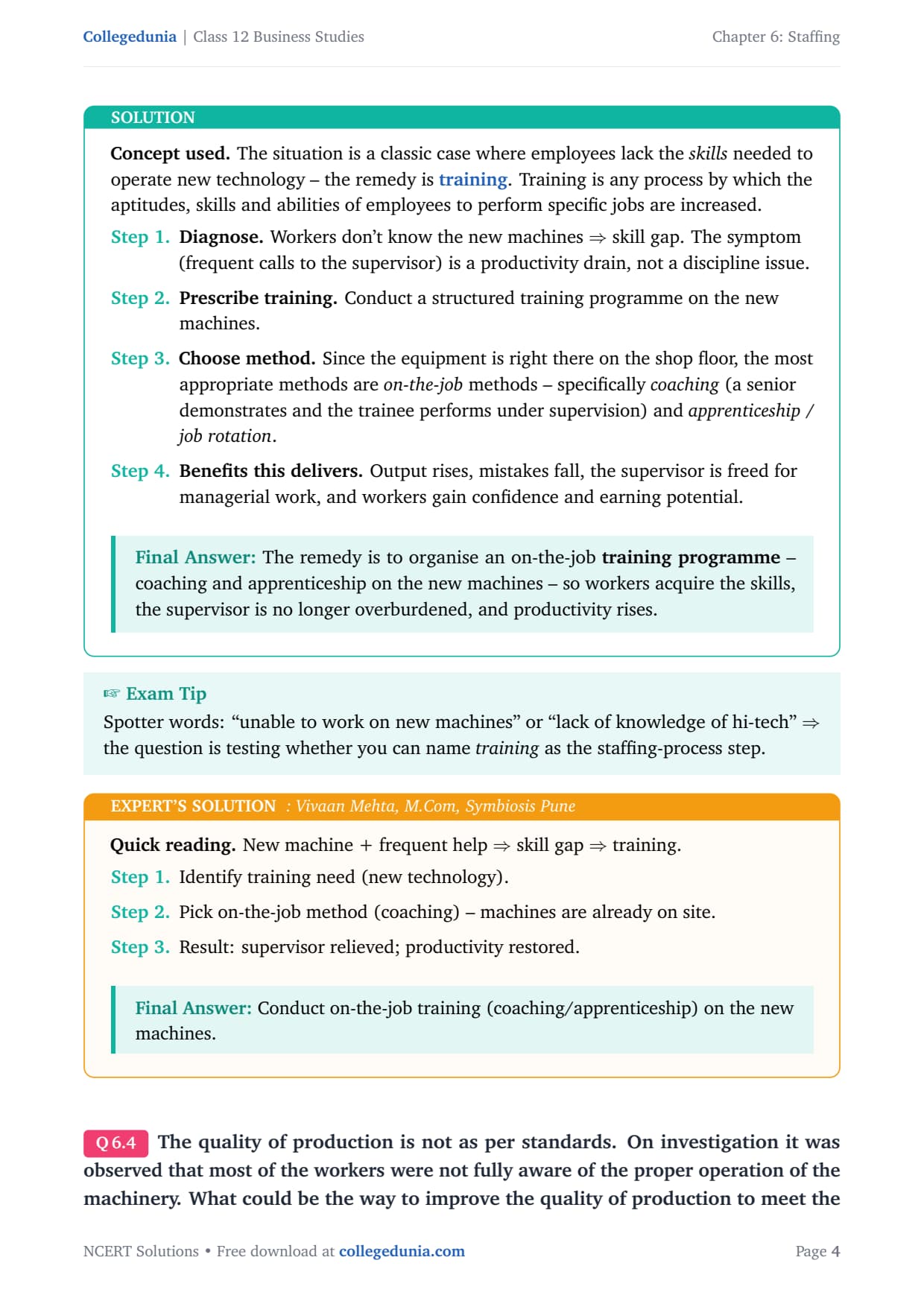
Concept used. The situation is a classic case where employees lack the skills needed
to operate new technology – the remedy is training. Training is any process by which the
aptitudes, skills and abilities of employees to perform specific jobs are increased.
Diagnose. Workers don't know the new machines \(\Rightarrow\) skill gap. The
symptom (frequent calls to the supervisor) is a productivity drain, not a discipline
issue.
Prescribe training. Conduct a structured training programme on the new
machines.
Choose method. Since the equipment is right there on the shop floor, the most
appropriate methods are on-the-job methods – specifically coaching (a
senior demonstrates and the trainee performs under supervision) and apprenticeship
/ job rotation.
Benefits this delivers. Output rises, mistakes fall, the supervisor is freed for
managerial work, and workers gain confidence and earning potential.
The remedy is to organise an on-the-job training programme – coaching and
apprenticeship on the new machines – so workers acquire the skills, the supervisor is no longer
overburdened, and productivity rises.
VM
Vivaan Mehta
M.Com, Symbiosis Pune
Verified Expert
Quick reading. New machine + frequent help \(\Rightarrow\) skill gap \(\Rightarrow\) training.
Identify training need (new technology).
Pick on-the-job method (coaching) – machines are already on site.
Conduct on-the-job training (coaching/apprenticeship) on the new machines.
Q 6.4
The quality of production is not as per standards. On investigation it was observed that
most of the workers were not fully aware of the proper operation of the machinery. What could be
the way to improve the quality of production to meet the standards? (training)
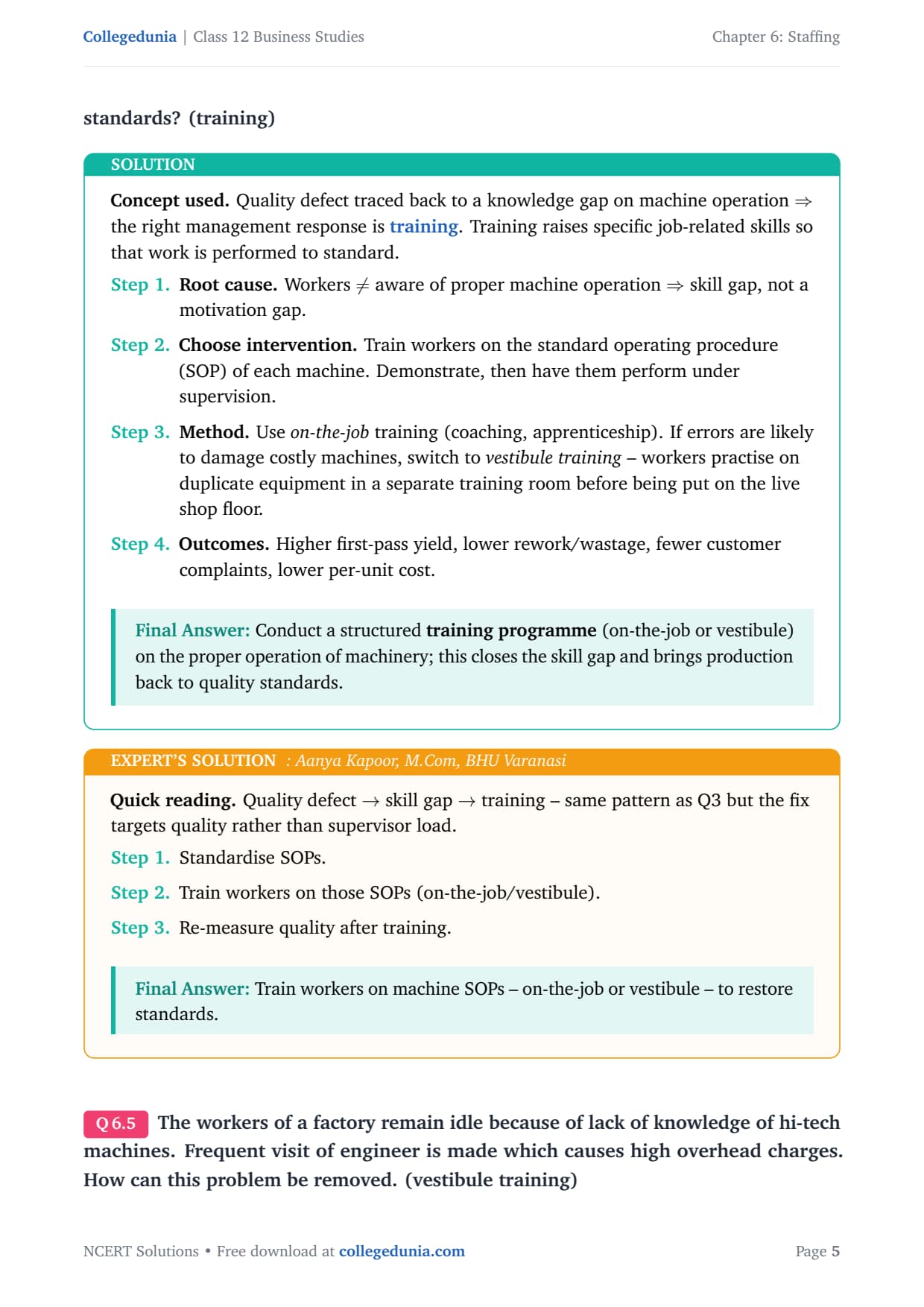
Concept used. Quality defect traced back to a knowledge gap on machine operation
\(\Rightarrow\) the right management response is training. Training raises specific
job-related skills so that work is performed to standard.
Root cause. Workers \(\not=\) aware of proper machine operation \(\Rightarrow\) skill
gap, not a motivation gap.
Choose intervention. Train workers on the standard operating procedure (SOP) of
each machine. Demonstrate, then have them perform under supervision.
Method. Use on-the-job training (coaching, apprenticeship). If errors are
likely to damage costly machines, switch to vestibule training – workers practise
on duplicate equipment in a separate training room before being put on the live shop
floor.
Conduct a structured training programme (on-the-job or vestibule) on the proper
operation of machinery; this closes the skill gap and brings production back to quality
standards.
AK
Aanya Kapoor
M.Com, BHU Varanasi
Verified Expert
Quick reading. Quality defect \(\to\) skill gap \(\to\) training – same pattern as Q3 but the
fix targets quality rather than supervisor load.
Standardise SOPs.
Train workers on those SOPs (on-the-job/vestibule).
Re-measure quality after training.
Train workers on machine SOPs – on-the-job or vestibule – to restore standards.
Q 6.5
The workers of a factory remain idle because of lack of knowledge of hi-tech machines.
Frequent visit of engineer is made which causes high overhead charges. How can this problem be
removed. (vestibule training)
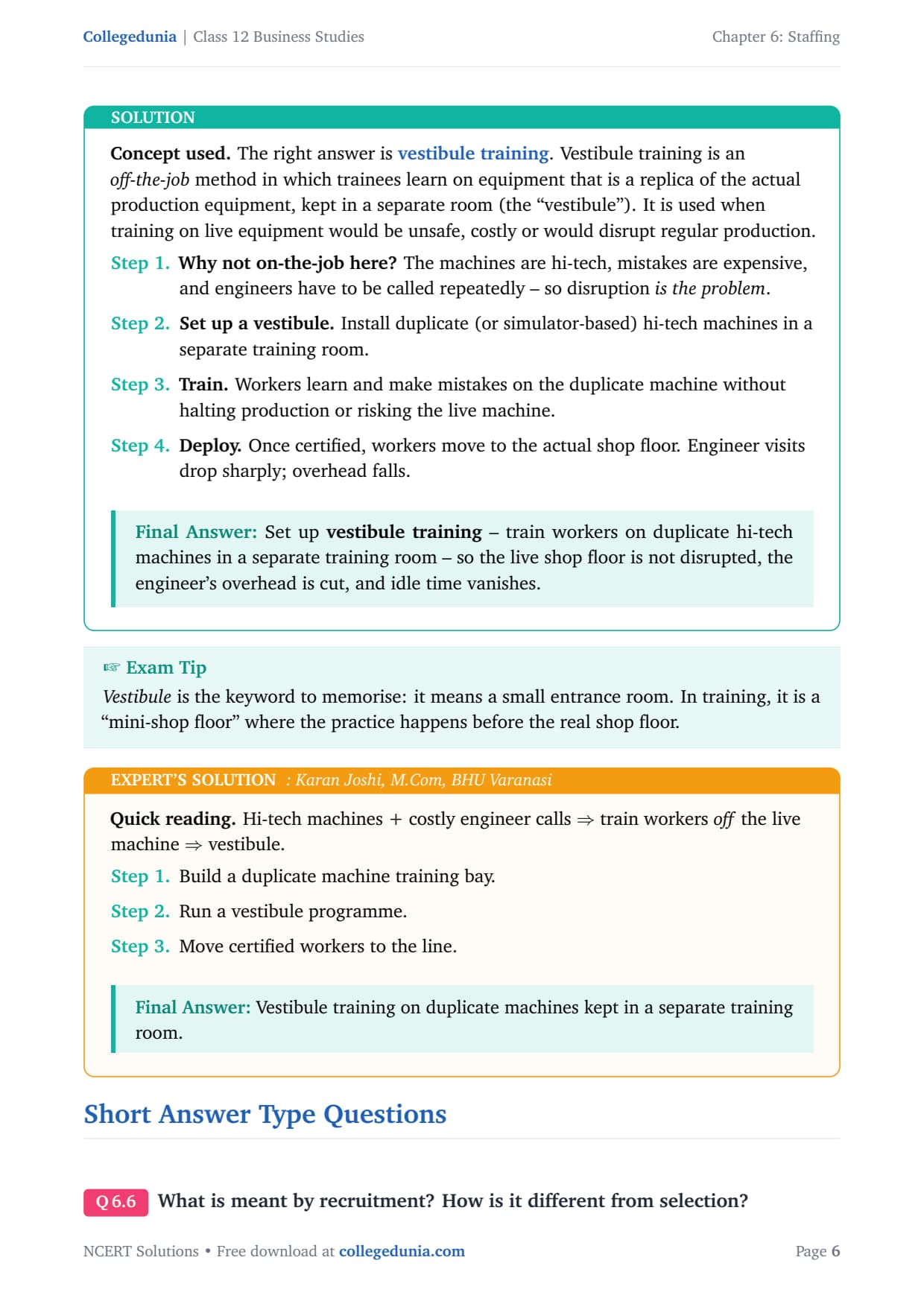
Concept used. The right answer is vestibule training. Vestibule training is an
off-the-job method in which trainees learn on equipment that is a replica of the actual
production equipment, kept in a separate room (the ``vestibule''). It is used when training on
live equipment would be unsafe, costly or would disrupt regular production.
Why not on-the-job here? The machines are hi-tech, mistakes are expensive, and
engineers have to be called repeatedly – so disruption is the problem.
Set up a vestibule. Install duplicate (or simulator-based) hi-tech machines in a
separate training room.
Train. Workers learn and make mistakes on the duplicate machine without halting
production or risking the live machine.
Deploy. Once certified, workers move to the actual shop floor. Engineer visits
drop sharply; overhead falls.
Set up vestibule training – train workers on duplicate hi-tech machines in a
separate training room – so the live shop floor is not disrupted, the engineer's overhead is cut,
and idle time vanishes.
KJ
Karan Joshi
M.Com, BHU Varanasi
Verified Expert
Quick reading. Hi-tech machines + costly engineer calls \(\Rightarrow\) train workers
off the live machine \(\Rightarrow\) vestibule.
Build a duplicate machine training bay.
Run a vestibule programme.
Move certified workers to the line.
Vestibule training on duplicate machines kept in a separate training room.
Short Answer Type Questions
Q 6.6
What is meant by recruitment? How is it different from selection?
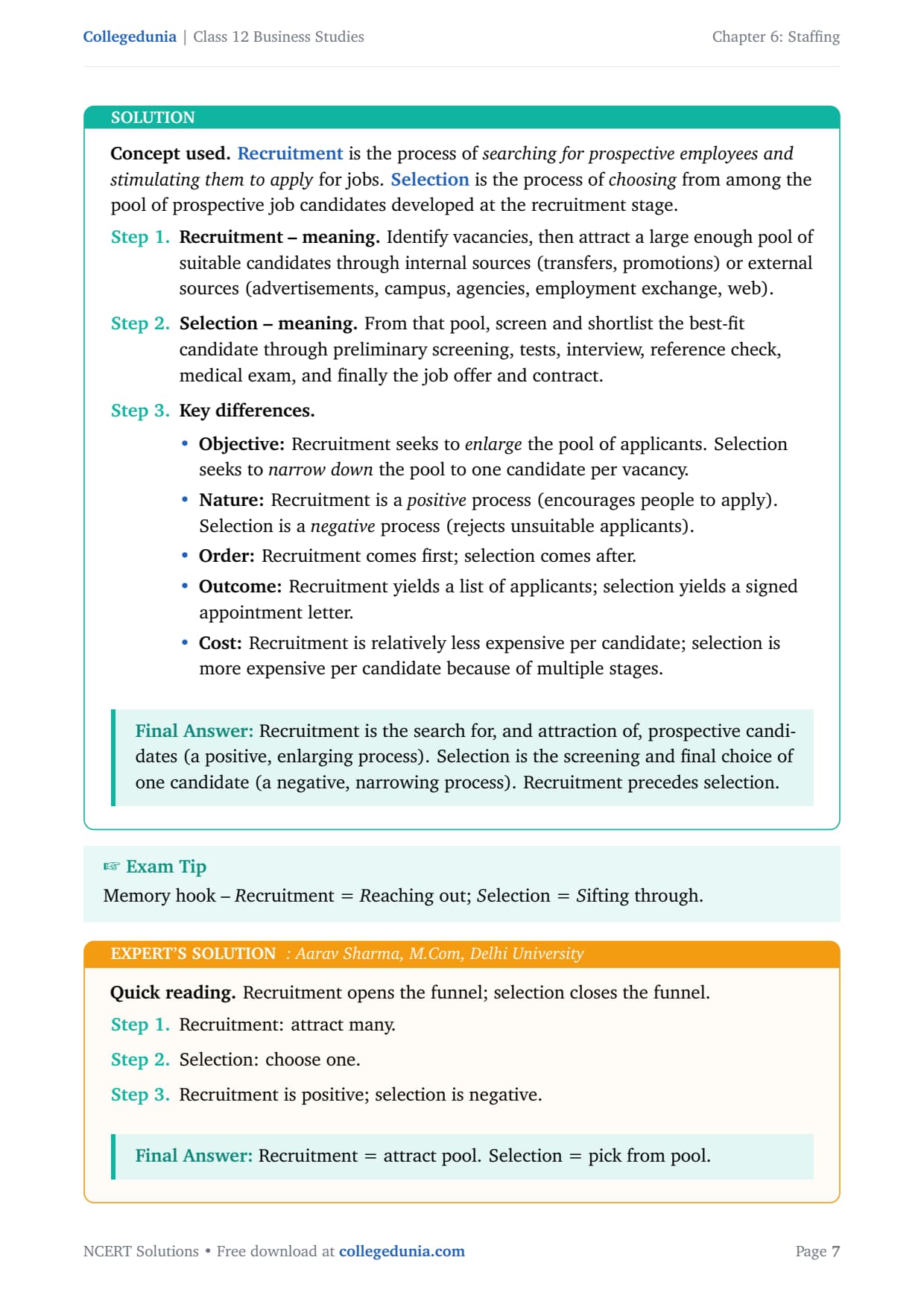
Concept used.Recruitment is the process of searching for prospective
employees and stimulating them to apply for jobs. Selection is the process of
choosing from among the pool of prospective job candidates developed at the recruitment
stage.
Recruitment – meaning. Identify vacancies, then attract a large enough pool of
suitable candidates through internal sources (transfers, promotions) or external sources
(advertisements, campus, agencies, employment exchange, web).
Selection – meaning. From that pool, screen and shortlist the best-fit candidate
through preliminary screening, tests, interview, reference check, medical exam, and
finally the job offer and contract.
Key differences.
Objective: Recruitment seeks to enlarge the pool of applicants.
Selection seeks to narrow down the pool to one candidate per vacancy.
Nature: Recruitment is a positive process (encourages people to
apply). Selection is a negative process (rejects unsuitable applicants).
Order: Recruitment comes first; selection comes after.
Outcome: Recruitment yields a list of applicants; selection yields a
signed appointment letter.
Cost: Recruitment is relatively less expensive per candidate; selection
is more expensive per candidate because of multiple stages.
Recruitment is the search for, and attraction of, prospective candidates (a positive,
enlarging process). Selection is the screening and final choice of one candidate (a negative,
narrowing process). Recruitment precedes selection.
AS
Aarav Sharma
M.Com, Delhi University
Verified Expert
Quick reading. Recruitment opens the funnel; selection closes the funnel.
Recruitment: attract many.
Selection: choose one.
Recruitment is positive; selection is negative.
Recruitment = attract pool. Selection = pick from pool.
Q 6.7
An organisation provides security services. It requires such candidates who are reliable
and don't leak out the secrets of their clients. What steps should be incorporated in selection
process?
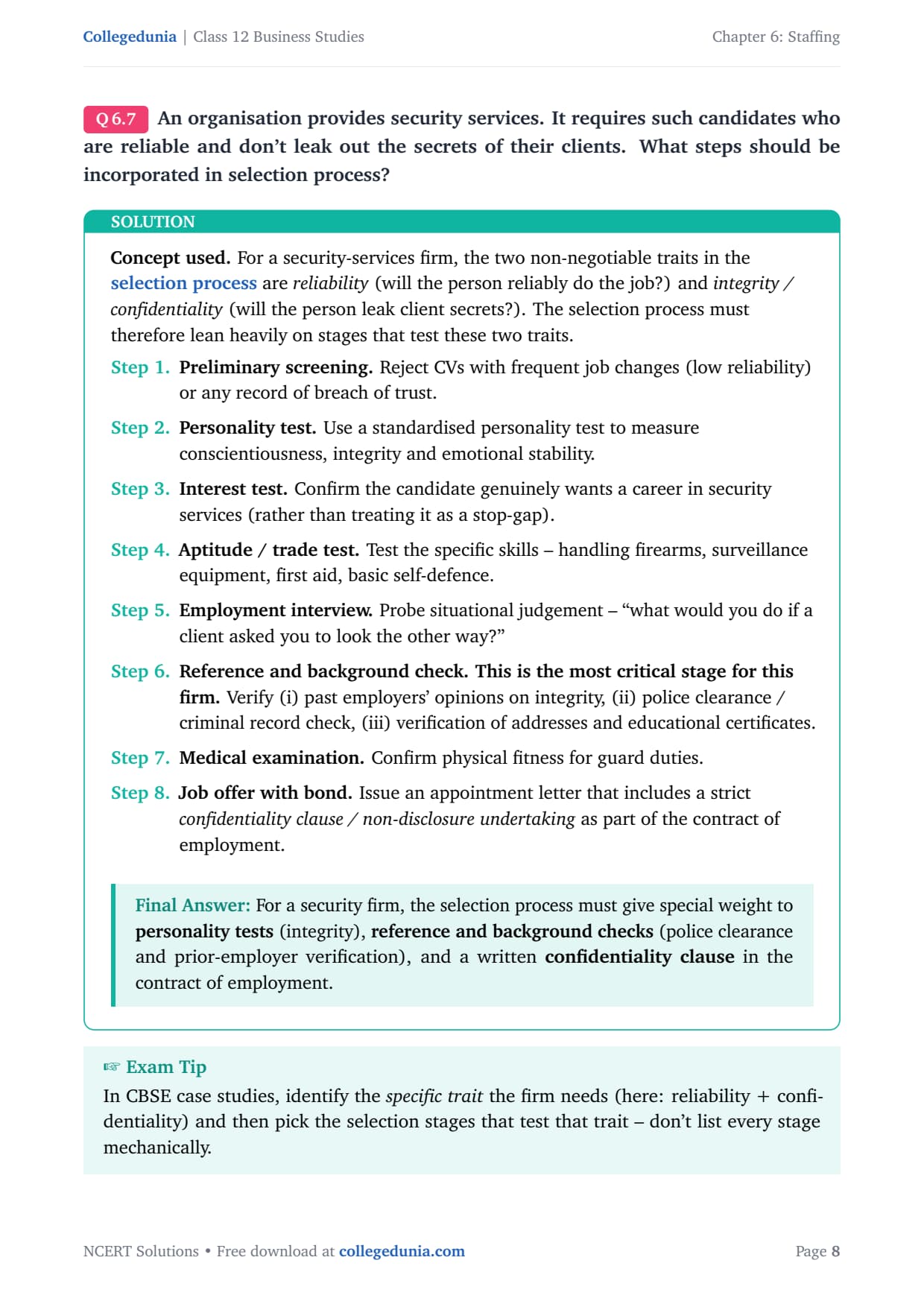
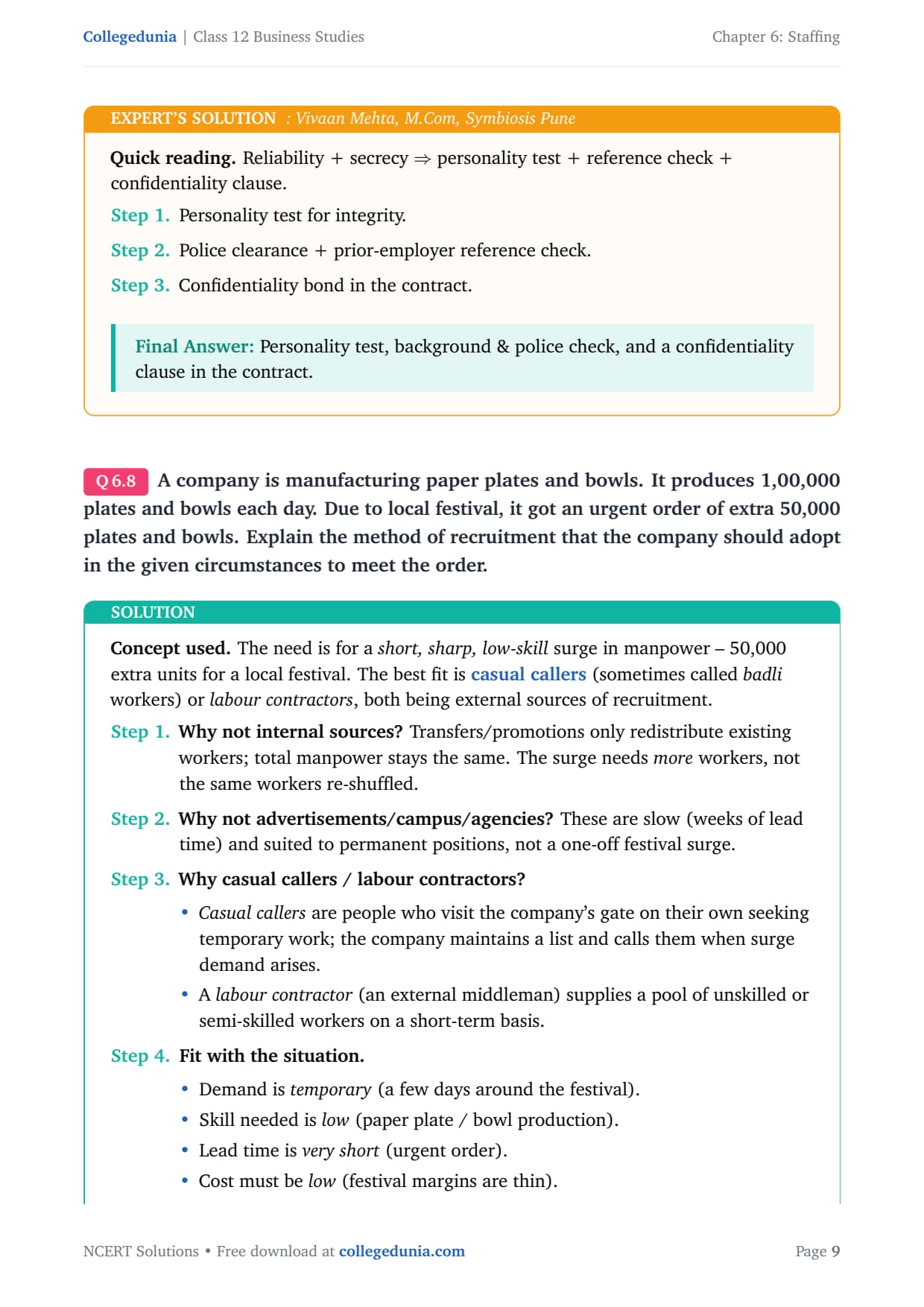
Concept used. For a security-services firm, the two non-negotiable traits in the
selection process are reliability (will the person reliably do the job?) and
integrity / confidentiality (will the person leak client secrets?). The selection process
must therefore lean heavily on stages that test these two traits.
Preliminary screening. Reject CVs with frequent job changes (low reliability) or
any record of breach of trust.
Personality test. Use a standardised personality test to measure
conscientiousness, integrity and emotional stability.
Interest test. Confirm the candidate genuinely wants a career in security
services (rather than treating it as a stop-gap).
Aptitude / trade test. Test the specific skills – handling firearms, surveillance
equipment, first aid, basic self-defence.
Employment interview. Probe situational judgement – ``what would you do if a
client asked you to look the other way?''
Reference and background check.This is the most critical stage for this
firm. Verify (i) past employers' opinions on integrity, (ii) police clearance / criminal
record check, (iii) verification of addresses and educational certificates.
Medical examination. Confirm physical fitness for guard duties.
Job offer with bond. Issue an appointment letter that includes a strict
confidentiality clause / non-disclosure undertaking as part of the contract of
employment.
For a security firm, the selection process must give special weight to
personality tests (integrity), reference and background checks (police clearance
and prior-employer verification), and a written confidentiality clause in the contract of
employment.
Personality test, background & police check, and a confidentiality clause in the
contract.
Q 6.8
A company is manufacturing paper plates and bowls. It produces 1,00,000 plates and bowls
each day. Due to local festival, it got an urgent order of extra 50,000 plates and bowls. Explain
the method of recruitment that the company should adopt in the given circumstances to meet the
order.
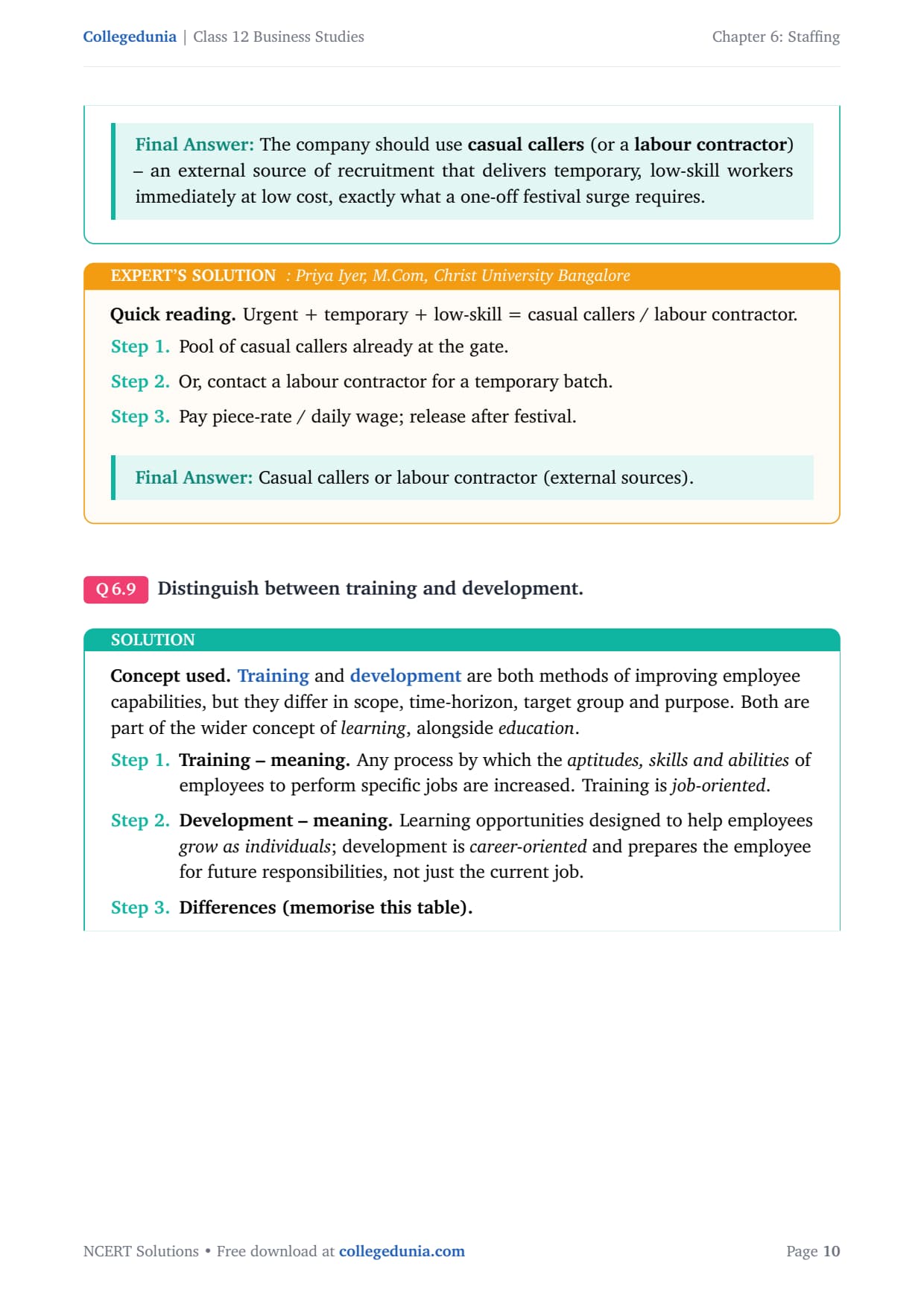
Concept used. The need is for a short, sharp, low-skill surge in manpower – 50,000
extra units for a local festival. The best fit is casual callers (sometimes called
badli workers) or labour contractors, both being external sources of recruitment.
Why not internal sources? Transfers/promotions only redistribute existing
workers; total manpower stays the same. The surge needs more workers, not the same
workers re-shuffled.
Why not advertisements/campus/agencies? These are slow (weeks of lead time) and
suited to permanent positions, not a one-off festival surge.
Why casual callers / labour contractors?
Casual callers are people who visit the company's gate on their own seeking
temporary work; the company maintains a list and calls them when surge demand
arises.
A labour contractor (an external middleman) supplies a pool of unskilled
or semi-skilled workers on a short-term basis.
Fit with the situation.
Demand is temporary (a few days around the festival).
Skill needed is low (paper plate / bowl production).
Lead time is very short (urgent order).
Cost must be low (festival margins are thin).
The company should use casual callers (or a labour contractor) – an
external source of recruitment that delivers temporary, low-skill workers immediately at low cost,
exactly what a one-off festival surge requires.
Or, contact a labour contractor for a temporary batch.
Pay piece-rate / daily wage; release after festival.
Casual callers or labour contractor (external sources).
Q 6.9
Distinguish between training and development.
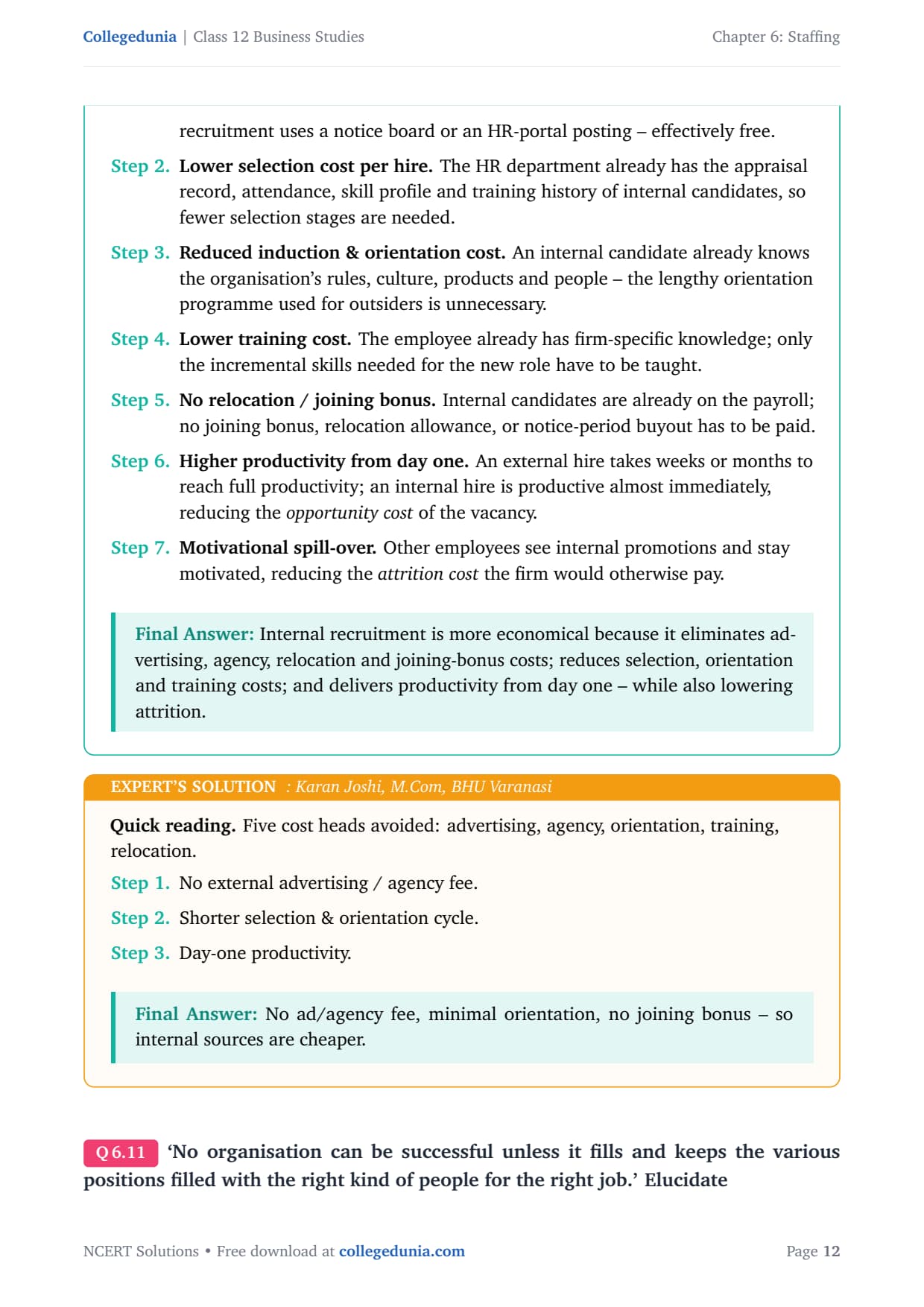
Concept used.Training and development are both methods of improving
employee capabilities, but they differ in scope, time-horizon, target group and purpose. Both are
part of the wider concept of learning, alongside education.
Training – meaning. Any process by which the aptitudes, skills and abilities
of employees to perform specific jobs are increased. Training is job-oriented.
Development – meaning. Learning opportunities designed to help employees
grow as individuals; development is career-oriented and prepares the
employee for future responsibilities, not just the current job.
Differences (memorise this table).
tabularp3.0cm p5.0cm p5.0cm
Basis & Training & Development
Focus & Specific job-related skills & Overall growth of the employee
Time horizon & Short-term & Long-term
Aimed at & Mostly non-managerial / operative staff & Mostly managerial / executive staff
Purpose & Improve performance on current job & Prepare for future responsibilities
Nature & Reactive (closes a present skill gap) & Proactive (builds future capability)
Initiated by & The organisation, for the job & The employee, for self-growth (org-supported)
tabular
Training is short-term, job-specific skill-building (mainly for operatives) to improve
performance on the current role. Development is long-term, career-wide growth (mainly for
managers) to prepare for future responsibilities.
AK
Aanya Kapoor
M.Com, BHU Varanasi
Verified Expert
Quick reading. Training closes today's gap; development builds tomorrow's
manager.
Training = current job, short-term, operative-heavy.
Development = career, long-term, manager-heavy.
Education = general knowledge, broader still.
Training = job + short-term + skill. Development = career + long-term + growth.
Q 6.10
Why are internal sources of recruitment considered to be more economical?
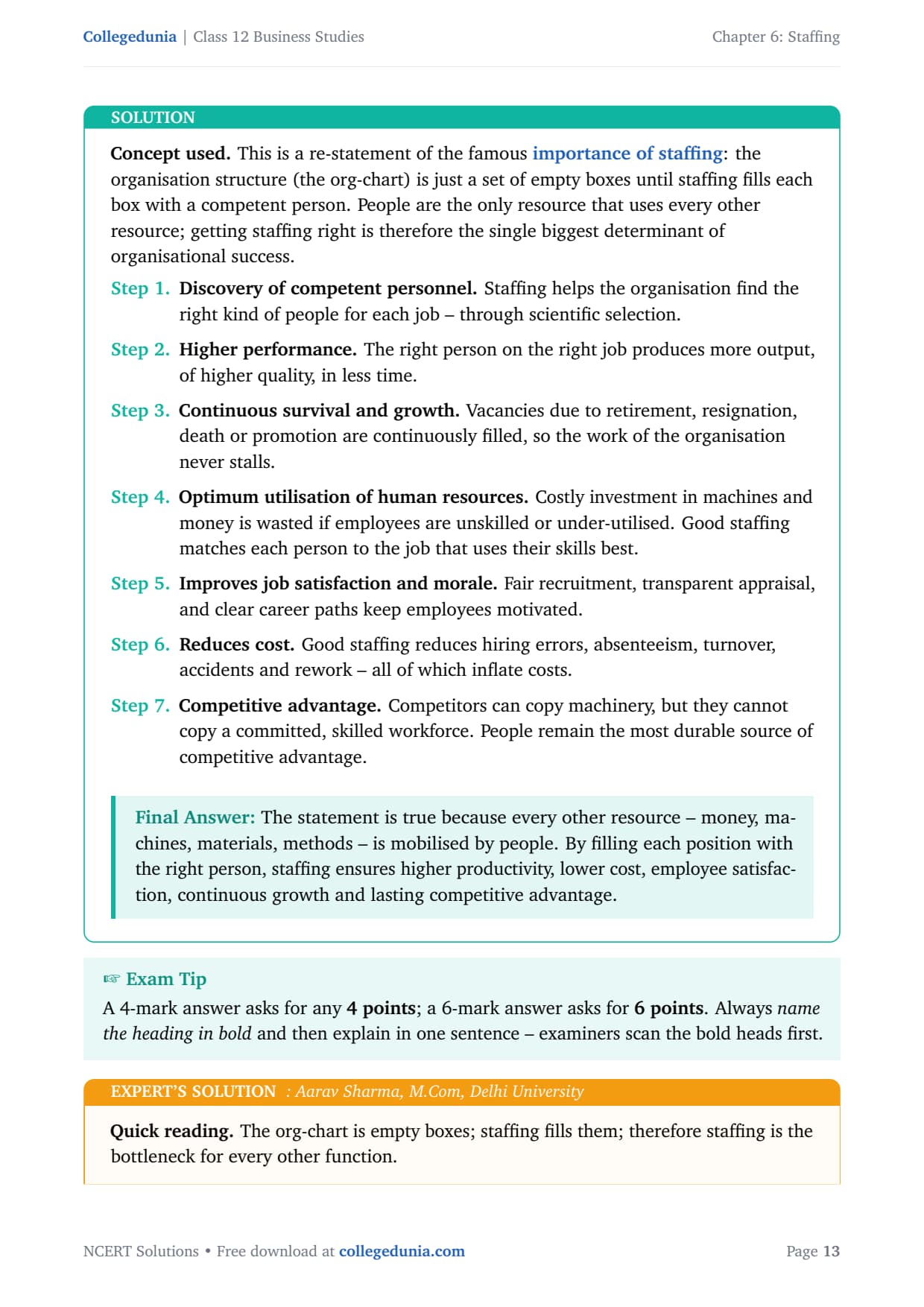
Concept used.Internal sources of recruitment (transfers and promotions) draw
candidates from within the existing employee pool. Several cost components of external recruitment
are either eliminated or sharply reduced when the source is internal – hence economical.
No advertising cost. External recruitment requires newspaper ads, online job-board
listings, placement-agency fees, or campus-visit costs. Internal recruitment uses a notice
board or an HR-portal posting – effectively free.
Lower selection cost per hire. The HR department already has the appraisal
record, attendance, skill profile and training history of internal candidates, so fewer
selection stages are needed.
Reduced induction & orientation cost. An internal candidate already knows the
organisation's rules, culture, products and people – the lengthy orientation programme
used for outsiders is unnecessary.
Lower training cost. The employee already has firm-specific knowledge; only the
incremental skills needed for the new role have to be taught.
No relocation / joining bonus. Internal candidates are already on the payroll;
no joining bonus, relocation allowance, or notice-period buyout has to be paid.
Higher productivity from day one. An external hire takes weeks or months to reach
full productivity; an internal hire is productive almost immediately, reducing the
opportunity cost of the vacancy.
Motivational spill-over. Other employees see internal promotions and stay
motivated, reducing the attrition cost the firm would otherwise pay.
Internal recruitment is more economical because it eliminates advertising, agency,
relocation and joining-bonus costs; reduces selection, orientation and training costs; and
delivers productivity from day one – while also lowering attrition.
No ad/agency fee, minimal orientation, no joining bonus – so internal sources are
cheaper.
Q 6.11
`No organisation can be successful unless it fills and keeps the various positions
filled with the right kind of people for the right job.' Elucidate
Concept used. This is a re-statement of the famous importance of staffing: the
organisation structure (the org-chart) is just a set of empty boxes until staffing fills each box
with a competent person. People are the only resource that uses every other resource; getting
staffing right is therefore the single biggest determinant of organisational success.
Discovery of competent personnel. Staffing helps the organisation find the right
kind of people for each job – through scientific selection.
Higher performance. The right person on the right job produces more output, of
higher quality, in less time.
Continuous survival and growth. Vacancies due to retirement, resignation, death
or promotion are continuously filled, so the work of the organisation never stalls.
Optimum utilisation of human resources. Costly investment in machines and money is
wasted if employees are unskilled or under-utilised. Good staffing matches each person to
the job that uses their skills best.
Improves job satisfaction and morale. Fair recruitment, transparent appraisal,
and clear career paths keep employees motivated.
Reduces cost. Good staffing reduces hiring errors, absenteeism, turnover,
accidents and rework – all of which inflate costs.
Competitive advantage. Competitors can copy machinery, but they cannot copy a
committed, skilled workforce. People remain the most durable source of competitive
advantage.
The statement is true because every other resource – money, machines, materials,
methods – is mobilised by people. By filling each position with the right person, staffing
ensures higher productivity, lower cost, employee satisfaction, continuous growth and lasting
competitive advantage.
AS
Aarav Sharma
M.Com, Delhi University
Verified Expert
Quick reading. The org-chart is empty boxes; staffing fills them; therefore staffing is
the bottleneck for every other function.
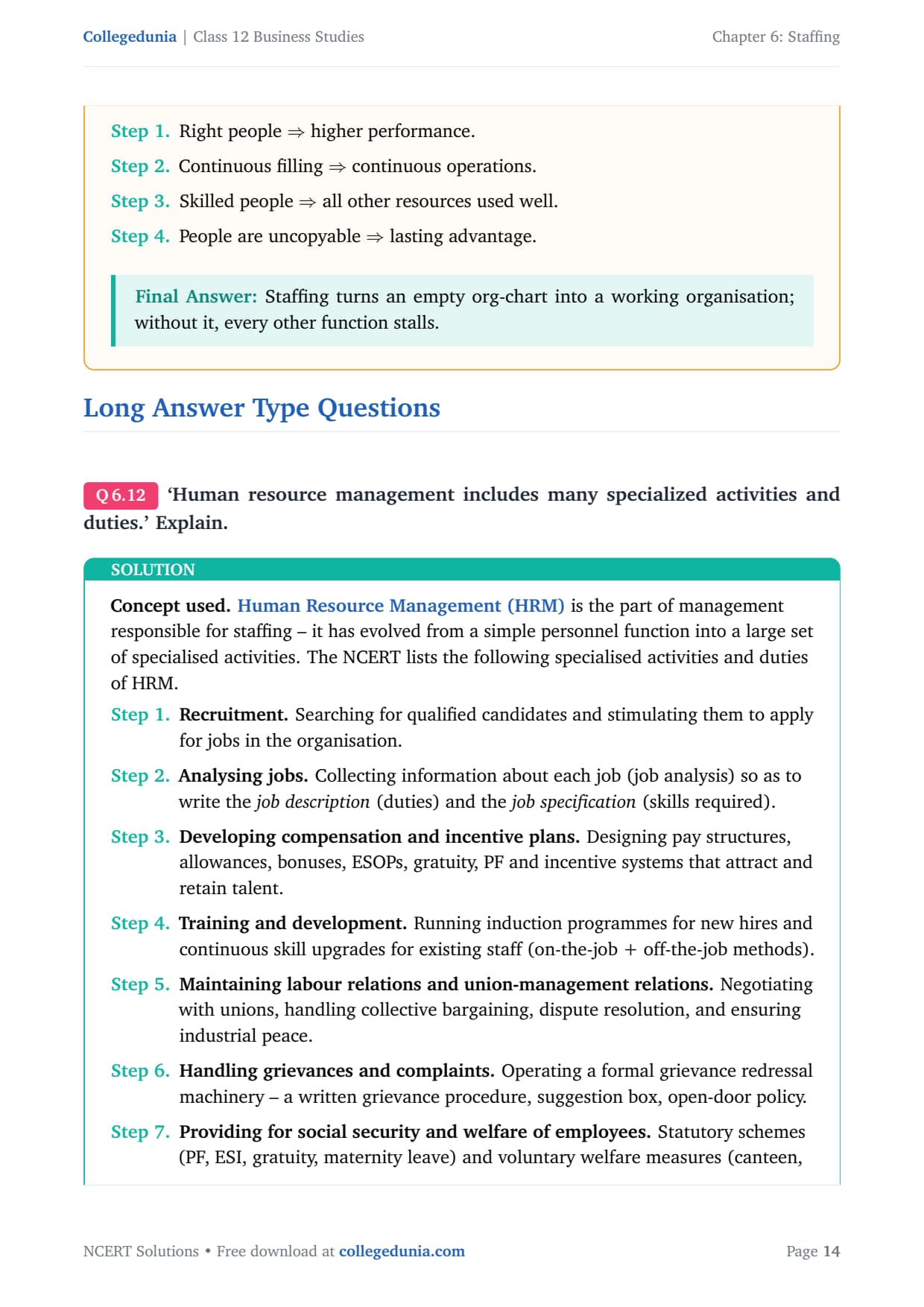
Skilled people \(\Rightarrow\) all other resources used well.
People are uncopyable \(\Rightarrow\) lasting advantage.
Staffing turns an empty org-chart into a working organisation; without it, every other
function stalls.
Long Answer Type Questions
Q 6.12
`Human resource management includes many specialized activities and duties.' Explain.
Concept used.Human Resource Management (HRM) is the part of management
responsible for staffing – it has evolved from a simple personnel function into a large set of
specialised activities. The NCERT lists the following specialised activities and duties of HRM.
Recruitment. Searching for qualified candidates and stimulating them to apply
for jobs in the organisation.
Analysing jobs. Collecting information about each job (job analysis) so as to
write the job description (duties) and the job specification (skills required).
Developing compensation and incentive plans. Designing pay structures, allowances,
bonuses, ESOPs, gratuity, PF and incentive systems that attract and retain talent.
Training and development. Running induction programmes for new hires and continuous
skill upgrades for existing staff (on-the-job + off-the-job methods).
Maintaining labour relations and union-management relations. Negotiating with
unions, handling collective bargaining, dispute resolution, and ensuring industrial
peace.
Handling grievances and complaints. Operating a formal grievance redressal
machinery – a written grievance procedure, suggestion box, open-door policy.
Providing for social security and welfare of employees. Statutory schemes
(PF, ESI, gratuity, maternity leave) and voluntary welfare measures (canteen, transport,
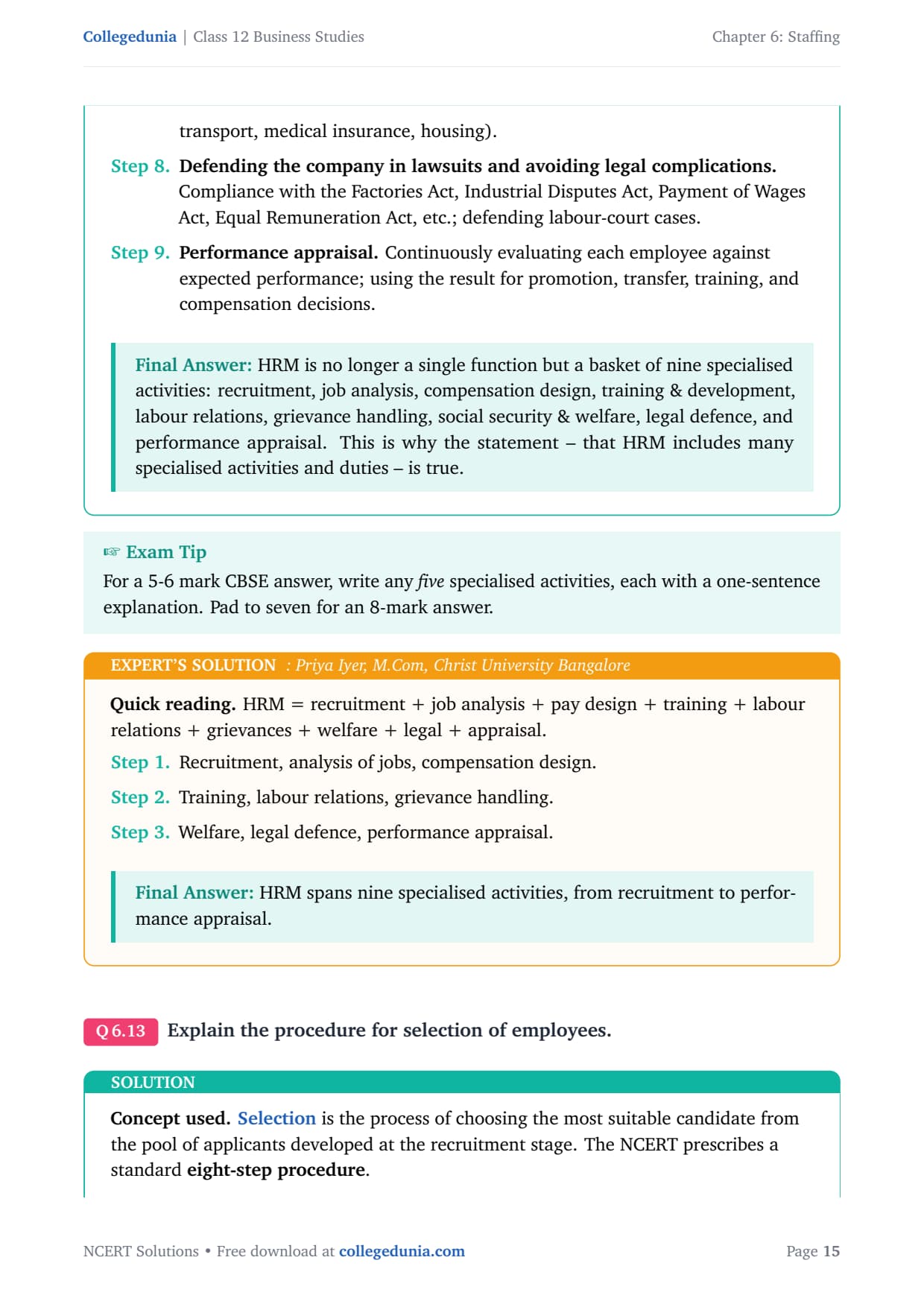
medical insurance, housing).
Defending the company in lawsuits and avoiding legal complications. Compliance
with the Factories Act, Industrial Disputes Act, Payment of Wages Act, Equal Remuneration
Act, etc.; defending labour-court cases.
Performance appraisal. Continuously evaluating each employee against expected
performance; using the result for promotion, transfer, training, and compensation
decisions.
HRM is no longer a single function but a basket of nine specialised activities:
recruitment, job analysis, compensation design, training & development, labour relations,
grievance handling, social security & welfare, legal defence, and performance appraisal. This
is why the statement – that HRM includes many specialised activities and duties – is true.
Recruitment, analysis of jobs, compensation design.
Training, labour relations, grievance handling.
Welfare, legal defence, performance appraisal.
HRM spans nine specialised activities, from recruitment to performance appraisal.
Q 6.13
Explain the procedure for selection of employees.
Concept used.Selection is the process of choosing the most suitable candidate
from the pool of applicants developed at the recruitment stage. The NCERT prescribes a standard
eight-step procedure.
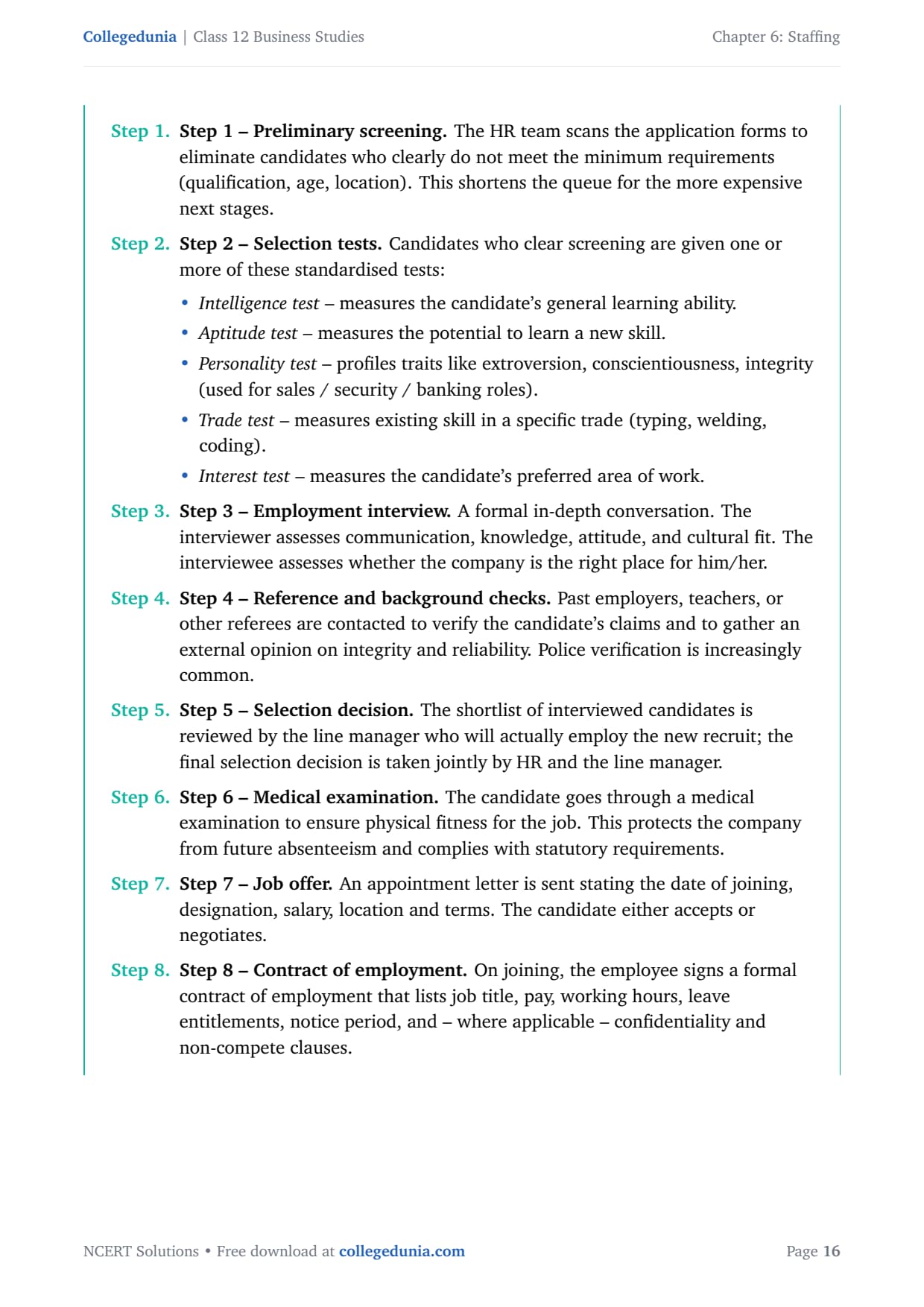
Step 1 – Preliminary screening. The HR team scans the application forms to
eliminate candidates who clearly do not meet the minimum requirements (qualification,
age, location). This shortens the queue for the more expensive next stages.
Step 2 – Selection tests. Candidates who clear screening are given one or more
of these standardised tests:
Intelligence test – measures the candidate's general learning ability.
Aptitude test – measures the potential to learn a new skill.
Personality test – profiles traits like extroversion, conscientiousness,
integrity (used for sales / security / banking roles).
Trade test – measures existing skill in a specific trade (typing, welding,
coding).
Interest test – measures the candidate's preferred area of work.
Step 3 – Employment interview. A formal in-depth conversation. The interviewer
assesses communication, knowledge, attitude, and cultural fit. The interviewee assesses
whether the company is the right place for him/her.
Step 4 – Reference and background checks. Past employers, teachers, or other
referees are contacted to verify the candidate's claims and to gather an external opinion
on integrity and reliability. Police verification is increasingly common.
Step 5 – Selection decision. The shortlist of interviewed candidates is reviewed
by the line manager who will actually employ the new recruit; the final selection
decision is taken jointly by HR and the line manager.
Step 6 – Medical examination. The candidate goes through a medical examination
to ensure physical fitness for the job. This protects the company from future absenteeism
and complies with statutory requirements.
Step 7 – Job offer. An appointment letter is sent stating the date of joining,
designation, salary, location and terms. The candidate either accepts or negotiates.
Step 8 – Contract of employment. On joining, the employee signs a formal contract
of employment that lists job title, pay, working hours, leave entitlements, notice
period, and – where applicable – confidentiality and non-compete clauses.
The eight-step selection procedure is: (1) Preliminary screening, (2) Selection tests,
(3) Employment interview, (4) Reference & background checks, (5) Selection decision, (6) Medical
examination, (7) Job offer, (8) Contract of employment.
VM
Vivaan Mehta
M.Com, Symbiosis Pune
Verified Expert
Quick reading. Eight stages, in order: screen \(\to\) test \(\to\) interview \(\to\) refs \(\to\)
decide \(\to\) medical \(\to\) offer \(\to\) contract.
Screen weak applications out.
Tests + interview filter for fit.
References, medical, offer, contract close the loop.
Selection runs through 8 stages from preliminary screening to signed contract of
employment.
Q 6.14
What are the advantages of training to the individual and to the organisation?
Concept used.Training delivers benefits on two sides of the employment
relationship – the individual (the employee) gets career-advancing skills; the
organisation gets productivity and stability.
Advantages to the organisation.
Systematic learning. Training imparts skills in a planned way – far
better than trial-and-error learning on the job.
Higher productivity. Trained workers produce more, with better quality, in
less time.
Reduced supervision. Trained workers handle their own tasks; the supervisor
is freed for higher-value managerial work.
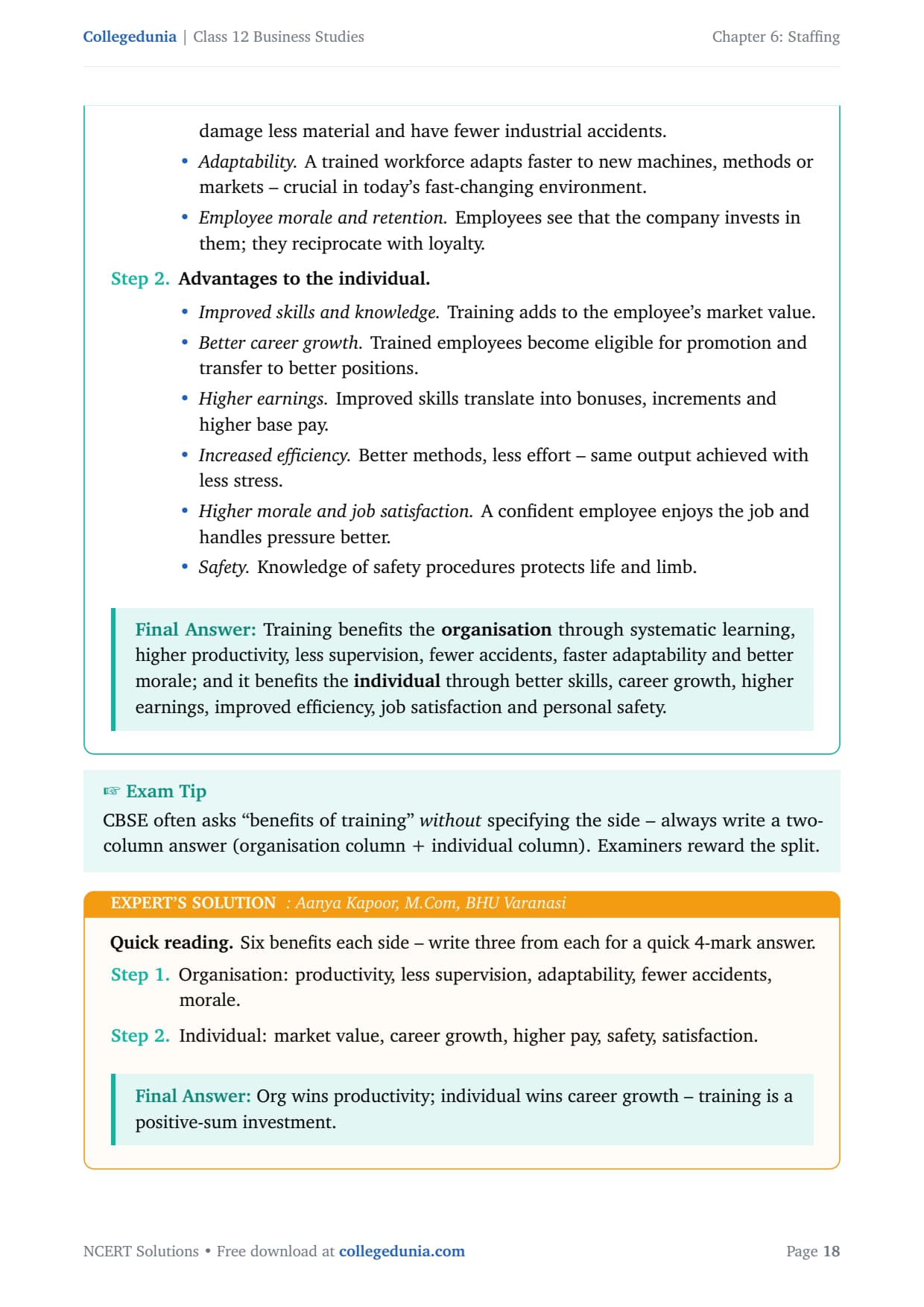
Reduced accidents and wastage. Workers who know SOPs and safe practices
damage less material and have fewer industrial accidents.
Adaptability. A trained workforce adapts faster to new machines, methods or
markets – crucial in today's fast-changing environment.
Employee morale and retention. Employees see that the company invests in
them; they reciprocate with loyalty.
Advantages to the individual.
Improved skills and knowledge. Training adds to the employee's market value.
Better career growth. Trained employees become eligible for promotion and
transfer to better positions.
Higher earnings. Improved skills translate into bonuses, increments and
higher base pay.
Increased efficiency. Better methods, less effort – same output achieved
with less stress.
Higher morale and job satisfaction. A confident employee enjoys the job and
handles pressure better.
Safety. Knowledge of safety procedures protects life and limb.
Training benefits the organisation through systematic learning, higher
productivity, less supervision, fewer accidents, faster adaptability and better morale; and it
benefits the individual through better skills, career growth, higher earnings, improved
efficiency, job satisfaction and personal safety.
AK
Aanya Kapoor
M.Com, BHU Varanasi
Verified Expert
Quick reading. Six benefits each side – write three from each for a quick 4-mark
answer.
Organisation: productivity, less supervision, adaptability, fewer accidents, morale.
Individual: market value, career growth, higher pay, safety, satisfaction.
Org wins productivity; individual wins career growth – training is a positive-sum
investment.
Q 6.15
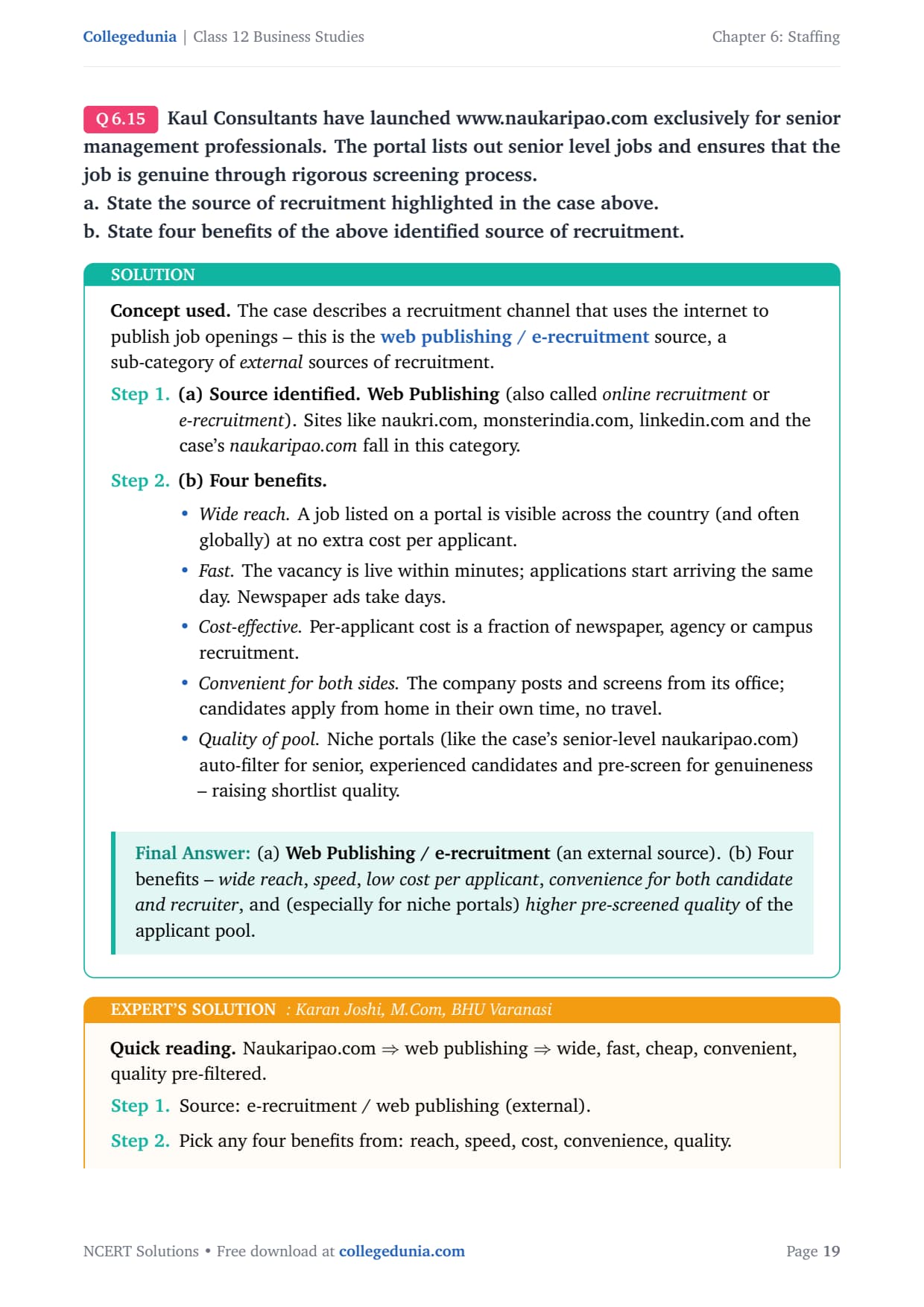
Kaul Consultants have launched www.naukaripao.com exclusively for senior management
professionals. The portal lists out senior level jobs and ensures that the job is genuine through
rigorous screening process.
a. State the source of recruitment highlighted in the case above.
b. State four benefits of the above identified source of recruitment.
Concept used. The case describes a recruitment channel that uses the internet to publish
job openings – this is the web publishing / e-recruitment source, a sub-category of
external sources of recruitment.
(a) Source identified.Web Publishing (also called online
recruitment or e-recruitment). Sites like naukri.com, monsterindia.com,
linkedin.com and the case's naukaripao.com fall in this category.
(b) Four benefits.
Wide reach. A job listed on a portal is visible across the country (and
often globally) at no extra cost per applicant.
Fast. The vacancy is live within minutes; applications start arriving the
same day. Newspaper ads take days.
Cost-effective. Per-applicant cost is a fraction of newspaper, agency or
campus recruitment.
Convenient for both sides. The company posts and screens from its office;
candidates apply from home in their own time, no travel.
Quality of pool. Niche portals (like the case's senior-level
naukaripao.com) auto-filter for senior, experienced candidates and pre-screen for
genuineness – raising shortlist quality.
(a) Web Publishing / e-recruitment (an external source). (b) Four benefits –
wide reach, speed, low cost per applicant, convenience for both
candidate and recruiter, and (especially for niche portals) higher pre-screened quality of
the applicant pool.
Source: e-recruitment / web publishing (external).
Pick any four benefits from: reach, speed, cost, convenience, quality.
Web Publishing; four benefits = wide reach, speed, low cost, convenience.
Q 6.16
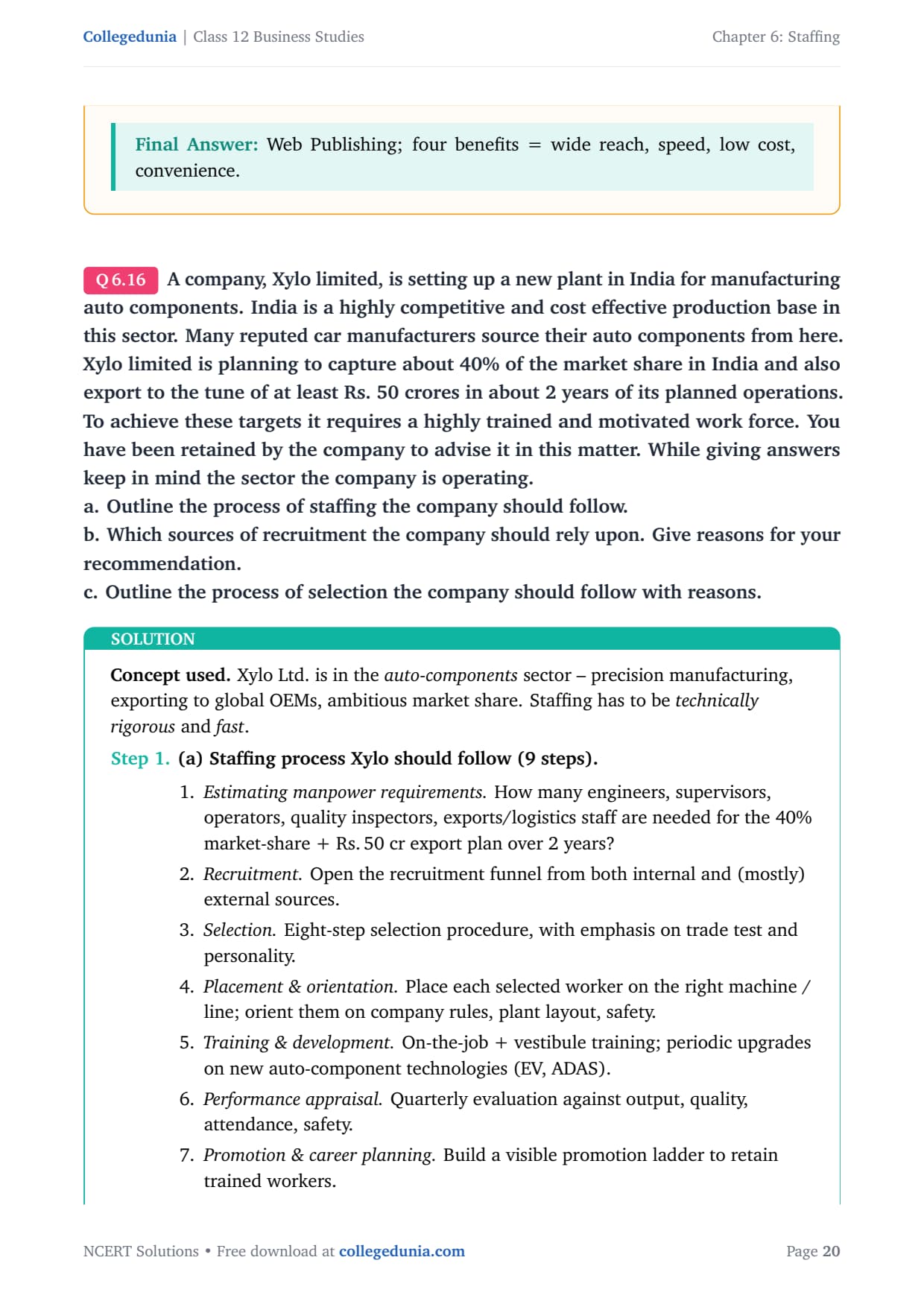
A company, Xylo limited, is setting up a new plant in India for manufacturing auto
components. India is a highly competitive and cost effective production base in this sector. Many
reputed car manufacturers source their auto components from here. Xylo limited is planning to
capture about 40% of the market share in India and also export to the tune of at least Rs. 50
crores in about 2 years of its planned operations. To achieve these targets it requires a highly
trained and motivated work force. You have been retained by the company to advise it in this
matter. While giving answers keep in mind the sector the company is operating.
a. Outline the process of staffing the company should follow.
b. Which sources of recruitment the company should rely upon. Give reasons for your
recommendation.
c. Outline the process of selection the company should follow with reasons.
Concept used. Xylo Ltd. is in the auto-components sector – precision
manufacturing, exporting to global OEMs, ambitious market share. Staffing has to be
technically rigorous and fast.
(a) Staffing process Xylo should follow (9 steps).
Estimating manpower requirements. How many engineers, supervisors,
operators, quality inspectors, exports/logistics staff are needed for the 40%
market-share + Rs. 50 cr export plan over 2 years?
Recruitment. Open the recruitment funnel from both internal and (mostly)
external sources.
Selection. Eight-step selection procedure, with emphasis on trade test and
personality.
Placement & orientation. Place each selected worker on the right machine /
line; orient them on company rules, plant layout, safety.
Training & development. On-the-job + vestibule training; periodic
upgrades on new auto-component technologies (EV, ADAS).
Performance appraisal. Quarterly evaluation against output, quality,
attendance, safety.
Promotion & career planning. Build a visible promotion ladder to retain
trained workers.
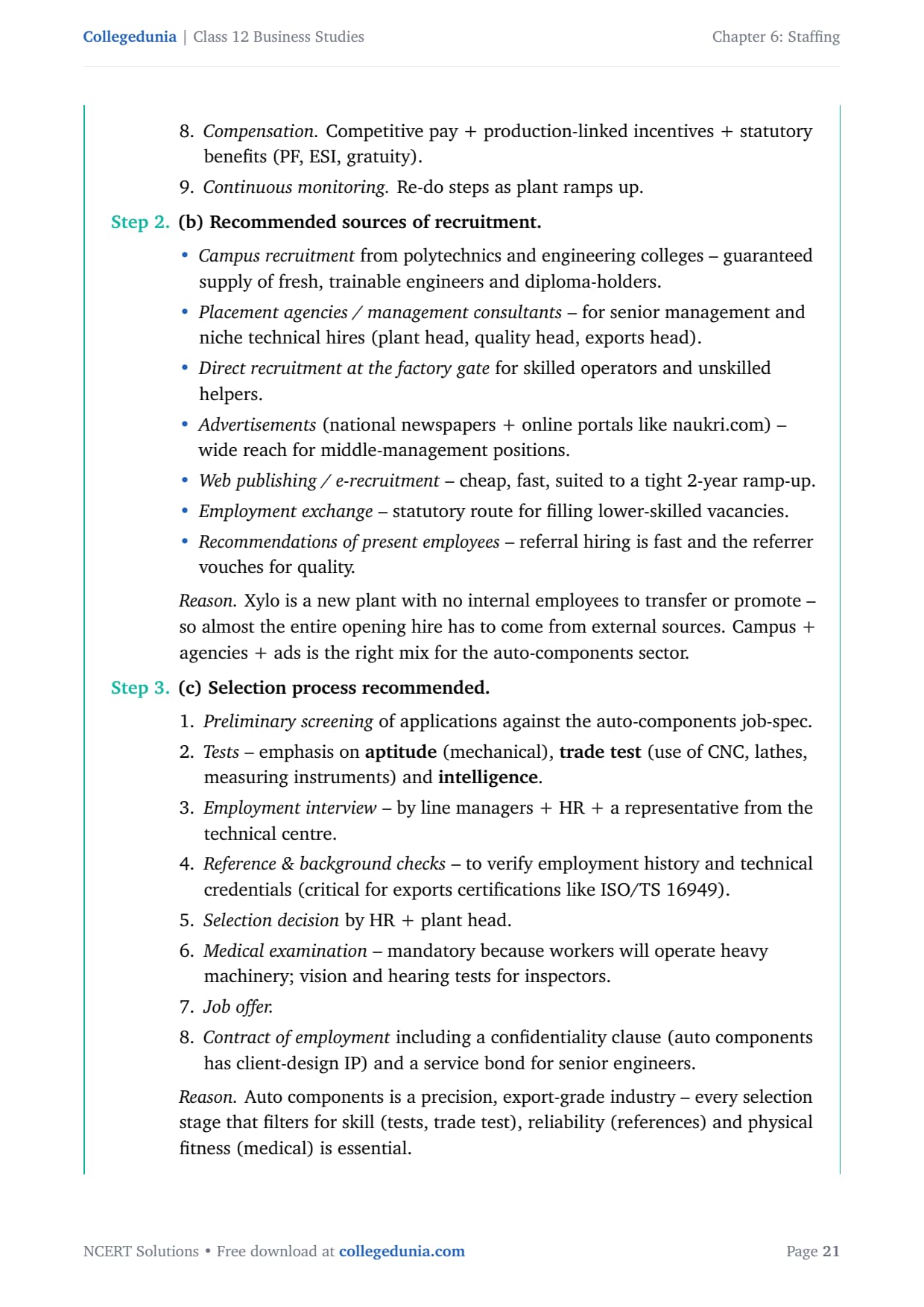
Continuous monitoring. Re-do steps as plant ramps up.
(b) Recommended sources of recruitment.
Campus recruitment from polytechnics and engineering colleges – guaranteed
supply of fresh, trainable engineers and diploma-holders.
Placement agencies / management consultants – for senior management and
niche technical hires (plant head, quality head, exports head).
Direct recruitment at the factory gate for skilled operators and unskilled
helpers.
Advertisements (national newspapers + online portals like naukri.com)
– wide reach for middle-management positions.
Web publishing / e-recruitment – cheap, fast, suited to a tight 2-year
ramp-up.
Employment exchange – statutory route for filling lower-skilled vacancies.
Recommendations of present employees – referral hiring is fast and the
referrer vouches for quality.
Reason. Xylo is a new plant with no internal employees to transfer or promote –
so almost the entire opening hire has to come from external sources. Campus + agencies +
ads is the right mix for the auto-components sector.
(c) Selection process recommended.
Preliminary screening of applications against the auto-components
job-spec.
Tests – emphasis on aptitude (mechanical), trade test
(use of CNC, lathes, measuring instruments) and intelligence.
Employment interview – by line managers + HR + a representative from the
technical centre.
Reference & background checks – to verify employment history and
technical credentials (critical for exports certifications like ISO/TS 16949).
Selection decision by HR + plant head.
Medical examination – mandatory because workers will operate heavy
machinery; vision and hearing tests for inspectors.
Job offer.
Contract of employment including a confidentiality clause (auto
components has client-design IP) and a service bond for senior engineers.
Reason. Auto components is a precision, export-grade industry – every selection
stage that filters for skill (tests, trade test), reliability (references) and physical
fitness (medical) is essential.
(a) Run the 9-step staffing cycle from manpower estimate to compensation. (b) Use
external sources – campus, agencies, ads, web publishing, gate recruitment, employee referrals –
because a greenfield plant has no internal pool. (c) Follow the standard 8-step selection,
emphasising aptitude + trade tests and confidentiality & bond clauses in the contract, because
auto components is a precision, export-grade industry.
AS
Aarav Sharma
M.Com, Delhi University
Verified Expert
Quick reading. New plant + auto-components + 2-yr ramp \(\Rightarrow\) heavy external
recruitment + technical selection.
Staffing cycle: 9 standard steps, calibrated to a ramp-up.
Sources: campus + agencies + ads + direct gate; almost all external.
Selection: full 8 steps with aptitude/trade-test emphasis.
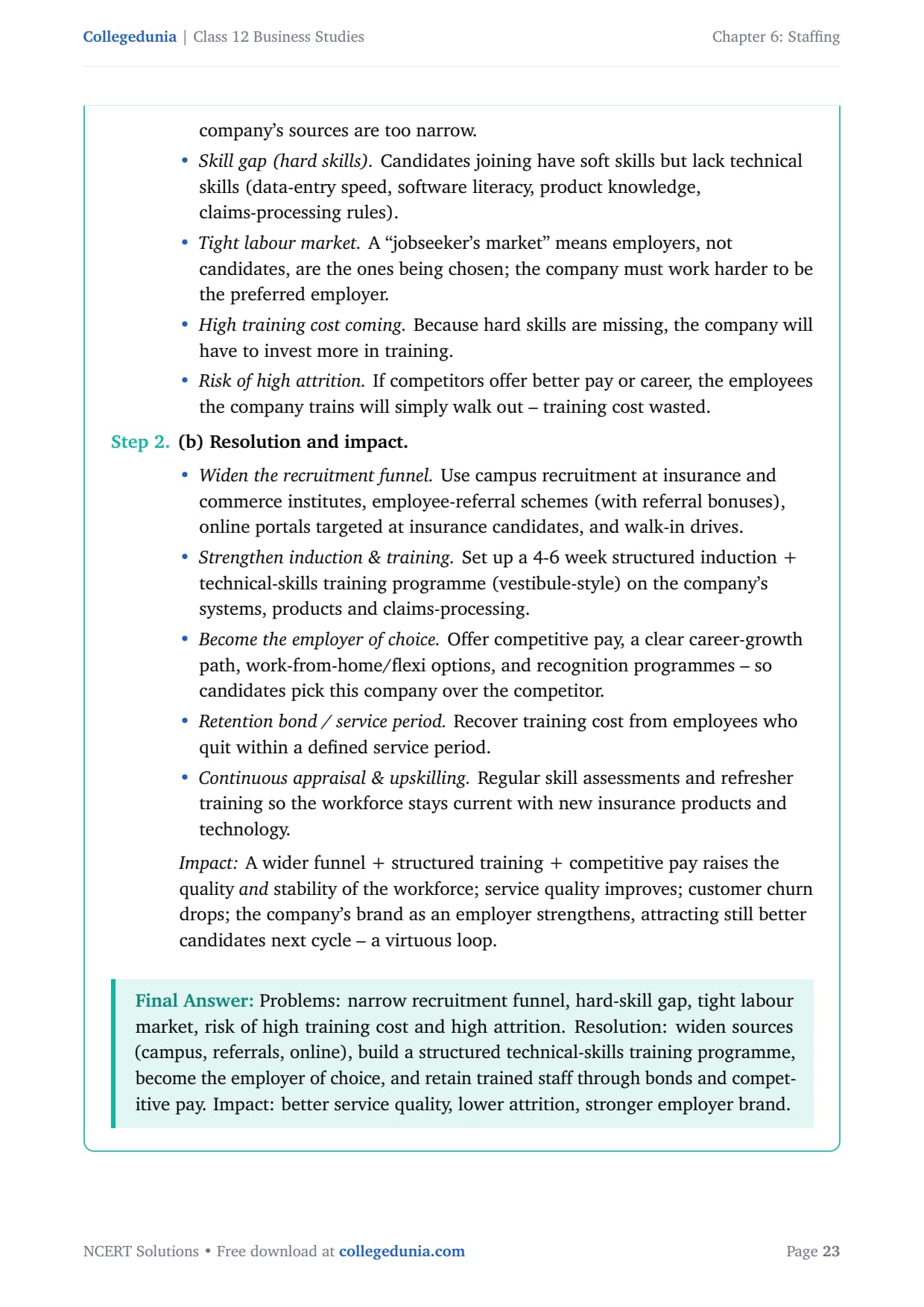
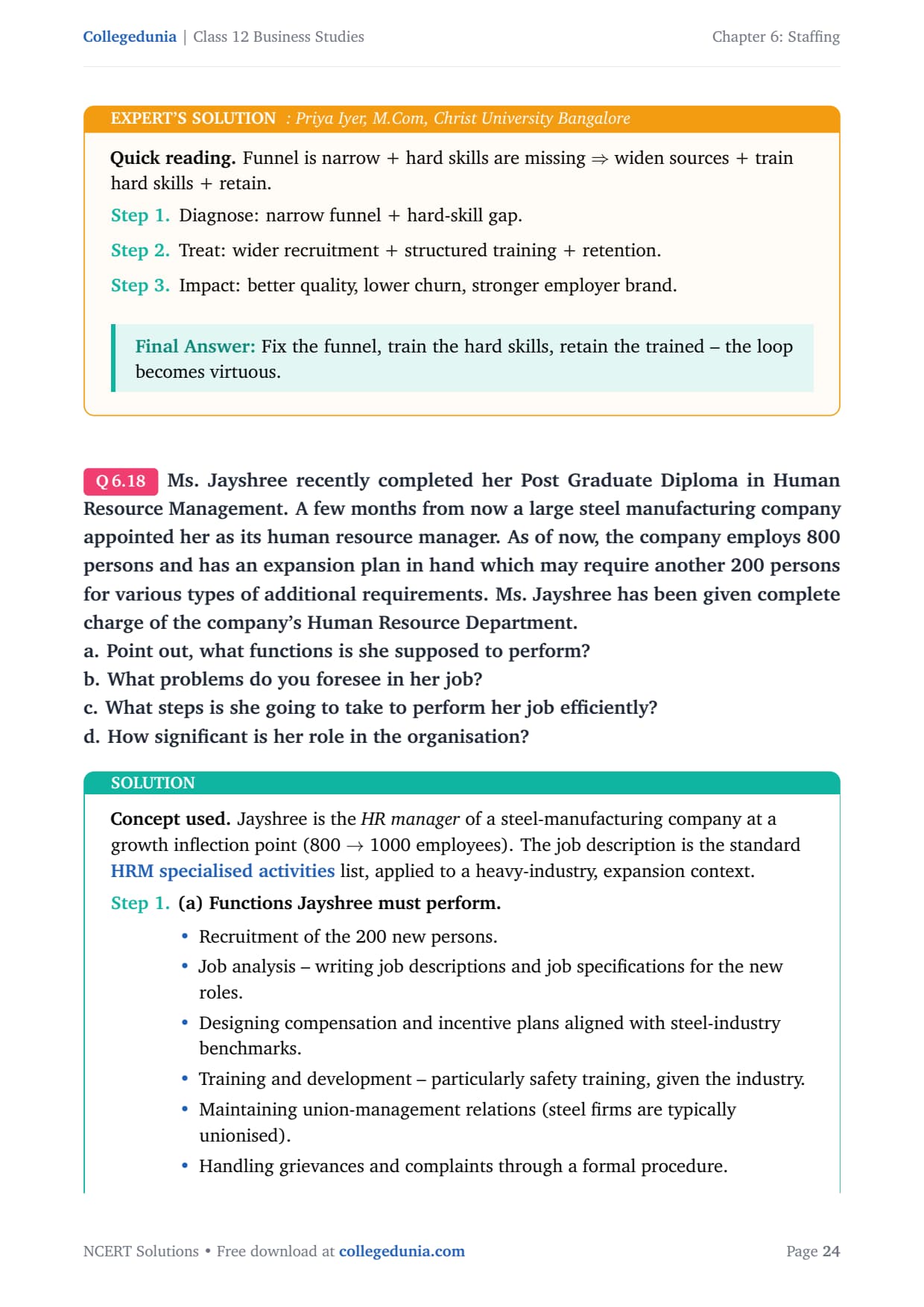
A major insurance company handled all recruiting, screening and training processes for
data entry/customer service representatives. Their competitor was attracting most of the
qualified, potential employees in their market. Recruiting was made even more difficult by the
strong economy and the `jobseeker's market.' This resulted in the client having to choose from
candidates who had the `soft' skills needed for the job, but lacked the proper `hard' skills and
training.
a. As an HR manager what problems do you see in the company?
b. How do you think it can be resolved and what would be its impact on the company?
Concept used. The case exposes a recruitment-and-training mis-match: the competitor is
absorbing the readily-employable candidates, leaving the company with applicants whose
soft skills are fine but who lack the hard / technical skills. Staffing theory says
the answer is training (to close the hard-skill gap) and improved sourcing (to widen
the recruitment funnel).
(a) Problems identified.
Weak recruitment funnel. The competitor is capturing the qualified pool;
the company's sources are too narrow.
Skill gap (hard skills). Candidates joining have soft skills but lack
technical skills (data-entry speed, software literacy, product knowledge,
claims-processing rules).
Tight labour market. A ``jobseeker's market'' means employers, not
candidates, are the ones being chosen; the company must work harder to be the
preferred employer.
High training cost coming. Because hard skills are missing, the company
will have to invest more in training.
Risk of high attrition. If competitors offer better pay or career, the
employees the company trains will simply walk out – training cost wasted.
(b) Resolution and impact.
Widen the recruitment funnel. Use campus recruitment at insurance and
commerce institutes, employee-referral schemes (with referral bonuses), online
portals targeted at insurance candidates, and walk-in drives.
Strengthen induction & training. Set up a 4-6 week structured induction +
technical-skills training programme (vestibule-style) on the company's systems,
products and claims-processing.
Become the employer of choice. Offer competitive pay, a clear career-growth
path, work-from-home/flexi options, and recognition programmes – so candidates
pick this company over the competitor.
Retention bond / service period. Recover training cost from employees who
quit within a defined service period.
Continuous appraisal & upskilling. Regular skill assessments and refresher
training so the workforce stays current with new insurance products and
technology.
Impact: A wider funnel + structured training + competitive pay raises the quality
and stability of the workforce; service quality improves; customer churn drops;
the company's brand as an employer strengthens, attracting still better candidates next
cycle – a virtuous loop.
Problems: narrow recruitment funnel, hard-skill gap, tight labour market, risk of high
training cost and high attrition. Resolution: widen sources (campus, referrals, online), build a
structured technical-skills training programme, become the employer of choice, and retain trained
staff through bonds and competitive pay. Impact: better service quality, lower attrition, stronger
employer brand.
PI
Priya Iyer
M.Com, Christ University Bangalore
Verified Expert
Quick reading. Funnel is narrow + hard skills are missing \(\Rightarrow\) widen sources +
train hard skills + retain.
Diagnose: narrow funnel + hard-skill gap.
Treat: wider recruitment + structured training + retention.
Fix the funnel, train the hard skills, retain the trained – the loop becomes virtuous.
Q 6.18
Ms. Jayshree recently completed her Post Graduate Diploma in Human Resource Management.
A few months from now a large steel manufacturing company appointed her as its human resource
manager. As of now, the company employs 800 persons and has an expansion plan in hand which may
require another 200 persons for various types of additional requirements. Ms. Jayshree has been
given complete charge of the company's Human Resource Department.
a. Point out, what functions is she supposed to perform?
b. What problems do you foresee in her job?
c. What steps is she going to take to perform her job efficiently?
d. How significant is her role in the organisation?
Concept used. Jayshree is the HR manager of a steel-manufacturing company at a
growth inflection point (800 \(\to\) 1000 employees). The job description is the standard
HRM specialised activities list, applied to a heavy-industry, expansion context.
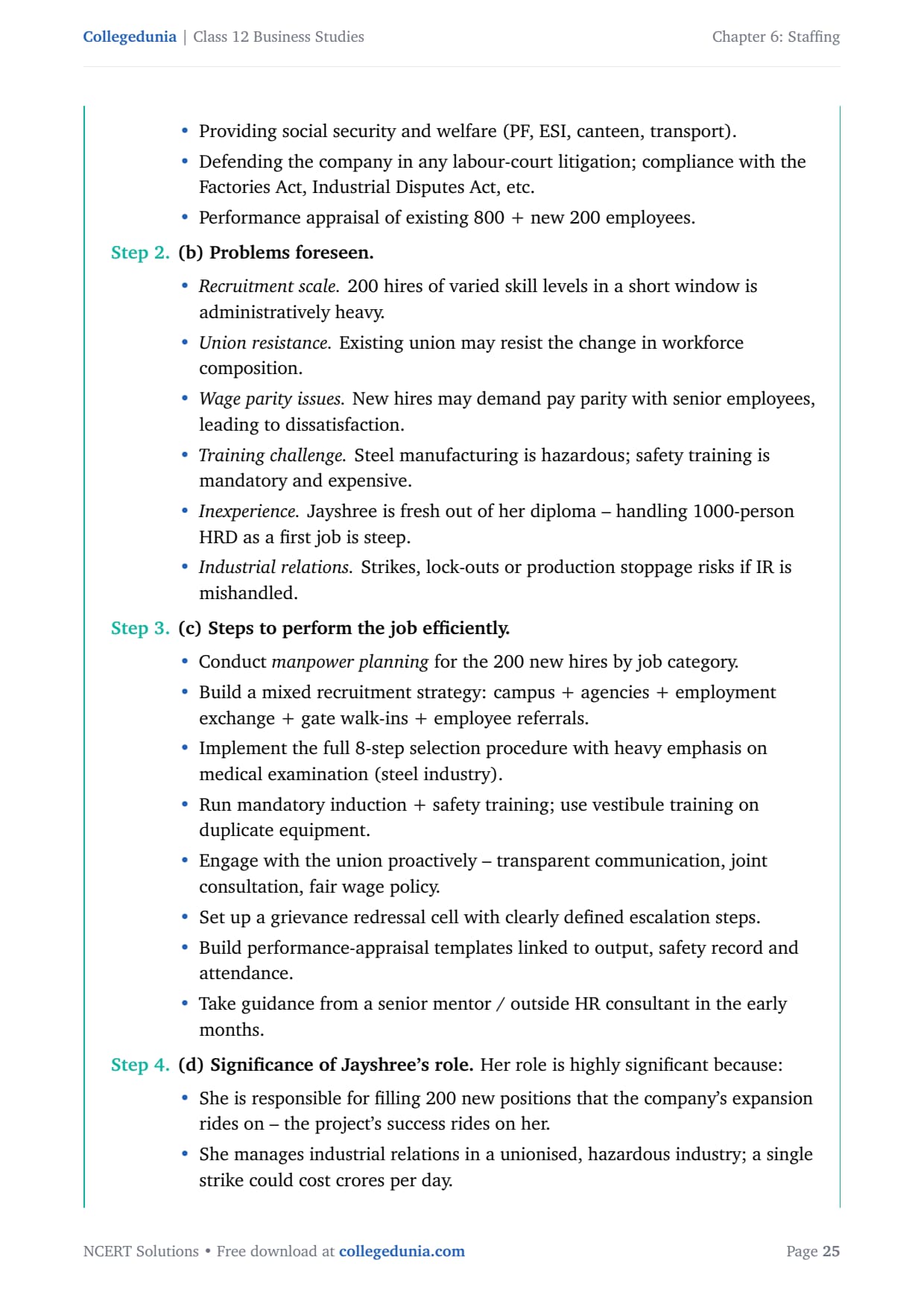
(a) Functions Jayshree must perform.
Recruitment of the 200 new persons.
Job analysis – writing job descriptions and job specifications for the new
roles.
Designing compensation and incentive plans aligned with steel-industry
benchmarks.
Training and development – particularly safety training, given the industry.
Maintaining union-management relations (steel firms are typically unionised).
Handling grievances and complaints through a formal procedure.
Providing social security and welfare (PF, ESI, canteen, transport).
Defending the company in any labour-court litigation; compliance with the
Factories Act, Industrial Disputes Act, etc.
Performance appraisal of existing 800 + new 200 employees.
(b) Problems foreseen.
Recruitment scale. 200 hires of varied skill levels in a short window is
administratively heavy.
Union resistance. Existing union may resist the change in workforce
composition.
Wage parity issues. New hires may demand pay parity with senior
employees, leading to dissatisfaction.
Training challenge. Steel manufacturing is hazardous; safety training is
mandatory and expensive.
Inexperience. Jayshree is fresh out of her diploma – handling 1000-person
HRD as a first job is steep.
Industrial relations. Strikes, lock-outs or production stoppage risks if
IR is mishandled.
(c) Steps to perform the job efficiently.
Conduct manpower planning for the 200 new hires by job category.
Implement the full 8-step selection procedure with heavy emphasis on medical
examination (steel industry).
Run mandatory induction + safety training; use vestibule training on duplicate
equipment.
Engage with the union proactively – transparent communication, joint
consultation, fair wage policy.
Set up a grievance redressal cell with clearly defined escalation steps.
Build performance-appraisal templates linked to output, safety record and
attendance.
Take guidance from a senior mentor / outside HR consultant in the early months.
(d) Significance of Jayshree's role. Her role is highly significant because:
She is responsible for filling 200 new positions that the company's expansion
rides on – the project's success rides on her.
She manages industrial relations in a unionised, hazardous industry; a single
strike could cost crores per day.
She controls a large share of the company's recurring cost – compensation +
training + welfare.
She shapes the company's employer brand, which determines the quality of every
future hire.
She is the legal-compliance shield against labour-court litigation.
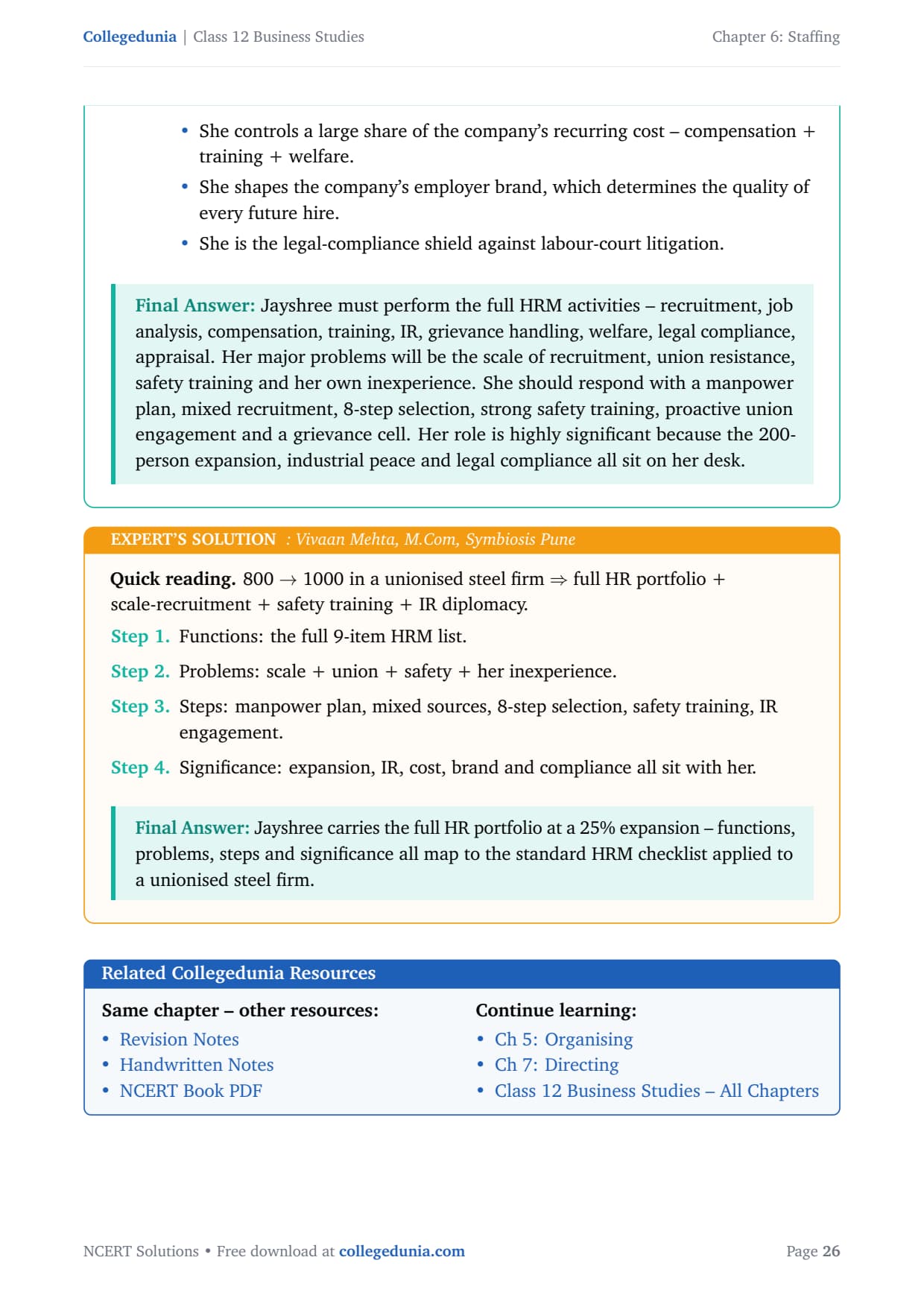
Jayshree must perform the full HRM activities – recruitment, job analysis,
compensation, training, IR, grievance handling, welfare, legal compliance, appraisal. Her major
problems will be the scale of recruitment, union resistance, safety training and her own
inexperience. She should respond with a manpower plan, mixed recruitment, 8-step selection,
strong safety training, proactive union engagement and a grievance cell. Her role is highly
significant because the 200-person expansion, industrial peace and legal compliance all sit on her
desk.
VM
Vivaan Mehta
M.Com, Symbiosis Pune
Verified Expert
Quick reading. 800 \(\to\) 1000 in a unionised steel firm \(\Rightarrow\) full HR portfolio +
scale-recruitment + safety training + IR diplomacy.
Functions: the full 9-item HRM list.
Problems: scale + union + safety + her inexperience.
Significance: expansion, IR, cost, brand and compliance all sit with her.
Jayshree carries the full HR portfolio at a 25% expansion – functions, problems, steps
and significance all map to the standard HRM checklist applied to a unionised steel firm.
Student Feedback
In a Collegedunia poll of 512 Class 12 Commerce students, 81% said the boxed final answers and Concept Used blocks made the Staffing solutions faster to revise than a plain textbook. 3 in 4 said the case-study spotters for training and casual callers helped them attempt the 8 to 10-mark applied question with confidence.
Other Resources for Class 12 Business Studies Chapter 6 Staffing
What is staffing in Class 12 Business Studies Chapter 6?
Staffing is the management function of filling, and keeping filled, the positions in the organisation structure - through manpower planning, recruitment, selection, placement, orientation, training, appraisal, promotion and compensation. It is the second function of management after planning and organising.
What are the steps of the staffing process?
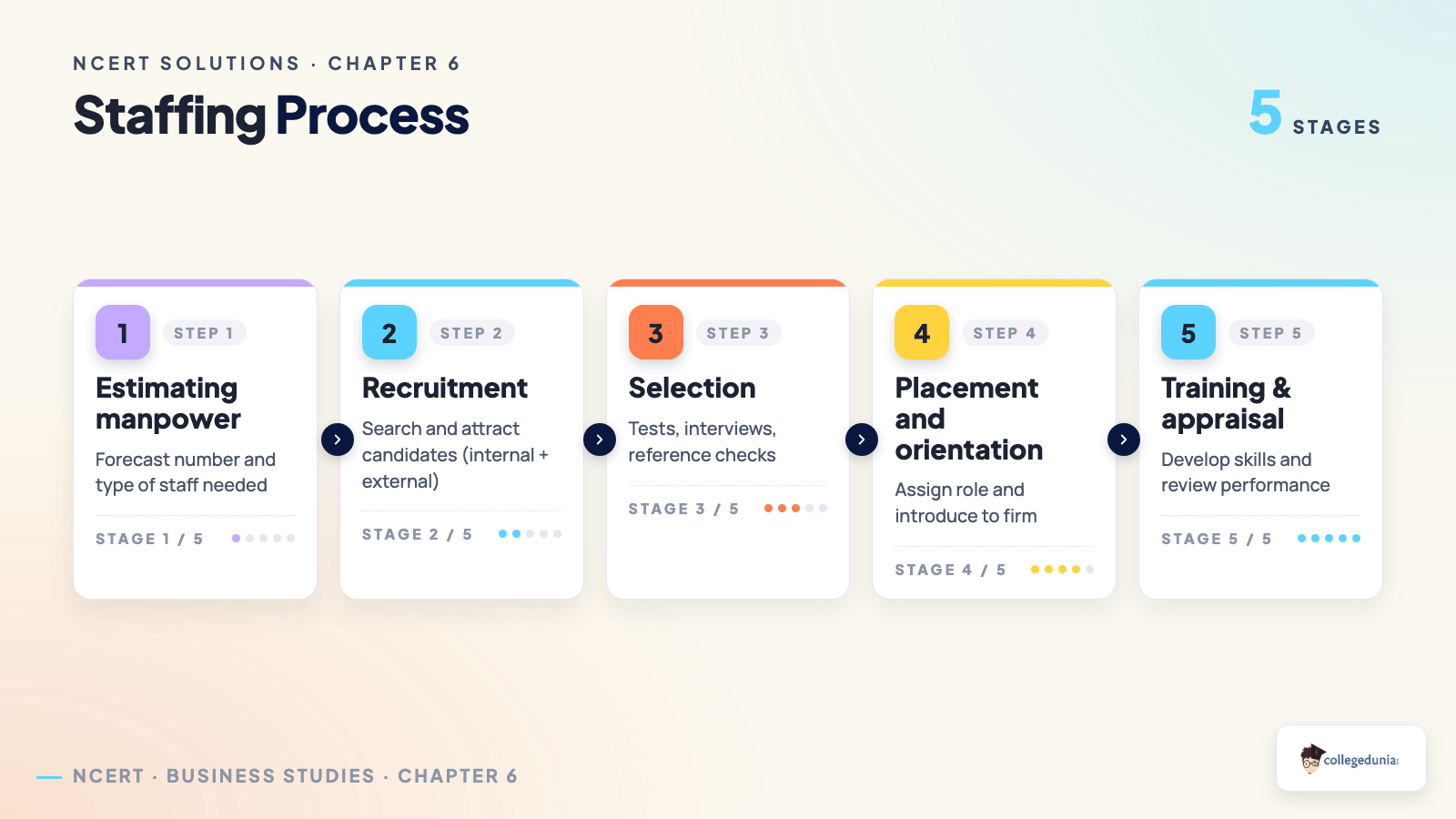
The NCERT staffing process has nine steps: (1) estimating manpower requirements, (2) recruitment, (3) selection, (4) placement and orientation, (5) training and development, (6) performance appraisal, (7) promotion and career planning, (8) compensation, (9) separation.
What are the differences between recruitment and selection?
Recruitment is the process of searching for and attracting prospective candidates (a positive, enlarging process). Selection is the process of choosing the most suitable candidate from the applicant pool (a negative, narrowing process). Recruitment precedes selection.
What is vestibule training?
Vestibule training is an off-the-job training method where trainees learn on duplicate (not live) equipment in a separate room. It is used when training on live machines would be unsafe, costly or disruptive to regular production - exactly the situation where workers must learn hi-tech machines without halting the shop floor.
Where can I download the Class 12 Business Studies Chapter 6 Staffing NCERT Solutions PDF?
You can download the Collegedunia Class 12 Business Studies Chapter 6 Staffing NCERT Solutions PDF free of cost from this page. The PDF is aligned to the NCERT Reprint 2026-27 syllabus and includes all the concepts, comparisons and case-study spotters you need for the board exam.











Comments