Business Studies Editor, MBA | Updated on - Jul 21, 2026
If you want easy marks in the Class 12 Business Studies paper, Consumer Protection is the chapter to lock down. These NCERT Solutions cover every question on the Consumer Protection Act 2019, the SICHRE rights and the three-tier redressal system, for the 2026-27 CBSE syllabus.
CBSE Weightage: 6 to 10 marks (Unit 4, Marketing and Consumer Protection) - typically one Short Answer + one Long Answer per session
Question Count: 3 Very Short Answer + 3 Short Answer + 3 Long Answer (9 in total)
The solutions below cover the meaning of consumer protection, the six rights and six responsibilities, the three-tier redressal machinery, the six categories of complainants, the ten reliefs, and the six ways and means of consumer protection.
These NCERT Solutions are mapped to the 2026-27 Business Studies textbook, which uses the Consumer Protection Act 2019, and checked against the last five years of CBSE Board papers.
The Business Studies Chapter 11 end-of-chapter exercises are split into three sub-sections by mark weightage. The table groups the 9 questions by sub-section so you can target the clusters CBSE tests most heavily.
Sub-section
Question Count
Focus Area
Difficulty
Very Short Answer Type
3
Meaning of consumer protection, any two consumer rights, three-tier redressal machinery
Easy
Short Answer Type
3
Four rights of consumers, four consumer responsibilities, role of consumer organisations and NGOs
Medium
Long Answer Type
3
Six reliefs available under CP Act 2019, who can file a complaint, six ways and means of consumer protection
Hard
The 6-mark Long Answer in CBSE Unit 4 is almost always pulled from the reliefs cluster, the complainant categories, or the ways and means cluster. The 3-mark Short Answer is most often the six consumer rights or the six consumer responsibilities. Practising one answer of each format covers the realistic board scenario for this chapter.
Consumer Protection Class 12: The Consumer Protection Act 2019 vs the 1986 Act
The single most important update in the 2026-27 syllabus is that NCERT now teaches Consumer Protection through the Consumer Protection Act 2019, which replaced the 1986 Act. The 2019 Act changed five things you must remember:
Element
CP Act 1986 (old)
CP Act 2019 (new, used by NCERT 2026-27)
District forum / commission limit
Up to Rs. 20 lakh
Up to Rs. 1 crore
State commission limit
Rs. 20 lakh to Rs. 1 crore
Rs. 1 crore to Rs. 10 crore
National commission limit
Above Rs. 1 crore
Above Rs. 10 crore
Coverage
Mainly offline goods and services
Explicitly covers e-commerce, direct selling and tele-shopping
Regulator
None
Central Consumer Protection Authority (CCPA) - new
Product liability
Not provided
Manufacturer, seller and service provider all liable for defective goods or deficient services
Dispute resolution
Only commissions
Commissions + Mediation Cells attached to every commission for early settlement
Time limit to file complaint
2 years from cause of action
2 years from cause of action (unchanged, but explicit in Section 69)
Examiner trap: If a question paper says "1986", treat it as a misprint and answer with the 2019 limits. CBSE marking schemes have been using 2019 since 2022. Also remember that the CP Act 2019 came into force on 20 July 2020 and the consumer must file within 2 years from the cause of action (Section 69).
Consumer Protection Class 12: Six Consumer Rights (SICHRE)
The six rights are the most-asked memorisation chunk in this chapter. The Collegedunia mnemonic is SICHRE - Safety, Information, Choice, Hearing, Redressal, Education.
Right to Safety: protection against goods and services hazardous to life and health (ISI mark, FSSAI logo, BIS Hallmark).
Right to be Informed: information about quality, quantity, potency, purity, standard and price (MRP, expiry date, net weight, batch number).
Right to Choose: access to a variety of goods and services at competitive prices; no tied selling.
Right to be Heard: the right to file a complaint and be heard; representation in policy-making bodies.
Right to Seek Redressal: the right to redressal against unfair trade practices through the three-tier redressal machinery.
Right to Consumer Education: the right to acquire the knowledge and skills to be an informed consumer.
Consumer Protection Class 12: Six Consumer Responsibilities
The CP Act 2019 matches each right with a responsibility. The consumer must:
Be aware about goods and services in the market.
Insist on a cash memo or bill as proof of purchase.
Look for standard marks: ISI, FSSAI, BIS Hallmark, AGMARK, ECOMARK.
File a truthful complaint promptly with documentary evidence.
Be honest when transacting and reporting.
Cooperate with police and consumer authorities during investigation.
Common mistake to avoid: Do not confuse rights with responsibilities. A right protects the consumer; a responsibility is what the consumer must do to be able to use that right. Cash memo is a responsibility; redressal is a right.
Consumer Protection Class 12: Three-Tier Redressal Machinery
The CP Act 2019 sets up three quasi-judicial consumer commissions, each with a defined pecuniary jurisdiction:
Commission
Where
Pecuniary Jurisdiction
Appeal lies to
District Commission
Every district
Up to Rs. 1 crore
State Commission
State Commission
Every State / UT
Above Rs. 1 crore to Rs. 10 crore
National Commission
National Commission
New Delhi
Above Rs. 10 crore
Supreme Court
Consumer Protection Class 12: Ten Reliefs Under the CP Act 2019
Sections 38(7) and 39 of the CP Act 2019 list ten specific reliefs the consumer commissions can grant. CBSE typically asks for any six. They cluster into three groups:
Goods reliefs: removal of defect, replacement of defective goods, refund of the price paid.
Compensation and service reliefs: compensation for loss or injury, removal of deficiency in service, withdrawal of hazardous goods.
Deterrence reliefs: discontinuation of unfair trade practice, corrective advertisement, punitive damages, cessation of manufacture of hazardous goods.
Consumer Protection Class 12: Six Categories of Complainants
Section 2(5) of the CP Act 2019 lists six categories of persons who can file a complaint:
The consumer himself or herself.
A registered consumer organisation (under the Companies Act 2013 or any other law).
The Central Government, any State Government, or the Central Consumer Protection Authority (CCPA - new under the 2019 Act).
One or more consumers, where there are numerous consumers having the same interest (class action).
The legal heir or representative of a deceased consumer.
The parent or legal guardian of a minor or person of unsound mind.
Consumer Protection Class 12: Common Mistakes in Board Answers
Forgetting to mention the Central Consumer Protection Authority (CCPA) - new under the 2019 Act and a frequent MCQ pick.
Confusing rights with responsibilities. Cash memo is a responsibility; redressal is a right.
Listing only five rights or six rights without examples. Markers reward the example as much as the right.
Not naming Indian consumer organisations. Always name VOICE, CGSI, CERS or Common Cause in your role-of-organisations answer.
CBSE Class 12 Business Studies Chapter 11: Previous-Year Patterns 2020-2025
Across the 2020-2025 Board papers, the Section D Long Answers were the six ways and means (2024, 2022), the reliefs available (2023), who can file a complaint (2025, 2020) and the role of consumer organisations (2021). The 3-mark Short Answer is usually the six rights or six responsibilities, and the 1-mark MCQ favourites are the pecuniary limits, the abbreviation CCPA and the standard marks.
All NCERT Solutions for Consumer Protection with Step-by-Step Working
Every NCERT textbook question for Class 12 Business Studies Chapter 11 Consumer Protection is listed below with its full Solution and Expert Solution hidden inside collapsible tabs. Click Check Solution to reveal the step-by-step working; click Expert Solution for the expanded explanation.
Very Short Answer Type Questions
Q 12.1
What is consumer protection?
Concept used.Consumer protection refers to the measures adopted for the
protection of consumers from unscrupulous and unethical business practices and against problems
arising from inferior products, services or unfair trade practices. It includes consumer
education, redressal of grievances, and the right to choose what to buy without being misled.
Definition. Consumer protection means safeguarding the interests and rights of
consumers –- the people who purchase goods or hire services –- from defects, deficiency
and exploitation.
Legal basis. In India, consumer protection is governed by the Consumer
Protection Act, 2019, which replaced the 1986 Act and added e-commerce coverage and
product liability.
Coverage. It covers six rights of consumers and a three-tier quasi-judicial
redressal machinery.
Scope. Applies to all goods and services, including e-commerce, telecom,
healthcare, education, transport, banking and insurance –- public and private.
Why needed. Information asymmetry between buyer and seller, the rise of
complex products, and the prevalence of unfair trade practices (adulteration, false
advertising, defective goods, deficient services) all make legal protection necessary.
Consumer protection is the set of legal, social and educational measures that protect
buyers of goods and services from defective products, deficient services and unfair trade
practices, governed in India by the Consumer Protection Act, 2019.
AS
Aarav Sharma
M.Com, Delhi University
Verified Expert
Quick reading. Consumer protection = legal shield for buyers against defects, deficiency
and unfair practices. CP Act 2019 is the engine in India.
Defects in goods, deficiency in services, unfair trade practices.
Six rights + three-tier redressal.
Backed by CP Act 2019 (replaces 1986 Act).
Consumer protection safeguards buyers from defective goods, deficient services and
unfair trade practices through legal and educational measures.
Q 12.2
State any two rights of consumers as per the Consumer Protection Act, 2019.
Concept used. The Consumer Protection Act, 2019 guarantees six
consumer rights to every consumer in India, drawn from the United Nations Guidelines for
Consumer Protection (1985, revised 2015). Naming any two is sufficient for a 2-mark VSA, but a
strong answer briefly defines each.
Right to Safety. Consumers have the right to be protected against the ncert-notes-class-12-business-studies-chapter-10-marketing
of goods and services that are hazardous to life and property. Example: a pressure
cooker without a safety valve cannot be sold; an electrical appliance must carry the
ISI mark.
Right to be Informed. Consumers have the right to information about quality,
quantity, potency, purity, standard and price of goods or services, so that they are
protected against unfair trade practices. Example: MRP, batch number, expiry date and
net weight printed on every pre-packed commodity.
Two rights of consumers under the CP Act 2019 are the Right to Safety (to be
protected against hazardous goods and services) and the Right to be Informed (to know
the quality, quantity, price and contents of what is being purchased).
IK
Ishita Kapoor
MBA, Symbiosis Pune
Verified Expert
Quick reading. Two rights = pick the easiest two to write quickly. Safety and
Information are the standard pick.
Right to Safety (hazardous goods).
Right to be Informed (quality, price, expiry).
Right to Safety and Right to be Informed are two of the six consumer rights under the
CP Act 2019.
Q 12.3
Name the three-tier machinery set up under the Consumer Protection Act, 2019 for
redressal of consumer grievances.
Concept used. The CP Act 2019 sets up a three-tier quasi-judicial redressal
machinery, each tier with a defined pecuniary jurisdiction (the maximum claim value it can
hear).
District Commission (formerly District Forum) –- established in each district;
hears complaints where value of goods/services and compensation claimed does not exceed
Rs. 1 crore.
State Commission –- established in each state; hears complaints where the
value is above Rs. 1 crore but does not exceed Rs. 10 crore; also hears appeals
from the District Commission.
National Commission –- located at New Delhi; hears complaints where the value
exceeds Rs. 10 crore; also hears appeals from State Commissions.
The three-tier redressal machinery under the CP Act 2019 consists of the
District Commission (up to Rs. 1 crore), the State Commission (Rs. 1 crore
to Rs. 10 crore) and the National Commission (above Rs. 10 crore).
MA
Mr Arjun Mehta
MA Economics, University of Delhi
Verified Expert
Quick reading. Three commissions, three pecuniary brackets. Memorise the numbers in
crores.
District: \(\le\) Rs. 1 crore.
State: Rs. 1–10 crore + appeals.
National: above Rs. 10 crore + appeals.
District Commission, State Commission and National Commission –- with pecuniary
limits Rs. 1 cr / Rs. 1–10 cr / above Rs. 10 cr respectively.
Short Answer Type Questions
Q 12.4
Explain any four rights of consumers as per the Consumer Protection Act, 2019.
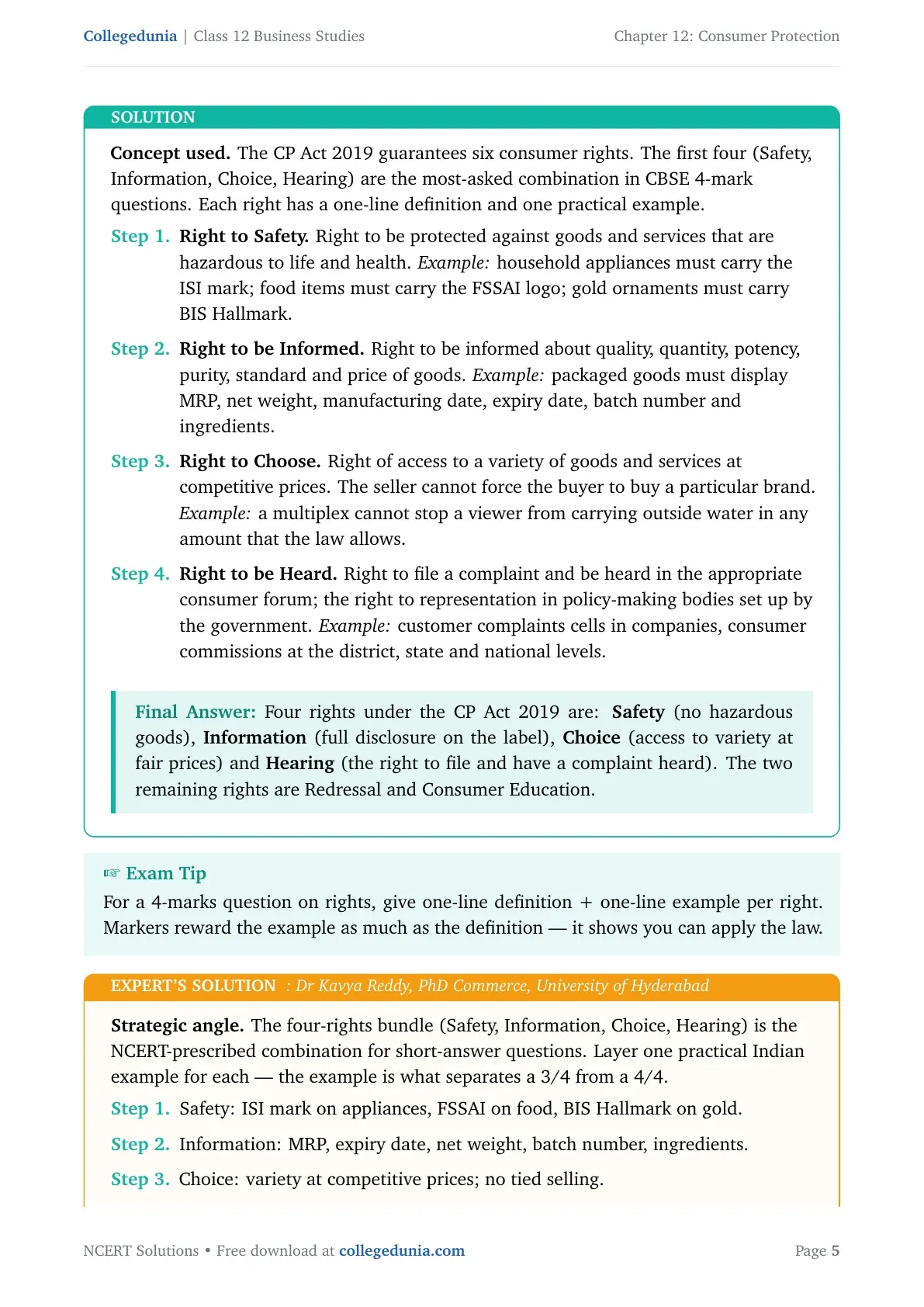
Concept used. The CP Act 2019 guarantees six consumer rights. The first four
(Safety, Information, Choice, Hearing) are the most-asked combination in CBSE 4-mark questions.
Each right has a one-line definition and one practical example.
Right to Safety. Right to be protected against goods and services that are
hazardous to life and health. Example: household appliances must carry the ISI
mark; food items must carry the FSSAI logo; gold ornaments must carry BIS Hallmark.
Right to be Informed. Right to be informed about quality, quantity, potency,
purity, standard and price of goods. Example: packaged goods must display MRP,
net weight, manufacturing date, expiry date, batch number and ingredients.
Right to Choose. Right of access to a variety of goods and services at
competitive prices. The seller cannot force the buyer to buy a particular brand.
Example: a multiplex cannot stop a viewer from carrying outside water in any
amount that the law allows.
Right to be Heard. Right to file a complaint and be heard in the appropriate
consumer forum; the right to representation in policy-making bodies set up by the
government. Example: customer complaints cells in companies, consumer commissions
at the district, state and national levels.
Four rights under the CP Act 2019 are: Safety (no hazardous goods),
Information (full disclosure on the label), Choice (access to variety at fair
prices) and Hearing (the right to file and have a complaint heard). The two remaining
rights are Redressal and Consumer Education.
DK
Dr Kavya Reddy
PhD Commerce, University of Hyderabad
Verified Expert
Strategic angle. The four-rights bundle (Safety, Information, Choice, Hearing) is the
NCERT-prescribed combination for short-answer questions. Layer one practical Indian example for
each –- the example is what separates a 3/4 from a 4/4.
Safety: ISI mark on appliances, FSSAI on food, BIS Hallmark on gold.
Information: MRP, expiry date, net weight, batch number, ingredients.
Choice: variety at competitive prices; no tied selling.
Safety, Information, Choice and Hearing –- the four basic rights of consumers –-
each with a single Indian example as proof of application.
Q 12.5
State any four responsibilities of a consumer.
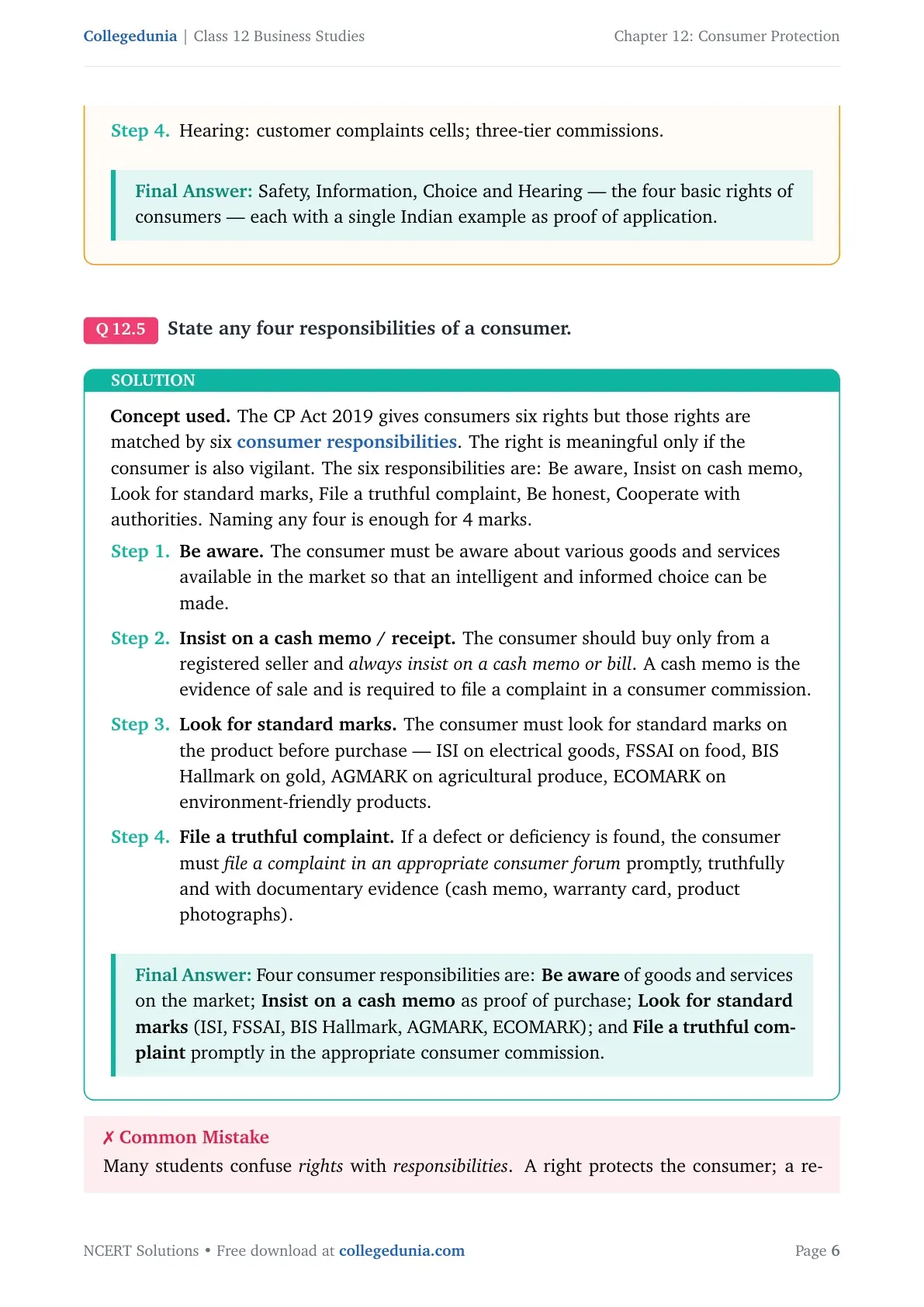
Concept used. The CP Act 2019 gives consumers six rights but those rights are
matched by six consumer responsibilities. The right is meaningful only if the consumer
is also vigilant. The six responsibilities are: Be aware, Insist on cash memo, Look for
standard marks, File a truthful complaint, Be honest, Cooperate with authorities. Naming any
four is enough for 4 marks.
Be aware. The consumer must be aware about various goods and services available
in the market so that an intelligent and informed choice can be made.
Insist on a cash memo / receipt. The consumer should buy only from a registered
seller and always insist on a cash memo or bill. A cash memo is the evidence of
sale and is required to file a complaint in a consumer commission.
Look for standard marks. The consumer must look for standard marks on the
product before purchase –- ISI on electrical goods, FSSAI on food, BIS Hallmark on
gold, AGMARK on agricultural produce, ECOMARK on environment-friendly products.
File a truthful complaint. If a defect or deficiency is found, the consumer
must file a complaint in an appropriate consumer forum promptly, truthfully and
with documentary evidence (cash memo, warranty card, product photographs).
Four consumer responsibilities are: Be aware of goods and services on the
market; Insist on a cash memo as proof of purchase; Look for standard marks
(ISI, FSSAI, BIS Hallmark, AGMARK, ECOMARK); and File a truthful complaint promptly
in the appropriate consumer commission.
IK
Ishita Kapoor
MBA, Symbiosis Pune
Verified Expert
Strategic angle. Six responsibilities; pick four with the easiest one-line examples.
Cash memo and standard marks are the operational pair; awareness and truthful complaint are
the legal pair.
Be aware of the marketplace.
Cash memo / bill as proof of purchase.
Standard marks: ISI, FSSAI, BIS, AGMARK, ECOMARK.
File a truthful complaint with documentary evidence.
Be aware, insist on a cash memo, look for standard marks, file a truthful complaint
–- four consumer responsibilities that turn legal rights into operational protection.
Q 12.6
Explain briefly the role of consumer organisations and NGOs in protecting and
promoting consumer interests.
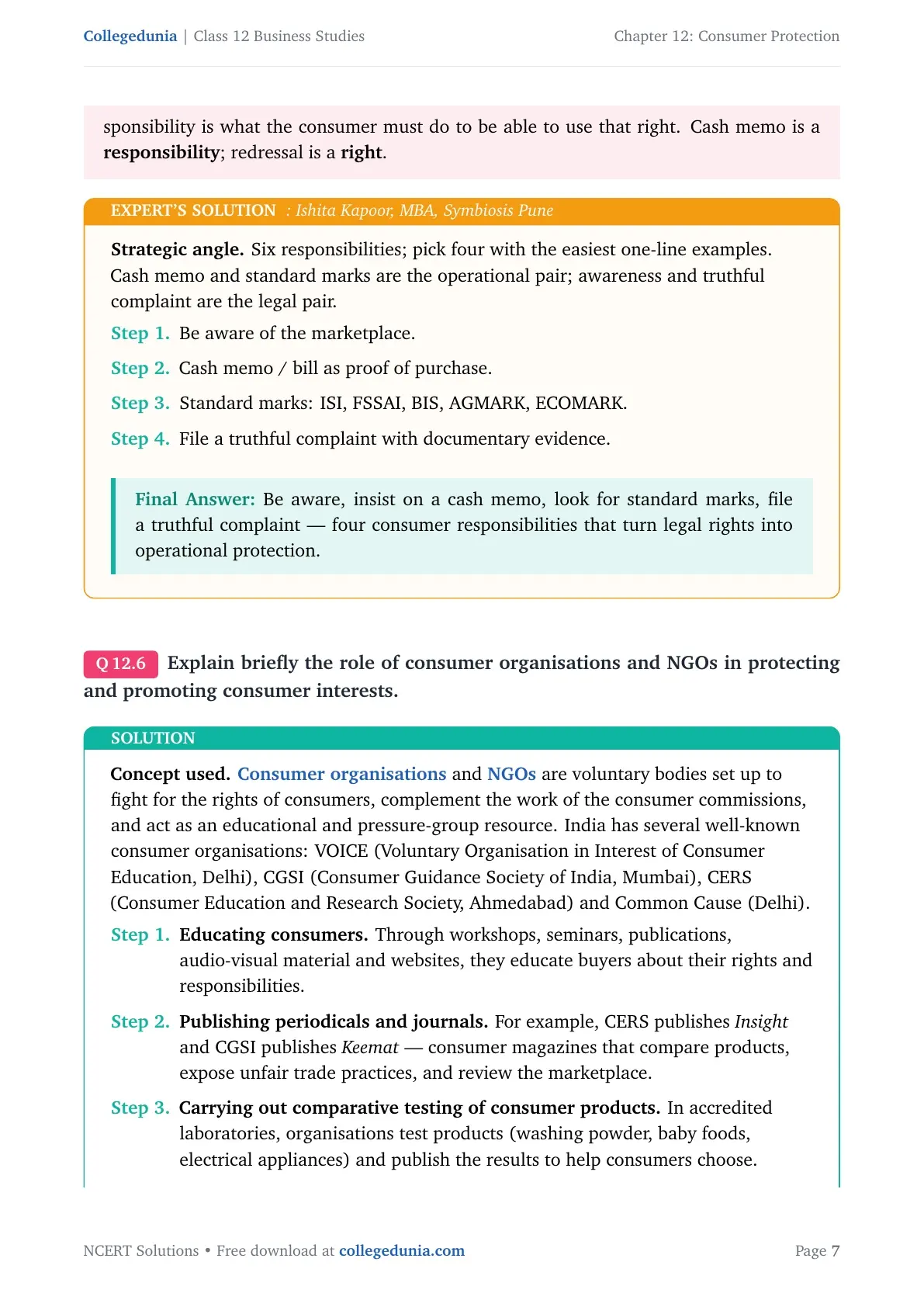
Concept used.Consumer organisations and NGOs are voluntary
bodies set up to fight for the rights of consumers, complement the work of the consumer
commissions, and act as an educational and pressure-group resource. India has several
well-known consumer organisations: VOICE (Voluntary Organisation in Interest of Consumer
Education, Delhi), CGSI (Consumer Guidance Society of India, Mumbai), CERS (Consumer
Education and Research Society, Ahmedabad) and Common Cause (Delhi).
Educating consumers. Through workshops, seminars, publications, audio-visual
material and websites, they educate buyers about their rights and responsibilities.
Publishing periodicals and journals. For example, CERS publishes
Insight and CGSI publishes Keemat –- consumer magazines that compare
products, expose unfair trade practices, and review the marketplace.
Carrying out comparative testing of consumer products. In accredited
laboratories, organisations test products (washing powder, baby foods, electrical
appliances) and publish the results to help consumers choose.
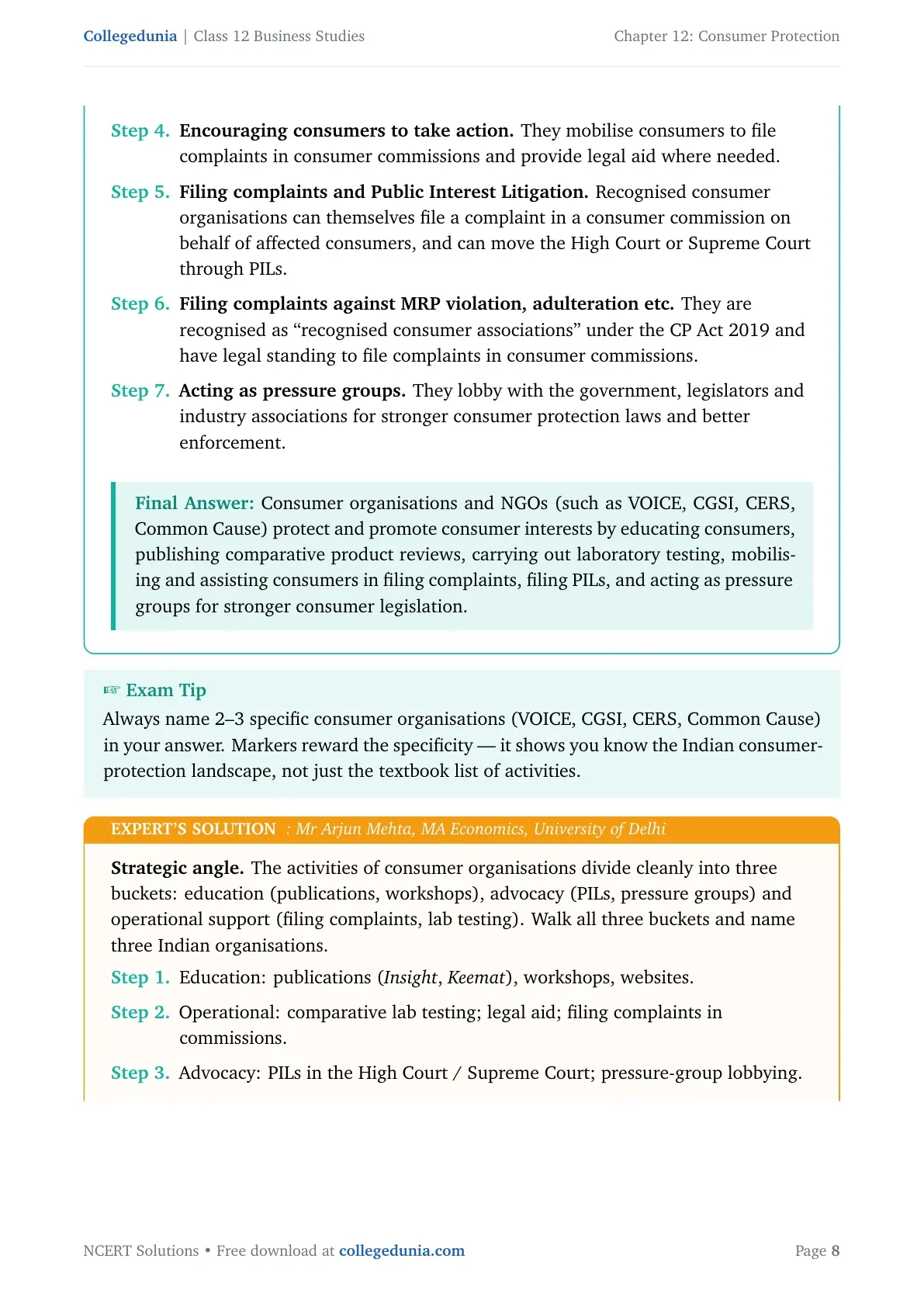
Encouraging consumers to take action. They mobilise consumers to file
complaints in consumer commissions and provide legal aid where needed.
Filing complaints and Public Interest Litigation. Recognised consumer
organisations can themselves file a complaint in a consumer commission on behalf of
affected consumers, and can move the High Court or Supreme Court through PILs.
Filing complaints against MRP violation, adulteration etc. They are recognised
as ``recognised consumer associations'' under the CP Act 2019 and have legal standing
to file complaints in consumer commissions.
Acting as pressure groups. They lobby with the government, legislators and
industry associations for stronger consumer protection laws and better enforcement.
Consumer organisations and NGOs (such as VOICE, CGSI, CERS, Common Cause) protect and
promote consumer interests by educating consumers, publishing comparative product reviews,
carrying out laboratory testing, mobilising and assisting consumers in filing complaints,
filing PILs, and acting as pressure groups for stronger consumer legislation.
MA
Mr Arjun Mehta
MA Economics, University of Delhi
Verified Expert
Strategic angle. The activities of consumer organisations divide cleanly into three
buckets: education (publications, workshops), advocacy (PILs, pressure groups) and operational
support (filing complaints, lab testing). Walk all three buckets and name three Indian
organisations.
Operational: comparative lab testing; legal aid; filing complaints in commissions.
Advocacy: PILs in the High Court / Supreme Court; pressure-group lobbying.
Consumer organisations like VOICE, CGSI, CERS and Common Cause educate consumers,
publish comparative product reviews, carry out lab testing, file complaints and PILs, and act
as pressure groups for stronger consumer protection.
Long Answer Type Questions
Q 12.7
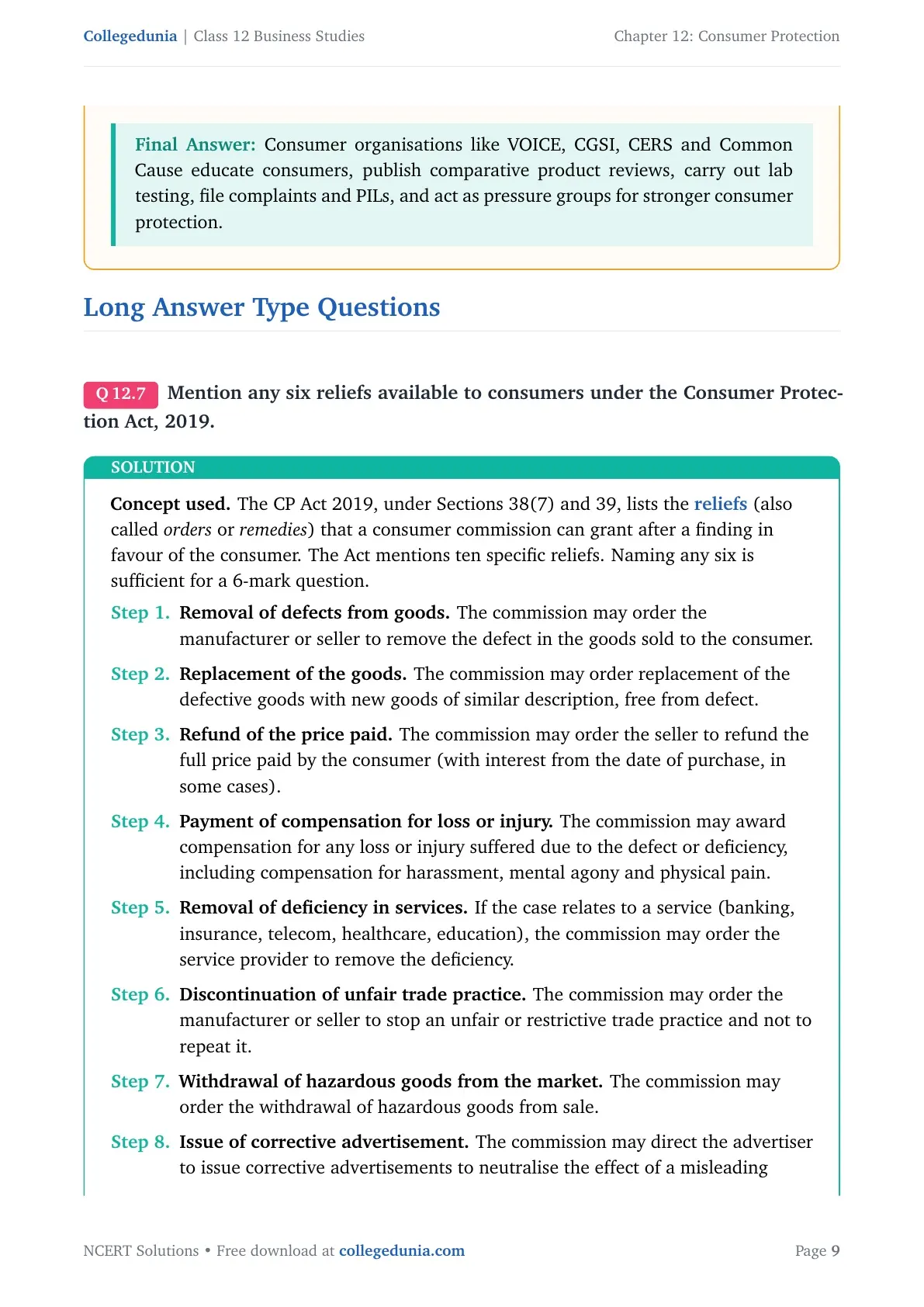
Mention any six reliefs available to consumers under the Consumer Protection Act, 2019.
Concept used. The CP Act 2019, under Sections 38(7) and 39, lists the
reliefs (also called orders or remedies) that a consumer commission
can grant after a finding in favour of the consumer. The Act mentions ten specific reliefs.
Naming any six is sufficient for a 6-mark question.
Removal of defects from goods. The commission may order the manufacturer or
seller to remove the defect in the goods sold to the consumer.
Replacement of the goods. The commission may order replacement of the
defective goods with new goods of similar description, free from defect.
Refund of the price paid. The commission may order the seller to refund the
full price paid by the consumer (with interest from the date of purchase, in some
cases).
Payment of compensation for loss or injury. The commission may award
compensation for any loss or injury suffered due to the defect or deficiency, including
compensation for harassment, mental agony and physical pain.
Removal of deficiency in services. If the case relates to a service (banking,
insurance, telecom, healthcare, education), the commission may order the service
provider to remove the deficiency.
Discontinuation of unfair trade practice. The commission may order the
manufacturer or seller to stop an unfair or restrictive trade practice and not to
repeat it.
Withdrawal of hazardous goods from the market. The commission may order the
withdrawal of hazardous goods from sale.
Issue of corrective advertisement. The commission may direct the
advertiser to issue corrective advertisements to neutralise the effect of a misleading
advertisement.
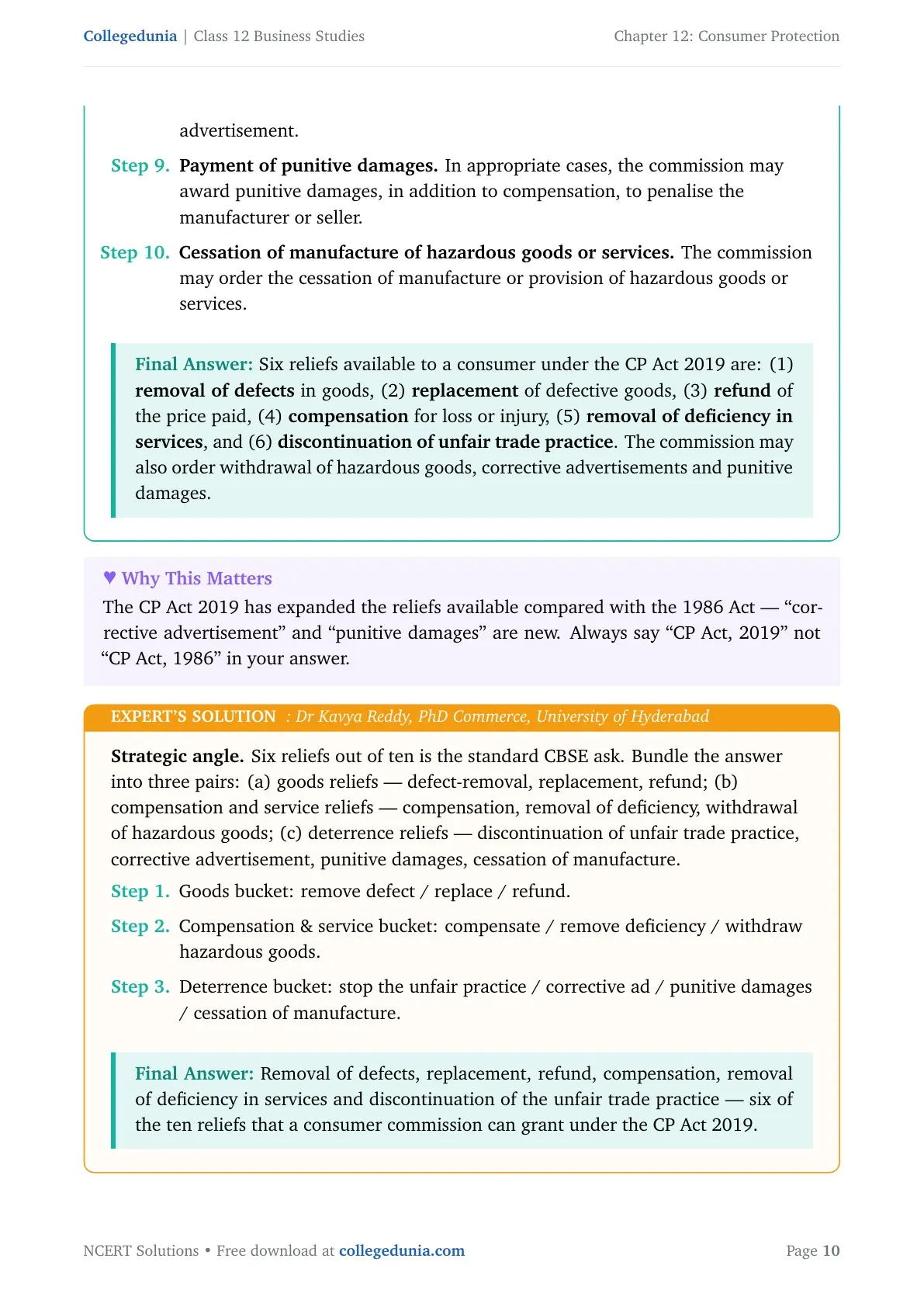
Payment of punitive damages. In appropriate cases, the commission may award
punitive damages, in addition to compensation, to penalise the manufacturer or seller.
Cessation of manufacture of hazardous goods or services. The commission may
order the cessation of manufacture or provision of hazardous goods or services.
Six reliefs available to a consumer under the CP Act 2019 are: (1) removal of
defects in goods, (2) replacement of defective goods, (3) refund of the
price paid, (4) compensation for loss or injury, (5) removal of deficiency in
services, and (6) discontinuation of unfair trade practice. The commission may also
order withdrawal of hazardous goods, corrective advertisements and punitive damages.
DK
Dr Kavya Reddy
PhD Commerce, University of Hyderabad
Verified Expert
Strategic angle. Six reliefs out of ten is the standard CBSE ask. Bundle the answer
into three pairs: (a) goods reliefs –- defect-removal, replacement, refund; (b) compensation
and service reliefs –- compensation, removal of deficiency, withdrawal of hazardous goods;
(c) deterrence reliefs –- discontinuation of unfair trade practice, corrective advertisement,
punitive damages, cessation of manufacture.
Deterrence bucket: stop the unfair practice / corrective ad / punitive damages /
cessation of manufacture.
Removal of defects, replacement, refund, compensation, removal of deficiency in
services and discontinuation of the unfair trade practice –- six of the ten reliefs that a
consumer commission can grant under the CP Act 2019.
Q 12.8
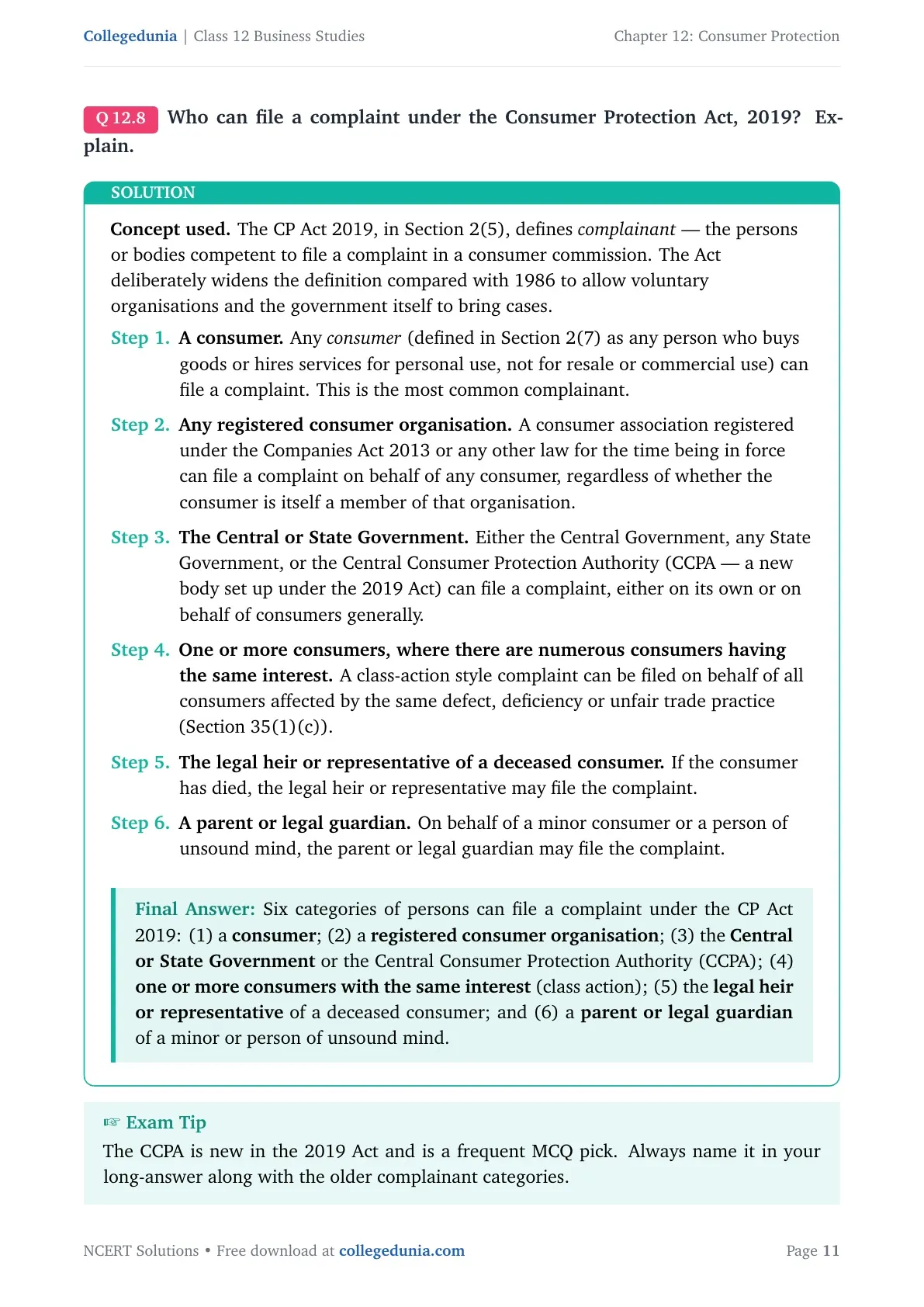
Who can file a complaint under the Consumer Protection Act, 2019? Explain.
Concept used. The CP Act 2019, in Section 2(5), defines complainant –-
the persons or bodies competent to file a complaint in a consumer commission. The Act
deliberately widens the definition compared with 1986 to allow voluntary organisations and the
government itself to bring cases.
A consumer. Any consumer (defined in Section 2(7) as any person who buys
goods or hires services for personal use, not for resale or commercial use) can file a
complaint. This is the most common complainant.
Any registered consumer organisation. A consumer association registered under
the Companies Act 2013 or any other law for the time being in force can file a
complaint on behalf of any consumer, regardless of whether the consumer is itself a
member of that organisation.
The Central or State Government. Either the Central Government, any State
Government, or the Central Consumer Protection Authority (CCPA –- a new body set up
under the 2019 Act) can file a complaint, either on its own or on behalf of consumers
generally.
One or more consumers, where there are numerous consumers having the same
interest. A class-action style complaint can be filed on behalf of all consumers
affected by the same defect, deficiency or unfair trade practice (Section 35(1)(c)).
The legal heir or representative of a deceased consumer. If the consumer has
died, the legal heir or representative may file the complaint.
A parent or legal guardian. On behalf of a minor consumer or a person of
unsound mind, the parent or legal guardian may file the complaint.
Six categories of persons can file a complaint under the CP Act 2019: (1) a
consumer; (2) a registered consumer organisation; (3) the Central or
State Government or the Central Consumer Protection Authority (CCPA); (4) one or more
consumers with the same interest (class action); (5) the legal heir or representative
of a deceased consumer; and (6) a parent or legal guardian of a minor or person of
unsound mind.
MA
Mr Arjun Mehta
MA Economics, University of Delhi
Verified Expert
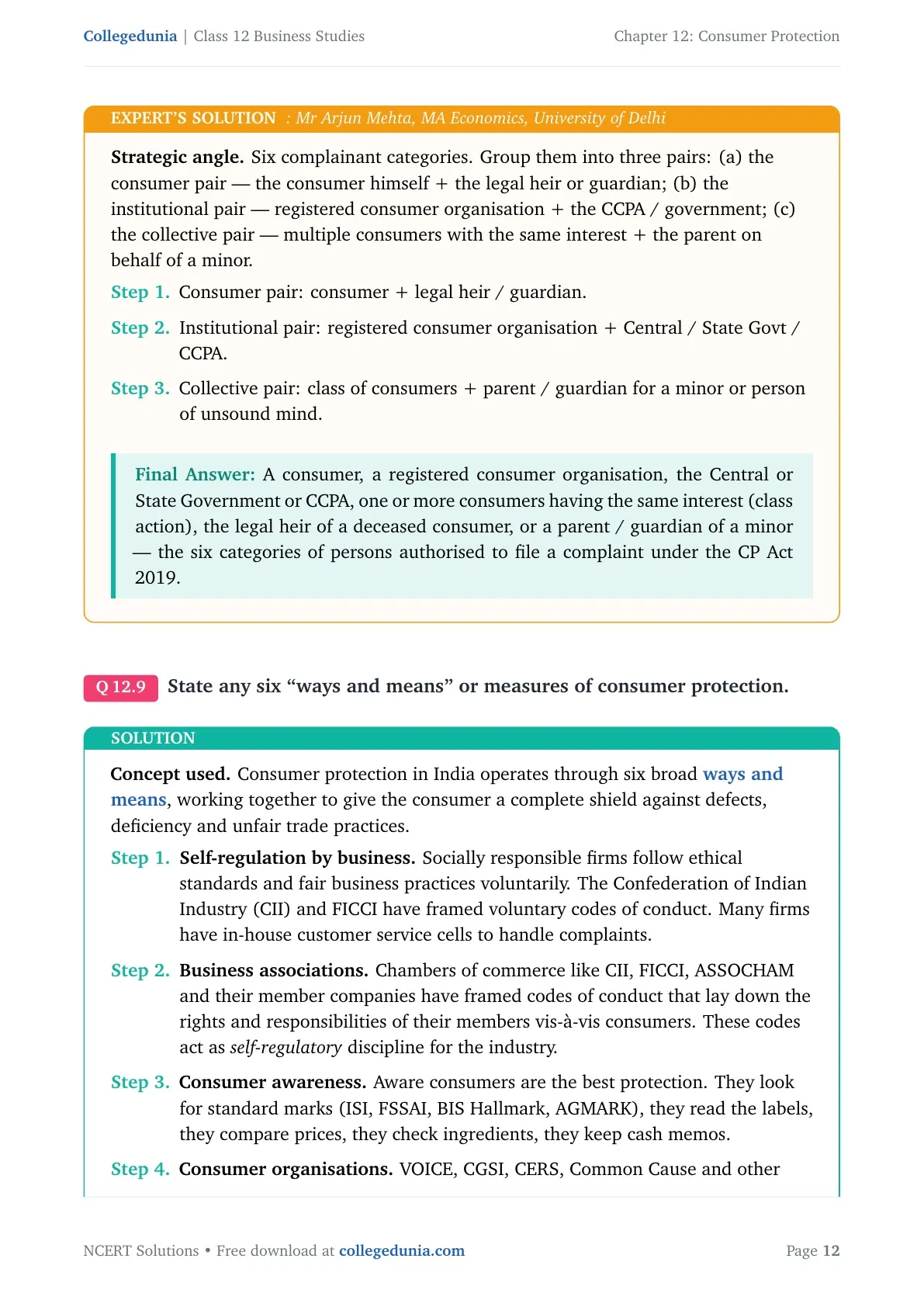
Strategic angle. Six complainant categories. Group them into three pairs: (a) the
consumer pair –- the consumer himself + the legal heir or guardian; (b) the institutional
pair –- registered consumer organisation + the CCPA / government; (c) the collective pair –-
multiple consumers with the same interest + the parent on behalf of a minor.
Consumer pair: consumer + legal heir / guardian.
Institutional pair: registered consumer organisation + Central / State Govt / CCPA.
Collective pair: class of consumers + parent / guardian for a minor or person of
unsound mind.
A consumer, a registered consumer organisation, the Central or State Government or
CCPA, one or more consumers having the same interest (class action), the legal heir of a
deceased consumer, or a parent / guardian of a minor –- the six categories of persons
authorised to file a complaint under the CP Act 2019.
Q 12.9
State any six ``ways and means'' or measures of consumer protection.
Concept used. Consumer protection in India operates through six broad
ways and means, working together to give the consumer a complete shield against
defects, deficiency and unfair trade practices.
Self-regulation by business. Socially responsible firms follow ethical
standards and fair business practices voluntarily. The Confederation of Indian
Industry (CII) and FICCI have framed voluntary codes of conduct. Many firms have
in-house customer service cells to handle complaints.
Business associations. Chambers of commerce like CII, FICCI, ASSOCHAM and
their member companies have framed codes of conduct that lay down the rights and
responsibilities of their members vis-`a-vis consumers. These codes act as
self-regulatory discipline for the industry.
Consumer awareness. Aware consumers are the best protection. They look for
standard marks (ISI, FSSAI, BIS Hallmark, AGMARK), they read the labels, they
compare prices, they check ingredients, they keep cash memos.
Consumer organisations. VOICE, CGSI, CERS, Common Cause and other voluntary
bodies educate consumers, do comparative testing, file complaints on behalf of
consumers, and act as pressure groups.
Government legal regime. The Consumer Protection Act 2019 is the central
law. Many other laws also indirectly protect consumers: the Sale of Goods Act 1930,
the Essential Commodities Act 1955, the Prevention of Food Adulteration Act 1954, the
Standards of Weights and Measures Act 1976, the Bureau of Indian Standards Act 1986,
the Trade Marks Act 1999, and the Drug and Magic Remedies (Objectionable
Advertisements) Act 1954.
Three-tier redressal machinery. The District, State and National
Commissions established under the CP Act 2019 provide a quick, inexpensive and
consumer-friendly judicial remedy in case of disputes.
The six ways and means of consumer protection are: (1) self-regulation by
business; (2) business associations (CII, FICCI) and their codes of conduct;
(3) consumer awareness; (4) consumer organisations like VOICE, CGSI, CERS;
(5) government legal regime (CP Act 2019 and supporting laws); and (6) the
three-tier redressal machinery (District, State, National Commissions).
DK
Dr Kavya Reddy
PhD Commerce, University of Hyderabad
Verified Expert
Strategic angle. Six ways and means; group them into three pairs: (a) the
business pair –- self-regulation + business associations; (b) the consumer pair
–- awareness + consumer organisations; (c) the state pair –- legal regime +
redressal machinery. Each pair is a side of the consumer-protection triangle.
Self-regulation, business associations, consumer awareness, consumer organisations,
the legal regime and the three-tier redressal machinery –- the six pillars of consumer
protection in India, working together to shield the consumer from defects, deficiency and
unfair trade practices.
Student Feedback
In a Collegedunia poll of 640 Class 12 Commerce students, 82% said the Consumer Protection Act 2019 pecuniary limits were the hardest fact to keep straight before exams. 3 in 4 said practising the six ways and means as a full Long Answer helped them score the Unit 4 marks with confidence.
Other Resources for Class 12 Business Studies Chapter 11 Consumer Protection
FAQs - Consumer Protection Class 12 NCERT Solutions
Which Act governs consumer protection in India today?
Which Act governs consumer protection in India today?
The Consumer Protection Act, 2019, which replaced the Consumer Protection Act, 1986. NCERT Reprint 2026-27 uses the 2019 Act. Always cite "CP Act 2019" in your Board answers.
What is the pecuniary jurisdiction of the District Commission under the CP Act 2019?
Up to Rs. 1 crore. The State Commission hears claims above Rs. 1 crore and up to Rs. 10 crore. The National Commission hears claims above Rs. 10 crore.
What does CCPA stand for in consumer protection?
Central Consumer Protection Authority - a new regulator set up under the CP Act 2019 to protect, promote and enforce the rights of consumers. The CCPA can investigate consumer complaints, recall unsafe products, and impose penalties on misleading advertisements.
What are the six consumer rights under the CP Act 2019?
Safety, Information, Choice, Hearing, Redressal and Consumer Education. The Collegedunia mnemonic is SICHRE.
Name three Indian consumer organisations that help consumers.
VOICE (Voluntary Organisation in Interest of Consumer Education, Delhi), CGSI (Consumer Guidance Society of India, Mumbai) and CERS (Consumer Education and Research Society, Ahmedabad). Common Cause (Delhi) is another well-known consumer body.








Comments