Senior Biology Editor, 11 Yrs | Updated 3+ months ago
A microbe is any micro-organism, bacterium, fungus, protozoan or virus too small to be seen by eye, yet collectively responsible for curd, bread, antibiotics, biogas and sewage treatment. Class 12 Biology Chapter 8 Microbes in Human Welfare is a high-yield NEET chapter and the current 2026-27 NCERT keeps all 15 exercise questions intact. This page hosts the step-by-step Solutions PDF.
Each question carries a fully-worked Solution plus a parallel Expert's Solution, so students can lift the exact NCERT line a paper-setter rewards. All answers are mapped to the 2026-27 NCERT and cross-checked against five years of CBSE and NEET papers.
Microbes in Human Welfare Video Lecture for Class 12 Biology
Why Microbes in Human Welfare is a Free-Marks Chapter for NEET 2027
Microbes in Human Welfare reads like a list of "microbe + product" pairs, which is how NEET frames its questions. With 22 named microbes and 18 products, pairing them converts directly to MCQ marks. No reasoning ladder: a strong NCERT pass yields full marks.
NEET pulled 3 direct-recall MCQs from this chapter in 2025 and 4 in 2024. Every one was a microbe-to-product match.
How will Collegedunia's NCERT Solutions help you crack Microbes in Human Welfare?
This Microbes in Human Welfare NCERT Solutions PDF is built around the exact phrasing CBSE awards full marks on. Every answer is graded step by step, and a separate Expert's Solution reframes it from a NEET-revision angle.
Worked answers for all 15 questions in the CBSE four-step pattern: definition, microbe in italics, mechanism, labelled diagram.
NEET-prep value baked in: each solution flags the phrase NEET asks verbatim (Methanobacterium, BOD, biocontrol, Rhizobium).
Industrial products (10.2) is the highest-yield NEET sub-topic, generating roughly 40 percent of the chapter's pull. Prioritise Q5, Q7 and Q8. Biofertilisers (Q14) is a near-guaranteed NEET item.
Microbes in Human Welfare Class 12 Biology PYQ Trend (2025 to 2021)
The table below tracks this chapter across CBSE Boards and NEET over five years.
Year
CBSE Class 12 Boards
NEET
Most-Asked Topic
2025
5 marks (one 3-marker on sewage treatment + one 2-marker on biofertilisers)
3 questions
BOD / Rhizobium
2024
6 marks (5-marker on biogas plant + 1-marker on cyclosporin)
4 questions
Methanogen / penicillin
2023
4 marks
2 questions
Statins / LAB
2022
5 marks (term-2)
3 questions
Activated sludge / biocontrol
2021
4 marks (term-2)
2 questions
Curd / baker's yeast
The five-year average sits at 4.8 marks in CBSE and 2.8 questions in NEET. Industrial products plus sewage / biogas account for over 60 percent of NEET's pull, so prepare Q5 to Q11 first.
NEET prep tip: Spellings like Methanobacterium, Trichoderma polysporum, Aspergillus niger, and Propionibacterium sharmanii have all been asked as direct-recall MCQs. One wrong letter loses the mark.
Where Students Lose Marks in Microbes in Human Welfare (Class 12 Biology)
Candidates rote-learn product names but mis-state microbe genera or get the spelling wrong. The mistakes below cost the most marks, and the worked solutions correct each.
Mistake 1. Writing "yeast" instead of Saccharomyces cerevisiae. CBSE and NEET want the full binomial.
Mistake 2. Confusing Rhizobium (symbiotic, root nodules of legumes) with Azotobacter / Azospirillum (free-living N-fixers).
Mistake 3. Calling biogas just "methane". Biogas is a mixture of CH4 + CO2 + H2 + H2S.
Mistake 4. Listing only one stage of sewage treatment. CBSE wants both primary (physical) and secondary (biological).
Mistake 5. Spelling "Bacillus thurigenesis" instead of Bacillus thuringiensis (Bt). A direct NEET MCQ trap.
Top Microbe-Product Recall Table for Class 12 Biology Chapter 8
The highest-ROI recall table in this chapter. Every entry has appeared in CBSE or NEET in the last five cycles. Memorise the genus in italics, correct spelling.
How to Study Microbes in Human Welfare for Class 12 Biology Boards
Biocontrol and biofertilisers are often under-prepared, yet NEET tests both every year. The three-day plan below distributes the 15 questions in proportion to exam frequency.
Day
Focus
NCERT Q to Solve
Time
Day 1
Household + industrial products (10.1 to 10.2)
Q1, Q3, Q5, Q6, Q7, Q8
3 hours
Day 2
Sewage + biogas (10.3 to 10.4): major CBSE LA
Q2, Q4, Q9, Q10, Q11, Q13
3 hours
Day 3
Biocontrol + biofertilisers (10.5 to 10.6) + full revision + 1 PYP
Q12, Q14, Q15
2 hours
Around 8 hours over 3 days, ending with one NEET-pattern PYP. Keep the microbe-product table on a single A4 for night-before glance.
Other Resources for Microbes in Human Welfare Class 12 Biology
Browse every Class 12 Biology Chapter 8 resource for the 2026-27 syllabus on Collegedunia.
All NCERT Solutions for Microbes in Human Welfare with Step-by-Step Working
Every NCERT textbook question for Class 12 Biology Chapter 8 Microbes in Human Welfare is listed below with its full Solution and Expert Solution hidden inside collapsible tabs. Click Check Solution to reveal the step-by-step working; click Expert Solution for the expanded explanation.
Questions
Q 8.1
Bacteria cannot be seen with the naked eyes, but these can be seen with the help of a microscope. If you have to carry a sample from your home to your biology laboratory to demonstrate the presence of microbes with the help of a microscope, which sample would you carry and why?
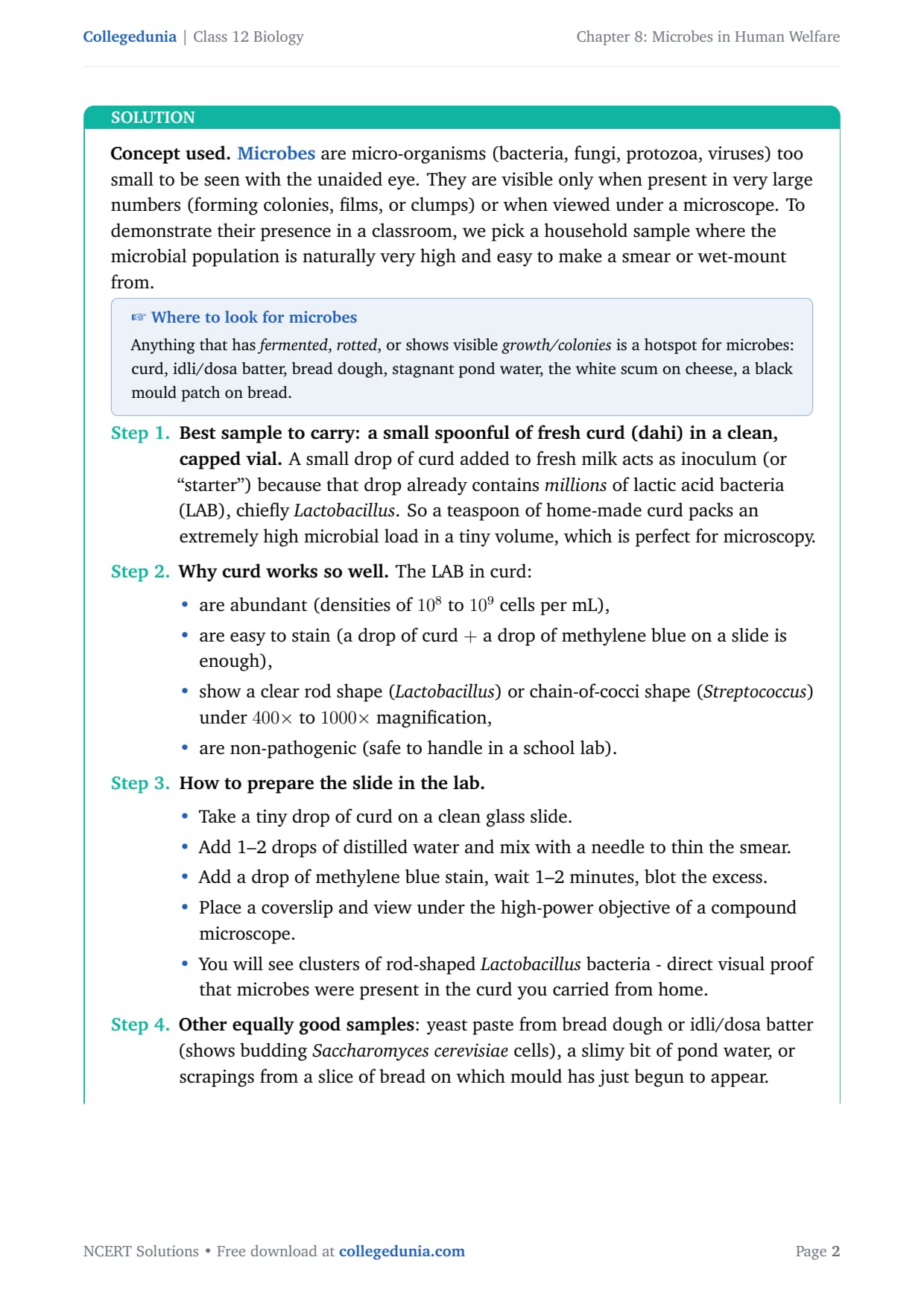
Concept used.Microbes are micro-organisms (bacteria, fungi, protozoa, viruses) too small to be seen with the unaided eye. They are visible only when present in very large numbers (forming colonies, films, or clumps) or when viewed under a microscope. To demonstrate their presence in a classroom, we pick a household sample where the microbial population is naturally very high and easy to make a smear or wet-mount from.
Where to look for microbes
Anything that has fermented, rotted, or shows visible growth/colonies is a hotspot for microbes: curd, idli/dosa batter, bread dough, stagnant pond water, the white scum on cheese, a black mould patch on bread.
Best sample to carry: a small spoonful of fresh curd (dahi) in a clean, capped vial. A small drop of curd added to fresh milk acts as inoculum (or ``starter'') because that drop already contains millions of lactic acid bacteria (LAB), chiefly Lactobacillus. So a teaspoon of home-made curd packs an extremely high microbial load in a tiny volume, which is perfect for microscopy.
Why curd works so well. The LAB in curd:
are abundant (densities of 108 to 109 cells per mL),
are easy to stain (a drop of curd + a drop of methylene blue on a slide is enough),
show a clear rod shape (Lactobacillus) or chain-of-cocci shape (Streptococcus) under 400× to 1000× magnification,
are non-pathogenic (safe to handle in a school lab).
How to prepare the slide in the lab.
Take a tiny drop of curd on a clean glass slide.
Add 1–2 drops of distilled water and mix with a needle to thin the smear.
Add a drop of methylene blue stain, wait 1–2 minutes, blot the excess.
Place a coverslip and view under the high-power objective of a compound microscope.
You will see clusters of rod-shaped Lactobacillus bacteria - direct visual proof that microbes were present in the curd you carried from home.
Other equally good samples: yeast paste from bread dough or idli/dosa batter (shows budding Saccharomyces cerevisiae cells), a slimy bit of pond water, or scrapings from a slice of bread on which mould has just begun to appear.
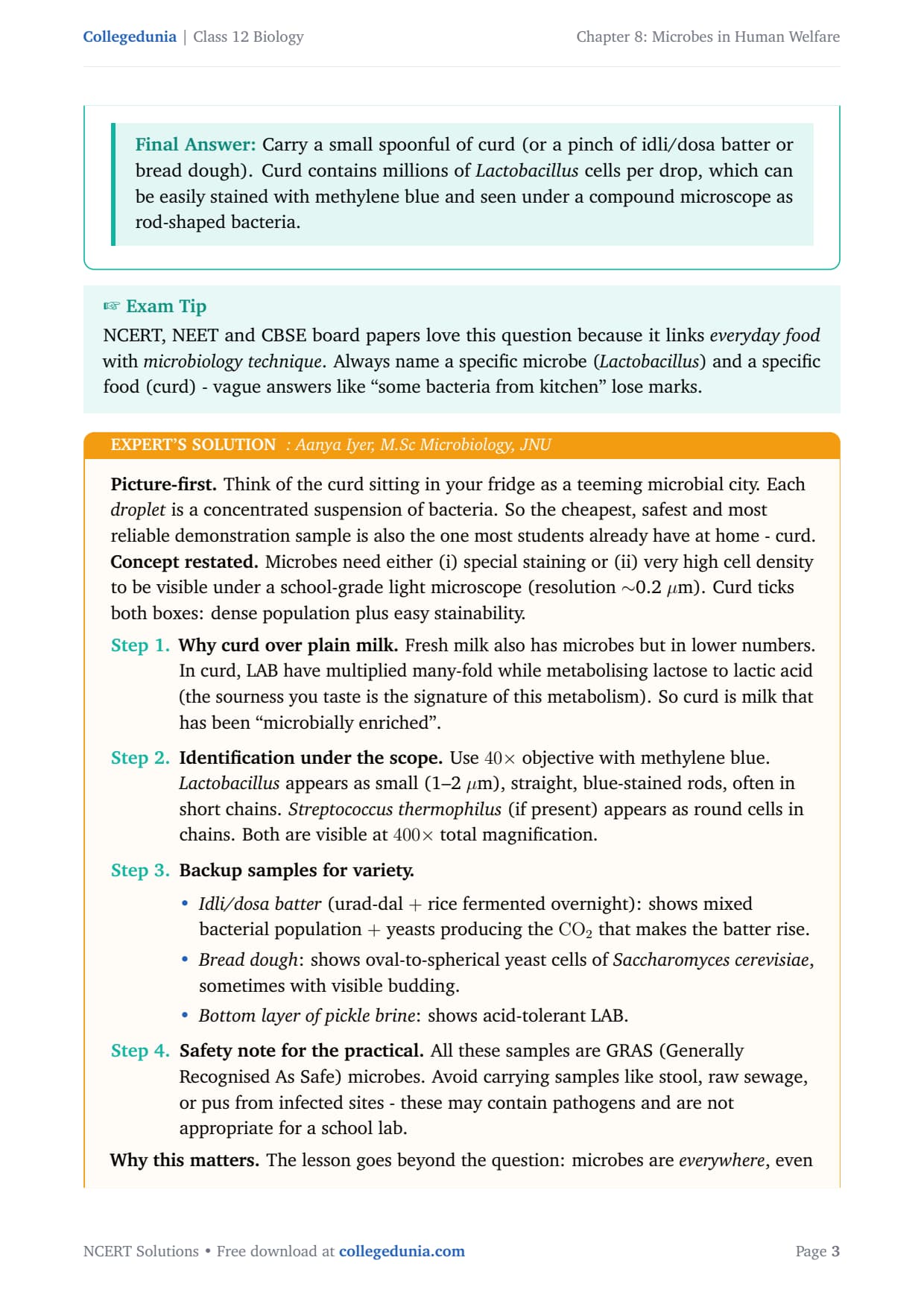
Carry a small spoonful of curd (or a pinch of idli/dosa batter or bread dough). Curd contains millions of Lactobacillus cells per drop, which can be easily stained with methylene blue and seen under a compound microscope as rod-shaped bacteria.
AI
Aanya Iyer
M.Sc Microbiology, JNU
Verified Expert
Picture-first. Think of the curd sitting in your fridge as a teeming microbial city. Each droplet is a concentrated suspension of bacteria. So the cheapest, safest and most reliable demonstration sample is also the one most students already have at home - curd.
Concept restated. Microbes need either (i) special staining or (ii) very high cell density to be visible under a school-grade light microscope (resolution ∼0.2 μm). Curd ticks both boxes: dense population plus easy stainability.
Why curd over plain milk. Fresh milk also has microbes but in lower numbers. In curd, LAB have multiplied many-fold while metabolising lactose to lactic acid (the sourness you taste is the signature of this metabolism). So curd is milk that has been ``microbially enriched''.
Identification under the scope. Use 40× objective with methylene blue. Lactobacillus appears as small (1–2 μm), straight, blue-stained rods, often in short chains. Streptococcus thermophilus (if present) appears as round cells in chains. Both are visible at 400× total magnification.
Backup samples for variety.
Idli/dosa batter (urad-dal + rice fermented overnight): shows mixed bacterial population + yeasts producing the CO2 that makes the batter rise.
Bread dough: shows oval-to-spherical yeast cells of Saccharomyces cerevisiae, sometimes with visible budding.
Bottom layer of pickle brine: shows acid-tolerant LAB.
Safety note for the practical. All these samples are GRAS (Generally Recognised As Safe) microbes. Avoid carrying samples like stool, raw sewage, or pus from infected sites - these may contain pathogens and are not appropriate for a school lab.
Why this matters. The lesson goes beyond the question: microbes are everywhere, even in the food you call ``pure''. Sterility, in everyday cooking, is a myth - and a useful myth to break for any future biology student.
A drop of curd is the ideal sample. Mounted with methylene blue and viewed at 400×, it reveals millions of Lactobacillus rods - irrefutable proof that microbes exist in everyday food.
Q 8.2
Give examples to prove that microbes release gases during metabolism.
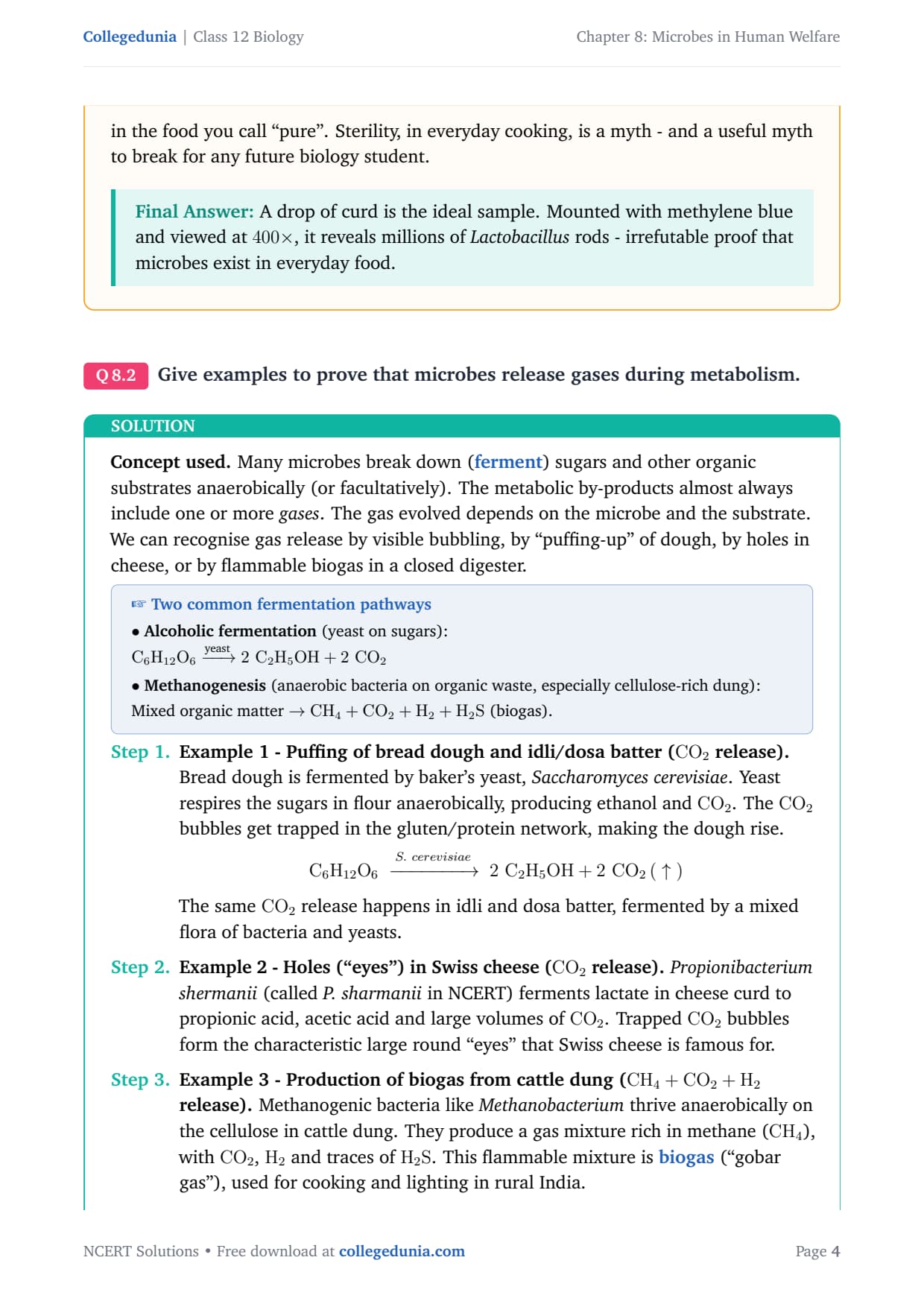
Concept used. Many microbes break down (ferment) sugars and other organic substrates anaerobically (or facultatively). The metabolic by-products almost always include one or more gases. The gas evolved depends on the microbe and the substrate. We can recognise gas release by visible bubbling, by ``puffing-up'' of dough, by holes in cheese, or by flammable biogas in a closed digester.
inlinerecall[Two common fermentation pathways]
•Alcoholic fermentation (yeast on sugars):1pt]
$C6H12O6 ->[yeast] 2 C2H5OH + 2 CO2$ [3pt]
$•$ Methanogenesis (anaerobic bacteria on organic waste, especially cellulose-rich dung): [1pt]
Mixed organic matter $→$ $CH4 + CO2 + H2 + H2S$ (biogas).
inlinerecall
steps
Example 1 - Puffing of bread dough and idli/dosa batter ($CO2$ release). Bread dough is fermented by baker's yeast, Saccharomyces cerevisiae. Yeast respires the sugars in flour anaerobically, producing ethanol and $CO2$. The $CO2$ bubbles get trapped in the gluten/protein network, making the dough rise.
[ C6H12O6 S. cerevisiae 2 C2H5OH + 2 CO2 (↑)
The same CO2 release happens in idli and dosa batter, fermented by a mixed flora of bacteria and yeasts.
Example 2 - Holes (``eyes'') in Swiss cheese (CO2 release).Propionibacterium shermanii (called P. sharmanii in NCERT) ferments lactate in cheese curd to propionic acid, acetic acid and large volumes of CO2. Trapped CO2 bubbles form the characteristic large round ``eyes'' that Swiss cheese is famous for.
Example 3 - Production of biogas from cattle dung (CH4 + CO2 + H2 release). Methanogenic bacteria like Methanobacterium thrive anaerobically on the cellulose in cattle dung. They produce a gas mixture rich in methane (CH4), with CO2, H2 and traces of H2S. This flammable mixture is biogas (``gobar gas''), used for cooking and lighting in rural India.
Example 4 - Brewing of beer, wine, whisky (ethanol +CO2).Saccharomyces cerevisiae (brewer's yeast) ferments malted cereals or fruit juices. The visible bubbling of fermenting must in a brewery is CO2 escaping. The same reaction as in step 1.
Example 5 - Anaerobic sludge digester of a sewage plant. The remaining sludge from secondary treatment is fed to anaerobic digesters, where bacteria release CH4 + CO2 + H2S. This is the same biogas, harvested as fuel right at the sewage plant.
steps
Curd + idli/dosa/bread dough rising, holes in Swiss cheese, fermenting beer/wine bubbling, biogas from dung, and gas from sewage digesters - all demonstrate that microbes release gases (CO2, CH4, H2, H2S) as metabolic by-products.
KB
Karan Banerjee
Ph.D Molecular Biology, NCBS Bangalore
Verified Expert
Structural observation. Whenever you see a food or process puffing, rising, bubbling, fizzing, or hissing, suspect microbial gas release. Group the examples by the gas they release and remember one ``poster microbe'' per group.
Gas = CO2: yeast (S. cerevisiae) in bread/beer/wine; Propionibacterium shermanii in Swiss cheese; LAB in idli batter.
Gas = CH4 + CO2 + H2: methanogens (Methanobacterium) in biogas plants and rumen of cattle.
Gas = H2S: sulphur-reducing bacteria in anaerobic sludge digesters.
Visualising the bread example. Mix flour, water and yeast; the dough doubles in size in 1–2 h. Cut a section: you will see hundreds of tiny gas pockets. Those pockets are the CO2 released by S. cerevisiae as it converts the flour's sugars to ethanol and CO2. The same gas, in a brewing vat, is what makes the wort foam.
Visualising the cheese example. As Swiss cheese ripens, P. shermanii feeds on the lactate left in the curd. Each colony locally produces enough CO2 to inflate a pocket of cheese matrix - that pocket becomes one of the famous Swiss eyes. The size and number of eyes is, literally, a microbial gas signature.
Visualising the biogas example. A floating-drum biogas plant has a metal dome that physically rises as methanogens release CH4 + CO2 from the slurry beneath. The fact that the dome rises is direct, mechanical proof of microbial gas release.
Quantitative angle (worth bonus marks). 1 mole of glucose (180 g) gives exactly 2 moles of CO2 during alcoholic fermentation. So 180 g glucose →2 × 22.4 L = 44.8 L of CO2 at STP. That is a lot of gas - enough to easily lift a kilogram of dough.
Why this matters. Microbial gas release is not just curious - it is the engine behind leavening, brewing, cheese-making and the entire renewable biogas industry.
Yeast in dough/beer, Propionibacterium in Swiss cheese, methanogens in biogas plants and rumen, and bacteria in anaerobic sludge digesters all release CO2, CH4, H2 or H2S during metabolism.
Q 8.3
In which food would you find lactic acid bacteria? Mention some of their useful applications.
Concept used.Lactic acid bacteria (LAB) are a group of Gram-positive, rod- or sphere-shaped bacteria that anaerobically ferment lactose (milk sugar) and other carbohydrates to lactic acid. The common genera are Lactobacillus, Streptococcus, Lactococcus and Leuconostoc. LAB are non-pathogenic and are widely used in food preservation, nutrition and human health (as probiotics).
Foods that contain LAB.
Curd / yoghurt / dahi - the classic example. Lactobacillus converts milk to curd.
Cheese - many varieties (cheddar, mozzarella, Roquefort) use LAB during ripening.
Idli and dosa batter - fermented by a mixed culture of LAB and wild yeasts.
Dhokla, kanji, sauerkraut, kimchi, pickles, yakult - all rely on LAB fermentation.
Fermented butter milk and lassi - products of LAB.
Useful applications of LAB.
Conversion of milk to curd. LAB produce acids that coagulate and partially digest the milk proteins (mainly casein). This curdles the milk and turns it into a thick, tangy semi-solid.
Improving nutritional quality. During curd formation LAB increase the content of vitamin B12 (cyano-cobalamin). Curd is therefore a better B12 source than plain milk - especially valuable for vegetarians.
Checking disease-causing microbes in the human gut. LAB are part of our natural intestinal flora. The lactic acid they secrete lowers gut pH, suppressing pathogenic bacteria. This is the principle behind probiotic drinks like Yakult.
Food preservation. Lactic acid acts as a natural preservative - it inhibits the growth of spoilage microbes. This is why curd, pickles, sauerkraut and kimchi keep for weeks without refrigeration.
Texture, flavour and aroma of cheese. LAB metabolism produces small molecules (diacetyl, acetate, propionate) that give cheese its characteristic sharp/tangy flavour.
Production of dough for idli, dosa, dhokla. LAB sourness +CO2 release together give the puffed, slightly sour traditional Indian breakfast foods.
LAB are found in curd, cheese, idli/dosa batter, dhokla, kanji, lassi, sauerkraut, kimchi and pickles. They convert milk to curd, increase vitamin B12 content, suppress harmful gut microbes, preserve food, flavour cheese, and leaven traditional Indian breads.
PR
Pooja Reddy
M.Sc Biotechnology, AIIMS Delhi
Verified Expert
Quick reading. A two-line answer in the exam is: LAB are found in curd and dairy ferments; they convert milk to curd, enrich it with B12, and act as probiotics that check gut pathogens. Then expand each point if the question is for 5+ marks.
Where LAB live. Anywhere with available lactose or other sugars and a low-oxygen environment - milk, fermenting vegetables, even the human intestine.
Three core jobs. (i) Acidify milk → curd; (ii) make B12; (iii) crowd out pathogens.
The biochemistry behind ``milk → curd''. Milk has ∼5% lactose. LAB enzymes break it: lactose → glucose + galactose → pyruvate →lactic acid. The lactic acid drops the pH from ∼6.7 to ∼4.5. At pH 4.5, casein micelles lose their charge and aggregate - the visible thickening you see when milk sets into curd.
Why B12 rises in curd. Some LAB strains synthesise cobalamin from the cobalt and amino-acid precursors in milk. Plant foods rarely contain B12, so curd is one of the most reliable vegetarian sources of this vitamin.
Probiotic effect inside the gut.
LAB lower pH (lactic and acetic acid release).
Pathogens like Salmonella and E. coli O157:H7 grow poorly at low pH.
Result: a curd-eating gut has fewer harmful microbes.
Medicine. Probiotic capsules to recover gut flora after a course of antibiotics or after diarrhoea.
Preservation. Pickling and sauerkraut.
Animal husbandry. Silage (preserved cattle fodder) fermented by LAB.
Why this matters. LAB are the friendliest microbes you eat every day. They are also the simplest case study for ``microbe-as-helper'' - perfect to anchor your understanding of the chapter.
LAB live in curd, cheese, idli batter, pickles and the human gut. They turn milk to curd, raise B12, preserve food, and act as probiotics that suppress harmful gut bacteria.
Q 8.4
Name some traditional Indian foods made of wheat, rice and Bengal gram (or their products) which involve use of microbes.
Concept used. Indian traditional cuisine uses microbial fermentation extensively. Different microbes (mostly LAB and wild yeasts) act on the carbohydrates and proteins of wheat, rice or Bengal gram (chana, besan) flours to produce: a sour-tangy taste from lactic acid, a puffed/spongy texture from CO2, plus improved digestibility and nutritional value (more B-complex vitamins, lower phytic acid).
Foods from wheat (or wheat flour, maida, suji).
Bread / pav / kulcha - leavened by baker's yeast Saccharomyces cerevisiae; CO2 release makes the dough rise.
Bhatura / naan - yoghurt + flour fermented overnight by LAB and yeast.
Jalebi batter - fermented overnight, microbes contribute to the sourness and bubbles.
Foods from rice (or rice flour) usually mixed with urad/chana dal.
Idli - rice + urad dal batter, fermented overnight by LAB (∼Leuconostoc mesenteroides) and wild yeasts; steam-cooked.
Dosa - same batter, pan-cooked thin.
Uttapam, appam - fermented rice batters.
Khaman / dhokla - uses chickpea/Bengal-gram flour with a rice component; LAB fermentation gives the spongy, mildly sour cake.
Lactobacillus, Streptococcus, Leuconostoc mesenteroides - LAB that sour and aerate idli/dosa/dhokla batter.
Wild yeasts and lactobacilli together provide both gas (CO2) and sourness (lactic acid).
Wheat: bread, bhatura, naan, kulcha (yeast + LAB). Rice: idli, dosa, uttapam, appam (LAB + wild yeast on rice-dal batter). Bengal gram: dhokla and khandvi (LAB on besan/rice batter).
AK
Aditya Kumar
Ph.D Molecular Biology, NCBS Bangalore
Verified Expert
Strategic angle. Group the foods by main grain. Then attach a single ``signature microbe'' to each group. Easier to memorise, easier to write in a 3-mark question.
Wheat group (signature microbe = Saccharomyces cerevisiae).
Bread, pav, naan, kulcha, bhatura.
Mechanism: yeast respires the small amount of free sugar in flour, producing CO2 which makes the dough rise.
Side bonus: a tiny amount of ethanol forms; it cooks off when the bread is baked.
Rice group (signature microbe = Leuconostoc mesenteroides + S. cerevisiae).
Idli, dosa, uttapam, appam, neer dosa.
Mechanism: LAB produce lactic acid (the slight sour taste); yeasts produce CO2 (the spongy holes in idli).
Side bonus: fermentation reduces phytic acid (an anti-nutrient in dals), improving iron and zinc absorption.
Bengal-gram / besan group (signature microbe = LAB).
Dhokla, khandvi.
Mechanism: LAB on the besan batter give the characteristic sour taste; soda (NaHCO3) added at the end gives the final lift.
Bonus example beyond the question.
Toddy - fermented sap of certain palms; not based on wheat/rice/gram, but worth knowing.
Cheese - bacterial and fungal fermentation of milk; LAB plus moulds.
Why this matters. Traditional Indian cuisine is one of the world's richest collections of natural microbial bioreactors. Each ``puffed'' or ``sour'' Indian food is a tiny biology experiment running on your kitchen counter overnight.
In which way have microbes played a major role in controlling diseases caused by harmful bacteria?
Concept used.Antibiotics are chemical substances produced by some microbes (mostly fungi, actinomycetes and bacteria) that can kill or retard the growth of other microbes - especially the disease-causing ones. The word anti-biotic literally means ``against life'' (with respect to harmful microbes) and pro-life (with respect to humans).
Penicillin: the chance discovery
In 1928, Alexander Fleming noticed that around a contaminating mould (Penicillium notatum) on his Staphylococcus culture plate, bacteria were not growing. He isolated the antibacterial substance and called it penicillin. Ernest Chain and Howard Florey later established its full potential. The trio won the 1945 Nobel Prize in Medicine.
Microbes are the natural source of nearly every antibiotic in clinical use. Examples:
Penicillin - from the fungus Penicillium notatum (and later P. chrysogenum).
Streptomycin - from the bacterium Streptomyces griseus.
Tetracycline - from Streptomyces aureofaciens.
Chloramphenicol - from Streptomyces venezuelae.
Erythromycin - from Streptomyces erythraeus.
How antibiotics kill or stop bacteria. They target structures or processes specific to bacteria (and absent in human cells), e.g.:
Penicillin breaks down the peptidoglycan cell wall of bacteria.
Streptomycin and tetracycline jam the 70S bacterial ribosome, stopping protein synthesis.
Result: bacteria die or stop dividing; human cells are unaffected.
Diseases brought under control by microbial antibiotics.
Plague (caused by Yersinia pestis).
Whooping cough or kali khansi (Bordetella pertussis).
Diphtheria or gal ghotu (Corynebacterium diphtheriae).
Leprosy or kusht rog (Mycobacterium leprae).
Pneumonia, tuberculosis, typhoid, cholera and many more.
World War II turning point. Penicillin was used on a large scale to treat wounded American soldiers in World War II. It saved millions of lives that would otherwise have been lost to bacterial wound infections.
Net impact. Before antibiotics, infectious diseases were a leading cause of death worldwide. Today, with microbial antibiotics, most bacterial infections are easily treatable. We literally cannot imagine modern medicine without antibiotics - and we owe each of them to a microbe.
Microbes produce antibiotics - natural chemicals like penicillin, streptomycin, tetracycline, chloramphenicol and erythromycin. These kill or stop disease-causing bacteria, bringing under control deadly illnesses such as plague, diphtheria, whooping cough, leprosy, pneumonia and tuberculosis.
VS
Vivaan Sharma
M.Sc Microbiology, JNU
Verified Expert
Strategic angle. The question is short, but a top-scoring answer must include three things: (i) a definition of antibiotic, (ii) at least 3–4 named antibiotic–microbe pairs, and (iii) named diseases controlled.
Define cleanly. Antibiotics are antimicrobial chemicals produced by some microbes that kill or inhibit the growth of other (disease-causing) microbes.
Mention selective toxicity. Antibiotics target bacterial-specific features (peptidoglycan wall, 70S ribosome). Human cells lack these, so we are unharmed - that is what makes antibiotics safe medicine.
Historical anchor. Fleming (1928) → Florey & Chain (1940s) → WW2 mass production → Nobel 1945.
Three big classes of bacteria-targeting antibiotics.
Why microbes make antibiotics in the first place. In soil, fungi and actinomycetes use these molecules as natural chemical weapons against neighbouring bacteria competing for the same scarce nutrients. We humans simply harvested this microbial arms race for clinical use.
Cure-versus-prevention. Antibiotics cure an already-established bacterial infection. They do not work on viruses (colds, flu, COVID), so doctors do not prescribe them for viral illnesses - a common patient confusion.
Why this matters. Today, antibiotic resistance is a growing crisis because we are overusing these microbe-derived drugs. The same microbes that gave us cures may yet take them away if we are not careful. Always finish your full antibiotic course; never self-medicate.
Microbes synthesise antibiotics (penicillin, streptomycin, tetracycline, chloramphenicol, erythromycin) that selectively kill bacterial pathogens, bringing plague, diphtheria, whooping cough, leprosy, pneumonia and many other infections under control.
Q 8.6
Name any two species of fungus, which are used in the production of the antibiotics.
Concept used. An antibiotic is a microbial product that kills or inhibits other microbes. Fungi were the very first organisms found to make antibiotics, and they remain a major source of broad-spectrum antibiotics today. The most famous antibiotic-producing fungi belong to the genus Penicillium.
Species 1: Penicillium notatum. This is the original mould that Alexander Fleming observed on his contaminated Staphylococcus plate in 1928. It produces penicillin, the first commercially-used antibiotic and the prototype of all β-lactam antibiotics. Penicillin destroys the peptidoglycan cell wall of Gram-positive bacteria.
Species 2: Penicillium chrysogenum. A higher-yielding cousin of P. notatum; it produces penicillin in much larger amounts and is the strain most modern commercial penicillin fermentations actually use. Industrial strain improvement (mutagenesis + selection) on P. chrysogenum has raised penicillin titres from a few mg/L to several g/L.
Other antibiotic-producing fungi (for extra marks).
Cephalosporium acremonium - produces cephalosporin (closely related to penicillin).
Trichoderma polysporum - produces cyclosporin A (immunosuppressant, not strictly an antibiotic but bioactive).
Two fungi that produce antibiotics: Penicillium notatum and Penicillium chrysogenum - both sources of penicillin. (Cephalosporium acremonium, producing cephalosporin, is another good example.)
SM
Sneha Mehta
Ph.D Organic Chemistry, IISc Bangalore
Verified Expert
Strategic angle. The cleanest answer is two species from the genus Penicillium: P. notatum and P. chrysogenum. Both make penicillin and both are unambiguously fungi.
Penicillium notatum - the historic one. Fleming's original strain; the one in every textbook history of antibiotics.
Penicillium chrysogenum - the industrial one. Found by Mary Hunt on a mouldy cantaloupe in 1943 (the famous ``mouldy melon'' story); it produces ∼200× more penicillin than P. notatum, which is why modern penicillin factories use it.
Optional third example.Cephalosporium acremonium (now renamed Acremonium chrysogenum) makes the cephalosporins - a whole family of β-lactam antibiotics important for treating Gram-negative infections.
Distinguishing fungi from bacteria-derived antibiotics.
Why this matters. The Penicillium story is the gold-standard example of accidental scientific discovery. A contaminating mould led directly to the modern antibiotic era - a useful reminder that careful observation often beats grand experiments.
Penicillium notatum and Penicillium chrysogenum - both produce penicillin and both are fungi.
Q 8.7
What is sewage? In which way can sewage be harmful to us?
Concept used.Sewage is the term for the municipal waste water generated by households and other establishments in towns and cities. It consists mainly of human and animal excreta, used kitchen water, soap, detergents, paper, rags and food remains. Crucially, it is rich in two things: organic matter and microbes - many of which are pathogenic (disease-causing).
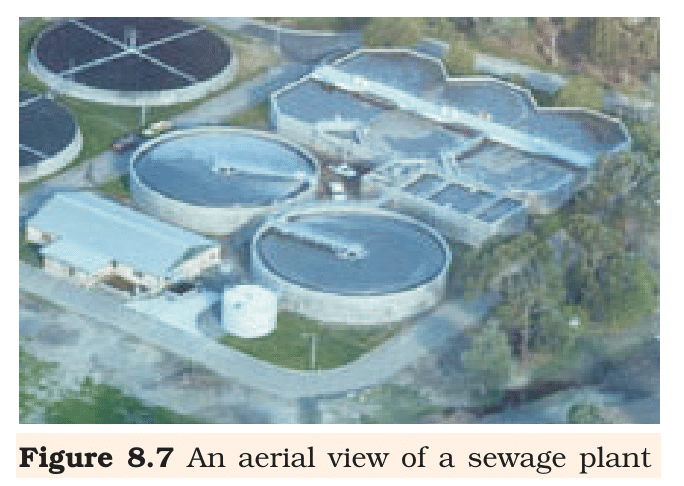
Fig 8.7 – Aerial view of a typical sewage treatment plant (NCERT Class 12 Biology, Chapter 8).
What is sewage? (the textbook definition).
Sewage = municipal waste water from cities and towns.
A major component is human excreta (urine + faeces).
Other components: detergents, soaps, food scraps, kitchen oil, hair, paper, used water from baths and toilets, and (often) industrial effluents and storm-water runoff that join the sewer line.
Two main constituents matter biologically: large amounts of organic matter and large numbers of microbes.
Why sewage is dangerous if released untreated.
Many of the microbes in sewage are pathogens. They cause water-borne diseases like cholera, typhoid, dysentery, hepatitis A and E, polio, diarrhoea, gastroenteritis and parasitic infections like amoebiasis, ascariasis and giardiasis.
Drinking water contaminated with sewage is the main route by which these diseases spread, often in explosive outbreaks (especially after floods).
Sewage also contains parasitic worm eggs (round-worm, hook-worm), which can survive long periods in water and soil.
Environmental harm.
Untreated sewage discharged into rivers and lakes raises the BOD of the water (see Q11). Aerobic bacteria consume the dissolved oxygen, leading to fish kills.
Excess nitrogen and phosphate in sewage cause eutrophication - explosive algal blooms followed by anoxic conditions that destroy aquatic life.
Toxic chemicals (heavy metals, pesticides, drug residues) in untreated sewage accumulate up the food chain.
Public-health corollary. This is precisely why every city must run sewage treatment plants (STPs). The Ganga Action Plan and Yamuna Action Plan of the Indian Ministry of Environment and Forests were launched to add STP capacity for these heavily-polluted rivers.
Sewage is the municipal waste water of cities (mostly human excreta + organic matter + microbes). It is harmful because the pathogenic microbes in it cause water-borne diseases like cholera, typhoid, dysentery, hepatitis and polio, while its organic and nutrient load pollutes rivers, depletes dissolved oxygen, and kills aquatic life.
DJ
Dev Joshi
M.Sc Biotechnology, AIIMS Delhi
Verified Expert
Quick reading. A perfect 4-marker answer here is split 50:50 - define sewage in 2 lines, then list 4–5 specific harms (diseases + ecology).
Define. ``Sewage is the liquid waste of cities, mainly human excreta along with kitchen and toilet water, very rich in organic matter and pathogenic microbes.'' Add: a major fraction is human excreta.
Harm 1 - pathogenic load. Sewage carries the bacteria, viruses and protozoa responsible for cholera (Vibrio cholerae), typhoid (Salmonella typhi), bacillary dysentery (Shigella), viral hepatitis A/E, polio, amoebiasis (Entamoeba histolytica) and giardiasis (Giardia lamblia).
Harm 2 - contamination of drinking water. If sewage seeps into wells, hand-pumps or supply pipes (a common failure in low-income settlements), it triggers diarrhoeal epidemics. Cholera outbreaks in Indian history were almost always linked to mixing of sewage with drinking water.
Harm 3 - eutrophication of receiving waters. Sewage is rich in nitrogen and phosphorus. Discharge into a river feeds algal blooms; the algae die and decompose, consuming all the dissolved oxygen, suffocating fish - a process called eutrophication.
Harm 4 - rise in BOD. Microbes in untreated sewage consume large amounts of dissolved O2 from the receiving water body. High BOD ⇒ less O2 left for aquatic animals ⇒ aquatic ecosystem collapses.
Harm 5 - odour, aesthetics and tourism. Open sewage drains release H2S and ammonia. Beyond stench, this also damages river-front tourism and property values.
Why this matters. The single biggest gain in average life expectancy in the last 150 years came not from any drug but from sewage treatment + piped drinking water. Public sanitation, in other words, has saved more lives than every antibiotic combined.
Sewage is municipal waste water dominated by human excreta and organic matter, packed with pathogens. It causes water-borne disease epidemics (cholera, typhoid, hepatitis), depletes dissolved oxygen (high BOD), and triggers eutrophication of rivers and lakes.
Q 8.8
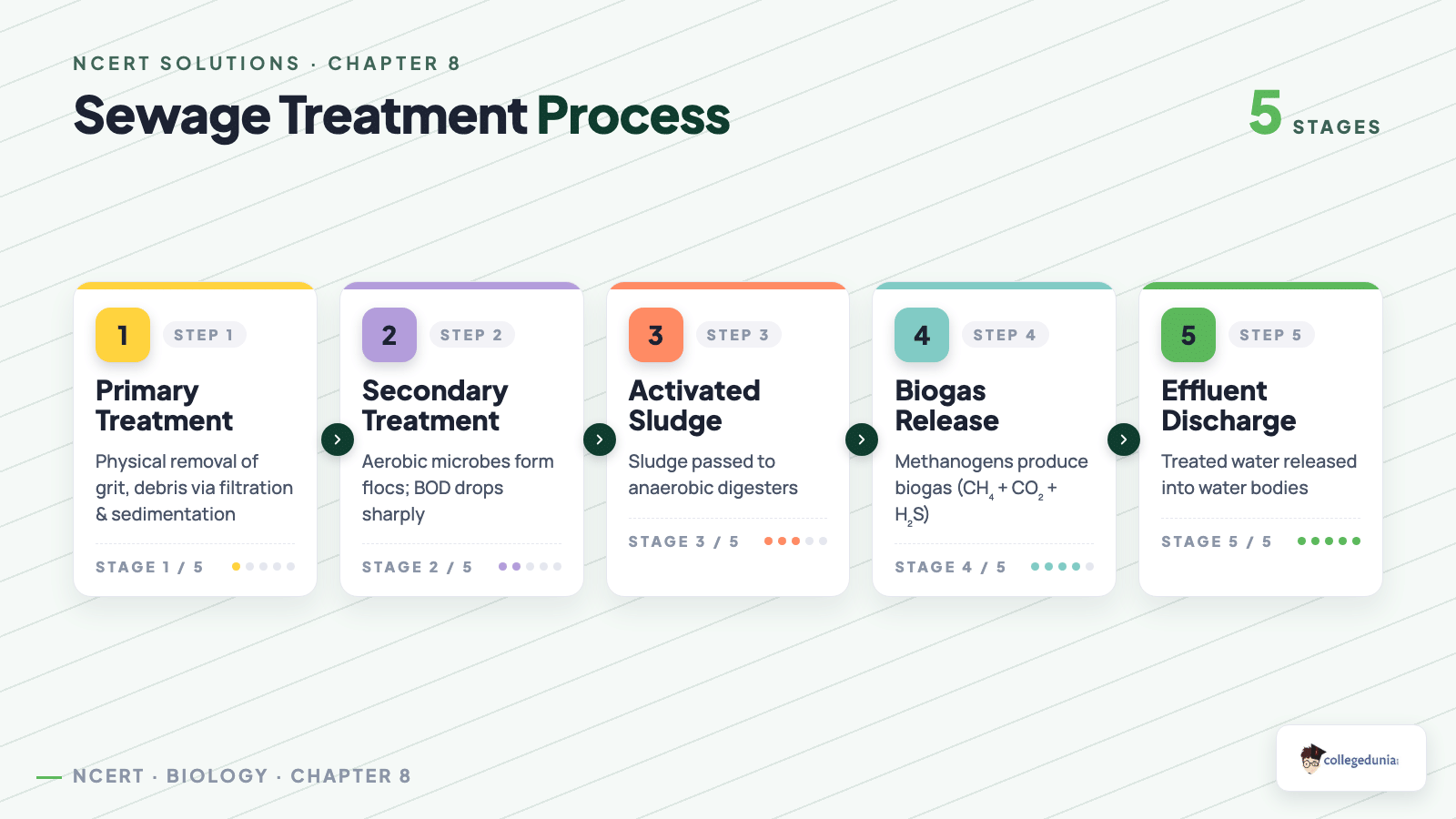
What is the key difference between primary and secondary sewage treatment?
Concept used. Sewage treatment occurs in two main stages. The first stage is primary treatment - purely a physical process (filtration, sedimentation) that removes solid particles. The second stage is secondary treatment - a biological process in which aerobic microbes consume the dissolved organic matter, sharply reducing the BOD of the effluent.
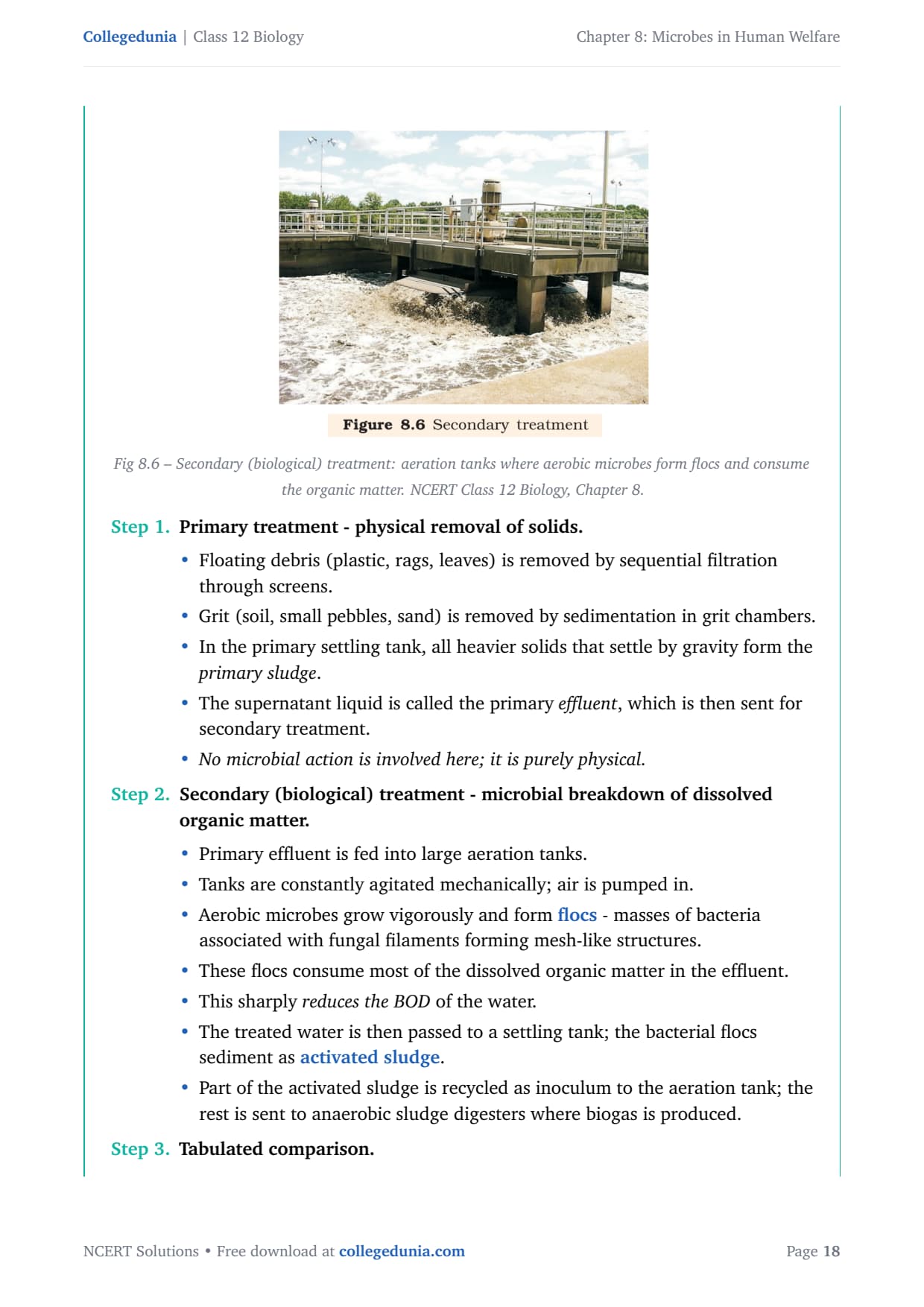
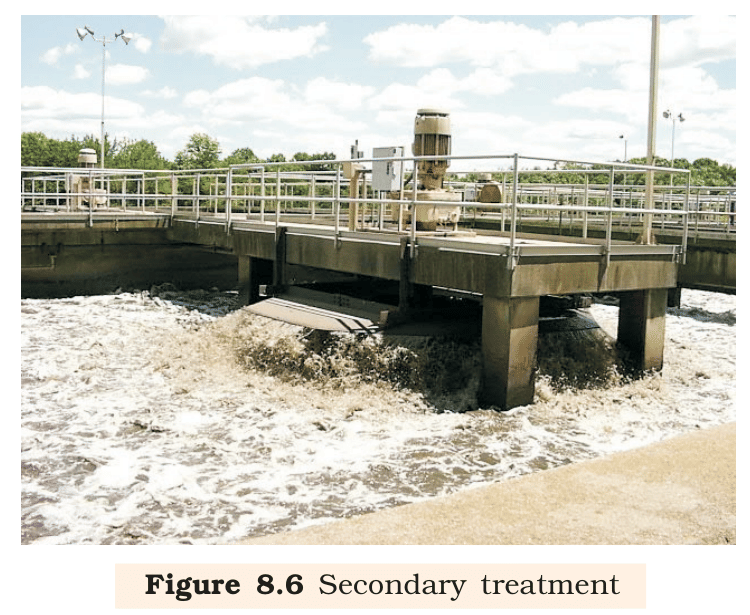
Fig 8.6 – Secondary (biological) treatment: aeration tanks where aerobic microbes form flocs and consume the organic matter. NCERT Class 12 Biology, Chapter 8.
Primary treatment - physical removal of solids.
Floating debris (plastic, rags, leaves) is removed by sequential filtration through screens.
Grit (soil, small pebbles, sand) is removed by sedimentation in grit chambers.
In the primary settling tank, all heavier solids that settle by gravity form the primary sludge.
The supernatant liquid is called the primary effluent, which is then sent for secondary treatment.
No microbial action is involved here; it is purely physical.
Secondary (biological) treatment - microbial breakdown of dissolved organic matter.
Primary effluent is fed into large aeration tanks.
Tanks are constantly agitated mechanically; air is pumped in.
Aerobic microbes grow vigorously and form flocs - masses of bacteria associated with fungal filaments forming mesh-like structures.
These flocs consume most of the dissolved organic matter in the effluent.
This sharply reduces the BOD of the water.
The treated water is then passed to a settling tank; the bacterial flocs sediment as activated sludge.
Part of the activated sludge is recycled as inoculum to the aeration tank; the rest is sent to anaerobic sludge digesters where biogas is produced.
Tabulated comparison.
1.25
tabular|p2.8cm|p5.0cm|p5.0cm|
Feature & Primary treatment & Secondary treatment
Nature of process & Physical (filtration, sedimentation) & Biological (microbial degradation)
Role of microbes & None & Central: aerobic microbes form flocs and consume organic matter
What is removed & Large/heavy solids (debris, grit, sludge) & Dissolved and fine suspended organic matter
Effect on BOD & Small reduction & Large reduction in BOD
Output & Primary effluent and primary sludge & Treated effluent (low BOD), activated sludge
Typical equipment & Screens, grit chambers, settling tanks & Aeration tanks, settling tanks, digesters
tabular
One-line key difference. Primary treatment is physical (removes solids, no microbes involved). Secondary treatment is biological (uses aerobic microbes in flocs to consume the organic matter and drastically reduce the BOD).
Primary treatment is a physical process (filtration + sedimentation) that removes large/small solids. Secondary treatment is a biological process where aerobic microbes form flocs in aeration tanks and consume the dissolved organic matter, sharply reducing the BOD of the effluent.
PV
Priya Verma
Ph.D Molecular Biology, NCBS Bangalore
Verified Expert
Structural observation. Read the answer as a comparison table in your head: primary = physical = solids out; secondary = biological = organic matter out.
Primary step in detail.
Coarse bar screens trap rags, plastic, large debris.
Grit chambers settle out sand and pebbles.
Primary settling tanks allow heavier suspended solids to sink as primary sludge.
Result: a clarified liquid called primary effluent moves forward.
Secondary step in detail.
Aeration tank: air pumped in, water stirred. Aerobic bacteria like Zoogloea ramigera form flocs (slimy clumps with embedded fungal filaments).
These flocs digest the dissolved organic matter (sugars, proteins, fats) leftover in the primary effluent.
BOD drops typically from ∼300–500 mg/L (raw sewage) to ∼10–30 mg/L (after secondary).
Final settling tank: flocs settle as activated sludge.
Some sludge is recycled to seed the aeration tank; the rest goes to anaerobic digesters that release biogas.
Why the two-step design.
Removing solids first (primary) prevents the aeration tank from getting clogged with sand and rags.
Doing biology second (secondary) makes the microbes' job tractable - they only have to deal with dissolved/fine organic matter, not chunks.
Optional tertiary stage. Modern plants also have a tertiary treatment that removes residual nutrients (N, P), disinfects with chlorine or UV, and yields water clean enough for reuse.
Role of the anaerobic sludge digester. The excess activated sludge (after recycling part of it) is pumped into large anaerobic digesters. Here, methanogens like Methanobacterium degrade the leftover organic matter without oxygen, releasing biogas (methane, CO2, H2S). So a well-designed STP not only cleans water but also generates its own fuel.
Two-line summary you can write in any exam. ``Primary treatment is physical (screens, grit chambers, primary settling tank) and removes solid particles. Secondary treatment is biological (aerobic flocs in aeration tanks), reduces BOD by 90+%, and produces activated sludge.''
Why this matters. Primary versus secondary is not just a definition - it is the design logic of every sewage plant on earth. ``Solids first, microbes second'' is the single most important sentence in modern sanitation engineering.
Primary = physical removal of solids (filtration + sedimentation, no microbes). Secondary = biological treatment by aerobic microbes in aeration tanks, drastically lowering the BOD.
Q 8.9
Do you think microbes can also be used as source of energy? If yes, how?
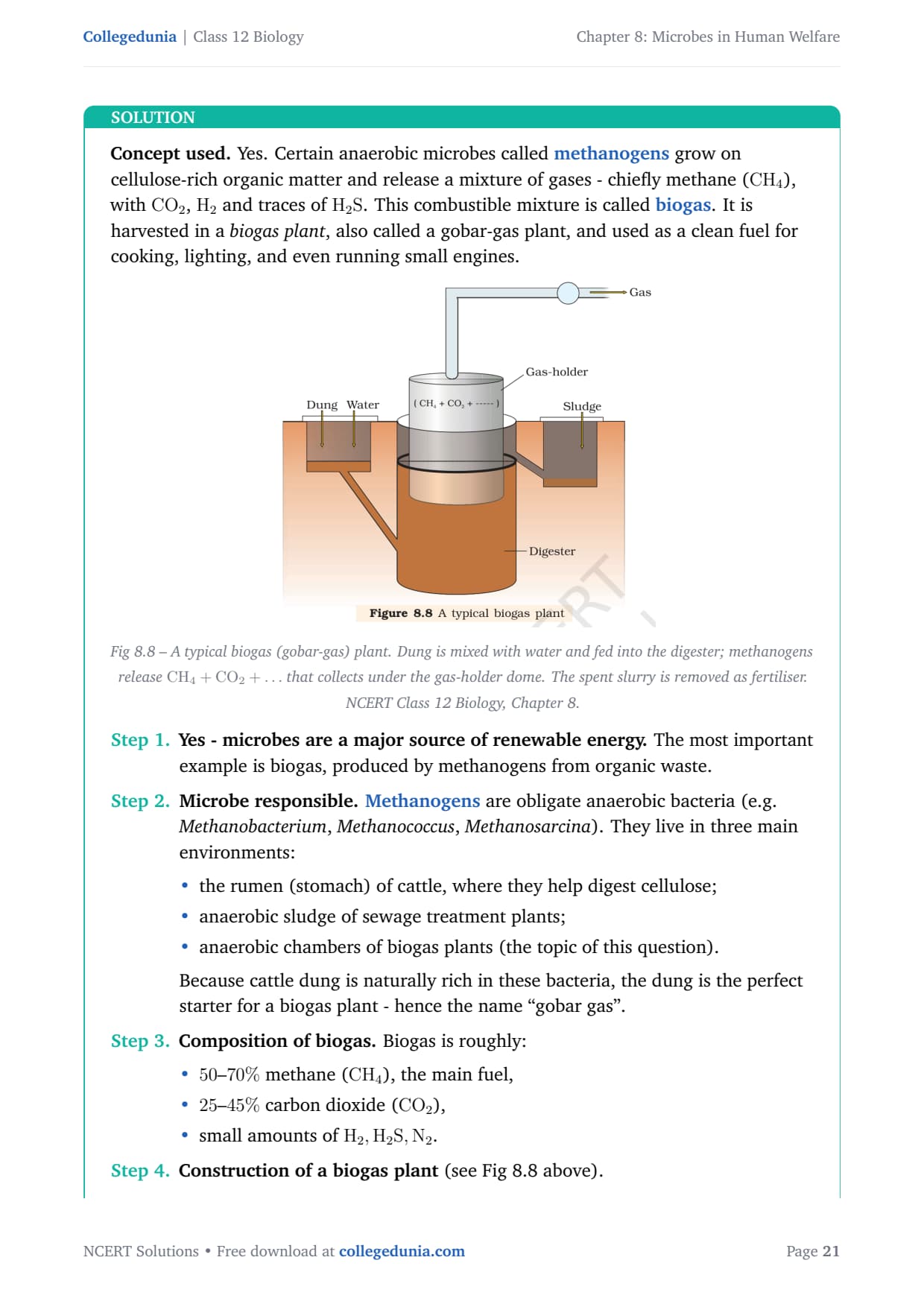
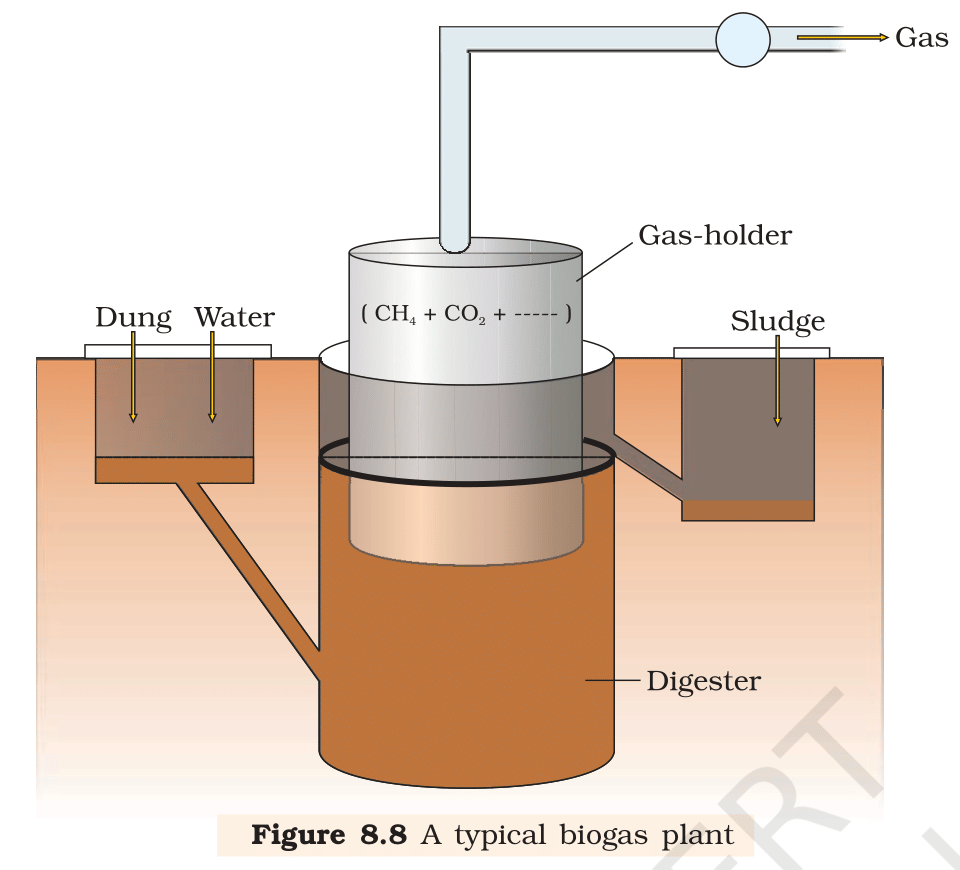
Concept used. Yes. Certain anaerobic microbes called methanogens grow on cellulose-rich organic matter and release a mixture of gases - chiefly methane (CH4), with CO2, H2 and traces of H2S. This combustible mixture is called biogas. It is harvested in a biogas plant, also called a gobar-gas plant, and used as a clean fuel for cooking, lighting, and even running small engines.
Fig 8.8 – A typical biogas (gobar-gas) plant. Dung is mixed with water and fed into the digester; methanogens release CH4 + CO2 + that collects under the gas-holder dome. The spent slurry is removed as fertiliser. NCERT Class 12 Biology, Chapter 8.
Yes - microbes are a major source of renewable energy. The most important example is biogas, produced by methanogens from organic waste.
Microbe responsible.Methanogens are obligate anaerobic bacteria (e.g. Methanobacterium, Methanococcus, Methanosarcina). They live in three main environments:
the rumen (stomach) of cattle, where they help digest cellulose;
anaerobic sludge of sewage treatment plants;
anaerobic chambers of biogas plants (the topic of this question).
Because cattle dung is naturally rich in these bacteria, the dung is the perfect starter for a biogas plant - hence the name ``gobar gas''.
Composition of biogas. Biogas is roughly:
50–70% methane (CH4), the main fuel,
25–45% carbon dioxide (CO2),
small amounts of H2, H2S, N2.
Construction of a biogas plant (see Fig 8.8 above).
A concrete tank, 10–15 feet deep, called the digester, is built underground.
A slurry of cattle dung + water is fed in through the dung inlet.
A floating metal cover (the gas-holder) sits over the slurry. As gas is produced, the dome rises.
An outlet pipe carries the biogas to nearby houses for cooking and lighting.
The spent slurry (rich in nitrogen and phosphorus) is pumped out through another outlet and used as fertiliser on fields.
The reactions. Under strictly anaerobic conditions:
Cellulose and other organic matter → organic acids + alcohols (by fermentative bacteria).
Acetate +H2+CO2→CH4 + CO2 (by methanogens). For example:
CO2 + 4 H2 -> CH4 + 2 H2O CH3COOH -> CH4 + CO2
Other microbial energy routes.
Bioethanol - Saccharomyces cerevisiae ferments sugar/cellulose to ethanol used as transport fuel.
Hydrogen production - certain bacteria (e.g. Clostridium butyricum) and cyanobacteria evolve H2 during photosynthesis or anaerobic fermentation.
Microbial fuel cells - bacteria oxidise organic waste at an electrode, generating an electric current directly.
Indian context. Biogas technology was developed largely in India by Indian Agricultural Research Institute (IARI) and Khadi and Village Industries Commission (KVIC). Biogas plants are most useful in rural India, where cattle dung is plentiful, and they double up as fertiliser sources.
Yes. Methanogenic bacteria like Methanobacterium digest cellulose-rich organic matter (cattle dung, plant waste, sewage sludge) anaerobically and release biogas - a mixture of CH4, CO2, H2 - that is used as a clean fuel for cooking, lighting and small engines. Bioethanol, biohydrogen and microbial fuel cells are other microbial energy routes.
RP
Rohit Pillai
Ph.D Physics, IISc Bangalore
Verified Expert
Strategic angle. Convert the answer into a 4-line skeleton: (i) Yes; (ii) Microbe = methanogen; (iii) Substrate = cellulose-rich organic waste; (iv) Product = biogas (∼70% methane) used as fuel.
Energy carrier. The relevant chemical species is CH4. Burning CH4 releases ∼890 kJ/mol:
CH4 + 2 O2 -> CO2 + 2 H2O, Δ H ≈ -890 kJ/mol.
That is comparable to natural gas, because biogas is natural gas (made by microbes instead of geologically).
The chain of microbial communities.
Stage A: hydrolytic bacteria break cellulose and proteins into sugars and amino acids.
Stage B: acidogenic and acetogenic bacteria convert these to acetate, H2 and CO2.
Stage C: methanogens (Methanobacterium, Methanococcus) convert acetate and H2/CO2 to CH4 + CO2.
The whole chain is anaerobic, so the digester must be sealed from air.
Engineering the floating-drum plant.
Inlet - dung-water slurry enters.
Digester - methanogens at work below.
Gas-holder - a floating dome that rises with gas pressure.
Beyond biogas - three more microbial energy options.
Bioethanol: yeast on sugarcane/corn starch.
Biohydrogen: cyanobacteria and Clostridium producing H2.
Microbial fuel cells (MFCs): electrogenic bacteria like Geobacter directly produce electricity from organic waste.
What ``anaerobic'' really means here. The digester is sealed so air cannot enter. Methanogens are obligate anaerobes - oxygen actually kills them. The slurry is kept moist and warm (30–40∘C); under these conditions the microbial chain runs steadily for weeks, releasing a near-constant stream of CH4.
Spent slurry is not waste. After the methanogens have done their job, the leftover slurry pumped out from the digester is still rich in nitrogen, phosphorus and potassium. Farmers use it directly as a biofertiliser. So one biogas plant delivers three outputs: cooking fuel, lighting fuel, and N–P–K fertiliser.
Comparison with fossil natural gas. Both are mostly methane and burn with the same energy (∼890 kJ/mol). The difference: fossil gas locks away ancient carbon, biogas only recycles current atmospheric CO2 - so biogas is carbon-neutral over short cycles.
Why this matters. Microbial energy is renewable, carbon-neutral over short cycles, and works on village scale. In a country with 300 million cattle and a strong rural population, biogas is not optional - it is essential.
Yes. Methanogens like Methanobacterium anaerobically digest dung/plant waste to give biogas (mostly CH4), used as cooking and lighting fuel. Bioethanol, H2 production and microbial fuel cells are further routes.
Q 8.10
Microbes can be used to decrease the use of chemical fertilisers and pesticides. Explain how this can be accomplished.
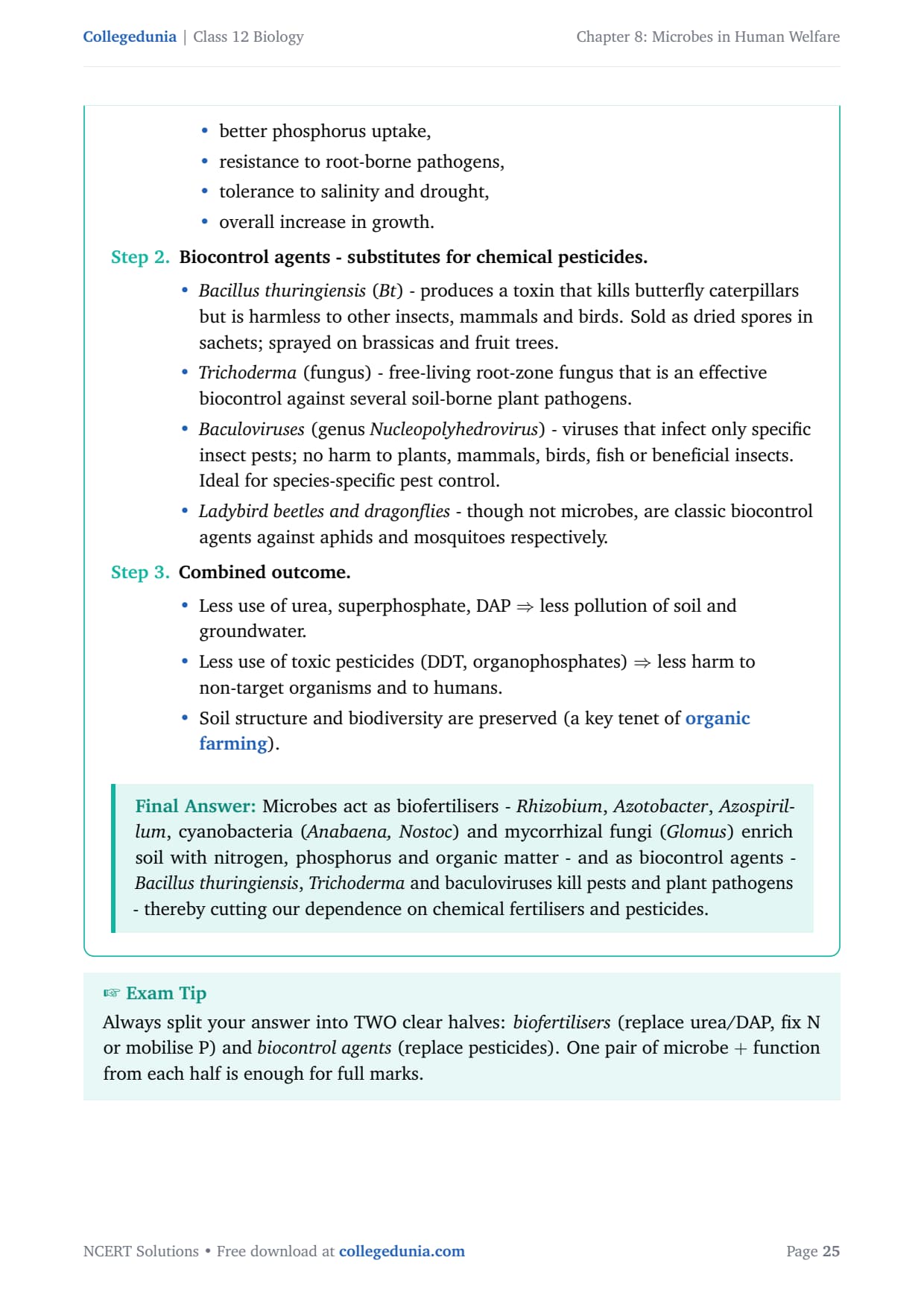
Concept used. Microbes can replace chemical inputs in two distinct ways:
as biofertilisers - organisms that enrich the soil with nitrogen, phosphorus or organic matter (substitute for chemical fertilisers like urea, DAP);
as biocontrol agents - organisms that kill or suppress pests, weeds or plant pathogens (substitute for chemical pesticides and weedicides).
Biofertilisers - substitutes for chemical fertilisers.
Symbiotic nitrogen-fixers.Rhizobium bacteria live in root nodules of leguminous plants (peas, beans, gram). They fix atmospheric N2 into ammonia/amino-form nitrogen, which the plant uses as nutrient. The plant in return supplies sugars to the bacteria - a mutualism.
Free-living nitrogen-fixers in soil.Azotobacter and Azospirillum live freely in soil and fix atmospheric N2, enriching soil nitrogen content.
Cyanobacteria (blue-green algae).Anabaena, Nostoc, Oscillatoria fix atmospheric nitrogen and also add organic matter. Especially important in paddy fields, where they serve as natural biofertilisers.
Mycorrhiza - fungal symbionts. Many fungi of the genus Glomus form symbiotic associations with plant roots (called mycorrhiza). The fungus absorbs phosphorus from soil and passes it to the plant. The plant gains:
itemize
better phosphorus uptake,
resistance to root-borne pathogens,
tolerance to salinity and drought,
overall increase in growth.
itemize
Biocontrol agents - substitutes for chemical pesticides.
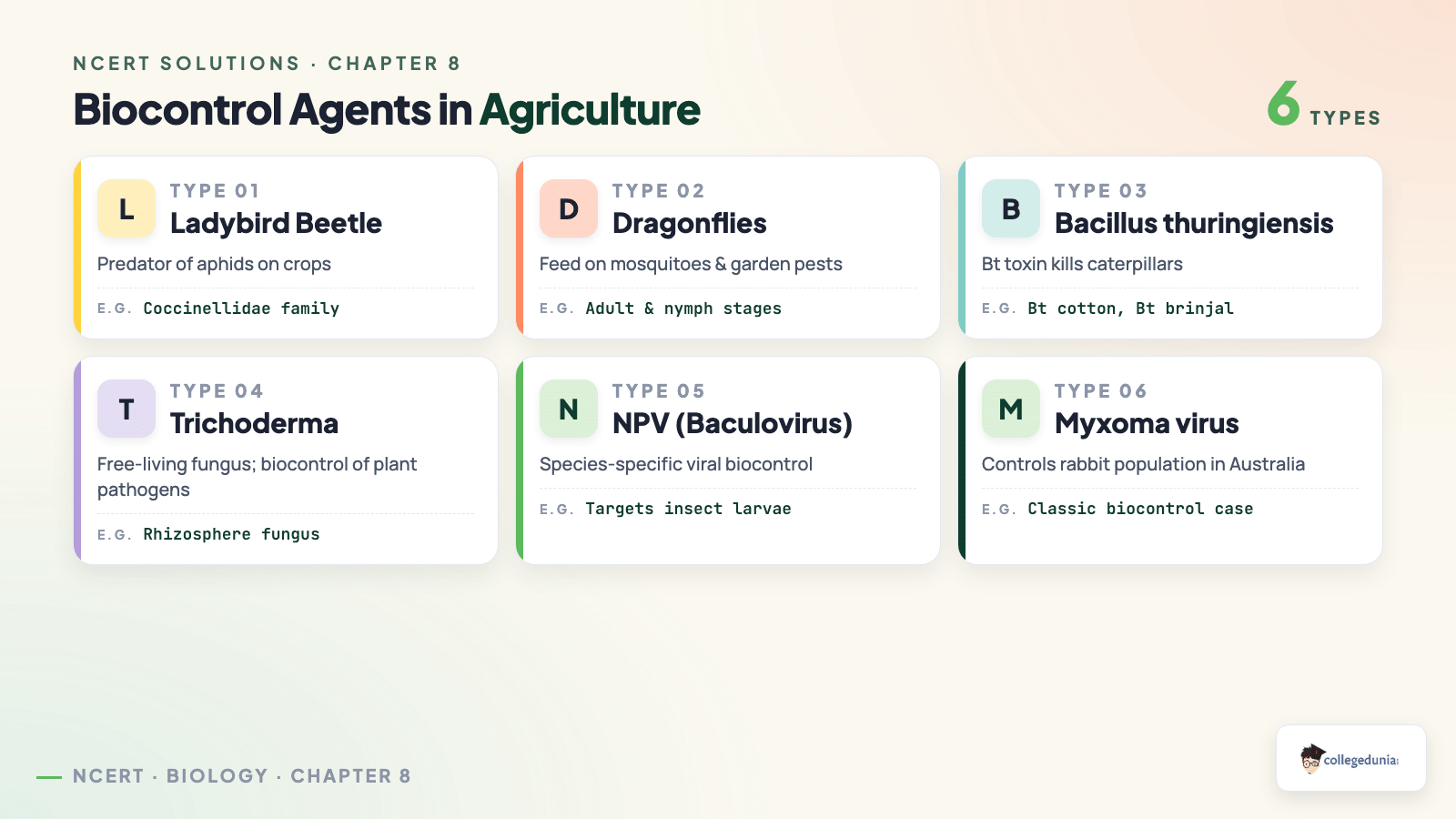
Bacillus thuringiensis (Bt) - produces a toxin that kills butterfly caterpillars but is harmless to other insects, mammals and birds. Sold as dried spores in sachets; sprayed on brassicas and fruit trees.
Trichoderma (fungus) - free-living root-zone fungus that is an effective biocontrol against several soil-borne plant pathogens.
Baculoviruses (genus Nucleopolyhedrovirus) - viruses that infect only specific insect pests; no harm to plants, mammals, birds, fish or beneficial insects. Ideal for species-specific pest control.
Ladybird beetles and dragonflies - though not microbes, are classic biocontrol agents against aphids and mosquitoes respectively.
Combined outcome.
Less use of urea, superphosphate, DAP ⇒ less pollution of soil and groundwater.
Less use of toxic pesticides (DDT, organophosphates) ⇒ less harm to non-target organisms and to humans.
Soil structure and biodiversity are preserved (a key tenet of organic farming).
Microbes act as biofertilisers - Rhizobium, Azotobacter, Azospirillum, cyanobacteria (Anabaena, Nostoc) and mycorrhizal fungi (Glomus) enrich soil with nitrogen, phosphorus and organic matter - and as biocontrol agents - Bacillus thuringiensis, Trichoderma and baculoviruses kill pests and plant pathogens - thereby cutting our dependence on chemical fertilisers and pesticides.
AN
Ananya Nair
M.Sc Biotechnology, AIIMS Delhi
Verified Expert
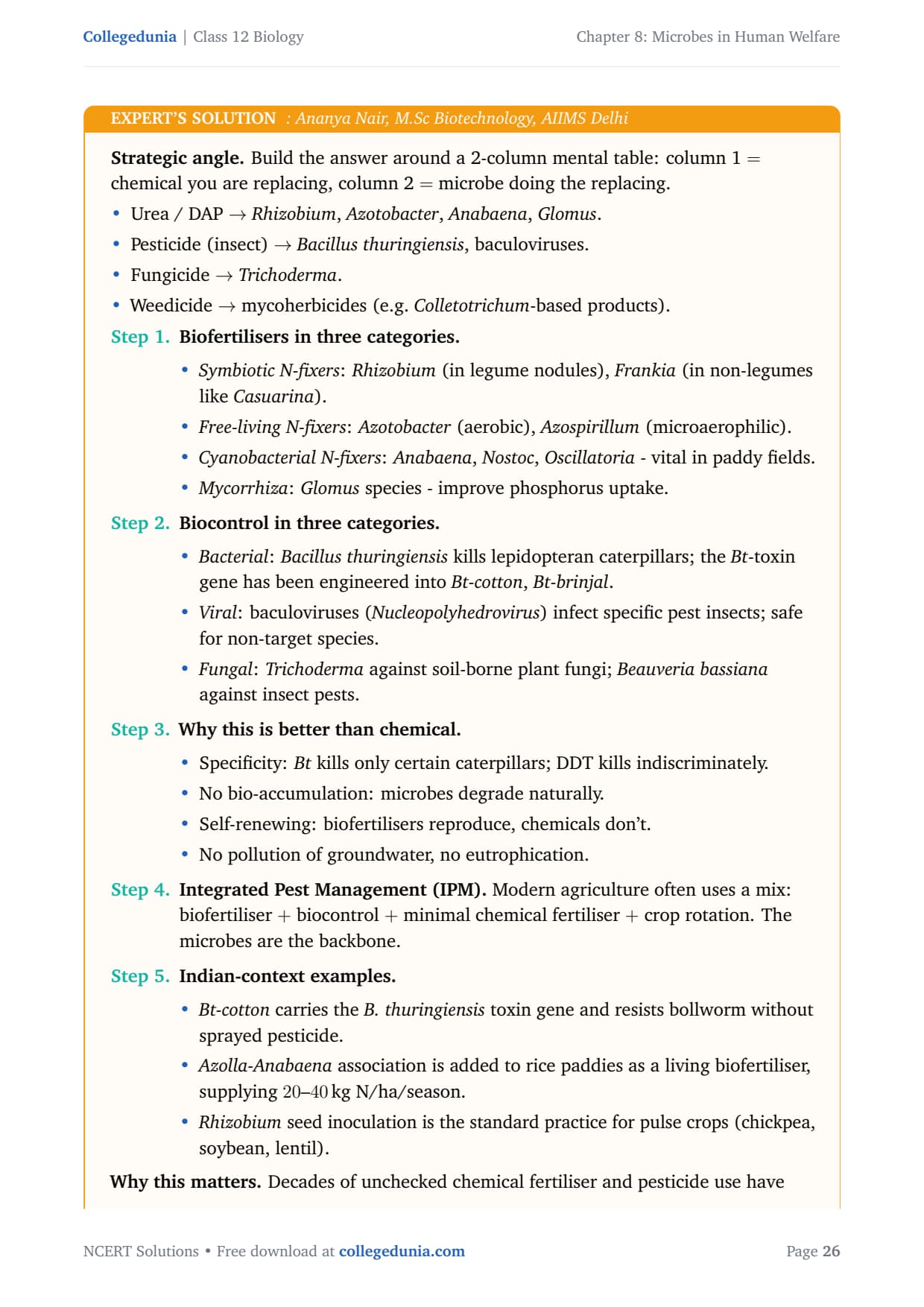
Strategic angle. Build the answer around a 2-column mental table: column 1 = chemical you are replacing, column 2 = microbe doing the replacing.
Integrated Pest Management (IPM). Modern agriculture often uses a mix: biofertiliser + biocontrol + minimal chemical fertiliser + crop rotation. The microbes are the backbone.
Indian-context examples.
Bt-cotton carries the B. thuringiensis toxin gene and resists bollworm without sprayed pesticide.
Azolla-Anabaena association is added to rice paddies as a living biofertiliser, supplying 20–40 kg N/ha/season.
Rhizobium seed inoculation is the standard practice for pulse crops (chickpea, soybean, lentil).
Why this matters. Decades of unchecked chemical fertiliser and pesticide use have poisoned soil and groundwater across the Green-Revolution belt. Microbial agriculture is the path back to sustainable yields.
Microbes act as biofertilisers (Rhizobium, Azotobacter, Azospirillum, cyanobacteria, mycorrhiza) and as biocontrol agents (Bacillus thuringiensis, baculoviruses, Trichoderma) - replacing chemical fertilisers and pesticides while protecting soil and water from pollution.
Q 8.11
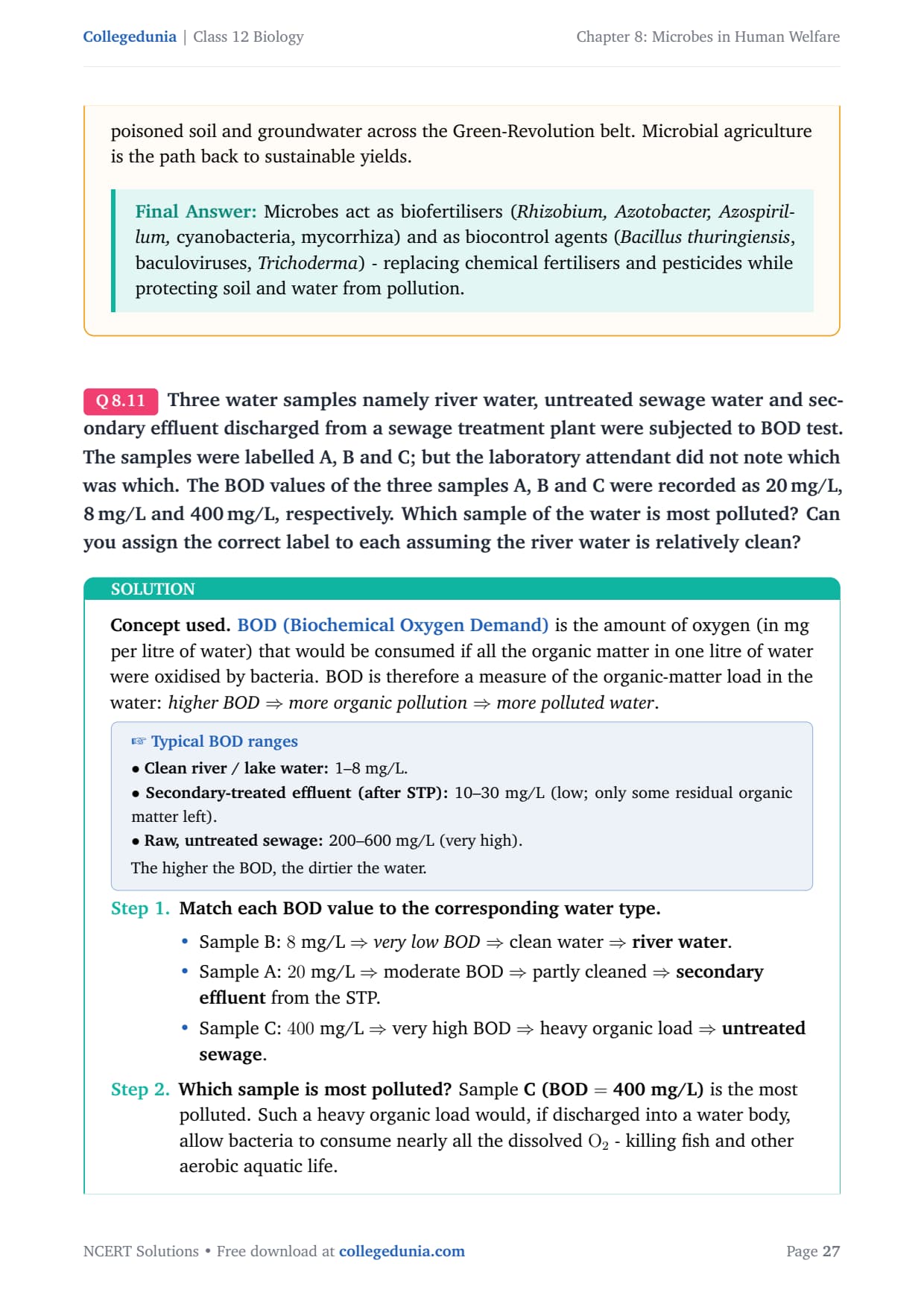
Three water samples namely river water, untreated sewage water and secondary effluent discharged from a sewage treatment plant were subjected to BOD test. The samples were labelled A, B and C; but the laboratory attendant did not note which was which. The BOD values of the three samples A, B and C were recorded as 20 mg/L, 8 mg/L and 400 mg/L, respectively. Which sample of the water is most polluted? Can you assign the correct label to each assuming the river water is relatively clean?
Concept used.BOD (Biochemical Oxygen Demand) is the amount of oxygen (in mg per litre of water) that would be consumed if all the organic matter in one litre of water were oxidised by bacteria. BOD is therefore a measure of the organic-matter load in the water: higher BOD ⇒ more organic pollution ⇒ more polluted water.
Typical BOD ranges
•Clean river / lake water: 1–8 mg/L. •Secondary-treated effluent (after STP): 10–30 mg/L (low; only some residual organic matter left). •Raw, untreated sewage: 200–600 mg/L (very high). [2pt]
The higher the BOD, the dirtier the water.
Match each BOD value to the corresponding water type.
Sample A: 20 mg/L ⇒ moderate BOD ⇒ partly cleaned ⇒secondary effluent from the STP.
Sample C: 400 mg/L ⇒ very high BOD ⇒ heavy organic load ⇒untreated sewage.
Which sample is most polluted? Sample C (BOD = 400 mg/L) is the most polluted. Such a heavy organic load would, if discharged into a water body, allow bacteria to consume nearly all the dissolved O2 - killing fish and other aerobic aquatic life.
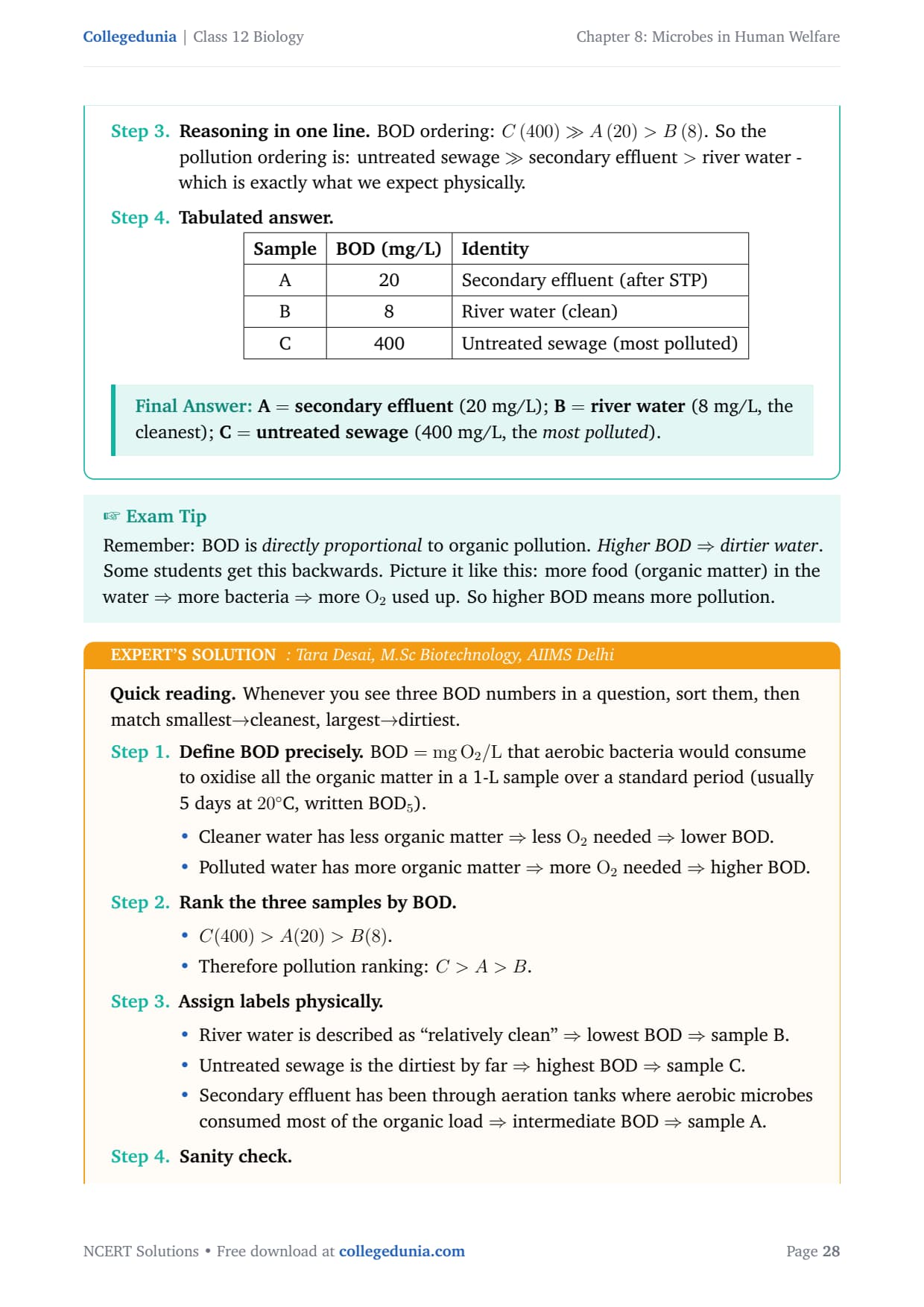
Reasoning in one line. BOD ordering: C (400) ≫ A (20) > B (8). So the pollution ordering is: untreated sewage ≫ secondary effluent > river water - which is exactly what we expect physically.
Tabulated answer.
1.2
tabular|c|c|l|
Sample & BOD (mg/L) & Identity
A & 20 & Secondary effluent (after STP)
B & 8 & River water (clean)
C & 400 & Untreated sewage (most polluted)
tabular
A = secondary effluent (20 mg/L); B = river water (8 mg/L, the cleanest); C = untreated sewage (400 mg/L, the most polluted).
TD
Tara Desai
M.Sc Biotechnology, AIIMS Delhi
Verified Expert
Quick reading. Whenever you see three BOD numbers in a question, sort them, then match smallest→cleanest, largest→dirtiest.
Define BOD precisely. BOD = mg O2/L that aerobic bacteria would consume to oxidise all the organic matter in a 1-L sample over a standard period (usually 5 days at 20∘C, written BOD5).
Cleaner water has less organic matter ⇒ less O2 needed ⇒ lower BOD.
Polluted water has more organic matter ⇒ more O2 needed ⇒ higher BOD.
Rank the three samples by BOD.
C (400) > A (20) > B (8).
Therefore pollution ranking: C > A > B.
Assign labels physically.
River water is described as ``relatively clean'' ⇒ lowest BOD ⇒ sample B.
Untreated sewage is the dirtiest by far ⇒ highest BOD ⇒ sample C.
Secondary effluent has been through aeration tanks where aerobic microbes consumed most of the organic load ⇒ intermediate BOD ⇒ sample A.
Sanity check.
Sample C has 400/8 = 50× the organic load of the river water. Plausible - raw sewage is indeed 50–100× dirtier than river water.
Sample A's BOD (20 mg/L) is exactly in the typical secondary-effluent range (10–30 mg/L).
Most polluted, identified. Sample C, with the highest BOD value of 400 mg/L, has the most organic pollution.
Why this matters. BOD is the single most-used number in environmental engineering for monitoring water quality. A 1-mark question of this type tests whether you have internalised the meaning of BOD - not the trivia, but the link from ``high number'' to ``dirty water''.
Sample B (8 mg/L) is river water; Sample A (20 mg/L) is secondary effluent; Sample C (400 mg/L) is untreated sewage and is the most polluted.
Q 8.12
Find out the name of the microbes from which Cyclosporin A (an immunosuppressive drug) and Statins (blood cholesterol lowering agents) are obtained.
Concept used. Microbes synthesise many bioactive molecules that we use as drugs. Two important examples from this chapter are cyclosporin A (an immunosuppressant used during organ transplants) and statins (cholesterol-lowering agents). Both are produced by specific fungi.
Cyclosporin A is obtained from Trichoderma polysporum, a fungus.
Use: it is used as an immunosuppressive agent in organ-transplant patients. By suppressing the recipient's immune response, it prevents the body from rejecting the transplanted organ.
Mechanism: cyclosporin A binds the protein cyclophilin and inhibits calcineurin, blocking T-lymphocyte activation.
Discovery: extracted in 1971; revolutionised organ transplantation (kidney, liver, heart).
Statins are obtained from Monascus purpureus, a yeast (a fungus too, but reproduces by budding like a yeast).
Use: statins are used as blood-cholesterol lowering agents. They reduce LDL (∼``bad'' cholesterol) and lower the risk of heart attacks and strokes.
Mechanism: statins competitively inhibit the enzyme HMG-CoA reductase, which is the rate-limiting step in cholesterol biosynthesis. Less enzyme activity ⇒ less cholesterol made by the liver ⇒ lower blood cholesterol.
Modern commercial statins (atorvastatin, simvastatin) are chemically modified versions of the natural Monascus product.
One-line summary.
Cyclosporin A ←Trichoderma polysporum (fungus).
Statins ←Monascus purpureus (yeast).
Cyclosporin A is obtained from the fungus Trichoderma polysporum (used as immunosuppressant during organ transplants). Statins are obtained from the yeast Monascus purpureus (used to lower blood cholesterol).
MB
Meera Bhat
Ph.D Organic Chemistry, IISc Bangalore
Verified Expert
Quick reading. Two microbes, two drugs, two mechanisms - memorise as a 2-by-2 table.
Cyclosporin A.
Source: Trichoderma polysporum, a soil fungus.
Action: immunosuppressant; blocks T-cell activation by inhibiting calcineurin.
Clinical use: prevents rejection of transplanted organs (kidney, heart, liver, bone marrow).
Trichoderma sounds like ``trickier-derma'' - used to trick the immune system into not rejecting an organ.
Monascus sounds like ``Mon-Ass-cuss-out-cholesterol'' - used to lower cholesterol.
Three other bioactive microbial products worth knowing.
Streptokinase from Streptococcus - clot buster after a heart attack.
Lipases from various fungi/bacteria - used in detergents to remove oily stains.
Pectinases & proteases - used to clarify bottled fruit juice.
Why this matters. Cyclosporin A made modern organ transplantation possible. Statins are among the world's most-prescribed medicines. Both came from soil-living fungi - a reminder that life-saving drugs often hide in the most unglamorous places.
Cyclosporin A ←Trichoderma polysporum (fungus); statins ←Monascus purpureus (yeast).
Q 8.13
Find out the role of microbes in the following and discuss it with your teacher.
(a) Single cell protein (SCP) (b) Soil
Concept used. Microbes are not only producers of food and medicine - they can also be food (Single Cell Protein) and they actively maintain the structure and fertility of soil. This question asks us to explain both roles.
(a) Role of microbes as Single Cell Protein (SCP).
Definition. Single Cell Protein refers to dried cells of microbes (algae, fungi, bacteria, yeasts) used as protein-rich human or animal food. The cells themselves are the food.
Why it matters. Global population growth (∼8 billion and rising) means conventional agriculture-and-livestock cannot meet protein demand sustainably. SCP grows very fast, on cheap substrates, and yields high-quality protein per unit area.
Common SCP microbes.
itemize
Spirulina (a cyanobacterium) - grown on materials like sewage water and molasses; rich in protein, vitamins and minerals.
Methylophilus methylotrophus (a bacterium) - grown on methanol; produces tonnes of biomass per day.
Saccharomyces cerevisiae (yeast) - used as animal feed protein.
Fusarium graminearum (mycoprotein) - the source of ``Quorn'', a mycoprotein-based meat substitute.
Key advantages.
Microbes can double their mass in hours; cattle take years.
Grow on industrial waste (cellulose, methanol, molasses) - turns waste into protein.
Rich in essential amino acids, vitamins, minerals.
Smaller land and water footprint than meat or pulses.
NCERT example to remember. 250 kg of a cow produces ∼200 g of protein per day; 250 kg of Methylophilus methylotrophus bacteria can produce 25 tonnes of protein per day. The difference is staggering.
itemize
(b) Role of microbes in soil.
Decomposition of organic matter. Saprophytic bacteria and fungi decompose dead plants, animals and animal excreta. The breakdown releases CO2 to the atmosphere and humus into the soil, improving soil structure and fertility.
Nitrogen fixation.
itemize
Symbiotic: Rhizobium in root nodules of legumes.
Free-living: Azotobacter, Azospirillum.
Cyanobacterial: Anabaena, Nostoc, Oscillatoria.
Phosphorus solubilisation. Mycorrhizal fungi (Glomus species) form symbiotic associations with plant roots, mobilising soil phosphorus to the plant.
Sulphur and other mineral cycling. Microbes drive the nitrogen, sulphur and phosphorus cycles, recycling elements through ecosystems.
Disease suppression.Trichoderma and other antagonistic microbes outcompete root pathogens - improving plant health without chemicals.
Soil structure. Fungal hyphae and bacterial polymers bind soil particles into stable aggregates, improving aeration and water retention.
Biocontrol in the rhizosphere.Bacillus thuringiensis and similar microbes suppress harmful insects and worms.
itemize
Putting both together. Microbes provide food directly (SCP) and indirectly (soil fertility supporting all crop growth). A handful of healthy soil contains more microbial cells than there are humans on earth.
Strategic angle. Two sub-parts = two clear paragraphs. (a) SCP: define, list 4 microbes, list 3 advantages. (b) Soil: list at least 4 different functions with named microbes.
SCP - single cell protein.
Define: ``Single cell protein is the dried biomass of microbes used as food or feed.''
Examples: Spirulina (sold as health supplement), Methylophilus methylotrophus (bacterial protein), Saccharomyces cerevisiae (feed yeast), Fusarium graminearum (mycoprotein, marketed as Quorn).
Advantages: fast growth, high protein content, low land/water use, can run on waste streams.
Disadvantage: high nucleic-acid content (can cause gout if eaten in excess) - addressed by RNA removal during processing.
Soil - six microbial functions.
Decomposition. Saprophytic fungi and bacteria break down dead leaves and dung into humus.
Nitrogen fixation.Rhizobium (symbiotic), Azotobacter/Azospirillum (free-living), Anabaena/Nostoc (cyanobacteria in paddy fields).
Phosphorus mobilisation.Glomus (mycorrhiza) supply P to plants.
Soil structure. Bacterial slime and fungal hyphae bind particles into crumb-like aggregates.
Nutrient cycling. Microbes drive carbon, nitrogen, sulphur and phosphorus cycles.
Specific NCERT example for the answer.
NCERT mentions that 250 kg of Methylophilus methylotrophus (with a high growth rate) can produce up to 25 tonnes of protein per day.
Compare with cow: 250 kg cow gives 200 g protein per day. SCP advantage ≈ 105×.
Soil microbes as the engine of every land ecosystem. One gram of fertile soil holds 108–109 bacterial cells plus thousands of fungi and protozoa. They drive nutrient release, root protection and water retention all at once - so a healthy soil is, biologically, a working microbial factory and the foundation of every crop you eat.
Why this matters. SCP is one possible answer to feeding 10 billion people. Soil microbes are one of the most under-appreciated supports of all terrestrial life. Together, they argue that microbes deserve much more than ``germs'' as a label.
(a) SCP = dried microbial biomass (Spirulina, Methylophilus methylotrophus, yeasts, Fusarium graminearum) used as protein food/feed. (b) Soil microbes decompose dead matter, fix nitrogen, solubilise phosphorus, suppress pathogens and maintain soil structure.
Q 8.14
Arrange the following in the decreasing order (most important first) of their importance, for the welfare of human society. Give reasons for your answer.
Biogas, Citric acid, Penicillin and Curd
Concept used. ``Most important to human welfare'' is judged by (i) the breadth of human need addressed (health, energy, food), (ii) the number of lives saved or quality-of-life improvements delivered, and (iii) how irreplaceable the product is. Health (life-and-death) is generally placed above food (daily quality of life), and food above industrial chemicals.
A reasonable ordering
Penicillin > Biogas > Curd > Citric acid. [2pt]
This ordering is the most defensible - but the question allows reasonable variations, as long as you justify your choice clearly. Award is given for the reasoning, not just the order.
Step 1 - Penicillin (most important).
It was the first antibiotic, isolated from the fungus Penicillium notatum.
Saved millions of lives during World War II and ever since by curing deadly bacterial infections (plague, pneumonia, diphtheria, leprosy, septicaemia).
Opened the entire era of antibiotic therapy - the single biggest jump in human life expectancy in the 20th century.
Directly saves lives - health trumps everything else.
Step 2 - Biogas (second).
Produced by anaerobic methanogens on dung/sewage; mostly CH4.
Provides clean cooking and lighting fuel to millions of rural households.
Solves an energy problem (fuel for cooking) AND a waste problem (cattle dung disposal) AND a fertiliser problem (spent slurry).
Indispensable in rural India, China and much of the developing world.
A daily food for billions, especially in South Asia. Improves nutritional value of milk (more B12). Acts as a probiotic, suppressing gut pathogens.
Important for daily nutrition but not directly life-saving the way antibiotics are.
Step 4 - Citric acid (least, in this list).
Produced by Aspergillus niger; used in foods, beverages, pharmaceuticals, detergents and as a preservative.
Useful and widespread, but it is mostly a flavouring/processing additive. People could live healthy lives without it.
No direct life-saving function; the most ``replaceable'' item in this list.
Final ordering. Penicillin > Biogas > Curd > Citric acid.
Penicillin > Biogas > Curd > Citric acid. Penicillin saves lives (antibiotic). Biogas powers and cleans up rural living. Curd is a daily nutrient and probiotic. Citric acid is a useful industrial additive but the most replaceable.
YG
Yash Gupta
M.Sc Biotechnology, AIIMS Delhi
Verified Expert
Strategic angle. Use a 3-tier ranking: life-saving > daily essentials > industrial convenience.
Tier 1 (life-saving): Penicillin.
Tier 2 (energy + daily nutrition): Biogas, Curd.
Tier 3 (industrial use): Citric acid.
Penicillin - tier 1.
Directly saves lives from bacterial infection.
Counterfactual: without it, simple wound infections in childbirth, surgery, or wartime would be lethal.
Worldwide reach (used in every hospital).
Biogas - high tier 2.
Provides renewable, clean cooking fuel to millions.
Reduces deforestation (less firewood demand) and indoor air pollution.
Reuses cattle dung and sewage; the spent slurry is a high-quality biofertiliser.
Affects energy AND waste AND fertility simultaneously.
Convenient but easily substituted by other acids (acetic, tartaric).
No direct health or energy role.
Caveat: subjectivity. If the marker prioritises ``number of people impacted daily'', curd (1.5+ billion daily consumers) could be placed higher than biogas. Both orderings are defensible if your reasoning is clear. The marks are for the reasoning.
Why this matters. ``Importance'' is rarely a single-axis quantity. The right answer is whichever ranking you can defend with concrete reasoning - be it lives saved, people fed, energy delivered, or environmental impact.
Penicillin > Biogas > Curd > Citric acid - life-saving drug first, energy fuel second, daily nutrient third, industrial additive last.
Q 8.15
How do biofertilisers enrich the fertility of the soil?
Concept used.Biofertilisers are living organisms (mostly bacteria, cyanobacteria and fungi) that enrich the nutrient quality of soil. They achieve this by (i) fixing atmospheric nitrogen, (ii) solubilising/mobilising phosphorus, and (iii) adding organic matter to soil. Together they reduce the need for chemical fertilisers and support sustainable agriculture.
Symbiotic nitrogen fixation - Rhizobium.
Rhizobium bacteria live inside root nodules of leguminous plants (peas, beans, gram, soybean).
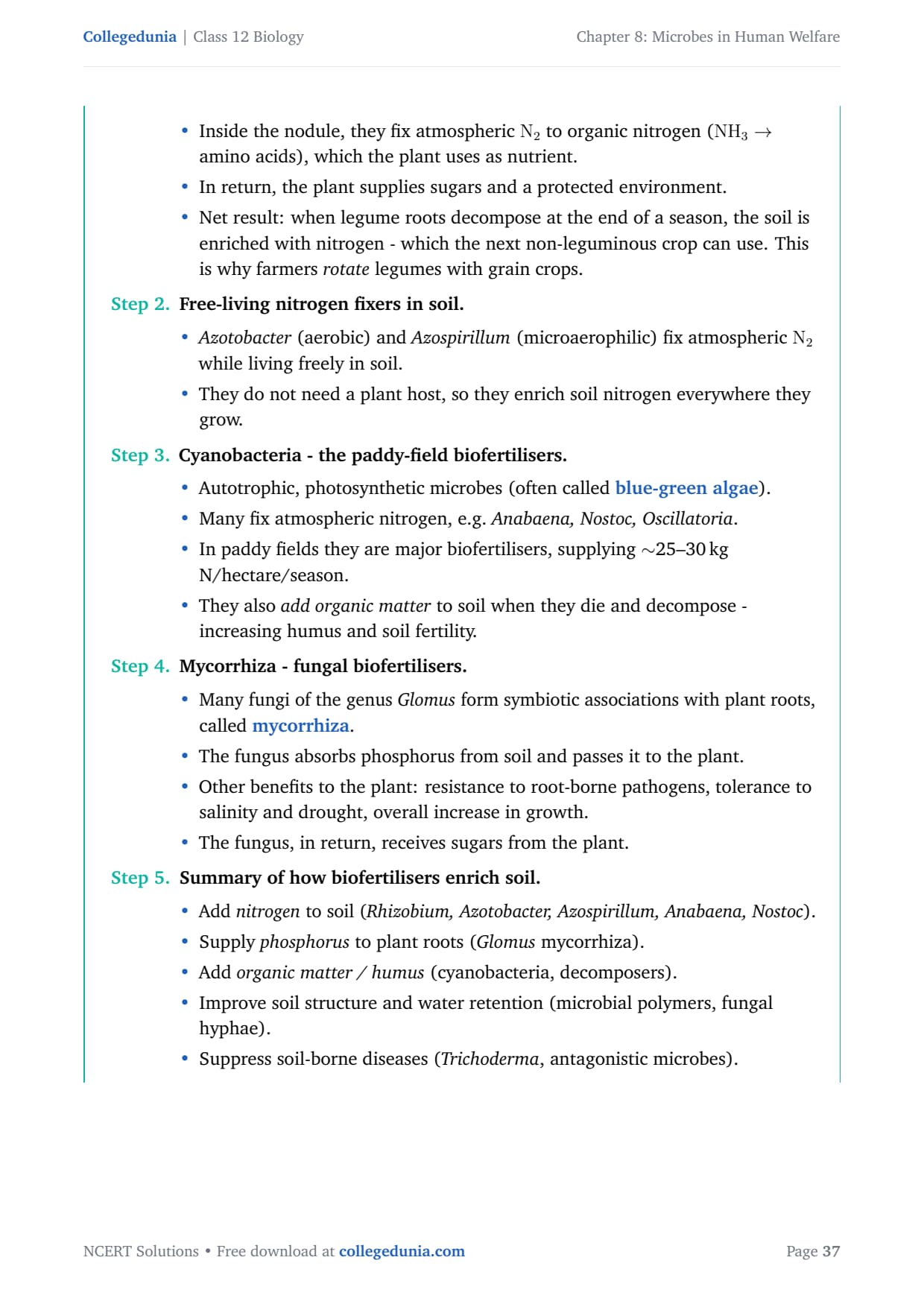
Inside the nodule, they fix atmospheric N2 to organic nitrogen (NH3→ amino acids), which the plant uses as nutrient.
In return, the plant supplies sugars and a protected environment.
Net result: when legume roots decompose at the end of a season, the soil is enriched with nitrogen - which the next non-leguminous crop can use. This is why farmers rotate legumes with grain crops.
Free-living nitrogen fixers in soil.
Azotobacter (aerobic) and Azospirillum (microaerophilic) fix atmospheric N2 while living freely in soil.
They do not need a plant host, so they enrich soil nitrogen everywhere they grow.
Cyanobacteria - the paddy-field biofertilisers.
Autotrophic, photosynthetic microbes (often called blue-green algae).
Many fix atmospheric nitrogen, e.g. Anabaena, Nostoc, Oscillatoria.
In paddy fields they are major biofertilisers, supplying ∼25–30 kg N/hectare/season.
They also add organic matter to soil when they die and decompose - increasing humus and soil fertility.
Mycorrhiza - fungal biofertilisers.
Many fungi of the genus Glomus form symbiotic associations with plant roots, called mycorrhiza.
The fungus absorbs phosphorus from soil and passes it to the plant.
Other benefits to the plant: resistance to root-borne pathogens, tolerance to salinity and drought, overall increase in growth.
The fungus, in return, receives sugars from the plant.
Summary of how biofertilisers enrich soil.
Add nitrogen to soil (Rhizobium, Azotobacter, Azospirillum, Anabaena, Nostoc).
Supply phosphorus to plant roots (Glomus mycorrhiza).
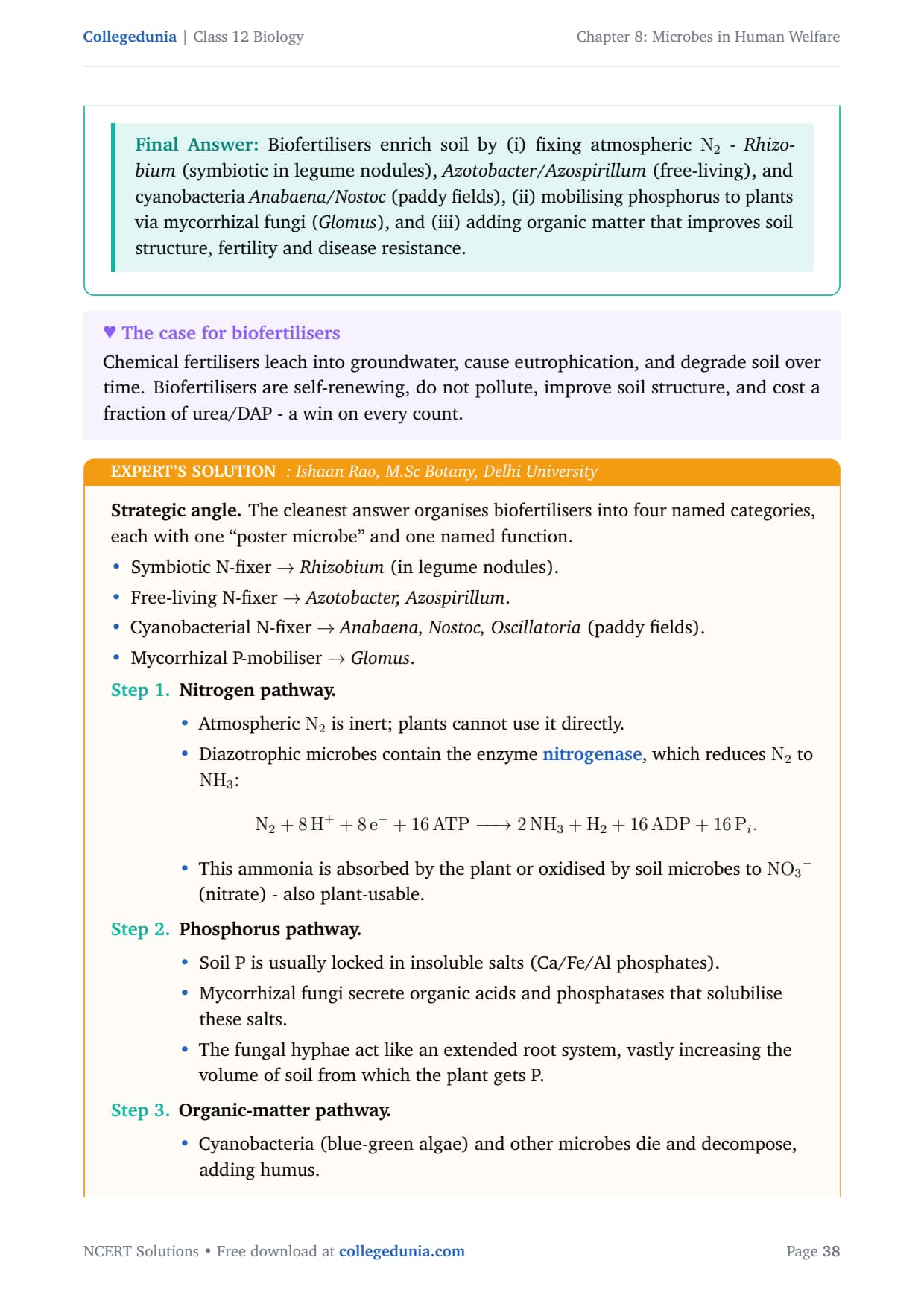
Biofertilisers enrich soil by (i) fixing atmospheric N2 - Rhizobium (symbiotic in legume nodules), Azotobacter/Azospirillum (free-living), and cyanobacteria Anabaena/Nostoc (paddy fields), (ii) mobilising phosphorus to plants via mycorrhizal fungi (Glomus), and (iii) adding organic matter that improves soil structure, fertility and disease resistance.
IR
Ishaan Rao
M.Sc Botany, Delhi University
Verified Expert
Strategic angle. The cleanest answer organises biofertilisers into four named categories, each with one ``poster microbe'' and one named function.
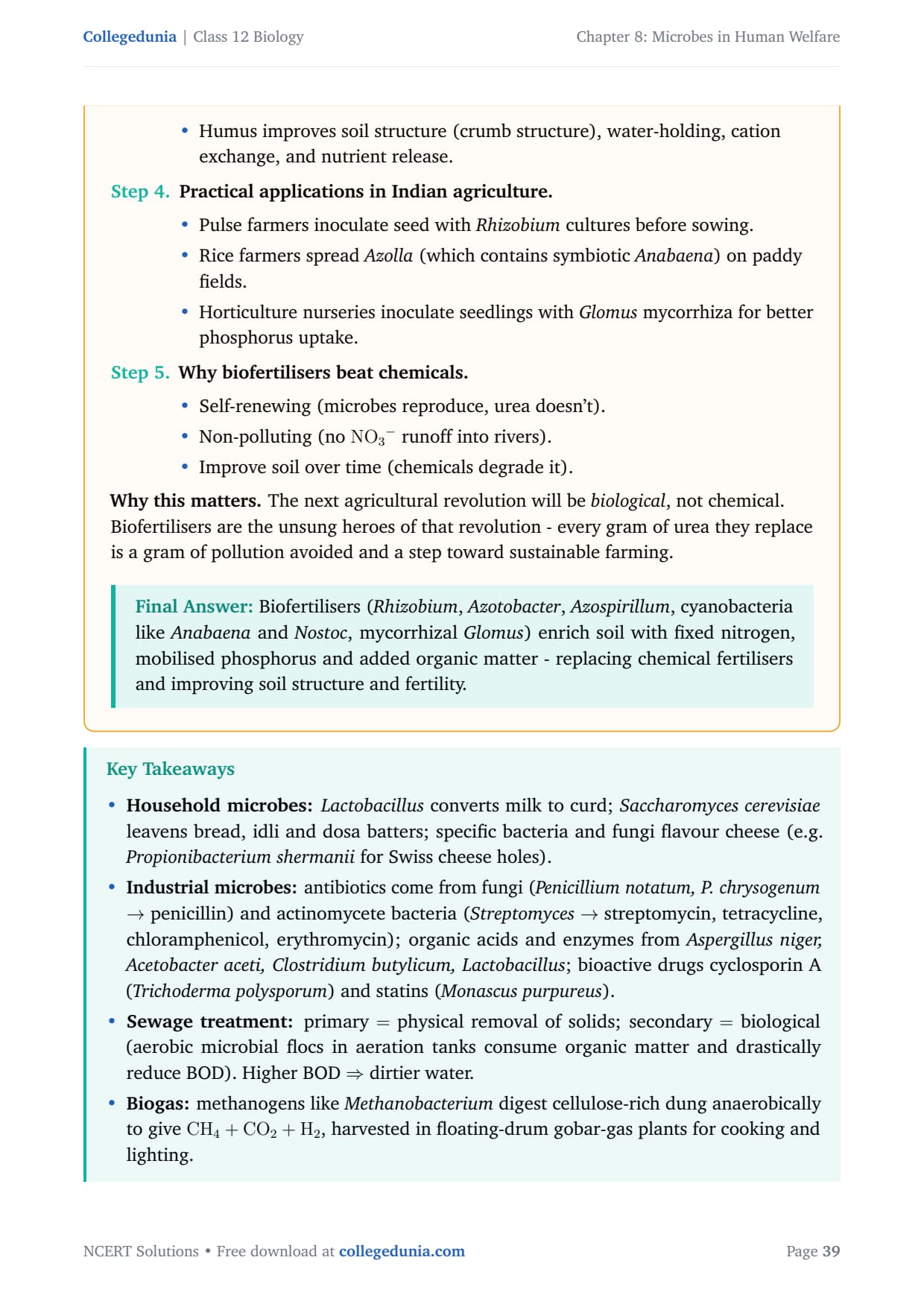
Horticulture nurseries inoculate seedlings with Glomus mycorrhiza for better phosphorus uptake.
Why biofertilisers beat chemicals.
Self-renewing (microbes reproduce, urea doesn't).
Non-polluting (no NO3- runoff into rivers).
Improve soil over time (chemicals degrade it).
Why this matters. The next agricultural revolution will be biological, not chemical. Biofertilisers are the unsung heroes of that revolution - every gram of urea they replace is a gram of pollution avoided and a step toward sustainable farming.
Biofertilisers (Rhizobium, Azotobacter, Azospirillum, cyanobacteria like Anabaena and Nostoc, mycorrhizal Glomus) enrich soil with fixed nitrogen, mobilised phosphorus and added organic matter - replacing chemical fertilisers and improving soil structure and fertility.
NCERT Solutions for Class 12 Biology: All Chapters
Browse Class 12 Biology NCERT Solutions for the 2026-27 syllabus on Collegedunia.
Student Feedback on Microbes in Human Welfare Class 12 Biology Solutions
Student Feedback
We surveyed 11,500 Class 12 Biology students before their boards. Here is what they told us about Chapter 8.
71% of students found the biogas plant flowchart the hardest sub-topic.
60% lost 1-2 marks while matching products to yeast, LAB and Penicillium.
4 out of 5 students skipped the sewage-treatment flowchart in their answer sheet.
4.7 hours went into the first read, and 2 hours into a focused revision pass.
Only 44% attempted every NCERT exercise question. Toppers solved them all and revisited wrong attempts within a day.
Source: 2025-26 Class 12 Biology survey of 11,500 students across 18 states.
Microbes in Human Welfare Class 12 Biology NCERT Solutions FAQs
Ques. Where can I download Class 12 Biology Chapter 8 Microbes in Human Welfare NCERT Solutions PDF?
Ans. You can download the Microbes in Human Welfare Class 12 Biology NCERT Solutions PDF directly from this page. Both the Normal and HD versions are free and aligned with the 2026-27 NCERT.
Ques. Are these NCERT Solutions aligned with the 2026-27 syllabus?
Ans. Yes. This page reflects the current 2026-27 syllabus for Class 12 Biology. NCERT did not trim Microbes in Human Welfare, so all 15 exercise questions are still examinable for CBSE Boards and NEET.
Ques. How many questions are there in the Microbes in Human Welfare NCERT exercise?
Ans. The end-of-chapter exercise has 15 numbered questions covering household products, industrial products, sewage and biogas, biocontrol and biofertilisers. The PDF carries step-by-step worked answers to every one.
Ques. What is the NEET weightage of Class 12th Biology Chapter 8 Microbes in Human Welfare?
Ans. NEET pulls 2 to 4 questions from this chapter every year. Industrial products (penicillin, statins, cyclosporin) and biofertilisers (Rhizobium) are the two highest-yield sub-topics.
Ques. Which microbes are most important for Class 12 Biology Microbes in Human Welfare?
Ans.Lactobacillus (curd), Saccharomyces cerevisiae (bread, beer), Penicillium notatum (penicillin), Trichoderma polysporum (cyclosporin), Monascus purpureus (statins), Methanobacterium (biogas), Rhizobium (N-fixer), and Bacillus thuringiensis (Bt biocontrol) are the eight most-tested microbes.
Ques. What is BOD and why is it important in sewage treatment?
Ans. BOD is the Biochemical Oxygen Demand: the amount of dissolved O2 consumed by bacteria when 1 L of polluted water is oxidised completely. Higher BOD means more organic load, hence dirtier water. Secondary sewage treatment drops BOD by about 95 percent through aerobic-microbe flocs in the aeration tank.
Ques. What is the difference between Rhizobium and Azotobacter?
Ans.Rhizobium is a symbiotic nitrogen-fixer that lives in root nodules of legumes (gram, peas, beans). Azotobacter and Azospirillum are free-living nitrogen-fixers in soil. Both convert atmospheric N2 to ammonia, but their habitat is the marker CBSE wants.
Ques. How do NCERT Solutions for Microbes in Human Welfare help with NEET preparation?
Ans. Every solution flags the exact microbe binomial NEET asks verbatim. Genera like Methanobacterium, Trichoderma polysporum, Aspergillus niger, and Bacillus thuringiensis all appear with correct spelling so the same answer doubles as a one-mark MCQ recall sheet. The microbe-product recall table on this page covers the top 18 NEET-tested pairings.
Ques. Are diagrams included in the Class 12 Biology Chapter 8 NCERT Solutions PDF?
Ans. Yes. The activated-sludge flow diagram (Q4 / Q9 answer), the biogas-plant cross-section (Q13), and the Rhizobium root-nodule labelled diagram (Q14) are all included with examiner-grade labels ready to copy into the board answer script.









Comments