Biology Mentor, Hindu College | Updated on - Jul 21, 2026
Evolution is the gradual heritable change of populations over time, producing the diversity of life from a common ancestral pool. Class 12 Biology Chapter 6 Evolution is a high-yield NEET chapter (5 to 7 questions per year) and a steady 4 to 6 marks on the CBSE Board paper. This page hosts the free NCERT Solutions PDF with step-by-step answers to all 10 exercise questions across the 2026-27 syllabus.
CBSE Weightage: 4 to 6 marks
NEET Weightage: 5 to 7 questions per year
Best for: CBSE Boards, NEET, AIIMS & CUET preparation
Common Mistakes Students Make in Evolution (Class 12 Biology)
NEET and CBSE examiners target this chapter because most students blur Darwinism with Lamarckism, mis-state the Hardy-Weinberg algebra, or call human evolution an adaptive radiation. The mistakes below cost the most marks, and every worked solution in the PDF corrects them.
Mistake 1. Writing "bacteria develop resistance because they are exposed to antibiotics." That is Lamarckism, which is wrong. Mutations are random and prior to exposure; the antibiotic only selects existing variants.
Mistake 2. Stating Hardy-Weinberg as p + q = 1 only. The full equilibrium is p2 + 2pq + q2 = 1 with five disturbing forces: gene flow, genetic drift, mutation, recombination, and natural selection.
Mistake 3. Calling human evolution a classical adaptive radiation. It is branching descent with heavy extinction; only Homo sapiens survives.
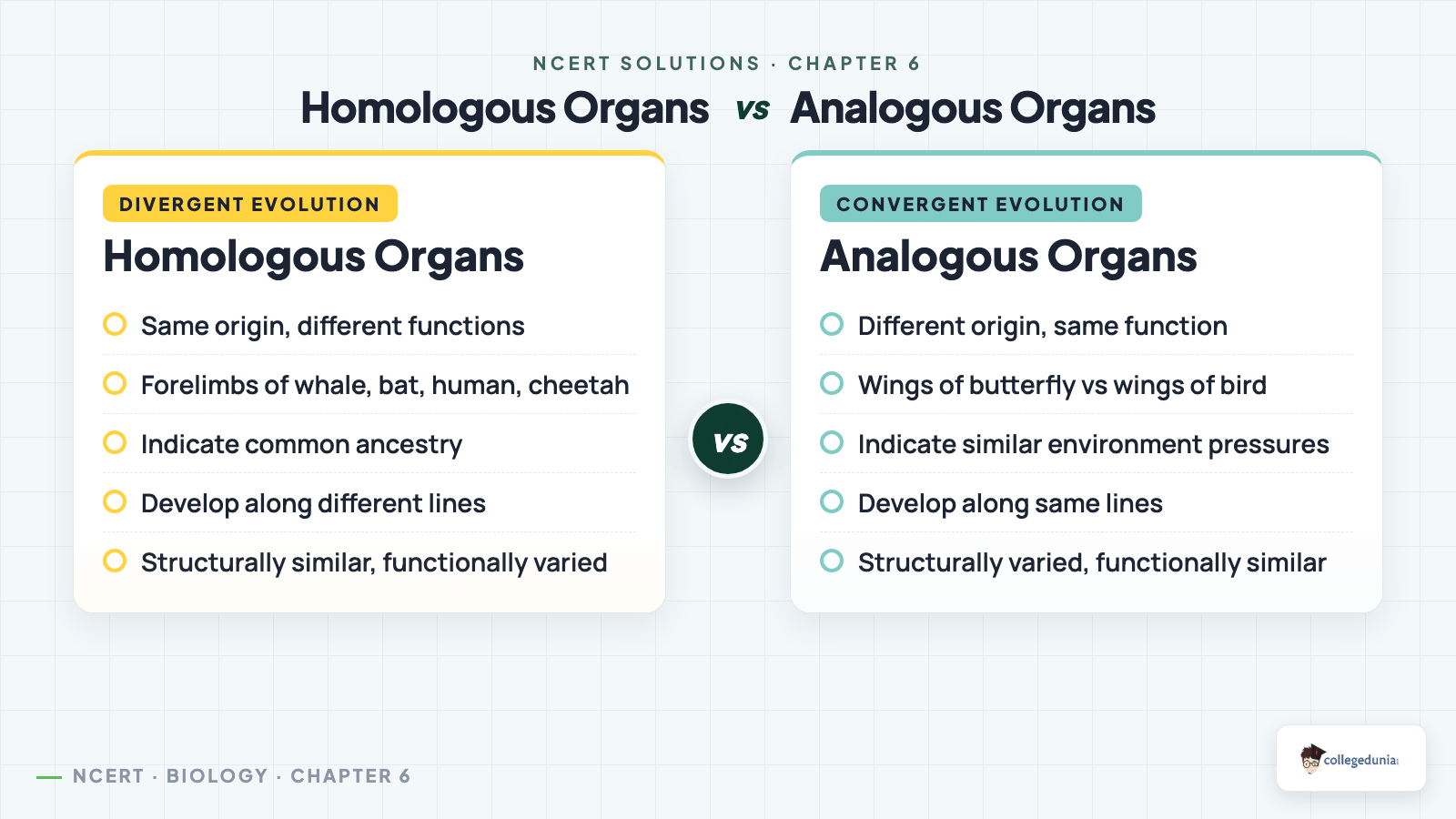
Mistake 4. Mixing up homologous and analogous structures. Same origin = homologous (whale flipper, bat wing, human hand). Same function = analogous (butterfly wing vs bird wing).
Mistake 5. Forgetting to cite a named fossil with year and location. CBSE wants Tiktaalik (2006, Ellesmere Island) or Homo naledi (2013, South Africa), not vague phrasing.
NEET 2024 carried a direct Hardy-Weinberg numerical that 41% of candidates got wrong because they used p + q = 1 instead of the full quadratic.
How These NCERT Solutions Help You Score in Evolution Class 12 Biology
This NCERT Solutions PDF matches the marking pattern CBSE examiners use and the exact terminology NEET wants on the OMR. Every answer is structured step by step, with a parallel "Expert's Solution" that gives a second attempt path.
Two attempt paths per question: the main Solution writes the textbook answer; the Expert's Solution reframes it from a NEET examiner's lens.
Step-by-step answers for all 10 NCERT questions covering Darwinian selection, fossils, species concept, human evolution, adaptive radiation, and the horse lineage.
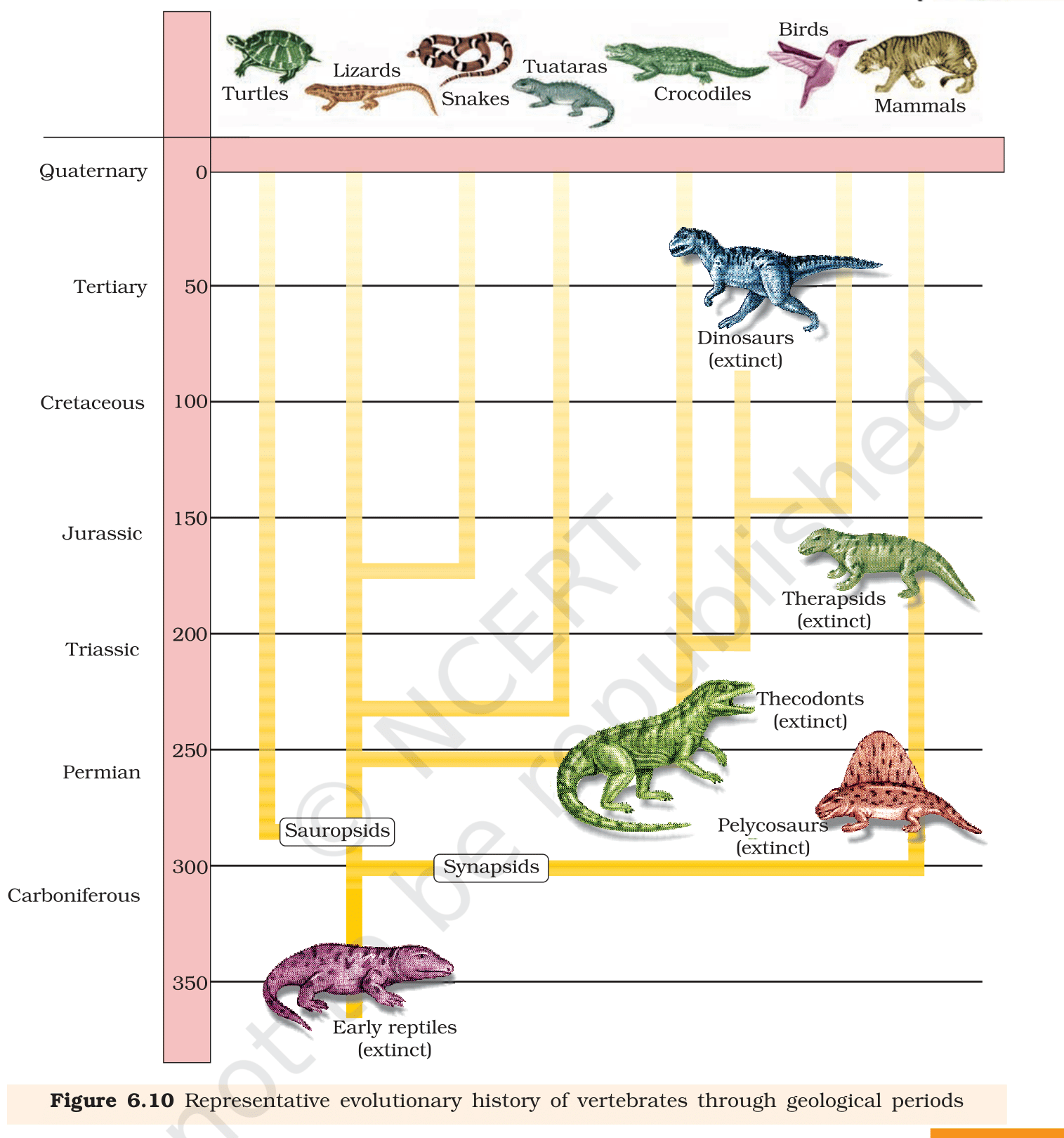
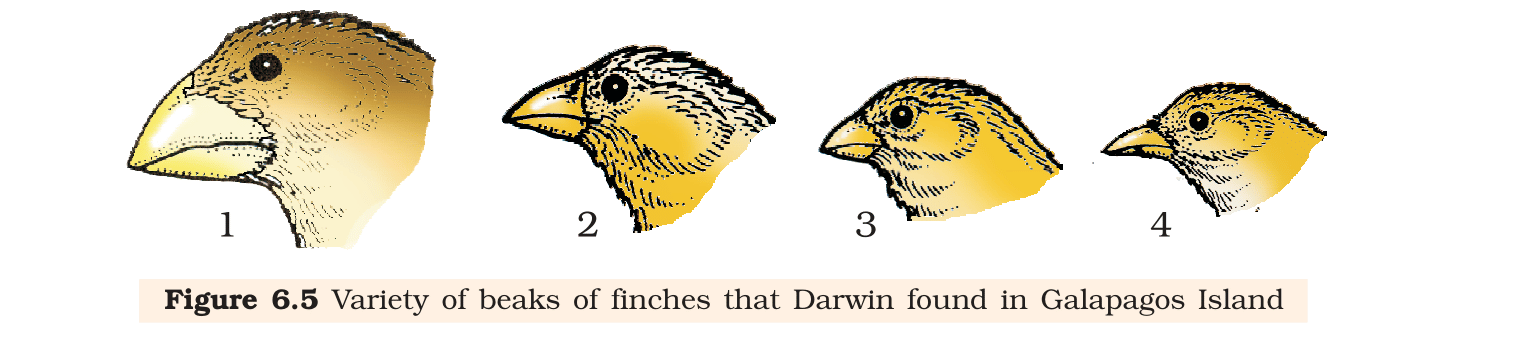
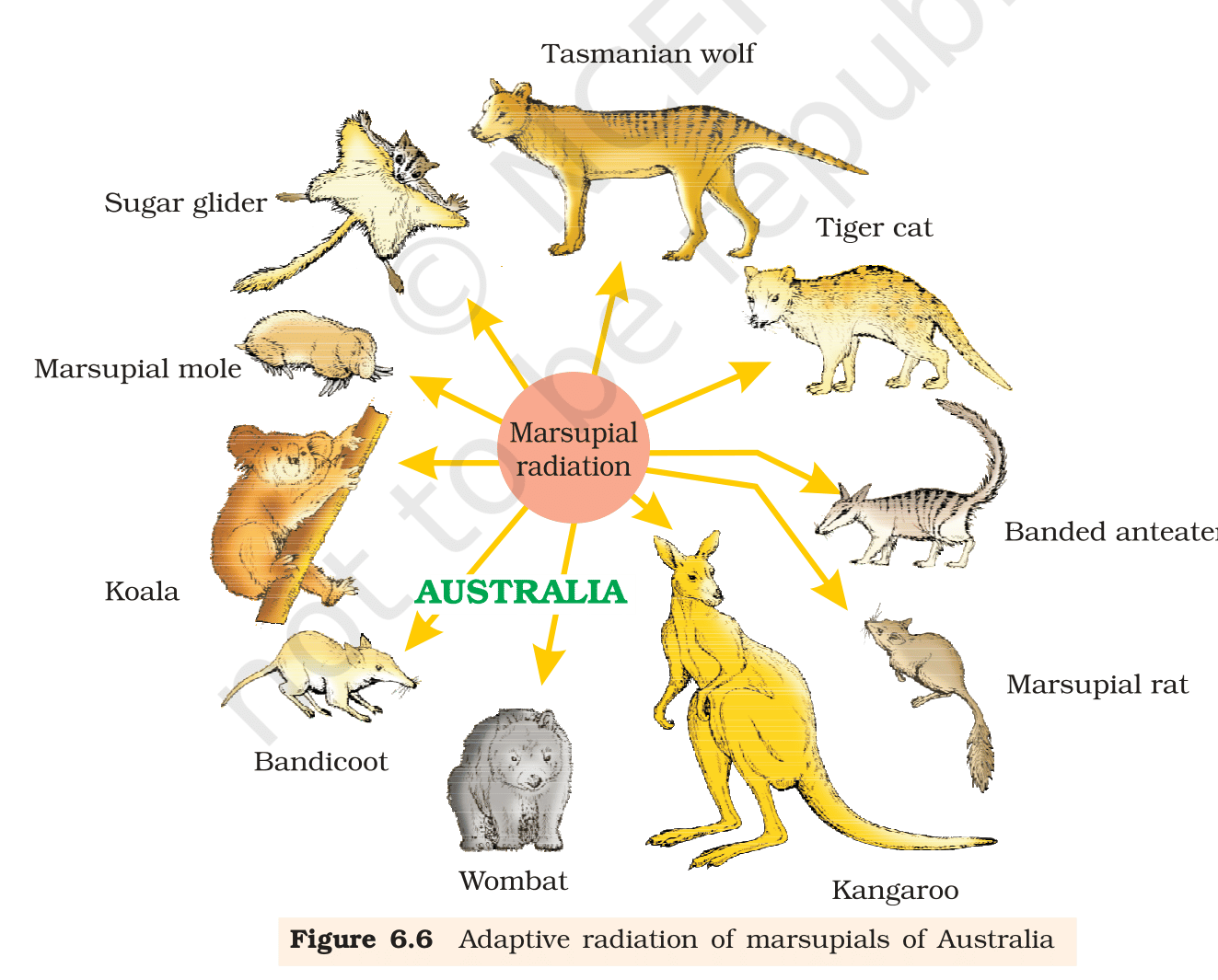
Source-book figures embedded: Darwin's finch beaks (Fig 6.5), the marsupial radiation (Fig 6.6), the vertebrate tree (Fig 6.10), and the hominid skull comparison (Fig 6.11) are pulled straight from the NCERT 2026-27 PDF.
NCERT Exercise-by-Exercise Breakdown: Evolution
The chapter has a single end-of-chapter exercise with 10 numbered questions. The table below shows how they spread across the six sub-topics so students can plan topic-wise practice.
Sub-Topic
NCERT Q Numbers
Question Count
NEET Yield (last 5 yrs)
Darwinian selection & mechanism
Q1
1
3-4 questions
Fossil evidence & geological time scale
Q2
1
2-3 questions
Species concept & biological species
Q3
1
1-2 questions
Human evolution & hominid line
Q4, Q5
2
4-5 questions
Modern-animal to fossil-ancestor pairings
Q6
1
2-3 questions
Comparative anatomy: homology vs analogy
Q7
1
2-3 questions
Adaptive radiation
Q8, Q9
2
3-4 questions
Horse-lineage evolutionary stages
Q10
1
1-2 questions
Human evolution (Q4, Q5) and adaptive radiation (Q8, Q9) are the two highest-yield clusters for NEET. Prioritise Q1, Q8, and Q10 for board long-answers.
Evolution Previous Year Questions Weightage (2021 to 2025)
The year-wise table below maps the chapter's footprint across CBSE Boards and NEET for the last five exam cycles. Numbers come from official marking schemes and answer keys.
Year
CBSE Class 12 Boards
NEET
Most-Asked Topic
2025
5 marks (3-marker on adaptive radiation, 2-marker on Hardy-Weinberg)
6 questions
Hardy-Weinberg algebra / hominid sequence
2024
6 marks (5-mark human-evolution LA + 1-mark species definition)
7 questions
Encephalisation quotient / Darwin's finches
2023
4 marks
5 questions
Lamarck vs Darwin / fossil dating
2022
5 marks (term-2 paper)
5 questions
Homologous vs analogous / convergent evolution
2021
4 marks
4 questions
Horse evolution / Hardy-Weinberg forces
The five-year average sits at 4.8 marks in CBSE and 5.4 questions in NEET. Hardy-Weinberg, human evolution, and adaptive radiation together account for over 60 percent of the NEET pull, so the answers to Q1, Q4, Q8, and Q9 carry the highest prep value.
How to Study Evolution Effectively (Class 12 Biology Time-Plan)
Most students over-allocate time to hominid names and under-allocate to Hardy-Weinberg numericals and adaptive-radiation case studies. The three-day plan below splits the 10 NCERT questions by NEET frequency and CBSE marks.
Day
Focus
NCERT Q to Solve
Time
Day 1
Darwinian selection + fossils + species concept
Q1, Q2, Q3
2.5 hours
Day 2
Human evolution + comparative anatomy (highest NEET yield)
Q4, Q5, Q6, Q7
3 hours
Day 3
Adaptive radiation + horse line + revision
Q8, Q9, Q10
2.5 hours
Total: roughly 8 hours over 3 days. Keep the hominid cranial-capacity ladder and the horse-lineage stage diagram on a single A4 sheet for the night-before glance.
All NCERT Solutions for Evolution with Step-by-Step Working
Every NCERT textbook question for Class 12 Biology Chapter 6 Evolution is listed below with its full Solution and Expert Solution hidden inside collapsible tabs. Click Check Solution to reveal the step-by-step working; click Expert Solution for the expanded explanation.
Questions
Q 6.1
Explain antibiotic resistance observed in bacteria in light of Darwinian selection theory.
Concept used.Darwinian natural selection is the
mechanism Charles Darwin proposed in 1859 (On the Origin of
Species) to explain how populations change over time. It rests on
four observable conditions:
Within any population, individuals show heritable
variation.
More offspring are produced than the environment can support
(overproduction).
The resulting struggle for existence means not every
individual survives or breeds.
Variants whose traits raise their chance of survival and
reproduction in that environment leave more offspring
(differential survival of the fittest). Over
generations these traits become more common in the population.
The phrase ``fitness'' here means reproductive success in a
specific environment, not strength or speed.
Key Darwinian phrase
``Survival of the fittest'' was coined by Herbert Spencer and
borrowed by Darwin. ``Fittest'' is defined relative to the
present environment, not as an absolute property.
Pre-existing variation in the bacterial population.
A bacterial colony is not genetically uniform. Random
mutations during DNA replication produce variants – some
carry an altered enzyme, an efflux pump, or a modified cell
wall that happens to weaken the binding of an antibiotic.
These mutants exist before the antibiotic is ever
applied, at frequencies of roughly 10-9 to 10-6 per
cell per generation.
Application of antibiotic creates a strong selective
pressure.
When penicillin (or any antibiotic) is introduced, the
environment changes drastically. Sensitive bacteria are
killed; the rare resistant mutants survive. This is exactly
Darwin's struggle for existence: the resource
(antibiotic-free niche) is limited, and only a few variants
can occupy it.
Differential reproduction of the resistant variant.
Resistant bacteria reproduce rapidly (E. coli
divides every ∼ 20 min). Within hours the resistant
genotype dominates the colony – a clear example of
differential survival and reproduction. After a few
generations the population is essentially all resistant.
Inheritance of the resistance trait.
Resistance is encoded in DNA (often on plasmids), so it is
passed to daughter cells. Plasmids can also move horizontally
between species by conjugation, accelerating the spread –
but the Darwinian core (variation + selection +
inheritance) is intact.
Outcome: rapid evolution of a resistant population.
Bacteria are a textbook demonstration of Darwinian selection
because their short generation time makes the entire
sequence visible within a single human lifetime. Hospitals
now report MRSA (methicillin-resistant Staphylococcus
aureus), VRE and XDR-TB – all evolved by the same logic.
Why this fits Darwin's theory perfectly. All four
preconditions of natural selection are satisfied: heritable
variation, overproduction (a single E. coli cell can yield
109 descendants overnight), differential survival under
antibiotic pressure, and inheritance of the favourable trait. The
antibiotic does not create resistance; it merely selects
for pre-existing resistant variants. This is what Darwin meant by
``nature selecting''.
Antibiotic resistance arises because rare pre-existing
mutants in a bacterial population happen to be insensitive to the
drug. When the antibiotic is applied, sensitive cells die while
resistant cells survive and reproduce. Within a few generations the
entire colony becomes resistant – a real-time demonstration of
Darwinian natural selection (variation, struggle, survival of the
fittest, inheritance).
AI
Aanya Iyer
M.Sc Microbiology, JNU
Verified Expert
Strategic angle: tell it as a Darwinian story. The cleanest
way to handle this 5-mark question in the board is to recite
Darwin's four conditions and tick each one against the bacterial
example. Examiners reward that explicit mapping.
Concept used. The four pillars of Darwinian selection are
(i) variation, (ii) overproduction, (iii) struggle
for existence, and (iv) differential survival of the fittest
with inheritance. A population evolves when an environmental change
favours one heritable variant over another.
Variation. Bacterial replication is high-fidelity
but not perfect: mutation rate is roughly
10-9--10-6 per base per generation.
A culture of 108 cells therefore already contains
several hundred random mutants, some of which alter the
antibiotic's target (e.g. penicillin-binding protein,
ribosome, gyrase) or activate a degradative enzyme
(e.g. β-lactamase).
Overproduction. An E. coli cell divides
every ∼ 20 minutes. Starting from one cell, after
n generations the population is
N = 2n. In 10 hours (n = 30), N ≈ 109.
Resources, however, are limited, so all 109 cannot
survive.
Struggle for existence. When the antibiotic is
added, the environment now defines a new ``fitness''. Cells
with the wild-type target are killed; cells carrying the
resistance mutation are not. The struggle is now between
sensitive cells trying to grow in a hostile environment and
resistant cells thriving in it.
Differential survival of the fittest with
inheritance. The resistant cells reproduce, passing the
resistance allele to all daughters. Because each generation
doubles the resistant population, a one-in-a-million mutant
can dominate a 109-cell colony in roughly 30
generations.
Real-world consequence. The same selection now
plays out across hospitals: Staphylococcus aureus
first met methicillin in the 1960s; MRSA was reported by
1961. Inappropriate antibiotic use simply accelerates the
Darwinian inevitability.
Why this matters. Antibiotic resistance is the single most
visible example of evolution in action that a school student can
observe. The 2022 Lancet estimate attributes
∼ 1.27 million human deaths a year directly to drug-resistant
infections – the practical cost of misunderstanding Darwin.
Resistance is the Darwinian outcome of pre-existing
mutational variation, antibiotic-driven differential
survival, and inheritance of the resistance allele across
rapidly dividing generations. Bacteria do not ``learn'' resistance;
the drug selects what was already there.
Q 6.2
Find out from newspapers and popular science articles any new fossil discoveries or controversies about evolution.
Concept used. A fossil is any preserved remains,
impression or trace of an organism that lived in the past, embedded
in sedimentary rock. Fossils are dated by (i) stratigraphy
(younger layers sit above older ones) and (ii) radiometric
dating ( 14C,
40K/40Ar etc.). Fossils give direct
evidence of evolution: they show transitional forms, extinct
groups and the geological order in which life diversified.
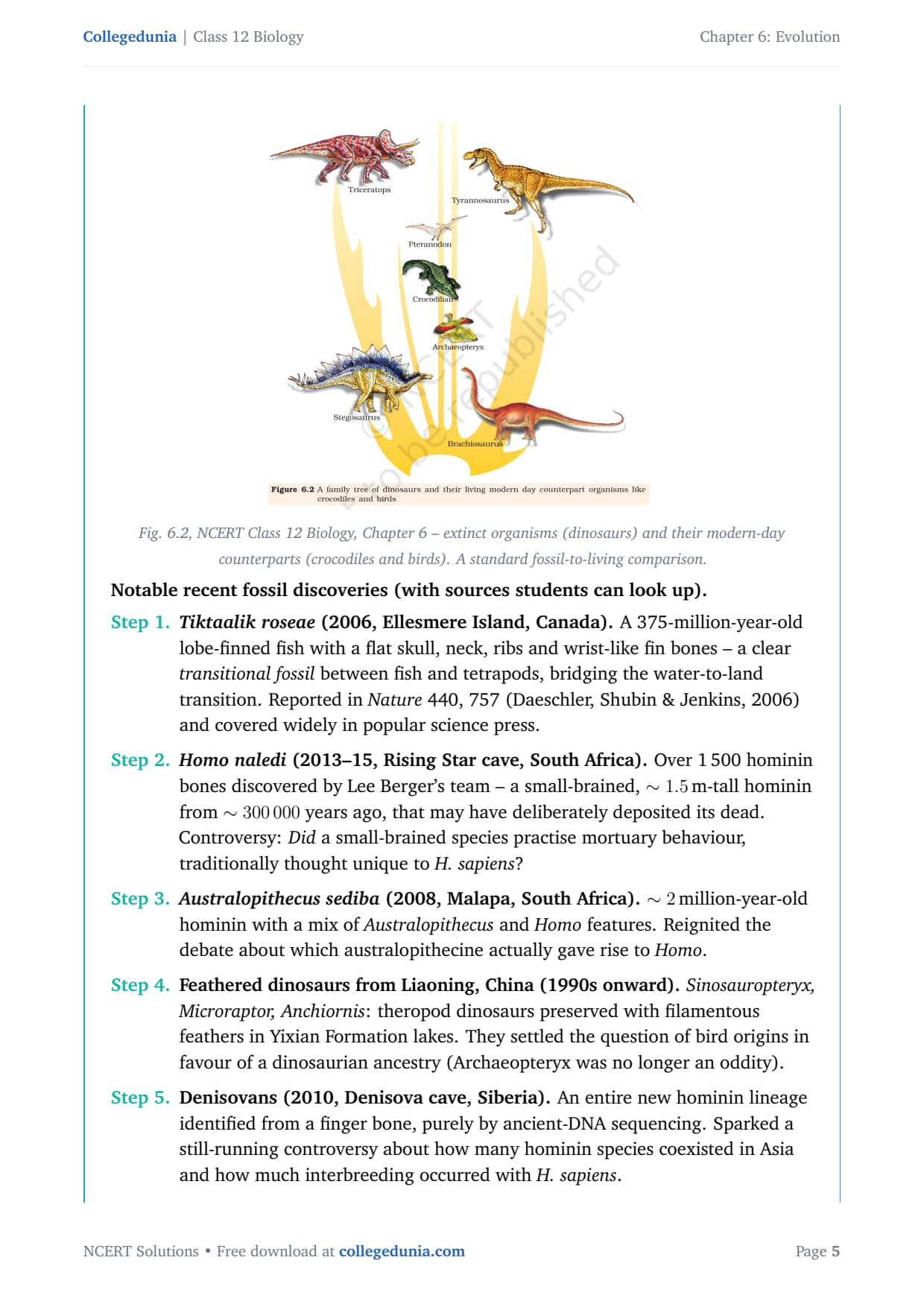
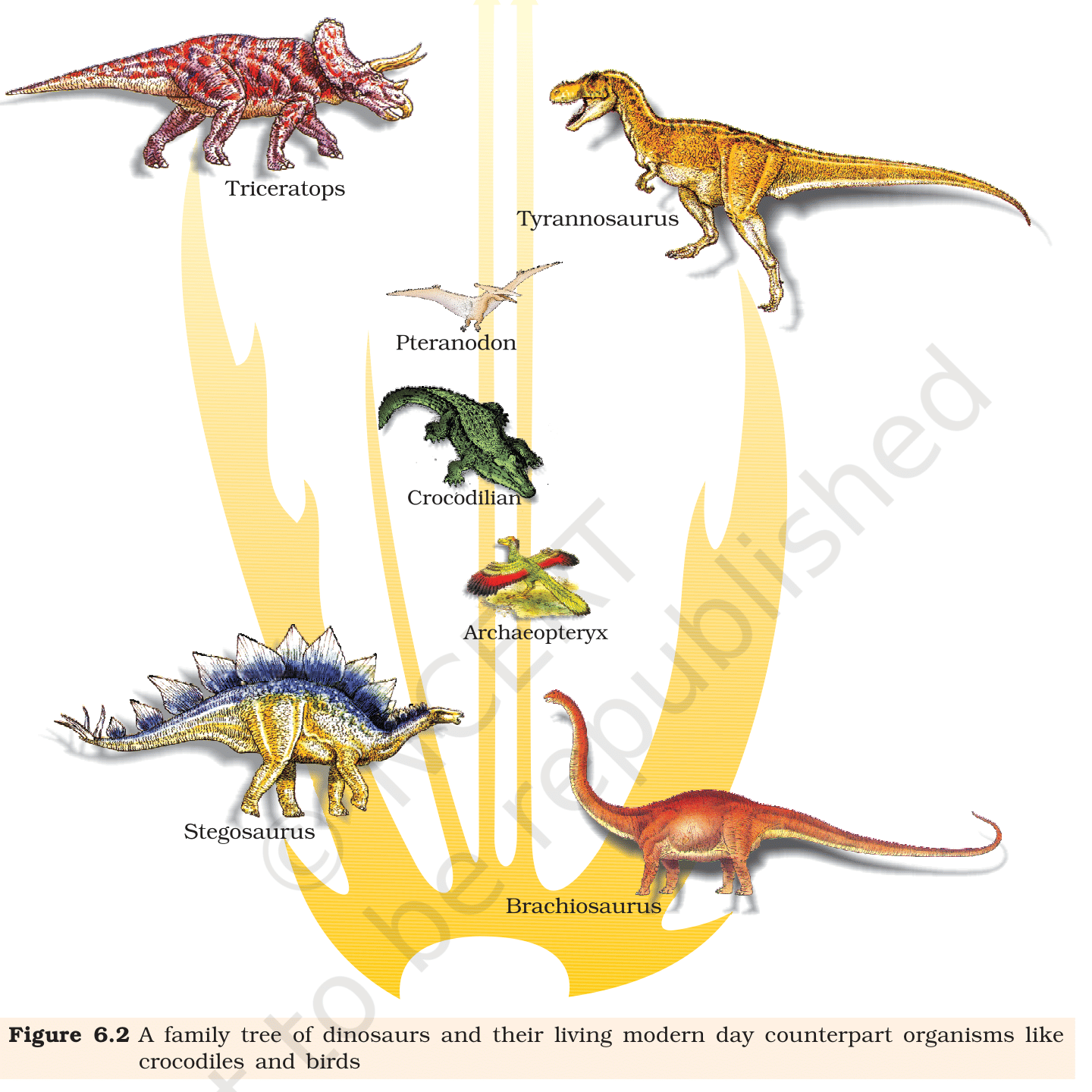
Fig. 6.2, NCERT Class 12 Biology,
Chapter 6 – extinct organisms (dinosaurs) and their modern-day
counterparts (crocodiles and birds). A standard fossil-to-living
comparison.
Notable recent fossil discoveries (with sources students can
look up).
Tiktaalik roseae (2006, Ellesmere Island,
Canada). A 375-million-year-old lobe-finned fish with a
flat skull, neck, ribs and wrist-like fin bones – a clear
transitional fossil between fish and tetrapods,
bridging the water-to-land transition. Reported in
Nature 440, 757 (Daeschler, Shubin & Jenkins, 2006)
and covered widely in popular science press.
Homo naledi (2013–15, Rising Star cave,
South Africa). Over 1 500 hominin bones discovered by Lee
Berger's team – a small-brained, ∼ 1.5 m-tall hominin
from ∼ 300 000 years ago, that may have deliberately
deposited its dead. Controversy: Did a small-brained
species practise mortuary behaviour, traditionally thought
unique to H. sapiens?
Australopithecus sediba (2008, Malapa,
South Africa).∼ 2 million-year-old hominin with a
mix of Australopithecus and Homo features.
Reignited the debate about which australopithecine actually
gave rise to Homo.
Feathered dinosaurs from Liaoning, China (1990s
onward).Sinosauropteryx, Microraptor,
Anchiornis: theropod dinosaurs preserved with filamentous
feathers in Yixian Formation lakes. They settled the
question of bird origins in favour of a dinosaurian
ancestry (Archaeopteryx was no longer an oddity).
Denisovans (2010, Denisova cave, Siberia). An
entire new hominin lineage identified from a finger bone,
purely by ancient-DNA sequencing. Sparked a still-running
controversy about how many hominin species coexisted in
Asia and how much interbreeding occurred with
H. sapiens.
Dickinsonia as the earliest animal
(∼ 558 Ma). 2018 cholesterol-biomarker work
(Science 361, 1246) showed Ediacaran
Dickinsonia was an animal, not a fungus or lichen –
pushing back the age of confirmed Metazoa.
Live evolution controversies in the press.
Where did Homo sapiens originate?
Single-origin (Africa, ∼ 200 kya) vs. multi-regional
models, complicated by new African finds at Jebel Irhoud
(∼ 315 kya).
Did Neanderthals and modern humans interbreed?
Confirmed by ancient-DNA work (Svante P"a"abo, Nobel
Prize 2022); ∼ 1--4% Neanderthal DNA persists
in non-African humans.
``Hobbit''Homo floresiensis (2003, Flores
Island): a tiny hominin alive until ∼ 50 kya –
species or pathological H. sapiens? Now widely
accepted as a distinct species.
Major recent fossil discoveries that reinforce evolutionary
theory include Tiktaalik (fish → tetrapod
transition, 2006), Homo naledi (small-brained hominin with
possible mortuary behaviour, 2013), A. sediba (2008),
feathered dinosaurs of Liaoning, the Denisovans (2010), and
biomarker evidence that Ediacaran Dickinsonia was an animal
(2018). Ongoing controversies concern human origins, Neanderthal
introgression, and Homo floresiensis.
PS
Pranav Sharma
M.Sc Biotechnology, AIIMS Delhi
Verified Expert
Strategic angle: a chronology with sources. The strongest
answer organises discoveries by what they settle – i.e. which
gap in the tree of life each closes – and pairs them with a
citation a student can verify. Below is a worked map.
Concept used.Transitional fossils (forms with
features of two related groups) are the gold-standard evidence for
descent with modification. Each major group transition predicts a
specific kind of fossil; finding one is a falsifiable test of
Darwin's theory.
Fish-to-tetrapod gap.Tiktaalik roseae
(375 Ma, Devonian, Ellesmere Is., Canada) was predicted to
exist in Late Devonian rocks of an exact age and was found
there by Neil Shubin's team in 2004 (published 2006). It
possesses a flat skull, a neck (free of the shoulder
girdle, like a tetrapod), proto-wrist bones inside a fish's
lobe fin, and ribs that could bear weight.
Dinosaur-to-bird gap.Anchiornis huxleyi
and Microraptor from Liaoning (Yixian Fm, China,
∼ 160–120 Ma) preserve filamentous and pennaceous
feathers on small theropod dinosaurs. Combined with Jurassic
Archaeopteryx (1861, Solnhofen), they make the
dinosaurian ancestry of birds the consensus view.
Ape-to-human gap.Sahelanthropus tchadensis
(2002, Chad; ∼ 7 Ma), Ardipithecus ramidus
(1992, Ethiopia; ∼ 4.4 Ma), Australopithecus
sediba (2008, S. Africa; ∼ 1.98 Ma), and Homo
naledi (2013, S. Africa; ∼ 0.3 Ma) populate the
bushy hominin tree.
Genus-level discoveries via ancient DNA. The
Denisovans (2010) were named entirely on the basis of a
∼ 40 kya finger-bone genome – a wholly new method
that has since identified introgression from Denisovans
into modern Papuans and Tibetans (the EPAS1
high-altitude allele).
Earliest-animal gap. 2018 biomarker work
confirmed Dickinsonia (∼ 558 Ma) as a
true metazoan, pushing the animal origin into the late
Precambrian.
Why this matters. Every named fossil above was a
prediction of evolutionary theory before it was found. The
fact that they were found in the predicted rocks at the predicted
ages is what Karl Popper would call ``corroboration of a risky
prediction'' – the hallmark of a successful scientific theory.
From Tiktaalik (water-to-land) to feathered
Liaoning dinosaurs (dinos-to-birds) to Homo naledi and the
Denisovans (the bushy human tree), every major group transition
predicted by Darwinian evolution has yielded a transitional fossil
in the past 25 years. Current controversies concern the timing and
geography of H. sapiens origins, Neanderthal and
Denisovan introgression, and the species status of H.
floresiensis.
Q 6.3
Attempt giving a clear definition of the term species.
Concept used. A species is the basic unit of
biological classification. Several non-equivalent definitions are
in current use because no single criterion fits all life. The most
widely taught is Ernst Mayr's biological species concept, but
students should know the alternatives because they apply to
fossils, asexual organisms and bacteria.
Biological species concept (Ernst Mayr, 1942).A species is a group of actually or potentially
interbreeding natural populations that are reproductively
isolated from other such groups, and produce fertile
offspring. Key requirements:
Interbreeding – members can mate and produce
viable offspring.
Fertile offspring – those offspring can
themselves reproduce (this excludes mule, the
infertile horse×donkey hybrid).
Reproductive isolation from other species
(pre-zygotic: behaviour, timing, habitat;
post-zygotic: hybrid inviability or sterility).
Morphological species concept. A species is a group
of organisms sharing characteristic anatomical features
distinct from other groups. Used for taxonomy when breeding
cannot be observed (e.g. herbarium specimens, museum
skeletons).
Phylogenetic species concept. A species is the
smallest monophyletic group descended from a common ancestor
– diagnosable by at least one unique derived character.
Useful for molecular-tree-based classification.
Ecological species concept. A species is a lineage
of populations that occupies a unique adaptive zone or
niche. Useful when reproductive isolation is incomplete but
ecological roles diverge.
Where Mayr's definition struggles. It fails for
(i) asexual organisms (bacteria, parthenogenetic
lizards) where ``interbreeding'' is undefined,
(ii) fossil species where mating cannot be tested,
(iii) ring species (Ensatina salamanders)
where adjacent populations interbreed but the end-of-ring
populations do not.
In NCERT terms: A species is a group of similar
organisms that can interbreed in nature and produce fertile
offspring, and that is reproductively isolated from all other such
groups (biological species concept, after Ernst Mayr, 1942).
Alternative definitions (morphological, phylogenetic, ecological)
apply where reproductive isolation cannot be tested.
RM
Riya Mehta
M.Sc Botany, Delhi University
Verified Expert
Strategic angle: state Mayr first, then qualify. An
examiner wants three things in a ``define species'' answer:
(i) the biological species concept, in one accurate sentence;
(ii) the three conditions (interbreeding, fertile offspring,
reproductive isolation); (iii) at least one example showing why the
definition matters.
Concept used. A species is the fundamental taxonomic
unit. Below it lie subspecies, races and demes; above it lie genus,
family etc. The biological species concept (BSC) defines a species
by reproductive criteria; the morphological concept defines it by
anatomy; the phylogenetic concept defines it by ancestry.
One-line Mayr definition. ``A species is a group
of populations whose members can interbreed in nature and
produce fertile offspring, and which is reproductively
isolated from other such groups.''
Decompose the three operative phrases.Interbreed in nature excludes forced laboratory
crosses. Fertile offspring excludes mules (donkey
× horse) and ligers – those animals cannot found
new populations. Reproductively isolated means no
gene flow with other species in the wild.
Examples that test the definition.
Same species, different appearance. Domestic
dogs (Chihuahua and Great Dane) belong to
Canis lupus familiaris; despite their
size difference, gene flow (via medium-sized
breeds) keeps them one species.
Different species, similar appearance.
Lions and tigers can be crossed in zoos (liger,
tigon) but ligers are usually sterile, and lions
and tigers do not meet in the wild – so they are
separate species P. leo vs P.
tigris.
When BSC fails. For bacteria (asexual), botanists
often use ≥ 97% 16S rRNA sequence identity as a
species cutoff (phylogenetic concept). For fossils,
morphology is the only available criterion (morphological
concept).
Why this matters. Biodiversity counts, conservation
priorities and patent law all depend on ``how many species are
there?''. The answer is not absolute; it depends on which species
concept is applied. The IUCN Red List, for instance, uses the
phylogenetic species concept by default.
A species is a group of organisms capable of interbreeding
in nature to produce fertile offspring, and reproductively isolated
from other groups (Mayr 1942). Where this fails – bacteria, fossils,
asexual lineages – morphological, phylogenetic or ecological
species concepts are used instead.
Q 6.4
Try to trace the various components of human evolution (hint: brain size and function, skeletal structure, dietary preference, etc.).
Concept used.Human evolution is the gradual
change, over ∼ 7 million years, from a chimpanzee-like
ancestor to modern Homo sapiens. It is documented by
fossils, by comparative anatomy and by molecular data. The
trends usually examined are: cranial capacity (brain size),
skeletal structure (bipedalism, posture, hand), dentition and diet,
and cultural artefacts (tools, fire, language).
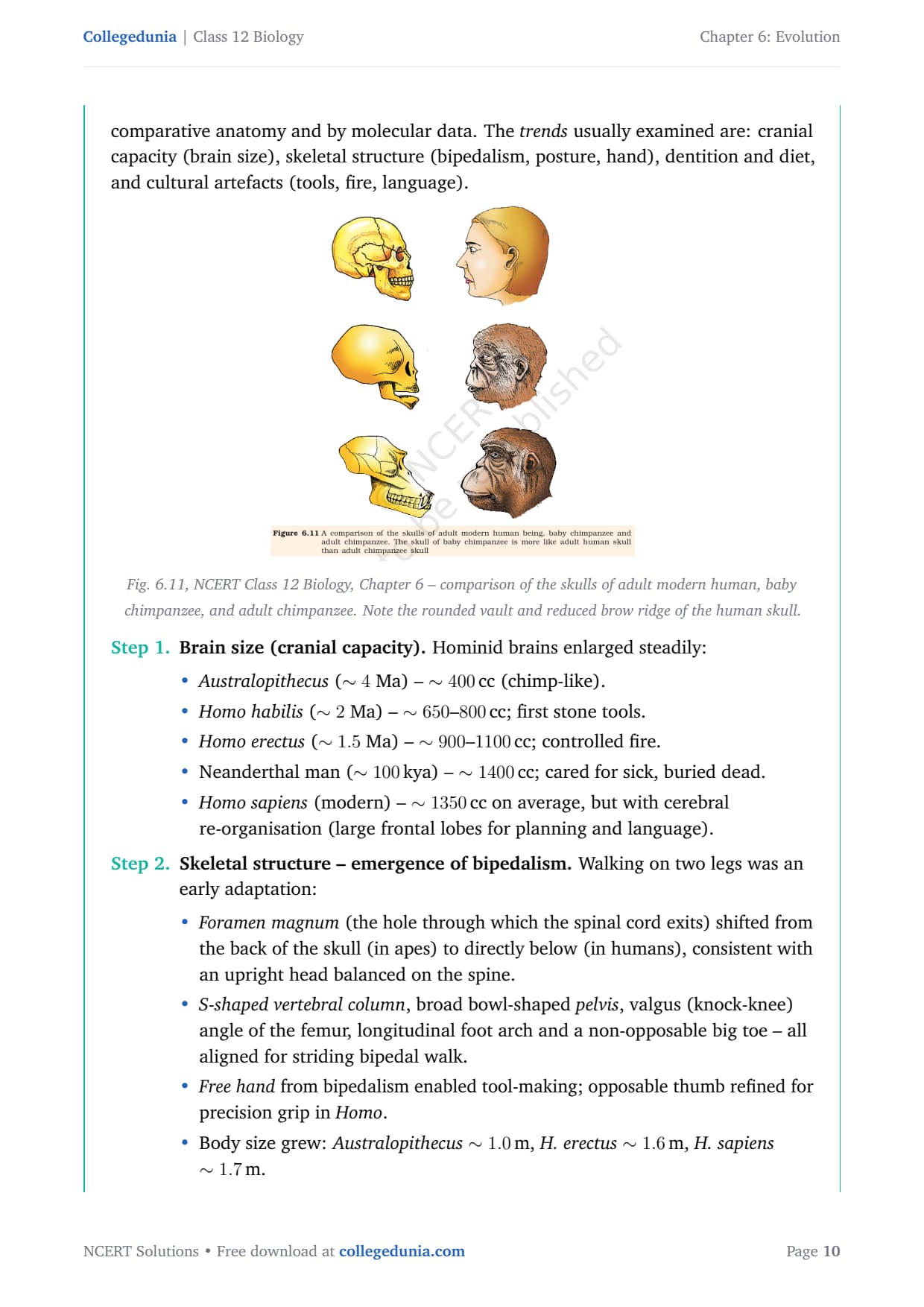
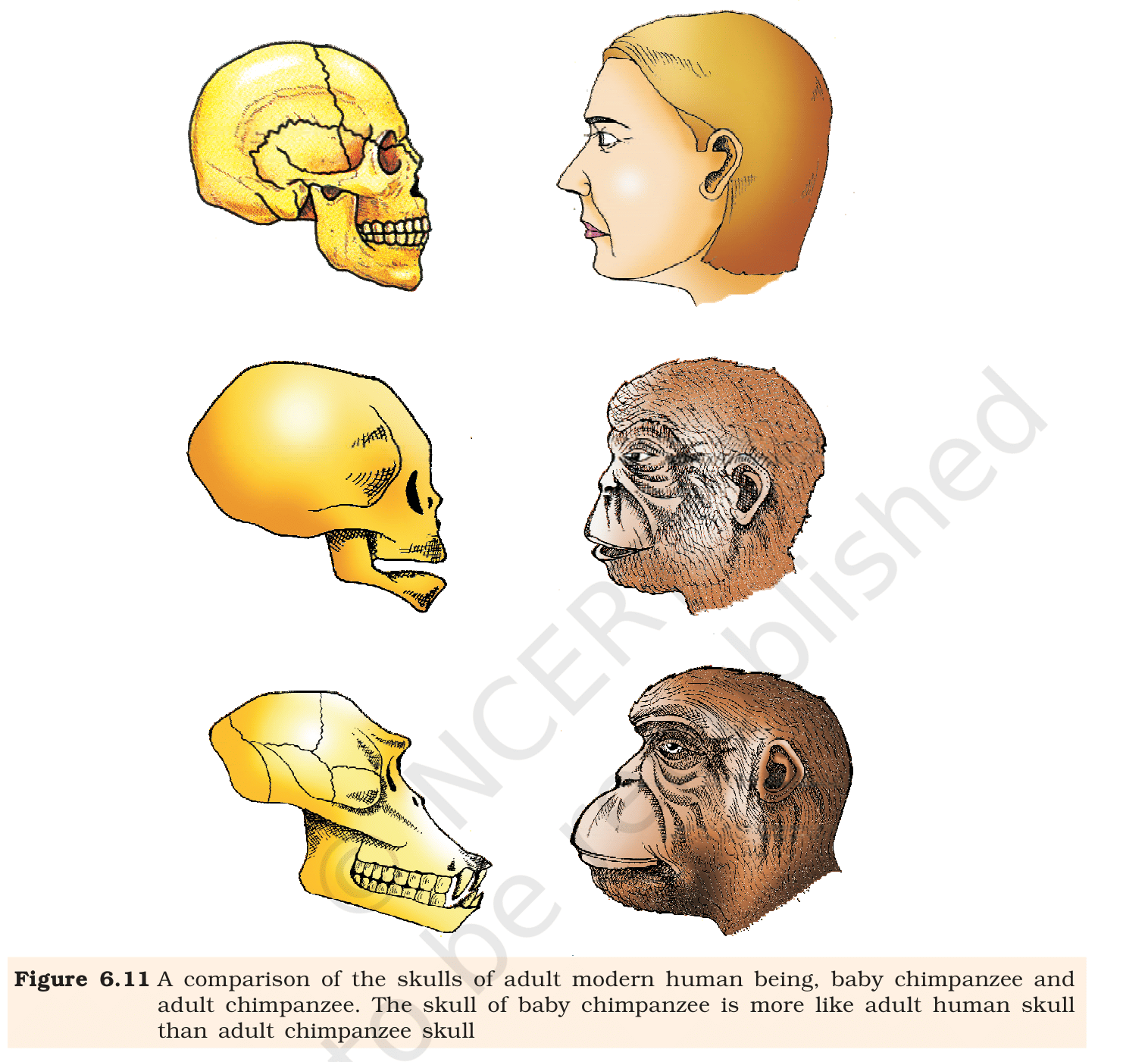
Fig. 6.11, NCERT Class 12 Biology,
Chapter 6 – comparison of the skulls of adult modern human, baby
chimpanzee, and adult chimpanzee. Note the rounded vault and reduced
brow ridge of the human skull.
Neanderthal man (∼ 100 kya) –
∼ 1400 cc; cared for sick, buried dead.
Homo sapiens (modern) – ∼ 1350 cc
on average, but with cerebral re-organisation
(large frontal lobes for planning and language).
Skeletal structure – emergence of bipedalism.
Walking on two legs was an early adaptation:
Foramen magnum (the hole through which the
spinal cord exits) shifted from the back of the
skull (in apes) to directly below (in humans),
consistent with an upright head balanced on the
spine.
S-shaped vertebral column, broad bowl-shaped
pelvis, valgus (knock-knee) angle of the
femur, longitudinal foot arch and a non-opposable
big toe – all aligned for striding bipedal walk.
Free hand from bipedalism enabled
tool-making; opposable thumb refined for precision
grip in Homo.
Body size grew: Australopithecus∼ 1.0 m, H. erectus∼ 1.6 m, H. sapiens∼ 1.7 m.
Dental and dietary changes.
Earliest hominids (Ardipithecus,
Australopithecus): mainly fruits and
tubers, large molars, thick enamel.
Homo erectus: ate cooked meat, used fire
(∼ 0.5–1.0 Ma).
Modern man: full omnivore; smaller jaw and teeth
(cooking softened food, reducing the need for
heavy chewing).
Cultural and behavioural milestones.
Tool-making (Oldowan flakes by H. habilis,
∼ 2.5 Ma), control of fire (∼ 1.5 Ma by
H. erectus), burial of the dead (Neanderthals,
∼ 0.1 Ma), cave painting (Bhimbetka, Chauvet,
∼ 30 kya), agriculture (∼ 10 kya), language
(anatomically supported by the descended larynx and a
modern hyoid, both present by ∼ 0.1 Ma).
Migration out of Africa.Homo erectus
left Africa ∼ 2 Ma (Java, Peking). Homo
sapiens originated in Africa ∼ 200 kya and migrated
outward by ∼ 60--75 kya, replacing or
interbreeding with archaic populations such as Neanderthals
and Denisovans.
Human evolution can be traced along five interconnected
components: (1) steady increase in cranial capacity (400 →
1400 cc); (2) skeletal adaptations for bipedalism
(repositioned foramen magnum, S-shaped spine, bowl-shaped pelvis,
arched foot); (3) dietary shift from herbivory to omnivory
with smaller teeth; (4) cultural advances (tools, fire,
burial, art, language); and (5) migration out of Africa∼ 2 Ma and again ∼ 60–75 kya.
AR
Aditya Reddy
Ph.D Molecular Biology, NCBS Bangalore
Verified Expert
Strategic angle: pair each ``component'' to its
fossil-and-feature evidence. The clearest way to organise the
answer is a table-like progression where every adaptive trend has
a named fossil that first shows it.
Concept used. Each evolutionary innovation in the hominid
line – bipedalism, brain expansion, tool use, fire, language –
emerged at a different time and is fossilised in a specific way.
Pairing trend ↔ fossil makes the story examinable.
Bipedalism (the foundational trait). First clear
evidence at ∼ 4 Ma in Australopithecus: the
Laetoli footprints (Tanzania, 3.6 Ma) capture a strided
walk identical to ours. Skeletal cues: angled femur,
bowl-shaped pelvis, repositioned foramen magnum.
Tool use. The Oldowan flake industry
(∼ 2.5 Ma, Gona, Ethiopia) coincides with Homo
habilis (``handy man'', 1964 discovery, L. Leakey).
Brain size climbs to ∼ 750 cc and the precision grip
is now skeletally evident.
Fire and migration.Homo erectus
(∼ 1.5 Ma): cranial capacity ∼ 1000 cc, body
size ∼ 1.6 m, controlled fire (charred bones at
Wonderwerk Cave, ∼ 1.0 Ma), and migrates out of
Africa (Java Man 1.7 Ma, Peking Man 0.7 Ma).
Symbolic culture. Neanderthals (∼ 200–30
kya), large brain (∼ 1400 cc), care for the
elderly (Shanidar 1, Iraq), deliberate burial with grave
goods (Le Moustier), and pigment use (Maltravieso, Spain;
≥ 64 kya).
Anatomically modern humans.H. sapiens
in Africa ≥ 200 kya (Omo Kibish, Jebel Irhoud); cave
art by ∼ 35–40 kya (Chauvet, El Castillo); 18 kya
cave paintings at Bhimbetka (India); agriculture
∼ 10 kya; language by ∼ 100 kya (descended
larynx, modern hyoid).
Six-stage summary table – useful for revision.
∼ 7 Ma: Last common ancestor with chimpanzee
in African forest.
Why this matters. Each ``component'' the question asks
about is an evolutionary trend whose age can be pinned by a named
fossil and a named site. Without that pairing the answer reads like
a list; with it, the answer reads like science. Both NEET and CBSE
board examiners specifically look for fossils and approximate ages.
Trace human evolution through (1) bipedalism
(Australopithecus, ∼ 4 Ma; Laetoli prints),
(2) tool use (H. habilis, 2.5 Ma; Oldowan),
(3) fire and migration (H. erectus, 1.5 Ma; Java,
Peking), (4) symbolic burial (Neanderthals, 0.1 Ma), and
(5) language and art (H. sapiens, 0.1–0.04 Ma;
Chauvet, Bhimbetka). Brain size climbed from ∼ 400 to
∼ 1400 cc across this progression.
Q 6.5
Find out through internet and popular science articles whether animals other than man have self-consciousness.
Concept used.Self-consciousness (or
self-awareness) is the ability of an organism to recognise
itself as an individual separate from its environment and other
individuals. The standard operational test in comparative
psychology is the Mirror Self-Recognition (MSR) or
rouge test, devised by Gordon Gallup in 1970: a coloured
mark is placed on the animal's face where it can be seen only in a
mirror, and the animal is observed for self-directed
mark-investigating behaviour.
Animals that have passed the mirror test.
Great apes – chimpanzees (Gallup 1970),
bonobos, orangutans, and gorillas. Among hominids
only humans pass it consistently from
∼ 18–24 months of age.
Cetaceans – bottlenose dolphins (Reiss &
Marino, 2001), Asian elephants (Plotnik, de Waal
& Reiss, 2006), and orcas have shown mark-directed
behaviour.
Birds – Eurasian magpies (Prior, Schwarz &
G"untürkün, 2008) pass the test, suggesting
self-recognition evolved independently in birds
(without a mammalian neocortex).
Fish – the cleaner wrasse (Labroides
dimidiatus) appears to pass the mark test
(Kohda et al., 2019), though this remains
controversial.
Other behavioural indicators. Self-awareness is a
spectrum, and the mirror test captures only one facet.
Other indicators include:
Tool use with planning (crows fashion hooks
from twigs; chimps strip leaves; elephants throw
debris with intent).
Theory of mind – knowing that another agent
has its own beliefs (chimps, scrub jays cache food
differently if watched).
Metacognition – ``knowing what you know.''
Macaques and dolphins decline trials they judge
hard, suggesting they recognise their own
uncertainty.
Episodic-like memory (western scrub jays
remember what, where, when of cached food).
Cooperative problem-solving and altruism
in elephants and dolphins.
Brain correlates. Most MSR-passing species have a
high encephalisation quotient (brain mass relative
to body mass), and many have von Economo (spindle)
neurons in the anterior cingulate cortex – neurons earlier
thought to be unique to humans but now described in great
apes, cetaceans and elephants.
What this implies. Self-consciousness is not
uniquely human; it has evolved independently
(convergent evolution) in several lineages whenever
complex social or ecological cognition pays off. It exists
on a continuum from minimal self-awareness (knowing one's
body in space) to full reflective self-consciousness
(humans).
Yes – several non-human species pass the mirror
self-recognition test and show other markers of self-awareness:
chimpanzees, bonobos, orangutans, gorillas, dolphins, orcas, Asian
elephants, Eurasian magpies, and (more controversially) cleaner
wrasses. Self-consciousness is not unique to humans; it has evolved
several times wherever complex social cognition is adaptive.
DB
Diya Banerjee
M.Sc Zoology, Banaras Hindu University
Verified Expert
Quick reading: a five-category cognitive ladder. Comparative
psychologists test for self-consciousness on a graded ladder of
behavioural markers; here are the five recognised rungs.
Concept used. The rouge/mark test is the strongest
single operational test for self-recognition, but
self-consciousness involves four further capacities – theory of
mind, metacognition, episodic memory, and intentional deception –
that together build the case.
Rung 1 – Mirror self-recognition. Demonstrated in
chimps, bonobos, orangutans, gorillas, dolphins, orcas,
Asian elephants, Eurasian magpies, cleaner wrasse.
Rung 2 – Theory of mind. Chimps modify their
behaviour when another individual cannot see a hidden food
item (Hare & Tomasello, 2001). Scrub jays re-cache food
if a watcher was present.
Rung 3 – Metacognition. Macaques and dolphins
will press a ``don't know'' option when uncertain, instead
of guessing – suggesting they monitor their own knowledge
(Smith et al., 2003).
Rung 4 – Episodic-like memory. Western scrub jays
remember which food they cached, where, and when – and
choose the freshest cache to retrieve (Clayton & Dickinson,
1998).
Rung 5 – Intentional deception. Capuchins fake
alarm calls to scare rivals off food; jays distract
observers from real cache sites.
Why this matters. If self-awareness is a continuum across
species (not a Boolean human privilege), then the moral status of
animals must also be a continuum. Conservation and welfare
priorities flow directly from that scientific evidence. The fact
that magpies – birds without a mammalian neocortex – also pass the
mirror test is especially important: it shows that
self-consciousness has converged on multiple neural
architectures, just as flight evolved independently in insects,
pterosaurs, birds and bats.
Lab tests that demonstrate self-awareness – quick recap.
Mirror mark test (Gallup 1970). Anaesthetised
animal, dot of odourless dye on face. Awake, the animal
is placed before a mirror. If it touches its own
face (not the mirror), it has passed.
Body-as-obstacle test. An elephant must step off
a mat to retrieve a stick that is attached to it. Asian
elephants pass (Dale & Plotnik 2017).
Mark recognition without mirror. Cleaner wrasses
rub the marked area on the substrate after seeing the
mark in a reflective surface.
Cooperative problem-solving. Two elephants pull
opposite ends of a rope to deliver a shared food reward –
each understands the partner's role.
Animals other than man – at minimum great apes, dolphins,
orcas, Asian elephants, magpies, and possibly cleaner wrasse – pass
the mirror test of self-recognition. Many also demonstrate theory
of mind, metacognition, episodic-like memory and intentional
deception. Self-consciousness is therefore widespread in animals
with rich social cognition, not unique to humans.
Q 6.6
List 10 modern-day animals and using the internet resources link it to a corresponding ancient fossil. Name both.
Concept used. A living fossil is a modern species
that closely resembles its fossil ancestors and has changed little
over geological time. Even for animals that are not living
fossils, palaeontology has often identified an extinct or near-
ancestral form. The fossil ancestor proves continuity of
lineage and lets us date when the group originated.
Fig. 6.10, NCERT Class 12 Biology,
Chapter 6 – evolutionary history of vertebrates across geological
periods. Use this as the backbone for matching modern animals to
ancestral fossils.
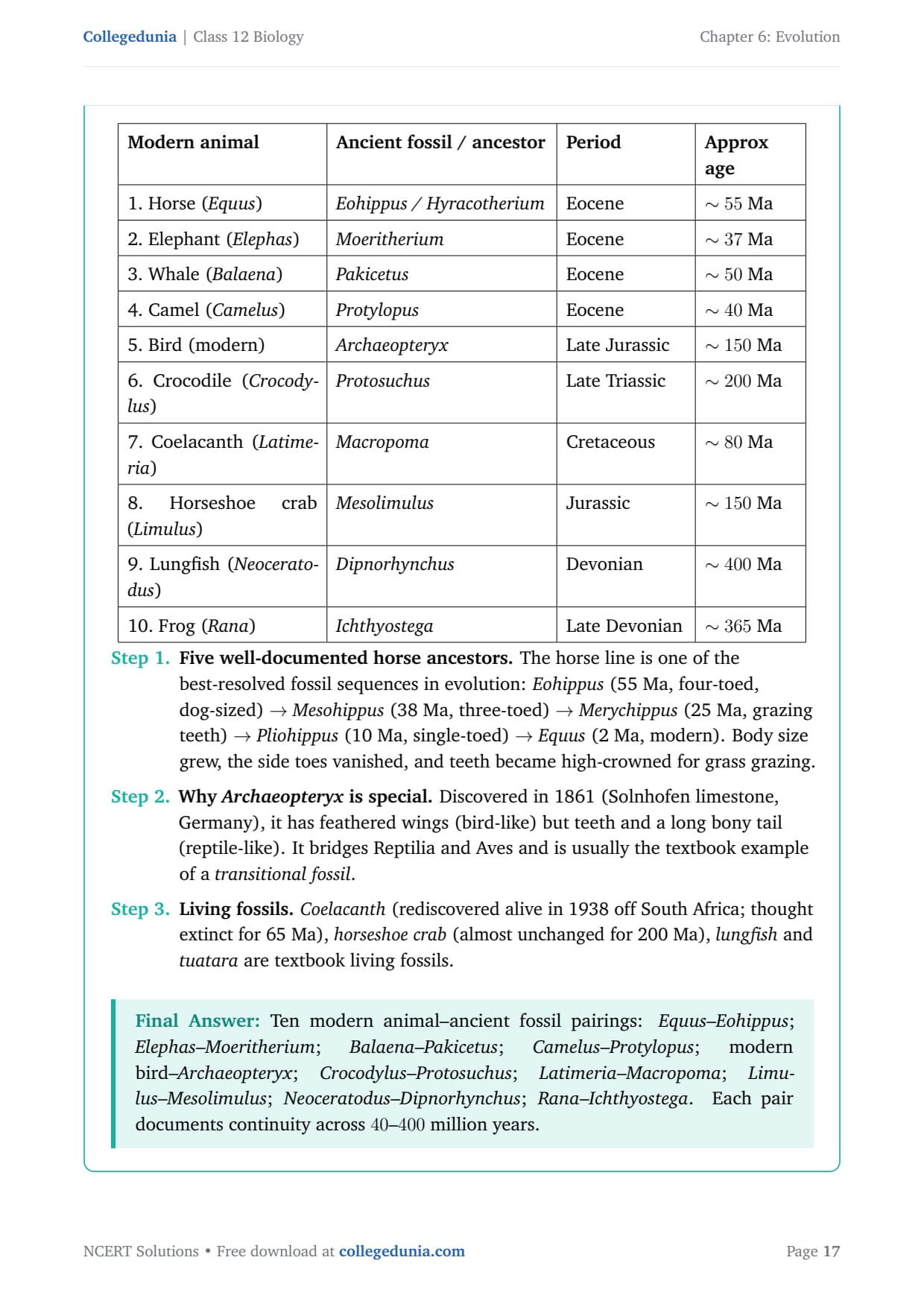
The table below lists ten modern animals paired with a named
fossil/ancestor (period and approximate age in millions of years
ago, Ma).
1.35
tabular|p0.27|p0.30|p0.17|p0.13|
Modern animal & Ancient fossil / ancestor & Period & Approx age
10. Frog (Rana) & Ichthyostega & Late Devonian & ∼ 365 Ma
tabular
Five well-documented horse ancestors. The horse
line is one of the best-resolved fossil sequences in
evolution: Eohippus (55 Ma, four-toed, dog-sized)
→Mesohippus (38 Ma, three-toed) →Merychippus (25 Ma, grazing teeth) →Pliohippus (10 Ma, single-toed) →Equus (2 Ma, modern). Body size grew, the side
toes vanished, and teeth became high-crowned for grass
grazing.
Why Archaeopteryx is special. Discovered
in 1861 (Solnhofen limestone, Germany), it has feathered
wings (bird-like) but teeth and a long bony tail
(reptile-like). It bridges Reptilia and Aves and is
usually the textbook example of a transitional
fossil.
Living fossils.Coelacanth (rediscovered
alive in 1938 off South Africa; thought extinct for 65 Ma),
horseshoe crab (almost unchanged for 200 Ma),
lungfish and tuatara are textbook living
fossils.
Ten modern animal–ancient fossil pairings:
Equus–Eohippus; Elephas–Moeritherium;
Balaena–Pakicetus; Camelus–Protylopus;
modern bird–Archaeopteryx;
Crocodylus–Protosuchus;
Latimeria–Macropoma;
Limulus–Mesolimulus;
Neoceratodus–Dipnorhynchus;
Rana–Ichthyostega. Each pair documents continuity
across 40–400 million years.
KJ
Karan Joshi
Ph.D Molecular Biology, NCBS Bangalore
Verified Expert
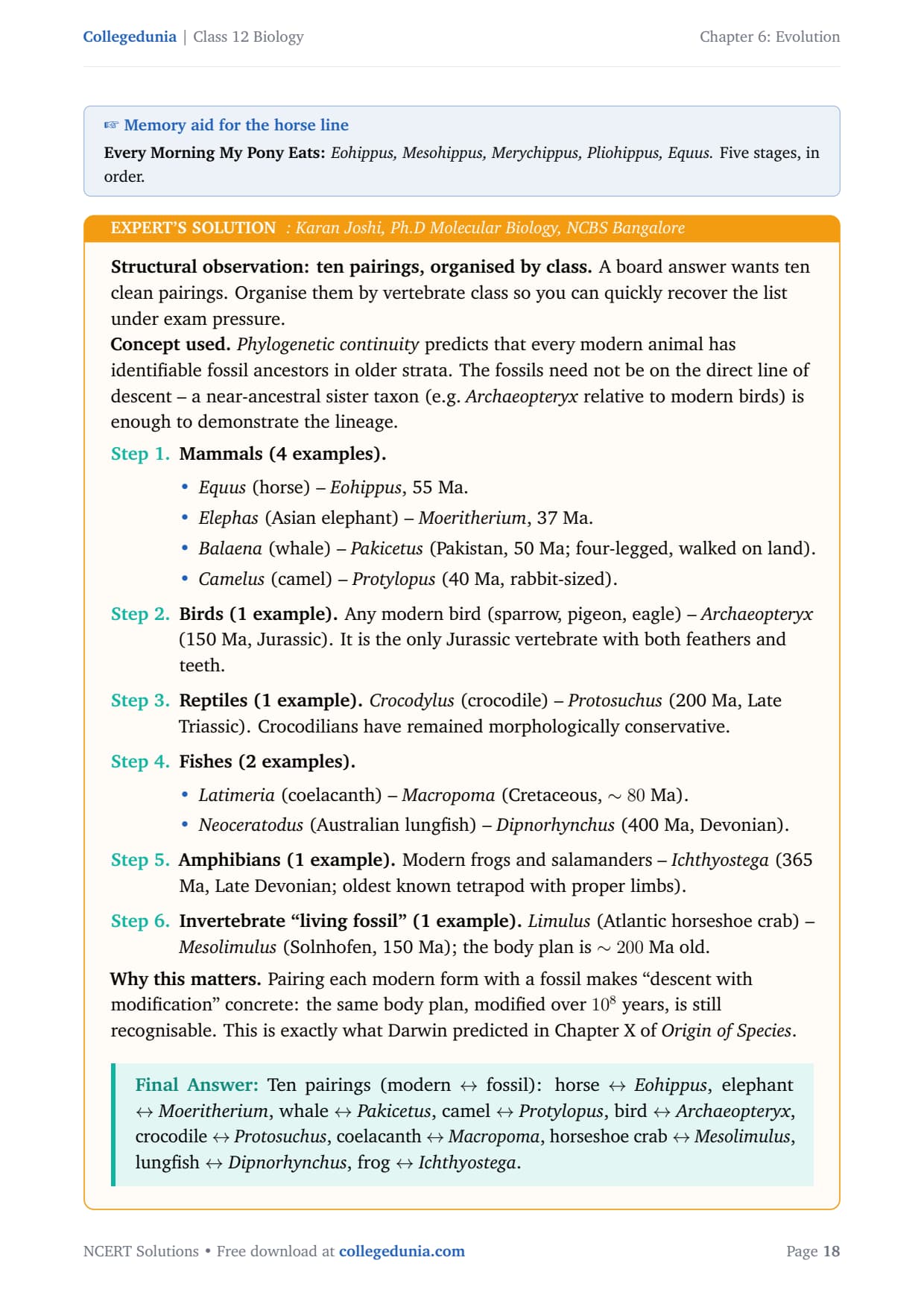
Structural observation: ten pairings, organised by class.
A board answer wants ten clean pairings. Organise them by
vertebrate class so you can quickly recover the list under exam
pressure.
Concept used.Phylogenetic continuity predicts that
every modern animal has identifiable fossil ancestors in older
strata. The fossils need not be on the direct line of descent – a
near-ancestral sister taxon (e.g. Archaeopteryx relative
to modern birds) is enough to demonstrate the lineage.
Birds (1 example). Any modern bird (sparrow,
pigeon, eagle) – Archaeopteryx (150 Ma,
Jurassic). It is the only Jurassic vertebrate with both
feathers and teeth.
Reptiles (1 example).Crocodylus
(crocodile) – Protosuchus (200 Ma, Late
Triassic). Crocodilians have remained morphologically
conservative.
Amphibians (1 example). Modern frogs and
salamanders – Ichthyostega (365 Ma, Late
Devonian; oldest known tetrapod with proper limbs).
Invertebrate ``living fossil'' (1 example).Limulus (Atlantic horseshoe crab) –
Mesolimulus (Solnhofen, 150 Ma); the body plan is
∼ 200 Ma old.
Why this matters. Pairing each modern form with a fossil
makes ``descent with modification'' concrete: the same body plan,
modified over 108 years, is still recognisable. This is
exactly what Darwin predicted in Chapter X of Origin of
Species.
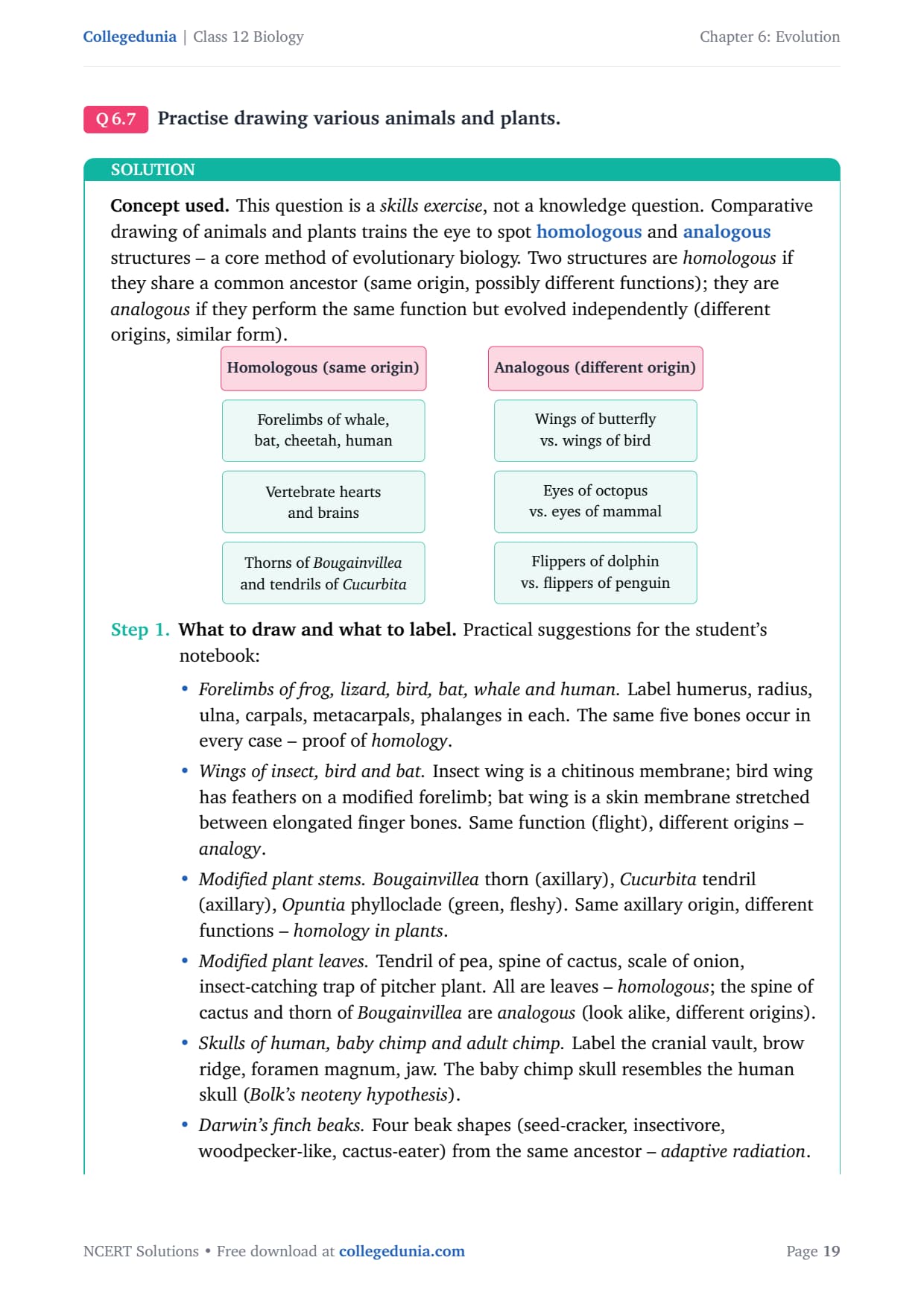
Concept used. This question is a skills exercise,
not a knowledge question. Comparative drawing of animals and plants
trains the eye to spot homologous and
analogous structures – a core method of evolutionary
biology. Two structures are homologous if they share a common
ancestor (same origin, possibly different functions); they are
analogous if they perform the same function but evolved
independently (different origins, similar form).
[See diagram in the PDF version]
What to draw and what to label. Practical
suggestions for the student's notebook:
Forelimbs of frog, lizard, bird, bat, whale
and human. Label humerus, radius, ulna, carpals,
metacarpals, phalanges in each. The same five
bones occur in every case – proof of
homology.
Wings of insect, bird and bat. Insect wing
is a chitinous membrane; bird wing has feathers on
a modified forelimb; bat wing is a skin membrane
stretched between elongated finger bones. Same
function (flight), different origins –
analogy.
Modified plant stems.Bougainvillea
thorn (axillary), Cucurbita tendril
(axillary), Opuntia phylloclade (green,
fleshy). Same axillary origin, different functions
– homology in plants.
Modified plant leaves. Tendril of pea,
spine of cactus, scale of onion, insect-catching
trap of pitcher plant. All are leaves –
homologous; the spine of cactus and thorn
of Bougainvillea are analogous
(look alike, different origins).
Skulls of human, baby chimp and adult
chimp. Label the cranial vault, brow ridge,
foramen magnum, jaw. The baby chimp skull
resembles the human skull (Bolk's
neoteny hypothesis).
Darwin's finch beaks. Four beak shapes
(seed-cracker, insectivore, woodpecker-like,
cactus-eater) from the same ancestor –
adaptive radiation.
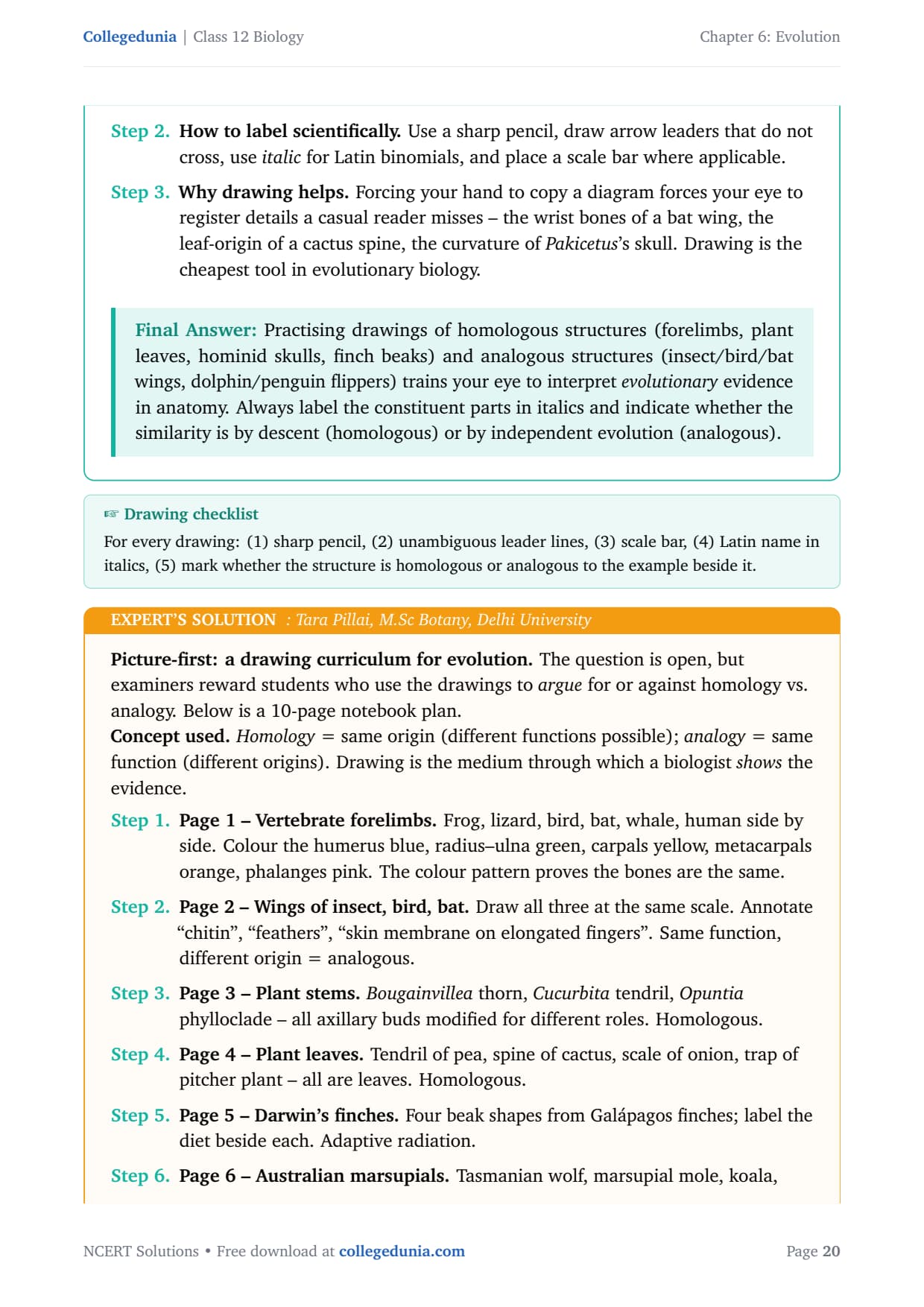
How to label scientifically. Use a sharp pencil,
draw arrow leaders that do not cross, use italic for
Latin binomials, and place a scale bar where applicable.
Why drawing helps. Forcing your hand to copy a
diagram forces your eye to register details a casual reader
misses – the wrist bones of a bat wing, the leaf-origin of
a cactus spine, the curvature of Pakicetus's
skull. Drawing is the cheapest tool in evolutionary
biology.
Practising drawings of homologous structures (forelimbs,
plant leaves, hominid skulls, finch beaks) and analogous structures
(insect/bird/bat wings, dolphin/penguin flippers) trains your eye
to interpret evolutionary evidence in anatomy. Always label
the constituent parts in italics and indicate whether the
similarity is by descent (homologous) or by independent evolution
(analogous).
TP
Tara Pillai
M.Sc Botany, Delhi University
Verified Expert
Picture-first: a drawing curriculum for evolution. The
question is open, but examiners reward students who use the
drawings to argue for or against homology vs. analogy. Below
is a 10-page notebook plan.
Concept used.Homology = same origin (different
functions possible); analogy = same function (different
origins). Drawing is the medium through which a biologist
shows the evidence.
Page 1 – Vertebrate forelimbs. Frog, lizard, bird,
bat, whale, human side by side. Colour the humerus blue,
radius–ulna green, carpals yellow, metacarpals orange,
phalanges pink. The colour pattern proves the bones are
the same.
Page 2 – Wings of insect, bird, bat. Draw all
three at the same scale. Annotate ``chitin'',
``feathers'', ``skin membrane on elongated fingers''. Same
function, different origin = analogous.
Page 3 – Plant stems.Bougainvillea
thorn, Cucurbita tendril, Opuntia
phylloclade – all axillary buds modified for different
roles. Homologous.
Page 4 – Plant leaves. Tendril of pea, spine of
cactus, scale of onion, trap of pitcher plant – all are
leaves. Homologous.
Page 5 – Darwin's finches. Four beak shapes from
Gal'apagos finches; label the diet beside each. Adaptive
radiation.
Page 6 – Australian marsupials. Tasmanian wolf,
marsupial mole, koala, kangaroo, marsupial rat – all
evolved from one ancestor by adaptive radiation.
Page 7 – Convergence. Placental wolf vs.
Tasmanian (marsupial) wolf. Same niche, different
ancestors. Analogous.
Page 9 – Horse evolution.Eohippus→Mesohippus→Merychippus→Pliohippus→Equus. Mark single-toe vs. multi-toe and tooth
height in each.
Page 10 – Three industrial-melanism moths.
Pre-industrial light moth on bark, dark moth on
soot-covered bark, post-clean-air light moth back on
lichen. Pure Darwinian selection by colour.
What to revise before each drawing.
Forelimbs: memorise the order
humerus–radius–ulna–carpals–metacarpals–phalanges and
the principle that the same five bones in the same
order appear across vertebrates.
Wings: insect (chitinous, no internal bones), bird
(feathers on modified forelimb), bat (skin between
elongated fingers). Same function, different origin.
Plant modifications: every axillary thorn /
tendril / phylloclade is a modified stem; every spine /
scale / pitcher / tendril of leaf-origin is a modified
leaf.
Skulls: mark foramen magnum (centre in human, back
in chimp), brow ridge (heavy in chimp, faint in human),
cranial vault (rounded in human, sloping in chimp).
Why this matters. Every concept in this chapter can be
seen. Once the diagrams are on the page, the verbal
explanations become muscle memory. Drawings are also expected to
appear in board diagrams (3–5 marks each). NEET diagram-based MCQs
are answered fastest by students who have hand-drawn each diagram
themselves; recognition is much faster after one's own hand has
traced the lines.
A focused drawing notebook with ten themed pages
(vertebrate forelimbs, three wing types, plant stems and leaves,
finch beaks, marsupials, convergent wolves, hominid skulls, horse
line, melanic moths) covers every evolutionary mechanism in
Chapter 6 and provides ready-made answer diagrams for the board.
Q 6.8
Describe one example of adaptive radiation.
Concept used.Adaptive radiation is the
evolutionary process in which an ancestral species, on entering a
new geographical area or unoccupied set of niches, gives rise to
several descendant species, each adapted to a different ecological
role. The textbook examples are Darwin's finches of the
Gal'apagos Islands and the marsupials of Australia. When
more than one adaptive radiation appears to have occurred in an
isolated geographical area (representing different habitats), the
phenomenon is called convergent evolution – for example
placental mammals in Australia exhibit adaptive radiation into forms
remarkably similar to the corresponding marsupials (placental wolf
vs. Tasmanian wolf-marsupial).
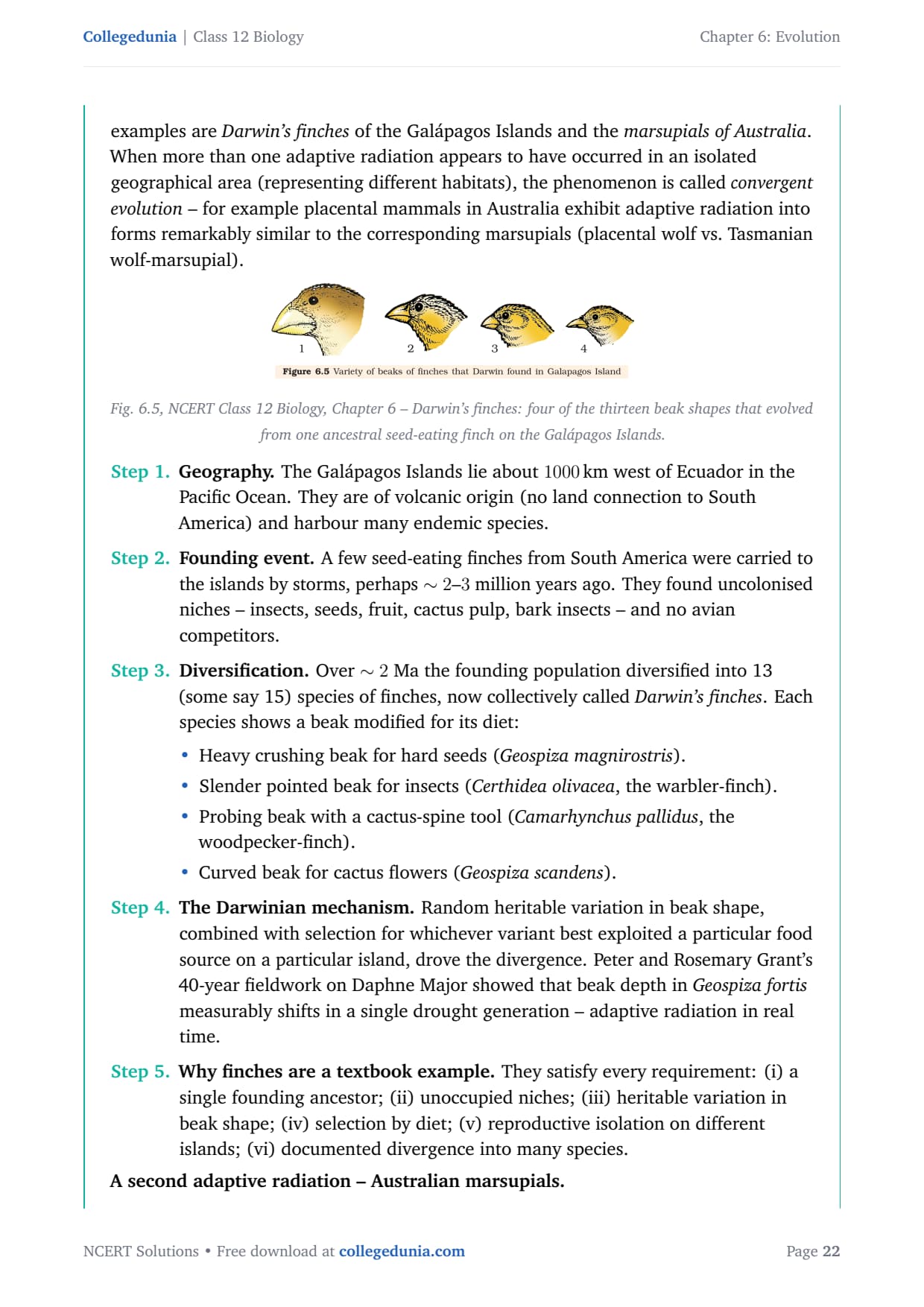
Fig. 6.5, NCERT Class 12 Biology,
Chapter 6 – Darwin's finches: four of the thirteen beak shapes that
evolved from one ancestral seed-eating finch on the Gal'apagos
Islands.
Geography. The Gal'apagos Islands lie about
1000 km west of Ecuador in the Pacific Ocean. They are
of volcanic origin (no land connection to South America)
and harbour many endemic species.
Founding event. A few seed-eating finches from
South America were carried to the islands by storms,
perhaps ∼ 2–3 million years ago. They found
uncolonised niches – insects, seeds, fruit, cactus pulp,
bark insects – and no avian competitors.
Diversification. Over ∼ 2 Ma the founding
population diversified into 13 (some say 15) species of
finches, now collectively called Darwin's finches.
Each species shows a beak modified for its diet:
Heavy crushing beak for hard seeds
(Geospiza magnirostris).
Slender pointed beak for insects
(Certhidea olivacea, the warbler-finch).
Probing beak with a cactus-spine tool
(Camarhynchus pallidus, the
woodpecker-finch).
Curved beak for cactus flowers
(Geospiza scandens).
The Darwinian mechanism. Random heritable
variation in beak shape, combined with selection for
whichever variant best exploited a particular food source
on a particular island, drove the divergence. Peter and
Rosemary Grant's 40-year fieldwork on Daphne Major showed
that beak depth in Geospiza fortis measurably
shifts in a single drought generation – adaptive radiation
in real time.
Why finches are a textbook example. They satisfy
every requirement: (i) a single founding ancestor;
(ii) unoccupied niches; (iii) heritable variation in beak
shape; (iv) selection by diet; (v) reproductive isolation
on different islands; (vi) documented divergence into
many species.
A second adaptive radiation – Australian marsupials.
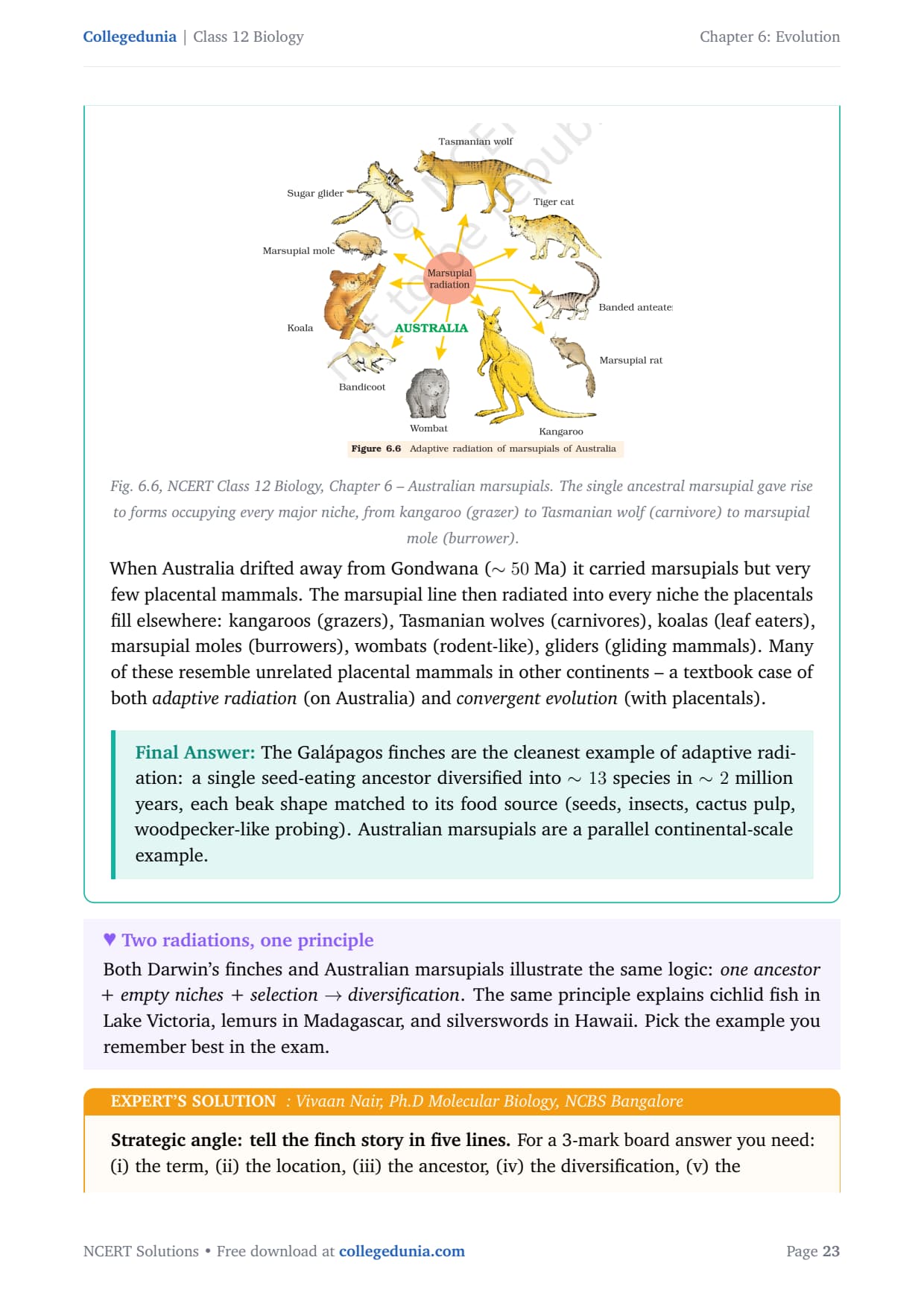
Fig. 6.6, NCERT Class 12 Biology,
Chapter 6 – Australian marsupials. The single ancestral marsupial
gave rise to forms occupying every major niche, from kangaroo
(grazer) to Tasmanian wolf (carnivore) to marsupial mole (burrower).
When Australia drifted away from Gondwana (∼ 50 Ma) it carried
marsupials but very few placental mammals. The marsupial line then
radiated into every niche the placentals fill elsewhere:
kangaroos (grazers), Tasmanian wolves (carnivores), koalas (leaf
eaters), marsupial moles (burrowers), wombats (rodent-like),
gliders (gliding mammals). Many of these resemble unrelated
placental mammals in other continents – a textbook case of both
adaptive radiation (on Australia) and convergent
evolution (with placentals).
The Gal'apagos finches are the cleanest example of
adaptive radiation: a single seed-eating ancestor diversified into
∼ 13 species in ∼ 2 million years, each beak shape
matched to its food source (seeds, insects, cactus pulp,
woodpecker-like probing). Australian marsupials are a parallel
continental-scale example.
VN
Vivaan Nair
Ph.D Molecular Biology, NCBS Bangalore
Verified Expert
Strategic angle: tell the finch story in five lines.
For a 3-mark board answer you need: (i) the term, (ii) the
location, (iii) the ancestor, (iv) the diversification, (v) the
mechanism. The Gal'apagos finches deliver all five with a clean
modern citation (the Grants).
Concept used.Adaptive radiation = ``radiating''
from one ancestor into many adaptive forms when ecological
opportunity opens up. The signature pattern is many closely
related species, each in a different niche, on a recently colonised
area.
Define the term. ``The evolutionary diversification
of an ancestral species into a number of new forms, each
adapted to a particular niche, when the original population
enters an unexploited area.''
Name the example. Gal'apagos finches, observed by
Darwin in 1835 on H.M.S. Beagle.
State the ancestor and outcome. A single
seed-eating finch from South America → 13 species on
the Gal'apagos, each with a beak suited to its food.
State the mechanism. Heritable variation in beak
depth + selection by available food → morphological
divergence. Peter and Rosemary Grant (Princeton)
documented this in real time on Daphne Major: in the 1977
drought, large-seeded plants survived and the finch
population shifted to deeper beaks.
Second example for the LA (long-answer) version.
Australian marsupials radiated into 200+ species in the
absence of placentals.
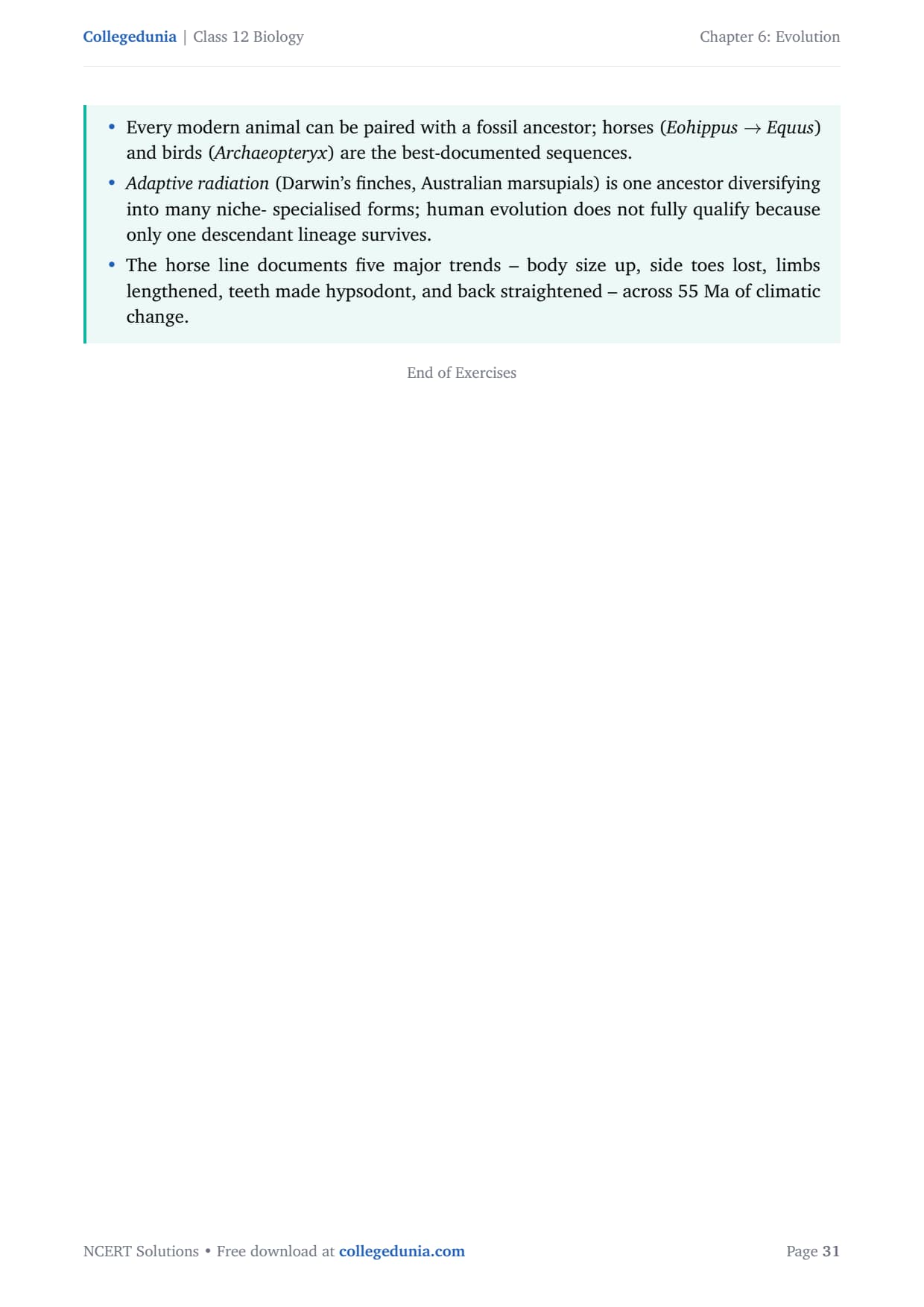
Other classical adaptive radiations a student should
recognise.
Hawaiian silverswords – descended from a single
Californian tarweed; now ∼ 28 plant species
spanning desert, alpine and rainforest niches.
Hawaiian honeycreepers – ∼ 50 bird species
from one finch-like ancestor, with beaks varying from
seed-cracker to nectar-sipper.
Cichlid fishes of Lake Victoria / Malawi /
Tanganyika – over 1 500 species in ∼ 5 Ma; the
fastest radiation in vertebrates.
Lemurs of Madagascar – ∼ 100 species from a
single ancestor that rafted from mainland Africa.
Why this matters. Adaptive radiation is the single most
visual demonstration that evolution works. The 13 beaks of
Darwin's finches are the icon of evolutionary biology because they
make selection paintable. The same logic explains why
islands are evolutionary laboratories: each island offers a fresh
ecological canvas with few competitors, and natural selection
quickly fills the empty niches with descendants of one founding
species.
Adaptive radiation is the rapid diversification of a
single ancestor into many forms suited to different niches.
Darwin's finches (13 species on the Gal'apagos, all from one
seed-eating ancestor, each with a beak matched to its diet) is the
classic example; Australian marsupials, Hawaiian silverswords and
honeycreepers, Madagascan lemurs and African cichlids are parallel
cases on continental, archipelagic and lacustrine scales.
Q 6.9
Can we call human evolution as adaptive radiation?
Concept used.Adaptive radiation requires
many descendant species, each occupying a different
ecological niche, arising from a single ancestor within a short
geological time. The signature is a branching pattern of
multiple coexisting forms (e.g. Darwin's finches). Human
evolution must be tested against these criteria.
Did one ancestor give rise to many hominid
species? Yes – the fossil record shows several genera
and species: Sahelanthropus, Orrorin,
Ardipithecus, several Australopithecus
(A. afarensis, A. africanus, A. sediba,
A. garhi), Paranthropus boisei, and the
Homo clade (H. habilis, H. erectus,
H. heidelbergensis, H. neanderthalensis, H.
floresiensis, H. naledi, H. sapiens). At several time
points (e.g. ∼ 2 Ma) three or four hominid species
co-existed in Africa.
Did they occupy different niches? Only weakly.
Paranthropus boisei (the ``robust''
australopithecine) had massive jaws and ate hard plant
food – clearly a different dietary niche. But most other
hominids (gracile australopithecines, early Homo)
overlapped substantially in diet and habitat. There is no
``insectivore hominid'' or ``aquatic hominid'' analogous
to a woodpecker-finch vs. a vampire-finch.
Did they survive into the present?No –
and this is the decisive point. Of the dozen-plus hominid
species, only one is alive today: Homo sapiens.
Adaptive radiation, by contrast, produces a
persisting bush of multiple coexisting forms (the
13 finches still all exist).
Verdict. Human evolution shows the
branching stage of an adaptive radiation but not
the persistence stage. Most lineages went extinct;
only one ``radiated'' lineage is left. Some authors
therefore call it a failed or
partial radiation. Strictly, by the conventional
definition (multiple coexisting forms in different
niches), human evolution is not a typical
adaptive radiation.
Comparison with classical examples.
Darwin's finches. 13 coexisting species, distinct
beak-driven niches, descended from one ancestor.
Persistent.
Australian marsupials. 200+ coexisting species
spanning every niche from herbivore to carnivore to
burrower. Persistent.
Human evolution. A dozen species over 7 Ma, but
only H. sapiens remains. Not persistent.
Strictly speaking, no – human evolution is not a
classical adaptive radiation. Although several hominid species
branched from a common ancestor, they did not occupy distinctly
different ecological niches, and all but Homo sapiens are
extinct. A true adaptive radiation (e.g. Darwin's finches)
produces a persisting bush of differentiated coexisting species.
Some authors describe human evolution as a
branching or partial radiation that was pruned by
competition and climate.
YV
Yash Verma
M.Sc Biotechnology, AIIMS Delhi
Verified Expert
Strategic angle: test the definition, then decide. For
this kind of yes/no conceptual question the highest-scoring answer
is one that lists the criteria for adaptive radiation, applies
each to human evolution and concludes with reasoning.
Concept used. The four diagnostic features of adaptive
radiation are: (1) common ancestor, (2) multiple
descendant species, (3) ecological diversification into
distinct niches, and (4) persistent coexistence.
Criterion 1 – common ancestor. Yes. All hominids
share a chimpanzee-like common ancestor ∼ 7 Ma ago.
Criterion 2 – multiple descendants.
Yes. At least 15 fossil hominid species are recognised
(Sahelanthropus, Orrorin, Ardipithecus,
Australopithecus (4 spp.), Paranthropus
(3 spp.), Homo (8+ spp.)).
Criterion 3 – niche diversification.Partially.Paranthropus robustus and
P. boisei ate hard plant matter; gracile
australopithecines were generalists; Homo erectus
used fire and ate cooked meat. But these niches are
not as separated as woodpecker-finch vs.
ground-finch.
Criterion 4 – persistent coexistence. No. Only
Homo sapiens survives. Even Neanderthals and
Denisovans went extinct ∼ 30–40 kya, leaving us
the sole surviving hominid.
Conclusion. Three of four criteria are met
weakly or partially; criterion 4 fails. Human evolution
is therefore not a classical adaptive radiation. The
better description is phyletic evolution with
branching (anagenesis with cladogenesis), where most
side branches went extinct.
Why this matters. It highlights that not all
diversification is adaptive radiation. Evolution can also produce
many lineages most of which die out – humans are an example of
this less glamorous pattern.
No, human evolution does not satisfy the criterion of
persistent coexistence of multiple distinctly-niched
descendants. Although the hominid family did branch into many
species, all but Homo sapiens are extinct, and the
niche differences among hominids were modest. It is better
described as branching descent (cladogenesis) under heavy
extinction, not as a classical adaptive radiation.
Q 6.10
Using various resources such as your school library or the internet and discussions with your teacher, trace the evolutionary stages of any one animal, say horse.
Concept used. The horse lineage (Family
Equidae) is the most complete fossil sequence in vertebrate
palaeontology, spanning ∼ 55 million years from the Eocene
to the present. The trends across this sequence are:
(i) increase in body size, (ii) progressive
loss of side toes (from four to one), (iii) elongation
of limbs, (iv) increase in tooth crown height
(hypsodonty) for grass grazing, and (v) straightening of
the back. These changes track the planet's shift from forested
to grassland environments during the Cenozoic.
[See diagram in the PDF version]
Eohippus / Hyracotherium (Eocene,
∼ 55 Ma). The ``dawn horse''. Size of a fox
(∼ 0.4 m at the shoulder); four toes on the
forefoot, three on the hindfoot; low-crowned teeth suited
to soft browse; arched back. Forested habitat.
Mesohippus (Oligocene, ∼ 38 Ma).
Sheep-sized (∼ 0.6 m); three toes on each foot, the
middle toe enlarged and weight-bearing; still a browser.
Found in North America.
Merychippus (Miocene, ∼ 25 Ma).
Pony-sized (∼ 1.0 m); three toes, but only the
middle toe touches the ground; high-crowned (hypsodont)
teeth – the first grazer on the line, exploiting the
Miocene grasslands. Long legs for fast running.
Pliohippus (Pliocene, ∼ 10 Ma).
Horse-sized (∼ 1.3 m); single weight-bearing
toe on each foot, with the side toes reduced to splint
bones; deep-rooted hypsodont teeth; long, slender legs
for sustained galloping; open-plains grazer.
Equus (Pleistocene to Recent,
∼ 2 Ma – 0). The modern horse and zebra. ∼ 1.6 m
at the shoulder, one toe (hoof), with vestigial splint
bones; permanently hypsodont molars; long mane; built for
endurance running on open grassland. Domesticated by
humans ∼ 5500 years ago in the Eurasian steppe.
Underlying drivers. The horse line tracks the global
climate shift from warm wet Eocene forests to dry Miocene
grasslands. As grasses spread and forests retreated, selection
favoured grazers with tougher teeth and faster gaits. Horses
evolved in North America, dispersed to Eurasia via the Bering land
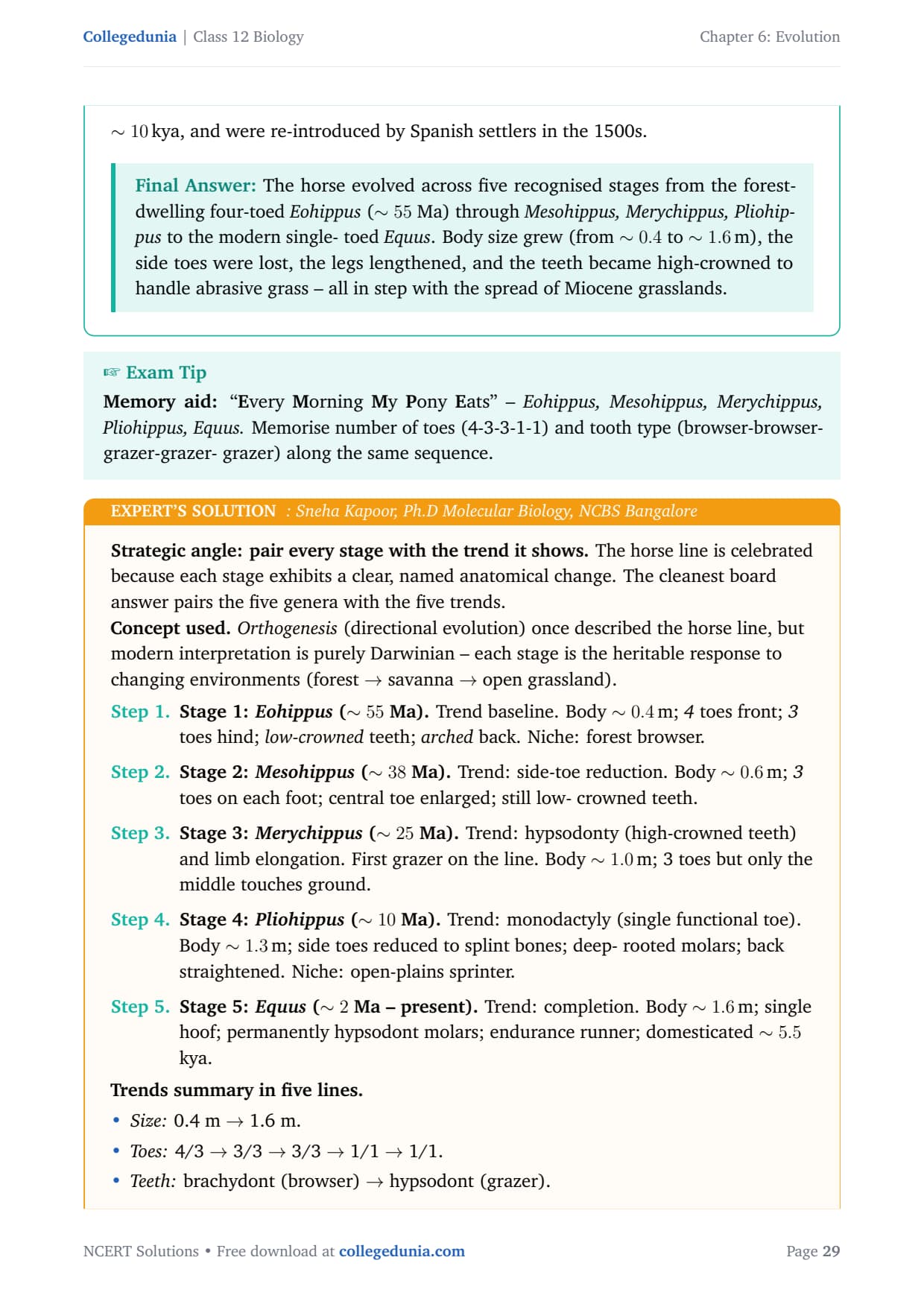
bridge, went extinct in North America ∼ 10 kya, and were
re-introduced by Spanish settlers in the 1500s.
The horse evolved across five recognised stages from the
forest-dwelling four-toed Eohippus (∼ 55 Ma) through
Mesohippus, Merychippus, Pliohippus to the modern single-
toed Equus. Body size grew (from ∼ 0.4 to
∼ 1.6 m), the side toes were lost, the legs lengthened, and
the teeth became high-crowned to handle abrasive grass – all in
step with the spread of Miocene grasslands.
SK
Sneha Kapoor
Ph.D Molecular Biology, NCBS Bangalore
Verified Expert
Strategic angle: pair every stage with the trend it shows.
The horse line is celebrated because each stage exhibits a clear,
named anatomical change. The cleanest board answer pairs the five
genera with the five trends.
Concept used.Orthogenesis (directional evolution)
once described the horse line, but modern interpretation is purely
Darwinian – each stage is the heritable response to changing
environments (forest → savanna → open grassland).
Stage 2: Mesohippus (∼ 38 Ma).
Trend: side-toe reduction. Body ∼ 0.6 m; 3
toes on each foot; central toe enlarged; still low-
crowned teeth.
Stage 3: Merychippus (∼ 25 Ma).
Trend: hypsodonty (high-crowned teeth) and limb
elongation. First grazer on the line. Body ∼ 1.0 m;
3 toes but only the middle touches ground.
Stage 4: Pliohippus (∼ 10 Ma).
Trend: monodactyly (single functional toe). Body
∼ 1.3 m; side toes reduced to splint bones; deep-
rooted molars; back straightened. Niche: open-plains
sprinter.
Stage 5: Equus (∼ 2 Ma – present).
Trend: completion. Body ∼ 1.6 m; single hoof;
permanently hypsodont molars; endurance runner;
domesticated ∼ 5.5 kya.
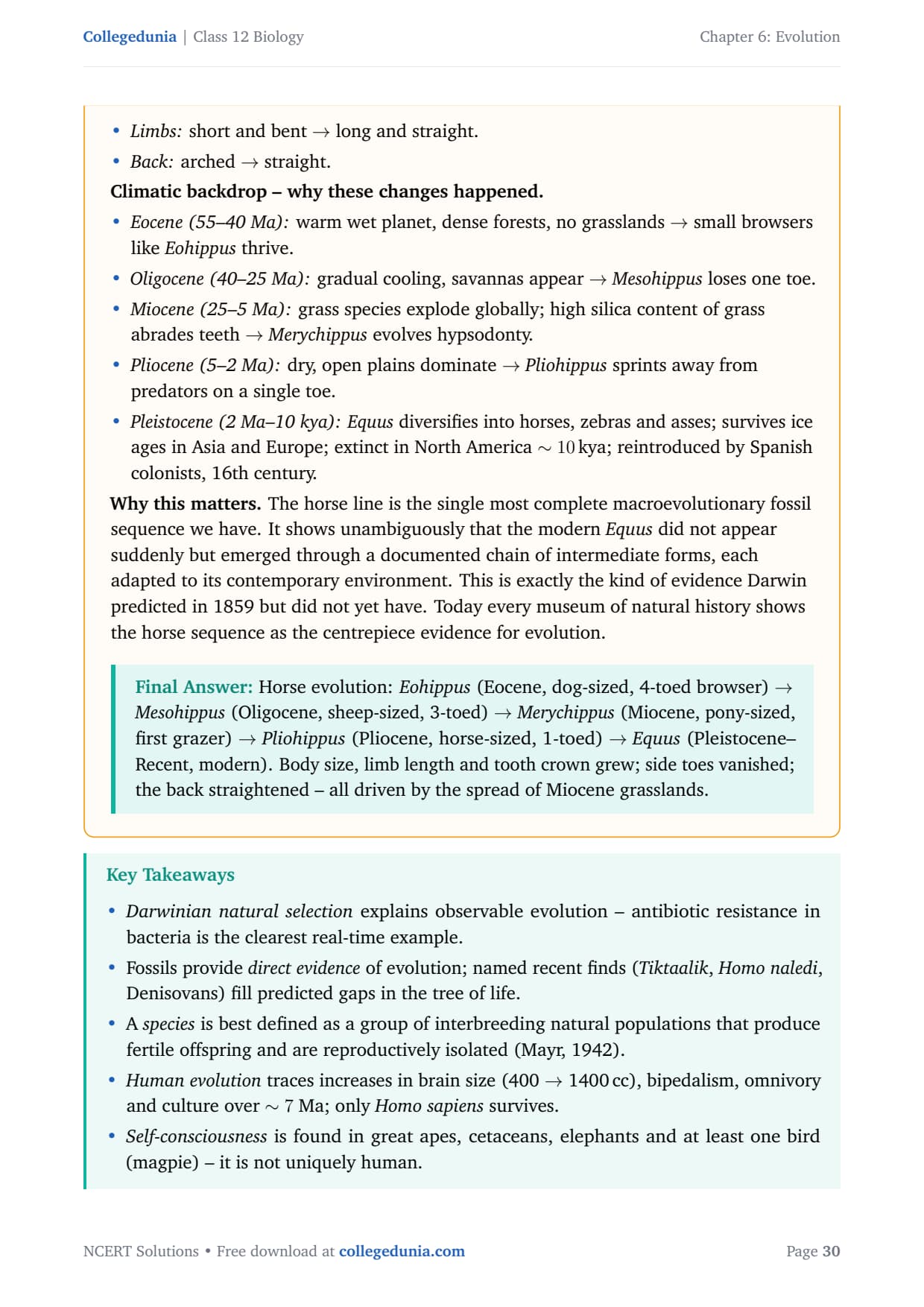
Trends summary in five lines.
Size: 0.4 m → 1.6 m.
Toes: 4/3 → 3/3 → 3/3 → 1/1 → 1/1.
Teeth: brachydont (browser) → hypsodont
(grazer).
Limbs: short and bent → long and straight.
Back: arched → straight.
Climatic backdrop – why these changes happened.
Eocene (55–40 Ma): warm wet planet, dense
forests, no grasslands → small browsers like
Eohippus thrive.
Miocene (25–5 Ma): grass species explode
globally; high silica content of grass abrades teeth
→Merychippus evolves hypsodonty.
Pliocene (5–2 Ma): dry, open plains dominate
→Pliohippus sprints away from predators on
a single toe.
Pleistocene (2 Ma–10 kya):Equus
diversifies into horses, zebras and asses; survives ice
ages in Asia and Europe; extinct in North America
∼ 10 kya; reintroduced by Spanish colonists, 16th
century.
Why this matters. The horse line is the single most
complete macroevolutionary fossil sequence we have. It shows
unambiguously that the modern Equus did not appear
suddenly but emerged through a documented chain of intermediate
forms, each adapted to its contemporary environment. This is
exactly the kind of evidence Darwin predicted in 1859 but did not
yet have. Today every museum of natural history shows the horse
sequence as the centrepiece evidence for evolution.
Horse evolution: Eohippus (Eocene, dog-sized,
4-toed browser) →Mesohippus (Oligocene, sheep-sized,
3-toed) →Merychippus (Miocene, pony-sized, first
grazer) →Pliohippus (Pliocene, horse-sized, 1-toed)
→Equus (Pleistocene–Recent, modern). Body size,
limb length and tooth crown grew; side toes vanished; the back
straightened – all driven by the spread of Miocene grasslands.
NCERT Solutions for Class 12 Biology: All Chapters
Browse the chapter-wise Class 12 Biology NCERT Solutions across the full 2026-27 syllabus on Collegedunia.
Student Feedback on Evolution Class 12 Biology NCERT Solutions
In a recent survey of 10,900 Class 12 Biology students, the Hardy-Weinberg derivation came out as the hardest part of the chapter, even though it carries the highest single-question marks in CBSE and NEET papers.
Student Feedback
72% of students rated the Hardy-Weinberg derivation the hardest sub-topic.
62% lost 1-2 marks mixing up Darwin's and Lamarck's theories.
4 out of 5 skipped the Miller-Urey apparatus diagram in their answer sheet.
The average student spent 5.4 hours on the first read and 2.3 hours on a focused revision pass.
Source: 2025-26 Class 12 Biology student survey, 10,900 students across 18 states.
Evolution Class 12 Biology NCERT Solutions FAQs
Ques. Where can I download Class 12 Biology Chapter 6 Evolution NCERT Solutions PDF?
Ans. You can download the Evolution Class 12 Biology NCERT Solutions PDF directly from this page. Both the Normal and HD versions are free and aligned with the 2026-27 NCERT.
Ques. How many NCERT exercise questions are there in Class 12 Biology Chapter 6 Evolution?
Ans. The end-of-chapter exercise has 10 numbered questions covering Darwinian selection, fossils, the species concept, human evolution, self-consciousness, modern-animal to fossil-ancestor pairings, comparative anatomy, adaptive radiation, and the horse lineage. The PDF carries step-by-step worked answers to every one of them.
Ques. What is the NEET weightage of Class 12th Biology Chapter 6 Evolution?
Ans. NEET pulls 5 to 7 questions from this chapter every year. Human evolution, adaptive radiation, and Hardy-Weinberg algebra are the three highest-yield sub-topics, together generating roughly 50 percent of the chapter's NEET pull.
Ques. Are these Evolution NCERT Solutions aligned with the 2026-27 syllabus?
Ans. Yes. This page reflects the current 2026-27 syllabus for Class 12 Biology. NCERT did not trim Evolution in the latest edition, so all 10 exercise questions are still examinable for CBSE Boards and NEET.
Ques. Which is the most-asked NCERT question from Evolution in CBSE Boards?
Ans. Q1 (antibiotic resistance under Darwinian selection) and Q4 (components of human evolution) are the two most frequently repeated. Both have appeared in at least three of the last five CBSE Board papers, usually as 5-mark long answers.
Ques. Why is human evolution not a classical adaptive radiation?
Ans. Adaptive radiation requires multiple coexisting descendant species in distinct ecological niches (Darwin's finches, Australian marsupials). Human evolution branched into many hominid species (Australopithecus, Paranthropus, Homo habilis, H. erectus, H. neanderthalensis) but all except Homo sapiens are extinct, and the niche differences were modest. It is better described as branching descent with heavy extinction, not a true adaptive radiation. The PDF answer to Q9 explains this with all four diagnostic criteria.
Ques. How do these NCERT Solutions help with NEET preparation for Evolution?
Ans. Every solution flags the exact phrase NEET asks verbatim - "differential survival", "branching descent", "convergent evolution", "encephalisation quotient", "Mayr 1942" - so the answer doubles as a one-mark MCQ recall sheet. The alternate "Expert's Solution" rewrites each question from a NEET examiner's lens, giving you two attempt paths for the same content.
Ques. What is the Hardy-Weinberg principle and which forces disturb it?
Ans. Hardy-Weinberg states that allele frequencies in a population remain constant from generation to generation in the absence of disturbing forces: p2 + 2pq + q2 = 1 with p + q = 1 . The five disturbing forces are gene flow, genetic drift, mutation, genetic recombination, and natural selection. Memorising both the algebra and all five forces is the topper-mark answer for any Hardy-Weinberg numerical.
Ques. Are diagrams and source-book figures included in the Class 12 Biology Chapter 6 NCERT Solutions PDF?
Ans. Yes. Five figures are pulled directly from the NCERT 2026-27 chapter: the dinosaur family tree (Fig 6.2), Darwin's finch beaks (Fig 6.5), the Australian marsupial radiation (Fig 6.6), the vertebrate evolutionary tree (Fig 6.10), and the hominid skull comparison (Fig 6.11). What you see in the PDF matches the printed textbook exactly.







Comments