




The Class 11 Physics NCERT Solutions Chapter 7 Gravitation will help students prepare for Boards, JEE Main, JEE Advanced, NEET, CUET and NDA in 2026-27. Every back-exercise question is solved with full working, so students can check each force calculation, gravity variation, potential energy step, and escape-velocity numerical one line at a time.
This chapter links the fall of an apple to the orbit of the Moon, and its formulas return again in later mechanics and space-physics questions.
- CBSE Weightage: 6 to 8 marks, usually one derivation plus one numerical on gravity, orbits or escape velocity.
- Questions solved: all Exercise 7.1 onward, covering Newton's law, Kepler's laws, gravity variation, potential energy, and satellites.
- Key formulas: universal gravitation, g variation with height and depth, escape velocity, orbital velocity, geostationary orbit.
Each solution in this Class 11 Physics NCERT Solutions Chapter 7 Gravitation compilation is curated by subject experts, based on the 2026-27 NCERT textbook, and refined against the last five years of CBSE Board, JEE Main and NEET papers.
Newton's Universal Law of Gravitation and the Gravitational Constant
The chapter opens with a single rule that holds for every pair of masses in the universe. Newton's law of gravitation says two point masses attract each other along the line joining them. Getting this force expression right is the first step in almost every numerical in the chapter.
The force between two masses m1 and m2 a distance r apart is F = G m1m2 / r2. The constant G is the same everywhere, which is why the law is called universal.
- Direction: the force is always attractive and acts along the line joining the two centres.
- Inverse-square: double the distance and the force drops to one quarter.
- Gravitational constant: G = 6.67 × 10⁻¹¹ N m2 kg-2, found by Cavendish.
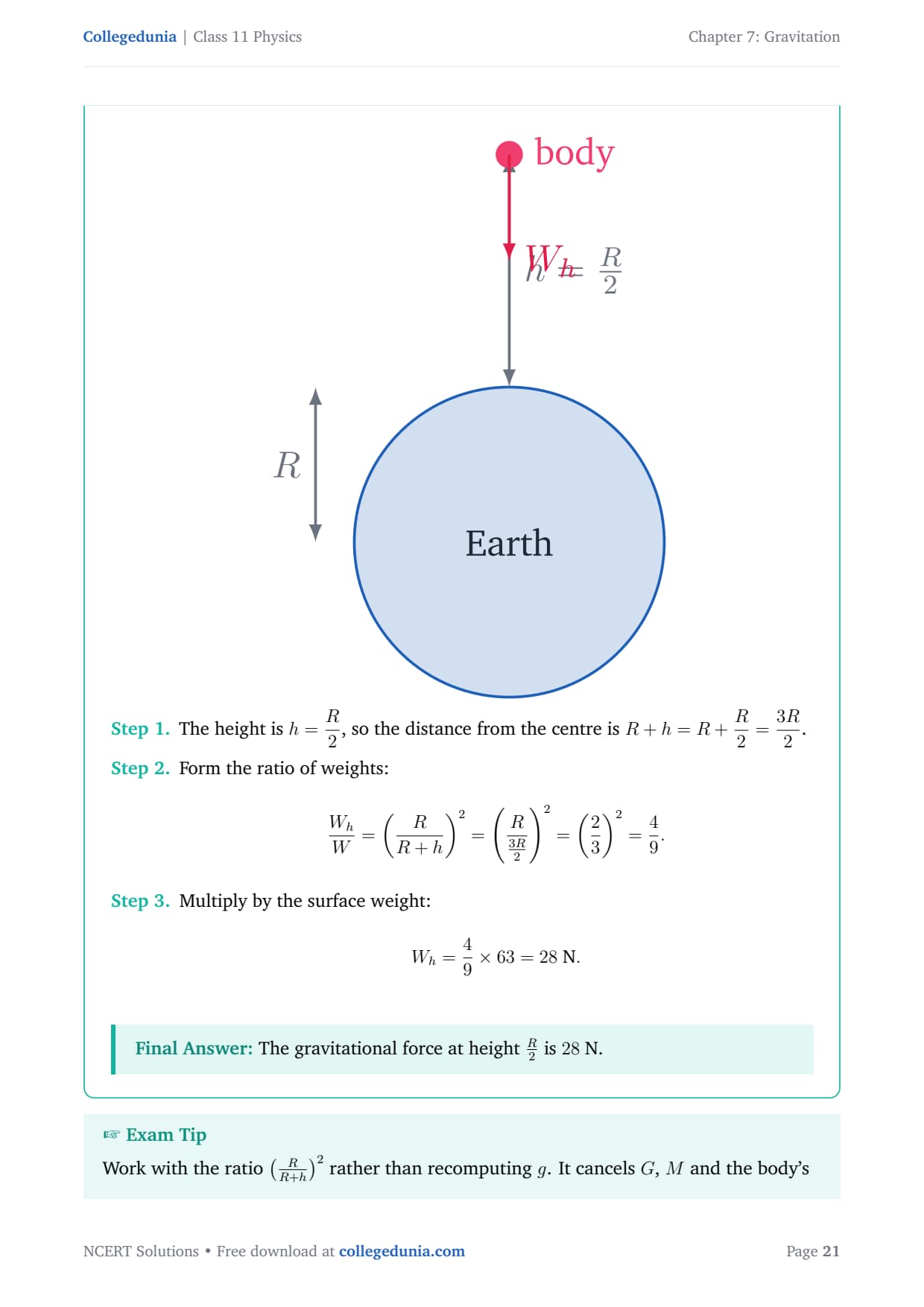
Questions such as Exercise 7.1 ask students to compare the gravitational pull in different situations. Treat a uniform sphere as if its whole mass sits at its centre. The solved answers state this shell result before substituting numbers, so the distance in the formula is never measured from the wrong point.
Kepler's Three Laws of Planetary Motion
Before Newton, Kepler described how planets actually move using three laws drawn from observation. The NCERT solutions use these laws in every orbit and period question, so students must know all three by name and by meaning.
- Law of orbits: every planet moves in an ellipse with the Sun at one focus.
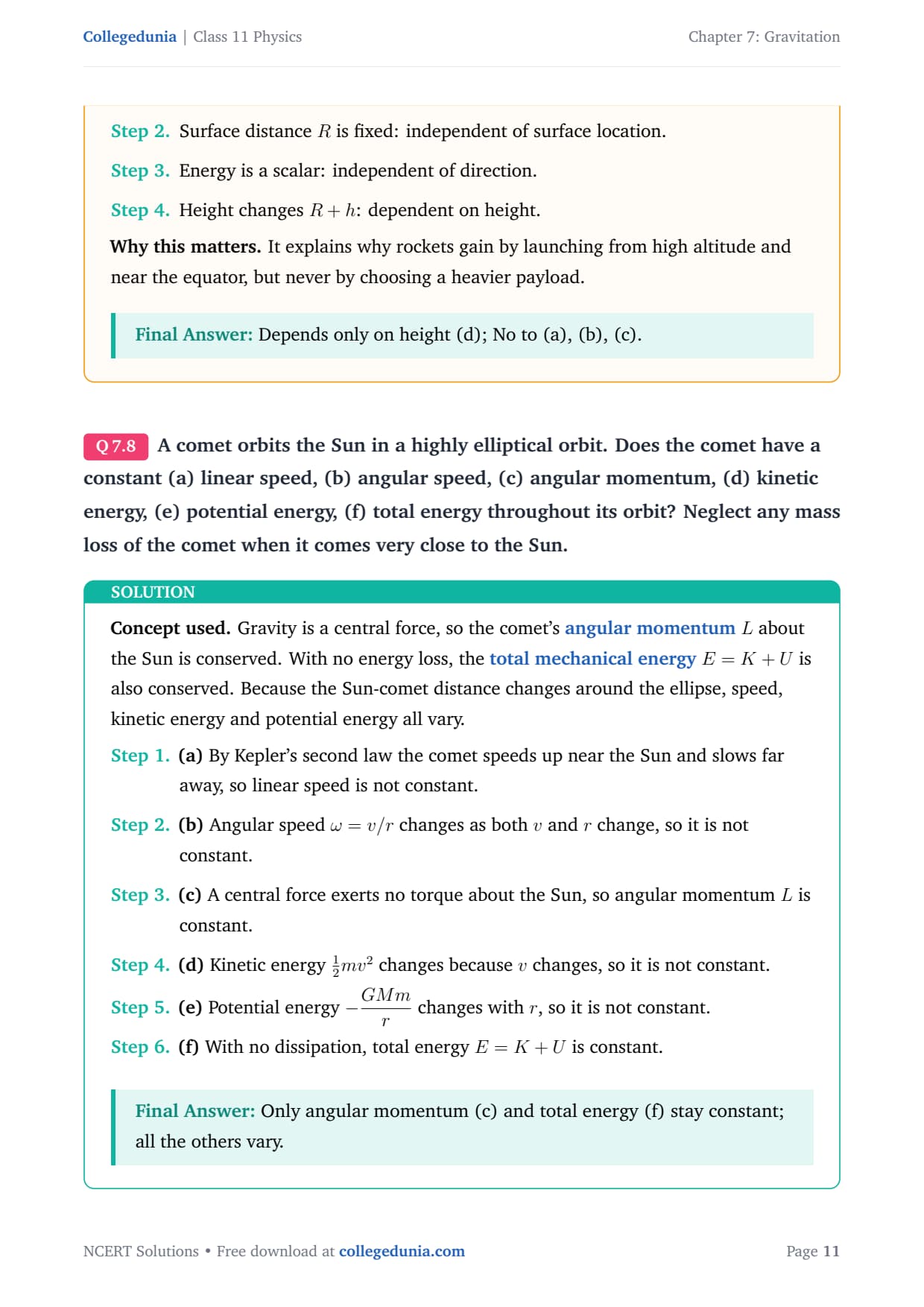
- Law of areas: the line from the Sun to a planet sweeps equal areas in equal times, so a planet moves faster when it is nearer the Sun.
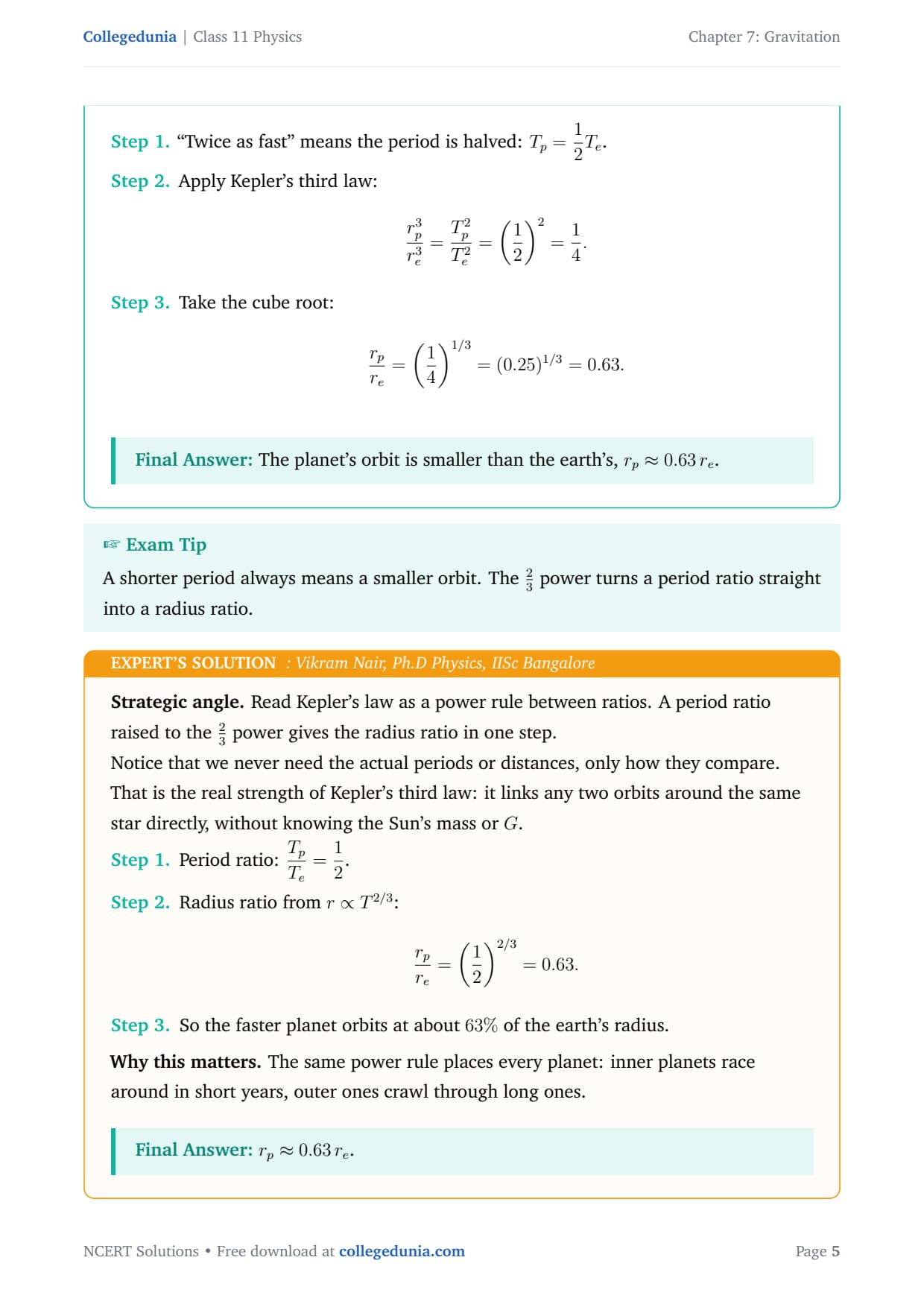
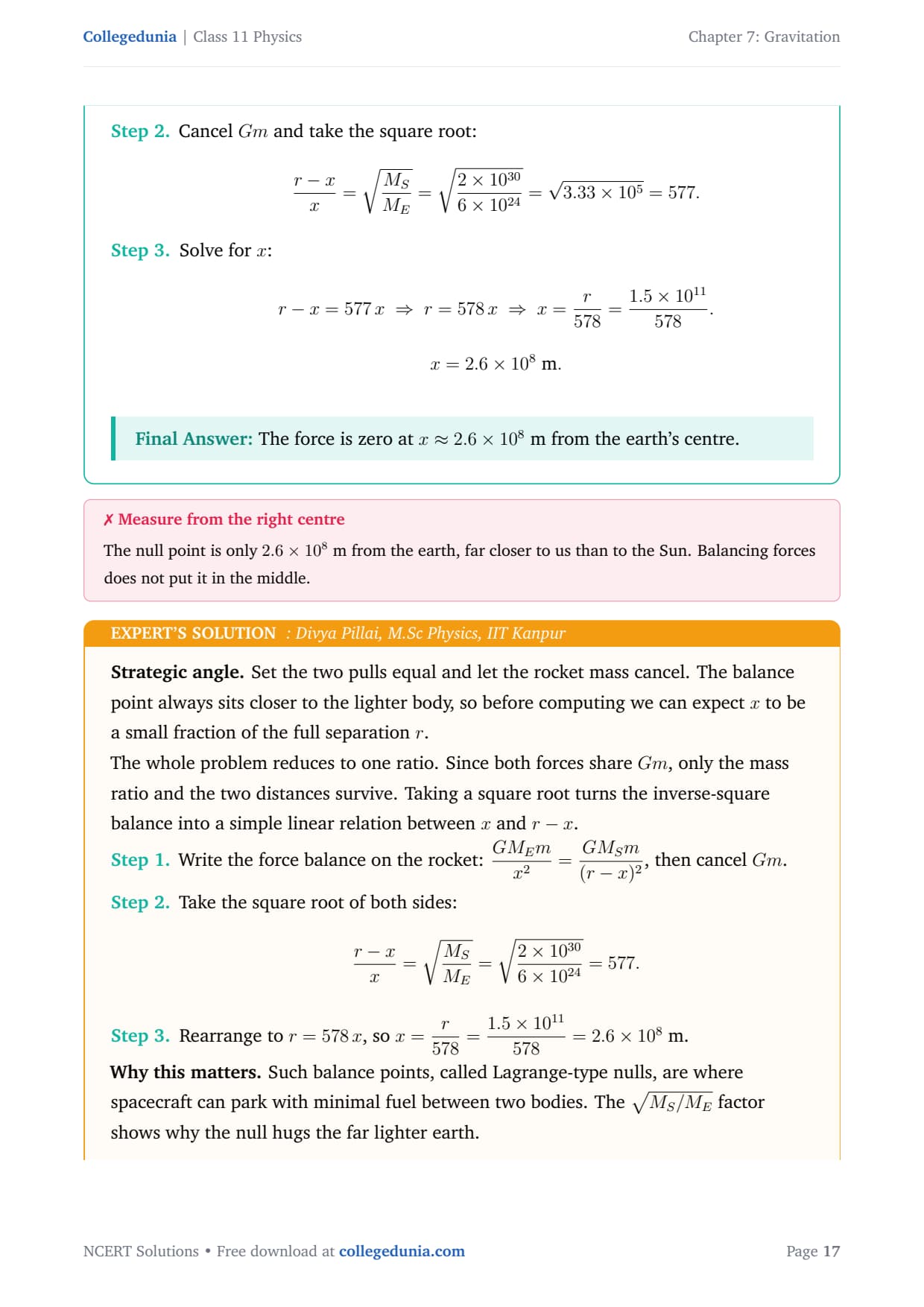
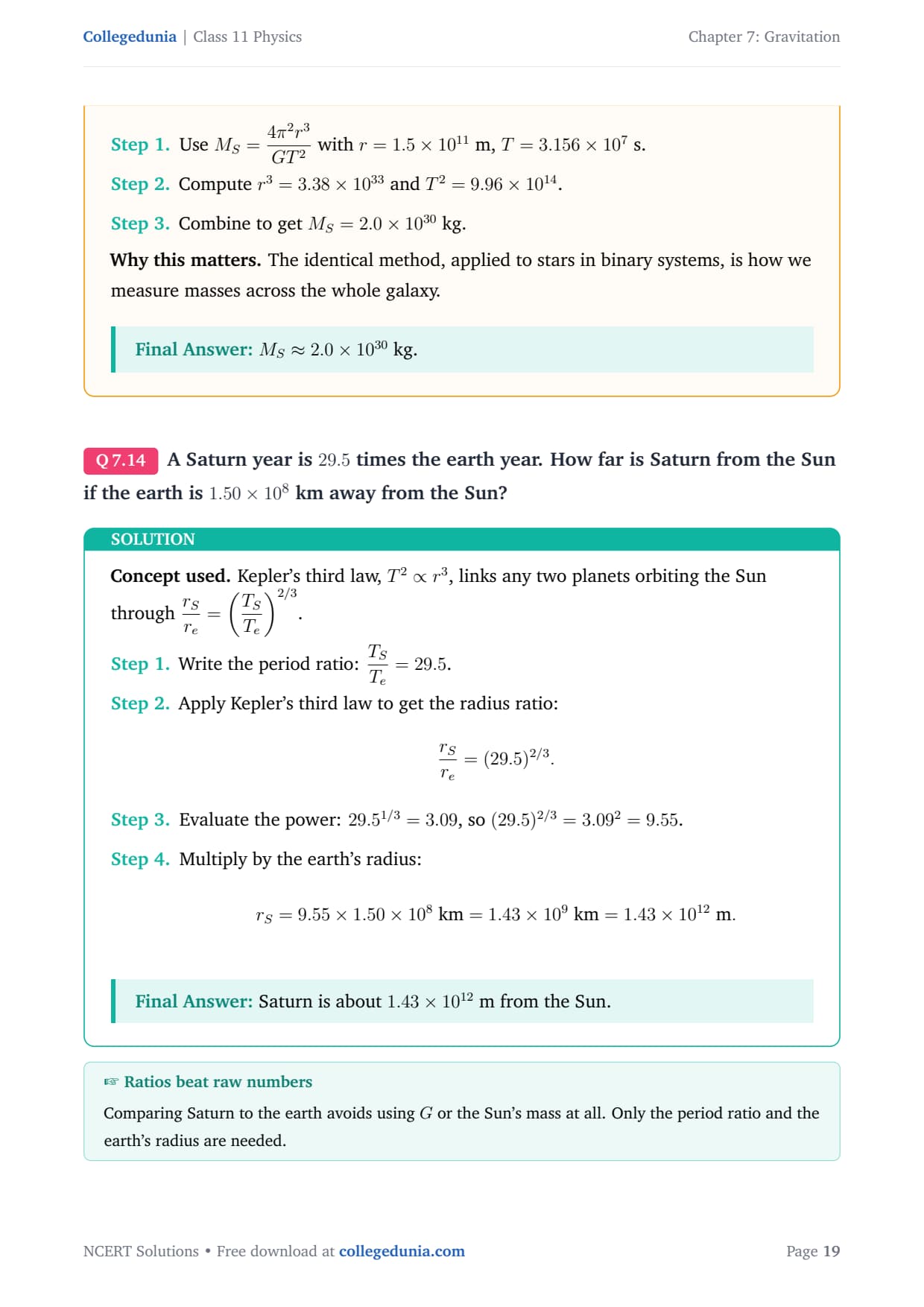
- Law of periods: the square of the time period is proportional to the cube of the semi-major axis, T2 ∝ r3.
The law of areas is really the conservation of angular momentum, since gravity is a central force with no torque about the Sun. Numericals like Exercise 7.2 use the third law to compare the periods or distances of two planets. The ratio method is the fastest route: write T2/r3 as a constant and cancel. The solutions show the cancellation in full so no step is skipped.
Acceleration Due to Gravity and Its Variation with Height, Depth and Latitude
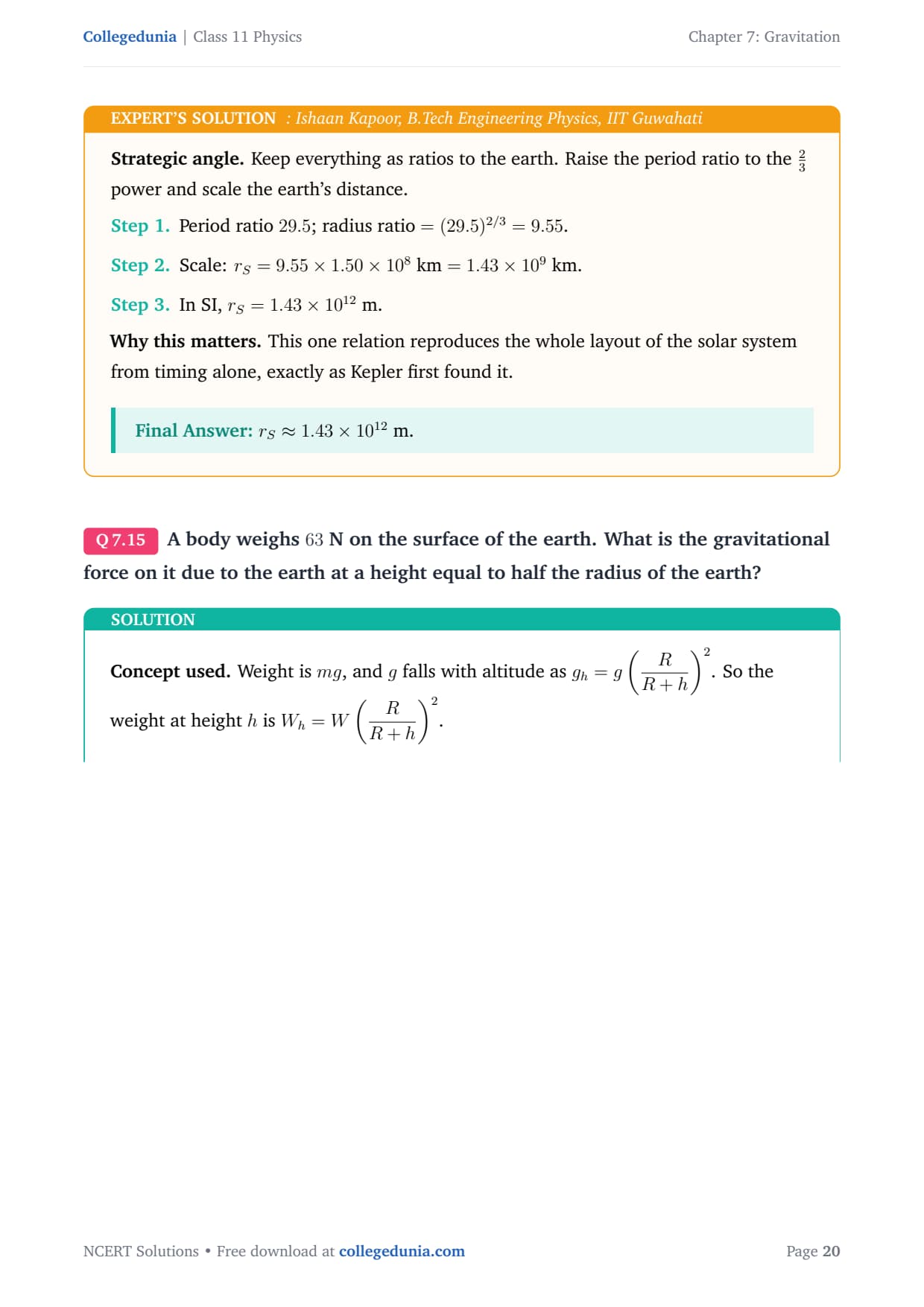
The value of g at the Earth's surface comes straight from the law of gravitation: g = G M / R2, where M and R are the mass and radius of the Earth. But g is not fixed. The chapter tests how it changes with position, and the NCERT answers cover every case.
| Change in position | Effect on g |
|---|---|
| At height h above surface | Decreases: g' = g (1 − 2h/R) for small h |
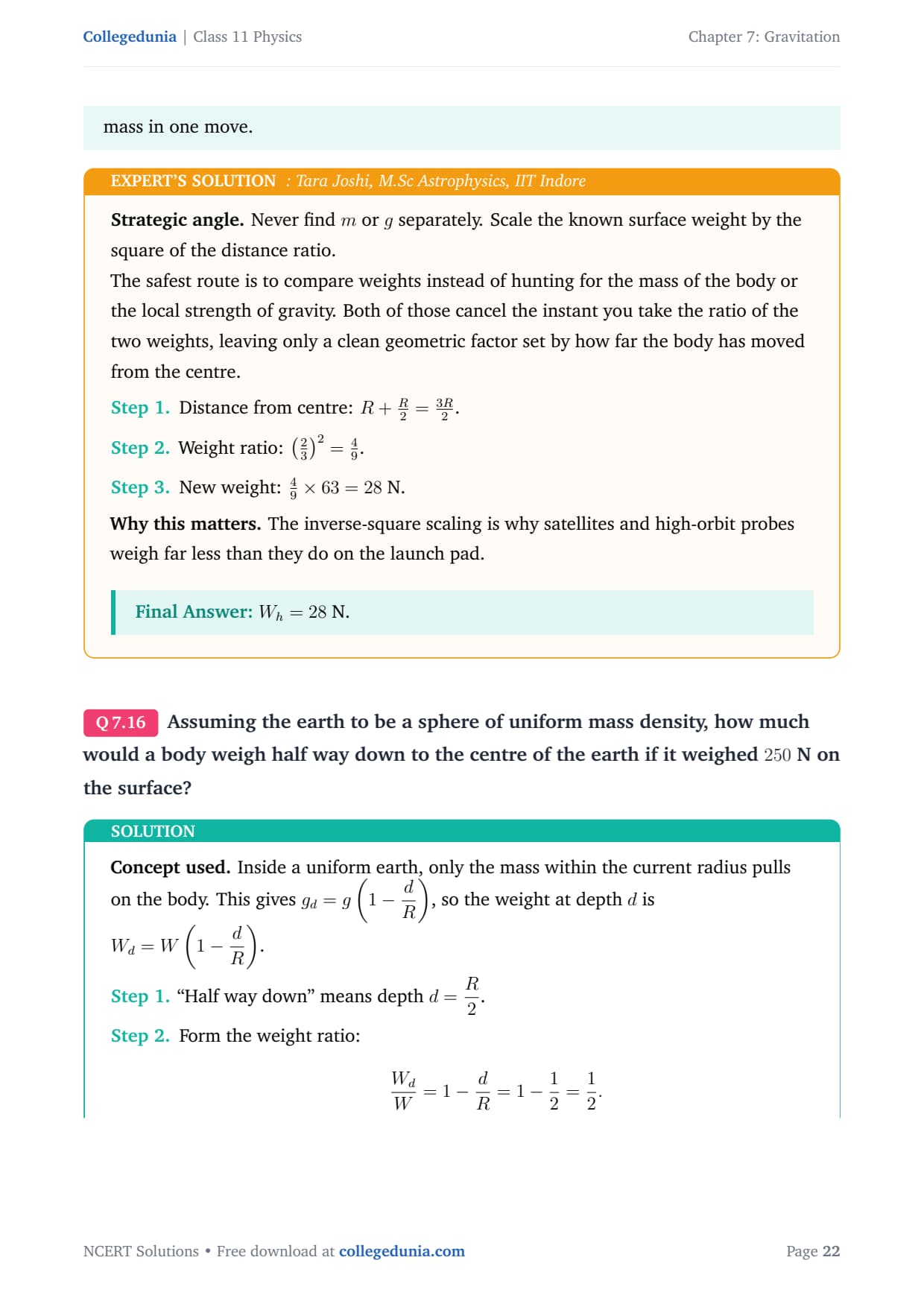
| At depth d below surface | Decreases: g' = g (1 − d/R) |
| With latitude (rotation) | Least at the equator, greatest at the poles |
A common trap is that gravity falls off in both directions from the surface, up into the sky and down into the Earth, but by different rules. At the centre of the Earth, g is zero. Questions such as Exercise 7.6 ask for the value of g at a given altitude, and the solutions pick the height or depth formula first, then substitute, so students never mix the two.
Gravitational Potential Energy and Gravitational Potential
Lifting a mass against gravity stores energy. Near the surface this is just mgh, but for large distances the chapter uses the full form. The NCERT solutions apply it to escape problems, binding energy, and satellite energy.
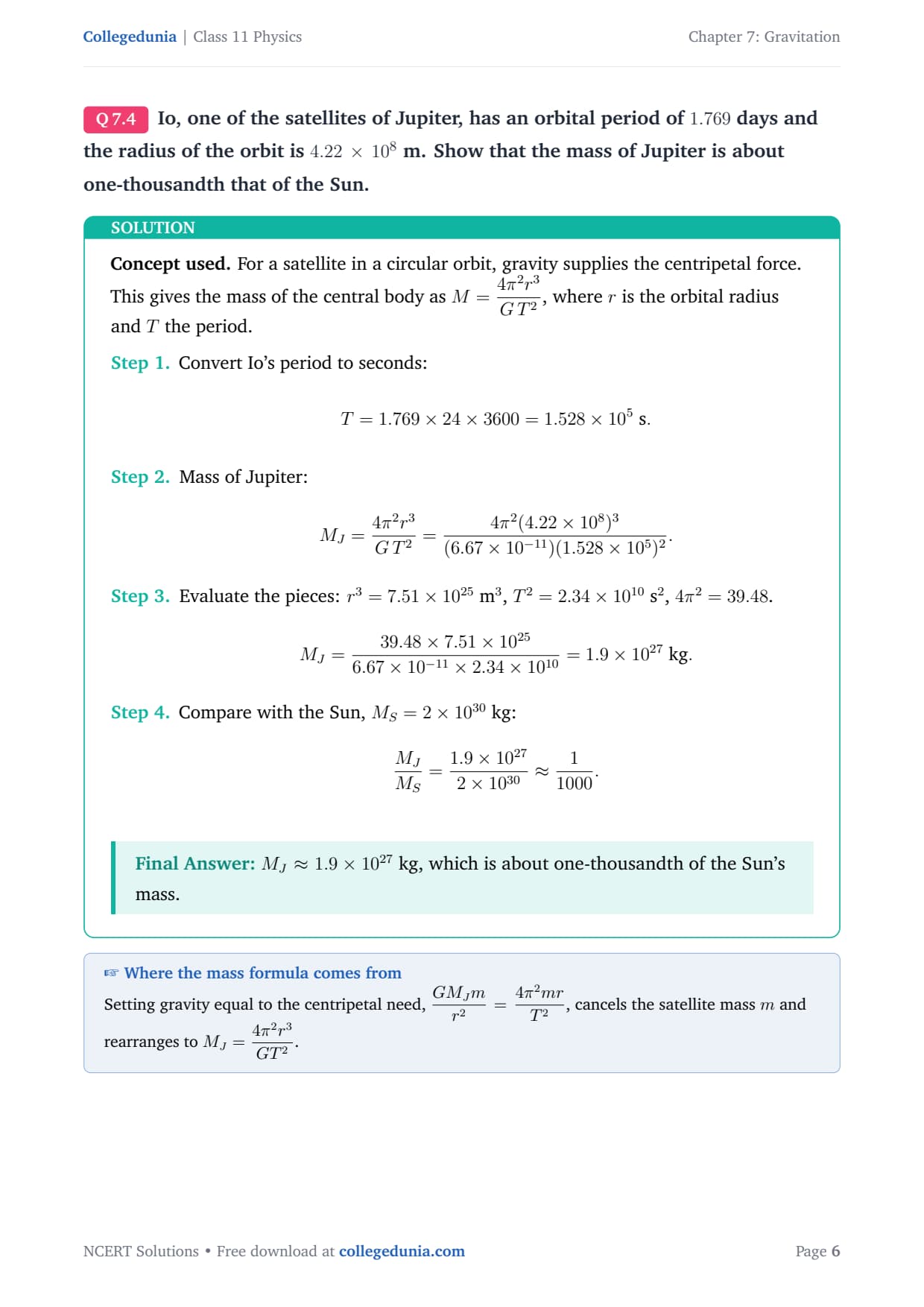
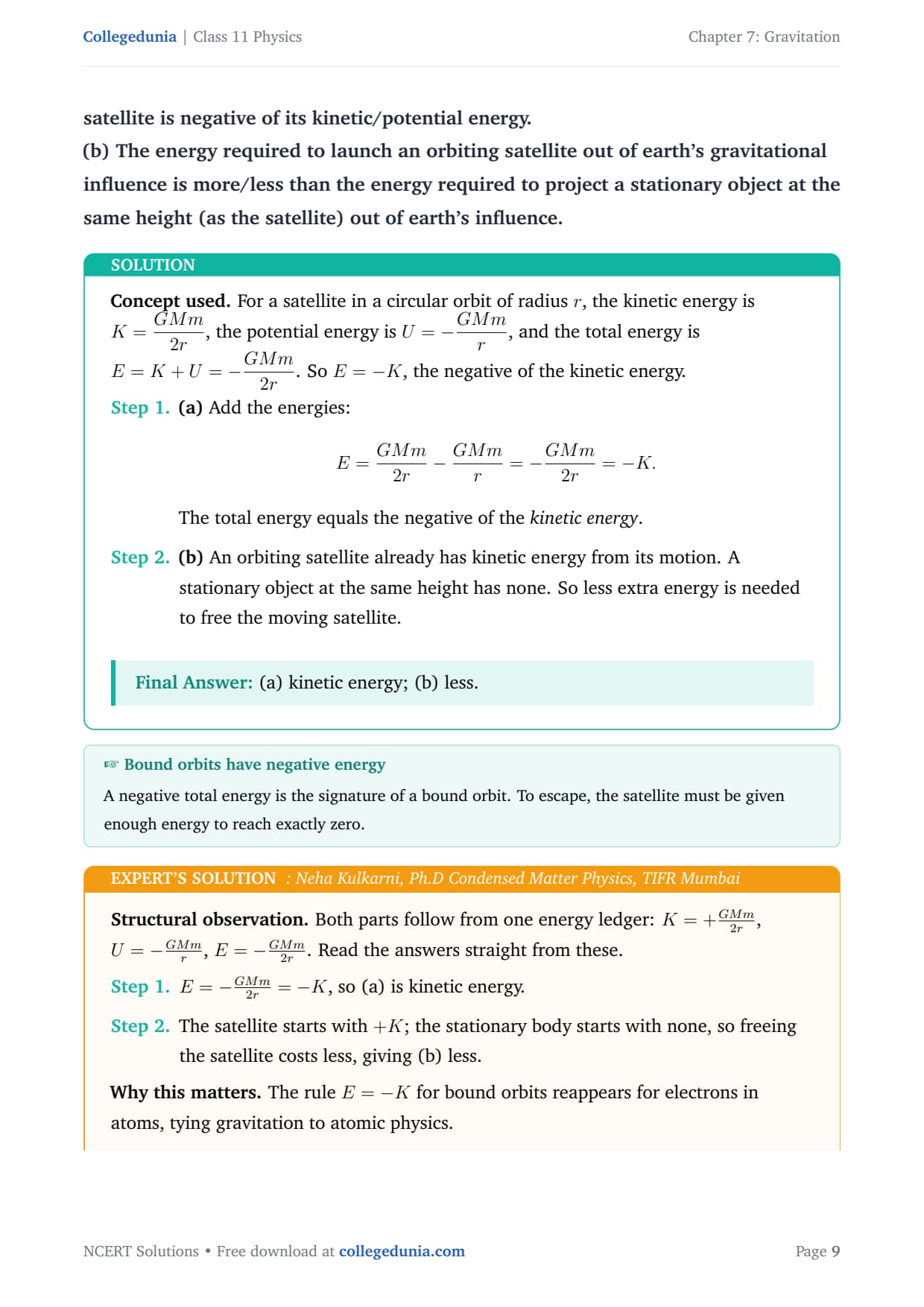
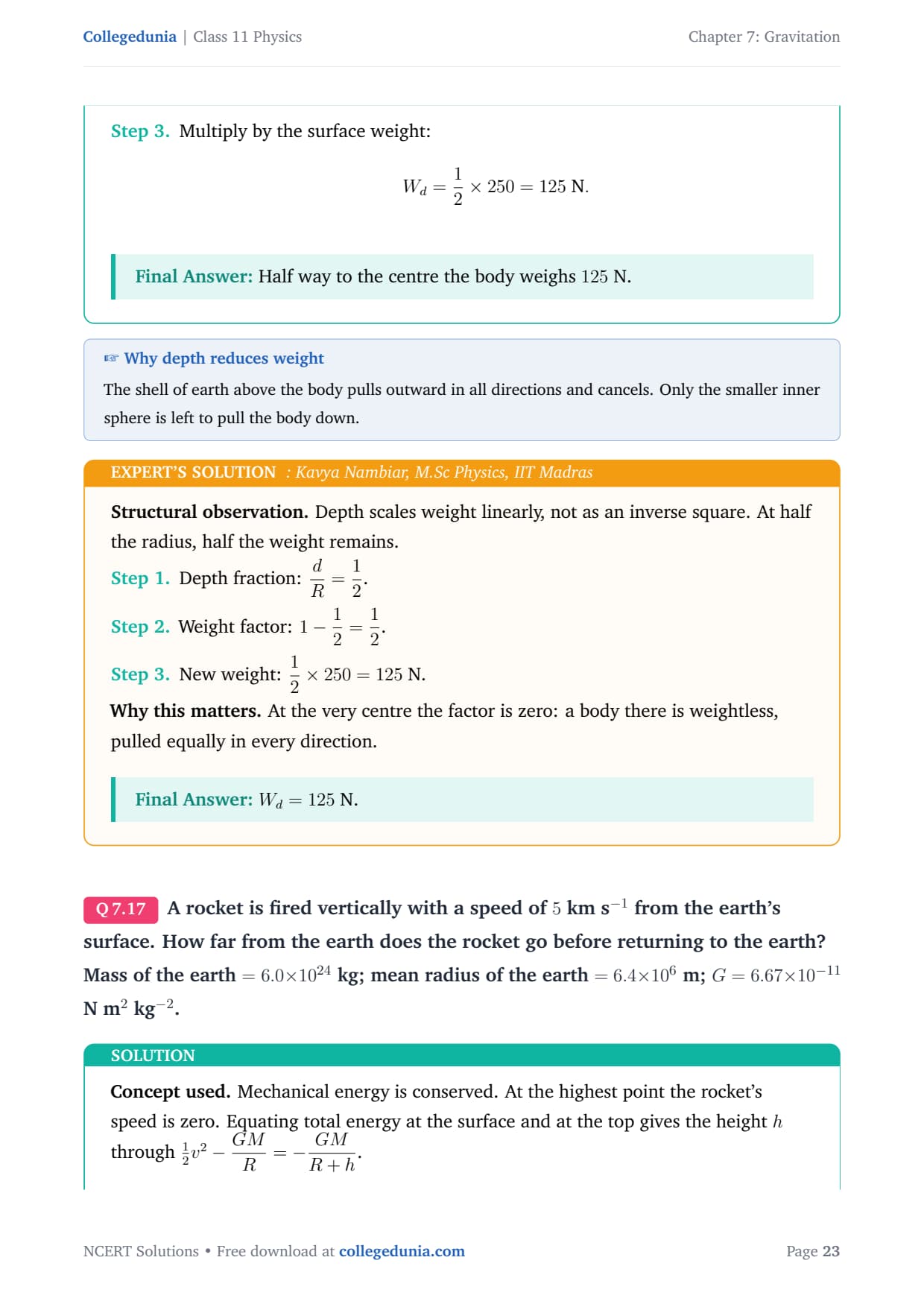
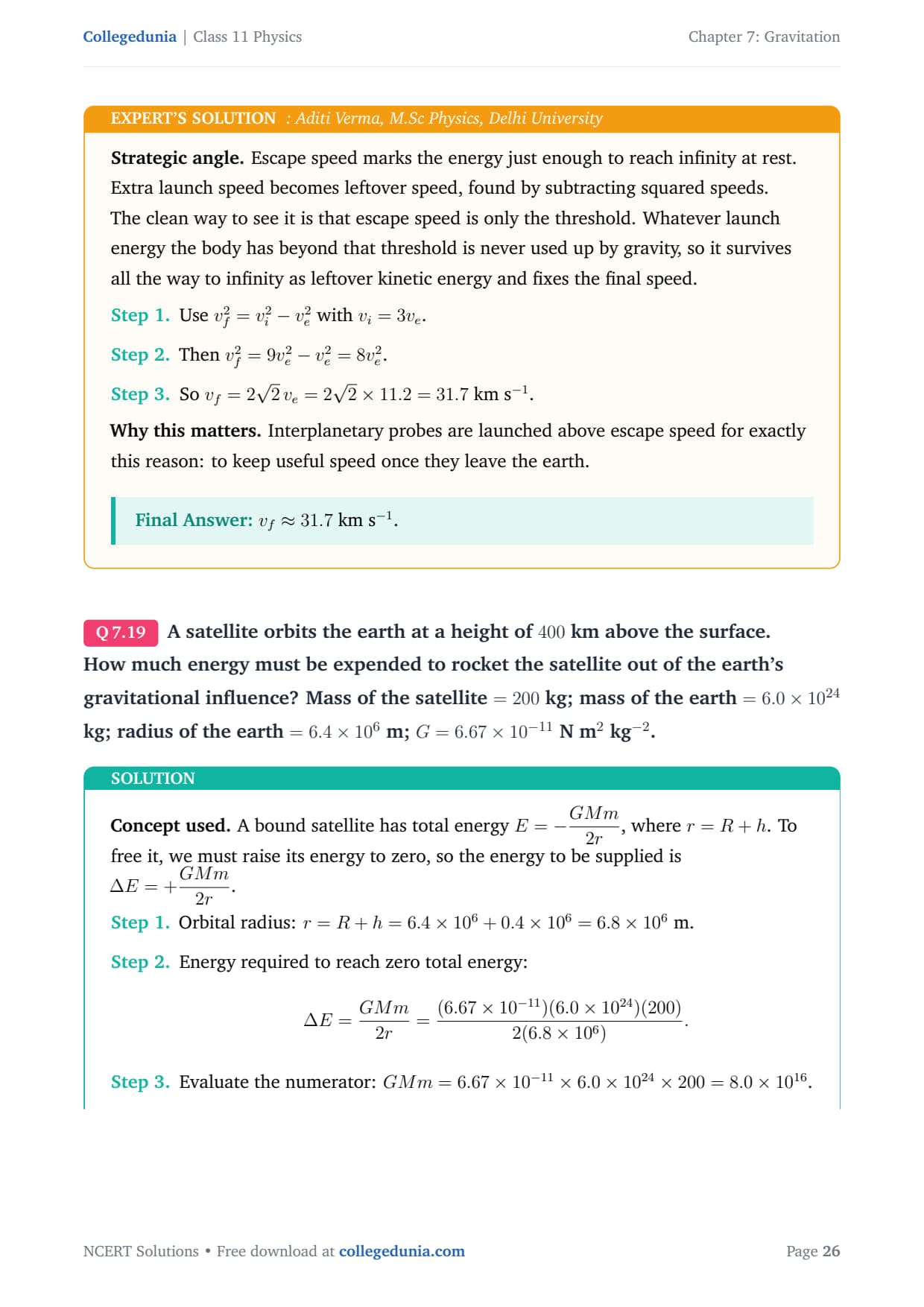
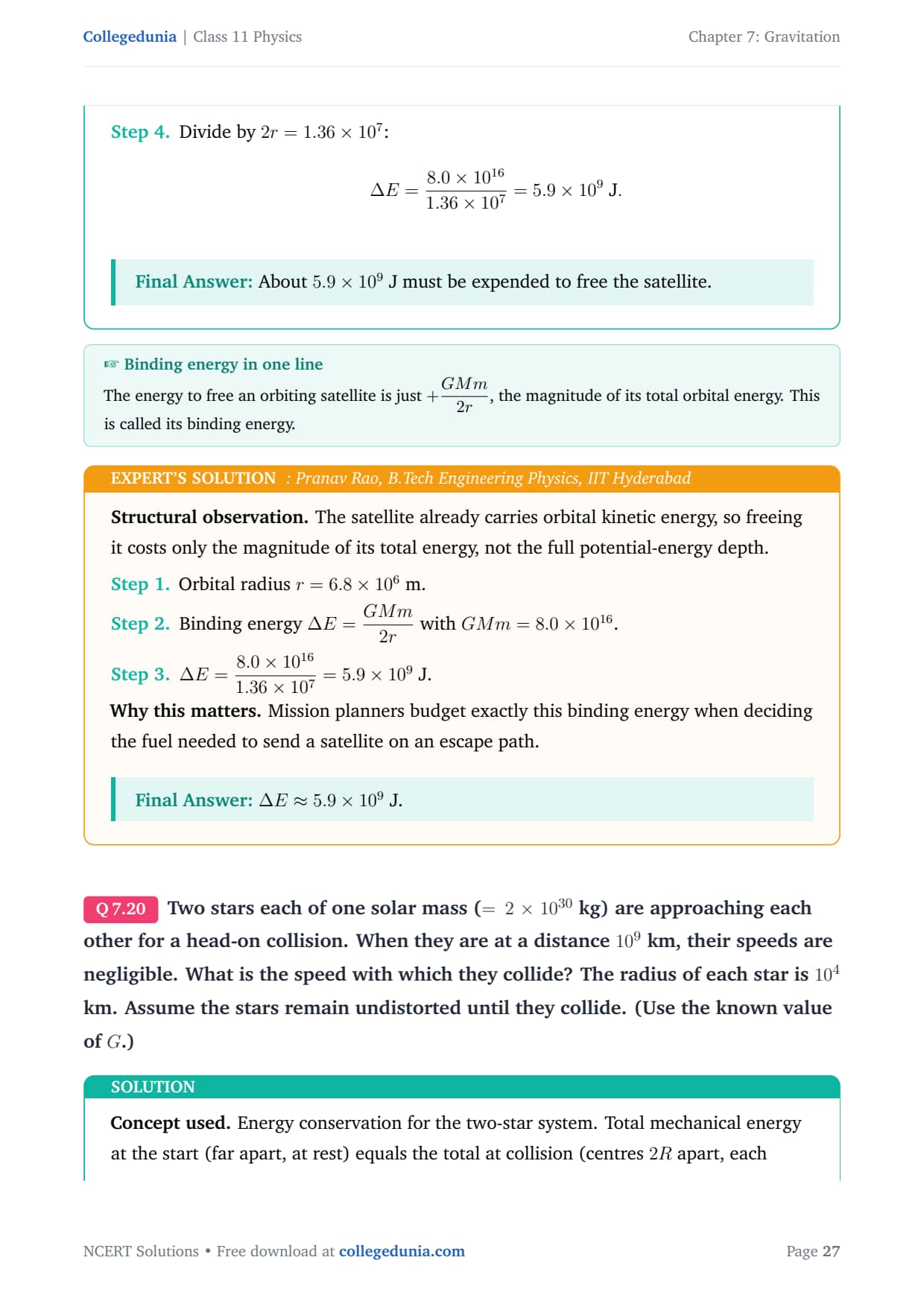
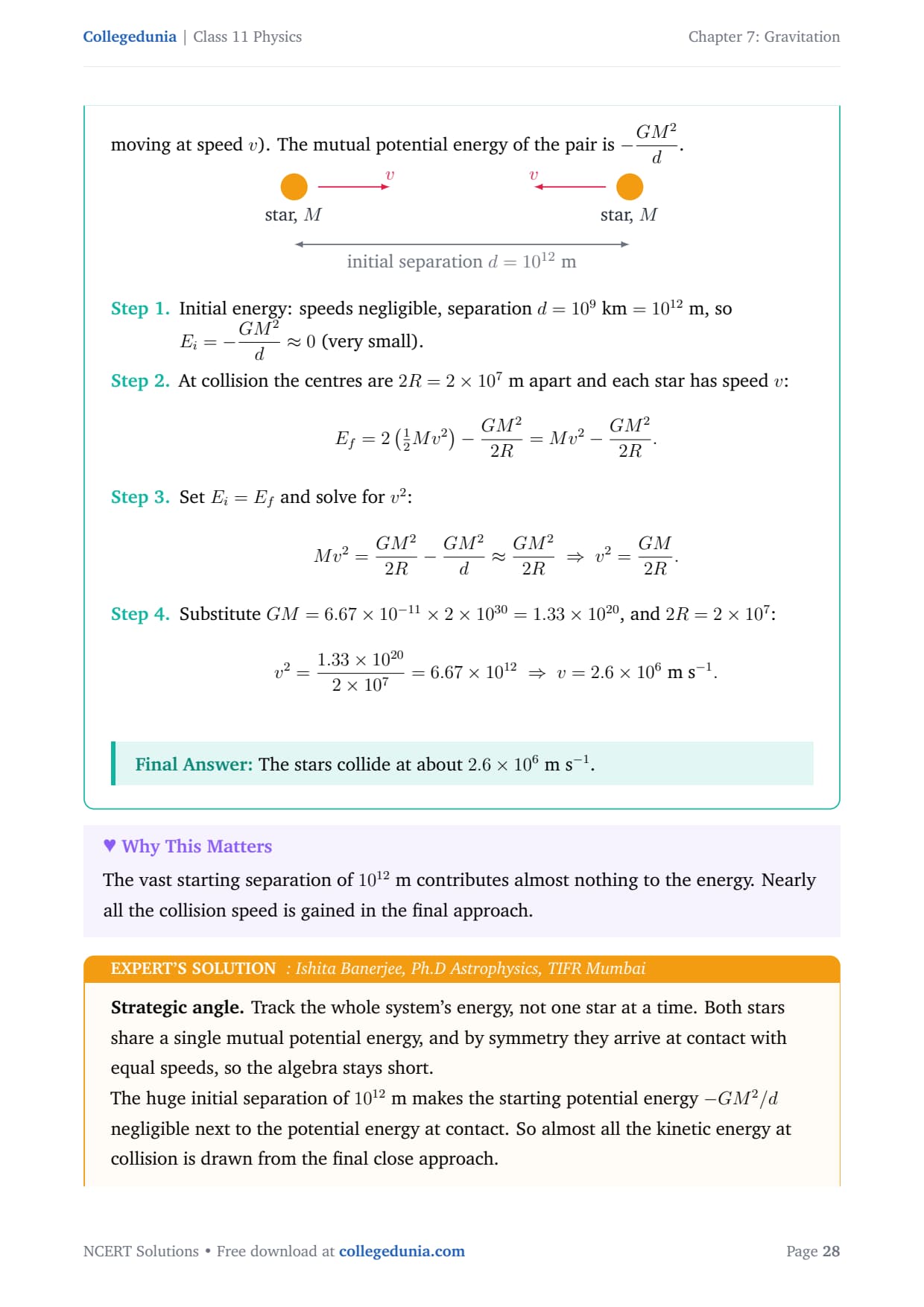
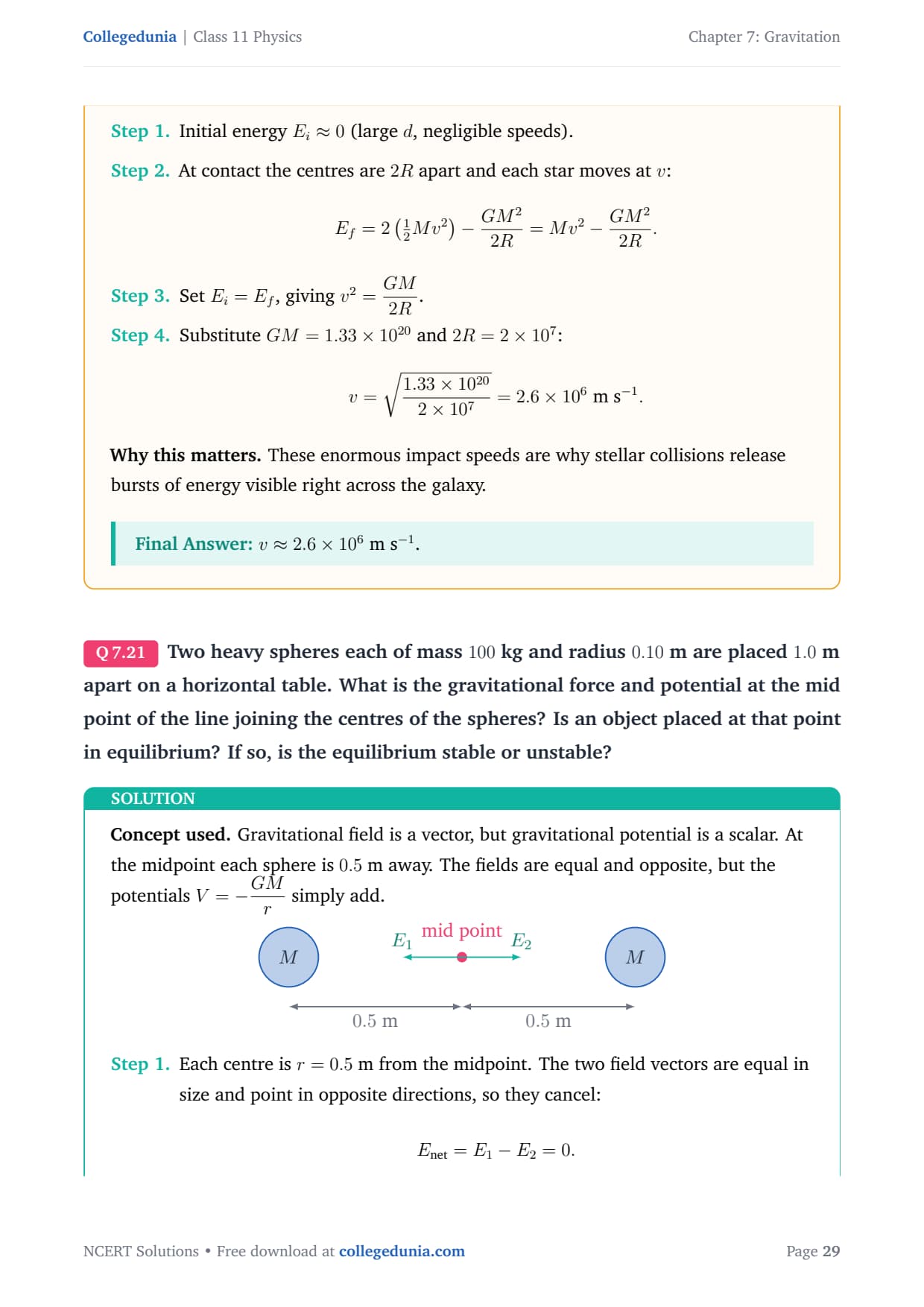
The gravitational potential energy of two masses a distance r apart is U = − G M m / r. The minus sign matters: it shows the two masses are bound, and that energy must be added to pull them apart.
- Potential energy: U = − G M m / r, taken as zero at infinite separation.
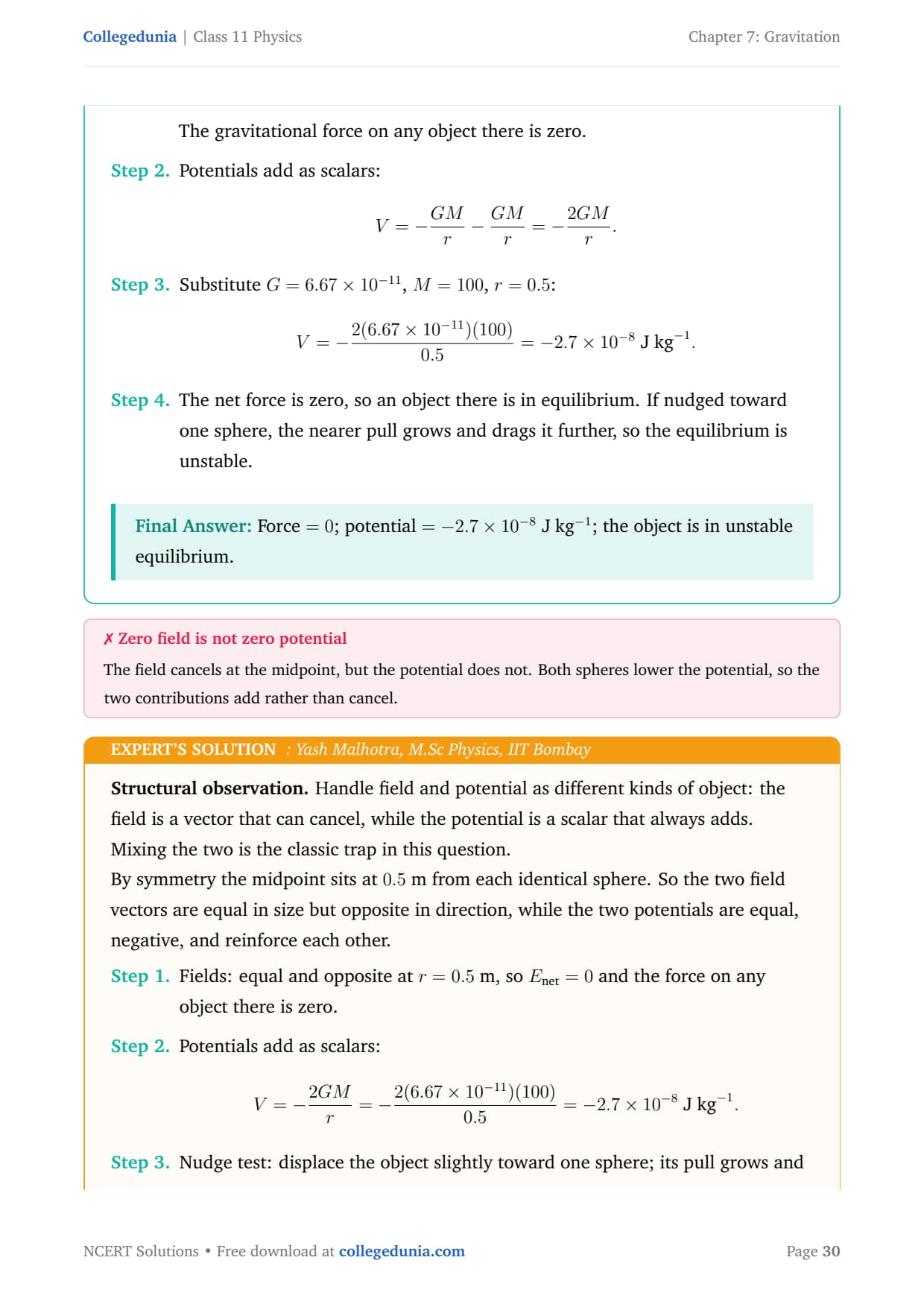
- Gravitational potential: the energy per unit mass, V = − G M / r.
- Work done: to move a mass between two points, use the change in potential energy, not the force.
The value at infinity is chosen as zero, so every bound position has a negative potential energy. A more negative energy means a more tightly bound system. The Class 11 Physics NCERT Solutions Chapter 7 Gravitation keep the sign on every line, because dropping the minus sign is the single most common error in energy numericals here.
Escape Velocity and Orbital Velocity of a Satellite
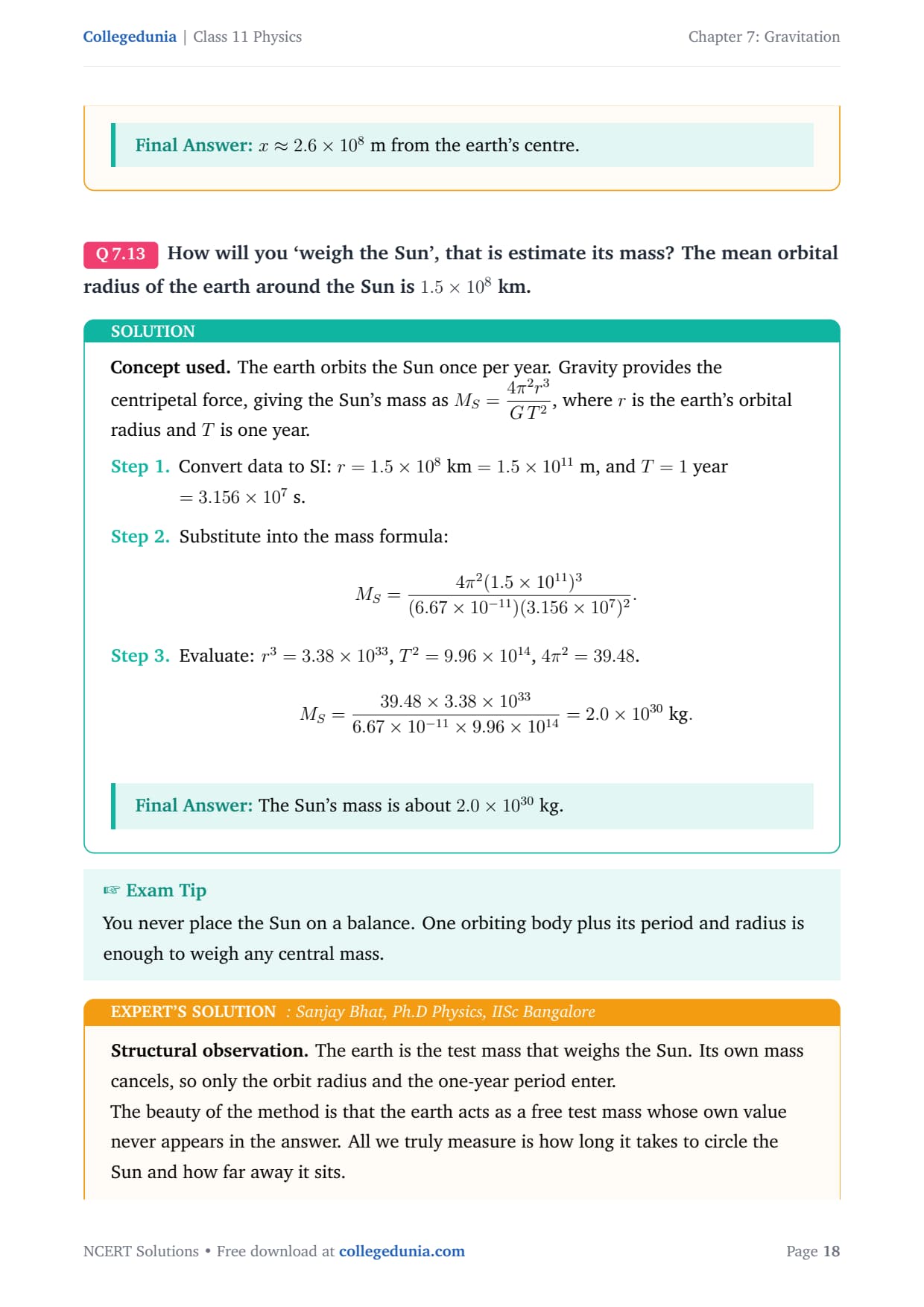
Two speeds dominate the numerical part of the chapter. Escape velocity is the least speed a body needs to leave a planet for good. Orbital velocity is the speed a satellite needs to stay in a circular orbit. Both come from energy and force balance, and the NCERT solutions derive each one before using it.
| Quantity | Formula | Meaning |
|---|---|---|
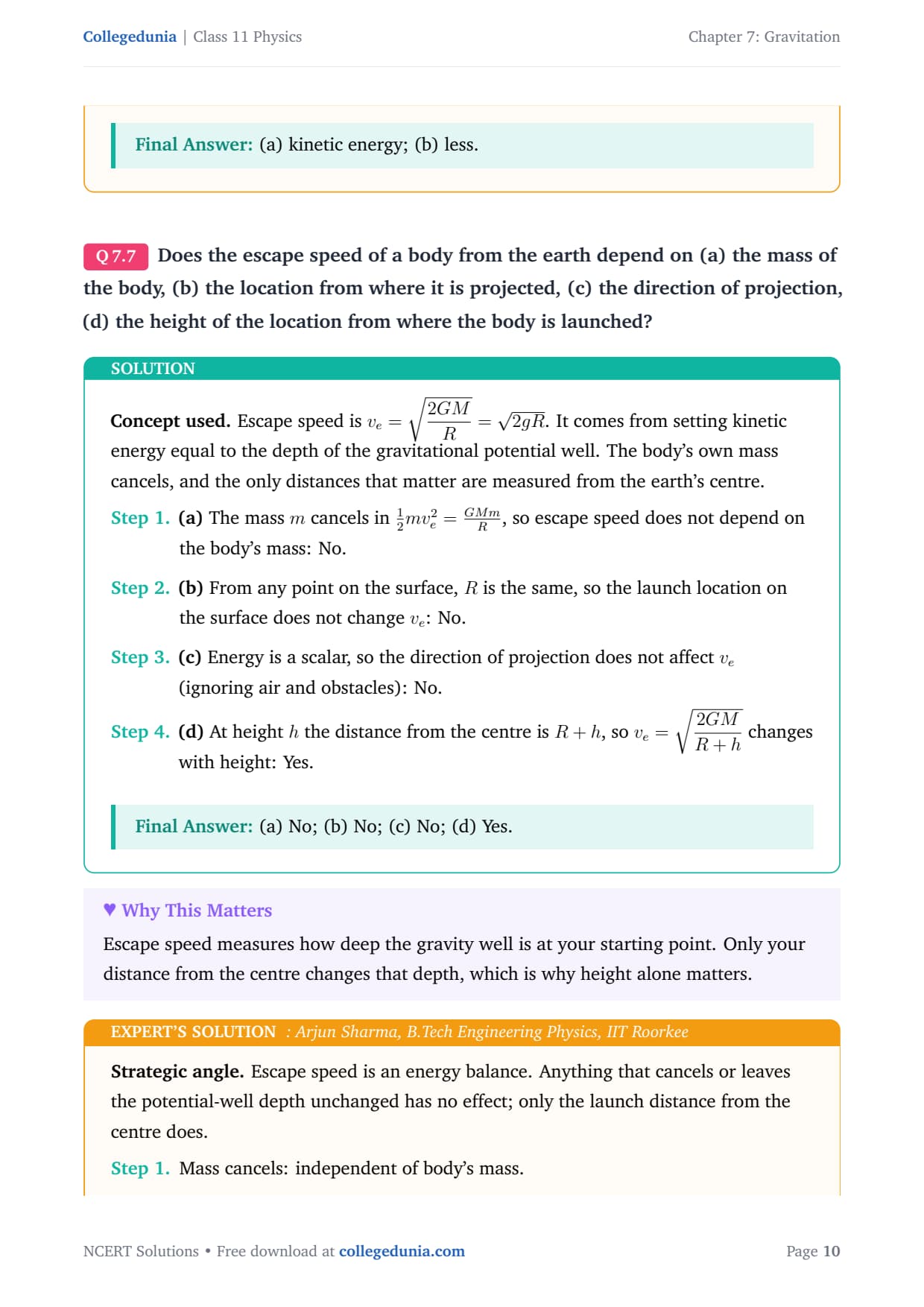
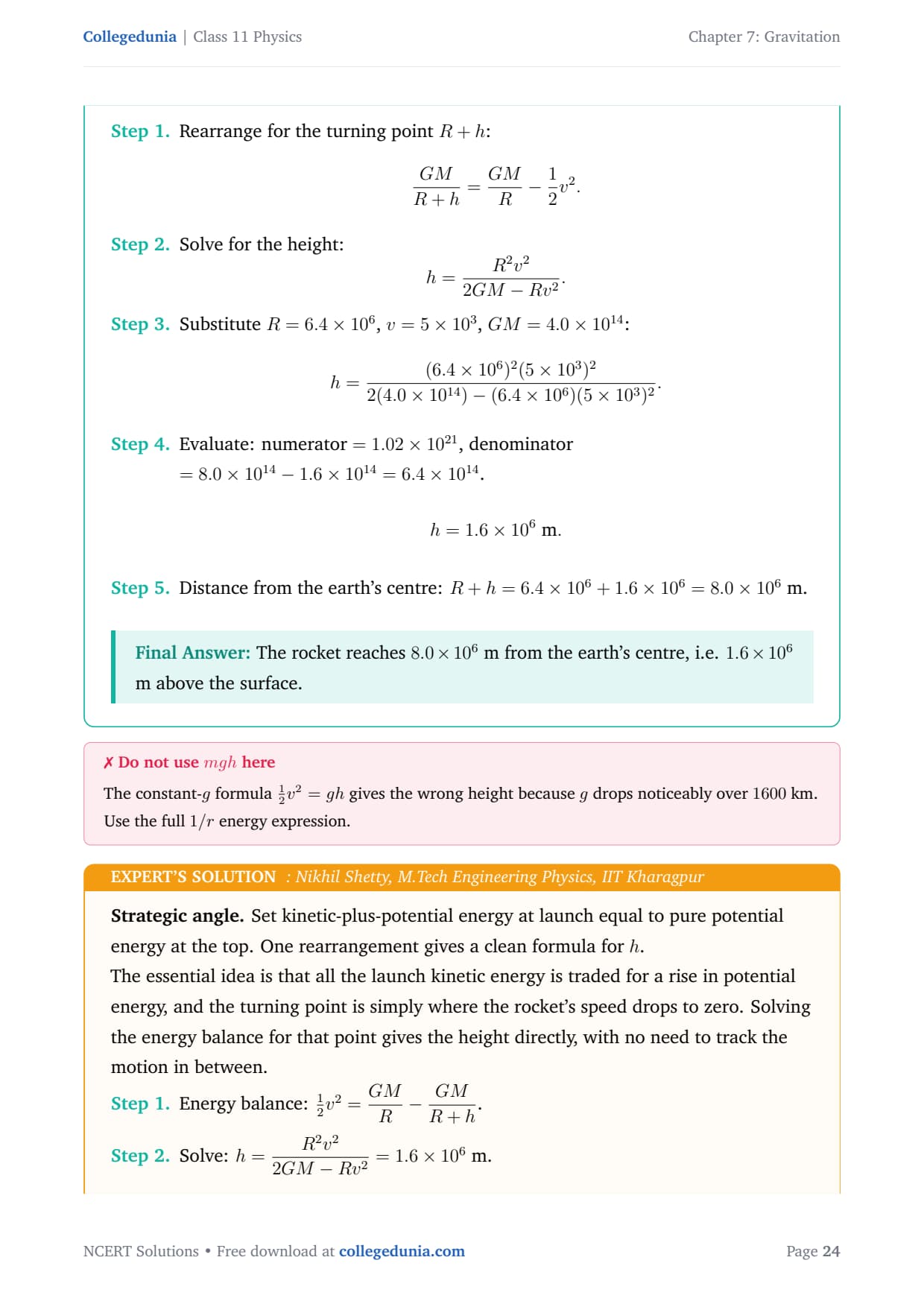
| Escape velocity | ve = √(2G M/R) = √(2g R) | Speed to break free from the surface |
| Orbital velocity (near surface) | vo = √(G M/R) = √(g R) | Speed to circle just above the surface |
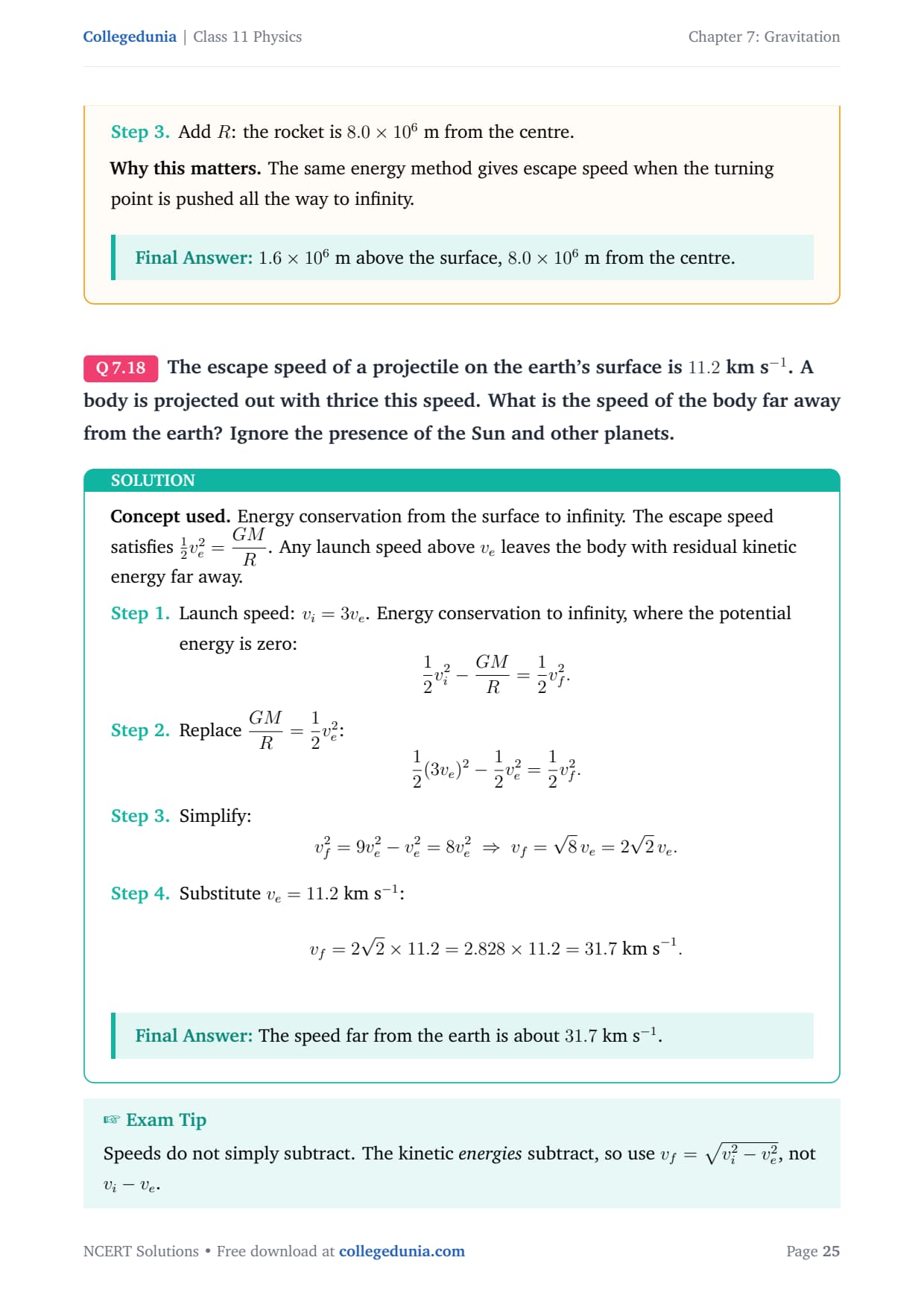
The two are linked by a clean result: ve = √2 × vo. For the Earth the escape speed is about 11.2 km/s, and it does not depend on the mass or the direction of launch of the escaping body. Numericals such as Exercise 7.10 ask students to find the escape speed for a given planet. The solutions show the √(2g R) form, which avoids needing the mass of the planet at all.
Earth Satellites, Geostationary Orbits and Weightlessness
The last part of the chapter puts a real satellite in orbit and studies its energy. These ideas appear in short-answer questions and in one-mark objective items for JEE Main and NEET. The NCERT solutions explain each with reasoning a student can reproduce.
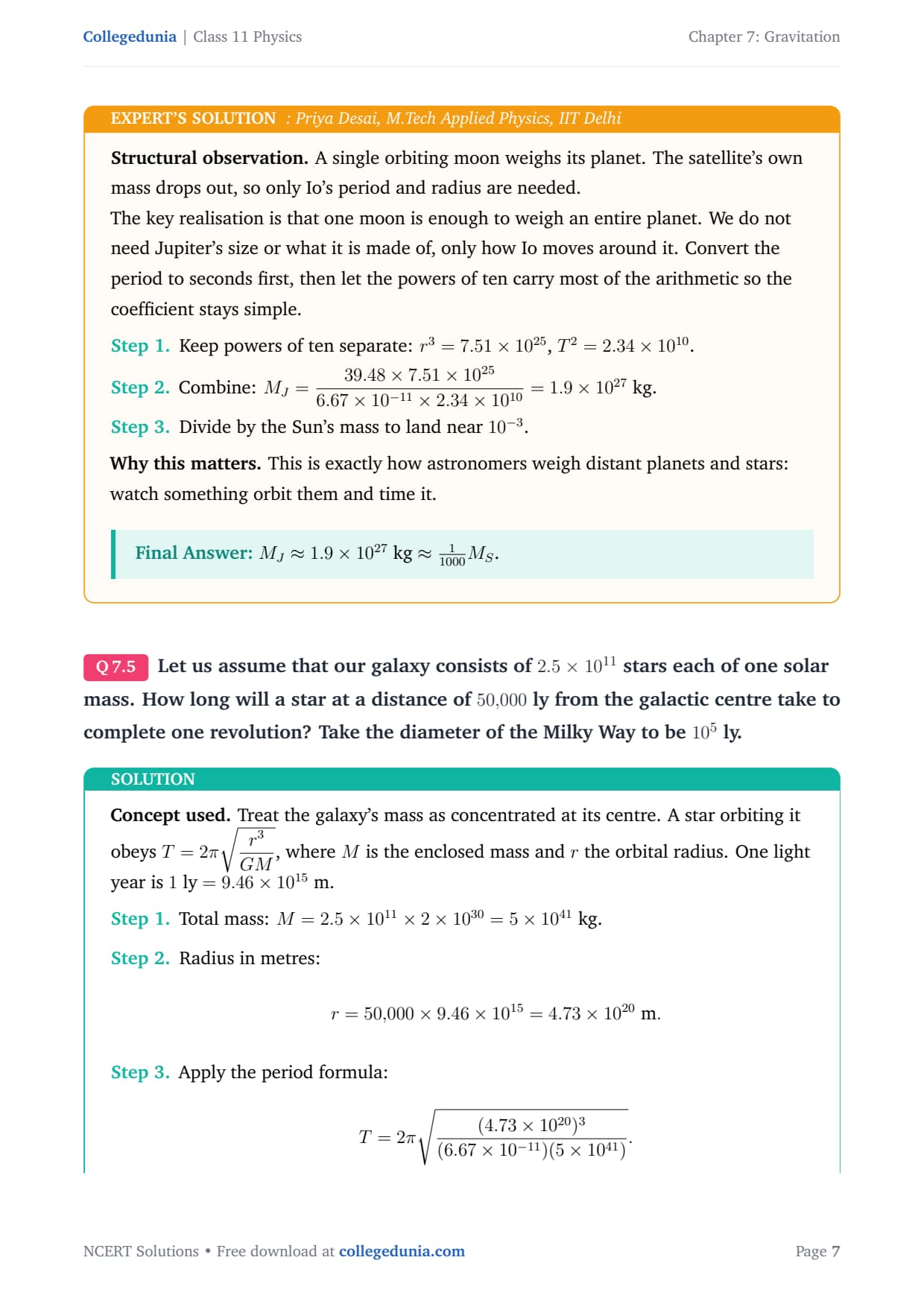
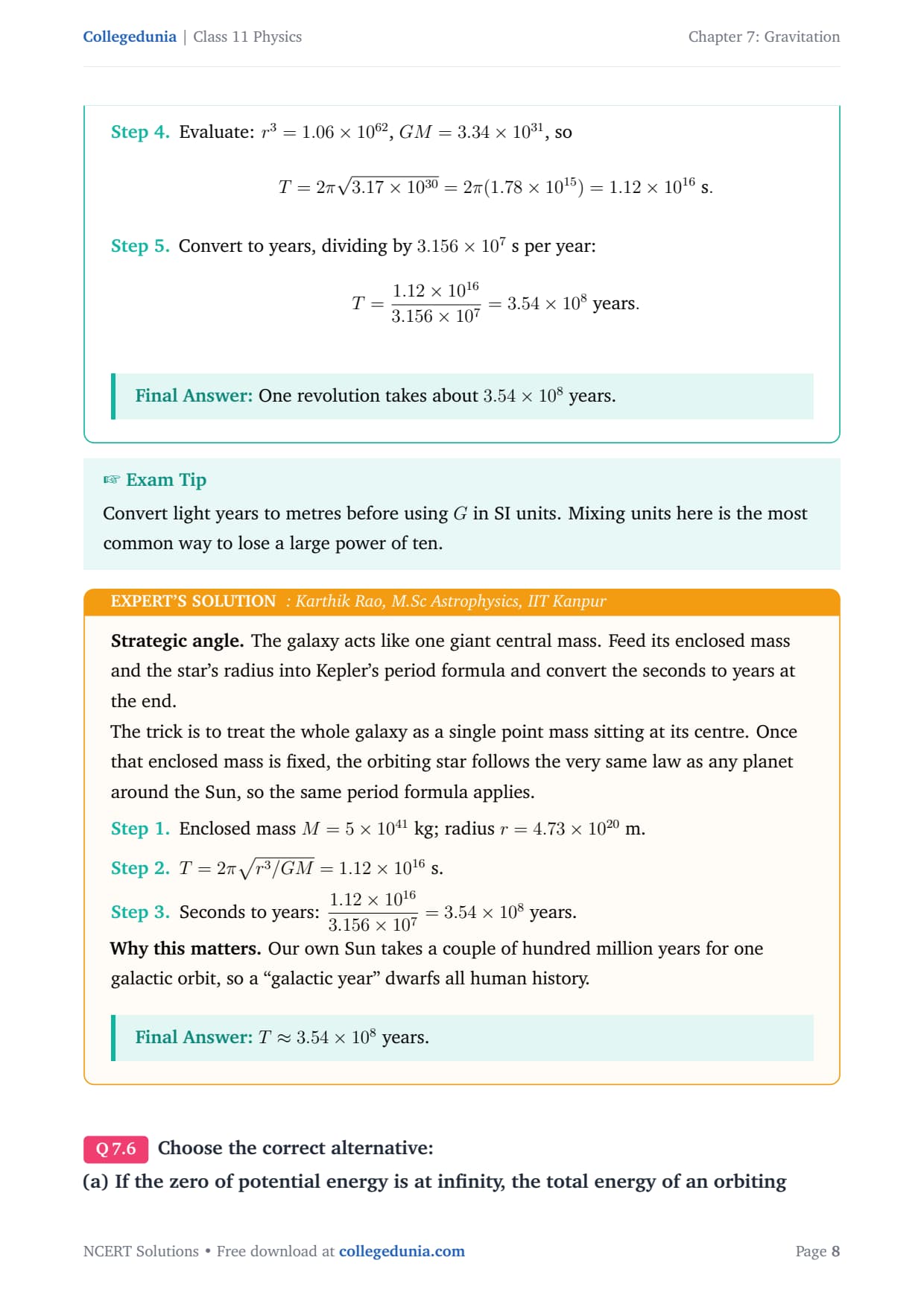
- Time period: a satellite at height h has T = 2π √((R+h)3/G M).
- Geostationary satellite: orbits with a period of 24 hours over the equator, so it appears fixed in the sky, at a height near 36,000 km.
- Total energy: for a circular orbit E = − G M m / 2(R+h), negative because the satellite is bound.
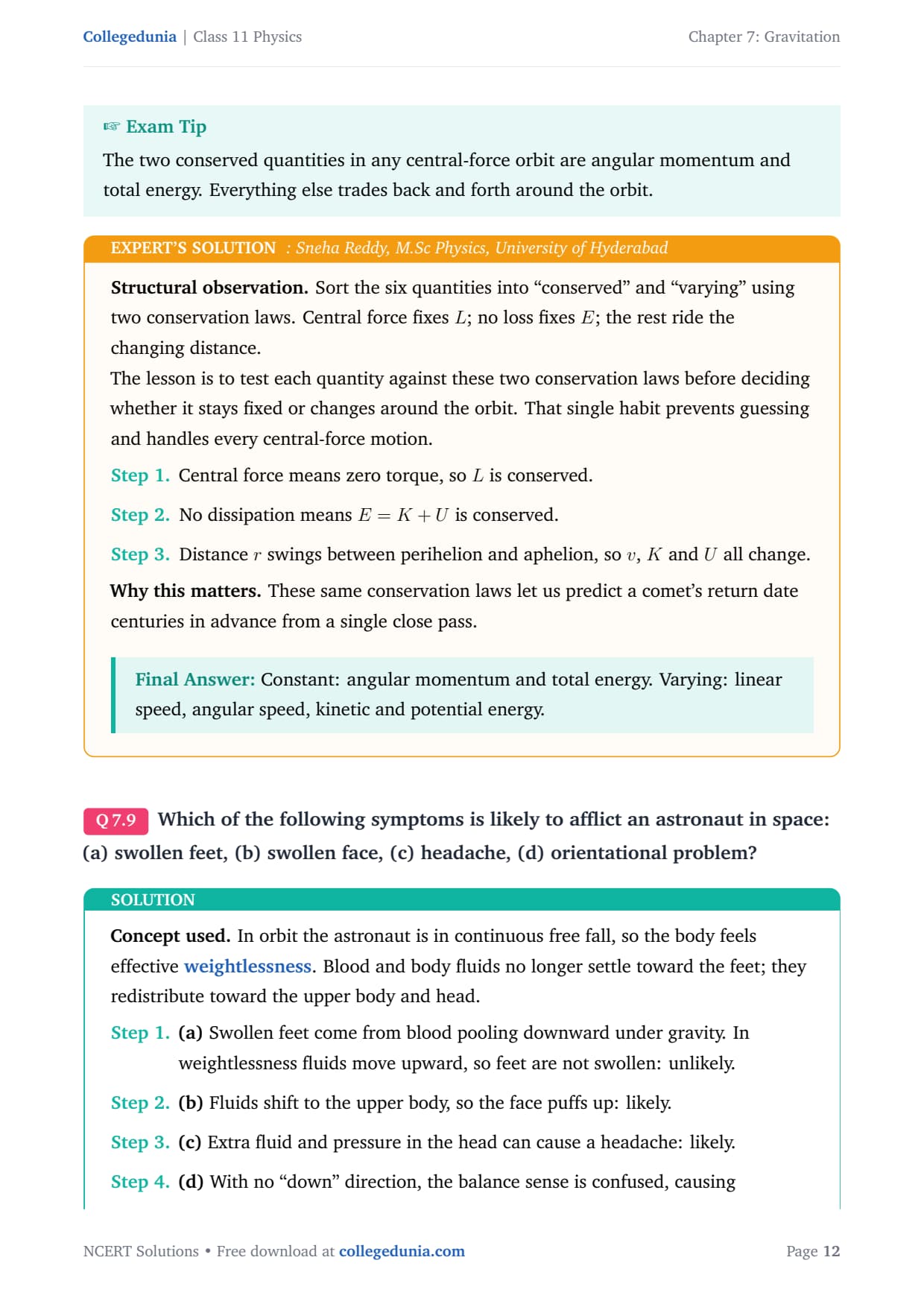
- Weightlessness: an astronaut feels weightless because both the astronaut and the satellite fall towards Earth with the same acceleration.
Weightlessness is not the absence of gravity. Gravity is still strong in orbit; the astronaut simply has no support force pressing back. The solutions state this reason clearly so students do not write that "there is no gravity in space", a marked error in the board scheme.
Exercise-wise Breakdown for Class 11 Physics Chapter 7 Gravitation
The NCERT back-exercise splits into clear groups. Use this map to plan which answers to practise first for the 2026-27 boards. Every group links to the full solved set.
| Question group | Exercises | What it covers |
|---|---|---|
| Law and short-answer concepts | Exercise 7.1 to Exercise 7.5 | Newton's law, Kepler's laws, direction of the gravitational force |
| Variation of gravity | Exercise 7.6 to Exercise 7.9 | Value of g with height, depth and on other planets |
| Energy, escape and orbital speed | Exercise 7.10 to Exercise 7.13 | Potential energy, escape velocity, orbital velocity |
| Satellites and applications | Exercise 7.14 onward | Satellite period, energy, geostationary orbit, weightlessness |
Solving the groups in this order builds the skills in the same sequence the chapter teaches them. Start with the law, then gravity variation, then energy and satellites, because each group uses the one before it.
Common Mistakes Students Make in the Gravitation Chapter
These slips happen while writing or calculating the answer, not because the concept is unclear. Each one costs 1 to 3 marks in the CBSE paper, so the solved answers point them out at the exact step.
Mistake 1: Measuring the distance from the surface instead of the centre. For a sphere, use the distance to the centre in the inverse-square law.
Mistake 2: Dropping the minus sign in gravitational potential energy. Bound systems always have negative energy, and the sign carries the physics.
Mistake 3: Confusing escape velocity with orbital velocity. Escape speed is √2 times the near-surface orbital speed, not equal to it.
Mistake 4: Writing that there is no gravity in orbit. Weightlessness comes from free fall, not from gravity disappearing.
Student Feedback on the Gravitation Chapter
What 12,840 students told us about their Gravitation revision:
- 71% of students rated the variation of g with height and depth as the hardest sub-topic.
- Most-skipped step: keeping the minus sign in potential energy, missed by about 3 in 10 students.
- Students who learned the escape and orbital speed derivations together reported the numericals felt faster.
Source: 2026-27 Class 11 Physics student poll. Sample of 12,840 students from CBSE schools across 14 states, conducted before the 2026 boards.
Practice Questions for Class 11 Physics Chapter 7 Gravitation
Once the solved answers are clear, test yourself on the full question set. The practice page has every NCERT question with a step-by-step Solution and an Expert Solution behind a click.
Practice Questions: Gravitation
Attempt all NCERT questions with detailed and expert solutions.
Open Practice QuestionsOther Gravitation Class 11 Physics Resources
| Resource | Link |
|---|---|
| NCERT Solutions | You are here |
| Notes | Gravitation Class 11 Notes |
| Handwritten Notes | Gravitation Class 11 Handwritten Notes |
| Formula Sheet | Gravitation Class 11 Formula Sheet |
| NCERT Book PDF | Gravitation Class 11 Book PDF |
NCERT Solutions for Class 11 Physics: All Chapters
Jump to the solutions for any other Class 11 Physics chapter below.
| Chapter | NCERT Solutions |
|---|---|
| Chapter 1 | Units and Measurements |
| Chapter 2 | Motion in a Straight Line |
| Chapter 3 | Motion in a Plane |
| Chapter 4 | Laws of Motion |
| Chapter 5 | Work, Energy and Power |
| Chapter 6 | System of Particles and Rotational Motion |
| Chapter 7 | Gravitation |
| Chapter 8 | Mechanical Properties of Solids |
| Chapter 9 | Mechanical Properties of Fluids |
| Chapter 10 | Thermal Properties of Matter |
| Chapter 11 | Thermodynamics |
| Chapter 12 | Kinetic Theory |
| Chapter 13 | Oscillations |
| Chapter 14 | Waves |
FAQs on Class 11 Physics Chapter 7 Gravitation NCERT Solutions
Gravitation NCERT Solutions - Frequently Asked Questions
Ques. How many questions are solved in the Class 11 Physics NCERT Solutions Chapter 7 Gravitation?
Ans. This page solves every NCERT back-exercise question of Class 11 Physics Chapter 7 Gravitation, starting from Exercise 7.1. The questions cover Newton's law of gravitation, Kepler's laws, variation of gravity, potential energy, escape velocity and satellites. Each answer has a step-by-step Solution and an Expert Solution.
Ques. What is Newton's universal law of gravitation in Chapter 7?
Ans. Newton's universal law of gravitation states that every pair of point masses attracts each other with a force F = G m1m2/r2. The force acts along the line joining them and is always attractive. The gravitational constant G = 6.67 × 10⁻¹¹ N m2 kg-2 is the same everywhere.
Ques. How do I calculate escape velocity in Class 11 Physics Chapter 7?
Ans. Escape velocity is the least speed needed to leave a planet without returning. Use ve = √(2G M/R) = √(2g R). For the Earth this is about 11.2 km/s, and it does not depend on the mass of the escaping body. The solved numericals in these Class 11 Physics Chapter 7 solutions show each step.
Ques. How does acceleration due to gravity change with height and depth?
Ans. Above the surface, g' = g(1 − 2h/R) for small height. Below the surface, g' = g(1 − d/R). So g falls off in both directions and reaches zero at the centre of the Earth. Gravity is also slightly less at the equator than at the poles because of the Earth's rotation.
Ques. What is the weightage of Gravitation in the CBSE board exam?
Ans. Gravitation carries about 6 to 8 marks in the CBSE Class 11 Physics paper, usually one derivation plus one numerical on gravity, orbits or escape velocity. It also appears in JEE Main and NEET as objective questions on Kepler's laws, escape velocity and geostationary satellites.
Ques. Why does an astronaut feel weightless in a satellite?
Ans. Weightlessness is not caused by gravity disappearing. Gravity is still strong in orbit. The astronaut and the satellite fall towards the Earth together with the same acceleration, so there is no support force pressing on the astronaut. This state of free fall is what makes the astronaut feel weightless. The NCERT Solutions for Class 11 Physics Chapter 7 Gravitation explain this clearly.



Comments