




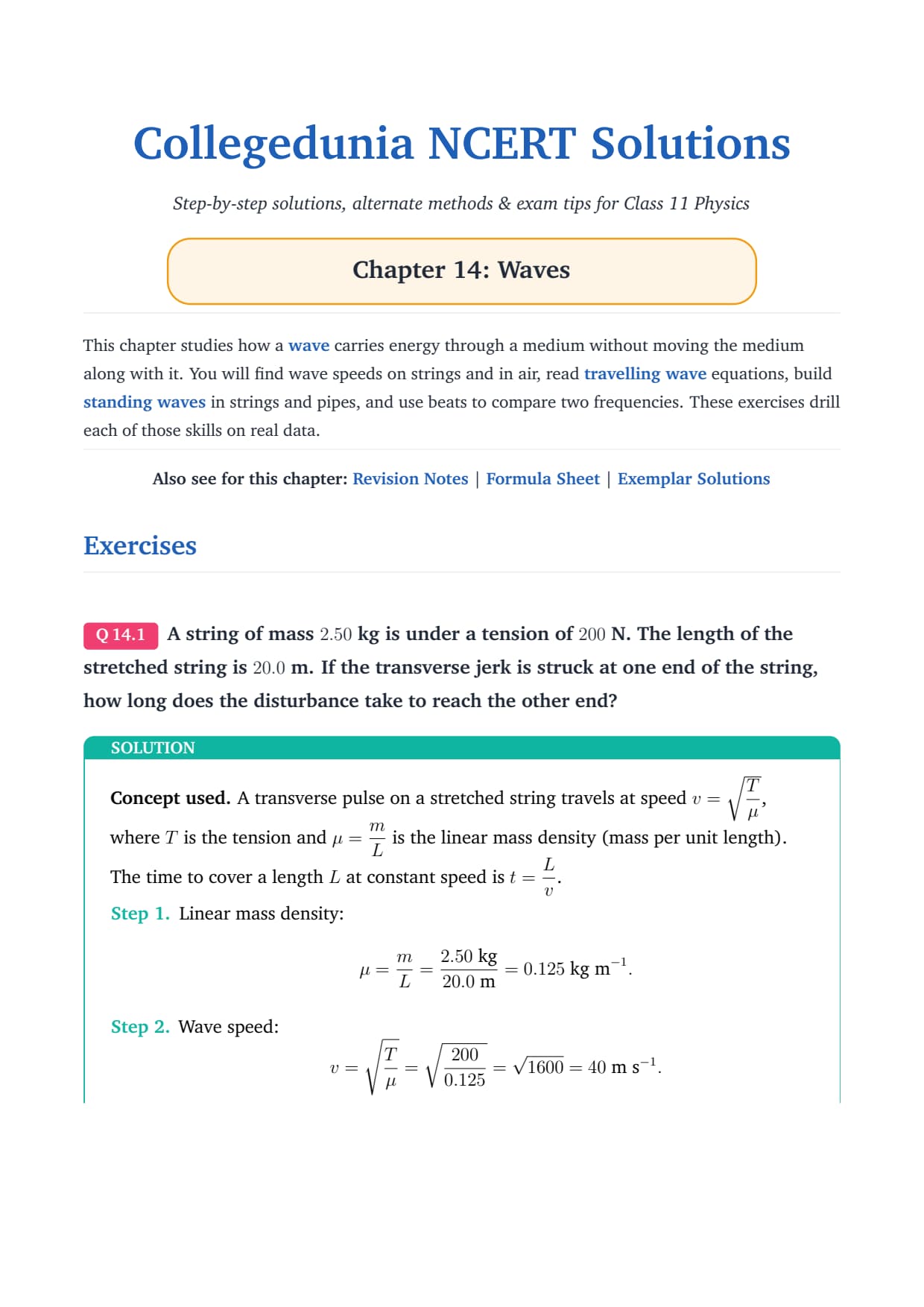
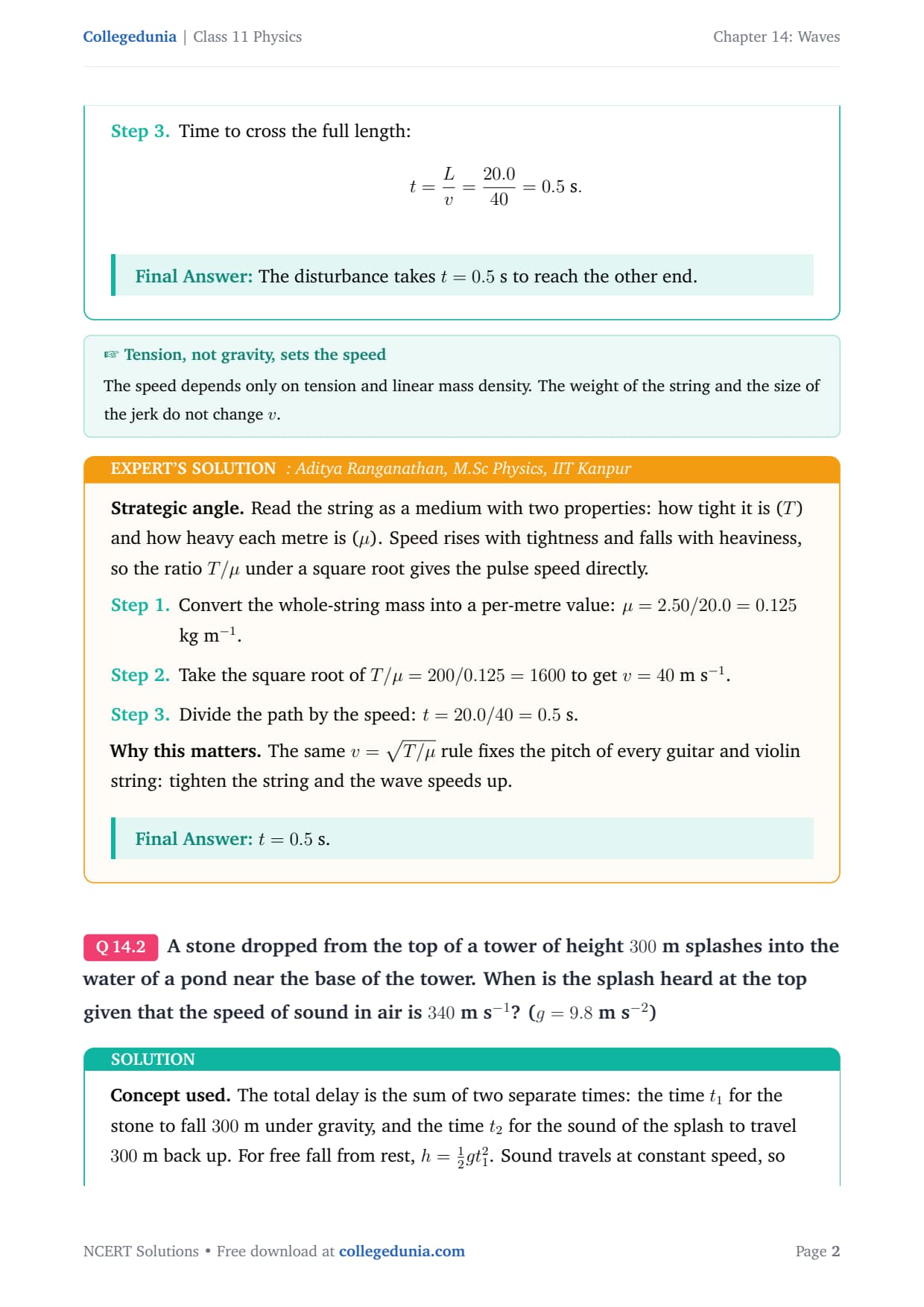
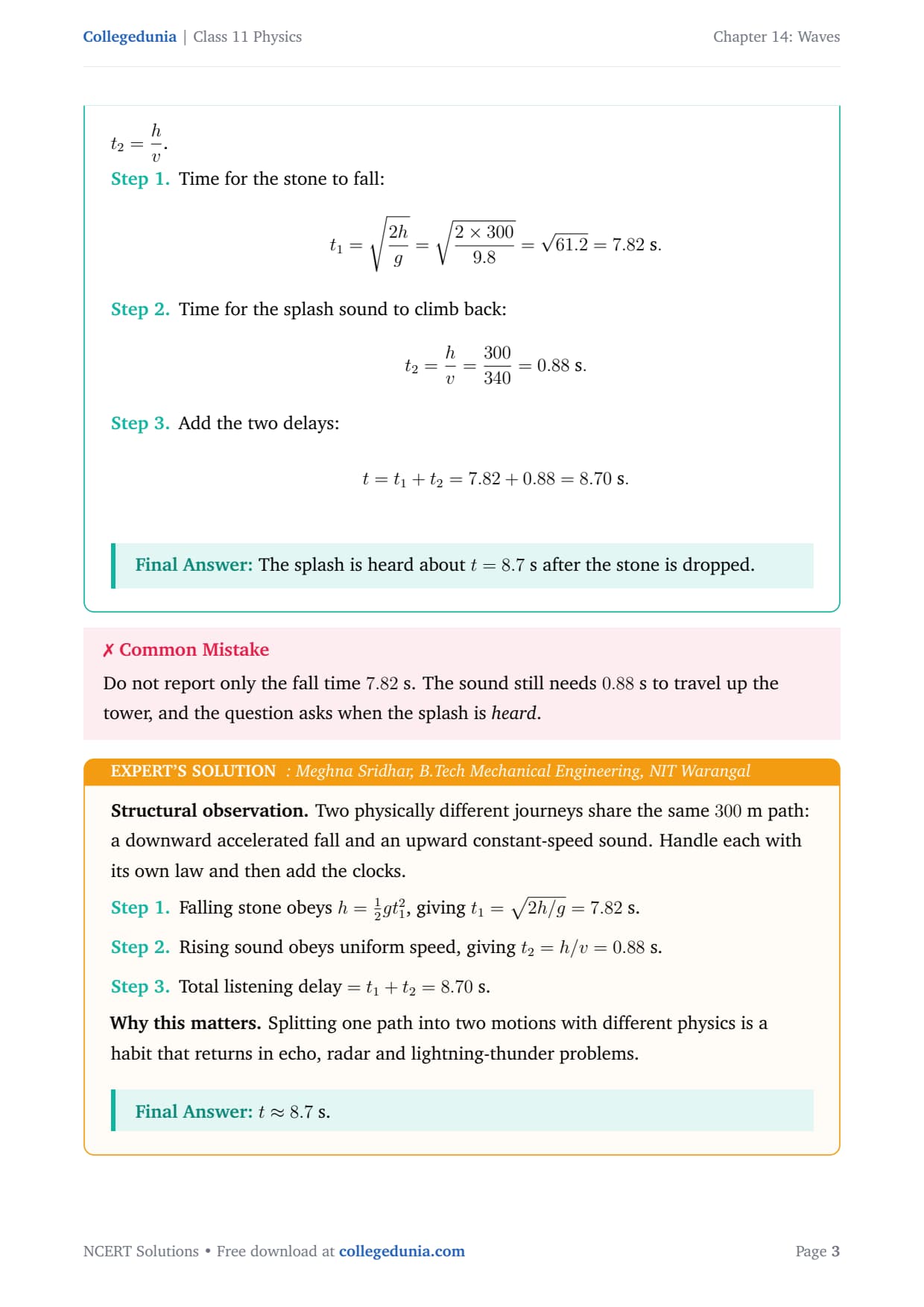
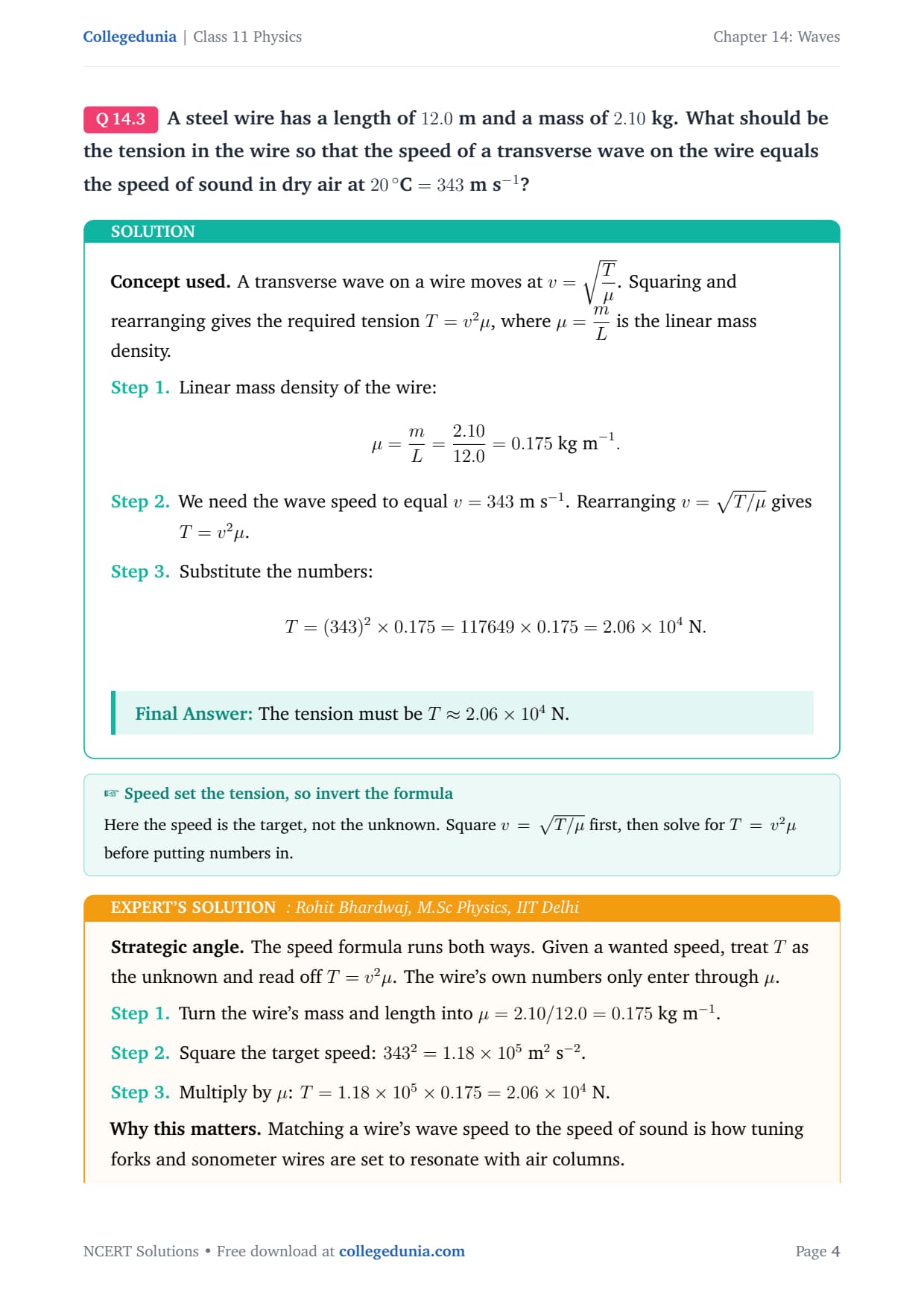
The Class 11 Physics NCERT Solutions Chapter 14 Waves will help students prepare for Boards, JEE Main, JEE Advanced, NEET, CUET and NDA in 2026-27. Every back-exercise question is solved with full working, so students can check each wave-speed calculation, standing-wave mode, beat-frequency count, and Doppler shift step by step.
This is the last chapter of the NCERT textbook, and it ties together oscillations, sound, and the wave picture used across physics.
- CBSE Weightage: 6 to 8 marks, usually one derivation plus one numerical on wave speed, beats or the Doppler effect.
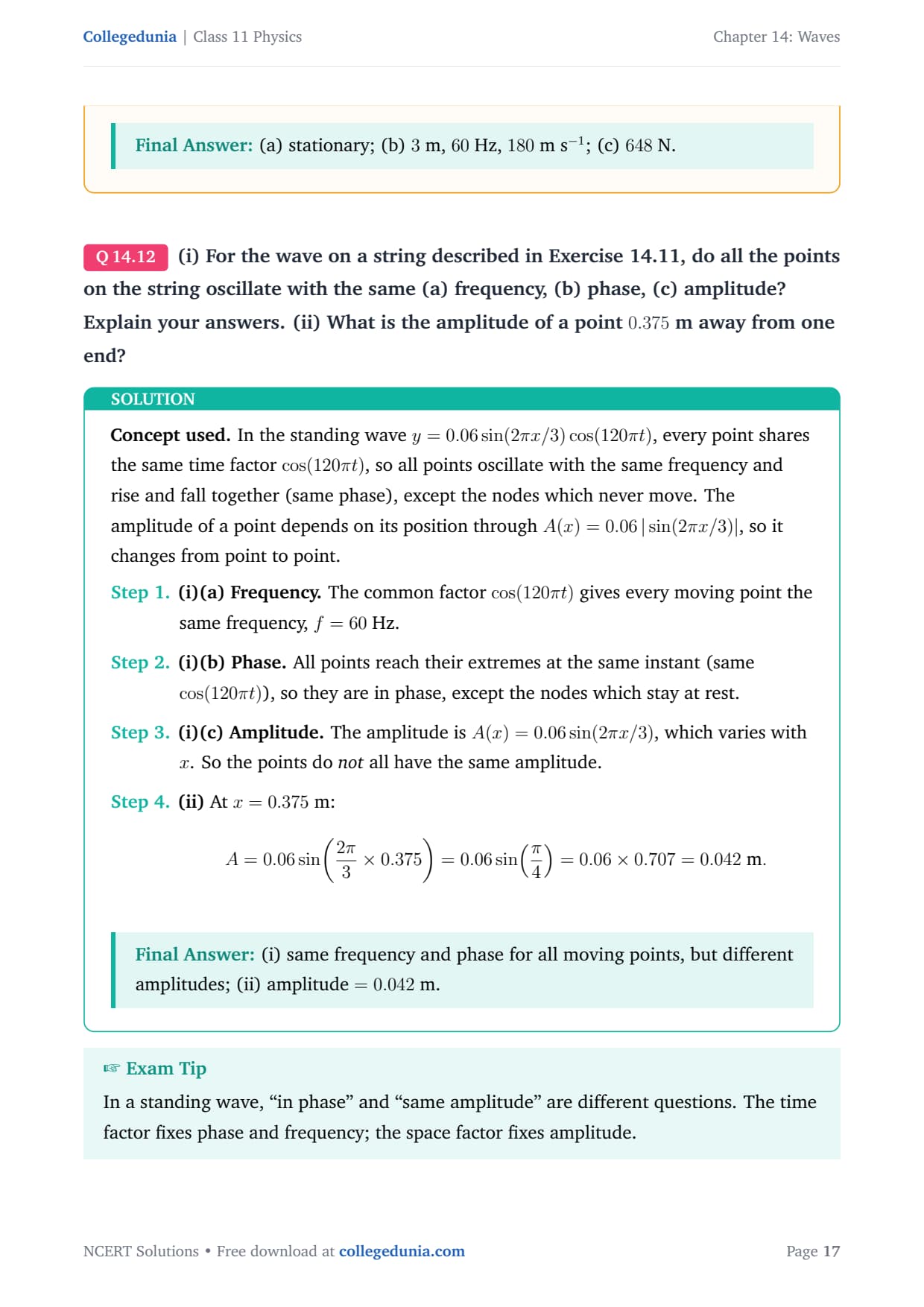
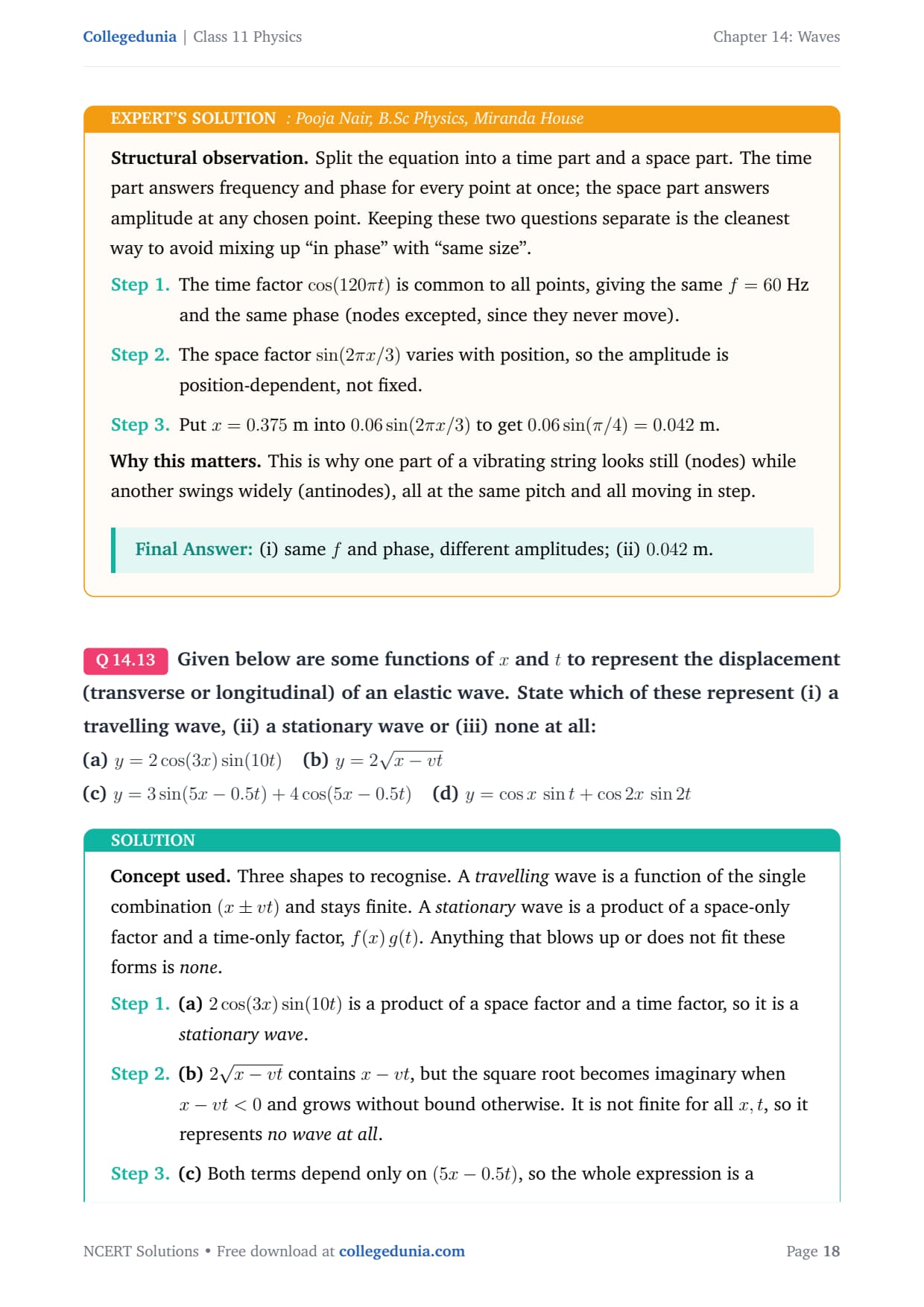
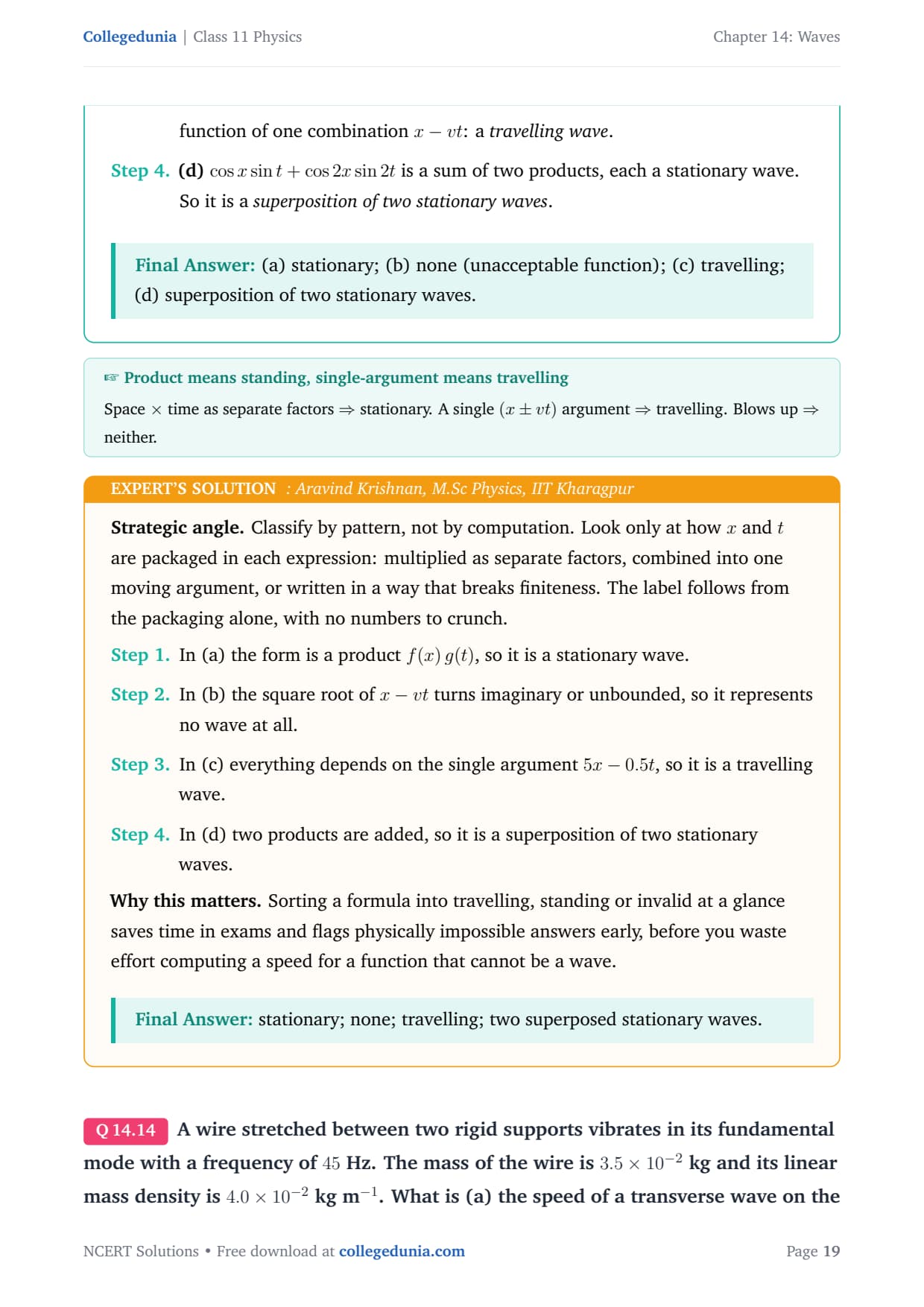
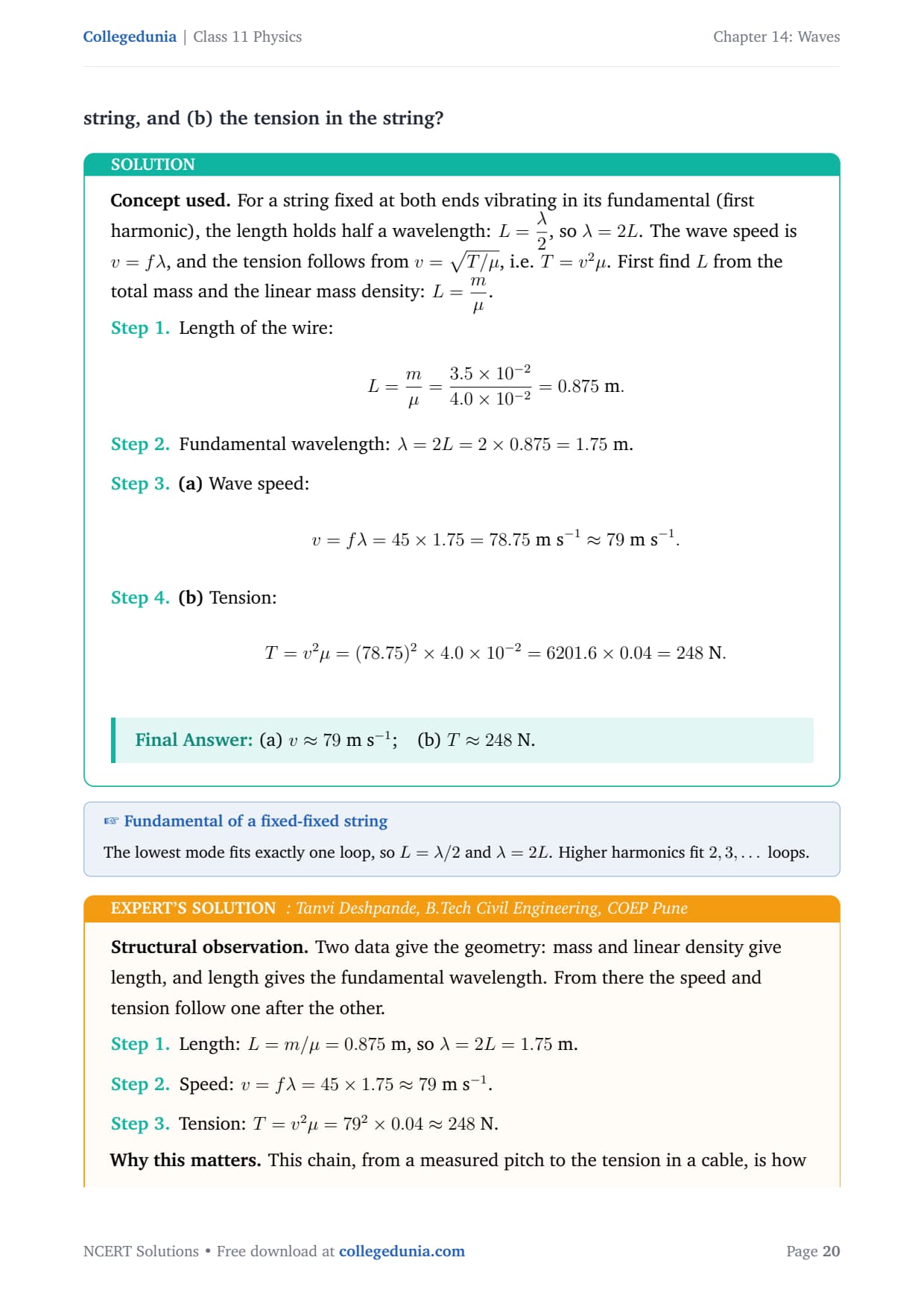
- Questions solved: all Exercise 14.1 onward, covering wave equation, speed on a string, standing waves, beats and Doppler shift.
- Key formulas: progressive wave equation, speed on a string, Newton-Laplace speed of sound, beat frequency, Doppler formula.
Each solution in this Class 11 Physics NCERT Solutions Chapter 14 Waves compilation is curated by subject experts, based on the 2026-27 NCERT textbook, and refined against the last five years of CBSE Board, JEE Main and NEET papers.
Transverse and Longitudinal Waves in Chapter 14 Waves
A wave carries energy and information from one place to another without moving the medium along with it. The chapter opens by splitting mechanical waves into two types. Getting this split right is the first step in almost every numerical, because the wave type decides which medium can carry it.
| Wave type | Particle motion | Where it travels |
|---|---|---|
| Transverse | Particles move at right angles to the wave | Solids and the surface of a liquid |
| Longitudinal | Particles move along the wave direction | Solids, liquids and gases |
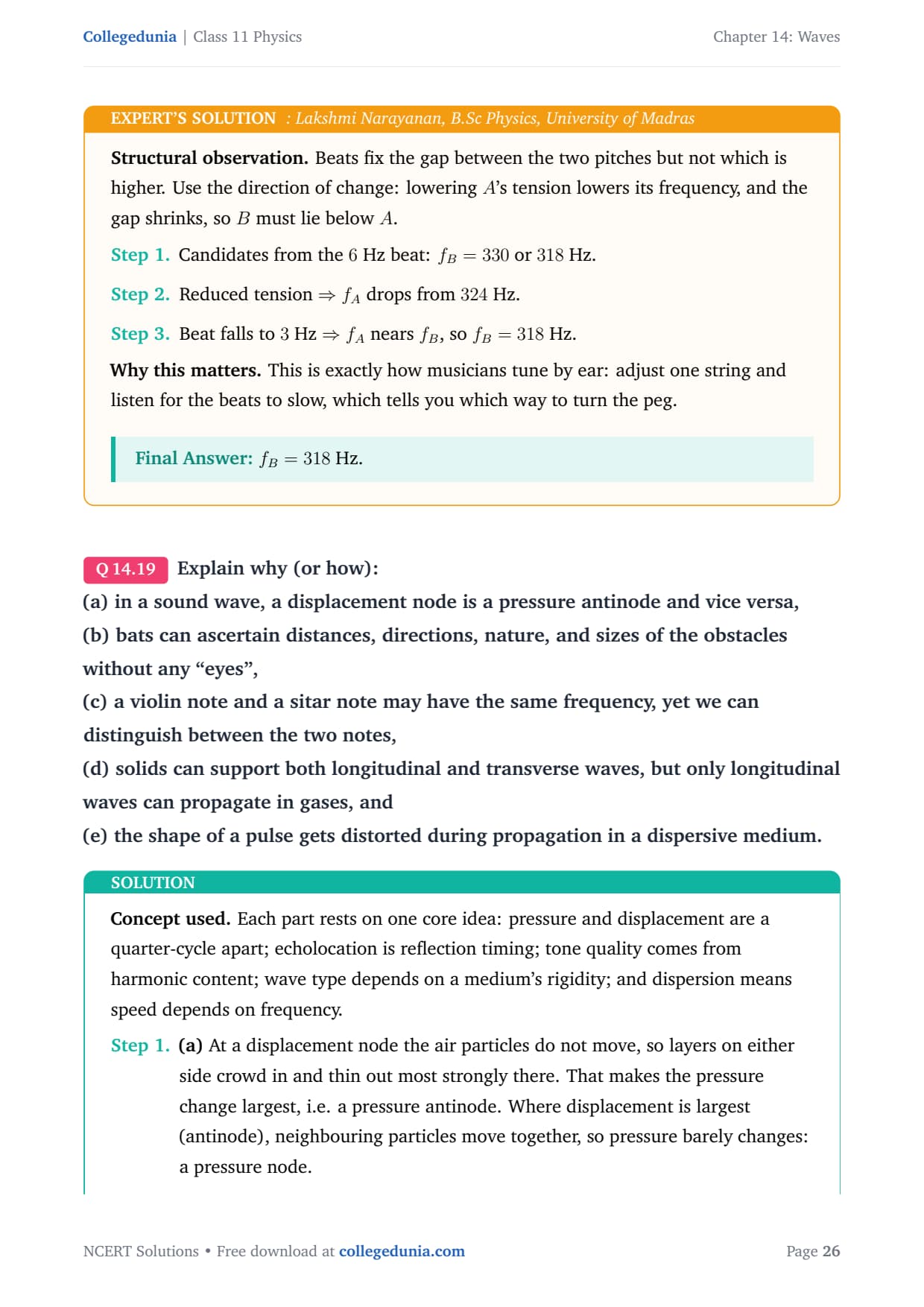
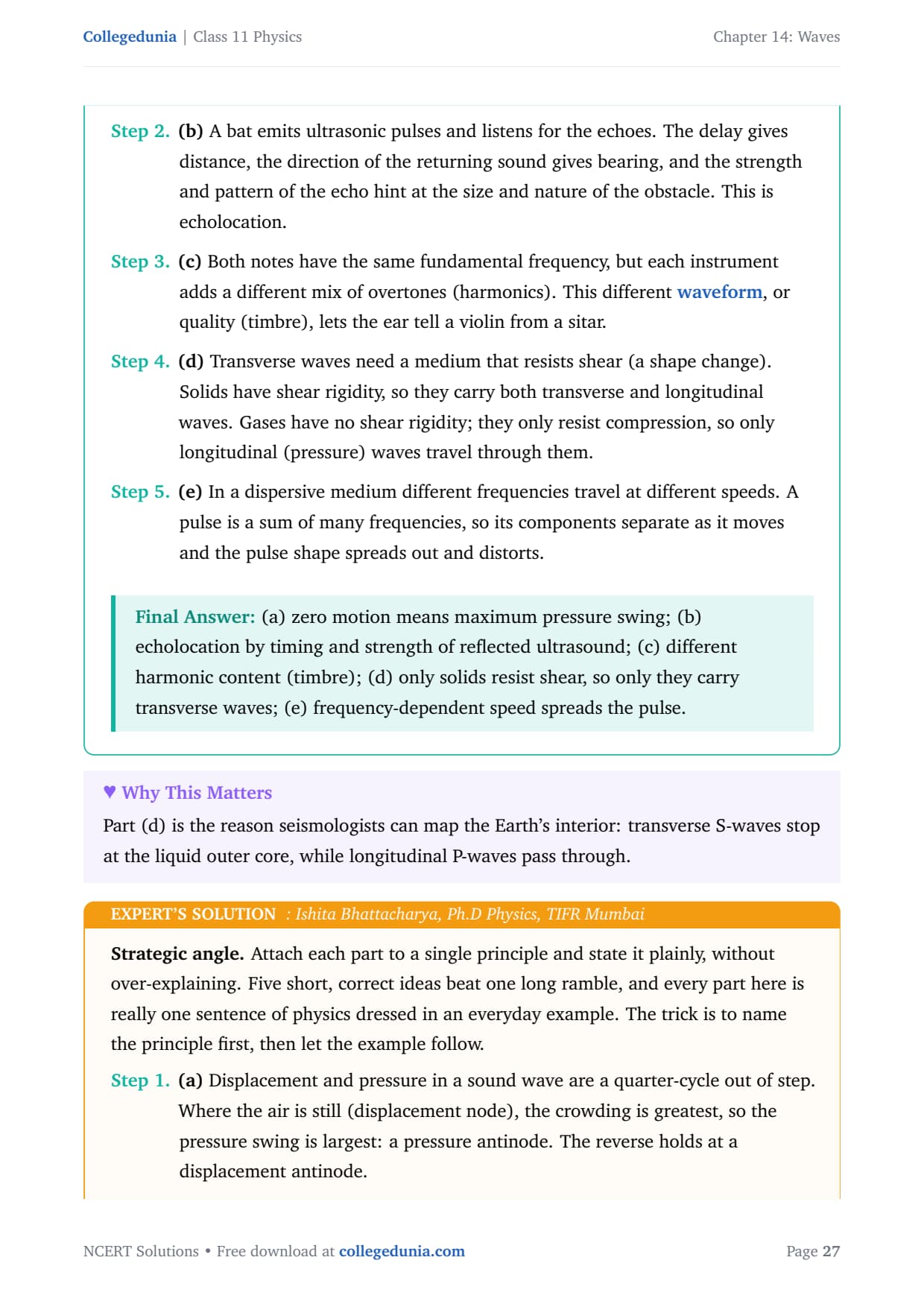
In a transverse wave, such as a wave on a string, the medium forms crests and troughs. In a longitudinal wave, such as a sound wave in air, the medium forms compressions and rarefactions. Sound cannot travel as a transverse wave through a gas because a gas has no shear strength. The NCERT solutions state this reason in full, so students can justify their answer in the board exam and not just name the wave type.
The Progressive Wave Equation and Its Terms
A travelling wave is written as a single equation that gives the displacement of any particle at any time. The chapter builds every numerical on this one relation, so reading each term correctly is what earns the marks.
The displacement of a wave moving along the positive x-direction is y(x, t) = a sin(kx − ωt + φ). Each symbol has a fixed meaning, and the solved answers pull them out one by one.
- Amplitude (a): the largest displacement of a particle from its rest position.
- Angular wave number (k): equals 2π/λ, where λ is the wavelength.
- Angular frequency (ω): equals 2πf, where f is the frequency.
- Phase (kx − ωt + φ): fixes the state of the particle at a given place and time.
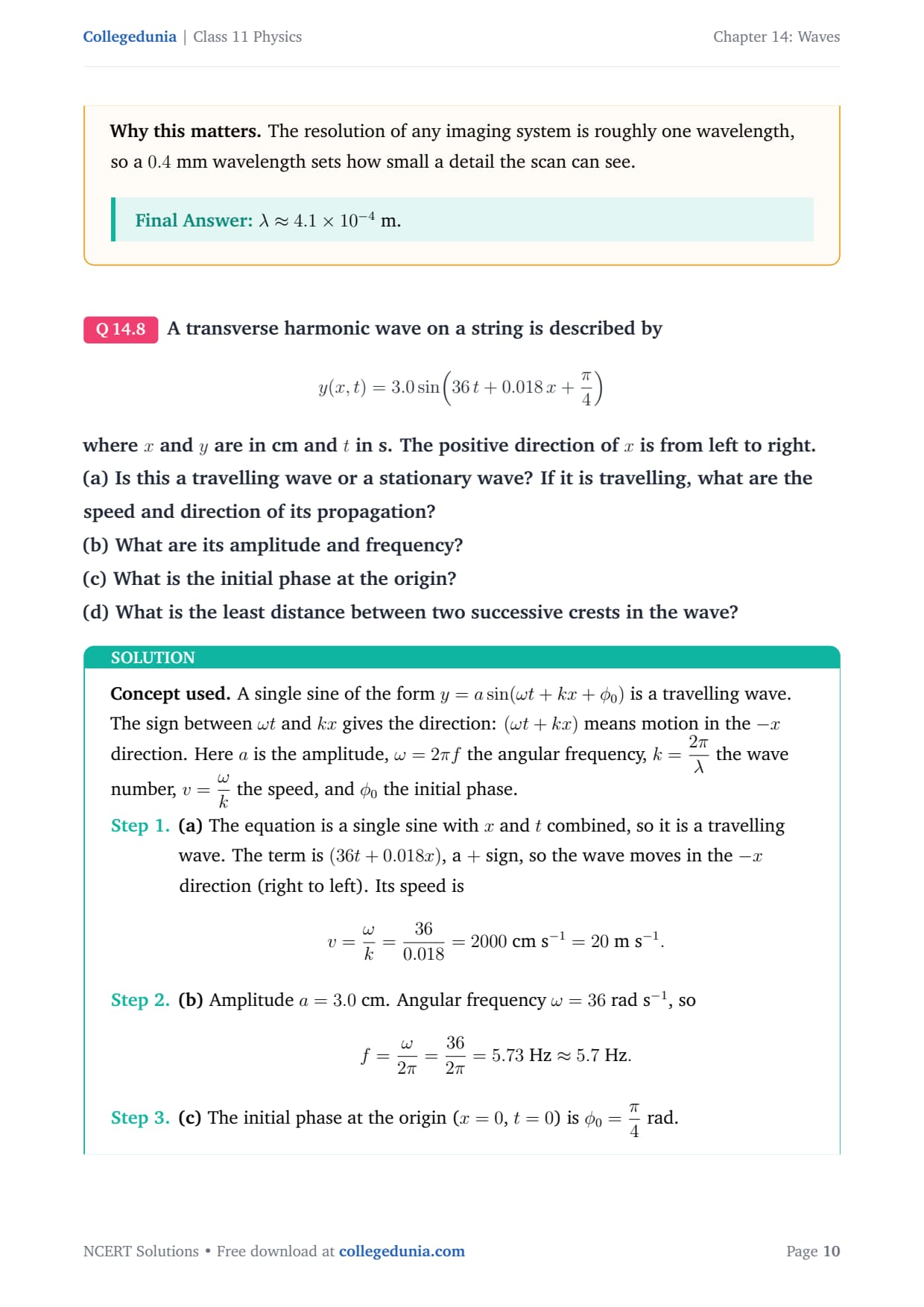
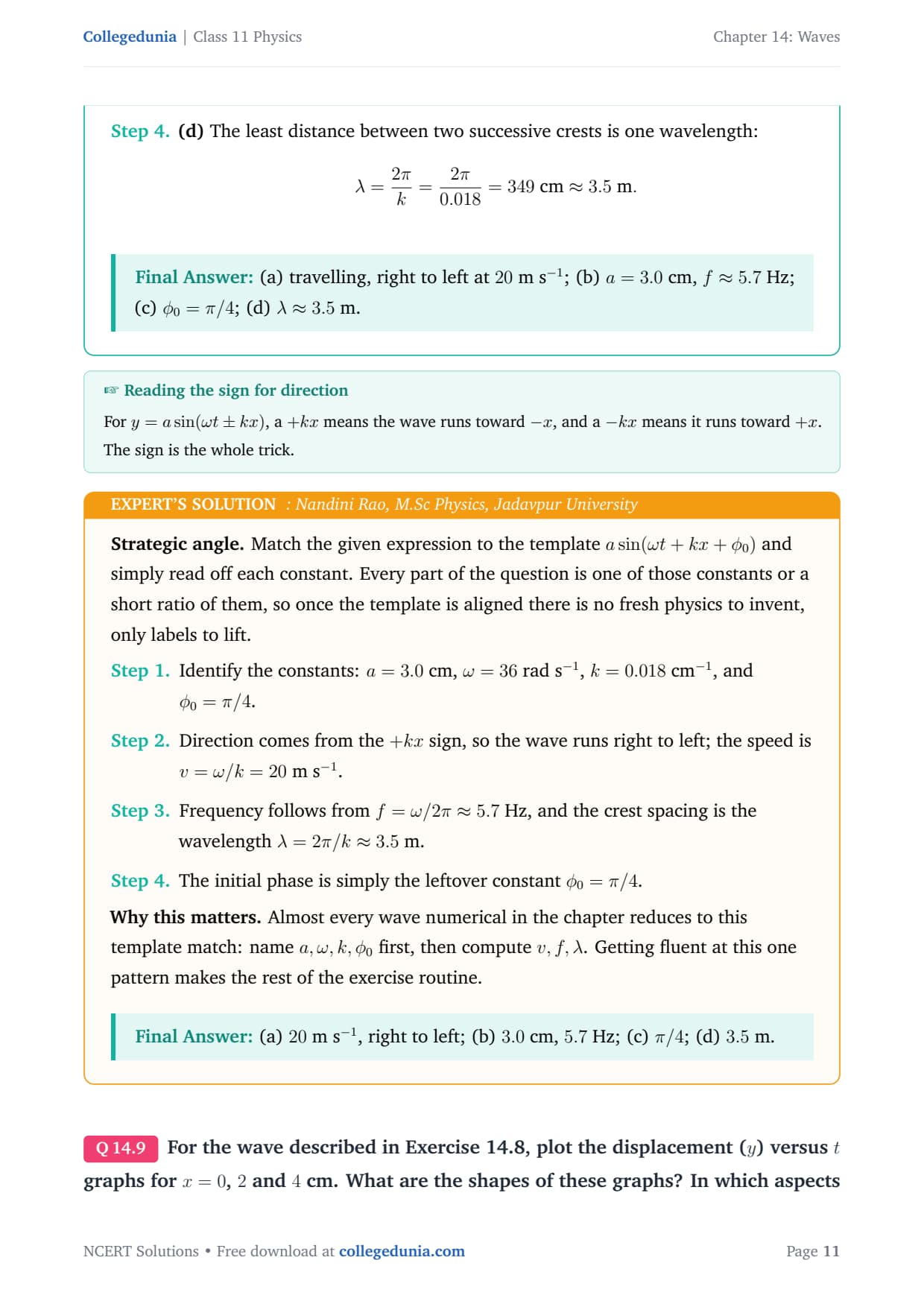
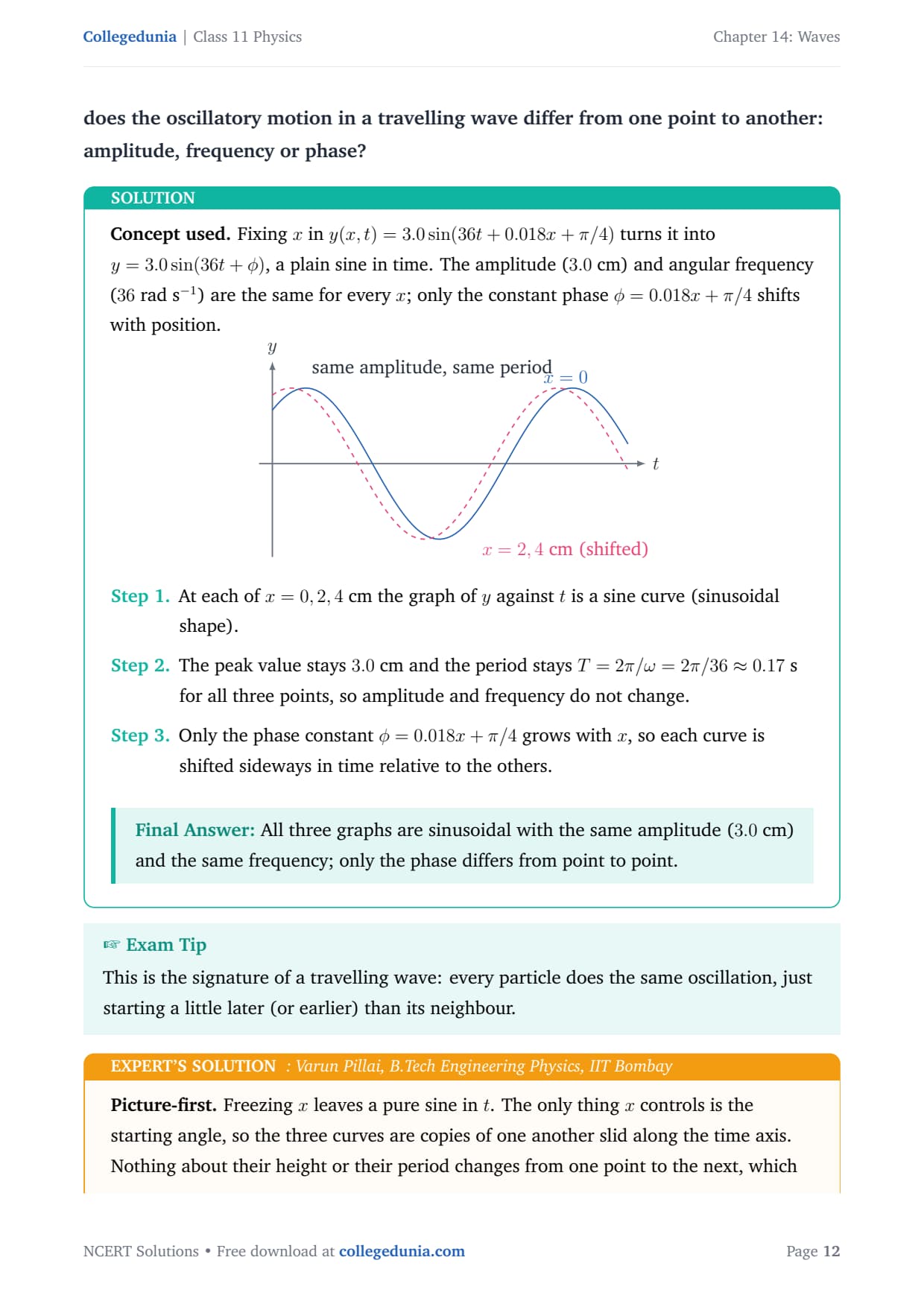
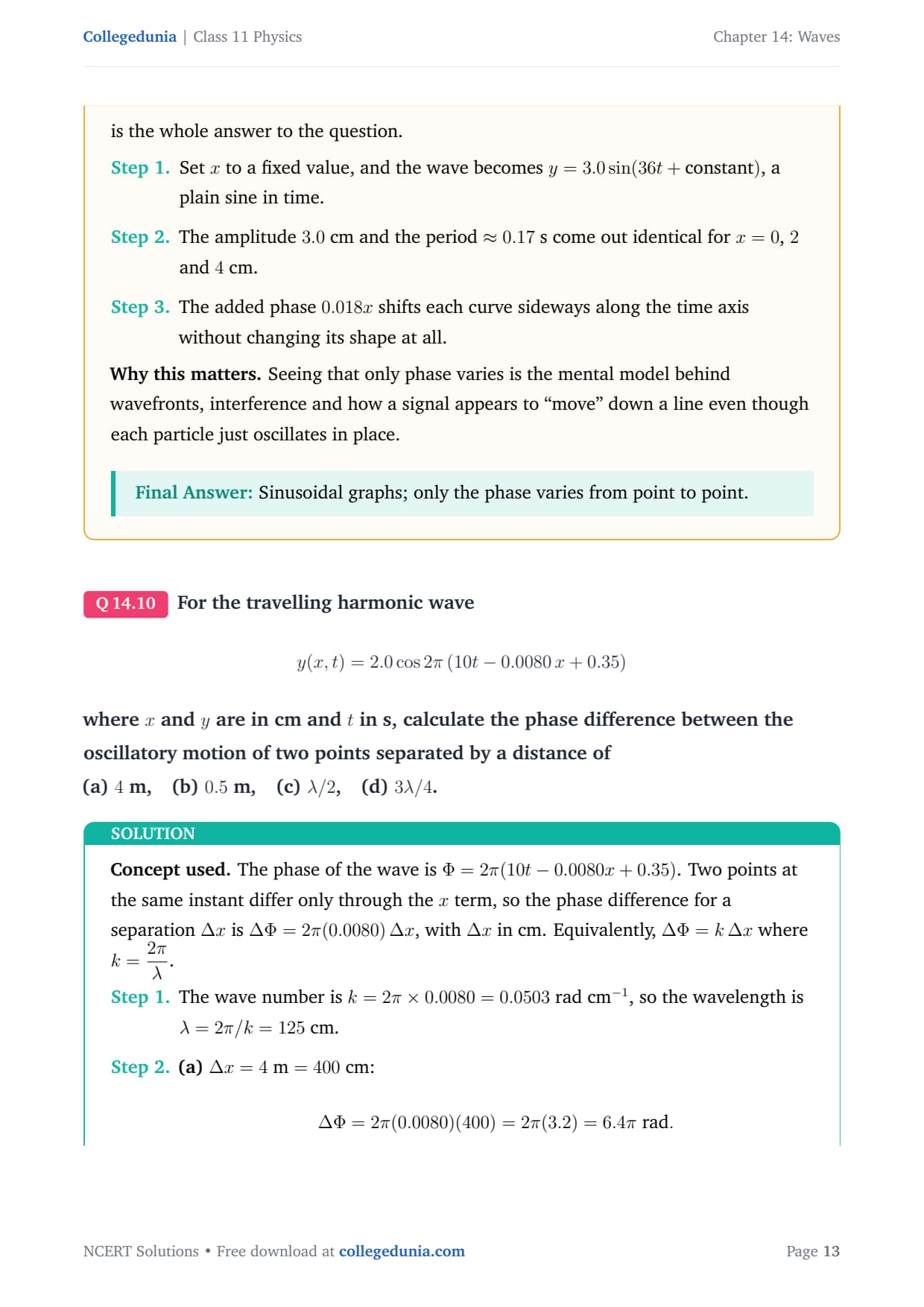
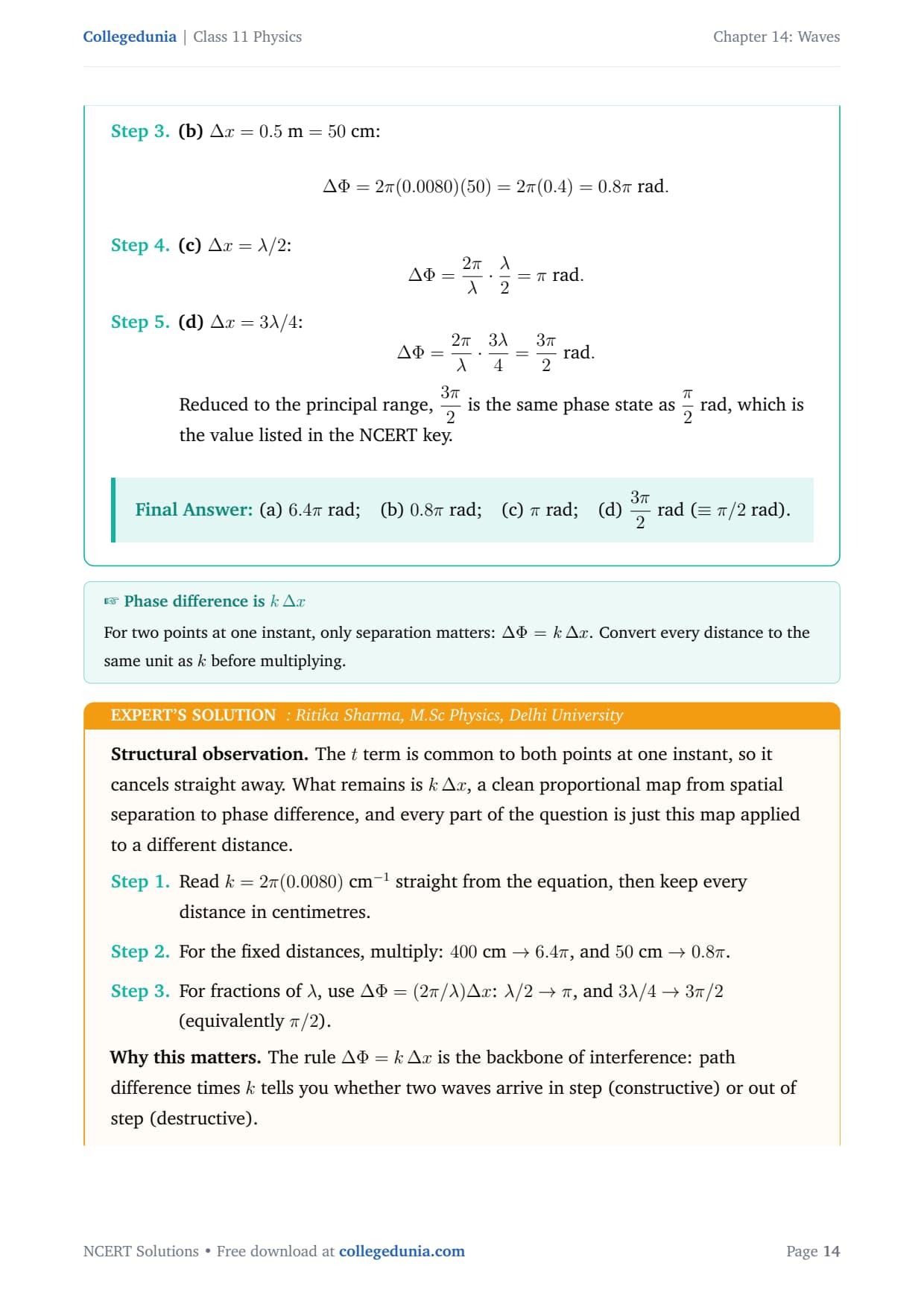
Numericals like Exercise 14.8 and Exercise 14.9 give a wave equation and ask for the amplitude, wavelength, frequency and speed. Read the number multiplying x as k and the number multiplying t as ω, then use v = ω/k. The Class 11 Physics NCERT Solutions Chapter 14 Waves show this extraction on a separate line for every such question.
Speed of a Wave on a String and in Gases
The speed of a wave depends only on the medium, not on the source. The chapter gives one formula for a stretched string and a separate line of reasoning for sound in a gas. Both appear often in the exam, so the solutions derive each one fully.
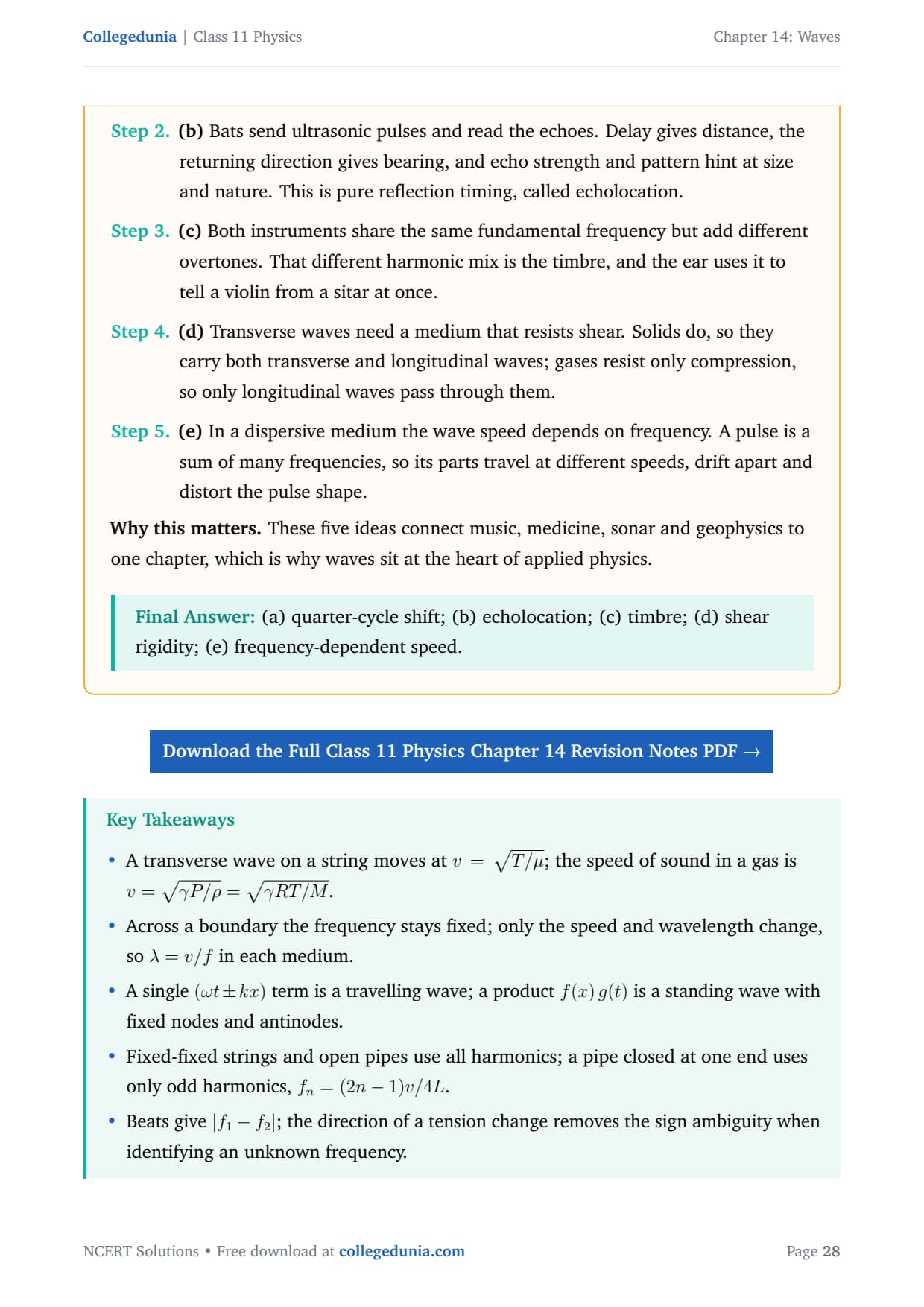
On a stretched string the speed is v = √(T/μ), where T is the tension and μ is the mass per unit length. A tighter or lighter string carries the wave faster. Questions such as Exercise 14.6 use this relation directly.
For sound in a gas the chapter tells a two-step story that students must know for a full-mark answer.
- Newton's formula: Newton assumed the compressions and rarefactions happen at constant temperature, giving v = √(P/ρ). This value came out about 15% too low for air.
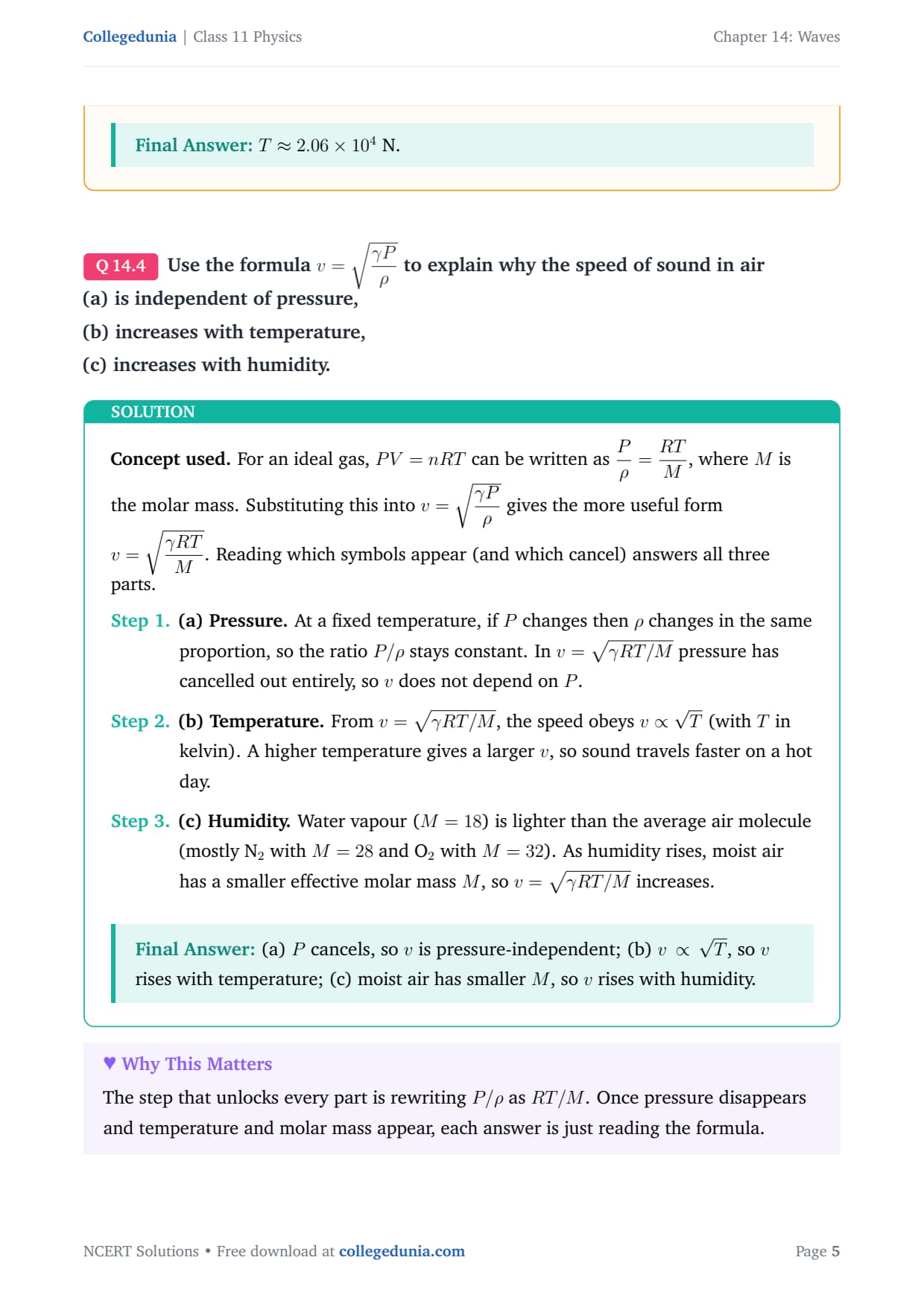
- Laplace correction: Laplace showed the changes are too fast for heat to escape, so they are adiabatic, giving v = √(γP/ρ). This matches the measured speed of sound.
The Laplace correction adds the factor √γ, where γ is the ratio of specific heats. The NCERT solutions explain why the process is adiabatic, not just which formula to use, because CBSE asks for that reasoning in the derivation.
The Principle of Superposition and Reflection of Waves
When two waves meet, their effects add. The chapter states this as the principle of superposition, and it is the idea behind beats, standing waves and interference. The solved answers use it every time two waves share the same medium.
By superposition, the resultant displacement at a point is the sum of the displacements each wave would produce there on its own. Two features follow from this and appear in short-answer questions.
- Constructive addition: when two crests meet, the displacements add and the amplitude grows.
- Destructive addition: when a crest meets a trough, the displacements cancel and the amplitude drops.
- Reflection at a fixed end: the wave flips over, so a crest returns as a trough, a phase change of π.
- Reflection at a free end: the wave returns without flipping, so there is no phase change.
Reflection is what sends a wave back along the string to meet the incoming wave. A fixed end gives a phase reversal of π; a free end gives none. The NCERT solutions for Class 11 Physics Chapter 14 Waves state the boundary rule clearly, because the next topic, standing waves, depends on it.
Standing Waves and Normal Modes on Strings and in Pipes
When a wave and its reflection overlap, they form a standing wave that does not travel. Some points, called nodes, never move; others, called antinodes, swing the most. The allowed patterns are the normal modes, and they set the frequencies an instrument can produce.
| System | Ends | Allowed frequencies |
|---|---|---|
| String fixed at both ends | Node at each end | All harmonics: f, 2f, 3f … |
| Pipe open at both ends | Antinode at each end | All harmonics: f, 2f, 3f … |
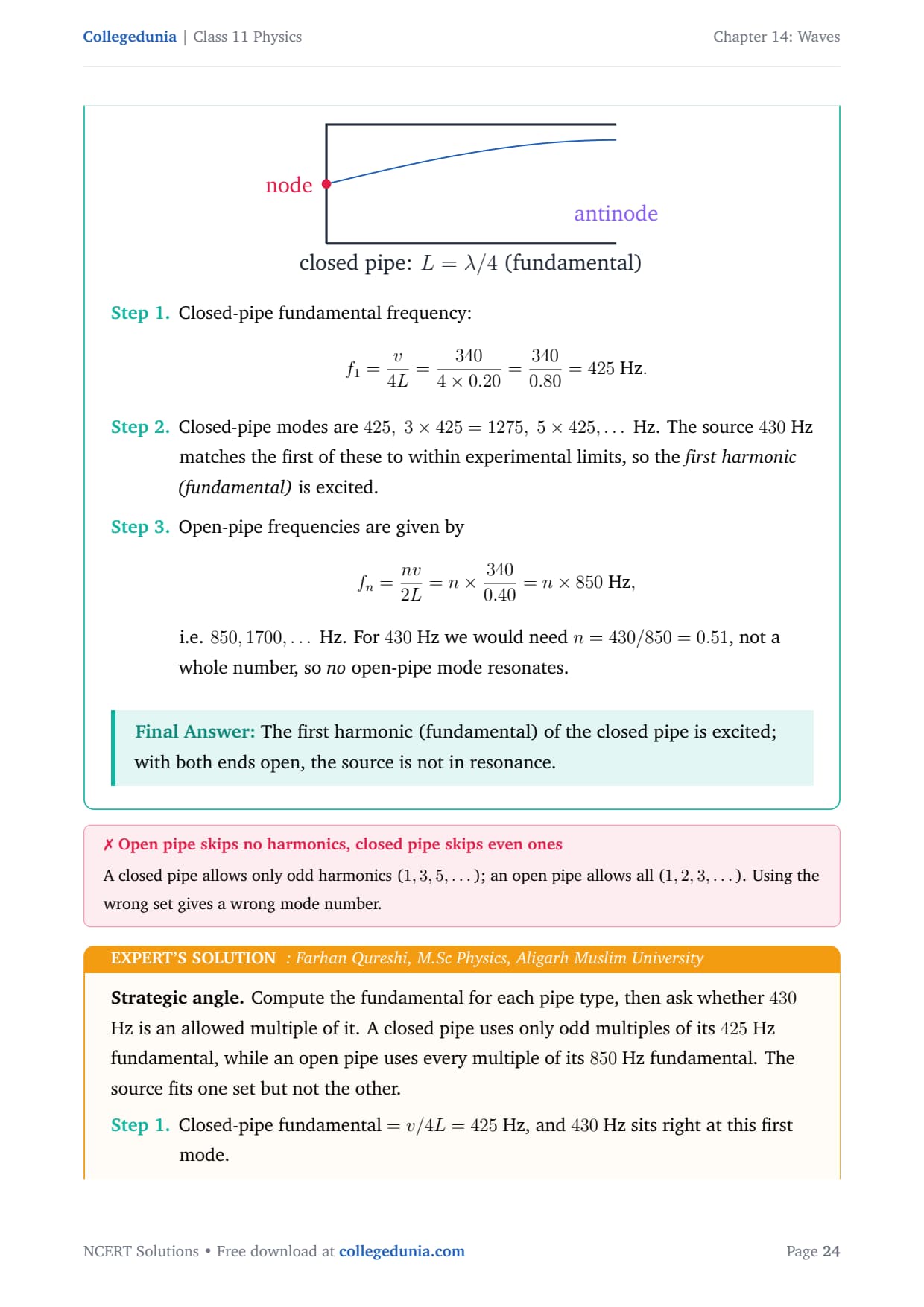
| Pipe closed at one end | Node at closed, antinode at open | Odd harmonics only: f, 3f, 5f … |
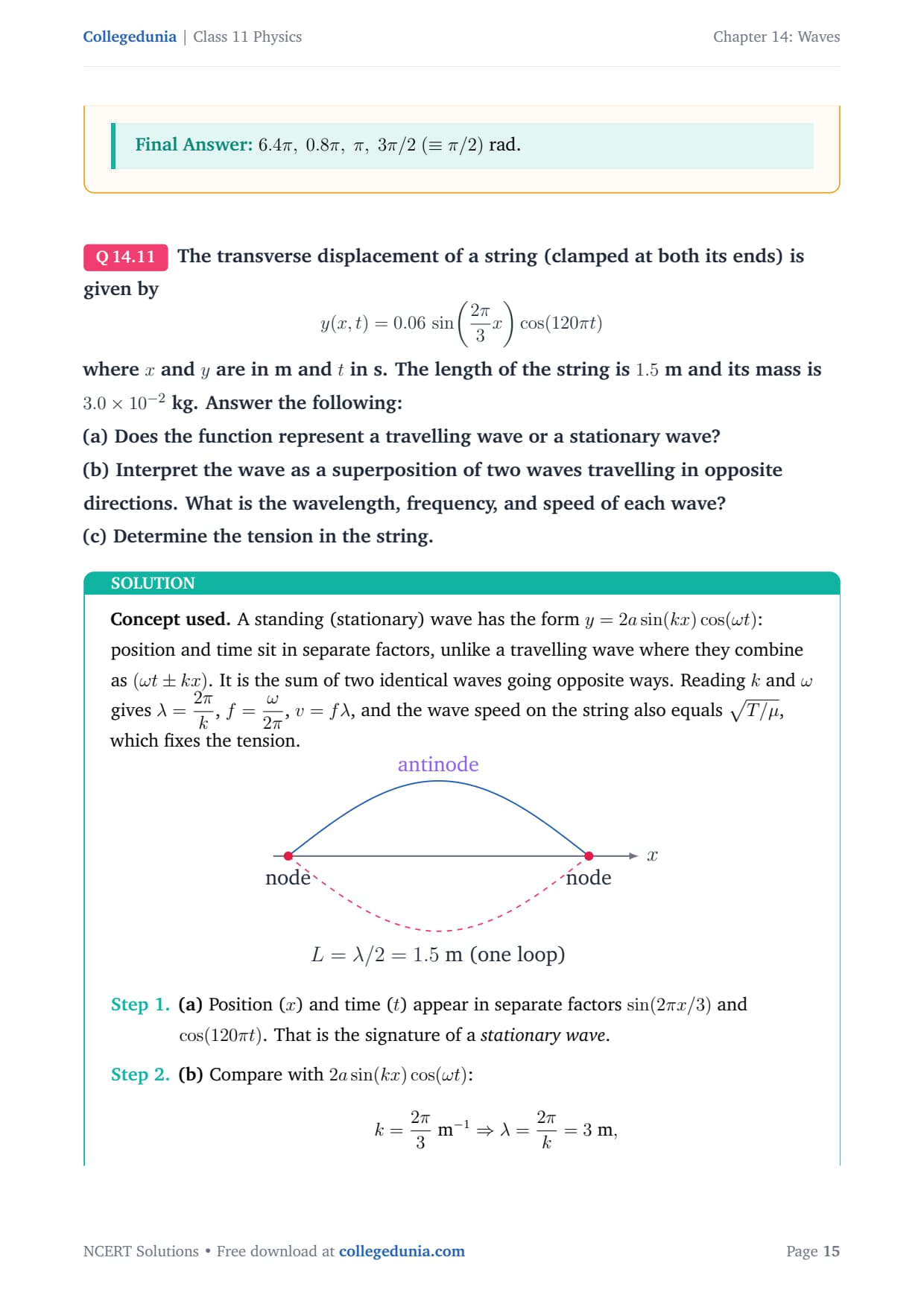
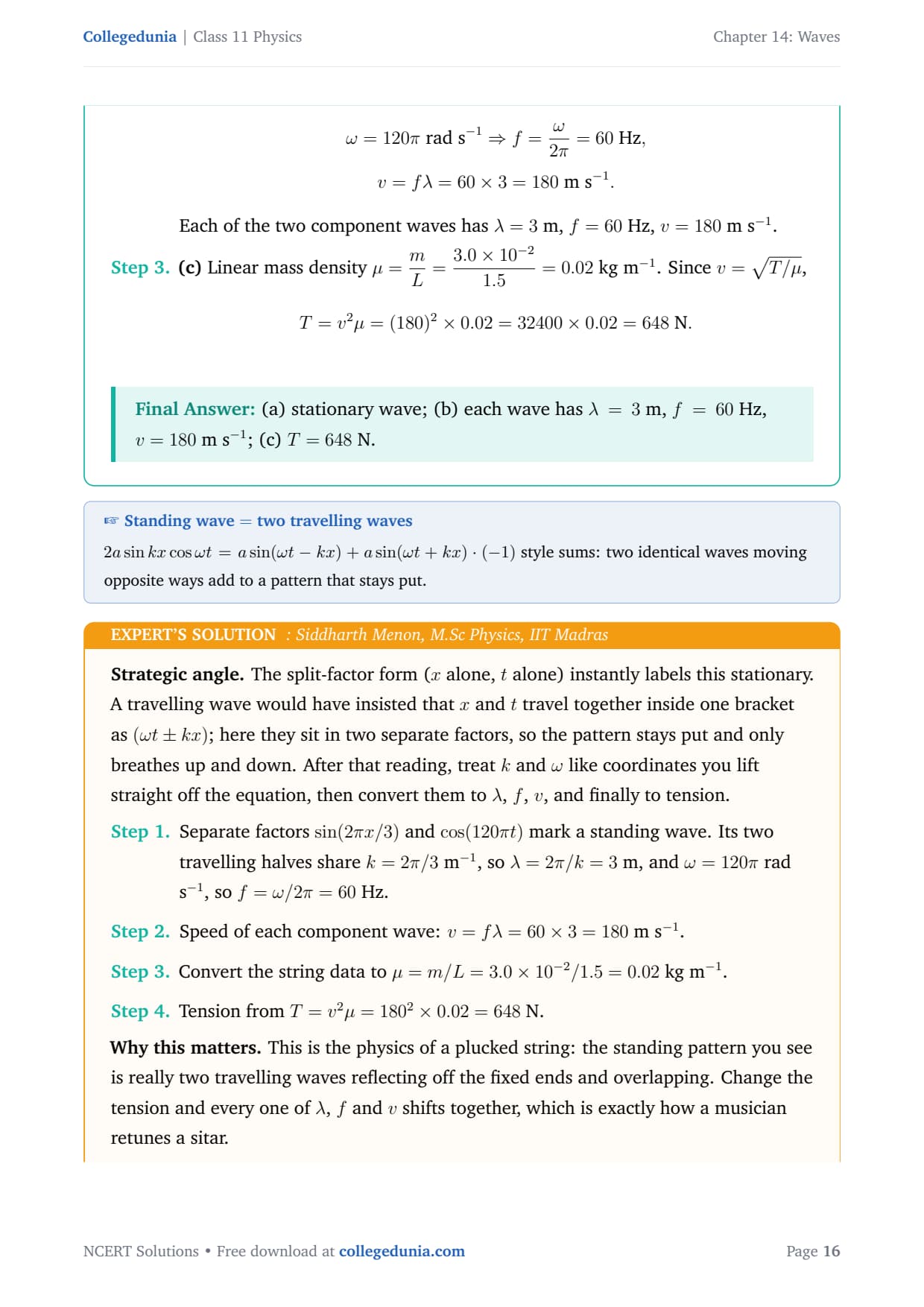
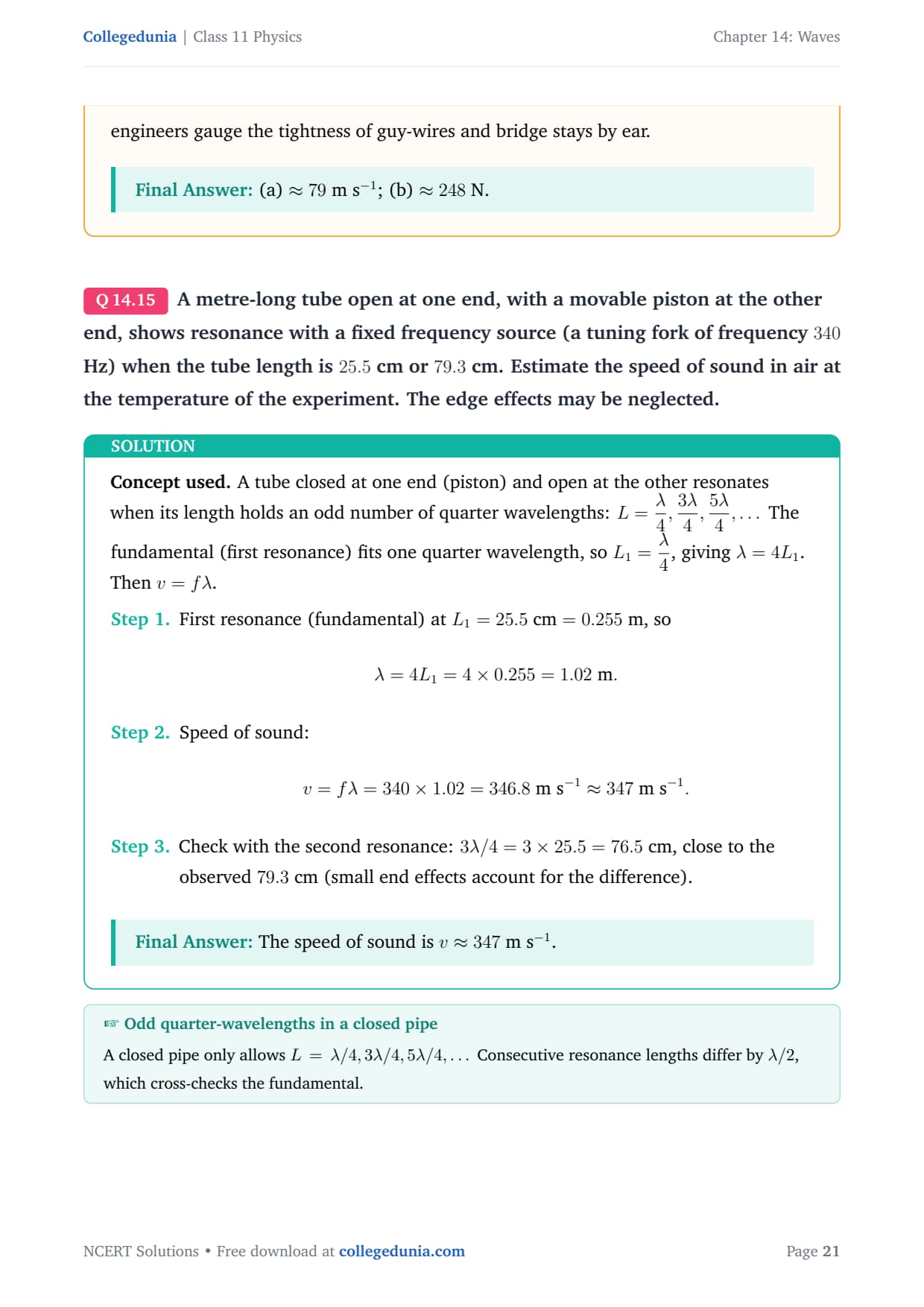
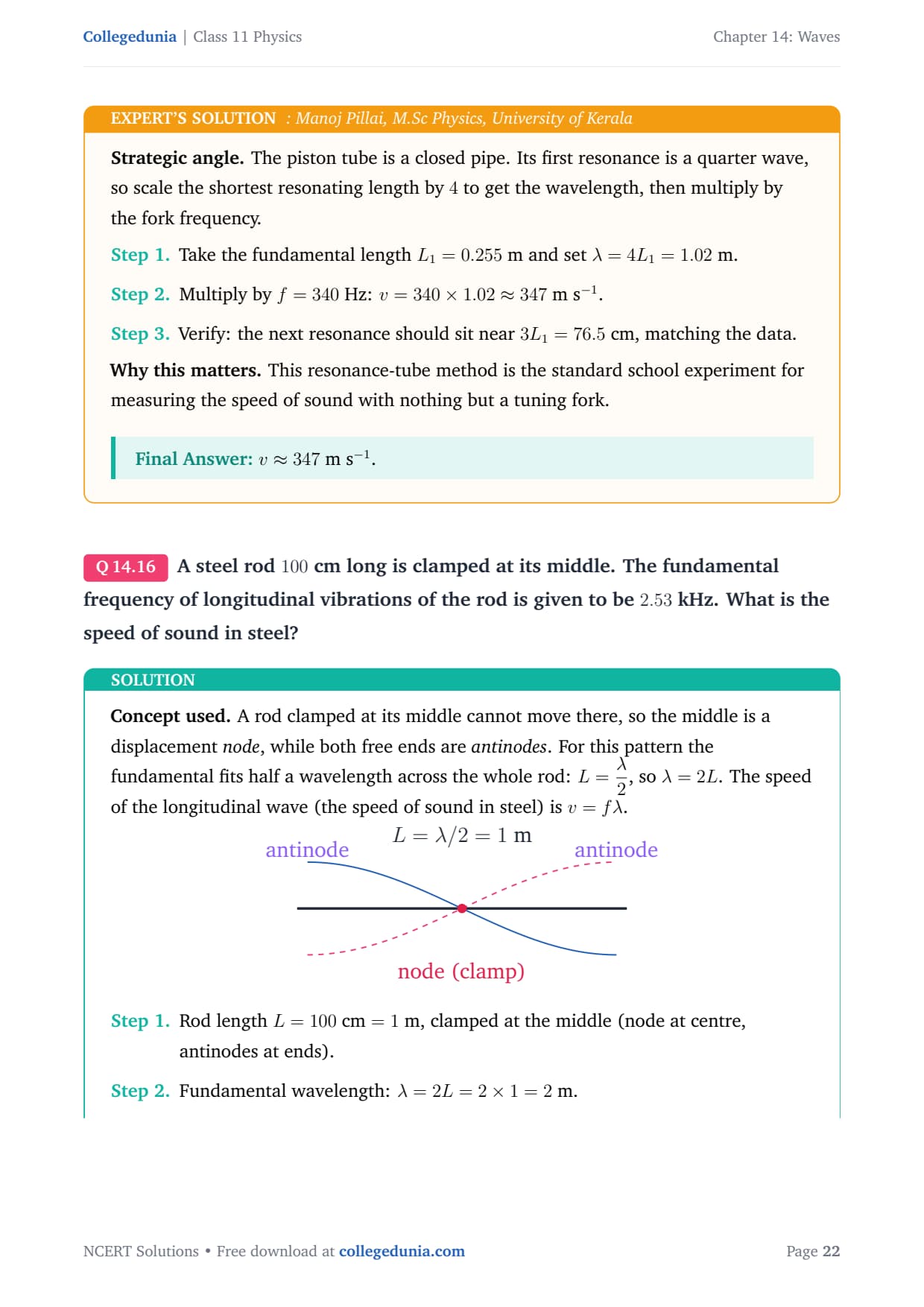
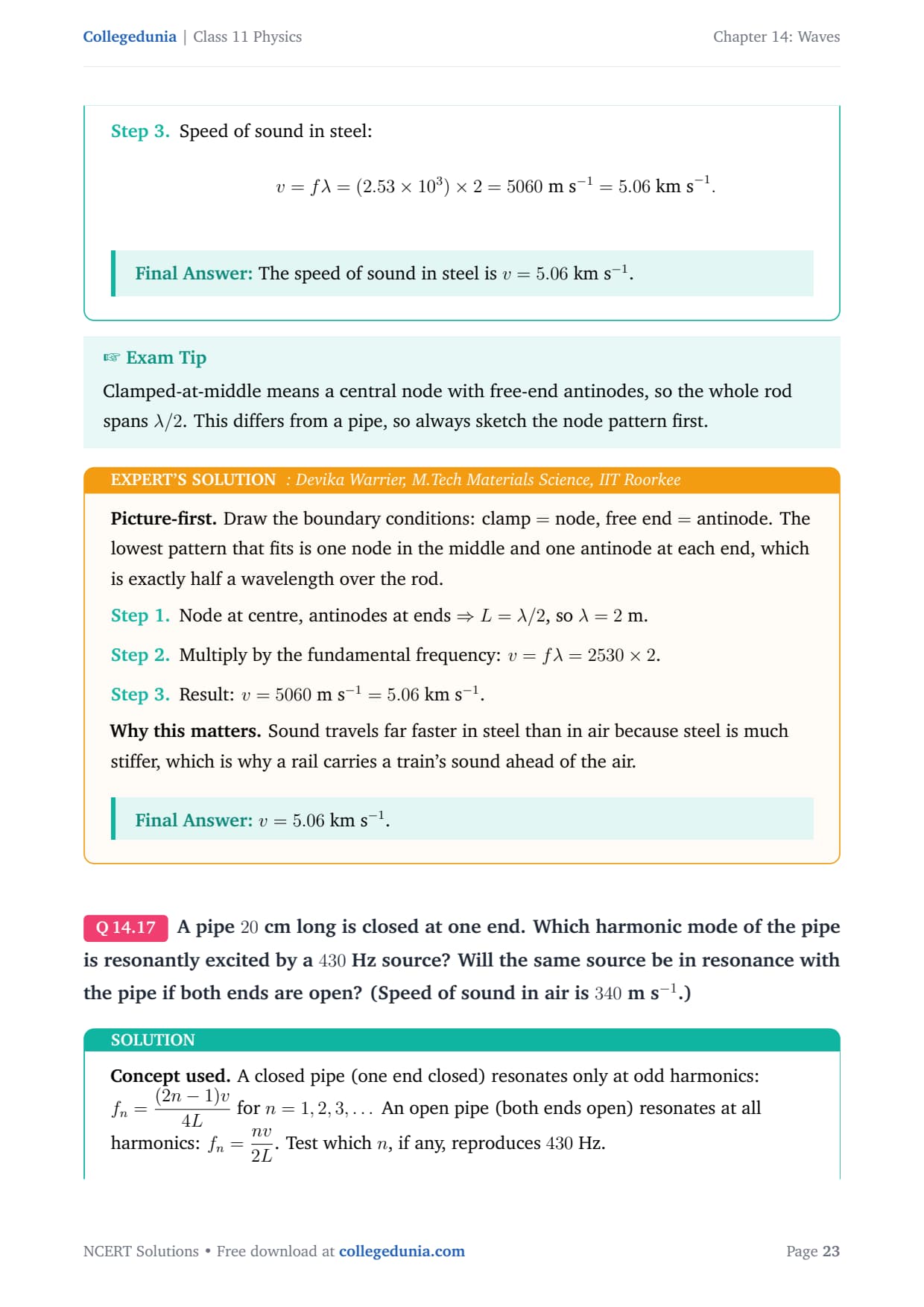
The lowest frequency is the fundamental, and the higher ones are overtones. Numericals like Exercise 14.11 ask for the fundamental frequency of a string or a pipe. A pipe closed at one end produces only odd harmonics, so its notes differ from an open pipe of the same length. The solved answers draw the node-antinode pattern in words so students can rebuild it in the exam.
Beats: Frequency, Formation and Uses in Chapter 14 Waves
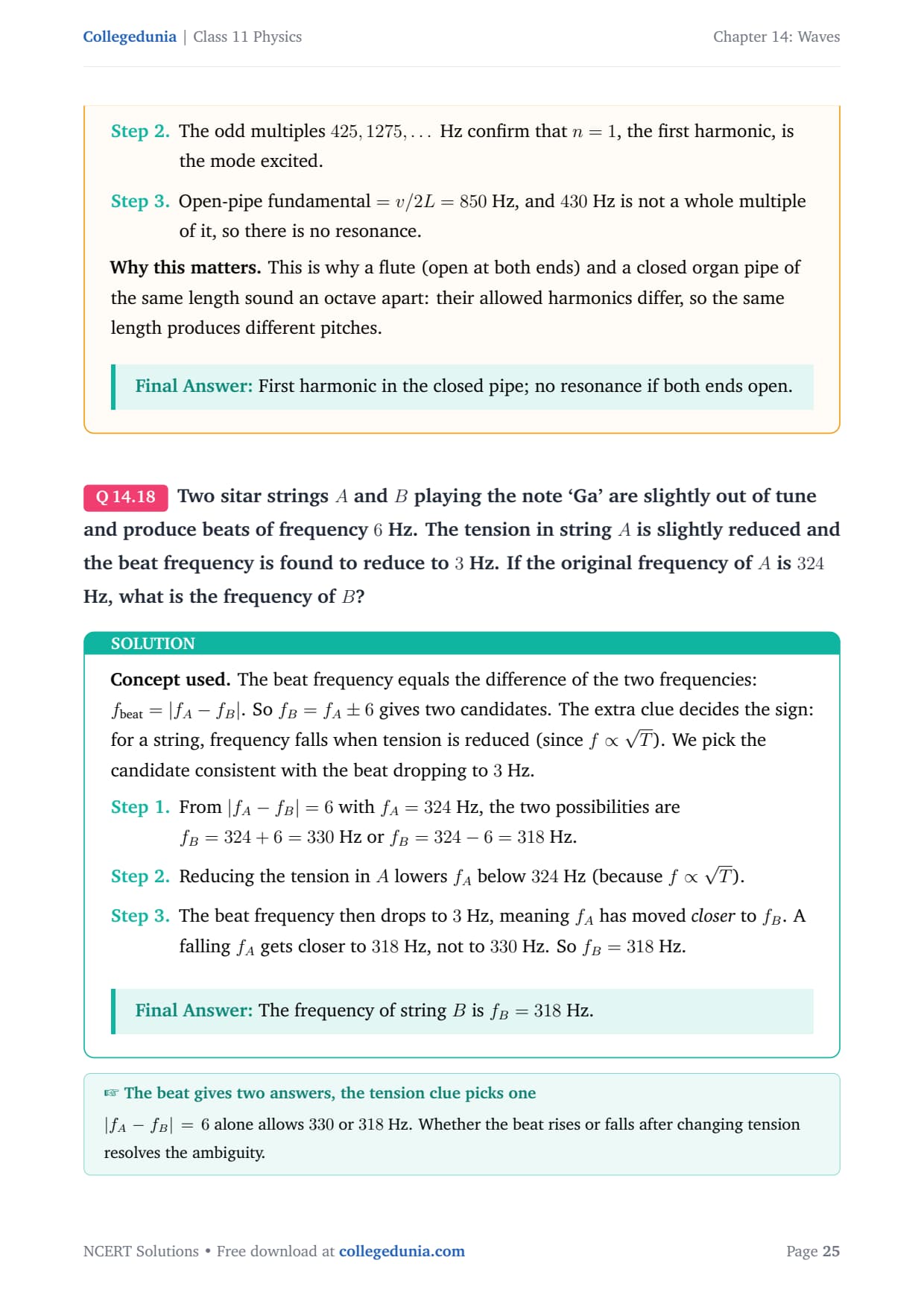
When two sounds of nearly equal frequency play together, the loudness rises and falls in a slow throb. This throb is called a beat, and it is a direct result of superposition. The chapter gives one simple formula, and the NCERT solutions apply it to every beat question.
The beat frequency equals the difference between the two source frequencies, fbeat = |f1 − f2|. Beats form only when the two frequencies are close, usually within a few hertz. The idea appears in these standard exam settings.
- Tuning instruments: a musician tunes a string until the beats with a reference note vanish.
- Finding an unknown frequency: load or file a tuning fork and watch whether the beat rate rises or falls.
- Everyday sound: two engines running at close speeds produce an audible throb.
Questions such as Exercise 14.12 give a tuning fork that produces a known number of beats and ask for the second frequency. The beat count per second is exactly the frequency difference in hertz. The trick is deciding whether to add or subtract, and the solutions show how the change in beat rate settles the sign.
The Doppler Effect for Sound and Its Formula
When a source or a listener moves, the pitch heard is not the pitch sent out. This shift is the Doppler effect, and it is the most-tested single idea in the chapter. The solved answers keep the sign convention fixed so students never lose marks on direction.
The observed frequency is f′ = f (v ± vo)/(v ∓ vs), where v is the speed of sound, vo the observer's speed and vs the source's speed. The rule for the signs is what students must lock in.
- Approaching: when source and observer move closer, the pitch rises above the emitted frequency.
- Receding: when they move apart, the pitch falls below the emitted frequency.
- Sign rule: choose the signs so that approach always gives a higher f′ and recession a lower one.
Numericals like Exercise 14.19 and Exercise 14.20 ask for the frequency heard when a train or a car passes. Fix the direction of motion first, then pick the signs to match a rise or fall in pitch. The Class 11 Physics NCERT Solutions Chapter 14 Waves put the sign choice on its own line so the reasoning is never hidden inside the arithmetic.
Exercise-wise Breakdown for Class 11 Physics Chapter 14 Waves
The NCERT back-exercise splits into clear groups. Use this map to plan which answers to practise first for the 2026-27 boards. Every group links to the full solved set.
| Question group | Exercises | What it covers |
|---|---|---|
| Wave types and speed | Exercise 14.1 to Exercise 14.7 | Transverse vs longitudinal, speed on a string, speed of sound |
| Wave equation | Exercise 14.8 to Exercise 14.10 | Reading amplitude, wavelength, frequency and phase from a wave |
| Standing waves and beats | Exercise 14.11 to Exercise 14.18 | Normal modes on strings and pipes, fundamental frequency, beats |
| Doppler effect | Exercise 14.19 onward | Moving source and observer, pitch heard, sign convention |
Solving the groups in this order builds the skills in the same sequence the chapter teaches them. Start with wave speed, then the wave equation, then standing waves and Doppler, because each group uses the one before it.
Common Mistakes Students Make in the Waves Chapter
These slips happen while writing or calculating the answer, not because the concept is unclear. Each one costs 1 to 3 marks in the CBSE paper, so the solved answers point them out at the exact step.
Mistake 1: Confusing angular frequency ω with frequency f. Divide ω by 2π before writing the frequency in hertz.
Mistake 2: Using Newton's formula for the speed of sound. The process is adiabatic, so include the Laplace factor √γ.
Mistake 3: Applying all-harmonics to a closed pipe. A pipe closed at one end has only odd harmonics.
Mistake 4: Getting the Doppler signs backwards. Fix the direction of motion first, then match the signs to a rise or fall in pitch.
Student Feedback on the Waves Chapter
What 12,840 students told us about their Waves revision:
- 71% of students rated the Doppler effect sign convention as the hardest part of the chapter.
- Most-skipped step: adding the Laplace factor when finding the speed of sound, missed by about 3 in 10 students.
- Students who practised the standing-wave exercises first reported the beat and Doppler numericals felt easier.
Source: 2026-27 Class 11 Physics student poll. Sample of 12,840 students from CBSE schools across 15 states, conducted before the 2026 boards.
Practice Questions for Class 11 Physics Chapter 14 Waves
Once the solved answers are clear, test yourself on the full question set. The practice page has every NCERT question with a step-by-step Solution and an Expert Solution behind a click.
Practice Questions: Waves
Attempt all NCERT questions with detailed and expert solutions.
Open Practice QuestionsOther Waves Class 11 Physics Resources
| Resource | Link |
|---|---|
| NCERT Solutions | You are here |
| Notes | Waves Class 11 Notes |
| Handwritten Notes | Waves Class 11 Handwritten Notes |
| Formula Sheet | Waves Class 11 Formula Sheet |
| NCERT Book PDF | Waves Class 11 Book PDF |
NCERT Solutions for Class 11 Physics: All Chapters
Jump to the solutions for any other Class 11 Physics chapter below.
| Chapter | NCERT Solutions |
|---|---|
| Chapter 1 | Units and Measurements |
| Chapter 2 | Motion in a Straight Line |
| Chapter 3 | Motion in a Plane |
| Chapter 4 | Laws of Motion |
| Chapter 5 | Work, Energy and Power |
| Chapter 6 | System of Particles and Rotational Motion |
| Chapter 7 | Gravitation |
| Chapter 8 | Mechanical Properties of Solids |
| Chapter 9 | Mechanical Properties of Fluids |
| Chapter 10 | Thermal Properties of Matter |
| Chapter 11 | Thermodynamics |
| Chapter 12 | Kinetic Theory |
| Chapter 13 | Oscillations |
| Chapter 14 | Waves |
FAQs on Class 11 Physics Chapter 14 Waves NCERT Solutions
Waves NCERT Solutions - Frequently Asked Questions
Ques. How many questions are solved in the Class 11 Physics NCERT Solutions Chapter 14 Waves?
Ans. This page solves every NCERT back-exercise question of Class 11 Physics Chapter 14 Waves, starting from Exercise 14.1. The questions cover wave types, the wave equation, wave speed, standing waves, beats, and the Doppler effect. Each answer has a step-by-step Solution and an Expert Solution.
Ques. What is the difference between transverse and longitudinal waves?
Ans. In a transverse wave the particles of the medium move at right angles to the direction the wave travels, forming crests and troughs. In a longitudinal wave the particles move back and forth along the wave direction, forming compressions and rarefactions. Sound in air is longitudinal, while a wave on a string is transverse.
Ques. Why is the Laplace correction needed for the speed of sound?
Ans. Newton assumed the compressions and rarefactions in a sound wave happen at constant temperature, which gave a speed about 15% too low. Laplace showed the changes are too fast for heat to flow out, so the process is adiabatic. This adds the factor √γ, and the corrected speed v = √(γP/ρ) matches the measured value.
Ques. How do you calculate beat frequency in Class 11 Physics Chapter 14?
Ans. The beat frequency equals the absolute difference between the two frequencies, |f1 − f2|. Beats form only when the two frequencies are close, usually within a few hertz. The number of beats heard per second is exactly the frequency difference in hertz, as the solved numericals in these Class 11 Physics Chapter 14 solutions show.
Ques. What is the weightage of Waves in the CBSE board exam?
Ans. Waves carries about 6 to 8 marks in the CBSE Class 11 Physics paper, usually one derivation plus one numerical on wave speed, beats or the Doppler effect. It also appears in JEE Main and NEET as questions on standing waves, resonance in pipes, and the Doppler shift.
Ques. What is the Doppler effect in sound?
Ans. The Doppler effect is the change in the observed frequency of a sound when the source, the observer, or both are moving. When they move closer the pitch rises above the emitted frequency, and when they move apart the pitch falls. The NCERT Solutions for Class 11 Physics Chapter 14 Waves keep a fixed sign rule so students do not lose marks on direction.



Comments