



The NCERT Solutions for Class 11 Maths Chapter 12 Limits and Derivatives Exercise 12.2 solve every derivative question of the second exercise, according to the latest 2026-27 CBSE syllabus. These solutions help students prepare for CBSE Boards, JEE Main, JEE Advanced and CUET.
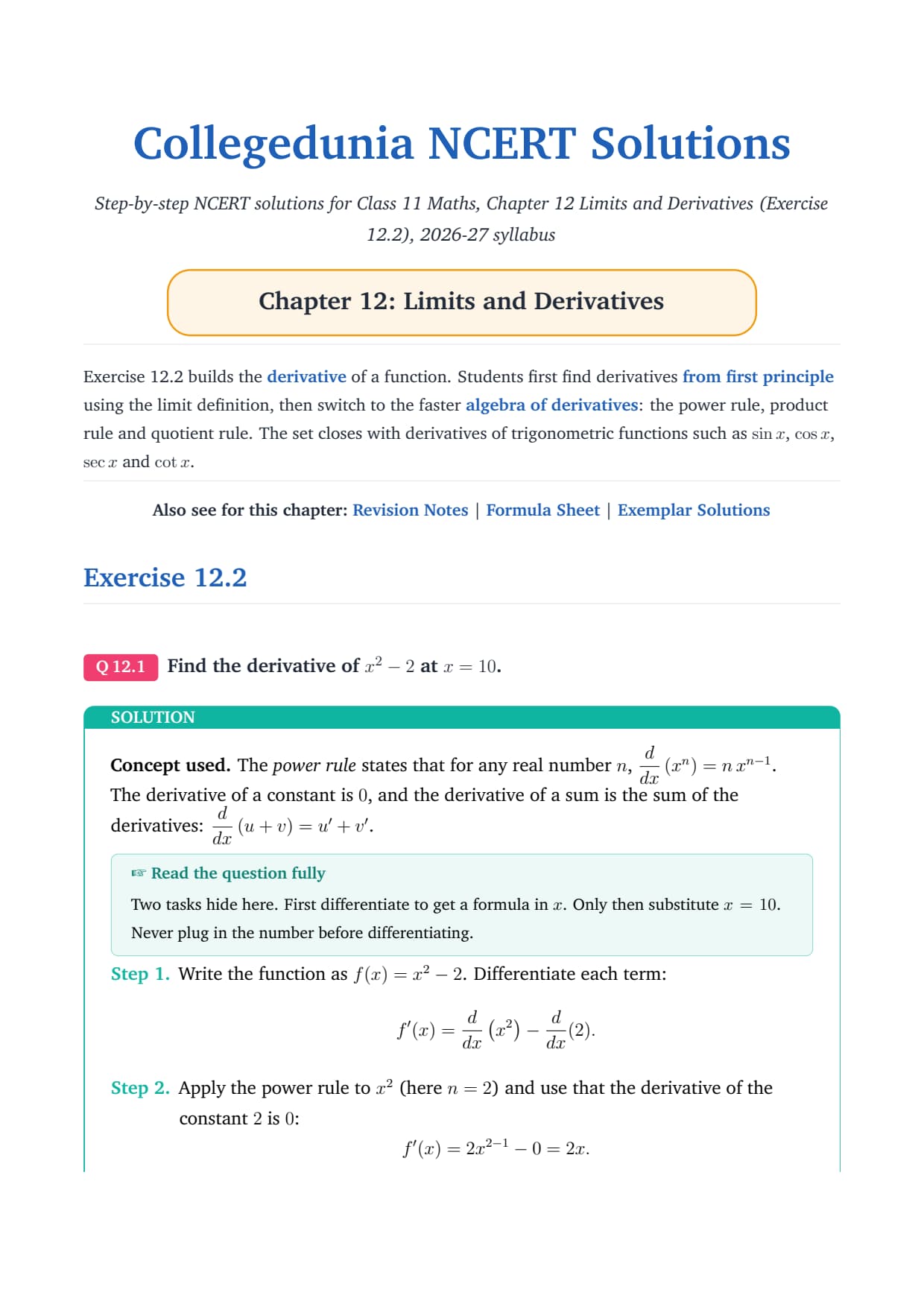
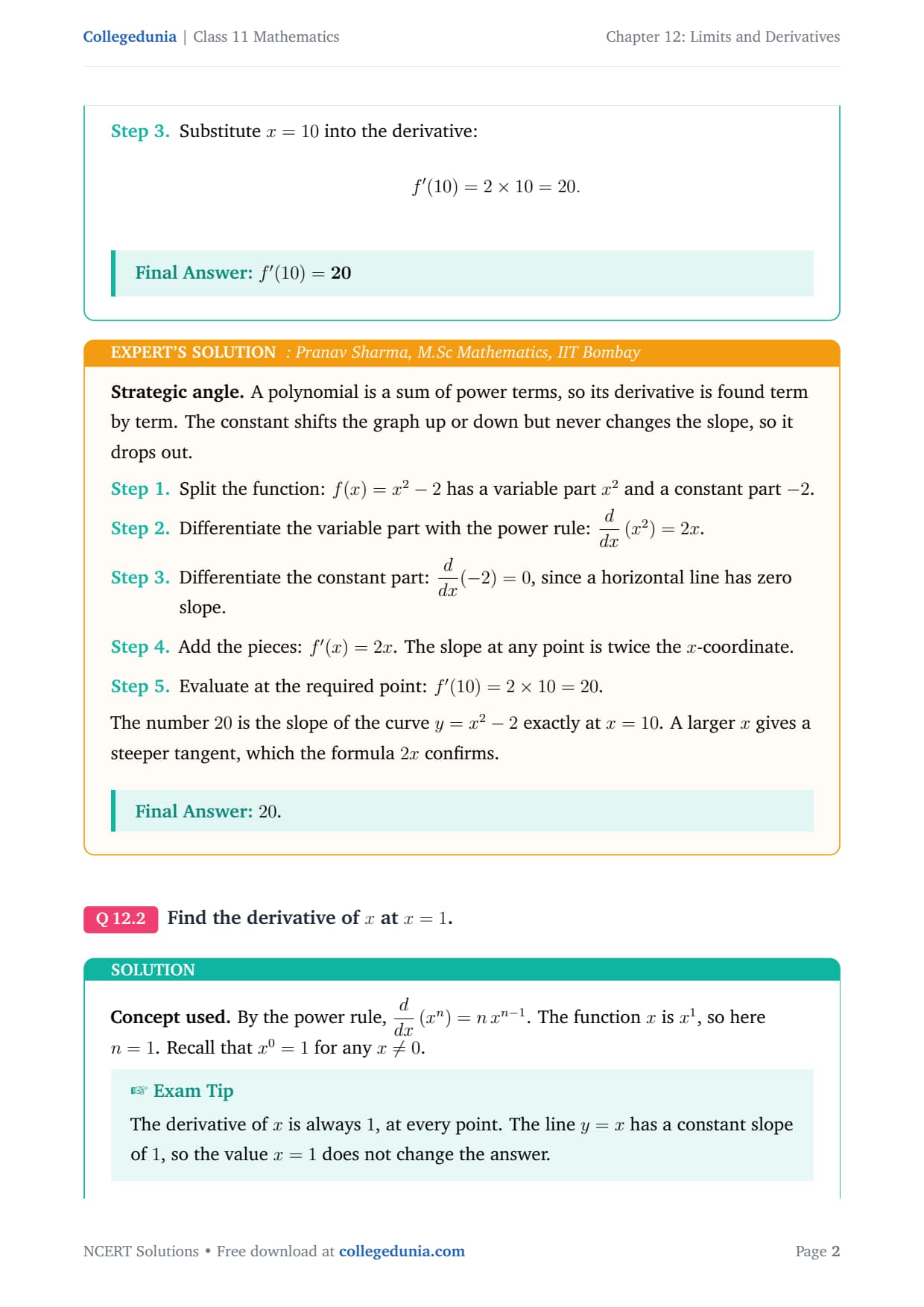
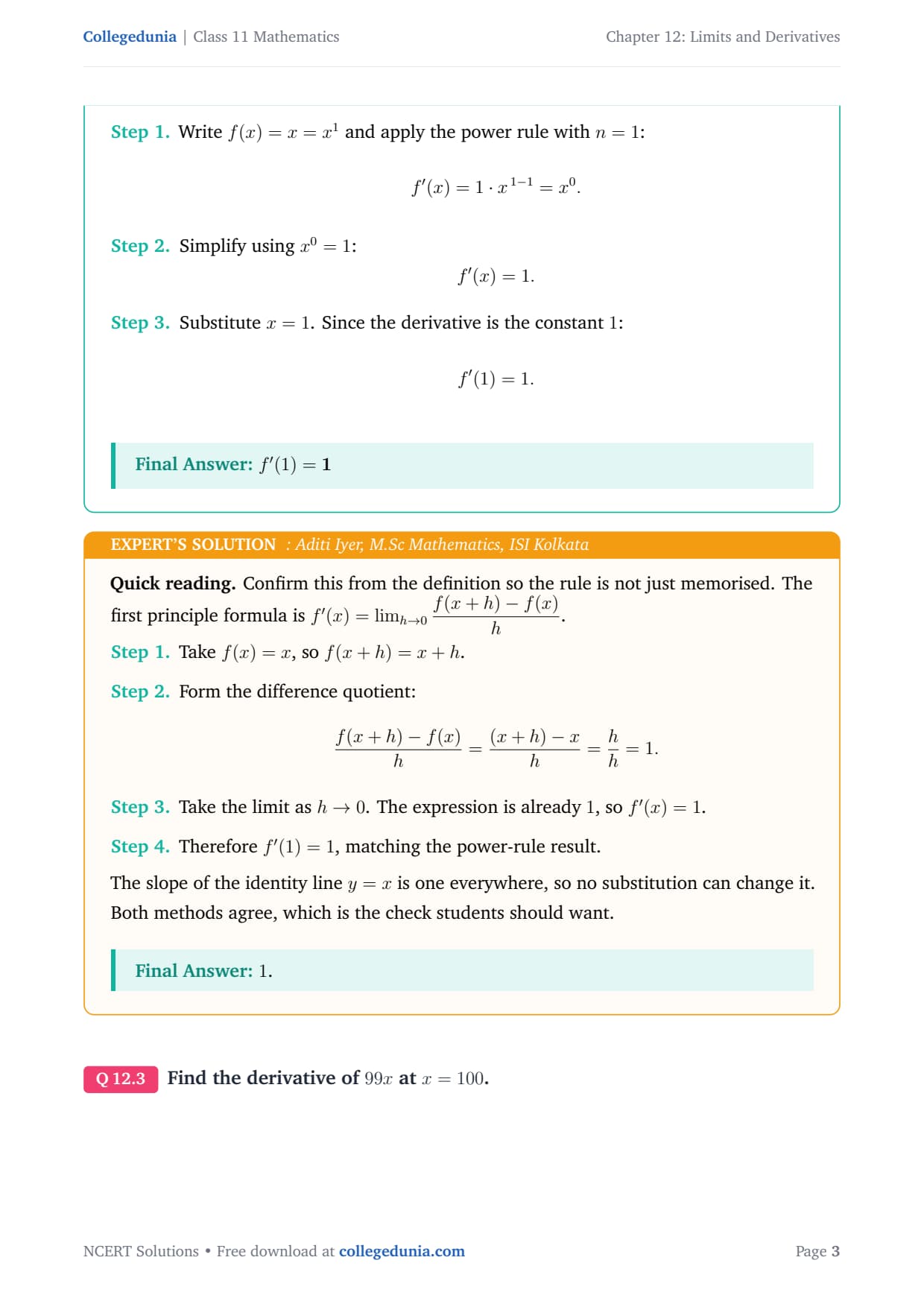
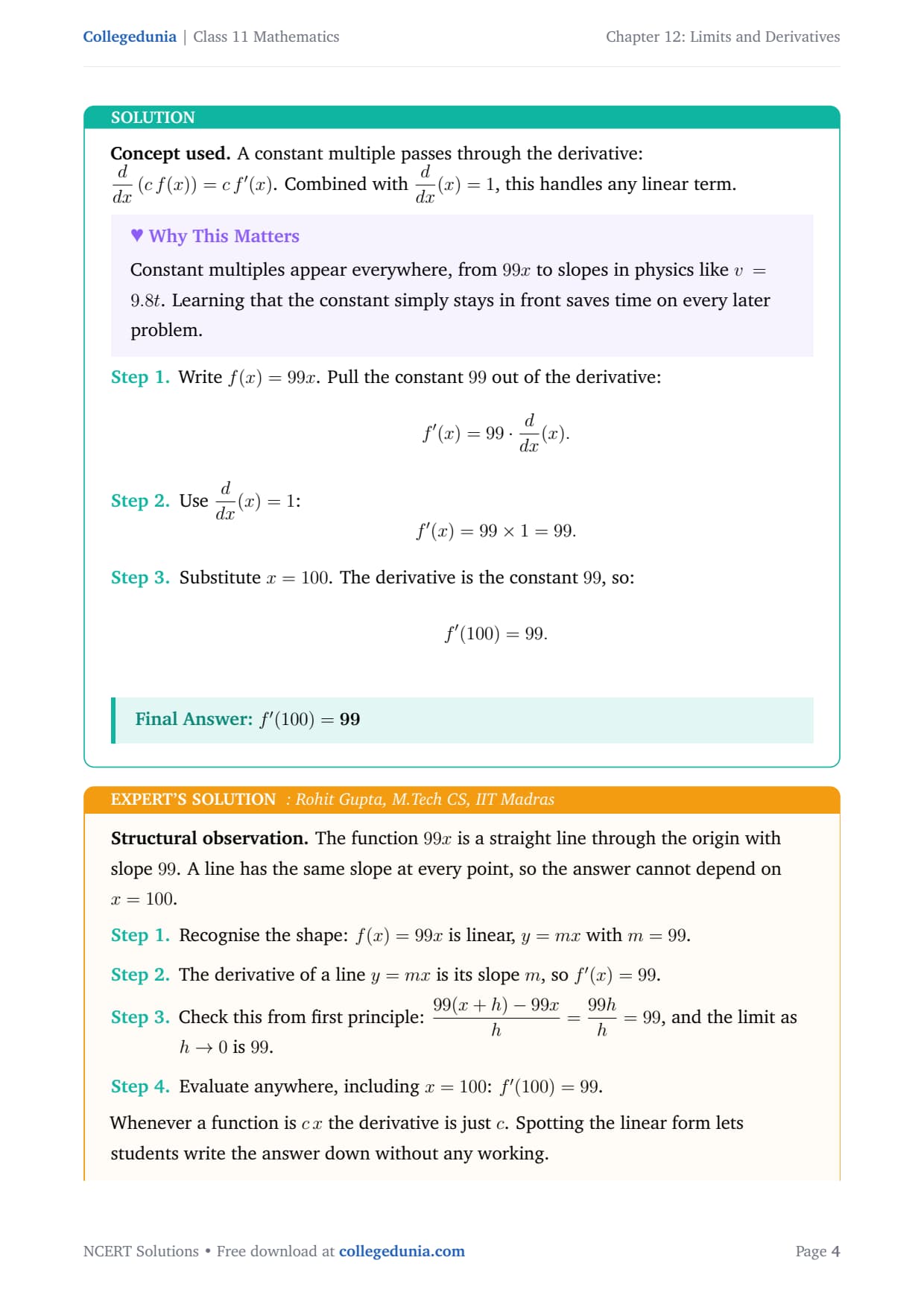
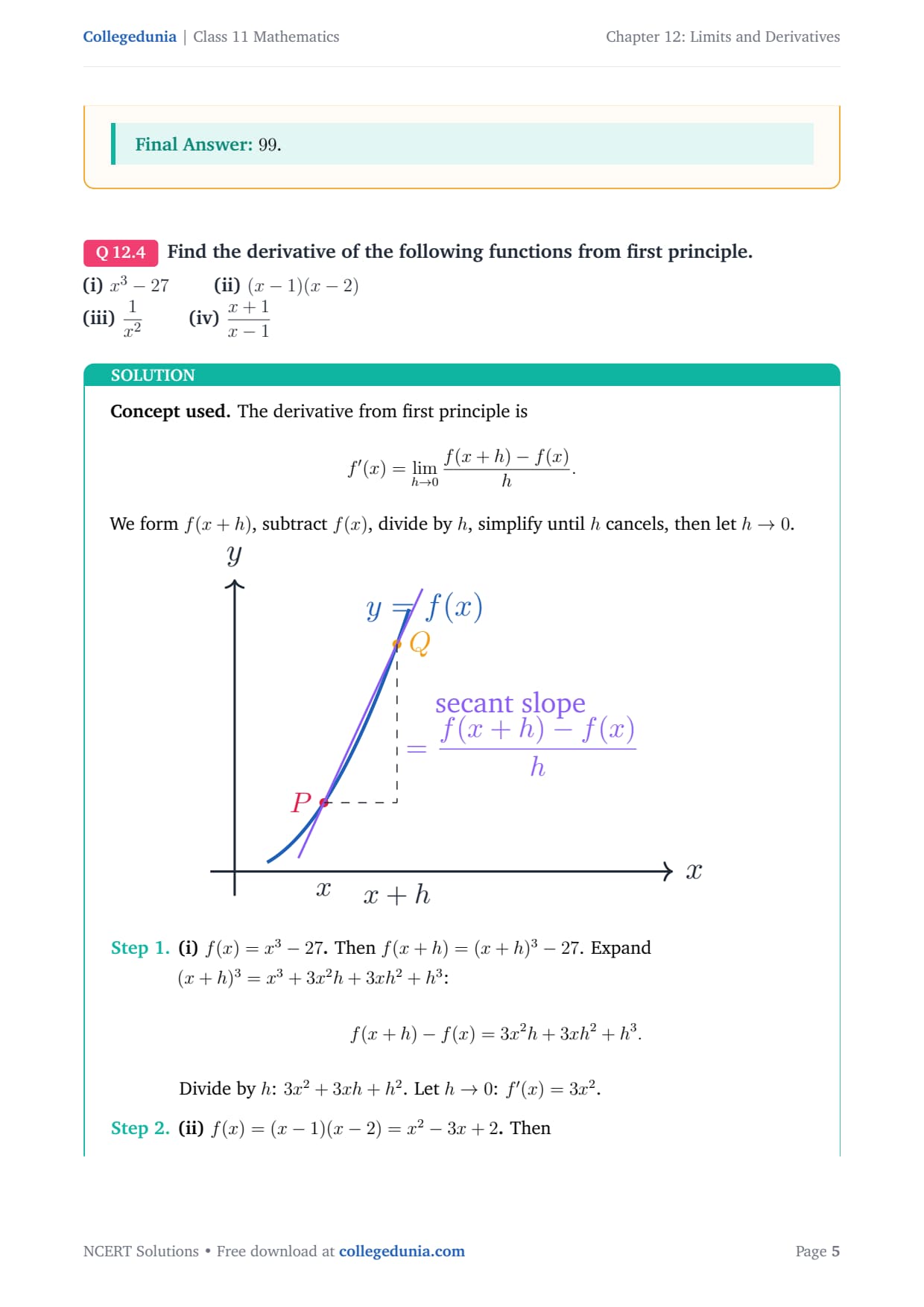
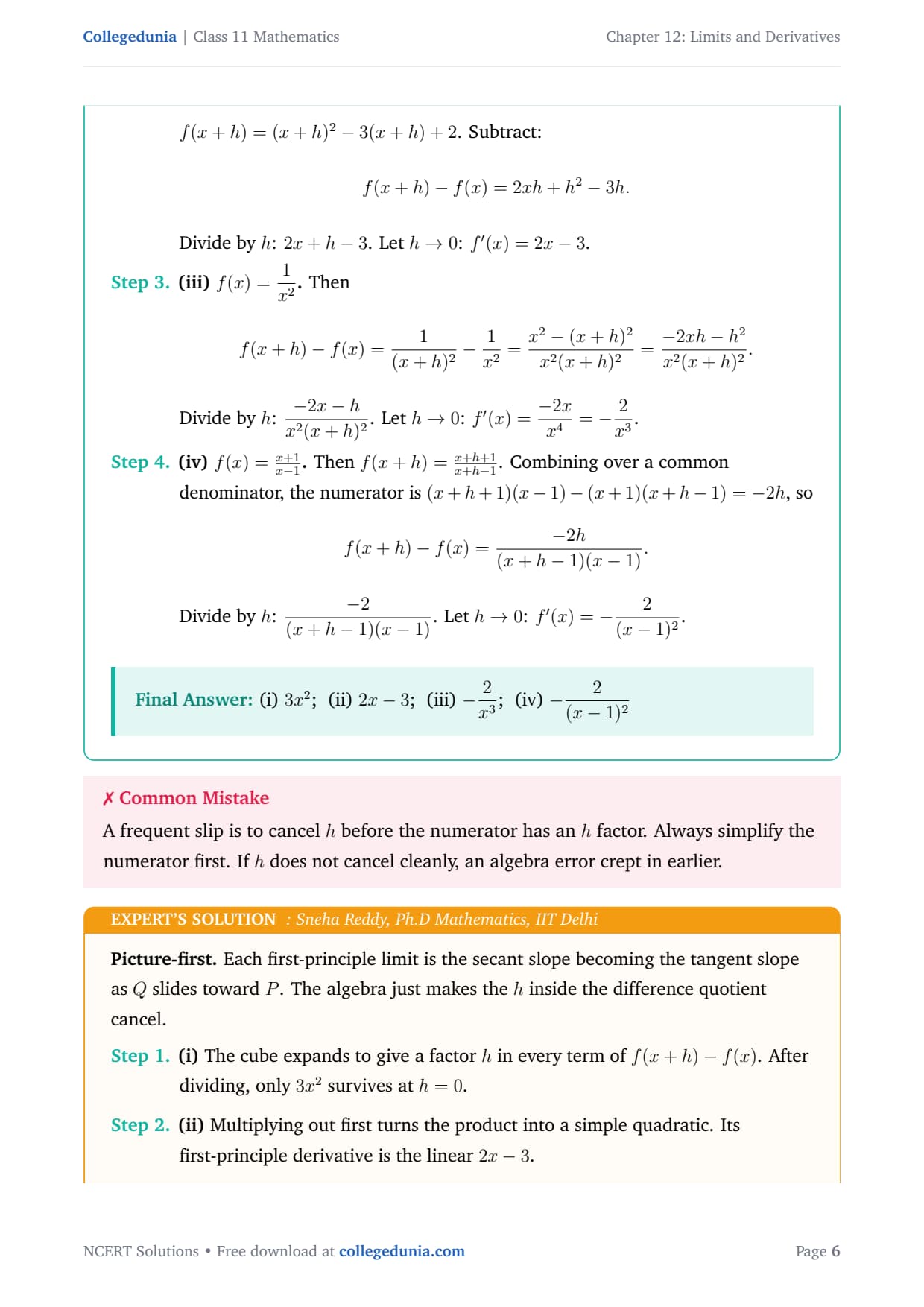
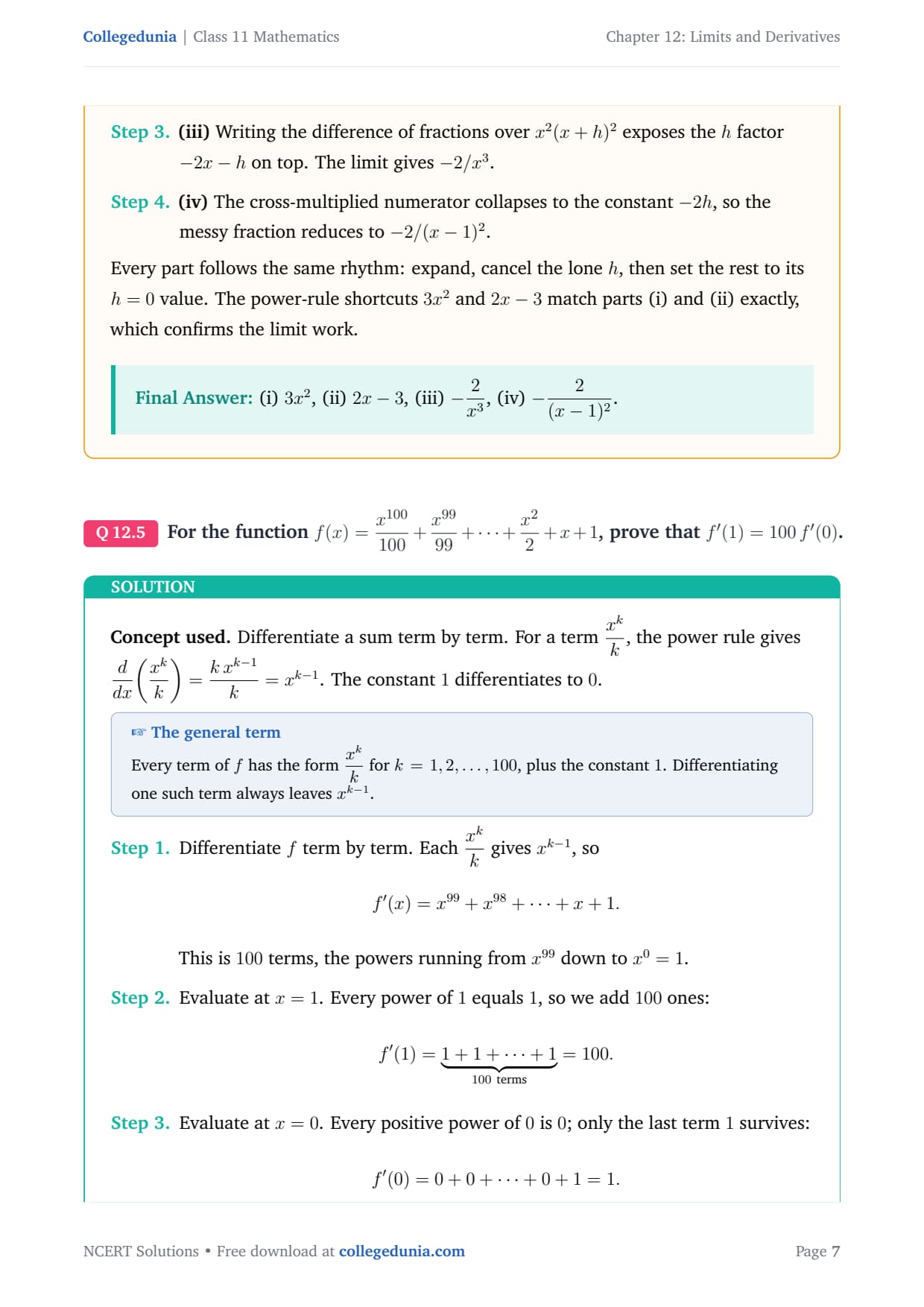
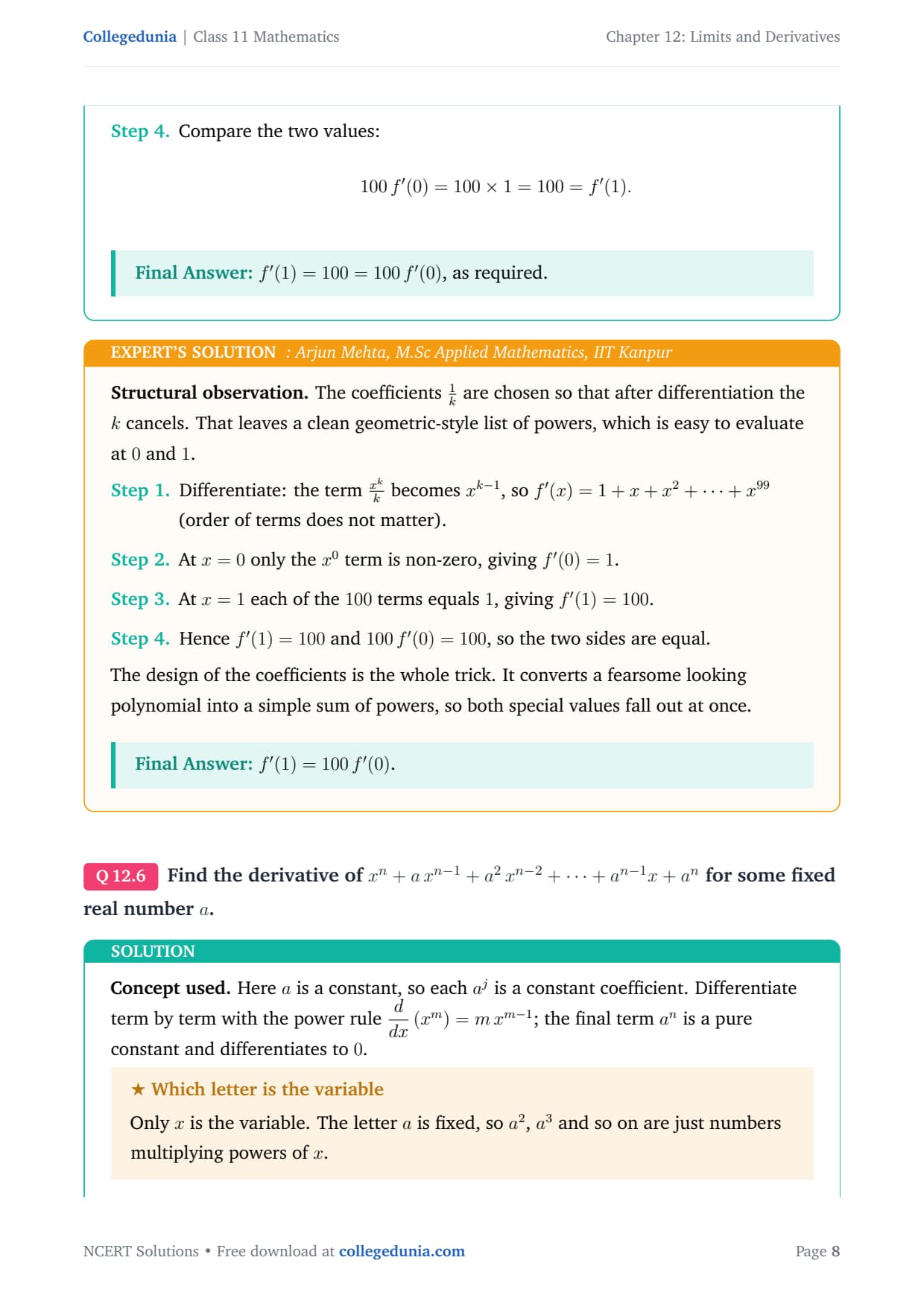
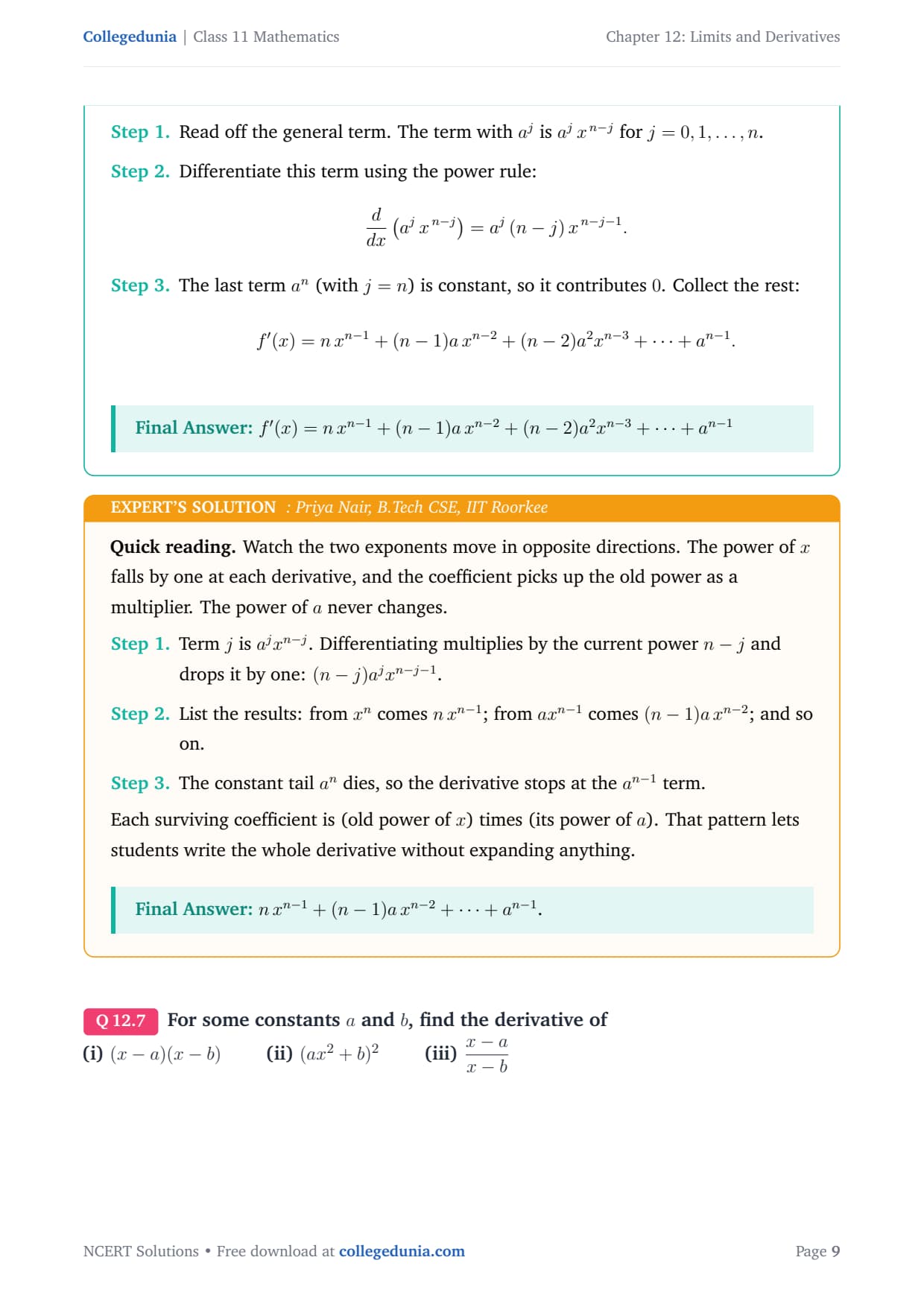
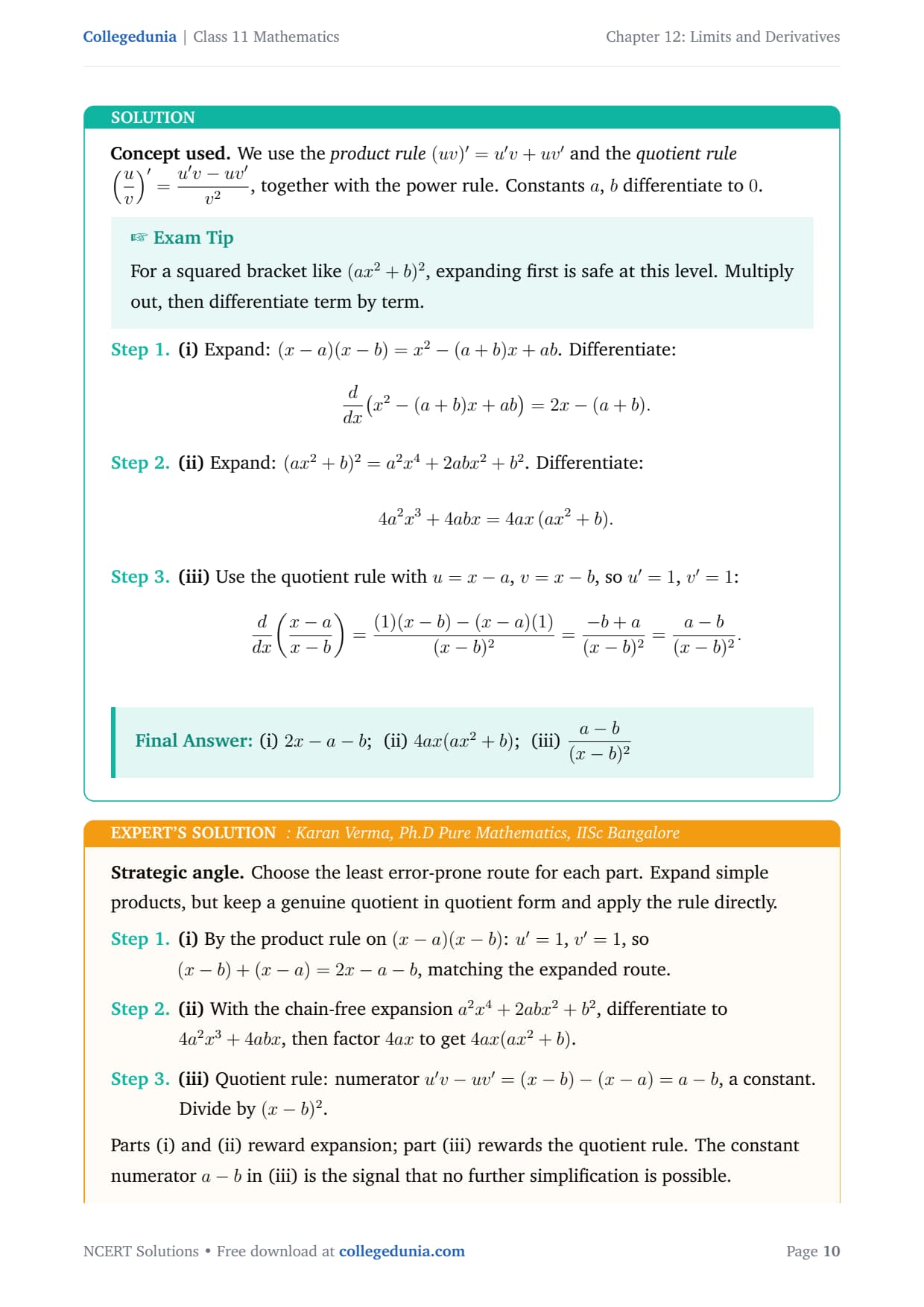
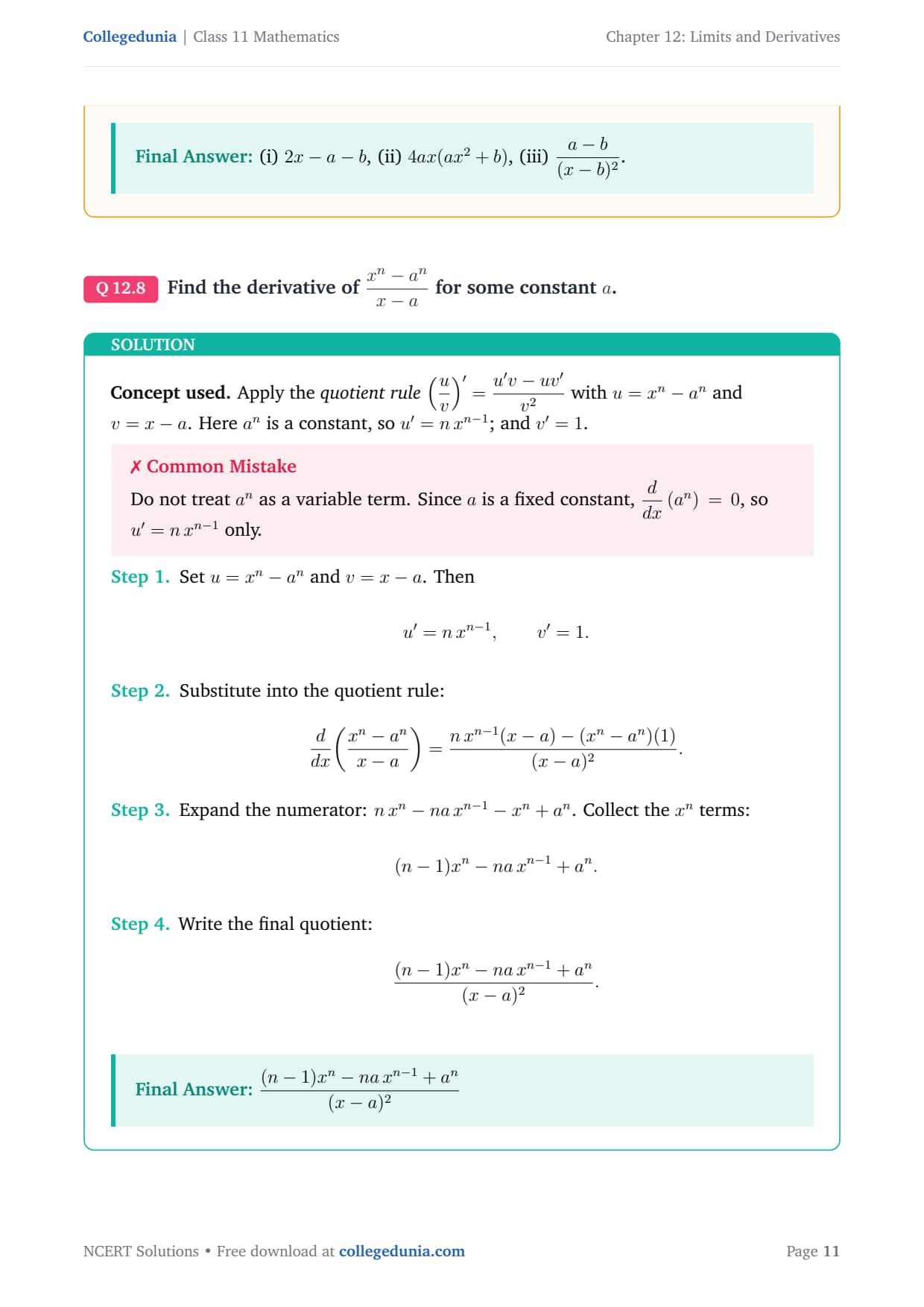
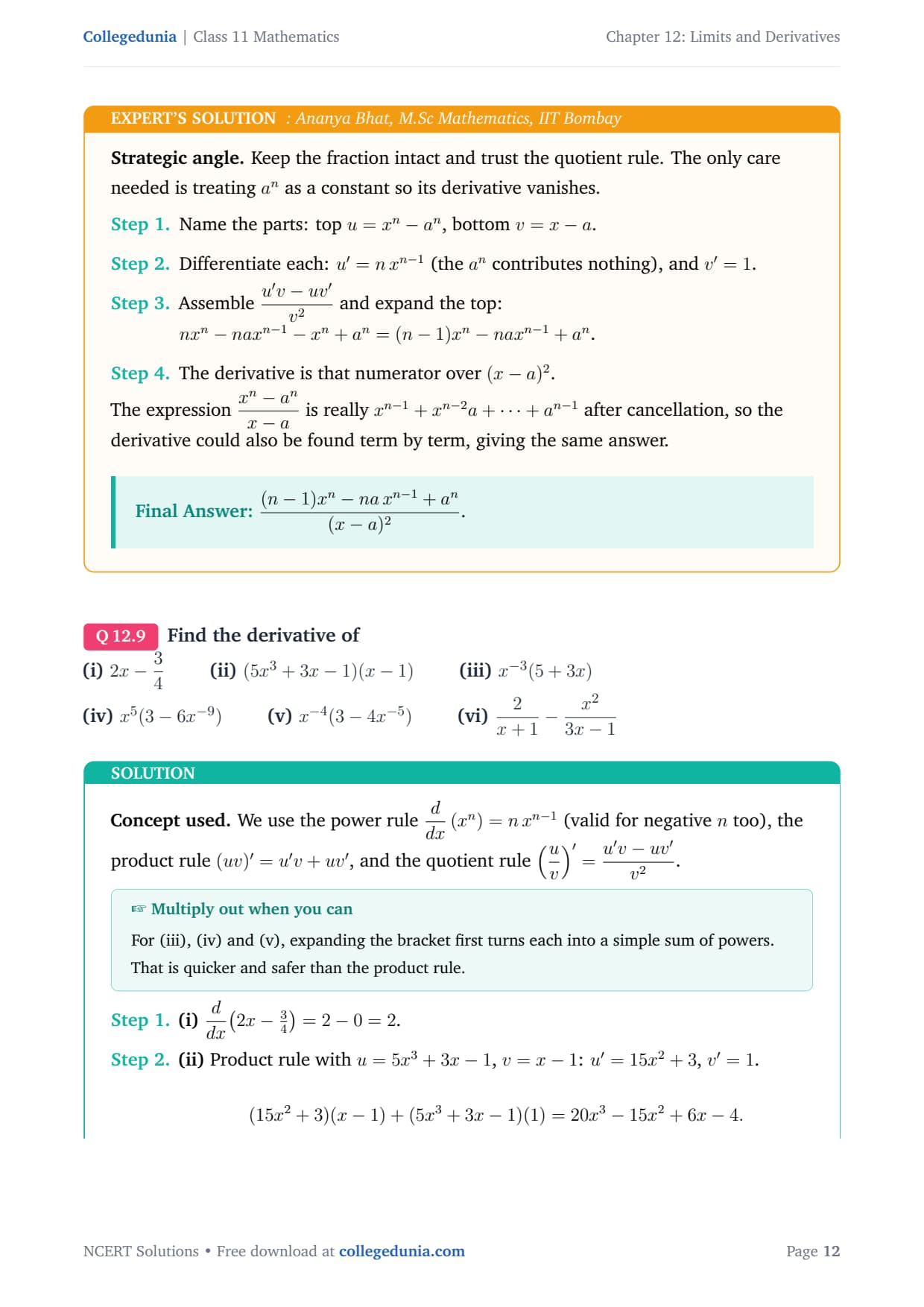
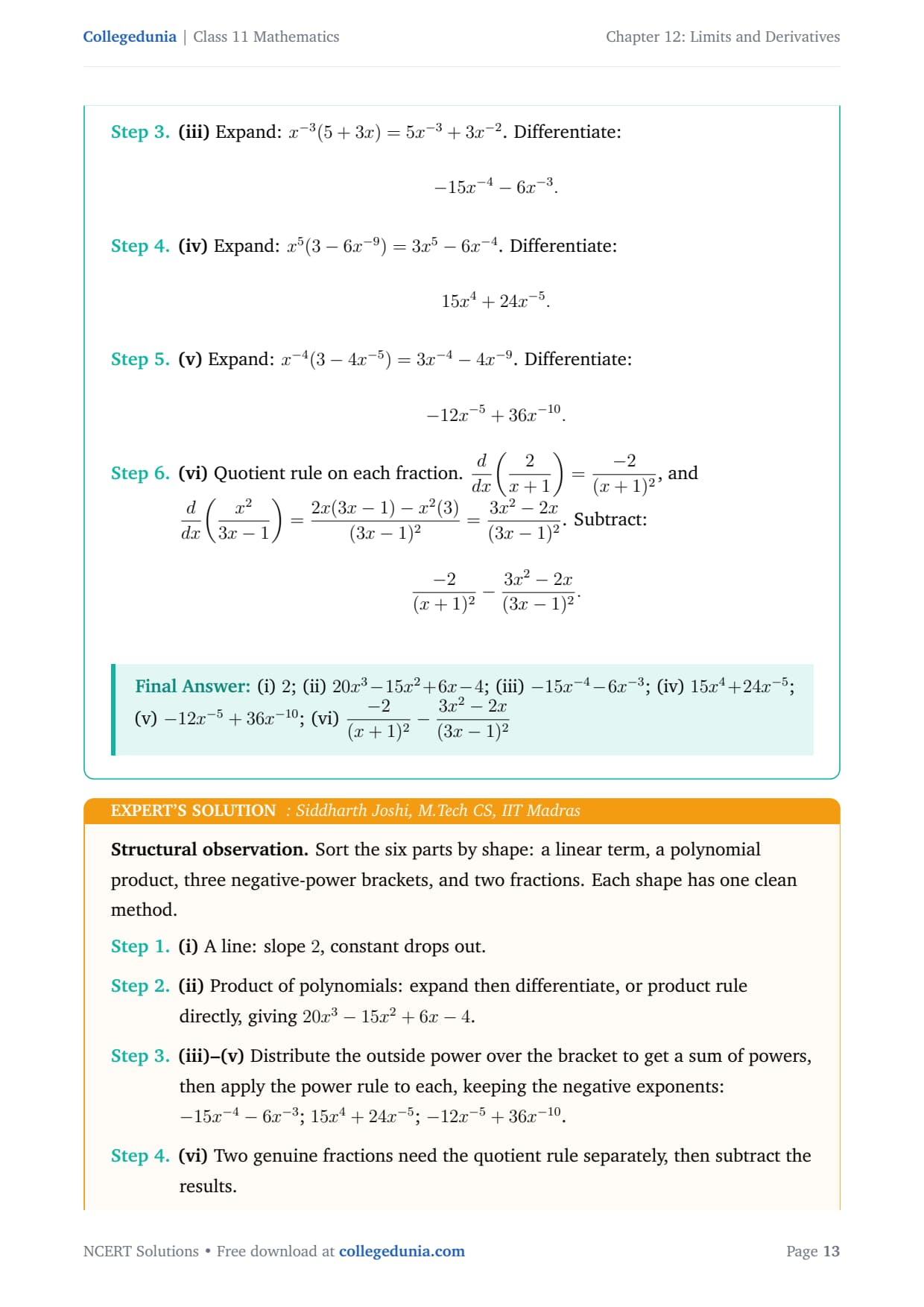
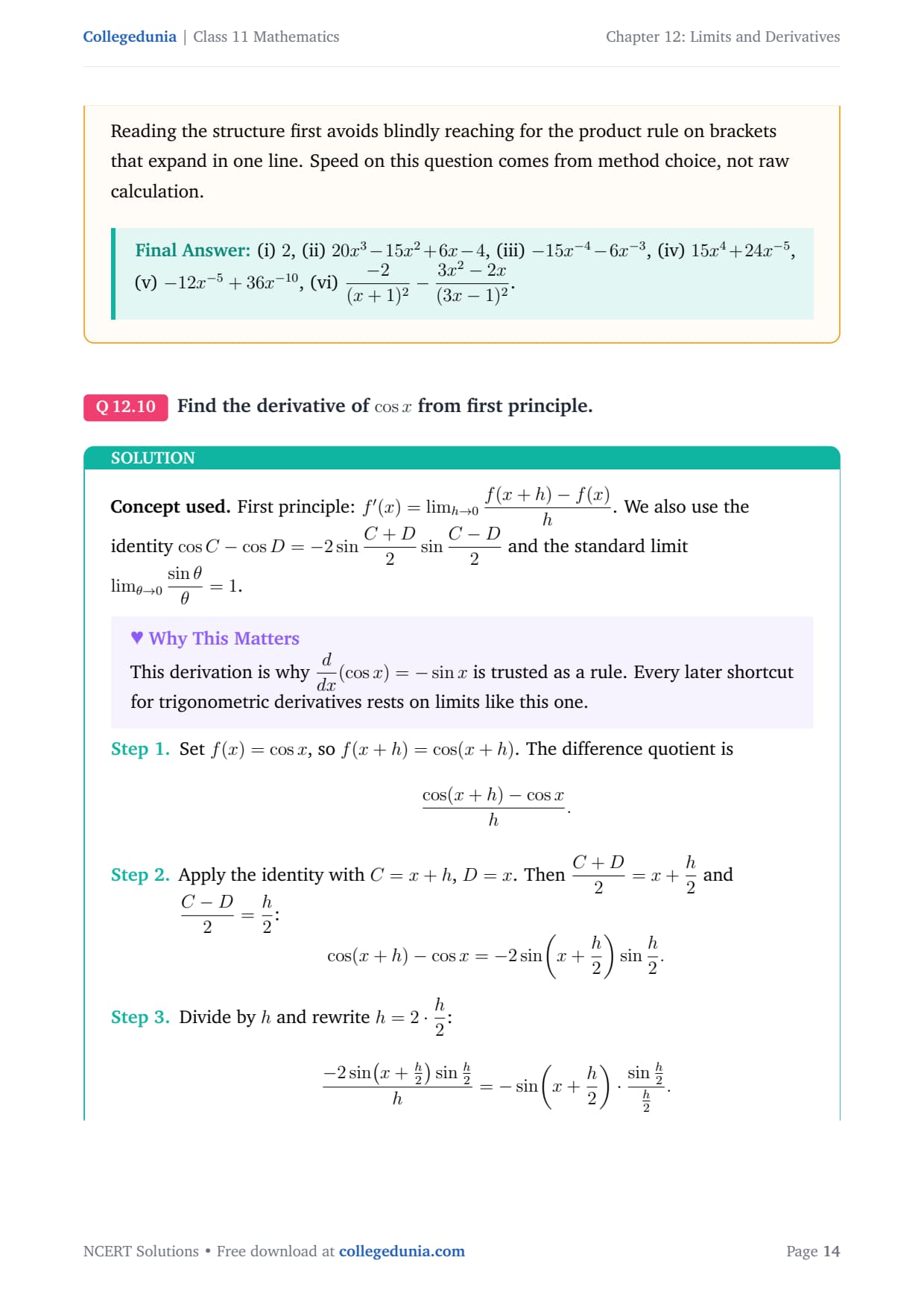
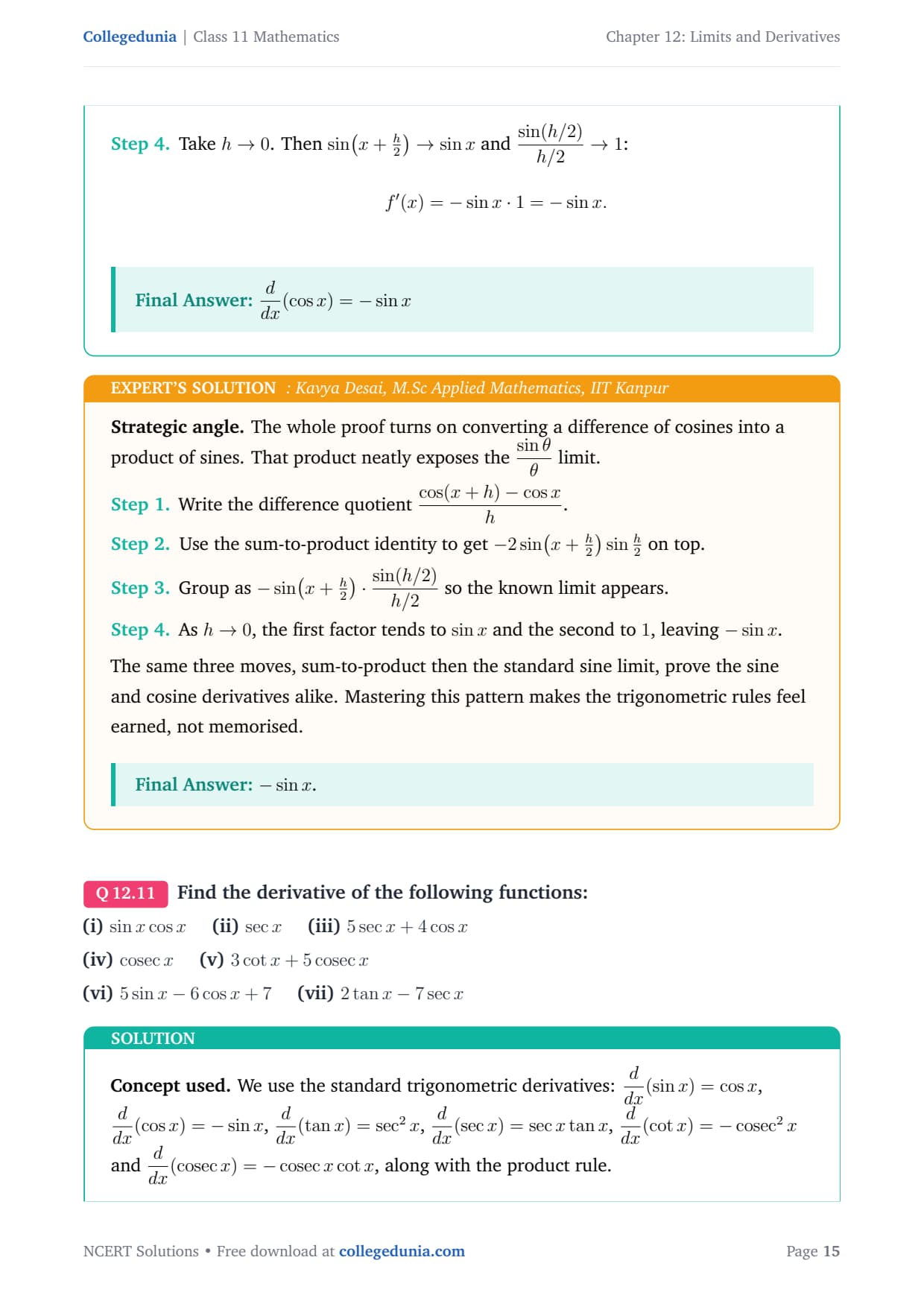
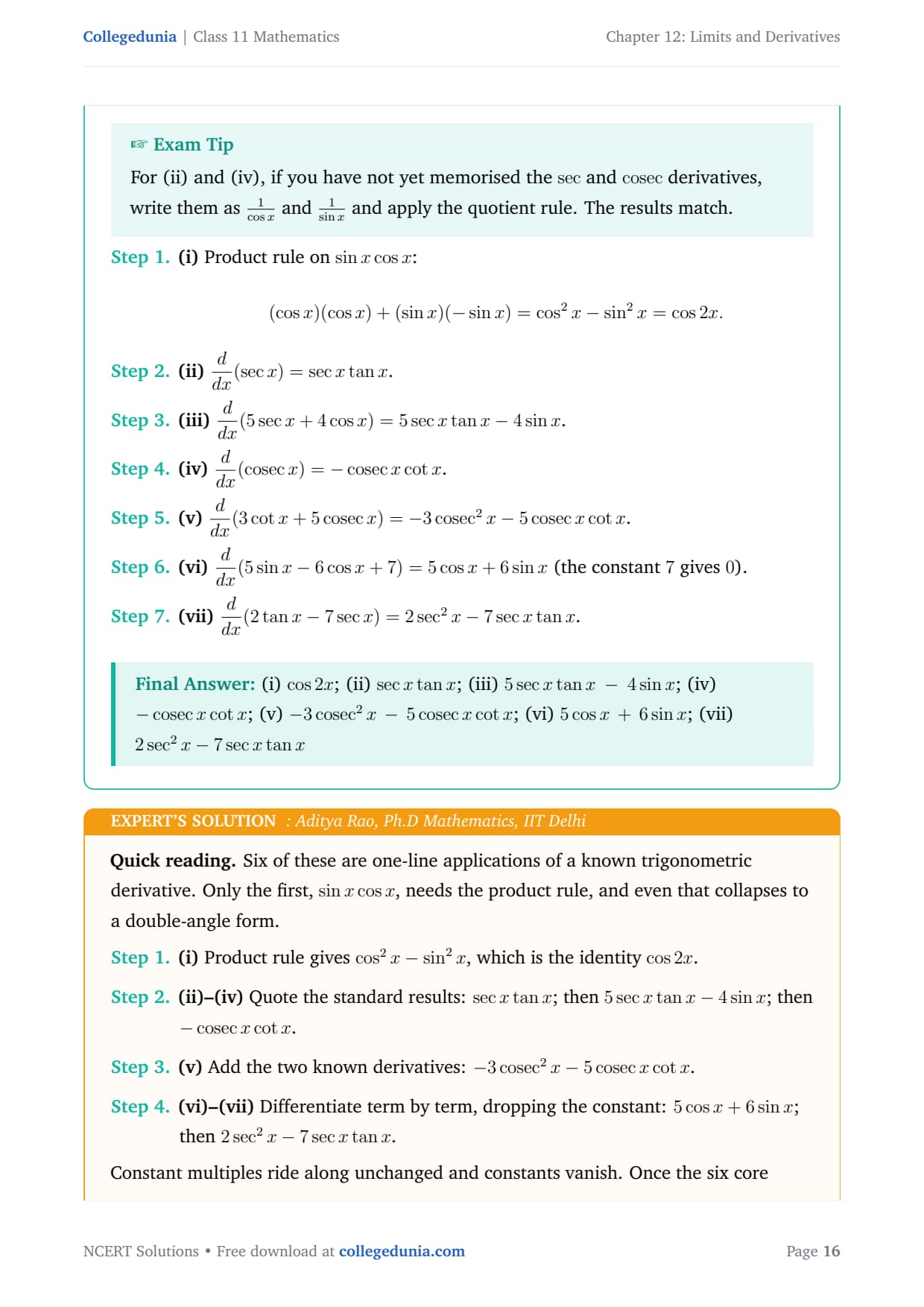
Each solution in this Collegedunia set is prepared by subject experts, based on the 2026-27 NCERT textbook, and checked against recent CBSE exam patterns.
Exercise 12.2 introduces the derivative, the rate at which a function changes. Students learn to differentiate from first principles and then with quicker rules. The exercise has 11 questions built around these skills:
- Finding the derivative of a function from first principle (the ab initio method).
- Using the power rule and the algebra of derivatives for polynomials.
- Differentiating trigonometric functions such as sin x and cos x.
Topics Covered in Exercise 12.2
This exercise defines the derivative of f(x) as f′(x) = limh→0 [f(x + h) − f(x)] / h. It is the slope of the curve at a point. Exercise 12.2 first uses this definition directly, then builds the product and quotient rules to speed things up.
- First principle: deriving f′(x) straight from the limit definition.
- Power rule: the derivative of xn is n·xn−1.
- Algebra of derivatives: the derivative of a sum and of a constant multiple.
- Product and quotient rules: differentiating products and ratios of functions.
- Trigonometric derivatives: d/dx(sin x) = cos x and d/dx(cos x) = −sin x.
Important: the first-principle method is examined directly, so students must be able to set up and simplify the limit even when a shortcut exists.
Question-wise Breakdown of Exercise 12.2
The NCERT Solutions for Class 11 Maths Chapter 12 Limits and Derivatives Exercise 12.2 solve all 11 questions in order. The table below groups the questions by method so students can plan their practice. Full step-by-step answers are inside the PDF above.
| Questions | What they ask | Skill tested |
|---|---|---|
| Q1 to Q2 | Derivative of x at a point and of a polynomial from first principle | First principle |
| Q3 to Q4 | Derivatives from first principle for rational and root functions | Ab initio method |
| Q5 to Q9 | Derivatives of polynomials using the power rule and algebra | Power rule |
| Q10 to Q11 | Derivatives involving trigonometric and combined functions | Product and quotient rules |
The exercise moves from the slow first-principle method to faster rules, so students see both why and how differentiation works.
Key Formulas and Definitions for Exercise 12.2
Exercise 12.2 rests on the definition of a derivative and a short list of rules. Students should learn these before tackling the mixed questions.
| Rule | Result |
|---|---|
| Derivative from first principle | f′(x) = limh→0 [f(x + h) − f(x)] / h |
| Power rule | d/dx(xn) = n·xn−1 |
| Constant multiple | d/dx(c·f) = c·f′ |
| Sum rule | (f + g)′ = f′ + g′ |
| Product rule | (u·v)′ = u′v + uv′ |
| Quotient rule | (u/v)′ = (u′v − uv′) / v2 |
| Trigonometric | d/dx(sin x) = cos x, d/dx(cos x) = −sin x |
Tip: when a question says "from first principle", the power rule cannot be used to save steps. Set up the limit definition and simplify fully.
Common Mistakes in Exercise 12.2
Students lose marks in Exercise 12.2 on small errors of method. The list below covers the slips seen most often in tests on the NCERT Solutions for Class 11 Maths Chapter 12 Limits and Derivatives Exercise 12.2.
- Using the power rule when a question clearly asks for the first-principle method.
- Forgetting the second term in the product rule, writing (uv)′ as only u′v′.
- Getting the sign wrong in the quotient rule numerator, which must be u′v − uv′.
- Writing the derivative of cos x as sin x instead of −sin x.
Practice Questions for Exercise 12.2
After reading the solutions, students should test themselves on the same derivative types. The card below opens a set of solved practice questions with step-by-step answers for Exercise 12.2.
Practice Card: Solved Practice Questions for Class 11 Maths Limits and Derivatives Exercise 12.2 — attempt each question, then check the worked solution.
Other Exercises of Chapter 12 Limits and Derivatives
Chapter 12 Limits and Derivatives has two exercises plus a Miscellaneous Exercise. Use the table to move between exercises once Exercise 12.2 is done.
| Exercise | NCERT Solutions link |
|---|---|
| Exercise 12.1 | Class 11 Maths Limits and Derivatives Exercise 12.1 Solutions |
| Miscellaneous Exercise | Class 11 Maths Limits and Derivatives Miscellaneous Exercise Solutions |
More Class 11 Maths Limits and Derivatives Resources
Pair the solutions with the notes and the NCERT book PDF for full chapter revision. All three resources for Chapter 12 Limits and Derivatives are linked below.
| Resource | Link |
|---|---|
| Revision Notes | Class 11 Maths Limits and Derivatives Notes |
| Handwritten Notes | Class 11 Maths Limits and Derivatives Handwritten Notes |
| NCERT Book PDF | Class 11 Maths Limits and Derivatives NCERT Book PDF |
NCERT Solutions for Other Class 11 Maths Chapters
Students can move to the first exercise of any other Class 11 Maths chapter using the cross-sell table below.
| Chapter | NCERT Solutions |
|---|---|
| Chapter 1: Sets | Sets Solutions |
| Chapter 2: Relations and Functions | Relations and Functions Solutions |
| Chapter 3: Trigonometric Functions | Trigonometric Functions Solutions |
| Chapter 4: Complex Numbers and Quadratic Equations | Complex Numbers Solutions |
| Chapter 5: Linear Inequalities | Linear Inequalities Solutions |
| Chapter 6: Permutations and Combinations | Permutations and Combinations Solutions |
| Chapter 7: Binomial Theorem | Binomial Theorem Solutions |
| Chapter 8: Sequences and Series | Sequences and Series Solutions |
| Chapter 9: Straight Lines | Straight Lines Solutions |
| Chapter 10: Conic Sections | Conic Sections Solutions |
| Chapter 11: Introduction to Three Dimensional Geometry | Three Dimensional Geometry Solutions |
| Chapter 12: Limits and Derivatives | You are here |
| Chapter 13: Statistics | Statistics Solutions |
| Chapter 14: Probability | Probability Solutions |
Student Feedback
In a Collegedunia survey of 8,430 Class 11 students conducted before the 2026 exams, 64% of students said the first-principle derivations in Exercise 12.2 took the longest to master, while the power-rule questions were rated quick and scoring.
FAQs on NCERT Solutions for Class 11 Maths Chapter 12 Limits and Derivatives Exercise 12.2
Limits and Derivatives NCERT Solutions - Frequently Asked Questions
Ques. How many questions are there in Class 11 Maths Chapter 12 Limits and Derivatives Exercise 12.2?
Ans. Exercise 12.2 has 11 questions. They cover derivatives from first principle, the power rule for polynomials, the product and quotient rules, and the derivatives of trigonometric functions like sin x and cos x.
Ques. What is the first-principle definition of a derivative?
Ans. The derivative from first principle is f′(x) = limh→0 [f(x + h) − f(x)] / h. This limit gives the slope of the curve at x. Exercise 12.2 asks students to apply it directly before moving to quicker rules.
Ques. What is the power rule used in Exercise 12.2?
Ans. The power rule states d/dx(xn) = n·xn−1. Combined with the sum rule and constant-multiple rule, it lets students differentiate any polynomial quickly, which is the method used in the middle questions of Exercise 12.2.
Ques. What are the derivatives of sin x and cos x?
Ans. The derivative of sin x is cos x, and the derivative of cos x is −sin x. The minus sign for cos x is a frequent slip, so students should note it carefully when solving the trigonometric questions of Exercise 12.2.
Ques. Are the NCERT Solutions for Class 11 Maths Chapter 12 Limits and Derivatives Exercise 12.2 free to download?
Ans. Yes. The NCERT Solutions for Class 11 Maths Chapter 12 Limits and Derivatives Exercise 12.2 are free to download as a PDF from this page. Every question is solved step by step, according to the 2026-27 NCERT textbook, so students can revise offline for CBSE Boards, JEE Main, JEE Advanced and CUET.



Comments