The NCERT Solutions for Class 11 History Chapter 7 Paths to Modernisation cover all eight textbook questions for 2026-27. These answers explain Japan's reforms, China's revolutions, and political change in Taiwan and South Korea. Each response connects a historical claim with evidence, helping you write clear comparisons rather than a list of dates.
Five brief answers and three short essays from Themes in World History
Comparisons of reform, revolution, economic growth and democracy
Detailed answers with an alternative expert explanation
Use these Collegedunia answers alongside the 2026-27 textbook. Check the question's time period before choosing your evidence.
Student Feedback and Self-check
After each answer, mark one point you explained clearly and one fact you need to check. Use the Collegedunia self-check to plan your next attempt.
Paths to Modernisation Exercise Questions and Answer Focus
The exercise moves from Japan's earlier conditions to wider comparisons of growth and political change. Explain causes and consequences together. A reform's name alone does not explain its importance.
Question
Focus
What to explain
1
Japan before the Meiji Restoration
Commerce, towns and education that supported later reform
2
Daily life in developing Japan
Changes in work, housing, consumption and social habits
3
Qing responses to Western powers
Attempts to strengthen China and the limits of reform
4
Sun Yat-sen's Three Principles
Nationalism, democracy and people's livelihood
5
Korea's 1997 foreign currency crisis
Emergency support, restructuring and public participation
6
Japanese industrialisation
Connections with war, expansion and environmental damage
7
Mao and the Communist Party
Liberation, achievements, failures and later development
8
South Korean growth and democracy
Economic change alongside popular democratic struggles
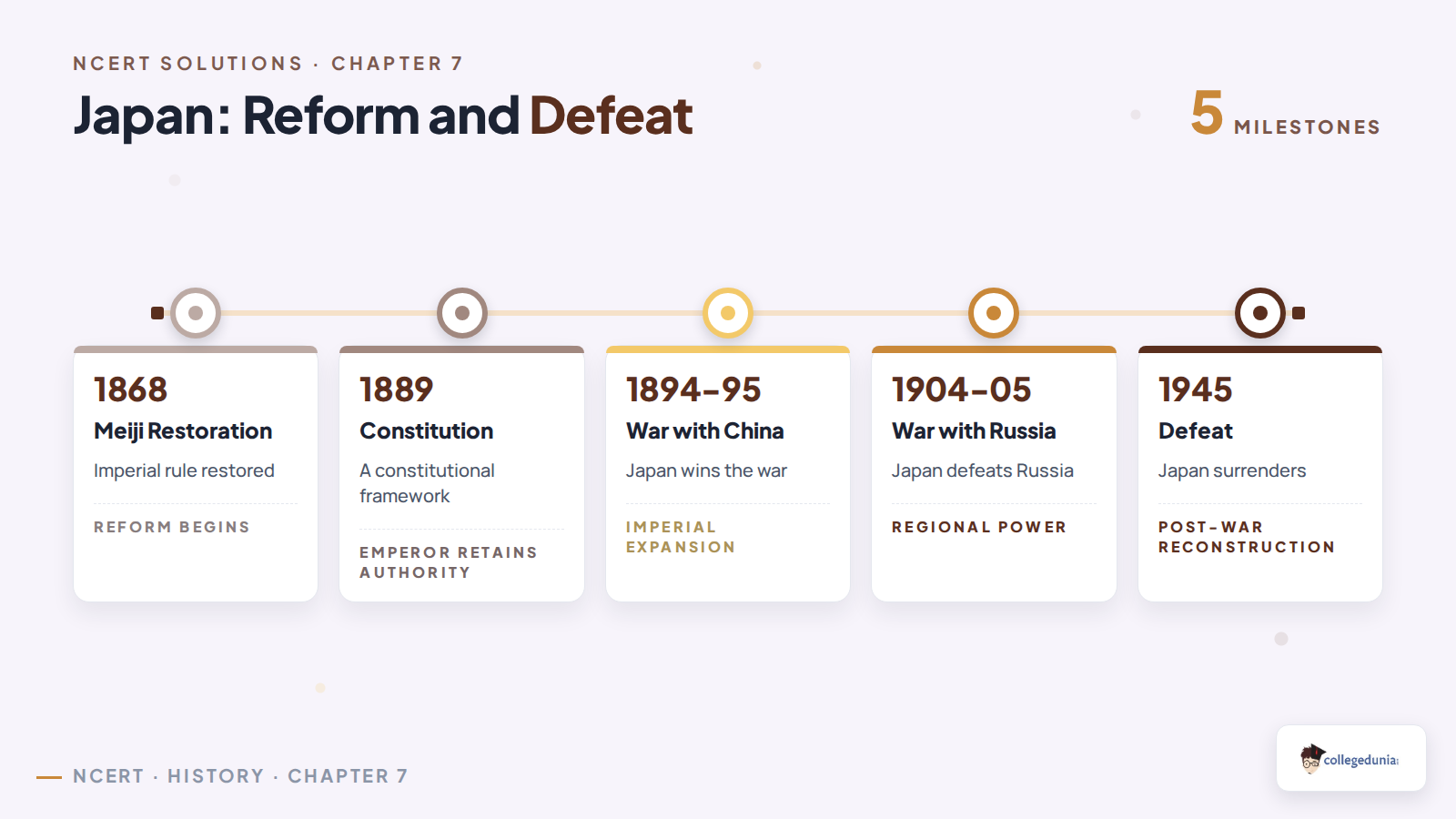
Meiji reforms drew on earlier commercial and social changes. The new leadership strengthened central government, education, industry and the army. These changes helped Japan resist foreign control, but they also supported imperial expansion.
Separate conditions before 1868 from reforms introduced after the Restoration.
Link education and transport to changes in work and production.
Explain how military strength connected with expansion into neighbouring territories.
Modernisation did not automatically create democracy. Japan's constitutional institutions coexisted with strong imperial authority. Keep political power and industrial growth as separate parts of your explanation.
Paths to Modernisation: Compare Four Historical Experiences
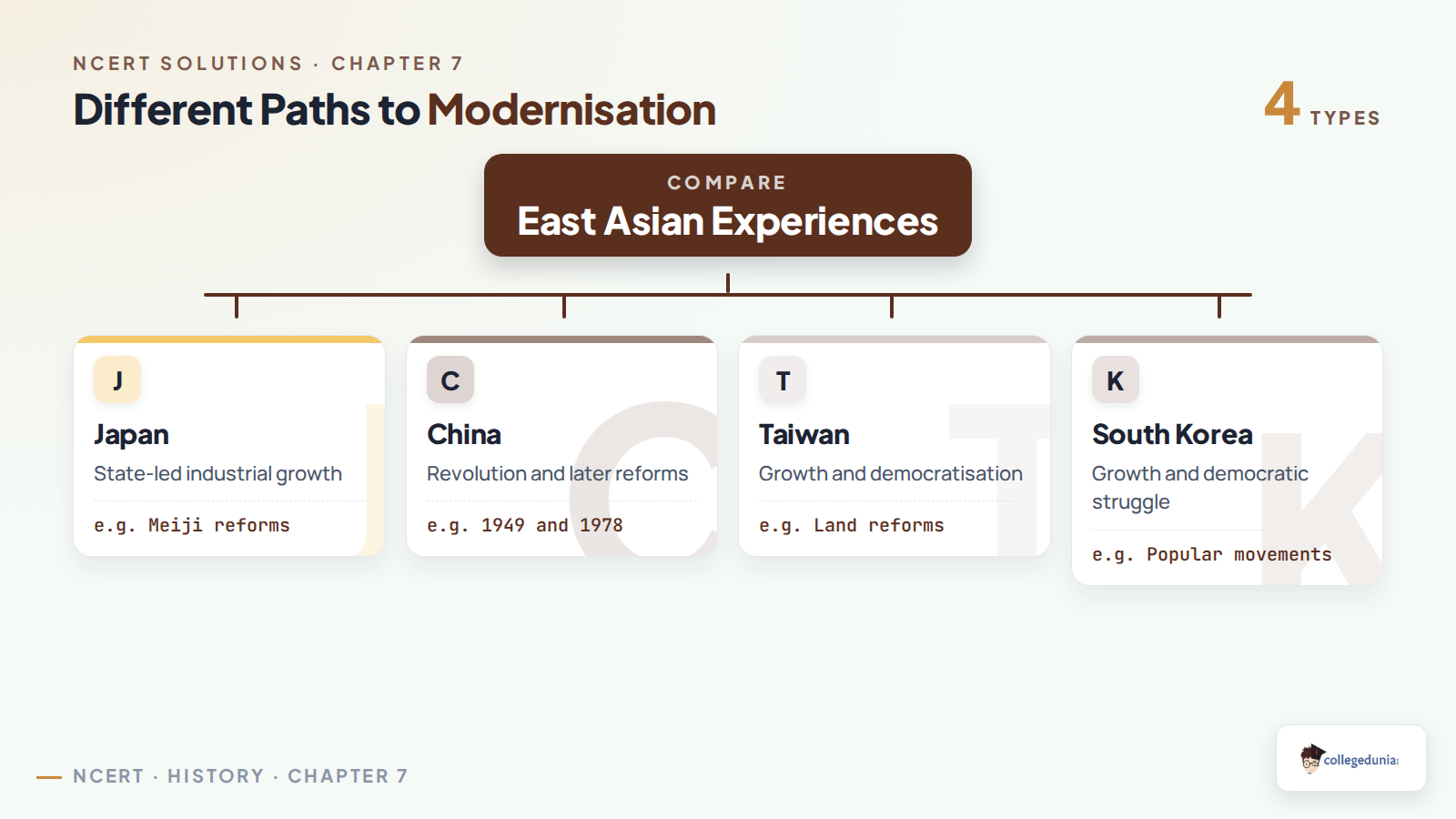
The title uses the plural paths because historical conditions differed. Compare the role of government, foreign pressure and popular movements. Avoid treating Europe as the only possible model.
Case
Central feature
Point to explain
Japan
State-led reforms and capitalist industry
National strength also fed imperialism
China
Revolution, communist rule and later economic reforms
Policies changed across distinct periods
Taiwan
Economic development followed by political liberalisation
Growth and democratic change were separate processes
South Korea
Rapid growth under authoritarian governments
Popular struggles helped secure democracy
Paths to Modernisation: Build an Evidence-based Short Essay
For a comparison, choose common headings before writing. A question about modernisation needs an argument about change. It does not need every event from the textbook.
State the main difference between the cases.
Explain each government's goals and methods.
Add a dated event or policy as evidence.
Describe effects on people and political rights.
End with a judgment that answers the question.
For example, Japan strengthened industry through state action after 1868. China's communist movement instead built support through rural mobilisation. These examples show different methods and social bases. Use evidence to explain the contrast. Do not describe both countries in separate, unrelated paragraphs.
Paths to Modernisation Common Answer-writing Mistakes
Check these errors when comparing your attempt with the PDF. A correct date cannot repair an explanation that mixes different leaders or periods.
Do not confuse Sun Yat-sen's Three Principles with Mao's communist programme.
Do not place Deng Xiaoping's reforms in Mao's earlier policy period.
Do not describe the Meiji Restoration as a democratic revolution.
Do not assume economic growth alone caused democracy in South Korea.
Always identify who made a policy and when. That check keeps your answer focused and prevents a misleading comparison.
Paths to Modernisation Practice Plan for Class 11 History
Start with the question rather than the answer. These suggested timings are study targets, not exam rules. Adjust them to your reading speed.
Session
Task
First 20 minutes
Read Japan and make a reform timeline
Next 25 minutes
Read China and separate leaders, aims and policies
Next 15 minutes
Compare Taiwan and South Korea
Final 20 minutes
Attempt one brief answer and one essay without help
Class 11 examinations are set by schools. Use your teacher's paper pattern for marks and answer length. This page does not assign unverified chapter-wise marks or claim a national Class 11 board trend.
All NCERT Solutions for Paths to Modernisation with Step-by-Step Solutions
Answer in Brief
Q 7.1
What were the major developments before the Meiji restoration that made it possible for Japan to modernise rapidly?
Concept used. Historical preparation means earlier changes that make later reforms easier. Japan's rapid modernisation had roots before 1868.
Disarming peasants reduced warfare. Samurai alone carried swords. Daimyo governed domains from their capitals. Land surveys identified taxpayers and assessed productivity, creating dependable revenue.
Edo, Osaka, Kyoto and castle-towns became large centres. They supported merchants, crafts and a commercial economy. These networks later helped industrial production and trade.
Credit arrangements, financial systems and a rice market developed. Domestic silk production reduced dependence on imports. Regional entrepreneurs acquired skills and capital.
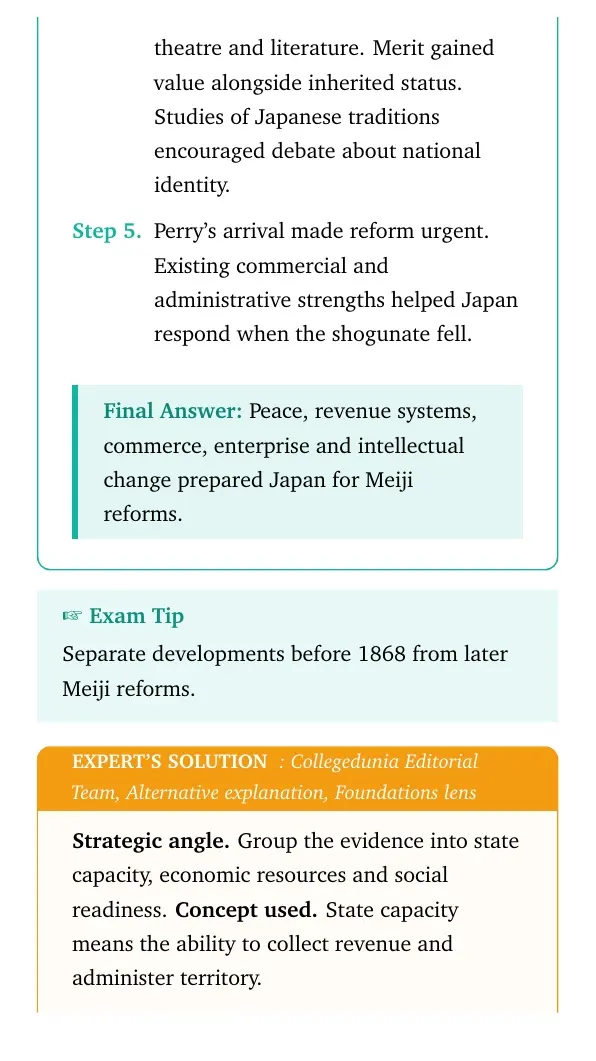
Popular reading and printing widened access to ideas. Merchants supported theatre and literature. Merit gained value alongside inherited status. Studies of Japanese traditions encouraged debate about national identity.
Perry's arrival made reform urgent. Existing commercial and administrative strengths helped Japan respond when the shogunate fell.
Peace, revenue systems, commerce, enterprise and intellectual change prepared Japan for Meiji reforms.
Collegedunia Editorial Team
Alternative explanation, Foundations lens
Strategic angle. Group the evidence into state capacity, economic resources and social readiness. Concept used. State capacity means the ability to collect revenue and administer territory.
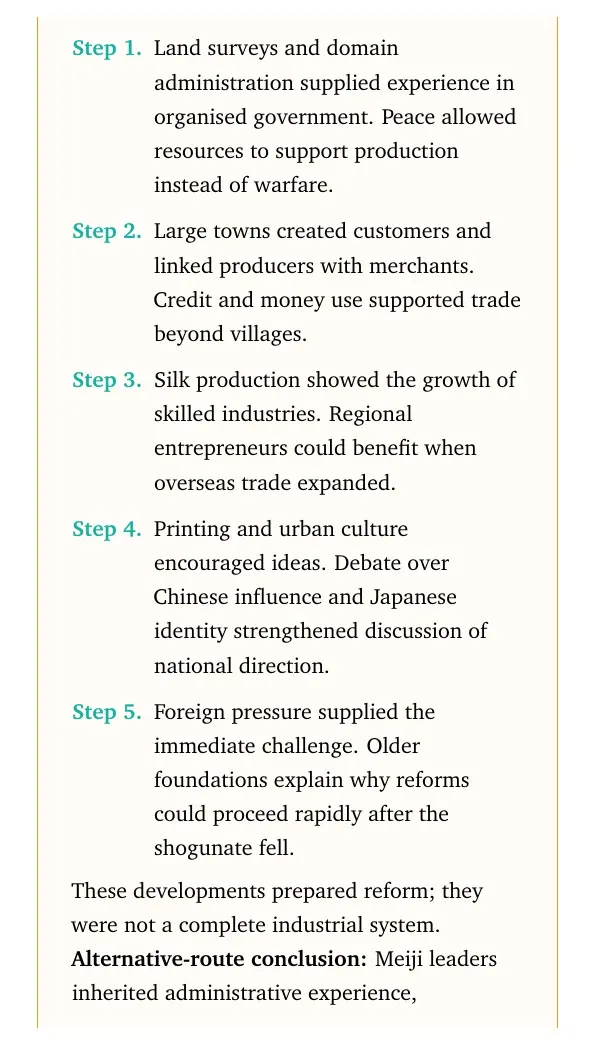
Land surveys and domain administration supplied experience in organised government. Peace allowed resources to support production instead of warfare.
Large towns created customers and linked producers with merchants. Credit and money use supported trade beyond villages.
Silk production showed the growth of skilled industries. Regional entrepreneurs could benefit when overseas trade expanded.
Printing and urban culture encouraged ideas. Debate over Chinese influence and Japanese identity strengthened discussion of national direction.
Foreign pressure supplied the immediate challenge. Older foundations explain why reforms could proceed rapidly after the shogunate fell.
These developments prepared reform; they were not a complete industrial system.
Alternative-route conclusion: Meiji leaders inherited administrative experience, commercial networks and a changing society.
Q 7.2
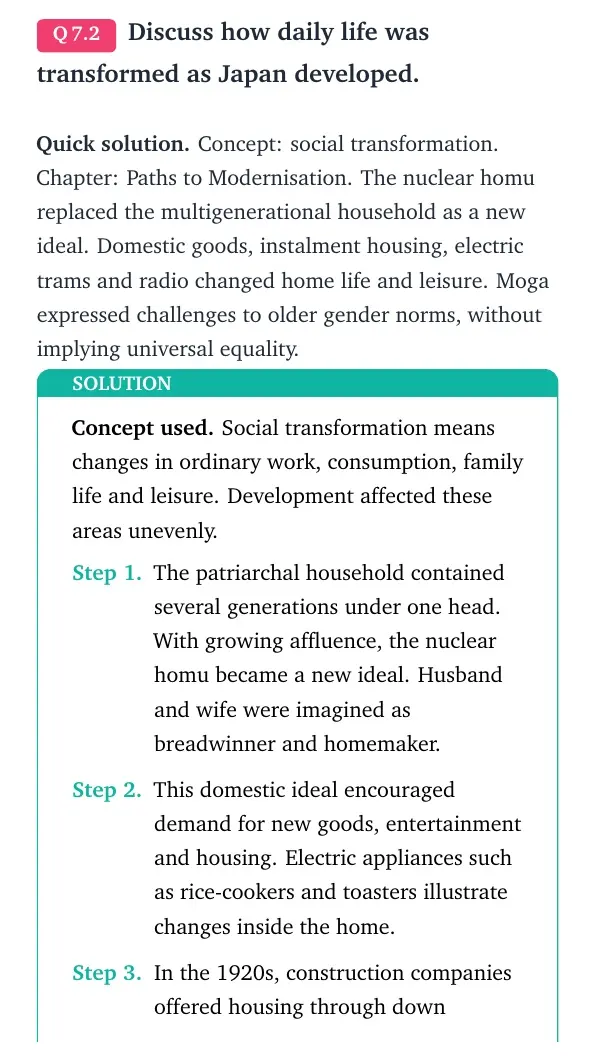
Discuss how daily life was transformed as Japan developed.
Concept used. Social transformation means changes in ordinary work, consumption, family life and leisure. Development affected these areas unevenly.
The patriarchal household contained several generations under one head. With growing affluence, the nuclear homu became a new ideal. Husband and wife were imagined as breadwinner and homemaker.
This domestic ideal encouraged demand for new goods, entertainment and housing. Electric appliances such as rice-cookers and toasters illustrate changes inside the home.
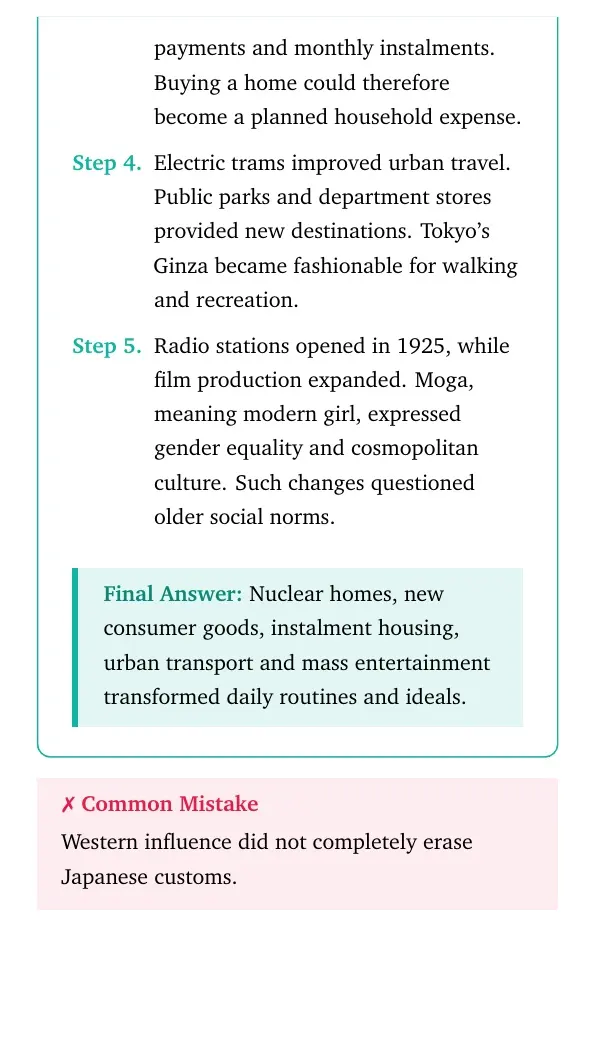
In the 1920s, construction companies offered housing through down payments and monthly instalments. Buying a home could therefore become a planned household expense.
Electric trams improved urban travel. Public parks and department stores provided new destinations. Tokyo's Ginza became fashionable for walking and recreation.
Radio stations opened in 1925, while film production expanded. Moga, meaning modern girl, expressed gender equality and cosmopolitan culture. Such changes questioned older social norms.
Nuclear homes, new consumer goods, instalment housing, urban transport and mass entertainment transformed daily routines and ideals.
Collegedunia Editorial Team
Alternative explanation, Household lens
Structural observation. Test the claim that becoming modern meant abandoning every older social rule. Concept used. Change and continuity means identifying new practices alongside expectations that persisted.
Checkpoint 1, household authority: The multigenerational household gave way to the homu ideal. Yet the breadwinner-homemaker division still assigned different roles to husbands and wives. A new family form therefore did not establish equal domestic roles.
Checkpoint 2, access versus universality: Instalment housing and new appliances widened consumer possibilities. These examples show changing aspirations and purchasing arrangements. They do not prove that every family could afford the same home or goods.
Checkpoint 3, mobility versus freedom: Trams, Ginza and department stores enlarged urban experiences. More opportunities to travel and consume demonstrate changed routines. They alone do not establish equal political or social power.
Checkpoint 4, cultural challenge: Radio and cinema spread shared entertainment. Moga expressed gender equality and cosmopolitan ideas, challenging older norms. This differed from merely adding a new appliance to an otherwise familiar household.
Use these tests to distinguish evidence from overstatement. Modern goods, new family ideals and challenges to gender expectations describe related but different kinds of transformation.
Alternative-route conclusion: Modern domestic ideals and urban leisure reshaped Japanese daily life and encouraged debate about social norms.
Q 7.3
How did the Qing dynasty try and meet the challenge posed by the Western powers?
Concept used. Selective reform adopts some foreign methods while preserving the existing political order. Qing rulers faced military defeat and foreign interference.
Western powers sought trade privileges and wider access. Defeat in the Opium Wars weakened Qing authority. Unequal treaties reduced Chinese control over national affairs.
Kang Youwei and Liang Qichao sought a modern administrative system. Reform aimed to make government more effective and protect China from colonisation.
A new army and educational system were promoted. Military and educational changes were intended to strengthen the country against foreign pressure.
Local assemblies were established toward constitutional government. This was an effort to change institutions, not merely acquire weapons.
Students studied in Japan, Britain and France to learn modern subjects. The old examination system was abolished in 1905, weakening an older route into the ruling elite.
The dynasty failed to restore confidence and independence. Revolutionary opposition grew. Imperial rule ended in 1911, showing the limits of these responses.
Administrative, military, educational and constitutional reforms sought national strength, but could not preserve Qing rule.
Collegedunia Editorial Team
Alternative explanation, Institutional lens
Structural observation. Trace a tension between survival and institutional change. Concept used. Sovereignty means control over a state's territory and decisions.
Foreign victories and unequal treaties threatened Chinese sovereignty. The court could no longer assume existing methods could defeat Western powers.
Kang Youwei and Liang Qichao linked survival to institutional reform. Modern administration could strengthen government, while a new army addressed military weakness.
Educational change aimed to train people in modern subjects. Overseas study in Japan, Britain and France exposed students to new knowledge and political ideas.
Abolishing the examination system in 1905 challenged the old path into elite government service. Education and recruitment could change together.
Local assemblies formed part of efforts toward constitutional government. These measures went beyond copying foreign weapons, but did not establish the later republic.
Reform failed to preserve the dynasty, which ended in 1911. Its failure should not obscure the concrete measures it attempted.
The response joined administration, military strength, education and political institutions. Each addressed a different weakness exposed by foreign pressure.
Alternative-route conclusion: Qing reform remained too limited and contested to restore authority or prevent revolution.
Q 7.4
What were Sun Yat-sen's Three Principles?
Concept used. A political programme sets goals for government and society. Sun Yat-sen's programme was called the Three Principles, or San min chui.
Nationalism: China should overcome foreign domination. Sun sought to overthrow the Manchu dynasty, regarded by supporters as foreign. Opposition to other foreign imperialists formed another part of nationalism.
Democracy: China should establish democratic government. Authority should no longer rest simply on an emperor's hereditary claims. This gave the republican movement its political direction.
Socialism: NCERT explains this as regulating capital and equalising landholdings. These measures aimed to address economic inequality and improve people's livelihood.
The principles joined national freedom, political rights and economic welfare. They shaped the Guomindang's political philosophy. Sun's socialism should be explained through the measures stated here. It was not identical to Mao's later communist programme.
The Three Principles were nationalism, democracy and socialism.
Collegedunia Editorial Team
Alternative explanation, Problem and remedy lens
Strategic angle. Ask what problem each principle addressed. Concept used. Republicanism rejects hereditary monarchy as the basis of government.
Nationalism answered foreign control and dynastic rule. It opposed both the Manchu dynasty and imperialist interference in China.
Democracy answered the absence of democratic political authority. Sun wanted democratic government instead of imperial rule.
Socialism answered unequal economic power. NCERT identifies the proposed measures as regulating capital and equalising landholdings.
Together, these goals went beyond replacing a ruler. They sought national independence, a different political order and improved livelihood. Their influence on the Guomindang explains their significance in modern Chinese history.
Alternative-route conclusion: Sun combined national freedom, democratic politics and economic reform in one programme.
Q 7.5
How did Korea deal with the foreign currency crisis in 1997?
Trade deficits increased. Poor management by financial institutions and reckless operations by conglomerates increased vulnerability. Greater market opening placed additional pressures on the economy.
Korea obtained emergency financial assistance from the International Monetary Fund, or IMF. This helped address immediate foreign currency needs and external obligations.
Efforts were made to improve the economy's underlying condition. Recovery required changes in economic and financial arrangements as well as immediate funding.
Citizens joined the Gold Collection Movement. Their contributions supported repayment of foreign loans. This campaign expressed collective participation in national recovery.
The measures served different purposes. IMF assistance addressed urgent financing. Reform targeted underlying weaknesses. Public contributions supported the wider repayment effort.
Emergency international support, domestic reform and public gold contributions formed Korea's response.
Collegedunia Editorial Team
Alternative explanation, Recovery mechanisms lens
Strategic angle. Distinguish an immediate shortage from underlying weaknesses and collective participation. Concept used. Crisis recovery operates through different mechanisms that cannot substitute completely for one another.
Immediate liquidity: Foreign currency was needed to meet external payments. IMF emergency support addressed this urgent financing problem. This explains why international assistance was useful even after years of industrial growth.
Underlying economic condition: Poor financial management and reckless conglomerate operations were separate problems. Efforts to improve the economy's condition addressed these weaknesses. Merely obtaining currency would not itself correct business conduct.
Citizen mobilisation: Gold collection supported foreign loan repayment. It converted public willingness to help into a material contribution. It complemented financial assistance rather than replacing institutional improvement.
Combined response: The textbook joins emergency assistance with economic repair and participation. An answer mentioning only IMF borrowing misses the domestic response; one mentioning only gold misses urgent international support.
The distinction between these mechanisms explains why the response needed several measures. Each addressed a different part of the same crisis.
Alternative-route conclusion: Korea combined IMF assistance, economic reform and citizens' Gold Collection Movement.
Answer in a Short Essay
Q 7.6
Did Japan's policy of rapid industrialisation lead to wars with its neighbours and destruction of the environment?
Concept used. Industrialisation expands machine production. Imperialism extends power over other peoples. They became closely linked in modern Japan.
Economic and military strength: The slogan of a rich country and strong army joined industrial growth with military power. Modern factories, transport and weapons helped Japan build a powerful state.
Regional expansion: Leaders sought markets, resources and strategic influence. Japan fought China in 1894-95 and Russia in 1904-05. It annexed Korea in 1910 and later expanded into China.
Political responsibility: Militarism and aggressive nationalism supported empire. Industrial growth supplied resources for war, but leaders made political choices to pursue conquest. Development did not make every war unavoidable.
Environmental damage: Expanding mines and factories polluted land and water. The Ashio copper mine became a major example. Pollution damaged farming and local livelihoods, provoking protests.
Assess the costs: Industrial success protected Japan's independence but did not guarantee peaceful or sustainable development. Neighbouring peoples and Japanese communities bore serious costs.
Japan's industrial growth became tied to imperial wars and environmental harm, shaped by military ambition and weak controls.
Collegedunia Editorial Team
Alternative explanation, Capacity and policy lens
Structural observation. Separate capacity, purpose and consequences. Concept used. Industrial capacity provides resources; government policy determines many uses of those resources.
Modern industry funded arms, transport and a stronger military. The Meiji state's economic programme therefore strengthened its ability to wage war.
Nationalist and military leaders pursued an empire. Wars against China and Russia, followed by colonial control in Korea, show the regional consequences.
Access to raw materials and markets supported expansionist arguments. Yet resource needs alone cannot excuse or fully explain political decisions to conquer neighbours.
Factory and mining growth also created pollution. Ashio's copper pollution harmed agriculture and communities, showing costs hidden behind production figures.
Local protests reveal that people challenged environmental destruction. Economic progress could conflict with health, livelihoods and political rights.
The judgement should recognise industrial achievements and their destructive uses. Economic growth needs political restraint and environmental safeguards.
Alternative-route conclusion: Industrialisation enabled expansion, while militarism and unchecked pollution made its costs severe.
Q 7.7
Do you think that Mao Zedong and the Communist Party of China were successful in liberating China and laying the basis for its current success?
Concept used. Historical evaluation weighs achievements, failures and later developments. China's recent growth cannot be explained by one leader alone.
Political consolidation: The CCP mobilised peasants and resisted Japanese occupation. Victory in the civil war led to the People's Republic in 1949. It established a stronger central state on the mainland.
Social foundations: In Jiangxi, land confiscation and redistribution united peasants. Mao supported rural women's associations and marriage-law changes. NCERT credits the Communist programme with removing old inequalities, spreading education and raising consciousness.
Ambitions and failures: The Great Leap Forward sought rapid industrialisation through backyard furnaces and communes. NCERT reports that the steel was industrially unusable and communes inefficient. Ambitious mobilisation did not guarantee successful production.
Political disruption: The Cultural Revolution weakened the Party and severely disrupted the economy and education. Ideological campaigns displaced professional knowledge and rational debate.
Later changes: From 1978, Deng Xiaoping introduced a socialist market economy. The Four Modernisations targeted science, industry, agriculture and defence. Later integration into world markets followed changes to Mao-era policy.
Political limits: National consolidation and social reform did not mean unrestricted political liberation. NCERT criticises the highly centralised, repressive system for compromising liberation and equality. Strong political control continued alongside later economic strength.
National consolidation, social reform and education supplied foundations, but repression limited liberation; later policy changes also explain economic success.
Collegedunia Editorial Team
Alternative explanation, Continuity and change lens
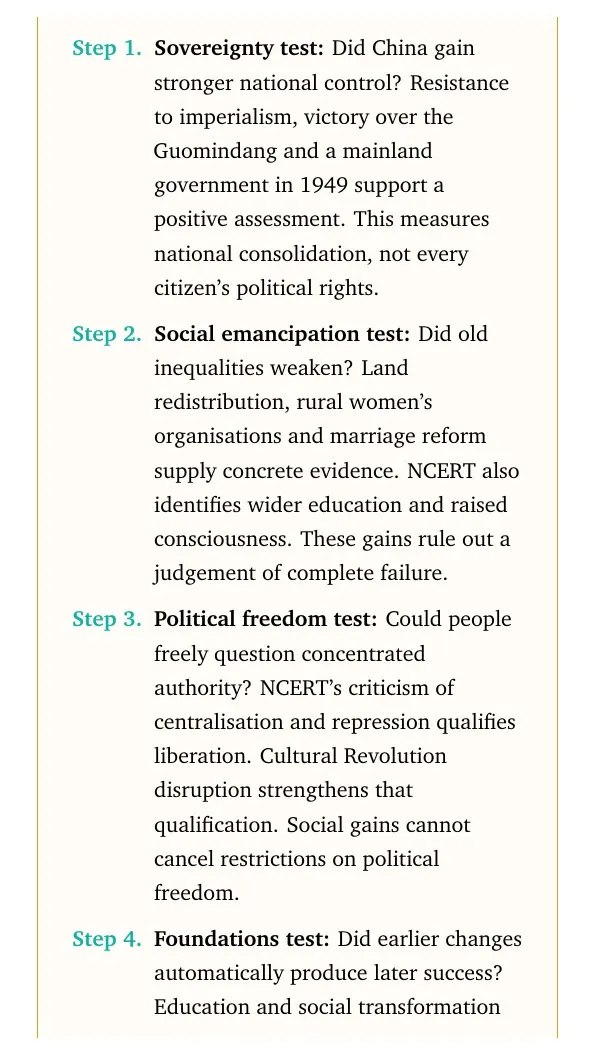
Strategic angle. Test success against separate criteria rather than repeat a political chronology. Concept used. National sovereignty, social emancipation and political freedom measure different kinds of liberation.
Sovereignty test: Did China gain stronger national control? Resistance to imperialism, victory over the Guomindang and a mainland government in 1949 support a positive assessment. This measures national consolidation, not every citizen's political rights.
Social emancipation test: Did old inequalities weaken? Land redistribution, rural women's organisations and marriage reform supply concrete evidence. NCERT also identifies wider education and raised consciousness. These gains rule out a judgement of complete failure.
Political freedom test: Could people freely question concentrated authority? NCERT's criticism of centralisation and repression qualifies liberation. Cultural Revolution disruption strengthens that qualification. Social gains cannot cancel restrictions on political freedom.
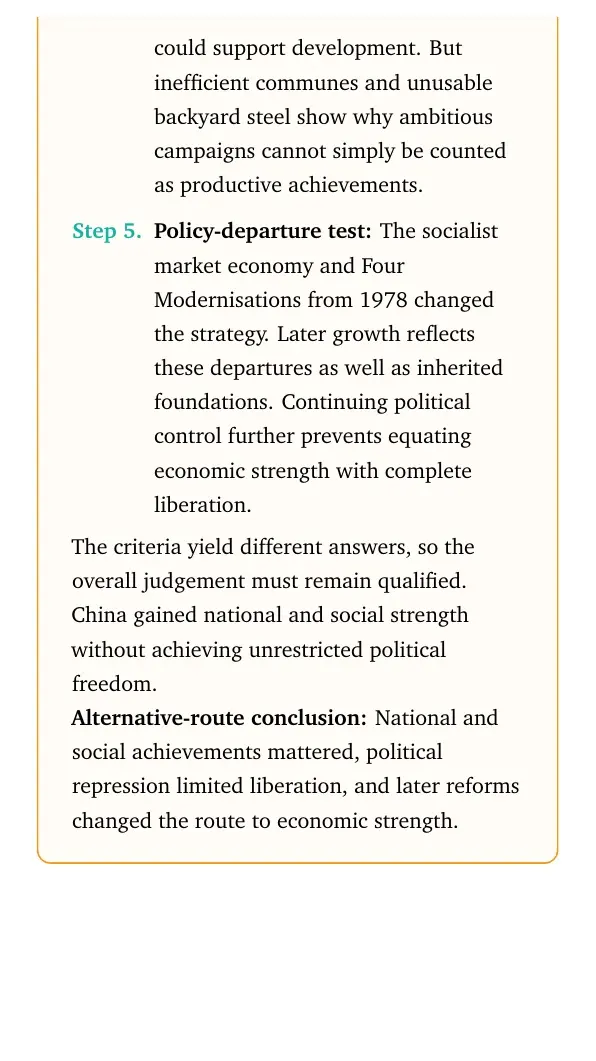
Foundations test: Did earlier changes automatically produce later success? Education and social transformation could support development. But inefficient communes and unusable backyard steel show why ambitious campaigns cannot simply be counted as productive achievements.
Policy-departure test: The socialist market economy and Four Modernisations from 1978 changed the strategy. Later growth reflects these departures as well as inherited foundations. Continuing political control further prevents equating economic strength with complete liberation.
The criteria yield different answers, so the overall judgement must remain qualified. China gained national and social strength without achieving unrestricted political freedom.
Alternative-route conclusion: National and social achievements mattered, political repression limited liberation, and later reforms changed the route to economic strength.
Q 7.8
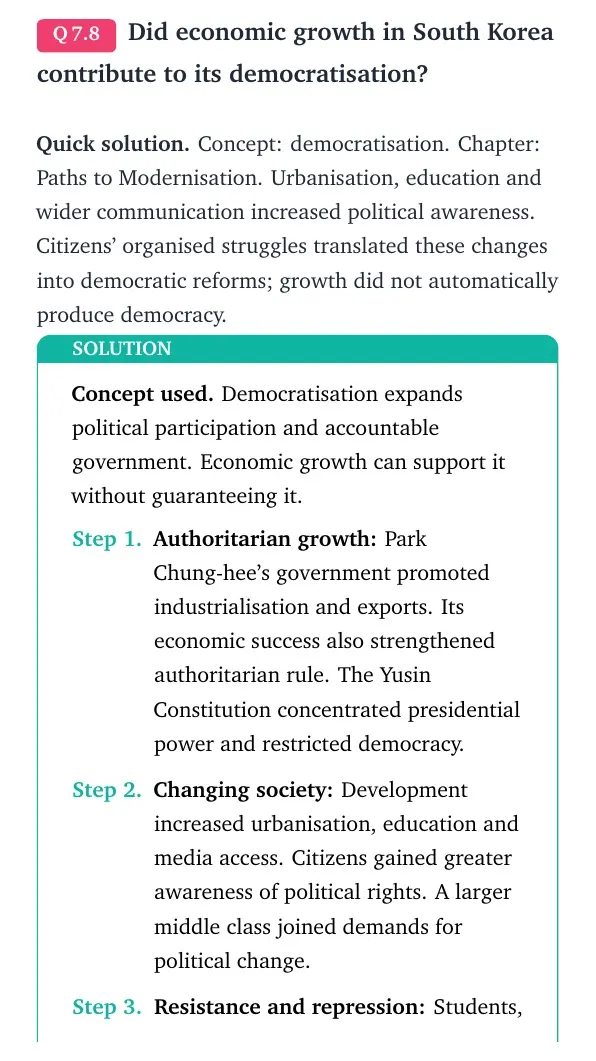
Did economic growth in South Korea contribute to its democratisation?
Concept used. Democratisation expands political participation and accountable government. Economic growth can support it without guaranteeing it.
Authoritarian growth: Park Chung-hee's government promoted industrialisation and exports. Its economic success also strengthened authoritarian rule. The Yusin Constitution concentrated presidential power and restricted democracy.
Changing society: Development increased urbanisation, education and media access. Citizens gained greater awareness of political rights. A larger middle class joined demands for political change.
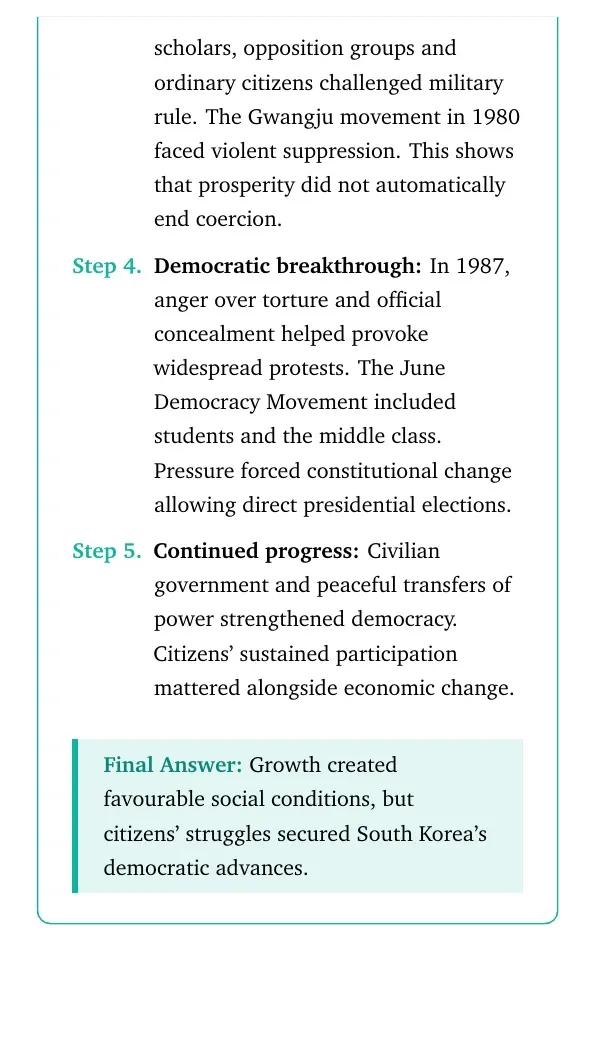
Resistance and repression: Students, scholars, opposition groups and ordinary citizens challenged military rule. The Gwangju movement in 1980 faced violent suppression. This shows that prosperity did not automatically end coercion.
Democratic breakthrough: In 1987, anger over torture and official concealment helped provoke widespread protests. The June Democracy Movement included students and the middle class. Pressure forced constitutional change allowing direct presidential elections.
Continued progress: Civilian government and peaceful transfers of power strengthened democracy. Citizens' sustained participation mattered alongside economic change.
Growth created favourable social conditions, but citizens' struggles secured South Korea's democratic advances.
Collegedunia Editorial Team
Alternative explanation, Political agency lens
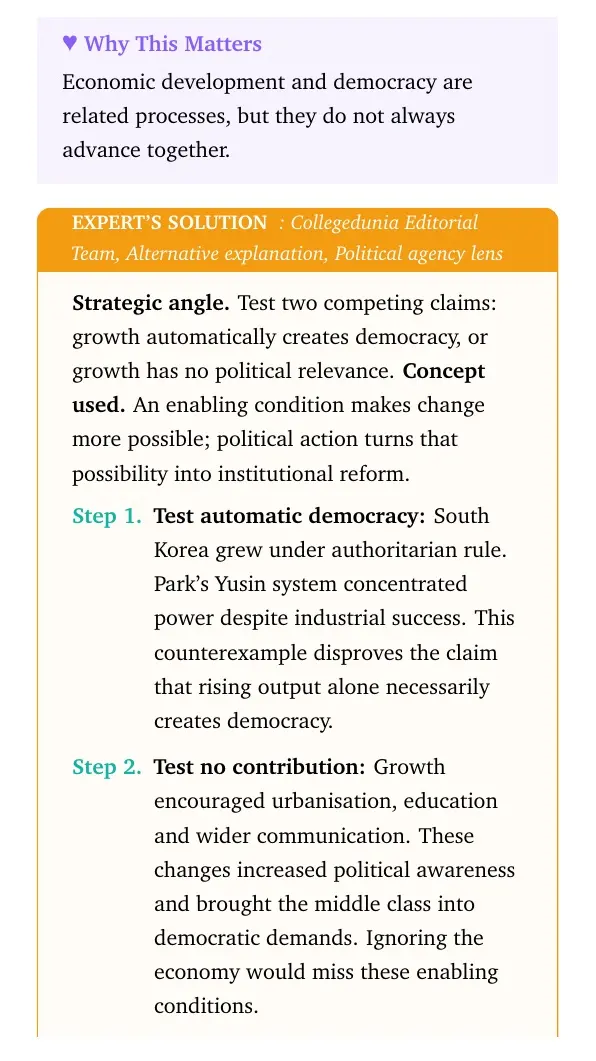
Strategic angle. Test two competing claims: growth automatically creates democracy, or growth has no political relevance. Concept used. An enabling condition makes change more possible; political action turns that possibility into institutional reform.
Test automatic democracy: South Korea grew under authoritarian rule. Park's Yusin system concentrated power despite industrial success. This counterexample disproves the claim that rising output alone necessarily creates democracy.
Test no contribution: Growth encouraged urbanisation, education and wider communication. These changes increased political awareness and brought the middle class into democratic demands. Ignoring the economy would miss these enabling conditions.
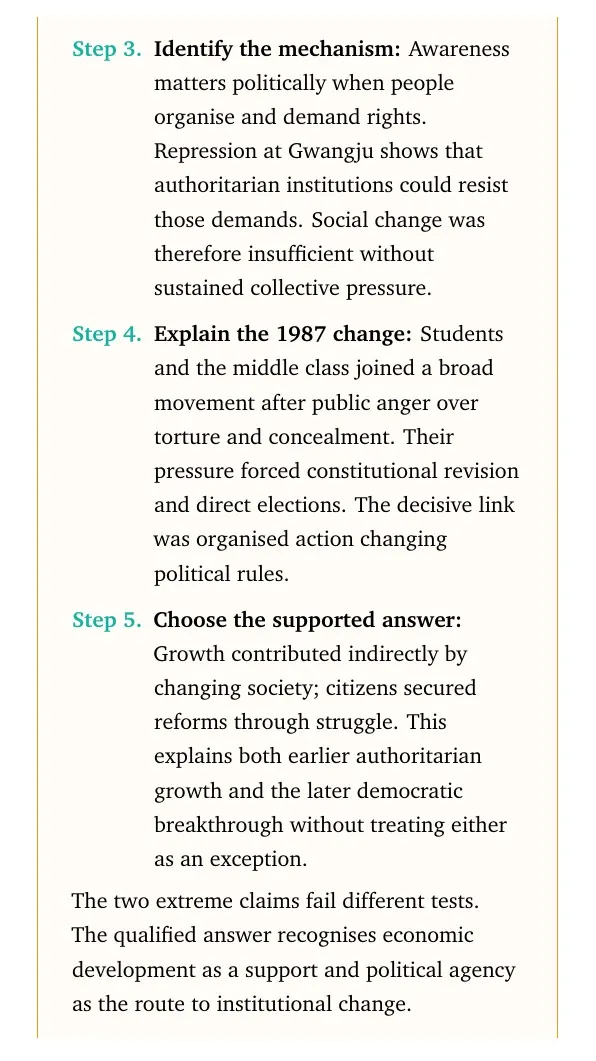
Identify the mechanism: Awareness matters politically when people organise and demand rights. Repression at Gwangju shows that authoritarian institutions could resist those demands. Social change was therefore insufficient without sustained collective pressure.
Explain the 1987 change: Students and the middle class joined a broad movement after public anger over torture and concealment. Their pressure forced constitutional revision and direct elections. The decisive link was organised action changing political rules.
Choose the supported answer: Growth contributed indirectly by changing society; citizens secured reforms through struggle. This explains both earlier authoritarian growth and the later democratic breakthrough without treating either as an exception.
The two extreme claims fail different tests. The qualified answer recognises economic development as a support and political agency as the route to institutional change.
Alternative-route conclusion: Economic change helped prepare democratisation; organised citizens turned that possibility into political reform.
Paths to Modernisation Related Study Resources
Read the original passages before checking an answer. Use revision resources to recall the sequence of events.









Comments