




The class 11 chemistry NCERT solutions chapter 9 Hydrocarbons answer every intext and back-exercise question, according to the latest 2026-27 CBSE syllabus, and help students prepare for the CBSE Boards, JEE Main, JEE Advanced, NEET and CUET. Each answer is worked step by step, from naming alkanes to the electrophilic substitution mechanisms of benzene.
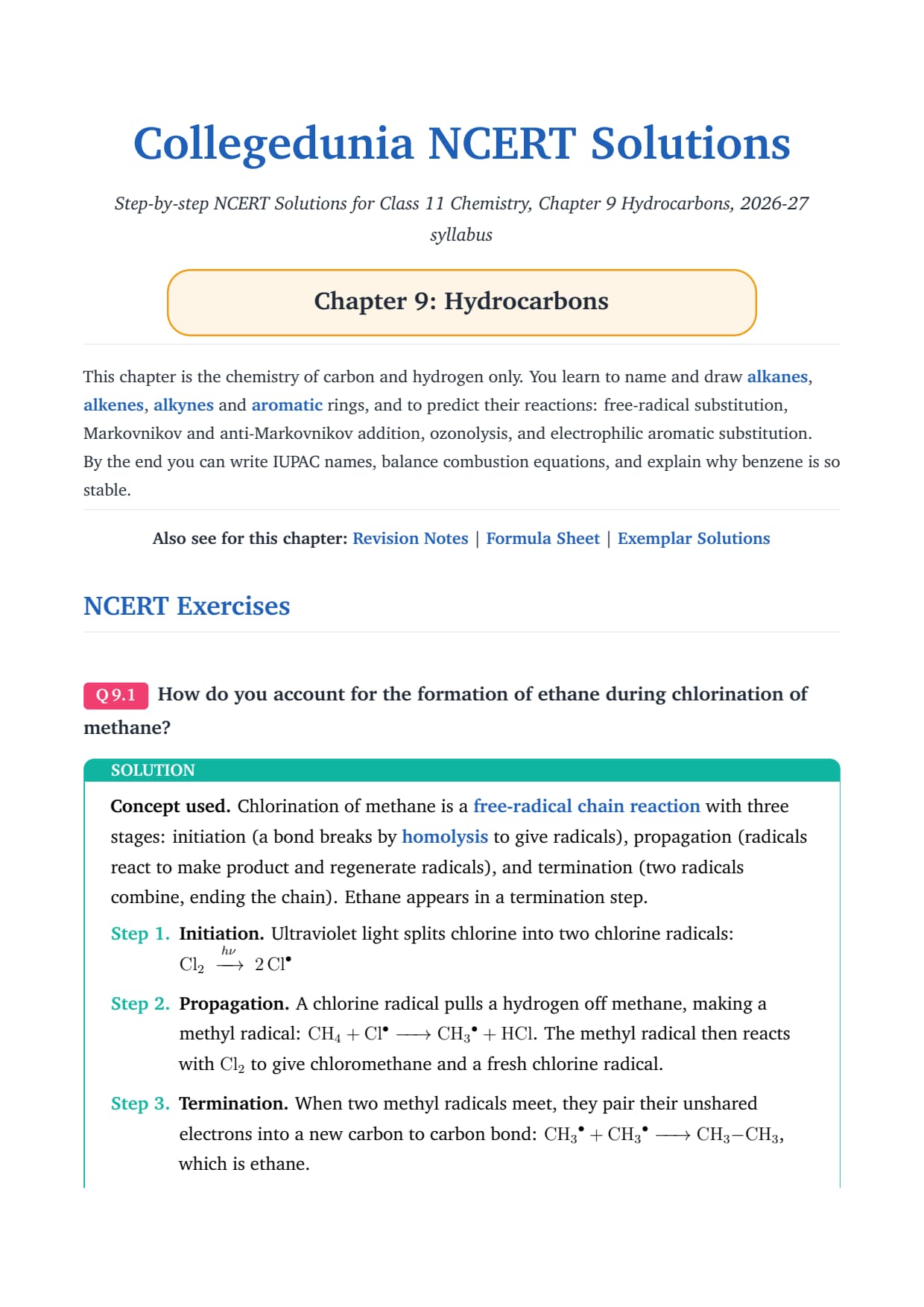
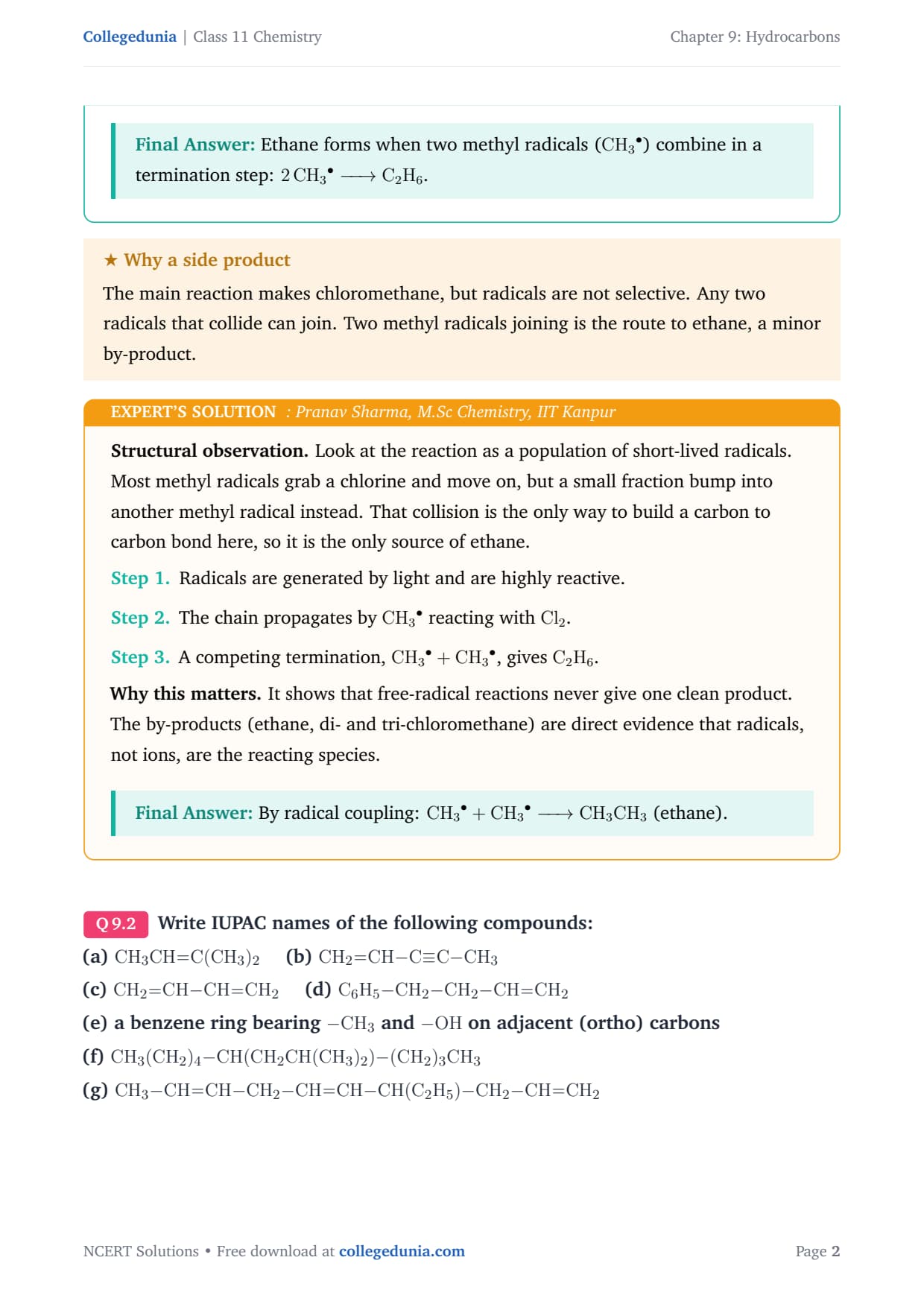
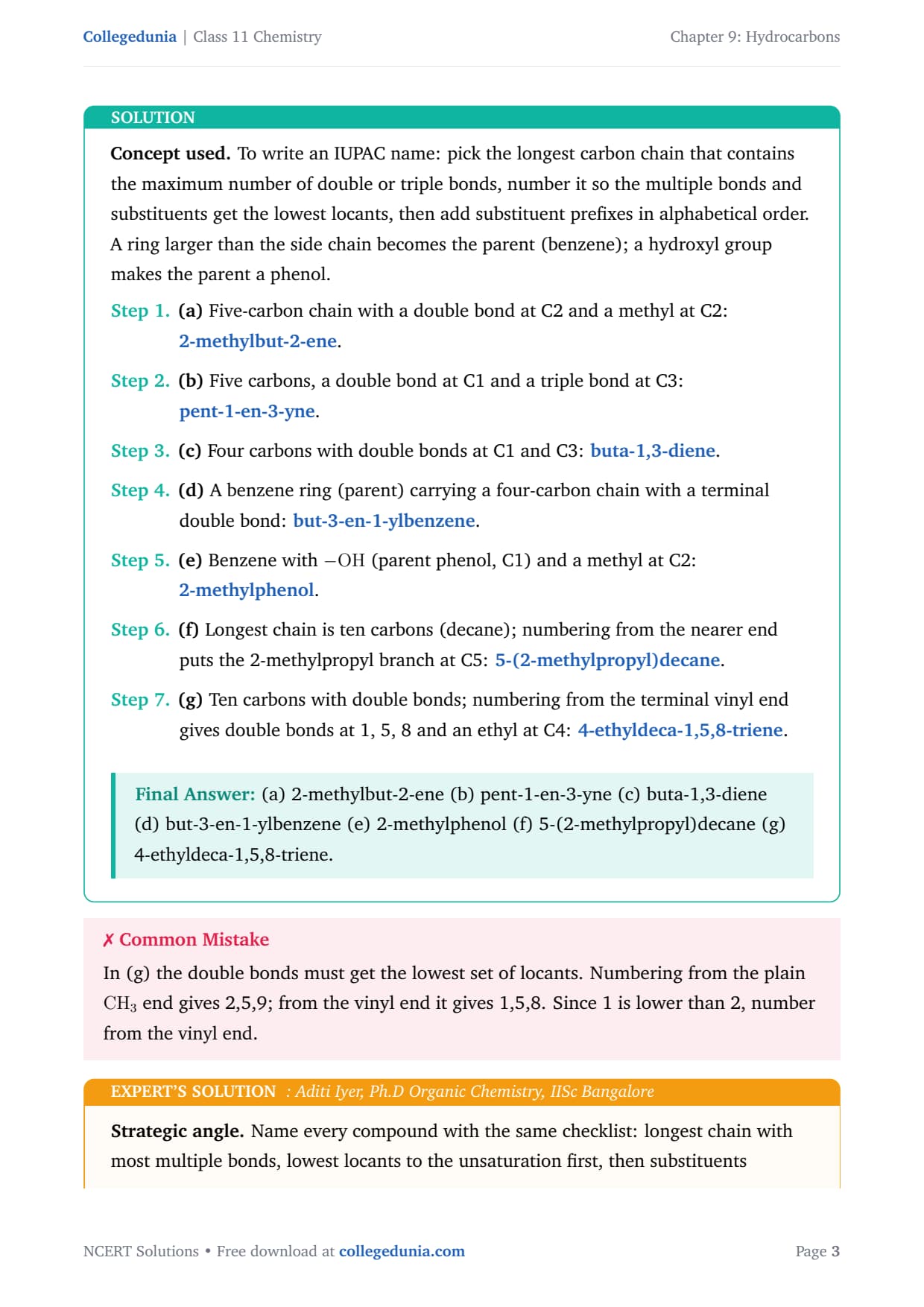
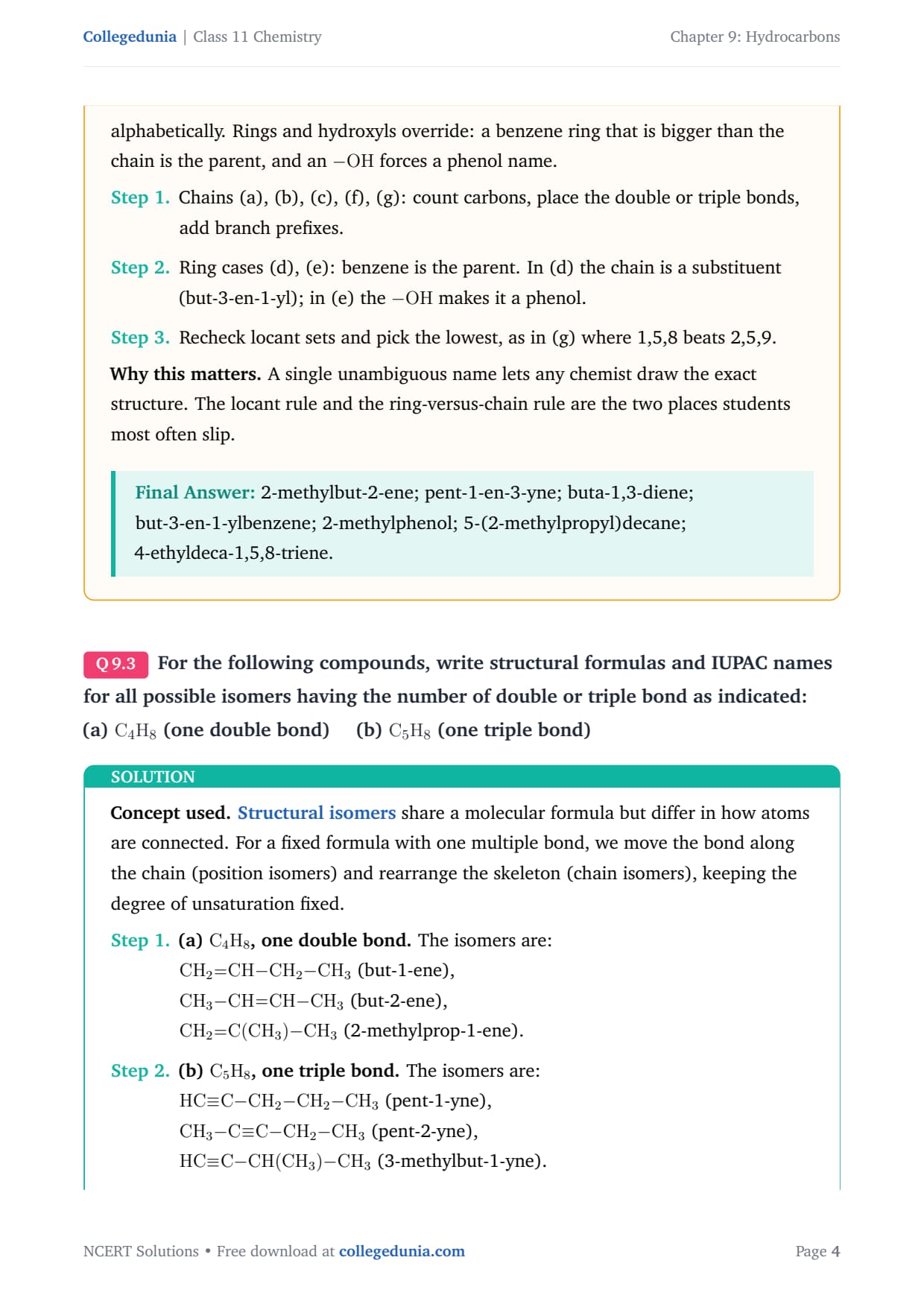
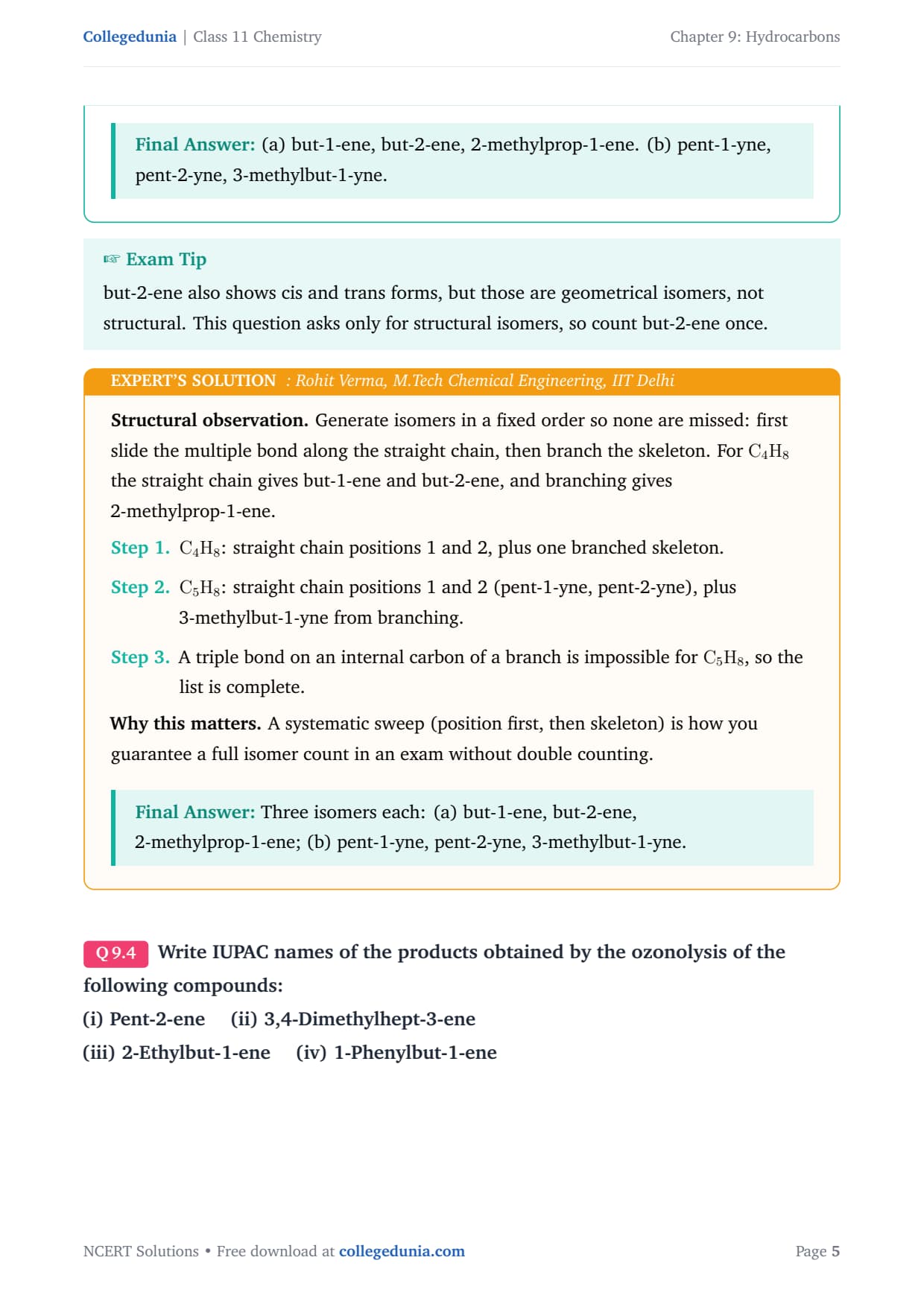
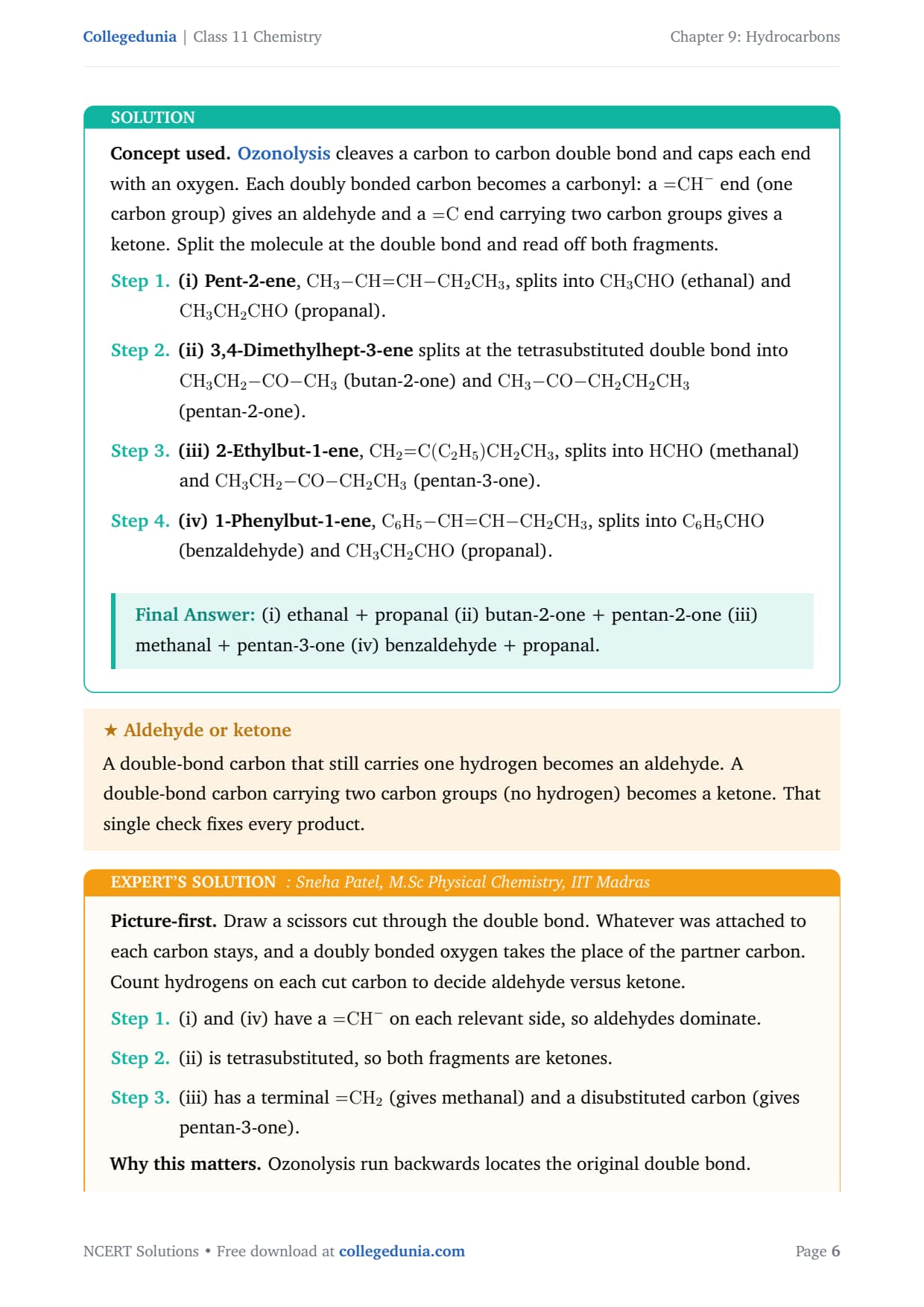
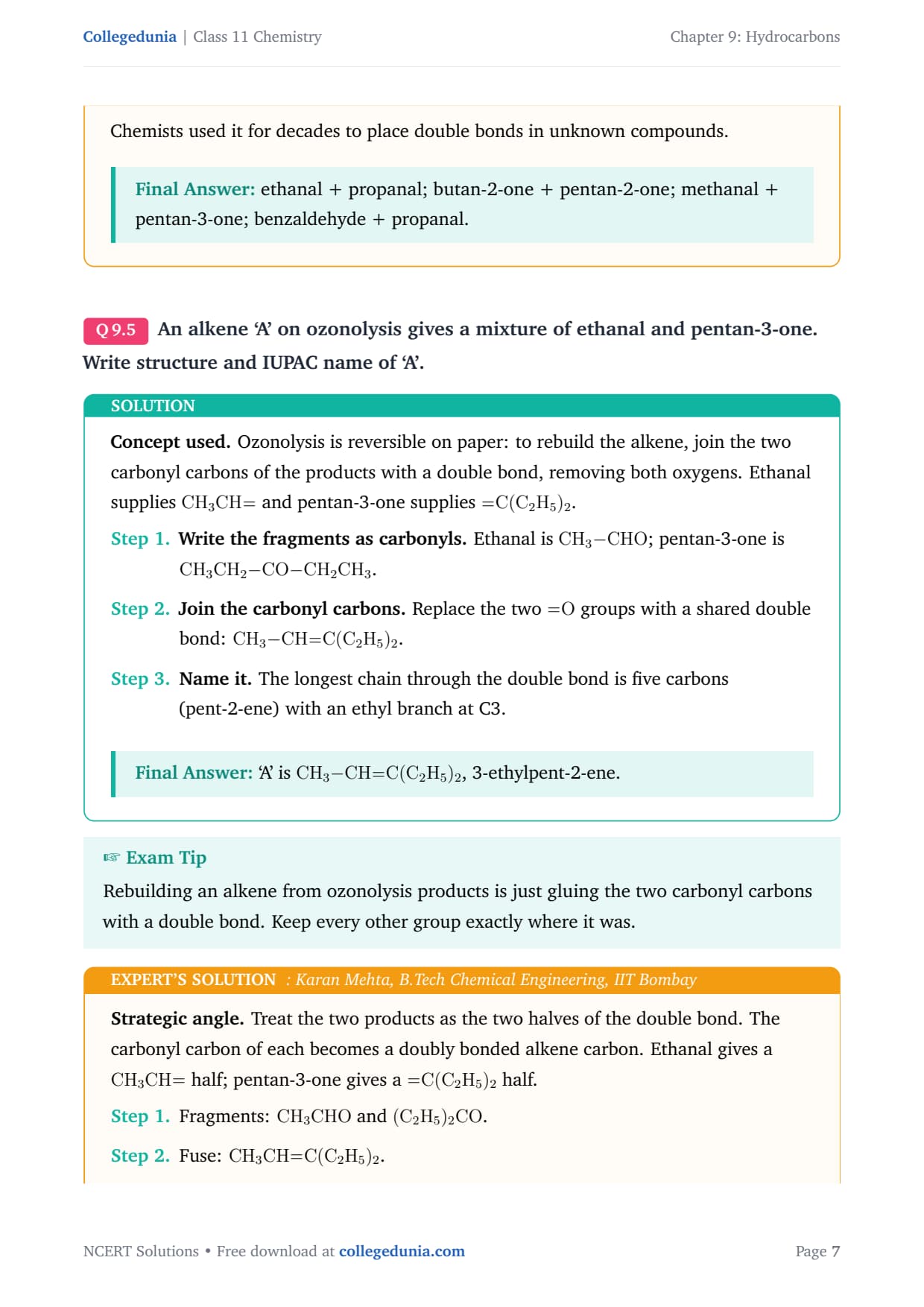
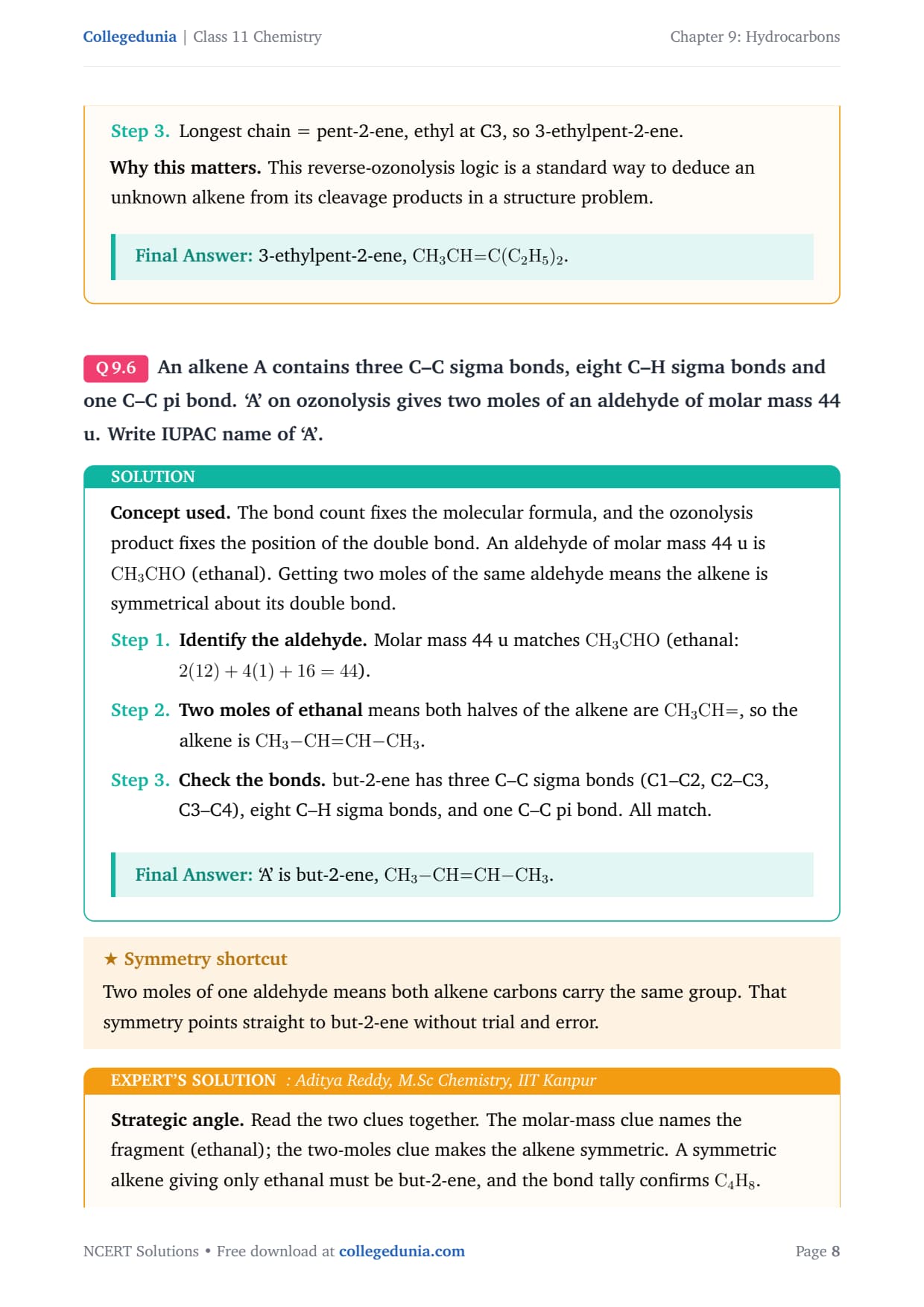
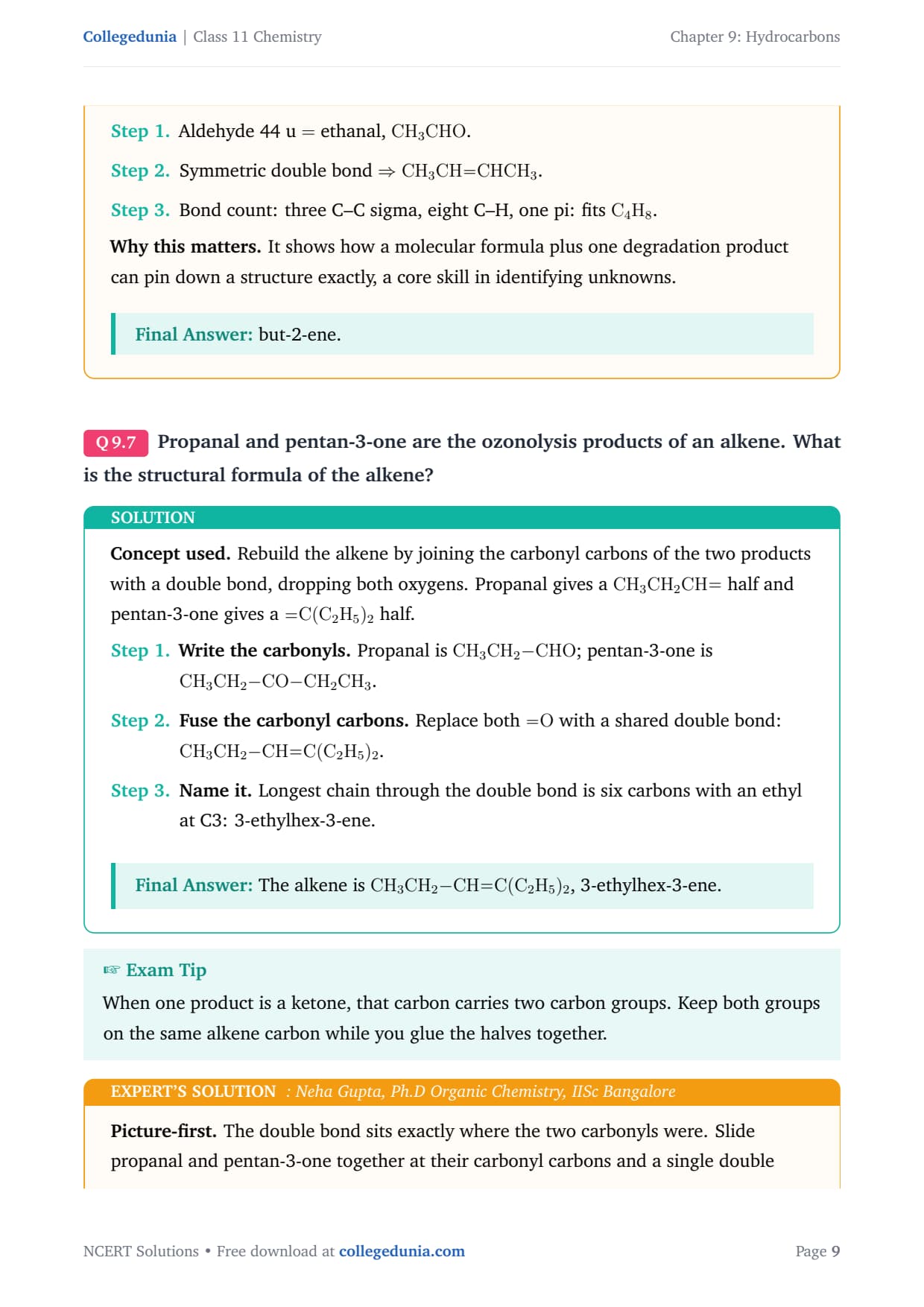
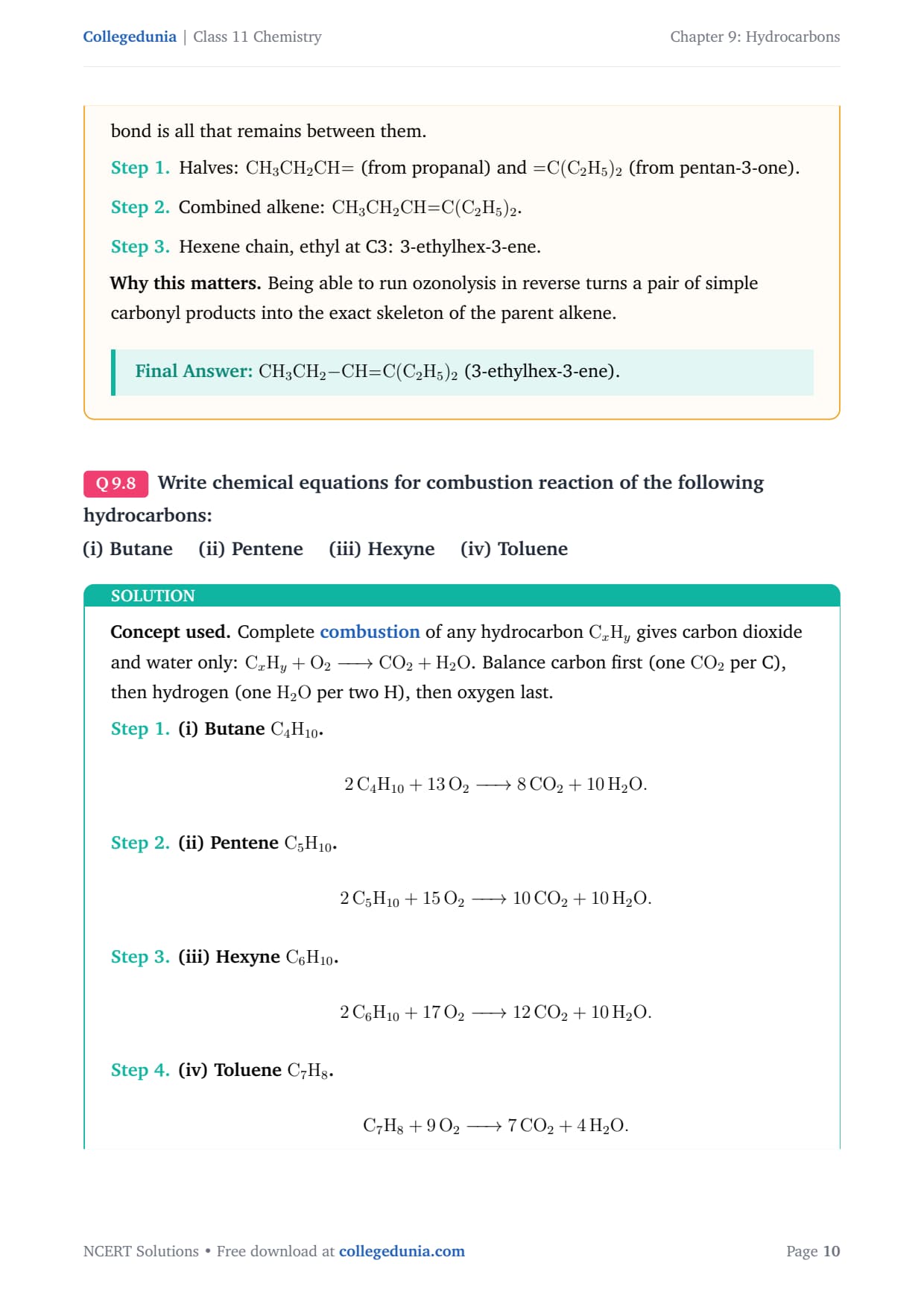
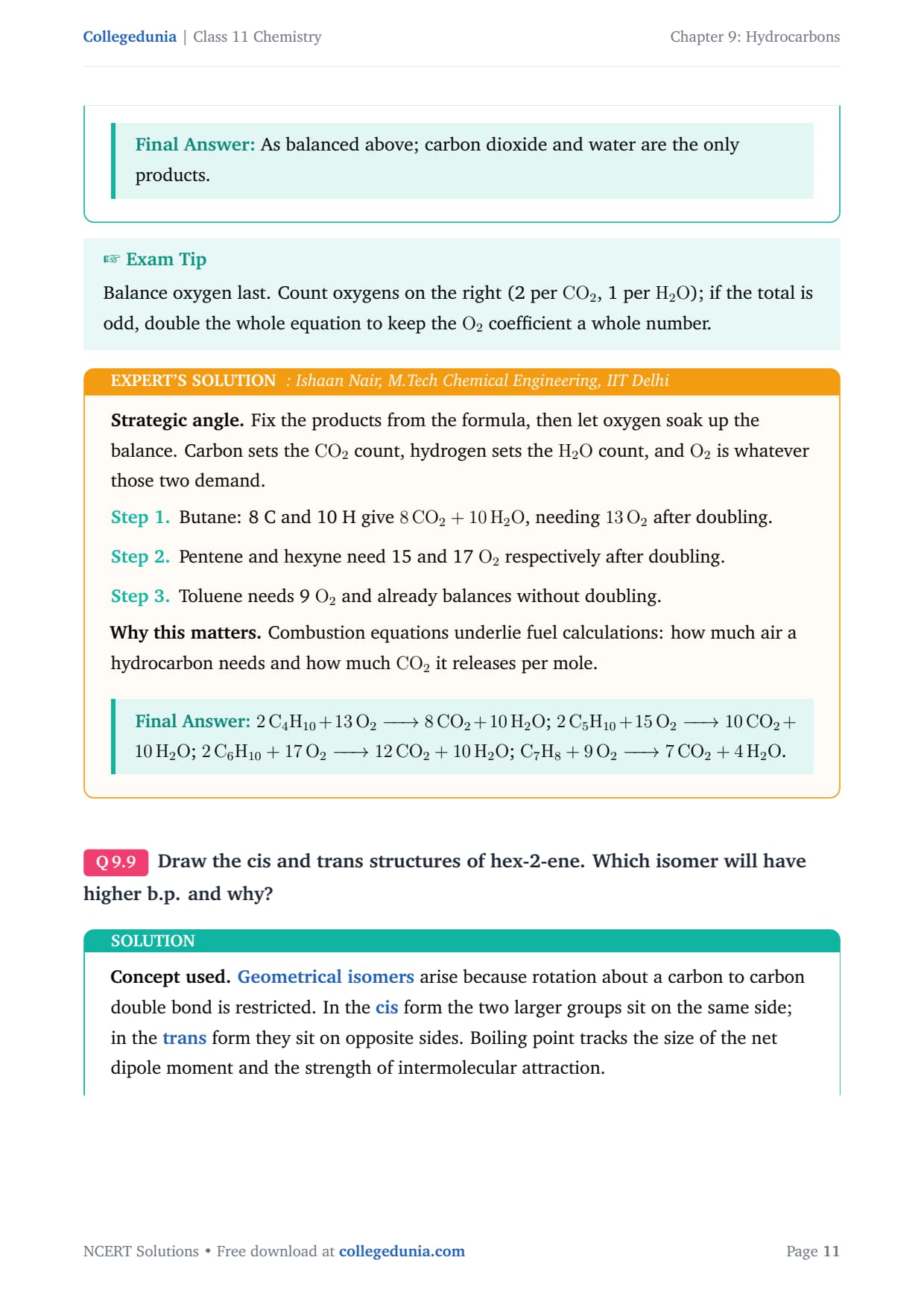
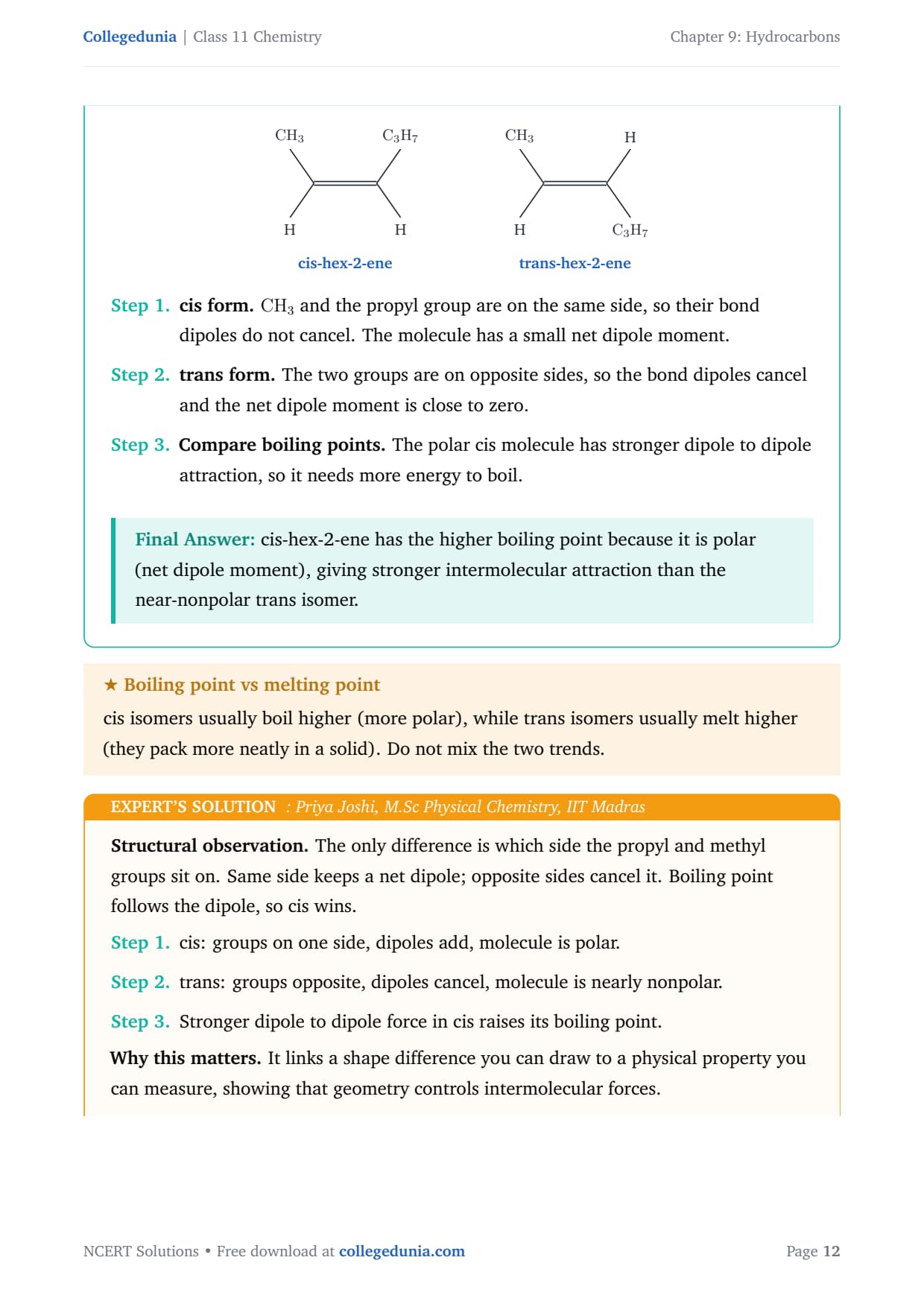
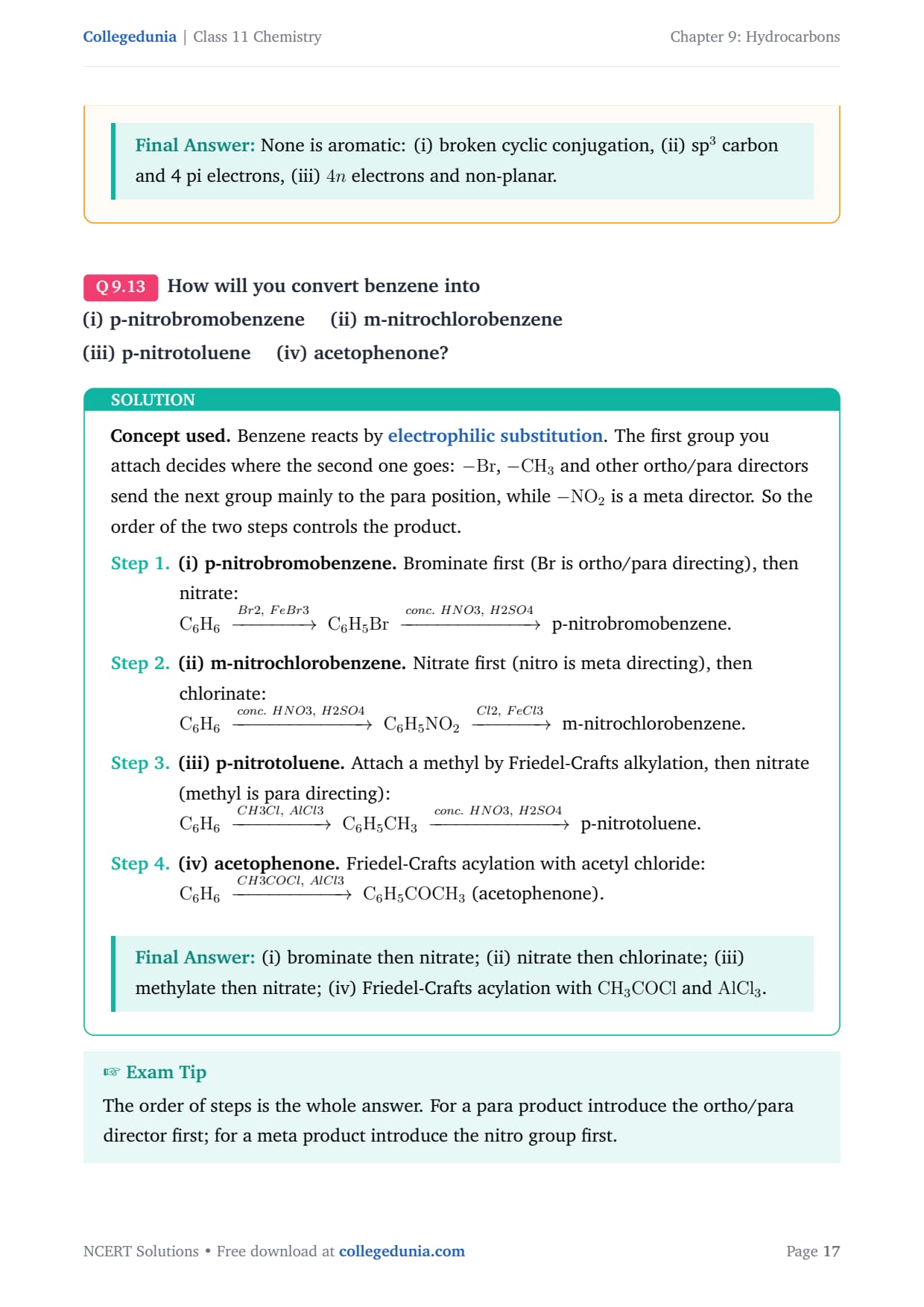
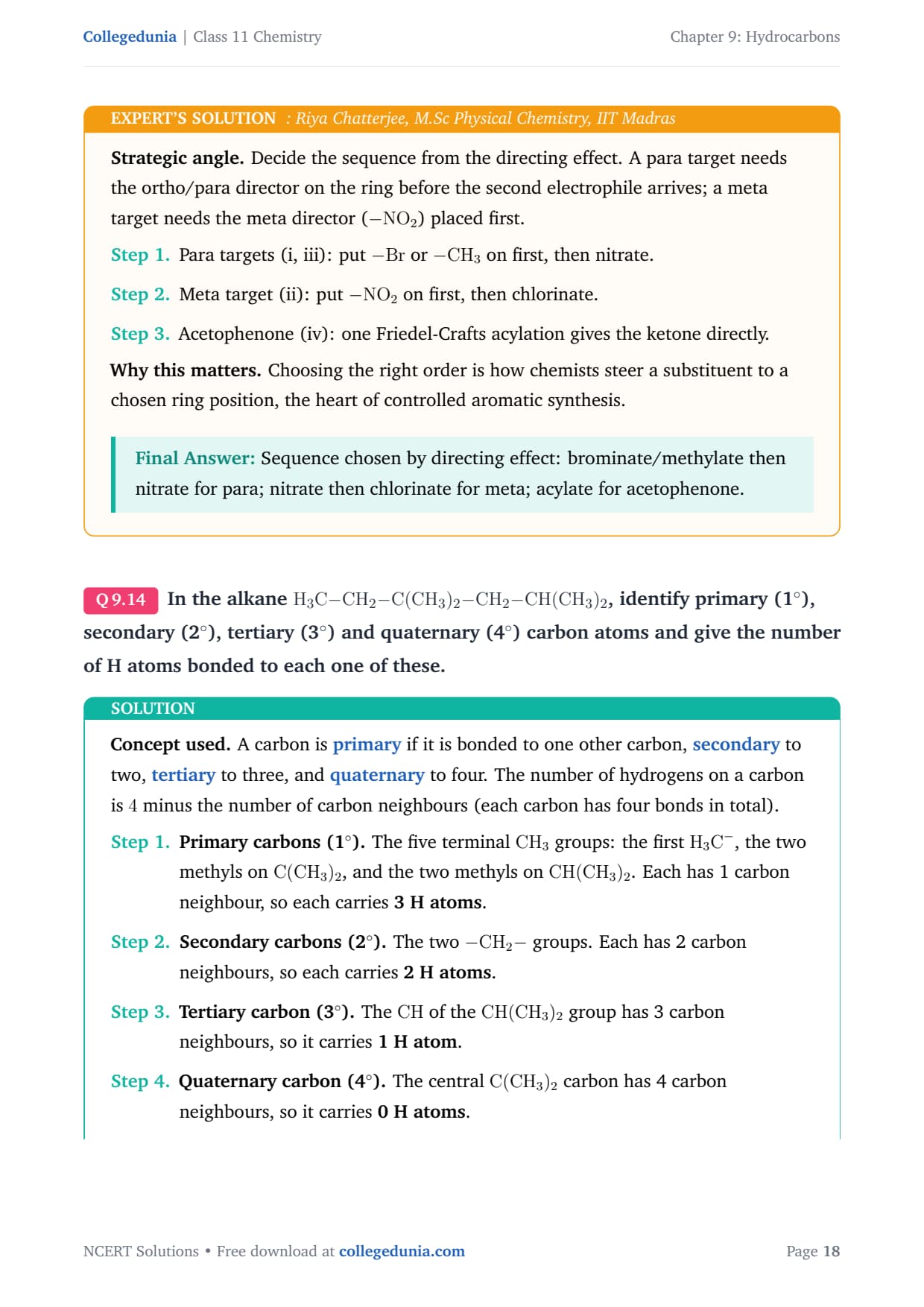
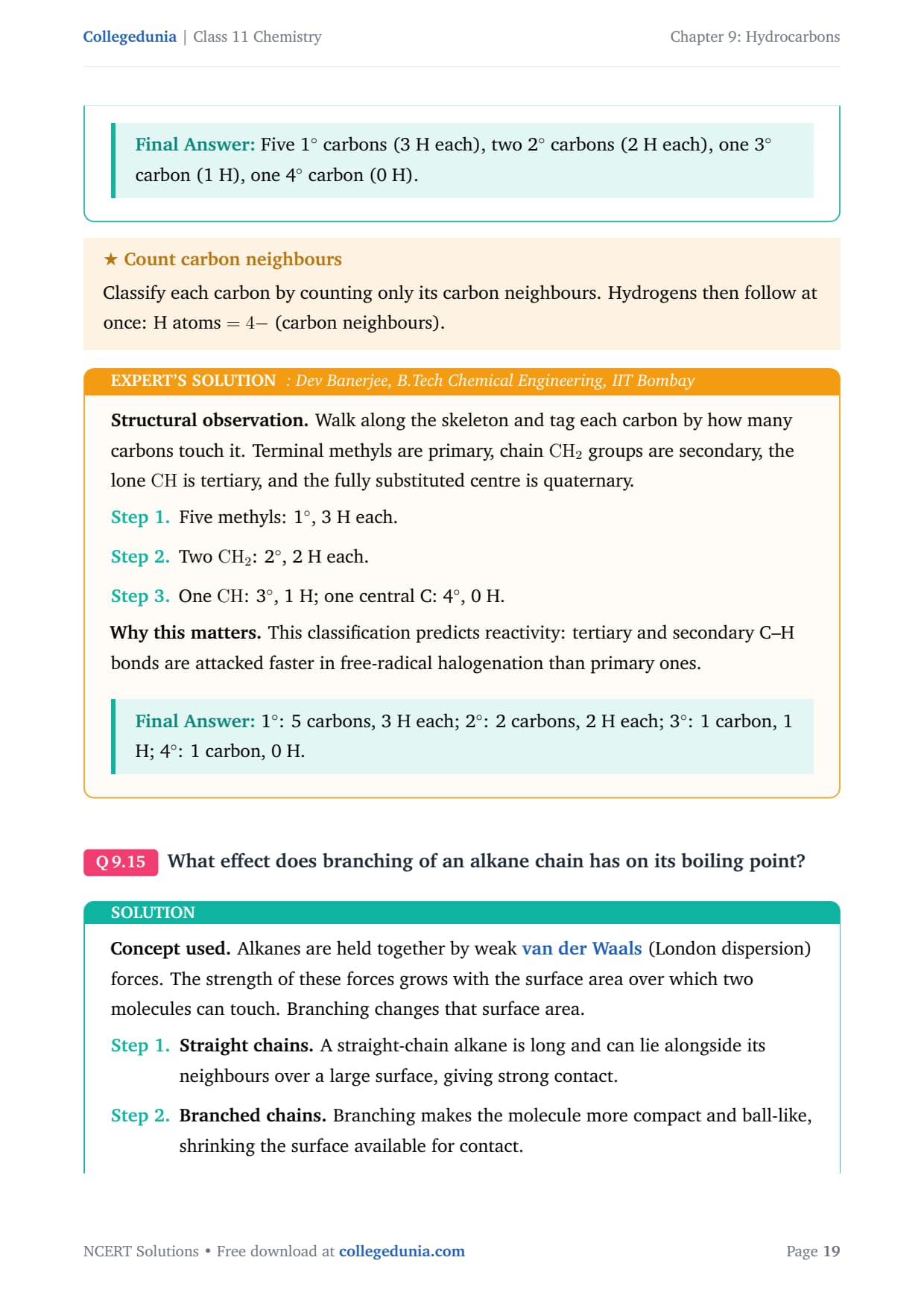
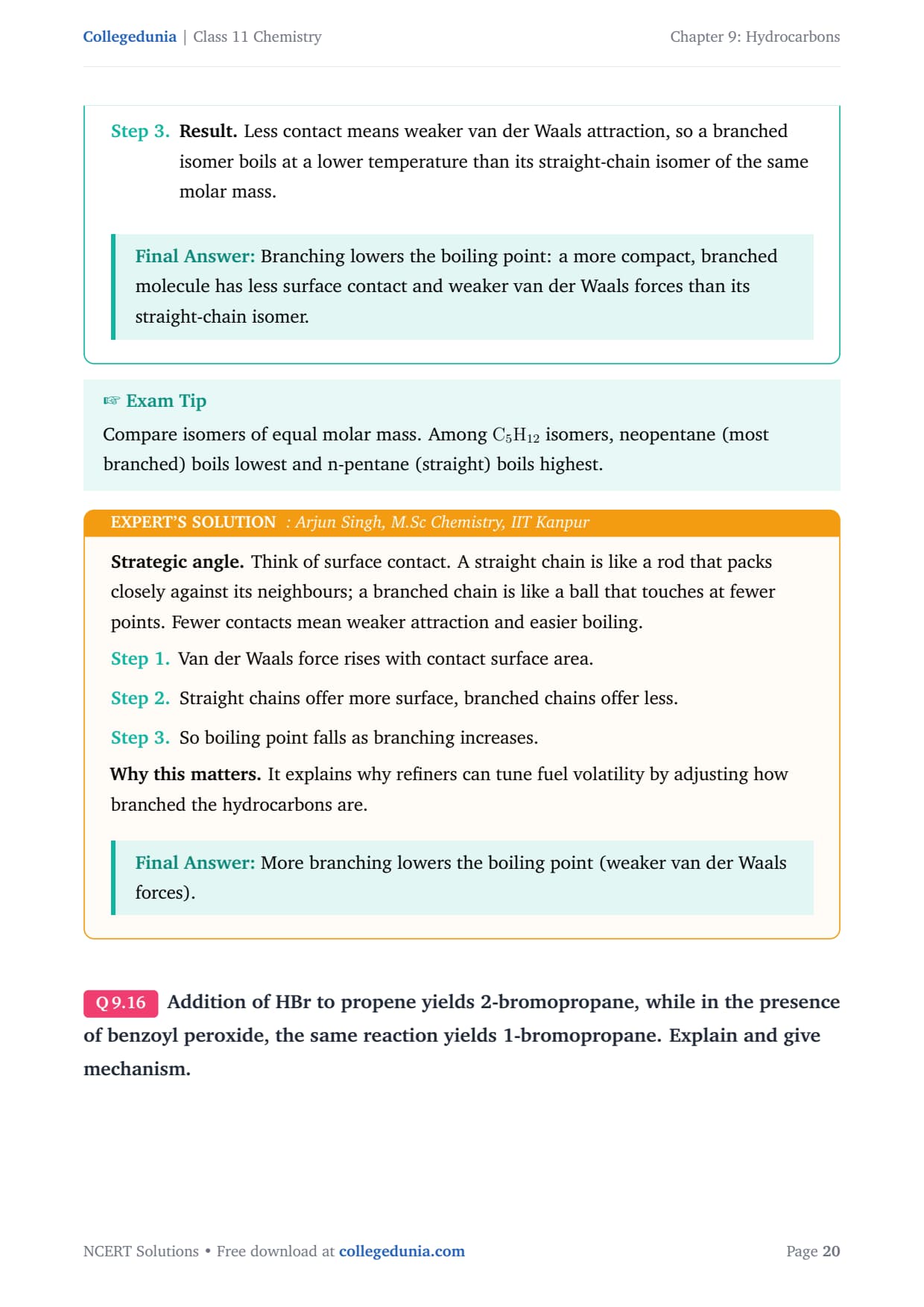
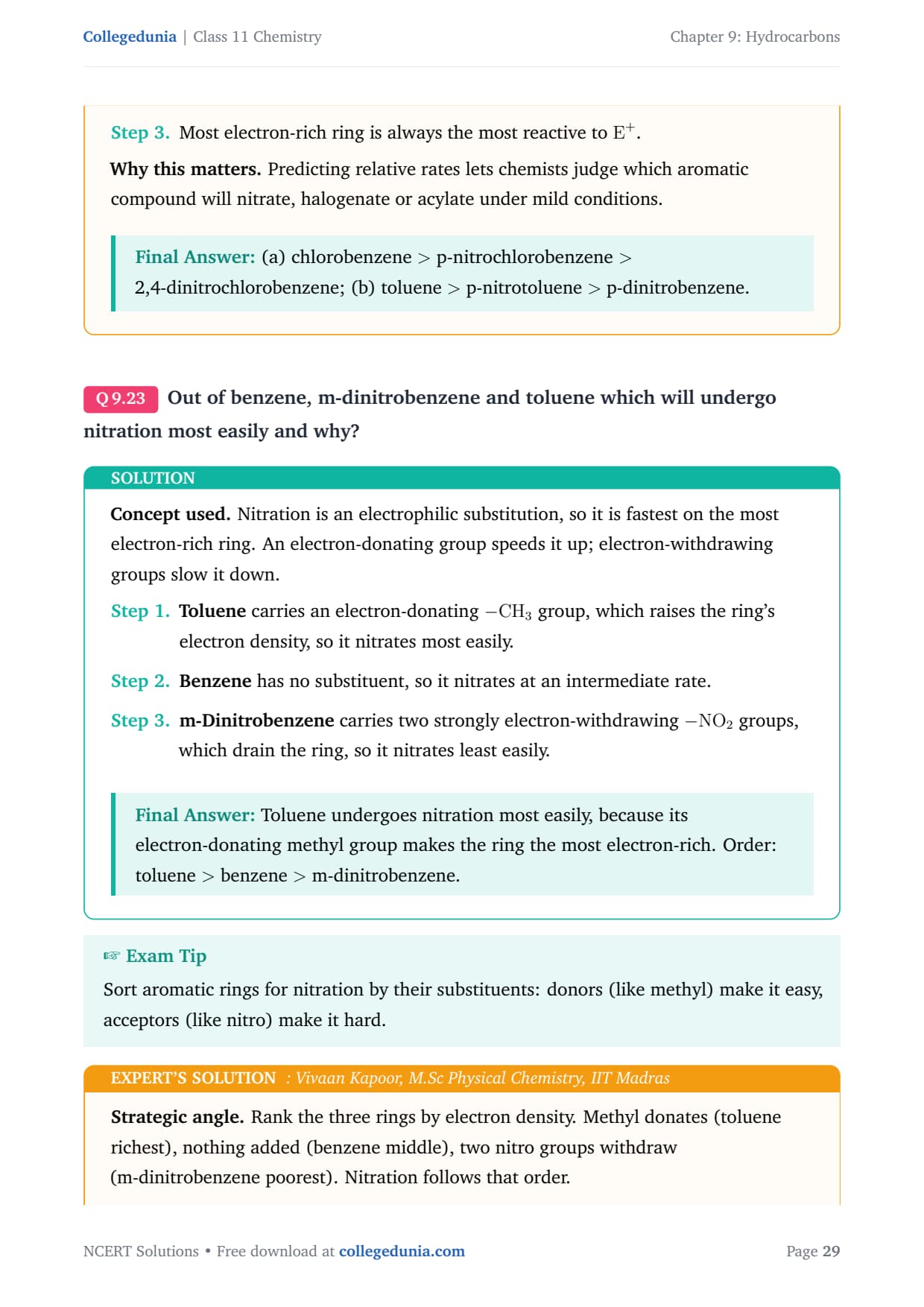
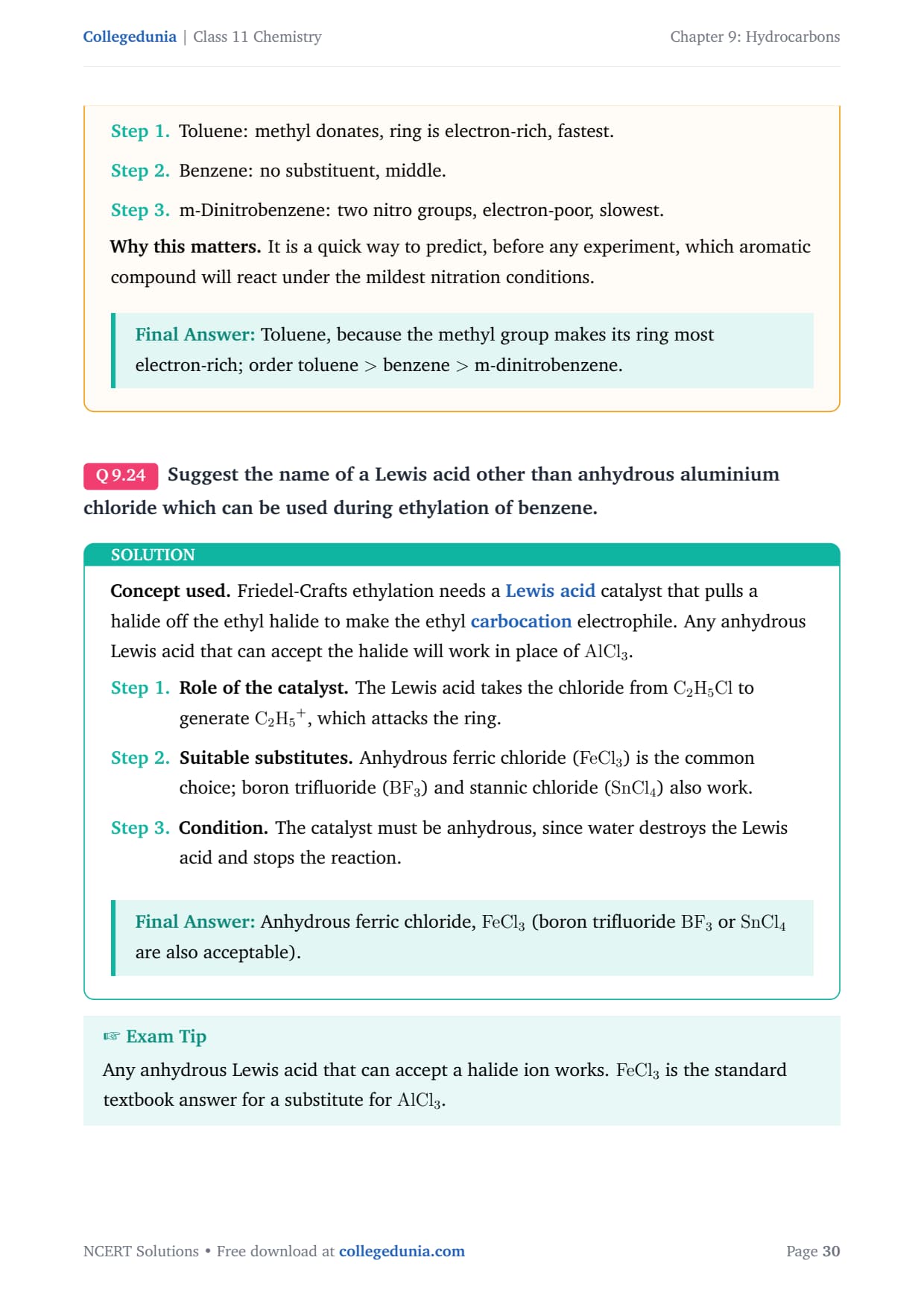
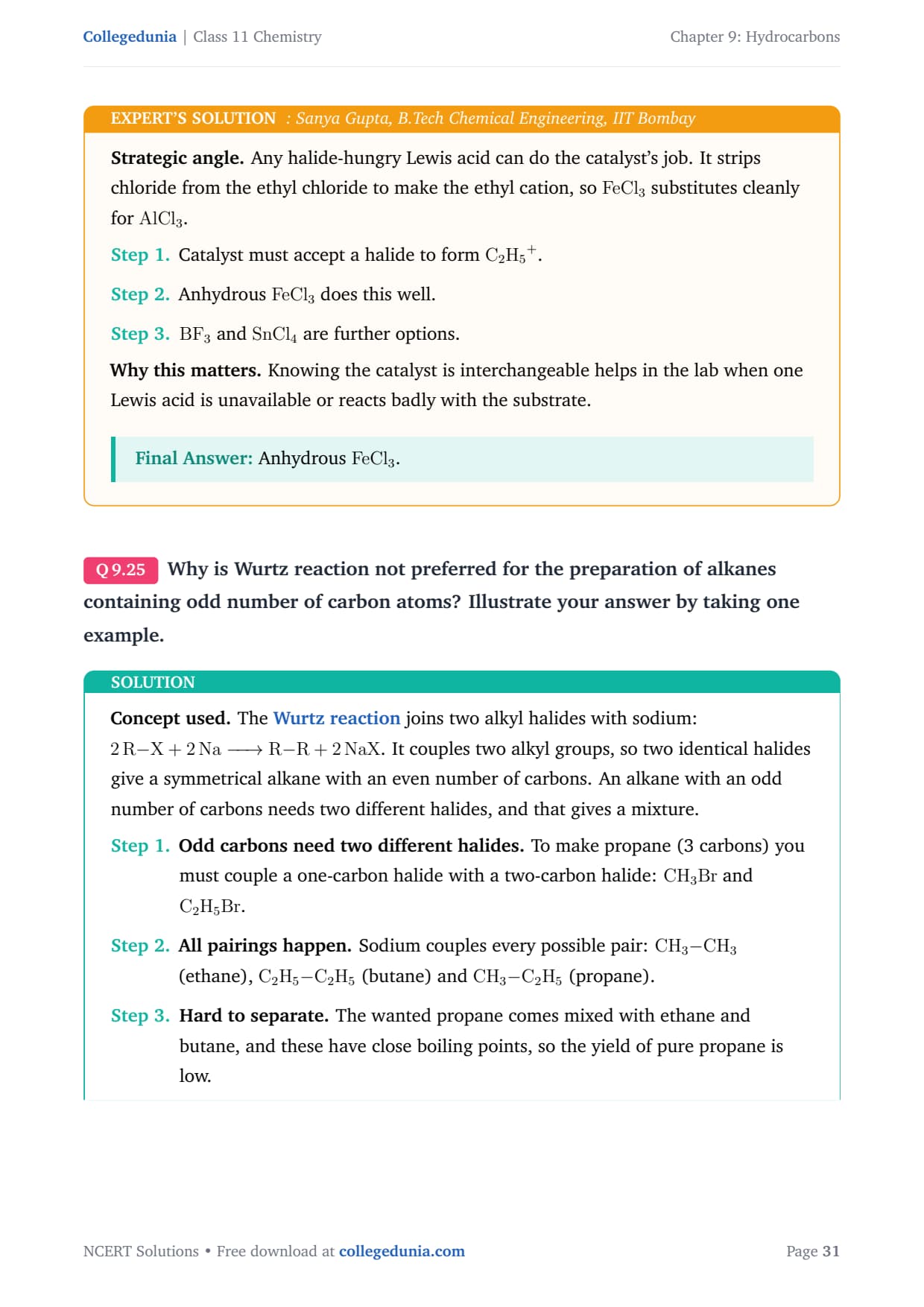
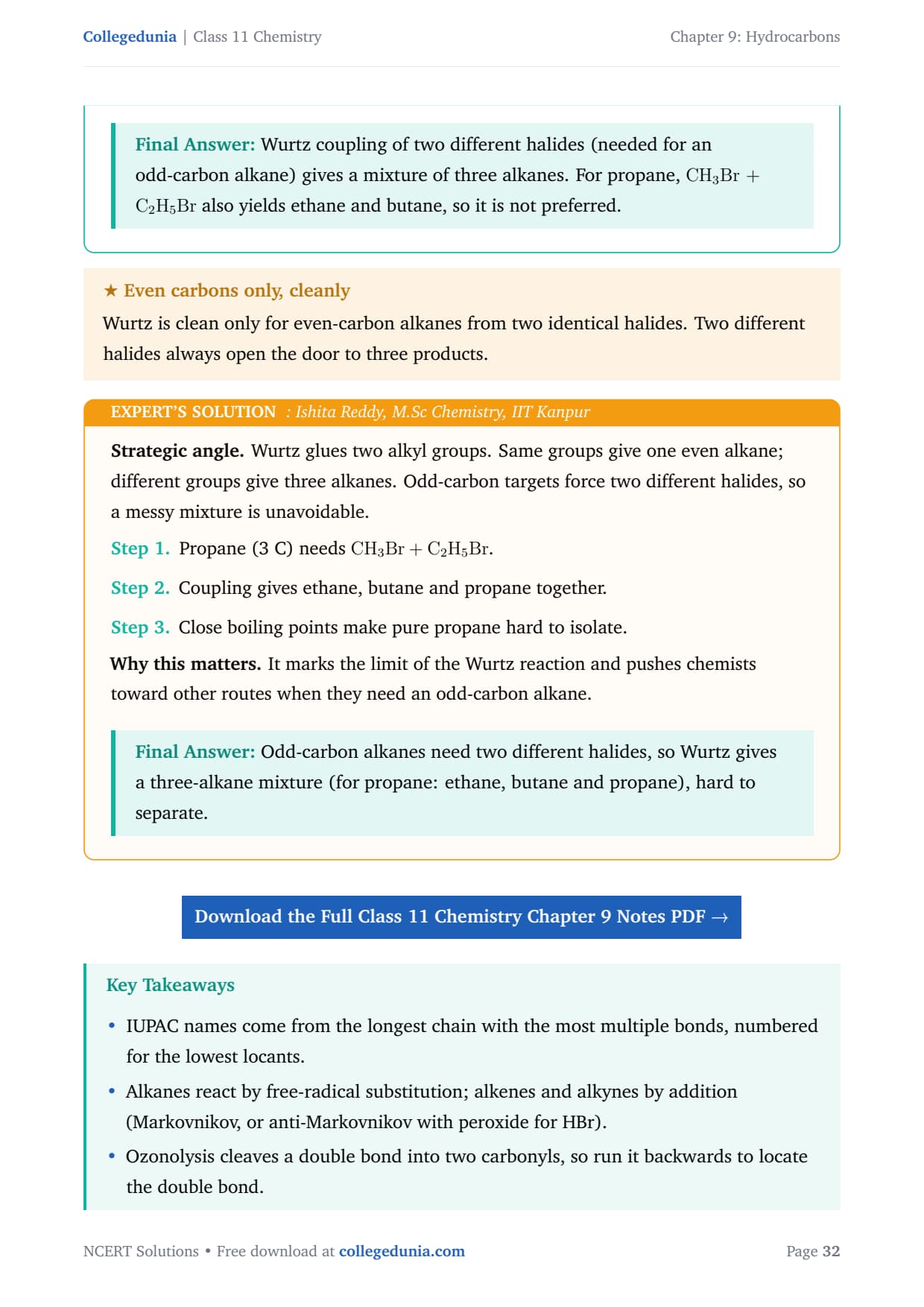
Hydrocarbons is the last chapter of Class 11 Chemistry and the launch pad for the whole of Class 12 Organic Chemistry, so the reactions here come back again and again.
- CBSE Weightage: 8 to 10 marks, one of the highest-scoring chapters in the Organic Chemistry unit.
- Topics covered: classification, alkanes, alkenes, alkynes, aromatic hydrocarbons, addition and substitution mechanisms, and carcinogenicity.
- Exercise count: 24 back-exercise questions plus intext questions, mixing naming, reactions and mechanism steps.
These class 11 chemistry NCERT solutions chapter 9 Hydrocarbons are curated by subject experts, based on the 2026-27 NCERT textbook, and checked against the last five years of CBSE Board, JEE Main and NEET papers.
Classification of Hydrocarbons Every Class 11 Student Must Know
Hydrocarbons are compounds made of only carbon and hydrogen. The chapter sorts them by the kind of carbon-carbon bond they hold, and that single idea decides how each family reacts. Get the classification right and the reactions fall into place.
- Saturated (alkanes): only single C-C bonds, general formula CnH2n+2, react by substitution.
- Unsaturated (alkenes and alkynes): at least one double bond CnH2n or triple bond CnH2n-2, react by addition.
- Aromatic: benzene and its rings, extra stable, react by electrophilic substitution.
Aliphatic hydrocarbons run in open chains or non-benzene rings, while aromatic hydrocarbons carry the special benzene ring. Saturated compounds add nothing; unsaturated ones add across the multiple bond. This split between substitution and addition is the thread that runs through every reaction in the class 11 chemistry NCERT solutions chapter 9 Hydrocarbons.
Alkanes: Nomenclature, Preparation and Conformations
Alkanes are the simplest hydrocarbons, with the general formula CnH2n+2. This section covers how they are named by the IUPAC rules, how they are made, and how single bonds let the molecule twist into different shapes.
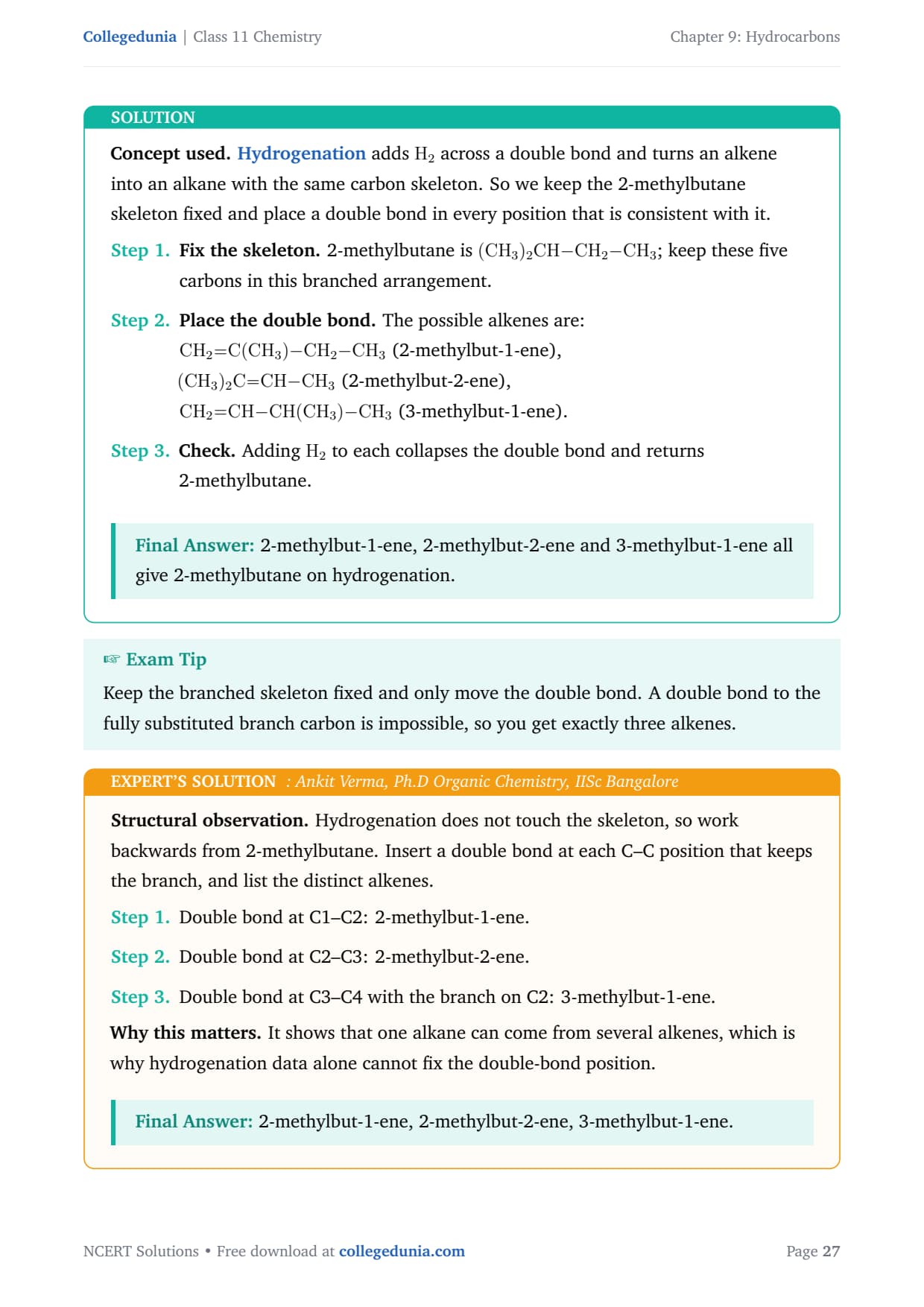
- Nomenclature: pick the longest carbon chain, number it to give substituents the lowest locants, then name the branches.
- Wurtz reaction: 2R-X + 2Na → R-R + 2NaX, joins two alkyl halides to make a longer alkane.
- From alkenes: catalytic hydrogenation, CH2=CH2 + H2 → CH3-CH3 over Ni.
Conformations are the shapes a molecule takes as groups rotate about a single bond. In ethane, the staggered form is more stable than the eclipsed form because the hydrogen atoms sit farthest apart, lowering repulsion. Sawhorse and Newman projections are the two ways to draw these shapes. A common exercise asks you to spot which conformation has the lowest energy, so learn the staggered-versus-eclipsed rule cold.
Chemical Properties of Alkanes and the Halogenation Mechanism
Alkanes are fairly unreactive, which is why they are called paraffins. Their headline reaction is free radical substitution with halogens in sunlight, and the mechanism is a favourite long-answer question.
- Initiation: UV light splits the halogen, Cl2 → 2Cl·, making reactive chlorine radicals.
- Propagation: Cl· pulls a hydrogen from methane to give CH3·, which then reacts with Cl2 to form CH3Cl and a fresh Cl·.
- Termination: two radicals combine, such as CH3· + Cl· → CH3Cl, ending the chain.
Because each propagation step makes a new radical, one photon can trigger many cycles, and the reaction does not stop at a single product. Chlorination of methane gives a mixture of CH3Cl, CH2Cl2, CHCl3 and CCl4. Alkanes also burn completely in excess air to CO2 and water, releasing the heat that makes them useful fuels. Controlled oxidation and isomerisation appear in the intext questions too.
Alkenes: Structure, Geometrical Isomerism and Preparation
Alkenes carry a carbon-carbon double bond and the formula CnH2n. The double bond is one strong sigma bond plus one weaker pi bond, and that pi bond is where nearly every reaction happens. The double bond also locks the shape, which creates a new kind of isomerism.
- Geometrical isomerism: restricted rotation about the double bond gives cis (same side) and trans (opposite side) forms.
- Condition: each double-bond carbon must carry two different groups, or no cis-trans pair exists.
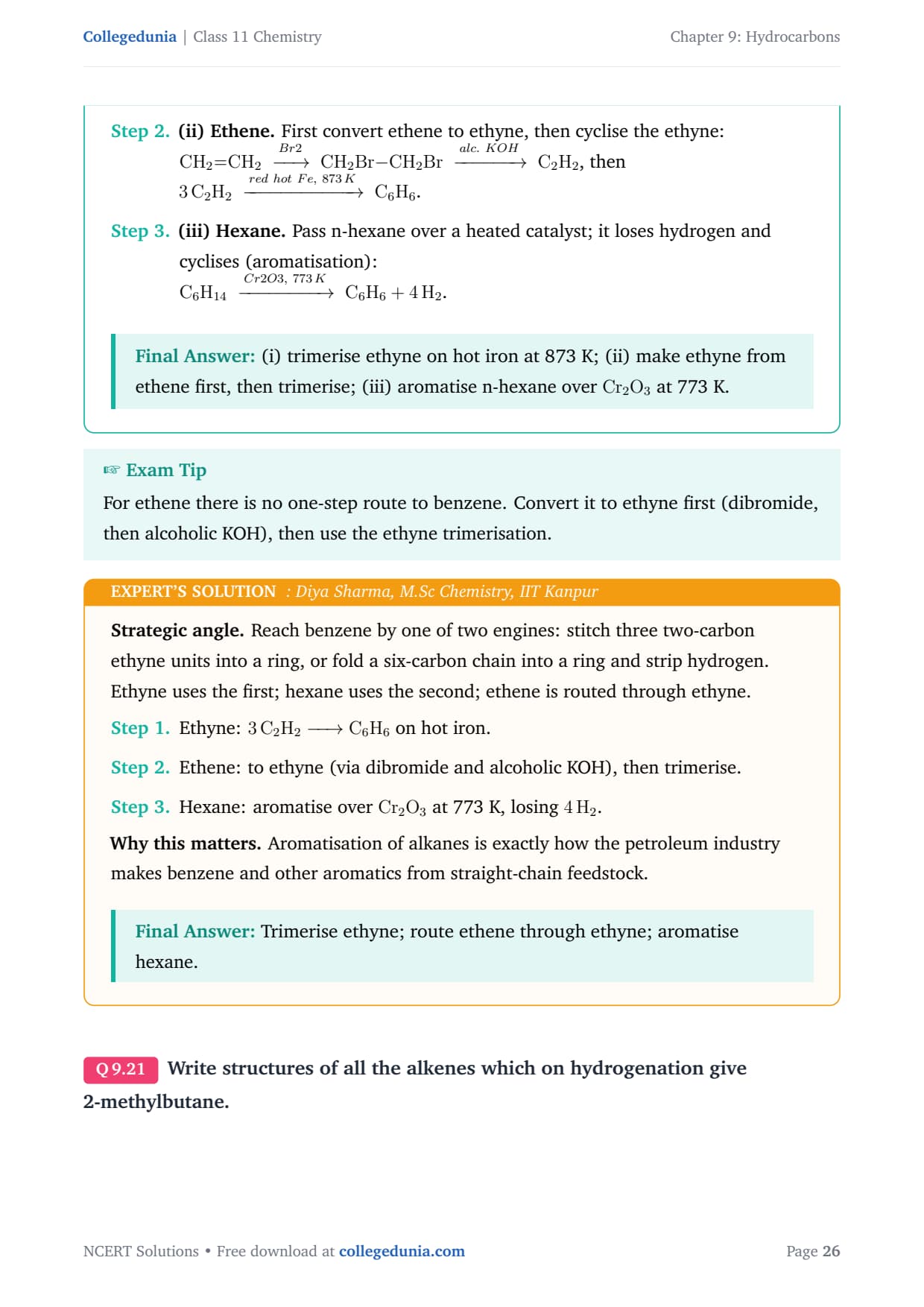
- Preparation: dehydrohalogenation of alkyl halides with alcoholic KOH, and dehydration of alcohols with concentrated H2SO4.
But-2-ene shows the idea clearly: it exists as cis and trans forms because each double-bond carbon holds a methyl and a hydrogen. The cis and trans isomers differ in melting point, boiling point and dipole moment. When you eliminate to make an alkene, Saytzeff's rule says the more substituted, more stable alkene forms as the major product. This preference is worth a mark in the board exam.
Addition Reactions of Alkenes: Markovnikov's Rule and the Peroxide Effect
The pi bond makes alkenes react by electrophilic addition, where a reagent adds across the double bond. When the alkene is unsymmetrical, two products are possible, and Markovnikov's rule tells you which one wins.
| Rule | What it states | Applies to |
|---|---|---|
| Markovnikov's rule | The negative part of the reagent adds to the carbon with fewer hydrogen atoms. | HX addition to unsymmetrical alkenes |
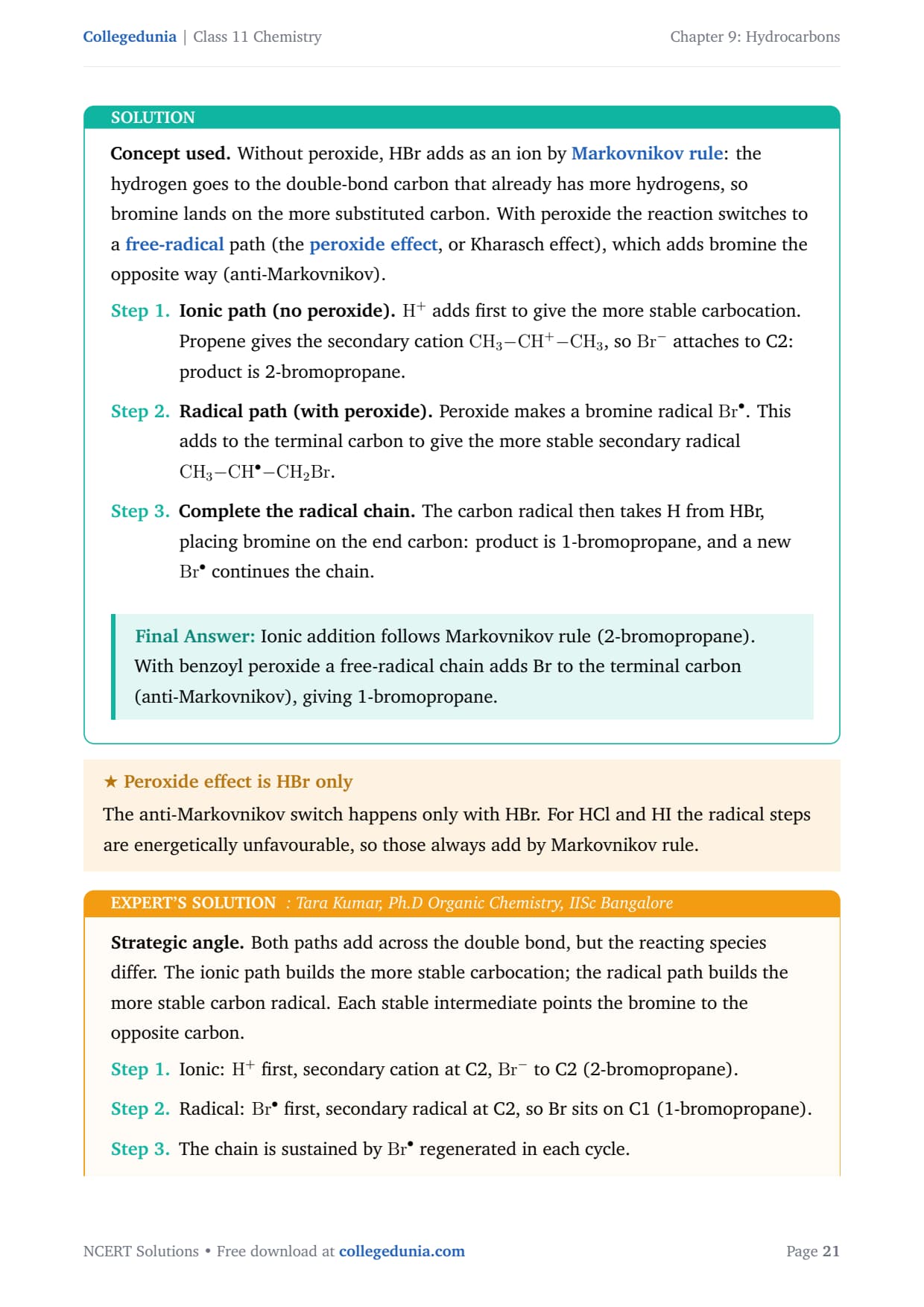
| Peroxide (anti-Markovnikov) effect | In the presence of peroxide, bromine adds to the carbon with more hydrogen atoms. | HBr only, by a free radical path |
For propene and HBr, Markovnikov addition gives 2-bromopropane because the bromide lands on the middle carbon. The peroxide effect works only with HBr, not with HCl or HI. The reason is bond energy: only the H-Br bond gives radicals stable enough to keep the chain going. Alkenes also decolourise bromine water, which is the classic test for unsaturation, and they add water in acid to form alcohols.
Alkynes: Acidic Character and Addition Reactions
Alkynes hold a carbon-carbon triple bond, formula CnH2n-2, made of one sigma and two pi bonds. Terminal alkynes carry a special feature the exam loves: the hydrogen on the triple-bonded carbon is weakly acidic.
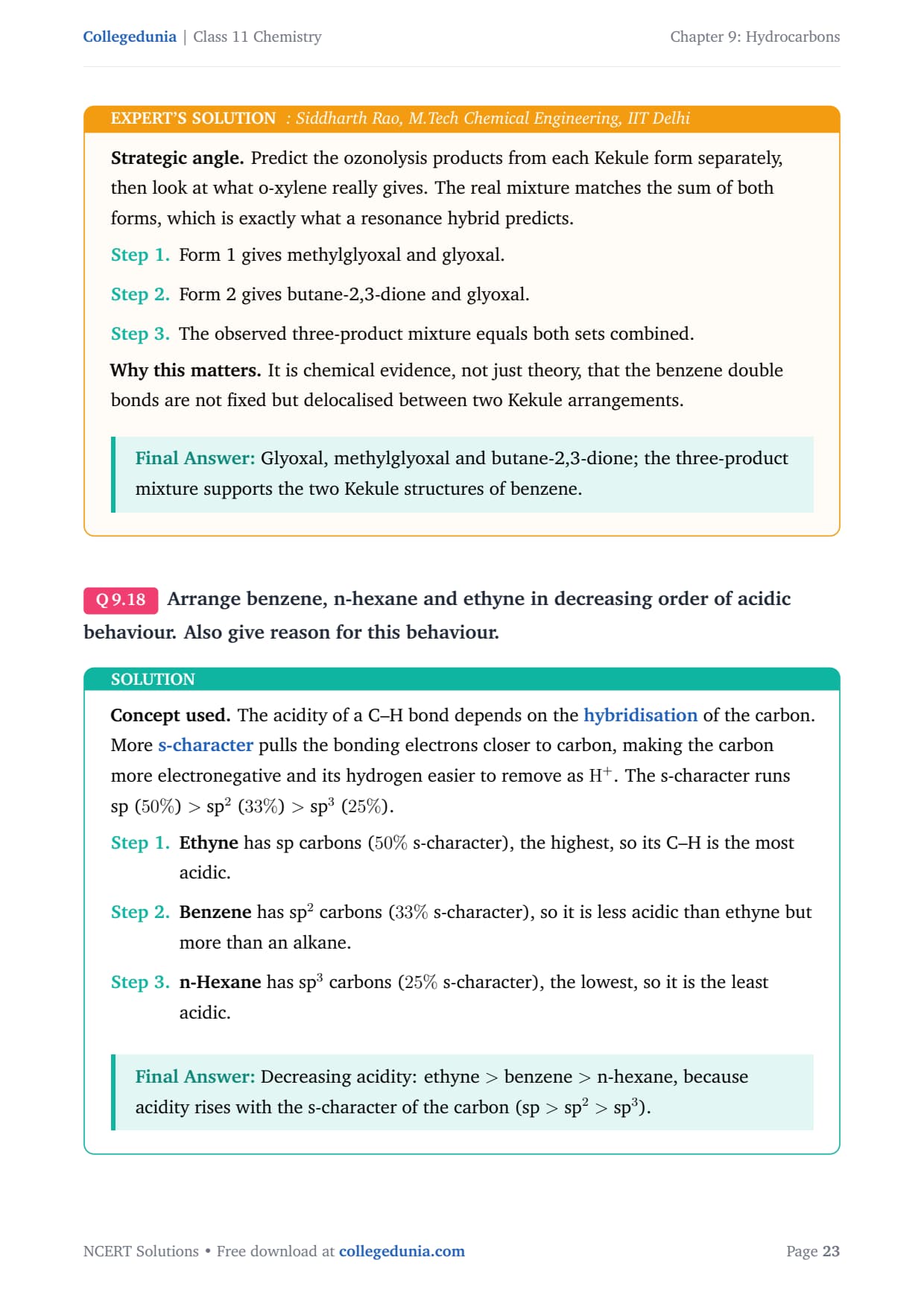
- Acidic hydrogen: the sp carbon holds its electrons tightly, so the C-H bond releases H+ more easily than in alkanes or alkenes.
- Test reaction: ethyne reacts with sodium to give sodium acetylide and hydrogen gas, HC≡CH + Na → HC≡CNa + ½H2.
- Addition: the triple bond adds hydrogen, halogens and hydrogen halides in two stages, following Markovnikov's rule.
The acid strength order to remember is ethyne > ethene > ethane, set by the s-character of the carbon holding the hydrogen. More s-character means the electrons sit closer to the nucleus, so the proton leaves more easily. Ethyne also adds water in the presence of dilute H2SO4 and HgSO4 to form acetaldehyde, a reaction that shows up in both intext and back-exercise questions.
Aromatic Hydrocarbons: Benzene Structure and Aromaticity
Aromatic hydrocarbons are built around the benzene ring, C6H6. Benzene is far more stable than its formula suggests, and explaining that extra stability is a standard question in this chapter.
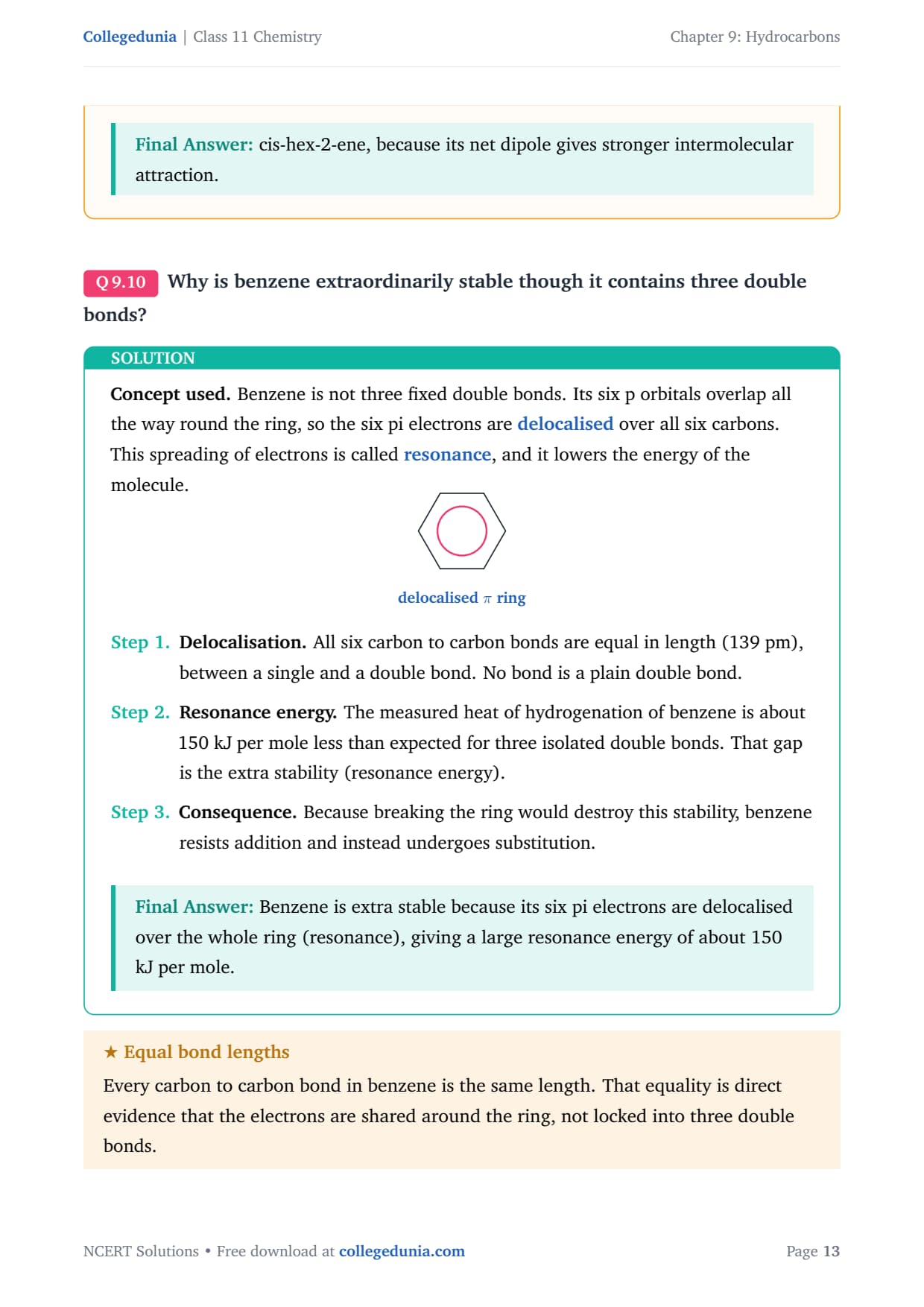
- Structure: a flat ring of six carbons, each sp2 hybridised, with the six pi electrons spread evenly in a delocalised cloud.
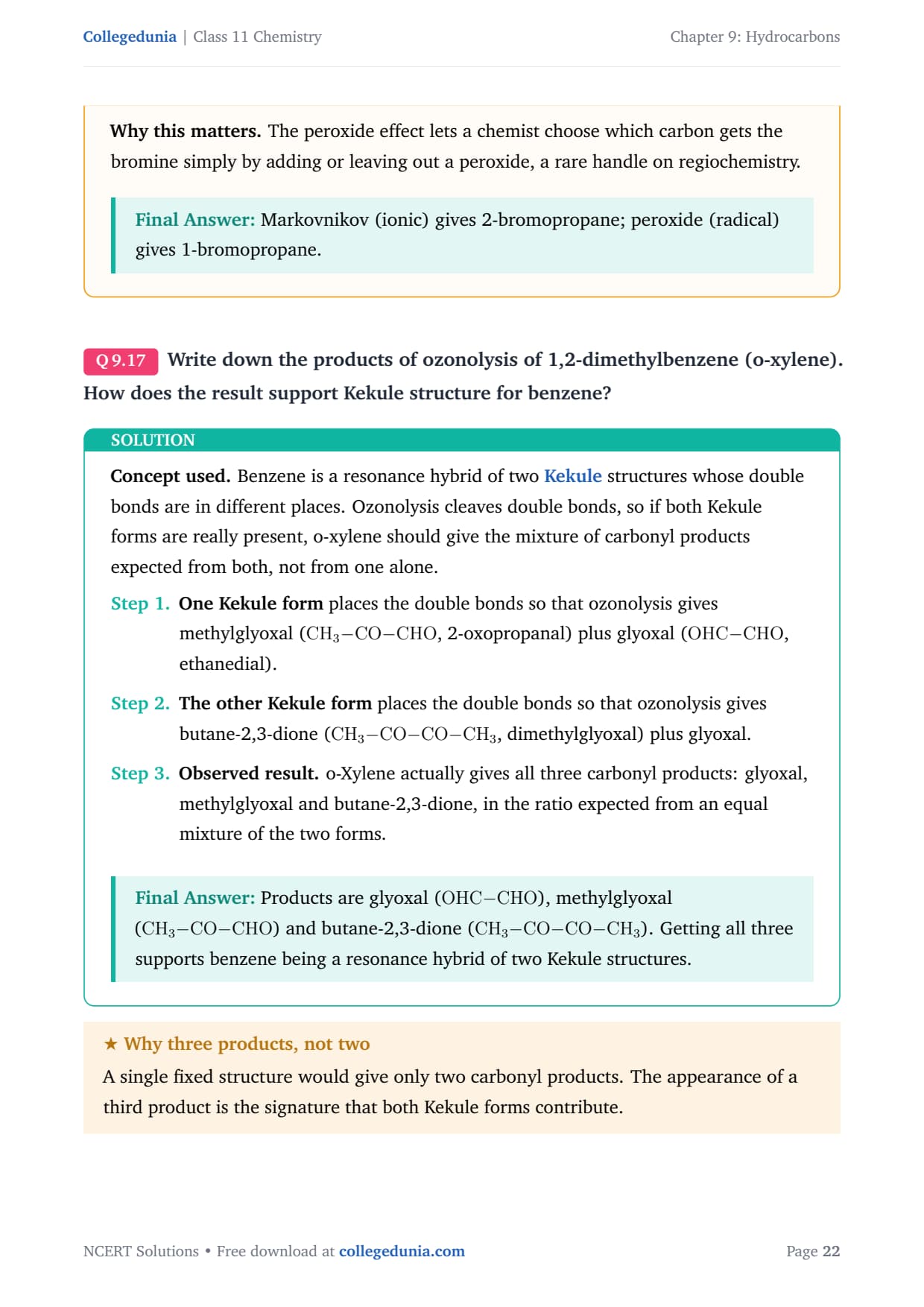
- Resonance: the real molecule is a hybrid of two Kekule structures, so all six C-C bonds are equal in length.
- Huckel's rule: a ring is aromatic when it is planar and holds (4n + 2) pi electrons; benzene has 6, so n = 1.
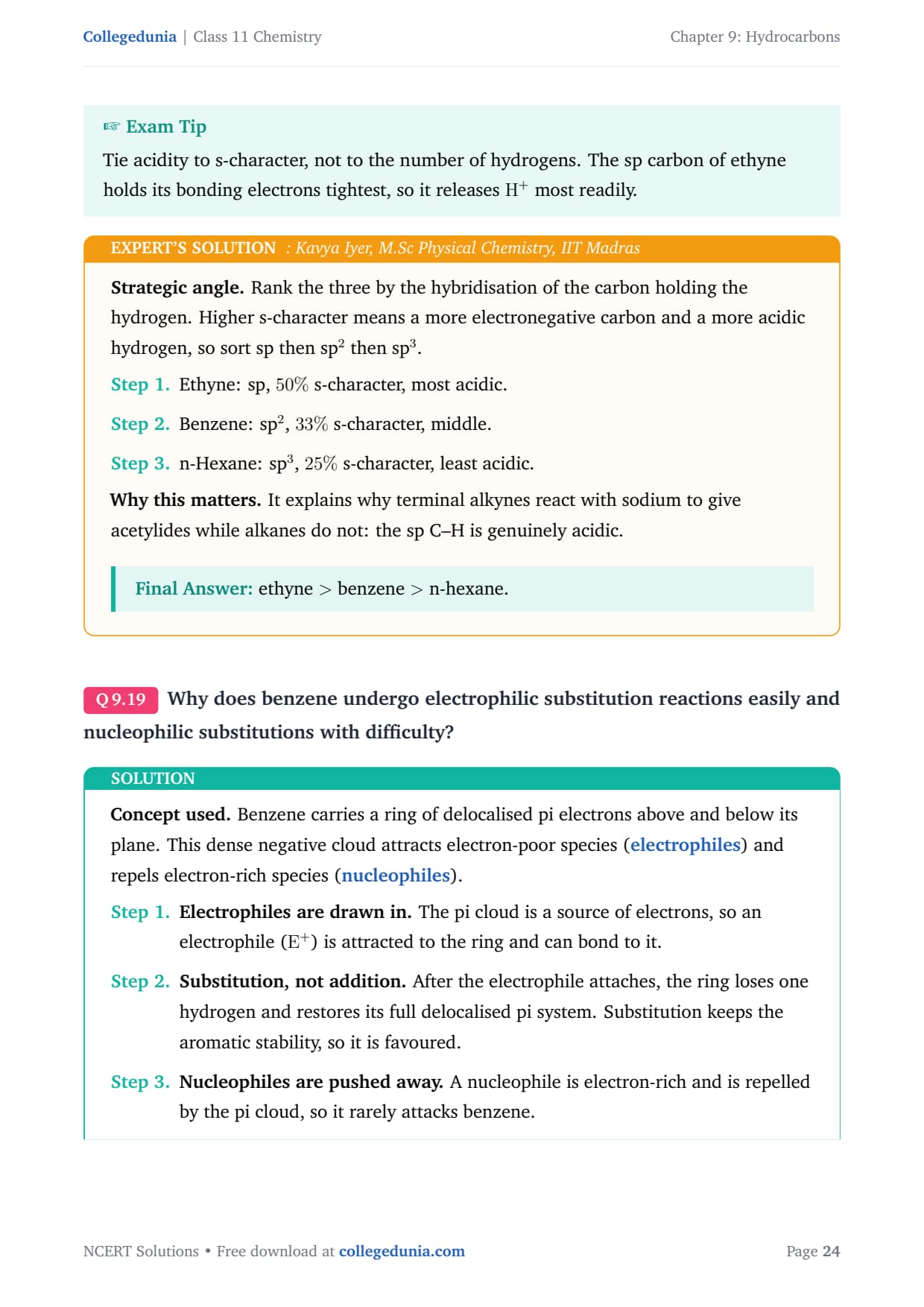
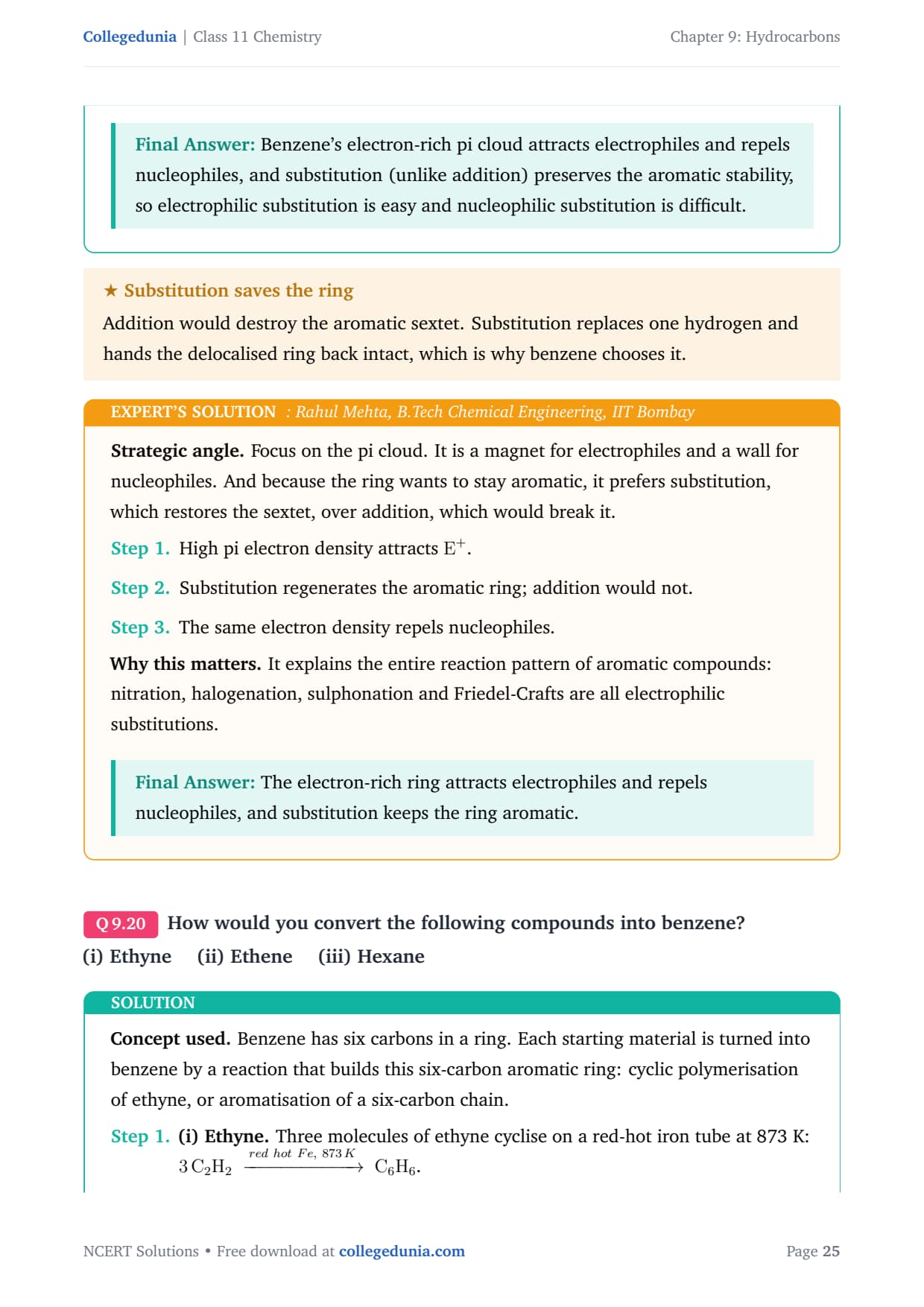
This delocalisation gives benzene a large resonance energy, which is why it resists addition and prefers substitution. Benzene undergoes substitution, keeping its stable ring, rather than addition. The three conditions for aromaticity, planarity, full delocalisation and the (4n + 2) count, are the exact points examiners look for in a definition answer.
Electrophilic Substitution, Directive Influence and Carcinogenicity
Benzene's typical reaction is electrophilic aromatic substitution, where an electrophile replaces a ring hydrogen. The general mechanism runs in three steps and covers nitration, halogenation, sulphonation and the two Friedel-Crafts reactions.
- Generation of the electrophile: for nitration, HNO3 and H2SO4 make the nitronium ion NO2+.
- Attack on the ring: the pi cloud attacks the electrophile to form a resonance-stabilised carbocation, the arenium ion.
- Loss of a proton: a base removes H+ to restore the aromatic ring, giving the substituted product.
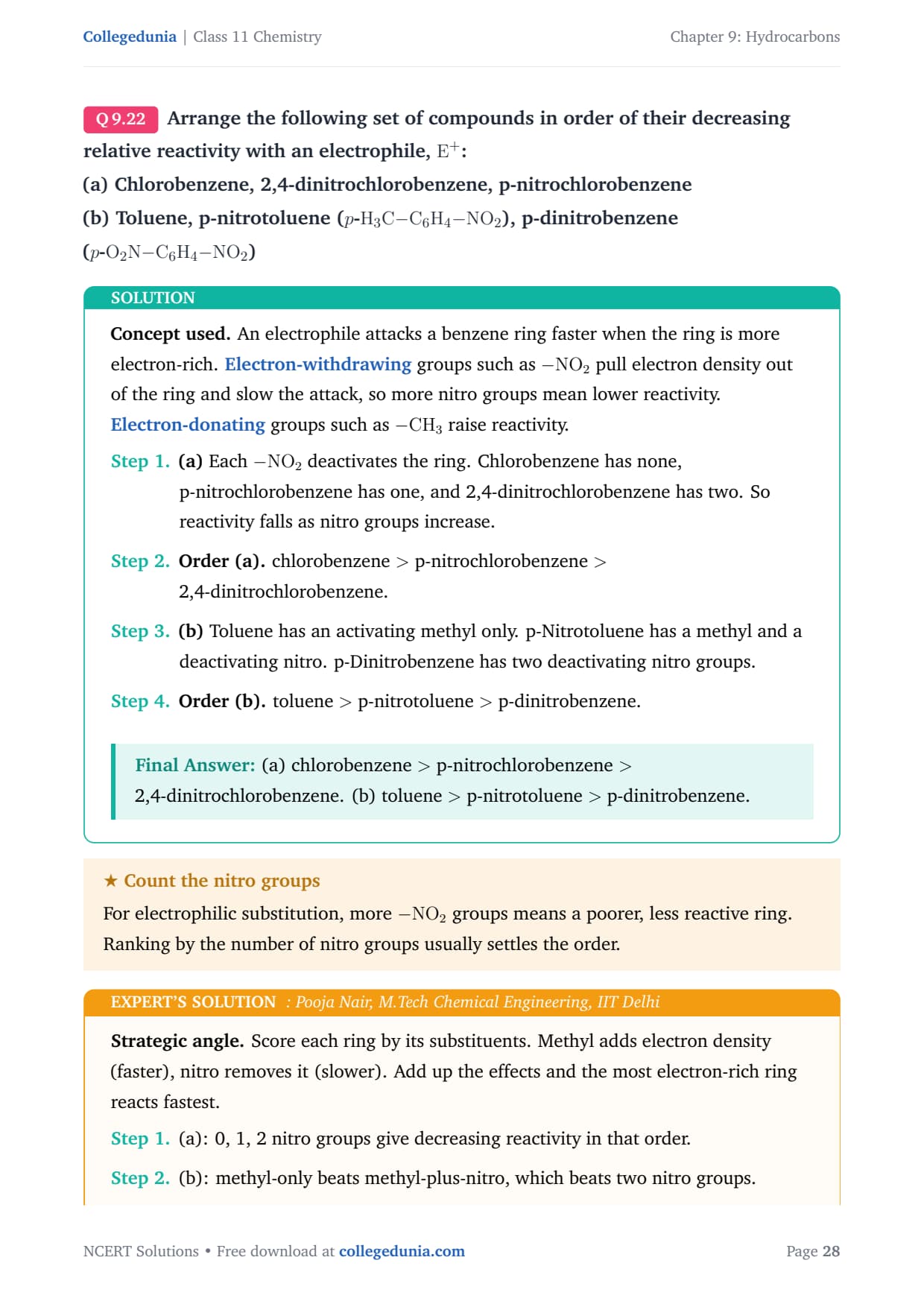
When a group is already on the ring, it steers the next one. Electron-donating groups such as -OH, -NH2 and -CH3 direct to the ortho and para positions, while electron-withdrawing groups such as -NO2 and -COOH direct to the meta position. Ortho-para directors mostly activate the ring; meta directors deactivate it. The chapter closes with a health note: polynuclear aromatic hydrocarbons like benzpyrene, formed when tobacco or coal burns, are carcinogenic and can cause cancer. This fact is a favourite one-mark question.
Hydrocarbons Exercise-wise Breakdown
The NCERT back exercise has 24 questions, mixing naming, reaction products and mechanism steps. The intext questions test the same ideas in shorter form. The table below maps the question blocks to their topics so you can plan your practice.
| Question block | What it tests |
|---|---|
| Q 9.1 to 9.6 | IUPAC naming, structural formulas, and classification of hydrocarbons. |
| Q 9.7 to 9.12 | Alkane preparation, conformations, and free radical halogenation. |
| Q 9.13 to 9.18 | Alkene and alkyne addition, Markovnikov's rule, and the peroxide effect. |
| Q 9.19 to 9.24 | Benzene aromaticity, electrophilic substitution, and directive influence. |
The intext questions before the exercise are shorter and check one idea each, such as naming a branch or predicting a single product. Solve the intext set first, then the back exercise. Every question in the class 11 chemistry NCERT solutions chapter 9 Hydrocarbons PDF is solved with each step shown, so you can compare your working line by line.
Practice the solved questions: Work through the full question bank with step-by-step answers and expert tips.
Common Mistakes Students Make in the Hydrocarbons Chapter
Most marks are lost on small habits, not on hard ideas. Each slip below costs 1 to 2 marks, so watch for them at the exact step.
Mistake 1: Applying the peroxide effect to HCl or HI. It works only with HBr, so the other halides always follow Markovnikov's rule.
Mistake 2: Forgetting the correct product in Markovnikov addition. The negative part goes to the carbon with fewer hydrogen atoms.
Mistake 3: Writing addition for benzene. Benzene prefers substitution because addition would destroy its stable aromatic ring.
Mistake 4: Mixing up ortho-para and meta directors. Electron-donating groups direct ortho-para; electron-withdrawing groups direct meta.
Student Feedback on the Hydrocarbons Solutions
What 14,120 students told us about their Hydrocarbons preparation:
- 68% of students rated the electrophilic substitution mechanism as the hardest part of the chapter.
- Most-skipped step: writing the arenium ion intermediate in the benzene mechanism, missed by about 3 in 10 students.
- Students who learned the ortho-para and meta directing rules first said the aromatic questions became straightforward.
Source: 2026-27 Class 11 Chemistry student poll. Sample of 14,120 students from CBSE schools across 15 states, conducted before the 2026 boards.
Other Hydrocarbons Class 11 Chemistry Resources
Pair these solutions with the revision notes and the NCERT textbook PDF for the same chapter.
| Resource | Link |
|---|---|
| NCERT Notes | Hydrocarbons Class 11 Notes |
| NCERT Book PDF | Hydrocarbons Class 11 Book PDF |
NCERT Solutions for Class 11 Chemistry: All Chapters
Jump to the step-by-step solutions for any other Class 11 Chemistry chapter below.
| Chapter | NCERT Solutions |
|---|---|
| Chapter 1 | Some Basic Concepts of Chemistry |
| Chapter 2 | Structure of Atom |
| Chapter 3 | Classification of Elements and Periodicity in Properties |
| Chapter 4 | Chemical Bonding and Molecular Structure |
| Chapter 5 | Thermodynamics |
| Chapter 6 | Equilibrium |
| Chapter 7 | Redox Reactions |
| Chapter 8 | Organic Chemistry Some Basic Principles and Techniques |
| Chapter 9 | Hydrocarbons |
FAQs on Hydrocarbons Class 11 NCERT Solutions
Hydrocarbons NCERT Solutions - Frequently Asked Questions
Ques. What do the class 11 chemistry NCERT solutions chapter 9 Hydrocarbons cover?
Ans. These solutions cover all 24 back-exercise questions and the intext questions, including the classification of hydrocarbons, IUPAC naming, alkane conformations and halogenation, alkene and alkyne addition reactions with Markovnikov's rule and the peroxide effect, and benzene aromaticity with electrophilic substitution. Every question is solved step by step.
Ques. What is Markovnikov's rule in Class 11 Chemistry Chapter 9?
Ans. Markovnikov's rule applies when a hydrogen halide adds to an unsymmetrical alkene. It states that the negative part of the reagent, the halide, adds to the double-bond carbon that carries fewer hydrogen atoms. For propene and HBr, the product is 2-bromopropane. The rule works because the more stable carbocation forms first.
Ques. What is the peroxide effect?
Ans. The peroxide effect, also called the Kharasch effect, is the anti-Markovnikov addition of HBr to an unsymmetrical alkene when a peroxide is present. The bromine adds to the carbon with more hydrogen atoms, the reverse of Markovnikov's rule. It happens by a free radical mechanism and works only with HBr, not HCl or HI.
Ques. Why does benzene undergo substitution rather than addition?
Ans. Benzene has six delocalised pi electrons that give it a large resonance energy and extra stability. Addition would break this delocalised system and remove the aromatic character, which costs energy. Electrophilic substitution replaces a hydrogen atom while keeping the ring intact, so benzene prefers substitution reactions such as nitration, halogenation and sulphonation.
Ques. Why is ethyne acidic while ethane is not?
Ans. In ethyne, the carbon holding the hydrogen is sp hybridised, which has 50% s-character. High s-character keeps the bonding electrons close to the nucleus, so the C-H bond releases a proton more easily. Ethane has sp3 carbon with only 25% s-character and is not acidic. The acid strength order is ethyne > ethene > ethane.
Ques. What is the weightage of Hydrocarbons in CBSE Class 11?
Ans. Hydrocarbons carries about 8 to 10 marks in the CBSE Class 11 Chemistry paper, mostly through reaction products, mechanism steps and naming questions. It is also heavily tested in JEE Main and NEET, where the reactions of alkenes, alkynes and benzene appear every year and carry into the Class 12 Organic Chemistry chapters.



Comments