




The class 11 chemistry NCERT solutions chapter 8 Organic Chemistry Some Basic Principles and Techniques cover every intext and back-exercise question, according to the latest 2026-27 CBSE syllabus, and help students prepare for the CBSE Boards, JEE Main, JEE Advanced, NEET and CUET. Each answer is worked step by step, from the tetravalence of carbon and IUPAC naming to reaction mechanism, electronic effects and methods of purification.
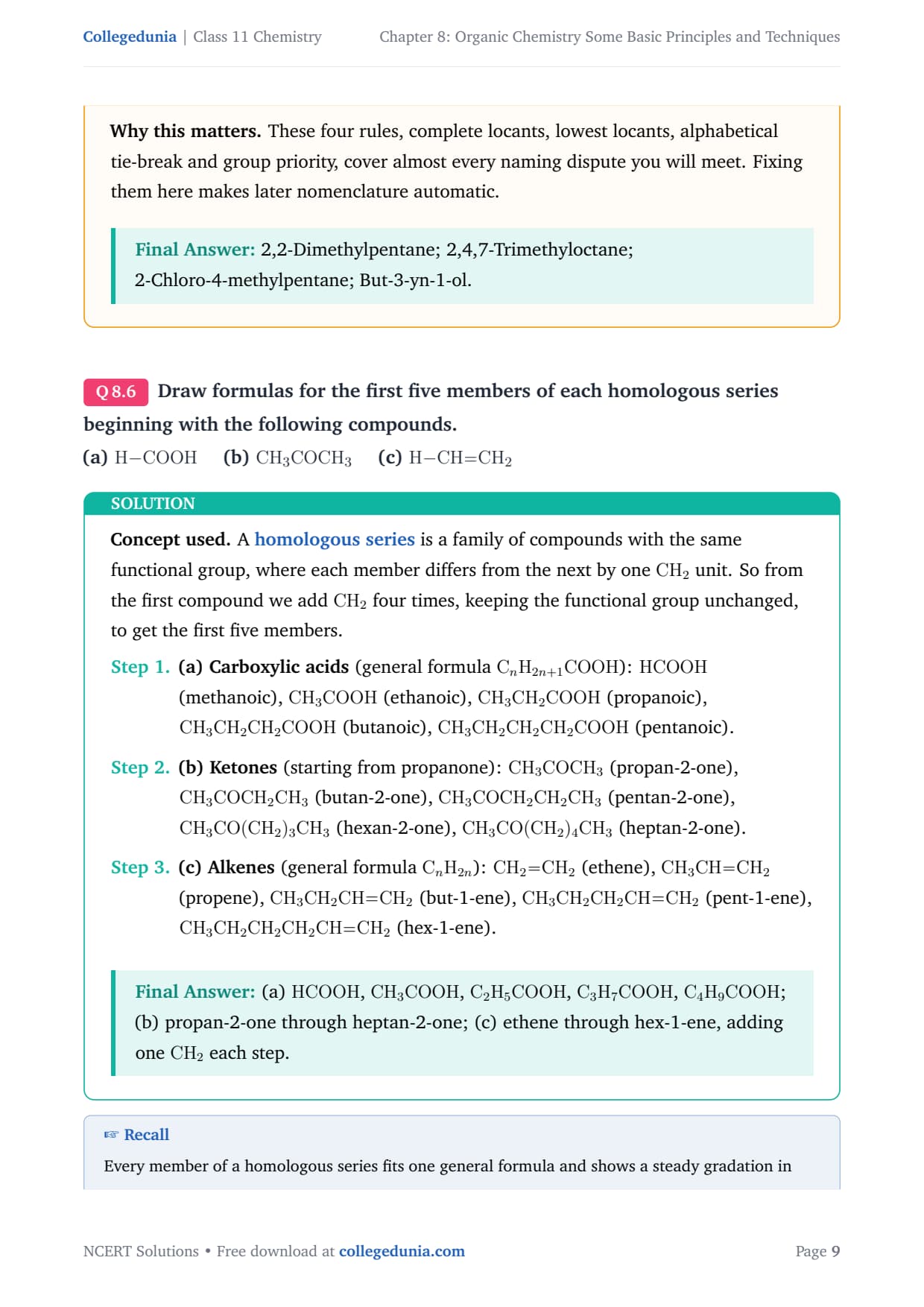
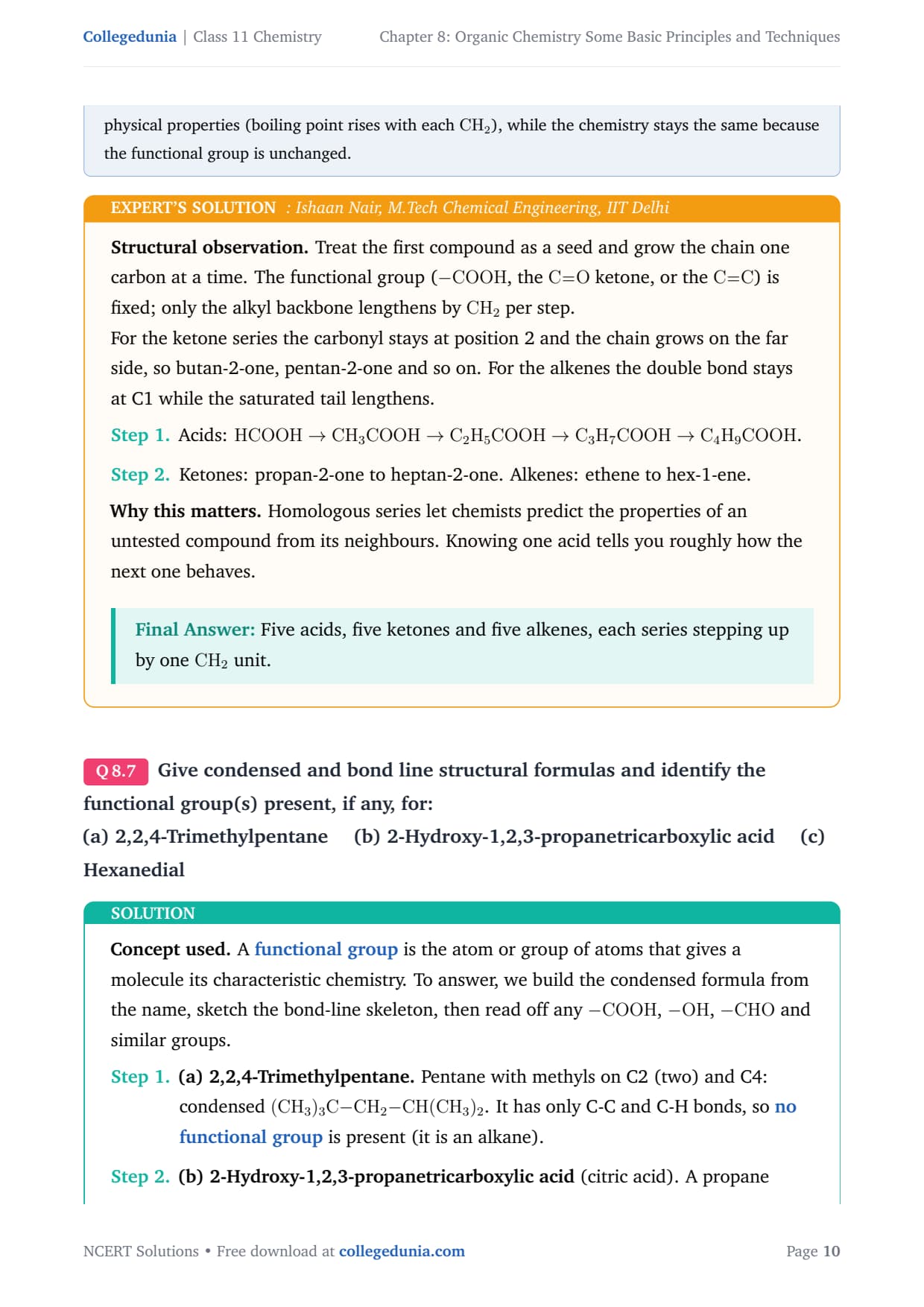
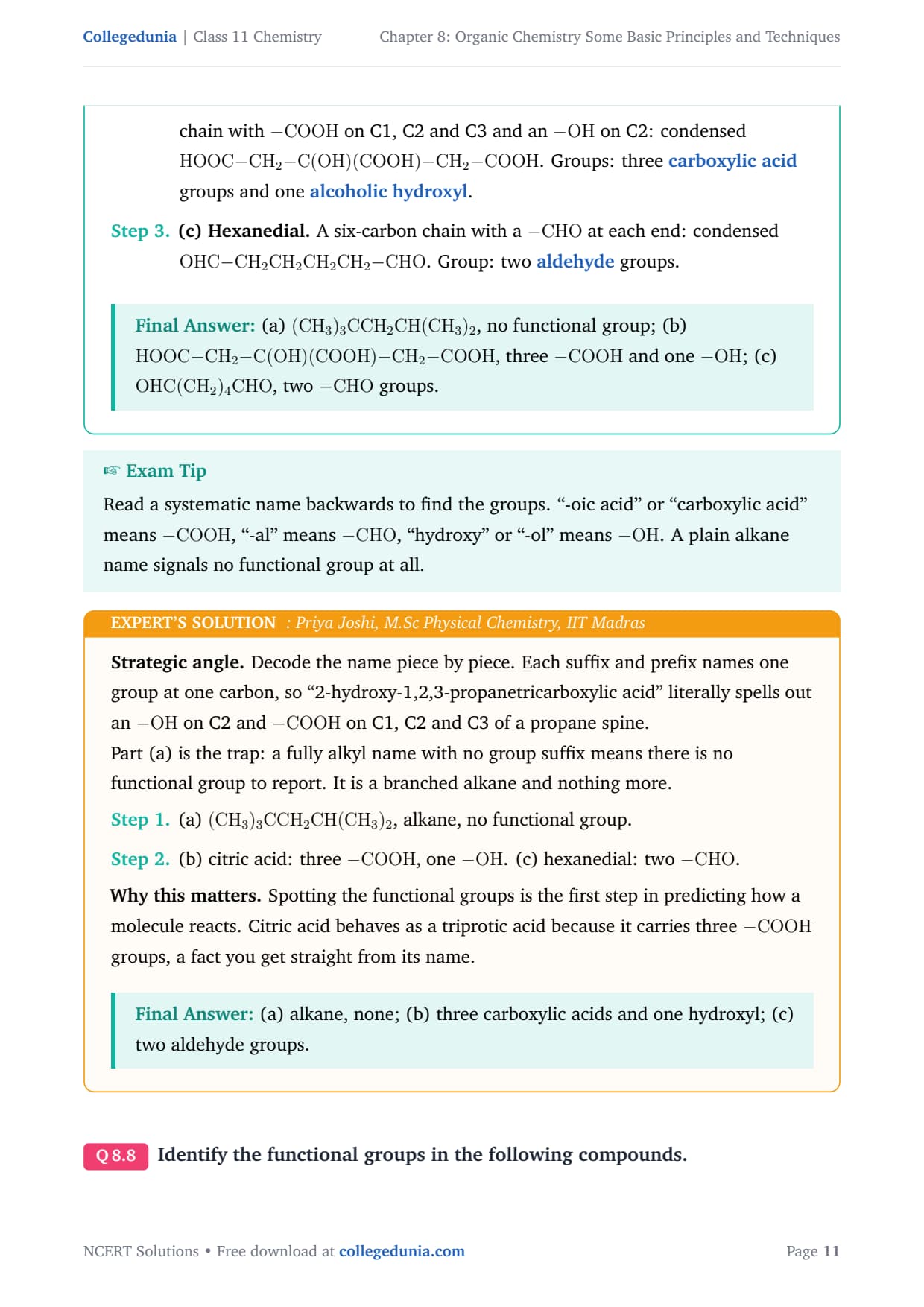
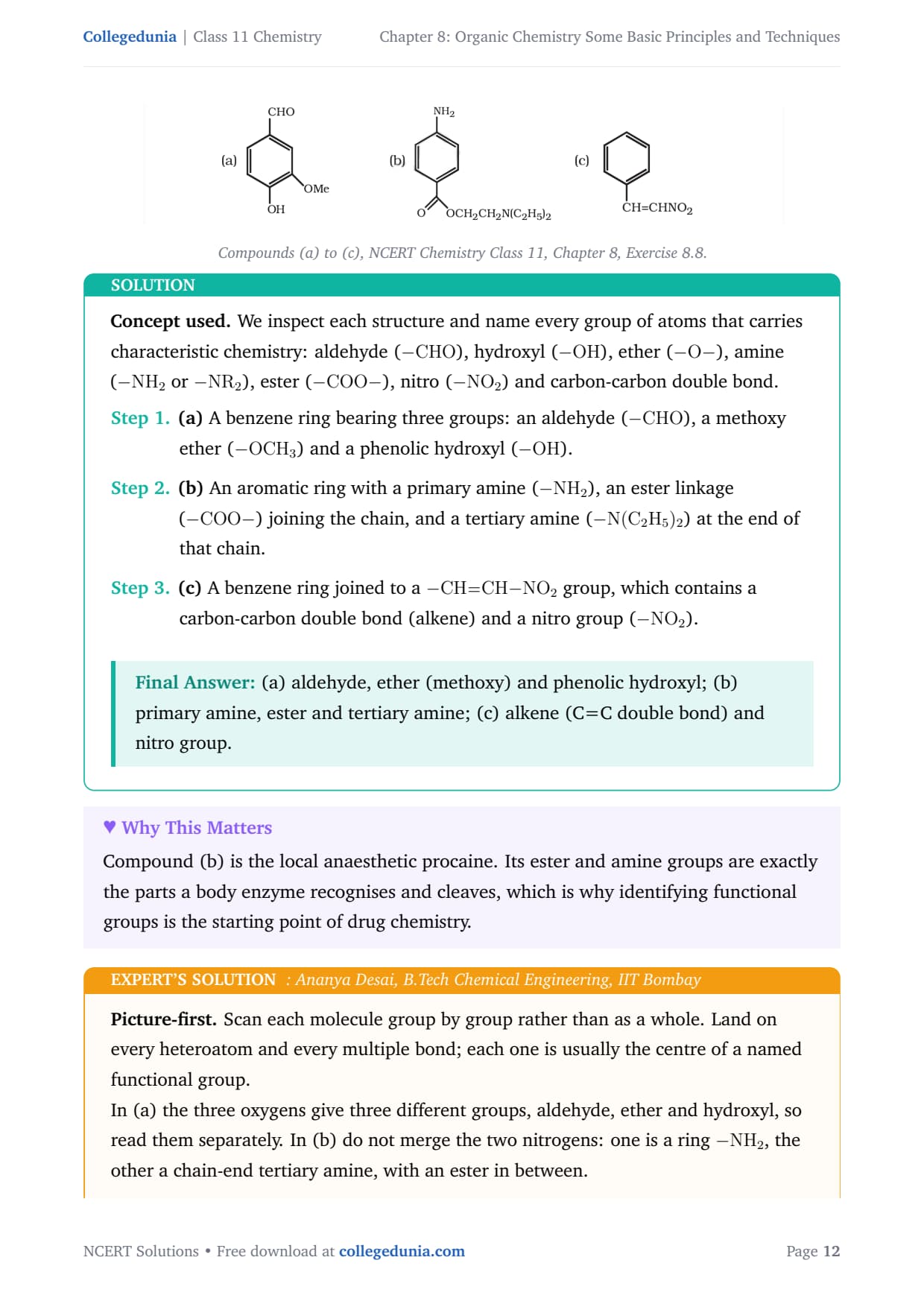
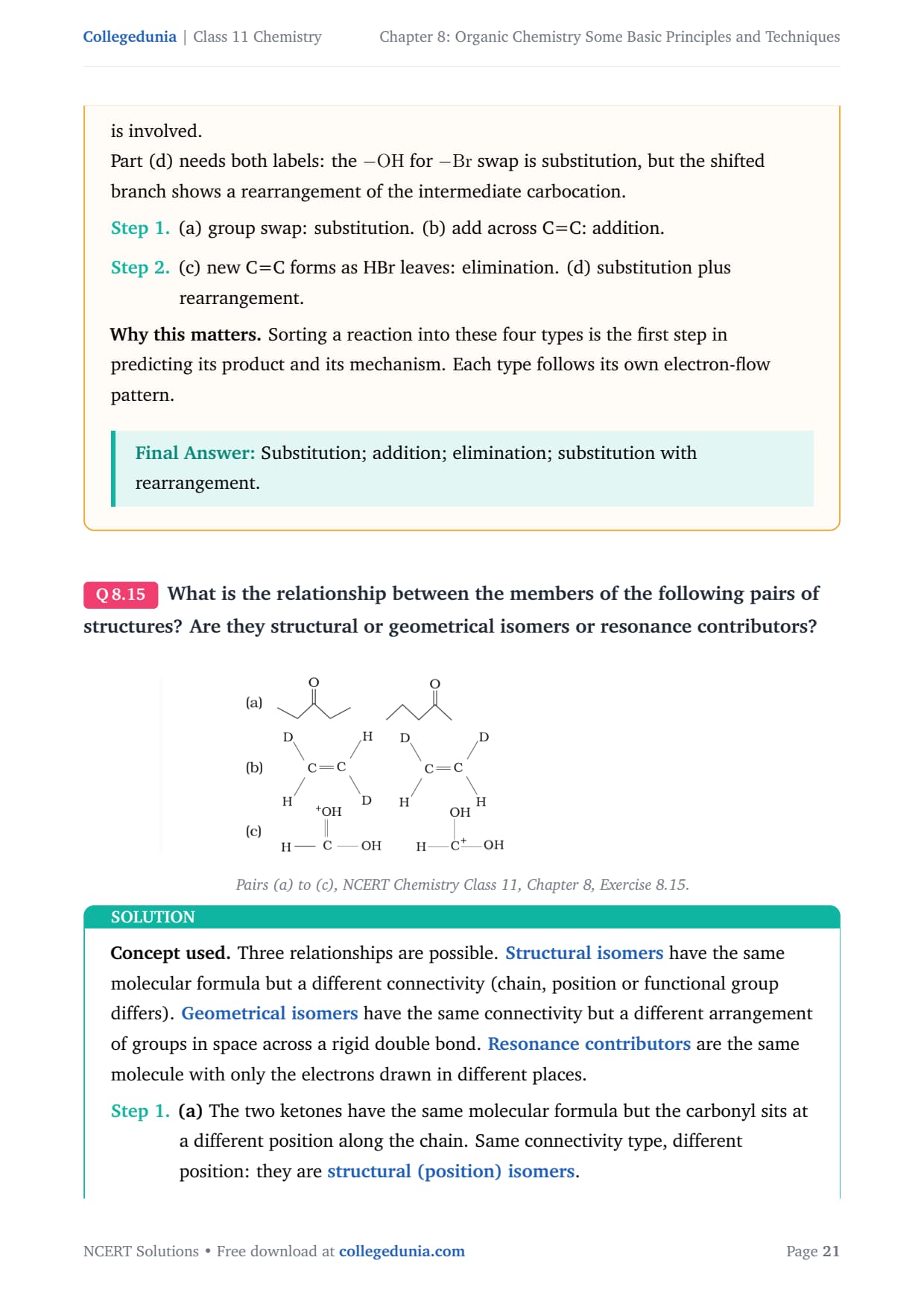
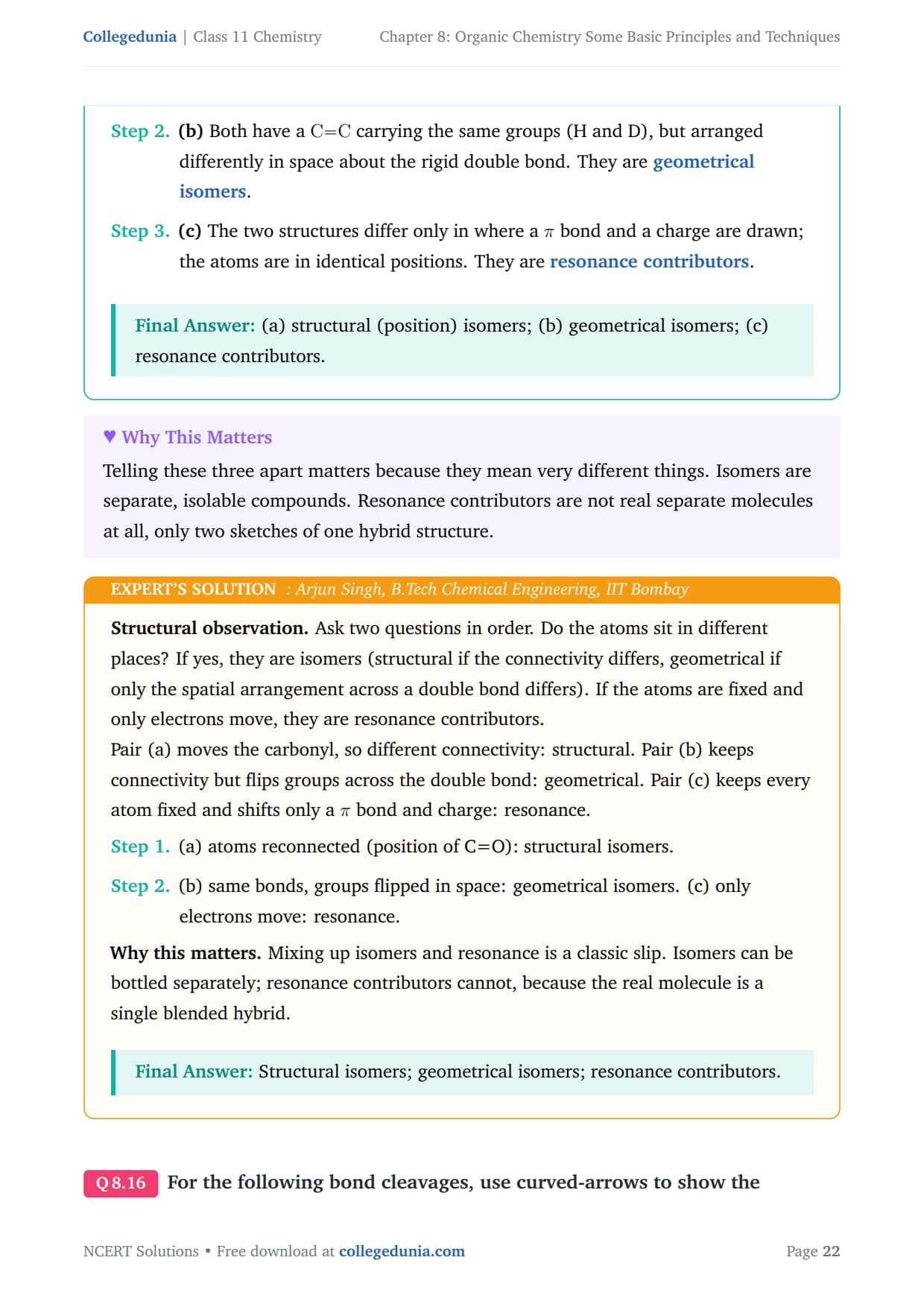
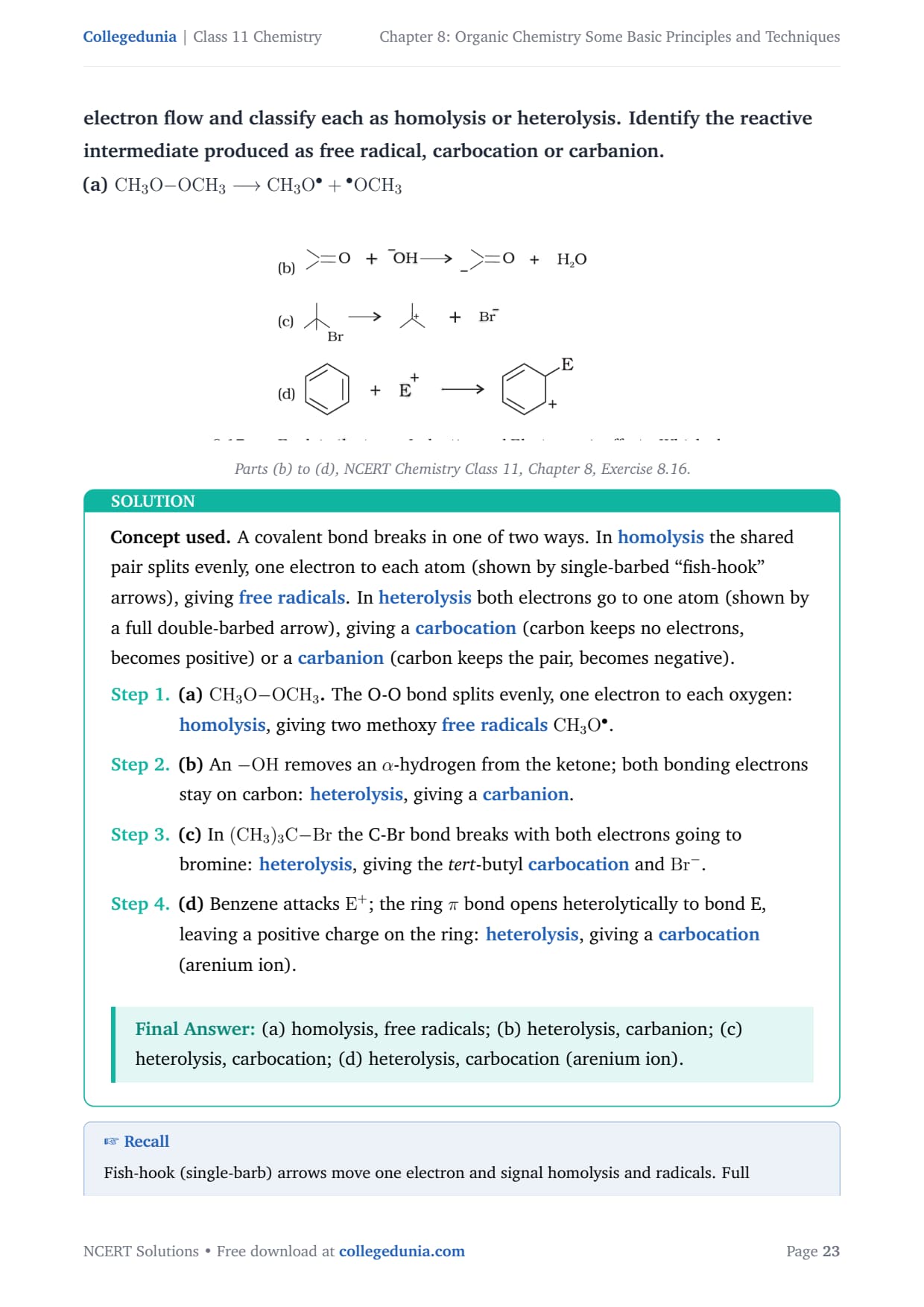
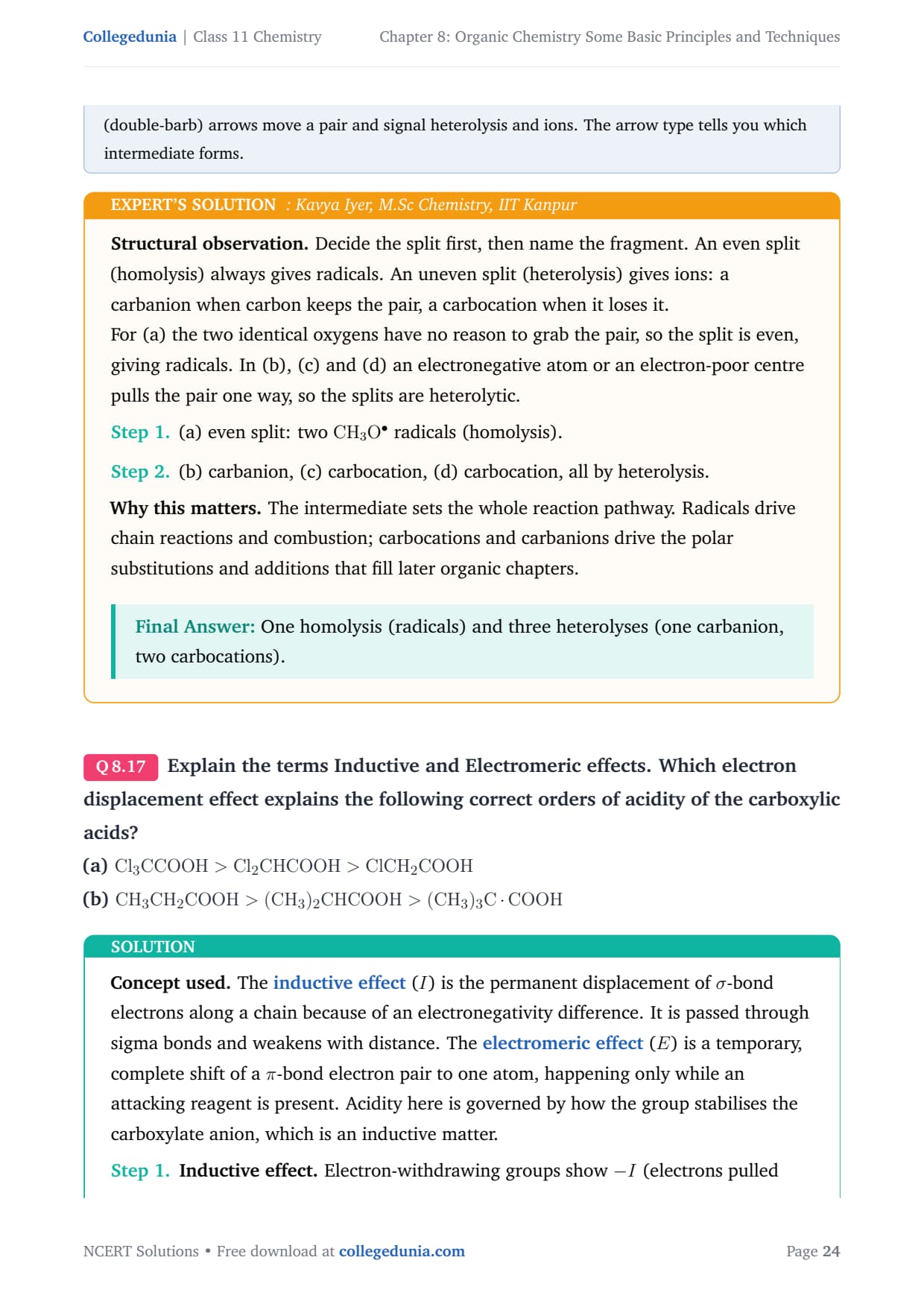
This chapter is the gateway to all of organic chemistry, and the naming, mechanism and analysis skills built here run straight into Chapter 9 Hydrocarbons and the whole Class 12 organic unit.
- CBSE Weightage: 6 to 8 marks, and a heavy scorer in JEE Main and NEET every year.
- Topics covered: tetravalence of carbon, structural representation, classification, IUPAC nomenclature, isomerism, reaction mechanism, electronic effects, intermediates, and analysis.
- Exercise count: 40 back-exercise questions plus intext questions, a mix of naming, structure and reasoning.
These class 11 chemistry NCERT solutions chapter 8 Organic Chemistry Some Basic Principles and Techniques are curated by subject experts, based on the 2026-27 NCERT textbook, and checked against the last five years of CBSE Board, JEE Main and NEET papers.
Why Organic Chemistry Matters and What This Chapter Covers
Organic chemistry is the study of carbon compounds, and carbon builds the molecules of life, medicine and fuel. This chapter gives you the grammar of the subject: how to draw a molecule, name it, group it, and predict how it reacts. Get these tools right and every later organic chapter becomes easier.
- Everyday role: carbon compounds make up food, plastics, drugs, dyes, petrol and DNA.
- Core skill: reading a structure and naming it, then predicting where it will react and why.
- Why it is foundational: the IUPAC rules and mechanism ideas here repeat in every organic chapter of Class 11 and Class 12.
Almost every organic question later depends on the naming and mechanism basics from this chapter. Students who fix these early stop losing marks on structure and naming. The solutions below follow the same order as the NCERT textbook.
Tetravalence of Carbon and the Shapes of Organic Molecules
Carbon has four electrons in its outer shell, so it forms four covalent bonds. This tetravalence, plus its ability to bond with itself (catenation), lets carbon build chains, branches and rings. The shape of each carbon depends on how it hybridises.
| Hybridisation | Shape and bond angle | Example |
|---|---|---|
| sp3 | Tetrahedral, 109.5° | Methane CH4 |
| sp2 | Trigonal planar, 120° | Ethene C2H4 |
| sp | Linear, 180° | Ethyne C2H2 |
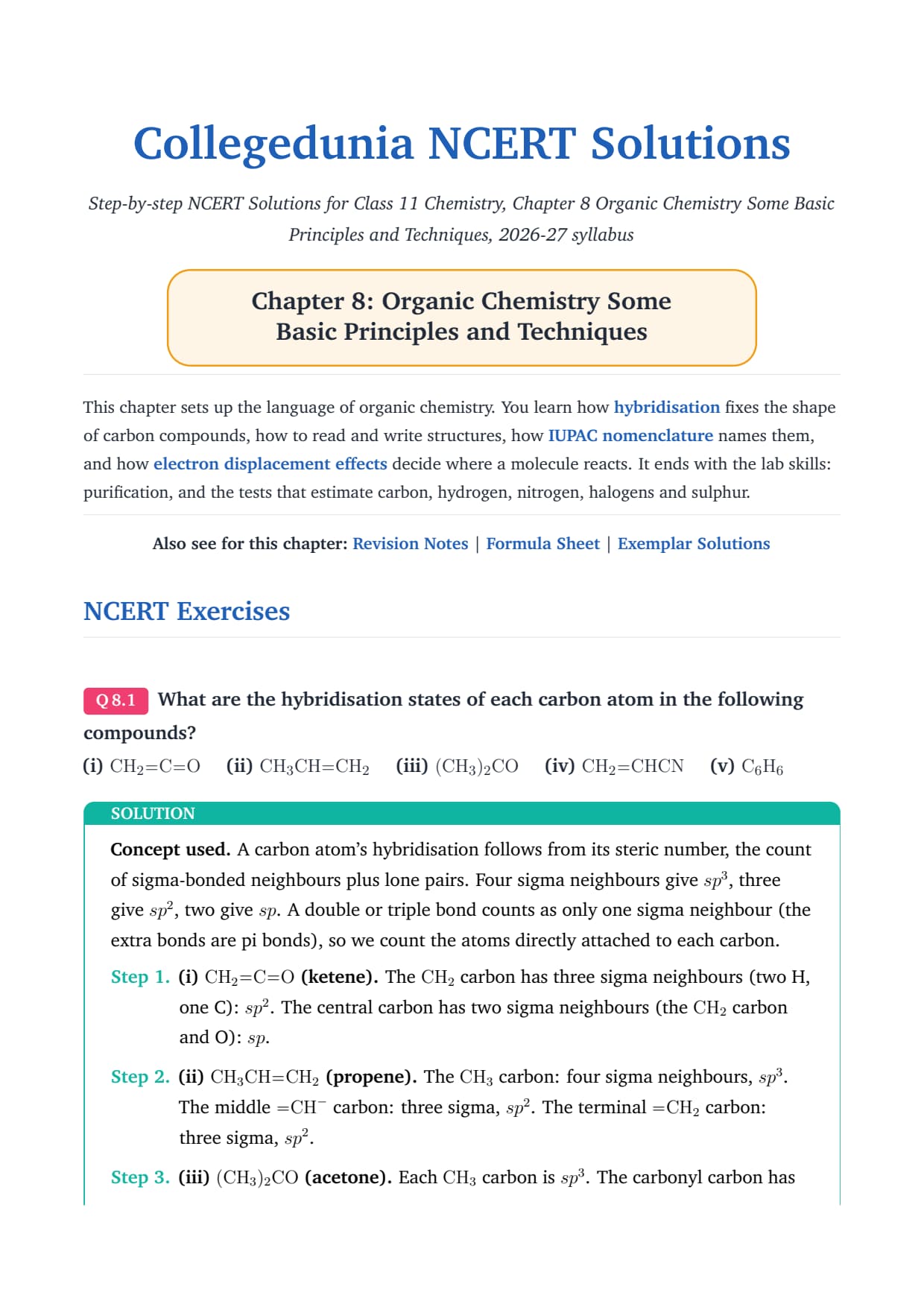
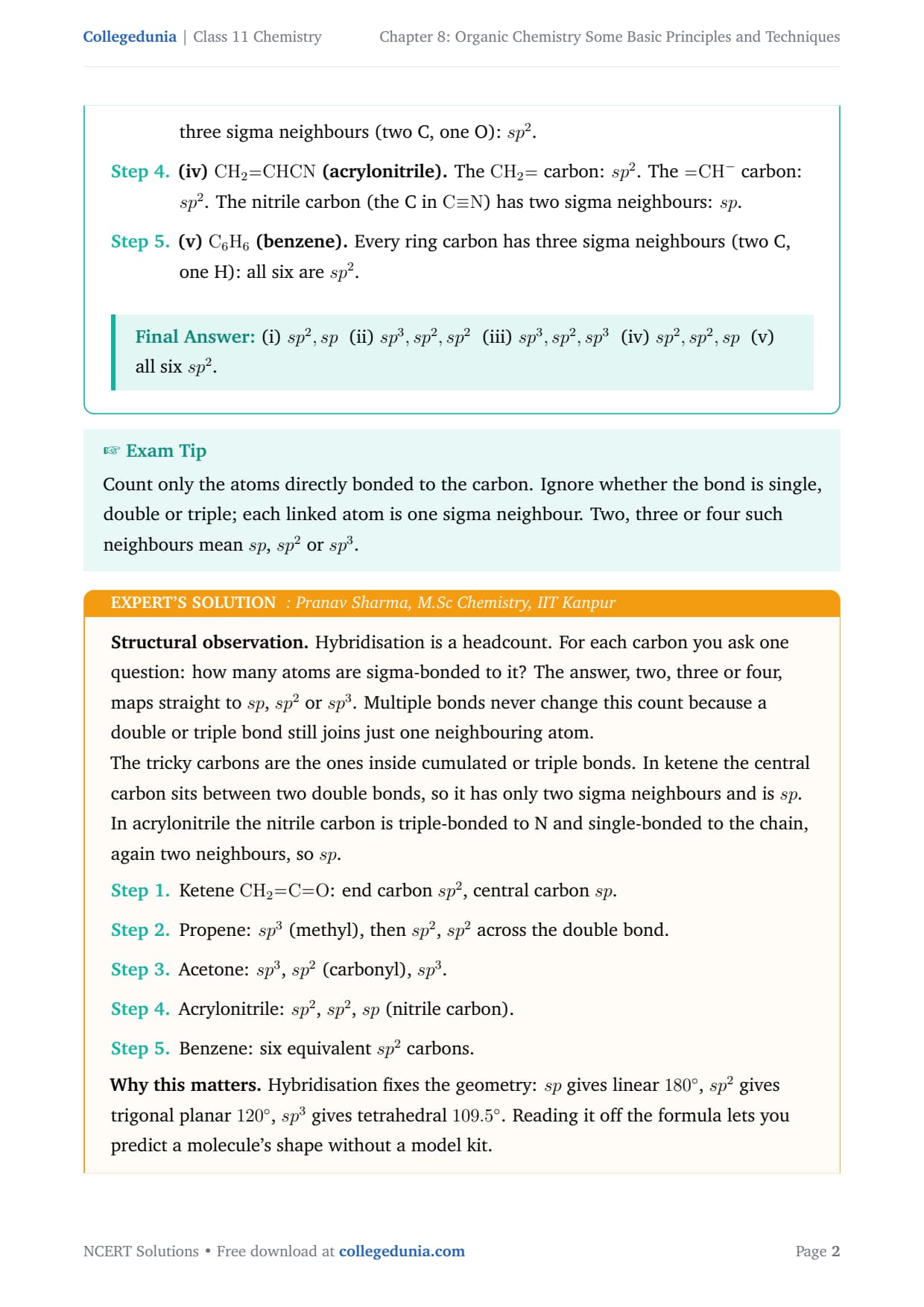
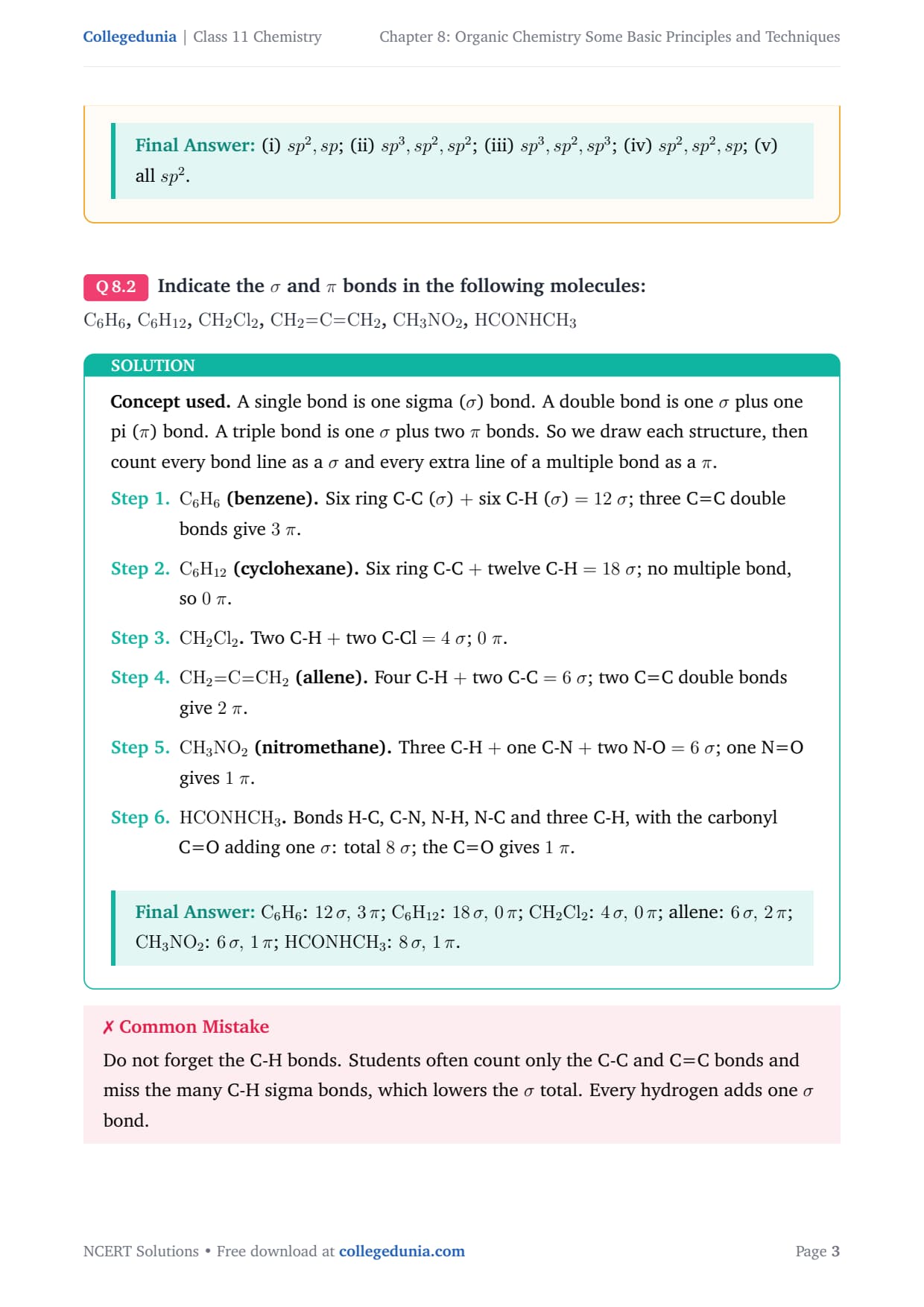
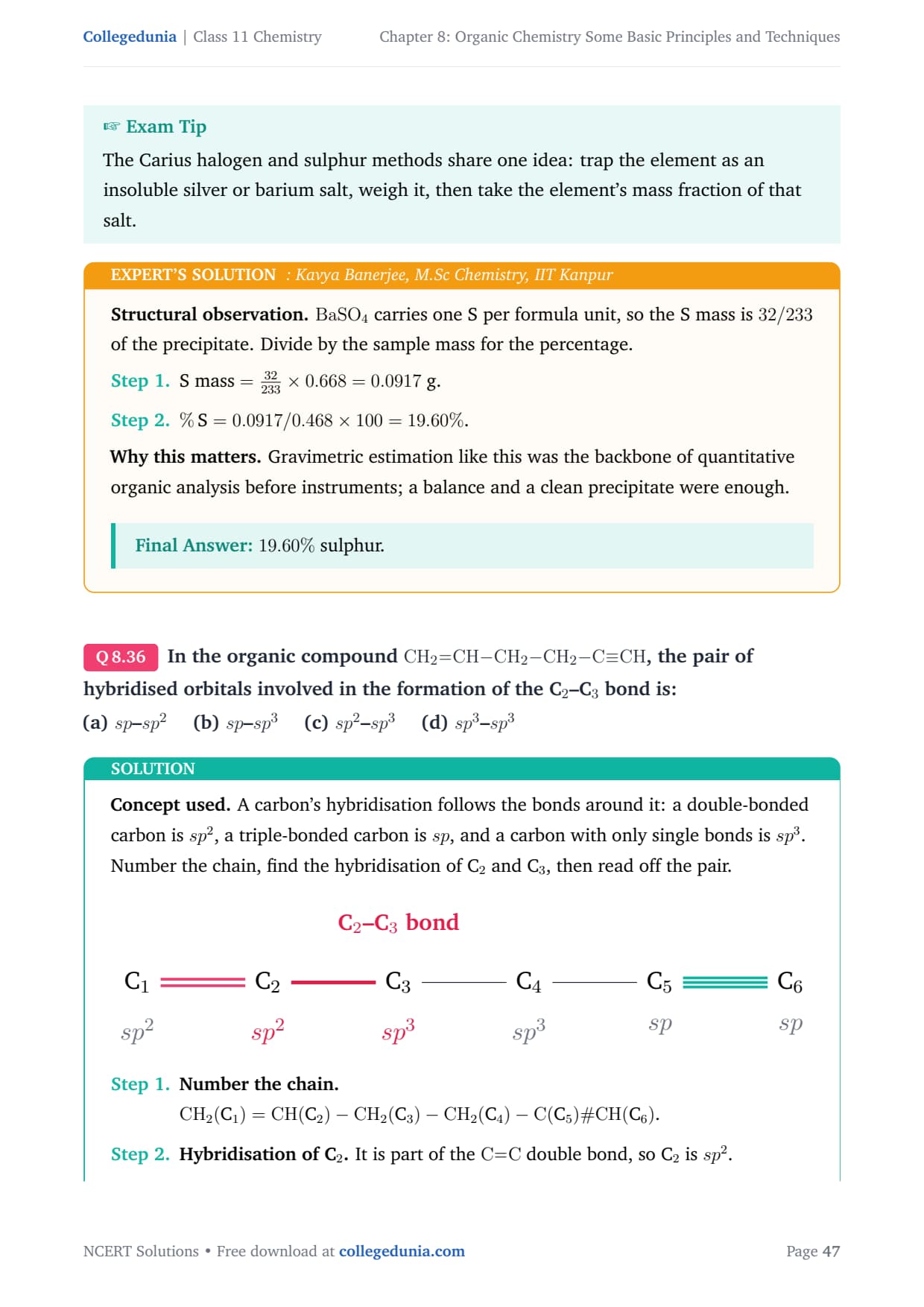
A single bond is one sigma bond, a double bond is one sigma plus one pi bond, and a triple bond is one sigma plus two pi bonds. Sigma bonds allow free rotation, but pi bonds lock the atoms in place. This is why alkenes show geometrical isomerism while alkanes do not. Learn to spot the hybridisation of each carbon at a glance, since it decides both shape and reactivity.
Structural Representations of Organic Compounds
The same molecule can be drawn in several ways, and NCERT asks you to switch between them. Choosing the right one saves time in the exam and avoids silly errors when a formula gets long.
- Complete structural formula: shows every atom and every bond, as in H-C-H drawn out fully.
- Condensed formula: groups atoms together, so butane becomes CH3CH2CH2CH3.
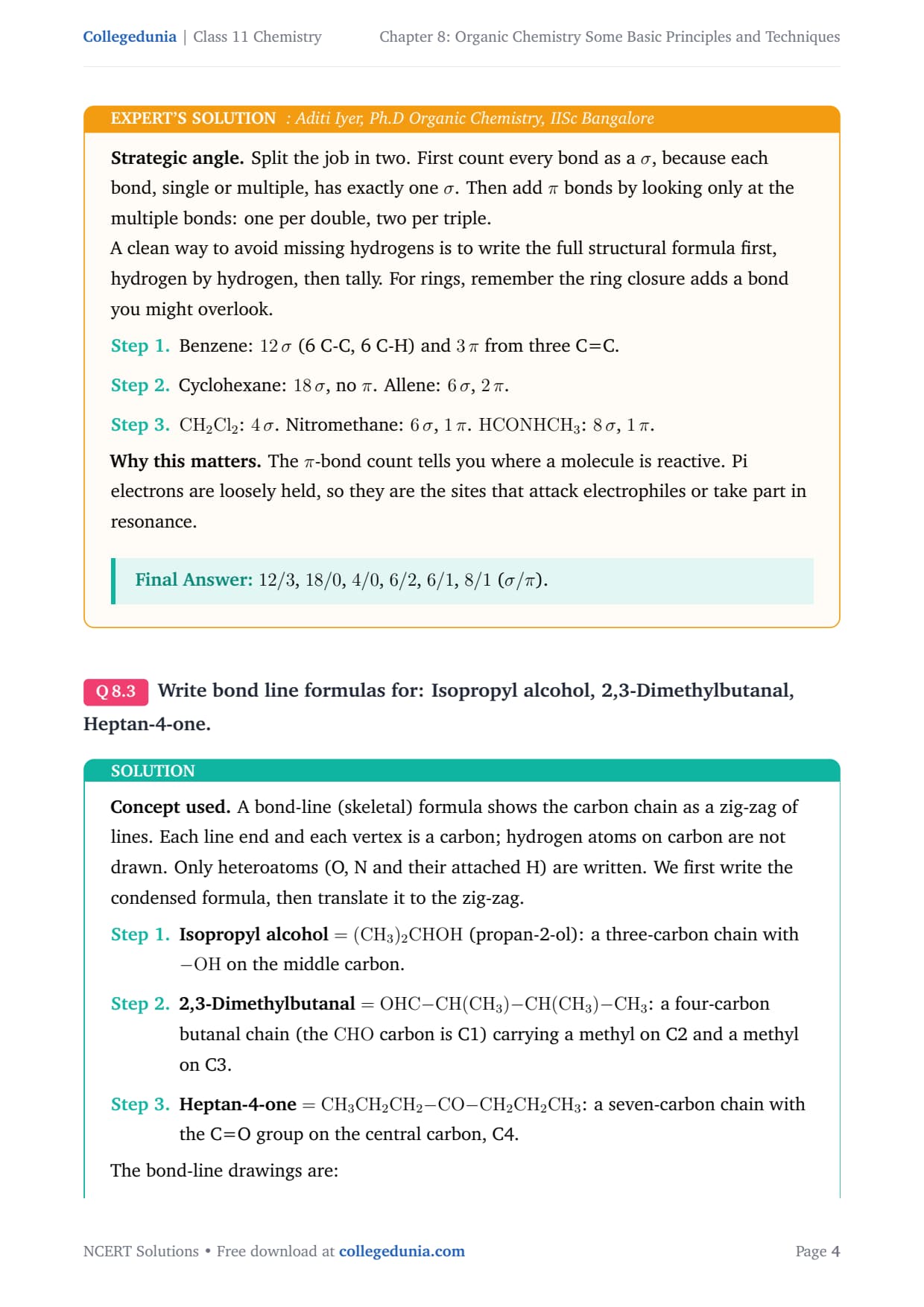
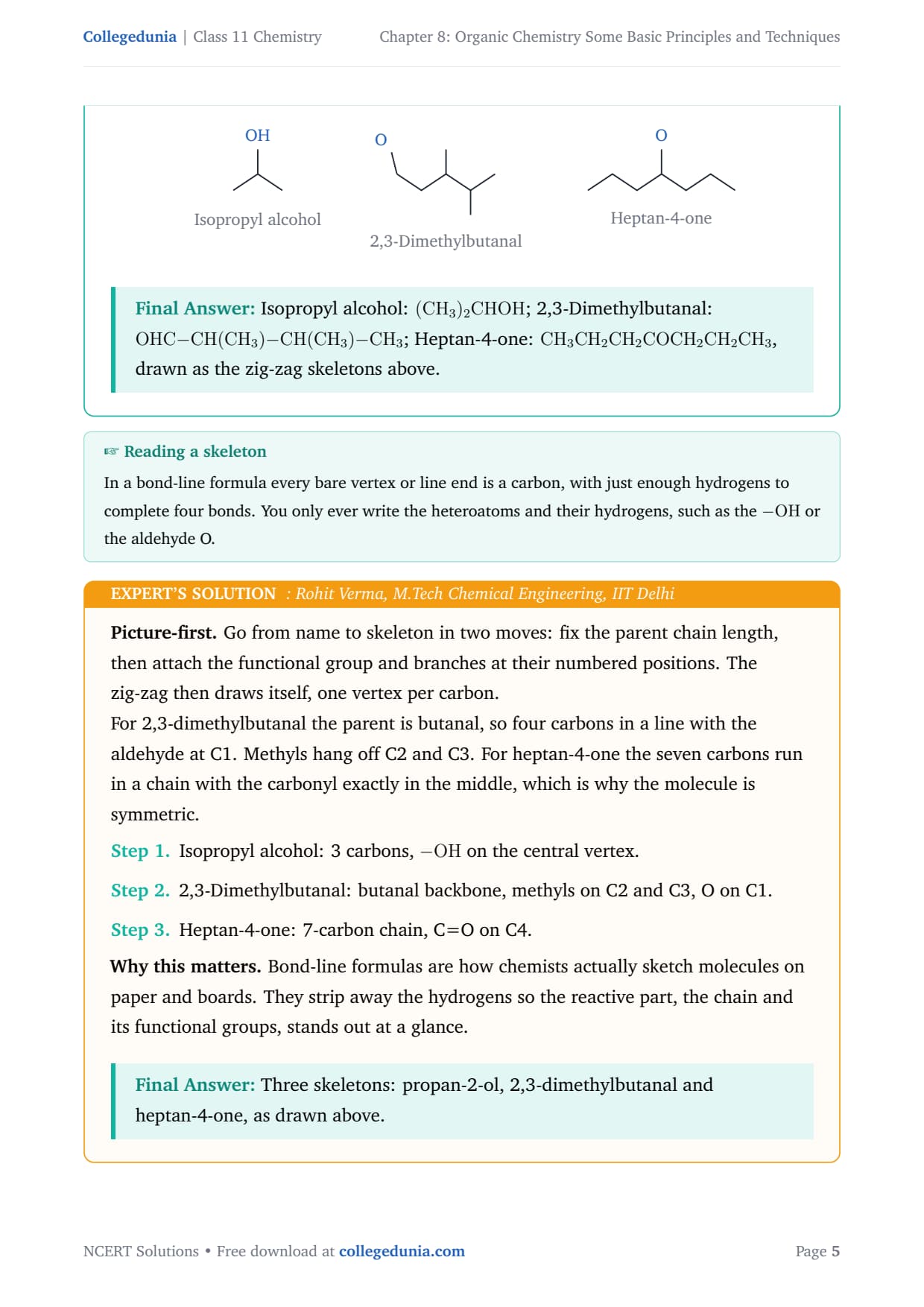
- Bond-line formula: carbons sit at the ends and bends of a zig-zag line, and hydrogens are understood.
The bond-line formula is the fastest to draw for large molecules, so most questions use it. In a bond-line drawing each line end and corner is a carbon, and enough hydrogens are added to keep every carbon tetravalent. Count the hydrogens on each carbon by remembering carbon always forms four bonds. Practice converting one form to another, because many intext questions ask exactly that.
Classification of Organic Compounds Made Simple
Organic compounds are sorted first by their carbon skeleton, then by the functional group they carry. This two-step grouping is what lets chemists study millions of compounds in a few families.
| Class | What it means |
|---|---|
| Acyclic (open chain) | Straight or branched chains, such as butane or isobutane. |
| Alicyclic (carbocyclic) | Rings of carbon only, such as cyclohexane. |
| Aromatic | Rings with delocalised pi electrons, such as benzene. |
| Heterocyclic | Rings that contain an atom other than carbon, such as pyridine. |
A functional group is the reactive atom or group that gives a family its chemistry, such as -OH in alcohols or -COOH in acids. Compounds that differ only by a -CH2- unit form a homologous series, with a general formula and a steady gradation in properties. Members of one homologous series share chemical properties because they share the same functional group. This idea appears in short-answer questions every year.
IUPAC Nomenclature of Organic Compounds Step by Step
The IUPAC system gives every compound one exact name, so no two chemists confuse a structure. This is the single most tested skill in the chapter, and marks here are easy once the steps are automatic.
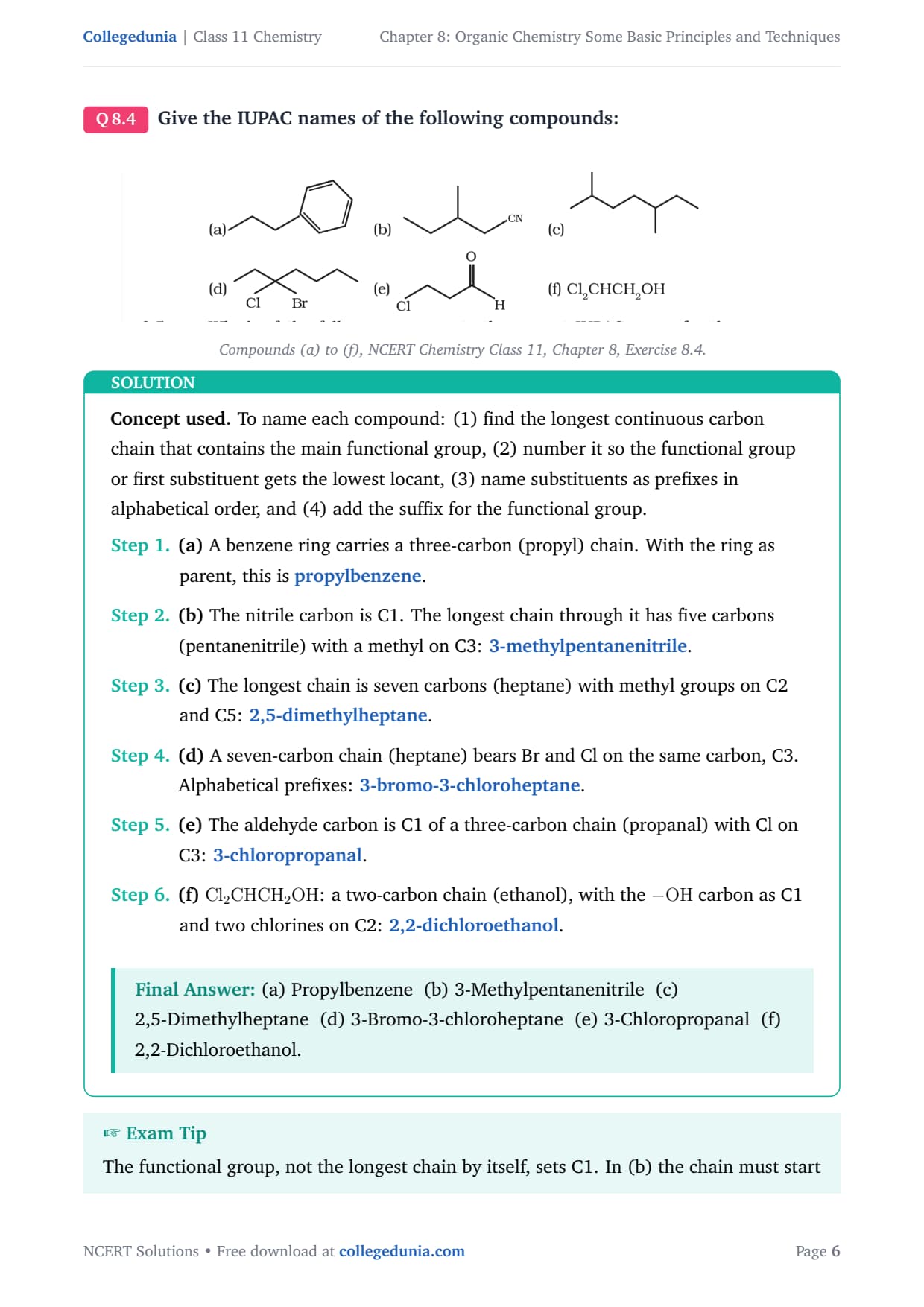
- Find the longest continuous carbon chain and use it as the parent word root.
- Number the chain from the end that gives the lowest locants to substituents and groups.
- Add the suffix for the main functional group, such as -ol, -al or -oic acid.
- Name the branches as prefixes and place them in alphabetical order.
- Combine the locants, prefixes, root and suffix into one word.
For example, CH3CH(CH3)CH2OH is named 2-methylpropan-1-ol. The longest chain has three carbons (propan), the -OH gives the suffix -ol at carbon 1, and the methyl branch sits at carbon 2. Always pick the lowest set of locants; a wrong numbering direction is the most common naming error. Learn the priority order of functional groups, because the highest-priority group decides the suffix.
Isomerism: Structural and Stereoisomerism
Isomers are compounds with the same molecular formula but a different arrangement of atoms. NCERT splits them into two big families, and telling them apart is a favourite reasoning question.
- Chain isomerism: the carbon skeleton differs, as in butane versus isobutane.
- Position isomerism: the functional group sits at a different carbon, as in propan-1-ol versus propan-2-ol.
- Functional isomerism: the functional group itself differs, as in an alcohol versus an ether.
- Metamerism: different alkyl groups sit around the same functional group.
Stereoisomers have the same connectivity but a different arrangement in space. Geometrical (cis-trans) isomerism arises when a double bond blocks rotation, while optical isomerism arises from a chiral carbon that makes a molecule non-superimposable on its mirror image. Structural isomers differ in connectivity; stereoisomers differ only in 3D arrangement. Keep this one line ready, as it settles most isomerism questions.
Fundamental Concepts in Organic Reaction Mechanism
A reaction mechanism is the step-by-step path a reaction follows. To read one, you need to know how bonds break and which species attack which. These ideas power every organic reaction you will meet.
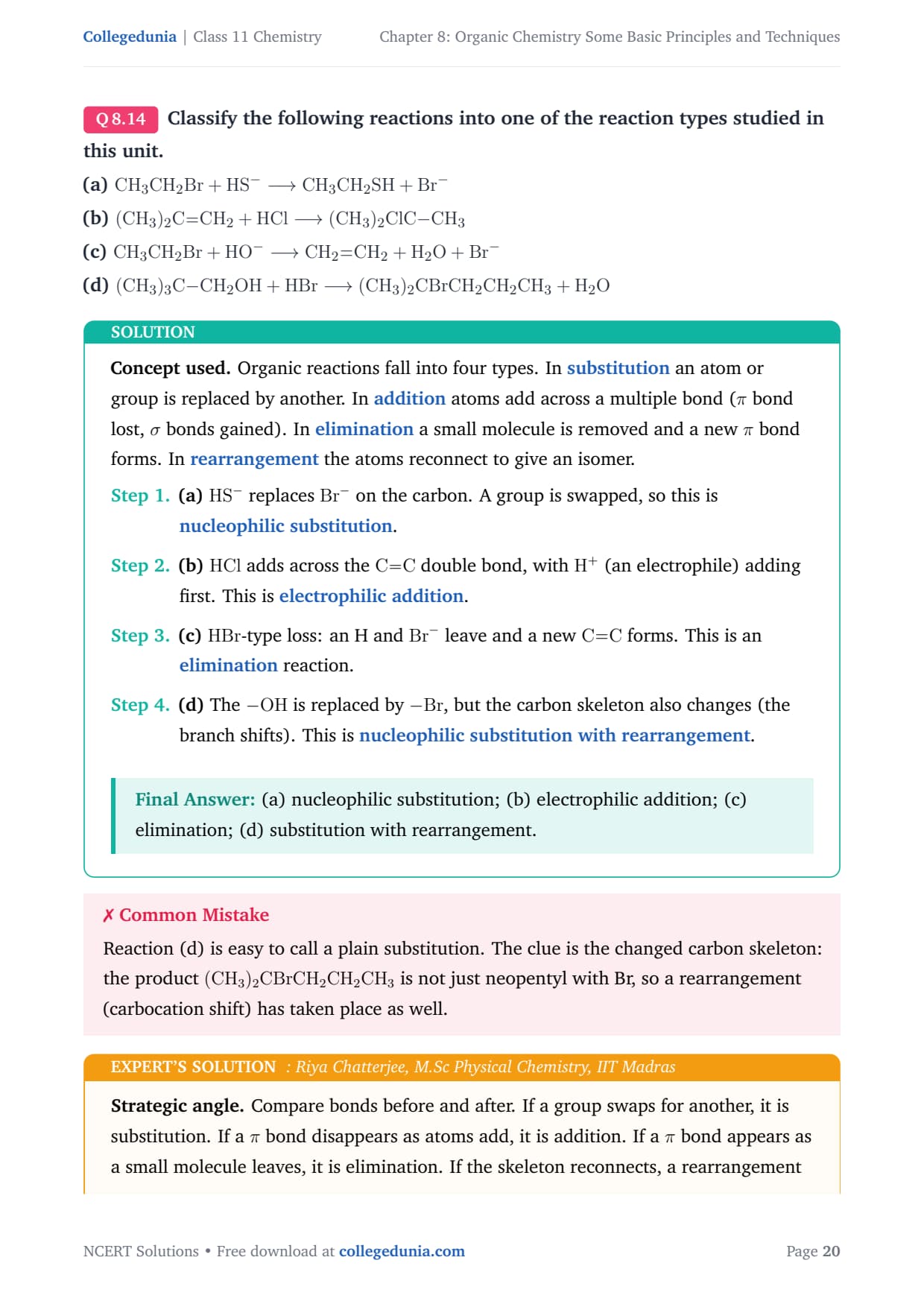
- Homolytic fission: the bond breaks evenly, each atom keeps one electron, and free radicals form.
- Heterolytic fission: the bond breaks unevenly, one atom takes both electrons, and ions form.
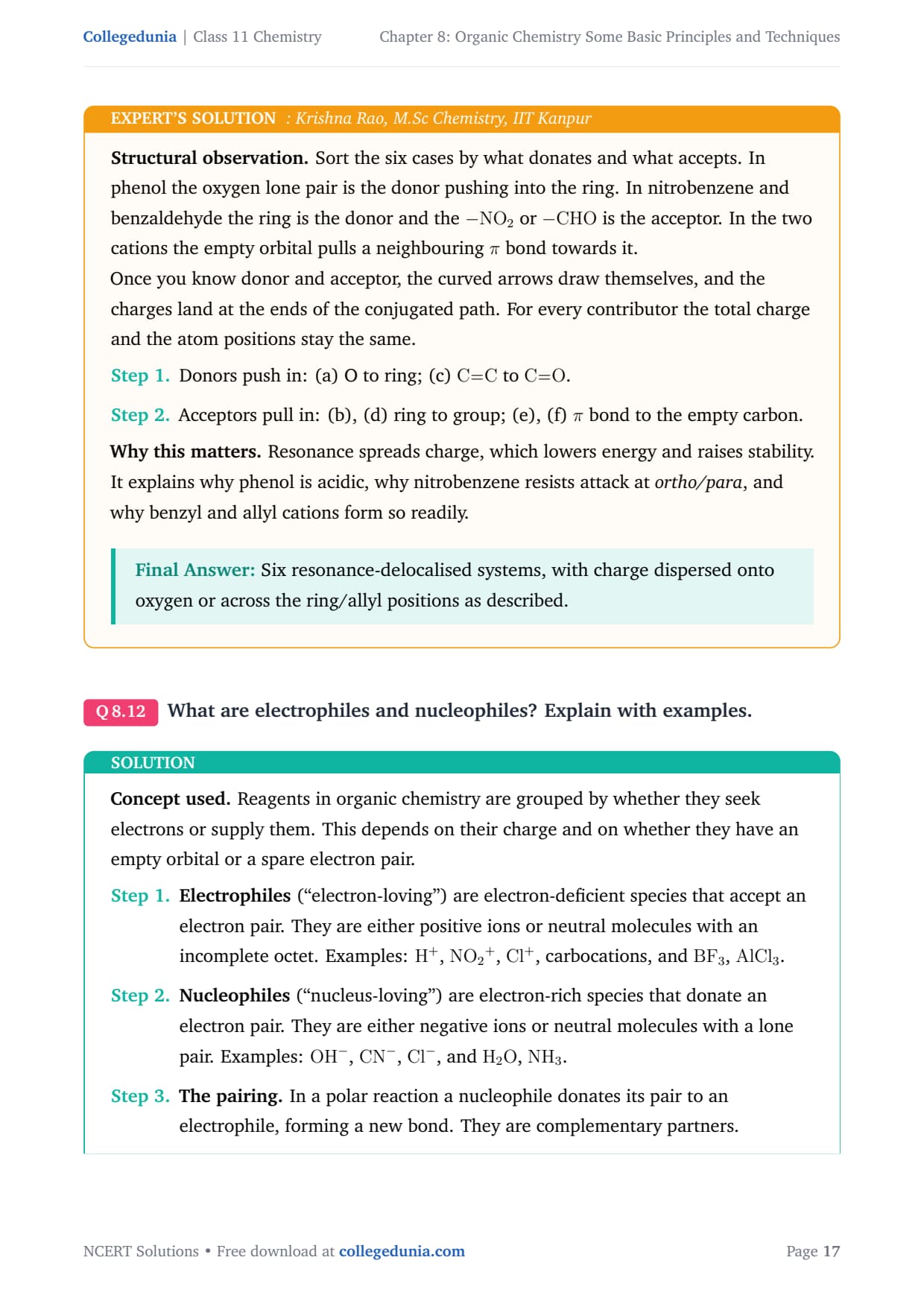
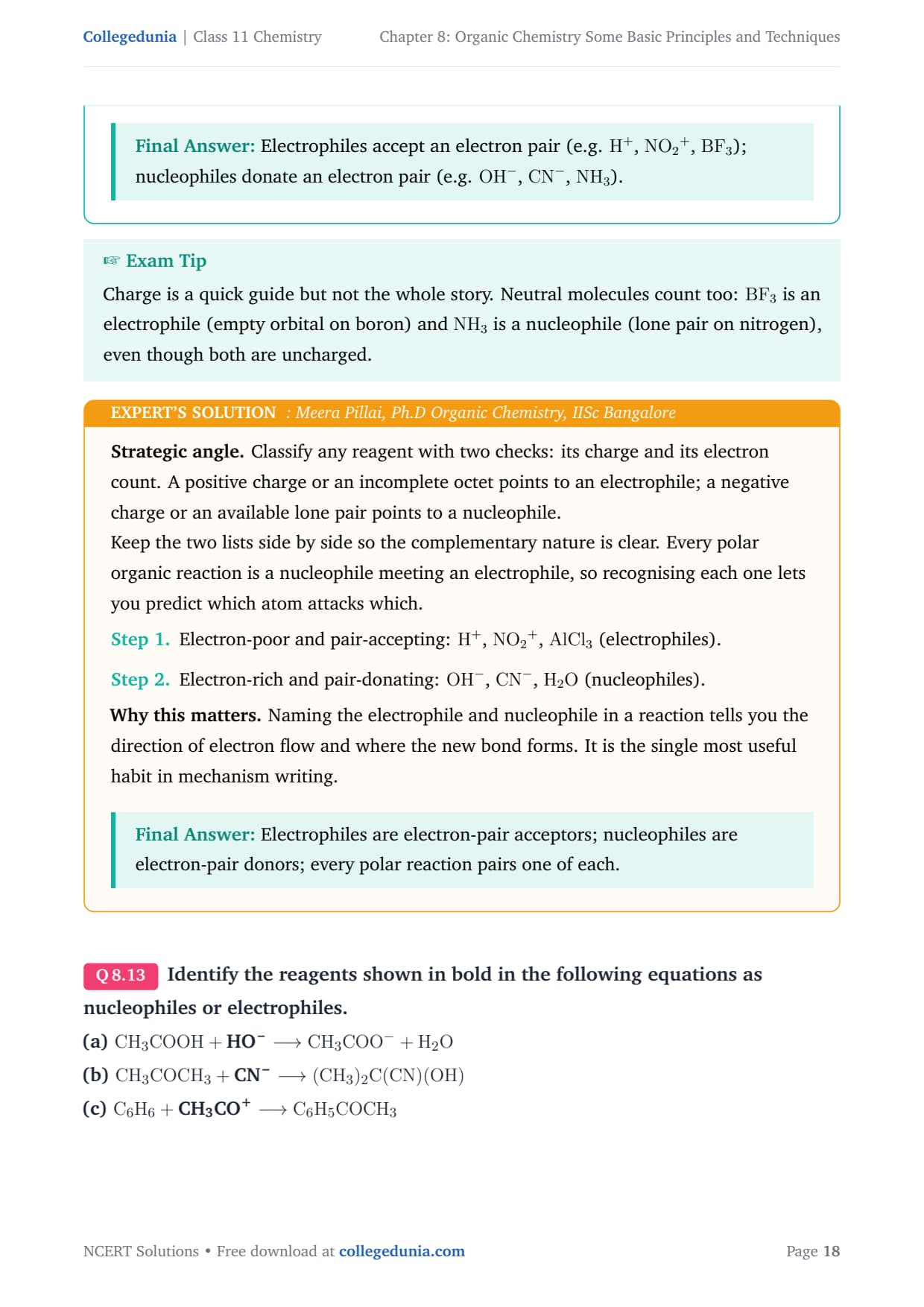
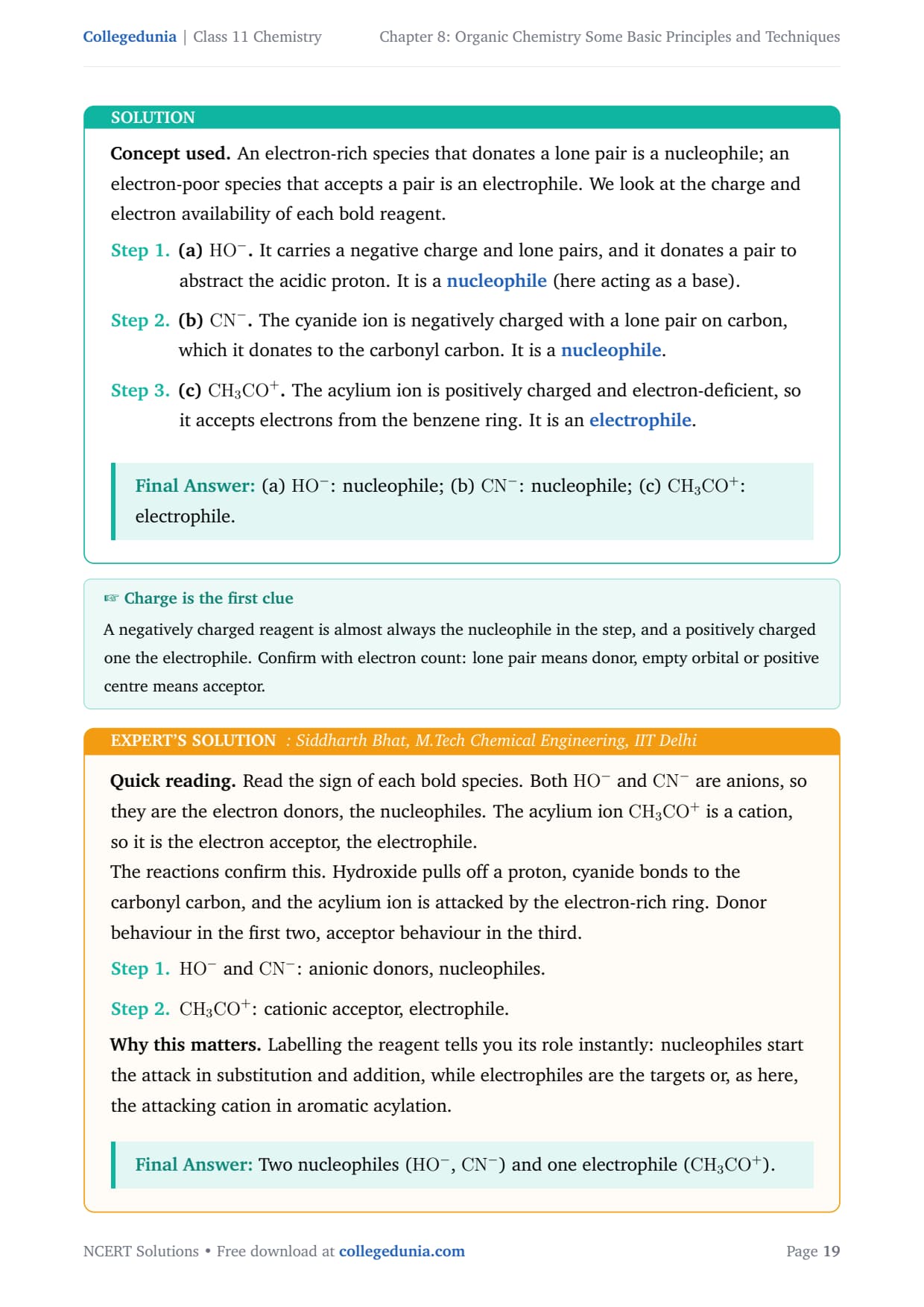
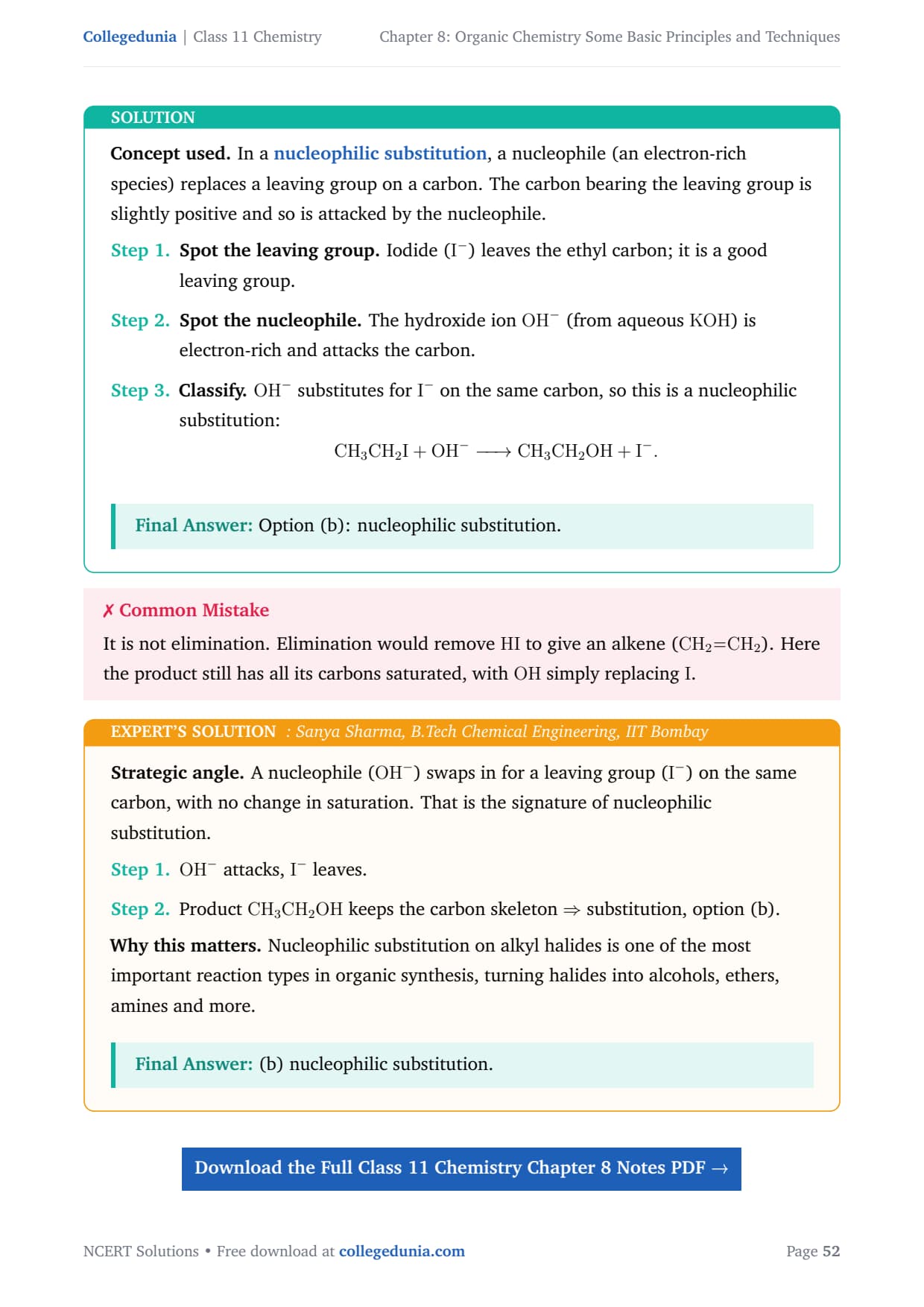
- Nucleophile: an electron-rich species that seeks a positive centre, such as OH- or NH3.
- Electrophile: an electron-poor species that seeks electrons, such as H+ or NO2+.
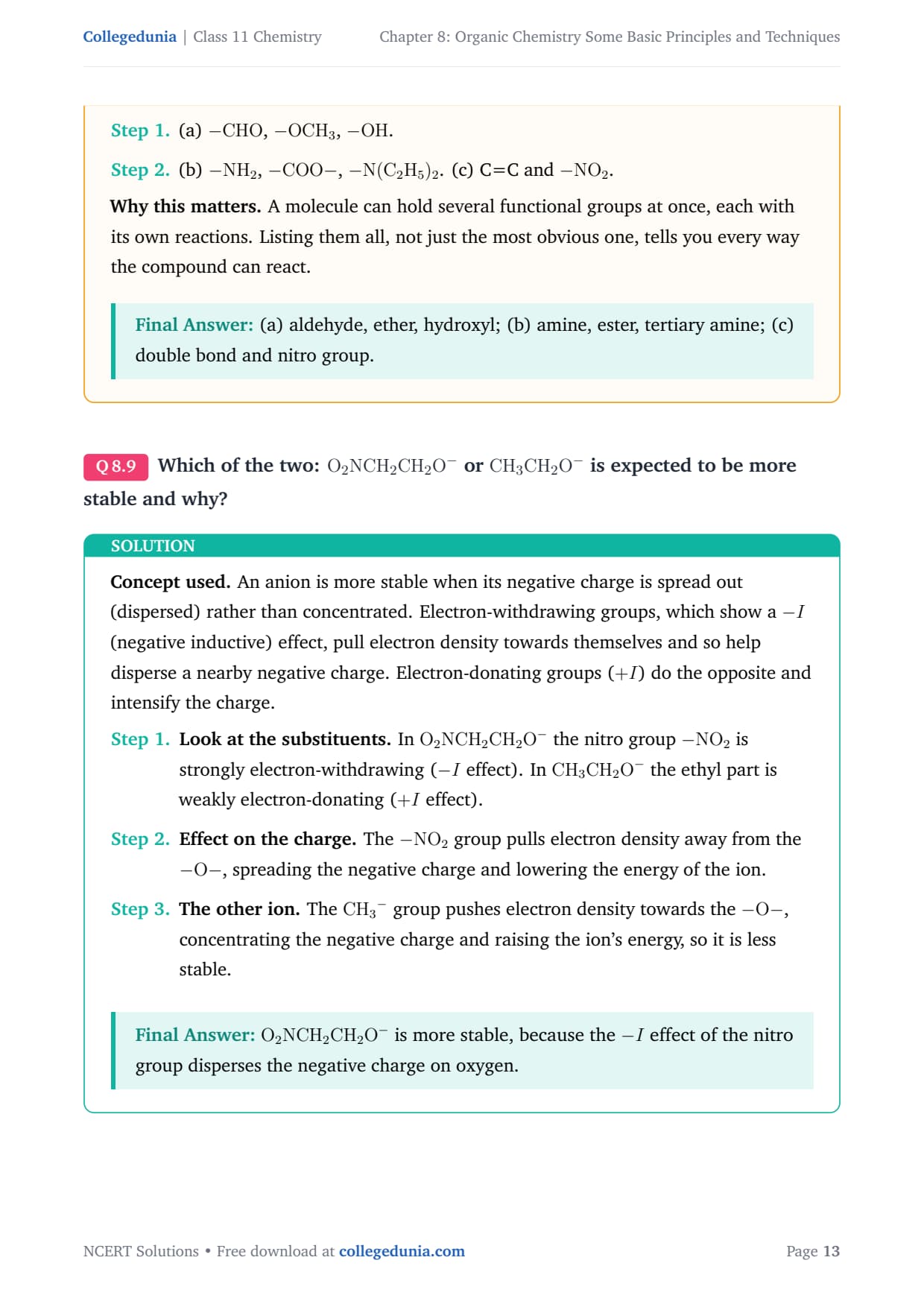
Chemists show the movement of an electron pair with a curved arrow and a single electron with a half-headed arrow. A curved arrow always points from the electron source to where the new bond forms. Getting the arrows right is what makes a mechanism answer correct. The class 11 chemistry NCERT solutions chapter 8 Organic Chemistry Some Basic Principles and Techniques show each arrow clearly so you can copy the style.
Electronic Displacement Effects: Inductive, Resonance, Electromeric and Hyperconjugation
Atoms in a molecule pull electron density around, and these shifts explain why one site reacts and another does not. Four effects appear in the exercise, and each has a clear cause.
| Effect | What causes it |
|---|---|
| Inductive (I) | Permanent shift of sigma electrons along a chain due to an electronegative atom; weakens down the chain. |
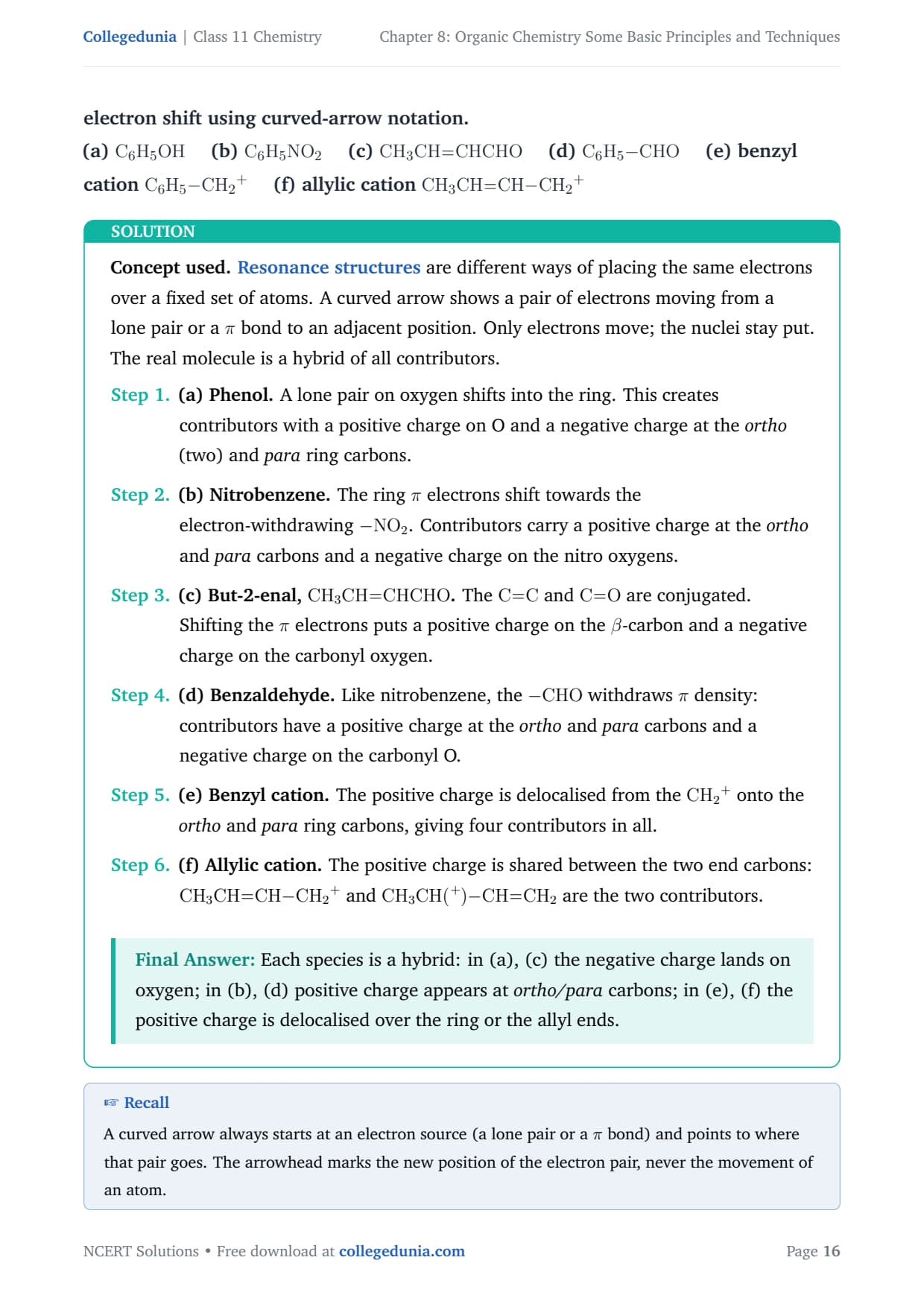
| Resonance (mesomeric) | Delocalisation of pi or lone-pair electrons over the molecule, shown by resonance structures. |
| Electromeric (E) | Temporary, complete shift of a pi pair to one atom when a reagent attacks. |
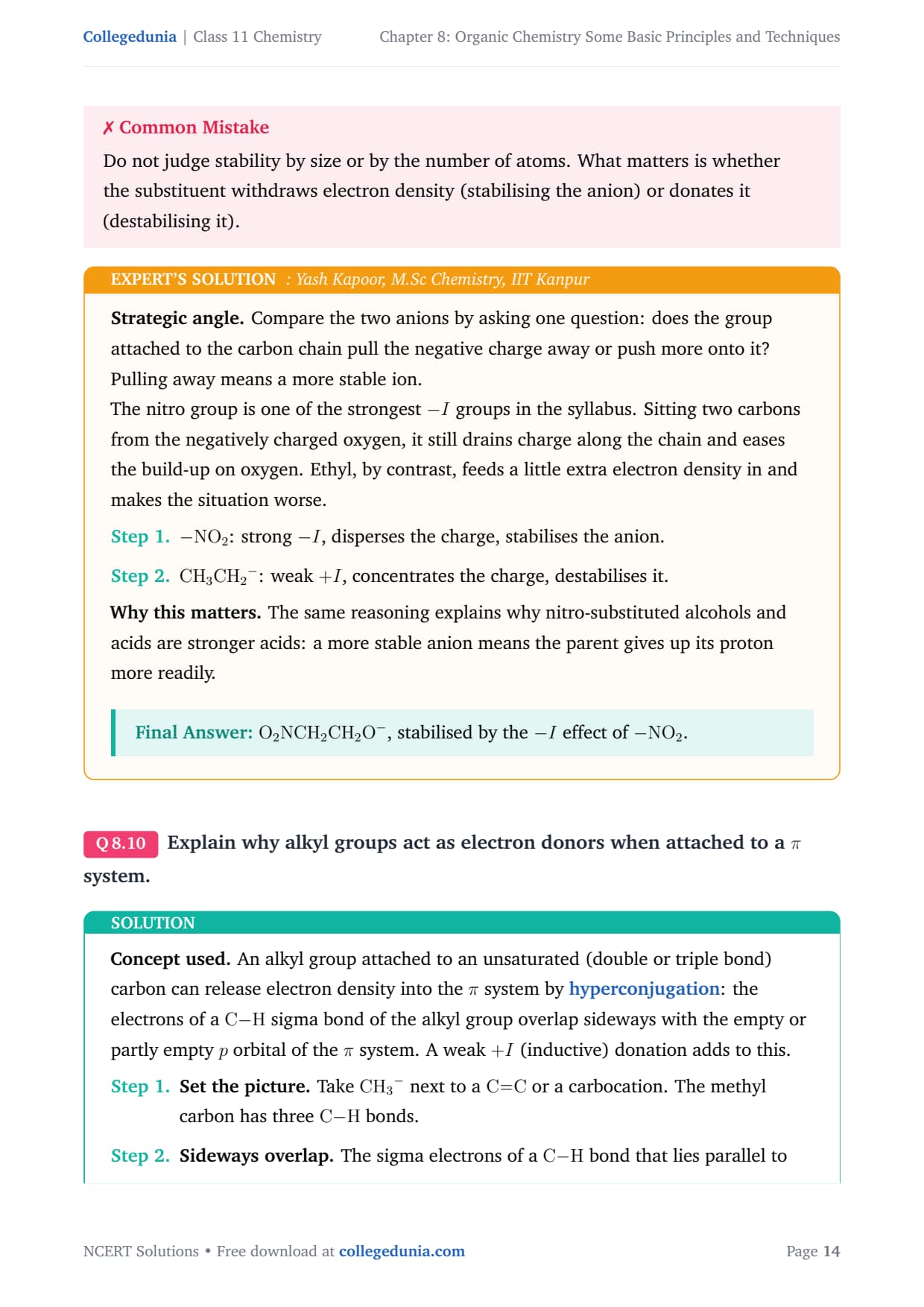
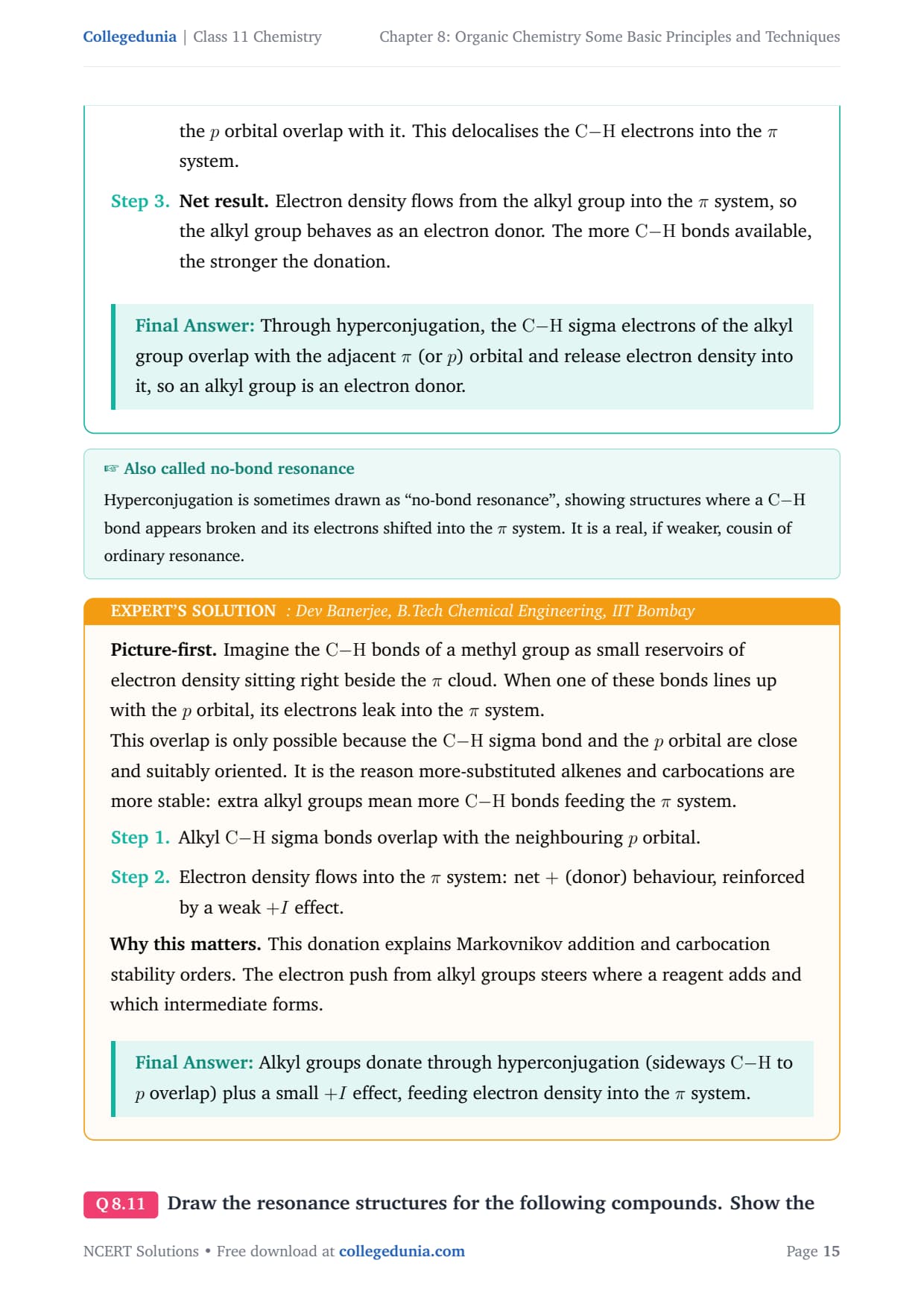
| Hyperconjugation | Delocalisation of sigma C-H electrons into an adjacent pi bond or empty orbital. |
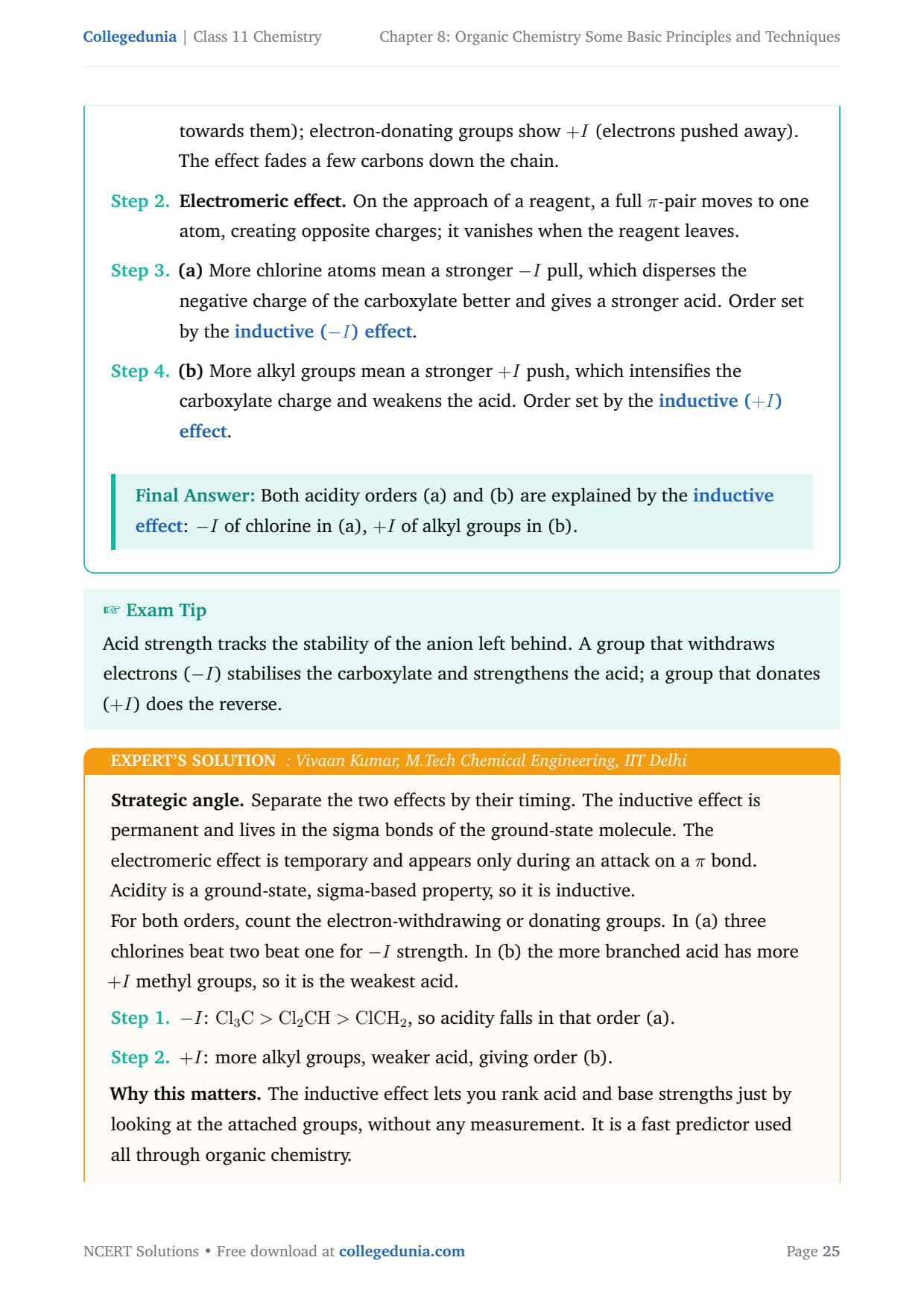
The inductive effect is permanent but weak, while the electromeric effect is temporary and appears only during a reaction. More hyperconjugation and more electron donation make a carbocation more stable. These effects together explain acidity, basicity and the order of intermediate stability. Learn to say which effect operates and in which direction, since that is what the marker looks for.
Reaction Intermediates: Carbocation, Carbanion and Free Radical
When a bond breaks, a short-lived species forms before the product. Three intermediates appear again and again, and their stability order decides which product wins.
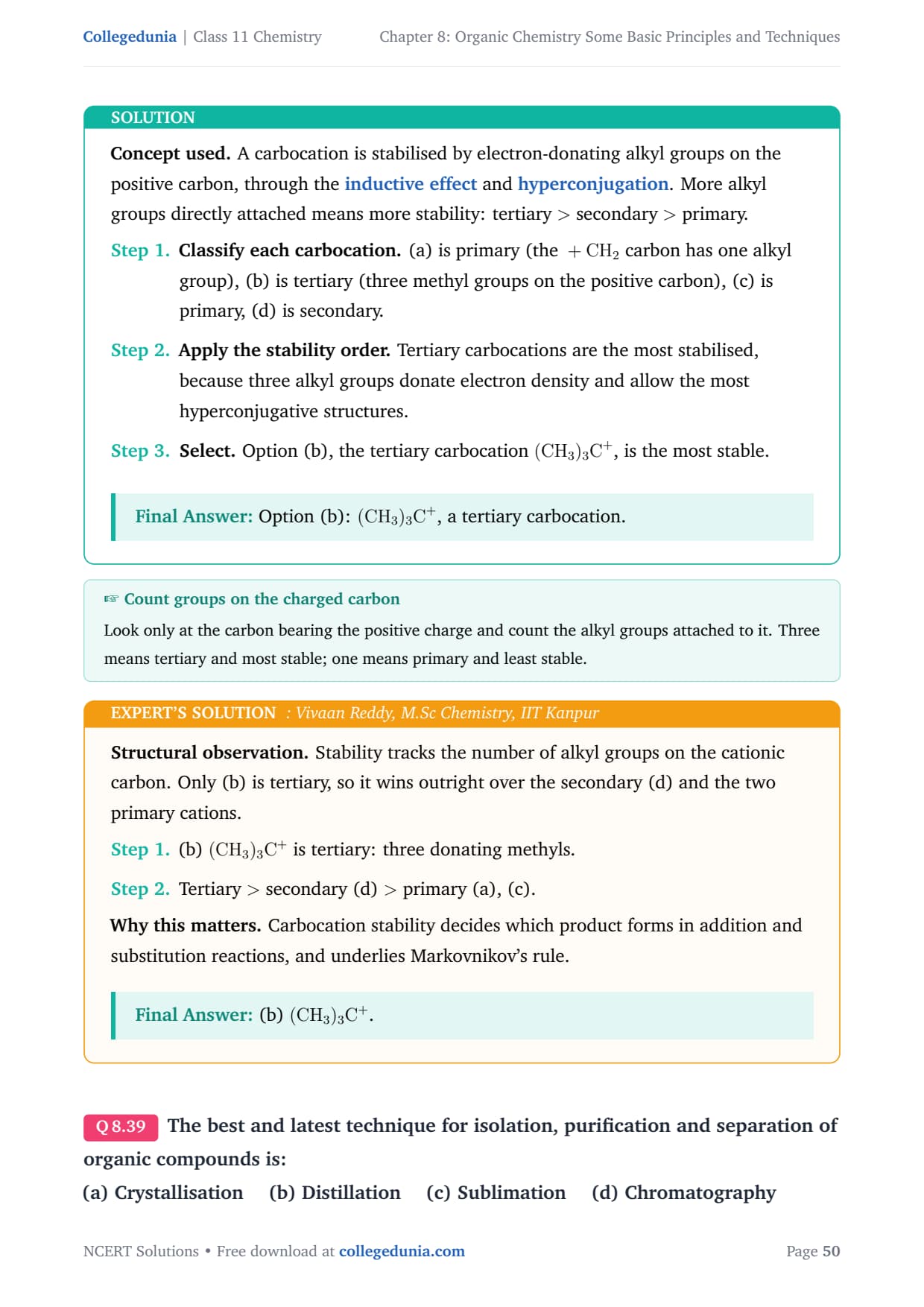
- Carbocation: a carbon with a positive charge and six electrons; stability rises 3° > 2° > 1°.
- Carbanion: a carbon with a negative charge and a lone pair; stability rises 1° > 2° > 3°.
- Free radical: a carbon with one unpaired electron; stability also rises 3° > 2° > 1°.
A carbocation is stabilised by electron-donating alkyl groups through the inductive effect and hyperconjugation, which is why a tertiary cation is the most stable. A carbanion is the opposite, so electron-withdrawing groups stabilise it. A carbocation and a free radical follow the same stability order, but a carbanion is reversed. These orders are short one-mark facts, so memorise them cleanly.
Purification and Qualitative and Quantitative Analysis
The techniques part of the chapter tells you how to purify an organic compound and then find what it is made of. These methods are practical, and the questions test the principle behind each one.
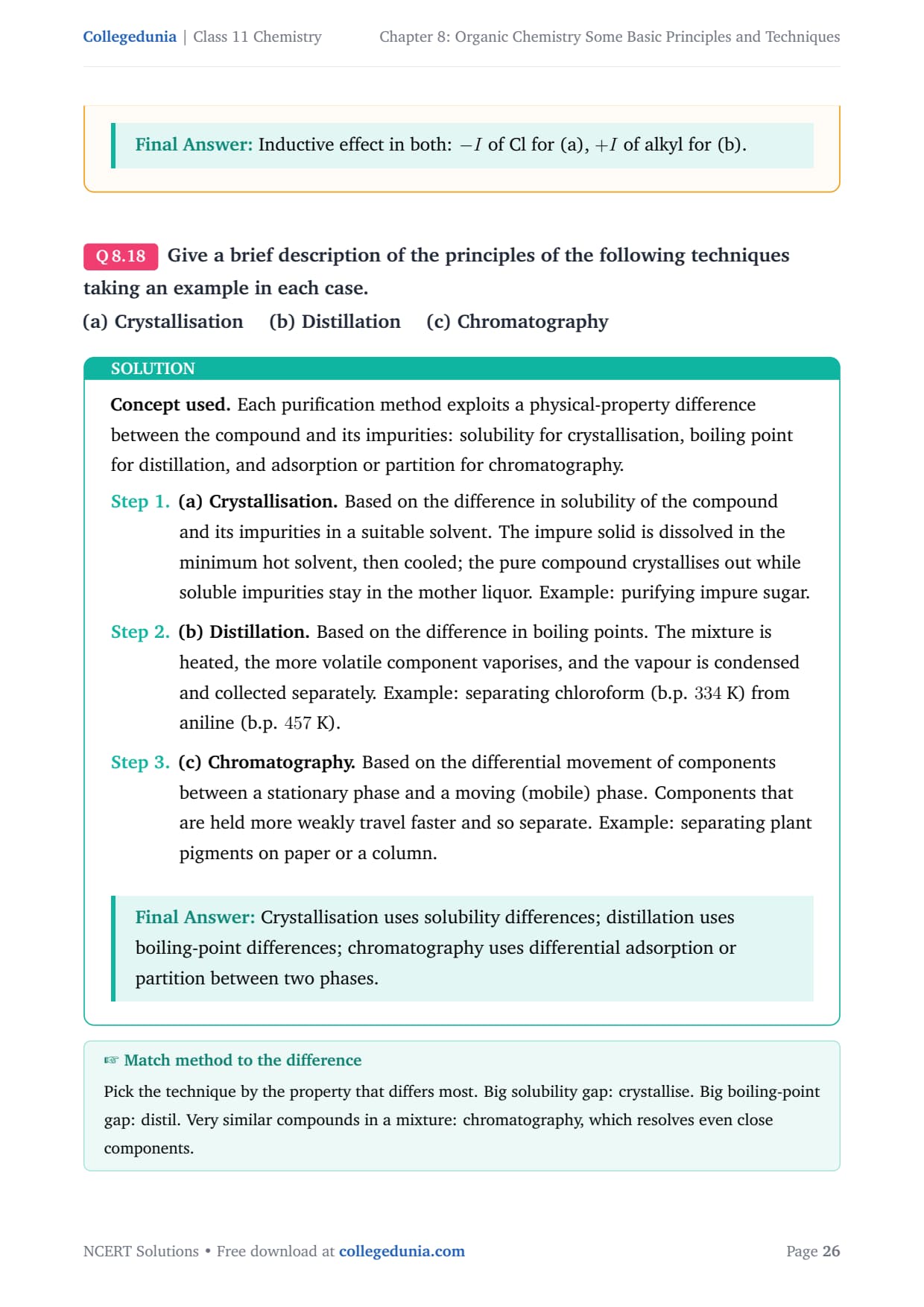
| Method | Used for |
|---|---|
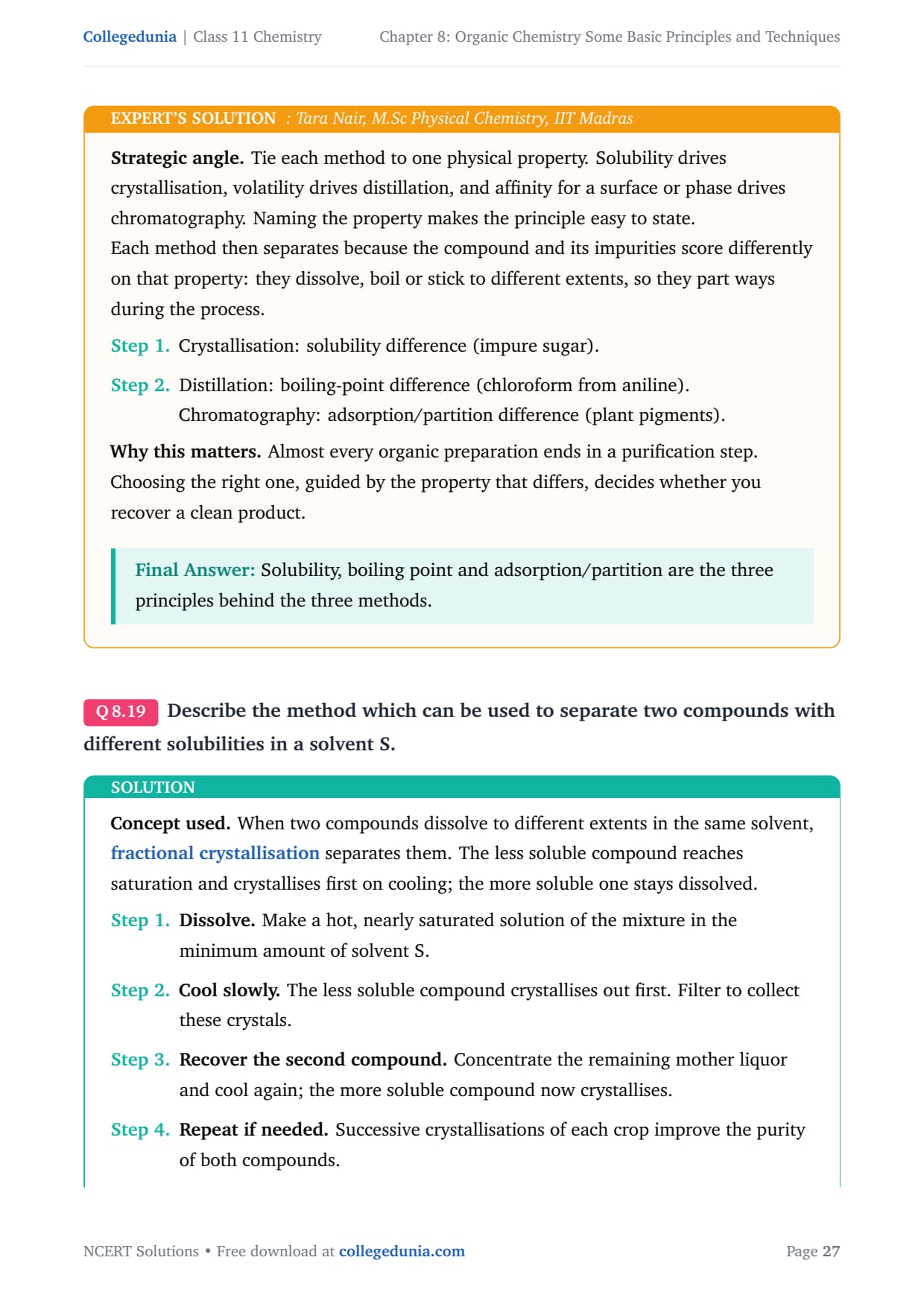
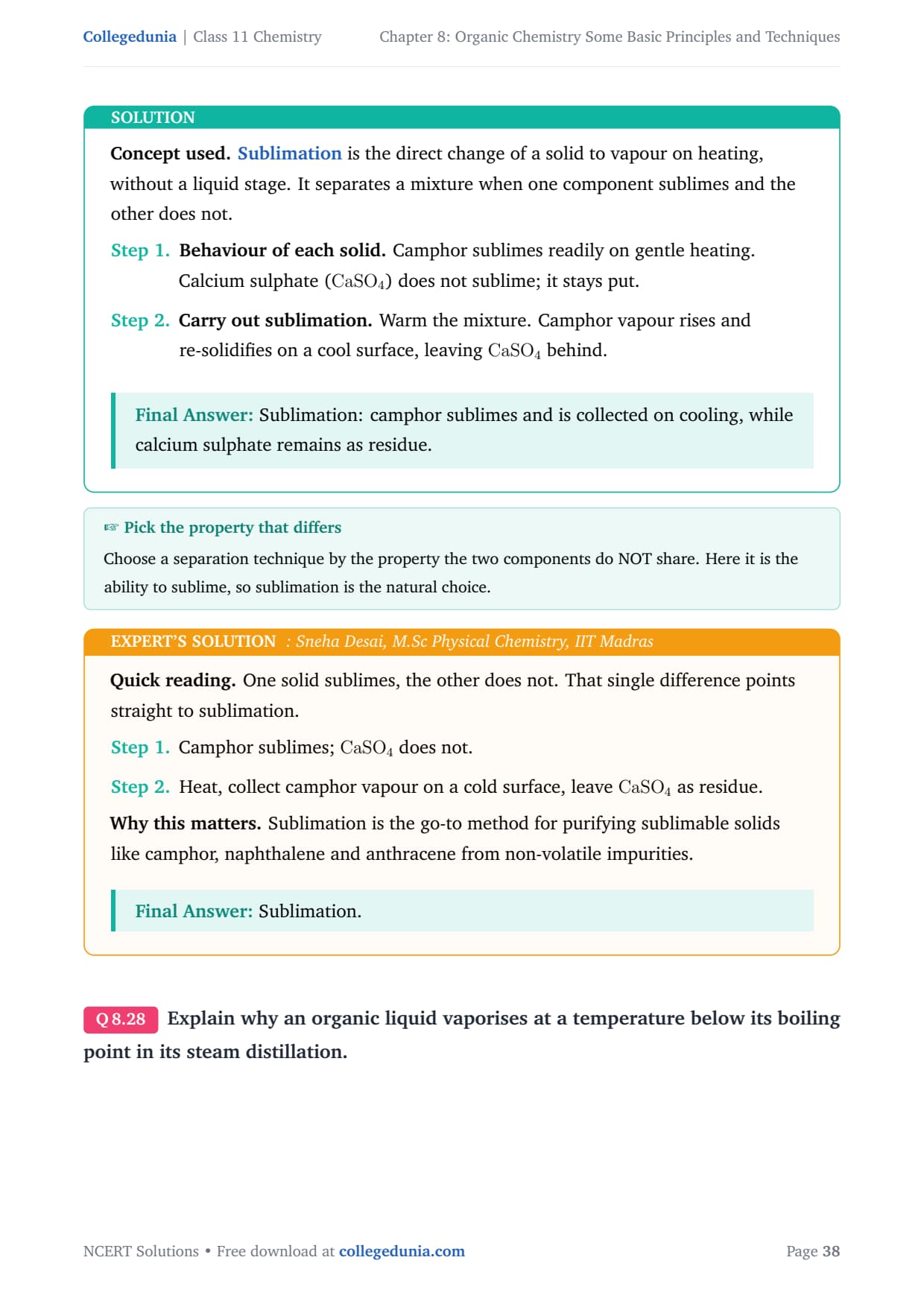
| Crystallisation | Purifying a solid using difference in solubility. |
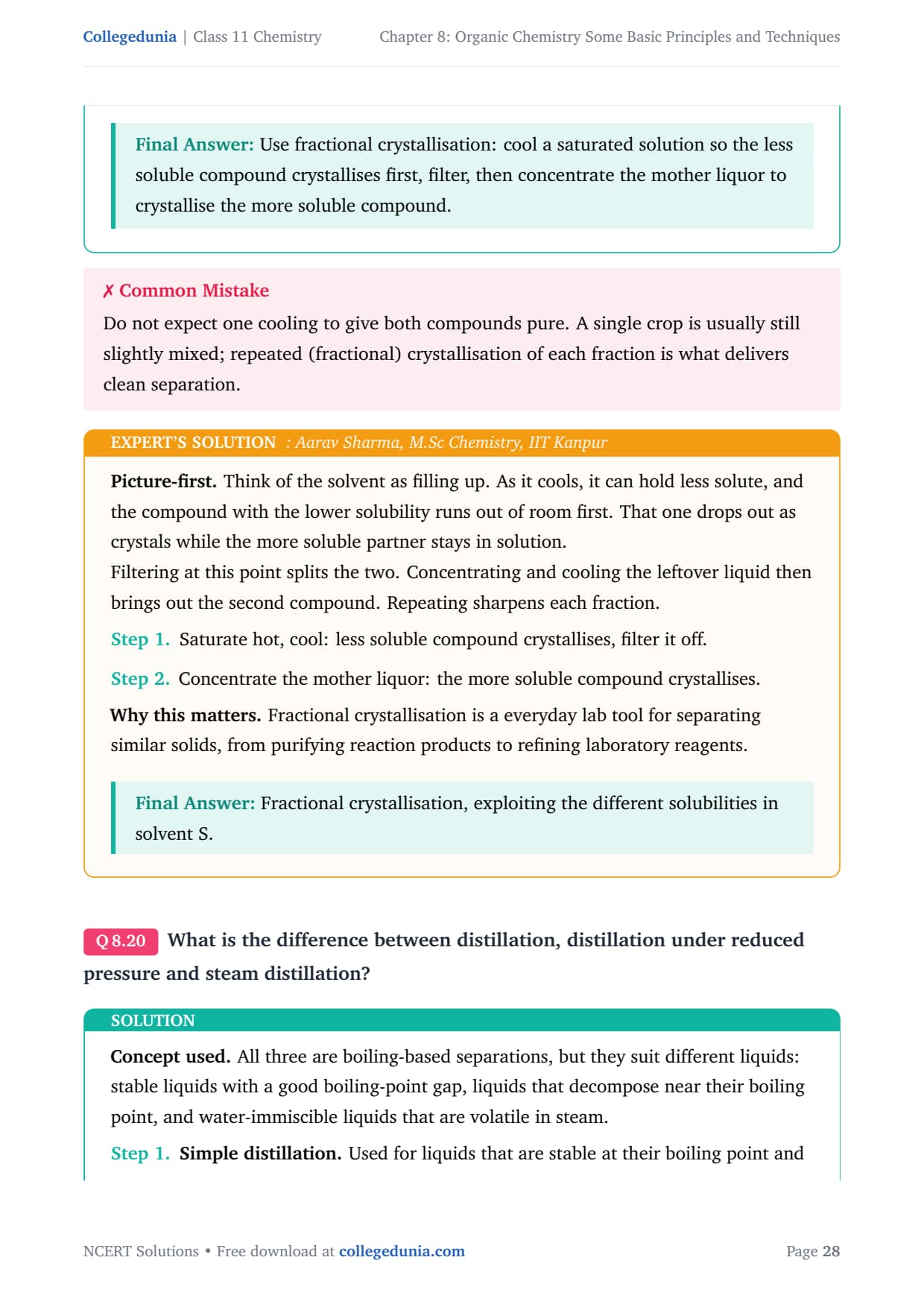
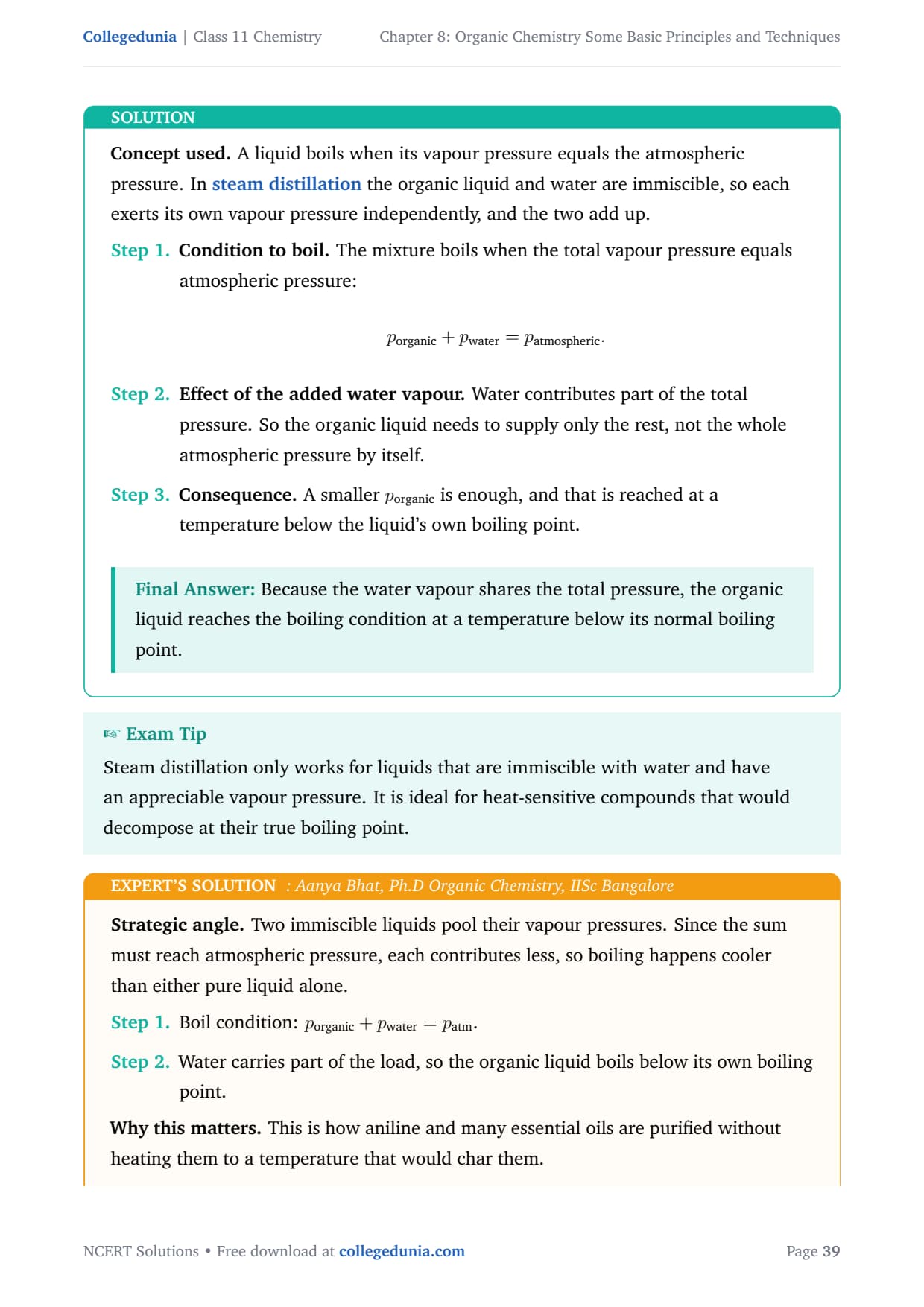
| Distillation | Separating liquids with different boiling points. |
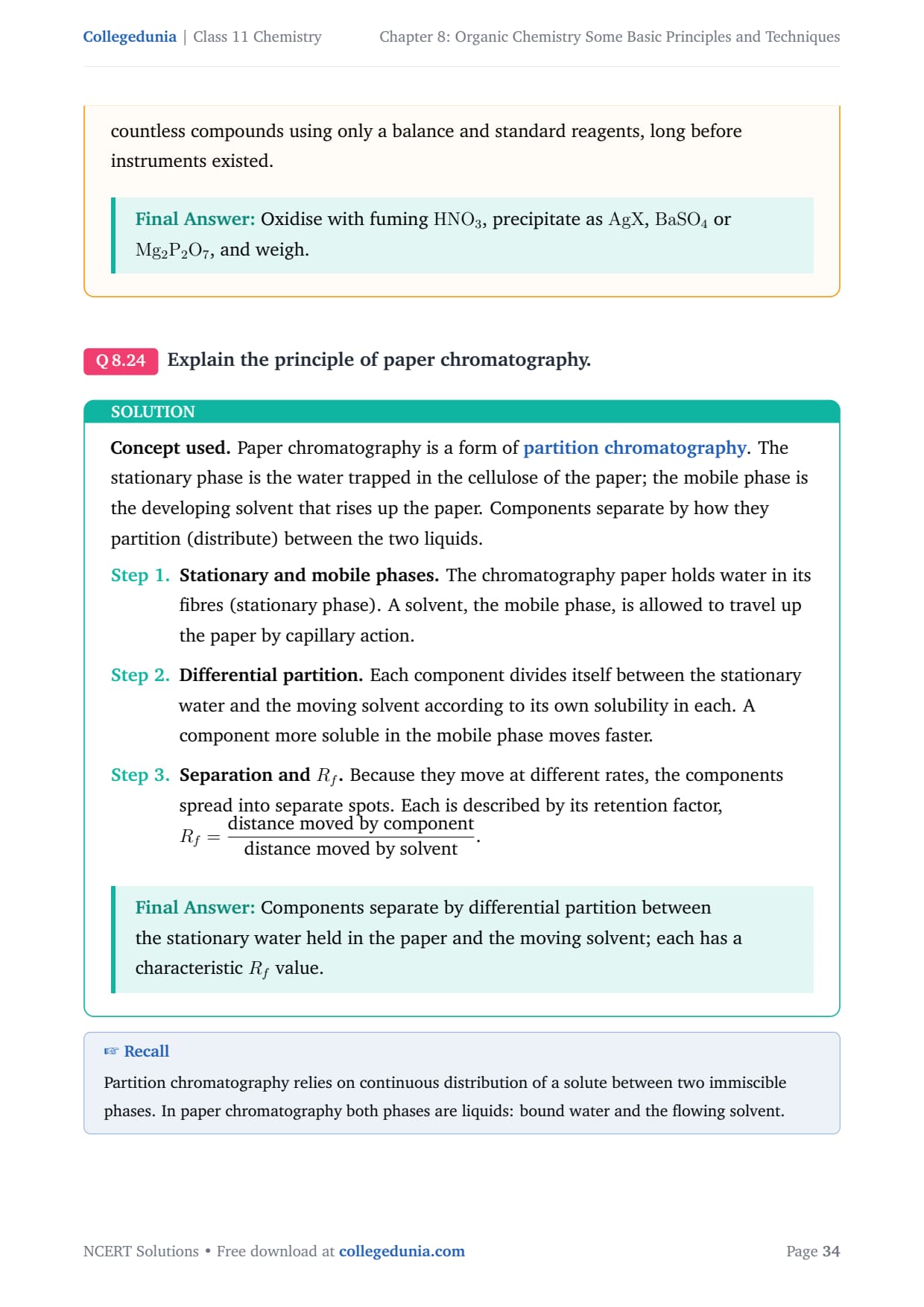
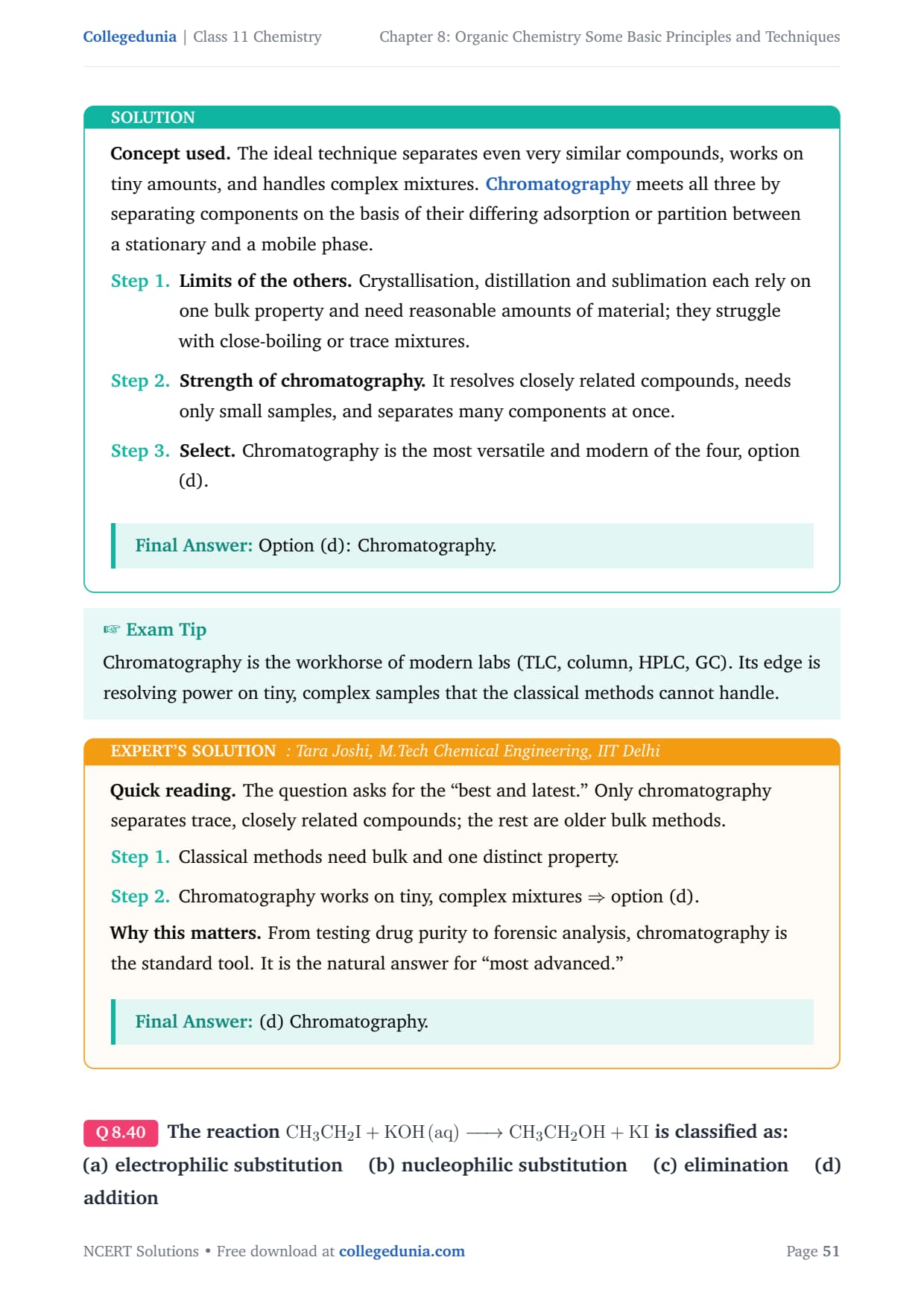
| Chromatography | Separating a mixture by different rates of movement over a surface. |
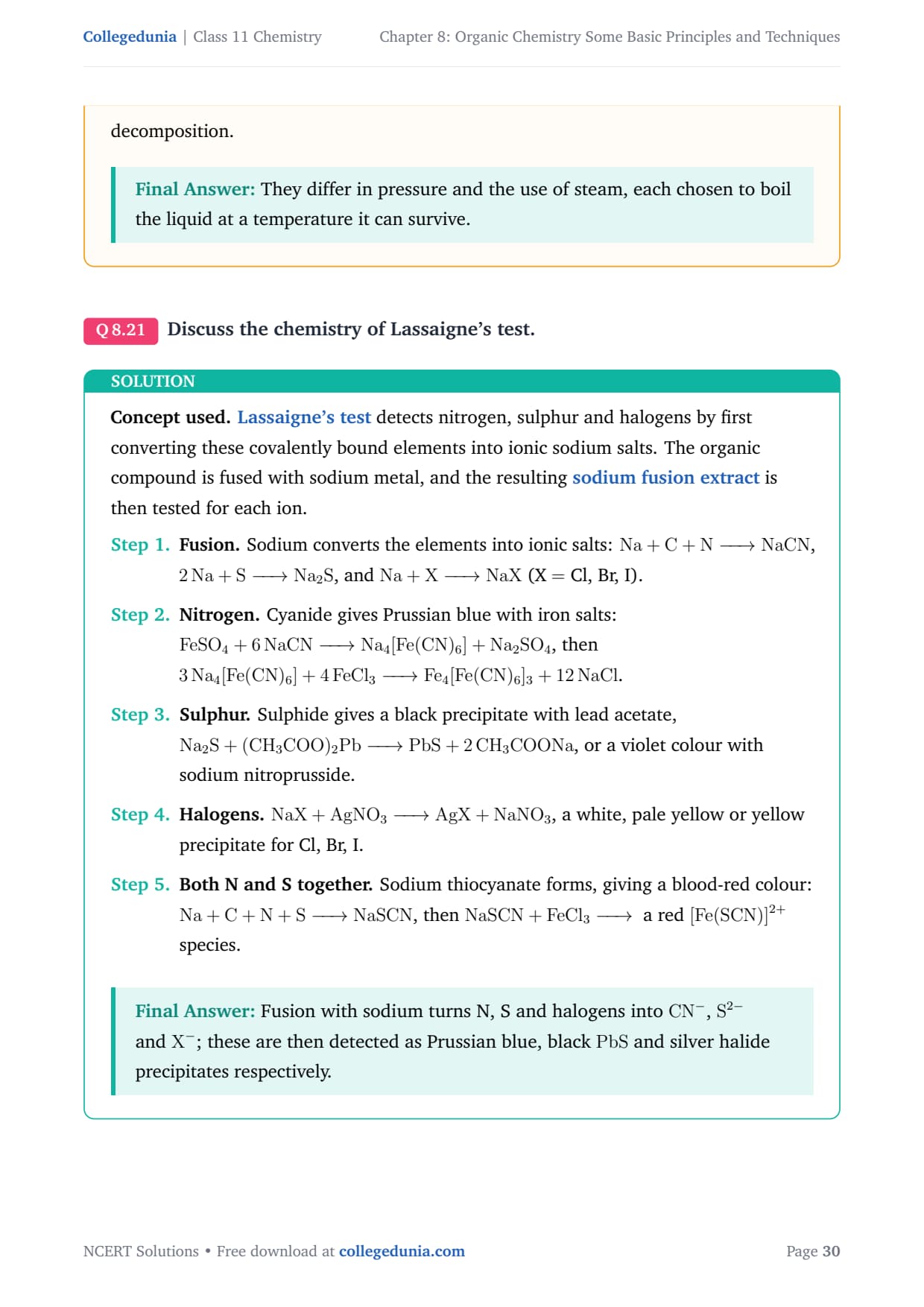
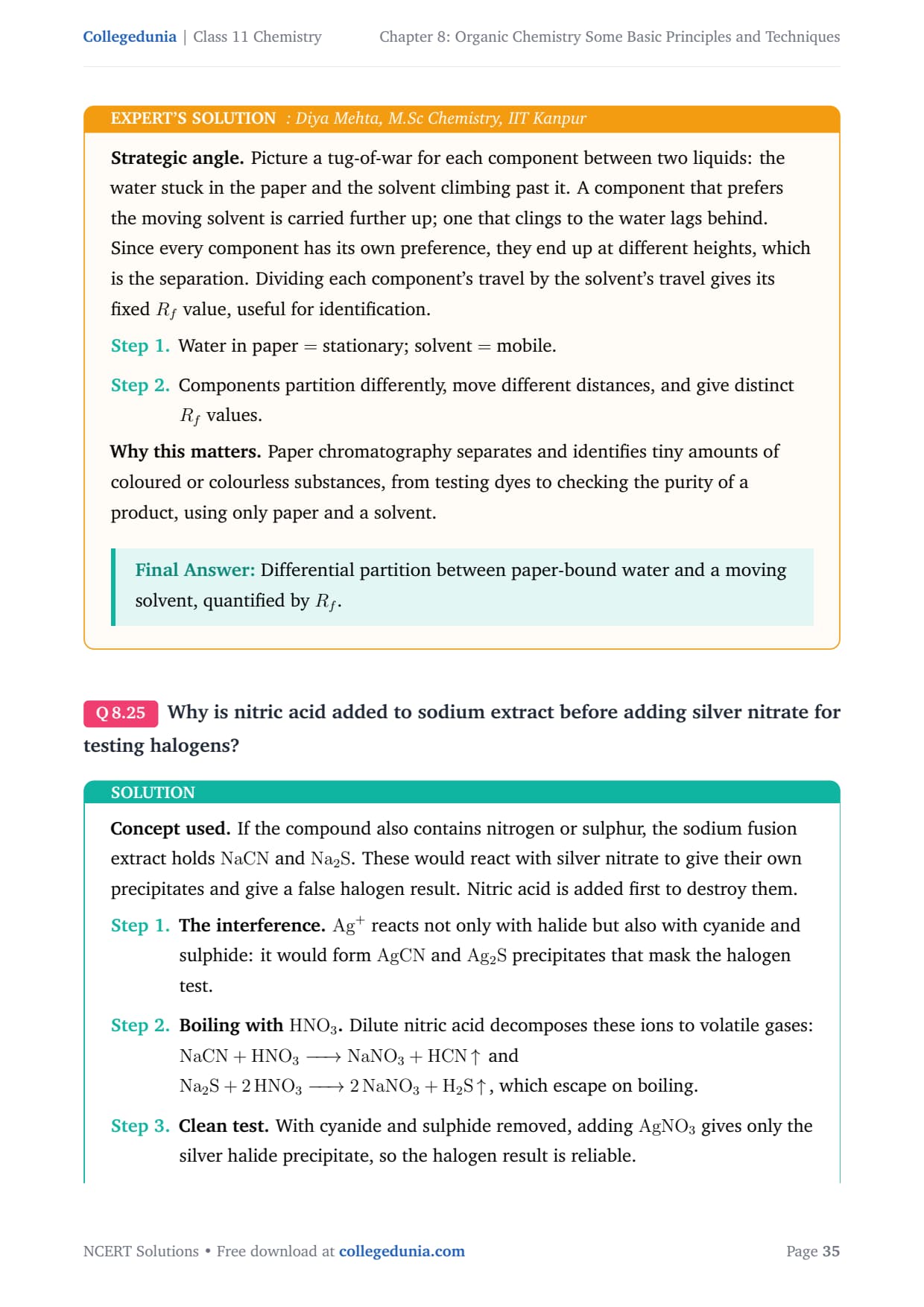
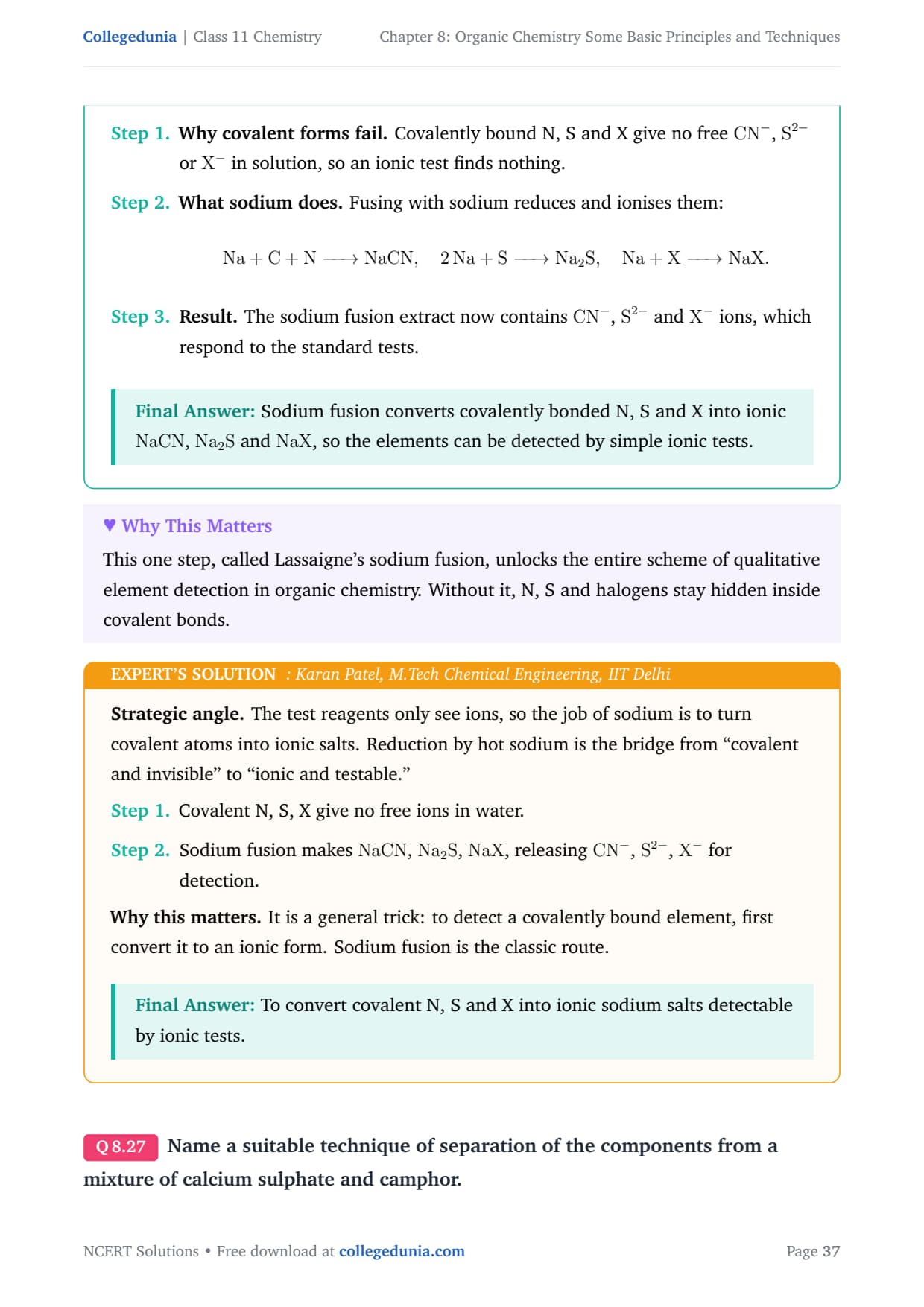
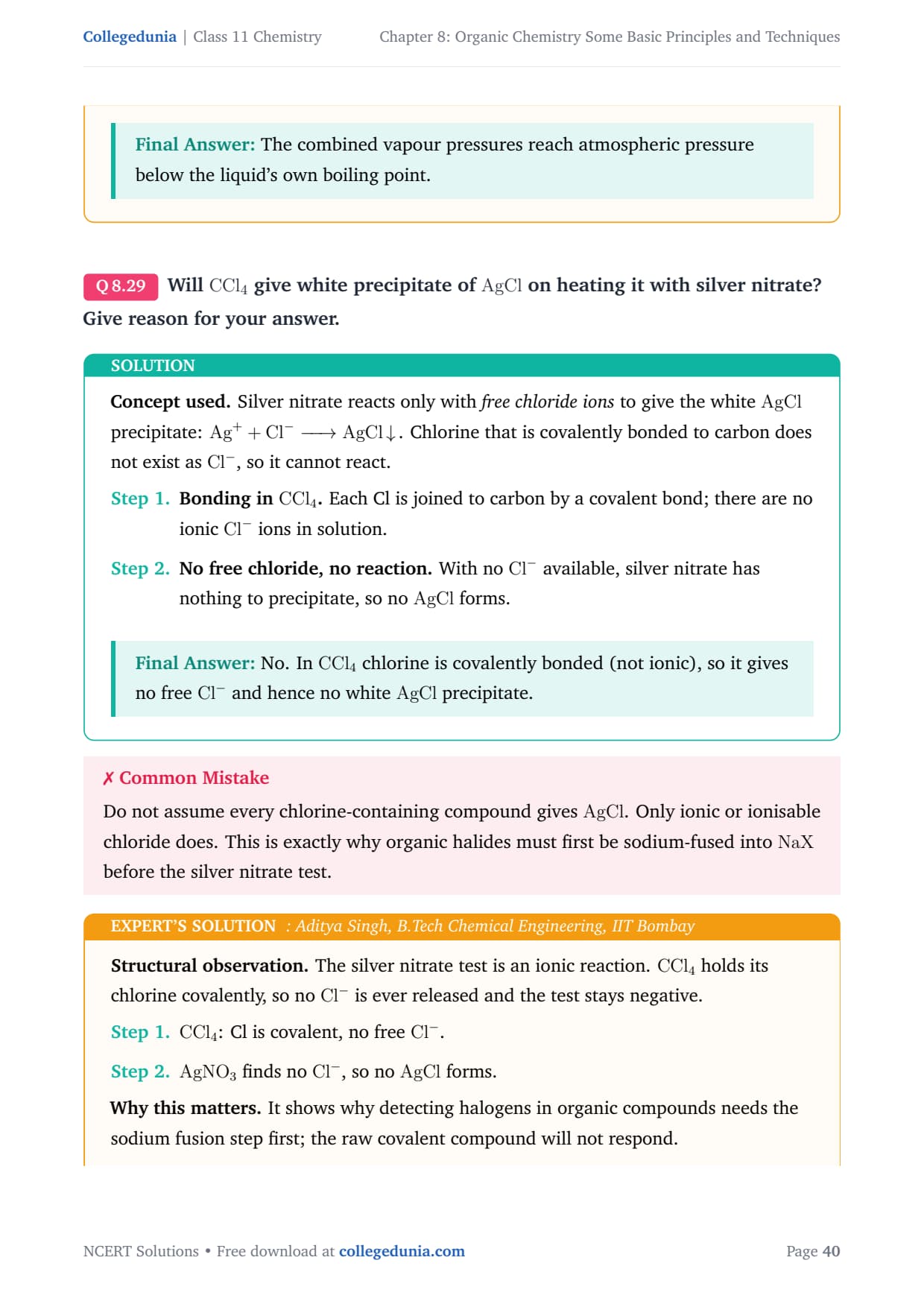
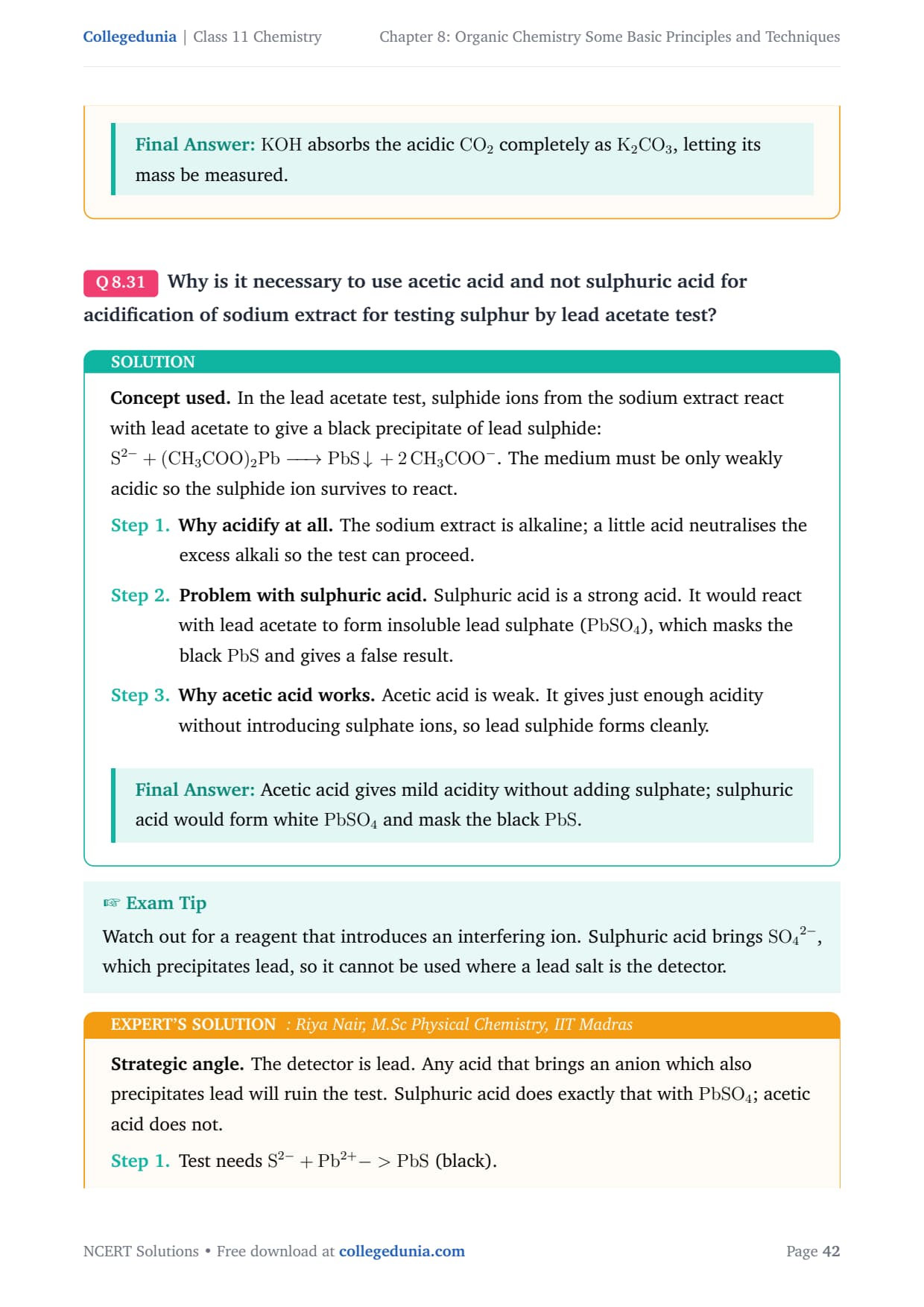
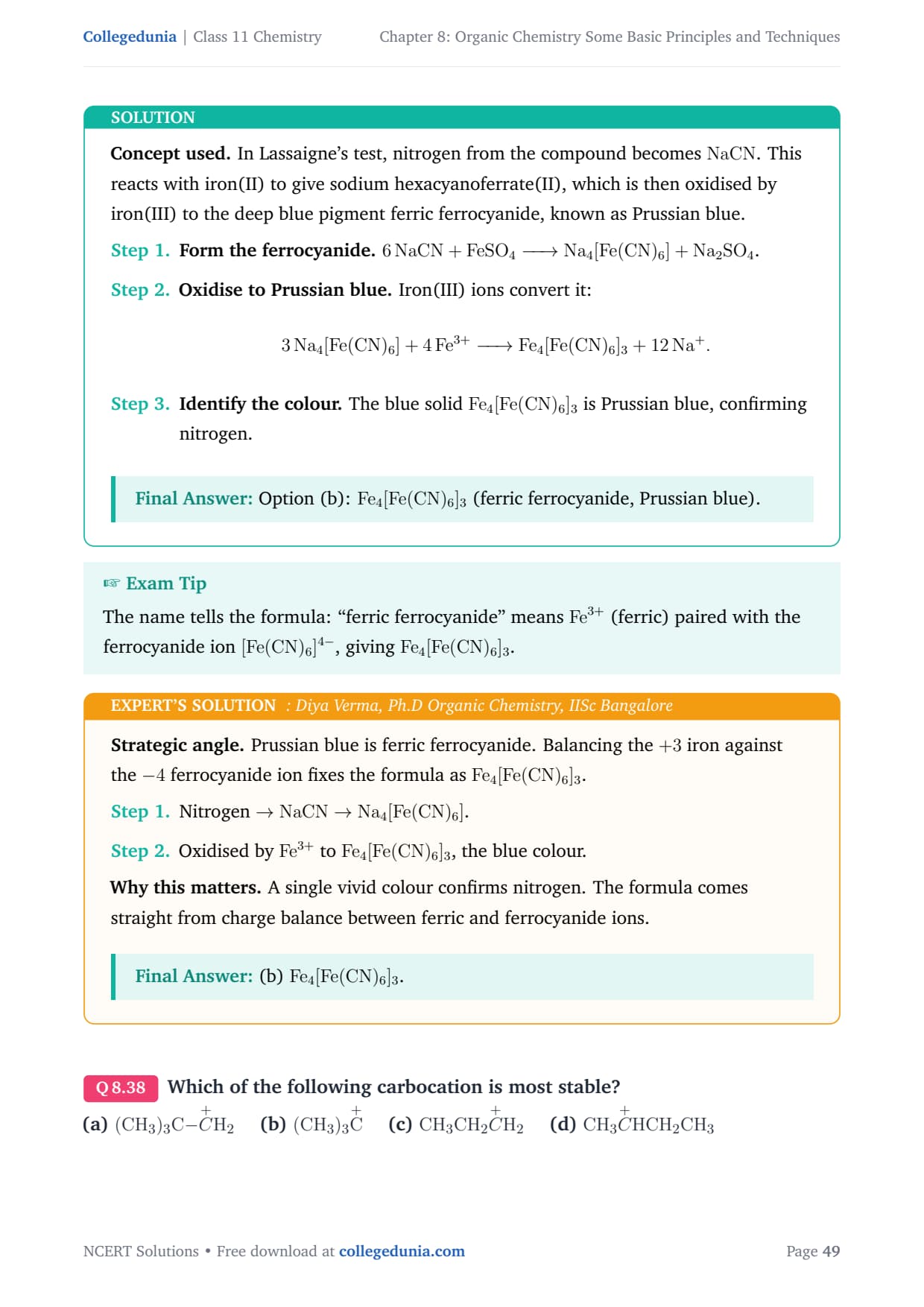
| Lassaigne's test | Detecting nitrogen, sulphur and halogens in a compound. |
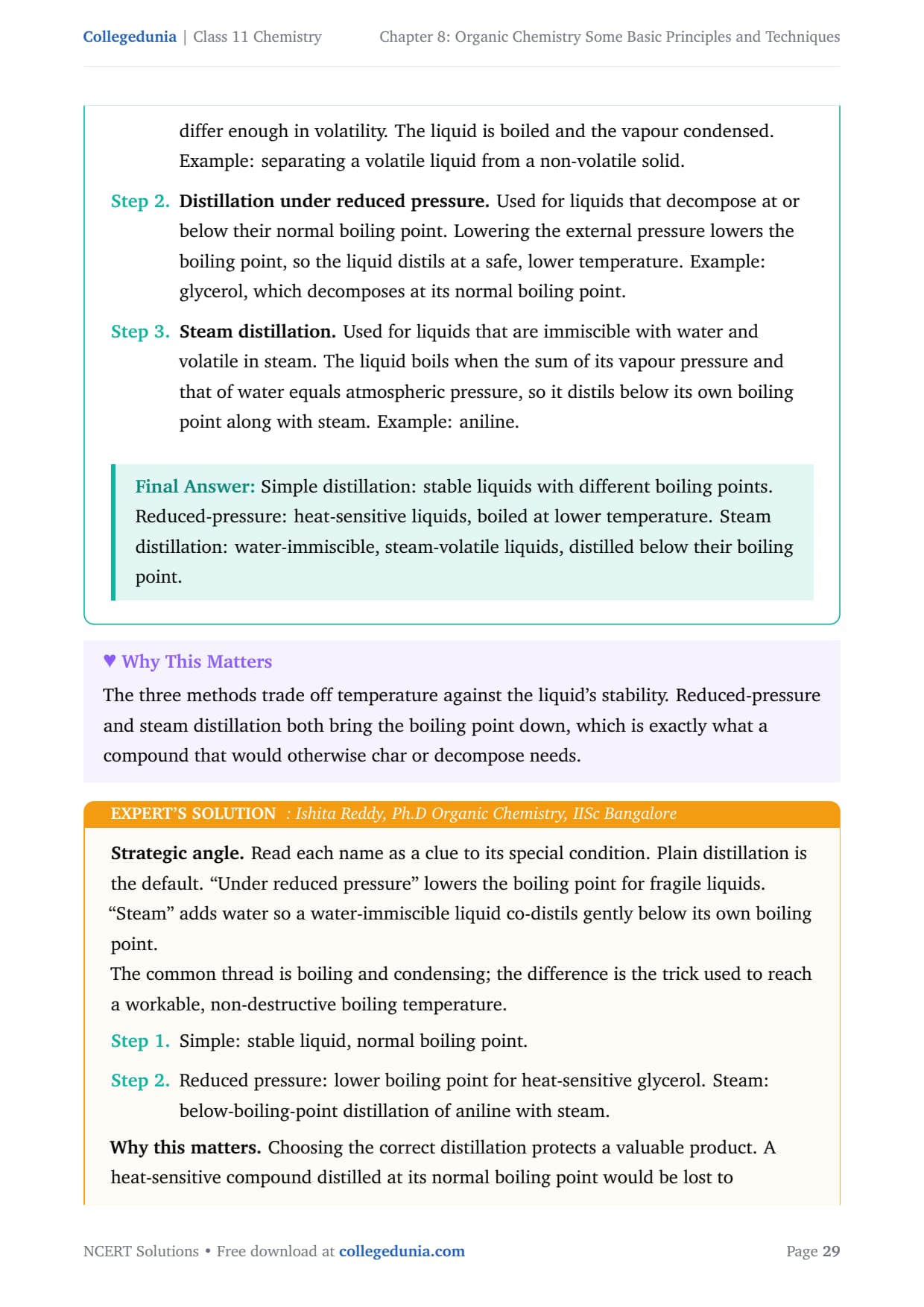
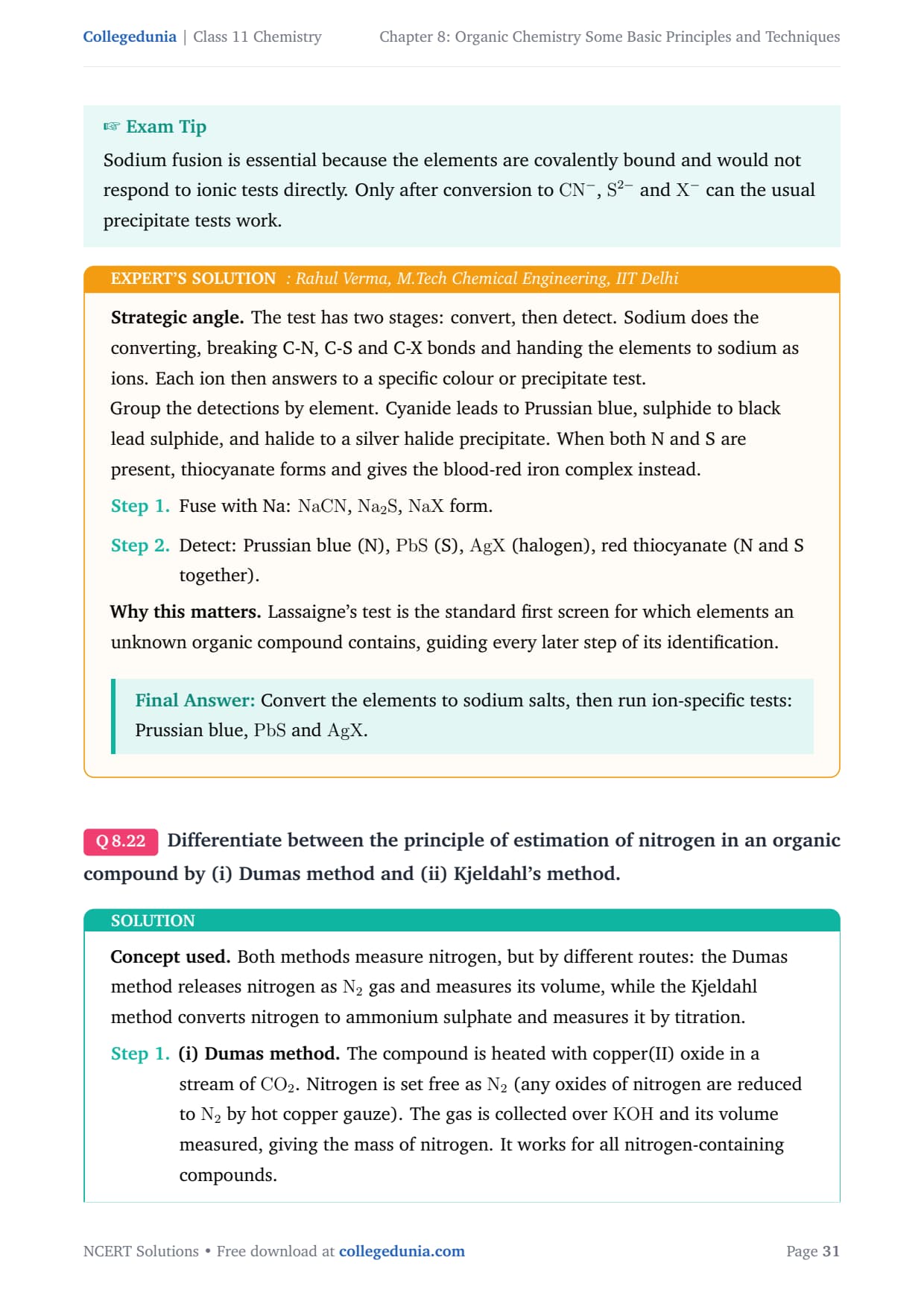
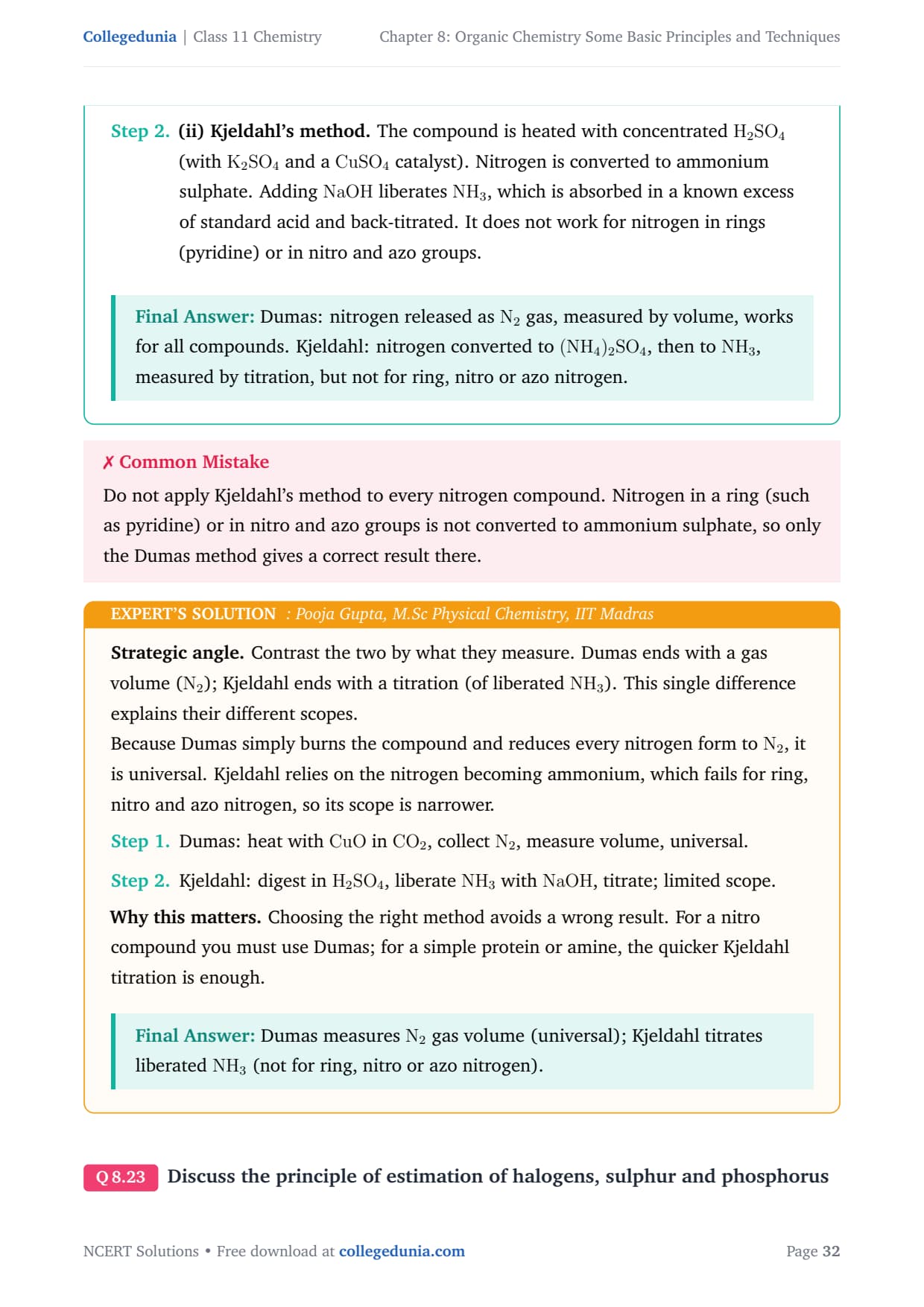
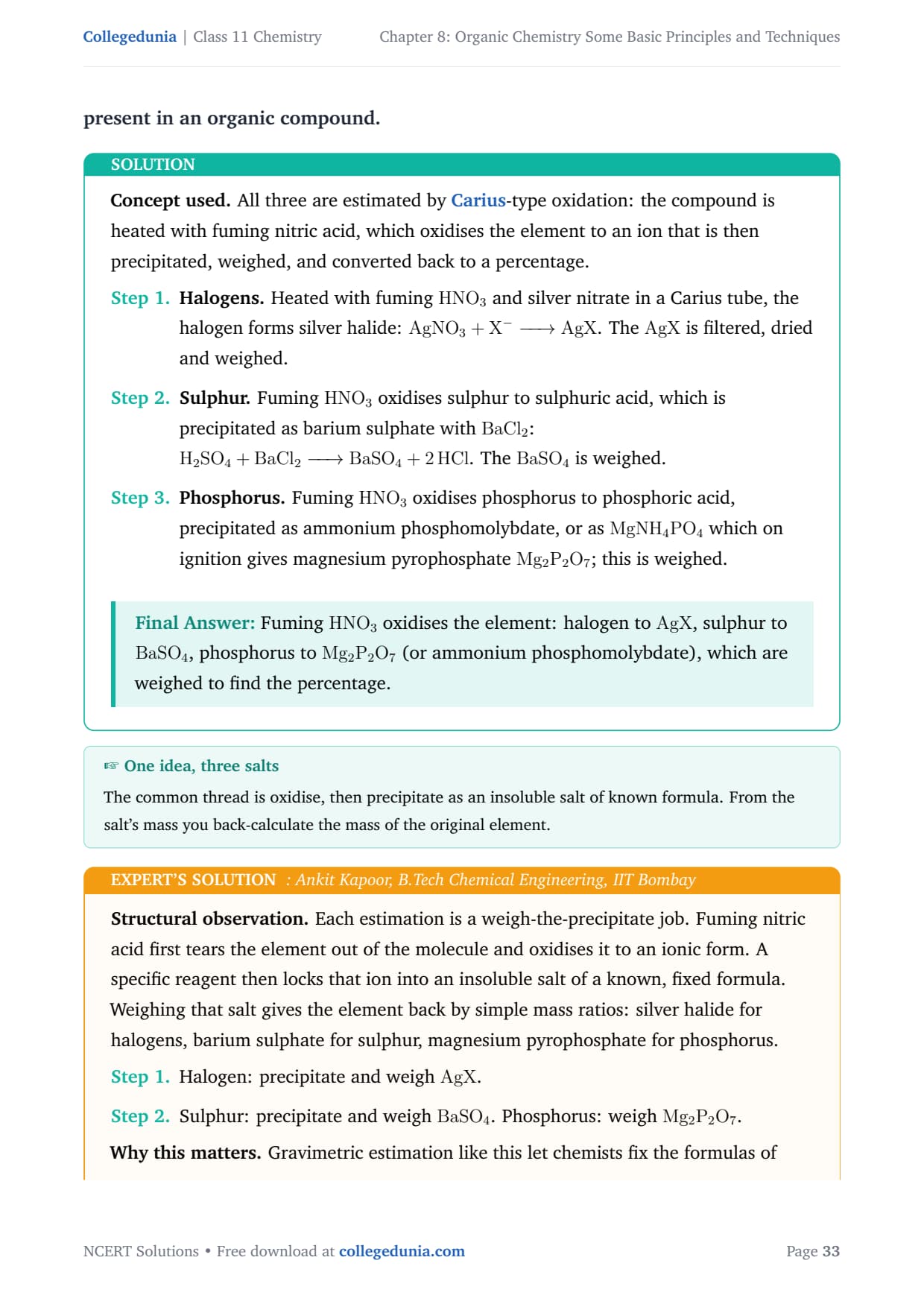
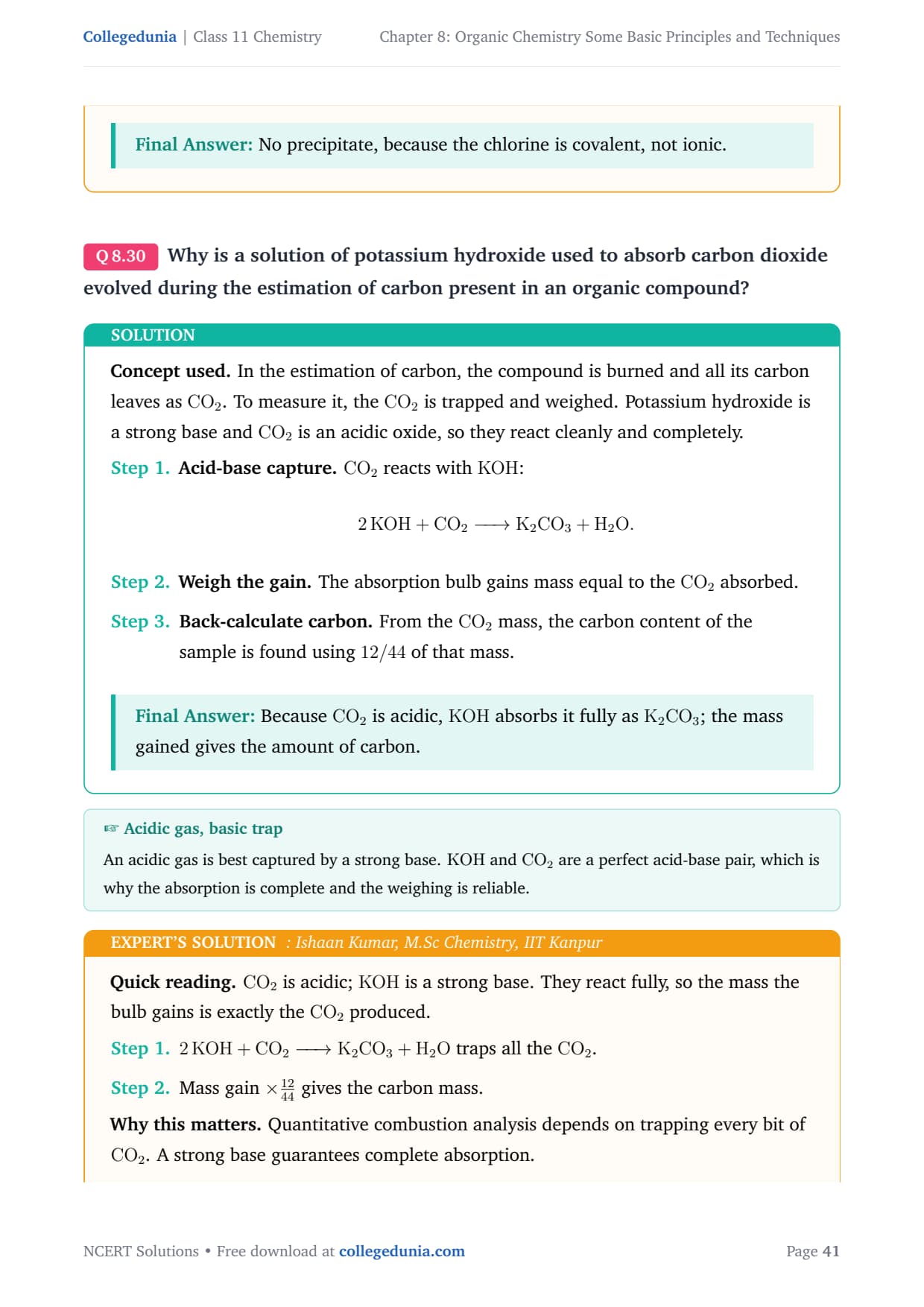
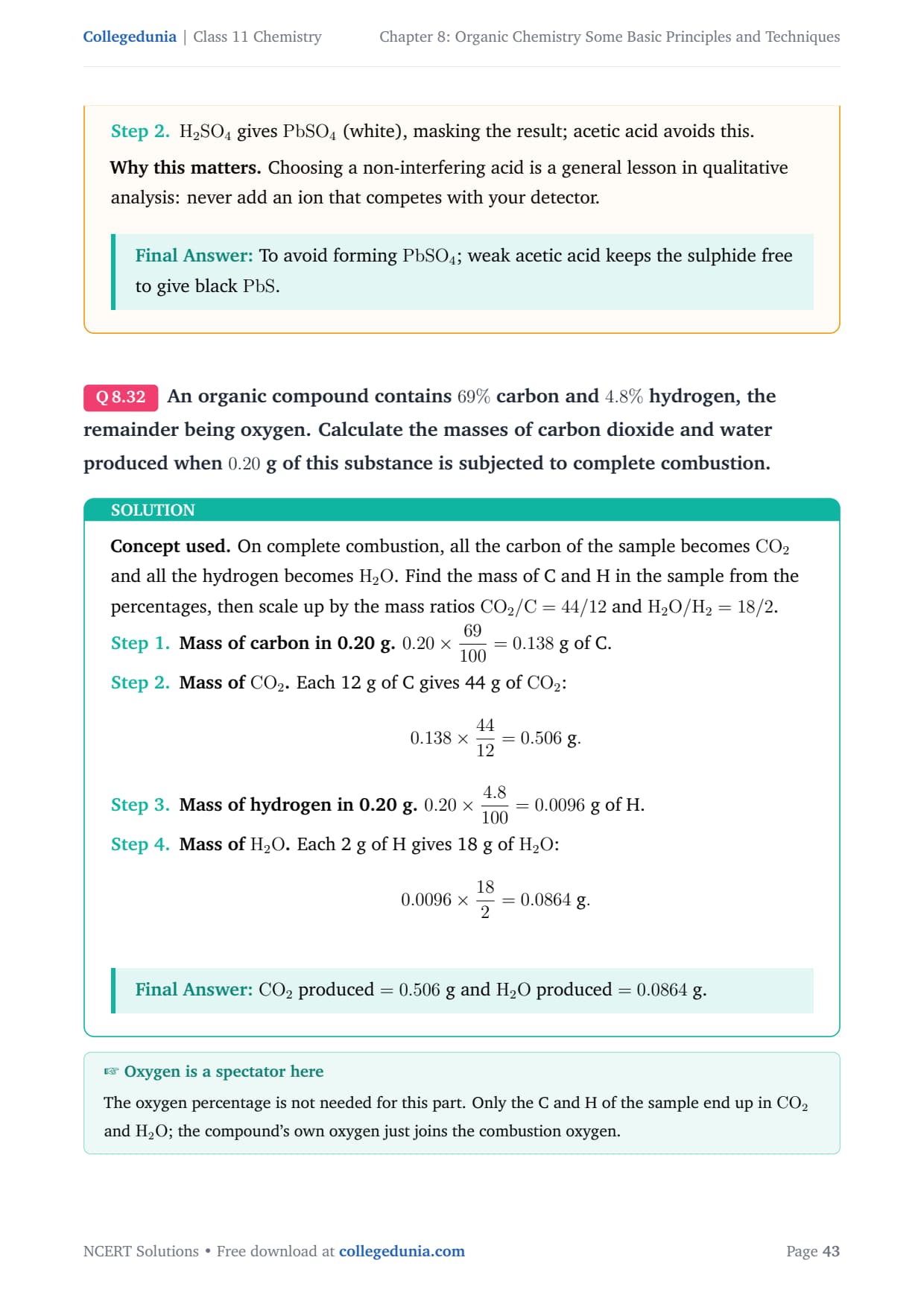
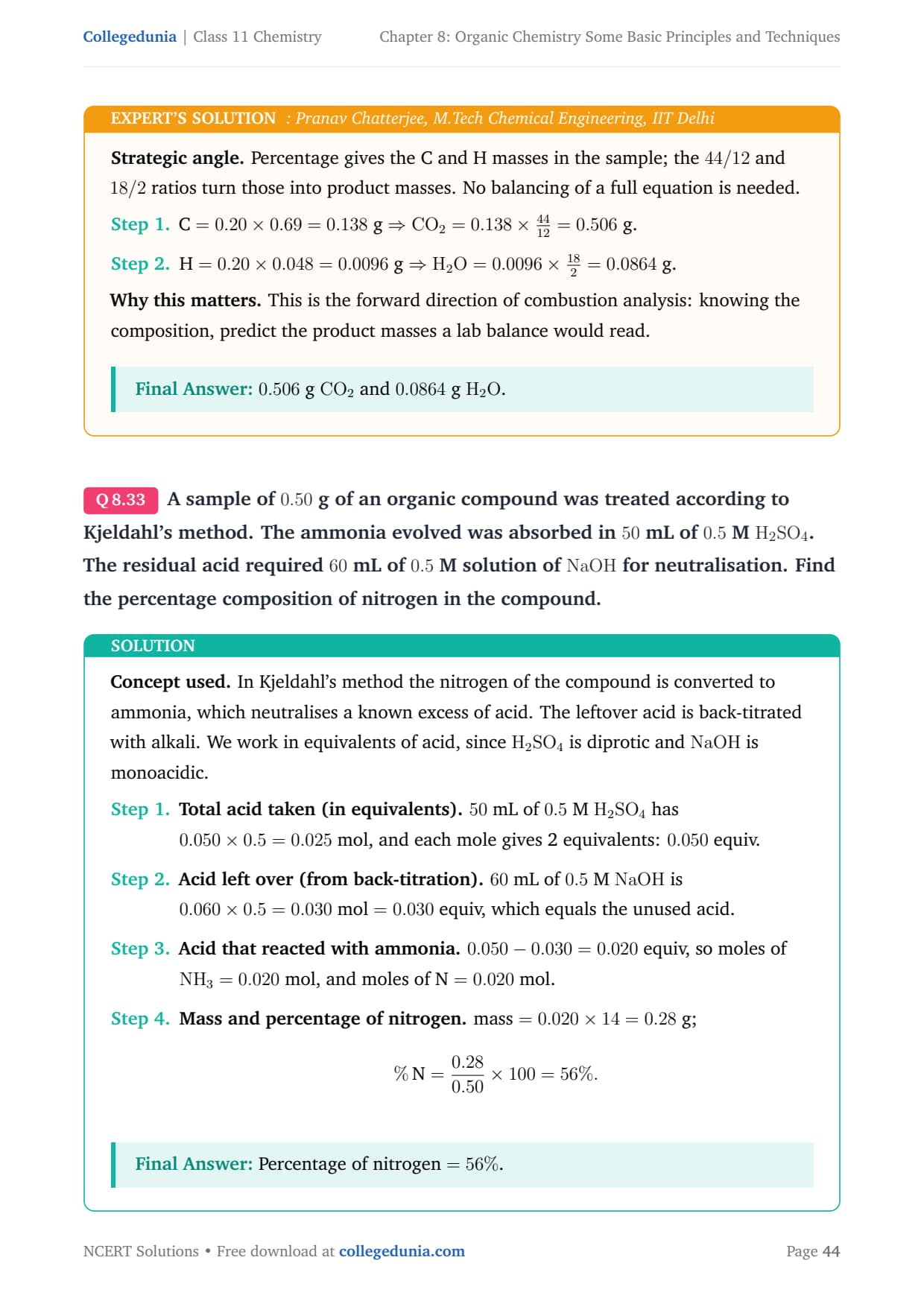
Qualitative analysis detects which elements are present, using tests such as Lassaigne's test for N, S and halogens. Quantitative analysis measures how much of each element is present, using methods like Dumas and Kjeldahl for nitrogen or Carius for halogens. Kjeldahl's method fails for nitro and azo compounds, a favourite exception in the exam. Learn one worked estimation, since a numerical from this section appears often in JEE and NEET.
Organic Chemistry Some Basic Principles and Techniques Exercise-wise Breakdown
The NCERT back exercise has 40 questions, mixing naming, structure drawing and reasoning. The intext questions test the same ideas in shorter form. The table below maps the question blocks to their topics so you can plan your practice.
| Question block | What it tests |
|---|---|
| Q 8.1 to 8.10 | Tetravalence, hybridisation, structural formulas and bond-line drawings. |
| Q 8.11 to 8.20 | IUPAC nomenclature, functional groups and homologous series. |
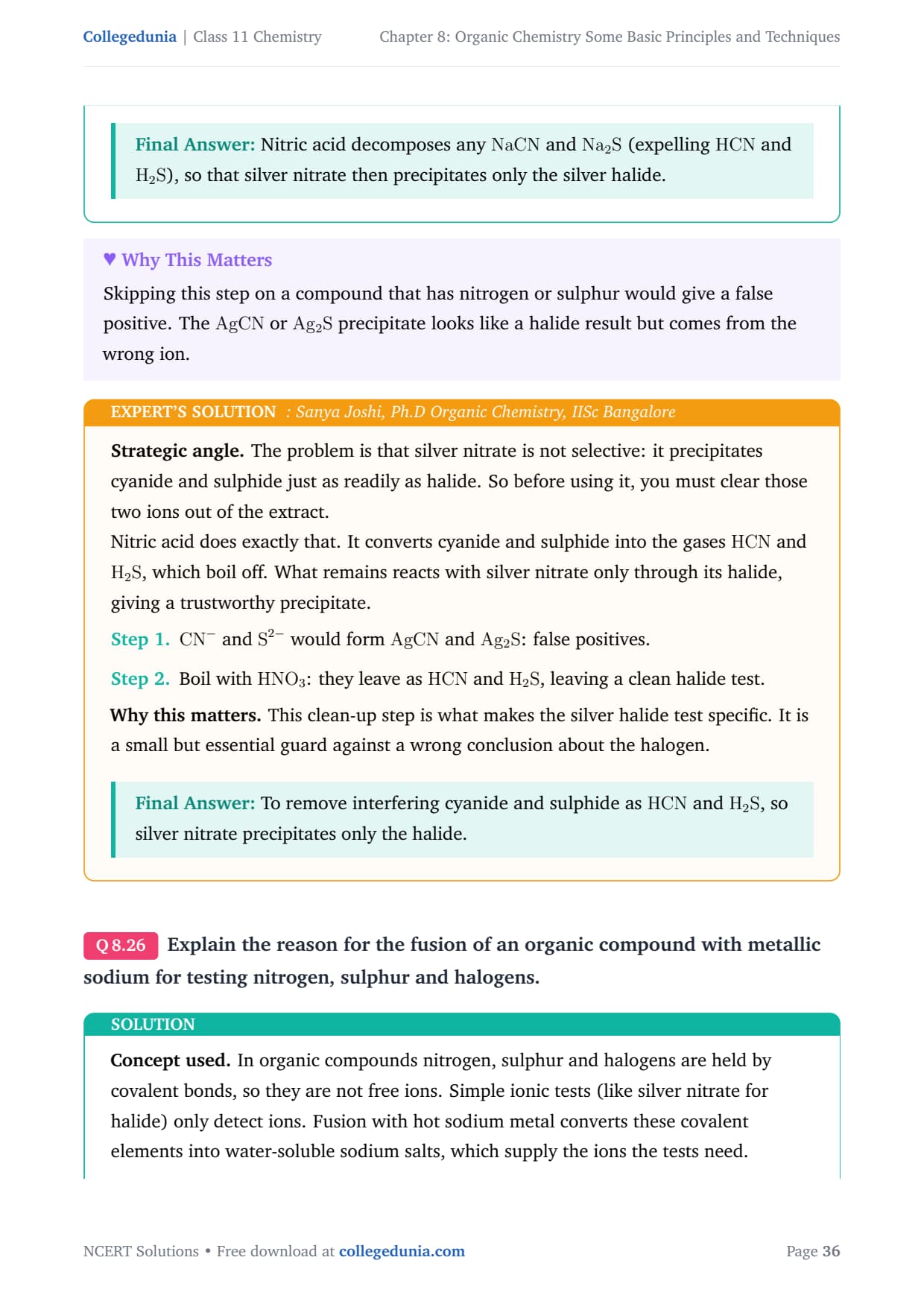
| Q 8.21 to 8.30 | Isomerism, electronic effects and stability of intermediates. |
| Q 8.31 to 8.40 | Reaction mechanism, purification methods and element analysis. |
The intext questions before the exercise are shorter and check one idea each, such as naming a compound or writing a resonance structure. Solve the intext set first, then the back exercise. Every question in the class 11 chemistry NCERT solutions chapter 8 Organic Chemistry Some Basic Principles and Techniques PDF is solved with each step shown, so you can compare your working line by line.
Practice the solved questions: Work through the full question bank with step-by-step answers and expert tips.
Organic Chemistry Some Basic Principles and Techniques Class 11 Solved Practice Questions
Common Mistakes Students Make in the Organic Chemistry Chapter
Most marks here are lost on small naming and reasoning slips, not on hard ideas. Each slip below costs 1 to 2 marks, so watch for them at the exact step.
Mistake 1: Numbering the chain from the wrong end. Always choose the direction that gives the lowest locants.
Mistake 2: Not picking the longest chain as the parent. Check every path before fixing the word root.
Mistake 3: Mixing up the stability orders. A carbocation and a free radical are 3° > 2° > 1°, but a carbanion is reversed.
Mistake 4: Confusing inductive and electromeric effects. The inductive effect is permanent; the electromeric effect appears only during attack.
Student Feedback on the Organic Chemistry Solutions
What 14,120 students told us about their Organic Chemistry preparation:
- 61% of students rated IUPAC nomenclature as the part that needed the most practice.
- Most-skipped step: writing correct resonance structures with curved arrows, missed by about 3 in 10 students.
- Students who learned the stability orders early said mechanism questions became far easier.
Source: 2026-27 Class 11 Chemistry student poll. Sample of 14,120 students from CBSE schools across 15 states, conducted before the 2026 boards.
Other Organic Chemistry Some Basic Principles and Techniques Class 11 Resources
Pair these solutions with the revision notes and the NCERT textbook PDF for the same chapter.
| Resource | Link |
|---|---|
| NCERT Notes | Organic Chemistry Some Basic Principles and Techniques Class 11 Notes |
| NCERT Book PDF | Organic Chemistry Some Basic Principles and Techniques Class 11 Book PDF |
NCERT Solutions for Class 11 Chemistry: All Chapters
Jump to the step-by-step solutions for any other Class 11 Chemistry chapter below.
| Chapter | NCERT Solutions |
|---|---|
| Chapter 1 | Some Basic Concepts of Chemistry |
| Chapter 2 | Structure of Atom |
| Chapter 3 | Classification of Elements and Periodicity in Properties |
| Chapter 4 | Chemical Bonding and Molecular Structure |
| Chapter 5 | Thermodynamics |
| Chapter 6 | Equilibrium |
| Chapter 7 | Redox Reactions |
| Chapter 8 | Organic Chemistry Some Basic Principles and Techniques |
| Chapter 9 | Hydrocarbons |
FAQs on Organic Chemistry Some Basic Principles and Techniques Class 11 NCERT Solutions
Organic Chemistry Some Basic Principles and Techniques NCERT Solutions - Frequently Asked Questions
Ques. What do the class 11 chemistry NCERT solutions chapter 8 Organic Chemistry Some Basic Principles and Techniques cover?
Ans. These solutions cover all 40 back-exercise questions and the intext questions, including the tetravalence of carbon and molecular shapes, structural representations, classification of organic compounds, IUPAC nomenclature, isomerism, reaction mechanism, electronic displacement effects, reaction intermediates, and methods of purification and analysis. Every question is solved step by step.
Ques. What is the tetravalence of carbon in Class 11 Chemistry Chapter 8?
Ans. Tetravalence means carbon forms four covalent bonds because it has four electrons in its outer shell. This lets carbon bond with itself and with other atoms to form chains, branches and rings. The shape at each carbon depends on hybridisation: sp3 is tetrahedral, sp2 is trigonal planar and sp is linear.
Ques. What is the difference between a nucleophile and an electrophile?
Ans. A nucleophile is an electron-rich species that donates a pair of electrons and attacks a positive centre, such as OH- or NH3. An electrophile is an electron-poor species that accepts a pair of electrons and attacks a negative centre, such as H+ or NO2+. Nucleophiles seek nuclei, while electrophiles seek electrons.
Ques. What is the order of stability of a carbocation?
Ans. The stability of a carbocation rises in the order 3° > 2° > 1° > methyl. Electron-donating alkyl groups stabilise the positive charge through the inductive effect and hyperconjugation, so a tertiary carbocation with three alkyl groups is the most stable. A free radical follows the same order, but a carbanion is reversed.
Ques. What is the inductive effect in organic chemistry?
Ans. The inductive effect is the permanent displacement of sigma-bond electrons towards a more electronegative atom along a carbon chain. It weakens quickly as you move away from the atom causing it. Electron-withdrawing groups show a -I effect, while alkyl groups show a +I effect, and this explains trends in acid strength and intermediate stability.
Ques. What is the weightage of Organic Chemistry Some Basic Principles and Techniques in CBSE Class 11?
Ans. Organic Chemistry Some Basic Principles and Techniques carries about 6 to 8 marks in the CBSE Class 11 Chemistry paper, mostly through IUPAC naming, isomerism and mechanism questions. It is also heavily tested in JEE Main and NEET, where naming, electronic effects and intermediate stability appear every year.



Comments