




The class 11 chemistry NCERT solutions chapter 6 Equilibrium solve every intext and back-exercise question, according to the latest 2026-27 CBSE syllabus, and help students prepare for the CBSE Boards, JEE Main, JEE Advanced, NEET and CUET. Each answer is worked step by step, from the equilibrium constant and Le Chatelier's principle to pH, buffers and the solubility product.
Equilibrium sits at the heart of Physical Chemistry, and the ideas here return in electrochemistry, thermodynamics and every Class 12 acid-base topic.
- CBSE Weightage: 7 to 8 marks, one of the most numerical-heavy chapters in the Physical Chemistry unit.
- Topics covered: physical and chemical equilibrium, law of mass action, Kc and Kp, reaction quotient, Le Chatelier's principle, acids and bases, pH, buffers, and solubility product.
- Exercise count: 73 back-exercise questions plus intext questions, a mix of numerical and reasoning.
These class 11 chemistry NCERT solutions chapter 6 Equilibrium are curated by subject experts, based on the 2026-27 NCERT textbook, and checked against the last five years of CBSE Board, JEE Main and NEET papers.
Why Equilibrium Matters and What the Equilibrium Chapter Covers
Most reactions do not go to completion. They reach a state where the forward and backward reactions run at the same rate, and the amounts of reactant and product stop changing. This balance point is called equilibrium, and it decides how much product a reaction can actually give.
- Everyday role: equilibrium controls the Haber process for ammonia, blood pH, and the fizz in a soft drink.
- Core skill: writing the equilibrium constant and using it to judge how far a reaction proceeds.
- Why it is central: the pH and buffer ideas introduced here run through the whole of Class 12 chemistry.
Equilibrium is dynamic, not static. The reaction has not stopped; the forward and backward changes simply cancel out. The class 11 chemistry NCERT solutions chapter 6 Equilibrium below follow the same order as the NCERT textbook, so you can match each answer to the exercise you are solving.
Physical and Chemical Equilibrium Explained for Class 11
Equilibrium is not limited to chemical reactions. A physical equilibrium is set up when a physical change, such as melting or evaporation, becomes reversible in a closed container. A chemical equilibrium involves a reversible chemical reaction. Both share the same key features.
| Type | Example | What stays constant |
|---|---|---|
| Solid-liquid | H2O(s) ⇌ H2O(l) at 0°C | Melting and freezing rates are equal. |
| Liquid-vapour | H2O(l) ⇌ H2O(g) | Vapour pressure is constant at a fixed temperature. |
| Dissolution | Sugar(s) ⇌ Sugar(in solution) | The solution stays saturated. |
| Chemical | N2 + 3H2 ⇌ 2NH3 | Concentrations of all species are fixed. |
Every equilibrium can only be reached in a closed system, where nothing escapes. It is dynamic, both reactions continue, and it is reached from either direction. At equilibrium the rate of the forward reaction equals the rate of the backward reaction. These points are a common source of short-answer questions in the board paper.
Law of Mass Action and the Equilibrium Constant Kc and Kp
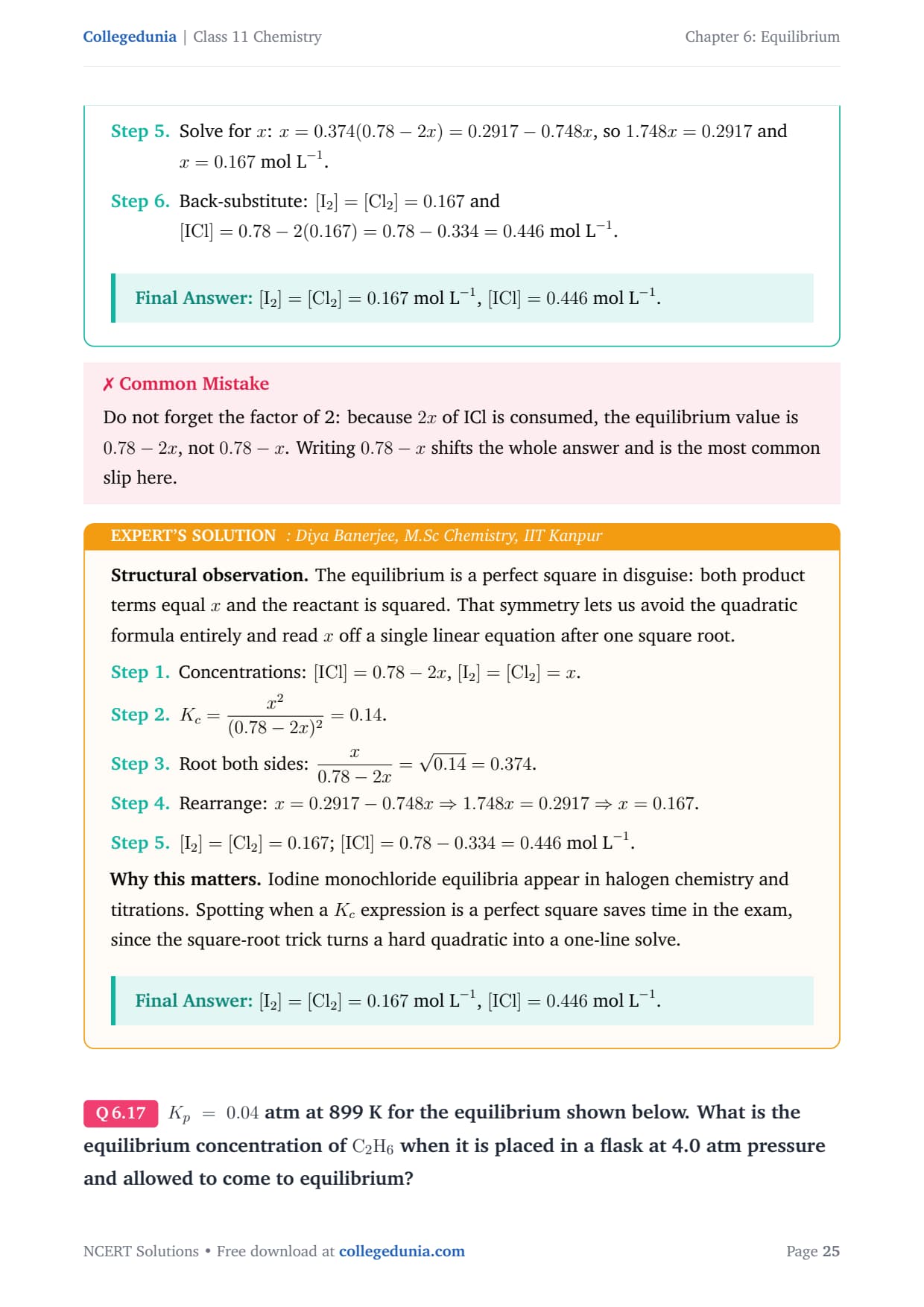
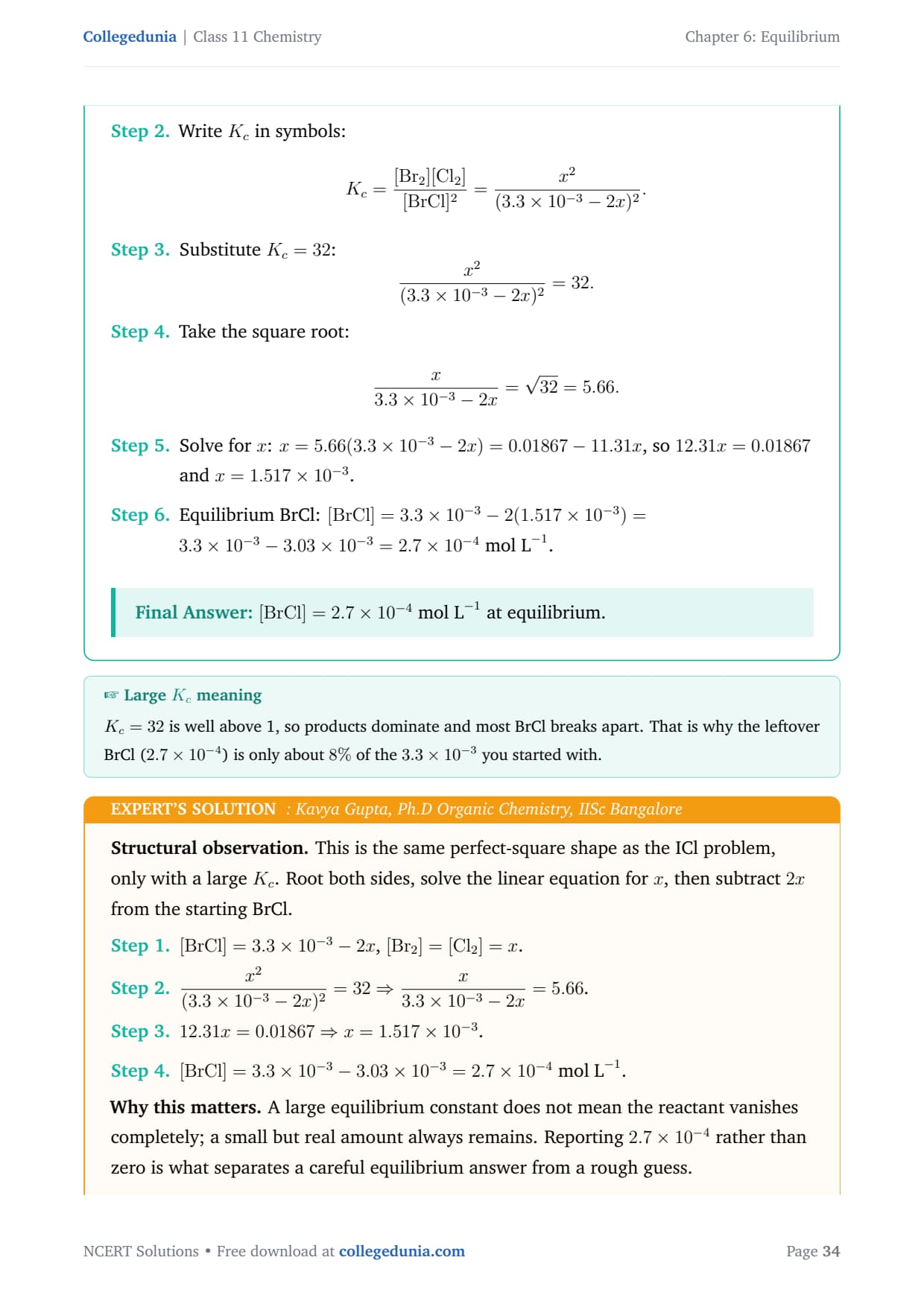
The law of mass action says the rate of a reaction is proportional to the product of the active masses of the reactants. Applying it to both directions gives the equilibrium constant, the single number that tells you how far a reaction goes. For a reaction aA + bB ⇌ cC + dD, the constant is written from the balanced equation.
- Kc: equilibrium constant in terms of molar concentrations, Kc = [C]c[D]d ÷ [A]a[B]b.
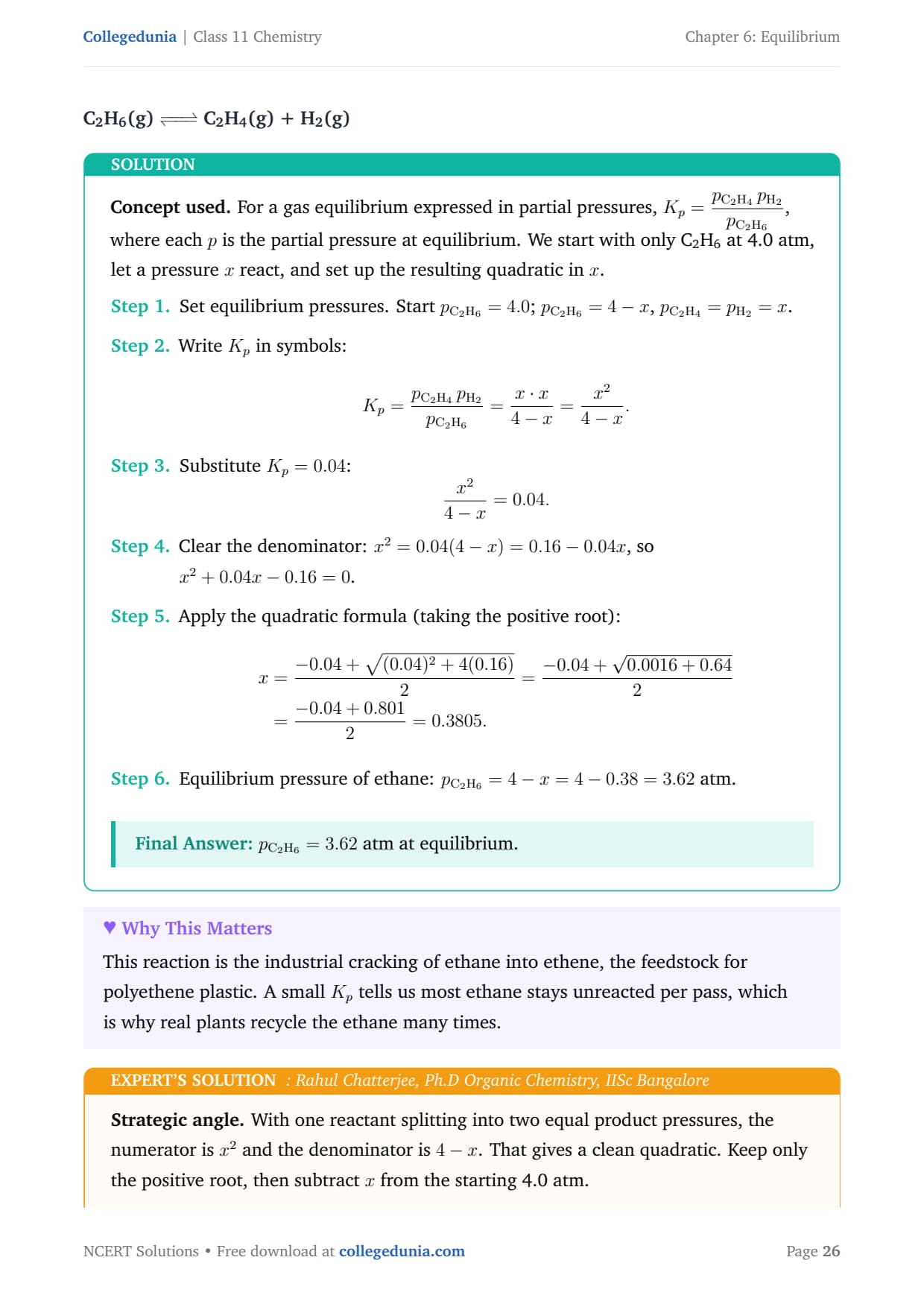
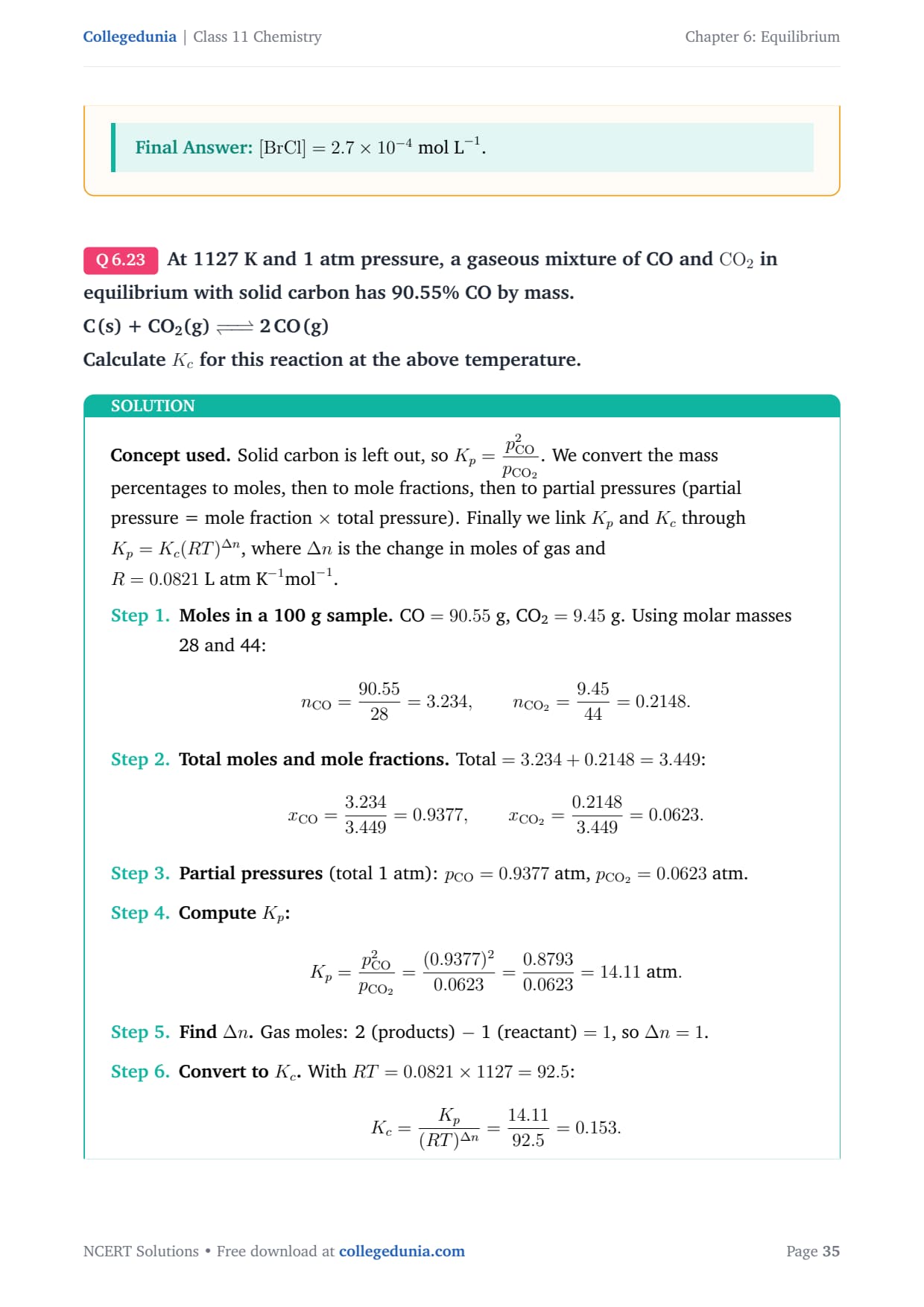
- Kp: equilibrium constant in terms of partial pressures, used for gaseous reactions.
- Link: Kp = Kc(RT)Δn, where Δn is the change in moles of gas.
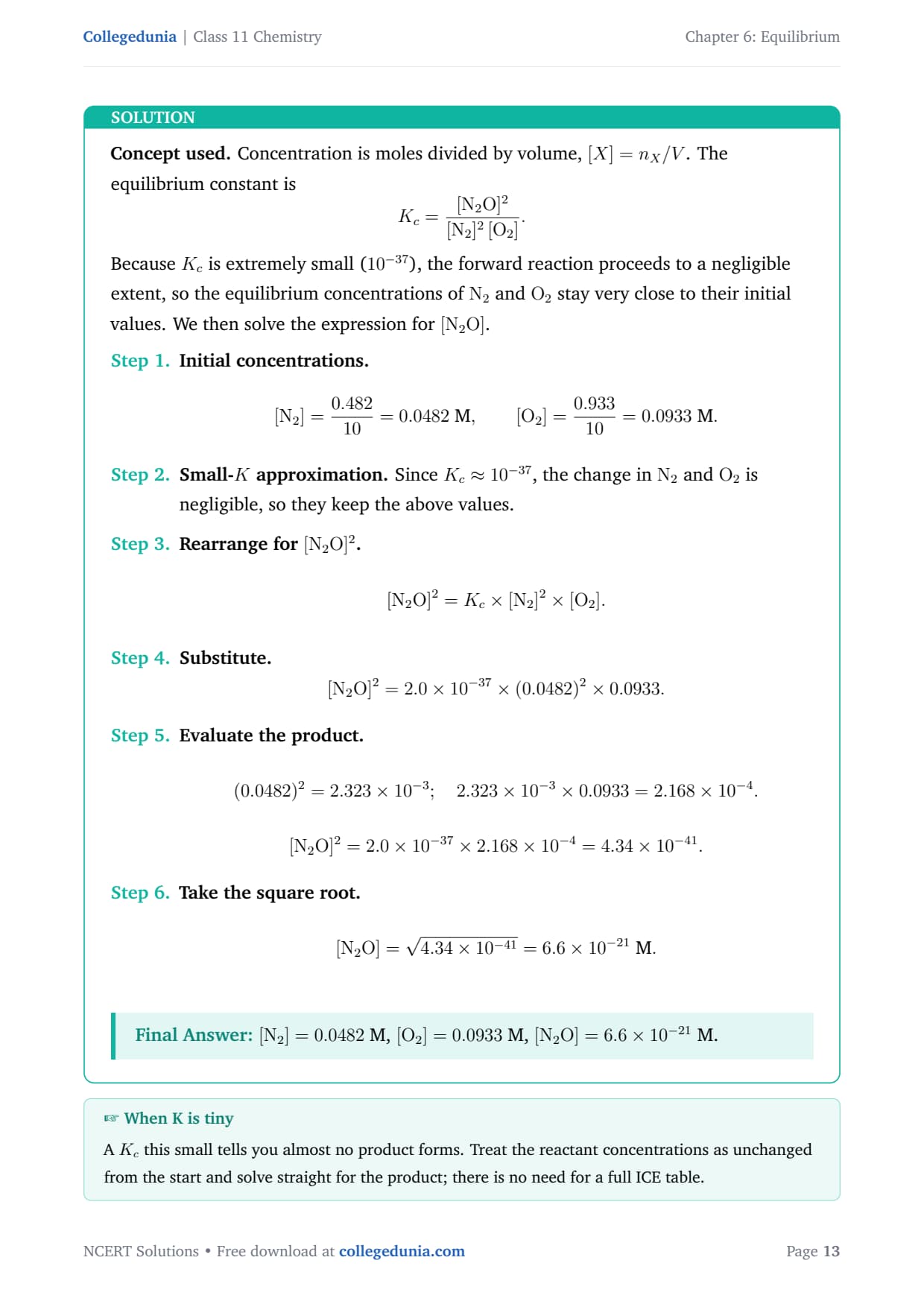
A large K value means the reaction is product-favoured, while a small K means little product forms. Pure solids and pure liquids are left out of the equilibrium expression because their concentration is constant. When Δn is zero, Kp equals Kc. Learn to write the expression straight from a balanced equation, since almost every numerical in the class 11 chemistry NCERT solutions chapter 6 Equilibrium starts with this step.
Reaction Quotient and Predicting the Direction of a Reaction
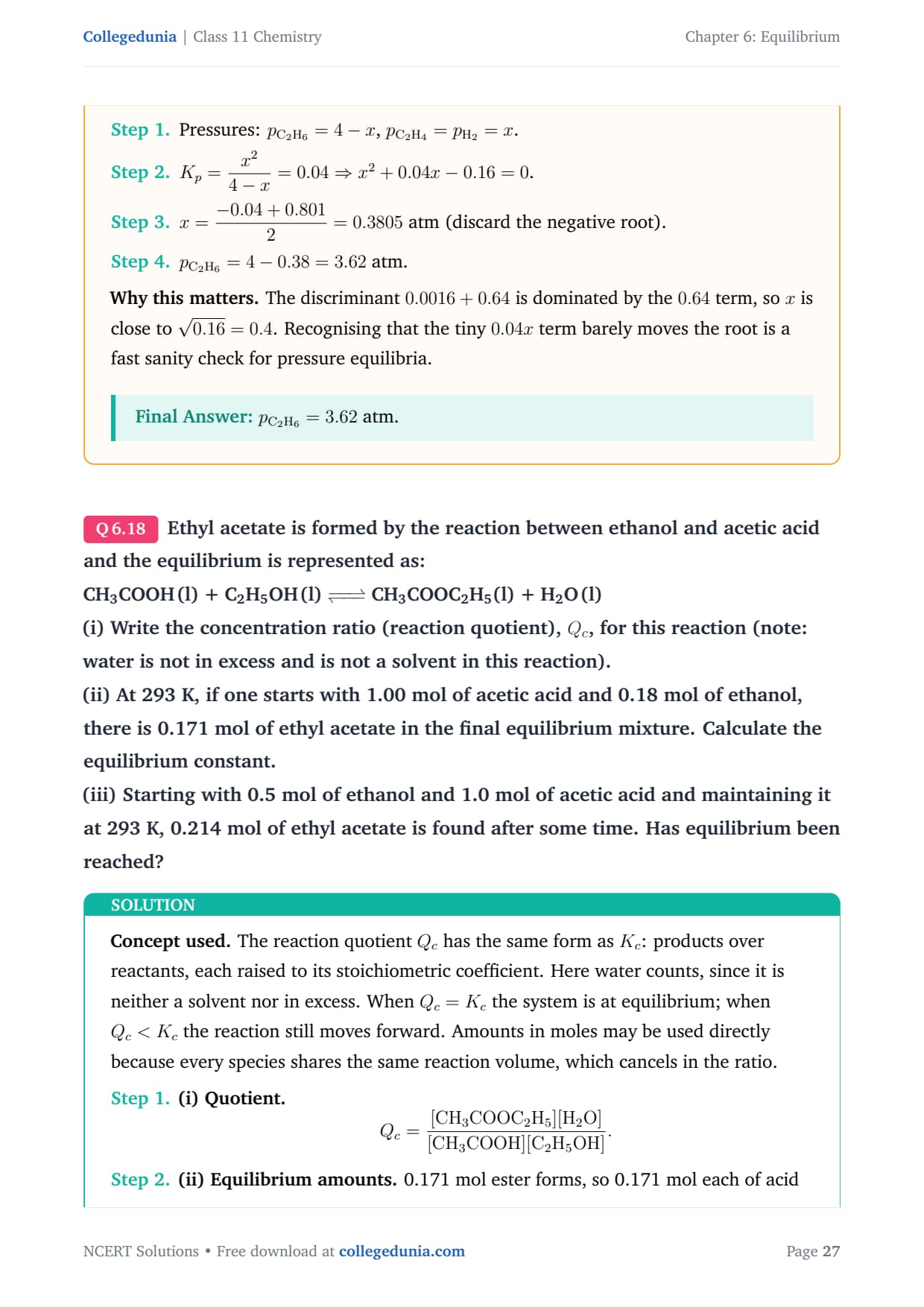
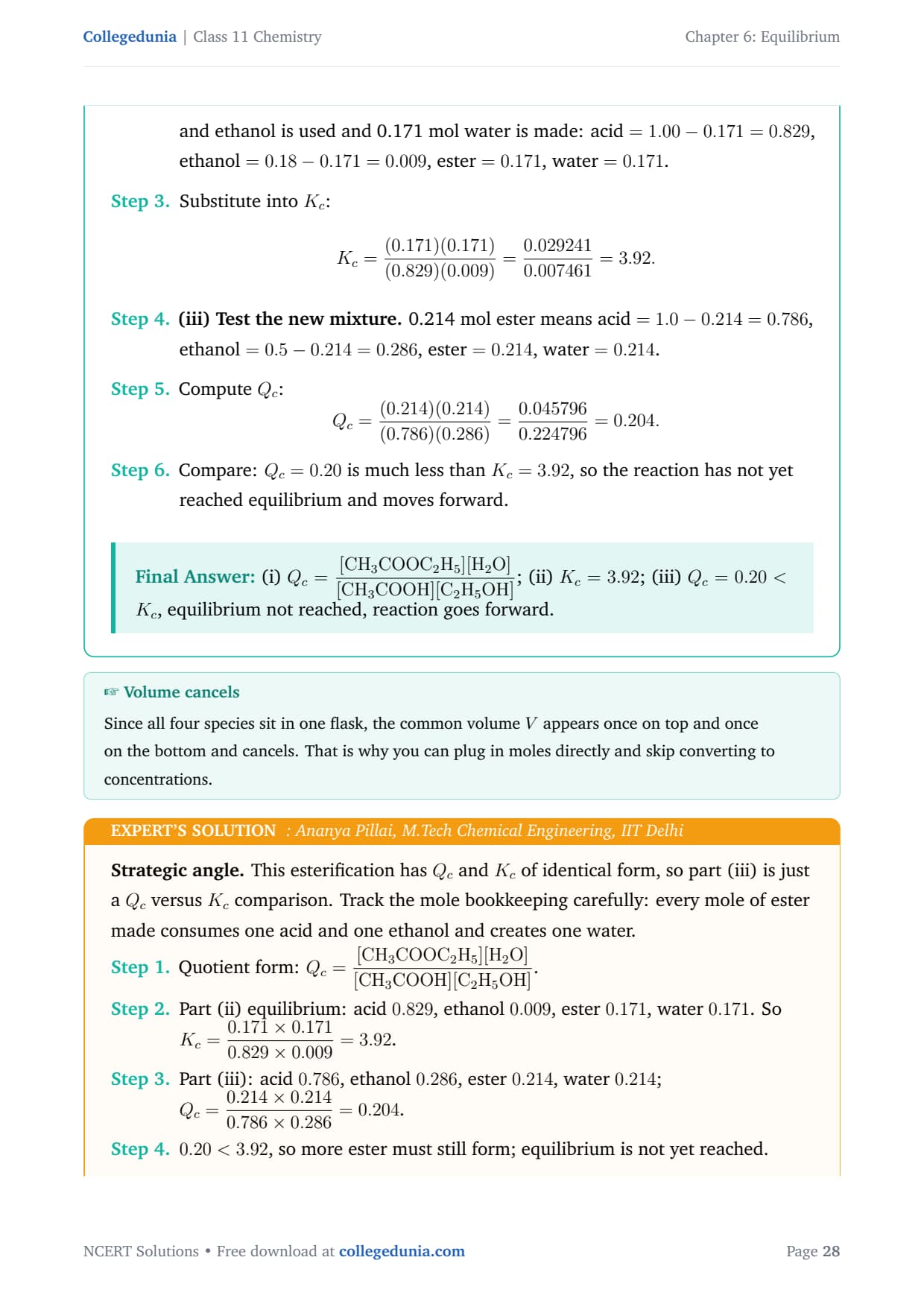
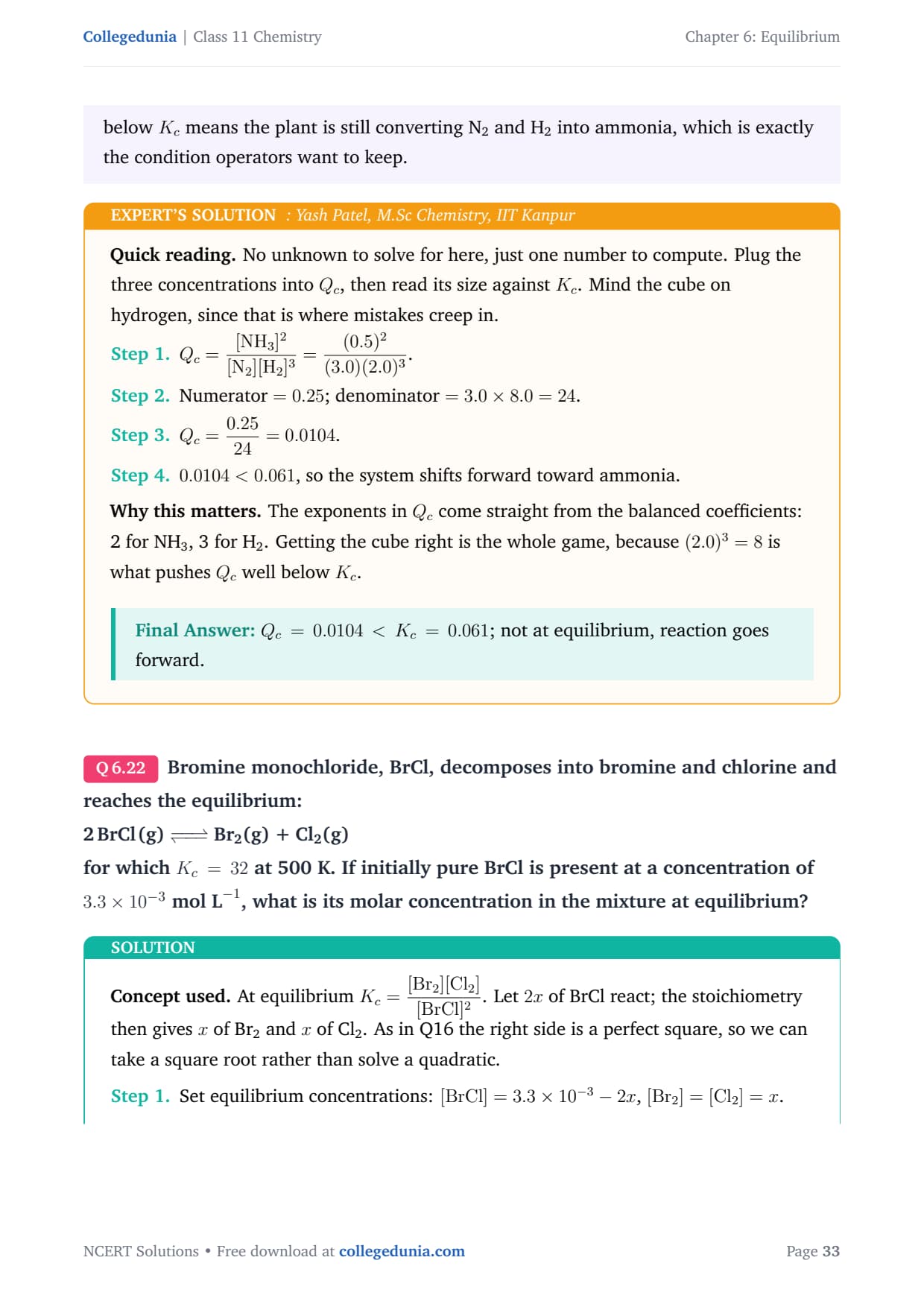
The reaction quotient Q has the same form as the equilibrium constant, but it uses the concentrations at any moment, not just at equilibrium. Comparing Q with Kc tells you which way a reaction must shift to reach balance.
| Condition | Meaning | Direction of shift |
|---|---|---|
| Q < Kc | Too little product | Reaction moves forward. |
| Q = Kc | System is at equilibrium | No net change. |
| Q > Kc | Too much product | Reaction moves backward. |
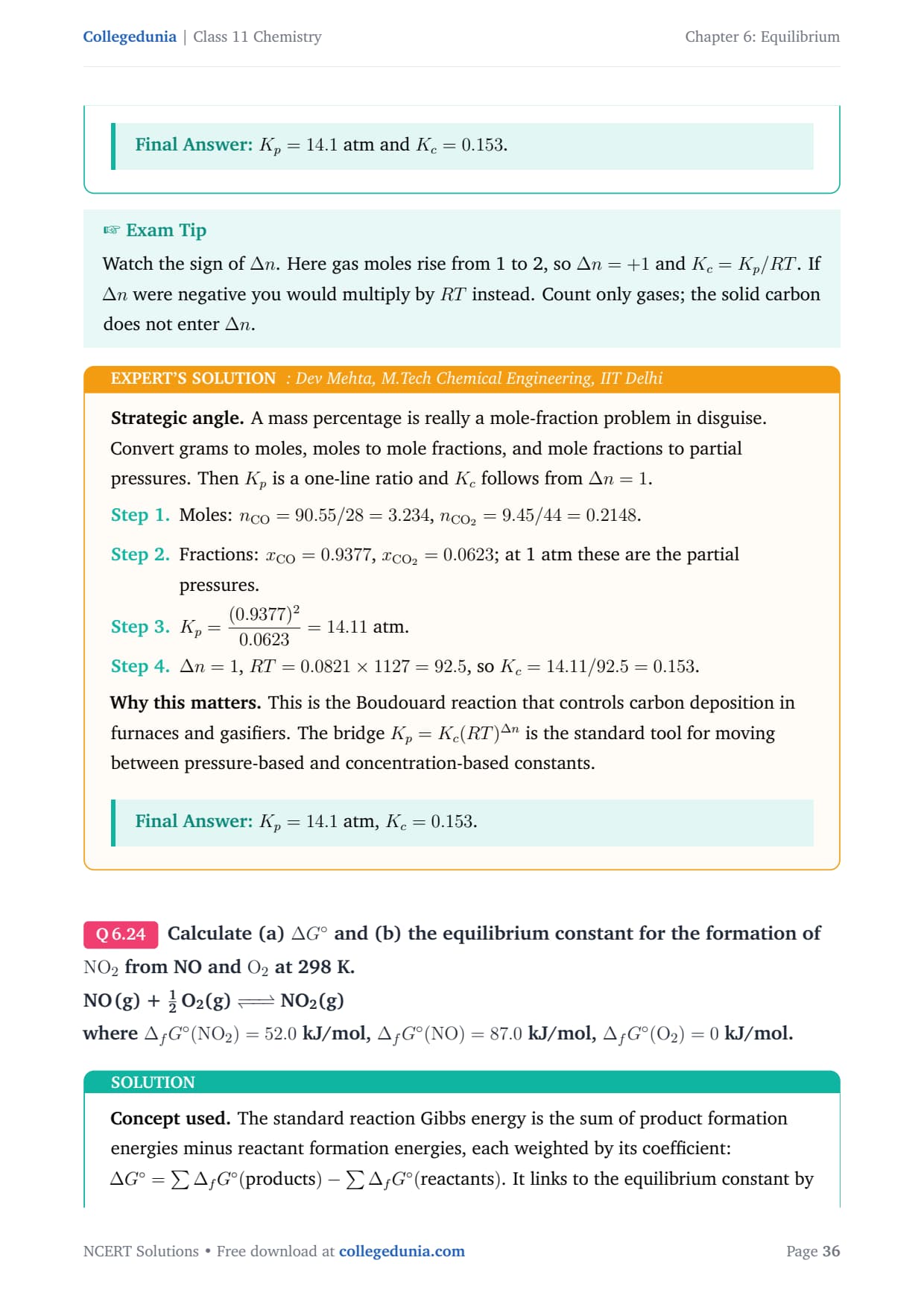
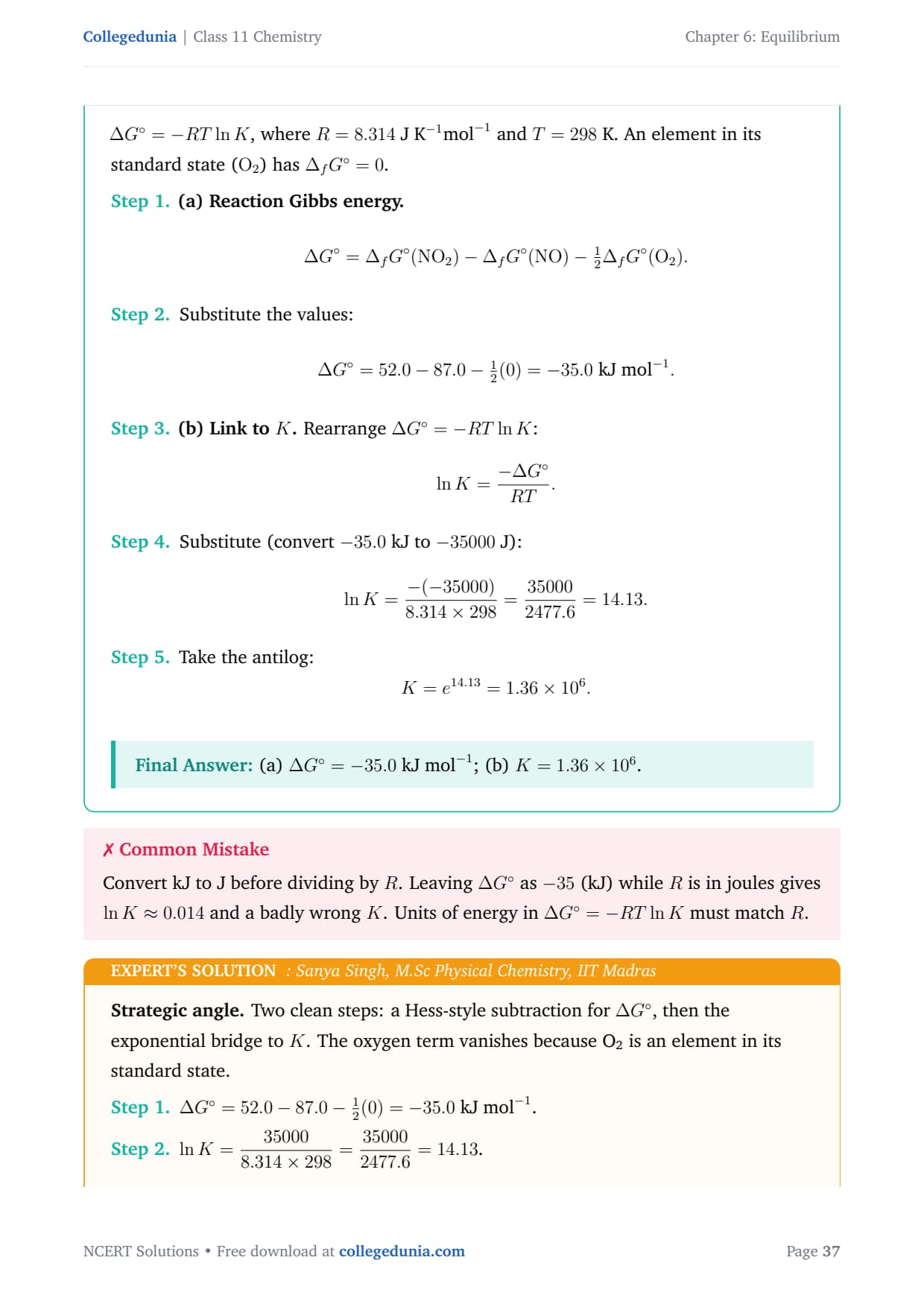
The equilibrium constant also links to Gibbs energy through ΔG = −RT ln K. A negative ΔG gives a K greater than one and a product-favoured reaction. Q equals K only at equilibrium; at every other instant the two differ. Several intext questions ask you to calculate Q and then predict the direction, so practise this comparison until it is quick.
Le Chatelier's Principle and Factors Affecting Equilibrium
Le Chatelier's principle states that when a system at equilibrium is disturbed, it shifts in the direction that reduces the disturbance. This one idea predicts the effect of concentration, pressure and temperature without any calculation, and it is a favourite reasoning question.
- Concentration: adding a reactant pushes the equilibrium toward the products.
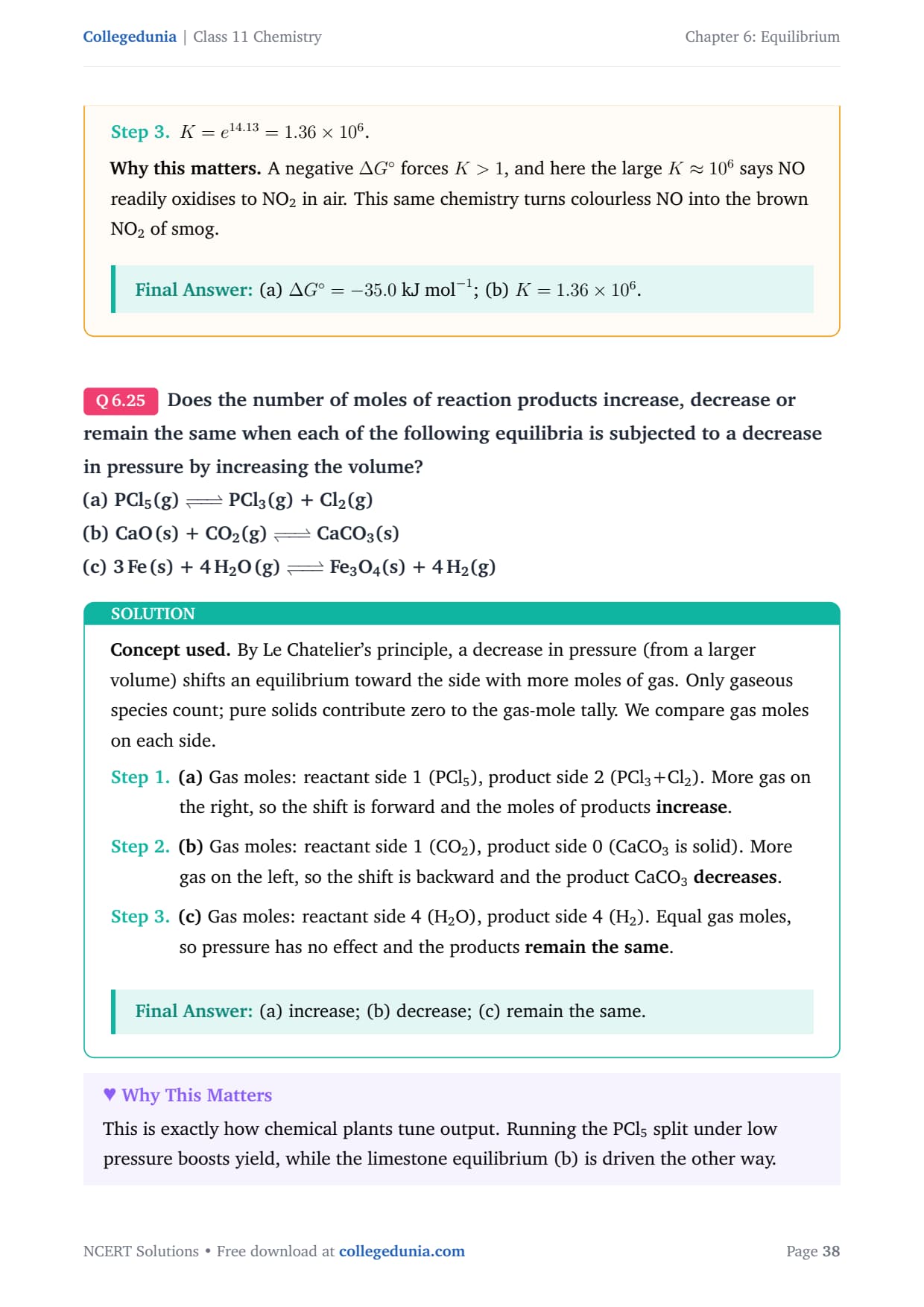
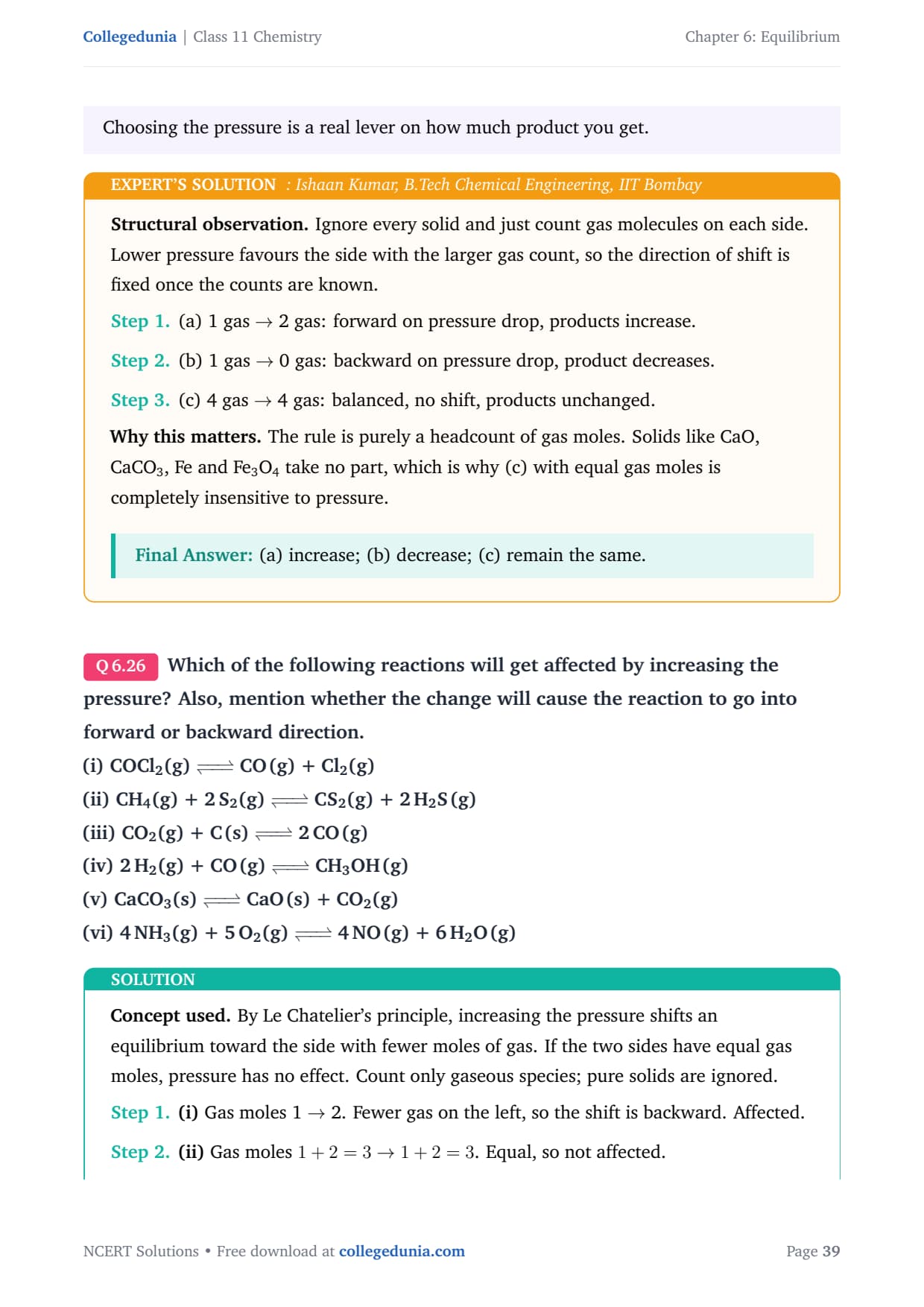
- Pressure: raising pressure shifts the equilibrium to the side with fewer moles of gas.
- Temperature: heating favours the endothermic direction; cooling favours the exothermic one.
- Catalyst: speeds up both directions equally, so it changes the rate but not the position.
In the Haber process N2 + 3H2 ⇌ 2NH3, high pressure and moderate temperature give the best ammonia yield. A catalyst never changes the value of the equilibrium constant. Only a change in temperature changes K; concentration and pressure only shift the position. Watch the sign of the enthalpy before you decide which way heat moves the equilibrium.
Ionic Equilibrium: Arrhenius, Bronsted-Lowry and Lewis Acids and Bases
When acids, bases and salts dissolve in water, they set up an ionic equilibrium between the ions and the un-ionised molecules. Three theories define acids and bases, each wider than the last, and the board often asks you to compare them.
| Theory | Acid | Base |
|---|---|---|
| Arrhenius | Gives H+ in water | Gives OH- in water |
| Bronsted-Lowry | Proton (H+) donor | Proton acceptor |
| Lewis | Electron-pair acceptor | Electron-pair donor |
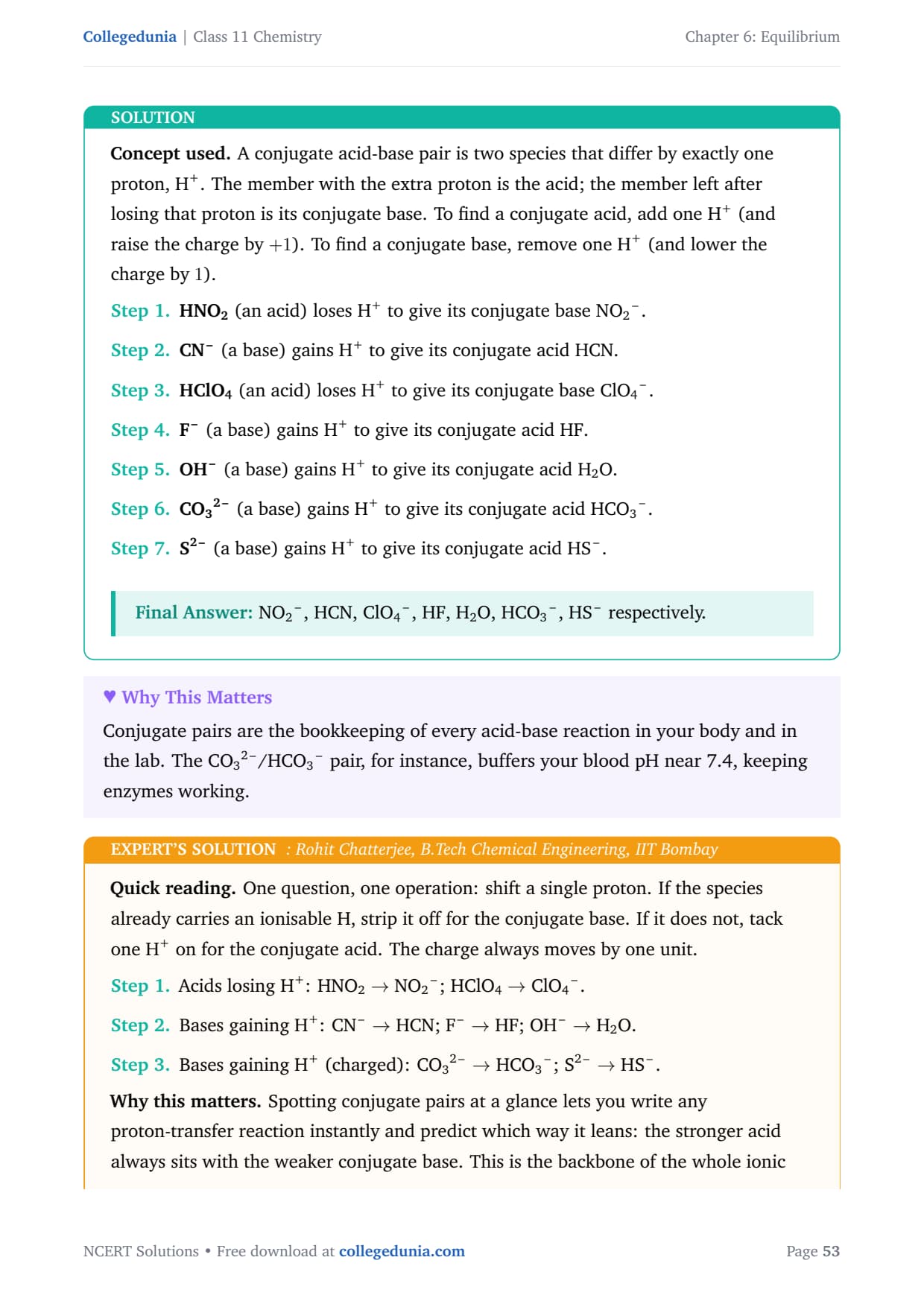
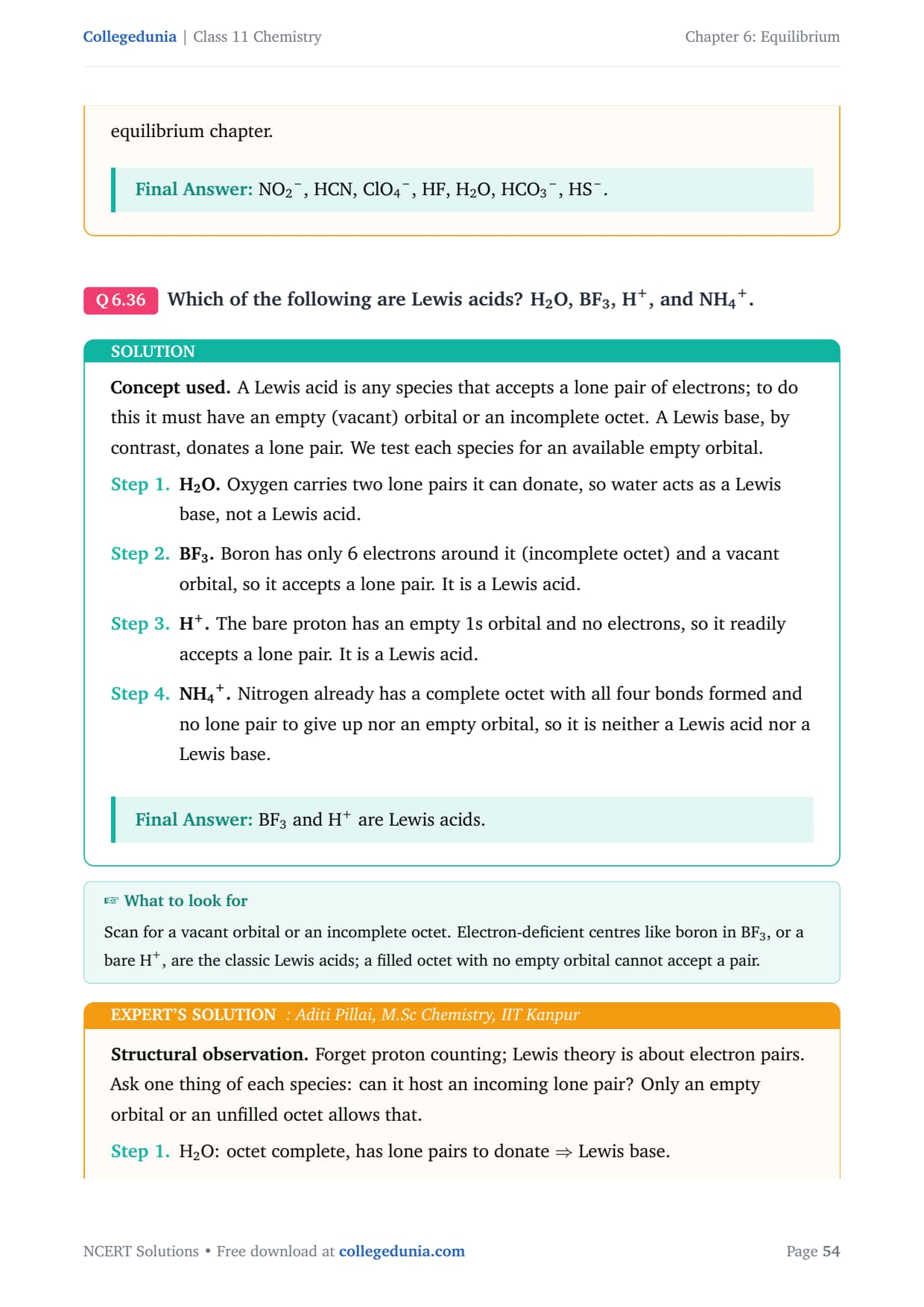
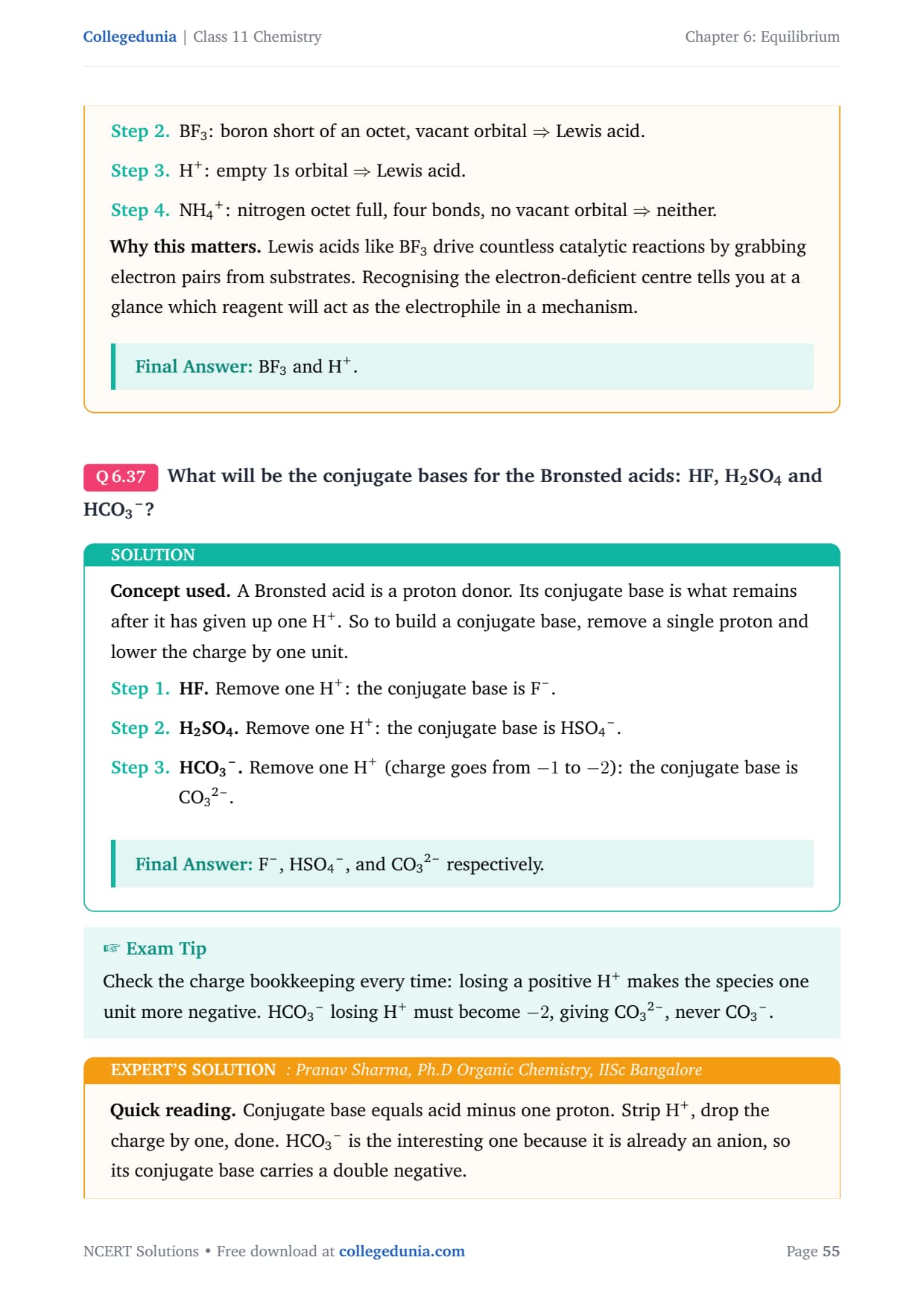
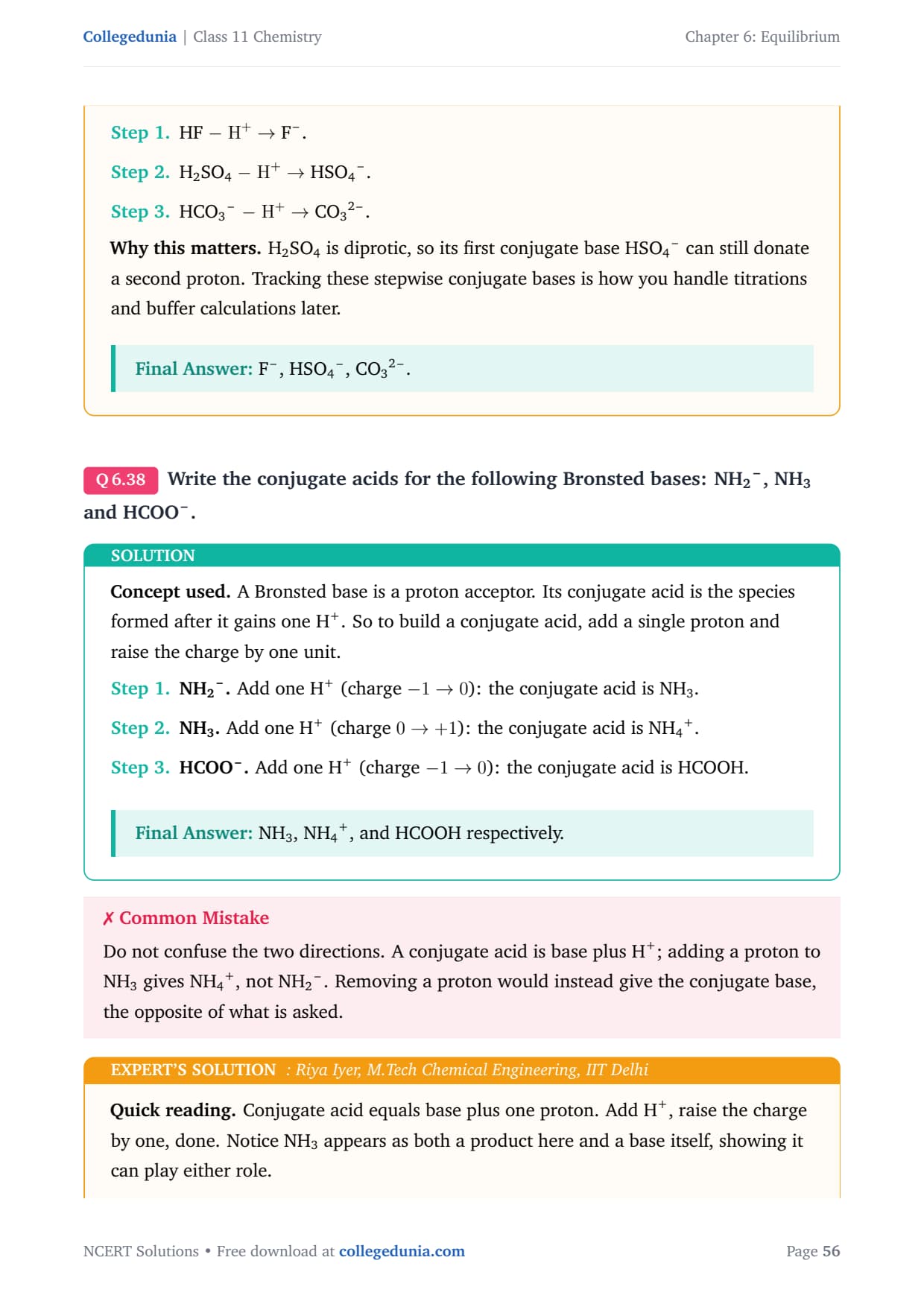
The Bronsted-Lowry idea introduces conjugate acid-base pairs, which differ by a single proton. For example, water can act as both an acid and a base, so it is amphoteric. Every Lewis base has a lone pair to donate, and every Lewis acid has an empty orbital to accept it. BF3 is a classic Lewis acid even though it has no hydrogen to give.
Ionization of Acids and Bases and the pH Scale
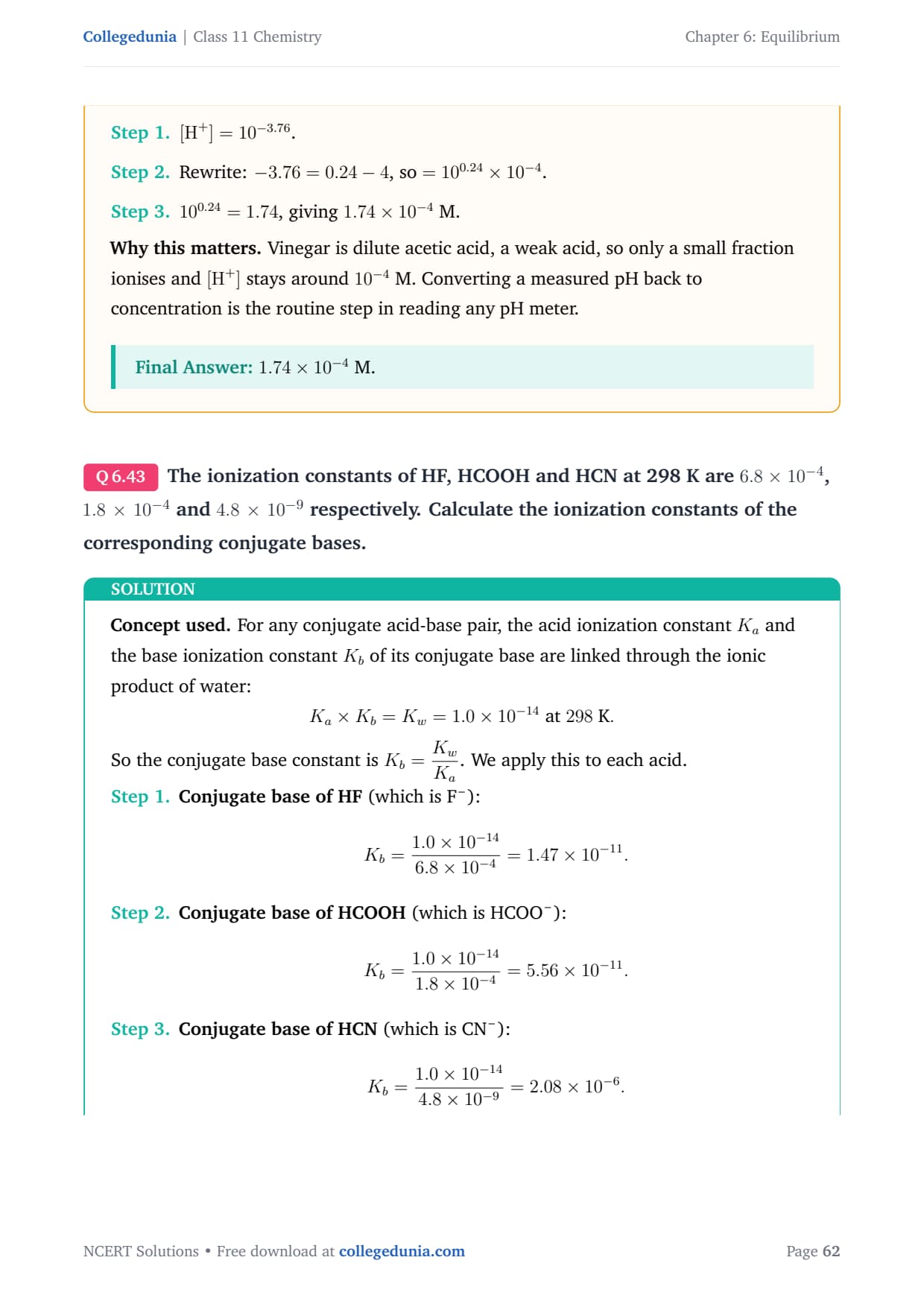
Strong acids and bases ionize almost completely, while weak ones only partly ionize and set up an equilibrium. The ionization constant, Ka for an acid or Kb for a base, measures this strength. The pH scale turns the hydrogen-ion concentration into an easy number.
- pH: pH = −log[H+], so a lower pH means a more acidic solution.
- Ionic product of water: Kw = [H+][OH-] = 1.0 × 10⁻¹⁴ at 25°C.
- Neutral point: pH = 7 at 25°C, where [H+] equals [OH-].
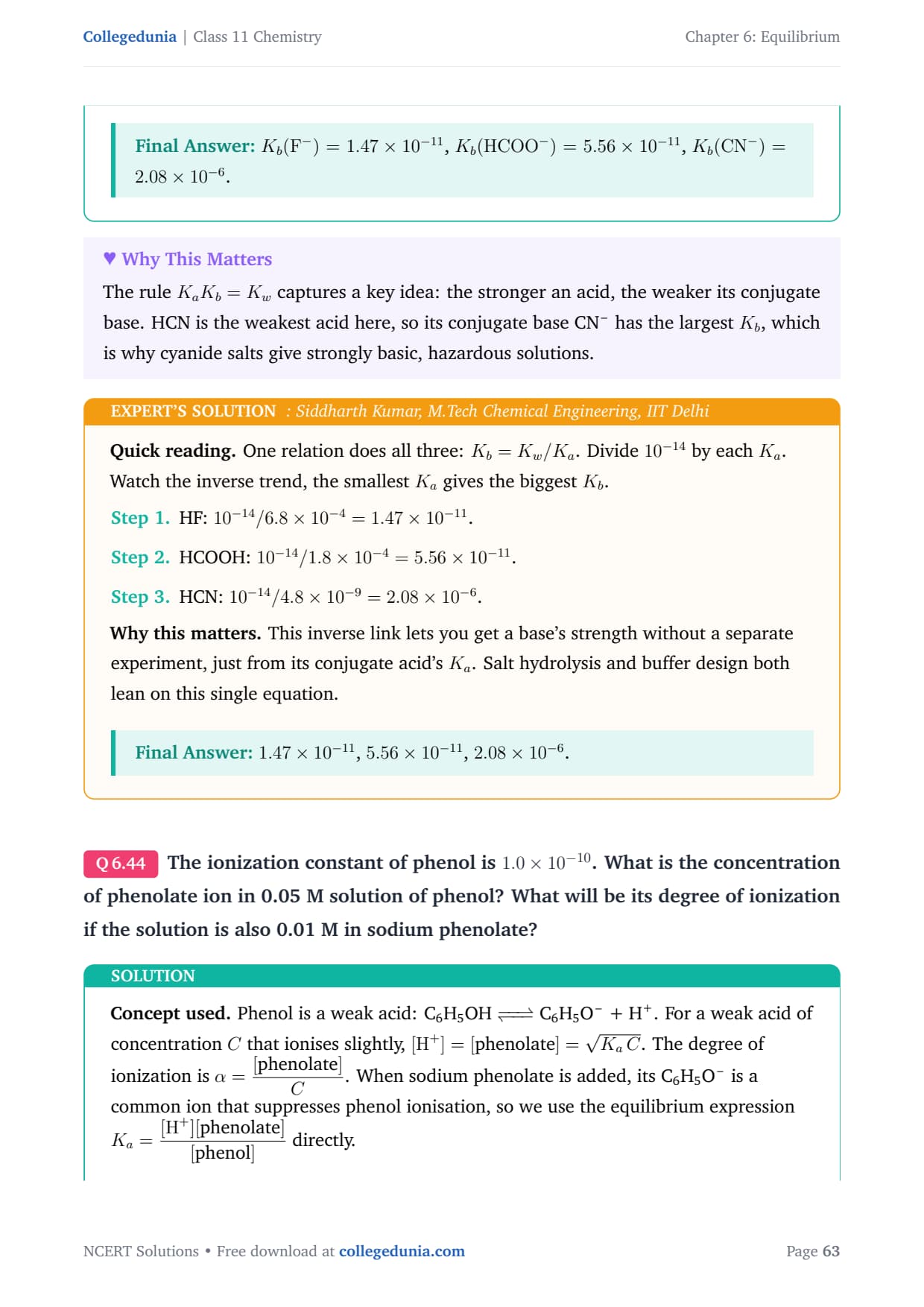
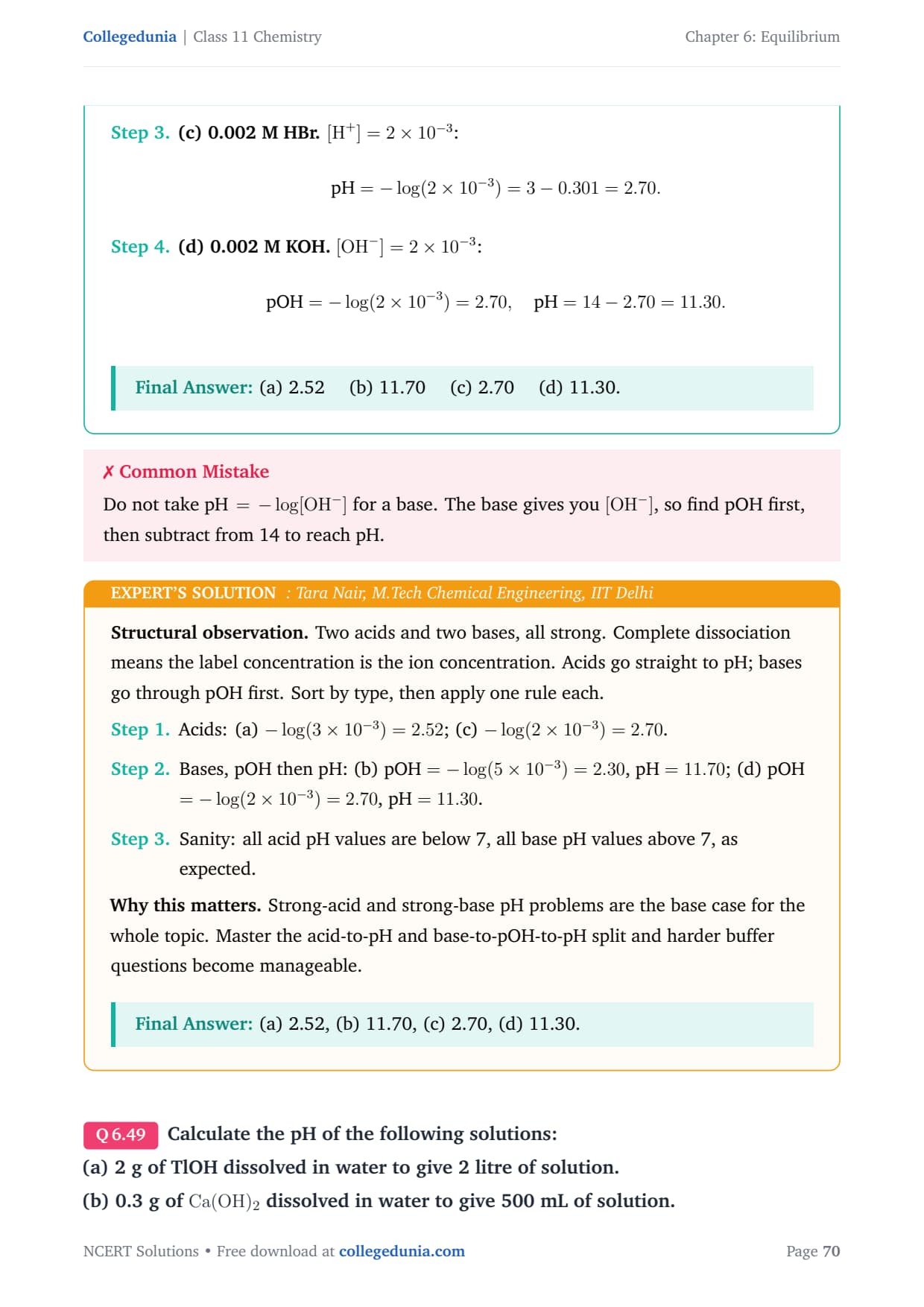
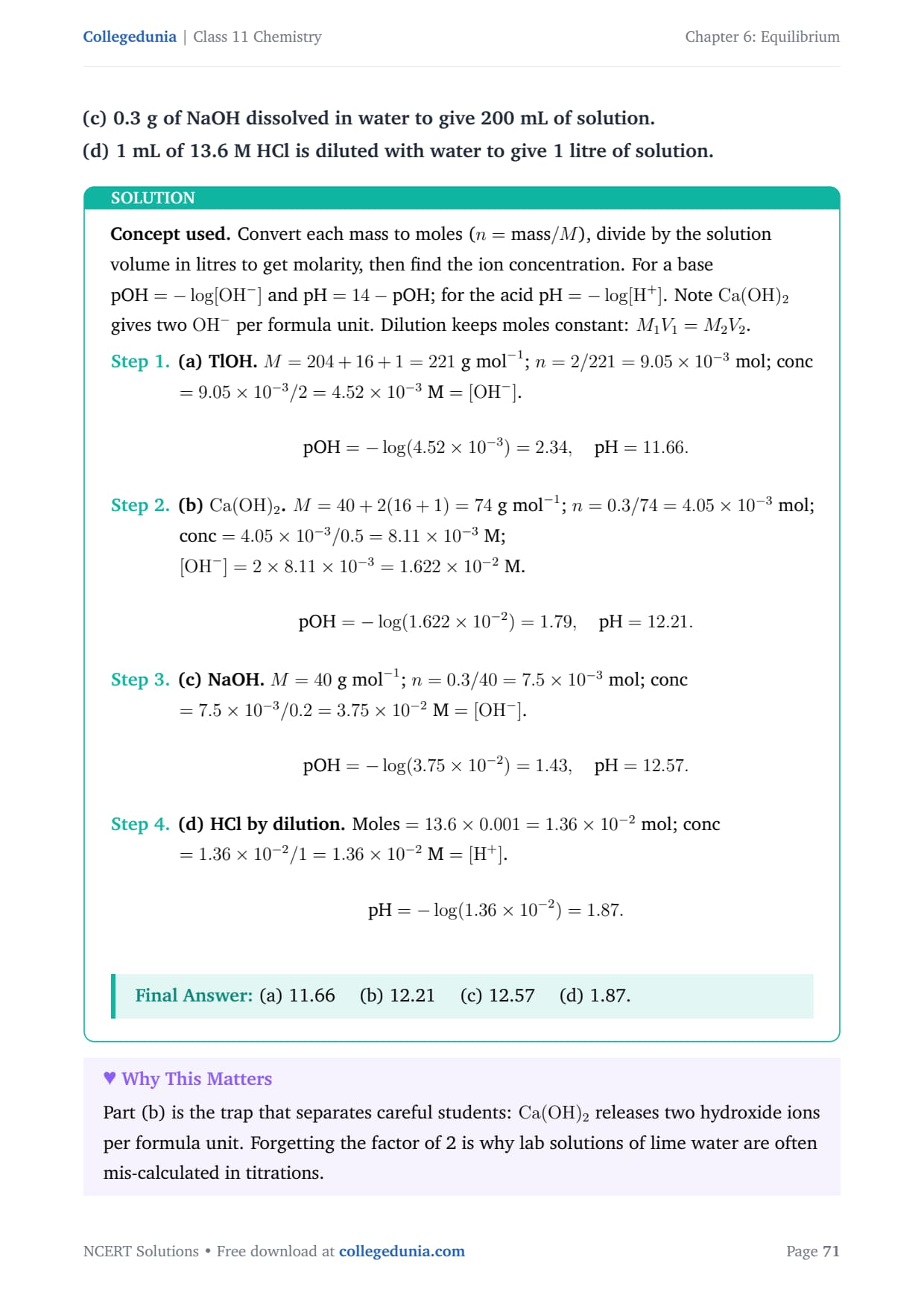
For a weak acid the degree of ionization follows the Ostwald dilution law, and dilution increases the fraction that ionizes. pH plus pOH always adds up to 14 at 25°C. A strong acid such as HCl gives its full concentration of H+ ions, so its pH is found directly. Salts of weak acids or weak bases undergo hydrolysis, which shifts the pH away from 7.
Buffer Solutions, Common Ion Effect and Solubility Product Ksp
The last part of the chapter applies ionic equilibrium to three high-scoring ideas. A buffer solution resists a change in pH when small amounts of acid or base are added. The common ion effect and the solubility product explain how salts dissolve and precipitate.
| Concept | What it means | Key relation |
|---|---|---|
| Buffer solution | Weak acid plus its salt, or weak base plus its salt | pH = pKa + log([salt] ÷ [acid]) |
| Common ion effect | Adding a shared ion suppresses ionization | Shifts equilibrium to the un-ionised side |
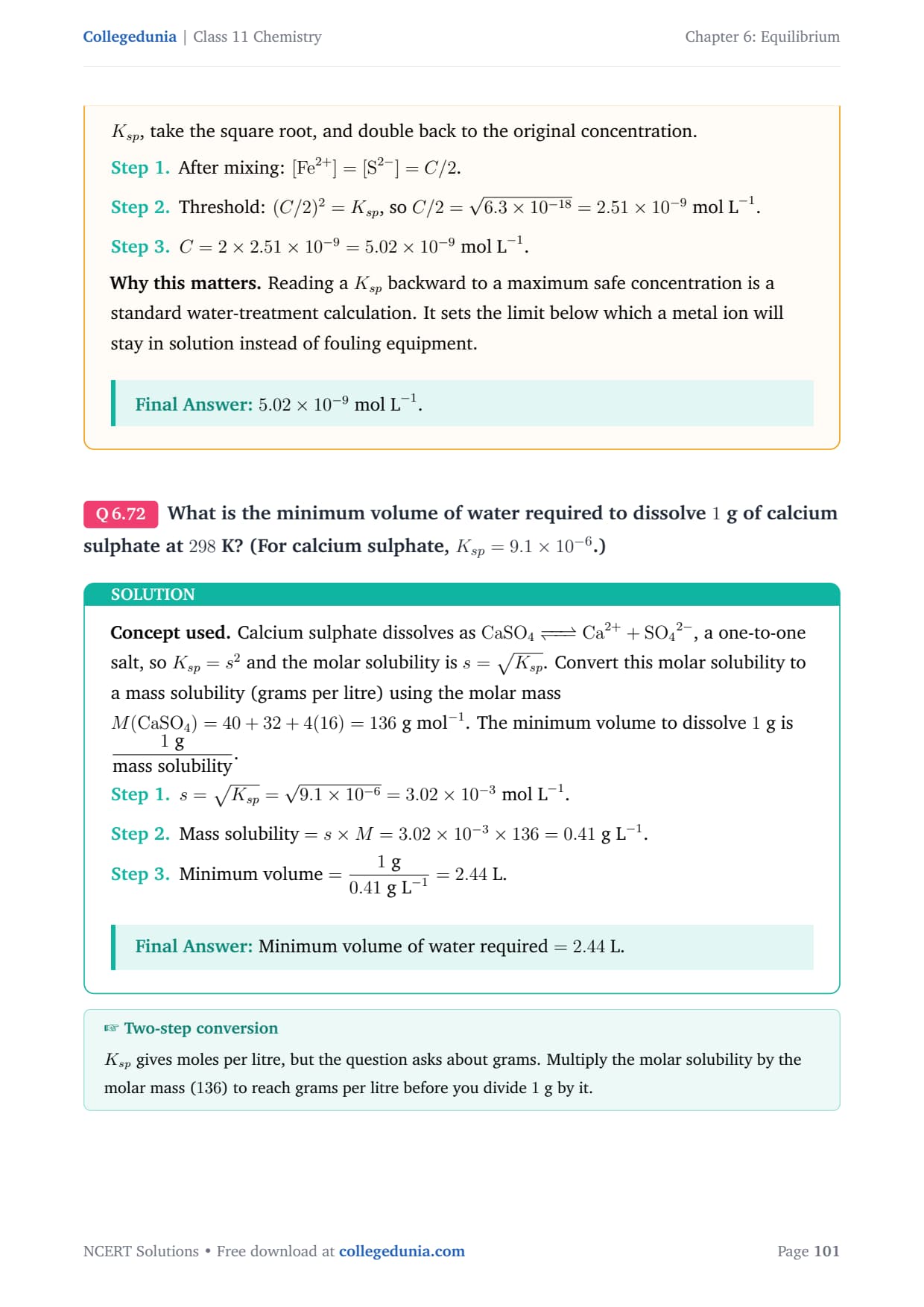
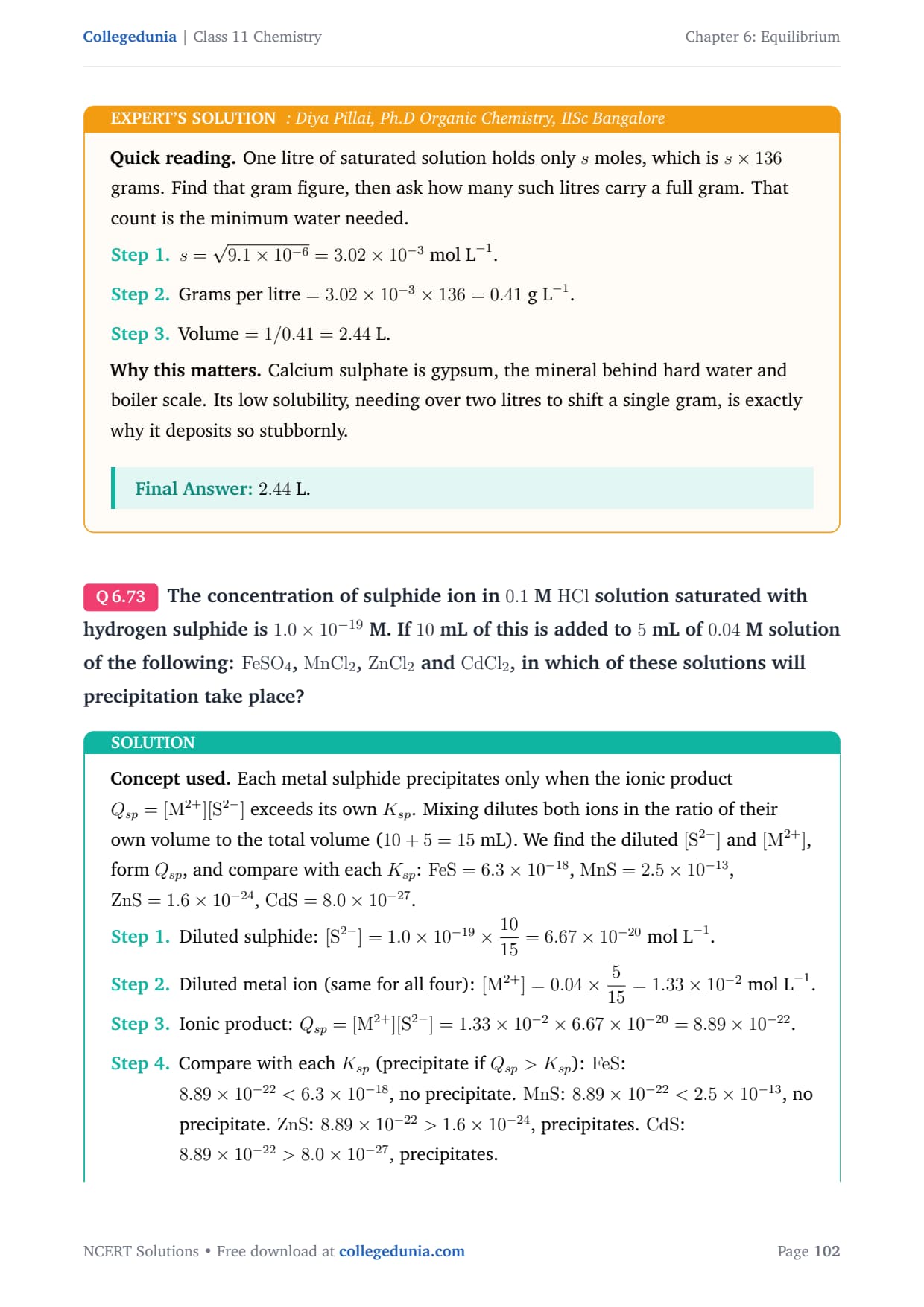
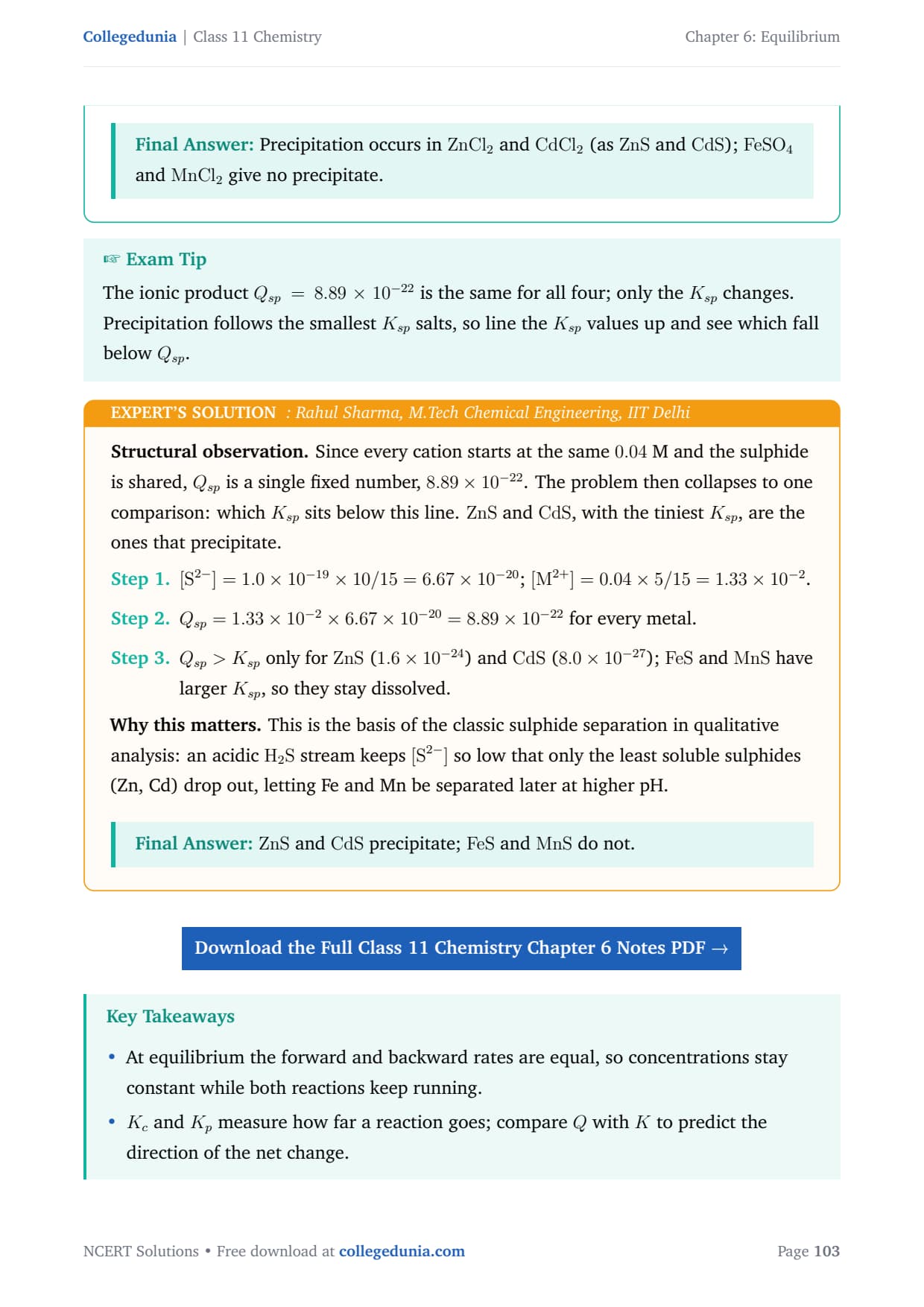
| Solubility product | Product of ion concentrations in a saturated solution | Ksp = [A+][B-] for AB |
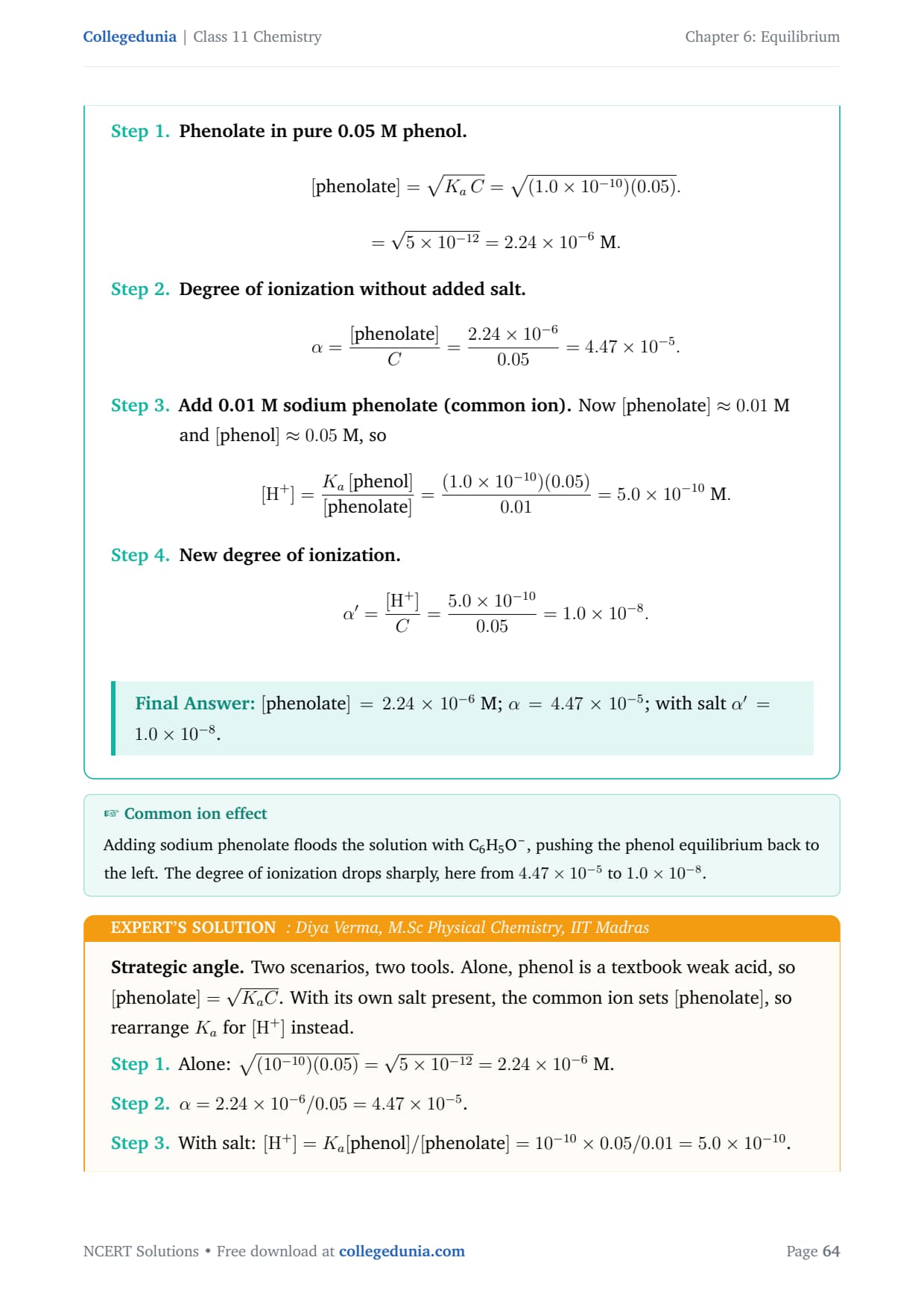
The buffer formula above is the Henderson-Hasselbalch equation, and it gives the pH of an acidic buffer in one step. A precipitate forms only when the ionic product exceeds Ksp. The common ion effect is what lowers the solubility of a salt when a soluble salt sharing one of its ions is added. These three ideas together carry several of the toughest numericals in the exercise.
Equilibrium Exercise-wise Breakdown
The NCERT back exercise has 73 questions, a mix of numerical and reasoning. The intext questions test the same ideas in shorter form. The table below maps the question blocks to their topics so you can plan your practice.
| Question block | What it tests |
|---|---|
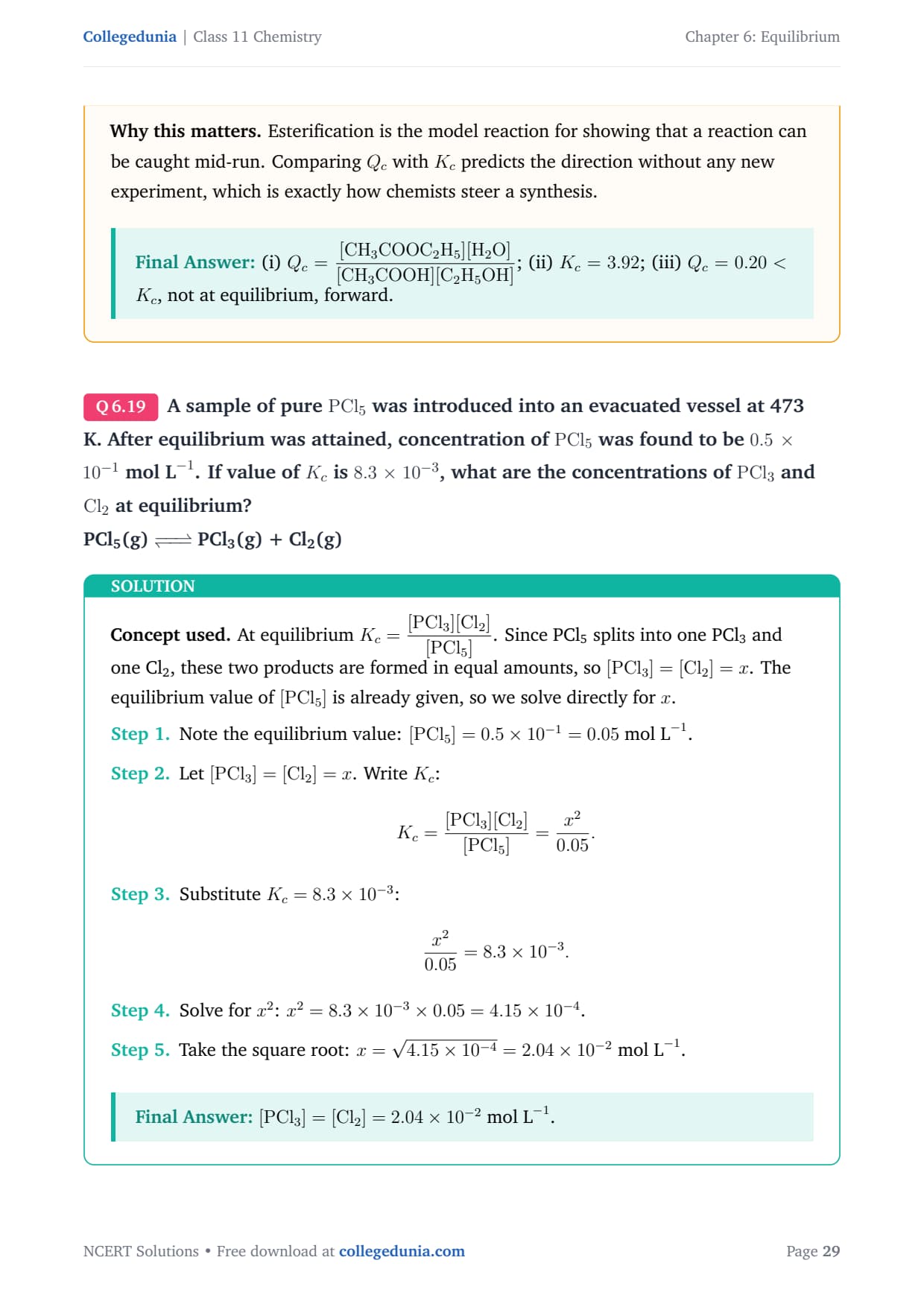
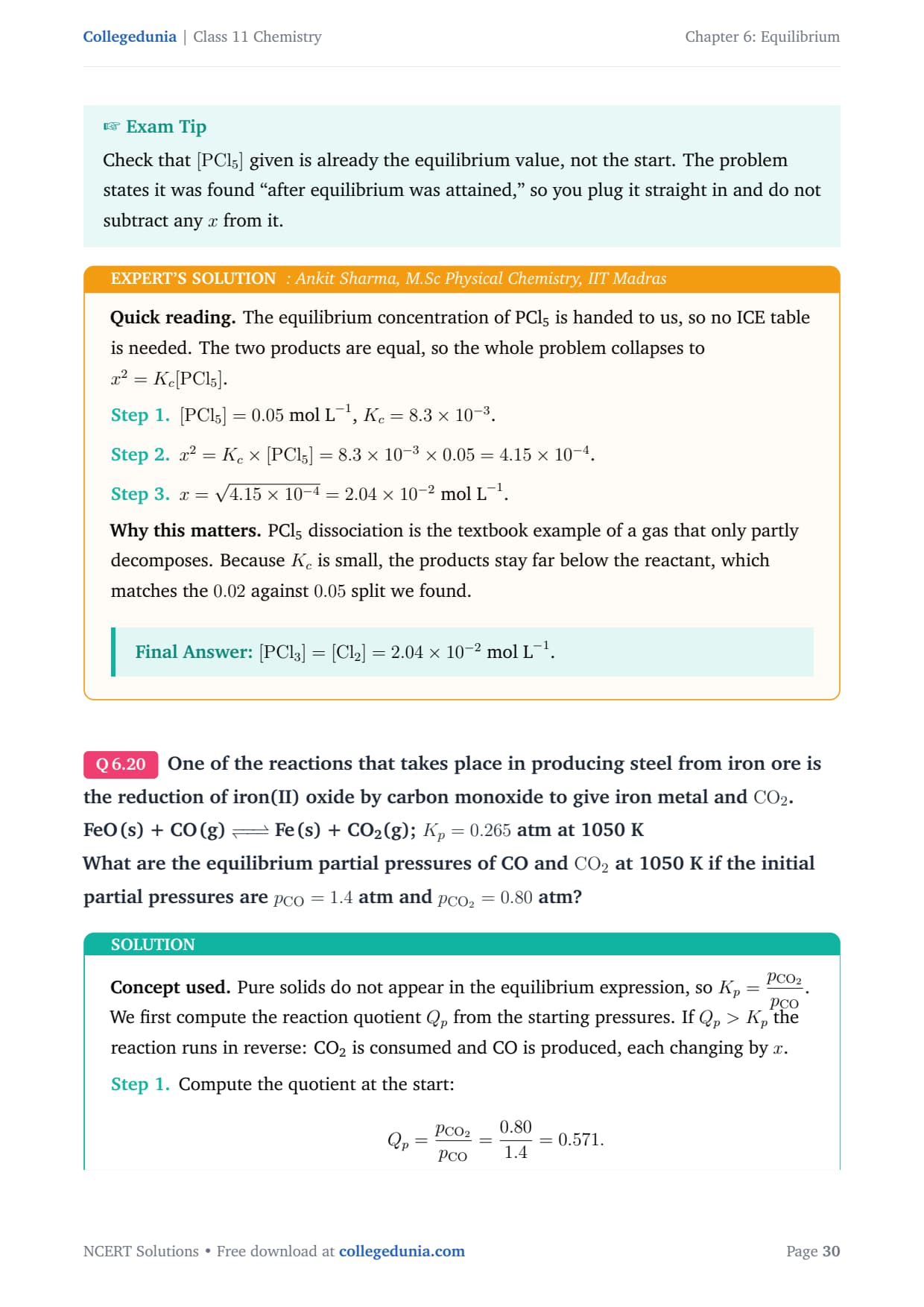
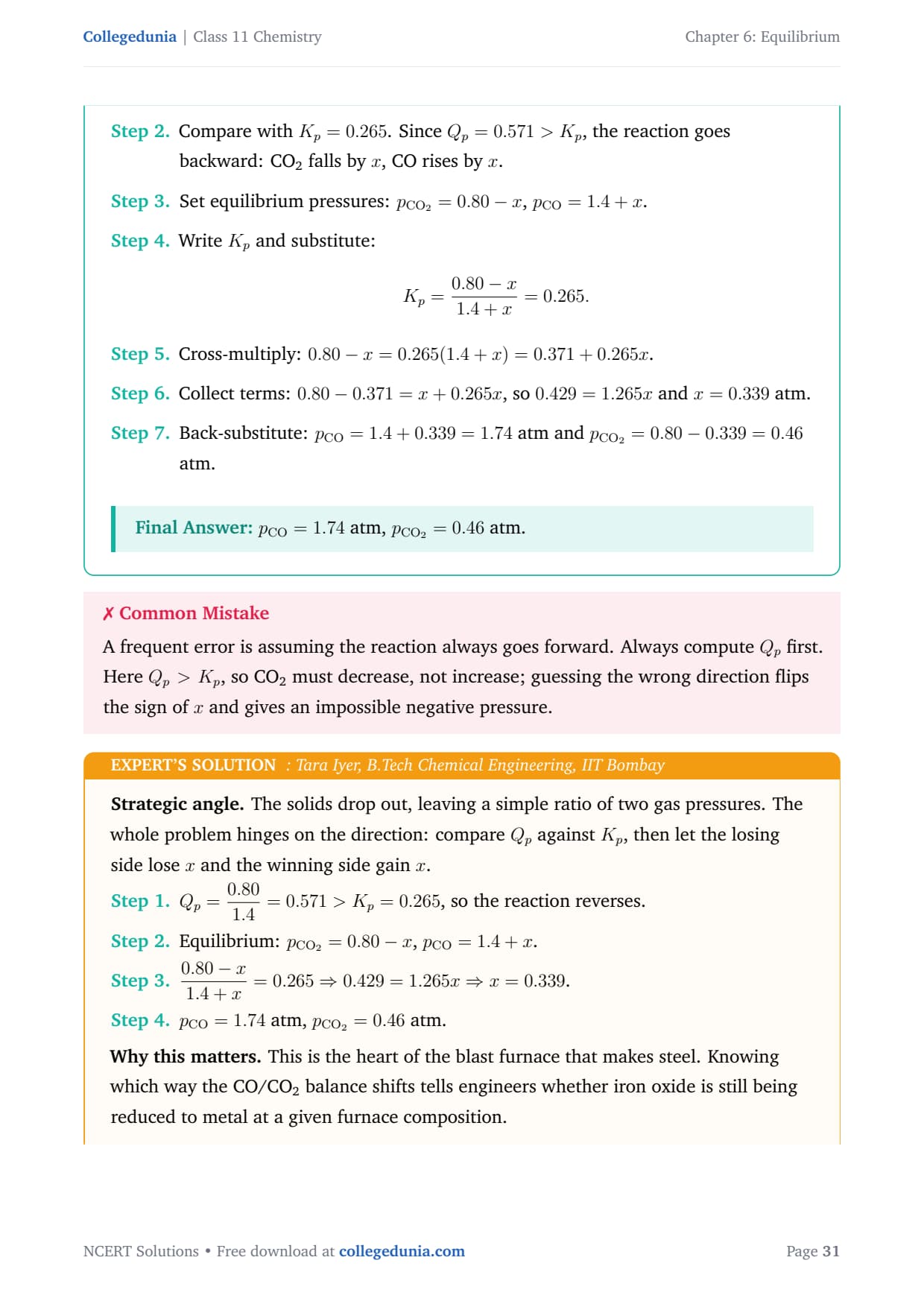
| Q 6.1 to 6.20 | Equilibrium constant, Kc and Kp expressions, and their calculation. |
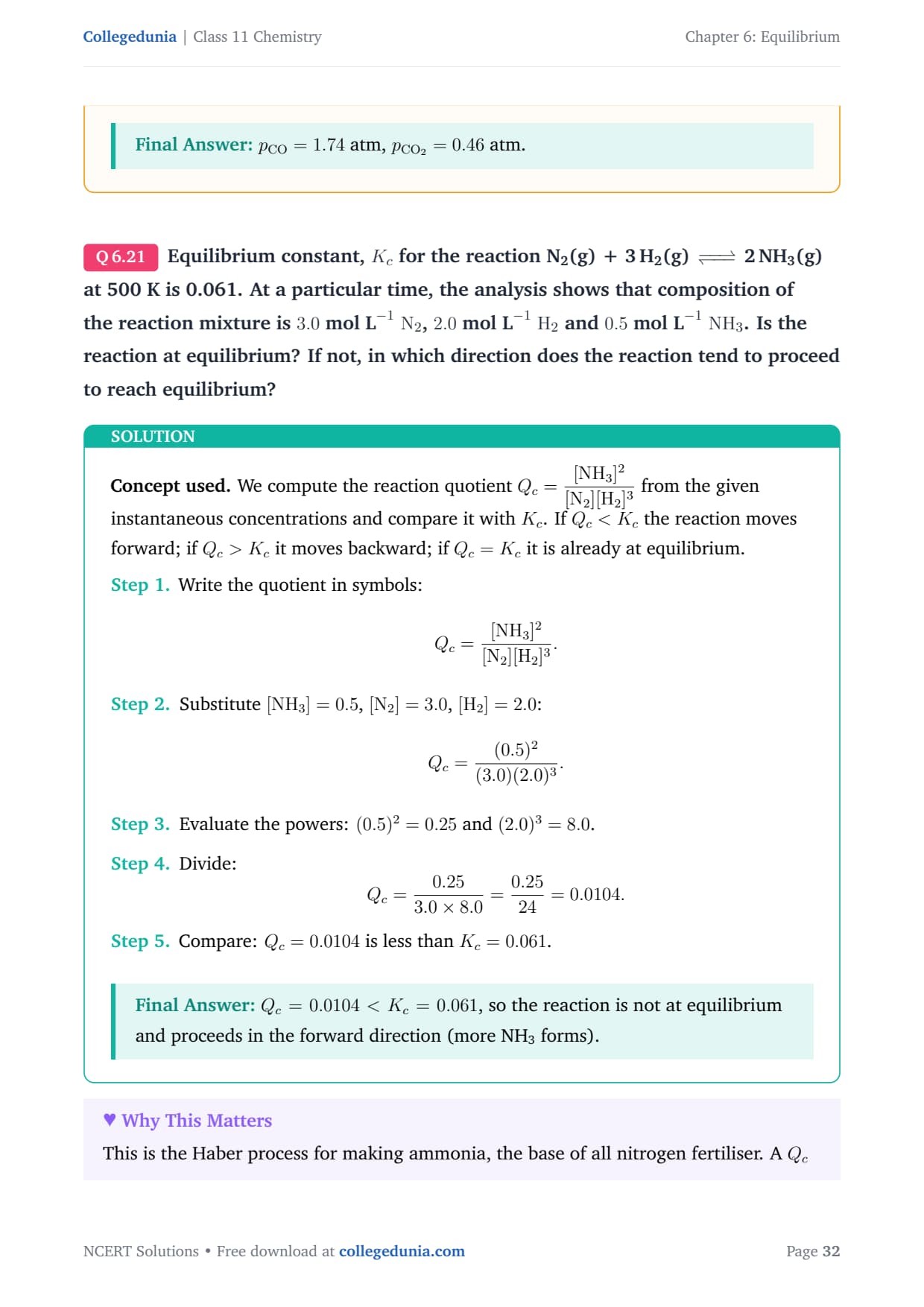
| Q 6.21 to 6.40 | Reaction quotient, direction of reaction, and Le Chatelier's principle. |
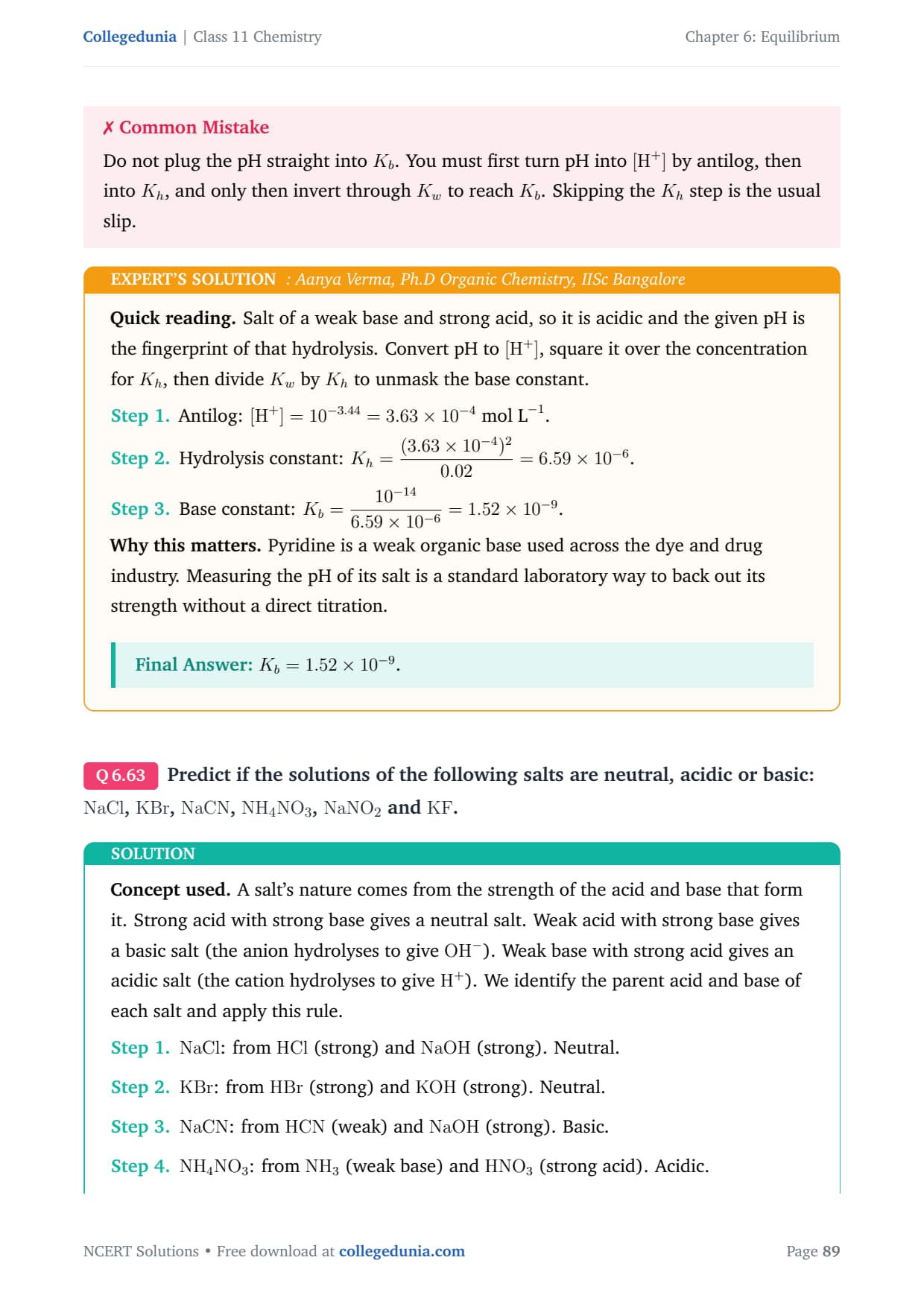
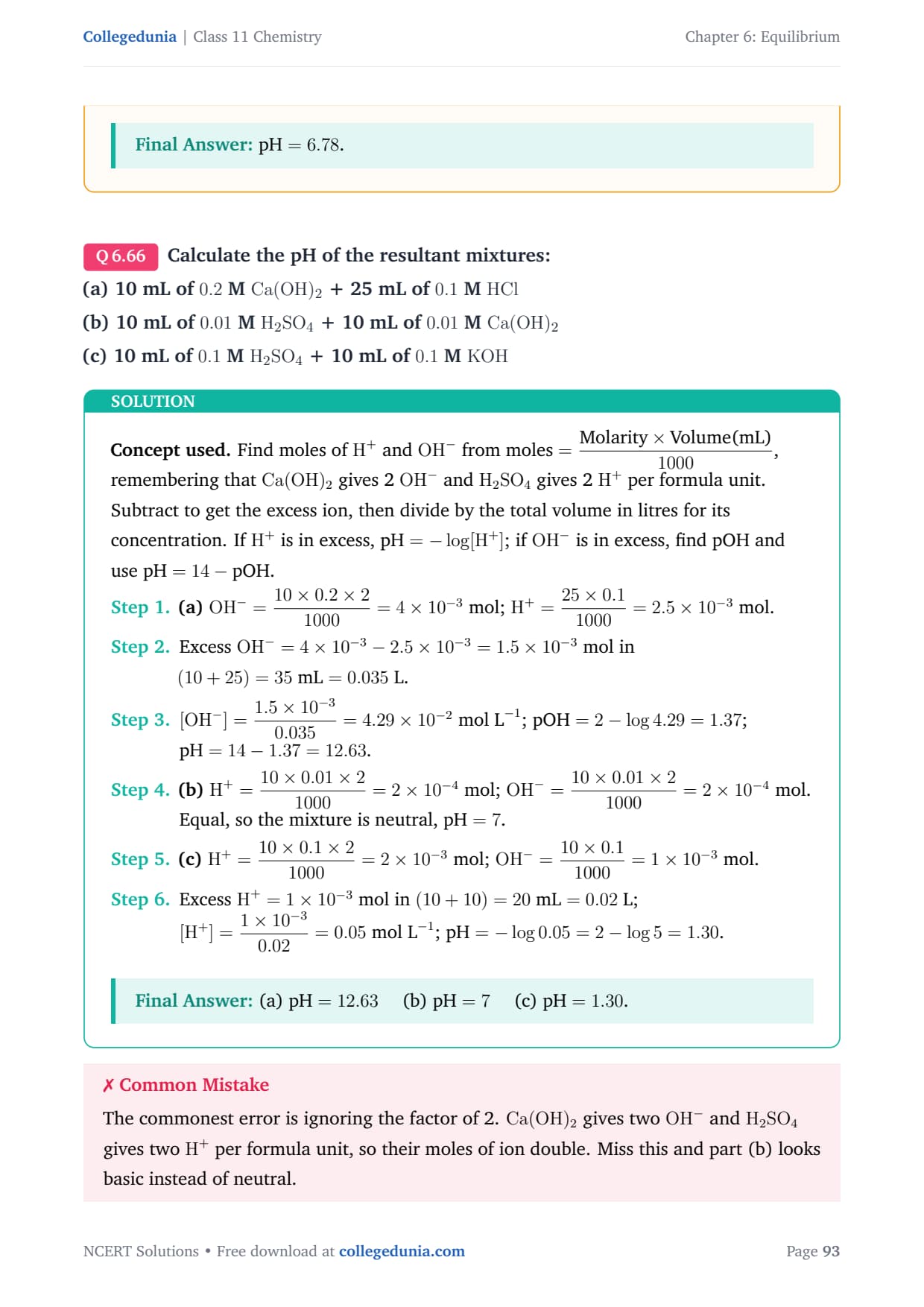
| Q 6.41 to 6.55 | Acids, bases, ionization constants, and pH calculations. |
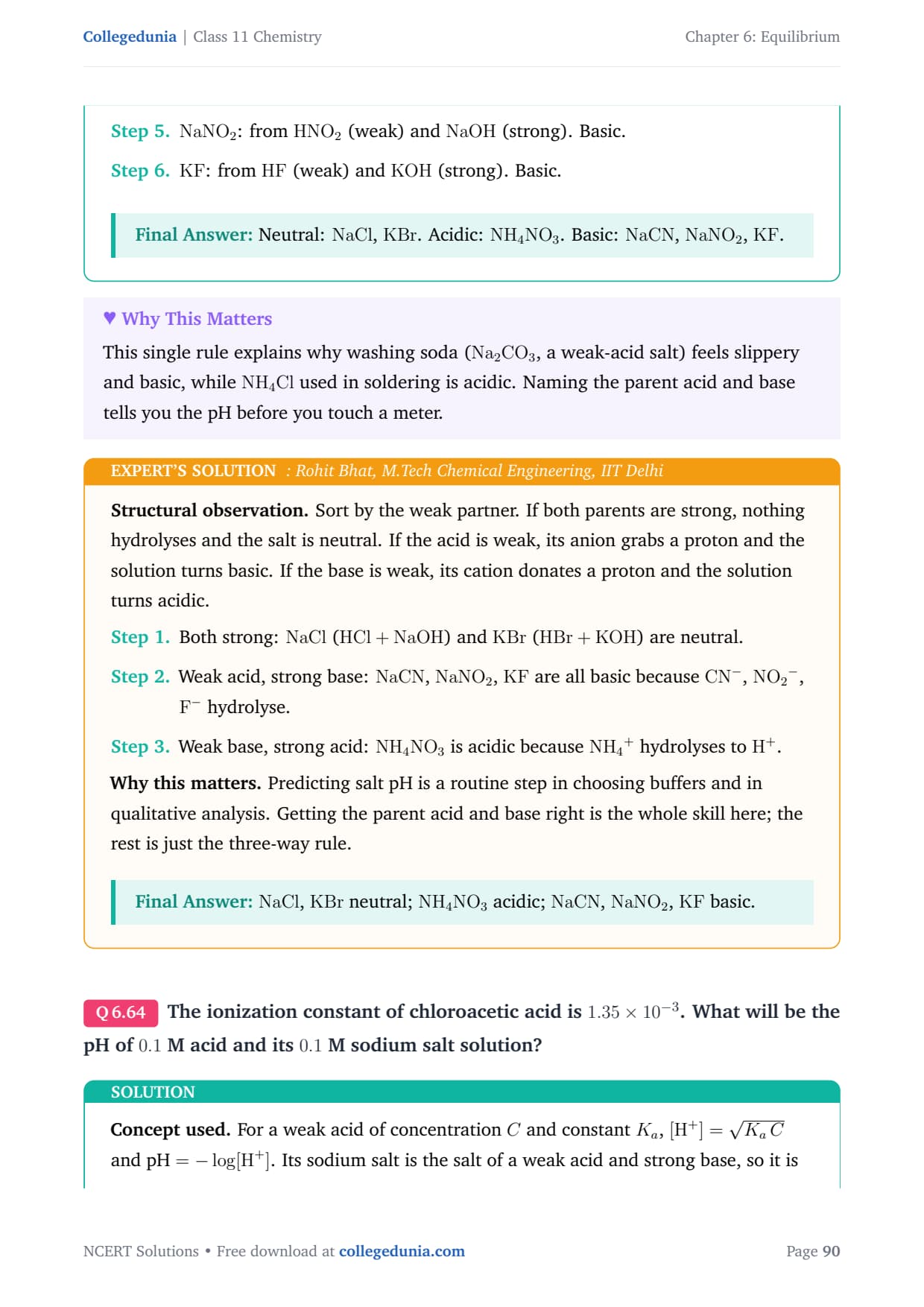
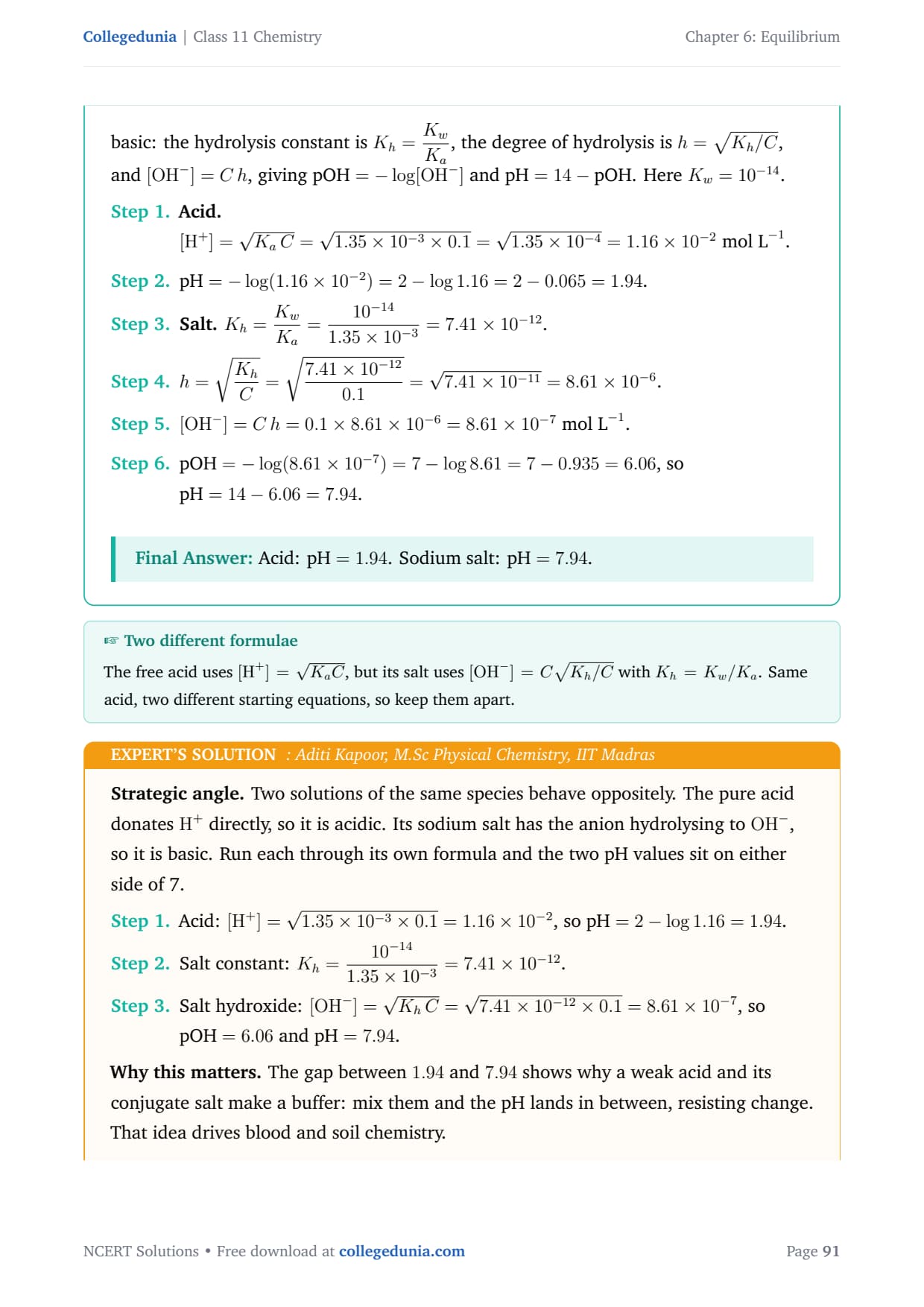
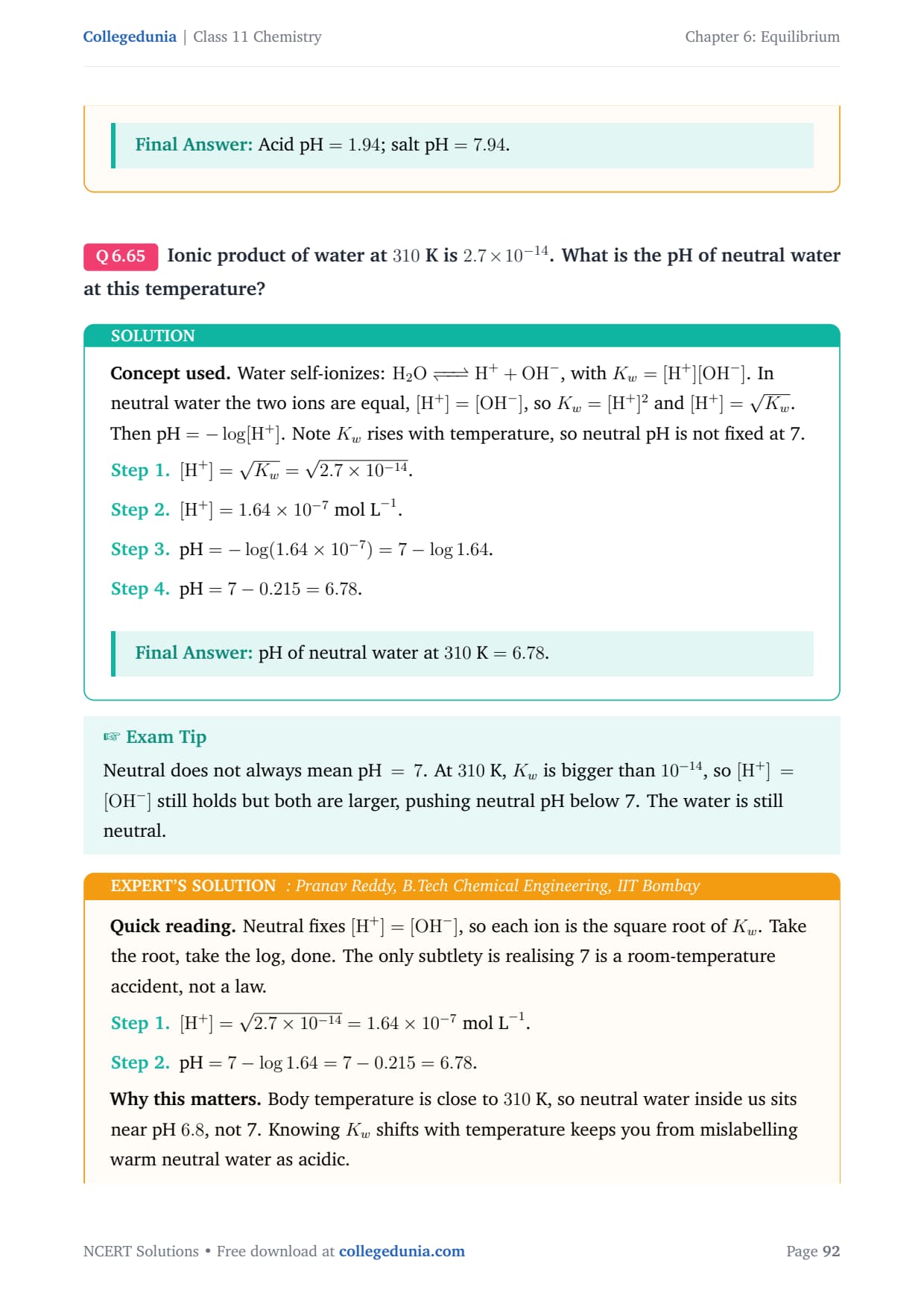
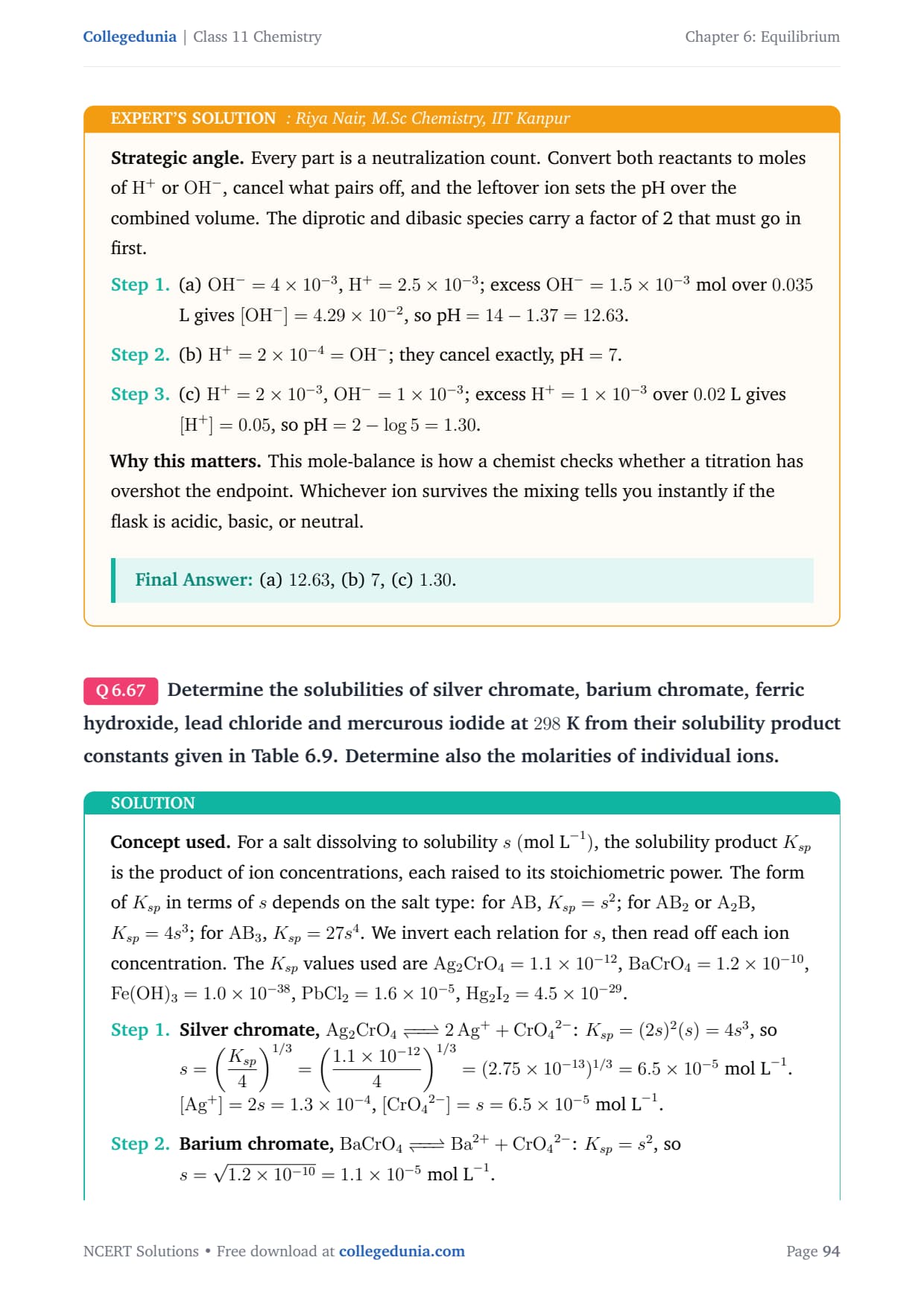
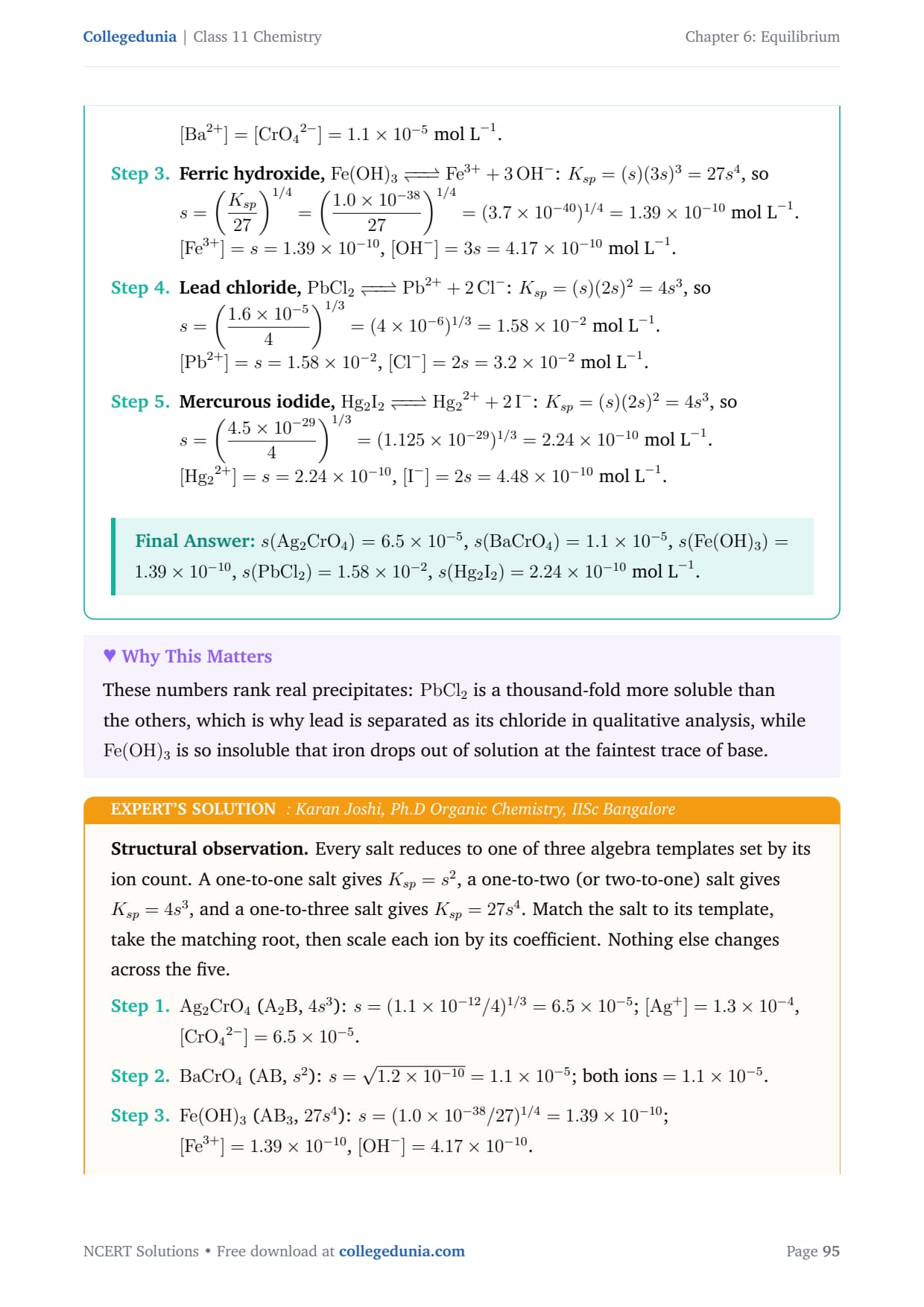
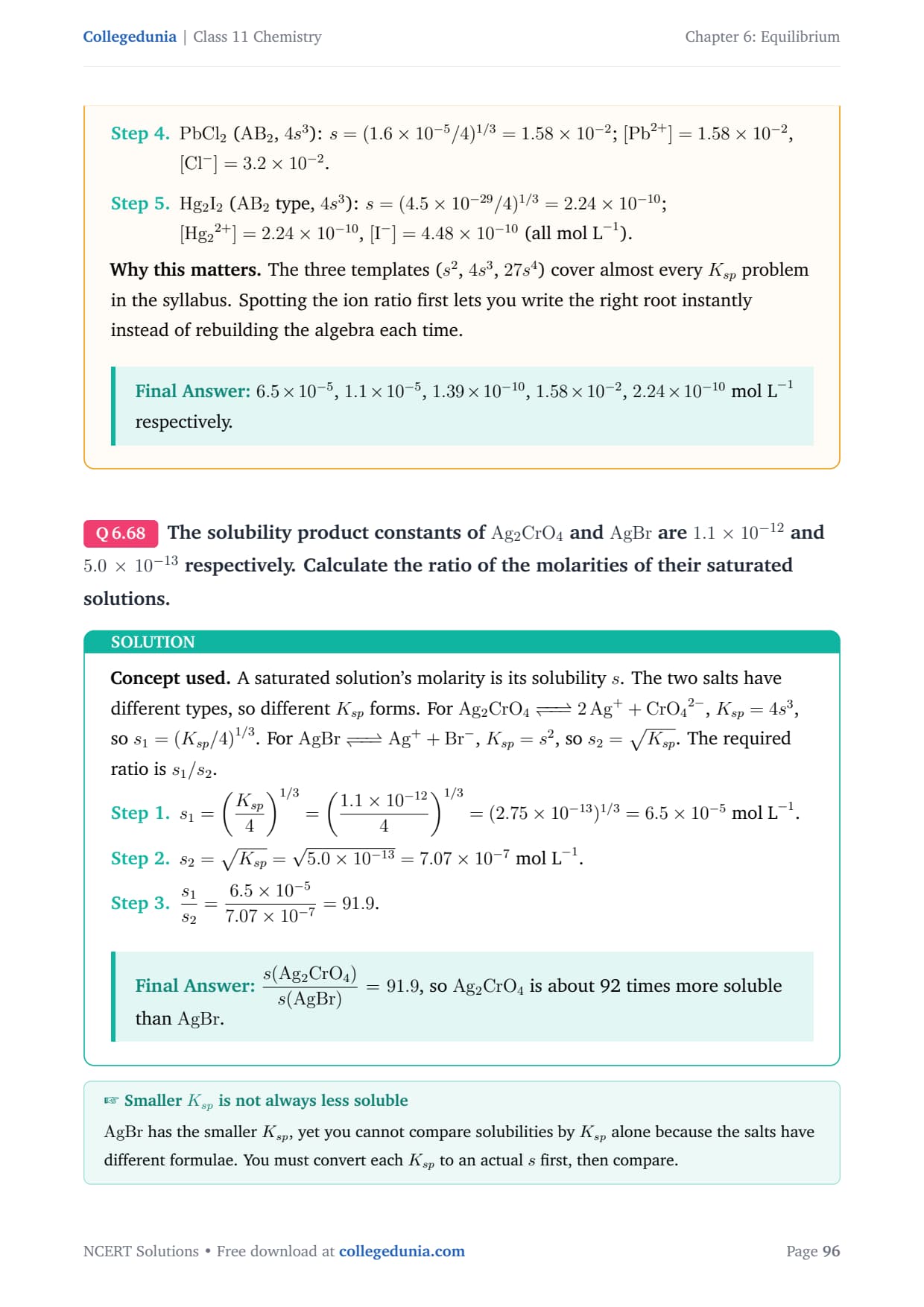
| Q 6.56 to 6.73 | Buffers, common ion effect, hydrolysis, and solubility product. |
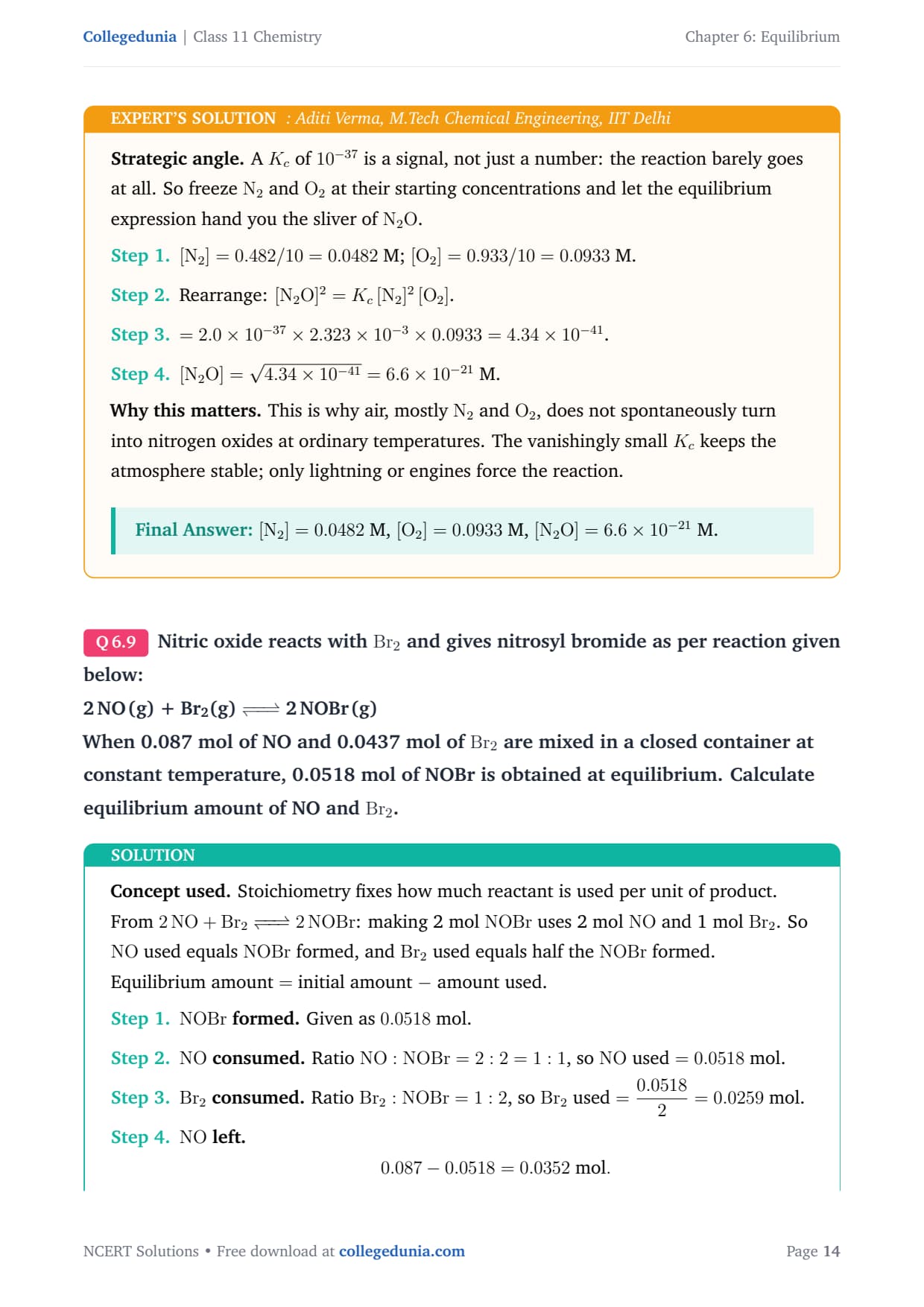
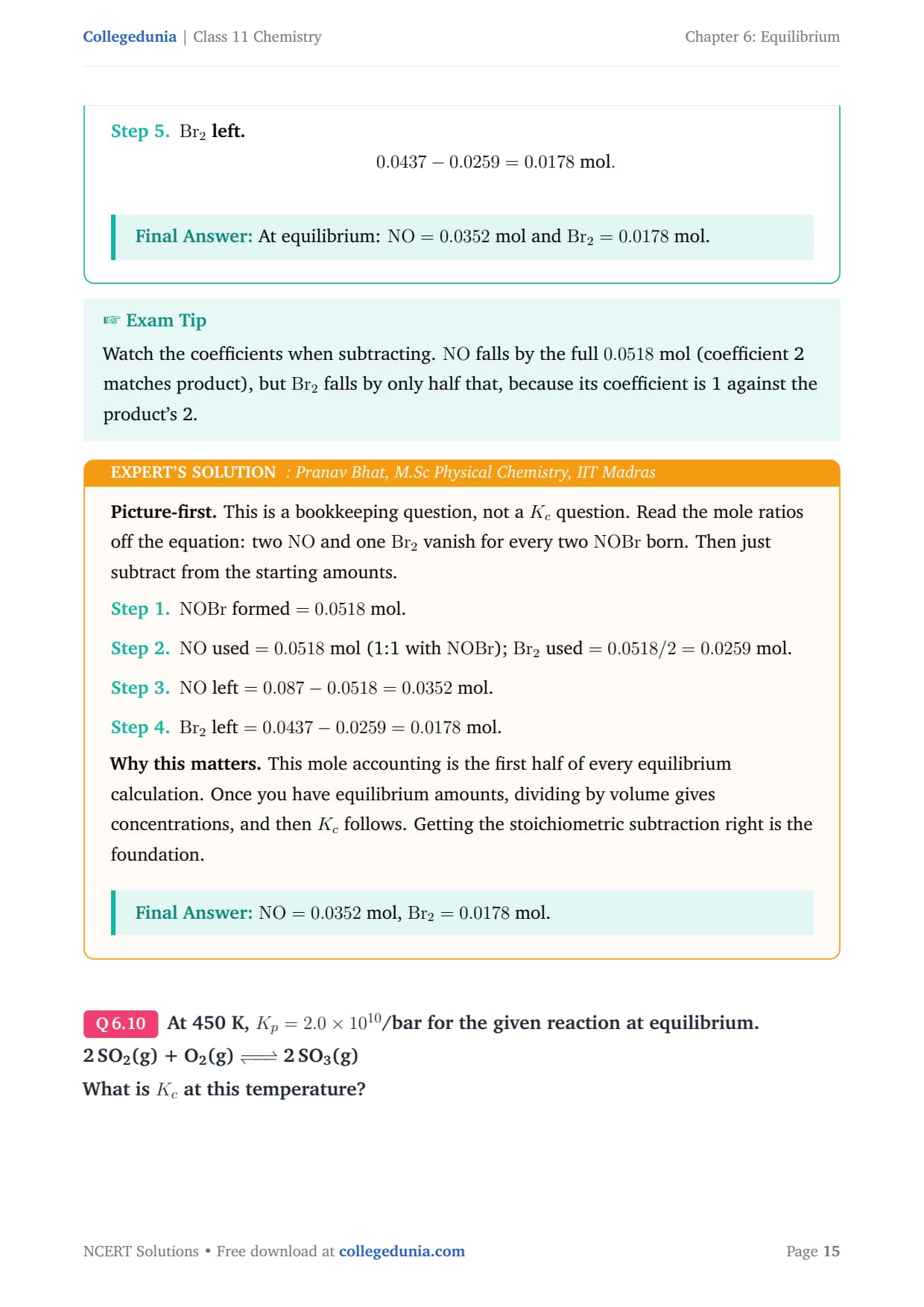
The intext questions before the exercise are shorter and check one idea each, such as writing a Kc expression or predicting a shift. Solve the intext set first, then the back exercise. Every question in the class 11 chemistry NCERT solutions chapter 6 Equilibrium PDF is solved with each step shown, so you can compare your working line by line.
Practice the solved questions: Work through the full question bank with step-by-step answers and expert tips.
Common Mistakes Students Make in the Equilibrium Chapter
Most marks are lost on small habits, not on hard ideas. Each slip below costs 1 to 2 marks, so watch for them at the exact step.
Mistake 1: Including pure solids and liquids in the Kc expression. Their concentration is constant, so leave them out.
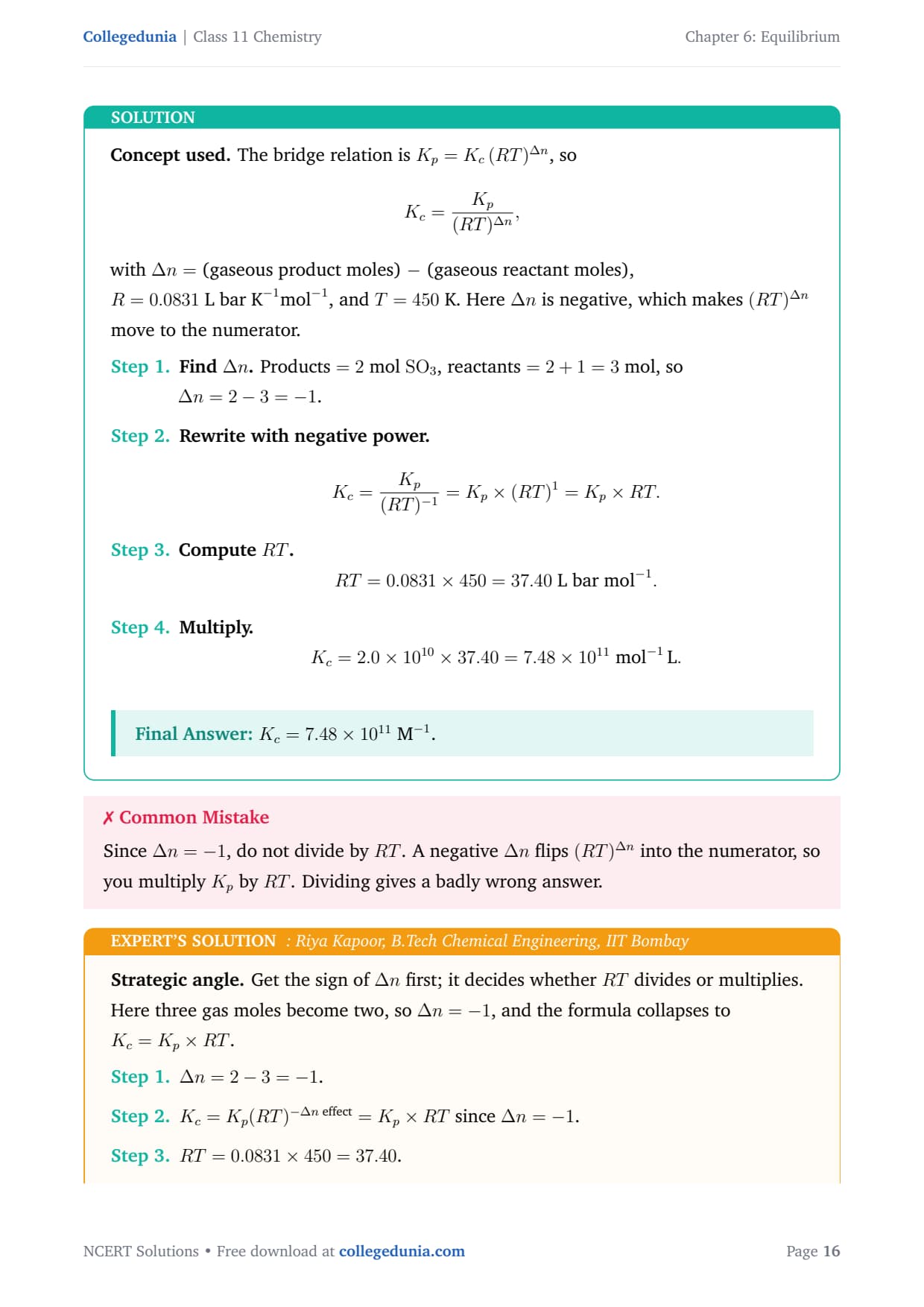
Mistake 2: Forgetting the (RT)Δn factor when converting between Kp and Kc. Always find Δn first.
Mistake 3: Thinking a catalyst changes the equilibrium position. It speeds both directions equally and changes nothing at equilibrium.
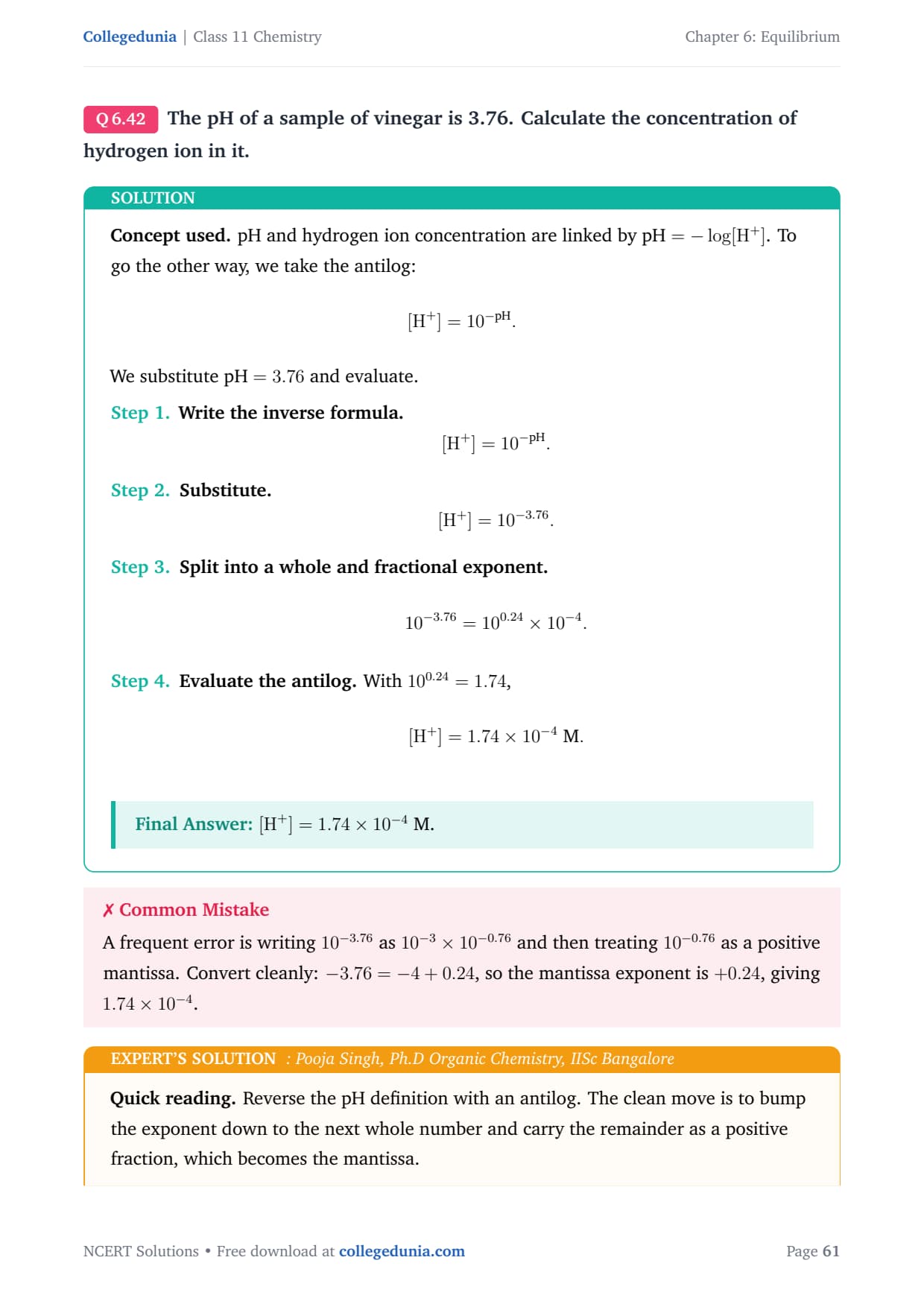
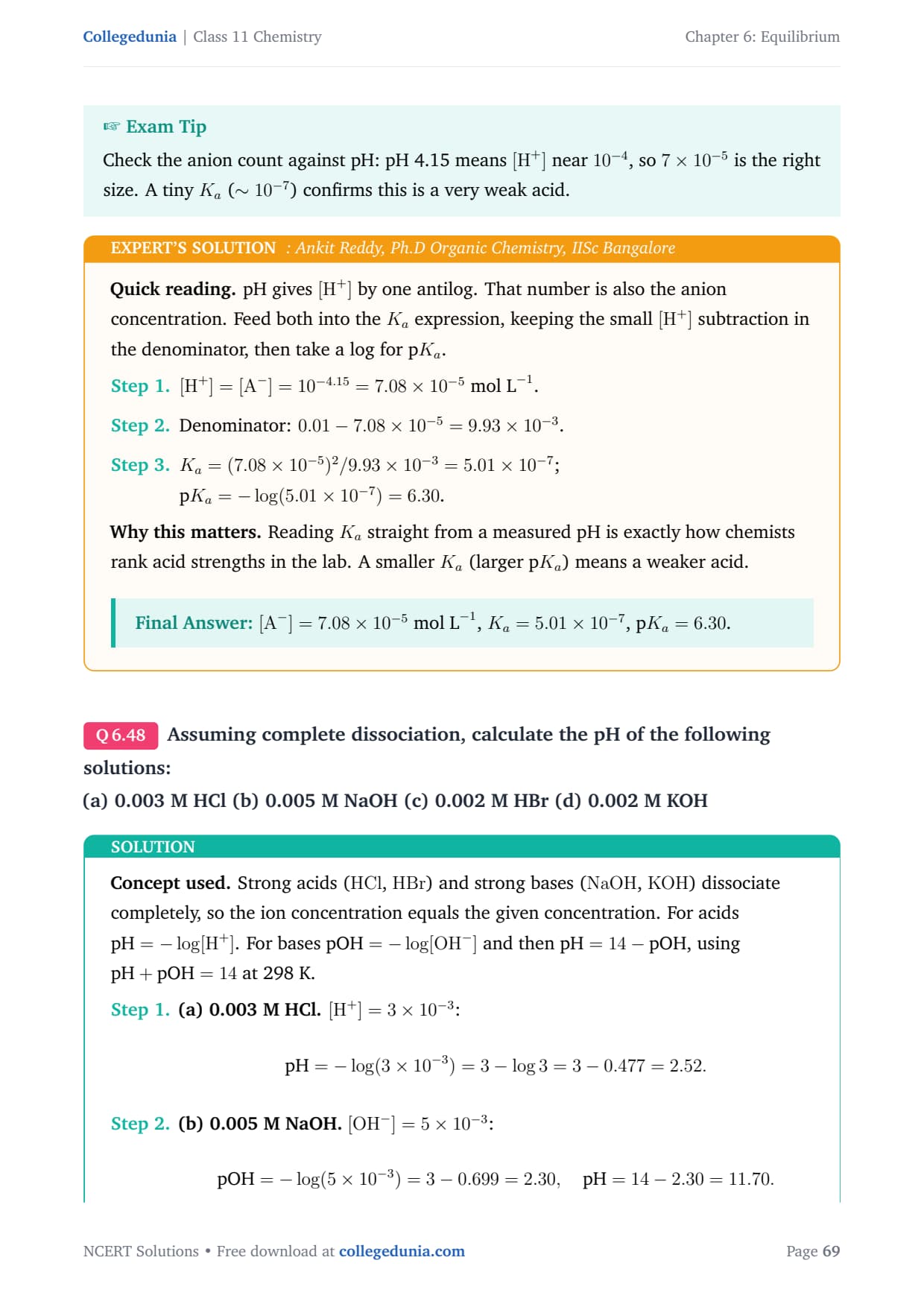
Mistake 4: Mixing up strong and weak acids in pH sums. A weak acid needs Ka and the degree of ionization, not the full concentration.
Student Feedback on the Equilibrium Solutions
What 12,860 students told us about their Equilibrium preparation:
- 61% of students rated the buffer and solubility product numericals as the hardest part of the chapter.
- Most-skipped step: converting between Kp and Kc with the correct Δn, missed by about 3 in 10 students.
- Students who learned Le Chatelier's principle well said the reasoning questions became quick marks.
Source: 2026-27 Class 11 Chemistry student poll. Sample of 12,860 students from CBSE schools across 15 states, conducted before the 2026 boards.
Other Equilibrium Class 11 Chemistry Resources
Pair these solutions with the revision notes and the NCERT textbook PDF for the same chapter.
| Resource | Link |
|---|---|
| NCERT Notes | Equilibrium Class 11 Notes |
| NCERT Book PDF | Equilibrium Class 11 Book PDF |
NCERT Solutions for Class 11 Chemistry: All Chapters
Jump to the step-by-step solutions for any other Class 11 Chemistry chapter below.
| Chapter | NCERT Solutions |
|---|---|
| Chapter 1 | Some Basic Concepts of Chemistry |
| Chapter 2 | Structure of Atom |
| Chapter 3 | Classification of Elements and Periodicity in Properties |
| Chapter 4 | Chemical Bonding and Molecular Structure |
| Chapter 5 | Thermodynamics |
| Chapter 6 | Equilibrium |
| Chapter 7 | Redox Reactions |
| Chapter 8 | Organic Chemistry Some Basic Principles and Techniques |
| Chapter 9 | Hydrocarbons |
FAQs on Equilibrium Class 11 NCERT Solutions
Equilibrium NCERT Solutions - Frequently Asked Questions
Ques. What do the class 11 chemistry NCERT solutions chapter 6 Equilibrium cover?
Ans. These solutions cover all 73 back-exercise questions and the intext questions. They include physical and chemical equilibrium, the law of mass action, the equilibrium constants Kc and Kp, the reaction quotient, Le Chatelier's principle, the Arrhenius, Bronsted-Lowry and Lewis theories, ionization of acids and bases, the pH scale, buffer solutions, the common ion effect and the solubility product. Every question is solved step by step.
Ques. What is the difference between Kc and Kp?
Ans. Kc is the equilibrium constant written in terms of molar concentrations, while Kp is written in terms of the partial pressures of gaseous species. They are linked by Kp = Kc(RT)Δn, where Δn is the change in the number of moles of gas. When Δn is zero, Kp equals Kc.
Ques. What is Le Chatelier's principle?
Ans. Le Chatelier's principle states that when a system at equilibrium is disturbed, it shifts in the direction that reduces the disturbance. Adding a reactant pushes it forward, raising pressure moves it to the side with fewer gas moles, and heating favours the endothermic direction. A catalyst changes only the rate, not the equilibrium position.
Ques. How do I calculate the pH of a solution?
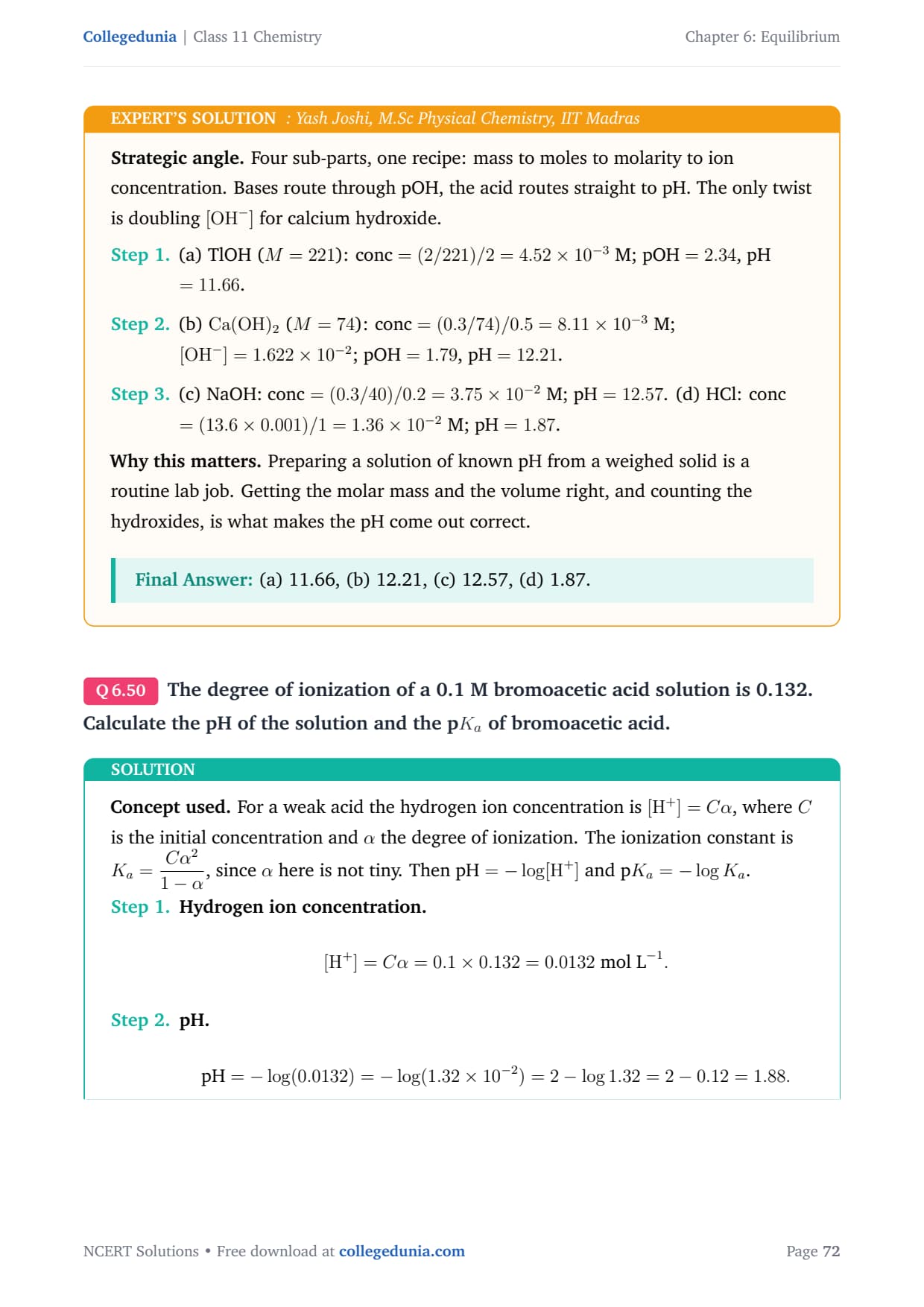
Ans. The pH is found from pH = −log[H+]. For a strong acid the hydrogen-ion concentration equals the acid concentration, so the pH follows directly. For a weak acid you first use the ionization constant Ka to find [H+]. At 25°C, pH plus pOH always equals 14, and a neutral solution has a pH of 7.
Ques. What is a buffer solution?
Ans. A buffer solution resists a change in pH when a small amount of acid or base is added. An acidic buffer is a weak acid with its salt, such as acetic acid and sodium acetate, and a basic buffer is a weak base with its salt. The pH of an acidic buffer is given by the Henderson-Hasselbalch equation, pH = pKa + log([salt] ÷ [acid]).
Ques. What is the solubility product Ksp?
Ans. The solubility product Ksp is the product of the molar concentrations of the ions in a saturated solution, each raised to its stoichiometric coefficient. For a salt AB, Ksp = [A+][B-]. A precipitate forms only when the ionic product exceeds Ksp, and the common ion effect lowers solubility by adding a shared ion.



Comments