




The class 11 chemistry NCERT solutions chapter 5 Thermodynamics cover every intext and back-exercise question, according to the latest 2026-27 CBSE syllabus, and help students prepare for the CBSE Boards, JEE Main, JEE Advanced, NEET and CUET. Each answer is worked step by step, from the first law and enthalpy to Hess's law, entropy and the Gibbs energy test for spontaneity.
This chapter builds the energy language that runs through equilibrium, electrochemistry and every reaction you study later, so the sign rules here are worth getting right early.
- CBSE Weightage: 6 to 8 marks, part of the Physical Chemistry unit that carries most of the numerical questions.
- Topics covered: system and surroundings, internal energy, first law, enthalpy, heat capacity, Hess's law, bond enthalpy, entropy and Gibbs energy.
- Exercise count: 22 back-exercise questions plus intext questions, a mix of sign-convention theory and short numericals.
These class 11 chemistry NCERT solutions chapter 5 Thermodynamics are curated by subject experts, based on the 2026-27 NCERT textbook, and checked against the last five years of CBSE Board, JEE Main and NEET papers.
Why Thermodynamics Matters and What the Chapter Covers
Thermodynamics studies the energy changes that go with chemical and physical processes. It answers two big questions: how much heat a reaction gives out or takes in, and whether the reaction will happen on its own. These ideas decide which reactions run in a battery, a furnace or a living cell.
- Everyday role: fuels, cold packs, and metabolism all depend on the heat that reactions release or absorb.
- Core skill: tracking energy as heat and work, and keeping the signs correct at every step.
- Why it is central: the Gibbs energy test defined here decides spontaneity for every later chapter.
Thermodynamics tells you if a reaction is possible, not how fast it goes. Speed is the job of kinetics, a separate chapter. Students who fix the sign conventions in this chapter early find the numericals much easier. The class 11 chemistry NCERT solutions chapter 5 Thermodynamics below follow the same order as the NCERT textbook.
System, Surroundings and State Functions
Every problem starts by choosing what you are studying. The system is the part of the universe under observation, and the surroundings are everything else. The boundary separates the two. Getting this split clear makes the sign of heat and work obvious later.
| Type of system | Exchanges with surroundings |
|---|---|
| Open | Both matter and energy can cross the boundary, like water boiling in an open beaker. |
| Closed | Only energy crosses, not matter, like gas sealed in a rigid container. |
| Isolated | Neither matter nor energy crosses, like a hot drink in an ideal thermos. |
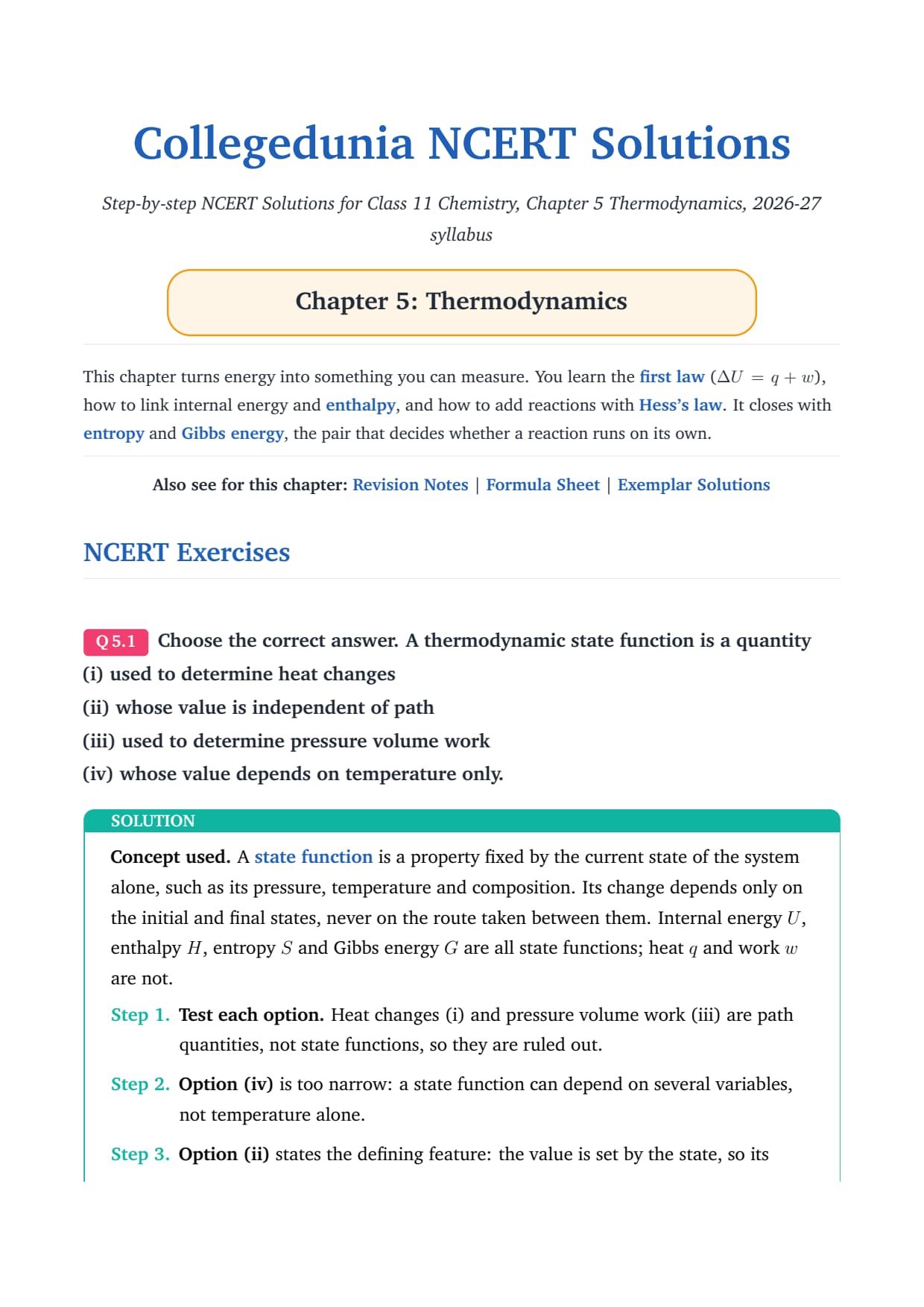
A state function depends only on the present state of the system, not on how it got there. Internal energy, enthalpy, entropy and Gibbs energy are all state functions. Heat and work are path functions, so their values depend on the route taken. The change in a state function is the same for every path between the same two states. That single idea is what makes Hess's law work.
Internal Energy, Work and Heat in a Chemical System
The total energy stored inside a system is its internal energy, written as U. You cannot measure U directly, but you can measure its change, ΔU, when a system moves from one state to another. This change happens through two routes: heat and work.
- Heat (q): energy that flows because of a temperature difference between system and surroundings.
- Work (w): energy transferred when a force acts, most often pressure-volume work when a gas expands or is compressed.
- Sign rule: heat added to the system is positive; work done on the system is positive.
For a gas expanding against a constant external pressure, the work done by the system is w = −pextΔV. The NCERT sign convention treats heat gained and work done on the system as positive. This is the most common source of lost marks in the chapter, so write the sign next to every number as you go. A reversible expansion does the maximum work, which is a favourite short-answer point.
First Law of Thermodynamics and Its Equation
The first law of thermodynamics is the law of conservation of energy applied to heat and work. Energy is neither created nor destroyed; it only changes form. For any process, the change in internal energy equals the heat added plus the work done on the system.
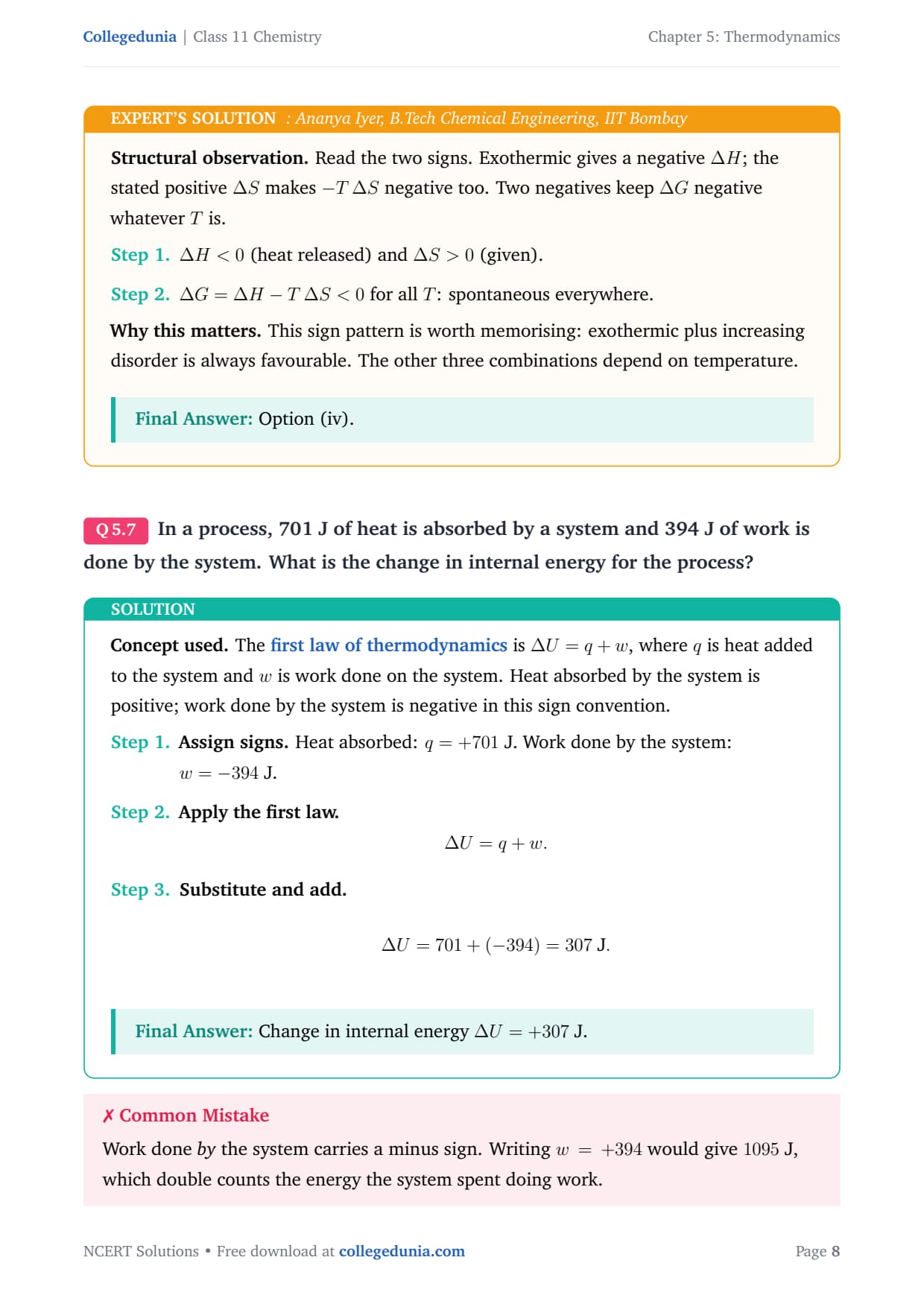
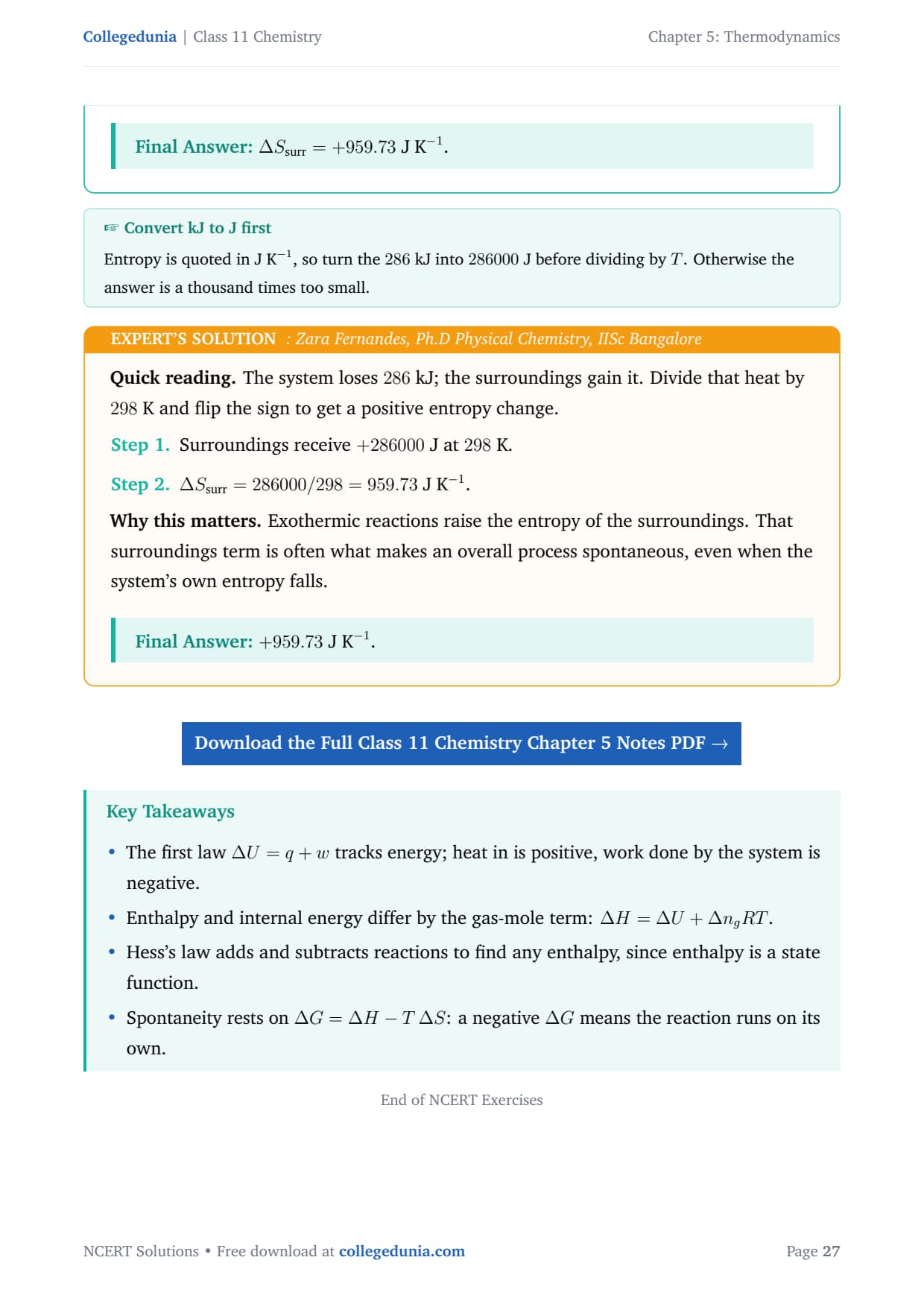
The working equation is ΔU = q + w. Here ΔU is the change in internal energy, q is the heat, and w is the work. From this one line you can find any of the three quantities when the other two are given, which is exactly what several back-exercise numericals ask.
| Condition | What the first law becomes |
|---|---|
| Isothermal (constant T) for an ideal gas | ΔU = 0, so q = −w. |
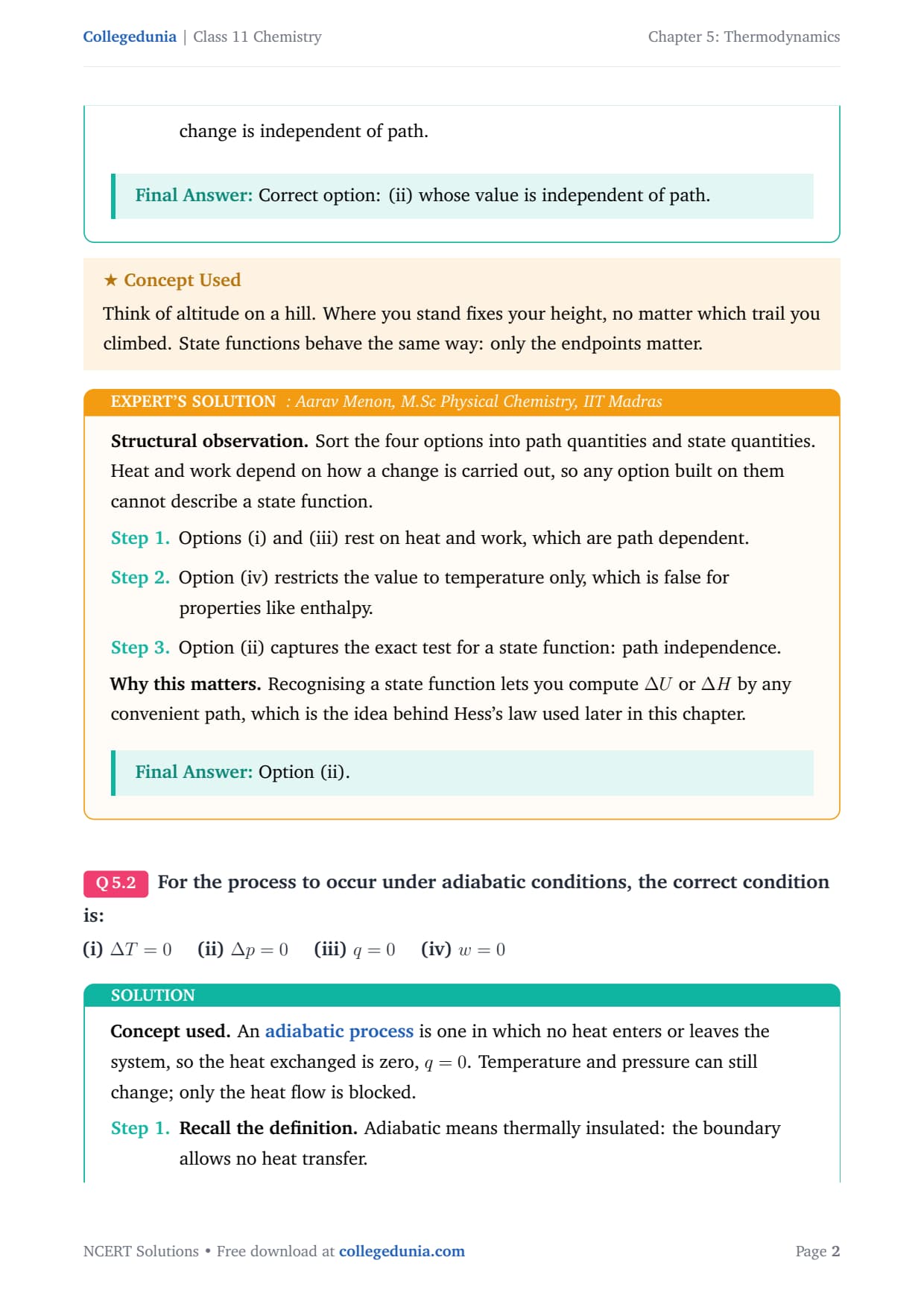
| Adiabatic (no heat exchange) | q = 0, so ΔU = w. |
| Isochoric (constant volume) | w = 0, so ΔU = qV. |
At constant volume the heat supplied equals the change in internal energy. Learn the three special cases above, because the intext questions test them directly. The first law fixes the total energy but says nothing about direction, which is why entropy is needed later.
Enthalpy and Heat Capacity of a Substance
Most reactions in the lab happen in open containers at constant pressure, not constant volume. For these, chemists use enthalpy, written H, defined as H = U + pV. The heat exchanged at constant pressure equals the change in enthalpy, ΔH.
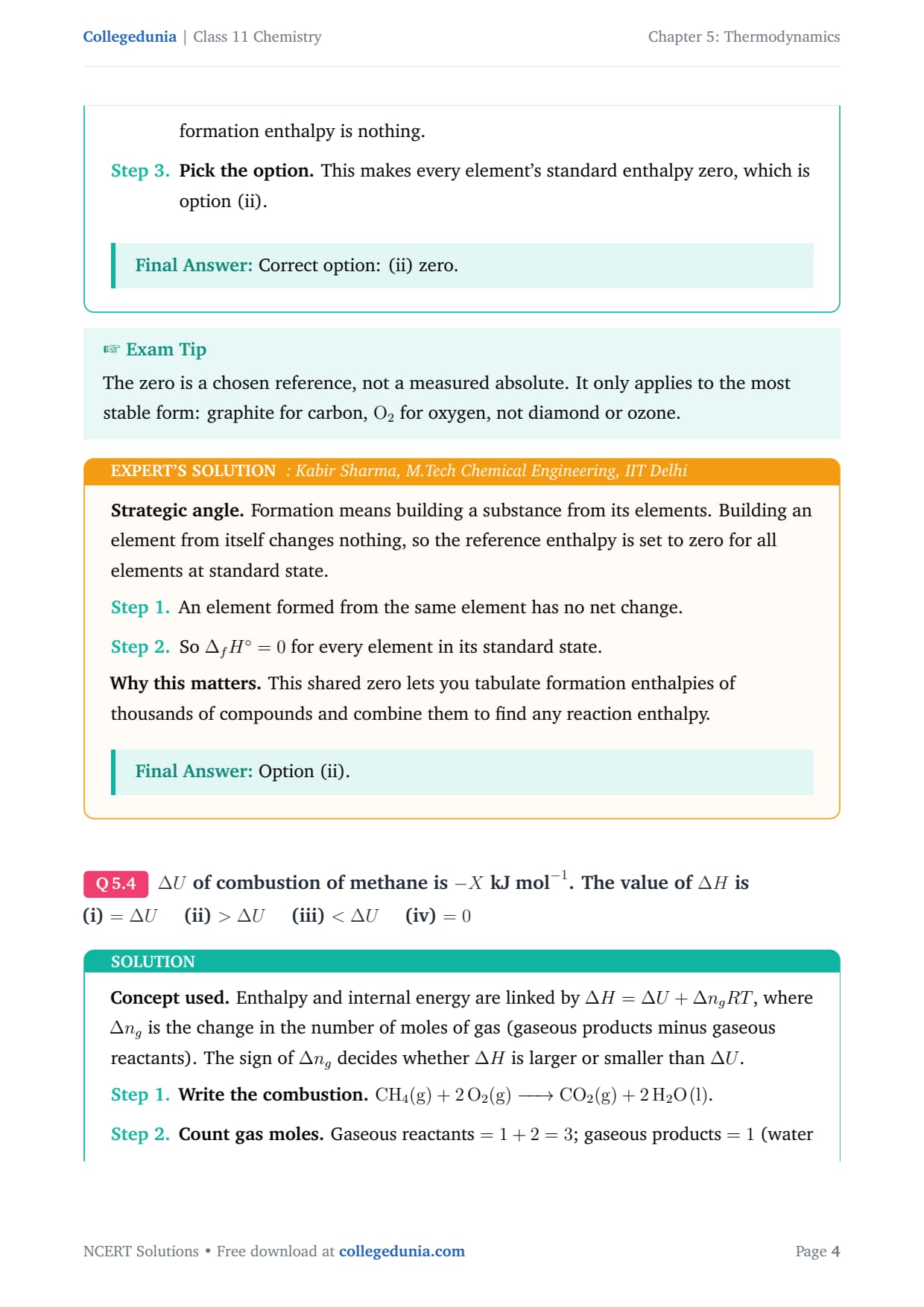
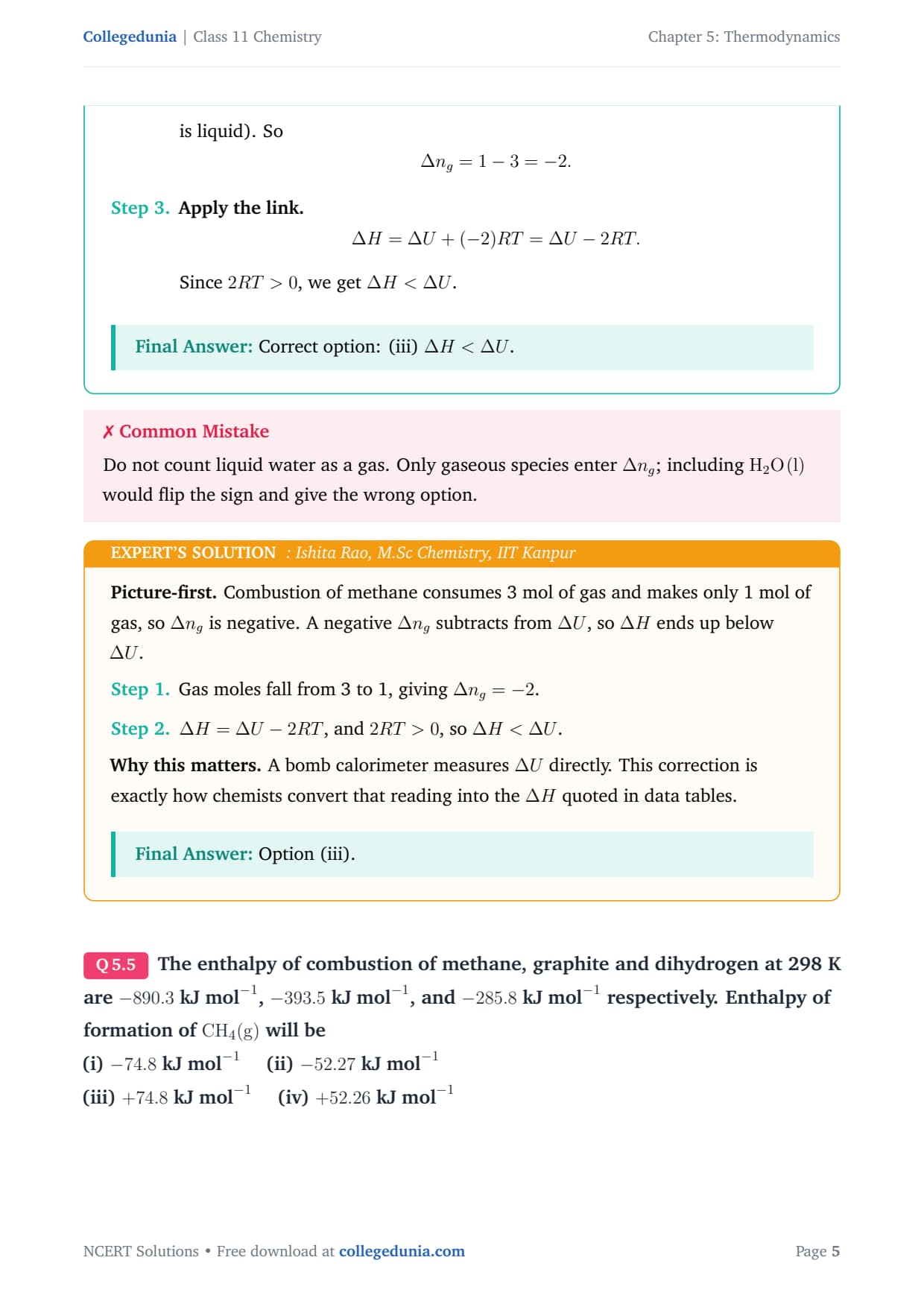
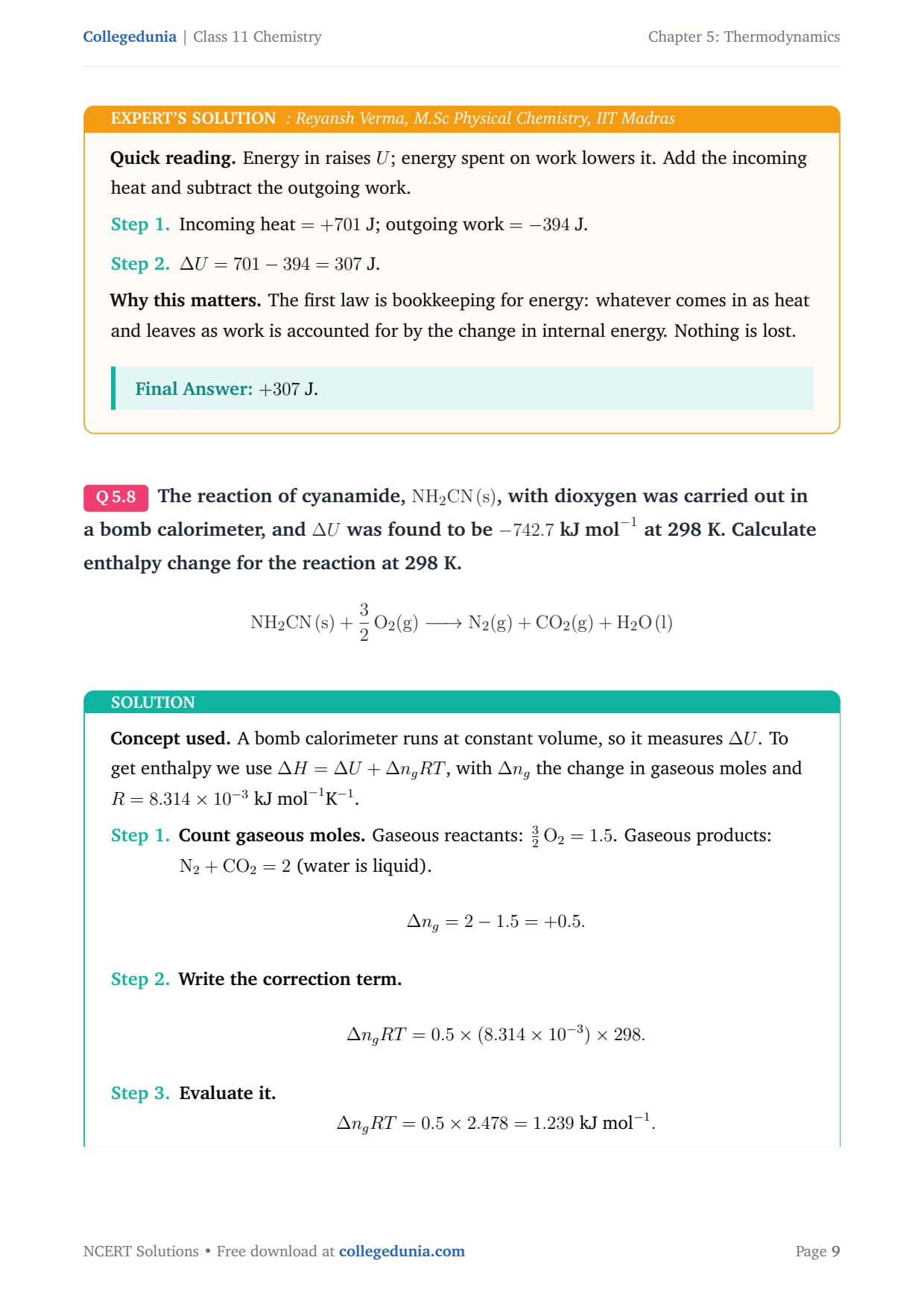
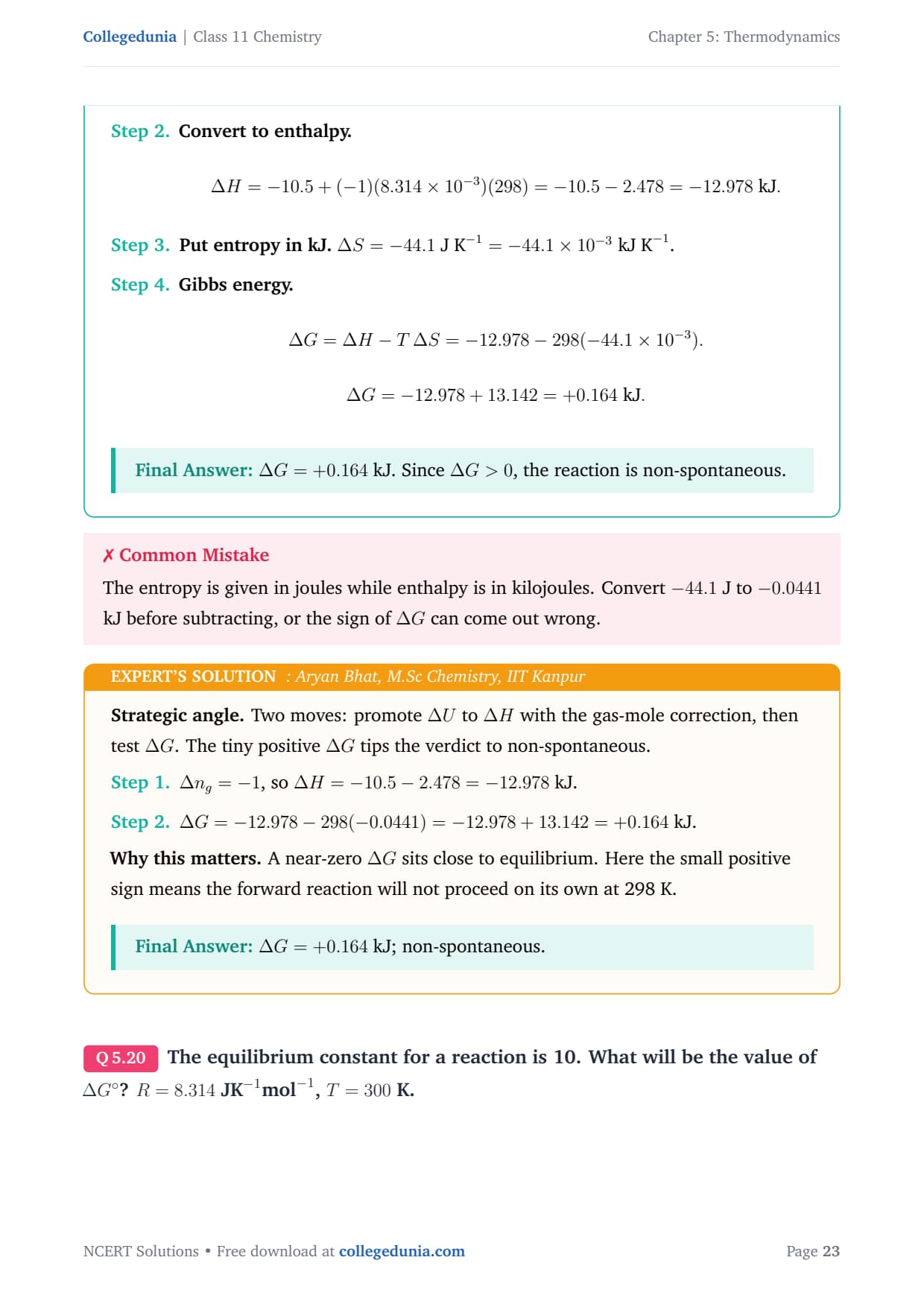
The link between the two heat measures is ΔH = ΔU + ΔngRT, where Δng is the change in the number of moles of gas. When no gas moles change, ΔH and ΔU are equal. This relation appears in at least one numerical every year.
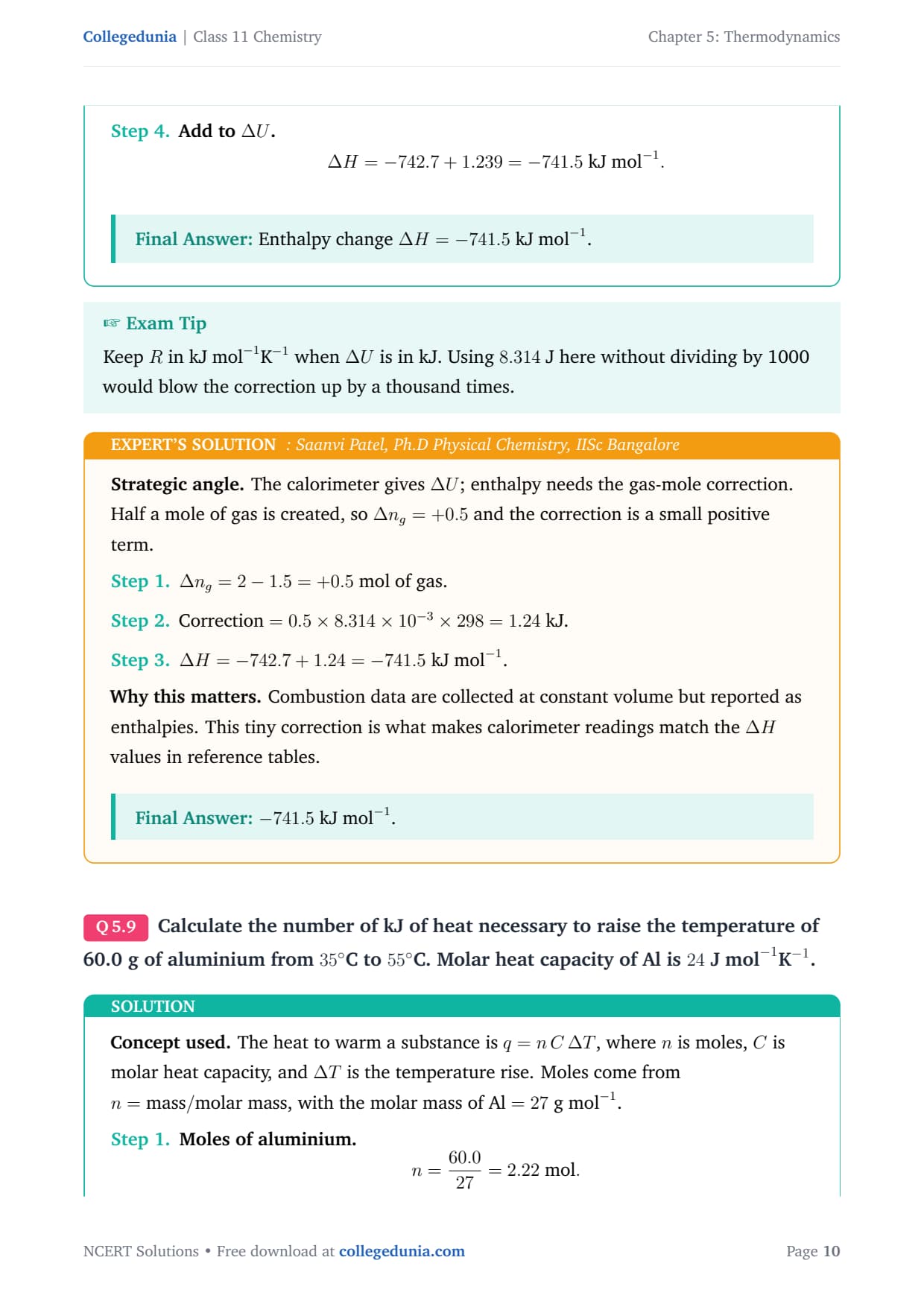
- Heat capacity (C): the heat needed to raise the temperature of a substance by one degree.
- Cp and CV: heat capacities at constant pressure and constant volume; for an ideal gas Cp − CV = R.
- Specific and molar: specific heat is per gram; molar heat capacity is per mole.
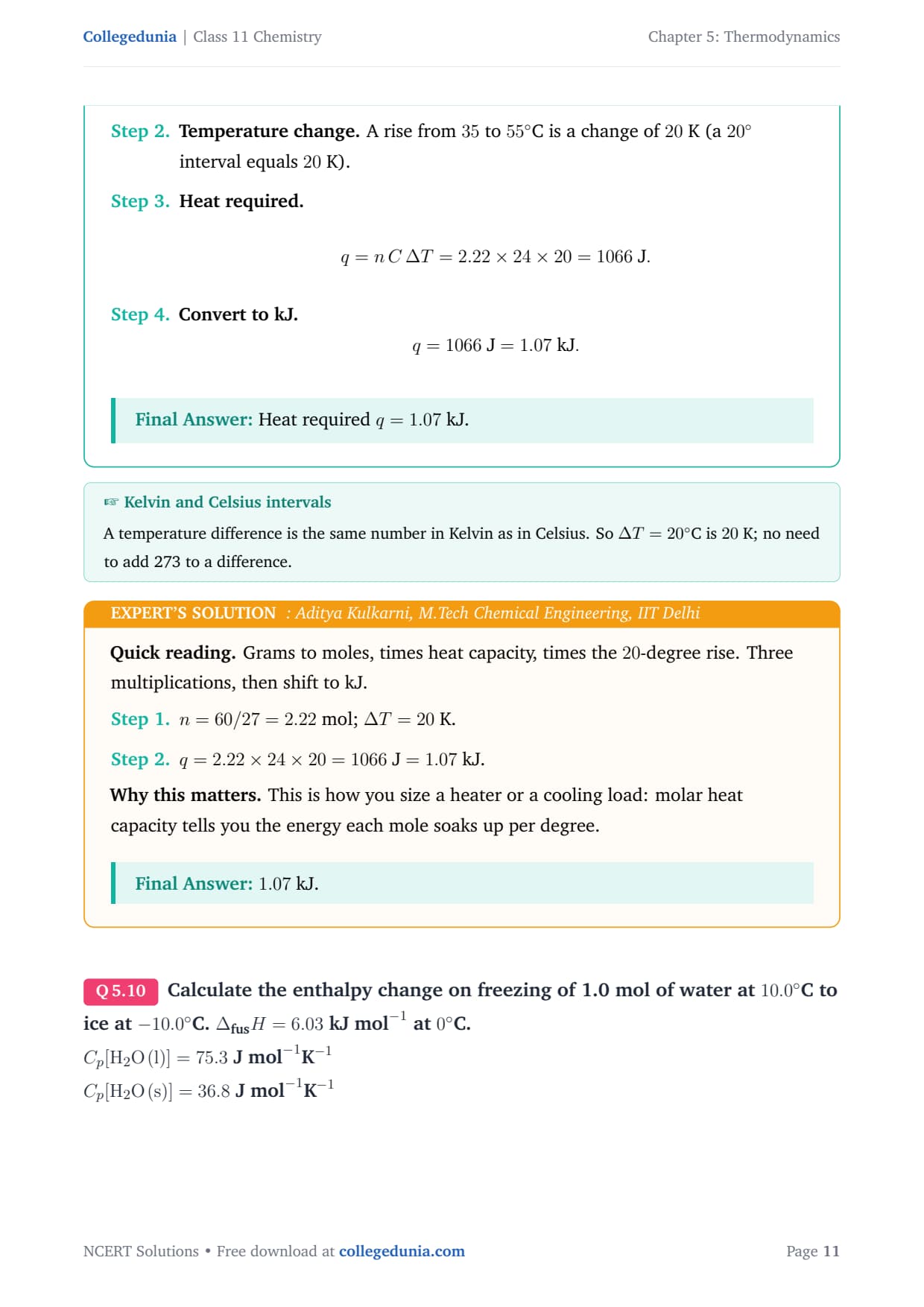
Enthalpy is a state function, so ΔH depends only on the initial and final states. An exothermic reaction has a negative ΔH because it releases heat, while an endothermic reaction has a positive ΔH. Keep this sign link firmly in mind before the next section.
Enthalpy of Reactions, Hess's Law and Bond Enthalpy
Different reactions have their own named enthalpy changes, and the NCERT exercise expects you to define each one cleanly. These standard enthalpies are measured at 298 K and one bar pressure.
| Enthalpy term | What it measures |
|---|---|
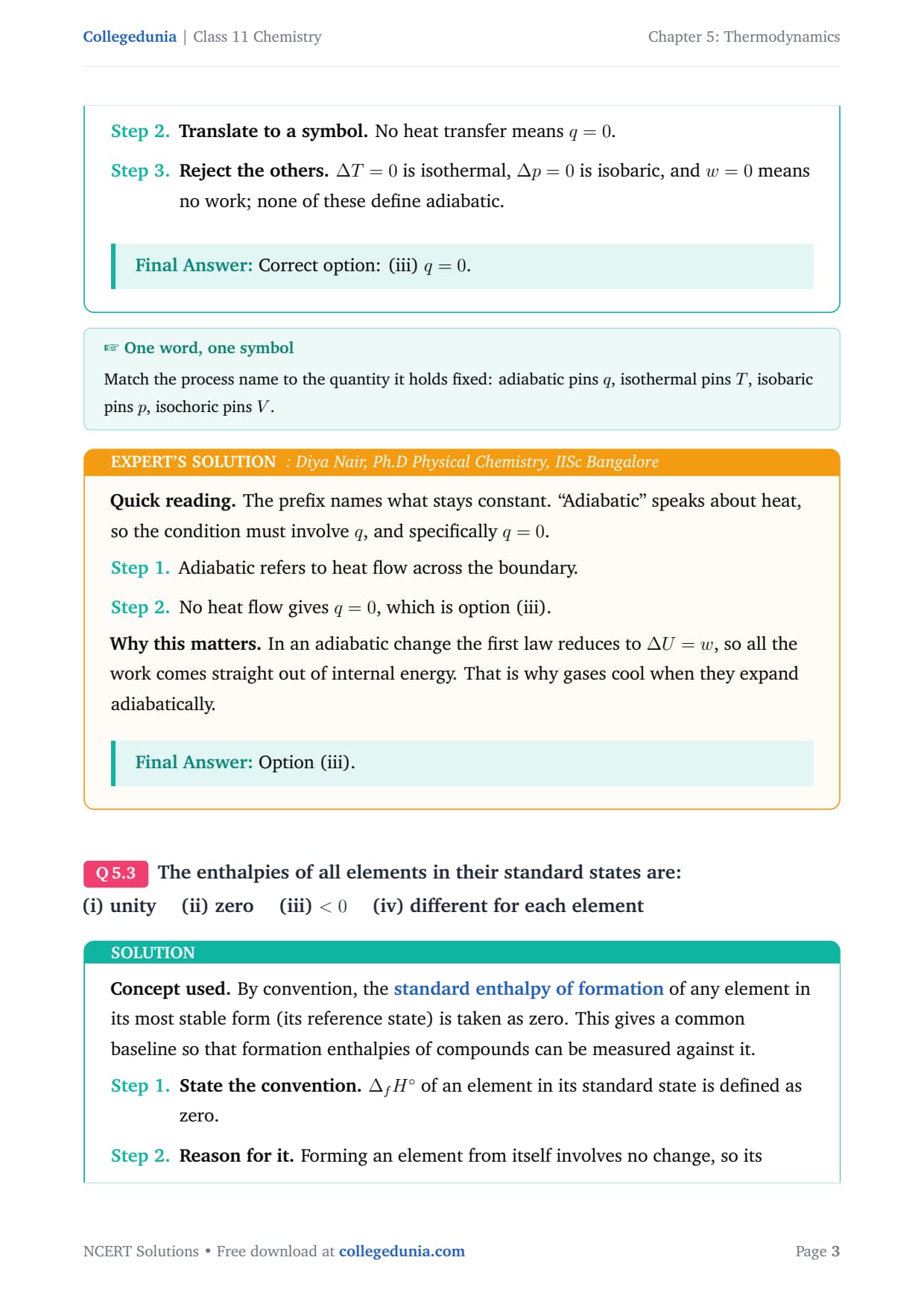
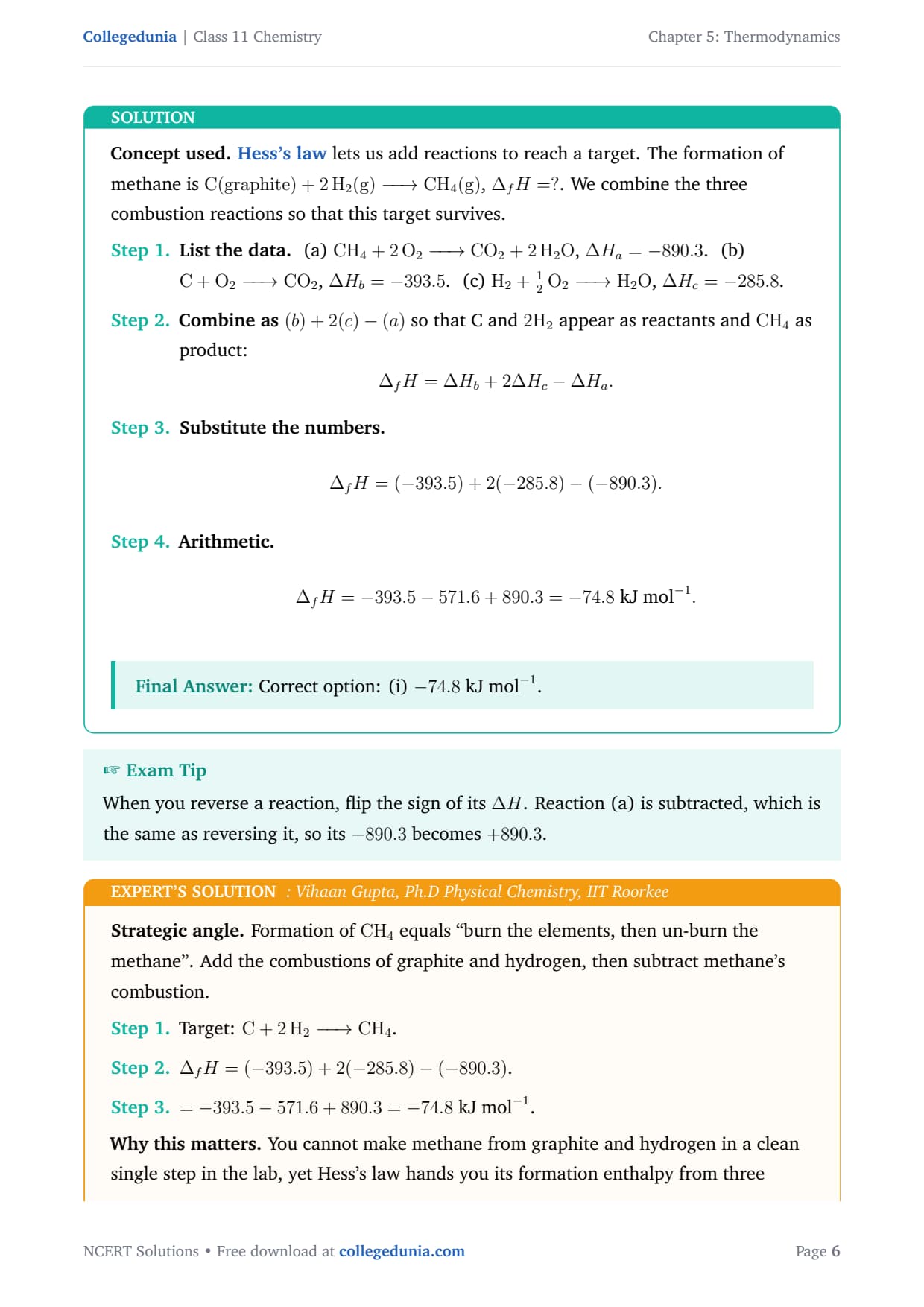
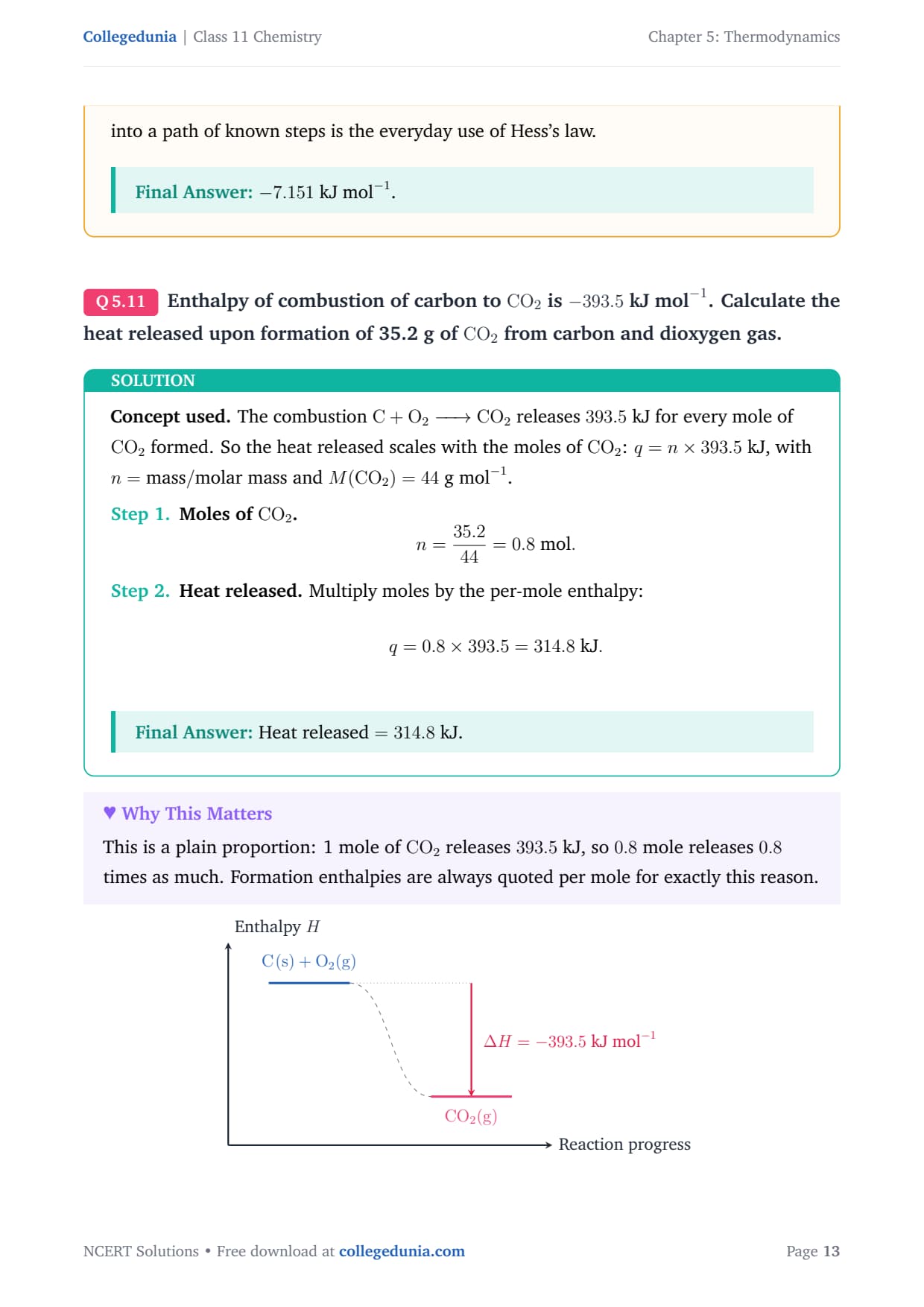
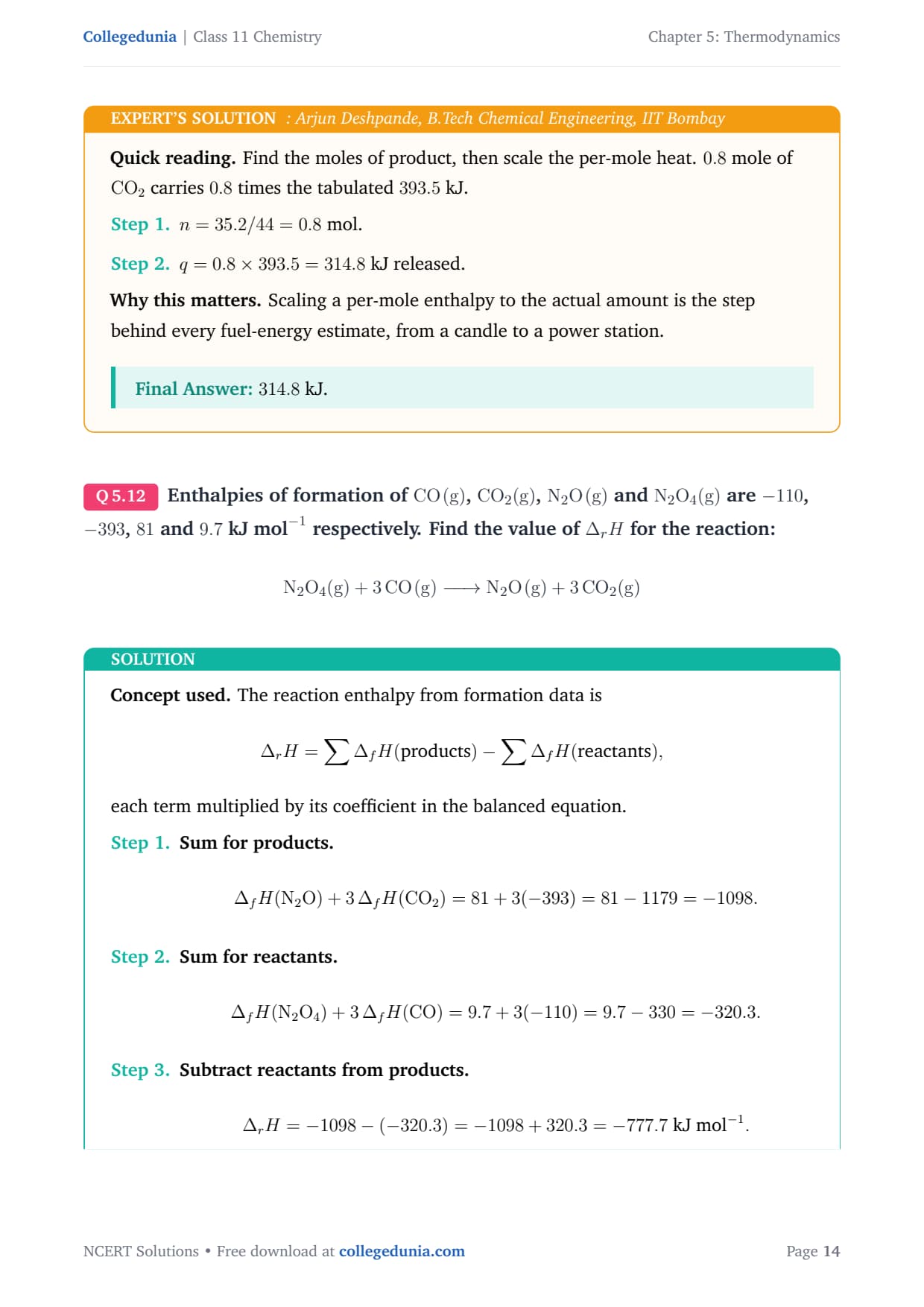
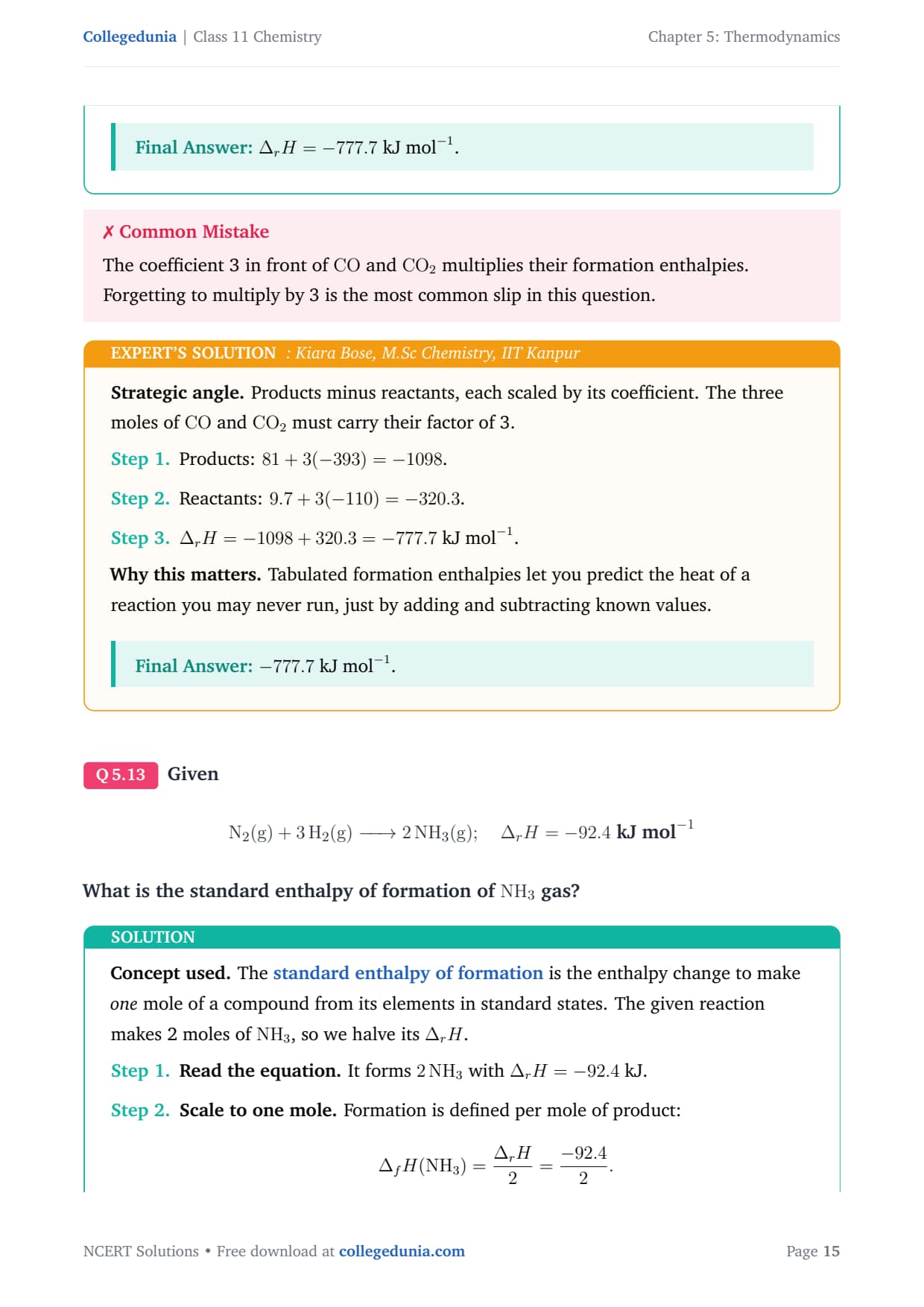
| Enthalpy of formation | Heat change when one mole of a compound forms from its elements in their standard states. |
| Enthalpy of combustion | Heat released when one mole of a substance burns completely in oxygen. |
| Enthalpy of neutralisation | Heat released when an acid and a base react to form one mole of water. |
| Bond enthalpy | Energy needed to break one mole of a particular bond in the gas phase. |
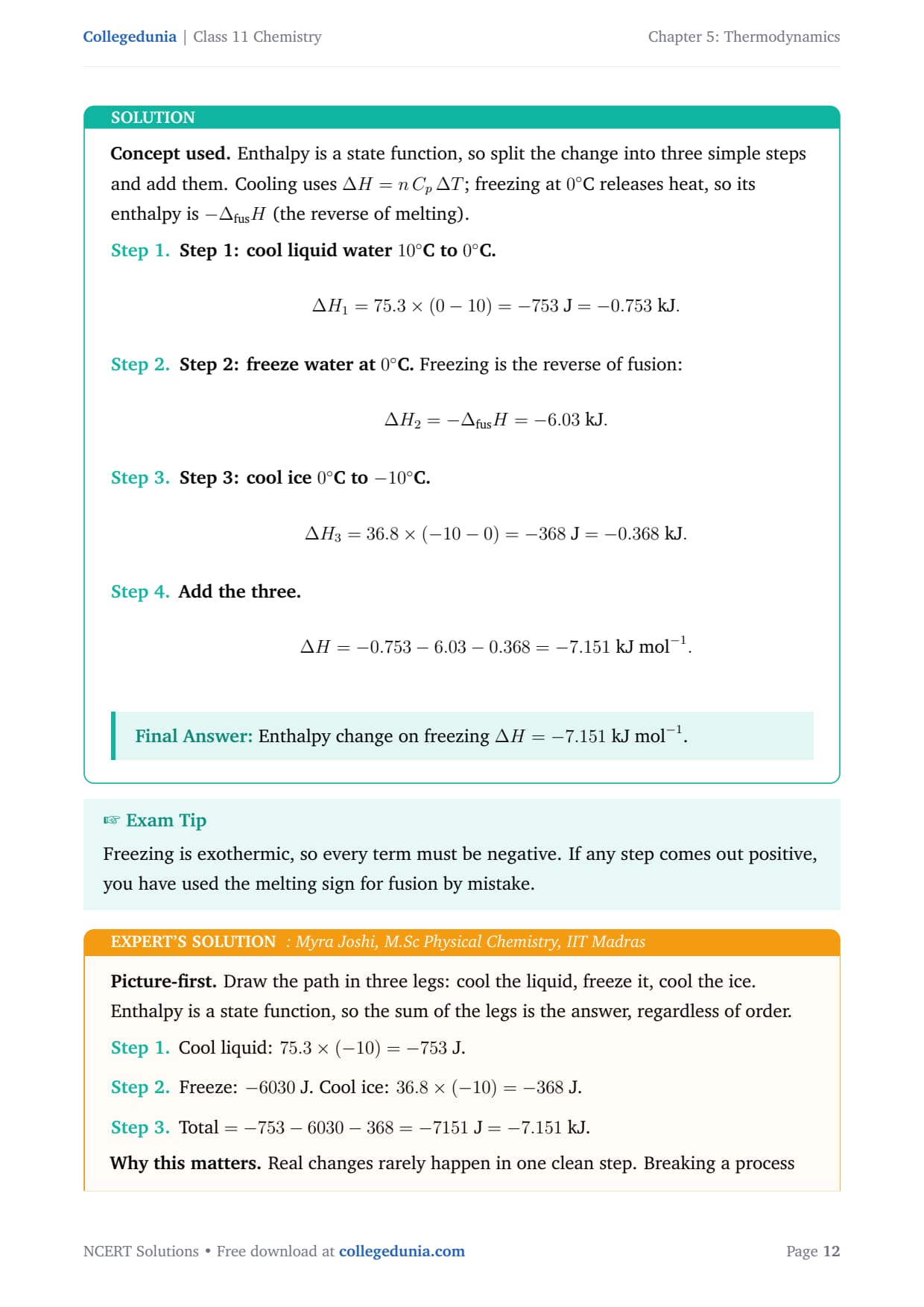
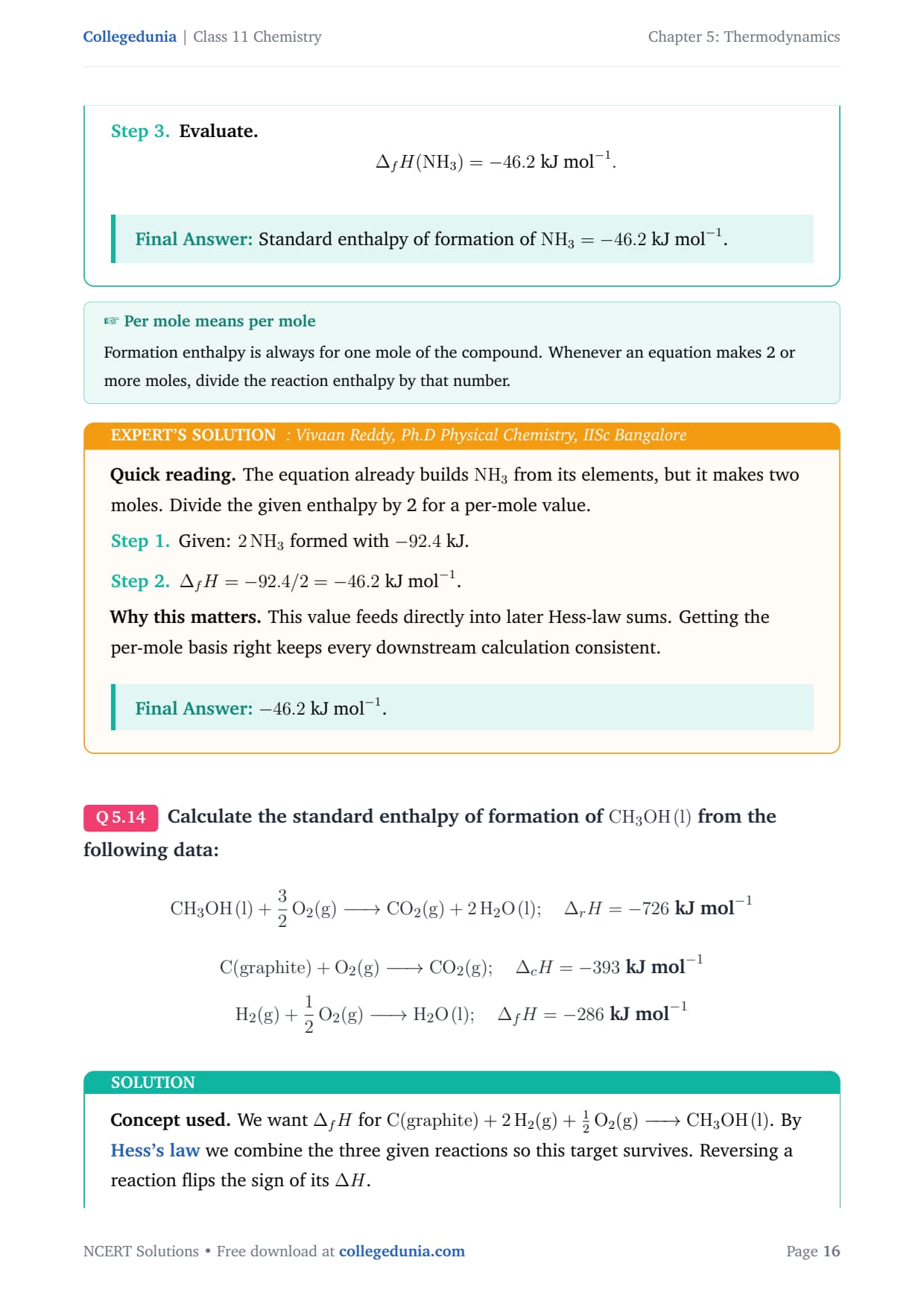
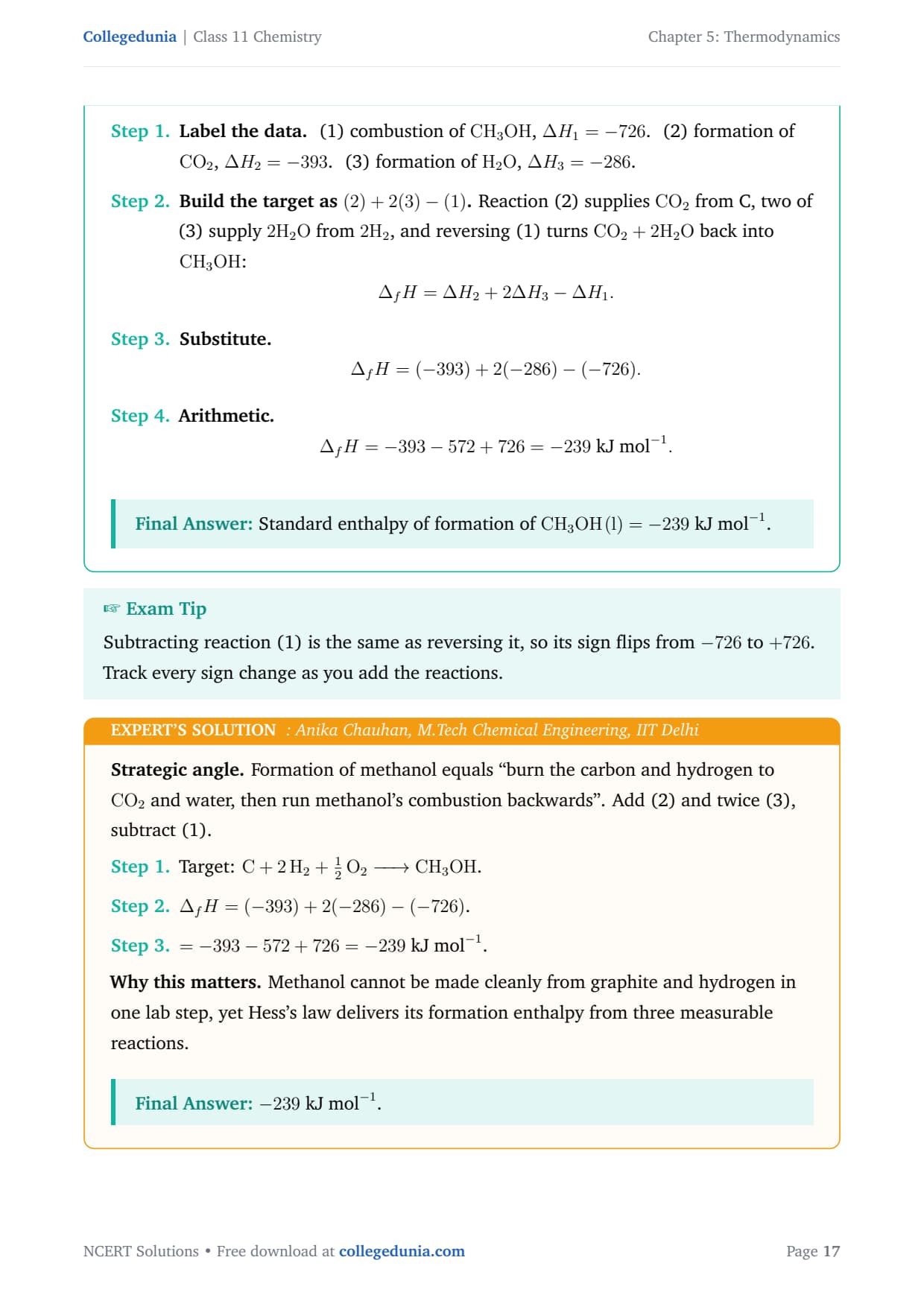
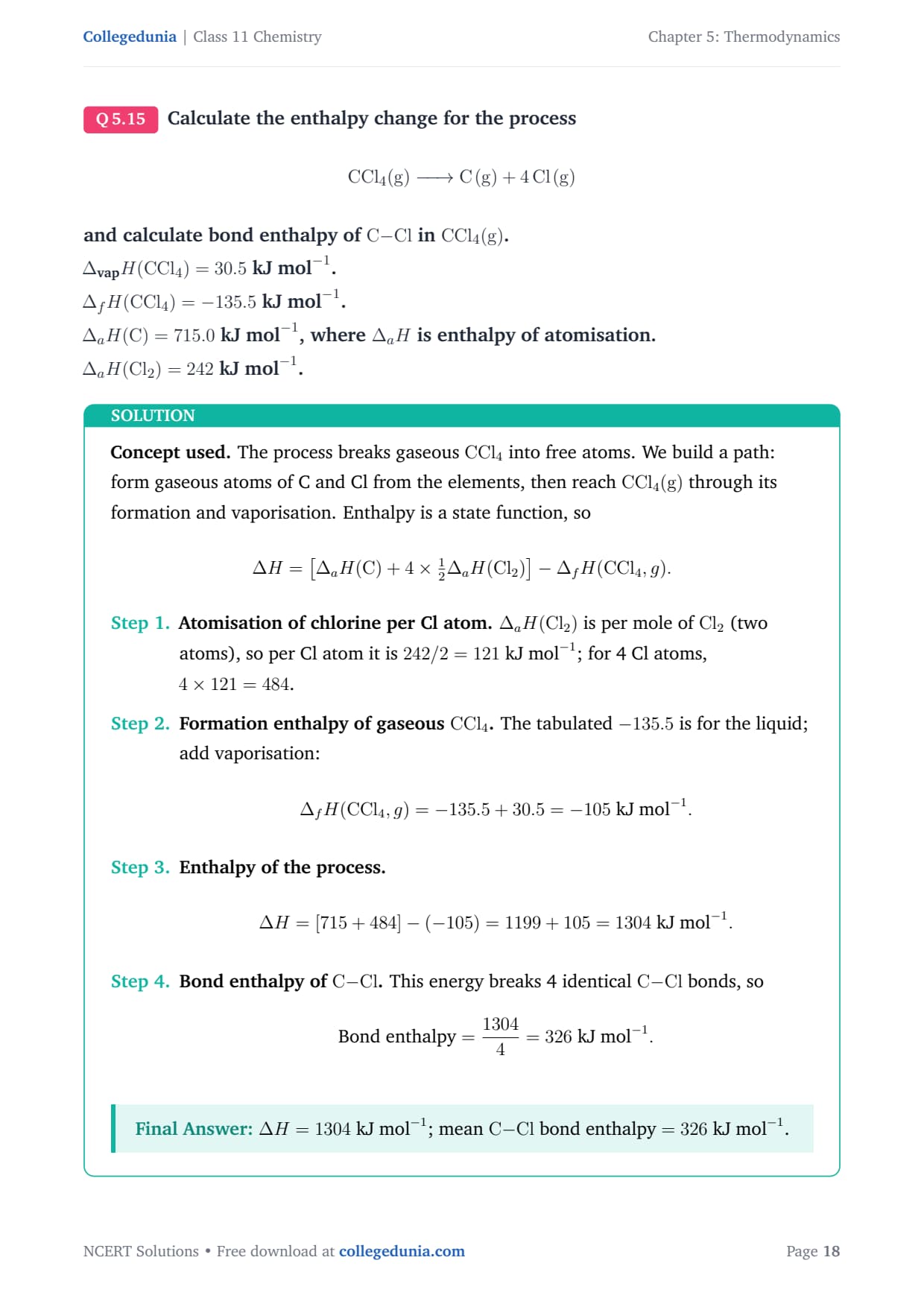
Hess's law states that the total enthalpy change of a reaction is the same whether it happens in one step or several. It follows directly from enthalpy being a state function. You can add reactions like algebra to reach a target equation, then add their ΔH values the same way. Hess's law lets you find an enthalpy that is hard to measure directly, such as the formation of carbon monoxide. The bond enthalpy route gives another estimate: ΔH equals the bonds broken minus the bonds formed. Both methods appear in the back exercise.
Entropy, Gibbs Energy and Spontaneity
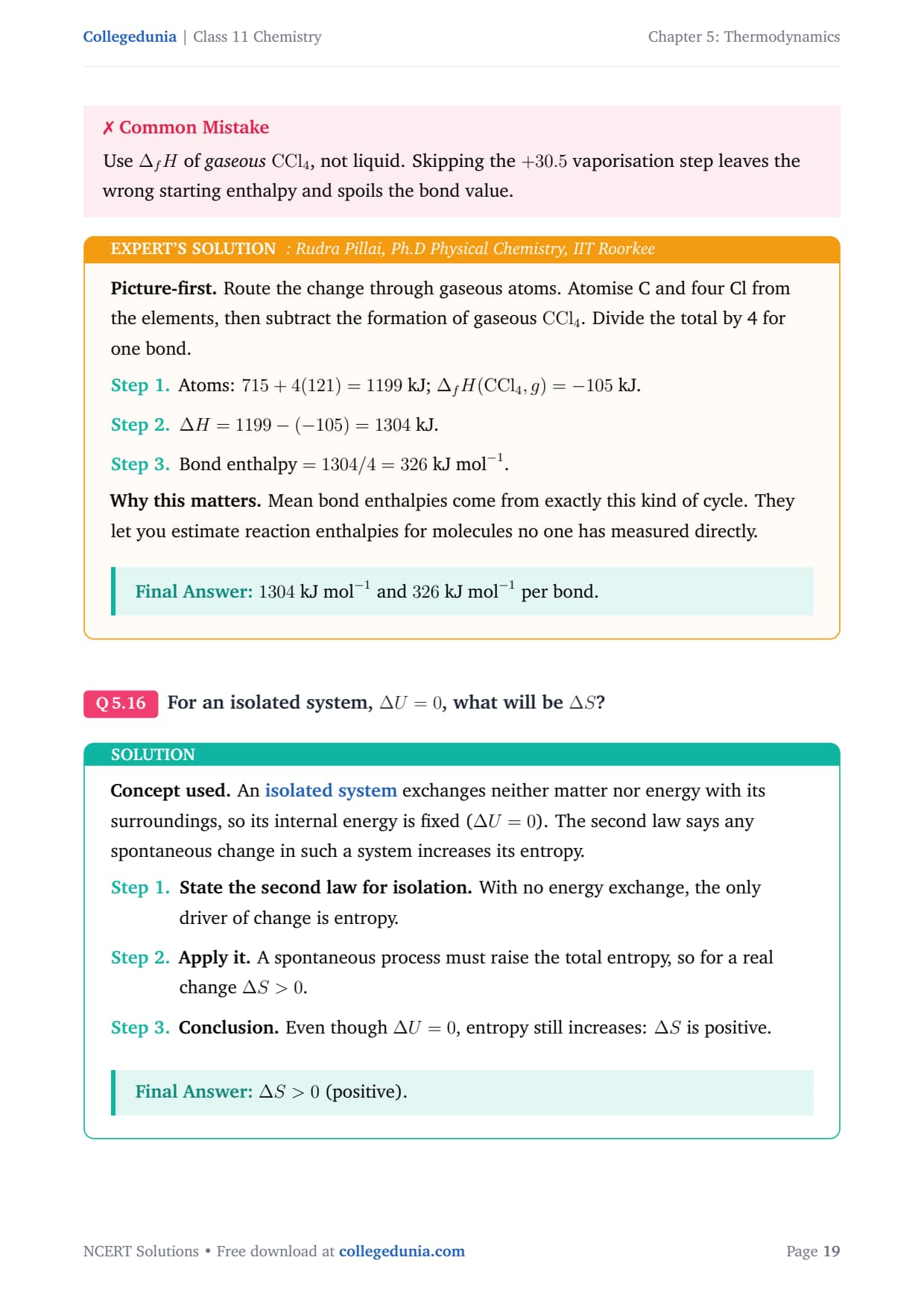
The first law cannot tell you which way a reaction goes on its own. That job needs entropy, written S, a measure of the disorder or randomness of a system. Processes tend to move towards greater total disorder. Melting ice and mixing gases both raise entropy.
- Entropy rises when a solid melts, a liquid boils, or the number of gas molecules increases.
- Second law: the total entropy of the universe increases in every spontaneous process.
- Gibbs energy (G): combines enthalpy and entropy into a single test for the system alone.
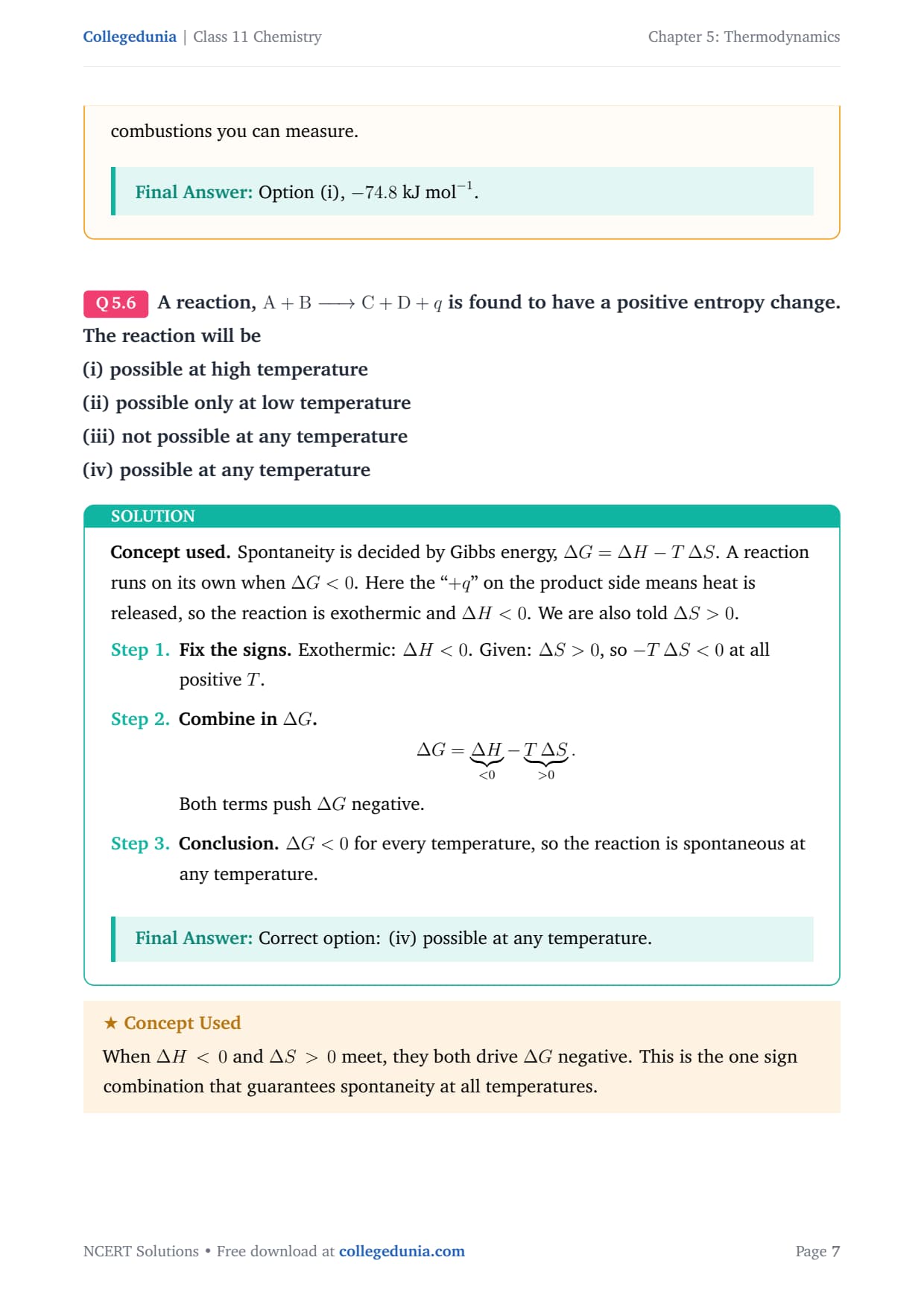
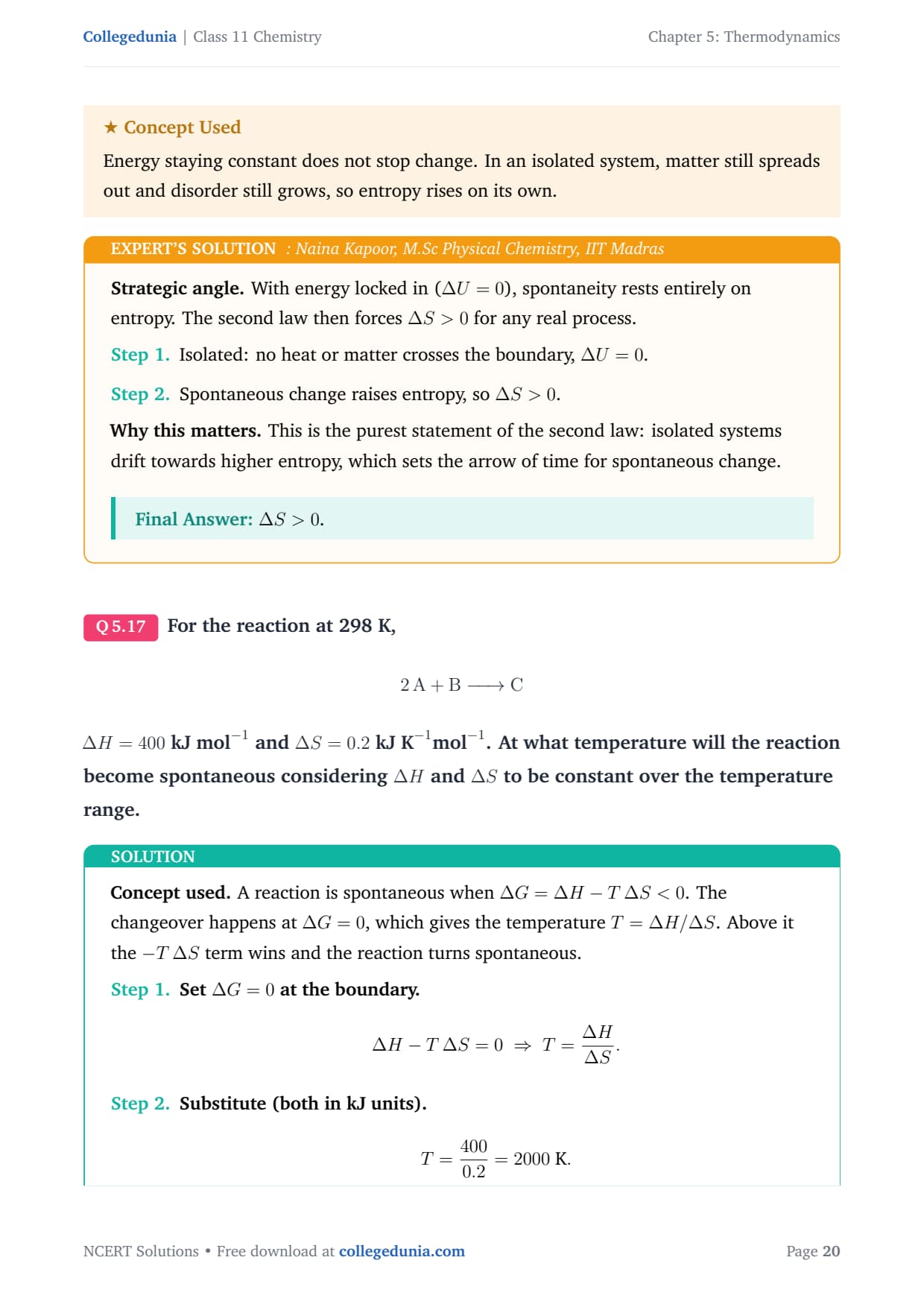
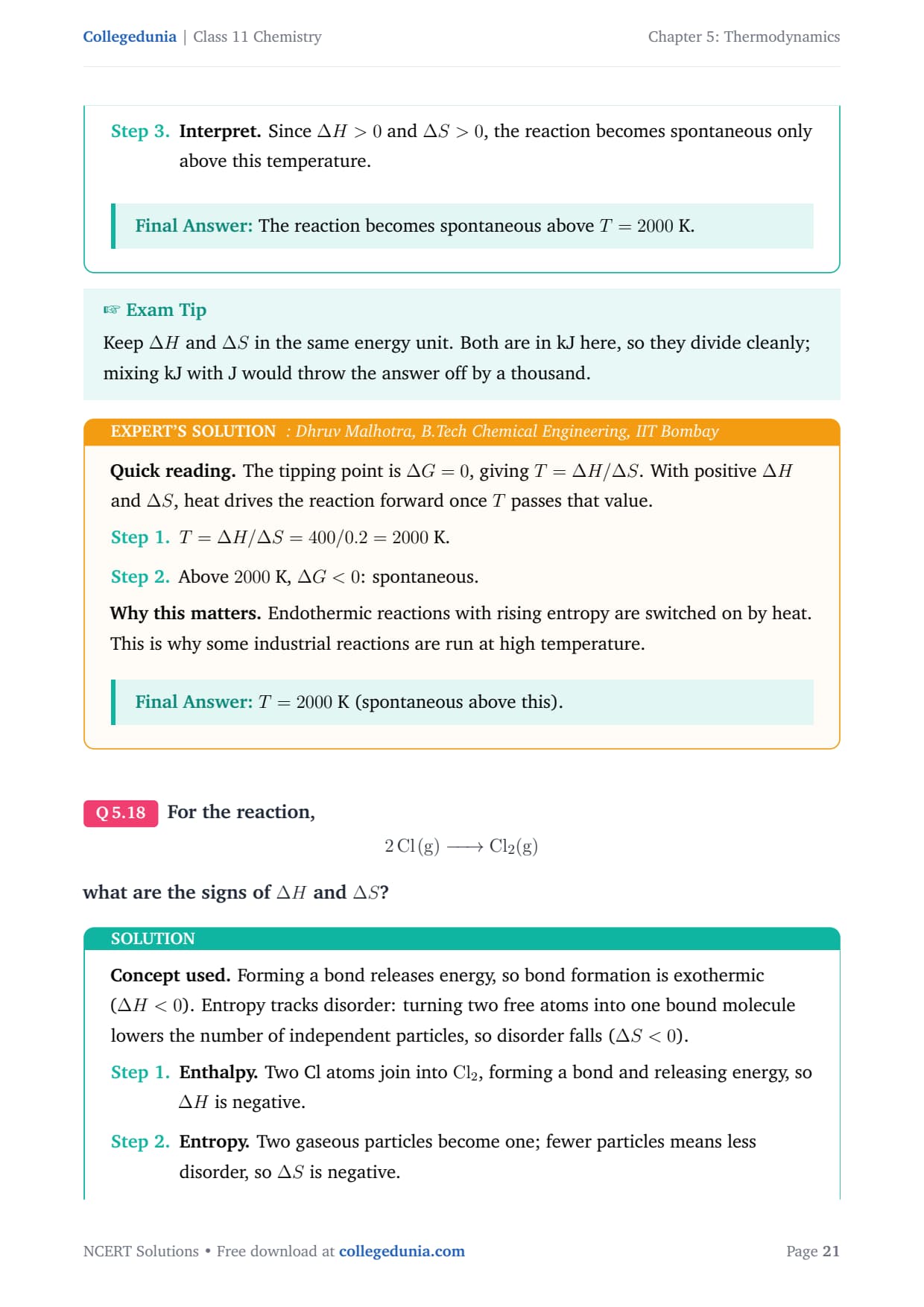
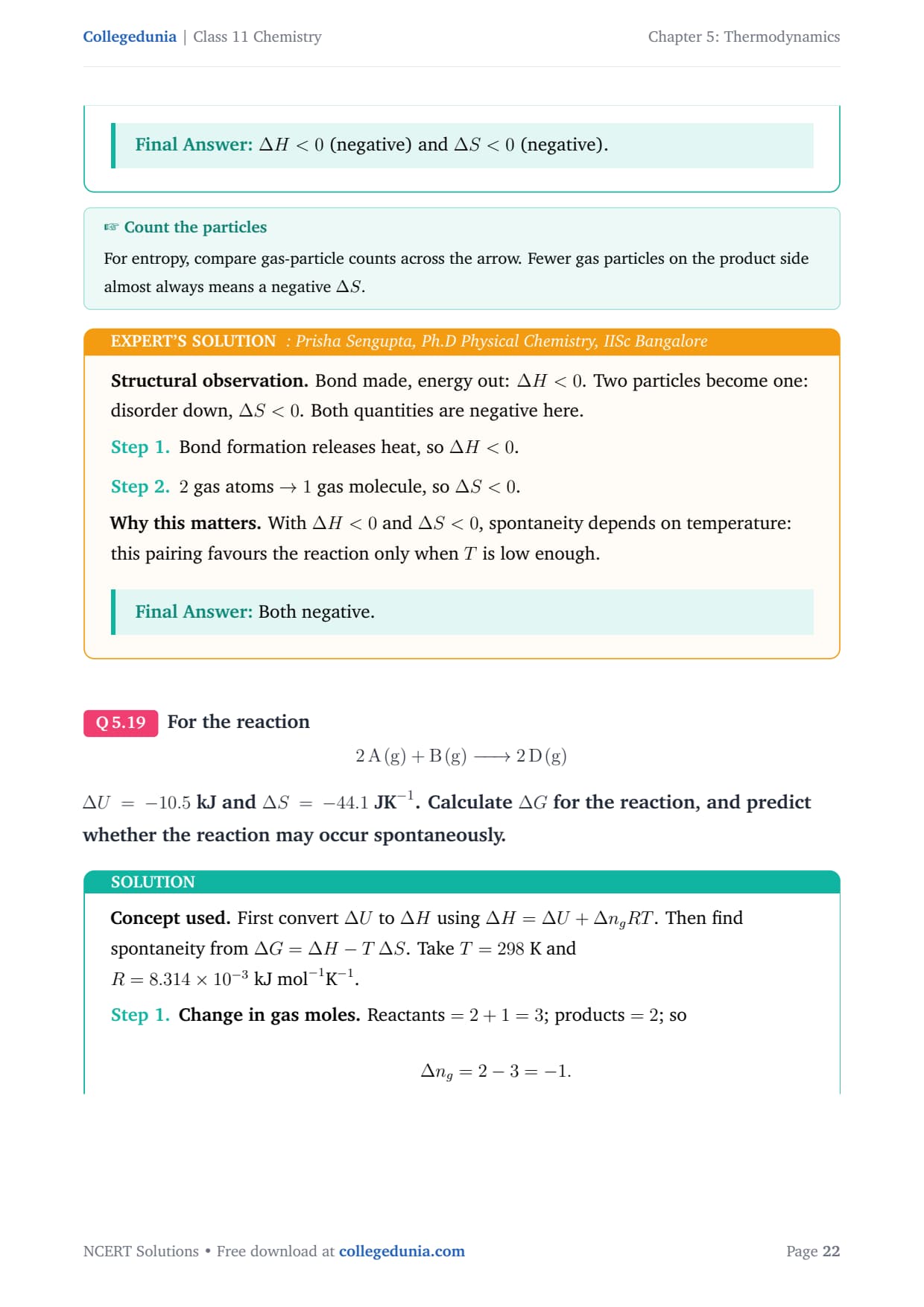
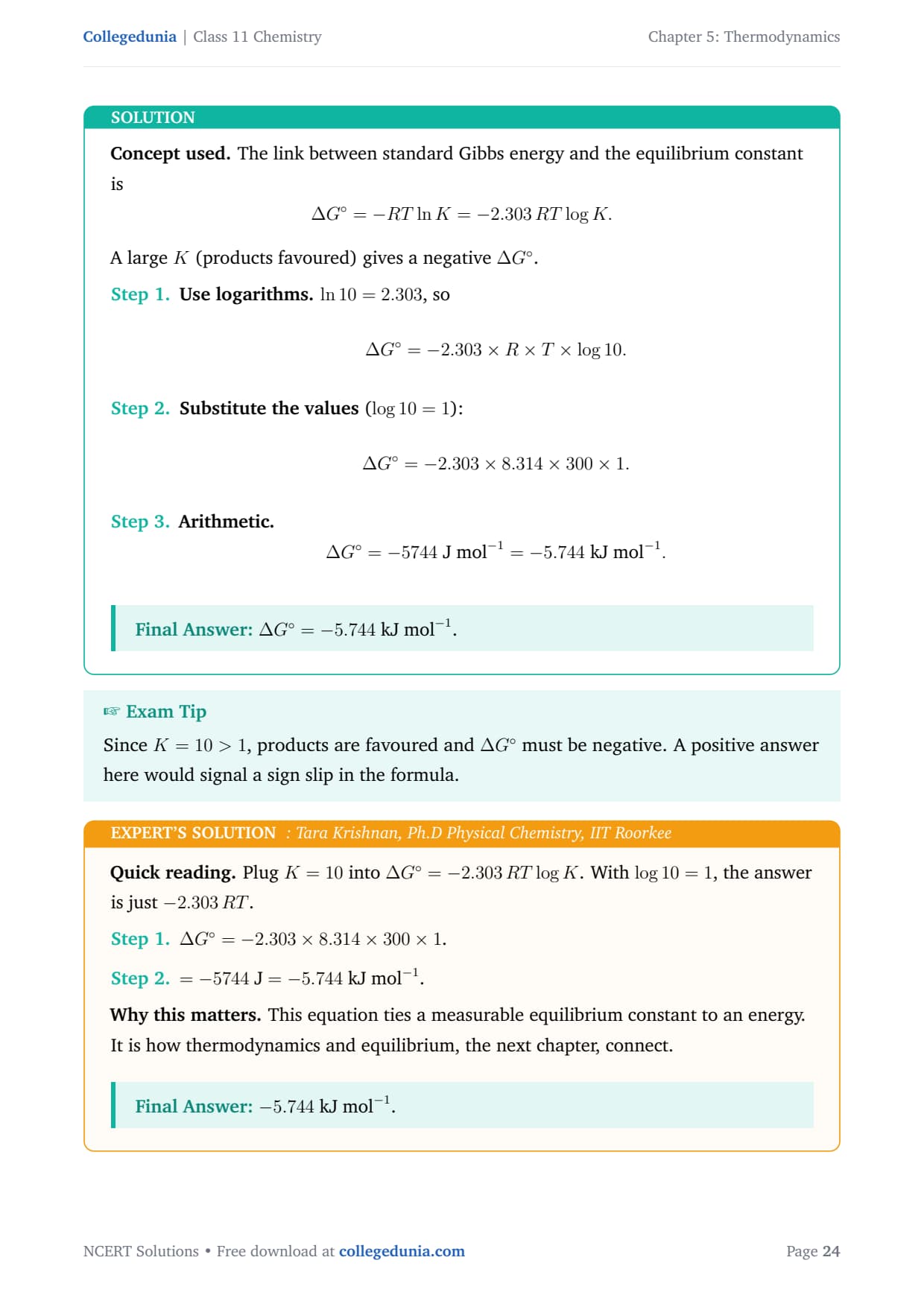
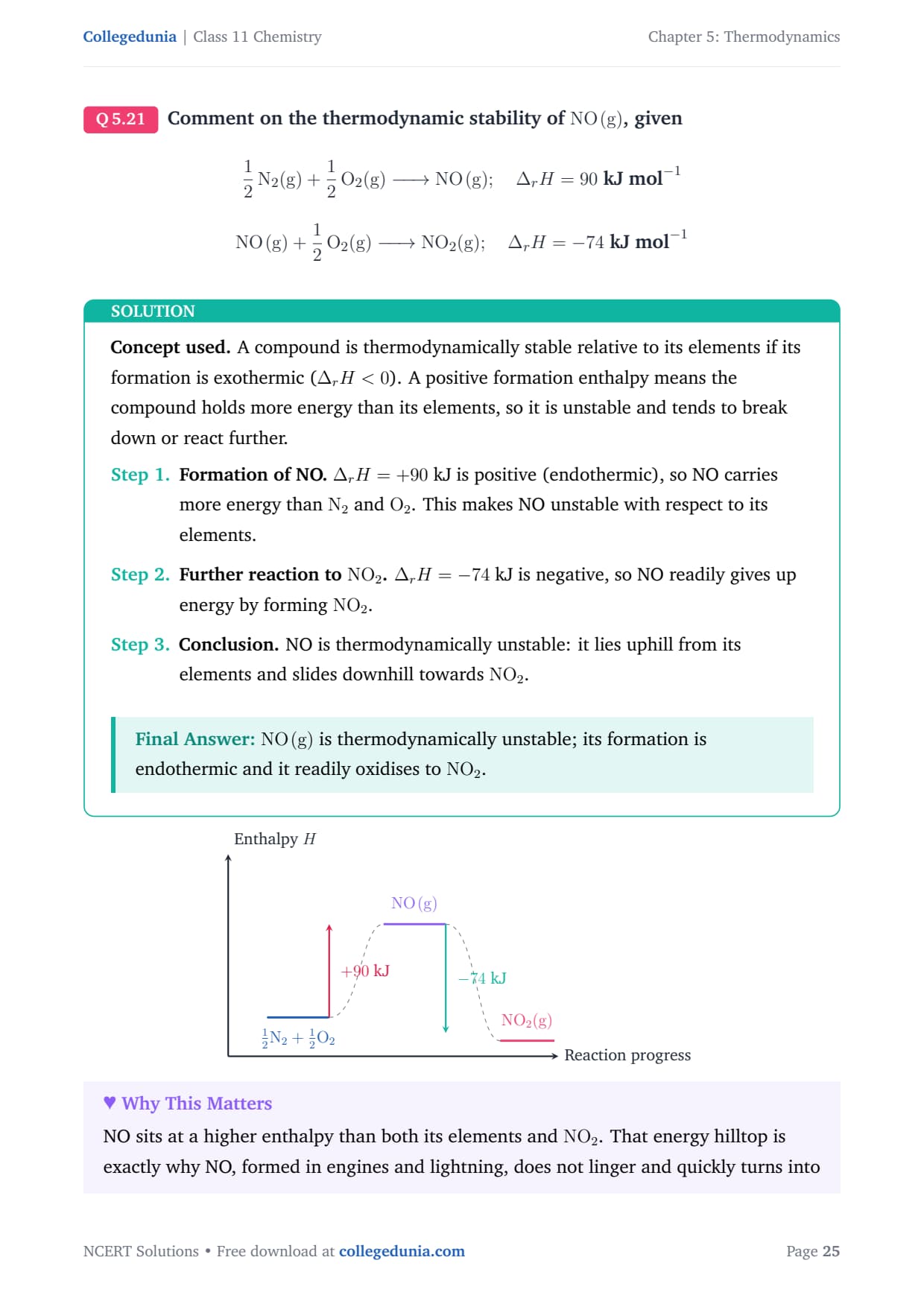
The Gibbs energy change is ΔG = ΔH − TΔS, where T is the temperature in kelvin. A reaction is spontaneous when ΔG is negative, at equilibrium when ΔG is zero, and non-spontaneous when ΔG is positive. A negative ΔG means the reaction can proceed on its own at that temperature. Because the equation carries T, a reaction that is non-spontaneous when cold can become spontaneous when heated, which explains why temperature is so often the twist in these questions. This is the single most tested idea in the whole chapter.
Thermodynamics Exercise-wise Breakdown
The NCERT back exercise has 22 questions that mix theory with short numericals. The intext questions check one idea each. The table below maps the question blocks to their topics so you can plan your practice.
| Question block | What it tests |
|---|---|
| Q 5.1 to 5.5 | System types, state functions, and first-law basics. |
| Q 5.6 to 5.12 | Internal energy, enthalpy, and ΔH versus ΔU calculations. |
| Q 5.13 to 5.18 | Hess's law, enthalpy of formation, and bond enthalpy problems. |
| Q 5.19 to 5.22 | Entropy, Gibbs energy, and spontaneity at different temperatures. |
The intext questions before the exercise are shorter and check one idea, such as the sign of ΔH or a single first-law substitution. Solve the intext set first, then the back exercise. Every question in the class 11 chemistry NCERT solutions chapter 5 Thermodynamics PDF is solved with each step shown, so you can compare your working line by line.
Practice the solved questions: Work through the full question bank with step-by-step answers and expert tips.
Common Mistakes Students Make in the Thermodynamics Chapter
Most marks are lost on signs and definitions, not on hard ideas. Each slip below costs 1 to 2 marks, so watch for them at the exact step.
Mistake 1: Getting the work sign wrong. In the NCERT convention, work done on the system is positive and work done by the system is negative.
Mistake 2: Confusing ΔH and ΔU. Use ΔH = ΔU + ΔngRT and count only the change in moles of gas.
Mistake 3: Forgetting to convert temperature to kelvin before using ΔG = ΔH − TΔS.
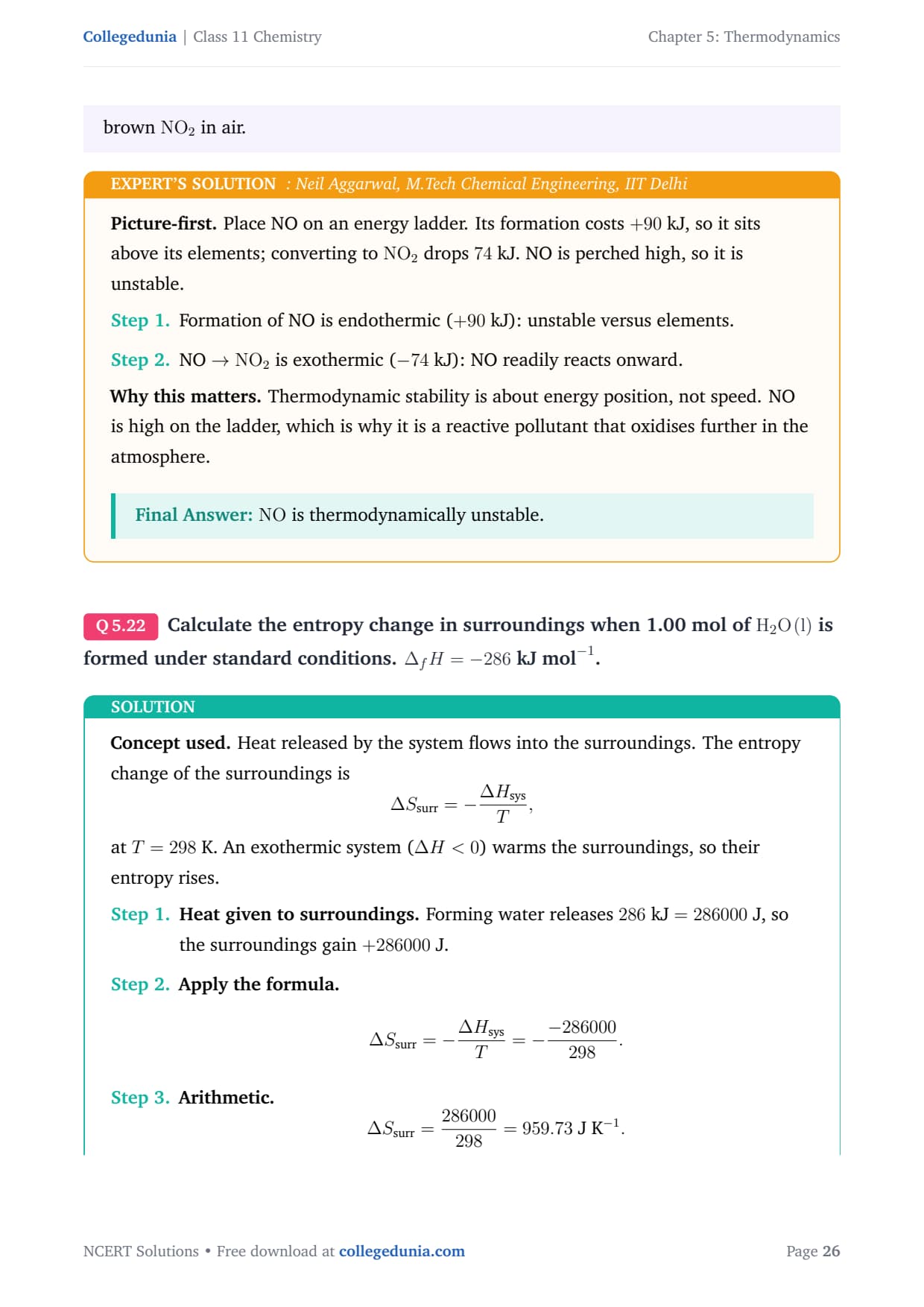
Mistake 4: Mixing up entropy units. ΔS is usually in J K-1 while ΔH is in kJ, so make the units match before subtracting.
Student Feedback on the Thermodynamics Solutions
What 12,480 students told us about their Thermodynamics preparation:
- 61% of students rated the sign conventions for heat and work as the hardest part of the chapter.
- Most-skipped step: converting the temperature to kelvin before applying the Gibbs energy equation, missed by about 3 in 10 students.
- Students who learned the state-function idea first said Hess's law problems became straightforward.
Source: 2026-27 Class 11 Chemistry student poll. Sample of 12,480 students from CBSE schools across 15 states, conducted before the 2026 boards.
Other Thermodynamics Class 11 Chemistry Resources
Pair these solutions with the revision notes and the NCERT textbook PDF for the same chapter.
| Resource | Link |
|---|---|
| NCERT Notes | Thermodynamics Class 11 Notes |
| NCERT Book PDF | Thermodynamics Class 11 Book PDF |
NCERT Solutions for Class 11 Chemistry: All Chapters
Jump to the step-by-step solutions for any other Class 11 Chemistry chapter below.
| Chapter | NCERT Solutions |
|---|---|
| Chapter 1 | Some Basic Concepts of Chemistry |
| Chapter 2 | Structure of Atom |
| Chapter 3 | Classification of Elements and Periodicity in Properties |
| Chapter 4 | Chemical Bonding and Molecular Structure |
| Chapter 5 | Thermodynamics |
| Chapter 6 | Equilibrium |
| Chapter 7 | Redox Reactions |
| Chapter 8 | Organic Chemistry Some Basic Principles and Techniques |
| Chapter 9 | Hydrocarbons |
FAQs on Thermodynamics Class 11 NCERT Solutions
Thermodynamics NCERT Solutions - Frequently Asked Questions
Ques. What do the class 11 chemistry NCERT solutions chapter 5 Thermodynamics cover?
Ans. These solutions cover all 22 back-exercise questions and the intext questions, including system and surroundings, internal energy, the first law of thermodynamics, enthalpy and heat capacity, enthalpy of reactions, Hess's law, bond enthalpy, entropy and Gibbs energy. Every question is solved step by step with the correct sign convention.
Ques. What is the first law of thermodynamics in Class 11 Chemistry?
Ans. The first law of thermodynamics is the law of conservation of energy. It states that energy is neither created nor destroyed, only changed in form. For a system, the change in internal energy equals the heat added plus the work done on the system, written as ΔU = q + w.
Ques. What is the difference between ΔH and ΔU?
Ans. ΔU is the change in internal energy, equal to the heat exchanged at constant volume. ΔH is the change in enthalpy, equal to the heat exchanged at constant pressure. They are linked by ΔH = ΔU + ΔngRT, where Δng is the change in the number of moles of gas. When no gas moles change, the two are equal.
Ques. What is Hess's law of constant heat summation?
Ans. Hess's law states that the enthalpy change of a reaction is the same whether it occurs in one step or several steps. It follows from enthalpy being a state function. You can add or reverse reactions to reach a target equation and add their ΔH values the same way, which lets you find an enthalpy that is hard to measure directly.
Ques. How does Gibbs energy decide whether a reaction is spontaneous?
Ans. The Gibbs energy change is ΔG = ΔH − TΔS. A reaction is spontaneous when ΔG is negative, at equilibrium when ΔG is zero, and non-spontaneous when ΔG is positive. Because the equation contains temperature, a reaction that is non-spontaneous when cold can become spontaneous when heated.
Ques. What is the weightage of Thermodynamics in CBSE Class 11?
Ans. Thermodynamics carries about 6 to 8 marks in the CBSE Class 11 Chemistry paper, mostly through numerical and reasoning questions on the first law, enthalpy and spontaneity. It is also tested heavily in JEE Main and NEET, where Gibbs energy and Hess's law problems appear almost every year.



Comments